
The Shirt 37 features class ring, Golden Dome
By Matthew Morin Associate News Editor
At 4:30 p.m. Friday, The Shirt Committee at Notre Dame announced its 37th annual design, a navy color with a class ring and the Golden Dome on the back.
The first Shirt was created during the 1990 football season. That year, the University sold 9,000 shirts that featured a hand-drawn design with then-Coach Lou Holtz. In recent history, 2011’s Shirt, entitled “Cheer Cheer For Old Notre Dame,” has sold the most at 165,000 purchases. Proceeds of the initiative are split — half going to the University to support clubs, organizations and the Office of Student Enrichment, and the other half going to The Shirt Charity, “which helps students afford unexpected medical expenses,” according to the organization’s website.
This year’s Shirt was unveiled in Duncan Student Center after poor
Holy Spirit Chapel marks 100th
By Aynslee Dellacca Managing Editor
“There are some places that seem almost too beautiful where they’re planted … hidden here on the third floor of the Le Mans hall, the Chapel of the Holy Spirit is just such a place. To call it a hidden gem doesn’t quite do it justice, does it? It is more like a quiet heartbeat: steady, faithful, life-giving, at the very center of this remarkable building for the past one hundred years,” Fr. Bill Lies said. Lies is the provincial superior for the U.S. Province of Priests and Brothers for the Congregation of Holy Cross.
Lies’ remarks on the chapel echoed throughout the nave, where scores of attendees sat and listened to his homily for the 100th anniversary of the Chapel of the Holy Spirit’s dedication. The Mass, celebrated Friday, was the 100th anniversary to the day. A 24-person community choir, made up of students, alumnae, faculty, staff, sisters and community members, led the congregation in liturgical worship. Lies was accompanied by Fr. Felipe Campos and Fr. Joseph Lorenz.
Generally, the Holy Spirit Chapel is reserved for students throughout
NEWS | PAGE 3
The default meal plan has given students 500 Flex Points since 2017 despite price increases.
year anniversary
the school year because of its location in the center of the residence portion of Le Mans Hall. However, for a few times out of the year, the chapel is open to the tri-campus community. This Mass marked one of these special occasions, “widening the invitation” to faculty and staff to celebrate Mass in Saint Mary’s landmark building.
“Holy Spirit Chapel is so beautiful and such an icon of the College because it’s nestled into the heart of Le Mans and surrounded by student residences. We aren’t able to bring even faculty and staff or off-campus friends into it as often as we would ideally like. It’s what makes today so special,” vice president for mission Molly Gower said.
The planning for this dedication, however, began nearly two years earlier when Director of the Center for Faith, Action, and Ministry Nicole Labadie became interested in the chapel’s 100th anniversary during the College’s celebrations for Le Mans Hall’s centennial.
Labadie described herself as “having a dream” to host a large celebration after learning from the College’s archivist Eric Walerko the century milestone hadn’t passed yet.
The original dedication date, April
TUESDAY, APRIL 28, 2026 | VOL. LX, NO. 61 SPORTS | PAGE 11
weather conditions forced the event off of its original location on Library Lawn.
Opening events included a performance by the Notre Dame Glee Club, singing its signature rendition of “Tonight” from West Side Story.
Fr. Pete McCormick, assistant vice president of Campus Ministry, emceed the event, keeping the audience engaged with jokes and various activities throughout. Following the Glee Club, McCormick brought up several children from the audience to play “Simon Says.”
The Undertones performed its cover of Jason DeRulo’s “Whatcha Say,” followed by McCormick taking the stage to engage the audience again. McCormick called out various colors, encouraging the audience to cheer for the color they hoped the Shirt would be.
He called out, “purple” and “pink,” receiving minimal cheers,
see “Shirt” on page 3
Richard Clark to lead Sheedy Program
24, 1926, had been lost to time until Walerko found the original worship guides within Saint Mary’s archives.
“I’ve been recounting a lot of just how much this chapel has seen over the past 100 years. It has been a place of such encounter: encounter with God, with community, in moments of silence and stillness. It has seen numerous weddings, many confirmations, many words of healing through the sacrament of reconciliation. It has been a place where students and Saint Mary’s community members and sisters have paused, bringing anguish, joy, grief and peace,” Labadie said during the anniversary Mass.
A post-Mass reception held in Stapleton Lounge invited those in attendance for the Mass and the general Saint Mary’s College community to digitally view the found archival materials and enjoy snacks, Holy Spirit Chapel-themed stickers and prayer cards. Students, alumnae, sisters and community members alike shared their appreciation for and memories of the Holy Spirit Chapel.
“When I first came here, I didn’t really know who I was or what I
see “Chapel” on page 4
By Mara Hall Associate News Editor
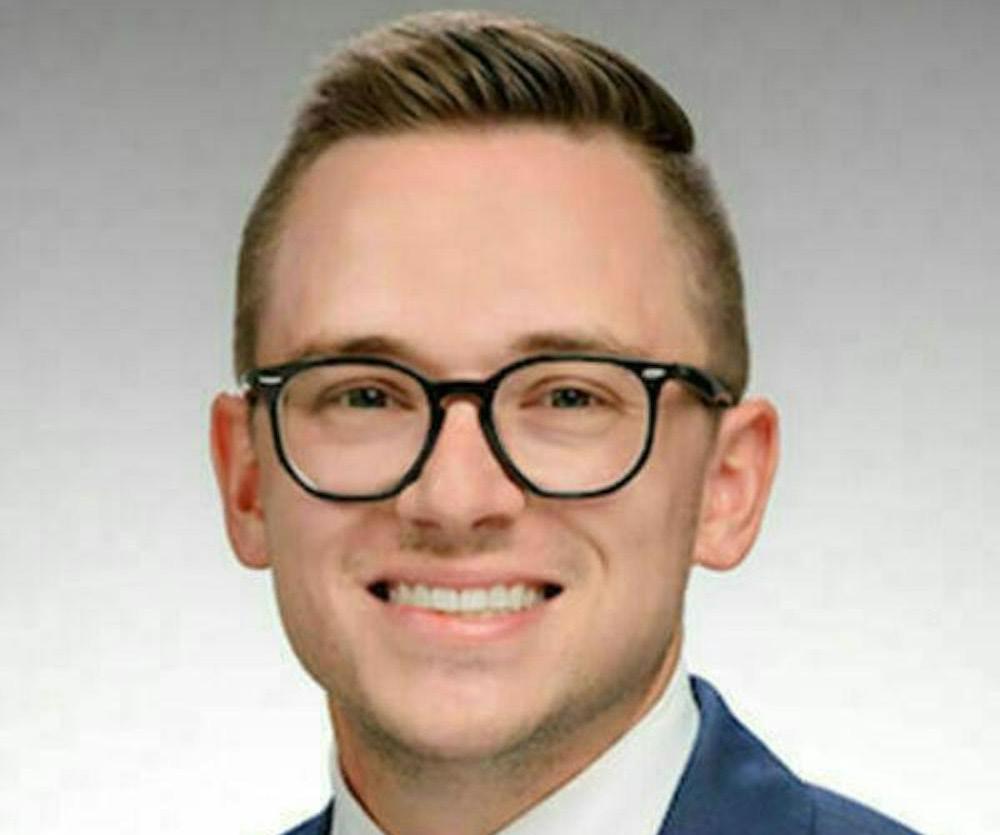
After serving as the director of the Sheedy Family Program in Economy, Enterprise and Society since its conception in 2022, Paul Blaschko is being replaced by Richard Clark, a tenure-track assistant professor of political science. Blaschko is leaving the University
at the end of his current contract, which runs through June 30. Clark will assume the role July 1. The program unifies a business background with a liberal arts pedagogy for students with concentrations in both Mendoza College of Business and College of Arts and Letters. The program includes
see
on page 3
Williams stepping up Aneyas Williams to follow in the footsteps of Love and Price, continuing their strong legacy.
MATTHEW MORIN| The Observer
The Shirt Committee, singing Notre Dame our Mother, wearing the 2026 Shirt. Despite bad weather forcing the event indoors to Duncan Student Center, the Shirt Committee revealed their 37th Shirt Design Friday.
“Sheedy”
Courtesy of the University of Notre Dame Assistant professor of political science Richard Clark will replace Paul Blaschko as the new director of Sheedy Family Program.
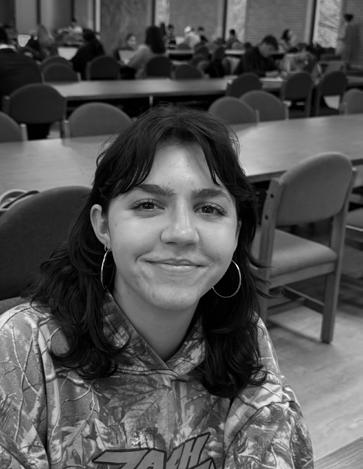
Victoria Rossi sophomore Regina South Hall “Teleportation.”
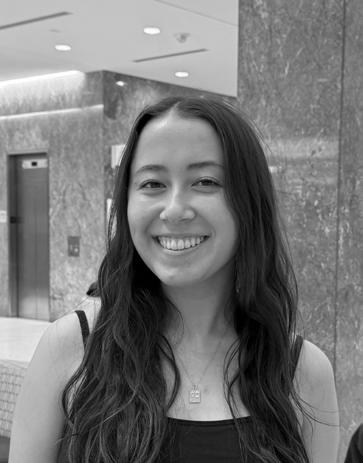
Sarah Neus senior Lyons Hall “Teleportation.”
What superpower would you want?
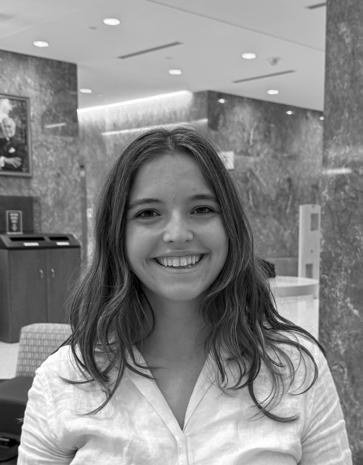
Ava Zehnder junior Holy Cross Hall “Super speed.”


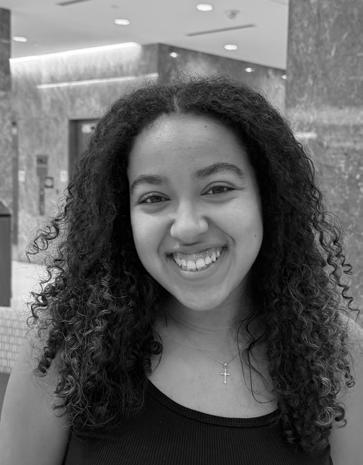
Ally Pelikan senior Lyons Hall “Invisibility.”
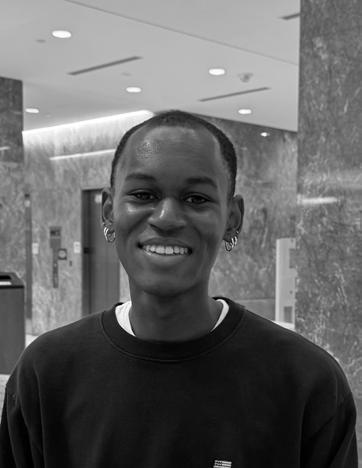
Eli Jackson senior Baumer Hall “Anything but invisibility.”
How are you feeling about finals week?
Tuesday
Lecture “Artemis Lunar Science”
Kelsey Young ‘09 speaks on her work in the 2026 space flight.
6:30 - 8:30 p.m.
101 DeBartolo Hall
Wednesday
Notre Dame Softball vs. DePaul
The Irish go head to head with the Blue Devils at home. 6:00 p.m.
Melissa Cook Stadium
Thursday
Film “The Artist” (2011)
The advent of the talkies silent movie star and extra’s careers. 6:30 p.m.
DeBartolo Performing Arts Center, Browning Cinema
Friday
Notre Dame Baseball vs. Stanford
The Irish fight off the Trees as they come to South Bend. 6:30 p.m. Frank Eck Stadium
Saturday
Notre Dame Women’s Tennis vs. Arizona
The Fighting Irish challenge the Wildcats on neutral turf. 10 a.m. Auer Tennis Complex & Live Stream
PHOTO OF THE DAY | EMMA SMITH
Le Mans Hall undergoes interior renovations
By Sofia Flores News Writer
Le Mans Hall, the largest residential hall that simultaneously serves as an administrative building at Saint Mary’s College, has undergone intensive renovations throughout the year, specifically on the first floor.
The construction of the Prikkel Advising, Career, and Experience Center, a new facility that combines the former academic advising office and Career Crossings office, began in fall 2025 with a recent unveiling held in January. According to executive director of marketing and communications Charlie Simpson, the outer side of the center is set to be finalized in the next month.
“Construction on the north exterior entrance to the PACE Center is progressing well and should be
Sheedy
Continued from page 1
three required courses and offers a variety of optional electives open to cohort students, despite it not being a degree, center or institute.
Dean of the College of Arts and Letters Kenneth Scheve explained in a written statement to The Observer that this leadership turnover comes after a standard review of the program. He shared that this review found that the program “was highly valued by students and an important part of their Notre Dame experience” connecting to the “quality of the stewardship of this program by its current leadership team.”
Yet, this report also found room for expansion, which required a social scientist as director.
“Because of that positive evaluation, we wanted the program to continue in its current direction. At the same time, we identified that in our efforts to bridge the liberal arts to careers in business there was room in the College and in the Sheedy Program to do even more,” Scheve wrote.
In an information session for students in the program on Monday, associate dean for undergraduate studies Mary Flannery said this growth is “not changing what is existing, but adding to it.”
Shirt
Continued from page 1
followed by “gold,” which received some cheers from the audience, and “green,” receiving more cheers than all of those before it. Joking with the audience, McCormick said the obvious next color choice must be orange, before calling out blue and receiving a majority of cheers from the audience.
McCormick also led Notre Dame trivia, with topics ranging from the first year of the Shirt to the football coach who has won the most national championships at Notre Dame.
The next act to perform was the
complete in May. This enhancement will improve both access and the overall arrival experience for students, visitors, and members of the campus community,”
Simpson wrote in a statement to The Observer.
He provided insights on renovations being made throughout the rest of the floor, including specific entrances into the hall and how it expands the interior space.
“Inside Le Mans Hall, we are making targeted cosmetic improvements to further enhance key gathering spaces. Near the west entrance to Reignbeaux Lounge, updates to the welcome desk area are underway. This includes extending the existing low walls to meet both the desk and the ceiling, creating a more cohesive and polished appearance,” he explained.
Simpson also described changes
Scheve explained that, to implement this expansion, they determined a need for a social scientist to serve as director, while also having the current leadership board remain, such as Blaschko.
He wrote, “The opportunity to continue leading the core aspects of the Sheedy program as associate director was verbally offered to him, but he declined the role.”
At the Sheedy student information session, Blaschko announced his departure from the University following the end of his contract. While he was regretful that he was unable to state where he was going next, he shared that he had several offers and would be staying in South Bend. He plans to continue attending the dinners, a key aspect of the program.
While limited in the details he could share ahead of an official announcement, Blaschko wrote in a statement to The Observer, “I’m extremely proud of what Chris and I have built with all our students and collaborators, including many in the Dean’s office and across the university, over the past five years. This program has meant more to me than I can express, and I’m most proud of the community our students have formed. The Sheedy program is distinct in so many ways, and I’m excited to see what’s next.”
Clark explained that one of his
Hawaiian Club, dancing two separate dances, followed by Project Fresh, who breakdanced for the audience.
Halftime, an a Capella group, sang “Neon Trees” by the Animals and “Somebody to Love” by Queen before the Bagpipe Band marched into the Student Center, performing a variety of songs before concluding with the Notre Dame Victory March. Irish Dance of Notre Dame and Saint Mary’s College was the next group to take the stage, shortly followed by McCormick returning once again to gauge the crowd’s choice for color of the Shirt, before welcoming the Planning Committee onto the stage.
The Planning Committee,
being made within the first floor next to the president’s office that will incorporate more technology instruments.
This includes “installing new digital displays that will recognize members of the Board of Trustees and our generous donors, while also featuring student photos and mission-focused messages. These updates introduce light, color and dynamic imagery that better reflect and celebrate the vibrancy of our community.”
Regarding a timeline on when these interior renovations will be completed, he shared that it will be finalized in mid-May to align with commencement events.
Sophomore Victoria Mac, a resident of Le Mans Hall, “got to see the whole entire process from start to finish” due to her work over the summer in the Office of Admissions
key goals is to expand the program, and he noted that he has explicitly been brought on to “bring in some social science perspectives to the program.”
Within those goals, Clark explained that they have heard existing students emphasize the importance of the current cohort structure. In the most recent admissions cycle, they have admitted two cohorts of around 30 students each, totaling 60 students. Clark believes this is, “probably the upper bound of what a cohort structure would look like.”
Regarding the social science aspect, Clark cited his work on the Global South development and world business, falling in line with the program’s mission.
In terms of program structure, he noted that this expansion of social science could either look like a collection of strong social science offerings within the electives, or it could look like some of the current required classes being transitioned to electives.
In an effort to reach freshmen, Brett Beasley, an assistant teaching professor in the program, has been building out the Business Explorers Program, which predates the leadership changeover plans.
The yearlong program, launching fall 2026, will feature the “Business for Humans” class. With one goal of the program being “preventing
co-chaired by seniors Molly Sullivan and Anna Huber, came onto the stage, noting that since 1989, over 3.5 million shirts have been sold, resulting in over $13.5 billion raised for students at the University.
Freshman quarterback CJ Carr, junior cornerback Leonard Moore, freshman receiver Quincy Porter and junior defensive tackle Francis Brewu were all present alongside the committee as the countdown began.
The front design reads Notre Dame, split down the middle by the University’s traditional-style class ring. The backside depicts four football players, wearing the numbers 1, 8, 4 and 2 — a nod to the University’s founding year, pointing upward at the Golden Dome.
as a summer admissions assistant.
She highlighted how the interior renovations came as a surprise to her and how it has presented challenges in giving tours to incoming families.
“I think it’s a little interesting how they are starting a new project, though, at the end of the semester. As someone who gives tours it looks a little funny sometimes,” Mac said. “It would be ideal to have this start and done in the summer and not during the academic year.”
She also described how the implementation of the PACE Center has helped in centralizing academic resources for students to access.
Mac explained that it helps her “showcase the opportunities and the support that we have here. I know that Saint Mary’s is all about that. Even me, as a student, I also use those resources as well.”
midlife crisis,” the course will guide students to engage with self-assessment, discernment and videos with program alums.
Flannery explained that “literally nobody” thinks the way the information on the departure was communicated was “done well,” describing it as a “PR should-be case study of where information got out before people were really ready to announce it.”
Sophomore Paul Kaminski, part of the Sheedy Family Program, explained that he learned that Blaschko was unlikely to be allowed to continue serving as director after he volunteered this information during his “Work, Meaning, and Happiness” class.
After learning this, Kaminski felt the need to create a platform for the community to take action, so he started a petition April 17 with the goal to highlight “the impact Paul has made on the program and on all of our students’ lives,” he said in an interview with The Observer.
To achieve this goal, he invited students and alumni to share anecdotes. On the first full day the petition was live, it reached over 100 signatures. As of Monday, the petition has 136 signatures and 21 supporter voices.
Kaminski and other students at the session expressed to The Observer their concerns that the replacement of Blaschko marks a
Speaking to The Observer, Sullivan said the design process for The Shirt began during the fall semester. The team first needed to choose a vendor before deciding on the primary color of the piece of apparel. She said that this year, the Committee mainly focused on different varieties of the color blue, saying they wanted to choose a design that would be “accessible to a lot of different skin tones and making sure that it’s something many, many people will be excited to wear.”
Junior Ava Zalduendo, also a resident of Le Mans Hall, believed that the PACE Center’s location was an improvement in comparison to its previous one in Spes Unica Hall. “I think it’s definitely a great addition compared to what we had in Spes with the original career center. Just a lot more modern [and] open. There’s plenty of lounge space just for studying even if you’re not using any of the career offices,” she said.
Junior Sofia Dahl-Santoro shared that while the PACE Center and interior renovations may be helpful, they also present a negative side in depriving Le Mans architecture: “I always feel like additions onto Le Mans kind of take away from its antique beauty.”
Contact Sofia Flores at sflores01@saintmarys.edu
deviation from Sheedy as a teaching program and aims to bring in more research aspects.
Despite noting that his research fell in line with Sheedy’s values, Clark shared, “I think Sheedy’s place on campus is less research oriented and more pedagogical.”
Flannery noted that she has looked into how the Sheedy Family Program could collaborate with research more at different points in time but said, “The Sheedys did not give money for there to be a lot of research.” She also specified that the shift from the director being on teaching track to tenure track is a secondary effect.
Chris Hedlin, another founding member of the program, is set to serve as associate director beginning July 1. Hedlin did not respond to our request for comment, with an out-of-office message noting she was on parental leave this semester.
Kaminski said Blaschko told him that the number of seats in the “God and the Good Life” class, which he co-created, was being cut from the typical 900 to 1,100 per year to only 450.
This is in line with course offerings for previous years, based on analysis of historical data by The Observer since 2022.
Contact Mara Hall at mhall27@nd.edu
The words, “Love Thee Notre Dame” — the final line of the Alma Mater — are imprinted on the back, with an image of a clock on the left sleeve — the time set to 18:42. Sullivan described the time as an “easter egg.” The words on the front are in the same font as the words, “In Glory Everlasting,” above the World War I Memorial Door at the Basilica.
“The Shirt is kind of all over the world, which is cool to make that much of an impact on Notre Dame history,” Sullivan said.
Sullivan said the navy shirt is designed to include both a football and faith identity, with this year being the first time in 27 years that the Shirt includes an image of the Dome. She noted that the stars above the Dome are the stars in the Basilica.
Contact Matthew Morin at mmorin2@nd.edu
Flex points flat for 8 years despite rising prices
By Mara Hall and Henry Jagodzinski Associate News Editor and Assistant Managing Editor
At Au Bon Pain in Hesburgh Library, the price of a chicken caprese sandwich is $10.89. At Modern Market in Duncan Student Center, a chipotle chicken wrap will set you back $12.75. At Garbanzo Mediterranean Fresh in the Hesburgh Center for International Studies, a falafel bowl starts at $13.29.
Prices at on-campus cafes, restaurants and fast food chains have increased over the last several years. The number of flex points, the Universityprovided currency that many students use to pay for meals at such locations, however, has not. Data on specific price increases for menu items at Notre Dame are not publicly available.
Students on Notre Dame’s default meal plan have 250 meal swipes, which can be used at
the University’s two dining halls over a 16 week semester. Students on the meal plan also receive 500 flex points, effectively $500 attached to a student’s account that can be spent at on-campus dining locations.
The number of flex points the University provides to students has remained flat at 500 since the 2017-2018 school year, despite inflation over nearly a decade, including a particularly steep pandemic-era rise in prices.
In the 2016-2017 school year, students received more flex points than the current academic year, which totaled at 660, in an effort to stem overcrowding in the dining halls during the renovation of North Dining Hall. South Dining Hall is currently undergoing a major multiyear renovation, but students did not receive a bump in their flex points this time around. During the 20152016 academic year, students
received 410 flex points.
According to the U.S. Bureau of Labor Statistics, food prices are 36% higher today than in 2018. To have kept pace with that metric, the number of flex points for students would have had to have increased from 500 to 680 over the same time span. Data indicates that nationally fast food prices surged even higher than general inflation over the same time period.
Charges for meals and housing at Notre Dame have risen significantly since the 20172018 school year. In that year, costs for room and meals was $14,890. This year, that cost was $18,438, an increase of 24%.
In a statement to The Observer, Notre Dame Dining did not indicate immediate plans to raise the number of flex points provided to students.
“Changes to meal plan structures, including Flex Point
allocations, are evaluated periodically and are informed by operational costs, inflationary pressures, student usage patterns and the overall sustainability of the dining program. At the same time, ND Dining is actively focused on value-oriented offerings across retail locations to help students stretch their Flex Points further during a period of sustained inflation,” the statement read.
Freshman Daniel Lee said he did not feel as though students had enough flex points, adding that he had used his entire balance by around March. He suggested that 750 flex points may be an adequate number.
Sophomore Bridget Selna said she had used up her flex points by the beginning of April.
“Personally, I run out of my flex points really fast,” she said. “I guess we are due for a little increase, especially because prices are rising, like Starbucks, all the prices have risen a ton.”
Other students suggested that meal plans offer greater flexibility. Sophomores, juniors and seniors are eligible to change their meal plan to have 20 fewer dining hall swipes in exchange for a $245 credit each semester. Freshmen, however, cannot change their meal plan, and only seniors can opt for a meal plan with fewer than 230 meal swipes.
“I think students get enough flex points, but I wish that you could convert some of your dining hall swipes into flex points,” sophomore Ava Schroeder said.
Freshman Lila Griesemer expressed a similar desire.
“I would not mind a few more flex points in exchange for some of the dining hall swipes because I have way too many,” Griesemer said.
Contact Mara Hall at mhall27@nd.edu and Henry Jagodzinski at hjagodzi@nd.edu
Johnson Family Hall hosts Family Feud event
By Maria Alice Souza Maia News Writer
On Thursday at 7 p.m in the Carey Auditorium in the Hesburgh Library, Johnson Family Hall hosted its annual signature event, “Johnson Family Feud,” which entailed a game of Family Feud between teams of Notre Dame students supporting For the Good South Bend.
Six teams participated in the competition, with two semifinalists and one winning group. Participants were asked questions ranging from dorm stereotypes to the best places to eat, both on and off campus.
Chapel
Continued from page 1
wanted to study or what I wanted my future to be,” Paige Parker ’24, a graduate student at Notre Dame, said. “And every time I felt that way, I would just go to the Holy Spirit Chapel and sit in silence. And I found that that silence offered me such a great comfort that I necessarily couldn’t find anywhere else.”
Sophomore Tori Diaz, the operations coordinator for CFAM, said one of her favorite places on campus is sitting in Holy Spirit Chapel and believes its presence on campus offers a meeting place with Christ for students.
“I think it’s just really nice to have a space of worship, especially having Jesus so close to me inside my own dorm, you know? It’s so accessible, and it’s really important to have somewhere where He’s
Kristina Erskine, a participant from the winning group comprised of students from Kansas City, spoke with the Observer about why she and her group wanted to participate in the game, saying, “I love the Johnson Family Feud. I thought it was a great way to spread Notre Dame culture.”
Bill Hayes, another member of Erskine’s team, similarly said, “We got a group together from KC. All five of us are from KC, and we thought trivia would be a lot of fun together, and we thought we’d be pretty good, and we won.”
Elle Dahle and Jiya Patel participated on the second-place team in the semifinals.
Speaking with the Observer
always there waiting for you. Even at three in the morning, I can just go over there and spend time [with Him].”
The original vision and construction of Le Mans Hall and the Holy Spirit Chapel began with the College’s first president, Mother Pauline O’Neill, at a time where the student population was little more than 300 students.
“Mother Pauline O’Neill and the Holy Cross sisters envisioned not just a building, but a home: a place where young women would grow, stretch, pray, laugh and occasionally stay up way too late,” Lies said during his homily.
The Chapel has undergone a number of changes since its original dedication. Labadie estimates the majority of the renovations, including the repainting of the walls and the reorientation of the altar, occurred during the era of Vatican II. The pews, flooring, stained glass windows, several
before the event, Dahle said, “Our team is all from Lewis Hall. We’re here to compete, and we’re really excited to play. We hope to win.”
“We came in ready to win. We practiced last night for two hours. We’re ready to represent Lewis, and we also love JFam,” Patel said.
Free food was served in the back of the auditorium, including chips with buffalo chicken dipping sauce, soda and water. Guests were invited to offer a donation for the food.
To attend the event, a single ticket cost $6 at the door and $5 if purchased beforehand. To register a team, it cost $10, with all proceeds going to For the Good South Bend.
architectural accessories and the prominent marble statues of Mary, Joseph and the infant Jesus, however, are original to the chapel’s design.
The Stations of the Cross mosaics lining the walls of the chapel were a gift on behalf of the Class of 1958 and designed by Barbara Kluth Harrigan ’58 and Joan Roytek DeMerchant ’58 as part of their senior comprehensive projects. The statue of St. Josephine Bakhita, which is located near the entrance to the chapel, was commissioned and placed in 2022.
Reflecting on Lies’ homily, which called Holy Spirit Chapel as the “beating heart” of Saint Mary’s, Labadie finds the analogy to hold true based on her witness and experiences during her time at the College.
“I think it’s a place where people have encountered God deeply and each other in deeper ways as a community
For the Good South Bend is an institution based in South Bend whose mission is to foster a community of support, one that seeks the common good of its South Bend neighbors. The organization has a food shelf and a variety of support programs for homeless people among other initiatives.
Sophomore Isabella Tobin, who is part of the events committee in Johnson Family Hall, spoke with the Observer about the event and the planning process.
“The process for putting the event together probably started two months ago. We started thinking through kind of how we wanted this to work, where we wanted to be for it. We knew this
is our signature event as we’re a newer dorm and we’re still working on getting it up and going,” Tobin said. She continued, “We talked a lot with marketing so they could help get our questionnaire out so that we could spread the word and get answers. We needed a new answer bank with lots of new questions. We did that and used that as advertising. Then we had teams all sign up. About a week or so ago, we started putting together the bracket with all the different questions to put on a good event.”
Contact Maria Alice Souza Maia at msouzama@nd.edu
of faith and that emphasizes faith in spirituality. Mass and worship of God is like our primary expression of community,” she said. Contact Aynslee Dellacca at adellacca01@saintmarys.edu

Should AI decide your future career?
By Noah Shoman Columnist, “The AI Era”
A student choosing a career today faces a new question: not “what do I want to do?” but “what won’t AI take from me?” It’s a tempting way to think, but it’s also the wrong one. This shift has created growing concern about job stability and how long roles will remain secure.
After the public launch of ChatGPT in November 2022, a working paper coauthored by Harvard Business School professor Suraj Srinivasan found that job postings for roles involving repetitive tasks decreased by 13%, while demand for jobs requiring analytical, technical and creative skills increased by 20%. A key question today is whether AI is working for us, with us or instead of us. Instead of focusing on the jobs AI can’t replicate, we should focus on the characteristics and skills that they can’t achieve. Philosophers have long explored what it means to live a good life and make ethical decisions. These skills can never be replicated by AI because they rely on human judgment and reasoning. These are the skills students
should aim to develop. Students should not choose their careers based on what AI cannot replace; instead, they should focus on developing judgment, critical thinking and ethical reasoning that AI fundamentally lacks.
The rapid growth and incorporation of AI in different fields has begun to create significant fear about job security, especially among young people entering the workforce. As AI continues to be developed, its capabilities to perform tasks that once required human workers will continue to grow. From customer service to writing emails, AI is beginning to take over many routine tasks or predictable responsibilities. This creates real concern because many jobs still rely on routine work. Previously, assistants were highly valuable, but AI chatbots can now perform many of those tasks. Many workers are now questioning the long-term security of their jobs. This uncertainty is especially concerning when it comes to students still choosing their career path. This raises the question of whether students should prioritize passion or focus on job stability when choosing a career. Recent research
from Goldman Sachs suggests that as AI becomes more widely adopted, up to 6–7% of U.S. jobs could be displaced. The Goldman Sachs study suggests that AI taking over the job market is not just a distant possibility but an active force reshaping the labor market daily. As a result, students and employees alike are increasingly drawn to safe career paths, usually not defined by their own
PAID ADVERTISEMENT
passion. Instead, they should focus on building the skills that ultimately make them human.
Skills like developing judgment and critical thinking help individuals to interpret situations, make quick decisions and adapt to problems. Unlike AI, humans must weigh consequences and context when making decisions.
AI can process information, but it cannot exercise judgment or take
Thank you, LRC Tutors!
responsibility for decisions. It cannot understand consequences or make moral judgments in the way humans can. Additionally, humans incorporate emotion and moral reasoning when making decisions. This is why choosing a career based solely on trying to avoid AI is not only unrealistic, but also limiting.
The Notre Dame Learning Resource Center congratulates all of the University’s graduating seniors. We especially want to congratulate and extend our sincerest gratitude to those students who served as tutors with the Learning Resource Center.
* Served for at least four semesters
Kate Ancona
Natalia Araujo do Carmo
Ingrid Azrak
Lauren Bangasser
Adriana Baniecki
Joseph Bartolomeo*
Gannon Becker*
Aidan Betts*
Nicholas Bifone
Claire Bleou
John Blount
Matthew Broder
Kathleen Buhrfiend
Stev Butrus
Braden Carroll
Daniela Casciani Sanoja
Mason Cohen*
Alfred Crosby*
William Crutchlow*
Quinn Deitch*
Luke Denn
Charles Desnoyers*
Torri Distefano*
Batradz Djikkaity*
Antonio Dolojan*
Jack Doohan*
Katerina Duncheskie
Hailey Dysert
Aidan Ekizian*
Nneze Ekowa*
Zachary Erling
Aidan Fleming
Bryce Frailey
John Gadbois
Kennedy Gallaher*
Sarah Gann*
Catherine George
Thomas Gore
Molly Hergenrother*
Lindsey Hermann*
Kyle Hill
Jillian Hinck*
Phoebe Huang
Josie Humbert
Alana Jardenil*
Ella Johnson*
Abigail Jones*
Allen Karottu
Ryan Kelley*
Declan Kelley
Kathryn Klein
Luke Lagunowich
Sophia Lama
Jonathan Lewis
Lang Li*
Jack Markillie*
Camille Anne Martinez
Paul Mattiola
Rowan McDonnell
Kelly McGlinn*
Rose McGuigan
Reid McMillan
Richard Mistichelli*
Valentina Morillas
Nathan Muetzel
Shaelin Murphy
Aidan Murray
John Nelson
Sophia Neuendorff*
Emma Newman
Megan O'Connor*
John Oliver*
Elizabeth Orchen-Baker
William Pater*
Daniel Pena Valinotti*
Matthew Politte
Santosharupa Ponna*
Jack Rellinger
Delaney Reynolds
Kristen Rizkalli*
Brody Rolston*
Jake Ryan*
Alan Saldivar*
Emma Sanders
Caroline Sarneso
Liam Schlosser
Brooke Stumm*
Richard Taylor
Nathan Theodore
Joseph Truluck
Rosa Vega Rodriguez
Esteban Velasco*
Karlee Waugh*
George Xu
Sonia Zhang
Keyang Zhou
The LRC only functions because of the outstanding students who choose to serve and support their fellow undergraduates. Whether you realize it or not, you impacted not only those individual students you worked with, but you also helped make the University’s academic community stronger. Thank you for your generosity with your time, energy, and talent. Good luck with whatever comes next for you, and we look forward to seeing what great things you will achieve in the future.
With gratitude, Chris Temple and Greg Macklem
LIAM FLYNN | The Observer
Continued from page 5
Focusing on career paths that one hopes are safe from AI is a misguided approach. Some argue that choosing an “AI-proof” career is the most practical decision. Although it might seem like a smart idea to pursue a job that is less likely to be automated, thinking this way oversimplifies how AI will actually affect the workforce. AI doesn’t simply eliminate entire careers; instead, it changes how the work is done within them. Many professions that people might assume are “safe,”
such as medicine, law or education, are already being reshaped by AI. For example, while AI can assist doctors with diagnosing illnesses, it cannot replace the ethical judgment humans are required to make in life-threatening moments. Similar changes are already happening in other fields. In law, AI is increasingly used to assist with research and document review, changing the role of junior attorneys and associates. In business, professionals use AI for data analysis and forecasting, shifting the focus toward interpretation and strategic decision-making. Even in education, AI is
being used to generate content and assist with grading, changing how teachers interact with students rather than replacing them entirely. There is no guarantee of job security by attempting to avoid technology. As a result, trying to choose a career solely based on what one believes is safe from AI can limit their options and push them away from fields they may be passionate about. Rather than focusing on avoidance, students should prioritize adaptability and continue developing the kinds of skills that allow them to grow alongside new technology.
As AI continues to reshape
the workforce, the way students think about careers must change with it. Although AI will continue to transform industries and automate tasks, it is not replacing human value, but rather reshaping it. Careers will not disappear, but rather evolve. This brings value to individuals who can adapt, think critically and make ethical decisions in situations where AI falls short. For this reason, choosing a career solely based on the limitations of AI is both limiting and temporary in its logic. Instead, students should focus on building the skills that remain relevant regardless of
what happens with technology, allowing them not only to survive in an AI-driven world, but to actively shape it. The real risk is not that AI will replace us, but that we will limit ourselves by trying to avoid it. Students will be better prepared for the future not by avoiding AI, but by learning to work alongside it while strengthening the skills that make them human.
The views expressed in this column are those of the author and not necessarily those of The Observer.
Write to Noah Shoman at nshoman@nd.edu
When your visa declares your major
When Lara Victor arrived at Notre Dame from Taubaté, Brazil, she had a plan: international economics, a degree that combined her interests and made sense for the career she wanted. She found out it was the wrong plan, not from an adviser, but from another Brazilian student who had figured it out the hard way. International economics and economics look nearly identical on paper — the same field, two fewer classes — but only one carries a STEM designation, and that distinction determines whether a student can legally work in the United States for one year after graduation, or three. Victor switched.
“I felt basically forced,” she said. “There was no other reason.”
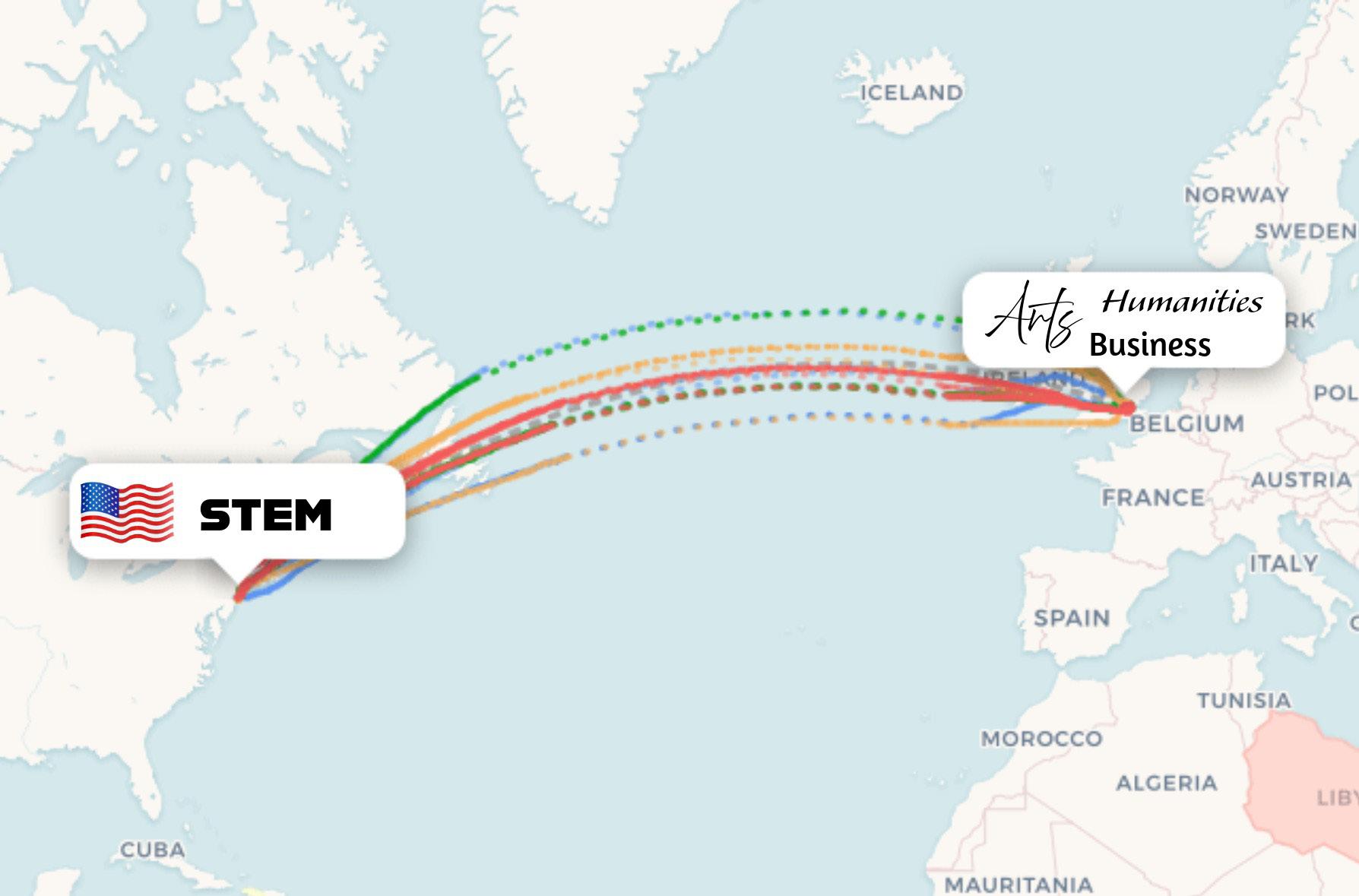
Optional Practical Training allows international students to work in the United States for 12 months after graduation. A STEM-designated degree extends that to three years, and with them come three chances at the H-1B lottery instead of one and access to employers who won’t invest in someone they might lose in a year. At elite recruiting levels, where a final round might have 20 equally qualified candidates, that distinction is critical.
“When you have that level of competition,” Roberto Pereira, a junior from Rio Grande do Norte, Brazil, said. “If I wasn’t at par with another applicant who had the three-year extension and I didn’t, I’m not sure I’d still have my job today.”
Pereira and Victor are both heading to McKinsey this summer. Both reshaped their academic paths around what the visa required. “It’s definitely a double-edged sword,” Roberto said. “I’m not sure which way I’d cut it.”
What makes this system function, to the extent that it does, is largely the students themselves. Both Pereira and Victor learned about OPT
distinctions, not from advisors or orientation materials, but from Brazilian upperclassmen who had navigated the same maze a year or two before. When Victor brought the issue to her advisors, she found them caught off guard — surprised, she said, by the distinctions between what counts toward the designation and what doesn’t.
Tyler Grant, Notre Dame’s dedicated career adviser for international students, estimates that about half the students who understand the OPT landscape learned it from a peer. He has seen the consequences for the other half — students who arrived a semester behind on the information, who trusted the wrong source, or who didn’t have the right person in the right hallway at the right time.
“If you didn’t get on that train early enough,” he said. “There’s not really another stop.”
According to Grant, the majors that absorb the most OPT-driven enrollment are predictable: engineering, economics, ACMS and now finance, which received its STEM designation this past fall. That last shift is already reshaping departments. Victor said that economics professors are bracing for enrollment drops — international students who were double-majoring in economics solely for the visa designation will no longer need to.
For international students, the second major has rarely been a question of curiosity. It has been a calculation — which combination keeps the designation, which field is close enough to what they wanted and still checks the right federal box. American students double major in things that interest them. International students double major in things that protect them.
This is the quieter cost: Not that international students end up somewhere wrong, but that they are cut off from a version of college their American peers take for granted — the freedom
to pair a professional major with something they chose purely because they want to.
Grant invokes “pressure makes diamonds,” and the cases exist. Pereira switched into business analytics reluctantly and found he liked it more than finance. But a system that occasionally generates growth through constraint is not, for that reason, a well-designed one. The student who was forced into a harder major and thrived is a real outcome. So is the student who spent four years in a discipline chosen not for curiosity but for a visa category — and who never found out what the alternative might have looked like.
Grant sees the starkest version of this in engineering. Aerospace students, for example, arrive as one of the most passionate group on campus — students who built things in their bedrooms as kids and came to Notre Dame because they wanted to work on rockets. Then they discover that aerospace, heavily tied to defense contracts, offers almost no straightforward path to employment for international students. They end up usually transferring to mechanical engineering. For some of them,
according to Grant, it is purely a business decision, and they set aside the thing they loved to make it.
International students make up 10% of Notre Dame’s population. If Grant could change one thing, it would be to go department-by-department and ensure that faculty and advisors actually understand what their international students can and cannot do — which jobs they can apply for, which designations matter, which deadlines they are navigating that their American classmates are not. Grant said a global affairs professor once sent an international student a list of State Department openings. The student could not apply for any of them.
Ten percent of the student body is navigating this primarily by peer connections. That is the institutional failure underneath the individual stories.
Victor advises international students arriving at Notre Dame to “just get a STEM major. Don’t be all hopeful and dreamy. Just have a major you enjoy, and have a major that will give you a job and a visa. That’s what you need to do.”
As I write this piece, I would like to pause on that word
— dreamy. Every international student at Notre Dame got here through an act of ambition that most people never attempt — crossing borders, learning languages, competing for a spot at one of the most selective universities in the country, while often carrying the weight of a family’s expectations alongside their own. International students are, by definition, dreamers of the most obstinate type. But the system they enter upon arrival is not built for innocent dreamers. It is built for students who already know, before their first semester, which majors carry which designations, which employers sponsor which visas and which hallways to walk down to find the upperclassman who will tell them what the adviser could not. The aerospace student who came to build rockets and left with a mechanical engineering degree did not stop dreaming. They just learned, quickly, what dreaming costs.
The views expressed in this column are those of the author and not necessarily those of The Observer.
By Maria Eduarda Grill Columnist, “Below the Dome”
LIAM FLYNN | The Observer
NFL Draft
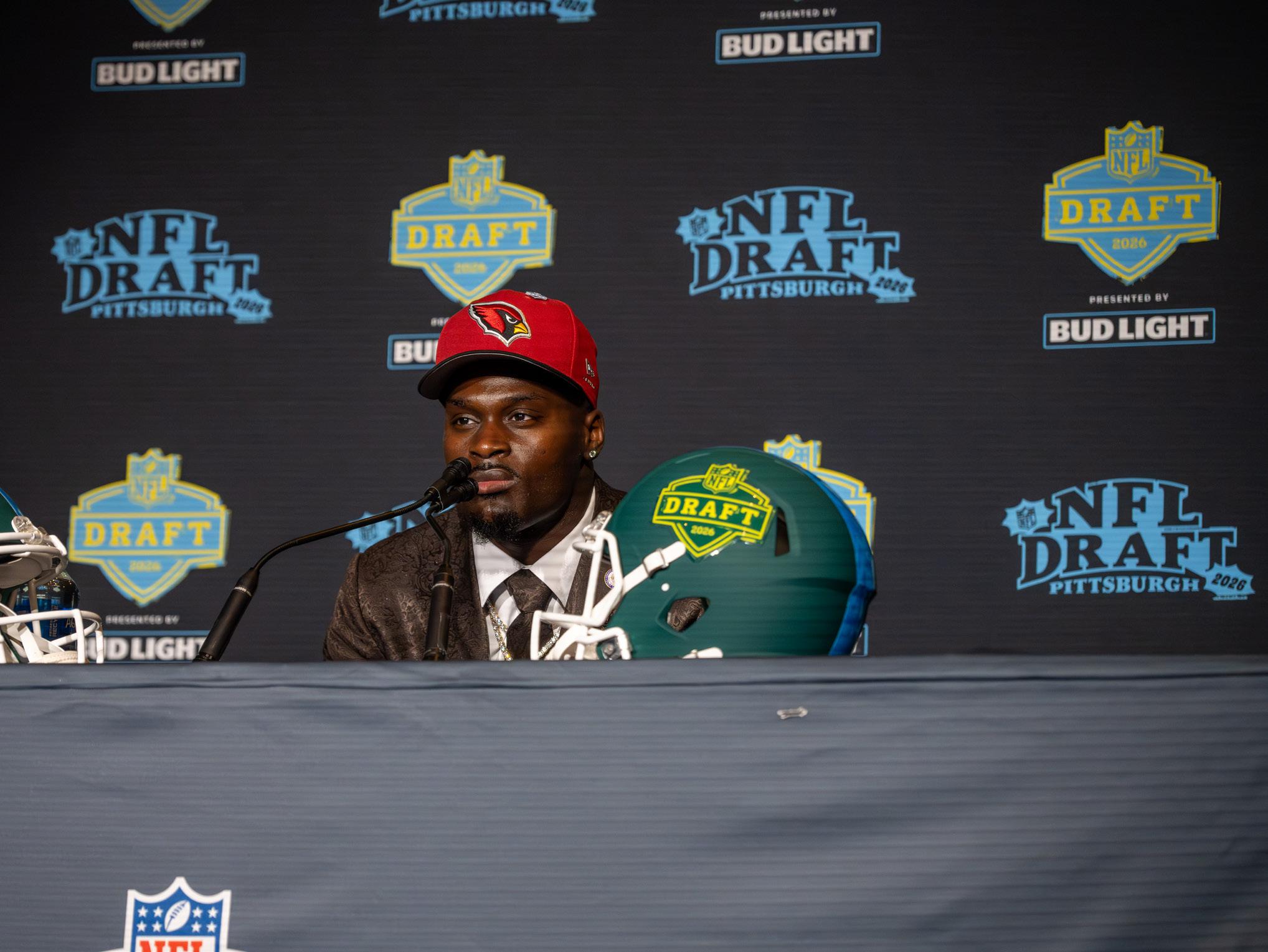
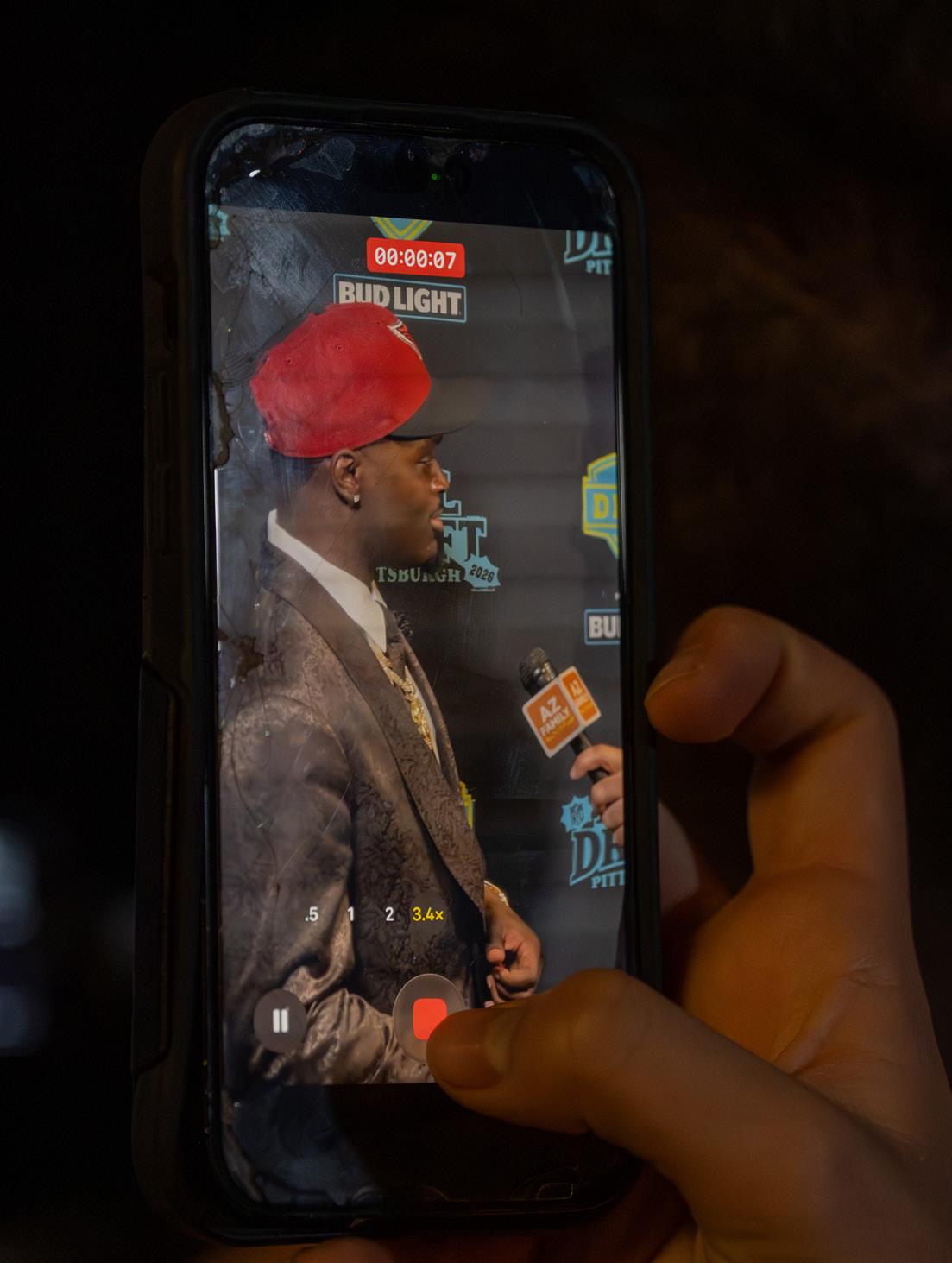
On Thursday, April 23, Jeremiyah Love was selected 3rd overall in the 2026 NFL Draft to the
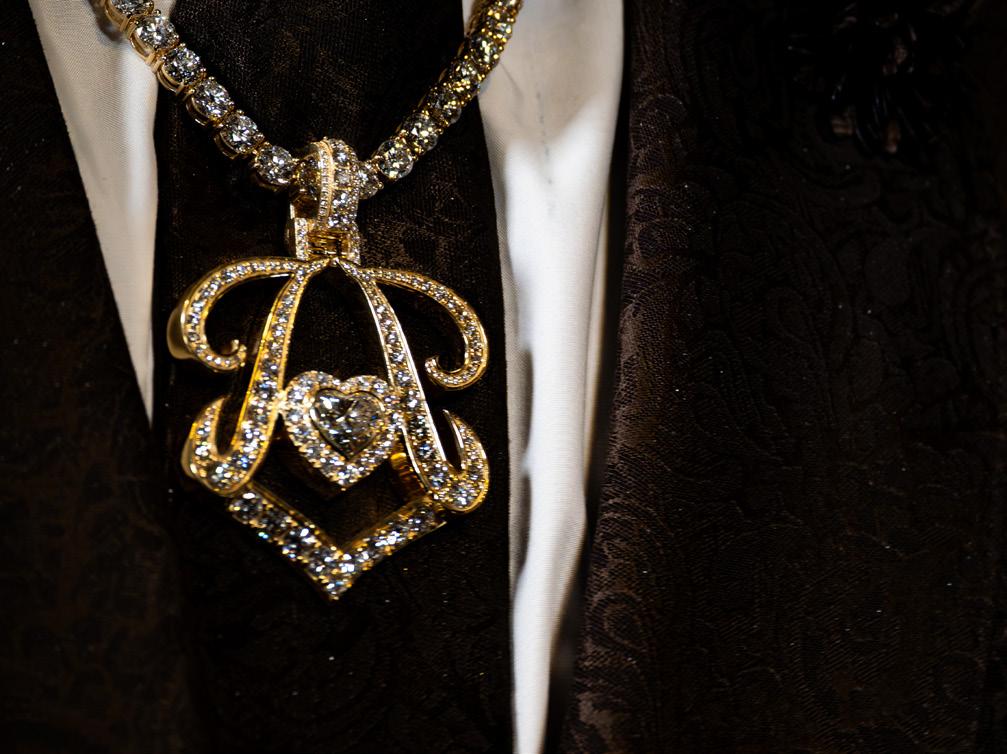

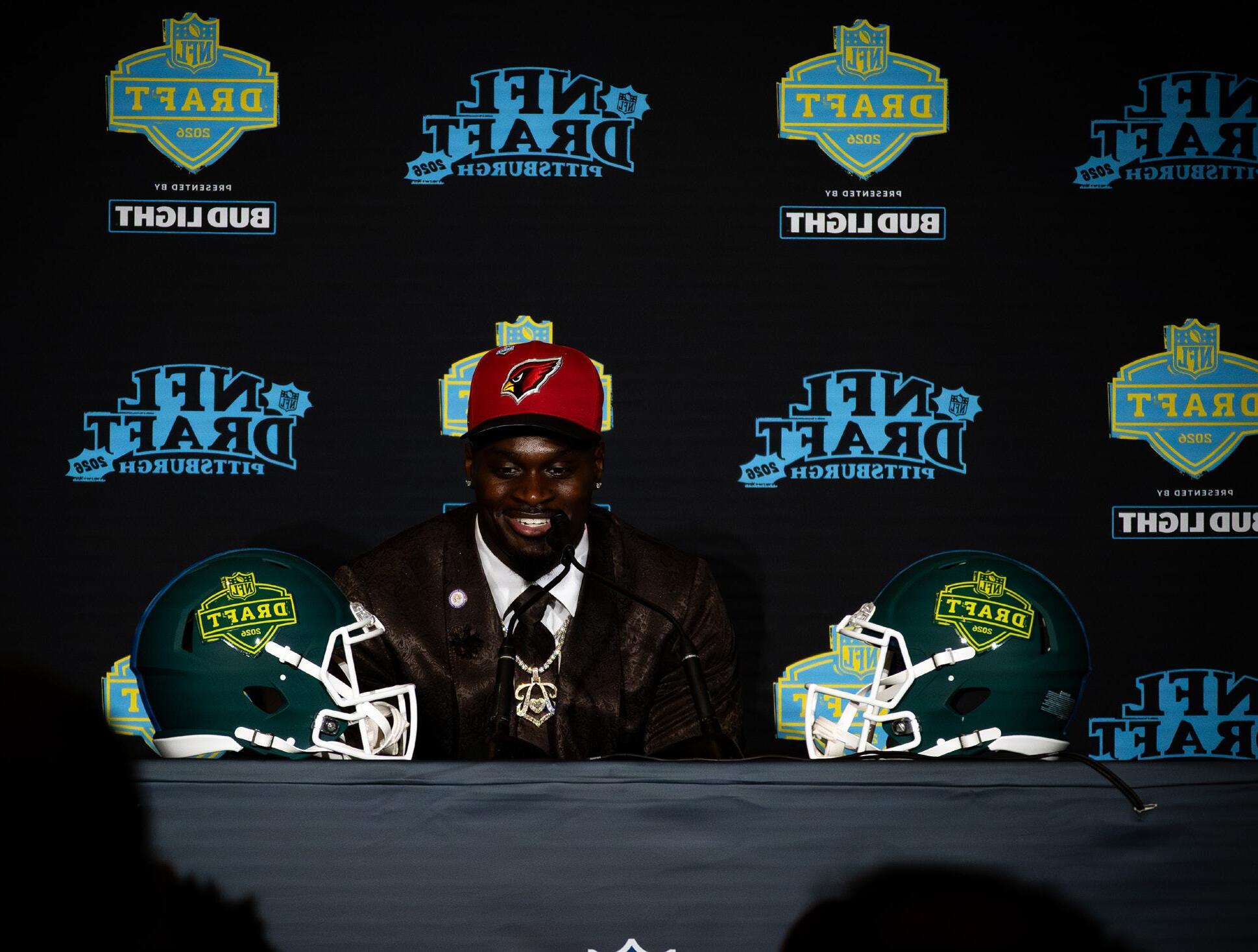
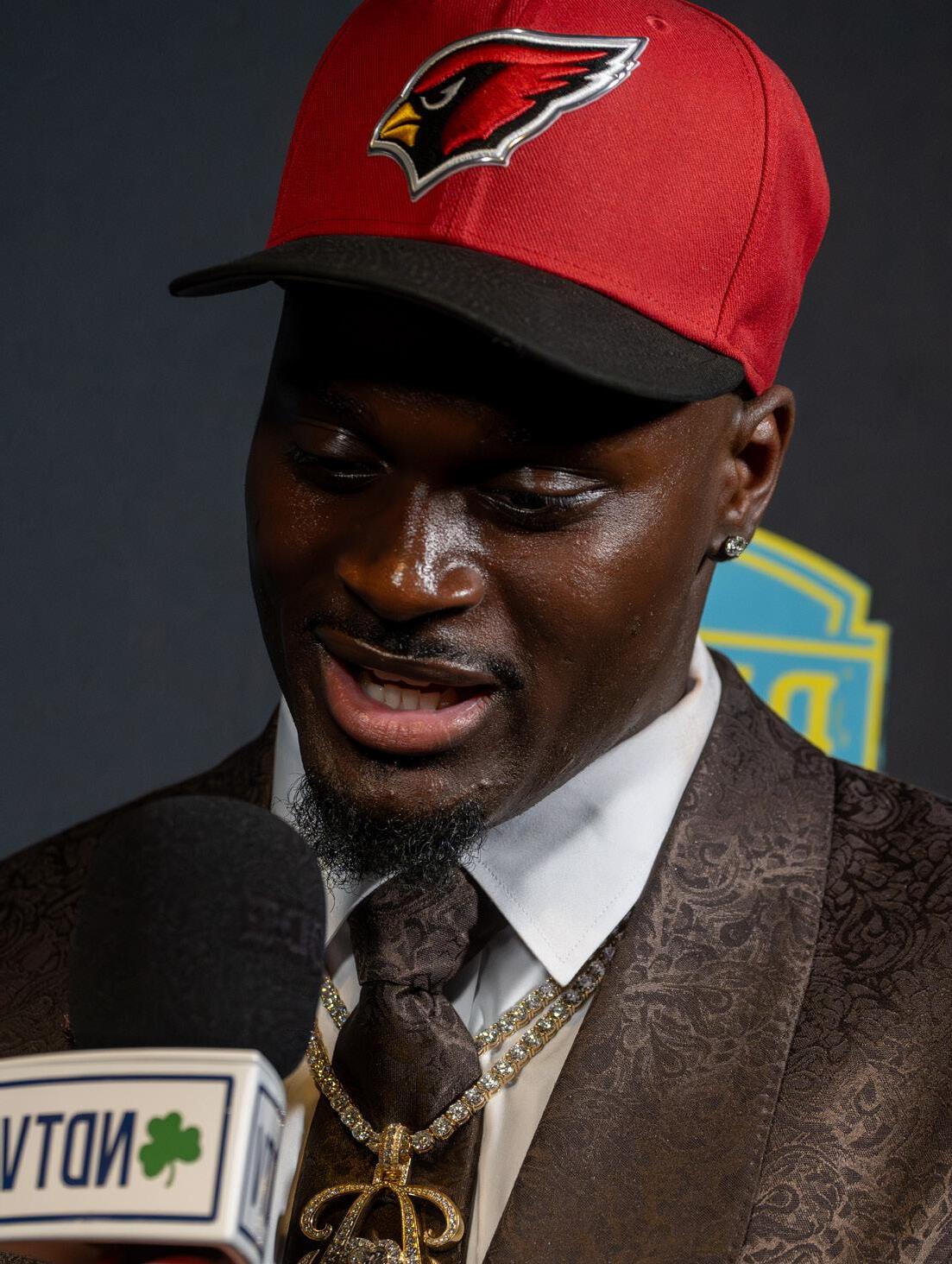
Arizona Cardinals.
Photography by Photo Editor Mariella Taddonio and Assistant Photo Editor Keira Jones
‘Michael’ is a dazzling but shallow spectacle
By Luke Foley Scene Editor
During my childhood, Michael Jackson was treated as an American folk hero. I grew up in the wake of his untimely death in 2009, which instantly shifted his image in the public consciousness from a circus freak to a mythical visionary. His music was played constantly, and family members who grew up during his imperial phase in the ’80s spoke of him with stunned reverence. They talked about him like he was an omnipotent extraterrestrial who mercifully graced us humans with song and dance. It seems this attitude toward Jackson is quite commonplace; no public entertainer has come close to cultivating his level of aura. Taylor Swift, Drake and Bad Bunny have only grazed his worldwide domination. But underneath the success, there was a darkness to Jackson. His eccentricities were rooted in serious psychological damage, and there are, of course, the numerous allegations of child sexual abuse leveled against him. Trying to deal with all this in one biopic film is no small task, yet “Michael” boldly stepped up to the plate this past weekend.
“Michael” is unashamedly an exercise in image rehabilitation, having been commissioned by Jackson’s estate shortly after the explosive “Leaving Neverland” documentary aired in 2019. It has also been through production hell since then; the entire third act, which explicitly addressed the CSA allegations, had to be completely reshot due to a forgotten legal settlement that prohibited dramatization, resulting in a ballooning budget of nearly $200 million. The resulting film is less a film and more a reenactment of Michael Jackson’s peak

— a reenactment it admittedly pulls off really well.
The film shows no interest in innovating the biopic genre, opting for the tried-and-true cradle-to-grave approach, albeit stopping just before his career became tainted by damaging allegations. We open on the Jackson family living in Gary, Indiana, as tyrannical patriarch Joseph Jackson (Colman Domingo) ruthlessly grooms his sons to be a superstar band. Here, after a surprisingly graphic scene of corporal punishment on a young Michael, the movie swiftly establishes the main conflict of the film: Michael’s tumultuous, abusive relationship with his father.
Now, this is a perfectly fine angle for a Michael Jackson biopic. The psychological and physical harm inflicted on him by his father was the root of many of Michael’s issues. Yet the film uses it as an alltoo-neat way to quarantine all the darkness of Michael’s life on one external party. It deprives Michael himself of any kind of interiority — we get no real sense of his inner world, the pain he carried,
the anger he fostered, the pathological behavior he developed. He’s simply depicted as a sweet, whimsical nymph with a harmless Peter Pan syndrome. Michael Jackson is probably one of the richest subjects ever for psychoanalysis: you could use his life to explore race, masculinity, beauty, abuse, media, celebrity, trauma and so much more. Yet, the film barely explores any of these. The film’s most interesting moment is a cut between Michael staring at a storybook illustration of Peter Pan and him visiting a plastic surgeon — a juxtaposition that suggests his obsession with Disney and childhood fantasy quietly instilled the Eurocentric beauty standards that would fuel his body dysmorphia and plastic surgery addiction. But beyond this surprisingly inspired analysis, there’s not much to sink your teeth into.
This issue of superficiality becomes especially egregious when the film arrives at his imperial phase of “Off the Wall” and “Thriller.” The film has shockingly little interest in actually depicting the making of
these albums. “Off the Wall” was a watershed moment in Jackson’s career, establishing his creative freedom and brilliance. Yet, the film dedicates a few throwaway lines to explaining its creation. Producer Quincy Jones, who arguably should be one of the most important characters in a Michael Jackson biopic, has barely any screentime. And then all the film dedicates to the making of “Thriller,” the most important pop album of all time, is a two-minute montage of Michael writing lyrics on notepads. What were they thinking?
Jackson was not just a gifted vocalist but a gifted songwriter. He was highly meticulous, obsessing over every little detail of a song’s composition. He and Quincy Jones were brilliant studio craftsmen who made some of the most immaculately produced pop music of all time. Yet, the film doesn’t care about any of that. It’s deeply insulting to Jackson’s legacy to ignore the passion and talent he poured into his studio albums. I’m surprised a biopic that’s so insistent on painting him as a
demigod has so little interest in demonstrating his generational songwriting talent. So if the movie isn’t exploring Michael Jackson’s psyche or creative process, what does it spend two hours doing? Well, it’s mainly recreating some of the most iconic moments from Jackson’s career: his television debut, the “Beat It” music video, the “Thriller” music video, the debut of the moonwalk and the Victory Tour. Now, one might ask what’s the point in these verbatim reenactments when you can just watch the originals on YouTube. And yet the sequences are undeniably well-crafted, with lavish sets and confident direction. They’re also massively elevated by Jaafar Jackson’s incredible performance as his uncle: there are some moments where he is truly indistinguishable from the actual Michael Jackson. But beyond the uncanny physical resemblance, he deftly captures Michael’s whimsical demeanor and fluid physicality. And though the film ending on an awkward time jump to the Bad World Tour is baffling, Jaafar’s final performance of “Bad” — one of my favorite Jackson songs — floored me. For all the film’s structural and narrative problems, it still dazzles with Jackson’s peerless showmanship and reality-bending magnetism.
“Michael” is not a particularly good biopic, but it is an effective one. You won’t find a deep character study of Jackson’s wounded, complex inner life, nor will you walk away with a better understanding of how some of the greatest albums of all time were made. But you will walk away understanding why he was one of the greatest entertainers who ever lived.
Contact Luke Foley at lfoley2@nd.edu
‘Roommates’ is a lighthearted and breezy watch
By Naischa Puri Scene Writer
After his 2023 movie
“You Are So Not Invited to My Bat Mitzvah,” producer Adam Sandler is back with another Netflix Original.
“Roommates,” starring Sadie Sandler as “Devon” and Chloe East as “Celeste,” is a funny, thoughtful and sometimes jaw-dropping comedy-drama about two college (you guessed it) roommates and the growing nature of passive-aggression and psychological warfare between them. With fantastic supporting performances from a stacked cast of Natasha Lyonne, Sarah Sherman, Nick Kroll and
Carol Kane, along with young stars Storm Reid, Ivy Wolk and Bailee Madison, this is a film I would recommend in a heartbeat. During a casual Saturday night viewing with a friend, and after seeing the title in bold yellow across our Netflix homepage and then clicking play, we shared many genuine laughs, screams and “There’s no way she did that,” moments as the film’s runtime of one hour and 47 minutes played out.
The story (warning: spoilers ahead) dives into the toxic friendship between shy and naïve freshman Devon and overbearing, seemingly nonchalant, 20-year-old-but-also-a-freshman Celeste. They
experience a variety of hindrances to their friendship, including but not limited to an exploding turkey, a dorm on fire, the CEO of Staples and a spring break karaoke performance of “Mr. Brightside” by The Killers. While I found the revenge submission to the college-wide campus betterment competition towards the end of the movie a lovely touch, my viewing companion felt differently, melting into second-hand embarrassment.
Another memorable part of the film was the surprise appearance of none other than icon Megan Thee Stallion in the final act. Though some online opinions said the ending was rushed and not good, reviews
were overwhelmingly positive overall. One X (Twitter) user wrote, “finished roommates on netflix solid 6/10 i wish we would’ve got a romantic happy ending with devon and michael cause they were buzzy,” and another wrote, “why was that new movie Roommates on Netflix actually a banger” accompanied by a gif of musical artist PinkPantheress. Others commented on their favor of the film despite the nepotism-filled cast: “roommates (2026) on netflix being randomly very good despite being a nepobaby fest,” referring to the children of Adam Sandler, Laura Dern, Eddie Murphy, Tim Herlihy, Chris Rock and Martin Scorsese all
being members of this cast. Ultimately, I suggest adding “Roommates” to your watch list this weekend if you are looking for an easy-going yet compelling narrative about a tumultuous relationship between college roommates that captures the twists and turns of early college life. The film’s focus on family support and sibling love will warm your heart just as much as it will make you snicker. So, grab some popcorn (and maybe your roommate) and turn on Netflix this weekend to watch this lighthearted, hilarious dramedy.
Contact Naischa Puri at npuri@nd.edu
DIONE QUIAMBAO PAHILAN | The Observer
Key moments from the 2026 Blue-Gold Game
By Ethan Laslo Associate Sports Editor
On a warm and sunny Saturday afternoon, 45,308 fans piled into Notre Dame Stadium for the first time since Nov. 22 for the 95th edition of the Blue-Gold Game — witnessing a 41-40 win for team blue, the offense.
The highly anticipated second year of defensive coordinator Chris Ash and sophomore quarterback CJ Carr drew the second-largest crowd in the history of Notre Dame’s intra-squad game, the record remaining 51,852 back in 2007. In a back-and-forth intrasquad effort, the Irish displayed immense depth and talent across the entire team, including the new-look running back room. Unlike last season’s uneventful affair, this year’s matchup featured a significant amount of action prior to the season opener, kicking off in just over four months time.
Cam Williams deep ball sets up opening score
On the game’s second series, the offense needed just four plays to reach the end zone. After freshman running back Jonaz Walton opened the drive with a four-yard rush, freshman quarterback Blake Hebert found sophomore
wideout Cam Williams on a 53-yard bomb to set up the game’s opening score. Walton needed two tries, but his second attempt from the fouryard line found the end zone for the first traditional score of the afternoon.
Aneyas Williams dominates fifth series
The second period contained arguably the most eventful four series of the game, and the fifth got the ball rolling. Junior running back Aneyas Williams was a one-man show, save for two plays. He gained 21 all-purpose yards on the drive’s first five plays before Carr found junior Jordan Faison for a short fourth down conversion. Williams would then rattle off three consecutive positive rushes for another first down. From there, Carr connected with sophomore Ohio State transfer receiver Mylan Graham on a 20-yard connection across the middle to the three-yard line. Williams capped off the dominant drive with his lone touchdown on the day.
Burress caps off Hebert’s commanding second drive
In his second drive calling the shots of the afternoon, Hebert was as consistent as
could be expected of a freshman quarterback. The lone non-positive play of the drive came on first down, where a reverse flea flicker saw Hebert fail to complete his pass to freshman running back Nolan James. From there, the offense marched. Eight positive plays later, Hebert threaded the needle to connect with freshman wideout Elijah Burress across the middle for a toe-tapping touchdown to cap off his best drive of the day.
Defense dominates in fourplay whirlwind
The seventh series of the game was brutal for the offense but saw the game’s first turnover. It began with back-to-back 10-yard losses for the offense to force second-and-30. The first play, a holding penalty, was followed by a sack from junior defensive lineman Loghan Thomas.
Carr found Graham for an 11-yard gain, but things quickly took a turn for the worse for the blue team. Senior tight end Ty Washington dropped a pass across the middle, which then bounced out of the hands of freshman safety Ethan Long before it was intercepted by senior linebacker Jaylen Sneed.
FOOTBALL
Grubbs-Fitzgerald connection shines
On the eighth overall and final series of the second period, two freshmen showed potential for a potentially dangerous future connection. A third would start things off, as running back Kurtis Smith opened the drive with his first carry for six yards. From there, quarterback Noah Grubbs and wide receiver Devin Fitzgerald connected on back-to-back plays. The first saw Fitzgerald run after a short catch for 11 yards. That set up a 28-yard go ball where Fitzgerald beat two defenders for his first touchdown in an Irish uniform.
Long establishes presence with interception
After letting his potential first interception of the day get away from him, Long knew that he had to capitalize if he got a second chance. Fortunately, he would on the 11th series. Grubbs began the series with an 11-yard completion to Kurtis Smith before attempting to continue his connection with Devin Fitzgerald. However, as the young wideout streaked across the middle of the field, Long timed the jump perfectly, earning his first Irish interception and returning it
another 20 yards to set up a dramatic finale.
Porath shines and clinches the offense’s win
Last season, kicking woes were an unfortunate hallmark of Notre Dame’s special teams. Head coach Marcus Freeman and special teams coordinator Marty Biagi fixed that by grabbing junior kicker Spencer Porath out of the transfer portal from in-state rival Purdue. Needless to say, the decision has already shown signs that it could pay dividends later this season. Following some score tallying after Long’s interception, the two sides were tied entering the game’s final series. The defense stuffed the offense, giving them a twopoint advantage. However, Freeman decided he needed some extra drama to end the afternoon. With his new kicker already three-for-three on PATs that day, Freeman set up a 43-yard field goal for Porath to win it for the offense. Despite being mobbed and heckled by his teammates from all angles, the junior nailed the kick to seal a second-consecutive offensive win.
Contact Ethan Laslo at elaslo@nd.edu
Laslo: Standouts to watch after Blue-Gold Game
By Ethan Laslo Associate Sports Editor
Devin Fitzgerald Freshman wide receiver
Devin Fitzgerald arrived at Notre Dame as one of many highly anticipated NFL legacy recruits. The son of NFL Hall-of-Famer wide receiver Larry Fitzgerald, Devin, had as high expectations as any young receiver from the moment he stepped on campus. After what many said was an impressive performance in the jersey scrimmage on April 18, Fitzgerald shined yet again during the spring game.
He showcased a particularly special connection with fresh man quarterback Noah Grubbs, who he connected with for a 28-yard touchdown on the eighth series of the game. That was one of his three receptions on the day, totaling 54 yards with 20 of them coming after the catch. He proved to be a threat down the field and in the short game with his run-after-catch abilities. Fitzgerald may still be a freshman, but he has clear potential to do great things in the coming years.
Blake Hebert
One of two freshman quarterbacks in the Irish QB room, Blake Hebert showed Saturday that he is currently the favorite to land the QB2 job. Sophomore quarterback CJ Carr is the clear starter, being named the Heisman favorite by multiple sources early in the offseason. As a result, the quarterback battle has shifted from 2025’s QB1 fight to QB2 in 2026. Grubbs also had a solid performance last weekend, but it was Hebert who showed veteran-level prowess.
Both of Hebert’s first two drives ended in touchdowns, something no other quarterback could claim during the scrimmage. His first was highlighted by a 53-yard deep ball to sophomore wideout Cam Williams that set up a touchdown by freshman running back Jonaz Walton. But it was Hebert’s second series that was arguably the most impressive offensive showing of the day.
After an incompletion on the first play, Hebert and the offense rattled off 10 consecutive positive plays that culminated in an 8-yard touchdown pass to freshman
receiver Elijah Burress, where he threaded two Irish defenders.
Jaylen Sneed
The most striking standout of the game was senior linebacker Jaylen Sneed, who proved scrimmages aren’t just opportunities for younger players to shine through. After a slight regression last season, he showed that the 2026 season could be his best yet. On Saturday, it seemed like no name was coming over the loudspeaker in Notre Dame Stadium as much as Jaylen Sneed’s. He finished the day with four tackles, the most of any Irish defender. Of his four tackles, three of them were credited as solo efforts. His most impressive play of the day came in the game’s seventh series. After a rough start to the series for the offense that eventually resulted in a third-and-19, Carr rifled a pass to senior tight end Ty Washington over the middle. Unfortunately for the offense, Washington dropped the pass into the hands of freshman safety Ethan Long, who also let it get away from him. That led to one final bounce putting the ball into the hands of
Sneed for the game’s first of two turnovers.
Sneed’s efforts were recognized at the end of the game, where he was named the Player of the Game due to his four tackles and his interception off the bounce from Long.
Ethan
Long
The second turnover of the game belonged to Long, who took advantage of his second chance after letting the aforementioned first slip away. The freshman took a redshirt season last year, collecting his first and only collegiate interception against Syracuse on Nov. 22, 2025. This season, he is already shaping up to be a new yet significant part of the reloaded Irish defense.
On what could’ve been yet another Grubbs-Fitzgerald connection, Long capitalized by coming out of seemingly nowhere for the defense’s second turnover of the day. As Fitzgerald streaked across the middle of the field, Grubbs rifled a well-placed ball that just so happened to also be within Long’s reach.
The freshman jumped the route in excellent fashion, returning it another 20 yards
to set up the game’s emphatic conclusion.
Spencer Porath
Last season, Notre Dame faced a familiar foe from 2025: kicking. They culminated in the all-too-familiar Boston College kicking disaster where the Irish went 1-for-3 on PATs and missed their only field goal attempt of the day on Nov. 1, 2025. This season, it would appear that those kicking woes could finally be laid to rest after two seasons of Irish fans tensing each time the kicking unit jogged onto the field with a new addition to the special team roster.
This offseason, head coach Marcus Freeman and special teams coordinator Marty Biagi added junior kicker Spencer Porath out of the portal from Purdue. His addition has already paid off, as he looked the part of a successful starting kicker on Saturday. He nailed each of his three PAT tries throughout the game before nailing a 43-yard field goal to win the game for the offense.
Contact Ethan Laslo at elaslo@nd.edu
Spring Blue-Gold Game reveals where Irish stand
By Nikki Stachurski Associate Sports Editor
Fans flocked to Notre Dame Stadium this Saturday for the 95th annual Blue-Gold game. Despite the game only being a scrimmage, fans are clearly invested in the upcoming season. The game began with extra excitement as former running backs Jeremiyah Love and Jadarian Price were both selected in the first round of the 2026 NFL Draft on Thursday.
The Blue-Gold game operates as a typical scrimmage in which offense plays defense. Offensive coordinator Mike Denbrock led the offense, representing the Blue team, and defensive coordinator Chris Ash represented the defense as the Gold team.
The game was broken into three periods, each period consisting of four series for a total of 12 in the game. Different plays earned each team points. For the offense, touchdowns remained at six points, then one point was awarded for a first down and two for any play over 20 yards. Defense had more options, the most important of which was one point each time the group forced a punt, two points for each sack and two points for stopping offensive progression on a fourth down.
Period one
The Irish were shaking off the off-season dust as the first period went underway. The offense did not initially appear to be the cohesive unit it was last season. Sophomore quarterback CJ Carr started for the offense, and of his nine attempted passes, only two were completed. It seemed as though Carr’s habit of finding Love and Price has yet to be broken, as he struggled to complete the reliable looks that became comfortable last season.
Denbrock alternated his offense, with freshman quarterback Blake Hebert at the helm. After passing to sophomore wide receiver Cam Williams to secure a second down, Hebert connected with freshman running back Jonaz Walton, who rushed the final few yards to find the end zone. Denbrock’s offense led 12-11 by the end of the period.
Period two Carr returned for the second period and made a better showing, repeatedly connecting with junior running back Aneyas Williams down the field. Not deterred by the heavy defensive presence in front of him, Carr capped off the drive by throwing a dart to Williams, who rushed the
final three yards into the end zone for the second touchdown of the day. The play shifted momentum to the offensive, and Carr was able to shake off the passing struggles from the first period.
Hebert rotated in and threw an eight-yard pass to freshman wide receiver Elijah Burress, who snuck in the far side of the end zone for a toetap touchdown.
A series later, a quick 10yard pass from Carr to senior tight end Ty Washington was foiled by freshman safety Ethan Long, who deflected the ball into the hands of senior linebacker Jaylen Sneed. For his interception and four tackles, Sneed earned the Player of the Game honor.
Third string freshman quarterback Noah Grubbs made his minutes count. In the most impressive scoring drive of the game, Grubbs threw a 28-yard pass to freshman wide receiver Devin Fitzgerald, son of Hall of Fame NFL receiver Larry Fitzgerald. Devin Fitzgerald beat the defenders from the slot position and was wide open for the rocket from Grubbs as he streaked past the defense.
The quarterbacks performed the best in the second period, scoring three touchdowns and tallying 1626 in total completions. Carr rounded his passing to 7-15, a major improvement from the first period. Hebert appeared sharp and focused at 6 for 7, and Grubbs totaled 3 of 4 passes himself. The second period ended with the offense leading 36-20, largely aided by trips to the end zone.
Period three
The defense showed out in the final period, withering away the offense’s lead.
Long added to his defense highlight take with an impressive 20-yard interception, the second and final interception of the game. The defense forced punts and earned sacks, taking a 40-38 lead ahead of the final series.
Blue elected to kick, placing pressure on the shoulders of junior kicker Spencer Porath.
The Purdue transfer nailed a 43-yard field goal, ending the game with a final score of 4140 and earning another win for the offense.
Although the Blue team walked away with the win, Ash’s defense proved consistent play as it came back from an 18-point deficit to even the game late in the third. The offense was able to pull through, largely in the second, but appeared disjointed on the field. The stakes may have been low in Saturday’s
game, but the second and third strings outperformed the first by a landslide, likely aiming to impress the coaching staff to earn more playing time.
Carr, who has earned his starting spot after an impressive sophomore season, did not have his best performance in the scrimmage. But spring games are opportunities to work out the kinks and give a glimpse into the season ahead. At the same time, the performances from
Hebert and Grubbs should give coaches and fans some relief, knowing that the two quarterbacks behind Carr have a drive to succeed and push themselves, as exemplified in their strong play during the scrimmage.
Last season, the defense was a major topic of discussion, as Chris Ash was brought in as the new defensive coordinator, and he has seemingly settled into his role. He will be tasked with maintaining a consistency on defense that is
critical for Notre Dame’s success in the upcoming season. The line of scrimmage and backfield will be the largest variables, especially considering the loss of Price and Love, who were vital to the Irish’s ability to score.
Notre Dame appears to be trudging through the hard, uncomfortable work necessary to prepare themselves for the fall.
Contact Nikki Stachurski at mstachu2@nd.edu
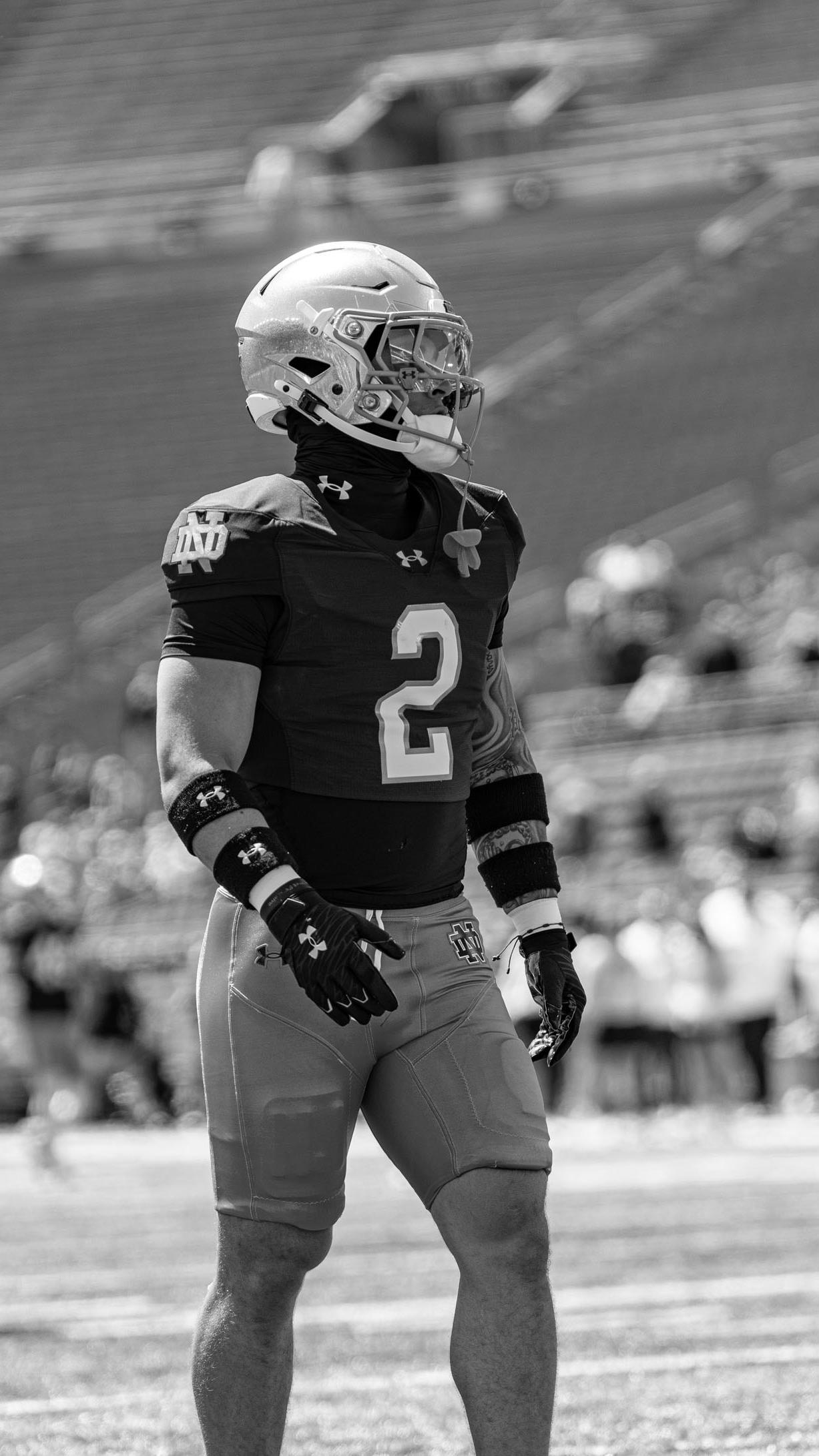
KEVIN SANCHEZ | The Observer
Freshman running back Nolan James Jr. in the first period of the Blue-Gold Game Saturday, April 25. The three-star recruit played four games for the Irish his first season, where he tallied 14 carries for 37 yards.
Stachurski: Aneyas Williams is stepping up
By Nikki Stachurski Associate Sports Editor
Notre Dame football has found recent success in the past two seasons due the impressive standout running backs Jeremiyah Love and Jadarian Price. In his three years for the Irish, Love totaled 2,882 rushing yards and 42 total touchdowns. Price himself recorded 1,692 rushing yards for 27 touchdowns. Together, the two were an unstoppable unit that made the
Notre Dame offense one to dread playing against.
Notre Dame fans unabashedly advocated that Price and Love were the best running backs in the nation, an opinion that only strengthened and spread as the two contributed one highlight-reel play after another. Their collegiate success did not go unnoticed, and both were selected in the first round of the 2026 NFL Draft. Love went No. 3 overall to the Arizona Cardinals, and Price went No. 32
overall to the Seattle Seahawks. The record-breaking selections are just the start of what will be promising professional careers for the two. And while Notre Dame fans are thrilled to see what the Irish alums will accomplish in the NFL, questions emerge concerning the future of the Irish offense.
It is no secret that Notre Dame has heavily relied on running backs as the primary method of attack, especially in a season like last year, when the passing game saw a transition to a rookie quarterback. So what, exactly, is Notre Dame’s plan for next season? The Irish still have a lot of the same pieces that allowed the team to win 10 straight games to close 2025, including an often overlooked running back in now-junior
Aneyas Williams.
A native of Hannibal, Mo., Williams has played two seasons for Notre Dame. In 27 games played, he has recorded 443 rushing yards and seven touchdowns, averaging 16.4 rushing yards per game while simultaneously being a threat as a pass catcher. The statistics are certainly nothing to scoff at, especially considering Williams was behind Price and Love on the roster.
But as Love and Price have
moved forward, Williams is finally getting the opportunity to shine as the top running back for the Irish.In the Blue-Gold Game on Saturday, Williams started with the ones for the Irish offense. He had 13 receiving yards and 38 rushing yards, scoring one of the four touchdowns of the game. Totaling 51 yards in a spring scrimmage, one where the first-strings are consistently rotating out, is a feat that should provide a sense of calm for Irish fans. Williams was the most consistent running back of the game, and with seven running backs all competing to prove they can shine at the top spot, his performance is a beacon of hope for the Irish offense.
After the game, offensive coordinator Mike Denbrock spoke on Williams’ role in the upcoming season.
“My anticipation for Aneyas is the same as it’s always been. Every time we’ve given him an opportunity, and he stepped into a football game, he’s made something positive happen and I don’t see that being any different,” Denbrock said.
When speaking with Williams after the game, I asked about his specific priorities for defining his game and competitiveness apart from all

the talk concerning Love and Price.
He said, “I just want to show that I’m an all-around [running] back. [That I can] do it all. Obviously, I’ve been thrown in multiple positions, and I just want to show that I can do it every down and be an every-down back and do what they did.”
It is important to remember that while he looked up to the successes of Love and Price, Williams is his own strong player who needs to be given the chance to define his own style of play and have room to develop into his own role as a running back. Holding him to the standards set by Love and Price is an opportunity for him to grow; however, Irish fans must remember he has his own skillset that, given the opportunity he has rightfully earned, will flourish.
With spring camp wrapping up, the competition in the running back room will continue into the summer and fall camp. There is lots of work to be done for offense and defense alike, but Aneyas Williams has proved he is able to rise to the occasion and become a running back that Notre Dame can depend on.
Contact Nikki Stachurski at mstachu2@nd.edu



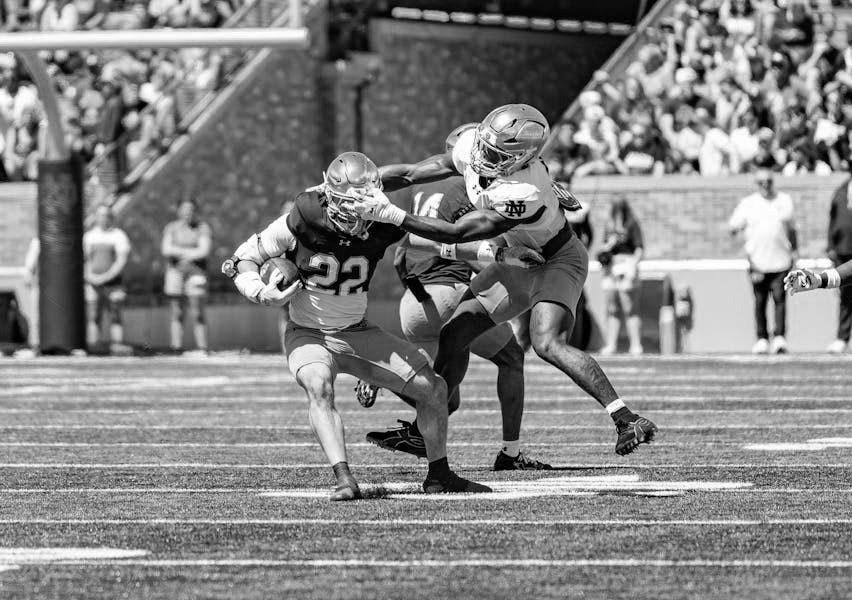
KEVIN SANCHEZ | The Observer
Junior running back Aneyas Williams maintains possession despite hefty defensive efforts in the 95th annual Blue-Gold Game Saturday.