THE INDEPENDENT NEWSPAPER SERVING NOTRE DAME, SAINT MARY’S AND HOLY CROSS ESTABLISHED 1966
TUESDAY, SEPTEMBER 8, 2026 | VOL. LXI, NO. 6
NDSMCOBSERVER.COM
Irish beat Badgers in season opener in Wisconsin By Noah Cahill
Assistant Managing Editor
The setting Sunday sun cast a soft blue light above Lambeau Field. But unlike many autumn nights in Green Bay, the Packers’ iconic G wasn’t painted between the 50-yard line markers, and it wasn’t a contingent of rowdy Cheeseheads filling the seats. Instead, the Shamrock Series logo filled the oval, and the bowl was split between seas of red and navy blue. The Irish faithful stood full of anticipation, waiting for a preseason national championship contender to take the field. Badger fans didn’t carry the same lofty expectations. But they entered this historic football venue with hope that their revamped squad will make massive improvements on last year’s 4-8 record. After winning the toss and electing to defer, Notre Dame’s highly touted defense took the spotlight first — and delivered. Forcing a quick three-and-out, the ball was
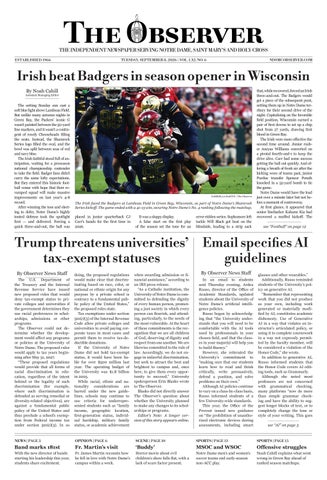
GABRIELLA MARTIN | The Observer
The Irish faced the Badgers at Lambeau Field in Green Bay, Wisconsin, as part of Notre Dame’s Shamrock Series kickoff. The game ended with a 41-13 win, securing Notre Dame’s No. 4 ranking following the matchup.
placed in junior quarterback CJ Carr’s hands for the first time in 2026.
It was a sloppy display. A false start on the first play of the season set the tone for an
error-ridden series. Sophomore left tackle Will Black got beat on the blindside, leading to a strip sack
that, while recovered, forced an Irish three-and-out. The Badgers would get a piece of the subsequent punt, setting them up in Notre Dame territory for their second drive of the night. Capitalizing on the favorable field position, Wisconsin earned a pair of first downs to set up a chip shot from 27 yards, drawing first blood in Green Bay. The Irish were more effective the second time around. Junior rusher Aneyas Williams converted on a pivotal fourth-and-1 to keep the drive alive. Carr had some success getting the ball out quickly. And offering a breath of fresh air after the kicking woes of teams past, junior Purdue transfer Spencer Porath knocked in a 52-yard bomb to tie the game. Notre Dame would have the lead just over a minute later but not before a moment of controversy. At first glance, it appeared that senior linebacker Kahanu Kia had recovered a muffed kickoff. The see “Football” on page 12
Trump threatens universities’ tax-exempt statuses
Email specifies AI guidelines
By Observer News Staff
By Observer News Staff
The U.S. Department of the Treasury and the Internal Revenue Service have issued new proposed rules that would deny tax-exempt status to private colleges and universities if the government determines they use racial preferences in scholarships, admissions or other programs. The Observer could not determine whether the development would affect any programs or policies at the University of Notre Dame. The proposed rules would apply to tax years beginning after May 31, 2027. “These proposed regulations would provide that all forms of racial discrimination in education, regardless of the intent behind or the legality of such discrimination (for example, where such discrimination is defended as serving remedial or diversity-related objectives), are against a fundamental public policy of the United States and thus preclude a school’s exemption from Federal income tax under section 501(c)(3). In so
doing, the proposed regulations would make clear that discriminating based on race, color, or national or ethnic origin for any purpose by a private school is contrary to a fundamental public policy of the United States,” the proposed rules state. Tax exemptions under section 501(c)(3) of the Internal Revenue Code allow private colleges and universities to avoid paying corporate taxes in most cases and permit them to receive tax-deductible donations. If the University of Notre Dame did not hold tax-exempt status, it would have been liable for over $500 million last year. The operating budget of the University was $1.8 billion in 2025. While racial, ethnic and nationality considerations are barred under the new guidelines, schools may continue to use criteria for underrepresented students such as “family income, geographic location, first-generation status, individual hardship, military family status, or academic achievement
when awarding admission or financial assistance,” according to an IRS press release. “As a Catholic institution, the University of Notre Dame is committed to defending the dignity of every human person, promoting a just society in which every person can flourish, and attending, particularly, to the needs of the most vulnerable. At the heart of these commitments is the recognition that we are all children of God, deserving of dignity and respect from one another. We are likewise committed to the rule of law. Accordingly, we do not engage in unlawful discrimination, but seek to attract the best and brightest to campus and, once here, to give them every opportunity to succeed,” University spokesperson Erin Blasko wrote to The Observer. Blasko did not directly answer The Observer’s question about whether the University planned to make any changes to its scholarships or programs. Editor’s Note: A longer version of this story appears online.
NEWS | PAGE 3
OPINION | PAGE 6
SCENE | PAGE 10
SPORTS | PAGE 13
SPORTS | PAGE 15
With the new director of bands starting his leadership this year, students share excitement.
Fr. James Martin recounts how he fell in love with Notre Dame’s campus within a week.
Horror movie about evil children’s show falls flat, with a lack of scare factor present.
Notre Dame men’s and women’s soccer teams end early-season non-ACC play.
Noah Cahill explains what went wrong in Green Bay ahead of ranked season matchups.
Band marks 181st
Fr. Martin’s visit
‘Buddy’
In an email to students sent Thursday evening, Ardea Russo, director of the Office of Academic Standards, updated students about the University of Notre Dame’s artificial intelligence policies. Russo began by acknowledging that “the University understands that you will need to be comfortable with the AI tools used by professionals in your chosen field, and that the classes in your major(s) will help you to build fluency.” However, she reiterated the University’s commitment to “making sure that our students learn how to read and think critically, write persuasively, defend a position, and solve problems on their own.” Although AI policies continue to vary on a class-by-class basis, Russo informed students of a few University-wide standards. This year, the Office of the Provost issued new guidance on “the prohibition of unauthorized electronic devices during assessments, including smart
MSOC and WSOC
glasses and other wearables.” Additionally, Russo reminded students of the University’s policy on generative AI. “Remember that representing work that you did not produce as your own, including work generated or materially modified by AI, constitutes academic dishonesty. Use of Generative AI in a way that violates an instructor’s articulated policy, or using it to complete coursework in a way not expressly permitted by the faculty member, will be considered a violation of the Honor Code,” she wrote. In addition to generative AI, Russo informed students that the Honor Code covers AI editing tools, such as Grammarly. Although she noted most professors are not concerned with grammatical checking, many platforms “now do more than simple grammar checking and have the ability to suggest longer blocks of text, or to completely change the tone or style of your writing. This goes see “AI” on page 3
Offensive struggles