Dymek: Freeman faces new pressure in year five
By Payton Dymek Associate Sports Editor
For decades, South Bend has built a reputation as the home of one of the greatest football programs in the country: Notre Dame. A place that set the standard for football across the country showed that success isn’t just something a program earns, but is tried and tested. For head coaches that came before Marcus Freeman, many found success by this mantra, earning national championship titles or undefeated regular seasons; although Freeman hasn’t found that success, he’s found something greater: resilience.
It’s no secret the Fighting Irish has found itself dominating headlines year-round.
From taking close losses in their first two games, not
making the College Football Playoff, rumors that Freeman would leave for an NFL team (or even worse, Penn State) and hateful comments about their absence from a conference, Notre Dame has seen it all.
Last season was one that fans will want to forget; however, it only solidified Freeman’s reputation as a fearless and adaptable leader. After the Irish fell short in the National Championships against Ohio State the year prior, Freeman entered his fourth year ready to navigate the team to the same position they had been in, this time led by redshirt freshman quarterback C.J. Carr. Notre Dame took a 27-24 loss at Miami before returning home and suffering a 41-40 defeat against Texas A&M.
Trying to pick up the broken
pieces of both the student body and their defensive line, not to mention handle the Chris Ash slander that seemed consistent in the media, the Irish stumbled through the mid-season stretch with bad kicking and inconsistent play calls not providing the style points that Notre Dame would need to make the Playoff. Fans who hung up their green and gold hats after the first two games only felt worse when the Miami Hurricanes were called for the CFP, crushing Irish dreams and ultimately causing Freeman to retract his team from a bowl game. All told, his fourth year ended in a drama no one could have predicted.
Speculations, coaching changes and unwanted conference debates defined the off-season. After the Nittany Lions parted with
now-Virginia Tech head coach James Franklin, there were rumors Freeman would head to State College and wear a different color blue on the weekends. Those rumors were quickly shut down, but not before Freeman was also credited with being on the list to take over the New York Giants. Freeman was insistent he would not be trading his Saturdays for Sundays and got back to work with his Irish team.
Heading into his fifth season with Notre Dame, Freeman has everything to lose, especially since the debates of whether or not the Irish need to join a conference have never been louder. Following its recent open scrimmage, it is clear the team’s focus has been to tune out the headlines and work with the reality that this will be a team with lofty
expectations. With the scrimmage behind him, Freeman noted how “we have to evaluate our coaching. We have to evaluate the way our players have received our coaching and prepared.”
In this season of growth across depth and coaching, the Irish are adapting well and rebuilding their identity one play at a time, but with the Blue-Gold Game this weekend and summer fast approaching, one question remains: Can Freeman transform two seasons of heartbreak into a championship which would immortalize the head coach among the all-time greats? The grace period is over, and the standard is ready to be set. Watch out for Marcus Freeman in his fifth season.
Contact Payton Dymek at pdymek@nd.edu
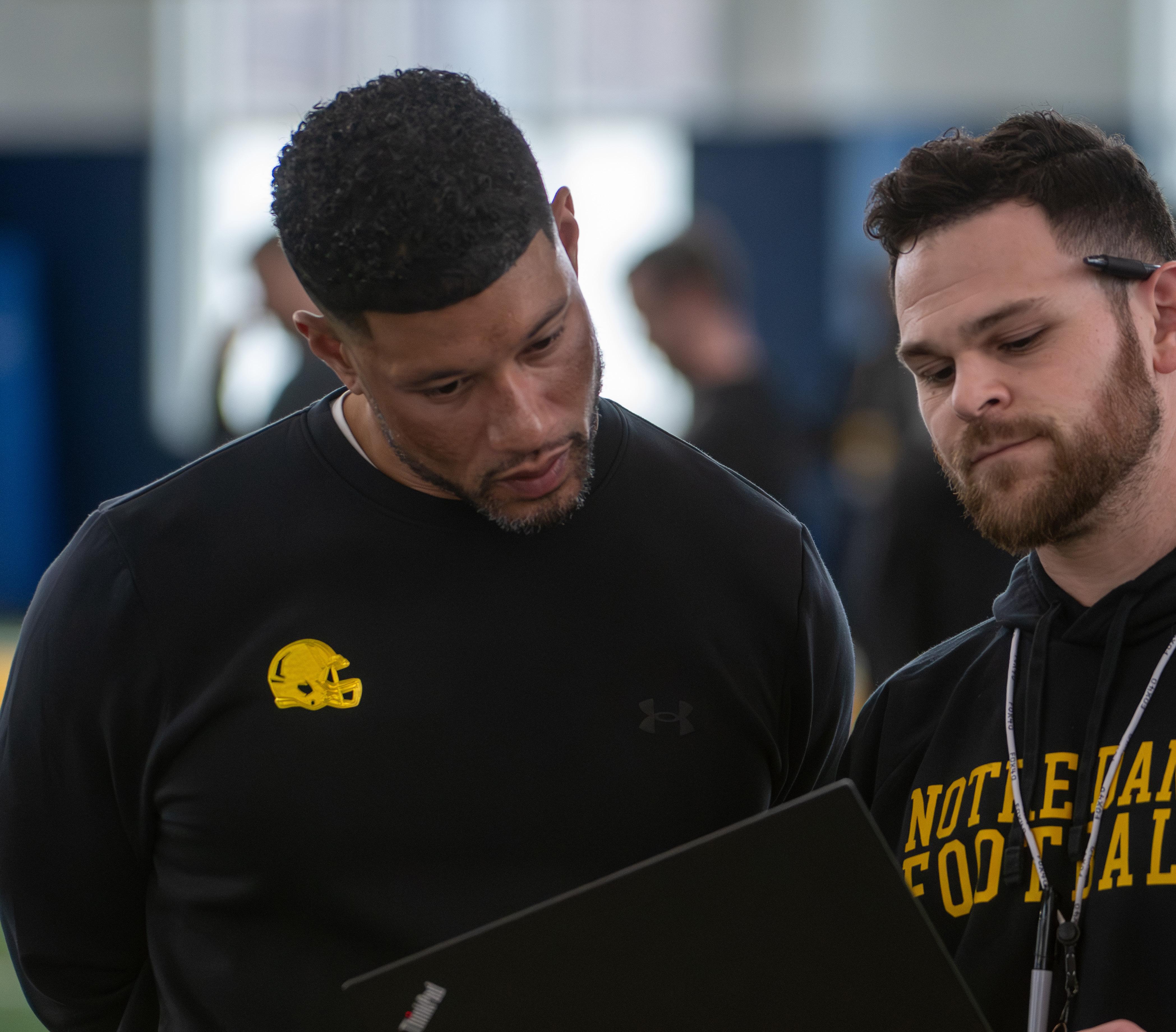
MARIELLA TADDONIO | The Observer
Head coach Marcus Freeman checks out some tape with an assistant during Notre Dame’s Pro Day at the Irish Athletics Center on March 24. The 40-year-old is entering his fifth year in 2026, and has quickly established himself amongst the sport’s premier coaches after a National Championship Game appearance in 2024 and another 10-win season last year.

THE INDEPENDENT NEWSPAPER SERVING NOTRE DAME, SAINT MARY’S AND HOLY CROSS
ND Day raises $4.6 million for campus groups
By Mara Hall Associate News Editor
Notre Dame Day, the University’s annual day of fundraising, brought in $4.6 million from 37,677 donors for 916 causes, an increase of over $150,000 from last year.
The Ara Parseghian Medical Research Fund received funds from 1,559 donors, the most of any cause, and also the largest amount of money raised, $465,323. However, these numbers are both down from last year. In 2025, the fund raised $720,464 from 2,236 donors. Dillon Hall raised the largest amount of any residence hall, with $236,165. The bulk of that amount, $200,000 came from a single donor, Stephen Strake, the CEO of Texas-based wealth management firm Hightower Trust Services. St. Edward’s Hall had the highest number of contributors for a residence hall with 834 donors, raising $232,289 in total. Farley Hall attained the highest number of
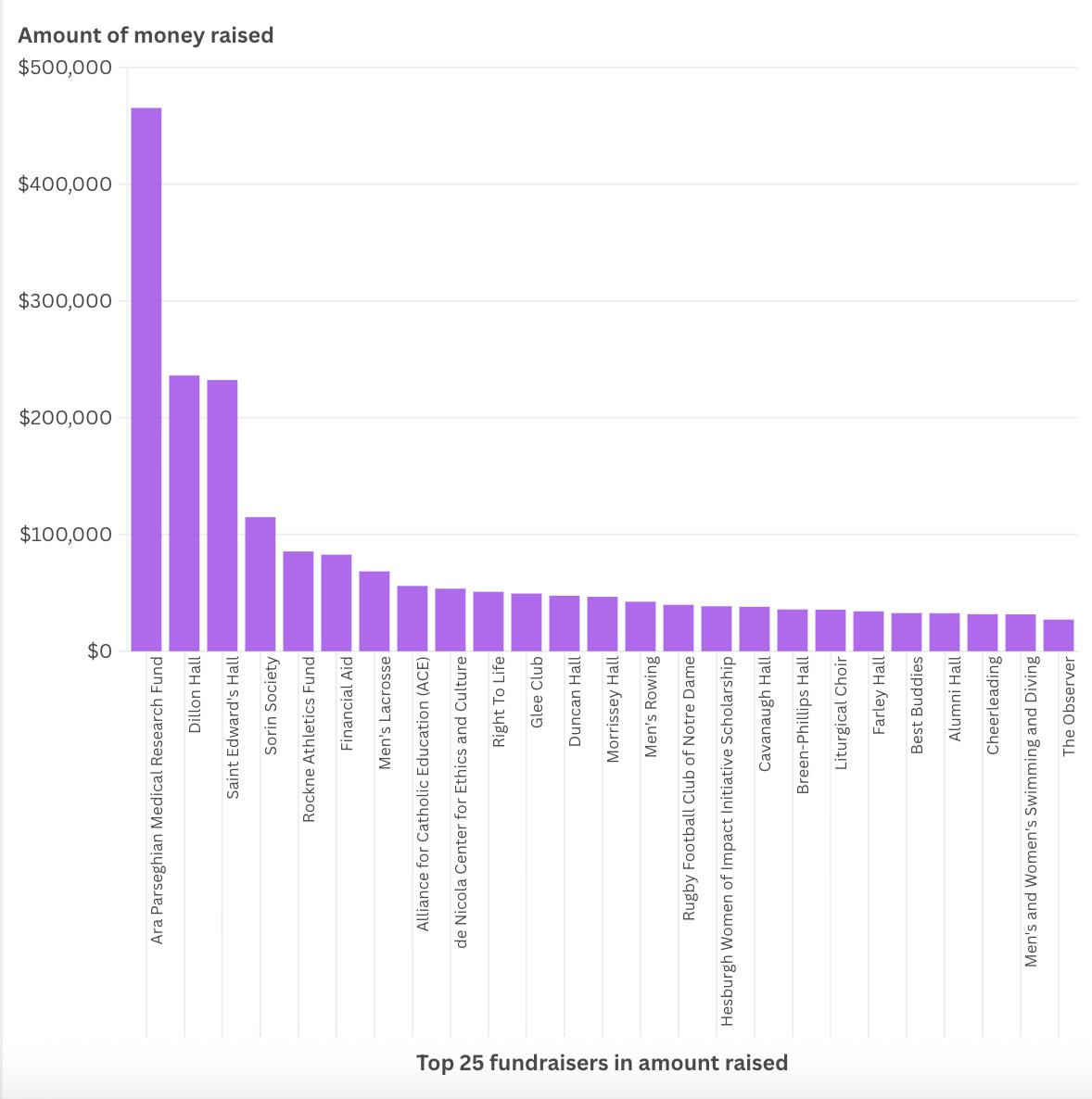
Data courtesy of the University of Notre Dame, graph by Mara Hall ND Day raised $4.6 million for Notre Dame’s causes, clubs and residence halls. The graph depicts the top 25 causes by amount raised.
donors for a women’s residence
see “ND Day” on page 3
A look into the history of Saint Mary’s publications
By Sophie Lewandowski News Writer
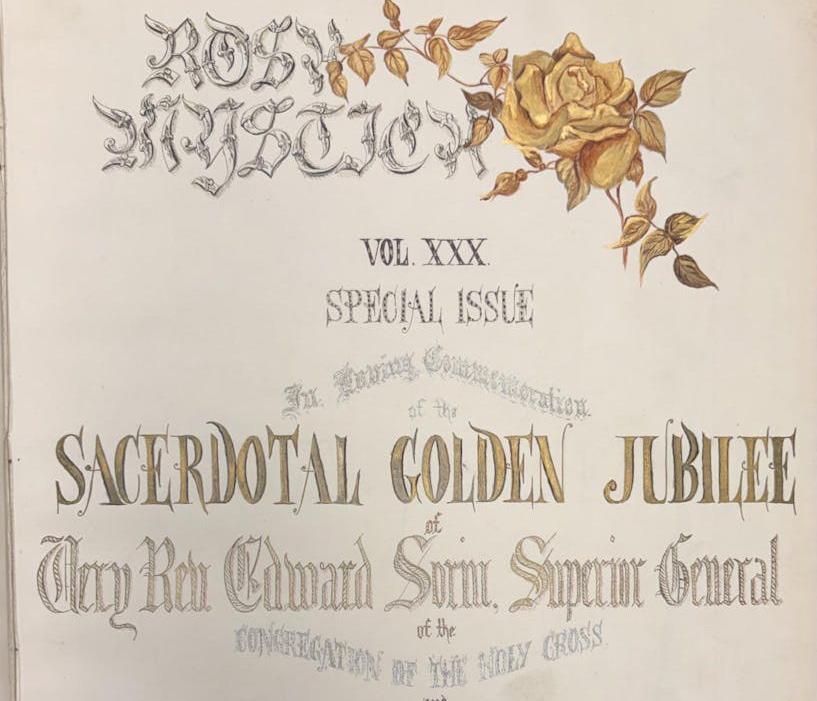
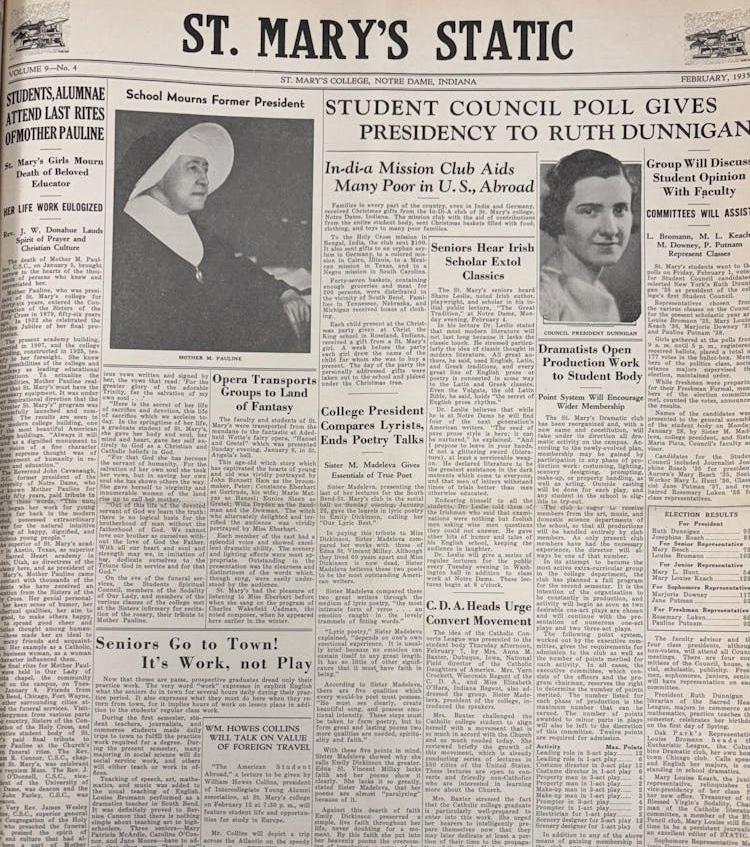
The Mystical Rose, debuting on Feb. 1, 1859, was a literary publication at Saint Mary’s College — the first of many papers to come. Handwritten in loopy cursive, The Mystical Rose was not distributed to a large student body, but printed in a single volume that was read out to the whole school.
Beginning with The Mystical Rose — published from 1859 to 1863 — papers, magazines and journals have passed through the school. Publications that predate the foundation of The Observer in 1966 include The Static (1926-1961) and The Crux (1956-1967).
Eric Walerko, college archivist at Saint Mary’s, explained that past papers are time capsules for impactful moments in Saint Mary’s history, and the culture of the
NEWS | PAGE 4
LEED Platinum
McCourtney Hall East was awarded LEED Platinum by the U.S. Green Building Council.
SOPHIE LEWANDOWSKI | The Observer
The first edition of The Mystical Rose was published on Feb. 1, 1859. It was entirely handwritten and would be read out loud to the school.
United States at the time they were published.
“Most of these publications can give a very unique insight
OPINION | PAGE 6
Academic liberty
If a university is guided by its Catholic mission, it cannot be neutral on moral issues.
into not just what’s going on in the world or campus at
see “Publications” on page 4
SCENE | PAGE 7
Coachella’s evolution
Since 1999, Coachella has shifted away from a music focus to an Instagram culture.
By Observer News Staff
Comedian Jim Gaffigan will perform at the Purcell Pavilion next fall. This performance was announced in an email to the campus community from Notre Dame Hospitality at noon Tuesday. Members of the public received a similar message about 15 minutes after the initial email. The show is scheduled for Sept. 11, 2026, and will be a part of Gaffigan’s “Everything is Wonderful!” tour.
The email and a press release from the University noted Gaffigan is an “eight-time Grammy nominated comedian, actor, writer, producer, three-time Emmy winning top touring performer, and multi-platinum-selling recording artist.” The press release also notes that Gaffigan has released 16 comedy albums and has written and produced two seasons of “The Jim Gaffigan Show” with his wife, Jeannie Gaffigan.
“There is a unique pride that
Jim Gaffigan to perform at ND Notre Dame bans e-bikes on campus
By Observer News Staff
Beginning July 1, 2026, electric bikes will no longer be permitted on Notre Dame’s campus, even without the use of their power features. The Notre Dame community was notified of this change via an email from Campus Safety at 2:01 p.m. Tuesday, signed by Keri Kei Shibata, associate vice president for campus safety and chief of police of the Notre Dame Police Department.
On December 17, 2023, the University shifted to a policy prohibiting personal electric vehicles on campus. Bikes, without their power features, were the exception to this policy, with caveats that they had to be registered with the NDPD, as all bikes must be, and in no capacity could they be charged in campus buildings.
SPORTS | PAGE 8
Love goes third
Jeremiyah Love was taken third overall by the Arizona Cardinals on Thursday night.
comes with welcoming one of our own back to northern Indiana. Gathering to enjoy Jim Gaffigan at Purcell Pavilion is a powerful way to celebrate the shared roots that define our corner of the state, strengthening the vital connection between the University and our neighbors. We are proud to welcome the community for a night of laughter, and to honor the collaborative spirit that makes northwest Indiana such a special place to call home,” Mike Seamon, vice president for University Operations, Events and Safety, wrote in the press release. Born in Elgin, Ill., Gaffigan was raised in Chesterton, Ind. Students, faculty and staff will have the opportunity to purchase tickets 24 hours before the general public. These advance ticket sales will happen 10 a.m. to 10 p.m. on April 23, with general sale tickets opening April 24 at 10 a.m. Gaffigan previously came to South Bend on tour as a part of events leading up to 2018 IDEA week.
The email to the campus community noted the 2023 policy, describing it as “rooted in our commitment to preserving the pedestrian character of our campus and, more importantly, protecting our community from the very real fire and collision hazards these vehicles present.”
The email went on to explain, “After continued observation and a thorough review of ongoing safety challenges, we must further refine our approach to ensure the well-being of every person who calls Notre Dame home.”
The new policy will include five bike racks on the perimeter of campus designated for e-bike parking and storage. These are the only approved locations for e-bikes on campus. No changes to building restrictions and other personal electric vehicles are present in these new policies.
SPORTS | PAGE 13
Three standouts
Chris Dailey highlights three Irish youngsters to look at for Saturday’s Blue-Gold Game.
FRIDAY, APRIL 24, 2026 | VOL. LX, NO. 60
Who do you think will draft Jeremiyah Love?
Teagan Adams sophomore St. Edward’s Hall “Titans.”
Colin Heil sophomore Keough Hall “Commanders.”
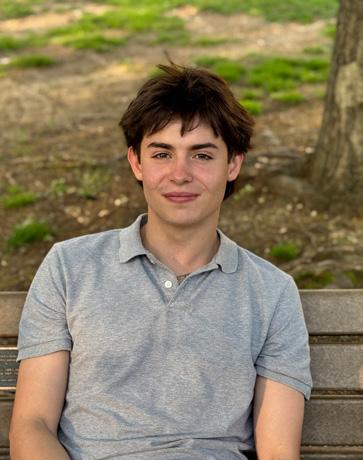
Alex Henry junior Knott Hall “Giants.”

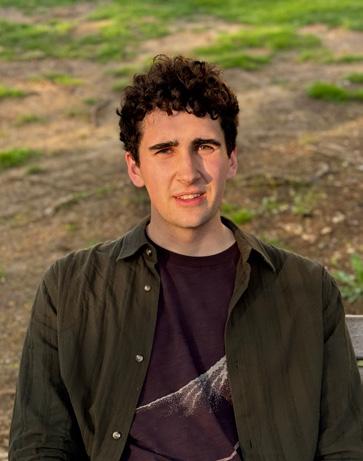
Luca Nijim senior Alumni Hall “Titans.”
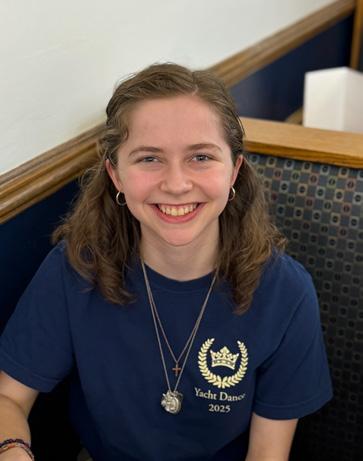
Rose Worth sophomore Lyons Hall “Lions.”
Friday
A Centennial of Holy Spirit Chapel Celebrate 100 years of Holy Spirit Chapel.
2 - 3 p.m.
Holy Spirit Chapel, Saint Mary’s College
Saturday
Blue-Gold Game Cheer for the Fighting Irish in this annual event. 2 p.m.
Notre Dame Stadium
Sunday
Matilda the Musical Come support the cast and crew for closing night. 7:30 p.m.
Moreau Center for the Arts, Saint Mary’s College
Monday
Fireside Chat with Writer and Critic in Residence Michael Magee and Radvan Markus discuss Irish literature. 5 - 6 p.m.
Hesburgh Center Auditorium
Tuesday
UIC v. the Fighting Irish
Support the softball team as they face the UIC Flames. 5 p.m.
Melissa Cook Stadium
PHOTO OF THE DAY | MARIELLA TADDONIO
David Diamond: Morrissey’s veteran rector
By Ane Ruiz Boyra News Writer
David Diamond is not an ordinary rector. Now in charge of Morrissey Manor, Diamond is a military veteran and assisted 20 victims during the Boston Marathon bombing.
Military career
For Diamond, the path to becoming rector of Morrissey Hall was anything but conventional. A retired U.S. Army colonel who spent decades in Special Forces, Diamond now leads one of Notre Dame’s residential communities — a role he sees as a continuation of a life defined by mentorship and service.
After retiring from the military in 2025, Diamond enrolled at Notre Dame to pursue a master’s degree in theology, which he has since completed.
Looking back, he sees the transition as part of a larger calling. “The Lord wanted me to go from being in the military to being a rector here at Notre Dame,” he said.
That connection to Notre Dame, however, began much earlier. Diamond said he once planned to attend the University as an undergraduate on an ROTC scholarship, but he ended up electing to stay closer to home after his father fell ill. Nevertheless, his interest in Catholicism and in the University itself persisted. He converted to Catholicism in 2011, in part influenced by
ND Day
Continued from page 1
hall with 392, but Cavanaugh brought in the greatest dollar amount at $38,083.
26 causes listed on Notre Dame Day’s website had over 250 donors; the top 80 causes had over 100 donors.
Seven causes joined the top 25 this year who had not made it last year, which included Breen-Philips Hall, Student Experience, Stanford Hall, Right To Life, Men’s rowing, Pasquerilla East Hall and Lewis Hall. These replaced Lacrosse Team of Notre Dame, Men’s Club; Dillon Hall; Rugby Football Club; Innovation for Impact — Powerful Means Initiative; Fisher Hall; MBA Military Veterans Club and Sacred Music.
Organizations are incentivized to promote contributions, including small contributions, through a challenge fund that is distributed proportionally to causes based on their number of donors.
“Notre Dame Day runs on a $500,000 challenge fund, thanks to some very generous donors who want to enhance the student experience. Any participating cause can benefit from that fund. Half
the strong presence of Catholic families in Special Forces units. “It seemed like, and this is me being hyperbolic, it seemed like everybody around me was Catholic,” he said.
Diamond served 30 years in the Army, including 10 deployments throughout the Middle East. Much of his work involved training allied forces. The leadership lessons he developed during that time now inform his role in Morrissey Manor.
During his interview process, Diamond was asked what he could bring from the military to a college dorm. His answer was simple: “I’ve been mentoring and training young men my entire life,” he said, “from the time I was a lieutenant to the time I retired as a colonel.”
That experience, he added, extends beyond technical training. “There’s a lot of transferable skills … emotional intelligence, understanding how to listen compassionately and help meet people where they are.”
Diamond sees strong parallels between military units and residence halls.
“Being a rector, I get to live with the boys, just like I would my guys in the military. I feel like I have my unit commanders, and I’ve got my AR’s, which are my deputies, and then RAs are my squad leaders,” he said.
He recalled the first dorm event — a football watch party.
“I could definitely feel a partnership beginning. It was like that in the military. You would
of it — $250,000 — goes toward prizes and challenges throughout the day, giving causes across campus a chance to earn extra funding.
The other $250,000 is distributed in shares at the end of the campaign: every time a cause receives a gift, no matter the size, it earns a share of that $250,000. Sometimes a $5 gift might be worth $15 or more once that share is added,” Brandon Tabor, assistant vice president for annual giving, stewardship and storytelling, explained in a statement to The Observer.
During Notre Dame Day, the University also ran a 14-hour live broadcast to promote giving, with two student broadcasters on air every hour of the show.
“Come February, we narrow it down to the stories we want to highlight. Then, for about two months, we team up with ND Studios to build out this 14-hour live show — kind of like a ‘Today’ show for Notre Dame. We bring in local TV hosts, student talent from NDTV, and we schedule every minute. It takes dozens of people and months of planning. Once the broadcast goes live from Duncan Student Center, we’re working around the clock to help student clubs,
join a unit, but until you do your first hard thing together, the relationships aren’t forged,” Diamond said.
Boston Marathon bombing
On April 15, 2013, Diamond ran the Boston Marathon. This was his fourth time running the Boston Marathon and was also the year of the Boston Marathon bombing.
Diamond described feeling a surge of energy throughout the race. “I remember having an unusually high amount of energy and focus and stamina … I didn’t know where that came from,” he said.
As the race progressed, he continued to accelerate, something he had never done before. “I just kept going faster and faster,” he said. “I think it was providential. It was divine. I was definitely meant to be there.”
Shortly after crossing the finish line, the bombs detonated. Reflecting on the moment, Diamond emphasized how jarring it felt given the setting. “I remember … thinking very vividly, ‘I can’t believe this happened, here today and now,’” he said.
Drawing on his military and paramedic training, Diamond immediately began assisting victims. He helped treat more than 20 people at the scene. Still, he resists framing his actions as extraordinary. “I just did what I hoped anyone else would do for my loved ones or
causes and residence halls hit their goals. It’s a ton of work, but we do it with great joy because we know how much it means for our students and for Notre Dame,” Tabor said.
Financial Aid
The Financial Aid fund brought in $82,728. This is less than the total estimated cost for one student before financial aid, which is $91,986. Notre Dame Day redirects donations made to shuttered residence halls to the Financial Aid fund. Nowclosed residence halls with donation pages include: Fisher Hall, Grace Hall, Flanner Hall, Pangborn Hall and Holy Cross Hall. Combined, these halls raised $3,829 across 76 donors.
Resident Hall incentives
Some residence halls offered incentives to residents who donated.
Luke Froman, a sophomore and vice president in Stanford Hall, explained he and the Stanford hall president made several offers to residents including a promise that they would jump in St. Mary’s Lake if they had 600 unique donors. Stanford fell short of that amount, with 308 donors.
Sophomore Teddy Potts,
me in a time of crisis.”
Over time, his Catholic faith has shaped how he understands both the event and its aftermath. While he initially felt anger, that perspective has evolved. “I was angry for a little bit,” he said. “But through my theology studies and my personal devotion, I’ve learned forgiveness, and how that impacts your heart and how you view people.”
Having worked extensively in the Middle East, Diamond said he resists framing acts of terrorism in simplistic or religious terms. “I had friends in Iraq who I trusted as much as I did Americans, so I didn’t really see it as an Islamic thing,” he said. “I saw it as a terrorist act.”
Instead, he emphasized being an example of moving on.
“If I can be an example of how to help people without carrying
that type of bias or grudge,” he said, “that’s what I want.”
Now, in his first year as rector, Diamond’s focus is firmly on his students. “This sounds terrible to say out loud, but I don’t have any ambition,” he said. “I’m not here to be the president of Notre Dame.”
Instead, he describes a sense of contentment rooted in faith and purpose. “This is the first time in my life I don’t have FOMO,” he said. “I know that I’m supposed to be here, right now, with my boys … I couldn’t be happier.”
“I loved being in the military,” he said. “But nothing has given me the sense of satisfaction as being here at Notre Dame and being a part of this organization.”
Contact Ane Ruiz Boyra at aruizboy@nd.edu
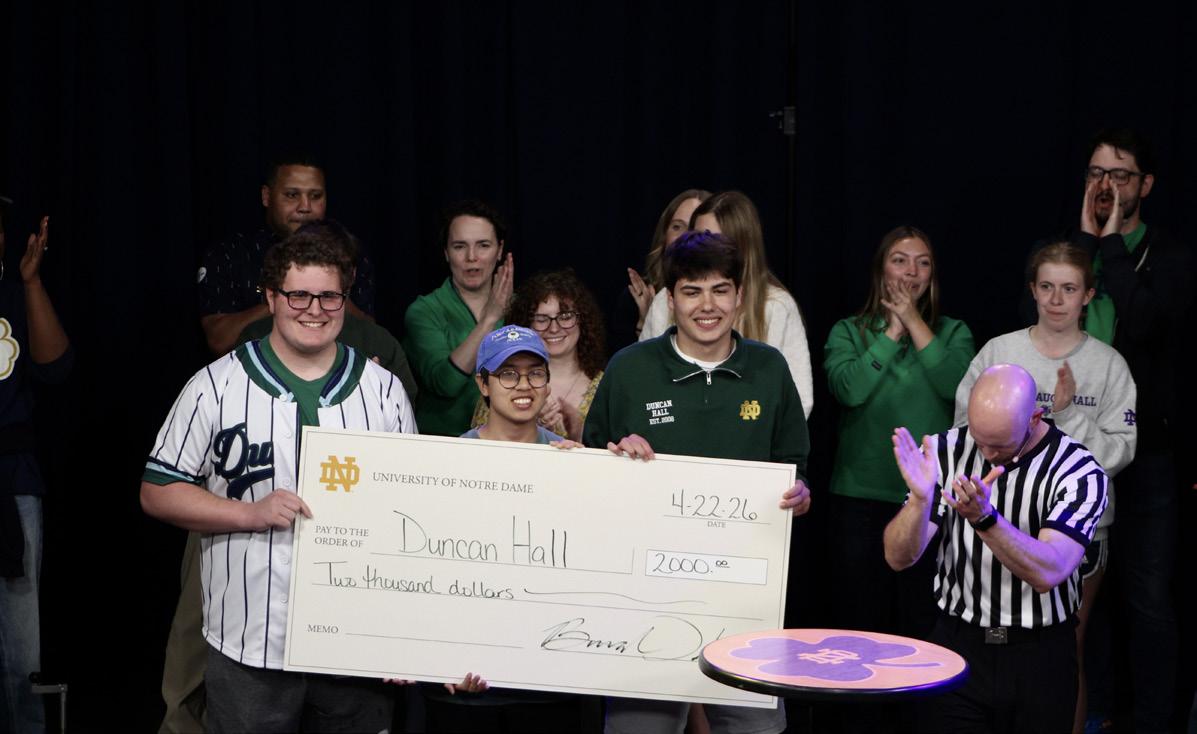
the president of Duncan Hall, explained the dorm offered discounts at its in-hall restaurant for reaching certain milestones.
Coyle Rector’s ND Day tradition
Joey Quinones, rector of Coyle Hall, has completed a very long run as a motivator for people to donate for the last four years.
For his run this year, he elected to run 82 miles for the 82 new beds Coyle will gain when they move from their current temporary residence in Zahm Hall to their permanent residence in Coyle Hall.
Two years ago, he ran for 18
hours and 42 minutes, a reference to the University being founded in 1842. In this time, he completed 71 miles. Last year, he ran 73 miles for the 73rd, and final, year of Fisher Hall.
Different members of the Coyle community ran alongside him for most of the day.
“Running with others is kind of a cheat code to it,” Quinones said.
Editor’s Note: The Observer is a participant and beneficiary of Notre Dame Day fundraising.
Contact Mara Hall at mhall27@nd.edu
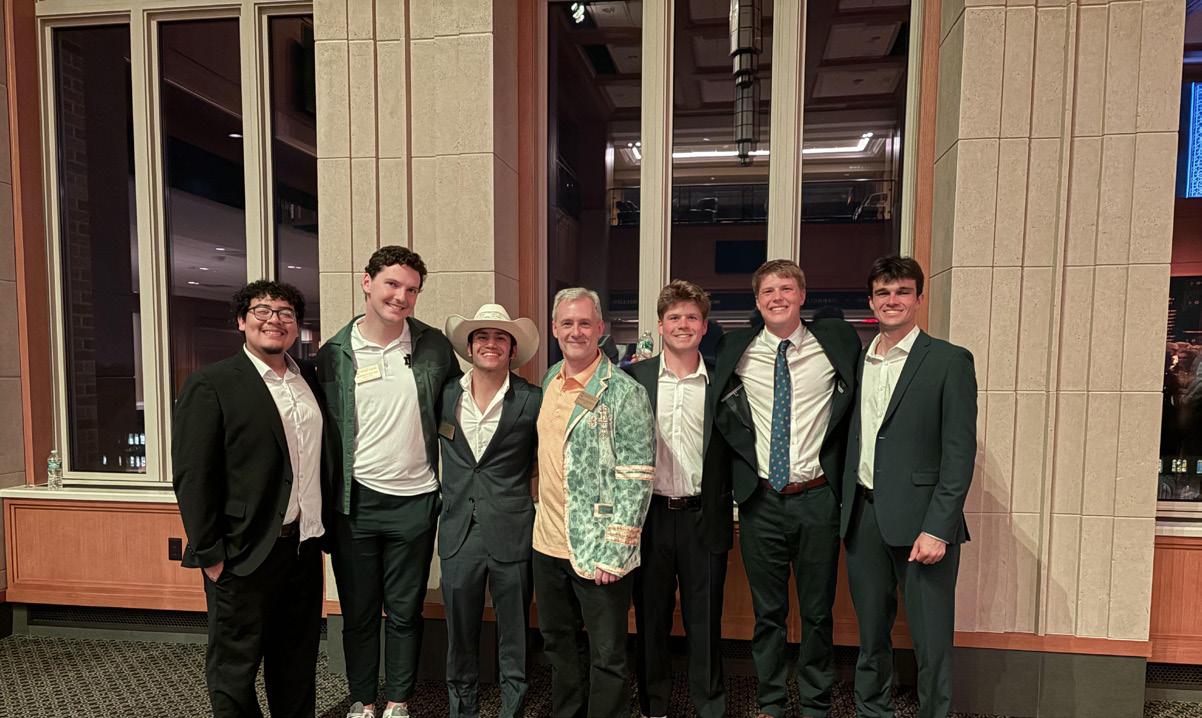
Courtesy of David Diamond
Morrissey rector David Diamond with several residents. Diamond is a former U.S. Army colonel who spent decades in Special Forces.
Courtesy of Michelle McDaniel
Representatives from Duncan Hall after winning the Notre Dame Day rock-paper-scissors challenge, earning their residence hall $2,000.
McCourtney Hall East awarded LEED Platinum
By Observer News Staff
McCourtney Hall East has been awarded the Platinum level of a Leadership in Energy and Environmental Design certification by the U.S. Green Building Council. It is the 27th building at the University of Notre Dame to receive a LEED certification and the first to be classified at the council’s highest standard — Platinum.
The LEED rating system encourages development projects to aim for sustainable construction and building designs.
Projects register for LEED
Publications
Continued from page 1
the time, but also what student life was like at the time,” Walerko said.
Writing for The Crux
The Crux emerged in 1957 in response to a desire for more frequent news publications on campus. Chimes was available as a student publication, but it was a literary journal that had a greater focus on the arts and literary work, and The Observer did not exist yet. At the time, Saint Mary’s had a journalism department on campus that published The Static monthly, but the Student Council desired a weekly publication.
Gail Donovan, Susan Pichler and Susan Fitzgerald Rice wrote for The Crux in the early 1960s.
“The student council at Saint Mary’s had decided that the College needed a newspaper that was a little more up to date, not so professional, that could be produced quickly of happenings on the campus at Saint Mary’s and Notre Dame,” Pichler said.
She recalled distinctly liking the name of the publication, which Pichler explained is to ”get to ’the crux’ of the matter.”
Pichler attended Saint Mary’s with her sister. The two both served as editors-in-chief of the publication during their respective senior years. As an English major and daughter of a journalist herself, Pichler remembers having a distinct interest in journalism and writing.
Anyone could write for The Crux. It covered campus news, clubs, classes, little stories from around campus and national or global affairs. Fitzgerald Rice recalls planning weekly topics with The Crux staff.
The paper was typed on two legal-sized sheets of paper, making four pages, which were stapled together and distributed to students at meal
certification before breaking ground then pursue a series of credits that help the U.S. Green Building Council determine which level to award.
The levels are Certified, Silver, Gold and Platinum.
The 200,000-square-foot research complex was completed in winter 2025 as an addition to McCourtney Hall, which received LEED Gold certification in 2016. The two projects headline a University plan to grow a campus quad composed of research buildings.
The University committed to pursuing LEED certifications for all of its construction
times. Pichler explained the paper would be distributed to the girls while they waited for the doors to the dining hall, located then in Le Mans Hall, to open.
Donovan, now a writer for Saint Mary’s alumni magazine Avenues, wrote for her high school paper before joining the Crux in college. She graduated from Saint Mary’s in 1963, and served as co-editor of the paper in her senior year with Diane Shalela Fritel. Donovan shared that the paper had been organized under a faculty advisor named William Slavick, an English teacher at Saint Mary’s who was finishing his doctorate at Notre Dame.
Throughout her time as a journalist in high school, Donovan interviewed a variety of people, including Christopher Dawson, a historian from Great Britain, and John F. Kennedy after following him for an entire day on the campaign trail for U.S. senator in Massachussetts.
“I followed him from something like seven in the morn
ing until 10 or 11 at night to Western Massachusetts, and finally got the interview, and I started out with, ‘Mr. Kennedy, I’ve been following you all day.’ And he said, ‘So, I’ve noticed.’ And he just went on with a spiel that was every writer’s dream. I didn’t have to ask him another question.” Donovan said.
While she was a student, Donovan witnessed the transition from Sister Madeleva’s presidency at Saint Mary’s to that of Sister Maria Renata Daily.
“That was a very dark time for Saint Mary’s. Sister Madeleva had retired in our sophomore year and a history professor was named President. And, all of a sudden, the place went from this kind of joyful place to a cloud over it,” Donovan said.
Donovan said The Crux did not address this cultural change, and only later did she learn to be more forthcoming
projects in 2008. Geddes Hall became the first building on campus to receive a LEED certification when it achieved Gold in 2010. Since then, 16 buildings have received the LEED Gold distinction, and 10 others are certified at the LEED Silver level.
There are 110 credits available in the LEED rating system used to evaluate McCourtney Hall East. The next most recent building to be granted a certification was Graham Family Hall, a men’s residence hall, achieving Gold level with 64 credits in June 2025. McCourtney Hall East received 81 credits — one
with her writing.
A lasting impact
Pichler worked for a short time as an English teacher before stepping away from a career in teaching when she got married and had kids. Regardless, she continued to have a deep appreciation for journalism and continues to read print papers.
“Hardly anybody on our street actually gets the printed paper, but I’m in love with two good newspapers,” Pichler said.
Fitzgerald Rice said The Crux gave her invaluable communication skills.
more than the minimum of 80 credits required for a Platinum certification.
A scorecard detailing which credits a construction project achieved is published in the LEED project directory. Graham Family Hall and McCourtney Hall East are publicly available, though at the discretion of project managers, scorecards can be made private.
The LEED scorecard is divided into nine sustainability metrics including water efficiency, indoor environmental quality and innovation.
The largest increase in credits for an individual category
“Your entire life depends on your ability to be articulate ... I’ve certainly learned in my time that a lot of people don’t have the kind of training that we had,” Fitzgerald said.
“We had a sister who was our counselor, and I don’t recall that she went over the language, but if we had errors, she probably caught them.”
Donovan went on to work in education, eventually serving as dean of Wheelock College in Boston. Her career reasserted the importance of strong communication to her.
“I’ve been a teacher, a principal and a school superintendent. I don’t find writing
between McCourtney and Graham Family was in the Energy & Atmosphere section. McCourtney received 26 credits compared with the residence hall’s 15. The new research building fulfilled all three credits for renewable energy production and 13 of 18 credits for optimizing energy performance.
McCourtney received more credits than Graham Family in four sections, though it trailed the residence hall by a single credit in water efficiency.
The University did not respond to a request for comment.
difficult at all, and supervising people, I think that you see what people didn’t learn along the way,” she said.
Surviving copies of the Mystical Rose, Static and The Crux are preserved in the archives at Saint Mary’s along with other publications throughout the school’s history.
“The archive is here to preserve the history of the college, and in doing so, it’s imperative that we preserve the work of its students,” Walerko said.
Contact Sophie Lewandowski at slewandowski01@saintmarys.edu
SOPHIE LEWANDOWSKI | The Observer
By Grayson Beckham Columnist, “Citizen Gray”
This week, undergraduate students received an email from a fellow student advertising his new AI startup. Before the email was promptly deleted by “the powers that be,” many students had seen freshman Caden Chuang offer to “lower our cortisol levels,” begging the question: Does AI lower our cortisol?
Of course, as a humanities student, I find myself doing quite a bit of reading. Chuang’s email promises that his platform “reads every slide, PDF and reading your professor uploaded and turns it into an actual study guide.” Wouldn’t it be nice to have a computer do all the work for you? To read the readings, consume the lectures and to study for you? All you have to do is memorize facts!
Chuang’s platform also promises to figure out “exactly where you’re falling short and gives you the precise roadmap to get an A with the least amount of work possible. Your only job is to pull up to the exam.” Even better! We have the honor to do the least work possible!
Maybe I’m an old soul. Maybe I’m the backward one. Maybe I’m the small-minded one. But I just can’t stomach the idea that AI is helpful for education.
Chuang and his AI-bullish cohort view AI as an unadulterated boon to human productivity. They treat schoolwork as if it is a household chore. AI is to education what the washing machine is to laundry.
AI doesn’t lower my cortisol
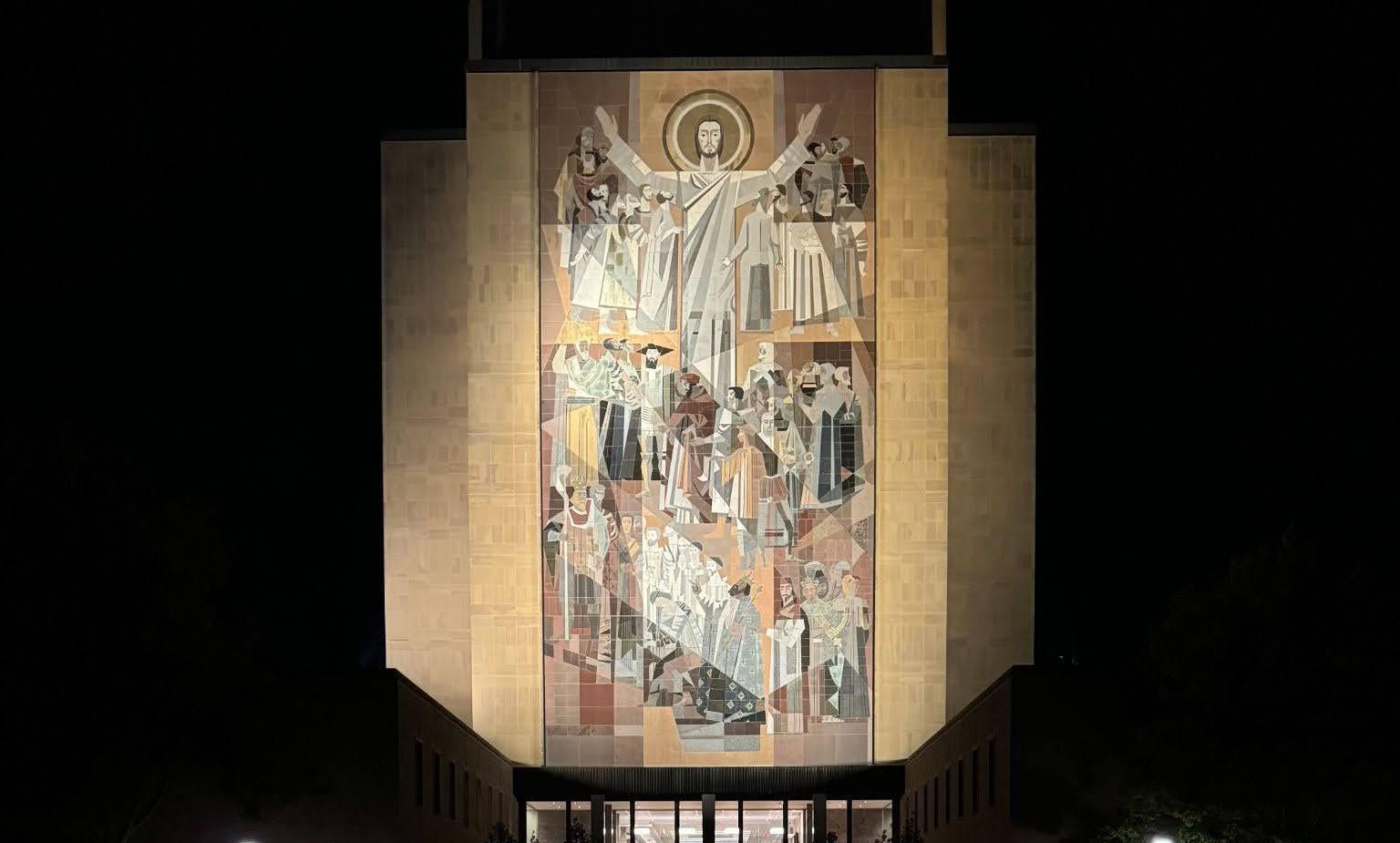
This mindset of convenience and efficiency then takes precedence over the real purpose of education — to grow the mind. Going to a liberal arts university like Notre Dame is not about learning facts, but rather how to think. Frankly, I could acquire all of the facts I need from my Notre Dame education in less than six months. However, the many readings, discussions and lectures provide invaluable cognitive training.
And if we are to go down extraneous paths — like reading books or articles that we don’t really “need” to read, we benefit more than we even realize. This past fall, I was exposed to a poem from fellow Kentuckian Wendell Berry that more succinctly and beautifully expressed the problem with Chuang’s message than
I ever could. Berry writes that we should “be like the fox / who makes more tracks than necessary, / sometimes in the wrong direction.” Understanding that our work is not to accomplish some direct goal, but rather to grow us as a person and thinker is a liberating feeling as a college student. We have lifetimes of careers ahead of us, where knowing facts and following deadlines will be of paramount importance. Why not let college — this wonderful, idyllic cognitive training ground — actually serve its purpose?
Incidentally, as I was writing this column, a Notre Dame professor chimed into the discourse prompted by Chuang’s email. David Smiley, a teaching professor who teaches AI and data science, wrote on LinkedIn that
the administration “must state unequivocally that if you do not want to be formed in the classroom and be tested by the fires of critical thinking and academic rigor, then the University of Notre Dame is not the place for you.”
I wholeheartedly agree with professor Smiley. In fact, I am willing to concede that AI may have a role to play in education. AI may serve researchers well in providing useful information regarding existing scholarly work on a given subject. It may also be useful in data organization.
In these ways, AI is merely advancing the wealth of technology already used in academia like search engines or spreadsheets.
The struggle with AI, however, is when it shifts actual learning or work from the human mind
Careerism is a disease
The mornings are cold, and the days are long in our nation’s capital. The sights on the commute to work resemble a silent frenzy — you see a mass of tired, yet focused, eyes on their way to work, each carrying a sense of urgency written in by their hurried strides on and off crowded metro cars. There are no passing smiles or conversations. Stern, nearly somber, faces remain absorbed in their private worlds as the train’s relentless clacking fills the void left by our silence.
For the past semester, I have gotten well acquainted with this morning scene. Washington runs at a feverish pace. There is always something happening, somewhere, and of some kind of significance. The gate-kept nature of these occurrences only adds to the self-assumed “importance” that most Washingtonians carry. I think of it as FOMO of the highest order — it is not a trip or a hangout you could be missing. It is a job or a networking opportunity. It is hard to avoid this sickness. Conversations about careers, internships and
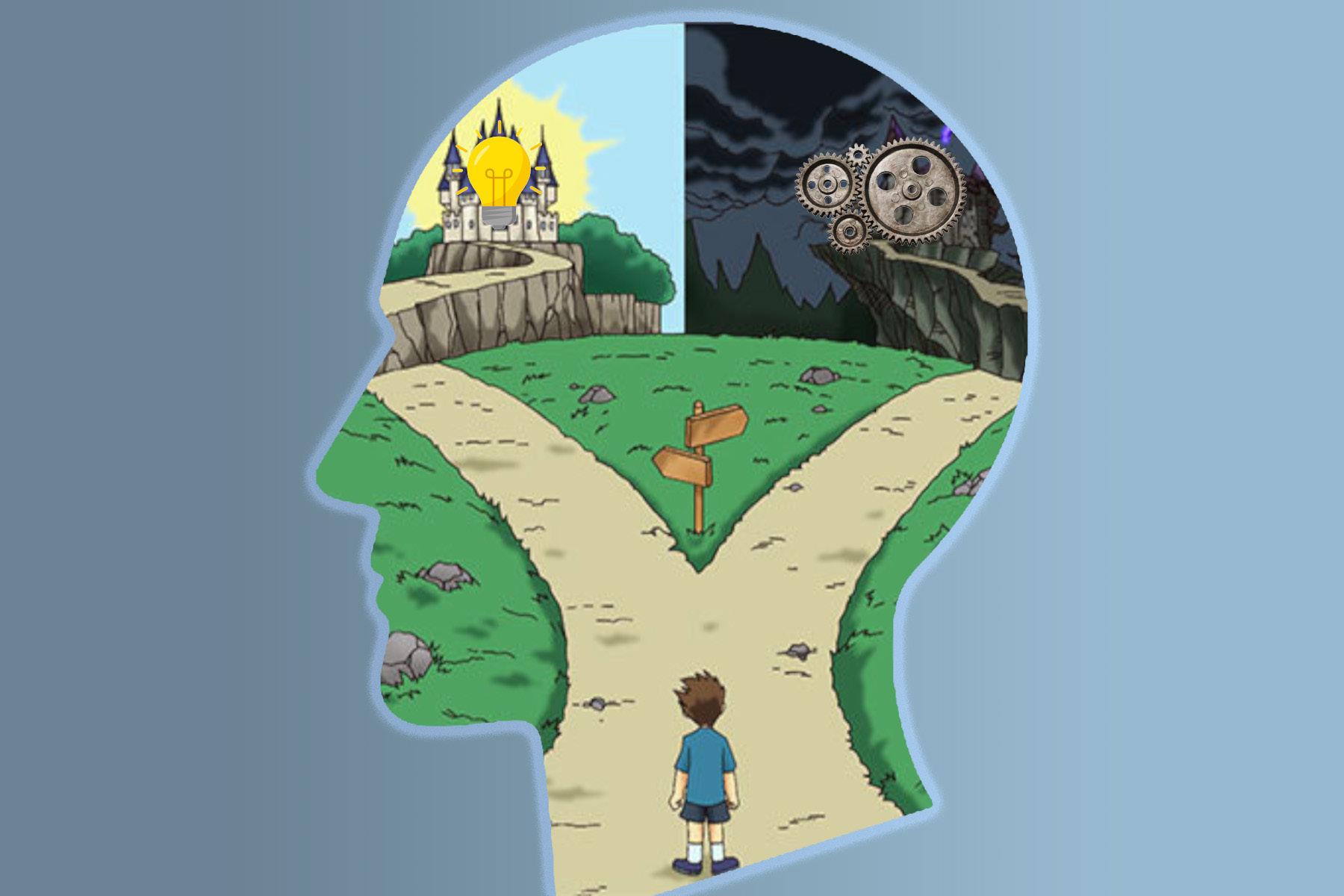
post-grad plans are virtually impossible to escape. Murmurs of law school preparation and job application season anxiety linger in the air. Every computer screen is contaminated with resumes and cover letters, all behind blank Google screens meant to hide from the embarrassment of applying to jobs on the WiFi of your current one. Soon enough, you catch the cold. The symptoms
arrive in bunches — your career plans consume you, and the ceaseless desire to achieve begins to set in. Hours are spent scouring job sites, but something feels off. Maybe you are falling behind. Not doing enough. Comparisons, conversations and coffee chats — none of them remedy your ailment.
This sickness — careerism — hides in plain sight, rewarding
to the digital mind. I will never trust generative AI to feel the depths of human emotion, nor will I trust AI to actually complete reliable work. Industry leaders who continue to test AI’s reliability continue to be disappointed. Just last week, a top Wall Street law firm was exposed for using generative AI to create a legal brief, hallucinating case law in the process.
The most disappointing part of Chuang’s email, though? It wasn’t from an outside company trying to take our money. It was from a classmate. Our community should know better.
AI doesn’t lower my cortisol as Chuang promises. It raises it. Maybe I’ll be left behind by my peers. Maybe I am accelerating my technological ineptitude. But frankly? I don’t care. I won’t let technology take my ability to think, nor will I mourn the hour and a half I lose by reading a class assignment.
God’s greatest gifts to humanity are our abilities to think, to feel and to struggle. When we yield these gifts to the computers of our own creation, we make ourselves a kind of god while also robbing ourselves of our greatest attributes. What is left is the husk of an automaton. I prefer being Grayson Luke Beckham as God made him.
The views expressed in this column are those of the author and not necessarily those of The Observer.
Contact Grayson Beckham at gbeckham@nd.edu
obsession over conviction and molding purpose into positioning. Washington is the perfect incubator; the city is flooded with ambition, qualifications and expertise. Everyone appears to have a personal agenda, a plan or a clear, identifiable end goal. Naturally, you follow suit, attempting to blend life and career aspirations into difficult-to-attain titles. Now, you are no longer just
symptomatic — you are contagious. Careerism, in its lightest form, has taken root.
This concept is neither revelatory nor unique. Aspects of this disorder are commonplace among high-achieving higher educational circles, often without harm. Selecting classes based on GPA protection instead of genuine academic intrigue can pass as benign — the same goes for joining and applying for leadership positions in clubs out of “necessity” instead of interest. The more you age, the underlying calculus of success becomes more apparent. There is a game to be played and moves to be made; whether or not you decide to participate is the only autonomy you are afforded. I won’t deny the existence of this “game,” nor will I attempt to shame those for playing it. It was the quiet assumption we all carried after opening our acceptance letters to Notre Dame — we knew our school could provide us with greater chances at finding our versions of success.
Being ambitious and having goals are not inherently malignant traits. This differentiation
GRAYSON BECKHAM | The Observer
By Naasei Lynn Columnist, “The Oregon Tale”
ALYSSA SIRICHOKTANASUP| The Observer
Careerism
Continued from page 5
has been made before, and the economic pressures facing students are clear — tuition costs are only increasing, and the post-grad job market is becoming an increasingly treacherous terrain. It takes intentionality to achieve career goals — and that often means applying this same intention to your educational and early-career experiences. This behavior only becomes pathological when career success becomes integral to self-worth and overrides the very convictions that
ambition was intended to serve. This malady transforms the engine of aspiration into the instrument of your own erasure. Past passions are hollowed out into one-liners, and positions are sought solely for the prestige they confer. Containment quickly breaks beyond the confines of employment — swallowing every hour of your day and every corner of your individuality. A careerist mindset violently removes any air for introspection, leaving you with the suffocating absence of an examined self. With this perspective, everything becomes a contest, and your vision is constrained to a black-and-white
OPINION
world — there are only those doing better or worse than you. As careerism progresses, the distinction between who you are and what appears on your resume no longer exists — your titles become your identity. Despite the severity, careerism is not terminal. Healing does not require the abandonment of ambition, simply the reassertion of intention. To properly orient (or reorient) yourself, you must take a step back and assess your true motivations. Ask yourself why — why do you need that position, title or role? Is the answer rooted in what you believe or in expectations you’ve
internalized? Stepping back from careerism requires focus, will and time — but these are steps toward remission.
I write this, having wrestled with careerism myself. I, too, have spent hours fretting over getting the “best” internship, comparing myself to others on LinkedIn and incorrectly treating my resume as an encapsulation of my experience in living. Having spent several months in a hotspot for this behavior, I could no longer ignore how much it had affected me. To turn away is a conscious and difficult choice but a necessary one. Be ambitious. Be proud of
what you have accomplished. But tread carefully — the validation of achievement is fleeting. The metro will still be waiting for me tomorrow morning, much like the careers and accolades that await all of us. The difference lies in whether we step on that train with intention or simply allow the weight of its movement to carry us forward.
The views expressed in this column are those of the author and not necessarily those of The Observer.
Contact Naasei Lynn at wlynn@nd.edu
Notre Dame v. academic freedom
By Diego Gonzalez Columnist, “Legalist Realities”
When one believes to know the truth it becomes burdensome; it makes you feel responsible for its dissemination and prompts you to discourage falsities. A Catholic university proclaims to know one thing from which everything flows: Jesus resurrected. With this comes a certain morality, certain obligations and binding customs, which have been developed through millennia. This baggage imposes itself on the Church’s institutions — like Notre Dame. One of the most notable tensions between the Catholic mission and modern ideals lies in the preservation of academic freedom — the tolerance, discourse and investigation of diverse ideas. The Church actively advocates for its form of morality and worldview, and its institutions are expected to do the same. How can an institution that presumes certain truths meet the neutral and objective standard our modern world has for universities — especially when the discourse contradicts its own principles?
I argue that a Catholic university can not meet the objective neutrality expected of a university in our age. I also argue most schools possess an illusory neutrality; at least Catholic institutions are transparent about the foundational axioms that define the marketplace of discourse.
The Catholic Church has stalls in the universal marketplace, and Notre Dame is one of its vendors. Both can not be passive. They move and act for, as Matthew states, “the gates of hell shall not prevail against it.”
The Catholic identity, as mentioned in The Application for Ex Corde Ecclesiae for the United States, has “distinctive characteristics that are essential for Catholic identity”, one being that reflection and research should be done “in the light of the Catholic faith.”
This follows from the principle that there is “no contradiction in the truth,” Fr. John Paul Kimes, canon lawyer and assistant professor of the practice at Notre Dame Law School

wrote in a statement to The Observer. “Authentic research and Church teachings are not at odds.”
This is drawn from Ex Corde Ecclesiae section 17, itself drawing from the Second Vatican Council’s Gaudium et Spes, saying methodical research “can never truly conflict with faith” because both “derive from the same God.” An example of this active action lies in Canon 810 of the Code of Canon Law where it says that professors in a Catholic university must be, “outstanding in integrity of doctrine and probity of life and that they are removed from their function when they lack these requirements.”
So then, how can a Catholic institution, with its preconceived notions of unitive truth, be satisfactorily free in its academic discourse? It is impossible. The Church has its beliefs, and it acts upon them. The Holy Cross mission statement proclaims a desire for “truth to be promoted in every imaginable way.” But when that truth is preconceived by the institution hosting the discourse surrounding its validity, critics may reasonably argue that it stifles the marketplace of ideas. However, this critique assumes secular universities are “neutral” marketplaces. They are not. The reality is that secular universities possess their own iterations of canon law, ecumenical councils and dogmatic decrees — some of
which stand in direct opposition to Catholic doctrine. The traditions from which many secular universities draw are often concealed under the guise of objective neutrality and academic freedom — until the ever-present line is expressed.
Consider abortion, a controversial topic whose fundamental nature is defined by one’s perspective in the debate: a matter of life and death or an inconsequential removal of cells. It is also, possibly, the most distinctly Catholic stance; where Catholics can only be on the anti-abortion side of the debate. Catechism of the Catholic Church §2272 is uncompromising: “A person who procures a completed abortion incurs a latae sententiae excommunication.” Even helping one get an abortion incurs this automatic excommunication from office and sacraments (see also Canon 1397). Usually, the abortion-rights advocate does not believe that non-viable cells, at conception, are imbued with the same rights a human obtains later in life — as they do not constitute the kind of life imbued with rights; therefore legislating against the abortive act is an intrusion. A conflict arises between the death of a human or the intrusion of one’s rights. Here the neutral and objective market place of ideas should flow in its untampered course. Right? No.
By virtue of its Catholic
identity, Notre Dame absolutely must, by every metric possible to measure its actions, be against and prohibit the abortion-rights position to be actualized or promoted. In theory, it would weigh in one side as to not help with the advancement of the abortion-rights side, and therefore the procurement of abortions. Likewise, the secular universities advocate with the opposite intentions. In the marketplace of ideas, within the academic environment and throughout school culture, the abortion-rights position is permitted and often promoted, while the anti-abortion advocate faces undeniable ostracization from both faculty and students. Both are acting politically, not neutrally. This can be seen from staff council statements from The University of Pittsburgh, to student magazines quoting their chancellor’s support for the, “ability to access necessary health care services” and even to funded reproductive health law centers with the goal of “helping advocates attack bans and criminalization at state and national levels.” The institutional support swings the other way too with the banning of certain talks and advertisements in Texan and Christian universities. However, the cards are out there. There is no guise of objective neutrality to be seen. You know the general environment expected at a Christian university, with its moral beliefs
plastered on a charter, creed or canons for you.
While UCLA uses state money to fund an abortion law advocacy center; the UCLA Academic Senate Committee on Academic Freedom boldly claims, “CAF stands opposed to partisan intrusion — of any sort — into teaching and learning at the university or any political tests imposed on scholarship or science.” I have not found a statement on the center’s establishment. The political test is stated in their mission statement: “Our mission is to increase access to abortion and contraception.” Granted, abortion-rights advocacy is not their only proclaimed function; they also focus on “racial and economic disparities in maternal health outcomes” and “gender bias that limits reproductive justice.” But if we take an honest look and recognize that this is not only an “abortion sanctuary,” as a UCLA professor writing for the student magazine claims, but also an organization co-founded by the CEO of Planned Parenthood Los Angeles, we can see it is clearly partisan. You can also consult any of the law center’s newsletters.
Political or religious affiliations impact one’s actions. The same stands for institutions which claim to be neutral hosts. Notre Dame serves the global academic community best when it does not mimic the illusory neutrality of its peers, but offers a consistent alternative. If it exists, academic freedom is best produced through a defined and consistent framework. If Notre Dame refuses to mask its mission, it can remain one of the few places where the marketplace of ideas is governed by a visible creed. If Notre Dame is to be Catholic, it must act while holding the Catholic baggage and define the marketplace it hosts. Clarity serves us all better.
The views expressed in this column are those of the author and not necessarily those of The Observer.
Contact Diego Gonzalez at dgonza38@nd.edu
LIAM FLYNN | The Observer
Coachella 1999 v. 2026: What has changed?
By Isabela Garza Sanchez Scene Writer
Picture this: October skies, desert heat, Levi’s 550 cutoff shorts and rock. This was the first-ever Coachella Valley Music and Arts Festival. Today, the festival has shifted slightly, from downto-earth rock ‘n’ roll to a glitzand-glam fashion runway. The massive annual music and arts festival is held over a two-week period in April at the Empire Polo Club in Indio, California. It is immensely popular for hosting high-profile artists from diverse genres, attracting music-lovers from all over the country and stressing them out with the intense pressure of not knowing what to wear. But what we know of the event today has a story of origin, a place where baby tees and Adidas Gazelles were trending.
1999 was a vibrant mix of glamour-meets-grunge. Style icons like Sarah Jessica Parker and Britney Spears defined what lived inside people’s closets. Everyone had a pair of combat boots or baggy pants — well, everyone except people at Coachella. Priorities were less on clothing and more on the music itself. People dressed to survive the terrible heat and be comfortable, more or less. Band t-shirts, tracksuits and flannel shirts wrapped around the waist were the look.
As the event rose to fame and social media became a thing, however, fashion was focused on as much as the lineups. The 2010s boho-chic trend came around, and Vanessa Hudgens was the
it-girl. Ruffled blouses, fringed suede vests and, of course, flower crowns. Fast forward to the 2020s, the Kardashian-Jenner family and several influencers took over. People wear bikini tops, tons of layers and sheer fabrics, drawing inspiration from Y2K and maximalism. Observing this shift, it may seem audiences are more excited for Instagram pictures and trendy outfits; yes, they still acknowledge the music, but they didn’t really enjoy it as people did in 1999. Coachella began as an alternative music festival in the now-famously known “City of Festivals.” Perfect for hiking, affordable living and the famous date shakes, the city of Indio was known for the National Date Festival, a celebration of the region’s date
palm harvest with an Arabian Nights theme and ostrich races. Different from the celebration of dates, the music festival was founded by music enthusiasts Paul Tollett and Rick Van Santen with zero success. There were around 25,000 people in attendance, with tickets sold at $50 — not even close to today’s $2,000, and that is if you find an incredibly cheap reseller and pray you are not getting scammed.
The inaugural two-day event featured headliners Beck, Tool and Rage Against the Machine. While it might’ve been cheap and fun, they canceled the event for the following year. Why? Because the partners lost $1 million, or nearly $2 million today due to inflation. To re-establish the festival as a premier, sustainable
event, they moved the date from October to April to avoid extreme heat and tried again in 2001. And, as you can probably tell from the popularity it has today, it was a success — second time’s the charm, I guess.
As for today, Coachella has become renowned for booking music icons and reuniting iconic brands. Major artists such as Beyoncé, Billie Eilish, Harry Styles and Bad Bunny have performed on stage. This year, talented artists like Sabrina Carpenter, Karol G and Anyma gave us incredible looks and performances.
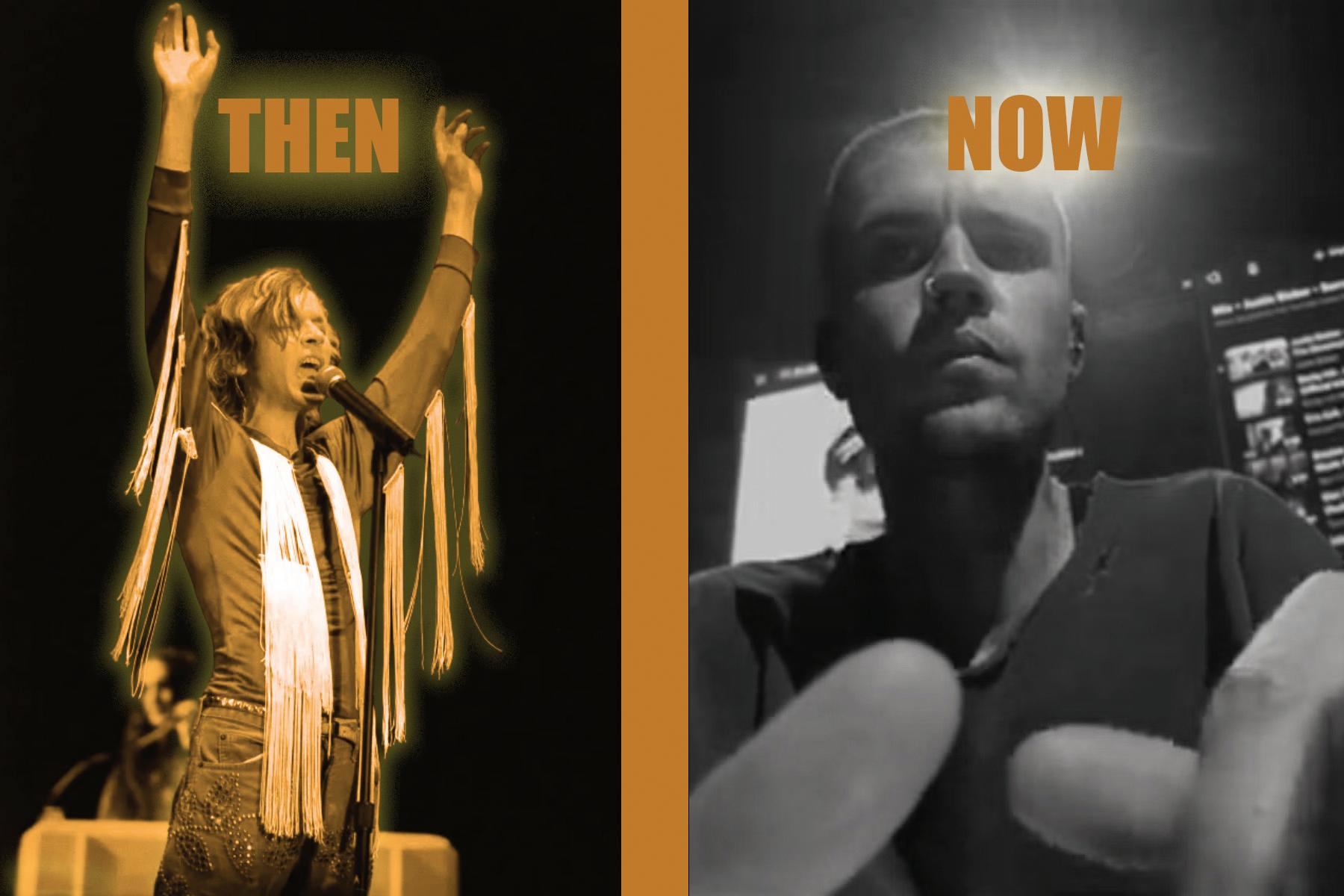
But of course, the main event was “Bieberchella.” Justin Bieber’s headlining performance at the main stage on April 11 and April 18 marked a major live performance comeback after a long
break without seeing everyone’s childhood crush.
With this performance, Bieber has broken the record for highest-paid artist in Coachella history at $10 million for two nights. He featured a throwback segment performing hits like “Beauty and a Beat” and “Baby,” both songs I distinctly remember my friends obsessing over (I was more of a Katy Perry fan at the age of eight). The second show was all over the internet with award-winning artist and super fan Billie Eilish, encouraged by his beautiful wife Hailey Bieber, to go up on stage and join his performance of “One Less Lonely Girl,” creating a really sweet moment. Instagram pics, exotic art installations, glamping and EDM; this is the Coachella of today.
The intimate, anti-Woodstock desert escape was once a mellow event, but it is not our Coachella. Adapting to every changing trend and influencer of the year, the event still celebrates music and art, just with a more curated, luxurious vibe. Now, the real question is whether this evolution is good or bad? I believe it is neither.
Sometimes it’s cringy, like when singer-songwriter CeeLo Green told the crowd to “put your middle fingers in the air.” Or soul-touching, like “Beychella,” Beyoncé’s historic 2018 political and radical performance celebrating Black history and womanhood. And so, is the new Coachella better or worse? You tell me.
Contact Isabela Garza Sanchez at igarzasa@nd.edu
The Strokes make a political comeback at Coachella
By Matt Norton Scene Writer
This past weekend, American rock band The Strokes rounded off the second weekend of Coachella with a stellar musical performance accompanied by a display of protest music of such magnitude and scope not seen in decades. They closed out their set with a performance of their 2016 song “Oblivius” to a background of a politically charged slideshow showcasing alleged CIAbacked assassinations and coups in Latin America and beyond.
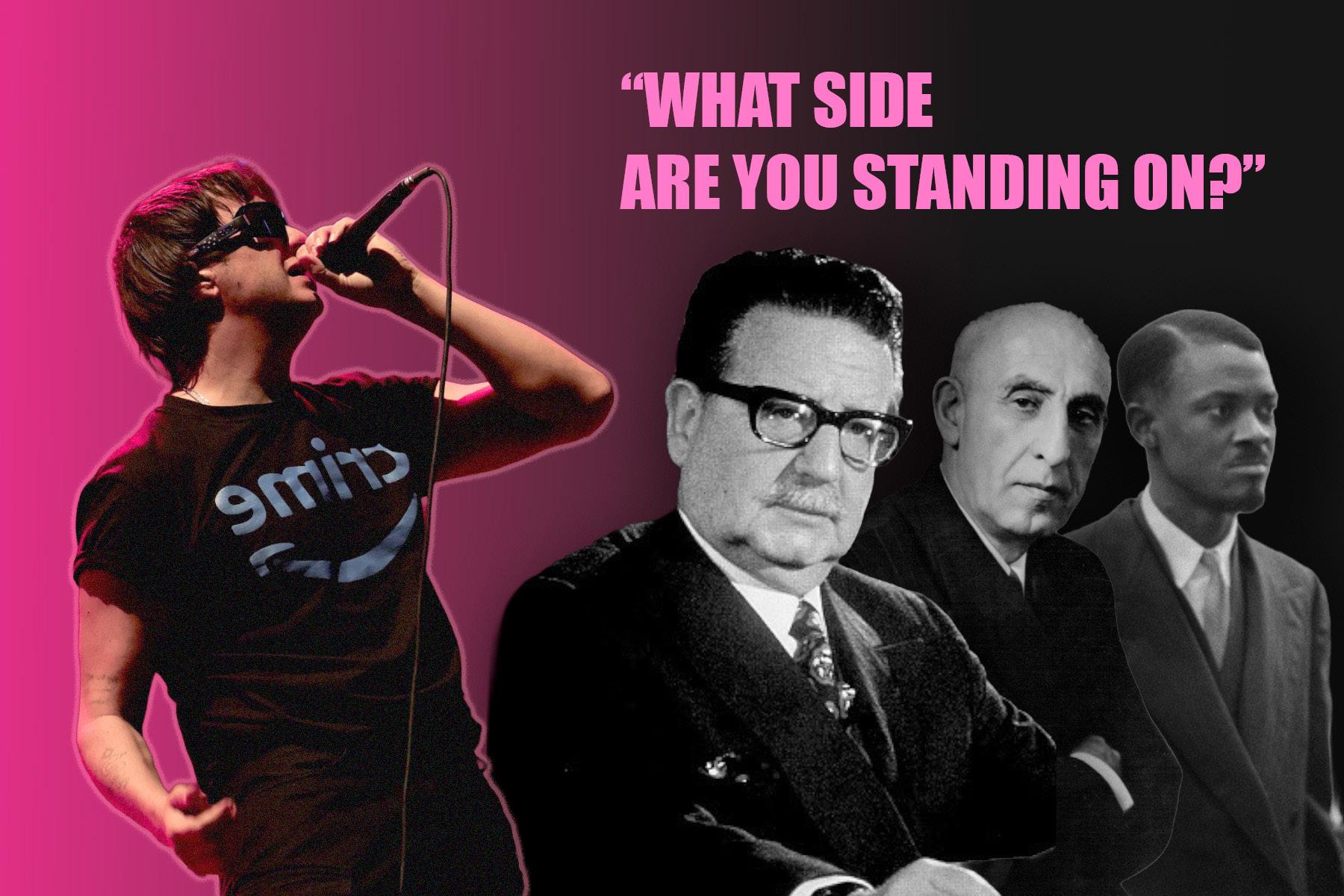
The slideshow began with the toppling of Iranian Prime Minister Mohammad Mossadegh, who was overthrown by a partially American intelligence-backed coup triggered by a nationalization of Iran’s oil deposits. From there, the montage continued to echo current political tensions. While displaying photos of the Congo’s Lumumba, Bolivia’s Torres and Chile’s Allende, the song’s chorus “What side are you standing on?” echoed throughout the venue. The historical weight of the images and allegations display was definitely made clear to the crowd.
The most polarizing aspect of the set was the showcasing of alleged
domestic interference by American intelligence services, culminating in a series of slides surrounding the 1999 civil trial where a jury held the American government liable for the assassination of Martin Luther King Jr. (Disclaimer: It’s well-documented that King and his family were surveilled by the FBI and CIA, though a 2000 internal investigation turned up no evidence of government involvement). Closing out
their set, footage showcasing the rubble of universities in Gaza and Iran accompanied the powerful final crescendo of “Oblivius.”
Reactions were immediate, especially for the protest occurring on such a global scale, with it spreading across X, Facebook and Instagram rapidly. Many saw it as something on brand for the band and a reasonable extension of many of their tracks’ political influence,
while others attacked the full veracity of the montage’s claims, especially regarding direct American involvement in the assassination of foreign premiers.
In any case, this display of political protest is not something that should come as a surprise for longtime fans of The Strokes. Lead singer Julian Casablancas has been an outspoken political advocate for years, signing numerous petitions
surrounding subjects like Palestine, wealth inequality and other topics that have been at the forefront of politics. The only surprise here is that this set somehow made it through Coachella’s vetting — the festival is not known for being a politically charged one, and I’d highly doubt The Strokes will be invited back for a while.
On another note, the band is gearing up for their summer release of their first album in six years, “Reality Awaits,” and a display of such magnitude and reach is sure to garner a good amount of hype for their upcoming tour.
No matter what side of the political spectrum you find yourself on, I think we can all appreciate that displays of free expression, especially in music, truly keep the key tenets of our constitutional rights alive. It’s refreshing to see headliner bands like The Strokes break the mold and actually express themselves in spite of contracts and other constraints preventing such expression that could affect the bottom lines of their agents and promoters. The Strokes have broken their yearslong hiatus with a powerful comeback.
Contact Matt Norton at mnorton3@nd.edu
LIAM FLYNN | The Observer
LIAM FLYNN | The Observer
Love selected third overall by Arizona Cardinals
By Observer Sports Staff
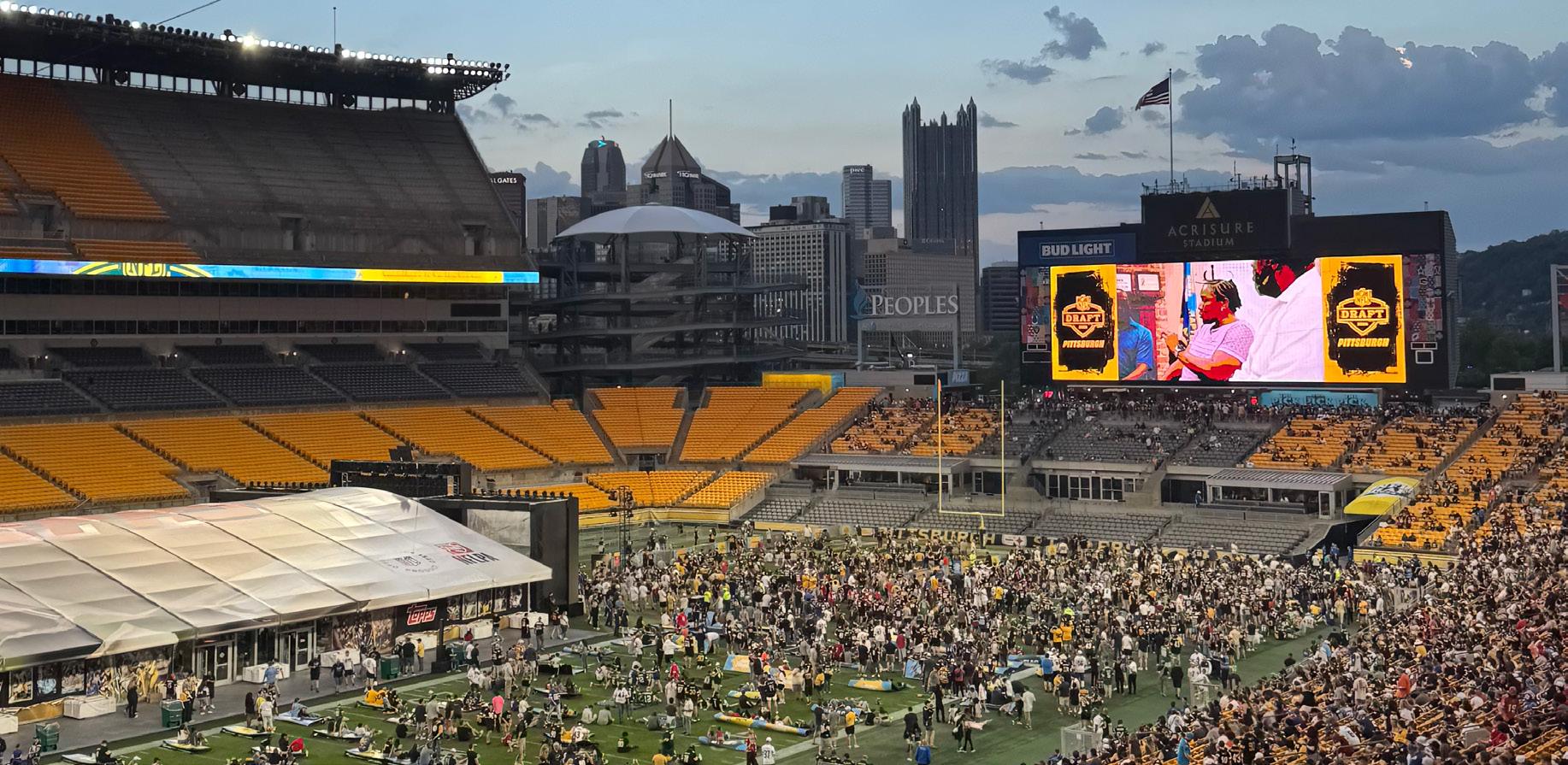
Notre Dame standout running back Jeremiyah Love was selected with the third overall pick in the 2026 NFL Draft by the Arizona Cardinals Thursday night. Flanked by his family and Notre Dame head coach Marcus Freeman in the Steel City of Pittsburgh, Penn., Love became just the third running back selected in the top-3 over the past 20 years.
Love was a workhorse for the Irish offense in 2025, leading the team with 1,372 rushing yards on 199 carries and broke the program’s record for total touchdowns in a single season with 21 scores. A native of St. Louis, Love also collected several accolades this season, earning Unanimous All-American honors, as well as being named one of four Heisman Trophy finalists.
Love became the first running back picked in the top3 since 2018, when Saquon Barkley was chosen second overall by the New York Giants. The selection is also the highest pick a Notre Dame running back has earned throughout the 90year history of the NFL Draft. Pro Football Hall of Famer Jerome Bettis was selected by the Pittsburgh Steelers with the 10th pick in 1993 after a standout three-year career in South Bend. 1956 Heisman Trophy winner Paul Hornung
went first in the 1957 Draft before enjoying an impressive career in Green Bay as a running back, but Hornung played quarterback for the Irish, allowing Love to claim the distinction.
Love’s production for the Fighting Irish began well before his storied junior campaign. The 4-star recruit racked up 504 all-purpose yards and two touchdowns as a freshman while backing up current New Orleans Saint, Audric Estime. Moving into the starting role as a sophomore, Love scored 19 touchdowns and eclipsed 1,100 rushing yards. He broke the program record by scoring in the first 13 games of the season, including a 98-yard rampage against Indiana to mark the first touchdown of the 12team College Football Playoff. Love also added 46 yards and a critical touchdown in the thrilling semifinal victory over Penn State at the Orange Bowl.
During the NFL Combine, Love recorded a 4.36 second forty-yard dash, with his athleticism jumping off the page to complement his on-field abilities.
Arizona went 3-14 last season and finished 4th in the NFC West. Although Love fills the void at running back vacated by James Conner, the Cardinals will also have a new head coach and starting quarterback in 2026 as the franchise embarks on a rebuild.
MARIELLA TADDONIO | The Observer
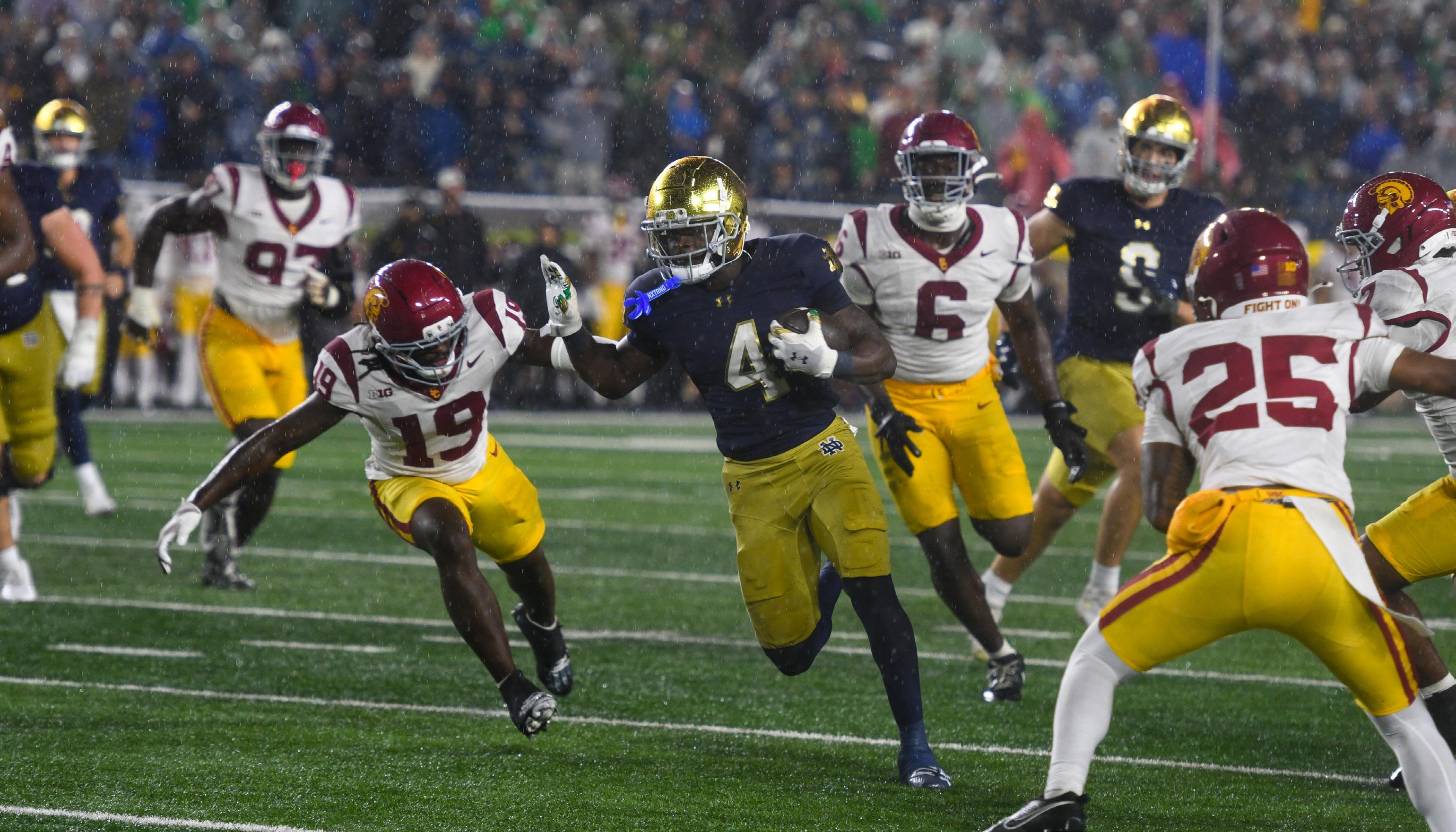
Jeremiyah Love slices through the USC secondary on the way to the endzone during Notre Dame’s 34-24 rivalry victory over the Trojans at Notre Dame Stadium on Oct. 18, 2025. After hurdling a Trojan defender in the 2024 win, Love had a career day in 2025, totaling 265 yards, including 228 on the ground, the most by an Irish player in the rivalry since 1996.
DECLAN LEE | The Observer
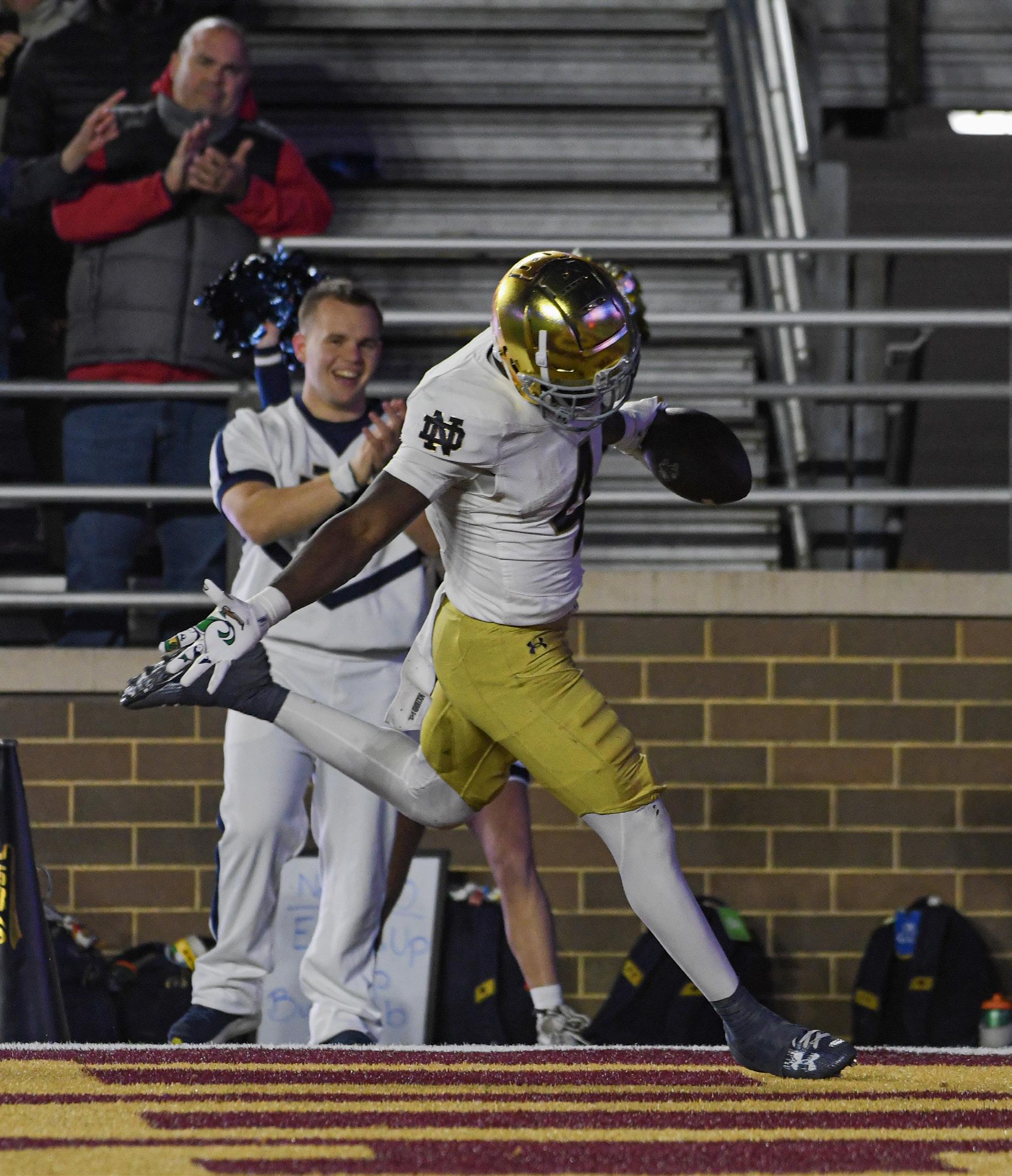
Jeremiyah Love celebrates in the endzone following a 94-yard touchdown to seal Notre Dame’s 22-10 win at Boston College at Alumni Stadium on Nov. 1, 2025. Love finished the game with 143 yards on 17 carries.
Notre Dame baseball
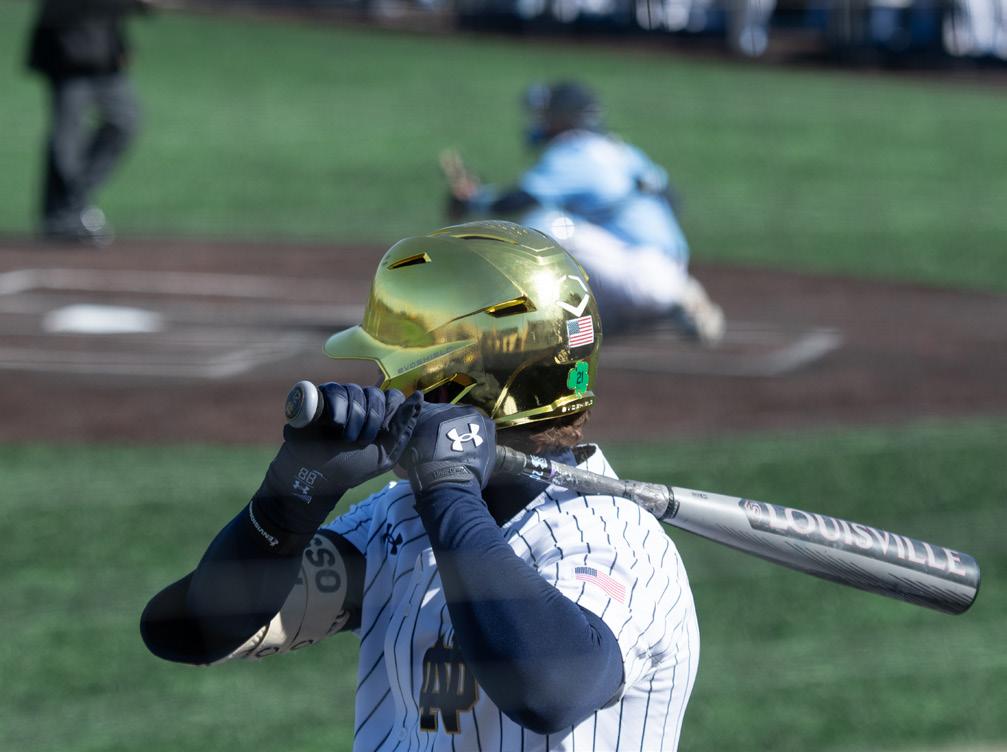
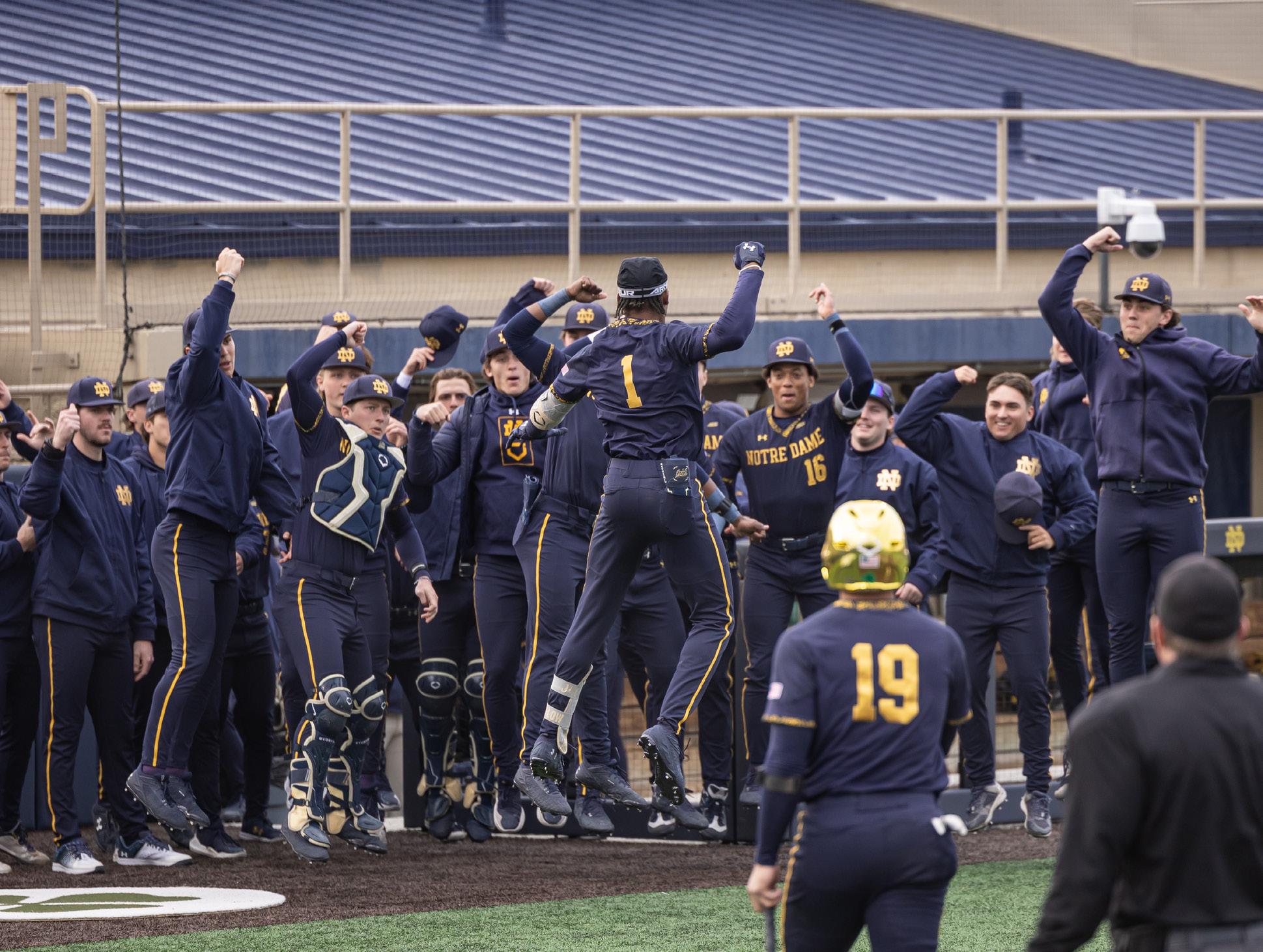
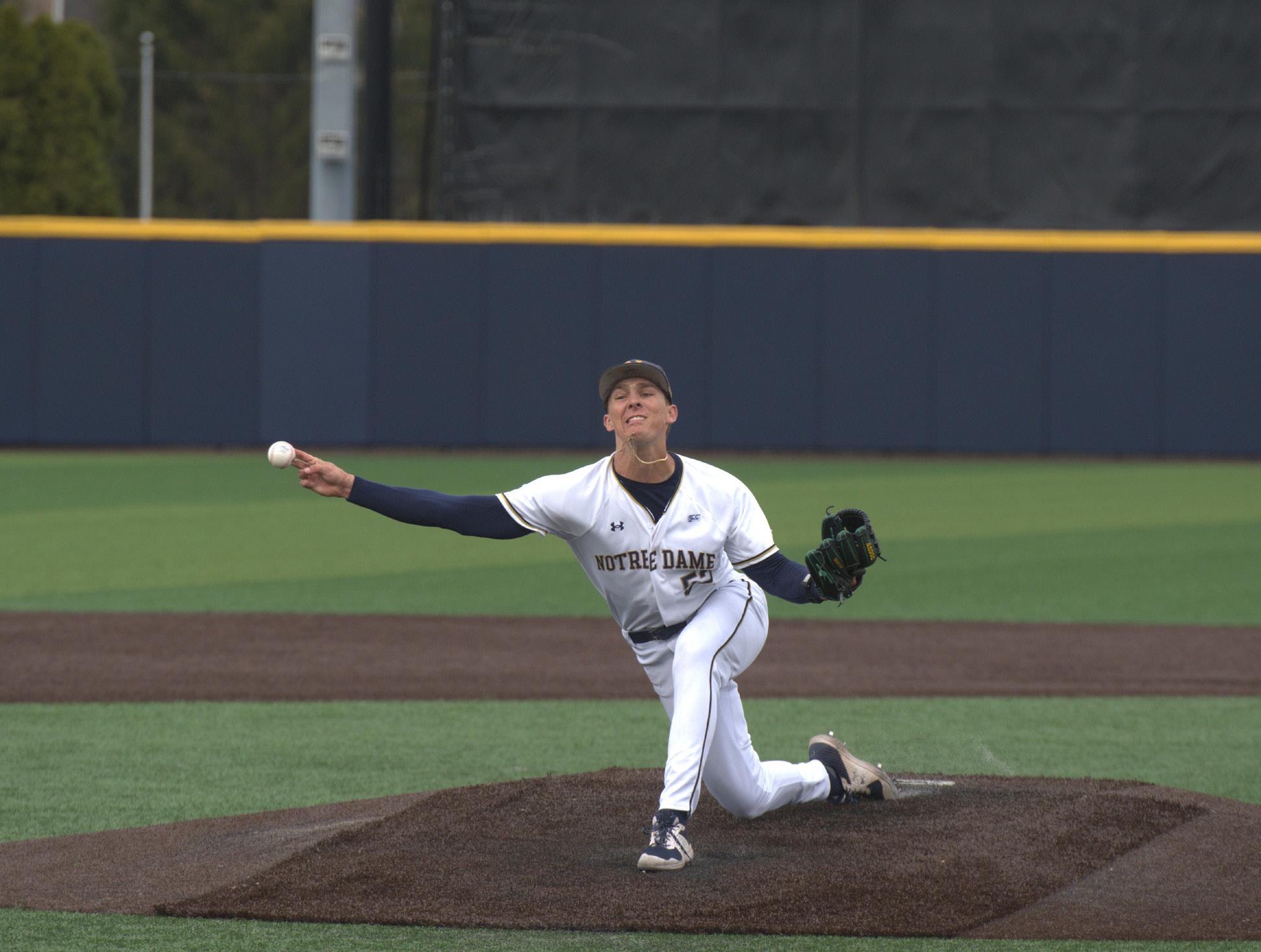
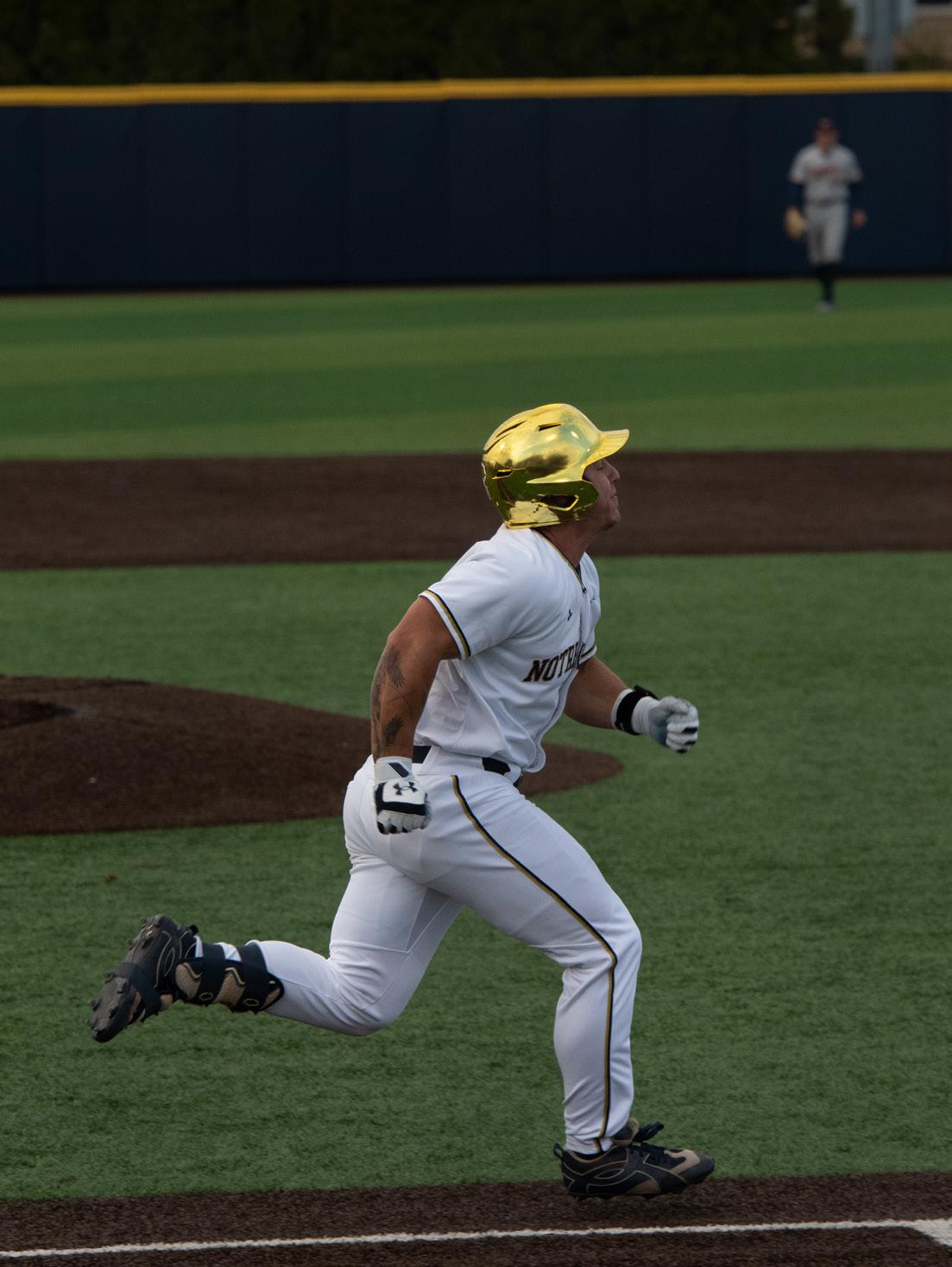
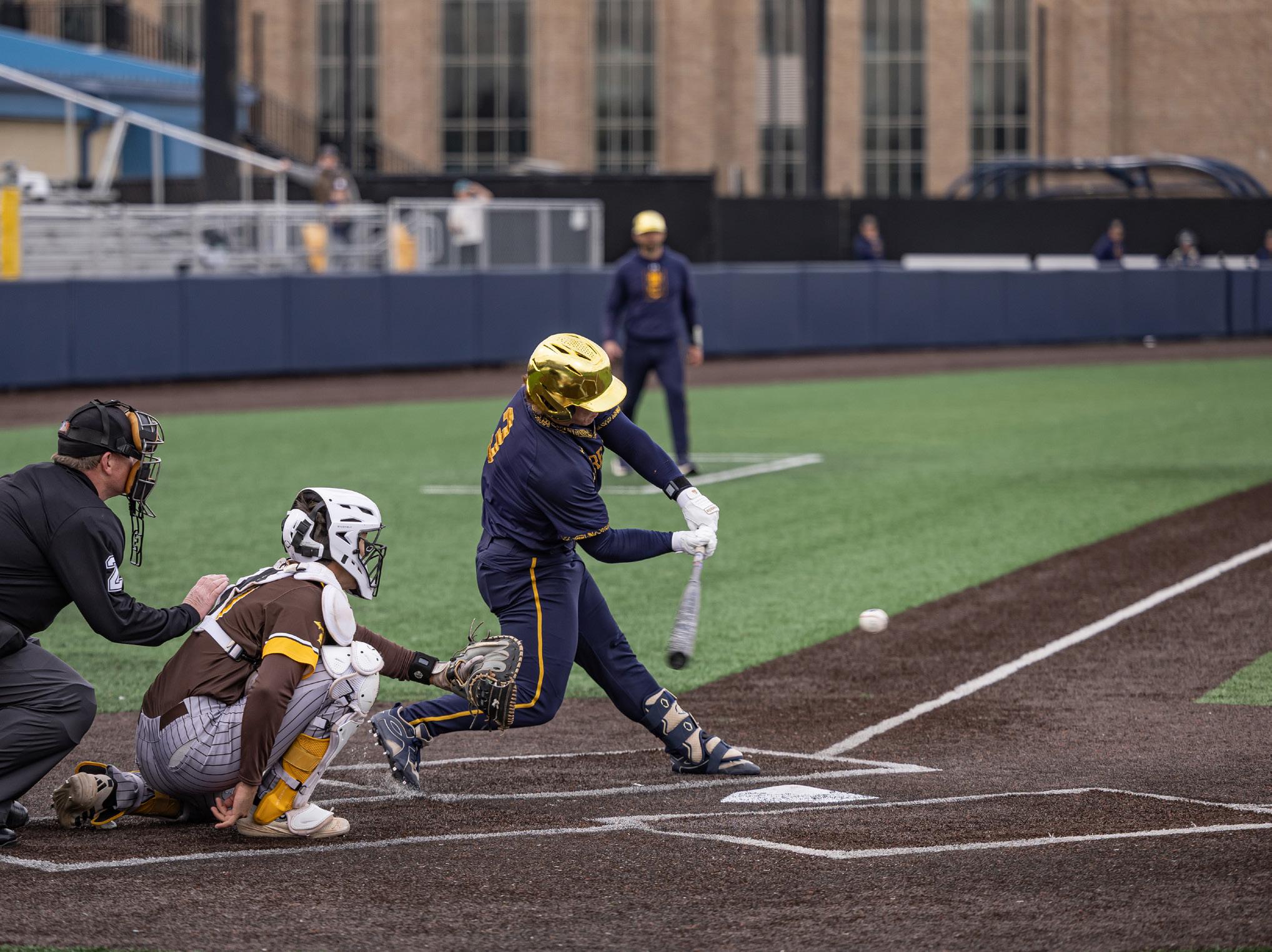
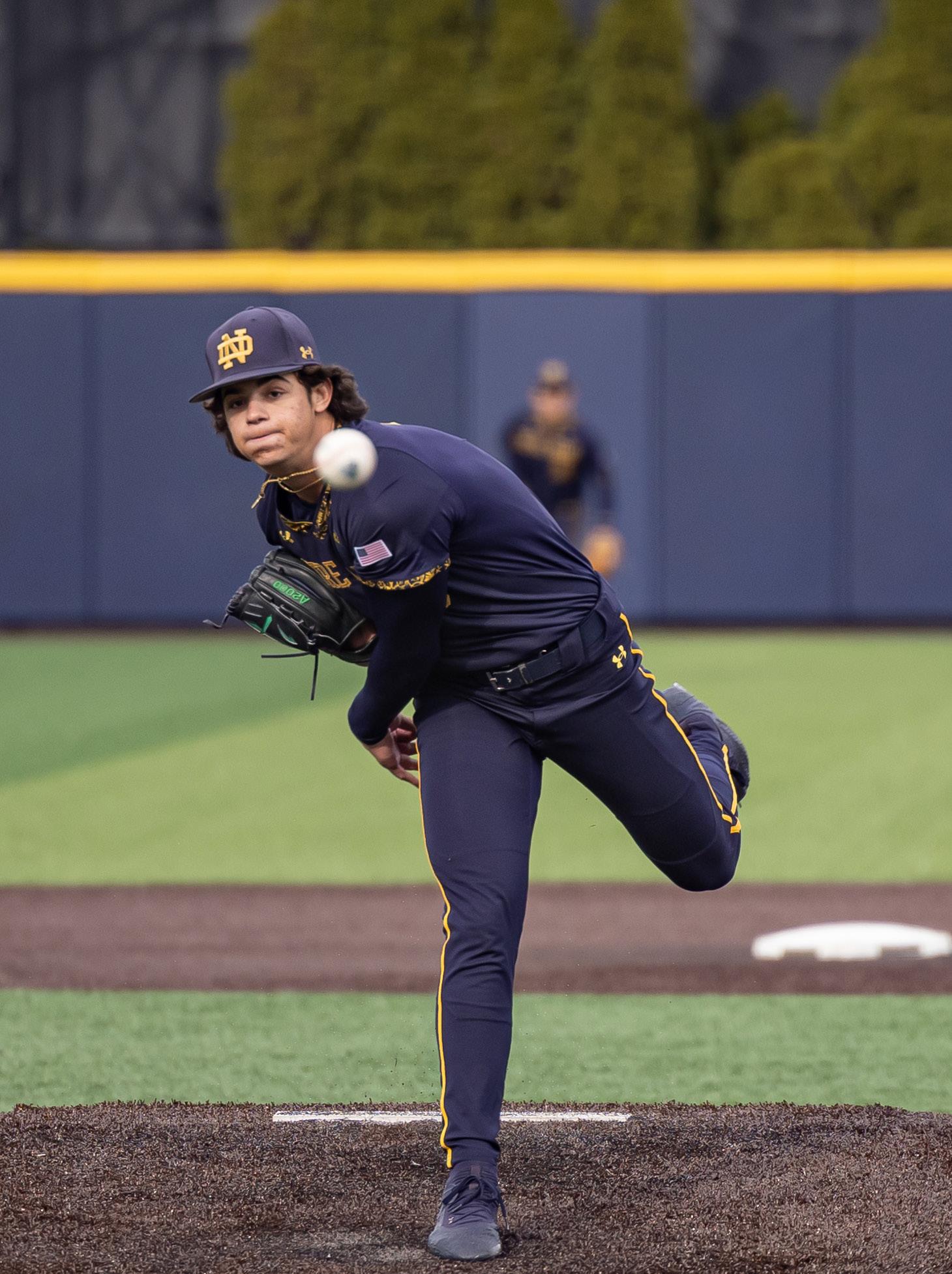
Photography by Declan Lee (Top Left, Center Left, Center Right) Gabriella Martin (Top Right, Bottom Left) and Lina Liu (Bottom Right)
Collins: My only NFL mock draft, Irish edition
By Ellie Collins Associate Sports Editor
At this point, every one of us is tired of reading Mel Kiper and other draft “experts” in their 317th mock draft edition. So here are my only draft predictions, focusing solely on the beloved Irish. The potential draftees are listed in reverse order of when I think their names will be called.
Quick note: Some of our guys will most likely be free agents, including Will Pauling, Devonta Smith, Jalen Stroman, Gabriel Rubio, Jared Dawson, Junior Tuihalamaka, James Rendell and Jordan Botelho. Even if they do not get drafted, it does not mean they cannot play in the NFL. Last year, 57 undrafted free agents made the initial 53-man rosters. Personally, I think Pauling and Rubio have the best chance to make a roster, but all of them should at least earn practice-squad berths.
But now we are on the clock; here are the selections.
Aamil Wagner, offensive tackle
Aamil Wagner put together two strong seasons at Notre Dame, joining the starting lineup as a sophomore in 2024. He was named a captain for his junior campaign. By NFL standards, however, he is a little small and does not promise the consistency of a professional starter. He, therefore, projects to fill the role of a valuable swing tackle. I, like the mock-draft consensus, have him going in the sixth or seventh round, and because it would be nice to see him with a team in the rebuilding stage, the New Orleans Saints would be the best fit.
Billy Schrauth, offensive guard
Offensive guard Billy Schrauth, while uniformly excellent, poses some injury concerns. He suffered two defining knee injuries during his collegiate career. After the first in 2024, he failed to return fully healthy but provided solid play in spite of it during the run to the national championship. And though he was beginning to reach his All-American potential as an elite recruit, he got hurt during October’s 2025’s USC matchup. Despite going on the shelf for the remainder of the season, however, he flashed his dominant promise against the Trojans. In the pro world, offensive line success is really about system and fit. With Schrauth’s bruising style, I say his name will be called in the third or fourth round.
I would love to see him with the Baltimore Ravens, given their smash-mouth football style.
Eli Raridon, tight end
Like Schrauth, tight end Eli Raridon dealt with injuries that tainted his college tapes. However, despite his two ACL tears, he clearly displays the athleticism and testing numbers necessary for an impact starter. Most people have him going in the fourth round, but, because of his blocking and catching abilities, I see him going in the higher range of the second or third. In my opinion, I like him with the Cincinnati Bengals in tandem with signal-caller Joe Burrow, or, even better, the Philadelphia Eagles and Jalen Hurts, as they desperately need to identify their future tight end.
Malachi Fields, wide receiver
Malachi Fields really took advantage of his senior season in South Bend to solidify his elite status as a wide receiver. Given Notre Dame’s rocky history with receiver recruits, the higher he goes, the better for the Irish. Though there was some initial late first-round buzz, the more probable scenario for Fields would be second or third round, likely being viewed as the No. 2 receiver option at the NFL level. I want him with the Buffalo Bills, as they need a big-body guy like him for a deep-ball and red-zone threat for superstar quarterback Josh Allen.
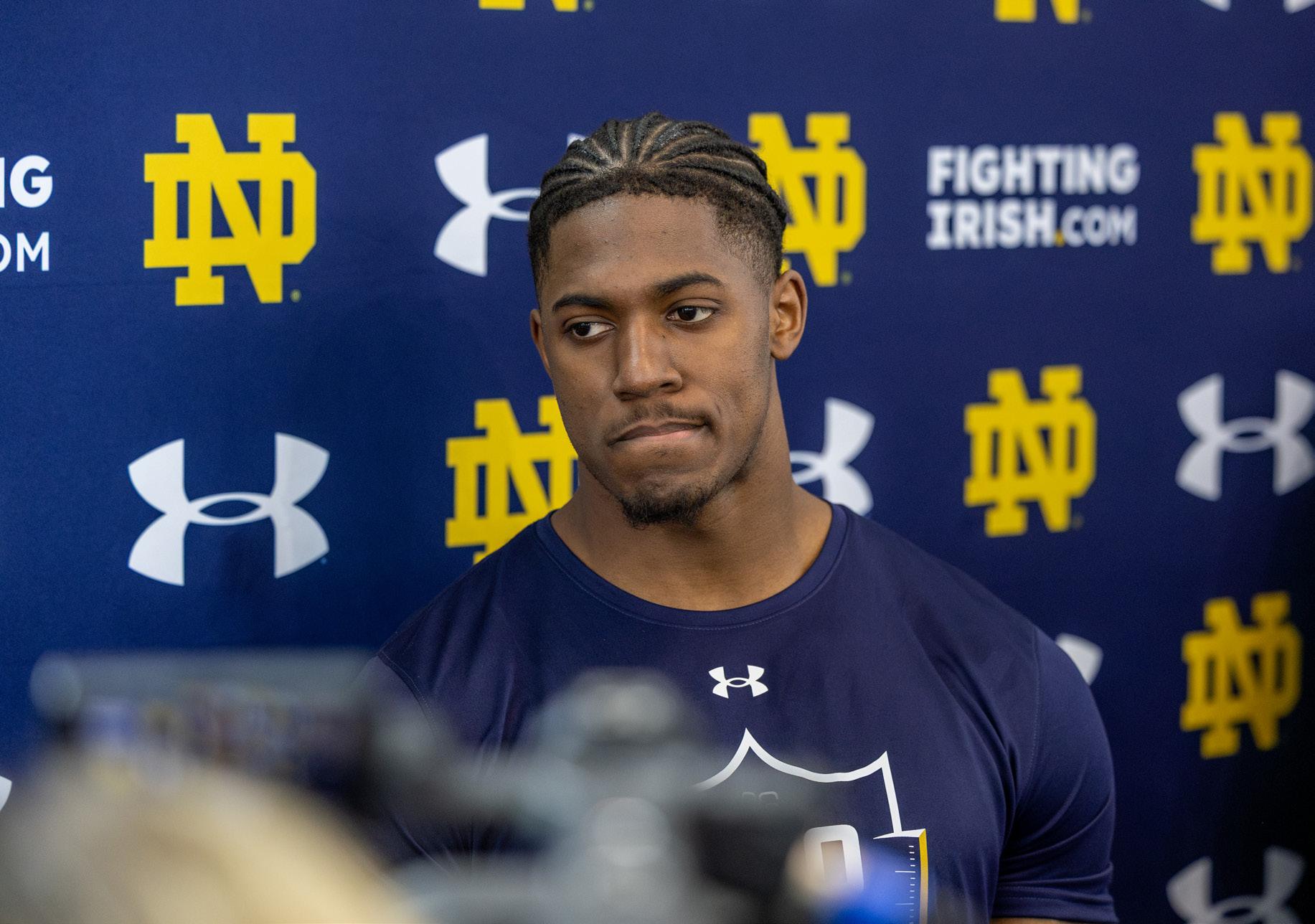
Jadarian Price, running back
Besides running mate Jeremiyah Love, Jadarian Price takes a backseat to no back in this draft. In fact, if he is the second runner off the board, he and Love will make history by being the first teammates to be taken 1-2 at the position. He could slide to the third round, but, given his big-play ability, Price will most likely hear his name called in the middle of round two. A great landing spot for the Irish legend, in my opinion, would be the Houston Texans — they need a running back, and he could
take pressure off quarterback
CJ Stroud.
Jeremiyah Love, running back
The moment you have been waiting for. The big question mark for Love will be the NFL’s valuation of running backs — given some teams may view him as the best player in the draft class, there is a possibility some general manager will trade up for him. He could go as high as third overall but should certainly hear his name called in the first 10 picks. If so, his most likely landing spots are the Tennessee
Titans, New York Giants or Washington Commanders. Love has the name and game made for the big lights of New York, but my hope is that the Minnesota Vikings trade up for him, and Kyle Shanahan acolyte and Vikings coach Kevin O’Connell makes him the next-generation version of Christian McCaffrey. With my one-and-only mock complete, do not hold your breath for my way-too-early 2027 mock draft.
Contact Ellie Collins at ecollin9@nd.edu
DECLAN LEE | The Observer
Jadarian Price answers questions from the media during Notre Dame’s Pro Day on March 24. The native of Denison, Texas, had a standout junior year, tallying 761 yards from scrimmage to go along with 13 scores.
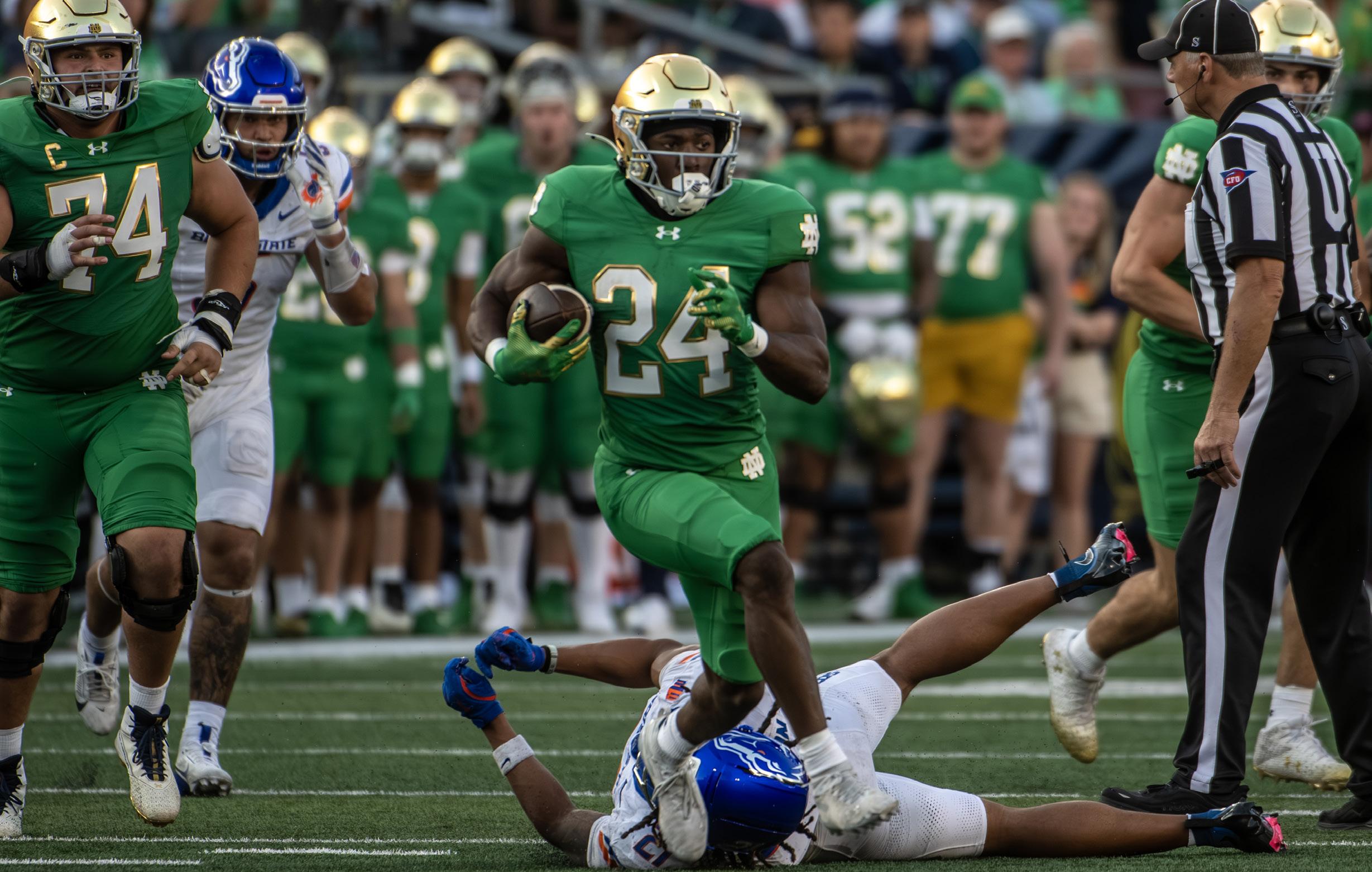
DECLAN LEE | The Observer
Jadarian Price (center) sprints past a Boise State defender on his way to the endzone after receiving a lead block from Billy Schrauth (left) during Notre Dame’s 28-7 win on Oct. 4, 2025. A projected second-round NFL Draft pick, Price took 8 carries for 83 yards and a touchdown in the win.
Irish baseball wins close game at Michigan State
By Zach Jones Sports Writer
Notre Dame baseball beat Michigan State in East Lansing by a score of 3-2 on Wednesday afternoon. The Irish victory evened the season series between the two teams at 1-1, as Michigan State beat Notre Dame last month 7-4 in South Bend. Following the win, the Irish improved to 18-18 on the year, while the Spartans fell to 14-23 overall.
Graduate student righty Ty Uber got the start for the Irish. Uber, who didn’t pitch in last week’s series against FSU due to some rough outings of late, got on the right track with two innings of two-run ball. He was relieved by graduate pitcher Eli Thurmond, who twirled two scoreless innings.
The Irish offense notched three runs in the contest, all coming in the first inning. In that frame, leadoff man graduate outfielder Drew Berkland singled and scored on a botched pick-off attempt to third. Two batters later, two-hole hitter sophomore infield and outfielder Bino Watters came around to
score on a sacrifice fly. With two outs, sophomore infielder Parker Brzustewicz, batting seventh, capped the rally with an RBI single to score junior catcher Mark Quatrani.
While the Irish were held scoreless in the remaining eight frames, they certainly didn’t go without chances to score. They stranded nine runners after the first inning and had bases loaded in the fourth and fifth innings, but they just couldn’t come up with a hit to bring the runners home.
Freshman righty Will Jaisle, freshman lefty Caden Crowell and sophomore righty Oisin Lee blanked the Spartans for the final five frames to secure the win for the Irish. Crowell spun three scoreless perfect innings, striking out three Spartans and allowing none to reach base. He capped off his night with two straight strikeouts and gave a big chest bump as he left the mound.
Crowell has now pitched ten straight scoreless innings, dating back to his start last Tuesday against Valparaiso where he blanked the Beacons for three scoreless. Jaisle pitched a clean
fifth inning and Lee spun a scoreless ninth to close the game for the Irish.
Leaders at the plate included Berkland and Watters, each of whom went 3-5 with a run scored. Brzustewicz delivered a productive 2-3 performance and collected an RBI and a walk. Sophomore right-fielder Jayce Lee slugged a lead-off triple in the fifth as well.
It was quite the display from the Irish bullpen, who held the Spartans scoreless for seven straight innings. After bullpen woes sunk the Irish against Florida State last weekend and Virginia the weekend before, Wednesday’s contest might be a harbinger of improved effectiveness as ACC conference play winds down and the conference tournament approaches.
Notre Dame will look to continue winning this weekend as they take on No. 24 Boston College this weekend at home. First pitches are scheduled for 6:30 p.m. on Friday, 2 p.m. on Saturday and 1 p.m. on Sunday.
Contact Zach Jones at zjones3@nd.edu
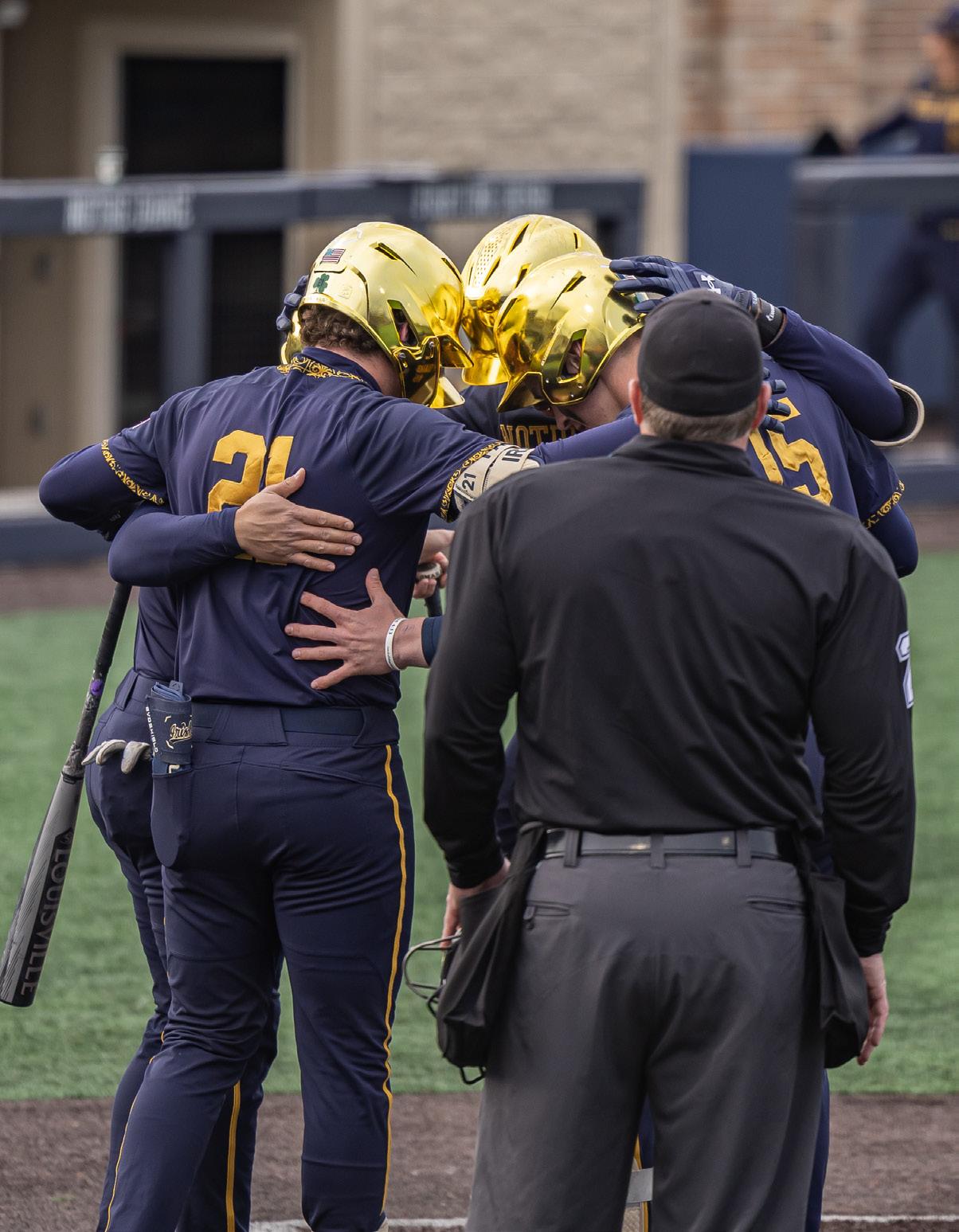
Notre Dame celebrates a three-run blast during its win over Western Michigan on March 24. The Irish won 14-3 in a 7-inning run-rule win.

GRADADS



What NIL can’t explain in collegiate recruiting
By Ethan Laslo Associate Sports Editor
For many high school football recruits, there is one aspect of the recruiting process that flies under the radar. There is a certain pride in being able to represent a community that helped make you into the person you are today. Many don’t need many words to express that feeling. For example, Asa Burch, a highly touted class of 2028 edge rusher, spoke to The Observer this week about his recruiting process.
“I can’t wait to represent where I’m from,” Burch said.
Burch, a product of Warren, Ohio, received an offer from Fighting Irish head coach Marcus Freeman and the Irish on April 12. In addition to Notre Dame, the 4-star holds offers from schools in each Power Four conference and many more beyond. In the Big Ten, he holds offers from Ohio State, Michigan, Oregon, Penn State and Michigan State. He also holds at least one offer each from the other three major FBS conferences: Missouri and Tennessee in the SEC, West Virginia in the Big 12 and Pittsburgh in the ACC. He’s as widely recruited as any other in his class.
In the world of college football, there is no facet of building a team as important as recruiting. However, it has taken a sharp turn in recent years with the introduction of NIL into the landscape of recruiting. But, much of that NIL money goes toward luring recruits out of the transfer portal. Another hallmark of modern college football, the transfer portal has given players the liberty to leave their former teams and join another in hopes of better prospects there. Reports over the past portal period suggested that quarterbacks could lure in between $1 million and $4 million in NIL, while freshman quarterbacks typically draw between $100,000 and $300,000.
The same, however, cannot necessarily be said of high school recruits like Burch, who will have to make a choice about their first school, one that could make or break their college football career.
This weekend, some of the most valuable high school recruits in the eyes of the Notre Dame coaching staff will likely be present at Notre Dame Stadium for the annual BlueGold Game. It may not be their only visit with the Irish, but it will be one of the most valuable in terms of the impact that it creates. The difference between these recruits and those out of the transfer portal, however, is what they may be looking for. Every recruit, no matter
what level, wants to be successful. Nowadays, they also likely want to pull a profit from both NIL and the newly introduced revenue-sharing measures. The primary difference for high school recruits is they have no experience at the collegiate level and, like Burch, may focus more on finding their new football home.
Burch made it a point to explain not everything in the college football recruiting process is purely about football. Instead, he emphasized the importance of finding a balance between education and athletics while keeping a good relationship with his coaches, all hallmarks of finding a new home rather than just a new football team.
“I’m looking for a school with good education and to be great at football,” he said. “I value the connection between the coaches and the players.”
Unfortunately for Burch, things weren’t always easy in the recruiting process. When asked about how he has navigated the recruiting process, he admitted, “It was pretty rough in the beginning, but now I have some good things going for me so I would say amazing.”
During his visit to Notre Dame, Burch had the chance to meet with several members of the coaching staff, including Freeman. He also had the opportunity to tour the football facilities, noting that he thoroughly enjoyed the entire experience.
Overall, Burch felt “great” after his tour and said he “can’t wait to go back.”
“I love how they do things with their athletes and their education,” Burch said, referring back to his previously mentioned preferences for finding his best recruitment match.
It seems NIL dominates the landscape of recruiting in 2026, however, other factors can play just as big of a role, particularly for those at the high school level. For Burch and countless others, there is one part of athletic success that cannot quite be quantified: pride. Whether an athlete comes from a football-rich area such as Northeast Ohio, like Burch does, or a less tradition-rich area, there is still immense pride to be taken in representing a community on some of the biggest stages in college athletics.
Pride may be an older aspect of recruiting; it is certainly harder to measure. But for high school athletes moving to the next stage of their careers, it may matter more than anything else.
DECLAN LEE | The Observer
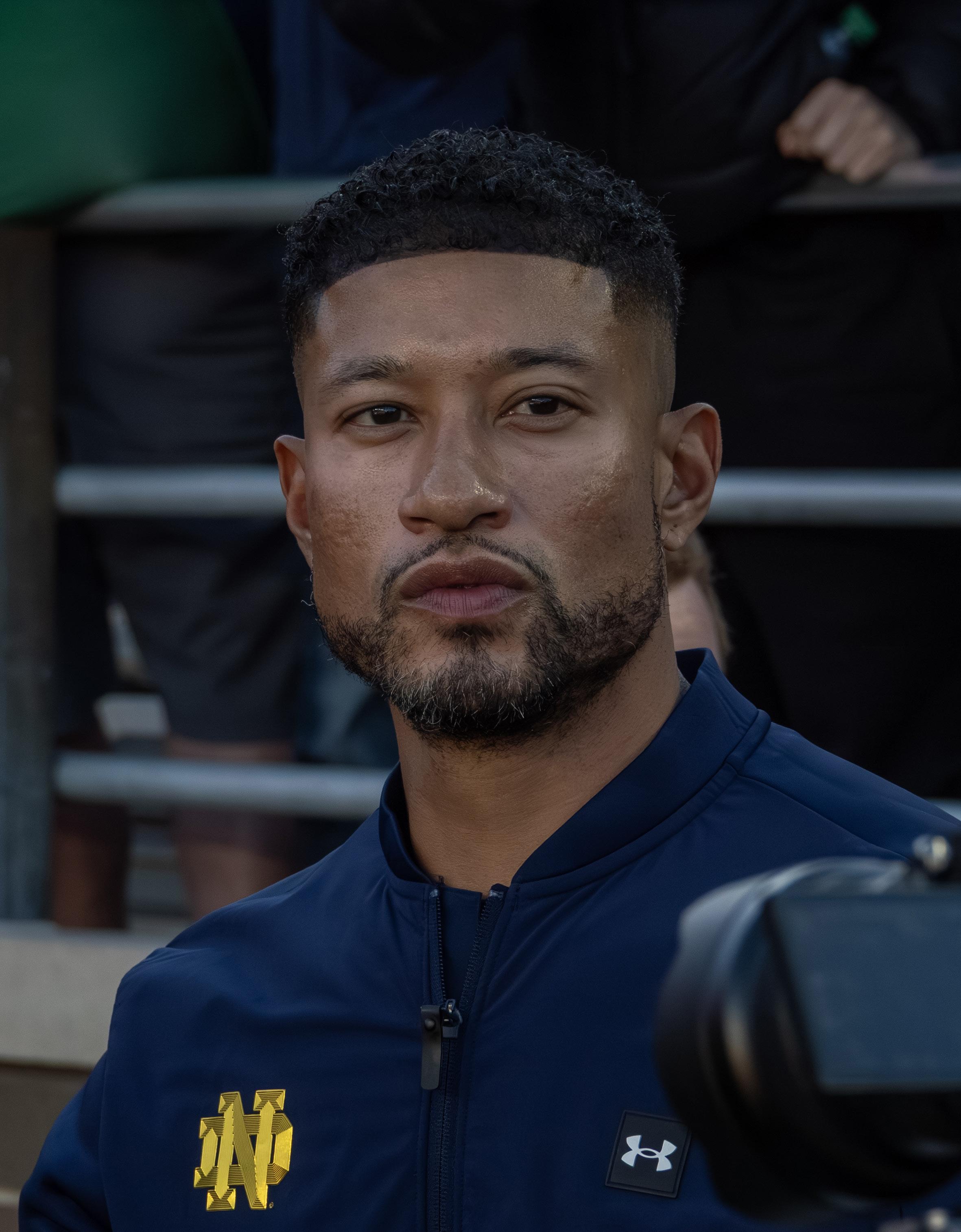
Head coach Marcus Freeman looks on prior to Notre Dame’s win at Boston College at Alumni Stadium on Nov. 1. Since taking the reins in 2021, the 40-year-old has transformed Notre Dame’s recruiting efforts.
DECLAN LEE | The Observer
Irish players sing the alma mater after a 25-10 win at Boston College on Nov. 1, 2025. Notre Dame is investing among the top tier of college football, with reports that its 2026 roster cost in excess of $40 million.
Blue-Gold Game: Three players to watch out for
By Chris Dailey Sports Writer
Marcus Freeman’s quest to bring Notre Dame its first national championship since 1988 begins Saturday at the Blue-Gold game.
The annual spring exhibition provides Freeman with a more comprehensive look at what players can make a real impact this fall.
For some, there’s little mystery. Of course, CJ Carr will impress. Jordan Faison should as well. On defense, Drayk Bowen and Adon Shuler should have no problem holding down the fort.
Freeman’s biggest question centers with the newcomers. Which one of them will seize the opportunity?
Here are three players on Saturday who can do exactly that.
Nolan James Jr. (So.)
Nolan James Jr. has been waiting for this moment.
Taking
By Henry Lytle Associate Sports Editor
With its high title odds, Heisman Trophy-contending players and elite playmakers entering the NFL Draft, Notre Dame has been one of the topics of conversation this college football offseason. The Irish were recently ranked No. 4 in ESPN’s preseason top 25. While Notre Dame has been heavily criticized for what many deem as a weak or lackluster schedule ahead of the 2026 season, taking a deeper look at each game, Marcus Freeman’s team will still be tested in a plethora of ways in its revenge season.
Notre Dame will head to Lambeau Field, home of the Green Bay Packers, on Sept. 6 to kick off the season. The Sunday game will feature a Wisconsin team that went 4-8 in 2025 to finish No. 14 in the Big Ten. The Badgers saw 22 players depart for the transfer portal, while adding 31 new players, including transfer quarterback Colton Joseph from Old Dominion and running back Abu Sama from Iowa State. Wisconsin is projected to improve in Luke Fickell’s fourth year with a win total set at 6.5, placing the team at the cusp of bowl eligibility. If the Irish can get off to an early start on the scoreboard, this game should be a comfortable victory to start the season. Week 2 sees Notre Dame host Rice in the Notre Dame Stadium opener. The Owls are coming off a 5-8 season
The former four-star recruit from the widely-acclaimed Delbarton School in New Jersey featured in a minimal role as a freshman this past fall. However, that’s expected when sitting behind Jeremiyah Love, Jadarian Price and Aneyas Williams.
With the former two headed to the NFL, James is expected to create the Irish new backfield tandem alongside Williams.
In the spring, James has stepped up to the plate and delivered. Clips of his nifty footwork at practice generated thousands of views on social media. The coaching staff has taken notice, and it seems as if it understands it has another gem in its hands.
“He’s a kid that was born to play running back,” positional coach Ja’Jaun Sieder said at a press conference in late March. “He’s built like you want a running back to be built, he’s super smart, he’s super intelligent. He’s like
a look
a quarterback playing running back, he can already see things most guys can’t at the running back position.”
That’s lofty praise coming from a coach who has coached his fair share of superstars.
Devin Fitzgerald (Fr.)
Maybe it’s because he’s the son of NFL Hall of Famer Larry Fitzgerald, but there is seemingly a palpable buzz about the emergence of freshman Devin Fitzgerald this spring.
Fitzgerald arrived to campus this spring as an early enrollee in this freshman class; he starred in high school for Brophy Prep in Arizona. Like his father, Devin is an elite runner with even better hands.
And similarly to James, clips of Fitzgerald impressing at spring practice have done their rounds on social media. In early April, his one-handed grab for a touchdown garnered several big
FOOTBALL
at Notre
that placed them 11th in the American Conference. In Scott Abell’s second year, Rice will look to improve, having added transfer run-first quarterback Jacurri Brown from UCF, as well as linebacker Jesus Machado from Houston. Rice should be another opportunity for Notre Dame’s offense to find its groove early ahead of hosting Michigan State on Sept. 19.
The Spartans finished at 4-8 with only one conference victory — against Maryland — in 2025. This season, Pat Fitzgerald will resume coaching after a four-year hiatus, taking over a struggling team projected at just 3.5 wins. The Spartans will likely come into the game at 2-0 after taking on Toledo and Eastern Michigan in their first two tests of the season. The Spartans lost superstar receiver Nick Marsh to Indiana, key defensive anchor Darius Snow to Texas and many other leading talents. Notre Dame transfer KK Smith will get to take on his old team, but the Irish should not have a problem with the Spartans at home.
The first true road contests will be against Purdue on Sept. 26 followed by North Carolina on Oct. 3. Purdue went 2-10 without any Big Ten wins in 2025 and will hope to build in Barry Odom’s second season at the helm. The Boilermakers added multiple quality players out of the transfer portal, including Justin Denson from Michigan State and John
reposts. Just this past week, a video of Fitzgerald turning a routine slant into a touchdown received tons of online attention.
Although virality is fleeting, Fitzgerald’s talent is certain. Fitzgerald has all the intangibles needed to be a star and provides Notre Dame’s offense a much needed boost after losing Malachi Fields.
Saturday’s game will give Fitzgerald a golden opportunity to show he can contribute from day one.
Spencer Porath (Jr.)
After Notre Dame’s lackluster performance in the kicking department against Boston College this past fall, Freeman said, “The issues were every time we kicked the ball it did not go in between the field goal posts. That’s the issue. We’re going to keep putting guys in there until we can have somebody consistently put the ball through the
Dame’s
Slaughter from Colorado. The Irish have scored 122 points in the last two seasons against Purdue and should have no trouble on the road. Then, Notre Dame will head to Chapel Hill, N.C., for the first out-of-state road game of the season against Bill Belichick’s Tar Heels. After a hyped yet highly disappointing 4-8 season, the Tar Heels are striving for massive improvement in 2026. Belichick’s team will have faced Clemson and TCU and had a bye week before the Irish. The Heels could be as good as 3-0 before taking on Notre Dame. While it is a road game, the Tar Heels will likely be unranked for Notre Dame’s fifth game of the season. While the USC rivalry might have disappeared, Notre Dame will still play Stanford in 2026. After a 4-8 2025 season for the Cardinal, Stanford has a tough stretch of ACC games this season, including Miami, Duke, Wake Forest and Georgia Tech all before Notre Dame. Next, for Notre Dame’s most significant road test of the season, Marcus Freeman will lead his team to Provo, Utah, to take on the preseason No. 12 BYU Cougars. BYU finished as the runner up in the Big XII and will return Bear Bachmeier at quarterback, who threw for over 3,000 yards in his freshman season, and LJ Martin, who rushed for 1,300 yards and 12 touchdowns in 2025. This team could be dangerous for Chris Ash’s defense. The Cougars will likely enter the game undefeated or
field goal posts.”
The Irish were supposed to win that game with ease. In an ugly 25-10 marred by special teams woes, it was anything but easy. Three different Notre Dame kickers failed to convert on two of three extra-point attempts and didn’t convert a single field goal.
After the season, Freeman knew he had to make a change.
Enter Spencer Porath.
The junior transfer from Purdue arrives having converted 41-of-41 PAT attempts. In his sophomore season, he knocked in 15-of-17 field goal attempts with a long of 53 yards against Washington.
Porath is tasked with weathering the Irish special teams storm. Although the stats don’t lie, the Blue-Gold Game will be his first real chance to show Notre Dame has found its long-awaited answer at the kicker position.
Contact Chris Dailey at cdailey2@nd.edu
2026 schedule
with one loss, and it will certainly be a golden opportunity for Notre Dame to finally prove itself against a ranked team.
Next, The Irish will travel to Gillette Stadium to take on a Navy team which finished 11-2 last campaign. The Midshipmen are projected 8.5 wins for the 2026 season, and will be a greater challenge out of the American than Rice. The Irish will then host Miami in the most difficult game of the season. The Hurricanes have added quarterback Darian Mensah from Duke to help lead an offense with playmakers at every position. Coming off the National Championship Game loss to Indiana and big-time contributors leaving a stacked defense, Miami will look to prove its sustained success behind players such as Kadarius Toney. Many Irish fans have circled this as a potential opportunity for College GameDay to visit South Bend, and it is possible if both teams enter undefeated. Miami is ranked as the preseason No. 7 team, and will have faced Clemson, Florida State and Pittsburgh before taking on the Irish.
Notre Dame will host Boston College and top 25 SMU in its next two home games as it prepares for the final stretch of the season. Boston College finished with one ACC victory in 2025 and looks to be improved in Bill O’Brien’s third season. Then, SMU will come to town two years removed from a College Football Playoff appearance and only one year after a 9-4
season in the ACC. Returning Kevin Jennings at quarterback, who threw for 3,600 yards, plus multiple 600-yard receivers, the Mustangs will be the biggest remaining roadblock in Notre Dame’s path throughout the regular season.
The final game of the season will be on the road at Syracuse over Thanksgiving. In Fran Brown’s third season, the Orange will look to stay healthy and compete at the top of the ACC. Notre Dame transfer Steve Angeli will still be leading Syracuse after suffering a season-ending injury last year. The Orange have a favorable conference schedule, avoiding Miami, Duke and Florida State, and could have a record as good as 9-1 or 8-2 if the chips fall in their favor.
Breaking down Notre Dame’s schedule brings a better perspective of the season. If Notre Dame can get past BYU and Miami blemish-free, there is a high likelihood of making the College Football Playoff for another chance at the national championship. However, if Notre Dame manages to lose two games again, it would not be a surprise to see the Irish on the outside of the playoff bubble for a second straight season. The season is in the hands of Marcus Freeman and the talented Notre Dame roster as it prepares for the Blue-Gold Game this weekend.
Contact Henry Lytle at hlytle@nd.edu