
THE INDEPENDENT NEWSPAPER SERVING NOTRE DAME, SAINT MARY’S AND HOLY CROSS
FRIDAY, JANUARY 23,
FRIDAY, JANUARY 23,
The Division of Student Affairs at Notre Dame sent an email Wednesday morning informing the student body that Olusegun “Segun” Olubunmi Soyemi, a second-year graduate student, had died over Christmas break. In the email, University President Fr. Bob Dowd, Provost John McGreevy and vice president for student affairs Fr. Gerry Olinger shared that Soyemi was in the master of sacred music program studying voice. He was from Lagos, Nigeria.
Soyemi was buried on the Notre Dame campus at Cedar Grove Cemetery in December 2025.
The email clarified that members of the sacred music program were notified of Soyemi’s death in December, but administrators shared the information this week with the entire campus in order to offer support for
community members who had returned for the spring semester.
The master of sacred music is a two-year degree requiring 48 credit hours, with a curriculum focused on applied music, sacred music history and analysis and liturgical studies. Students enter the program through one of three studios: choral conducting, organ or voice.
According to the University website, “The MSM program equips students for professional careers in church music – where employment opportunities are plentiful – while also providing them with the foundations to pursue doctoral studies or other professional career paths, including music education, music ministry and concert performance.”
The email included available support resources and plans to gather in remembrance.
Campus Ministry is
available to offer pastoral support to any members of the University community affected by Soyemi’s death. The University Counseling Center also offers confidential counseling services to all degree-seeking students currently enrolled at Notre Dame, as well as international non-degree-seeking students.
The University will celebrate a Mass of remembrance in Soyemi’s honor on Tuesday, Feb. 17 at 5:15 p.m. in the Basilica of the Sacred Heart. Dowd will preside over the Mass, and Fr. Pete McCormick, assistant vice president for Campus Ministry, will deliver the homily.
By Sophie Lewandowski News Writer
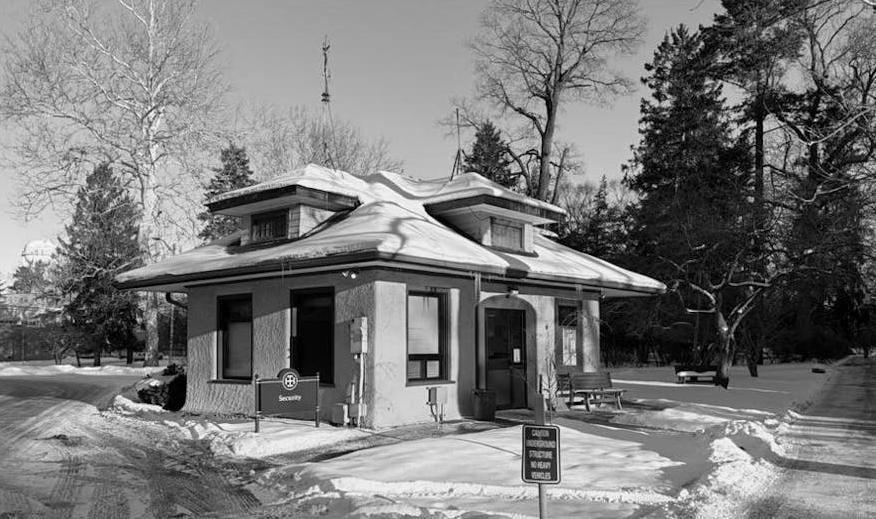
Following the recent shooting that occurred at the intersection of Angela Boulevard and Michigan Avenue on Jan. 11, Saint Mary’s Campus Safety department did not send out an alert to students.
Phil Bambenek, director of campus safety at Saint Mary’s, explained his office’s decision not to communicate with students about the incident, which left one South
Two presidential tickets have announced their intention to qualify for the student body presidential election, seeking the 700 signatures required to appear on the student government election ballot. Petitions began on Jan. 14, and election hopefuls must reach the minimum signatures before the Jan. 26 deadline.
Bend resident dead. He said it was determined that students were not in need of either type of alert the office sends out; a campus crime alert or a timely warning.
Crime alerts warn students of situations which they need to be aware of for their immediate safety. Timely warnings notify students of a situation which has already been resolved but which Campus Safety determines occurred in a location
see “Safety” on page 3
By Lucy Loes News Writer
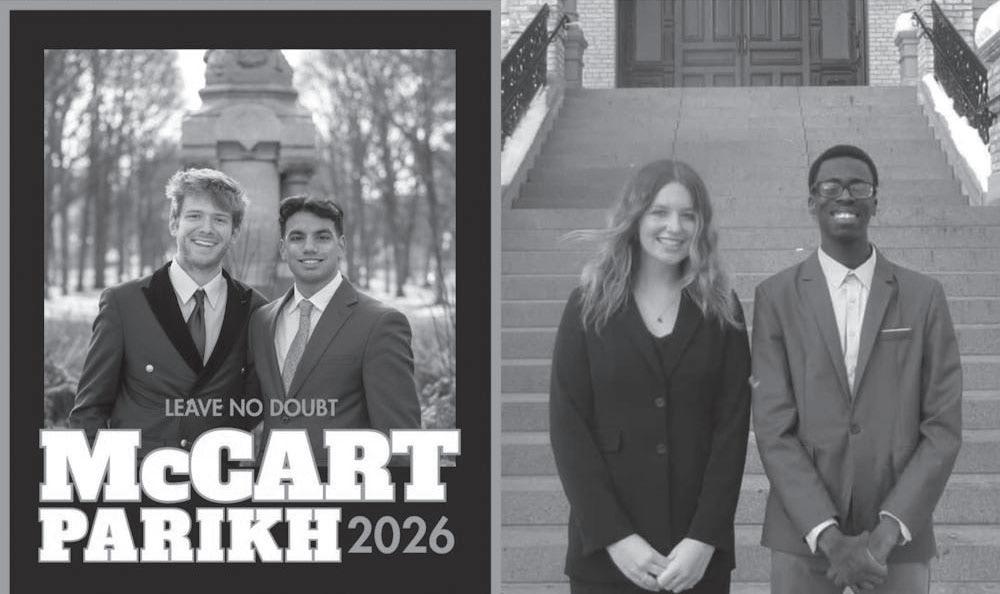
Mason McCart and Luke Parikh became the first ticket to declare their intention to run for the student body presidency, with an Instagram announcement on the first day of petitioning. McCart is a junior from Dillon Hall and co-director of student life in student government. Parikh is a sophomore, also from Dillon Hall. He serves as a committee member for the Department of Communication and Department of Student Life.
NEWS | PAGE 2
Study abroad results
Some students feel relief now that the decisions are released, while others rush to reapply.
Petitioning for student government elections is underway, with prospective candidates working to reach the required 700 signatures.
“We want to leave no doubt in your minds that we will serve you all with your best interests in mind,” the post read. “Sign the petition in our bio to get McCart Parikh on the ballot.”
OPINION | PAGE 5
Death of print news
Newspapers are decaying in front of us, as seen in the death of the Pittsburgh Post-Gazette.
A day later, Elijah Jones and Riley Evers announced their presidential bid in an Instagram post. Jones is a junior from Alumni Hall who serves as president of the Judicial Council. Evers is a sophomore who represents
SCENE | PAGE 7
Author Dean Koontz
An exclusive interview with Koontz explores the author’s life, writing process and new novel.
This January, Notre Dame Law School began accepting cases for its new Immigration Clinic, now its tenth clinic in operation. Designed and led by director Ashley Sanchez, the clinic offers pro bono legal assistance to members of the South Bend community while providing an experiential learning opportunity for graduate students.
In the email, University administrators encouraged members of the community to support one another and to keep Soyemi and his loved ones in their prayers during this time of loss. see “Immigration” on page 2
Rather than waiting until they pass the bar, law students are able to take on cases and interact with clients before finishing their degree through University-run legal clinics that offer faculty guidance. “It’s the opportunity for [law students] to dip their feet in the water of being a real lawyer and [without] having the stakes where everything falls on them,” Sanchez said.
SPORTS | PAGE 11 Lacrosse schedule
Going for its third national title, Notre Dame men’s lacrosse unveiled the 2026 schedule.
These graduate students will be taking on a wide range of immigration-related cases within the South Bend community. “We’re going to focus on family and humanitarian based immigration. So that means we’ll help people who want to get their green cards through their U.S. citizen family members and help people apply for citizenship, help people apply for asylum or people who are in removal proceedings, things like that,” Sanchez said.
This semester, the clinic consists of six graduate students, mostly in their second and third years. Working in pairs based on the type of language they’re familiar with, students are assigned clients and will begin to meet with them in the next few
SPORTS | PAGE 12
Irish hockey
The Irish return to Compton Family Ice Arena to try and snap their skid against Ohio State.

ndsmcobserver.com
“TO UNCOVER THE TRUTH AND REPORT IT ACCURATELY”
900 Hesburgh Library, Notre Dame, IN 46556
Editor-in-Chief
Liam Kelly
Managing Editor Gray Nocjar
Asst. Managing Editor: Aynslee Dellacca
Asst. Managing Editor: Grace Tadajweski
Asst. Managing Editor: Henry Jagodzinski
Notre Dame News Editor: Sophie Hanawalt
SMC News Editor: Berhan Hagezom
Opinion Editor: Redmond Bernhold
Sports Editor: Noah Cahill
Scene Editor: Peter Mikulski
Photo Editor: Mariella Taddonio
Graphics Editor: Isabelle Rutland
Social Media Editor: Duncan Stangel
Ad Design Manager: Isabelle Rutland
Business Manager: Zack Pohlman
Systems Administrator: Jack MapelLentz
Advertising advertising@ndsmcobserver.com
Editor-in-Chief lkelly8@nd.edu
Managing Editor gnocjar@nd.edu
Assistant Managing Editors adellacca01@saintmarys.edu, gtadajwe@nd.edu, hjagodzi@nd.edu
Business Manager zpohlma2@nd.edu
Notre Dame News Desk shanawal@nd.edu
Saint Mary’s News Desk bhagezom01@saintmarys.edu
Opinion Desk rbernho2@nd.edu
Sports Desk
ncahill2@nd.edu
Scene Desk pmikulsk@nd.edu
Photo Desk mtaddonio01@saintmarys.edu
Systems & Web Administrators
webmaster@ndsmcobserver.com
Policies
The Observer is the independent, daily newspaper published in print and online by the students of the University of Notre Dame du Lac, Saint Mary’s College and Holy Cross College. Editorial content, including advertisements, is not governed by policies of the administration of any institution. The Observer reserves the right to refuse advertisements based on content.
The news is reported as accurately and objectively as possible. Unsigned editorials represent the opinion of the majority of the Editor-in-Chief, Managing Editor, Assistant Managing Editors and department editors. Commentaries, letters and columns present the views of the authors and not necessarily those of The Observer. Opinion space is available to all readers. The free expression of all opinions through letters is encouraged. Letters to the Editor must be signed and must include contact information.
Questions regarding Observer policies should be directed to Editor-in-Chief Liam Kelly.
Post Office Information The Observer (USPS 599 2-4000) is published Monday through Friday except during exam and vacation periods.
A subscription to The Observer is $130 for one academic year; $75 for one semester. The Observer is published at 900 Hesburgh Library Notre Dame, IN 46556-0779
Periodical postage paid at Notre Dame and additional mailing offices
POSTMASTER Send address corrections to:
Corrections
The Observer regards itself as a professional publication and strives for the highest standards of journalism at all times. We do, however, recognize that we will make mistakes. If we have made a mistake, please contact us at editor@ ndsmcobserver.com so we can correct our error.
By Mayte Mendez News Writer
Study abroad decisions for the 2026-27 academic year were released Jan. 17, marking a key moment for Notre Dame sophomores as they consider academic plans abroad and evaluate their options following a competitive application cycle. According to the University’s Study Abroad Office director, Robert Leis, Notre Dame received over 2,300 applications from nearly 1,200 individual students for various overseas programs.
Students have a designated window to accept or decline their study abroad offers. Given the potential for additional rounds of placement, this means finalized acceptance data is not yet available. Leis said in a written statement to The Observer that the University remains in the midst of a multi-stage enrollment process.
“What we can share at this stage is a reflection of student interest,” he wrote. “Interest in Notre Dame’s global opportunities remains very high.”
As in previous years, programs in Western Europe attracted the largest number of applicants, receiving significantly more applications than available spots. This makes them among the most competitive programs.
“Similar to years past, the study abroad programs that receive the most applications tend to be in Western Europe,” Leis said. “ND site locations such as Rome, London and Dublin receive far more applications than their ability
Continued from page 1
to accept.”
To accommodate students who did not receive an initial offer, the Study Abroad Office reopened applications for several programs with remaining capacity through Feb. 1. These include sites in Spain, France, Germany, Japan, South Africa, Mexico, Chile, Brazil, India, China and the United Kingdom. While many of these programs require prior language experience, Leis still encouraged students without placements to explore these alternative options.
For students who received offers, the news brought relief after months of preparation. Sophomore Drew Hemmesch, who lives in O’Neill Family Hall and majors in strategic management, economics and sociology, was accepted into the London Spring program. Due to academic requirements and scheduling considerations, it was the only study abroad program he applied to.
“I heard [the decision] might come out at midnight, and I was pretty nervous leading up to it,” Hemmesch said. “Once I opened it and saw I got into London Spring, I was really excited. I knew it was a risk applying to just one program, but London fit really well with my majors and my overall plan.”
He added that the cost structure played an important role in his decision to apply. “It costs the same as being on campus for the semester, aside from flights and extra expenses,” Hemmesch said. “That made it feel accessible.”
Sophomore Gracie Keough, who
and the questions you should ask. And then later this week, we’re going to practice interviews with our classmates,” Obergfell said.
is double majoring in medieval studies and French with a minor in theology, was accepted into the Paris program. Keough said she applied primarily to Francophone programs that, while challenging, aligned with her academic goals and supported her long-term plans.
“I was excited when I opened it, but then it hit me that I’d be doing an entire semester academically in French ... that part was intimidating,” Keough said. “Paris has a lot of resources for medieval French history, which is what I want to pursue in graduate school.”
Felix Ruda, a math and physics major from Siegfried Hall, was accepted into Notre Dame’s year-long Oxford program, which provides Notre Dame juniors the opportunity to pursue the study of a single subject area in depth at the University of Oxford. He said he was both anxious and confident as he awaited the decision.
“I was obviously super happy to get in, super excited,” Ruda said. “It really gives you the chance to dive deep into your chosen topic, which really appealed to me.” He also noted a personal connection: “A lot of my family’s over in Europe, and I’m an EU citizen, so being able to travel and be closer to them was something I was really looking forward to.”
Ruda said that financial aid or scholarships were not an issue and that the program would allow him to continue fulfilling major requirements while taking additional physics classes, though he would need to catch up slightly during his
touch people’s lives individually … I guess that is the feeling that I’m carrying with me,” Adhikari said.
senior year. “I’ve talked to my advisors, and it seems like I’ll be able to do it,” he said.
As for the application process itself, he described it as structured but manageable. “I definitely had to lock in there for a little bit at the start of the semester, and I just had to ask for recommendation letters really early,” Ruda said.
Looking ahead, Ruda said the year abroad will shape his Notre Dame experience academically and socially. “It’ll be tough to be away from campus for a year, but I think it’ll really enrich my experience,” he said. “Spring programs in general, London especially, seem to me like the most competitive ones.”
Both Hemmesch and Keough agreed with this assessment, describing the process as doable but competitive, particularly for European programs.
“There are a lot of strong options, but some programs just have far more applicants than spots,” Hemmesch said.
As students consider whether to accept their offers and others explore reopened programs, the Study Abroad Office emphasized flexibility during the remaining placement period. The Jan. 17 release represents a significant step for sophomores, shaping their academic experience at Notre Dame, whether that means preparing for a semester abroad or reconsidering alternative global opportunities.
Contact Mayte Mendez at mmendez4@nd.edu weeks.
“For my partner and I, we were assigned five clients, and they have a range of issues such as asylum DACA or green card applications.
So we will meet directly with the clients, get their information, and then help them through the process of applying for the specific immigration relief that they’ve requested. We meet with our professor weekly. She’s supervising everything that we do, but essentially we serve as lawyers for the clients that we work with,” Ana Obergfell, a third year law student, said.
In class, students focus on gaining practical skills and preparing for client interactions. “Today, we talked about interviewing clients and how to conduct interviews,
Continued from page 1
Pasquerilla West Hall as the dorm’s student senator.
“We’re committed to fighting for EVERY student’s voice to be heard, and would love for you to sign our petition,” the post read.
For Obergfell, these interpersonal skills are central to becoming an effective lawyer. “I think it can be difficult to have those kinds of conversations. So creating a safe space where clients can tell me their stories and then doing my very best to advocate for them and present their stories to the system is [my goal],” she said.
Aashiyana Adhikari, a first generation immigrant and a second year law student, is looking for something similar — a personal connection that can’t be found in textbooks. “I have my fair bit of law experience, but I’ve never talked to a client … I guess that is something that I’m looking forward to very much, because I really genuinely want to help people. And for me, Ashley and I are on the same level on this, I want to
The Jones-Evers ticket revealed in a Jan. 17 “get-toknow” post on Instagram that they were a third of the way to their petition goal.
The McCart-Parikh ticket announced in a Jan. 22 Instagram video they had received approximately 600 signatures.
Madeline Grace Hutson, Judicial Council vice president
Undergraduate interns, such as senior Rachael Kutsenda, can also gain real world legal skills with the clinic. Kutsenda has been working with the clinic since November, helping Sanchez review intakes and assess which cases are a good fit for the clinic’s capacity before its official start. For Rachael, her time with the clinic has grounded her studies in reality.
“I think right now working in this particular clinic feels especially meaningful given everything that’s going on in our country and surrounding immigration … Policies and rhetoric around immigration can feel overwhelming. But at the clinic, the work feels very tangible. You know, you’re brought face to face with people who are being directly impacted by these policies and need help now. So I feel like that’s been
of elections, told The Observer in a written statement that she could not publicly reveal whether any other individuals had requested partitions.
“Historically, the Judicial Council has not provided information publicly about who has or has not requested a petition,” she wrote. “Once we verify positions, we can then
just the most meaningful aspect for me is being able to put a face to a name and really see the impact that these policies are having,” Kutsenda said.
Sanchez further highlighted the relevance of the clinic’s opening, particularly as a source of guidance for the local community. “Immigration has just been a very polarizing issue for over a decade at this point, but things have really come to a head. And the situation is very scary for the public, and more and more people are looking for an attorney, someone to just guide them through the process and to answer their questions. And it’s reached a point where people are really desperate and scared. So I think that’s really just reflective of how much need is there, and [how we] can help fill some of the gap,” Sanchez said.
Contact Lucy Loes at lloes@nd.edu
name individuals as candidates and therefore share that information publicly.”
Prospective candidates are not allowed to officially campaign for the office of student body president until they are on the ballot and thus cannot provide official comment to The Observer.
By Mara Hall News Writer
President Donald Trump ramped up his proposal in recent days that the United States control Greenland. The world’s largest island is currently claimed by Denmark and has been since the Kingdom of Denmark-Norway dissolved in 1814.
Michael Desch, a professor of political science and director of the O’Brien Notre Dame International Security Center, explained that Greenland is simultaneously a subordinate of Denmark and maintains a level of self-governance over its largely indigenous population.
According to Desch, Greenland’s largest asset is its geographic location, and has been since World War II. He shared that historically, it served as a refueling stop for aircrafts and during the Cold War it housed the Far Eastern leg of the
United States’ defense early warning radar system — constructed to detect Soviet bombers flying over the North Pole. Later, the system was upgraded to parallel a technological shift from bombers to missiles and space reconnaissance.
Today, the United States’ Pituffik Space Base, formerly Thule Air Base, operates in northern Greenland. Desch said the conversations surrounding Greenland have become more pronounced in recent years. Climate change has increased the navigability of the Arctic Ocean and opened exploratory efforts to find rare earth metals and strategic materials. Still, he believes the longstanding significance of the region remains with its early warning radar capabilities.
George Lopez, a professor in the Kroc Institute for International Peace Studies, said U.S. involvement in Greenland would ruin relations with Denmark — a country
he noted was quick to step up and enact Article 5 of the North Atlantic Treaty Organization on Sept. 11, 2001, when the United States was in need of support.
The article states that an attack on one NATO country is attack on all nations under the treaty.
Asher Kaufman, a professor in the Kroc Institute for International Peace Studies, described the conversations generated around Greenland as “mind boggling,” adding, “it is an example of the end of the international system as we knew it only a year ago.”
Citing the President’s 2025 national security strategy, Desch believed the Trump administration has become heavily concerned with hemispheric defense.
“Greenland, in a way, is something of an anomaly. There are islands in the Caribbean that have a similar sort of relationship with extra hemispheric countries, but
Greenland is the biggest chunk of territory that has sovereignty outside the Western hemisphere,” Desch said.
A recent survey by Verian returned mixed opinions by Greenlanders for remaining a part of Denmark or become independent. However, only 6% of people were found to be in favor of becoming a part of the United States.
Other foreign nations expressed discontent at the idea of any American designs for the island.
Susanne Wengle, an associate professor in the department of political science, noted all NATO members would object to an occupation effort, though some European powers may benefit.
“The U.S., under Trump, would be handing Putin an absolute victory,” she said of the occupation. “It would also de facto legitimize Russia’s invasion of Ukraine, and in general align with the Russian
approach to power politics,” Wengle wrote in a statement.
Logistical questions remain on how a transfer of power would take place. While in the beginning of the Greenland discussion, President Trump said the transfer could be done with force, but he has since refined his position to be against using force.
Joseph Parent, professor of political science, does not forsee the United States using force in Greenland.
“No state has the will or capability to inflict more than symbolic violence on a Greenland takeover. But the illegality of it has repercussions around the world. If this is what it means to be a US ally, who needs friends? If this is how one takes over a territory, Taiwan has even greater problems,” Parent said.
Contact Mara Hall at mhall27@nd.edu
By Emily Barlett News Writer
Notre Dame has received a $50.8 million grant from the Lilly Endowment to support the DELTA Network, an expansion of the faith-based AI ethics framework developed by the University’s Institute for Ethics and the Common Good. The grant is the largest Notre Dame has ever received from a private foundation in University history.
“The Lilly Endowment’s landmark investment reflects the responsibility of a leading global Catholic research university to engage the ethical challenges posed by artificial intelligence. This work is central to Notre Dame’s mission and strengthens our ability to bring moral leadership, rooted in faith, into urgent conversations shaping our shared future,” Provost John
Continued from page 1
students frequent and therefore requires students to exercise caution. Bambenek said these notifications are the primary way that the College’s safety department communicates information and updates either in the midst of or following a dangerous situation, serving both students and staff.
The decision to refrain from notifying students was not made to keep students in the dark, but rather, Bambenek explained, because the shooting did not pose an immediate or long-term threat to Saint Mary’s students.
“In looking at that situation, we determined, one, that there was probably no further threat to students at that point in time, and, is it really something that putting out a timely warning [would] in some way
McGreevy said in a statement to The Observer.
DELTA is an acronym for dignity, embodiment, love, transcendence and agency. According to a press release announcing the grant, the framework is based on “principles and values from Christian traditions,” but also “designed to be accessible to people of all faith perspectives.”
The grant is an investment in “human formation in the age of powerful artificial intelligence,” director of research and external engagement for the Institute for Ethics and the Common Good Adam Kronk said. Kronk is leading the implementation of the DELTA framework.
“Our hope is to help as wide a swath of people, as we can be very intentional about whether and how they will interact with artificial intelligence in different facets of their lives,” Kronk
enhance the safety of the community?” Bambenek said, “And in that case, we looked at it and said, one, the event really didn’t even start near where it ended. It probably didn’t have a significant impact on our community ... it’s not an area where a lot of students congregate or anything like that. So, we determined at that point in time that it really wasn’t necessary to issue a timely warning on that.”
The shooting’s location was just south of the tri-campus area. Michigan Street separates the campuses of Saint Mary’s and Holy Cross College from Notre Dame. Bambenek said he works closely with his team and the safety departments at the University of Notre Dame and Holy Cross College to ensure the safety of all students.
According to Bambenek, almost all students are on the text alert system. For many students, the communication system is how they remain
shared. “We want to make sure that we’re preserving and promoting key elements of our human existence as this technology plays a bigger role in each dimension of our day.”
Julia French, the Institute’s program manager for the grant, shared that they have conducted approximately 200 benchmarking calls with various stakeholders across the country, including technologists, AI developers, educators and students. To gather information, focus groups were established across the country in San Francisco, Boston, Washington, D.C. and Notre Dame.
“Part of our hope with the DELTA project is that we’re going to provide networking and programming materials to bring together all of these different stakeholders and push forward the DELTA framework,” French
alert about any dangerous situations that might occur.
There is another factor that influences if and when Campus Safety decides to issue an alert about a situation — if Saint Mary’s students have the potential to learn more about how to stay safe on campus. Bambenek said this factors into why students might receive messaging about certain incidents and not others, and it is why Saint Mary’s students were alerted about the shootings that occurred at Eddy Street Commons earlier this school year but not the shooting on the eleventh.
“If there’s gunfire near where you are, take shelter,” Bambenek said, explaining how a timely warning could be used as an educational opportunity in the case of the shootings on Eddy Street Commons. “If somebody is driving down the street exchanging gunfire, there’s not a lot of education I can do about that other than you get out of the way. So that’s
said.
A key focus of the project is exploring the human formation necessary for engaging with this technology.
“AI is coming and there’s not much that we can do to mitigate its rollout,” French said. “But what we can really focus on is who we are going to be as humans when we’re choosing to use it or not and how we are choosing to use it.”
The funding from Lilly Endowment is being directed toward building a network of “interdisciplinary and intergenerational communities of practice focused on education, pastoral ministry and public engagement,” according to the press release. The grant will support the development of “hubs” in both Silicon Valley and the Northeast to engage with tech leaders and the public on the
kind of the thought about that.”
The communication systems work in a variety of ways in hopes of reaching as many students and faculty as possible. In the case of a campus crime alert, students receive emails and/or texts from campus safety officers, and they can view posts on social media that communicate the threat. Campus Safety also has the ability to send messages directly to computers in classrooms. Bambenek shared that Campus Safety is always working to improve communication with students to create prudent and effective alerts.
“I think they do a pretty good job of telling us on campus things.” sophomore Meredith Downs said. “I don’t think it would be a bad idea if they sent us notifications about, like, things going on in South Bend.”
Caitlin Jaskolski, said she appreciated the types of alerts that Campus Safety sends out. “I feel like they communicate very well, and
DELTA framework.
Additionally, the Institute plans to develop a signature DELTA course for the university level, promoting AI ethics.
“To have the highest private grant ever awarded to Notre Dame be within the Institute for Ethics and the Common Good says a lot about Notre Dame and its values,” said senior Mary Jordan, who has participated in a panel on DELTA. “This framework reminds us of the value of human life and connection with real human beings. AI shouldn’t replace that.”
Editor’s note: Meghan Sullivan, the director of the Institute for Ethics and the Common Good, has written a series of letters to the editor about DELTA, which can be read here.
Contact Emily Barlett at ebarlett@nd.edu
they send out all the information to us and make sure we’re aware of what’s going on, which I appreciate,” Jaskolski said.
Bambenek said Campus Safety is always looking for ways to improve response to emergencies following incidents. “We do a debrief after every incident, and the three questions I ask [my team] to consider anytime anything happens is what went well, what could we have done better and is there a change in the process we need to make in order to better serve the community if this happens again?” Bambenek explained. Bambenek encouraged students at the College to download the SMC Safe app, which he explained is the easiest way to maintain communication, stay up to date on emergency procedures, get help in an emergency or report any situation on campus.
Contact Sophie Lewandowski at slewandowski01@saintmarys.edu
By
By Redmond Bernhold Opinion Editor
We constantly hear about the death of journalism and the defunct print model.
The former is a total scam: we will always care about the world around us, and it’s the journalists’ job to tell us those stories. We are nosy creatures, after all. The latter? A forceful truth that’s been suffocating local newspapers like an octopus engorging fish on the ocean floor.
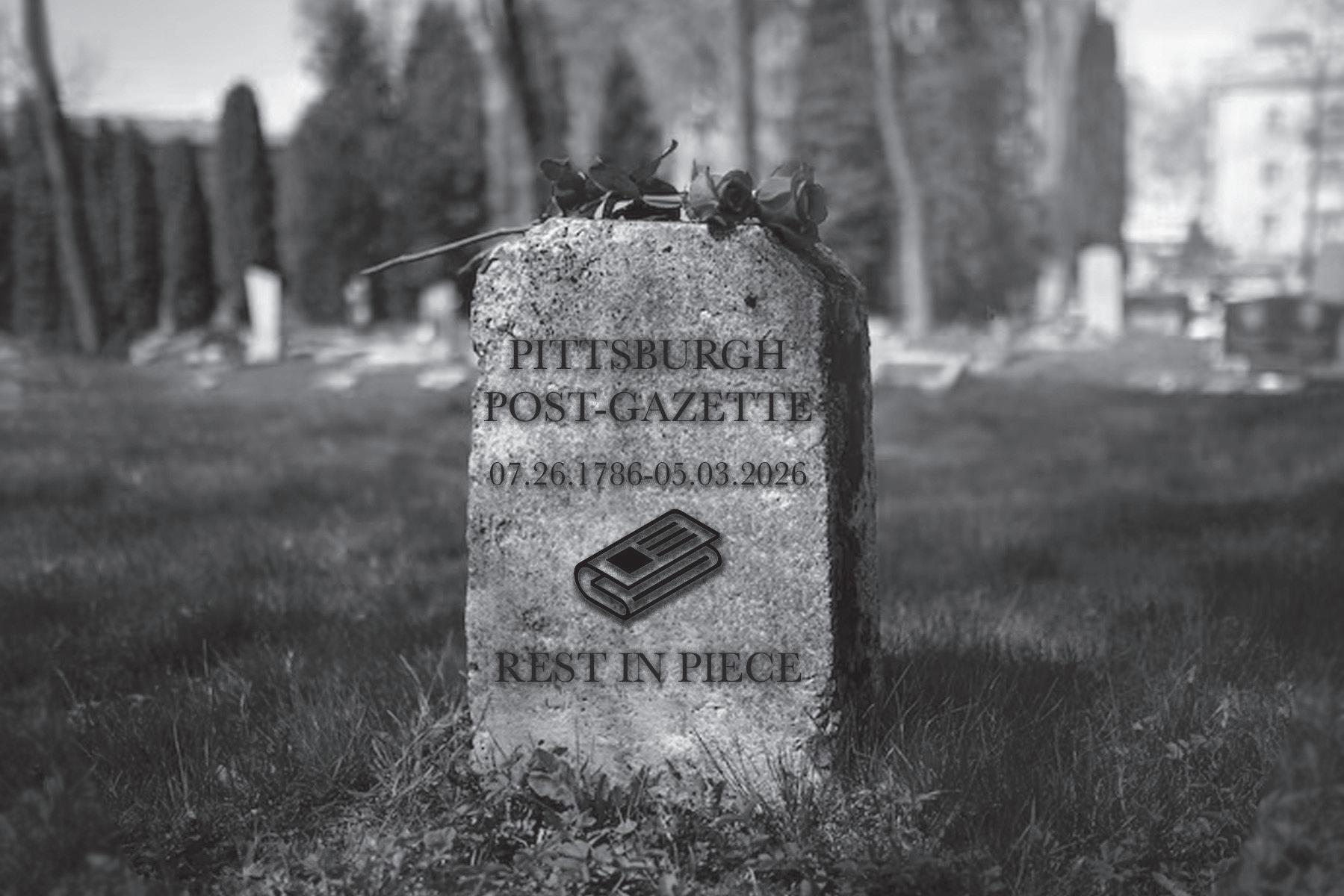
It has most recently been observed at the Pittsburgh PostGazette. The 240-year-old publication will close on May 3.
On Jan. 7, the paper’s owners, Block Communications, sent a pre-recorded Zoom call — lasting less than three minutes — to the paper’s staff detailing the closure. Executives said the decision encompassed $350 million lost in funding over the past two decades, employee strikes and the dour fall of print journalism.
When I heard of the closure, my intern experience flashed before my eyes. I thought of yellow bridges, Picklesburgh and pierogies. I also envisioned more serious times, like the assassination attempt on President Trump and listening to wisdom from the journalists in the newsroom who always warned me of the media’s uncertainty. I knew I wasn’t the
only one — certainly not one of a few people — who cared about the world around me. But I knew deep in my heart that paper-first outlets are frail.
The closing reminds us what is at stake if and when news ceases to exist. News is a public service, a watchdog meant to keep power in check and share stories with the aim of articulating our shared reality.
Right now, that public service is under attack, and not just Pittsburgh is suffering.
Over 3,200 papers have closed in the U.S. since 2005, according to the most recent data from
Northwestern University’s Medill School. There are just over 5,400 active papers throughout the nation. Out of the U.S.’s over 3,000 counties, 55% have either one newspaper or none at all.
Newspapers close for many reasons, but it seems that simply user preference is one of the largest reasons why, if not the largest. The print model has crumbled before our screen-glued eyes for years. Social media slop has replaced news; Alex Cooper for Anderson Cooper; influencer babble has replaced journalists. It’s difficult to break people away from free and entertaining
escapism. And it’s a very possible reality that many PG readers will digest more social media, sustaining the vacuum seal seizing disinformation.
I’m critical because newspapers abide by something that the veil of social media can never offer: a platform without curation, a double-edged sword of sorts. Scanning the news, either online or in print, forces you to engage with all sides in our shared reality. Whether you like it or not, you read of Zohran Mamdani’s unlikely victory. You read of Nicolás Maduro’s swift capture. You read of Antarctica shredding away its
largest sheet of ice. The list goes on, updating in a momentary refresh.
Facing the news is tougher than we like to admit. We like to turn away from the grim reality that we share. It’s easier to completely ignore the news, rather than to read — and understand — the other and the world. When we do that, though, it further separates us from reality. And at the end of it, only the most comfortable, powerful people win.
The Post-Gazette’s owners spent more money fighting court battles with Pittsburgh’s union than if it were to impose acrossthe-board wage increases “several times over,” according to the local NewsGuild.
Unionized workers of the PG struck against contract disagreements with the paper’s publisher for three years starting in 2020. The strike ended in November when the U.S. Third Circuit Court of Appeals ruled in the union’s favor. Supreme Court Justice Samuel Alito ordered a pause on the court’s decision last December, but it was later retracted.
The views expressed in this column are those of the author and not necessarily those of The Observer.
Contact Redmond Bernhold at rbernho2@nd.edu
“It all feels like a movie. To finally have [our] championship aspirations realized is so special.” This was IU Bloomington freshman Noah Yoon’s reaction after Indiana’s historic championship win on Jan. 19. Yoon comes from a family of IU alumni, and while this victory meant a great deal to him, it meant even more to his father. Reflecting on what the win meant to his dad, Yoon remarked, “He has been a Hoosier fan for basically all of his life. [He lived] on campus for 18 plus years, yet he has only seen our football team be the losers of the Big 10 and the nation at large. To see this historic turnaround climax in the biggest win of all, I know it meant more [to him] than I can imagine.” Many members of Hoosier nation in Bloomington and beyond likely felt the same on Monday night. While this is a far cry from the topics I usually cover, as a born and raised Indiana Hoosier, the twin sister of an IU student and the daughter of an IU Med School alumnus, it would be impossible to ignore how Indiana’s championship has reshaped college football. IU’s title demonstrates that success no longer belongs to the wealthiest programs or those stacked with

five-star recruits. Instead, it be longs to teams who are “never daunted.”
This wasn’t a fluke Indiana entered the 2025 season as the most-losing program in the history of college football, yet they finished as national champions. Many have described Indiana’s historic run as a “Cinderella story.”
The reality is no fairytale; luck was involved in their success. Indiana is a product of grit, faith and an unwavering commitment to fundamentals. Most
importantly, it required a coach who understood that leadership and consistency breeds champions. It was because of Coach Curt Cignetti’s emphasis on the fundamentals that in 2025 the Indiana Hoosiers found themselves as the most mistakeproof program in the nation. In the first quarter of the IU vs Old Dominion game, Indiana running back Lee Beebe Jr. fumbled the football, this Indiana’s only fumble for the rest of the season. As of Jan. 6, the Indiana receivers had dropped just
six of quarterback Fernando Mendoza’s 332 pass attempts. There are countless other statistics that support Indiana’s near perfect gameplay which made them so successful. What makes these numbers so striking is that Indiana’s roster is full of overlooked talent.
The Hoosiers used the transfer portal to bring in players who were diamonds in the rough. Heisman winner and star quarterback Fernando Mendoza was exactly this, a diamond in the rough. Mendoza was a two-star recruit and the 182nd ranked
quarterback in his class. While he had found some success in California, he believed that “Indiana was the best place for [him] to make that jump developmentally” and position himself as an NFL draft prospect. It‘s safe to say he made the right choice.
Indiana‘s title is a culmination of so many right choices, but it also marks a new beginning for the business of college football. Conventional wisdom once held that only elite programs with decades of history, an abundance of championships and ever-flowing resources could survive in the college football world, let alone become national champions. IU’s success is forcing college football fans everywhere to reevaluate what success looks like in this sport. Moreover, it is forcing teams everywhere to learn how to use transfer portals and NIL policies to their advantage. After the 2021 NCAA ruling on Name, Image, Likeness (NIL), college athletes found themselves able to profit off their NIL for the first time. This decision came with a lot of push back from fans and programs
see “Comeback” on page 6
Continued from page 5
alike who claimed players making NIL would only overcommercialize the sport. The reality is, college football was always a business. Conferences sign multi-billion dollar broadcasting contracts all the time. The Big Ten’s 7-year, $7 billion media rights contract is just one example.
While the NIL played a role in IU’s success, ultimately it was Cignetti’s expert use of the transfer portal that built the championship-winning wonder team. Cignetti bringing 13 of his James Madison University players to Indiana was a controversial move, with many saying that it gutted JMU’s program. However, the transfer portal gave these players a rare second chance. Experienced and overlooked, they found an opportunity to compete for a national title and redefine their careers.
Changes in NIL spending and transfer portal regulations have not eliminated inequality
in college football. Glaring financial disparities still exist, and NIL has introduced new debates about wealth disparities. However, the ability to succeed has shifted away from historic superteams and has allowed fresh faces to enter the conversation.
Contrary to the previous parts of this article, “Off Notre Dame Ave” is not morphing into a sports column. Indiana’s win matters because it is not just a sports story, but a story of overcoming inequities and breaking the glass ceiling in college football. IU’s team is riddled with stories of overcoming adversity. Mendoza is the first Cuban American Heisman Trophy winner and third Latino winner in college football history. In a time where Latino communities in the United States are being hatefully targeted, displaced and disrespected, I can only imagine what it means to see a Latino quarterback lead a team of misfits to a national championship. Mendoza has
never been afraid to share his Latino heritage with the world, and now more than ever it is important he wears his Cuban American identity with pride.
Indiana’s win is indicative of an era of college football that is less reliant on stars or numbers or stats, but potential for excellence. When discussing his recruitment to James Madison University, defensive lineman Mikail Kamara said, “They do a great job of watching film and not just looking at rankings or stars … That’s what a lot of coaches need to start doing; look at the tape.”
Coach Cignetti has always been open about the impact his Indiana team has had on college football saying, “I think we sent a message to society that if you keep your nose to the grindstone and work hard, you’ve got the right people, anything’s possible.”
Indiana’s win starts a conversation about equity in college football. Equity doesn’t mean that every program will go on a generational run like
the Hoosiers. It does mean that doors will open for those who have been overlooked and underestimated. It means that success is no longer reserved for a predetermined few. Media surrounding college football often reinforces a hierarchy that portrays certain programs as more deserving of success than others. Commentators throw around stats and historical evidence to “prove” the excellence of certain teams. Indiana shows that the past is not indicative of the future. Sometimes in order to win, you must disrupt the status quo; you must take chances that no statistic supports because the higher the risk, the higher the reward. As a college football fan, I hope coaches across the country take a second look at their recruiting class and see the potential in players no one else sees.
As Notre Dame students and Fighting Irish fans, it is easy to see IU’s win and feel
discouraged. If Indiana has won a national championship in the 21st century, why hasn’t Notre Dame? To this I say have patience. Hoosier fans waited 140 years for one national title. Notre Dame is blessed with eleven.
The Fighting Irish are not lacking in grit, work ethic or resilience. Like Indiana, Notre Dame has an intelligent, seasoned coach at the helm. It has never been a question of if Notre Dame will win its twelfth national championship but when.
If you take away any lesson from Indiana’s win, it is that we must continue to bide our time and have complete faith in our team. While I’m the sister, daughter and friend of Hoosier fans, it will always be Irish by a trillion for me.
The views expressed in this column are those of the author and not necessarily those of The Observer.
Contact Thea Bendaly at tbendaly@nd.edu
By Oliver Ortega Columnist, “The O.G. Grad Student”
Last semester, I began working at Saint Mary’s College as an adjunct lecturer. On the days I teach, I board the No. 17 — the campus sweep — at Notre Dame’s library circle to get to Saint Mary’s. I get off the bus after it crosses SR 933 and walk a quarter mile north to Spes Unica Hall, home to the English department. As fate would have it, my office in Spes — as the building is colloquially known — is on the same floor as a cafe called Off the Avenue. So, for better or worse, I’ve made the spot a regular haunt of mine. Usually, I stay for about an hour to grade papers, read through the required course materials for the day and lesson plan before heading back to my office. The regular caffeine and sugar fixes, as well as the background chatter, get me through the mornings and prime me for giving lectures in the afternoons. By doing my flaneur thing and inadvertently eavesdropping on conversations around me, I’ve gotten a better sense of the vibe at Saint Mary’s, which I knew little about before the start of the academic year.
Off the Avenue is a quaint, if modestly sized, coffee shop. It sits on an inner terrace that overlooks Spes’s first-floor lobby, where students regularly congregate to study and socialize. Even though the cafe itself is small, the space is visually integrated with the building’s expansive first floor, and the foot traffic shuttling to and from classrooms and offices on the second floor makes it feel busy even when it’s not. Founded in 2023 by seven marketing
majors, the cafe is entirely staffed by students. There are ten baristas and two student managers, and business professor Jim Rogers serves as their faculty sponsor. According to Rogers, whom I met by chance one afternoon in the cafe, the students do a fantastic job of running the coffee shop. After only a year in business, they were able to pay off a $24,000 startup loan given to them by the college. They do well enough that they can afford to donate a portion of their profits to local nonprofits such as St. Margaret’s House, a day center for women and children in South Bend.
When it comes to the drinks, Off the Avenue has a regular menu and a seasonal menu. If you read my column, you know I’m not one for sugary lattes. I keep it simple: drip coffees, cappuccinos and americanos. Though my first two cappuccinos at Off the Avenue were passable, the third — a warm, milky mess with little to no hint of espresso — was not. My goto, then, became the drip coffee, which is actually quite good. The coffee is from Uncommon Coffee Roasters in Saugatuck, Mich. which the founders chose after taking a trip to their facilities and tasting their coffee and teas. Uncommon also provides the syrups, the cold brew kegerator and maintenance for the espresso machines. They also train the baristas and managers.
All of the pastries come from Ragamuffin Bakery of South Bend. At the beginning of the fall semester, there was a supply issue. For whatever reason, Ragamuffin wasn’t delivering enough pastries, so Off the

Avenue would run out of food routinely. Eventually, though, the managers ironed out the issue, and they were stocked Monday through Friday, at least from what I saw. Personally, discovering the Ragamuffin connection was a blast from the past. For roughly four years, I was a regular patron at Ragamuffin’s downtown South Bend location, which opened around the start of the COVID-19 pandemic. I was especially fond of their sliced strawberry cake, a seasonal offering in the spring made with regionally sourced strawberries. I’d go there so often that I annoyed the girls working the register, by the looks on their faces. But the owner, Abby, seemed to like me. Then, somehow, through sheer will, I managed to break the spell. I swore off Ragamuffin, and that was that. But now Ragamuffin
is back in my life. She won’t kill me, but she’ll give me diabetes if I don’t watch myself. And she’ll take my money, too. The least expensive pastry at Off the Avenue is a modestly sized cookie, which costs $4.50, while the most expensive item is the croissant, which runs $7. I was never much a fan of the croissants or muffins from Ragamuffin, but the cookies are good. Still, I miss the strawberry cake and some of the other pastries owner Abby came up with before closing her storefront last year. Those more sophisticated offerings are not available at Off the Avenue, at least not at the moment. But that may yet be an area for improvement. Given my aversion to sugary coffee drinks, I can’t speak directly to the quality of the lattes at Off the Avenue. I can tell you, however, from
doing my flaneur thing — also known as eavesdropping — that some of their most popular drinks seem to be the brown bear and the skunk tail lattes. The first is a brown sugar oat milk shaken espresso, while the second is infused with white chocolate and mocha powder. Their winter menu boasts a peppermint mocha latte and a gingerbread chai, though the tiramisu mocha latte is a crowd-pleaser, from what I hear. Beyond that, I leave it to you to explore. Or not. Stick to your Keurigs or whatever. Or the Starbucks closest to you. Plebes. Until next time. OG out.
The views expressed in this column are those of the author and not necessarily those of The Observer.
Contact Oliver Ortega at oortega1@nd.edu
By Harry Penne Scene Copy Editor
“The Friend of the Family,” Dean Koontz’s new novel, is a book for book lovers, heartfelt and genuine. While Koontz is primarily known for his works of suspense and horror, “The Friend” is a work of period fiction echoing classic literature and nineteenth-century “big house” novels. Set in California during the early decades of the twentieth century, it presents the story of Alida, a captive “star” of a circus freak show, who, after a particularly cruel exhibition, is freed from her carnival prison and adopted by a caring couple and their loving family. For the first time, Alida is seen beyond her deformity and acknowledged for her intelligence and humanity. What follows is an account of compassion and testimony for the discovery of beauty in all places.
“The Friend” is a welcome genre shift for Koontz. While it “drives publishers a little nutty at times,” Koontz explained that he doesn’t want to keep rewriting the same book despite industry expectations for authors to find and adhere to a successful formula. “My current publisher has been an exception to that. Perhaps that’s why I can go from a comic novel like ‘Going Home in the Dark’ to a novel like ‘The Friend of the Family,’” the author said in an interview.
The style and voice of “The Friend” are undeniably his, hitting all his trademarks, including California settings, a faithful dog and a well-crafted villain. His signature suspense is present in the novel as well as a layer of mystery concerning Alida’s new home, which is a very entertaining thread.
The historical setting of “The Friend” was a standout aspect of the novel. I thoroughly enjoyed catching the cultural references within, such as Cary Grant (whom
Koontz thinks “is one of the greatest film actors to ever live”) briefly being a character and Venerable Archbishop Fulton Sheen receiving a mention. Beyond pop culture, the historical circumstances were a fascinating backdrop, encompassing both world wars and the times between. Koontz explained that every detail was fact-checked and that ensuring the work’s historical accuracy is one of the challenges of writing a period piece. “At one point, someone tucks a Kleenex from a box. I wrote the line and suddenly thought, ‘Wait a minute, a Kleenex in 1930?’ And you have to go and check out hundreds and thousands of small details like that,” the author said. Despite his current love for research, Koontz reminisced that, especially in his academic career, he used to loathe it, even making up sources and citing “books that didn’t exist with authors who were nonexistent” to get out of it. Now, he loves the process and strongly dissuades students from faking sources.
One of the most powerful aspects of “The Friend” is its inclusion of countless literary references, spanning authors from Charles Dickens to H.G. Wells. This is why I state it’s for book lovers; however, these go beyond Easter eggs for bookish readers. They show Alida’s knowledge of the world and its vast ideas despite being imprisoned, reflecting Koontz’s own childhood. “I think I knew right before it began that Alida was going to have lived through books because that was her only choice of being what she is and who she is. She, really until the age of seventeen, has no freedom, except the freedom which books provide. That really is an autobiographical element because I grew up in a very unpleasant environment, an alcoholic, violent father, poverty and everything that comes along with that. My escape was into books. In a sense, I could understand Alida’s methods of
surviving all of that was to escape into books, but not just to escape — to read and see that the world offered many other ways to live a life than the one that was imposed on you when you came into the world. In many ways, her life was guided by the best things in novels that she had read,” Koontz said. Through our conversation, it became increasingly clear that many aspects of “The Friend of the Family” are autobiographical. Koontz noted how his own life experiences shaped his writing profoundly: “Whatever you go through, it does add value to you and it brings you to a better understanding of how to live your life most successfully and what to avoid doing.” This is very evident in his ability to craft a villain. “The Friend of the Family” has one of the most despicable villains in his oeuvre: the Captain, who is allaround deplorable. Koontz provided insight into his villain crafting process, noting how his childhood with a sociopathic father forms these characters. He mused that, whenever faced with a moral dilemma, he thinks, “What would dad do?” and does the opposite. What readers may not know is that Koontz is a convert to Catholicism and, while he has never written an explicitly religious novel, one can find underlying themes that align with faith, hope and Catholic social teaching — like the dignity of the human person, which is especially prevalent in “The Friend of the Family” — in most of his works. This is strongly influenced by his childhood. Koontz told me that he converted to Catholicism while in college. “When I first started dating [my wife] Gerda, the first thing that I noticed was what [her] intact family was like. When you’re raised in a family like mine, you think that all households are like that when the door is closed. You have to have other examples to
learn the difference. I started seeing these families who were intact, happy and functional. I began to associate that with Catholicism because that is the thing they all had in common. That is when I began to think that this was something I wanted, and that was where the conversion took faith. And there I’ve been ever since,” the author said. In “The Friend,” one of the most prevalent themes is, in the author’s words, “The value of every life regardless of what its apparent limitations might be.” This is where one of the key ideas, friendship and relationship, really shines. The novel concerns and uplifts genuine, loving human connection. On the flip side, it also explores toxic relationships and their resulting problems. Through our conversation, it was apparent how Koontz’s own service and interactions with others shaped the formation of Alida and her story: “My wife and I have worked for some years with Canine Companions for Independence, which is an organization that provides assistance dogs for people with severe disabilities. One day, after we went away for a weekend at a Canine Companions function where there were hundreds of people with severe disabilities, I came home and said what was most amazing about that was that not one person that we met and interacted with was complaining, self-pitying or had a pessimistic view of anything. They were all optimistic, forward-looking, hoping to better their lives. It’s very eye opening to me. It’s where I began to understand that every life is meaningful. Every life has the potential to lift up others. This is what these people do. They lead by courage in the face of health and functional problems. That became a theme in the book, for sure.”
This leads me to another major theme in the novel: hope. “The Friend” testifies to hope’s
power and persistence in the darkest of times, whether it be an abusive relationship or a world war. The novel is told by Alida, and this first-person narrative was a highlight for me because it allows moments to empathize with Alida’s experiences, struggles and hope. Her hope never falters, and Alida’s voice and insights portray this beautifully. “The recognition of beauty and order in the world is fundamental to living a happy life. If what you see all the time is disorder and ugliness, you are going to have a life very much like that. It is important to recognize the gifts that God created for us in the world, and if you do, hope can never be lost,” Koontz said.
In my conversation with Koontz, I asked him if he had any words of writing wisdom for Notre Dame students. In his process, he doesn’t outline: “As a book comes alive, it becomes something other than what you originally intended. You should be free and able to go with that.” Koontz also warns that publishers often limit authors to write within genre constraints and keep personal values to a minimum to increase mass-appeal. “I have found what the public wants is not what the publishing industry wants to give them. You have to stay with your own values and have faith in your fellow human beings, and you will find you can make a place for yourself. It’s just harder than if you write the way they want you to,” Koontz advised. I would recommend “The Friend of the Family” to book lovers who enjoy stories about beauty and friendship. Further, if you have been wanting to read Koontz but are wary of horror or thriller stories, then this is your chance to experience his storytelling. It truly is a wonderful novel.
Contact Harry Penne at hpenne@nd.edu
By Luke Foley Interim Scene Editor
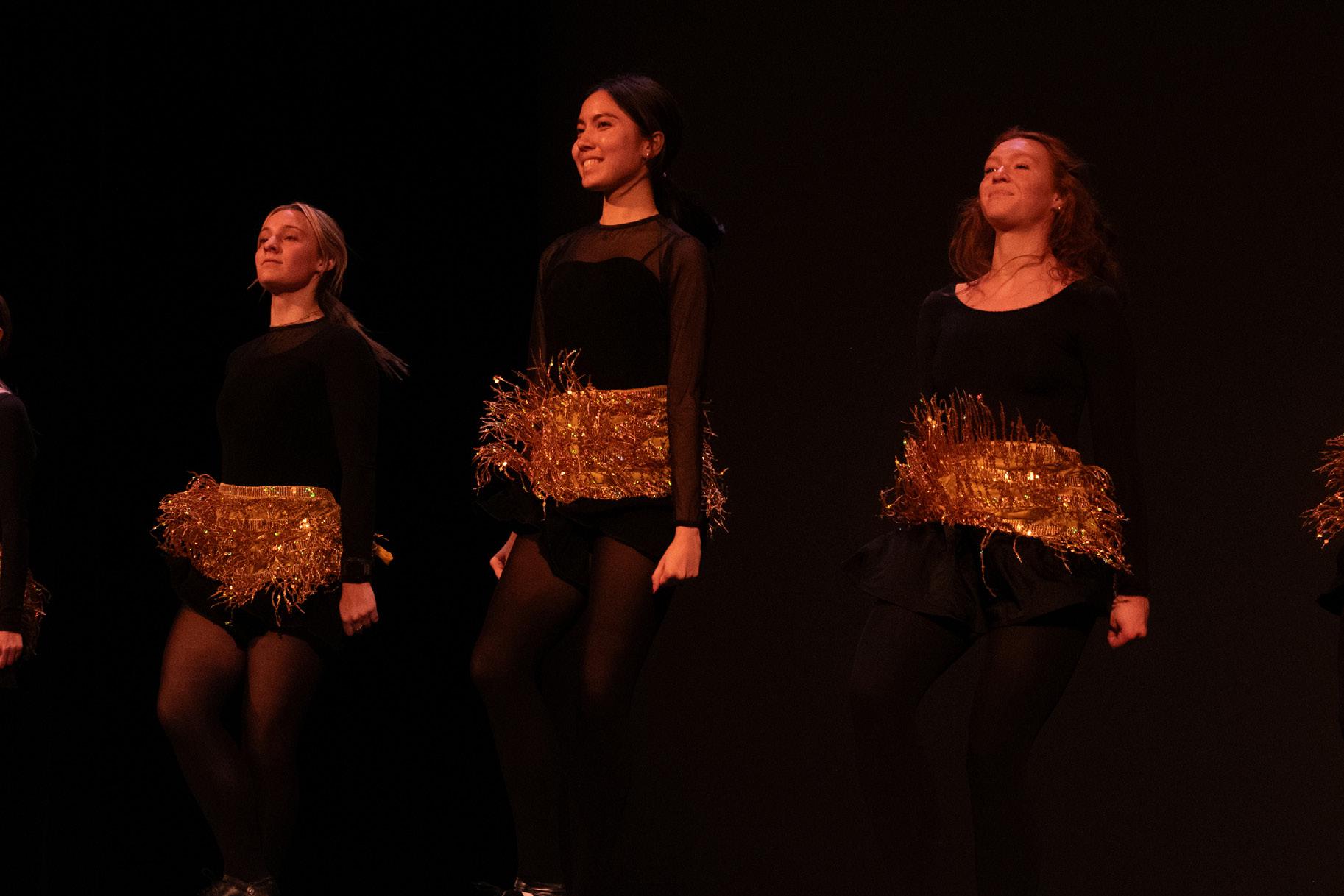
A proud man of Irish descent, my dad has always boasted about Ireland’s outsized cultural impact. He thought it was amazing how a tiny island’s culture has spread across the world and become cherished by so many: Irish pubs, U2, Samuel Beckett and “Normal People” are just some Irish exports I personally love. However, none may be as important as Irish dance, which is alive and well here on our campus: The Notre Dame and Saint Mary’s Irish Dance Team will be performing their annual showcase in Washington Hall this Thursday, Friday and Saturday.
The team is divided into two halves — the Gold Team and the Blue Team — each with its own president and dance style. Their showcase this year is titled “Echoes of Eire” — a phrase that,
according to Gold Team president Kate Rafford, captures the diverse forms Irish dance can take. The showcase more than lives up to the name: It’s a sweeping excavation of Ireland that excites at every turn.
The winning contrast between the two teams is quickly established at the beginning of the showcase. The Gold Team’s “Heartland” opens with the dancers shrouded in striking shadows as they dance with militant ferocity. The piece eventually explodes into color as they ramp up the pace of their meticulous footwork. Following that is the Blue Team’s “Mischief,” a free-flowing and playful piece, with the dancers joining and breaking with spirited energy. “Irish Echoes” is an a cappella piece in which each dancer serves as a musical instrument, carrying a different part of the beat through their tapping.
“Distant Thunder,” a piece drawn
from the world-renowned Irish dance show “Riverdance”, opens with a cacophony of storm sounds that transition into thunderous dancing; spirited stomp-clapping adds to the wild atmosphere.
“Stolen Kisses” is a slip jig dance featuring graceful leaps and acrobatic composure. Next, the ceili team, competing at the Collegiate Irish Dance Nationals this year, performed dances full of fluid geometry and elegant movement across the stage. Finally, Act 1 closes with “Warriors” from “Lord of the Dance.” The atmosphere in this piece almost feels like a horror movie — tense, fearsome and with minimal lighting. The aggressive strikes to the floor evoke gunfire. Yet, amid this dangerous atmosphere, the dancers stand out as fearless.
Act 2 opens with “American Wake,” a piece that stands out with its thematic depth. According to Rafford, it depicts an Irish village
throwing a party to celebrate a villager’s last night before their departure to America amid the Great Famine. They cheerfully dance to the promise of a better life across the ocean, yet it’s tinged with sorrow as their community fractures. But it’s the birth of this diaspora that allows for celebrations of Irish culture in America like this very showcase — fascinating stuff! On a much lighter note, the following “Shake Down the Thunder” is a fun ode to Notre Dame, featuring a melody of iconic songs from our community. “Countess Cathleen” references the W.B. Yeats poem in which the title character sells her soul to the devil to feed her community during the Great Famine. Thus, the dance features red and black costumes and ominous music. “Anna Livia” is another dance inspired by Irish literature specifically, the character from James Joyce’s “Finnegans Wake” of the same name. The dance
has some very exciting breakdowns with ballistic footwork that never relents. The show then ends with a trip to the present day with “Without You” and “Fuego” — who said Irish dance can’t be performed to modern club bangers from Usher and Pitbull?
“Echoes of Eire” is a remarkable survey of both the rich history of Irish dance and Ireland as a whole. The ND-SMC Irish Dance Team takes you on a diverse tour of Irish culture, ranging from the haunted days of the Great Famine to the rollicking stands of Notre Dame Stadium. Some dances convey a striking ferocity, others an infectious joy. But throughout it all, “Echoes of Eire” is always a delight to watch. Don’t miss out on some incredible dancing this weekend.
Contact Luke Foley at lfoley2@nd.edu
HOCKEY
By Nikki Stachurski Sports Writer
The snow has taken hold of Notre Dame’s campus, and the winter sports are in full swing. But among them all, hockey has fallen into a rut, and subsequently cratered to the bottom of the Big Ten standings.
In their six games since the World Junior Championships break began in late December, the Irish have not recorded a win, with two of the losses being shutouts. And as fans continue to flock to Compton Family Ice Arena weekend after weekend to support their team, there is undoubtedly frustration that the Irish remain mired in a losing streak.
Goaltending
Of the 26 players on the Notre Dame roster, only sophomore goaltender Nicholas Kempf was chosen to play in the World Juniors, being named as the second goaltender for Team USA. The Irish
heavily depend on Kempf in net, as he started all 16 games prior to his international duty. In his absence, the Irish played graduate goaltender Luke Pearson and senior goaltender Jack Williams in net. Williams started against the No. 3 Western Michigan Broncos on Jan. 2 and Pearson started the following night, with both contests ending in a 4-0 loss for the Irish. Kempf played in the Michigan series following the semifinal elimination for Team USA in the World Juniors, but consistently facing some of the nation’s most potent offenses has slowed Notre Dame’s progress.
The goaltending trio for the Irish is not to blame for the losses, however the heavy reliance on Kempf hindered the defensive chemistry in the catastrophic series against the defending champions. It is vital for a strong team to not only have a steady rotation of goaltenders, but also to establish confidence along
the bench.
Some irritation has made its way onto the ice, resulting in suspensions when the Irish traveled to face No. 1 Michigan on Jan. 9 and 10. In the second game of the series, Notre Dame junior defenseman Paul Fischer and freshman defenseman Caeden Carlisle were each given a game misconduct and ejected from the game. Tensions were high and despite trailing 5-4 with 14 minutes left in the third period, the Irish ended up falling short 7-4.
After the game, the NCAA gave Carlisle a one-game suspension for his hit to the head and gave Fischer a twogame suspension following a questionable cross-checking call. The suspensions affected the games against No. 5 Wisconsin the following weekend, with one of their strongest defensemen out the first game and one of the best playmakers for the Irish
offense out for both games.
On the ice, the Irish struggle to capitalize on the power play. Even with the one-man advantage, the Irish scored on only one of their 20 power plays in the past six games.
Junior forward Evan Werner scored the lone star against Penn State on Jan. 16. Notre Dame cannot afford not scoring when its opponents are down a player, and must utilize its collection of strong forwards to score when on the advantage.
One of the team’s greatest strengths is their creativity on playmaking, yet they seem to have lost their spark since mid-December. Recently, creativity is lacking, and it seems like the Irish are playing the same game each time they take the ice. When the season started, they were scoring creative goals and taking their time to find the
right shots to take, and their artistry was paying off on the scoreboard.
As the end of the season approaches, the Notre Dame attack seems to be lacking that same chemistry. The frustration is palpable, but there is still time to turn the season around and prove the Irish belong among the best in the Big Ten.
It is easy to focus on the team’s record and losing streak. However, Notre Dame plays Division I hockey in the Big Ten, arguably the most difficult conference in collegiate puck. When facing ranked teams every other weekend, Notre Dame sharpens itself against iron-clad teams, and its dedication and determination to improve will manifest into success as long as the Irish remain steadfast in their pursuit.
Contact Nikki Stachurski at mstachur@nd.edu
By Andy Caron Sports Writer
When Sir Mohammed stepped out onto the floor of the Dean E. Smith Center, informally known as the “Dean Dome,” the stakes could not have been higher. Mohammed, a junior in high school holding 14 Division I offers at the time, would be playing for a 4A North Carolina men’s basketball state championship. The Charlotte native had been representing Myers Park for the entirety of his high school career, a school that had not claimed a men’s basketball state championship in more than 60 years. Mohammed posted nine points, three rebounds and three assists to help propel the Mustangs to a state title. Wednesday night marks the first time Mohammed will return to the Dean Dome since making history on the court less than three years ago.
Mohammed had an extremely successful high school career. Averaging more than 13 points per game across each of his last three seasons for Myers Park, he ranked 43rd in the country in the 2024 recruiting class, per 247Sports. Not only did he lead the Mustangs to a state title in his junior year, but he also guided them to a 27-3 record in his senior season. Mohammed was awarded second-team allstate honors in both his junior and senior years.
Prior to Mohammed’s junior year, he was offered a scholarship by Notre Dame, but not by current head coach Micah Shrewsberry. Before departing the program in March 2023, longtime Irish head coach Mike Brey had offered the 6-foot-6 guard the previous October. When Micah Shrewsberry was hired following the 2022-23 season, he and his staff immediately pursued Mohammed despite not being involved in his original recruitment process.
Following an official visit to South Bend, Mohammed committed to play for the Irish in August 2023.
Coach Shrewsberry was thrilled about his new commit. “The first thing I look for in a player is intelligence on the court, and no one has a better feel for the game than Sir does,” Shrewsberry said. The coaching staff added, “You will not find a nicer and more respectful kid than Sir.”
Mohammed’s strong character was instilled by his parents, Nazr and Mandi Mohammed. His father, Nazr, had a long and successful professional career, playing 18 seasons in the NBA across eight different teams. Prior to his NBA career, he won two national championships with the University of Kentucky: the first championship under Rick Pitino (1996) and the second under Tubby Smith (1998).
Despite Notre Dame
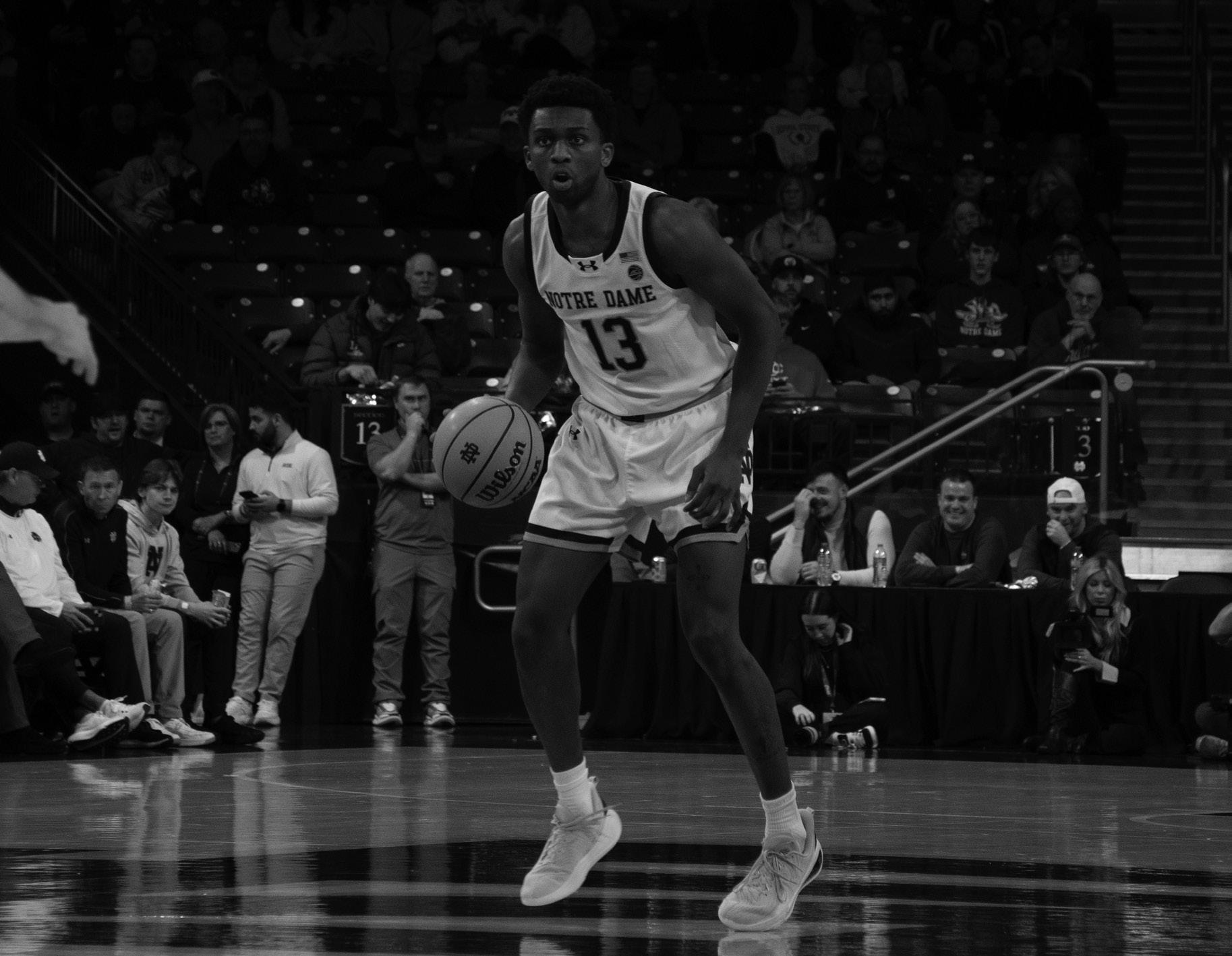
finishing with a 15-18 record, Sir showed development in his first year with the Irish. He started in eight games for the Irish, averaging 5.4 points and 2.7 rebounds. A lowerbody injury kept the guard sidelined for most of non-conference play, but Mohammed showed flashes of his potential in the second half of the season, including an 11-point effort in a loss to Duke.
After a very promising first
year, Mohammed has continued to display his talent so far in year two. Despite not logging consistent minutes throughout this season, the sophomore has recorded impressive stat lines as of late. Mohammed has scored double-digit points in each of the Irish’s last two outings, including a 15-point showing against Miami. His recent play earned him a spot in the starting lineup in Saturday’s
loss to Virginia Tech, where he knocked down two threes on his way to scoring 12 points. Mohammed is playing his best basketball as the Irish enter a critical part of their schedule.
Editor’s note: The full version of this story can be read at ndsmcobserver.com
Contact Andy Caron at acaron2@nd.edu
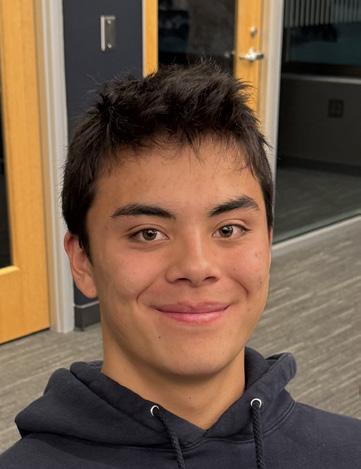
Tyler Wu sophomore Keough Hall
“USC Trojan.”
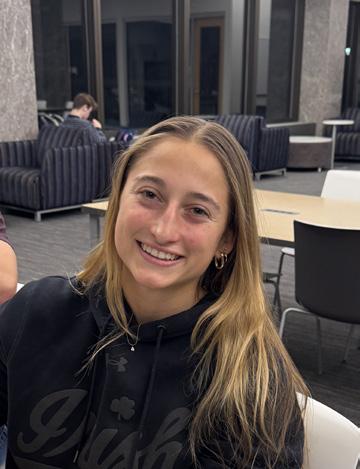
Mari-Louise Van Zyl freshman Pasquerilla East
“SMU Mustang.”
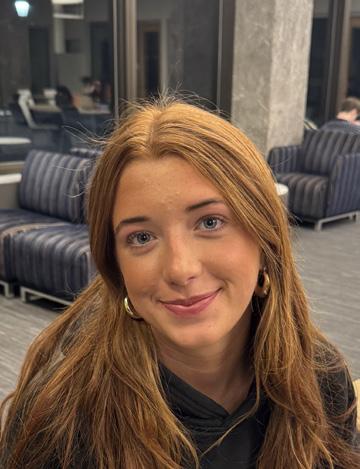
Aoife Stover freshman Farley Hall
“Otto the Orange.”
|
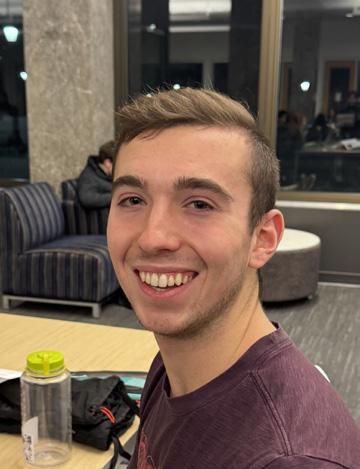
Luke Murray freshman Stanford Hall
“Miami Hurricane’s Duck.”
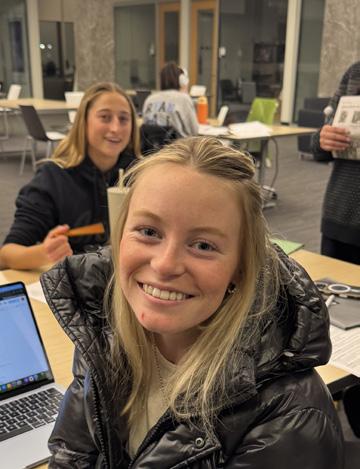
Evan Ehlman freshman Pasquerilla East
“Stanford Tree.”
Have an idea for a poll? Email dstangel@nd.edu
How effective do you think the student government is at making real changes on campus?
Want your event included here? Email news@ndsmcobserver.com
Friday
Notre Dame Hockey vs. Ohio State The Irish hockey team takes on the Buckeyes. Compton Family Ice Arena 7 p.m.
Saturday
37th Annual Notre Dame Student Film Festival Watch films created by Notre Dame undergraduates. Browning Cinema 6:30 p.m. - 9:30 p.m.
Sunday
Notre Dame women’s basketball vs. Clemson The Irish face the tigers in women’s basketball. Purcell Pavilion 3 p.m.
Monday
Walk the Walk Week candlelight prayer service A night of prayer and reflection with the Voices of Faith choir. Main Building Rotunda 8
Tuesday
Notre Dame men’s basketball vs. Virginia The Fighting Irish compete against the Cavaliers. Purcell Pavilion 7 p.m.
By Chris Dailey Sports Writer
The Notre Dame fencing program returns home to South Bend as it hosts the Michael Decicco Duals this weekend. Fresh off 4-1 victories for both men and women at the St. John’s Super Cup, the Irish seek to continue along their path as they hunt for its 15th national championship.
Notre Dame will begin the meet at 9 a.m. on Saturday against Northwestern. Later that day, they’ll square off against Florida, Detroit Mercy, Cleveland State and Lawrence.
On Sunday, Notre Dame will face Michigan, Case Western Reserve, Purdue, Michigan State, Wisconsin and University of Chicago.
If all goes to plan, it should be a relatively straightforward weekend of competition for Notre Dame. The Irish men are ranked first in the country, while the women sit at second – just a notch behind Columbia. Of Notre Dame’s weekend competition, no team is ranked inside the top 15 for men‘s or women‘s.
Moreover, of all the opponents competing, many operate as club teams in comparison to Notre Dame’s varsity NCAA status. The other NCAA member teams at the meet are Cleveland State, Lawrence and Detroit Mercy, and while Northwestern‘s varsity women’s program is one of the best in the country, only the men‘s team will be in attendance.
In other words: Notre Dame’s chances to clean-sweep are high.
If they are to do so, they need to get the most out of this roster, as the meet provides head coach Gia Kvaratskhelia the perfect opportunity to utilize his team’s immense depth.
Such a setup will be the exact opposite from the St. John’s Super Cup, in which Notre Dame faced every top six-ranked team in the nation for the men’s teams. In women’s, they faced No. 1 Columbia, No. 3 Princeton and No. 4 Harvard alongside two other top-15 teams in No. 7 Ohio State and No. 13 St. John’s.
At the Super Cup, senior foil specialist James Chen impressed for the Irish. After finishing third at the NCAA Championships last year, Chen has only shown more comfort on the strip in the new season. He
finished 11-2 in New York.
Senior captain and sabre specialist Grant Dodrill also put together a superb showing. Dodrill went 11-4 at the Super Cup. His leadership on and off the strip proves to be a valuable asset for Kvaratskhelia’s team.
Dodrill is one of six captains Kvaratskhelia named this past week. He’s joined alongside junior sabre specialist Chelsea Delsoin, junior foil specialist Chase Emmer, senior epee specialist Jonathan Hamilton-Meikle, junior foil specialist Ryanne Leslie and senior epee specialist Eszter Muhari.
On the women’s side at the Super Cup, Notre Dame’s sophomore sensation Magda Skarbonkiewicz continued her stellar start to the season. The 2024 USA Olympian dominated at the Super Cup and
looks to expand upon her 19 wins this season.
While these starts will certainly be on display this weekend, Kvaratskhelia will likely use this meet as an opportunity to allow fencers who don’t receive as much time on the strip a platform to showcase their talents. With March creeping up by the day, the value of having a roster that is sharp from top to bottom is indisputable.
The meet will be Notre Dame’s last competition at home until they return March 19-22 for the NCAA Fencing Championships, which marks the first time the national stage returns to Notre Dame since 2022.
Contact Chris Dailey at cdailey2@nd.edu
By Henry Lytle Associate Sports Editor
Notre Dame’s offense is a clear problem for the Markus Burtonless Irish in the midst of a slump, and Micah Shrewsberry is the only one who can fix it.
Notre Dame’s offense has started ACC play in a significant rut, and it will need significant changes to turn the season around. Notre Dame has not broken 80 points in nearly a month since its 82-58 win against Evansville. The struggles go hand in hand with the absence of junior guard Markus Burton, who suffered an ankle injury against TCU on Dec. 5. Losing the near 20-point per game scorer and one of the strongest offensive hubs in the ACC has hit the Irish offense hard. This downturn in offensive efficiency has directly led to a 1-5 start in ACC play.
The offensive woes from Burton’s void began to manifest in the 72-69 loss to Purdue Fort Wayne on Dec. 21. Notre Dame has gone 1-6, including a 1-5 start in league play since the devastating home loss. The only victory came on the road at Stanford, in what can only be described as a bizarre 47-40 win where both teams shot below 33% from the field and 20% from three-point range.
Micah Shrewsberry’s defense has improved in the 2025-26 season from one year ago, but it has been unable to cover up fatal shortcomings on offense. In conference play, Notre Dame is scoring 64.8 on average while giving up 71.6. The more concerning measure on offense has been the lack of ball movement, early offense and quality shots for Notre Dame. Notre Dame has shot the three-pointer well at 36% as a team, but since Burton’s departure and the defensive adjustment in ACC play, this percent has plummeted.
Without secondary ball-handling help, Notre Dame is turning to forwards and guards without the confidence or experience to run the offense and it simply has not produced. Notre Dame is currently last in the ACC in turnover margin at -2.61 and last in assist to turnover ratio at 0.98. This means that for every Notre Dame assist, the offense produces 2.61 turnovers.
After the best recruiting class in program history, nobody can deny the talent in South Bend. I would however, expect more help to stitch a bumpy stretch for the Irish. It just hasn’t been there. Freshman forward Jalen Haralson has been leading the Irish in scoring since Burton’s injury, but his work revolves around the paint, drawing contact and passing to open shooters. The Irish have put the heavy offensive burden on Haralson and junior guards Logan Imes and Braeden Shrewsberry, which has resulted in Haralson averaging 2.4 assists compared to 2.9 turnovers per game. It’s unfair to throw the blame on Haralson, a first-year forward who has yet to finish a season in college to run the offense, when his skillset is tuned off the ball as a slasher. On the other hand, Notre Dame does need to complete an honest assessment of skillsets and offensive system for a group that is struggling to put the ball in the hoop.
Offensive woes without Markus Burton are nothing new for Notre Dame. In each of Micah Shrewsberry’s first two seasons, Notre Dame has operated without Burton for a period in the season that resulted in offensive issues. It is fair to ask the question of how Notre Dame has used the transfer portal, particularly with adding complementary ball handling and rebounding. Notre Dame added graduate forward Carson Towt to help in the frontcourt, the Northern Arizona
transfer averaging 9.9 rebounds for the Irish. On the ball-handling side, Notre Dame is stacked with guards who can shoot and play off the ball, but these players lack the skills and confidence to truly lead an offense by creating for others. That was up to Burton. It’s not a question of talent for Notre Dame, but more so a question of personnel and grouping. Notre Dame has shooting in
Braedon Shrewsberry, sophomore guard Cole Certa and freshman forward Brady Koehler, all three shooting over 38% from beyond the arc. The Irish have defensiveminded forwards and wings in Towt, Haralson, and sophomore guard Sir Mohammed. The positions of need this season happen to be center and point guard, which have been exacerbated by injuries to Burton and senior big
man Kebba Njie, who is out for the season with a knee problem. Njie’s absence will be felt, as the Irish are already last in the ACC in blocked shots and steals.
Editor’s note: The full version of this story can be read at ndsmcobserver.com
Contact Henry Lytle at hlytle@nd.edu
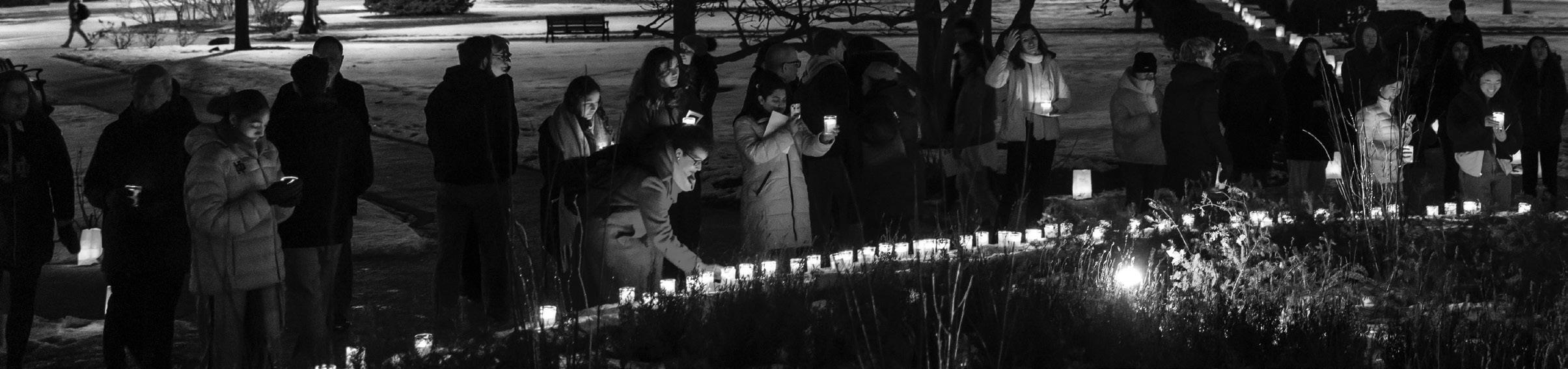

By Jack Muething Sports Writer
The Notre Dame Fighting Irish men’s lacrosse team is coming off a solid year, qualifying for the NCAA Tournament and reaching the last eight before losing to the Penn State Nittany Lions in a second half collapse that surely haunted Irish fans all off-season. Fortunately, the wait for the 2026 lacrosse season is soon to be over, with two exhibition games to be played on Friday and Sunday, and the regular season starting around three weeks later on Feb. 14.
Notre Dame will play a very similar schedule to the one it played last year with nine of their 11 games being against teams they played a season ago. Additionally,
seven of those showdowns are against teams who made the tournament last year. With only 18 spots, the NCAA Lacrosse Tournament is one of the hardest tournaments to make in all of college sports. A good way to reach the tournament is to schedule the toughest opponents possible, and the Irish have certainly done that.
Notre Dame will open the season up with two of its easier opponents, starting the year off in Milwaukee to face Marquette before hosting Bellarmine. After those two games to ease the Irish in, the challenge really starts as the team faces Georgetown, Maryland, and Ohio State in consecutive games, all three of whom reached the postseason a year prior. The Irish played those same three teams consecutively
last year as well, going 1-2 in that stretch. The lone victory was an 11-9 thriller against the Hoyas in Washington. Their next contest against Maryland was also a thriller as the Terrapins beat the Irish by one goal in a game where Notre Dame held the lead at the half. Maryland would go on to make the finals of the NCAA Tournament before losing to Cornell. Just as they were last year, it is likely the Terrapins will be Notre Dame’s toughest opponent of the year. The Irish then played Ohio State in their next game and again lost by one with Ohio State scoring the winning goal at Arlotta Stadium with seven seconds left. The Irish would get their revenge in the tournament though, beating the Buckeyes 15-6 in Columbus in
what was widely considered to be their best performance of the year.
Fans can expect these three teams the Irish face to be very strong once again. In the preseason rankings by Inside Lacrosse, Maryland is ranked No. 1, Georgetown is ranked No. 5, and Ohio State is ranked No. 10. For context, the Irish are ranked No. 8. With Michigan claiming the final spot in the opening poll, nine of Notre Dame’s 11 adversaries enter the year ranked.
To round out that tough stretch of games, the Irish then face a team that just missed out on the tournament last year in the Michigan Wolverines. That game would be tough on its own, but considering the gauntlet that the Irish will have just been

through, it gets that much more difficult. After that, the Irish will start conference play, facing the perceived weakest ACC team in the Virginia Cavaliers. The Cavaliers are the lowest ranked of the ACC opponents in the top 20, but a top-15 opponent on road soil is no easy win. After that, the Irish will travel to Evanston, Illinois for a battle with Richmond. The Spiders shocked everyone last year with an opening round upset of North Carolina in Chapel Hill, before narrowly falling to eventual champion Cornell in round two. This year though, the smallschool Spiders won’t scurry up on anybody, entering the season ranked ninth.
These first eight games are going to be incredibly important, but the key games are going to be the three the Irish have to close out the season as they end the conference slate with North Carolina, Duke and Syracuse, all three of which made the tournament last season. The ACC is regarded as the toughest conference in collegiate lacrosse, and these four teams are the reason why. The Irish were able to get the best of both North Carolina and Duke last year, beating North Carolina 12-6 and Duke 14-7, and those relatively dominant wins were a large part of the reason why the Irish made the tournament. After those two games, the Irish will welcome the defending ACC champions in the Syracuse Orange to Northern Indiana. The toughest opponent the Irish face this year is projected to be Maryland, but Syracuse is a close second as the Orange come in as the projected No. 3 team in the country. The Irish are looking for revenge here as they faced the Orange twice last year, dropping close contests in Upstate New York and in the ACC Tournament. Syracuse won comfortably in the JMA Wireless Dome in early April before closing strong to best the Irish by two in Charlotte in early May.
Last season, 8-4 was enough for the Irish to sneak in the tournament, but a large part of that was because three of its four losses were within two goals, and all but two of their wins were by more than two goals. The Irish also went 3-2 in their ACC contests. The good news for the Irish is that there is margin for error with the schedule they play. Going undefeated with this slate would be unexpected, and while it may not demand perfection, it certainly demands the Irish to prove credibility. Notre Dame will still need to win a fair amount of the tossup games if they want a chance at another deep postseason run. There are a lot of exciting matchups for this Notre Dame team this season, and Irish fans should be confident in their team’s ability to handle these tight games.
By Tyler Reidy Associate Sports Editor
After a five-game stretch away from South Bend, Notre Dame hockey will host Ohio State at the Compton Family Ice Arena this weekend. The Irish head into the series at 4-17-1 and are still winless in Big Ten play at 0-12, while the Buckeyes check in at 7-12-1 (3-7-0 Big Ten). Ohio State is the final Big Ten team still yet to face the Irish in 2025-26.
Big Ten update
With Notre Dame exactly halfway through its conference schedule, it’s a good time to quickly take stock of the league as February approaches. Michigan remains the undisputed No. 1 team in both the conference and the country, but it’s just starting life without star goaltender Jack Ivankovic, who was injured in a series against Notre Dame two weeks ago. The Wolverines impressed last weekend, badly outshooting Minnesota in a road sweep.
Bunched six to nine points behind Michigan are Penn State, Michigan State and Wisconsin. The Nittany Lions are especially hot, having won all four of their conference games to start the new year to claim second place. Meanwhile, Michigan State swept Wisconsin in Madison last weekend to leapfrog the Badgers in the standings.
Behind Minnesota, Ohio State and Notre Dame comprise the Big Ten’s bottom two. The Buckeyes have nine points to Notre Dame’s one, and Irish head coach Brock Sheahan has been open about working through the frustration of occupying last place.
“It’s not easy when things are not going well, right?” Sheahan said. “I do think [that] when you pull back and zoom out and look at our game, there has been a lot of progress in our 5-on-5 game, our ability to generate more chances; it has gotten better.”
The Irish have lost nine in a row but they’ve shown positive signs in their last two series. In each of their last four road losses to Michigan and Penn State, they’ve generated more chances than their opponent (or come very close to doing it). However, for various reasons, Notre Dame hasn’t gotten over the hump yet.
Struggling special teams
The power play and penalty kill, two areas where Notre Dame thrived in the first half, have hurt the Irish in a big way recently. Their man-advantage unit, which led the nation in early December, has gone 1 for 19 in the new year. It scored only once in 12 opportunities at Penn State last weekend.
On the other side, the Irish now lead college hockey in penalty minutes, dragging their overworked penalty kill down
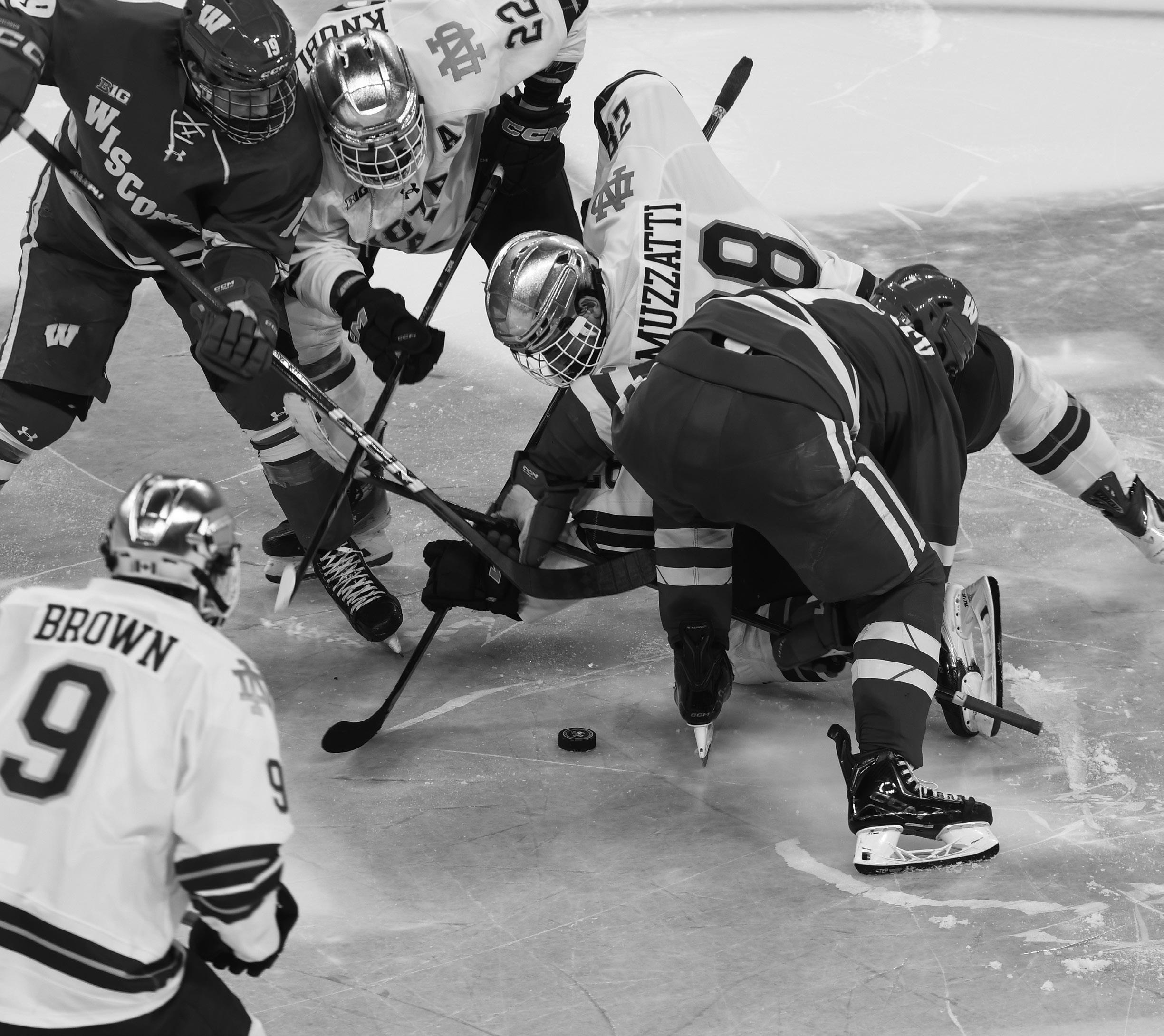
from the national top-10 to 32nd. At Penn State, the Irish took themselves out of Friday’s game by allowing three powerplay goals before giving up a key 5-on-3 goal Saturday night.
“The thing where [the series] got away to me is the penalties again… You put a talented team on the power play that much, they’re going to score,” Sheahan recalled. “And then our power play, it’s the way things have gone for us, right? [Our] power play’s been good all year, and we don’t score on the power play.”
Notre Dame’s power play could be in for a get-right series this weekend, as Ohio State’s penalty kill has lived in the bottom half of the national rankings since the 2023-24 season. However, that may depend on the availability of junior defenseman Paul Fischer.
The former fifth-round NHL draft pick is eligible to return from his two-game suspension this weekend, but Sheahan commented on Wednesday that he might not be able to go against Ohio State.
Fischer also factors into the Irish penalty kill, which will be tasked with an Ohio State power play that has improved from 47th nationally last season to 15th this year.
Knuble getting closer
While the Irish have had serious problems on the defensive end lately, some of their top offensive threats are hitting their stride. That includes junior forward Cole Knuble, who led Notre Dame in assists (27) and points (39) a year ago. The results haven’t always matched his underlying generation this season, but he’s posted eight points across his last nine games, adding a breakaway goal last Saturday.
“His recent play has been much better, as far as [being] more connected to the team,” Sheahan described. “I feel like he’s been much more connected, moving the puck, playing much better off the puck, committed to a 200-foot game, which is when he’s at his best … My hope is that for the remainder of these 14 games, he continues to generate at a high level and you see it even out, and then he starts putting the puck in the net more.”
Last weekend, Knuble played on a forward line with fellow juniors Evan Werner and Danny Nelson, and those three dominated the early part of game two. Werner has been excellent for a while, scoring six times over the last 11 games, while Nelson remains at the top of any opposing
scouting report as Notre Dame’s highest-drafted player.
As they look to impose their game this weekend, the Irish will have a chance to capitalize on an Ohio State defensive unit that has taken a real step back from last year’s NCAA Tournament season. The Buckeyes, on average, are surrendering 3.45 goals per game this season (12th-most nationally).
The Buckeyes enter South Bend with an extra week of rest, as they did not take the ice last weekend. Before that, they hosted high-powered Michigan State, getting off to an awful start by allowing four goals in the first period of the series opener. However, they found a solution in benching junior goalie Kristoffer Eberly for freshman Sam Hillebrandt, who stopped 14 of 16 shots against on Friday before leading Ohio State to a 2-1 win on Saturday. We’ll see if he keeps the net this weekend, or if the Buckeyes return to their timeshare between the two goalies.
In the realm of skaters, 13thyear head coach Steve Rohlik mimicked a large part of his approach to turning the Buckeyes around last year, using the
transfer portal to grab five experienced newcomers. However, they haven’t made the same type of impact last season’s additions did. Two of them, former RPI man Felix Caron and Minnesota State import Adam Eisele, rank among the team leaders in scoring. Longtime Buckeye Davis Burnside has been their greatest threat as of late, producing seven points across his last five games. On a roster dominated by juniors and sophomore, freshman blue-liner Jake Karabela paces the group with 17 points. Though Ohio State swept the season series against Notre Dame last year, the Irish could swing this weekend’s games against the Buckeyes if they’re close late. With their last game an exception, the Buckeyes have struggled badly in tight third periods, playing to records of 2-7 in one-goal games and 6-51 when leading through two periods.
Notre Dame and Ohio State will drop the puck at 7 p.m. on Friday and 5 p.m. on Saturday before completing the season series on the Big Ten schedule’s final weekend of March 5 and 6 in Columbus.