Office
Ph: (574) 631-7471
Fax: (574) 631-6927
Advertising (574) 631-6900 ads@ndsmcobserver.com

Office
Ph: (574) 631-7471
Fax: (574) 631-6927
Advertising (574) 631-6900 ads@ndsmcobserver.com


Have


Hannah Gillespie sophomore Pasquerilla West hall “beth Winters.”
hall “red.”
Editor-in-Chief (574) 631-4542 bpadanil@nd.edu
Editor-in-Chief (574) 631-4542 ajoseph2@nd.edu
Managing Editor (574) 631-4542 kgalioto@nd.edu
Managing
(574) 631-4542 mdoyle11@nd.edu
Assistant
(574) 631-4541 aowens2@nd.edu sstryke1@nd.edu
Assistant Managing Editors (574) 631-4541 mmazurek@nd.edu, rogrady@nd.edu, mvalley@nd.edu
Business Office (574) 631-5313
Business
(574) 631-5313


News Desk (574) 631-5323 news@ndsmcobserver.com
News
Viewpoint Desk (574) 631-5303 viewpoint@ndsmcobserver.com
Viewpoint
Sports Desk (574) 631-4543 sports@ndsmcobserver.com
(574) 631-4543 observersports@gmail.com Scene
Scene Desk (574) 631-4540 scene@ndsmcobserver.com
Saint Mary’s Desk mreilly01@saintmarys.edu
(574) 631-4540 observer. s cene.e ditor@gmail.com Saint Mary’s Desk jbarwi01@saintmarys.edu
Photo Desk (574) 631-8767 photo@ndsmcobserver.com
Photo Desk (574) 631-8767 obsphoto@gmail.com
Systems & Web Administrators (574) 631-8839
Systems & Web Administrators (574) 631-8839
Policies
Policies The
the administration of either institution. The observer reserves the right to refuse advertisements based on content.
The news is reported as accurately and objectively as possible. Unsigned editorials represent the opinion of the majority of the e ditor-in- c hief, managing e ditor, Assistant managing e ditors and
Students
The observer regards itself as a professional
and strives for the highest standards of
at all times.
will make mistakes. If we have made a mistake, please contact us at (574) 631-4541 so
Wednesday
Lecture:
Thursday
Research Seminar
Hesburgh Library
5 p.m. - 6:30 p.m.
Margaret Meserve explores relics and rituals.
Trivia Night Nanovic
6 p.m. - 8 p.m. Evening of European trivia. Free prizes and pizza. .
Lecture Series DeBartolo Hall
7:30 p.m. - 8:30 p.m. Erin Fitzgerald will speak on business ethics.
Friday
Staff Mass Log Cabin Chapel
12:10 p.m. - 12:45 p.m.
Staff members of all faiths are welcome to celebrate Mass.
First Issue of Fr. Hesburgh Stamp Purcell Pavillion
1 p.m. - 2 p.m.
All are welcome to the free event.
Saturday
Lecture: “10 Year Review”
Jordan Hall of Science
11:00 a.m. - noon
Explores social media in medical innovation.
Football vs. Temple Notre Dame Stadium
3:30 p.m.
The Irish take on the Owls in first home game of the season.
Sunday
Exhibition Opening Snite Museum of Art all day
Over 70 of Rembrandt’s pieces will be displayed.
Mass Basilica of the Sacred Heart
10 a.m. - 11 a.m.
Mass is also held at 11:45 a.m.
By BECKI JEREN news Writer
saint mary’s welcomed 24 international students this past week from 10 different countries: some returning students, some new students. They attended both belles beginnings – the college’s orientation program – as well as an international student and scholar orientation, which is a program designed specifically for them. The program introduces and orients international students with aspects of college and university life in the states, which may differ from what they’re used to.
adriana Petty, assistant director of international student and scholar services, helps the students with logistics such as visas and more personal integration into saint mary’s, such as learning to adapt to the social and academic climate.
“at the international student
and scholar orientation, the students learn about types of classroom experiences,” she said.
“This includes class participation, where they can really share their opinions and offer perspectives.
This is a shift for a few of them who are used to lecture courses with an emphasis on memorization. They discuss with the students, social involvement and how joining clubs, participating in activities and attending sports events can all contribute to their experience.”
in addition to orientation, saint mary’s also coordinates various events and programs to help the students become more comfortable with U.s. culture, Petty said.
“The international student and scholar services office provides monthly events for all international students and scholars to experience activities related to U.s. culture,” she said. “We have on- and off-campus activities to introduce the students to different
cultural celebrations like U.s holidays.”
saint mary’s students from the United states also have the opportunity to learn about different cultures from international students, Petty said.
“saint mary’s also plans events during the international education Week, starting november 13, during which the international students get to share with the saint mary’s community about their own culture and country customs,” she said.
in addition to 19 four-year students, saint mary’s is also hosting one Fulbright scholar from china, two J-1 research scholars from Poland and china and two exchange students from south Korea and Tunisia. The four-year students originate from chile, china, spain, rwanda, vietnam, mexico and south africa, Petty said.
The international student and
scholar services helps international students focus on the positives when they have difficulties adjusting to the United states, Petty said. some students start to feel overwhelmed or homesick, she said. Petty said almost all of the first-years talk about how different the U.s. education system is.
“We often talk about the fact that they are only here for a limited amount of time and to find ways to enjoy this unique and memorable experience,” she said. “The semester, year or four years goes by quickly, so even though there are many changes to become accustomed to, there are also a lot of new opportunities to make life-long memories ... [and] make their time here as an international student or scholar a wonderful experience.”
Contact Becki Jeren at rjeren01@saintmarys.edu

sports industry someday, so i felt this would be a great opportunity to get involved with an athletic program and to build my resume,” she added.
in addition to building her resume, football management has taught her about all of the work that goes into a game day, she said.
“i love getting to see everything that happens behind the scenes,” deJonge said. “i’ve learned so much about an athletic team and its program that i would have never imagined goes into a game day production.”
however, there are also obstacles that come with working in the field, deJonge said.
“at times being a female in this position presents a challenge where i’m unable to help out in areas that are needed, such as having to be in the locker room. but these situations definitely have not hindered my ability to work in this program,” she said.
nonetheless, deJonge said her experience at saint mary’s has given her the confidence to continue working in the field.
“saint mary’s really prides themselves on empowering women, so this mentality has helped me succeed in a male-dominant position,” she said.
if any first year students have an interest in joining, deJonge said she recommends they give it a try. any freshmen that would like to become involved are welcome to send her an email, she said.
“even if you are on the line about it, sign up and work a practice,” deJonge said. “every freshman will have the opportunity to work practices and some will even get lucky enough to work a game. it’s an amazing opportunity no matter how long your experience is.”
Contact Jordan Cockrum at jcockrum01@saintmarys.edu
speak to students at activities night.
“There are a few tables that we dedicate strictly to those groups,” he said.
For some of these partners, disseminating information can be just as valuable as raising membership can be for clubs, senior Tommy Yemc — who represented the career center at activities night — said.
“ ... We are here really just as a knowledge resource — we’re not an activity, per se,” he said. “We don’t have sign-up sheets, we don’t have people sign up for our services. We’re more of an informative experience for mostly freshman.”
sedlacek said the event opens students up to groups they may not have considered prior to encountering their tables at activities night.
“ … We’re hoping that this event will kind of appeal to people,” she said.
Contact Courtney Becker at cbecker3@nd.edu
american students’ knowledge of both the language and culture of different nations, while providing foreign teachers with the chance to experience american culture and incorporate new methods. FLTas, as the foreign teachers are called, are supported by a U.s. university for one academic year while teaching one or more levels of a certain language.
For now, the program is relatively small, ayo said: bengali has just one student, Turkish two and swahili and vietnamese each have around seven. however, the students requesting the languages are extremely dedicated, often choosing their language based on service work.
“one of the students who is in swahili intermediate ii — which is being offered this semester — he goes to Tanzania every summer and works in a hospital,” ayo said. other students are taking the newer languages based on their cultural backgrounds, especially the students studying vietnamese, ayo said.
“We’re getting a lot of students whose grandmothers speak vietnamese, or they grew up hearing it, whom we call heritage speakers — they understand vietnamese but they can’t speak it. They can’t produce it, they can’t write it, so they’re trying to gain that proficiency,” she said.
ayo said she hopes as time goes on and various institutes continue to support the FLTa Program, more students will choose to study LTcLs. Part of the issue, she said, is that students fail to see the practicality of a language spoken so far from home, but this issue is based not in reality, but in a student’s reality.
“bengali is the sixth most spoken language in the world. These aren’t little languages,” ayo said. “students know spanish is important, and sometimes south asia or africa is just so far away, but it’s so important as we start to look globally.”
ayo said she was enthusiastic about the FLTas at notre dame both this year and in past years.
“These are young, exciting instructors, and they are very in touch with the culture,” she said. “They’re going to be able to tell you things about bangladesh that most people can’t because they actually live there. .... it’s worth just getting to know them.”
one such FLTa is Thao nguyen, who teaches english at the university level in vietnam and is teaching beginning and intermediate vietnamese this year. Teaching has been nguyen’s life-long passion, she said. she received degrees in education, english and linguistics in vietnam.
“i dreamed of becoming a teacher when i was very small,” she said. “i was just born to be a teacher.”
nguyen said the FLTa program gives her an opportunity to expand her knowledge of american culture, which she said will enable her to better serve her vietnamese students.
“We teach american studies
back home, but we have few ideas about the real american people and their lives — how they react, how they treat others and how they study and work, and about their education system,” she said.
it’s a big transition she said — before coming to notre dame for FLTa training in early august, nguyen had never been to the U.s despite the obvious challenges of arriving in the U.s. for the first time and immediately jumping into teaching students unfamiliar with vietnamese nguyen said she was enthusiastic about her classes and students.
“most of the time i try to speak vietnamese so they can acquire the language and immerse themselves in an environment of vietnamese,” she said. “They have some difficulty, but up until now they have overcome it very quickly. i love the way they study and get involved in the activities. .... i have to say they’re very cute.”
Contact Ciara Hopkinson at chopkin1@nd.edu
and effective.”
The show is a full scale production, Goodrich said, following sorin’s life from his childhood in France to his eventual death.
“The concept of the show is that he’s speaking to God the entire time,” he said. “it’s one long prayer.”
To prepare to take on the role, Goodrich read marvin o’connell’s lengthy biography of sorin, as well as sorin’s first-hand chronicles. he said he also spent a lot of time with the priests and brothers of holy cross on campus to learn about the community that sorin spent most of his life in.
“it was important to me to understand what their conception of Fr. sorin was because they’re closest to him,” Goodrich said. “They actually do know the history and the lore. i wanted to get what they all thought and how they
perceived sorin in their minds so that i could harness that and use it in my portrayal.”
Gorman — who got her start in theater as a stage manager during her undergraduate years at notre dame — also utilized o’connell’s biography, painstakingly searched archives with the help of experts from the hesburgh Library and pulled together all of the stories that people have told of the founder over the years to write the script.
“i concentrated on the parts of sorin’s life that led to the creation of notre dame,” she said. “it’s the story of notre dame as told by Fr. sorin.”
Throughout the play, there will be three screens on stage showing many of the documents and photos Gorman found in her research in order to help audiences better envision sorin’s journeys all over the world and see what he saw, vassel said.
belock arranged the visual elements digitally, and said he thinks of the projections as Goodrich’s
scene partner. “ ... not only are we showing the physical journey that Fr. sorin took, we are showing the journey of his mind and his soul and his heart,” belock said.
vassel said he believes sorin’s story — that of an immigrant — is a prime example of the notre dame spirit of finding a way to do the seemingly impossible. he said he hopes everyone can walk away from the play moved, having learned something about the university that they didn’t know before.
“i hope the experience is of a fantastic night at the theater, a fantastic play,” vassel said. “and for anyone — a student or alum or part of the notre dame community — to really have a better appreciation and understanding of the founder of the University and a better understanding of the real story of notre dame through the story of Fr. sorin.”
Contact Marie Fazio at mfazio@nd.edu


By MIKE DONOVAN s cene Writer
This Friday at 1 p.m. in Purcell Pavilion, the United states Postal service will unveil a 49-cent Forever stamp commemorating the life and work of notre dame’s most prominent figure — University president emeritus Fr. Theodore hesburgh. The ceremony will feature a notable list of speakers including former secretary of state and notre dame alumna condoleezza r ice, Postmaster General megan brennan and University president Fr. John Jenkins. digger Phelps, the famed notre dame men’s basketball coach of 20 seasons and former member of the U.s. Postal service’s citizens’ stamp Advisory committee, will emcee the event. The stamps will be available for purchase at Purcell Pavilion, the notre dame Post office and in the hammes bookstore following the ceremony.
For those who’d like to further investigate hesburgh’s enduring legacy, I’d recommend picking up a copy of Phelps’ latest book — “Father Ted hesburgh: he coached me” — written in conjunction with Tim bourret. In his writing, Phelps offers an image of hesburgh we seldom see, one of intimacy and warmth.
The book, in premise and scope, sets out to accomplish a monumental task — that of honoring a man who many, including Phelps, considered to be “a living
saint.” Yet, Phelps finds success, mainly through his beautiful humility. The coach’s portrait of hesburgh, constructed with a series of conversational anecdotes, vignettes and personal reflections, immortalizes the late priest with the unfettered honesty of a close friend. It also envisions the hesburgh legacy at a unique contextual location — the intersection of faith, justice, friendship and, of course, basketball.
As its title suggests, the book casts hesburgh in a coach’s role. It shows how hesburgh, like all great coaches, has an exceptional “starting five” (c hapter 3), an effective game plan (c hapter 6), an illustrious history of past victories (c hapter 5) and an unbreakable philosophy at the center of it all ( c hapter 7). Phelps, who counts himself among the many players on hesburgh’s immense and accomplished team, pays particular attention to the domino effect of the priest’s coaching prowess. The coach attributes much of his success on the court — “believe it or not, we never lost a game when Father hesburgh said the pregame mass and sat on the bench, a perfect 7-0” — and off — “my discussion with Father Ted sparked an idea to improve the infrastructure of the schools in south bend” — to the priest’s presence, wisdom and support.
The books most enduring moments, however, occur outside of the coaching framework. They manifest themselves in the dining room of Parisi’s restaurant,
where Phelps would excitedly “pick [ hesburgh’s] brain about his life experiences.” They appear on secluded walks at the edge of campus in the presence of “a lifesized bronze statue of Jesus hanging form the cross, flanked by the statue of mary on the right side and a statue of mary magdalene on the left,” radiating a spiritual glow. And, perhaps most substantially, they shine through a darkness that Phelps’ eloquently captures in his account of hesburgh’s final days.
“Father Ted hesburgh: he coached me” adds another facet to the captivating human story of a man whose influence has blossomed into an immortal life of its own. It imbues the upcoming stamp unveiling with a rich symbolic depth. These stamps are more than just stickers — or well-decorated elements of postage. rather, they indicate the spiritual stamps that hesburgh placed on thousands of hearts — testaments to the indomitable sense of mercy that defined their subject matter.
“Father Ted hesburgh: he coached me” by digger Phelps with Tim bourret is available in the hammes notre dame bookstore and through most major booksellers.
special thanks to digger Phelps for providing background on this piece.
Contact Mike Donovan at mdonov10@nd.edu

By CHARLIE KENNEY s cene Writer
All of christopher nolan’s movies exist in his fictional worlds, places where stealing memories is possible, cloning yourself is achievable, remembering nothing but what the tattoos on your body say is plausible and fifth dimensional travel is totally feasible. All of his movies are his creations and no one else’s — he decides what occurs, who dies, who lives and even how the laws of physics will play out before the end credits roll. It’s this unique vision that allows him to gross 200 million at the box office and still garner oscar nominations. but, in his latest film — an adaptation of the famed evacuation of dunkirk at the beginning of World War II — he can’t play God. dunkirk was a historical event that took place in our own mortal realm.
nolan’s decision to pursue historical fiction is ambitious. In theory, he’s tied to the laws of physics, the timeline of history and the intrinsic nature of man. nolan, however, isn’t one to let reality stunt his creative vision.
nolan’s non-linear plot structure flexed his unorthodoxy in characteristic fashion. his movies are famous for nontraditional time formats. he loves to confuse his audience with his intricate, highly intentional jumbling. his movies “memento,” “Inception” and “The Prestige” utilize the nonlinear plot structure to stunning effect. While “dunkirk” cannot take the same temporal liberties as his previous works of pure fiction, nolan does what he can. The result may be his most innovative storyline yet.
he organized the film into three intersecting plots — one following the british troops on the beach, one following a
boat-bound family on their way to rescue troops and one following an r AF fighter pilot above the english channel. on the surface, these three interwoven plots seem rather elementary — a simple way for nolan to tell three sides of the story — but, as you progress further into the screen time of the movie, their true colors shine through. The story on the beach takes place over one week, the story at sea takes place over one day and the story in the air takes place over one hour. nolan’s plot structure, however, projects the stories simultaneously. only at the end do we realize how time was structured. With his temporal antics, nolan turns a historical battle with a forgone conclusion (spoiler Alert: the brits retreat successfully) into a fresh tale, ripe with surprises. nolan also improvised on the fact that dunkirk did not have a grand hero. Yes, some generals made important decisions and many soldiers demonstrated valor, but no single person stood out. nolan’s prior movies typically followed one supernatural or special protagonist. Whether it was bruce Wayne (christian bale) in the “dark Knight” or cobb (Leonardo dicaprio) in “Inception,” he always had someone to crux around. To fill dunkirk’s hero gap, nolan invented a slew of notables, probably to pay homage to the widespread collaboration that made the evacuation possible.
Lastly, nolan improvised to make his movie as immersive as possible. War movies have a certain obligation to draw their audiences in — viewers want to step on the beaches at d-day, trudge through the Afghan highlands and wait on the shores of dunkirk. Immersive filmmaking pays these times of war and tragedy their due respect. nolan’s past movies — “Interstellar” and the batman Trilogy in particular — excelled at the task of immersion — but none of these films had
“dunkirk’s” prerequisite expectations and logistical challenges. The entire movie takes place in water, near water and in the air, making it an incredibly difficult shoot, especially with a bulky ImAX camera. nolan, producer emma Thomas and director of photography hoyte van hoytema attacked the challenge head-on. They built original contraptions to put the camera in the water, hang it off boats and trail flying planes all in the name of immersion. When combined with hans Zimmer’s stopwatch-oriented score, these shots leave the audience emotionally and physically leveled.
Would I say that “dunkirk” is christopher nolan’s magnum opus? In certain aspects, yes, I would. In others, I am not so sure. but, wherever the film stands in nolan’s catalogue, I can cite it as the acclaimed director’s successful jump from the comfort and convention of a self-made sci-fi universe into the dark waters of reality. It’s a film that will be shown for years to come both for its brilliant portrayal of history and for its technical prowess.
Contact Charlie Kenney at ckenney4@nd.edu
“Dunkirk”
Starring: Fionn Whitehead, Barry Keoghan, Mark Rylance
Kelly Burke news Writer
In an age of instant gratification and endless technological advancements, a phone call feels like dusting off an old typewriter. The clouds of earthy smoke obscured my vision as I scrolled through my contact list to find the receiver of my ancient ways. Fortunately, a thin “hello” traveled through the phone lines and unpacked its luggage in my ear. The delicate voice that inhabited my ear belonged to a girl who I thank God for everyday.
h er name is Ally and her hair is golden like a lion. h er soul speaks in mellifluous rhythms that shelter all those who feel lost. That’s exactly what she did the night I called her. Utilizing her calming nature, Ally revealed a new instruction on God’s path for me. o ur conversations, lately, had been dominated by vacillating colleges and realizing that soon we wouldn’t be singing show tunes in our math classes together. As we discussed the heartbreak we would soon endure, Ally mentioned a college visit that she just returned from. Ally vocalized a beautiful illustration of engraved trees, buildings adorned with character, lofty dorm ceilings, and wholesome hearts that walked the Avenue. As I listened to the enchantment escape from her heart-shaped lips, I envisioned a castle where a princess might wed her prince. The castle I imagined fit harmoniously with land that Ally depicted. h er musical words continued and she spoke of traveling to r ome, magnificent basilicas and Jesus’ image with arms spread like a dove ready to catch whatever comes his way.
A community of women, she said, uniquely reflecting the image and likeness of God; just follow the road along the Grotto at n otre d ame and you’ll get there. At these words, my mind scrambled in various directions. I had visited n otre d ame on two occasions: once on a camping trip to s outh b end with my family and the other when I hopped in my friend’s mini van to visit her brother at school. h owever, Ally was the first person to unveil the mystery across the highway. b efore our conversation, I only knew that n otre d ame holds a rich c atholic history and scholarly academic track. It never occurred to me that this community of believers could one day be feasible for me.
I collected my dismembered thoughts and realized the instruction I had just received. If I hadn’t been placed in the same small group with Ally on our Kairos retreat, if we hadn’t bonded and become best friends and if I hadn’t called her that one night, I would have never known of the place I call home. h ome is s aint m ary’s c ollege.
Contact Kelly Burke at kburke01@saintmarys.edu
The views expressed in the Inside Column are those of the author and not necessarily those of The Observer.
Ariel Dominguez s olidarity
Admittedly, I have always held a contrived understanding of leadership. m y adolescent mind would conjure images of n apoleon at the s aint- b ernard Pass valiantly mounting his steed, c aesar crossing the r ubicon, F dr delivering his first inaugural address; men who shaped the world in their image. Yet leadership necessitates more than drive and ostentatious charm. It requires empathy. Interestingly, women have always been conspicuously absent from my mental list of heroic figures to emulate. h owever, this summer I worked in an office entirely composed of women, all of whom taught me the importance of emotional intelligence in cultivating an environment conducive to success. Working for UnidosUs, the nation’s largest Latino c ivil rights advocacy group, this past summer compelled me to examine the discrepancy in my imaginings and the actual qualities that make for effective leadership. m ore precisely, it forced me to recognize how the women I worked with are particularly suited for leadership positions and, conversely, how my preconceived notions of strong “masculine” leadership has been a far greater hindrance than an asset. o n equal footing with grit, the ability to understand and relate to the thoughts and experiences of those around you is a salient ingredient to successful leadership. There’s that popular caricature of the aloof, calculating, cynical commander (Tywin Lannister, s tringer b ell, Plankton …) Yet, studies consistently find that those who display high levels of drive and empathy vastly outperform their peers who merely have one of the aforementioned qualities. This became abundantly clear this past summer. As an intern at Unidos, I felt like everything was tailored to my success. s upervisors would be clear about their expectations, yet supportive in terms of how to reach them. The office, though buzzing with activity, never felt tense but rather a serene veneer of confidence enveloped each cubicle. e veryone felt that management genuinely cared for their growth and that the organization was invested in their professional development. This was evident in everything from the open door policies to the routine offering of snacks and s tarbucks. Unidos is an example of how empathy can lead to a much more efficient work environment. h owever, what made the experience especially revealing was that
the office was composed entirely of women. As one of the only men on the floor, I received a world-class education in tact and diplomacy. Incredibly impressive, hardworking women — Latina women no less — who never hesitated to check my offhand, insensitive comments surrounded me at all sides. “ m achismo,” the s panish word for male chauvinism, is a concept deeply embedded in many, if not all, Latin-American cultures. And yet, though I have never consciously sought to reinforce such an abhorrent tendency, there have always been subtle residual effects of that culture in my behavior. What’s worst, I managed to convince myself that these traits were charming, that it was somehow endearing to have confidence bordering on narcissism. This malady was at its most detrimental in my understanding of leadership. I assumed leadership meant imposing a vision on others with resolute determination and unshakable pride. Ironically, this is the exact opposite of what truly effective leadership looks like. Without a genuine sense of appreciation and understanding, no one will want to be around you, much less follow you. r eal leadership is just as much about kindness and intimacy as it is grit and determination. To that end, the women I worked with communicated honest care for others with considerably greater ease than I can. There was no showboating at the office; an atmosphere of friendly cooperation tamed the competitive drive of each individual employee. The lack of an overbearing confidence is perhaps indicative of a clearer understanding of interpersonal relationships — that adamant zeal for dynamic, visionary leadership must be kindled with emotional support and friendship. This means uplifting those around you through simple, consistent displays of kindness, as opposed to beating them down with commands or arguments. The prominent members of the student body, those most heavily engaged in the n otre d ame community, all have this in common. Their ability to establish intimate ties to their peers and project an aura of congeniality is essential to their achievements. In contrast, my growth has been slow, deterred at all times by pride and social ineptitudes. m ore than superficial charm, I need empathy.
Ariel is a junior from the Bronx, New York, living in Dunne Hall. Please send your invectives and snapchats to pdoming2@nd.edu.
The views expressed in this column are those of the author and not necessarily those of The Observer.
Jordan Ryan Words of Wisdome
America is in the midst of an unprecedented addiction crisis. In the decade between 2000 and 2010, prescription pain reliever overdose deaths increased by more than 400 percent among women and 237 percent among men. drugs such as fentanyl took over 65,000 American lives last year. That’s 100 deaths per day. If you try, you’ll find that a friend, relative or someone close to you has been directly and adversely affected by this crisis.
Unfortunately, there are collateral aspects of this crisis that will require creative solutions. one of the major roadblocks to solving this problem is the emerging industry of patient brokers. Patient brokers are abusing the vulnerability of the addicted in their local communities and committing insurance fraud to line their own pockets. This horrible and greedy practice leads only to more relapses, struggles and deaths among addicts.
The practice of “patient brokering” occurs when a broker convinces an addict to obtain treatment at a facility the broker is partnering with. In return for steering the patient to the facility, the broker receives significant compensation from the treatment centers. Patient brokers work in communities all over the country. They approach addicts wherever they can be found, from the street to the grocery store, sometimes even on social media, with a warm smile and encouraging promises. They’ll share a story about how they themselves are recovering addicts. After securing the addict’s trust, the broker offers to send them free of charge to sober houses or rehabilitation programs in places like california or Florida to start on the road towards recovery. They promise free housing, discounted groceries, sometimes even free cigarettes and
Xboxes, in return for entering the designated treatment program. They shower the addicts with false compassion and support. They make it sound so easy.
What those needing help unfortunately don’t realize is that these brokers are merely serving as middlemen for the treatment centers. In return for filling the facilities with bodies, these brokers can receive anywhere from $500 to $5,000 per patient referred.
It gets worse. once admitted, patients are subjected to unnecessary and costly testing to generate revenue for the centers and their brokers. With the Affordable care Act came the requirement of insurance companies to cover all drug addiction-related treatment. For this reason, treatment centers can charge insurers for whatever tests they decide to perform. This unethical practice racks up hundreds of thousands of dollars in costs that the patient did not need and deflects resources from treatments that are truly necessary.
These treatment mills or “sober homes” rely on the continued charging of insurance companies to fuel their schemes. Insurers are often falsely billed for thousands of dollars every month to pay for unnecessary tests and treatments, or more often, for tests that are never actually conducted. These sober homes often conspire with labs to scam yet more money from insurance companies.
The most shocking aspect of these schemes is the total lack of concern for patient recovery. successful recoveries at these mills are extremely low. Living conditions at the sober houses offered by brokers are often, at best, poor and dangerous. many of these facilities do not meet regulatory requirements and become magnets for crime.
The difficulty in overseeing these centers has led to disastrous consequences. Those in need of treatment are sometimes locked inside these facilities in order to cut off all connection to the outside world. Their phones are confiscated in the name of treatment. In an
extreme case, some patients at a center in Florida were subjected to prostitution.
relapses are much more common than successful recoveries. some of these centers supply drugs in an effort to encourage relapses among their patients. relapses mean more time in the center, more tests and treatment and more money for the centers. These centers do not seek true rehabilitation. They are perpetuating the revolving door which we are desperately trying to eliminate. This heartless scam has turned into a $1 billion business at the cost of thousands of lives.
This problem is particularly troubling for ethical and professional rehabilitation centers, which are doing good work. some insurers are simply refusing to reimburse treatment with little or no evidence of fraud. The good are getting punished for the conduct of the bad.
There should be no question as to the importance of rectifying this crisis. Perhaps this may be a point of unity among Americans. Florida has already enacted legislation that makes patient brokering illegal and allows for broader regulatory oversight. Uniform federal action is necessary and should generate bipartisan support.
Patient brokering is unfortunately just one of the many roadblocks which America faces on the road to solving the opioid crisis. The problems underlying the crisis implicate a variety of interwoven causes which will require a coordinated effort by the political, healthcare and social services communities. The result will undoubtedly be worth the effort.
Senior Jordan Ryan, a Pittsburgher formerly of Lyons Hall, studies political science, peace studies and constitutional studies. She welcomes any inquiries, comments or political memes to jryan15@nd.edu.
The views expressed in this column are those of the author and not necessarily those of The Observer.
It’s a summer afternoon in the sculpture garden. The Washington, d c., heat makes it feel like you’re walking through a sauna dressed in ski gear. so, people are coming from all corners of the mall to meet at this post-modern park’s focal point: a circular fountain with eight dueling jets of cool water.
I sit, enveloped in shade, on the artificial pond’s periphery. As a recent migrant to our nation’s only stateless city, I’m still timid about dipping my toes into the capital’s current. so, I stay to the side, sit silently and wonder instead. What is it about making water move through the shadows of concrete jungles that seems so universally appealing to our kind? on paper, it makes no sense. We spend thousands of dollars a year to animate atoms, flinging earth’s most abundant fluid through the air for folly’s sake. but there’s widespread demand for this apparent foolishness. midday congregations around urban waterholes from Albuquerque, singapore and everywhere else in between prove this point. so why, then, are these weird, water-full contraptions so satisfying to the human mind?
Is it the cool breeze created by flowing water that stimulates our senses? or the coordinated compression of fluid when it first flees from a fountain’s high-pressure canons, inducing in us the sentiment of being in control? Perhaps it’s simply the sense of community catalyzed by a neutral public place with entrances on all sides? or, rather, the calming call of splashing water reminding us to relax and breathe amidst our busy day’s distractions?
Turning to my partner, I ask for her opinion on this translucent puzzle. she proposes that, maybe, it’s the contradiction created by the fountain that tickles our curiosity. After
all, many human cultures appear to be characterized by dichotomies: man and woman, nature and culture, adult and child. so, it’s not absurd to think that a cold container of water, in the middle of an arid heat island, couldn’t also find its way onto our long list of daily dualisms.
Another line of argument, we reason, could be that, in a fully rational world, fountains just shouldn’t exist. In this case, it’s feasible that the sole fact they do is enough to engross us. This often seems to be why we find things like “the top 10 weirdest animals” so interesting. It isn’t always their “this” or “that” that astonishes us; it’s solely their paradoxical presence.
but as beads of sweat swim down the back of my neck, like ants tiptoing nimbly down a log, I conceive of an explanation more convincing to myself than all the rest. I realize that in fountains, citygoers must ultimately see themselves, trapped yet also freed, constrained to a tumultuous cycle of rapid flows and gentle ebbs.
Just as water from a fountain moves within the limits we define for it, our modern minds migrate within the boundaries that culture creates and our bodies bumble around inside urban human honeycombs that our cities construct. Thinking in this new way, I finger something in particular that seems to make the fountain before me so fascinating. It makes the water move much like we do, in a synchronous fashion, cycling from freedom to constraint and back again.
Thus, the fountain feels familiar and forbidden at the same time. I can see both my present reality and my private fantasy cohesively captured in its core. The erratically ejected water shows me my own innate craving for freedom. simultaneously, however, the concrete confine that surrounds the whole affair reminds me what I knowingly trade that freedom for.
After all, is this not exactly what we ask of life? We desire to be different. To travel to unknown places and to create our own unique stories along the way. To be truly free. but we also long to live in a world where everyone thinks and sees things the same way we do. To be part of a homogeneous community. Fountains show us how this illogical insistence plays out.
As molecules of water fly out of each faucet, and feel the full embrace of oxygen on all sides, they get to experience their own autonomy and utter independence. but their airy adventures are short-lived, lasting just long enough to ensure that they can still be safely ushered back into the familiar body of water from which they came.
In their hydraulic hypnotism, we see our own impossible imaginings. To feel free and exceptional; yet still fit securely within a familiar system. Perhaps fountains show us how we can have both; perhaps this is why we’re so fascinated by them.
They reflect our selves, both metaphorically and physically. First, when we dream of an antithetical truth that we can never fully possess; and then, when we work up the courage to walk to the water’s edge and peer down, only to find an image that is familiar, and yet still unrecognizable, staring back up at us.
Matt is a senior studying anthropology. His favorite animal is a human, and he’s fascinated by faith and evolution. You can usually find him wandering barefoot by the library or wondering about life by the Geddes fireplace. Please direct any questions or comments about his articles or afro to mwilli41@nd.edu, and don’t forget to be awesome.
The views expressed in this column are those of the author and not necessarily those of The Observer.
Happy Birthday: A progressive approach to obtaining your goals will help you reach your destination. g etting into petty arguments will hold you back. This is the year to take action. focus on physically bringing about the changes you want to make, not just talking about them. Walk away from dreamers and align yourself with people who are willing to take action. your numbers are 6, 12, 21, 24, 36, 40, 43.
ARIES (March 21-April 19): Working with others can be helpful, but also undermining. don’t trust anyone with your personal information. share only what’s necessary and focus on taking care of your responsibilities. self-improvement projects will give you a revived energy and added confidence.
TAURUS (April 20-May 20): m aking time for friends, parents or children will be a good investment. The time spent will bring you closer together. c ommunication will help you understand how you can work as a team to improve your standard of living.
GEMINI (May 21-June 20): Physical activity will do you good and help you accomplish some of the chores you’ve been ignoring. catching up with others will encourage you to begin something new. A positive change will take place if you nurture important relationships.
CANCER (June 21-July 22): get along with your peers even if someone aggravates you. keeping emotions in check and your thoughts to yourself will help you avoid a showdown with someone who is looking for a fight. Personal growth will result in greater stability.
LEO (July 23-Aug. 22): make your relationships and interactions with friends and relatives a priority. share your feelings and plan gatherings that will promote sharing and helping one another through thick and thin. Put your best foot forward.
VIRGO (Aug. 23-Sept. 22): handle domestic situations carefully. refuse to let emotions swell up and lead to a no-win situation. disillusion regarding a relationship you have with someone will keep you from doing what’s best for you. search for the truth.
LIBRA (Sept. 23-Oct. 22): your appeal will help you get ahead. back it up with intelligence and you will be in the running for a unique position. your performance will be your best calling card, so don’t feel the urge to brag.
SCORPIO (Oct. 23-Nov. 21): Personal matters are best handled with thoughtfulness, but not at the expense of neglecting your responsibilities. be a good listener and friend, and in return ask for a helping hand to ensure that you achieve what’s essential to you.
SAGITTARIUS (Nov. 22-Dec. 21): reevaluate your relationships with some of your friends. refuse to let anyone manipulate you. consider what you want and back away from bad influences. A healthy lifestyle should be your first choice.
CAPRICORN (Dec. 22-Jan. 19): keep your personal finances, health concerns and legal dealings a secret. The less other people know about your feelings or plans, the easier it will be for you to get things done your way. back away from wasteful or erratic individuals.
AQUARIUS (Jan. 20-Feb. 18): not everyone you meet will be as honest as you. listen carefully and follow through to make sure you are being given authentic information. form alliances with those willing to match your standard of perfection.
PISCES (Feb. 19-March 20): you’ll be contradicted if you stretch the truth. Take notes or have someone else serve as a witness to the negotiations you undertake. getting all the facts straight and only offering what is feasible will be more difficult than anticipated.
Birthday Baby: you are imaginative, charming and expressive. you are persuasive and interesting.

Ryan Kolakowski sports Writer
In recent days, hurricane h arvey has had a tremendous impact on south Texas. The storm made landfall in r ockport, Texas, later making its way up to houston. h arvey has swept through the gulf coast of the state, leaving destroyed homes and flooded infrastructure in its wake. c urrently, 19 are counted as dead while several others are still missing. m any of those who are safe from harm have a long road to recovery ahead.
d ue to the flooding and damage in south Texas, the division-leading h ouston Astros were given the difficult task of determining how they would play their upcoming home games. While m inute m aid Park, the Astros’ home ballpark, is in good condition, the city of h ouston cannot support their team at this time. It would be unsafe for fans to travel to the park, and it is not in the best interest of the city to be hosting m ajor League b aseball games. The next home series for the Astros comes against the Texas r angers, a divisional rival that has their own playoff aspirations. The Astros and r angers have one final series scheduled next month in Arlington, so the Astros requested to simply trade the home sites of the two series. The upcoming series would then take place in Arlington, and the final series would take place in houston.
The r angers declined.
From a baseball perspective, the reasoning of the r angers makes some sense here. The organization surely doesn’t want to lose the ticket revenue from trading locations at the last minute. Additionally, the r angers are on the fringe of the American League wild card race, sitting 3 games behind the m innesota Twins. It is logical that they do not want to suddenly change locations, possibly making their players uncomfortable. It is also understandable that the r angers do not want to desert an important home series
in exchange for a road series during the most critical month of the season.
r eid r yan, president of the houston Astros, indicated that the r angers decided not to trade series locations. The upcoming series has now been relocated to s t. Petersburg, Florida, the home of the Tampa b ay r ays, and fans are outraged. People are taking to social media to criticize the r angers organization. Individuals across the nation are weighing in on the matter. e veryone seems to notice the disagreement that is taking place between the Astros and the r angers.
Unfortunately, these same fans do not seem to notice the tragedy that is taking place in houston.
This is not about a r angers organization that declined to trade series locations. This is not about an Astros team that now has to play six home games in a foreign ballpark. This is not about baseball in any sense.
hurricane h arvey is a whole lot bigger than baseball. s top the Twitter reactions. s top the talking heads who have a problem with the r angers organization. While it is unfortunate that the Astros have to play home games in Florida, it is not a disaster.
The disaster is that many in houston do not know where they will be living for an undetermined amount of time. The disaster is that many in houston do not know where or when they will receive their next meal. The disaster is that lives have been lost.
Individuals across the country cannot simply point fingers and shame the r angers organization. r ather, we, as a nation, should rally together and care for our fellow Americans during their time of need.
This is bigger than the r angers. This is bigger than the Astros. hurricane h arvey is bigger than baseball.
Contact Ryan Kolakowski at rkolakow@nd.edu
The views expressed in this Sports Authority are those of the author and not necessarily those of The Observer.
Associated Press
ATLA n TIc c ITY, n.J. — new Jersey officials say the U. s . s upreme c ourt should strike down a ban on sports betting in all but four states because it wrongly forces states to enforce a regulation that c ongress wants.
The high court will hear new Jersey’s argument this fall that the ban is not legal because it exceeds the authority of c ongress. The state has been trying for nearly a decade to legalize sports betting and grab a share of the estimated $150 billion that is bet illegally on sports each year.
After being rebuffed in its efforts to regulate legal sports betting, new Jersey tried a different tactic: repealing its regulations regarding sports betting, leaving no law in place at all.
The question to be decided by the justices is this: d oes a federal statute that prohibits modification or repeal of state-law prohibitions on
private conduct impermissibly usurp the regulatory power of states?
m ajor professional and collegiate sports leagues oppose new Jersey’s effort to legalize sports betting, saying it would threaten the perceived integrity of the games.
In filings with the high court made Tuesday evening, new Jersey took aim at a law called the Professional and Amateur s ports Protection Act of 1992 that forbids stateauthorized sports gambling in all but four states that met a 1991 deadline to legalize it: d elaware, montana, nevada and o regon. nevada is the only state to allow singlegame wagering.
“To meet c ongress’s objective of forestalling further legalization of sports wagering, PA s PA directs s tates to maintain in effect their state-law prohibitions on the activity,” new Jersey wrote in its filing. “o ur constitutional structure does not permit c ongress to regulate interstate commerce
in that manner. Under our c onstitution, if c ongress wishes for sports wagering to be illegal, it must make the activity unlawful itself. It cannot compel states to do so.”
d aniel Wallach, an attorney in Fort Lauderdale, Florida, and an expert in sports law, predicted new Jersey stands a decent chance of success before the high court.
“c ongress can’t prohibit states from decriminalizing activity within their borders, which is the whole crux of this case,” he said. “more likely than not, new Jersey winds up with some sorts of sports betting when this case is done, whether it’s new Jersey alone, or all the states.”
new Jersey voters passed a non-binding referendum to allow sports betting in 2011.
The four major pro sports leagues and the nc AA sued the state in 2012, after r epublican Gov. c hris c hristie signed a sports betting law.
Associated Press
I nd IA n AP o LI s — The injury list just keeps expanding for the Indianapolis c olts.
o n Tuesday, two-time Pro b owl cornerback vontae d avis became the latest addition with what coach c huck Pagano called a “pretty significant” groin injury that could keep him out of the regular-season opener and perhaps longer.
“ h e’s week to week,” Pagano said, divulging no other details including a timetable for d avis’ return.
The nine-year veteran was injured during the first half of s aturday’s game at Pittsburgh. h e did not
re-enter the game then missed m onday’s practice to get a second medical opinion. h is absence only complicates the decision-making process for Indy’s front office with the cut-down deadline looming with s aturday afternoon. d avis had arguably the best training camp of his career and was projected to be one of the defensive stalwarts following r obert m athis’ retirement. d avis missed the first two games last season with an injured ankle and six games in 2012 with a knee injury. Indy must figure out what to do without d avis, their top defender, or Andrew
Luck, their best overall player. Luck remains on the physically unable to perform list following offseason surgery on his throwing shoulder. h e still has not practiced and if he stays on PUP following the cuts, Luck would miss the first six weeks.
Last month, general manager c hris b allard told reporters he expected Luck to be active for the season opener — a prognosis that doesn’t appear to have changed.
“We’ll have that discussion in the coming days,” Pagano said when asked if PUP was an option. “ b ut I don’t foresee that happening.”

rely on our training and what we’ve been working on over the last eight months. Those things that were not part of our process are now part of it, and we’ll display that on s aturday.”
The biggest news of the day was that sophomore safety a lohi Gilman, who transferred from navy to notre dame this summer, was denied a waiver to his eligibility, which would have allowed him to play this season instead of waiting until 2018. Kelly said the program is still deciding whether or not to appeal the decision.
a nd while the i rish appear very talented on offense, defensively there remain questions after the struggles of last year’s unit, which led to the firing of then-defensive coordinator brian vanGorder. new coordinator m ike e lko has brought in a new scheme, and for Kelly, it all starts with defending the run, not giving up big plays downfield and taking away the football.
“i f you just came to our practice, you would see those three things being drilled ad nauseam,” Kelly said. “You’d look at the defensive practice field, and you’d see guys mirroring the off-hand of the quarterback, working on stripping the football, run support lanes, tackling, run fits. a ll of the things that i just mentioned, you can talk about them, they sound great, they’re great
sound bites, but you better do something every single day to develop that.
“ … What m ike [ e lko] does, he drills that every single day and builds that within the practice schedules. i’ve even had to adjust our practice schedules to make certain that we get that time in the schedule so he can drill that to the point where he feels comfortable that we’re getting to that fundamental kind of football.”
Throughout the spring and offseason, the i rish have been meticulously planning for s aturday. but besides all the practice reps, for Kelly the mental aspect of the game is just as important.
“i think the mental preparation of our football team has been something that i’ve taken quite a bit of time to help develop,” he said. “Total preparation for me is certainly the physical, the technical, the tactical has got to be part of that. but the mental is absolutely crucial. i think this football team is as prepared as any team that i have coached from a mental perspective.
“ … That’s something that will continue to grow, but i’ve taken a great amount of time
to really spend time, and our coaches have done a terrific job of really following my lead of working with our football team from that mental performance standpoint and how effective that can be to helping them reach their potential.”
a nd as the i rish head into another season, the pressure to succeed may be the highest it’s been under Kelly. but for notre dame’s head coach, that pressure is not only expected, it’s demanded.
“For me, i’ve always felt like there’s an expectation that you have to have being the head coach at notre dame,” Kelly said. “it’s God, country and notre dame. That’s a pretty high bar. You should live up to that bar. i didn’t live up to that bar, so i think as the head coach at notre dame, every year is the same way: You’ve got to live up to that high bar, and this year is no different.
“ … We come into this year, our mission is to win the national championship. That’s a pretty high bar. i think you feel that every single year.” a lumni stadium.
Contact Tobias Hoonhout at thoonhou@nd.edu
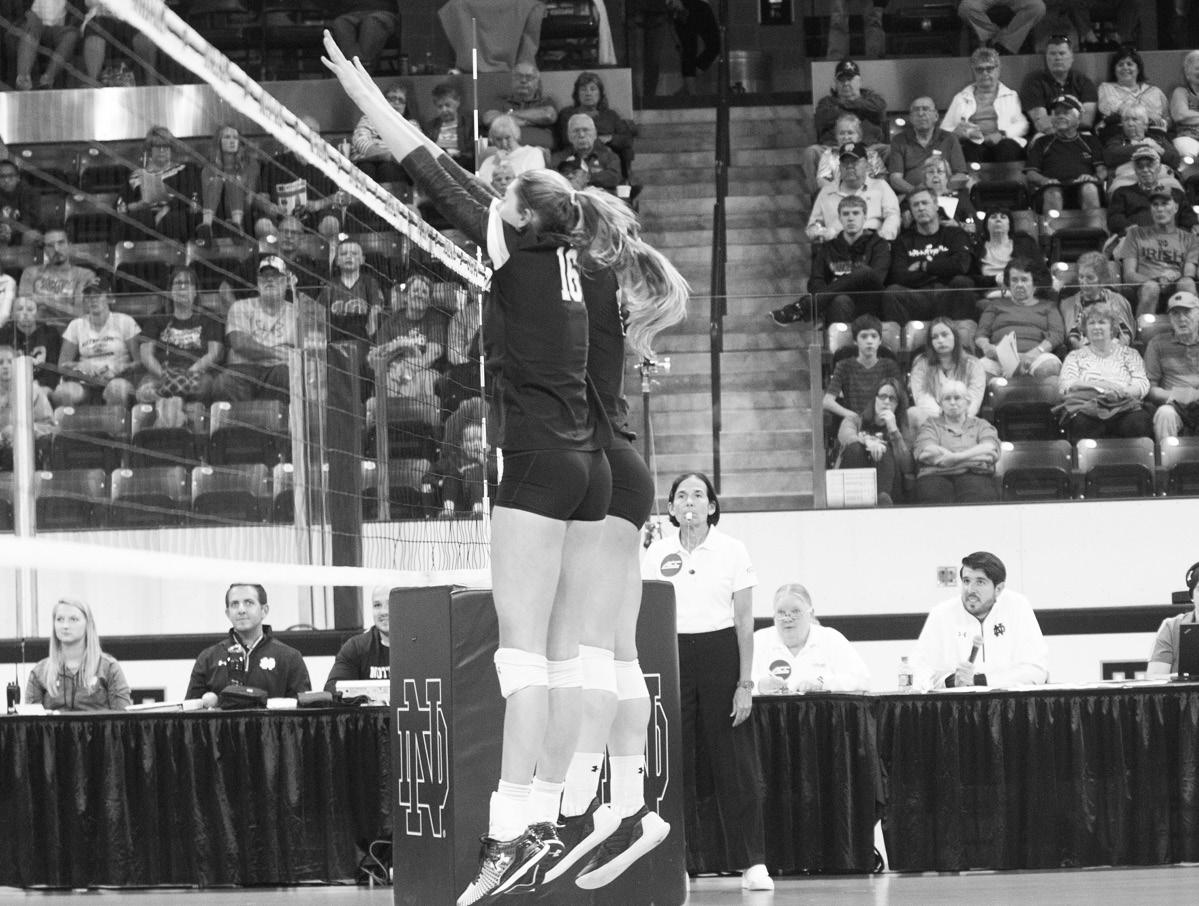
will travel to the bGsu/Toledo i nvitational this weekend. o n Friday, they will take on vcu and bowling Green, before closing out the weekend with a matchup against Toledo. a fter utilizing several different starting lineups at the Golden dome i nvitational, head coach Jim mcLaughlin will have to decide whether to use his more experienced players like sophomore outside hitter Jemma Yeadon, who started 29 of 32 matches last season, and junior middle blocker meg morningstar, who had 35 starts in the last two years, or less experienced competitors, including junior middle block Kristin baer, who made her first career appearance in the start against r hode i sland.
Looking at the opposition, vcu enters the tournament with two wins under their belt against Texas state and s am houston state, but the r ams (2-1) fell short against Texas a & m, losing that match in three sets. hosting the hampton i nn i nvitational, bowling Green lost their first match of the season at the hands of the university of i llinois at c hicago in a fiveset thriller, recorded a win in three sets against d uquesne and fell to an undefeated Xavier team in the final match. Toledo opened their season at the Fort Wayne i nvitational, losing to both s outhern i llinois university and Fort Wayne but grinding out a win against Quinnipiac in a five-set match. notre dame takes the court at 11 a.m. on Friday against vcu at the stroh c enter in bowling Green, ohio.
makes up for the lack of experience, and i’m really proud of what she’s doing,” she added.
“she’s learning, challenging herself, and she’s showing really exciting potential of the type of goalkeeper she can be.”
b ut s outh c arolina is also coming off of a win after besting h igh Point university 3-0 at home on sunday.
The Gamecocks limited the Panthers to just three total shots, while sophomore e lexa b ahr and freshmen Luciana Zullo and sharah e skew all scored. b ahr and senior s avannah mc c askill lead the Gamecocks’ offensive attack and each have three goals under their belt this season. s outh c arolina’s strong defense has allowed only 12 shots on goal in four games. s outh c arolina averages 13.75 shots per game, while limiting their opponents to 5.5 shots per game.
romagnolo said she is excited for the team’s potential this season and emphasized the importance of cohesion on the field in order for improvements to be made.
“We’re seeing glimpses of things we can do really well,”
she said. “We have great potential in some areas, and there’s things we want to consider to improve on. We’ve had a couple injuries in the course of four weeks and we haven’t necessarily had the same group on the field consistently, which leads to a lack of cohesion. b ut again, there are glimpses where we are brilliant and that is really exciting. i’m excited about the improvement and the strides that we’re making.”
romagnolo noted the importance of this weekend and how it will shed light on the future the team’s preparation for acc matches.
“i think this weekend will be a tremendous test for us,” she said. “We’re going to play two top opponents at home. We are going to see where we’re at and continue to look at what we’re doing well, what we need to keep working on and what we should keep preparing ourselves for when we head into conference play.”
notre d ame’s first-ever matchup against the Gamecocks takes place at 7 p.m. Friday at a lumni stadium.
Contact Brenna Moxley at bmoxley@nd.edu
By TOBIAS HOONHOUT Associate sports e ditor
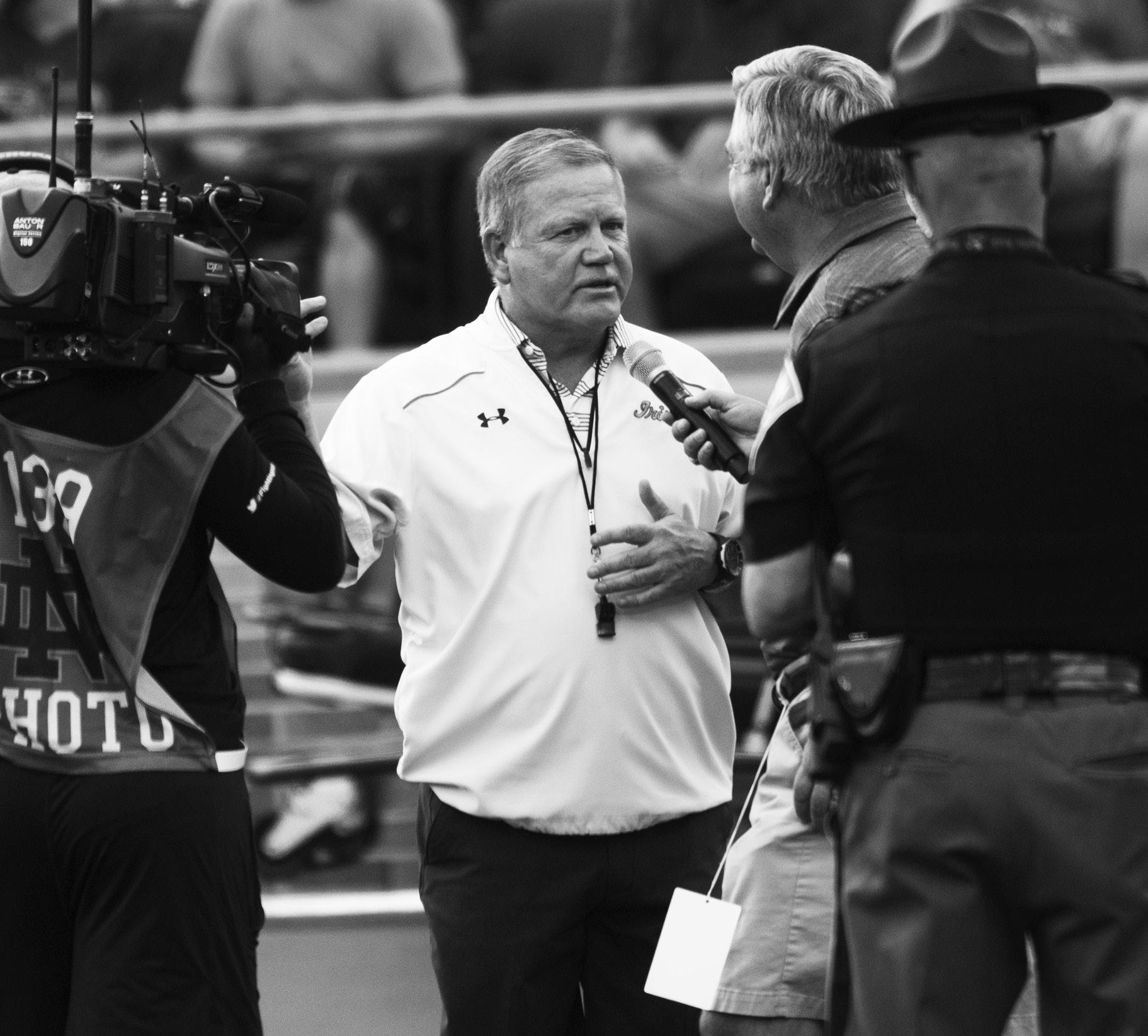
d espite the long break since last fall’s disappointing season, n otre d ame head coach b rian Kelly expressed excitement Tuesday as the Irish prepare for the season opener against Temple on s aturday.
“I can tell you that from my perspective, it’s exciting to start to talk about playing a game,” Kelly said. “It’s been a long time coming for all of us to begin this season. The preparation, the work, all the things that go into starting a season are now right in front of us. A lot of excitement.
“ … I know everybody has a similar press conference and stands in front of the media and the group and talks about how excited they are. b ut our team is ready to play. I don’t know that I’ve had many press conferences where I said, ‘Give me the team right now, we’d like to play today.’ We’re ready to play with a few more practice days in front of us.”
While n otre d ame has
nd Volleyball
plenty of uncertainty after an offseason marked by transition, both among players and coaches, arguably the team with more question marks is the o wls.
After back-to-back 10-win seasons, Temple lost its head coach m att r hule, who left to take the job at b aylor.
In steps former Florida defensive coordinator Geoff c ollins, and while the o wls should be competitive, questions on defense and at quarterback still remain unanswered. b ut for Kelly, Temple will be no pushover.
“They’ve got a core of winners,” Kelly said. “ c oach c ollins takes over a very successful program, comes from a winning background, has played winning football, great defensive coordinator at Florida. h e continues to bring that kind of mindset to that Temple program.
“ … All in all, [this is] a Temple football team that has a confidence of winning, and certainly from our standpoint what we have to do certainly in our opener is
Observer Sports Staff
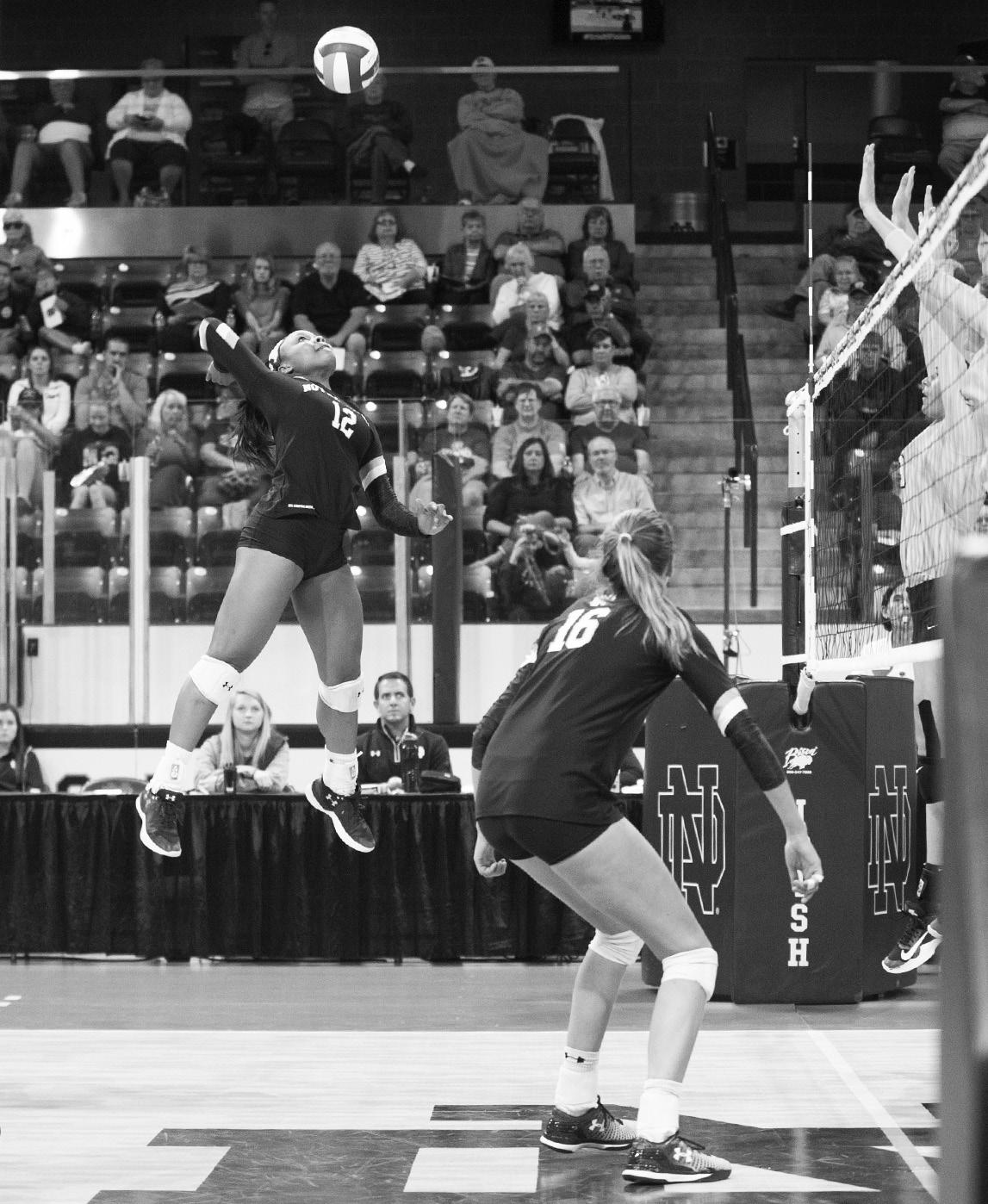
c oming off a sweep at last weekend’s Golden d ome Invitational, n otre d ame looks to continue their success as they begin their first road trip of the season.
The Irish (3-0) faced v alparaiso, r hode Island and n ew m exico s tate in the Golden d ome Invitational, winning all three matches to claim the title for the second straight year. While they handled r hode Island (0-3) in straight sets, v alparaiso (1-2) and n ew m exico s tate (2-1) proved to be more difficult opponents with both matches going into a fourth set. n otre d ame had two players named to the alltournament team, including junior libero r yann d eJarld, who was named tournament mv P, recording 87 digs over the course of the weekend.
Looking ahead, the Irish
By BRENNA MOXLEY sports Writer
n otre d ame faces its first real test of the season this coming Friday in a match against s outh c arolina.
d espite being unbeaten, the Irish (2-0-2) fell out of the nc AA d ivision I top 25 rankings according to the United s occer c oaches poll, while n o. 11 s outh c arolina (3-10) visits Alumni s tadium after defeating n o. 24 c entral Florida and losing to n o. 18 Wake Forest.
The game between the Gamecocks and the Irish is the first of this weekend’s n otre d ame Invitational.
n otre d ame will also play s anta c lara on s unday in the team’s final game of the tournament.
This past s unday, the Irish recorded their second win of the season, defeating Iowa 2-0 after junior defender s abrina Flores and sophomore forward n atalie Jacobs
each scored first-half goals to secure the win for the Irish.
s tatistically, n otre d ame ranks among the upper quarter of d ivision o ne, averaging 18.75 shots per game, leading to seven goals in four games, while only giving one goal. Irish sophomore goalie b rooke Littman has been a major reason for n otre d ame’s defensive strength, recording 14 saves and holding a save percentage of 93.3 percent, despite not seeing the field last season
Irish head coach Theresa r omagnolo reflected on Littman’s hard work and dedication to the sport during the summer.
“ s he has put a lot of work in, and she has prepared herself well all summer by playing in a league and having a lot of goalkeeper training,” r omagnolo said.
“ h er hard work this summer