Despite all the talk, it’s too early to judge
Disappointing? Yes. But a disappointment? Absolutely not.
Notre Dame’s recruiting class of 2012 was not all it could have been, but it should certainly not be considered a failure.
Judging the pending success or failure of a player as he moves from college football to the NFL is difficult enough. Judging the same as a player moves from high school to college is intelligent guesswork at best.
That is not to say National Signing Day is not important.

Eric Prister Senior Sports Writer
Recruiting is an invaluable part of the college football process and should be treated as such. But to claim Notre Dame failed because it did not rank higher on an analyst’s list of top classes is ludicrous.
The Irish missed out on a few opportunities, losing receiver Deontay Greenberry in the eleventh hour to Houston and highly touted defensive back Ronald Darby a few weeks earlier. But to claim these losses signal a downward spiral for the state of the football program is absurd.
Last season, Notre Dame hit a home run, signing defensive lineman Aaron Lynch and Stephon Tuitt, along with linebacker Ishaq Williams, who at the time was considered to be on their level. Irish coach Brian Kelly went into the recruiting process knowing he needed to solidify his defensive front, and he did just that.
But the impact of Tuitt and Lynch was not just on the field. Certainly they played well this season, but they provided much-needed depth on the defensive line, and that was their greatest contribution this year.
Kelly did not hit that same home run this year. He said at last year’s National Signing Day press conference that after recruiting well on the defensive interior, this year’s focus would be the exterior. The home run would have been signing corners Tee Shepard, Darby and Brian Poole. On signing day, only Shepard belongs to the Irish. But the class of 2012
includes five players who will enter camp as defensive backs, and that depth is what is important.
And while defensive back was highlighted as the position to watch as early as last February, the most immediate concern for most Irish fans is the quarterback position, and the Irish nabbed one of the best. Gunner Kiel fits in perfectly with Kelly’s system and should complete for the starting job immediately as an early enrollee.
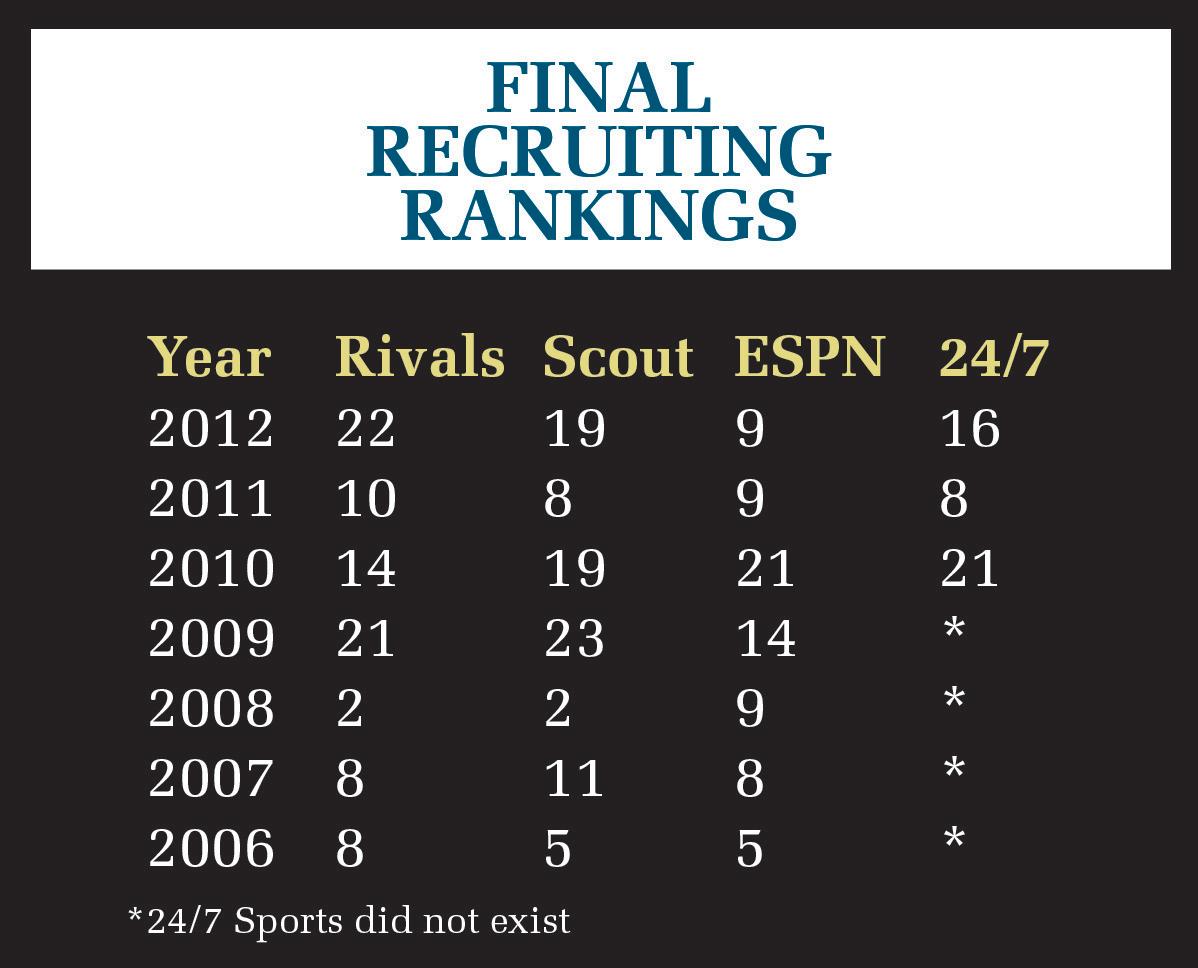
But it is very difficult to judge players at this stage. According to Rivals.com, Notre Dame signed just two players in the top-100. According to ESPN, they signed three. But what does this mean?
Arguably the best quarterback in recent memory at Notre Dame, Brady Quinn, was a three-star prospect coming out of high school, nowhere near the top-100. Tyler Eifert was also a three-star recruit. Jeff Samardzija was as well. Rankings are meaningless until a coach gets his hands on the players. Receiver recruit
Justin Ferguson is rated the 14th-best receiver by ESPN and the 58th-best receiver by Rivals.com. Which is right, or is either? Only time will tell.
Kelly said Wednesday that Notre Dame did exactly what it set out to do this year, and for now, there is no reason to doubt him. Certainly there were some slip-ups, and things did not go exactly according to plan. But to judge the success or failure of a coaching hire based on the whims of one or two 18-year-olds is bordering on certifiable insanity.
Notre Dame football is moving in the right direction. It may not be going there as quickly as some would like, and Kelly’s third year probably will not bring a national championship.
There certainly have been setbacks, the loss of Greenberry potentially being one of them, just as the loss to South Florida at the beginning of last season undoubtedly was.
But Brian Kelly has a plan, and if he says things are moving according to it, who’s to say he’s wrong?
Contact Eric Prister at eprister@nd.edu
The views expressed in this column are those of the author and not necessarily those of The Observer.
Kelly unveils 2012 recruits
By CHRIS MASOUD Assistant Managing Editor
No pleasant surprises and no 11th-hour recruiting coups — National Signing Day 2012 simply turned out a group of solid football players. Irish coach Brian Kelly added one transfer student and 16 high school seniors to the 2012 football roster, including 10 skill players, four power players, one big skill player and one specialist.
late to Notre Dame because we don’t want you to get here, and you’ve signed a letter of intent, and it wasn’t the right fit. You just got sold a bill of goods.”
“I think we painted the picture ... clearly about what we were about, and we made sure that this is what you’re going to get at Notre Dame.”
“Today we have a class that represents the needs that we had in our football program,” Kelly said Wednesday. “As you know, last year our need base relative to our class was centered around the power position. I thought we did a great job of addressing that. This year was about that skill level, and especially at the defensive backfield and the wide receiver position, and we feel like we have addressed those needs within our program for the 2012 class that we’re announcing.”
Brian
Kelly Irish coach
The lone surprise of the day was the fax that never came in. Wide receiver Deontay Greenberry, the No. 7 wide receiver ranked by Scout.com and a verbal commitment up until Wednesday, signed with Houston instead.
Kelly said conversations that took place between last night and this morning indicated Greenberry had changed his mind.
propriate messages on Twitter.
“[Social media has] opened up the eyes of everybody, and in particular what you say tracks you. I think that’s appropriate … I think social media is definitely a window in which we can see more about a young man. Sometimes it’s just being silly, but the recognition that it does track you, it is very important and it’s a point that we made this year. I brought in a specialist this year to talk about social media and the implications of that. We’re going to have to continue to teach and educate.”
Transfer running back Amir Carlisle, defensive lineman Sheldon Day, defensive back Tee Shepard and Kiel enrolled at the University in January and have already started taking classes. Kelly said the coaching staff has maintained constant contact with the early enrollees to ease the transition process.
Among the 16 high school recruits, defensive lineman Jarron Jones, quarterback Gunner Kiel, running back KeiVarae Russell and defensive back Elija Shumate were selected for the U.S. Army AllAmerican Bowl. Kelly and his staff crisscrossed 13 states, visiting recruits and their families from the Midwest, the South and both coasts to secure National Letters of Intent.
“It starts with making sure that we talk about our distinctions and not shy away from them,” he said. “We talk about a faith based education; we talk about, ‘You got to live in the dorms.’ We talk about those things as they re -
“I think we painted the picture … clearly about what we were about, and we made sure that this is what you’re going to get at Notre Dame. For me it’s hard to be disappointed about something you’ve never had or you’ve never coached,” he said. “I’m more excited about the guys that signed because they are the right kind of guys.”
But Kelly quickly dashed any implications of coddling, adding he expects each recruit to push incoming players for time on the field.
“In the recruiting process we clearly tell our freshmen, ‘You better be ready to compete,’ whether it’s Gunner Kiel or Sheldon Day or Tee Shepard.”
Brian Kelly Irish coach
Unlike previous years, Kelly said social media emerged as a factor in the recruiting process. Originally recruited by Notre Dame and Michigan, cornerback Yuri Wright committed instead to Colorado after being dismissed from his high school by posting inap -
“In the recruiting process we clearly tell our freshmen, ‘You better be ready to compete,’ whether it’s Gunner Kiel or Sheldon Day or Tee Shepard … If you think you’re going to come in and get a free year and red shirt, [that’s] somewhere else,” Kelly said. “Come to Notre Dame if you want to compete.”
Spring football practices begin March 21.
Contact Chris Masoud at cmasoud@nd.edu
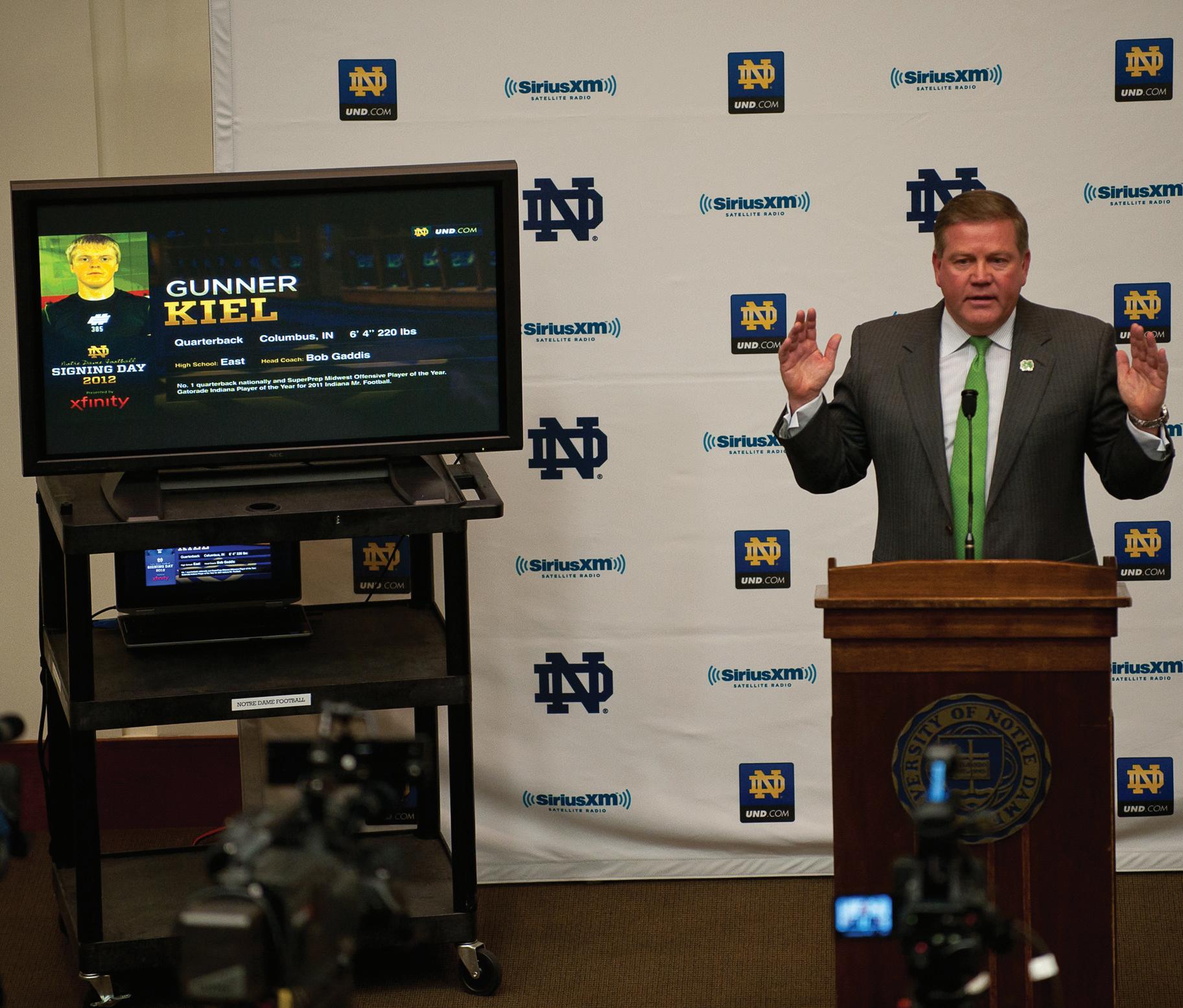
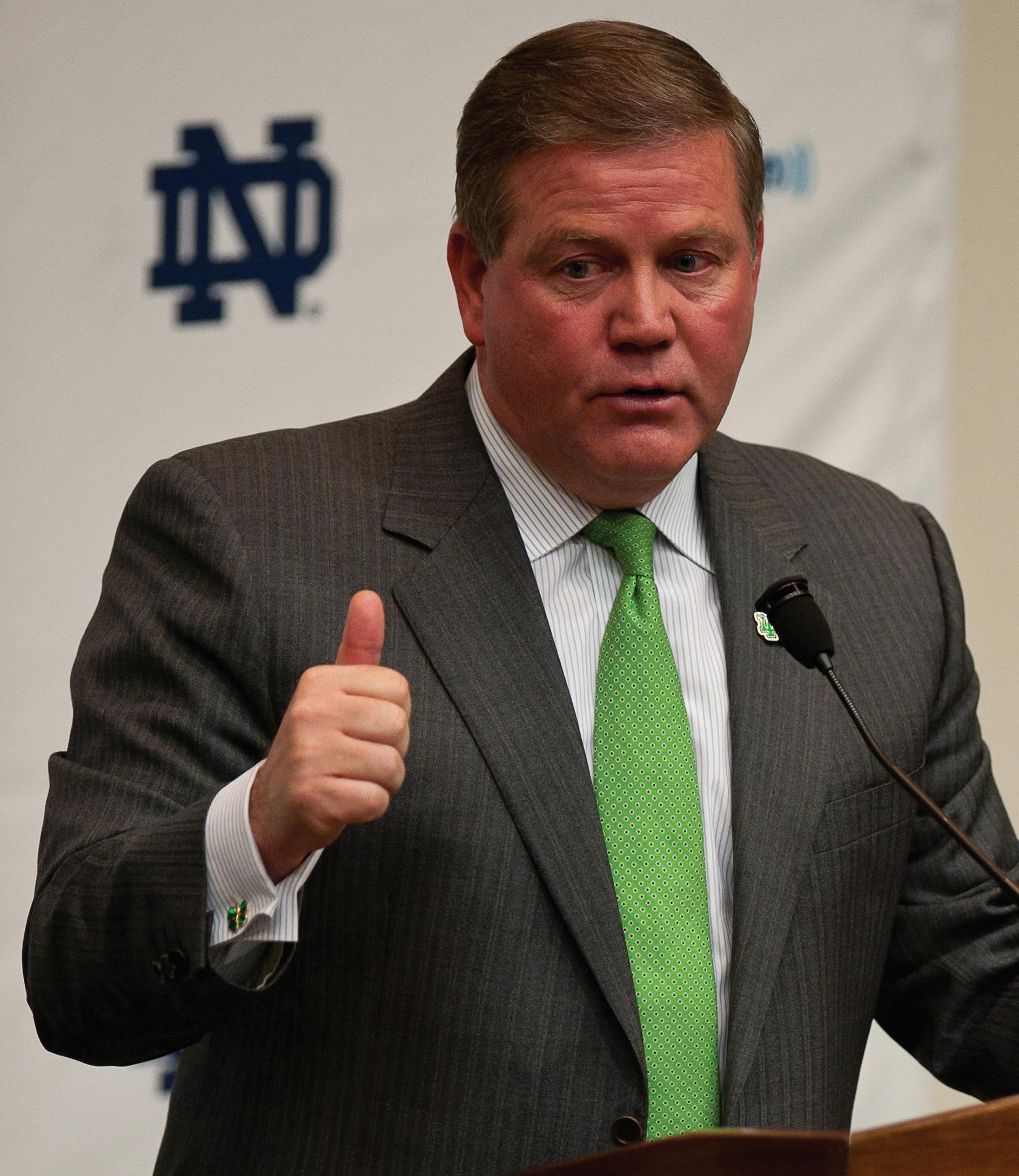
Irish coach Brian Kelly discusses Notre Dame’s 2012 recruiting class with the media Wednesday at the Guglielmino Complex. The Irish added 16 recruits and one transfer in the recruiting haul.
GRANT TOBIN/The Observer
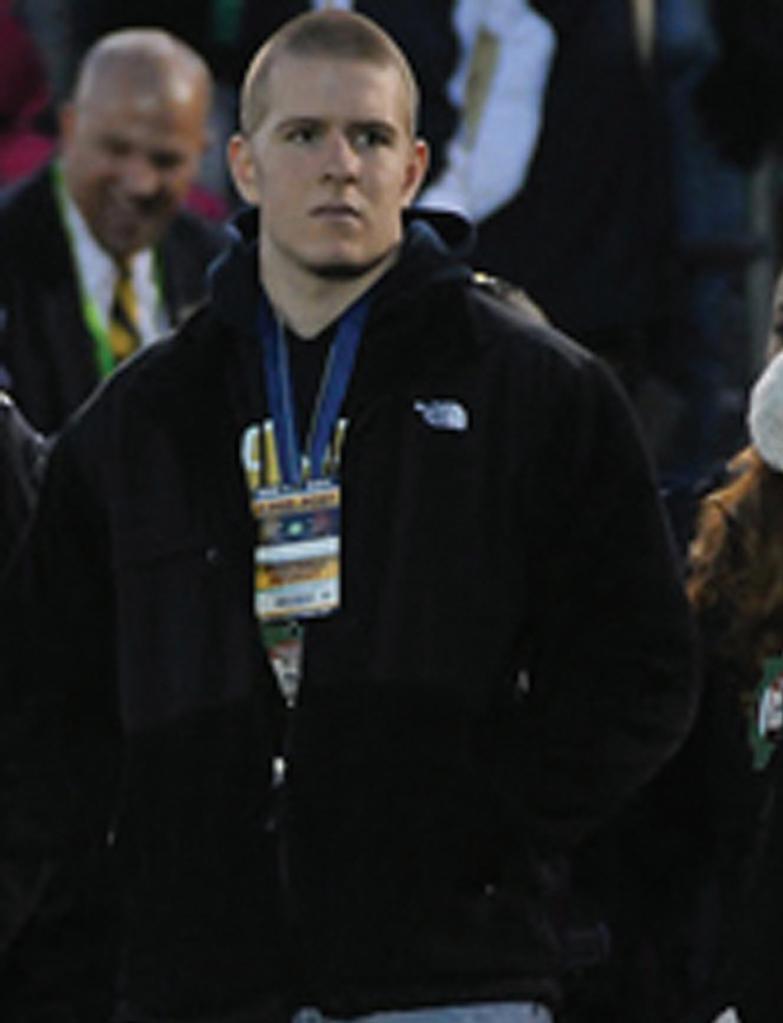
Nick Baratti
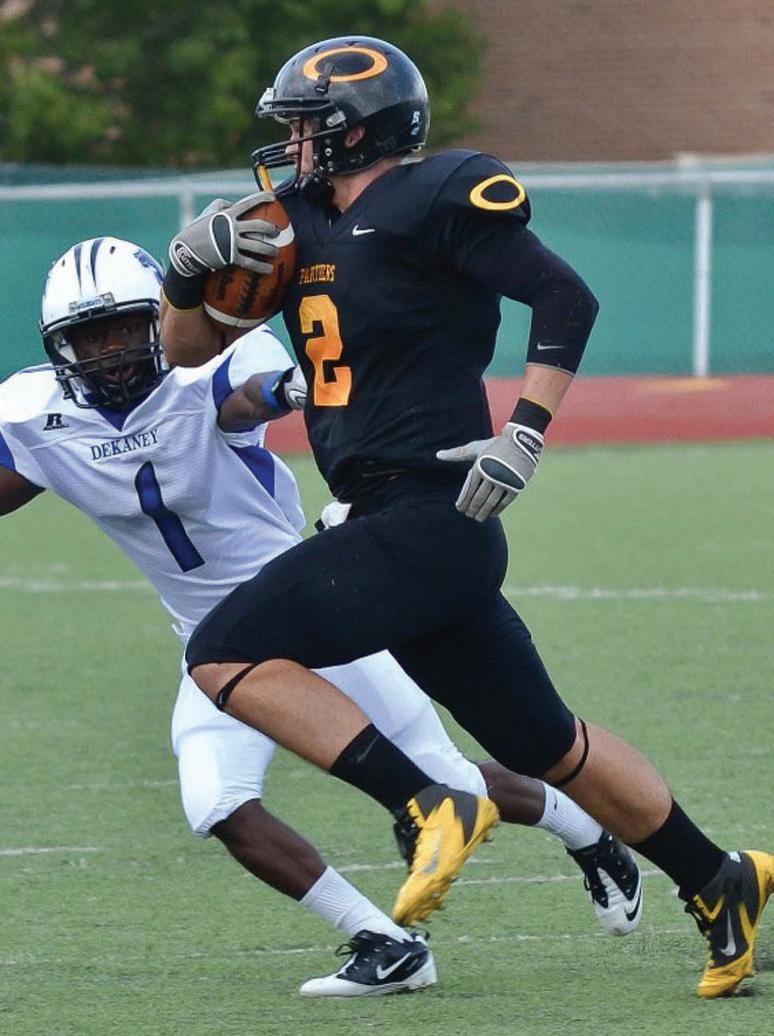
S, ***, 210 pounds, 6-2
Klein Oak High School Spring, Texas
Nick Baratti features a deadly combination of acceleration and size coming out of Texas, one of the country’s premier football states. Considered by many a three-star recruit, the Irish expect Baratti to play safety in order to utilize his ball skills, great closing speed and explosiveness in and out of cuts.
At 6-foot-2 and 215 pounds, he has a build nearly exactly copying that of outgoing safety Harrison Smith, but he also runs a 4.48 40-yard dash.
Baratti was primarily used in a running back and quarterback combination while also posing as a dangerous receiving threat in high school. In his junior year the Spring, Texas, native threw for 1,873 yards and 13 touchdowns while rushing for 1,267 yards and 17 touchdowns.
Scott Daly
LS, **, 210 pounds, 6-2
Downers Grove South High School Downers Grove, Ill.
Long snappers are rarely noticed until they make a mistake, but Scott Daly’s performance earned him the recognition of a Notre Dame scholarship.
Playing for the Irish has been Daly’s top goal from the beginning of the recruiting process, and he accepted a scholarship offer just seconds after Irish coach Brian Kelly offered it.
The Downers Grove, Ill., resident made the trip for five of Notre Dame’s six home games this fall and has made several visits to campus during the winter.
Daly’s consistency and work ethic at the position are unrivaled, and his quickness will be an asset in punt coverage.
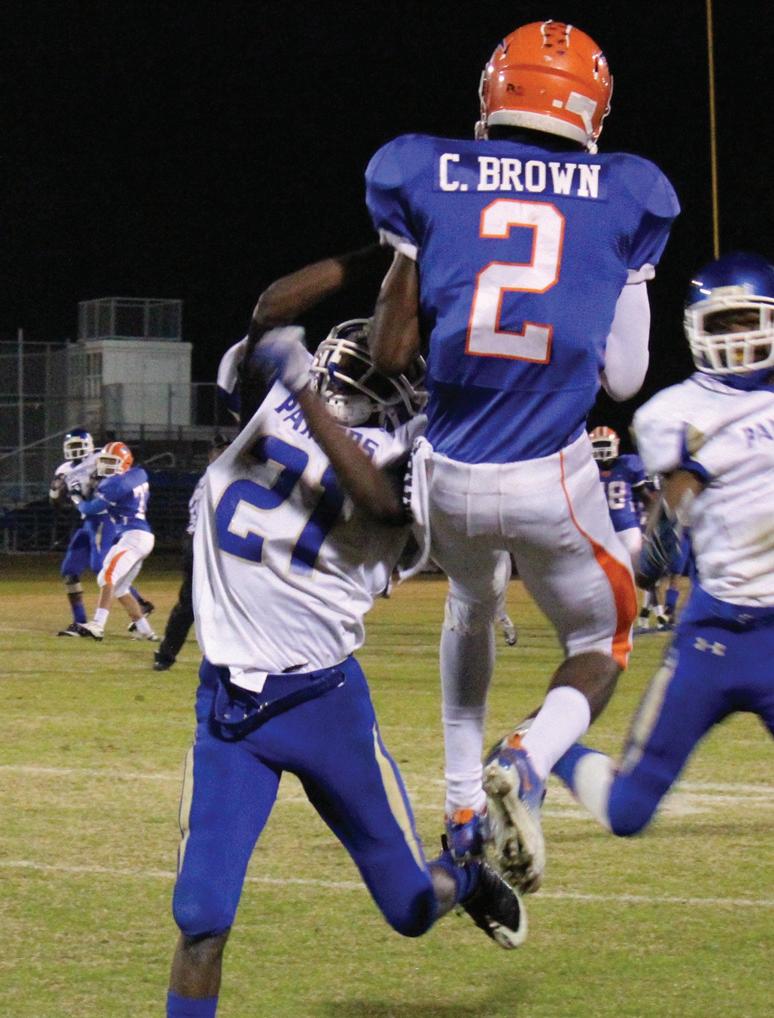
Chris Brown
WR, ****, 180 pounds, 6-2 Hanahan High School Hanahan, S.C.
While the Irish have churned out plenty of solid possession receivers, the offense has lacked a pass-catcher with blazing speed. Enter Chris Brown and his 40-yard dash time of 4.44.
Brown shot up recruiting boards across the nation toward the end of his high school career.
Though he missed half of his senior campaign because of a broken collarbone, Brown still had a productive high school career, including a junior season in which he recorded 52 catches for 1,105 yards and 16 touchdowns.
Brown has tremendous athleticism; in addition to his top-end speed, he has great jumping ability.
Brown has the versatility to play in the slot or on the outside for Notre Dame.
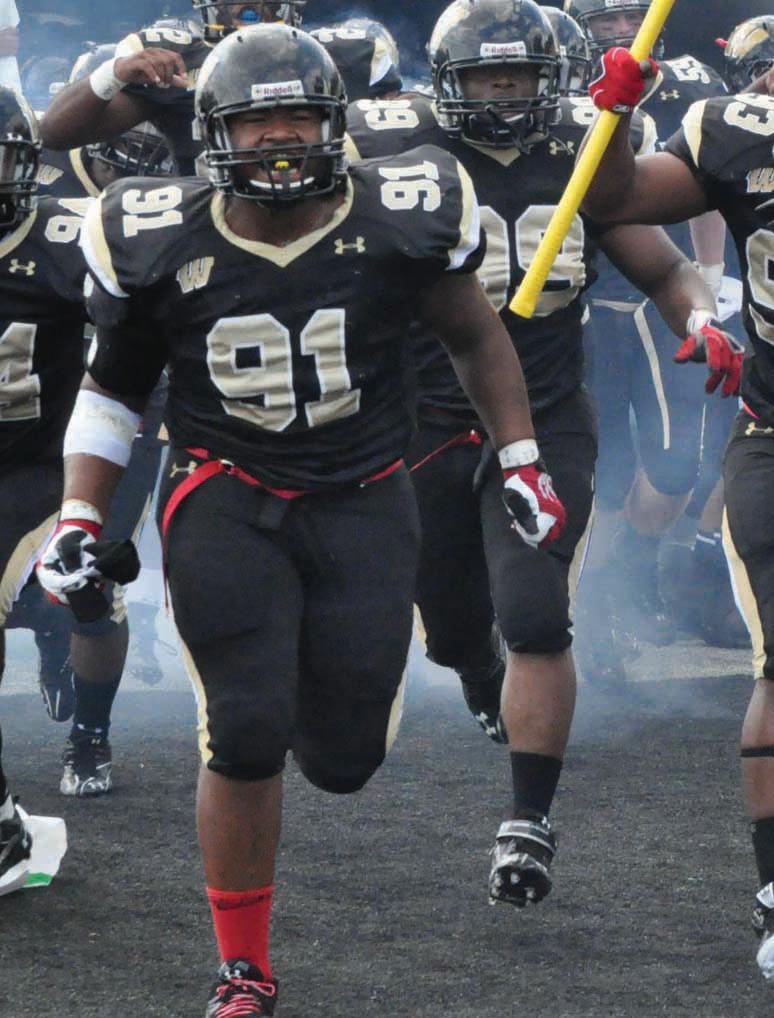
Sheldon Day
DE, ****, 280 pounds, 6-2 Warren Central High School Indianapolis, Ind.
One of the highest-rated prospects in the Irish recruiting class, Day is ranked among the nation’s top defensive tackles by most recruiting services. The 280-pound lineman from Indianapolis drew a slew of impressive scholarship offers from around the country. Other offering powerhouse programs including Arkansas, Michigan, LSU, Penn State, Virginia Tech and Wisconsin, but he chose to stay in his home state and play for the Irish. Day joins an already-loaded Irish front and will likely figure into the rotation in the middle of the Irish defensive line immediately. He is smaller than current Irish nose guard Louis Nix, but has been an active force against the run and the pass at Warren Central High School, with nine sacks and 11 tackles for loss in his senior season.

Capsules by Observer Sports staff
Photo courtesy of Hanahan High School
Photo courtesy of James Clancy
Photo courtesy of Irish Sports Daily
Photo courtesy of Warren Central High School
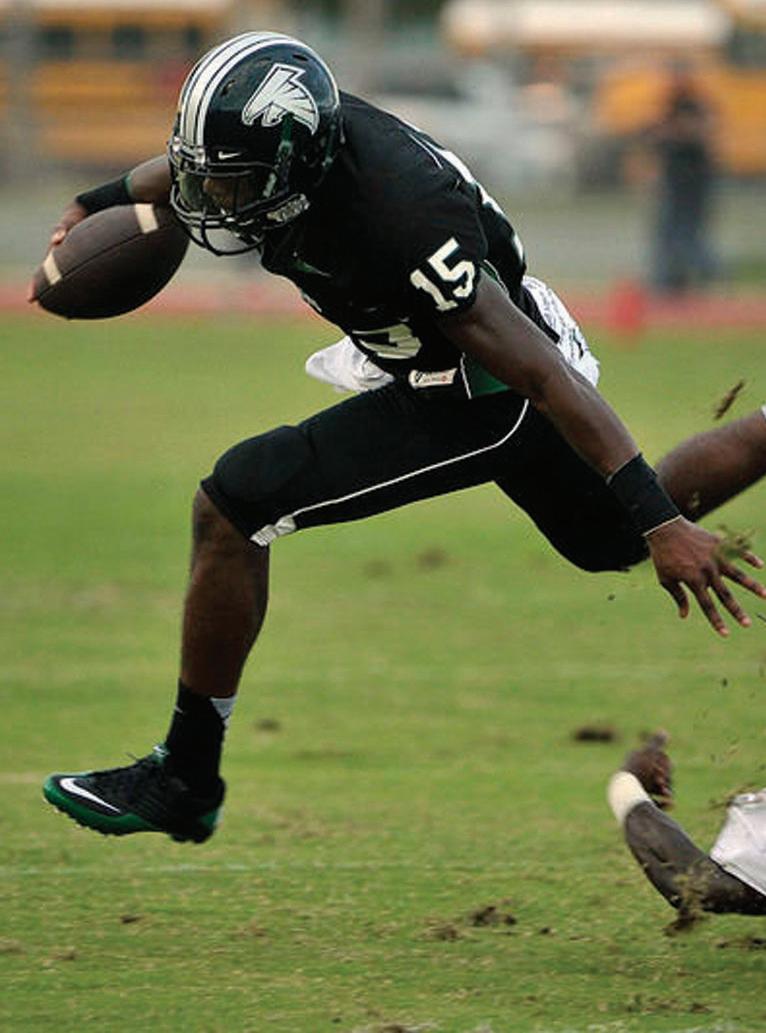
Justin Ferguson
WR, ***, 205 pounds, 6-2
Flanagan High School Pembroke Pines, Fla.
With the departure of the most accomplished wide receiver in Notre Dame history, Justin Ferguson will be one of the players hoping to emerge as a threat in the Irish passing game in 2012.
Ferguson brings good size to the position and his game is fundamentally reliant on outmuscling defensive backs. However, Ferguson’s impressive power is coupled with considerable agility and speed. He figures to line up primarily on the outside where he will have the ability to get behind defenses and extend the field.
The Florida native is athletic and talented, and if he is able to improve his technique he could develop into an important player in Notre Dame’s field of young receivers.
Jarron Jones DE, ****, 290 pounds, 6-6 Aquinas Institute Rochester, N.Y.
A two-way lineman in high school, Jarron Jones is expected to play on the defensive side of the ball at Notre Dame, adding even more youth to a line deep with potential.
He is ranked as a four-star recruit by most major recruiting services, is a member of the ESPNU 150, and played in the U.S. Army All-American Bowl on Jan. 7. Jones, who has a scary combination of size, strength and athleticism, is an intelligent player who shows a good ability to read and react on defense. He initially committed to Penn State in April, but then decommitted in July before committing to the Irish in late August.
As a junior, Jones had 68 tackles, 10 sacks and an interception. During his senior season, he recorded 71 tackles and five sacks.
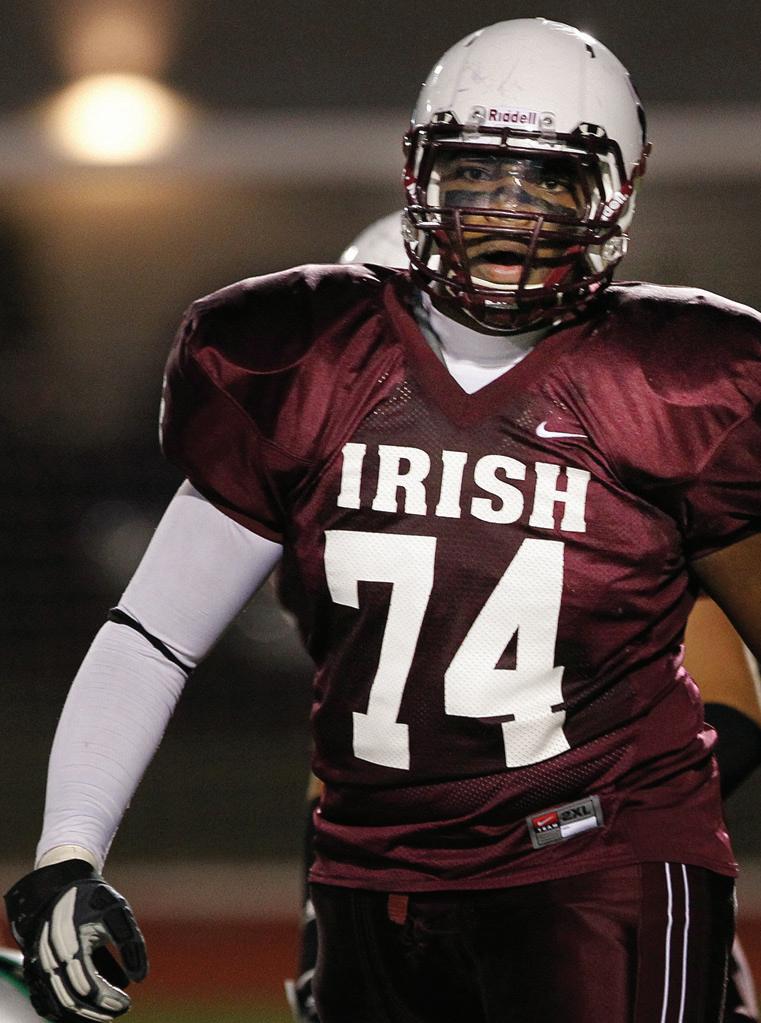
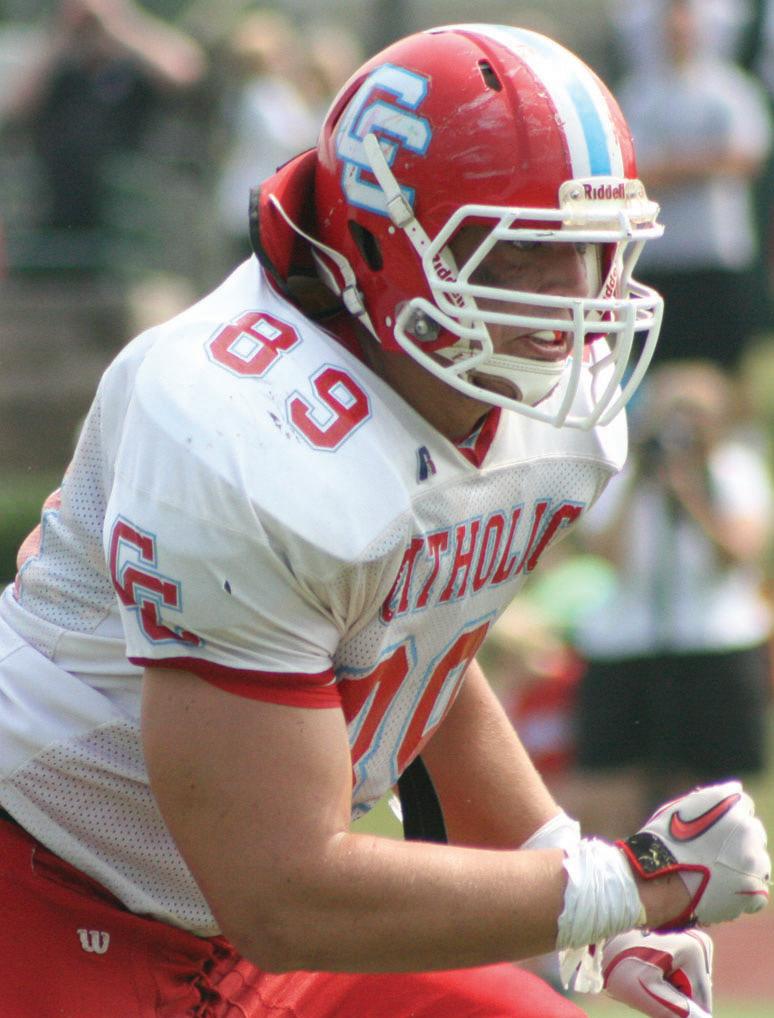
Harrell
OL, ***, 270 pounds, 6-5 Charlotte Catholic High School Charlotte, N.C.
Mark Harrell is a versatile prospect who will be able to contribute at a number of positions for the Irish. At 6’ 5” and 265 lbs, he has the athleticism and length to excel at guard but also the drive and competitiveness to be a force in the middle. It is not yet determined where on the offensive line he will end up, but he is primed to succeed in Notre Dame’s spread offense, which places a premium on big, athletic linemen who can both protect the quarterback and get to the second level on runs and short passes.
While he still has to add bulk to his frame, the senior from Charlotte, N.C., and Charlotte Catholic High School should be a force when his body catches up to his skills and natural size.
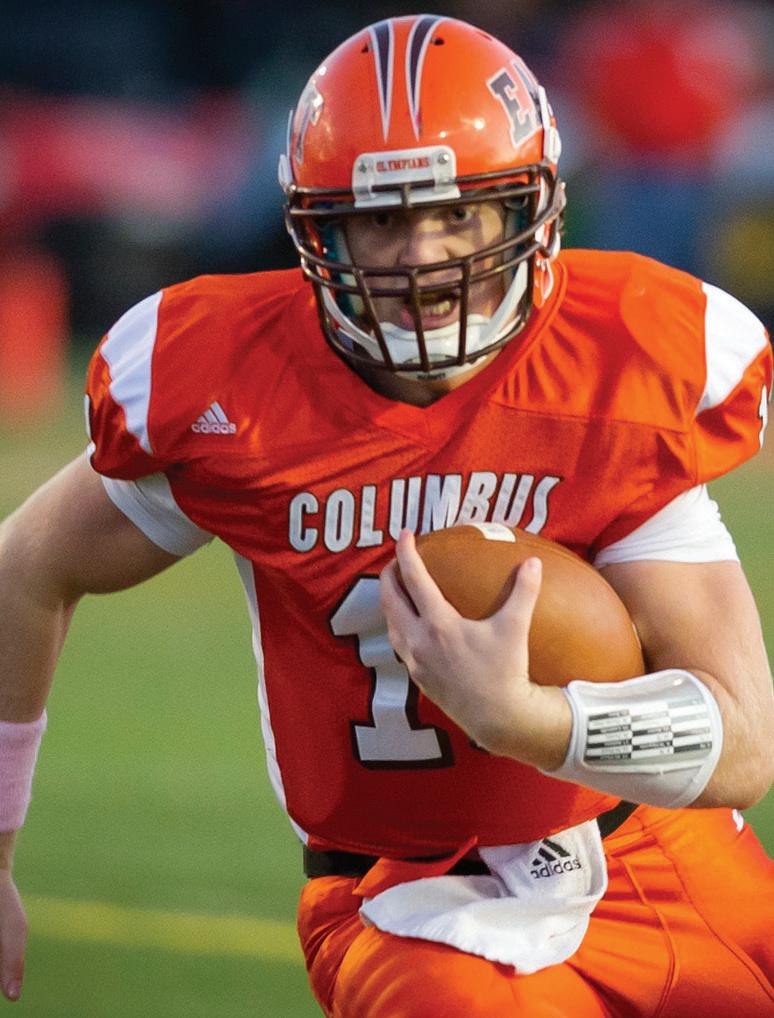
Gunner Kiel
QB, *****, 215 pounds, 6-4 Columbus East High School Columbus, Ind.
Originally committed to Indiana, Kiel switched to LSU in December before capping off a roller coaster recruitment by finally choosing the Irish hours before the start of the second semester.
The quarterback is one of three early enrollees and will compete for the starting job in spring practice. He joins an already crowded quarterback position that struggled to provide consistency last season. Expectations for Kiel range from earning the starting job to redshirting his first year on campus, similar to the blueprint used in 2011 for freshman quarterback Everett Golson.
Kiel, at 6-foot-4 and 220 pounds, carries good size and above average skills on the ground. Due to his arm strength and accuracy, Kiel was tabbed the top-rated quarterback prospect in the nation.

William Mahone
RB, ****, 205 pounds, 5-11 Fitch High School, Austintown, Ohio
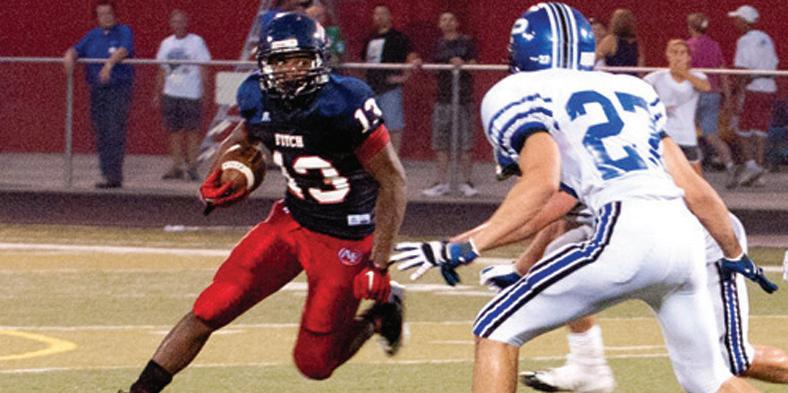
A strong and well-built running back, Will Mahone hopes to step in as Notre Dame’s primary physical back and fill the void created by Jonas Gray’s graduation.
In his senior season at Fitch High School in Austintown, Ohio, Mahone averaged 7.3 yards per carry and reeled off several long touchdown runs. He also contributed as a linebacker for Fitch, creating two forced fumbles and snatching four interceptions.
Mahone’s size makes it difficult for defenders to tackle him, as he is powerful enough to drive through defenders. He is not exactly a speedy running back but possesses a quick initial burst and has the ability to change direction with ease.
LB, ***, 235 pounds, 6-4 Ardrey Kell High School, Charlotte, N.C.
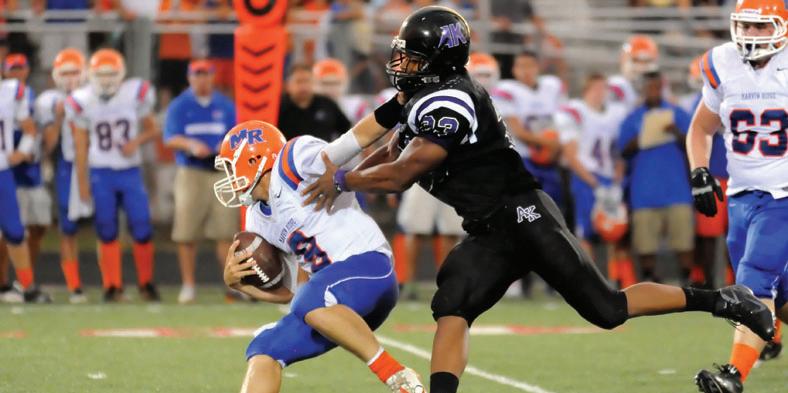
Add another impressive young pass-rushing talent to the Irish front seven — Romeo Okwara, a 6-foot, 4-inch, 225-pound defensive end from Charlotte, N.C., spent last season tirelessly chasing dwn opposing quarterbacks en route to nine sacks and 70 tackles.
Okwara has been a solid commitment for Notre Dame since before the 2011 season and took in multiple Irish games this past fall, both in South Bend and on the road. Okwara was in attendance for the Oct. 22 loss to USC before taking in wins over Wake Forest and Maryland. As a menacing presence for Ardrey Kell High School, he caused havoc in the opposing backfield with a knack for causing turnovers. He carries a 3.5 grade-point average into Notre Dame.
Capsules by Observer Sports staff
Photo Courtesy of Andrew Laker/The Republic
Photo courtesy of Flanagan High School
Mark
Photo courtesy of Charlotte Catholic High School
Photo courtesy of Lakiescha Titus-Jones
Photo Courtesy of Andrew Laker/The Republic
Romeo Okwara
Beamer Sports Photo
C.J. Prosise
S, ***, 205 pounds, 6-2
Woodberry Forest High School
Woodberry Forest, Va.
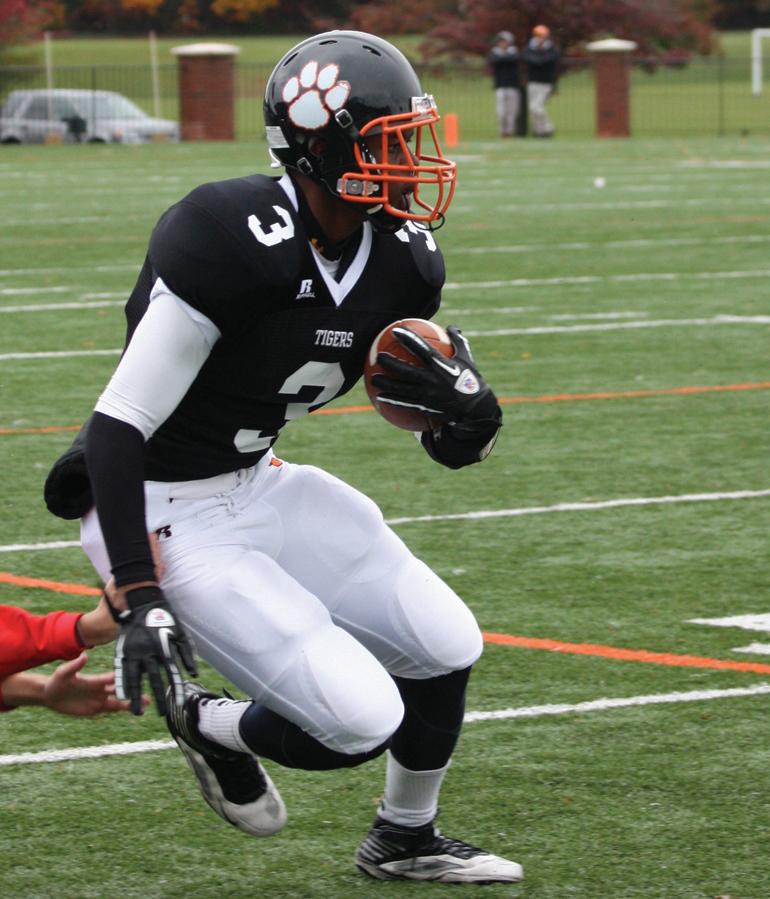
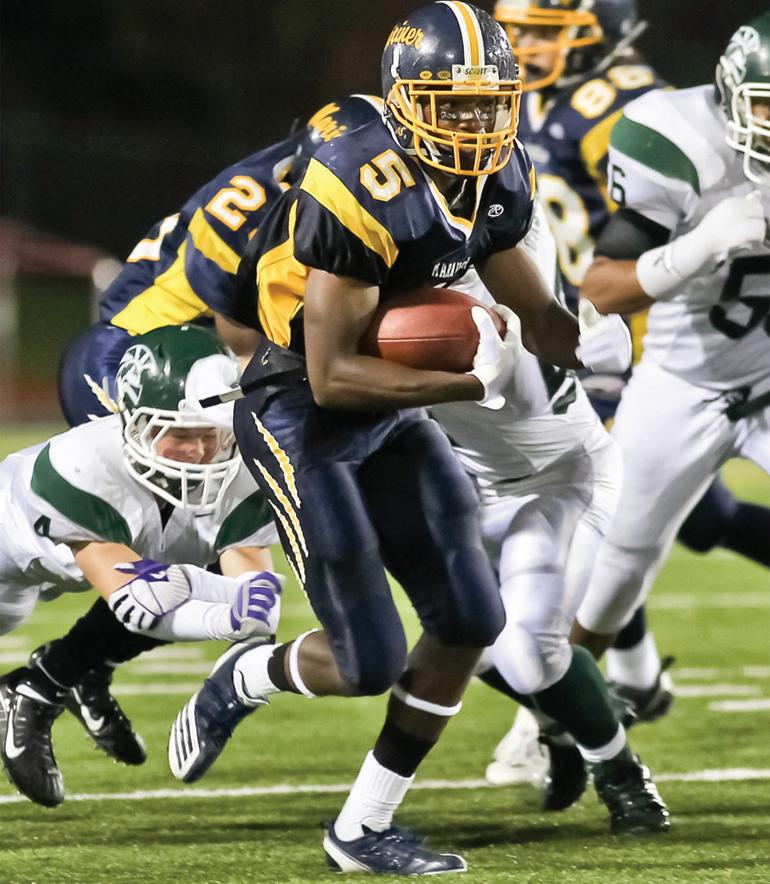
C.J. Prosise, a 6-foot-2, 205-pound defensive back, should provide muchneeded depth at the safety position for the Irish.
He picked Notre Dame over offers from schools such as Wisconsin, Virginia Tech and Penn State.
Prosise finished his senior season with 51 tackles, six interceptions and 10 pass breakups. He also should factor into the nearly nonexistent Notre Dame punt return game, as Prosise returned four punts for touchdowns last year.
The Central Virginia Defensive Player of the Year possesses 4.55 speed, yet has the size needed to be a safety in college.
Tee Shepard
CB, ****, 180 pounds, 6-1
Washington Union High School Fresno, Calif.
The first commitment to Notre Dame’s class of 2012, doing so all the way back in March, Tee Shepard is one of three members of the class who enrolled early for the spring semester.
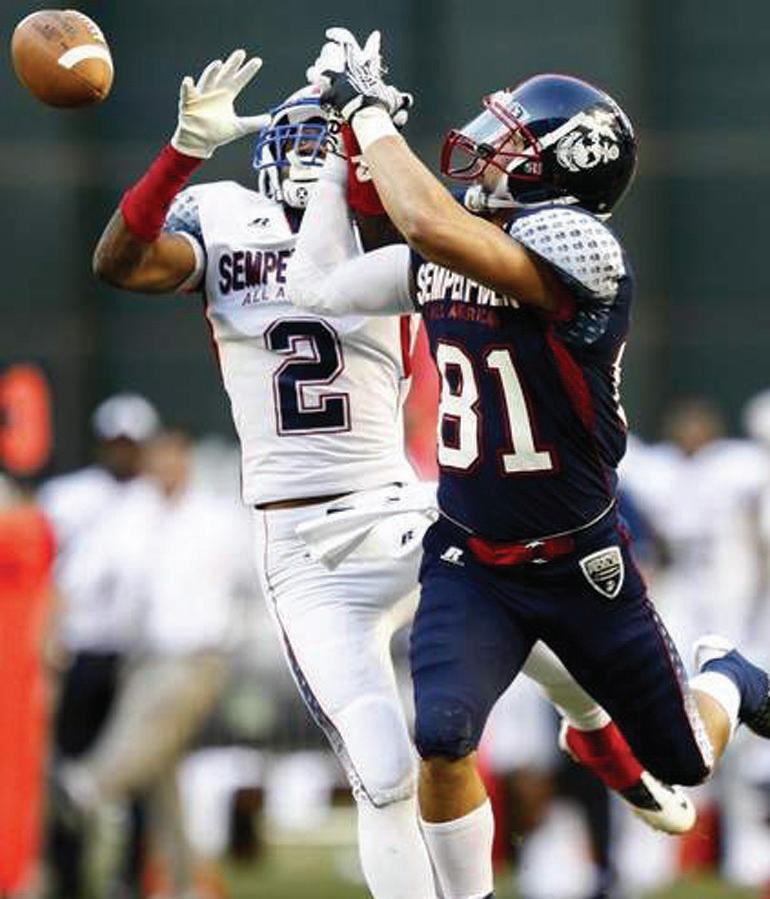
The fourth best cornerback prospect in the country according to rivals.com, Shepard has great size and length for cornerback and impressive football instincts, which makes him a potential lockdown defensive back for the Irish.
Shepard sat out his senior season due to an eligibility issue after transferring high schools, but competed in the Semper Fidelis All-American Bowl in January.
Ronnie Stanley
OL, ****, 285 pounds, 6-6
Bishop Gorman High School Las Vegas, Nev.
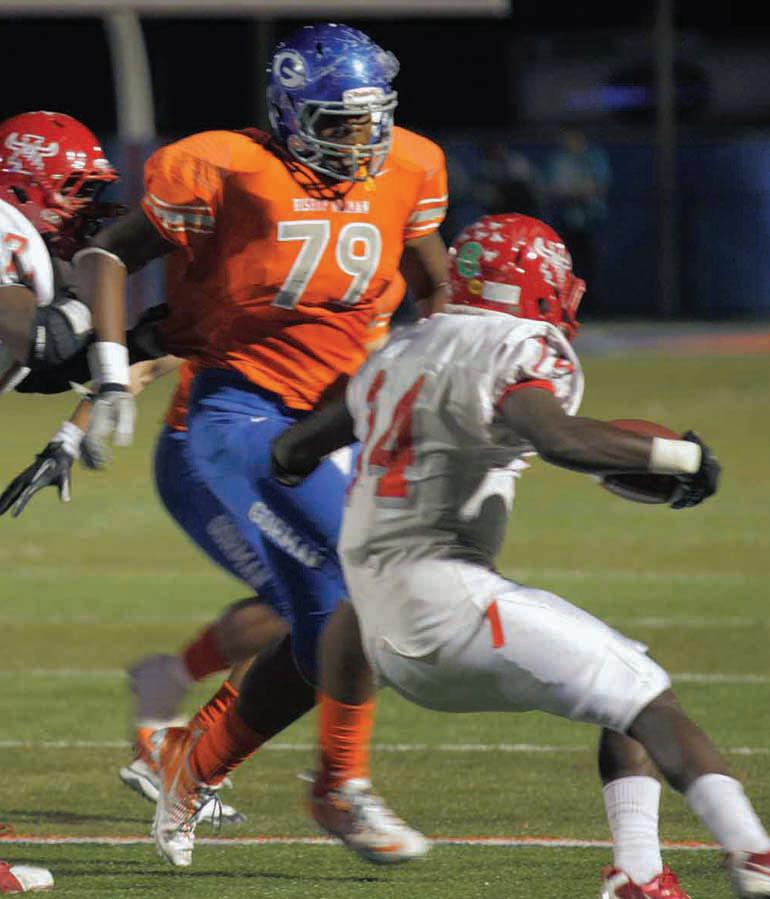
Ranked as the top recruit in Nevada, Ronnie Stanley committed to Notre Dame after making an official visit in December, selecting the Irish over Arkansas and Nebraska.
A three-year starter for powerhouse Bishop Gorman High School in Las Vegas, Stanley’s solid play on the line helped his team capture three consecutive state championships and deliver a 43-3 record over the last three years.
Stanley’s 6-foot-7 frame and agility gives him a strong mix of size and athleticism, which should play well in Irish coach Brian Kelly’s spread offense. He is still seen as raw and needs more time in the weight room but has great upside.
KeiVarae Russell
ATH, ****, 170 pounds, 6-0 Mariner High School Everett, Wash.
Running back KeiVarae Russell chose the Irish over his home-state Washington Huskies on Dec. 29. Russell, who also received offers from USC and Cal, among others, rushed for at least 1,200 yards in each of his sophomore, junior and senior seasons, including 1,850 yards as a junior and 1,293 yards as a senior, despite missing three games due to injury.
Russell, who participated in the U.S. Army All-American Bowl in January, provides versatility with his ability to catch passes out of the backfield and can play in the slot if necessary. Russell’s elusiveness and change of pace ability also provides a nice complement to fellow Irish signee running back Will Mahone’s more powerful running game.
Elijah Shumate
S, ****, 205 pounds, 6-1
Don Bosco Prep Ramsey, N.J.
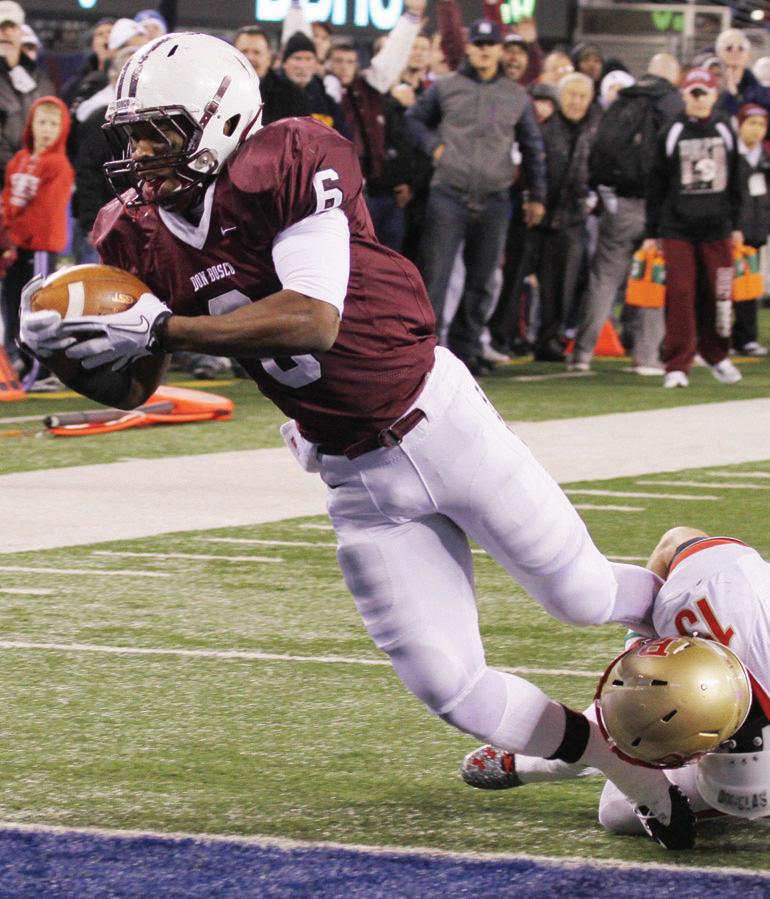
This four-star recruit was a huge recruiting coup for a depleted Irish secondary. While receiving offers from Oklahoma, South Carolina and Michigan among others, Shumate chose Notre Dame in early January at the U.S. Army All-American Bowl after a late-December visit while being heavily recruited by defensive coordinator Bob Diaco. Shumate played linebacker in high school, but is expected to make the switch to strong safety for the Irish.
The Don Bosco product is the No. 4 overall recruit coming out of New Jersey and is known for his jarring hits and tremendous closing speed.
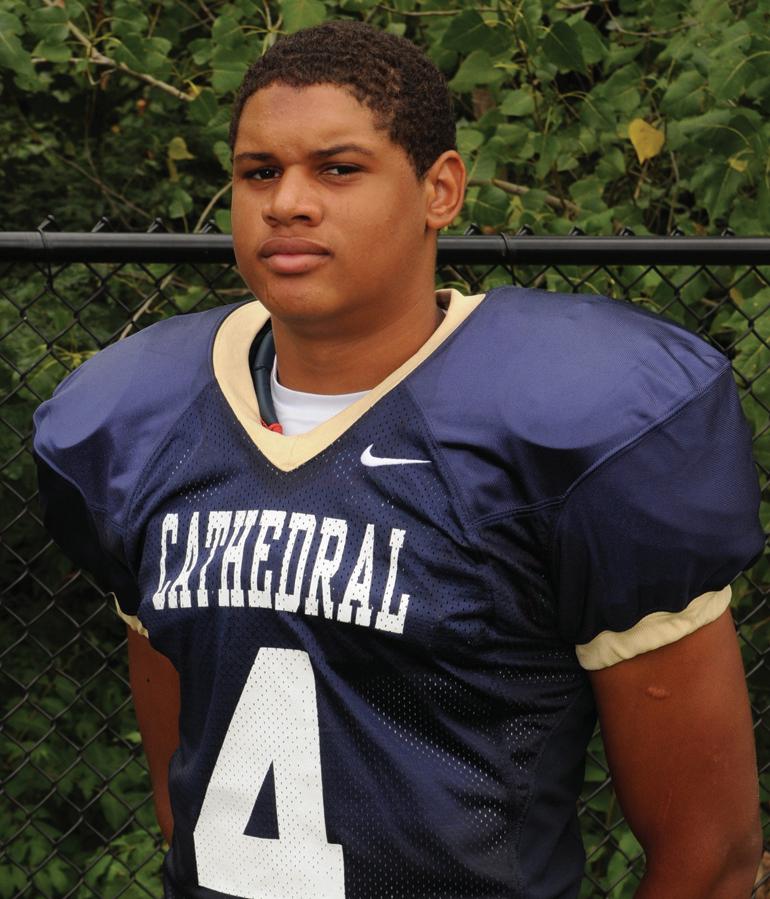
John Turner S, ***, 195 pounds, 6-1 Indianapolis Cathedral High School Indianapolis, Ind.
John Turner will be a key piece of Notre Dame’s secondary-heavy class, bringing both talent and a tradition of winning to the Irish defense.
As a cornerback at Cathedral High School in Indianapolis, Turner led his school to two state championships. His lean frame and imposing wingspan caused most opposing offenses to shy away from throwing to his side of the field, and his coverage skills will allow him to challenge for time on defense and special teams immediately.
Turner made the short drive to South Bend for several games this season, and spoke to other interested recruits about the benefits of playing at Notre Dame.

Elaine Alexander/Woodberry Forest High School
Photo courtesy of Flanagan High School
Elaine Alexander/Woodberry Forest High School
Elaine Alexander/Woodberry Forest High School
Photo courtesy of Bishop Gorman High School
Elaine Alexander/Woodberry Forest High School
Elaine Alexander/Woodberry Forest High School
Photo courtesy of Cathedral High School
Elaine Alexander/Woodberry Forest High School
Photo courtesy of Mariner High School
Photo courtesy of Dave Rubel/NJ Sports Media
Capsules by Observer Sports staff
Admissions discusses early enrollment process
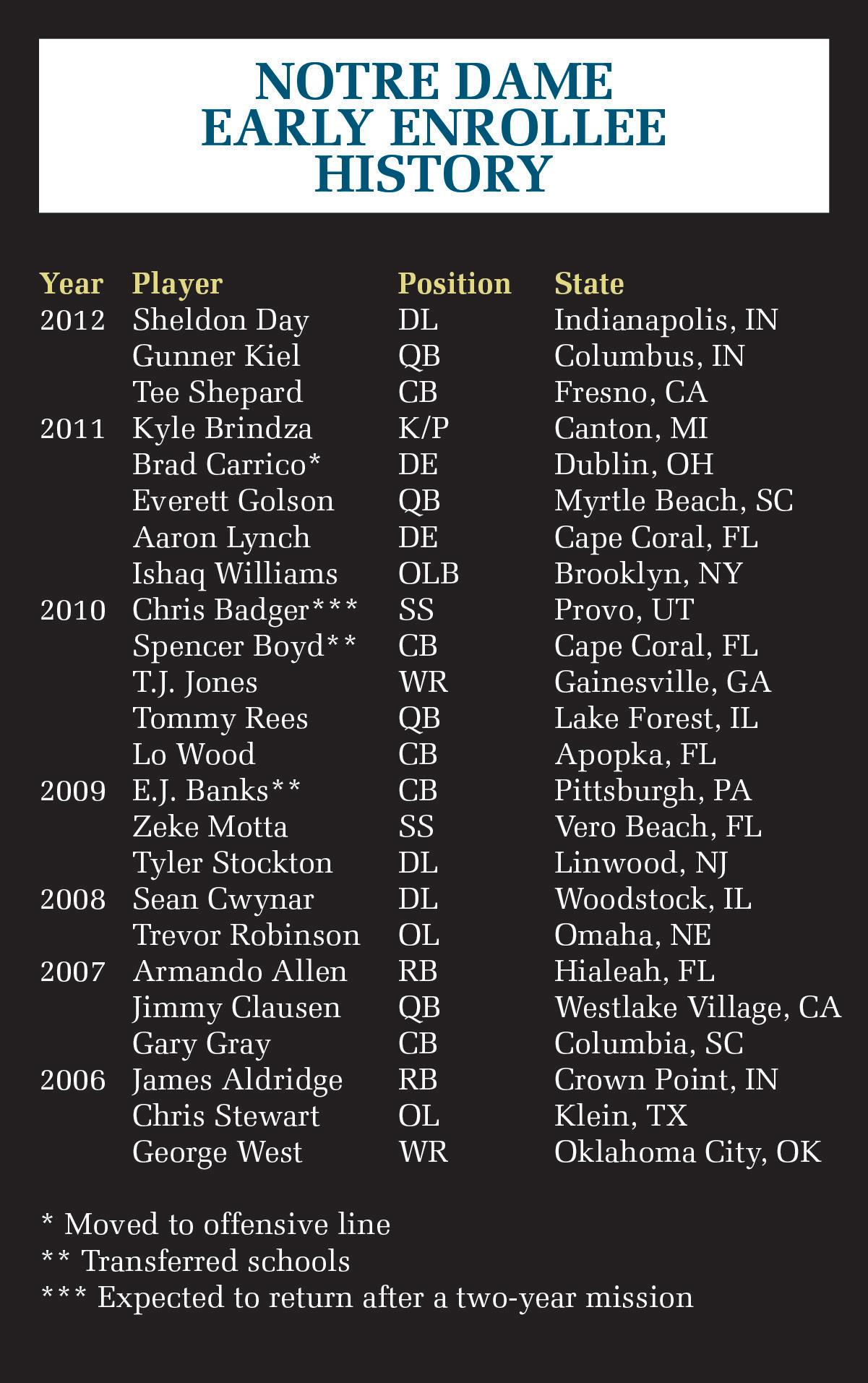
Notre Dame has admitted 24 early enrollees to its football program since creating the policy seven years ago
By ANDREW OWENS Associate Sports Editor
More than six years ago, with the number of high school players opting for early enrollment skyrocketing, Notre Dame realized it was at a competitive disadvantage unless it instituted a similar policy of its own.
So that’s exactly what the University did.
With three early enrollees already taking classes at Notre Dame this semester, only six weeks after they were in sitting in high school classrooms, the total the University has admitted in seven years is 24.
“We were approached at the time about this possibility of enrolling students in essence early after three-and-a-half years of high school and it clearly was a reflection of the changing world of particularly football recruitment,” Director of Admissions
Bob Mundy said.
“So we obviously agreed that we would consider it and it’s been a pretty modest number here.
“It’s a challenge for students. Students in high school have to be planning this in advance so that they meet all the graduation requirements.”
in 2009 and an all-time high of 141 in 2010. No total has yet been released for 2012.
“In general, when there is a shift in access policies by the NCAA, we’re always going to have to look at those issues to make sure it fits what we do at Notre Dame and it also keeps the programs competitive with what’s going on out there,” Associate Vice President for Undergraduate Enrollment Don Bishop said. “But it has to serve both purposes. It has to be a reasonable accommodation to a change in the competitive environment that’s out there in recruiting, but also it still has to fit with what Notre Dame does. It’s never going to be just one side.”
Bishop said the decision of whether to accept an early enrollee is a collaborative effort between the admissions office, the football program and the athletic department.
“We were approached at the time about this possibility of enrolling students in essence early after three-and-a-half years of high school and it clearly was a reflection of the changing world of particularly football recruitment.”
Bob Mundy Director of Admissions
Former Georgia quarterback Eric Zeier is regarded as one of the first high-profile players to enroll early out of high school, a move he made in 1991. There was no NCAA policy against early enrollment, but the practice did not gain much momentum until the early 2000s.
According to USA Today, 15 players from BCS conferences enrolled early in 2002, 53 in 2006 (the first year Notre Dame implemented the policy), 110
“We take real care, as does the football office, in that we interview these students. We really look them in the eye and talk to them about life in college and at Notre Dame,”
Bishop said. “So this is not just a football decision they’re making; it’s an academic, it’s a personal and an athletic decision.
“We give that feedback back to the coaches. I’ve been impressed by the quality of the people we’ve been meeting … I think that the kids that are coming here are coming with a very specific sense that Notre Dame is a unique place and
that they need to buy into that.”
Of Notre Dame’s 24 early enrollees, eight have graduated, two have transferred and 13 are still enrolled at the University. Safety Chris Badger has been on a two-year mission and is expected to return to school this summer.
Because Notre Dame has such a small sample size at this point, it is too early to notice any trends, Bishop said.
“We have not seen any concerns as to retention issues. If you look at normal retention patterns, they fit within that, although you’re only looking at how many have now gone through graduation, especially with five-year eligibility now being in play, so it’s a little early to be talking about trends,” he said. “With that said, what we’ve seen with the progress of student-athletes, academically, socially, on campus, their desire to remain in-state, successful, is all fine.
“Is there an advantage these students benefitted from as far as athletically on the field, or GPA-wise or graduation? [We] haven’t seen enough of that to say yes to that, but we haven’t any problems, either. Rest assured, if we see problems, we are willing to make corrections into any future decision-making process.”
A shift in transfer policy?
In August, freshman offensive lineman Jordan Prestwood transferred from Florida State to Notre Dame, becoming the first scholarship transfer the Irish have taken in decades.
Notre Dame, who had received Prestwood’s commitment during the recruitment process before he ultimately flipped to the Seminoles, did not wait decades before accepting its next transfer. USC freshman running back Amir Carlisle transferred from the rival Trojans to Notre Dame in January and enrolled at the University for second semester classes.
Bishop, who cannot discuss individual cases, said the addition of the two players did not represent a shift in the transfer policy.
“While we had not had [midyear scholarship transfers] before, when we were asked this, we employed the same treatment to these transfer kids that we would to any non-athlete requesting it,” he said.
“We just didn’t feel they should be singled out and not given the same access that other students did.
been given is where we already knew them pretty well through the process. They went through the whole process.”
Mundy said admissions meets with a recruit during the process, reviews high school transcripts, test scores and senior schedules and tells the football program whether they can continue to recruit the athlete.
“While we had not had [mid-year scholarship transfers] before, when we were asked this, we employed the same treatment to these transfer kids that we would to any nonathlete requesting it.”
“I can’t speak to why it wasn’t asked for [by the football program] before, but when it was asked for and we looked at our policies, we said, ‘Yes. We do this. We do take midyear transfers.’”
Don Bishop Associate Vice President for Undergraduate Enrollment
“If that student commits to another place, he’s not going to apply to Notre Dame, so we never had the opportunity to admit him, but the implication clearly is that we would have.”
Mundy said the University often receives calls during the summer or after a semester from students regretting the decision not to attend Notre Dame. If the student had been previously admitted to Notre Dame, their case is reviewed if the University has open spots.
While football recruits typically do not officially apply to a school until they are committed, the admissions office has completed a vetting process with all players considering Notre Dame, Bishop said.
“If we were unfamiliar with them completely and there wasn’t much information available, then no, we would not be moving forward on them,” he said. “The only cases we’ve
Bishop said it is unlikely that the Admissions Department would be unfamiliar with a football player looking to transfer because of how widely Notre Dame seeks out players during recruitment.
“The football program is so thorough that they’ve engaged every student-athlete in the country who has reasonable academics for Notre Dame, who is a high talent,” Bishop said. “They don’t miss those. I don’t know if there will ever be a case where they will present somebody that was not recruited, who was not a part of a process with us. … They already know the top kids in the country, they’re already recruiting them.”
Contact Andrew Owens at aowens2@nd.edu
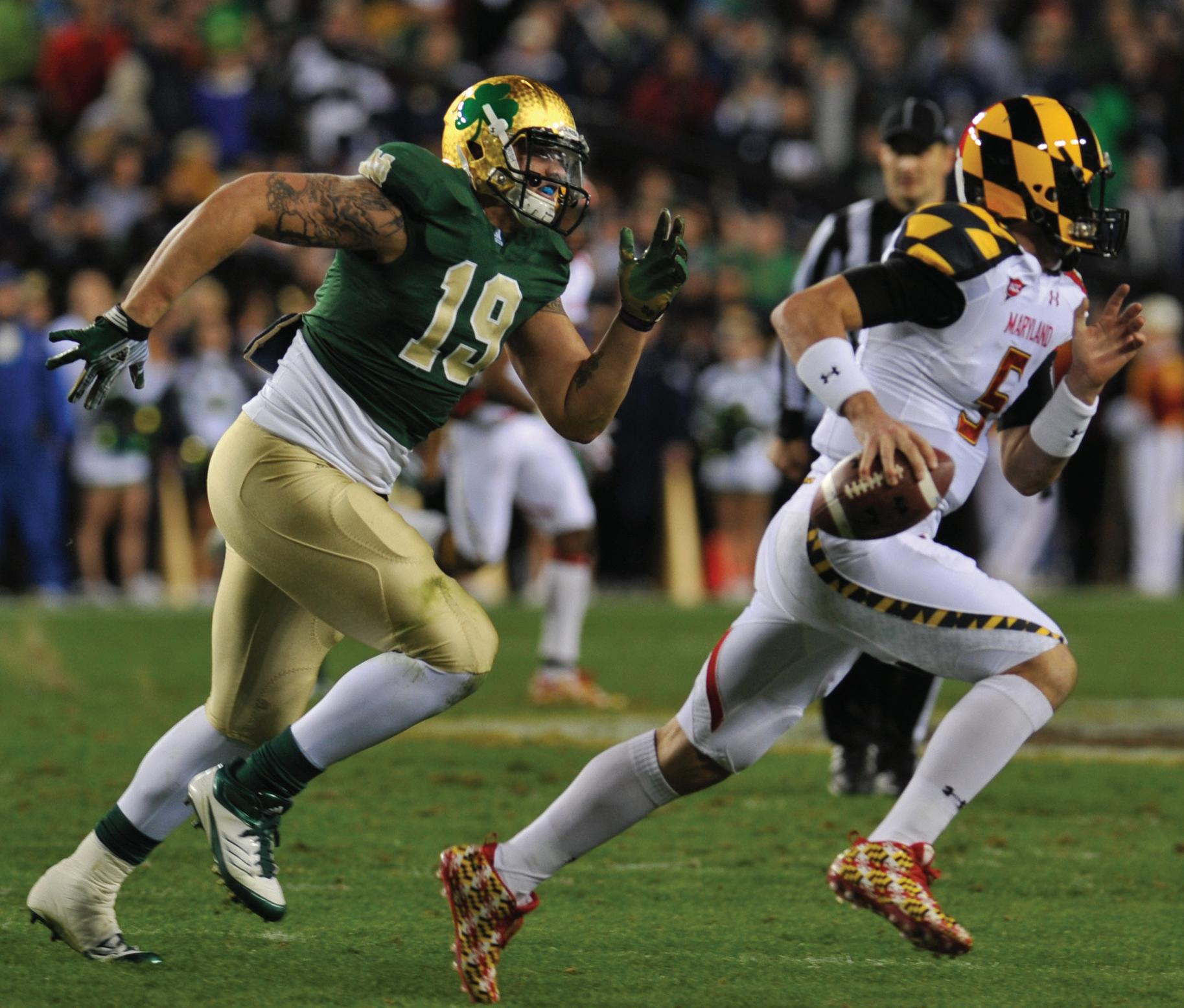
Irish freshman defensive end Aaron Lynch chases Maryland quarterback Danny O’Brien in Notre Dame’s 45-21 victory on Nov. 12. Lynch enrolled early at Notre Dame in January 2011.
MACKENZIE SAIN/The Observer
After early surge, ‘12 recruiting finishes slowly
By ALLAN JOSEPH Sports Editor
When Irish recruiting expert Mike Frank considers recruiting classes, he uses three all-important criteria for evaluation.
“The first thing you want to do is make sure you fill all your needs, and the second thing you want to do is make sure you get some quality depth,” said Frank, who runs the ESPNaffiliated Irish Sports Daily.
“The third thing is that you’ve got to get some impact players. You’ve got to get guys that when you watch them on film, you look at them and you say, ‘Okay, that guy is going to play here. I have no doubt that he’s going to be a player here.’”
ceiver class. I like all the guys there,” Frank said. “I think one highly underrated player is KeiVarae Russell … He’s a guy that can get moving in a hurry, and he’s exactly the type of player they’ve been lacking.
“I think Chris Brown brings a lot of good size and speed. He’s a guy that can stretch the field and get behind the secondary.”
Despite a solid group of recruits, Frank said there were still a few weaknesses in the incoming group of freshmen.
“The first thing you want to do is make sure you fill all your needs, and the second thing you want to do is make sure you get some quality depth.”
Mike Frank
Based on those criteria, Frank said Notre Dame’s 2012 class was a good class, although not a spectacular one like the 2011 signing class.
“I think it was a solid class,” Frank said. “Last year they got a number of [impact players.] This year, they’ve got quite a few, but it’s not as many as last year. They got some key players, though, at need positions.”
Despite California receiver Deontay Greenberry’s surprise commitment to Houston over the Irish, Frank said he was still pleased with the receivers who signed letters of intent.
“Overall, I really like the re-
“They really needed another corner — they missed there,” Frank said. “I think they needed at least one more offensive lineman. I really like the two they have … they definitely needed one more, and maybe another, and unfortunately they missed there.
“I think they would have liked to have another running back other than Will Mahone … I Like Will Mahone, but I just think they would have liked to have another different type of running back.”
Frank said the late-season surge the Irish had on the field in 2010 helped the 2011 signing class, while the late-season inconsistency in the 2011 season hampered the 2012 class.
“[Last year,] people looked at it and said, ‘Well, Brian Kelly’s turning this around. This is a program on the rise, and I want to jump aboard,’” Frank said.
“This year, ups and downs all throughout the season, and unfortunately the last two games didn’t go their way … I think what you’re seeing now is just perception. These recruits are having a little pause, saying, ‘I thought this was turning around but maybe it’s not.’
“I don’t think it was any lack of effort. I think Notre Dame’s staff really worked hard to get these players, but they came out just a bit short.”
Frank said Notre Dame relies on winning football games to recruit most effectively.
“There are three things re-
cruits look for when they’re considering schools. One is good football, one’s a good social life and one is a good education — and I think for a lot of these guys, it’s in that order,” Frank said.
“Notre Dame has always been able to land elite players from all across the country when they play good football. They’ve never had a problem.
sive line is huge,” Frank said. “They’re going to have to get five [linemen], and they’re going to need to get some guys who can play already … These guys know how to evaluate offensive line talent. I’ve been really impressed with that they’ve done so far in that area.”
“This year, ups and downs all throughout the season, and unfortunately the last two games didn’t go their way ... I think what you’re seeing now is just perception.”
Mike Frank Irish recruiting analyst
“When they were winning enough games, kids were lining up to come here. They were turning kids away.”
As Frank looked ahead to the class of 2013, he pointed out a number of positions the Irish will need to fill, including inside linebacker, running back and defensive end. One position, however, stood out more than any other.
“Without a question, offen-
All in all, Frank said Kelly and his staff did a good job recruiting.
“They got a lot of really good players. They did a good job,” Frank said. “Unfortunately, they’re about two or three impact players away from this being a great class … They were so close on so many of these guys.”
For more information on Notre Dame recruiting, check out Mike Frank’s irishsportsdaily.com. Email Mike at mikefrank18@sbcglobal.net and tell him The Observer sent you.
Contact Allan Joseph at ajoseph2@nd.edu

Irish recruiting analyst
PAT COVENEY/The Observer
Irish recruiting coordinator Chuck Martin discusses the team at Media Day on August 16. Martin, who previously coached Notre Dame’s defensive backs, will take over as the offensive coordinator in 2012.
Irish coach Brian Kelly discusses the 2012 recruiting class at a press conference Wednesday. The class, Kelly’s second full haul at Notre Dame, consists of 16 recruits from across the country.
GRANT TOBIN/The Observer