Print Edition of The Observer for Monday, November 21, 2016
Same old, same old
Irish blow double-digit lead for fourth time this season, fall to Hokies on Senior Day
There is nothing left to say after another loss
I’m not sure what else there is to say.
I could say that Notre Dame lost to Virginia Tech on Senior Day by a score of 34-31. But Notre Dame has lost many times before.
I could tell you the Irish (4-7) blew 17-0 and 24-7 leads as they let the Hokies (8-3, 5-2 ACC) back into a game they had no business being in. But Notre Dame has already lost two games holding a double-digit lead, and in the seven games it’s achieved such a cushion, it’s given that lead up in four of them.
I could say the Irish played well, but they’ve played well in losses before.
I could say the experience the freshman class is getting will be valuable for next year, but we’ve been looking ahead to next year for the past month.
Simply put, there is nothing
By JOE EVERETT Sports Writer
The first time Notre Dame fans ever counted on DeShone Kizer, thrust into action after Malik Zaire suffered a broken right ankle, was when he was called upon to rally then-No. 9 Notre Dame from the jaws of defeat against Virginia during the second game of the 2015 Irish campaign.
Kizer stepped up and rallied the team. Down 27-26 with 19 seconds left, Kizer side-stepped the Virginia pass rush and lofted the ball towards a streaking Will Fuller, who caught the ball in stride for a miraculous, go-ahead 39-yard touchdown, stunning the Virginia crowd and sending Kizer into Irish lore.
On Saturday against Virginia Tech, Kizer looked to add one more chapter to his collection of comeback stories. After the Irish defense forced a punt from the Hokies inside Notre Dame territory, Kizer and the Irish offense took over possession at the Notre Dame 10-yard line with 1:07 left on the clock. Kizer quickly picked up a first down on an 11-yard run to the Notre
Dame 21 and followed that with a 20-yard completion to sophomore receiver Equanimeous St. Brown. With a 5-yard Virginia Tech offside penalty added onto the completion, Notre Dame had the ball on its own 46-yard line with 40 seconds to go and momentum on its side. Kizer appeared to set up another comeback in potentially his final game inside Notre Dame Stadium.
However, as one might have predicted in a season marred by mistakes and disappointment, there was to be no storybook ending for Kizer, nor the Notre Dame seniors.
Three straight incompletions left the Irish with a fourth-and-5 with 17 seconds to go. On the ensuing play, Kizer ran up the middle for seven yards to pick up the first down, but sustained a hit to the head in the process, causing him to leave the field for a play. Zaire entered for what would prove to be the final play of the game, as the Irish were only able to attempt one pass before time expired, sending Virginia Tech into jubilation and Notre Dame to its first losing season since 2007. Having to endure yet another close loss
this season, Kizer found himself a bit lost for words trying to describe a haywire 2016 campaign for the Irish.
“At this point, what else am I supposed to say?” Kizer said. “It’s just unfortunate that this is how the season has gone. I do believe that in every game we’ve played we’ve had an opportunity to win. We beat ourselves in a sense, from stupid penalties to stupid decisions on reads. I think that, once again, every opportunity that we’ve been out there we’ve had a chance to win the game, and for us to come up short by an average of something around five points in all those games is very frustrating.”
Although the Irish faced a long field with no timeouts on their final drive, Kizer said that he was confident in the offense’s ability to tie or potentially win the game.
“Anytime the ball’s in my hand I think we’re going to score,” Kizer said. “With the guys that we have out there at skill positions and one of the best offensive lines in the country, you have to have all
Notre Dame offense stalls in second half
By ELIZABETH GREASON Sports Writer
Malik Zaire entered the game with seconds left on the clock, just as the Irish crossed into Virginia Tech territory, and completed a pass to sophomore wide receiver Equanimeous St. Brown to pick up a first down as time expired, sealing Notre Dame’s 34-31 loss to the Hokies (8-3).
But let’s rewind to the end of the first half.
The Irish had a 24-14 lead, and had led by as much as 17. Junior quarterback DeShone Kizer had completed 13 of 18 passing attempts and tallied 199 passing yards. Notre Dame had scored on four of its six drives, dominating the Hokies offensively.
As the final score exhibits, the second half could not have been more different for the Irish offense, which Irish head coach Brian Kelly noted in his post-game press conference.
Marek Mazurek Sports Editor
ROSIE LoVOI | The Observer
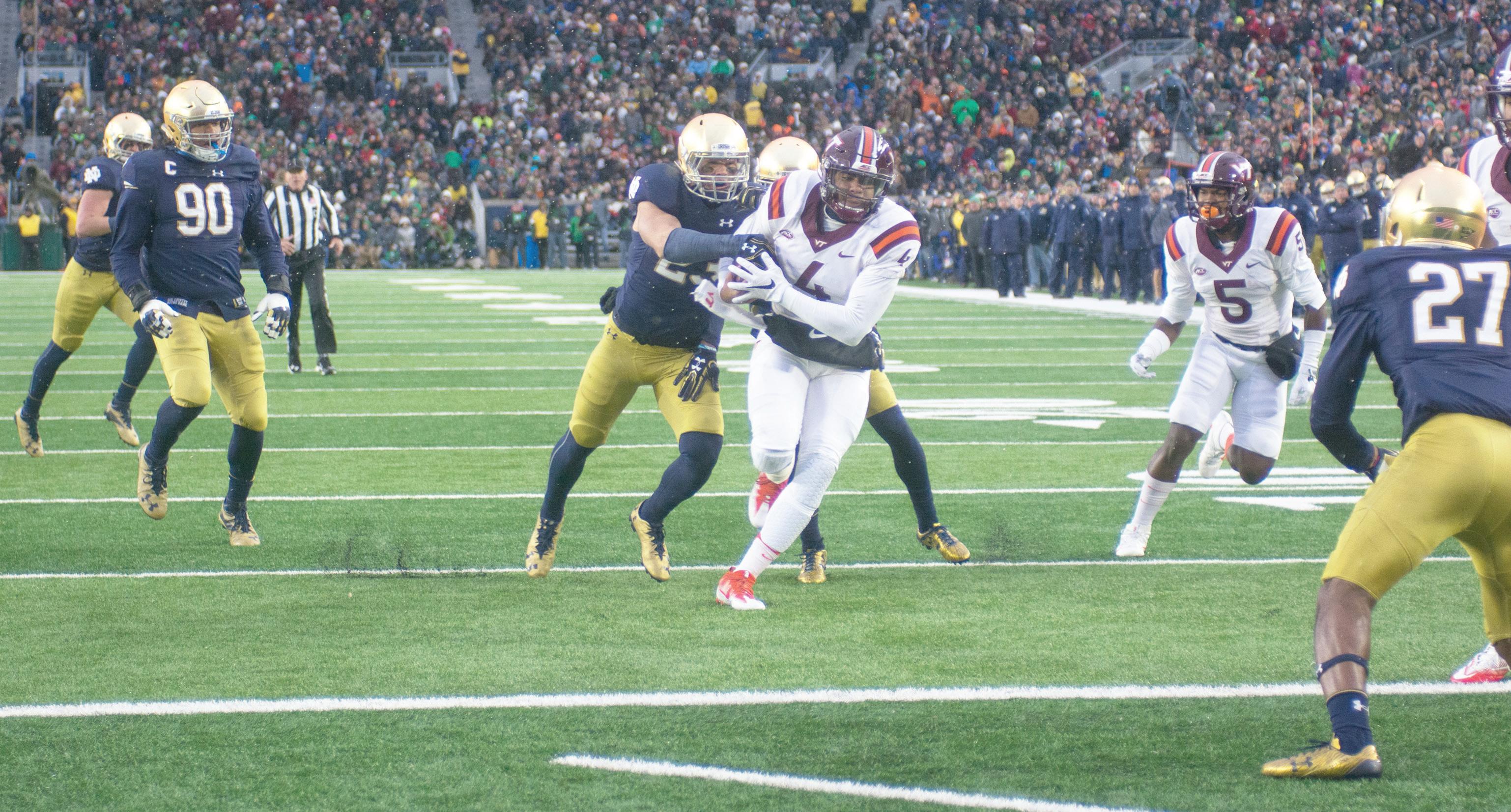
Virginia Tech junior quarterback Jerod Evans barrels his way into the end zone at the end of a 23-yard touchdown rush during Notre Dame’s 34-31 loss to the Hokies on Saturday. The Irish jumped out to a 17-0 lead on Senior Day, but the Hokies scored 20 points in the second half to hand the Irish their seventh loss of the season.
nd students win scholarship
Seniors Alexis Doyle, Grace Watkins named 2017 Rhodes Scholars
Observer Staff Report
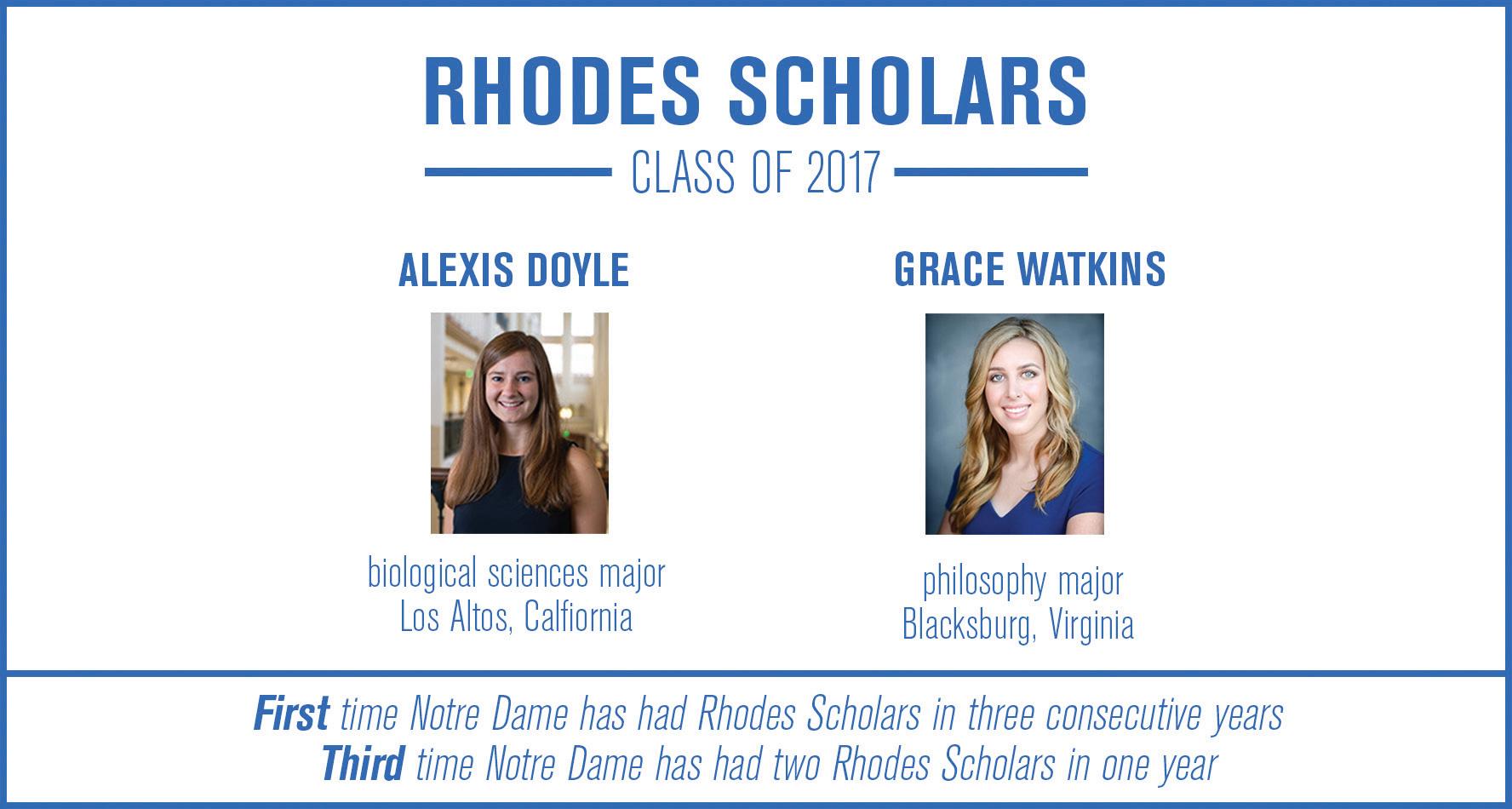
on saturday, two women from notre dame — seniors a lexis doyle and grace watkins — were named rhodes scholars, according to a university press release.
doyle and watkins are the university’s 18th and 19th rhodes scholars, and were two of 32 rhodes scholars selected from a pool of 882 candidates. notre dame has previously had women selected as rhodes scholars, but never two in the same year.
“we are very proud of grace and a lexis for earning the distinction of being named rhodes
LAUREN WELDON | The Observer
Sexual assault reported
Observer Staff Report
a sexual assault was reported to the university by a third party on Friday, according to an email sent to students Friday afternoon from notre dame security police. the alleged assault occurred in a north Quad men’s residence hall on the night of nov. 17 or the early morning hours of nov. 18, 2016, after the female victim and male suspect met at an
Dorms host holiday festivities registration process evolves
By ANDREW CAMERON news writer
every year, dorms across campus host a variety of community events to celebrate thanksgiving, and this year proved no different.
Flaherty hall’s project pumpkin pie was described by junior resident k iera bader as focusing on holiday’s spirit of gratitude spirit, sharing and giving back, within and beyond the dorms hosting them.
“it was pangborn’s signature event and now it’s Flaherty’s, and it’s where we make pies for the center for the homeless to have at their thanksgiving day meal,” bader said. “we typically make about 125 pies for the residents of the center and this year we also made cards for them saying ‘happy thanksgiving.’” bader said that while the event has traditionally been held in north dining hall, this year the pies were baked in the center for culinary excellence.
“they gave us a tour there and we had the head chef there and a couple other chefs help us to measure out the ingredients and everything, and then we all worked together to bake the pies,” bader said. “once the pies
are ready, they’re delivered over to the center to be used there, and they usually have enough to keep a bunch frozen, so they’re also able to use the same pies for christmas, which is pretty cool — they’re kind of able to cover the whole holiday season.
“it was a really fun event — definitely my favorite that pangborn does. it’s very community-based, and you can kind of come together in a fun way that you know is going to benefit others,” bader said.
walsh hall hosts the thanksgiving sustainability dinner, which brings the hall together while promoting environmentally sustainable cooking practices.
“[the event is] basically us cooking for a majority of walsh and what we do is we try to have the most environmentally-friendly, sustainable, cooking practices and ingredients,” walsh sustainability commissioner kaitlin powers said. “we went to the farmer’s market and got everything locally sourced. ” powers estimates that around 20 walsh residents assisted in making the dinner, which fed around 100 people last thursday,
holiday PAGE 4
By MEGAN VALLEY a ssociate news e ditor
l ast week, seniors, juniors and sophomores registered for the spring semester; this week, u niversity freshmen will be registering on their own online for the first time. s tudents wake up early and — in their short time slots — determine their whole semester. a s stressful as registering can be, it wasn’t always so easily done from bed.
u p until world war ii , students would have to register for classes in person and all of the requests would be written down by hand, u niversity registrar c huck h urley said.
“ you would get off your horse at the d ome and see Fr. s o-and-so, who was the registrar and you would tell him, ‘ i want to take arithmetic and blacksmithing,’ and whatever they offered in those days,” he said. “ t hey’d write it down in a ledger
book and that’s how it was done.”
For a century, that is how every student would register for their classes; they would not even know if they got into every class they registered for until they arrived on campus for that semester.
“a fter world war ii , as n otre d ame started to grow as an institution, they had to find more and more sophisticated ways of conducting
Professors spark dialogue about compassion
By MARTHA REILLY a ssociate s aint mary’s e ditor
two professors organized a lecture about kindness and open-mindedness Friday at saint mary’s.
p rofessor of e nglish l aura haigwood said introspection and self-transformation can lead to valuable societal change, but a failure to respect and understand others’ viewpoints contributes to a dangerous cycle.
“shaming, judging, competition, anger and violence, no matter how just our cause may be, evoke defensive and retaliatory shaming, judging, et cetera from others,” she said. “conflicts stalemate and degenerate into violence, and nothing and no one changes for the better.”
according to haigwood, professors who openly discuss social justice issues in their classes can foster a comfortable environment of mutual support.
“compassionate learning … is fluid, cooperative, collaborative, democratic,” haigwood said. “teachers can be learners, and students can be teachers.”
patient listening and nonviolent communication are especially meaningful topics of discussion for those who have been affected by bullying, haigwood said.
How would you describe your last home football game as a student?
Shannon Riley senior mcGlinn hall
“my favorite notre dame memory.”
Emily Seranko senior off campus
“cold and melancholy, but overall a great day with great people.”
Meghan Dalton senior off campus
“The happiest and saddest day of my life so far.”
Tucker Triolo senior off campus “Legendary.”
Luke Dziedzic senior off campus “What game?”
Erich Jegier senior off campus
“Well, time to fail my Theo next semester.”
Today’s Staff
t he next f ive D ays:
Monday
Lecture: “Integrated Energy and Harvesting Systems” DeBartolo
Corrections
The observer regards itself as a professional publication and strives for the highest standards of journalism at all times.
do, however, recognize that we will make mistakes. If we have made a mistake, please contact us at (574) 631-4541 so we can correct our error.
Lecture: “The Bionic Body: Technology, Disability and Humanism” McKenna Hall 5 p.m. - 6 p.m.
Tuesday
Super Cycle Freebie Class Rockne Memorial
5:30 p.m. - 7 p.m.
Free fitness class. No registration required.
Sing Out and Rejoice Holy Cross Hall
8 p.m. - 9 p.m.
Spiritual group to worship through music. Open to all.
Professors discuss juvenile education policies
By KATHRYN MARSHALL news Writer
The s aint mary’s Faculty c olloquium s eries continued Friday with presentations by dawn Farmer, visiting assistant professor of music, and s arah noonan, visiting assistant professor of e nglish.
Farmer provided insight into the shifting themes and substrands associated with the terms “urban,” “inner city,” “at risk,” “race” and “diversity” from 1991 to 2010 in her talk “d iscursive Trends in Urban music e ducation.”
Farmer chose to trace these words because of the power of discourse in shaping education, she said.
“Words are important,” she said. “Words carry a lot of weight. Words can inspire, words can hurt, words can heal and words can destroy. i became very interested in the words that we use within education and what weight those carry.”
she used two music journal publications through the national a ssociation for music e ducation to trace themes
a ssault
off-campus bar or club, according to the email.
associated with words, and eventually used 1,206 articles from these journals, Farmer said.
The time frame for her research centered on the no c hild Left b ehind act, Farmer said. she wanted to see if the trends of word usage shifted at all before and after the act, and her results indicated that there was an especially interesting shift in the phrase “at risk.”
“b efore the no c hild Left b ehind act, when we think about students at risk, it means they’re going to have struggles in finishing or graduating a program,” Farmer said. “a nd those struggles were delineated in terms of medical conditions, assuming a physical or mental situation that was going to make it harder for them to graduate.
“a fter no c hild Left b ehind, they began focusing on assessment and the groups of students we asses, separating students by schools. We change the word ‘at risk’ to be problematic for graduating because of social or behavioral issues.”
The language educators use
The identity of the suspect is unknown to ndsP.
University spokesperson dennis brown declined to comment further on the incident. information about sexual
around music education is important because of the reality of labelling theory and self-fulfilling prophecy, Farmer said. e ducators need to counter the current negative associations with the words “urban music education,” she said.
“We talk about these things of ‘truths’ … we accept them, because we don’t challenge our current practices,” Farmer said. “We have to find ways to not use the word ‘urban’ as a prerogative term within education. We have to make changes … i’m fighting for the idea of what success is and if we’re able to redefine it within our field.”
s arah noonan considered the relationship between numbers and a reader’s interaction with books in her talk “reading as e xploration: a bsence of Page number’s in medieval manuscripts.”
a n experience of trying to read and analyze a medieval manuscript in the beinecke library inspired the research, noonan said, as she felt disorientated without the page numbers as a navigational guide.
d espite the development of
assault prevention and resources for survivors of sexual assault are available online from ndsP and from the committee for sexual assault Prevention (csaP).
foliation in the 10th century, ideas of pagination surprisingly did not take root until the late 16th century, noonan said.
“Without foliation or pagination, one must navigation and experience the book in a way that is complete different than as i do as a modern reader and scholar,” she said.
i nstead, these books can be navigated with margin writing, red text, initials and a medieval calendar text, she said. o ne example of approaching a manuscript from a medieval perspective comes from reading “The o rchard of s yon,” where in descriptions of wandering through the orchard with both pleasant fruits and bitter herbs, one is invited to get lost in the orchard, that is, the text.
“This warning of bitter herbs is an attempt to leverage the readers lack of familiarity with the work to increase his or her emotional response,” noonan said. “it seems to be an attempt to habituate readers to the emotional demands of reading and to evoke feelings where there are none.”
Compassion
“ i believe that compassion is the cure for bullying — both compassion for bullies and helping bullies themselves to practice compassion,” she said.
a ssistant professor of communication studies m arne a ustin said once people gain an acute awareness of themselves, they can more fully accept others. s he led the group in a guided meditation exercise to demonstrate the interconnectedness between knowing oneself and exemplifying kindness in daily actions.
“You can have a person walk by, and they don’t have to say a thing, but you know that they’re having a bad day,” a ustin said. “We limit our scope of understanding of each other, and thus of compassion, when we start to look at somebody and say we know what they’re going through.”
a ustin said she hopes students resist selfish impulses and learn to genuinely empathize, regardless of other people’s reactions or hesitations.
“The thing with conversation and dialogue is the other person doesn’t have to know how to do it,” a ustin said. “What matters is how you move through with it.”
a ustin said self-reflection can expand consciousness while promoting acceptance and love for others, which
The lack of page numbers in manuscripts such as this one emphasizes how medieval books were different from modern books, in that no one copy was the exact same so page numbers were not as necessary for cross referencing exercises, she said.
b y better understanding how medieval readers read medieval manuscripts, the disorientation she originally felt when reading a manuscript without page numbers decreases, she said. it is a different experience for the modern reader.
“i f one assumes that the organizational structure of this manuscript is purposefully crafted and not deficient in some way, it is possible that words in this manuscript were organized so that here too, surprise and emotion play a powerful role in reading process. … i f one cannot immediately locate what one is looking for within a book, then one must tread or read cautiously as though one were exploring a landscape,” noonan said.
Contact Kathryn Marshall at kmarsh02@saintmarys.edu
will translate into gradual societal improvement. s tudents should view selftransformation as the first step in developing a more compassionate perception of the world, she said.
“The silence speaks to us in such beautiful and amazing ways and encourages us to listen in ways that we often don’t,” a ustin said. “The idea with any kind of practice … is to perhaps not see it as the door but as the doorway.”
a ccording to a ustin, sometimes self-care can be misconstrued as succumbing to narcissistic tendencies, though it is actually a way to better relationships with others through exploring oneself.
“ i t starts with us,” a ustin said. “Watch the world dance with you.”
Those who focus on maintaining empathy, even in divisive climates, contribute to a society that embraces differences, h aigwood said.
“ i love the idea that we are living in an era that will go down in history as the age of compassionate awakening,” h aigwood said. “Let us not read the election last week as the last word on our historical moment. a s the popular vote proves, and as the voting patterns of younger people dramatically illustrate, the unstoppable cultural movement of our time is indeed to be hopeful, inclusive and big-hearted.”
Contact Martha Reilly at mreilly01@saintmarys.edu
Paid a dverT isemen T
registration,” hurley said. “It was still a manual process in the 1950s, 1960s, going into the 1970s, but in some ways it mirrored — somewhat — what we do now.”
each class year would have its day to register, entering south dining hall — or, in later years, stepan center — where each department would have its own table, winding around the room.
“The department chair would be sitting there and they’d have several stacks of cards,” hurley said. “one stack of cards might be for history 101 and another might be 100 cards for calculus. When a person walked in, they’d have to make a decision immediately. You’d walk up to the table, they’d give you a card for the class you needed, then you’d try to sprint over to another table afterwards. You really had to decide what was much important to you.” eventually, those cards were switched to punch cards, which were carefully ordered by student and then used to write up class rosters.
“It was very basic at that time,” hurley said. “It wasn’t stone tablets and chisels, but it was just a step above that.”
cards were used until the early 1980s, due to an accident with a student.
“In the early 1980s, they were at stepan center, still using the same process … and the rush to get into stepan center was so heavy that there was a student who was pushed through a plate-glass door on the side of it,” hurley said. “That happened and they decided they needed to do something better, this was too much.”
From the early 1980s to the mid 1990s, students registered through the phone.
“You’d punch in numbers and every class had a code,” hurley said. “You had to put in your social security number, and then an entry code, and after that you’d type in a [course registration number] for each class. It would give you a little ‘ding ding’ if you got the class and a different noise if you didn’t get the class.
The telephone registration process, hurley said, was “slow, but it worked.” The system could only handle 15–20 students at a time; it took over a month for all students to be registered.
hurley began working for the office of the registrar in 1996, after working as a developer for citibank.
“The internet was just coming about and I built the first
registration system online — it was called Irish Link back then,” he said. “Twenty years ago, the computing power was still not great. It was heavy, it was slow, it was still taking a month for all of registration to take place. but at least it was online.”
For the last 10 years, the University has used the banner system to register students online; novo, which notre dame went to last year, is an upgrade to that system.
hurley said that for the past few years, the office of the registrar has worked with student government. many of the changes that came with novo started as student government recommendations, including condensing the process more, enhancing the search capability and providing all of the error messages for class restrictions at once.
“I’ve been registrar for five years, and I’ve tried to make [student government] our primary vehicle for student recommendations,” he said. “We need an organized way to take the ideas that come in from students. If students have ideas, go through student government and have them bring those ideas to us.”
Contact Megan Valley at mvalley@nd.edu
scholars,” University president Fr. John Jenkins said in the release. “It is a tremendous honor not only for them, but for all of us here at notre dame.”
doyle, originally from Los altos, california, is a biological sciences major with minor in international peace studies and is a participant in the hesburgh program in public service, the glynn Family honors program and the hesburgh-Yusko scholars program.
a resident assistant in ryan hall, doyle is also a teaching assistant for honors mathematics and will attend the Icahn school of medicine at mount sinai after her studies at oxford.
“I am deeply grateful for everyone who has supported my learning and personal growth over the past four years at notre dame,” doyle said in the release. “receiving this scholarship is a huge honor, but one that certainly reflects the quality of the incredible support system that I have at notre dame – in my peers, professors, my mentors and in the south bend community. I am very energized to use this scholarship to prepare myself better to serve as an advocate for health.”
Watkins, who was also selected as a 2016 Truman scholar, is a philosophy major with a minor in philosophy, politics and economics.
Watkins recently spearheaded the creation of a sexual assault survivors group at notre dame, and serves as the University policy Liaison on behalf of student government.
Watkins additionally serves
as the co-president of college democrats at notre dame, and will pursue a doctor in philosophy degree in school-legal studies at oxford.
“I am so grateful for this incredible opportunity to study at oxford alongside other students who want to make a difference in the world,” Watkins said in the release. “I attribute all credit to Jeffrey Thibert and the other advisers at Flatley center for Undergraduate scholarly engagement, as well as the professors, friends and family who supported me through the process.” according to the release,
approximately 2,500 students applied for endorsements from their universities for the rhodes scholarships, 882 of which were endorsed by their respective universities.
“I want to congratulate first of all grace and alexis, but also the faculty here at notre dame who taught them and the staff of the Flatley center for Undergraduate scholarly engagement who put in countless hours assisting grace, alexis and our other candidates for the rhodes and other scholars’ programs,” Jenkins said in the release.
and included green beans, sweet potatoes, mashed potatoes, turkey tetrazzini, cranberry sauce, cornbread, gravy and pies.
The event, powers said, has been put on for at least three years.
“We have an outline from previous years that’s been perfected over time,” she said. “For example, the reason we do a turkey tetrazzini is because eating straight turkey is not as energy efficient. It lets us take the turkey and spread it further.”
powers feels the event functions both as a way to build community and a way to spread the word about sustainability.
“I think it’s a great way to communicate our message, because everyone wants to go, and before we ate we explained to everyone what we did and why we did it,” she said. “maybe it won’t make a huge impact for people right now, but it’s definitely important to buy local and do things of that sort, it’s a little thing we can do that attracts a lot of attention and allows us to get our point across. It’s also super fun and makes us feel like family.”
another dorm-wide meal is made and enjoyed by ryan hall,
for its annual Thanksgiving dinner — a tradition in ryan since its founding in 2009.
“The entire hall is invited, with the caveat that you have to bring something in order to come,” sophomore and event commissioner emma morrison said.
“It’s a whole hall effort, and we usually feed around 200 people,” she said. “It’s just for ryan girls, and we usually invite our hall fellow and the staff that work here. It’s the whole ryan family.”
claire Kramer, a junior in ryan, went into detail of the logistics of the event, which was held on sunday night.
“We have to put up sign-up sheets for our kitchens,” Kramer said. “our assistant rectors, our rector and our priest-in-residence open up their kitchens for us to use on sunday so that everyone gets to cook. For people who don’t want to cook or if there aren’t enough spots to sign up to cook, they can set up or clean up.”
“It’s a really good community event to all be together as one group, and people come together best around food. people refer to it as the best day of the year — it’s wonderful,” Kramer said.
Contact Andrew Cameron at acamero2@nd.edu
pa I d a dverTIsemen T
pa I d a dverTIsemen
By NORA McGREEVY s cene Writer
numbers play an important role in Ava d uvernay’s new documentary “13th,” which premiered on the opening night of the new York Film Festival and was released on netflix o ct 7.
The first words of the film, lifted from a speech President o bama gave to the n AAc P in 2015, underscore this fact. “ s o let’s look at the statistics,” announces the disembodied voice of the president. o n screen, a white outline of the contiguous 50 states appears, like white chalk on a classroom blackboard. “The United s tates is home to 5 percent of the world’s population, but 25 percent of the world’s prisoners.” he pauses.
“Think about that.”
We are given a few moments to contemplate before a new barrage of numbers rolls through:
The United s tates holds 2.3 million prisoners behind bars.
In his lifetime, the average white male living in America has a 1-in-17 chance of going to prison at some point in his life.
The average black male’s chances, on the other hand? o ne-in-3.
These numbers and other supporting statistics and evidence provide the skeleton framework of d uvernay’s documentary. Through a compilation of stirring interviews, archival footage, thorough historical research and a blend of philosophical and legal thought, “13th” brings these numbers to life.
The documentary offers answers to many of the questions that these statistics provoke. Why does
the U. s . imprison such a staggering amount of its own people? Why does this burden land most heavily on our Latinx and especially our African-American populations?
Part of the answers to these questions lies in another number, this time a symbolic one: The title of the film refers to the Thirteenth Amendment to the United s tates. r atified in 1865, this amendment abolished slavery — “except as punishment for crime.”
This loophole created the space for a radical transformation in the prison system, wherein white former slave owners used the prison system to suppress a newly freed black population. This was the germ of today’s current prison system. The documentary then reconstructs the history of mass incarceration in the United s tates, beginning with the r eformation, covering Jim c row Laws and the tumultuous c ivil r ights era of the 1950s and ’60s and analyzing the ways in which policies of the 1980s and ’90s pushed the era of mass incarceration to new heights.
s torytelling is accomplished primarily through impactful interviews with a host of celebrity figures and celebrated legal thinkers, including cnn commentator van Jones, former s peaker of the house newt Gingrich, author m ichelle Alexander, scholar Angela d avis and many others.
The film argues that the history of mass incarceration in America is also the history of institutionalized race-based slavery. o ne story cannot be told in its entirety without recreating the story of the other.
As d uvernay put in an interview with The Atlantic, “the film was 150 years in the making.”
Although it espouses a strong activist message,
the film consciously positions itself outside of the political binary, criticizing both d onald Trump and the c lintons. d uvernay herself recently reprimanded a d emocratic party staffer for tweeting a clip of the film without context for political purposes. The clip, one of the most powerful from the film, depicts video footage from Trump rallies cut with videos of c ivil r ights protestors from the 1950s, as Trump’s voice plays in the background: “You see, in the good old days, law enforcement acted a lot quicker than this.”
The documentary does not shy away from engaging in contemporary discourse on civil rights, reflecting d uvernay’s own strong activism and beliefs. The last 15 minutes of the film are dedicated to an unpacking of the b lack Lives m atter movement, portraying the movement as the most recent development in America’s complicated history with race and institutionalized discrimination.
The film harshly criticizes the rise of prison privatization under r onald r eagan, decries the “war on drugs” waged by politicians in the last 50 years and casts blame on b ill c linton’s 1994 crime bill, which included mandatory minimums for low-level drug offenses and a “three strikes, you’re out” policy that led to a sharp uptick in imprisonments nationwide. It also problematizes the relatively recent outcry for prison reform as the opportunistic empty words of politicians seeking votes.
In today’s whirlwind of hyper-partisan politics and toxic fake news, “13th” provides essential insight, articulating a thoughtfully researched narrative in a beautiful and invigorating format.
Contact Nora McGreevy at nmcgreev@nd.edu
Going down as one of the most iconic T-shirt designs in college football history, the “c atholics vs. c onvicts” slogan captures the bitter rivalry between notre dame and m iami.
Audience members at notre dame’s o ct. 28 screening of esPn’s documentary, “30 for 30: c atholics vs. c onvicts,” remember this shirt; many even wore or brought theirs. The story has been passed down through generations — my family talks about the 1988 football season as if it’s the creation story out of Genesis. All of them had the shirt, and some still wear it on football s aturdays. even though I was familiar with the glorious season, there was so much backstory I did not know.
c reation stories tend to be long, and esPn’s newest installment in its “30 for 30” series is no exception. It covers the story of the students who made the shirt, players of both teams and histories of the coaches.
d uring the Q&A, director Patrick c readon admitted that the production team had too much material going into the film. When esPn called and asked, “What do you know about ‘c atholics vs. c onvicts?’” he replied, “how much time do you have?” After all, c readon lived it. A class of 1989 alumnus, he shared a dorm with Tony r ice and saw the events of 1988 unfold firsthand.
The film is filled with many beloved notre dame legends like Lou holtz and Tony r ice, but when asked who his favorite person to interview was, c readon revealed that Jimmy Johnson, m iami’s coach at the time, surprised him with his friendliness. Johnson even sent c readon a card after seeing the film, joking, “It’s good, even though it is filled with notre dame bias.”
An image from the film stands out: “m iami 58-notre dame 7. never Forget!” After this embarrassing loss in 1985, a perfect storm inflamed the rivalry: Players who were overlooked from notre dame’s football program were recruited to m iami and career conflicts ensued between Johnson and holtz. The controversial shirt fed the already fanatical energy of notre dame fans.
Like the 1988 notre dame football team, this film has heart. You can feel the personal investment of each person’s hopes, dreams and regrets. s ome even look back with remorse at the infamous shirt. c alling it hateful, the makers say they regret pressing the shirt — the student behind “c atholics vs. c onvicts” shirt was even punished by notre dame. since the shirt, notre dame has seen the introduction of The shirt, but the wholesome and polite T-shirts have not since attracted the level of publicity as “c atholics vs. c onvicts.” even though the film is a bit long, it is worth watching. It is hard not to feel nostalgic and proud while hearing the details of the 1988 season retold by the players, coaches and fans who loved notre dame football. The highly anticipated “30 for 30: c atholics vs. c onvicts” airs dec. 10 on esPn, the same night as the heisman Trophy ceremony.
Contact Katie Madonna Lee at klee24@nd.edu
The views expressed in this column are those of the author and not necessarily those of the Observer.
Katie Madonna Lee s cene Writer
In the Dante fandom
Emily
I really like Dante’s Divine Comedy. No single work, in fact, has had more of an impact on my college experience. A University Seminar on the “Inferno” freshman year led to Italian classes, an Italian major, almost a year in Rome, and the desire to live there after I graduate.
What I didn’t understand until recently is why Dante was able to light such a fire in me. I still haven’t read a lot of the Western canon, literary analysis does not excite me, and despite my deep appreciation for Dante’s works, I haven’t devoted myself to studying them; Harry Potter fan theories tend to catch my attention more than close readings of medieval poetry.
For awhile, I thought I liked Dante’s works because of their science-fiction-like world-building. Dante’s afterlife is fantastically vivid and detailed but also orderly. I can see his heaven and hell through the text, and I can infer more details about it based on the rules he created for them. Part of it is the engagement with the divine: While I don’t draw a lot of religious instruction from the Comedy, I like stories that use Biblical concepts and themes. Part of it is also the sheer audacity of the whole project. Dante constructed an entirely new afterlife, claimed it was reality, ordained himself God’s chosen vessel to explain it all to us and then put people he knew in it.
But that doesn’t entirely explain why the Divine Comedy was able to pick me up and carry me across an ocean and back. Then, three years after that University Seminar, I started another Dante course, and I figured it out. The academic study of the Divine Comedy is not just the Divine Comedy. It’s 700 years of notes, commentary and translations. Reading Dante is reading centuries of the learned and not-so-learned arguing over big things, like the nature of divine justice as Dante presents it, and little things, like how exactly Virgil hugs Dante in a passage of the Purgatorio. Dante put quite a lot of stuff in the Divine Comedy, so reading it is reading Ovid’s Metamorphoses into Dante’s entry into heaven; it’s teasing out exactly how Dante uses the story of the Pentecost to criticize the medieval Church; it’s analyzing the theological significance of a simile about shipbuilding. It’s sometimes silly, sometimes profound, almost always mind-blowing. Which … actually isn’t too different from the internet forums on, say, Harry Potter or Doctor Who or Game of Thrones I looked at in high school, where you find people who (for better or for worse) are passionate about understanding fictional worlds, resolving potential contradictions, trying to find sources of information, devising grand theories of the work. The difference, of course, is that people have been Dantists for hundreds of years, they get paid for it, and they literally have to master the great works of Western civilization in order to do their jobs.
I don’t pretend to have mastered the great works of Western civilization, but every time I study Dante, I feel like I’m part of one of the world’s oldest fan forums, one dedicated to understanding the nature of the universe itself. It’s everything I like about stories, fandoms and scholarly inquiry rolled up into one. Dante, centuries later, allowed me to think big thoughts and made me feel legitimate in expressing them. The least I can do is learn his language.
Contact Emily McConville at emcconv1@nd.edu
The views expressed in the Inside Column are those of the author and not necessarily those of The Observer.
leTTeR To THe edIToR
‘I
voted.’ What now?
Last fall, we invited campus to join the civic engagement dialogue and enter into political life. It was September of 2015, and a slew of presidential candidates was spread across the field in the first leg of what would become a brutal and mud-slinging 18-month race. Blissfully unaware of the challenge that lay before us, we ordered balloons, pizza and pop, and invited the mayor of our 21st century city to help us launch our own campaign for voter education, registration and mobilization in advance of the 2016 election.
Now, two weeks after the election and fourteen months after the kickoff of NDVotes ’16, we have weathered a season of discontent which few of us forecasted. As a member of our team wrote this week, “It has become more than evident that people on both sides lack empathy and understanding; we need to do every
thing we can to make connections and practice empathy — beginning at the community and local level — with people who have different experiences and ideas than our own.”
Who was the “we” in our campaign? More people than you might expect. Our campaign staff involved around 20 task force members and nearly 30 dorm liaisons over the course of three semesters. Representatives from over a dozen clubs and groups, many of which identified as partisan or special interest, came together in a nonpartisan coalition which has defied party politics to become a tightknit group of friends. Numerous professors got involved as speakers at our “Pizza, Pop & Politics” series and invaluable resources for questions such as, “How do we create an exit poll?” and, “What issues will most impact this presidential election?” Our two primary sponsors, the Center for Social Concerns and Rooney Center for the Study of American Democracy, enabled political discourse and voter engagement to grow and flourish in ways we never thought possible. To this team, to all who participated in our events, and to the more than 3,400 people who stopped by our tables to register through the online resource TurboVote, thank you.
On Wednesday, NDVotes ’16 hosted its final event, “What Just Happened?” This event was titled before the election, but it echoed a question which will reverberate in the months and years to come. At this event, we learned that the surprise was that there was no surprise. When it came down to it, we voted along the same lines on the same issues as we have in previous elections. The only thing that changes now is how we choose to react.
When the “I Voted” sticker comes off, you may find yourself asking,“What do I do now?”
Now, we invite you to engage anew. In the words of one of our campaign’s founding doctrines, taken from the document Forming Consciences for Faithful Citizenship of the U.S. Conference of Catholic Bishops, “In the Catholic Tradition, responsible citizenship is a virtue, and participation in political life is a moral obligation.” Citizenship and participation involves voting, yes. But a trip to the polls every now and then is only part of a lifestyle in which we are morally obliged to engage.
“For me, these next weeks and months will be a time to reflect on what has occurred and to determine how, in light of civil discourse, all of us can stay engaged and respond to what may not have been our outcome of choice.” This reflection from another team member ought to convict all of us, regardless of whether or not the election went our way.
So how do we engage and respond? NDVotes has three ideas. First, get involved on campus. A full list of the clubs represented on our task force is available on our website. Second, tell your elected officials what you expect from them. And third, participate in your communities beyond the classroom. There are numerous resources and programs for us students to be involved outside of the university during our four years here.
We’ll close with the words of one of our task force members who sees the outcome of this election as an opportunity. She writes, “It has been encouraging to see so many people of my generation become involved in and passionate about politics, and I hope that passion will continue after this election. If this election has shown us anything, it is that we have a lot of work to do in government and many societal problems that need innovative solutions. I hope to use the energy and insight I gained from this election towards supporting campaigns and initiatives that will positively impact my community and my country and participating in local and state government. The most important thing I learned from this election is that this country is huge and diverse, and it is important to try to understand people from all walks of life when engaging in political discourse or attempting to create change. I hope to operate from a place of compassion and understanding rather than a place of condemnation and judgement when possible.”
After ND votes, ND stays engaged.
Sarah Tomas Morgan junior co-chair, NDVotes ’16 Nov. 18
McConville News Writer
And
In the post-election haze of hopes dashed, unexpected victories and false prophets (I’m looking at you, Nate Silver), it is helpful to seek the wisdom of the great thinkers of the past for perspective and context. The first source of insight is the observation of Antonio to Sebastian in “The Tempest,” that all the crazy unpredictable events that have led them to commit murder also can be looked at as a way to put their act in context and give it meaning: “We all were sea-swallow’d, though some cast again, / And by that destiny to perform an act / Whereof what’s past is prologue, what to come / In yours and my discharge.” The past is prologue not in the sense that it is not important, but rather that it is crucial to understand and appreciate what led to these apparently unexplainable events.
Numerous pundits and academicians are busily dissecting the events that led to the election of Donald Trump in an effort to understand the deeper meaning of the event, and to place a context around this seemingly seismic shift in politics. Yet, as time has proven, unexpected results, such as the election in 1968 of Richard Nixon, are explainable, perhaps even inevitable, given an appreciation of the events leading up to Nixon’s election. The ‘Southern Strategy’ of tapping into lightly veiled racism (using recently resurrected tropes of “law and order” and “taking our country back”) along with fear of a rapidly changing world, gave Nixon enough of a
Why does a senior college business student sign a $60,000 loan for one year’s tuition, then the very next year sign a contract of employment for a $60,000 annual salary?
I’m a business student at a business school, but I might as well be an employee at a corporation. Our business school is a trade school. We’re not here for a liberal arts education; in fact, we’re not here for an education at all.
We’re here to acquire the skills that make us marketable to top firms; really, we don’t even care about the skills, we just need the piece of paper that says we have them and the number that says we’re good at them.
The piece of paper, the degree, the diploma: the only reason a college student experiences a $120,000 swing in value from the time he steps onto the stage at graduation and accepts his diploma to the time he steps down as a college graduate.
In economics, there’s this thing called signaling, which basically means that one party tells something about itself to another party; in the case of a college graduate seeking employment, the degree signals to an employer that the student acquired a certain amount of knowledge while studying at university.
The employer receives the signal of a bachelor’s degree, for example, and assumes it is positively correlated with having greater ability after four years of higher education.
But why is this magical threshold of value placed precisely after four years? When exactly does a student surpass the threshold of skills that make him or her valuable, and therefore hirable, by a top firm?
What happens at graduation where all of a sudden a college student no longer pays to learn, but gets paid to work? Do we not learn a great deal as we work?
Shakespeare
boost to defeat the mainstream and popular Hubert Humphrey. Nixon, who had been dismissed as a “loser” in his sweaty, nervous, televised debate performance only eight years before, flashed victory signs at the narrow election results, though the message sent really only needed a single middle digit.
So to get back to Shakespeare, we could scan the various history plays or the tragedies for weighty commentary on the recent election, or perhaps look to the comedies for observation on the farcical aspects of politics. I’ll leave that low-hanging fruit to others; as for me, I think the sonnets are the best place to find some context for recent events. For those who think of Shakespeare’s sonnets as a collection of syrupy love poems, it may come as a surprise that Shakespeare never really intended these works to be widely distributed, but rather treated them as a personal exercise in expressing difficult and conflicting emotions. A number of experts deduced that the subject of many of the poems was a young man on whom Shakespeare doted. Many of the poems are highly erotic, with bawdy double entendre, but subtle enough to have kept the relationship deniable, especially given that the consequences for Shakespeare, if discovered, could be grave indeed.
The conflicted nature of Shakespeare’s love, which gave him great joy but also placed him at risk, is apparent in Sonnet 144.
I can almost see the potential Trump voter, ballot in hand, cocking his or her head to listen to the “better angel” of Trump’s promises of jobs and winning and greatness, then turning slightly in shame to
Trade school
Then why can we not also work a great deal while we learn?
Why are we not able to start producing value for the firms and economy until after precisely four years? Maybe not as freshman, but as sophomores, surely we are able to do at least menial projects and calculations that would save companies time and money.
I remember taking a finance exam during my sophomore year, working on a particular annuity calculation — several cash flows with different equal and regular payments discounted backwards in time with different interest rates and compounding dates.
I looked up. I was in the middle of a sea of students. If I recall that testing center had 500 seats. And all my classmates were working so hard, thinking and writing fast and accurately, nonstop for two hours.
Then I looked back down at the annuity problem — something about a company with a made-up name and made-up financial data, a company that didn’t exist. The problem wasn’t real.
But what if the problems were real?
What if, instead of playing make-believe, we started working like the employees we’re acting as anyways?
What if our exam solutions could solve a real company’s real problem with real numbers to make a real positive impact on the real world?
What if, instead of throwing away exam booklets and trashing computer homework files, we transferred the value of human capital expended in the classroom straight to the economy?
Five hundred students worked on that finance exam nonstop for two hours. The value of 1,000 highskill man hours transposed onto the stapled pages of our exam booklets.
How many exams were proctored to finance students at our university that year? How many to accounting, management and marketing students? How many to nonbusiness students? Engineering, math, science, English. How many to students at other universities that year? And all the years before? For
acknowledge the “worser spirit” (of course, a woman) that spouts racism, pettiness and misogyny. As the voter marks the ballot for Trump, he or she is set on a course to empower the bad angel to fire the good one out. Will the decision provide the comfort that the poet hoped for, with the choice driven by despair? As was the case with Shakespeare, one can only hope for the best.
And what to do with the outcome of the election?
For those who currently see themselves as victorious, as well as those who despair at the results, Shakespeare set out a sophisticated approach to dealing with the uncertainty, fear and self-doubt that may have led some to vote for a given candidate, or that others now feel as a result of the election. Rich in wisdom, hope and perspective, I present Sonnet 29.
While many of us may be feeling “bootless” (useless and ineffective) right about now, you are not alone in losing sleep over recent events. A brief excerpt from Sonnet 27 reminds us the Bard felt the same way:
“Weary with toil, I haste me to my bed, / The dear repose for limbs with travel tired; / But then begins a journey in my head, / To work my mind, when body’s work’s expired.”
Ray Ramirez is an attorney practicing, yet never perfecting, law in Texas while waiting patiently for a MacArthur Genius Grant. You may contact him at patrayram@sbcglobal.net
The views expressed in this column are those of the author and not necessarily those of The Observer.
as long as higher education has existed. And not only exams but papers, projects and presentations too.
How much human capital have we wasted at university?
This is not to tear down our old institutions, but to build up our young individuals. College students are powerful beyond their own imaginations, and even more so when working together. Like minnows attacking a whale, or coders solving an open source problem.
We may just be little undergrads, but together, we can make a big impact. With such great intellectual power, why must we spend so long in our college bubbles without doing any good for the outside world?
I love college just as much as the next kid. I love that we have four years to just hang out and drink and muse and figure out our lives.
College is an important social institution, an important place for us to find ourselves before we enter the real world and start making big decisions. But there’s no reason for us to be a drain on the economy.
We can stay in our bubbles and find ourselves, while producing unprecedented value for the economy. And it would make no difference to our college experience, except for decreasing our student debt, and tailoring our learning to the career we intend to enter.
So, I am challenging colleges to restructure classes, exams and homework assignments to be capable of deriving value from the human capital poured out by its students, firms to become capable of receiving this value in a manner that would justify wages being paid to students, and the entrepreneurial community to help both parties along, as bureaucratic giants tend to drag their feet.
Deep hows and outer spades, art and idiosingsongs; email colejfeldman@gmail.com, nonsense only please.
The views expressed in this column are those of the author and not necessarily those of The Observer.
Ray Ramirez The Crooked Path
Cole Feldman The Absurder
Happy Birthday: Personal and professional partnerships will be unpredictable. s how patience and be willing to compromise with others to keep everything in your life balanced and moving along smoothly. d o your best to meet people halfway. s hare your feelings and look for common ground, and you will flush out problems quickly. c omfort and convenience are featured. your numbers are 4, 10, 13, 22, 36, 40, 43.
ARIES (March 21-April 19): s ometimes it’s best to let things go. It’s in your best interest to calm down and avoid blowing situations out of proportion. Try to be patient instead of making poor choices. A peaceful approach will keep you grounded.
TAURUS (April 20-May 20): l ove and emotion will be heightened. Pick and choose your words and actions carefully. The right move can bring you happiness and a better understanding between yourself and someone special. A romantic gesture will pay off.
GEMINI (May 21-June 20): A creative outlet will help you find balance and calm your nerves. An old idea with a new twist will help you find additional income. d oing without some of the extras will help you save money.
CANCER (June 21-July 22): d o your best to put everyone at ease and you will be rewarded for the effort. l ove and romance are highlighted, and surprising someone with an unusual suggestion will bring you closer together.
LEO (July 23-Aug. 22): follow through with your plans. d on’t expect everyone to agree with you. negotiate on your own behalf and don’t falter if someone attacks your position or decision. you will come out on top if you adhere to your strategy.
VIRGO (Aug. 23-Sept. 22): A situation you cannot control will push you to make a change before you are ready. d o your best to stay within budget, and don’t feel obligated to oblige others if it costs too much to do so. Take what belongs to you.
LIBRA (Sept. 23-Oct. 22): keep everything in perspective. g etting all worked up over nothing will give someone else the edge. l isten to what’s being said or offered and counter with something that you feel is fair. c ompromise will pay off.
SCORPIO (Oct. 23-Nov. 21): k eep your plans doable. r efuse to let anyone talk you into taking on responsibilities that will make your life difficult. focus more on personal gains and making your life stress-free. c all the shots and do things your way.
SAGITTARIUS (Nov. 22-Dec. 21): m ake plans that will give you the opportunity to try something new. A chance meeting with someone from your past will provide you with information that will help you make an important decision. d on’t reveal personal secrets.
CAPRICORN (Dec. 22-Jan. 19): r emember what you are trying to achieve. r efuse to let an emotional situation ruin your plans. o ffer an out to anyone you feel is more trouble than you care to deal with. Take care of your needs first.
AQUARIUS (Jan. 20-Feb. 18): you will be forced to do more if you want to avoid a setback. s omeone will want too much too fast, leaving you in an awkward position. s ay “no” and make an offer that’s reasonable.
PISCES (Feb. 19-March 20): l isten to the voice of reason and consider how you can make the information you gather work to your benefit. Taking a hands-on approach to whatever you do will give you the control you need to reach your goal unscathed.
Birthday Baby: you are charming, intelligent and outgoing. you are goaloriented and proactive.
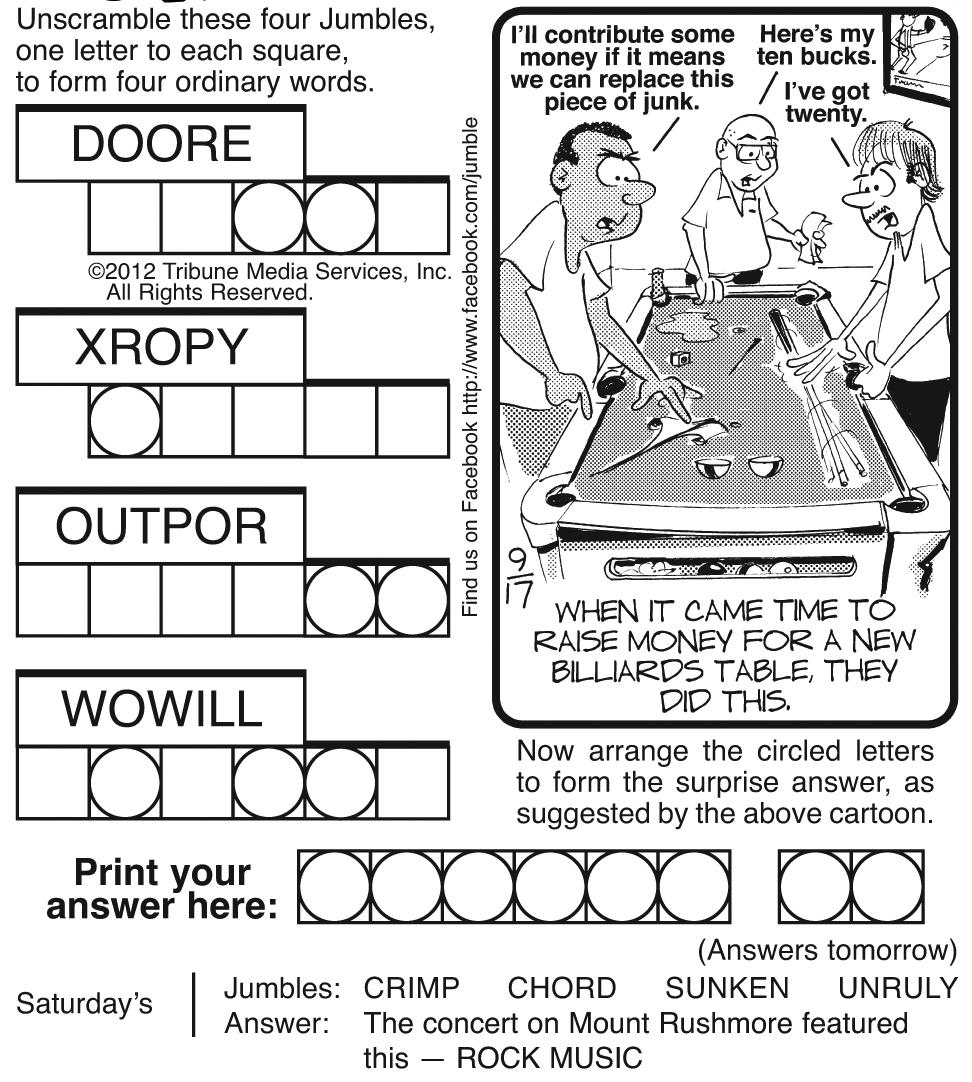
Jumble | dAvId hoyT
Jeff knurek
umass Lowell did have three power plays in the period, but it failed to capitalize on those early opportunities.
i n the second period, junior forward a nders bjork sparked notre dame to life, as he scored the first goal of the period and assisted on the second. bjork and sophomore defenseman b obby nardella, who had a goal and two assists on the night, combined their efforts in the first goal, as bjork took the pass from nardella and hammered it across goal to break the deadlock.
“he’s one of the best players in the country right now, it’s pretty easy to play with someone like him,” nardella said of bjork. “he was there in the slot, and i just saw him. a nd he’s good at finding guys too and getting open, and he’s got a really good shot — he’s leading the country in scoring i think or something — so it’s not hard to play with a guy like that.”
umass Lowell responded just under seven minutes later, when junior forward Jake Kamrass skated behind the net and slipped in a pass to freshman forward Kenny
Interhall
con T inued from page 12
first possession of the half. Led by Jennings, the griffins drove down the field and into the red zone, but were forced back by offensive penalties, eventually punting to end the scoring threat.
Late in the fourth quarter, the highlanders caught a break when the griffins could not convert on a fourth-and-1 attempt just outside the red zone, falling inches short of the first-down line. a few plays later, an unsportsmanlike conduct penalty on the griffins resulted in a 15-yard swing in momentum in favor of the highlanders.
spurred on by a few key runs from rensch, the highlanders took the ball down the field and ultimately converted on a long touchdown throw from Kase. however, a bad hold caused the extra point attempt to fall short and to the right, keeping the griffins in the lead at 7-6 with only a few minutes remaining in the game. garcia sealed the victory with a few key first-down runs that allowed the griffins to run out the clock, as the highlanders did not get the chance to run another play on offense. as the clock ran out, the griffin faithful rushed the field, cheering wildly in celebration of a championship that, as Kohler put it, was years in the making.
“When i was a freshman, we were 0-4, and we didn’t score a single point all season,” Kohler said. “This championship means a lot for our seniors especially, because we have been through so much together.”
for the highlanders and their
hausinger, who slotted it home past petersen. it was a potential momentum-shifting goal, as the energy from the first goal was sucked out of the building. but the i rish responded minutes later. bjork was once again involved, as he, nardella and freshman defenseman a ndrew peeke passed it around the blue line, waiting for an opening, and with junior forward dawson c ook blocking the net, peeke fired from distance, and the puck flew over red hawks freshman goalie Tyler Wall into the top corner. Jackson said he was very pleased with the team’s ability to go ahead and then respond after giving up that lead.
“s coring the first goal was huge, and scoring the second goal was probably more important,” he said. “Just in the response — showing that we were not going to change the way we played just because they scored a goal. but they are tough to score on, they are a very good defensive team, they don’t give you a lot, they’ve got a lot of grizzled guys out there, their vets in their system make it hard to generate offense, they’re defense-first and we need to be a little more of that way ourselves at times.”
fans, the outcome of the game was heartbreaking, but an emotional junior captain Thomas staffieri still believed that the season as a whole was a resounding success.
“We really improved throughout the year,” staffieri said. “great things are in store for duncan football in the future. When we were first here as freshmen, duncan football wasn’t much of anything. The seniors here have really worked hard to put duncan on the map as a football program.”
Kohler had trouble finding words to describe his emotions after winning such an intense game, but he did not forget to give credit to his teammates and the stanford fans.
“This championship has definitely been a team effort,” Kohler said. “as i was saying to the guys after the game, this was made possible by everyone from the seniors to all the guys who came out from our dorm to support us this year. We couldn’t have done it without any of them.”
Contact Brennan Buhr at bbuhr@nd.edu
Welsh Family def. r yan 20-14
By KYLE BARRY sports Writer
on a cold, grey november afternoon, no. 1 Welsh family came from behind to defeat ryan 2014 in the championship game in notre dame stadium.
The no. 1 Whirlwinds (8-1) and no. 3 Wildcats (7-2) were neckand-neck as there was barely any breathing room for either team throughout the game.
The i rish then added a third to close out the period, as nardella collected a pass from sophomore forward Jack Jenkins and whipped it in to put notre dame in firm control of the game.
The third period was all notre dame, as it dominated the puck, with the team’s speed and physicality wearing down umass Lowell. c ook scored the team’s fourth goal when he blocked a shot on one end — starting the rush — and then finished the play when he slotted home a rebound off of a shot from peeke. Jackson said it was the culmination of a great night for the i rish, and it knocked Wall out of the umass Lowell goal.
“When our team is playing well, that’s how we’ve played,” Jackson said. “i f we are using our speed, getting pucks in behind the defense and putting pressure on them, eventually they wear down. a nd last night, we didn’t put any pressure on their defense, so we did a much better job of eventually wearing them down over three periods.”
The i rish next play when they host the shillelagh Tournament on friday and s aturday.
Contact Tobias Hoonhout at thoonhou@nd.edu
The Wildcats took the lead early in the fourth quarter to put them up 14-12.
With a championship on the line, Whirlwinds senior captain ariel navotas caught a short pass and took it 44 yards to the house to take a 20-14 lead with two minutes left in the game.
Trying to answer back, the Wildcats turned the ball over on downs and the Whirlwinds would hold on to win the championship.
The Whirlwinds have now won either the “a” or “b” championship in four straight years thanks in part to navotas, who poses a threat at receiver. she feels her team’s victory was a well-deserved one.
“We had an amazing game,” navotas said. “We knew that we wanted it, deserved it and did whatever we needed to do and we did it.”
navotas believed that defense has carried the Whirlwinds the entire season which resulted in their success in the last few season.
“This season has been an unabashed joy,” navotas said. “it’s bittersweet especially for the seniors who’d played in notre dame stadium all four years and it means so much to them. We ended up crying in the end because we’re a family; we’re always there for each other.”
although the Wildcats came up short, senior captain shawn hall is proud of how her team fought.
“The outcome of the game wasn’t what we were looking for,” hall said. “but i’m so proud of the way our team has come out and played the entire season.”
Contact Kyle Barry at kbarry@hcc-nd.edu
schweizer pulled ahead in the last 100 meters, winning her first national championship, with finn edging out rohrer for second place. rohrer said she was expecting it to be a fast race coming into the competition.
“going into the race i was definitely expecting it to be very fast and very hard the whole time, which it was,” rohrer said. “That’s typically how national races run, which is in my favor, but i knew that if i wanted to win i would have to push the pace the whole time and not wait until the end, and so that’s what i did and with a [kilometer] left i picked it up and broke away a little bit. i brought it in as hard as i could, and it came down to the last 100 meters.”
“it was disappointing, but i know that i gave everything that i could.”
irish sophomore a nnie heffernan finished 41st and graduate student danielle a ragon crossed the finish line in 52nd.
The women’s team as a whole finished in 11th place, and associate head coach matthew sparks commented on the team’s performance, saying he felt it was a day of close calls.
“i think we were on the edge of a great day, so it was a good day,” sparks said. “We had a lot of
near misses on the day — anna missing out on first place overall, a nnie just missing a ll-a merican honors, and the team just finishing outside the top 10. but it was a good day overall — our top three raced really well again.”
sparks also touched on the level of impact that a special runner like rohrer has on a program like notre dame — what she means to it now and in the future.
“she establishes notre dame as a national program, not only because it makes our current status strong, but it certainly helps us with recruiting as well,” sparks said. “she’ll be a marquee name for a couple more years.”
it’s been a special individual season for rohrer, the 2016 acc champion, but she took a moment to value the quality of the season for the women’s team as a whole.
“We’ve definitely been on an upswing the whole year, because a lot of girls were injured over the summer, and so it’s been progressively better, which is really exciting,” rohrer said. “it’s a big deal that we were able to finish the season with eight healthy girls running, so i think overall everyone’s pleased with their season, pleased with their performance; and it was a good day, a good season.”
Contact Joe Everett at jeveret4@nd.edu
EMMET FARNAN | The Observer
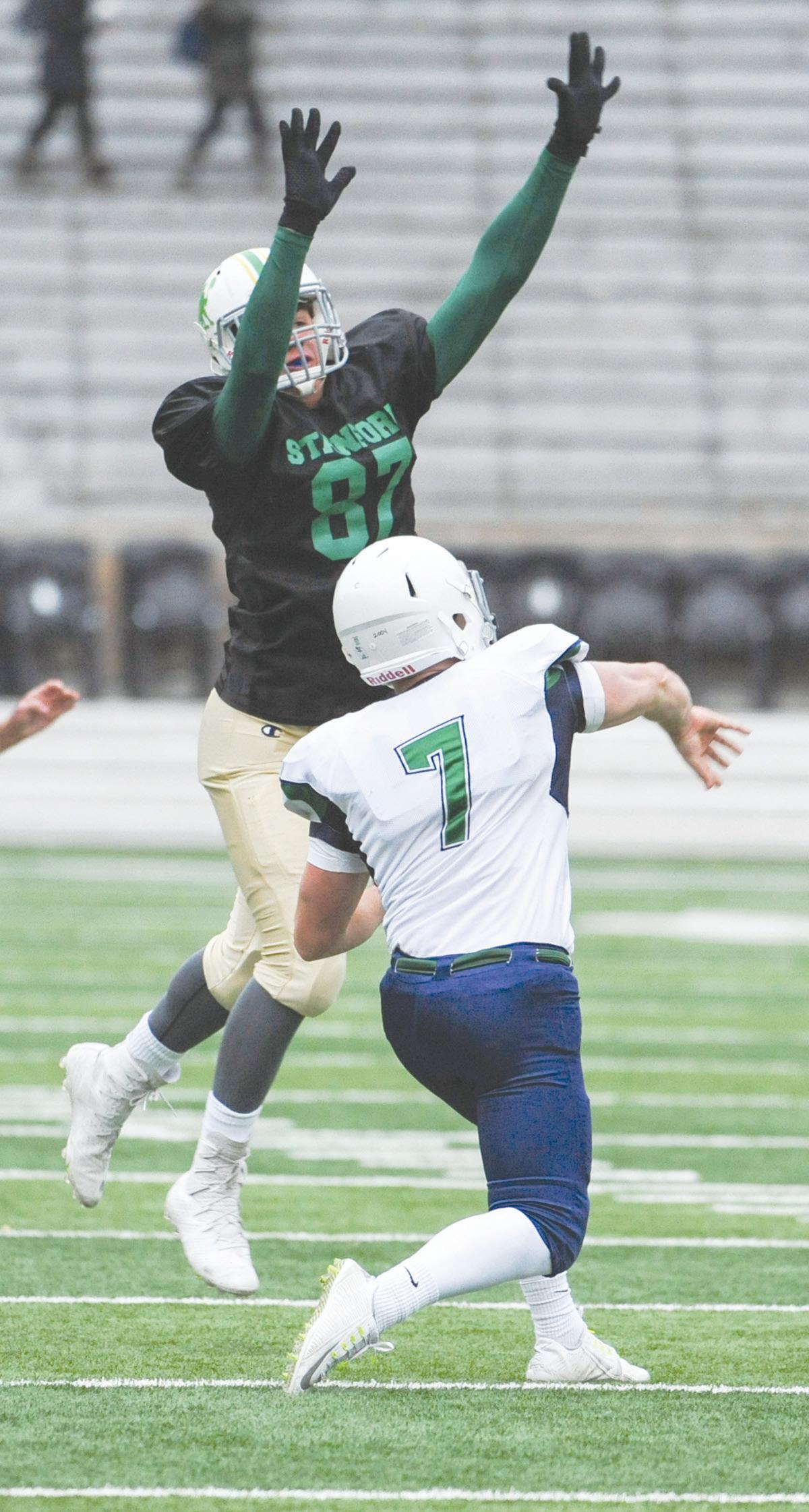
Duncan junior quarterback Matthew Kase throws a ball past a defender in Stanford’s 7-6 victory over the Highlanders in the interhall title game.
Gallagher’s shot found the back of the net.
“It was definitely relief, because the longer the game went on, I felt that the more excited they were going to get,” c lark said. “one opportunity was going to decide the game, and they were a dangerous enough team — they’re a good team. It was nice to see Jon getting another goal to put him up to 13 goals — that’s a great number — and it was a great assist by mark Gormley. And it was great that the two strikers combined to get a goal.”
After Gallagher’s goal, Loyola constantly pushed people forward and pressured the ball, hastily seeking an equalizer. Four of the r amblers’ six shots in the second half came in the final 10 minutes of the game, but the Irish defense held firm, highlighted by the play of senior defender brandon Audrey, who had several key headers out of the box to thwart several chances by Loyola.
“If we just kept a little more composure in the last five minutes maybe we could have gotten a second goal,” c lark said. “It’s like when you pull the goalkeeper in hockey, they pushed extra players and were knocking the ball up. They had nothing to lose at that point in the game so it made sense to get up the field. We held firm, and I think brandon Aubrey was superb in that time. They were knocking balls in the air and brandon’s head was clearing things.”
c lark said afterwards he thought Loyola had an advantage entering the game having already played a tournament game, but that the
Irish put forth a great opening performance.
“The first game is always a very difficult game in the [ nc AA] tournament, and it may have been a little easier for Loyola because they’ve already had a game.” c lark said. “but I was very pleased with the way we played — our pressing, our passing, our speed of play and our enthusiasm to take the game to them was fantastic. The last 10 minutes were very nervous, but it was still a very good performance.”
notre dame now advances to play no. 4-seeded Louisville next sunday, who advanced to the round of 16 after staving off uc LA 2-1 in overtime. The Irish and c ardinals met once in the regular season back on s ept. 16 at Louisville’s Lynn stadium, where Louisville
and put up 10 points to help the Irish maintain a 57-43 lead heading into the fourth.
got good shots. I thought her shot selection was particularly good today.”
The second quarter ended with the Irish ahead by the same margin as they were in the first, as they and the huskies traded several small runs. neither team was able to get much going offensively in the quarter, however, as notre d ame shot just 6-of18 from the field in the period, while Washington shot an even worse 4-of-15 mark — including a field-goal drought lasting 3:06 to end the period — to give the Irish a 39-22 lead at the half.
The second half followed a similar script to the second quarter; both teams would continue to trade baskets, but the Irish lead would largely remain in double digits throughout the rest of the contest. Westbeld led the scoring for notre d ame in the third period, as she hit two 3s
“Kathryn took over the game for a stretch in the third quarter,” mcGraw said. “[Irish junior forward b rianna Turner] is out with fouls, we were struggling a little bit to find some kind of a rhythm and I though she just took over the game. … s he really, I thought, played her best game of the season.”
And although the huskies would shrink the lead to as little as nine, a dry spell of 4:57 would keep them from bringing it any closer than that, as the Irish ultimately closed out the game. A large part of that was notre d ame’s defense, which forced 17 Washington turnovers and held the huskies to a 37-percent clip from the field. In particular, the Irish slowed down huskies All-American senior guard Kelsey Plum, who entered the contest averaging 30 points per game. Plum was held to just 7-of19 shooting, well below her
ND tops Loyola in total team effort
By MANNY DE JESUS sports Writer
before heading into the 10th annual Legends classic Tournament on monday, notre dame beat Loyola maryland 83-48 Friday night at Purcell Pavilion for its third straight win to open the season.
While the Irish offense shined brightest in the other two wins, the 35-point rout of the Greyhounds (1-3) was led by the defense, which held its opponent to 30 percent shooting from the floor. From early on in the game, it was evident that notre dame’s size was going to play a factor in the rest of the contest, as the Irish (3-0) recorded four blocks midway through the first half.
won 1-0 to hand the Irish their first loss of the season. c lark said he and the team are excited for another chance to play their Acc rival.
“We were undefeated, 9-0 when we went to play Louisville, so this is a chance to set the record straight,” c lark said. “It’ll be a tough game because they’re a good team, but it’s a game that the boys are very excited for.”
Although the team will now have to stay on campus for practice over Thanksgiving break instead of going home, c lark said he sees the positive in the situation.
“If we have Thanksgiving here on campus, I know it’s been a pretty good season.”
Contact Joe Everett at jeveret4@nd.edu
season average of 53 percent from the field.
“r eally pleased with our defense on Plum,” mcGraw said. “I mean, she got [22 points], but she’s averaging 30, so I was happy we held her below her average.”
“That defensive performance from their entire team was the best I’ve seen since s yracuse in [last season’s] Final Four,” Plum said. “They sat on my left hand the entire game. They made me take step-back and fadeaway jump shots, and I didn’t knock as many down as I should’ve. s o I just have to credit them.”
Following four straight home games and a preseason tournament title, the Irish will now play their first game away from Purcell Pavilion this season the next time they take the court. They will travel to houston on Tuesday and take on Louisiana-Lafayette. Tip-off at the c ampbell c enter is set for 8 p.m.
Contact Ben Padanilam at bpadanil@nd.edu
In addition to the eight total blocks, notre dame recorded 13 steals, which was a season high.
“I loved how we defended,” Irish head coach mike brey said. “We were flying all over the place. Getting deflections, rotating, 13 steals — we got a bunch of deflections, we had a couple of sequences where guys were on the floor. We love that energy, and, again, I’m hoping that we can be a very good defensive team to help us on nights when we’re not making shots.”
on this particular night, the offense complemented the stout defense. From the very start of the game, notre dame’s senior captains — forward v.J. beachem and guard steve vasturia — scored using their size against the much smaller Greyhound defenders.
Junior guard matt Farrell followed up those scores with a savvy assist from the baseline to a cutting junior forward martinas Geben, who emphatically dunked the ball for his first points of the game.
Later in the half, freshman guard Temple Gibbs turned a block on one end of the floor to a pass to sophomore guard rex Plfueger, who converted the assist into three points.
Junior captain forward bonzie colson had a game-high four blocks on the night, while beachem and vasturia led the team with four and three steals, respectively. offensively, beachem scored a game-high 21 points with three 3-pointers, colson connected on eight of 12 shot attempts for 19 points and vasturia added nine points.
beachem was particularly aggressive in his shot selections, which helped him score eight straight points late in the first half. After hitting a long jumper, beachem connected on two 3-pointers, which were all a part of a 23-8 run that eventually helped propel the Irish to a 17-point cushion in the first half.
“That’s something I’ve been focusing on my entire career, and it’s finally coming into fruition as far as being a more aggressive jump shooter,” beachem said. “It’s
something I had to develop into and get confidence in. You know, it always helps when your jump shots are going down.”
notre dame also showcased its ball movement for the third straight game, notching 23 assists against Loyola maryland. In the last three games, the Irish have recorded 15, 23 and 23 assists, which, according to brey, was a feat that the team has talked about accomplishing for some time now.
“It goes with leadership, and it starts in the summer with your older guys,” he said. “When I’m not around — I’m only with them once a week — they’re like, ‘here’s how we play. here’s how we do.’ Again, our three freshman are very mature and smart. They’ve kind of looked around and said, ‘oK, this is how they do it.’ my theme is so enforced by our upperclassmen. I talked to them yesterday; we were doing scouting, and I said, ‘I got home the other night, and I was watching the Warriors game and a graphic went up there. They’ve had five straight games with 30 assists. Why can’t we get 20?’”
hitting on all aspects of its game, notre dame now prepares to face off against a quality opponent that made the ncAA tournament last season. The Irish will travel to the barclays center in brooklyn, new York — where they won two ncAA tournament games in the spring — to face colorado. The buffaloes (3-0) and Irish have never faced off before, but now they’ll meet head-to-head in one of the Legends classic semifinals. The other semifinal will consist of northwestern and Texas.
The Irish understand the next slate on their schedule will see an increase in quality of opponents, so their focus has turned towards rising to the occasion and winning the Legends classic tournament.
“I think that this moment that we have is great, but at the same time we got to flush these three games, remember the habits that we carry over from the games and practices. but these three games don’t matter anymore,” beachem said. “We’ve got a new opponent we’ve got to lock in on starting tomorrow.”
notre dame will hope to not only continue playing tough offensively, but also remain defensively potent against potential ncAA tournament teams. According to colson, there’s no other way to walk away from barclays center with the tournament title.
“You just have to do it,” colson said. “There are no ifs, ands or buts. We’re ready to play bigger competition, and we can’t wait for the challenge to play our game.” notre dame will tip-off against colorado at 7 p.m. in brooklyn, new York.
Manny De Jesus at mdejesus@nd.edu
ALLISON CULVER | The Observer
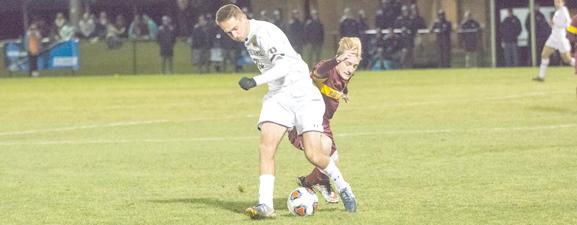
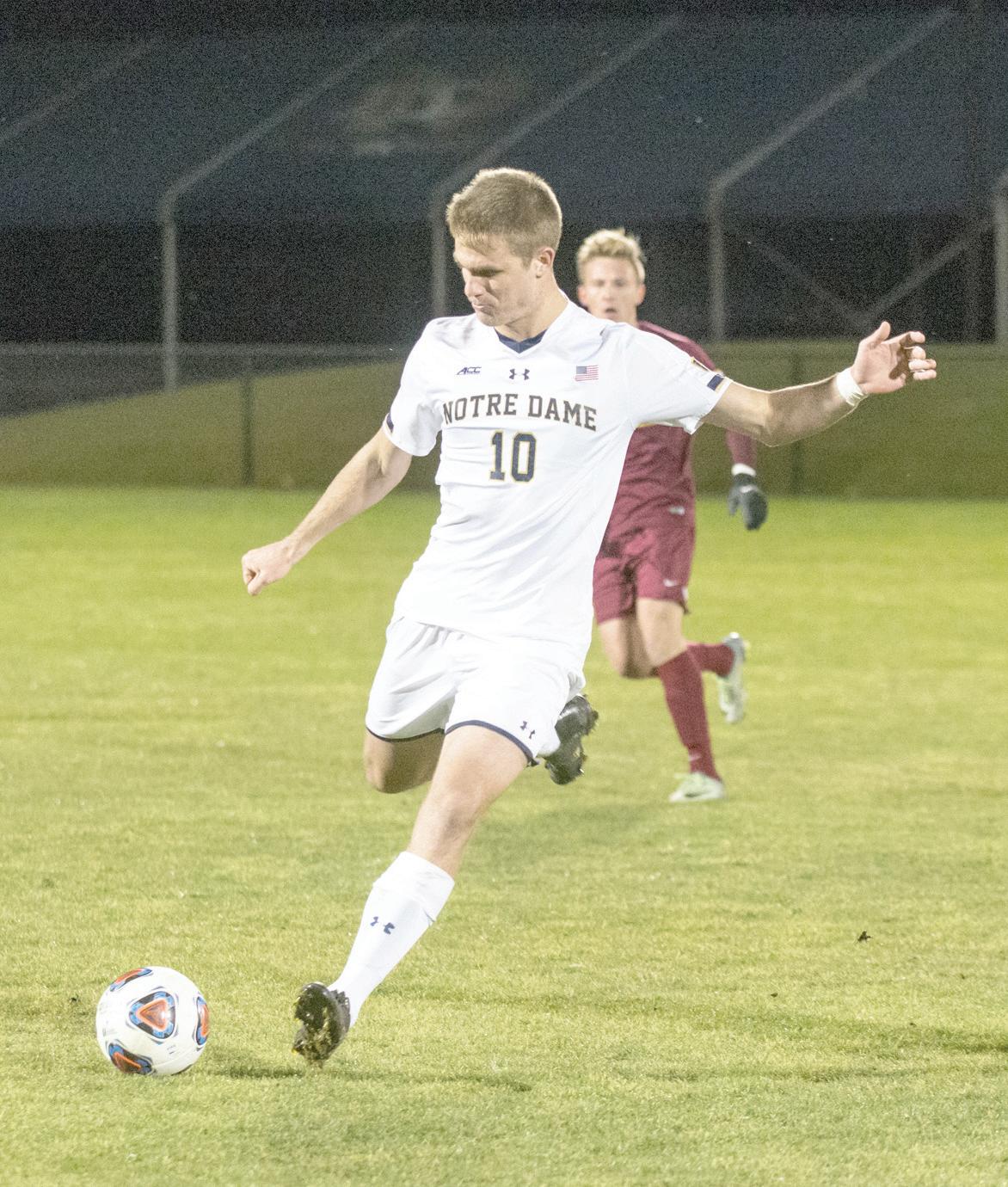
Irish senior defender Brandon Aubrey makes a pass during Notre Dame’s 1-0 win over Loyola Chicago on Sunday night.
the confidence in the world that things are going to end up the way they’re supposed to. Obviously we go out and we try to execute the coaches call, and we don’t execute, and we don’t win.”
While the Irish were not able to execute down the stretch against Virginia Tech, they started Senior Day by dominating the Hokies on both sides of the ball. Notre Dame received the opening kickoff and proceeded to march 78 yards on seven plays, capping off the scoring drive on a 1-yard touchdown run by Josh Adams to put the Irish up 7-0 — Notre Dame’s seventh opening-drive touchdown of the year. Not to be outdone, the Notre Dame defense took its turn rising to the occasion, as senior James Onwualu stripped junior Virginia Tech quarterback Jerod Evans at midfield, with graduate student Jarron Jones recovering the fumble. Kizer then engineered a 13-play, 42yard drive, culminating in a 25-yard field goal from sophomore Justin Yoon to put the Irish up 10-0. On Notre Dame’s next possession, Kizer found sophomore Chris Finke for a 31-yard score to put the Irish up 17-0 barely into the second quarter.
“We were aggressive, we knew what we were capable of,” Adams said. “I don’t think we doubted ourselves for one minute.”
Though Virginia Tech eventually put together a drive and scored on the 23-yard run by Evans, Notre Dame hit right back, with Kizer finding sophomore Miles Boykin for an 18-yard touchdown. Virginia Tech scored again before halftime on an Evans 16-yard touchdown pass to junior Cam Phillips, and thus Notre Dame entered halftime with a 24-14 lead.
However, the Hokies made adjustments on offense and defense in the second half.
After a 62-yard catch-and-run by Virginia Tech’s C.J. Carroll, the Hokies found the end zone as Steven People ran it in from two yards to make it 24-21. Then on defense, the Hokies got away with a hit to DeShone Kizer’s head as Kizer slid to the ground. Kizer was shaken up but stayed in the game, and Brian Kelly after the game was upset by the inconsistency of the targeting rule and its enforcement.
“I mean, we’re talking about protecting the quarterback,” Kelly said. “I’ve been on the wrong end of that play now this year at Syracuse and here against Virginia Tech. That was clearly a quarterback that gave himself up and then was hit. So we’re either going to protect the quarterback or we’re not. So I don’t quite understand what the rule is, because it’s being officiated clearly differently.”
With the Irish offense struggling, Adams provided a necessary spark in the form of a 67-yard touchdown run, the longest run from scrimmage
helmet of a Virginia Tech defender. The hit was not flagged. It wasn’t even reviewed.
I can say that hasn’t been said already. There is no original take I could have. No unexamined angle or minute tidbit I could bring to light.
Because it’s all been said.
Irish junior safety Drue Tranquill makes a tackle while senior Cole Luke looks on during Notre Dame’s 34-31 loss to Virginia Tech on Saturday.
It’s easy to point to the 17-point lead the Irish slowly, yet methodically, blew as a common theme for the season. It’s easy to point to the lack of offensive production and questionable play calling at key points in the game as trends that have plagued the Irish. And it’s easy to point to a defensive collapse that allowed the Hokies to score 13 straight points in the fourth quarter as the reason for yet another loss.
But even the unfortunate penalties and the missed tackles were there too. Everyone remembers the interceptions and the blown coverages, but the missed tackles that allow first downs and the penalties that stall drives are just as crucial to the story of this season.
DeShone Kizer rolled out of the pocket in the third quarter, but as the junior quarterback slid to give himself up as a runner, he was hit in the head by the
for the Irish this season, to put the Irish up 31-21. However, the Virginia Tech offense would not go away. After a 23-yard field goal from Hokies junior kicker Joey Slye trimmed the Irish lead to 3124, Evans again drove the Hokies down the field on their next possession. After a questionable pass interference call against senior Cole Luke put the ball on the Notre Dame 7-yard line, Evans found a leaping Bucky Hodges in the end zone to knot the score at 31. Cole commented on the pass interference call as well as the offensive adjustments Virginia Tech made.
“I think it was just a bad call, and it happens,” Cole said. “Obviously I was frustrated in the moment, but I don’t blame the guy; it happens, he may have saw something differently, on film it might be different from what I think it is, but I think from start to finish I played it perfectly.”
“They were just able to spread us out,” Cole said. “Go spread and get us in a five-box situation, and let the quarterback use his legs to his ability. They executed better than us.”
After yet another Notre Dame three-and-out, Virginia Tech got the ball back and marched 51 yards down the field, eventually settling for a 20-yard field goal by Slye with 4:16 to go to take a 34-31 lead. Kizer and the Irish couldn’t come back.
Chris Finke 31-yard pass from DeShone Kizer (Yoon kick)
14:53 remaining
Drive: Seven plays, 79 yards 2:59 elapsed
n oTr E Dam E 17 , virginia TE ch 7
Jerod Evans 23-yard rush (Joey Slye kick)
11:28 remaining
Drive: Nine plays, 61 yards, 2:35 elapsed
n oTr E Dam E 24, virginia TE ch 7
Miles Boykin 18-yard pass from Kizer (Yoon kick)
6:00 remaining
Drive: Seven plays, 60 yards, 2:11 elapsed
n oTr E Dam E 24, virginia TE ch 14
Cam Philips 16-yard pass from Evans (Slye kick)
1:18 remaining
Drive: 10 plays, 75 yards 4:42 elapsed
n oTr E Dam E 24, virginia TE ch 21
Steven Peoples two-yard rush (Slye kick)
12:39 remaining
Drive: Five plays, 75 yards, 2:21 elapsed
noTr E D am E 31, vigrinia TE ch 21
Josh Adams 67-yard rush (Yoon kick)
Earlier in the third, junior safety Drue Tranquill was matched up with Hokies speedster C.J. Carroll but couldn’t corral him, as the sophomore receiver broke free for a 63-yard gain to set up a Virginia Tech touchdown.
The emotion was present on the sidelines during the game, as it has been almost all year. The Irish players swayed as they did on each kickoff, but each kickoff came on the back of a Virginia Tech touchdown that brought the game one step closer to its seemingly predetermined conclusion.
But after the game, it almost seemed as though there was no emotion. One loss brings cautious optimism. Two losses breeds concern, and three losses incites panic. But at seven losses, there is nothing.
Irish head coach Brian Kelly didn’t yell or cry in his postgame interview. He didn’t make an opening statement, but he made sure he answered every question before he went back into the locker room. Kizer stood at the podium and stared straight ahead as reporters tried to get him to lash out at the officials or announce his potential future in the NFL.
However, just because it was the same, that doesn’t mean it
was all bad. For what seems like the millionth game in a row, Notre Dame was one drive — one play — away from winning. For most of the game, the young Irish secondary was able to keep a talented Virginia Tech receiving corps in check, and the Irish came away with two turnovers.
Notre Dame didn’t quit: It hasn’t yet, and if I had to bet, I don’t think it will versus uSC next week either.
There may be a time when there is something new to say. That time may come this winter when Kelly makes some coaching changes. It may come during spring practice as a new freshman class arrives on campus, or it may not even come until next September when the scoreboard says “Notre Dame (0-0).”
When that day comes, I, along with many other journalists, bloggers and armchair coaches, will say those things and report those storylines.
But for now, there is nothing to say. Everything that happened in this game has happened before, and it will likely happen again against uSC next Saturday. Except that it snowed. And there were marshmallows.
Contact Marek Mazurek at mmazurek@nd.edu
The views expressed in this column are those of the author and not necessarily those of The Observer.