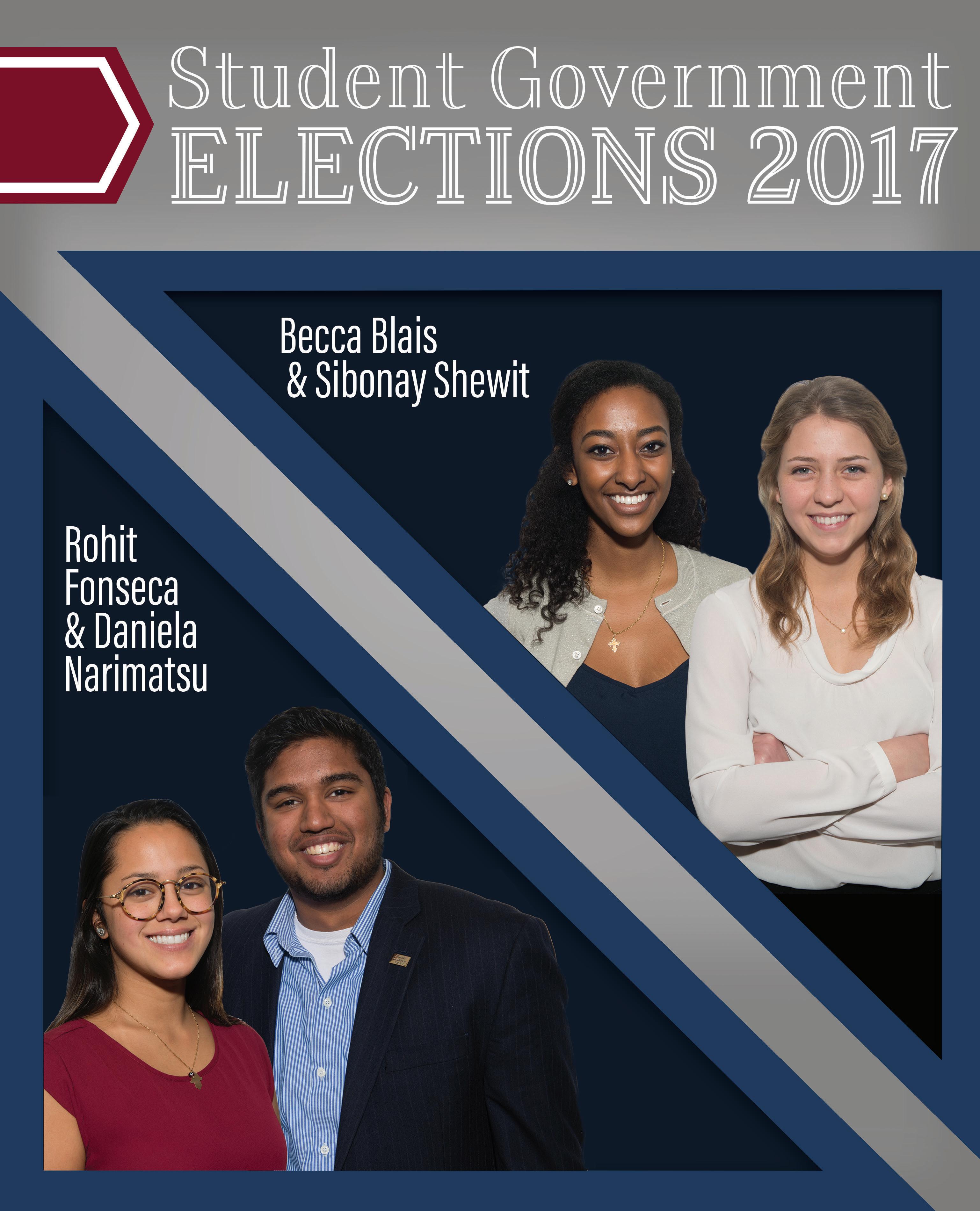
Photo Illustration by Lindsey Meyers and Michael Yu

Who they are:
Junior r ohit Fonseca, the presidential candidate, is an international economics major concentrating in s panish and a Fisher h all resident. h e has lived in eight states and spent two years living abroad. Fonseca was student government’s first director of health and wellness, and served as the director of social concerns. h e is also a campus tour guide and member of the Knights of c olumbus, and he volunteers at the r obinson c ommunity Learning c enter.
The vice-presidential candidate, junior d aniela n arimatsu, is studying IT management and political science. s he is a h oward h all resident — and its current vice president — and hails from s ao Paulo, b razil. n arimatsu has also served as the director of social concerns for student government and sat on the advisory committee for student climate related to race and ethnicity.
top priority: Creating platforms for “civil discourse” on campus
Fonseca said the top priority for the upcoming year is to foster an environment for discourse on campus through two programs: Irish c onnection and r ou nd Tables. Irish c onnection intends to bring two or more
groups, clubs or organizations that don’t share much in common to an activity, such as a dinner, game, campus event or social service to build relationships between people who might not otherwise know each other. r ou nd Tables is the ticket’s answer to the need for civil discourse on campus, centered around topics that are n otre d ame-specific, such as parietals and whether President d onald Trump should be invited to speak at c ommencement.
b est idea: f ocusing on mental health
While Fonseca and n arimatsu do not offer up new or significantly changed programming to draw attention to mental health, their plan to emphasize, underline and expand existing resources is both well-focused and highly reasonable. Their intention to continue partnering with Active m inds for Irish s tate of m ind and Irish Peace of m ind is expected but still important and their plans to better advertise the m c d onald c enter for s tudent Wellness c enter could benefit students by alerting them of a perhaps underutilized resource. Finally, expanding on the anonymous testimony project Fonseca implemented during his time as the first director of health
and wellness is a highly visible platform to encourage dialogue regarding mental health and the issues confronted by students on a daily basis.
Worst idea: f eminine hygiene product boxes
Fonseca and n arimatsu’s plan to provide access to necessary feminine hygiene products may seem commendable — at least on the surface — but it should be stressed that the ticket does not intend for student government to be providing the products. r ather, “sharing boxes” would be placed in female public restrooms across campus and students would be encouraged to leave any “spare products” inside in case another student has an emergency situation. While clearly well intentioned, the plan does not require the intervention of student government in any way and they offered no way to incentivize students to donate their own products, which can be expensive, especially if purchased on campus. m ost students, additionally, do not consider the products they don’t need at a particular moment as “extra” — they tend to carry a few in case of their own emergencies and, as the products have no expiration date, simply keep any
leftovers for their next cycle.
Most feasible: b uilding on the u niversity’s spiritual life
The ticket’s plans to expand upon the University’s sprawling spiritual life is unique and comes off as extremely simple and easy to implement. Fonseca plans to have a brief prayer with students followed by breakfast in front of o ’ s haughnessy h all each and every m onday morning. As a c atholic institution, it can be assumed that at least some students would be interested in participating in the weekly events, coordinated with the d epartment of h ealth and Wellness and the c ampus m inistry representative.
Least feasible:
b roadening Grab ‘N’ Go locations
Fonseca and n arimatsu’s plans to address c ampus d ining consists of two highly feasible projects — encouraging the dining halls to continue to offer late lunch hours, and improving allergy and dietary labeling in the dining halls — and a third, highly infeasible plan to broaden the locations where students can pick up Grab ‘ n ’ Go meals. Working with c ampus d ining can be a very slow process and, as the suggest locations
— the h uddle, Waddicks, a la d escartes and c afe c ommons — function to create their own revenue, it is highly unlikely that such venues would be in favor of the plan. Additionally, with two Grab ‘ n ’ Go locations already on campus, there does not seem to be as much of a need for this service as their other suggestions.
b ottom Line: Maintaining the status quo
While Fonseca and n arimatsu bring a different kind of student government experience to the table against the other ticket and most of their platform appears to be highly achievable, very little of what they propose is truly progress. m uch of the platform focuses on reiterating the availability of already-existing resources — both in and out of student government — and continuing relationships that student government already has. In particular, their lack of a plan to further address sexual assault on campus beyond what programming is already offered is disheartening. While maintaining the services currently offered is realistically attainable and better than regressing, the hope of every election is to improve upon what already exists.
By LUCAS MASIN-MOYER news Writer
As Wednesday’s election for student body president and vice president rapidly approaches, the candidates were given their first and only chance to debate their platforms against one another monday night. In the c arey Auditorium of the hesburgh Library, student body presidential candidate — and current student body vice president — b ecca b lais and her running mate, s ibonay s hewit, faced off against the opposing ticket of presidential candidate r ohit Fonseca and his running mate, d aniela narimatsu, to begin the final push for votes before the election.
The candidates began the debate by discussing why they chose to run for office.
“When we decided to run for student government, we had one thing in mind — you guys, the students, our classmates, our friends, the people who mean the most to us and the notre d ame family,” Fonseca said. “We have very different life experiences that we bring to the table, but you will find us united in our passion for notre d ame.”
b lais said one of the key issues that motivated her to run was reforming sexual assault procedures, prompted by an experience at a sexual assault prevention meeting.
b oth tickets had plans to tackle sexual assault. Fonseca and narimatsu advocated for presenting anonymous testimonies to the student body via displays in the dining halls, an initiative that Fonseca had spearheaded in regards to mental health during his tenure as director of health and wellness for student government.
“You kind of understand that these people you walk by everyday ... might be dealing with sexual assault, might be dealing with domestic abuse, might be dealing with serious life issues that we pretend don’t exist here in our perfectionist culture here at notre d ame,” Fonseca said.
o ne of the key policies b lais and s hewit said they hoped to enact in regards to sexual assault is the use of the sexual assault recording software c allisto. The software aims to “provides survivors with a confidential and secure way to create a time-stamped record of an assault, learn about reporting options and
support resources, or report electronically to campus authorities. It [als] gives survivors the option to report their assault only if someone else names the same assailant,” according to the software’s website.
“ s peakupnd is a great reporting software for harassment; c allisto is an online software for sexual assault,” she said. “The unique thing about c allisto is that you can put in all of your information when it happens.”
b lais said the current system did not go far enough and more steps needed to be taken to prevent sexual assault.
“[ s exual assault victims] are your classmates, those are your dormmates — those are your friends,” she said. however, Fonseca argued that the technology already used by the University ought to be kept in place.
“We want to push what we already have,” he said. “We don’t need any new technology for online reporting of sexual assault. We already have speakup.nd.edu and we’re going to make that known.”
The candidates also discussed issues relating to inclusion and diversity on notre d ame’s campus.
narimatsu said one way to help students that feel left out, especially non- c atholics, become a part of the community is through service.
“It is really hard for [nonreligious] first years trying to navigate within the culture of notre d ame and [be included]; we think service is going to be a part of that,” she said.
Fonseca added that another one of their campaign’s initiatives — a campus-wide prayer service — was also aimed at bringing students together.
The prayer would be held on monday mornings to “start the week off right,” he said.
s hewit said in order to bring students together, greater dialogue about diversity and inclusion was necessary.
“We want students to know that it’s okay to celebrate their differences and talk about them and to ask questions about other students and their own celebrations and uniqueness,” she said.
“We want to foster a place where these conversations can happen.”
The candidates then transitioned to issues relating to greater student health.
b lais and s hewit said they wanted to provide free s T d and s TI testing and rape kit
testing to st. Liam’s. The duo also wants to bring in the J ed Foundation — an organization that evaluates schools’ mental health programs in order to improve the programs — to help streamline the University health s ervices’ care.
Fonseca said improving student health was important but that some of b lais and s hewit’s proposals weren’t feasible.
“We know that there are some things that we need to be realistic about,” Fonseca said. “We have talked directly to a director in st. Liam’s who says that it is impossible — not that it’s her opinion or she thinks that it’s impossible — it is impossible to get free s T d and s TI testing within a year.”
b lais said being told something is impossible isn’t the end.
“ s ometimes when you hear that something is impossible, try anyway,” she said. “We were once told that a peer support group was impossible, yet we launched the firstever sexual assault survivors support group last fall.”
Contact Lucas Masin-Moyer at lmasinmo@nd.edu

When polls open Wednesday morning, the n otre d ame student body will be faced with a difficult decision between two highly qualified student government tickets — juniors b ecca b lais and s ibonay s hewit and juniors r ohit Fonseca and d aniela narimatsu. b oth teams developed thoughtful and considerate platforms that addressed the concerns and needs of the student body.
The o bserver e ditorial b oard interviewed each ticket over the weekend and — having considered the priorities and plans of each ticket — voted to endorse b lais- s hewit.
The b lais- s hewit platform dreams big — perhaps too big at points — but overall has done an excellent job of assessing the current needs of the n otre d ame student body. Their commitment to the notion of “flipping the model” of student government — that is, bringing student government to the students instead of requiring students to come to student government with their concerns — is clear, as much of their platform is derived from ideas they have received from the student body itself. They pledge to “represent every student,” and while this sometimes leads to too many unattainable ideas, they demonstrate a passion for understanding the student body. The b lais- s hewit ticket also boasts a remarkable and prominent amount of student government experience — particularly as b lais currently serves as student body vice president and s hewit served as secretary and later chief of staff for the r ickettsr uelas administration — and it is evident they have a concrete grasp on its inner workings. The focus on clear and tangible goals is a large part of what makes the b lais- s hewit ticket stand out, and while the two have ambitious plans for the coming year, the fact that they have a wide range of well-defined and formulated ideas is encouraging. h owever, our endorsement comes with several reservations about the ticket. While b lais and s hewit have a thorough platform addressing the varied needs of the student body, we have some concerns about its feasibility. Although most individual items on the ticket’s platform are achievable in their own right, the more than 100
individual goals b lais and s hewit put forward on their platform present perhaps too gargantuan a task to accomplish in one term. We are concerned the team may be taking on too much, which could distract and detract from some of their larger goals. m ore to the point, we fear this ambition could lead to should-be achievable objectives failing due to resources being spread too thin.
Additionally, some ideas on the b lais- s hewit platform — for example, “ensuring all campus buildings are 100 percent handicap accessible, and fight for necessary changes for those that are not” — are simply not attainable. Last spring, The o bserver found nearly half of all dorms on campus were not wheelchair accessible, and fixing all of them would require significant funding and construction to add elevators and ramps. Likewise, decreasing the number of tests given between Thanksgiving and finals week, and extending Flex Points to e ddy s treet stores seem both unlikely and beyond the scope of what student government can reasonably achieve. While we appreciate the ticket’s attempt to address a wide variety of issues, we found the scope of the ticket’s platform misleading in terms of what they could realistically expect to accomplish.
A few ideas have also made a repeat appearance from b lais’s campaign last year with current student body president c orey r obinson, leading us to question why they weren’t achieved this year and whether it is feasible to achieve them in the coming year. s pecifically, part of b lais’ platform last year focused especially on getting s exual Assault n urse e xaminers ( s A ne ) in s t. Liam’s. h owever, it has yet to be achieved and has landed back on the b lais- s hewit agenda this year. While r obinson and b lais made progress on implementing this initiative in the past year, we still have doubts about whether it will come to fruition this time around.
o n the other hand, the Fonseca-narimatsu ticket takes the opposite approach of focusing almost exclusively on what they can reasonably hope to accomplish in one year with existing resources and shying away from offering many new ideas — ultimately limiting themselves in their goals and plans. For example, in addressing sexual assault — a key issue on campus — they failed to provide any new ideas to tackle the problem, and pledged to work with the University to make public the
results of the c ampus c limate s urvey — results which are already made public. o ther initiatives put forward by the ticket focus solely on education about available resources, which is certainly helpful, but left us wondering what more could be done.
We did appreciate the team’s commitment to improving mental health awareness on campus: Their plans to work with the m c d onald c enter for s tudent Well-b eing and to promote Irish s tate of m ind Week demonstrated a dedication to the mental health of the student body, an issue we take seriously. Further, their combined experience throughout a variety of student government committees and other organizations is an asset to their understanding of the n otre d ame student body, but we felt it did not stack up against that of the b lais- s hewit ticket.
While the Fonseca-narimatsu ticket proposes an interesting idea with the concept of r ou nd Tables — a regular campus event giving students from different perspectives and groups a forum to discuss divisive tops — we had concerns about both its implementation and the ultimate goal. The plan as is does not address how the ticket plans to attract active participants, particularly those who are not already politically active and vocal on campus, and a large-group discussion may not be the best forum for discussing some of the issues they had in mind.
Finally, we also took notice of each ticket’s priorities. b lais and s hewit made it clear both in their platform and the student body debate m onday night that sexual assault and student safety are their primary concerns, whereas Fonseca and narimatsu, though they do address both safety and sexual assault in their platforms, chose the need for civil discourse as the campaign’s primary pillar. While we as a newspaper staff appreciate the need for civil discourse as well, we consider student safety and sexual assault issues that need immediate attention and focus.
s o, despite our reservations, the e ditorial b oard felt most of b lais and s hewit’s ideas were sound, pertinent and likely to have a positive impact on the student body. Furthermore, the b lais- s hewit ticket attempts to truly make progress on issues that matter to students, instead of just accepting things as they are.