Notre Dame hosts Take Back the Night with sister school
By NICOLE TOCZAUER News Writer
Members of the Notre Dame community joined with Saint Mary’s in Take Back the Night on Thursday evening to break the silence surrounding the violence of rape and sexual assault.
Amanda Downey, assistant director for Educational Initiatives at the Gender Relations Center (GRC), said the goal of Take Back the Night (TBTN) is for survivors and allies to publicly stand against all forms of sexual violence.
“Men and women break the silence surrounding this violence with voices of prayer, chanting and the sharing of stories,” she said.
Take Back the Night began in Philadelphia in 1975 as a way for communities to unite against abuse, sexual assault and rape. Since then, the event has spread to thousands of universities, crisis centers and cities around the country, Downey said.
Downey said Notre Dame began supporting the cause with its own TBTN several years ago. This year, the GRC worked with Men Against Violence, the Core Council and the Belles Against Violence Office at Saint Mary’s.
“We have worked collaboratively since the early stages of planning,” she said. “Students and staff from both campuses worked together to plan and implement the program.”
Saint Mary’s women speak out against sexual violence
By JILLIAN BARWICK Saint Mary’s Editor
The Saint Mary’s and Notre Dame community recognized survivors of rape and sexual assault at Take Back the Night on Thursday evening, with events hosted across the two campuses.
Connie Adams, assistant director for the Belles Against Violence Office (BAVO), worked with the team of sponsors for the event. The Core Council, Men Against Violence, and S-O-S of the Family Justice Center are co-sponsoring the event.
She said this is the second year BAVO has co-sponsored Take Back the Night (TBTN) with the Gender Relations Center at Notre Dame.
The cooperation across campuses mirrored the night’s effort of promoting solidarity among women and community members, she said.
A&L grads compete in business
By KRISTEN DURBIN News Editor
When senior Mitch Gainer began interviewing for a position with Boston Consulting Group (BCG), he expected most of his peers to have studied business during their undergraduate careers.
But as he progressed through the interview process, Gainer, an economics major, said he noticed a majority of the interviewees had educational backgrounds grounded in the liberal arts.
“The majority of the top-20 schools in the country don’t have undergraduate business programs, so I found myself competing against history and medieval studies majors,” he said.
Like most graduating seniors entering the job market, Gainer said he was worried about employment prospects. But after securing a job in the business world with a liberal arts degree, he said he investigated the statistics on post-graduate
“We are all united in voices of hope and prayer that this violence will not be tolerated, and that those who have been hurt will
5
“The Take Back the Night event is an opportunity to stand in solidarity with survivors of rape and sexual assault, and to show a commitment to preventing this violence from happening in our community,” Adams said.
A candlelight vigil service
NIGHT/page 7
Global powers face emerging nations
By MAIJA GUSTIN Senior News Writer
British politician Lord Chris Patten of Barnes spoke about the role of world powers at his lecture
“Europe, America and the Changing World Order” in Geddes Hall on Thursday evening. The Nanovic Institute for European Studies sponsored the presentation.
Patten said his experiences as governor of Hong Kong during its handover to the People’s Republic of China in 1997, and as a member of the European Commission provided insight to the problems global leaders face. The U.S. and European nations are especially affected by the emergence of countries like
China and India, he said.
Though the American economy has declined in recent years, it maintains a global dominance of commerce and culture, he said.
“The United States has really been … the only country which matters everywhere,” he said.
Patten said while the United States grapples with financial crises and a massive accumulation of debt, the European Union must navigate a different set of economic and political issues to maintain its current stature.
“The Eurozone is not yet out of the mire and is … a victim of the consequences of national democratic politics in which people feel a
ASHLEY DACY/The Observer
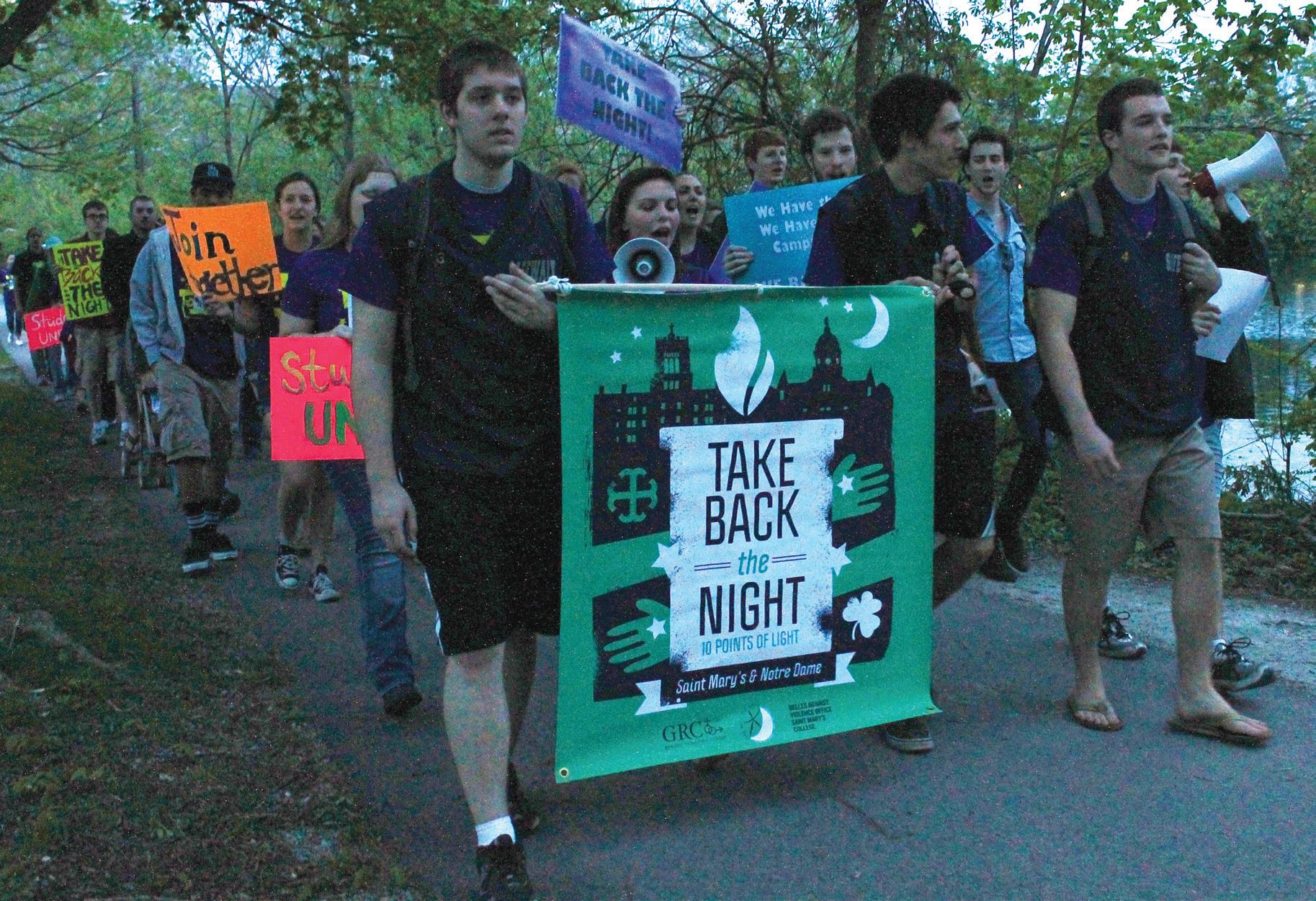
Notre Dame and Saint Mary’s students march on Thursday night from Lake Marian at Saint Mary’s to the Grotto to show support for survivors of rape and sexual assault during Take Back the Night.
MARINA KOZAK Observer Graphics
www.ndsmcobserver.com
P.O. Box 779, Notre Dame, IN 46556
024 South Dining Hall, Notre Dame, IN 46556
Editor-in-Chief
Allan Joseph
Managing Editor Megan Doyle Business Manager Jeff Liptak
a sst. Managing Editor: Andrew Owens
a sst.
Managing Editor: Sam Stryker
News Editor: Kristen Durbin
Viewpoint Editor: Meghan Thomassen
Sports Editor: Chris Allen
Scene Editor: Kevin Noonan
Saint Mary’s Editor: Jillian Barwick
Photo Editor: Suzanna Pratt
Graphics Editor: Brandon Keelean
a dvertising Manager: Katherine Lukas
a d Design Manager: Sara Hillstrom
Controller: Jason Taulman
Systems a dministrator: William Heineman
Office Manager & General Info (574) 631-7471 Fax (574) 631-6927
Scene Desk (574) 631-4540 knoonan2@nd.edu Saint Mary’s Desk jbarwi01@saintmarys.edu
Photo Desk (574) 631-8767 obsphoto@gmail.com Systems & Web Administrators (574) 631-8839
Policies
The Observer is the independent, daily newspaper published in print and online by the students of the University of Notre Dame du Lac and Saint Mary’s College. Editorial content, including advertisements, is not governed by policies of the administration of either institution. The Observer reserves the right to refuse advertisements based on content. The news is reported as accurately and objectively as possible. Unsigned editorials represent the opinion of the majority of the Editor-in-Chief, Managing Editor, Assistant Managing Editors and department editors. Commentaries, letters and columns present the views of the authors and not necessarily those of The Observer.
Viewpoint space is available to all readers. The free expression of all opinions through letters is encouraged. Letters to the Editor must be signed and must include contact information.
Questions regarding Observer policies should be directed to Editor-in-Chief Allan Joseph. Post Office Information
Brian Vega junior Alumni
“Samuel L. Jackson.”
Kristen Groody junior Welsh Fam
“Kim Kardashian.”
Liz Pawlak senior Pangborn “Natalie Portman.”
Mia Genereux junior Welsh Fam “Joe Mauer.”
Rob Dillard junior St. Ed’s “Denzel Washington.”
Sam Costanza senior off-campus
“Carly Rae Jepsen.”
Senior
News
Nicole Toczauer
Jillian Barwick
Drew Pangraze
Graphics
Marina Kozak
Photo
Kirby McKenna
Sports Joseph Monardo
Megan Finneran
Peter Steiner
Scene
Carrie Turek
Viewpoint
Amber Galick
Police handcuff 6-year-old girl for temper tantrum
MILLEDGEVILLE, GA. —
A 6-year-old girl in Georgia was handcuffed by police and charged with assault after throwing a “tantrum” in her elementary school. Local tv affiliate 13WMAZ reports that Salecia Johnson, who is in kindergarten, was detained by police after her alleged outburst.
“Our policy is that any detainee transported to our station in a patrol vehicle is to be handcuffed in the back. There is no age discrimination on that rule,” Milledgeville Chief of Police Dray Swicord, told the station.
Swicord said the officer
who handcuffed Johnson is not facing an investigation over his actions. Swicord added that Johnson was handcuffed for her safety as well as the safety of others. She was initially taken to the principal’s office after pushing two other students, according to a police report.
James Cameron launches asteroid mining company SEATTLE, WA. — A new company called Planetary Resources held its official launch today promising a new venture that would merge “space exploration and natural resources,” while adding “trillions” of dollars to the global GDP.
The company counts some
heavy-hitters amongst its founders and financial backers, including filmmaker/ explorer James Cameron, Google co-founders Larry Page and Eric Schmidt, Ross Perot Jr. Charles Simonyi, formerly of Microsoft.
The group’s somewhat vague press release has the site Technology Review thinking the new company’s goal “sounds like asteroid mining.”
Planetary Resources announced its launch on Tuesday morning at an event held at the Charles Simonyi Space Gallery at The Museum of Flight in Seattle.
Information compiled from the Associated Press.
In brIef
The Class of 2012 continues the Bald and the Beautiful Fundraiser today in the basement of the LaFortune Student Center to help fight childhood cancer. Donors can either shave their head, cut their hair (at least 8 inches), or buy colored hair extensions to help out.
Saint Mary’s College and the Congregation of the Sisters of the Holy Cross will welome to campus Theresa Flores, a former victim of sex trafficing, for a lecture on sex and labor traficking at noon today. The public lecture will be in the Vander Vennet Theatre on the ground level of the Student Center
The Shirt Committee is sponsoring “The Shirt” Unveiling Ceremony today Festivities begin at 3:30 p.m. including inflatables, face painting, prizes, free food and drink (while supplies last), local radio station B100 and a performance by ND’s band. Head football coach Brian Kelly will unveil The Shirt at approximately 5:45 p.m
Rev. Ronald J. Nuzzi Ph.D., will answer the question, “Who Will Save the Catholic Schools?” during a lecture Saturday, April 21st at 11 a.m. The lecture, free and open to the public in McKenna Hall Auditorium is part of Alumni Senate weekend and the celebration of the 25th Anniversary of the Hesburgh Lecture Series.
To submit information to be included in this section of The Observer, e-mail detailed information about an event to obsnews.nd@gmail.com
Students explore business aspect of nonprofits
By NICOLE MICHELS
News Writer
Non-profit business leaders spoke to Notre Dame students last night on how to combine commitment to a cause with a career during “Inspire Purpose: the Business Side of Non-Profits.” The event was sponsored by ND8, Inspire and the Career Center.
Sophomore Olevia Boykin, president of Inspire, said the club works to increase the number of student connections with non-profits.
“Inspire’s purpose is to serve students interested in non-profits, and we found that we were really lacking in serving business students,” Boykin said. “Our goal is to bring that side of non-profits to life…non-profits are still a business and they need business students.”
Victoria Lam, a biology graduate student, founded “Swell Cause” as an organization to promote entrepreneurial education and sustainable business incubation in Haiti.
“I feel that through providing people with sustainable livelihoods, in the future they will be self-reliant and be able to provide those things for themselves,” Lam said.
Lam said she was compelled to start Swell Cause after seeing the very real need in Haiti for sustainable, long-term development.
“I’m taking another trip down to Haiti to make sure that I’m meeting an actual need and not a perceived need,” Lam said. “We’re looking for funding so we can establish a permanent presence down there.”
Lam said the difference between for-profits and non-prof-
its lies in accountability.
“In a for-profit you’re accountable to your stakeholders, but in a non-profit you’re accountable to the people you serve,” Lam said. “In a for-profit, it’s easy to measure how much money you made [or find other measures of success], but in a non-profit you have to come up with different guidelines to measure outcomes.”
Mark Murray, CEO of the Center for Hospice Care, also spoke at Thursday’s event. He said the agency provides home care and community support for patients dealing with end-of-life issues.
The Center is the largest hospice program in the state of Indiana and cares for 350 patients each day, Murray said.
The key to the Center’s success as a non-profit is its integration into the communities of patients and their families, Murray said.
“We count on their connections, the people they know, and their capacity to tell our story,” Murray said. “We continue to take all those people and really try to engage them, cultivation [of relationships] is really the whole key to everything.”
Murray said because the patients are the Center’s top priority, it is not afraid to compete with for-profit hospices.
“We’re here to do our mission because we believe that the best care will come from our organization,” Murray said.
Sean MacCready, the Alumni Director and External Relations Associate at Saint Ignatius College Prep in Chicago, said he learned how schools are financed after the school he taught at was closed down.
After teaching for a few years, MacCready said he went into school development and has
spearheaded the movement for school choice in Indiana.
MacCready said non-profits must focus on the sustainability of the organization in order to ensure success.
“When you’re working in a non-profit organization, a lot of times your key stakeholders are individuals who are being served by your organization, and it is a delicate balancing act to focus not only on the needs being served by your institution, but also your sustainability,” MacCready said.
MacCready said his experiences with individuals in the non-profit and for-profit sector led him to strengthen relationships with the community to se-
cure funding for St. Ignatius.
“It’s about maintaining relationships … it’s a lot easier to get a grant or to get funding for your non-profit if you know someone,” MacCready said. “You have to get into the community, you have to make sure everyone knows that you’re doing a good job [in order to find funding].”
Sophomore Alex Rogalski said he learned about a side of business not focused on in his classes at Mendoza.
“Today I learned about the amazing opportunities that are out there for someone who is studying business here to get involved in a non-profit,” Rogalski said. “Everything that we learn
here is about gaining as much as possible for shareholders, but we don’t learn much about the non-profit side.”
Freshman Bre Thomas agreed with Rogalski and said the speakers furthered her knowledge of non-profit careers.
“I came because I had high hopes of working with a nonprofit in the future, and just thought that it would be nice to get another perspective for the non-profit as a job,” Thomas said. “I learned more about how it is a job, but that you can also fuel your passion while taking care of the business side of it.”
Contact Nicole Michels at nmichels@nd.edu
SMC alumna visits campus to host special writing classes
By MEAGHAN DALY News Writer
New York Times-bestselling author Adriana Trigiani, class of 1981, will come to
Saint Mary’s April 26 and 27 to share her experiences in the “Golden Age of Televeision.” Trigiani will be joined by television producer, director and actor Bill Persky in
two master classes for Saint Mary’s students.
Trigiani said she is known for her best-selling “Big Stone Gap” series, the novel “Lucia” and her latest book, “The Shoemaker’s Wife.” Before she focused on writing books, she began her writing career in television with Persky, she said.
Trigiani said she started as part of the writing staff for Persky’s television show, “Working it Out.” She also worked as a writerproducer for the “Cosby Show,” a show runner for “City Kids” and for the Macy’s Thanksgiving Day Parade. Trigiani said the impact Persky has had on her goes beyond working together for television.
“I
this event possible at Saint Mary’s.
“Max Westler thought of it, and I asked Bill and here we are. I love a women’s college hosting a brilliant creator of comedy,” she said. “He’s a woman’s man, father of daughters, by extension dad to a few non biological daughters, and mentor to countless more.”
love the process of naming the characters and building their lives. Hearing their voices. Letting them live in the imagination.”
Adriana Trigiani author
“Above and beyond that wonderful piece of luck, I became dear friends with his daughter Dana, and then [his] twins Jamie and Liza,” Trigiani said. “Through the years, he evolved from mentor to family for me. I adore him.”
Trigiani has worked with Persky and Max Westler, an English professor, to make
Trigiani said holding the two master classes was actually Persky’s idea. She said Persky hosts workshops at New York University and wanted to bring the experience to Saint Mary’s.
“Bill understands women, respects us and celebrates us, Trigiani said.
“This is a very rare thing — and it’s perfect that a venerable women’s college is hosting a man who has long championed our struggles and joys.”
“The master class is Bill’s idea — he wanted to bring a structure to the conversation that will really help you decide if you’d like to pursue this kind of work, and find your own voice in the work,” Trigiani said.
Trigiani said her time at Saint Mary’s did not pass by without the impact of influential professors. Trigiani said theater professor Reg Bain, English professor Sister Jean Klene and Wrestler were among those who played a significant role in her education and career.
Today, Trigiani said she focuses on writing books. When looking for inspiration she needs not much other than a closed door and silence, she said.
“I love to be alone, so writing novels is also a spiritual and creative match for me,” Trigiani said. “I love the process of naming the characters and building their lives. Hearing their voices. Letting them live in the imagination.”
The first master class will be held on Thursday, April 26, and is open to all students, she said. The second master class on Friday is open to writing majors only. At the Friday class, students are instructed to bring an idea for a sitcom for Trigiani and Persky to evaluate.
Contact Meaghan Daly at mdaly01@saintmarys.edu
ASHLEY DACY/The Observer
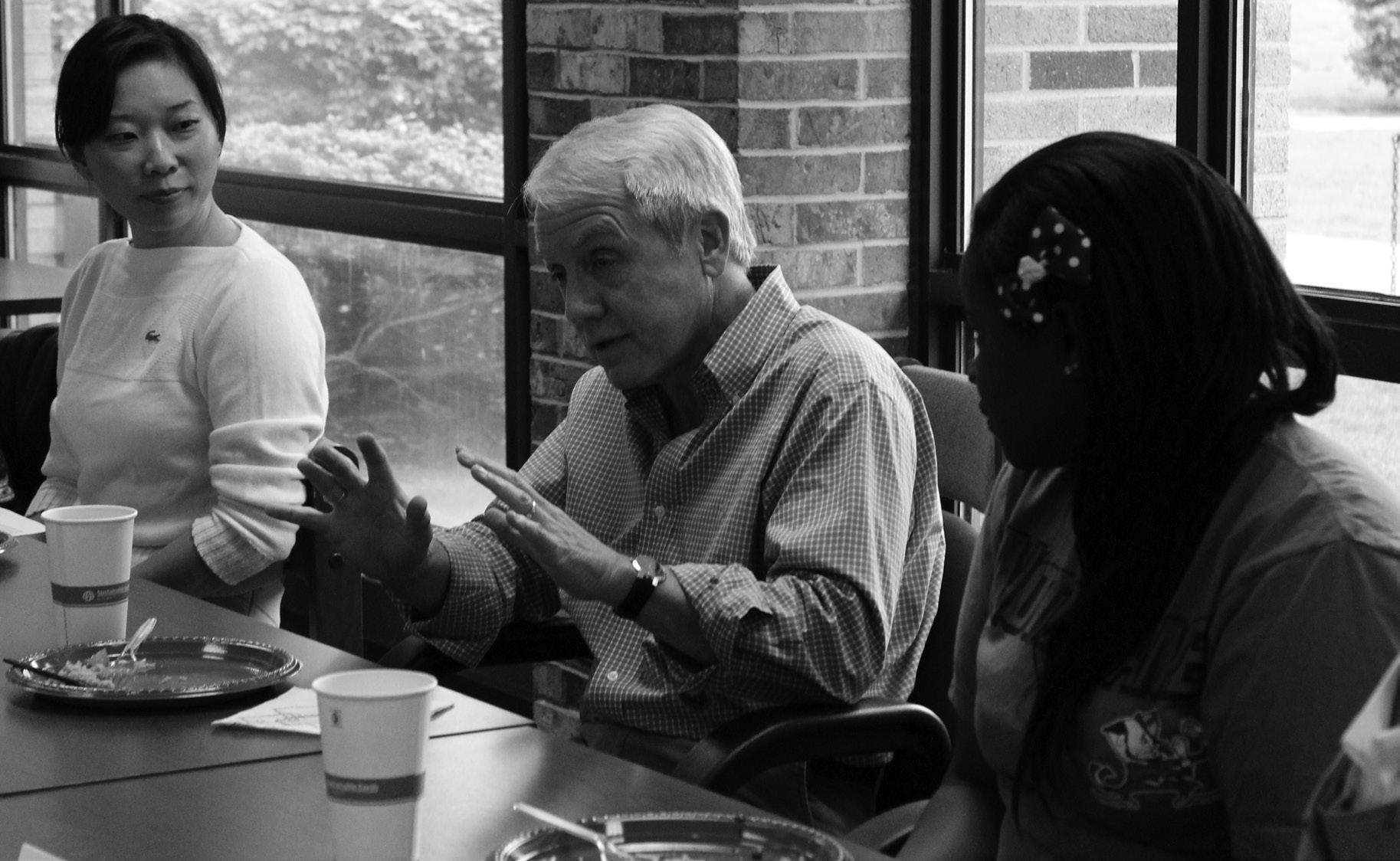
Freshman Bre Thomas and graduate student Victoria Lam listen to Mark Murray, CEO of the Center for Hospice Care, speak about the center’s integration into its community.
ND hosts first intercollegiate mechatronic football game
By AUBREY BUTTS News Writer
They’ve got jerseys and boast muscles of steel, but have never taken to the field before. Tonight, the Fighting Irish will battle the Polar Bears of Ohio Northern University in the first intercollegiate mechatronic football game in the Stepan Center at 7 p.m.
Michael Stanisic, associate professor of mechanical engineering, said though the team has held a Blue versus Gold game for the past three years, this will be the first match between two different universities.
He said the robots have specialized positions and are directed by student “coaches” through running and passing maneuvers in the game.
“There’s a center, a quarterback, a running back, linemen, receivers, kicker, punter and they all do the things you would expect such a player to do. If students want to win, they start getting into these things, and they have kickers who are very dependable,” Stanisic said. “They have quarterbacks and receivers with somewhat sophisticated control systems on them.”
The robotic linemen have removable tops with moving arms to block passes, and the quarterback has two spinning wheels with a feeder mechanism to replicate the action throwing a football. Stanisic said the machine
Take
continued from page 1
someday find peace and healing,” Downey said. “It is important to create a survivor-friendly environment.”
The night began with a group walk from Saint Mary’s Lake Marian to the Grotto for a candlelight vigil. A campus march followed the vigil and led to Holy Cross Hill, where members of the Notre Dame and Saint Mary’s communities shared experiences in a “Speak Out” session.
can throw the ball 40 or 50 feet.
The robots can communicate with each other, but coordination between student controllers and robots on the field allows the team to complete a pass, Stanisic said.
“For this year, the students have developed a system of ultrasonic beacons that the players listen for, and when they hear the beacon they can compute how far they are from the beacons which tells them where they are on the field in relation to each other,” Stanisic said. “The quarterback then knows where the receiver is, and can line up with it and know exactly where to throw it.”
being able to complete the firstever football pass by a robot,” Chen said.
Senior Rebecca Sees said her favorite part of the project was seeing the robot designs develop.
“Everything started out as just a bunch of ideas and sketches, and it’s cool to see how we got to this point from those first stages,” Sees said. “We’re all passionate about getting these robots to work and about trying new things to make them work better.”
“I am the most excited about getting the trilateration system working in the actual game and being able to complete the first-ever football pass by a robot.”
Waylon Chen senior
Senior Waylon Chen, a student coach, said he is looking forward to seeing the developments in action Friday.
“I am most excited about getting the trilateration system working in the actual game, and
“I [was] really looking forward to the prayer service at the Grotto. It was a moving and beautiful event,” Downey said. “During the ‘Speak Out’ portion of the event, survivors felt empowered by sharing their own journey of healing, or by listening to the stories of others.”
Downey said survivors of sexual assault witnessed the outpouring of support from the community at Take Back the Night. She said friends, family and community members were also impacted by the events and shared stories.
“The hope for this type of program is always to raise awareness and to create a safe space for survivors and friends,” Downey said. “There are a lot of people on campus who care and want to help.”
For information about on-campus support, visit the Committee on Sexual Assault Prevention’s website at www.csap.nd.edu.
Contact Nicole toczauer at ntoczaue@nd.edu
Stanisic said the commitment stems from the many hours students devote outside of the classroom to the construction of their robots.
“The team puts in at least 12 to 15 hours a week, which is a tremendous amount of time,” he said. “Every time I go down to the lab, they are working.”
Friday’s game will also display the humor student members brought to this project, Stanisic said.
“[The students] like to give them names that are in some cases silly, in some cases make
Arts
continued from page 1
plans of students in the College of Arts and Letters.
“A lot of Arts and Letters students worry about getting a job after graduation, but that worry wasn’t reflective of what I saw [during interviews] at all,” Gainer said. “So I went to [assistant dean] Joe Stanfiel and the Career Center, and looked closer at the statistics.”
When Gainer was offered a position at BCG, Stanfiel said he and Gainer began analyzing 2010 data from the Office of Institutional Research for a different perspective on the post-graduation employment climate for Notre Dame students.
“[The interviews] got Mitch thinking about the generalized claims about who gets jobs after graduation and that the sorts of jobs people get would be something to look into as well,” Stanfiel said. “After looking at the data, we found that Arts and Letters students were getting competitive jobs in the business world in roughly equal number with business students.”
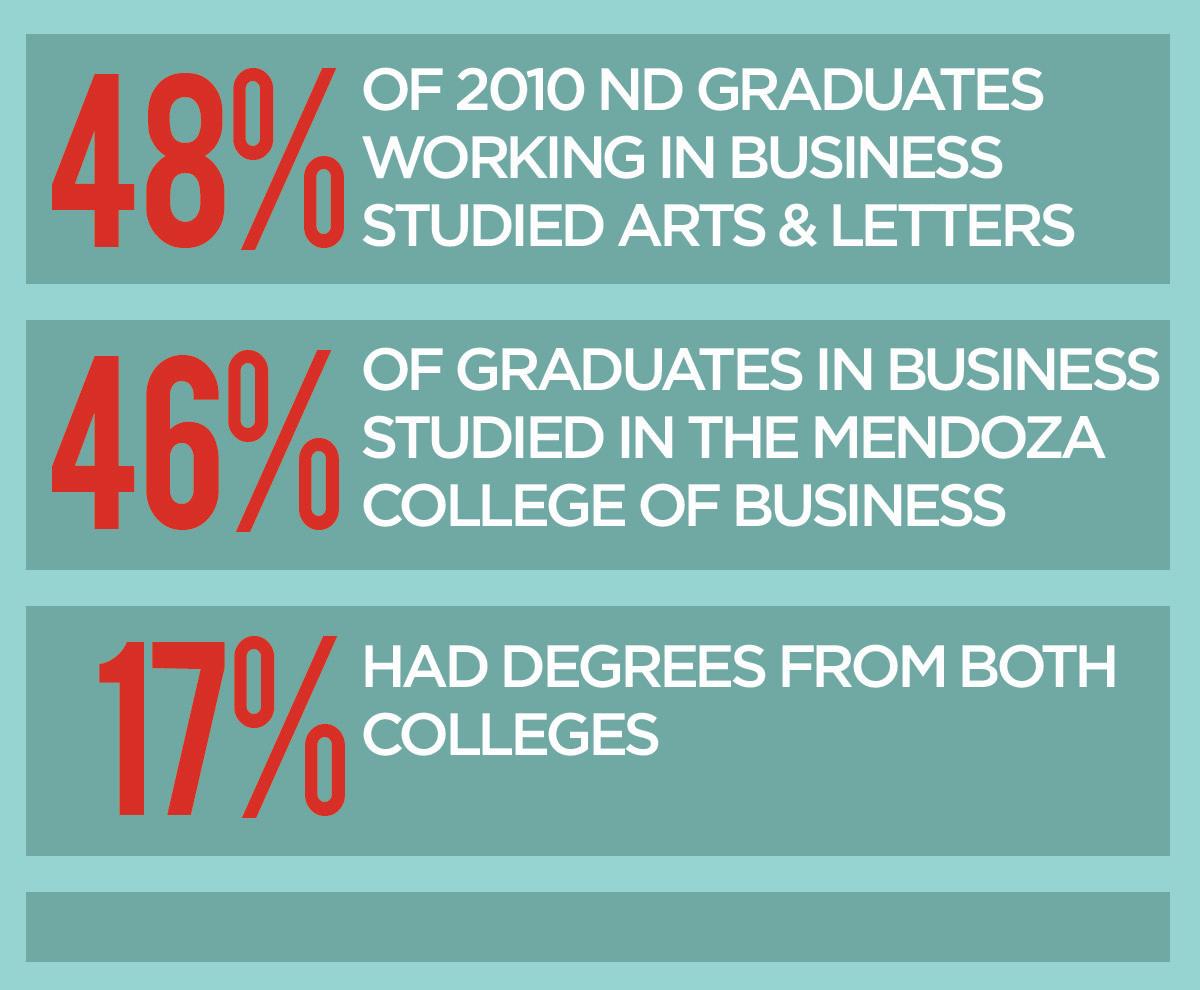
According to the data, 48 percent of 2010 Notre Dame graduates working in the business world hailed from the College of Arts and Letters, versus 46 percent from programs in the Mendoza College of Business, Gainer said. 17 percent of graduates working in business had degrees from both colleges.
Of the graduates working in the top-six consulting firms in the country, Gainer said 43 percent had Arts and Letters degrees, compared to the 40 percent who were business majors. Additionally, every Notre Dame student offered a position at BCG was from either Arts and Letters or the College of Engineering, Gainer said.
Since some of the country’s most elite institutions do not offer undergraduate business programs, Stanfiel said the notion that a business degree is necessary for success in the business world does not carry much weight.
fun of their faculty that have been lecturing at them and in some cases make fun of themselves,” he said.
Stanisic said he hopes the game will pave the way for the formation of an intercollegiate mechatronic football league.
“We’ve played this game Blue vs. Gold for three years. Last year, we invited Ohio Northern
“It would be very odd to tell someone at Harvard, Princeton, Yale or Stanford that you have to have a business degree to get a good job,” he said. “Notre Dame is an elite university in the company of those places, and the sort of person that comes here is coming from the top one percent of students.”
Stanfiel said Notre Dame students have a unique advantage in the pool of newly-graduated job applicants due to the resources available through the Career Center and Arts and Letters. This contributes to the low unemployment rate of Arts and Letters graduates: two percent.
“Practical experience would be favorable to have going into a job, so we promote internships and provide funding for students who take unpaid internships,” he said. “Between the outstanding education of Arts and Letters and other opportunities, graduates are going to find themselves very well prepared.”
According to the data, Arts and Letters graduates have also been successful in securing jobs in the public sector. 66 percent of 2010 graduates working for the Central Intelligence Agency came from Arts and Letters backgrounds, and 55 percent of students working in other federal government positions were Arts and Letters majors. Just under half of those Arts and Letters graduates working for the federal government were political science majors.
Additionally, 95 percent of Notre Dame students who obtain prestigious fellowships, such as the Fulbright and Rhodes scholarships, hail from Arts and Letters.
Gainer and other students said a liberal arts education at Notre Dame provides students with critical thinking and communication skills valued in almost every work environment.
“Arts and Letters was huge in the interview process, because I was able to take non-business experiences and show their value in business situations,” Gainer said. “My experience working to help establish farming cooperatives in rural India was probably the biggest rea-
to build three players and play on the Gold squad,” Stanisic said. “We have representatives coming from two or three other schools to see the game, and then the hope is that we can establish a league and get sponsorship by a professional society.”
Contact aubrey Butts at abutts@nd.edu
son I got a job.”
Senior Graham Thomas said his experience as a Program of Liberal Studies (PLS) major prepared him well for past internships, and helped him secure a job with BCG following graduation.
“The practice in oral communication provided by discussionbased seminars and oral final exams, a staple of the PLS Great Books seminars, sharpens a student’s ability to think quickly on the spot and to eloquently articulate ideas,” he said. “This skill has made me more effective in my internships when working on teams and attending business meetings, and it was crucial to my success when interviewing for jobs this past fall.”
Senior Christine Fagan, a double major in English and Film, Television and Theatre (FTT) who will be working as a project manager for the healthcare software company Epic Systems after graduation, said her undergraduate experience provided her with the skills necessary for success in any job.
“My role as a student worker in two FTT jobs helped me work with other people to achieve goals and manage projects and my time,” she said. “My English major has helped me organize my thoughts before beginning a project, so I think having a liberal arts double major has led me to be more well-rounded and learn a lot of business-related skills in an environment I enjoyed more ⎯ in theater and in writing.”
The success of liberal arts students in the business world speaks to the type of student Notre Dame attracts and the core identity of the University, Stanfiel said.
“If you take a group of incredibly talented people and give them a Notre Dame liberal arts education, we in the College of Arts and Letters feel like that’s the best type of education to have,” he said. “Specific technological knowledge can be learned on the job, but learning how to think and write takes an investment of years and can’t be learned on the job.”
Contact Kristen Durbin at kdurbin@nd.edu
Photo courtesy of wes wevard
The kick returner for the mechatronic football team will play tonight in the first intercollegiate robot football game.
Students create own social network site
By ABI HOVERMAN News Writer
Planning the weekend just became a little bit easier with Inkle, a social networking site developed to coordinate college students’ evening events. Seniors Chad Heise and Jacob Wenger, both computer science majors, launched inkleit.com in February for Notre Dame, Saint Mary’s and Holy Cross students.
“People want to go and do things with their friends,” Heise said. “It’s about finding out what your larger group of friends is doing and putting it together in one place so that you can easily make decisions and plans on any given night.”
Heise said the frustrations of organizing the pair’s weekly “Trivia Night” at local restaurant Between the Buns served as inspiration for the website. They wanted a better tool for inviting friends to events than email, which resulted in a full inbox of “Yes” or “No” responses.
“Whenever we wanted to do something, we sent out mass texts or emails … We realized it was a really clunky, complicated way to organize events,” he said.
Students who open an Inkle account can post their plans for “Dinner”, “Pregame” and a “Main Event,” with drop-down options of local restaurants, bars, dorms and dining halls. Other users can be invited after an event is “inkled,” and only accepted followers can view the plans. Friends’ “inkles” can also be organized into “blots,” like a trivia group or dorm friends.
“We didn’t want to make another social network that did something we already had [access to],” Wenger said. “You won’t make a Facebook event to go to the dining hall or Between the Buns, but you will do that on Inkle,” Wenger said.
Although Inkle has a layout to organize weekend plans around parties, Heise and Wenger said the site helps the coordination of everyday events as well.
“We want to make it clear it’s not just for going out,” Heise said. “This is also useful if you want to get a group together to go to dinner, or if you want to go to the soccer or basketball game.”
Inkle’s creators said privacy is a priority, since students may not want their evening plans to be
continued from page 1
greater sense of loyalty to the institutions of nation states than to those institutions, which you establish to manage the sovereignty which their governments are prepared to share,” he said.
Patten noted emerging economies make up 30 percent of global gross domestic product. India’s rapid economic expansion has allowed the nation to become a world leader in international commercial markets.
However, the growing nation’s weak infrastructure, corrupt upper levels of government and profound social inequity will prevent it from advancing, Patten said.
“So, India remains an exciting country… but I don’t believe that India is going to be a superpower,” he said.
MARINA KOZAK Observer Graphic
accessible on the Internet. They said Inkle uses a “following” and “followers” system, similar to Twitter, so only accepted followers can view Inkles.
“It’s not information you want the world to know … [so if a request to follow is] declined, I can’t see anything about where you’re going,” Heise said.
Inspired by Twitter’s unique terminology, Heise said the pair thought of the name Inkle, which has its roots in the word “inkling.”
“If you don’t know what your plans are, you have an inkling of what your friends are doing. The site takes those possibilities and allows you to make definite plans,” Heise said.
Heise said both he and Wenger are drawn to entrepreneurial careers. He said they created the site with skills learned in computer science classes.
“It’s all original code. We were able to set up pages and do the code ourselves,” Heise said.
After working on the site during the fall, the two launched Inkle in February. Heise said they use their friends’ feedback and advice to make improvements to the site.
“Initially, it started out well among our group of friends,” Heise said. “ We took feedback from them and were able to modify and tweak it to the stable version we have now.”
The pair is also developing an Inkle mobile app, which they hope to release soon.
“We think it’s going to increase usage of Inkle,” Wenger said. “If you go to a party off-campus, and then you’re going to a bar, but you don’t know which one [beforehand], you want to let people know of your plans, but you don’t have your computer on you.”
Wenger said he and Heise plan to continue the expansion of Inkle after graduation, while working software development jobs on the West Coast.
“We’re both graduating this year and we’ll both be in Seattle, so we’re thinking of launching it at the University of Washington, although of course we’ll continue to think of Notre Dame,” Wenger said. “We realize there are still developments we can make to make a better product.”
Contact a bi Hoverman at ahoverman@nd.edu
Patten noted China is the world’s largest manufacturer, exporter and consumer of energy. He said four problems plague China, which will determine the course of its future success.
“First of all, it has a problem of reshaping its economy from one which is largely based on the manufacturing industry and the export of goods more cheaply than the West can make them, to an economy in which there is more domestic consumption and investment,” he said.
Patten said the nation’s major environmental problems and high level of social inequity also presents issues.
This contributes to the growing problem of trust
the Chinese people have in their government, he said.
Patten said China faces the dilemma of balancing state and private control of institutions.
”China doing badly [though] would be a threat to the rest of the world, and would be a serious threat to our quality of life and to our stability,” Patten said.
Ultimately, Patten said the world is in a period of great flux and its future is uncertain.
“[It] is less predictable
than it’s been at any time in my political lifetime. Which is I guess an argument for us hanging on to the values which we know are important,” Patten said. “If we can be more effective and coherent about making those work in our own societies, maybe we’ll carry more conviction when we argue that other people should run their affairs like that as well.”
Contact Maija Gustin at mgustin@nd.edu
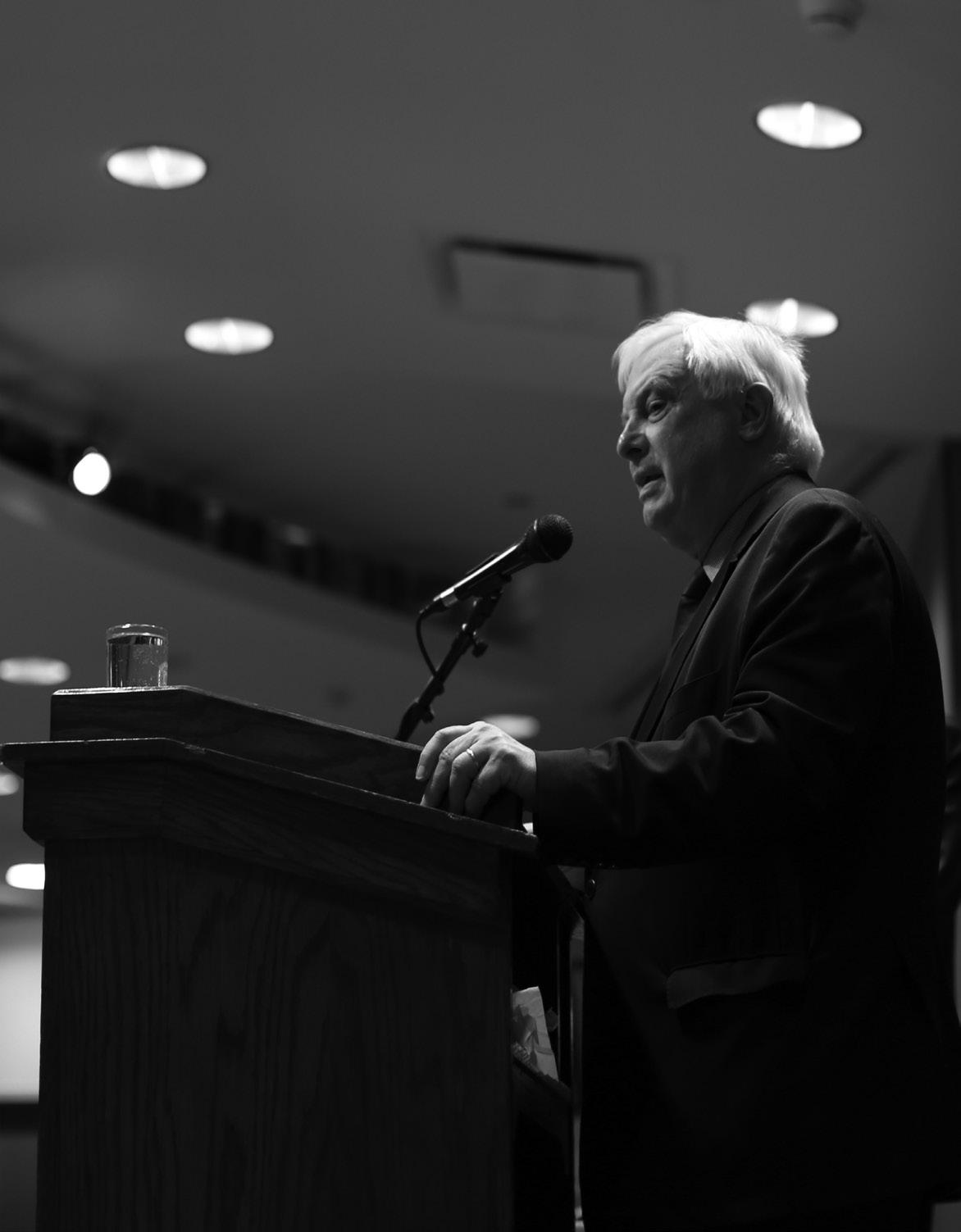
Lord Chris Patten of Barnes discussed the tension between global superpowers and rising nations on Thursday in Geddes Hall.
Cruise ship ignores 3 stranded fishermen
Associated Press
RIO HATO, Panama — A Panamanian man and his two friends had been drifting for 16 days in an open fishing boat in the Pacific Ocean when they saw a huge white ship. They would be saved, they thought, and Adrian Vasquez began waving a dark red sweater.
Birdwatchers with powerful spotting scopes on the promenade deck of the luxury cruise ship Star Princess saw a little boat adrift miles away. They told ship staff about the man desperately waving a red cloth.
The cruise ship didn’t stop, and the fishing boat drifted another two weeks before it was found. By then, Vasquez’s two friends had died.
On Thursday, Princess Cruises, based in Santa Clarita, Calif., said a preliminary investigation showed that passengers’ reports that they had spotted a boat in distress never made it to Capt. Edward Perrin or the officer on duty. If it did, the company said, the captain and crew would have altered course to rescue the men, just as the cruise line has done more than 30 times in the last 10 years. The company expressed sympathy for the men and their families.
On Feb. 24, the three men set out for a day of fishing from Rio Hato, the site of a former U.S. Army base guarding the Panama Canal on the Pacific Coast. They were on their way back, happy with their catch, when the motor died.
Vasquez recalled seeing the ship — “It was big. It was white.” — on the morning of March 10.
Vasquez remembered jumping up and waving the sweater. He raised it over his head, dropped it down to his knees, over and over and over. Though near death, Elvis Oropeza Betancourt, 31, joined in, waving an orange life jacket.
“’Tio, look what’s coming
over there,’” Vasquez recalled saying.
“We felt happy, because we thought they were coming to rescue us,” he said.
Birdwatcher Jeff Gilligan from Portland, Ore., was the first to spot the boat, something white that looked like a house.
When Judy Meredith of Bend, Ore., looked through her scope, she could plainly see it was a small open boat, like the kinds they had seen off Ecuador. And she could see a man waving what looked like a dark red T-shirt.
“You don’t wave a shirt like that just to be friendly,” Meredith said. “He was desperate to get our attention.”
Barred from going to the bridge herself to notify the ship’s officers, Meredith said she told a Princess Cruises sales representative what they had seen, and he assured her he passed the news on to crew.
The birdwatchers said they even put the representative on one of the spotting scopes so he could see for himself.
Meredith went to her cabin and noted their coordinates from a TV feed from the ship, booted up her laptop and emailed the U.S. Coast Guard what she had seen. She said she hoped someone would get the message and help.
She sent a copy to her son. When she returned to the promenade deck, she could still see the boat.
But nothing happened. The ship kept going. And the little boat with the waving men disappeared.
“It was very disturbing,” he said. “We asked other people, ‘What do you think we should do?’ Their reaction was: ‘Well, you’ve done what you could do.’ Whether something else could have been done, that’s a bit frustrating to think about.”
The company said in an email that the investigation was continuing.
continued from page 1
began the night at 7 p.m. at Lake Marian on Saint Mary’s campus, followed by a walk to Notre Dame’s campus. There, participants shared their experiences at a “Speak Out,” and gathered together for a hospitality and music afterwards.
“The kickoff at Saint Mary’s provided a space to gather as a community and walk in solidarity to Notre Dame together as one,” Adams said. “As a women’s institution, it is essential that we offer ways to break the silence which often surrounds sexual violence.”
Adams said a strong component of TBTN is solidarity. It is logical for the deeplyintertwined communities of Saint Mary’s College and the University of Notre Dame to stand together against vio -
lence and support survivors, she said.
“A primary purpose of our offices is to implement programming to reduce and address sexual violence,” Adams said.
TBTN also allows Saint Mary’s and Notre Dame to embrace Catholic social teaching by recognizing the dignity of the human person and encouraging solidarity, Adams said.
“The primary aim of the event is to offer a space for survivors of sexual assault to have a voice, to shine their light into the darkness of violence,” she said. “However, it is critical for all members of our community to support those impacted by violence and to have a presence showing our commitment to prevent this violence from happening in our community.
“I hope students are empowered through their participation and recognize that
our community is dedicated to eliminating violence.”
According to the Rape, Abuse and Incest Network, the issues of sexual assault, relationship violence and stalking impact college-age women at disproportionately higher rates than other demographics. National statistics indicate one out of every six women will be sexually assaulted during their lifetime. College-aged women are four times more likely to be sexually assaulted, and 60 percent of sexual assaults go unreported, Adams said. “If violence exists, regardless of the frequency, the need to raise awareness and promote action is essential,” Adams said. “We live in a society where violence is an epidemic, and it is our responsibility to create change and to support survivors.”
Contact Jillian Barwick at jbarwi01@saintmarys.edu
Warrant issued for 1980s “mountain man”
Associated Press
HELENA, Mont. — One of the infamous “mountain men” who in the 1980s eluded authorities for five months by living in the wilderness is on the run from the law again — and considered “armed and dangerous.”
The U.S. attorney’s office in Montana has filed federal drug and weapons charges against Dan Nichols, who with his father was convicted in kidnaping a world class athlete in 1984, killing a would-be rescuer and hiding in the remote mountains northwest of Yellowstone National Park.
An indictment unsealed Wednesday alleges Nichols and two other men were involved in a statewide marijuana distribution ring that netted nearly $1.8 million. The news comes as his 81-year-old father, Don, comes up for a parole hearing next week.
Federal marshals said they are now looking for the younger Nichols, who was previously wanted in state court for not appearing earlier this year on relatively minor drug charges filed after his arrest at a rock concert. The new federal charges allege a much larger conspiracy.
“He should definitely be considered armed and dangerous,” said Chief Deputy U.S. Marshal for Montana, Rod Ostermiller.
“He is obviously someone who hasn’t been compliant with law enforcement in the past.”
Ostermiller wouldn’t say whether authorities believe Nichols has taken to the woods again. But he warned the public to be wary of the 5-foot-11, 150-pound Nichols.
“I think there is some definite safety issues involved regarding this individual,” the marshal said. “That is just one thing we can’t stress enough.”
The original, bizarre crime gripped the state and the nation when the father and son abducted world-class biathlete Kari Swenson in 1984 while she was on a training run in the mountains above the resort town of Big Sky. The elder Nichols was reportedly looking for a wife for his then 19-year-old son.
The so-called mountain men had been living continuously in the woods for a year prior to the abduction, growing hidden makeshift gardens, poaching game and generally staying out of sight.
The scheme quickly fell apart when would-be rescuers stumbled upon the camp. In the melee, Dan Nichols accidentally shot Swenson. An armed standoff ensued, and the elder Nichols gunned down Alan Goldstein.
The Nichols evaded capture by living in the Madison Range, until they surrendered when a
Madison County sheriff caught up with them.
Swenson, despite diminished lung capacity from the gunshot wound, went on to win a bronze medal in the world biathlon championships.
The new charges against Nichols include allegations the felon illegally amassed dozens of rifles, assault weapons, pistols, and shotguns while engaged in drug crimes. Christopher Wayne Williams and Christopher Lindsey, two of the five co-founders of the nowshuttered Montana Cannabis statewide medical marijuana operation, are also charged, but they are not on the run.
Drug Enforcement Agency agent Wesley Smith said Thursday at a sentencing of Richard Flor, another Montana Cannabis co-founder, that Nichols worked for Williams at the operation’s Helena marijuana nursery overseeing the care of hundreds of pot plants.
Federal agents raided the nursery as part of a crackdown on medical marijuana operations last year, and Smith said agents found a handgun in the camper that Nichols had been living in next to the nursery. All of the Montana Cannabis co-owners, who also ran the Montana Caregivers Association, have been indicted or pleaded guilty to federal drug charges.
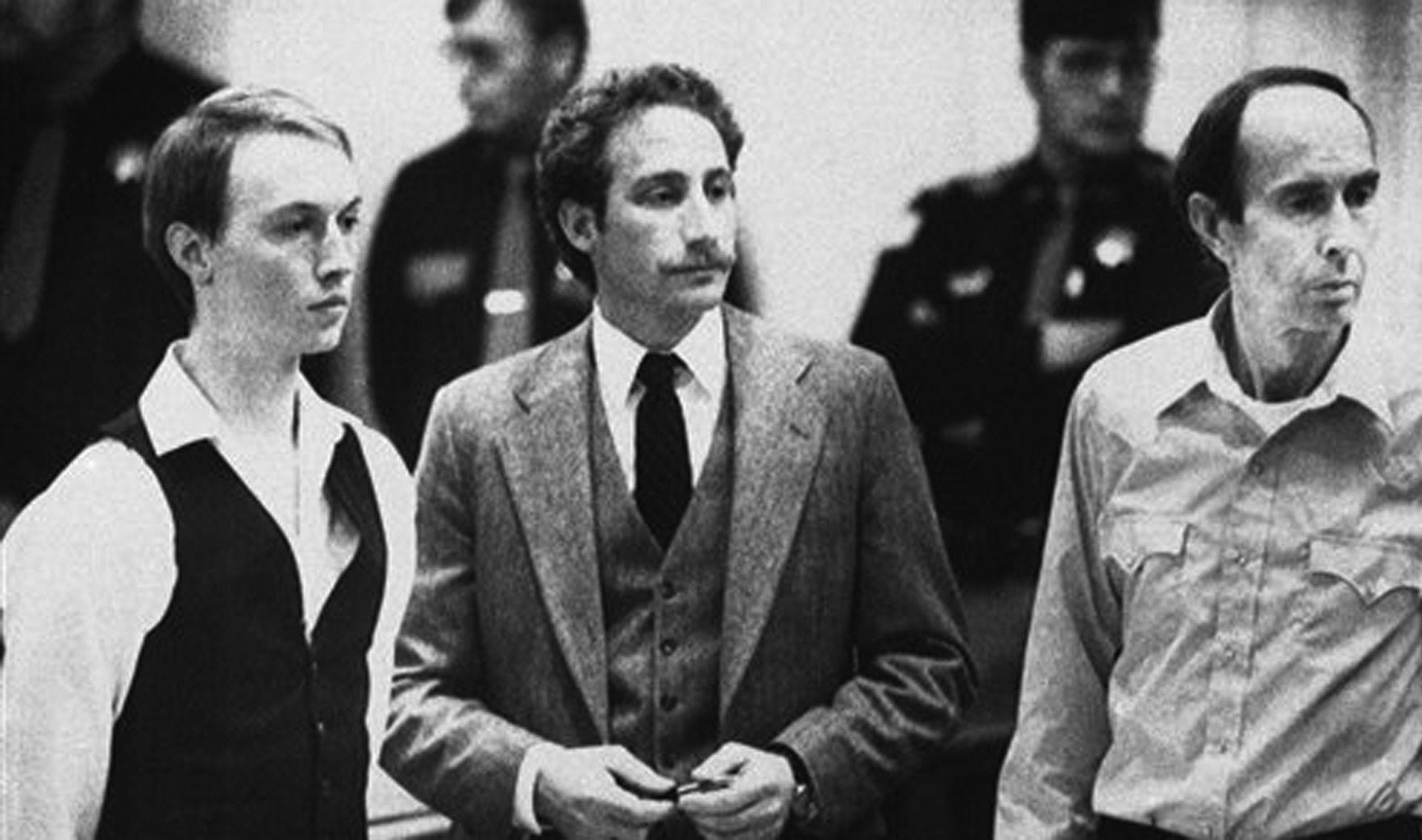
In this De. 1984 file photo, Dan Nichols, left, stands with his father Don Nichols, right, in court. Dan Nichols has a warrant out for his arrest on new charges for drug possession.
Changing journalism
The past week has been eventful for the modern world of journalism.
Keep dorm identity alive
part of dorm culture.
And it isn’t the only time it has done so.
For example, Keenan Hall has experienced more strict censorship during its past two years of its signature event — the Keenan Revue.
On Tuesday, Columbia University announced the winners of the 2012 Pulitzer Prizes, the highest honor in journalism. The next day, the blog Mashable released an intriguing infographic showing how social media is taking over the breakingnews industry from traditional sources. And yesterday, the New York Times Co. and other major media outlets announced firstquarter financial results.
These stories have highlighted the dynamic world of print and online journalism. On one hand, the two Pulitzers and better-thanexpected finances of the New York Times might calm the nerves of those of us who hold onto the hope that traditional journalism isn’t on its deathbed. On the other hand, Pulitzers won by online-only sources like the Huffington Post and POLITICO show that even the academic journalists on the Pulitzer panel acknowledge the changing landscape.
Of course, journalism is still journalism. It still consists of generating engaging story ideas, tracking down sources, synthesizing information, and drafting a coherent written product. But that isn’t to say that some people are better at it than others. Matt Wuerker of POLITICO and David Wood of the Huffington Post — both 2012 Pulitzer winners — are probably best described as bloggers. But just because their work does not regularly appear in print, does that mean that it’s less important?
Mashable reported that over 50% of those polled had learned about major breaking news from Twitter or Facebook before seeing it in traditional news sources. Their analysis of this finding, however, was important. The blog listed four pros and cons to this shift in modern news sources. Cons included compromised journalistic integrity and the ability for false or biased stories to be disseminated quickly without fact checking. This post brings up an intriguing question: What do readers care about more, quality or quickness? Or maybe, just maybe, they can have both.
That’s what the Times is trying to accomplish with its new online presence. So far, it seems to be working. On Thursday, the company released first quarter earnings that exceeded expectations. Its paid digital subscriber count stands at 454,000 — nearly all of which do not subscribe to the print edition. The Times Co. now gets nearly half of its revenue from digital and half from print, according to the Poynter Institute. For those of us entering this tumultuous field, our charge will be to provide readers with our best work as efficiently as possible. That’s a tall order. But if either one is sacrificed — quality or quickness — journalism will indeed be on its deathbed. The mission statement of modern journalists might as well be an amalgamation of the missions of the New York Times, CNN’s NewsPulse, and our own Observer: “All the news that’s fit to print, reported accurately, the way you want it.”
Contact Pat Coveney at pcoveney@nd.edu
The views expressed in the Inside Column are those of the author and not necessarily those of The Observer.
It’s April, and that means the surest rite of spring is in the air — prospective students are visiting campus for tours and information sessions to learn about Notre Dame. Admissions counselors and tour guides are putting on the metaphorical full-court press, telling the harried students and their stressed parents all about the things that make Our Lady’s University so unique — which means dorm life will inevitably come up.
“Dorm life is absolutely unique here,” tour guides will say. “Every dorm has its own culture, its own unique traditions and its own feel.”
That’s true, and we love dorm life at the University. But recently, some of its most unique — and best — aspects have been modified and changed in ways that worry us.
The most recent example, of course, is that of St. Edward’s Hall. While a number of dorms still have lofts, none of them have integrated the wooden structures into a dorm culture quite like St. Ed’s has. The Office of Residence Life and Housing, however, recently informed the Gentlemen of a two-year plan to move every room in the hall to modular furniture, robbing some rooms of the ability to have lofts next year — after room picks, no less. Rather than participating in a communal activity that transforms small rooms into real living spaces, the Gentlemen now have to figure out how to use both the closet in the room and the wardrobe provided with the modular furniture.
Sure, in the grand scheme of things, this doesn’t seem like a particularly big deal. In taking away lofts, though, the University has minimized liability at the expense of a unique
While we understand the University’s reasoning behind these moves, we simply don’t approve of them. To be fair, dorm culture still thrives and greatly contributes to the Notre Dame student experience. We’re not arguing the University has killed everything (or even most things) special about residence life — St. Edward’s still has its famed Yacht Dance, interhall sports still thrive and people still feel connected to their respective dorms. These events just set a bad precedent.
In our view, the University should do a better job of collaboratively finding ways to address its all-too-real concerns, while protecting the very system that makes the Notre Dame undergraduate experience so unique. For example, instead of simply moving to modular furniture, the University could make loft inspection and approval a more thorough process overseen by Risk Management instead of by hall staff. Notre Dame must address these problems in a way that promotes both the University’s pragmatic interests and the culture that has made it so unique.
If the University really wants to showcase its dorm culture to all of the students visiting — and we think it should — then it should find better ways to promote dorm culture. After all, what’s the point of telling a prospective student about an expertly-engineered St. Ed’s loft that won’t exist by the time they get to participate in room picks for the first time?
Quote of the day
“The more you find out about the world, the more opportunities there are to laugh at it.”
Bill Nye
U.S. TV host and “Science Guy”
Pat Coveney Senior Photgrapher
edItorIal Cartoon
Rationality — that is, our reflection upon how things seem to us — allows us to understand the world. In its quest to understand itself, however, rationality is pulled in two contradictory directions — and worse, both directions lead rationality to a position that would undermine whatever understanding it achieves. But let us begin at the beginning.
Dan Sportiello Bound Variables
In the beginning, rationality inherits an arbitrary array of beliefs and desires — a perspective upon how things are and how they should be. These raw materials upon which rationality works are thoroughly conditioned by biology and culture. In our youth, we believe and desire broadly what we do because we were born doing so, or were taught to do so. Rationality, in other words, does not choose the perspective from which it begins — and, to judge from history, the breadth of possible perspectives is broad.
But rationality is not chained to what it inherits: When its beliefs and desires conflict with one another — as, it seems, they inevitably do — rationality can transcend them, reordering them so that, upon reflection, they no longer conflict with one another. It does this by coming to see its inherited beliefs and desires as illusory — as, that is, mere products of the interaction between its limited perspective and how things actually are and should be.
There is no guarantee that rationality will succeed in this task of reflectively reordering its raw materials. Insofar as it does, however, rationality will have rendered its beliefs knowledge and its desires justice — will have, that is, come to a new perspective on how things are and how they should be. This new perspective will be justified — will, that is, give reasons that things ever seemed otherwise.
To call them knowledge and justice assumes, of course, that rational-
letters to the edItor
Constraint
ity’s reordered beliefs and desires are, respectively, true and right — that they will not, that is, conflict with the beliefs and desires to which rationality’s newly transcendent perspective gives rise. In case they do — as, it seems, they inevitably do — rationality must transcend them also. It must take its theory and ethics — that is, its reordered beliefs and desires, respectively — and reorder them in turn. Rationality must, in other words, come to see its new beliefs and desires as illusory, just as it came to see its original beliefs and desires as illusory.
There need be, in principle, no limit to this process. There is, however, an obvious condition upon it: Whatever theory and ethics rationality yields must not conflict with rationality itself. On the one hand, any theory must explain rationality’s past activity — must, that is, give reasons to believe that rationality has approached knowledge and justice; on the other hand, any ethics must value rationality’s future activity — must, that is, give reasons to desire the further pursuit of knowledge and justice.
And thus rationality comes, at last, to Kant. Though its theory and its ethics might threaten to diverge in any number of directions — for the same beliefs and desires can be reordered in any number of ways — said theory and said ethics must converge, at least, upon the explanation and the value, respectively, of the reordering itself. In its quest to understand itself, in other words, rationality is ever drawn to build its foundation upon its own activity: Such is the only foundation, Kant insists, that cannot be shaken.
The problem is that transcendental idealism — that is, Kant’s foundation — turns out to be no foundation at all. For among the inheritance that rationality can reorder is its own method of reordering. What it means for beliefs and desires to conflict with one another is itself something that rationality can change — and, to judge from history, the number of times when it has done so is large indeed. There seem to be no limits as to
Breaking traditions, board by board
One of my fondest memories of Frosh-O was waking up that Sunday morning to unload a truck. On second thought, maybe not my fondest memory. But it nevertheless has stuck in my mind.
That morning, an 18-wheeler rolled into the parking lot behind St. Edward’s. The older Gentlemen woke the freshmen up, and we gathered at the doors of the trailer. As they opened it, we were astonished to see it fully-packed with wood. We were instructed to unload the contents of the truck, as it was the lumber that would make up all of the lofts in St. Edward’s for the year. Then the older Gentlemen proceeded to kick back on couches they had brought outside, watching us work while the sunrise gleamed off the Dome. More than anything, unloading a truck with the rest of the freshmen fostered a sense of brotherhood among us. We participated in myriad awkward and cliché team building exercises during FroshO, but this one felt natural, productive, and was absolutely more effective than the planned ones.
Unloading the truck is one of the traditions that the Gentlemen of St. Edward’s partake in every year. Now, that tradition is being stripped away because the Office of Residence Life and Housing (ORLH) won’t allow lofts for freshmen next year. By August 2013, no Stedsmen will be allowed to loft. And if you don’t think this affects you, keep in mind that per ORLH’s plan, no dorms will be allowed to have lofts in a few years.
Traditions are something that our University holds dear. We won’t be able to foster brotherhood with the freshmen as well next year, because we won’t be helping them build their lofts. I won’t be able to sit on a couch Sunday morning this August to playfully tease the freshmen as they unload the trailer. And what about all the alumni who lived in St. Edward’s that would undoubtedly be upset if they heard this news? A part of St. Edward’s will die if ORLH has its way. And by extension, one of Notre Dame’s traditions will die as well.
David Dziedzic freshman St. Edward’s Hall April 19
how far rationality can, given enough time, reorder its own activity — and so the mere fact of reordering turns out to be a constraint upon neither theory nor ethics. No matter how thoroughly rationality reorders its inheritance, it has no reason to suspect that it converges upon where it would have arrived had its inheritance been different — that it converges, in other words, upon truth and righteousness.
In the end, then, rationality finds itself, just as it did in the beginning, with an arbitrary array of beliefs and desires. But for rationality to admit the arbitrariness of its beliefs and desires is for it to surrender as empty the criteria of truth and righteousness. Since every theory and every ethics is the result of reordering some arbitrary perspective — and every method of reordering is itself arbitrary — rationality has no reason to suspect that it will ever converge upon a perspective within which there will be no further conflict. In a sense, then, all beliefs and desires are illusory — which is just to say, of course, that none are.
And thus rationality comes, at last, to Rorty: If it is to believe in and value the arbitrariness of its theory and its ethics, then rationality must reorder its beliefs and desires to yield a theory and an ethics from which truth and righteousness are absent. In its quest to understand itself, in other words, rationality is ever drawn to build its foundation upon nothing at all: Such is the only foundation, Rorty insists, that cannot be shaken.
The problem is that ironism — that is, Rorty’s foundation — turns out to be no foundation at all. For if there is, ultimately, neither truth nor justice, then no particular beliefs and desires are, ultimately, justified: There is no reason to believe or desire anything rather than its contradiction. And there is no reason, therefore, to believe with Rorty that rationality should seek a theory and an ethics from which truth and righteousness are absent — or, for that matter, to believe any of the narrative that led
him to that conclusion. To his credit — or something like it — Rorty admits as much. Though this does nothing to help his case.
To say that rationality is left in a difficult position is an understatement: it cannot build its foundation upon either transcendental idealism or ironism, much less both at once — and yet it seems that it has reason to move toward both. For rationality should believe in and value both its ability to transcend its inheritance and its admission that it can never fully do so. Is there a way, however, for it to respect both of these without collapsing fully into either? Is there a foundation for rationality that is not at war with itself?
Such a foundation would have to admit the ability of rationality to reorder and thus transcend any particular array of beliefs and desires, but would also have to limit the ability of rationality to reorder its own method of reordering. Moreover, it would have to have faith in itself — would, that is, have to understand this relative limitation upon its transcendence of itself not as a weakness but rather as a strength. It would have to believe in and value the ability of its relatively fixed method of reordering to converge upon a perspective within which there will be no further conflict. Rationality would have to have faith, in other words, that its seemingly arbitrary method of reordering beliefs and desires is not, in fact, arbitrary at all — that it is, rather, precisely what is necessary in order to achieve knowledge and justice. But this would just be to reconstruct the teleology that Socrates, Plato, and Aristotle had not yet thought to question — that is, to have faith in a human nature fundamentally oriented toward truth and goodness.
Daniel John Sportiello is in his fourth year in the philosophy Ph.D. program. He can be reached at dsportie@nd.edu The views expressed in this column are those of the author and not necessarily those of The Observer.
Holy Votes response
Professor Rosato’s letter, “Holy Votes correction for Democratic platform” (April 15), regarding the freedom of Catholics to vote for pro-abortion candidates, while correct in the most arcane, technical sense, is nevertheless seriously flawed. He does a splendid job of almost completely reversing the meaning intended by Cardinal Ratzinger in The Congregation of the Doctrine of the Faith’s “Worthiness to Receive Holy Communion: General Principles.” This document was intended to put Catholic politicians on notice that they could not consign their faith to the strictlyprivate sphere, and thereby vote for and promote laws that allow for abortion. By doing so, these politicians would cooperate formally in moral evil, and be therefore unworthy to receive Holy Communion.
While this document references that one who votes for a pro-abortion candidate, despite his pro-abortion stance, does not formally cooperate with evil, he or she still does in fact cooperate with evil, but in a remotely material way. And this “can be permitted in the presence of proportionate reasons.” This would seem to refer to an unfortunate circumstance when a faithful Catholic would be forced to choose between two or more pro-abortion candidates, when no pro-life candidate was available. It is highly tendentious to assume, as Professor Rosato does, that this gives the Catholic faithful license to vote for a pro-abortion candidate when there is a pro-life alternative, let alone support
unreservedly a manifestly pro-abortion platform of a political party, like that of the Democratic Party.
It would be instructive to learn what contents Professor Rosato discerns in the emanations of the penumbras of the Democratic platform, which are proportionate to balance an unfettered right to abortion on demand. Improved school lunch programs for inner city youth? Guaranteed union scale wages for all federal contract workers? “Free” government health care services for all?
The students, faculty and alumni of Notre Dame deserve to hear the words of John Paul II’s evangelical “Evangelium Vitae” preached from every chapel and taught in every lecture hall on campus: All Catholics have a “grave and clear obligation to oppose” any law that attacks human life.
In the Doctrinal Note “The Participation of Catholics in Political Life” the current Pope, writing in 2002 as Prefect of the Congregation of the Faith, warns “a well-formed Christian conscience does not permit one to vote for a political program or an individual law which contradicts the fundamental contents of faith and morals.” Professor Rosato would do well to heed this advice and cease to carry water for politicians or political parties that promote a Culture of Death.
Mark Diamond
By PATRICK MCMANUS Scene Writer
South Bend is about to have a case of the blues.
This weekend, the Blue Man Group will be performing at the Morris Performing Arts Center.
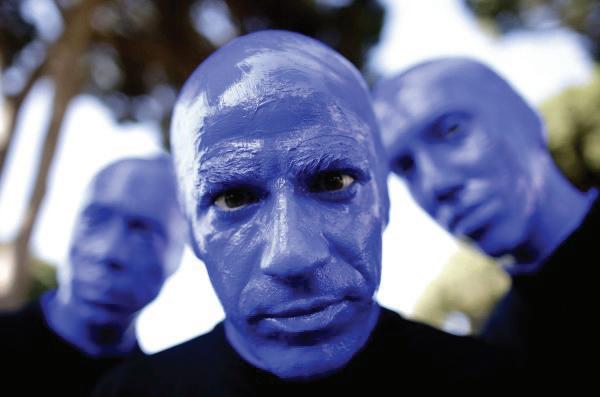
The act is a performanceart troupe, whose theatrical shows include live music on conventional and invented instruments, slapstick comedy and multimedia elements.
The show features three men in bald caps, painted completely blue, who do not speak. The show has taken a variety of forms over the years, but it is always an entirely unique experience in the world of theatre.
Section,” and ponchos are provided in case paint used onstage winds up in the audience.
Today, there are more than 70 Blue Men in a dozen shows around the globe. They perform in New York, Chicago and Las Vegas, as well as Boston, Orlando, Berlin and Tokyo. Another group is currently performing on Norwegian Cruise Line.
In fact, it is an experience so unique, trying to articulate its elements is hardly worthwhile. The Blue Man Group’s theatrical performance is centered on character acting. It is rumored members of the Blue Man Group do not break character, even after a performance is over.
Though the setup behind the Blue Man Group is unique and their many shows vary, it may be telling that the area closest to the stage is called the “Poncho
The Blue Man Groups’ international reach is a far cry from their origins as a ragtag group of avant-garde performers, working out of small New York City venues in the early 1990s. Since the group opened an off-Broadway show in 1991, 17 million people have seen them perform, they have won a Drama Desk award, been nominated for a Grammy, appeared on “The Tonight Show” and done a series of Intel commercials.
One humorous way many people have been introduced to the Blue Man Group is through the sitcom “Arrested Development.” The character Tobias Fünke mistakes the performance troupe for a therapy group
for sad men. Upon realizing his mistake, he decides to become a standby understudy. In the role he often paints himself blue, despite not formally being part of the group. This enables him to make inappropriate jokes about his role in the group.
Beyond all the mess and frivolity of a Blue Man Group show, the spectacle is meant to address certain themes. As one of the group’s founders, Matt Goldman, has said, “The Blue Man character is about universal human truths. When we got bald and blue for the first time, we knew instantly that we were on to something really special.”
One theme the Blue Men address involves the idea of the outsider, which is why Blue Men always appear in groups of three ¾ the smallest number that enables one to be an outsider. Much of the pathos of the performances comes from the empowerment of one person being singled out from the group. The Blue Men also play with themes of innocence and naiveté, especially in regard to technology and pop culture.
The Blue Man Group will be performing at the Morris Performing Arts Center tonight at 8 p.m, Saturday at 2 p.m. and 8 p.m., and Sunday at 2 p.m. and 7 p.m. If you are looking to see a unique and engaging piece of performance art, you should definitely consider checking out the Blue Man Group.
Contact Patrick McManus at pmcmanu1@nd.edu
By MEGHAN THOMASSEN Scene Writer
As the lights dimmed in the Morris Performing Arts Center this Wednesday, the audience didn’t hear the usual announcement to turn off and stow away their cell phones.
Daniel Tosh of the Comedy Central show “Tosh.0” is known for his strong Twitter presence. The social media outlet is an integral part of his satiric show, airing Tuesday nights at 10 p.m.
Cell phones flashed after Kyle Kinane’s opening act, as Tosh walked onstage toting his two dogs, which he takes with him on tour.
Throughout Wednesday’s performance, audience members tweeted responses to Tosh’s performance using #tosh. The technology takeover did not, however, stop the audience from vocalizing their approval once the jokes started rolling in.
“So, people kept asking me why I came here,” was all Tosh had to say to get the night rolling on what promised to be a groan-inducing run.
Sophomore Connor Sorensen said he saw the show because he thought it would be an enjoyable thing to do during the week.
“Tosh is a pretty fun guy, so I thought I might as well take the opportunity,” he said.
racism, relationship issues, religious intolerance and obesity.
Despite the audacity of the content, the audience roared with laughter.
“I liked the religious jokes,” said sophomore Katie
Tosh is known for his signature irreverent jokes, paired with a snarky smile. Jokes Wednesday night targeted sensitive issues such as abortion, terrorism,
For some students, Tosh.0 is part of their traditional dorm life.
“It’s hilarious, we’ve been watching it every week since last year with our friends,” said sophomore Matthew Jewell. “It’s ‘Tosh Tuesday.’”
When it came to inappropriate jokes, Tosh left no stone unturned.
His comedic style involves blatantly alienating his audience, then turning around and criticizing them for feeling estranged.
“I’ve got to loosen you guys up,” Tosh said into the microphone after cracking a joke. “Otherwise, you’re going to be in for a long night.”
Tosh expects his audience to understand his sense of humor, or learn to laugh along with him — and fast.
“If there are any of you people out there who have ever thought, ‘There’s nothing funny about blank,’ then I hate you,” he said.
While Tosh certainly took a few shots at Notre Dame (“Notre Dame will never be relevant,” he said), students said they expected more material related to the University.
“I thought it was funny, but he didn’t do as much Notre Dame stuff as I thought he would,” sophomore James Peterson said.
Although Tosh touches on hot-button issues, such as the election, with lowbrow humor, such as red-neck behavior, he does it all with a satiric grin that could charm just about anyone.
Plus, his self-promotional tendencies are overdone to the point of being self-deprecating.
Overall, Tosh was unwilling to tone down his racy sense of humor for the largely-Notre Dame audience, and was his usually entertaining, rakish self.
Contact Meghan t homassen at mthomass@nd.edu
Nunn.
AP
Members of the Blue Man Group are known for their signature bald heads and blue paint.
AP Ponchos are distributed in certain areas of the theater to prevent paint splatter on audience members.
Comedy Central’s Daniel Tosh brought his snarky sense of humor to South Bend on April 18. Photo
“They say that time changes things, but you actually have to change them yourself.” − Andy Warhol.
“Fashion is not something that exists only in dresses. Fashion is in the sky, in the street; fashion has to do with ideas, the way we live, what is happening.” − Coco Chanel.
The first time I heard of the sustainability movement, darlings, was when I read an article a few years back about the dear Mr. Leonardo DiCaprio’s dedication to counting his carbon footprint. “What was that?” I wondered. A new type of impression, left by an avant-garde footwear design I had yet to make my own? Yes, I know—lovely naïveté. Or maybe not.
As a six-year old, I remember my first grade teacher insisting we watch a short animated film about wasting water. In it, a little girl brushed her teeth vigorously while letting the sink water run. Unbeknownst to her, the water from her sink was draining the little pond outside the window where a charming goldfish lived. Soon, he was out of breath, and almost left for dead. Of course, you can imagine my six-year-old fashionista shock. I immediately ran home, and insisted on turning off the water every time I brushed my teeth— even for five seconds!
While my commitment to this act of environmentalism has waned over the years, that beautifully orange fish still captures my attention. Waste can often be a word too easily uttered in our daily nonverbal vocabulary.
Indeed, even if we buy a designer leather bag and keep it forever, “focusing on fashion can feel like a wastefully elite thing, a waste of money. But fashion is not about spending, it’s about finding,” senior Jillian Stinchcomb, organizer of the Green Fashion Show, said.
As this column is always proud to emphasize, fashion is a nonverbal, visual language that mediates relationships and our self-understanding. This discovery can happen anywhere—in a luxury boutique, a vintage store, in a museum or in Goodwill. I myself admit to scrounging thrift stores (my
particular favorite: the wonderful It’s A Wrap in Los Angeles) for amazing vintage. Don’t knock it dears— if you had found the caramel suede clutch and white Patrizia Pepe dress for the price I did, you would have expired from happiness—as I almost did on the spot!
In fact, our own imaginative and resourceful ways of finding our definitive style often sustains us through many life challenges. Now that’s sustainable fashion.
It is this sustainable fashion that the Green Fashion Show, sponsored by GreeND, seeks to emphasize. The production of textiles has always been an important part of sustainable fashion. The use of materials including organic cotton, tencel, hemp and deadstock silks has defined the movement.
Awareness is what this year’s Fashion Show seeks to emphasize.
“[It’s] awareness that students can make a conscious choice through the clothes they wear, and that sustainable fashion doesn’t have to look like something recycled,” sophomore event organizer Nathalia Silvestre said.
Sustainable fashion, as it turns out, is an industry.
By including both celebrity and student designers, the Fashion Show combines the individuality sustainable fashion can foster with the greater macrocosm of the fashion industry.
LAVUK, an ecofriendly brand based in Los Angeles, is one of the celebrity design houses that will showcase their designs this year.
Their clothing is sweatshop-free and made locally with the aforementioned sustainable materials. They also plant a tree for every purchase through the California Wildfire ReLeaf Program. Further, LAVUK is an alum of New York Fashion
Week. Who needs Anna Wintour’s Vogue pass when Fashion Week’s goods are delivered straight to your door?
Other high profile designers include Auralís, Vaute Couture from New York and Laboratório Fashion, which creates beautiful accessories out of reused Coke cans.
Freshman Alyssa Hummel is one of the premiere student-designers of the show. She says her interest in fashion sustainability stems from the fact that “many fashion trends are cyclical and come back in style, so it seems worthwhile to invest in recycling clothes.”
Hummel emphasizes the ease with which you can change and revamp an ensemble.
“Sewing skills can come in handy if I just want to add buttons, hem something or change the seams,” Hummel said.
Her fellow Notre Dame students will model her designs, a mix of vintage items with her own detailed innovations, on the runway at the Green Fashion Show.
“I like how I can have control over the piece, rather than just picking out clothing that’s in style.
Sometimes you have to see the clothing as a workable piece and be creative with it, rather than just take it as is,” Hummel shared.
There is no such thing as apathy when it comes to fashion, dearest readers.
Even the academic, who states he cares not for these perceived trappings of an avant-garde commercial elite, makes a statement in his disheveled tie and elbow-patched jacket.
The recent green movement calls us to be responsible citizens of the world—to realize exactly how much what we put on our bodies actually impacts the workings of our world.
Like the goldfish in the pond, who knows what can be affected by a wasteful consumption of textiles and clothing items?
The Green Fashion Show will show us that contrary to what that all-important economist Thorstein Veblen once said, conspicuous consumption isn’t the defining aspect of fashion, conspicuous sustainability is.
The Green Fashion Show is sponsored by GreeND. It will take place in the LaFortune Ballroom on Sunday at 4 p.m. The suggested donation is $5.
Freshmen Morgan Hankamer and Kate Geppert model Alyssa Hummel’s sustainable designs.
Freshman designer Alyssa Hummel will display her clothing in the Green Fashion Show.
Photo courtesy of lavuk.com
Photo courtesy of Alyssa Hummel
Photo courtesy of Alyssa Hummel
Photo courtesy of lavuk.com
Playoffs represent best and worst of hockey
Playoff Hockey.
Two words, but around this time of year they’re used almost ubiquitously in NHL locker rooms to describe the emotion, suspense, physicality and general craziness that comes with the territory in the Stanley Cup Playoffs.
Oft-injured superstar Sidney Crosby coming back and scoring the first goal of the playoffs?
That’s Playoff Hockey.
Jack Hefferon Sports Writer
Coyotes goalie Mike Smith getting checked to the ice behind the net, with the Blackhawks accusing him of diving? Typical Playoff Hockey. Panes of glass falling on Bruins, one too many pucks on the ice during play, Gatorade jugs being tossed in rage and all the other insane occurrences we’ve seen so far? Only in Playoff Hockey.
Overtime? You bet. Nothing may be more closely associated with the playoffs than sudden-death overtime, where the gimmicky shootout of the regular season is put to pasture and the teams play five-on-five, as God and Lord Stanley intended. Plus, in one of the most pure and refreshing moves in professional sports, commercials don’t interrupt play once the game gets to overtime. Trust me, you don’t miss them.
Overtime games can end at any time with just one shot, but this task is so difficult that it often seems that it will take three or four overtimes (or a Mayan apocalypse) to find a winner. And when that moment does come, even elite players like Alexander Ovechkin rush on the ice like they’re six-year-olds at Chuck E. Cheese. Yup, overtime is definitely Playoff Hockey.
The Penguins-Flyers series? Well, that’s a different story. For one, the All-Star game might be the only place you’ll see more scoring, as the series has had an absurd 45 goals in four games. As the calendar turns to April, scoring routinely tightens up around the league, as teams play more a gritty and conservative style.
But in addition to routinely outscoring the Pirates and Phillies, the Penguins and
ClassIfIeds
Flyers have played a brand of hockey that isn’t just physical, but at times downright thuggish. And that is not Playoff Hockey. The playoffs are notorious for dust-ups after the whistle, but players abide by hockey’s extensive collection of unwritten rules, and can look each other in the eye during the seriesclosing handshake lines.
In Game 3 alone, we saw Pittsburgh’s Arron Asham sucker punch an opponent and continue to hit him while he was defenseless on the ground, and the Penguins’ Craig Adams pull Scott Hartnell’s hair during a fight. Overall, the teams combined for 158 penalty minutes over the course of the 60 minute game, leaving a black eye on the NHL. Combined with the intent-to-injure hits supplied by New York’s Carl Hagelin, Ottawa’s Matt Carkner and Nashville’s Shea Weber, those who criticize violence and fighting in the NHL have had plenty of ammo. Playoff Hockey? Look no further than the series between the Predators and Red Wings. After the aforementioned Weber smashed Henrik Zetterburg’s face into the glass during Game 1, it took Detroit’s Todd Bertuzzi less than two minutes into Game 2 to issue Weber some frontier justice.
Bertuzzi approached Weber, the two dropped gloves, then beat the crap out of each other for the better part of 30 seconds. When asked about it after the game, Bertuzzi explained his actions: “That’s just hockey.” And it was. The two dropped gloves, and that was that. You break the rules, you’re held accountable. The players police the code among themselves.
So as we progress through three more rounds (!) of the Cup Playoffs, give us less cheap shots and concussions, and more mind games in the media. More goalies standing on their heads, blocked shots, and fourth-liners becoming heroes. More of gamesmanship and edging the line and the sport at its finest.
More Playoff Hockey, please.
Contact Jack Hefferon at wheffero@nd.edu
The views expressed in this Sports Authority column are those of the author and not necessarily those of The Observer.
Reds take down Cardinals, 6-3
Associated Press
ST. LOUIS — Right now, Adam Wainwright is the weak link in the St. Louis Cardinals’ rotation. He’s not about to blame it on making a rapid return from reconstructive elbow surgery.
“I’m sure there’s a little bit to it, but it’s a crutch I’m not going to stand on,” he said after giving up two home runs in a 6-3 loss to the Cincinnati Reds on Thursday. “It’s an excuse.”
Wainwright won 20 games in 2010 and 19 in 2009, but missed all of last season. The right-hander returned 13 months after the procedure and has lost twice at home, giving up three homers and eight runs in three innings in a home-opening loss to the Cubs.
Manager Mike Matheny thought Wainwright (0-3) was closer to his old self on Thursday, when he allowed four runs in five innings. But the manager also believes too much has been expected too soon.
“That’s a radical surgery and I think we’ve made light of it to some point because so many guys have had it and bounced back,” Matheny said. “He’s just got to be patient with himself and realize it’s not going to come as easily as it used to.
“And that will pass and he’ll be just as he always was.”
It can’t happen soon enough for Wainwright, who had never started a season 0-3, either.
Wainwright allowed four runs in five innings, leaving him with a 9.88 ERA, and has allowed multiple homers in consecutive starts for just the second time in his career. The other four members of the rotation, Kyle Lohse, Jaime Garcia, Jake Westbrook and Lance Lynn, all are 2-0.
“I think the takeaway for me today is you remember the feeling of losing three games in a row, especially the last two,” Wainwright said. “That’s not a feeling I want to keep having.
“I’m the only guy that’s not giving our team a great chance to win right now and I take that personally.”
Bronson Arroyo worked eight strong innings and the Reds broke loose with three home runs to avert a threegame sweep.
Brandon Phillips, Ryan Ludwick and Drew Stubbs homered. The Reds had connected just once in their previous nine games and began the day with a .211 batting
average. Phillips hit his first homer and Ludwick hit his second in a span of three at-bats in the fourth. Stubbs, who was 3 for 5, hit his first off Victor Marte in the seventh.
Matt Holliday’s three-run homer in the sixth was the only damage against Arroyo (1-0), who struck out five and walked none while scattering five hits. Arroyo threw just 90 pitches.
Joey Votto added an RBI single in the Reds ninth off Fernando Salas. Sean Marshall struck out the side after allowing a leadoff hit in the ninth for his second save in second chances.
Cardinals center fielder Jon Jay left after the seventh with a sprained right shoulder, likely from bumping into the wall trying to snare Stubbs’ homer. Earlier Thursday, general manager John Mozeliak said first baseman Lance Berkman would be placed on the 15-day disabled list with a left calf injury and that utilityman Skip Schumaker would be activated from the 15-day disabled list from a pulled right side muscle sustained in spring training.
“If you can’t run, you can’t play,” Berkman said after the game. “It’s not really that tough of a decision.”
Jay said X-rays showed no significant damage and said he was day to day.
“I was about to make my jump and just miscalculated my steps,” Jay said. “It’s not too bad. Tomorrow is going to be a bigger day.”
Phillips got his first RBI with one out in the third, Jay Bruce followed with a single and Ludwick hit the next pitch beyond the visitor’s bullpen. Arroyo allowed two hits the first five innings, but the Cardinals opened the sixth with three straight hits. Rafael Furcal and Jay singled before Holliday, who had been 3 for 26 on the homestand, hit his third homer to cut the deficit to 4-3. The NL Central-leading Cardinals are 9-4. A sweep over the Reds would have given the franchise its best start to the season since it was 13-3 in 1982, a World Series title year.
NOTES: The Reds are 3-21-2 in 26 series in St. Louis since the start of 2003. ... RHP Homer Bailey (0-2, 5.40) starts for the Reds in the opener of a three-game series at Chicago on Friday. St. Louis’ Lance Lynn (2-0, 1.50) makes his fifth career start at Pittsburgh. ... Wainwright previous allowed homers in consecutive starts May 5 and 10, 2009, surrendering two each against the Phillies at home and at Cincinnati. ... Marshall has seven strikeouts in 4 1-3 innings. ... Rafael Furcal had two hits for the Cardinals and is 6 for 10 the last two games.
AP Cardinals starting pitcher Adam Wainwright throws during the first inning against the Cincinnati Reds on Thursday in St. Louis.
traCk and fIeld
Shawel’s strong finish leads Irish into weekend
By BRIAN HARTNETT Sports Writer
Held over a three-day period every April, the Mt. SAC Relays on the campus of San Antonio College in Walnut, Calif., is one of the most famed track meets in the nation. The event counts such accomplished Olympians as Carl Lewis and Jackie Joyner-Kersee among its former competitors. Notre Dame wrote its name into the 54th chapter of the relays’ storied history Thursday with a 25thplace showing in the 1500-meter race by senior middledistance runner Johnathan Shawel.
Shawel took first place in his heat of eight runners, finishing in a time of 3:49.24. In the overall field, consisting of 11 heats, Shawel finished 25th out of the field of 121 runners, approximately six seconds behind the victor, Iowa State senior Rico Loy.
The Irish will look to add another line to the meet’s history books Friday when junior middle-distance runner Jeremy Rae also competes in the 1500-meter event. Rae will compete in the invitationalelite division of the 1500-meter race, which features select college runners, as well as unattached amateur competitors. Despite the more difficult field, Irish coach Joe Piane said he believes Rae, who holds the fourth-fastest time nationally in the event, has a great chance of turning in a top finish.
“He [Rae] looks terrific at practice, and he’s run exceptionally well,” Piane said. “I’ll be real anxious to see how he does Friday night.”
While Shawel and Rae conclude competition on the West Coast, the remainder of the Irish team will stay closer to home, traveling to Bloomington, Ind. to compete in the Polytan Invitational on Saturday and Sunday.
With the Big East championships looming on the horizon, Piane said he estimates approximately 65 to 70 team members have met Big East qualifying standards and will
be traveling for the conference championships, although some athletes will still have the chance to qualify this weekend. With qualification for the Big East meet nearly concluded, Piane said the team’s focus for this weekend has shifted toward preparation for the conference event.
“Some kids are going to run in different events,” Piane said. “Some kids haven’t raced for quite a while, so they’re going to have an opportunity to get this race in. We’re doing whatever these kids need right now in preparation for the Big East meet.”
The Irish will look to build on their success in last weekend’s Texas Roadhouse Border Battle, where they captured nine event victories. Key contributors to last weekend’s strong showing included several members of Notre Dame’s field team, as sophomore thrower Andrew Brock and senior polevaulter Kevin Schipper, who was named the Big East Men’s Field Athlete of the Week on Monday, captured victories in the shot put and pole vault, respectively. Additionally, sophomore thrower Amanda Chamblee and senior pole-vaulter Ann Polcari took home secondplace finishes at the meet for the Irish women, with Chamblee finishing second in the javelin throw and Polcari finishing as the runner-up in the pole vault.
With several members of the field team only competing in outdoor events, Piane said this unit is essential to Notre Dame’s success in the spring season.
“If we didn’t have the field members, we wouldn’t do anything at the Big East meet,” Piane said. “We have some good throwers and some additional good jumpers in both genders, which will allow us to do well.”
Rae will compete at the Mt. SAC Relays on Friday, while the rest of the Irish will compete in the Polytan Invitational on Saturday and Sunday.
Contact Brian Hartnett at bhartnet@nd.edu
GRANT TOBIN/The Observer
Senior pole vaulter Kevin Schipper vaults during the Blue & Gold Meet on December 2, 2011 at home.
Belles defeat Albion in back-to-back games
By NICK BOYLE Sports Writer
Saint Mary’s took both contests in their doubleheader Thursday at Albion, winning the first by a score of 14-6 in six innings and taking the second by a score of 6-3.
The Belles used a combination of timely hitting and smart hitting to get past their opponents.
“Senior left fielder Kristen Nelson, junior catcher Morgan Bedan and senior centerfielder Lauren Enayati all had big games for us,” Belles coach Erin Sullivan said. “We did a solid job of jumping on the first good pitch and not getting behind in the count.”
In the first game, the Belles scored runs in each of the first three innings. Saint Mary’s led by a score of 9-2 going into the sixth inning and would go on to add five in the top of the sixth to reach their final run total of 14. The second game was much of the same for the visitors, as Saint
Mary’s took a 5-0 lead after only three innings. That would be all the run support senior pitcher Angela Gillis needed, as she threw a complete game, only giving up two earned runs.
“[Gillis] threw really well and worked ahead in the count,”
Sullivan said. “She kept hitters off balance with her curveball in and screwball away and had them guessing all game.”
Sullivan said she was pleased with her players’ performance after enduring some recent struggles.
“[The wins] show that we’re a better team,” Sullivan said. “We have to be in the top four in our conference to make the tourney. At times, it can be a lot of pressure, but it’s pressure we’re capable of handling.”
The Belles will look to solidify their spot at the top of the conference when they travel to Kalamazoo for a doubleheader Saturday beginning at 1 p.m.
Contact Nick Boyle at nboyle1@nd.edu
Irish welcome teams to Warren
By CONOR KELLY Sports Writer
One of the most obvious challenges for a golf program in northwestern Indiana is the constant travel necessitated by harsh weather in the region.
With most of Notre Dame’s season occurring before the Warren Golf Course is even open, the Irish spend most of the year traveling to far-away southern oases to compete against the top teams in the country.
On Sunday, however, the Irish will have their one and only shot at defending their home turf at the Battle at the Warren, the final tune-up before the Big East championships begin April 29.
“All of our guys are real excited about the chance to be playing at home,” Irish coach Jim Kubinski said. “Everyone has friends, dorm-mates coming out to watch. It should be a good time.”
In comparison to some of the larger tournaments the Irish have travelled to this spring, the Battle at the Warren is small, but it assembles an impressive field that should
Bayliss
continued from page 20
currently the highest-ranked singles player in the Big East at No. 62.
“I am very proud of Greg and what he has accomplished this year,” Bayliss said. “On top of [his honors], he’s carrying close to a 4.0 [grade-point average] in accountancy, so he represents what college athletics should be all about.”
Bayliss said he is confident Andrews and the rest of the Irish will continue to play well and succeed this weekend.
“At this point, I am satisfied that we have prepared adequately and seem to be in relatively good health,” he said. “I have a lot of faith in our players. They have been a top-15 team these last few weeks in their level of play. There are a couple of teams here capable of beating us, and one of them [South Florida] has already done so. It’s going to be fun seeing what happens the next few days.”
Notre Dame will begin play at 9 a.m. today at South Florida’s P.E. courts.
Contact l aura Coletti at lcoletti@nd.edu
test the Irish team looking to defend its championship from last year. Bradley, Evansville, Illinois State and Big East rival Marquette will make the trip to South Bend.
The Irish have struggled with inconsistent play for much of the spring season while playing against some of the top teams in the nation, but Kubinski said his team is primed for a good showing at the Warren because of the adversity they have faced.
“One thing you worry about as a coach is that their confidence drops a little because of poor showings, but their confidence will stay high,” Kubinski said. “If we play well, I feel that we’ll win, but if not, we’ll be in for a battle.”
The tournament will also provide an opportunity for Kubinski to play all twelve of his athletes. In addition to Notre Dame’s normal starting five, senior Ryan Coughlin will join
the Irish lineup, bringing the total to six countable scores. The other six golfers will compete as individuals.
Though Kubinski hopes his team performs well, he said the tournament’s results will have little influence on seeding for the Big East tournament.
“I think we pretty much have the number-one seed wrapped up,” Kubinski said. “The problem with the Big East right now is that it is very top-heavy. There’s us, Louisville, South Florida and everyone else for the most part. Someone else is sure to get hot, but that’s the way it is.”
Until then, the Irish will focus on putting up a good showing in their one chance to impress at home. Action begins Sunday at the Warren Golf Course.
Contact Conor Kelly at ckelly17@nd.edu
KIRBY McKENNA/The Observer
Senior Casey Watt prepares to return a serve in a match against Lousiville on April 14. The Irish won 5-2 during their Senior Day at the Courtney Tennis Center.
Irish triumph over Cleveland State with close play
By MIKE MONACO Sports Writer
While the scorekeeper decided to score the play as an error, the momentum of the game swung in favor of the Irish, who went on to defeat Cleveland State 6-5 on Thursday at Melissa Cook Stadium. The play was a hard-hit
ground ball off the bat of freshman outfielder Emilee Koerner with two outs in the bottom of the third inning and the Vikings (13-31, 5-7 Horizon League) leading 2-1. The ball went under the glove of Cleveland State junior first baseman Dara Toman, and Notre Dame second baseman Jenna Simon came in from
third to tie the game.
Two pitches later, junior catcher Amy Buntin blasted a two-run home run to straightaway center field to give the Irish (23-13, 5-3 Big East) a 4-2 lead. Irish senior first baseman Dani Miller then took the first pitch she saw and sent it over the right-center field fence to increase the lead to 5-2.
Regardless of how it happened, Irish coach Deanna Gumpf said the Irish are just happy to get a win.
“[Toman’s error] was a big play, and then we had the two home runs,” Gumpf said. “Right now we’re celebrating all the little things, and a win against a great-hitting team is a great win in my book.”
Junior pitcher Brittany O’Donnell started for Notre Dame and went the first four innings. O’Donnell ran into trouble in the third when Toman laced a double to center field to put runners on second and third. Vikings senior pitcher Megan Bashak then ripped a two-run double to take the short-lived 2-1 lead.
O’Donnell settled down in the fourth, and was relieved by sophomore pitcher Laura Winter, who tossed the final three innings.
Winter allowed three runs in the fifth, but she shut out Cleveland State for the remainder of the game.
“I thought both pitchers had great innings except for one,” Gumpf said. “Both pitchers, I felt, didn’t throw well in one inning. So out of the seven innings we played, we had five great innings from our pitching staff, but we need seven.”
With Thursday’s win over the Vikings and Wednesday’s 6-3 win against Valparaiso, the Irish are hoping to ride the momentum of their midweek wins, Gumpf said.
“We have to carry this momentum,” Gumpf said. “In my mind, these midweek games are practice for the Big East. Our goal is just to get better every day.”
Big East
continued from page 20
winning six of seven, before plodding through a sevengame losing streak midway through the season.
However, the Hoyas have turned things around of late, winning four of the last five. With a series win against Notre Dame (19-16, 6-6) this weekend, Georgetown could jump the Irish in the Big East standings, and continue its recent surge from bottom-dweller to surprise competitor.
“I think we need to do routine types of things [to beat Georgetown],” Aoki said. “Take care of the baseball on defense, timely hits, solid pitching. Baseball is actually pretty simple. You hit, you run, you throw. We just have to do it well.”
The Irish did just that last weekend against lastplace Cincinnati, taking two of three and scoring 18 runs in the three-game series. But now, the Irish face a Hoya offense with four starters hitting above .300, led by junior shortstop Mike Garza, who is hitting .372 with five home runs and 29 RBIs this season. To stop the shortstop and the rest of the Hoya offense, Aoki said Irish pitching must do what it does best.
“We have to get back to doing some things that we had been doing before com -
The Irish will look to put their practice to work in this weekend’s Big East series against DePaul. The Blue Demons (26-14, 8-3) have won eight of their last 10 games, and will try to keep recent success going in Melissa Cook Stadium. However, the Irish are 10-2 at home this season.
Because the teams are so evenly-matched, Gumpf said she thinks the games will come down to who comes out stronger.
“I think we’re very similar to DePaul,” Gumpf said. “I think we’re really similar teams if you look at us on paper. Similar records, similar batting averages, similar pitching. So I just think whoever plays better is going to win those ball games and I expect us to play better.”
Sophomore pitcher Kirsten Verdun leads the Blue Demons with an 18-7 record and a 1.64 ERA. Verdun, who has 20 complete games, is also fifth in the Big East with 146 strikeouts. To put together an offensive attack against Verdun, the Irish will rely on a total team effort, Gumpf said.
“I think for us it will be piece-by-piece on offense [against DePaul],” Gumpf said. “I think we definitely need to string hits together, and I think our speed needs to be a factor.”
The Irish square off with DePaul at Melissa Cook on Saturday at 12 p.m. and again at 2 p.m., and return Sunday to conclude the series at 12 p.m.
Contact Mike Monaco at jmonaco@nd.edu
ing into league play,” the second-year coach said. “[It’s about] attacking hitters with our strengths, and doing a good of a job as we can staying in positive counts. Part of our Cincinnati series was staying in negative counts, and they made us pay for it.”
Meanwhile, Irish sophomore first baseman Trey Mancini is still on the mend following two injuries in as many weekend series. Mancini, who was hit by a pitch on the wrist April 13, is hitting .317 with four home runs and 27 RBIs, and has missed the last two Irish games. The injuries may have kept the sophomore phenom out of recent matchups, but he is expected to be back in the lineup against the Hoyas.
“I think he is fine, he is a really good player, but even good players go through rough stretches,” Aoki said. “He is too good of a player [to let that affect him]. We will put him right back in the lineup, although I might consider [making him a designated hitter] so there is no risk of him banging his wrist. With us having no games this week, he should be good. 90 percent of Trey is still pretty good.”
The Irish will head to the Washington area to take on the Hoyas, with a fourgame series starting tonight at 7 p.m.
Contact a ndrew Gastelum at agastel1@nd.edu
ALEX PARTAK/The Observer
Senior outfielder Alexa Maldonado bats during a 6-5 win April 19 against Cleveland State in Melissa Cox Stadium. The Irish took the game with back-to-back home runs.
Irish seek conference championship
By VICKY JACOBSEN Sports Writer
The No. 17 Irish are aiming to claim their fifth straight conference championship and sixth in seven years at the Big East championships in Tampa, Fla., this weekend.
The Irish (17-7, 5-0 Big East) are the No. 1 -seed in the tournament, the 16th time they’ve earned that seeding since they joined the Big East seventeen years ago. The team has gone on to win the title in 11 of those years and has never failed to reach the championship match.
The top 12 teams in the conference received invitations to play in the four-round tournament that began yesterday on South Florida’s campus. As the No. 1 -seed, Notre Dame earned a bye in the first round and will face eighth-seeded Rutgers Friday at 9 a.m. Rutgers moved into the second round with a 4-3 win over No. 9 -seed Cincinnati on Thursday.
“They’ll definitely be ready to compete and they’ll be a tough opponent, so everyone’s trying their best,” senior co-captain Shannon Mathews said. “We’re the No. 1 -seed so everyone’s running and gunning for us, so we’re going to try and come out as strong as possible, especially with that doubles point.”
Notre Dame comes into the tournament with an impressive record overall and a perfect record in the conference, but winning another ring will be far from a cakewalk, Mathews said.
“South Florida’s a two seed, and it’s on their home court so they’re always going to be tough competition for us,” Mathews said. “Syracuse and DePaul are also going to be tough opponents so we probably won’t see any other teams until the finals because they’re on opposite sides of the draw, so it going to be interesting to see.”
If Notre Dame uses its regular season lineup, Mathews and senior
California teams host double-dual regatta
By JOE WIRTH Sports Writer
After a strong performance at the Virginia Invite last weekend, the No. 17 Irish hope to carry their momentum across the country when they participate in a double-dual regatta against No. 5 USC and No. 11 Stanford this weekend.
Senior Morgan Kelley said travelling to California would be a challenge. However, she said if the team carries the right mindset into the event, they should have success.
“Our approach going into this weekend’s races with Stanford and USC is to stay internal,” Kelley said. “Although they’re two very fast teams, and are currently ranked ahead of us, we just need to stay calm, cool, and collected and realize that we have a lot of speed as well.”
Stanford and USC have fast boats up and down their roster, and their depth will provide a stern test for the Irish.
“As long as we’re internally
co-captain Kristy Frilling will command the No. 1 and 2 courts, respectively. Sophomore Britney Sanders has done the Irish proud on the No. 3 court this season, and sophomore Jennifer Kellner and junior Chrissie McGaffigan have held down the No. 4 and 5 courts. Freshman Katherine White and sophomore Julie Sabacinski have shared time on the No. 6 court, but Sabacinski has been having trouble with injuries and the Irish are waiting until the morning of the match to decide who will play.
Mathews, the reigning Big East player of the week, is Notre Dame’s highest-ranking individual player at No. 32 in the country. She is also one half of the nation’s No. 6 doubles pairing along with her co-captain, Frilling. The two have been very successful on the No. 1 doubles court, while Kellner and McGaffigan have teamed up as the No. 3 doubles team. Sabacinski and White also took turns pairing with Sanders on the No. 2 doubles court, but even though they don’t always play together Sanders and Sabacinski are ranked 63rd in doubles rankings.
This will be the last Big East tournament for Mathews and Frilling.
“To get that fourth ring would be something special,” Mathews said. “We’re going to take it one match at a time but we would love to — and I would love to — get another Big East Championship and finish off my career with four straight championships.”
The Irish will begin Big East championship play against Rutgers Friday at 9 a.m. at the USF Varsity Tennis Center. Semifinal action begins at 9 a.m. on Saturday, and the finals begin at the same time Sunday morning.
Contact Vicky Jacobsen at vjacobse@nd.edu
Noise
continued from page 20
so many tight games, the Irish have been as good or as bad as they play in the closing innings. Consider their Holy Thursday doubleheader at Seton Hall. Senior Will Hudgins and junior Adam Norton both took no-hitters deep into the game, but it wasn’t enough in the end. Notre Dame blew ninthand tenth-inning leads in the opener, narrowly missing out on potential game-ending catches and double plays to lose in the extras. That game also saw Notre Dame walk six, leave 14 on base and commit an atrocious seven errors.
In the second game, a late error allowed the Pirates to tie things back up and force extras, where the Irish lost in the eleventh inning. That sweep sparked a five-game losing streak, during the course of which the Irish repeatedly couldn’t find a way to win late in the game.
Through struggling to get on base in the final three innings, making the final out of the game at home, several more costly errors and every other way Notre Dame lost over those five games, they’ve realized it will take a team effort to win these games late. While the Irish lineup may feature several surprises and loads of potential, it does not have a superstar that can put the team on his back game-in and gameout to eke out close games.
But this past weekend, Mik Aoki’s squad was able to dig out of its rut by getting timely contributions from its entire lineup.
In Friday’s game against Cincinnati, the Irish shot out to an 8-1 lead, but then watched as the reliable Hudgins, who led the conference with a 1.33
ERA, allowed the Bearcats to come back to 8-7 before being chased from the game. After losing five straight heartbreakers, heading back into a tight game had to mess with the team’s collective psyche.
But the offense forced through a couple more runs, and the bullpen didn’t allow a hit in the last three innings to break the losing streak and secure a late win.
The offense picked up the slack again on Saturday against the Bearcats. Down a run in the ninth, freshman infielder Phil Mosey — who’s hitting only .136 on the year — started the inning off with a single, and five batters later, senior outfielder Alex Robinson completed the rally with a walk-off single.
The Irish couldn’t complete the sweep in a 6-2 loss on Sunday, but coming through in the clutch for two out of three gave them a .500 Big East record, and something more important — confidence. This young lineup is still learning how to win, and two clutch victories should help make up for the lost self-belief from losing nine of their last 13.
So as the conference season goes on, Notre Dame will still undoubtedly end up in their fair share of close games. And with the right amount of clutch hitting, solid relief pitching, and maybe some of that Irish luck, this team has the ability to outperform even its own expectations down the stretch. But that success can only start if Notre Dame continues to play some of its best baseball after the seventh inning stretch. The end is only the beginning.
Contact Jack Hefferon at wheffero@nd.edu
The views in this column are those of the author and not necessarily those of The Observer.
focused on making our boat go as fast as possible, I think we can definitely give these other crews a run for their money,” Kelley said. “All three of these teams have a lot of speed, and have always been known for putting some really fast boating lineups on the water.”
Michigan State will also be participating in the regatta.
Although Notre Dame will not go up against the Spartans head-to-head, Kelley said the Irish still hope to register faster times.
“We won’t be racing Michigan State this weekend directly, but our times will still be compared against theirs for NCAA rankings. The idea is to put up times that are faster than State’s,” Kelley said. “The key is having better margins against Stanford and USC than Michigan State’s margins.”
The regatta will take place Saturday in Redwood Shores, Calif.
Contact Joe w irth at jwirth@nd.edu
ALEX PARTAK/The Observer
Junior Chrissie McGaffigan returns a serve against USF on April 13. The Irish swept the meet 7-0.
Manning prepares for new offense with Broncos
ENGLEWOOD, Colo. — Out with the old option. In with the new no-huddle.
The Denver Broncos are getting their first taste of the hurry-up-at-altitude offense that Peyton Manning will unleash on the NFL this fall if everything keeps going well with his surgically repaired neck.
Although the installation of the Broncos’ new offense won’t happen until summertime, Manning and his receivers are getting to know each other during the team’s voluntary workouts this month.
When they signed Manning to a $96 million deal and dealt Tim Tebow to the New York Jets, the
Broncos scrapped the optionstyle offense they had dusted off last season to fit the scrambling southpaw’s unique skill set.
Now, it’s all about the fastpaced switcheroo style, including healthy doses of the no-huddle, that’s the basis of Manning’s maniacal motions at the line of scrimmage as he deciphers defenses.
Coach John Fox spoke at Manning’s introductory news conference last month about how excited he was to have such an accomplished and cerebral quarterback running the nohuddle at Mile High.
“I’ve said all along, from having had to compete here, it might be the best home-field advantage in the NFL,” Fox said,
“because, on an NFL travel schedule, you don’t have time to acclimate to altitude.”
Not only do Manning’s receivers, running backs and tight ends have to get used to a new offense, but they have to get ready to fast-forward, too.
Andre Caldwell, a free agent who spent the last four seasons in Cincinnati, said he’s still getting his wind but he’s eager to see defenses get gassed in September.
“It’s going to be great, because I played here last year. I ran the no-huddle offense at Cincinnati, and I was dead tired,” Caldwell said. “So, I’ve got a feel for how the defense will react to it and how they will be feeling.”
Linebacker Joe Mays said the
only defense that will appreciate the turbocharged no-huddle is Denver’s, which will have to keep pace with Manning every day in practice and be better for it.
“We’re all excited,” Mays said. “We’re looking forward to working with him on the field, looking forward to those no-huddle practices. But it’s going to be fun. You’re going up against the best quarterback who ever played the game — in practice.
So, it should definitely help the defense out during the game.”
He can just imagine how opponents are going to feel sucking air in the fourth quarter after running up and down the field, often unable to switch personnel because of the Broncos’ pace.
“Oh yeah, we’re going to be in great shape. Peyton, he’s got those guys working hard right now, just preparing themselves for the season,” Mays said. “He’s going to have those guys ready to work, ready to get going and I’m just looking forward to standing on the sideline and watching.”
With Manning running the show in Denver, the Broncos’ tight ends will get a lot more action. Last year, Denver’s tight ends accounted for just 30 receptions and three touchdowns.
The Broncos brought in free agent tight ends Joel Dreessen and Jacob Tamme, who played with Manning in Indy, to go with promising second-year pros Julius Thomas and Virgil Green.
Tamme has 92 career receptions for 855 yards and five touchdowns. His best season was 2010, when he started eight games and set career highs with 67 catches for 631 yards with four touchdowns.
“In Indianapolis, the tight end has been a focal point,” Tamme said. “We’ve got a lot of guys around here that can catch the football. I think it should be a lot
of fun. We’ll be able to do a lot of different things offensively.”
Dreessen, a former Colorado State University standout, has hauled in 110 passes for 1,364 yards and 13 TDs in six seasons with the New York Jets and Houston Texans. Last season, Dreessen caught 28 passes for 353 yards and six scores for the Texans.
Dreessen and the rest of the offense have been watching film of the Colts to see how Manning ran things in Indianapolis.
Most of the learning is handson, though, with Manning serving as both the coach and quarterback.
“The man is just a very gifted leader as far as organizing drills, organizing what we’re going to get done, being efficient with our time, moving at a fast pace,” Dreessen said.
Everybody’s curious about how Manning looks as the NFL’s only four-time MVP works his way back from a series of neck operations that sidelined him all of last year and led to his unceremonious release by the Colts.
“Outstanding,” Dreessen offered. “He’s putting it on the money.”
Tamme is the one Broncos player who has a baseline for comparison, having played in Indianapolis from 2008-2011. But he declined to share his opinion when asked how Manning has looked during workouts that are closed to the public and the media.
“Well, first of all, I’m pretty experienced with the Peyton question, so I’m going to let Peyton give updates on Peyton, but it’s been a lot of fun to get out there with him,” Tamme said. “I think everybody’s really enjoyed what we’ve been doing. This week has been a lot of fun to get out here on the field at the facility. Things are going well. I think it’s going to be a fun summer.”
White Sox batting woes continue in loss to Baltimore
CHICAGO — Strikeouts are starting to pile up on the Chi-
White
and opposing
teams are taking notice.
Jason Hammel struck out 10 and closer Jim Johnson fanned Alex Rios with the bases loaded Thursday to preserve the Balti-
more Orioles’ 5-3 win over the White Sox.
The White Sox struck out 16 times on the day and 41 times in the four-game series.
“They’re a very aggressive team,” Hammel said. “They’re going swing at bad stuff if you get ahead in the count. I think I exploited that today.”
The White Sox have whiffed 111 times through 12 games — a glaring weak spot that the Orioles took advantage of. Chicago left the bases loaded three times and stranded 11 runners total.
“Some of them you can put it down as maybe not having the right approach,” White Sox manager Robin Ventura said of the strikeouts. “Some of them are just good pitches. It’s going to happen. You just try to learn from it and work on it and cut those down.”
The White Sox dropped three of four to the Orioles and have lost four of their last five overall.
Adam Jones hit his fifth homer of the season, a two-run shot in the fifth inning. He’s gone deep four times in the first seven games of Baltimore’s 10game road trip. He opened the scoring with an RBI double in the first.
White Sox starter Gavin Floyd said it was a hanging
curveball that Jones hit deep.
“He’s a good hitter, he’s hot right now,” Floyd said. “Probably should have kept that in mind.”
Floyd (1-2) allowed five runs and six hits in six innings. He walked three and struck out seven.
The game was briefly delayed in the top of the seventh when a young boy who appeared to about 4 or 5 years old slipped through a barricade and went running across the outfield. With the crowd laughing, White Sox left fielder Dayan Viciedo scooped him up and handed him over to a security guard.
Viciedo, who has a 2-year-old son, said he reacted instinctively.
“My first reaction was to grab him,” Viciedo said through an interpreter. “What I was thinking was hoping a ball doesn’t come and hit him.”
“I didn’t know if the play had stopped or not,” he said.
The child and his family were ejected from the game per Major League Baseball rules but no charges were filed, the team said.
Associated Press
Denver Broncos quarterback Peyton Manning speaks during a news conference in Engelwood, Colo., on April 16. Manning will lead the team in a new offense next season.
Associated Press
cago
Sox,
Hoyas
continued from page 20
ing in a 22-11 thrashing by No. 2 Syracuse. Even taking that loss into account, the Hoyas are averaging 18.0 goals per game over their past five contests.
“I think our defense is going to really have to hold down oneon-ones and mark our cutters,” Halfpenny said. “It is going to be important that our defense [gets] on our matchups.”
The Irish enter the game hot off three straight wins, the most recent, a 12-11 victory over nonconference opponent Vanderbilt on Wednesday. On
Rogers
continued from page 20
doing their job and holding them below 10 [goals], which will be a tough task to do,” he said. “We have to do what we’ve been doing. If we just keep playing the way we have been, we’ll score enough goals to win the game.”
Like the Irish, the Wildcats have been tested several times this season and hold a 3-3 record against ranked opponents. In those contests, Villanova averaged more than 10 goals per game.
Both the Irish and the Wildcats fell to unranked Penn State, a loss that stands as Notre Dame’s lone defeat of the season.
Notre Dame leads the country in scoring defense, allowing an average of just 5.47 goals per game.
Rogers said the Irish defense is capable of stopping the talented Wildcats and their Big East-leading 11.0 goals per game.
“The defense has been the best in the country,” Rogers said. “It definitely gives the offense confidence, and you know you can afford to be aggressive because the defense has our back.”
Despite Notre Dame’s impressive defensive performance thus far, Villanova’s offense will present a challenge to the Irish. Unlike the majority of teams Notre Dame has faced this season, the Wildcats do not have a set
Saturday, Notre Dame will aim to duplicate the defensive intensity it brought against the Commodores (7-7, 1-4 ALC).
“I think that the extra effort [our defense] gave [against Vanderbilt] was something we haven’t seen in a while,” Halfpenny said. “We knew against Vanderbilt that that was going to be important, so coming off of Vanderbilt and going into Georgetown, like I said, they have a similar style of one-versus-ones that also kind of dish right into the feeding game that they have … [We are] going to be really aggressive like we did with Vanderbilt.”
As the Irish try to get an important conference win on the road, the team finds some com-
playbook.
The matchup will feature Wildcats senior midfielder Matt Bell, who was named Big East Offensive Player of the Week on Monday, and Notre Dame junior goalkeeper John Kemp, the reigning Big East Defensive Player of the Week.
Kemp has started all 14 games for the Irish this season, and is averaging 9.9 saves per game for the year.
“He is our best player. We would not be in the position we are if it wasn’t for John Kemp,” Rogers said. “We have a phenomenal defense, and even when teams make great plays and beat them, just knowing you have Kemp in the cage boosts the entire team’s confidence. He doesn’t give away too many cheap ones.”
Rogers said Notre Dame has discovered a leader in Kemp, who has earned the nickname “honey badger” from his teammates.
“He’s so relaxed, and nothing seems to rattle him. Added pressure does not faze him at all,” Rogers said. “His demeanor definitely rubs off on the rest of the team. You know he won’t lose his head if he lets up a goal. That’s important against ranked teams, because they are going to score goals.”
Looking for their ninthstraight win, the Irish will face the Wildcats on Saturday at 5:30 p.m. in Villanova, Pa.
Contact Megan Golden at mgolde01@saintmarys.edu
fort in the familiar location, Halfpenny said.
“The beauty is … it will feel a little bit like home-cooking. We are going back to the East Coast, where a lot of our girls are from,” Halfpenny said. “So we are excited about that, because we should have a great fan base as well.”
With only games against Northwestern and Cincinnati remaining in the regular season, the Irish will attempt to jump into sole possession of third place in the Big East with a win against Georgetown. The game commences at 2:30 p.m. in Washington on Saturday.
Contact Joseph Monardo at jmonardo@nd.edu
Irish carry momentum into conference champs
By ISAAC LORTON Sports Writer
Notre Dame is hoping to defend its 2011 Big East title as it heads down to Orlando, Fla., for the conference tournament. The Irish will play the Tom Watson-designed 6,319 yard, par-72 Reunion Golf course.
The Irish are ready for the tournament, and head into it with momentum on their side after their performance at the Liz Murphey Collegiate Classic in Athens, Ga., Irish coach Susan Holt said.
“We have had great practices the past few weeks in preparation,” Holt said. “The weather has been cooperative, we have practiced hard and we especially have confidence coming off of our finish in Georgia. We finished very well in a tough field.”
Notre Dame is the secondseed coming into the tournament, behind top-seed South Florida. However, the Irish have a lot going for them. Senior captain Becca Huffer will lead the Irish after finishing fourth last year. Huffer is looking to be named to the all-Big East team for the fourth-straight year.
Sophomore Kristina Nhim also comes into the event with strong experience in the tournament, having finished third last year. Freshmen Ashley Armstrong and Kelli Oride also bring experience into the Big East championships, having played the
course before in junior national tournaments.
“I think it will help them, and it will also be beneficial for our team,” Holt said. “During our practice round on Saturday, the knowledge they have will be very helpful.”
Even with all of these advantages, Holt does not want the team to be thinking too far ahead.
“There are three teams that will be especially competitive,” Holt said. “South Florida is at 49, us at 50 and Louisville at 63 in the national rankings, but we are in a pretty good spot. All I will say is that the girls are excited, and I like our chances.”
Holt said the Irish hope to use potential upcoming victories to create a legacy that will be remembered in future years.
“As a collegiate golfer myself and after these years coaching, as you go through your golfing career, you will be remembered by your conference and NCAA championships,” Holt said. “You want to win as many as possible, and we hope to do that.”
The Irish will look to continue a winning legacy and defend their 2011 Big East championship with the first round starting Sunday in Orlando, Fla., at the Reunion Resort and Golf Club.
Contact isaac l orton at ilorton@nd.edu
GRANT TOBIN/The Observer
Sophomore midfielder Grace Dooley attempts to steal the ball in a home game aganst Vanderbilt on April 18. The Irish won 12-11. This weekend they travel to Washington to face Georgetown.
the london express
Make checks payable to
Published Monday through Friday, The Observer is a vital source of information on people and events in the Notre Dame and Saint Mary’s Community.
Join the more than 13,000 readers who have found The Observer an indispensable link to the two campuses. Please complete the accompanying form and mail it today to receive The Observer in your home.
Enclosed is $130 for one academic year Enclosed is $75 for one semester
HENRy ARNOLD MIKE ARgIRION
Jumble
LEE HAggENJOS and ALEx gRISWOLD
KELLy LyNCH and JOE MILLER
the Clammy handshake
Aoki, team head east for road series baseball
By ANDREW GASTELUM Associate Sports Editor
It has been a stuck-inthe-middle kind of year for Notre Dame.
At 6-6 in conference play, the Irish sit right in the middle of the Big East standings, while they are also one bad series away from a .500 overall record. But Irish coach Mik Aoki isn’t quite ready to call it crunch time heading into a road series at Georgetown.
“It’s kind of too early for this to be crunch time,” Aoki said. “We are just about at a halfway point in the Big East season. But don’t get me wrong, this is a big series. Georgetown is playing a lot better than in recent years.”
The Hoyas (18-18, 5-7 Big East) started the year by
Breaking .500
Season leaves plenty of time for turnaround
The end is only the beginning. The Irish currently sit at 19-16, with a 6-6 record in the Big East, putting them smack in the middle of the conference standings. They opened up the season on a tear, but since then the young team has cooled, losing six of their last eight and nine of their last 13. As they enter the heart of Big East play against Georgetown this weekend, the next few weeks should tell us if this team will continue their slow decline, or hang around to make some noise in the postseason.
Hanging around.
That’s something Notre Dame has excelled at over the course of the season. Of their last eight games, six have been decided by two runs or less. And with
see BIG EAST/page 15 see NOISE/page 16
men’s tennIs
Big East Tournament starts for top seed Irish
By LAURA COLETTI Sports Writer
The top-seeded Irish will square off against No. 8 seed Villanova today as they begin their quest for their eighth Big East title, and their first since 2008.
Notre Dame coach Bob Bayliss predicts a highly-competitive tournament for the Irish (18-7, 3-1 Big East) and is expecting to be challenged by every opponent.
“You never take anyone lightly, but we have never lost in the first round of the conference tournament in my life, and I don’t expect to do it this year,” he said. “It has been three years since we won the Big East [tournament] and I well know the challenge facing us this year as the No. 1 seed. Nonetheless, we did not come here to be second or third, so we are confident that
women’s laCrosse
we can play well enough to win it.”
Bayliss said his squad is sufficiently prepared to face the Wildcats (10-11, 0-1). The Irish have spent this week training by practicing specific situations Bayliss expects to come up repeatedly in their matches this weekend.
“Occasions like this are what we have trained and prepared for all year long,” Bayliss said. “I believe in what we do, and feel that we are playing our best tennis right now, so I am pretty excited about the opportunities ahead.”
One Irish player in particular is playing at the top of his game heading into this weekend’s tournament. Sophomore Greg Andrews was honored as the Big East Player of the Week on Tuesday for the third time this season. Andrews is
No. 11 Villanova to host No. 4 ND
By MEGAN GOLDEN Sports Writer
After winning its eighth consecutive game against Georgetown, No. 4 Notre Dame continues Big East play on the road at No. 11 Villanova on Saturday.
The Irish offense rallied to erase a four-goal halftime deficit versus the Hoyas (56, 1-2 Big East) last weekend, as they extended their winning streak to remain undefeated in four road games this season.
Notre Dame senior attack Sean Rogers said he is confident that the Irish (9-1, 4-0) will build off Sunday’s successful second half, and play aggressively against Villanova (8-4, 4-0).
“[Outscoring Villanova] is going to take our defense
see BAYLISS/page 14 see ROGERS/page 18
Squad set to square off with competitive Georgetown team
By JOSEPH MONARDO
Sports Writer
With the Big East tournament a mere two weeks away, No. 6 Notre Dame will head to the nation’s capital to face off with conference foe No. 14 Georgetown.
The matchup between the Irish (11-2, 4-2 Big East) and the Hoyas (8-5, 4-2) has been highly competitive in recent
years, as four of the past six contests have been decided by two goals or less. In those six meetings, the teams have split the results, with three wins apiece.
“This has been a battle back and forth, depending on the year, between Georgetown and Notre Dame,” Irish coach Christine Halfpenny said.
This year’s contest is especially significant for both
teams, as they are currently in a three-way tie with Rutgers for third place in the Big East. For the Irish, the chance to improve their seeding for the conference tournament is at the front of their minds, Halfpenny said.
“At this point, we are 4-2 in a three-way tie right now, and Georgetown in one of those teams,” she said. “To get that head-to-head, that just solidi-
fies our future, and really we just want to be in charge of our own destiny.”
The Hoyas pose a significant challenge though, as they enter the game with a pair of wins over top-10 teams this season, including a 9-8 home win over then-No. 2 North Carolina on March 17.
“[This] is going to be a game that probably everybody circles on their calendar at the begin-
ning of the season,” Halfpenny said. “They are the only team that has knocked off Carolina this year, they have some very athletic strategies, they run a great ride and they are going to be just as hungry [as we are].” Heading into its matchup with Notre Dame, Georgetown has won four of its last five games, with the only loss com-
see HOYAS/page 18
GRANT TOBIN/The Observer
Freshman righthander Pat Connaughton throws a pitch during a 6-2 loss against Cincinnati on April 15 in the Eck Stadium. This weekend the Irish take on Georgetown in a four-game series.
GRANT TOBIN/The Observer
Sophomore midfielder Jim Marlatt carries the ball in a 9-1 win against Providence on April 7 in Arlotta Stadium.