Notre Dame and Saint Mary’s joint program provides free services for qualified participants
By REBECCA O’NEIL News Writer
Accounting majors from s aint Mary’s and Notre dame are helping members of the s outh Bend community this tax season — for free.
In 1972, a new accountancy professor interested in helping people claim their earned income tax credit founded the Tax Assistance Program (TAP). That professor, Ken Milani, now mentors undergraduate students 42 years later as they continue assisting members of the s outh Bend community.
John Cergnul, a former student of Milani’s and TAP volunteer in 1975 and 1976, is now an assistant professor of accounting at s aint Mary’s College. The Notre dame
alumnus said he advises his students to participate in the program for various reasons.
Junior Taylor Etzell said the experience with real tax returns takes students far beyond the classroom.
“The classroom can give you basic scenarios of what you may encounter when preparing someone’s tax return but the Tax Assistance Program is far superior,” Etzell said. “We are looking at real employees’ W-2s and 1099s and have to pull the correct numbers from the forms and place them where they belong on the federal and state tax returns. It’s all so real life and so exciting.”
Cergnul said the earned income tax credit is comparable to a negative tax.
“s o when you file your tax
return you’re getting a refund, you’re just getting your own money back, right? A negative tax is the government giving you money,” Cergnul said.
Acquiring the credit is a difficult process, Cergnul said. This is where the student volunteers come in.
“The problem is that it’s very complicated just to see who qualifies and then to make the calculations as to how much the credit is and how much you’re entitled to,” Cergnul said. “That was the genesis of the program and it remains so today.”
The tax assistance the program offers is completely free for participants, Cergnul said.
“We’re doing tax returns for
Rector talks reconciliation
By KAYLA MULLEN News Writer
Margaret Morgan, rector of howard h all, gave a talk titled “reconciliation: Why should I s eek It?” Wednesday night at Legends as part of Campus Ministry’s Theology on Tap series. The lecture focused on what reconciliation means, the differences between reconciliation and forgiveness and why
reconciliation is important in every day life.
“A life without reconciliation is self-isolation, moving farther and farther away [from other people],” Morgan said. “Changing our lives due to annoyance or hurt, cutting ourselves off from people.”
Morgan said this reluctance to open up to others is natural for everyone.
“As humans we can relate to that. We do this all the
time,” Morgan said. “If I have learned anything as a rector or as a teacher, it is that we are a conflict-averse people. … We are a honest communication avoiding people.
“We love to talk about ideas, movies, sports, “The Bachelor,” “The Bachelorette,” but we don’t like to say how we feel to one another. specifically, we
sMC stages fairy tale opera
By KELSIE PLESAC News Writer
A new operatic production at s aint Mary’s tells the boymeets-girl story of a young prince and princess, except with one problem: h e is a pig, literally.
The r omanian fairy tale inspired opera “The Enchanted Pig” will be playing Thursday through s aturday in Little Theater at the Moreau Center for the
Class election results revealed
By CHARLIE DUCEY News Writer
The winning tickets for the Notre dame student body class councils were announced at midnight in the third floor of the LaFortune student Center.
The winning senior class council ticket, which ran unopposed, consists of president Martin Walsh, vice president Briggs hoyt, secretary robert reed and treasurer devin Nagendran.
senior class president-elect Walsh said he and his running mates, all from Keenan hall, devised a peculiar strategy to come up with ideas for class events.
“Briggs and I will get our best ideas right before we go to sleep, ideas tend to just flow, so we’ve found that’s the time to best come up with ideas to serve our class,” Walsh said. “Barn dance, for one, was a product of [latenight discussion], as was the idea to have a concert featuring local south Bend talent.”
senior class secretary-elect reed said seniors can expect other new events as well.
“We’re looking forward to
planning a 24-hour dance marathon, a charity event common at other universities,” reed said.
The winning junior class ticket also ran uncontested, with Zachary Waterson as president, Michael Fliotsos as vice president, Miranda herrara as secretary and Andrew stoker as treasurer.
Junior class president-elect Waterson said he looks forward to collaborating with groups around campus.
“I think that there’s a lot of opportunity given that the junior class is in a special position because there are fewer juniors on campus,” Waterson said. “The official program of each student body council is to bring together their respective class through activities like dances, study breaks and class apparel. We want to focus on co-programming between multiple clubs and dorms.“
No ticket won a majority of the vote in the sophomore class council election, which will result in a runoff election on Friday, Feb. 21.
STEPH WULZ | The Observer
Photo courtesy of Peter Ringenberg
‘The Enchanted Pig’ is the story of a princess, played by Victoria Connelly, right, her enchanted pig prince and the quest to save him.
obsphoto@gmail.com
Systems & Web Administrators (574) 631-8839
Question of the Day:
Jay Michuda sophomore duncan hall “Whistling.”
Tim Hosty junior sorin College “Beard-growing.”
Mary Hermann freshman Walsh hall “Quoting comedians.”
Ian Mackett sophomore O’Neill hall
“Cutting other people’s hair.”
Jessica Lencioni senior Pasquerilla East hall “Tossing flags.”
Austin Lagomarsino senior Keough hall “singing ‘hallelujah’ by Jeff Buckley.”
The Society of Women Civil Engineers hosted their annual Mr. Engineering Pageant on Wednesday night. Sophomore Adam Logeman won the competition, representing the aerospace engineering program.
Today’s Staff
News
Christian Myers
rebecca O’Neil
Abi hoverman
Graphics
steph Wulz
Photo
Zach Llorens
Corrections
Sports
Joseph Monardo
greg hadley
Brian Plamondan
Scene
Erin McAuliffe Viewpoint
gabriela Leskur
The Observer regards itself as a professional publication and strives for the highest standards of journalism at all times. We do, however, recognize that we will make mistakes. If we have made a mistake, please contact us at (574) 631-4541 so we can correct our error.
Thursday
Men’s Boxing
Joyce Center
6 p.m.-7 p.m.
Bengal Bouts Quarter finals in the Fieldhouse.
Eliminate the F-Word South Dining Hall
6 p.m.-7 p.m.
Learn how to improve body image and stop saying fat as part of Healthy Body Week.
Friday
Film: “12 Years a Slave” Browning Cinema
6:30 p.m. & 9:30 p.m.
Tickets $4 for students.
Theatre: “Clybourne Park” DeBartolo Performing Arts Center
7:30 p.m.-9:30 p.m.
This comedy won the 2011 Pulitzer Prize.
Saturday
Women’s Lacrosse Loftus Sports Center
12 p.m.-2 p.m. The Irish take on Stony Brook.
Indian Film Night: “English Vinglish” LaFortune Student Center
6 p.m.-8 p.m. Refreshments served before film.
Sunday
Free Women on
Weights Workshop
Rolfs Recreation Center 10:15 a.m.-11:30 a.m. Reserve spot online.
Catholic Social Tradition Minor Brunch Geddes Hall 11:30 a.m.-1 p.m. Held in the Coffee House.
Monday
Lecture: “Targeting PI3K” Jordan Hall of Science
4 p.m.-5 p.m. On cancer treatment.
Swing Show: “The Evolution of Swing Dance” Washington Hall 7:30 p.m.-8:45 p.m. From the Charleston to hip hop and blues.
Alum orates original cross-cultural poems
By GABRIELA MALESPIN News Writer
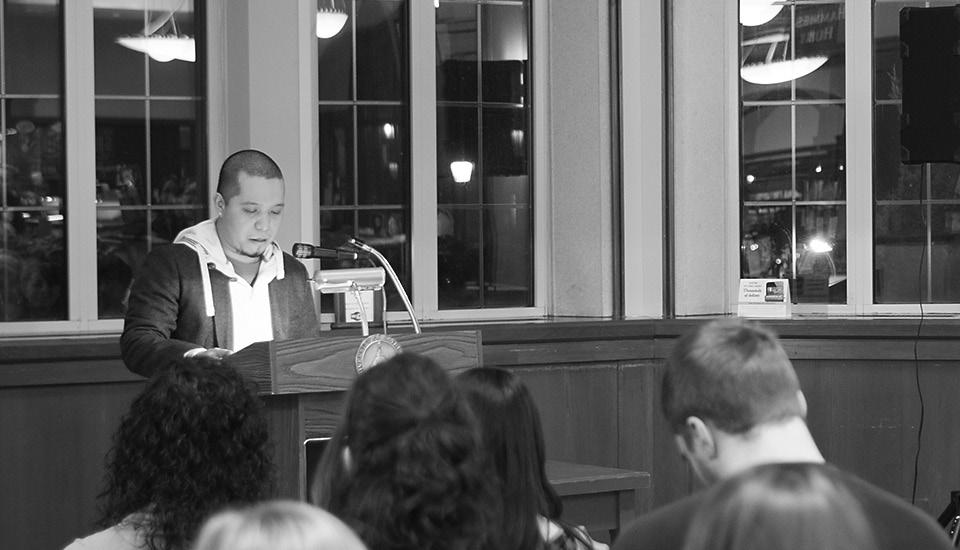
Poet Lauro Vazquez, a graduate of the Notre dame Creative Writing Program and recipient of the sparks Prize, gave a poetry reading at the Notre dame Bookstore on Wednesday night.
A native of Northern California, Vazquez is also coeditor of “Letras Latinas,” a blog sponsored by the Institute for Latino studies and recipient of a fellowship from Cantomundo, as well as a guest speaker at several universities, such as Iowa state university.
Vazquez read several of his poems, including “Ode to a Pretzel,” “homophobes,” “The door,” “Fables” and many others.
Vazquez said his poetry presents a combination of obscure and singular events, such as
former President george Bush choking on a pretzel or a scientist attempting to save carrier pigeons from extinction, with themes of revolution, mysticism and u s.-Latino relations.
“Poetry is like a playground,” Vazquez said. “Language to me is very playful and experimental.”
Vazquez said his upbringing in both Mexico and California has been a major influence on his writing. Many of his poems deal with hispanic culture and its influence in California.
revolutionaries who have impacted both the u s. and Latin America, such as Vasco Nunez de Balboa, Carlos sandino and Irish immigrant workers in the u s. appear often in his poetry, Vazquez said.
“When I went to college, I heard about these revolutionaries. They
gave me an understanding of the world,” Vazquez said. “I’m an artist. The best I can do is reflect on their contributions.”
Vazquez said the theme of revolution and the glory of revolutionaries across history connects easily with younger generations.
“young people, by nature, don’t accept injustice and tend to gravitate towards people who have upset the status quo,” Vazquez said.
Vazquez said his experiences at Notre dame helped shape his writing and his world views.
“Notre dame really helped me develop the aesthetic in terms of the artistry behind my poems as well as a broader understanding of history,” Vazquez said.
“[It] helped connect me to a network of poets and I belong to a community that nourishes my writing.”
sENAtE
Creative writing program director Orlando Menes said Velazquez has continued to grow as a writer after graduating from the program.
“Lauro has made tremendous
strides as a poet,” Menes said.
“he grounds his cross-cultural poems in his sophisticated fusion of myth and history.”
Contact Gabriela Malespin at gmalespi@nd.edu
student body discusses campus expansion
Observer Staff Report
university architect d oug Marsh spoke about campus growth and development at Wednesday’s student senate meeting, according to the meeting minutes.
Marsh explained the overarching organization plan of Notre d ame’s campus, which he said parallels the original master plan of university founder Fr. Edward s orin.
Campus growth expanded under the leadership of university President Emeritus Fr. Ted hesburgh, and currently continues at a rate of approximately 2.5 percent each year, Marsh said.
While physical growth is important to a university’s success, Marsh said the planners must anticipate the growth and be smart about it so it does not devolve into a sprawling system with shuttles and remote parking structures. Overall, preserving the walkability of campus and its pedestrian focus is important, he said.
According to the minutes, Marsh highlighted the northeast and south districts of campus as sites for potential development plans, including two new residence halls and a molecular engineering research building. he said the architecture department would like to increase the number of beds on campus and still alleviate some of the cramped space problems. Any new buildings would preserve the collegiate gothic
character, he said.
Other development plans include the area of campus adjacent to Eddy street, he said, where they envision additional buildings. According to the meeting minutes, Marsh cited a potential new art museum building to house the s nite Museum’s current collection. Earlier this year, the university announced plans for a new architecture building in that area, as well as a Jenkins h all and a Nanovic h all to hold the growing global affairs programs.
Marsh said the recently announced Campus Crossroads project began with questions about where to put a new student center, recreational facilities and the psychology and anthropology departments.
he explained the five-minute walking radius measure used to determine where the ideal site would be, marking the center at the point where s outh Quad and g od Quad meet. Because the department didn’t want to expand in Mc g linn fields or near the g rotto, they looked to the potential space around the stadium.
More information about campus plans and architectural projects can be found at architect.nd.edu
PAI d AdVE rTIsEMENT
PAI d AdVE rTIsEMENT
ZACHARY LLORENS | The Observer
Lauro Vazquez, a recipient of the Sparks Prize, read various original poems Wednesday night at the Hammes Notre Dame Bookstore.
reconcile
don’t like to say how we feel to one another when that person is sitting in front of us.”
The importance of reconciliation is preventing this distancing of ourselves in a relationship with g od, Morgan said.
“A fundamental belief in the Christian faith is that g od created me to be in relationship with g od. … When I mess up in my relationship with g od, I have a choice,” Morgan said. “I can ask for forgiveness or I can start to pack up my things and be okay with moving a little further away from g od.”
Morgan said people often question the sacrament of reconciliation because they don’t realize the bearing it has on one’s relationship with g od.
“Oftentimes I hear the question, particular about reconciliation and the sacrament of confession,” Morgan said. “People say, ‘Why do I have to go to confession? Why does it have to be a sacrament?’. … It is not just saying you are forgiven, but that there is a relationship that is restored in this moment and that happens in this moment of reconciliation.”
Forgiveness, however, is not the same as reconciliation, Morgan said.
“We often forget that and put those two things together,” Morgan said. “[Forgiveness] is often an intimate and private journey. It doesn’t require working or sitting with another person. The journey to forgiveness is its own story and one that is required before you can reconcile, but it is still its own story.”
In order to reconcile with others, we must first look past the person’s mistake, Morgan said.
“We have to surround ourselves with the memories of that relationship,” she said. “We have to remember who this person is, we have to remember who we are and the context of this person. … We have to remember that people are people and often there is more to them than a simple mistake.”
Morgan said the sacrament of reconciliation is ultimately important to repair our relationship with g od after having made a mistake.
“g od has reconciled himself to us and now we must reconcile ourselves to g od,” Morgan said. “We need the physical signs to do that. We need the help of a community. We need to feel the emotions that go along with working up the courage to say we’re sorry, of admitting to ourselves ⎯ as well to Christ ⎯ what we’ve done wrong and the most important thing we need in the sacrament, is to hear someone say to us, ‘ you are forgiven.’”
Contact Kayla Mullen at kmullen2@nd.edu
Arts.
The opera’s director and associate professor of music, Laurel Thomas, said she took a chance bringing “The Enchanted Pig” to s aint Mary’s. The opera, composed by Jonathan d ove, was originally written for an opera company in Leeds, England, Thomas said.
“I could hear very little of the music,” she said. “It sounded like something we could do, so I went for it.”
The main character is the princess, played by junior Victoria Connelly, who attempts to break an old woman’s spell that has turned a handsome prince, the future husband of the princess, into a pig. The princess must break the spell and turn the pig back into a prince in three days or lose him to
the old woman’s daughter, Thomas said. her journey to save the prince and her marriage takes her to the end of the earth, to the moon, to the sun
“We rarely do full operas in the music department. So this is a really big show for us”
Laurel Thomas associate professor of music
and to the Milky Way as she meets interesting characters along the way, Thomas said. s everal s aint Mary’s and I u s outh Bend students, as well as freshman Carlos Torres from Notre d ame, will lend their voices to the opera, with six professional musicians comprising the opera’s chamber orchestra,
Thomas said. The cast has dedicated many months to rehearsal and preparation for the upcoming show.
“We’ve actually been learning the music since the first day of class in the fall,” Thomas said. “It’s a big show.”
d espite the long hours of rehearsal, the cast has managed to make their own fun, Thomas said.
“There have been a lot of nights when we have been working out blocking that we all just stand around laughing our heads off,” Thomas said. “It’s really been fun.”
Thomas said “The Enchanted Pig” includes a variety of musical styles, with elements of musical theatre in addition to opera.
“It has some music that really sounds like high opera,” Thomas said. “And it also has some pieces that sound like
musical theatre.”
The choice of an opera is unusual for the s aint Mary’s Music d epartment, Thomas said.
“We rarely do full operas in the music department,” Thomas said. “ s o this is a really big show for us.”
s how times are 7:30 p.m. on Thursday through s aturday with an additional matinee performance at 2 p.m. on s aturday, Thomas said.
Admission is free for all s aint Mary’s, Notre d ame and holy Cross students. Faculty and staff tickets will be sold for $8 for evening performances and $5 for the matinee.
For more information and to purchase tickets visit MoreauCenter.com or call the Box Office at (574) 284-4626.
Contact Kelsie Plesac at kplesa01@saintmarys.edu
Out of four original tickets, the two tickets remaining tickets will be that of Noemi Ventilla, Michael Markel, Neil Joseph and Eva Niklinska, which received 43.03 percent of the votes and that of Andrew galo, Michaela McInerney, Vincent Vangaever and daniel Barabasi, which received 24.49 precent of the votes.
Ventilla, presidential candidate of the leading ticket said she and her running mates plan to simply wait and see.
“At this point, both tickets would do a great job, so we’re just going to wait to see what will happen,” Ventilla said.
galo, presidential candidate of the second-place ticket, said he and his running mates were glad to be part of the run-off.
“We’re excited to move on,” galo said. “Obviously, either one of us will do a great job.”
Contact Charlie Ducey at cducey8@nd.edu
people and we don’t charge them,” he said. “That’s the best part of the program. The second best part of the program is what the students learn.”
Cergnul said the practical application makes the lessons in accounting classrooms tangible and the weight of responsibility becomes more real.
“The third big benefit from this is the students’ poise and confidence. They’re sitting across the table from real people with real dollars, real taxes,” Cergnul said. “In class it’s hypothetical. Take a look at Problem 35, oh heck I got it wrong.”
Etzell said the professors running the program have given her both confidence and the necessary skills.
“My professors — Cergnul, in particular — have instilled in me a confidence that must
be used when preparing a return,” Etzell said. “Milani has taught me how to look at the correct information and extract meaning from simple interview questions we direct toward the taxpayers. Because of his direction, I know what exactly I’m looking for and how I am going to go about finding that information.”
Cergnul said students are invariably anxious when they start out, but gain confidence over time.
“By the end of the filing season, they’ve grown in poise and their ability to communicate with other people — professional communication — is enhanced,” Cergnul said.
This poise ultimately helps students as they interview for jobs, he said.
“I mean they’ve actually sat across the table with a real client and did a real transaction and people who don’t go through this program haven’t done that,” Cergnul
said. “Those communication skills translate very well in interviews.”
Etzell said the work can be difficult given the sheer number of clients students are required to assist.
“Professor Milani, along with Professor Cergnul, have taught me how to be perform under pressure,” she said. “We have lines of people waiting for us to prepare their returns so it is of utmost importance that we move efficiently, yet effectively, through everyone’s paperwork and return forms.”
Etzell said as challenging as the work is, it is rewarding to help out members of the local community.
“I have been given the necessary tools to perform well in this program, and now my duty is to help the community,” Etzell said. “d etecting when people have earned certain deductions or credits is a task in and of itself, but again, the reward of helping others
makes all the work so worth it.
“My favorite part is seeing the people come in looking rather flustered and then them leaving a little while later with a sense of relief on their faces.”
Junior grace harvey said TAP has helped hone her knowledge of tax practices and concepts.
“Even though my internship this summer with grant Thorton is more focused on corporate tax rather than personal income tax, [TAP is] an awesome opportunity,” harvey said.
The two credit hours contribute toward the 150 credit hours required to sit for the CPA exam, harvey said.
harvey said that participating students will help file tax returns in various locations throughout s outh Bend with tax filings due April 15.
Contact Rebecca O’Neil at roneil01@saintmarys.edu
Court rules to control MLK Nobel Peace Prize
Associated Press
ATLANTA — Martin Luther King Jr.’s Bible and Nobel Peace Prize should be placed in a safe deposit box controlled by the court pending the outcome of a legal dispute over who owns the items, a judge said Wednesday.
The dispute marks the latest in a string of legal battles
between the siblings.
The civil rights icon’s estate is controlled by his two sons, Martin Luther King III and dexter King. Lawyers for the estate on Jan. 31 filed a complaint asking a judge to order that their sister, Bernice King, turn over the two prized items.
After about two and half hours of arguments from
PAI d AdVE rTIsEMENT
lawyers for both sides, Fulton County superior Court Judge robert McBurney said he believes it is likely that the estate will prevail in the case. he said he would issue an order that both items be kept together in a safe deposit box in the name of the estate but that the keys would remain with the court until the ownership dispute
before him is settled.
“I find that, at this point, that is a fair, equitable balance of the competing interests,” McBurney said.
Lawyers for both sides said after the hearing that they felt the judge’s temporary solution was fair.
William h ill, a lawyer for the Estate of Martin Luther King Jr. Inc., said the bible and peace prize medal belong to the state under a 1995 agreement in which King’s heirs signed over their rights to many items they inherited from him. Eric Barnum, a lawyer for Bernice, said his client doesn’t believe those items are part of the estate and doesn’t believe her father’s most cherished possessions should be sold.
The three surviving King children are all board members of the estate, and they held a special board meeting in late January to vote on a proposed sale of the bible and peace prize, h ill said in court. They voted 2-1 in favor of the sale, with Bernice being the dissenting vote, h ill said.
“We have one director who disagrees with a properly taken vote of the corporation,” h ill said, repeatedly saying that Bernice has no individual right of ownership to the items.
“you don’t sell the most prized items of the estate.
That’s Bernice King’s position,” Barnum said. h ill urged McBurney to issue an immediate order asking Bernice to turn over the items, saying the money that would come in from the sale or lease of the items was crucial to the estate’s viability. People or entities interested in buying or leasing the items for public display had come forward but the offers won’t last long, h ill said, though he didn’t say who the interested parties are or why their offers had a short shelf life.
McBurney seemed skeptical that the estate, if proven to be the owner of the items, wouldn’t be able to find a similar deal once the legal dispute is resolved.
“They are as culturally significant today as they were yesterday as they will be tomorrow,” he said, ultimately refusing h ill’s request that the items immediately be turned over.
King was assassinated in Memphis in April 1968. h is wife, Coretta scott King, died in 2006 and yolanda King, the eldest child, died in 2007. That left the three remaining siblings as the sole shareholders and directors of their father’s estate, but their relationship has deteriorated over legal battles.
Cardinal evades charges with tarnished image
Associated Press
LOs ANgELEs — The nation’s largest roman Catholic archdiocese has agreed to pay $720 million to clergy abuse victims over the past decade and released internal files that showed Cardinal roger Mahony shielded priests and ordered a surrogate to withhold evidence from police, yet Mahony and other archdiocese leaders are unlikely to face criminal charges.
With the final $13 million settlement of existing old cases announced Wednesday, Mahony has emerged from the scandal with his reputation tarnished, but his place in the church intact — even after being publicly rebuked by his successor for internal church files showing that he and others worked to protect priests, keep parishioners in the dark and defend the church’s image.
By settling the cases, the archdiocese avoids a trial in which Mahony would have been publicly questioned under oath about what plaintiffs’ lawyers said was an attempt to thwart a Los Angeles police investigation. during a deposition unsealed Wednesday, Mahony acknowledged he told an underling not to give police a list of altar boys who had worked with the rev. Nicolas Aguilar rivera. he testified he wasn’t trying to hinder police, but he didn’t want the boys to be scarred by the investigation and
that he felt the altar boys were too old to be potential victims of the Mexican priest.
Police later found that 25 of Aguilar rivera’s alleged victims were altar boys and the other victim was training with the priest to be one, said Anthony deMarco, a plaintiff attorney.
It’s not clear what impact Mahony’s action had on the investigation, though at the time, police complained that the archdiocese wasn’t fully cooperating.
“Cardinal Mahony and those top officials have never been held fully to account,” Jeff Anderson, a plaintiffs’ attorney, said at a news conference. “What we see is a current and ongoing attempt to deflect and deny responsibility.”
The priest is believed to have molested 100 additional children in Mexico both before and after his stint in Los Angeles, deMarco said. he was defrocked in 2009 after attorneys in Los Angeles filed the first of their lawsuits.
The archdiocese said in a statement Tuesday that the church had settled the cases to “provide support to the victims through the healing process.”
Mahony, who retired as head of the archdiocese in 2011, was admonished last year by Archbishop Jose gomez for his handling of the abuse crisis. But he has avoided criminal prosecution, despite investigations by the Los Angeles County district attorney and the u s. attorney’s office.
Mild Midwest weather expected to worsen
C h ICAg O — National Weather s ervice meteorologist g ino Izzi has a message to those who think the bright sunshine over parts of the Midwest this week means the brutal winter is over: “Forgetaboutit.”
In a report issued Wednesday, the meteorologist veered away from the weather service’s just-thefacts-ma’am forecasts about wind gusts and precipitation in favor of something more personal.
Two weather indicators “both paint such a bleak ... dismal ... cold ... and potentially snowy picture next week that it’s likely to leave many winter weary souls ready to curl up into the fetal position and beg for mercy from old man winter!” wrote Izzi, who is based at the weather service’s suburban Chicago office.
Izzi was not at work on
With only a three- to five-year period to bring charges of obstruction of justice after a crime — depending on a federal or state court venue — it’s unlikely he or other church administrators would face charges now for cases that date back more than a decade, said Lawrence rosenthal, a criminal law professor at Chapman university and a former prosecutor.
In other cases, church leaders accused of shielding pedophile priests from prosecution have faced criminal charges.
In Missouri, a judge found the Kansas City bishop guilty last year of failing to report child abuse to the state, making him the highest-ranking u s roman Catholic official to be convicted of a crime related to the child sexual abuse scandal. he was sentenced to probation for the misdemeanor and remains head of his diocese.
A Los Angeles federal prosecutor involved in a 2009 grand jury investigation wrote that documents showed “the possibility of criminal culpability” by members of the archdiocese leadership, but a criminal conspiracy case was “more and more remote” because of the passage of time.
The newly disclosed testimony by Mahony deals mostly with Aguilar rivera, who fled to his native Mexico in January 1988 after Mahony’s top aide, Monsignor Thomas Curry, tipped him off
about parent complaints and warned that the church would call police.
Aguilar rivera, who was 46 at the time, remains a fugitive and is believed to be somewhere in Mexico.
In the deposition taken a year ago, Mahony appears on video in his priests’ collar, taking long pauses and glancing down frequently. At one point he explains why he told Curry not to share a list of altar boys with police. Allowing police to question altar boys at the two parishes where Aguilar rivera worked during his 10-month stint in LA “could be very traumatic to those servers to all of a sudden be sitting in front of a policeman being interrogated,” the cardinal said. “And we had no suspicion at that time of any other victims and nobody among the altar servers.”
he denied under questioning from plaintiff attorneys that his motivation in holding back the list was to protect the priest and delay the investigation.
In his testimony, Mahony also defended Curry, the vicar for clergy, for telling Aguilar r ivera that the church would need to contact police and that the accused priest was “in a good deal of danger.”
The complaints came in on a Friday, and Curry met with the priest saturday morning. Police weren’t notified until Monday. By then, Aguilar rivera was gone.
Victor Cortez, 34, said he was
PAI d AdVE rTIsEMENT
molested by Aguilar rivera when he was 7 and kept the abuse secret for years.
“I’ve lived for 26 years with fear, and now I’m not afraid anymore,” said Cortez, who was part of Wednesday’s settlement announcement. “Once I got it all out, the problems just went away. I’m able to be a better father to my children and a better husband to my wife.”
Mahony also testified about a 1986 letter he wrote to the director at a New Mexico center treating the rev. Peter garcia for pedophilia, warning that the priest couldn’t return to Los Angeles in the foreseeable future.
“I believe that if Monsignor garcia were to reappear here with the archdiocese, we might very well have some type of legal action filed in both the criminal and civil sectors,” he wrote.
In his deposition, Mahony said the letter was not intended to protect garcia from prosecution.
“Was I interested in having a big civil upset here for the archdiocese? No, I was not,” he said. “But I was not encouraging him to avoid criminal prosecution.”
Mahony, who turns 78 next week, has largely retreated from the public eye.
After giving his deposition last year, he traveled to rome, where he helped elect the new pope. A month ago, he celebrated Mass with Pope Francis at the Vatican before having a private meeting with him.
Wednesday afternoon, having gone home to sleep after he finished his overnight shift. But his boss said he was aware of the Izzi’s take on the weather, though not before he wrote it up and released it.
Ed Fenelon said he thinks that Izzi is “looking to expound on” people’s views of what seems to many an endless winter. h e also suggested that the decidedly informal tone of Izzi’s comments reflect a trend in communication that extends far beyond the weather service.
But Fenelon disputes the notion that the weather has been bad.
“To me ... there’s no such thing as good weather and bad weather,” he said. “To skiers and snowmobilers, they love it. s nowplowing businesses are making good money from it, and people who live in warm, sunny weather, they are going to be miserable.”
Associated Press
Assoicated Press
Obama calls for end to violence in Ukraine Protest leader awaits charges in Venezuela
TOLuCA, Mexico — President Barack Obama on Wednesday urged ukraine to avoid violence against peaceful protesters or face consequences, as the united states considered joining European partners to impose sanctions aimed at ending deadly street clashes that are sparking fears of civil war.
“There will be consequences if people step over the line,” Obama said shortly after landing in Mexico for a summit with the leaders of Mexico and Canada, as fires burned in central Kiev. “And that includes making sure that the ukrainian military does not step in to what should be a set of issues that can be resolved by civilians.”
shortly after Obama’s remarks, ukrainian President Viktor yanukovych’s office said he and opposition leaders had agreed on a truce, although the brief statement offered no details about what it would entail or how it would be implemented. Obama later responded that he hoped a truce would “provide space for the sides to resolve their disagreements peacefully.”
“ultimately the government’s responsible for making sure that we shift toward some sort of unity government, even if it’s temporary, that allows us to move to fair and free elections so that the will of the ukrainian people can be rightly expressed without the kinds of chaos we’ve seen on the streets, without the bloodshed that all of us, I think, strongly condemn,” Obama said at an evening news conference with his fellow North American
leaders.
Meanwhile, the European union called an extraordinary meeting of its 28 member countries on Thursday to address the situation.
French Foreign Minister Laurent Fabius told reporters in Paris that he and his counterparts from germany and Poland would travel to ukraine, meeting with the ukrainian government and opposition before the emergency Eu meeting.
Eu sanctions would typically include banning leading officials from traveling to the Eu countries and freezing their assets there.
Obama said he is monitoring the ukrainian violence “very carefully.”
“We expect the ukrainian government to show restraint and to not resort to violence when dealing with peaceful protesters,” Obama said.
secretary of state John Kerry, in Paris for meetings with Fabius and others, said he was disturbed by the level of abuse demonstrated by the ukrainian government and protesters.
“We are talking about the possibility of sanctions or other steps in order to create the atmosphere for compromise,” he said.
It was not immediately clear Wednesday what sort of sanctions or penalties the u s. could impose.
state department deputy spokeswoman Marie harf said visa restrictions already have been imposed against some members of the ukrainian government, and cited “different kinds of individual sanctions that can be levied” without
being specific. she said officials are still trying to determine who is responsible for the violence and described a sense of urgency within the Obama administration “to make decisions very, very soon about what we will do next.”
deadly clashes between police and anti-government protesters in the ukrainian capital of Kiev on Tuesday left at least 25 people dead and hundreds injured.
Ben r hodes, Obama’s deputy national security adviser, told reporters traveling with Obama aboard Air Force one that what happened Tuesday was “completely outrageous” and will be a factor in u s. decision-making.
r hodes said there was still time for the ukrainian government to avoid sanctions or other punishment by pulling back its “riot police,” respecting people’s right to protest peacefully, releasing protesters who have been arrested and pursuing a “serious dialogue” with the opposition about how to unify the country.
A senior state department official, who is closely following the unrest in ukraine, said Wednesday that u s. officials were concerned about the ukrainian president’s decision to replace the army chief. The military has announced that it would take part in a national anti-terrorist operation to restore order. u s. officials have been able to stay in direct contact senior security force leaders in the ukrainian government, but in the past 24 hours that has been difficult because they are not answering their phones, the official said.
Associated Press
CA r ACAs, Venezuela — held at a military jail, opposition leader Leopoldo Lopez waited to learn Wednesday if he will be charged for violence that has erupted during protests that have revitalized challenges to 15 years of socialist rule in the oil-rich nation.
Lopez, who dramatically surrendered to authorities before thousands of cheering supporters Tuesday, was to appear before a judge to learn what charges he would face for organizing mass demonstrations that have resulted in at least six deaths and more than 100 injuries over the past week.
The hearing was closed and the outcome had not been announced by late Wednesday as sporadic protests continued to erupt throughout the capital, with protesters setting fires in the streets and police firing volleys of tear gas and blasts from water cannons.
The government of President Nicolas Maduro has accused Lopez, a 42-year-old former mayor and the leader of the Popular Will party, of attempting to foment a coup in the south American nation and authorities had said he could face charges that include homicide and causing grievous bodily harm.
A judicial official told The Associated Press that prosecutors were leaning toward discarding homicide and terrorism charges, opting instead to pursue less serious counts such as
arson and incitement to commit crimes. That would allow the possibility of Lopez being released pending trial, according to the official, who agreed to discuss the matter only if not quoted by name because the decision had not been made public.
hundreds of supporters waited outside the courthouse for news of the decision, watched over by National guard troops. Caracas Mayor Antonio Ledezma, a member of a different opposition party, showed up at one point in a sign of unity among the foes of the Maduro government.
“We are all united in demanding the release of Leopoldo Lopez,” Ledezma told the AP. “We are rallying behind him.”
The crowd dissipated after hours of waiting when officials decided to hold the court hearing at the military jail outside Caracas where Lopez was being detained.
The opposition has planned nationwide marches for saturday to protest both his detention as well as the rampant crime, shortages of consumer goods and inflation rate of more than 50 percent that has made life difficult for many in the country of nearly 30 million people.
The jailing of Lopez has made him a cause celebre among opponents of Maduro, eclipsing to some degree henrique Capriles, the opposition’s two-time losing presidential candidate who was building support for another challenge in two years.
Punk band whipped at Olympic protest concert
Associated Press
sOChI, russia — Cossack militia attacked russia’s Pussy riot punk group with horsewhips on Wednesday as the artists — who have feuded with Vladimir Putin’s government for years — tried to perform under a sign advertising the sochi Olympics.
The group has resurfaced as a thorn for russian authorities this week for the first time in nearly two years, just as Putin had been using the Winter games to burnish his image at home and charm critics abroad with the most expensive Olympics ever.
six group members — five women and one man — donned their signature ski masks in downtown sochi and were pulling out a guitar and microphone as at least 10 Cossacks and other security officials moved in. One Cossack appeared to use pepper spray. Another whipped several group members while other
Cossacks ripped off their masks and threw the guitar in a garbage can.
Police arrived and questioned witnesses, but no one was arrested.
The Cossacks violently pulled masks from women’s heads, beating group member Nadezhda Tolokonnikova with a whip as she lay on the ground.
The incident lasted less than three minutes and one Pussy riot member, a man wearing a bright yellow tank top, was left with blood on his face, saying he had been pushed to the ground.
“They hit me all across my body, look at my bruises,” Tolokonnikova said afterward.
Krasnodar region governor Alexander Tkachev, who has been advancing Cossacks’ interests for years, promised on Wednesday to conduct a “thorough probe” into the incident and prosecute the attackers. Tkachev said in comments carried by the Interfax
news agency that the views of Pussy riot “are not supported by the majority of people in the region” but stressed the importance of abiding the law.
u s state department deputy spokeswoman Marie harf on Wednesday criticized attacks on protesters in russia but avoided specifically addressing the beatings of Pussy riot members.
“We continue to support the rights of all russians to exercise their fundamental freedoms of expression and assembly, as we say all the time, and of course condemn the use of violence against any protesters,” harf said.
Pussy riot, a performanceart collective involving a loose membership of feminists who edit their actions into music videos, has become an international flashpoint for those who contend Putin’s government has exceeded its authority, particularly restricting human and gay rights. They have called for a boycott of the
sochi Olympics.
The group gained international attention in 2012 after barging into Moscow’s main cathedral and performing a “punk prayer” in which they entreated the Virgin Mary to save russia from Putin, who was on the verge of returning to the russian presidency for a third term.
Two members of the group, Tolokonnikova and Maria Alekhina, were sentenced to two years in prison, but were released in december under an amnesty bill seen as a Kremlin effort to assuage critics before the Olympics.
The Cossacks have been used since last year as an auxiliary police force to patrol the streets in the Krasnodar province, which includes the Winter Olympic host city. Patrol leader Igor gulichev compared his forces to the Texas rangers, an elite law-enforcement body that has power throughout that state.
Cossacks trace their history
in russia back to the 15th century. serving in the czarist cavalry, they spearheaded imperial russia’s expansion and were often used as border guards. under communism, they virtually disappeared, but have since resurfaced, particularly in the south. They are now recognized as an ethnic group, but it is largely a self-identification by those who consider themselves descendants of the czarist-era horsemen.
Later Wednesday, Tolokonnikova, Alekhina and two others held another surprise mini-performance in central sochi, this time next to the Olympic rings in front of City hall.
Jumping up and down, one playing a plastic guitar, they sang-shouted in russian: “Putin will teach you how to love the motherland!” A person dressed as one of the Olympic mascots joined them for a moment in an apparent joke.
Meditations on Hoffman
Claire Bleecker News Writer
According to an article I read in the New york Times last week, the demand for heroine in the united states has risen 232 percent in the past four years. Just this past Christmas, a friend from my hometown told me that heroin “came in last year,” killed several kids we went to high school with and hasn’t left since. Then earlier this month, of one of the most talented actors of the 21st century was found dead in g reenwich Village with a needle in his arm.
The news of Philip s eymour hoffman’s death disturbed me deeply. My friend and I used to say that when we finally attended the Oscars, Philip s eymour hoffman would sit at our table so that we could all throw ice chips at Morgan Freeman together. how could such a brilliant man, so sensitive to the nuances of his characters, give into a drug that numbs you into oblivion?
What I always liked most about hoffman was his irreverence. h is roles were not glamorous (I’m thinking here of Boogie Nights, his portrayal of a child-abusing priest or of the effeminate Truman Capote). you wouldn’t say he cared much for public sentiment. In 2009, he showed up to the Academy Awards wearing a beanie.
If hoffman indeed disregarded public sentiment, where does heroin fit into the equation? d id he succeed in separating himself from the public sentiment — succeeding in devoting himself totally to the art of acting — so well that some ineffable loneliness got to him? Or was his overdose on Feb. 2 an effect of not succeeding at all, but rather relying too much on public sentiment and collapsing under the realization of its fickleness?
In s hakespeare’s “As you Like It,” the character Jacques’s situation is similarly ambiguous. Jacques has the option of returning to courtly society after living in the forest of Arden. In my s hakespeare class, we recently discussed the performance in Washington h all by the Actors from the London stage. One of the most curious things about the ending of the play is whether the people in Arden can return to their fickle society and sustain the genuine version of life they tasted in the forest. In the last scene, we learn that Jacques does not return to courtly society with the rest of the characters. he chooses to stay in the forest, bidding farewell: “s o, to your pleasures / I am for other than for dancing measures.”
Contact Claire Bleecker at cbleec01@saintmarys.edu
necessarily those of
Notre dame and my identity crisis
My friends back home still call me “white-washed” because I speak English without an accent and my skin tone is lighter than the coffee I drank this morning. I checked “white” in every application and standardized test I filled out until high school, because that was the closest thing I could relate to. I was never Mexican enough because of the opinions of what my peers deemed acceptable. When I visited friends’ houses, I would be offered a sandwich instead of the carne asada their moms made for dinner. I wanted to be accepted and to be just another Mexican. But at the same time, I rejected and feared the stigma of being Mexican. My life is a constant identity crisis. And after interacting with other PoC (People of Color) at Notre dame, I have come to realize I am not an anomaly, and the “identity crisis” I face (somewhat a hyperbole) is not all that unique.
A high school mentor and teacher of mine both recommended I used my mother’s hispanic last name for college applications because it would give me the upper hand. It sounded logical coming from those with a lot of authority in the matter, but it was never really who I was. Throughout high school, I was referred to as an inner-city student because the high school I attended was in the middle of the “ghetto” and nearly half of my peers live below the poverty line. My best friends were first generation citizens, some of them even born in Mexico. Even though I never really identified as hispanic until high school — or Latino until college — I was always considered a person of color, another statistic as far as my high school
EDItorIAl CArtooN
was concerned. Throughout my educational career, from kindergarten to high school, people who knew more than I did told me who I was and tried to label me as different until I began to believe it.
It’s absurd that silly labels determine how somebody feels about him or herself because society places specific identifiers by race and ethnicity. There’s a reason why ethnic parents constantly have to reinforce a sense of racial pride in their children. It is because society instills the idea that darker skin means inferiority. Even in the Latino community, darker skin is stigmatized and considered lesser by many of those of spanish descent. yes, Mexicans are terribly racist and prejudiced as well.
The point is, I didn’t care about race or ethnicity until I came to Notre dame. As crazy as it sounds, blatant racism and prejudice were never a problem I have ever faced until I came here. I was content living my life as a Californian, where everybody is equally as accepting as one another. As vainly naïve as that sounds, Californians are all around accepting people, with the exception of our flourishing black sheep KKK population. There is knowledge as how to be culturally sensitive and interact with those of different creeds, genders and ethnicities without being raging racists or sexists, or whatever prejudice labels exist. I must reiterate, however, that there is a large population of Californians that do not fit the typical form. however, they remain a minority as far as I can tell. As I try to figure out the root of my aggressiveness in pursuing race relations at Notre dame, it comes down to the people I am forced to interact with in my classes and activities everyday.
More often than not, I have found there
to be more of a disconnection between those from the Midwest and inland states than those of the coastal areas and southern states. As a general observation, I have found them to have a more difficult time interacting with people of color, making them appear less culturally sensitive and more ignorant on ethnic issues. I am not trying to be stereotypical or assuming. This has merely been an overwhelming observation.
I am not quite sure why my articles still continue to get a rise out of members of the student body. At any other university my writings would be deemed tame at the most. Why do I feel like I’m in a scene of “don’t Be a Menace to south Central L.A.” and a sniper is about to take me out any second for trying to “make it out of the hood?” I for one would love to live in a world where my opinion is not deemed invalid because another person is less educated about the struggles of minority communities. I don’t expect anybody to understand my life, only that they accept that these are my views and they are valid views, just as vapid, biased rebuttals are valid in their own sense.
As a “well-spoken token” friend of mine stated recently, “Not everybody was raised like I was,” and I need to understand that many individuals were raised in households where they are told that the opinions of people of color are fueled by a bitter past, when in reality they are fueled by an ignorant present.
Katrina Linden is a sophomore English and Latino Studies major living in Lewis Hall. She can be contacted at klinden1@nd.edu
The views expressed in this column are those of the author and not necessarily those of The Observer.
QuotE of thE DAY
“In the depth of winter, I finally learned that within me there lay an invincible summer.
Albert Camus French existentialist author & philosopher
Katrina Linden Kat’s Meow
Raymond Michuda Common sense
You can’t make me sell a cake
As a Viewpoint columnist, I feel compelled to bring to our readers’ attention political events that have serious implications, ones that threaten our freedom and ones that are just plain ridiculous. Today’s topic falls under all three categories.
With the recent legalization of gay marriage and civil unions in many states, we’ve seen quite a few cases where a gay couple files a lawsuit against a bakery for refusing to sell them a wedding cake. In these cases, the business owners refused mostly due to religious objections. Many ended up with severe fines and some were forced to shut down their bakeries. Laws have been passed in some states to bolster these lawsuits.
Throughout the rest of the article, I will explain why these recent events are unfair and why it should be perfectly acceptable to refuse to sell a gay couple a wedding cake.
First off, I want to emphasize that the main reason the bakery owners refused service was their religious objections to gay marriage. They are morally against it, but I want to point out these business
owners aren’t trying to prevent gays from getting married. They just don’t want to be forced to provide a cake for a celebration of something they view as a sin. Nothing about that is unreasonable. Plus, I don’t see why the gay couple’s desire for a wedding cake should supersede someone’s religious beliefs, especially since the bakery owner’s religious beliefs are protected under the Constitution. The couple could have easily gone to another bakery. I severely doubt they would be unable to find a local bakery to make them a cake.
And then there is the larger issue of property rights. some people may disagree with me when I say that religious objections are a legitimate reason to refuse a cake sale, but these people are missing the bigger point. you see, the bakery owners shouldn’t even have to give a reason for not making a sale. That’s the beauty of owning property. It’s yours.
As long as you don’t use it to cause harm, you may do with it what you please. If you make cakes, you should be free to sell them or not at your discretion. A government with the ability to force someone to sell a product is far too powerful. I would even go so far as to say that court rulings and current state laws forcing the bakers to sell
cakes against their will are a form of theft. It is an act of unrightfully taking someone else’s property against his or her will.
Many people will likely disagree with this statement, but those that do probably don’t fully understand my argument. you see, I’m not saying that it’s morally acceptable to discriminate against groups of people. I’ll leave that for you to decide. however, there is a big difference between morality and legality. It is not the job of the government to legislate morality, and the very action of doing so is immoral in itself. so if someone doesn’t want to sell a gay couple a cake, fine. It’s not the end of the world. No harm done. grow up and go to a different bakery instead of trying to destroy someone’s livelihood just because they don’t support your lifestyle.
In the end, I’m just trying to point out that there are many instances in which upstanding business owners have had their property and religious rights violated in the name of gay rights. The gay movement always talks about tolerance, but I think many of its members have to realize that tolerance isn’t a one-way street.
They can’t expect Christians to tolerate the gay lifestyle if they won’t
tolerate Christians’ religious beliefs. Additionally, it’s fundamental to our existence as free Americans to make our own decisions pertaining to our property. And there are certainly many gay people that recognize this.
One of the most powerful examples is a story I heard about the so-called Chick-Fil-A day. A large group of gay people actually went to support the restaurant on this day because they realized that although the company disagrees with their lifestyle, its leaders have the right to express their views. They realized that their own quest for acceptance does not allow the government to trample on the rights of others, and that’s what it comes down to at the end of the day.
I’ve heard many absurd stories, but hearing that people successfully sued a bakery for not selling them a wedding cake is in a league of its own. One might even say that of all the outrageous stories I’ve heard, this one really takes the cake.
Raymond Michuda is a sophomore in the College of Engineering. He can be contacted at rmichuda@nd.edu
The views expressed in this column are those of the author and not necessarily those of The Observer.
Finding a better solution than $10.10
One of President Obama’s most popular policy ideas as of late has been the proposal to “g ive America a r aise” by raising the federal minimum wage to $10.10, up from its current level of $7.25. It’s not right, he argues, for a full-time worker to make less than the federal poverty line. While I agree with this sentiment, the truth is that now is simply not the right time to raise the minimum wage.
This past week, the nonpartisan Congressional Budget Office (CBO) released a report about the likely impact of a higher minimum wage.
According to the CBO, an increase to $10.10 would likely increase earnings for about 16.5 million workers while costing another 500,000 their jobs. At first glance, this seems like it works out to a net positive, with several million people ending up better off. But let’s go a bit deeper and look at the distribution of the benefits of a higher minimum wage.
According to the CBO, a higher minimum wage would result in a total of around $31 billion in increased earnings for low-wage workers, but less than one-fifth of these earnings would actually go to low-income families, while around 30 percent would go to families earning more than three times the federal poverty limit. Why? s imply put, most workers earning the minimum wage are not members of low-income families. According to the White h ouse, more than half of all minimum wage workers come from households earning more than $35,000 per year, and according to the d epartment of Labor, around a third of all minimum wage workers are teenagers between the ages of 16 and
19. Moreover, despite the president’s characterization of the minimum wage as a support for struggling families, according to the White house Council of Economic Advisors, only about a fourth of minimum wage earners have kids.
What all this suggests is that simply raising the minimum wage is not the most effective antipoverty policy in the world, with a lot of its benefits accruing to people other than those our antipoverty policies should best target. But despite that, it still might be a good idea were it not for the poor state of our labor markets and the existence of better alternatives.
A g allup issues poll this week showed that Americans named unemployment as the largest problem in America, and it’s hard to disagree. As of today, the official unemployment rate in the united s tates is 6.6 percent. For high school dropouts, it’s almost 10 percent, and many believe that these numbers are lower than they otherwise would be because of discouraged unemployed individuals dropping out of the workforce altogether. While a minimum wage may bring good effects to some, is now really the time to adopt policies that make it harder for businesses to hire more low-wage workers? Admittedly, the academic literature on a minimum wage’s employment effects is unclear, but with a labor market as weak as ours, it seems prudent to play it safe.
Fortunately, there are other ways we can both encourage employment and alleviate poverty among low-income families. The biggest of these is the Earned Income Tax Credit (EITC), which acts as a wage subsidy to boost incomes of lowwage workers. Economist Michael s train from the American Enterprise Institute argues that the EITC is precisely the policy we should be championing as an antipoverty tool, as it both
supplements earnings and incentivizes work. Moreover, since subsidies phase out as incomes rise, the benefits of the EITC will target only those people who need it most — low-income workers — and not other groups, as the minimum wage does. There is reason for cautious optimism about a potential EITC expansion. Along with his call for a higher minimum wage, President Obama did also call for an EITC expansion in his s tate of the union address. I sincerely hope he makes progress on it. In talking about the EITC, the president also referenced s enator Marco r ubio, who recently outlined an antipoverty agenda which proposed reforming the EITC and turning it into a more direct wage subsidy for low-wage workers. h ouse Budget Chairman Paul r yan has also talked positively about the EITC in recent days, comparing it favorably to a minimum wage hike as an antipoverty tool.
s imply put, there is a better way to help the poor than just raising the minimum wage. An expansion of the Earned Income Tax Credit would encourage more employment, not less, and would more directly benefit the people that need our assistance the most. In a labor market as weak as ours, any policies that make it harder to hire low-income workers should be considered very thoroughly before enacted, and when better alternatives exist, they should not be enacted at all. I couldn’t agree more with the president. We need to do more to help low-income workers get out of poverty. But a higher minimum wage isn’t the right solution to the problem.
Conor Durkin is a senior studying political science and economics. He can be reached at cdurkin@nd.edu
The views expressed in this column are those of the author and not necessarily those of The Observer.
Conor Durkin
Thinking differently
By ERIN McAULIFFE
scene Writer
The satirical “skit show” that is the Keenan revue returns this Thursday, marking the 38th year of the event. “It’s Not revue, It’s Me: A Breakup revue” will take place Feb. 20, 21 and 22 at 7 p.m. in the stepan Center.
Tickets were distributed for free in LaFortune earlier this month, enticing students to wait in line for hours to secure seats.
Matt Moore, a senior from Keenan hall and this year’s producer, provided some background on the show.
“The revue addresses topics such as campus events, dorm life and pop culture,” Moore said. “The show is lighthearted and meant to poke fun at different events that happened within the past year.”
This is the fourth year the revue has been held on Notre dame’s campus, he said. The show was previously held at saint Mary’s, but relocated to everyone’s second-favorite dome on campus, the stepan Center.
The revue was able to push boundaries when the show was at saint Mary’s, but less obscenity has been tolerated since moving to Notre dame’s campus, Moore said.
Four years since the stepan Center debut, Moore said that Keenan now has a better understanding of their limits.
“As a freshman, one of the skits I was in got cut for being offensive, but since then The revue has cleaned up and become less vulgar,” Moore states. “The second year The revue was back on campus, I was one of the head writers and we had a better understanding of what would be
tolerated. We only had to make minor adjustments to the show after Thursday. Our goal this year is to have all three nights of the show be exactly the same.”
The revue has a unique theme every year. Past themes included “Keenan revue: Too Big for saint Mary’s” and “The revue strikes Back.” This year’s theme is “It’s Not revue, It’s Me: A Breakup revue.”
Although the themes of the show vary, there is some consistency, Moore said.
For instance, every year there is some dancing* to accompanying music. *disclaimer: “dancing” is being used as a euphemism. Example: T-Pain’s 2005 hit “I’m n’ Luv (Wit A dancer) was a commendable ballad.
The making of The revue involved an elaborate process that began in October. Keenan held two weeks of tryouts, in which over 60 skits were auditioned.
since the show only lasts two hours, they had to be brutal with the eliminations, Moore said. however, the show’s directors worked to accommodate as many Keenan guys into the selected skits as possible.
The show’s director, Connor duffy, promises this year’s show to be a great one.
“I was the dance* director last year, and I will be the first one to tell you that the dancers* are way better than last year,” states duffy. “They are going to bring the house down. The musical acts sound great as well. We are implementing some new technical equipment on stage that will add to the overall quality of the show. Overall, expect a great show, hopefully the best one ever!”
Contact Erin McAuliffe at emcaulif@nd.edu
By MARISA IATI Assistant Managing Editor
Omigod you guys. Washington hall is about to erupt with pink when the Pasquerilla East Musical Company (PEMCo) takes the stage this weekend for a three-performance run of “Legally Blonde: The Musical.”
The show, which is the student theatre group’s annual spring production, is based on the novel and film of the same name. It tells the familiar story with exuberance, but senior Elizabeth Curtin, one of the producers and the actress who plays Vivienne, said there’s more to the musical than the spectacle.
“While maybe … to the outside viewer it just looks a bunch of pizzazz and fireworks, there are a lot of moments of heart in this show,” Curtin said. “so while it is a bunch of feel good-ery, there is some substance to this.
“And you won’t have to dig for it. I think this cast and this crew have done an incredible job of finding the balance between the flash extravaganza and the honest moments that these characters really experience.”
One of those honest moments comes during a song called, somewhat ironically,
“serious.” Law school-bound Emmett tells his girlfriend Elle that if he’s going to be a senator by the time he’s 30, he needs a love interest who is “less of a Marilyn, more of a Jackie.” The line provides senior Emily Nash, who plays Elle, an opportunity to respond in a way that showcases her character’s depth.
The “Legally Blonde” production team has worked to highlight the complexity of many of the characters, director and sophomore Jacob schrimpf said.
“Elle can easily come off as being just a dumb blonde, and she’s so much more than that,” schrimpf stated. “And I think through her journey, especially through the way that Emily Nash is playing her, you find an intelligence there that you wouldn’t initially see, you find a sense of compassion, you find all these deeper qualities.
“I think it’s also true with Emmett, with Vivienne. A lot of these characters, if they’re played honestly, pop and they grow beyond just these archetypes and stereotypical stock characters.”
The production team has particularly encouraged the actors who play gay characters to develop them beyond the stereotypical way in which they’re written, schrimpf said.
“What we’ve been trying to do is encourage these actors to find the character in themselves and … find how they as people can merge with these characters to create something that’s not stereotypical, that’s not offensive and something that’s really honest,” he said.
schrimpf said the song “Legally Blonde” at the end of Act II is a particularly sincere part of the show. The number features Elle and Emmett sharing a tender moment alone on the stage.
“We really worked on stripping that moment down and allowing it to breathe,” schrimpf said. “And so when you get the juxtaposition of that moment of honesty with all the other moments that are really spectacular, you get this really nice, kind of refreshing view into these characters.”
In the less serious moments of the show, the cast employs over-the-top humor to make the satire clear. Curtin pointed to the opening song, “Omigod you guys,” as an example of a larger-than-life number that shows the musical’s intent to make fun of sexist attitudes.
“I think you can go into a show like this and … see it as sort of anti-feminist if you wanted to, but once you sit through the whole thing and watch Elle’s journey, it’s like, ‘yeah, this started out as goofy and
we weren’t really taking her seriously, we weren’t really taking the show seriously,’ but by the end of it, you really do,” Curtin said.
“It’s about female empowerment, and all of the satire, taking it to both ends of the extreme, is what shows that contrast.” Curtin said “Legally Blonde” is a “talentjacked” production, and all students can find something to love in it.
“I think even if you have no exposure to musical theatre, this is a show that you can and will enjoy,” she said. “It’s hilarious, it’s heartfelt, a bit poignant at times and it’s triumphant. It’s just such a raucous good time.”
Oh, and it features a real Chihuahua. you can’t do “Legally Blonde” without a girl’s best friend.
“Legally Blonde: The Musical” opens today at 7:30 p.m. in Washington hall. Additional performances will be Friday and saturday at the same time. general admission tickets cost $8, and student tickets are $6.
Tickets are available at the box office in the LaFortune student Center, and any leftover tickets will be sold at the door before performances.
Contact Marisa Iati at miati@nd.edu
WEEKEND E VENTS CaLENDar
THURSDAY
What: Keenan revue
Where: stepan Center
When: 7 p.m. how much: free
hopefully you already have a ticket if you want to go to the Keenan revue, because they’re hard to come by this late in the game. If you do have one, the revue promises to be yet another in a line of classic comedy shows put on by Keenan hall every year. shows are Thursday, Friday and saturday, but get there Thursday to see it uncensored.
FRIDAY
What: “legally blonde”
Where: Washington hall When: 7:30 p.m. how much: $6
This is an all-student production of the musical, “Legally Blonde,” based on the fabulous 2001 film starring reese Witherspoon as harvard Law student Elle Woods. The show runs Thursday through saturday in Washington hall. Tickets can be purchased at the box office in LaFortune or at the theatre.
SATURDAY SUNDAY
What: “12 Years a slave”
Where: DPAC When: 6:30 and 9:30 how much: $4
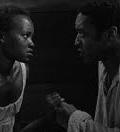
Emotionally powerful and ninetime Oscar nominated film “12 years a slave” screens at the deBartolo Performing Arts Center on Friday and saturday at 6:30 and 9:30 p.m. The film stars Chiwetel Ejiofor as solomon Northrup, a free black man from New york in the 1800s, who is abducted and sold into slavery.
What: “Clybourne Park”
Where: DPAC When: 2:30 p.m. how much: $7
Following a single, modest Chicago neighborhood over the course of generations, “Clybourne Park” examines racial tensions that arise from shifts in demographics and society. The play runs Thursday through sunday, and sunday’s performance will be followed by a panel discussion on revitalization and gentrification in south Bend neighborhoods.
By ALLIE TOLLAKSEN
Associate scene Editor
This evening, the Notre dame department of Film, Television and Theatre (FTT) will premiere the acclaimed play “Clybourne Park.”
Written by Bruce Norris and originally debuted in 2010, “Clybourne Park” builds off of Lorraine hansberry’s revolutionary Broadway play “A raisin in the sun.” hansberry’s play premiered in 1959 and centers around the experiences of a black family as they move into an all-white subdivision of a Chicago neighborhood. “A raisin in the sun” became the first play written by a black woman to premiere on Broadway.
In “Clybourne Park,” Norris expands on hansberry’s plot, telling it from the perspective of the white family selling the house and including events that occur before and after those in “A raisin in the sun.”
The second act, for example, takes place 50 years later in the same house and continues hansberry’s examination of the relationship between race and housing.
Exploring themes of race, gentrification and community from the time of Lansberry’s original play until now, Norris won the 2011 Pulitzer Prize for drama for “Clybourne Park.”
Although the play’s themes are serious, it doesn’t shy away from humor. The play is a dark comedy that offers plenty of laughs while still managing to call attention to its important themes.
“Audiences across the country have found the show hilariously funny,” director grant Mudge said in the play’s press release, “but uncomfortably so.” he points out that the play’s dark comedy highlights serious questions about race and gentrification.
The play was chosen and produced by FTT not only because of its great writing and important themes, but also for its relevance to the experiences of many within this community.
“When the play first came up among the faculty,” director of Theatre Kevin dreyer said, “Many of us felt a personal connection to its story of neighborhood decay and restoration and the accompanying racial tensions.
“We also saw an opportunity to do a show that could be of special interest in our surrounding community, as we see in the news regularly how south Bend leaders are engaged in ongoing efforts toward community revitalization.”
Because of the play’s examination of pertinent issues and relevance to the south Bend community, the FTT department will also be hosting a panel discussion, called “some change is inevitable: A Conversation about revitalization and gentrification in south Bend Neighborhoods,” on sunday, Feb. 3 at 5:00 p.m.
Following the play’s 2:30 p.m. matinee, Jackie rucker of Notre dame’s Associate director of Community relations will moderate the panel.
Panel speakers include Jeff gibney, founder and director of Planning and development at the south Bend heritage Foundation, Bernice Freeman, neighborhood advocate for equity in housing and former member of CAsh Plus (Community Action for south Bend housing) and Marguerite Taylor, board member, Northeast Neighborhood
revitalization Organization and officer of the North East Neighborhood Council.
The panel will discuss many of the issues raised by Norris and hansberry regarding gentrification, community revitalization and race relations and specifically how they pertain to the south Bend community.
It will be free and open to the public, no ticket required. The panel will undoubtedly be a compelling companion to the FTT production.
“It’s healthy to find relief in laughter,” Mudge said, “but ultimately our task is to ensure that the play provokes an honest and productive conversation.”
The play debuts this evening at 7:30 p.m. and will run until sunday, March 2 in the in the Philbin studio Theatre of the deBartolo Performing Arts Center (dPAC). Tickets are $15 for the public, $12 for seniors, faculty and staff and $7 for students. Times and tickets are available online, by phone or at the dPAC ticket office.
NFL shows different side in offseason
Aaron Sant-Miller sports Writer
during the NFL season, it’s easy to get caught up in the emotion of it all. In fact, that’s part of he beauty that comes with the game. It’s intense; players bring their fire on the field and off the field. In a violent and physical game, players bring a palpable aggression to every play, and even sometimes to post-game interviews with Erin Andrews.
At times, the passion of the sport can even overwrite the game itself. The once-held sense of perspective that “this is just a game” quickly becomes a figment of the both the fan’s and athlete’s imagination.
suddenly, after what is considered to be the most emotional game of them all, emotion is torn from the equation. A cool rift stands between the NFL season and the NFL off-season.
In a matter of days following the super Bowl, players tuck away their vivid passion. Their undying loyalty to city and fan alike is quickly replaced by savvy marketing. sure, “this is just a game” is still far from the lips. On the other hand, the phrase “this is a business” flies through the air more often than a denver Broncos pass attempt.
Immediately, the loyalty players treated as paramount to their character fades. They choose to play in different colors for a fivepercent increase in yearly salary. Everything is made as a career decision, the smart move for one’s future, family and “brand.” simultaneously, teams start to value players. Intangibles fade in importance as the player, the human, is commoditized. Teams limbo under an invisible monetary line, choosing players based on current and future value, bargain shopping.
Every year a handful of players, previously termed the “face of the franchise,” depart to foreign lands where they receive welcomes previously reserved only for prodigal children. On occasion, a franchise player will take a reduced salary to stay with his team and allow them to build up more around him. These loyalties sworn upon midseason are lauded as sacrifices during the offseason. Is this right? I don’t know. At the end of the day, the NFL is a profit-seeking business with strict financial constraints. I certainly wouldn’t approach my offseason moves with a cold, rational demeanor. My players would be my players, players I would have grown attached to and developed my own loyalties to. Then again, there is a reason I’m a fan and a writer, not an NFL general manager.
In another form, the same process occurs around the NFL draft.
A college player, during the season, can light up the field. In pads, young men can make a complex game look incredibly easy as they dominate the competition.
Once again, these players receive praise for their on-the-field skills and passion for the game. Their leadership abilities stand at the forefront, as does their tendency to be a “playmaker.”
It’s right about this time that the draft process shifts in its focus.
From the vivid and emotional football performance, draft gurus begin to see players in terms of measurables and numbers. In a matter of days, incredible players can be reduced to something average because they can’t run 40 yards faster than a back-up wide receiver from Neverheardof Tech.
At the same time, players who lack the necessary skills and football essentials ride the escalator up draft boards as their physical abilities are publicized, publicized, and publicized some more. Players with below-average numbers on the field are seen as potential superstars due to aboveaverage numbers in a gym.
Every year a few players will be drafted too early because of impressive NFL Combine numbers and every year a few players will fall because of lackluster NFL Combine numbers. years later, the pundits are unanimous in their evaluation of the pick.
“you can’t quantify talent!” “he never developed the way they hoped.” “he was a steal because 31 other teams valued how high he could jump more than they valued how effective he was on the field throughout his career.”
This Thursday, the madness begins with our lovely “underwear Olympics” in Indianapolis. Team officials will surround young men, dressed in skintight spandex, as they perform feats of strength and speed for evaluation. read that again. It’s a little weird.
It’s also impractically practical. you can’t quantify the game of football down to numbers or wages. At the end of the day, football is an emotion-driven sport. When performance matters, in the midst of an NFL season, passion, intangibles and football skills dictate the game. ray Lewis slipped in the draft because he was “too small.” Terrell davis and Thurman Thomas slipped in the draft because they were “too slow.” Oh, and then there was that Tom Brady guy.
Come on NFL. It makes sense to think about your offseason moves, but don’t forget the way you acted four months ago. This is football.
Contact Aaron Sant-Miller at asantmil@nd.edu
The views expressed in this Sports Authority are those of the author and not necessarily those of the Observer. NCAA bAsKEtbAll
Boston College upsets syracuse
Associated Press
Olivier hanlan and Patrick heckmann hit 3-pointers in overtime, Lonnie Jackson made four straight free throws in the final 26.2 seconds, and lowly Boston College stunned top-ranked s yracuse 62-59 on Wednesday night, ending the Orange’s unbeaten season.
Boston College (7-19, 3-10 Atlantic Coast Conference), which had lost five straight, rallied from a 13-point second-half deficit to pull off the improbable upset.
s yracuse (25-1, 12-1) travels to No. 5 d uke on s aturday night.
The loss leaves No. 3 Wichita state, which was playing at Loyola of Chicago on Wednesday, as the lone unbeaten in d ivision I.
The Eagles came to town with heavy hearts and a good dose of determination. Longtime basketball media contact and sports information assistant d ick Kelley died
last week after a two-year battle with AL s h is funeral was Tuesday and the Eagles, who often visited his apartment, were wearing “dK” patches on their uniforms.
The Eagles, whose only conference wins this season were over Virginia Tech, beat a No. 1-ranked team for the third time and first since the 2008-09 season.
s yracuse, which had won its last two games by a combined three points, shot a season-low 32.2 percent from the field including going 2 of 12 from 3-point range.
Tied at 50 after two halves played at Boston College’s deliberate pace, hanlan and heckmann hit from long range to give BC a 56-52 lead with 2:56 left, but Tyler Ennis’s driving layup knotted the score at 56 with 2:09 to play.
A free throw by Ennis gave the Orange a one-point lead, but heckmann’s backdoor layup put the Eagles back in
front with 43.5 seconds left. After a timeout, Ennis threw a pass toward C.J. Fair in the right corner that sailed out of bounds. After the officials initially ruled it was s yracuse’s ball a video review with 32.5 seconds left re-affirmed the call. It didn’t matter when Fair missed a drive and Jackson sealed the victory with his clutch free throws. hanlan finished with 20 points and Jackson had 10. r yan Anderson had nine points and 14 rebounds, but the Eagles won it by going 11 of 22 from behind the arc. Fair finished with 20 points on 7-of-23 shooting and had 11 rebounds. Ennis had 14 points and six assists and Jerami grant finished with 11 points.
s yracuse beat won 58-56 at Pittsburgh a week ago and 56-55 over North Carolina state in the Carrier d ome on s aturday night — as the Orange had walked a tightrope much of the season.
golf gets underway
Associated Press
graeme Mcdowell rarely felt as hopeless in match play as he did Wednesday at dove Mountain.
Overpowered and outplayed for much of the first round, he was 3 down with three holes to play as he watched the majestic flight of gary Woodland’s tee shot cover the flag on the 16th hole. Mcdowell figured it was a matter of time before he climbed into a courtesy car to be driven back to the clubhouse.
“The Cadillacs were circling,” he said. They must have looked like buzzards.
In an opening round of comebacks in the Match Play Championship, none was more stunning than Mcdowell surviving to see another day of this most unpredictable event.
Woodland’s shot took a hard bounce and landed between two corporate suites. Bogey. With a wedge in hand, Woodland pulled it on the wrong side of the 17th green, and Mcdowell capitalized by making a 12-foot birdie. Woodland blasted out of the left
bunker, over the 18th green and into the right bunker to lose a third straight hole.
Mcdowell completed his improbable rally with a 6-foot birdie on the 19th hole to win.
“I’m sure he’s extremely disappointed right now — and I’m extremely elated,” Mcdowell said. “I’m surprised to be sitting here, having won. yeah, I hit a couple of quality shots down the last couple of holes, but he had mistakes, as well. It’s a brutal format.”
It certainly was brutal for the 32 players headed for the airport. such is the nature of this World golf Championship, as cut-throat as it comes.
“It feels like a sunday afternoon on Wednesday,” Mcdowell said, realizing that Thursday won’t be much different.
Mcdowell was among eight players who trailed with six holes remaining and somehow survived.
Brandt snedeker had to make two tough par saves just to stay alive on the 18th and 19th holes of his match against david Lynn of England. he won with an 8-foot birdie on the next hole. It
was the only time all day he had the lead.
Jason dufner was 3 down with five holes remaining when scott stallings made too many mistakes, dufner made one clutch birdie, and the PgA champion advanced in 19 holes with a simple par.
six matches went the distance. Five matches went overtime. The last one was Ernie Els, vexed by this format so many times that some years he didn’t bother showing up. he was 2 down with three to play and outlasted stephen gallacher in 19 holes.
“I feel for him,” Els said, perhaps because he has been there himself.
After a wild day, there was a small degree of normalcy on dove Mountain. Only three of the top 10 seeds were eliminated — Zach Johnson (3), dustin Johnson (6) and steve stricker (9), who wasn’t even sure he would play until his brother had liver transplant surgery last weekend.
The better seed — it’s really just a number — won 23 of the 32 matches.
PGA
ND enjoys strong first day at conference meet
By ALEX WILCOX sports Writer
There have been just two events in Notre d ame’s inaugural ACC conference championship, yet the Irish have already made an immediate impact and found themselves on the podium.
Notre d ame took third in the meet’s first event, the 200-yard medley relay, with a school-record time of 1:37.61. The team of senior Kelly r yan, juniors Emma r eaney and Courtney Whyte and freshman Catherine Mulquin also earned an NCAA A-cut with its performance.
“I feel great about that race,” r eaney said. “Everyone was so on-point and ready to go. We had pretty much been working 50s for the last couple days. you have to be warmed up as much as you can and I don’t think we could have been any better prepared. We shaved a whole second off the school record and got an NCAA A-cut so I’m thrilled.”
The 200-yard medley has been a strength for the Irish all season. After they swept the podium in the event in their dual meet against Cleveland s tate on Feb. 8, r eaney said how it would be a tough decision for the coaches to put together a team for the
conference championships, given how many capable swimmers the team had. After Wednesday’s performance, r eaney had no qualms with the coaches’ choices.
“Obviously from the results I think the team was perfect,” r eaney said. “We’ve been practicing and working really hard the past week. This whole team has become so on-point with each other. We’re all on the same page,
“Obviously from the results I think the team was perfect. We’ve been practicing and working really hard the past week.”
Emma Reaney Irish junior
and it feels really good to have a team like that.”
In the second and final event of the day, Notre d ame placed sixth in the 800-yard freestyle relay. The team of r yan, r eaney, junior s uzanne Bessire and freshman Katie Miller turned in a time of 7:11.92.
“That race went pretty well,” r eaney said. “I think we were about a second slower than
last year. I know I came out hard from the beginning and so I kind of died at the end, but it went well. I think that relay has the potential to be really great. We’re seeing some of it right now, and I think once everyone comes together and gets their 200 right, we’ll be in good shape.”
At the end of day one, Notre d ame finds itself sitting in fourth place. Virginia won both events and is in first place, followed by a tie for second between North Carolina and North Carolina state. r eaney said she is happy with the position the team is in.
“[Wednesday] puts us in a great place,” r eaney said. “I think we’re tied for fourth right now, so out of 11 teams on the first day, that’s pretty good. u VA and u NC are really good, so we’re just trying to keep pace with them.”
s ince this is Notre d ame’s first ACC conference championship, r eaney said the Irish weren’t sure what to expect. s he said they used experience from previous Big East conference championships to help prepare themselves for the atmosphere.
“ s ome people were warning us that it was going to be super intense with the Virginia vs. u NC rivalry, but I think coming from the conference
where we had a very intense rivalry with Louisville we knew what to expect,” r eaney said. “It actually wasn’t as bad as we expected. I think getting on the podium right away really showed the conference that we’re here and we’re not going away.”
smC tENNIs
Notre d ame will look to continue its strong start when the second day of the ACC conference championships kicks off Thursday at 11 a.m. in g reensboro, N.C.
Contact Alex Wilcox at awilcox1@nd.edu
Belles hit road after home loss
By ALEX CARSON sports Writer
The Belles will look to get back to winning ways saturday when they travel to grand rapids, Mich., to take on Aquinas in a non-conference contest.
saint Mary’s (1-1) opened its spring season with a 7-2 home defeat to Ohio Northern last Friday. While the Belles got promising victories at No. 1 singles from senior Mary Catherine Faller and No. 6 singles from sophomore newcomer Andrea Fetters, Belles coach dale Campbell said that the Belles need to continue to improve through these earlyseason contests.
“We were a little tentative early [in our match against Ohio Northern],” Belles coach dale Campbell said. “It was our first match, but I have to get them more prepared [moving forward].”
While the Belles dropped decisions in all three doubles matches last week, they led at one point in all three and Campbell said the difference came down to positioning, which will be another
area for future improvement.
On the other side of the net, Aquinas (1-0) opened its season last weekend with a 9-0 road sweep of Alma in which it won five of the nine matches by at least two breaks in each set. saints senior Lauren ramey
“It was our first match, but I have to get them more prepared.”
Dale
Campbell Belles coach
played at No. 1 singles last weekend for Aquinas and needed three sets to win her match in the only three-set match of the day. ramey figures to be Faller’s match-up when the teams meet this weekend.
The Belles will make the visit to grand rapids, Mich., on saturday to battle the saints, with the first serve scheduled for 6:00 p.m.
Contact Alex Carson at acarson1@nd.edu
GRANT TOBIN | The Observer Irish freshman Danielle Margheret swims the breaststroke during the Shamrock Invitational on Jan. 31 at Rolfs Aquatic Center.
Irish enter ACC play over weekend
By MIKE GINOCCHIO sports Writer
Coming off of a tough loss to age-old rival Michigan last s aturday, No. 22 Notre d ame looks to make a strong entrance as it begins ACC play on the road this weekend. The Irish will take on No. 25 g eorgia Tech on Friday, then will travel down to Florida to take on No. 17 Miami on s unday. Irish coach Jay Louderback welcomes the chance to finally begin ACC play.
“ g eorgia Tech’s our first ACC match, which will be great,” Louderback said. “It’s good to start playing ACC teams…but [Tech] is good. We had two tight matches with them last year, and I’m sure it will be a good and close one this year. They’re very well-coached.”
The yellow Jackets (31) come into their meeting with the Irish (5-2) on a roll, having knocked off No. 27 Tennessee this past s aturday, 5-2. The yellow Jackets will rely on strong singles play, such as that of sophomore Natasha Prokhnevska. Prokhnevska, who is 3-0 in singles play this season, won the first ACC Player of the Week award of her career after going 2-0 in singles play against the Volunteers (3-3).
As soon as theyefinish playingsin Atlanta, the Irish must immediately focus themselves on dealing with the h urricanes (4-2). Though Miami will have only played one match in 11 days (on Friday they take oe Marylans, their first contest
Belles fall to Comets in final home game of season
Observer Staff Report
saint Mary’s could not hang with MIAA power No. 18 Olivet on Wednesday as the Comets left the Angela Athletic Center with an 8972 win.
The Belles (7-17, 5-10 MIAA) dug themselves an early hole , shooting only 32.3 percent in the first half. The Comets (21-3, 132) fed junior center s tefanie Lang early and often, as the 6-foot-4 junior put up 18 points in the first half on 8-11 shooting. The Comets shot 52.8 percent in the first half on the way to a 43-25 halftime lead.
since the ITA National Indoor Tournament), coming into the ITA National Indoor Tournament they were ranked ninth in the nation
When it comes to playing Miami, Louderback isn’t only concerned about the matches themselves but also the logistics that will surround them.
“The tough thing with Miami is we have to play them outdoors on s unday,”
Louderback said. “ h opefully, if our flight goes okay, we’ll get out there with time to hit outdoor] on s aturday and then play them on s unday. Which, going from indoors to outdoors, is not easy.”
Louderback also pointed out that the team had been observing the weather radar for the Miami area and noted that the temperature for s unday’s match is projected to be around 85 degrees.
“I’m hoping it rains in Miami all week so that they can’t practice,” Louderback said drily.
All jokes aside, Louderback knows that now the Irish have really entered the challenging run of the season.
“We start off with some tough early ACC matches,”
Louderback said. “We’ve just got to get a little more energy on the court when we’re playing, and I think we’ll do just that.”
The Irish will make their ACC debuy against the yellow Jackets on Friday, at 4 p.m. They travel to Miami to take on the h urricanes on s unday at noon.
Contact Mike Ginocchio at mginocch@nd.edu
The Belles came out strong after halftime, keeping pace with the Comets throughout the second half. s aint Mary’s outscored Olivet 47-46 in the second half and shot 55.6 percent from the field in the period. The Comets never let their lead dwindle to less than 12, though, as Lang continued her strong play. Olivet’s leading scorer for the night finished the game with a dominating 30 points on 14-21 shooting, also adding 17 rebounds in just 25
minutes.
In her final home game in a s aint Mary’s uniform, senior guard s hanlynn Bias scored a career-high 24 points to lead the Belles, 18 of which came in the second half. Junior forward Ariana Paul added 19 points and 14 rebounds for the Belles, and was the only other Belle to score in double figures.
The Belles shot 44.8 percent from the field for the game, going 20-36 in the second half to recover from their poor offensive first half. The Belles’ 13 turnovers were just one more than their season low. s aint Mary’s concludes its season s aturday with an away matchup at Albion at 3:00 p.m.
PAI d AdVE rTIsEMENT
EMMET FARNAN | The Observer Irish freshman Mary Closs returns a volley during Notre Dame’s 4-3 victory over Indiana on Feb. 2 at the Eck Tennis Pavilion.
CAROLINE GENCO | The Observer
Belles freshman guard Timoney Moyer lines up a shot during Saint Mary’s 95-68 loss to Calvin on Jan. 15.
tr ACK AND fIElD
Notre Dame hosts Alex Wilson Invitational
By CASEY KARNES sports Writer
Notre dame will finish up its 2014 indoor regular season by hosting the Alex Wilson Invitational at Loftus sports Complex on s aturday.
The meet is Notre dame’s final competition prior to the ACC Indoor Championships, held in Clemson, s .C., at the end of the month. Following the Indoor Championships, the outdoor season begins March 26. Last weekend, the Irish faced their final road meet, the sPI r E Invitational in g eneva, Ohio and came away with 15 top-five finishes.
graduate student and multiple-event athlete Ted g lasnow notched Notre dame’s lone victory with his performance in the men’s heptathlon. Other key performances included a fourth-place finish by junior sprinter Josh Atkinson (6.83) in the 60-meter dash and senior sprinter Pat Feeney (46.39) and junior sprinter
Chris giesting (46.44) finishing second and third, respectively, in the 400-meter dash.
The namesake of the Alex Wilson Invitational is the 1932 Notre dame graduate, who was a three-time All American for the Irish. Wilson also won four medals — three bronzes and a silver — while competing for Canada in the 1928 and 1932 Olympics. After his running career finished, Wilson coached Notre dame track and field and cross-country from 1950 to 1972. he found a spot in the u s . Track and Field and Cross Country Coaches Association hall of Fame in 2008. In the spirit of Wilson’s legacy, Irish coach Joe Piane said this weekend’s goals were to get as many runners qualified for the NCAA championships as possible.
“This is a great opportunity to not only improve their seed times for the ACC meet, but certainly to get qualified for the NCAA championships,” he said. “That’s really the thrust
this weekend. One of our goals is to get the women’s distance medley qualified, same thing on the men’s side. I don’t want to wait until the ACC’s to do it, I’d rather get it done this weekend.”
The women’s distance medley team finished second behind Michigan at the sPI r E Invitational with a time of 11:08.58. The medley has a great deal of experience, with three seniors — middle distance runner Alexa Aragon, sprinter Michelle Brown and middle distance runner Kelly Curran — leading the way. s ophomore middle distance runner danielle Aragon rounds out the group.
While the Irish are focused on the postseason, Piane said he’s still had time to notice the impressive performance of this season’s freshmen class.
“The freshmen have been doing well,” Piane said. “[ d istance runner] Taylor d riscoll has been doing a very good job on the women’s side. [Middle distance runner Jacob] d umford and [middle distance runner Chris] Marco have been doing very, very well on the other side, along with some other freshmen. We’ve got a pretty good group of freshmen athletes, we’re excited.”
The Irish will be competing at the Alex Wilson Invitational all day s aturday at Loftus sports Complex.
Contact Casey Karnes at wkarnes@nd.edu
six games fill schedule at Mary Nutter Classic
By KATIE HEIT sports Writer
The No. 24 Irish head to Cathedral City, Calif., to compete in the largest regular-season tournament this weekend when they compete in the Mary Nutter Collegiate Classic.
The five-day tournament will find the Irish (6-1) facing six teams in four days, starting with Pacific and Byu tonight, uC davis on Friday, California and Cal state Fullerton on
s aturday and wrapping up with a game against No. 8 Oregon on sunday.
Irish senior pitcher Laura Winter said focusing on the details of their game will keep the Irish going through the long string of competition.
“using each game as momentum into the next is huge,”
Winter said. “It is important to keep doing little things well.
Feeding off each other will be a huge factor as well, by stringing hits together and making
great defensive plays for each other.”
Junior catcher Cassidy Whidden said Notre dame will also have to keep its focus through every game.
“Our toughest challenge will be ourselves this weekend,” Whidden said. “We play some tough teams who will challenge us offensively and defensively. The key to our success will be playing together and playing tough no matter who we play over the next four days.”
The Irish enter the tournament on a five-game winning streak, having swept all their games at the Jacksonville university Tournament last weekend, which included two games against No. 23 Louisville. In their second face-off against the Cardinals (4-5), the Irish scored seven runs in the first inning and went on to win the game 11-4.
As they head to sunny California for this weekend’s tournament, both Whidden and Winter said the Irish are looking forward to the warm environment the tournament has to offer — but are not letting it distract from their focus.
“We always look forward to getting back out on the dirt
and playing the game we love,” Winter said.
Whidden said the tournament provides a national stage for Notre dame to showcase its talent early in the season.
“We are excited to perform on a big stage,” Whidden said.
“This weekend we have the opportunity to show the nation
what Notre dame softball is all about and what we are capable of doing — dominating.”
The Irish begin play at the Mary Nutter Collegiate Classic at 1 p.m. today against Pacific in Cathedral City, Calif.
Contact Katie Heit at kheit@nd.edu
ZACHARY LLORENS | The Observer
Irish sophomore middle-distance runner Danielle Aragon, right, competes during the Notre Dame Invitational on Jan. 25.
ZACHARY LLORENS | The Observer
Irish senior pitcher Laura Winter stands in the circle during a matchup against Purdue on Sept. 22.
Notre Dame hosts round-robin in Texas
By MATTHEW DeFRANKS Assistant Managing Editor
After facing a preseason top-25 team to open the season, the Irish will take a step down in competition this weekend when they host the Irish Baseball Classic in san Antonio.
Notre dame (1-2) lost its opening series to No. 24 Florida Atlantic after it dropped the final two games by 10 runs apiece. In the three-game set, the Irish committed 10 errors and allowed 14 unearned runs.
“We didn’t discriminate against any type of error,” Irish coach Mik Aoki said.
Notre dame pitchers also struggled with their control, walking 20 batters, hitting six more and throwing four wild pitches.
“Put all that together and it’s a bad recipe,” Aoki said.
This weekend, the Irish will play santa Clara, gonzaga and Incarnate Word, three teams that combined for 46 division I-wins in 2013. Notre dame won 34 games a season ago.
The four teams will play each other round-robin style before playing a fourth game sunday.
unless santa Clara and gonzaga are slated to play again sunday, the top two teams would meet in a quasi-championship game while the bottom two play.
Both schools are in the West Coast Conference (WCC) and wanted to avoid playing twice before their future three-game series.
The Irish face santa Clara (14) Thursday. The Broncos went just 14-39 last year, including 1-23 in the WCC. santa Clara returns just one player that hit above .300 last season in senior outfielder Casey Munoz. Munoz also led the Broncos in hits (64), doubles (10) and rBIs (31) in 2013.
On Friday, Notre dame will take on gonzaga (1-3). The Bulldogs won the regular-season WCC title last year but failed to qualify for the NCAA Tournament. gonzaga lost a pair of starting pitchers with Er As less than 3.00 and do not return any pitchers with more than eight starts.
The Bulldogs nearly beat Oregon state (ranked in the top five by all five polls) in their season-opener but fell 4-3.
“gonzaga’s probably the best team we’ll see this weekend,” Aoki said.
Incarnate Word (1-2) is in its first season of division I play after spending 14 years in division II. The Cardinals made the division II NCAA Tournament four times during that span. Incarnate Word is not eligible for postseason competition this year due to its transition from division II.
Aoki said the Irish would change up their starting pitching rotation due to the unusually long break between the first series and the Irish Baseball Classic. sophomore right-hander Nick McCarty (0-1, 11.57 Er A) will get
PAI d AdVE rTIsEMENT
the ball Thursday against santa Clara while junior transfer lefthander robert youngdahl (0-0, 3.38) will make his first start for the Irish on Friday.
senior right-hander sean Fitzgerald (1-0, 3.60), the normal No. 1 starter, will go saturday to ensure six days of rest, Aoki said. Junior right-hander scott Kerrigan (0-1, 11.57) will start sunday’s game.
Aoki said freshman infielder Kyle Fiala would get the start at third base this weekend. Last week, Aoki said Fiala and juniors
deFilipis and Phil Mosey were all vying for playing time at the hot corner.
deFilipis started all three games against Florida Atlantic and went 1-for-8 with six strikeouts and two errors.
Notre dame plays santa Clara at 8 p.m., gonzaga at 1:30 p.m. and Incarnate Word at 5 p.m. on Thursday, Friday and saturday, respectively. The fourth game will be at 12:30 p.m. on sunday.
Contact Matthew DeFranks at mdefrank@nd.edu
Kevin
Observer File Photo
Irish senior pitcher Sean Fitzgerald delivers a pitch during a game in 2012. Fitzgerald will pitch Saturday against Incarnate Word in the Irish Baseball Classic.
I “It’s cool to be able to say that I have. The first time I sparred … I got popped pretty good in the first couple seconds, and thought, ‘This might not be as cool as I thought.’ you start throwing punches back, though, and it turns into a great way to vent, honestly.”
Nothing beats the pre-fight buildup, though, not even the first spar, Considine said. g oing into his fight Monday, Considine couldn’t sit down. The freshman said he felt a bigger adrenaline rush than he had ever felt, going back to his high-school swimming and water-polo days.
“The adrenaline rush is unbelievable,” Considine said. “I was pumped, not nervous about the fight. h onestly I’m always scared of messing up, and there’s all this protocol
about where you have to be and when, and when to step into the ring and all this extra stuff, so I was more nervous about doing that stuff wrong
and looking stupid.”
What was once just a way to fill time has turned into something of an obsession for Considine, especially after
PAI d AdVE rTIsEMENT
his win Monday over graduate student John g riffin to move into the quarterfinals of the 180 lbs. bracket.
“After Monday night, you
realize there’s only a week left at the most. g oing into that fight I was still viewing [Bengal Bouts] … as just something to do, but I honestly could be done fighting [tonight] so that’s given me a lot of motivation.”
Now that he’s caught the boxing bug, Considine said nothing will keep him from continuing on after this year’s bouts are over. Nothing, that is, except his dad.
“I’ll definitely keep going after this year, granted my dad lets me,” Considine said. “I told him I might’ve broken my nose Monday, and he wasn’t too happy. But hopefully he’ll come around.”
Considine and the other Bengal Bouts quarterfinalists step back into the ring tonight, starting at 6 p.m. in the Joyce Center Fieldhouse.
Contact A.J. Godeaux at agodeaux@nd.edu
EMILY McCONVILLe | The Observer
Irish freshman Jack Considine throws a punch during his first-round fight of the Bengal Bouts on Monday. Considine won the fight in a unanimous decision and will participate in the second round tonight.
22 seconds left. But after two more Brown free throws made the score 6764, Jackson missed a contested layup on the other end and the Irish would not score the rest of the evening.
“I’m really proud of our group, because nothing really felt great tonight,” Irish coach Mike Brey told u N d com. “And you give Miami credit – they shot the heck out of it, especially to start the game. But we had three freshmen on the floor to make that run back and they made big plays for us. It’s something to build on. We’ve got to have a short memory … but I’m proud of our group because we sure put ourselves in a position.”
Connaughton scored eight of Notre d ame’s first 10 points and shot 6-for-7 from 3-point range to finish with 22 points, just two shy of his career high.
Meanwhile, Jackson scored a career-high 17 points on 7-for-13 shooting. The Mishawaka product also notched five assists and had just one turnover in his first appearance after a two-game absence due to academic reasons.
“ h e had a tough week,” Brey said. “ h e got caught up academically. I think he’s more mature and more grown up. And one of the real positives of tonight is that he is back in a rhythm and part of our rotation. We started him in the second
half and he was the guy that really energized us to make us feel like we had a chance to do it tonight.”
Irish senior guard Eric Atkins and senior center g arrick s herman both struggled shooting the ball Wednesday. Atkins picked up two fouls in the game’s opening 13 minutes and finished with just five points on 2-for-8 shooting.
s herman, battling a finger injury, scored seven points and made just three of his nine field goal attempts.
Brown finished with a team-high 21 points for the h urricanes as Miami secured its first home conference victory of the season in its seventh chance.
Next on the docket for the Irish is a trip to Charlottesville, Va., and a s aturday-afternoon matchup with No. 14 Virginia.
The Cavaliers (22-5, 13-1) lead the ACC after No. 1
s yracuse’s loss to Boston College on Wednesday and handed Notre d ame its worst defeat of the season, a 68-53 loss in Purcell Pavilion on Jan. 28.
“We’ve got to flush this one quickly,” Brey said.
“We’ve got a chance to play a nationally-ranked team on their floor and a team that thumped us in our place. That’s the worst beating we’ve gotten. s o we’ve got to move forward quickly … tune it up a little [Thursday in practice] and play again on the road.”
Contact Sam Gans at sgans@nd.edu
1,024 rebounds compared to a 947 mark for its opponents. d emon d eacons junior forward d earica h amby leads the way with 11.0 rebounds per game, an average that also leads the ACC.
Lately, Notre d ame has turned in subpar rebounding performances, according to Mc g raw. The Irish cannot continue to rebound as poorly as they did against g eorgia Tech if they hope to continue winning games, she said.
“I was really disappointed in our rebounding effort [against g eorgia Tech],” Mc g raw said. “We actually didn’t have enough. The rebounding was poor. I mean [allowing] 26 offensive rebounds is not gonna win us a lot of games.”
h amby and senior guard Chelsea d ouglas dominate the stats for Wake Forest. h amby averages 21.5 points per game, and d ouglas puts up 18.8 points per game. h amby’s average makes her the ACC’s top individual scorer, and d ouglas has the fourth-highest scoring average in the conference.
After h amby and d ouglas, Wake Forest’s offensive statistics drop off with redshirt freshman guard Kelila Atkinson as the team’s third-highest scorer at 6.1 points per
game. For the team’s topscoring forward after h amby, one has to look to sophomore Kandice Ball, who averages 3.0 points per game.
The d emon d eacons own a slight edge over their opponents in total offense with an average of 69.2 points per game, compared to 68.6 per game for opponents. Although the d emon d eacons have struggled on the road, posting a 5-6 record, they have found more success at home, where they have posted an 8-4 mark.
PAI d AdVE rTIsEMENT
The Irish arrive at Wake Forest’s home arena leading the ACC in scoring and with an average margin of victory of 26.3 points per game. Connecticut has maintained its numberone national ranking over Notre d ame throughout the season with a 26-0 record. The Irish square off Thursday against the d emon d eacons at 7 p.m. in Winston- s alem, N.C., at Lawrence Joel Veterans Memorial Coliseum.
Contact Samantha Zuba at szuba@nd.edu
JOHN NING | The Observer
Irish sophomore guard Jewell Loyd moves upcourt during Notre Dame’s 101-64 win over Syracuse on Feb. 9 in the Purcell Pavilion.
ANNETTE SAYRE | The Observer
Irish freshman guard Steve Vasturia dribbles the ball during Notre Dame’s 68-64 win (2OT) over Clemson in the Purcell Pavilion on Feb. 11.
Happy Birthday: you’ll make headway with matters that concern personal finance, investments, contracts, agreements and medical issues. don’t sit back waiting for things to come to you. so much can be accomplished if you take control. your actions will help make a difference for those unable to do so. strive to improve your life and secure your future. your numbers are 4, 11, 21, 29, 35, 44, 49.
ARIES (March 21-April 19): Take care of business. don’t get dragged down or into a situation that has the potential to make you look bad. Keep things moving along without complication and you will show your strength and ability to get things done.
TAURUS (April 20-May 20): stay focused on what you need to accomplish. don’t get involved in rumors or office politics. Put greater emphasis on what you have to offer and the ways you can diversify in order to make the most professionally and financially.
GEMINI (May 21-June 20): Follow your heart and go in the direction that suits you best. refuse to let anyone railroad you into something you know little about. Express your thoughts and push for what you want to see unfold. Taking the initiative will be your best course of action.
CANCER (June 21-July 22): get involved in your community or in an activity that will add to your knowledge regarding a skill you have. Finding ways to improve will take you in a new direction that may be questioned by friends or relatives.
LEO (July 23-Aug. 22): A short trip or conversation with an expert will help you make a decision that will alter your course and help you find the satisfaction and happiness you desire. don’t look back when forward motion has so much to offer. Follow your heart.
VIRGO (Aug. 23-Sept. 22): Take it easy, relax and enjoy your friends. g o shopping for something that will help update your appearance. spend some time socializing with someone you love to be with.
LIBRA (Sept. 23-Oct. 22): Tie up loose ends before someone brings them to your attention. Complaints will end in hard feelings and a change in an important relationship. Now is not the time to overreact. Just get things done and live up to any promises you made.
SCORPIO (Oct. 23-Nov. 21): have some fun, learn something new and venture into unfamiliar territory. It’s time to expand your mind, your friendships and your interests. romance will improve your life and lead to a personal change that will make you happy.
SAGITTARIUS (Nov. 22-Dec. 21): It’s important to have a clear picture of your situation, surroundings and what other think or want to do in order to make a judgment call that can determine your future. have a heart-to-heart talk before making a personal or professional decision.
CAPRICORN (Dec. 22-Jan. 19): don’t tamper with something that is working. step back and watch things unfold. The less you do or say, the better. you will be blamed for whatever goes wrong if you decide to interfere. don’t try to change others.
AQUARIUS (Jan. 20-Feb. 18): strategize and push to activate your plans. don’t be shy; express your thoughts and use your skills openly to reach your goals. rewards will come your way along with recognition and praise. stand tall and be proud of your accomplishments.
PISCES (Feb. 19-March 20): Ease your stress by making the changes that will help you achieve stability in your life personally, financially and physically. A chance to help someone you have worked with in the past will lead to a new and prosperous opportunity.
Birthday Baby: you are smart, articulate and progressive. you are imaginative and driven.
JumblE | dAVId hOyT ANd JEFF KNurEK
suDoKu | ThE MEPhAM grOuP
By SAM GANS sports Writer
Blown off course
Miami utilized a hot start to take a large first-half lead and held on late for a 71-64 victory over Notre d ame in the Bank u nited Center in Coral g ables, Fla., on Wednesday night.
The h urricanes (13-13, 4-9 ACC) entered the week averaging 61.0 points per game – to rank 339th out of 345 d ivision I teams – and had scored 55 points or fewer in three of their previous four games. But Miami made its first four 3-point attempts Wednesday and ended the first half with a shooting percentage of 61.9 – one that included a 6-for-8 performance from 3-point range – to break out to a 38-26 halftime lead.
The h urricanes cooled down in the second half, however, shooting 37
percent. That mark, coupled with strong performances from Irish junior forward Pat Connaughton and freshman guard d emetrius Jackson, gave Notre d ame (14-13, 5-9) a chance to steal a win.
After falling behind 5439 with 11:09 remaining, the Irish worked their way back into the game and
pulled within one point at 63-62 when freshman guard s teve Vasturia hit a 3-pointer with 36 seconds remaining.
Miami senior guard r ion Brown hit two free throws to make the score 65-62 before a Jackson layup again cut the deficit to one with
ND WomEN’s bAsKEtbAll
Irish carry streak into Wake Forest
By SAMANTHA ZUBA sports Writer
The undefeated No. 2 Irish head to Winston-salem, N.C., for the first time to take on Wake Forest on Thursday at 7 p.m. in Lawrence Joel Veterans Memorial Coliseum.
Notre dame (25-0, 12-0 ACC) and the demon deacons (14-11, 5-7) have played once before, but Thursday’s game marks the first matchup at Wake Forest.
Notre dame defeated Wake Forest 92-69 on Nov. 27, 2010 at Purcell Pavilion.
The demon deacons have had an up-and-down season but have strung together two consecutive close wins in their last two games. Wake Forest narrowly defeated Pittsburgh 74-70 on Feb. 9 and squeaked by Virginia Tech 65-64 on Feb. 13. Two free throws from junior guard Millesa Calicott secured the victory over Virginia Tech (11-14, 1-11) with 5.9 seconds left in the game.
The Irish last played Monday,
when they defeated g eorgia Tech 87-72 at home. sophomore guard Jewell Loyd sparked Notre dame’s offense with 27 points. Loyd has led the team in scoring 10 times this season, including in two of the last three games.
Although Notre dame secured the win against g eorgia Tech (17-9, 7-6), Irish coach Muffet Mcgraw said her team needs to start rebounding better. The yellow Jackets outrebounded Notre dame 48-46 and also bested the Irish in the offensive rebound category, 26-12.
“They were quick, and they were physical, and we didn’t match it,” Mcgraw said. “We didn’t really attempt to box out. I think our rotations were poor. But we’ve got a lot of work to do rebounding wise, especially in the post.”
Wake Forest has gained an advantage in rebounding over its opponents this season, with
Freshman novice finds a path into second round
By A.J. GODEAUX sports Writer
Every fall, a mass of beginner boxers, “novices” in Bengal-Bouts terms, descends on s tepan Fields to begin workouts in hopes of months later having an arm raised by the referee in victory.
Freshman Jack Considine, who Monday night won his first Bengal Bouts fight by unanimous decision, is one of those novices.
“I always thought it’d be kinda cool to learn how to defend yourself,” the Wilmette, Ill., native said.
“One of my role models from back home, a kid I really looked up to, was really into boxing, so I’ve always been drawn to it.”
Before his natural ability in the ring — Considine stands a legitimate 6-foot-3 with a
solid build and a pterodactyl-like wingspan — could even be realized, though, he considered quitting after the first few workouts.
“I honestly thought we were going to just jump in and start sparring,”
Considine said. “It’s such a slow progression from that first workout to when you first spar. I understand completely now why [the captains and coaches] do it that way, but I had first joined just to have some fun and throw some punches.”
Once he did start sparring, though, all the buildup was worth it, he said.
“Whenever someone talks about a martial art or boxing, they always get asked ‘ h ave you sparred,’” he said.
“It’s cool to be able to say that I have. The first time
EMILY McCONVILLE | The Observer
Irish junior guard/forward Pat Connaughton releases a shot during Notre Dame’s 68-64 double-overtime win over Clemson on Feb.