Print Edition of The Observer for Monday, October 31, 2016
Weathering its own storm
Notre Dame starts fast, overcomes untimely mistakes in return to winning ways against Miami
to give the Irish the 30-27
Despite problems, Irish get extremely important victory
Zach Klonsinski Assistant Managing Editor
Notre Dame needed this one. No, that doesn’t even begin to capture it: For Notre Dame this game was more of a must-win than sophomore receiver C.J. Sanders’ muffed punt was an absurdly bone-headed decision.
After stumbling out to a 2-5 start, the Irish and their fan base were reeling. Director of Athletics Jack Swarbrick had to give Irish head coach Brian Kelly a “vote of confidence” and squash rumors Kelly might not lead Notre Dame out of the tunnel in 2017. Recruits were becoming skeptical: Fourstar defensive end Donovan Jeter decided to decommit and jump north of the state line to become a Wolverine over the bye week.
Even the student section failed to approach capacity Saturday, large swaths of wooden benches and concrete glaringly visible throughout the game, from the senior to freshmen sections.
In short, basically everything had gone wrong.
By ALEX BENDER Sports Writer
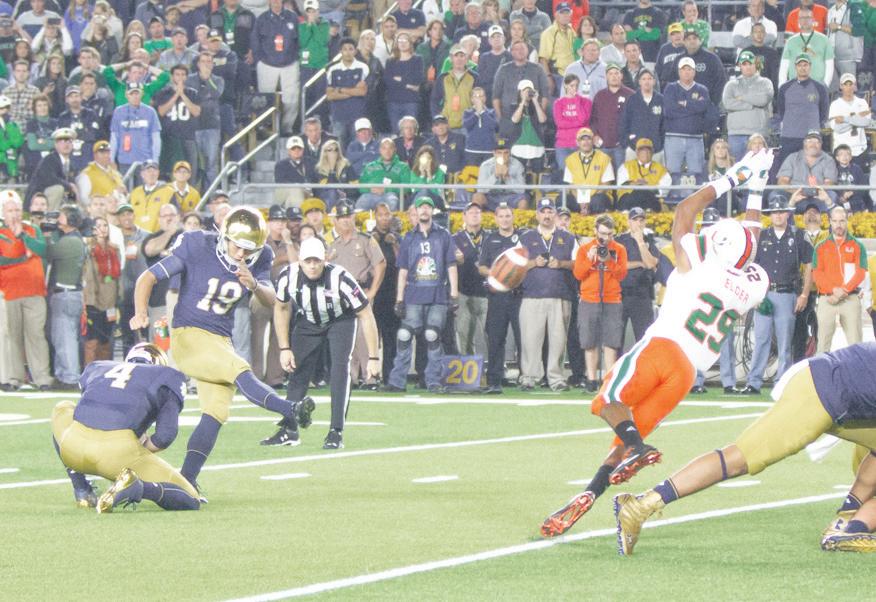
On an unseasonably warm day at Notre Dame Stadium, the Irish were able to come away with the 30-27 win over Miami after late game heroics from sophomores running back Josh Adams and kicker Justin Yoon.
Miami (4-4, 1-3 ACC) controlled the middle of the game, scoring 27 unanswered points, but Notre Dame (3-5) came up big at the start and finish, and it proved to be enough for the Irish to pick up the win.
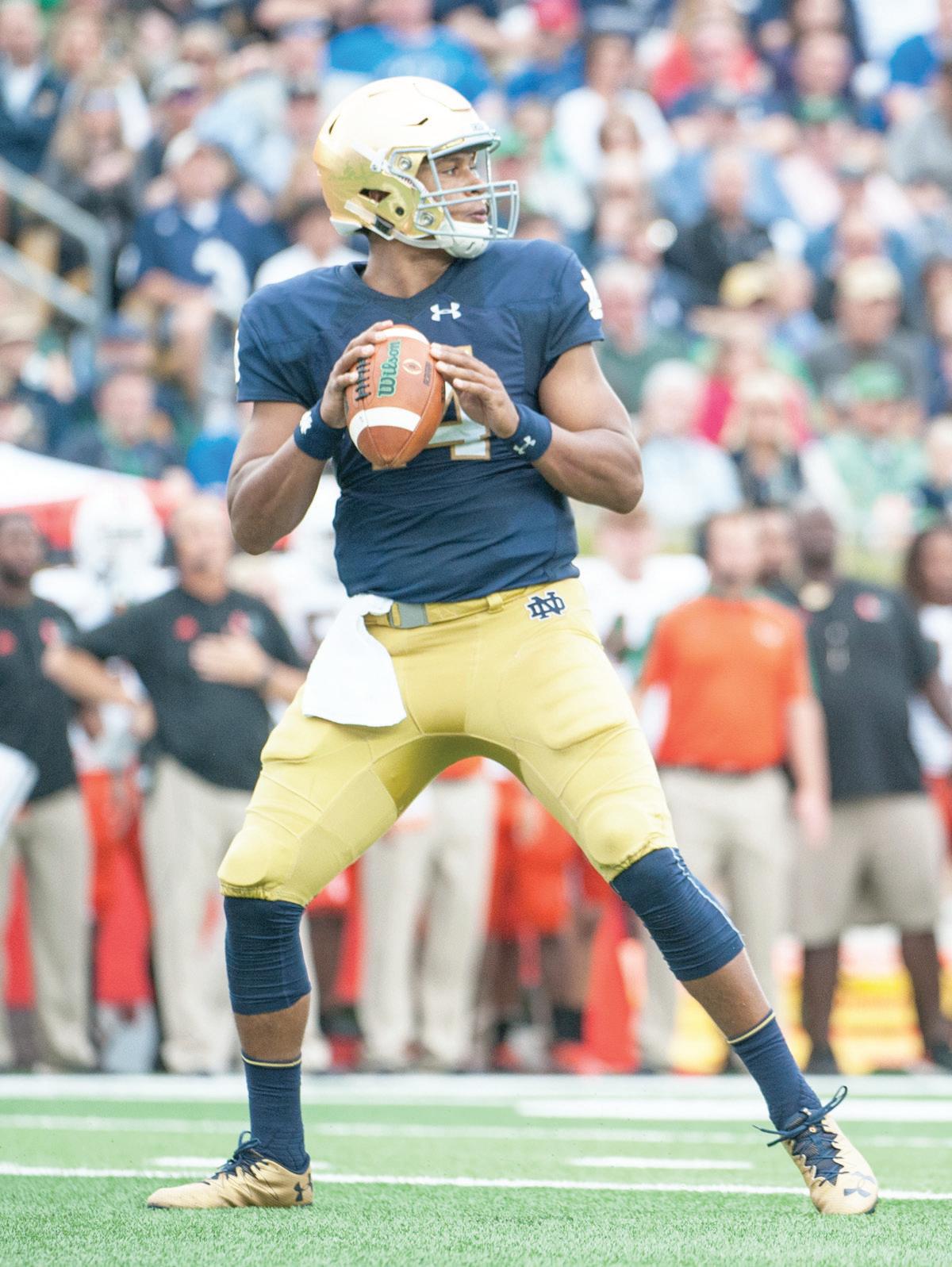
After Miami deferred to the second half off the coin toss, the Irish got things going early with a drive that saw effective play on the ground and in the air. The Irish eventually capped off the drive and made their way into the end zone off a five-yard shovel pass by junior quarterback DeShone Kizer to senior receiver Torii Hunter Jr., giving Notre Dame the early 7-0 advantage.
On defense, the Irish smothered the Hurricanes early on, getting three first half sacks as well as an interception, which often led to good field position for Kizer and company. Between a field goal by junior kicker Justin Yoon and another touchdown — this time from Kizer to sophomore
Equanimeous St. Brown for a 14-yard score — the Irish found themselves on top 17-0 with almost four and half minutes left in the first quarter. Miami was frustrated offensively early on as the Hurricanes concluded the first quarter with just two rushing yards and zero passing yards on three drives.
Irish head coach Brian Kelly said Notre Dame’s defensive front seven, especially graduate student defensive lineman Jarron Jones, helped put Miami on its heels early on.
“Jarron was outstanding,” Kelly said “He was awarded the game ball, and what I think stands out to me more than anything else is when your senior is playing his best ball, that says a lot about how he feels about coming to work every day, getting better, regardless of the record. That’s a real positive for our program and for him individually, and he was a beast out there today.”
Miami would be forced to punt during their first drive of the second quarter with Notre Dame starting back at their own 38 yard-line, but thanks to a big play on a 53-yard grab by freshman receiver Kevin Stepherson, the Irish were knocking on the door step before coming up short. Yoon notched his second field goal of the day, this one
from 26 yards out, and the Irish were up 20-0.
The following Hurricane drive appeared to be coming to a close with a punt from their own end of the field, but due to a special teams blunder in which freshman Troy Pride Jr. inadvertently touched the ball while blocking, the Hurricanes pounced on it and kept their drive alive. The Hurricanes were able to generate some offense this time around and capitalized on the mistake when junior quarterback Brad Kaaya hit junior tight end David Njoku in the end zone for the two-yard score.
On the following kickoff, Miami caught the Irish off guard with an onside kick attempt, giving themselves great field position and a chance to ride the momentum of the previous drive. Notre Dame’s defense stood strong, however. Nothing would come of it as the teams headed to the locker room with a score of 20-7 Notre Dame.
As the second half got underway, the Miami offense seemed to be getting into their first real rhythm on the day, nosing their way into the end zone off a oneyard rush by Mark Walton, and Miami had cut the deficit to six
Kizer shines in quarterback duel with Kaaya
By MANNY DE JESUS Sports Writer
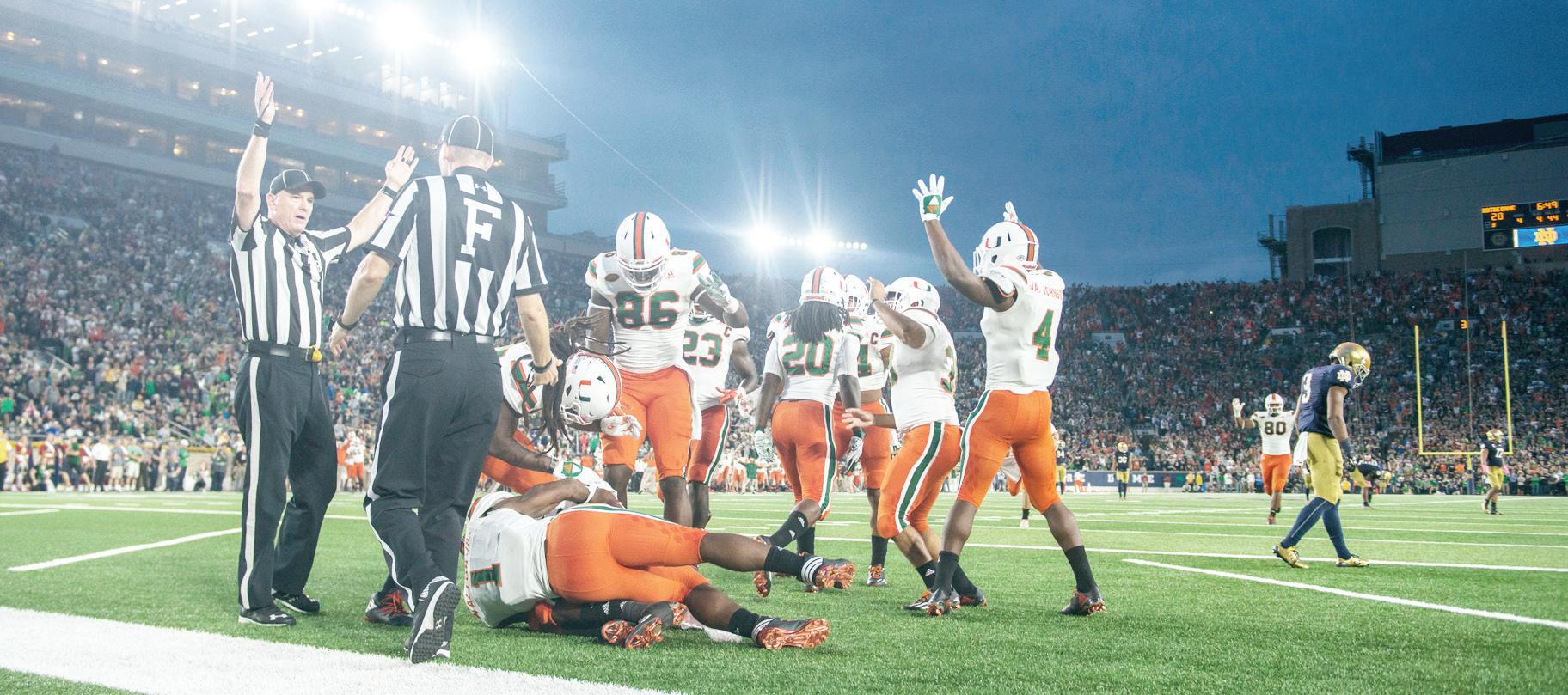
The battle between two of Scout Inc.’s top quarterback prospects was as advertised. Both Irish junior DeShone Kizer and Miami junior Brad Kaaya had a handful of moments where they picked apart the opposing defense like an NFL quarterback would. However, one particular play set Kizer apart as the Irish managed to hold on for a 30-27 win over Miami at Notre Dame Stadium on Saturday. With 2:11 left in the final quarter and at seven yards away from the end zone, Kizer connected with senior tight end Durham Smythe for a short pass over the line of scrimmage. Smythe turned around with what seemed like a clear lane to a touchdown when a Miami (4-3) defender knocked the ball right out of Smythe’s control. Kizer saw the ball out of the corner of his eye and jumped towards the forming scrum right at the two-yard line. After struggling with several other Miami defenders on top of him, Notre Dame Stadium erupted with cheers as Kizer came out of
EMMET FARNAN | The Observer
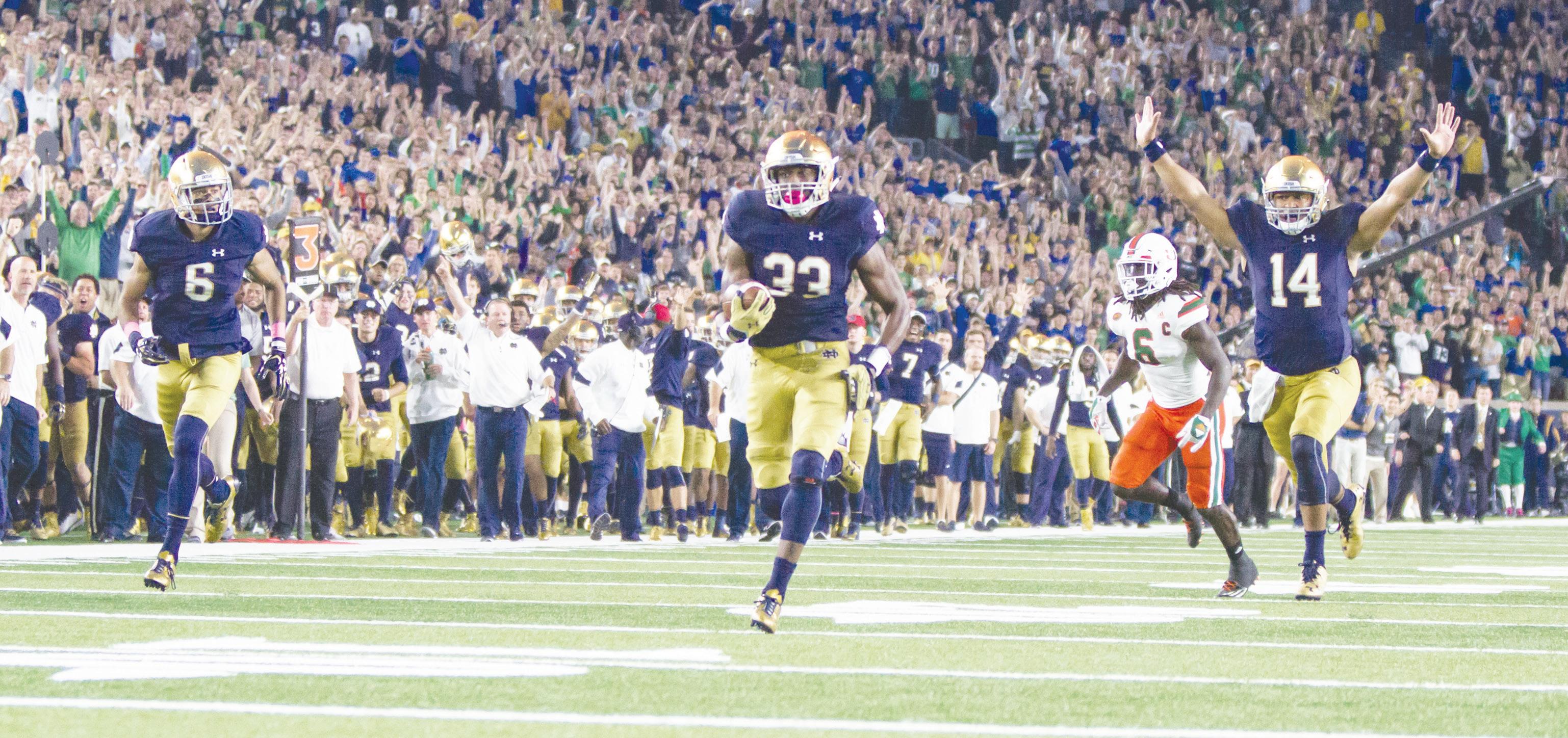
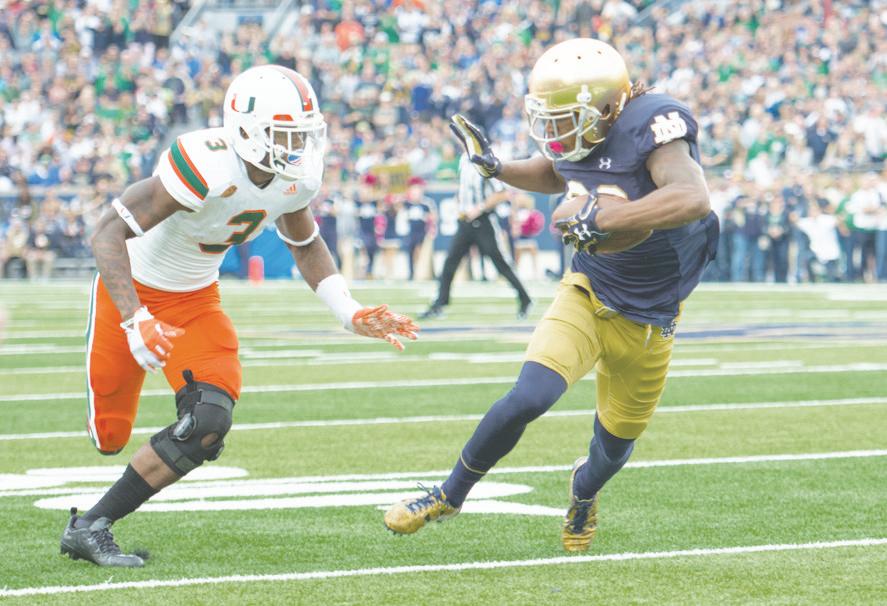
Irish sophomore running back Josh Adams sprints into the end zone to score the game-tying touchdown against Miami on Saturday at Notre Dame Stadium as junior quarterback DeShone Kizer, right, begins celebrating with the rest of the Irish faithful. Sophomore kicker Justin Yoon hit a 27-yard field goal with 30 seconds left
win.
Saturday afternoon slowed the bleeding. Barely.
The Irish still have a lot of work to do to salvage anything from this season, but 3-5 sounds a heck of a lot better than 2-6.
Cautious optimism surrounded those involved with the program after the bye week and the University’s fall break. There was a new excitement in the air that hadn’t been felt since before the season opener down in Austin, Texas. It was an indescribable buzz nearly pinchable between a thumb and index finger but always just slipping out.
In the latest installment of what has been a seemingly endless case of déjà vu, Notre Dame jumped out to the early 20-0 lead and seemed to be
on cruise control offensively. For a quarter and six minutes, the Irish actually looked like the playoff contender we all thought they were at the beginning of the year.
Then a short Miami punt practically landed on Irish freshman cornerback Troy Pride Jr. as he ran down the field to block. The Hurricanes pounced on the loose ball, and 27 unanswered points later Notre Dame once again found itself trailing late in the fourth quarter.
Irish fans are forgiven for being a bit skeptical of the team’s chances based on what we’ve seen this year. Notre Dame has always been just a few yards short of getting over the mental hurdle that’s plagued it in close games.
This time, however, the Irish finally made the play they needed to. Plays even, emphasis on the plural: junior
quarterback DeShone Kizer somehow emerging with the football from that massive pile of humans at the 1-yard line, sophomore running back Josh Adams’ 41-yard touchdown scamper to tie the game at 27, and junior linebacker Nyles Morgan’s game-ending sack all come to mind, as well as anytime the name Jarron Jones was mentioned.
The Irish tried to give the game away on multiple occasions, of course: senior tight end Durham Smythe’s fumble Kizer pulled out of a hat, Sanders’ I-don’t-know-whatadjective-to-use debacle, and Pride’s wrong-spot, wrong-time moment on the game-changing punt in the second quarter.
But, finally, the Irish stayed out of their own way just enough to get a victory. Notre Dame starts the second half of the season with a win, and suddenly a bowl game doesn’t
seem so far-fetched.
Don’t be disillusioned, of course: There’s still an immense amount Notre Dame has to fix, starting with the mental lapses on both ends of special teams and ranging all the way up to more questionable coaching decisions. The military academies, Virginia Tech and USC will all expose Notre Dame’s shortcomings, like Miami managed to at times Saturday. The road ahead is far from well-traveled, and more than a few Irish blessings may be necessary along the way.
But that’s for Monday, when the team gets back to practice and begins preparing for Navy. For now all the Irish need to do is remember this feeling, find a way to bottle it and keep it on the sideline.
“We won. We won,” Kizer said when a reporter started asking him about Miami’s
comeback, the relief visibly washing over him. “We won tonight. That’s all that matters. I don’t know how they came back. I don’t care how they came back. I don’t care what it took for them to come back. … I don’t care how pretty it looks. I don’t care how many yards I throw. I don’t care how many touchdowns we run in, how many trick plays we run.
“I just want to make sure we freaking win games because that’s all that’s on my mind.”
He’s right: The scoreboard doesn’t ask how it happened. The only idea that matters for now is that the phrase “Notre Dame wins” has meaning again.
Contact Zach Klonsinski at zklonsin@nd.edu
The views expressed in this column are those of the author and not necessarily those of The Observer.
Josh adams’ game-tying 41-yard touchdown run
irish d efensive l ineman Jarron Jones
MICHAEL YU | The Observer
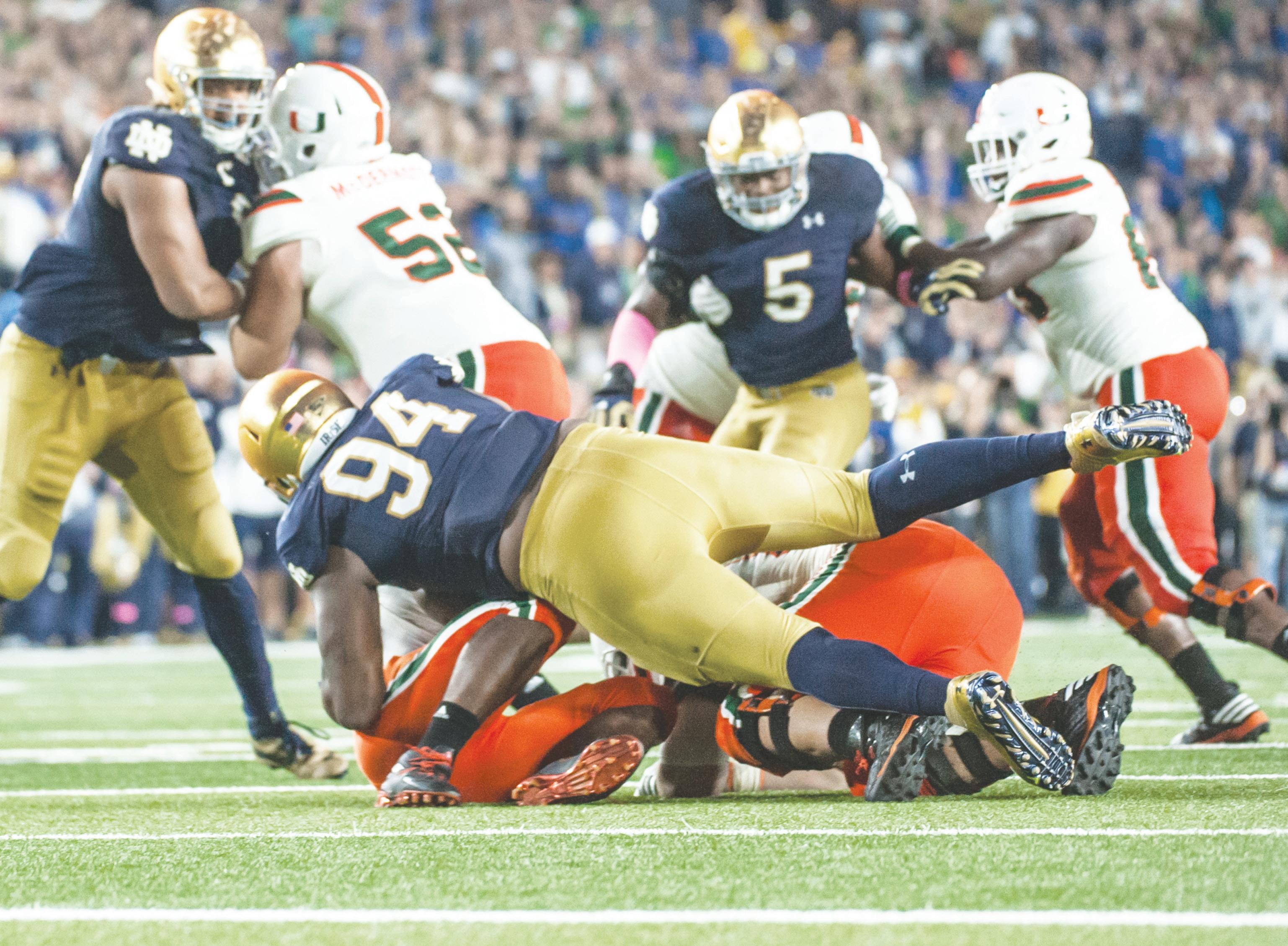
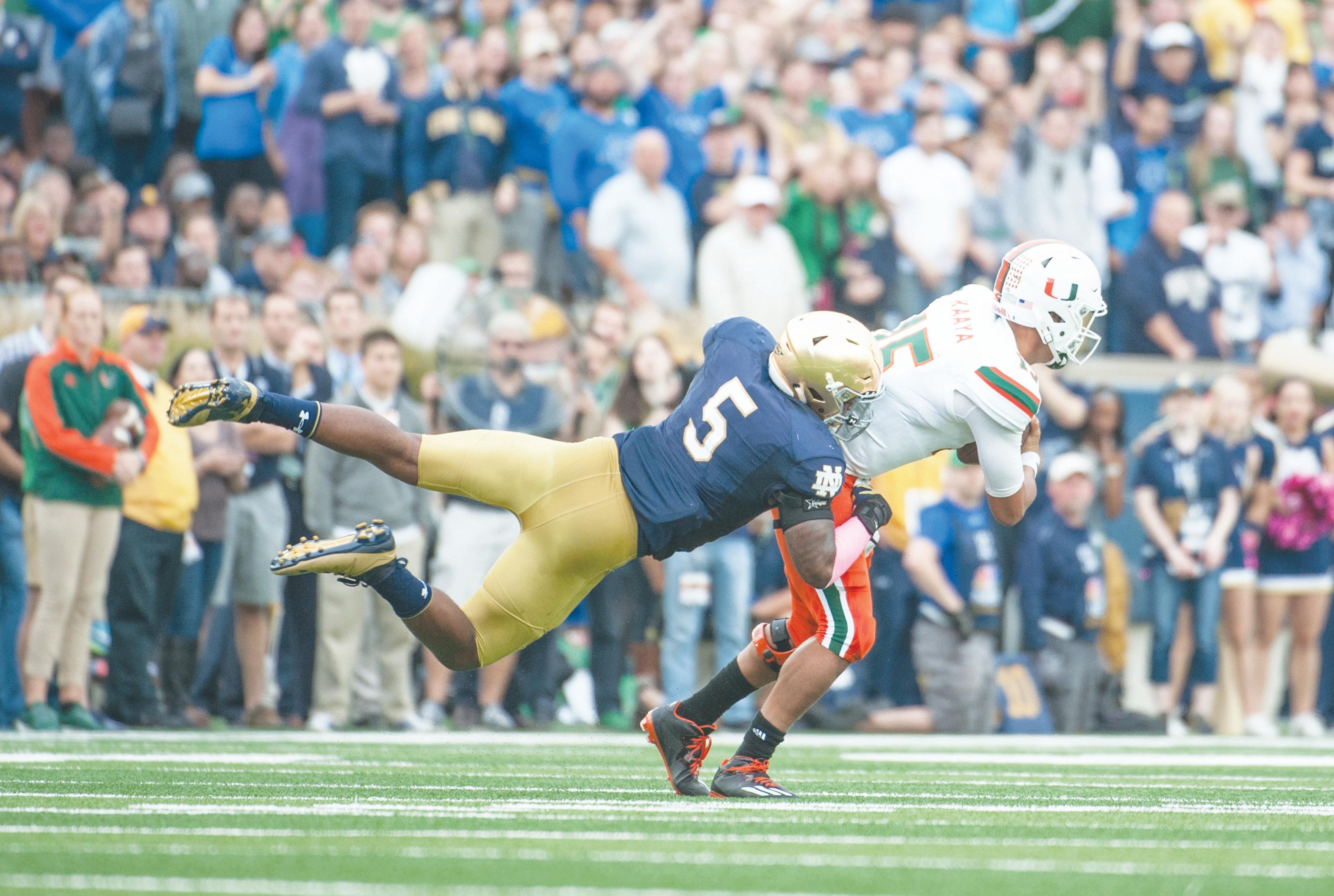
Irish graduate student defensive lineman Jarron Jones swallows Miami sophomore running back
Hurricanes at Notre Dame Stadium. Jones finished with
Ghost of Washington Hall haunts on
Students, faculty members pass Notre Dame’s phantasmic lore down through generations
By EMILY McCONVILLE News Writer
In 1920, All-American football player George Gipp, locked out of his dorm, slept on the steps of Washington Hall and as a result contracted pneumonia and died. Not long after, the Gipper was sighted riding a white horse up the steps of Washington Hall. His ghost has haunted the building ever since.
That’s one version.
The “Ghost of Washington Hall” has been a staple of Notre Dame’s history, attracting the interest of ghost hunters, curious students and chroniclers of the haunted for nearly a century. They report footsteps, moved objects and the sound
of French horns, or bugles, or trumpets, wafting ethereally through the hall.
According to “Washington Hall at Notre Dame: Crossroads of the University, 1864-2004,” a book by Film, Television and Theatre emeritus professor Mark C. Pilkinton, the legend around the theatre building began and solidified in 1921, when Scholastic magazine and the Dome yearbook reported footsteps and the sound of brass instruments. The ghost was first connected to Gipp in 1926, when, as the story goes, a student named Pio Montenegro exited what is now LaFortune Student Center and saw the Gipper on
Book discusses SMC ghosts
By NICOLE CARATAS
Saint Mary’s Editor
Three College alumnae
—Shelly Houser, Veronica Kessenich and Kristen Matha — wrote the book after interviewing hundreds of staff, faculty and local residents.
Ghosts and spirits have been a staple of life at Saint Mary’s for decades, but it wasn’t until 2002 that the stories of paranormal activity on campus were collected and written in a book titled “Quiet Hours.”
“We were serving as leadership coaches for the Leadership and Community Development Academy — a program of the College’s Leaders of a New Indiana Project in the summer of
see SMC GHOSTS PAGE 4
University president signs
‘It’s
Observer Staff Report
University President Fr. John Jenkins signed the “It’s On Us” pledge Thursday, joined by student body vice president Becca Blais and University policy liaison Grace Watkins in a ceremony in his office.
“It’s On Us” is a sexual assault awareness campaign launched by President Barack Obama and Vice President Joe Biden in 2014 to help end sexual assault on college campuses.
University President Fr. John Jenkins signs the “It’s on Us” pledge alongside student body
On Us’ pledge
vice president Becca Blais, left, and University policy liason
Grace Watkins.Photo courtesy of the University of Notre Dame
University President Fr. John Jenkins signs the “It’s on Us” pledge alongside student body vice president Becca Blais, left, and University policy liaison Grace Watkins.
“We’re all responsible for creating an environment where all are safe and the dignity of each person is respected,” Jenkins said in the release.
“Sexual assault has no place at Notre Dame, and it will only
be eliminated if we each do our part individually and work together collectively.”
The pledge calls on campus community members — students, faculty, staff and administrators — to commit to keeping men and women safe from sexual assault. This commitment is fulfilled by recognizing what sexual assault is, identifying situations in which sexual assault may occur, intervening in situations where consent has not been given and fostering an environment that does not accept or tolerate sexual assault.
Professor relates election to policy
By HALLIE NOLAN News Writer
On Friday, Saint Mary’s chair and associate professor of political science Marc Belanger spoke during a Justice Friday luncheon about the impact of the presidential election on foreign policy.
He started the conversation by discussing the attention this campaign season has received around the world.
“This election raises issues about the role of foreign policy in campaigns and the future of the United States in the world,” Belanger said.
Cartoonists from all over the world have depicted the candidates, and the bulk of the attention has been directed at Donald Trump, Belanger said.
“People from around the world have been paying attention” he said.
Belanger said in previous elections, candidates followed the traditions of their party.
This election is different due to Trump’s abnormal candidacy.
“He has asserted positions that in the past would have been
inconceivable to politicians,” he said.
Belanger mentioned many of Trump’s positions on foreign policy, such as building a wall that Mexico would pay for, pulling out of NATO and letting Japan and South Korea have nuclear weapons. Belanger said people are questioning if Trump will really try to accomplish these things.
“Trump’s concern is not so much if these are actual policies, but he is trying to reach out to a constituency that didn’t feel spoken to and has anxieties that other candidates are not talking about,” he said.
Belanger said these inconceivable policies are alienating Republican leaders, but Trump is finding support in the base.
“Speaking strongly about these things in ways that shocked the policy establishment has been his way to brand himself as someone [who is] distinctly different,” Belanger said. “These policies aren’t designed to say, ‘This is exactly what I’m going to
see POLICY PAGE 4
CHRIS COLLINS | The Observer
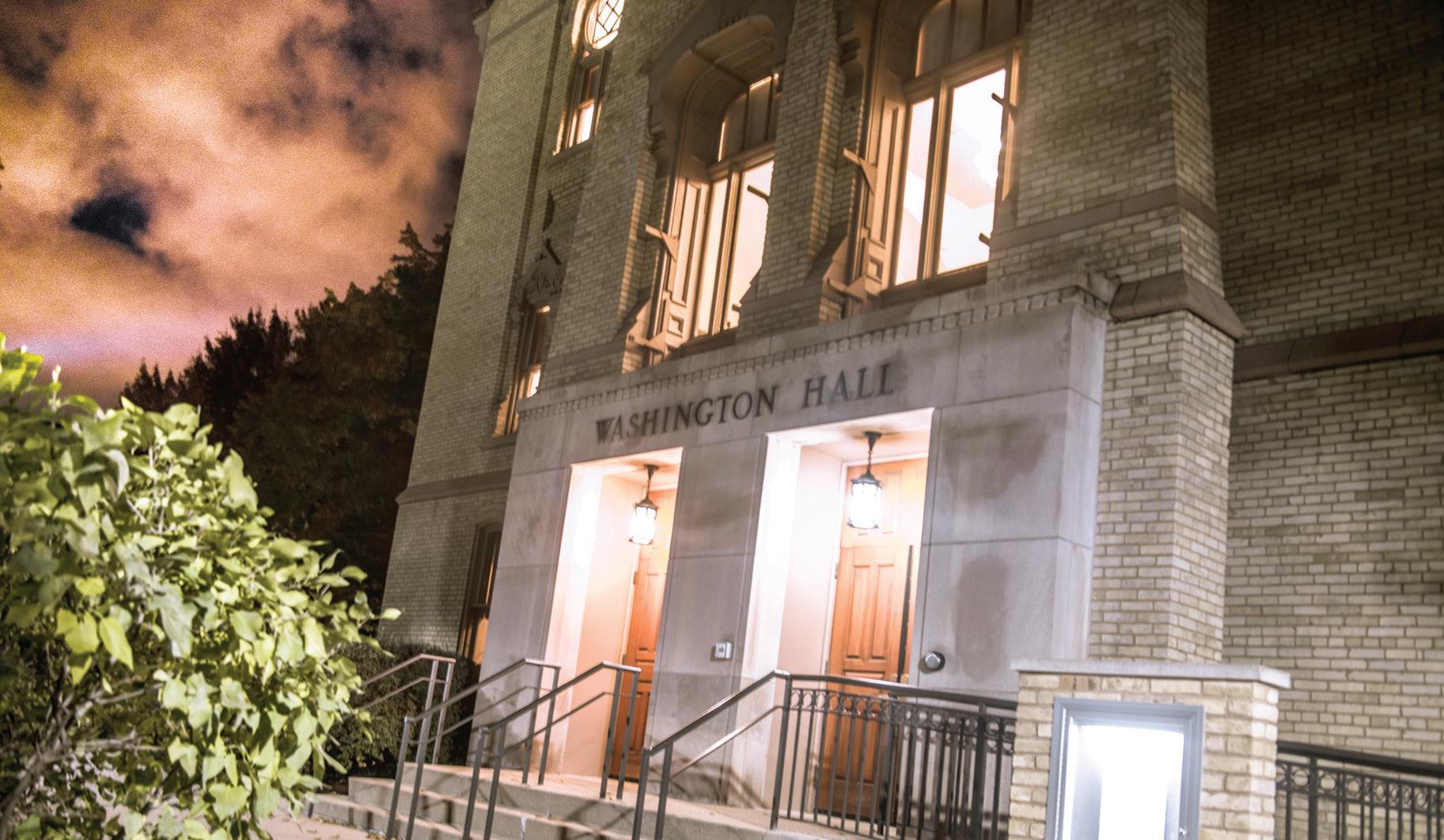
The legend of the ghost of Washington Hall first began circulating Notre Dame’s campus in 1921. There are many theories as to who haunts the building, most famously the Gipper.
Policies The Observer is the independent, daily newspaper published in print and online by the students of the University of Notre Dame du Lac and Saint Mary’s College. Editorial content, including advertisements, is not governed by policies of the administration of either institution. The Observer reserves the
The
Questions
QUESTION OF THE DAY:
Have a question you want answered? Email photo@ndsmcobserver.com
What was the best Halloween costume you saw this weekend?
Christopher Jarocki senior off campus
“A group of women dressed as iPods.”
Olivia Cimo sophomore
Welsh Family Hall
“I saw someone dressed as Jesus and they gave me a blessing.”
Collette Gillaspie freshman
Welsh Family Hall
“My friend Eileen DiPofi painted her body green and went as Rango.”
Ryan Fielder junior off campus
“A group of guys dressed as Fruit of the Loom.”
Jake Spraul senior off campus
“A group of about 12 people dressed up as Ken Bone, all to varying degrees of accuracy.”
Tom Plagge senior off campus
“Hiccup, Astrid and Toothless from ‘How to Train Your Dragon.’ Great use of a third wheel.”
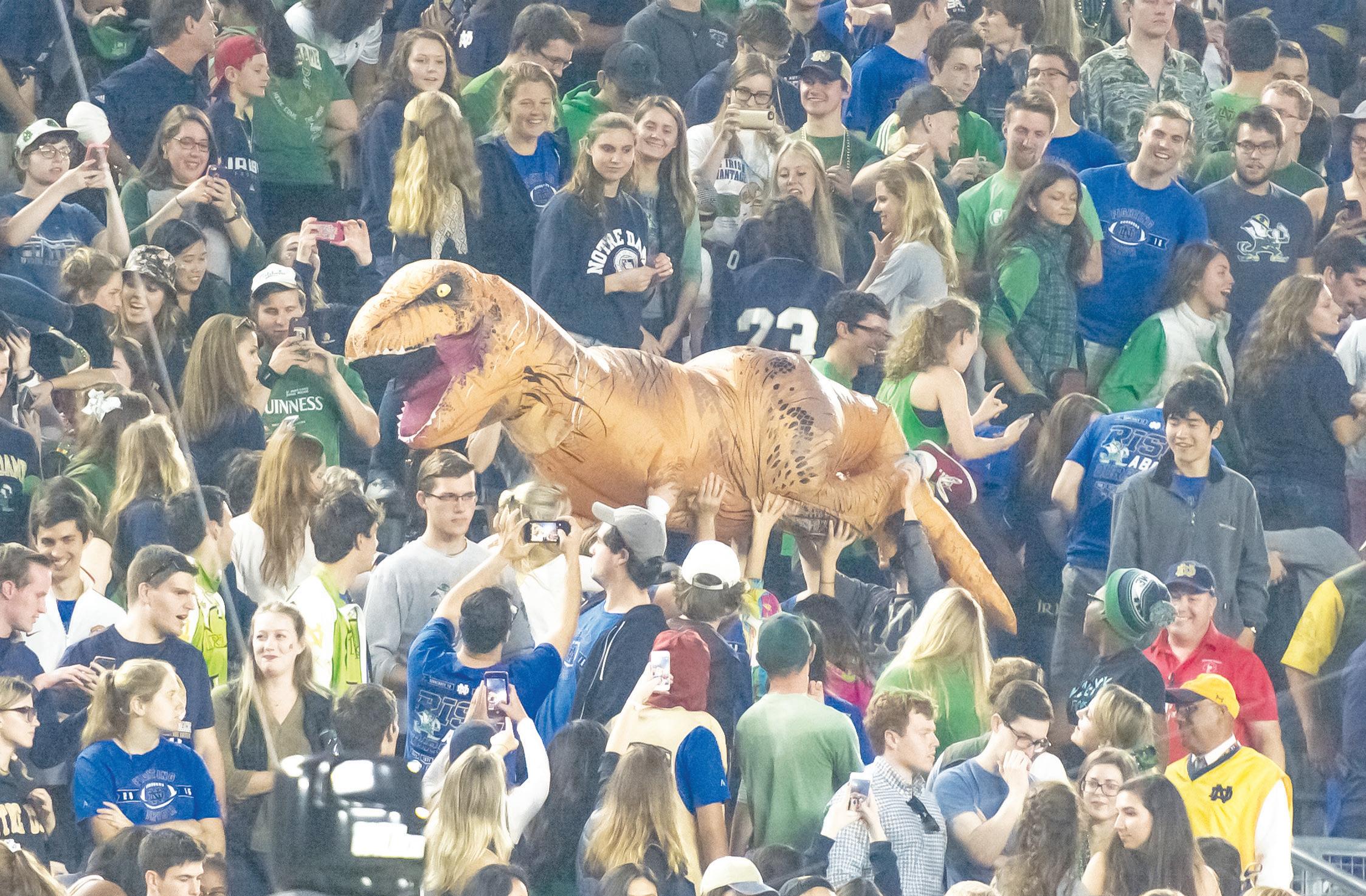
A student dressed in an inflatable dinosaur costume to celebrate Halloween weekend does push-ups in the student section during Notre Dame’s 30-27 win over Miami on Saturday. The Irish are now 3-5 on the season after defeating the Hurricanes.
Today’s Staff
Monday
Lecture:
The Observer regards itself as a professional publication and strives for the highest standards of journalism at all times.
do, however, recognize that
will make mistakes. If we have made a mistake, please contact us at (574) 631-4541 so we can correct our error.
Tuesday
Lecture: A Maturing African Democracy Hesburgh Center for International Studies
12:30 p.m. - 2 p.m. Open to the public.
Panel: Asia and the U.S. Elections Hesburgh Library
4 p.m. - 5:30 p.m. Sponsored by the Liu Institute.
Wednesday
All Souls Day Mass Basilica of the Sacred Heart
5:15 p.m. - 6:15 p.m.
Commemorates the faithful departed.
Reading by Lily Hoang Hammes Bookstore
7:30 p.m. - 9 p.m.
Visiting author reads from her new book.
Thursday
Yoga In The Galleries
Snite Museum of Art
4 p.m. - 5 p.m.
Free and open to the public; RecSports will provide mats.
Film Screening: “Hand Held” DeBartolo Performing Arts Center
7 p.m. - 9:30 p.m. A new documentary.
Friday
Boardroom Insights
Lecture Series Mendoza College of Business
10:40 a.m. - 12:10 p.m. Victor Dodig speaks.
Higgins Labor Cafe Geddes Hall
5 p.m. - 6 p.m. Gather to discuss contemporary issues; coffee will be served.
KELLY VAUGHAN | The Observer
Young Leaders of the Americas visit South Bend
By ERIN SHANG News Writer
A week before fall break, 14 young entrepreneurs in the Young Leaders from the Americas Initiatives (YLAI) Professional Fellows program arrived in South Bend to spend four weeks in professional exchange with local companies and industries.
The State Department program helps entrepreneurs from Latin America and the Caribbean improve businesses in their home countries. Two hundred fifty people in the program are divided among 21 U.S. states. Notre Dame’s Initiative for Global Investment is hosting and supporting the 14 in South Bend.
“This program is amazing, as we get to know
entrepreneurs from our area,”
Daniella Garcia, a program fellow, said. “In November all the [250] of us will be together for a conference in Washington D.C. There will also be investors pitching us, and lots of networking, and we are all excited.”
Garcia is the founder and owner of Elemental, a tech teaching center in Bolivia.
YLAI assigned her to a local programming school in South Bend.
“I’ve learned the methodology in teaching, and I’m helping them with the plan for a summer camp in June,” she said. “In Bolivia, we really need some funds, so South Bend coding school is also teaching me how to get grants from government and nonprofit organizations.”
The 14 entrepreneurs are assigned to different
companies in South Bend according to the industry in which they work at home.
Karla Pacheco, director of the Cocrea Creative Agency in El Salvador, is working for Pathfinders, a marketing agency.
“I’m learning how big companies like the Pathfinder are organizing their team and work,” she said. “My goal is to organize my team more sufficiently so we can have more clients.”
It is easier to get ideas accepted in the U.S., said Santiago Yelmini, co-founder of LATIO 6, an entrepreneurship community in Argentina. Yelmini is working on a learning forum that will help entrepreneurs present and implement their ideas more effectively.
“In our own countries, it is harder to start a company
to go from an idea to a concrete body, not just because of the social conditions, but because of all the resources regarding education, regulations and access to financial support,” Yelmini said.
“The struggles of everyone telling us we aren’t going to make it is another big difficulty for us entrepreneurs. People here are more used to seeing new businesses grow,” Pacheco added.
John Paul Arvelo, president of Servicios de Seguridad y Resguardo, said while his society is losing hope, entrepreneurs are trying to solve the country’s issues.
“My initiative is about providing protection services to companies, houses and individual people. I’m trying to build an awareness in people, to teach them how to apply law and save their lives,”
Arvelo said.
Germán Santillan Ugarte is the CEO and Founder of Oaxacanita Chocolate, a company which strives for the economic development of the Oaxacan Mixteca by hiring artisan cooks and palm craftsmen and by using local raw materials. He learns how to improve workers’ efficiency by using machines and skills here in South Bend, Ugarte said.
“We all feel very welcomed here at Notre Dame,” Ugarte said. “The day when I arrived, there was a little note saying ‘Welcome home, Germán.’ It turned out that all the stereotypes about Americans are not true because all the professors and students are so nice.”
Contact Erin Shang at yshang@nd.edu
PAID ADVERTISEMENT
ND ghost
the white horse.
The ghost, according to Pilkinton’s book, has also been reputed to be:
• A “student professor,” responsible for the spooky brass music
• A construction worker
• A steeplejack (yes, those exist)
• A brother, also responsible for the horns
• An anonymous quarterback, most definitely not the Gipper
• A student who fell to his death in the 1950s
Over the decades, the Ghost of Washington Hall became a popular Halloween feature for campus publications. It regularly makes listicles of the most haunted campuses or the haunted-est places in Indiana. It’s been part of “haunted campus” tours organized by the Students Activities Office. The ghost has also been used to advertise plays in the building or make points about campus issues, like the deterioration of the building or the low quality of the movies shown there.
Bigger issues, too. In 1970, Observer writer T.C. Treanor spent a night in Washington Hall, waiting for the ghost. Building staff let him in, but the one student who still lived in the building was having none of it. Neither was
SMC ghosts
CONTINUED FROM PAGE 1
2000,” Matha said. “All of the counselors stayed in Le Mans with the high school students who were participating in the program, and to entertain them and ourselves, we told Saint Mary’s ghost stories. We then had the crazy idea to gather more stories and publish a book.
The book then morphed into a combination of ghost stories and Saint Mary’s history.”
Matha said it was exciting to contribute to the folklore of the College.
“We would walk around campus with tape recorders and students would stop us to share a story,” she said.
“We also held a ghost story night during what is now known as Heritage Week, and students shared story after story. We met with security guards and cleaning staff who worked the night shift, both at the College and the Convent, to gather their stories.
Matha said her favorite of the ghost stories was one about a poltergeist that supposedly haunts one of the rooms in Le Mans Hall.
“We first heard the story in the Tower Room during
the reporter.
Treanor, who graduated in 1973 and is now a lawyer and theatre critic, said he used the ghost story to try to criticize what he saw as his generation’s preoccupation with supernatural beings, at a time when New Age spirituality was beginning to emerge.
“If you thought that rational thinking had limits, you were of the party that was open to visitations from the invisible universe,” he said Sunday. “I really wasn’t. I was the son of a scientist. I had grown up through conventional Catholic education, which of course admitted to the presence of a world beyond, but it expressed that presence in a very rational way.”
The resulting “series” ended after two articles because Treanor saw no ghost. Nor did he expect to.
“Nobody really believes in ghosts — at least no one except marginal illiterates,” he wrote in 1970. “But people want to believe in ghosts — want desperately to believe in ghosts; poltergeists, witches, evil spirits, distilled or otherwise; demons incarnate evil possession. People want to believe it because they want an escape from reality; they want an escape from the rational; the categorized; the systematized. They want ghosts because they want to be afraid, and they want to be afraid because fear is the strongest emotion. Or
the ghost story session,” she said. “It was an amazing evening — students were packed into the room sitting shoulder-to-shoulder with some students sitting in the stairwell trying to hear. A student shared the story and immediately following her another student stood up and said [she] lived there the year before and the same thing happened to [her.] All the air went out of the room as everyone let out a collective gasp.
“But it gets even spookier. Last spring, I was on campus for the alumnae Board of Directors meeting and a member of the Board who recently graduated shared that she had the same experience when she was a student. So we have had three confirmed accounts of that story spanning multiple years.”
The book’s publishing garnered a lot of attention, according to Matha. She said South Bend ghost hunters even came to campus inquiring about the book.
Matha said she never had an encounter herself, though she lived in Le Mans for two and a half years.
“I’m a true believer though,” she said.
Contact Nicole Caratas at ncaratas01@saintmarys.edu
maybe they’re all stupid. In any event, it’s not true. There are no ghosts in Washington Hall.”
“Rest in peace, Gipper,” Treanor concluded. “Sorry for having bothered you.”
If Treanor hoped that would put an end to the matter, it didn’t. He had been the latest in a long tradition of intrepid reporters spending the night in Washington Hall dating back to the 1940s, a tradition that continued the very next year, when another Observer reporter, Bill Eiler, set up shop in the auditorium with some friends and a photographer.
After several hours, atmosphere in the room changed and the group saw “a waving light-greenish figure ... suspended in the air in the left section of the balcony in front of the window curtain.”
The photographer snapped a photo, and they hightailed it out of the building.
“Three hours and several Hail Mary’s later, the picture turned out and we had our proof,” Eiler wrote.
The accompanying photo was of an indistinct white blob.
Not only reporters braved the phantasmic for a night. Eiler’s 1971 article recounts meeting a girl who had taken part in a recent seance, though “she was very reluctant to divulge any details.”
A 1989 Observer article details how a group of students took a Ouija board onstage,
asking the ghost to talk to them.
“The pointer darted to ‘No’ and ‘Goodbye’ and stopped. When the students asked why, the pointer moved back and forth between the letters ‘S’ and ‘G,’ moved to ‘Goodbye’ again, and stopped,” the article said. “The students fled. Once out of Washington Hall, they looked back and saw that a security guard had just woken up. They had been warned just in time.”
People still ask Washington Hall assistant program manager Kathleen Van Vleet if they can spend the night in the hall (they can’t), but she’s happy to tell campus visitors, alumni and supernatural enthusiasts the story of the ghost of Gipp.
“I mean, It’s an old building,” Van Vleet, who has worked in the building for 12 years, said. “The steam heater makes a lot of noise. There’s also some acoustical weirdness, there’s some air shafts on the other side of the auditorium that make it sound like, depending on where you are, it can make people who are talking outside sound like they’re talking inside. I found that out the hard way when I started working here.”
Does she believe in the ghost? Van Vleet considered her words.
“Let’s say I don’t disbelieve,” she said.
Contact Emily McConville at emcconv1@nd.edu
PAID ADVERTISEMENT
do,’ but, ‘This is an example of the kinds of ways that I’m going to make you safe.’”
Trump’s extreme policies have caused many high-level Republicans, to support Hillary Clinton, because her policies do not challenge the country’s current foreign policy, Belanger said.
“To most of the Republican establishment, Trump represents the isolationist position that they have long rejected,” he said.
In response to a question about whether Trump’s policies would pass or be blocked by a Republican-controlled Congress, Belanger said he believes Senate majority leader Mitch McConnell would take on a larger role in the policy decisions.
“McConnell would quickly try to assert that whatever Trump wants, he has to work through the McConnell,” Belanger said.
Finally, Belanger answered a question about the reason for some people’s extreme hatred of Clinton. Belanger said Clinton has been subject to very public criticism over a long period of time. He said the hatred could be a mixture of legitimate scandals and sexism.
“It’s not hard to believe that another, more conventional politician, that was not Hillary Clinton but had 25 years of a record, would be at a better place than she is right now,” he said.
Contact Hallie Nolan at hnolan01@saintmarys.edu
A bunch of hocus pocus
I am not a terribly brave person when it comes to all things spooky. When I was 14, I took my younger cousins on a Halloween haunted trail that was aimed for small children ages 5 to 10. I’m not saying that I cried during this twilight stroll adorned with dollar-store quality decorations, but I’m also not denying that it happened. It’s probably not shocking, then, that I am not a fan of scary movies. If you or your friends are like me in this regard, here are a few movies full of Halloween spirit without all the jump scares, graphically violent deaths and virgin sacrifices.
‘Hocus Pocus’
Kenny Ortega’s masterpiece is inarguably the best Halloween movie of all time, if not the best holiday movie of all time. The hair and special effects are peak ’90s. It’s wonderfully quotable. Bette Midler has a musical number for no apparent reason. This movie is so good it actually transcended its original fate as a Disney Channel Original Movie to become a feature film.
‘It Follows’
This indie hit about the dangers of premarital sex has a few jump scares and disturbing images, but it’s more of a dramatic thriller than a sanguinary gore-fest. The terror is real, but not as violent or stomach-churning as many other horror films.
‘Addams Family Values’
The first Addams Family movie is also excellent, but Joan Cusack’s sublime performance as a man-eating nanny really pushes the sequel forward past its predecessor. The third one, on the other hand, is such garbage that I didn’t even bother to Google the title of it for this column, so I suggest you avoid it as well.
‘The Babadook’
Is this movie scary? Holy crap, yes: a shadowy figure; a screaming, bug-eyed child; a horrific children’s book. This movie will mess you up. The saving grace that allows it to be on this list, though, is that (SPOILER ALERT) no one dies. Well, at least no people die …
‘Corpse Bride’
I’m sorry to all its fans, but “The Nightmare Before Christmas” is way over-hyped. If you’re looking for a Tim Burton cartoon, “Corpse Bride,” is a more subtle, emotionally touching choice. The animation is beautiful and eerie and there’s no Oogie Boogie character to scare me.
Any ‘Harry Potter’ Movie
“The Sorcerer’s Stone” is the best, considering there’s actually a Halloween scene, but any of them will do. Even when they’re 11-year-olds saving the world from evil, witches and wizards are technically spooky. Plus, you already know darn well that Freeform — previously, ABC Family — has a Harry Potter weekend planned, just like they do every single month.
Contact Megan Valley at mvalley@nd.edu
The views expressed in the Inside Column are those of the author and not necessarily those of The Observer.
Frozen secrets
Jose Fernandez, the 24-year-old Miami Marlins star pitcher, died Sept. 25 in a boating accident, and was uniformly hailed as a hero to Miami’s Cuban community. Fernandez and his mother escaped by boat to Mexico when he was 15. As is the case with the vast majority of Cuban immigrants to the U.S., Fernandez and his mother then crossed into this country from Mexico, and received the favorable immigration status granted to Cuban refugees.
Despite the fact that Cuba’s communist government restored diplomatic relations with the U.S. last year, neither Cuba’s official newspaper, Granma, nor any other state media, made mention of Fernandez’s death. Cuba still characterizes people fleeing the country as traitors, and the official response is a reminder that the U.S. is still treated with suspicion.
The Cold War may be winding down, but many spies, traitors and troubling secrets remain to be sorted out and accounted for by both countries. On the day that the U.S. and Cuba announced renewed diplomatic relations, the countries exchanged long-held spies, including three Cuban sleeper agents held by the U.S. since 1998, a CIA double agent held in Cuba since 1995 and a U.S. State Department contractor arrested in 2009 for smuggling communications equipment into Cuba for dissidents.
One of the most notorious figures remaining to be dealt with is alleged to be the mastermind behind a 1976 explosion aboard an aircraft that took 73 lives and was likely the first bombing of a civilian passenger jet in this hemisphere. Cuba has repeatedly sought the arrest and extradition from the U.S. of Luis Posada Carriles, an 88-yearold Cuban exile, to face terrorism charges for the bombing of Cubana de Aviacion Flight 455. In 1997, Posada admitted to being the mastermind behind the bombing of a Havana hotel which killed an Italian tourist.
In 2000, Posada and his co-conspirators were arrested in Panama in possession of 200 pounds of explosives which were to be used in a plot to kill Fidel Castro. Posada and his accomplices were convicted and imprisoned. In 2004, Panama’s outgoing President, Mireya Moscoso, pardoned them, and Posada shortly reappeared in the U.S., where he was arrested for immigration fraud. In 2011, he was tried for the fraud charges, but in a curious twist the judge found him not guilty on all charges after Posada’s lawyer indicated that Posada was prepared to reveal the details of his work on behalf of the CIA. Posada remains a free man in Miami, and at the top of Cuba’s ‘most wanted’ list.
The U.S. exile in Cuba that American law
enforcement claims it most wants to extradite is Assata Shakur. Born JoAnne Deborah Byron, Shakur was a member of the former Black Panther Party and Black Liberation Army. Between 1971 and 1973, Shakur was convicted of several crimes, including murder, and fled federal and state officers across a number of states. In 1973, Shakur was confronted on the New Jersey Turnpike, and she was accused of killing a New Jersey State Trooper in the resulting shootout. In 1977, she was convicted of the first-degree murder of the trooper.
Shakur escaped from prison in 1979, lived for a while as a fugitive and fled to Cuba. Her exploits and trials had been followed with interest in the Soviet Union and Cuba, and she received Cuban political asylum in 1984. In 2005, the FBI classified her as a domestic terrorist and offered a $1 million reward for assistance in her capture. The FBI added her to the Most Wanted Terrorist list in 2013; the same day, the New Jersey attorney general matched the FBI reward, making the total reward for her capture come to $2 million. In the years since her initial arrest, Shakur has become a mythic figure, something of a combination of Robin Hood and Sojourner Truth, emblematic of a long struggle against authority and embedded racism.
These strands of symbolism and acknowledged violence make Shakur’s extradition a complicated matter: Cuba does not want to lose such a powerful symbol of U.S. injustice and, while they want her to pay for her crimes, U.S. authorities may be less than enthusiastic in returning Shakur to a position of prominence. Similarly, Cuba’s desire to have Posada extradited and place him on trial for terrorism is especially fraught with this country’s concerns over the secrets Posada may divulge and the embarrassment and political fallout such disclosures may produce. In addition, the motives of these actors are not always clear and neither country wants unexpected revelations concerning who they actually served.
So as relationships between the countries improve, both Cuba and the U.S. officially seek and condemn perpetrators held by the other, maintaining the official line that they want these persons returned, while not entirely sure they want that to happen anytime soon. These types of concerns will make ongoing engagement and normalization of relations with Cuba complicated as both countries ease onto the ever-thinning ice of the Cold War.
Ray Ramirez is an attorney practicing, yet never perfecting, law in Texas while patiently waiting for a MacArthur Genius Grant. You may contact him at patrayram@sbcglobal.net
The views expressed in this column are those of the author and not necessarily those of The Observer.
Raymond Ramirez The Crooked Path
Megan Valley Associate News Editor
Out of many, one
Little Rock in 1959.
Liam Stewart Conservative Conscience
Students at the University of California, Berkeley held a protest Oct. 21 to advocate for the creation of “safe spaces” segregated by race and gender identity. The protest erupted after Berkeley’s administration made the decision to move a “safe space” from the fifth floor to the basement level of a building on campus. In response, a mob of students formed a human chain near the center of campus, obstructing a major entrance and preventing white students from getting to class. Footage of the event reveals protestors yelling “Go around!” to white students, while allowing only students of color to pass through.
This protest represents not only the latest manifestation of “safe space” ideology, but a gross perversion of civil rights activism. Whereas the 1960s civil rights movement sought to end racial segregation and discrimination, this demonstration seems to be actively advancing it. It is exceedingly difficult, if not impossible, to reconcile the message of these protestors with that of Dr. Martin Luther King Jr. in 1963. He dreamt of a world in which people of all colors would set aside racial labels and “sit down together at the table of brotherhood.” He understood that social inclusion, and not racial exclusion, was the key to overcoming bigotry and divisiveness.
It was this same vision for humanity that drove the landmark Brown v. Board of Education case and outlawed racial segregation in America. It was this vision that has enabled the civil rights movement to make such tremendous strides over the last half century. And yet, so-called progressive students at Berkeley are still demanding non-white facilities and segregated “safe spaces” so many years later. To the casual observer, the signs “Fight for Spaces of Color” are eerily reminiscent of those held by white segregationists in
This protest is just the latest example of an increasingly regressive view of social activism on Berkeley’s campus. Last year, the university chose to expand its segregated housing for students of color. Andres Castro Arms, currently a student housing cooperative, is transitioning to become a “People of Color” house this fall. In recent years, the administration has also designated a growing number of “safe spaces” on campus, although it seems these are no longer enough for the self-proclaimed crusaders of social justice.
“Spaces of color,” on the other hand, not only shield students from differing viewpoints, they also aim to protect students from those with differing skin colors. Such a policy is not only racist in its underlying assumptions, but also in its desired effects. Universities should be working to bring students together, not driving them apart through a policy of racial separatism.
Sadly, segregated spaces for students of color are quickly becoming commonplace on many university campuses. The University of Connecticut announced earlier this year that it would open a dormitory and offer classes explicitly for black students. According to the University’s webpage, the initiative is “designed to support the scholastic efforts of male students who identify as African American/Black.” Administrators maintain that the program will be entirely voluntary, and that it has the full support of UConn’s various black advocacy groups. However, while there are those who would applaud this policy of racial separatism as a progressive victory, it will be irreparably damaging to students’ education and long-term personal development.
The harmful effects of segregation are not undone by the positive intentions of those who support it. Policies that advance racial separatism inherently divide white and non-white students from one another,
resulting in discrimination, racial polarization and hurtful stereotyping. This, in turn, subverts campus unity and disrupts the academic community as a whole.
As centers of intellectual thought, universities should build and foster healthy relations among students through inclusive and meaningful collaboration. Students and administrators alike have to realize that racially divisive policies and segregated facilities are the cause of — and not the solution to — insularity and intolerance on campus.
We live in a nation increasingly divided by identity politics and partisan bigotry. Complex social issues have been reduced to a series of sterile dichotomies: white vs. black, men vs. women, democrat vs republican, etc. These categorical labels diminish the individual, as we become little more than the color of our skin, our sex and our voting preference.
America’s greatest strength is that it was founded on great ideas: ideas of inalienable rights and of a government instituted by the people for the people. As Americans, we are all united by these ideas as one, regardless of skin color, gender, religion, ethnicity or even nationality. Rather than perpetuating racial separatism, our nation should embrace our common values and work toward a better future together. In the words of President Barack Obama, “there’s not a black America and white America and Latino America and Asian America; there’s the United States of America.”
Liam Stewart is a sophomore in the College of Arts and Letters, majoring in political science. Liam was born and raised in the beautiful Irish city of Dublin, although he has been proud to call Seattle home for the past six years. He enjoys country music, hardback books and binge-watching TV shows. He can be reached at lstewar4@nd.edu
The views expressed in this column are those of the author and not necessarily those of The Observer.
Encryption: time to get serious about privacy
Hackers are out there; people who want your information are out there and they are willing to do what they can to get into your personal devices to retrieve such information and use it against you. Those texts to your ex-boyfriend/girlfriend? Public. Those not-so-in-good-taste photos? Public. Those personal secrets you’ve kept just between you and a few friends and family? Not so secret anymore. That potentially incriminating conversation or browser history? Evidence to be used against you the moment you slip up.
There’s a common misconception that usually goes something like “If you’ve got nothing to hide, you’ve got nothing to fear.” This might be comforting, if only people weren’t ready to pounce on every new piece of information, gobbling it up like a starving animal on the side of the road waiting for some innocent creature to make a misstep. This phrase is typically associated with government stepping in, obtaining information about its citizens, supposedly for the sake of protection. This is not such a simple topic, and evokes the currently very prominent question regarding the balance between security and privacy. And, in this current age, much of this privacy revolves around our personal computers, and the main line of defense against such invasions of privacy is encryption, a subject many people are very much, to quote the FBI’s James Comey, in the dark about.
There are several events we can turn to in order to
see this dilemma play out. One of the most prominent was the issue regarding a specific iPhone retrieved from the San Bernardino shooter last year. This phone could contain information which would prove useful in prosecution, information that the FBI could use for security’s sake; however, the FBI could not access the phone because of current encryption technology on the phone. In vain, they asked Apple to give them a way to access such information. The arguments for such a way in go something like: Given a warrant, law enforcement is able to access any physical location, such as someone’s house or car, etc., so why should they not be allowed access to all of someone’s information on their devices? Or, if it’s for the sake of security, surely the government should be granted access to this information. These are fairly reasonable arguments, but short-sighted. The problem, however, is that there’s no easy way to allow this. Creating such a so-called “backdoor” into one device is not the end of it. To create such a thing, technology companies need to alter their code or create alternative code which grants access. This is a problem. Every computer doesn’t run different code; our phones run a limited number of operating systems which means that access to one phone, or allowing infinite passcode attempts for one phone, means that same software could be used to gain access to any of the phones running the same operating system. This means that the overall security of the device for everyone is compromised, not just the
person of interest. Are we OK with that? Would you want some guy on the side of the street to have read all of your messages? Do you want some company to mine your data and sell it without your knowledge or consent?
One may have nothing to hide, but that doesn’t mean they want everything so easily accessible such that their entire English class has read it just like another book. Physical security is important, but so is protection for everyone’s personal information so that they don’t become exploited or fall victim to other very imminent crimes. That’s why it’s important that encryption, a method of protecting your information, be not only allowed, but encouraged. You know that iPhone you haven’t updated since you bought it? How about that update screen that you keep saying “Remind me tomorrow” to? Perhaps, it’s a good idea to go ahead and let it update. Security features may not be as glamorous as that pretty new font Apple keeps changing, or that sweet new background image of each iOS version, but they are important features. I don’t think the world is ready for all of your emoji stories, your snapchats, your private conversations or your photo library, so let’s for everyone’s sake keep them private and protected.
Jonathan Baker junior Oct. 29
Clemson gets a makeover
Alex Carson Assistant Managing Editor
If you look up “Clemsoning” on Urban Dictionary — one of the internet’s true treasures — you’ll find the following top definition, posted in 2011: “The act of delivering an inexplicably disappointing performance, usually within the context of a college football season.”
In a previous world, if there was one thing you could count on in college football, it was a disappointing performance from Clemson on a big stage. From the Tigers’ upset 37-13 loss at North Carolina State as the nation’s No. 7 team in 2011 to their 2013 home drubbing, 51-14 at the hands of Florida State in a No. 5 at No. 3 showdown, the very word “Clemson” became used as a proxy for failure and turned into a verb that applied to any school that found spectacular ways to lose.
And while it wasn’t a blowout loss, there was no better example of Clemsoning than the Tigers’ 2014 defeat at No. 1 Florida State. With just over two minutes remaining, in a game tied 17-17, Clemson forced a Sean Maguire — remember, this was the game Jameis Winston missed due to suspension — interception, returning it to the Seminoles 26. Game over, right? The Tigers would get their score, win the game and secure a program-defining win.
Wrong, of course. Clemson fumbled two plays later and proceeded to lose 23-17 in overtime.
Perhaps that defeat — seeing a chance to down No. 1 away from home slip away — was the moment things changed. Or maybe it was the 40-6 win over Oklahoma in that year’s Russell Athletic Bowl. But regardless, somewhere between that night in Tallahassee, Florida, and the start of the 2015 season, things changed at Clemson in a big way.
The Tigers went from the team that couldn’t win the big game to, well, the team that seemingly can’t lose one. Between their wins over Florida State, Notre Dame, North Carolina and Oklahoma last year, to survival victories at Auburn, against Louisville and at Florida State this year, Clemson has been remarkably successful against some of college football’s best teams over the past two years, only dropping a national title game to Alabama during this stretch. It’s a
reflection of a program transformation, one that’s taken the Tigers from a laughingstock of college football to one of the country’s mostfeared teams.
It is entirely possible that head coach Dabo Swinney and Clemson don’t win a national title together. But while it’s possible, as long as things keep trending in the right direction, it seems more likely they’ll get the job done sooner rather than later — and perhaps this year. When the game’s been on the line over the last two seasons, Clemson’s defense has stepped up to make the play. Be it in the driving rain against Notre Dame, on a gorgeous night against Louisville or in a hostile environment at Florida State, the Tigers have consistently made one more play than their opponent in key moments.
That’s the mark of not just a good team, but a wellcoached one.
The job Swinney has done, in all aspects, in Clemson shouldn’t go without mention. Urban Meyer and Nick Saban are two great coaches, there’s no doubting that, but perhaps we should start thinking of Swinney as being in that top tier, too. Not only are the Tigers playing well on the field — assuming they don’t collapse down the stretch, this will be Swinney’s sixth straight 10-win season — but they’re recruiting at an elite level, too.
While it’s not like Clemson is some small-time program — the 1981 national title proves that — it isn’t like the Tigers had experienced considerable success before Swinney’s arrival. When Clemson won the ACC in 2011, it was the first conference title in 20 years and the first time finishing inside the AP top 20 since 2000. Before Swinney, Clemson simply wasn’t an elite destination, for players or coaches, in college football.
Now, the Tigers have helped lead an ACC renaissance and, unless something goes wildly wrong between now and the end of November, will play for another conference title and a spot in the playoff this December.
Dabo Swinney isn’t just a good coach. He’s one of college football’s best.
Contact Alex Carson at acarson1@nd.edu
The views expressed in this Sports Authority are those of the author and not necessarily those of The Observer.
Rohrer wins ACC title, women finish second
By JOE EVERETT Sports Writer
This past Friday, Notre Dame competed in the ACC Championship in Cary, North Carolina, ending the day with an individual champion for the second year in a row as sophomore Anna Rohrer won her first conference title, repeating Molly Seidel’s feat a year ago.
Running through the wooded trails of WakeMed Soccer Park, Rohrer recorded a personal record with a time of 19:26.4, steadily distancing herself from the field and finishing a full 25 seconds in front of the second-place runner, recording All-ACC honors in the process. Following up a second-place finish at the ACCs last season with a conference championship this year, Rohrer said the award means a lot for both her and Notre Dame cross country.
“It definitely means a lot to me because it’s representing the University well, and because I know it helped out my team a lot,” Rohrer said. “Last year, Molly won ACCs, and so I really wanted to start a streak for Notre Dame women.”
Sophomore Annie Heffernan and graduate student Danielle Aragon
MLB | CUBS 3, INDIANS 2
also recorded personal bests with their times and earned All-ACC honors, finishing in sixth and ninth, respectively. Senior Lexi Pelletier, who finished in 23rd, and sophomore Rachel DaDamio, who finished in 38th, rounded out the top five for the 19th-ranked women’s team, who finished in second place overall behind No. 3 North Carolina State. With a strong team performance landing them in second place, Rohrer said the women’s team accomplished what they set out to accomplish.
“Our team overall did really, really well,” Rohrer said. “We set goals together as a team at the beginning of the season and wrote them down and put them in the locker room, and one of the goals was to finish better than we did last year at the ACCs, and so definitely as a team we all pulled together and finished second instead of third, like we did last year.”
On the men’s side of the competition, Notre Dame was led by sophomore Anthony Williams, who finished in 28th place and set a personal record with his time of 24:02.1. Senior Chris Marco, senior Jacob Dumford, sophomore Brent Kennedy and freshman
Peter Monahan capped off the top five on the men’s side, who finished 10th overall in the competition. The men’s team featured three freshmen and two sophomores in the race, as freshmen Kevin Salvano and Tyler Keslin also contributed to the Irish effort, finishing in 88th and 94th, respectively. Keslin said like the women’s team, the men’s team accomplished its personal goal, while also highlighting some key performances from the day.
“I think that we did as well as we expected to,” Keslin said. “Our goal was to place [anywhere from] sixth to tenth, and we ended up placing tenth, so we achieved that goal. We had some really great performances from [Anthony] Williams and Chris Marco, along with freshmen Peter Monahan — I know he was pretty happy with his performance because he broke 25 minutes, [and] that’s a big achievement for a freshman.”
Next up for the Irish is the NCAA Great Lakes Regional on Nov. 11. The competition will be held in Madison, Wisconsin, on the Zimmer Championship Course.
Contact Joe Everett at jeveret4@nd.edu
Cubs defeat Indians to extend World Series
Associated Press
CHICAGO — They’ve waited 108 years for a championship. So with this World Series on the verge of slipping away, the Chicago Cubs could not wait any longer.
Manager Joe Maddon summoned closer Aroldis Chapman from the bullpen in the seventh inning for the first eight-out save of his big league career, needing to hold off the Cleveland Indians in Game 5.
As nervous fans fretted at Wrigley Field, Chapman fired his 100 mph heat and preserved the Cubs’ 3-2 win Sunday night, cutting Cleveland’s lead to 3-2.
The Cubs won a Series game at Wrigley for the first time
since Game 6 in 1945.
Now, the team that led the majors in wins this year will try to extend its season again Tuesday night when Chicago right-hander Jake Arrieta faces Josh Tomlin at Cleveland in Game 6. Chicago is trying to become the first club to overcome a 3-1 Series deficit since the 1985 Kansas City Royals and the first to do it by winning Games 6 and 7 on the road since the 1979 Pittsburgh Pirates. Cleveland, in search of its first title since 1948, is in search of its third-ever title and has won the championship at home just once, in 1920.
Chapman hadn’t pitched in the seventh inning since
2012. He threw 42 pitches, 15 of them at least 100 mph. The lefty struck out four and fanned Jose Ramirez, who had homered earlier, with 101 mph heat to end it.
With the crowd at the Friendly Confines desperate for a win, Kris Bryant homered to start a three-run burst in the fourth off Trevor Bauer. That gave Jon Lester a 3-1 lead. The Indians nicked him for a run in the sixth, and Carl Edwards Jr. took over to begin the seventh with a 3-2 edge. Chapman came in with a runner on second and one out. He stranded the potential tying run at second base in the seventh and at third in the eighth, then pitched a 1-23 ninth.
Hockey
CONTINUED FROM PAGE 12
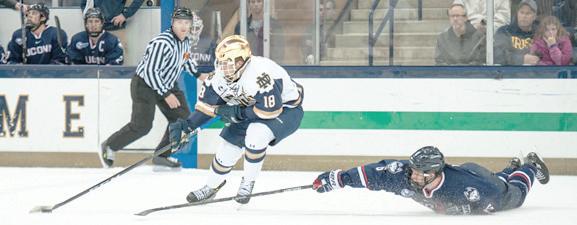
for good. Freshman forward Cam Morrison scored early in the second period to double the Irish lead. Junior forward Connor Hurley scored early in the third to give the Irish their third goal. Sophomore forward Jack Jenkins followed suit with his first goal of the season just under nine minutes into the period, and Bjork added a fifth goal 41 seconds later to put the game out of reach.
Jackson said he was pleased with the offensive production, especially after a tough outing Thursday, when the Irish created chances but couldn’t finish them.
“Well, I thought we [had scoring chances Thursday], too — I mean we had a lot of speed on them, and we didn’t capitalize,” he said. “I thought we did a better job of creating traffic at the net, creating situations similar to what they did to [Irish junior goaltender Cal Petersen] yesterday — you know, when they’re throwing the puck to the net from different angles and just being more aggressive, getting inside body position at the net — so that was part of the reason why we scored a few more goals.”
Led by the play of junior goalie Cal Petersen, who made his 58th consecutive start, and junior defenseman Luke Ripley, the Irish defense was stout throughout the game, closing down to keep the Huskies off the board for most of the contest. Although UConn scored two late consolation goals, Bjork added his second goal of the night in the closing minutes by skating up the right, cutting across the front of crease and beating Nichols shortside, closing out the 6-2 win with an exclamation point and his second four-point game of the year.
Overall Jackson said he was happy with how his team responded from the loss.
“If we keep using our speed and utilizing our speed against teams, it can wear them down, but you have to do it consistently,” he said. “If our defensemen get the puck up to the forwards, whether it’s on the breakout or whether it’s on transition, that gives us a lot more speed up the ice and putting pressure on the opposing team’s defense. That’s what I thought we did better in the second [and] third periods tonight.”
The Irish have two weeks to prepare for their next test, a trip to Boston to square off against Northeastern for games on Nov. 12 and 13.
Contact Tobias Hoonhout at thoonhou@nd.edu
Volleyball
CONTINUED FROM PAGE 12
head coach Jim McLaughlin said that, despite running a different offense, this week was business as usual for the Irish.
“As much as I love [Holt], you can’t think about it,” McLaughlin said. “We go with what we have, and we invest in them like we always do. They’ll get better. … These kids will do anything to help the team, and you’ve got to do that. It’s about a team, and everybody’s got to do their job, have a role. You never know when your number’s called so you’ve gotta be ready, and I think we’re learning those lessons.”
The Irish got off to a slow start against the Hurricanes (11-13, 5-7) with Klein and Nunge at the helm, but they were able to keep pace with Miami throughout the match.
The Irish serving game highlighted the first set, as the team picked up five aces. Notre Dame’s back line, however, struggled to defend against the ACC leader in kills, Hurricanes junior outside hitter Olga Strantzali, who notched nine kills in the first set alone. The Hurricanes took the first set, 25-22.
In the second set, senior middle blocker Katie Higgins helped keep the Irish focused and energetic with constant encouragement and well-timed blocks, as she had five blocks by the end of the second set. The set ended on a controversial call that had McLaughlin out of his chair when the line judge called an Irish ball out, handing Miami the set. Junior outside hitter Sydney Kuhn noted that, although close calls are less than ideal, the team was
confident it would be able to climb back into the match after being down 2-0 at the break.
“That’s just kind of part of the game, and you just have to forget about it and move right on to the next play,” Kuhn said. “We just have to keep working. There’s ebbs and flows, but as long as we continue to play volleyball the Notre Dame way, it’ll come back our way.”
The Irish came out of the locker room an entirely different team for the third set, jumping out to a 5-0 lead. For the first time in the match, the Irish were consistently in-system, with both Nunge and Klein putting up more hittable balls. Kuhn, who finished the match with 19 kills, said having a different setter in shouldn’t change a hitter’s approach to the match.
“Like [McLaughlin] says, ‘The move is the move,’” Kuhn said. “Your mechanics shouldn’t change no matter who’s setting the ball. And our setters are all capable of getting the ball in the right spot.”
The Irish took the third and fourth sets 25-21 and 25-22, respectively, forcing a fifth. However, Miami jumped out to a 5-0 and never looked back. Service errors plagued the Irish in the final set, and the Hurricanes took the match with a 15-11 win in the fifth set.
Despite the loss, McLaughlin said he was proud of his team’s ability to handle the adversity Holt’s absence brought and its ability to keep pace with Miami despite the slow start.
“You know, the character is there,” McLaughlin said. “We fought and we kicked and we scratched and we did what we’ve got to do. I’m proud of what Nunge did, and I’m proud of Hanna Klein. Klein
did a good job. The foundation of our program is improving, we’ve got to just attack it and keep getting better, but we fought. So the effort was good, the energy was good. We just have to get better.”
On Sunday, Notre Dame faced off against the Seminoles (18-3, 11-1) and put them away easily in the first set, winning 25-17. Irish freshman outside hitter Jemma Yeadon led the squad with six kills, while Kuhn, Nunge and junior middle blocker Sam Fry each picked up three.
In the second, Notre Dame took control of the set early with a 17-13 lead, but Florida State clawed back and was eventually able to capture the lead and steal the set from the Irish, 26-24. McLaughlin noted that giving up leads has been a theme for the Irish as of late.
“You’ve got to be good enough to prevent them from doing what they want to do, and we didn’t do that tonight,” McLaughlin said.
“But mostly, I think it’s controlling what we can control, and we weren’t in control long enough tonight.”
Some of Notre Dame’s typical strongholds in the lineup struggled against the Seminoles, which caused McLaughlin to mix up the lineup throughout the match, giving junior Maddie Plumlee, graduate student Haley Bonneval and freshman Lauren Woodard — all outside hitters — opportunities to prove themselves.
With Woodard in the lineup, the Irish had up to three freshmen on the court at one point, although McLaughlin was not worried by the team’s inexperience.
the season, so they’ve had plenty of opportunities. I’m excited to play young people, and they did a good job. We just have to get better.”
After dropping the third set decisively, 25-14, the Irish were able to keep pace with the Seminoles for much of the fourth set, but their targeting of the struggling Irish backline proved too much to handle. FSU took the match win, 3-1, with a fourth-set victory, 25-20, with the Irish dropping consecutive matches for the first time this season. Klein finished the match with 25 assists, and Nunge picked up 19, while Yeadon, Kuhn and Nunge each reached double digits in the kills column.
For Nunge, the transition to setter has been a difficult one, as it causes her to have two completely different roles in the course of a single match, but it was a transition she was more than willing to make in order to better her team, she said.
“We’re handling a lot of adversity as a team right now, but our sole focus is just getting better every single point, every play,” Nunge said. “You know, I’m just doing the best I can. I just want to put up a hittable ball. I’m not really changing my thought, I’m just working on getting better every single time I touch the ball. When I’m about to serve, I’m just trying to hit it on the deep mat, you know, in between the players. … I think as long as we keep the same mindset we’ve had all season and all spring and summer, I think we’ll be okay.”
The Irish will next take the court when they hit the road to face off against Wake Forest on Friday at 7:30 p.m.
Contact Elizabeth Greason at egreason@nd.edu
PAID ADVERTISEMENT
W Soccer
only curl her shot into the arms of Wolfpack sophomore goalkeeper Sydney Wootten.
In the final 10 minutes of the game, the Irish began to press harder for the potential winning goal. Sophomore midfielder Shannon Hendricks played a pass that left junior forward Meghan Doyle with only Wootten to beat, and though her shot slid past the Wolfpack goalkeeper, it went wide of the post.
The Irish continued to press however, as sophomore defender Natalie Ward found junior forward Kaitlin Klawunder with a back-heel pass, and Klawunder sent the ball in to senior midfielder Sandra Yu at the penalty spot. Yu, however, was dispossessed
before she could get a shot off.
With only three minutes remaining on the clock, though, the Irish launched its final offensive attack of the game. Ward’s high cross was met by junior forward Karin Muya in the six-yard box. Muya’s header was deflected into the air, but fell to Klawunder, who finished from close-range to win the game for the Irish.
Romagnolo said she felt a need for a tactical change at halftime, and switching to a 4-3-3 formation allowed the Irish to control the midfield and create more chances.
“We switched what we were doing in the second half, and I thought it helped us,” Romagnolo said. “We had people in better spaces on the field, I thought we defended better in the second half and limited the chances that they had, we created a couple of great
PAID ADVERTISEMENT
chances and then Kaitlin coming off the bench gave that huge lift to us, so that was awesome.
“We went into a 4-3-3 in the second half. We just matched up with them, and that made it a simpler game, gave us some numbers in the middle of the field to help us win 50-50s. In our other system we’d been playing, we weren’t sliding very well, and we were a bit too slow, but in our 4-3-3 we felt we matched up with them, and it helped for our [1-on-1] battles.”
Notre Dame’s win sends the Irish to Charleston, South Carolina, for the ACC semi-finals. The Irish will face fourth-seeded North Carolina — who defeated fifth-seeded Virginia 3-0 in their quarter-final clash — Friday at 5:30 p.m.
Contact Daniel O’Boyle at doboyle1@nd.edu
M Soccer
CONTINUED FROM PAGE 12
from the upper right corner of the field to graduate student midfielder Evan Panken, who connected on a header that went off the right post. The ball bounced right off the post in senior forward Mark Gormley’s direction as he cut into the box, but his momentum carried him too far past where the ball ricocheted, which caused him to miss out on 1-on-1 opportunity against Tar Heel redshirt sophomore goalie James Pyle.
Three minutes later, Panken took a free kick from 35 yards out and connected perfectly with senior defender Matt Habrowski, but the team captain missed on the header and had the ball bounce away from him and towards senior defender Brandon Aubrey. Aubrey had a poor touch on the ball, which caused it to bounce off once again and land right in front of Gallagher. The team’s leading scorer fired the ball towards an open left side of the goal, but the attempt went slid wide left.
In the overtime periods, the Irish managed to hold the Tar Heels to zero shot attempts, but they failed to convert either of their three shots into a goal, resulting in the 0-0 tie.
“We’re obviously disappointed,” Irish head coach Bobby Clark said. “I think the thing that pleased me most was that we were the team that controlled most of the second half and all of the overtime. It was slow to start, but they were a very good team. They handled the ball really well, and they pressed us well, so it took us a little while to get out of our own half for a period.”
The Tar Heels threatened early in the first half as they were led by junior forward Zach Wright and sophomore forward Nils Bruening, who have scored five and seven goals on the season, respectively. Despite the
offensive pressures from North Carolina, the Irish were able to clear any potential scoring attempts and clog the box to block any long shot attempts by the Tar Heels.
It’s not the result Notre Dame wanted, but heading into the ACC tournament, Clark said he is confident that the challenge against the co-ACC regular season champions will set them up for a good outing in the first round of the conference tournament Wednesday.
“It’s a great advert for ACC soccer,” Clark said. “It’s two very talented teams, and two teams that play well. Although there was no goals — they hit the post as well — I felt either team could win at any time. It’s not the result we wanted, but it’s the first step to getting back on the road, and, as I said, this team has the potential to win the national championship, but so does North Carolina, so does Virginia and nearly every team in the ACC, so we’re not alone and we’ve got to keep working on it.”
Last season, Notre Dame lost to Syracuse in the conference final at Alumni Stadium. Clark said he believes despite not being a top seed in the tournament, Notre Dame can make a strong run towards the final of this year’s competition.
“We’ve lost in the final, we’ve lost in penalty kicks twice in the ACC semifinals, but we’ve never won the ACC tournament, so it would be quite nice to do so,” Clark said. “It’s one of the tournaments we haven’t won, so it would be nice to get a run in that, but we’ll see. We’ll put this one to bed first, and then we’ll start looking at who we play and how we tackle that one.”
Notre Dame will kick off the first round of the ACC tournament on Wednesday against Duke at 7 p.m. at Alumni Stadium.
Contact Manny De Jesus at mdejesus@nd.edu
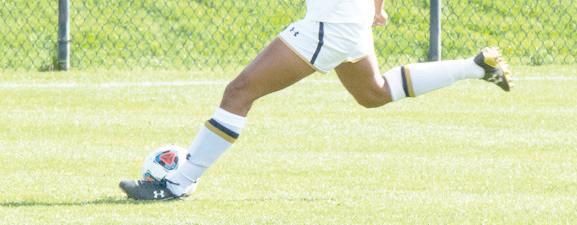
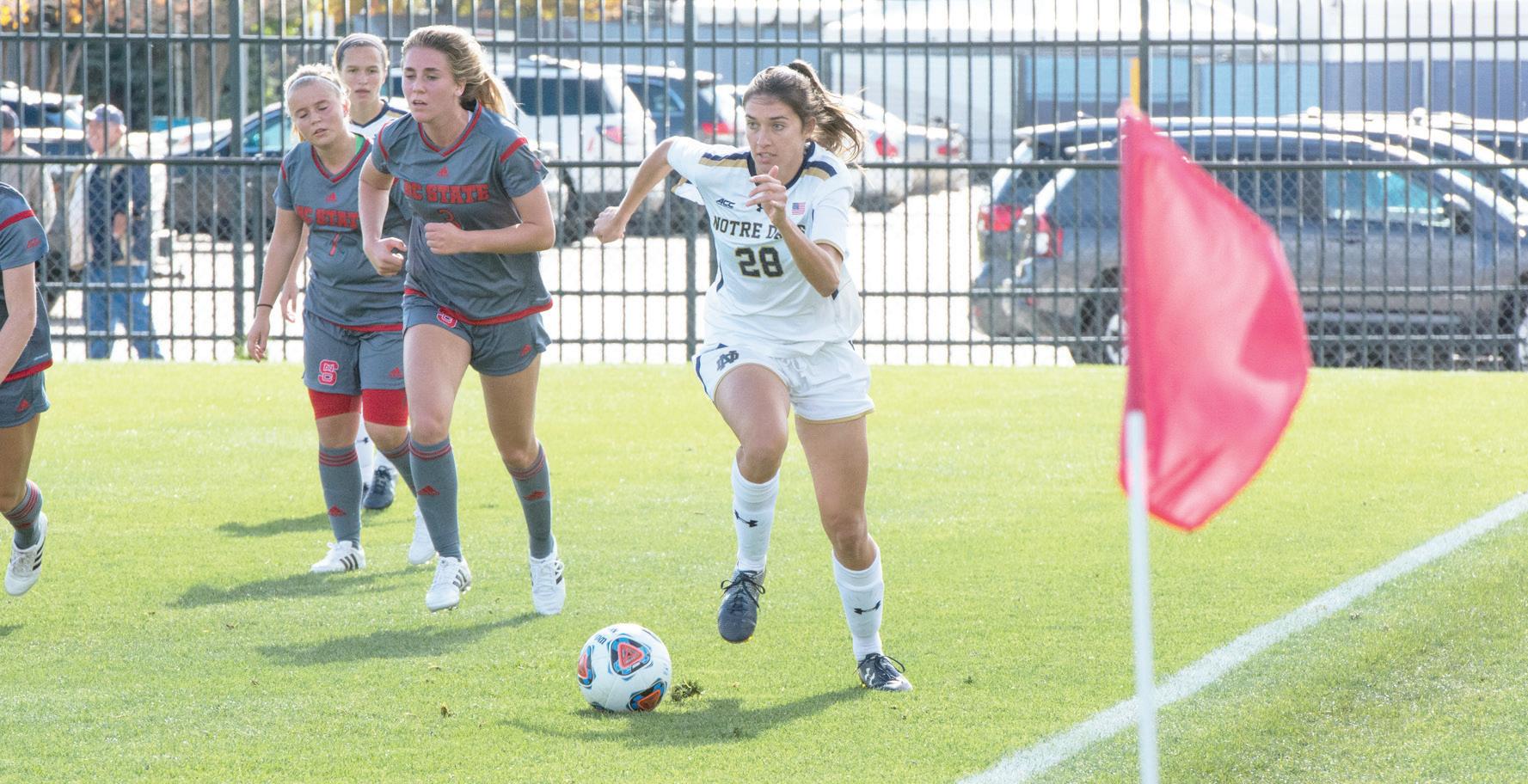
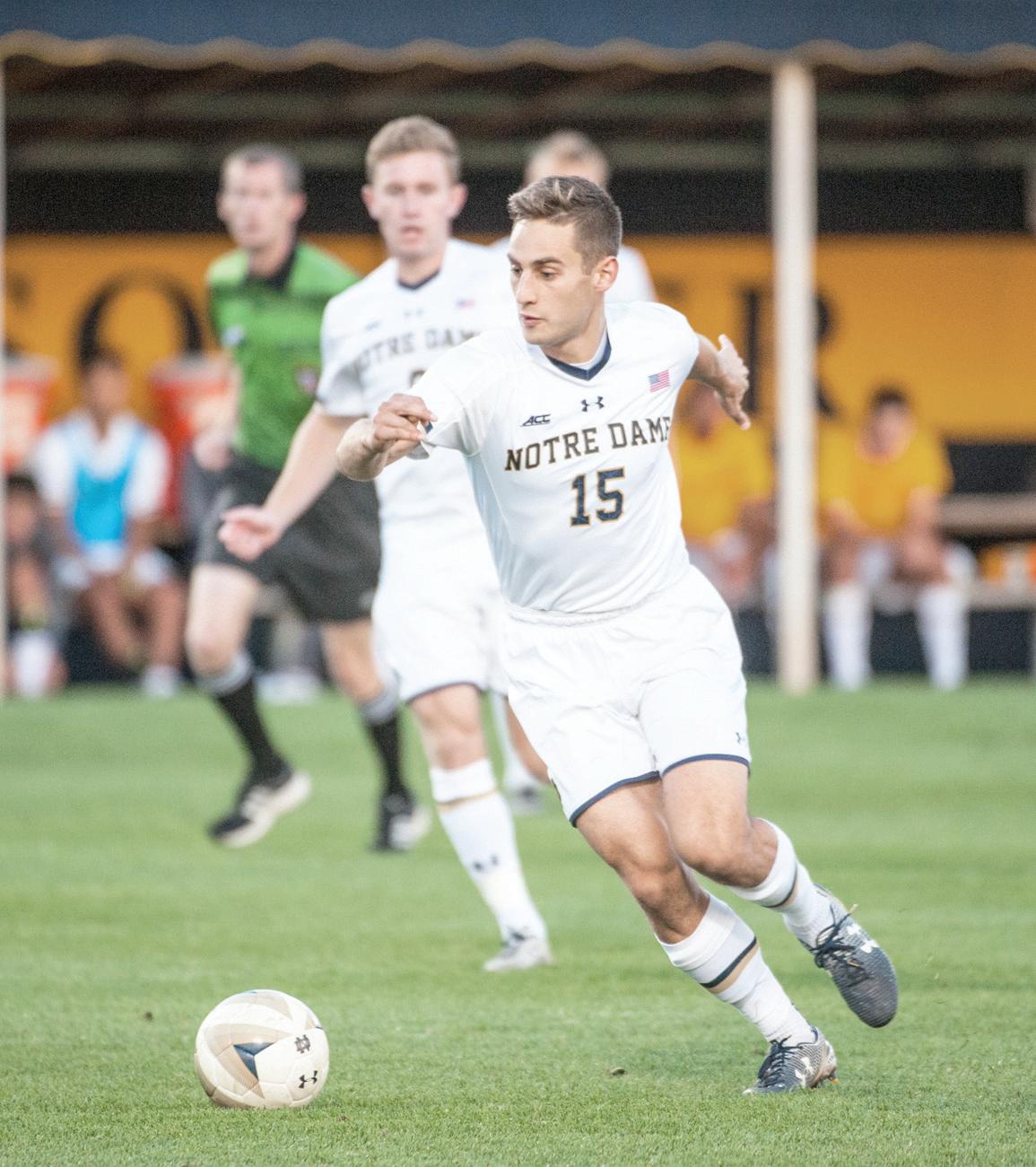
KATHLEEN DONAHUE | The Observer Irish junior forward Kaitlin Klawunder races down the sideline in Notre Dame’s 1-0 win over NC State on Sunday at Alumni Stadium. Klawunder sealed the game for the Irish, scoring the game’s lone goal.
CHRIS COLLINS | The Observer
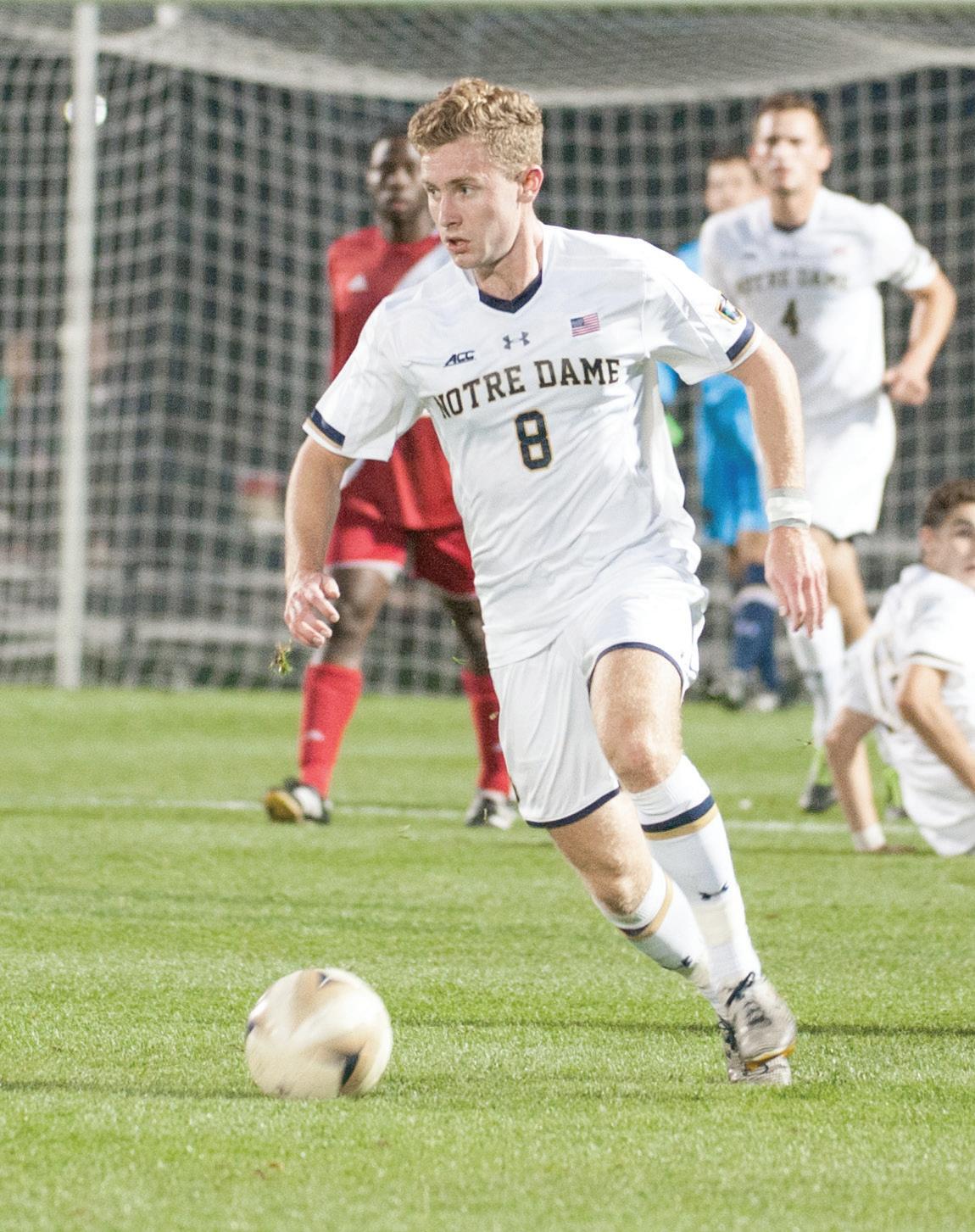
Irish graduate student midfielder Evan Panken dribbles the ball up the field during Notre Dame’s 4-0 win over Indiana on Oct. 4.
ND ends regular season with draw against UNC Irish earn shutout in postseason
By MANNY DE JESUS Sports Writer
No. 12 Notre Dame returned to dominant form in their regular season finale, but No. 3 North Carolina did enough defensively to bring the physical ACC matchup to a 0-0 stalemate to end the regular season Friday at Alumni Stadium.
The Irish (10-5-2, 3-3-2 ACC) started slowly in the first half getting off just four shots, but the second half showcased a completely different Notre Dame team. The Irish outshot the Tar Heels (11-2-3, 5-1-2) 11 to eight and created a myriad of scoring opportunities in the final minutes of the game off of free kicks and ricochets that, if timed correctly, could have led to the game-winning goal for Notre Dame.
But the Irish just weren’t in the right place at the right time. With just under five minutes left in the game, junior forward Jon Gallagher crossed the ball
M SOCCER PAGE 11
victory over Indiana on Oct. 4 at Alumi Stadium.
By DANIEL O’BOYLE Sports Writer
On one end of the field, top-seeded Notre Dame’s defense did in its ACC tournament opener against eighth-seeded North Carolina State what it did time and again in the regular season: limit chances, trust senior goalkeeper Kaela Little to handle the threats on goal she faced and come away with another clean sheet at Alumni Stadium.
At the other end, it took 87 minutes, but the Irish (13-2-4, 7-1-2 ACC) did what they had done time and again in the regular season as well — deliver a dangerous cross into the box and finish it to give the Irish a victory.
For the opening 45 minutes, few serious scoring chances came either way, but the Wolfpack (10-8-1, 4-5-1) were the more threatening side, outshooting the Irish in the first half, 5-3. Wolfpack freshman midfielder Ricarda Walkling had three shots saved by Little, including a 21st-minute effort from the edge of the box, which the Irish goalkeeper did well to hold on to, and a volley in space from 12 yards
out that she couldn’t connect with cleanly. Freshman midfielder Tziarra King also had an opportunity to score for the Wolfpack after the Irish struggled to clear a free kick, but her shot deflected over the crossbar.
Irish head coach Theresa Romagnolo said she thought her team’s slow start was due to its struggling with fatigue early on.
“I think it was a tough game,” Romagnolo said. “I think a lot went into Thursday night’s performance, and I think everyone across the board — with teams having to travel, I think people are a little bit tired today, and I think we looked a little bit tired.”
Notre Dame had its first serious scoring opportunity of the game early in the second half, when freshman forward Jennifer Westendorf capitalized on a mistake from North Carolina State’s sophomore defender Ella Bonner and set senior forward Kaleigh Olmsted free down the right-hand side of the field. But under pressure from a defender, Olmsted could
W SOCCER PAGE 11
Offense propels Irish over Huskies Notre Dame falls short against Miami, FSU
By TOBIAS HOONHOUT Sports Writer
After struggling to finish offensively Thursday night, the Irish scored early in the first period and never looked back Friday night, putting six past UConn en-route to a convincing 6-2 win to escape the sweep and break out of a three-game winless streak.
“I thought first period was a little, you know, tentative, but I thought after that we played real well,” Irish head coach Jeff Jackson said after the game. “I thought it was a good balance. We had good shifts from each line. I was even more pleased after the first period with the play of our defense.
“I think that to me, that’s going to be the key for us, those guys making simple decisions and getting us out of zones so we can utilize our speed. And I thought they were going back a lot with the puck, and then after that, they really did a good job.”
After UConn freshman goalie Adam Huska made 47 saves on Thursday to stymie the Irish offense, senior Rob Nichols got
the start in net Friday night for the Huskies (3-2-3, 1-1-0 Hockey East), but he didn’t have the same success. On the first power play of the night for the Irish (4-3-1, 1-1-0), sophomore forward Joe Wegwerth accidentally blocked junior forward Anders Bjork’s shot in front of the net, but then he collected the puck, turned and whipped a shot past Nichols to give the Irish an early advantage.
“I thought it was good for our power play — it was good for our bench,” Jackson said. “Because [Thursday], when they scored that first goal, I thought there was a little bit of a letdown or a gasp, but we responded. We had as many or more good chances last night as tonight. The biggest difference was that we got the timely goals that helped us to get the lead and finish it off after they had a little bit of a spurt there in the third period.”
As the game went on, the Irish continued to find their offensive rhythm in the game, following their fast start with four more goals to distance themselves
By ELIZABETH GREASON Sports Writer
Notre Dame entered the weekend in second place in the ACC with its hope of winning the conference intact, but that hope took a hit, as the Irish dropped their both matches this weekend to Miami and No. 11 Florida State.
The Irish (18-6, 9-3 ACC) had fresh faces running the offense with its starting setter and ACC assist leader, junior Caroline Holt, out after having surgery on her fractured leg earlier this week and its backup setter, junior Taylor Zwickl, also out with an arm injury. Notre Dame moved from the 5-1 offense it had been running all season, with Holt on the court at all times, to a 6-2 offense with freshman setter Hanna Klein making her first collegiate appearance and sophomore outside hitter Rebecca Nunge stepping up to set in Holt’s absence. Irish
PETER ST. JOHN | The Observer Irish junior forward Jon Gallagher scans the field during Notre Dame’s 4-0
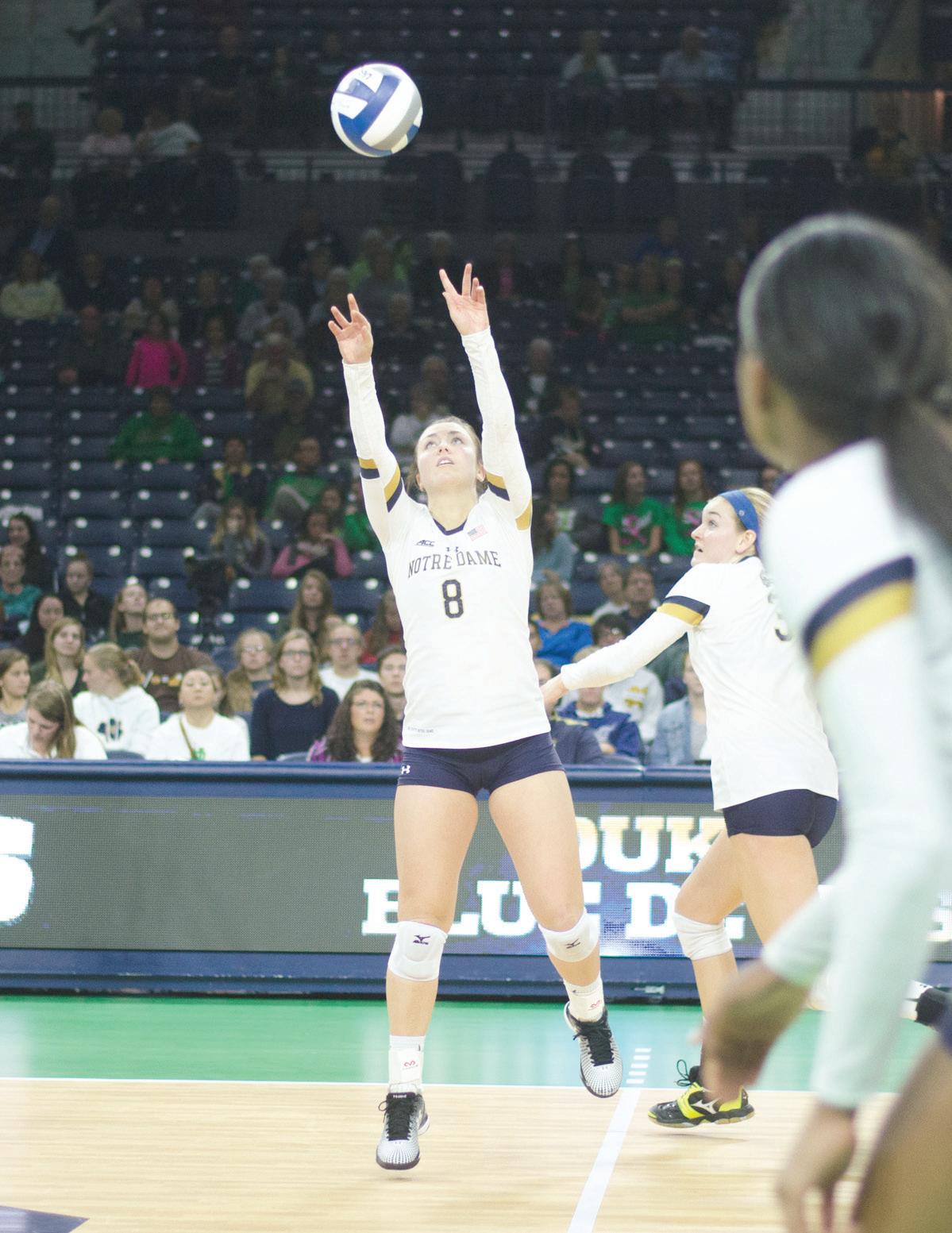
Irish junior setter Caroline Holt sets the ball during Notre Dame’s 3-1 victory over Duke on Sept. 30. Holt is the ACC leader in assists.
for the time being. After the hot start to the game, Notre Dame was unable to do anything with early second-half opportunities, and Miami seized the comeback opportunity. With 12:30 remaining in regulation, Miami put its second field goal of the quarter through the uprights, eliminating the 20-point advantage Notre Dame had once held.
Among the problems for Notre Dame that allowed Miami back into the game, Kelly noted the team’s lack of decisiveness as perhaps one of the biggest problems throughout the day.
“Our whole football had been battling at times with being indecisive in certain areas, whether at the quarterback position, whether we were indecisive as a play caller, whether we were indecisive at the cornerback position, and indecisiveness put us where we are today,” Kelly said.
With the game tied at 20, Notre Dame got its first offensive possession of the fourth
quarter, but the Irish were unable to get anything going and were forced to give the ball back to the Hurricanes. Miami found itself unable to move the ball either, and the drive appeared to be over. However, sophomore C.J. Sanders muffed the punt inside the 5-yard line and allowed Miami to jump on the ball in the end zone to take a 27-20 lead.
Notre Dame responded and put an end to the unanswered scoring run by Miami when Adams bounced outside the box and scored from 41 yards out, tying the game at 27 in the process.
With under two minutes remaining in regulation and down inside the Miami 10yard line, Kizer hit senior tight end Durham Smythe for what seemed like a potential touchdown, until Smythe fumbled near the goal line. In the chaos that ensued to find the ball, it was Kizer who somehow came up from the pile and kept possession for the Irish. Kizer noted the craziness of the play after the game.
“Yeah it’s a lot down there, and I felt like it was only white jerseys around me. That’s
probably my favorite play of the season so far in being down there and doing whatever it takes to win for my team,” said Kizer. “Those are big guys down in there, but for a quarterback to be down there, it’s awesome to come up big for us.”
With 30 seconds to play, Yoon knocked through his third field goal of the evening and gave Notre Dame the 3027 lead. Miami’s efforts to drive down the field came up short with junior linebacker Nyles Morgan coming up huge on the last play of the game, sacking Kaaya for the Notre Dame defense’s fifth on the night as the clock ran out.
Notre Dame walked away with their first win in nearly a month and a boost of confidence after closing out the game late, Kelly said.
“It was a dominant effort against a Power 5 football team that was nationally ranked a few weeks ago, and I think that’s about as good a performance as we’ve had in a while here,” Kelly said.
Contact Alex Bender at abender@nd.edu
Scoring Summary
n oTr E Dam E 7, miami 0
Torii Hunter Jr. five-yard pass from DeShone Kizer (Justin Yoon kick)
11:32 remaining
Drive: Nine plays, 75 yards, 3:28 elapsed
noTr E D am E 10, miami 0
Yoon 37-yard field goal
6:36 remaining
Drive: Eight plays, 66 yards, 2:55 elapsed
noTr E D am E 17, miami 0
Equanimeous St. Brown 14-yard pass from Kizer (Yoon kick)
4:23 remaining
Drive: Three plays, 13 yards 1:12 elapsed
n oTr E Dam E 20 , miami 0
Yoon 26-yard field goal
10:31 remaining
Drive: Five plays, 53 yards, 0:34 elapsed
n oTr E Dam E 20, miami 7
David Njoku two-yard pass from Brad Kaaya (Michael Badgley kick)
6:50 remaining
Drive: Four plays, 38 yards, 4:01 elapsed
the pile with possession of the football.
That play not only kept the Irish (3-5) in possession of the football, but allowed the clock to run off another minute and a half before sophomore kicker Justin Yoon hit the go-ahead field goal to put Notre Dame up 30-27.
“Obviously, it was a key point of the game,” Kizer said. “Obviously, we don’t want to fumble down there, but you look at it from an outsider’s point of view, burn two timeouts, leave 30 seconds on the clock, you never know what happens with a guy like Brad Kaaya out there with more than a minute and two timeouts. It led us to victory.”
With just 30 seconds left, Kaaya was able to move the ball up from Miami’s 25yard line to the 47-yard line. However, Notre Dame’s pressure proved once again to be too much as junior linebacker Nyles Morgan’s sack wrapped up the game.
In the second half, Kaaya led Miami to 20 straight points to take the lead in the fourth quarter, and he did it all with his arm. He completed 17-of-26 passes for 186 yards, and of the 13 converted first downs in the second half, Kaaya was responsible for 12. This was also all with Notre Dame’s defense unleashing the most pressure they’ve shown all season long. Kaaya was sacked for a total of five times, including two key ones in the second half.
Kizer played well throughout the game, recording nearly identical numbers to
Kaaya’s, but the difference according to Irish head coach Brian Kelly was his mental toughness, which was highlighted in Kizer’s fumble recovery.
“One of the things I was looking for from him was not whether or not he could throw another dig route,” Kelly said. “I needed some toughness from him, some mental toughness. And that’s an indication. He was not going to be denied. He was going to find a way to get that football. That grittiness is maybe what we were lacking a little bit, and he showed some of that grittiness in the way he went and fought for that football.”
Kizer dominated the game early on in the first quarter looking the part of an NFL quarterback. He completed 10-of-14 pass attempts for 95 yards and a couple of touchdown passes to senior receiver Torii Hunter Jr. and sophomore receiver Equanimeous St. Brown. The 17-0 first quarter lead had the Irish on the brink of running away with the game early until Kaaya had his shot in the spotlight.
There were several other factors involved in how the game turned out, including a surprise onside kick by Miami, a muffed punt that went for a touchdown in the Hurricanes’ favor and a career game for senior defensive tackle Jarron Jones, which changed the way Miami approached the game offensively. But Kizer’s ability to get into the late fourth quarter scrum and emerge with possession is what stands out, and according to Kizer, his toughness was a response to Kelly’s challenge to the
quarterback.
“Coach Kelly challenged me this week,” Kizer said. “He told me that we were going to throw the ball around the place. … With that, he challenged me and said, ‘Look, these throws aren’t hard. We don’t need you to go out there and make crazy plays. These are all simple things. The only way you’re going to be able to get through that and be successful is to have the mental toughness and discipline to be able to make those throws every time we need to.
“Obviously in the secondto-last drive I lost that. Coach Kelly came over and challenged me again. He said, ‘I told you. Those are the plays we’re going to have to make to win this game.’ We go back out there the last drive, and we make those same plays, and that’s what leads us to a victory.”
Kizer answered the call and made the necessary plays to set himself apart in a tightly contested battle with Kaaya. With the first win in more than a month, Notre Dame is hopeful that the victory over Miami will be the first of a lengthy winning streak.
“It’s huge for us,” senior left tackle Mike McGlinchey said. “It definitely sets us back on the right track. Now we understand what it takes to get it done and how to do it. We came down and executed those final few drives this week, and we couldn’t be prouder of our guys. It’ll absolutely provide a spark for our guys the rest of the season. One is a streak, so we’re going to keep rolling with this one.”
Contact Manny
n oTr E Dam E 20, miami 14
Mark Walton one-yard run (Badgley kick)
8:36 remaining
Drive: 13 plays, 76 yards, 6:24 elapsed
n oTr E Dam E 20, miami 17
Badgley 43-yard field goal
4:41 remaining
Drive: Nine plays, 42 yards, 2:50 elapsed
noTr E D am E 20, miami 20
Badgley 38-yard field goal
12:30 remaining
Drive: 11 plays, 48 yards, 4:23 elapsed
n oTr E Dam E 20, miami 27
Michael Jackson fumble recovery off muffed punt 6:49 remaining
n oTr E Dam E 27, miami 27
Josh Adams 41-yard run (Yoon kick)
5:53
remaining
Drive: Four plays, 75 yards, 0:56 elapsed
n oTr E Dam E 30, miami 27
Yoon 23-yard field goal
0:30
remaining
Drive: 10 plays, 34 yards, 4:13 elapsed
Outlasting the hurricanes
Notre Dame jumped out to a 20-0 lead, but a Miami punt that hit Troy Pride Jr. and was recovered by the Hurricanes deep in Irish territory flipped the momentum. Miami then put up 27 unanswered points, but a touchdown run by Josh Adams, a timely fumble recovery by DeShone Kizer and clutch finalminute field goal by Justin Yoon put Notre Dame over the top.
MICHAEL YU | The Observer
Irish junior linebacker Nyles Morgan wraps up Miami junior quarterback Brad Kaaya for his first of two sacks on the afternoon. Morgan also sacked Kaaya on the game’s final play, causing time to expire as Miami tried to drive down the field to tie or win. Morgan also finished with nine total tackles, one tackle for loss and a pass breakup.
MICHAEL YU | The Observer
The Miami punt coverage unit celebrates scoring a go-ahead touchdown after Irish sophomore receiver C.J. Sanders, right, muffed a punt that rolled into the end zone. The recovery put the Hurricanes up 27-20.
KELLY VAUGHAN | The Observer
Irish senior cornerback Cole Luke intercepts his second pass of the season in the first quarter.
EMMET FARNAN | The Observer Irish sophomore kicker Justin Yoon gives Notre Dame the lead with just 30 seconds remaining.
MICHAEL YU | The Observer
Irish junior quarterback DeShone Kizer drops back during Notre Dame’s win. He finished 25-for-38 for 263 yards and two touchdowns.