Print Edition of The Observer for Thursday, September 15, 2016
university hosts N d Forum on elections
‘Debating Our Future’ panel reflects on history of presidential debates, role of moderators
By EMILY McCONVILLE
if b ob s chieffer could ask h illary c linton and d onald Trump one question at a presidential debate this fall, it would be: w hy do you think people don’t like you?
“a follow-up question might be ‘ w hy do you think it is that this is happening?’”
s chieffer, former “ f ace the n ation” host and moderator of three debates, said as his audience applauded. “ w e’re at a point where our whole political infrastructure has collapsed, frankly, and how is it that the campaign came down to these two candidates? That’s the question
that i hear more than any other question, and it might be interesting to ask the candidates, ‘ w hy do you think it’s come down to you two?’”
f ormer pbs anchor Jim l ehrer, who moderated 12 debates, cut in. “ l et the record reflect, i didn’t ask that question,” he said.
The role of moderators in presidential debates — how the c ommission on p residential d ebates chooses them, which questions they should ask, how they should approach fact-checking — was a key theme in the first installment of the 2016 n otre d ame f orum,
By LUCAS MASIN-MOYER
news writer
Walsh family donates to build architecture hall SMC professor researches bird genetics, climate
b ond h all, constructed in 1917 on the coast of s aint m ary’s l ake, has long served as the home for the s chool of a rchitecture. b ut in the fall of 2018, the s chool will uproot itself from its longtime home and move to a new location.
w alsh f amily h all of a rchitecture, as the new building will be called, will be located on e ddy s treet, just south of l egends of n otre d ame and east of the d e b artolo p erforming a rts c enter.
i n b ond h all on w ednesday night, architecture students were briefed on their new home. m ichael l ykoudis, dean of the s chool of a rchitecture, began with a discussion of the necessity for a new building.
“ w e were rapidly outsizing [ b ond h all]; we don’t have that much space in the studios,” he said. “ w e need a different kind of space. b ond h all is an amazing building, a beautiful building, well-built. The studio
layout doesn’t work as studios should. o ne of the most common complaints i hear is that graduates and undergraduates don’t speak to each other.”
The construction process of the new building began three years ago with a donation of $27 million from advisory council members, m atthew and Joyce w alsh. n otre d ame and the s chool of a rchitecture chose John s impson a rchitects to design w alsh f amily h all.
“ o ne of the reasons we selected this firm was not only for the quality of the design but that they actually sold a business model on top of the design,” l ykoudis said. “ w e have a design of a building that has actually gotten better because of the budget, and the creativity of the architect has actually come through in the challenges.”
s impson then spoke on the overall design of the building, which is heavily rooted in classicism and g reek style. s impson noted the Temple of a pollo at
d idyma as a chief source of inspiration.
The central element of the new building will be a stoa, a central portico which will be used as a meeting area.
“ i t is a double-height space; it is designed so it really stands out and gives you a sense of scale as you look out upon it, one whole side is looking out on the green court,” s impson said.
The classrooms are heavily integrated with the stoa, s impson said.
“The way the classrooms are organized is almost like a series of shops that come off from the stoa,” he said. “ s ome of the activities going on in there relate to what’s going on in the stoa.”
a tower at the center of the courtyard is another prominent element of the new building. s impson said this tower would be “a beacon which was really highlighting this whole part of campus as the arts district.”
The announcement and unveiling of this new home for the s chool of
By ALLISON SANCHEZ news writer
s aint m ary’s assistant biology professor Joel r alston is studying a population of northern boreal forest birds to determine if climatedriven changes will impact species distributions and genetic diversity. h e has been using a field study of wild birds, genetics and computer modeling to test what influence climate change will have on the population.
“ i t is generally thought that as climates warm, species will move northward or up in elevation to track their ideal conditions,” r alston said. “This means that populations at the southern edge of their current ranges may be the first to disappear due to climate change and any unique genetic diversity held in those populations could be lost.”
avoid climate change.
“ w arming temperatures are already having big effects on wildlife,” he said. “ d istributions are changing, populations are declining, birds are migrating earlier each year and some studies have shown that nearly half
of all n orth a merican birds are threatened by climate change.”
s aint m ary’s seniors Kathryn m arshall, e mily c rimmins and e milie vanneste have given r alston aid in this study, as well as colleagues around the country and student participants from r alston’s previous see donaTion PAGE 3 see birds PAGE 3
r alston said his interest in species distributions had made it nearly impossible to
THOMAS MOLOGNE | The Observer
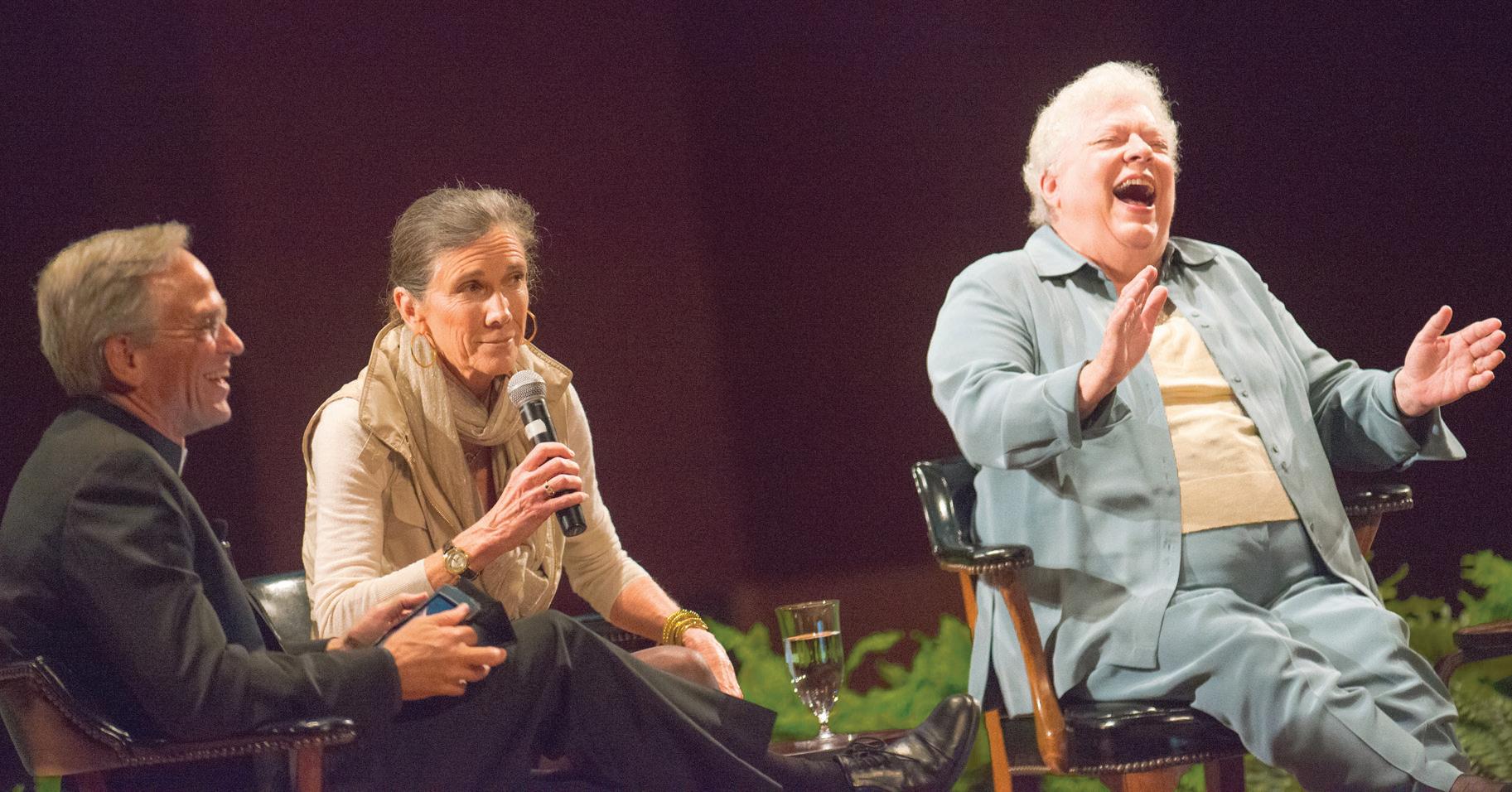
Former president of the League of Women Voters Dorothy Ridings laughs as Janet Brown, executive director of the Commission on Presidential Debates, speaks during the forum Wednesday night in DPAC.
Lora Sonnick freshman cavanaugh hall “h igh uggs and shorts.”
Emily Black freshman cavanaugh hall “vests.”
Have
Kyle Planck senior dunne hall “birkenstocks.”
Christy Ivey freshman cavanaugh hall “Jorts.”
Robert McAvoy sophomore Zahm house “f lat-brim hats.”
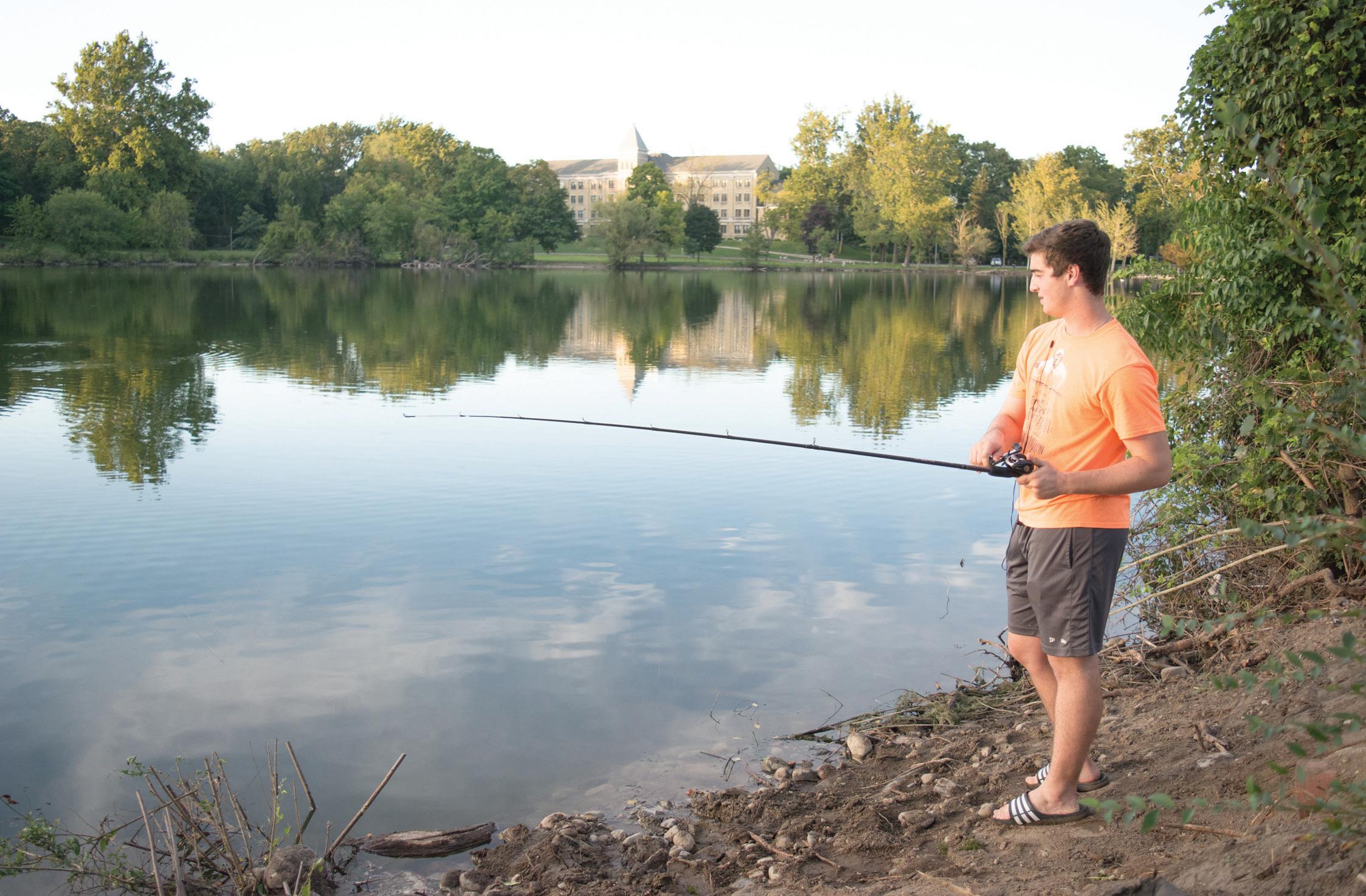
Freshman Bart Bramanti of Dillon Hall fishes at Saint Mary’s Lake on Wednesday evening. He was one of the many students spending time outdoors enjoying the beginning of the transition to fall weather.
Today’s Staff
Corrections
The
itself as a
CAiTLyN
JOrdAN | The Observer
Group hears SafebouND presentation
By DEVON HARFORD news writer
i n a continuation of the campus conversation about s afe b ou nd, s enate welcomed
n otre d ame s ecurity p olice ( ndsp ) c apt. Tracy s kibins to their meeting wednesday.
s kibins, along with student supervisor senior m ichael p ohl, spoke about some of the continuing concerns regarding the campus safety program, while also encouraging students to send feedback straight to ndsp
“ we have not had a single complaint given to us yet,” s kibins said. “ we want the comments so we can keep improving and changing to fit the students.”
The pair also reported some recent changes, including an extension of the 2:30 a.m. closing time on Thursday through s aturday to 3 a.m.
“ it’s something that you guys suggested that was easy to do,” s kibins said.
These recent changes also included better identification for students working with s afe b ou nd, including reflective vests, a mandatory ndsp id and amber lights for the golf carts and minivan that are in operation during the week. s kibins said shamrock decorations may even be added to make the vehicles more recognizable.
o ther potential changes designed to decrease wait times for students were presented
as works-in-progress and included reintroducing the use of golf carts during the weekends, but only along the edges of campus.
p ohl added that the use of walkers would reduce waiting time no matter what.
“The highest wait time [last year] was 88 minutes,” p ohl said. “ we wanted to bring that number down.”
a dditionally, s kibins said such changes would not be implemented until later in the year, once the service is more widely known and steadily used.
s he also drew attention to the history of safety programs such as this on campus.
“The original ‘ s afewalk’ was created 25 years ago,
strictly as a walking program,” s kibins said.
o riginally a student’s idea, the program remained a walking service until the introduction of o ’ snap in 2014, which incorporated golf carts into the program. s kibins said o ’ snap at first was unknown and slow to take hold as a popular service, and that by looking at the original records and statistics of the first few weeks of o ’ snap, ndsp hopes to get a better sense of how the new program is taking hold in comparison.
“ i n the past 15 days, 115 rides have been provided by s afe b ou nd,” s kibins said.
a lthough she does not yet have the data on s afe b ou nd,
s kibins said she is confident that use will pick up as the year goes on, as more efforts to promote the program are being developed.
a fter being asked if there was any way to cater the program to people who felt unsafe as well as those interested in the program’s use as a “party shuttle,” in order to appease disgruntled students on campus, s kibins said it would not be in the spirit of the original creation of the service.
“ we have to remember the purpose of this program, and that it is a safety service, not as a convenience,” she said.
Contact Devon Harford at dharford@nd.edu
pence’s order on syrian refugees faces scrutiny
Associated Press
chicago — attorneys defending i ndiana g ov. m ike pence’s order to bar agencies from helping syrian refugees resettle in his state faced unusually fierce questioning before a federal appeals court wednesday, suggesting the panel might side with a lower court that found the order discriminatory.
a three-judge panel for the 7th u s c ircuit court of appeals in c hicago zeroed in on the intelligence and intent behind the republican vice presidential candidate’s order, which a federal judge said in february “clearly discriminates” against refugees from the war-torn nation. Judges suggested that i ndiana could’ve had a stronger argument for entirely opting out of the refugee
birds
college ( e ditor’s note: m arshall is a n ews writer for The o bserver).
a portion of the summer was spent capturing birds in 30- to 40-foot mist nets with m arshall, r alston said.
“ w e placed the nets in the bird’s appropriate habitat and opened them up really early in the morning — just before sunrise usually — so that it is still dark enough that the birds couldn’t see the net,” he said. “Then we’d wait patiently for a bird to fly through and crash into the net.”
r alston said it is important to study birds because they are vital for the ecosystems they live in and
program — for which states disperse federal money to resettlement organizations — instead of excluding syrians.
“i f you’re in, you play by the government’s rules,” Judge frank e asterbrook said.
The oral arguments came the same day the w hite house announced that the refugee program will be expanded in the next year as concern continues about the refugee crisis stemming from syria’s civil war and conflicts in i raq and a fghanistan.
following november’s paris attacks, pence was among dozens of governors from mostly gop states who attempted to block syrian refugees, saying there were questions about the federal government’s screening process. The suspects in the attack were primarily from france and belgium;
can be used as a means to study the effects of environmental pollutants, human urban development and climate change.
“ b ird study is also very important in providing early warnings of issues that may be affecting
“By taking actions that we know help birds ... we will be ... helping them naturally respond to climate change.”
Joel Ralston assistant biology professor Saint Mary’s
ecosystems as a whole,” he said. “ b ecause birds are relatively easy to observe, biologists often notice changes in bird
gop leaders, including pence, noted that a syrian passport, now believed to be fake, was found near one of the suicide bombers.
pence sought to withhold federal funds for groups, including i ndianapolis-based e xodus refugee i mmigration, that help syrian refugees with medical and social services and job training.
The governor had the authority “due to terrorism concerns,” i ndiana’s attorney general said in a wednesday statement. but the a merican c ivil l iberties union of i ndiana, which is representing e xodus, said in previously filed legal briefs that the order violates the u s constitution and the c ivil r ights act and discriminates because states in the federal program must assist without regard to nationality. The aclu
populations before other types of organisms.”
i n a recent study, r alston and his colleagues found that certain species of birds are disappearing from their current distributions and are unable to move to new sites as a response to climate change.
“ i think this [study] is important because it shows that you can help birds persist through climate change,” he said. “ b y taking actions that we know help birds — keeping your cats indoors, preventing window collisions, putting out bird feeders, planting native plants in your yards — we will be building up bird populations and helping them naturally respond to climate change.”
Contact Allison Sanchez at asanch01@saintmarys.edu
said arguments by i ndiana state officials were “built on fear.”
courts have knocked down other states’ efforts to block syrian refugees, most recently in June, when a federal judge threw out the state of Texas’ lawsuit because it had no authority over resettlements handled by the federal government.
i ndiana s olicitor g eneral Thomas fisher repeatedly cited in court fbi directors’ past comments about less information available on s yrian refugees compared to those from other countries.
The judges, in sharp exchanges at times, were skeptical.
w hen fisher interrupted a judge, another on the bench issued a rebuke. l ater, when Judge r ichard posner launched into queries about how i ndiana
con T inued from page 1
a rchitecture have created excitement amongst its students.
s tephanie Kubus, a sophomore architecture student, said that the instructional spaces will be much improved over those in b ond h all.
“The fact that there’s more space and more classrooms is exciting,” Kubus said.
had determined s yrians were more dangerous than other refugees, he appeared unsatisfied with fisher’s response. “honestly, you are so out of it,” posner said.
Questions directed at aclu attorney Kenneth falk, were less intense and largely focused on constitutional arguments. it’s unknown when the three-judge panel will issue a written ruling on whether to uphold or overturn the lower court’s decision. since february, more than 100 refugees from syria have resettled in i ndiana, according to e xodus. a nd the obama administration said wednesday that the u s . will strive to take in 30 percent more refugees — 110,000 — than allowed in the previous year, saying the program doesn’t impose a national security threat.
“The studio arrangements will allow for more interaction between years.”
Kubus also noted her excitement about certain new design element of the building.
“ i ’m most excited to experience the hall of casts, stoa and terrace,” Kubus said. “ p lus there’s lots of natural lighting, which will be beautiful.”
Contact Lucas Masin-Moyer at lmasinmo@nd.edu
“ d ebating o ur f uture,” held w ednesday night at the d e b artolo p erforming a rts c enter ( dpac ). a t the f orum, u niversity p resident f r. John Jenkins asked a panel comprised of l ehrer and s chieffer, as well as Janet b rown, executive director of the c ommission on p residential d ebates, and d orothy r idings, former president of the l eague of w omen voters, questions about the evolution of presidential debates and their function in a merican politics. a udience members were able to ask their own questions via email.
b rown said televised presidential debates date back to 1960, when John f. Kennedy famously debated r ichard n ixon — three election cycles passed before one was held again.
“The candidates did not see them as an imperative,” b rown said. “They saw them as something that could be avoided with impunity, and that’s what they did.”
b y 1976, the l eague of w omen voters had hosted radio debates for years, r idings added. That year, legislation was passed that allowed non-partisan organizations unconnected to the media, like the l eague, to sponsor debates that television networks could broadcast.
i t was the l eague of w omen v oters that created the criteria a generalelection candidate had to meet to participate in the debate, criteria that still stand today: eligibility to run for president under the c onstitution, petitioning to be on ballots in enough states to win the electoral
college and, most controversially, polling at or above 15 percent nationally. The last requirement usually disqualifies all but the major party candidates — the one exception was John a nderson, an independent candidate who qualified for one debate in 1980.
“There has to be some way, and this is the tough part of all this, of ascertaining who should be on that stage, who really has deserved to be in that place to be heard by an audience that has to make hard choices,” r idings said.
The l eague, sometimes accused of disorganization, sponsored debates until 1988, at which point the c ommission on p residential d ebates, whose board of directors now includes Jenkins, formed.
“The debates had taken on a level of importance where it should be run by an organization with no other agenda in the general election,” b rown said.
b rown said the c ommission looks for moderators who are experienced and fair journalists who are comfortable on live T v
“They are there to facilitate, not to compete, not to take up a lot of time with hard questions that people don’t know how to answer,” she said.
f or his part, l ehrer said nobody at the c ommission tried to influence the questions he asked or the content of the debates. s ince moderating his first debate in 1988, he said the format has gone from one with more-or-less scripted questions and answers to one that is more open, in which candidates can freely talk to each other.
“ w hat has happened in this process is being a moderator is becoming
increasingly difficult,” he said. “ i t is really hard work because now, you have candidates with freedom to engage, freedom to ask questions, freedom not to to shut up if you want them to. … The moderator’s got to have a tremendous amount of knowledge, not so that you can write a bunch of questions, but so you can listen, so you can follow up, so you can have a sense of fairness.”
s chieffer said he tries to come into debates as prepared as possible — for one of the 2012 debates, he interviewed dozens of experts
“There has to be some way ... of ascertaining who should be on that stage, who really has deserved to be in that place to be heard by an audience that has to make hard choices.”
Dorothy Ridings former president League of Women Voters
in think tanks, potential debate questions numbering in the hundreds. b oth s chieffer and l ehrer, however, stressed the importance of pulling back and letting candidates talk.
“ i n this new format in particular — the open format — the moderator [has to] be able to listen,” l ehrer said.
b esides a more open format, l ehrer said another major change is the introduction of split screens during the debates, displaying both the candidate talking and the opponent reacting. a s a l g ore, unable to
get a word in during a 2000 debate against g eorge w b ush, learned the hard way, body language has become increasingly important.
“ i became more keenly aware of it, and candidates have become more keenly aware of it as well,” l ehrer said. “ i ’ve noticed in the progression of debates that i ’ve moderated since then, candidates are very careful about what they do because they know they’re being watched all the time.”
s chieffer said moderating debates taught him that, especially since many have already decided on a candidate by the time the debates roll around, voters want to get to know the candidates as people, something that does not always involve strict policy discussion. i t’s the moderator’s job, he said, to make that happen, which is why he asked b ush and John Kerry in 2004 what they learned from the women in their lives.
“ p arty is important, a person’s positions are important, but the overall question in voters’ minds is, ‘ w ho i would be most comfortable with in times of crisis?’” s chieffer said.
i n response to an audience question about whether moderators should fact check candidates, s chieffer said he does consider that his job — but not right away.
“ i t is the responsibility of the moderator to make sure the truth gets out, but the chief fact checker should be the candidates themselves,” he said. “ i f candidate a says something … you should give the other candidate an opportunity to correct him. i f he doesn’t, the moderator should step in and state what the facts are.”
The point of debates, l ehrer said, is for both sides
of an issue to be presented in real time.
“These are the only opportunities we have as voters to see the candidates on the same stage, in the same place, at the same time being asked the same questions and so forth,” he said. o ther questions came in: c ould l ibertarian candidate g ary Johnson participate in a debate even if he hasn’t reached the 15 percent polling threshold? n o, b rown said, though the criteria are constantly reassessed. d o debates encourage the development of quips or one-liners? yes, l ehrer said, though most candidates deny it. h ow do new media affect the televised debates? n o matter how it’s broadcast, the style of the debate will stay important, l ehrer said.
d oes race or gender play a role in the selection of moderators or the treatment of candidates during the debates? b rown said the c ommission looks for both diversity and experience in its moderators, which feeds into fair treatment for the candidates.
“There is no sense that any candidate is treated any differently than any other candidate,” she said.
b rown said major-party candidates will never be required to attend a debate, but they have become such an integral part of the election season that skipping one is disadvantageous.
“The mandate in these debates in public opinion,” b rown said. “ p eople want to see these debates. These audiences are so much larger than they are for any other kind of political programming.”
a sked at the end of the discussion why debates are important, both b rown and r idings said they exemplify the free exchange of ideas, something leaders they meet from developing countries try to emulate. s chieffer said they allow voters to find out as much about candidates as possible.
l ehrer said the debates are as “sacred” as voting itself.
“That institution … makes it possible for everybody in a merica at the same time or at any pace they want to now with new technology to see these candidates, the people who will be in this position … the most powerful position in the world,” he said. “ you can see them in an environment that is clean, that is fair, that is presented in such a way it’s serious. i t’s not there to make you laugh, it’s not there to make you cry. i t’s there to make you an informed voter.”
Contact Emily McConville at emcconv1@nd.edu
paid a dverT isemen T
By CARLOS DE LOERA
s cene writer
This past friday, capitol records released “live at the hollywood bowl,” a remastered version of two legendary beatles concerts originally recorded in 1964-65 and released in 1977. friday also saw the release of “Jack w hite acoustic recordings 1998-2016,” a selection of acoustic versions of w hite’s songs that showcase the evolution of his songwriting throughout the years. on the surface it seems as though there is no apparent connection between the two albums, but together the albums highlight one of the most important aspects of the recording process: sound mixing.
on aug. 23, 1964, The beatles performed at the hollywood bowl and a year later on aug. 29 and 30, 1965, they returned for another two sets. a ll three performances were professionally recorded by capitol records. The recordings were done on a 3-track with vocals on one track, drums and bass on another track, and guitars on the third. a common thread between the tracks was that they were all filled with screams from the audience. in fact, the screams were so loud during the concert that The beatles were not even able to hear themselves play. These screams diminished the quality of the tracks so much that capitol records decided to hold off on releasing the live performances. in 1977, seven years after the beatles broke up, producer george martin and capitol records managed to salvage some of the recordings and put them together to create the live album. The album was made up of 13 song performances carefully selected from the three performances. The recordings still featured the band being significantly drowned out by screams, but
there was enough there for capitol records to release a vinyl. To date, these recordings are the only professional live recordings of The beatles. more than 50 years after The beatles’ performance and almost 40 years after the release of “The beatles live at the hollywood bowl,” giles martin, producer and son of george martin, was contacted by capitol records and told that new tapes of the hollywood bowl performances had been found. included in the recordings were four previously-unreleased tracks. in an interview with “a ll songs considered,” giles martin talked about how he was able to improve the recordings using “de-mix technology.” with de-mix technology he was able to, as he described, “take one track and separate it into its constituent parts.” he went on to say, “w hat we ended up with is it split the [live] track into two tracks and you get the screams on one half … and the band playing [on the other half].” This was crucial because it allowed him to go into each track and bring the best out of each instrument, which ensured that each track did not get drowned out by the audience. The final product of this de-mixing process is “live at the hollywood bowl,” which truly gives listeners the chance to experience the full magnitude of a beatles live performance from the music to the crowd. w hereas the main goal of “live at the hollywood bowl” was to bring about new sounds, the objective of “Jack w hite acoustic recordings 1998-2016” was to strip songs of much of their sound. w hile many of the songs on the album will have a traditionally acoustic sound, the use of the term “acoustic” to describe the entire collection is a bit misleading. listeners can expect to hear, in some songs, full drum sets, violins, slide guitars, cellos and a multitude of other instruments that are not
usually associated with the term “acoustic.” rather than re-recording many of his songs in an acoustic manner, w hite merely retrieved some his songs from his solo work and from his days with The w hite stripes and The raconteurs. (unfortunately, there are no The dead weather songs on the album.) The collection includes two never-before-released tracks and a plethora of songs throughout w hite’s discography compiled into an album. a good deal of the songs were originally recorded acoustically or were pulled from official studio acoustic cuts, but there are few songs on the album where the original “plugged” version is used. w hat makes these “plugged” songs acoustic is that the electric instruments used are mostly mixed out. in an interview, w hite revealed that he decided to use this method to “let people hear the way [these songs] started off.” creating acoustic versions of these songs would change the tracks, but by stripping back the electric instruments, w hite is able to let the songs organically revert to their primal forms. on one hand, “live at the hollywood bowl” is able to create a more polished sounding recording of a live performance while still letting the listener hear the raw talent of the fab four and the insanity of the crowds they drew. conversely, “Jack w hite acoustic recordings 19982016” takes a more fleshed-out production and distills it to a raw form that allows the listener to focus less on the masterful electric guitar playing of w hite and more on the strength and evolution of his songwriting. Through the process of mixing both albums is able to give a new life to older recordings, it still preserves the key aspects of each artist’s songs that make them great.
Contact Carlos De Loera at cdeloera@nd.edu
By GABBY SALERA
s cene writer
w hat does your typical instagram caption look like? is it song lyrics? a n inspirational quote? how about a multiparagraph account of your most personal life experiences? if you’re caroline calloway — cambridge grad and full-time author — you probably picked the last one. calloway’s story started in new york with the hudson instagram filter and a “high school musical” reference. she charmed her fan base — the #adventurefam — when she misused instagram as a blogging tool and spent more time on writing her caption than she did on editing her picture.
for over a year calloway blogged about the summer of 2013. in her teenage dream, spending two weeks in
europe was just the beginning of the yellow brick road. There were flower crowns and candy shops, serena van der woodsen look-a-likes and sicilian aristocracy — and even an ecstasy/a ltoids mix-up.
Just as we thought our adventures with her were coming to an end she arrived at cambridge, everything except her witty prose changed, but the adventures only got better. The same youthful spontaneity existed; it was just against a different background. The new york skyline was replaced with 15th-century castles and her story turned into a storybook tale set in the whimsical british countryside. The world illustrated in calloway’s photos could have easily come from the mind of J. K. rowling. with her instagram posts, calloway revealed the inner workings of one of the world’s most prestigious universities. her time at cambridge was a series of rooftop
champagne toasts with her english love, masked and unmasked balls, and lots of flower crowns. The brand caroline calloway built has something for everyone; her instagram’s target audience stretches from the “gossip girl” posse to lana del rey record collectors to your neighborhood’s harry potter book club.
since her first instagram post in 2012, calloway has expanded and dominated all forms of social media. she is the breath of fresh air in a sea of over-edited selfies and overused drake quotes. caroline calloway’s still misusing social media daily; you can catch her posting vlogs to her snapchat account (@adventuregrams). make sure to check out her memoir “a nd we were like” when it comes out in 2017.
Contact Gabby Salera at gsalera01@saintmarys.edu
INsIdE ColumN
nd football: a labor of love
a fter the sept. 4 loss to Texas, fr. sorin’s unofficial parody Twitter account posted the following message: “it’s truly appropriate that today is l abor day, because being an i rish fan is truly a labor of love.” i don’t think i could agree with anything more.
The common joke amongst my friends is that i have “been a notre dame fan my whole life.” This joke arose during last year’s v irginia game when the i rish, down with a few minutes left, had the ball and needing to score to drive, i, in my relentless optimism of my fandom, said something to the effect of, “i’ve been a notre dame fan my whole life; i know how this will turn out.” a nd no, i did not mean that i anticipated deshone Kizer hitting w ill fuller on a perfect pass in the end zone with a few seconds left.
i, the typical legacy child, was raised on the notre dame football tradition — stories of rushing the field after the legendary “catholics vs. convicts” game, of rockne and l eahy, montana and lujack, r ice and The rocket. it got so bad that in fourth grade, i did an entire project on Knute rockne’s life. some of my earliest memories of my family loading up our car at 5 a.m. and hitting the pennsylvania Turnpike for the 12-hour ride out to the bend. i n my first game the Tyrone w illinghamled i rish, in typical notre dame fashion, were tied with a team they should have been beating, navy, with a few minutes left. in characteristic dramatic fashion, six-year-old lucas watched in awe as d.J. fitzpatrick put the ball through the uprights as time expired, and since that point, i’ve been hooked.
since my fandom has begun, i have truly learned what nietzsche meant when he said, “to live is to suffer.” i watched when matt l einart was pushed into the end zone, illegally i may add, to best the irish in 2005, a game we very much deserved to win. i labored through 3-9 in the c harlie weis years, and was in the stands when snowballs rained down upon c harlie weis against syracuse. i will readily admit that i cried myself to sleep on the night of Jan. 7, 2013 as a perfect season, and a shot at the national title lay in shards after a demolition at the hands of a labama.
but amongst the struggle there have been moments of pure joy: in 2012, hugging my dad in my grandparents house as oregon’s attempt at a field goal in overtime sailed wide, meaning that the no. 1 sign would be lit up on top of grace for the first time since 1993; watching notre dame beat m ichigan 37-0 (yes 37) the night after i applied to the university (yes, i applied in september…); and in my first game as a student watching in all the glory of a fall evening in south bend as the irish trounced Texas 38-3 and running through stonehenge afterwards (sorry, fr. Jenkins).
a mongst it all, i’ve learned that while it may be a labor of love to be a notre dame football fan, it does deep down come from a place of love. i n what will be a total cliché, i know that every saturday, no matter how the week was, i can sit in front of the T v or climb the beer-soaked stairs of notre dame stadium to tiny bleachers and know that for three and a half hours, i can lose myself in the magic.
Contact Lucas Masin-Moyer at lmasinmo@nd.edu
The views expressed in the Inside Column are those of the author and not necessarily those of The Observer.
To ThE EdITor
A Republican’s right of reply
i recently read your publication of b ridgend’s article entitled “This e lection is too i mportant” and i must say that while i have read some frightfully pitiful defenses of s ecretary c linton, this meagre effort makes the f rench defense of the m aginot l ine in 1940 look positively formidable.
The author of this article is of the opinion that s ecretary c linton’s “greatest scandal seems to be moving confidential emails to her private email server” and defends s ecretary c linton by arguing “with a job as hectic as secretary of state, i cannot say i blame her for wanting to streamline her tasks and improve efficiency.” s he goes on to argue that it is reasonable for a former first lady, senator and secretary of state to “not fully understand the pitfalls of their technology” because after all it’s “the same crime of which many people’s parents are guilty.”
This is nothing more than a heaving pile of totally nonsensical balderdash. e xcept balderdash doesn’t result in a mericans coming home in body bags. w hat the author neglects in her flippancy is that s ecretary c linton’s use of an unsecured private server put a merican national security and lives at risk, a crime for which the “many parents” of whom she spoke would be thrown in jail. w hat’s more, there actually are military members who have been demoted, fined and even imprisoned for this crime. The name petraeus springs to mind. e ven by her own words, she puts forth an argument supporting the notion that the former secretary should be behind bars as gross negligence is a crime in this instance, and it would appear that the secretary did “not fully understand the pitfalls” of a private server. i must apologize to the author for my indecorous bluntness, particularly in print, but it was her job to understand.
it should also be mentioned that at no point in her article does the author mention a single policy position put forward by s ecretary c linton. g iven that she described this election as “too important,” one would hope that there would have been at least a modicum of policy analysis in an effort to swing the vote towards the secretary. i nstead the focus is on persona, and even then there is no mention of the myriad of health problems rendering s ecretary c linton literally unfit for office.
The reason for this is simple: The policy positions put forward by m r. Trump are vastly superior to those put forward by s ecretary c linton. w hile
m r. Trump would put this country on the path to energy independence and end the eco-socialistic war on coal instigated by this d emocratic administration, s ecretary c linton vowed to double down and shamefully proclaimed to the harpies surrounding her that she would “put coal miners out of business.” m r. Trump would protect our s econd a mendment right to keep and bear arms while s ecretary c linton would seek to write this amendment out of existence. m r. Trump would construct trade deals that put the a merican worker first, while s ecretary c linton would continue to use the government of this country to construct trade deals that would advance the interests of those who donated to her “foundation.” need i continue? m r. Trump would lower your taxes (because he believes in the radical idea that people should keep more of the money they earn, quelle horreur!) while s ecretary c linton would raise them to fund yet more government intervention into the economy, expanding the fraudulent waste that has come to define the o bama budgets. m r. Trump would secure the border, while s ecretary c linton would continue to allow the influx of illegal immigrants to drive down the wages of the working a merican. The list goes on.
The author is correct that d onald “J.” Trump is a “Jackass,” and i would actually go further, asserting that he is living proof that money can’t buy class. w hether it is the gauche private jets emblazoned with his name or the fact that his new york apartment is dripping in the gold of the nouveau riche, d onald Trump is indeed a jackass. he may not have been my first choice, but given the options of a “jackass” with some sound policies or an unhealthy criminal whose policies are determined by a sick notion of leftist elitism designed solely to satiate her lifelong lust for power, the choice is clear. i am not with her, i never have been with her and i never will be with her. o ne year ago, i would never have guessed that i would utter this phrase, but i will vote to m ake a merica g reat a gain. l ooking at the policies of the options available, it should hardly be considered surprising.
Dylan Stevenson notre dame college republicans, vice president senior sept. 13
lETTEr
Lucas Masin-Moyer news writer
There has recently been a very public uproar over the perceived unfair increases in the price of epi pens sold by mylan pharmaceuticals, resulting in a classaction lawsuit being brought against mylan earlier this week. The company is also now under investigation by the house o versight committee. The price of this life-saving device, which is a unique delivery system for epinephrine, has risen dramatically since mylan acquired the product in 2007. w hen mylan entered this market, the price for a two-pack of epi pens cost slightly over $100. The price for a two-pack of the exact same product now is approximately $608.
The epi pen is a hugely important product for mylan. The company earned over $1 billion of revenues last year on the device and sales of the product reportedly provided 40 percent of the company’s operating profits in 2014. reports are quick to link the dramatic rise in the price of epi pens to compensation increases experienced by mylan’s ceo, heather bresch. d uring the period from 2007 to 2015, ms. bresch’s total compensation rose from $2,453,456 to $18,931,068, a whopping 671 percent increase.
many are rightfully concerned about the conduct of mylan in connection with the dramatic increases in the price of this important drug. however, the actions of this publicly-owned company are entirely consistent with profit-motivated entities owing a duty to their shareholders, particularly those companies holding presumably valid patents which provide a right to exclude others from making, using, selling or
Listen up, FDA
offering to sell the patented invention, in this case the epi pen. mylan’s patent will not expire until 2025. i n effect, this means that no other pharmaceutical company can produce the drug and delivery device combination claimed in the epi pen patent until the patent expires or is found to be invalid.
mylan, however, is hearing the drumbeats of competition from manufacturers of generic alternatives to the epi pen. Teva pharmaceuticals several years ago filed suit seeking to invalidate mylan’s exclusive rights with respect to the epi pen intellectual property. The litigation resulted in a settlement agreement, which authorized Teva to manufacture and sell a generic version of the epi pen. Teva pursued its rights under the agreement and sought approval from the food and drug administration ( fda) to release its version of the product. however, the fda unexpectedly refused to approve Teva’s request. Teva has yet to win fda approval to proceed with the alternative to mylan’s epi pen.
similarly, a second drug company, sanofi, entered the market with a competitive delivery device for epinephrine. i n october 2015, the sanofi product was suddenly pulled from the market over alleged concerns that the device was not dispensing proper doses of epinephrine. This fda action forced sanofi to head back to the drawing board and is allowing mylan to continue to maintain its monopoly of the market. most experts agree that we can expect to see more generic versions of the epi pen by late 2017. The inevitability of competition in this market has created a predictable response of accelerating the price increases of the epi pen, as mylan will likely soon lose exclusivity. it is very common for drug companies to
impose more significant price increases as the exclusivity for its products are coming to an end. w hile mylan may be criticized for being opportunistic and far too focused on profits, much of the blame needs to be laid at the feet of the fda , as it has been provided with ample opportunity but thus far, has refused to allow competitors to enter the market, thereby allowing mylan to maintain its monopoly.
w hile the fda obviously serves an important and necessary function, its conduct with respect to the epi pen is an example of how impractical government regulation can choke off competition that would create market efficiencies and ultimately benefit consumers. simply stated, the fda needs to realistically work with drug companies seeking generic or other alternatives to the epi pens so that safe and effective alternatives can be brought to market. consumers need to be able to afford to purchase a cost-effective solution at cvs or walgreens, much like other generic drugs have become the choice of many consumers. mylan alone cannot be held responsible for this state of affairs. The fda needs to shoulder a substantial portion of the blame for this health crisis. a s importantly, the fda needs to learn from its mistakes and aggressively move forward with permitting alternatives to mylan’s epi pen to get to the market and into the hands of consumers at a far more realistic price.
Jordan Ryan, junior resident of Lyons Hall, is a major in political science and peace studies and minors in Constitutional studies. She can be reached at jryan15@nd.edu
The views expressed in this column are those of the author and not necessarily those of The Observer.
wait, we have another option?
“be prepared to be bombarded with questions about this election.” These are the words of warning we received before traveling to i reland for a study abroad program. a pparently this election is so notorious and consequential as to startle even those overseas that cannot vote in november. w hen it comes to this upcoming election, the typical response if asked one’s thoughts on the election seems to be one of three options:
- a dramatic sigh followed with the name of whomever the individual views as the lesser of two evils.
- a promise that said individual is going to abstain from voting
- some joke about writing in the name of guy fieri or an equivalent
i n fact, according to gallup, one in four a mericans strongly dislike both candidates, and as many as 75 percent of those who remain do not strongly prefer c linton over Trump, or vice versa. w hat you never really seem to hear is someone intent on voting for a third-party candidate. a lthough there are drawbacks to giving your vote to a non-democrat/republican candidate, the current state of our country’s political scene may call for a closer the other option.
l ast week in an economics class, the teacher took a poll amongst students to demonstrate ranking preferences. we were told to rank h ilary c linton, donald Trump, Jill stein and gary Johnson from best to worst candidate. s everal students volunteered to share their preferences aloud, and of the five who shared, every single one ranked the l ibertarian party nominee gary Johnson as their top choice, despite having varying orders for the other three candidates.
This shocked me, as i have hardly heard Johnson discussed as a viable option for president. i n order to appear on a nationally-broadcasted debate alongside c linton and Trump, Johnson would need to garner at least 15 percent of the national electorate as determined by five selected national public opinion polling organizations. Johnson has been receiving around 8 through 11 percent in most polls, which is roughly twice as high as Johnson’s figures from the last cycle. despite this progress, you might expect him to have a higher polling percentage, given responses like the one in my economics class. s o why aren’t as many people pledging their vote to Johnson as those who claim to prefer him above the others?
i have heard the idiom “stuck between a rock and a hard place” used many times throughout this election cycle, but to many, it seems to be more like “a rock and the most unfathomably hard place imaginable.” w hile many dislike both options, it is usually the case that one candidate is vastly preferable to the other, depending on the individual. many republicans, who might not usually stand behind Trump, fear that a vote for Johnson is a vote for c linton, as it is essentially throwing away a republican vote. a n excerpt from a 1996 episode of “The simpsons” demonstrates this idea when a citizen states his intent to vote for a third-party candidate and is derisively told by the evil alien election front-runner to “go ahead and throw [his] vote away.” There has been a movement, however, designated to stop this mindset. The website, balanced rebellion.com, came up with a system that allows republicans and democrats who mutually dislike their candidates come together to vote for Johnson, and balance out the scales so that neither party gets the benefit of a lopsided vote. i n theory, this would help members of both parties feel reassured that their vote is not helping the opposition, but
whether or not it is potent enough of an idea to actually convince voters to vote for Johnson remains to be seen, and depends on the willingness of Johnson supporters to spread the message and garner wide varieties of support.
it would be very easy, particularly for college students who are far away from their registered voting precincts, to decide to simply not vote in this election. i will admit that i have been tempted to abstain from my first presidential election vote under the conviction that it might represent my own small form of protestation. on average, about 60 percent of eligible voters participate in presidential elections, but political analysts are predicting a lower-than-average turnout for this election. despite the temptation to stay home nov. 8, i am a huge proponent of the idea that if you don’t vote, you have no right to complain about who is elected and what policies they enact. perhaps a better way to protest is to give your vote to a thirdparty candidate, who can demonstrate a merica’s dissatisfaction by gaining higher-than-average polling percentages in the general election. w hichever way you vote this november, whether for c linton, Trump or fieri, keep in mind that, despite modern emphasis on a two-party system, there are other options. don’t forget that good ole’ Teddy roosevelt’s bull-moose party beat out the republican party to almost win the election of 1912. it could happen again.
Aside from incessantly quoting “Hamilton” and other perfect works of theater/film, Lucy Collins majors in economics and history, is a sophomore at Notre Dame and is often found trying to balance her hopeless romanticism and nearly constant cynicism. Please direct comments to lcollin8@nd.edu
The views expressed in this column are those of the author and not necessarily those of The Observer.
Jordan Ryan words of w isdome
Lucy Collins stuck in the m iddle
happy b irthday: Keeping an open mind will help you avoid the pitfalls that come with disagreements. Take whatever you can from the conversations and experiences you have this year, and form your own opinions and plans for the future. b eing honest about what’s possible and what isn’t will bring you one step closer to your long-term goals. your numbers are 4, 13, 18, 22, 36, 38, 45.
ARIES (March 21-April 19): recognize what is required to fill the position you want. m ake adjustments to your resume, skills and the way you present who you are and what you can do. positive changes lie ahead. d on’t settle for less.
TAURUS (April 20-May 20): l ive and learn. Keep a watchful eye over what your peers are doing. m ake your presence noticeable by offering insight and solutions. o pt to get involved and assist with the humanitarian causes that concern you.
GEMINI (May 21-June 20): Keep your emotions out of the workplace. a ct on facts, not assumptions. a change that contributes to your professionalism will help you close in on an opening that interests you. honesty will help you win favors and support.
CANCER (June 21-July 22): personal changes will be necessary in order for you to avoid being pressured by people who want the best for you. p ut some muscle behind your plans and you will turn an idea into a reality. d on’t fear doing things differently.
LEO (July 23-Aug. 22): Take part in activities that will allow you to challenge yourself physically. d o your best to boost your confidence and morale. Turn up the intensity and success will be yours. romance is encouraged.
VIRGO (Aug. 23-Sept. 22): you will get out of something what you put into it. you will charm anyone you do business with, but make sure you have the backup to follow through with your promises. a personal update will result in compliments and recognition.
LIBRA (Sept. 23-Oct. 22): update your look or make plans with someone you love. a pleasure trip or finding an activity you can share with others will improve your relationship. a personal change will give you a new lease on life.
SCORPIO (Oct. 23-Nov. 21): your secretive nature will pay off, and so will your ability to be a good listener. you’ll have a greater understanding of what needs to be done in order to make progress. d on’t expect everyone to like your plans.
SAGITTARIUS (Nov. 22-Dec. 21): p ut more emphasis on personal progress, and don’t let someone put demands on your time. romance and bringing about positive changes at home will help you avoid negativity. l earn to say “no.”
CAPRICORN (Dec. 22-Jan. 19): c ommunication will continue to be important. Keep your conversations precise and honest. d o not leave room for error or misinterpretation. Keep vital information a secret and you’ll avoid a loss. m ake positive changes at home.
AQUARIUS (Jan. 20-Feb. 18): g o after what you want and bring about the changes that will encourage you to grow personally, financially and spiritually. hard work and dedication will bring you good results. s eek attention from someone you respect and love.
PISCES (Feb. 19-March 20): d on’t leave any room for error in your dealings. you’ll be offered information that is outdated or will make you look bad if you share what you hear. avoid people who want you to take on too much.
Birthday Baby: you are charming, affectionate and kind. you are proactive and just.
enclosed is $130 for one academic year enclosed is $75 for one semester
JumblE | david hoyT and Jeff KnureK
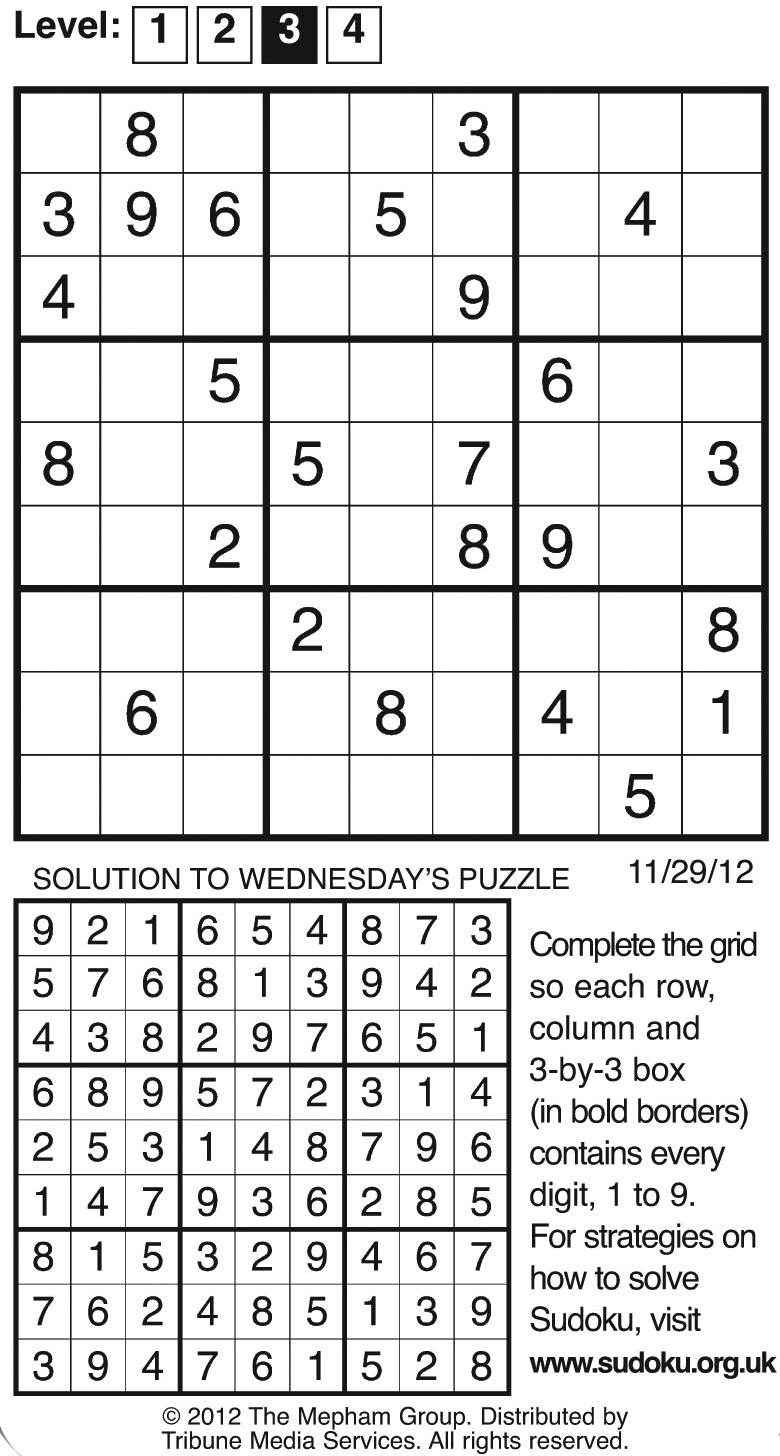
sudoku | The mepham group
JusT Add wATEr | John roddy & eric carlson
Riot could learn from NFL
have you ever wondered how professional sports leagues work? like, beyond the fact they makes billions of dollars a year, have you ever wondered how they work?
well, let me tell you. Take the nfl, for instance. The nfl itself is actually owned by all 32 teams collectively and each team gets a share of the total revenue pool. so whether you’re the super bowl-winning broncos or the lowly Titans, you get the same share of revenue from the league. additionally, the collective ownership of the nfl means that each team gets one vote in league roles and policies. This equal vote and equal revenue gives each team a fair playing field, in theory.
so that’s how the nfl (and almost all professional sports organizations) share the revenue they take in. but the revenue itself is also interesting. The biggest source of revenue (by far) is television advertising. The nfl is widely popular, so it takes in millions of dollars of ad revenue, which is split evenly between the teams. each team also has local sponsorship deals and ticket sales, but these other revenue sources pale in comparison to television ad money.
so that’s how the nfl works in a nutshell. w hy am i telling you this? because there is another professional sports entity that needs to learn from the nfl’s model: the lcs, or the league championship series.
a big reason the nfl is so successful is equality. Teams get roughly the same amount of revenue and theirs votes count the same so parity is high. but imagine a system where revenue wasn’t shared equally between all the teams, what would happen? well, that’s what league of legends is currently like — and it isn’t working.
unlike the nfl, which sells the broadcasting rights for its games, riot games, the owning company of the lcs, does not and thus, the revenue that is generated stays with riot. also unlike the nfl, the owning company of riot games is not collectively owned by the teams that make up the league. so any revenue riot generates stays with riot. This begs the question, how do the teams themselves make money?
for the typical lcs team, revenue comes from only two main sources: stipends and sponsorships. riot does give each team a stipend, which is supposed to go towards paying for player salaries and cost of living. however, the stipend is not very large and the amount has not changed since 2013, despite the fact that the cost of being a successful league of
legends team has skyrocketed. fortunately, most teams recognize the importance of paying for high-quality players and most lcs athletes are earning more than enough to make a decent living.
The second, and biggest, revenue source for lcs teams is sponsorships. These sponsorship deals come from software companies like hyperX, which makes headsets and mice, or intel. a few more recognizable energy drink brands like red bull and monster also support lcs teams, but the big sponsorship money from companies like coke or mcdonald’s is absent. Teams will have their sponsors’ logos on their jersey and will often advertise them on player streams and such. it’s very important to note that these sponsorship deals make up most of a team’s revenue and so maintaining these deals is crucial to the survival of the team.
The problem that has arisen in the lcs is that teams are almost utterly dependent on sponsors to stay in business. This wouldn’t be much of a problem, except that the lcs works on a relegation system like the english premier league. if a team finished in the bottom three slots of the league, they risk being relegated down. and if a team is relegated, they lose everything.
Think about it: if you’re an executive at red bull, you would only sponsor a team because that team would put your logo on their jersey and you gain visibility and thus, money. but if a team is relegated, you aren’t getting that visibility, so you drop them as a sponsor. it makes business sense for the sponsors, but it’s brutal to the lower-tier teams in the lcs for instance, if a new team is coming into the league, there are an unknown quantity so sponsors will be reluctant to endorse them since they don’t know if the team will be relegated. without the sponsor money, the team can’t afford to pay as much money for good players and so it is subjugated to a cycle of mediocrity that is hard to break out of. in the nfl, every team can afford to pay a player the same amount of money so talent doesn’t congregate to a few teams because of that factor.
if riot wants to take esports into the mainstream where it can pick up big sponsors like coke and pepsi, it needs to sort out how it runs the lcs and if you’re a football fan wondering what’s going on, just be happy all you have to worry about is a deflated football or two.
Contact Marek Mazurek at mmazurek@nd.edu
The views expressed in this Sports Authority are those of the author and not necessarily those of The Observer.
m Golf
con T inued from page 12
game, but Kubinski believes that they can be eliminated as the team continues to put in the work.
“[we need to] keep reducing the small errors, especially with short irons into greens,” Kubinski said. “we can do that.”
one major takeaway from the tournament is that the irish are capable of handling a top-notch, renowned course, such as the olympic club. Kubinski was impressed by the course and felt that his team handled its tough set-up well.
“The course was a strong test; everything we anticipated,” Kubinski said. “[Tuesday’s] hole locations were the same as those used in the final round of the 2012 u s open, which were very difficult.”
while a top-five finish may not have been what the irish were hoping for coming into the event that had been looming on the schedule for months, Kubinski knows that it is by no means a poor start to the year.
“i think a top-five finish is a solid start,” Kubinski said. “having had the lead about halfway through, we would have liked to have been in a better position [Tuesday] to earn a win, of course, but we’ll take some strong positives from the week.”
rushton was notre dame’s top finisher on the individual
m Tennis
con T inued from page 12
dual season.
“They’re all very good,” sachire said. “The philosophy that we have with scheduling, especially in the fall, is to expose our team to some of the best level of college tennis that we can so that when we face the competition that we play in the springtime, we’re going to see everything by then. There’s nothing that’s going to be new in terms of level of play or anything. it’s not like we’re jumping up in class once we get to next season. we’re going to prepare our guys and show them the best level we can show them every week and help them get adjusted and ready to roll come spring time.”
last year, the irish were led by a strong senior class that included Quentin monaghan, who was ranked as the no. 35 singles player in the nation at the end of the year, and alex lawson, who reached the ncaa doubles semifinals alongside monaghan. senior Josh hagar will be the
leaderboard. his score of 214 put him into a three-way tie for fifth place and made him the only top10 finisher for the irish. Kubinski was content with rushton’s play at the event, and he believes that the rest of his team learned important lessons from the tournament and pulled together some very solid holes to give the irish a satisfactory result.
“i really try to avoid expectations, from a results standpoint, in general,” Kubinski said. “i prefer looking for things in our play and approach to playing that will allow us to chase down our ultimate
goals. i thought our seniors played two excellent rounds and earned solid finishes on the week. i was also happy to see ben post two good rounds and our two freshmen [hunter ostrom and John felitto] learn a great deal in their first college event on the road.” notre dame will take to the course next sept. 23 in the georgia state maui Jim intercollegiate, which will be hosted at the mirabel golf club in scottsdale, arizona.
Contact Elizabeth Greason at egreason@nd.edu
highest-ranked player in the team for this year, at no. 70 in the preseason rankings, while freshmen Johnathan small and matthew gamble, part of a top-five ranked recruiting class, may also have a chance to make an impact early on in their notre dame careers. seniors eddy covalschi and sophomore grayson broadus will also return after playing a major role last season. sachire said he believes his team is well-prepared for the start of the season, despite the roster turnover.
“i think we’ve been preparing very well,” sachire said. “we’ve only been in official team practice here for a couple of days, but our guys have done a very good job since school started. we’ve done a lot of individual work with each of them, they’ve conditioned very well, and i feel like all of our returning players have made good jumps from last spring, and the freshmen are still getting a good feel for how they fit in. but you don’t really know a ton until you start competing, so we’ll certainly learn a lot this weekend,
but it’s been a really good start to the year. The work ethic has been very good and we’re excited to go play on friday.”
sachire said he hoped to see his players playing to their strengths in the tournament.
“The biggest thing we’ve had with our guys this school year is playing the way that they want to play,” sachire said. “in other words, not allowing pressure to make them play too conservatively or overly aggressive, but to play at their optimal level, their style, and treat each point with that mentality. do not allow the pressure of the moment, score pressure, whatever to affect how they play. go out and be the best they can be and if the opponent is too good, then that’s fine, but doing things to the best of their capability and not allowing pressure to impact how they play.”
The tournament begins friday morning at beren Tennis center in cambridge and will last all day friday, saturday and sunday.
Contact Daniel O’Boyle at doboyle1@nd.edu
Marek Mazurek sports e ditor
MiCHAEL yU | The Observer
Irish senior Matt Rushton follows through with an iron at the Notre Dame Kickoff Challenge on Sept. 3 at Warren Golf Course.
deJarld
under mclaughlin by the horns and is excited to be a part of something new.
“i’m really lucky to have Jim and [associate head coach] mike [Johnson] and [assistant coach] Katie [wilson] and the whole staff as coaches,” deJarld said. “it was a really smooth transition. obviously, there’s always some questions and question marks about what’s going to happen when you’re coming in kind of blinded about the program. but it could not have worked out better that they took over my freshman year, so i began here with them and i will finish here with them. it’s kind of a blessing.”
another source for the change in pace the irish have seen so far this year is deJarld’s partnership with junior transfer student and setter caroline holt. holt and deJarld, as setter and libero, must work in tandem constantly. The team’s success on any given point relies on their ability to be consistent and to communicate well. deJarld is fully aware of this and feels that, although this is holt’s first season with the irish, she has made an immediate impact on the team.
“me and holt are building really good communication skills, which is really important obviously,” deJarld said. “it’s sort of like a battery role, like a catcher and a pitcher. i’m passing to her and she relies on me and i rely on her to do her job if i’m getting her a good pass. so, i think our relationship is really important for the team and i absolutely love playing with caroline. i think she’s really — she has a contagious presence on the court for sure. she’s been great on her team so far.”
while deJarld is conscious of the fact that her relationship with her setter is an important one, she is also aware to the fact that, as the libero, she is looked to as a leader on the team, both on and off the court.
“it’s definitely something that i had to take head on, just, in regards to, you have to be a very consistent player to be a libero,” deJarld said. “[libero is] more of a backbone position than it is a changing factor. you should always be consistent, steady and be keeping everyone settled down and ready to play. so i definitely think the more consistent i am, the more i am helping the team and the more i can be a leader for them.”
The chicago native’s impact on the team has not gone unnoticed. in notre dame’s three tournaments so far, deJarld has been selected as mvp of the art carmichael invitational last weekend and made the all-tournament team for the shamrock invitational at notre dame.
“i guess i was a little surprised, just because liberos usually don’t get recognized like that,” deJarld said. “it’s just affirmation that each touch and each play, i hopefully am getting better and better. and i guess, being better for my team is what my goal is.” while bettering herself for the team may be deJarld’s personal goal, she shares her teammates’
lofty goals for the squad this season and down the road, and she knows what changes she will need to make in order for those goals to be achieved.
“i guess one of my biggest motivations is just to be in a final four, be in a championship,” deJarld said. “you know, growing up around volleyball so much, i’m one of the few on my team who just grew up watching all these college matches and going to college matches. and that’s always been the dream for me, is to just make it that far. so i just have to go into every practice knowing that that’s the end goal in mind … perfecting skills and really buckling down on mechanics are that i didn’t really think about; i kind of just thought about playing and going all out. but there’s a lot of important things that you have to consider to be, to play volleyball the right way, like we do here.”
however, while most of the team
have the acc championship trophy in mind as an ultimate goal, deJarld has her sights set on a different match this season. ryann’s sister Jane, who is younger than her by one year, is starting her freshman season at acc rival boston college as a setter. deJarld is looking forward to being pitted against her family member and former teammate when the irish face off against the eagles later in the season.
“well, we’ve talked about this for a couple years now, just because [Jane has] been committed for so long,” deJarld said, laughingly. “my parents actually said, ‘we will root for the team with whoever is starting,’ but i think that was a joke. i think they’re going to root for us both equally and probably not pick favorites. but i’m still hoping to win.”
Contact Elizabeth Greason at egreason@nd.edu
MiCHAEL yU | The Observer
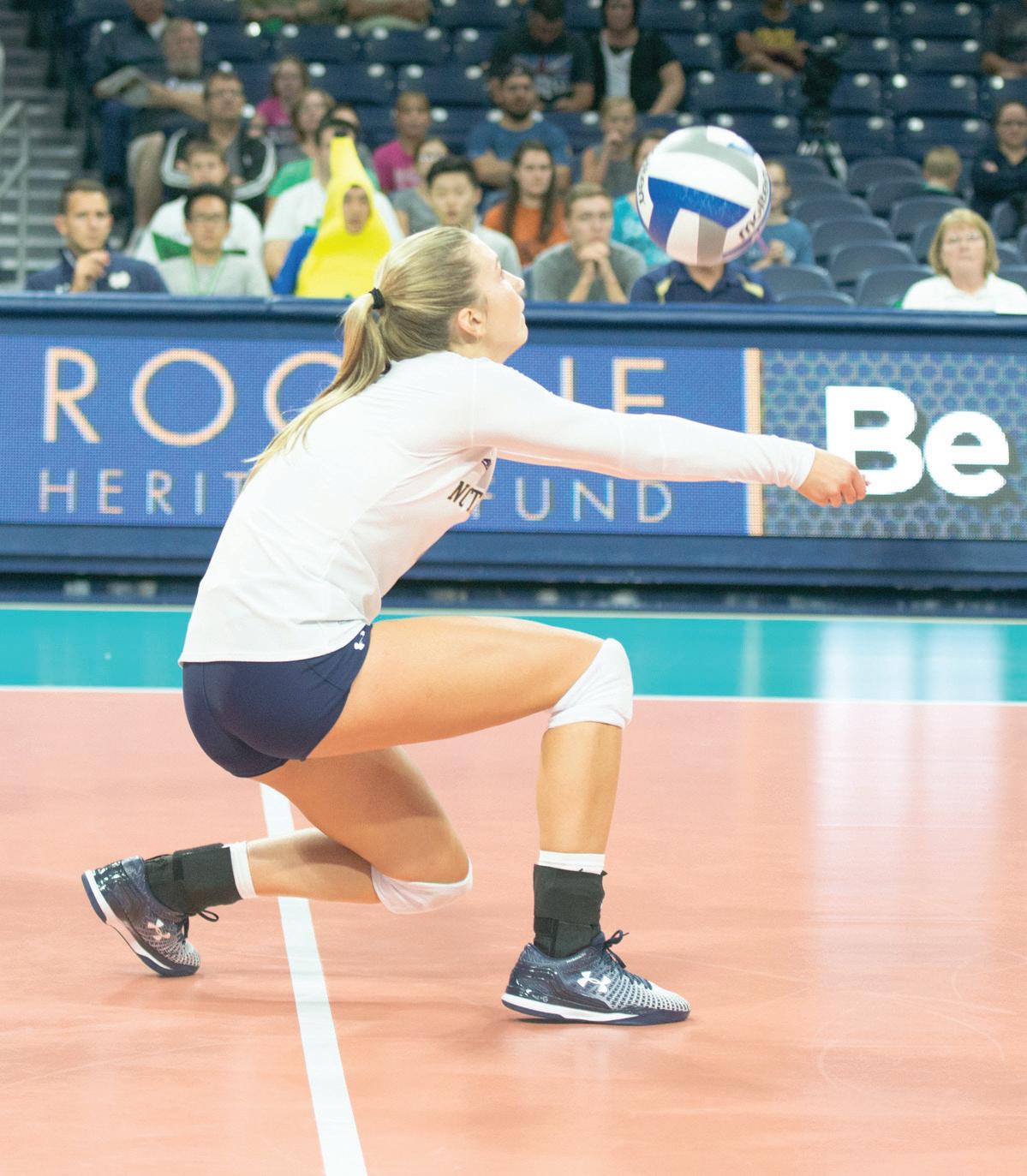
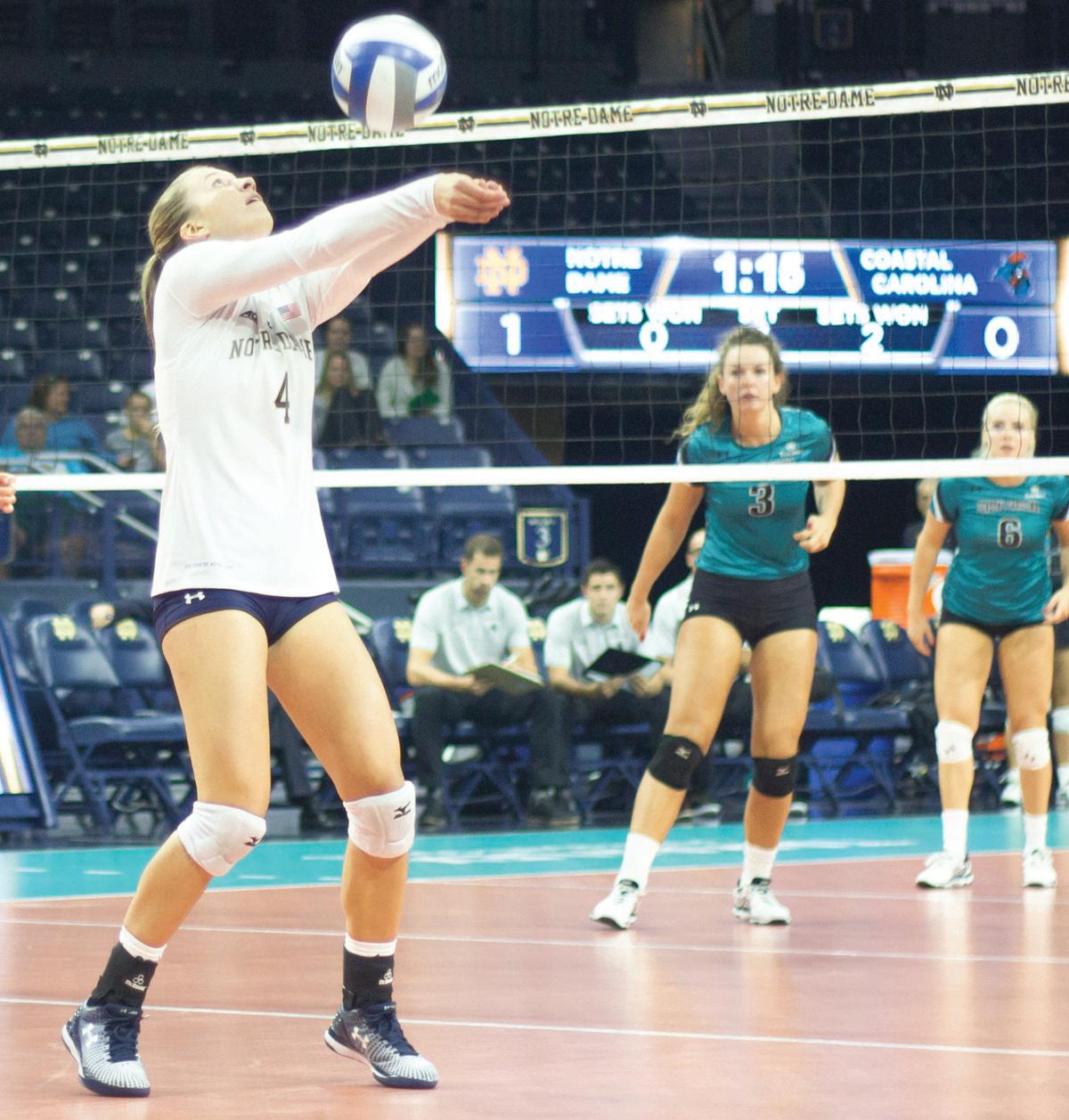
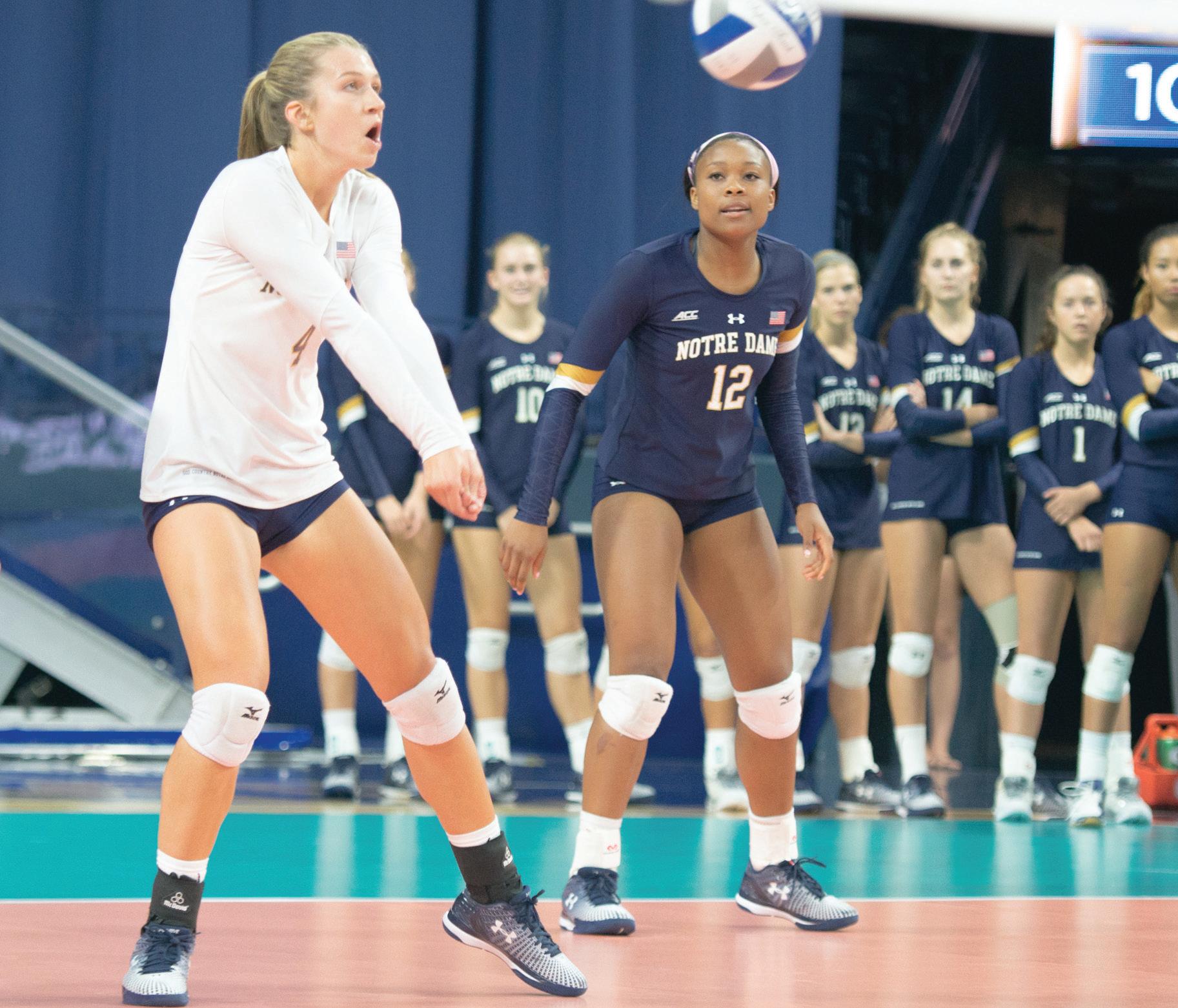
Sophomore libero Ryann DeJarld records a dig in Notre Dame’s 3-0 loss to Coastal Carolina on Sept. 2. DeJarld recorded 489 digs last year.
MiCHAEL yU | The Observer
Irish sophomore libero Ryann DeJarld sends the ball back over the net in Notre Dame’s Sept. 2 loss to Coastal Carolina at Purcell Pavilion.
DeJarld’s leadership on court yields success
By ELIZABETH GREASON sports writer
ryann deJarld was born and bred to be a great volleyball player.
since joining the irish last season, deJarld, a sophomore libero, has become a leader and a force to be reckoned with on the court. in her freshman season, deJarld racked up a team high 489 digs and tied the team high with 29 service aces. This comes as no surprise, based on deJarld’s strong background in the sport.
“i guess i’m kind of a different case than everyone else,” deJarld said. “i grew up totally playing volleyball since i was born because my mom is a volleyball coach at mother mcauley in chicago. she has always been around the sport; she played for the university of iowa. so, ever since a really young age, my sister and i, we grew up being pepper partners and kind of just being in the gym and going downstate for state tournament rounds with my mom’s team. Just getting to grow up around the sport and be gym rats and have access to that high school gym really helped us get
extra reps and just become good volleyball players.”
from the moment deJarld stepped on the court at notre dame, she was expected to do big things. she took on the role of starting libero early in her collegiate career, and while some players may have cracked under the pressure, deJarld thrived.
“it was a pretty swift transition for me, in regards to high-pressure situations,” deJarld said. “i was lucky enough to be in a really competitive program in high school, which, not a lot of people get that experience, but it’s definitely a lot more work at notre dame.”
deJarld’s notre dame volleyball career hasn’t been exactly what she expected when she committed to play for the irish. at the time, the irish were being coached by debbie brown, but current notre dame head coach Jim mclaughlin took over the head coaching job before the start of deJarld’s freshman year. deJarld took on the challenge of rebuilding the program and marking the start of a new era
see deJarld PAGE 10
Irish start fall season against top-ranked teams
By DANIEL O’BOYLE sports writer
notre dame begins its 201617 season this week with the first of the season’s individual tournaments, chowder fest, in cambridge, massachusetts. beside the irish, the tournament will feature Texas a&m, illinois and the hosts, harvard.
irish head coach ryan sachire said all four of the teams competing are very talented teams.
“it’s a really good-level tournament,” sachire said. “ … Traditionally, all four of us are top25 level programs and i think for a large stretch of last year, illinois and a&m were in the top 10. it will be a very good level of competition and we’ll see some very good tennis.”
The competition includes two of the top 10 singles players in the country, in illinois’ a leks vukic and Texas a&m’s arthur rinderknech. sachire said playing some of the best players in the nation early on can be a great way to prepare his team for the spring
notches top-five finish
By ELIZABETH GREASON sports writer
notre dame had a solid showing at its first full-field tournament of the season earlier this week at the san francisco olympic club intercollegiate, finishing in a tie for fifth after a disappointing final round. Two irish athletes also made it inside the top 20 individually.
The irish came out quickly in the first two rounds of the 54-hole event. upon teeing off for the third and final round of the tournament, notre dame was poised for a top finish, entering the round in third place, with two players, seniors matt rushton and blake barens in a tie for second. irish head coach Jim Kubinski was hoping for his players to make a strong finish, but the team hit some snags on the back nine, which prevented them from doing so.
“[i was] just looking for some good play today to move up the leaderboard,” Kubinski said. “we had a chance to do that today but lost a couple shots per player on that closing nine.”
barens’ final round had its ups and downs, ultimately leading to his worst score of the tournament, a 5-over-par 77. he posted two birdies, but also double-bogeyed two holes. This round moved barens from a tie for second place to a tie for 12th. despite barens’ less-than-ideal final round, he played a major role in notre dame’s blitz of birdies throughout the tournament.
The irish led the field in birdies this week, posting 47 birdies. rushton led the irish with 12, and barens and sophomore ben albin each accumulated 10 birdies. Kubinski was pleased with his team’s ability to post low numbers and believes that it proves notre dame’s strength as a team.
“it was fun to make those birdies this week, especially on a historic and challenging course in the olympic club,” Kubinski said. “it shows our talent. we just made an error here and there, leading to some bogeys and double bogeys, that we need to clean up.”
These errors continue to revolve around notre dame’s short
mEN’s TENNIs
mEN’s GolF
Nd vollE ybAll
KATHLEEN dONAHUE | The Observer
Irish sophomore Grayson Broadus returns the ball in Notre Dame’s 5-2 win over Duke on March 18 at Eck Tennis Pavilion.
MiCHAEL yU | The Observer
Irish sophomore libero Ryann DeJarld passes the ball in Notre Dame’s 3-0 loss to Coastal Carolina on Sept. 2 in the Shamrock Invitational at Purcell Pavilion. DeJarld was selected to the All-Tournament Team.