Print Edition of The Observer for Wednesday, September 7, 2016
UHs debuts electronic records
New system allows for easier monitoring of patients’ medical information
By AIDAN LEWIS news writer
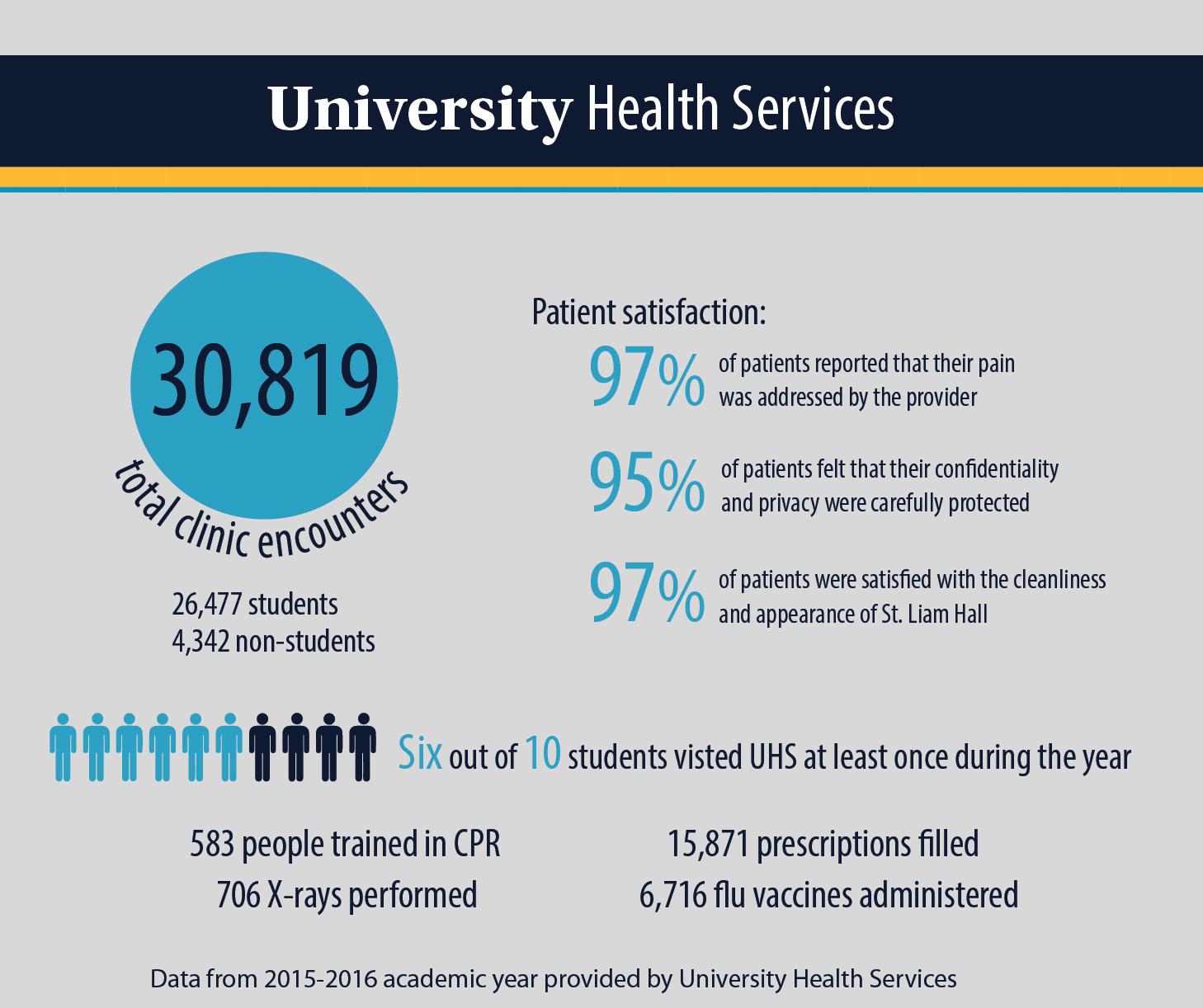
This year, university health services (uhs), based in st. liam hall, has implemented electronic medical records (emr), a move director sharon mcmullen says will improve the quality and efficiency of care on campus.
The change from paper to electronic records has a multitude of upsides, mcmullen said, including an increase in student safety.
“our emr interfaces with a national drug pharmacy database, and if we prescribe a medication that a student has an allergy to, the emr alerts us to that,” mcmullen said.
mcmullen said the emr will also increase the efficiency of care, since the use of paper charts in the past meant necessary patient information was much harder to organize and locate.
“The student waits while we go scurrying around for the paper charts, so it disrupts the continuity
GreeNDot to receive award
By MEGAN VALLEY news writer
m ore than 100 students went through g ree nd ot’s bystander training in its first year. n ow, just starting its second year, the violence prevention initiative will be honored at s aturday’s football game against n evada as one of the six organizations awarded the p residential Team i rish award.
“ i think two of the things that make g ree nd ot remarkable for our campus is its cross-campus collaboration — you have faculty, staff and students all working in a way that’s different from every other violence prevention initiative i ’ve ever been part of — and its impact on our campus has been really amazing,” c hristine c aron g ebhardt, director of the g ender r elations c enter ( grc ), said. “ p eople have really taken to the message, i think, because it’s
very straightforward. i t’s something people can get their hands on and it’s very practical.”
The p residential Team i rish award recognizes a department as a group of people that live out core values of the u niversity and do it in such a way that it impacts the entire u niversity, according to the website for the o ffice of h uman r esources.
g ree nd ot is a “campuswide initiative for violence prevention” that works by promoting culture change about violence and how everyone does their part.
“ w hat we like about g ree nd ot is that it takes a large issues like sexual assault, or stalking or domestic dating violence and breaks it into strategies that a person can do in their everyday life and that is suited to who they are so that all of the individual efforts and individual choices to do green dots have an overall impact
of changing n otre d ame’s culture, as well as preventing violence from happening here,” g ebhardt said.
s he said the main service g ree nd ot offers is bystander training, which encourages participants to “do their part” to prevent violence with the “3 d s”: delegate, distract and direct. o ver 300 people have expressed interest in being bystander trained this year, she said. The grc plans on holding six trainings this year.
“This school year, we’d like to have over 500 people to be trained,” g ebhardt said. “ we have a number of overview speeches that we’d like to make sure that we reach. we are trying to reach more faculty because we feel like faculty can be one of the strongest voices.”
The training teaches participants about “red dots,” or individual decisions that contribute to a culture of violence, and how to replace
them with “green dots,” or individual decisions that promote change in this culture.
“ i think one of the most powerful parts of the training is the steps that a predator takes in order to find someone to prey upon,” she said. “ i think it’s very intense, but it also helps people understand that when they see a situation playing out, while it may seem harmless, there’s actually an intentionality behind it that, as you see those steps, you see how you as a bystander may be able to intervene either before something happens, but also remind people that, regrettably, there are times that we can’t, but how they can intervene after and take care of the person who’s been harmed.”
w ith the “strong momentum” from last year, g ebhardt said the grc is
smc seeks student feedback
Observer Staff Report
saint mary’s president Jan cervelli launched her presidential listening Tour: “a Foundation for the Future” on sept. 2 to gather feedback to inform the college’s next strategic plan, according to a college press release.
according to the release, cervelli will hold a series of meetings and attend events throughout the academic year with students, faculty and staff, as well as other members of the saint mary’s community, such as alumnae, parents and trustees. surveys will also be conducted to gather data and personal input from members of the community in order to find areas for improvement in the college.
Former college president carol a nn mooney initiated the current strategic plan, called “boldly Forward,” to cover the years 2012 to 2017. over the summer of 2017, cervelli will use the data collected during her listening tour to develop the next strategic plan. cervelli said in the release that she encourages everyone in the campus and in alumnae communities, as well as friends and supporters of the college, to make their voices heard in shaping the college’s future.
“saint mary’s proud tradition inspires and reminds us that, though our service to the college will be short in the full sweep of its history, the influence of decisions we make today will be felt much longer,” she said in the release. “w hat do we want our influence on saint mary’s to be?” in a previous interview with The observer, cervelli said the listening tour is an opportunity to hear from everyone involved with saint mary’s.
“it’s my objective to meet as many people as possible in as many different venues, to listen to what people have to say about saint mary’s,” cervelli
“20, because my birthday is nov. 21 and i always get too excited the day before.”
John Adams junior o’neill hall
“i, because it’s unreal.”
Galen Harden graduate student
Fischer hall
“1, doing something the first time is always hard.”
Nik Procaccini sophomore duncan hall
“17, it’s my brother’s lucky number.”
Marie Mastellne junior off campus
“13, i’m just not a fan.”
|
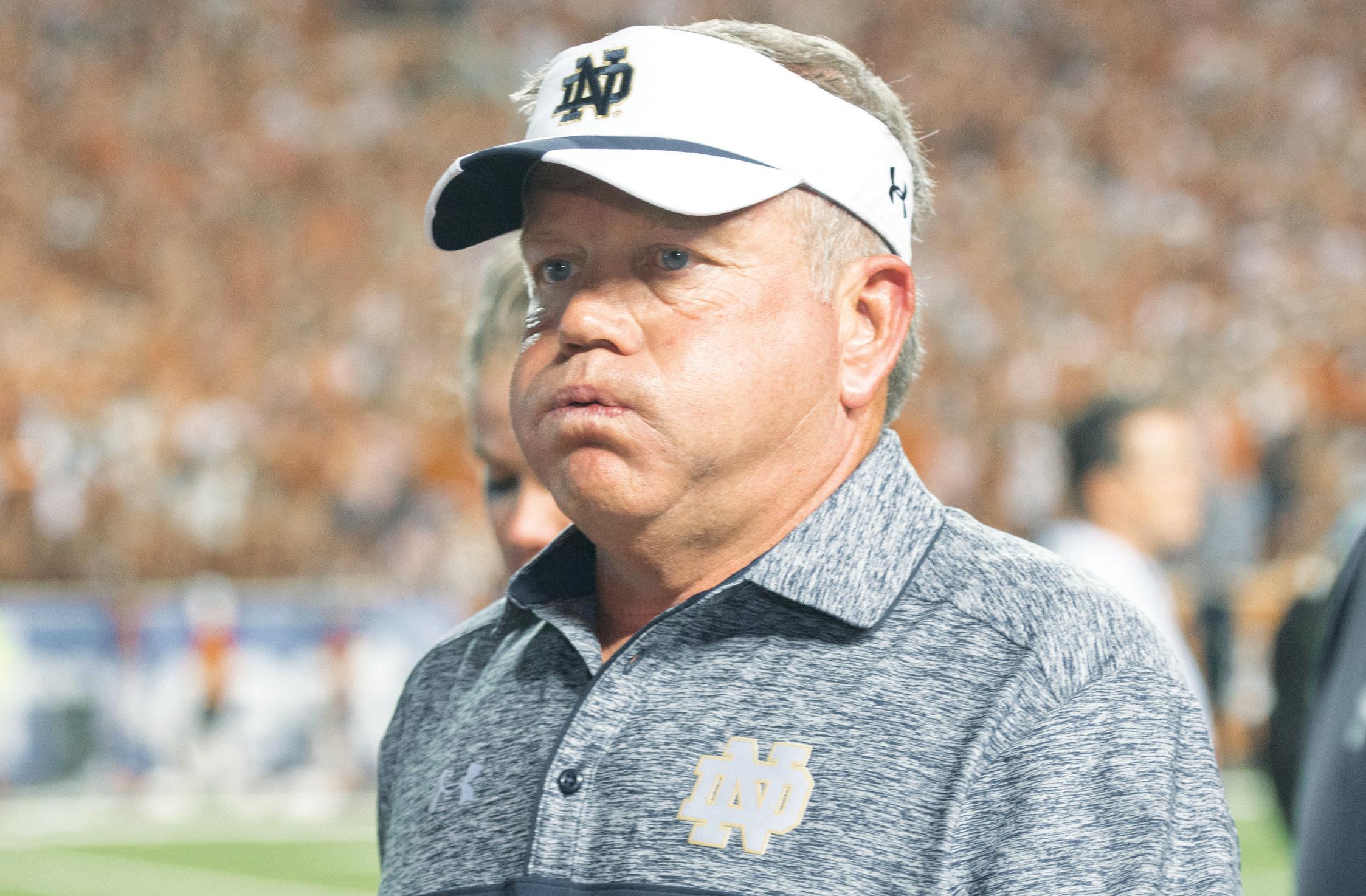
Notre Dame head football coach Brian Kelly reacts to his team’s defeat on Sunday night in Austin, Texas. The Irish fell in their season opener to Texas, 50-47, in a game that went into double overtime. The Irish host Nevada on Saturday.
Today’s Staff
4 p.m.
Corrections
The observer regards itself as a professional publication and strives for the highest standards of journalism at all times. we do, however, recognize that we will make mistakes. i f we have made a mistake, please contact us at (574) 631-4541 so we can correct our error.
Peacemakers
CAITLYN JORDAN
The Observer
Higgins Labor Program examines social justice
By NATALIE WEBER news writer
w hat are the origins of l abor d ay? w hat is a just wage? h ow are racial justice and workers’ rights intertwined? These are all questions one might discuss for project or discussion group sponsored by the h iggins l abor p rogram, part of the c enter for s ocial c oncerns. a ccording to the c enter for s ocial c oncerns’ website, the h iggins l abor p rogram “sponsors research, education and dialogue on issues involving work, opportunity, and social justice” and was named for m onsignor g eorge h iggins, a priest and laborers’ rights activist.
The program is sponsoring several projects and groups this semester to investigate both contemporary and historical labor rights’ issues. d an g raff, professor of history and director of the h iggins l abor p rogram, said he and c lemens s edmak, a visiting professor of community engagement at the c enter for s ocial c oncerns, are forming a working group to study the just wage. The program will also sponsor research about the past of the labor
rights movement and its c atholic roots, he said.
“The u s . labor movement historically has had a really strong c atholic component to it, and still many labor leaders in the u nited s tates are practicing or raised r oman c atholic,” g raff said. “The h iggins l abor p rogram is in the very beginnings of undertaking a project to do an oral history of c atholic labor leaders.”
i n addition to these projects, the program sponsors the l abor c afé, a discussion group that meets to discuss issues facing modern day laborers, g raff said.
“The most casual program we run is called the l abor c afé,” g raff said.
“ e very couple weeks on a Friday afternoon, anybody in the n otre d ame community gathers with interest in talking about a contemporary labor concern.”
The program also brings in speakers to discuss various modern-day labor concerns and share their knowledge as part of the r esearch, a dvocacy and p olicy s eries.
“ we ask a member of the n otre d ame community or sometimes a visitor to give a talk on a topic of their
paid a dverT isemen T
expertise over lunch, and we have two of those scheduled for each semester,” g raff said. “The two this fall both raise questions about the place of government in regulating in regulating the economy.”
The program also plans on participating in the racial justice events happening on campus.
“ we’re going to do something, probably after the election — definitely after fall break — about some kind of black labor matters theme,” g raff said. “ i t’ll be participating in this broader campaign. i know student government is doing a bunch of stuff around race relations and promoting dialogue and equality, so it’ll be integrating with those efforts.”
o verall, the program seeks to remind people of the importance of work and its human face, g raff said.
“ we cast our net widely,” he said. “a lot of our efforts are around educating folks, reminding people of the centrality of work to the human condition and raising awareness of that.”
Contact Natalie Weber at nweber@nd.edu
ccac discusses student safety for upcoming year
By KATIE GALIOTO news editor
Just three weeks ago, the city of s outh b end welcomed back thousands of students to the community.
w ith the start of the new school year comes an influx of business and events in and around the area, as students host house parties, seek out jobs and tailgate for football games.
The c ommunity/c ampus a dvisory c oalition ( ccac ) met Tuesday afternoon in the city government office for the first time this academic year.
The panel — which consists of city leaders, law enforcement officers and residents of s outh b end, in addition to students and administrators from notre dame, s aint mary’s and holy c ross c ollege — meets once a month to discuss ways to foster a positive relationship between students and the local community.
students, administrators and city officials all highlighted safety as a primary focus for the upcoming weeks.
notre dame student government is working to introduce two new initiatives
— s afer ides and s afeb ars — to compliment and expand upon s afeb ou nd, the rebranded campus transportation service, student body vice president b ecca blais said.
For the s afer ides program, blais said student government hopes to form a partnership with u ber to provide discounted rides for students in the area traveling back to their housing at night. The s afeb ars program would aim to provide bystander intervention training to bartenders and bar owners in the s outh b end community, an extra layer of safety for students who participate in the local nightlife scene.
“Those two programs, we are just now beginning to negotiate and look into,” blais said.
The group voiced concerns about sexual assault and violence on campuses, particularly during the first six weeks of the school year.
s aint mary’s student body president e mma mc c arthy
said the tri-campus community should aim to be a national model.
united, the three colleges could make a difference, blais said.
“ w ith the three of us, we can stand together and really make a statement for the rest of the united states,” she said. “it will go from here, to the acc , to the rest of the country.”
dan a llen, off-campus liaison for the university, said a record number of students chose not to live in the residence halls this year, raising other safety concerns. more than 20 percent of students have moved to apartments or houses off campus.
For example, two burglars have been reported in l egacy v illage since the start of the school year, major d ean c handler of the s aint Joseph c ounty police said. i n both cases, residents left their doors unlocked.
b oth c handler and robert hammer of the s outh b end police d epartment encouraged students to remember general safety tips.
“ we know that problems occur throughout the school year,” hammer said. “ we’re here in support of the students. we want to make sure everyone’s safe.”
The group also briefly discussed nuisance violations involving students and ideas for programming and promotions to expose students to downtown businesses.
The next ccac meeting will take place in o ctober at holy c ross c ollege.
since its inception in 2008, the committee has provided an outlet for both new ideas and feedback, city council attorney Kathy c ekanskiFarrand said.
“This forum gives a great opportunity for so many offices and individuals at all levels to cut through some of the red tape that you might see otherwise,” she said. “ w hen issues are raised, we can address them quickly, working with the administration and with the councilmembers that are here.”
Contact Katie Galioto at kgalioto@nd.edu
hopeful about greendot’s second year, especially with some of the changes being introduced.
“o ne of the key things we recognize is really having students be more directly involved in the implementation, so we set up the student advisory committee,” she said. “i think that’s one of our biggest initiatives this year. u ltimately, we want this to be something the students feel ownership of and the students can shape it to what it needs to be for notre dame, not just for this year, but for the long-term future.”
s enior mary Kate healey, one of the members of the new student committee and who is working on the social marketing subcommittee, said the students will help with advocacy and awareness.
“ you need to have students involved in order to make a campaign for students,” she said. “ we’re the voice of the student body for the adults.”
healey was pulled in because of her previous work with c ampus m inistry; she said other student council members were pulled from athletics, student government, etc.
“i f we’re going to say that we’re a community or a family and then acts of violence happens between students, there’s clearly something wrong there,” healey said. “having people from c ampus m inistry brings that perspective, as well as letting the organization know that, as a faith-based institution, we’re not okay with what’s happening.”
i n addition to introducing the student advisory committee, g ebhardt said the grc is also adding to their promotional plan for the program.
“u ltimately, we’d like to get bystander stories out to people, because we’re hearing about the great ways in which people have used greendot, and we want to get those stories out to other people so that folks can see that doing a green dot, while it’s courageous, may not be as hard as folks think it is,” she said. “i f we can just have people share their stories, we can take that collection of green dots and show how we’re actually changing notre dame’s culture.
“That’s really the heart of greendot, that every day we’re sending a message about what notre dame stands for.”
Contact Megan Valley at mvalley@nd.edu
of care,” mcmullen said.
in addition, mcmullen said the emr will make it easier for students to monitor their own medical information.
“The emr brings our patient portal into the 21st century, so now we can transmit a student’s lab results directly to her through a secure portal,” she said.
mcmullen said another major positive of the switch to emr is access to an enormous amount of data.
“we have the ability to take big data, and use it to improve the quality of the notre dame student population, because now we’ll be able to make data-driven decisions,” she said.
For example, mcmullen said if she sees an earlier than expected spike in influenza patients, uhs can “bump up [their] flu vaccine blitz” in response.
however, the rollout of emr will
not be without its challenges for uhs, she said.
“The convenience comes at a really high cost of learning curve,” mcmullen said. “so say you’re a provider and you’ve been working for 20 years, and you’re used to paper records, and now suddenly you’ve got this big, complex system to learn.”
as a result, mcmullen said uhs will require time to reach the high level of efficiency she eventually expects with emr in the meantime, mcmullen said, uhs is adjusting so students are not neglected during this transition.
“we’re really concerned about students having to wait to get in to see providers, so to combat that, we’ve loosened up our scheduling, we’ve asked our providers to come off of their administrative time, and we’ve doubled up at some high volume times,” mcmullen said.
currently, mcmullen said uhs is also conducting an organizational analysis and design (oad), which is a process aimed at finding
avenues for positive change within an organization.
“we’re at a place right now where we can really think more comprehensively about what our current students need, and question whether we are really meeting the needs of contemporary college students,” she said.
one goal of the oad process is to continue and expand medical education for uhs’s clinicians, which has been a focus of mcmullen’s since she became director over two years ago.
“we are trying to clarify both financial and operational support for clinicians to go to conferences, to pay for their licensure, and to engage in professional studies,” mcmullen said.
mcmullen said another goal for the future is to provide care at a greater range of times.
“i think our students need availability to providers beyond the nine to five,” mcmullen said.
Contact Aidan Lewis at alewis9@nd.edu
said. “w hat they think of it today, what it means to them, how has it changed their lives, what works really well, what are some opportunities we’re missing and what are some things we could do better.
“i’ve learned a great deal by
asking more questions than i have talking, so i want to continue that through the year and you will see that i want to share what i’m hearing — i don’t want to just internalize it. i think it’s also a good opportunity for all of us to do a listening tour — to listen to each other, to get to know each other. while it’s a small campus, we have a lot to learn from each other.”
according to cervelli, upcoming events and other information about the listening tour can be found on the college’s website.
“anyone can get on [the website] and learn what i’m learning, can participate, can add,” cervelli said. “i think it’s a great convening of who are we, who do we want to — where did we come from, and where are we going?”
Rachel O’Grady a ssociate news editor
Three days before move-in this year, i walked home from brunch and watched the o lympics with my mom. Three days before move-in, i texted my roommate, elated that i was going to get to see her in three days. Three days before move-in, my roommate never responded, but her brother texted me to let me know she was, essentially, in a coma.
a t the time, that was all we collectively knew. s he was later diagnosed with a virus, which had caused brain inflammation, and thus, induced a coma.
m y roommate is g race g arry, and she is objectively one of the best people i know. i ’m not just saying that because she’s my roommate — we’ll get to that part later — but because truly, she is a person of the utmost character and strongest values. s he’s exactly the kind of friend you want, the kind that will love you unconditionally and call you out when you’re wrong. s he’s funny, sweet and caring unlike any other, and for a few days, i truly was terrified i wouldn’t get to experience all of that love again.
g race came out of the coma the day before move-in. The next day i moved back into r yan h all, temporarily without a roommate. i n the weeks that g race wasn’t in r yan with me, i realized all the things i had taken for granted when she was here. it dawned on me just how impactful her presence was in my life, and yet how infrequently i thanked her for these things.
i never thanked her for pretending to be asleep every time i came back in the room well after midnight after a late night at the o bserver, or for laughing at my jokes when they explicitly were not funny, or the constant flow of love and support.
most importantly though, i realized i had probably never thanked her for deciding to live with me again this year. i ’m not a perfect roommate — my sisters at home were all too happy to see me leave for college two years ago — but g race opted for a second year in r yan h all with me. This notion that someone is really, truly willing to put up with your flaws, your clothes on the floor and your d iet c oke dependence, is incredibly humbling, and more than that, it’s validating. g race has experienced me at my best and at my worst over the course of the past year and subsequently decided of her own volition that she wouldn’t mind putting up with that for the next year. a s much as i try, words cannot fully express how self-assuring that is, and the validation that provides.
a s i slowly started telling people about why i was temporarily roommate-less, i kept on getting the question “a re you okay?”
m y answer stayed the same up until the very moment she came back: “i ’ll be a lot better when g race is back.”
it’s been a little over a week since she moved in, and i can confirm that i was right. hopefully she was right about picking me.
Contact Rachel O’Grady at rogrady@nd.edu
The views expressed in the Inside Column are those of the author and not necessarily those of The Observer.
The Cuban Missile Crisis, revisited
“ w hat should we do, m r. p resident?”
c igar smoke filled the room and maps of c uba covered the wall. a distinct air of peril pervaded the trappings of the c abinet room, where the e xecutive c ommittee had gathered. it was a cold o ctober day in 1962, and, whether the men knew it or not, the world was the closest it had ever been to a rmageddon.
The d efense s ecretary, robert mc namara, realized the ultimatum before the p resident and his advisors. now was the decisive moment when the p resident would have to choose — would he bomb the r ussianinstalled missile sites in c uba? would he consider a naval blockade? was there some course of action they had not yet discussed?
g eneral c urtis l emay and the military hawks were eager to invade the communist stronghold, and the threat of a nuclear war loomed large. a s the men in the room leaned in with anticipation, the p resident cleared his throat.
“ … s o what do we do about this c astro loser?”
p resident Trump asked quizzically.
h is advisors paused, not sure if they had heard him correctly.
“sir?” mc namara gasped.
Trump began again.
“l ook, let me tell you something folks. This Khrushchev guy, he … y’know, he is a dumb leader. i hate to say it, but look, i have to say it. he’s really so dumb. a nd this guy, he says about me, ‘o h, Trump’s weak … i can put nuclear missiles in c uba and Trump won’t do anything,’ and he is so, so, so wrong. i’m like the toughest guy. i’m one of the smartest people. My IQ is one of the highest — and you all know it! Please don’t feel so stupid or insecure; it’s not your fault.”
The men in the room pondered the situation. Two men, p remier n ikita Khrushchev and p resident d onald J. Trump, were in a position to dictate the survival of humanity. Khrushchev was acting tactically and the world stood still on the p resident’s move. Trump was, simply put, not making any sense. g eneral l emay seized the opportunity.
“m r. p resident,” g eneral c urtis l emay began, “i f you want to be tough, you should bomb c uba and invade the mainland. a t that point, we will have options to depose c astro, and we will be able to destroy
the warheads.”
“i like this guy,” Trump jutted his hand toward the g eneral. “he’s talking tough. he’s not like lyin’ [ d ean r usk] over here.” he gestured at the s ecretary of state. “The thing i like most about the g eneral is I like people who weren’t captured you weren’t captured, right, c urtis? g ood.” mc namara couldn’t help but chime in: “m r. p resident, what if we aren’t able to destroy all of the missile sites? w hat if r ussia retaliates by launching a strike against west b erlin or even on our own soil?!” h is voice trailed off in exasperation.
“They hit us and kill a couple million a mericans? b ang. b oom. we hit them and kill a couple million r ussians. we’re gonna bomb the s--- out of them it’s that simple, folks. it’s really that simple.”
The advisors’ mouths dropped in awe. e ven the hawks were shocked by the blunt proposition the p resident had laid forth.
“m r. p resident,” s ecretary of state d ean r usk implored, “i f we attack the r ussians unprovoked, the world will blame us. The media will destroy you. you won’t win reelection. you may have beaten the d emocrats the first time around, but they’ll beat you in 1964.”
“ we all know you love the dishonest media, c rooked [ d ean]. l ook, fellas, it really doesn’t matter what [the media] write as long as you’ve got a young and beautiful piece of a--,” the p resident bragged with a trademark puff of the lips. “a s for the d emocrats, if they win, nothing you can do, folks. Although the Second Amendment people — maybe there is, I don’t know.”
s ecretary mc namara had had enough.
“m r. p resident, this is a real threat! i will resign if you continue with this nonsense. The fate of the world hangs in the balance. we need you to be poised. we need a measured response. we need moral judgment. we need you to consider facts, evidence, and reason. we need smart leadership.”
w hat did he expect? d idn’t mc namara watch Trump’s campaign?
ept. 6
Liam Dalton sophomore s
The day before i left for i reland for the year, i walked down the street to my local bank. For the second time in as many years, i was informing them that i would be travelling for an extended period, so it wasn’t a case of identity theft when i used my debit card to make purchases on the other side of the world.
This required only a few minutes and a little bit of paperwork, but during the course of my interaction with the personal banker, a delightful woman named b eth, it truly hit me for the first time that i was moving across an ocean for a full year.
b eth asked where and for how long i would be travelling, and when i told her i would be spending a full year in i reland, she reacted the same way as nearly everyone i told about my move.
“o h my goodness, that’s so wonderful,” she told me, eyebrows raised in excitement and smile expanding across her face. “ i t’s just so great that so many young people want to travel,” she said.
i smiled and nodded politely and agreed that it’s nice how many of my peers have spent at least some time abroad. b ut by the time i left the bank, i came to fully realize that i wasn’t just leaving for a cookie cutter study abroad semester. i was actually moving somewhere else. For a year of my life, my home would be in a different country.
Why we travel
a nd now that i ’ve been here a few weeks, i ’ve thought quite a bit about travel and why we do it and why it’s important. The last thing i want is for this column to be a tragically cliched “ omg , study abroad changed my life” column, but i do want to articulate, from my own perspective, why we (and by we, i specifically mean young people) travel.
a ccording to a survey conducted by youth travel service Topdeck Travel, 88 percent of people aged 18-30 traveled overseas one to three times a year. a nd when we travel, we want genuine cultural experience — 86 percent of the 31,000 survey respondents said experiencing a new culture is a main factor motivating them to travel.
s o, some numbers seem to tell us that we travel to immerse ourselves in the unfamiliar. m y own experience tells me this is true, but also just the tip of the iceberg. The longing to experience a different culture drove me to study abroad in d ublin in the spring of 2015. b ut what brought me back this year was a desire to deepen my ties with an adopted homeland, for when it comes down to our core motivations, i think we travel to find a home.
i n T. s e liot’s “ l ittle g idding,” the fourth and final poem of his “Four Quartets,” he wrote: “ we shall not cease from exploration / a nd the end of all our exploring / w ill be to arrive where we started / a nd know the place for the first time.” i think the “place” to which e liot refers is a home, however you might define it a nd though the poem was originally published
in 1942, i think the “place” today could be our entire planet. The world is a stunningly small place if you make it so, and on a macro level, it is one of the few things all people have in common — a shared home.
we travel to different corners and crevices of our shared home for lots of little reasons: to visit friends and family, to escape the mundanity of our routine, to see and experience things we otherwise wouldn’t, to relax. b ut all these little reasons, and more, are pieces of the big reason i think our generation wants to travel. i am, admittedly, rather irrationally optimistic about our generation, but i think the more we see of the world, the more we can improve it.
The internet has made the world a smaller place. a irplanes have, too. we’re the first generation to grow up with both. p erhaps, then, we travel to more deeply understand the world and the people who inhabit it, including ourselves. a nd maybe, at the end of our exploration, we will come to truly know the world as our home.
Jack Rooney is a 2016 Notre Dame graduate, and The Observer’s former managing editor. He is currently spending a year living and working for the University in Ireland, and writes these columns to keep him busy and satisfy his need for journalism. Follow Jack on Twitter @RooneyReports and/or email him at jrooney1@nd.edu
The views expressed in this column are those of the author and not necessarily those of The Observer.
beyond free speech?
l ost in Translation
Two weeks ago, the university of c hicago informed incoming first-year students that the school would not support safe spaces, trigger warnings and censoring lectures in a commitment to “freedom of inquiry and expression.”
a few days later, northwestern university’s president argued for something a bit different, urging readers to consider how safe spaces and trigger warnings were a much-needed response to students’ concerns — especially those experiencing psychological traumas and discrimination.
The media response revolving around these two messages has been disappointingly reductive. i f we take the derivative op-eds and reader comments as gospel, we are left with depictions of a coddled left and an insensitive right fighting for the last word in a culture war of eschatological proportions. i f recent political developments have taught us anything, it’s exactly this sort of rhetoric that kills any hope of communication.
now i realize that notre d ame, unlike its c hicagoan neighbors, has remained out of national spotlight throughout this debate aimed at defining the limits of free speech on the college campus. b ut, as students, it’s very much our responsibility to join the discussion, keeping in mind that solutions often lie in finding a middle ground. i n this spirit, here’s my own take on the issue: while schools must always err on the side of upholding free speech, we as students have a responsibility to address the underlying concerns that give our peers reason to demand school-wide implementation of trigger warnings, safe spaces and lecture censorship.
This means the university of c hicago should be applauded for adopting an official stance not to support these particular policies. s upport for them would privilege an intellectual or personal conviction that not everyone may hold, obstructing a more general commitment to academic inquiry that should challenge deeply held assumptions, not confirm them.
i n any case, saying, “we will not support X” is a far weaker statement than its negation. p ut another way, if a university supported trigger warnings or safe spaces, disagreeing with this position would be a matter of opting out of official policy. i n the university of c hicago’s case, however, students who disagree with the decision are free to submit their own arguments in favor of trigger warnings and safe spaces. o pting out of policy is exclusionary. o ffering the possibility of new policy is constructive, and exactly the kind of discussion that free speech protects.
w hich brings me to the second part of my argument. a s students, we in fact have just as great a commitment to our community as to our right to free speech. a t notre d ame, where even in its name we invoke a sense of shared and catholic identity, we must care about things beyond ourselves.
This means we must listen to those experiencing genuine psychological distress, and ensure their participation in campus discussion is not hindered by it. a ccommodations in the classroom should be made to students who suffer debilitating traumas, in the same manner of discretion with which faculty accommodate students with physical and learning disabilities. w hat this looks like in practice is largely a private matter between student and professor. more importantly, however, a student’s health history should not become a matter of classwide scrutiny, and neither should the academic
adjustments made to address these concerns. we must also take a look at the term “safe space,” broadly defined as an area where one can pursue full freedom of expression without fear of negative consequence. i f, fearing harassment or even physical harm due to identity, someone finds refuge in a “safe space,” that only reflects there is something seriously wrong in the environment, and something must be done about it. i f, however, one designates a “safe space” solely to be an area insulating those of a certain mindset, identity or worldview from disagreement, that is a different matter. notre d ame has no place for the latter, not least because such a space erodes our shared responsibility to talk through difference. b ut the very call for “safe spaces” may indicate underlying social problems that have gone ignored. These concerns must be addressed by the greater student body and the university, in hopes that one day, even the notion of “safe space” encompasses something far greater.
no, refusing to support widespread implementation of trigger warnings and safe spaces is not “insensitive.” p roviding the support that students with genuine concerns need is not “coddling.” b efore we ourselves get caught up in this sort of name-calling, consider that when all is said and done, our call to compassion, not our right to say what we please, will change lives.
Jeremy Cappello Lee is a junior at Notre Dame studying philosophy, though he dabbles in as many fields as his schedule permits. He spent the summer teaching English in Cambodia and is currently debating where next to go. Direct any comments and travel ideas to jcappell@nd.edu.
The views expressed in this column are those of the author and not necessarily those of The Observer.
Jack Rooney i rish eyes
Jeremy Cappello Lee
By MICHAEL DONOVAN scene writer
a ngel olsen’s latest release breaks away from the sparse introspection of her earlier records. The album is the 27-year-old songwriter’s attempt to repackage her trademark vulnerability and intimacy with a unique take on pop sensibility.
w ith her first three studio albums, olsen drew an honest and unadorned map of her headspace. on “strange cacti” and “half way home,” she delivered stimulating but vague musings about the mental journeys of an introvert over restrained and largely traditional folk arrangements. her fuzzy, garage-inspired third lp, “burn your Fire for no w itness,” displayed a considerably more dynamic feel, but, at its core, the album was still a bare-bones, underground work. on “my woman,” however, olsen embarks on an instrumental and stylistic pursuit that reaches a magnitude far exceeding anything she has previously done. The album has the energy and refinement of an enlightened pop production while still retaining a doit-yourself ethos. i f olsen’s earlier work describes her introversion on a personal level, then “my woman” encapsulates her efforts to reconcile that introversion with the social mess of the outside world.
“i ntern,” a synth pop track in the vein of 80s indie giants Joy division and new order, offers a brooding and atmospheric introduction to the album. The song serves both as a statement of purpose and acknowledgment of failure. “i just want to be alive, make something
real,” olsen sings in her distinctively wispy voice. Then, just seconds later she concedes, “something in the work will make a fool of you.” This conflict of ideas, the dichotomy of ambition and failure, emerges many times over the album. i n one respect, olsen uses this theme as a lyrical vehicle for dealing with the harsh complexities of love and relationships. on another level, though, olsen’s fascination with the ambition–failure dynamic reflects her own aspiration and fears as she strives for authenticity in her work.
structurally, “my woman” has two distinct personalities. w ith its overdriven power chord progressions and pulsing rhythm sections, the a-side has a refreshingly positive vibe. “never be m ine,” “shut up Kiss me” and “give it up” each take the fuzz-folk aesthetic of “burn your Fire for no w itness” and make it more palatable and upbeat. The songs pacify the pungent grit of a mericana with the airy simplicity of twee pop. underneath the vibrant buzz, olsen weaves an equally assertive collection of sentiments. she forgoes an instrumental prelude on her signature track, “shut up Kiss me.” i nstead, without wasting a measure, she declares, “i ain’t hanging up this time / i ain’t giving up tonight.” olsen demands progress in her emotional and musical life. The pounding sonic structures of the a-side embody this desire.
The second half of “my woman” sees an abrupt paradigm shift. olsen returns to the realm of introspection and sets her sights on ambition’s less favorable counterpart, failure. “sister,” a rambling, reverb-heavy track clocking in at nearly eight minutes, epitomizes
the spirit of the b-side. evolving from a simple, dark guitar hook in the style of The velvet underground to an imposing folk rock cascade reminiscent of Fleetwood mac, the track is a meditation on decay. The song’s mantra of “a ll my life i thought i’d change” suggests ambition may just be futile and defeat inevitable. olsen does offer one last thread of solace with “pops.” The scant and somber interplay between the piano and vocals resurrect the olsen of “strange cacti.” a melancholy reflection on a decimated relationship, “pops” is the naked definition of olsen’s original ethos. a ngel olsen proves with her newest record that the pursuit of pop sensibility does not always equate to selling out. a passionate commentary on honesty, creative ambition and self-awareness, “my woman” welcomes mainstream listeners to a previously exclusive underground club.
Contact Michael Donovan at mdonov10@nd.edu
“My Woman”
Angel Olsen
Label: Jagjaguwar
Track: “Pops,” “Give It Up,” “intern”
If you like: Sharon Van Etten, Courtney Barnett, Julia Holter
happy birthday: look at the big picture and set goals according to what you want to see happen over the course of the upcoming year. Face any problems head-on to ensure that you have clear passage to finish what you start with detail and precision. no matter what you decide to do, the initial setup will be what counts. your numbers are 9, 17, 21, 26, 32, 43, 49.
ARIES (March 21-April 19): a partnership will take a turn that could result in an important development. Follow your heart and be ready for an adventure. The changes will have a remarkable impact on your life. embrace the opportunity to start something new.
TAURUS (April 20-May 20): use your imagination when looking for solutions or dealing with problems that crop up. your ability to see different sides of an issue will help you come up with answers that will please others. business trips are favored.
GEMINI (May 21-June 20): do your best to get along with the people you encounter, but not at the expense of doing something that may jeopardize your position or your health. put greater emphasis on self-improvement and taking care of important relationships.
CANCER (June 21-July 22): speak up and collaborate with the people you feel have something to contribute. socialize, network and offer solutions about the causes you feel strongly about. a unique position will interest you and your children will play a role in a decision you make.
LEO (July 23-Aug. 22): someone from your past will cause an emotional situation to escalate. don’t try to evade issues if you want to avoid a backlash. work on self-improvement and offering your very best to those who need you the most.
VIRGO (Aug. 23-Sept. 22): remain cautious when dealing with people who are likely to take advantage of your knowledge or skills. Take time out of your busy schedule to show interest in what friends and family members are up to.
LIBRA (Sept. 23-Oct. 22): plan a vacation or a family gathering. interacting with people from different walks of life will broaden your perspective. don’t be angered by those who fudge the truth. instead, you can avoid doing business with them. choose your associates wisely.
SCORPIO (Oct. 23-Nov. 21): Take part in protests, fundraisers or anything that addresses issues you care about. participating is the only way to bring about change. your contribution will be appreciated, and the connections you make will last a lifetime.
SAGITTARIUS (Nov. 22-Dec. 21): stick close to home and avoid unnecessary conversations with people who don’t share your opinion. arguing will be tiresome and could take away time and energy from the projects you want to accomplish. home improvements will help you expand your interests.
CAPRICORN (Dec. 22-Jan. 19): don’t let the changes others make influence you. stick to your own agenda and only collaborate with those who have as much to offer as you do. charity begins at home, so don’t overlook where you can make the biggest impact.
AQUARIUS (Jan. 20-Feb. 18): There will be a fine line between fiction and truth. Take your time and make an honest assessment of whatever you hear before you take action. it’s best to concentrate on personal growth, not on what others think or do.
PISCES (Feb. 19-March 20): look into an investment that allows you to use your skills and put time and money into something you love doing. refuse to let someone’s doubts hold you back or stifle your plans. your insight will help you gain ground.
Birthday Baby: you are intense, relentless and courageous. you are charming and passionate.
JUmble | david hoyT and JeFF KnureK
sUdokU | The mepham group
JUst add Water | eric carlson & John roddy
AP poll should be done away with
This past weekend saw the opening of the college football season.
a nd man was it a good one. espn spent the last several weeks hyping it up, dubbing it the “best c ollege Kickoff weekend ever” in their advertising campaigns. a nd despite the incredibly high expectations for the weekend, it might have surpassed them in the level of excitement, number of upsets and quality of football we saw.
well, unless you were usc and had the pleasure of opening against a labama.
we saw w isconsin surprise lsu at l ambeau Field. we witnessed houston prove its remaining doubters wrong with a big win over oklahoma. Texas and notre dame battled in a double overtime affair that ended with the l onghorns reasserting themselves on a national stage. Then, freshman quarterback deondre Francois seemingly grew up over the course of a half, leading Florida state to a 22-point comeback against ole m iss.
That’s not to say, of course, there were not less notable outcomes that weren’t also exciting and shocking. Take m ississippi state, who fell to south a labama after missing a 28-yard field goal that could have won it the game.
a nd after all the excitement and thrills, we get the culmination of it all in the form of a meaningless ap poll.
w isconsin’s win over lsu was impressive, but why did the badgers jump out of the depths of the unranked pool to become one of the nation’s 10 best teams at no. 10? The l onghorns were impressive in their win over the i rish, but they didn’t look like the no. 11 team in the country they are now ranked as.
c onversely, the losers of those high profile games saw significant drops in the ap, as oklahoma, notre dame and lsu fell to nos. 14, 18 and 21, respectively. Tennessee even dropped eight spots to no.
17 after struggling against a ppalachian state. a nd now the perception, for all of these teams, is that they are on the outside looking in. yet there’s no way to know that for sure at this point in the season. remember when ohio state lost to v irginia Tech in the second week of college football in its national championship season just two years ago? it only goes to show that the college football season is unpredictable. but, for some reason, we still waste our time with an ap poll that can create perceptions and rush to judgements on all these teams when it’s simply too early to tell.
The only poll that ultimately matters is the one released by the c ollege Football playoff committee halfway through the season. yet, the fickle nature of the ap poll can shape the way the committee’s voters look at these teams and, more importantly, the strength of the schedule they face. a fter all, the c F p voters are just as human and prone to recency and projection biases as the ap voters. a nd while they have standards that are supposed to limit the effect of those biases, those standards — such as strength of schedule — are still not capable of sufficiently removing those biases. so what can we do to ensure that this doesn’t happen? well, the clearest answer is to get rid of the ap and c oaches’ polls. w hile they’re handy tools for the media, they are ultimately meaningless during the season outside of presenting distractions and potential biases to the voters of the poll that does matter. a s radical or as strange as it might sound, it might ultimately be the best move for college football going forward. we’ll still know which games are important and which ones will be exciting. s o why do we need a meaningless poll to tell us that?
Contact Ben Padanilam at bpadanil@nd.edu
The views expressed in this Sports Authority are those of the author and not necessarily those of The Observer.
g onzalez’s three-run shot lifts a stros past indians
Associated Press
cleveland — corey Kluber lost for the first time since July 3 after marwin g onzalez connected for a three-run homer off c leveland’s ace in the second inning, leading the houston a stros over the i ndians 4-3 on Tuesday night.
Kluber (15-9) had won his previous seven decisions, a span during which he dominated the way he did while winning the c y young award in 2014. but the right-hander had a bad sequence of six batters against the a stros, who have won the first two of four games between the playoff contenders.
g onzalez added two doubles for houston, a major leaguebest 13-4 since aug. 19.
reliever James hoyt (1-0) struck out two in 1 1/3 innings for his first major league win. The 29-year-old rookie replaced brad peacock, who was called up to replace an injured dallas Keuchel and made his
mlb | meTs 5, reds 3
first start since april 14, 2015. carlos santana homered in the eighth off luke gregerson to pull c leveland within 4-2. The i ndians scored an unearned run in the ninth and got the tying run to second before Ken giles, houston’s fifth reliever, recorded his ninth save.
The i ndians, who have led the al central for 95 consecutive days, lost for just the second time in eight games.
Kluber has been a big reason why the i ndians have stayed on top of their division. The unflappable 30-year-old had not lost in over two months, and whenever his team needed a big outing, Kluber delivered. he was 7-0 with a 1.94 era in 11 starts since losing to Toronto in July.
a n uncharacteristic run hurt Kluber in the second.
a fter getting two outs, he walked evan gattis and colby rasmus before quickly getting ahead 0-2 on g onzalez. Kluber tried to sneak a curveball past houston’s first baseman, but
he left it over the plate and g onzalez drove it into the seats in right for his 12th homer to put the a stros up 3-0.
The i ndians, who couldn’t score on peacock in the first despite opening with a single and double, got a run back in the second on Tyler naquin’s rbi groundout.
houston went ahead 4-1 in the third on a lex bregman’s rbi triple single off Kluber, who settled in and retired 15 of 17 before leaving after seven. he finished with nine strikeouts.
c leveland missed its chance to do early damage on p eacock, who worked out of the initial jam and gave the a stros all they could ask for in 3 2/3 innings.
a n injury to Keuchel prevented the game from being a matchup of former c y young winners. The lefthander was sent back to h ouston with shoulder inflammation, a significant setback to the club’s wildcard chances.
Mets stay hot in wild card race behind Cespedes
Associated Press
cincinnaTi — yoenis cespedes hit the most damaging of new york’s four homers, a two-run shot in the seventh inning, as the mets rallied for their 13th straight victory over the cincinnati reds, 5-3 on Tuesday night.
The mets’ winning streak is their longest against cincinnati. The club record against any opponent is 15 straight wins against pittsburgh in 1986-87. new york has won 18 of its last 20 against cincinnati, including its division-clinching win at great a merican ball park last
sept. 26.
overall, new york has won 13 of 17 to tighten the nl wild card race. curtis granderson and Jose reyes had solo shots off brandon Finnegan. cespedes connected off michael lorenzen (2-1) for his 28th homer. a lejandro de a za had a pinch-hit homer in the ninth. rafael montero made his second start of the season and gave up adam duvall’s two-run homer in 4 1/3 innings. Josh smoker (2-0) allowed one hit in one inning. Jeurys Familia pitched the ninth for his 46th save in 49 chances. The closer has allowed one earned run in
15 2/3 innings since aug. 1. The reds have dropped 11 of 15 overall, including the first two games of the series that concludes wednesday. granderson’s fourth homer in his last seven games gave him 24 for the season. The mets have hit six homers in the first two games of the series, five of them solo shots.
Up next mets: noah syndergaard (128) is 3-1 with a 1.63 era in his last four starts. reds: a nthony desclafani (8-2) is 0-2 with a 12.27 era in three career starts against the mets.
worth Make ‘em go, “Aah, aah, aah” As you shoot across the sky-y-y Baby, you’re a firework Come on, let your colours burst Make ‘em go, “Aah, aah, aah” You’re gonna leave ‘em all in awe, awe, awe
Ben Padanilam a ssociate sports e ditor
W tennis
con T inued F rom page 16
a s always with the beginning of a new season, adjustments must be made, and this season is no different with the loss of two senior doubles players from last year’s team, according to l ouderback.
“ we’re going to probably have all new doubles teams because two of our seniors who graduated were in the doubles lineup, so there’s a good chance of having three new doubles teams,” l ouderback said. “s o that’s a big thing, us working and
seeing what are good pairs to put together and who will compete well together. That’s probably our biggest thing right now — looking for our doubles teams.”
l ouderback is optimistic, however, about this year’s team’s ability to pick up slack left over from last year’s seniors, he added.
“i feel like our group of freshmen that have come in have really good doubles skills plus our kids returning,” l ouderback said. “a ll of those players will have a chance to fill in. we should be fine, i feel really good about what i’m going to see
tomorrow.”
w ith players and coaches alike excited about the beginning of fall practice, l ouderback said he welcomes the new atmosphere that accompanies each new season.
“it always makes it more enjoyable for me when you have new kids coming in,” l ouderback said. “a s always, we’ll miss our seniors, but it helps you revive with new kids coming in. They come in and everything’s new to them, and they love everything.”
Contact Molly Murphy at mmurph40@nd.edu
mlb | yanKees 7, blue Jays 6
Yankees squeak past Blue Jays
Associated Press
new yor K — brett g ardner made a leaping catch at the top of the left-field wall on Justin smoak’s bases-loaded drive for the final out, and the new york yankees held on during a nervy ninth inning to beat the al e ast-leading Toronto blue Jays 7-6 on a misty Tuesday night.
a scrambly s eptember game with o ctober implications seesawed to the last swing, and turned at the end in favor of the yankees. new york won its third in a row and sent Toronto to its fourth loss in five games.
at a season-high seven games over .500, the yankees closed within 4½ games of first place, their smallest deficit since a pril, and remained 3½ back for the al’s second wild card.
The blue Jays had already scored twice in the ninth off dellin betances when they loaded the bases with one out.
blake parker, the eighth new york pitcher, suddenly became an unlikely closer, and he struck out Kevin p illar.
smoak was up next, and he hit a drive to deep left. g ardner ran back, jumped and
mlb | cardinals 9, piraTes 7
corralled the ball at the top of the padding. he immediately leaped in the air to celebrate as the yankees rushed out to congratulate him. a few minutes later, a replay of the catch drew another ovation from the fans.
Tyler austin’s two-run homer in the seventh off al era leader a aron s anchez put the yankees ahead 3-2. p illar lined a two-out, two-run double in the eighth that gave the blue Jays a 4-3 edge.
The yankees then rallied for four runs in their half for a 7-4 lead, capped by c hase headley’s two-run homer. The drive off Jason grilli (5-5) left the reliever bent over at the mound in frustration.
w ith the yankees running out of time to chase a playoff spot, manager Joe girardi spared no expense with his staff. c hasen shreve (2-1) wound up with the win and parker got his first save since 2013 with the c ubs. betances made it interesting in the ninth, walking the first two batters while working his third straight day. e dwin e ncarnacion and melvin upton got rbi singles on infield hits to pull Toronto within a run.
p irates’ skid
reaches eight
Associated Press
pi TT sburgh — matt
c arpenter, r andal grichuk and Jhonny peralta all homered off closer Tony watson with two outs in the ninth inning, helping the st. l ouis c ardinals rally past the p ittsburgh p irates 9-7 on Tuesday night.
The c ardinals were down to their last strike when c arpenter sent a long drive to right-center to tie it 6-6. grichuk followed two batters later with a two-run shot off watson (2-4), and peralta piled on with a solo homer as st. l ouis held on to the second wild card in the nl
c arpenter’s homer was the 15th by a st. l ouis pinch-hitter this season, a major league record. yadier molina went 4 for 5, including a first-inning grand slam. m ike mayers (11) tossed a scoreless eighth for the win, and s eung-hwan oh worked around a solo homer to Jung ho Kang in the ninth for his 16th save.
Kang had two homers for p ittsburgh and Jordy mercer
hit a two-run double in the fifth as the p irates took advantage of some sloppy defense by the c ardinals to overcome an early five-run deficit. p ittsburgh has dropped eight straight.
The p irates came in reeling during their longest skid in two years, one that dropped them to the fringe of playoff contention. o pponents outscored them 47-22 during the slide, including a 12-6 setback on monday night in which the c ardinals simply overpowered p ittsburgh’s struggling pitching staff.
it looked like more of the same early on Tuesday. The c ardinals loaded the bases against r yan vogelsong thanks in part to a moment of hesitation by first baseman John Jaso in which Jaso tried to throw out Kolten wong at third rather than tag first for an easy out. molina turned vogelsong’s next pitch into his first grand slam since 2012, the 25th straight game the c ardinals have homered, a club record.
CAITLYN JORDAN | The Observer
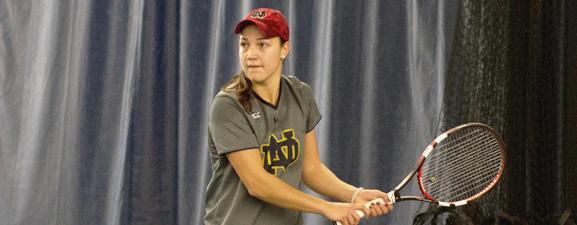
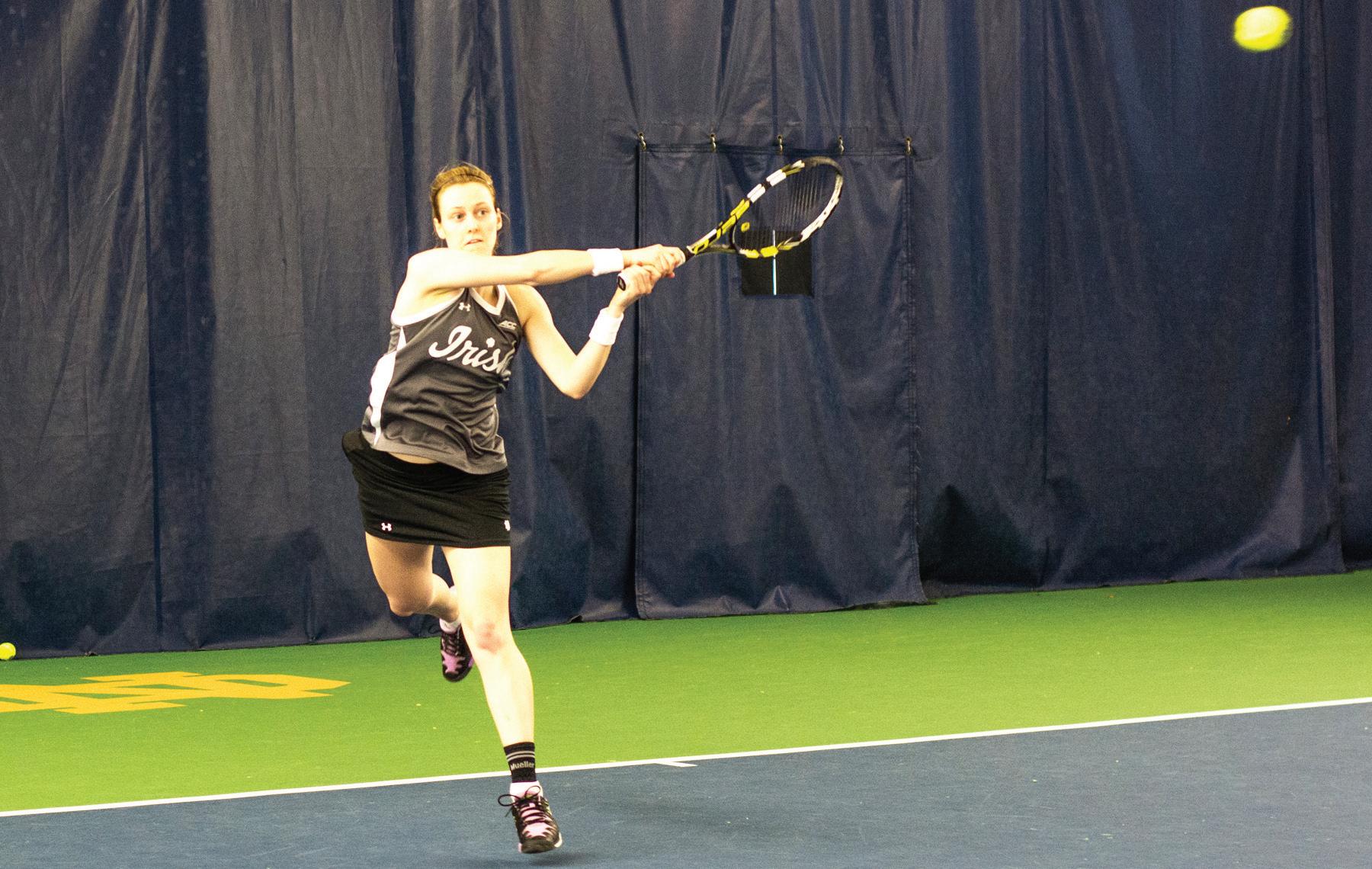
Irish junior Brooke Broda returns a ball during Notre Dame’s 6-1 win over Indiana at Eck Tennis Pavilion on Feb. 20. Notre Dame reached the first round of the NCAA tournament last season.
m tennis
played their last college match back in m ay.”
s achire said he expects his team to be one of the hardest working, if not the hardest working team, in the country.
“ w e expect to be a really competitive team, both within our own squad and within every single match that we play,” s achire said. “ i n terms of expectations for results and rankings and wins and stuff like that, we’ll let those happen. w e’re going to focus on the day-today process of those things and feel like if we take care of those things, we’re going to have a great year.”
The i rish finished with an overall record of 15-14 last season, including a 6-6 mark in the acc . Their season ended when they were defeated by s tanford in the first round of the ncaa tournament.
s achire said he hopes his team will build off of the success of last season.
“ w e had a great month of a pril last year,” s achire said.
“ w e had some injuries and didn’t play very well at the beginning part of last year,
but we did a tremendous job finishing the season off right and had a great month of a pril. i feel like we have some momentum because of that, but this is a new team. This is a new chapter in the history of our program. There’s a lot of good freshman coming in and looking to make their mark. we also have a lot of returning guys, too, that didn’t play or didn’t play as much as they wanted to last year, and they want an opportunity, too.
“a s a program, we feel a tremendous amount of confidence and pride in what we did last season. b ut in terms of players who actually played in the matches, we’re going to have a fair number of new faces and familiar faces in different roles, and we’re excited about that.”
s achire said improving his team’s doubles play is going to be a major point of emphasis in early practices this year and throughout the fall.
“ w e lost a lot of our doubles superstars [from last season],” s achire said. “ w e were a good doubles team last year, but more than anything, i think we lost some really key pieces as part of our lineup. That’s something where the new guys have a lot of experience to
make up for. s o we’re going to really train and practice for that as much as we can and take pride in, hopefully, being one of the best doubles teams in the country.”
w hen asked which members of his team he expects to have the biggest impact this season, s achire pointed to the team’s two seniors, Josh h ager and e ddy c ovalschi.
“They have both been figures in the top half of our singles lineup for the last two years,” s achire said. “ d uring both their sophomore and junior years, they played in the top three of our lineup, and as a doubles combo they’ve been ranked as high as n o. 10 in the country and have had some very significant national wins. i f they have great senior years, we’re going to have a great season.”
s achire said he thinks one of the beautiful things about his team’s schedule is that it’s tough.
“ w e have all kinds of opportunities,” s achire said.
“The two-time defending ncaa champion v irginia c avaliers come to s outh b end. i think that will be an exciting match for us. b ut we play a lot of other great competition, both at home
and on the road. o ur schedule is balanced with great opportunities.”
s achire said what excites him the most about this year’s team is the competition and the energy that all of his players bring.
“ e very one of them [is] striving to play in a role for the first time if they’re a freshman on our team, or
in a role bigger than what they played last season,” s achire said. “ w e graduated our n o. 1 singles player and our n o. 1 doubles team that made it to the semis of the ncaa doubles tournament. l iterally every spot is up for grabs.”
Contact Michael Ivey at mivey@hcc-nd.edu
paid a dverT isemen T
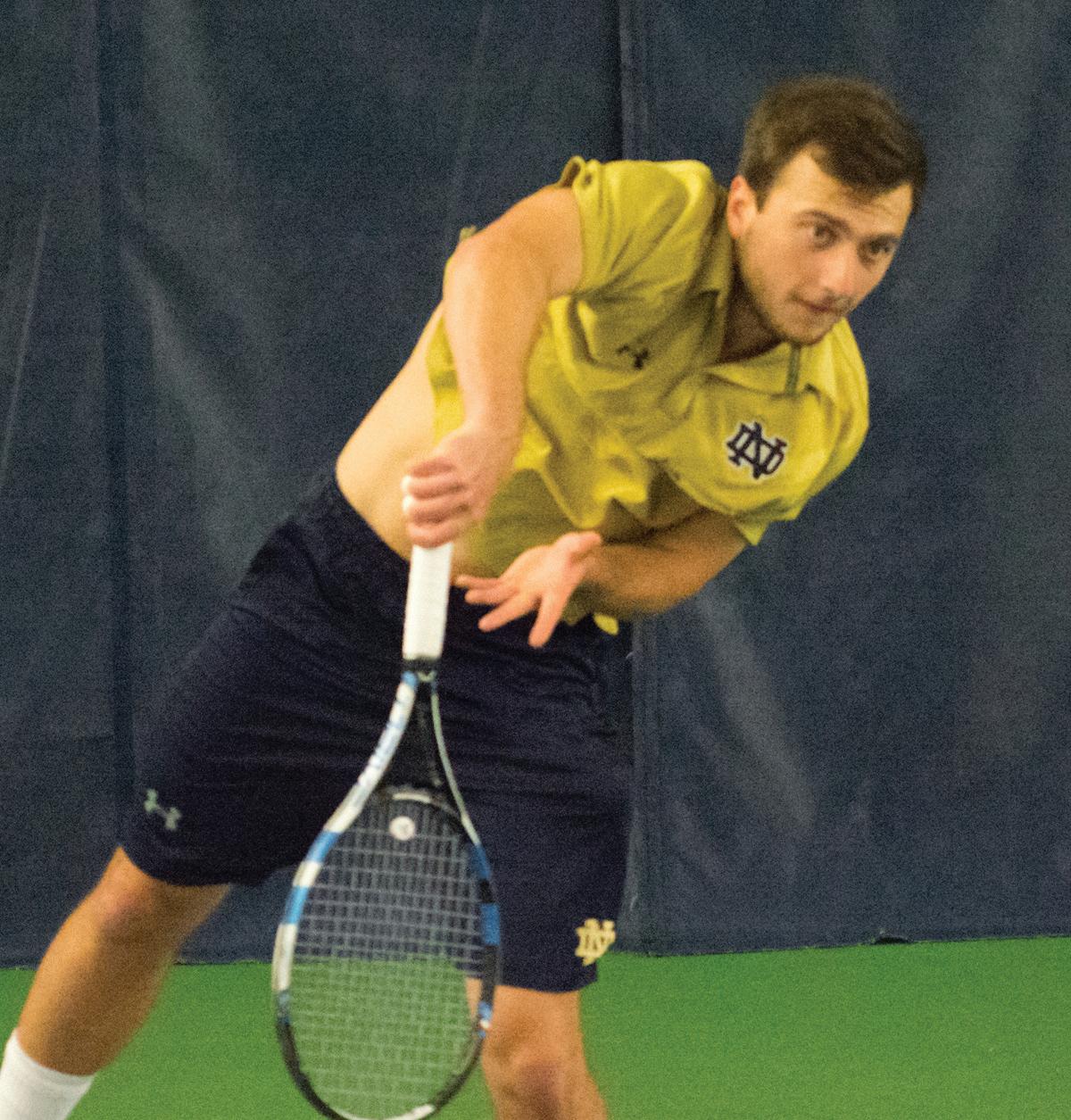
KATHLEEN DONAHUE | The Observer Irish senior Eddy Covalschi returns the ball during Notre Dame’s 5-2 win over Duke on March 18 at Eck Tennis Pavilion.
only three series and gained only 23 yards of total offense. Kelly said no decision has been made concerning playing time against n evada but added the decision will be made once he has a chance to sit down with both Kizer and Zaire.
“ we plan on having two really good quarterbacks the rest of the year,” Kelly said. “ i haven’t sat down and talked with to either one of them, so before we do that, we don’t have any plans to make any decisions.”
Kelly did say he expects whoever is relegated to the second-string to maintain a positive attitude at all times while on the bench and to be ready to play at a moment’s notice.
“First of all, it’s about your attitude and your attitude has to be such that whoever the n o. 2 is, whether he’s the n o. 2 quarterback or the n o. 2 running back, you’re one play away from being in there,” Kelly said. “ s o you can’t let your teammates down, and you can’t let yourself down. you have got in the way of yourself from preparing the way you need to to lead your football team. That’s really 99 percent attitude and accepting the role that you have. i f you can’t accept the role, then you need to move out of the way and let somebody go into that role that can accept it and prepare themselves accordingly, so when they are called upon, they’re ready to play. s o to me it’s really — it’s all about the attitude.”
defensive improvement
The i rish defense has come under intense scrutiny the last few days after giving up 50 points and 517 yards of total offense to Texas. The secondary especially has received a large share of blame, giving up numerous big plays and allowing the l onghorns 10.4 yards per pass attempt. a nd with graduate student safety avery s ebastian going through the concussion protocol, the secondary looks vulnerable. a ccording to Kelly, however, the problems in the secondary start with the need for better coaching.
“ i think we have the
personnel there,” Kelly said. “ l ook ... we were in c over 3 on long balls. b alls that got thrown over our head, we were in c over 3 — except for the one that we were in latch coverage the one time we got beat in the seam because our safety was obviously way too wide.
“ p rimarily, if we just do the ordinary things ordinarily well we’re in good shape. we have to do those better. we have to coach better. i f we’re not playing cover three well, we’re not coaching well enough, so we’ve got to do those things better. i know if we’re coaching better and getting that from our players, we will be a better defense moving forward.”
w ith s ebastian likely out and m ax r edfield’s dismissal from the team, freshman d evin s tudstill will see a lot of snaps at safety on s aturday, Kelly said.
“ h e will see a lot of playing time this week,” Kelly said. “ yes, we will have to continue to give him the opportunity to get out there and play and experience the scenarios that you can’t really duplicate in practice. b ut, yeah, you’ll see a lot more of him on s aturday.”
Questions have also arisen about i rish defensive coordinator b rian van g order and his ability to fashion a highcaliber defense in s outh b end. Kelly is aware of the criticism but said he has no doubt in van g order’s ability.
“ l ike i said, it’s great conversation for everybody to have, but it’s so short-sighted of what really happened in the Texas game,” Kelly said. “ w hat really happened in the Texas game was you had the offense that had a chance to win the game — you’re going to have to play some games where you outscore people. i f we’re 10 or 11 games into the season and we have to outscore everybody, i ’ll take the questions, you know? a nd i would say fair enough. we’re in game one of a brand new offense that we saw for the first time, and we got guys that went on to the n F l off this team.
“ s o i just think we’re jumping the gun. i f we’re ten games into this and we’re giving up 50 points a game, i ’ll have to answer your questions. ... a s i said yesterday, i think y’all should relax a little bit. i think our
defense is going to be fine.”
Injury report
n otre d ame suffered injuries to two notable players in the game: senior receiver Torii h unter Jr. and s ebastian. Kelly said that h unter Jr. is undergoing the concussion protocol and there is no timeline on his return.
“ i think with a guy like Torii, anything up to, you know, game time is [possible],” Kelly said. “ c oncussion symptoms come and go. ... There’s no real timeline, you know? w hen you start to expect somebody to clear — it’s so individual, and you just let it take it’s course and we will prepare accordingly.”
h unter was the only i rish receiver with meaningful game experience before the Texas game s unday, and with the possibility of him missing the game against n evada, the i rish receiving corps loses a valuable asset. s ophomore e quanimeous s t. b rown had a breakout game against Texas, notching five catches for 75 yards and two touchdowns, but Kelly said he plans to keep s t. b rown at the slot position, rather than moving him over to the X position, which may be vacant due to h unter’s absence.
“ i prefer not to move [ s t. b rown],” Kelly said. “ i think he’s established himself in a position that i would like continuity and consistency there. i t’s a position that i think more than anything else requires somebody to really build a relationship and a rapport with the quarterback, and if you start to move him around now, it begins to erode some of the things that we have built on over the last few weeks.
“ s o that’s not an option right now. we’ll look at options from [junior] c orey h olmes, who has been working at the Z but has been cross-trained at the X. o bviously [freshman Kevin s tepherson] and [freshman] Javon m cKinley, those would be the places to look right now at the X.”
Kelly did not comment on s ebastian’s status but did say junior defensive tackle Jay h ayes is closer to 100 percent and should see playing time against n evada.
Contact Marek Mazurek at mmazurek@nd.edu
CAITLYN JORDAN | The Observer
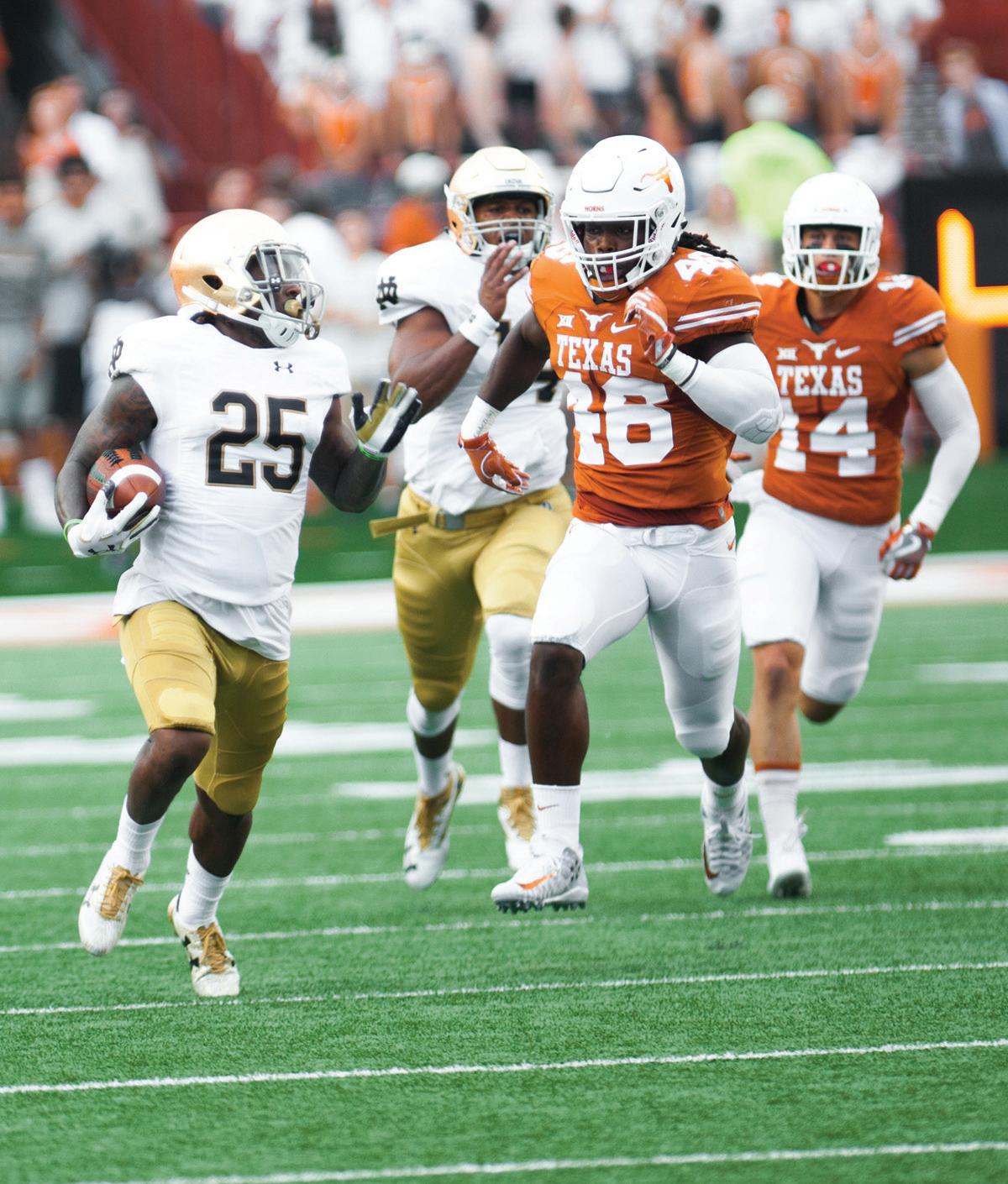
Irish senior running back Tarean Folston rushes down the field at Darrell K. Royal–Texas Memorial Stadium on Sunday.
CAITLYN JORDAN | The Observer
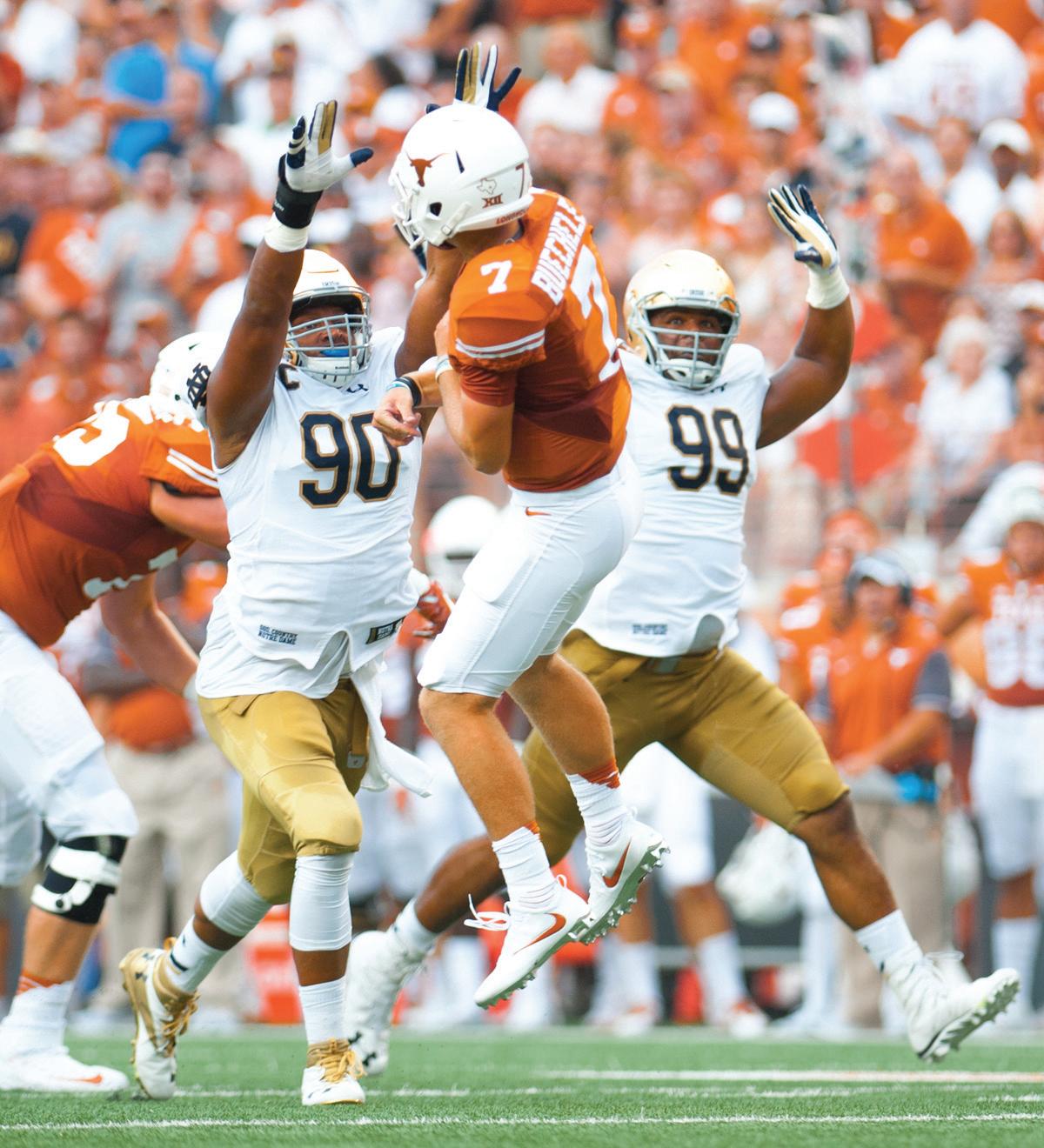
Irish senior Isaac Rochell, left, and sophomore Jerry Tillery, right, attempt to deflect a pass during Notre Dame’s 50-47 loss to Texas.
CAITLYN JORDAN | The Observer
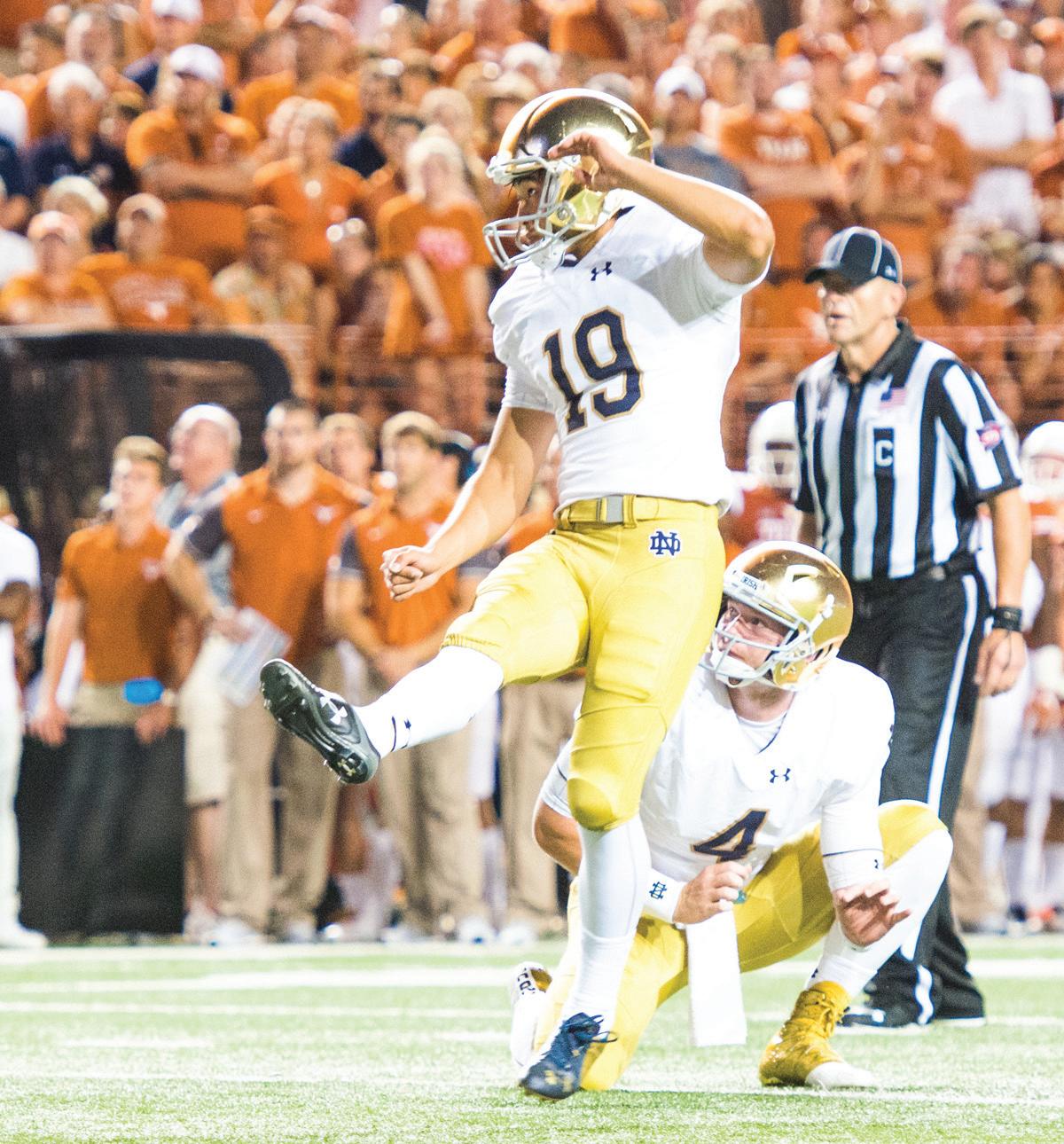
Irish sophomore kicker Justin Yoon attempts a kick during Notre Dame’s 50-47 loss in Austin, Texas, on Sunday.
Kelly confident in team’s ability to rebound
By MAREK MAZUREK
sports e ditor
Following a narrow loss to
n o. 11 Texas in double overtime, n o. 18 n otre d ame looks to pick up its first win of the season in its home opener against n evada on s aturday.
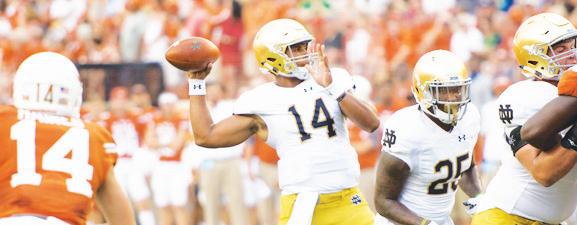
d espite the loss, i rish head coach b rian Kelly said he was proud of his team’s resiliency after coming back from a 17-point deficit to tie the game in the fourth quarter.
“[ i ’m] certainly proud of the resiliency and the effort that was displayed on s unday night,” Kelly said. “ c oming back from a 17-point deficit and putting ourselves in a position to win the game. we were up late in the game. we asked our team to get us to the fourth quarter and find a way to win.”
n ow, the team needs to focus on finishing, and Kelly said he will preach that message all week.
“Finishing was not something that we did well on s unday,” Kelly said. “ we competed. we played hard. we put ourselves in a position. we made some plays, but if you really look at it in a microcosm, offensively we
men’s tennIs
had a chance to finish out well or put us in a good position on the last couple of drives, and we came up with nothing.
“ ... s o the message to the team yesterday was about closing and finishing and hard-fought games on the road against quality opposition you gotta finish. That’s what we did not do in this game — we didn’t finish and that will be a ‘watch word’ for this group as we move forward. a gain, i like their effort, i like their fight.”
g oing into the contest with the wolfpack (1-0), the i rish (0-1) have numerous questions that need sorting out — most notably, the quarterback depth chart and a rough defensive showing.
Quarterback battle
b oth junior d e s hone Kizer and senior m alik Zaire saw playing time on s unday, but Kizer stole the show. Kizer — n otre d ame’s starter for most of 2015 — threw for 215 yards on 15-of-24 passing and five touchdowns while also giving up zero turnovers and running for a sixth score. m eanwhile, Zaire played in
see FooTball paGe 15
notre dame to open season with veteran-led team
By MICHAEL IVEY sports writer
a fter four months of preparations, n otre d ame is ready to get back in the swing of things.
The i rish will kick off their 2016 fall schedule in c ambridge, m assachusetts, where they will compete in a tournament at h arvard from s ept. 16-18.
i rish head coach r yan s achire said he feels like a lot of his players made significant strides in their development over the course of this past summer.
“Tennis is a year round sport, and our guys did a really good job of practicing and playing in tournaments on their own throughout the summer,” s achire said. “ w e have a number of returning guys who are better players right now than when they
Irish look to make strides this fall
By MOLLY MURPHY sports writer
This season, n otre d ame begins its fall practices and invitationals looking to build on last year’s successes.
“ w e had a really tight match with chances to beat ucla in the first round of the ncaa s, so i think that’s something we really took a good feeling away from that loss knowing we were right there with ucla ,” i rish head coach Jay l ouderback said.
“ i think that’s something that’s going to really help us as we go into this year.” c lose matches were a theme throughout the previous spring season for the i rish, and that will be a motivating factor for the team as they move ahead, l ouderback added.
“ o f our 14 conference matches, nine of them were 4-3 either winning or
losing, and all the other matches were all 5-2, so every match we played, we were right there with them,” l ouderback said. “ i think our kids are looking forward to playing some of those teams again this year.”
w ith these difficult, close losses fresh in the team’s mind, l ouderback said he believes it is the group’s work ethic that will set them apart this season.
“ i feel like that’s our biggest strength. The kids are working hard not just on the court but in conditioning, and they’re doing everything to be ready for the spring,” l ouderback said. “ r ight now, our main thing is to make sure that we’re physically in shape for the spring. o ur main goal is to be healthy and ready and ready to compete when the spring comes along.”
KATHLEEN DONAHUE | The Observer
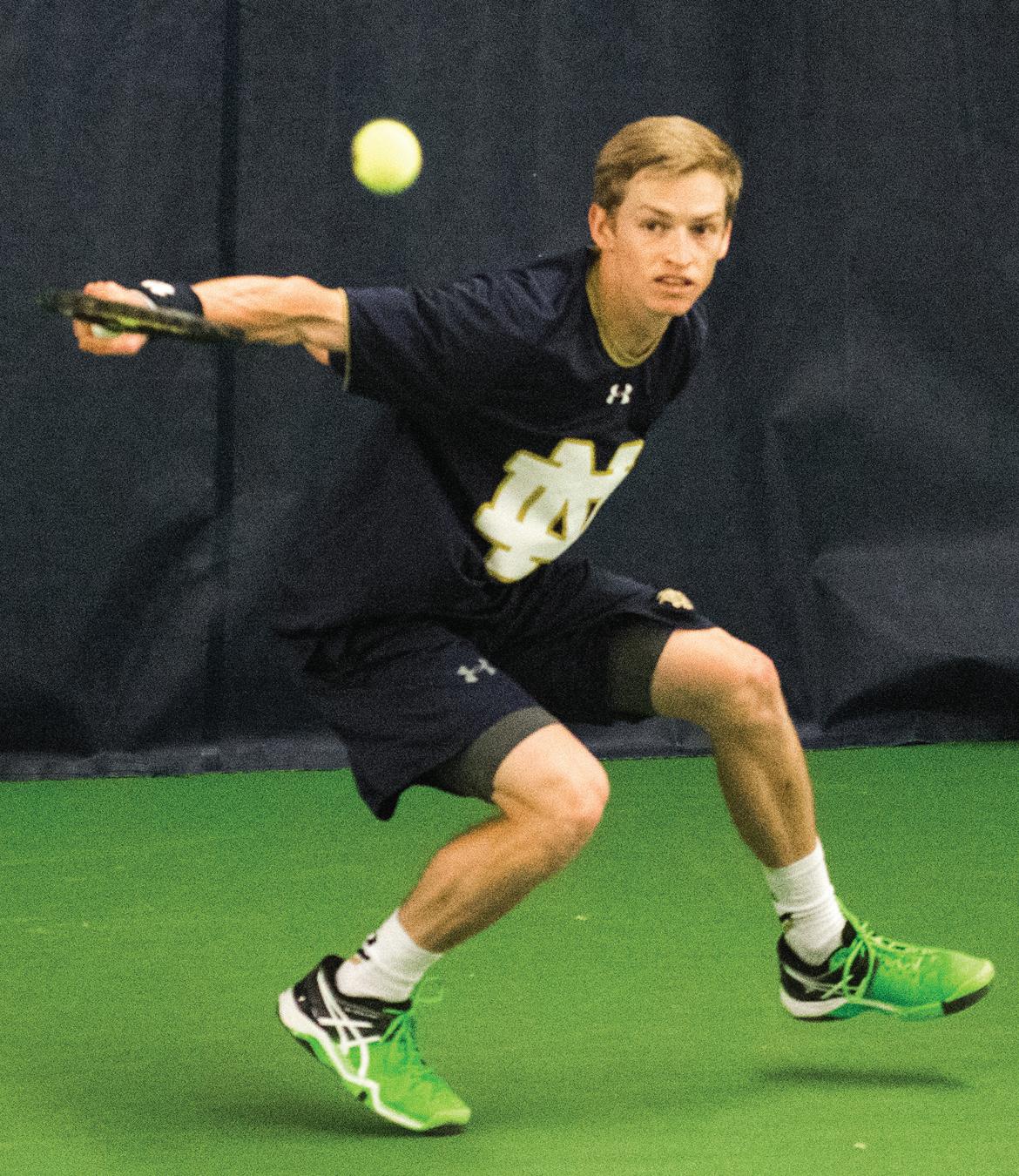
Irish senior Josh Hagar follows through on a return during Notre Dame’s 5-2 win over Duke at Eck Tennis Pavilion on March 20.
nd Women’s tennIs
CAITLYN JORDAN | The Observer
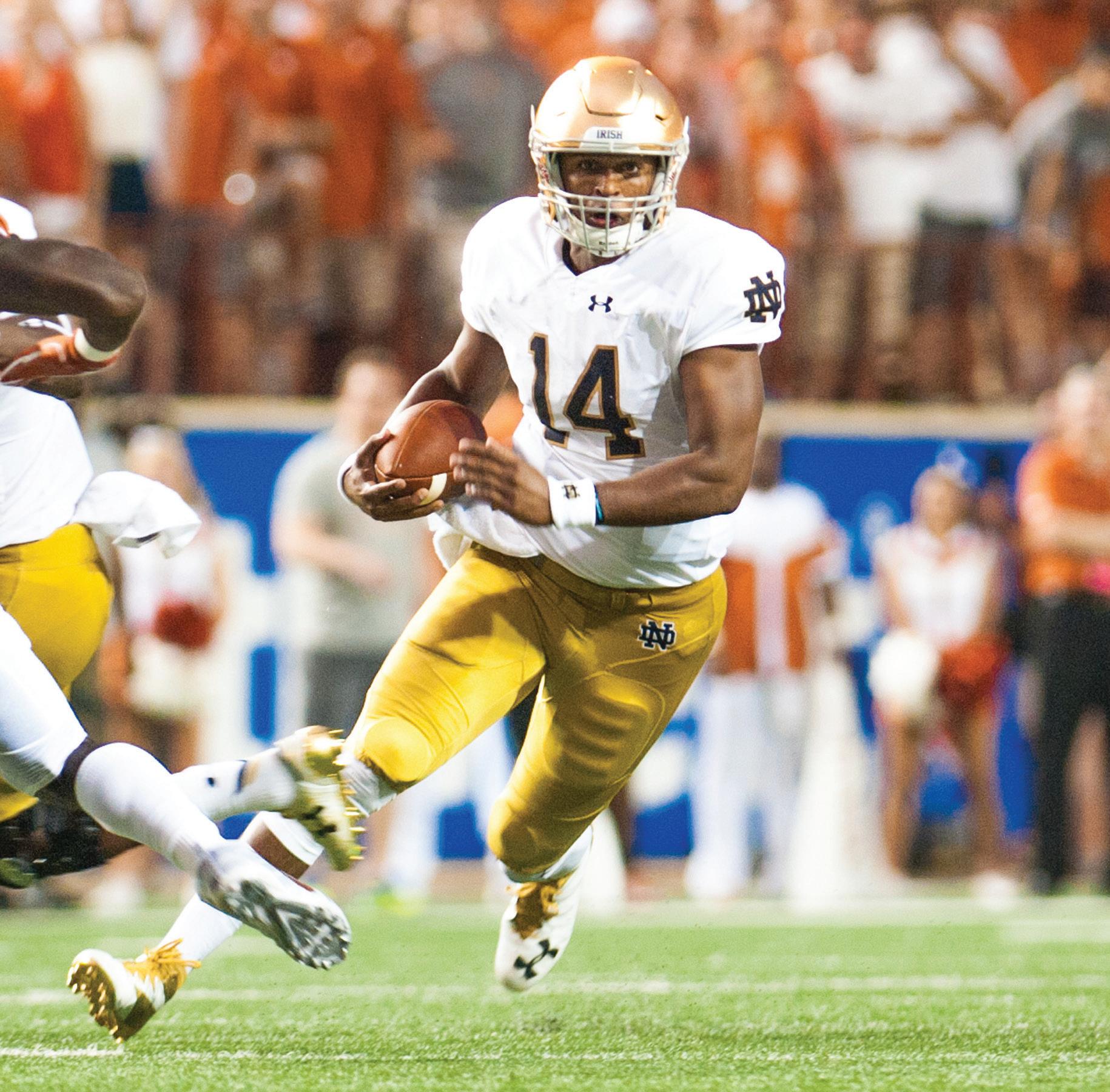
Irish junior quarterback DeShone Kizer rushes during Notre Dame’s 50-47 loss against Texas on Sunday at Darrell K. Royal–Texas Memorial Stadium. Kizer accounted for 36 of Notre Dame’s 47 points.