Print Edition of The Observer for Tuesday, August 30, 2016
Panel analyzes Brexit decision
Professors examine impact of the British vote to leave the European Union
By LUCAS MASIN-MOYER news writer
perhaps the most important geopolitical event of the summer happened completely outside the context of the united states’ presidential election, which has otherwise dominated news coverage. This event, dubbed brexit, occurred on June 23, when the people of the united Kingdom voted to leave the european union ( eu ).
The Kellogg i nstitute for i nternational studies hosted a panel monday on brexit, featuring four notre dame professors — associate professors of political science sebastian rosato, e milia Justyna powell and a ndrew g ould and professor of finance Jeffrey bergstrand.
a lum connects religion and election
By RACHEL O’GRADY a ssociate news e ditor
Editor’s Note: Throughout the 2016 presidential campaign, The Observer will sit down with Notre Dame experts to break down the election and its importance to students. In this 11th installment, Associate News Editor Rachel O’Grady asks former chief speechwriter for President George W. Bush, current member of the Wall Street Journal editorial board and 1980 alumnus Bill McGurn about the significance of American Catholics in this election.
r achel o ’ g rady: s tarting off a bit on rhetoric, as a former speechwriter for p resident b ush, what are you noticing about speeches and rhetoric in this election?
b ill m c g urn: o n rhetoric, i recommend the l incolnd ouglas debates — remember, l incoln lost that election. The speeches are long and vivid. i t’s not likely they would succeed
in the age of the televised sound-bite. i n our day, few campaign speeches are remembered past e lection d ay. w hichever your party, in office you have it harder because you can no longer simply paint a flowery vision of your proposals or a dark picture of your opponent’s. o nce president, your choices have real con -
sequences and trade-offs. a great speech deals with these realities and transcends them, whether it’s the g ettysburg a ddress or [ l yndon b . Johnson’s voting r ights a ct] speech. rog : w hat is the significance about c atholicism and, obviously, particularly a merican c atholicism in this election? b eyond that,
what’s the impact and/or significance of the vp picks for both candidates?
bmg : Tim Kaine embodies a decades-long effort, prominently encouraged by institutions such as n otre d ame, to make a safe space for pro-choice c atholic d emocrats. m r. Kaine is what you get: an affable man who treats as sacred a s upreme c ourt decision ( r oe v. w ade) that a) outrageously short-circuited the democratic process and b) ushered in the killing of tens of millions of the most defenseless members of our society. Too often abortion is treated as a single issue. i n fact, it has proved the beachhead for an entire ethic that is hostile to life, hostile to marriage and, as we see from the contraceptive mandate, increasingly hostile to religion, religious a mericans and religious institutions. s o rather than leaven the a merican experiment, liberal a merican c atholicism has spent the last four decades
accommodating itself to the secular zeitgeist, largely because of their surrender on abortion. w hen you point this out, the answer is almost never to defend their position but to raise phony claims of moral equivalence that r epublicans are “just as bad.” i t’s all very sad.
rog : h illary c linton and d onald Trump are arguably (and polls have agreed) the two most disliked presidential candidates in history. w hat’s the significance of that?
bmg : a bsolutely. h illary c linton’s negatives are skyhigh. b ut d onald Trump’s are higher still. n ovember’s election may well be decided by who turns off more rather than who attracts more.
m eanwhile, a mericans will watch the presidential debates the way they watched a m ike Tyson fight: to see if someone’s going to bite off the other side’s ear.
rog : Terrorism, and in particular isis , has been a
see elecTion PAGE 3
Five football players charged
Observer Staff Report
The five notre dame football players arrested in Fulton c ounty, i ndiana, on a ug. 19 all face misdemeanor charges for possession of marijuana, a c lass b misdemeanor, according to a report from nd i nsider.
The five students — senior max redfield, sophomores d exter w illiams, Te’von c oney and a shton w hite and freshman Kevin stepherson — were arrested at approximately 10:07 p.m. during a traffic stop in Fulton c ounty, i ndiana. redfield will also face charges for carrying a handgun without a license, a c lass a misdemeanor according to the report. The handgun charges were dropped against stepherson and w illiams, who were both in the backseat of the car and had access to the handgun.
The initial hearing for all five students is set for Tuesday at 8:30 a.m., according to the report.
The 2007 Ford Focus, driven by w hite, was pulled over for a speeding violation and an improper taillight when state Trooper b en reason allegedly detected the odor of marijuana coming from the car, an i ndiana state police press release said. From there, a narcotics dog indicated the presence of illegal narcotics inside the vehicle, and in the subsequent search, officers allegedly found marijuana and a loaded handgun. redfield was dismissed from the football team following the incident while the other four students were disciplined internally by the program. i rish head coach brian Kelly has said that all four will be available to play against Texas on sunday, unless otherwise disciplined by the university’s o ffice of c ommunity standards.
McGurn
ROSIE LoVOI | The Observer
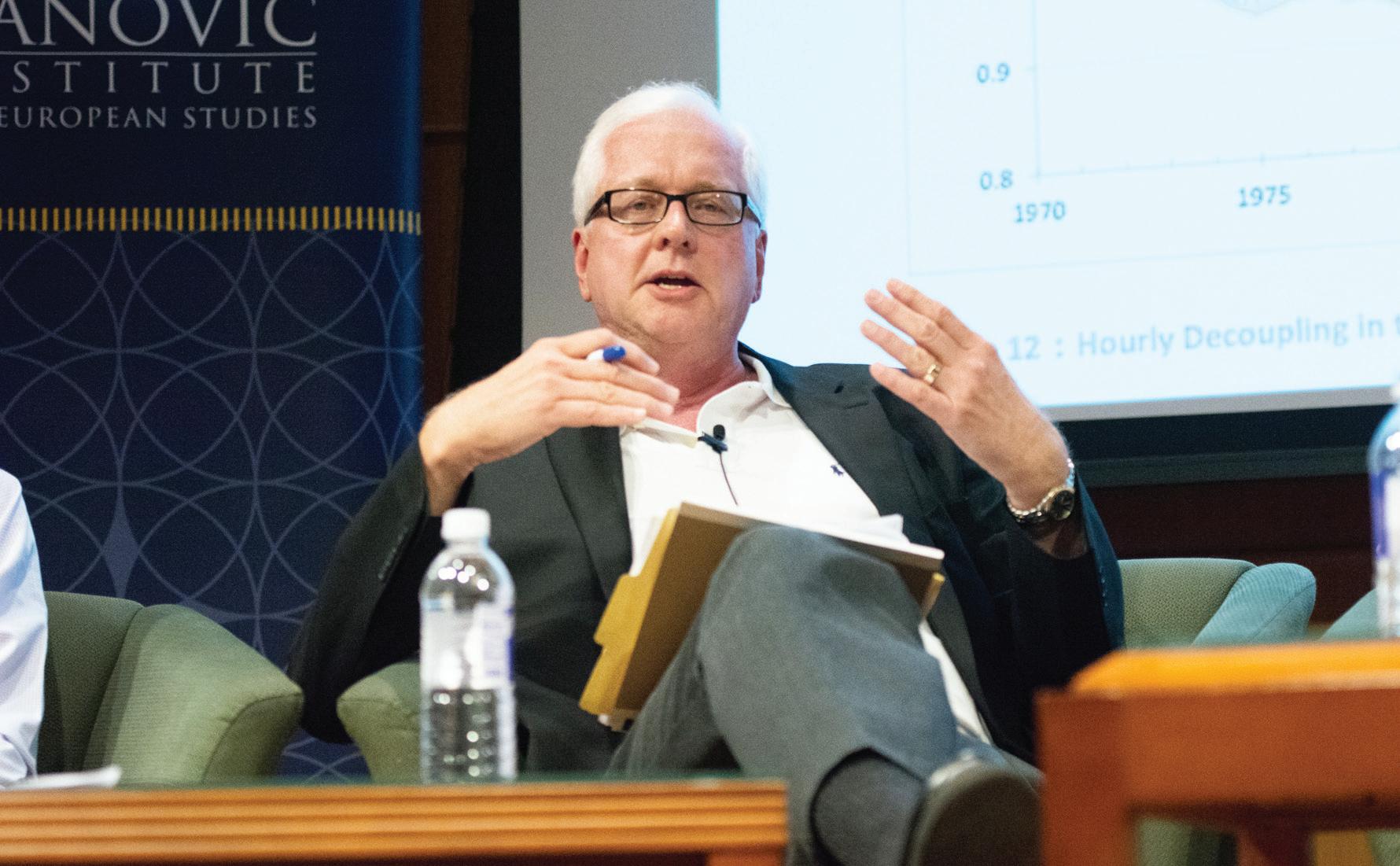
Jeffery Bergstrand, professor of finance, speaks on the financial significance of the United Kingdom’s departure from the European Union at a panel hosted by the Kellogg Institute for International Studies.
Scene Desk (574) 631-4540 scene@ndsmcobserver.com Saint Mary’s Desk ncaratas01@saintmarys.edu
Photo Desk (574) 631-8767 photo@ndsmcobserver.com
Systems & Web Administrators (574) 631-8839
Policies The
Question of the Day:
When you have to use a touch-screen soda dispenser, do you feel overwhelmed?
Caroline Riester junior breen-phillips hall
“i was at first but now i feel comfortable.”
Mark Dahl junior Zahm house
“yeah, most things are overwhelming for me.”
Sean O’Brien junior stanford hall “no.”
Julia Szromba junior breen-phillips hall “no.”
Rebecca Wiley junior cavanaugh hall “yes!”
Utkarsh Sonkiya junior Zahm house “yes. yes.”
Students begin the fall semester by celebrating Campus Ministry’s Opening of the Academic Year Mass and Picnic on Notre Dame’s South Quad with University President Fr. John Jenkins on Aug. 23.
Staff
i n the aug. 28 issue of The
gaven dev illier was misidentfied as a junior in the online headline.
is a sophomore. The observer regrets this error.
he next f ive D ays:
Tuesday
Last day for all class changes at ND campus wide all day
Last day for students to add or drop classes.
Lecture: Einstein’s Cosmological Constant Jordan Hall, Room 105
7 p.m. - 8 p.m. Open to the public.
Wednesday
Lecture: Dark Energy Nieuwland Hall, Room 115 4 p.m. - 5 p.m.
Pondering questions of dark energy.
“Eye in the Sky” DeBartolo Performing Arts Center
8 p.m. - 10 p.m. Part of the Campaign Concerns Film Series.
Thursday
Want your event included here? Email news@ndsmcobserver.com
Friday
Yoga in the Galleries Snite Museum of Art
4 p.m. - 5 p.m.
Relax and recharge through Artful Yoga in the Snite.
Student Standups and the Humor Artists Legends 9 p.m. Comedy shows.
ND Volleyball vs. Coastal Carolina Purcell Pavilion
7 p.m.
The Irish take on the Chanticleers.
ND Women’s Soccer vs. Illinois State Alumni Stadium
7 p.m.
The Irish take on the Redbirds.
Saturday
ND Men’s Golf Kickoff Challenge Warren Golf Course Clubhouse all day Open to the public.
ND Volleyball vs. Purdue Purcell Pavilion
7 p.m.
The Irish take on the Boilermakers.
MICHAEL YU | The Observer
Family donates $5 million for i nnovation park
Observer Staff Report
The Quinn family made a $5 million donation to the university to fund the second phase of construction of i nnovation p ark, according to a monday press release.
The donation was made by the late 1969 notre d ame alumnus, Thomas Quinn and his wife, d iane, according to the release.
“Tom was a tremendous supporter of notre d ame with
his time, talent and treasure,”
Fr. John Jenkins, university p resident, said in the release.
“This new and extraordinary gift makes it possible for us to continue to build upon the success of the first phase of i nnovation p ark. we are most grateful.”
a ccording to the release, construction on the the Thomas h . and d iane g Quinn h all for i nnovation and c hange is expected to begin later this fall or
early winter. The h all will be a 40,000-square-foot, threelevel facility located across the street from the university.
Thomas g b urish, c harles and Jill Fischer p rovost of the university, said he joins Fr. Jenkins in thanking the Quinns for their donation.
“o ver the past seven years at i nnovation p ark, we have seen a wide range of marketable business ideas emanating from faculty and student research,” b urish said in the
release. “p hase ii of the park is a major step forward for the university — and for the community as a whole, as we continue to collaborate with the city on initiatives that begin at notre d ame and continue at ignition p ark in s outh b end.”
a ccording to the release, since i nnovation p ark’s opening in 2009, 59 new ventures have launched at the park, 29 companies are currently operational on the grounds,
38 notre d ame faculty members are working there and 67 notre d ame student interns are employed by various groups.
The Quinns’ donations have also contributed to the creation of the Quinn mba c hina i mmersion p rogram, the renovation of the morris i nn and support for the b usiness on the Front l ines initiative in the mendoza c ollege of b usiness and the p resident’s c ircle, according to the release.
rosato began the panel by discussing the importance of nationalism in contemporary european politics.
“nationalism in britain [shown by the brexit vote] is just an example of the fact that nationalism is back all over europe and because of this, the e uropean union’s days are numbered,” rosato said.
rosato said that this nationalism, coupled with a desire for increased sovereignty, prompted the british decision to leave the united Kingdom — a decision which he believes spells trouble for the eu’s long-term future.
“d issatisfaction with the eu is at an all-time high,” rosato said. “nationalism and
a desire for sovereignty is back and all over. The number of leaders who are talking about holding referenda or re-negotiating, which means not more union but less union, is rising.”
powell then discussed reactions in e astern and c entral europe to brexit.
“The member states to the east of g ermany feel very uncertain about brexit,” powell said. “They are blocking any deals between the e uropean union and britain that would try to delimit free movement and trading access, because many of the citizens from these countries live in the united Kingdom.”
powell said poland especially was unhappy with brexit.
“poland was quite upset with britain leaving,” he said. “This is the case because britain was one of the biggest allies of
paid a dverT isemen T
poland in speaking out against ‘brussels Federalism,’” referring to where the headquarters of the eu is located in b elgium.
b ergstrand said the united Kingdom has always been somewhat independent from the rest of europe, especially seen in its resistance to adopt the e uro. b ergstrand said he believes that this, accompanied by economic factors, helped to spurn brexit.
a ccording to b ergstrand, the regions which voted in favor of leaving had characteristically low per capita income, a low standard of living, low education and a predominance of people who did not have a high school education.
b ergstrand said he sees shades of what has happened in the united Kingdom in the increased populism of u s
politics. b ergstrand said he believes that could lead to increased isolationism, which he sees as deeply troubling.
“This is one of the most respected economies in the world going down a dark path, and we’ve had this isolationism going back to the great d epression,” b ergstrand said. “c ountries went back and forth raising tariffs and caused the great recession of the 1920s and early 30s to become the g reat d epression.”
g ould finished the panel by discussing why p rime m inister d avid c ameron decided to call the referendum, though he himself wanted the united Kingdom to remain in the eu
g ould said the influence of the e uro-skeptic united Kingdom i ndependence p arty ( u K ip ) and internal dissent were major drivers of the brexit vote.
“i ntra-party tensions and third-party threats are a major
reason for a governing party to hold a referendum, even if the party leaders do not want to change policy,” g ould said.
“he called for a referendum — c ameron did — to keep his party in power. he was attempting to control internal dissent and trying to keep the europe issue out of the 2015 election campaign.”
c ameron, who resigned in the wake of the brexit vote, lost this fight, but the party, g ould said, succeeded as it was able to solidify its stance on e urope.
d espite britain’s departure from the eu, g ould believes the union may still survive.
“The eu could be sustained by a more homogeneous group of 27,” g ould said. “britain was always the exception. French and g erman cooperation will be the key link that holds the rest together.”
Contact Lucas Masin-Moyer at lmasinmo@nd.edu
the m iddle e ast.
major talking point in this election. w ith your experience under p resident b ush, what is your take on the importance of terrorism and war in this election?
bmg : b arack o bama entered office with the view that the fight against terrorism is an issue of law enforcement, not war, and m rs. c linton supports that. m rs. c linton and m r. Trump each talk tough on isis , but each has also campaigned against the “unnecessary” b ush wars in the m iddle e ast. m r. Trump talks tougher and will speak of [ i slamic] terror, but thus far he has not offered a foreign policy that draws sharp and substantial distinctions with m rs. c linton’s, especially in
rog : Turning it back to students and campus here, what do you think is the most important issue for students? w hat is gong to impact students the most, post election? bmg : s tudents share the general interest in a safe and prosperous and hopeful a merica. b ut because students are young and starting out, they have a greater stake in a dynamic economy that gives people at the bottom hope and gives all citizens the confidence that they can make a better life for themselves and their families. e xcept for those who are already wealthy and well connected, you won’t get this with 1.1 percent economic growth we now have.
Contact Rachel O’Grady at rogrady@nd.edu
hear each other
a month ago, my friend m egh emailed me with an important question. m egh, who was working in a s outh a frican school this past summer, had started a project called w ords for the w orld. s he asked the people she interacted with on a daily basis (many of them homeless), “ i f you could say one thing to the world, what would it be?” s he posed a similar question to me. “ s usan, what does the world need to hear right now?”
The world needs to hear each other. i am not sure when the world began to feel so incredibly divisive, but this new reality is one that scares me. i t really scares me, down to the core of my being, that people care more about being “right” than they do about each other. a s human beings, we share a common humanity. This is a truth that we cannot forget. g overnments care more about money and prestige than their own people. g ridlock is not only expected, but also praised at times. p eople get so hung up on the labels of things — not calling it “systemic,” not calling it “hatred,” not calling it “bigotry,” etc. b ut in truth — do those labels really matter? d ebating about labels prevents us from hearing each other and hearing each other’s concerns. a t the core of it, aren’t we all fearful for the future of humanity? a ren’t we all afraid of the fear that has begun to drive and control our world? a ren’t we all disgusted by the taking of innocent lives, and don’t we all wish it would end? w hen did our common understanding die? This nation, this world, was built on differences, and the respect, love and understanding that overcame those differences. a s the respect for human dignity begins to erode, our differences are now being used as weapons. d o we not have enough weapons in this world already? d o we really need to also arm ourselves with hatred and ignorance and pride?
i beg the world — i am on my knees — to return to respect and to recognize our common humanity. The world needs to hear each other. The world needs to hear each other’s honesty, dreams, experiences and fears. w e are all human beings, and we all need each other.
i believe that every single one of you reading this has the potential to be a true bringer of joy, who is eager to be a driving force of good in the world. w e all have the ability to revive our common humanity. Take the first step and listen. l isten to those around you and refrain from dismissing anyone’s opinion as irrelevant. o nce we remember that every human being is worthy, we will take real steps towards reclaiming the respect and love that will heal our divisive world.
Contact Susan Zhu at szhu4@nd.edu
The views expressed in the Inside Column are those of the author and not necessarily those of The Observer.
Rage against the machine gun
This summer’s all-too-familiar mass shootings have once again turned the nation to the topic of gun control. one particular class of weaponry that has been under discussion is so-called “assault weapons.” w hat is an assault weapon, and why are policymakers talking about regulating them? To answer these questions, it is necessary to look at history.
i nfantrymen in world war ii fought predominantly with two types of firearms. s ome troops were issued battle rifles — bolt-action or semi-automatic rifles firing full-power cartridges. These weapons were highly accurate and lethal but limited in their rate of fire. o ther soldiers carried submachine guns that could fire pistol-caliber bullets as long as their triggers were depressed, but were limited in accuracy and power. i n 1943, g erman engineers invented a rifle that blended these two approaches, firing a cut-down version of the g erman battle rifle cartridge in either fully automatic or semi-automatic mode. The weapon was dubbed the sturmgewehr, or “assault rifle.” o ver the next generation of rifle designs, intermediate cartridges and detachable high-capacity magazines became ubiquitous. The popular civilian variants of these firearms, restricted to semi-automatic fire, are the “assault weapons” that are currently under scrutiny.
it’s important to note that the military origins of assault weapons do not inherently make them dangerous or a valid target of regulation; microwave ovens were also once military technology. r ather, assault weapons are worthy of scrutiny because they are suboptimal choices for most civilian applications. The weaker intermediate rounds fired by these weapons limit their range and lethality, making them less suitable for hunting than their battle rifle ancestors. The large size of a rifle naturally makes it difficult to carry in self-defense, whether open or concealed; when used defensively inside a building, its high-velocity bullets can penetrate walls, increasing the risk to bystanders. The successful defensive uses of these weapons are at best niche applications and could be carried out equally well with another firearm type.
The one category in which assault weapons are unmatched is the ability to put large amounts of lead downrange with speed and accuracy. i n contrast to their full-powered battle rifle counterparts, an assault weapon is easier to keep on target during rapid fire. w hile this is great fun for law-abiding citizens, it’s also exactly what is sought by a mass-murderer. Though they are used in less than two percent of all gun crimes, assault weapons have turned up in the arsenals of terrorists in s an bernardino, c alifornia; o rlando, Florida and baton rouge, l ouisiana, as well as spree killers in s andy hook, c onnecticut; aurora, c olorado and far too many other places that have appeared beneath the words “breaking news.” i n the absence of regulation, we’re only going to see more of these stories.
a modernized assault weapons bill should be modeled after an excellent law already on the books — the national Firearms act ( n Fa) of 1934. passed in the wake of p rohibition-era gang violence, this law severely
restricted private ownership of machine guns, explosives, silencers and short-barreled firearms. Though not banned outright, the purchase of such a weapon requires an extensive background check (including photographs and fingerprints), registration and a tax payment. a new bill would elevate assault weapons to this same level of regulation. neither full-power battle rifles nor fixed-magazine rifles would be affected by this legislation, and the law would not be retroactive.
c ontrast this law with the portion of the v iolent c rime c ontrol and l aw e nforcement act of 1994, passed under bill c linton. The bill banned weapons based on their external characteristics, such as rifles with two or more of the following: a folding stock, a pistol grip, a bayonet lug, a silencer, a flash suppressor or a mount for a grenade launcher. e nterprising gun manufacturers simply designed rifles that incorporated only one of these features to retain legal status. moreover, no part of the law targeted the trinity of detachable magazine, intermediate cartridge and semi-automatic action that made these guns so deadly in the first place.
b y this point, there are doubtless those who are chafing at the idea of regulation on s econd a mendment grounds, maintaining that “a well regulated militia, being necessary to the security of a free state, the right of the people to keep and bear a rms, shall not be infringed.” yet the same c onstitution contains a rticle i, s ection 8, c lause 16, which gives c ongress authority to “provide for the organizing, arming, and disciplining, the m ilitia, and for governing such part of them as may be employed in the s ervice of the united states.” The legal underpinnings of the n Fa-type law proposed above have already been upheld by the supreme c ourt in us v. m iller (1939).
even given the legal authority, i know this proposal will be a tough sell to gun-rights advocates. a llow me then to suggest a compromise. To ensure smarter, more effective gun policy, it’s time that we also repeal one of the most pointless laws ever penned — the hughes a mendment to the Firearm o wner’s p rotection act of 1986. This law tightened restrictions on machine guns even further, making it illegal to manufacture new ones. This massive supply restriction caused prices to spike — Fopa-compliant machine guns are now practically antiques and cost as much as a new car. a nd for what? i f assault weapon crime is currently infrequent, crime committed with legal machine guns had been practically nonexistent. making automatic weapons available fresh off the assembly line to an already tightly-regulated consumer base won’t cause any more violence than it did in the 52 years between the n Fa and the Fopa
The time has long since passed for a merican gun legislation to be updated. restricting (not banning) the ownership of assault weapons while eliminating unnecessary restrictions against automatic weapons is the policy which best reflects the modern reality of gun ownership in our society.
Stephen Raab, an MSM Candidate at the Mendoza College of Business, graduated from Notre Dame with a Bachelor’s in Chemical Engineering in 2016. He enjoys matching wits with all comers at sraab@nd.edu
The views expressed in the Inside Column are those of the author and not necessarily those of The Observer.
insidE column
Susan Zhu graphics e ditor
Stephen Raab l et’s Talk smart
The nationalized leagues
Devon Chenelle
The gadfly
once upon a time, i was the mayor of a small town that was utterly ordinary but for one quirk: it loved dachshund racing. The town even operated a dachshund training program, complete with amateur leagues funneling the fastest dogs to the local professional team.
The town’s massive sacrifice of time and money was rewarded with watching the professional team’s weekly meets. To ensure everyone could watch, thousands had to buy expensive tickets, because the owner, roger, refused to televise games that didn’t sell-out.
a lthough i thought the town had already paid for its viewing experience by training virtually all the professionals, i consoled myself by remembering the tickets paid our beloved racing dachshunds, many born into desperate canine poverty.
That qualm resurfaced when roger arrived in my office with a request.
The old track, he said, was cutting his profits — he needed more space to hawk nachos and luxury boxes. a lthough he was a billionaire, roger continued, he simply can’t afford new facilities. given the town’s love of the dog races, he felt it should help pay for a new track.
The town could never afford that expense without depleting pension and education funding, i replied. roger grimaced, and murmured los angeles was bereft of a dog-racing track.
Though shocked at roger’s cupidity, i countered. The town could help pay for your new track, i said, if taxpayers receive team shares and discounted tickets.
w hen i finished, roger looked like i had suggested his children take a week’s sojourn at the neverland ranch, and then stormed out of my office while denouncing me as a communist.
a paroxysm of fear hit me. how could i face my constituents if my dispute with roger lost the town’s dachshund racing squad?
as i began drafting my resignation, a mad heresy whispered in my ear. it said the town does everything roger’s organization needs, then pays to watch our labor’s fruits. it said roger imposes costs for products he didn’t produce on those who did, and should be treated like any unnecessary and expensive liability.
an idea took root. it grew when i discovered that a wisconsin town once made their dog racing team communal property. They’re now the smallest town with a professional dachshund racing team, their team legendarily successful.
i awoke the next morning feeling certain. That day, i signed an executive action transferring the team’s title to the town. roger’s Fifth amendment right to “just compensation” for “private property ... taken for public use” was respected, with roger compensated over time from the team’s future profits, and everyone lived happily ever after.
outrageous as that fable may seem, it’s not far from the real relationship between american municipalities and their professional teams. a bloomberg report revealed there are currently 64 publicly-funded professional stadiums, while sports franchises’ values have doubled since 2000. in the nFl alone, current stadiums are the beneficiaries of $6 billion of public largesse. w hen public funding isn’t secured, extortionate relocation threats are often followed through with, to recent outrage in st. louis and seattle.
w hy do such moves call for drastic action? professional sports teams entertain millions, generate economic growth and bolster civic unity. as vital public goods, they ought never be privately monopolized and subjected to individual caprice and domination by cabal. Though many americans recoil at such talk, public institutions,
from schools to hospitals, form society’s backbone. would anyone advocate eliminating america’s public parks and museums? public institutions produce social cohesion — unsurprising, given their initial role combating marxism’s and fascism’s appeal to the disaffected masses.
skepticism about public institutions’ value may be allayed by surveying an idealized age: the 1950s. Those years’ prosperity is unimaginable without the gi bill and the public universities that grew around it, as is modern, interconnected america without the national defense interstate highway act.
if a good’s vital public status is insufficient to demand nationalization, its simultaneous reliance on public support is. perhaps more significant than public stadium funding is the public’s operation of the amateur programs that produce professional players. imagine if the american government established a colony on mars, then gave the rights to profit from the colony to a private individual — while still supplying the colony through public funds. professional franchise owners’ situation is scarcely less obscene.
our professional sports teams are produced and supported by the many, and profited from by the (very) few. This is symptomatic of a national trend, as tax revenue is transferred towards influential cliques and away from the voiceless multitude; taxpayer-funded stadiums are cousins to the bailouts and interest-free loans for banking executives who can never fail. without legislative action, commonly enjoyed and supported public goods will be supplanted by private fiefs, subsidized by the masses for the wealthy elite.
Devon Chenelle is a junior in Keough Hall. He is a history major with an Italian minor. He can be reached at dchenell@nd.edu
The views expressed in this column are those of the author and not necessarily those of The Observer.
make peace a priority
Elizabeth Hascher guest c olumnist
“The ultimate weakness of violence is that it is a descending spiral, begetting the very thing it seeks to destroy. returning violence for violence multiplies violence, adding deeper darkness to a night already devoid of stars.”
w hen martin luther King, Jr. spoke these words, the united states was embattled in a struggle to ensure the protection of rights and dignity for citizens of color. in today’s world, the challenges we face are no less complex and far-reaching. conflict is present in all forms, affecting families, communities and nations everywhere.
a s we have progressed through the years, dr. King’s message of escalating violence has been pushed aside and forgotten by many. The rhetoric of politicians, community leaders and everyday citizens calls for aggression and violent retaliation more often than not. we turn on the news to see presidential candidates including donald Trump making statements such as “i like [waterboarding] a lot. i don’t think it’s tough enough,” or Ted cruz claiming he wishes to “carpet bomb” isis certain political leaders also perpetuate indirect forms of violence against those they consider to have wronged them. Trump does this so often that The new york Times created an interactive catalog of his insults and inflammatory rhetoric. it is not just political leaders who espouse the supposed value of addressing conflict with further violence, but also organizations such as the nra and our own neighbors. a fter every shooting, many find it
appropriate to advocate for putting more guns out on the streets. rather than develop comprehensive, proactive prevention strategies to gun violence, they suggest that more deadly weapons be circulated in the areas we most seek safety — classrooms, grocery stores and movie theaters. p utting a deadly weapon in the hands of any person physically capable of carrying one does not lead us to a place that any of us can feel good about. simply put, violence in all its forms cannot be ended with more violence. it takes thoughtful discussions and actions of peace to truly put an end to conflict and establish justice. peacebuilding should no longer be absent from our discussions of violence of any form, whether that be direct, cultural, structural or institutional. instead, we must strive to make peace our greatest priority. w hether in conversations with our neighbors, in community meetings or in foreign policy debates on the national stage, peacebuilding must be considered a topic of utmost importance.
peacebuilding efforts are not to be taken lightly. To create peace and seek justice requires complex frameworks and a deep understanding of the processes and actors present in a conflict. such change is not always immediate, and tensions may increase before they lessen. in the long term, however, there is much greater potential for a safer, more inclusive, enjoyable society. Furthermore, the most effective peacekeeping strategies also take care to serve justice and create systems and structures that ensure principles of justice are upheld in any future conflict. peace and justice should go hand in hand when attempting to end violence, and justice should not be synonymous with hatred, physical harm or the loss of life.
peacebuilding does not mean allowing perpetrators
of violence to walk away from their crimes and pretend they are innocent. rather, it advocates for the implementation of forms of justice most appropriate for any given conflict and then seeks to build more fair and inclusive structures and systems to limit future violence. some may argue that this line of thinking is naive, that some people and groups will always resort to violence. but why must we validate hatred and intolerance by responding with violence of our own? such actions will only result in greater conflict and intensified hatred.
additionally, critics of peacebuilding often emphasize that those against whom violence is being perpetrated must “show strength” and refuse to be “cowardly.” however, it is worth considering the exercise of peace and careful restraint is the best possible way to demonstrate strength and moral integrity. To allow conflict and chaos to reign above understanding and genuine effort is a sign of weakness, not a show of strength.
w hen we refuse to engage with the process of strategic peacebuilding, we sell ourselves short. we are capable of more. in fact, it has been the leaders of our society such as martin luther King, Jr. who have stood as a force for peace that have created lasting, positive change in our society. making peacebuilding a priority in the conflicts we face throughout the world today is the most effective and dignified way to bring them to an end. it is our best hope to prevent darkness from overtaking a night already devoid of stars.
Contact Elizabeth Hascher at ehascher@nd.edu
The views expressed in this column are those of the author and not necessarily those of The Observer.
Happy Birthday: Take note of what’s transpired and make the decisions and changes that will encourage you to stabilize your financial position. less stress will help you deal with other pressing domestic matters. The way you handle your money and offer help to others will determine your progress as well as your satisfaction and happiness. past experience will result in personal growth. your numbers are 6, 17, 24, 29, 31, 33, 45.
ARIES (March 21-April 19): live, learn and participate, and positive changes will unfold. embrace the challenges that come your way and you will surpass obstacles while you display your talent and skill. aim to please others by going above and beyond what’s expected. Financial gain is apparent.
TAURUS (April 20-May 20): past experience will help you solve problems and make suggestions that will help others. your unique way of communicating with your peers will promote a stellar reputation and boost your ego. home improvements are favored.
GEMINI (May 21-June 20): you’ll be misled if you are gullible or let someone else handle your affairs. be responsible and take care of your financial, medical or legal issues personally. making updates should be your focus. romance is encouraged.
CANCER (June 21-July 22): you have more leeway than you realize. use your creative imagination to come up with new ways to bring in more cash. alterations you make at home will help ease your stress and add to your comfort. romance is encouraged.
LEO (July 23-Aug. 22): don’t attempt the impossible. stretch your mind and put some muscle behind your efforts. a change will turn out to be a saving grace, not a disappointment. offer a positive attitude and plenty of enthusiasm.
VIRGO (Aug. 23-Sept. 22): use finesse and originality when trying to get others to agree with you or follow your lead. someone from your past will remind you of something you used to love to do. a tempting offer will be worth looking into.
LIBRA (Sept. 23-Oct. 22): Find out what will give you the edge over competitive peers. Knowing what and whom you are up against will give you the chance to up your game and make changes to the way you approach an important project.
SCORPIO (Oct. 23-Nov. 21): get involved, do your thing and make a difference. you will get the favors, support and recognition you deserve if you lend a helping hand and offer imaginative solutions to those in an influential position. romance is highlighted.
SAGITTARIUS (Nov. 22-Dec. 21): you’ll face opposition, temptation and uncertainty. rely on what you know and protect what you’ve worked so hard to acquire. discipline and fortitude will help you bring about change. don’t trust anyone else to know what’s best for you.
CAPRICORN (Dec. 22-Jan. 19): stay intent on reaching your destination. don’t let bureaucracy get to you. Keep your papers in order and your personal affairs a secret. a trip will offer incentives that will contribute to your success. romance is highlighted.
AQUARIUS (Jan. 20-Feb. 18): ask questions and discuss emotional matters. The information you gather will help you make a decision that will help ease your stress and define your future. Face matters head-on and keep moving forward. a partnership or promotion is within reach.
PISCES (Feb. 19-March 20): a business or educational trip will result in an opportunity. discuss your options openly, but if someone makes unfair demands, consider it a signal for you to move on and do your own thing. diplomacy and charm will help you avoid a blowout. Birthday Baby: you are willful, persistent and competitive. you are outgoing and productive.
JumBlE | david hoyT and JeFF KnureK
sudoku | The mepham group
JusT Add wATEr | John roddy & eric carlson
Durant move alters state of NBA
l ate-inning throwing error leads to cardinals win
o ne of the biggest free agency losses in nba history happened this summer. The only instance that was even close to the o klahoma c ity Thunder losing Kevin d urant to the g olden s tate warriors was s haquille o ’ n eal leaving the o rlando m agic for the l os a ngeles l akers all the way back in 1996. a nd while the repercussions of the move are clear for the Thunder and warriors, the ripples that will echo through the rest of the league are still up for debate.
The immediate response to the move from players and ex-players was widely negative. c harles b arkley called d urant out on, “trying to cheat his way to a championship.” l arry b ird compared the move to him joining m agic Johnson. n obody was happy, except for warriors fans.
The critics have a good point, and as tempers cooled in the heat of summer, nba commissioner a dam s ilver weighed in on the move that was turning his league on its head.
“Just to be absolutely clear, i do not think that’s ideal from a league standpoint,” s ilver said. w hat he’s talking about is parity. i f making basketball the biggest sport in the world is the number one priority for s ilver, balancing the league is number two.
The 2014 nba mvp joining the winningest regular season team in history has not happened before and probably never will again, but in the short term it makes the league more unbalanced, both in talent and the distribution of money. The Thunder will lose viewers and fans who will follow d urant to the warriors, an already popular team with a large T v market. The western c onference, which was full of talented and competitive teams, lost its second-best team and vastly improved the best team in one stroke. The west is
starting to look like the e ast, which has been dominated by l e b ron James for a half decade, at least for the foreseeable future.
e ven though all of this craziness sounds bad for competition in the league, it is not all that different than what has already been going on. The l akers and c eltics both dominated the 80’s and the 2000’s. The b ulls dominated the 90’s and the s purs have been great since they drafted Tim d uncan 19 years ago. b ecause there are only ten people on the court at a time and there is only one basketball to go around, the sport has been and always will be star-driven. There can never be parity to the extent that is found in other sports, simply because really good players are few and far between, and having a couple of those players makes a team really good.
b ut yes, this warriors super team is one like we have not seen before. s ure they will win most of their games and will likely win a championship, but that should not be a bad thing for the rest of the league. Kobe put it best: “as a competitor you have to look at that and say ok, i have to figure out to take apart that team, and how can i take them down.” The bigger they are the harder they fall, as the saying goes.
o f course Kobe is retired and does not actually have to face this beast, but he has a point. e very team is one injury away from falling out of contention, and those teams in the second tier need to be ready to grab at any opportunity that comes their way. w ho knows? m aybe s tephen c urry, Klay Thompson, d raymond g reen and d urant all go cold one series ( w ho am i kidding? They are unbeatable). Finally, despite the negatives, it will surely be a fun season to watch, as the evil warriors take the league by a storm of threes.
Contact R.J. Stempak at rstempak@nd.edu
The views expressed in this Sports Authority are those of the author and not necessarily those of The Observer.
Associated Press
milwau K ee — s tephen p iscotty scored on a throwing error in the ninth inning after c arlos m artinez struck out a career-high 13, leading the s t. l ouis c ardinals over the m ilwaukee b rewers 6-5 on m onday night.
w ith two on and nobody out in the ninth, yadier m olina dropped down a bunt. r eliever Tyler Thornburg (5-5) threw to third base for a force out, but Jonathan v illar’s throw to first was wild, allowing p iscotty to score.
a fter m artinez held m ilwaukee to one run over six innings, the b rewers scored four runs in the seventh to take a 5-3 lead. s t. l ouis tied it in the eighth on a two-run homer by r andal g richuk off c orey Knebel. s eung h wan o h pitched a perfect ninth for his 14th save. m iguel s ocolovich (10) pitched 1 2/3 scoreless innings to pick up his first win.
Jedd g yorko and Kolten w ong each hit solo home runs for the c ardinals.
m artinez allowed four hits and walked two while throwing 98 pitches. h e’s allowed exactly one run in three straight starts. o rlando a rcia began the four-run seventh with a homer off m att b owman. v illar had an rbi double, and then m ilwaukee went ahead on an rbi infield single by s cooter g ennett. The b rewers sent 10 batters to the plate against three relievers during the inning.
The c ardinals took the lead on a sacrifice fly by w ong in the fourth. g yorko homered in the fifth and w ong hit a solo shot in the fifth for a 3-1 advantage.
b rewers starter Zach d avies (10-7) matched his career high with nine strikeouts but gave up three runs and seven hits over 6 1/3 innings.
The c ardinals recalled lhp d ean Kiekhefer from Triple- a m emphis to fill
the roster spot of rhp m ike l eake, who was placed on the 15-day disabled list.
c ardinals: l eake’s placement on the disabled list is retroactive to a ug. 22. h e is eligible to return s ept. 6. w ith l eake sidelined, rookie rhp a lex r eyes will remain in the rotation for at least one more turn.
b rewers: b rewers rhp Junior g uerra (right elbow) will return from the disabled list to start Friday in p ittsburgh.
c ardinals: rhp a dam w ainwright (9-8, 4.67 era ) will look to continue his career dominance of the b rewers on Tuesday. The veteran is 13-8 with a 2.23 era in 33 games against m ilwaukee.
b rewers: rhp w ily p eralta (5-9, 5.87) will make his 18th start of the season when he faces the c ardinals on Tuesday. p eralta is 1-2 with a 3.52 era in four starts since being recalled from Triple- a c olorado s prings on a ug. 8.
Porcello’s pitching lifts
Red Sox over Rays
Associated Press
bos T on — r ick p orcello became the majors’ first 18game winner and the first r ed s ox pitcher in 70 years to open a season 13-0 in Fenway p ark, going seven solid innings in b oston’s 9-4 victory over the Tampa b ay r ays on monday night.
mookie b etts hit his 30th homer, a solo shot, and drove in two runs for the r ed s ox, who hold the al’s first wildcard spot but had lost four of five.
brock holt had three hits and drove in two runs, Travis s haw had three hits and c hris young added a tiebreaking two-run double for b oston.
The r ays, buried in last in the al e ast, have lost three of four.
porcello (18-3) allowed
three runs and six hits, striking out seven without issuing a walk to become the first b oston pitcher since d ave “b oo” Ferriss finished 13-0 at home in 1946 to start a season by winning his initial 13 decisions in Fenway.
r ed s ox 2 b d ustin pedroia missed the game after a death in the family, but he’s expected back Tuesday.
m att a ndriese (6-6) took the loss, giving up a seasonhigh seven runs in four-plus innings. e van l ongoria had two sacrifice flies for the r ays, who split a four-game series against the r ed s ox at home last week.
The game was tied 2-2 after three innings before b oston took charge with three runs in the fourth and two in the fifth.
young lined his two-run
double past third baseman l ongoria, moving the r ed s ox ahead 4-2. l ongoria seemed to mistime the speed of the liner, raising his glove a bit late. holt added an rbi double.
a fter the r ays cut it to 5-3, b etts lined a run-scoring double into the left-field corner. he scored on s haw’s infield hit.
b etts homered over the g reen monster, hitting a billboard with the ball bouncing onto the field.
r ays: m anager Kevin c ash has decided to go with six starters when rhp a ex c obb returns to the rotation this weekend against Toronto after being sidelined since Tommy John surgery in m ay 2015. “ we have six guys, all with the reason to be starters,” c ash said.
R.J. Stempak sports writer
pressure on the b roncos early with a corner kick. i rish junior forward m eghan d oyle had a lively start to the half, with a good chance early that was saved by the goalkeeper and a few minutes later had a goal disallowed on an offsides call.
b ut only seconds later d oyle got her goal, when muya played her in and the junior finished to put the i rish up by three. western m ichigan pushed forward looking for a response, and although they did force l ittle to make two saves, the b roncos looked particularly vulnerable at the back, and i rish freshman forward Jennifer westendorf came close on the counter with a shot just wide. The i rish looked particularly
dangerous on corner kicks, with a number of chances that were cleared off the line, and the final whistle blew with no further goals.
“ i think there are still things in the game that we obviously want to keep getting better at,” r omagnolo said. “o ur decision making out of the back was better; i thought we didn’t force it as much as we have been, and just continuing to read different situations. These two teams this weekend i think will give us maybe some different systems to look at, and we’ll have to read those.”
The i rish next take to the pitch when they host i llinois s tate at a lumni s tadium on Friday at 7 p.m. before welcoming m issouri on s unday at 5 p.m.
Contact Tobias Hoonhout at thoonhou@nd.edu
paid a dverT isemen T
CAITLYn JORdAn | The Observer
Irish senior forward Kaleigh Olmsted chases down the ball during Notre Dame’s 1-0 victory against Wisconsin at Alumni Stadium on Aug. 25. Olmsted had four goals and three assists last season.
m s occer
to be one of these teams,” clark said. “we’re hopeful, but then again every team in the country is hopeful at this moment in time, so we don’t want to read too much into it. we’ve got to keep working. we’ve got a lot of work to do … but if we add a little bit on each week, then by the end of the season we’ll be in good shape.”
still, evidenced by their winning of the mike berticelli Tournament this past weekend, the irish (2-0) figure to be acc and national title contenders largely due to their leadership and experience, highlighted by their three upperclassmen captains. senior defender matt habrowski and graduate student michael shipp join graduate student midfielder evan panken to form the core of the irish leadership on the field, and clark noted how they’re exactly the right people for the job.
“it’s quite amazing that every year that i’ve been here, the team has picked the same leaders that i would’ve picked,” clark said. “i think [this year’s captains] are three very strong leaders. They’re terrific students, they’re terrific soccer players. They’re good people, good role models for all the younger boys coming through our program, both on and off the field.”
during his tenure in south bend, clark has coached two student-athletes to the nscaa scholar-athlete of the year — matt besler in 2008 and harrison shipp in 2013. shipp and 2016
alumnus patrick hodan also received cosida academic a lla merica of the year honors. yet, the majority of the leadership and instruction still lies with the coaching staff, a staff clark said he carefully constructed and has a lot of fun with.
“The first thing i do is i surround myself with good people — that’s the most important thing,” clark said. “we’ve got a great staff — [bJ] craig our associate head coach, [assistant coach michael] casper, and then [ vern] gingrich who does a fantastic job as a volunteer coach with the goalkeepers. we all love the game and we’re all teachers. … you have a group of guys who are passionate about what they’re trying to learn, so we all look at ourselves as teachers first.”
clark said becoming head coach for the notre dame men’s soccer team has been very special, and he always tries to represent the university the best he can. he has been a mainstay throughout his time here as head coach, evidenced by his reception of an honorary monogram from the notre dame monogram club in June of 2011 to honor his commitment and dedication to the program.
“notre dame has a soul — it’s hard to put your finger on what a soul is, but it’s just a feeling you get,” clark said. “i don’t think anyone ever gets anything right, but we try to do the right thing here, and that’s the most important thing.”
Contact Joe Everett at jeveret4@nd.edu
belles earn second-place finish in opening tourney
By RYAN KLAUS sports writer
s aint m ary’s opened its season this weekend at the c ross Town r ivalry at e rskine p ark g olf c lub, where the b elles competed against holy c ross and b ethel and finished second.
b elles head coach Kim Johnson said the meet will serve as a solid building block for the rest of the season going forward.
“ i felt the c ross Town r ivalry was a great opening to our season,” Johnson said. “The second-place finish wasn’t exactly what i was hoping for, but i was pleased with our team’s overall total. i felt that total was a decent start to the season. it is a great way to build some confidence going into some of our future events.”
The b elles had an overall team score of 46-over-par 326. b ethel shot a 29-overpar 309 to win the event while h oly c ross finished
Greason
stronger in the past, with no signs that they will slip up going forward. in short, it is going to be a long, difficult road until the irish can be considered superior.
but, there is certainly no lack of hope in the squad’s future due primarily to mcl aughlin’s new leadership and attitude of constant progress. a long with this attitude, mcl aughlin brings an illustrious resume to notre dame with him. a mong a wide variety of other accomplishments, he is the lone
third with a 52-over-par 332. Friday’s contest was the first collegiate event for freshmen l auren r ead, Julia m c a lindon, Kaitlyn g ray and e mily b esler. r ead led the freshmen with an 83. Johnson said she was especially happy with the rounds her younger golfers put together.
“ i was definitely happy with the performance of our young freshman,” Johnson said. “They did not let the nerves of their first collegiate tournament effect their overall score. it was nice to see three of the four under 90, with the fourth right at 90. i was very confident going into this event that our freshman could have a big impact on our team score and they definitely lived up to my expectations. i have no doubt that after a few tournaments under their belts they will only get better.”
o utside of the four freshmen, junior Kaitlyn c arone led the b elles by shooting an
coach to win ncaa championships on both the men’s and women’s sides of the sport. a nd with that strong background comes a strong recruiting pull.
This year’s freshmen mark the first recruiting class of the mcl aughlin era. a nd the freshmen have already begun to leave their mark. outside hitter Jemma yeadon picked up a double-double in her collegiate debut, while under a rmour honorable mention a ll-a merican and freshman outside hitter l auren woodard is preparing to see her first action in a college match, which mcl aughlin said will come sooner rather than later.
80 and Johnson said c arone’s work over the summer paid off on the course over the weekend.
“ i was extremely pleased by Kaitlyn c artone’s performance at this event,” Johnson said. “ h owever, i was not surprised. s he has been working hard this summer, and it has definitely shown. h er individual score of 80 not only lead our team, but was also her collegiate best tournament score. s he is a leader on our team and this start to her season just exemplifies that leadership. i expect some good things from her this year.”
The b elles were scheduled to play against b ethel in a match-play competition s aturday, but that event was cancelled. s aint m ary’s will return to action next weekend at the o livet l abor d ay i nvite at the m edalist g olf c lub in m arshall, m ichigan.
Contact Ryan Klaus at rklaus1@nd.edu
mcl aughlin has the ability to build a team from the bottom up, and with yeadon and woodard — as well as fellow freshmen setter hanna Klein and libero halle Truett, leading the way — the irish are sure to become a force to be reckoned with and will undoubtedly pose a veritable threat nationally as mcl aughlin has the chance to build the team he wants.
Contact Elizabeth Greason at egreason@nd.edu
The views expressed in this column are those of the author and not necessarily those of The Observer.
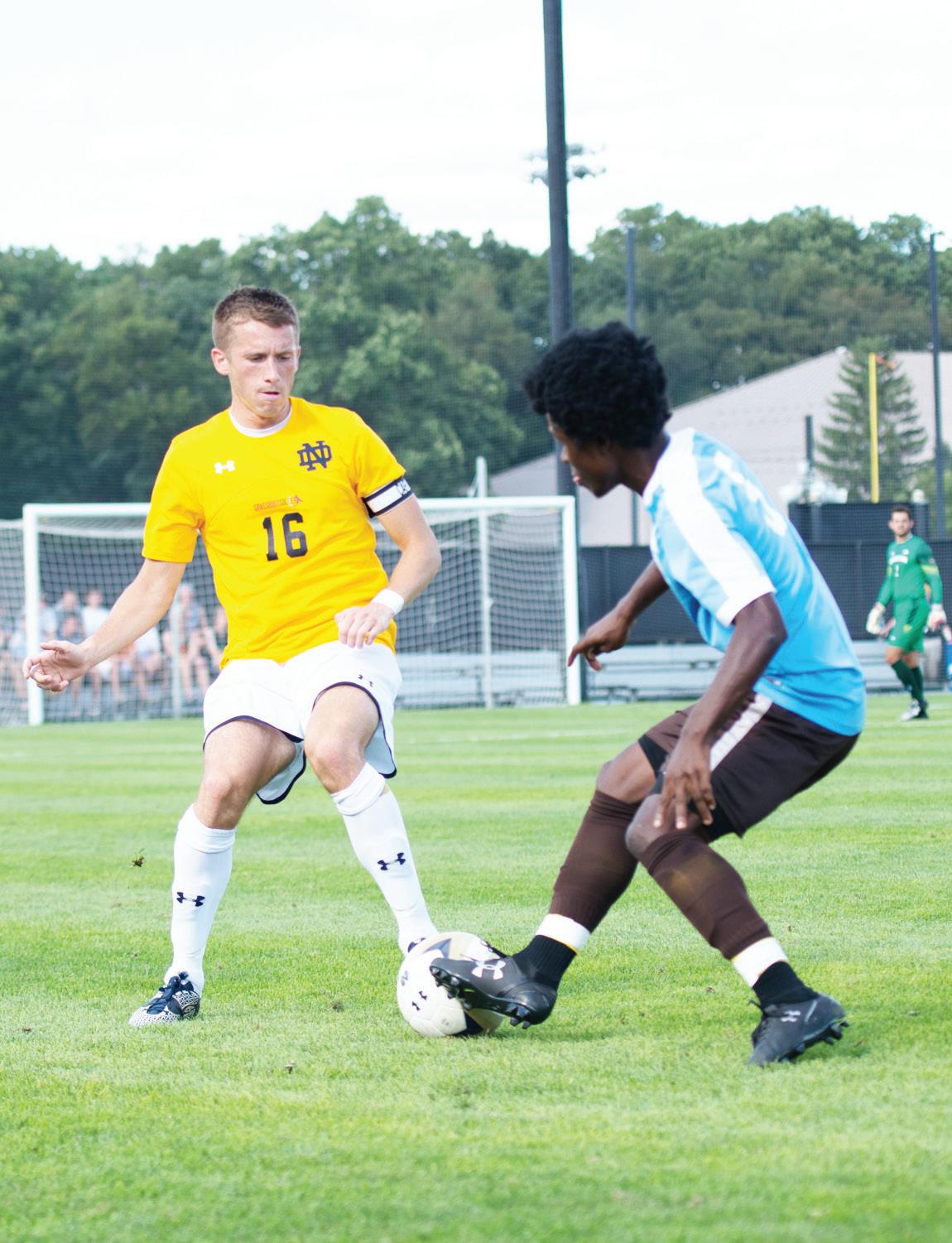
MICHAEL YU | The Observer Notre Dame graduate student captain Evan Panken passes the ball during a 1-1 tie against Valparaiso on Aug. 22 at Alumni Stadium.
CAITLYn JORdAn | The Observer
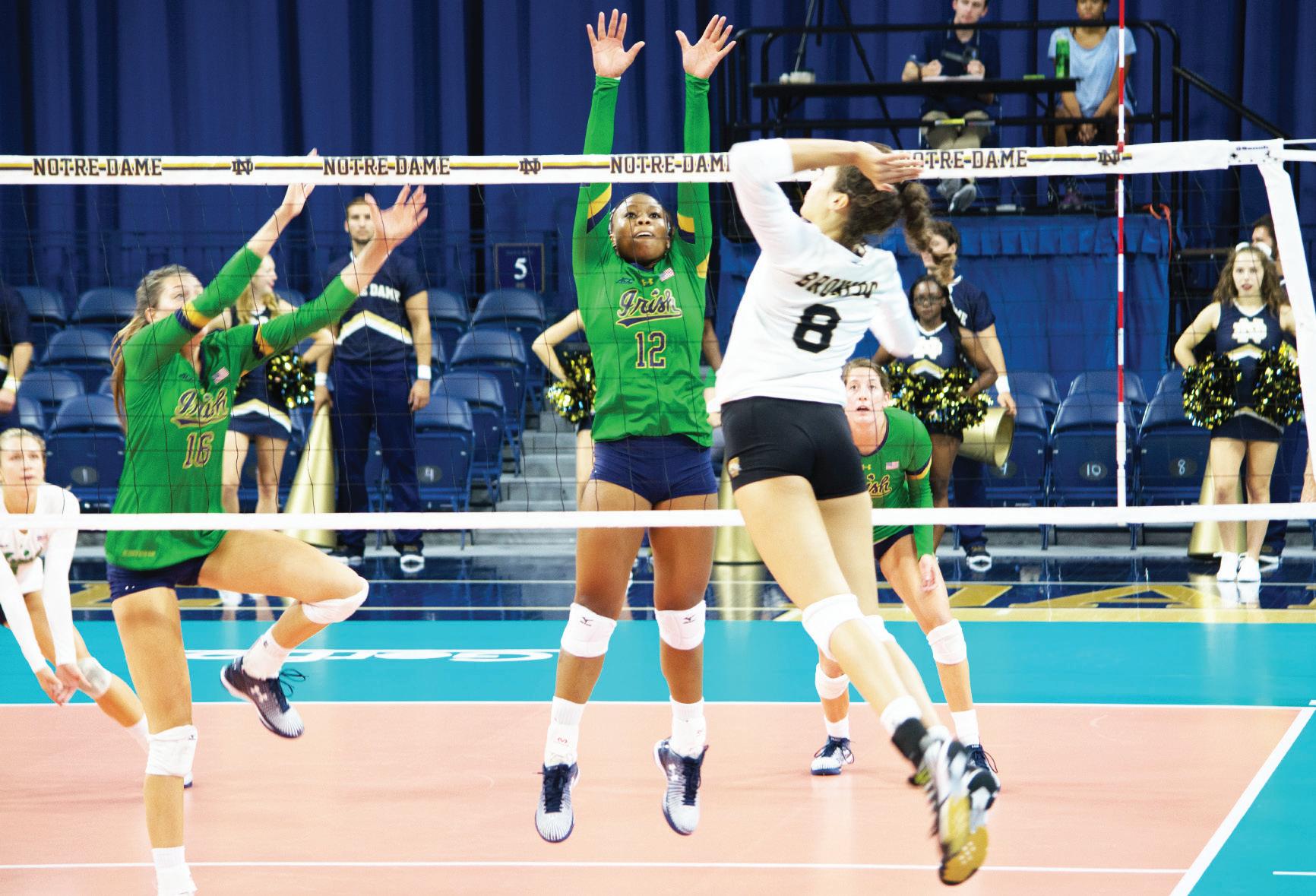
Irish freshman outside hitter Jemma Yeadon rises for a block in Notre Dame’s 3-0 win against Western Michigan during the Golden Dome Invitational at Purcell Pavilion on Aug. 27 .
nd womEn’s soccEr | nd 3, wesTern michigan 0
Irish bounce back with shutout win
By TOBIAS HOONHOUT sports writer
a fter a tough loss on the road to rival m ichigan in their last game, the i rish faced off against western m ichigan on monday night in a game that was postponed a day due to lightning. The final whistle saw notre dame use a large rotation and high pressure to cruise to a 3-0 win.
The first half started slowly, as both teams were tight defensively and waited for an opening. The i rish (3-1, 0-0 acc ) looked dangerous on the counter, especially junior forward Karin muya, whose pace posed problems for the western m ichigan defense. she came close to scoring in the first five minutes from just outside the six-meter box, after senior captain Kaleigh olmsted played a through ball to her. but it was a tight angle and the shot went into the side netting.
notre dame’s pressure and high-defensive line kept the ball in the broncos’ half, and as the game drew on, the i rish started to take control. i n the 19th minute, the deadlock was broken when an olmsted cross bounced off a western
mEn’s soccEr
m ichigan defender and into the net, giving notre dame the 1-0 lead and putting the i rish in the driver’s seat.
a s the half went on, the i rish started to dominate, pushing the broncos (2-1, 0-0 mac ) further and further into their own half. notre dame struck again in the 38th minute when senior midfielder c indy p ineda played a ball through to muya, who controlled and slotted a composed finish past the bronco keeper for the second i rish goal.
“i thought she was buzzing and very active,” i rish head coach Theresa romagnolo said about muya. “she created a lot for herself and made some good passes, so i thought she played well.”
western m ichigan struggled to create chances, and its closest effort came from a 25-yard free kick from junior midfielder Kendall Juhnke that went wide. s enior i rish goalkeeper
Kaela l ittle was largely untroubled in a solid first-half defensive display for the i rish.
i n the second half, notre dame picked up right where it had left off, putting the
c lark fuels notre dame’s recent on-field success
By JOE EVERETT sports writer
a truth universally acknowledged is that behind every great team there is a great coach, and notre dame certainly has one in head coach bobby c lark.
c lark is entering his 16th season at the helm of the men’s soccer program — a program that has dramatically improved under his tenure. since leaving a strong stanford program and coming to notre dame in 2001, c lark has compiled 15 straight winning seasons and a 195-79-51 overall mark. c lark has led his teams to the ncaa Tournament 14 times in his 15 years here at notre dame, including leading the i rish to a national championship in 2013. The 2016 edition of the team has similar national title aspirations, but c lark warned not to crown them champions of anything yet.
“[This team] has thepotential
mEn’s BAskETBAll
auguste signs for l akers
Observer Sports Staff
l os a ngeles l akers general manager m itch Kupchak announced monday his team agreed to terms with former i rish forward Zach auguste. The terms of the deal were not announced and auguste is not guaranteed to make the team’s roster for the 20162017 nba season since the l akers have a deep frontcourt. auguste played with the l akers in the nba summer l eague in l as vegas for four games, averaging 5.3 points and pulling down four rebounds per game. auguste received more than 15 minutes of playing time per contest and started one game. i n his final year at notre dame, auguste averaged 14 points and 10.7 rebounds per game while helping lead the i rish to a second consecutive e lite e ight berth. auguste led the acc in rebounding in 20152016 and was named thirdteam a ll-acc
McLaughlin looks to new season
Elizabeth Greason sports writer
it’s no secret the i rish did not have their best possible season last year. i n fact, with their 7-25 (2-18 acc ) record, the 20152016 season could best be categorized as a disappointment. but last season also falls into another category — one of constant improvement, as evidenced by notre dame’s undefeated start to the 20162017 season, its best start in five years, and stronger play in its spring season. There is no doubt that i rish head coach Jim mcl aughlin has seen a complete turnaround in his team since he took the helm a year ago.
“it’s just a totally different team,” mcl aughlin said. “more mature, more familiar, playing harder, a little bit more confident.”
a s in the spring, mcl aughlin also felt that the team has improved in the physical and technical aspects of the game, and not simply emotionally
and as a team.
“our serve and pass has gotten better, but the thing that has stepped up is, our blocking defense has improved,” mcl aughlin said may 4. “we did two things: we served better; we passed better. i n our blocking game, we created more opportunities and we converted those opportunities. so our blocking [defense] was better.”
however, while the team is leaps and bounds from where it was this time last year, its ability to stack up against topnotched competition, including nationally-ranked p urdue, will be tested when the i rish face the no. 24 boilermakers this saturday.
w hile the i rish put on a strong showing at the g olden dome i nvitational to open the season, the teams they will face throughout the remainder of the season, especially their acc rivals, have simply proven themselves to be better and stronger in the past, with no
MICHAEL YU | The Observer
Irish graduate student defender Michael Shipp attacks the ball during a 1-1 tie against Valparaiso on Aug. 22 at Alumni Stadium.
CAITLYn JORdAn | The Observer
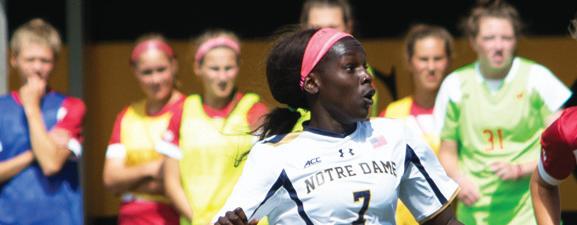
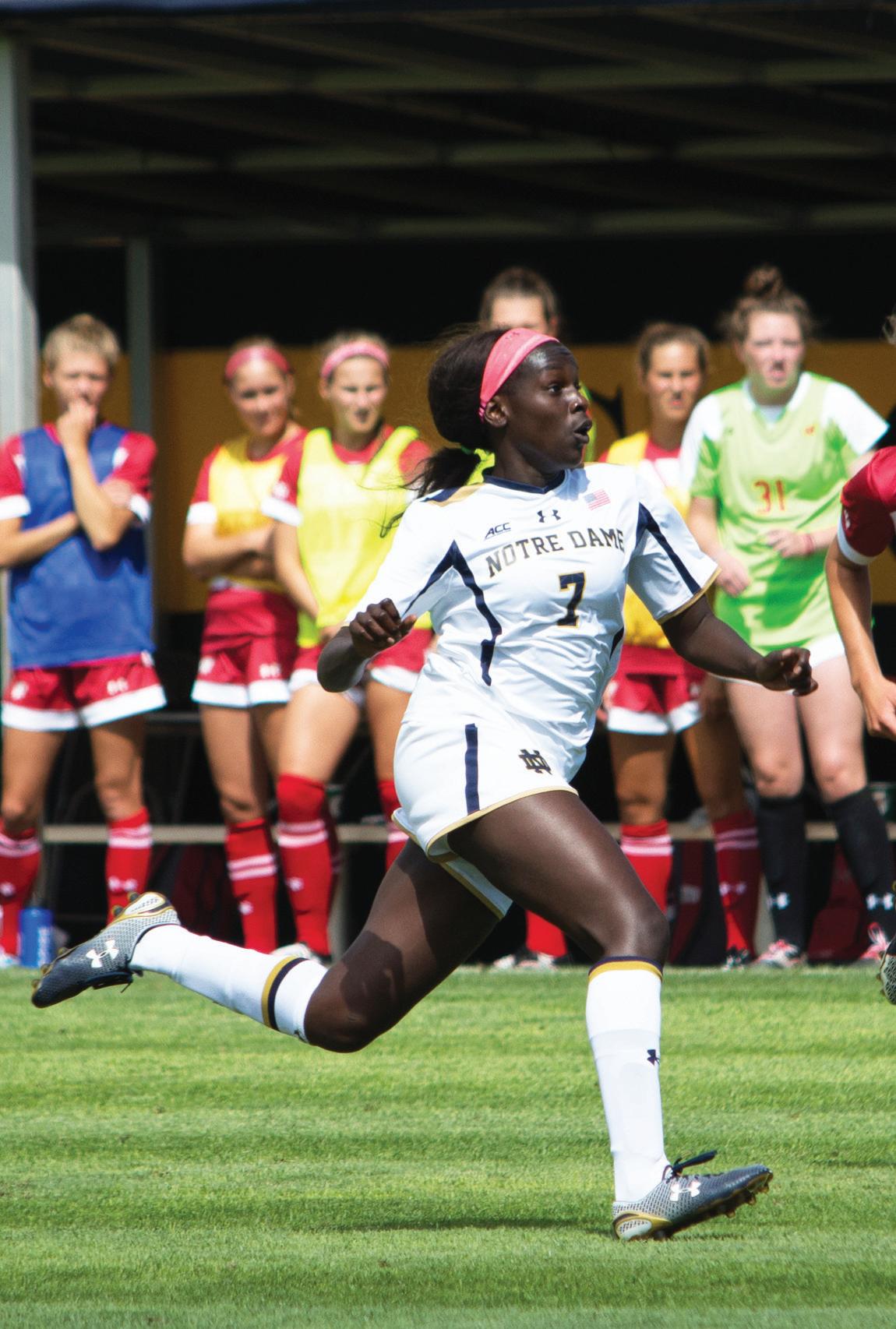
Notre Dame junior forward Karin Muya runs across the field during a 1-0 win against Wisconsin at Alumni Stadium on Aug. 25.