Print Edition of The Observer for Friday, April 15, 2016
Jenkins defends l aetare Medal decision
University president responds to criticism on selection of Biden, Boehner as this year’s award recipients
By KATIE GALIOTO news e ditor
university p resident f r. John Jenkins defended his decision to award the l aetare medal to Vice p resident Joe biden and former speaker of the House John b oehner in an interview with the observer on tuesday, his first comments since the university announced this year’s recipients in a press release on m arch 5.
t he decision sparked a controversy — on campus and on a national scale — and
has received both criticism and support from various members of the notre d ame community.
“I don’t think controversies are necessarily a bad thing if they lead us to have serious conversations, to think deeply about issues,” Jenkins said in the interview.
t he l aetare medal is awarded to an a merican c atholic at notre d ame’s c ommencement each year in recognition of outstanding service to the
speaker
explores gang relations in prisons
By JENNA WILSON news writer
w hile mass incarceration may incapacitate and deter individuals from committing crimes, it can actually empower sophisticated criminal organizations, according to b enjamin l essing. l essing, assistant professor of political science at the university of c hicago, unraveled the complicated dichotomy of prison gangs in a lecture
“a Hole at the c enter of the state: p rison Gangs as a t hreat to state a uthority” on t hursday.
l essing said he focuses on organized armed violence involving non-state actors who, unlike revolutionary insurgents, are not trying to topple the state.
“c rime is a transgression of the authority of the state,” he said. “If everyone is breaking the laws, there is no state authority. c riminals transgress
state authority and punishment restores that authority.”
His research has focused on two gangs: the p rimeirio c omando da c apital ( pcc ) in brazil and the m aras in e l s alvador, l essing said.
“calling them prisons gangs doesn’t convey the scope of these criminal organizations,” he said.
this gang activity can be traced back to mass
prIson paGE 4
CEO examines gender in global consumer economy
By MEGHAN SULLIVAN
news writer
t he mendoza c ollege of business and the university’s gender studies program hosted bridget brennan, ceo of female factor and author of “ w hy she buys,” on t hursday to discuss women’s role in business.
brennan’s lecture, “top trends in marketing and s elling to women,” began by explaining the growth trends in the marketplace.
she addressed the fact that nations like brazil, c hina and India tend to be labeled as the greatest growth markets, but she emphasized that the commonly unmentioned female market is especially large.
“ women are now considered to be one of the world’s largest emerging growth markets because of women’s increased economic participation, educational levels and political participation,” brennan said.
t his increased female
presence in the market has resulted in the creation of programs targeting women by major companies, she said. brennan said companies like under a rmour, l evi’s and Harley-davidson are developing these types of programs with the hope of increasing their brand by including women.
“ women are the engine of the consumer economy, driving between 70 and 80
see trends paGE 4 see laetare paGE 4
Lecture promotes religious dialogue
By KATHRYN MARSHALL news writer
saint mary’s center for spirituality hosted the 31st annual madeleva l ecture on t hursday, honoring the 175th anniversary of the foundation of the sisters of the Holy cross. t he event featured three keynote speakers, all women scholars, to discuss religious dialogue.
sr. eva mary Hooker, professor of e nglish at saint mary’s, began the night reading two
original poems. t he first was based on an image she saw in an illustrated bible, where lines of scripture were being pictorially hoisted into place with a bumblebee and pulley, and the other poem was inspired by the line of sycamores lining the avenue, she said.
“I want tonight to celebrate in poetic image the mission of this college and the sisters who have worked here and the land upon which it stands,” she said.
see madeleVa paGE 3
MONICA VILLAGOMEZ MENDEZ | The Observer
Marianne Farina speaks at the annual Madeleva Lecture in Carroll Auditorium, examining the importance of interfaith conversations.
OLIVIA MIKKELSEN | The Observer
Business
(574) 631-5313
News
(574) 631-4540 scene@ndsmcobserver.com
Systems & Web Administrators (574) 631-8839
Policies
Corrections
t he observer regards itself as a professional
and strives for the highest standards of journalism at all times. we do, however, recognize that we will make mistakes. If we have made a mistake, please contact us at (574) 631-4541 so we can correct our error.
Gabe
“2006
Sam Bradley sophomore st. edward’s
“st.
b team basketball winning all the games.”
Will Minor sophomore st. edward’s Hall
“Kobe on wednesday.”
Andrew Rebholz freshman carroll Hall
“t he Immaculate reception.”
Michael O’Connor sophomore morrissey manor
“cal r ipken’s record for consecutive games played.”
Matthew Grothaus junior fisher Hall
“fisher b team soccer ‘winning’ the championship last year.”
Friday
Unveiling
MICHAEL YU | The Observer
SMC fine arts departments to stage ‘CHICAGO’
By JORDAN COCKRUM news writer
s aint m ary’s will present the musical “ c HI ca G o ” this weekend, with performances f riday, s aturday and s unday.
“It’s a very strong cast that we have in this show, and the sense of energy that fills the auditorium when they are performing these numbers is electrifying,” director m ark a bramc openhaver said. “It’s a fun evening of theater.”
“ c HI ca G o ” tells the story of the women in c ook c ounty Jail for murdering their husbands. However, beyond the surface of the story, the play explores history and demonstrates the innate need to feel important, a bram- c openhaver said.
“ w hat we see is characters that are desperately trying to be acknowledged as being important in some way,” a bram- c openhaver said. “ t hey each go about doing that in different ways, but, in spite of the fact that they have this really human need that people can relate to, the way we see them go about it is really dark.”
a bram- c openhaver said the need to be acknowledged and feel important is precisely what makes the play relatable to so many.
“ t hey violate the law, they manipulate the press, they manipulate the court system — they are just really cynical about rules and ethics,” he said. “ n one of those things are really important to them in their quest for attention. t his might sound like some people we all know.”
n ot only does “ c HI ca G o ” explore the human desire for recognition, but it also is an empowering story for women, a bramc openhaver said.
“It is irreverent and it is sexy,” a bram- c openhaver said. “ e specially this being a story about women, it is about female empowerment and females claiming power where they normally have none. t he opening number is clearly that — these women in situations where they are all murderesses, they are all on trial for their lives — but they are in this number claiming that what they did was the right thing to do.”
t he sexiness of the play is
pa I d a dV ert
Isement
something that sets it apart from other musicals, first year Jennie l iu said.
“ t he costumes are professionally made, personalized and more revealing, and the script contains some words that would normally be replaced in a high school play,” l iu said.
l iu wanted to participate in the production to experience a new type of theater, she said.
“I decided to participate in “ c HI ca G o ” because I loved the movie and the musical, and I wanted to see how a college production is different from a high school production,” l iu said.
d ue to its unique nature, “ c HI ca G o ” differs from even other college productions, a bram- c openhaver said.
“ t his is going to be unlike other shows that you see at the schools, either s aint m ary’s or n otre d ame,” he said. “ t his is edgy, it is jazzy, and it is sexy in a way that many of our shows don’t have the opportunity to be.”
Contact Jordan Cockrum at jcockrum01@saintmarys.edu
Madeleva
“we have all built together a place in which we seek wisdom.”
f ollowing the poetry reading, m arianne f arina, a professor of philosophy and theology at Graduate t heological u nion in b erkley, c alifornia, spoke on “ s acred c onversations and the e volution of d ialogue.”
m utual understanding and enrichment comes from sacred conversations, as such dialogue helps one appreciate the holiness of religions and cultures, she said.
“ s acred conversations contribute to a deep theology, which like deep ecology contemplates the interconnectedness of all the cosmos,” f arina said. “ t his deep theology evinces an evolutionary consciousness skilled at holding it in esteem, the unenthused complex and enthused connection that exist between all living beings and the goodness God has ordained for each.”
t hese conversations are opportunities for communication with self, God and others, f arina said. t his idea is shared between c hristian and Islamic traditions.
“ f or as the sacred texts of c hristians and m uslims proclaim, ‘God spoke and creation came to existence.’
t hese texts also tell of God’s continuing communication with nature in ways that foster a deep interiority in our encounters with cultures and religions,” she said.
f arina said she had a religious experience of her own when providing cyclone relief efforts for an island off b angladesh. t he island population heard another storm was coming, and f arina spent the night of the scheduled storm in the second story of a building with numerous other women and children, many of whom were m uslim.
f arina said the eye of the storm spared the island and very few were harmed. s he noticed the m uslim women never stopped praying that night, and asked why the following morning.
“ o ver a simple breakfast we had the chance to share our experiences of that fearful night,” she said. “ t hey remained in the prayer circle because if that night was to be their last, they wanted to meet God together as a community uttering God’s own words on their lips. a t that moment and in their telling, I gained insight.”
f arina said dialogue and communication are important and evolutionary when they enter into the depth of shared existence in God. t his movement is not linear, but rather a discovery of God’s presence in everything, she
said.
“ s acred conversation assists our entry into this depth, where we experience spiritual power,” she said. t he response by s isters of the Holy c ross in b angladesh is an example of the way mission and dialogue crosses numerous boundaries, she said.
“ t hrough [sacred conversations], we stand in solidarity with all others filled with hope, especially at the foot of the cross, bearing witness to ... a future larger than ourselves,” she said.
a sma a fsaruddin, a professor in the department of near e astern languages and cultures at Indiana u niversity, said she has met f arina multiple times at various symposiums. a fsaruddin responded to f arina’s talk and said she appreciated f arina’s passion for open interfaith dialogue.
“ c hange is to be affected first internally in the individual before any meaningful external change can take root,” a fsaruddin said. “ t he most important site for bringing out genuine individual change, followed by social change, is clearly the human heart. transformation of the human heart occurs by making it receptive to God’s will and becoming filled with God consciousness,” she said. b oth c hristian and m uslim traditions emphasize internal transformation and reconciliation with the creator and created beings to live an open life which can develop profound self-knowledge, she said.
“It is fitting that m arianne should end her inspirational talk by emphasizing hope, to which God calls us to bear witness,” she said. “ b oth c hristianity and Islam are founded on hope. t he Quran and the b ible assure us that we must never despair of God’s love and solicitude for us and never lose faith in the ultimate goodness of human beings.”
a fsaruddin said she agreed with f arina that humility and hospitality are necessary for sacred conversations and inter-religious dialogue, because these conversations allow people from different traditions to celebrate interconnectedness and common responsibilities to promote what is good.
“ s acred conversations help to keep this compact among ourselves alive and relevant,” she said. “a nd most importantly of all, these sacred conversations help us to push back against other profane conversations that seek to divide and form hatred, of which unfortunately, as we know, there has been way too much lately.”
c hurch and society. t he award honors c atholics in all different fields; recent recipients include singer a aron neville, biologist Kenneth m iller and poet dana Gloria.
t he decision to honor two c atholic politicians was not a timely one in light of the upcoming election, Jenkins said, but instead meant to recognize biden and boehner’s many years of service to the country as their political careers begin to wind down.
“ we’re not endorsing the active politicians who are going to have a campaign,” he said. “but I thought it was an opportunity to recognize people who had risen to the very highest level of political leadership. for their dedication to public service, their willingness to work with others for the common good, we recognize them with the l aetare.”
Jenkins said the decision to award the medal to two members of different political parties was to avoid any perception of the university endorsing one or the other.
“I said before, and I’ll say it again, this award does not endorse the particular positions of either person,” he said. “… I think it’s significant these two men, despite being of different parties disagreeing on so much, became and remain friends.”
t he decision was meant to address the division and animosity present in today’s political environment, Jenkins said.
“I do want, with this award, to fight against the tendency that those who disagree with us are necessarily evil or worthy only of our disdain,” he said. “ we can disagree — and even disagree on significant moral issues — and still find laudable qualities in those with whom we disagree.”
e ach year, a committee provides recommendations to Jenkins, who is free, but not required, to select an honoree from the list of suggestions. biden and boehner were not on this year’s list of proposed recipients, but Jenkins chose to award the medal to the two individuals after discussing the matter with the committee, he said.
In response, bishop Kevin r hoades, of the fort waynes outh bend diocese, released a statement condemning the university’s choice due to biden’s stances on abortion and gay marriage. r hoades said he is concerned honoring biden and boehner will provoke “scandal,” as defined in the c atholic sense.
“t hat is a somewhat technical word in c atholic thought that means that the action creates the impression that we’re sanctioning or encouraging immoral or unjust actions,” Jenkins said. “I have the greatest respect for the bishop and want to respond by explaining our intentions, in the hope that I can counter any misperceptions leading to scandal.”
multiple groups have written letters to the editor in the observer’s Viewpoint section voicing their dissent. more than 2,700 individuals — many
— and just about everyone in between,” brennan said.
percent of all consumer purchases,” she said.
t he domination of women in the marketplace can attributed to two factors: buying power and influence, brennan said. a n increased percentage of women with a higher education has increased their earning power and contributes to their buying power, she said.
“Influence means that even when a woman isn’t paying for something with her own money … she is typically the influencer or veto vote behind somebody else’s purchase,” brennan said.
a dditionally, brennan aimed to counter the stereotypes surrounding women and shopping. a s opposed to the misconceptions that women only care about shopping for shoes or handbags, she explained that women’s spending habits serve a greater purpose.
“ t he reason women are so responsible for consumer spending is because, in virtually every society in the world, women have primary caregiving responsibilities for both children and the elderly
notre dame alumni — have signed a petition professing their agreement with the bishop, urging the university to reconsider the decision.
Jenkins said he wants to articulate the meaning of the award and his reasons for choosing it, a lesson he learned when the university invited obama to speak at notre dame’s 2009 c ommencement.
“ w hat I’ve tried to do, and will try to do, is just explain clearly what we’re doing,” he said. “people can disagree; I don’t think that’s necessarily a bad thing, as long as it leaves to substantive, constructive discussion and not just acrimony.”
a majority at the criticism is directed at biden, which Jenkins said he is afraid reflects a one-sided partisan approach.
“I’m certainly not saying that I support all the Vice p resident’s positions,” he said. “but I do find, in the record, that he took account of his c atholic faith, even while trying to make decisions on legislation — that’s often complex in a nation on issues on which the nation is deeply divided.”
u ltimately, Jenkins said he thinks a public servant can exemplify what it means to be a c atholic leader, regardless of his or her political affiliation.
“I think it’s important to evaluate, to take account both of that range of [ c atholic] teachings and take account of the complex realities of our nation that is so deeply divided on these issues,” he said.
Contact Katie Galioto at kgalioto@nd.edu
such a culture has led to a “multiplier effect,” brennan said. b ecause women tend to be responsible for purchasing things for the important people in their lives, they influence the market for even items like men’s athletic apparel, she said.
a s a result, brennan’s work at female factor has focused on identifying and monitoring women’s trends in the market. t he first major trend brennan said she saw was the large percentage of women in today’s labor force.
b ecause 70 percent of women with children under the age of 18 are a part of the labor force, today’s business must accommodate for time limitations on women’s shopping, brennan said. o perational hour changes and convenience-focused business models are ways in which companies can address time needs.
“ w ith less time, there’s a demand for services, not just products,” brennan said. similarly, brennan has also observed trends relating to the delayed marriages of today’s women. b ecause women tend to wait until the age of 27
incarceration, l essing said.
“sophisticated prison gangs consolidate control over inmate life — they provide an entire system of government within prison. t hey propagate through the prison system and project power onto the streets,” he said.
Governmental actions and laws targeting both low and high level offenders may have actually made gangs more powerful, l essing said.
“Increased incarceration rates further the powers of the gangs, and therefore, beyond a certain point, punishment undermines state authority,” he said. “mass incarceration and poorly translated gang policies transformed how the gangs were organized and actually made them more powerful.”
l essing’s research focuses on how incarceration effects the collective gang culture. He said within the prison environment, the stability these gangs can provide can create a more positive environment.
“everybody wins — prisoners, guards and politicians,” he said. “a prison guard in brazil told me that his job is easier because of the collectivization.”
However, with this increased of power within prisons, gangs also have increased their control outside of the prisons. l essing said the first time social scientists were able to observe the strong power of gangs on the streets was during a pcc terror attack that shut down são paulo for four days.
to get married and because they are more active in the labor force, they are more likely to have the desire and means to purchase things before marriage.
brennan said the delayed marriages also have an effect on family formation that influences the market. for example, women married later in life tend to have kids at a later time, and because they are older, they are more entrenched in their personal brand and impose this brand on their kids.
“m any brands are finding that they have an opportunity to either age up or age down the spectrum because there is a broader embracing of brands across the age spectrum,” brennan said.
a variety of additional trends led by the female market, such as social media and fitness trends, have highlighted the increased role of female empowerment in advertising, brennan said.
“It is positive to see that strength and femininity is being positioned as something powerful in the marketplace,” she said.
structure, it is critical to understand why those who are not incarcerated would support gangs, l essing said.
“t hinking about this projection of power, there is this kind of fundamental puzzle: why would people on the street take costly and risky actions on behalf of the leaders?” he said “It’s simple: what you do on the outside, you have to answer for on the inside.”
according to l essing, people on the streets do what the gang wants, even though this activity leads to an increased chance that they will be arrested. If they support the gang, they will be protected in prison — their support for the gang alleviates the blow if they are ever put in prison, he said.
“It is the promise of a notso-bad time in prison, with a higher likelihood of going to prison,” lessing said. “If this is true, prison gangs depend on high incarceration rate. t hose on the outside need to think they will go back to prison.”
t his ultimately contributes to a changing power structure, both inside and outside of the prison, l essing said. once again, l essing said that there are both positives and negatives to this changing power structure. w hile it decreases the power of the state and increases the drug trade outside of prison, l essing said this consolidation and power structure leads to less violence in gang-controlled communities, as there are fewer turf wars.
“prisons gangs have a unique ability to control street level drug markets, and this is an unusual thing, because these street level markets are usually extremely fragmented,” he said.
In order to understand gang
“overall, my theory says that if prison gangs are getting more consolidated and incarceration rates are increasing, the projection onto the street should increase,” he said. “t his will lead to changes in the street level criminal structure and behavior.”
Contact Jenna Wilson at jwilso35@nd.edu
By ERIN McAULIFFE scene e ditor
As an inconsistent South Bend spring breeze rolled through the windows, Brian Powers of Frances Luke Accord talked about his band and their upcoming album, tour and South Bend shows over the steady tick of his flashers in a black, five-seater car parked illegally in Library Circle.
Brian Powers and Nicholas Gunty formed Frances Luke Accord during their senior year at Notre Dame. They played a secret show with fellow Chicago-via-South Bend act Ratboys at Bond Hall that year, along with frequent performances at AcoustiCafe and Legends … until they didn’t.
“We got banned from Legends, actually,” Powers admitted, pulling at the zipper on his worn navy hoodie. Their senior year, the duo opened for Girl Talk at SUB’s now retired B1 Block Party concert series (a lineup that is painful to acknowledge with the recent announcement of The All-American Rejects for this year’s spring show).
Powers babysat contributing violinist Christian Rougeau during Powers’ freshman year at Notre Dame. Although Rougeau was significantly younger than Powers, the two started to play music together. Rougeau’s family moved to Boston while Powers was still at Notre Dame, but they flew him back to play Girl Talk’s opening set.
“Since it was his first time back in South Bend after moving, he wanted to invite all his high school buddies to hangout with him — he’s a 17 yearold. The Block Party was 18 and up, so we snuck all of his friends in with our backstage passes.
“One of his friends walked in the front gate with our backstage pass and the Legends people yelled at us. Then they had the audacity to call us three weeks later to tell us again they were disappointed in us — and that we were banned from Legends for good.”
With one of two on-campus music venues off limits, the duo turned to South Bend for exposure and playtime.
“That kinda forced us to do more at Fiddler’s Hearth — we did some house
shows. The South Bend music scene was not even close to what it is today. It’s unbelievable to see how much it has blossomed in the last three years, and even though we went to Chicago, we’ve been able to capitalize on it. We’re from South Bend, we went to Notre Dame, we played The Pool a bunch of times — we have that connection. The scene is awesome now and we’re super stoked on it,” Powers said.
Since quitting their jobs at the end of last summer to tour this fall, Powers and Gunty have been back in South Bend working on their album.
The band will continue their South Bend music scene ventures at their April 30 LangLab album release party. They plan to play songs from their new album, but the sound will differ from the recorded version.
“We have different live arrangements — mostly because we both play a decent number of instruments but only have two hands. And there’s the crowd interaction, there’s so much that goes into a live performance,” he said.
“Fluke,” Frances Luke Accord’s debut full-length album, is set for national release on May 20, but it will be available on CD and vinyl at LangLab on April 30. The physical copies feature artwork by Nicholas Gunty, a Notre Dame Studio Art major with a concentration in painting. With live shows and merchandise making up a large portion of artists’ profits these days, the duo is hoping to get a good showing for the event.
The band joked about Spotify’s minimal returns in a recent Facebook post: “We’re hoping the 0.006 cents per play we make can buy us a candy bar to share by the end of the week …”
Although the joke brings to light the consequences of today’s music consumption norms, Powers doesn’t scorn streaming.
“I use Spotify, too, because it’s awesome. It’s tough because the money right now comes from touring; you have to be a live touring act … For me, if I really like an artist, I’m going to listen to them on Spotify — but I’m also going to shell out 30 bucks and buy their vinyl,” he said.
However, tours — especially the one on which Frances Luke Accord are about to embark in the same car where the interview was conducted — are not a sustainable or even healthy model for profitability.
“We’re not sleeping in hotels every night, we’re not getting fed well — we’re still in the grind phase. Our mindset is to hopefully tour really hard for 7 or 8 years and kinda see what happens,” he said.
Powers spoke on the playlists that will accompany them on their drive across the country.
“Nick and I are both huge suckers for ambient music. One of my favorite Pandora stations is the Native American flute station. Listen to that shit. Oh, and if you’re looking for an ambient artist name drop, Steve Roach,” he said.
Their eclectic instrumental tastes shine in “Fluke”: ambient car music floods the intro to the fittingly named “On The Road” while “Stones I’ve Thrown” features the Native American flute Powers recently bought in Denver.
“Ultimately we want to play the kind of music we listen to — and we listen to a grab bag of stuff,” Powers said.
Their range of influences leaves Frances Luke Accord›s new music in a transient dance between worldly ambient, Americana folk and instrumental. “Fluke” features humming, whistling, snapping and clapping in the same space as samples of a moving train atop dramatic orchestral-esque layering.
“When you put yourself in a category, which is what a genre is, you’re absolutely limiting yourself. When people see us play we definitely have a singer-songwriter, folk persona — but we don’t ever want to be labeled just as a folk band,” Powers said.
Not signed to a record label, Powers and Gunty funded a successful Kickstarter for “Fluke,” allowing them to upgrade microphones and equipment for a higher quality sound. However, their self-production still has an endearingly low-key accessibility.
“I definitely think you get a DIY feel from our recorded music, because it’s
made in our apartment. We obviously go and record like a grand piano and drums in a studio, but everything else is recorded in our apartment,” he said.
The album’s name, “Fluke,” pulled inspiration from their band name and their Chicago-based house concert and video series Fluke Takes — they also don’t want people to take them too seriously. However, they are more proud of this album than any of their previous work.
“I think our songwriting process is one of the biggest reasons this album is different than our previous work — and also the reason we feel so strongly about this album.
“When we first met in college, I was a singer-songwriter and Nick was a singer-songwriter, so we would both write our own songs and then just play on each other’s songs. But for the first time on “Fluke” the writing process was more collaborative. A song’s initial melody always needs to come from one of us — about 50% of the song — but it’s almost always finished together now,” Powers said.
Powers and Gunty live together, allowing them to capitalize on their often spontaneous songwriting inspiration and bursts.
“When you’re not trying, you’ll pick up an instrument and a melody come will come you. You’ll like a little part of it so you decide right then and there, ‘That’s the spark, this needs to be hammered out’ — and that’s when the labor really comes in,” he said.
Powers encourages any aspiring Notre Dame musicians to join a band and give it a shot.
“ t he music industry is a tough place to be and, if you’re savvy at pushing your own music, no one’s going to be more committed to the goal of getting your music out there than you are.”
Frances Luke Accord will be headlining Lakeside outside Carroll Hall this Saturday at 4:05 p.m. Tickets are $3 presale and $5 at the door. All proceeds benefit The Boys and Girls Club.
Contact Erin McAuliffe at emcaulif@nd.edu
insidE ColuMn
The Half that didn’t happen
I woke up to snow on a pril 9. a ctually, no — I woke up to a blizzard. I looked over at the t-shirt and shorts ensemble I had laid out for that morning and felt my stomach drop. f or four months I had looked forward to (and dreaded) this day. d espite the weather, I threw on two sweatshirts and began the long, cold trek from r yan Hall to s tepan c enter. t he atmosphere in s tepan the morning of the Holy Half was one of excitement and confusion. t he race had already been delayed 15 minutes as the snow continued to pile on the ground, and I had the sinking feeling the organizers would soon announce what everyone in the room was thinking. a t 9:10, five minutes before the race was supposed to begin, a statement was made that the 12th a nnual Holy Half was canceled due to potential safety hazards along the race path.
I never anticipated the sadness I felt as I walked home. I didn’t run a half marathon that morning. I didn’t get to do round two and attempt a new p r . from last year’s Half. I had planned on running the race every year I attended n otre d ame, and it was overwhelmingly disappointing the weather decided I would be unable to do that.
I tell my friends I do one cool thing a year, and that cool thing is always the Holy Half. m y training plan both years was abhorrent, but I was looking forward to pushing myself for a little under two hours with 1500 other runners. I didn’t pick up running until I came to college and I couldn’t find the motivation to hit the tennis courts every day as I had in high school. a s I walked home, I remembered the shared disappointment, as people reflected on months of training and anticipation. s ome still ran in the snow, but I knew it was something I couldn’t do, as I nearly slipped three times just on the walk over.
a lthough I didn’t end up running the race, I am still glad I made the goal in d ecember to beat last year’s time. It pushed me on offdays, and kept me going. It was what got me through the last few miles on a long run, and gave me a little bit of purpose in each day. e ven if I would have a bad day, I wouldn’t have a bad run. I know that the Half is a goal for a lot of people, and even though the majority of the runners didn’t accomplish that goal physically, I still believe they completed it. a canceled race doesn’t negate the hard work and hundreds of miles run during training. t here will always be a little leftover sadness for the Half that didn’t happen, but I am still grateful for the way it pushed me to be better than I was and for the purpose it put into every day. a s I start my training for the 2017 c hicago m arathon, I can only hope it doesn’t blizzard in early o ctober.
Contact Susan Zhu at szhu4@nd.edu
The views expressed in the Inside Column are those of the author and not necessarily those of The Observer.
the ideal campus concert
e di T orial
t his week, sub announced the a ll-a merican rejects will play on campus for the annual spring concert, setting our middle school hearts aflame — after going years without hearing the classic “dirty l ittle secret,” we relish the chance to once again belt out the lyrics of our former favorite songs.
apparently some students are immune to the powerful force of nostalgia, however, and were less than pleased by the announcement. Here are our editorial board’s recommendations for who should take the stage after the a ll-a merican rejects “move a long” next weekend:
Cathy Richardson and the Dropkick Murphys now several long months removed from football season, who wouldn’t seize the opportunity to relive those sunny (or not so sunny) football saturday afternoons swaying along to r ichardson’s honey-toned classic, “Here come the Irish,” followed by none other than notre dame’s jarring unofficial theme song, “I’m shipping up to boston”? a match so perfect it had to have been made in heaven, the combination of these two songs embodies the spirit and irrational love for tradition of all true notre dame football fanatics.
Phil Collins w hat more perfect throwback is there? collins is a throwback artist to all of your throwback childhood disney favorites, reminding you of the blissfully nostalgic nights you spent at Grandma and Grandpa’s. It’s too perfect, really: a s soon as the first notes of any tarzan song echo off the walls of stepan center, everyone will forget they’re college students supposed to be entering the fully adult world in a year or two.
The cast of “Hamilton” rumor has it the core curriculum review committee will issue its final recommendations soon, including one that the university replace the general history requirement with mandatory viewings of “Hamilton,” l in-manuel m iranda’s hit musical sensation. nobody wanted to take “t he History of a ncient Greece” or “t he topography of a ncient rome” anyway, so why not knock three credits out of the way for the small expense of $20 and your otherwise boring friday night?
Cher Lloyd, again seriously, at this point, notre dame students should be singing “want u back” in c her l loyd’s direction, rather than the other way around. w hile her concert last year wasn’t the biggest hit in the world, at least her music doesn’t make you relive your eighth grade identity crisis. “w ith ur l ove,” a more appropriatelysized venue and playing after someone who isn’t Jesse mccartney, 2016 could finally be the year c her l loyd hits it big at notre dame.
A cardboard cutout of Kanye West w hile a bit unorthodox, a cardboard cutout of Kanye west is the perfect choice for a campus concert not because of what it can do, but because of what it can’t do. a cardboard cutout can’t cry at your concert the way Jamie lynn spears did. It can’t make you feel uncomfortable about going to college the way shaun w hite’s band did, or break his wrist skateboarding before the show like drake bell did. It can’t get arrested for drug possession like some rumored sub artists (cough, t-pain) did, or cancel on us the way the c hainsmokers did. a nd most importantly, a cardboard cutout can’t disappoint us, the way the campus music scene does every show.
Avril Lavigne
If we’re going to go with 2000s pop stars, everyone knows avril takes the cake. she even looks exactly the same as she did back in her glory days. everyone can relate to her angsty teenager punk-rock anthems; w hat better for a college campus? “sk8r boi,”
“Girlfriend” and “complicated” would be huge hits.
The Treblemakers w ith their juice pouches, copy of “t he breakfast c lub” and those hot guy smiles, the treblemakers from the modern classic “p itch perfect” are an easy choice. w ith his love for star wars and his adorkable sideburns, benji melted our hearts as he belted out “magic” with his fellow acca-bros. from hitting the high notes in “since u been Gone” and to his sensual take on foreigner’s song “feels l ike t he first time,” Jesse can make you forget that he’s a human being. together, the duo will bring in all the pitches.
Fall Out Boy
fob through and through. It’s time to stop belting one song at dorm parties and bring them to the wonderful place that is the stepan center — everyone should be exposed to the fact fall out boy has more songs than “sugar we’re Going down.”
The von Trapps no, not the musical family of seven children, c hristopher plummer and Julie a ndrews in the rodgers and Hammerstein classic “t he sound music.” now, it’s their grandchildren, a quartet from portland, oregon, who have been touring the country and sharing their favorite things and edelweiss with a merica. sofia, melanie, a manda and august are sure to get everyone on campus singing along in no time.
Ryan Adams no one is hotter than taylor swift right now, so why not book the hottest taylor swift cover artist? substitute sold-out arenas for the intimate atmosphere of stepan center and watch adams shine. He lacks the star power of t-swizzle, but give him a stage and adams may yet surprise you.
The Zetta Bytes and Loretta Modern (the DCOM Hologram)
dear people who “code for fun” or anyone who has stepped foot in that radiation building: please recreate l oretta modern from the disney c hannel original movie ( dcom ) “p ixel perfect.” “phil of t he future” did it; there is no reason an engineering department that prides itself on “tech developments that overshadow 2004 dcom predictions” can’t. a lso, “a hologram from a low-budget television movie that aired 12 years-ago” fits in perfectly with the sci-fi/horror film interior decor of everyone’s favorite geodesic dome.
Nickelback
a nother late-90s rock band with somewhat strange and not-so-meaningful lyrics, nickelback provides something the a ll-a merican rejects lack — a strong anti-fan group. bringing nickelback to campus would be a more daring and controversial decision, opening the door for some fun dialogue and classic nickelback jokes.
Billy Joel
seeing as his on-campus concert in 1979 went over so well with the university administration, inviting billy Joel back to notre dame would be a no-brainer. It may be a controversial decision, but we would all love to spend $20 to listen to billy Joel sing “only the Good die Young” six times, just like our parents did 37 years ago.
Colonel Chris Hadfield
Heard on stations orbiting around the globe, this fighter-pilot-turned-astronaut has spent much of his time missing the earth. His success on the International space station proved that anyone can be successful performing in venues far away from civilization ( stepan center, anyone?), and his 2013 recording of david bowie’s “space oddity” was out of this world. down on earth, our down-to-earth rocket man opened a 2014 maple l eafs hockey game with canada’s national anthem, “o canada,” reaffirming the fact that everything is better on ice.
Susan Zhu Graphics e ditor
To ThE EdiTor
Notre Dame for restorative justice
according to the catechism of the catholic church, punishment for a crime, “in addition to defending public order and protecting people’s safety, has a medicinal purpose: as far as possible, it must contribute to the correction of the guilty party.” In 1980, 32 percent of a mericans agreed the primary purpose of prison was to rehabilitate, not punish; by 1993, 61 percent of a mericans felt that prison was a place strictly for punishment. this shift in opinion has filled our prisons with repeat offenders, wasted taxpayers’ money, perpetuated racial discrimination and, above all, harmed our communities. the time to shift the model of our justice system is now. notre dame for restorative Justice suggests the remedy of restorative justice. the theory of restorative justice addresses the needs of the victim, the community and the offenders. w hile we tend to think first of the needs of the victims and communities that have been harmed, restorative justice reminds us most offenders have needs, as well. to quote Howard Zehr, the pioneer of a merican restorative justice, “If we are to expect [offenders] to assume their responsibilities, to change their behavior, to become contributing members of our communities, restorative justice assumes that these needs must be addressed as well.”
one key tenet of restorative justice is that “crime is to be viewed as a violation of the individual, rather than just as an offence against the state.” this region of Indiana is already well versed in restorative justice, as the center for community Justice in elkhart launched the first Victim offender reconciliation program (Vorp) in the united states. we have personally seen and experienced restorative justice in practice in south bend through talking circles at rise up academy, reading for life (a program that has recently received attention from the w hite House and catholic charities), and spending time at dismas House, the transitional housing program here in south bend for individuals recently released from incarceration.
In addition to our shared humanity that necessitates a
more compassionate justice system, the financial dimension of the current justice system demands reform, as our retributive approach is expensive for the community and the taxpayer. the state of Indiana pays tremendous daily costs for juveniles and adults incarcerated in the justice system. a lternatively, restorative justice programs, while sometimes expensive to put in place, ensure lower recidivism rates and long-term cost effectiveness. ultimately, it is better to invest in community-based initiatives and legislation that focus on the respect and dignity of each person involved in a crime, such as the second chance reauthorization act and the sentencing reform and corrections act of 2015.
w hile small scale restorative justice programs do exist throughout Indiana, we are nowhere close to being able to implement them statewide. engaging the humanity of every individual and encouraging an atmosphere of love in the face of hate is necessary, but changing our laws incrementally is also required in order to enable an environment in which restorative justice could be widespread. the second chance act and the sentencing reform act are congress bills on the docket that could direct the legislative environment and public opinion toward a more humane, cost-effective approach to justice. the second chance act strengthens reentry programs ranging from job training to substance abuse treatment and provides opportunities for behavioral change that would otherwise not be available in the event of incarceration. the sentencing reform and corrections act repairs the mandatory minimum sentences for prior drug felons, gives judges flexibility in sentencing, broadens prison-based reentry programs and limits solitary confinement for juveniles. these bills encourage our government to invest in community-based initiatives, such as dismas House, that seek to break the cycle of crime for the benefit of both the individual and that of society. as an advocacy group through the center for social concerns, nd for restorative Justice has reached out to the south bend community to understand how these
senate bills, if passed, would impact the local community. both state institutions and local initiatives are affected by the justice system in st. Joseph’s county, and all those to whom we have reached out fully support these two bills.
restorative justice, in general, has the backing of groups such as the u s catholic council of bishops. In their 2000 document, “responsibility, rehabilitation, a nd restoration: a catholic perspective on crime and criminal Justice,” the usccb wrote, “a catholic approach leads us to encourage models of restorative justice that seek to address crime in terms of the harm done to victims and communities, not simply as a violation of law.”
a re you willing to stand with nd for restorative Justice in supporting the second chance and the sentencing reform acts in hopes of laying the groundwork for a restorative justice system? we will be communicating their urgency at a meeting with the office of Indiana senator Joe donnelly this week. sign our petition on change. org, “make restorative justice a reality by supporting the second chance & the corrections acts,” to take an active step in making restorative justice a reality in south bend. peace,
Evelyn Bauman senior
Sofia Piecuch senior
Seamus Ronan senior
Adrianna Duggan sophomore
Kelsey Feldmeier sophomore april 13
don’t stand with the oppressor
on april 8, notre dame’s center for civil and Human rights (ccHr) hosted George deek, a representative of Israel’s foreign ministry. deek’s narrative denied Israel’s relentless attempts to rebut the rights of the palestinians, and it discredited the palestinian struggle for justice and equality. during his talk, he presented Israel as a bastion of diversity in the middle east and the world. the idyllic picture deek painted ignores the systematic discrimination and oppression both inside Israel (which is 20 percent palestinian) and under Israel’s occupation of the palestinian territories (of approximately 3.5 million palestinians).
w hile deek’s picture is, at best, whitewashing human rights abuses and, at worst, justifying them, the university is a place of divergent views and dialogue, and may invite a variety of voices. However, we are very concerned that the event was co-sponsored by the ccHr, which claims in its mission statement that “in all of its efforts, the center stands in solidarity with the oppressed, the afflicted, and the vulnerable and seeks to secure their human rights and the conditions for their flourishing.” on friday, the ccHr did not stand in solidarity with the oppressed, the afflicted and the vulnerable. It did not stand with the bedouins of the negev, Israeli citizens whose own government forcefully evicted them from their lands; or with the palestinian families living in east Jerusalem, whose homes the Israeli government demolished; or with the farmers in the cremisan valley, whose 2,000 year old olive groves Israel tore up and replaced with a ‘security barrier.’ It did not stand with the palestinian children who are tortured in Israeli military detention. In short, the ccHr failed to fulfill its mission. George deek exploits his minority “a rab-Israeli” identity and claims the way forward is for a rabs to be
both grateful for their Israeli identity and proud of their a rab heritage. He blames palestinians for not assimilating, while denying Israel’s methodical suppression of palestinian a rab identity — making them secondclass citizens. during the 1948 war, Israel censored palestinian narratives by confiscating approximately 60,000 palestinian books, and, between 1967 and 1993, it was illegal to fly the palestinian flag. the term a rabIsraeli, which deek uses, is yet another construct of Israel to further erase palestinian identity.
In his presentation, deek did not represent the palestinian people; he represented the state of Israel, justifying its apartheid-style policies against palestinians. deek promotes a discourse of political propaganda that denies Israel’s involvement in violations of human rights, war crimes and crimes against humanity that have been exposed by several united nations inquiry missions and by the International court of Justice. over the past few weeks, a group of over 50 notre dame activists hailing from ccHr’s program in International Human rights law, the Kroc Institute for International peace studies, the law school, faculty and various phd, master’s and undergraduate students have unified around their shared investment in human rights. this pro-Justice nd group wrote a letter to the acting director of the ccHr and held a meeting with her and her colleague raising their concerns — which were dismissed. on april 8, the group stood in the freezing rain to hand out flyers, meet student passersby with factual information and display a wooden replica of the separation wall on which they painted smaller versions of real graffiti art from palestine.
the ccHr has failed in its mandate to “equip human rights lawyers and other students to become champions
of human rights.” by sponsoring an Israeli diplomat who completely ignores Israel’s illegal occupation and its devastating effects on palestinians, the ccHr failed to educate the campus community, and instead served as a propaganda tool to further Israel’s political agenda. this talk gave volume to only one side of an already asymmetrical conflict and silenced the voices of the oppressed, afflicted and vulnerable. we worry this sets a dangerous precedent for future events.
for more information on Israel’s subjugation of the palestinian people, check out If a mericansKnew.org and JewishVoiceforpeace.org. If you would like to get involved to ensure notre dame upholds its mission statement to cultivate “a disciplined sensibility to the poverty, injustice and oppression that burden the lives of so many ... to create a sense of human solidarity and concern for the common good that will bear fruit as learning becomes service to justice,” please email humanrights. peace.nd@gmail.com
In the words of paulo freire (which were displayed on the pro-Justice nd separation wall), “If we wash our hands of the conflict between the powerful and the powerless, we side with the powerful - we don’t remain neutral.”
Kelsey Jones senior
Marie Klassen junior
Jonathan Brenneman senior april 12
lETTErs
Amateurism is a false ideal
d ear ncaa , l et me say this as simply as I possibly can:
a mateurism. Is. a s ham.
a t no point in history has amateurism, what you call “a bedrock principle of college athletics and the ncaa” been a thing.
a t least, not one you want to be associated with.
a llow me to provide a brief history lesson:
m ost people think amateurism began with the original o lympic games, the ones that began in 776 b c in Greece.
w rong.
You see, there were no monetary prizes awarded at the games, but the winners at o lympia won the eternal favor of the gods, a prize beyond any monetary compensation. a dditionally, the o lympics were just one of a series of games held between the various Greek city-states ( c orinth, for example, hosted a version), all of which awarded amphorae of olive oil, each worth a lot of money, for winning.
m any city-states treated their returning heroes like gods, too: o lympic champions in a thens, for example, received the equivalent of free room and board for the rest of their lives in addition to prizes bestowed upon them by the city-state and leadership roles in the army. Historians and archaeologists have even discovered evidence for a form of free agency in a ncient Greece: certain smaller city-states, for example, won a disproportionate amount of the events during prosperous times and none during less favorable conditions, and names appear as winning different events for different city-states in consecutive years.
s o, no, the Greeks weren’t amateurs. In fact, as one of my professors told us in class, they probably would have laughed at the very notion.
s o where did this ideal of the ‘amateur’ come from then?
You see, in the 19th century, e nglish (and, to a lesser degree, a merican) elites decided they wanted to engage in sports on a more competitive level, organizing official competitions, sporting clubs and tournaments to prove their athletic superiority over each other, but especially over the working classes.
o ne wrench in that plan: t he working classes, many who engaged in jobs that strengthened and molded them physically from sunrise to sunset, often could beat elites.
t hat was a problem because elites were supposed to be so much better than those who toiled all day in the dirty streets and factories that losing wasn’t something they could risk.
s o elites simply invented the idea of amateurism: no one could get paid for their athletic performances, whether that be in prize money or sponsors supporting efforts to train for and/or travel to competitions.
s ince working class households needed everyone to work from sunrise to sunset in order to, you know, survive, they couldn’t train or take time off for sporting ventures. a mateurism worked like a charm for the elites — they had most of the organized sports to themselves.
e ven the modern-day o lympic games — which, thankfully, don’t have that same amateur myth surrounding them anymore — were founded in a false amateuristic sense by b aron p ierre de c oubertin, a f renchman who idolized the b ritish elite’s system of exclusionary sports.
a nd so began the idea of playing for the love of the game.
t here you have it ncaa o ne of your “bedrock principle[s]” is based in classist, elitist thinking dating back to the less-than-amazing b ritish e mpire. I hope that makes you feel good about yourselves.
I would love to say that the class barrier was completely broken down over the 20th century (and then the race barrier … and then the gender barrier) and that everything is now perfectly equal and the sporting world just holds hands in a circle as it sings “Kumbaya.” I really would love to say that. unfortunately, I know I can’t. a nd the ncaa is one of the reasons.
d on’t get me wrong, you are just one of the many problems that still exist in today’s sporting world.
b ut please, enough with this “amateurism” thing.
Contact Zach Klonsinski at zklonsin@nd.edu
The views expressed in this Sports Authority are those of the author and not necessarily those of The Observer.
Irish travel to Greensboro for acc tournament
By MAUREEN SCHWENINGER sports writer
notre dame will face nine top-50 teams at the acc championship in Greensboro, north carolina this weekend, as the Irish look to build on their fifth place finish at the bryan national collegiate.
friday morning marks the first tee at sedgefield country club, a course that also serves as an annual pGa tour site. Irish head coach susan Holt said she has been looking forward to this weekend as good weather is expected and the course is one the team has prepared for.
“unfortunately, the weather at home hasn’t been cooperative,” Holt said. “but we’re having good practice time here. the greens are a lot faster than they have been the last few years. our preparation really started two weeks ago when we went to wake forest. that golf course is very similar to this golf course, same terrain and grass, which is such an important factor in our game. the wake forest tournament was really good preparation for here.”
the team is set to break the previous school stroke average mark for the fourth time in the past six seasons with a 294.65 average, and looks to win its first
conference title since 2013 when it won the big east. the Irish have placed fifth and sixth at the acc championship in the last two years and Holt said the acc has presented tough competition for her squad.
“right now there are ten of the twelve acc teams ranked in the top 50,” Holt said. “there’s only one other conference that has as many and that’s the pac-12. It’s super competitive. nationally we’re right at the top of the country as far as competitiveness.”
no. 5 duke, no. 18 Virginia and no. 20 florida state are among the most serious opponents notre dame will face at the tournament. the Irish lineup includes three freshmen and a senior captain which makes this team stand out for Holt.
“we are much more young in our lineup,” Holt said. “we do have three players who haven’t seen this golf course until this week. I thought that the adjustments the freshmen made throughout the round were good. talia [campbell] and Jordan [ferreira] have played on this course before and they have some experience, which should definitely play to their advantage.”
senior captain talia campbell leads the team with a career-low
73.27 stroke average, the 10thbest in the conference this year. campbell has been the top finisher for the Irish in all three of her last conference championships, and Holt believes she has the skill to do it again.
“talia’s just a really solid player for us,” Holt said. “she’s a good ball striker; she hits a lot of quality golf shots and this golf course definitely demands that. she’s playing well right now, so if she can just get her putter going and capitalize off her good shots, I think she’ll do just fine.”
emma albrecht, Isabella dilisio, and maddie rose Hamilton will also play for the Irish, all hailing from a freshmen class ranked third in the nation by Golfstat. Holt said she has faith that the whole team will rise to the challenge at this peak of the season.
“this is a very challenging course,” Holt said. “It’s a championship tour-quality golf course. It should be a real battle, but we’ve got good players and a good chance. we’re excited to see how it all plays out.”
the Irish will tee off in Greensboro on friday morning for the three-day tournament.
Contact Maureen Schweninger at mschweni@nd.edu
Harper hits 100th HR
Associated Press
wasHInGton — a fter connecting for his first grand slam and 100th career home run, bryce Harper is already thinking ahead to bigger milestones. His manager is invoking names like michael Jordan and wayne Gretzky.
Harper smashed a panel on an electronic signboard with his slam in the third inning, and the washington nationals beat the braves 6-2 on thursday to give atlanta its ninth straight loss to start the season.
Harper is the eighth-youngest
player to hit 100 homers at 23 years and 181 days old. Harper hit 42 of those homers last season while winning his first nl mV p award despite the nationals falling short of the playoffs.
He has three home runs this season in eight games under new manager dusty baker, who is already impressed with Harper’s ability in the clutch. thursday’s shot was just the latest, giving the nationals a 4-1 lead after braves starter Julio teheran had breezed through two innings.
“In every sport, guys (that) are considered the great ones,
michael Jordan, Gretzky, Jim brown, Joe montana, they have a flair for the dramatic,” baker said. “a nd I told him when he hit that home run, ‘man, you’ve got a flair for the dramatic.’” Harper said the benchmark hadn’t weighed on his mind. “I think if you’re worried about 100, you don’t want any higher than that,” Harper said. the braves and twins, who fell to 0-9 earlier thursday, are the first major league teams to lose nine in a row to start a season since detroit in 2003, according to stats atlanta’s worst start came in 1988, when it went 0-10.
Wan T ed
Zach Klonsinski a ssistant managing e ditor
Mlb | natIonals 6, braVes 2
M Tennis
cont I nued from paGe 12
put up the first singles point on court no. 1; shortly after, b roadus put up another one on court no. 6.
Hagar was defeated in a tight 7-6(6), 7-6(5) match, making the score 4-2. o ne more match was needed to win the game for notre d ame, and senior a lex l awson secured it with a 6-4, 6-7(5), and 6-7(6) win. s enior Kenneth s abacinski added another win, making the final score 5-2. Irish head coach r yan s achire said he was proud of the way his team played agains the top-ranked tar Heels.
“o bviously, last f riday night was a great night for our program,” s achire said. “b eating a program that we respect, like north c arolina, is always special and I couldn’t be prouder to see our seniors step up in their last home match and lead our team to victory.”
to knock off north c arolina, s achire said playing aggressively and staying calm were key factors for his team.
“ t he biggest reasons why we were successful were: one, we didn’t get discouraged when they made runs at us and we were in adverse situations and two, we had the courage and confidence to play aggressive tennis, go for our shots, and trust ourselves in the biggest moments,” s achire said.
to add to notre d ame’s momentum, l awson was named the acc c o-p layer of the week on tuesday. His performance in his singles match, staying strong through two tie-breakers and coming back from deficits to clinch the game for the team win, was what got him the title, s achire said, adding the accolade was well-deserved.
“a lex [ l awson] is a very hard worker and has improved so much at n otre d ame,” s achire said. “He is as invested in our program as anyone who has played here, and he hast truly earned everything that he has gotten. a s a coach, it’s great to see players with that kind of attitude get rewarded for their effort and dedication. I couldn’t be prouder of a lex.”
In regards to this upcoming game, s achire said the team plans to build on the momentum it currently has.
“o ur goal is to build on [last week’s] performance and play with the same mindset on s unday against nc s tate. we expect it to be a great match,” s achire said.
o n s unday, the Irish will go on the road to r aleigh, n orth c arolina to face n orth c arolina s tate in their last game of the regular season. t he game will be played in the J.w. Isenhour tennis c enter and is schedule to start at 1:00 pm.
Contact Jackie Brebeck at jbrebeck@nd.edu
w Tennis
cont I nued from paGe 12
during the singles competition. a fter losing her first set 6-2, broda won her match by winning the final two sets 7-5, 1-0(7) on court no. 4. m iller also earned a come-frombehind victory. — after losing her first set 6-1, the norcross, Georgia native emerged victorious on court no. 2 by winning the final two sets 6-3, 6-1. o n court no. 1, Gleason won her first set 6-2 before being bested 6-3 in the second set. t he score of the third and deciding set was 1-0(6) in favor of Gleason.
c loss, fennelly, and c hong did not have the same success as their teammates, however. c loss lost her match in straight sets 6-3, 7-5 on court no. 3. fennelly was met with the same fate on court no. 5, losing 6-0, 6-4. c hong lost a close first set 7-6(0) before being bested in the second set 6-1 on court no. 6.
In the doubles competition, broda and m iller emerged victorious in their match, 6-3, while the teams of Gleason and fennelly and c loss and Vrabel were both bested by scores of 6-3 on courts no. 1 and 2, respectively.
Irish head coach Jay l ouderback said his team was close to winning each of their last two games but fell just short. He said he also liked how they responded in practice this weekend, and if his
players keep it up, they will have a good chance of winning their final two regular season matches.
“ we have had a lot of tight 4-3 matches and have been on the wrong end of the score lately,” l ouderback said. “I have been so impressed with our team and how they have approached each practice focused and with maximum effort. I feel like our energy in our matches has been very good and, if we continue to put forth that effort and energy, it will pay off in our final weekend of matches leading up the acc tournament.”
e ntering the weekend’s matchups, l ouderback said his team feels good about their chances in both matches and will be comfortable
pa I d a dV ert Isement
playing on its home court on friday. He also said his team will be ready for the quick turnaround on sunday.
“ we are getting comfortable with the playing at home on friday and a sunday match on the road,” l ouderback said. t hese will be the Irish’s last two matches before next week’s acc tournament at the c ary tennis c enter in c ary, north c arolina. t he five-day tournament begins next wednesday. friday’s match against the Hokies (14-7, 7-5 acc ) is scheduled to start at 3:30 p.m. while sunday’s match with the c avaliers (12-9, 7-5 acc ) is set at 10 a.m.
Contact Michael Ivey at mivey@hcc-nd.edu
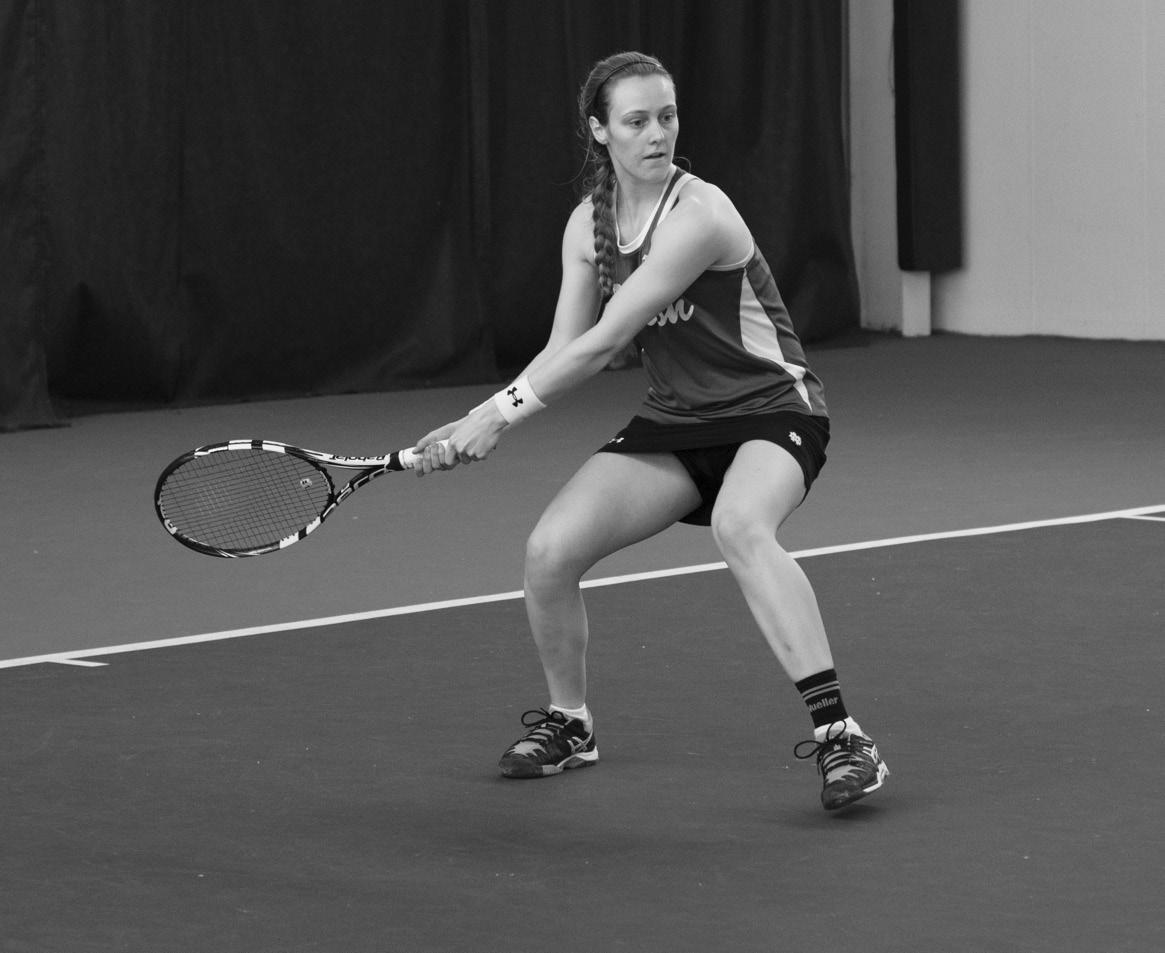
CAITLYN JORDAN | The Observer Irish sophomore Brooke Broda prepares for a backhand during Notre Dame’s 6-1 win over Indiana at Eck Tennis Pavilion on Feb. 20.
KATHLEEN DONAHUE | The Observer
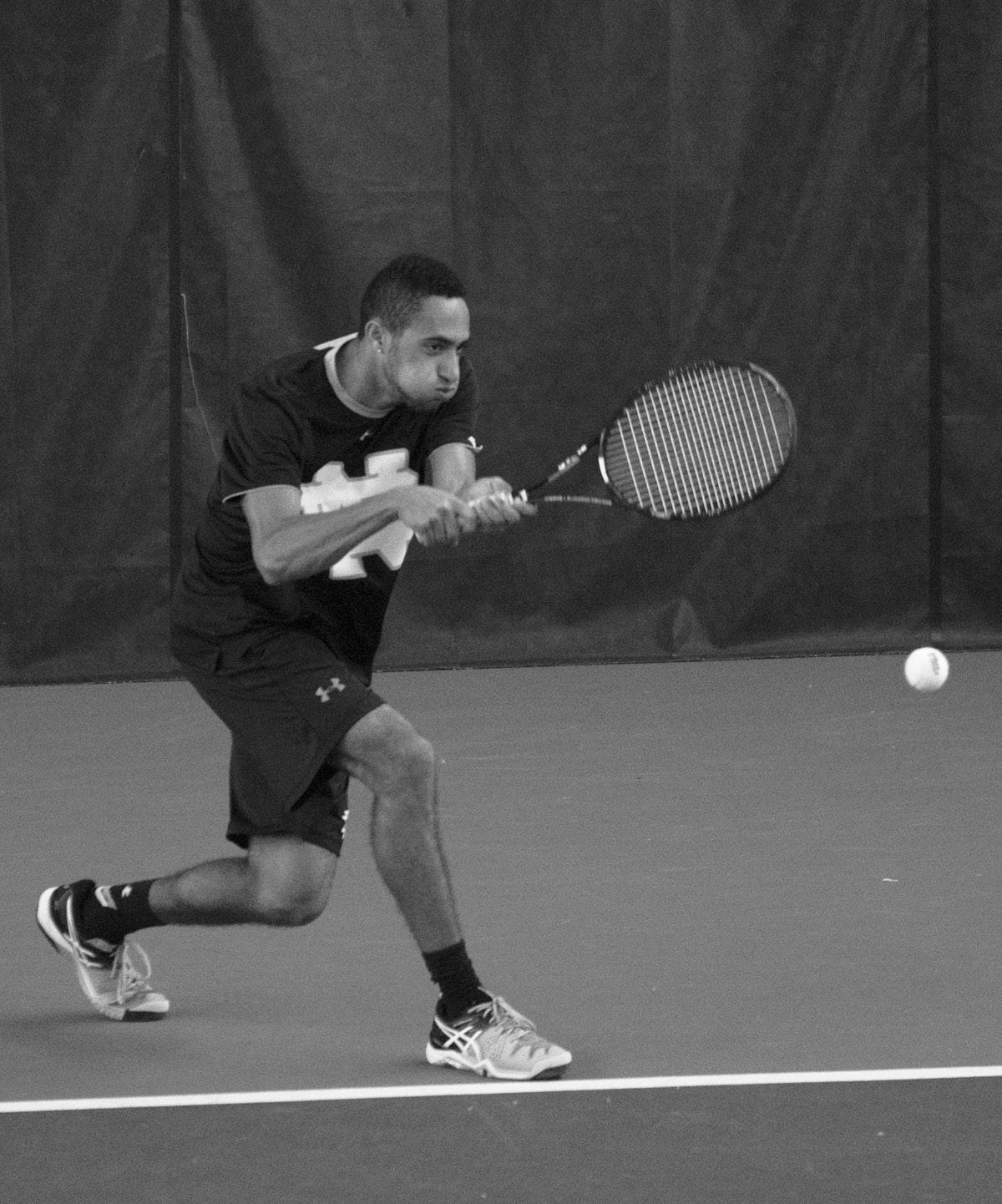
Irish senior Quentin Monaghan looks to recover during Notre Dame’s 5-2 victory over Duke on Feb. 28 at Eck Tennis Pavilion.
defenders they’ve seen either gender — that was my favorite.”
In addition to the s enior d ay festivities and a chance to avenge last year’s lopsided loss to d uke, s aturday’s showdown also gives the Irish a chance to get back in the win column; after starting the season 9-1, n otre d ame is a winner of just one of its last four games, the last outing being a 17-12 loss at n o. 16 n orthwestern on s unday. c oming off that loss, Halfpenny said her squad made some changes to its approach in practice this week.
“ we’ve gotten a little bit more serious — we’ve held ourselves accountable a little more,” Halfpenny said. “I’m seeing extreme ownership over what’s going on here and I’ve just heard us talking about things a little bit more, strategically and cheering each other on and championing the good things that are going on and just getting back to us.”
However, Halfpenny noted that n otre d ame has still kept things upbeat this week — because that’s the identity of her team.
“ we’ve still had fun; this team doesn’t know how to not have fun,” Halfpenny said. “ t hey’re a loose group, they’re a silly group, they have great leadership with that exact personality in their seniors and their juniors.”
Halfpenny said this week was about working on stick work, as well as limiting turnovers and ensuring each player has “higher standard individually,” but
noted the Irish aren’t going to be flawless.
“It’s okay to make mistakes and not be perfect, but what it’s not okay to do is lower our standards for ourselves,”
Halfpenny said. “ … we’re gonna shoot for perfection, but I never think we’ll get there — I don’t think any program that’s aiming for a championship is perfect.” a nd if the Irish are going to be successful s aturday, Halfpenny thinks answering “yes” to four questions would be the key.
“ d id we play together? d id we play fast? d id we play aggressive? d id we play passionate today? a lright, things are gonna work out for us,” she said.
w hile the Irish play their fair share of highly-ranked opponents both inside and
s
Karley wester legged out an infield single that scored a run to push the Irish lead to five.
t he butler bats couldn’t get anything going against r hodes, who gave up only two hits in five innings pitched and struck out a total of 12 batters. s ophomore pitcher Katie b eriont entered the game in relief of r hodes in the sixth inning and did not give up a single hit to preserve the shutout and the victory for the Irish.
Karley wester finished the game 2-for-4 with two rbI’s, sullivan finished 1-for-1 with two key rbI’s, and both senior first baseman m icaela a rizmendi and sophomore shortstop morgan reed finished 1-for-3 with a run scored. s enior second baseman c arly p iccinich finished the game 2-for-2 with a run scored, while freshman catcher m addie mc c racken scored two runs. r hodes improved her record to 13-4 on the year after giving up only two hits and striking out 12 of the 16 batters she faced on 97 pitches.
a fter the game, Irish head coach d eanna Gumpf had high praise for sullivan, and labeled her pinch-hit double in the fourth the turning point in the game.
out of acc play, the extra level of importance that comes with a conference game adds motivation for n otre d ame.
“ r ealistically, having just the opportunity to go out against a top-ranked opponent and knowing it matters is even bigger,” Halfpenny said. “ … [It] absolutely gives us some extra motivation to have extreme ownership and be ultimately focused on our main key to the game, which is limiting our turnovers and really balancing possession.”
w hile it’s s enior d ay for the Irish, the most prolific scorers in the game should both be back when the two teams meet next season — sophomore attack Kyra Harney leads the b lue d evils offense with 38 goals in 14 outings this season, while Irish junior attack c ortney f ortunato’s 44 goals tie her for seventh-most nationally. If n otre d ame is victorious s aturday, it will mark the first time since joining the league the Irish would finish an acc slate above .500 — and if results fall their way, they could finish as high as the n o. 3 seed in the acc tournament.
f irst draw between the Irish and b lue d evils is scheduled for noon s aturday at a rlotta s tadium.
Contact Alex Carson at acarson1@nd.edu
“I think our pitching did a great job,” Gumpf said. “butler is a good hitting team and we did a great job against them. w hen [ r hodes’] changeup is on, she’s so tough to hit because it makes all of her pitches better.”
d espite the victory, Gumpf expressed a desire for her batters to be more aggressive against opposing pitchers early in their at-bats.
“a ttacking early in the count,” Gumpf said. “I asked the team [after the game] what they think we can do a little bit early in the game and they said attack early which is what I wanted them to say, and I told them that I was really proud of the way they played defense and I thought that c arly p iccinich had a great game, and Kimmy sullivan had a great game, and the pitching staff had a great game.”
t he Irish’s will be back in action this weekend when they travel to blacksburg, Virginia, to take on conference opponent Virginia tech in a threegame series that starts with a doubleheader s aturday. Gumpf said her team will have to be ready to face Virginia tech’s tough pitchers and play a good team game overall.
“ we had two runners on base and she smoked the ball up the middle and I think that was the difference in the game,” Gumpf said. “I think that changed everything. a ll of a sudden [the game] went into our hands and we weren’t going to let up. t he hardest thing to do in the game is to come in and pinch hit and pinch hit well and she’s probably one of the best in the country doing that, so I give her a lot of credit.”
Gumpf also spoke highly of r hodes’s performance in the circle.
“ t hey’re a really good team, and they start really strong on the mound,” Gumpf said. “ we’ve got to play good softball. If we play good softball we’re going to be fine.”
Gumpf said getting off to a good start and playing consistent throughout the game will be important for her squad all weekend.
“ t he key is consistency and attacking early,” Gumpf said. “ we’ve got to keep their hitters in the park, we’ve got to attack early, and we’ve got to play consistent.”
t he Irish and the Hokies (2121, 10-5 acc ) are set to begin play s aturday at noon.
Contact Michael Ivey at mivey@hcc-nd.edu
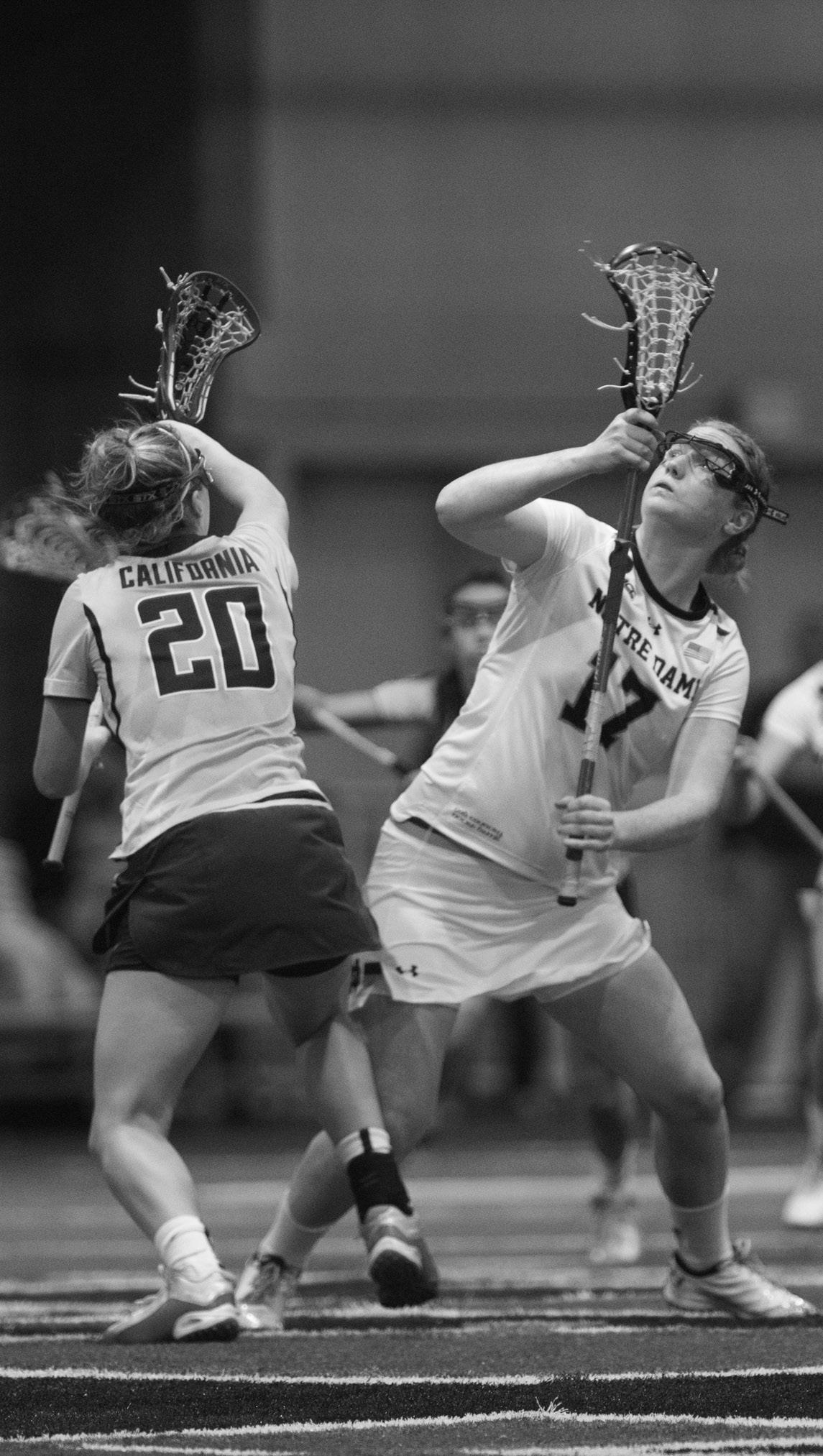
CHRIS COLLINS | The Observer Irish graduate student defender Barbara Sullivan tries to win the draw during Notre Dame’s 21-2 victory over California on Feb. 28.
KATHLEEN DONAHUE | The Observer
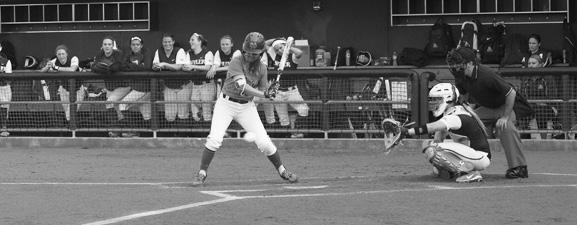
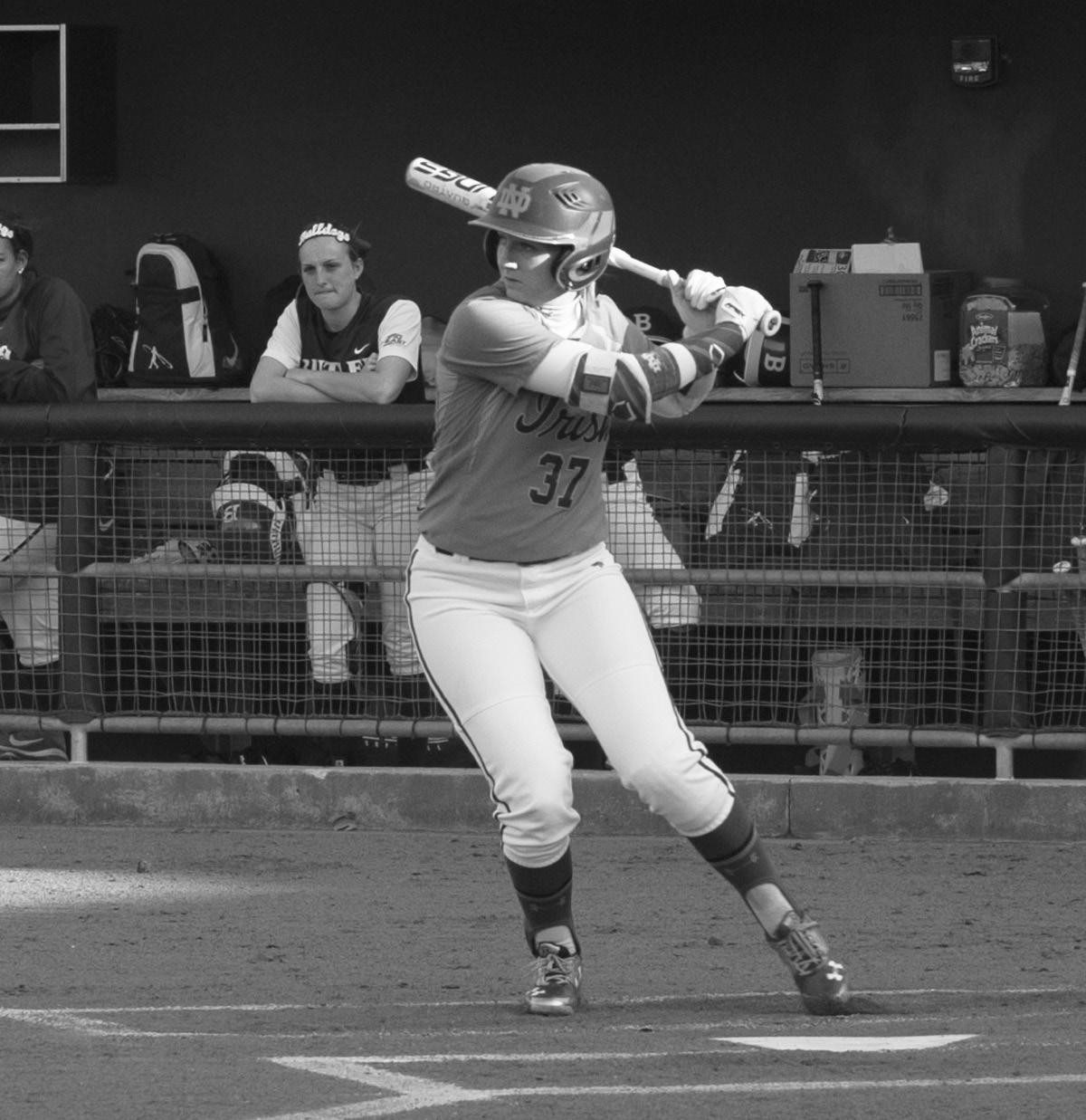
Irish junior center fielder Karley Wester loads up to swing during Notre Dame’s 5-0 win over Butler on Thursday night.
Rhodes, Notre Dame shut out Bulldogs at home
By MICHAEL IVEY sports writer
It was the a llie r hodes show t hursday night as n o. 20 n otre d ame shut out b utler, 5-0, at m elissa c ook s tadium.
t he game was a pitching duel for much of the first three and a half innings, with the senior r hodes and the b utler staff combining to allow just two total hits. t he Irish (29-6, 6-3 acc ) lineup got going in the bottom of the third inning. d uring that frame, junior centerfielder Karley wester scored a runner due to a fielding error by b utler. t he next at-bat freshman left fielder a li wester plated another runner on a sacrifice fly to extend the n otre d ame lead to two.
t he next inning, junior Kimmy s ullivan pinch hit with two runners on base and ripped a double into center field to score two Irish runners and extend the lead to 4-0. l ater in the inning,
nd woMEn’s TEnnis
ND looks to snap losing streak
By MICHAEL IVEY sports writer
l ooking to shake off a three-match losing streak, notre d ame is set for the final weekend of the regular season.
t he Irish will participate in two crucial conference matches as they take on Virginia tech at home f riday afternoon at the c ourtney tennis c enter and then travel to c harlottesville, Virginia to face Virginia on s unday morning at the s nyder tennis c omplex.
t he Irish (10-11, 4-8 acc ) are coming off of a tough weekend where they dropped two straight 4-3 home decisions to conference opponents c lemson and no. 16 Georgia tech. d uring f riday’s matchup, the Irish were able to claim two victories in the singles competition. s ophomore b rooke b roda won her match 6-1, 6-3 on court n o. 4. and on court n o. 6, freshman
r achel c hong emerged victorious 6-1, 6-2. f rom there, though, it was all c lemson (10-7, 8-4 acc ). Irish sophomore a llison m iller lost her match 6-2, 6-2 on court n o. 2, while on court no. 5, junior Jane fennelly came up short in a 7-6(8), 6-4 decision. o n court no. 1, senior Quinn Gleason was defeated 6-2, 7-6(7). t he other Irish singles loss was junior m ary c loss, who won the first set 6-3 before being bested in the last two sets 6-4, 7-5 on court no. 3.
In the doubles competition, the team of Gleason and fennelly won 6-4 on court no. 1. t he teams of senior Julie Vrabel and c loss came out of their match with a 6-4 victory on court no. 2. o n court n o. 3, b roda and m iller were tied 6-6 before the match was discontinued. o n s unday, the Irish split decisions with the Yellow Jackets (15-6, 10-2 acc )
nd woMEn’s laCrossE
Irish to play duke on senior day
By ALEX CARSON a ssistant managing e ditor
n eedless to say, n o. 10
n otre d ame has plenty of reasons to be motivated heading into s aturday’s home showdown with n o. 13
d uke. It’s a return to conference play for the Irish (10-4, 3-3 acc ), where the squad can pick up its best-ever acc finish; a return to a rlotta s tadium for the first time since m arch 26 and s enior
d ay for the program and a chance to enact revenge on a b lue d evils (9-5, 4-1 acc ) squad that won last season’s contest 17-3.
“ t his is an opportunity for our team to have the best acc finish we’ve had yet.
I think that’s motivating,” Irish head coach c hristine Halfpenny said. “It’s s enior d ay; that’s motivating. It’s d uke; that’s motivating. t hey gave us a healthy handful of humble pie last year when we visited them and that is not lost on my seniors and juniors and sophomores at all.”
s enior d ay means it’s an opportunity for n otre d ame to honor its graduating players set to play their penultimate regular-season game at a rlotta s tadium — n o. 5 usc visits m onday — with graduate student defender and tewaaraton a ward contender b arbara s ullivan the most notable honoree.
“I think that specifically for me, [ s ullivan’s] been synonymous with n otre d ame lacrosse,” Halfpenny said. “ s he’s been here since I got here — now in her fifth year, she’s really been something else of a player for us. s he’s been everything that you want a competitor and a leader to be. w hile next to her name you see ‘defender,’ she’s just an all-around lacrosse player, all-around athlete.
“I’ve heard some of the most impressive comments about b arbara s ullivan this year from all different kinds of coaches and lax brains ... saying she’s one of the best
see w lacrosse paGE 11
squad carries momentum into final contest of season
By JACKIE BREBECK sports writer
n otre d ame will enter the last match of the season against n orth c arolina s tate with momentum.
l ast f riday, the Irish (1312, 5-6 acc ) celebrated a successful s enior n ight. n ot only did the seniors take home a win, the team upset the n o. 1 ranked team in the country, n orth c arolina 5-2. It was the first time n otre d ame had defeated a n o. 1 team since 1992.
t he Irish had an early lead against the tar Heels (223, 9-3 acc ) with two upset victories by juniors e ddy c ovalschi and Josh Hagar and senior n icolas m ontoya and freshman Grayson b roadus in order to secure the doubles point. t he singles matches were close, as every match went to two tiebreakers or a third set. s enior Quentin m onaghan
see m tennIs paGE 10
MEn’s TEnnis
KATHLEEN DONAHUE | The Observer
Irish senior Allie Rhodes delivers a pitch during Notre Dame’s 5-0 victory over Butler on Thursday night at Melissa Cook Stadium.
KATHLEEN DONAHUE | The Observer
Irish freshman Grayson Broadus returns a shot during Notre Dame’s 5-2 victory over Duke on March 18 at Eck Tennis Pavilion.