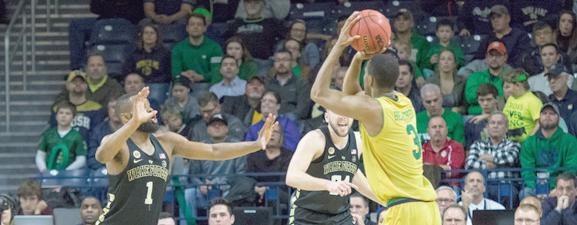
Print Edition of The Observer for Monday, February 20, 2017
Events celebrate juniors, family members
Junior
Parents Weekend offers opportunity for class of 2018, parents to reflect on time together
By COURTNEY BECKER news writer
notre dame welcomed parents and families to campus Friday for Junior parents weekend (Jpw ), an annual celebration for juniors and any seniors who spent spring semester of their junior year abroad.
Junior madi purrenhage, executive co-chair of Jpw, said the weekend offered an opportunity for students to relax with family members.
“it’s just a really good weekend to see all your friends,” she said. “most people aren’t doing their homework when their parents are here, so everybody [was] focused on socializing. … i [was] really excited to see all of the work we put in and how that [played] out.”
Jpw kicked off Friday with the
opening gala throughout the Joyce center, which purrenhage said served as the highlight of the weekend.
“it fills up the entirety of the [Joyce center], all that space, and there’s a photographer, several cash bars, appetizers and hors d’oeuvres and then a dJ and a dance floor,” she said. “so it’s basically a very large, moving party.”
Junior tommy yemc, the other executive co-chair of Jpw, said he and purrenhage began preparing for this year’s Jpw last spring to make sure all the events came together.
“we chose our committee in april of last year and began very preliminary discussions about what we wanted this weekend
see Jpw PAGE 4
Saint Mary’s student explains foster care system
By STEPHANIE SNYDER news writer
in honor of national Foster care month in may and national child abuse prevention month in april, saint mary’s sophomore taylor kehoe explained the urgent need to change the way the foster care system is run in the united states at last week’s installment of Justice Friday.
kehoe said she has seen the effects of the foster care system firsthand. her aunt and uncle were not able to conceive a child and exhausted all other options to adopt. they decided they would try to foster children, with the intention to eventually adopt a child.
in 2013, kehoe’s aunt and uncle began fostering two young sisters. the girls previously lived with a younger brother and another half-sister who were being raised by their biological mother and a nonbiological father. the mother had had seven children before having the other four; all were taken away from her and either put in the foster care system or adopted by other family members.
w hile the children lived in the house, they were physically and sexually abused by their father. the abuse led to the death of the little brother, and the remaining three children were finally taken away from their parents.
despite the girls’ sad beginning, kehoe said their story brings a smile to her face.
“i love my aunt and uncle’s story because they really needed kids and the kids needed parents,” she said. “it makes me happy because they’re adopted now and they have a whole new life to look forward to.”
however, kehoe said the system can be a negative experience for children. the children who do not get adopted age out of the system at 18 years old. kehoe said nearly 24,000 children age out of the system every year, and one in five of those children will be homeless as a result. group homes, she said, are competitive some oftentimes only exist in big cities. only half of the kids will be employed after age 24, she said.
kehoe said as of sept. 30, 2014, 415,129 children were in the foster care system, and 107,918 of those children were eligible and
waiting to be adopted.
“a child enters foster care about every two minutes,” she said. “every eight minutes, child protective services find evidence for a claim of child abuse.”
by the time the children leave the system, kehoe said 75 percent of them will have experienced child abuse, and one in four will have post-traumatic stress disorder as a result, just like one of kehoe’s cousins.
once the children are out of the system, kehoe said 50 percent of them will be incarcerated within two years. the girls in the system are also shown to be 50 percent more likely to become pregnant before the age of 21 than those who are not in the system. kehoe said this is likely because of the lack of support for the children.
“we’re not devoting the money and materials to get the kids out of the system,” she said. “they give the same amount of money designated for food for an 8-yearold boy as they do to a 17-year-old boy.”
another negative of the system is that many foster parents
see Foster PAGE 4
cab driver reflects on 10 years of students, routes
By EMILY McCONVILLE news writer
gail hickey, the founder of the bend executive shuttle and a longtime south bend taxi driver, has a lot of stories.
like the time a couple met in her cab, back when she was working for yellow cab. hickey was driving three guys, and she asked if she could pick up three girls on the way.
“one of the guys and the girls ended up dating, they graduated, ended up following each other to law school . . . and ended up getting married,” she said. “they met because i asked if it was okay to pick them up together.”
in the middle of a long weekend picking up parents in town for Junior parents weekend, hickey said she started driving in about 2008. it was before eddy street commons, before uber and lyft, before most other cab drivers and companies. hickey drove nights, while her husband, terry hickey, drove days.
gail hickey soon became
one of several local drivers with a “following” — students who love getting rides with her, who call her first and who trust her unconditionally.
“as i drove and my popularity got bigger, students would actually start calling me in advance to say, ‘okay, we are definitely going out tonight,’ to make sure they made the most of the time that they had,” she said.
over the past decade, her business has, in fact, became mostly word of mouth. students recommended her to other students. she became the driver of choice for various campus groups: pasquerilla east girls, certain latino students, fencers, law students who once had her star in a comedy sketch video and saint mary’s students whom she made sure actually got to saint mary’s at the end of the night, not just main circle. parents found out about her and called her, asking her to make sure their kids were safe. students inherited her from older siblings.
see shuttle PAGE 4
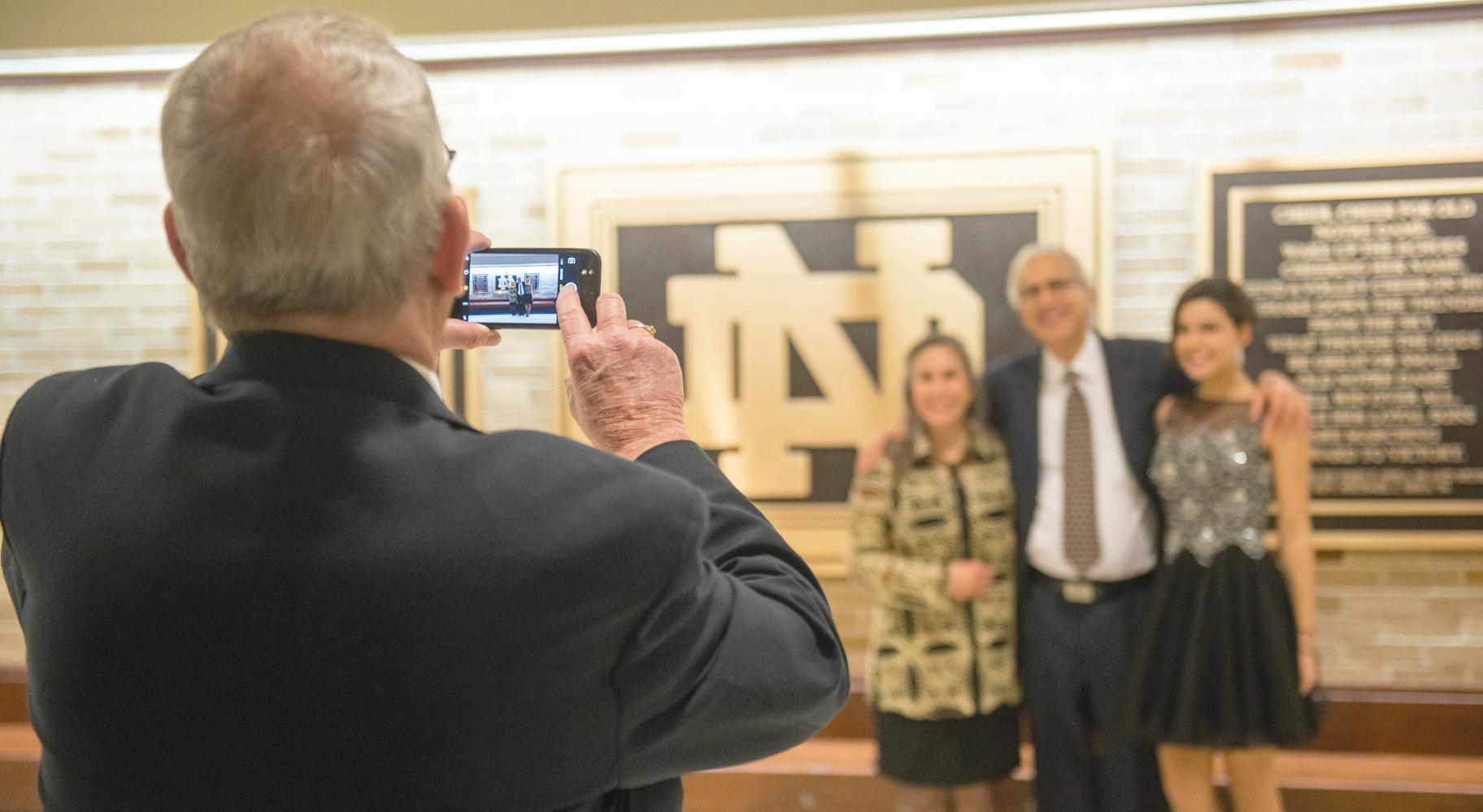
MICHAEL YU | The Observer
A student and her family pose for photos at the JPW Opening Gala in Purcell Pavilion on Friday night. Over 3,000 people attended the event, which kicked off the weekend.
Policies the observer is the independent, daily newspaper published in print and online by the students of the university of notre dame du lac and saint mary’s college. editorial content, including advertisements, is not governed by policies of the administration of either institution. the observer reserves the right to refuse advertisements based on content. the news is reported as accurately and objectively as possible. unsigned editorials represent the opinion of the
and
Question of the Day:
Jagger Scholz
junior duncan hall “g eorgia.”
Madeline Buynak junior ryan hall “california.”
Francisco Yang junior keenan hall “austin, texas.”
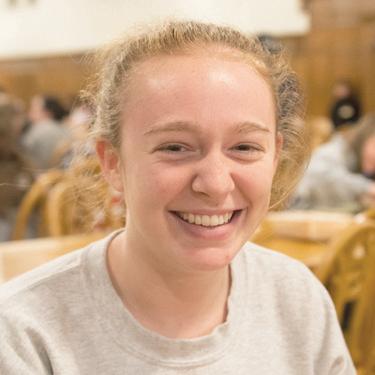
Katie McKeon sophomore pasquerilla east hall “Jacksonville, Florida.”
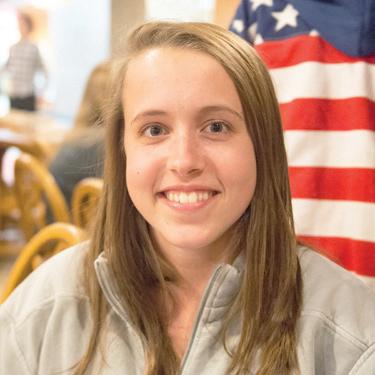
Emily Dubuque freshman lewis hall “l os a ngeles.”
Libby Cresap freshman ryan hall “north carolina.”
The Notre Dame Rocket Team launched its new rocket for the first time Saturday, successfully launching and recovering the rocket twice. The team will compete in the NASA Student Launch Competition in Huntsville, Alabama, in April.
Today’s Staff
Corrections
t he observer regards itself as a
Monday
Workshop: “Writing A Strong
Undergraduate Grant Proposal” Brownson Hall
4 p.m. - 5 p.m.
Book Launch: Julia Douthwaite’s “Rousseau and Dignity” Geddes Hall 5 p.m. - 6 p.m.
Tuesday
“International Migration: Learning from the ‘Other One Percent’” Hesburgh Center 12:30 p.m. - 2 p.m.
Bengal Bouts Quarterfinals
Joyce Center 7 p.m.
Tickets available online.
Wednesday
Michael Collins
Reading Hammes Bookstore
7 p.m. - 8:30 p.m.
Author of “The Keepers of Truth.”
“The Star Spangled Girl” Senior Theatre Show O’Laughlin Auditorium
7:30 p.m.
Tickets are free.
Thursday
“Under Caesar’s Sword” Documentary
Washington HallMainstage Auditorium
6 p.m. - 7 p.m.
Short Q & A to follow.
Women’s Basketball vs. Boston College Purcell Pavilion 7 p.m.
The Irish take on the Eagles.
Friday
“ND’s Labor Licensing Code: Moving Forward” Geddes Hall Coffee House
5 p.m. - 6 p.m.
Silent Retreat Moreau Seminary 5:30 p.m.
Weekend silent retreat open to all students, faculty and staff.
speaker highlights athletes’ charities
By COURTNEY BECKER news writer
t he mendoza college of business’ ethics week concluded Friday with J. Jonathan hayes, director of pro sports at pegasus partners ltd., speaking about the business of helping professional athletes give back.
hayes said he got his start helping athletes manage charitable foundations by taking them on as clients when he was a private banker in c incinnati early in his career.
“i always thought that their agents did more of the financial advising and helping the guys get direction with what to do with the contract dollars that the agents would negotiate for them,” he said. “i came to find out that most guys were not getting any advice at all, and if they were, a lot of times it was bad advice, or maybe the agent had a little bit of a shady angle that he was pursuing.”
hayes said discovering the lack of guidance for professional athletes with millions of dollars in their bank accounts inspired him to specialize in helping these clients manage their assets.
“i n 1995, i got the bank to start a separate practice focused on wealth management for pro athletes,” he said. “[ i made] a shift from private banking … to actively helping advise the guys on what to do with the money that they were amassing as professional athletes.”
t he trend of professional athletes starting charitable foundations, hayes said, was largely prompted by the salary growth that came about in response to factors such as league expansions, players becoming more vocal during contract negotiations and the advent of sports on cable television.
“w hat really started to drive this was, back in the ’70s and ’80s, you really started to see a more uniform growth in player contracts,” he said. “p rior to that, the superstar players — you would see those guys get rewarded by their teams. but if you were the third pitcher on a staff, if you were the sixth man coming off the bench of an nba team [or] if you were the backup quarterback, you weren’t making anything. [ i n] the ’70s and ’80s, that started to change pretty dramatically.”
once professional athletes began making more money, their agents started encouraging them to give back in some way, hayes said.
“w ith that, the player agents started to become a little more socially aware,” he said. “one of the ones that you would hear about most often — at least publicly — was l eigh steinberg. steinberg was the preeminent football agent in the ’80s and ’90s. … t he evidence of some of
the charitable work that l eigh’s clients did start to get involved in is fairly strong.”
hayes said this trend grew once players who lead the way with their charitable acts started generating more positive press.
“a couple other things started to factor in to create some acceleration behind this,” he said. “i think the teams liked that their players were charitable, that [they] were involved with the community. … it helps owners to sell more tickets to fans if the fans perceive that they’re rooting for a bunch of good guys.” hayes said it didn’t take long for players to begin adding to this movement on their own, as well.
“t he players themselves — it became kind of a cottage industry there for a while,” he said. “ … you’re the star wide receiver on the team, the quarterback is going to have a golf outing for his foundation, so he invites all his teammates there, you go to it, you see fans there, you see sponsors, everybody is wearing the shirt with the quarterback’s foundation’s logo and the players liked that. w hether it touched them on an ego level or it touched their hearts, a lot of players said, ‘t hat was really cool. i want to do that.’”
w ith the good done by these charities, though, there have always been people willing to take advantage of professional athletes or fans that are willing to donate to a particular athlete’s cause, hayes said.
“o nce markets start to occur, there are those that see that opportunity and want to be a part of it,” he said. “s ometimes it’s for legitimate reasons [and] sometimes not, but there were — and still are — people that want to get athletes to say, ‘hey, let me help you have an event. l et me help you run a foundation.’ … e specially early on, you would see a lot of, ‘i’m going to charge a big fee for doing this.’”
i n spite of occasional negative stories, hayes said the good player charities have done vastly outweighs any bad instances, pointing to stars including l ebron James, tiger woods and david robinson, father of student body president corey robinson, as athletes who have paved the way for greater charitable efforts.
“t he fact is some really good work has come out of what we’ve seen athletes and their charities do,” he said. “ … we see charitable activity now in leagues. … we don’t have to look too far from our own notre dame family to find some great examples of charitable work done by athletes.” Contact Courtney Becker at cbecker3@nd.edu
to look like,” he said. “ … with running an event of this size at an organization as large as the university of notre dame, logistics are always going to be an issue.”
the students and family members celebrating Jpw enjoyed particularly warm weather and a smooth schedule of events, which sophomore co-chair maureen schweninger said in an email was an honor to observe as a sophomore and made her excited to experience the weekend next year.
“i would say the weekend was a great success,” she said. “ … parents meeting parents, singing the alma mater and simply enjoying quality time with one another [were] so cool. i didn’t need to know these juniors to be touched by their experience, and i can’t wait to facilitate this weekend for my own classmates next year.”
one highlight of the weekend for yemc was his closing address
Shuttle
some, she said, took to calling her their “notre dame mom.”
hickey attributed her popularity to the fact that, as a mother, “i take this very personally.” she said she tries to make sure students are safe, often “rescuing” them from unsafe situations and calling out uncertified cab drivers.
“there’s too much uncertainty out there,” she said. “so we developed our popularity through that kind of mentality. your kids are our kids.”
hickey’s relationship with her students became greater than driving them around on weekends. she manages house rentals for the parents of a football player. she once sat with a student in the hospital. she’s been taken out to dinner, invited to weddings and notified of the births of children.
in the nearly ten years since she started driving, the transportation market has become “saturated,” she said, with rideshare apps and other cab companies — that was part of why she went into the shuttle business, instead of strictly taxis.
three years ago, after going through saint mary’s spark program for women entrepreneurs, hickey started her own transportation company, the bend executive shuttle. she mainly takes people to and from chicago and south bend airports, often for notre dame departmental functions.
but hickey still occasionally drives at night, taking students to club Fever, Finnies, house parties or wherever they want to go. she said she’ll drive for as long as she can.
“i like the students a lot,” she said. “it makes me whole. you guys are great, i mean really. i love the stories you guys tell, i love to know what you’re doing. it’s just fun.”
Contact Emily McConville at emcconv1@nd.edu
at the closing brunch on sunday, traditionally delivered by one of the Jpw executive chairs.
“i feel my speech got across exactly the message that i wanted it to get across,” yemc said in an email. “we, as juniors, are all incredibly thankful for our parents and everything they have done for us, and i believe we were able to show them that this weekend.”
the weekend also featured some impromptu moments, such as when junior dean merriweather delivered unscheduled remarks drawing attention to the fact that some students are unable to participate in Jpw for various reasons at the brunch.
“at Jpw it’s very easy to enter the notre dame state, the notre dame bubble,” he said. “ … i felt like there should be some way that not only students that don’t have parents who are able to come or can’t come or aren’t there — they should still feel welcome to come and be a part of this Junior parents weekend.”
one way the Jpw chairs ensure
as many students are included as possible is by offering tickets to any student who was abroad for the event during his or her junior year, purrenhage said.
“the option is available for any junior who is abroad in the spring to come to their Jpw the next year,” she said. “so for the architecture majors it would be their fourth year, but for everybody else it’s just their senior year. if you’re a senior year who was abroad your junior year spring, you [were] allowed to come to all of the events.”
purrenhage said the best part of the weekend was seeing her and yemc’s hard work come to fruition.
“Jpw means a lot to a lot of people,” she said. “knowing that tommy and i could be a part of that, and knowing that we helped contribute to making that weekend something special for all of our friends and for all of our classmates — it really has meant a lot to us.”
Contact Courtney Becker at cbecker3@nd.edu
continued F rom page 1
participate in the system only for the money, kehoe said; these parents are called employment Foster parents. For each child a parent fosters, the parent gets a stipend to take care of the child.
“a new law says that half the money must be spent on brand new clothes for the child,” she said. “but the other half of the money can easily be pocketed by the parents because no one is keeping track of where the money goes.”
parents can also get more money if the child is labeled disabled. kehoe said her aunt and uncle were even encouraged by a worker in the system to label one of their foster children as disabled for this purpose. kehoe’s aunt and uncle disregarded the suggestion in order to save their child from an unnecessary label.
kehoe said her aunt thinks it is challenging to get good foster
paid a dvertisement
parents in the system because the process can be intimidating.
“my aunt said they ask questions like, ‘are you okay with a child who starts fires in your home?’ or ‘are you okay with a child who runs away?’” kehoe said. “it’s not the child’s fault and yet they suffer — it becomes a cycle that can never be broken.” in 2015, the mother of the girls had another baby who was immediately taken away and given to kehoe’s aunt and uncle. her rights as a parent were terminated, and they were able to adopt all three girls at once. kehoe said the best thing citizens can do to help improve the foster care system is by advocating for it.
“Foster care is the future of our country,” she said. “if we’re not doing anything about it then we’re not supporting our future. there are so many kids that show so much potential.”
Contact Stephanie Snyder at ssnyder01@saintmarys.edu
By KELLY McGARRY a ssociate s cene e ditor
everything about the netflix original show “santa clarita diet” is nauseating. a nauseatingly flawless suburban landscape is filmed in bright lighting. hostile yet friendly neighbors in unhappy marriages engage in bickering and affairs. a nd of course, the fad diets abound — like sheila hammond’s (drew barrymore) human-flesh-only fare.
in an uptight family where both parents are realtors, it might prove difficult to accept an unconventional challenge faced by a family member even despite the stigmas of suburbia living. Families might experience this if their mom is going through addiction or mental illness — or, of course, if the mother of the family becomes a flesh-eating zombie.
sheila’s husband Joel ( timothy olyphant) copes with his wife’s new condition by having existential conversations with the pharmacy staff. he ultimately commits to stick by his wife through thick and thin, even when that means mopping up a murder scene. t heir teenage daughter abby (l iv hewson) deals with the situation with both teenage irreverence and commitment to family, teaming up with the “geeky” (but really too cute to be geeky) neighbor boy who helps to uncover her mother’s ailment.
t he juxtaposition of sterility with gruesome murder recalls the images of “dexter,” along with the goodguy-needs-to-murder dynamic. t hough dexter is emotionally cold-blooded whereas sheila is physically cold-gooey-and-black-blooded, somehow the violence in “santa clarita diet” is so much more disgusting. w here the drama “dexter” approaches murder and death with a dramatic seriousness sprinkled with irony, “santa clarita diet” is entirely comedy — tremendously dark comedy. t he irreverence with which people are killed is part of what makes “santa clarita diet” even worse. watching people get eaten gives the stomach a special kind of churn.
t he gore isn’t only nauseating in theory. it’s presented in the goriest possible way. t he blood that often covers the face, arms and chest of drew barrymore isn’t a campy red paint. it’s dark and viscous, and anyone with an aversion to blood will find themselves affected by it. t he black goo that has replaced her own blood is even more unsettling.
in the first episode, sheila, a realtor, shows a house to a couple for the third time. in the middle of the tour, she projects an impossible amount of vomit onto the pristine carpet of the master bedroom. she goes into the bathroom only to puke up more, covering the walls and ceiling. t he substance is not quite realistic — a nearly-electric green-yellow with visible chunks — but
is nevertheless unwatchable.
t he entire premise of “santa c larita” rests on complete absurdism, which comments on the various skeletons in the closets of suburbanites committed to convention. even after the couple becomes desensitized to sheila’s meals of human flesh, they are appalled by tamer yet still unconventional propositions, such as their daughter’s suggestion that she might not want to go to college.
i n episode 8, the hammonds’ neighbor, an aspiring musician, records a phrase he said in conversation which he found particularly artistic on his phone. he said he embraced violence “like a drop of dew embraces a blade of grass.” sheila compliments him: “blade of grass. blade. v iolence. it’s a twist on the familiar that makes it so profound.”
p rofound is not the first word i would use to describe “santa c larita diet,” but it’s certainly a twist on familiar suburban conventionalism, right down to sheila’s fleshy adaptation of the annoying health smoothie obsession.
even as a minimally squeamish viewer, the series left the taste of bile in my mouth. i don’t recommend trying to eat while watching it, unless you’re feasting on human flesh.
Contact Kelly McGarry at kmcgarry@nd.edu
By JIMMY KEMPER s cene writer
From the moment it took the stage in washington h all on Friday night, t he s econd c ity’s blue c o. troupe made it abundantly clear that it was going to be a great night, but also a night that would address some of the biggest controversies in our country right now.
t he touring group kicked off the show with a group song, centered around the refrain, “nothing is wrong, everything is perfect,” where one comedian would start to complain about a serious problem, whether it be the immigration ban, global warming or race relations. he or she would then be loudly interrupted by the other members of the troupe, who would humorously attempt to convince the complaining member that it’s a non-issue. t he song finally ended with an inversion of that refrain — “nothing is perfect and everything is wrong” — thereby introducing the audience to a central theme of the show.
t he c hicago-based s econd c ity, over the course of its 50-plus year history as a touring comedy troupe, theatre and comedy club, has developed a reputation for this sort of dark and timely humor. t he program has given rise to sharp comedians such as stephen c olbert and steve c arrell and also has functioned as a feeder program into “s aturday night l ive,” serving
as an incubator for some of the show’s biggest stars over the years, including a my poehler, t ina Fey, c hris Farley and bill murray.
o n Friday night, the comedy ensemble gathered together put on a show just as hilarious as some of the best “snl” bits. it was diverse and fresh as the comedians varied between topical humor, timeless sketches, on-the-spot improv and quirky songs.
s ometimes, s econd c ity seamlessly mixed these disparate comedy elements into a single performance, like the barbershop quartet piece that the male members of the cast opened with after the intermission.
i n this sketch, the cast started singing their tune before quickly realizing that their fourth member, “g reg,” wasn’t going to make the performance in time. t hey pulled a random audience member out of the crowd, claimed he was “g reg,” and prompted him to finish off the lines of the song with obvious, yet funny, rhyming punchlines. s ometimes, “g reg” would go completely off course, in one instance replacing “i pod” with “ walkman” to hilarious effect.
t he comedy troupe particularly shined in improvisational moments like this one, especially those which featured interactions with the crowds. l ater in the show, one of the members looked to the audience to come up with a suggestion for a recent event that his character, a deep cover spy, was responsible for.
t he crowd chose b eyonce’s pregnancy. t he comedians rolled with the absurdity of the situation with nary a smirk on their faces, transforming the skit into one of the more memorable moments of the night.
a nd even though none of the members of the ensemble had been to notre d ame, s econd c ity had clearly done its research. t hey incorporated football fans’ disappointment with the recent 4-8 season and the university’s choice to not become a sanctuary campus into the performance with ease.
t hroughout the entirety of the performance ran an underlying discontent with the system which deeply resonated with the audience, as manifested by the intense amount of laughter throughout the show. s econd c ity mocked the absurdity of the real world and current events with equally absurd comedic performance, like having a white male belt out an acoustic ballad mourning the death of “simpler times” where it was okay to discriminate against women and the disabled, or having d isney world character actors discuss Ferguson and racial tension in the downtime moments between children’s train rides. o verall, s econd c ity put on a fantastic performance that felt incredibly relevant. w hile these days it may feel difficult to carry on as if nothing is wrong, everything at Friday’s performance was perfect.
Contact Jimmy Kemper at jkemper2@nd.edu
EdITor
a hole in the permacloud
a lthough p unxsutawney p hil said otherwise, this past weekend and week of 50+ degrees has me wondering where winter has actually gone. i f someone was to tell me that in coming to n otre d ame, where everyone tells winter horror stories of the bleak temperatures, chilling winds and months of nothing but ice and snow, there would be days in February where i could wear shorts and flip flops, i would probably laugh at them. yet as my sophomore year approaches the final months, “winter” weeks like this have become an expectation.
m aybe i ’ve just gotten lucky, but these relatively mild winters have been a bright spot in an otherwise gloomy part of the year. a s wonderful as n otre d ame is, the one thing that people always complain about is the weather, particularly in winter. t he gray permacloud that stretches from d ecember to m arch, accompanied by wind and snow, is a much-discussed negative aspect of living in s outh b end, but at least for me, in the past two years here there have been plenty of bright spots.
For one, the snowfall has not been massive, rather coming in bits and pieces. c oming from l ong i sland, consistently throughout high school i would be slammed with storms of 2 feet of snowfall or more, and snow would stay on the ground largely untouched for a month or so at a time. h ere, however, i don’t think we’ve gotten a snow storm in the past two years that has dropped over 2 feet yet, and usually the snow doesn’t last long. n ow there still has been snow, and when it has fallen, like during last semester’s finals week, it certainly hasn’t been ideal to walk through. i n fact, that Friday was particularly nasty, and as i walked to my 8 a.m. exam through the snow and biting wind i was definitely not been overjoyed to witness such a display of m other n ature. b ut then there are days like s unday, which breaks the 65-degree record for Feb. 19 set in 1930. Just walking outside this morning i was blown away, and for good reason. o n a day when in almost every year the temperature is below freezing and everyone is in jackets, instead the sun is shining, tons of people are outside lounging on the quads and the many visitors and alumni for Junior p arents weekend are probably wondering where is the bad weather that they always hear about and in some cases have experienced themselves. i t may be ridiculous, and it certainly won’t last. b ut in the end, wonderful weather that is unexpected brightens everyone’s day, literally and figuratively. e veryone seems more upbeat, and people are spending time together outside just enjoying the weather and each other’s company. s ome of my best memories at n otre d ame so far have been on beautiful days in January and February, not only because of the weather but also because of the unexpected nature of it. i ’ve gone on impromptu trips and set aside the studies for a few hours just to be grateful for the opportunity to enjoy some of college life’s finer moments.
m aybe it’s good luck, maybe it’s global warming. r egardless, these gorgeous days in the season without football really make me appreciate attending a place like n otre d ame, where there’s always something to be thankful for.
Contact Tobias Hoonhout
A letter from Father Jenkins
d ear members of the n otre d ame community:
w ith the plight of d eferred a ction c hildhood a rrivals ( daca ) now attracting attention at the highest level of government, it is both timely and urgent that we express unqualified backing for a critical piece of legislation. t he bridge a ct ( b ar r emoval of i ndividuals who d ream and g row our e conomy a ct), which has broad bipartisan support, would codify
protection for our daca students and classmates. i urge members of this community — faculty, staff and students — to contact their representatives to ask for swift passage of this legislation. respectfully,
Fr. John Jenkins university p resident Feb. 18
hink before you talk
o n Feb. 10, i attended the iconic comedy show, the k eenan r evue. t he comedy skits were hilarious, but one line that stood out from the rest for me. t he news skit brought up b eyonce’s recent pregnancy announcement, stating, “ n ow there are more black people inside b eyonce than in any of my classes.” m any people laughed at this, but instead of finding it funny, i began to think about the truth of this statement. i know that n otre d ame is not a very diverse school, but i never took the time to think about it. t he week of classes following the show, i paid attention to the people in my class and was shocked to find out that the k eenan skit was not wrong.
c oming from a town called b olingbrook, and a high school that was exceedingly diverse, coming to n otre d ame was an interesting transition. i n my high school, the makeup of the school was 38.5 percent h ispanic, 29 percent black, 20.5 percent white and many other ethnic backgrounds filled the remaining 12 percent. i n comparison, the makeup of n otre d ame is 74 percent white, 11 percent h ispanic and only 4 percent black. i valued and appreciated the diversity in my high school, and realized it was something i took for granted. t he interesting thing is that i am included in the majority now, yet i felt more comfortable back in b olingbrook than i do here. i could not even imagine going from a school that was diverse to a school where i was a part of the 4 percent.
n otre d ame claims that, “c ampus community is rich in diversity and committed to inclusion.”
yet, i read the other day in t he o bserver about a group of students harassing a student in their dorm, yelling disturbing racist phrases. m any
dorms have a motto containing “community” in some regard, and the fact that people brought this negativity into a space in which they have to live is unacceptable. i f community really was rich in diversity here, incidents like this should never occur. s tudents of any race, sexuality, gender or socioeconomic background should not have to be afraid to return to their own room. i witness microaggressions every day, and most people seem oblivious of the things they say. we cannot change the diversity makeup of the campus, but we can help students feel welcomed. it saddens me that we fail to promote inclusion and diversity in many ways. w hat if the roles were reversed and you were the student sitting in the class feeling isolated because of your own ethnicity or the student hiding in the dorm because people thought it was something to joke about? it sounds cliche, but it needs to be pointed out that it is not something you would find funny. w hile i know anything in the r evue is not to be taken seriously, these kind of jokes are not isolated to the comedy show.
e ven though the university lacks diversity, as students we should not joke about this, because it is not a laughing matter. p eople that find these kind of jokes funny are the ones that make small comments that offend other students. a lthough it is only a small remark, they add up and are definitely annoying. s o the next time you want to joke about diversity here at n otre d ame, think before you talk.
John O’Brien freshman Feb. 16
Tobias Hoonhout sports writer
responsible parties
a brief tale set in a familiar country in a time that is, or is not, to be: t here were no fireworks or formal observances, but a few editorial writers noted the 10-year anniversary of legislation that essentially eliminated abortion in the u s . “ it was amazingly quick in effect,” one writer noted, “within two years of the act being signed by the president, abortions had dropped to negligible numbers in most states. i ronically, the only places with meaningful numbers of procedures were certain southern states that fought the legislation with near-religious fervor.”
t he impetus for the law started decades before, with birth control being seriously discussed as a global imperative. s afe, legal and inexpensive birth control was presented as a necessary option for family planning and as a realistic part of every post-pubescent woman’s health regimen — either through regular use or purposeful avoidance. r espected institutions joined in the discourse, and even n otre d ame held an annual “c onference on p opulation p roblems” from 1963 to 1967. t he conference was organized by g eorge s huster, special assistant to notre d ame’s president, Fr. t heodore h esburgh, with help from p lanned p arenthood. t he intent was to develop a humane and realistic c atholic position on contraception. a 1965 conference statement to p ope p aul vi , signed by 37 scholars and clerics, affirmed “[t]here is dependable evidence that contraception is not intrinsically immoral, and that therefore there are certain circumstances in which it may be permitted or indeed even recommended.”
t he c atholic c hurch’s official position with respect to contraception prior to this time was, in a word, hostile. p ope p ius X i promulgated the encyclical “c asti c onnubii” in 1930, condemning birth control. t his approach was somewhat softened in p ope p ius X ii ’s 1951 announcement that the c hurch could accept “systematic use of the sterile period” (the rhythm method) for couples with a “serious economic, medical or social reason” for
circumventing children. tolerance of the rhythm method had sown hope among post-vatican ii progressive thinkers that acceptance of birth control was a logical next step: i f “sterile periods” were acceptable to prevent conception, then wasn’t the birth control pill simply a means of extending the sterile period for couples who wanted to delay or prevent pregnancy, and wasn’t the “population crisis” sufficient reason to limit the number of children brought into this world? unfortunately for this well-reasoned approach to artificial contraception, a further encyclical censoring birth control, “ humanae v itae,” issued by the pious p ope p aul vi in July 1968, delayed further progress. t he 1968 encyclical was influential enough to cause the r epublican p arty to reverse its pro-contraception stance and cemented the politicization of reproductive rights for decades to come. t he political right came to view reproductive rights (or rather, the limitation of such rights) as a reliable conservative cause, and sought to convert otherwise wide-ranging thinkers who were conflicted over v ietnam, economic disparity and civil rights into single-issue voters who would support any “right-to-life” politicians, no matter how vile their personal character or disdainful they were for post-birth human life. o ddly, this approach sought to place the entire burden for resulting guilt and shame for the exercise of reproductive rights solely on women.
From classical times, g reek and r oman philosophers took wild guesses at how children were conceived, and it was on one of the wrong guesses that so much religious, legal and political antagonism towards women’s role in reproduction was based. i n brief, the male seed, the sperm, was erroneously thought to carry the entirety of the human child and only required a vessel in which to grow. a s the vessel for growth, the woman played a minor role, and the man was given total control with respect to decisions regarding the financial, legal and social growth of the child. i n this erroneous construct, the environment and nurturing provided by the mother might influence the appearance or actions of the child, but only the father was seen as the decision-maker in all matters regarding reproduction. o f course, the analogy is faulty because
a true seed — say from an oak tree — is already the product of two parents, with each contributing half the offspring’s genetic makeup. s cientific knowledge changed, but patriarchy persisted. s till, even the most obstinate had to admit that basic science applied to humans, and both men and women contribute equally to the genetics and essential being of children. i n 2009, following the dramatic shift in power in both houses of c ongress, legislation was introduced that finally recognized this fact, and led to the aforementioned precipitous drop in abortions, as well as unwanted teen pregnancies. p assed the following year, the c ontrol a nd r esponsibility e quality a ct actually never mentioned abortions or birth control; rather, it simply stated one fact and a few requirements.
i n relevant part, it declared, “ b oth parents contribute equally to the genetic makeup of children; accordingly both parents will share responsibility for all financial costs associated with decisions regarding conception, pregnancy, birth and the ensuing nurturing, education, housing and raising of all resultant children until the death of both parents. i f either parent is a minor, the parents of those minors shall bear all costs. n o governmental entity shall intrude or interfere with the decisionmaking process unless it (i) has received prior permission from both parents to do so, and (ii) has established an escrow fund equal to all anticipated financial costs, payable to both parents upon conception of the child.”
Fully shared financial responsibility from conception turned out to be the key to the resulting plummet in the cost of safe and effective contraception. e ven conservatives embraced contraception as the “abortion vaccine” rather than risk the actual cost of supporting life decisions. h esburgh’s vision of a humane approach to sexuality finally came into focus in 2020.
Ray Ramirez is an attorney practicing, yet never perfecting, law in Texas while waiting patiently for a MacArthur Genius Grant. You may contact him at patrayram@sbcglobal.net
The views expressed in this column are those of the author and not necessarily those of The Observer.
Classmates: a thank you letter
earn their deeper insights which shallow conversations fail to find.
t he other day bradford and i had dinner at cambodian t hai.
he asked me, “w ho’s your mentor?” i thought for a second.
“you are,” i said. he laughed and said, “no seriously.” a nd i said, “no seriously.” in “walden,” t horeau writes, “tuition is an important item in the term bill, while for the far more valuable education which he gets by associating with the most cultivated of his contemporaries no charge is made.” he graduated harvard in 1837.
i’m not a model student and my personal favorite piece of advice is: don’t take advice. but here’s some advice: learn from your peers.
w ith the same organized rigor that you schedule your classes and extracurriculars, vie for the free time of your friends. not just between 10 p.m. and 2 a.m. on the weekend — though beer talk is certainly some of the best. but also for coffee before class or lunch on a weekday afternoon. if you can’t meet in person start an email thread.
w ith the same attentiveness that you take notes in lecture to earn a high mark on the exam, listen to what your peers have to say and ask the right questions to
certainly it begins with small talk, “how are your classes?” “did you go out last night?” but with genuine interest it progresses to, “w hat are you reading right now?” “could you teach me what you know about meditation, music, math, etc.?”
From these conversations with my peers, i learned more than during whole semesters in class listening to a professor. a writing pal became a business partner; a friend of a friend, a music adviser; a philosophy classmate, a confidant. From acquaintances appeared a concert pianist, trilingual literature expert, national jump rope champion, renewable energy entrepreneur and all-star basketball player. if they let me graduate, my cardstock degrees will say finance and philosophy in a fancy script font. but i would sooner have an 8 1/2-by-11-inch piece of printer paper with the names of my best friends written in crayon—this would closer represent the value of my education.
because college isn’t about labs, grades and 150-seat lecture halls; it’s about the people you meet amid all that. it’s about proximity to amazing peers. recently, we grilled out for a bonfire in the backyard. bradford showed me how to press dimples in the beef patties with my thumb so they cook evenly. he also taught me gratitude: how to control my breathing and talk to trees. martini taught me nietzsche and camus.
aJ taught me piano. p uddle taught me trading. sir doyle taught me conversation. l a’hyle taught me selfawareness. a nnalee taught me empathy.
For seniors, everyone’s favorite question is: do you know what you’re doing after graduation? i tell my parents about my job offers. but to be honest, i’m trying to do the same thing i’ve done for the past four years. t he only difference: instead of going to class, i’ll go to work. From an atlantic article that emerson wrote about t horeau after his death:
“at this time, a strong, healthy youth, fresh from college, whilst all his companions were choosing their profession, or eager to begin some lucrative employment. … he declined to give up his large ambition of knowledge and action for any narrow craft or profession, aiming at a much more comprehensive calling, the art of living well.”
i agree with t horeau on a lot. something i think he got wrong: spending so much time alone. because it seems to me the art of living well has a lot to do with surrounding yourself with good people. For seniors, i wish you luck postgrad in finding a community like notre dame. For underclassmen, i hope you find this community as brilliant as i did.
Deep hows and outer spades, art and idiosingsongs; email colejfeldman@gmail.com, nonsense only please. The views expressed in this column are those of the author and not necessarily those of The Observer.
Ray Ramirez
t he c rooked path
Cole Feldman
t he a bsurder
Happy Birthday: t hink twice before you react. t here will be a fine line between truth and deception. l isten, observe and have the patience to wait for all the facts to come in before you make a decision that will influence the rest of your life. b e smart and attentive, and protect against negativity. m ake positive personal changes instead of trying to change others. your numbers are 5, 16, 21, 24, 32, 36, 44.
ARIES (March 21-April 19): s et things up your way and go after your dreams. m ake a commitment that will help to stabilize an important relationship, and work to bring about changes to the way you live. r omance will improve your personal life.
TAURUS (April 20-May 20): g et involved in things that make you think and that encourage you to be a part of something you believe in. e mbrace the unfamiliar, and you will discover things about yourself that will add to your confidence.
GEMINI (May 21-June 20): d eception is apparent. Question your motives as well as those of someone who might be offering insincere overtures of support. e motions will play a big part in the connections you make today, but intelligence will keep you on track.
CANCER (June 21-July 22): a business offer will interfere with your personal life. try to avoid joint ventures and don’t get involved in something that is complicated or risky. stay focused on self-awareness, personal honesty and improving your life inside and out.
LEO (July 23-Aug. 22): p lan a special day or trip for yourself and someone you love. w hether it’s a family day or just some time spent with a good friend or partner, positive vibes will result. l ove conquers all.
VIRGO (Aug. 23-Sept. 22): p roblems at home will escalate if someone is too demanding. d on’t let emotional manipulation ruin a good relationship. d ifficulties negotiating your position will result due to unfair circumstances. a im for greater equality.
LIBRA (Sept. 23-Oct. 22): partnerships are highlighted. w hether dealing with a business or personal relationship, the conversations you have will encourage a long-lasting and prosperous union. r omance will bring about positive changes.
SCORPIO (Oct. 23-Nov. 21): p lan a fun time with friends, family or your partner. staying at home or making your place more comfortable will draw visitors to your door. d on’t let someone from your past disrupt your life. c hoose your friends wisely.
SAGITTARIUS (Nov. 22-Dec. 21): e xpress the way you feel and what you want to see happen in your relationships with friends, family or your partner. your adventurous, free-spirited approach to life will attract someone eager to befriend you. e xplore new beginnings.
CAPRICORN (Dec. 22-Jan. 19): l et go of the past. you will do far better if you can learn from the experience you have acquired. b e persistent and focused in order to reach your goals. i mpulse and indulgence will be the enemy.
AQUARIUS (Jan. 20-Feb. 18): l ook for any opening that promises greater stability. a new venture will turn into a winning situation if you partner with someone who thinks the same way you do. trend-setting or taking part in something new and exciting is favored.
PISCES (Feb. 19-March 20): k now what you want before you take a step forward. weigh the pros and cons, and act only when there is enough evidence to warrant action. s how courtesy and understanding, and offer suggestions based on truth and practicality.
Birthday Baby: you are astute, cautious and emotional. you are affectionate and upbeat.
JumblE | david hoyt and JeFF knurek
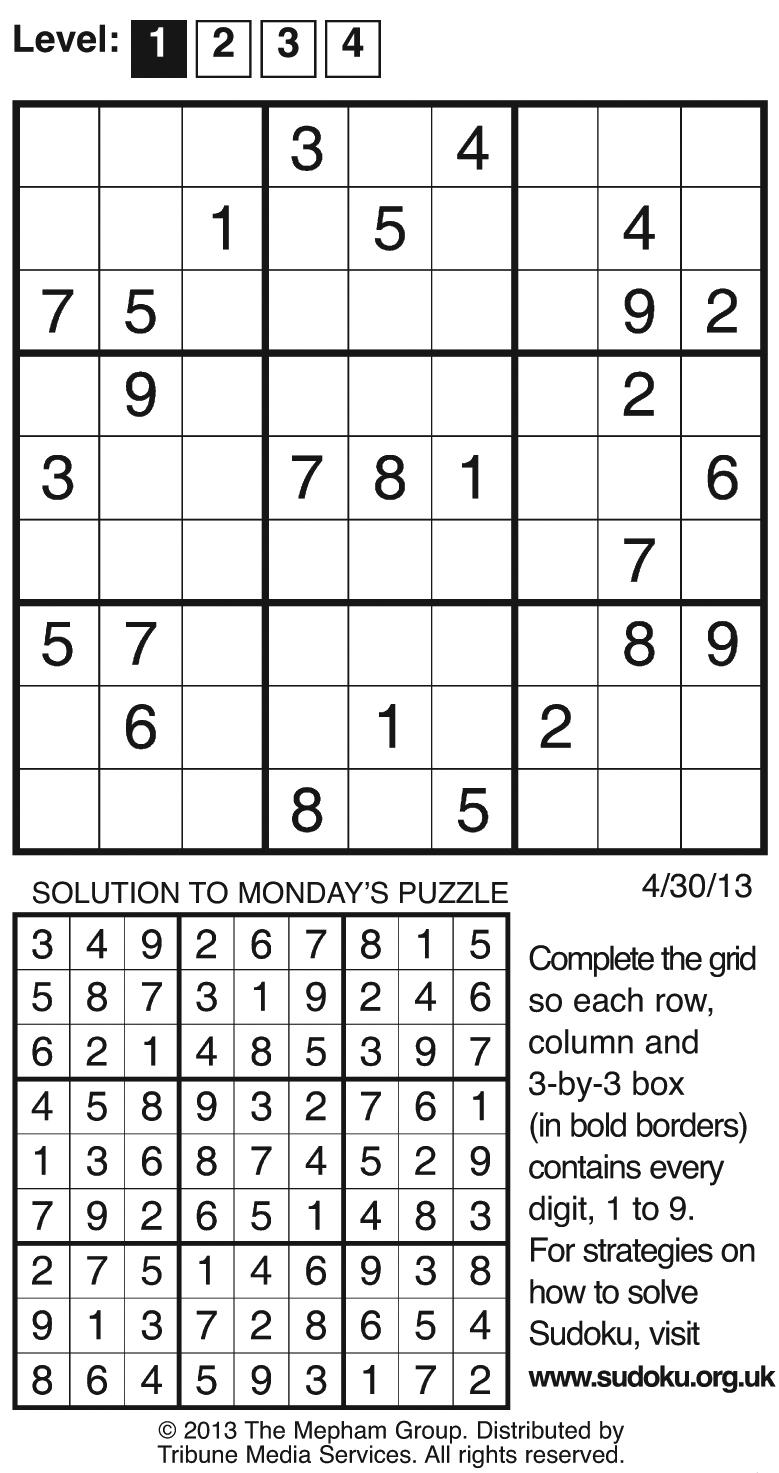
Sudoku | the mepham group
Lincoln City is making history
w ith l incoln c ity in the midst of one of the great alltime sports c inderella runs, perhaps it’s more apt than ever that the team is nicknamed the i mps.
w hen l incoln traveled to the p remier l eague’s b urnley on s aturday and came away with a win, it made history, becoming the first “nonleague” side to make the Fa c up’s quarterfinal round since before the war. no, not that war — the First world war. t he last time a nonleague side played an Fa c up quarterfinal, m arch 7, 1914, a rchduke Franz Ferdinand was alive, u s p resident woodrow w ilson was yet to declare mother’s d ay a thing, and b abe r uth was a minorleague baseball player. a lot has changed since then.
For a quick point of clarification: a team is “nonleague” if it doesn’t compete in either the Football l eague, which now runs the secondthrough fourth-tier divisions, or the p remier l eague, which broke away in 1992 to run the top flight. t hus, l incoln, who currently sits at the top of the fifth-division national l eague, would be ranked as the 93rd-best team in the country.
r emember Florida g ulf c oast, the no. 15 seed that a merica fell in love with four years ago in the ncaa men’s basketball tournament? t his is them going one step further, beating Florida and making the e lite e ight.
i f you google “imps,” the first result you’ll find is the definition: “a small, mischievous devil or sprite.” a s far as the Fa c up goes, l incoln — or any other non-league club for that matter — is the very definition of small. a t the p remier l eague level, clubs rake in exorbitant sums of money — the last-placed club’s prize money share will likely be around $125 million (£100 million) this year, as even the smallest clubs in the competition (like b urnley) are able to shell out eight-figure transfer sums. c ontrast that with l incoln, who will make, well, nowhere close to that, even if they win the national l eague and, with it, promotion to the Football l eague.
w hile b urnley’s not one of the p remier l eague’s giants, that it sits in the league at all makes this a perfect d avid vs. g oliath scenario; transfermarkt values b urnley’s team at around
$80 million, l incoln’s at just $850,000.
t he Fa c up is the most storied competition in e ngland — 736 clubs entered the tournament this year, with single-elimination matches (if two teams tie, they replay the match up until the round of 16) playing the field down to one champion, crowned at the end of m ay. b efore the institution of the nationwide Football l eague, it served as the chance to crown the best team in the nation.
For many years, it held that glory, too. b ut over time, the importance of the Fa c up has decreased, with bigger clubs taking it less seriously — resting starters to finish a place or two higher in the p remier l eague often yields more in return than advancing one or two rounds in the cup.
c onsider this weekend the perfect tonic to the malaise that’s set in.
not only did we get l incoln’s win, but monday night (well, afternoon in the u s .), fellow non-league club s utton united will host a rsenal for a spot in the quarterfinals. s utton’s ground holds just 5,013, with all of 765 seats — the rest of the supporters are forced to stand, and unlike a rsenal’s modern e mirates stadium, g ander g reen l ane (seriously, how can you not love that name?) isn’t at all luxurious.
s utton has a chance — a slim one if its opposition takes the match seriously, to be fair — of becoming the second non-league team this year to qualify for the quarterfinals, after it hadn’t happened in 103 years. t hat’s pretty neat.
o f course, s utton’s task is much more difficult — a rsenal’s squad is valued at over $500 million — but if the i mps succeed, they’ll set up the dream quarterfinals of all dream quarterfinals: s utton united would host l incoln c ity, with a spot at a wembley stadium semifinal on the line. e ven if s utton isn’t victorious, we’d still be treated to a l incoln c ity trip to a rsenal. it seems likely that either monday night or next month, we’ll get a fleeting moment of belief, a chance that lets us ponder if s utton or l incoln can pull off the impossible. a nd that moment will make this run one of the year’s best sports stories.
Contact Alex Carson at acarson1@nd.edu
The views expressed in this Sports Authority are those of the author and not necessarily those of The Observer.
i rish record blowout victory over i ndiana
By MICHAEL IVEY sports writer
notre dame continued its winning ways sunday when it defeated indiana 7-0 in a nonconference match at eck tennis pavilion. sunday’s match was the fifth time in notre dame’s last six games it has won by a score of 7-0.
t he irish (7-1, 1-0 acc ) were powered by singles wins from sophomore grayson broadus, freshman guillermo cabrera, freshman matt gamble, sophomore a lex l ebedev and freshman Jonathan small, who all won their matches in straight sets. senior Josh hagar won his first set 6-4 before dropping the second set 6-1. hagar emerged victorious in the third and decisive set, 7-5.
t he no. 1 doubles team of seniors eddy covalschi and hagar came back to win its match 6-4, while the no. 3 team of junior brendon kempin/ broadus won its match 6-1. irish head coach ryan sachire said the performances from senior captains covalschi and hagar stood out to him against the hoosiers (7-4, 0-1 big ten).
“you have to give a lot of
nbA | west 192, east 182
credit to our two senior captains,” sachire said. “t hey won a big match at no. 1 doubles to clinch the doubles points for our team and they were playing against a really good doubles team from indiana. our guys got down and one guy actually had the flu a little bit, so there was some pretty decent adversity facing our guys and they rallied to win 6-4 and competed really well down the stretch. i’m really proud of them.”
sachire also said he was impressed by the performance of freshman Jonathan small.
“i think the next person to single out is one of our freshman, Jonathan small,” sachire said. “coming into today he didn’t expect to play in the singles lineup and but eddy covalschi was feeling a little under the weather so we had to pull him out of singles. Jonathan came in and did no. 6 singles for us and i believe he got the fourth point that clinched the singles match for us. it’s not easy to be ready to go when you don’t know if you’re going to play or not, but he did a heck of a job for us.”
sachire said his team will continue to practice on improving serving as well as
individual aspects of each players’ game as the season continues.
“i definitely think serving is key,” sachire said. “i think one of the things that we want to do a great job of is attacking the second serve of our opponents. we started working on that last week and really made some good strides and we’ll continue to do that moving forward. in terms of specifics, there’s not a ton of time between now and our next match on Friday against northwestern, but we’ll spend time on wednesday and t hursday in practice with each guy to improve one or two things individually in his game and be ready to go on Friday.”
t he irish will be back in action on Friday night when they host northwestern at eck tennis pavilion.
sachire said his team will take some time off to recover before the match against northwestern.
“we’ll recover and use tomorrow and maybe tuesday for some guys for recovery, and then we’ll get back to practice,” sachire said.
Contact Michael Ivey at mivey@hcc-nd.edu
Davis sets scoring record as West defeats East
Associated Press
new orleans — a nthony davis had an a ll-star game for the record books.
a nd on a night when russell westbrook and kevin durant provided a glimpse of the past, giannis a ntetokounmpo showed he’s clearly part of the future and a midcourt lob attempt from James harden even went in, davis absolutely stole the show.
he scored 52 points, 10 more than wilt chamberlain’s a llstar record that had stood for 55 years, and the western conference beat the eastern conference 192-182 on sunday night — the highest-scoring game in league history.
“it was a lot of fun,” davis said. “my teammates did a great job of looking for me.”
durant had a triple-double with 21 points, 10 rebounds and 10 assists. stephen curry added 21 points for the west — where a subplot emerged as demarcus cousins played only two minutes, prompting some speculation that a trade sending him out of sacramento might be looming.
a ntetokounmpo had 30 points for the east, with 12 dunks in his night. lebron James scored 23 points to become the first a ll-star to eclipse 300 in a career, kyrie irving had 22 points and 14 assists, and isaiah thomas scored 20 for the east.
davis became the story that overshadowed the story coming into this game, that being the durant-westbrook whatever.
davis made 26 shots and took 39, both of those also a llstar records. he even outdid westbrook, who had 41 points in just 20 minutes — which ordinarily would have been enough to merit him what would have been a third straight mvp award. not this time. it was davis hoisting the trophy, to the delight of his new orleans fans.
a nd if there is any animus remaining between durant and westbrook, it was hidden. they passed each other the ball and slapped hands in the pregame layup line, and not long after westbrook checked into the game the former oklahoma city teammates provided one of the game’s top highlights — a giveand-go, capped by durant lobbing the ball to set westbrook up for a dunk.
“oh my god ! what Just happened?” curry shouted on the west bench, which moments later broke into celebration. players jumped and threw hands skyward, curry tossing a cupful of water onto a smiling durant amid it all.
draymond green called the play “cute,” and westbrook and durant seemed happy with it as well.
“it was a nice give-and-go, man,” westbrook said. “good give-and-go. made a good pass. i barely got over the rim, but it was a nice give-and-go.”
Alex Carson a ssistant managing e ditor
Hockey
continued F rom page 12
snapping home his fifth of the season on an odd-man rush.
b jork netted a pair in a twominute span late in the third period to give n otre d ame some breathing room.
b jork’s first goal came on a shorthanded break. h e hit the crossbar, but the puck ricocheted into the air in front of the net. a crashing p rovidence defender knocked his goaltender, and the puck, across the goal line.
“ i was a little pissed off, but then guys started skating over to me and i saw a scrum in front of the net,” b jork said of his goal, which he didn’t realize went in until he moved close to the blue line. “ t hanks to the hockey gods, i guess.”
n otre d ame turned to b jork and its other cornerstones s aturday night to rally from 1-0, 2-1 and 3-2 deficits; the top forward line of b jork, junior Jake e vans and freshman c am m orrison was on the ice for all three i rish goals.
“ t hey’re either going to help us win it or they’re going to help us lose it every night,” Jackson said of his top line. “ n ot only do they have to be productive offensively, but they get matched up against other teams’ top lines, and they have to fight through that and they have to defend.”
e vans redirected a pass into the Friars net with 25 seconds left in the second period to tie the game, 2-2, and m orrison made it 3-3 when he deflected another d ello shot off the far post midway
W bball
continued F rom page 12
of the charged home crowd, more than 11,000 strong, by making their first ten shots, including three 3-pointers, for a 20-8 lead.
“t hey came out really smoking,” i rish head coach muffet mc graw said of syracuse. “t hey really shut the lights out in the first quarter, and i was a little disappointed in our defense.”
notre dame trailed for the entirety of the first half, plagued by turnovers and unable to slow the orange onslaught. u ltimately, the i rish entered halftime down 43-35 — just the second time this season notre dame has trailed at the half, the other being its sole acc loss to north carolina state on dec. 29.
orange senior guards a lexis peterson and brittney sykes paced their team with 19 points each, while two other orange players contributed 18.
through the third period.
s ophomore defenseman
b obby n ardella scored the first i rish goal, picking his spot on a first-period power play.
“[ p rovidence is] one of the top teams in the country, and one of the hottest right now, so getting three points out of that is pretty big,” e vans said after s aturday’s tie. “ p roud of the team — we showed a lot of resilience today.”
Junior netminder c al p etersen also made a few highlight-reel saves in the third period s aturday to keep n otre d ame in the game. o verall p etersen turned away 70 of the 74 shots (.946 save percentage) he faced on the weekend while recording his 50th career victory Friday.
“ we just couldn’t extend our lead,” l eaman said. “ we had two or three really good looks. [ p etersen] came up with some really good saves.”
n otre d ame visits b oston university next weekend with playoff seeding and a first-round bye in the h ockey e ast playoffs on the line. t he i rish clinch a bye with a single point, but they can climb as high as first or fall as low as fifth depending on results around the league.
“ we control our own destiny [in h ockey e ast],” Jackson said. “ we’re going to have to play probably the most talented team in college hockey next week. it’s going to be a big challenge, especially in their building.”
p uck drop Friday is at 6:05 p.m. while action at a gganis a rena gets underway at 7:05 p.m. the following evening in b oston.
Contact Zach Klonsinski at zklonsin@nd.edu
adjusted after the break, continuing to dominate the boards and the paint while making changes to slow down syracuse’s attack.
“t hey didn’t really cool off too much until the second half,” mc graw said. “ … we used everything in our book [on defense], and i thought it kept them a little off balance.”
notre dame finally tied it up midway through the third quarter on one of turner’s many layups of the night. however, it took just a few seconds for the i rish to be behind again by four, and then by seven a couple minutes later. several i rish players missed shots and committed fouls in that span.
heading into the final quarter, mc graw’s squad was down by four yet again.
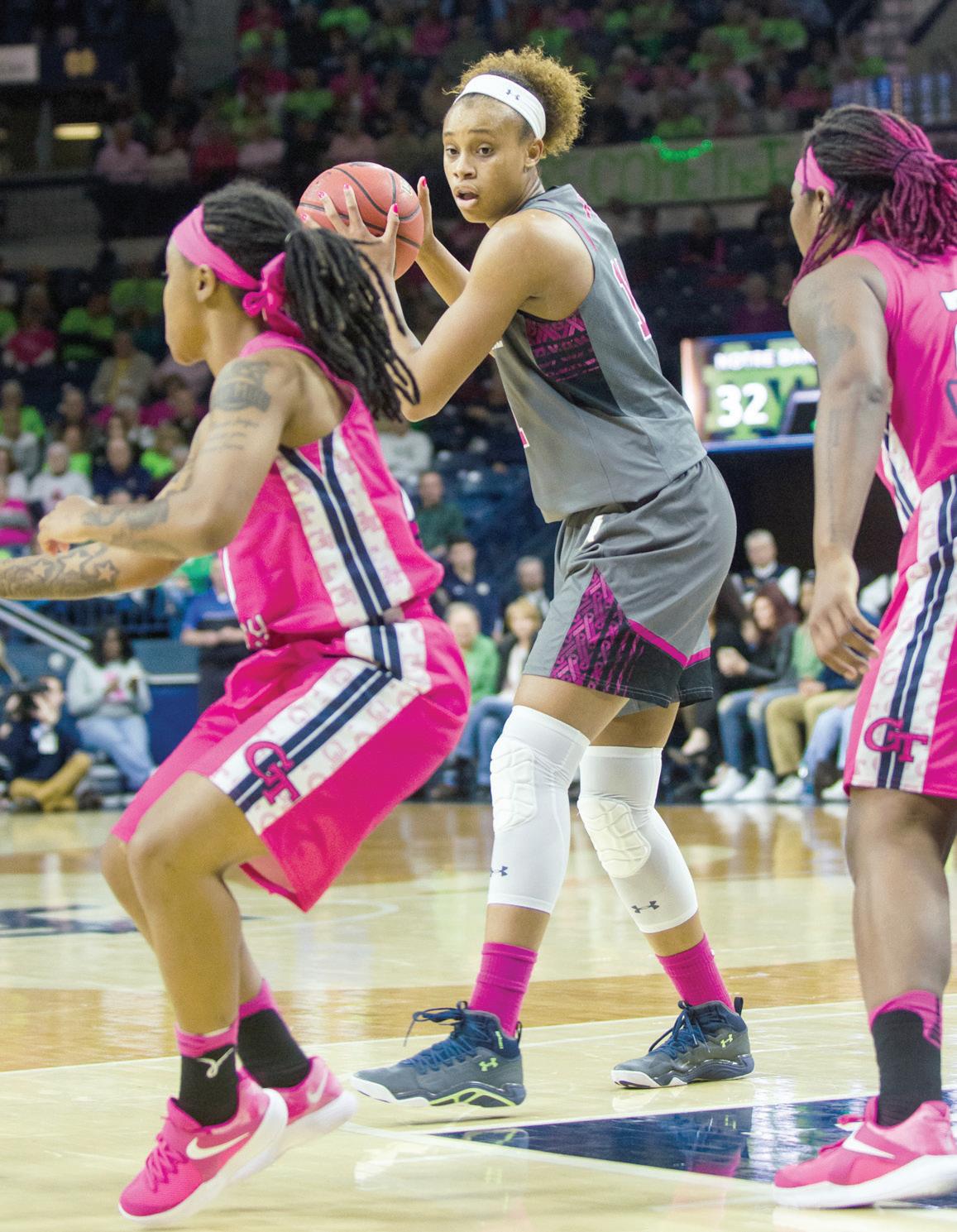
missed free throws by notre dame (and made free throws by peterson) kept the home team’s hopes alive until there were 11 seconds left and the i rish had a one-point lead. syracuse fouled notre dame sophomore guard marina mabrey, who finished with 22 points, and she sank both free throws. peterson then missed a 3 and turner snagged the rebound to effectively secure the i rish win.
mc graw said along with mixing up the defensive plans, getting the ball to turner was key to taking the game back. t he victory was crucial to notre dame keeping its spot at the top of the acc standings, and staying in contention for a no. 1 seed in the ncaa tournament in march.
“t he thing that makes them hard to guard is they can put it on the ground, and they can shoot 3s,” mc graw said of the pair of guards. “we have the best backcourt in the league, but they definitely have one of the best in the league also.”
nevertheless, notre dame
but the fourth was a different story: the i rish went off on a 10-0 run, and at last took their first lead of the day with eight minutes remaining. t he orange had no answer for turner, who shot 13-of-14 overall sunday.
however, syracuse would not just go away — the orange stayed close and sunk a 3-point shot with 36 seconds remaining to narrow the i rish lead to four.
a n orange attempt at a trick play failed, but several
mc graw said the team had known the importance of winning at the carrier dome all along.
“t his was a game i was really worried about,” mc graw said. “t his is the game you look at on the schedule and you think maybe this was the most important game of the year. we had to win this game. t here’s a lot of pressure on us to hold on to first place. i’ll tell you, it was tough.”
Contact Renee Griffin at rgriffi6@nd.edu
paid a dvertisement
KATHLEEN DONAHUE | The Observer Irish junior goalkeeper Cal Petersen defends the goal during a 4-1 victory over Vermont on Feb. 4 at Compton Family Ice Arena.
mbball
continued F rom page 12
our bye-week timing. we need a little bit of rest to get refreshed for the stretch run.”
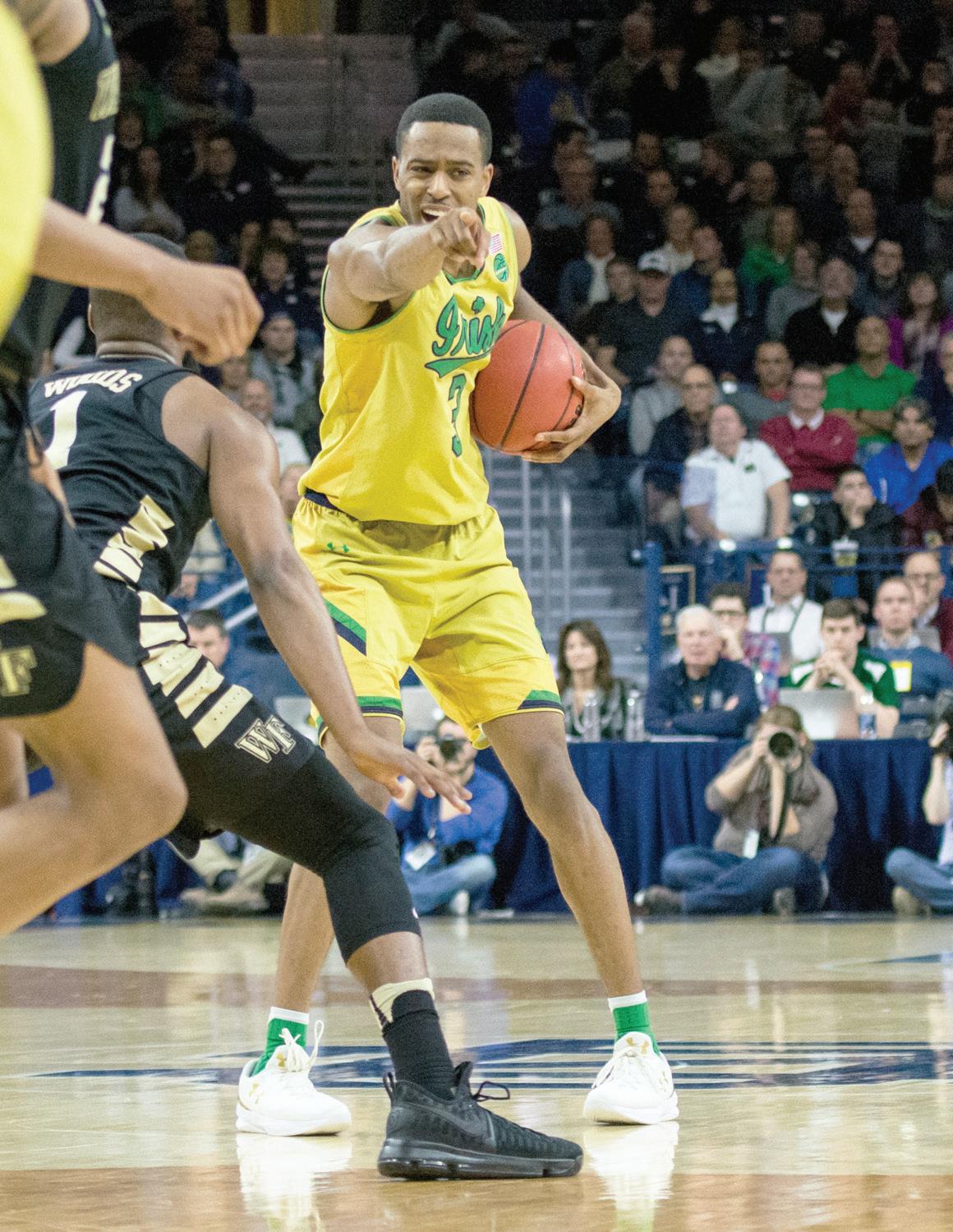
brey also applauded how notre dame took care of business on the road, displaying its strengths on offense against a struggling wolfpack defense. carrying momentum from their three-game winning streak, the irish offense was hitting on all cylinders in the first half of the game. senior forward v.J. beachem and junior forward bonzie colson led the charge scoring 10 points each. beachem converted two of his three 3-point attempts while colson connected on all five of his field goal attempts in the first half.
the wolfpack kept the game close through the first 10 minutes of the first half behind sophomore forward maverick rowan’s four points and freshman center omer yurtseven’s six points. however, with a little over eight minutes left in the half, the irish significantly extended their lead with a 19-9 run.
beachem started the run with a 3-pointer, which was followed up with back-toback jumpers from colson. sophomore forward matt ryan, who came off the bench, also contributed to the run with two straight 3-pointers. with 56 seconds left in the half, a pair of free throws from junior guard matt Farrell extended the irish lead to 13 points. despite shooting 59.3 percent from the floor in the first half and having a lead as high as 23 points in the second half, notre dame allowed n c state to make a run of its own to cut the deficit.
Freshman guard dennis smith Jr. and freshman guard markell Johnson scored 22 of the wolfpack’s 44 second half
points, and in a span of about seven minutes, n c state went on a 21-10 run to cut the notre dame lead to just 10. smith scored 10 of his 16 points during that run.
w hile it looked as if the wolfpack were going to make the game competitive again, colson put a halt to their momentum with a layup and a made free throw. beachem’s seventh 3-pointer and senior forward steve vasturia’s four free throws ended any opportunity of a n c state comeback.
“we did get out of the gate well,” brey said. “we talked about that [asking], ‘could we get off to a good start?’ i thought they’d have a run, and they did. they’re a gifted offensive team. i loved our poise. we didn’t get rattled, and, again, we made big free throws to get out of here.”
in addition to beachem’s 27 points, the irish also got a lift off the bench from freshman guard t.J. gibbs, who scored all of his seven points in the first half. ryan added six points, and senior forward austin torres added another four points along with two rebounds.
notre dame is now on a fourgame winning streak, which moves it to fourth place in the acc before playing its final three games of the season, the irish will benefit from having a full week of practice and rest before its next game against georgia tech.
“we need a little rest and a little break from the routine,” brey said. “my goal is when we really get back into our practice routine on thursday, we feel like it’s october and we have really fresh legs and minds.”
notre dame will face off against georgia tech for the second time this season sunday at purcell pavilion.
paid a dvertisement
i rish gain momentum heading into accs
By JOE EVERETT sports writer
a week before the acc indoor championships, notre dame picked up some much-needed momentum this weekend at the a lex w ilson i nvitational.
t he i rish saw six first-place finishes and 22 personal records saturday inside l oftus sports center. hosting and competing against athletes from 32 teams across the country, notre dame and i rish head coach a lan turner viewed the meet as a tuneup for the acc championships, as the i rish held out many of their top performers.
“t he people who did compete today did very well,” turner said. “t he throwers in particular have been pretty consistent all year, and they had a very good day again today.”
t he throwers did have a strong showing at the a lex w ilson i nvitational. t he men’s shot put saw three personal records from underclassmen, as freshman l ogan kusky finished in second with a throw of 16.37 meters, with sophomore daniel hardiman (16.33 meters) and freshman shae watkins (15.97 meters) right behind him in third and fourth, respectively. on the women’s side of the shot put, senior i ndi Jackson made a statement by breaking the indoor school record in the event with her throw of 16.23 meters — earning second place in the event. turner commented that Jackson performance shows she has the potential to compete with best in the country.
Contact Manny De Jesus at mdejesus@nd.edu Swimming
“[ i ndi’s performance] was another big highlight — she’s peaking at the right time,” turner said. “r ight now she’s 19th on the national list, so if next week she can throw a few centimeters further, we think we can get her into the national meet.”
i n the jumps, freshman l andon shank took first place
in the pole vault with a mark of 4.56 meters, while freshman keira kelly won the women’s high jump with a leap of 1.59 meters.
on the track, junior Jessica harris provided another highlight by winning the women’s mile in a time of 4:35.27 — setting another personal record, like she did at the meyo i nvitational earlier in the month. harris’ performance also puts her in the national conversation, and again drew praise from turner.
“t hat [performance] sets her up nicely,” turner said. “r ight now she’s ninth [nationally] in the mile, and i think that time should hold up. h istorically, [her time] has been right there on the bubble in the top 16, so i think she’ll get in. she’s running the mile right here next week at [accs], so if she wants to take it out fast and run faster, i definitely want her to do that.”
k aitlin Frei continued the success of the i rish in the
important for our program — it means we have a huge future ahead of us,” l itzinger said.
year with Joe winning and being the first acc champion ever in notre dame’s men’s swimming program really got the momentum started for us and we are thrilled.”
l itzinger emphasized the importance of eight school records being broken by mostly freshmen and sophomores as well, saying their experience should yield positive results in the future.
“t he women setting those records are freshmen and sophomores and that is really
“[Freshman] a bbie dolan set two of those records and e rin sheehan, who is a freshman as well, really came out of nowhere to get third in the 100 butterfly. i knew she was set up to do something special, but i didn’t know how special it was going to be and it turned out to be really special. now it’s on to the ncaa championships and we’ll see where we go from there.” next up for the i rish women is the ncaa championship meet the week of march 15.
l itzinger said the team will be
women’s distance events, as the junior took first place in the 5,000-meter run with a time of 17:56.13. on saturday, youth was served in the sprints, as freshman troy p ride Jr. ran a 6.93-second race to win the men’s 60-meter dash, while freshman summer t horpe took home the title in the 60-meter hurdles with a time of 8.60 second. Freshman madysen hunter also had a big day, recording two personal records in the 60-meter hurdles (9.08 seconds) and 60m dash (7.78 seconds) — recording fourth place finishes in each. having closed out the indoor regular season, notre dame now sets its sights on the acc indoor championships. t he i rish will host the meet at l oftus sports center next t hursday, Friday and saturday, where 15 teams will compete for the title of conference champion.
Contact Joe Everett at jeveret4@nd.edu
able to take nine women to the competition based on qualifying times.
“t hey take the top 38 women in each event,” l itzinger explained. “we made all of our relay cuts so we will be swimming in four out of the five relays at the ncaa s, which is really exciting. a ny way you slice it, we will be taking nine women to the ncaa meet.”
t he men will compete in the acc championships in atlanta next week, while the women visit i ndianapolis for the ncaa championships march 15-18.
Contact Brenna Moxley at bmoxley@nd.edu
EMMET FARNAN | The Observer
Junior Jessica Harris runs the mile during the Meyo Invitational on Feb. 4 at Loftus Sports Complex. Harris won the mile on Saturday.
mEn’S bASkETbAll | nd 84, nc state 72
Irish earn fifth conference road win of the season
By MANNY DE JESUS sports writer
it’s probably safe to say that no. 25 notre dame has locked in a spot for the ncaa tournament next month. the irish (21-7, 10-5 acc) secured their 10th acc victory of the season saturday defeating north carolina state 81-72 in raleigh, north carolina. with the win, notre dame also recorded its fifth conference road win of the season, this one over a wolfpack (14-14, 3-12) squad that recently fired its head coach mark gottfried, who will continue to coach until the end of the season.
irish head coach mike brey acknowledged the importance of the 10th conference win right before returning to south bend for the last two home games of the regular season.
“i’m thrilled,” brey said. “For this group to get to 10 league wins in this week, this year, and five road wins, which guarantees a road winning record … it’s a heck of an achievement. i love
HoCkE y | nd 4, providence 1; nd 3, providence 3
squad earns win,
By ZACH KLONSINSKI
a ssistant managing e ditor
t he word “playoff” was tossed around before, during and after no. 15 notre dame’s series with no. 9 p rovidence this weekend.
e ntering the weekend, just one point separated the i rish (18-9-5, 11-5-4 hockey e ast) and Friars (18-9-5, 10-7-3) in the hockey e ast standings, but notre dame pulled away for a 4-1 victory Friday and overcame three one-goal deficits saturday as the teams skated to a 3-3 tie.
“it was like a playoff game,” i rish head coach Jeff Jackson said after notre dame’s win Friday. “t here wasn’t much space for either team.”
“t his is basically playoff hockey now,” i rish junior forward a nders bjork said Friday, echoing his coach. “we’ve got to play desperate, do-or-die, because that’s basically how we’re going to have to play the rest of the season.”
“t hat’s as close to playoff hockey as you’re going to get,”
p rovidence coach nate l eaman said after saturday’s game. “ … t heir environment was terrific this weekend, maybe the best we’ve played in all year.”
youth powered the i rish to the win Friday as freshman forward cal burke broke a 1-1 tie just 59 seconds into the third period with his third goal of the season. burke won an offensive zone draw and drove straight to the front of the net in time to pounce on a rebound off a shot by classmate defenseman tory dello.
“t he young guys are growing up,” Jackson said. “[ t he freshmen] are basically sophomores now.”
“everyone’s said all year we’re a young team, we’re immature,” bjork said. “we’ve finally learned how to take that step and learn how to play against good teams and win. … it’s really encouraging to see how well the guys have stepped up.”
sophomore forward Jack Jenkins gave notre dame the lead in the first period,
SWImmInG & dIvInG
nd women place seventh at accs
By BRENNA MOXLEY sports writer
notre dame placed seventh in the acc women’s swimming and diving championships, which took place last monday through t hursday in atlanta.
t he women broke school records in four relays: the 400yard freestyle relay, the 200-yard freestyle relay, the 200-yard medley relay and the 800-yard freestyle relay. t hey also beat four individual schools records for the 100-yard backstroke, 100-yard freestyle, 200-yard freestyle and 100-yard butterfly. on top of this, the men’s diving team claimed first place in the 1-meter acc championship after junior Joe coumos scored a 420.00. cuomos’ performance marked notre dame’s first-ever acc championship medal for diving.
irish head coach mike l itzinger spoke about the contrast between last year’s team and the newly self-assured squad.
“it was a great week for our women,” l itzinger said. “a year
ago we were very unsure of ourselves and not super confident about where we stood in the league and where we stood with ourselves, seeing that there was a coaching change. i can tell you without a doubt it was a great effort by our women, we had a lot of fun, and we swam really fast. i haven’t been part of a group that has swum that fast collectively in a long, long time so i am very proud of them.”
l itzinger spoke about coumos’ performance, which helped the irish take home their first-ever acc championship medal, saying the tomball, texas, native helped make history for notre dame.
“we were in an odd situation with the men’s divers competing during the women’s meet because the focus is naturally on the women due to them participating in the bulk of the events,” l itzinger explained. “l ast year, Joe redshirted and we were a little low on the diving end of things, but to have such a great start to the men’s meet this
Notre Dame seals victory with second-half run
By RENEE GRIFFIN sports writer
d espite trailing for 78 percent of the game, and by as many as 13 points, no. 7 notre dame pulled out an 85-80 win over no. 21 s yracuse at the c arrier d ome on sunday night, powered by 44 i rish rebounds and a career-best 31 points from junior forward brianna turner.
t he final rebound tally for notre dame (25-3, 13-1 acc ) was more than double the number s yracuse (18-9, 9-5) was able to haul in. t hat translated to 22 second-chance points compared to s yracuse’s three.
Freshman guard Jackie young paced the i rish with 12 rebounds, made possible because of the o range’s eagerness to shoot from beyond the arc — they sank 46.2 percent of their 3-pointers on the day. turner added nine rebounds, just missing a double-double. t he o range took advantage
CHRIS BOWERS | The Observer
Junior forward Brianna Turner holds the ball at the elbow during a 90-69 victory over Georgia Tech on Feb. 12 at Purcell Pavilion.
hockey
MICHELLE MEHELAS | The Observer
Irish senior forward V.J. Beachem directs the offense during Notre Dame’s 88-81 victory over Wake Forest on Feb. 7 at Purcell Pavilion.