
n
Notre dame will not be a sanctuary campus
University president ‘concerned that such a declaration may give our students a false sense of security’
By COURTNEY BECKER news writer
it was announced at student senate wednesday that university p resident Fr. John Jenkins sent a letter to the members of the faculty senate Feb. 7 informing them he will not declare n otre d ame a sanctuary campus at this time.
Jenkins said in the letter — which he sent in response to a resolution from faculty senate asking that the university be declared a sanctuary campus — that he is concerned declaring the university would give students a false impression of the weight the term carries.
“ w hile the senate no doubt recognizes that the practical import of declaring n otre d ame a sanctuary campus
is limited, the resolution affirms that the term ‘carries considerable symbolic weight,’” he said in the letter. “ i appreciate this point, but am concerned that such a declaration may give our students a false sense of security.”
a ccording to the letter, Jenkins’ concerns stem from the university’s duty to “comply with the law,” potentially conflicting with any promises the students could interpret from the declaration.
“The senate’s resolution itself recognizes that while the term ‘sanctuary’ could be understood as a place ‘free from civil intrusion,’ the university must comply with subpoenas, court orders and warrants,” he said in the
see sancTuary PaGe 3

Demonstrators pushed for the University to become a sanctuary campus in November. On Feb. 7, Fr.
wrote that Notre Dame “would not voluntarily provide information … without a clear legal requirement.”
Athletes reflect on black activism Saint Mary’s hosts Chinese exchange student
By ANDREW CAMERON news writer
The o ffice of m ulticultural s tudent p rograms and s ervices hosted “ s ports and a ctivism: Fame, c ontroversy, and i mpact” — a panel to discuss the importance role that sports have played in a frican- a merican activism — wednesday night in l aFortune s tudent
c enter.
The panel featured three speakers: a mira r ose d avis, Johns h opkins u niversity history p h. d. candidate; k arin m uya, senior forward on the n otre d ame women’s soccer team; and a utry d enson, class of 1999 alum and current running backs coach for the Fighting i rish.
see aThleTes PaGe 4
By GINA TWARDOSZ news writer
saint mary’s has sent students to china women’s university through an exchange program before, but junior siwei li is the first student from china women’s university to attend the college.
“i love the environment here because there’s so much free time and you can do all of the
things you want to,” li said.
“a lso, i’ve met plenty of great students here.”
a lice siqin yang, associate director of international education at the college, said china women’s university is an esteemed college firmly invested in women’s empowerment.
“it is affiliated with the a llchina women’s Federation, which is a national network,” yang said. “There’s a strong
network support for women’s empowerment and girl’s education in the country. we all support the idea of women’s education. we share the same philosophies and visions for leadership and training for our students.”
in her three months in the u s., l i has visited three states, including i ndiana.
see eXchange PaGe 4
‘i ran beyond politics’ display comes to snite
By CIARA HOPKINSON news writer
i n an attempt to showcase a different side of i ran, the p ersian a ssociation of n otre d ame ( pand ) is hosting a photo exhibit, titled “ i ran b eyond p olitics,” on Friday at the s nite m useum of a rt.
Fatemeh e lahi, an organizer of the event and a

member of pand , said the exhibit “emphasizes the diversity of the i ranian people — especially culture and ethnicity.”
The exhibit includes photographs of i ranian society, nature and architecture.
“This exhibit shows some very old parts of i ran and some very new parts, and i think this contrast is my

favorite,” e lahi said. pand , which was founded in o ctober, is hosting the exhibit in order to show i ran from an angle not usually seen in the media, e lhai said.
“ e specially with all the recent news about i ran, we’re trying to provide a different image of how eager i ranian people are to communicate

with the west, and how what the media shows is not the true representation of i ran,” e lahi said.
e lahi, who emigrated to the u nited s tates from i ran when she was 16 years old, said she relates to the exhibit’s mission on a personal level.
“ w hen i came to the u s ., a melting pot of different
cultures, i realized how much my government, my media had skewed my mind to think a certain way about certain people,” e lahi said. “ w hen i met those people, i realized that wasn’t true at all, or that was only part of the story.”
The exhibit is not seeking
see eXhibiT PaGe 3

CHRIS COLLINS | The Observer
Jenkins


s anctuary
letter. “ we do not now, and would not, voluntarily provide information about any student without a clear legal requirement to do so, but we would comply with the law and so cannot promise a campus entirely ‘free from civil intrusion.’ i do not want to appear to make our students a promise on which we can not deliver.”
Jenkins also said he was concerned about potential action against d eferred a ction for c hildhood a rrivals ( daca ) students at n otre d ame if the campus were declared a sanctuary campus.
“ i am also mindful that a public declaration of our campus as a sanctuary campus could unnecessarily draw attention to these vulnerable students and provoke a reaction from authorities that we might otherwise avoid,” he said. “ … k ey members of the administration have either signaled or said that there are no plans to act aggressively against those with daca status, and at this point, it is perhaps best to monitor the situation.”
a fter Jenkins released his letter, the notre d ame c ollege r epublicans said they were supportive of his decision.
“ we are very pleased with Fr. Jenkins’ decision to not make n otre d ame a sanctuary campus,” senior k evin b urke, c ollege r epublicans secretary, said on behalf of the club in an email. “The rule of law is an important and necessary part of a merican society and we applaud Fr. Jenkins on his decision.”
The n otre d ame c ollege d emocrats said they were disappointed in Jenkins’ decision. s enior a ndrew g allo, co-president of the c ollege d emocrats, said the club had hoped Jenkins would a step to provide any extra protection
available to daca students at n otre d ame.
“ we think that as a c atholic university and a university of our stature that we are in a tradition of welcoming refugees and welcoming those who need it and those who are cast aside,” he said. “a nd so in light of the new administration and the new policies regarding immigration and refugees, it’s really disappointing to see that Fr. Jenkins will not designate us a sanctuary campus — that he will not provide these basic and necessary protections that we think are so essential for many members here in our community.”
d espite his decision to not declare n otre d ame a s anctuary c ampus, Jenkins assured the Faculty s enate his commitment to daca students at n otre d ame remained unchanged and said the university would continue to support them.
“ … i also met privately with a number of our daca students to listen to their concerns and assure them of the university’s support,” he said. “There are a number of our university colleagues who are doing superb work in providing day-to-day assistance and guidance to these students during this difficult time, and i can assure you, we will continue to provide the university resources necessary to do so.”
s tudent senate additionally discussed potential executive cabinet restructuring that would cut the number of members from 22 to 17, passed an amendment to the constitution that will restructure the s hirt e nrichment e ndowment to put the profits from The s hirt p roject to better use and incentives for students to live on campus for their senior years during its meeting.
Contact Courtney Becker at cbecker3@nd.edu
to show some sort of grand image of i ran, e lhai said.
r ather, it seeks only to show a fuller vision of i ran, beyond its political and religious conflicts.
“ i t’s actually very mundane things ... basically, we’re showing that no, they’re just people,” e lahi said.
m aryam g hadiri, a p h. d student at p urdue and the curator of the exhibit, gave a T ed Talk called “ i ran from a d ifferent l ens” last spring. a fter seeing the talk, several members of pand proposed booking the exhibit. The event happens to fall just a few weeks after p resident d onald Trump issued an executive order temporarily banning foreign
nationals and refugees from seven predominantly m uslim countries, including i ran, from entering the country. c atering to fears of “the other,” e lahi said, is nothing new.
“This is a very common strategy that many politicians have used in the past to establish their own government and gain popularity,” e lahi said.
Though many a mericans have pushed back strongly against the travel ban, there are other ways to combat misconceptions and misguided fear, e lahi said.
“a nother strategy is communication, showing ourselves in the community and trying to represent ourselves,” e lahi said.
Contact Ciara Hopkinson at chopkin1@nd.edu

INsIde ColumN
w hat’s the next big thing?
w hen i got back home for winter break, i went through a box of some of my childhood items and found my old fourth generation i p od Touch from my middle school days. i turned it back on and was immediately greeted by the old operating system, i os 6.1.6. a fter using the i p od Touch for a couple of minutes, i realized not a lot has changed with current smartphones.
a lot of flagship smartphone devices boast a great deal of improvements and extra features. b ut if you break it down to the bare backbone, they are the same as their predecessors. you just have to add the word “better” to a certain component of the devices and there you have it — a “new, revolutionary” phone. For example, the i p hone 7 just has a better screen, better data connection, better storage, better processor, better security and better build. The same thing applies to its competitors, the s amsung g alaxy lineups and other a ndroid devices.
i t was not a surprise when i later heard the news that the smartphone market was destined to die out in five years or so. Take a look at tablets, laptops, and other hybrids. c ompanies have seemed to just follow the path of “if there is nothing wrong with it, leave it.” a s a result, the competition within the technology field has driven these devices to become faster, lighter, and stronger, and now it has reached a point that customers do not see any further improvements as a necessary push to upgrade their devices.
e ven though i bought the i p ad a ir in 2013, i don’t find the need to upgrade to the latest tablet out there. i ’m sure later in the future, we will reach a point where we won’t upgrade our smartphones as much either. This stagnation within the smart device market makes me wonder what the next new thing will be.
w hen the first set of mobile phones came out, it changed how people communicated by making it more personal and portable; it allowed consumers to reach others for one-on-one conversations or message chat. w hen the first i p hone came out in 2007 along with other smartphones, it changed how people interacted within social groups and networks. a pps like i nstagram and s napchat have changed how people share and exchange information. w hat kind of change will the next level of communication bring the society to? w hat form of communication will it utilize? w ill it be virtual reality headsets? w hat will be the next big thing?
Contact Joseph Han at shan3@nd.edu
The views expressed in this Inside Column are those of the author and not necessarily those of The Observer.
letters to the edItor
Don’t invite Donald Trump to Commencement
Fr. Jenkins, i t has been years since i last read an o bserver article, and even longer since i wrote a letter to the editor, but today i found myself, drawn back, through social media: Friends had shared an article about whether d onald Trump would be invited to speak at the 2017 c ommencement. a s a student and as an alumnus (and, in fact, until the results of this election), i was proud of the u niversity’s tradition of inviting the sitting president, regardless of party, to speak. n ow, i am terrified of associating d onald Trump with the best traditions, let alone the intellectual and moral life, of our u niversity.
There is so much to say about the reasons not to pick Trump — much of it said during the course of the presidential campaign. r ather than repeat the innumerable scandals and embarrassments, i want to focus on three things which i ’m sure you look for in a commencement speaker: inspiring n otre d ame’s newest alumni, commending the value of higher education and furthering the unique mission of n otre d ame.
First, and most basic, can you imagine Trump inspiring the class of 2017? c an you even imagine him saying anything of value, at all, to a graduate? w hen you ask students, faculty, staff, trustees, h oly c ross priests or other trusted friends, can they imagine it? h e speaks at a lowest common denominator level, playing to fear and insecurity, trading on innuendo and conspiracy theories.
s econd, Trump may be among the worst people to uphold the value of higher education among our recent graduates. That may sound hyperbolic, but this man has utter distain for any sort of learning or expertise, as he demonstrated by claiming to
“know more about isis than the generals do,” and that that his “primary foreign policy consultant is myself” because “ i have a very good brain.” l earning should inspire humility about the limits of one’s own knowledge; as s ocrates reflected: “The ancient o racle said that i was the wisest of all the g reeks. i t is because i alone, of all the g reeks, know that i know nothing.” w ho can picture Trump ever betraying a hint of ignorance about anything? That, after all, would be a sign of weakness.
Third, and finally, Trump’s words and conduct are antithetical to n otre d ame’s unique mission. a s a student, i was inspired by the u niversity’s commitment to teaching the whole person, to promoting a moral and spiritual, as well as intellectual, education. Trump represents no kind of moral or spiritual life. e verything that Trump says, everything that he does, is in service of himself and his ego. The things he likes, the things he does, are the best; he says kind words about those who support him or treat him well, and no one else. Those who oppose him are liars, failures or losers. i am not saying that our commencement speaker must be c atholic, or even c hristian, but Trump’s conduct provides no evidence of any guiding moral principle, beyond pride.
Fr. Jenkins, i can think of no worse commencement speaker than d onald Trump. i t is prestigious for the u niversity to have presidents speak at commencement, but surely prestige alone cannot drive this decision. w hat shall it profit the u niversity to have d onald Trump as a speaker?
w hy we should celebrate c hinese new year
o n Jan. 28, 2017, c hina celebrated spring Festival, the annual c hinese new year and the most widely celebrated holiday in c hina. a s a freshman, this is my first year living away from home during this national holiday, and like many others on campus, being away from home during this festive season will be the case for many years to come.
a s i spoke to my parents and friends, i could not help but reminisce about the days as a child when i was blessed to spend this holiday at home. i could not help but remember the color red lingering in every corner of the city as everyone prepared to celebrate; beautiful red lanterns, decorative paper-cuttings and traditional antithetical couplets — traditional poetic idioms that expresses good fortune — adorning every household. i also remembered the smell of mother’s dumplings, and the warm feeling of family as we cuddled together waiting for the countdown to the new year. Three … two … one … and the sound of the city lighting up in fireworks.
i was very happy when i saw that the c hinese c ulture s ociety decided to organize special events to celebrate this joyous occasion, but i was also sad to see that the school itself had paid little attention to this holiday. my
calculus professor, who is from c hina, expressed briefly that, “hopefully someday, the school will give us a holiday because it is the most important day in c hina.” This seemingly perfunctory comment made me realize how little attention the school pays to cultural events outside the united states. s ome of my friends who had gone to universities such as uc b erkeley and nyu had all seen red colored decorations put around the school, and even temporary changes in dining hall menus. notre dame’s student body is over 8 percent international students — not to mention a large part of this percentage is students from c hina — and with this number growing each year, our school is becoming more and more international and outward facing. i encourage the school to realize this and harness this opportunity not only to diversify its students on campus, but also to diversify its culture, to learn about the different traditions and backgrounds of people it houses behind its academic doors and to strive to make our home under the dome a place for everyone.
Wendi Gradoville freshman Feb. 14
Mike Romano class of 2004 dec. 7
Joseph Han graphic designer
Matt Williams v iewology: c ritical
Experimenting with joy
o f all the existential questions to get tossed around on Friday nights or over coffee on s aturday mornings, my all-time favorites are those considering the point of human life. They usually begin as raw why questions about our existence, which get mixed into questions of how to live a “meaningful” life, before finally rising into half-baked opinions about the pursuit of pleasure, power and a plethora of other emotions and achievements.
recently, i have been trying a different approach to this process. working backwards, i assume “to maximize joy” as my hypothesis for the worthiest pursuit in life, and then i test this hypothesis by experimenting with joy so to speak.
b efore beginning these experiments, however, i had to first figure out what exactly this intangible concept of “joy” truly was, where this state, which seemed to transcend the realm of feelings like happiness and suffering, came from, and why everyone from h is holiness the dalai l ama to p ixar producers at d isney l and seemed to believe that it was the most important part of life.
This sounds like a simple task, but for a threeletter word that entered most of our vocabularies in grade school, joy turned out to be a surprisingly elusive concept to catch. i quickly discovered that it couldn’t be activated from a sample set of emotions and actions, such as “if chocolate, then joy,” but rather, inducing the experience of joy relied upon our completely adopting a certain state of mind. Thus, while happiness could be clearly traced to a great piece of cake or a first kiss, and suffering directly derived from a stomach ache or bad break-up, joy was not so simply summoned.
i think this is because joy is of a different degree than happy and sad, and therefore is not subject to the same principles of cause and effect that these more temporary emotional reactions are. This
would explain why it’s possible to find joy amongst great suffering; and why it’s easy to produce happiness when one possesses joy alone.
To put this another way, because joy is a state of mind something that exists independent from external circumstances, and because a foundation of joy can provide a subsistent supply of happiness, there’s never a reason why you can’t choose to be the happiest person in the room.
w hat’s more, joy has a self-catalytic effect, wherein once you detect the trace of joy, it naturally leads you to discover even more, and the more joy you find, the more you recognize has been hidden all around you, disguised under the veil of daily distractions, just waiting to be uncovered. i know this to be true, because i been repeatedly revealed this effect through my own experiments with joy.
l ately, when walking to class, or sitting down to dinner, i have begun to feel the infectious powers of joy. it comes over me, at first, like an itch, but then quickly evolves into something as expressive as a sneeze. The result is that things as small as a smile from a stranger, a glance at the dome, or a meager memory can lead me to break into laughter for no reason aside from the overwhelming experience of joy.
w hat’s even more remarkable than this, however, is the way that joy manages to spread itself. i n buddhism, there’s a concept called “mudita,” which means that you receive joy simply from witnessing other people experience it. Thus, my joyous laughing fits are a transmittable phenomenon, and the method of doing so is as simple as being near someone.
w ith this in mind, it should follow that through meeting one of these moments face-to-face, a person would respond with wonder whilst they receive the seedling of a great joy. but this is not always the case, and often we greet joy instead with distrust, or even worse, disgust. we call someone who sits alone with a smile on their face “strange,” or someone who walks and laughs to his or herself “weird.” w here,
The final frontier
when and how did this unwelcome social norm weed its way into the garden of western culture? my initial diagnosis, for what it’s worth, would be that this invasive custom lies rooted partially in the west’s indulgence in capitalism, and partially in the rights that members of this modern era now inherit with birth.
o n the first, i would argue that as capitalism is driven by competition, competition is driven by comparison, and as Theodore roosevelt so elegantly put it, “comparison is the thief of joy.” a s members of the notre dame microcosm of a merica’s highly capitalist society, we are constantly comparing ourselves to each other in order to retain a competitive edge; a process which is far more conducive of the g erman phenomena “schadenfreude,” in which one gains pleasure from the misfortune of others, than it is of the e astern ideal “mudita.”
o n the second, i would argue that when something, like education, per say, is viewed as a right owed to us by society, as opposed to an opportunity to be earned, it becomes far easier to complain about its non-ideal aspects, and much more difficult to appreciate its perfectly adequate ones. This becomes a problem, because as joy resides in an internal state of mind, cultivating it requires that we consciously choose to focus on the good parts of circumstance; something we are becoming less adept to do.
i n closing, while my experimentation with joy is still in its infancy, i hope to offer these ideas as some food for thought — some starter, so to speak, for crafting a satisfactory solution to the aforementioned existential recipes.
Have any procedures to recommend? Want to propose an alternative hypothesis? Need to see some proof in person? Please feel free to contact Matt at mwilli41@nd.edu (and in the meanwhile, don’t forget to be awesome).
The views expressed in this column are those of the author and not necessarily of the Observer.
a sk anyone who was alive at the time what they were doing July 20, 1969. c hances are, whether they were young or old, rich or poor, educated or uneducated, they were planted in front of a T v set, watching with eyes wide with wonder as history was made and mankind reached the moon. Think about that for a second — barely 20 years after the invention of colored T v, and decades before cellphones and desktop computers became commonplace, humans found a way to travel 238,900 miles to the moon. such a feat could only come about through the work of mercilessly relentless and incredibly passionate individuals. i n recent years, however, our species’ thirst for more knowledge about space has taken a sideline to more pressing issues, receiving fewer and fewer funds. i n fact, it’s been 40 years now since anyone has walked on the moon. a renewed dedication to space exploration could open new doors for mankind, and unite a divided people under one goal.
w hen p resident John F. k ennedy confidently announced that a merica was going to reach the moon, it was not merely due to a desire to explore. w ith the c old war raging, a mericans needed a victory, and space was the way to do it. not only would putting a man into space open doors for new technologies and weapons, but it would also strike a chord with our enemies, spelling out that we weren’t to be messed with. a merica was going through tense, divisive times (sound familiar?), and space was a common goal to be shared. obviously,
things are different this time around. i n the ’60s, nasa received almost 5 percent of the national budget. Today, it receives less than half of 1 percent. d uring the 1960s, many a mericans felt the expense of a pollo was justified because of its importance to national security. Today, some people question whether human space exploration is valuable. it’s a much loftier goal that we are after this time around — creating a settlement on the moon, as well as branching out farther, towards m ars. This obviously means that more money is needed. it’s understandably difficult to get a lot of people to rally behind the idea of pouring billions of dollars into space exploration when there are so many things to fix on e arth, but the implications of an expanded and more dedicated space program could be just what us e arthlings need. o ne of the many new technologies discovered could have applications on the ground. For instance, advances in high-efficiency batteries, energy storage systems, closed-loop environmental control and life support could benefit people back on e arth. a side from the scientific and environmental benefits, there is a powerful, purely symbolic reason to set our sights on space again. human beings are innate explorers. There’s a reason why science fiction and tales of discovery have dominated T v and movie screens for almost a decade now — we have a fascination with conquering the unknown. now that mount e verest has been climbed hundreds of times, it’s no longer that impressive; a new goal is needed. a fter the e arthly frontiers had been all but closed, it makes sense that we next looked to the skies. w ith this new goal comes new jobs and a new passion for the science, technology, engineering and math ( s T em )
subjects for younger generations.
d espite the government’s hesitancy to fund these extraterrestrial endeavors, several private corporations have taken the reins. perhaps the best known of these entrepreneurs is e lon musk, founder of Tesco i ncorporation and spaceX. musk has made contracts with nasa and has spent billions on new technologies with the goal of “enabling people to live on other planets.” i n 2016, national g eographic released an epic six-part miniseries, appropriately titled “m ars,” which documented a fictional voyage to the red planet, interspersed with real footage and interviews with some of the field’s preeminent scholars including musk himself.
it is clear that there is an interest in getting back up into space, but a national consensus on just how important that goal is needs to be reached for any progress to be made. a s matthew mc c onaughey’s character c ooper says in one of my favorite movies, “i nterstellar”: “ we used to look up at the sky and wonder at our place in the stars, now we just look down and worry about our place in the dirt.” i personally think “i nterstellar” was on to something — perhaps all the solutions to our e arth-bound problems lie in the sky, out of sight, but within reach.
Aside from incessantly quoting “Hamilton” and other perfect works of theater/film, Lucy Collins majors in economics and history, is a sophomore at Notre Dame and is often found trying to balance her hopeless romanticism and nearly constant cynicism. Please direct comments to lcollin8@nd.edu
The views expressed in this column are those of the author and not necessarily of the Observer.
Lucy Collins stuck in the m iddle

Happy Birthday: Face challenges with confidence. Trust and believe in your ability to make things happen and to achieve positive gains throughout the year. c hoose to participate and to negotiate on your own behalf. g ood fortune awaits you if you are willing to do your part. a ct quickly and with precision. romance and commitment will lead to a brighter future. your numbers are 8, 13, 20, 26, 31, 37, 43.
ARIES (March 21-April 19): Test what you have discovered through conversations and past experiences. your ability to expand an idea and to get things up and running will help you drum up interest and support. romance and physical improvements are highlighted.
TAURUS (April 20-May 20): i nteracting with financial or medical institutions, government agencies or the courts will be difficult but doable if you have your documents in order and a good plan of action. keep an open mind and be willing to compromise.
GEMINI (May 21-June 20): p ut some muscle as well as thought into whatever you take on today. Foresight and progressive action will show that you mean business. much can be accomplished this year, and the payoff will lead to greater personal security.
CANCER (June 21-July 22): l earn as you go and refuse to let anyone step in and take over or lead you in the wrong direction. moderation will be your ticket to success. p roblems with children or peers will surface if you are aggressive.
LEO (July 23-Aug. 22): personal changes will improve your position. a n investment will pay off, altering the way you live. s haring your thoughts with someone special will help you raise your standard of living. l ove is highlighted.
VIRGO (Aug. 23-Sept. 22): Taking part is one thing, but spending more than you can afford is another. d on’t go into debt to keep up with your peers or to give someone something in order to win favors. l ive within your means.
LIBRA (Sept. 23-Oct. 22): you’ll have too many options. size up your situation and eliminate anything that isn’t in your best interest. stay focused on what you want to achieve and resist becoming a jack-of-alltrades and master of none. romance is favored.
SCORPIO (Oct. 23-Nov. 21): s how consideration and be attentive toward the people you deal with daily. it’s important not to let anyone take advantage of you. Find balance and equality in the relationships you choose without giving up the right to do things your way.
SAGITTARIUS (Nov. 22-Dec. 21): s hoot for the stars. it’s how you strategize and maneuver your way through the ups and downs that will secure a place in the spotlight. a romantic gesture will improve your personal life.
CAPRICORN (Dec. 22-Jan. 19): m inor accidents or injury can be expected if you take unnecessary risks. Think before you make a move that you feel the least bit uncertain about making. Trust in your intuition, not what someone else says or does.
AQUARIUS (Jan. 20-Feb. 18): step up and make every thought and motion count. you are right on target, so don’t back down when there is so much you can do to make your life better. personal improvements will build the confidence required to become successful.
PISCES (Feb. 19-March 20): s how courtesy and goodwill, but don’t let anyone take advantage of you. s how strength and courage to follow the path that will lead to success on your own terms. Take initiative and help your cause.
Birthday Baby: you are charismatic, courteous and free-spirited. you are progressive and precise.
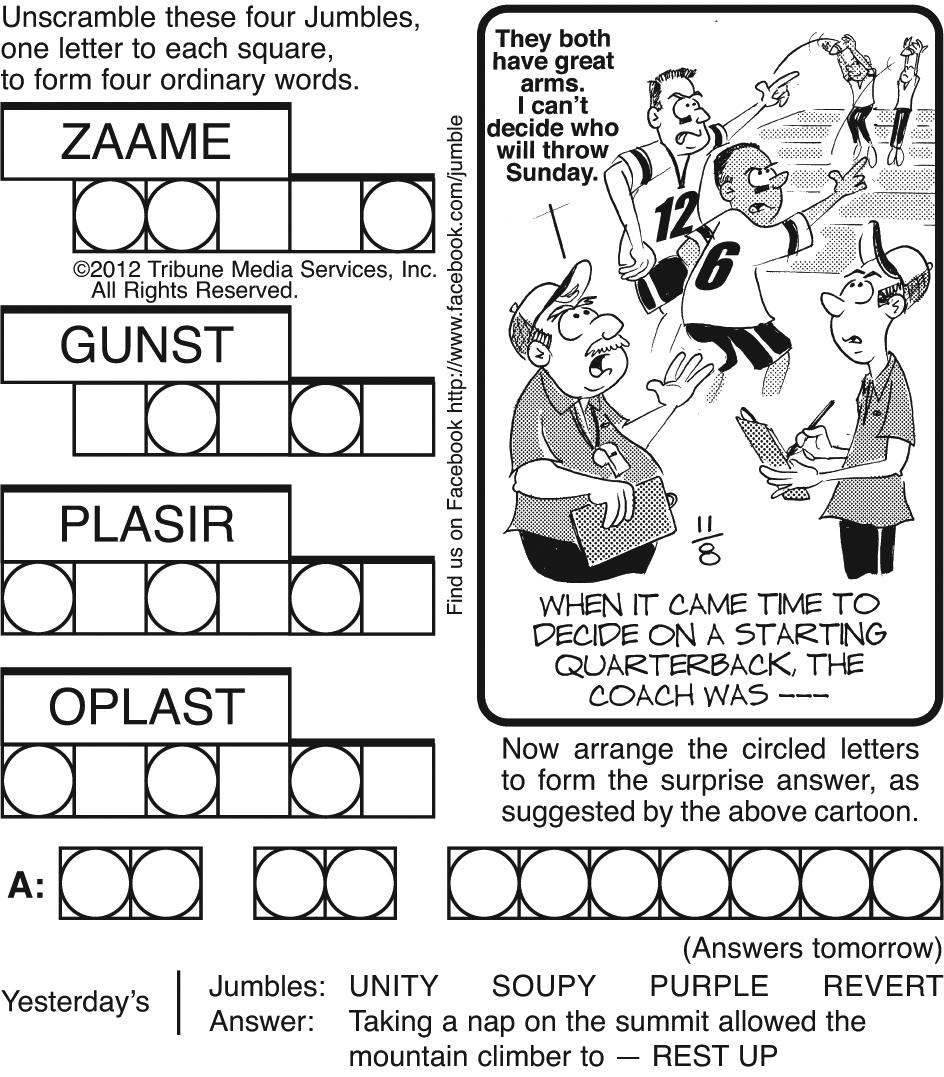
Jumble | david hoyT and JeFF knurek
sudoku | The mepham group
Bye week could cause problems

Michael Ivey sports writer
b ye weeks are known throughout the football community as the week of the season where a team doesn’t practice or play a game. e ach n F l team has one while a college team can have as much as two each season. n ow the term is expanding to another sport.
l ast season, the nhl announced that beginning in the 2016-17 season, each team will take a five-day period of rest during the season. n o practice. n o games. e ach team’s bye week takes place at some point between Jan 1 and a pril 9 — essentially during the dog days of the hockey season.
The one-week break was implemented as a way to give players extra rest during the grueling nhl schedule that can include playing three games in the span of four days. h owever, the week of rest could prove to be problematic for some teams.
o ver the course of the season, the players and coaches on a team work themselves into a groove in which they get used to the busy schedule. g iving them a week off of practice and playing in games could throw them out of that groove and sputtering to get back into the swing of things, which can be hard during this time of the season. This season in particular is a tough time to implement this policy, given how the majority of teams are still in the playoff hunt.
b ye weeks can also affect the playoff race in the nhl
l et’s say Team a is only two or three points behind Team b for a playoff position when Team a enters their bye week. Team b has already had their bye week, and can widen their lead over Team a with a few wins while Team a can’t skate or practice. i t puts teams’ in a tough position to find their groove again while chasing a playoff spot. i t can also affect how teams decide what to do during the trade deadline.
The bye weeks will also affect teams later on this season due to the scheduling.
i n a season where the schedule is already condensed due to the world c up of h ockey in s eptember, the bye weeks will condense the schedule even more, meaning that a lot of teams will play an unusually
large amount of games during the last month of the regular season. The c hicago b lackhawks’ bye week is this week, and when it’s over they’ll play in four games during the first week back. That small stretch will serve as the time to get back in the groove of things before they play 16 games in 31 days during the month of m arch. That much hockey in that amount of time can only add to the wear and tear on players’ bodies. The bye week may help teams relax now, but they’ll need it even more later on in the season.
The b lackhawks aren’t the only team to face this dilemma. e very team will.
The team the b lackhawks are currently chasing in the standings, the m innesota w ild, will have their bye week later this month. a fter it’s over, the w ild will play their last 20 regular season games during a 35 day stretch. That can affect their performance down the stretch in trying to win the c entral d ivision.
h as it had an effect on teams’ that have already had it? l et’s look at the numbers.
The n ew york i slanders had their bye from Jan. 1-5. i n their first seven games after the break, the i slanders went 1-2-2. This stretch, along with the bad start to the season the i slanders had, led to the dismissal of head coach Jack c apuano.
The p hiladelphia Flyers had their bye from Jan. 1620. They lost their last two games before the break before winning three of their first four games after the break ended. The n ew york r angers lost their first three games after their bye from Jan. 8-12. The p ittsburgh p enguins won the first game after their bye, but then lost the next three straight. o n s aturday, the e dmonton o ilers lost 5-1 in their first game back from their bye.
i t’s still early in the process and the results so far are mixed, but the trend seems to be teams initially struggle coming back from the bye.
l et’s hope this doesn’t affect teams too much, or else a little extra rest during the season can inadvertently lead players to more rest during a longer offseason.
Contact Michael Ivey at mivey@hcc-nd.edu
The views expressed in this Sports Authority are those of the author and not necessarily those of The Observer.

tm ondo track that we are on everyday and we know where the splits are. a lso not having to travel on a bus or plane is always good. i hope we will have that advantage when we host the acc indoor championships the following week when it really matters.”
c onsidering the overall team’s performance, Turner said the team is not at the level
he expected and will have to put in quality training time to qualify for nationals.
“The younger players have not progressed as much as i would have liked them to,” Turner said. “even the older players have not done as well. The women’s team last year was three points away from going to the championships. They’ve bounced back-andforth from fifth to sixth place in the conference, and they have to work their butts off and compete against m iami, c lemson and Florida state to
qualify for nationals. a s for the men’s team, they’ve had a hard time at conference meets. They haven’t had the numbers and have had injuries. There are not as many injuries this year, and they are in the middle ranking of fifth to ninth in the conference. Their competition is v irginia Tech, s yracuse and Florida state because they have the numbers and quality times.”
Contact Meagan Bens at mbens@nd.edu
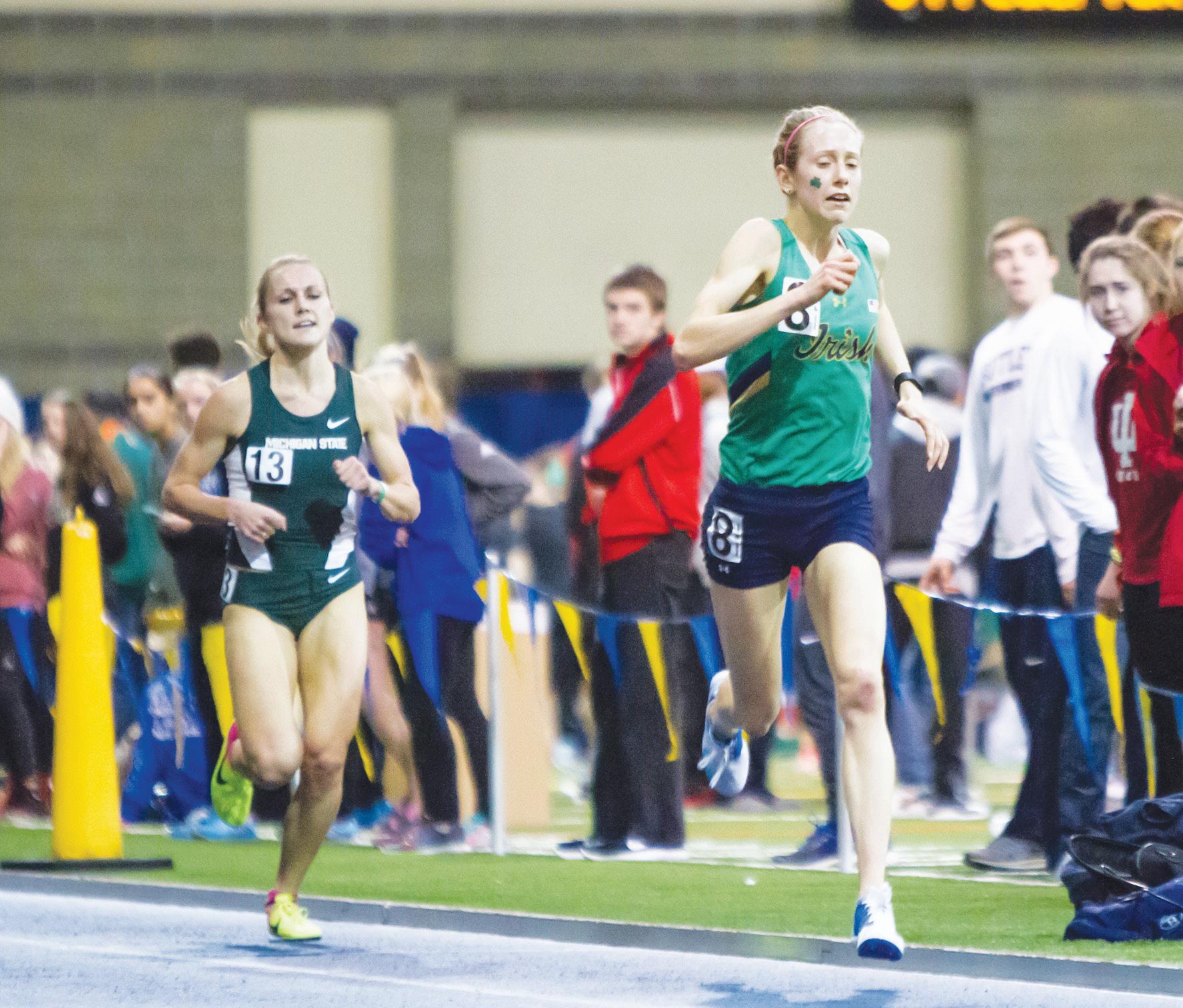
eMMeT FaRNaN | The Observer Irish sophomore Anna Rohrer competes in the 3000-meter run during the Meyo Invitational on Feb. 4 at Loftus Sports Center. Rohrer finished in fifth place in the event.
eMMeT FaRNaN | The Observer
Irish senior Patrick O’Connell stretches his neck after crossing the finish line in the 800-meter dash at the Meyo Invitational on Feb. 4 at Loftus Sports Center. O’Connell clocked a personal best in the event.
second win this year in an full-field competition, marking the first time the i rish have secured two such wins in one season since the 20112012 team won both a 16-team match play event and the 12team big e ast championship.
i rish head coach Jim kubinski said he was very pleased with his team’s dominant performance over the weekend.
“o ur guys did all the things we’ve asked of them this week,” k ubinski said. “ we played with the best focus i’ve seen from this year’s team, a tremendous attitude throughout and high level emotional maturity.”
kubinski said he was also happy to see every golfer contribute to the team’s victory.
“i’m always impressed with both the game and leadership of senior blake b arens, and our sophomores b en [ a lbin] and m iguel [ d elgado] are two of the most intense and invested competitors i’ve coached,” he said. “This week, though, the freshmen really stood out in posting a combined 7-1-1 record in our 4-5-6 lineup positions. o ur depth there — the win margins — set us apart this week.”
a fter winning the event, kubinski told his team he couldn’t have been any prouder of its performance.
“b eyond the win itself, i was proud of how they competed all three rounds, and really, for how they represented notre d ame this week,” kubinski said. “o ur guys played with strong resolve and sportsmanship throughout.”
kubinski said he will look for his golfers to build on this win and continue to improve on their games.
“ we just have to maintain the level of focus on every shot and continue to exhibit the emotional maturity throughout the tournaments that led to our championship win down in Tampa,” he said.
The i rish golf team will be back in action February 27-28 in Tucson, a rizona, to compete in the national i nvitational Tournament at o mni Tucson national g olf c lub.
Contact Kyle Barry at kbarry@hcc-nd.edu

paid a dverT isemen T
MICHaeL YU | The Observer
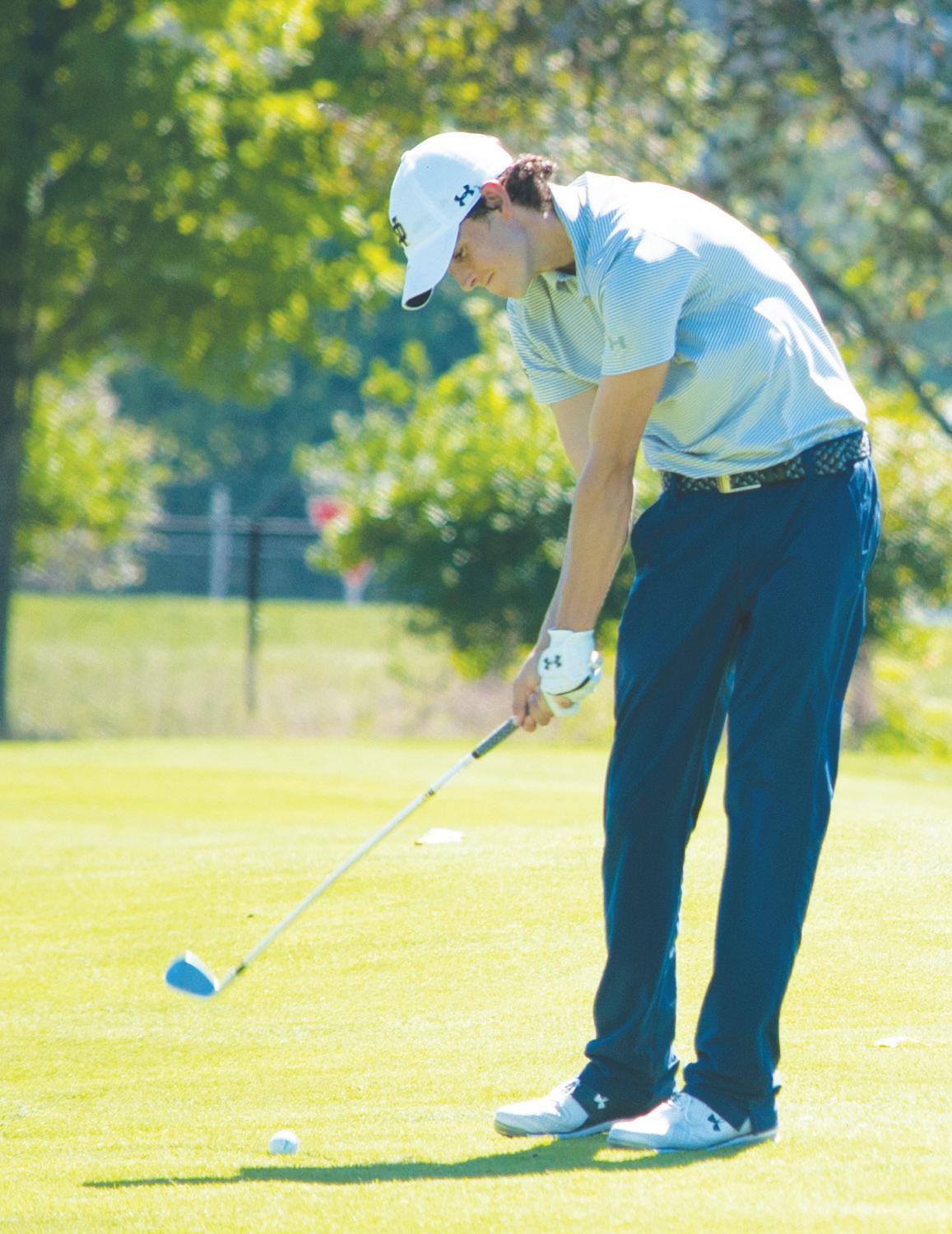
Irish freshman Davis Lamb marks his ball on the green during the Notre Dame Kickoff Challenge on Sept. 3 at Warren Golf Course. Lamb’s putt Tuesday on the 18th green at Lake Jovita Golf and Country Club clinched Notre Dame’s victory in the finals of the Yestingsmeier Match Play.

eight. w illetts, on the other hand, was a top-10 recruit in this past year’s class according to i nside l acrosse.
freshman b rian w illetts.
“ o n the attack, we will have a couple new faces,” c orrigan said. “ b rendan g leason, a nthony m arini and [ b rian] w illetts will all be playing significantly in the attack. g leason was a midfielder last year, w illetts was in high school last year and m arini did not play a lot. Those are three guys who are going to be playing a lot of minutes for us and are going to be new faces on the attack.”
g leason played in 13 games last season, while m arini played in a total of
The h oyas (0-1) dropped their first game of the season against h igh p oint on Tuesday, 9-3, and have now lost 10 of their last 11 games dating back to last season.
g eorgetown was tied with h igh p oint at the half but outscored 7-1 in the final two quarters. r edshirt junior attack p eter c onley led his team with 10 shots, but he only managed to tally one goal. s ophomore attack d aniel b ucaro also netted a goal and contributed an assist for the h oyas. i n net, junior goalkeeper n ick m arrocco made six saves in
paid a dverT isemen T
the losing effort.
The i rish open the season as part of the p atriot c up in Frisco, Texas. The team will play at the d allas c owboy’s new practice facility, which opened late last year.
“[There is no difference in the site of the game], other than it should be really cool. i am looking forward to seeing The s tar,” c orrigan said. “ we have been part of these types of events [for] many years, so our guys are used to it. n o big deal, just a great environment to play in.”
The i rish take the field at 2 p.m. against g eorgetown on s aturday.
Contact R.J. Stempak rstempak@nd.edu
w bball
guard ali patberg, are all dealing with injury or illness at the time, leaving the irish with limited options off its bench. w hile irish head coach muffet mcgraw called Johnson “questionable,” she called both westbeld and patberg “doubtful” for the game at clemson.
westbeld, who played in sunday’s win, has particularly been affected by her ankle injury, which has continued to cause her pain, so the training staff has decided to keep her out to allow her the chance to return to full health.
“it will continue to cause her pain,” mcgraw said of westbeld’s ankle injury. “it’s just — it’s not healing. she’s not 100 percent, and we want her to be 100 percent.” with westbeld doubtful and potentially out for more than just Thursday’s game, the irish will turn to freshman forward erin boley and senior forward kristina nelson to take on her minutes and replace her production. mcgraw said she has full confidence in both players.
“i think [boley] is very ready for this opportunity, and i think [nelson] is as well,” mcgraw said.
“so i think we’ve got some depth at that position.”
at the guard spot, patberg’s absence — she missed sunday’s game with the flu — has forced mcgraw to ask senior guard lindsay allen to play extended minutes this season. and while she knows allen can physically handle the extra time, mcgraw has still made efforts to rest her in practice and hopes to get patberg back soon so allen will not be pushed too much during the acc tournament.
“she’s really playing a lot of minutes for us this year,” mcgraw said of allen. “and without ali [patberg], it’s been really hard to take her out of the game, so it’s really important that we get ali back so that we can rest her a little bit because, with the acc tournament looming when you got to play back-to-back, that could really be an issue.”
Fortunately for the irish, freshman guard Jackie young has been able to pick up some of the slack, as she was named the acc rookie
of the week for her performances last week.
“i think lately her rebounding, really been strong at both ends,” mcgraw said regarding young’s play as of late. “she’s getting some big rebounds, and she’s really been — i mean, she’s aggressive going after it, but she’s really been steady and doing a lot of good things. her shot selection has been really good, she’s shooting a little more — which i like; i want her to shoot even more. defensively, i think she continues to get better. i’ve seen a lot of improvement with her.” and despite all of the in-house issues mcgraw and the irish are currently dealing with, they still are well aware of the challenge the Tigers will present Thursday. despite its record, clemson has secured all three of its acc wins in its last five games, which mcgraw said indicates how much more dangerous they are than some might think.
“They have pretty much a whole new team from last year,” mcgraw said of the Tigers. “it seems like this is a different team, so they’re getting a lot of confidence now — young team just figuring things out, so they’re a dangerous team at home.”
For the irish, the main focus in practice has been improving their defensive fundamentals and technique, an area mcgraw believes her team has struggled of late.
“we’re just continuing to work on our defense and get back to the fundamentals: containing the ball, keeping them in front of us and rotating,” mcgraw said. “a lot of defensive details.”
and although a no. 1 seed in the ncaa tournament is still theoretically in play for notre dame, it is not putting its efforts towards the pursuit of that goal. rather, the irish want to do everything they can to be healthy and poised for a postseason run, regardless of what spot they have to make that run from.
“i think we lost our chance for that,” mcgraw said of a no. 1 seed. “i think we’re just trying to get to the end of the regular season right now.”
The irish and the Tigers will tip off at 7 p.m. Thursday at littlejohn coliseum.
Contact Ben Padanilam at bpadanil@nd.edu
eDDIe GRIeSeDIeCK | The Observer
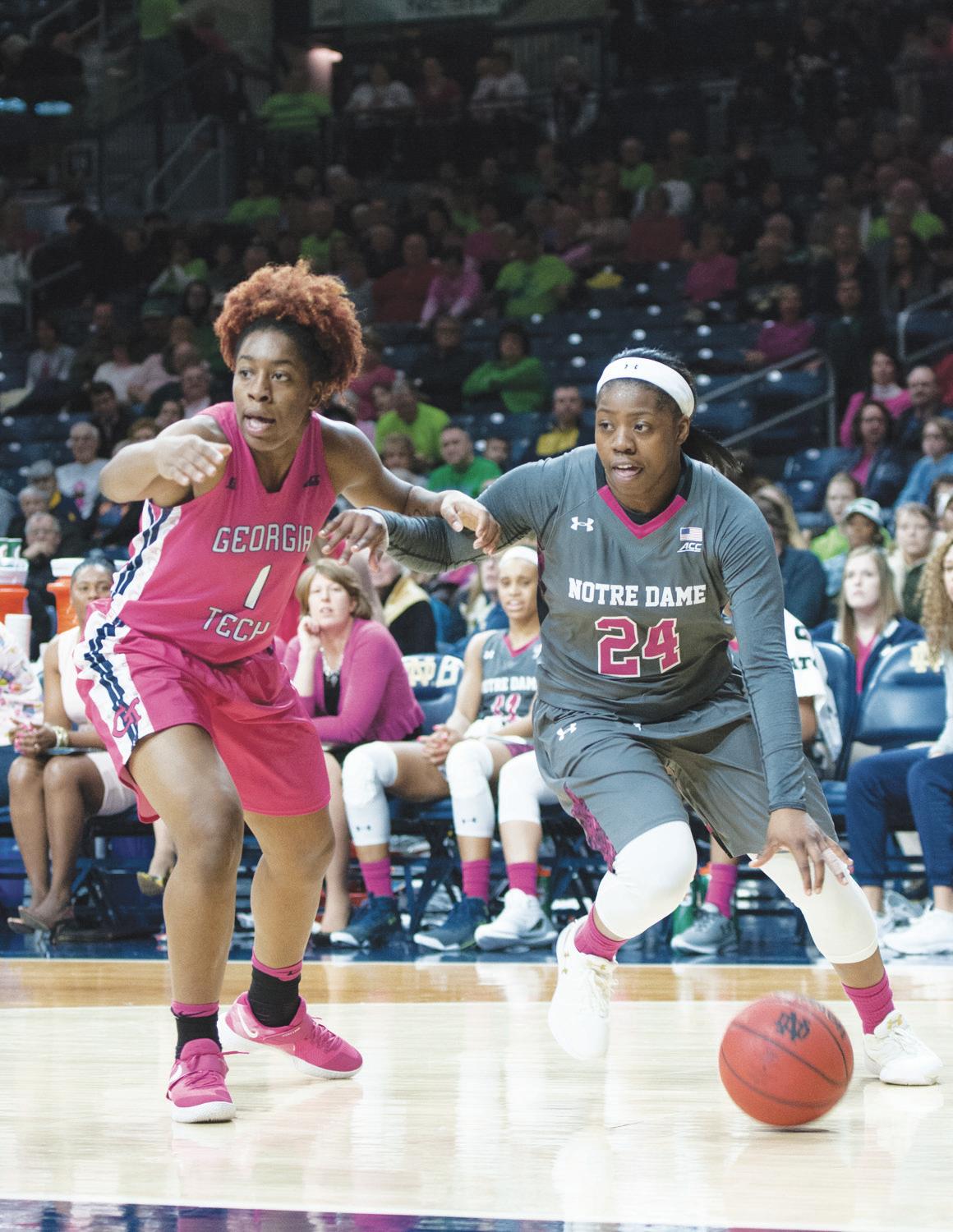
Irish sophomore guard Marina Mabrey brings the ball up the court in Notre Dame’s 90-69 win over Georgia Tech on Sunday.
GRaCe TOURVILLe | The Observer
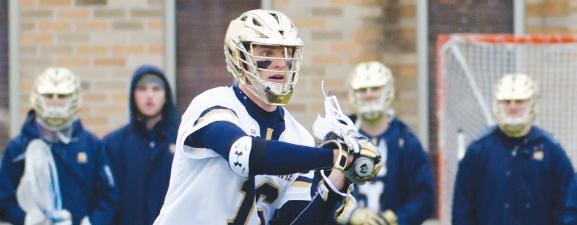
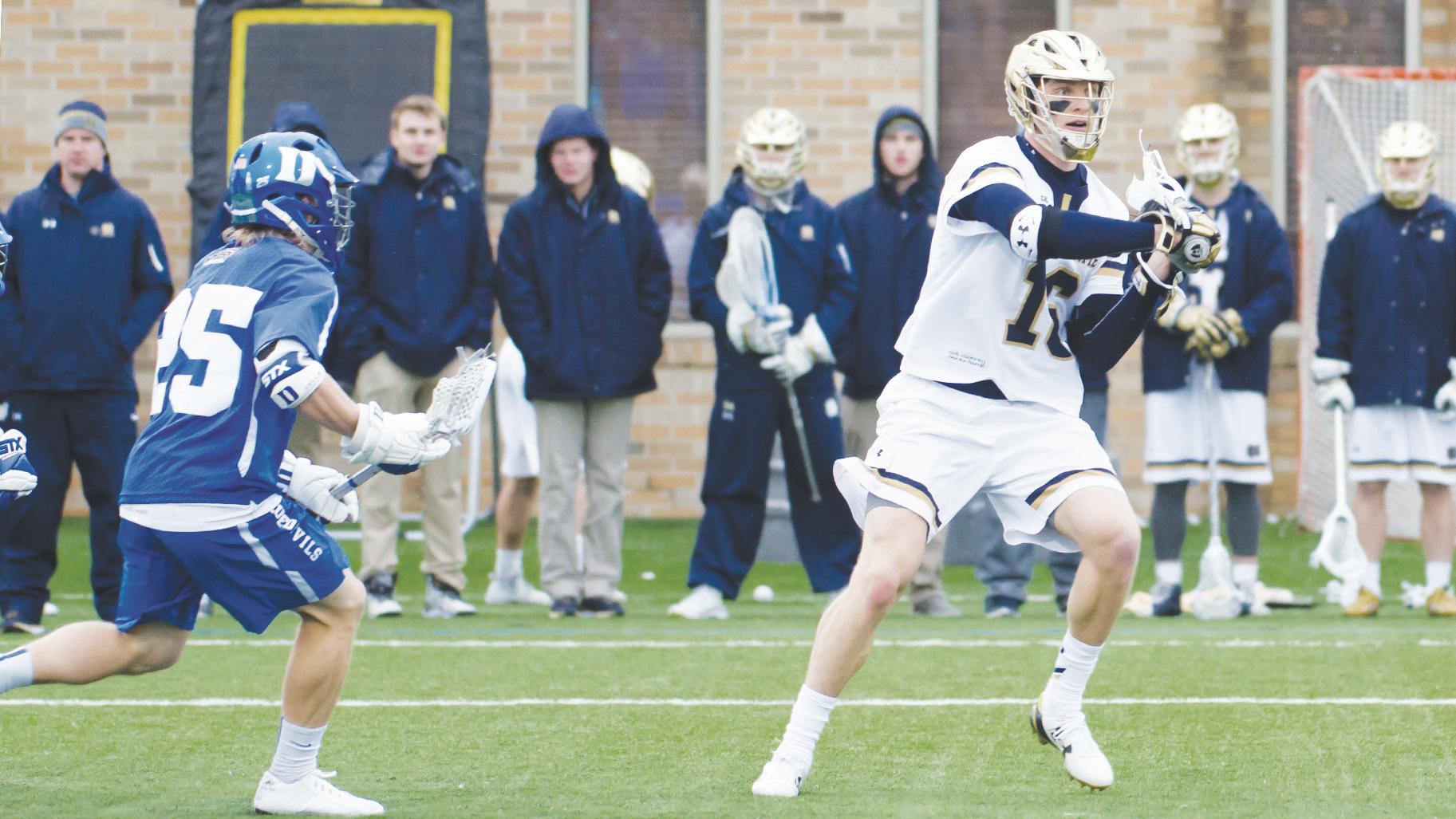
Irish senior midfielder Sergio Perkovic surveys the field to make a pass during Notre Dame’s 8-6 victory over Duke on April 10 at Arlotta Stadium. The Irish open their season Saturday against Georgetown.
Nd womeN’s basketball
Injuries hamper Notre Dame as ACC play rolls on
By BEN PADANILAM
a ssociate sports e ditor
w ith the regular season winding down, n o. 7 n otre d ame will look to keep its acc regular season title hopes alive when it travels to c lemson, s outh c arolina, to take on the Tigers on Thursday.
c oming off a 90-69 victory over g eorgia Tech on s unday, the i rish (23-3, 11-1 acc ) currently sit atop the acc with n o. 4 Florida s tate, who is n otre d ame’s final opponent of the regular season. b ut in order for that game to have title implications, the i rish will first need to beat at least two of their next three opponents, starting with the Tigers (14-12, 3-10).
b ut the i rish have another focus as well heading into Thursday’s contest: getting and keeping everyone healthy. Juniors k athryn westbeld and m ychal Johnson, as well as sophomore
traCk &
fIeld
i rish to meet hoyas in Texas
By R.J. STEMPAK sports writer
n o. 4 n otre d ame will begin its season s aturday in Frisco, Texas, in a neutral site game against g eorgetown. The i rish will look to start the season off on the right foot, especially after graduating top point-scorer m att k avanagh and defensive stalwart m att l andis. i rish head coach k evin c orrigan said the team is looking for an identity, and it will have to focus on the fundamentals early on in the season.
“ i t’s the first game, so we are concerned with our fundamental execution of the things we want to do without knowing a lot about our opponent because it is an early season game,” c orrigan said. “ we have to rely on our communication and our fundamentals. From that standpoint, it is like every opening game every year. you have to be very aware and able to adapt because you are going to get surprised
by some things because it is early in the year.”
p layers who the i rish will look to carry the scoring burden early include senior midfielder and captain s ergio p erkovic and sophomore attack r yder g arnsey, who was third on the team in points scored last season despite making only five starts. d efensively, c orrigan said the i rish will need senior p at h eely to get comfortable with his new role quickly, as he only appeared in three games last season.
“ p at h eely is stepping into a really important starting role on our defense,” c orrigan said. “ i think that is new for him, but he has had a really good preseason and he has been very consistent, which is good for us to see.”
n ew players that will be featured in the attack are sophomore b rendan g leason, senior and captain a nthony m arini and
Lamb secures victory for squad in Florida
By MEAGAN BENS sports writer
The i rish will compete at home in the a lex w ilson i nvitational at l oftus sport center on saturday.
unlike previous meets in the indoor season, most schools participating will not be sending a majority of their teams to compete at the invitational.
“This meet is different than most,” i rish head coach Turner said. “most of the coaches sending athletes the week before the indoor championships will not load athletes in multiple events. a bulk of the athletes will be resting due to the timing. we will be having some of our distance and relay runners competing. a s for the relays, most teams don’t put their four best people in them until conference championships and nationals. The medley distance relay will be the one event to watch. but overall most of the athletes will just be in one event and this meet is the last opportunity to tune up.” even though not as many
athletes will be at the invitational, Turner said the quality of the competition will not be any different.
“The mile, 800-meter, the relays and the field events are the key events this weekend,” Turner said. “The best teams in the country will be there. our bigger indoor track attracts teams from coast to coast. stanford will be there, byu, g eorgetown, Tsu it’s a real mix of everything all from the top conferences. no one will be bringing full team though. key runners at the meet for us will be [junior] Jessica harris in the women’s distance medley relay, [senior] Jacob dumford in the mile and medley relay, and [senior] c hris marco in the medley relay.”
The a lex w ilson i nvitational is a non-scored competition, Turner said; notre dame has hosted the meet for at least 30 years.
“it’s always an advantage to be home on our track,” Turner said. “we have a 320-meter
By KYLE BARRY sports writer
i t was a successful trip down to s outh Florida for n otre d ame, as the i rish captured the yestingsmeier m atch p lay championship at l ake Jovita g olf and c ountry c lub in d ade c ity, Florida, on m onday and Tuesday. The i rish, who were seeded second in the eight-team field, defeated both d e p aul and b all s tate on m onday in the quarterfinals and semifinals of the event before defeating s eton h all in the event’s final round Tuesday. Freshman d avis l amb was one of the key components of n otre d ame’s success. l amb was paired with p irates senior k evin o ’ b rien, and their match was at a draw heading into the 18th hole Tuesday. w ith the championship on the line, l amb sank his putt to win the match 1 up and secure the title for the i rish.
This is n otre d ame’s
see
MICHaeL YU | The Observer
Irish freshman Davis Lamb strikes the ball during the Notre Dame Kickoff Challenge at Warren Golf Course on Sept. 3.
eDDIe GRIeSeDIeCK | The Observer Irish sophomore guard Arike Ogunbowale looks to get by a defender during Notre Dame’s win over Georgia Tech on Sunday.
meN’s l aCrosse
see w bball PaGe 11
see m laX PaGe 11
meN’s Golf | yesTingsmeier maTch play