Print Edition of The Observer for Friday, February 3, 2017
Panel seeks to clarify platforms
Candidates outline plans for diversity during first public forum
By RACHEL O’GRADY news e ditor
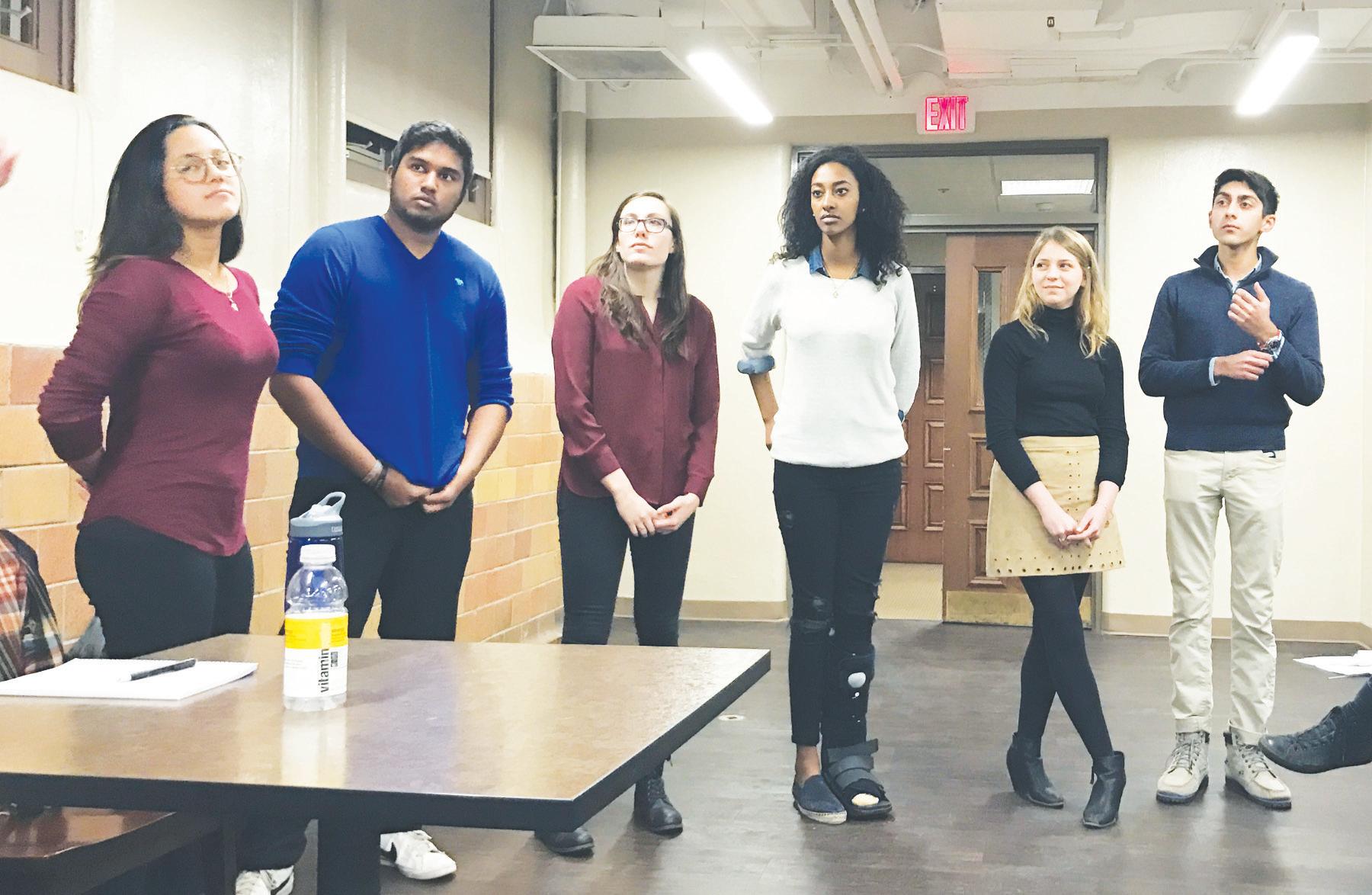
n otre d ame student body election season kicked off Thursday night in the basement of c avanaugh h all with a panel comprised of the presidential and vice presidential candidates, joined by their campaign managers.
The panel was hosted by we s tand For — a group that aims at “sharing resources and support for n otre d ame students in light of the election” — and was focused on clarifying how each ticket plans to address diversity on campus.
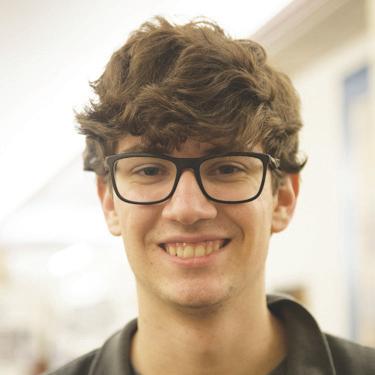
“ d iversity at n otre d ame comes in many different forms,” junior presidential candidate r ohit
Sexual assault reported to NDSP
Observer Staff Report
a sexual assault was reported to the university’s deputy Title i X coordinator, according to an email sent to students Thursday night from notre d ame s ecurity police ( ndsp ).
The alleged assault occurred in a west Quad men’s dorm early sunday morning. i nformation about sexual assault prevention and resources for survivors of sexual assault are available online from ndsp and from the c ommittee for s exual a ssault p revention ( csap ).
ND considers new parking options SMC student reflects on experience as delegate
Observer Staff Report
u niversity e xecutive v ice p resident John a ffleckg raves convened a parking committee in February 2016 made up of faculty, staff, and undergraduate and graduate students. They analyzed four specific aspects of parking on campus: the on-campus shuttle service, surface lot parking, the possibility of a parking garage and the reserved parking pilot program.
Final recommendations were submitted at the end of n ovember and shared with students in an email wednesday from a ffleckg raves. a t first priority was the shuttle. The committee suggested changes such as combining the current routes into one route that accesses the majority of campus, investing in shuttle technology advancements, improving shuttle system visibility and continuing to
use an outside vendor for shuttle services, instead of a u niversity-owned shuttle service.
The construction of a parking garage came in as the second priority and the committee suggested the u niversity build a 1,000- to 1,200-car parking garage in the vicinity of l egends. This garage would be open to faculty, staff and students that would have to pay a daily or hourly rate. o vernight parking would not be permitted. a s for surface lots, a proposal was made for a new paved surface lot in 2018 following the demolition of the o ’ h ara- g race apartments. They also suggested a new paved surface lot on the green space east of i nnovation p ark. i ncreased technology and short-term parking were among topics discussed in regards to these surface lots.
By COLLEEN ZEWE news writer
s aint m ary’s junior a nna
m c c ambridge proves college students can make a difference in politics.
i n a ugust, the business major ran for and won the role of precinct delegate
during the m ichigan state primaries. l ater, at a county convention, she was elected state delegate. m c c ambridge represents the r epublican p arty for k ent c ounty, which encompasses her hometown of g rand r apids, m ichigan. a fter spontaneously
attending a state convention as a guest along with a few friends, m c c ambridge said she felt inspired to run. s he said she’s always been interested in politics, especially after coming to college; seeing other college
counselor sides with ndsp in records case
By MARGARET HYNDS e ditor-in- c hief
i ndiana p ublic a ccess c ounselor l uke b ritt sided with n otre d ame s ecurity p olice ( ndsp ) on m onday in responding to a complaint filed with his office last month by The o bserver. The complaint concerned the police force and n otre
d ame’s denial of records requests in n ovember, despite a change in state law last year that might have required them to grant access.
The relevant law hinges on the legal distinction between private and public agencies.
u nder i ndiana’s a ccess to p ublic r ecords a ct ( apra ), “public agencies” — like local police departments — are required to release certain records by law. h owever, private university police departments like ndsp have long been considered private agencies under state law, and therefore not subject to apra
Fonseca
RACHEL O’GRADY | The Observer
On Thursday evening in Cavanaugh Hall, candidates for student body president and vice president, along with their campaign managers, discussed issues relating to the upcoming election.
Policies The observer is the independent, daily newspaper published in print and online by the students of the University of notre dame du Lac and saint mary’s college. e ditorial content, including advertisements, is not governed by policies of the administration of either institution. The observer reserves the right to refuse advertisements based on content.
The news is reported as accurately and objectively as possible. Unsigned
Michelle Williams senior Pasquerilla West hall “stepan.”
Paige Curley junior Pasquerilla east hall “debart.”
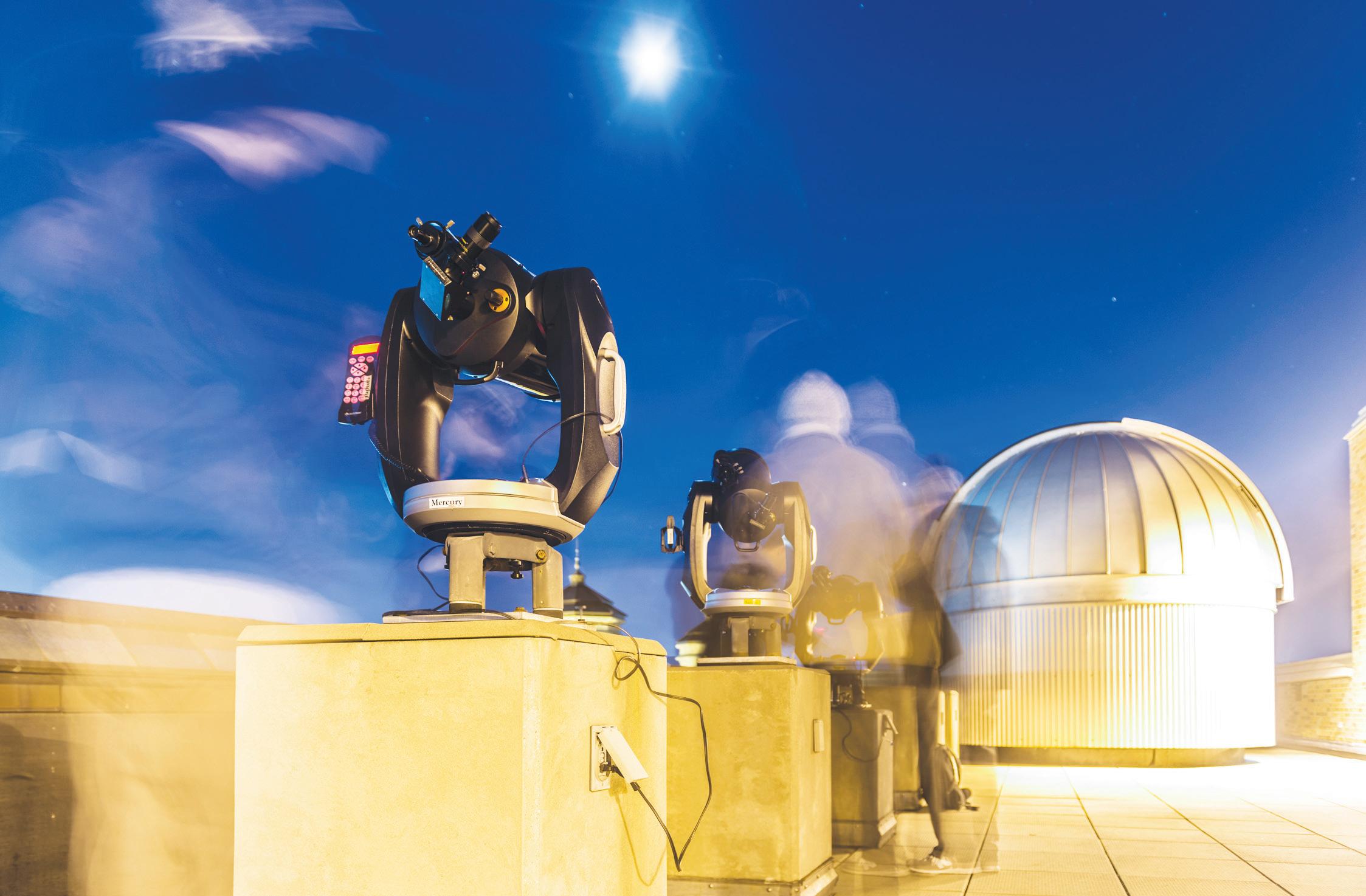
Students of the “Descriptive Astronomy” course use telescopes to observe the sky on the Jordan Hall rooftop. Students were assigned to look at the moon, Venus and the Orion Nebula, and then sketch what they saw through the telescope.
Today’s Staff
The
t he next f ive D ays:
Friday
The Future of Liberalism in the Age of Trump
South Dining Hall
12:30 p.m. - 2 p.m. Lunch provided.
Men’s Hockey vs. Vermont Compton Family Ice Arena
7:35 p.m.
The Irish take on the Catamounts
Saturday
Indoor Cycling — Spring 2017 Freebies
Rockne Memorial
11 a.m. - 11:45 a.m.
Arrive early; space is limited.
Men’s Hockey vs. Vermont Compton Family Ice Rrena
6:30 p.m.
Game 2 of the weekend series.
Want your event included here?
Email news@ndsmcobserver.com
Sunday
Kroc Institute ScreenPeace Film Festival
DeBartolo Performing Arts Center
3 p.m. - 5 p.m.
Monthly Fellowship: Jamii Coleman-Morse Center
9 p.m. - 10 p.m.
Food will be provided. All are Welcome.
Monday
Mass for Immigrants and Refugees
Basilica of the Sacred Heart
5:15 p.m. - 6:15 p.m. All are welcome.
ND Women’s Basketball vs. Louisville Purcell Pavilion
7 p.m.
The Irish take on the Cardinals.
Tuesday
Men’s Basketball vs. Wake Forest Purcell Pavilion
7 p.m.
The Irish take on the Demon Deacons.
Discussion: “The Half-life of Freedom: Race and Justice in America” Mendoza College of Business
7 p.m. - 8:30 p.m.
MICHAEL YU | The Observer
students getting involved inspired her.
“I saw what kind of impact I could have, despite my age,” m c c ambridge said.
m c c ambridge attended her first state convention as an elected official in August.
“The governor — as well as other m ichigan state officials — attended and gave powerful remarks about how important it is to have representation even at such a local level,” she said. “It was pretty cool. As a delegate, I’m an
elected official just as many other big name individuals are, so it’s not uncommon to be waiting in line for the ladies room with a senator in front of you and the governor’s wife behind you.”
r ecently, m c c ambridge traveled home for a county convention.
“ m yself and other Kent c ounty delegates met in downtown Grand r apids,” she said. “We listened to speeches from candidates running for local and party offices.
“They travel to different county conventions to campaign and, later,
state delegates from each m ichigan county, including myself, will meet at the state convention to vote on them.”
m c c ambridge has already voted for many leadership positions, including the m ichigan b oard of e ducation.
“These are the people that will make a difference in our children’s education,” she said. “The people on the b oard of e ducation are going to be passing laws that will affect the next generation, which will probably include my own future children.”
Getting involved at the
local level is one of the best things concerned citizens can do, m c c ambridge said.
“While everyone’s focusing on the federal government, nobody’s focusing on the government here at home,” she said. “ b ut it’s these smaller decisions that will affect us the most. That’s why I find it important to get involved in the local level as much as possible. That’s where you have to start to create real and effective change at the federal level.”
m c c ambridge said she believes it’s important for women to get involved in politics.
“ s ome say politics is a man’s world, but I kind of disagree,” she said. “Women just don’t get as much coverage [in the media], but we’re making progress.”
In the future, m c c ambridge said she hopes to continue participating in the political process.
“ n ow that I know how campaigns are run, I can definitely see myself running for office again,” she said. “We, as women, need to not be afraid of losing. Losing is part of life.”
Contact Colleen Zewe at czewe01@saintmarys.edu
said. “ d iversity is what makes us a great university; it’s what makes us special.” f onseca’s running mate, junior d aniela n aramatsu, said their ticket emphasizes and exemplifies diversity.
“ d iversity at n otre d ame is the three of us — we have very different views, but we’re free to differ from each other and we’re free to talk about it,” n aramatsu said. “We think we’re a pretty diverse ticket because we’re able to bring a lot of different ideas to the table.”
Junior m adi p urrenhage, campaign manager for the f onseca- n aramatsu ticket, said a major part of their platform involves creating civil discourse on campus. o ur ticket is really passionate about the fact that we represent a lot of diverse opinions,” p urrenhage said. “ e ven if someone is the exact opposite of any of us, we can understand other people’s viewpoints. We tried to take a lot of different viewpoints into account in making our platform.”
s imilarly, junior presidential candidate b ecca b lais said diversity played a significant role in the formation of their platform.
“I see diversity as progress,” b lais said. “It’s acknowledging all the wonderful differences we have, and that progress comes in moving forward. I know, with us, diversity is a huge piece of our platform.”
b lais’ running mate, junior s ibonay s hewit, said there is “more [ n otre d ame] can do to celebrate diversity.”
“ e veryone recognizes that nd is a diverse university,” s hewit said. “We may not be where our peer universities are … but that doesn’t mean that it’s o K, so we want to really push that, and start these conversations.”
The next steps, as b lais said she sees it, include coping with the political climate at n otre d ame.
“I think we’re in a very
ugly place right now with our political climate,” b lais said. “I think we’re afraid to talk to each other, to have these conversations. The biggest next step is changing that climate on campus and bringing down that hostility. It’s not an us and them — it’s an all of us.”
s hewit said the impetus of promoting diversity falls on student government.
“With every example, it starts with s tudent Government making these things their top priority,” s hewit said. “We want to be allies for the LG b TQ community, for the [ d eferred Action for c hildhood Arrivals] students, we want to help with Walk the Walk week, we want to be there at Welcome Weekend, we want to be as open and visible as possible.”
f onseca said a major component of their platform is the creation of r ou nd Tables — “moderated faceto-face conversations about critical or controversial topics,” according to their platform.
“You never see people having those hard conversations with people, face to face,” f onseca said. “We’re going to do that with r ou nd Tables. If we did it today, we would ask if Trump should be invited to campus. The stuff you see in v iewpoints or f acebook, it’s not stuff you would say to people’s face. I think we can have these discussions faceto-face though. What we’re doing is getting you faceto-face with people who you would never see during your four years here.”
s ophomore campaign manager for the b laiss hewit ticket, p rathm Juneja, said he hopes to bring together students with different experiences and backgrounds.
“What we’re focusing on what can we do to make it feel like students belong here,” Juneja said. “ e very student belongs here, and how do we make them feel like that?”
Contact Rachel O’Grady at rogrady@nd.edu
records
Last spring, the Indiana s tate Legislature passed hb 1022, which would have required private university police departments to disclose records only in situations where someone was arrested or incarcerated, shielding them specifically from the rest of A pr A. It was vetoed by then-Gov. m ike p ence in m arch.
b ut in n ovember, the s outh b end Tribune reported another law — hb 1019 — was also passed last year containing language such that it inadvertently changed the state’s definition of a “public agency” to specifically include university police departments.
e ffective July 1 of last year, the law changed the term’s definition, which now reads in the Indiana s tate c ode as the following:
“‘ p ublic agency,’ except as provided in section 2.1 of this chapter, means the following: … (11) A private university police department. The term does not include the governing
Parking
con TI nued from pAGe 1
board of a private university or any other department, division, board, entity, or office of a private university.”
o f the change in the definition, b ritt said it was “inadvertently inserted into hb 1019.”
b ritt said in a letter that his office became aware of the error in July 2016, and that “on the advice of the Legislative s ervices agency,” he began to advise his constituents that the changed definition had “the full force of law.”
“In August of 2016, however, the Indiana Legislative c ouncil voted unanimously to include the error in the 2017 Technical c orrections b ill, hb 1181,” b ritt said.
“As of the date of this writing [Jan. 30] it had been referred to the Judiciary c ommittee but had not yet been passed.”
b ritt also cited the state s upreme c ourt’s decision in espn ’s lawsuit against n otre d ame, which ruled in n ovember that private universities in Indiana are not obligated to disclose police records.
“While I may respectfully disagree with that ruling as p ublic Access c ounselor for policy reasons, I defer to the c ourt’s opinion as the
binding and final authority on the matter,” b ritt said. u ltimately, b ritt said his interpretation of the events surrounding hb 1019 is that the change regarding private university police departments was unintentional.
“While the language itself and its impact is substantive and not technical in nature, it was obviously an oversight to include it in the bill,” he said. “I hesitate to categorize it as a simple scrivener’s error, however, it appears to be done in error.
“It has been my modus to evaluate the totality of circumstances of an issue and not make determinations on a technicality.”
b ecause he believes the correction will pass the General Assembly and because of his interpretation of the original bill’s intent, b ritt said he would “defer to the General Assembly.”
If, however, the section regarding A pr A is removed from or altered in the legislative corrections bill and private university police departments remain in the definition of “public agency,” britt said he would revisit the issue.
Contact Margaret Hynds at mhynds@nd.edu
As for the reserved parking pilot program, the committee will gather more input from faculty and staff before making recommendations on the program.bike-sharing program but has not come up
The committee also considered the possibility of a bike-sharing program but has not come up with any definitive plans other than to further explore the option.
with any definitive plans other than to further explore the option. As for the reserved parking pilot program, the committee will gather more input from faculty and staff before making recommendations on the program.
By JACK RIEDY scene Writer
This saturday at 10 p.m., standup comedian marina Franklin will perform at Legends. The new York-based comic has an impressive range of credits, including performing in san Francisco’s sketchfest, hosting her podcast “Friends Like Us,” writing for hbo’s “divorce,” and appearing on the “Jim Gaffigan show,” “c happelle’s show,” and “Louie.” before she takes the stage this weekend, ms. Franklin spoke with The observer about political correctness, international travel and house music.
JR: In one of your jokes you say that your favorite part of doing comedy is traveling. Are you enjoying your time on the road? The joke is about racism in England so I understand that might have been facetious.
m F: You have no idea how psychic you are. I haven’t done that joke in years, and I was wondering this morning why I don’t do it anymore. I thought, “oh right, because people are too sensitive.” People would take it the wrong way. The joke is about people not knowing they’re being racist.
Which seems relevant.
Yes! It does. It may make a comeback. I like traveling. I’m glad to come to notre dame. my sister went here. my family’s from Illinois, so when I moved to new York to pursue comedy I did it all on my own. my dad has now passed, but that’s something he said he was really proud of. he said to me, “That’s pretty incredible what you did.” I was young and crazy and didn’t think of the consequences. but, the consequences for this have been pretty good.
Where else have you been on tour?
It feels like a tour, but I just have a lot of dates in February. The last one was Towanda, Pennsylvania. have you ever heard of that?
I have not.
It’s near scranton, Pennsylvania. This is when I realized I’m still from Illinois. I just go, “I don’t know any other places in the world.”
Is there a difference for you between performing in Towanda, Pennsylvania, or on a college campus?
Well, the show in Towanda was at a theater, not a club. I did not do my research, which I told them from the stage. They were predominantly white, I’m black, and so it was a little different. It was a small town that predominantly voted for Trump as I found out from the stickers on the cars. They were older, a typical theater crowd. They were very nice! That’s different from performing at a college, absolutely. college students are open-minded, and I feel like they are on the right side of history right now. r ight after the election, I was
at University of Iowa. You could drive through and see most people were Trump voters. but the weekend after the election, the college was really upset. We were feeling it. c hris rock or Jerry seinfeld said they’re too sensitive, but I did not find that to be true actually.
It’s refreshing to hear you say that about college students because I feel like, I don’t know where it came from, but there’s a stigma that’s developed about them. Do you think that’s generational?
It’s most likely because they have been out of the scene. They come back into the scene and it has changed. There was political correctness that was going on, but the bubble has burst on that. I don’t know why students get the bad rap. The bookers sometimes will say, “no curse words, no sexual content,” especially if it’s a religious school. c hris can say shocking things, more so than me. I will have to imply some things, but college students get it.
You mentioned that Towanda had an older, white, Trump voter crowd. I don’t know if you consider yourself a political comic, but does that affect your performance?
It does. I had a great time, but it throws off my timing. normally I would just have fun and enjoy the moment, but instead I’m wondering why they are listening more than laughing. And it’s because I’m telling them something they’re not used to hearing.
“When the joke is told with beautiful timing and lands the way it is supposed to land, that clapping is beautiful. Because we’ve all agreed.”
Marina Franklin comedian
I had a Q&A afterwards, and I did get the question, “did you not do your Trump jokes tonight?” I don’t have any. I just don’t find the situation funny right now. The audience gets too divided. I’ll do it for students though. The weekend after the election, performing for students was the best thing I could have done. even if they did vote for Trump, I find they are still more open. Towanda was nice, too! even the guy who booed when I said I missed President obama was a pretty nice guy.
Do you think outbursts like that come from inexperience in comedy clubs?
I think that’s part of it too. They wouldn’t do that at a play. I’m very conversational, so you don’t feel like you’re listening to a joke. Lately, people just start talking to me. sometimes, it’s a compliment because I know they feel comfortable enough. In new York city, people are meaner about it.
Have you had the opposite, where you get light applause instead of genuine laughs?
You want people to laugh, not to clap. When you’re starting the premise of a joke, and it makes people feel good, they’ll clap. The turn is gonna be rough. When the joke is told with beautiful timing and lands the way it is supposed to land, that clapping is beautiful. because we’ve all agreed.
Are there other topics you don’t write about? It seems like a lot of comedians have a hard time making current events funny.
As of this year, engaging people in topics like that is tricker. I was never a current events comic. my angle is my personality and experience as it relates to everything going on in the world.
Your IMDb has a stellar lineup of credits. Is acting your side gig or your focus?
It’s all the focus. I always want to be a good standup, but when I get cast in “Trainwreck,” people come out to see me perform.
Is it tough showing up on set and holding back from suggesting bits?
You have no idea. I have to go with flow. Part of the time, you’re cast because they want you. They will say, “do marina.” It’s a relief. For example, I do a joke about not being sassy. The descriptions of parts for black women are all about “loud and sassy,” so if I try those parts, it’s not even acting, it’s an impersonation. If I’m cast for a part like that because of my act, I wonder if they even get the joke.
After this string of shows, what’s next for you?
It’s pilot season, so it depends if I get a part. The next three weeks could change my life forever. It’s a long process for network shows though, so standup is my constant. rubbing my belly is standup, rubbing my head the opposite direction is acting. I’m also taping something for Wyatt cenac for seeso. on top of that, I have my podcast to take over my life. I need an assistant. It’s all juggling. I don’t have kids so I guess there’s no excuse.
I know from your material that you’re a Simon & Garfunkel fan. What other sort of music do you listen to, if you do while writing?
I am c hicago, so I am a house-head. Last night, I went dancing until three in the morning. I listen to it all the time, but not when I’m writing. It makes me feel like I have to move. It’s not techno, stress that. I’m a pretty good dancer. They were recording me last night actually, I had the moves. dancing requires no thoughts, just feelings. And that’s a metaphor for life. When you’re not thinking about it, that’s when people gravitate towards you.
Contact Jack Riedy at jriedy@nd.edu
You’re not pro-life
This past weekend, I was afforded the opportunity to attend the m arch for Life in Washington for the first time.
While I was excited to see the occasional protest sign advocating for defense of the environment, nuclear nonproliferation and other issues that constitute a comprehensive pro-life agenda, I was dismayed by the sheer amount of d onald Trump supporters in attendance and by the fact that m ike Pence and Kellyanne c onway, two members of Trump’s inner circle, were the featured speakers at the rally.
This support for the new administration — both implicitly by the organizers and explicitly by the marchers — speaks volumes about the dishonest narrative that the m arch for Life presents.
Those who participate in the m arch for Life often boast about the “culture of joy” within their movement, yet they now have intertwined themselves closely with a man who regularly mocks and berates those who oppose him.
The problematic nature of the m arch for Life extends beyond these surface level semantics, however, and penetrates the very core of their ideology. h ow can they, as a movement, claim to be “saving babies” — as so many of the chants insist — if they are unwilling to advocate for comprehensive policies that will defend those lives from conception to natural death, especially if those lives exist at the margins of our society?
To be pro-life means to be willing to stand up and fight so that all of us can live the fullest lives possible. That of course means fighting to end abortion, but that also means fighting for livable wages, affordable healthcare, environmental protections and so much more. Furthermore, it also demands that we defend and aid those who have been marginalized: the poor, the homeless, blacks, m uslims, h ispanics, LG b TQ communities and, right now more than ever, refugees.
This makes the m arch for Life’s support for d onald Trump so disheartening. Trump displayed little regard for refugees from war-torn s yria in speeches during his campaign, but the absolute disdain he now exhibits as President toward this marginalized group blatantly stands in direct opposition to the principles that the pro-life movement is founded upon. The most recent executive order defies all sense of c hristian charity by permanently turning away innocent civilians who are fleeing from an armed conflict for which we are in part responsible.
Until the organizers and supporters of the m arch for Life understand this and are willing to separate themselves from the hateful rhetoric and policies of the Trump organization, they can’t call themselves pro-life. They’re just pro-birth.
Contact Jimmy Kemper at jkemper2@nd.edu. The views expressed in the Inside Column are those of the author and not necessarily those of The Observer.
leTTer To THe ediTor
To the Trump supporters who paid me a visit
Two days after the election, I was in my room in Keough h all like any other night. h aving finished a day of classes, I had returned to my dorm to relax and finish some homework before dinner. h alf an hour went by and then I heard your shrieks. It startled me, but I assumed it was a practical joke of some kind until you began banging on my door. “ d eplorables knocking at your door,” you roared. “ b uild the wall!” “ o pen up! It’s immigration services!” “Trump sent us to get you!” “We’re building a wall around your room!”
This went on for what felt like hours. With every jeer, I felt more isolated. With every chuckle that burst from your lips, I felt more humiliated. I was also shocked. This was not something I ever would have expected from students enrolled at n otre d ame.
Then one of you decided to open my door — to personally breach the safe space of my room. I sprang from my chair and bolted for the door, slamming it and locking it on motion. I now felt like a prisoner in my own room. m y back against the door, I slunk to the floor and shouted, “Please! Just stop. Leave. … Just leave!”
The three of you only grew louder. You continued with your insults and after your amusement began to curtail, the three of you began to walk down the corridor.
s omehow I managed to stand back up. Whether it was the grace of the saints or just a spontaneous action, I summoned the fortitude to open the door, to see the individuals who found it so funny to demean and belittle a fellow student.
I looked down the hall to get a glimpse of who would do such a thing. As I yelled “ c owards!,” the three of you proceeded to sprint out of sight. I saw one of you holding a mask. Were the three of you wearing masks? Were you ashamed of what you were doing? It certainly didn’t seem that way.
It is no secret to anyone who knows me that I am a deeply religious person. I was so shocked with what had just happened that I began to pray. I finished the “ o ur Father” and “ h ail m ary” but before I could start the “Glory be,” you were back. “Trump 2016 baby!” h owling insults for a while longer, you scurried off again.
I was furious. I was saddened. A plethora of emotions filled me. m y pounding heart only served to
remind me of the sounds of your fists against my door.
I spent the next several minutes reliving this nightmare. I felt numb. The whole experience felt unreal, like something you see in a movie. c ertainly, the insults you barked at my door offended me. b ut what pained me was that it sounded like you were having fun. What revolted me was that you went out of your way to find my room.
Thanks to you, I felt the need to move off-campus to stay with one of my best friends just to get a goodnight’s rest. At the same time, I still needed to keep up with my studies. I had classes to attend, essays to write, projects to complete. Yet, I could not focus. I could not summon the discipline and attention that I pride myself on.
As half- e nglish and half- m exican, I fondly refer to myself as b rit- m ex. I have always relished the beauty both cultures offer our world. I always thought, only in America could this happen, somewhere where cultures come together and construct a society based on the best of all the world’s cultures. And yet, you attempted to denigrate me for this, for my identity.
This is where your efforts failed. Though offended, I maintain pride in who I am. After sharing this experience with trusted professors, treasured friends, my supportive rector and r A, and above all my beloved mother, I not only mustered the courage to write to you, but also the strength to forgive you. I forgive you for your insults, your laughter laughs, your jeers, the feelings of isolation and pain you caused me. I forgive you for everything. I pray for you.
I pray each of you can free yourselves of the malice and contempt you seem to feel. I even pray that you consider revealing yourselves and meeting me. As students of n otre d ame, I’d like to think that, deep down, you are better than what your behavior suggests.
To quote University President Fr. John Jenkins, “ e ither we walk together in mutual support, or we do not walk at all. e ither we are all n otre d ame, or none of us are.”
Gregory Jenn junior Feb. 2
Jimmy Kemper scene Writer
Rescind this order
one week ago today, U.s. and international airports were thrown into chaos as thousands of people attempting to enter the country were prevented from boarding their flights or detained — many for multiple hours — as soon as they stepped off their planes onto American soil.
Within hours, protesters around the U.s. converged at the nation’s airports to express their support for the detainees — all of whom were nationals of Iraq, Iran, syria, sudan, somalia, Yemen or Libya. The reason behind the sudden detention: an executive order, signed by President donald Trump during his first week in office. The order bars entry into the U.s. for nationals from the above countries for 90 days, suspends the entry of refugees for 120 days and suspends entry for refugees from syria indefinitely.
The order immediately made waves on the international stage. Leaders around the world had mixed reactions: French Foreign minister Jean-marc Ayrault accused the order of being discriminatory, and Iran’s ministry of Foreign Affairs released a statement calling the order “a great gift to extremists and their supporters,” while the dutch politician Geert Wilders tweeted, “Well done @ PoTUs it’s the only way to stay safe + free.”
similarly, on the domestic front, the reactions of political leaders have spanned a wide spectrum, and the story generated a massive amount of attention in the news and on social media as high-level business executives like Facebook’s mark Zuckerberg and Apple’s Tim cook issued statements against the order.
but the order also has a more personal side — one that resonates here in south bend. At notre dame alone, there are about 30 students from those seven countries — students who no longer have the freedom to travel home to
see loved ones or to spend their breaks traveling abroad. Instead, they now face the possibility that they will not be readmitted to the United states if they leave the country. notre dame International (ndI) issued a statement saturday to those affected by the order, expressing support for the students and calling them “critical members of our notre dame and American community.”
We as an editorial board wholeheartedly agree with ndI. These students are indeed critical members of our community. As their intellect, resilience and perseverance prove, they represent the very height of American values. We stand with these students who are part of a larger community being unfairly singled out for factors beyond their control. They are people who, in many cases, have already fought through so many obstacles to study at notre dame, and who are now under scrutiny from a government and a populace that owe their very existence to the hard work of immigrants.
To the 30 students affected: We as a country, we as a collegiate community and we as the notre dame family would not be where we are today without you, and we will not concede to a tomorrow without you.
our editorial board objects to the order for several reasons. First, the order contradicts fundamental American values, such as welcoming diversity and recognizing all humans as being created equal — equally entitled to life, liberty and the pursuit of happiness. It ignores our nation’s history — a nation that was built on the industry of immigrants — and betrays the words inscribed on the statue of Liberty: “Give me your tired, your poor / Your huddled masses yearning to breathe free.”
second, the order is particularly detrimental to academia, which depends upon free and global exchange of ideas for its survival. Academia flourishes when people from different backgrounds and perspectives come together to bring their combined brainpower to the table. exchange programs, international conferences and
research fellowships to travel abroad are all major facets of academic life, and ones which are now being challenged by this executive order. At notre dame alone, two visiting professors scheduled to arrive next week will most likely be prevented from entering the United states as a direct result of the order. Are these the “bad dudes” President Trump was attempting to exclude?
Finally, the order personally affects many hardworking people who have fought to come to this country and who now find themselves shut out from the land of opportunity — or, conversely, shut in, fearing that if they leave, they may not be able to return.
In his response to last Friday’s events, University President Fr. John Jenkins condemned the order, calling it “sweeping, indiscriminate and abrupt.” he went on to say the order threatens American principles as well as academic ones, stating the order “will over time diminish the scope and strength of the educational and research efforts of American universities, … and, above all, it will demean our nation, whose true greatness has been its guiding ideals of fairness, welcome to immigrants, compassion for refugees, respect for religious faith and the courageous refusal to compromise its principles in the face of threats.”
We as an editorial board could not agree more. This order threatens our nation’s founding principles, as well as our identity as a notre dame family and as a nation. It threatens the institutions this nation was built upon, as well as the people who work to maintain them. It threatens people we know personally — people who we know from classes, dorms, interhall sports and other aspects of campus life.
For the concluding remark to his response, Jenkins directed his words at President Trump, saying, “We respectfully urge the president to rescind this order.”
We now repeat his sentiment: We urge the president to rescind this order.
The fallacy of sanctuary cities
In the early 1980s, a handful of faith-based activists along the southwestern border — most notably John Fife, pastor of the southside Presbyterian church in Tucson, Arizona — established the “sanctuary movement.” A throwback to the medieval practice of churches providing shelter to all, regardless of alleged crimes, the movement viewed migrants crossing the American border as refugees, not criminals. For the movement’s leaders, it was a moral obligation to offer relief to a vulnerable population who fled the death squads that flourished in many central American nations.
“‘sanctuary’ is an idea. It’s an action that people have always taken throughout history to protect the victims of human rights violations,” Fife said. “It was a different phenomena back then.”
For Fife and a handful of others, the concept of “taking sanctuary” was literal. Their underground network smuggled mostly central American refugee families to safety across the border into the United states. once here, they were given shelter in the physical sanctuary of various churches, and slept between the pews overnight. however, the federal government infiltrated the movement, and in 1985, Fife, along with 10 other church workers, was indicted on 71 counts ranging from harboring illegal aliens to conspiracy. rather than squelch the movement, sanctuary efforts grew to more than 500 faith groups.
In 2017, the notion of a “sanctuary city” carries with it at least three conflicting designations depending upon the perspective. For today’s undocumented migrant refugee, it is the barricade between the federal government — specifically the department of homeland security’s immigration law enforcement component, Immigration and customs enforcement (Ice) — and the individual who is in jeopardy of deportation merely for crossing the border illegally. These people remember that not long ago in 2007, the George W. bush policy initially and routinely raided various workplace
locations to round up anyone without papers, and then began raiding homes looking to deport anyone here illegally. on the other hand, for law enforcement, local and federal officials are divided by the degree of cooperation a sanctuary city should offer in response to a federal request, known as a detainer. Federal agencies like Ice seek assistance from local law enforcement nationwide. originally, an Ice detainer mandated that a wanted undocumented criminal in a local detention facility be held an additional 48 hours so that Ice can arrange to take custody of that wanted person. Under bush, this could have been any undocumented person regardless of criminal activity or upstanding community character.
barrack obama’s policy shifted in an effort to seek a balanced working relationship between federal and local officials. detainer language was rewritten to request rather than mandate. The additional 48-hour detention language was modified so that local law enforcement officials were asked to notify Ice 48 hours before the release so that Ice could be present upon release. In the eyes of local law enforcement officials, the sanctuary city structure has evolved into a patchwork approach in place of a national immigration policy.
It is ironic that the sanctuary movement continues through a new generation of advocates, local law enforcement officials. They agree that sanctuary is useful and necessary, but with the opposite condition — not cooperating with Ice actually endangers their communities. They seek to prioritize and remove the high-level criminals in conjunction with the federal government while waiting for congress to pass comprehensive immigration standards. Fife concludes, “This is not a bunch of left-wing radicals. These are sheriffs and police chiefs.”
during cnn’s town hall event Tuesday, a woman whose son was tortured then murdered by a man who should have been removed for past criminal activity confronted house democratic Leader nancy Pelosi. Pelosi explained that people do not disobey the law in sanctuary cities, but are enabled to live there and come forward as a witness of a crime
without fear of Ice removal.
“The point is that you do not turn law enforcement officers into immigration officers,” Pelosi concluded. “That is really what the point is in a sanctuary city. so it’s not a question of giving sanctuary to someone who is guilty of a crime — they should be deported.”
Finally, the missing stakeholder in this federal-local tug of war — grieving survivors of relatives lost at the hands of an undocumented criminal — remained nearly invisible until donald Trump stepped into the presidential race in 2015. For them, the only reality they knew was twofold: first, they overwhelmingly saw an injustice that permitted undocumented criminals to roam the streets reeking havoc. secondly, their feeling of loss continually festers while they watch officials fail to remove those who should be removed. during the Trump campaign, the stories of family losses grew in stature.
sanctuary cities serve to shelter the undocumented without criminal records. such safe havens could be eliminated through congressional comprehensive immigration action — if only hardliners who desire to deport all 12 million presently in the United states would consider a path to legalization. In 1986, President ronald reagan signed the last immigration package into law. reagan said, “I supported this bill. I believe in the idea of amnesty for those who have put down roots and who have lived here even though sometime back they may have entered illegally.”
Given the current White house deportment, only congressional action can remedy our sanctuary city myth.
Gary J. Caruso, Notre Dame ’73 American Studies major, serves in the Department of Homeland Security and was a legislative and public affairs director at the U.S. House of Representatives and in President Clinton’s administration. His column appears every other Friday. Contact him on Twitter: @GaryJCaruso or e-mail: GaryJCaruso@alumni.nd.edu.
The views expressed in this column are those of the author and not necessarily those of The Observer.
Gary Caruso capitol comments
’Melo has no trade value
Ryan Klaus sports Writer
As the nb A inches closer to its Feb. 23 trade deadline, trade rumors have begun to swirl around the league.
h eadlining all the rumors has been the n ew York Knicks, who are reportedly looking to move superstar c armelo Anthony after the Knicks, unsurprisingly, find themselves sitting at the bottom of the e astern c onference with a team of declining former stars.
Among the several rumors that have permeated throughout the league, the rumor that has secured the most fanfare involves a potential swap between the Knicks and defending-champion c avaliers. s ome sources have insinuated over the course of the past week that the Knicks have been been trying to persuade c leveland and potentially a third trade partner to facilitate a move that would bring Kevin Love to the Knicks and c armelo to the c avaliers.
o f course, to anyone with an informed gauge on the league, the possibility of the Knicks getting a return as valuable as Kevin Love for c armelo Anthony is clearly remote. d espite a decorated career and a clear ability to still be an elite offensive player in the nb A — Anthony is averaging 23 points per game so far this season — Anthony’s trade value is staggeringly low.
c ontributing to this depressed value is undoubtedly the fact that Anthony has long been considered a one-dimensional, who at age 32, is by the day moving closer to his eventual decline. h owever, in addition to age and style of play, Anthony’s value has been diluted by Phil Jackson and the Knicks’ imprudent decision to include a full no-trade clause in his contract when
he re-signed with the team in 2014.
Though more pervasive in other professional sports, no-trade clauses are definitively less popular in the nb A; Anthony is just one of three current players — Le b ron James and d irk n owitzki being the others — to have the stipulation included in his contract. Two-and-a-half years later, insiders around the league are still confounded by the Knicks’ inclusion of the clause.
Though it gave the team extra leverage in negotiations with the highlysought-after Anthony in the summer of 2014, there is not a general sentiment that the clause was necessary to keep Anthony in n ew York, a city he clearly joined being in. Also, because of nb A rules regarding maximum salaries for incumbent employers, the Knicks were able to offer Anthony more money than any other free agency suitor.
As a result, Anthony’s notrade clause and the corresponding ambiguous rationale for it, has put the Knicks in a precarious situation. For a team clearly in search of some form of a rebuild, the clause has further impaired the value of Anthony to the point that, if a deal is made, it will likely be for an astonishingly low return. s ince being named president of the Knicks in 2014, Phil Jackson has made a number of questionable moves, but, as Knick fans are finding out, perhaps no blunder has the potential to be as head-scratching and utterly confounding as the decision to include a rare no-trade clause in Anthony’s contract.
Contact Ryan Klaus at rklaus@nd.edu
The views expressed in this Sports Authority are those of the author and not necessarily those of The Observer.
Notre Dame to face Northwestern in Duals
Observer Sports Staff
notre dame looks to continue its dominance saturday and sunday against northwestern in the northwestern duals at castellan Family Fencing center.
notre dame’s facility will house the event, but it will technically be hosted by the Wildcats due to renovations over at the Wildcats’ fencing center.
The Wildcats women, ranked no. 9 in the country, are returning to castellan Family Fencing center after winning four of their five matches and picking up a 14-3 loss to the Irish in last weekend’s decicco duals.
At the decicco duals, northwestern defeated Lawrence, Wayne state, detroit and Florida. The
Wildcats toppled their opponents by a combined score of 105-12, but were outscored by 11 points in their lone loss to the Irish.
The Irish men, ranked no. 3 nationally, are coming off of decisive victories over Wisconsin, v irginia, m ichigan state and c hicago, including two close wins against m ichigan and mcKendree in the decicco duals.
The Irish women, ranked no. 4 nationally, are also coming off of absolute victories over Wisconsin, v irginia, m ichigan, m ichigan state, c hicago and mcKendree.
A pair of Irish teammates, senior Ian d wyer and sophomore Amanda sirico, are going into the northwestern duals after being named Acc Fencers of the Week on Wednesday.
d wyer, a native of montclair, new Jersey, won by a combined mark of 17-1 in the decicco duals and helped lead the Irish to victory in the two-day span.
sirico, a sophomore from bowie, maryland, defeated her opponents 15-7 in the decicco duals and was responsible for three of notre dame’s five wins during the duals in epee competition. sirico became the second straight Irish woman to win Acc Fencers of the Week after senior foil Lee Kiefer won the award last week for her performance in the new York University Invitational.
notre dame will look to clinch a win against the Wildcats in the northwestern duals this saturday and sunday at castellan Family Fencing center.
Belles fall to rival Bulldogs in conference contest
Observer Sports Staff
s aint m ary’s played its closest m IAA game of the season, but is still without a conference victory after falling 67-56 to Adrian.
The b elles (1-19, 0-12 m IAA) fell 4-0 behind within 45 seconds, and despite tying the game again, trailed 15-8 late in the first quarter before a jumper from sophomore forward c aroline m acius brought the game back to 15-10 after the first quarter.
In the second quarter, the b elles brought the game back to 24-23, but the
b ulldogs (12-8, 7-5) scored the last six points of the half within three minutes to lead 30-23 at halftime.
In an evenly matched third quarter, Adrian’s lead was never less than five or more than 10 points, as both teams scored 16 in the quarter to enter the final period at 46-39.
In just over two minutes of fourth-quarter play, the belles brought the game to within three points thanks to a layup from senior forward Kelsey ronan. After the bulldogs brought the lead back to six points, freshman guard Ally steve cut the bulldogs lead
Nba | WIZArds 116, LAKers 108
back down to a single score with a 3-pointer with just under three minutes left. however, Adrain made nine of its 10 free throws down the stretch to prevent a belles comeback and extend its lead to 14 points. A late 3-pointer from junior forward Gabby diamond, who had 21 points and eight rebounds including 17 of the belles’ 33 secondhalf points, meant the game finished 67-56 in Albion’s favor. sophomore guard e rin maloney had eight points and five assists.
The belles will host Kalamazoo on saturday. Tipoff is at 3 p.m.
Wall scores 33 points to defeat Lakers
WA sh I n GT on , d c . —
John Wall scored 33 points and had 11 assists, b radley
b eal added 23 points and m arcin Gortat tied his
season high with 21 to lead the Washington Wizards to their sixth straight win, 116-108 over the Los Angeles Lakers on Thursday night. It marks Washington’s first six-game winning
streak since d ec. 8-19, 2014. The Wizards have also won 16 straight at home — the second-longest run in franchise history.
Jordan c larkson led Los Angeles with 20 points.
Associated Press
Smc bball | AdrIAn 67, smc 56
M bball
con T inued from Page 12
we’ve done in the second half of g eorgia Tech; or it could be one of the guards.”
The starting lineup might not be the only rotation change notre d ame (17-6, 6-4 acc ) implements for its trip to c hapel h ill, north c arolina, on s aturday — freshman forward John mooney might find his way onto the court in a key spot, brey said.
“i want to get him in a white shirt and get him playing with our key guys the next two days,” brey said. “Love to get to him on s aturday and evaluate that — he’s a guy that’s been on my mind.”
mooney said he has been biding his time this season ready for a chance to shine — it might finally happen s aturday against the Tar heels (20-4, 8-2).
“c oach has always said, ‘stay at it, be ready,’ and if this is my opportunity, then i’m gonna make the most of it,” mooney said. “ … o ver the past couple practices, i’ve been getting a little bit more time with the first group and it’s exciting.”
no matter the personnel the sliding i rish put on the court, they’ll have to deal with north c arolina’s key post presences: senior forwards i saiah h icks and Kennedy meeks. i f the i rish stick with a smaller lineup, brey said, it might be due to success on the offensive, not defensive, end of the floor.
“i think for us, that’s a tricky one, because we do want to play small sometimes and downshift,” brey said. “it’s a group responsibility and can we ride our small group — are we scoring enough to absorb a couple putbacks? — is kind of how i always look at it when we’re downshifted.”
b ut for as big of a problem as h icks and meeks could be down low — especially meeks’ 17.2 percent offensive rebound rate, fourth-best among qualified players in the nation — the i rish need to be cognizant of the 3-point threat from
junior guard Joel b erry (a 43.1 percent 3-point shooter) and junior forward Justin Jackson (39.5 percent).
“Those two guys have been so good. We have to have a real awareness; we can’t help off of them,” brey said. “We’ve gotta take away their 3-point looks because those guys are really shooting it from there.”
s witching up defensive schemes could help the i rish, brey said, with notre d ame likely to go to a 2-3 zone at some point during the game.
“We’ll play some zone and when we do, we have to really tilt it toward those guys,” brey said. “b ut [in man], whoever’s matched up on ’em, and it’s gonna be a lot of different guys, you can’t help in the post. i f Kennedy meeks is backing down somebody, you just can’t leave those two guys. Those guys making 3s are momentum plays for them.”
The Tar heels eked out an 80-78 win over last-place Pittsburgh on Tuesday night, a game where the Panthers shot 56 percent from the field, including 13-for-29 from behind the arc. a long those lines, s aturday could be an opportunity for the i rish to get senior guard steve vasturia, who’s shot just 2-for-16 from the field in the last two games, going. brey, though, isn’t concerned about his captain’s mindset during a slump.
“steve’s the lowest-maintenance player i’ve ever coached,” brey said. “ … i don’t have a lot of deep heartto-hearts with steve. i’ll come back after he goes 1-for-7 and he’s thoroughly exhausted in the training room and mess with him about bruce springsteen and we’ll [joke] about bouncing back. he’s such a steady guy and ‘onto the next play’ guy, i’ve never really had to worry about his head so much.”
notre d ame will look to break a three-game skid s aturday at north c arolina, with tipoff set for 6 p.m. on esPn
Contact Alex Carson at acarson1@nd.edu
Paid a dverT isemen T
EMMET FARNAN | The Observer
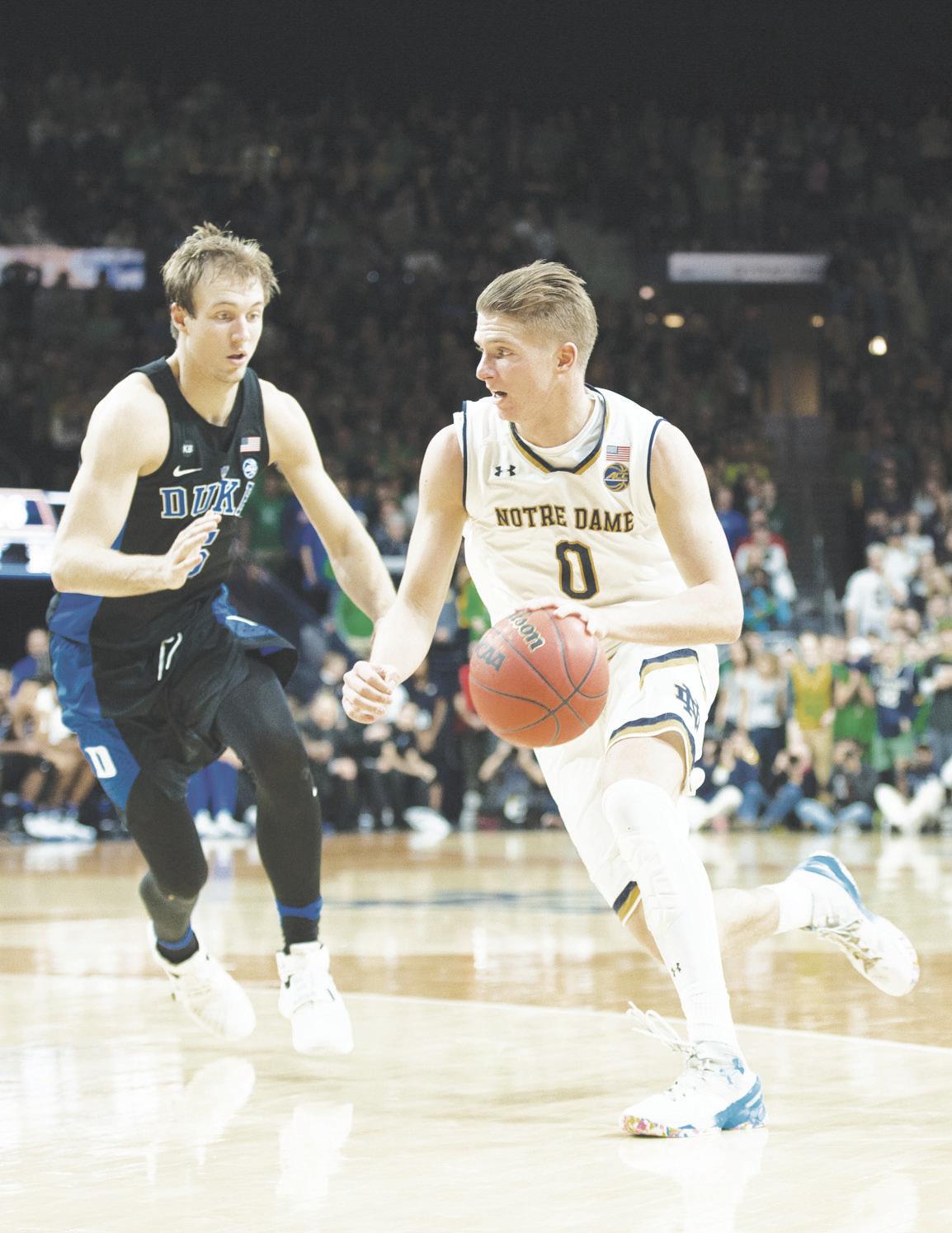
Irish freshman T.J. Gibbs jumps up for a layup during Notre Dame’s 84-74 loss to Duke on Jan. 30 at Purcell Pavilion. Gibbs is one of four players under consideration for a starting spot in Saturday’s game.
nd women’s basketball | nd 76, vIrGInIA Tech 59
Irish start slow, finish strong to beat Hokies
By ELIZABETH GREASON sports Writer
v irginia Tech had a chance to win it. And then it was gone.
The Irish went on to take down the h okies 76-59 on the road in b lacksburg, v irginia.
The h okies (16-6, 3-6 A cc ) sprung out to an early lead as n o. 7 n otre d ame (21-3, 9-1) struggled to maintain control of the ball, turning the ball over five times in the opening four minutes.
s ophomore guard m arina m abrey kept the Irish within reach by knocking down two early 3-pointers, but it was not until junior forward Kathryn Westbeld came off the bench midway through the first quarter that the Irish were able to regain control of their struggling offense. Irish head coach m uffet m cGraw was particularly pleased with Westbeld’s production, as she did not start due to an injury.
“I was really happy with Kathryn Westbeld,” m cGraw said. “I thought, she was the difference in the game. s till nursing a sore ankle but she
men’s basketball
was able to really get it out and she did a great job.”
m cGraw felt the momentum swing early in the game that allowed the Irish to end the first quarter with a 1911 lead after being down to start the game was due to a renewed intensity on the defensive side of the ball after a switch to zone coverage from the man-to-man the Irish had been planning to play the whole game.
“I think just the energy on defense [allowed us to turn it around],” m cGraw said. “I think we looked a little flat at the beginning. They were kind of shooting it right in our face; we really were not defending well, not great help defense. I think the zone is what changed it.”
Although v irginia Tech was able to climb back within arm’s length toward the end of the second quarter, as the half finished 34-29 in n otre d ame’s favor, the h okies’ production did not click into gear in the second half and v irginia Tech struggled to keep its head
see W bbALL PaGe 10
brey ponders lineup changes for U nc trip
By ALEX CARSON Assistant managing e ditor
no. 20 notre d ame has used the same starting lineup in each of its 23 games this season.
That might change s aturday, with Irish head coach m ike brey pondering dropping junior forward m artinas Geben from the starting five for his team’s trip to no. 12 north c arolina.
Geben might stay in his spot, brey said, but he’s also considering senior forward Austin Torres, sophomore guard rex Pflueger and freshman guard T.J. Gibbs to take the final starting spot.
“I’m not sure who we start and I think we’ve got to look at that over the next two days,” brey said at his pre-practice press conference Thursday.
“m an, we may not make a decision on the fifth starter, that is, until the shootaround on s aturday. It could be the same way; it could be Torres, like
ND faces crucial conference game
By TOBIAS HOONHOUT sports Writer
With perhaps the season on the line, no. 17 notre dame is set to face no. 12 vermont at home this weekend. The two teams are third and fourth in hockey east, with the catamounts (16-8-2, 8-5-1) ahead by only one point, and a sweep for the Irish (14-9-3, 7-52) would go a long way in shoring up their nc AA tournament chances.
In last weekend’s loss to boston college, the Irish struggled to handle the speed of the eagles in transition. While the Irish have gotten better at limiting those opportunities, head coach Jeff Jackson is hoping that the problems last weekend were just a hiccup, and that the Irish can stay focused this weekend.
“We have to. We are playing a team in the same caliber [of boston college], maybe a different style, but very similar team as far as offensively,” Jackson said. “vermont is as good as there is in our conference right
now, and we’re going to have to be really smart with the puck. We had been doing a really good job of minimizing odd-man rush situations, but against bc I don’t know if we got caught up in the moment with the energy in the building and the speed of the game, because that’s where we got ourselves into trouble. so by controlling the puck, you control the tempo, and our team has been inconsistent with that for a lot of this year. but I thought we had settled down quite a bit over the last month and avoided some of those turnovers, and they showed back up, like I said maybe it was just the environment, because it was a good game.”
Although not picked to do well in hockey east this year, vermont has surprised a lot of people. In october, the program was put on probation and both co-captains were suspended by the University amid allegations of hazing, but the team has see hocKeY PaGe 10
EMMET FARNAN | The Observer
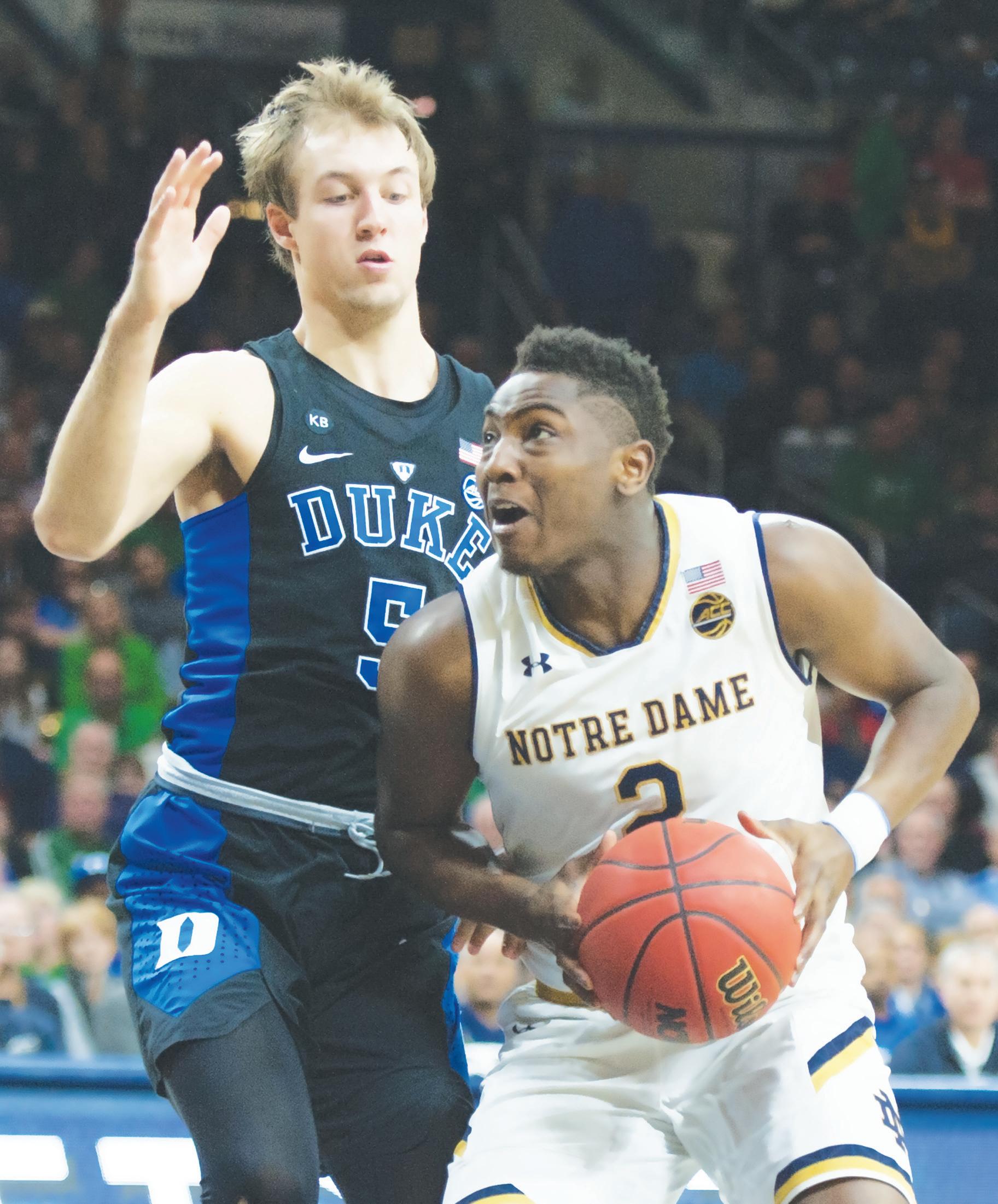
Irish sophomore guard Rex Pflueger drives to the basket during Notre Dame’s 84-74 loss to Duke on Jan. 30 at Purcell Pavilion.
see m bbALL PaGe 11
EMMET FARNAN | The Observer
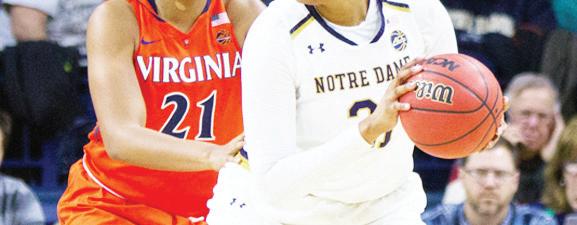
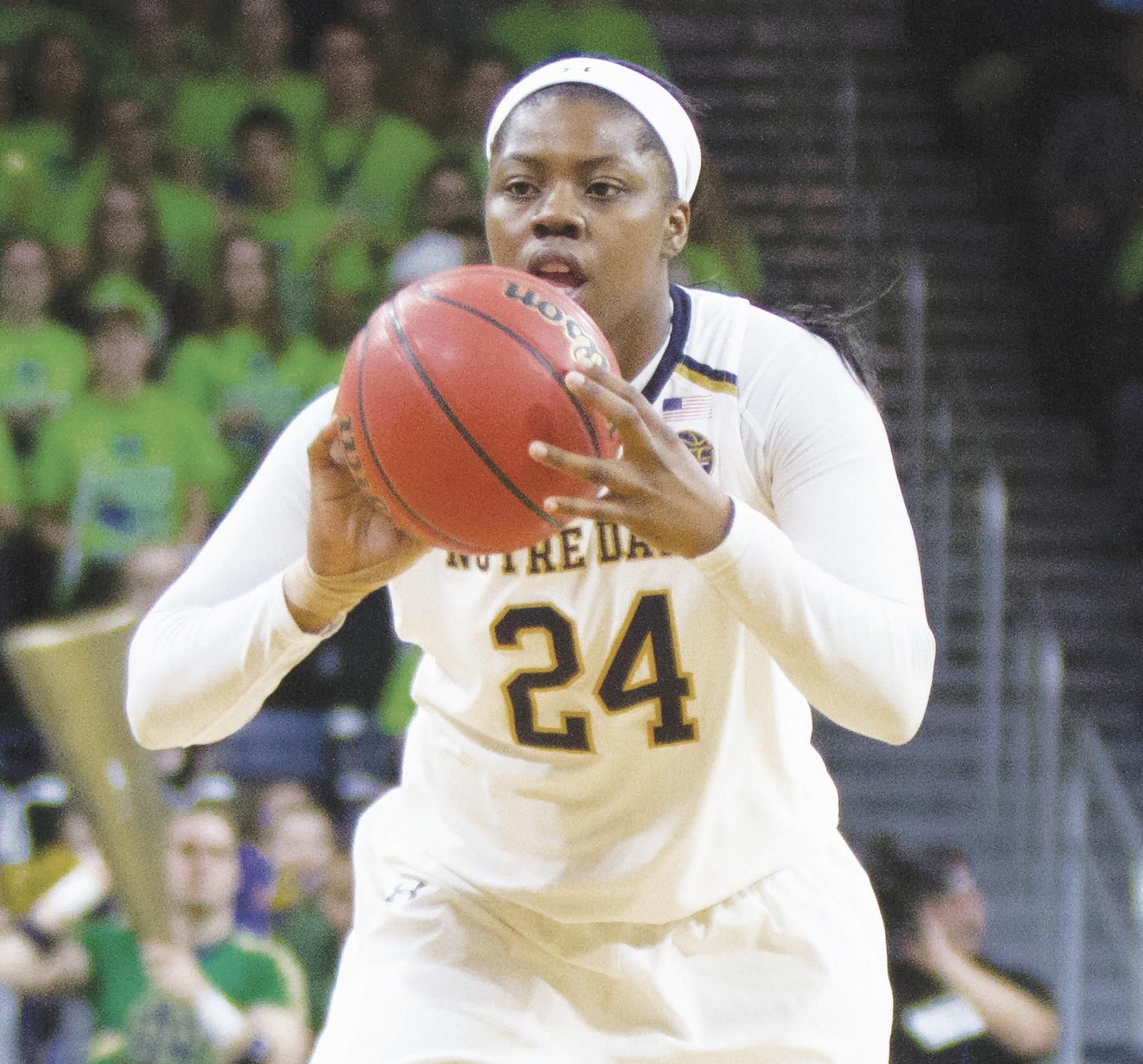
Irish sophomore guard Arike Ogunbowale looks to pass during Notre Dame’s 82-74 home win over Virginia on Jan. 29. Ogunbowale recorded her first career double-double against Virginia Tech.