Print Edition of The Observer for Friday, January 20, 2017
Community reflects on Pence’s legacy
Notre Dame students discuss former Indiana governor’s impact on University on eve of Inauguration
By MEGAN VALLEY
Associate News e ditor
hundreds of thousands of people — including protesters — will descend on the Capitol on Friday to watch Donald trump take the oath of office to become the 45th president of the united states.
For the students of Notre Dame and saint Mary’s, the inauguration will also see former indiana governor Mike pence sworn in as the vice president.
“i think that before Donald trump announced him as his running mate, if you asked most Notre Dame students what they thought of Mike pence, they’d say ‘w ho?,’” senior College republicans vice president Dylan stevenson said.
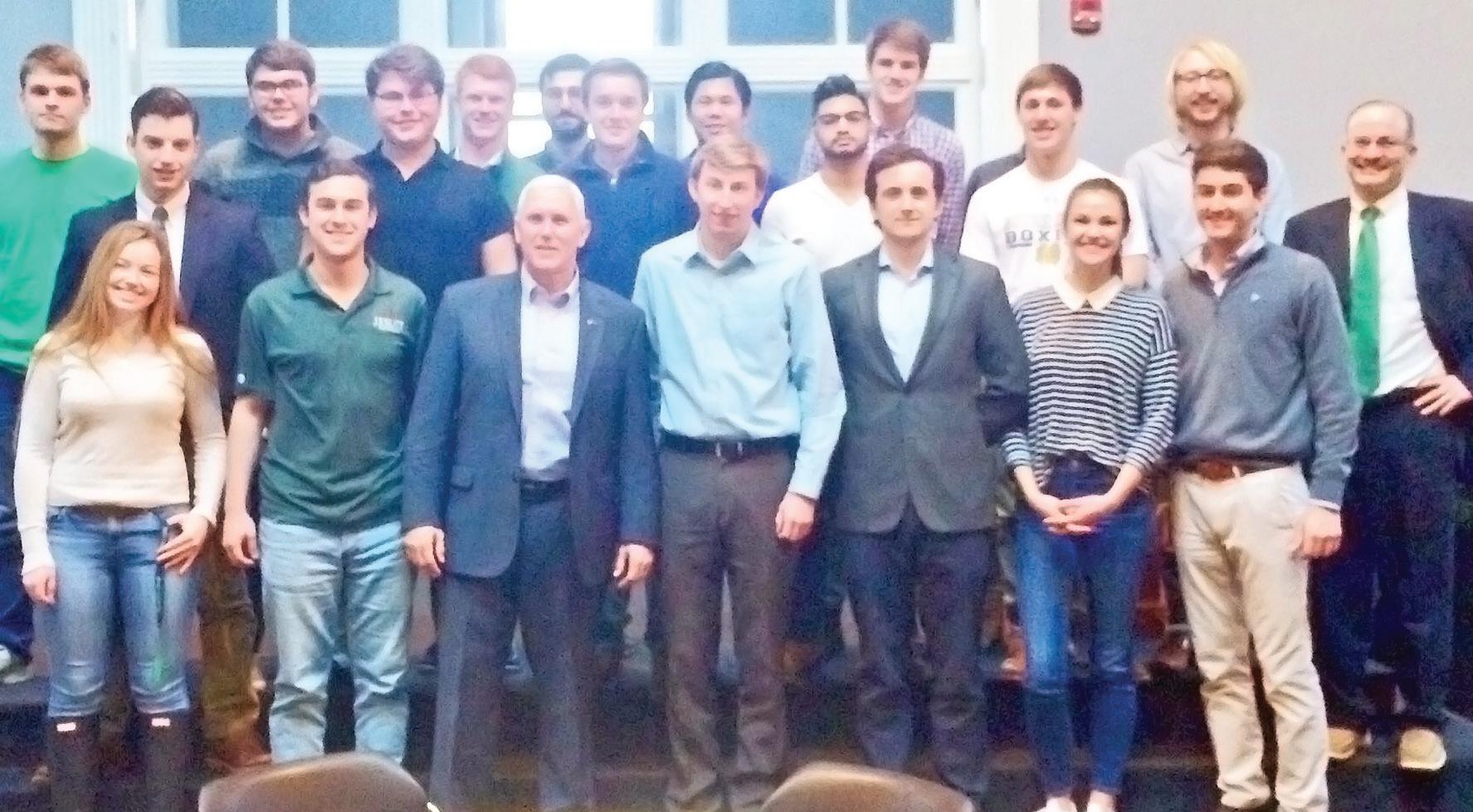
Former governor Mike pence joins College republicans for a luncheon event last school year. photo courtesy of Dylan stevenson
Former governor Mike pence joins College republicans for a luncheon event last school year.
senior Andrew galo, co-president of College Democrats, said pence’s legacy as governor was “not one to be proud of.”
stevenson said pence’s legacy was “primarily economic.”
“A lot of what fiscal conservatives wanted to see, he put into practice, and a lot of it worked,” stevenson said.
galo, however, said pence’s term as governor was not good for
see peNCe PAGE 3
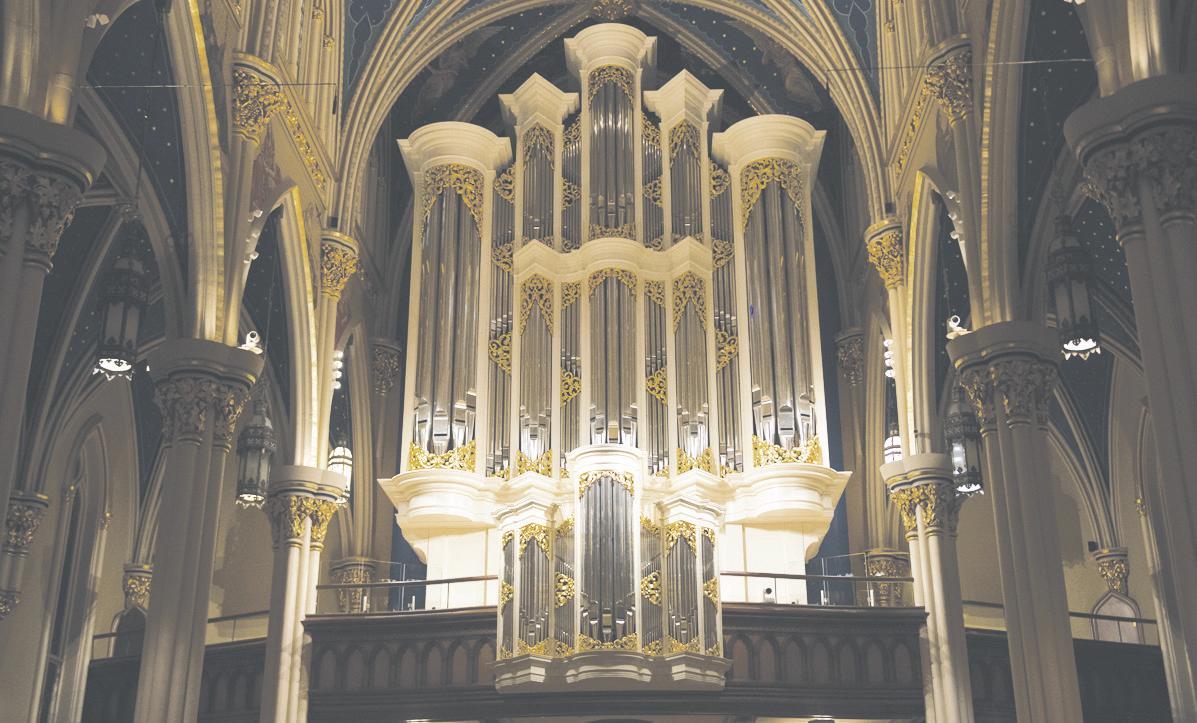
Murdy Family organ to be dedicated Friday
Friday
Mike Pence, then governor of Indiana, visits the Notre Dame College Republicans during the 2015-2016 school year. Pence will be innaugurated as Vice President of the United States on Friday.
Former civil rights lawyer reflects on public service
By LUCAS MASIN-MOYER News writer
A year ago, r ussell Lovell, professor emeritus at Drake Law s chool, got a call from Benny Anders, the president of the i owa-Nebraska chapter of the NAAC p. Anders joked that now that Lovell was retired, he was now going to be working full time
for the NAAC p after years of being a volunteer civil rights lawyer. According to Lovell, “it’s been pretty much the case.”
t hursday evening, in the e ck s chool of Law, Lovell, a 1966 graduate of Notre Dame, discussed his many years with the NAAC p, with whom he has been recently fighting the nomination
of s enator Jeff s essions for Attorney g eneral. Lovell also spoke on his inspirations for becoming a civil rights lawyer, the challenges that caused within his family and the importance of public service and civility. Lovell’s talk is part of programming for Notre
see NAACp PAGE
8:15 p.m. after 10 years of organizing and work.
By COURTNEY BECKER News writer
the Murdy Family organ will be dedicated by Bishop Daniel Jenky on Friday, the culmination of a 10-year-long project.
Fr. peter rocca, rector of the Basilica of the sacred heart, said once the Murdy family donated funds to begin construction of the organ it took around 40 months to
complete.
“i would say it’s been almost 10 years that we’ve been working on this project,” rocca said. “And then it was in 2012 that we finally sealed the deal with the donation by the Murdy family to begin the construction of the organ.”
the goal for a new organ in the Basilica came about due to certain
see orgAN PAGE 5
Local women to march against healthcare repeal
By SELENA PONIO Associate News e ditor
Members of the south Bend community, many dressed in pink, will be marching this saturday in solidarity with one cause: women’s rights.
the Feminist Federation of south Bend and pro-Choice south Bend are hosting a short march through downtown
south Bend in an effort to emphasize the importance of women’s rights, safety, health and families. the Notre Dame gender studies department is also a sponsor.
Media coordinator of proChoice south Bend Karen Nemes said although the main march is being held in washington, D.C., there are many local organizations
working towards raising awareness as well.
“it’s always really uplifting,” Nemes said about the march. “i always get an immense recharge of my own batteries when i see people of all ages and different socioeconomic backgrounds and ethnic groups in solidarity.”
see MArCh PAGE 5
PHOTO COURTESY OF DYLAN STEVENSON
MICHELLE MEHELAS | The Observer
The Basilica of the Sacred Heart will dedicate a new organ
Vincent Buono freshman Keenan hall “perennial hall of the year.”
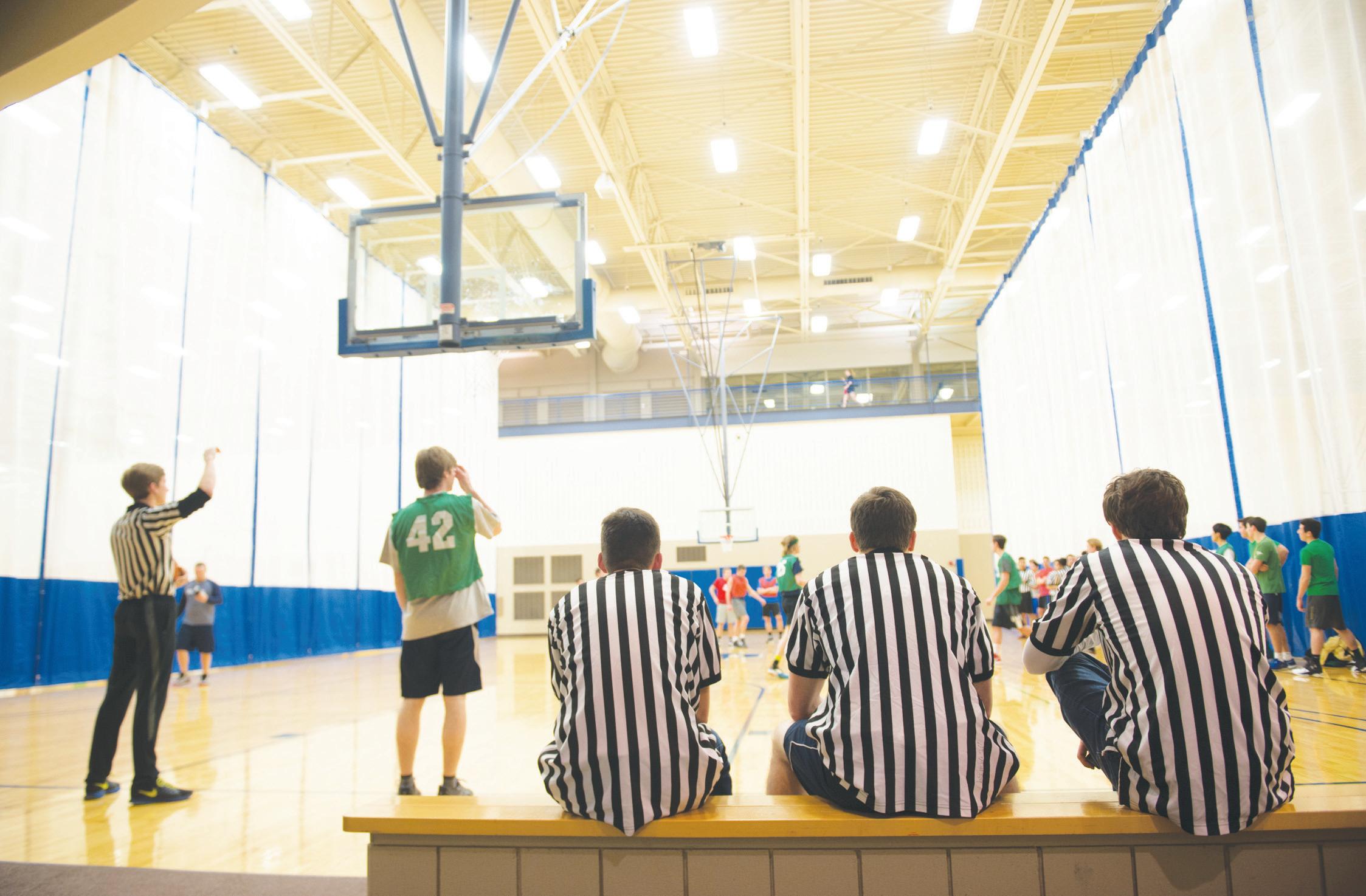
Prospective Rec Sports basketball referees practice at Rolfs Sports Recreation Center during an officiating training clinic. Both the men’s and women’s interhall leagues start Sunday, with
Today’s Staff
News
Megan Valley Lucas Masin-Mayer gina twardosz
Graphics
Lauren weldon
Photo Michael yu
Corrections
t he observer regards itself as a professional publication and strives for the highest standards of journalism at all times. we do, however, recognize that we will make mistakes. i f we have made a mistake, please contact us at (574) 631-4541 so we can correct our error.
Hockey vs. New Hampshire Compton Family Ice Arena
Saturday
Men’s Basketball vs. Syracuse Purcell Pavilion
noon
The Irish take on the Orange.
Harlem Globetrotters Purcell Pavilion
7 p.m.
Open to the public. Tickets are available online.
Sunday
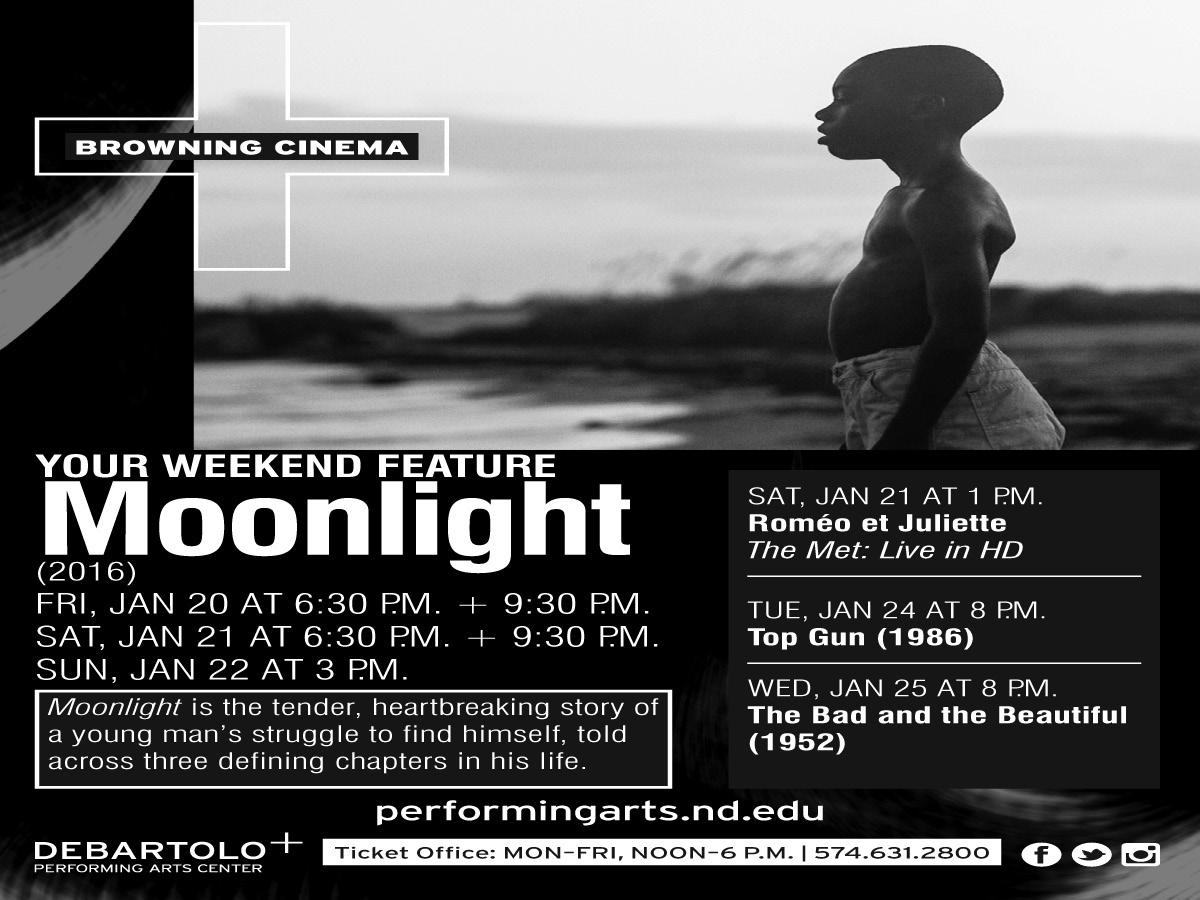
Film: ‘Moonlight’ Debartolo Performing Arts Center
3 p.m. - 4:50 p.m.
Open to the public. Film is rated R.
Monthly Fellowship: Jamii Coleman-Morse Center
9 p.m.
‘A Conversation with Judge Ann Claire Williams: Walking the Walk, Saying Yes’ Joyce Center 11:30 a.m. - 1:30 p.m. ‘Raptivism’ Hesburgh Library 7 p.m. - 8 p.m. Part of ‘Walk the Walk Week.’ Open to the public.
MICHAEL YU | The Observer
Civil rights advocate discusses King’s legacy
By JORDAN COCKRUM News writer
s aint Mary’s s tudent Diversity Board and the Division of Mission hosted a dinner in celebration of Martin Luther King Jr.’s life and work t hursday
t he dinner featured guest speaker Darryl h eller, director of the Civil r ights h eritage Center at i ndiana u niversity- s outh Bend.
“[King’s] dream was one of racial harmony,” h eller said.
h eller discussed not only the most famous actions of Martin Luther King Jr., but also the lesser-known aspects of his work.
“ t he King that we’re almost never told about is the Martin Luther King whose conscience required him to break his silence over the Vietnam war, even knowing it would cost him the
support of the Johnson administration and many others,” h eller said.
Martin Luther King Jr. tends to be remembered more for his “ i h ave A Dream” speech and other early work, rather than for the speeches he gave towards the end of his life, h eller said.
“ we are almost never made aware of the King who asked ‘ w here do we go from here?’ in a speech he gave at the 11th annual s CLC convention in Atlanta in 1967,” h eller said. “ h ere, King passionately spoke about the thread that connected the history of slavery with the oppression black people continue to experience. h e called on black people to organize for economic and political power because he reminded listeners that the plantation and the ghetto were created by those who
Notre Dame names two new vice presidents
Observer Staff Report
t he u niversity announced it named Doug Marsh and David Bailey as vice presidents Jan. 5.
Marsh, a s outh Bend native and a 1982 Notre Dame graduate, was promoted to vice president for facilities design and operations.
Bailey, a 1983 Notre Dame graduate, was promoted to vice president for strategic planning and institutional research.
As vice president for facilities design and operations, Marsh will be the university architect. For more than
two decades, he has led planning, design and construction at Notre Dame, in addition to overseeing the u niversity’s utilities and maintenance team.
Bailey began his career on campus in 2011. s ince 2012, he has led the o ffice of s trategic p lanning and i nstitutional r esearch. p reviously he worked at i BM Corp., g erard Klauer Mattison & Co and g oldman s achs.
After these promotions, Notre Dame now has 18 vice presidents, in addition to executive vice president John Affleck- g raves.
as vice president.
indiana.
“it’s been one of setbacks and turning us back in the progress we’ve made,” he said. “ … he’s shown every indication of continuing to do that in the next administration.”
senior gracie watkins, co-president of College Democrats, said the status of minority groups, including students who identify with those groups on campus, was threatened by pence as governor and would continue to be threatened as he begins his term
had power.”
i n addition, h eller touched on the importance of taking into account the fact that African Americans have been enslaved for 246 years, and free for just 152 years.
“ today we still have been enslaved for 94 years more than we have been free,” h eller said. “ t he balance of black freedom to black slavery will not balance out until the next century.”
t he attempts to reach this balance are continually met with backlash, h eller said.
“ h owever, every step towards America’s promise has been met with a backlash meant to ... expand white supremacy and patriarchy,” h eller said.
o ver time, these backlashes can be seen expressed in different ways: s ome include the Jim Crowe laws, lynching and the assassination of
Dr. Martin Luther King Jr., h eller said.
i n recent times, “a burst of hope” was seen in the election of the nation’s first black president, Barack o bama, h eller said.
“ t his was met with increased voter suppression laws, a parade of unarmed black people killed by those who were supposed to serve and protect them, the rise of the school choice movement to support black education, and the thinly veiled rhetoric that appeals to those that want to hold on to whiteskinned privilege,” h eller.
h owever, this resulted what h eller described as the “ultimate backlash”: the election of p resident-elect Donald trump.
“ today, we are facing a new administration that looks backwards and draws upon some of the worst that
university
America has to offer,” h eller said.
h owever, h eller also spoke of the fact that Martin Luther King Jr. inspired — and continues to inspire — an array of social movements in both our nation and abroad, and that in honoring Martin Luther King Jr., we should “honor the whole man.” “ t he Civil r ights movement, which was led by black people, created a space and gave energy to multiple social movements in the 1960s,” h eller said. “ t his is because of [Martin Luther King Jr.’s] dream. o ur dream. ... Calling us to work towards a future that embodies not just the letter but also the spirit of the best parts of the nation’s founding documents.”
Contact Joran Cockrum at jcockrum01@saintmarys.edu
awards architecture prizes
Observer Staff Report
Architect r obert Adam has been named the recipient of the u niversity’s 2017 r ichard h . Driehaus p rize.
t he $50,000 prize is given annually to an individual working outside the practice of architecture and who has supported the cultivation of the traditional city.
Adam is the 15th Driehaus p rize laureate and will be recognized during a ceremony in Chicago on March 25, where he will be awarded the $200,000 prize and a bronze miniature of the Choregic Monument of Lysikrates.
i n addition to being the author of numerous essays and books, Adam works with
“i think Notre Dame is kind of a microcosm of the united states, where marginalized communities on our campus will be targeted the same way they are across the states, specifically [Deferred Action for Childhood Arrival] students and their families, come to mind,” she said.
stevenson said another point of controversy of pence’s term was the religious Freedom restoration Act (rFr A), which was intended to protect religious liberties. galo said all rFr A did was “codify bigotry and [establish] a precedent for legal discrimination.”
“As a Catholic university, there’s
something to be said for a Catholic identity, but that also means we don’t discriminate and we don’t hate others,” galo said. “[rFr A] was a bill of hate.
“thankfully, south Bend came out and said ‘we’re going to be a community for all,’ and if you look downtown, all the businesses say ‘we’re open to business for everybody.’ it’s hard at a school like this to kind of walk that fine line, but this bill was pretty explicit in that it was thinly veiled religious freedom covering up this idea of discrimination and hatred and this malpractice to others.”
stevenson said that because pence was pressured to sign an
clients for projects including master planning, public and commercial buildings, private houses and extensions to historic buildings.
Adam is a fellow of the r oyal s ociety of Arts, a senior fellow of the p rince’s Foundation for the Built e nvironment and founder of the College of Chapters at i N t BAu
t he Driehaus p rize was established in 2003 to honor those who dedicate their life to traditional, classical and sustainable architecture.
o n the 15th anniversary of the Driehaus p rize, the jury will also honor the Congress for the New u rbanism for its contributions to the public realm over the last 25 years.
Alongside the Driehaus
amendment negating much of the act, he wasn’t sure what kind of impact it would have on indiana businesses and the indiana LgBt community.
“Do i think [rFr A] will tarnish his legacy? No,” stevenson said.
“ … those on the left would not view him favorably [because of rFr A], which is legitimate if you’re very vocal on LgBt rights — then you’re obviously not going to be oK with that sort of thing. But if you’re like me, which is where the economy and the budget come ‘uber alles,’ i think your opinion of him then is always going to be quite high.”
galo said regardless of a person’s
p rize, the u niversity also posthumously awarded the h enry h ope r eed Award to architectural historian James Ackerman.
Before his death several weeks ago, Ackerman was the Arthur Kingsley p rofessor of Fine Arts e meritus at h arvard u niversity.
t he recipients of all of this year’s awards were selected by a jury including: Adele Chatfield-taylor, president emerita of the American Academy in r ome; r obert Davis, developer and founder of s easide, Florida; p aul g oldberger, contributing editor at Vanity Fair; Leon Krier, architect and urban planner; and Demetri p orphyrios, principal of p orphyrios Associates.
opinion of pence, students have ability to express that opinion in a productive way at Notre Dame.
“Notre Dame’s a really interesting and unique place in that we have these conversations and we have a platform to do that,” galo said. “i think it’s cool that we’re able to discuss and grapple with them. i think that’s one of our strengths and it will continue to be our strength in the next four years.
“it’s not a time to keep looking backwards, we have to look forward.”
Contact Megan Valley at mvalley@nd.edu
n AACP
Dame’s “walk the walk” week, honoring the legacy of Dr. Martin Luther King Jr.
Lovell said that his passion for civil rights started with his admiration of Jackie robinson as a child, when his mother bought him a book on the Brooklyn Dodgers second baseman.
Lovell said he was shocked by “the kind of harassment the kind of terrorism the kind of threats he faced being the black man who integrated this American game that was a white man’s game.”
Lovell said that his views on civil rights didn’t become solidified until later in life
March
Jamie Morgan, director of the board for p ro-Choice south Bend, said the local march started when members of the community came forward and said they wanted to do something like the women’s March on washington but closer to home.
“we have invited everyone, the march is for all,” Morgan said. “From this march, we hope that we are more aware and united so that people can continue to take action in supporting equal rights for all.”
According to the Facebook
because of his conservative upbringing in a country that was “the only red county north of the Mason-Dixon line when g oldwater ran.”
Another figure who influenced Lovell was e d Murphy, a Notre Dame law professor and his advisor during his time with the young republicans at Notre Dame.
“w hat i recall about him was, and i think it’s really important to you today, he was the model for civility,” Lovell said. “w hen i hear the presidentelect talking about his enemies e d Murphy would never talk about his enemies. he might talk about the Democrats who he disagreed with as opponents with different views, but he would never use the word enemies.”
event, participants are encouraged to wear pink and hold signs as they march. t he march will conclude at Vegetable Buddies with food, drink and dance for all those who participated.
Junior Joey w ikelski said not only is the march important because it champions for women’s rights, but also because it is an act of solidarity with the hundreds of sister marches taking place across the country on the same day. taking place the day after i nauguration Day, w ikelski said she hopes this march holds extra importance.
“i hope the march sends a message to our new administration on their first day in office and to everyone who felt
During his time at Notre Dame, Lovell said that he also began to question his views because of the work of university p resident e meritus Fr. t heodore hesburgh.
“[ hesburgh] was a catalyst by example ... almost no other American had the impact on peace and justice that he had over these years and so he was clearly a role model for me,” Lovell said. “he always had me thinking in terms of, if i disagreed with some of his views, he made me rethink those views.”
As Lovell moved closer and closer to advocating for civil rights, he drifted further and further from his parents who did not share his views. t his came to a head when Lovell protested against a restaurant
threatened or insulted by campaign rhetoric that we believe women’s rights are human rights and that when we defend the marginalized among us, we defend all of us,” w ikelski said.
w ikelski said when she heard about the March on washington, she was so excited that she started to look at flights. however, when she found out there was also a march in south Bend, she knew she could not turn down the opportunity to be able to support the same cause locally.
“As a Notre Dame student, the women’s March on south Bend will be another opportunity to break out of the Notre Dame bubble and stand in
that his father legally represented because it would not admit a black classmate during his time at the university of Nebraska’s school of Law.
t he singular event that Lovell sights as being instrumental in driving him to spend his life fighting for civil rights was the King assassination.
“[King] died when i was in law school, martyred in 1968,” Lovell said. “i remember the emotions across the nation, the riots. in Lincoln, Nebraska, people just poured out onto the streets, marched to the only black and white integrated church there. if there was ever an a-ha moment that was the one.”
After this moment, and after two years as a law clerk, Lovell began his career as a civil rights lawyer in i ndianapolis, later
solidarity with people from the south Bend community as we collectively bring attention to important issues facing women in the united states today,” w ikelski said. “it’s also been exciting to see other students from the Notre Dame family want to get involved; on saturday, i’ll be leading a carpool of friends downtown so we can all march together.”
Nemes said anyone who is in support of the platform and wants to work both locally and nationally is welcome to get involved. she said the focus on the march is really about unity and equality.
“it’s bigger than any one person or politician,” Nemes said.
Organ
restraints created by the previous organ, rocca said.
“they’re not frequently replaced,” he said. “ ... i think this is perhaps — we’ve had a number of organs in the Basilica and i think this might be the fifth or sixth organ.”
rocca said the Murdy Family organ is better suited to the Basilica than the previous organ due to the high quality of the new organ.
“this organ is probably one of the best you’ll find in the united states — if not, in the world,” rocca said. “it has a great versatility. it will enable organists to play a whole repertoire of literature that the previous organ would not necessarily permit because it is quite a bit larger than the previous organ. so there is more variety in terms of the stops and the sounds.”
the increased size of the organ will also enhance Mass and other celebrations in the Basilica, rocca said.
rocca said he hopes the improved organ also draws in more students who intend to study sacred music at the university.
“we have a master of sacred music program and a doctoral program, both with organ majors,” he said. “so this will be a very attractive instrument for them to practice on and to
moving to Drake university to teach law and volunteering with the NAAC p, which he called the, “oldest, the boldest and — to use contemporary terms — the baddest civil rights organization in the country.”
Lovell concluded his talk by advocating for students to engage in public service and fight against racial discrimination.
“you don’t get rich doing it, but you can make a living do it,” Lovell said. “so my challenge to you is to give a thought to raising the status of lawyers in the eyes of the public, make a difference, consider racial justice. t he country is in crying need for people to be more involved.”
Contact Lucas Masin-Moyer at lmasinmo@nd.edu
“Certainly, the election took up a lot of national attention this past year and i think for a lot of folks that really inspired them to be more politically active whether it’s locally or on a larger scale.”
w ikelski said she is excited to meet the other marchers and have their voices be heard as well.
“For me, i’m hoping the positive energy of the march and the feeling of being involved in what is greater than myself will be a boost in energy and morale as i figure out my role in the movement,” w ikelski said.
Contact Selena Ponio at sponio@nd.edu
perform on.”
in addition to attracting organ students, rocca said, the Murdy Family organ offers greater opportunities for visiting organists to play recitals at Notre Dame.
“we hope to bring in concert performers from around the world who will be very anxious and happy to play and perform on this organ,” he said. “so it’s — both liturgically and professionally — this organ will be attractive for a whole host of reasons.”
rocca said Jenky being the one to bless the organ will be a highlight of the dedication and recital.
“we have bishops here all the time to celebrate Mass,” he said. “But for a bishop to come to bless an organ? that’s, i would say, pretty rare.”
Above everything else, rocca said, this new addition to Notre Dame’s campus would not be possible without the generosity of the Murdy family.
“we’re eternally grateful and indebted to the Murdy family for this very generous benefaction of this organ,” he said.
the dedication will take place at 8:15 p.m. in the Basilica, followed immediately by the dedication recital. organ professor and university organist Craig Cramer will perform the recital.
Contact Courtney Becker at cbecker3@nd.edu
slow down, puzzle more
i t’s a common trope, at least in my experience, for reporters to inquire about the downtime hobbies of their celebrity interviewees. you see it all over the internet, in articles and video clips: to unwind, o prah will occasionally shut herself in her closet in the middle of the work day to collect her thoughts. w hen she’s not out partying or filming with i lana g lazer, Abbi Jacobson paints quirky pictures of hamburgers. p resident Barack o bama reads books.
i think the theme stems from the desire of reporters to humanize the stars (to quote p eople magazine, they’re just like us!), and simultaneously capitalizes on audiences’ enthusiasm to peek into the daily routine of the rich and famous. t he idea of the women and men we see on billboards kicking off their shoes at the end of the day and completing their own calming rituals comforts us, a reminder that the human need for periodic rejuvenation is a universal one.
i thought a lot about the soothing effect of these hobbies like these over break. Coming out of a semester where time seemed to hurtle forward at warp speed, i needed slow. At my grandparents’ house in s outh Dakota, i sat in the living room and picked at couch cushions, aimlessly leafing through a book, still halfway unsure how to relax after scrambling to finish the past semester. t ime crawled.
e nter my little brother p atrick, sitting quietly across from me in the living room. h e’s not a celebrity now, but who knows? Maybe someday. h e’s smart, with an encyclopedic memory and a lightning-fast wit, capable of throwing out a hilarious comeback quicker than i can respond. As i fidget on the couch, p at is focused on nothing but the puzzle in front of him. i t’s a map of the world – an impressive 4,000 pieces, spread out evenly across the table. As i watch, he puts Namibia in place and moves over to the Arctic o cean, scanning the board for familiar shapes and colors.
At age 14-almost-15, p at is something of a puzzle connoisseur. o bama has presidential biographies; p atrick Mc g reevy has puzzles. i n our living room at home, one of the most common fixtures is the half-completed puzzle on the coffee table, usually with p at bent over it, intently putting it together. h e puzzles steadily and methodically. too much puzzling can sometimes wear people out — for reference, g oogle “competitive puzzling” — but p at doesn’t get bored.
i nspired by his intensity and with nothing better to do, i did puzzles with p at this break, and now i think i can make the case for puzzles as self-care. p uzzling is contemplative and orderly — close to meditative. i t’s soothing and satisfying to put all of the pieces in the place and watch the larger picture emerge. i n that sense, it’s emblematic of all of the little self-care rituals we do as humans, celebrities and eighth graders alike: small things that put pieces of our lives and minds into place.
Contact Nora McGreevy at nmcgreev@nd.edu
The views expressed in the Inside Column are those of the author and not necessarily those of The Observer.
Trumpism and empire
o n Feb. 15, 1898, the uss Maine sunk in the h avana harbor. w ithin the year, the spanishAmerican war had begun, and with it America’s path towards global empire. t he treaty of p aris that ended the war ceded vast territories to the united states, to the despair of Mark twain, “opposed to having the eagle put its talons on any other land,” and s enator g eorge Frisbie hoar, who presciently remarked “this treaty will make us a vulgar, commonplace empire.”
t he sinic and i slamic worlds have long sustained the ideal, if not the reality, of universal rulership. Not so in the west, home to innumerable divided polities since the fall of rome. o r it was, until, merely 47 years after the Maine’s sinking, p resident h arry truman detonated the atomic bomb. standing atop world war ii’s 100 million corpses, he was acclaimed Leader of the Free world. For the first time in 1,500 years, there was once again united leadership of the west.
After rome unified italy, it conquered the g reek lands surrounding it, bringing luxury and knowledge into the once-austere roman republic. yet these triumphs were attended with profound consequences. Cato the e lder, roman senator, declaimed, “ t he greater the empire grows … the more i fear that these things will capture us rather than we them.” he was rightfully fearful. t he infusion of hellenic mores eventually made it impossible to govern a cosmopolitan roman people under their simple but virtuous ancestors’ laws. A century after Cato’s death, Julius Caesar crossed the r ubicon and replaced a republic no longer sufficient for her peoples’ needs with an empire that was.
e n route to the presidency, Donald trump flouted nearly every “norm” of American politics, his rise fueled and permitted by our national institutions’ debility, as our banks generate financial disaster, our media provokes disbelief and our political parties promote populists and kleptocrats. however, t he Donald’s triumph is not the final chapter in the popular rejection of the old consensus. trump’s victory indicates, at least, that there will be more disruption before political order is restored, and at worst, that our republic’s latter days are at hand.
t he republic’s current crisis is unsurprising, for modern America exists in fundamental tension: it acts like an empire, but attempts to administer itself like the republic it once was. o ur constitution was conceived for a coastal strip of agricultural, precariously independent, former colonies governed by propertied white men. t his legal structure can no
longer govern a sprawling, multiethnic, and urban state whose imperial tentacles spread over billions of souls from taiwan to Mogadishu.
America’s transition to imperial government began long ago — i wonder whether the founders would be more horrified by our massive standing army or modern readings of the Commerce Clause — but is now accelerating. Congress has not issued a declaration of war in 75 years, presidential use of executive orders to rule without Congress is now cemented precedent, and between the C i A, FBi and Ns A, America now has its very own p raetorian g uard, ready and willing to intervene in the selection of their next master. t he potus has ears, eyes, and fists everywhere; the blithe decision to give the office those appendages now appears more fateful than expedient as Donald trump, known to publicly expound on the delights of revenge, is bestowed with near omnipotence.
yet, despite how much people love to scream about trump’s insanity, none seriously consider what the trump phenomenon bodes for the future. All seem to share an unspoken assumption things won’t get any crazier once he’s actually president.
As rome initially declined full sovereignty over the Mediterranean, so has the united states foregone direct power over its vast complex of vassals, allies and tributaries in favor of exercising a less onerous, if more frustrating, indirect authority. yet such arrangements cannot last, for empire is, above all else, expensive. Driven by the military’s ravenous need for capital, rome eventually took a firmer hand with her provincial clients. trump’s demands that our allies “pay their own way” hint our empire is at a similar crossroads. Around the same time, the decay of rome’s institutions transformed roman politics into a contest of individual wills, auguring the republic’s final days. t he past presidential contest could only be described similarly, though one candidate subjugated her party while the other sidelined his. America appears to have finally shed off the party politics washington so feared. yet we will never have another washington, for it is as hard to imagine trump spending his time in bucolic anonymity as it is to imagine g eorge washington caking himself in makeup to shout a catchphrase into t V cameras. None can know what the future holds, but after trump, the o val o ffice can never again host a Lincoln, though someday it may welcome an o ctavian.
Devon Chenelle is a junior in Keough Hall. He is a history major with an Italian minor. He can be reached at dchenell@nd.edu
The views expressed in this column are those of the author and not necessarily those of The Observer.
insidE COluMn
Devon Chenelle t he gadfly
Nora McGreevy scene writer
i nvite trump to commencement
abortion while bypassing beneficial proposals to increase living wages, better clean air and water, improve healthcare or expand family leave.
in an early December interview with the observer, university president Fr. John Jenkins reflected on a myriad of reasons to either ignore or invite incoming president-elect Donald trump to speak at Commencement in May. Jenkins — university president since 2005, who has personally only invited president Barack obama in 2009 amidst denunciations from antiabortion rights cardinals and bishops as well as alumni lobbying to reverse the invitation — said that it would be good to have the new president on campus in 2017, regardless of his views. “i do think the elected leader of the nation should be listened to,” Jenkins summarized. however, Jenkins hedged his thought by citing unprecedented high levels of political acrimony throughout the recent campaign when he countered, “At the same time, the 2009 Commencement was a bit of a political circus, and i think i’m conscious that that day is for graduates and their parents — and i don’t want to make the focus something else. … My concern a little bit is that, should the new president come, it may be even more of a circus.”
Jenkins errs in primarily concerning himself with the “circus” more than offering his graduates and their parents a day with the leader of the free world and our nation’s president — regardless of human and policy shortcomings perceived or evident by specific campaign promises such as deporting current students brought illegally as children into the united states. Jenkins must consider that every president has a buffet of policies Americans must evaluate as an entire political meal.
too often prior to pope Francis, the American Catholic hierarchy completely and rigidly rejected a president based on one litmus test — abortion rights, but not necessarily its sister issues of preventing war deaths or striving to restrict capital punishment deaths. American bishops are notorious for prioritizing
Notre Dame enjoys a unique stature as the leading nonmilitary educational institution that hosted the most sitting presidents as commencement speakers: Dwight eisenhower (1960), Jimmy Carter (1977), ronald reagan (1981), george h w. Bush (1992), george w Bush (2001) and Barack obama (2009). Notably absent is Bill Clinton (1993-2001), whose abortion rights support “excommunicated” him by the Catholic hierarchy. yet despite a history of factoring the artificial Catholic hierarchical restrictions before extending such invitations, twice as many presidents accepted Notre Dame commencement requests than the nearest other university with three presidential addresses.
in 2009, many kooky conservative Catholics did not view obama’s invitation and accompanying honorary degree as welcoming the nation’s first African-American president, but as support for his abortion rights stand. Activists embarrassed all Catholics through their outlandishly rigid, zealous, vitriolic clownish so-called anti-abortion stunts. Notably, Alan Keyes, conservative Catholic third-degree Knight of Columbus who ran against obama in 2008 as the America’s independent party nominee, led some of the antics. had pope Francis been at the Vatican during the time, we may have seen less livid unyielding rhetorical bluster and intolerant lock-stepping church indignation as personified by the likes of New york’s Cardinal timothy Dolan. with the ascendancy of pope Francis, the Church has begun to heal, embrace and judge less while ministering to all Catholics. in his september 2013 America Magazine interview, Francis focused less on doctrine and dogma and more on attitude from within when ministering. he warns, “we cannot insist only on issues related to abortion, gay marriage and the use of contraceptive methods.”
w hile Francis reigns, Catholics of differing opinions should be more respectful in their dissent against trump policies, not his visit to Notre Dame. remember
Francis’ famous airplane answer to a question about a homosexual person of good will and in search of god, “i am no one to judge. religion has the right to express its opinion in the service of the people, but god in creation has set us free: it is not possible to interfere spiritually in the life of a person.”
Like it or not, Donald trump is our president. it is misguided to proclaim, “Not my president,” unless you renounce your citizenship or your state secedes from the union. the more correct slogan is, “Not my policy.” A trump commencement protest should contain the internal dignified attitude pope Francis advocates, with respect for the campus community distinguished by the peaceful approach Dr. Martin Luther King Jr. demonstrated. protestors should wear a half-inch wide plain blue button as a sign of opposition — peaceful and orderly protest marching in designated areas optional. graduating students who oppose trump should merely affix blue painter’s tape in the form of an “X” across the tops of their mortarboard graduation hats to visibly demonstrate the breadth of their opposition in a single photograph from above.
Citing pope Francis’ inspiration, and continuing his 2009 tradition of not cherry-picking policy stands, Jenkins has no other option but to invite trump, especially if trump opposes abortion rights. Few Americans ever see a president, let alone spend an hour with him — whether history judges him the greatest or worst. Jenkins’ call to minister to his educational flock outweighs any circus outside or the carnival barking under the tent.
Gary J. Caruso, Notre Dame ’73, serves in the Department of Homeland Security and was a legislative and public affairs director at the U.S. House of Representatives and in President Clinton’s administration. His column appears every other Friday. Contact him on Twitter: @GaryJCaruso or email: GaryJCaruso@alumni.nd.edu
The views expressed in this column are those of the author and not necessarily those of The Observer.
To walk the walk of our mission
t he latest rankings are out, and Notre Dame is 105th, far behind rivals stanford (19), Michigan (48), and us C (85). But this isn’t the latest college football recruiting index, algorithm, or poll. t his is the College Access i ndex, the New york t imes’ s eptember 2015 ranking of 179 elite American universities according to their economic diversity. i was surprised, and saddened, to read this because i know that my alma mater values diversity for the strength and vibrancy it brings the university experience. i n the together at Notre Dame vision statement, university p resident Fr. John Jenkins states, “i n our commitment to diversity, we hope to reflect a global church that is richly diverse ethnically and culturally, yet bound together in a family extending across the whole of the earth.” Beyond talk, Notre Dame’s Center for s ocial Concerns-led immersions in Ciudad Juarez, Mexico, and s outh Bend lit my social justice fire and flipped my world on its head. i accepted my degree in economics the same day in 2009 that university p resident e meritus Fr. hesburgh presented p resident Barack obama his iconic picture with Dr. Martin Luther King, Jr., and i moved to st. Louis to teach fifth grade.
w hile living in st. Louis, i came to realize just how privileged and insulated Notre Dame is.
During my two years in the city, i learned more about the world — and about myself — from my students and fellow teachers than i did in four years at Notre Dame. today i live in washington, a city where thousands of young members of the global church from countries like honduras, h aiti and Venezuela find sanctuary and attend our public schools. to fulfill its values, Notre Dame should be accessible to these immigrant students and include them in our Catholic family. But as the College Access i ndex shows, Notre Dame is not very high on the list of places that low-income students can go. t his troubles me. Notre Dame’s important civil rights legacy, roots in Catholic social teaching and stated commitment to diversity contradict the access it grants to low-income students. o ur Lady’s current lack of socioeconomic diversity calls into question our Mission statement, which proclaims, “ t he intellectual interchange essential to a university requires, and is enriched by, the presence and voices of diverse scholars and students.” Besides the benefits that diversity bring, Notre Dame has a responsibility rooted in Catholic social teaching and in the American dream to provide an education to students in need. For these reasons, during 2017 walk the walk week, i urge the university’s leaders to make a greater effort to increase the diversity of
our student body.
i n December 2016, 30 elite ivy League, flagship state and other private universities launched the American talent i nitiative, an effort to expand access for 50,000 additional low- and moderateincome students to elite American universities by 2025. By joining this group, Notre Dame’s leaders could work with their colleagues at h arvard, Duke, the university of texas, and many other great universities to find and scale solutions to the challenge of expanding socioeconomic diversity in higher education.
As Jenkins writes, “ t he kind of community we strive to be at Notre Dame … invites us out of isolation into something richer, more whole, sustaining.” e xpanding access to more American students would richen the university experience for students and faculty and help sustain the American dream for low-income families across the united states. i hope that Notre Dame commits to expanding college access for all American students by joining the America talent i nitiative. t his would be one step towards making our community more whole.
Cummings class of 2009 Jan. 17
Charlie
lETTEr TO THE EdiTOr
Gary Caruso t he e xamined Life
LAUREN WELDON | The Observer Photo courtesy of Dave Nudelman
By OWEN LANE scene writer
s ometimes in life, your heroes will disappoint you. o ther times, your heroes are Killer Mike and e l-p. As r un t he Jewels’ impressive singles rolled out during the fall, it became clear their new record was going to adhere to the template laid out by their first two albums: the title would be “r un the Jewels 3,” the cover would feature the signature hand-pistol and fist, and Jaime Meline and Michael render would continue to funnel their rage, fears and joy into the hottest bars by any rapper today not named Kendrick Lamar. w hen the pair dropped “rt J3” on December 24th, the album fit perfectly within their established narrative. Although this adherence to precedent threatened to land rt J in the doldrums, the duo delivered an album that felt familiar but not stale.
i n early December, r un t he Jewels issued a statement explaining the significance of their album covers, and explained that, “For rt J3 the bandages are off, the chain is gone and the hands have been transformed into gold. For us this represents the idea that there is nothing to take that exists outside of yourself. you are the jewel.” “rt J3” exudes this confident, empowered ideology, especially on the opening track “Down (feat. Joi).” “Down” contrasts sharply with the ominous opener from “rt J2,” as Killer Mike and Joi sing an amazingly congruous duet that acknowledges struggles, taunts enemies and easily secures the opener as the duo’s most accessible song yet.
“rt J3” moves from “Down” to a string of braggadocious tracks that feature rt J’s greatest strengths. t he rap group is at their best when they trade bars back and forth and unite their contrasting styles through their irreverent flair. “Legend h as it” is a
hilarious bar-trading exhibition. “Call t icketron” is one of the most unique rap tracks in recent memory and the perfect summation of everything great about rt J, the production rooted in e l-p ’s signature cyberpunk production style. t he sample is random yet brilliant (outdated concert ticket tech). t he verses are wild and surreal — yet dynamic and meaningful — and Mike and e l feed off each other perfectly.
“rt J3” suffers from a slightly inferior second half, where it sometimes loses the same unceasing, unstoppable energy that drove “rt J2” and made the sophomore album such a remarkable feat. Killer Mike often feels a bit diluted on his “rt J3” verses and he occasionally lacks his signature ferocity. “rt J3” is also a noticeably slower-paced album than its two predecessors. however, “rt J3” does feature a pitchperfect guest list. red-hot Danny Brown shows up on “hey Kids (Bumaye),” Kamasi washington provides poignancy to the heartbreaking “ t hursday in the Danger room,” and trina’s vocals pull together the album’s biggest banger, “p anther Like a p anther (Miracle Mix).”
w hile every “woke” person with two thumbs and a twitter account made some joke about how “2016 just needs to be over already plz,” Killer Mike and e l-p appear unfazed by the past year’s changes. rt J has preached their concerns about police brutality, big money in politics, surveillance, the prison-industrial complex and shadowy government conspiracies since 2012 and “rt J3” has five songs that are intensely and explicitly political. “2100 (feat. Boots)” sounds like both a tired sigh and a hopeful protest song. Amidst their music’s outrage and violence, it is easy to forget that the beating heart of r un the Jewels is a friendship. Like the other great rap duos that have preceded them, rt J’s power is a
product of a profound connection between two brilliant musicians. t he tireless paranoia and crushing oppression that pervade Killer Mike and e l-p ’s music become surmountable when they combat them together. And this struggle does not always have to feel like one. “rt J3” is a manifestation of how this artistic collaboration has not only been empowering and meaningful — but also so much fun. w hen r un the Jewels take the stage, they have fun up there. trading bars with one another and laughing along with their crowd, it is clear they do not have any interest in being the brooding rebels or the navel-gazing artistes. t hey are class clowns with a social justice streak. Killer Mike and e l-p legitimately want people to have fun when they listen to, see or purchase r un the Jewels — these guys surprisedropped their album, for free, on Christmas e ve. e l-p accompanying the word “lyin’” with an actual lion’s roar on “Legend h as it” is only one of dozens of times when listening to this record closely will reward you with a slow, surprised smile. t he Jewel r unners’ latest effort, a reminder of the long road ahead, urges you to never let anyone take away your voice or your joy.
Contact Owen Lane at olane@nd.edu
“Run
The Jewels 3” Run the Jewels
Label: Run the Jewels, Inc.
Tracks: “Down (feat. Joi),” “Call Ticketron”
By KATIE MADONNA LEE scene writer
A year ago, an accomplished filmmaker and Facebook friend of mine posted a trailer to a film called “Moonlight.” t he trailer’s cinematography evoked h iro Murai’s intuitive videos for Flying Lotus’ “Never g oing to Catch Me” or Kimberly p iece’s iconic and game changing “Boys Don’t Cry.” i n my gut, i felt something stir. t his is the film that homeless youth, the L gBtQ community, people of color and society as a whole has been waiting for.
Building off of Charles Burnett’s “Killer of sheep” and Julie Dash’s “Daughters of the Dust,” Barry Jenkins’ three-chapter film never takes any cheap shots. e ach moment meditates on getting viewers to digest the layers of a young man’s coming of age story in Miami’s housing projects. i n the history of black cinema and in L gBtQ films, there has never been such a simultaneously bold, delicate, sincere and
sensual cinematic reflection on intimacy. t he beauty of “Moonlight” is that the cinematography grabs poetry and paints it on the screen. even in the cruelest of scenes — while protagonist Chiron’s (played successively by Alex h ibbert, Ashton s anders and trevante r hodes) mother (Naomie harris) screams scarring words at him — a pink light from a bare bulb lights her back ethereally. t here is poetry in the bleak.
i n my own world, i have been waiting for this movie. i n the gay community, a flamer rarely ever crosses over to the “hood.” For flamboyant types, the hood has been hostile. t he “ghetto” is the place where gay kids build an armor never to be removed. t he hard layers of survival mute any possibility to translate your shame, confusion and excitement — survival takes your words and all you have left are your feelings. And images. w hich explains how we have “Moonlight.”
At the core of “Moonlight” is a person who has been deprived of his own life as he struggles just to survive,
ridiculed constantly at school and at home. Chiron is a person who has been so disconnected from any human affection that he struggles to communicate.
o ne criticism of the L gBtQ movement is that is has left out people of color. it has largely been an upper-middle-class, white-collar movement. to get “Moonlight,” an intersectional story in the form of cinematic art and not a public service announcement, is a miracle.
every film is political, but “Moonlight” goes farther — breaking down stereotypes and eliminating kneejerk casting. t his is the film that humanity has been waiting for. t his is the film that will humanize us. “Moonlight” will be playing at the DeBartolo performing Arts Center this weekend. t he showings are 6:30 p.m. and 9:30 p.m. on Friday and s aturday, as well as a 3 p.m. sunday showing. t ickets are $4 for students.
Contact Katie Madonna Lee at kmadonna@nd.edu
sudOku | the MephAM group
Happy Birthday: Avoid being put in a position of uncertainty. stay focused on what you can do and work diligently to reach your goals without interference. p ut your effort into doing things your way and on your own terms. helping others get ahead while you sit idle will lead to regret. Don’t feel guilty, put yourself first and reach for the stars. your numbers are 5, 16, 23, 30, 36, 43, 45.
ARIES (March 21-April 19): you’ll be inclined to take on too much. An honest assessment followed by a helpful suggestion will save you from getting in over your head. you will gain through listening and observation. travel delays and red tape can be expected.
TAURUS (April 20-May 20): you’ll learn a lot from those you choose to help. s haring resources and perspectives will be the order of the day. participate in events that allow you to use your skills and meet new people. trust your instincts.
GEMINI (May 21-June 20): Don’t let anyone take advantage of you. you will be subject to scrutiny if you aren’t forthcoming about what you really want. Be true to yourself and follow your dream instead of investing in someone else’s gain.
CANCER (June 21-July 22): e motional spending will be your downfall. you cannot buy love, but offering your time, help and understanding will encourage a better relationship with someone who is prone to taking advantage of you. Follow your instincts and you’ll come out on top.
LEO (July 23-Aug. 22): Focus on stabilizing your position or making the most of your chances to advance. refuse to let an emotional matter at home stop you from being productive or accomplishing what’s expected of you.
VIRGO (Aug. 23-Sept. 22): Don’t underestimate your competition or someone will try to take advantage of you. t he demands will only pile up further if you give in. speak up if there is something you cannot or do not want to do. o ffer alternative suggestions.
LIBRA (Sept. 23-Oct. 22): Look for creative alternatives when it comes to entertainment or dealing with peers, children or an investment that can change your future. impulsive action will be to your detriment. Bide your time and live within your means.
SCORPIO (Oct. 23-Nov. 21): Don’t share your personal secrets. stick close to home and put your energy into personal gains and important relationships. romance is highlighted along with physical alterations that make you look better and your surroundings more comfortable.
SAGITTARIUS (Nov. 22-Dec. 21): inch forward with a goal in mind, but don’t take on so much that you cannot complete your mission. Balance, integrity and sticking to what’s affordable will be your best ways to make progress. s omeone you count on will disappoint you.
CAPRICORN (Dec. 22-Jan. 19): Find new ways to use your knowledge, experience and skills to get ahead financially. Deal with institutions, agencies or whoever can offer you the information you require to raise your income and your status.
AQUARIUS (Jan. 20-Feb. 18): e motional matters will escalate if money is involved. Avoid joint ventures or impulsive spending. implement cost-saving changes to help cut your costs. A smart money maneuver will ease your stress. A settlement, gift or unexpected offer looks promising.
PISCES (Feb. 19-March 20): Money, legal, contractual and medical matters will be difficult to deal with if you let your emotions interfere. s eparate your needs from what’s best for everyone involved, and make a concerted effort to be fair and do what’s right.
Birthday Baby: you are progressive, eager and steadfast. you are spontaneous and driven.
juMblE | DAViD hoyt AND JeFF KNureK
ACC move would benefit UConn
Ryan Klaus sports writer
t his past s aturday, the u Conn women’s basketball team extended its win streak to an NCAA-record 91 games with a predictable 40-point road beatdown of s M u i n doing so, the h uskies topped their own preexisting record of 90 wins that was less than six years old.
Last year, i argued before the NCAA tournament in favor of the somehow not universally held belief that the ending of u Conn’s supremacy in women’s college basketball would be positive for the sport. o f course, the h uskies went on to easily win their fourth straight title and have continued their incessant dominance with a 17-0 start this season.
e xcept this year was supposed to be different. As the season began in November, u Conn was losing three accomplished starters and A p voters had the audacity to vote the h uskies No. 3 in their preseason poll, suggesting to the public that the h uskies’ peers finally an opportunity to overtake them. i n its first game, u Conn made these assertions tenable, as the h uskies were uncharacteristically taken down to the wire by Florida s tate in a close 78-76 victory. o ther nonconference games against ranked opponents such as Baylor, Notre Dame and Maryland challenged the h uskies, but once the calendar turned to 2017 and u Conn entered conference play in the barren American Athletic Conference (AAC), it has become readily foreseeable that u Conn will likely enter the NCAA tournament undefeated.
And therein lies an egregious problem: t here is no reason that u Conn should be playing in the AAC, a conference that has only one other ranked team, No. 23 us F, who the h uskies bested by 65 points just last week to tie their previous record win streak of 90. As i suggested last March, the parity problem in women’s college basketball isn’t just specific to the u Conn teams of the past half-decade; the fact that three teams have accounted for 18 of the past 23 championships (including a trio of three-peats) with obscene average margins of victory in postseason games has limited the sport’s reach for the last few decades. t hese numbers certainly suggest that a permanent solution
will require development of viable competing programs — an ongoing process with a timeline that is incredibly difficult to forecast.
h owever, this does not mean that a solution to making games more competitive for the current juggernaut shouldn’t be considered in the meantime. A worthwhile and logical resolution would be to remove u Conn from the AAC to allow the h uskies to join a more competitive conference like the ACC for women’s basketball or become independents and continue to schedule difficult opponents from other top conferences throughout the entire regular season, like it has already done in nonconference play this year.
w hile there are certainly monetary and contractual obligations that would hamper the possibility of a move ever becoming a reality, it is undeniably rational from a basketball sense. e ven dominant basketball teams are faced with a potential losses when they are faced with a tough conference slate, which often includes weeks with back-to-back games against ranked opponents or in hostile road environments. i n the AAC, the h uskies are never faced with these challenges, a large reason why they are 59-0 in conference play since entering the league four years ago. w ith 11 teams currently — a tell-tale reminder that the league was first and foremost established for monetary gains in other sports — the AAC would not only become more competitive by losing u Conn, but also simply have a more sensible number of teams.
to college basketball fans everywhere, u Conn’s record 91st consecutive victory should have amazed. i nstead, the feat remained hollow and largely a nonstory for a team that has been a victim of its own success in a sport characterized by imbalance over the last few decades. w hile it may take several more years for women’s college basketball to reach a more appealing state of parity, steps should be taken as soon as possible to get the incredible h uskies out of the comparatively feeble AAC.
Contact Ryan Klaus at rklaus@nd.edu
The views expressed in this Sports Authority are those of the author and not necessarily those of The Observer.
wall’s late-game heroics help w izards top Knicks
Associated Press
New yorK — John wall had 29 points and 13 assists, scoring washington’s final four points in the last 32 seconds as the surging wizards beat the New york Knicks 113-110 on thursday night.
otto porter Jr. made six 3-pointers for the second straight night and added 23 points, but the wizards needed big plays from wall down the stretch to win their fourth in a row.
he made two free throws to put washington back on top after New york had rallied to take a 110-109 lead, then rebounded Carmelo Anthony’s miss and left all the Knicks in his dust as he raced down the floor for a dunk with 13.7 seconds to play.
Anthony finished with 34 points but wall stole the ball from Brandon Jennings to prevent the Knicks from attempting a 3-pointer that could have tied it.
Derrick rose added 20 points and Kristaps porzingis came off the bench for 15 in his return from a sore left Achilles tendon.
nbA | heAt 99, MAVeriCKs 95
the wizards trailed 67-66 at halftime after Anthony scored a Knicks-record 25 points in the second quarter, then seemed to be in control after outscoring New york 34-19 to take a 100-86 lead into the fourth.
But porzingis had an emphatic follow dunk to cap a 7-0 run that cut the deficit in half, and the Knicks came all the way back to take a 110-109 lead when rose put back his own miss with 48 seconds to play.
wall handled things from there as the wizards won for the seventh time in eight games. they are 20-10 following a 3-9 start.
porter, who matched the career high for 3-pointers he set wednesday against Memphis, had 15 points in the third quarter. the wizards are 12-2 when he makes three or more 3s.
Tip-ins
wizards: wall, the NBA leader in total steals, has one in a career-best 30 straight games. the wizards have won six straight at Madison square garden.
Knicks: Joakim Noah missed
his second straight game with a sprained left ankle. the Knicks lost for the first time in six games this season without their starting center. ... hall of Famer willis reed and Allan houston shared the previous franchise record, having both scored 24 points in a quarter. reed also did it in the second period, while houston’s outburst came in the fourth.
back-To-back facts
washington improved to 2-7 on the second night of back-toback games — with both victories against the Knicks, who are even worse in that situation. New york is 1-9, including a loss at washington on Nov. 17.
up next
wizards: Visit the pistons on saturday. the wizards won 122108 at home against Detroit on Dec. 16 behind 29 points and 11 assists from wall.
Knicks: host the suns on saturday as coach Jeff hornacek tries to beat his former team for the first time. phoenix pulled out a 113-111 overtime victory against New york on Dec. 13.
Dragic, Johnson lead Miami over Dallas
Associated Press
M i AM i — goran Dragic had 32 points, tyler Johnson scored 10 of his 23 in the fourth quarter and the Miami heat topped the Dallas Mavericks 99-95 on t hursday night.
Dragic shot 11 for 15 from the field and 4 of 4 from 3-point range. he also got a big offensive rebound in the final minute to extend a possession, and Johnson made a pair of free throws with 29.9 seconds left to give Miami an eight-point lead. hassan w hiteside scored 13 and Dion waiters added 12 for the heat.
Dirk Nowitzki scored 19 points for Dallas, which had its season-best three-game winning streak snapped. t he Mavericks went 1 for 8 from the
field during a late stretch of the fourth quarter and never got the lead again.
wesley Matthews scored 18 for the Mavericks, who got 15 apiece from harrison Barnes and seth Curry.
Nowitzki made two of three free throws with 18.5 seconds left to get the Mavs within 9592. t he heat needed to burn two timeouts before even getting the ball inbounded on the ensuing possession, and Johnson hit two from the line five seconds later to help seal the win.
Dragic tied a career best for shooting percentage when taking at least 15 shots; he was 11 of 15 on two other occasions, both with phoenix. it was also the fourth time he was 4 for 4 from 3-point range in a
regular-season game — he was 5 for 5 once, in a 2010 playoff game with the suns.
Tip-ins
Mavericks: Nowitzki took Dallas’ first four shots. ... J.J. Barea scored 13 points and has reached double figures in 11 of his 17 games this season. At 32, he’s on pace to average more than 12 points a game for the first time. ... Dallas took only 11 free throws to Miami’s 29. heat: Miami is up to 170 games missed by players for illness or injury this season, most in the NBA. ... okaro w hite made his NBA debut in the first quarter. he was signed to a 10-day deal earlier this week. wayne ellington got his 1,000th career rebound and is one 3-pointer shy of 500.
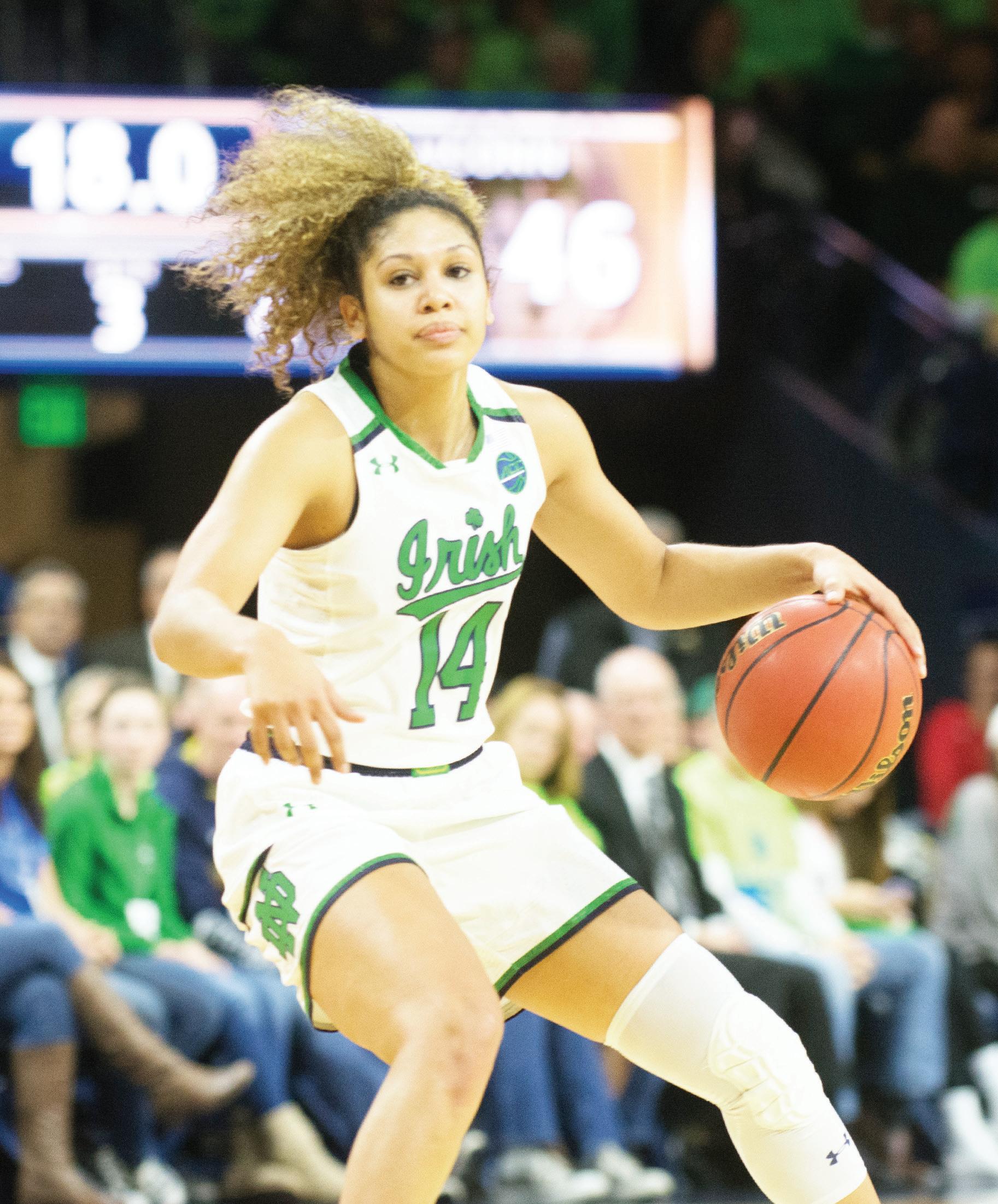
by veterans in Allen and junior forward Brianna turner, went on a 10-4 run, giving Notre Dame a 22-15 lead to end the first quarter.
w hile the i rish extended their lead to start the second quarter, the e agles (8-11, 1-5) began to claw back, propelled by a handful of 3-pointers, two of which came from freshman guard taylor o rtlepp. t he e agles were able to get within five of the i rish, until Allen launched a 3-pointer to swing the momentum in Notre Dame’s favor. Allen felt that her last-second bucket gave her teammates the jolt of the energy they needed to come out of the half ready to go.
“i think we just needed a sense of urgency in everything that we did,” Allen said. “i was telling [freshman guard] Jackie [ young] to get the ball quick so we could get a quick shot as close to the basket as possible and then just coming into the half and making sure that we still have that momentum coming out of halftime.”
Allen’s clutch buzzer-beater carried the i rish to an 11-0 run to start the second half. turner picked up two blocks to prevent the e agles from scoring their first points of the half. e agles freshman forward e mma g uy finally ended the e agles’ drought, but not before the i rish racked up a 19-point lead. i rish head coach Muffet Mc g raw noted that the team’s defense in the third quarter allowed it to be successful.
“i think, the third quarter, we started a pretty good defensive team,” Mc g raw said. “i thought it was pretty good. we got good shots; we shared the ball.”
s ophomore guard Marina Mabrey was a picture of consistency in the third quarter. s he turned up the heat offensively for the i rish, putting 15 points on the board in the quarter. turner also added nine points to her total in the third. Allen felt that strong defense allowed the offense to succeed, especially in feeding the ball to turner under the net.
“i think that [Mc g raw] subbed [junior guard] Mychal [Johnson] in to start the half and she gives us that defensive pressure, that defensive presence for us,” Allen said. “ … we’re all, you know, just scrambling, racing around, trying to get steals, just playing with a lot of energy, just kind of roaming around, trying to play as hard as we could. o ur defense led to easy shots on offense. you know, we were looking inside for [ turner] and [Mabrey] was hitting shots in the third quarter. And so, i think, you know, when we play hard on defense, we get that energy from our defense, it really, really helps our offense.”
Notre Dame dominated the e agles from the free-throw line, especially in the first half, as Boston College fouled the i rish 12 times to Notre Dame’s six. Notre Dame scored nine points from the line with young leading the way, going 4-for-4. Capitalizing on Boston College’s 20 turnovers was another difference-maker for Notre Dame, as 23 of the i rish points resulted from Boston College turnovers.
t he i rish led by as many as 24 during the third quarter, but the e agles surged back in the fourth. Boston College outscored Notre Dame 17-6 in the fourth and the e agles crawled within 11 points. Mc g raw was disappointed in her squad’s inability to dig deep and sustain the strong play from the third quarter. “ we’ve never played well here,” Mc g raw said. “ … s hould’ve really been able to extend the lead, but we just weren’t able to put our foot on the pedal. you know, i think we have a couple people out there, [Allen] and [ turner], they’re out there doing what they can and i thought Marina played pretty well, especially in the second half. we’ve been playing a lot of young players and they just are taking a little long.”
t he i rish will don their blue jerseys once again in the final game of their road series when they take on North Carolina on s unday. t ipoff is scheduled for noon in Chapel h ill, North Carolina.
Contact Elizabeth Greason at egreason@nd.edu
ALLISON CULVER | The Observer
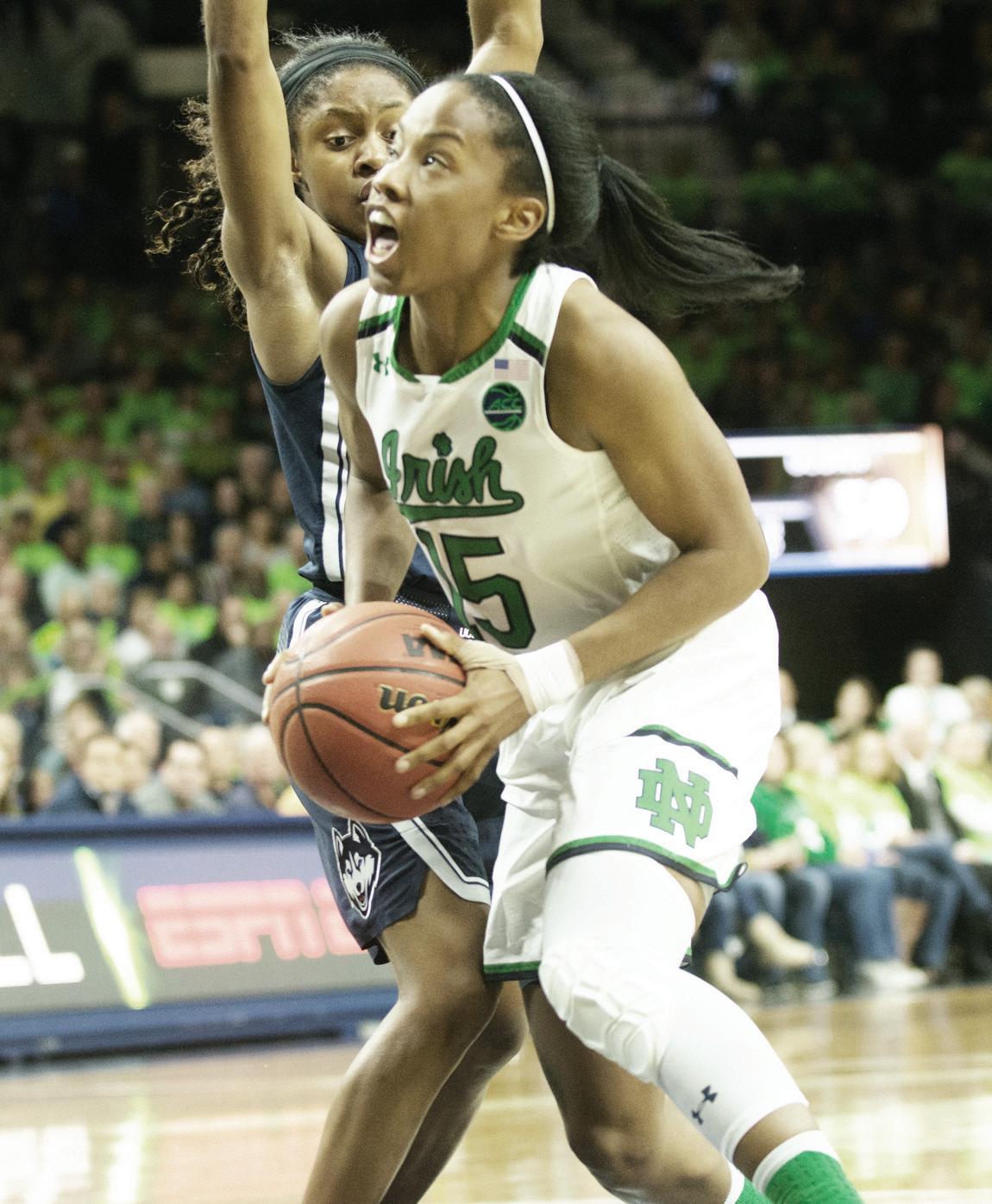
Irish junior guard Mychal Johnson collects a loose ball in a game against UConn on Dec. 7 at Purcell Pavilion. Notre Dame bounced back from a road loss to Tennesse by defeating BC, 80-69, on Thursday.
Hockey
CoN ti N ue D F roM pAge 16
earlier in the year was the first night, and now we are doing a better job of coming out strong on Friday nights, and then s aturday nights the other team amps it up a little bit and we need to find a way to match that.”
New h ampshire (11-83, 6-2-2) is coming into the matchup this weekend with one of the deepest offenses in the hockey e ast, led by senior forward tyler Kelleher. Kelleher leads the league and is third in the country in points, with 40 from 14 goals and 26 assists. Jackson stressed matching the w ildcats at every step.
“[Defensively] it’s got to be a collective effort, because if he doesn’t break
you down one-on-one he’s going to make a play to find somebody else, so it’s not just going to be the focus on him, it’s going to be the focus away from the puck as well,”
Jackson said. “it’s going to be a matter of us matching the depth both offensively and defensively, because we want to try and capitalize when they make mistakes as well.”
Notre Dame sits 18th in the NCAA p air w ise rankings, currently on the outside looking in for the NCAA tournament. t he i rish also suffered a blow defensively at Merrimack, indefinitely losing sophomore defenseman Bobby Nardella last Friday to injury. But Jackson reiterated that the team is staying focused, and looking to get a run together as the season enters its final
M bball
CoN ti N ue D F roM pAge 16
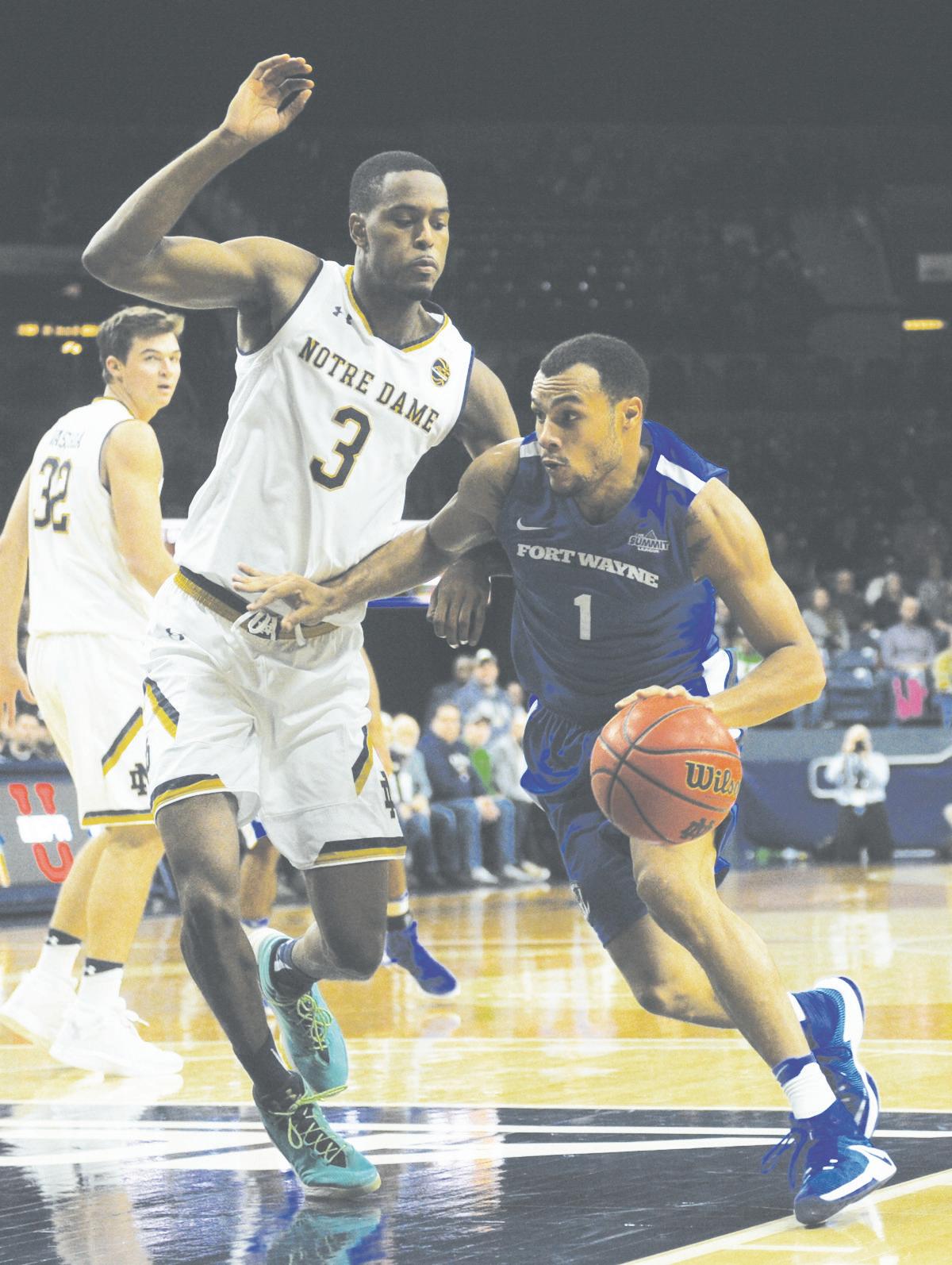
squad got beat handily on the road. But while that zone poses a unique challenge, senior guard and captain s teve Vasturia said the i rish are confident in their ability if they can manufacture good looks s aturday.
“i think we gotta just put ourselves in good positions against the zone,” Vasturia said. “o bviously, that’s what they do and they’re very good at it. i think we’re confident in the shot makers on this team. s o, just getting in the right position, getting the ball to the middle, into the short corner and making shots. But they do a good job of being long and making it difficult for us.”
o ne of those challenges, Vasturia said, is ensuring that the i rish offense doesn’t simply pass the ball around the perimeter against the s yracuse zone.
15-of-21 from behind the 3-point line, the i rish turned the ball over 18 times and head coach Mike Brey received a technical near the end of the first half — as the i rish concluded a three-game road trip with their first ACC loss of the season.
t he strong shooting performance from deep wednesday night could be a good omen for Notre Dame heading into s aturday: the i rish have attempted 46 3-pointers in their last two games against the o range combined, but only connected on 13 of them.
“hopefully we can stay that warm playing against a zone s aturday,” Beachem said.
t hat 18-turnover mark s aturday was Notre Dame’s highest of the season, and Vasturia noted it is an area where the i rish need to show improvement.
“ we’ve gotta be better at taking care of the ball for sure,” Vasturia said. “ t hat’s something we’ve been really good at.”
third, starting with New h ampshire.
“ we’ve put ourselves in kind of a tough position, we have to take care of business coming up here,” Jackson said. “ i don’t need to let them know, i ’m sure they already know. o ur most important focus has to be playing u N h on Friday night right now, because if we don’t worry about the next game, then the games down the road don’t mean anything. Frankly, we need to have success here at home, because it’s hard to win two games on the road, no matter where you play in hockey e ast, it’s not easy.”
t he two game series begins Friday night at 7:35 p.m. at Compton, with s aturday’s contest starting at 7:05 p.m.
Contact Tobias Hoonhout at thoonhou@nd.edu
“For me and for the other guys on the team, just making sure we’re moving and not standing still,” Vasturia said. “obviously, you don’t have a guy chasing you around, but they’re long enough that they cover up most of the areas on the court, so just not being stagnant and continuing to cut and move without the ball, just the way we play against man [is important].”
At times this season, the i rish have deployed a 2-3 of their own defensively, and senior forward and captain V.J. Beachem said the i rish can take the knowledge they’ve learned at the defensive end and apply it to the offensive one s aturday.
“Just remembering the weak spots in our zone, the middle, baseline drive sometimes,” Beachem said. “Just stepping up and being ready to shoot open shots. i think sometimes when you’re playing against a zone or you’re playing a zone, it makes the offense tight. As long as you can play free against a zone, we’ll be fine.”
i f the i rish attack the middle of that zone s aturday, Beachem said junior forward and captain Bonzie Colson may be able to exploit its weaknesses.
“ t hey pretty much — if you get into the middle, they pretty much leave that middle man alone and make him try to make a decision, because a lot of the time it’s a big,” Beachem said. “But we have Bonzie in there, who’s a great decision-maker in the middle, so that’s gonna be a great strength for us.”
bouncing back
s aturday’s contest will mark a quick turnaround for the i rish, who fell on the road at No. 10 Florida s tate on wednesday night, 83-80.
i t was an odd game — Notre Dame lost despite shooting
s yracuse’s struggles
A year after making a surprise Final Four run, the o range have struggled throughout their 2016-17 campaign — they’ve already dropped eight contests, including all four true road games, and have fallen to three teams with at least 10 losses this season: u Conn, s t. Johns and Boston College. Nevertheless, Beachem said he wouldn’t be shocked to see the o range turn their fortunes around again this season.
“ e ven though they’ve been struggling a little bit so far this year, [ i ] wouldn’t be surprised if they go on another type of run like [last year],” Beachem said. “ i think they may be a little longer this year, but i think some of the guys are newer to the zone.
i ’m sure they’ve figured that out by now.”
returning home
For the first time since December, the i rish will play at home s aturday when school is in session — and that means a return of the students to p urcell p avilion.
“ we haven’t played in front of them in like a month, so to be back at home and playing with the w ilson ball, everyone’s excited about it,” Beachem said.
Torres’ fifth year
Brey announced that senior forward Austin torres, who’s averaging a careerhigh 8.1 minutes per game, will return for a fifth year on his radio show t hursday night. t he g ranger, i ndiana, native, who did not see the floor during his freshman year, tweeted about his return t hursday. Contact Alex Carson at acarson1@nd.edu
ANN CURTIS | The Observer
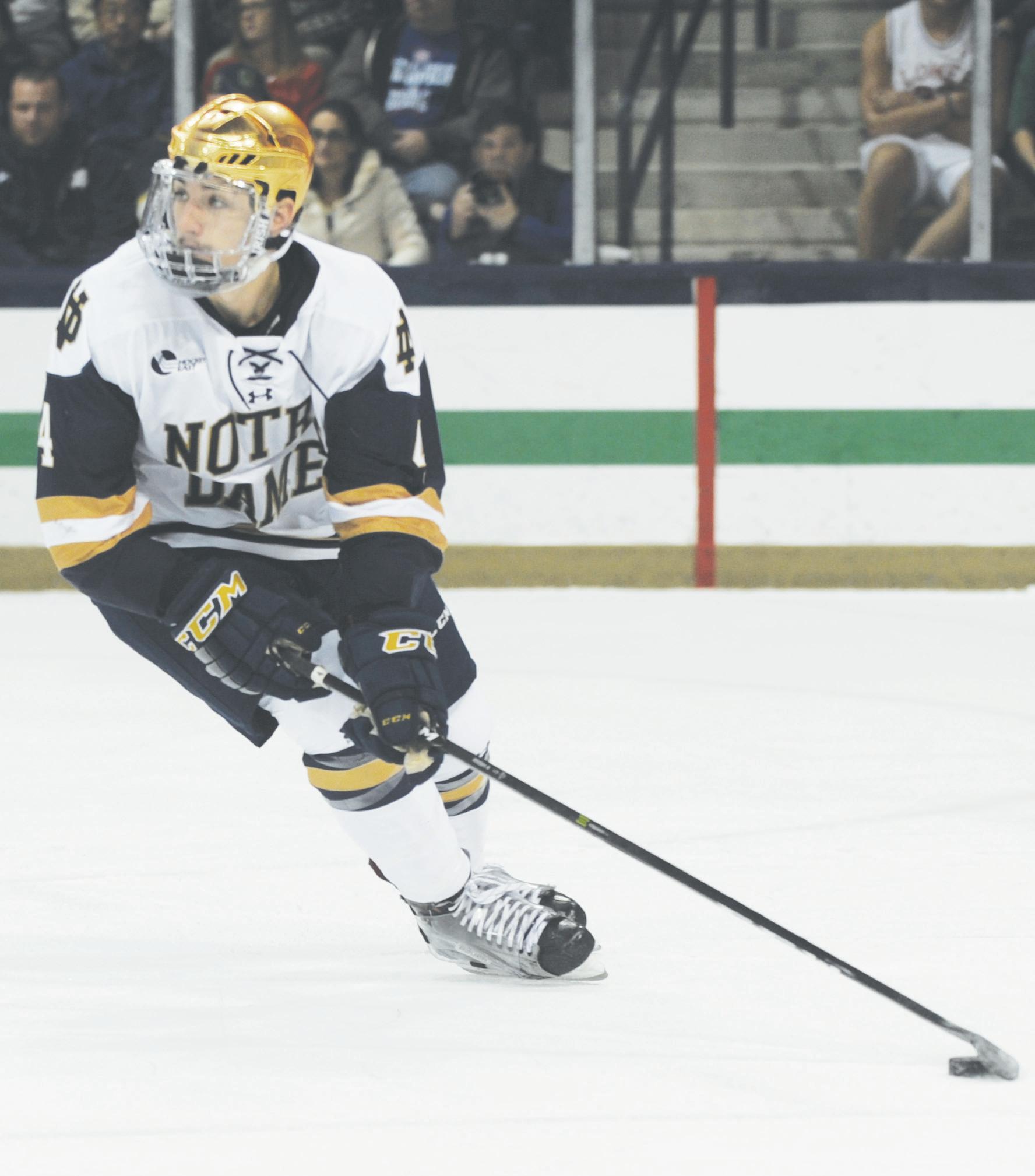
Irish sophomore defenseman Dennis Gilbert scans the ice during a game against UMass-Lowell at Compton Family Ice Arena on Nov. 18. The Irish won the contest 4-1.
Irish rebound with win over Boston College
By ELIZABETH GREASON sports writer
t he No. 6 i rish bounced back from a loss to unranked tennessee, taking down ACC foe Boston College on the road t hursday, 80-69.
i rish senior point guard Lindsay Allen talked about being anxious to redeem the tough loss and said the whole team was antsy to get back on the court after Monday’s upset loss to the Volunteers.
“ i think we always look forward to playing, but i think especially after a tough loss like that, you want to get out, you want to get that frustration out of you,” Allen said. “ i think we were really excited to play today and just kind of be able to play together as a team and be able to come off that loss a few days later.”
After trading shots for a few minutes to start the game, the i rish (17-3, 5-1 ACC), led
see w BBALL PAGE 14
y
ND returns home to face u N h
By TOBIAS HOONHOUT sports writer
After splitting road series against Michigan tech and Merrimack, the No. 14 i rish return home this weekend to face New h ampshire in a hockey e ast matchup. t he w ildcats sit fifth in the hockey e ast standings, one place above Notre Dame and i rish head coach Jeff Jackson stressed the importance of this home stand for the i rish.
“obviously it’s a huge series, they’re a point ahead of us in the standings and they’re right behind us in the NCAA rankings too,” Jackson said. “ t hey’re a much improved team from last year. Last year we went in there and actually beat them twice, which is not an easy thing to do in their building, so i’m sure they’re coming back with the same idea in mind. But they have one of the best offenses in the country, one of the best power plays in the country, certainly a couple of the top offensive players in the country, so they are a lot to handle defensively, and
they’ve had a good year compared to where everybody picked them, and i think that’s given them motivation to come out of the gates really strong.”
t his is the first game back at Compton Family ice Arena for Notre Dame since the i rish (13-8-2, 6-4-1 hockey e ast) travelled to Michigan tech and Merrimack over break. i n both two-game series, Notre Dame went 1-1, and for Jackson, consistency remains his team’s biggest struggle this year.
“ t he biggest thing that we’ve been talking about for a couple months is the consistency of playing nightin and night-out,” Jackson said. “Merrimack was a tough, gritty team, just like Michigan tech was a tough, gritty team, and we matched their grit on Friday night both nights, both series, and s aturday night we didn’t. we need to learn how to be dialed in at that same level on the second night of a twogame series. o ur problem
Kelly adds two coaches to staff
Observer Sports Staff
Notre Dame announced two new additions to its program t hursday, as wide receivers coach DelVaughn Alexander and strength coach Matt Balis joined the irish staff.
Alexander replaces former wide receivers coach Mike Denbrock, who took over the job of offensive coordinator at Cincinnati in the offseason. Alexander has coached at w isconsin, oregon state, uNLV and, for the past five seasons, Arizona state.
“i’m excited to officially get on board, hit the road recruiting and to find and develop the best student-athletes in the country,” Alexander said in a press release. “Notre Dame is a special place, and i’ve been able to the see the power of its brand on the recruiting trails across the country for the last 15-20 years. i’m honored and humbled to serve this university, this program and these remarkable young men.”
Meanwhile, Balis — whose official title is Director of Football performance — takes over for long-time strength and conditioning coach paul Longo, who had been at Notre Dame for the past six seasons and with Brian Kelly at Cincinnati before that. Longo has taken a leave of absence from the program.
Balis served as the head strength and conditioning coach at uConn for the past three years and has spent time at Mississippi state, utah and Virginia. During his coaching career, Balis has worked with former uConn head coach and Notre Dame defensive coordinator Bob Diaco, current ohio state head coach urban Meyer and Mississippi head coach Dan Mullen.
“it’s an honor and dream come true to be part of the Notre Dame football program,” Balis said in a press release. “i’m humbled by this opportunity, and i’ll work hard everyday to give our players and program my absolute best.”
Notre Dame seeks first win over ‘Cuse since 2012
By ALEX CARSON Associate Managing e ditor
t he last time Notre Dame beat s yracuse, things were a little different at p urcell p avilion: Demetrius Jackson was months away from committing to Notre Dame; the i rish and o range were Big e ast, not ACC rivals; e ric Atkins was the starting point guard, not the video coordinator.
o n Jan. 21, 2012, behind a double-double from Jack Cooley, the i rish topped No. 1 s yracuse 67-58, handing the o range what would be their only loss of the regular season. s aturday’s showdown between No. 15 Notre Dame (16-3, 5-1 ACC) and s yracuse (11-8, 3-3) will come exactly five years to the day since that upset win.
s ince, at every opportunity, the i rish have been stymied by s yracuse’s patented 2-3 zone, most recently in 2015, when a top-10 Notre Dame squad fell at home, 65-60, and last season, when a Jackson-less i rish
ALLISON CULVER | The Observer
Irish senior guard Lindsay Allen drives through contact during Notre Dame’s 72-61 loss to UConn at Purcell Pavilion on Dec. 7.
ANN CURTIS | The Observer
Senior captain V.J. Beachem defends against a driving Fort Wayne player during Notre Dame’s 87-72 at Purcell Pavilion on Dec. 6.