Print Edition of The Observer 50th Anniversary Special Issue for Thursday, November 3, 2016
By MARGARET HYNDS, CLARE KOSSLER and KATIE GALIOTO Editor-in-Chief, Assistant Managing Editor and News Editor
Fifty years ago today, the first copies of a new student publication appeared around campus. Students heading into the dining hall or on their way to class picked up The Observer, Vol. 1, Issue 1 — some out of curiosity, some out of boredom and some on a whim.
When they picked up the paper, they would have seen that day’s top stories: “Legal Apts. For Off-Campusers Seen as Near” and “Student Stress Study Slated.” And, at the bottom of the page: “A Promise, A Purpose, A Newspaper is Born.”
A lot has changed since then.
Born out of the ashes of the student newspaper The Voice, The Observer joined Scholastic as one of the regular sources for Notre Dame news.
Certainly, The Observer’s coverage has changed, shifted in accordance with the times or in response to issues that have emerged over the years. But it’s more than that — the newspaper’s role on campus, even its day-to-day operations, have radically changed in the five decades since Robert Sam Anson and Stephen Feldhaus first set out with a vision of a new independent student publication.
The early years
At the same time he was deciding to discontinue The Voice, Feldhaus — its editor and a 1967 graduate — made the decision to found a new paper. It was the fall of 1966, and the first thing Feldhaus realized he had to do was form a core group of students who would undertake the running of a new publication.
“I realized … that I needed to be able to attract the best and the brightest. So, with that in mind, I also decided that I should bring in someone with newspaper experience to help me create a longer lasting professional organization. And I knew Robert Sam Anson, and I approached him,” Feldhaus said. “He was a tough newspaper-man mold, and I became convinced he could add a real degree of journalistic professionalism to the organization.”
The new Observer staff drew from the previous staff of
The Voice and also attracted new blood, Feldhaus said. For example, Anson, a fellow member of the class of 1967, as well as a few other writers, had previously worked at Scholastic.
“We created an institution together that took some of my staff and some of the relationships I had with the printer; and that built on the relationships I had in the advertising community and built on the structure that we had,” Feldhaus said. “And it brought clear improvements, and I’ve been glad to this day that I did what I did because I think that the paper was a better paper as a result, and I think the University of Notre Dame has benefitted from having a firstclass paper.”
The goal — as laid out in first issue — was to create a 12page weekly paper, that would transition to an 8-page biweekly paper after one month of publication. After two years of publication, The Observer began printing daily editions Monday through Friday while classes were in session, and has continued to do so since.
Anson, who served as Feldhaus’ co-editor-in-chief, said in its first few years The Observer was “a very rambunctious, left-wing newspaper” with “a really, really good staff.”
“It was really tough. I mean this was the middle of the Vietnam War … and all kinds of things were going on,” he said.
Anson said the atmosphere of the 1960s in many ways shaped his own experience and influenced the first year of coverage.
“You have no idea what the ’60s were,” Anson said. “I mean you felt as a student that you were right there on the cutting edge of a revolution.
“... It just shaped you in an astonishing sort of way.”
‘It was fun to be a ‘first’’
As the turmoil of the 1960s came to a close, The Observer pivoted from its status as a spunky upshot publication to a more established campus institution.
Shortly after its inception, The Observer had joined forces with the student paper at Saint Mary’s. A few years after that,
P.O.
observer
CONTINUED FROM PAGE 1
in 1972, Notre Dame admitted its first class of undergraduate women.
Five years later, in 1977, Saint Mary’s junior Marti Hogan took over as the first woman editor-in-chief of The Observer.
“I enjoyed it very much,” Hogan said. “It was fun to be a ‘first.’ … And it was great, it was a lot of fun. And welcoming.”
The Observer was a place for all students to get involved, Hogan said.
different relationships with the administration over time.
“I know there were some editorial boards that were a little bit more aggressive than others. Or maybe, looking for more things to uncover. I think we had a pretty good working relationship,” Hogan said of the paper’s 1977-1978 editorial board. “[The University] took us seriously, which I always respected.”
— much to the dismay of the staff — to the basement of South Dining Hall, where it remains today.
The early years of the transition to the new office were not easy, former office coordinator Shirley Grauel said.
Policies The Observer is the independent, daily newspaper published in print and online by the students of the University of Notre Dame du Lac and Saint Mary’s College. Editorial content, including advertisements, is not governed by policies of the administration of either institution. The Observer reserves the right to refuse advertisements based on content. The news is reported as accurately and objectively as possible. Unsigned editorials represent the opinion of the majority of the Editor-in-Chief, Managing Editor, Assistant Managing Editors and department editors. Commentaries, letters and columns present the views of the authors and not necessarily those of The Observer.
Viewpoint space is available to all readers. The free expression of all opinions through letters is encouraged. Letters to the Editor must be signed and must include contact information.
“We were trying to think of what the students would be interested in reading,” she said. “And that’s why — boy, some of our entertainment section, cultural stories, those were just a blast. Because that’s where people could have fun.”
An independent paper
In the first few years of its existence, The Observer shared an attimes-complicated relationship with the University, Anson said. On the one hand, several Observer editorial decisions came under fire from the administration, while on the other hand, Anson said he received a significant amount of
“ ... I said, ‘How come you didn’t throw me out?’ He said, ‘Because you had a martyr complex.’”
Robert Sam Anson Co-Editor-in-Chief 1966-1967
support and encouragement from then-University President Fr. Theodore Hesburgh.
Staff
The Observer regards itself as a professional publication and strives for the highest standards of journalism at all times.
do, however, recognize that we will make mistakes. If we have made a mistake, please contact us at (574) 631-4541 so we can correct our error.
“All kinds of people would call in [to Hesburgh] and say, ‘You should throw him out,’” Anson said. “And I saw Fr. Hesburgh about a year before his death … and I said, ‘How come you didn’t throw me out?’ He said, ‘Because you had a martyr complex.’”
Feldhaus said despite several conflicts, the administration ultimately offered The Observer substantial support throughout the process of its foundation.
“The University [was] pretty farsighted, and they saw the benefit of an independent newspaper at the school,” Feldhaus said. “And we got a tremendous amount of support from very far-sighted leaders in the administration, including Fr. Hesburgh, and also [then-executive vice president Fr. Edmund] Joyce and numerous others who really did try to nurture the independent voice of The Voice and ultimately The Observer.”
However, different editorial boards and staffs experienced
One particular source of tension lasting throughout a good portion of the 1990s concerned The Observer’s advertising policy. At several points, the paper experienced resistance from the administration in printing advertisements relating to the LGBT community, particularly those coming from the Gay and Lesbian Alumni of Notre Dame and Saint Mary’s (GALA-ND/SMC).
“One of the major issues when I was [editor-in-chief] — and it’s nice to see how the campus has progressed in this way — was we were not allowed to accept any advertising from gays and lesbians of Notre Dame and Saint Mary’s,” Alison Hamilton, the editor-in-chief from 1990-1991, said.
The issue with accepting advertisements from groups with gay or lesbian affiliations continued into the tenure of the 1992-1993 editorin-chief Monica Yant Kinney.
“I distinctly remember pushing the boundaries on ads and allowing and encouraging ads that said something to the effect of, ‘If you don’t want to meet to talk about what it may be like to be gay or lesbian at Notre Dame, don’t come to such-and-such room tonight, because we won’t be there,’” Yant Kinney said. “And I remember getting some not particularly pleased responses from parts of the administration. … We were walking a very fine line.”
The matter came to a head during the tenures of Michelle Krupa and Mike Connolly, who served as editors-in-chief in 1999-2000 and 2000-2002, respectively. Both ran advertisements from GALA-ND/ SMC for a service scholarship the group was offering.
“In the end, there was a meeting with the president of the University and me and my managing editor and my [assistant managing editor] in his office and it was sort of … now that I’m further away from it, I see it as a real effort to intimidate us as students,” Krupa said.
Connolly said he experienced similar “veiled threats” from the University when he continued to run the advertisement, which prompted him to develop a more active strategy.
“We started using our resources to get the word out there. We lined up with student senate and then went and spoke with student senate about what the problem was. … [A story] went on the [Associated Press] wire about the threat to shut the paper down if we wouldn’t stop running these ads,” he said.
Late nights in the office
While the staff struggled over editorial decisions, day-to-day operations at The Observer at times proved difficult, as well.
The Observer office was located on the third floor of LaFortune Student Center until 1998, when it was relocated by the University
“Well, I remember we used to have floods when we were in the [basement] because the cafeteria is above us,” she said. “The sports desk would get soaked — it would come through the ceiling and it was a mess. It was just a flood. Then the guys upstairs from food services said, ‘Just put plastic over it.’”
But irrespective of its location, and despite technological advancements, late nights at The Observer office have remained a constant.
“ ... I definitely more than once walked out of The Observer and walked into class on Friday morning.”
Michelle Krupa Editor-in-Chief 1999-2000
Hogan described working in The Observer’s LaFortune office until the early hours of the morning, waxing stories onto galley proofs and preparing the layout for the next day’s paper during her time at The Observer in the late 1970s.
“We were, unfortunately, perfectionists,” Hogan said. “It didn’t always show when the papers showed up at lunch time in the dining hall, but there were several nights when we would be watching the sun come up. ... We would be waiting for maybe a last story to come in or a last change. We literally drove [the paper] to the printer.”
More than 20 years later, Krupa described a similar office atmosphere.
“1:30 a.m. was a good night — that was probably a Monday or Tuesday night,” she said. “We could hit 48 pages in a Friday edition, plus the football insert. That’s a lot of copy to fill the pages. And we were literally printing pages. So if the printer was on the fritz, you’d have to get somebody to fix it, and then paste it up.
“… I definitely more than once walked out of The Observer and walked to class on Friday morning.”
One late night in particular stands out to the current editors and recent alumni.
The night of Thursday, Feb. 27, 2015, The Observer staff was celebrating the transition from one editor-in-chief, Ann Marie Jakubowski, to another, Greg Hadley, when rumors began to appear on the social media app Yik Yak that Fr. Hesburgh had died.
“It was without a doubt the most
stressful night I ever had at The Observer,” Hadley, the 2015-2016 editor-in-chief, said in an email. “Some people were already asleep, so we were just frantically calling people and roommates of people to get them up and get them around campus, because tributes popped up so quickly.
“ … I don’t think I appreciated how important Fr. Hesburgh was to the history of The Observer at that point. It just wasn’t something we talked about a lot. But seeing how much it impacted other people really impressed me, and as we went through so many old issues and saw letters from him, comments from him, input from him on the goingons of campus, I realized how he was so pivotal to the growth of The Observer into a really legitimate and respected voice on campus.”
m ore than a hobby
In its five decades of reporting, The Observer has covered all sorts of campus stories — on campus crime and construction, student senate and sexual assault.
Of course, it’s covered the
By MEGAN VALLEY Associate News Editor
In the 50 years since The Observer began, hundreds of students have written for the paper, forming friendships and — in some cases — relationships, which have led to marriages and children. We sat down with a few of our alumni for whom the Observer has become a family affair.
“Once you’re in it, The Observer is kind of like this crazy, extended family over a period of, now, 50 years,” former editor-in-chief and 1988 alumnus Kevin Becker said. “I think our little family is a nice metaphor for The Observer family that has gone on for 50 years now.”
The Kinneys
Monica Yant Kinney, class of 1993, and Dave Kinney, class of 1994, were successive editors-in-chief during their respective senior years before eventually getting married.
Before joining The Observer, Dave Kinney said he had “never actually written any newspaper stories before.”
“I typed it up, and Monica was there. And she came in and decided to edit the thing by reading over my shoulder in sort of a mocking tone,” he said. “And that was the first newspaper story I had ever written.”
Monica Yant Kinney said that “sadly,” the couple’s children have heard that story many a time. Her entire Observer experience, she added, was a time for learning and growth.
“It later became clear to me that my professional path was being formed, in addition to meeting my dear friends and my now husband,” she said. “I just had no idea that I was going to get to have an
not-so-important news, too.
“One of our years there was a very, very minor break-in at LaFortune. Someone broke into an office and took $12 or something. And [19911992 editor-in-chief] Kelley [Tuthill] and I treated it like Watergate,” Yant Kinney said. “You would’ve thought we were breaking some huge story. We traced the burglar’s steps. I mean, [my husband] still makes fun of me for this. It was the biggest, most exciting thing — and yet, it was nothing.”
Students only have four years in college, Yant Kinney added. But a person can learn a lot during that time.
“I really feel like I had an incredible opportunity to start my profession before I even knew that was going to be my profession,” she said. “I think at The Observer, we were aware that we didn’t know everything — we were learning as we went. And I think Notre Dame, as a community, was supportive of that.”
Whatever the quality of stories; whatever problems The Observer has experienced with production and day-to-day-operations; whatever issues the editorial board has had to grapple with — The Observer has always been a place where students
have had the opportunity to gain real-life work experience and form lasting relationships.
“The Observer teaches you things that you will use later in life, because you don’t have a faculty advisor watching over you like some other publications,” Hamilton said. “You really have to own everything that’s in that paper.”
And for the thousands of students that have spent their nights in The Observer office, the paper looms large in their college memories.
“The Observer was my Notre Dame experience,” Krupa said. “I scheduled my courses around when I worked at the paper. My best friends were at the paper, you know? That’s what I really wanted to be doing.”Managing Editor Kayla Mullen, Associate News Editor Rachel O’Grady and News Writer Courtney Becker contributed to this story.
Managing Editor Kayla Mullen, Associate News Editor Rachel O’Grady and News Writer Courtney Becker contributed to this story.
Contact Margaret Hynds at mhynds@nd.edu, Clare Kossler at ckossler@nd.edu and Katie Galioto at kgalioto@nd.edu
Rain or shine
In the past 38 years, there has only been one day — January 31, 2002 — that The Observer had to cancel a scheduled paper. It was a Wednesday night when a historic ice storm hit northern Indiana, knocking out power across the region and at The Papers Inc., the company that printed The Observer at the time.
The printing company sent home its employees, and by the time power was restored, it was too late for The Observer to be printed and driven to campus at a reasonable hour. Though Thursday’s paper was never delivered, students could access online through the University’s website. This break in publishing was the first for The Observer since January of 1978, when a snow storm caused Notre Dame and Saint Mary’s to close for five days.
When bad weather poses a threat, however, The Observer puts up a good fight. In 1977, the University and College closed due to a dangerously cold wind chill. In 2011 and 2014, both campuses closed again for snow days. On each occasion, the printing presses kept running — and The Observer was available on campus.
‘crazy, extended family’
experience like that when I was going to school.”
Two days after her graduation, Monica Yant moved to California to start working for the Los Angeles Times, leaving her future husband to be the editor-in-chief.
“A few years later, I was in Florida, and Dave and I start dating … and now we’re married with two kids,
out of The Observer,” Mike Connolly said there was one time the two were fighting about a story and were told by a fellow staff member to go figure out their problems before coming back.
Having been editor-in-chief and managing editor for two years, The Observer is “incredibly important” to their relationship, Mike Connelly
“In the end, I owe my life to The Observer. You kind of have to give back at that point.”
Courtney Becker News writer Class of 2019
sitting 25 feet away from each other,” she said. “I think in that way, [The Observer] really was the center memory — other than living in Farley — of Notre Dame.”
The Connollys
Mike and Noreen Gillespie Connolly, Notre Dame and Saint Mary’s classes of 2002, were sophomores when they took over as editor-in-chief and managing editor, respectively, in spring 2000. But they didn’t begin dating until senior week of their junior year.
“Noreen, my now wife, was my managing editor for two years,” Mike Connolly said. “We both took over as sophomores together.”
The duo kept the same roles into their senior year.
“We got a little bit of swagger since we had been doing it for two years,” he added.
While they were “pretty good about keeping [their] relationship
said. That’s why they even had Observer-themed favors at their wedding.
The m asin- m oyers
Sophomore news writer Lucas Masin-Moyer is a second-generation Observer writer.
“My grandparents used to always get The Observer shipped to their house when my dad was in college,” Masin-Moyer said. “So whenever I was over there, I’d see old clippings from my dad when he wrote there.”
His father, Fran Masin-Moyer — a 1992 graduate — was a scene writer, and his mother also went to Notre Dame. Masin-Moyer said now, his parents read all of his articles.
“It’s a little bit weird — 30 years later, I’m doing the exact same thing,” he said. “But it was already kind of weird since both of my parents went here, and it’s like I’m just reliving their lives. I like it, though, because we have that to talk about
and that shared experience.”
The b eckers
For sophomore news writer Courtney Becker, it was always “Notre Dame or bust.” Writing for The Observer came naturally — her parents Kevin and Mary Becker, both 1987 Notre Dame graduates, met working for the paper.
“In the end, I owe my life to The Observer,” she said. “You kind of have to give back at that point.” Kevin and Mary Becker met when he was a sophomore viewpoint copy editor and she was junior assistant news editor.
“I was sitting there, laying out the Viewpoint section and in walks who I predetermined to be my new girlfriend — and future wife — the second she walked in,” he said.
While they knew their daughter was interested in journalism from working with the high school paper, Mary Becker said she and her husband were careful not to pressure her into joining The Observer.
“We actually had to make sure that it didn’t seem like we were influencing her,” she said. “We thought that was the worst way to get her to work at The Observer. But we were pretty confident she’d do it.”
While the Becker’s have three children, Courtney is the only one to attend Notre Dame.
“I’m serious when I say it’s my claim to fame in the Becker family,” Courtney Becker said. “My siblings are smarter than me, nicer than me, all around better than me. But at least I write for The Observer.
“I’m happy that I’m doing something so important to them and that it’s become so important to me.”
Contact Megan Valley at mvalley@nd.edu
Office managers enable day-to-day operations
By COURTNEY BECKER
News Writer
In addition to the staff of students who work for The Observer, there is always one person without whom producing a daily newspaper would not be possible: the office manager.
Debra de St. Jean, current office manager, loves her job.
“I’ve got the best job in the world because of all [the students]. They make it worthwhile,” she said. “Coming in at night and seeing [the students] working, just helping in any way I can, just seeing the paper come out every morning [are the best parts].”
De St. Jean took the position over from Shirley Grauel, who started working with The Observer in 1980.
“I applied for a job with the University … and they didn’t have anything for me,” Grauel said. “A few days later, the girl from human resources called and said, ‘I have a job. It’s for nine months and it’s working with the student newspaper.’ I had also worked at the South Bend Tribune, so it was just a perfect match.”
Before Grauel knew it, a ninemonth job turned into 30 years — after three decades with the paper, she retired in 2010.
“It was a family atmosphere,” she said. “I respected the students, and the students respected me. I never felt a gap. It was just a very good
experience. To tell you the truth, I worked there for five years and [I realized], ‘I have never gotten up and thought, oh heck, I have to go to work.’”
Grauel was with The Observer through two office moves and the addition of computers to the newsroom, which she said created problems at first.
“Stories kept getting lost,” she said. “… It was very difficult when they first got the computers. And that was when we first put the classified ads and everything on the computers. It was a nightmare.”
In addition to working with the business side of The Observer — by handling accounts payable, accounts receivable and helping with ad sales — De St. Jean and Grauel discovered their day-to-day presence in the office was vital.
“Since I’m here during the day when [the business manager is] here, and [production staff] works nights, I’m kind of like the go-between,” De St. Jean said. “… [It’s hard] getting people to understand that you’re students running this paper. A lot of people call up and say, ‘Why is no one there?’ Well, it’s because they’re in class.”
Grauel said she tried to make things easier for the Observer staff by filling any necessary roles when the students were unavailable.
“They needed somebody fulltime there because everybody was coming in and out, in and out,
going to classes,” she said. “Just having a constant person there was beneficial. They couldn’t have done it without Deb or me.”
Once De St. Jean took over after Grauel’s retirement, she needed to adjust to working with students for the first time — something she said has led to lasting relationships.
“Working with students [was new], because I hadn’t worked with a student group in the past,” she said. “There are quite a bit of people that you need to learn, and then each year, it changes. That’s probably one of the hardest things on the job. As much as I’m happy to see [students] graduate, it’s always bittersweet because you lose that group. But it’s kind of nice because you maintain relationships forever.”
Grauel said although she misses working with students, she has also maintained contact with many of them.
“I miss the students. I really, really do,” she said. “I miss them, but I still keep in touch with quite a few — especially with Facebook, you know, you can see anything. … I loved working with them. I really did. They were a pleasure.”
De St. Jean said she hopes in the future, members of the Notre Dame community will stop to pick up a hard copy of the paper more frequently.
“I’d like it to kind of go back a little bit and stop the progression
of no one picking up a paper anymore,” she said. “As far as The Observer is concerned, I’d like to see [the students] get a little more recognition.”
Grauel said she is honored to have been a part of the Observer’s history for so long.
“For a daily newspaper, they do one heck of a job. They really do,”
she said. “It’ll be 50 years, for gosh sakes — and when you think, I was there for 30 of them. … It was a pleasure to work there, it was an honor to work there. I loved everyone and before I knew it, I had been there 30 years.”
Contact Courtney Becker at cbecker3@nd.edu
Observer File Photo
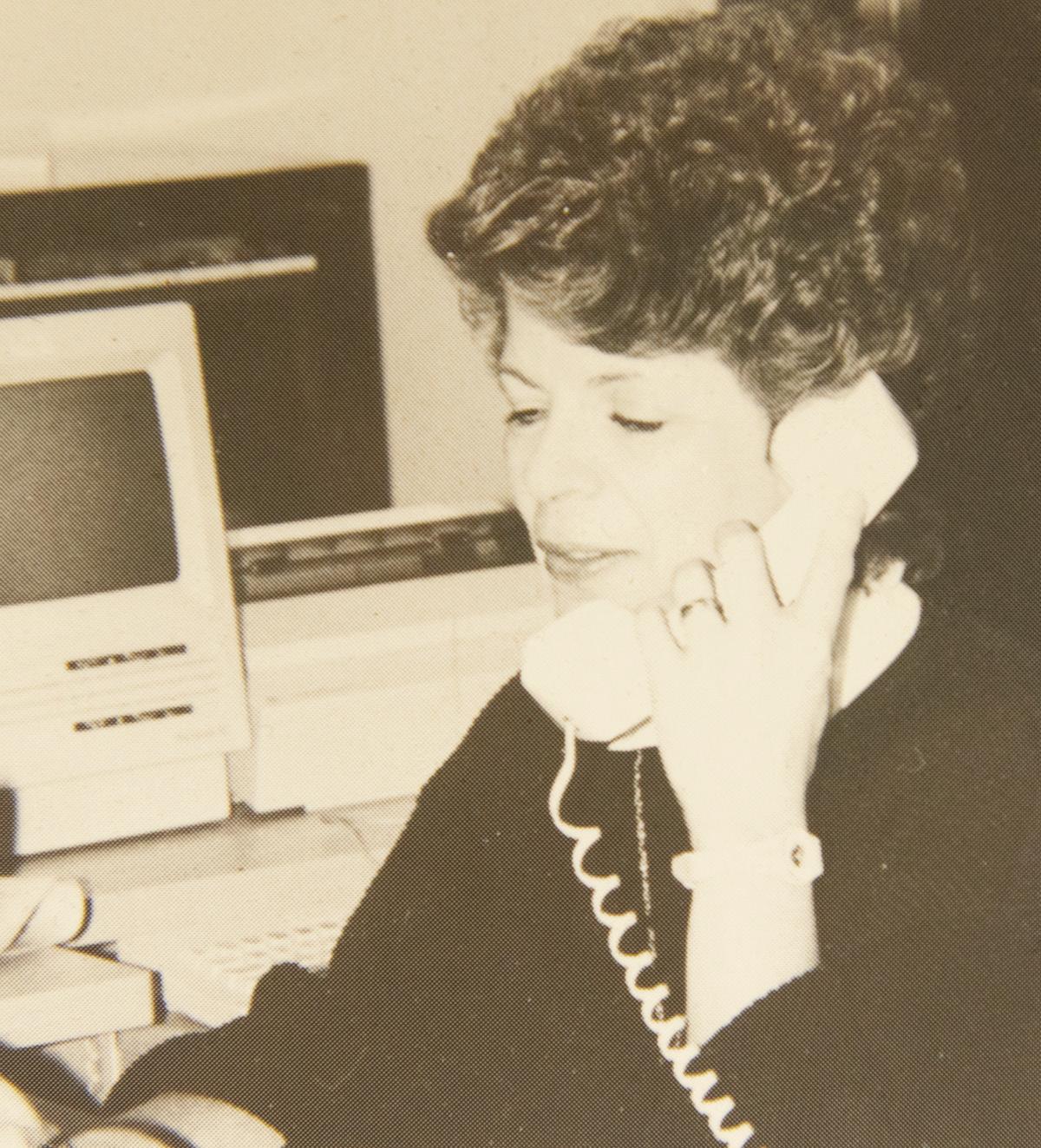
Shirley Grauel answers a phone call in this photo from The Observer’s 35th anniversary issue. Grauel worked for The Observer for 30 years.
LETTErs To ThE EdITor
Long live The Observer Student journalists never fail to impress
It was the year the world was supposed to implode, so we had a lot on our plate. To say nothing of 48-page Friday sections – plus the pullout – and all that ad business. A lifetime of thanks to the 1999-2000 editorial board: Shannon Ryan, Dave Rogero and Laura Petelle; Tim Logan, Colleen Gaughen, Brian Kessler, Mike Vargas, Noreen Gillespie, Kevin Dalum, Bryan Lutz, Bret Huelat, Erik Kuskto, Tim Lane and Joe Mueller. And a special nod to Mike Revers, who defended our staff from Y2K and who, I might imagine, still keeps the computers churning in the wee hours; you, my friend, are missed.
This job taught me to trust my colleagues and to make them my friends. It may be the best job I’ll ever have. Long live The Observer.
Michelle Krupa Editor-in-Chief
1999-2000
Notre Dame class of 2000
Twenty years after I served as editor-in-chief of The Observer, I left the newspaper business and took a university job that requires me to interact daily with student journalists. Sometimes, they infuriate me. Often, they impress me. Always, I remember that they are students juggling a transformative full-time job and rigorous classes.
For fun, I remind each new crop of editors to look around the newsroom, because they might be toiling alongside a future spouse. They smile politely, almost dismissively, until I count all the Observer marriages — including my own.
1992-1993
Notre Dame class of 1993
Lessons still being learned, ignored 20 years on
Late at night — and it was always late at night — as I stepped out of LaFortune to catch the return shuttle to Saint Mary’s, I made it a point to look up at the Golden Dome. Sometimes it was frosted over; sometimes it was glowing in cloud cover; sometimes it was gleaming like a movie set in spotlights. I first thought it was a static monument to college life, but that’s not right at all. The backdrop was forever in motion against it.
The Observer held all that college was, all I hoped it would be, all that never
came to fruition. I sat on the floor of McCandless Hall dorm room as a visiting high school senior, poring over it like holy writ: There was a space to write columns. I could be a columnist before I even graduated. And I became a columnist. And, for about five minutes, the Saint Mary’s Accent editor — a job which exhausted and infuriated me, the first warning shot that all writers are not necessarily journalists. I went back to columning. It was a lesson I forgot over and over again, this attempt to strike out from
my column inches: The ranch hand. The tech writer. The NASA educator. The museum specialist. All jobs pulled on like dresses and thrown back over my head almost as quickly as they settled against my body. In some ways I’m still not listening to what The Observer was trying to teach me as 19 year old, when, at the tipping point of a new technological generation, we laid out the paper on computers but still didn’t think to put it all online. Although now a writer looking at 40, I still pull away and bounce back
to that stunned freshman, who, in failed attempts to improve her appearance, submitted herself to tighter and tighter perms. The Observer was the start of what everything I thought I would be and the end of it, too. The backdrop, it’s always moving — but some truths will always stand.
Mary Beth Ellis SMC Accent Editor 1996-1997
Saint Mary’s class of 1997
‘Fundamental and cherished aspect’ Pep talk, Fr. Ted pushed paper through dark days
Congratulations to The Observer on 50 years of independent student journalism. In 1985, we swarmed around a finicky computerized typesetter and layout boards until 5 a.m. Clanging heat on the top floor of LaFortune kept us company. We introduced innovative efforts to keep the financial operation solvent and transparent, and aimed to never publish an Associated Press article on the front or back page. Not once, as editor, did I receive a call from a University administrator mandating content. Student journalism is constantly learning, constantly struggling and remains a fundamental and cherished aspect of higher education, especially at Notre Dame.
Robert Vonderheide Editor-in-Chief 1984-1985
Notre Dame class of 1985
I would like to share a bit of history with you from The Observer’s infancy. In the fall of 1970 The Observer’s editor-in-chief quit and the paper was closed for a week. The Observer’s editors gathered one evening to decide what to do — elect a new editor or shut the paper down. Just as we were starting our deliberations, a person walked in who none of us save Guy DeSapio, previous Observer, editor-in-chief, recognized. Turns out the unknown person was The Observer’s first editor, Robert Sam Anson, who was on campus visiting with Fr. Ted Hesburgh, Notre Dame’s President. During the Vietnam War, Anson was a reporter and was captured in Cambodia
by Communist forces. Hesburgh prevailed on the Vatican to press for Anson’s release, which apparently was done. Anson was on campus to thank Hesburgh.
Anson gave the assembled group of editors a pep talk, discussed what it was like when he and his colleagues founded The Observer, and urged us to elect a new editor and carry on, which we did. Very glad to see that 46 years later The Observer is alive and well.
Glen Corso
Editor-in-Chief 1971-1972
Notre Dame class of 1972
‘Molarity’ received feedback in pages of Observer
I will forever be thankful to The Observer for permitting me to discover and hone my cartooning craft. It allowed me to create a bond with an audience that could never be duplicated. I created the cartoon strip “Molarity.” By the end of my freshman year, it was in the paper daily and remained there until my graduation. And while the strip became the most popular feature of the paper in those days, the most unique thing was the intimate bond I had with my audience. I could sit anonymously in the dining halls at lunch and listen to the reaction to the cartoon. I knew when I hit and I knew when I missed. Even today, when I meet Domers I did not know back at school, they tell me of their fondness for “Molarity” and how the strip fully expressed the joys and frustrations of being at Notre Dame. The strip has had amazing success, but only within the square mile that is Du Lac. Back in the ‘80s it spawned 14,000 books sold in the bookstore. “Molarity” continues today with both new and classic cartoons appearing on Notre Dame Magazine’s website. And there is a
new book with all 581 original cartoons that has respectable sales for a book whose contents reach back almost 40 years. Today’s social media has almost duplicated that intimate relationship built in the dining halls. Once again I am getting instant feedback on my new “Molarity” cartoons. I have been able to rekindle and start friendships based mostly on our common memory of the strip.
While I did not match that cartooning success professionally, I have gotten in the mind and hearts of many Domers. That remains a cherished honor and privilege.
Michael Molinelli Observer Cartoonist
1984-1988 Notre Dame class of 1988
Monica Yant Kinney Editor-in-Chief
A promise, a purpose, a newspaper turns 50
On Nov. 3, 1966, a story in the first issue of The Observer ran under the headline “A Promise, A Purpose, A Newspaper is Born.” As The Observer celebrates its 50th anniversary this week, we encourage our readers to reflect on student journalism’s place not only on Notre Dame and Saint Mary’s campuses, but nationwide.
The decline of print journalism has been well publicized in recent years, and college campuses are especially susceptible to this phenomenon. Many student publications that used to be printed daily — every weekday, for most college papers — have cut back to two or three editions per week.
The Observer is far from immune to this pinch. But we also firmly believe in the importance of providing a daily platform for news and discussion for the student body, alumni, faculty, staff and other community members here at Notre Dame and Saint Mary’s.
Every day, The Observer publishes voices from all corners of campus, the United States and even the world. The 50 years of tireless work by the thousands of students who have been a part of this publication represent one of the most complete sources of preserved memory found on campus.
It is not our intention to use this editorial as a pulpit for self-congratulation. Rather, we want to
highlight the important role student journalism holds nationwide. Editorially independent publications, like The Observer, enable student-to-student dialogue. College newspapers foster infamous debates in the opinion sections, spread campus news, expose students to entertainment and arts happenings, chronicle the athletic achievements of peers, serve as a check on administration and perform a number of other roles.
Independent student journalism is one of the most important contributors to campus conversations. Over the past few years, excellent pieces highlighting campus sexual assault have appeared in newspapers like Indiana University’s Indiana Daily Student and DePaul University’s The DePaulia. The Observer also ran a series looking at the issue last year.
The Observer broke the news of University President Emeritus Fr. Theodore Hesburgh’s death in February 2015. We were also the primary source for the following week’s coverage, as people streamed into campus from around the world to attend the funeral and honor Fr. Ted’s memory.
One of the paper’s most important roles is providing a platform for the voices of those who might otherwise be deprived of an outlet. In recent years, we’ve highlighted the struggles Notre Dame and Saint Mary’s students with disabilities face every day, as well as the resources on each campus available to those who face mental health challenges. All of this coverage is important — because there
is no other publication as actively involved in uncovering and reporting daily happenings at the collegiate level.
In addition to providing a platform for discussion, student newspapers also demand a level of professionalism for their content. We work to inspire conversations that push beyond today’s social media rants. Our editorial staff determines whether every single article we publish meets our standards, and unfortunately, there are some that do not.
That editorial staff is composed entirely of students — it does not have faculty oversight. Students do all of our production and layout. Students take our photos, and students produce all of our graphics. Students coordinate all our advertising and make our business decisions. The only non-student on our payroll is our office coordinator Debra de St. Jean, who you can read about on page 2 of this issue. She, like her predecessor Shirley Grauel before her, is the glue that holds us all together.
As students, we have unique angles and perspectives on events and how they affect our campus. It’s the same for student newspapers across the country. College journalism provides a unique voice that epitomizes the phrase “from the bottom up.” We are the outlet for everyone — from incoming freshmen to university presidents — to have a voice on campus.
And with that, please excuse us — we’ve got a paper to print.
‘How would The New York Times cover
parietals?’
As I went from doe-eyed freshman to something vaguely more aware, I realized that journalism was my calling. Notre Dame had no journalism program then, so The Observer became my journalism program. During my years at the paper, I worked nearly every job and learned much. We were a bunch of 20-year-olds sitting around at editorial board meetings trying to figure out how to cover thorny issues on campus and in our youthful naiveté saying things like: “How would The New York Times cover parietals?”
The Observer was also a place of great passion. Some of my most creatively fulfilling moments came while frantically writing headlines and designing pages ahead of a 5 a.m. printer deadline. It was also a place of disappointment. While driving to pick up kegs (at 6 a.m.!) for an Observer tailgater in 1981 (which always drew lots of alums), we said bleary eyed: “Well, in the future, someone else will be going to get the kegs and we’ll be the ones drinking from the tap ... ” And my experience at the paper did pay off. I got my first job after graduating because of The Observer. A crusty editor out of central casting (at a small Chicago magazine dedicated to investigating the cases of the falsely convicted on death row in Illinois) hired me because he liked a column I wrote titled “Beware of the Boneheads.”
But finally, even as I can trace my career as a writer now back to The Observer, I think the greatest contribution it made to my life is in the many lifelong friends I made during the sweaty days and nights working on the top floor of La Fortune (no A/C in September, too much steam heat in winter). John McGrath, Maura Murphy, Paul McGinn, Margaret Fosmoe and Mark Rust are just a few of the Observerites that continue to enrich my life every day.
Ryan Ver Berkmoes Managing Editor
1982-1982
Note Dame class of 1983
Honoring Fr. Hesburgh provided perspective
My best memory of The Observer coincides with the most challenging story that ever came up in my four years. The night we learned that University President Emeritus Fr. Theodore Hesburgh had died was the night I was supposed to turn the editor-in-chief office over to Greg Hadley (’16), and the overnight scramble to put out the “In Memoriam” issue was the greatest example of teamwork and cooperation that I’ve ever been a part of.
The logistic challenges were significant, but the greatest difficulty was trying to figure out how much a newspaper can do when faced with the legacy of a man whose story and impact are so much bigger than anything that could ever be represented in print. During that weekend at the end of February 2015, the whole staff worked around the clock, drawing on the support of alumni and external mentors while also finding ways to dig into the stories of the campus community. We wanted
to share the legacy Fr. Hesburgh left with our peers while also capturing the live dynamic of the memorial events on campus for readers who couldn’t be there in person to celebrate his life with us. We did as much as we could, and though it never felt like enough, the teamwork and shared passion was as significant a tribute to him as the actual papers we put out that week.
Every time I see my copies of those special issues, I remember not only the incredible man they honor, but also the extraordinary way that the Observer staff members combined their energy, talent and love for Notre Dame to honor Fr. Hesburgh. We worked to produce an issue that would reflect the depth of appreciation Notre Dame had for its former president, even if that appreciation could never be fully contained on the printed page.
That weekend was the first time I truly understood the limits of journalism and all of the
things that can never be completely represented through the process of transcribing, editing, writing and printing the paper, all on deadline. However, I also learned exactly what newspapers can do — create concrete, material reminders for people that those intangible elements affect us all. Those stories brought readers, writers, students and alumni together in shared appreciation of a person who shaped the University that links us. In the past 50 years — and in the 50 yet to come — The Observer has offered the Notre Dame community a way to share the stories that matter to us, which in turn will shape the community we go on to become.
Ann Marie Jakubowski Editor-in-Chief
LETTErs To ThE EdITor
FIFTY Years in r ev I
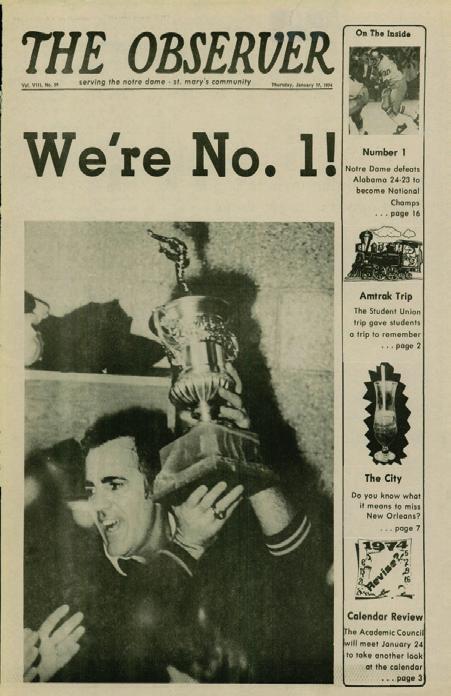
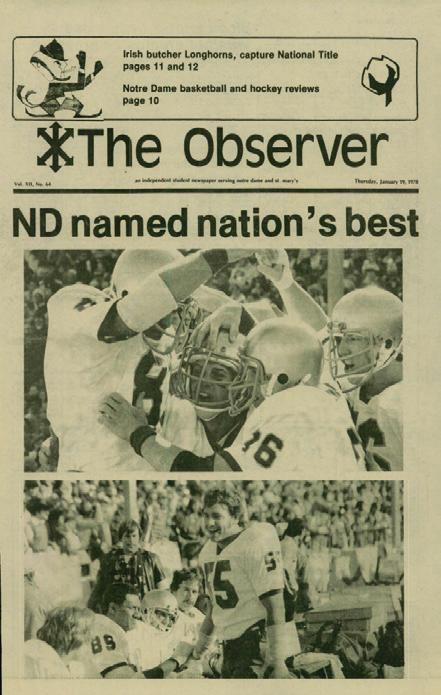
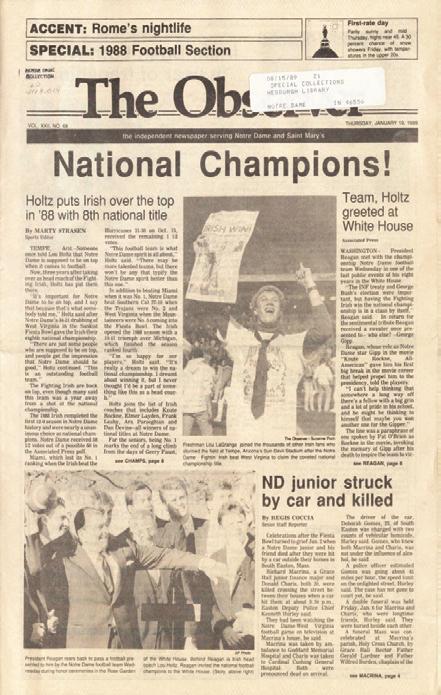
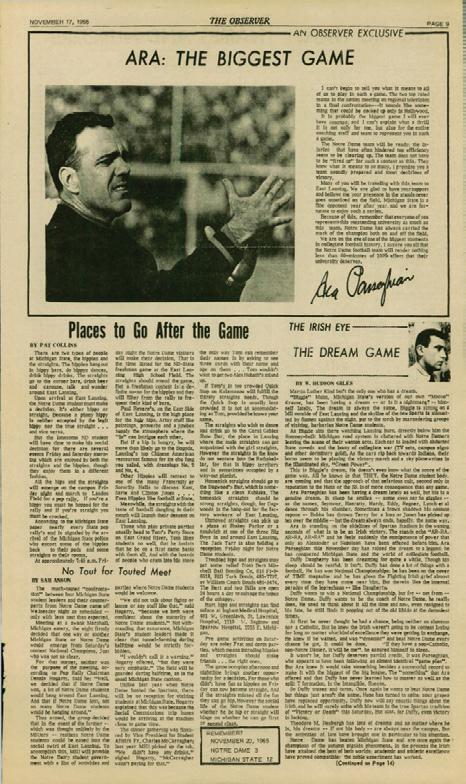
Football claims championships in 1966, 1973, 1977 and 1988
“Game of
the Century” versus Michigan State
Nov. 19, 1966
Notre Dame and Michigan State met in 1966 at Spartan Stadium as the No. 1 and No. 2 teams in the country, respectively. The game ended in a 10-10 tie, after the Irish scored a field goal in the fourth quarter.
Notre Dame went on to win the national championship later that year, finishing with a 9-0-1 record.
Men’s basketball reaches the Final Four for first time
March 24, 1978
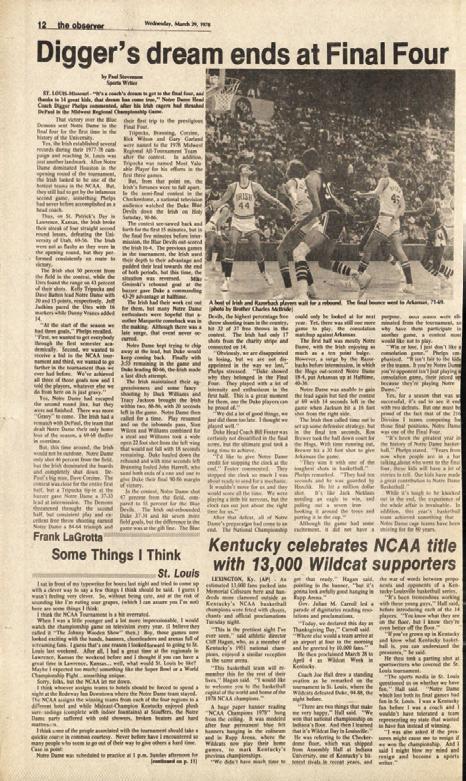
In the 1978 NCAA tournament, Notre Dame, led by head coach Digger Phelps, reached the Final Four for the first time in program history. En route to the Final Four berth, the Irish beat Houston, Utah and DePaul. Notre Dame lost to Duke 90-86 in the national semifinals. The next season, Notre Dame advanced to the Elite Eight.
Women’s basketball wins 2001 national championship
April 1, 2001
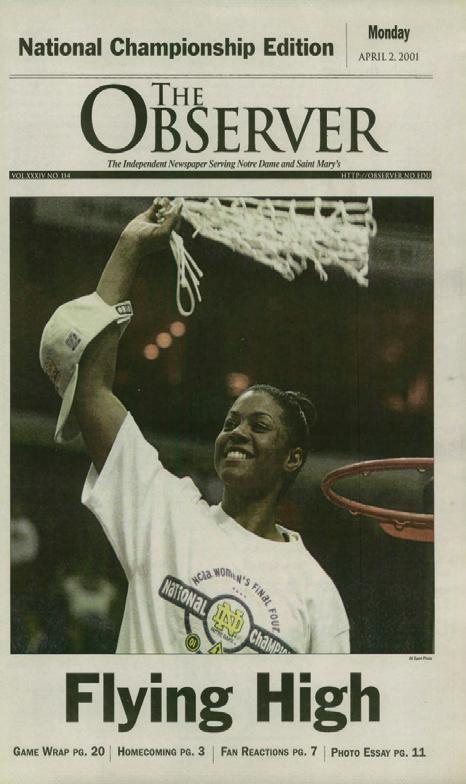
Irish head coach Muffet McGraw won her first national champoinship in St. Louis in 2001, as Notre Dame beat Purdue 68-66 on two late-game freethrows by Ruth Riley. Riley had 28 points in the game and current Irish associate head coach Niele Ivey scored 12 points.
Under McGraw, Notre Dame made the Final Four for five consecutive years from 2011-2015.
Notre Dame holds the record for the most college football titles of any school with 11. Four of those championships occured during The Observer’s tenure.
In 1966, Notre Dame won the title by finishing first in the season’s final Associated Press poll. 1966 was head coach Ara Parseghian’s third year with the team and the Irish tied No. 2 Michigan State in the “Game of the Century” to cap their season.
Ten years into his career, Parseghian won another championship in 1973,
Bengal Bouts organizes boxing tournament for charity
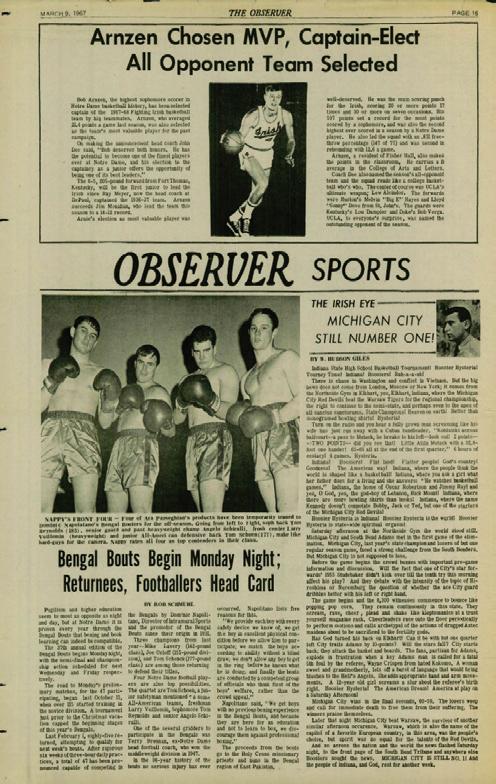
Since the early 1930s, Notre Dame students have taken part in an amateur charity boxing club, designed to benefit Holy Cross Missions in Bangladesh. Today, the Bengal Bouts club puts on a tournament each spring to benefit the missions.
The clubs’ motto is “Strong bodies fight, that weak bodies may be nourished.”
“Game of the Century”
versus Florida State
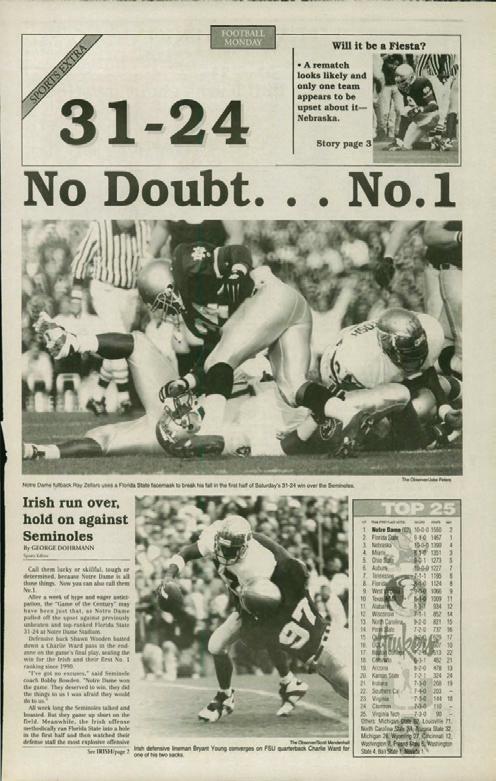
Florida State entered Notre Dame Stadium ranked first in the country on Nov. 13, 1993. The Irish were ranked No. 2. Dubbed as one of the “Games of the Century,” the Irish defeated the Seminoles, 31-24. Florida State quarterback Charlie Ward went on to win the Heisman Trophy that year and the Seminoles won the national championship, beating Nebraska in the Orange Bowl.
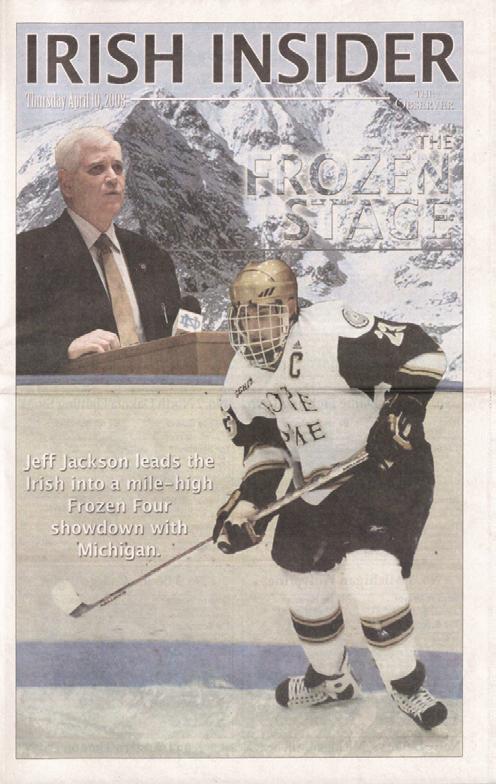
Hockey makes first Frozen Four and finishes as national runner-up
April 10, 2008
The Irish reached its first Frozen Four in program history in 2008 under head coach Jeff Jackson. The freshmen on that squad were seniors on the team that reached the 2011 Frozen Four; the seniors shepherded an exceptionally young team (loaded with 12 freshmen) to another Frozen Four berth in St. Paul, Minn.
beating then-No. 1 ranked Alabama in the Sugar Bowl by a score of 24-23. The Irish finished the season with an 11-0 record.
Just four years later, Notre Dame landed another title, this time with third-year head coach Dan Devine. The Irish won the title by beating Texas in the Cotton Bowl, 38-0.
Notre Dame’s most recent title to date came in 1988 with head coach Lou Holtz. The Irish upset then-No. 1 Miami 31-30 en route to the championship.
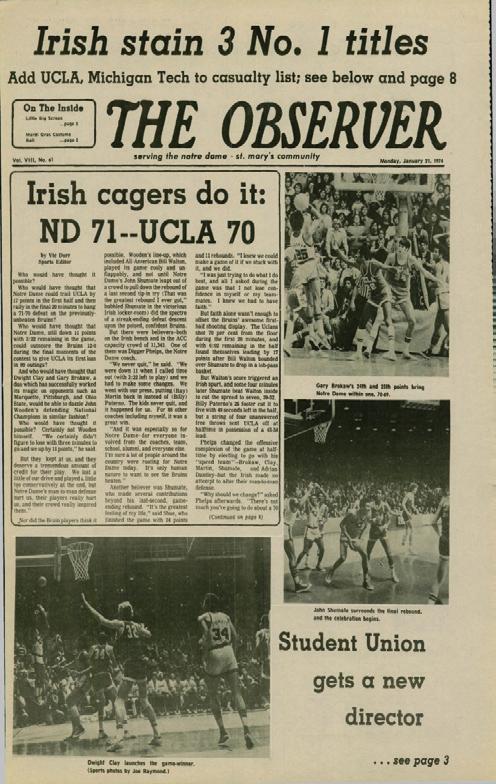
Jan. 19, 1974
UCLA entered the Joyce Center on Jan. 19, 1974, with an 88-game winning streak, the longest winning streak ever in men’s college basketball.
Led by center John Shumate and guard Gary Brokaw, the Irish scored 12 straight points in the game’s final minutes to knock off John Wooden’s squad.
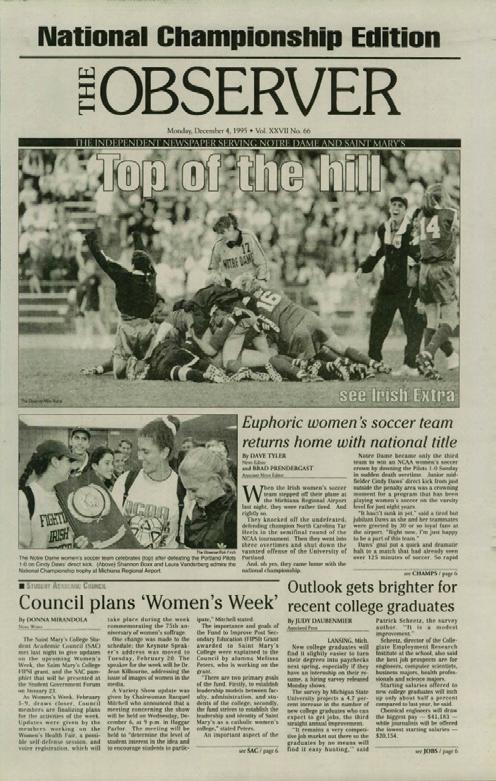
Women’s soccer wins first of three national championships
Dec. 3, 1995
After a runner-up finish the year before, Notre Dame won its first national championship, beating Portland in triple overtime, 1-0, on a Cindy Daws free kick.
Notre Dame went on to win the title in 2004 and 2010 as well, under head coach Randy Waldrum. The Irish also finished as runner up in 1996, 1999, 2006 and 2008.
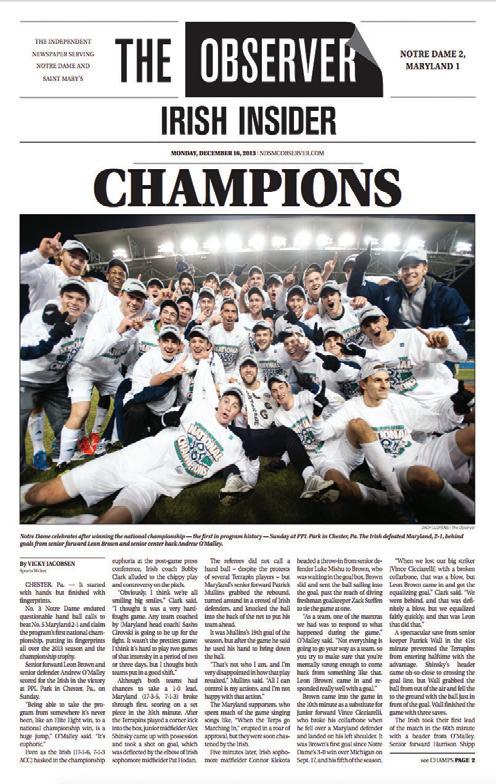
Men’s soccer defeats Maryland to take home first national title
Dec. 16, 2013
Thanks to goals from Andrew O’Malley and Leon Brown, Notre Dame won the program’s first national championship in Chester, Penn., in December 2013. It was the first championship for long-time Irish head coach Bobby Clark. Harrison Shipp won the Most Outstanding Player of the Tournament award.