Anello, Ruffer, should a walk-on punt in 2011?
Catch the snap. Take a step or two. Drop the ball toward your foot, and boot the living daylights out of it.
So easy, a caveman could do it. Right?
Especially when the caveman undergoes years of specialized training and spends hours a week doing those four things: Catch. Step. Drop. Boot.
So why is it that junior punter Ben Turk can’t seem to figure it out come Saturdays?
Of the 79 punters in the nation to have played in each of their team’s games, Turk ranks 74th in punting average.

Douglas Farmer Editor-in-Chief
His whopping 36.23 yards per punt somehow outpaces USC’s punter, Kyle Negrete. But Notre Dame does not make it a habit to measure itself against USC.
But what about measuring the Irish, specifically Turk, by the average Notre Dame student?
Alumni Hall junior Dan Finan cameos as the Dawgs’ punter in interhall games. It really is only a cameo — Finan is very obviously a defensive lineman at heart, and when he steps back to punt, his linemen shoes go with him.
Catch. Step. Drop. Boot.
For kicks and giggles, Finan punted for 20 minutes Wednesday night by moonlight on McGlinn Fields. With no training, hardly any idea of what he was doing and trouble seeing the ball as it dropped to his foot, the former 8-year-old soccer goalie sent two punts 50 yards deep. Factoring in the 14 yards Finan would stand behind the line of scrimmage, he sent two punts equal to Turk’s 36-yard average. If they had been allowed to roll, as six of Turk’s 13 have, who knows how far they may have bounced.
“My problem is consistency with the spiral,” Finan said of his two-for-20-minutes success rate.
“I learned by messing around before practice in high school.”
So Finan equals the caveman with no training.
In that case, Stanford Hall junior Patrick Kramer equals the caveman who invented the wheel.
When Irish coach Brian Kelly took over the program, the skinny kid who once boomed a 72-yard punt in high school
knew he needed to step up his game. He stayed on campus over the summer specifically to work on four things: Catch. Step. Drop. Punt.
On the first day of fall classes, Kramer got the call saying he was off the team.
Wearing his Walk-On Player Union Nation (WOPU Nation) t-shirt, Kramer brushed the rust off his leg Tuesday afternoon on North Quad. His longest punt landed more than 46 yards past the proverbial line of scrimmage. His five longest averaged more than 43 yards.
“I work in the dining hall now, and I do chemistry undergrad research,” Kramer said following what he considered to be a disappointed performance. “I’m not doing this everyday.”
Fortunately for Stanford Hall, he does it on weekends when interhall season starts up.
Catch. Step. Drop. Punt.
Yet Kramer seems to think his appropriate place is wearing faded gold pants with Stanford, rather than a sparkling new pair with the Irish.
“I’ve seen Ben [Turk] punt,” Kramer said. “He’s one of the top-20 punters in the nation, in practice.”
Irish special teams coach Mike Elston said the same thing.
“Ben demonstrates in practice that he can get it done,” Elston said.
Even Turk knows as much.
“In practice I’m hitting around 50 yards consistently,” he said. “It’s just turning that over to Saturdays now.”
Until he does so, questions of walk-ons, or cavemen, will persist. Turk’s best performance of the season, averaging 41.5 yards on four punts against Michigan State, only would have placed him 40th in the nation for the season. After that game, Kelly was asked, point-blank, how he would feel about a walk-on.
“Heck yeah,” Kelly said. “I would take anybody that had shown the ability to do that, punting the football or kicking … If you know somebody, you can reach me at 1-574…”
Actually, Finan or Kramer, or anyone else, should contact director of football personnel Tim McDonnell.
Catch. Step. Drop. Punt.
So easy, Ben Turk does it in practice. Is this the week he does it in a game?
The views expressed in this column are those of the author and not necessarily those of The Observer.
Contact Douglas Farmer at dfarmer1@nd.edu

Two prospects commit to Irish
By ALLAN JOSEPH Sports Editor
Notre Dame added another playmaker to its recruiting class when South Carolina receiver Chris Brown committed to the Irish during his visit to campus during last weekend’s game against Michigan State. While Brown was not highly ranked by many recruiting services, Irish recruiting expert Mike Frank said Brown’s talent was evident from the intense interest he had drawn.
“It’s kind of strange,” said Frank, who runs the ESPN affiliate Irish Sports Daily. “Here’s a guy who has 25 legitimate Division I offers, and more importantly he has offers from everybody in his surrounding area … but for some reason he’s just ranked a threestar by a lot of the services.”
Frank said Brown’s playmaking ability was a good fit for the Irish.
“He can really, really run,” Frank said. “He’s a very, very explosive player who can bring some speed to the Notre Dame receiving corps. I personally think it’s a big pickup for Notre Dame. They need wide receivers.”
Notre Dame also added its first member of the class of 2013 this past weekend, picking up a verbal commitment from Michigan offensive lineman Steve Elmer.
“[Elmer] is probably the top offensive lineman in all of the Midwest next year,” Frank said. “This is a very, very big pickup for Notre Dame. He’s a very big guy already — 300 pounds, and it’s not fat. It’s real size and real strength. He can also move very, very well.”
Frank said Notre Dame’s focus on recruiting Elmer was indicative of the attitude Irish coach Brian Kelly had brought to the program in its second year.
“Brian Kelly has made it very clear … that the only way [he and his staff] are going to get this thing turned around is to make sure that they have dominating play on both sides of the line,” Frank said. “He’s shown by offensive line recruiting and defensive line recruiting that he means business. He knows they have to have elite players on both sides of the ball. All you have to do is watch the Michigan State game last week to see evidence of that.”
Ohio running back William Mahone also visited Notre Dame last weekend, and while he did not commit to the Irish, he is moving closer to a decision.
“I think he really, really liked his visit, and really felt like he fit in well,” Frank said. “He loved the way Notre Dame ran the ball, which is important for any running back.
“I think he’s going to go visit Pitt this weekend … and then after that, we could end up having a decision, or he could check out Michigan State. I think he’s getting close to pulling the trigger.”
Maryland cornerback Ronald Darby was on campus last weekend, and while Darby was committed to the Irish, he had talked about taking official visits to other schools. After this weekend, however, Darby may no longer take those visits, said Frank.
“Notre Dame did a really good job of talking to him,” Frank said. “I think he understands that [senior cornerbacks] R.J. Blanton and Gary Gray will be gone next year, so there’s going to be a great opportunity for anyone to come in and play … He just wants to go and have some fun on these trips. He has a good time going and seeing all these different places. I think Notre Dame would much rather him not go. As of earlier this week,
it sounded like he was having a lot of second thoughts about those trips.”
Freshman defensive end Aaron Lynch excelled in last week’s victory over Michigan State, and Frank said the amount of playing time Lynch received sent a clear message to prospective recruits.
“Brian Kelly isn’t just going to play the senior or the older guy. If [a player] can help the team, [he] will get on the field at Notre Dame,” Frank said. “That’s really important to these kids. None of these guys have ever really sat … They want to play right away and make an impact for their team.”
While conference realignment continues to be a hot topic on the minds of college football fans, Frank said conference affiliation had little to do with recruiting.
“I don’t think it’s really that big of a deal whether a team’s in a conference, not in a conference [or] which conference you’re in,” Frank said. “You can get to the NFL no matter what conference you’re in so long as you perform. It hasn’t made an impact that I’ve seen so far.”
More important for Notre Dame’s recruiting is that it continues to earn victories.
“Whether [Notre Dame] is in a conference or not, I really don’t see much of a difference either way when it comes to recruiting,” Frank said. “Winning games is really what matters for Notre Dame recruiting right now.
For more on Notre Dame recruiting, check out Mike Frank’s irishsportsdaily.com. Email Mike at mikefrank18@sbcglobal.net and tell him The Observer sent you.
Contact Allan Joseph at ajoseph2@nd.edu

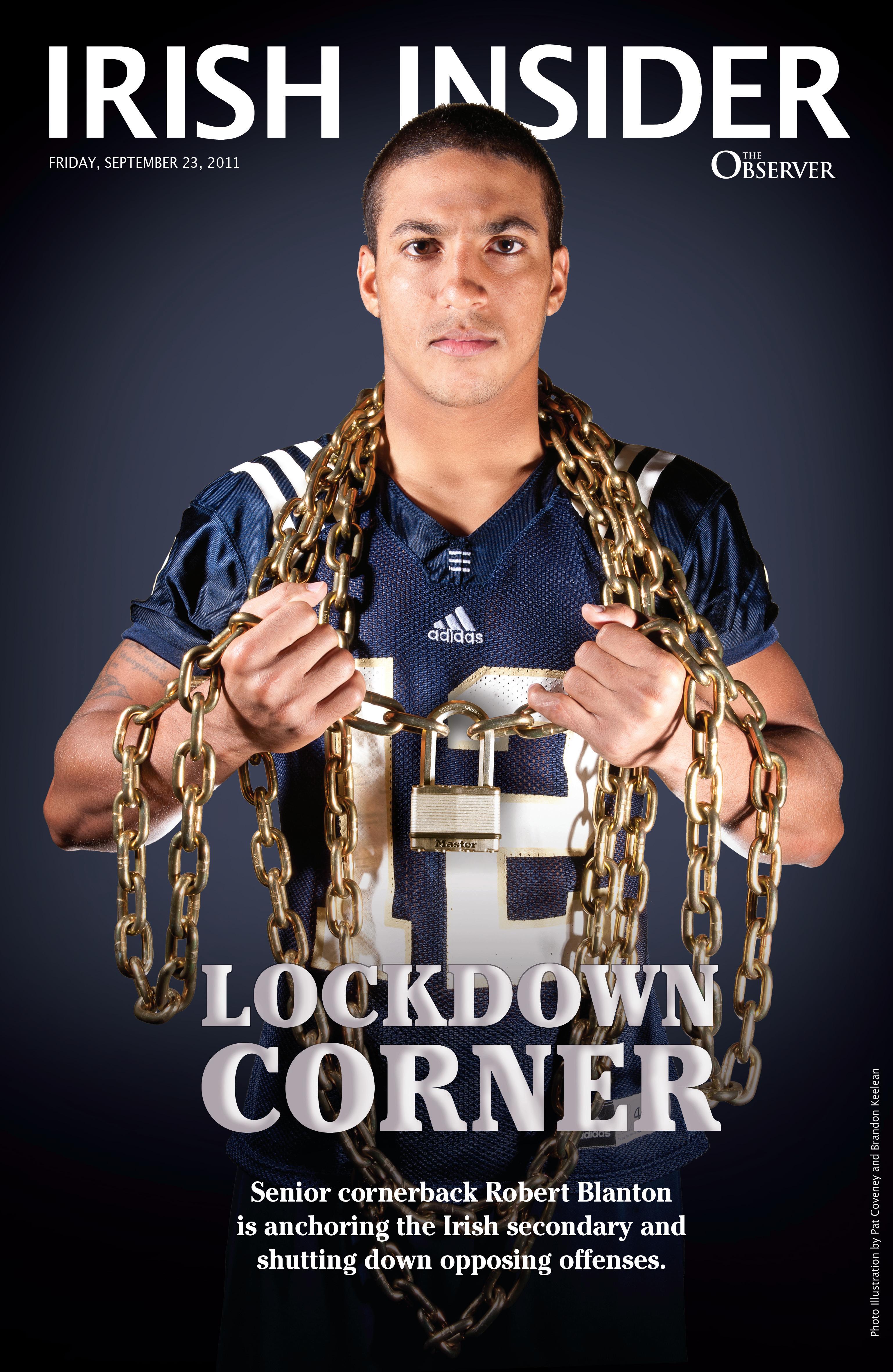
Blanton Island
Senior cornerback Robert Blanton has blossomed in his senior season to lead the Irish defense
By CHRIS MASOUD Assistant Managing Editor
They call it being on an island. No man’s land. Responsibilities range from deflecting a pass to jamming a receiver to shedding a block to making an open-field tackle to intercepting the opposing quarterback. Candidates must possess a sub-4.5 40-yard dash time and a minimum 36-inch vertical.
Still interested in the cornerback position?
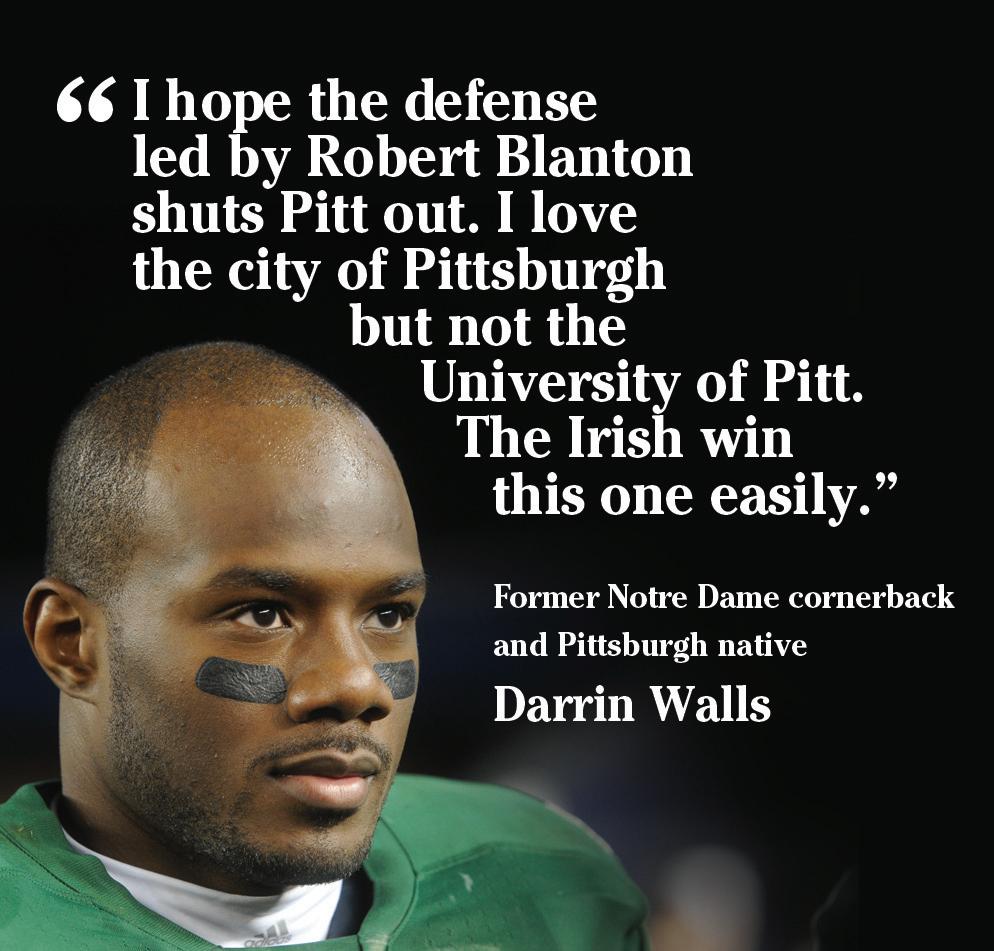
“You don’t have any help out there. If you don’t have safety help over the top, there’s no help out there. It’s like an island. If you mess up, it’s going to be a touchdown handsdown.”
But that natural comfort did not translate to success on every down early in Blanton’s career, and the corner found himself shuffling in-and-out of the starting rotation as a sophomore after starting against USC, Syracuse and Hawaii as a freshman.
Following a year of rotations with former Irish cornerback Darrin Walls and senior Gary Gray in 2010, Blanton has secured his position on the perimeter in his final year in pads for the Irish.
“We felt very strongly about Robert Blanton coming into the season, that he would give us great play.”
Brian Kelly Irish coach
Take it from senior cornerback Robert Blanton, Notre Dame’s newest stalwart on a defense that held Michigan State to just 13 points Saturday in the first Irish victory of the season.
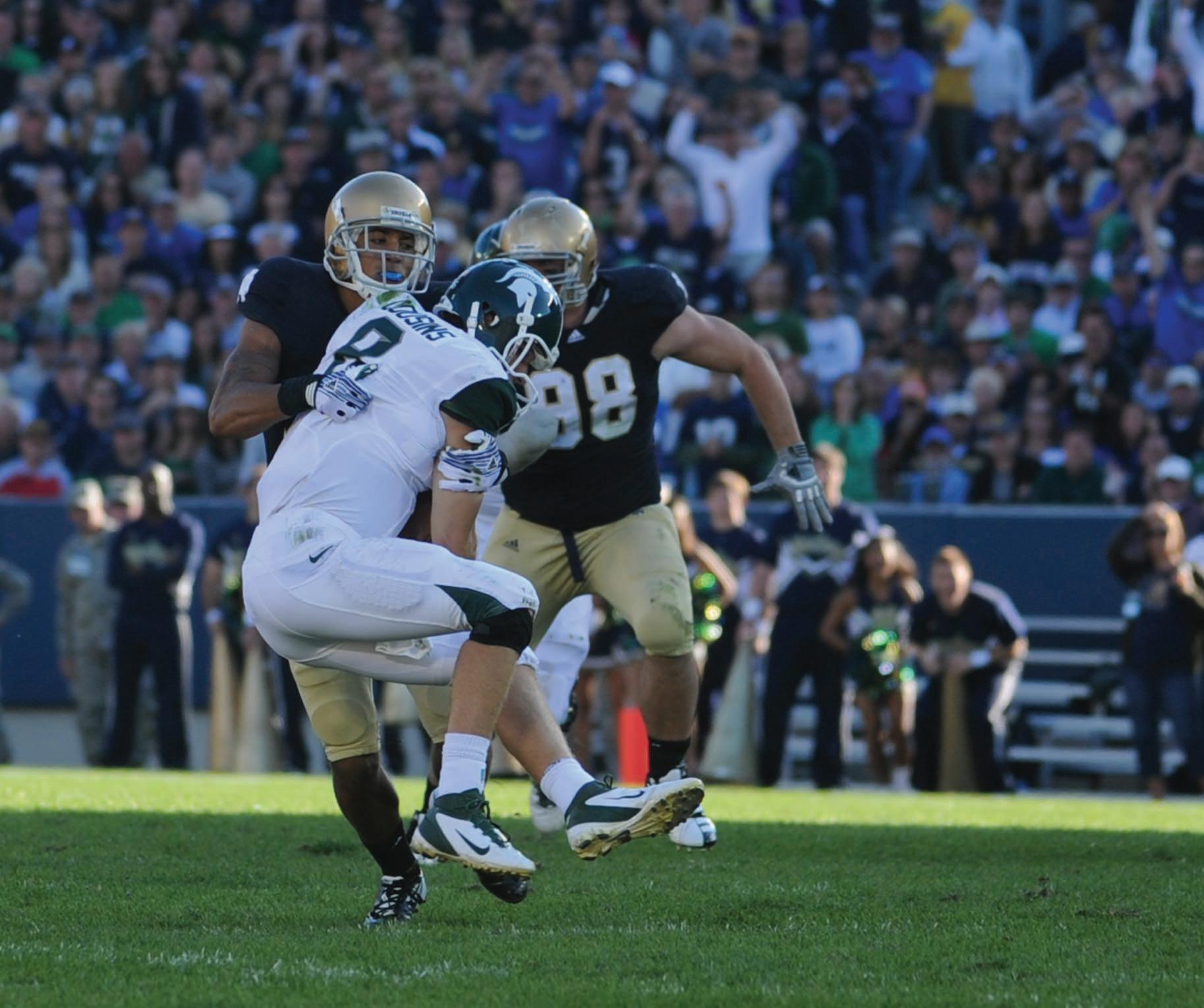
Blanton played four quarters of shutdown defense, deflecting passes and recording six tackles, including a key sack of Spartans quarterback Kirk Cousins in the third quarter.
“We felt very strongly about Robert Blanton coming into the season, that he would give us great play,” Irish coach Brian Kelly said. “I think he’s exceeded everybody’s expectations at this point. He’s been a consistent performer for us.”
Blanton’s natural comfort at the cornerback position comes from experience as much as athletic ability. A one-time safety, Blanton converted to the cornerback position as a sophomore in high school and never looked back.
“The difference now is that he comes into this year with a lot of experience, a lot of confidence,” defensive backs coach Kerry Cooks said. “He’s got to be one of the guys back there in the secondary that sets the tone. When he goes out there and he makes plays, he’s one of those guys that’s just got a personality that energizes everybody.”
While Blanton brings a renewed enthusiasm to the position, Kelly met with the corner earlier in the year to discuss his verbal approach on the field.
“I don’t allow talk on the field, so we had our conversations in the first couple of practices last spring,” he said.
“Since that time, he’s curtailed the talking.
“It’s great that he’s got that kind of personality. He just doesn’t talk on the field. He does it with his actions, which is what I expect of him.”
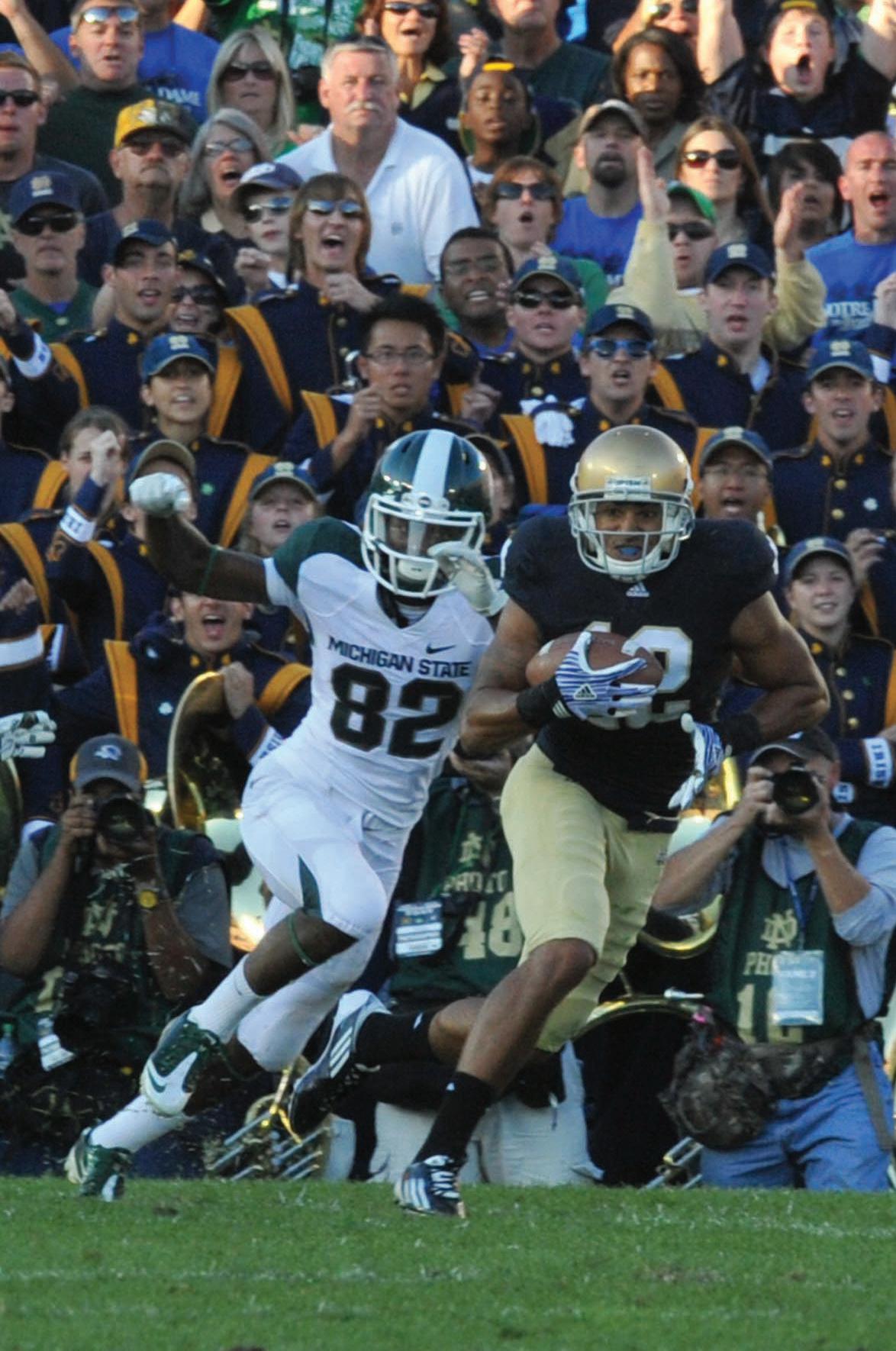
Those actions included an electrifying 82-yard interception return late in the fourth quarter Saturday to dash any chance of a Spartan comeback and seal the Irish victory. At the conclusion of the return, stadium public ad -
dress announcer Mike Collins recapped the play with a new call: “Sir Robert Blanton.”
Collins, who describes the North Carolina native as a “southern gentleman,” said he has only used a handful of nicknames in his 30 years as the voice of Notre Dame Stadium, reserving the distinction for only certain occasions.
“So, I met Robert his sophomore year,” Collins said. “No matter what, he answers everything with, ‘Yes, sir,’ — everything. So I went to him after last season and asked if there was something special he did on the field, would he mind if I called him ‘Sir Robert Blanton.’
“Then I said I had to wait until something really special happened, and then it did against MSU, and he is now Sir Robert Blanton.”
Collins may call him “Sir”, and his teammates may call him ‘RJ,’ but opposing offensive coordinators simply calling him frustrating. The corner’s success, which includes another late interception against Michigan in the second game of the season, stems from an intense preparation process that begins in the film room.
“RJ’s up here studying just as much as the coaches are,” Cooks said. “It’s ridiculous. Sometimes I’ll tell him a play, and he’ll already know the play is happening just based on the recognition, the splits. A lot of that comes from studying and understanding what the offense is trying to do to him.”
Blanton, who said the cornerback position is 90 percent mental, said he focuses his time in the film room studying opposing receivers and their tendencies rather than highlights of his past performances.
“100 percent I watch my opponent,” he said. “Our coaches have a great breakdown for us. They gave us clips, cut-
ups. I’ll watch those and then watch the receivers and evaluate each receiver on the team. But I don’t study too much. It’s fun to go in there and evaluate your opponent, and it helps you on Saturday to be successful and see what your opponent’s doing. It’s like studying for an exam. Saturday is the exam.”
While Blanton has aced the first three exams, he remains focused on the task ahead, taking each game and each snap one at a time.
A constant test in practice, senior wide receiver Michael Floyd, said Blanton possesses a number of qualities that make him difficult to beat both down the field and in short-yardage situations.
ting him right, no matter who it is. He’s constantly pressing and making sure the guys are locked in to the task at hand.”
In addition to his responsibilities on the field, Blanton has taken on the role of mentor to sophomore cornerbacks Lo Wood and Bennett Jackson. Cooks said he hopes the young corners will learn from Blanton’s “swagger” and relentless enthusiasm toward football.
“He’s tall and long. He gives you a lot of difficulty. He presses you. You have to know how to get off the line.”
Michael Floyd senior receiver
“He’s tall and long,” Floyd said. “He gives you a lot of difficulty. He presses you. You have to know how to get off the line. He gives us a lot of pressure and a lot of good technique that we can get help on.”
Defensive coordinator Bob Diaco said the 6-foot-1 senior utilizes his length to his advantage, allowing Blanton to compete for the football in the air with larger receivers. Still, he credits Blanton’s intangibles, character and leadership qualities for his success on the field.
“He’s the battery,” Diaco said. “He’s fun, he’s exciting. He’s just himself. And he leads by example. He doesn’t mind snatching a guy up and get -
“I think his passion for the game and his will not to get beat, you want to pass on,” Cooks said. “You have to be right on the edge. You got to have a short-term memory. When you line-up, nobody is better than you, nobody can beat you, but at the same time you respect every wide receiver. The reality of it is if you’re overconfident, then you are going to get beat.”
Blanton continues to toe the edge between confidence and reality, setting goals for himself in the short- and the longterm.
“Right now — making sure we beat Pittsburgh,” he said. “Long-run — finishing 102, graduating and hopefully playing at the next level.” A legacy like that is sure to make any mother proud.
Contact Chris Masoud at cmasoud@nd.edu
Senior cornerback Robert Blanton sacks Michigan State quarterback Kirk Cousins on Sept. 17. Blanton recorded three tackles for loss and an interception in Notre Dame’s 31-13 win.
PAT COVENEY/The Observer
TOM YOUNG/The Observer Senior cornerback Robert Blanton intercepts a pass in Notre Dame’s 31-13 win over Michigan State on Sept. 17.
IRISH PASSING
Tommy Rees didn’t put up quite as big numbers last week as he did against South Florida and Michigan, but unlike those two contests, the Irish came out on top. The key to that difference was Rees’ limiting his own turnovers. The sophomore threw only one interception and gave up one fumble on a blindside hit for which the blame falls squarely on the shoulders of the offensive line.
The biggest challenge the Irish will face this weekend is the variety of schemes the Panthers employ to confuse the quarterback. While Pittsburgh is based in a 3-4 formation, the Panthers often will line up in a traditional 4-3 defense. The secondary is similarly complex, as Pittsburgh coach Todd Graham throws everything from a stock Cover 2 defense to the rarelyseen Cover 0 at the quarterback to confuse him.
Kelly will simplify the offense for Rees to minimize the number of complex reads, and the Irish will focus on quickly getting the ball to the abundance of playmakers they have. While Pittsburgh may be complex, it isn’t athletic enough to keep up.
EDGE: NOTRE DAME
IRISH RUSHING
The Notre Dame rushing attack looked very effective in the first half against Michigan State, seemingly continuing the success it had experienced against South Florida and Michigan. In the second half, however, the Irish struggled on the ground. While little was said about the adjustments Michigan State made in the second half in the wake of Notre Dame’s first win, rest assured the Panthers have watched the game film from last week.
The Irish offensive line has been one of the best in recent memory for most of the season, but it has occasionally had difficulty opening running lanes when the opposing defense has overloaded the line of scrimmage or has sent a run blitz.
Pittsburgh allows just 80 rushing yards a game on 2.35 yards per carry. Sophomore linebacker Max Gruder leads the Panther defense, which ranks No. 23 in the country against the run.
Notre Dame’s success in the running game will depend on whether the offensive line can rebound from a lackluster second half against Michigan State.
EDGE: EVEN
IRISH OFFENSIVE COACHING
After two five-turnover performances, Notre Dame finally dropped its turnover count — but only to three. The Irish will employ a balanced but simple attack, which will be necessary against the complex schemes Graham will throw at Rees. Ultimately, Notre Dame’s offensive success depends on whether Rees can distribute the ball to his playmakers without turnovers.
EDGE: EVEN
Sept.
Sept.
Sept.
Sept.
Oct.
Oct.
Oct.
Oct.
Nov.
Nov.
Nov.
Nov.
IRISH SPECIAL TEAMS
Notre Dame showed a flash of brilliance on special teams last week when George Atkinson returned a kick for a touchdown, but that accomplishment was overshadowed by John Goodman’s fumble on a punt return, which continues a string of struggles in that aspect. Ben Turk looked somewhat better by rugby-punting, but that is not an ideal solution for the Irish. Until the punting and punt return woes are fixed, Notre Dame cannot win the field position battle.
EDGE: PITTSBURGH
Allan Joseph Sports Editor

After three games, I have picked exactly zero games correctly. In my defense, no one saw the loss to South Florida coming, and I would have had the score of the Michigan game exactly right ... if the game had ended 30 seconds earlier. And last week, the Irish overcame their mistakes to beat Michigan State. This week should be the week I actually get one right. The defensive line was impressive again last week, pushing around a strong Spartan front. That will continue. Tommy Rees should have plenty of time to throw and plenty of breathing room for his seemingly-inevitable turnovers. Notre Dame isn’t yet playing to its potential, but Pittsburgh isn’t good enough to win. The Irish will get their second win of the season on the weekend I get my first one.
FINAL SCORE: Notre Dame 31, Pittsburgh 14
Douglas Farmer Editor-in-Chief

It’s as Mickey said in “Rocky II,” or a censored version of what Linkin Park says in “Numb/Encore” — “What are we waiting for?” What was Notre Dame waiting for? Where was that team all season?
Yes, Notre Dame still turned the ball over three times, but at some point the Irish will cure the punt return woes. If nothing else, stick Michael Floyd back there to fair catch every time around. And the offensive line certainly paid the price for letting Tommy Rees get blindsided, causing a fumble.
With the turnovers finally cured, or nearly so, and the defensive front showing its true potential, no need to wait anymore.
After all, Rocky beat Apollo Creed the second time.
Pittsburgh
Eric Prister Sports Writer

The Irish showed last week just what they can do when they don’t beat themselves, though they still committed three turnovers. The Irish did not need a 100-yard performance from either Cierre Wood or Michael Floyd to win by double digits. It seemed as though the offense simplified things and executed better than they had all season. The defense held the Spartans to just 29 rushing yards, as the defensive line dominated the interior and kept Michigan State off balance most of the game. Pittsburgh has only played one legitimate opponent so far this season, losing to Iowa last week. Notre Dame is once again the better team — the question remains whether or not they will beat themselves like they did against South Florida and Michigan.
FINAL SCORE: Notre Dame 34, Pittsburgh 20
Head-to-Head
Andrew Owens
Associate Sports Editor

PITTSBURGH OFFENSIVE
COACHING
Pittsburgh coach Todd Graham is familiar with Notre Dame’s offensive schemes despite being in his first year, as he coached Tulsa to an upset victory over the Irish in 2010. In his first year, however, Graham is still working his players with his system. Irish defensive coordinator Bob Diaco, however, has a defensive front seven that plays fast, strong and smart now that it understands Diaco’s system.
EDGE: EVEN
PITTSBURGH RUSHING
Running back Ray Graham has established himself as one of the nation’s top running backs, currently ranking fifth in the nation with 140 yards per game. Graham’s six touchdowns are also third in the country. Pittsburgh will lean on its lead running back to establish a strong ground game early in Saturday’s contest.
First-year Panthers coach Todd Graham brings the same offensive scheme he used to prolific effect at Tulsa. In 2010, Todd Graham’s Tulsa squad averaged over 500 yards of total offense, including 217 yards per game on the ground.
The Notre Dame defensive line played perhaps its best game of the season against a physical Michigan State squad, highlighted by the Spartans’ mere 29 rushing yards on 23 carries. Though some of the younger players will see less playing time against Pittsburgh’s complex offense, the Irish defensive line provides an equal match to the Panthers’ experienced offensive front.
Linebacker Prince Shembo will retun to the field this week after tending to a family emergency last week, bolstering Notre Dame’s run defense.
EDGE: EVEN
PITTSBURGH SPECIAL TEAMS
Pittsburgh excels on punt coverage, allowing only two returns all year — which, when combined, lost three yards. This should give them a significant advantage on the Irish, who have struggled all year when returning punts.
Kicker Kevin Harper has struggled, making only four of his seven attempts, and missing two from within 40 yards. Harper has also forced only one touchback all season on kickoffs, while he has kicked two out of bounds for penalties.
EDGE: EVEN
Notre Dame is still a flawed team. One week does not erase the recurring problems of this team. The Irish still have secondary and special teams issues, but last week was a step in the right direction. This week Notre Dame faces a Pittsburgh team that, quite simply, is not very good. Panthers coach Todd Graham will restore
to the program, but 2011 will be rough for the former Tulsa coach who beat the Irish last season. Panthers running back is very talented, but one thing the Irish have proven is they can stop the run. They will keep Graham in
and
and
and
PITTSBURGH PASSING
Pittsburgh quarterback Tino Sunseri had some trouble adjusting to Todd Graham’s new system at the beginning of the year but has now become fairly comfortable in his schemes. While the Panthers no longer have stalwart receiver Jonathan Baldwin, receiver Devin Street has capably filled Baldwin’s role as primary target. Sunseri and Street have developed a good relationship, which has manifested itself in Street averaging 15.7 yards per catch and nearly 80 yards per game.
Panthers running back Ray Graham adds another unique dimension to Pittsburgh’s aerial attack, as he is tied for the second-most receptions on the team. Ray Graham’s running ability also sets Pittsburgh up to utilize play-action effectively.
The Notre Dame secondary has been inconsistent over its first three contests, though cornerback Robert Blanton has been the one constant. Most important to Notre Dame’s pass defense is the play of cornerback Gary Gray, who struggled against Michigan. If Gray can play to his potential, Notre Dame has two top-quality cornerbacks.
Chris Masoud Assistant Managing Editor

After the dismantling of Michigan State, Notre Dame heads into Pittsburgh with more confidence than any one-win team in the nation, and rightly so. Tommy Rees played the worst game of his career, and yet the sophomore quarterback continues to do just enough to give the Irish a chance to win. He’s due for a breakout performance against Pittsburgh, and if the offensive line continues to keep his shirt clean, the sophomore could post the best numbers of his career against a suspect Panthers secondary.
Brian Kelly also just discovered his new favorite toy: freshman defensive end Aaron Lynch’s bull rush on third down. In addition to Kelly’s praise of the rookie’s genetic composition, the head coach said he just has a desire to bring the quarterback down.
FINAL SCORE: Notre
EDGE: NOTRE DAME
By ALLAN JOSEPH Sports Editor
One of the biggest challenges first-year coaches face is installing their systems while preparing for unfamiliar opponents.
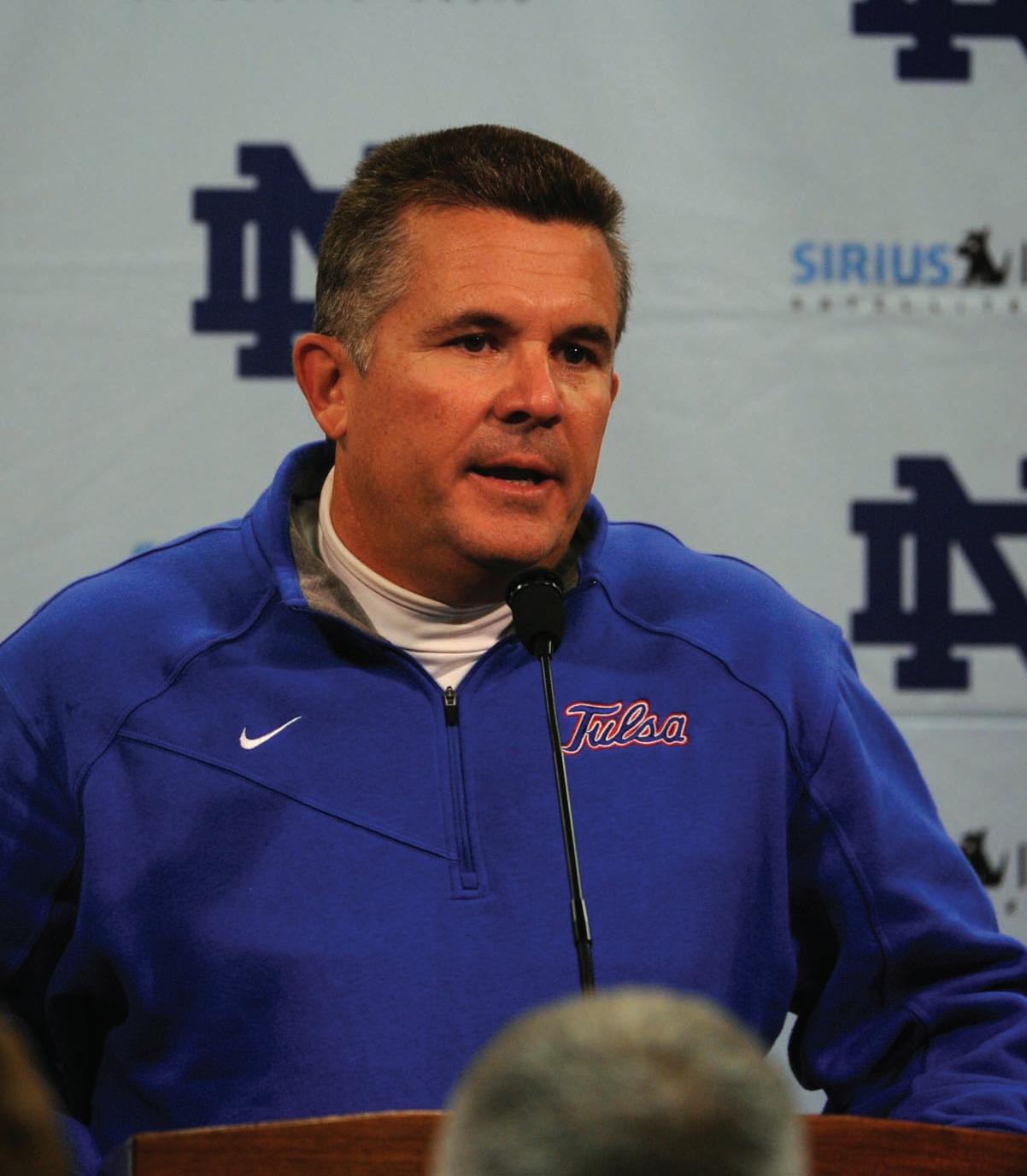
Pittsburgh’s Todd Graham, however, is intimately familiar with Notre Dame, as he coached Tulsa to one of the biggest upsets in Notre Dame history, when the Golden Hurricane defeated the Irish 28-27 in Notre Dame Stadium last year.
“[Graham] knows us quite well from last year,” Irish coach Brian Kelly said. “We’re familiar with his system. Now he essentially put in his philosophy and his system of offense and defense at Pittsburgh. When you’re watching film, you’re seeing a lot of similarities to his Tulsa club.”
Graham’s signature philosophy is defensive complexity, as his Panthers (2-1) employ a dizzying number of looks in order to confuse the opposing quarterback.
“They play every coverage imaginable in the back end,” Kelly said. “You’re going to see multiple coverages in the secondary. They’ll bring a lot of pressure, mix it up between three down and four down [linemen], and give you a lot of different looks. I think that that, from our standpoint, is what concerns us the most.”
Kelly drew comparisons between his squad and the Panthers’ defensive front.
“I like their front. They can be in three down, four down, and they’re a lot like us in that standpoint,” Kelly said. “I just remember last year they brought a lot of pressure.”
While the Pittsburgh secondary has struggled somewhat this season, senior Irish wide receiver Michael Floyd expects the Panthers to play their best game of the year against Notre Dame.
“When a team plays Notre Dame … it [doesn’t] really matter what the record was,” Floyd said. “I think they will play exceptionally well, and I don’t think the mistakes will be there.”
On the offensive side of the ball, the Panthers are taller and bigger than Graham’s 2010 Tulsa
east is east west is west

SEPTEMBER 23 | 6:30 PM
squad, but Irish defensive coordinator Bob Diaco said the core schemes are no different.
“Tulsa had excellent personnel too, it’s just a little different,” Diaco said. “They still have a myriad of different plays that they run from different steps, and we need to be ready to defend all of those plays.”
The Panther offense revolves around junior running back Ray Graham, who currently ranks fifth in the nation in rushing with 140 yards per game.
“[Ray Graham] is a rugged player,” Diaco said. “He’s got contact balance and initial quickness, he’s got long speed and he could move both laterally in short space quickly, and he can also get vertical and accelerate. He’s a rugged runner, he’s a tacklebreaker, so he’s a real challenge.” Graham, however, is also known for his versatility out of the backfield.
“Obviously the first guy that stands out is Ray Graham,” Kelly said. “[He’s an] outstanding running back, [and is] multidimensional in that he can catch the ball coming out of the backfield — he can line up as a wide receiver.”
Junior Panther quarterback
Tino Sunseri has flourished in Todd Graham’s offensive system and has especially developed a relationship with receiver Devin Street.
“[Sunseri] seems far more comfortable in this system,” junior linebacker Manti Te’o said. “He’s making good decisions, so we definitely know what they are capable of doing.”
Sunseri leads a complex offense that will force the Irish defense to stay honest and disciplined.
“We need to read our key, get into our fit, and we need to stay there — and not be unfocused with our eyes,” Diaco said.
Te’o, however, believes the Irish must stick to their fundamentals.
“We just play football,” he said. “We just line up and get to the ball.” Contact Allan Joseph at ajoseph2@nd.edu



SARAH O’CONNOR/The Observer
Pittsburgh coach Todd Graham speaks to the media following his 28-27 victory over Notre Dame as Tulsa coach Oct. 30, 2010.
Jones carries the memory of his father on the field
By ANDREW OWENS Associate Sports Editor
Ever since he was a young boy, sophomore receiver TJ Jones has depended on his father as the rock in his life — spiritually, academically and athletically.
When Andre Jones, member of the 1988 Irish national championship team, died at age 42 in June, much of what TJ had come to rely on in his first 18 years of life was thrown into chaos. But the sophomore has transformed into the rock that his mother and four younger siblings depend on in Gainesville, Ga.
“I just think to myself [about his father] every day,” Jones said. “I’ve got six, seven people counting on me. So every day I got to push myself that much harder to make sure that it’s not enough to make it for myself, but also for my family.”
Jones was participating in summer practices when receivers coach Tony Alford called him into the Guglielmino Complex and told him his father was ill after suffering a brain aneurism.
Alford and Andre Jones developed a close bond after the recruitment of TJ When Alford’s father died at the time, Jones assisted the receivers coach during the period.
“[Alford] and my dad had a very close relationship, and he’s kind of like that father figure in my life on campus and I can talk about anything with him if I needed to,” TJ said. “I know during that period, him and my dad, their relationship grew because my dad was there for him helping him stay through it spiritually, so that helps our re-
lationship now because he knows what I’m going through and he knows what kind of person my dad was.”
Those surrounding TJ have been astonished by the receiver’s composure since the tragedy.
“Just the way that he’s handled himself, it’s just unbelievable,”
Irish senior safety and captain Harrison Smith said. “There was never any time where he was down or gave up. He’s just a tough kid and … it’s just motivation. Just doing it for his dad. Just giving him that little bit extra when you might not want to put everything you have into it is something that he has definitely used to his advantage.
Irish coach Brian Kelly credits Jones’ ability to mature amid a life-changing situation.
“As a player, I think he’s really stepped up and become more accountable,” Kelly said. “He’s not a freshman anymore. Last year there were times where he would just act like a freshman. He’s a lot more mature in the way he handles himself.”
Jones said he often stops during his busy days and reflects on his relationship with his father.
“It’s not hard to keep him on my mind,” he said. “Every second I’m not thinking about schoolwork or football, I’m thinking about him. It’s put a toll on me. When I’m on the field or in the classroom [it’s difficult], but outside that I can think to myself and be myself.”
Jones said he valued the discussions he had with his father, his source of advice for life at Notre Dame and as a college football
player.
“I don’t have that person to go to when I have questions on football or life at Notre Dame because he knew all that,” Jones said. “So I don’t have anyone to really talk to now, and I’ve become the man of the house, so my problems don’t matter to me anymore. It’s more helping my family out.
“I’m very grateful because I know a lot of times it would make him tear up or cry running out of the tunnel, and I never understood
it until I ran out of the tunnel the first time knowing he wasn’t there, so I am very grateful he got to see me last year.”
Jones is serving as a father-figure for his brother Malachi while the high school senior takes recruiting visits himself and decides where to play college football.
“Every Thursday or so I try to talk to him pregame and see who they’re playing, what their gameplan is, and that’s my advice — to go out and ball and do your best,
give it your all and play,” Jones said. “Then we’ll talk on Sunday and Monday and recap how the game went if I can’t catch it online.”
As those in his life — teammates, friends and family — continue to rely on the sophomore’s ability to lead, TJ has discovered more about himself by reflecting on Andre’s life as a football player, a friend, and, most importantly, a father.
Contact Andrew Owens at aowens2@nd.edu
SARAH O’CONNOR/The Observer
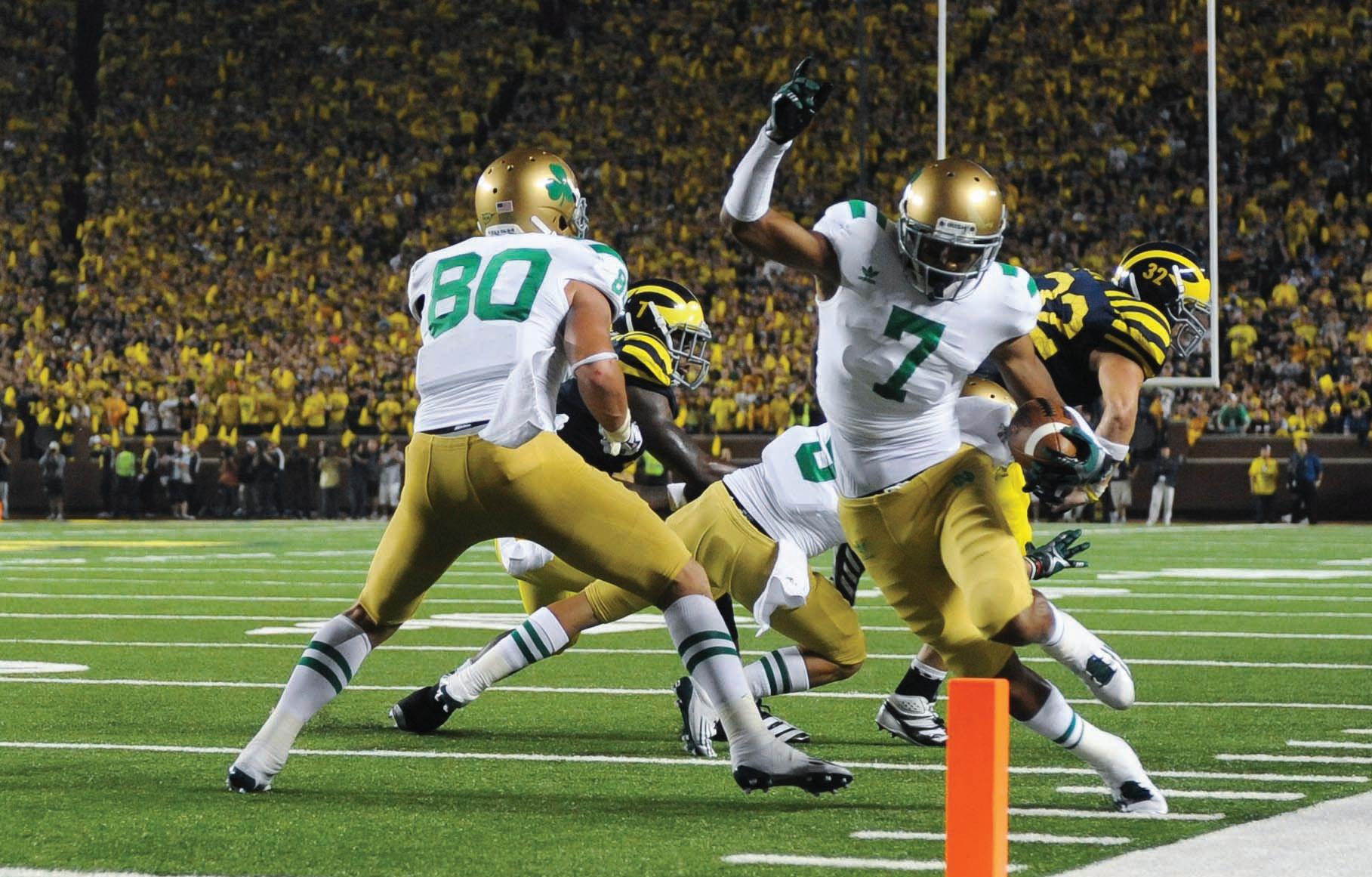
Irish sophomore receiver TJ Jones tip-toes along the sideline and scores a touchdown against Michigan on Sept. 10. The Wolverines defeated Notre Dame, 35-31.