Kareem to help experts evaluate structural integrity of new project for Department of Homeland Security
By ABI HOVERMAN News Writer
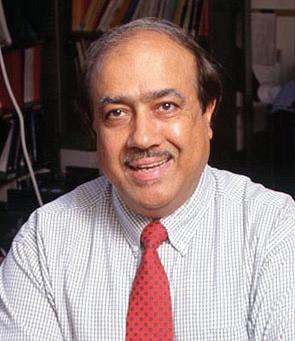
Earlier this month, the National Academy of Sciences selected a Notre Dame professor to join a risk assessment committee evaluating plans for a new Department of Homeland Security (DHS) animal disease research facility.
Ahsan Kareem, the Robert Moran Professor of Civil Engineering and Geological Sciences, will use his expertise in wind engi-
neering to assess how the building would withstand natural disasters.
“One looks at scenarios to be sure the basic safety steps are built in,” Kareem said.
According to the DHS website, Kareem will work with 16 experts
on the committee considering plans for the Planned National Bio- and Agro-Defense Facility (NBAF), to be built in Manhattan, Kansas. The building will house those conducting research, creating vaccines and medications for livestock and training professionals to respond to diseases spread from animal-to-animal and from animals-to-human.
Because the NBAF will contain strains of viruses like Foot and Mouth Disease and Classical Swine Fever, it is of the upmost
importance that the building withstands natural disasters.
Kareem serves on the second committee to review the NBAF.
The first committee’s recommendation lead to the revised plan currently under consideration, he said.
“In this case, if the building collapses, it is a serious problem,” Kareem said.
Kareem said final funding from Congress rests on the recommendation of the committee on how the building would fare
Holy Land Lenten Pilgrimage canceled
By ANNA BOARINI News Writer
A popular and distinctive spring break option offered to students last year has been withdrawn due to logistical difficulties. The Theology and Campus Ministry Departments cancelled this semester’s Holy Land Lenten Pilgrimage, which was to have travelled through Jerusalem, Galilee and Bethlehem.
Students going on the Theology department and Campus Ministry sponsored trip received an email earlier this week informing them of the trip’s cancellation. The email was signed by Theology department chair J. Matthew Ashley and interim director of Campus Ministry Fr. Joe Carey.
According to the email, “insurmountable logistical problems” contributed to the can-
cellation of the trip.
Ashley said living arrangements were a concern with the trip as planned.
“First, there were space constraints at Tantur [an ecumenical institute for theological studies based in Jerusalem], but we were able to work around those,” he said.
Budget constraints were also an issue, Ashley said.
“The second and more serious problem had to do with airfares,” he said. “The prices are extremely volatile, making it impossible to fix a price for the participants and be sure we could stay within our budget.”
Along with the price of airfare, Ashley said safety concerns came into question when planning the flight over to Israel.
“There was a serious quessee PILGRIMAGE/page 7
in probable risks. The committee also contains veterinarians, microbiologists, meteorologists and risk-assessment specialists.
“It’s a politically hard item because it is mandated by Congress, and they want to make sure everything goes well,” he said. “Whenever Congress wants an unbiased opinion they go to an academy.”
Kareem said the appointment process selected completely un-
5
Students search for careers
By JILL BARWICK News Writer
Once again, the time of year when Saint Mary’s College seniors begin to apply for the job of their dreams has come around on the calendar. The employment search is well underway, and seniors and faculty know full well the process is a job in itself.
Senior Hilary Ferguson said she knows experience in her preferred field of communications will enhance her chances of employment, adding that her see JOBS/page 5
Faculty members use physics to expose art forgery
By CAROLYN HUTYRA News Writer
The worlds of science and art are headed on a collision course, and master forgers are forewarned: Science will catch them red-handed.
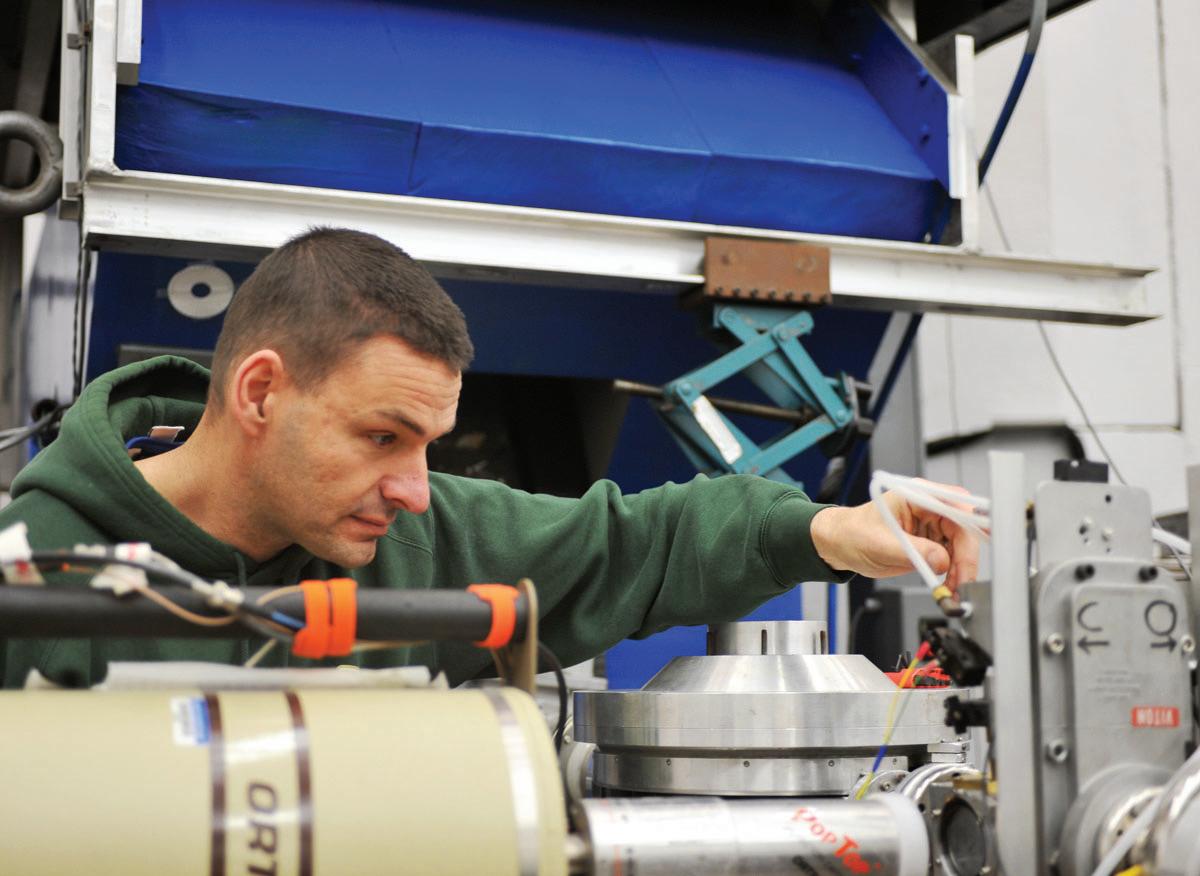
Notre Dame’s nuclear astrophysicist professors Michael C.F. Wiescher and Philippe Collon are using proton-induced x-ray emission (PIXE) and Accelerator Mass Spectroscopy (AMS) to analyze various artifacts without destroying any parts of the samples.
The application of such methods involves dating artwork, determining prior locations of artifacts and identifying pigments through particulate analysis. In so doing, art forgeries are more easily identified
and more information about the artifacts is gained, according to Wiescher and Collon’s January article “Accelerated ion beams in art forensics” in the academic magazine Physics Today.
This new approach is unique in that it comes from the area of physics. Collon said using AMS is akin to pouring a bottle of wine into Lake Michigan and trying to examine the wine particles, saying the process allows researchers to specifically examine from the backgrounds that interfere in the separations. He said the main focus is to look at a few trace atoms in a large matrix.
Collon said he enjoys his focus using the AMS program.
“I have a love for astrophysics and nuclear physics,” he said.
“I love applying AMS to those areas.”
Collon said the accelerators used at Notre Dame are similar to the ones in European art museums, save for the fact that the ones overseas work specifically on art works, forgeries and archeology. He said the majority of research conducted at Notre Dame is related to nuclear astrophysics.
Collon added that although the work in the nuclear labs at Notre Dame remains focused on research and experimentation, the professors are now using applied physics in connection to other studies such as art, archeology and anthropology.
“It really is a sort of melding of these different areas,” he
Kareem
SARAH O’CONNOR/The Observer
Astrophysics professor Philippe Collon analyzes artifacts using Accelerator Mass Spectroscopy, which preserves the samples.
Photo courtesy of Colin King
Campus Ministry and the Department of Theology announced Monday this year’s Holy Land Lenten Pilgrimage is canceled.
www.ndsmcobserver.com
P.O. Box 779, Notre Dame, IN 46556
024 South Dining Hall, Notre Dame, IN 46556
Editor-in-Chief
Douglas Farmer
Managing Editor
Sarah Mervosh Business Manager Jeff Liptak
a sst.
Managing Editor: Adriana Pratt
a sst.
Managing Editor: Chris Masoud
News Editor: Sam Stryker
Viewpoint Editor: Meghan Thomassen
Sports Editor: Allan Joseph
Scene Editor: Maija Gustin
Saint Mary’s Editor: Caitlin E. Housley
Photo Editor: Pat Coveney
Graphics Editor: Brandon Keelean
a dvertising Manager: Katherine Lukas
a d Design Manager: Amanda Jonovski
Controller: Jason Taulman
Systems a dministrator: William Heineman
Office Manager & General Info (574) 631-7471 Fax (574) 631-6927
The Observer is the independent, daily newspaper published in print and online by the students of the University of Notre Dame du Lac and Saint Mary’s College. Editorial content, including advertisements, is not governed by policies of the administration of either institution. The Observer reserves the right to refuse advertisements based on content. The news is reported as accurately and objectively as possible. Unsigned editorials represent the opinion of the majority of the Editor-in-Chief, Managing Editor, Assistant Managing Editors and department editors. Commentaries, letters and columns present the views of the authors and not necessarily those of The Observer.
Viewpoint space is available to all readers. The free expression of all opinions through letters is encouraged. Letters to the Editor must be signed and must include contact information.
Questions regarding Observer policies should be directed to Editor-in-Chief Douglas Farmer.
Brian Connor
freshman O’Neill “Nothing.”
Katy Riley senior Farley “Legend’s trivia night.”
Pat Condon junior Stanford “First prize.”
Caroline Munegast
sophomore Badin “A tie-dyed Sammy Sosa Beanie Baby in the 2nd grade.”
Rob Callus
freshman Zahm “A 10 lb. chocolate bar.”
2011.
Hearse used for JFK sells DALLAS, Texas — The man who paid $176,000 for the white hearse used to transport President John F. Kennedy’s body following his assassination in Dallas plans to include it in his collection of about 400 cars in Colorado.
Stephen Tebo, a real estate developer from Boulder, bought the hearse Saturday that was being offered by Barrett-Jackson Auction Co. of Scottsdale, Ariz. He got the car with a bid of $160,000, plus a $16,000 buyer’s premium.
The auction company said that the 1964 Cadillac hearse carried Kennedy’s body as well as first lady Jacqueline Kennedy from
Parkland Memorial Hospital to Air Force One at Dallas’ Love Field for the flight back to Washington following his assassination on Nov. 22, 1963.
Tebo said that he plans to eventually turn his car collection into a museum.
Woman stole soda just for can deposit LYNN, Mass. — Authorities say a Massachusetts woman bought $64 worth of soda using a stolen welfare benefits card, then immediately fed the full cans into the supermarket’s automated redemption machine to exchange the cans for the nickel deposit.
Tina Cafarelli, of Lynn,
pleaded not guilty Monday to charges including larceny, property destruction and receiving stolen property. She was ordered by authorities to be held on $250 bail.
Police tell The Daily Item that the electronic benefits card Cafarelli used to buy the 18 12-packs of soda had another person’s name on it. The supermarket manager says the full cans caused extensive damage to the redemption machine, which usually receives empty cans.
The 36-year-old Cafarelli couldn’t be reached for comment.
Information compiled from the Associated Press.
Will Murray
freshman Carroll “My dad’s respect for four minutes.”
In brIef
Spring Lessons for the Spring 2012 Session 1 Registration begins at 9:00 a.m today in the Rockne Memorial. The cost is $30 per session. Contact Sarah Ryckman with any questions at sryckman@nd.edu
The Center for Social Concerns will host the Social Concerns Fair today from 6 to 8 p.m. in Geddes Hall, classrooms B034 to B036. The Social Concerns Fair provides an opportunity for 40 local community organizations and student service and action clubs to meet with students and engage them in the community.
For international graduate students, finding a job or internship can be a challenge. Cosponsored by English for Academic Purposes (EAP) and the Career Center, the Interviewing and Networking Strategies for International Students workshop will be held today from 6:30 to 7:30 p.m in 303 DeBartolo Hall for free
Tonight from 7 to 9 p.m., the John Madden film “ The Debt” will premiere in the DeBartolo Performing Arts Center. The event is open to the public and costs $6 for adults, $4 for seniors and $3 for children and students
The Social Venturing and Microfinance Internships Information Session will be held tonight in the coffee house of Geddes Hall from 7 to 8 p.m
To submit information to be included in this section of The Observer, e-mail detailed information about an event to obsnews.nd@gmail.com
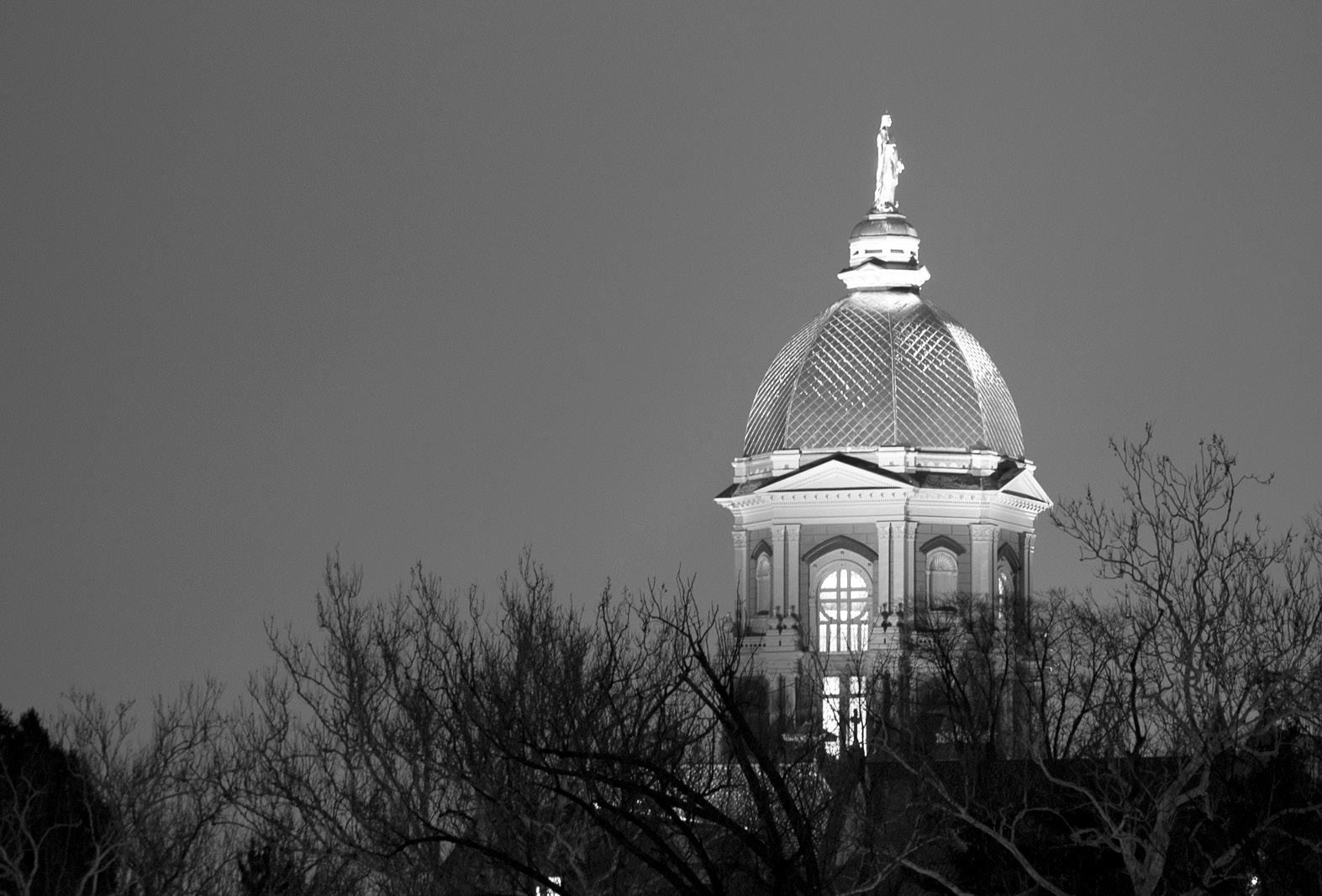
ALEX PARTAK/The Observer
Shot from the center of campus, the Golden Dome is silouhetted against the evening sky. Situated on the top of the Main Building, the Golden Dome lended flakes of gold to the football team’s helmets in
Saint Mary’s students celebrate College’s tradition with tea
By MEAGHAN DALY News Writer
Tuesday afternoon’s teatime at the Riedinger House offered Saint Mary’s College students an opportunity to see some of the school’s traditions brought to life.
Director of Alumnae Relations
Kara O’Leary said graduates of the school are crucial in keeping the College’s traditions alive.
“The Alumnae Association works to keep alumnae connected to each other as well as the College,” she said. “It represents decades [of alumnae] and geographical locations of the alumnae population at large.
Tea in Riedinger House during Heritage Week began three years ago and has grown in popularity each year, O’Leary said. Along with the Student Govern-
ment Association (SGA), she has had to schedule additional times for students to attend. There will be two more sessions held on Wednesday at 4 p.m. and 5:15 p.m.
O’Leary said the strength of the school’s alumnae is considerable, noting Saint Mary’s College possesses the top women’s Catholic alumnae association in the nation.
“Students realize their time here [at Saint Mary’s] is short, but they will be alumnae the rest of their lives,” O’Leary said.
SGA chief of staff Emily Skirtich said the events of the week serve to evoke the history of the school.
“The goal of Heritage Week is to remind veteran students and tell current students about the College and the rich traditions we celebrate here,” she said.
because it is the first motherdaughter legacy connection at Saint Mary’s,” O’Leary said. “One of best parts of the tea is educating our students on what being postSaint Mary’s means.”
“Students realize their time here [at Saint Mary’s] is short, but they will be alumnae the rest of their lives.”
Kara O’Leary director of alumnae relations
Skitich said SGA chose Riedinger House because of the building’s rich historical tradition on campus.
“It reminds students of what life here used to be like versus what it is now,” she said. “We are celebrating one of the storied places on campus.”
Adaline Crowley Riedinger, Class of 1864, was responsible for donating the majority of the funds to construct the house. Riedinger was also the first alumna to send her daughter, Mary Adalaide Riedinger, Class of 1889, to Saint Mary’s College.
Junior Madeline Meckes said she was initially unaware of the historical significance of the building, but appreciated the opportunity to learn more about the traditions of the College.
“I learned a lot about the history of the house and the alumnae association. I thought it was really cool that it used to be used as a practice house for home economics majors,” Meckes said.
Skirtich said students’ thirst to understand more about their school means Heritage Week gets stronger each year.
“I learned a lot about the history of the house and the alumnae assocation. I thought it was really cool that it used to be used as a practice house for home economics majors.”
Madeline Meckes junior
O’Leary said the rich tradition of the house serves as a reminder of what it means to be an alumna of the College.
“We open Riedinger House
“Each year SGA (Student Government Association) strives to highlight all the really important parts of the College and its history,” she said. “Each year keeps getting better and better. The students appreciate where we came from and all the College has to offer.”
Contact Meaghan Daly at mdaly01@saintmarys.edu
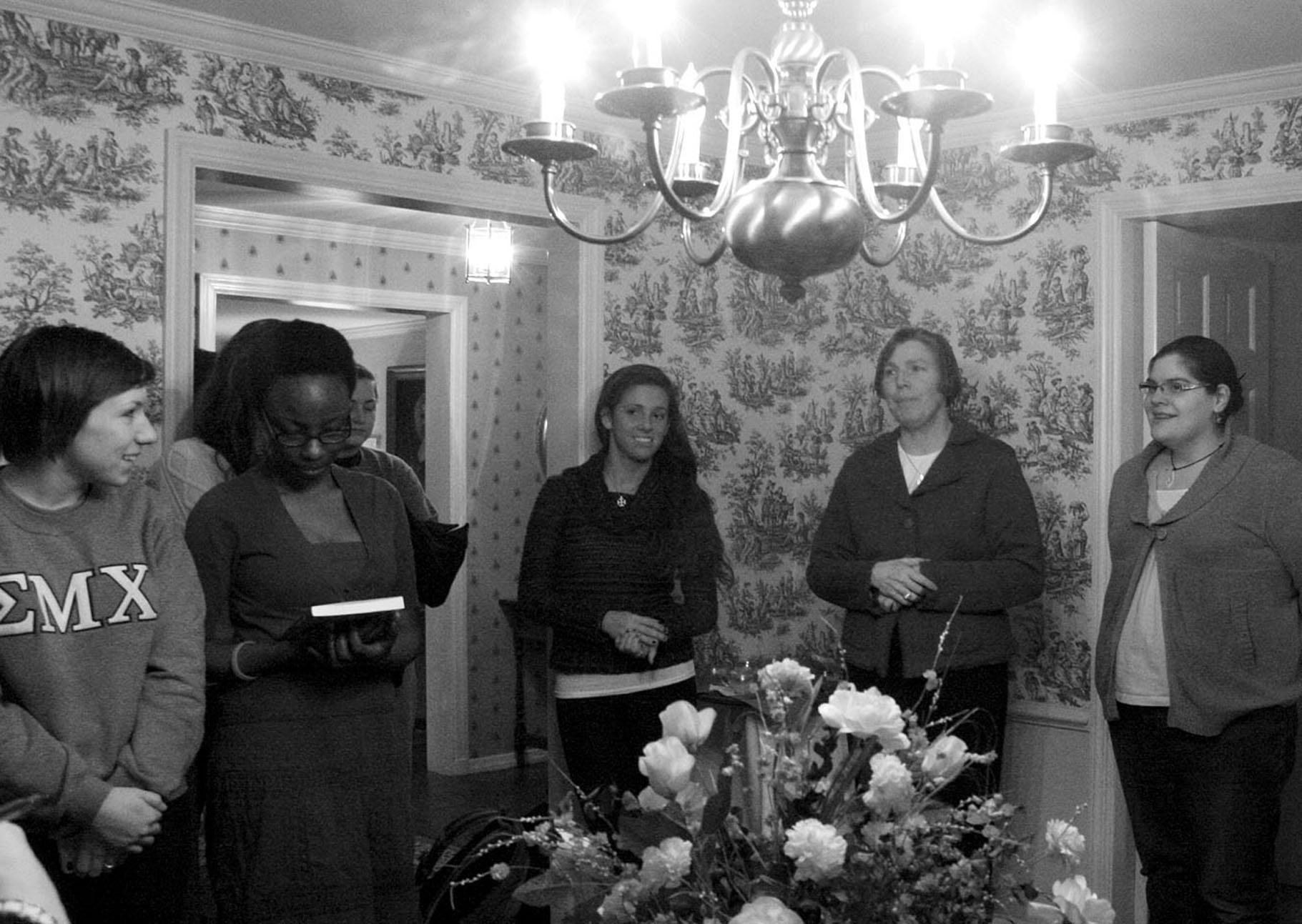
COURTNEY ECKERLE/The Observer
Saint Mary’s students listen to Kara O’Leary, director of alumnae relations, speak at teatime at the Riedinger House on Tuesday. The event began three years ago and honors the history of the College.
CollegeFashionista highlights campus trends
By KRISTEN DURBIN News Writer
The chill of winter may have overtaken South Bend, but Notre Dame’s fashion scene is heating up with the launch of its CollegeFashionista webpage earlier this month.
Indiana University graduate Amy Levin founded CollegeFashionista in 2009 as a fashion blog site for style-conscious college students around the world. Since its inception, the site has expanded to include more than 180 college campuses in the United States and Canada.
Student “Style Gurus” represent each campus, contributing blog entries and photos of the “Fashionistas” and popular trends they find on campus, according to CollegeFashionista’s website. These blog entries take on a different focus each day of the week, from “Style Advice” on Mondays to “Accessories Report” and “Fashion from Abroad” on Fridays.
another university.
“My friend worked for [CollegeFashionista] last year as a Style Guru, and I’ve always had an interest in writing and especially fashion after doing fashion internships in the past,” Willis said. “I decided to apply to be a Style Guru this semester, so I wrote to [Levin] and recommended Notre Dame for the site.”
“We hope students at Notre Dame will be inspired by their peers and use CollegeFashionista as a place to learn about trends happening not only at their campus but at college campuses around the world.”
Willis applied for CollegeFashionista in November and found out in December that she was selected to be one of Notre Dame’s two new Style Gurus, along with senior Katherine Lukas [Note: Lukas is the Advertising Manager of The Observer].
Amy Levin founder of CollegeFashionista
Levin said she felt the time was right to get Notre Dame involved in her site, especially based on Willis and Lukas’ enthusiasm for the idea.
media skills were totally in line with what we were looking for in Style Gurus and we quickly brought them on the team.”
why.”
Willis said she has already received positive feedback from her Notre Dame peers.
Sophomore Elizabeth Willis became interested in bringing the site to Notre Dame after hearing about it from a friend at
“We felt a need to showcase the fashion at this Midwest college and found two perfect candidates to help us launch CollegeFashionista at Notre Dame,” Levin said. “Katherine and Elizabeth both reached out to us about their interest in launching a Notre Dame page. Their photography, writing and social
Willis said her focus as a Style Guru is on accessories, while Lukas gives general style advice in her posts. Both girls submit a blog entry directly to the site once per week, including their campus fashion findings for that week.
“Notre Dame often gets the reputation of having a ‘uniform,’ so I want to bring attention to various styles and interesting things people are wearing on campus.”
“We both walk around campus and look for people whose style catches our eyes,” Willis said. “We stop them, take a picture and interview them about what they’re wearing and
Elizabeth Willis sophomore
“A couple of my friends here had read CollegeFashionista in the past, but more attention is drawn to it when I post my blogs on Facebook and Twitter,” she said. “As Style Gurus we’re required to do that, so that promoted it and got people asking about the site.”
As the site gains popularity at Notre Dame, Levin said she hopes to expand CollegeFashionista’s presence on campus by developing a full team of
five Style Gurus. In the meantime, she said she is optimistic about the site’s potential impact on fashion at Notre Dame.
“We hope students at Notre Dame will be inspired by their peers and use CollegeFashionista as a place to learn about trends happening not only at their campus but at college campuses around the world,” she said.
Willis said she hopes her contributions to the site will help dispel stereotypes about Notre Dame student style and encourage them to display their individuality as well.
“Notre Dame often gets the reputation of having a ‘uniform,’ so I want to bring attention to various styles and interesting things people are wearing on campus,” she said.
Contact Kristen Durbin at kdurbin@nd.edu
LiSA HOEYNCK | Observer g raphic
Researchers develop solar paint
By CHRIS BARNES News Writer
The sharper reflection on Notre Dame’s football helmets in the sunlight is not the only cutting-edge development featuring light technology on campus.
Sponsored by the Department of Energy, a team of Notre Dame researchers led by Professor Prashant Kamat is currently engineering a type of paint that can generate electricity upon exposure to light.
Kamat said the fundamental principle of developing the paint was to utilize the special conducive properties of various metals.
“This project includes a whole array of semiconductors, such as silicon, cadmium and telluride, which are currently employed in solar cells,” said Kamat.
“The number of surfaces available that are impinged upon by sunlight on a daily basis makes a technology such as paint very attractive.”
Prashant Kamat professor of science
Kamat, who is working with graduate students James Radich and Ian Lightcap, said his work to harness the electric potential of the sun’s rays has been a long time coming.
“We’ve been conducting solar photochemistry research for more than two decades,” Kamat said.
Radich said the idea for the use of sunlight as a primary source of energy compelled the researchers to pursue this elusive possibility.
“The number of surfaces available that are impinged upon by sunlight on a daily basis makes a technology such as paint very attractive,” he said.
“The paint’s semiconductors absorb light and generate charge carriers that are tapped in photovoltaic cells to generate electricity.” Though he and his team have made great strides in cultivating the paint, Kamat said his work in maximizing the product’s quality is far from over.
“So far what we’ve shown is a proof of concept, which is only the first of a four-phase step in scientific discovery,” Kamat said. “We need to boost the paint’s efficiency to more
than five percent, but the external funding support and the research progress will determine the duration of product development.”
Lightcap said his team needs more time to fully develop its discovery.
“We optimistically estimate that development of the paint into a product with competitive efficiency and stability will take a few years to a decade to reach fruition,” he said. “We are confident that a few of our Notre Dame undergrads working on this and related projects will make the next breakthrough.”
Kamat said their research has yielded a product with incredible properties, naming the paint “Sun-Believable.”
“A large number of people still do not believe that solar energy is a viable energy alternative that could become part of our energy portfolio,” he said. “However, the facts contradict this opinion.
“This project includes a whole array of semiconductors such as silicon, cadmium and telluride, which are currently employed in solar cells.”
Prashant Kamat professor of science
Security
continued from page 1
biased members, as the Academy of Science posted nominees’ biographies online for public objection and circulated the list of members to relevant interest groups. The Academy does not compensate the experts in order to ensure the accuracy of the recommendation, he said.
“Everything is in the open; it’s very transparent,” he said.
The facility’s location in Manhattan, Kansas, the heart of tornado alley, makes the building extremely susceptible to tornadoes, he said.
“Manhattan is an area where there have been strong tornadoes. Anytime, anything can happen … One must look at the risk … of tornado strength,” Kareem said. “Then we look at the structure to find the weak links.”
The DHS website explained that despite the risk of tornados, the NBAF will benefit from this location on the campus of Kansas State University, the location of existing facilities for similar bio-security research. It will also
Jobscontinued from page 1
minor in Advertising and Public Relations will broaden her choices.
“I have had two internships over the past year, including one this semester as a marketing intern at Quality Dining, Inc.,” Ferguson said. “I am not planning on going to graduate school. However, I am still deciding where I am planning on settling down after graduation.”
be near a major hub of the veterinary pharmaceutical industry. Kareem was selected for his expertise on the impact of high winds and other natural phenomenon, he said. Kareem investigated the collapse of a scissorlift on campus that killed junior Declan Sullivan in 2010, and has explored buildings that have failed in hurricanes. He has also served for six years on a committee on natural disasters for the Academy of Sciences, he said.
“In our profession, you have to do these kinds of things if asked,” he said.
The committee will meet next week to make its final recommendation on the project, which is projected to be operational in 2020. Although this project for the DHS is more sensitive and classified than other projects, Kareem said he uses the same methodology when considering the NBAF plans.
“What is the possibility of something happening, what are the consequences, and how do those consequences affect society,” Kareem said.
Contact abi Hoverman at ahoverma@nd.edu
BELLES to give an advantage to our students currently seeking jobs.”
Jeffirs said CCO provides interview preparation as well as mock interviews for students who have gotten the call from a potential employer. Career assessments are provided at the office to help students make sure they know what field they want to enter into.
The food that we eat comes from the conversion of sunlight into carbohydrates, and the fossil fuels that we use today are stored energy from the Sun. The simplicity of the approach in this work highlights the cause.”
Kamat added the development of the paint represents a leap into the largely untapped well of renewable energy.
“Many efforts are needed to attain sustainable energy,” he said. “There is no single silver bullet to meet our clean energy demand, so we also need to consider various alternatives to oil and coal, such as wind power, hydropower, biomass and geothermal energy.”
Lightcap said this work has given him hope for a future of cleaner forms of energy.
“Our work is the first step in right direction toward setting our sights on renewable energy forms that are accessible to everyone,” he said. “Transforming the costly and timeintensive construction of solar cells into a simple, paint-like approach is one direction we can take to achieve that goal.”
Contact Chris Barnes at cbarnes4@nd.edu
Senior Lauren Carroll said she recognizes the value of having internships throughout her collegiate career. Carroll worked for the United States Food and Drug Administration this past summer.
“My internship allowed me to see the duties of a public relations specialist on a day-to-day basis and further understand the field I plan to go into,” Carroll said. “I was able to gain experience in the public relations field and had the opportunity to learn from an outstanding public relations specialist.”
In addition to internships, Saint Mary’s students can turn to on-campus resources in their search for employment.
Stacie Jeffirs, the director of the Career Crossings Office (CCO), said she works with students, mainly seniors, who have questions or worries or would just like to talk about the job market. She said personal communication is crucial in searching for employment.
“Networking is very important when searching for jobs. The CCO uses the Alumnae Resource Network to help students connect with Saint Mary’s grads for the next steps after graduation,” Jeffirs said. “We also highly encourage using LinkedIn and Go
Additionally, Jeffirs said the CCO has Senior Disorientation every semester to incorporate two topics it feels will enhance students’ post-graduation view. This semester the topics are titled, “Finding your spiritual path after graduation,” and “Living a healthy lifestyle.”
The office also helps students prepare for the Career Fair coming up next week. Jeffirs said she recommends seniors take a proactive approach in their search for employment.
“If seniors need assistance, coming into the office sooner rather than later will greatly benefit them in the long run,” she said. “Seniors should understand that job searching is a process which includes different elements and pieces.”
Ferguson said the CCO has been very helpful in her internship searches in the past.
“They provided me with a lot of resources that I would not have had access to otherwise and assisted me with my resume [and] applications,” she said.
Jeffirs said although searching for a job can be daunting, students should not be afraid of the process.
“Being able to adapt and always having a backup plan, or two, is a solid way to approach the job hunt,” she said. “It is not as scary as people think.”
Contact Jill Barwick at jbarwi01@saintmarys.edu
LiSA HOEYNCK Observer g raphic
Forgery
continued from page 1
said.
Collon said he and Wiescher are continuously developing these applied physics programs. He said the specific focus on art and archaeology took place more recently in the past four to five years.
“This is a program that we’re developing. It’s something that is growing, that is taking on more and more importance,” Collon said. “It’s a sort of parallel to our main activity, which is basic nuclear physics.”
Additionally, current undergraduate research focuses on AMS in connection with carbon-14 dating, Collon said.
Pilgrimage
continued from page 1
tion as to whether we could secure a block of seats for all the participants on the same flight,” he said. “Because of security issues all of the participants have to travel together.”
Last March, a group of students, including junior Colin King, was able to travel to the Holy Land. King said the group’s accommodations were unlike anything he has experienced.
“We stayed at Tantur, a Notre Dame residence right on the border of Israeli controlled Jerusalem and Palestinian controlled Bethlehem,” he said. “It’s about a five-minute walk from the massive walls surrounding Bethlehem.”
During the day, the students on the trip would travel to holy sites and at night they would learn about the Israeli-Palestinian conflict. Junior Jackie
These students are given the opportunity to work with these techniques, most often using the 11 million volt tandem accelerator.
Collon said no commercial plans exist for AMS technology. Although the campus science buildings belong to Notre Dame, the National Science Foundation (NSF) pays for the labs. At this time, the NSF would like the lab activity at Notre Dame to continue with its basic research.
He said the NSF recognizes the goal of these particular research labs to serve the science community in the widespread study of physics, not just one area alone.
Contact Carolyn Hutyra at chutyra@nd.edu
Bacon said this academic aspect was especially interesting.
“It was really cool for me as an Arabic major, learning more about the conflict and being in the moment, seeing how the conflict plays out for these people,” she said. “We were learning what is happening in this part of the world and then seeing the conflict happen when we were walking around.”
While King also enjoyed the academic side of the trip and the insight into the IsraeliPalestinian conflict, he said the trip truly deepened his faith.
“This trip was first and foremost a spiritual experience, we went to these unbelievable holy places,” he said. “This gave me some tangible sights and images to places that I have always heard about. You read the Bible and now you can picture what you read.”
Contact a nna Boarini at aboari01@saintmarys.edu
President addresses nation
Associated Press
WASHINGTON — Declaring the American dream under siege, President Barack Obama delivered a populist challenge Tuesday night to shrink the gap between rich and poor, promising to tax the wealthy more and help jobless Americans get work and hang onto their homes. Seeking reelection and needing results, the president invited Republicans to join him but warned, “I intend to fight.”
In an emphatic State of the Union address, Obama said ensuring a fair shot for all Americans is “the defining issue of our time.” He said the economy is finally recovering from a deep and painful recession and he will fight any
effort to return to policies that brought it low.
“We’ve come too far to turn back now,” he declared.
Obama outlined a vastly different vision for fixing the country than the one pressed by the Republicans confronting him in Congress and fighting to take his job in the November election. He pleaded for an active government that ensures economic fairness for everyone, just as his opponents demand that the government back off and let the free market rule.
Obama offered steps to help students afford college, a plan for more struggling homeowners to refinance their homes and tax cuts for manufacturers. He threw in politically appealing references to accountability, including warning universities they will lose federal aid if they don’t stop tuition from soaring.
Standing in front of a divided Congress, with bleak hope this election year for much of his legislative agenda, Obama spoke with voters in mind.
“We can either settle for a country where a shrinking number of people do really well, while a growing number of Americans barely get by,” Obama said. “Or we can restore an economy where everyone gets a fair shot, everyone does their fair share, and everyone plays by the same set of rules.”
A rare wave of unity splashed over the House chamber at the start. Rep. Gabrielle Giffords, survivor of an assassination attempt one year ago, received sustained applause from her peers and cheers of “Gabby, Gabby, Gabby.” She blew a kiss to the podium. Obama embraced her.
Lawmakers leapt to their feet when Obama said near the start of his speech that terrorist leader Osama bin Laden, killed by a raid authorized by the president, will no longer threaten America.
At the core of Obama’s address was the improving but deeply wounded economy — the matter still driving Americans’ anxiety and the one likely to determine the next presidency.
“The state of our union is getting stronger,” Obama said, calibrating his words as millions remain unemployed. Implicit in his declaration that the American dream is “within our reach” was the recognition that, after three years of an Obama presiden-
cy, the country is not there yet.
He spoke of restoring basic goals: owning a home, earning enough to raise a family, putting a little money away for retirement.
“We can do this,” Obama said. “I know we can.” He said Americans are convinced that “Washington is broken,” but he also said it wasn’t too late to cooperate on important matters.
Republicans were not impressed. They applauded infrequently, though they did cheer when the president quoted “Republican Abraham Lincoln” as saying: “That government should do for people only what they cannot do better by themselves — and no more.”
Indiana Gov. Mitch Daniels, offering the formal GOP response, called Obama’s policies “pro-poverty” and his tactics divisive.
“No feature of the Obama presidency has been sadder than its constant efforts to divide us, to curry favor with some Americans by castigating others,” Daniels said after the president’s address.
In a signature swipe at the nation’s growing income gap, Obama called for a new minimum tax rate of at least 30 percent on anyone making over $1 million. Many millionaires — including one of his chief rivals, Republican Mitt Romney — pay a rate less than that because they get most of their income from investments, which are taxed at a lower rate.
“Now you can call this class warfare all you want,” Obama said, responding to a frequent criticism from the GOP presidential field. “But asking a billionaire to pay at least as much as his secretary in taxes? Most Americans would call that common sense.”
Obama calls this the “Buffett rule,” named for billionaire Warren Buffett, who has said it’s unfair that his secretary pays a higher tax rate than he does. Emphasizing the point, Buffett’s secretary, Debbie Bosanek, attended the address in first lady Michelle Obama’s box.
Obama underlined every proposal with the idea that hard work and responsibility still count. He was targeting independent voters who helped seal his election in 2008 and the frustrated masses in a nation pessimistic about its course.
President Barack Obama delivers the State of the Union Address at Capitol Hill on Tuesday evening as Vice President Joe Biden and House Speaker John Boehner watch.
InsIde Column
Fandom found
Holding Christ hostage
For a good portion of the first 18 years of my life, I did not consider myself a hockey fan. Sure, I paid attention to the sport during the Winter Olympics and Stanley Cup Finals, and I knew about star players like Wayne Gretzky, Mario Lemieux and Patrick Roy, but I never really paid too much attention to any particular team or regular season outcome.
This all changed for me in 2009. I have always been a loyal listener of Chicago sports radio, and during the early months of that year, I began noticing that an unusual amount of time was being devoted to talk about the Chicago Blackhawks. This caused me to look at the standings to see that the team was doing quite well. I remember I decided to tune into a game against the Minnesota Wild and was mesmerized. Not only did I enjoy watching the Blackhawks win, but also thoroughly enjoyed watching hockey. For the rest of the season, I paid close attention to the team and was captivated by its run to the Western Conference Finals. The next season, my level of interest in the team and the sport increased even more. I found myself regularly watching games on television, I determined Blackhawks center Jonathan Toews was my favorite player and I skipped class to watch Team USA do battle in the Winter Olympics. When the playoffs began in the spring of 2010, there was hardly anything that could have stopped me from watching the Blackhawks play. I watched as the team advanced all they way to the Stanley Cup Finals, where they met the Philadelphia Flyers. My father, brother and I made the sojourn to the United Center in Chicago to watch the Blackhawks beat the Flyers 6-5 in the first game of the series. 11 days later, I watched from a couch in Treasure Island, Fla., as Patrick Kane got a shot past Flyers goalie Michael Leighton to not only give the Blackhawks the Game Six victory, but also the series victory. I had only been a fan for a little over a year and had already seen my team win the Stanley Cup. My hockey fandom is currently at its greatest peak. I get every Blackhawks’ scoring update sent to my cell phone. I try to watch as many games as possible. I will listen to games on the radio if the team is playing while I am driving. The past two winters I have been enthralled with HBO’s fantastic 24-7 series as it documents the events leading up to the Winter Classic for both participants. The increase in my fandom has been so dramatic that I now even watch games that do not feature the Blackhawks. If I had been told in 2008 that four years later I would be interested in the outcome of a New York Rangers-Pittsburgh Penguins game, I would have probably passed out from laughing so hard. Becoming a hockey fan has taught me to always try giving things a chance because there is a possibility that the thing may become very important to me. I believe that is a motto everyone should adopt.
Contact Walker Carey at wcarey@nd.edu
The views expressed in the Inside Column are those of the author and not necessarily those of The Observer.
This article is not endorsing Ron Paul, nor condemning Rick Santorum, nor is this article taking a stance on the legality of abortion. What must be under critical dialogue, especially at Notre Dame, is precisely how to enter a discussion on the topic of abortion respectfully and in the context of the love that religious people believe Jesus exemplified.
Black comedian and social commentator Richard Pryor told a story in a 1983 interview regarding a picture that he had in his mind: “Once I was in a Church and Jesus was on the cross and he said, ‘Psst, come here. Get me down. I’ve been up here two-thousand years trying to get to the graveyard.’ So I took him off the cross and we were leaving the church together and alarms went off and great searchlights went off all over the cathedral. And monks came out and jumped on us and they started beating us up. And they took him and they put him back on the cross. And they threw me out. And I said, ‘I’m gonna tell!’ And as they were throwing me out the door, the monk said, ‘Who’s gonna believe you?’”
The first interpretation I could think of for Pryor’s segment was the act of holding Christ hostage, in the sense of asking, “Who/what controls the modern day Church in America?” Is it a Church hierarchy, or the condition given by Jesus to love, unconditionally? When one of the most prominent images of American Catholicism is a yard full of crosses, it is hard not to think that the politicization of one issue has blinded the need for constructive efforts to alleviate suffering in other arenas of public life.
It was extremely reassuring, al-
though horrifyingly ineffective towards voters in South Carolina, that over forty Catholic leaders and prominent theologians across the country issued a public statement to candidates Rick Santorum and Newt Gingrich, stating: “As Catholic leaders who recognize that the moral scandals of racism and poverty remain a blemish on the American soul, we challenge our fellow Catholics Newt Gingrich and Rick Santorum to stop perpetuating ugly racial stereotypes on the campaign trail. … Labeling our nation’s first African-American president with a title that evokes the past myth of ‘welfare queens’ and inflaming other racist caricatures is irresponsible, immoral and unworthy of political leaders.” The most important line, however, reads, “Some presidential candidates now courting ‘values voters’ seem to have forgotten that defending human life and dignity does not stop with protecting the unborn.”
Within the Republican debates, the issue of a Consistent Ethic of Life has been lost, exemplified when Rick Santorum lambasted Ron Paul for having a “National Right to Life voting record of 50 percent.” Both Santorum and Paul identify as “pro-life;” that is, anti-abortion. However, because Paul votes according to his political conscience (which believes abortion should be made illegal on a state, not a federal level), since the issue is not prescribed in the Constitution, Ron Paul cannot claim to be “pro-life,” according to Santorum.
The message of the prominent Catholic leaders is an extremely important balance to the statement issued by Santorum on the anniversary of Roe v. Wade: “The right to life is the first right. Without its protection, no other rights matter.” This idea, that until abortion is made illegal — the prerogative of National Right to Life and the U.S. Conference of Catholic Bishops (probably the two largest lobbying organizations on the issue) — no other rights matter, is precisely the danger of the bipolarity of the
abortion debate and tying it completely to matters of religiosity, and even worse, tying matters of religiosity to a particular political party. Santorum thinks the issue should be made illegal at the federal level because of his religious beliefs. Paul thinks the issue should be addressed at the state level because of his constitutional beliefs.
Constructive dialogue regarding abortion can only come within a conceptual framework of Cardinal Bernadin’s Consistent Ethic of Life. But constructive dialogue also comes from abiding by Jesus’ call to love. University president Fr. John Jenkins put it eloquently while introducing the President of the United States in 2009: “As the Fathers of the Second Vatican Council wrote in their pastoral constitution Gaudium et Spes: ‘Respect and love ought to be extended also to those who think or act differently than we do in social, political and even religious matters. In fact, the more deeply we come to understand their ways of thinking through such courtesy and love, the more easily will we be able to enter into dialogue with them.’ If we want to extend courtesy, respect and love — and enter into dialogue — then surely we can start by acknowledging what is honorable in others.”
The moment that acknowledging what is honorable in others becomes a task too onerous because of a person’s stance on abortion is the moment that Christ is taken hostage. His body no longer represents the conquering of death to ensure the right for all to live with God. Instead, the love that he proclaimed for all people is silenced.
Alex Coccia is a sophomore. He appreciates the conversations he has in the Student Welfare and Development Lounge. He can be contacted at acoccia@nd.edu
The views expressed in this column are those of the author and not necessarily those of The Observer.
“Waste not fresh tears over old griefs.”
Euripides Greek dramatist
Where will you watch Super Bowl 2012? With my roommates O’Rourke’s
Walker Carey Sports Writer
Alex Coccia Shard of Glass
Cartoon
letters to the edItor
Disregard the mandate
In May of 2009, President Obama delivered the commencement address to the graduating seniors at the University of Notre Dame. Despite the significant disagreement on matters related to the sanctity of life between the University and the President, Obama promised to work together on issues where we find common ground. Among those issues, the President said, was a “sensible conscience clause.”
As part of the President’s Affordable Care Act, Congress gave the Department of Health and Human Services (HHS) the power to interpret a mandate that required insurers to cover “preventive health services” at no cost. HHS quickly exercised that authority and announced that all employers who provide health care to employees must provide services that include contraception, sterilization and abortifacients.
The Obama administration provided an exemption only for those religious employers whose primary purpose is the inculcation of faith, who primarily employ only individuals who confess that faith and who primarily serve only those who are members of that faith. Such a limited exemption — which is narrower than the definition of “religious employers” employed by 47 states and every previous federal definition of the term — excludes almost every Catholic college, including Notre Dame, as well as Catholic hospitals and Catholic Relief Services.
From August through January, President Obama considered broadening the exemption so that it applies to Catholic universities, medical centers and social service organizations. However, on Friday, the Obama administration announced that the proposed definition will be final and that Catholic colleges have until August of 2013 to comply with the HHS regulation. According to The New York Times, President Obama himself made the final decision on the rule. As a result, President Obama is attempting to force institutions like Notre Dame to violate their faith either by not providing health care to employees or by providing services in direct conflict with the moral teachings of the Church.
It is perhaps instructive that President Obama made his final decision on Jan. 20, 2012 — the 26th anniversary of the first Martin Luther King, Jr. Day in the United States. Earlier in the week, the University proudly distributed a photograph of Father Hesburgh arm in arm with Rev. King, singing “We Shall Overcome” at a 1964 civil rights rally at Chicago’s Soldier Field. Rev. King preached peace and civil disobedience as the way to protest the undermining of one’s rights. Today, the Obama administration has attempted to undermine the University’s ability to exercise its religion freely. But there is an answer: Disobey
uWIre
this regulation. Defend the freedom of religion by refusing to comply with an edict that is neither an ordinance of reason nor directed for the common good. Continue to offer health care for employees, and continue to offer only those services that comport with the Church’s moral teachings.
There may come a point when the government attempts to force the University to change, either through a revocation of federal funding or through the courts. If that day comes, we will be standing beside you.
Father Jenkins, we encourage you to clearly announce Notre Dame’s intention to disregard the HHS regulation as an infringement of the freedom of religious exercise and to state in succinct terms that there can be no compromise on this particular issue.
Jessica Carney alumna
Class of 2007
Matthew Carney alumnus
Class of 2006
Rich Coglianese alumnus
Class of 1989
Ken Fowler alumnus
Class of 2008
Lauren Fowler alumna
Class of 2008
Joseph Fremeau alumnus
Class of 2002
Mark Hotovy alumnus
Class of 2007
Brendan Hanehan alumnus
Class of 2007, 2010
Stephanie A. Joyce alumna
Class of 1994
Larry Luppi alumnus
Class of 2010
James Mullaney alumnus
Class of 2007
Karl Schudt alumnus
Class of 1991
Donald E. Wittgen alumnus
Class of 1979
Jan. 24
2012’s Shirt
It’s great to see the annual debate about the The Shirt has already begun. With that in mind, as President of The Shirt Project, it is my responsibility to shed some insight concerning The Shirt Project and how it operates.
The Shirt began as a student-led initiative to unify the stadium, and a subsequent Shirt was created to support a student with dire medical needs. That year 30,000 shirts were sold and it set the precedent for future Shirts.
22 Shirts later, The Shirt 2011 sold 162,000 shirts and set a record for quantity of shirts sold in one year. The Shirt Project today remains true to its initial mission of being created by students, for students and supported by thousands of Notre Dame fans around the world.
As the largest student-run fundraiser at Notre Dame, The Shirt Project must always account for its financial obligations to our fellow students. In sum, The Shirt Project profits help defray medical bills for students who suffer from extraordinary medical conditions and fund student clubs, organizations and residence halls to support their activities. In addition, money generated from The Shirt Project also supports the Rector Fund (which helps students in financial need purchase football tickets, participate in JPW and service learning trips, buy textbooks, etc.). Finally, The Shirt Project contributes financial resources to establish memorial awards in the names of students who have passed away while at Notre Dame. In the past, The Shirt Project has tried consistency in colors, but there was a significant shortfall in sales. From 2002-2004, The Shirt Project made shirts that were variations of green. In 2002, 130,000 shirts were sold. In 2003, 122,000 shirts were sold. Finally, in 2004, 52,000 shirts were sold. The Shirt Project each year strives to find a balance with a Notre Dame color and a unique design that makes Notre Dame fans proud to wear it. One of the ways we accomplish our goals is by changing the color each year.
More than anyone, I would love to see Notre Dame Stadium all in one color. As a former junior manager for the football team and current student manager for the women’s rowing team, I can attest that the lack of color in Notre Dame Stadium is a challenge. I also recognize that the same color provides an intimidation factor to opposing teams. It is my goal as President of The Shirt 2012 to hopefully see Notre Dame Stadium unified under the same color as The Shirt. My committee is committed to creating innovative methods to spread the word about The Shirt for the 2012 football season.
For more information, please visit our website, theshirt.nd.edu, or follow us on Twitter @theshirtND. Go Irish,
Colbert, Cain highlight flaws of primary system in bids
Stephen Colbert, of “The Colbert Report” announced on Jan. 12 that he would explore the chance of running for “President of the United States of South Carolina.” The only problem was, he was more than two months late to put his name in the running, and there was no option for write-in votes.
The solution for Colbert’s late entry seemed quite simple: Herman Cain, a former Republican hopeful that dropped out of the race about a month prior to the South Carolina primary. Even though Cain suspended his campaign, his name remained on the ballot.
So Colbert urged voters to vote for Cain if they wanted him to further explore the candidacy.
Colbert’s attempt at running for presidency was to point out the flaws of the political system and the ridiculousness of campaign financial
law. I thoroughly enjoyed the actions Colbert was taking at pointing out the issues in place today.
As a journalism student, I feel like I should be in the know of all things political and election-based news, but the sad truth is I’m not.
I can’t get past the digs that each candidate makes toward their opponents. I understand it is a contest of sorts, and the grand prize of the presidential election is to be the leader of the free world. But do they really need to do what they’re doing?
How am I supposed to make an informed decision on which candidate to choose when they are just throwing mud at each other and making what seem to be slanderous claims?
Finally though, I thought I saw the light at the end of the tunnel when Stephen Colbert, of Comedy Central’s “The Colbert Report” announced he would form an “exploratory committee to become President of the United States of South Carolina.”
His “exploratory campaign” may
come off as a joke to most, but Colbert has done more through his faux candidacy to highlight important issues facing America than any of the honest campaigns have managed.
With each stage of his exploratory committee, Colbert revealed more about the candidacies’ work behind the scenes.
Honestly, I didn’t know what a super PAC, or political action committee, was before Colbert formed his, which fellow Comedy Central funny man Jon Stewart, of “The Daily Show with Jon Stewart” has since taken charge of.
The comedians have used Colbert’s candidacy and the super PAC to demonstrate the flaws of a system that has been in place for years. For example, candidates cannot directly coordinate with their super PACs, but it’s OK to communicate through the media, as Newt Gingrich did with his PAC.
Sadly, Colbert, via Cain, only received a little more than 6,000 votes,
according to WYFF 4, a local news station in South Carolina. But in a way, that is impressive for someone who pulled out of the race a month ago. Cain’s one percent vote beat out other candidates who dropped out of the race prior to the South Carolina preliminaries also, such as Michele Bachmann and Rick Perry. I hope Colbert’s humorous attempt to become President of the United States of South Carolina could open the eyes of the candidates who are actually running, not only during this preliminary round, but also during the actual election period. Obviously there is some kind of following for this honest and entertaining approach.
This article first ran in the Jan. 24 edition of The Lantern, the daily publication serving Ohio State University. The views expressed in this column are those of the author and not necessarily those of The Observer.
Andrew Alea junior Stanford Hall Jan. 24
Caitlyn Wasmundt The Lantern
MAIJA GUSTIN Scene Editor
Get a taste of Shakespeare this week with the newest production from Actors From The London Stage. These bi-annual productions, which feature a group of actors known for their work in British theatre, visit Washington Hall once each semester thanks to support from Shakespeare at Notre Dame. This semester’s production is the comedy, “Twelfth Night.”
What makes Actors from the London stage a unique theatre experience is both the rehearsal process and the performance itself. Unlike most stage productions, these plays do not have a director. Rather, a small group of actors get together and direct and rehearse the play themselves. These productions are truly collaborative for everyone involved and put the power of performance straight into the hands of the actors.
In addition, the performance itself is different from what one usually sees at the theatre — small casts of five actors fill in for large ensemble casts by playing multiple characters in the same play. To avoid utter chaos and confusion, the actors use different props and pieces of costume to differentiate their various characters. Though this can be confusing at the start
of a performance, it doesn’t take long to settle into the idea and quickly follow character changes. What’s more, the actors often use this unusual casting for comedic purposes, eliciting laughs from nothing more than a costume or character change.
“Twelfth Night,” is one of Shakespeare’s most beloved comedies. It contains many classic Shakespearian comedy tropes of romance, mistaken identity, disguise and a little cross-dressing to boot.
Twins Viola and Sebastian are separated when the ship they are traveling on capsizes during its journey. Each believes that the other has drowned, so when Viola finds herself on the shore of Illyria, she disguises herself as Sebastian to take a job with the Duke, Orsino. Viola falls in love with Orsino, who is in love with Olivia, who in turn loves Viola’s Sebastian. Of course, Sebastian is not dead, and when he turns up, merry mayhem ensues.
“Twelfth Night” also features a whole host of memorable supporting characters, all of whom round out a perfect piece of comedy.If the zany plot didn’t win you over, “Twelfth Night” is also the source material for the popular teen movie “She’s the Man.” While hosting Actors From The London Stage is a theatrical venture taken up by Shakespeare at Notre Dame and other
participating groups, it is also an educational program. The group puts on performances and classes for students in different locations throughout the year. During their stay at Notre Dame this week, the actors will also visit classes across various departments to discuss acting, Shakespeare and anything else they can shed light on.Following the performances at Notre Dame, Actors From The London Stage will also travel to Schreiner University, Middle Tennessee State University, Rice University and Vanderbilt University. Afterwards, they will head back to London for performances at the Fortune Theatre.
This will be the last performance of the academic year at Notre Dame by Actors From The London Stage, so don’t miss out.
Contact Maija Gustin at mgustin@nd.edu
While it really is unfortunate that the South Bend area only has one Indian restaurant ofnote, that may be a byproduct of India Garden having some of the best Indian food made in the state of Indiana outside of my mom’s kitchen. Only a short drive east of campus on Edison St., I highly recommend this place for seasoned Indian-food enthusiasts and those new to the cuisine alike.
The menu at India Garden is extensive, featuring traditional dishes and chef creations that cater to any palate. The meal starts with complimentary papad and chutney, the Indian equivalent of chips and salsa. Some of my preferred appetizers include its fish pakoras (marinated and deep fried cubes of catfish) and vegetable samosas.
One of the best things about Indian cuisine is its appeal to both vegetarians and meat eaters with unique, delicious dishes. Starting on the vegetarian side, the saag paneer (curried spinach with cheese cubes) is one of my personal favorites, and it’s hard to overlook the dal makhni (traditional lentil soup) as well. A few of my friends new to Indian food enjoyed the Aloo Gobi (a dry dish of seasoned potatoes and cauliflower) and chana masala (spiced chick peas cooked with ginger and garlic).
For the meat-eaters, don’t be discouraged by the onslaught of vegetarian options. For every vegetarian dish, there is an equally delicious dish on the meat side of the menu. The tandoori chicken is a classic choice that comes out on a hot skillet, served alongside sautéed onions with a deep red spice rub on the tender meat. I also recommend the chicken makhni (chicken in a butter cream sauce) and the chicken mango (kind of self explanatory, but chicken in a mango sauce). The seekh kabab and lamb curry are
What: Actors From The London Stage present “Twelfth Night”
To go with these main course options, many of you might jump to the traditional naan as your accompanying bread item. While that’s not a bad choice, I’d say take a chance with the garlic naan or onion kulcha. Admittedly, those don’t sound like they’d be the best for your breath, but the added flavor is well worth it and you’ll thank me later.
No Indian meal is complete without dessert, and the gulab jamun (the equivalent of Indian donut holes in a sweet syrup) at India Garden is a must. If dessert isn’t your thing, I’d still recommend the mango lassi (essentially a yogurt-based mango smoothie) to wash down your meal.
Now, I am very partial to Indian food and understand if this review is taken with a grain of salt, pun intended. Still, with complete impartiality, I still highly recommend India Garden, as it is one of my favorite restaurants in the area. It does have a lunch buffet every afternoon, but I would order off the menu for fresh dishes. Enjoy and let me know the next time you’re going, because I will probably want to join.
Contact a nkur Chawla at achawla@nd.edu
India Garden On campus
615 West Edison Road Mishawaka, IN 46545 (574) 255-5600
Photo courtesy of Peter Ringenberg
Photo courtesy of Peter Ringenberg
ANKUR CHAWLA Scene Writer
MEGHAN
THOMASSEN Viewpoint Editor
Master of the icy stare, the inclined head and the pensively pursed lips, Meryl Streep astounds viewers even beneath the heavy history and makeup needed to portray former U.K. Prime Minister Margaret Thatcher.
“The Iron Lady” begins with Lady Thatcher after her glory days. Sequestered away from the world, the failing woman passes seamlessly from reality to conversation with her dead husband, still jovial despite his death 15 years ago. Streep’s genius really shines through, however, when flashbacks to Lady Thatcher’s prime provide a painful contrast to her current powerlessness.
Headstrong and full of ideals, Margaret Thatcher strode onto the stage of Parliament in 1959 as the only woman in the house. As if being female wasn’t odd enough, Thatcher comes from humble origins as the daughter of a grocer. And a degree from Oxford doesn’t seem to make much of a difference to the men who hold Parliament. But what really separates Thatcher from the sea of suits is her strict adherence to principle. In the film, Streep maintains Thatcher’s keep-no-prisoners attitude as she climbs to the position of Leader of the Conservative Party.
Jim Broadbent plays the home-tied husband, Denis, with a twinkle in his eye, and Olivia Colman embodies the role of Carol Thatcher, the neglected, criticized daughter, perfectly. Carol and her mother’s relationship, however, seems more suited to that of a father and son. Thatcher is visibly disappointed in her daughter’s dissimilitude to her younger, more ambitious self, which makes Carol’s unconditional love for her mother all the more tragic.
Without indulging in the melodramatic, the film emphasizes how Thatcher’s single-mindedness may have won her the seat, but at a great cost. The job reveals a less flattering aspect of Thatcher’s character — her apparent coldness towards her family. Despite his encouragement at the beginning of her career, Denis eventually accuses her of being heartless, shouting, “The children and I can go to hell!” Thatcher’s worst nightmare has come true: Her role as a woman and mother has become an obstacle. Streep artfully exposes Thatcher’s weakness as a wife and mother in small doses, unleashing it finally in a powerful revelation at the conclusion of the film.
The filmmakers rightly took cues from Streep’s strategy of contrast. She raises wizened eyebrows at the rising price of milk, while a young secretary’s hip-hop ringtone violates Lady Thatcher’s sophistication. Her presence in the modern world just feels wrong. In one scene, Thatcher fumbles painfully with the remote control, determined to watch DVDs of happier times with Denis and her twins. The audience enjoys fragments of her past, which are clear and colorful, until viewers are literally jolted back to reality when the
camera makes shaky cuts around Lady’s Thatcher’s post-retirement world.
Streep has the audience tumbling between sympathy and frustration. Thatcher’s best quality in politics, her consistency, is a curse for her womanhood. Her steely will prevents her from swapping back and forth effectively between the roles of politician and mother, as so many American women do effortlessly today.
However, Streep’s unapologetic stance persists. Although she leads a sad life at the hands of her handlers, Thatcher does not surrender to emotion or weakness, even in her old age. Inflexible and unforgiving, Streep’s performance evokes a woman with nerves of steel. Even as she begins to lose her grip on reality, Thatcher berates and badgers herself back to sanity, “I will not go mad. I will not go mad.” Margaret Thatcher truly was an Iron Lady, womanly in appearance and steely in nature.
If you’re a lover of all things British and an incurable Meryl Streep fan, such as myself, this film is worth seeing in theaters. But for those of you looking for excellence across the board, or political inspiration, you might want to wait for the DVD. The rise and fall of a leader isn’t a revolutionary plotline, and the filmography seems to take a few too many pages from the books of the BBC.
While some may argue “The Iron Lady” came just in time to finally hand Streep some Oscars Awards, I say to them, “So what?” If she wins, she deserves it. Streep has some stiff competition for “Best Actress in a Leading Role” this year due to the popularity of “The Help” and the fantastic work of Viola Davis.
The film itself is also artfully constructed around the grayness of London, as director Phyllida Lloyd strategically uses light to highlight exhilarating parts of Thatcher’s life, while its absence is used to set the mood for more somber segments, like the dimmed quarters of a Lady Thatcher past her prime. Its high-caliber acting and historical significance makes “The Iron Lady” not just a stage for Streep to strut her stuff, but also a statement about the strengths and weaknesses of the gentler sex. “The Iron Lady” is about a lady who believes in “doing something,” a mantra both Margaret Thatcher and Meryl Streep embody.
Contact Meghan thomassen at mthomass@nd.edu
“The Iron Lady”
Directed by: Phyllida Lloyd
Starring: Meryl Streep, Jim Broadbent, Richard E. Grant, Olivia Colman
Dear fans, it’s time to stop the death threats
Patriots thrive under Belichick
Associated Press
Joseph Monardo Sports Writer
He messed up. Twice. It is undeniable that receiver Kyle Williams failed to help his team as a punt returner during San Francisco’s 20-17 overtime loss to the Giants on Sunday. Early in the fourth quarter, with the 49ers leading 14-10 and set to regain control of the ball, Williams watched a punt brush his knee on its way past. Williams continued to spectate as an alert Devin Thomas, the first man on the scene for the Giants, scooped up the punt to tear the momentum away from the home team.
Although potentially devastating, Williams’ fumble didn’t doom the 49ers, who forced overtime with a late field goal. But when Williams’ second fumble of the day — also on a punt return —allowed New York the opportunity to kick the game-winning field goal, the young receiver capped off a day he would soon wish to forget. Unfortunately, it was undoubtedly a day that will haunt Williams for years to come. And not just for what happened on the field.
Following the game’s conclusion, Williams received death threats from enraged fans, one of which aired on Twitter and threatened the second-year pro’s wife and child. Although Williams is single and without kids, the threats are no less disturbing.
As professional sports have continued to grow in popularity, games are followed more closely than ever and team supporters have developed a sense of pride in their crazed fanaticism. An ugly dimension of fandom has become unfortunately prevalent: anger.
In many cases, anger from a fan base is understandable and acceptable. When attempting to root for perennially unsuccessful rosters, underachieving athletes and combative teammates, a fan’s natural reaction is anger. Furthermore, the millions of dollars that athletes, coaches and executives rake in every year gives fans the right, some would say, to not only feel anger but also to voice it.
However, the case of Kyle Williams serves as a reminder to fans that the competitive and frenzied anger must be tempered by a sense of human decency. When a player receives death threats
ClassIfIeds
following a bad game, the fan base is out of line. Of course few, if any, would argue against such logic, and the fan who sends or posts online death threats represents an extreme case, one unrepresentative of the fan base as a whole.
But how extreme is it? Williams is hardly the only target of death threats in the sporting world from recent years, and the trend even extends to college athletics. West Virginia kicker Pat McAfee reportedly received death threats after missing two short field goals in the Mountaineers’ loss to rival Pittsburgh in 2007, Tennessee quarterback Jonathan Crompton did as well following the Volunteers’ disappointing 5-7 season in 2008, and Boise State kicker Kyle Brotzman endured harassment and taunts after his two missed field goals came in Boise State’s loss to Nevada in 2010, which buried its hopes of a national championship.
Most dedicated fans have felt, at one time or another, anger directed at a player who let the team and its fans down. In the digital age, upset fans are able to take to social networking sites to express their displeasure, and it is here that a select few fans allow their anger to carry them too far. Except in the case of someone truly deranged, it is certainly difficult to imagine any fan who would actually wish for serious harm to befall an athlete or his family. Rather, death threats are more likely the result of anger in the immediate aftermath of a loss fueled by the access to vent via the internet. No proofreading necessary, no need to reconsider one’s statement. And this is what is dangerous. So yeah, Kyle Williams messed up, he made a mistake, he had a rough day on the job. As a fan, when Williams, or any other player in the future, dashes your hopes of a Super Bowl, World Series, BCS National Championship, etc., feel free to shake your head, pull your hair out or scream into your pillow. But please, for the sake of the human under the helmet, refrain from issuing a death threat. If that is not motivation enough, at least consider whether you want the NFL to investigate you as a credible threat to murder one of its employees.
Contact Joseph Monardo at jmonardo@nd.edu
The views expressed in this Sports Authority column are those of the author and not necessarily those of The Observer.
wALK TO CAMPUS g reat Specials! Studio, 1, 2, 3 Bedroom & Townhomes available. (574) 272-8124. www.clovervillageapartments.com
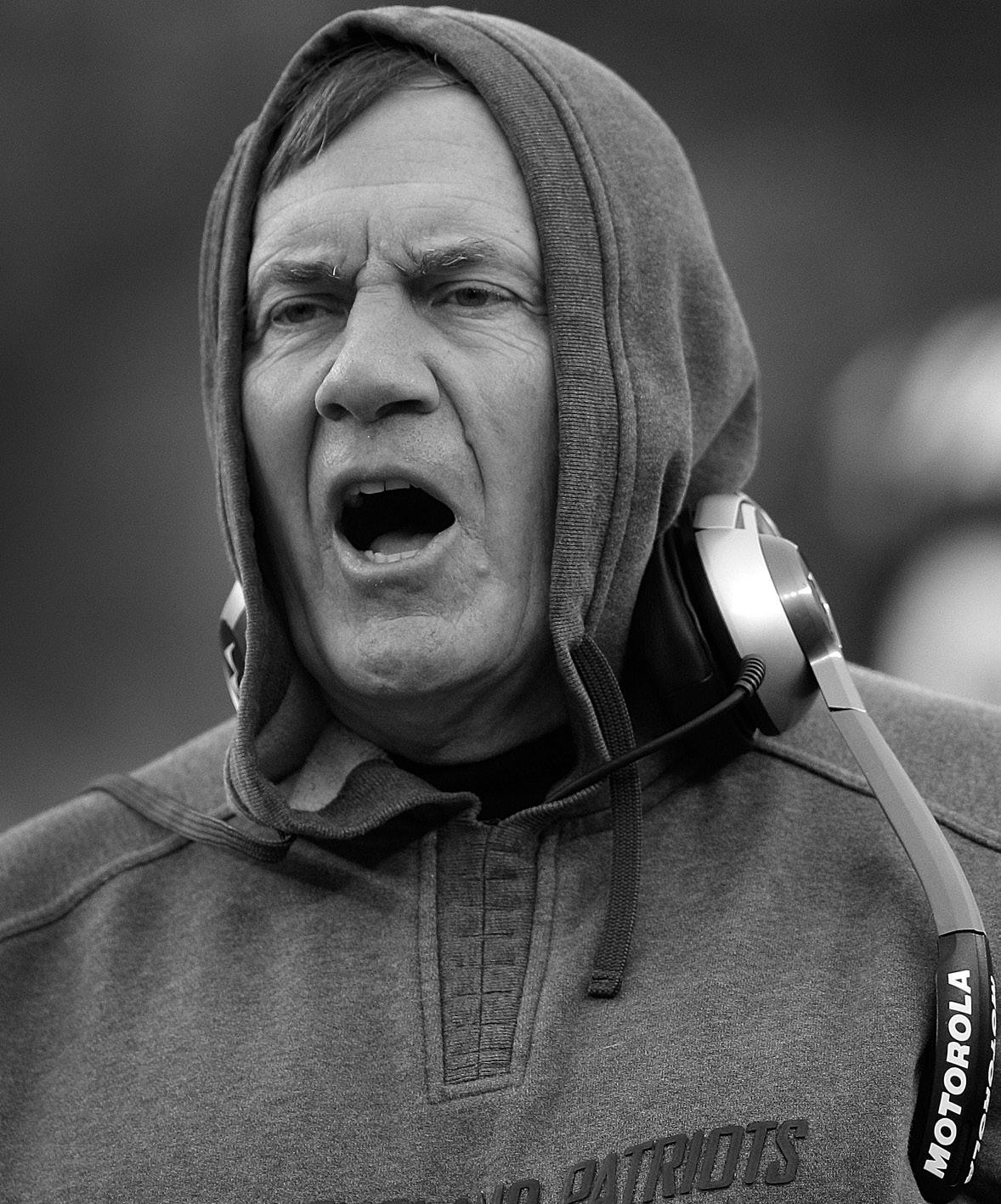
FOXBOROUGH, Mass. — Season opener or Super Bowl, every game is a big game to Bill Belichick.
His consistent approach to preparation for the next opponent, whether a powerhouse or a pushover, is the cornerstone of the coaching that has brought the New England Patriots to their fifth Super Bowl in 11 years.
The more intense the practices, the more prepared his players are for the game.
“You know what to expect week-in and week-out with him,” wide receiver Matthew Slater said. “The attention to detail is always there. It doesn’t matter if it’s a bye week or if it’s a divisional playoff round. He’s committed to winning and that commitment never falters, no matter what the circumstance, no matter how much success we’ve had or how many games we may have lost in a row.
“That commitment to winning is always there.”
During practices, Belichick strolls the field, sometimes twirling his whistle on a lanyard, other times stopping to talk with players. His daily message is simple — get the fundamentals right and just do your own job while preparing for the uniqueness of the next opponent.
That’s resulted in 10 straight victories, eight in the regular season and two in the playoffs. Another win on Feb. 5 against the New York Giants would give the Patriots their fourth Super Bowl championship.
“I think every game is a big game,” Belichick said Tuesday. “Every time we get an opportunity to compete then we try to take advantage of the time leading up to that opportunity — the practice week, the preparation, the film study, understanding our game plan and our adjustments, all of those kinds of things.
“What else is there to work on but the game, the next one on your schedule, the one that you’re playing? You try to cover all your bases for that game, you play it, and then you start the process all over again with the next one.”
Right guard Brian Waters played his first 11 seasons with the Kansas City Chiefs. But when he signed with the Patriots on Sept. 4, eight days before the season opener, he quickly sensed the difference in Belichick’s style.
“I wasn’t here in training camp but, from day one, I can tell that he’s all about the details,” Waters said. “He’s all
UNPLANNED PREg NANCY? Don’t go it alone. Notre Dame has many resources in place to assist you. if you or someone you love needs confidential support or assistance, please call Sr. Sue Dunn at 1-7819 or Ann Firth at 1-2685. For more information, visit ND’s website at: http://pregnancysupport@nd.edu
about everybody doing their own job and staying in their lane. Everybody has their own responsibilities. That’s something that you learn early on and that’s something that he still makes sure that we understand today.”
Another part of the Belichick playbook: Don’t focus on the past or far into the future, just on the next practice and the next game.
That’s a big enough workload, considering how hard he pushes his players.
James Ihedigbo didn’t start a game the past three seasons with the New York Jets, but did go to AFC championship games the past two seasons. The Jets lost both. This season he started 12 of 16 games at safety for the Patriots and reached the Super Bowl.
The Patriots are special, he said, “because we prepare. We prepare harder than any other place that I’ve played and it definitely gets you focused in on your opponent and knowing them and understanding their strengths and how they want to attack you.
“So that’s what we’re keyed in on this week.”
And this season’s playoff wins over Denver, 45-10, and Baltimore, 23-20, are fading rapidly from players’ minds.
“It has been going on all year and you just have to put every-
Today’s joke by John, the dining hall greeter: what’s the No. 1 cause of divorce? Marriage.
Today’s poem by John: i crept upstairs, my shoes in hand Just as the night took wing And there, four steps above i saw my wife doing the
thing
thing in the past,” tight end Rob Gronkowski said. “If you have a good game, that is all over with and you just have to keep moving on forward to the future and make sure you have a good practice week.”
Running back Stevan Ridley, drafted in the third round last April, was the team’s secondleading rusher during the regular season. When the playoffs began, he didn’t notice much difference in Belichick’s intensity.
“You know coach Bill, man, every game is serious,” Ridley said, “playoffs, regular season, preseason.”
One of the Patriots’ most veteran players, left tackle Matt Light, also has played for just one head coach. Drafted in 2001, only Tom Brady and Kevin Faulk have been with the team longer.
What stands out most about Belichick is his “consistency, just his ability to stay focused to the nth degree and do that repetitively, week-in and week-out,” Light said. “It’s not an easy thing, obviously, running a team and putting up with a lot of guys like myself and the rest of the knuckleheads in that locker room.
“But you know what? I think that coming in and setting that example with our entire coaching staff and how he approaches everything, it makes it easy for all of us to fall in line.”
AP
Patriots head coach Bill Belichick leads his team to a 23-20 victory over the Ravens on Sunday in the AFC title game.
All-Star catcher Posada retires after 17 seasons in New York
Posada was drafted by the Yankees in 1992 and won five World Series championships in the pinstripes
Associated Press
NEW YORK — Jorge Posada was watching television when he saw speculation on which teams were interested in signing him as a free agent.
“They put my face on different uniforms,” he said. “And it didn’t look good.”
He began a Yankee and ended as a Yankee, spending his entire career in pinstripes.
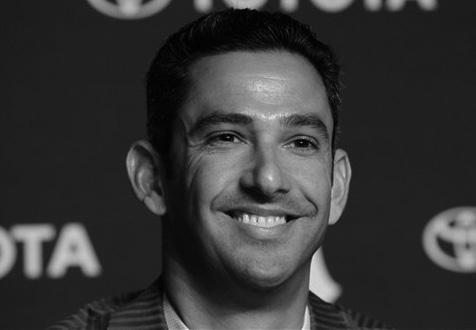
Flanked by his wife and children, with five World Series trophies sitting on a table to his right, the five-time All-Star catcher retired at age 40 on Tuesday
after 17 major league seasons. He finished with a .273 career batting average, 275 home runs and 1,065 RBIs.
At a crowded Yankee Stadium news conference, Derek Jeter, Mariano Rivera and CC Sabathia were among those who watched Posada fight off tears as he sat on a dais with wife, Laura, 12-yearold son Jorge Jr. and 9-year-old daughter Paulina. It was clear the rest of the family also wanted to be Yankees lifers.
“This is so cool,” Paulina said to her dad as she picked up the cardboard in front of her seat with her name and the famous interlocking “NY” logo. “I’m going to keep this.”
Posada joins Bernie Williams and Andy Pettitte in retirement, leaving only the 37-year-old Jeter and 42-year-old Rivera from the core group that led the Yankees to four World Series titles in five years from 1996-2000.
“Mariano said this is it. He says one more year. But Derek says he’s got like three more to go. So we’ll see,” Posada said, adding he didn’t expect the great closer to quit after next season.
“I don’t think about it right now. But the time will come,” Rivera said. “Definitely the time will come when I’ll have to just admit it and hang (up) the glove and the uniform and move on. We all go through that.”
Jeter, the Yankees’ captain and leader, expects to outlast Rivera.
“Mo’s still got to go first. He’s a lot older than me,” he said before adding with a laugh: “Mo’s going to be here longer than all of us.”
Shrieking at success and fum-
ing over failure, Posada often was nuclear fission at the center of the Yankees and what became known as the Core Four. While Jeter and Rivera rarely reveals their feelings, and Pettitte does only on occasion, Posada has been a passionate open window into the Yankees, praising, strutting, venting and battling.
“We feel the same way; I’m just better at hiding it. But we feel the same way inside, and I think that’s why we’ve gotten along so well throughout the years,” said Jeter, who first played alongside Posada in the minors in 1992.
He has called him “Posado” for years, even since late Yankee Stadium announcer Bob Sheppard mispronounced his name when he pinch ran for Wade Boggs in Game 2 of the 1995 AL playoffs.
In the same room where Pettitte announced his retirement 11½ months ago, select season ticket holders were invited to sit in the audience.
Posada talked with great fervor about the team that drafted him on the 24th round in 1991.
“Every time I step through the Yankee Stadium doors,” he began, “I quoted Joe DiMaggio and said, I want to thank the good Lord for making me a Yankee.”
“I could never wear another uniform,” he said. “I will forever be a Yankee.”
Posada’s voice broke up, especially when he spoke in Spanish. He thanked his teammates, rubbing his chin three times and wiping his eyes. He called Rivera “my brother” and praised Jeter “who helped me stay focused and positive.”
“Hopefully you won’t miss me that much,” he said.
Diana Munson, wife of the late Yankees catcher Thurman Munson, spoke admiringly of Posada, who kept a quote from her husband in his locker: “Batting fourth and being in the lineup is important, but I think the stuff I do behind the plate is more important.” One day at Yankee Stadium, Posada sat next to her and told her about his admiration for the former captain, who died in a plane crash when Posada was 7. She wound up following Posada in the box scores.
“He in fact is the one who brought me back to baseball again. After losing Thurman, I kind of lost my heart for baseball,” she said. “He plays the game I think the way Thurman played it: a lot of grittiness, lot of toughness. ... I think he and Thurman would have been best buds. He definitely has the it
factor. I can’t describe it. I don’t know what it is. But I knew immediately upon meeting him that he had it, and I think the Yankee fans also have realized that, and I imagine they’re as sad today as we all are.”
She was followed by a video of fan tributes and by Lisa and Brett Niederer from Bristol, Wis. She talked about the Jorge Posada Foundation and its emotional support and financial assistance to families affected by craniosynostosis, a disease that causes bones in the skull to fuse prematurely.
Jorge Jr. has had nine operations, and Lisa Niederer was watching on television when the father and son went onto the field together during the introductions for the 1992 All-Star game. Brett, then 2½, was diagnosed the disease around the start of that year, and they talked about the Posada family’s assistance.
“I knew we were not alone anymore,” said Lisa, who has become a mentor for the foundation.
When the focus returned to baseball, Posada recalled how he started his professional career as a shortstop, was moved to second base and was asked by the Yankees to move to catcher after the 1991 season.
“I felt like it was the worst decision ever,” he said, remembering all the passed balls he allowed while catching top draft pick Brien Taylor. “It was not a pretty sight.”
He went on to have one of the better offensive careers by a catcher. The switch-hitting Posada made the decision to retire during a season that turned tumultuous May 14 when he was batting .165 and was dropped to No. 9 in the batting order against Boston. He asked to be taken out of the lineup, saying he wasn’t ready to play.
Posada rallied to hit .268 for the rest of the season, leaving him with a .235 average, 14 homers and 44 RBIs. And then on Sept. 21, his two-run pinch-hit single beat Tampa Bay to clinch the AL East and earn another huge ovation. He hit .429 (6 for 14) in the five-game loss to Detroit in the division series.
Yankees manager Joe Girardi and general manager Brian Cashman said that was just a blip in his career — part of Posada’s fiery disposition, the one that drew fans to him, one that he may take with him into coaching or managing — after the Yankees likely honor him with a tribute this year.
Jorge Posada smiles during a press conference Tuesday at Yankee Stadium in New York to announce his retirement.
Navy football to join Big East conference
Associated Press
NEW YORK — Navy is headed to the Big East, giving up more than 130 years of football independence to join a conference that is in the middle of a massive overhaul.
The Big East announced Tuesday that the U.S. Naval Academy has accepted an invitation to join the league for football only, starting in 2015. The conference has now added six new members in the last seven weeks after losing three members and having another school renege on a future commitment in the fall.
“Stability in the Big East was a very important aspect in our discussions with the commissioner,” Vice Admiral Michael Miller, superintendent of the U.S. Naval Academy, said during a teleconference. “What we see is a very bright future for the conference.”
Navy has been playing football since 1879 without conference affiliation, but academy officials said they believe independence will be too difficult to maintain as other powerful leagues grow. Athletic Director Chet Gladchuk said scheduling games late in the season, landing desirable television deals and securing bowl bids will become a problem for Navy.
“Opportunities to exist as independents into the future are clearly in jeopardy,” he said.
Gladchuk said Navy and the Big East have been talking about the Midshipmen joining the league for a decade, but those talks got serious about a year ago— before the Big East was beset by defections.
“It’s a marriage our membership has longed for for many, many years,” Big East Commissioner John Marinatto said.
Navy football has been thriving over the last decade. The Midshipmen played in eight straight bowl games before slipping to 5-7 this season and have won a record 10 straight games against rival Army. But Navy’s schedule will get tougher playing in the Big East, while keeping its rivalry games against Army, Air Force and Notre Dame.
“We have a definite challenge ahead of us,” coach Ken Niumatalolo said. “I feel like there’s drift happening between the haves and havenots (in major college football), and I want to be with the haves.”
Gladchuk said the Big East will
allow Navy to maintain its annual rivalries with Army, Air Force and Notre Dame, and that the Army-Navy game will still be the season finale for both teams, regardless of when a future Big East championship game is played.
“The Army-Navy game remains on that second Saturday in December,” he said.
Gladchuk also said that Navy’s television deals with CBS and CBS Sports Network had to be accommodated by the Big East.
“Partnership with CBS was one of the reasons this agreement took a little time to finalize,” he said.
CBS owns the TV rights to the Army-Navy game and Navy’s home games against Notre Dame through 2018. Navy has a separate deal with CBS Sports Network for the TV rights to its other home games that runs through 2017.
“We have a great relationship with the academies, and our deals will be grandfathered for the length of our contracts” said Mike Aresco, executive vice president for programming at CBS Sports.
The Big East’s current TV deals run through the 2013 football season. The league is hoping to land a new deal similar to the long-term, billion dollars contracts signed last year by the Atlantic Coast Conference and the Pac-12. The Big East needs to know its lineup beyond 2013 before it can negotiate with a television network.
In December, the Big East added Boise State and San Diego State as football-only members and SMU, Houston and Central Florida in all sports. Those schools will join in 2013.
“That Navy would give up 100 years of football independence speaks to the long-term viability of the Big East,” Marinatto said.
The Big East is trying to build a 12-team football conference with an eastern and western division and a league championship game.
The conference is losing Pittsburgh and Syracuse to the Atlantic Coast Conference andWest Virginia to the Big 12, but it’s unclear when.
West Virginia filed a lawsuit against the Big East so it can join the Big 12 in 2012. The Big East sued West Virginia to make the school abide by the league’s 27-month notification period, which would keep the Mountaineers in the conference through the 2013-14 school year.
T’wolves, Love stall on extension
Associated Press
Timberwolves president David Kahn has remained confident that a deal will be completed and Love has done nothing to discount that stance. Coach Rick Adelman said Tuesday that he doesn’t think it’s been a distraction to the team, but did say he can tell it is on his best player’s mind.
“I’m sure it is for him,” Adelman said. “It’s a big deal. Something’s obviously going to have to happen by (Wednesday), so we’ll see.”
Love — who ranks fifth in the league with 24.9 points per game, second with 13.9 rebounds and first with 39.4 minutes — declined to comment after practice, clearly tired of answering questions about a situation that he has been discussing for most of the season.
“I’m not worried about it,” Love said Monday before the loss to the Rockets. “I’m in a good situation regardless of what happens and I just want to continue to keep playing good basketball.”
The new collective bargaining agreement allows the Timberwolves to offer Love more money than any other team. They can offer him a maximum salary contract of four years and roughly $60 million, or they can choose to use their one-time “designated player” contract for five years and around $80 million. Each team can only use one five-year contract during the term of the CBA, so the Wolves would like to save that chip to use give them as much salary cap flexibility in future years as possible.
But after seeing UCLA classmate Russell Westbrook get the five-year deal in Oklahoma City, which also has superstar Kevin Durant on the roster, there is no doubt that Love would prefer a similar level of security and status.
If no deal is reached and Love becomes a restricted free agent, the Timberwolves would be able to match any offer he signs with
another team. Love could also decide to play next year for $6.1 million and become an unrestricted free agent in 2013, but that carries considerable risk if he suffers a serious injury before then.
“Of course he’s thinking about it because it’s in every newspaper across the world,” teammate and friend Michael Beasley said. “As far as his play, Kevin’s tough mentally. He’s going to go out there and give it what he’s got every night.”
Love certainly has shown no signs of the situation affecting his play. He hit the game-winning 3-pointer at the buzzer on Friday to beat the Los Angeles Clippers,
then fought through illness to score 39 points and grab 12 rebounds in the loss to Houston on Monday night.
“Kevin’s been consistent in his games and that’s all you can ask for,” Adelman said.
The feeling around Target Center has been that a deal will eventually get done, with the only question being the length of the contract.
In previous years, this situation would have been settled long before this point.
But the lockout has thrust it into the heart of the team’s season, and that’s been an adjustment for everyone.
AP Timberwolves forward Kevin Love attacks the basket during Minnesota’s 107-92 loss to Houston on Monday.
Fielder signs with Tigers to fill void left by injury
Associated Press
DETROIT — The Detroit Tigers responded to a jarring injury with an audacious move.
Free-agent first baseman Prince Fielder and the Tigers agreed Tuesday to a nine-year, $214 million contract that fills the AL Central champions’ need for a power hitter, a person familiar with the deal said.
Detroit boldly stepped up in the Fielder sweepstakes after the recent knee injury to star Victor Martinez. A week ago, the Tigers announced the productive designated hitter could miss the entire season after tearing his left ACL during offseason conditioning.
The person told The Associated Press the deal was subject to a physical. The person spoke on condition of anonymity because the contract was not yet complete.
The Tigers won their division by 15 games before losing in the AL championship series to Texas. Adding the 27-year-old Fielder gives the Tigers two of the game’s premier
sluggers, pairing him with Miguel Cabrera.
With Fielder now in the fold, general manager Dave Dombrowski and owner Mike Ilitch have a team that figures to enter the 2012 season as a favorite to repeat in the division — with an eye on winning the franchise’s first World Series title since 1984.
“Everyone knew Mr. Ilitch and Mr. Dombrowski were going to make a move when Victor went down,” outfielder Brennan Boesch said in a phone interview with the AP. “But I don’t think anybody thought it would be this big.”
The move also keeps Fielder’s name in the Tigers’ family. His father, Cecil, became a big league star when he returned to the majors from Japan and hit 51 home runs with Detroit in 1990.
Cecil played with the Tigers into the 1996 season, and young Prince made a name for himself by hitting prodigious home runs in batting practice at Tiger Stadium.
A few years ago, when Prince returned to Detroit as a member
“You can’t ever say that you look at a kid that age and say that you know he’s going to hit 40 or 50
home runs someday, but Prince was unbelievable,” Kaline said then. “Here’s a 12-year-old kid commonly hitting homers at a big league ballpark.”
In an interview with MLB Network Radio on SiriusXM, Cecil Fielder said he was “shocked” by the news that Prince was heading to Detroit.
“He’s been there in Detroit most of his young life so I think he’ll be comfortable in that place,” Cecil Fielder said. “I know Mr. Ilitch is probably excited because he’s been wanting that kid since he was a little kid, so he finally got his wish.”
With Cabrera and Fielder, Detroit will begin this season with two players under age 30 with at least 200 career homers. According to STATS LLC, that’s happened only once before.
At the start of the 1961 season, the Milwaukee Braves featured 29-year-old Eddie Mathews (338 homers) and 27-year-old Hank Aaron (219).
Several teams had shown interest this winter in Fielder, who had spent his entire career with the Brewers.
He visited Texas, and the Washington Nationals also got involved in the discussions.
The beefy slugger hit .299 with 38 home runs and 120 RBIs last season. He is a three-time All-Star and was the MVP of last year’s event in Phoenix.
Fielder has averaged 40 homers and 113 RBIs over the past five years. He’s also been among the most durable players in the majors, appearing in at least 157 games in each of the last six seasons.
Fielder hits left-handed, while Cabrera is a righty. Manager Jim Leyland will get to decide where to put them in the batting order.
“I don’t think there’s a better right-left combo in any lineup in baseball,” Boesch said. “I’m sure Skip’s wheels are already turning on how to set them up.”
The deal is only the fourth $200 million contract in baseball history, following Alex Rodriguez’s $275 million, 10-year contract with the New York Yankees,
A-Rod’s $252 million, 10-year deal with Texas and Albert Pujols’ $240 million, 10-year contract last month with the Los Angeles Angels.
Among current players, Fielder’s $23.78 million average salary is behind only A-Rod ($27.5 million),Ryan Howard ($25 million), and Cliff Lee and Pujols ($24 million each).
Dombrowski indicated last week he’d probably seek a short-term solution to Martinez’s injury, but he left himself some wriggle room, saying it depended who the replacement was.
of the Milwaukee Brewers, Tigers Hall of Famer Al Kaline recalled that power show.
Former Brewers first baseman Prince Fielder hits a home run during Milwaikee’s 4-3 win over the Cardinals on June 12, 2011. Fielder signed a nine-year, $214 million deal with Detroit on Tuesday.
Wizards fire Saunders after torrid 2-15 start
Wizards coach Flip Saunders watches as his team loses in Philadelphia on Monday. The Wizards fired Saunders Tuesday.
Associated Press
WASHINGTON — Flip Saunders was fired Tuesday as coach of the NBA-worst Washington Wizards and replaced by assistant Randy Wittman, who has the job for the rest of the season.
The Wizards fell to 2-15 this season, including 0-7 on the road, with a 20-point loss to the Philadelphia 76ers on Monday. Washington’s next game is at home Wednesday against the Charlotte Bobcats.
“We felt the team had become unresponsive, and we will look to Randy to provide a different voice and a change in philosophy moving forward,” Wizards president Ernie Grunfeld said in a statement released by the team. “We have been transparent in how we would evaluate our team this season and we were disappointed in the lack of development of our players at this point in our rebuilding plan.”
Saunders was in his third season with the Wizards, going 51130. When he was hired, the roster featured All-Stars Gilbert Arenas, Antawn Jamison and Caron Butler, but the franchise is now rebuilding around point guard John Wall, the No. 1 overall pick in the 2010 draft.
But there is not a lot of help for Wall, and the Wizards have been prone to inconsistent play, often failing to even be competitive this season. On Monday, they walked down the court for offensive possessions, never hustled after loose balls and couldn’t convert the easiest of buckets, missing eight of nine shots in the paint in the first quarter.
After one string of sloppy plays, Saunders took a knee in front of the scorer’s table, bowed his head and rubbed his temples.
After the game, Wall said: “Whoever got the ball just took a shot. Guys are holding their heads down, and we’re not fighting or competing.”
Back in December, before the lockout-shortened season began, Saunders tried to look on the bright said, saying he could envision how the young Wizards could improve on their 23-59 record from 2010-11.
Seagulls descend upon Open
Associated Press
MELBOURNE, Australia — Evening sessions at this year’s Australian Open are starting to resemble a remake of the Alfred Hitchcock horror movie, “The Birds.”
In search of locusts, swarms of seagulls have been circling Melbourne Park, occasionally swooping down to capture the tasty treats below.
On Monday, it was Novak Djokovic who seemed unnerved. The defending champion was in cruise control against Lleyton Hewitt, leading by two sets and 3-0 on Rod Laver Arena.
Then the birds came in. Djokovic smiled at the unusual holdup but he lost six of the next seven games in dropping his first set of the tournament, before winning through in four sets.
The birds swooped again a day later. Second-ranked Rafael Nadal was leading 5-4 in the first-set tiebreak Tuesday against Tomas Berdych when the birds appeared. Nadal paused briefly and looked up at them — and didn’t win another point in the set.
Wimbledon’s pigeon problem became so serious that the tournament employed a hawk to scare off the pests. Named Rufus, the bird of prey even has its
own accreditation pass.
Handlers are often seen walking the grounds of Melbourne Park with birds of prey on their arms — but they are only really for show and don’t seem to be acting as much of a deterrent.
Australian Open organizers say the swarms of seagulls are a “highly unusual occurrence and we are looking at ways of preventing it in the future.”
The birds are taking a risk by flying by a tennis court. Ten years ago, a small bird chased a moth across Rod Laver Arena and was struck down and killed by a forehand hit by French player Michael Llodra during a men’s doubles semifinal.
“I want to compete for the playoffs,” the coach said then.
But Washington got off to a franchise-worst 0-8 start — half of the losses were by at least 18 points — before beating the Toronto Raptors. Curiously, the Wizards’ only other victory came against Kevin Durant and the Oklahoma City Thunder.
Saunders tried finding different ways to motivate players such as Andray Blatche, who was made a captain for the season-opening game, and tinkered a bit with the lineup. But nothing seemed to get things going in the right direction.
Asked after what turned out to be his last game with Washington how he can change the way the Wizards are performing, Saunders said Monday night: “You try to put different lineups in, play a lot of different people, try to do some different things.”
Before joining the Wizards, Saunders coached 13 NBA seasons with the Minnesota Timberwolves and Detroit Pistons, reaching the conference finals a total of four times.
continued from page 20
four consecutive Big East games.
“I look at Seton Hall being very due, coming back home after losing two in a row on the road, something that we just went through,” Brey said. “In this league you come home and get back on track, and they will be ready to roll.”
Notre Dame is 6-6 alltime at Seton Hall and are 16-7 overall against the Pirates since joining the Big East in 1995.
The Irish and Pirates will tip-off at 8 p.m. on Wednesday at the Prudential Center in Newark, N.J.
Contact a ndrew o wens at aowens2@nd.edu
Flyers defeat Panthers in shootout
Associated Press
SUNRISE, Fla. — Claude Giroux’s minor adjustment gave the Philadelphia Flyers their first shootout victory of the season.
Giroux scored the only goal in the shootout and the Flyers beat the Florida Panthers 3-2 on Tuesday night.
The All-Star forward beat Scott Clemmensen on the stick side to give the Flyers their first shootout victory in four tries this season. He paused before he got to the crease and found an opening.
“I just wanted to switch up a little bit, go fast and slow down and try different things,” Giroux said. “It was good to help the team.”
Brayden Schenn and Jakub
Voracek scored in regulation for the Flyers, and Sergei Bobrovsky made 23 saves. Bobrovsky also stopped three attempts in the shootout, after going 0 for 5 previously this season.
Mikael Samuelsson and Tomas Fleischmann had goals for Florida, and Clemmensen made 35 saves.
The injury-depleted Flyers played eight rookies.
“We’ve got a lot of injuries and missing a lot of key guys but these young guys go out there and do their job and play hard. They want to stay in the lineup,” Flyers coach Peter Laviolette said.”It was nice to get a shootout win. There haven’t been a lot of them. It was good to get one, on the road, before the break.”
The Panthers are 3-6 in the shootout this season.
“We’ve got to figure out a better formula in the shootout,” Panthers coach Kevin Dineen said. “We’re just losing too many points up for grabs and not ending up in our back pocket.”
The Panthers tied it 2-all on Fleischmann’s goal in the second. Kris Versteeg grabbed the puck as it rebounded off the side boards. He skated in on Bobrovsky, then passed from the side of the crease back to Fleischmann in front, who wristed it in at 15:40.
“It was just a pass off the wall
and taking it to the net,” Versteeg said. “Flash made a great play to put it in the net.”
The Flyers took a 2-1 lead on Voracek’s goal at 17:59 of the first. Tom Sestito grabbed the puck in the right circle and his pass to Voracek was tipped in between Clemmensen’s pad and the post.
The Panthers took a 1-0 lead during a power play 2:49 in.
A shot by Stephen Weiss was blocked. The puck came out to Brian Campbell in the left circle, who passed across to Samuelsson above the right circle. His slap shot beat Bobrovsky on the stick side.
The Flyers tied it on Schenn’s odd goal at 10:34, also during a power play. Schenn’s shot hit Clemmensen’s right skate and bounced up in the air, landing on his right shoulder. The puck trickled down his back and crossed the goal line just before a Flyers player dislodged the net. The goal was reviewed and the call on the ice was upheld.
“It just went straight up and straight down. I was just hoping I’d get a break there and it would go in,” Schenn said. “We got a lucky break there and it’s nice when it works like that.”
Sharapova advances to semifinals
Associated Press
MELBOURNE, Australia — Former and reigning Wimbledon winners Maria Sharapova and Petra Kvitova will meet in the Australian Open semifinals after both won in straight sets on Wednesday.
Sharapova won 6-2, 6-3 against fellow Russian Ekaterina Makarova, who knocked out fivetime champion Serena Williams in the previous round.
Kvitova earlier reached the semifinals at Melbourne Park for the first time with a 6-4, 6-4 win over unseeded Italian Sara Errani.
Kvitova beat Sharapova in last year’s Wimbledon final to claim her first Grand Slam title.
“Obviously it was a tough one at Wimbledon,” Sharapova said. “She’s full of confidence and playing the best tennis right now. I look forward to it.”
Sharapova and Kvitova also kept alive their chances of claiming the top ranking, which Caroline Wozniacki will vacate on Monday after her quarterfinal loss to Kim Clijsters.
The fourth-seeded Sharapova must repeat her 2008 Australian title win. Kvitova only has to match or better the run of Victoria Azarenka, the only other player still in the running this week for the No. 1 spot.
Sharapova has dropped one set and lost 21 games en route to her first Australian Open semifinal since she won the 2008 final — the last of her three major titles.
“It’s been a long road back to this stage,” said Sharapova, who spent 10 months off court with a shoulder injury that required surgery later in 2008.
Kvitova was far from her best against an opponent making her debut in a Grand Slam quarterfinal, and with a 0-24 record
against top-10 players. The second-seeded Czech made 44 errors and had to come back from a break down in the second set.
“I was a little nervous because I knew that everybody expect it will be easy match,” Kvitova said. “Probably I had in my head that it’s a good draw.”
The men’s semifinal lineup also will be completed Wednesday.
Defending champion Novak Djokovic is up against fifthseeded David Ferrer in the first match of the night session. Twotime finalist Andy Murray faces Kei Nishikori of Japan.
Two of the so-called “Big Four,” Roger Federer and Rafael Nadal, are already through to a marquee semifinal after winning Wednesday.
Federer beat 2009 U.S. Open champion Juan Martin del Potro 6-4, 6-3, 6-2 in his 1,000th tourlevel match. Nadal rallied for a 6-7 (5), 7-6 (6), 6-4, 6-3 win over Tomas Berdych.
Their match on Thursday will be their 27th in all and 10th at a major, but their first in a Grand Slam semifinal since 2005.
Yelling “Vamos,” disputing line calls, pumping his arms after winning big points and bounding around like a hyperactive kid, Nadal ripped winner after winner against Berdych in a 4-hour, 16-minute display of pure intimidation.
He said he was nervous in the first set — he’d lost in the quarterfinals two straight years — but by the third and fourth sets things had changed.
“The character on court, the way to win the points ... the level is very positive, much, much better than the end of the season,” he said. “Semifinals is fantastic result for me.”
Federer finished his match with one of his classic, one-handed backhands against Del Potro,
one of only two men who have beaten him in a major final. The other is Nadal, who has done it six times.
That lopsided record aside, there’s a touch of extra tension this time in this usually cordial rivalry. Nadal had told Spanish reporters during a discussion about player discontent that Federer liked to protect his reputation as a gentleman by saying nothing negative in public and letting others “burn.”
Both have since played down the comments. On Tuesday, Federer said it didn’t damage their relationship.
“No. No. Honestly, no,” he said. “It was here for one day and then gone again. I’m happy about that because it didn’t deserve more attention than it did. So for me, it’s another great match with Rafa. ... Obviously I’d like to play Rafa because of our great epic match earlier in the finals here a few years ago.”
Thursday’s match will be the first time they have met at Melbourne Park since Nadal won the 2009 title in five seesawing sets. Nadal collected the trophy from the great Rod Laver after consoling Federer as he sobbed in the background.
“We are talking about a player who has won 16 Grand Slams, and I’ve won 10,” Nadal said. “We have played a lot of matches together, many in very important moments for our careers. So the matches against him are always special, even if we are (ranked) 20 against 25.”
The other women’s semifinal will feature defending champion Clijsters against third-seeded Azarenka. Clijsters advanced with a 6-3, 7-6 (4) win over Wozniacki, who remains without a major title. Azarenka rallied for a 6-7 (0), 6-0, 6-2 win over eighth-seeded Agnieszka Radwanska.
AP
Flyers’ center Claude Giroux scores the game-winning goal in a shootout during Philadelphia’s 3-2 win Tuesday in Florida.
Track
continued from page 20 soreness and continuing to run.”
Barber’s efforts helped her garner the Big East Track and Field Athlete of the Week award for the week of Dec. 6th.
“I was shocked when I found out I was named Big East Athlete of the Week,” she said.
Her success and hard work has not gone unnoticed by teammates, either.
“Kaila’s doing awesome this year,” senior captain Maddie Buttinger said. “We have a lot of freshmen and it’s nice to see her get right in and do really well. She’s a really hard worker and it’s nice to have someone like that as a teammate. She’s got a great work ethic; to have her working hard is good for both practice and meets.”
Barber, whose favorite event is the 400-meter hurdles, acknowledged that a lot of her early success is a function of the support from her coaches and teammates.
“The older teammates really helped with the adjustments needed for college and always supported myself and the rest of the new runners here,” she said.
“Coach Turner has been a big help with explaining why we do certain drills and exercises.”
Barber and the rest of the Irish look to continue their success this weekend at the Indiana Relays in Bloomington, Ind.
Contact l aura Coletti at lcoletti@nd.edu
Peters
continued from page 20 all of her season-high 20 points in the first half. The scoring run was uncharacteristic for the forward, who said her primary role on the team is usually not the leading scorer.
“I’m not really big into getting a bunch of points,” Peters said “There are plenty of people on the team who are scorers.
When I have big nights, that’s great, but I don’t focus on it.”
Before halftime against Villanova, Peters scored more than the entire Wildcats team combined.
“After [the first half] they paid attention to me a little more and that opened everyone else up,” Peters said. “[Senior guard] Natalie [Novosel] and [junior guard] Skylar [Diggins] started hitting [shots]. They seemed to focus on me a little more.”
Peters averages 11.8 points per game over the season, but pushed her average up during No. 2 Notre Dame’s win over No. 7 Tennessee on Monday with 16 points.
Though Peters is on a scoring run over the last three games, she knows when to get rid of the ball and she does it well, sophomore guard Kayla McBride said.
“[Peters] sees the court really well,” McBride said. “She sees the double team and decides if she should lob or skip it. It’s something we work on in practice everyday, and she has been here for a while, so
Trine
continued from page 20 Belles. Together with senior guard Katie Sullivan, they form a core group of senior leaders that Henley said she expects to take charge against Trine on Nov. 30.
“As we face Trine on Wednesday, I am expecting all five of our seniors to step up for us ... more so at the defensive end,” Henley said.
Although they are averaging an MIAA third-best 63.1 points per game this season, the Belles rank second-to-last in scoring defense at 64.2 points
she knows what to do.”
When Peters is set up to score, she said she has faith in the Notre Dame guards to find her.
“I just run the floor, and Skylar is going to find me because she knows where I’m going to go,” Peters said. “The guards do a great job of finding me. I really just run down the floor, and they get me the ball.”
Her 16 points against Tennessee matched her career-high 16 rebounds, good enough for her fourth double-double of the season and the 15th of her career.
Irish coach Muffet McGraw told the team before the Tennessee game that she was looking for a drastic improvement in rebounds, Peters said.
“We got yelled at by coach, and that’s a lot of motivation to do what you’re supposed to do,” Peters said. “We knew rebounding was going to be really important coming in.”
She also became the first Irish player to reach at least fifteen rebounds and points since guard Lindsay Schrader (’09) did so against Cincinnati on Jan. 31.
According to Peters, getting rebounds requires the tenacity she brings in each game.
“It’s about what you’ve got to do to win the game,” she said. “If you’re going to be soft, you’re going to lose.”
Peters and the Irish will travel to New York to take on St. John’s on Saturday. Tip-off is scheduled for noon.
Contact Molly Sammon at msammon@nd.edu
Casey
continued from page 20
Casey said. “I was really surprised since I didn’t even know if I was eligible to make it.
With her spot on the national team secured, Casey will have the opportunity to compete for her country on an international stage, as the top four swimmers in each event are selected for international competitions. Additionally, she will travel to the United States Olympic Training Center in Colorado Springs, Colo., in April to meet other team members as well as swimming coaches from the national team.
For now though, Casey said she is enjoying the honor of being a National Junior Team member and applying the lessons learned from national competitions to her collegiate meets.
“Swimming in the national championships was definitely a lot of pressure and made me very nervous,” she said. “I think that being exposed to that kind of pressure beforehand has helped prepare me for big races like the Big East championships that are at the end of this month.”
With this exposure to pressure and tough competition, Casey has stepped in as a freshman to deliver several strong performances for the Irish. She has continued to excel in the 200-meter butterfly, winning the event at last Saturday’s meet against Michigan State and turning in her personal best time in the event at the Ohio State Invitational in October. She has also enjoyed success in the 1000-meter freestyle, an event that was foreign to her when she arrived at Notre Dame, earning two top-three finishes in the event.
“I definitely think that I’ve adjusted very well and adapted to my new coaches, surroundings and teammates,” Casey said. “I’m
really happy that I’ve had the opportunity to help out and score points for the team.”
She also cited the close-knit culture of the team, especially among the freshman swimmers, as being instrumental in helping her make the adjustment to college swimming.
“Everyone on the team gets along really well, and we all push each other to do really well in practice,” she said. “We all really want to work hard and reach our goal of winning the Big East this year.”
Casey, however, doesn’t need to talk to just her teammates to hear some perspective on college swimming. In fact, she doesn’t even need to leave her house to hear such perspective. That’s because she happens to be related to four former Notre Dame swimmers. Casey’s father (Don Casey), uncle and two sisters all competed for the Irish during their time as students, ingraining Notre Dame into Casey’s life from a young age.
“I’ve been coming to Notre Dame since I was two years old,” Casey said. “Seeing [my sister] Katie on the team and hearing how much she loved it was a huge influence on my decision to come here. It was always my dream to come here.”
Following in the footsteps of her family members is not an easy task, but Casey said she feels as though she has started to make a name for herself.
“I was a little nervous coming in since I was curious to find out if I would just be known as Katie’s little sister or Don Casey’s daughter,” she said. “But I started with a clean slate and everyone knows me as Bridget Casey, the incoming freshman who swims the 200fly.”
Casey and the rest of the Irish will compete in the Shamrock Invitational on Friday all day at the Rolfs Aquatic Center.
Contact Brian Hartnett at bhartnet@nd.edu
per game allowed.
Entering a crucial final month of the season, Henley picked out specific areas her team must improve in order to be successful as the season winds down, including the defensive end of the floor and the frontcourt.
“As a team, we need to get back to a more disciplined style of basketball,” Henley said. “We need to focus more on stopping the drives in transition and controlling the boards at both ends.”
Saint Mary’s will face off against Trine at home tonight at 7:30 p.m.
Contact Nick Boyle at nboyle1@nd.edu
COURTNEY ECKERLE/The Observer
Belles’ senior center Jessica Centa battles in the paint in a December 3 game against Alma.
Make
Published Monday through Friday, The Observer is a vital source of information on people and events in the Notre Dame and Saint Mary’s Community.
Join the more than 13,000 readers who have found The Observer an indispensable link to the two campuses. Please complete the accompanying form and mail it today to receive The Observer in your home.
Enclosed is $130 for one academic year
Enclosed is $75 for one semester
HENRy ARNOLD MIKE ARGIRION
Jumble
EUGENIA L AST
ALEx GRISWOLD and LEE HAGGENJOS
the london express
JOE MILLER and KELLy LyNCH
the Clammy handshake
January 25, 2012
nd Women’s traCk and fIeld men’s basketball
Freshman having big impact for the Irish
By LAURA COLETTI Sports Writer
It didn’t take long for Kaila Barber to make an impact for the Irish.
The freshman from Middleburg Heights, Ohio, who competes in sprinting and hurdling events, burst onto the scene during Notre Dame’s Blue-Gold Meet, the very first competition of the winter track season. Her impressive first outing included Big East championships qualifying marks in the 40-meter hurdles, the 400-meter race and the long jump. Barber took first in all three events, as well
smC basketball
as placing first in the women’s 4x400 meter relay.
Yet for the freshman, the transition from high school to collegiate track and field has almost been seamless.
“I think that the main difference between high school and college track is the amount of running you actually do,” she said. “High school track didn’t have nearly as many repeat practices or lifting days. The biggest adjustment I’ve had to make since coming here is pushing through the
see TRACK/page 18
Belles hope to continue momentum against Trine
By NICK BOYLE Sports Writer
Coming off a victory over Alma College, Saint Mary’s looks to start a winning streak when it hosts conference foe Trine tonight.
Saint Mary’s (8-10, 4-5 MIAA) used a late scoring run and clutch free throw shooting on Saturday to defeat Alma by 69-61.
“Anytime you can win on the road in this league, it is very important,” Belles head coach Jenn Henley said. “While I don’t believe we were satisfied with how we played against Alma, we were certainly glad to get the win. I think we hit some key free throws down the stretch to put the game
out of reach in the closing minutes.”
Saint Mary’s will look to keep its momentum from the win flowing into its second meeting with Trine (9-9, 3-6) this season. The Belles lost to the Thunder 67-59 in the teams’ first contest.
Saint Mary’s has been led this season by a balanced scoring attack, featuring four players averaging double figures. Seniors forward Jessica Centa, forward Kelley Murphy, guard Patsy Mahoney and guard Maggie Ronan all average at least 10 points per game for the
nd Women’s basketball
see TRINE/page 18
Anti-Piracy
By ANDREW OWENS Associate Sports Editor
Fresh off of a 67-58 victory over top-ranked Syracuse in a raucous atmosphere at the Purcell Pavilion, concluding with students and players celebrating at midcourt, the Irish look to win their second consecutive game Wednesday at Seton Hall. Notre Dame (12-8, 4-3 Big East) hits the road for the first half of a two-game road trip that will conclude Sunday at Connecticut. Senior guard Jordan Theodore and senior forward Herb Pope lead Seton Hall (15-4, 4-3), one of the league’s most improved teams, but the Pirates are riding a two-game losing streak heading into
Peters comfortable in her role
By MOLLY SAMMON Sports Writer
Irish graduate student forward Devereaux Peters had the week of her career over the last seven days. Against Villanova on Saturday and Pittsburgh on Jan. 17, Peters averaged 64 percent shooting from the field and 19.5 points, earning Big East Conference as the Player of the Week honors Monday. Simply put, Peters shined in the first-half of each game. Against the Panthers, Peters scored
see PETERS/page 18
tonight’s game.
“They’re off to a great start,” Irish coach Mike Brey said. “I have a lot of respect for them. There’s nobody in the league playing better than Theodore and Pope, and they’re men. They’re going to want to beat us up, they’re going to want to play some zone, so can we control the tempo?”
Brey said the Irish not only have to confront a talented Big East team on the road, but also the mental roadblock of putting Saturday’s win over Syracuse behind them.
“When I woke up today, we were 4-3 in the league, we’re not 6-3, and that’s the cold hard reality of the celebration. [The victory]
Women’s sWImmIng
was a great win and it was awesome, but we’re 4-3 in the league,” he said. “We’re playing a team Wednesday that’s lost two in a row on the road and they’ve been really good at home.
“I think the challenge is going to be: How will you come out after what you did Saturday, for this team still finding itself? I think most teams, it doesn’t make them bad teams, would have a problem going out there Wednesday after Saturday. Can we [avoid doing that] and maybe show some special signs?” Prior to the Pirates’ two-game skid, they won
see PIRATES/page 17
Casey uses national team experience at ND
By BRIAN HARTNETT Sports Writer
For most incoming college students, the summer before college represents one final joyous period of leisure, a time to reflect and recharge before advancing to the rigors of college. For freshman Bridget Casey, however, the final summer before college signified an opportunity to prove herself among the best of her sport and add a signature achievement to her stellar resume.
Mere weeks before arriving at Notre Dame, Casey competed in the ConocoPhillips National Championships at Stanford Uni-
versity. Facing top swimmers from across the nation, Casey finished 25th out of a field of 148 in her favorite event, the 200-meter butterfly. Casey later learned her performance had placed her fifth in the nation among 18-andunder swimmers in the event, earning her a spot on the prestigious USA Swimming National Junior Team.
“I actually didn’t even know I made the team until a few months later, when I was at school here and my old coach called to congratulate me,”
see CASEY/page 18
PAT COVENEY/The Observer
Irish graduate student Devereaux Peters shoots the ball against Tennessee on Monday during Notre Dame’s 72-44 win a Purcell Pavilion.
D iLLON wEiSNER/The Observer
Junior forward Jack Cooley battles with Syracuse sophomore Baye Moussa Keita for a loose ball during Notre Dame’s 67-58 victory Saturday at Purcell Pavilion.