The observer is the independent, daily newspaper published in print and online by the students of the University of notre dame du Lac and s aint mary’s c ollege. e ditorial content, including advertisements, is not governed by policies of the administration of either institution. The observer reserves the right to refuse advertisements based on content.
The news is reported as accurately and objectively as possible. Unsigned editorials represent the opinion of the majority of the e ditor-in- c hief, managing e ditor, Assistant managing e ditors and department editors. c ommentaries, letters and columns present the views of the authors and not necessarily those of The observer. v iewpoint space is available to all readers. The free expression of all opinions through letters is encouraged. Letters
ditor must be signed and must include contact information.
Questions regarding Observer policies should be directed to
Padanilam. Post
University plans ceremony
By ALEXANDRA MUCK and NATALIE WEBER news Writers
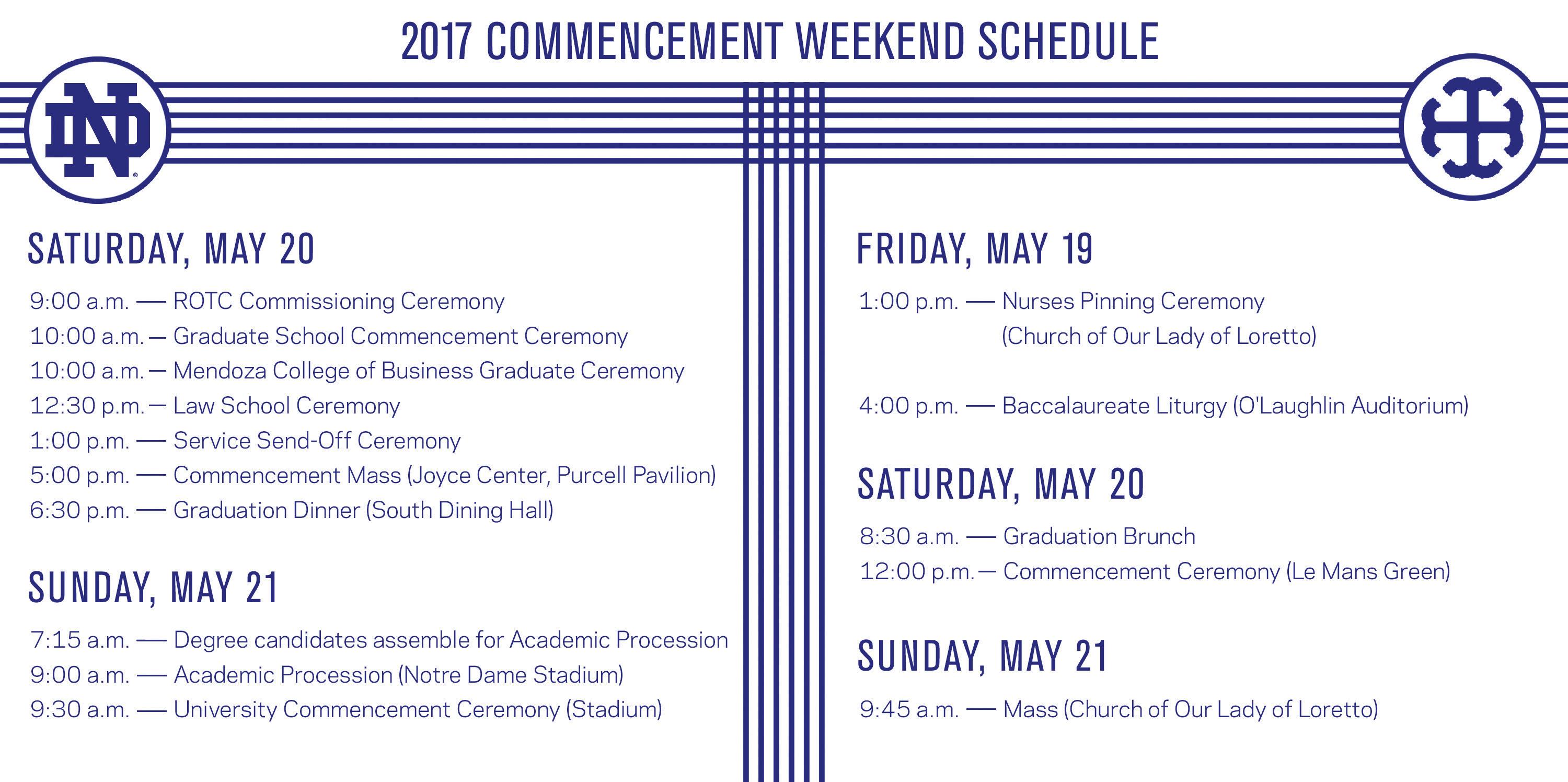
sunday, may 21 will mark the 172nd notre dame commencement ceremony, where approximately 3,000 graduates will be presented with their degrees from the University. The commencement ceremony will take place in notre dame stadium and serve as the culmination of senior week, as well as the class of 2017’s time at notre dame.
While the ceremony officially starts at 9 a.m., University registrar chuck hurley said he recommends people arrive shortly after the stadium opens at 7 a.m., especially given the extra security measures that will be in place due to the presence of vice President mike Pence at the ceremony.
“We have to open up on saturday morning about half an hour earlier than we normally do,” hurley said. “In 2001 when President bush came, and in 2009 when President obama came to commencement … we had a number of folks who showed up at the last minute and thought they could just walk right in. In years where you have a President or vice President, that’s just not the case. … You have to go through the magnetometers that the secret service has. It takes longer to get folks in.”
In the case of severe weather, the commencement ceremony will take place in Purcell Pavilion. As a result, each graduate would only receive three tickets to commencement due to the smaller size of the venue.
If this venue change becomes necessary, overflow locations will be available for additional guests in compton Family Ice Arena, Jordan hall of science, debartolo hall or the north dome of the Joyce center. hurley said commencement will also be live-streamed for those who would prefer to watch the ceremony remotely.
For the most part, hurley said, the campus crossroads Project construction will not affect the ceremony itself.
“There’s some areas they block off, and they’ll put fencing around things because certain areas of the facility are constructions zones,” he said. “ … but it’s important to remember, the stage is on the field and the students are on the field, so that doesn’t really change at all because there’s no work being done on the field itself.”
Aside from the main commencement ceremony, almost 100 other events relating to commencement take place between Wednesday and sunday, which include “everything from honor society functions to dinners,” hurley said. nineteen of the
ceremonies are diploma ceremonies for programs and colleges within the University.
hurley said his favorite part of the weekend is the mass at 5 p.m. on saturday evening in Purcell Pavilion. he said 11,000 to 12,000 people typically attend the event.
“The holy cross priests do a wonderful job with the mass,” hurley said. “It is a beautiful event, and it is really a culmination. All of our first-year students during orientation weekend come in and are in Purcell Pavilion together for opening orientation, and then four years later one of the last things they do is go to mass [on] saturday night of commencement weekend.”
Planning for commencement starts in october, hurley said, and continues throughout the year, up until commencement weekend in may.
“It’s an event-filled several days for us where we only get to go home for a few hours at night and come back at four in the morning to get going,” he said. “There’s a lot of people who bring relatives to campus for that weekend. We want them to have a wonderful experience. … It really is a massive endeavor.”
Contact Alexandra Muck at amuck@nd.edu and Natalie Weber at nweber@nd.edu
University gives honorary degrees
Observer Staff Report
Editor’s Note: A version of this story appeared in the print edition of The Observer on March 30.
Today’s Staff
Corrections
The observer regards itself as a professional publication and strives for the highest standards of journalism at all times. We do, however, recognize that we will make mistakes. If we have made a mistake, please contact us at (574) 631-4541 so we can correct our error.
notre dame will award seven honorary degrees at commencement ceremony may 21, including one to vice President mike Pence, the University announced in a press release march 30.
Pence, this year’s commencement speaker, will receive an honorary doctor of laws degree, along with maj. Gen. charles F. bolden Jr., cardinal Kevin Farrell, rev. martin Junge and Philip J. Purcell III, according to the press release.
bolden, a veteran of the U.s marine corps, served 14 of his 34 years in the military as a nAsA astronaut, and became the agency’s twelfth administrator in 2009. According to the press release, he has served on four space shuttle missions, twice as commander and twice as pilot, and flew more than 100 combat missions in north and south vietnam, Laos and cambodia.
Pope Francis appointed Farrell, “the
highest-ranking American serving in the vatican,” a cardinal in 2016 to lead the dicastery for Laity, the Family and Life, the press release said. his honorary degree from notre dame will be his fourth, as he also holds degrees from the University of salamanca in spain, Pontifical Gregorian University in rome and Pontifical University of st. Thomas Aquinas.
Junge, a pastor in the evangelical Lutheran church, is the first Latin American general secretary — the chief ecumenical officer — of the Lutheran World Federation (LWF), a position he was elected to in 2010. Junge and the LWF commemorated the 500th anniversary of the Lutheran reformation along with Pope Francis and the vatican by co-authoring a report, “From conflict to communion,” and co-hosting the commemoration in Lund, sweden, in october.
Purcell, for whom the Purcell Pavilion in the Joyce center is named, is a 1964 graduate of the University and 25-year member of the board of trustees at notre dame. he is the founder and president of continental Investors, and has previously been the chairman and chief executive officer of morgan
stanley, director of American Airlines and northwestern memorial healthcare, chairman of the Financial services Forum, a director of the new York stock exchange and a member of the advisory council for notre dame’s mendoza college of business.
Alice Gast, the president of Imperial college London, will receive an honorary doctor of engineering degree from the University, according to the press release. A chemical engineer, Gast has previously served as vice president for research and associate provost at the massachusetts Institute of Technology (mIT), and the thirteenth president of Lehigh University. martha Lampkin Welborne, the senior vice president for corporate real estate and global facilities with The Walt disney company, will receive an honorary doctor of fine arts degree from the University, according to the press release. After graduating with a degree in architecture from notre dame in 1975, Welborne earned two master’s degrees in architecture and city planning at mIT, and also served as the chief planning officer for the Los Angeles county metropolitan Transportation Authority.
LAUREN WELDON | The Observer
University valedictorian reflects on journey
By SELENA PONIO Associate news e ditor
The class of 2017 valedictorian, caleb “c.J.” Pine, said growing up in Tianjin, china was what sparked his interest in culture and conflict.
“being an American who lived in china for 18 years, I was really interested in questions of culture and conflict and how I saw myself as a bridge who could get involved in cultural understanding,” Pine said.
Pine, a Truman scholar and a Gilman scholar, is an Arabic and peace studies major with a minor in philosophy, politics and economics (PPe). Also a member of notre dame’s Glynn Family honors Program and a hesburghYusko scholar, Pine is graduating with a 3.92 cumulative GPA and will intern at the bureau of International organization Affairs within the state department in Washington, d c
Pine said one of the reasons he came to notre dame was because of the peace studies program. he said Arabic was something he started from scratch when he came to notre dame, but that his first exposure to Islam was when he moved to western china, where his dad was conducting research on the area’s muslim community.
“I was interested in just learning,” Pine said. “I started freshman year and had the chance to spend my summer in Jordan, and was able to study abroad in the middle east, as well, and it kind of just developed from there.”
Pine spent two semesters studying abroad during his time at notre dame. his first study abroad experience was at Tantur ecumenical Institute in Jerusalem during his spring 2015 semester, and his second experience was at Princess sumaya University of Technology in Jordan during his spring 2016 semester. during his undergraduate
career, Pine has focused on refugees and promoting interreligious dialogue. he completed an internship last summer at the U.s department of state’s office of religion and Global Affairs, studying religious dynamics in burma and working with religious communities in the U.s. to support refugee resettlement. While studying abroad in Jerusalem, Pine also volunteered his time to teach english at a Palestinian refugee camp.
“my interest in working with refugees was definitely sparked by the fact that my freshman year and throughout all of college, the refugee crisis has been such a huge humanitarian crisis, and … our generation has come to adulthood with this going on in the world,” he said. “Given the fact that I was interested in culture and religion and conflict, I felt that this was a specific case that I wanted to dive into and to apply peace studies.”
Pine organized solidarity With syria, a student advocacy group
College co-valedictorians to address 2017 graduates
By MARTHA REILLY
s aint mary’s e ditor
caps off to saint mary’s 2017 valedictorians, elise desomer, a studio art and english literature double major from south bend, and brianna Kozemzak, a computing and applied mathematics major from eagan, minnesota. The two will address the class of 2017 at this year’s commencement on may 20.
Editor’s note: Kozemzak declined to comment.
desomer said the welcoming and accepting college campus community consistently empowered her to do her best work.
“The whole women’s college ethos is something really unique that I don’t regret at all,” desomer said. “I love how the small-campus vibe is sort of like a small town. There’s something really nice about coming to saint mary’s and feeling like you’re at home.”
The college fosters values of accountability and respect for others through its emphasis on small class sizes, desomer said.
“I’ve really learned a strong work ethic here — how to be accountable to professors and deadlines, not just because adhering to deadlines is important in a type of capitalist way but because your professors are humans,” she said. “You have to respect the interpersonal relationships between professors and students. You have to recognize the inherent worth and dignity of other people’s time.”
students should strive to engage socially while succeeding academically, desomer said.
“my advice would be to maintain a healthy study and social
balance,” she said. “It’s easy to go to extremes in the opposite direction, so just know that you have to build those memories.”
having fun in college does not necessarily have to come at the expense of earning good grades, desomer said.
“be adventurous,” she said. “do things with friends, but still study hard. study on the train to chicago or something.”
her saint mary’s education exposed desomer to the harsh realities women and other vulnerable populations face, she said.
“It’s completely opened my eyes to the different types of oppression that women and minorities face,” desomer said.
she said she was reminded of the enduring sisterhood the saint mary’s community shares when she and students she tutored at the Writing center walked back to their dorms together after late night sessions.
“It just really reinforced that at saint mary’s, we have each other’s backs,” desomer said. “We look out for each other. That’s provided me with really profound bonding experiences.”
Last summer, she earned a student Independent study and research (sIsTA r) grant to study object-oriented ontology — a philosophical analysis of existence that views objects as equal — with art professor Krista hoefle. desomer said this mode of understanding the universe calls into question the power dynamics that humans learn from young ages.
“It’s a way of viewing the world without hierarchies,” she said.
“It’s not just saying minorities are equal to the majority, or animals [are] equal to people or plants
and awareness campaign with the goal of countering Islamophobia on campus. he also helped found road to mafraq, a nonprofit that seeks to increase access to education for children affected by violence in the middle east, but focusing specifically on syrian and Iraqi refugees in Jordan.
“When I decided to attend notre dame, I was excited about the mission statement — the idea that there’s this learning of service and justice,” Pine said. “There’s this sense of being very honored and blessed to represent the mission statement and the desire to live out that mission statement.”
Pine, a resident of siegfried hall, said his time at notre dame was largely defined by all the relationships he established with both his friends and professors. he said he recently experienced a moment in the dorm he lived in for four years when the reality of graduation suddenly hit him.
“We had to take down the
decorations on our wall for room inspections,” Pine said. “my room has been more bare, and I think it started to hit me. It became a little more real that I’ll be moving out soon, and I started to think about my last day of class and things wrapping up.”
Graduating alongside the people that became friends and family to him during his time at the University is particularly humbling, Pine said.
“I feel very honored, very blessed to have the opportunity to represent the class of 2017 and to reflect on what has been most significant about the notre dame experience, and what it means to belong to the notre dame community,” he said. “I’m proud to be a part of the class of 2017, and I’m excited see where the future takes all of us and the way we can apply all the things we learned here at notre dame.”
Contact Selena Ponio at sponio@nd.edu
should vote, too. It’s just thinking of things from what we call a nonanthropocentric viewpoint.”
Though decentralizing the human experience can sound intimidating, doing so fosters a deeper understanding of the inherent, useful properties of seemingly ordinary objects, desomer said.
“It’s just thinking of a democracy of objects,” she said. “It’s not saying that objects have colonies, and they’re like people too. It’s not anthropomorphizing. It’s just seeing the world in more of an interconnected mesh, rather than a hierarchal structure.”
Working alongside a professor prepared her for potential future collaborations, desomer said.
“The learning experience of working closely with another professor really prepared me for graduate level research, and showed me how to work in a collaborative, artistic and academic environment,” desomer said.
she said she plans to take these skills with her as she prepares to take the Graduate record examination (Gre) while continuing to schedule appointments for her photography business, elise imagery. desomer said saint mary’s has left a lasting impression on her mind and heart, so she looks forward to giving a valedictory address.
“I’ve been given this really nice privilege to be able to represent saint mary’s, and that means a lot to me because I love everything that saint mary’s represents,” she said. “I’ll miss this place.”
Contact Martha Reilly at mreilly01@saintmarys.edu
notre dame salutatorian advises balance
By COURTNEY BECKER news e ditor
University class of 2017 salutatorian José Alberto suárez said he balanced earning a cumulative 4.0 GPA as a computer science and engineering major with his duties as a resident assistant ( r A) in Keenan hall and president of the student International business c ouncil ( sI bc ) by prioritizing what was most important to him during his time at notre dame.
“The biggest thing for me was just being timely with my work,” he said. “I never left anything for later, I never had to pull an all-nighter or anything. The biggest thing for me [is you should] just be timely, prioritize what you’re doing so that you don’t overcommit yourself and you actually do what’s important to you. b ecause if you’re just trying to fill it up, it’s not going to work that way.”
A hesburgh-Yusko s cholar, member of three University honor societies and a fouryear member of the d ean’s List, suárez said he fit so much into his life at notre dame by recognizing that he couldn’t do everything at once.
“I think that I was able to prioritize one or two big things a year,” he said. “ … I kind of had one big thing at a time alongside academics as opposed to trying to put them all together. s o I think that’s kind of how you can still get a
lot done in four years, but you have to balance that.”
suárez said he got different things out of each new challenge he took on as a student and leader in the community.
“sI bc was a really cool way to explore my professional future, and meet a lot of people and travel internationally and that kind of thing,” he said. “ … [ b eing an] r A, for me, was a lot about giving back to the community — to notre dame as a whole, but especially to Keenan, which has given me a lot.”
h is selection as the second salutatorian in 46 years was an honor, suárez said.
“[I was] extremely honored,” he said. “I’m really happy that I’m getting this opportunity, and being able to share that news with my friends … was probably the most important thing for me. more than speaking, it was just seeing how happy other people were for me. The continued support on that end was just really satisfying.”
This support from his friends is the most valuable gift suárez will take away from notre dame, he said.
“It’s really important to have your friends around for both the parts that are hard and the ones that are easy,” suárez said. “b ecause if you can count on them for that kind of stuff, you can get past it all.”
Contact Courtney Becker at cbecker3@nd.edu
Saint Mary’s honors 2017 Outstanding Senior
By MARTHA REILLY
s
aint mary’s e ditor
during her time at saint mary’s, a lex Winegar said she strove to put others before herself, even through simple actions such as holding the door open for others. Winegar, the recipient of this year’s outstanding senior award — which honors a student who exemplifies the saint mary’s spirit and values — now awaits the many doors that will open for her as a graduate of the college.
Editor’s Note: Winegar is one of The Observer’s former Associate Saint Mary’s Editors.
Winegar said students can foster a compassionate, uplifting community through showcasing positivity and optimism in daily tasks.
“my mom always has this saying, ‘be the bright side in someone’s day,’” Winegar said. “i just hope i could’ve done that for at least a few people.”
Winegar’s classmates empowered her to consistently work toward her ambitions and use her talents for good, she said “it’s really humbling to accept this award because our class is full of amazing people,” she said. “our whole school is. i did not expect it to be me at all.”
a fter earning her degree in communicative sciences and disorders from saint mary’s, Winegar will pursue a doctorate degree in audiology at central michigan University. she said the invaluable lessons she learned and connections she made while enrolled at the college will benefit her for the rest of her life.
“i want to make sure that i’m grateful for everything i have in my life,” Winegar said. “Take it one day at a time.”
Winegar said she hopes current students embrace their limited time at the college and recognize the premiere education an all-women’s institution affords them.
“realize the importance of being at saint mary’s,” she said. “You’re never going to have that again, so take advantage of all four years.”
saint mary’s emphasis on a challenging curriculum and lifelong friendships enables the college to fortify its students’ minds and hearts, Winegar said.
“o ver the years, i found myself comparing my college to my friends’ state schools or coed schools,” she said. “ours is truly special and unique, and i think we need to value that a lot more than we do sometimes.”
Winegar said saint mary’s
Paid a dverT isemen T
enforces values of service and selfless love, which enabled her to explore her passions. her four-year commitment to dance marathon — an annual fundraiser in which participants dance for 12 hours to raise money for r iley hospital for children — taught her the powerful influence saint mary’s students can have on the world, she said.
“i love dance marathon because it’s like we’re part of something bigger than our school,” Winegar said. “This is where you go to school, and you’re dedicating your life for four years to studying here. it’s like, ‘Why not be involved and learn more about what our campus can really do?’”
saint mary’s prepares graduates to take on future endeavors with confidence and critical thinking skills, Winegar said. she said she hopes her legacy reflects her everlasting commitment to enhancing the college through simple, random acts of kindness and dedication to service organizations.
“i just want to be known as someone who really cared about the school,” Winegar said.
Contact Martha Reilly at mreilly01@saintmarys.edu
cervelli wraps up first year in office
By NICOLE CARATAS s enior news Writer
saint mary’s President Jan cervelli looks back on her first year with fondness.
“it has been one of the most wonderful years of my life,” cervelli said. “i am doing the most important work of my life.”
cervelli, a south bend native, took over as president on June 1.
“i have discovered a community that is unlike any other i’ve been part of, and i say that from a professional, a personal and a faith perspective,” she said. “i have fallen in love with the belles here.
i’ve never been so inspired by students.”
cervelli, along with the presidents of notre dame and holy cross, signed a memorandum of Understanding (moU), which allows for the three institutions to share information regarding sexual assault on all three campuses, she said.
“That’s a very important first step — the memorandum of Understanding — in establishing a level of cooperation that helps us, one, to provide support to students in the event of an unfortunate act of sexual violence,” she said. “meaning that we have agreed to share information about incidences to where, if an incidence happens to a saint mary’s student on notre dame’s campus, we can have better knowledge of what took place and what kind of healthcare, or counseling or pastoral care we can provide much more quickly than in the past.
“it’s really important that we provide the kind of support that encourages students to report incidences. otherwise, without that information, it is difficult for us to learn better around prevention strategies. … Knowing when and where — sometimes why — we are able to better educate our students.”
cervelli began a “listening tour” when she first came to the college. as part of that tour, cervelli has travelled to different events across the country to meet with alumnae and discuss their experiences at saint mary’s, she said.
“Their experiences help us weave a picture of what is really special about saint mary’s and the saint mary’s experience,” she said.
“i’ve learned that this is no fouryear degree experience. This is saint mary’s for life when you come to saint mary’s, and the sisterhood is phenomenal. They are there for their sisters unlike anybody i have seen.”
cervelli, who is passionate about sustainability, said she is in planning mode for expanding sustainability at the college. she said she is working on developing an environmental studies major, which she envisions as an interdisciplinary degree.
saint mary’s is already working on expanding its graduate program opportunities, including the
early development of a master’s in social work, she said. in addition to graduate programs, cervelli also said the college’s study abroad options are being improved.
“We’re finding with international studies — with some of the chaos in the world and some of the terrorist activities — we’re having to shift a little bit based on people’s concerns about going to certain places,” she said. “We’re trying to look at where is the best place for students to learn and what is the safest place.”
a group of students proposed a plan for an “adulting 101” class, which cervelli said she accepted and will work to implement.
“i think the idea is fantastic,” she said. “What i heard from the students is that we need to help prepare our graduates to enter into the world in general, and colleges and universities overlooked the challenges that graduates face.”
The class will span many topics, including how to set up a financial plan as well as how to negotiate salaries, cervelli said.
“While one course is the initial goal, these are conversations i’d like to see all the way back to first year when you first come in, because you are negotiating internships well before you graduate,” she said. “any kind of those experiences, we want to best position our belles so that we’re like a force.”
cervelli said she is proud of the political activism that saint mary’s students have embraced — both on campus and in south bend — especially because of the mutual respect that students have for each other, even when disagreeing on issues.
“This has been an extraordinary year to get to know the students, with a lot of the chaos and the divisiveness that came out of the election and political decisions,” she said. “The love of our students for each other, the courage of our students to take on issues of immigration and social justice and to stand up for all belles, the call for mutual respect and mutual understanding and the demands for civil discourse and wanting to learn how to talk to each other are amazing. as hard as this year has been in many respects, i would not have chosen a different year, because i think it has revealed the real deep character.”
cervelli said the best part of her first year was her overnight stay in Le mans hall.
“it was so meaningful to me in so many ways,” she said. “Just to see students relaxing, and having fun, and kicking back first and just talking about what it’s like living in a dorm. Just having girl talk and talking about dreams and plans and just laughing a little bit together. i did get to see how much women love Le mans and why. … i was just so warmly received, and it was just great.”
Contact Nicole Caratas at ncaratas01@saintmarys.edu
Saint Mary’s graduates to enter workforce, volunteer
By GINA TWARDOSZ
Associate Saint Mary’s Editor
Saint Mary’s Office of Institutional Research conducted the annual Graduation Destination survey to chart the different paths undergraduates pursue after graduating from the College.
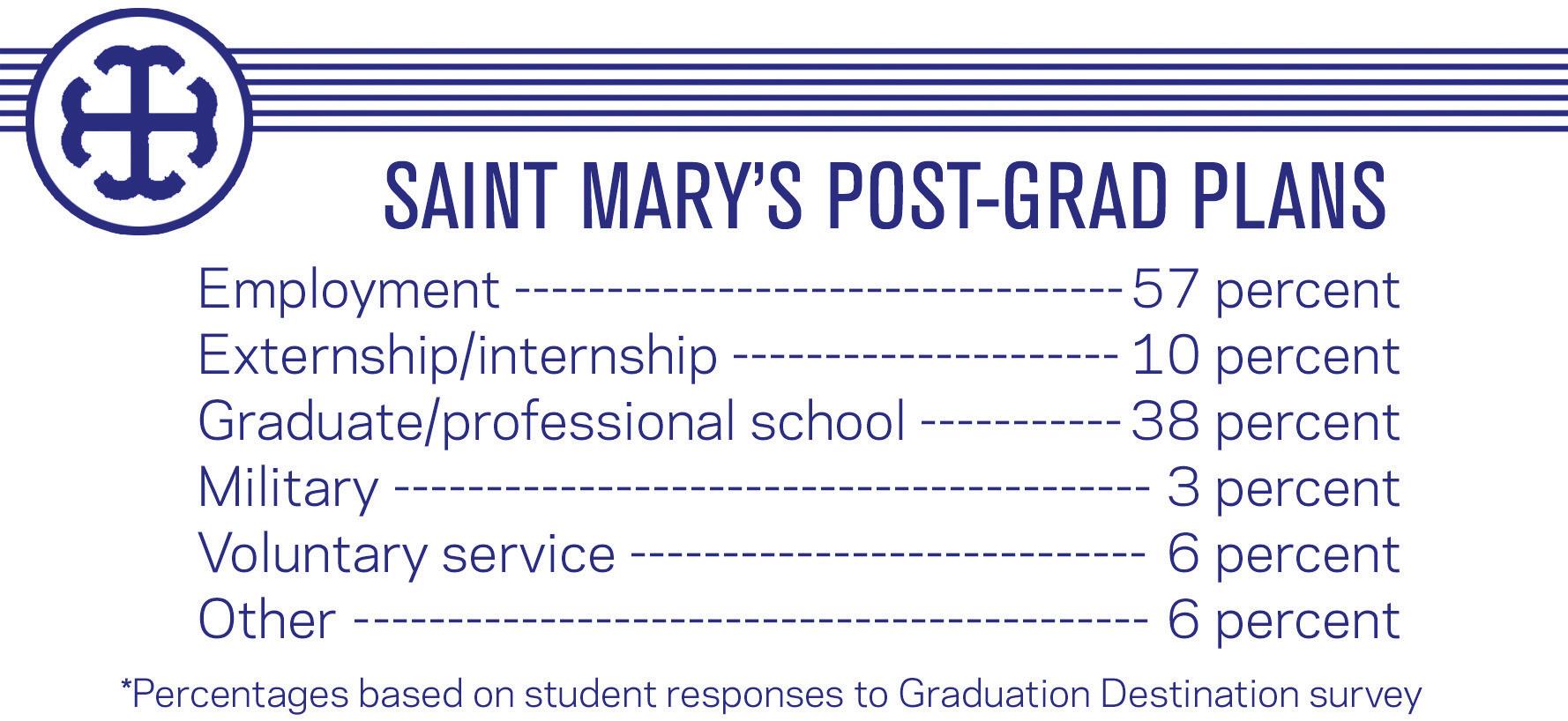
As of May, the survey concluded that 57 percent of respondents will pursue employment, 38 percent will enroll in a graduate school, 10 percent will pursue externships or internships, 6 percent will involve themselves with voluntary service and 3 percent will join the military.
Stacie Jeffirs, director of the Career Crossings Office, said percentages from the survey do not change much over the years, with the post-graduation employment category usually having the highest percentage of students. She said graduate school enrollment also sees a high volume of post-graduates.
“Most of our graduating students go into job fields, as career is the number one choice for students,” she said. “High up there, too, is graduate school. Our numbers will range from year to year, but typically, we have an upwards of 25-30 percent that go on to graduate school.”
Other students choose to join service-oriented organizations or the military, according to Jeffirs.
“Then we also have students who go into service and volunteering, like Peace Corps or Teach for America,” she said. “We also have a small percentage serving in the military, like ROTC students at Notre Dame. And then a small percentage of students who do something different like travel or go back abroad.”
Jeffirs said surveys are also conducted at one year and five year intervals after graduation.
“We also do one-year and five-year surveys to see where the alumnae are and how they feel like the Saint Mary’s education prepared them for the future,” she said. “We always ask questions about whether or not they think their current job is a career path for them, or a
stepping stone into a career or just a job to get them by. By far, most graduates say their current job is a career path or stepping stone towards a career.”
Jeffirs said deciding what to do after graduation forces students to consider what values are meaningful to them.
“A lot of our decisions are driven by values and what’s important to us,” she said. “What do we see as our mission?”
Senior Clare McMillan said her mission is to serve with the Olancho Aid Foundation — an organization that helps children maintain their bilingual education. McMillan said Saint Mary’s and the Career Crossings Office helped her to discover this opportunity.
“My education at Saint Mary’s had opened my perspective to the global community,” she said. “During my four years here, I have come to understand the importance of serving those in need, and that is why I will be traveling to Juticalpa, Honduras this summer and serving with the Olancho Aid Foundation.”
McMillan said she envisions her commitment to the Olancho Aid Foundation enduring over time, since she will embrace the opportunity to make valuable differences in students’ lives.
“One of the goals of this foundation is to provide a moral framework for students, enabling them to overcome challenges in their community,” she said. “I am choosing to serve with the Olancho Aid Foundation because it provides a faith-based environment, which promotes education and hope for the future — two values that I also hold in high regard. It is a seven-week commitment that I hope to continue participating in for years to come.”
Senior Mary Gring plans to attend graduate school at Columbia College Chicago.
“I chose to attend graduate school because I really wasn’t ready to be done with school,” she said. “I love school, I love learning and I felt as though I had a lot more to learn, especially in my discipline.”
Gring will be pursuing a Master’s of Fine Arts (MFA) in Interdisciplinary Arts and Media.
Notre Dame seniors reflect on career routes
By TOM NAATZ News Writer
After graduating from Notre Dame, members of the class of 2017 will be involved in various different pursuits, ranging from full-time employment to attending graduate school.
“I love art, specifically video art, but I love that the program allows me to explore other areas of art and other disciplines, too,” she said. “If I want to grow as an artist, as a professional and as an individual, I think being in a program that allows for exploration would help me do that most effectively.”
Gring said Saint Mary’s helped her decide to continue her education.
“Saint Mary’s professors helped a lot in my decision to pursue graduate school,” Gring said. “My professors helped me narrow down programs I might be interested in, assisted me in writing strong statements of purpose and provided me with letters of recommendation. The Saint Mary’s community encourages all Belles to know more. It’s an environment that fosters exploration.”
Senior Isabela Hudson said she decided to enter the Peace Corps after graduation, since Saint Mary’s helped her discover her love for traveling and assisting others.
“I will be going to the Peace Corps to serve in Botswana,” she said, “I will be placed in a health facility to address the public health and HIV/AIDS needs of the community and be focused on delivering HIV prevention, treatment and care.”
Hudson said Saint Mary’s strengthens students’ passions and gives them outlets to express those passions.
“Saint Mary’s gave me the chance to grow in my experiences to strengthen my love for service,” she said. “The College gave me the chance to participate in the Uganda practicum, where I worked at the Sisters of the Holy Cross’s clinic. Saint Mary’s also provided me with the education and love for nursing. I cannot wait to put in practice what Saint Mary’s has taught me during my service in Botswana.”
It may be hard for graduating seniors to plan for the future, so they should keep their interests in mind, Jeffirs said.
“It’s hard to plan too far into the future in terms of what to do after graduation,” she said.
Contact Gina Twardosz at gtwardosz01@saintmarys.edu
the reason I got this job,” he said. “They put me in touch with the company at the fair, and the rest just fell into place.”
When it comes to the career process, McMullen said he advised patience for those still looking for a job.
Though data regarding the class of 2017’s post-graduation plans will not be available for another year, director of the Career Center Hilary Flanagan said that the graduating class will be taking on a wide range of activities over the course of the next year.
“From anecdotal evidence, it seems that the class of 2017 is incredibly diverse, as we would expect from their varied interests, passions and skill sets,” she said.
While noting that some industries don’t perform entrylevel hiring until the summer, Flanagan said the current job market is “one of the best in recent history for new graduates.”
“Recruiters representing organizations across the spectrum of industries have indicated that their needs for acquiring new talent are at a high,” she said. “For those industries that have seen the bulk of their hiring occur throughout the academic year, the interest in our students has been at levels not seen since before this graduating class was in high school.”
According to data for the class of 2016 — available on the Career Center website — 64 percent of graduates had found full-time employment the fall after graduation, 22 percent were enrolled in graduate or professional school, 2 percent were still seeking employment, 7 percent were involved in a service program, 1 percent were serving in the military and 3 percent had other plans.
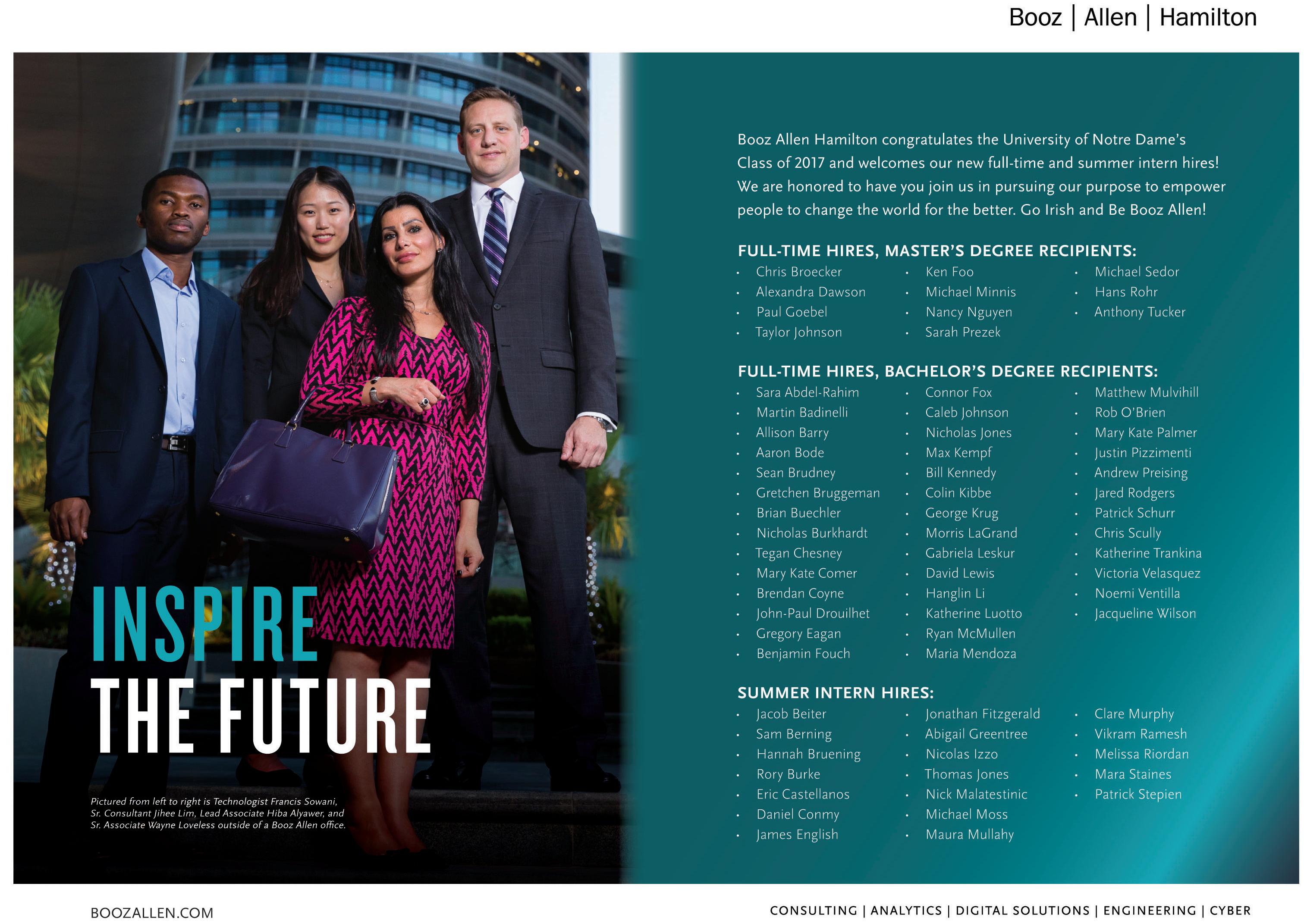
Graduating senior Ryan McMullen, a computer science major, will be working as a consultant at Booz Allen Hamilton in Washington, D.C. this fall. McMullen said he ultimately decided between following this path and pursuing a two-year master’s program at Notre Dame with the Alliance for Catholic Education (ACE).
“I wanted to expand my professional acumen with the intent to teach in the future and bring what I learn in the professional world to that setting,” McMullen said. “I want to experience the working world and grow in ways I have not yet had the opportunity to do. I am also very passionate about helping people, which is what I think led me to the consulting realm.” McMullen said he credits the University’s Career Center for his placement in his future job.
“Notre Dame’s career services and career fairs are 100 percent
“The career process is a little daunting, but it just takes time and effort into determining what it is you truly want to do and what steps will help you get there,” he said. “Then, all you have to do is let your passion for those outcomes shine.”
Senior Madeline Lewis will be attending graduate school at Miami University in Ohio, working toward obtaining a Master’s in Fine Arts (MFA) in creative writing. As part of the program she is enrolled in, Lewis will be writing poetry in workshops and teaching freshmen. Had she not gotten into graduate school, Lewis said she would have worked for a year and then reapplied.
“While I studied abroad the spring semester of my junior year, I started to realize that the things I would think about while traveling on long trains or while exploring different countries were always ideas for poems,” she said. “I was surprised by this because I had only taken one poetry class at ND the semester before, and didn’t consider at the time that that was something I wanted to do post-grad.”
In the fall semester of this year, Lewis took an advanced poetry writing class and started considering an MFA as a possibility. In a mid-semester meeting, her professor suggested it as a possibility without any prompting, she said.
“From then on, it started to feel like the perfect fit for these next couple years — the chance to be creative, gain teaching experience and have the structures in place to be able to really work on my writing in a focused setting,” Lewis said.
Lewis said she credits her study abroad experience and her professors for helping her reach her decision to pursue an MFA.
“One thing that has helped me find peace in the whole process has been remembering that I’m deciding what I want to do with the next one, two or three years of my life,” she said. “It took a lot of pressure away when I stopped thinking of my post-grad plans as ‘the whole entire rest of my life forever and ever.’ Reminding myself this, I felt more free to do something creative after college, and to plant good seeds of writing skills and imagination that I hope to be able to see grow in lots of ways over the course of my career.”
Contact Tom Naatz at tnaatz@nd.edu
LAUREN WELDON | The Observer
College ROTC graduates pursue military service
By STEPHANIE SNYDER news Writer
Three saint mary’s seniors will carry on the college’s legacy for service, as their participation in notre dame’s reserve officer Training corps (roTc) will enable them to join the military after graduation.
despite being the Army battalion commander and receiving a senior award from the roTc program, biology major emilie vanneste said the most rewarding part of her life is yet to come.
“I think when I commission, it’s going to feel like I’m done with one small chapter, and the rest of my Army career is going to start,” she said. “I’ve always wanted to be in the service. “
navy midshipman first-class and nursing major Abigail Waller said roTc is helping her achieve her goals.
“I don’t think I’ll start accomplishing things until I get out and start helping people,” she said. “[roTc] is like a stepping stone.”
Air Force wing commander and computing and applied mathematics major megan o’bryan recently received the commander’s leadership award. o’bryan said she credits her success to being a student at saint mary’s.
“coming here, I was pretty shy,” o’bryan said. “I can now say I’ve done a complete 180. I’ve learned how to be a leader and how to be the best that I can be to help others and my peers.”
According to vanneste, these women have spent 20-25 hours training each week for the past four academic years. she said
training entails participating in lab, class and physical challenges.
Waller said managing her time was one of the biggest difficulties of participating in roTc
“It’s an interesting dichotomy, always trying to schedule classes with clinical,” she said. “It got easier once I had a car. my first year, I was riding my bike in the snow over to notre dame at 5 [a.m.]”
o’bryan, who is also a member of the notre dame marching band, said it was difficult to manage the roTc time commitment while trying to be an average college student, so she had to switch her major.
“It’s hard to make time socially,” she said. “At first, I was trying to do the engineering program, but it was too many credits. I recommend picking your battles and going from there.”
vanneste said the time commitment helped her to increase her level of self-discipline and has helped all of the cadets grow closer together.
“You have to be up, you have to be at certain things at certain times and keep the GPA up,” she said. “one of the biggest challenges is prioritizing who you want to be as a college student with who you want to be as a cadet. You have a lot of camaraderie there.”
however, o’bryan said saint mary’s accommodated her busy schedule.
“A lot of people are really supportive,” she said. “People have been really flexible, especially when they know my roTc schedule is super chaotic.”
Waller said roTc has also
helped her to develop skills she can use beyond the navy.
“I think, on a personal note, it has really helped me develop my professionalism and leadership,” she said. “It’s given me a way to be a part of something that’s much bigger than myself. I wouldn’t know college without [roTc].”
All three women said they are unsure of how long they will serve, but each will begin by serving for four years.
Waller will move to virginia beach, virginia, to work in Portsmouth hospital when she is deployed. When she is done with service, she said she would like to return to school to become a nurse practitioner.
o’bryan will go to the dover Air Force base in delaware, where she will work as a personnel officer, helping to provide others with the resources they need. After serving, she said she hopes to enter the graphic design industry.
vanneste will begin her service at Fort Gordon in Georgia but then will transfer to a basic officer Leader course (boLc) in Germany. Upon her leave, she hopes to teach elementary education and possibly return to school to earn a master’s degree, she said.
o’bryan said she is looking forward to being commissioned.
“Part of the reason I joined was to see the world, and I’ve always really enjoyed helping other people,” she said. “I always knew I wanted to serve my country or just help people. This seemed like the best way to do it.”
Contact Stephanie Snyder at ssnyder02@saintmarys.edu
Program directors evaluate success of senior cadets
By CIARA HOPKINSON news Writer
After four years of hard work, sacrifice and dedication, this year’s r eserve o fficers’ Training c orps ( ro T c ) seniors will receive their commissions at the d e b artolo Performing Arts c enter on s aturday, m ay 20, marking their transition into active or reserve duty.
The commanders of all three units of n otre d ame’s ro T c praised their seniors for their abilities to implement and manage programs within their units.
“The beauty of watching them [execute programs] is watching them develop as leaders on their own … they self-organize, they figure out how to do this and through that struggle, that process of learning from failure is super important for their development,” c apt. John c arter, commanding officer of naval ro T c , said.
Working with high caliber students, each commander said, is a privilege. ro T c students — who come from n otre d ame, s aint m ary’s, b ethel c ollege, Indiana University s outh b end and valparaiso University — do community service, engage in intense physical training and complete technical education with military equipment on top of rigorous course loads.
Lt. c ol. c hristopher Pratt from Army ro T c said the students’ dedication astounds him and reminds him of the value of the program.
“It just speaks volumes of the quality and the intellect and the flexibility and the type of individuals they are,” he said. “I couldn’t be more proud of them and what they’ve accomplished.”
ro T c seniors take on major responsibilities throughout the year by leading their battalions and heading the disparate organizations that fall under each branch of ro T c , from service projects to physical fitness competitions, according to c ol. James b owen of Air Force ro T c
“They offered our freshmen and sophomores, for the first time, the opportunity to be an invested part of the wing and have a job and be directly responsible for whether we succeed or fail,” he said. “It gave those young people a sense of ownership that I don’t think they had before.”
c arter said students remind him of the necessity of ro T c to the survival and progress of the armed forces.
“When you interact with students, they tend to question things that you just assume is that way and no other way and can’t change, but they question things, and that questioning is a very good thing because it forces us to challenge things that we don’t think we can change but maybe we can,” he said. “That has been a very rewarding piece of working here.”
d espite the small size of the Army senior class — just six are commissioning this year — Pratt said he continually emphasized the importance
“I couldn’t be more proud of them and what they’ve accomplished.”
Christopher Pratt Lt. Col., Army ROTC
of quality over quantity, not just for this class but in the military in general. The seniors’ chief accomplishment, he said, was winning the President’s c up, a yearlong competition comprised of football, basketball and soccer.
“It was truly a team event,” Pratt said. “e ven if you weren’t an active participant in one of the events, everybody was there supporting it, everybody was there as part of it. It really brought the whole group together.
“It’s about coming together as an organization and accomplishing something bigger that you couldn’t do as an individual … I think that was a great moment for them.”
All three commanders said they appreciate and value the sacrifices their students make and the virtues they display on a daily basis.
“The air force runs three core values we teach our kids every day,” b owen said. “The first one is integrity, the second one is service before self and the third is excellence in everything we do. If you think about what those words really mean, it talks about holding yourself to a higher standard, it’s sacrificing to be that servant leader we want these young men and women to grow up to be.”
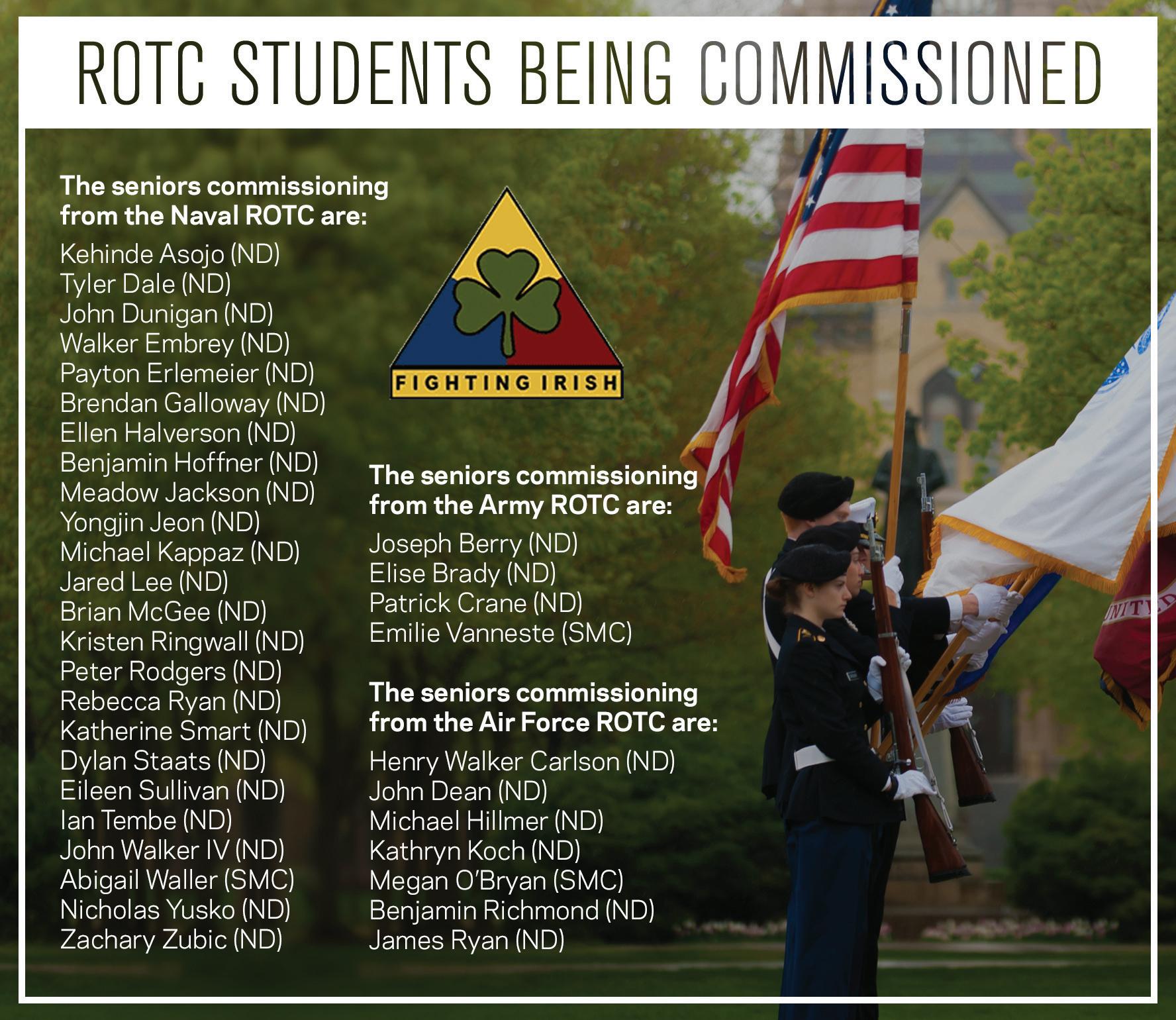
The Army ro T c will commission six officers, the navy will commission 25 and the Air Force will commission eight in a ticketed ceremony s aturday morning.
Contact Ciara Hopkinson at chopkin1@nd.edu
LAUREN WELDON | The Observer
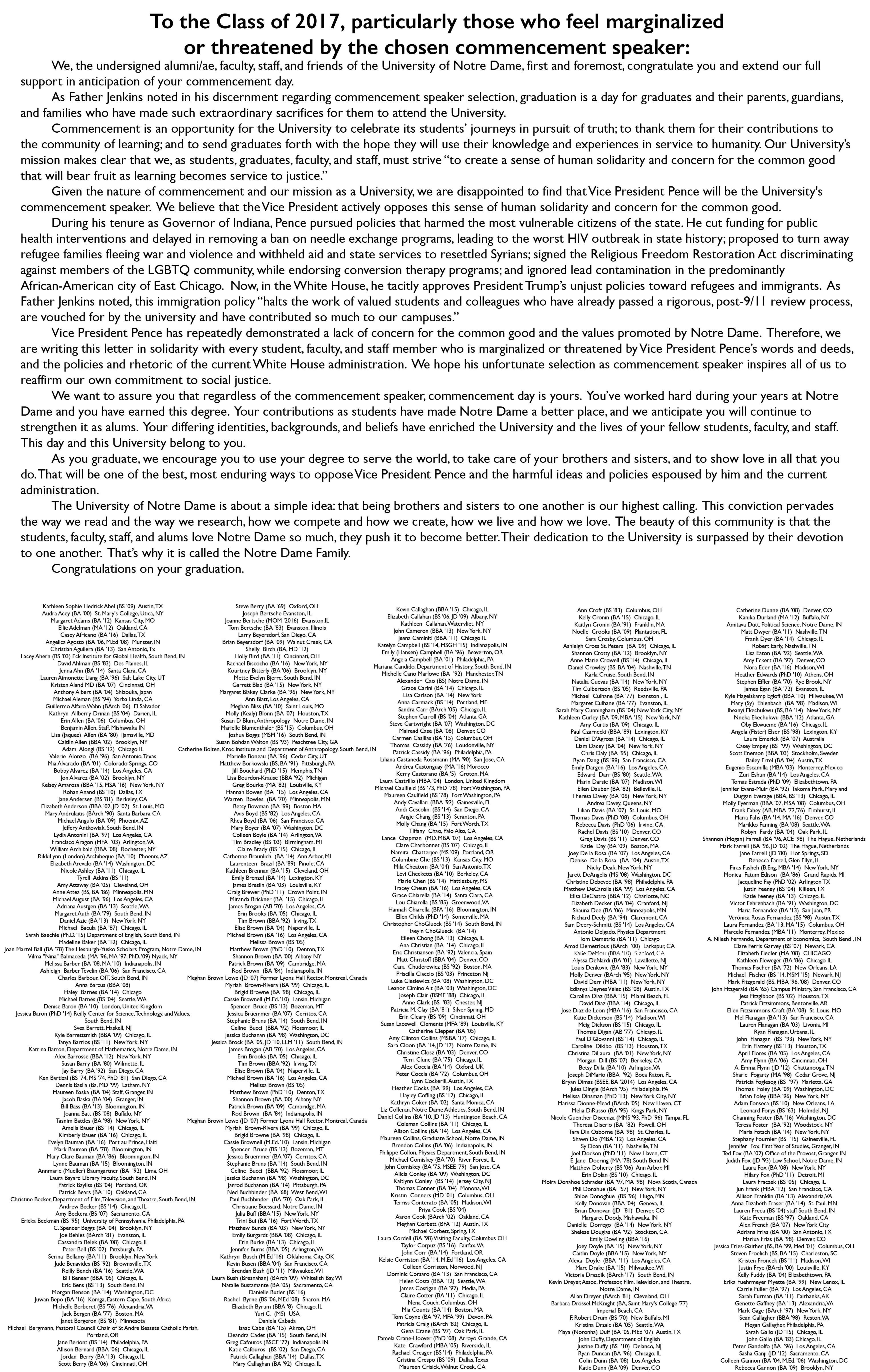
Pence to deliver Commencement address
By LUCAS MASIN-MOYER
a ssociate news e ditor
Past University commencement speakers have included United states Presidents, television personalities and famous journalists. This year — despite months of speculation on whether or not the University would invite President donald Trump — v ice President m ike Pence, the former Governor of i ndiana, was selected to address the class of 2017 at sunday’s commencement ceremony as the graduates go forward into the next stage of their lives.
The march 2 announcement of Pence as the commencement speaker was met with mixed reactions across campus, with students and community members both coming to Pence’s defense and protesting against what they consider to be his record of exclusionary policies.
sophomore d ylan Jaskowski, president of the notre dame college republicans, said the organization is looking forward to Pence’s visit and speech.
“We at the college republicans are very excited to have v ice President Pence here to speak on campus,” he said. “it’s a great honor that the University can bring in such prominent figures like the v ice President of the United states to speak, and i think it’s especially a great thing given he was the Governor here for many years and he can come back to speak at commencement.”
Pence previously visited the University during his time as Governor of i ndiana, meeting with college republicans while he was on campus.
“Last year, [Pence] called up our club and just wanted to sit down with us and some of our members,” Jaskowski said. “ … From what i
heard, it was a great event.”
The reaction to Pence’s selection has not been universally positive among members of the class of 2017, however. i n order to protest Pence’s record on issues relating to LGbT rights, fifth-year student bryan r icketts helped organize the distribution of LGbT pride flags to be displayed across campus.
“There were a couple of us who came together after realizing that m ike Pence had been invited and understanding how frustrating that felt to the LGbT members of notre dame’s community,” r icketts said april 20 in a previous interview with The observer. “ … We came together and reached out to alumni who actually donated almost 500 flags for people to put up as a show of support, solidarity for the LGbT community and recognizing that it’s something that needs to be visibly said on notre dame’s campus still.”
r icketts said Pence’s record on LGbT issues made him a concerning choice to address students at commencement.
“[Pence has], in the past, been against same-sex marriage because it harms people, which is demonstrably false and really offensive,” he said. “i n addition to that, he passed a budget which supported funding for conversion therapy … so it feels pretty offensive to have him coming on campus and [giving] a commencement speech where he tells me how to go out into the world.”
Jack bergen, a member of the c lass of 1977 and c hair of the LGbT a lumni Group of notre dame & saint mary’s (G a L a-nd/smc ), voiced similar concerns about Pence’s record.
“For many years, v ice President Pence as governor of the state of i ndiana has demonstrated his intense opposition
to the LGbT community,” he said in an email statement. “he has advocated and voted repeatedly to restrict and/or to remove rights of LGbT individuals. he has expressed views that are totally without merit such as, ‘being gay is a choice.’ … notre dame has made significant progress toward becoming a more welcoming place for all individuals. The decision to invite [ v ice President] Pence is outrageously inconsistent with those goals.”
backlash against Pence’s speech has not been limited to the University, as members of the south bend community have come together to organize a peaceful protest off campus. The main organizers of the event are We Go h igh! of st. Joe county, in ; m ichiana a lliance for democracy; the nu black Power movement; south bend equality; i nclusive m ichiana; and Planned Parenthood of i ndiana and Kentucky.
The m ichiana a lliance for democracy said it believes Pence has a record of infringing upon basic human rights.
“a s i ndiana residents, we have lived through the extreme conservatism of a m ike Pence administration,” the group said in an email statement. “h is theocratic doctrine and myopic view of what is essential for the good of his state led to disastrous legislation that continues to reverberate throughout i ndiana. … We consider [ notre dame] to be a valuable community partner and are confused by the decision to have Pence deliver the commencement speech.”
south bend equality shared the view that Pence’s selection was wrong and said in an email statement it ought to be protested.
“We know all too well how his policies endangered or caused direct harm to
public education, health care, women’s rights, the environment, LGbTQ individuals, immigrants and refugees, reproductive rights, local infrastructure, the economy of our state and more,” the group said. “We are angry and dismayed that the University of notre dame not only invited m ike Pence to be its commencement speaker, but also its decision to bestow an honorary degree upon him. by exercising our right to peaceably assemble on public land in front of the University, we hope to draw attention to Pence’s failed policies, destructive ideology and abysmal legacy.”
While there have been many protests lined up, Jaskowski said he felt it was an incorrect assumption to believe the University community was completely against the decision to select Pence as the commencement speaker.
“i think that with the protests coming out, there has been this sort of perception that notre dame doesn’t want v ice President Pence here speaking at commencement,” he said. “but i would just reiterate the fact we have over a thousand people on our listserv for college republicans, so there are a lot of people at this University who are very excited to hear v ice President Pence speak at commencement.”
Jaskowski said he hopes those protesting Pence’s invitation still listen to what the vice president has to say.
“i would encourage them to keep an open mind,” he said “obviously having a constructive dialogue is an important thing, and i think that if you don’t attend commencement, it’ll be hard to keep that dialogue open.”
Contact Lucas Masin-Moyer at lmasinmo@nd.edu
saint mary’s to confer honorary degrees
Observer Staff Report
Editor’s Note: A version of this story appeared in the print edition of The Observer on April 27.
i llinois supreme court Justice a nne m burke will address 2017 graduates at this year’s commencement ceremony on may 20, according to a college press release.
burke will receive saint mary’s highest honor, an honorary doctor of humanities degree, at the ceremony, according to the release. she has advocated for children and the disabled throughout her career, pursuing reforms to law enforcement procedures and social service programs.
“Justice burke’s distinguished legal career and demonstrated care for the most vulnerable members of our society is a testament to her commitment to justice,” saint mary’s President Jan cervelli said in the release. “a leader in her chosen profession and in the service of others, she represents the qualities we seek to instill in saint mary’s students.”
burke was the first woman appointed to the i llinois court of claims, and she earned a position on the i llinois appellate court in 1995. burke was appointed to the state supreme court in 2006 after chief Justice mary a nn mcmorrow retired, and she was elected to a ten year term in 2008, according to the release. burke played an integral role in initiating the chicago special olympics,
which she later helped develop into the international special olympics, according to the release.
“The common theme in Justice burke’s life and career is dedication to advancing the common good for all people,” cervelli said in the press release. “she will send our newest graduates into the world with an inspirational message and an example that reflects the essence of their saint mary’s education.”
The college will also award two additional honorary degrees at this year’s ceremony, according to the release.
sr. maura brannick will earn recognition for extending care to uninsured residents of st. Joseph county. brannick, a registered nurse, established a clinic to provide basic services to patients
without access to medicaid, medicare or private insurance, according to the release. because of her dedication to caring for the local community, she has received various honors, including a 1991 Points of Light award from then-President George h. W. bush.
dorothy m. Feigl, a college chemistry professor, will also be recognized for her long-term commitment to saint mary’s. according to the release, she served as a board of Trustees member from 19761982 and as vice president and dean of faculty from 1985-1999.
“sr. maura and Professor Feigl embody the spirit of saint mary’s,” cervelli said in the release. “Through their expertise and their example, they have shown us the ideal of servant leadership.”
22 Notre Dame students awarded fellowships
By AIDAN LEWIS news Writer
members of the class of 2017 received an array of prestigious fellowships and awards this year, including two r hodes scholarships and 15 Fulbright grants.
Jeffrey Thibert, interim director of the center for Undergraduate scholarly e ngagement (cUse ), said the r hodes scholarship process is intensely selective.
“For r hodes, this year there were 882 candidates, and they chose 32,” Thibert said. “We had two of them.”
Thibert said the r hodes scholarship supports two years of study at the University of o xford for a graduate degree or another undergraduate degree. here, he said, senior r hodes scholarship recipients Alexis doyle and Grace Watkins will study alongside the other 30 U.s r hodes scholars, as well as many others from around the world.
“As with most fellowships, a key part of the experience is connecting with a cohort of future leaders from around the world at o xford who are also r hodes scholars,” Thibert said.
doyle, a biology and peace studies double major, said she initially planned to take a gap year and do social work before medical school, but was pushed by professors to apply for the scholarship.
“A couple professors explained to me that it would be a good opportunity to get a platform on which I could advocate at a larger scale for the things I care about,” she said.
After working at the American Public health Association in Washington, d c . after her junior year, doyle said she realized she had a passion for public health policy.
“The health of the most vulnerable will be determined by policies,” she said. “I would really love to study policy in greater depth, and the r hodes will give me an opportunity to do that before going to medical school.”
being a r hodes scholar will also provide doyle with an opportunity to learn from the other students in the program at o xford, she said.
“I think a huge part of my education here has been being able to interact with peers who have all of these ideas outside of my field of study that are so fascinating and have influenced my thought on a bunch of things,” doyle said. “I’ll get to meet a lot of people at o xford that will have a positive influence on me and the way that I think.”
In addition to doyle
and Watkins’s r hodes scholarships, 15 members of the class of 2017 received grants from the Fulbright U.s student Program, Thibert said.
“The Fulbright Program is our biggest fellowship in terms of students applying,” he said. “What the Fulbright U.s student Program does is provide opportunities for students to spend a year after graduation doing study, research or e nglish teaching.”
Ten of the Fulbright scholars were offered e nglish Teaching Assistantship grants from the Fulbright program in several countries around the world.
haley Adams and david Arney will complete their assistantships in Poland, dana drysdale will complete hers in south Korea, John Gadient will complete his in Germany, madeline hahn and Joseph rebagliati will complete theirs in spain, maya Jain will complete hers in Peru, Peter stankiewicz will complete his in russia and connor bliss and dolores vargas declined their assistantship offers.
Gadient, who will graduate with a degree in international economics with German, said the uniqueness of the opportunity is part of what drew him to it.
“It’s an experience I wouldn’t be able to get with any other job or graduate school,” Gadient said. “This is something that I can’t do anywhere else.”
Gadient has studied abroad in Germany twice — in Freiburg after his freshman year and in heidelberg during his junior year — and said his desire to return to the country contributed to his decision to apply for the grant.
“I wanted to go back to Germany,” Gadient said. “While I was there I actually got to become a part of the community I was living in, and [the assistantship is a] way to go back and give back to the people.”
The other five Fulbright scholars from the c lass of 2017 were awarded research grants. sara Abdel-rahim will complete her research in Greece, Luke donahue and matthew o’neill will both complete theirs in Germany, Kiley Adams will complete hers in India and daniel barabasi declined his research grant offer.
Four more seniors — bradley bowles, Julia butterfield, Paulina eberts and sreeraahul Kancherla — received Graduate research Fellowships from the national science Foundation ( nsF).
According to its website, the program “recognizes and supports outstanding graduate students in nsF-supported science, technology, engineering
and mathematics disciplines who are pursuing researchbased master’s and doctoral degrees.”
Additionally, senior political science major Jenny ng received full funding for a oneyear master’s of c hina studies program at Yenching Academy — a distinguished college within Peking University — and senior applied and computational mathematics and statistics major John huber received a prestigious Gates cambridge scholarship.
cUse plays a crucial role in setting students up for success in these fellowship application processes, Thibert said.
“The idea behind cUse was that the kind of scholarly engagement that we try to enable students to do — like undergraduate research, service learning and internships — we try to connect students to the different resources on campus and beyond campus for doing those things,” he said. by giving students access to these resources, Thibert said, cUse hopes to propel them to research and experiences that can make them valuable candidates for fellowships.
“The students who do those things and excel in those areas might be the very same students who would be strong candidates for fellowships,” he said. “We build a strong relationship with students by working with them on scholarly engagement, and so then they already know and have this relationship with us when they become interested in fellowships.
“In these past few years, we’ve seen consistent growth first in the number of students who are engaging with cUse in different ways. That includes workshops we give about undergraduate research, oneon-one advising we do to give students feedback on proposals for research grants and fellowships. We’ve also seen growth overall in the number of students applying for fellowships and in the number receiving fellowships.”
Thibert said c Use hopes to expose students to opportunities that can change the course of their lives for the better.
“I think generally one of the benefits of these fellowships is they tend to allow you to make connections that will open doors that you didn’t even know were there,” he said. “I think a lot of people go into an internship with one life plan, and they come out the other end with a slightly revised life plan because of the opportunities they were offered through that fellowship.”
Contact Aidan Lewis at alewis9@nd.edu
seniors to pursue service opportunities
By KELLI SMITH news Writer
Through Ace Teaching Fellows, a postgraduate program under the Alliance for catholic education (Ace), a group of notre dame and saint mary’s students in the class of 2017 will be teaching at various under-resourced schools across the nation after committing themselves to a pillar of catholic education: service.
since its founding in 1993 by Fr. Timothy scully and Fr. sean mcGraw, Ace has devoted itself to serving and enhancing catholic institutions across America, and has inspired and branched 14 service programs that soon-to-be graduates commit to every year, such as Teach for America and the Pacific Alliance for catholic education (PAce). Teaching Fellows enlisted 45 graduating notre dame and saint mary’s students to serve in Ace’s 24th cohort.
scully said these graduates’ commitment to service work is “a tremendous sign of hope.”
“The young men and women in this new cohort have so many gifts and experiences to put into the service of their students — so many of whom are on the margins of society,” he said.
Last year, the career center and office of strategic Planning and Institutional research reported that roughly 7 percent of notre dame graduates committed to service post-graduation. These students served at over 50 different organizations in roles pertaining to advocacy, administration, education, healthcare, social services, legal affairs or ministry.
Lead postgraduate service coordinator Karen manier said this year’s class is on track to match this wide range of service.
“Postgraduate service is a popular choice for many students, not just those pursuing a career in education,” manier said. “over 100 notre dame seniors participate in postgraduate service in any given year.”
Under the program, Ace teaching fellows will teach subjects they specialize in for two years at their assigned placement. They will also spend a few weeks at notre dame this summer undergoing intensive studies intended to prepare them for their teaching roles.
originally drawn in by Ace’s sense of community, senior biology major and poverty studies minor catherine Wagner interned with Ace her senior year, and committed to Teaching Fellows to explore the possibility of teaching as a long-term vocation. Wagner will be teaching middle school science and religion for grades 6, 7 and 8 at most Pure heart of mary school in mobile, Alabama, where she said she hopes to help students “realize their full potential.”
“There’s something so special
about being united with people that have similar ideas and passions as you,” Wagner said. “The framing of my education through a catholic mindset and catholic values had a big impact on my life, so I’d like to continue that for other people.”
history major and education, schooling and society minor samuel Jezak learned about Ace through an information session in his dorm, Keenan hall. Jezak said he thought the program stood out through its emphasis of community in the “fight to provide quality education to everyone.” he will be teaching high school history and social studies at cristo rey san Jose in san Jose, california.
“Ace was a win-win for me — a way to serve under-resourced communities, as well as receive fantastic training in pedagogy that culminates in a master’s degree in education,” Jezak said. “The cohort is an incredible collection of talent and human capital that will also be there to lift me up when times are challenging while teaching.”
As a graduate of a high school that hosted Ace teachers, history major and secondary education minor Itzxul moreno, a saint mary’s senior, said she has known about Ace since high school, where she was inspired by many Ace teachers. she will be teaching fourth grade at st. Philip neri catholic school, a notre dame Ace Academy in Indianapolis.
“As a product of Ace’s efforts in under-resourced catholic schools, I have always carried its very special mission close to heart,” moreno said. “I knew I was going to apply to Ace, but was considering various other postgraduate programs, jobs and even business school. Through it all, I realized that nothing brought me more joy than working with students and serving communities in need.”
Another graduating intern of the program, mechanical engineering major John Assaf, said he committed to Ace rather than a career in engineering because he believes engineers are charged to make the world a better place, and teaching “perfectly fulfills [that] goal.” Assaf will be venturing to san Antonio to teach high school math at st. Gerard catholic high school.
“In a way we’re disciples, because these kids, these students and these families at the schools we’re going to flat-out need [our help],” Assaf said. “It’s not like we’re going to provide all of it — we can’t — but if we can start to help people with their backs against the wall, then in a way we’re starting to claw towards that goal of helping people, which is what God wanted to try to do always.”
Contact Kelli Smith at ksmith67@nd.edu
InsIDe ColuMn
embracing life’s uncertainties
most of my life gets planned out on yellow legal pads. I find comfort in plans, to-do lists and spreadsheets, and have been known to get physically uncomfortable when I don’t know what’s coming.
so, no; I was not expecting this week to go very well for me.
I feel as though I’m in limbo — done with school, but with no idea what comes next, and only days before “next” comes knocking. so, I’m trying to embrace the uncertainty of life after my plans run out.
on the one hand, it’s very freeing. I get to go do what I want, where I want, when I want. but operating sans plan is a radical departure from my normal way of life, so I’d be lying if I said it’s been easy.
To avoid the crushing anxiety of facing the unknown, however, I’ve instead tried to focus on the things I have to be grateful for over the last four years. In hindsight, I’m realizing just how many of them occurred by happy accident. by serendipity, I was placed in Pangborn hall as a freshman. I’m not proud of this, but I’ll admit that I was not entirely thrilled at living in the most functional and safe dorm on campus. but, living in Pang, I met some of the most wonderful people I know, who will be my friends for the rest of my life.
I joined The observer in my second week of school — and nearly quit more than once — because I wanted to meet people and they had candy at Activities night, but never thought I would stick around longer than a year. I had no way of knowing four years ago that it would come to define my college experience.
Perhaps most importantly, notre dame was never a part of my plan. I didn’t have a notre dame onesie as a baby, I didn’t grow up singing the fight song, I applied because other people thought I should. I distinctly remember asking my dad the summer before my senior year of high school if notre dame was catholic, the irony of which I appreciated as I stayed up late finishing my final assignment as an undergrad — a 12-page theology paper. notre dame has given me the opportunity to succeed, to fail, to love others and to be loved in return, and I never saw it coming.
I’m going to walk across a stage on sunday. I’m going to go back to my apartment and pack up my things, and then on monday, I’m driving home. The plan ends there, and I’m going to be okay.
Margaret Hynds is graduating with a degree in political science and a minor in the Hesburgh program in public service. She’s excited to be returning home for the graduation party of the century, co-hosted with her high school grad and little sister, Rachel, and law school grad and cousin, Phil. She would like to thank not just her family for unwavering support, but also Golden French Toast Keurig pods and Frito Lay’s Fiery Hot Crunchy Cheetos for providing key energy on late night shifts. If you wish to contact her, or send fruit snacks her way, email her at her personal email margaret.e.hynds@gmail.com
The views expressed in this column are those of the author and not necessarily those of The Observer.
A special thanks to O’Neill 3A
Carson Assistant managing e ditor e meritus
I like to think of life as a simulation.
n o, not like “The m atrix.” I actually think the world is real and, well, not some simulated reality.
r ather in the way that reality differs based on decisions, ones that are either within or outside of our control. o ne thing happens and you live in one world. Another minor thing changes, and maybe your life is completely different.
n early all of us at n otre d ame have been through something entirely outside of our control, a true simulation that means so much. Almost four years ago, I put my faith in a computer. In fact, we all did. This was one of n otre d ame’s hallmarks, the pseudorandom simulation that would determine our new addresses, new roommates and, if we were lucky enough, new friends.
I could’ve ended up in any of 15 dorms (sorry for your lack of existence in 2013, d unne), and within those dorms, in several different locales — first floor, 4 b section, etc. Yet that simulation placed me in the third-floor, A-side “annex” of o ’ n eill h all. o ne of the best things that ever happened to me was something entirely outside of my control. I’ve only truly left o ’ n eill’s 3A to go home on seasonal breaks, the summer one the worst of all. Three months away from your closest friends, from the often-grimy showers that likely litter most men’s residence halls on campus, from the cinderblock-wall dorm rooms that start to feel more like home than the place in the Indianapolis suburbs my family moved to in 1997, and my dad still lives in today.
o ver the years, I’ve gotten to know seven classes of 3A men, each of whom carries their own,
unique nickname. There were b eanstalk, s tache, e uchie and m agic, a quartet of guys who helped me transition to this whole college thing immensely. They graduated in 2014. For four years, I’ve known guys like b eaker, m oonstar, s ugar d addy and Wonder b read, guys who’ve tolerated my 3 a.m. rants about the American educational system and have been my closest friends over this whole experience. And this year, I’ve known guys like s hardonnay and Threeonardo d iKaprio, who piled on top of me when r ajai d avis tied Game 7 of the World s eries, others like Frudy Punch or Ulysses e gg. Plant. They’ll all graduate in 2020, when I hopefully have something that resembles a firm grasp on whow the real world works and am surrounded by a group of colleagues that probably call me “Alex,” not “ s ly c ooper.”
A perk of staying a midwesterner is that I’ll be close to campus after graduation. I’ve already promised I’ll be back “a bunch” during football season, and I’m sure I’ll make my way here in the spring semester for a couple key basketball games. I’ll visit my friends who’ll be working in c hicago, just a short drive from my Indianapolis base. b ut it won’t be the same. I think we all recognize it.
b ut I won’t dwell on it. Instead, I’m going to embrace randomness. After all, it gave me the best group of friends I could’ve ever asked for.
Alex Carson is graduating with a degree in applied and computational mathematics and statistics with a minor in actuarial science. He’ll be returning home to live with his parents and work in Indianapolis after graduation. You can contact him at acarson1@alumni.nd.edu, but his main short-term focus is gearing up for this month’s Indianapolis 500, not responding to your message.
The views expressed in this column are those of the author and not necessarily those of The Observer.
never stop writing
my fellow co-associate news editor writing the article “smc display examines Planned Parenthood services”. To write those articles, I had to listen.
Thank you, observer, for shaping me into a storyteller.
stories capture the significance of the world around us by taking snapshots of everyday events and conversations, whether they take place in a lecture hall or at a demonstration downtown. They entertain us, they inform us and even more importantly, they challenge us. They challenge us to keep writing.
b eing a news writer my first year challenged me to engage with a brand new campus community. I found myself interviewing faculty and staff and attending lectures on topics previously foreign to me. It was all very intimidating, and yet I kept writing. o ver the past four years, I’ve written on a variety of topics. I have fond memories of sneaking a picture of my sister into the article I wrote about Little sibs Weekend, and I can still recall the conversations I had with the wonderful alumni who invited me to sit with them as I covered President mooney’s Tribute d inner. Those memories kept me writing. but of course, my five minutes of fame came from my article “smc lecture examines relationship between humanity, nature” being featured in the Irish Potato in 2015. no, I have not forgotten, and yes, I laugh every time I think about it. Keep writing you guys.
d uring this time of learning how to write news articles, I also learned how to listen.
For example, one of my most poignant news writing memories occurred in fall 2015. Immediately after writing a preview article about the upcoming respect Life week, I found myself staying up late with
It was during that week of controversy that reinforced for me the importance of listening to both sides of an argument ... and the importance of recognizing that there can be more than two sides. readers, in our world today, I encourage you to keep listening.
And that is why storytelling is important. storytelling as a news writer challenges a writer to listen, so they, in turn, write in such a way that encourages the world to listen.
s o with that, I would like to conclude with a message to my fellow storytellers. Thank you to all who make the publication of this paper possible. e ven though I may not see you very often, please know that I admire your hard work and dedication. Thank you for the opportunity to be a storyteller for the past four years.
For those of you who write for s aint mary’s, take a moment to look at the seniors who have gone before you. recognize you are part of a legacy of strong, incredible women. Keep up the good work; there are plenty of stories left to tell.
Finally, to the readers. Thank you for your curiosity, for reading the paper over lunch, for doing those crossword puzzles in sociology class. Know that when we write, we write for you.
All I have left is this: Keep writing. Keep listening. And most importantly, keep telling stories.
Kathryn Marshall is graduating from Saint Mary’s with degrees in biology and humanistic studies. Contact Kathryn at kmarsh02@saintmarys.edu
The views expressed in this column are those of the author and not necessarily those of The Observer.
Kathryn Marshall news Writer e meritus
Margaret Hynds e ditor-in- c hief e meritus
Alex
Not-so minor miracles
11:45 p.m., Thursday, Feb. 26, 2015.
That was the moment that forever changed how I viewed the work done in the basement of s outh d ining h all by the wonderful people who work for The o bserver.
It started with a simple statement: “People are saying Fr. Ted died on Twitter.”
I don’t remember who exactly said it, but it was someone at a n ews or v iewpoint computer in the front of the office who first alerted us to the news about Fr. Theodore h esburgh. I do, however, distinctly remember e rin m cAuliffe following with, “It’s all over Yik Yak, too.”
The minutes and hours that followed were some of my proudest at The o bserver.
b y 11:47 p.m., we had the email that Fr. Paul d oyle, a close friend of h esburgh’s, sent to all the d illon h all residents informing them h esburgh had died at 97.
At 11:52 p.m., outgoing e ditor-in- c hief Ann m arie Jakubowski confirmed the news with a University spokesperson.
The tweet breaking the news to the rest of the world went out at 12:03 a.m., Feb. 27 — just 18 minutes after we first heard the rumors.
n eedless to say, especially for those familiar with h esburgh’s place in n otre d ame lore, the regular Friday edition we were working on at the time was scrapped completely. All non-essential staff members were sent home. e veryone else flew into action.
I was the water boy.
m y most productive role that evening was perfecting my inner b obby b oucher, ferrying cups of water all across the office (although I did
Michael Yu Associate Photo e ditor e meritus
help find an op-ed by h esburgh on amateurism and college athletics for one of the earliest issues of s ports Illustrated that rings perhaps even more true today than it did over 60 years ago).
In reality though, I was really just an unnecessary body bouncing around a buzzing office tackling the biggest piece of breaking news in our college careers.
Like hell I was going to be anywhere else.
I finally left the office at 6:30 a.m. When I returned at noon for an emergency meeting, there were many who hadn’t left at all. Luckily, it was Friday, so we had time to prepare another special edition for that m onday.
o ver the next week, we covered h esburgh events — like his memorial service, wake and funeral — around the clock. I’ve never seen an office so exhausted yet also positively glowing with pride and joy in the work we were doing, despite the somber curtain that enveloped campus.
That is what I’m going to miss most about working for The o bserver. The people here devote their lives and GPA’s to a daily, independent campus newspaper, all in an insatiable pursuit of their individual and collective passions.
o ver the last four years, from my first experiences covering interhall football to my final days as Assistant m anaging e ditor and a senior sports writer, the people of The o bserver have shown me just how much pain you have to endure while pursuing your passions, and yet also how much pride and gratification the payoff yields.
There are so many other lessons The o bserver has taught me, too, but one of the most important is that there’s always a word limit in life, so I’ll spare you the novel.
n ow I’m being forced to accept the weird and utterly unbelievable reality that my fellow seniors and I must leave The o bserver to all of the wonderful people coming behind us.
They are now the ones charged with capturing the spirit of campus. It is a monumental responsibility, but I know The o bserver is in the hands of extraordinarily capable reporters, editors, photographers, ads personnel and graphic designers who have already proven they can meet any challenge.
We often joke about pulling off a minor miracle every day at The o bserver, but it’s not hyperbolic.
m argaret h ynds once told me that every issue of The o bserver is a product of between 30 and 40 individuals. s o, including this behemoth, during my four years on campus, The o bserver produced 523 editions — many including other special editions, like football and student government insiders — without missing a single deadline.
In hindsight, it does feel more than a bit miraculous.
To everyone at The o bserver, past and present: Thank you, I love you all and keep uncovering the truth and reporting it accurately.
Zach Klonsinski is graduating with a degree in history and minors in business economics and journalism, ethics and democracy. After graduation, he’ll spend one more summer at home in Montana wrestling bears before jetting across the pond to conduct research and travel in Europe as part of the process to discern what he wants to do with the rest of his life. All helpful suggestions are happily and gratefully accepted at zklonsinski@gmail.com or, more reliably, via the Pony Express.
The views in this column are those of the author and not necessarily those of The Observer.
The treachery of images
At the beginning of the year, I wrote a column about how I was going into senior year with some diffidence because of how little I took photos of myself enjoying the company of my friends. I may have taken dozens of thousands of photos for The o bserver, but I’ve seldom appeared on the other side of the lens. I was worried I’d soon forget about all the fun I had if I didn’t start documenting it on social media.
I made a conscious effort to do that; I would try to be in more group photos, go to more hangouts and take selfies with my friends, despite how much my mom thinks I look chubby when I put the camera that close to my face.
We rely on images every day to be the representation of the reality in which we live. French surrealist r ene m agritte explored what he called “The Treachery of Images” with a painting that featured a pipe and a phrase that read, “This is not a pipe.” This seemingly paradoxical situation reveals the truth when we take the phrase for what it is: the pipe in the painting is actually a picture of a pipe, not an actual pipe. We make arbitrary associations between an image and the reality it mimics so fluidly that an image can substitute the reality it is based upon. Without that reminder, the image transforms into a reality.
American writer s usan s ontag worried about all of this. In her essay, “ o n Photography,” s ontag discusses how the medium of photography is capable of providing a hyper-real sense
of reality. The past four years has provided us with an infinite amount of innovations in new smartphone technology and social media, pushing us harder to become visual storytellers. We livestream meaningless parts of our lives. We incessantly share posts of hangouts on s napchat. We’ve been given an awful lot of power in this photographic ability, and we feed into it. b ut s ontag suggests that this desire for the procurement of reality, in addition to the photograph’s function as indelible proof that that event occurred, leads to the substitution of the past by a new form of reality constructed out of photos. Taking part in an event comes becomes identical with taking its picture, and experiencing something is increasingly becoming equivalent to looking at it in photographed form.
In the end, I don’t know if I collected enough evidence. I will always have the photos I took for The o bserver, but without me in them, the photos suggest a reality that I didn’t experience them myself, but rather as a spectator, a fly on the wall. To exacerbate the issue, my Instagram has one aesthetic rule: don’t post any pictures of myself.
s o part of me is worried about whether I’ll be able to connect myself with this reality. c an I look back five years from now and remember n otre d ame for what it was? Will I remember all the times my s orin friends and I went bowling? What the old n orth d ining h all was like? Photographic evidence for these things, big or small, that define my n otre d ame experience don’t exist, so I won’t have a direct relationship with that reality once my memory starts to fade. If I didn’t post a picture of it, did it ever exist?
I didn’t meet my goal from earlier in the year, but I think it was misguided from the start. I didn’t spend a lot of time taking photos, but I was instead able to reinforce my relationships by being more involved with their lives. Turning 21 helped, of course, but I did get out of my room, leave my comfort zone and do more with my friends, which I think was my main objective.
I find comfort in knowing that a lack of photographic artifacts of the things we did can’t take away the quality of the bond that I’ve formed with my friends. It doesn’t take away my relationship with each person, and while I may forget the specifics of what we did, it’ll be hard to forget what that person meant to me.
s o with that, I want to thank those who helped me end my college experience on a high note. From my friends from s orin to those in c avanaugh, from my colleagues at The o bserver and everyone else in my life (you know who you are), thanks for being there. I hope we can continue to build upon these friendships one day, but if we don’t, I won’t forget you.
Michael Yu is graduating with a degree in accountancy and a minor in innovation and entrepreneurship. He will be working in Los Angeles with PwC as an Assurance Associate. He’s hoping to keep his ego going and pursue sports photography on the side. If you would like to contribute to his goal of $5,000 for new cameras, please contact him at michaelyu95@gmail.com (first 10 donors will receive a print of an angry Brian Kelly).
The views in this column are those of the author and not necessarily those of The Observer.
Zach Klonsinski Assistant managing e ditor e meritus
The art of observing
Renee Griffin sports Writer e meritus
I’ve always loved that this paper is called The o bserver, because I think “observing” is the most valuable skill I’ll take away from my four years at n otre d ame.
This skill goes by other names: “listening,” “reporting,” “eavesdropping,” “being nosy,” “bothering people,” “refusing to mind your own business, you are rude, please go away.” I humbly accept all of these labels, though personally I prefer “demonstrating journalistic curiosity.”
There are many, many amazing things to observe at this school. There are of course the academic successes, and the sports-related things — I’ll definitely never forget standing on the field at the end of the m ichigan shutout as the student section chanted in elation, or being woken up early on a s aturday by the band playing the fight song outside my window, or screaming on the sidelines during a Farley flag football game or voluntarily stepping into a boxing ring to get punched in the face.
b ut at risk of getting too sappy, the observations that I’ll remember most have to do with the people here, and the things they do, and the passion they show in doing them.
It’s probably fitting to start in the depths of s outh d ining h all. Though I never pursued a
“I’m not going here.”
real editor position, I have sat in the back corner of The o bserver’s basement office one long night a week for almost my entire college career. I am an o bserver observer, constantly witnessing the time and passion that the staff puts into the paper every day.
For example, I once overheard e ditor-in- c hief b en Padanilam offhandedly mention that he was covering the softball game and working a double shift and only got two hours of sleep the night before, and then ask for nothing but a hug from office saint d eb.
c onversations like that are a dime a dozen in that surprisingly bright little office, which begs the question: Why do these people spend hours in the basement of s outh d ining h all, and more hours typing away at laptops, and more hours scrolling through s outh b end crime reports or football game notes, and more hours hanging out with the same people they’re stuck doing those things with?
It’s not the salary, I assure you. You can call it insanity, I guess. b ut I think it’s passion, and a genuine love for the paper and the people involved with it.
That type of passion, dedication and friendship can be found everywhere on and around the n otre d ame campus. I’ve observed it in the Farley h all chapel and the b asilica as an entire community supports its members dealing with the most terrible of losses. I’ve observed it in
dorm rooms as my friends listen to each other and, even better, laugh at each other. I’ve observed it in sunlit darty backyards and strobelit bar dance floors. I’ve even observed it in classrooms in d ebart and o ’ s hag and h ammesm owbray and the m ain b uilding (they’ll put American s tudies classes anywhere).
I’m confident that I’ll be able to keep observing those kinds of things after graduation, too, when I hear about some former classmate doing something impressive, and when I run into fellow alums living post-grad life, and when I Facetime my friends who no longer live steps away.
b ut I wouldn’t be able to absorb and appreciate those instances without the people at n otre d ame putting them right in front of my nose over and over again in these past four years. s o to those who did so, thank you.
And to those who have more time here: Pay attention. o bserve. e avesdrop. It’s the best part.
Renee Griffin is graduating with a degree in American studies. After graduation, she’ll write some more stuff and fortunately get paid a little more for it than what The Observer gave her. If you know any good jokes, send them to reneemgriffin6@gmail.com or tweet them @ReneeMGriffin. But please, jokes only. She is not interested in your opinion of Brian Kelly and does not want to hear how you think all women’s sports are boring.
The views in this column are those of the author and not necessarily those of The Observer.
Finding unexpected happiness
knew I needed to be here.
m y mom and I are sitting in the admissions office, and I am fuming as I page through the “Welcome h ome!” view book.
“They have m ass every day.”
m y mom looks at me, exasperated. After touring every college east of c hicago with me, it’s become almost her permanent expression.
“That doesn’t mean you have to go every day. o r at all.”
I look out the window.
“It’s snowing. In AP r IL.”
s he rolls her eyes, not even dignifying that one with a response.
“Just give it a chance.”
I slam the admissions book shut, settling back into the chair, determined to hate it.
“oK, but I’m not going here.”
h owever, despite my best efforts, I ended up here. e ven after loudly complaining about everything on the tour — parietals! the distance from home! the weather (again)! — I found myself slowly cracking. I couldn’t explain it, but I wanted to be here so badly that it ached (the cute tour guide didn’t hurt, either). I didn’t know why, but I just
I spent my first night at n otre d ame laying on the linoleum floor of my half-unpacked room, crying on FaceTime with my mom. s he was halfasleep, huddled in the bathroom of a hotel room down the street, whispering so that she wouldn’t wake up my dad and brother. b etween sobs, I told her that I wanted to go home, I wanted to go to community college, I didn’t know why I was here, I couldn’t do it. s he sleepily murmured affirmations, trying to remind me how sure I had felt only months previously, making me promise to at least finish the weekend of orientation activities.
“oK, but I’m not staying here.”
The next day, our rector asked us to write down what we wanted out of our four years here at n otre d ame onto individual slips of cloth that would be tied together to form a chain. I stalled, watching others march up to add their words to the chain, wracking my brain for something to say. I scrawled something quickly, messily, running up to the front to intertwine my wishes with everyone else’s. Knotting it on, it slipped open.
“I want to be happy here.”
And I have been. These last four years have been the best years of my life and writing this column was incredibly hard for me — it’s impossible to convey in words what this place means to me. I don’t think I myself even can grasp how much this
place means to me, and I’m not sure I want to even try. I didn’t know what I was getting into when I came here and honestly, I don’t know what I’m getting into when I leave here, but I can only hope it’s half as great as my time here was. There’s so much I still want to do here and so much I want to say to the people that made this place home, but apparently, n otre d ame is pretty strict about their fouryears-and-you’re-out rule, so this column will have to suffice as demonstrating my love for this place. Last week, my mom and I got into a fight. s he wanted me to start looking for a dress for graduation, for a job for the summer, for an apartment for next year, for a roommate to live in said apartment next year. I told her I would get to it, to not worry, to not rush me — I have time, I said. s he grew frustrated with me, asking why I was delaying the things I needed to do. I only had one answer for her.
“I don’t want to leave here.”
Kayla Mullen is graduating with a degree in political science and minors in business economics and the Glynn Family honors program. She will be attending Duke Law School starting next fall. She can be contacted exclusively through Facebook invites, or if need be, at kmullen2@gmail.com
The views in this column are those of the author and not necessarily those of The Observer.
Kayla Mullen managing e ditor e meritus
LETTERs TO THE EDITOR: FoUr YeArs In revIeW
Warm pink lights: A call to remember
If you drive around my neighborhood in north suburban chicago around christmastime, you see a wonderful assortment of lights and decorations. You get the icicles, the beautiful wreaths, the big, bright colored bulbs, but then every few houses or so you see something different. Warm pink lights, wrapped around a bush or two, contrast the typical reds and greens of the seasons and piqued my curiosity back in 2010 when they first began to appear. I asked my mom why all these houses had pink lights, to which she solemnly responded, “They’re for Lizzy.”
I write this article due to the recent statements by Prince shembo, a former linebacker for notre dame, claiming himself innocent of the alleged sexual battery of a saint mary’s student named Lizzy seeberg in fall of 2010. Ten days after the events, she committed suicide. Lizzy lived and grew up in my hometown of northbrook, Ill., which is why I heard the story in the first place. I never knew Lizzy, but I did know some of her relatives through my school and my community.
The death of this young woman and following inquiry into the events left my community devastated and heartbroken. I’m sure some were wondering how this could’ve happened, why notre dame was being portrayed in such a bad light, what texts like, “messing with notre dame football is a
bad idea” mean in the context of a girl’s life. And here’s the truth: I don’t know. I don’t know the details. I can’t and won’t pass judgment on shembo, on how notre dame should have handled the issue, what the culture of football at this University means, who said what, what the big story is. All I really know is that Lizzy is gone, and this tragic fact is the only thing that matters in the end. but the reason why I’m really concerned is this: I was talking with a few friends the other day, and someone in conversation said something along the lines of, “oh, did you hear that they found out more about the football player involved in the sexual assault a few years ago?” I responded with an “oh, really?,” didn’t give it a second thought, and moved on with my day. only later when I found out that this was Lizzy seeberg in question did I care to give it a second glance.
Am I that quick to forget? I clearly remember the details as they occurred back in 2010, I remember how distraught the community was and I remember thinking about how close to home the whole situation felt, despite my obvious distance from the events. I heard what my friend said about a football player and threw it away like it was nothing. I strongly feel this is not something our community as a whole can simply forget, but I didn’t care until it directly related to me. but what about people who this didn’t relate
to? Is our community as a whole so numb to alleged forms of violence such as this?
I’m referring not just to athletes and the football program, but the campus as a whole after several sexual assault incidents this year. I would hope that for the amount we talk about the notre dame family we actually support this claim when people’s lives and dignity are at stake; this suicide is not something we should forget. The “one is Too many” movement is an excellent start, and is something that I fully put my weight behind. but it doesn’t change the fact that any kind of disregard for these events is a crime against the victim and her family, and is something of which I myself am guilty. no, I never knew Lizzy seeberg or Prince shembo and maybe this article is just a useless reminder of a terrible tragedy from which notre dame and the seeberg family would like to move on. but right after reading shembo’s statement, I remembered the pink lights that I saw this year and that I will see every time I return home during christmas. I have a reminder of Lizzy. What will it take for notre dame to remember as well?
Don’t invite Donald Trump to Commencement
Fr. Jenkins,
It has been years since I last read an observer article, and even longer since I wrote a letter to the editor, but today I found myself, drawn back, through social media: Friends had shared an article about whether donald Trump would be invited to speak at the 2017 commencement. As a student and as an alumnus (and, in fact, until the results of this election), I was proud of the University’s tradition of inviting the sitting president, regardless of party, to speak. now, I am terrified of associating donald Trump with the best traditions, let alone the intellectual and moral life, of our University.
There is so much to say about the reasons not to pick Trump — much of it said during the course of the presidential campaign. rather than repeat the innumerable scandals and embarrassments, I want to focus on three things which I’m sure you look for in a commencement speaker: inspiring notre dame’s newest alumni, commending the value of higher education and furthering the unique mission of notre dame.
First, and most basic, can you imagine Trump inspiring the class of 2017? can you even imagine him saying anything
notre dame family
We recently attended the memorial mass for our son, Jake, in the basilica of the sacred heart. notre dame has always been a very special place for us. After learning of our son’s passing, we were concerned that returning there now and in the future would bring us sadness. That concern was alleviated for us during our recent visit. The notre dame family has gone above and beyond to help us get through this. From the arrangement of our trip, the mass and the assembly at the Grotto with the men of siegfried, we felt not only the presence of God, but also that of the notre dame family. mere words cannot describe our appreciation for the prayers, love and support. We love Jake and know a lot of you do too. We are humbled to know he touched so many lives in his short 20 years on this earth. now, we all take that experience and continue our journey to heaven. may God bless and keep us all the days of our lives. Love thee notre dame.
Jerry and Janet s canlan class of 1982 nov. 13, 2016
of value, at all, to a graduate? When you ask students, faculty, staff, trustees, holy cross priests or other trusted friends, can they imagine it? he speaks at a lowest common denominator level, playing to fear and insecurity, trading on innuendo and conspiracy theories.
second, Trump may be among the worst people to uphold the value of higher education among our recent graduates. That may sound hyperbolic, but this man has utter distain for any sort of learning or expertise, as he demonstrated by claiming to “know more about IsIs than the generals do,” and that that his “primary foreign policy consultant is myself” because “I have a very good brain.” Learning should inspire humility about the limits of one’s own knowledge; as socrates reflected: “The ancient oracle said that I was the wisest of all the Greeks. It is because I alone, of all the Greeks, know that I know nothing.” Who can picture Trump ever betraying a hint of ignorance about anything? That, after all, would be a sign of weakness.
Third, and finally, Trump’s words and conduct are antithetical to notre dame’s unique mission. As a student, I was
inspired by the University’s commitment to teaching the whole person, to promoting a moral and spiritual, as well as intellectual, education. Trump represents no kind of moral or spiritual life. everything that Trump says, everything that he does, is in service of himself and his ego. The things he likes, the things he does, are the best; he says kind words about those who support him or treat him well, and no one else. Those who oppose him are liars, failures or losers. I am not saying that our commencement speaker must be catholic, or even christian, but Trump’s conduct provides no evidence of any guiding moral principle, beyond pride.
Fr. Jenkins, I can think of no worse commencement speaker than donald Trump. It is prestigious for the University to have presidents speak at commencement, but surely prestige alone cannot drive this decision. What shall it profit the University to have donald Trump as a speaker?
On Father Hesburgh
d ear Father Ted,
It is with gratitude and deep devotion that I write to reflect on your legacy at n otre d ame and your lasting gift to the women of o ur Lady. Forty-plus years later, we women of nd are the proud legacy of your having the vision and the courage many years ago to break the mold and allow us to attend this great university. The n otre d ame community fostered and grew under your good guidance, and the men and women that now serve as o ur Lady’s ambassadors are positive proof that co-education is the best environment for men and women to learn how to live and work together. We women of n otre d ame are blessed and thankful for having been given this opportunity to grow and serve in the spirit of o ur Lady.
You have set an example for all of us, the men and women of n otre d ame, of the importance of service to God and others above self. Your legacy will live on in all of us who were made to feel as equals on this campus, whether in the classroom or the athletic arena. You inspired us to strive toward excellence, to challenge the status quo, to break barriers in our careers and
our lives and to look to o ur Lady for guidance and support.
Your dedication to God, to c ountry and to n otre d ame (to paraphrase from a “best-seller”), has given us the moral compass to live by. Whether in our professional lives, or more importantly in raising our families and within our communities, the lessons you helped impart while we were at n otre d ame have shaped who we are. We are the women of n otre d ame, and we are a powerful, spiritual and responsible group who cherish life and seek justice and truth.
We thank you for your influence in our lives, which will live on in eternity. Your work on this earth is now complete; may you rest in peace in the comfort of your Lord.
We are n otre d ame.
Yours in o ur Lady,
Danny Martin class of 2018 Feb. 26, 2014
Mike Romano class of 2004 dec. 7, 2016
Tara C. Kenney
Paid a dverT isemen T
Paid a dverT isemen T
By LUC y Ly NCH news Writer
University presents awards honoring student leaders seniors discern futures, pursue religious life
At the 31st annual student Leadership Awards banquet on April 10, the division of student Affairs presented awards to seven members of the class of 2017, recognizing their feats in leadership, inclusion and faith.
Jessica Pedroza received The rev. A. Leonard collins, c s c., Award. This award is given to someone who makes an effort to further student interests on campus. Pedroza is a political science major and Anbryce scholar who is actively involved in the student coalition for Immigrant Advocacy; she also co-founded and is co-president of the group 1stGnd, representing first-generation college students. Pedroza said she was surprised to have received the award.
“being from my specific background — the daughter of mexican immigrants, born and raised in the south side of Phoenix — while also going to a prestigious high school and university and subsequently rising up to leadership positions, I receive a lot of praise, admiration and congratulations,” said Pedroza. “most of the time, I feel like I don't deserve it. To the best of my ability, I just try to be kind and loving, I try to help others, and I work hard at what I'm passionate about.”
In addition to her successes at notre dame, Pedroza is a former volunteer coordinator of st. vincent de Paul, a senior Anchor intern in the office of campus ministry and she has taught english as a second language at a high school in santiago, chile.
Alexis doyle received the John W. Gardner student Leadership Award, recognizing her feats in community service in south bend and abroad. doyle is a biological sciences and international peace studies major who was recently named a rhodes scholar for her outstanding work in Guatemala helping women in the community fight parasitic infection through a self-sustaining soap cooperative. This year, in addition to serving as a resident assistant in ryan hall, doyle’s community involvement included her work at the Youth services bureau of the sister maura brannick health center, where she leads student reflections.
“I have been so fortunate to be welcomed into the south bend community, particularly at the Youth services bureau and the sister maura brannick health center, where I have learned so much,” doyle said. “I look forward to carrying the lessons I have learned and the stories that have been shared with me at these special places as I leave south bend in a few weeks.”
Fifth-year student bryan ricketts, a political science and chemical engineering major, was the recipient of The rev. Theodore hesburgh, c s c., Award. This award is bestowed to a graduating
student whose actions have made the notre dame community a more welcoming and inclusive home.
ricketts’ involvement with Prismnd, the student organization representing the LGbT and ally communities on campus, garnered him recognition from the division of student Affairs.
“The formation of Prismnd was a turning point for the treatment of LGbTQ students at notre dame, and I’m proud to have been a part of its story,” ricketts said.
during his time as president of Prismnd and his year serving as student government president, ricketts said he worked to make the notre dame community more welcoming and comfortable for LGbT students.
“The word ‘catholic’ means universal,” he said. “being at a catholic university means that we offer an education based in truth and justice that is accessible to all people. however, people come to notre dame from different backgrounds, and we must create an environment where everyone can come to seek that justice through their own identity and experiences. This means that our University must continue to identify the ways in which students may find themselves marginalized and unable to have a seat at the table.”
bridgid smith, a theology and Italian studies major, was awarded the blessed basil moreau, c s c., Leadership Award for her work embodying the mission of moreau and her faith-enriching projects. specifically, smith co-founded the eXALT evening Adoration to encourage student prayer, led bible studies, played piano at cavanaugh hall mass and interned with campus ministry in sacramental Preparation and catechesis.
“I remember freshman year hearing the quote by blessed basil moreau that says, ‘the mind should not be cultivated at the expense of the heart,’ and since then it really has been my goal to strive for this in everything I have done,” smith said. “The importance of the catholic spirit at notre dame cannot be emphasized enough. It truly is what should shape every decision we make and be what sets us apart from other elite institutions.”
The mike russo Award is annually given to a student who embodies the qualities of mike russo – someone dedicated to service, personal character and striving to bring the best out of themselves and others. This year’s recipient was elaine schmidt, a program of liberal studies major and Latino studies minor.
during her career at notre dame, schmidt emphasized inclusion and making students feel welcome and happy on campus.
As a resident assistant in Lewis hall, Welcome Weekend orientation captain and co-founder of the student positivity group Kind, schmidt said she made it her mission to be kind to everyone in the
campus community.
“recently, [senior] Peter Fink — another cofounder of Kind — shared with me an experience during a medical school interview when the proctor asked him if he would do Kind club over again given that it has almost nothing to do with his future career,” she said. “Peter responded, ‘When it comes down to it, all that really matters in life is that we’re kind and loving to one another, so yes.’ I really agree with Peter that for the same reason we are Kind in general, we must choose to be Kind, welcoming, inclusive and loving on campus — because in the end, all that really matters is how we make others feel.”
catherine Wagner, a biology major, received the ray siegfried Award for Leadership excellence, honoring students committed to faith, athletics and leadership in the notre dame community. Wagner embodied this spirit of ray siegfried through her experiences on the notre dame Women’s rowing team and her devotion to campus ministry, where she led spiritual discussions as a member of the First Anchor leadership program that aims to cultivate faith on campus.
“my notre dame experience has been shaped by the communities of faith and friendship I've been a part of here,” Wagner said. “on the rowing team, I’ve pushed myself more physically and mentally than I ever thought possible, and my teammates have been there through it all. We do it for each other. Faith is all about community, as well — both the Anchor community in campus ministry or the wonderful women at [Pasquerilla east] mass on sundays.”
cassidy mcdonald was awarded The denny moore Award for e xcellence in Journalism. mcdonald, a marketing major with a minor in the John W. Gallivan program in journalism, ethics and edmocracy, represented the qualities of former notre dame vice president dennis moore, who was revered for his curiosity and journalistic integrity.
In addition to her role as the editor-in-chief of scholastic, mcdonald was awarded the Luce scholarship, which will take her to china to report on marginalized citizens interacting with policies and systems.
“Journalism was a passport to so many diverse perspectives at notre dame, and my time at scholastic magazine was extraordinary,” mcdonald said. “I learned so much about [many] diverse topics, but more importantly, I learned that my greatest passion in life is journalism, and I’m beyond grateful that my mentors and professors at notre dame have set me up to follow that passion.”
Contact Lucy Lynch at llynch1@nd.edu
By mari E fa Z iO news Writer
Though many students pass corby hall and moreau seminary without even knowing what they are used for, the buildings hold deep significance to seniors such as ryan Kerr and brian vetter.
For a year following commencement, Kerr, vetter and others will enter a year of formation with the congregation of the holy cross. The year of formation is a time in which those who are called to religious life take classes, pray and further discern their vocations, Fr. neil Wack, director of vocations for the congregation of the holy cross, said.
To be accepted, Kerr and vetter, as well as other applicants, completed a lengthy application, interviews, psychological evaluations and a spiritual autobiography similar to st. Augustine’s confessions, Wack said.
“We ask that they come and see for a weekend to see what life is like in the community, go to class, go to mass, go to prayer and just to hang out and see if this feels like home, a community where you can live and die with,” he said.
Wack said notre dame prepares men and women entering religious life and way of thought through the theology and philosophy requirements, and — perhaps more importantly — the environment.
“our charism is ‘educators of the faith, educators of the hearts,’” he said. “A big part of how we do that is by living where we work. … We get the opportunity to serve in a different way, they get the opportunity to experience the religious life and the priesthood in a different way and see us as being something more than far away, unapproachable and — heaven forbid — uninteresting.”
Kerr lived in his dorm, Keough hall, for all four years as an undergraduate. Kerr said he has been in touch with the holy cross vocations director sine his sophomore year of high school.
“I went back and forth between religious life and married life and different kinds of religious life,” he said. “For a long time I thought I would be in a more contemplative order — a benedictine community.”
however, his experiences in his dorm, namely with his rector, Fr. Pat reidy, and Wack — who has lived in Keough for the last two years — gave him a greater understanding of holy cross and helped him realize his calling more fully, Kerr said.
Kerr was able to see reidy take his final vows with holy cross, Kerr said, as well as witness him perform his ministries as rector.
“one hundred and fifty of us were at his ordination, and I
think that that sparked something really significant for me that I couldn’t replace,” Kerr said.
Kerr said the education he received in his undergraduate years at notre dame has been equally beneficial in preparation.
“being in the theology department, some things really changed my spiritual life that I learned in class,” he said. “And within the english major, I was able to learn to engage in things that I wasn’t used to, in a way that I wasn’t used to and articulate myself in a new way.”
members of the congregation of the holy cross live in community wherever they work, Wack said, be it a soup kitchen or a university such as notre dame. Kerr said this aspect of it drew him to the congregation.
“holy cross is known for its fraternity and community — for holy cross, it’s kind of like their hallmark,” Kerr said. “I ended up being drawn in by that and realized that God had been working through my life pretty actively, through my stubbornness to get me here.”
The fraternity that attracted Kerr to the community also appealed to vetter, who has lived in Alumni hall for the past four years, which he said greatly influenced his decision to join the congregation.
“I wouldn’t be joining holy cross without the awesome community of Alumni hall,” vetter said. “Throughout my discernment, I realized that my most authentically joyful moments have taken place when I have been in community with my Alumni hall brothers.” vetter said this community taught him more about himself and how to live his own life.
“This has taught me how to love, and has drawn out my best self,” he said. “I’ve learned that this is a charism that flows directly from the religious life of holy cross. If I want to be my best self and cultivate a close relationship with God, I need a strong community to support me.”
echoing Kerr, vetter spoke of his discerning process and time at notre dame as an overall positive experience, and advised all students to keep an open mind about their vocations.
“discerning a vocation to the priesthood has been the most difficult thing I’ve ever done, but it has been an experience of profound joy,” he said. “The more I have opened my heart to it, the more peace and joy I have experienced. so be open and never forget to pray for an open heart, because without prayer it won’t be possible.”
Contact marie fazio at mfazio@nd.edu
College honors six students’ service
By JORDAN COCKRUM news Writer
This year, the o ffice of c ivic and s ocial e ngagement honored six students with various awards that recognize their commitment to volunteering and community involvement.
First-year and global studies major Anne m aguire received the s ister m aria c oncepta m c d ermott, csc Award for s ervice in e ducation.
“I was so honored and so touched,” m aguire said. “I don’t do a lot of the things I do to get some sort of recognition. I do it more just to be a part of the community and try to make the community a better place.”
m aguire said she has been an active member of the s aint m ary’s and s outh b end communities this year. As an ambassador for c atholic r elief s ervices, m aguire said she worked on campaigns centering around issues regarding migration, climate change, and human-trafficking.
“That has been a great experience for me, just getting more active as a leader who is interested in social justice,” m aguire said.
m aguire also works with the Justice s tudent Advisory c ommittee (J s Ac ), volunteers for the b oys and Girls c lub, tutors through the c ollegiate Academy of Tutors ( c AT) program, is the president and organizer of Project she ( s preading h ope through e ducation) and will work as the outreach coordinator for c ollege d emocrats in the fall.
“I really tried to promote educational advocacy in different ways, especially given that we are at an all women’s school,” m aguire said. “If we try to spread that mission to other young girls and women in the community, that’s a great opportunity for us because we are women at an institution that is for women.”
In her work, m aguire said she aims to become immersed in the community.
“I think there’s so much we can learn from our community and just reaching out to others,” m aguire said. “To change the mindset from helping others to working with others to empower them and empower yourself in the process.” h er dedication to education earned her this award, she said.
“I was so humbled too because these people who interact with me all the time wanted to express their thanks to me when really I feel that I should express my thanks to them,” m aguire said. “I have found these opportunities and then this
kind of found me, which is an honor.”
According to m aguire, her peers empower her to serve the community.
“Just looking around and seeing those women who were all so inspiring as well, and seeing myself with them, was really eye-opening,” m aguire said. “They were recognizing me in this way that was just so powerful and empowering.”
s enior communicative sciences and disorders major c aylin m c c allick received the s ister c hristine h ealy, csc award for s ervice with Women.
d uring her time at s aint
m ary’s, m c c allick has been president of J s Ac , participated in the Intercultural Leadership Program, served on the presidential task force for sexual assault, volunteered at the c enter for the h omeless, and organized two healing garden events.
“I feel like so much a part of a liberal arts education is meeting various parts of the community and meeting needs of the community,” m c c allick said. “ d oing service is a learning experience, and it’s a growing experience.”
The healing garden events enabled participants to take negative experiences and change the way they were looked at, m c c allick said.
“I saw that as symbolic,”
m c c allick said. “Growing beauty is coming out of something negative that happened.”
m c c allick said her s aint
m ary’s education reinforced her desire to help others.
“It’s just something that my family has instilled in me, and certainly s aint
m ary’s has too,” m c c allick said. “I think it’s part of being a good c atholic. Part of being a s aint m ary’s student is that you should serve the world with the things you are given.”
m c c allick said she hopes to continue her passion of serving the world by getting a masters degree from n orthwestern University and working in audiology.
“ b ecause I’m going into audiology, I figured that there are a lot of underserved populations who don’t necessarily have audiological services for various reasons,”
m c c allick said. “I would like to work with those populations in different cultures across the U. s . and across the world.”
Assisting those with their audiological needs helps to give a vital gift of communication, she said.
“You need to have a voice, and you need to be able to communicate that voice, so I think that is the root of
developing communication skills,” m c c allick said.
s enior communicative sciences and disorders major Alyssia Parrett received the Patricia Arch Green Award for her work with c AT.
Parrett said his award is given to a student that shows dedication to the c AT program, which provides tutors to a local elementary and middle school.
“I was kind of shocked because there are a bunch of other seniors that do as much work as I do in the office,” Parrett said.
Parrett said she began her involvement in the c AT program her sophomore year after seeing posters looking for students to act as both tutors and teaching assistants. This year, she not only helped to lead the c AT program when it was left without a director, but also acted as the lead teaching assistant.
“I recruited 20 [teaching assistants] this semester, and I managed where they were going, what teachers they were with and also got feedback from the teachers about how our students were benefitting the teachers and their students,” Parrett said.
The schools that c AT works with have a high percentage of low-income students.
“Just being a positive person in their life, I really wanted to do that in that aspect,” Parrett said. “They don’t have someone. Their parents are usually working third shift. They don’t see them, or their siblings are taking care of them. It’s just rushed all the time, and they don’t get one-on-one contact with someone.”
This helped Parrett realize that she wanted to continue to help children in need, she said.
“After working with the c AT program is when I realized that I really want to work with kids,” Parrett said. Parrett is a communicative sciences and disorders major and will pursue her master’s degree in speech pathology at s aint m ary’s next fall.
“I hope to continue doing the c AT program,” Parrett said. “And when I graduate, I want to work in ... areas that have high poverty rates.”
Parrett said her experience with the c AT program has opened her eyes to the importance of community service.
“I encourage people to go out and do service in the community because you don’t realize what a need there is until you are there,” Parrett said. “We stay in our niche at s aint m ary’s, and we don’t leave our bubble, but leaving the bubble has helped my life so much.”
Junior psychology major
Kathleen Thursby received the s ister o livette Whalen, csc Award for General s ervice.
“I didn’t really realize that it was an award you needed to be nominated for, and I distinctly remember saying, ‘I don’t remember applying for this award,’” Thursby said in an email. “ b ut once I found out more about this honorable distinction, I was really excited and grateful to be recognized for this.”
Thursby is currently the president of the student athlete advisory committee ( s AAc ), and was previously a soccer representative on s AAc s he also founded the s aint m ary’s h abitat for humanity c hapter.
“This past year has really allowed me to become more involved in service opportunities, and there has been a lot of recognition that has come with that,” Thursby said. “While I do truly appreciate the recognition, I mostly look at it as a great way for the things I am involved in to become more public too.”
Thursby’s work in service has enabled her to develop an increased sense of involvement with the community, both on a larger scale and at an individual level, she said.
“ b ringing people up and providing them with the basic necessities that they deserve is truly inspiring, and I have always cherished the opportunity to connect with those whom we are serving and hear their stories,” Thursby said. “You not only learn a lot about that individual, but also a lot about yourself and what is important to you.”
s he said she plans to continue her work in the community throughout her senior year, and she is exploring working with nonprofit organizations after graduation to continue her passion for volunteer service.
“I look at myself and the opportunities I have been presented and immediately think and know that I constantly need to find ways to allow others to have the same opportunities as me,” Thursby said. “A lot of these opportunities are rights, and I think it is important to do everything in your power to ensure that these basic rights are provided to all.”
s enior nursing major m aranda Pennington won the s ister o livia m arie h utcheson Award for s ervice in the h ealth Field. s enior social work major m aria Teresa valencia won the s ister Kathleen Anne n elligan Award for s piritual s ervice.
Contact Jordan Cockrum at jcockrum01@saintmarys.edu
nd to award Laetare medal
Observer Staff Report
Editor’s Note: A version of this story appeared in the print edition of The Observer on March 27.
The University announced Fr. Gregory J. b oyle, the founder and executive director of homeboy Industries, as the 2017 recipient of notre d ame’s Laetare medal in a press release s unday.
The Laetare medal is awarded annually by the University to an American c atholic figure “whose genius has ennobled the arts and sciences, illustrated the ideals of the c hurch and enriched the heritage of humanity.”
According to the press release, homeboy Industries — which b oyle founded in Los Angeles in 1988 — is “now the largest gang intervention, rehabilitation and re-entry program in the world.” e ach year, the organization helps 10,000 men and women who are struggling with violence and being cycled through the prison system to “develop the strength and skills to transform their lives and become contributing members of society.”
“At homeboy, we try to hold up a mirror and say, ‘here’s who you are; you’re exactly what God had in mind when he made you,’” b oyle said in the release. “Then you have this moment with people when they become that truth.”
University President Fr. John Jenkins said in the release that b oyle’s decades of work made him an “inspiring” figure in the c atholic c hurch.
“For nearly 30 years, Father b oyle has served men and women who have been incarcerated and involved with gangs, and, in doing so, has helped them to discover the strength and hope necessary to transform their lives,” he said in the release. “Father b oyle’s solidarity with our sisters and brothers at the margins of society offers an inspiring model of faith in action. We are grateful for the witness of his life and honored to bestow this award on him.” b oyle said in the press release that he is honored to receive the 2017 Laetare medal.
“You want a university to be in the world what you invite the world to become,” he said. “notre d ame is like that. It’s an honor to be recognized as the Laetare medal recipient, and I’m very grateful.”