Print Edition for The Observer for Monday, April 24, 2017
Group unveils The Shirt
Design to feature football players, ‘Here Come the Irish’
By ALEXANDRA MUCK news writer
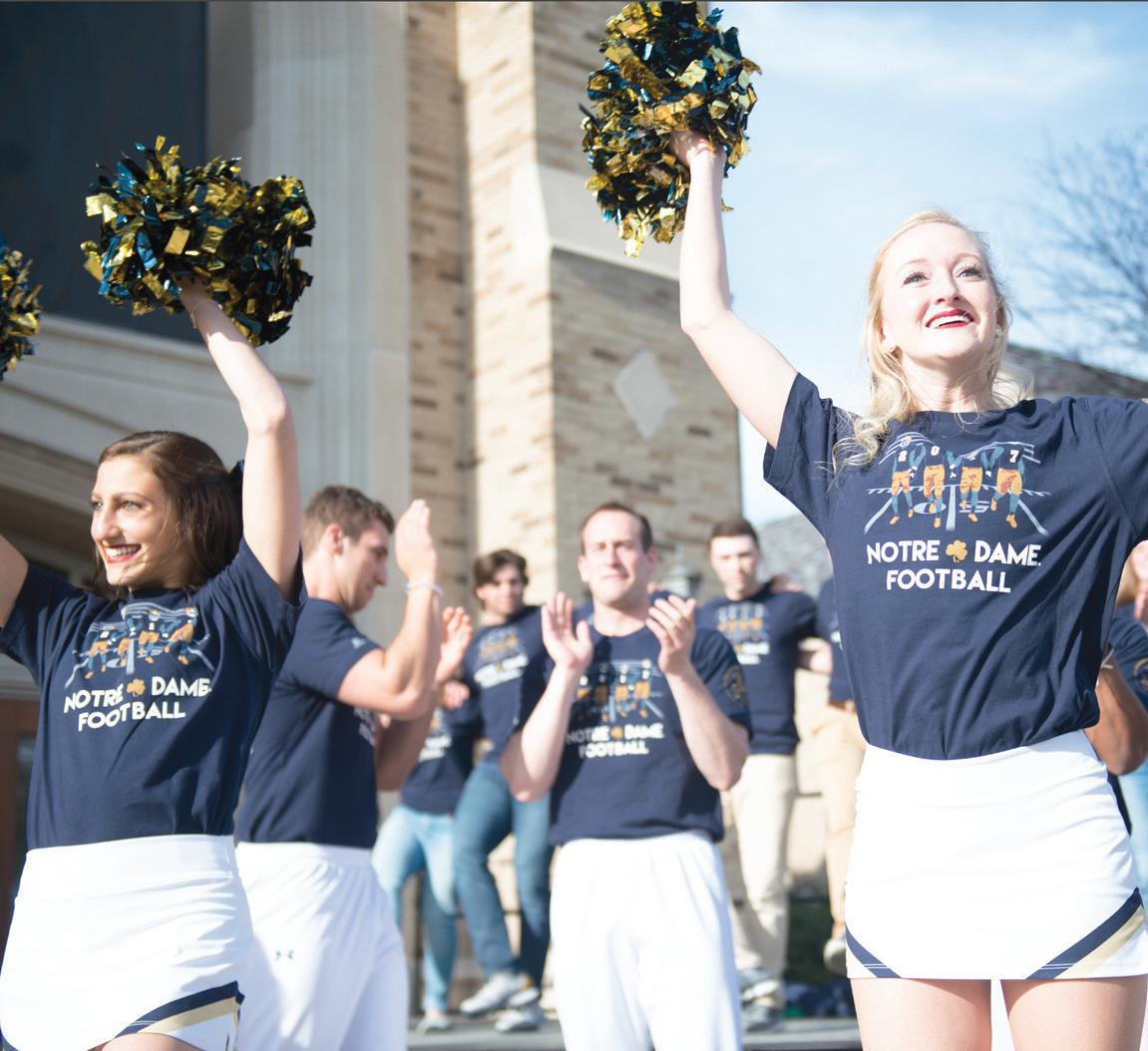
For the first football season with the new Jumbotron, students will see themselves wearing navy, the color of this year’s The shirt.
The design for the front of The shirt features football players holding hands, and the back carries an excerpt from the lyrics of the song “here come the irish,” which was written by former football player and special guest of the unveiling ceremony John scully. according to a university press release, this is the first time The shirt has been navy since 2012.
Justin mccurdy, president of The shirt committee, said this year’s design encompasses various aspects of notre dame football games.
Title i X teach-in examines rights Observer celebrates 50th anniversary
Alumni, students come together for reunion gala
By NATALIE WEBER news writer
This weekend, alumni and current members of The observer gathered to participate in the newspaper’s 50th anniversary celebration, which culminated in a reunion gala on saturday night. senior clare Kossler, who organized the event, said the reunion had been “on [the editorial board’s] radar for forever.” she said she and the other editorial board members began planning for the event at the end of last summer. (Editor’s note: Kossler served as an assistant managing editor for The Observer during the 2016-2017 school year.)
“within just a couple days of us starting to plan for some sort of reunion, observer alumni — without us contacting them as of yet — had started kind of getting together a group to say ‘you know, we really want to have this 50th reunion,’” Kossler said. “at the same time we were planning,
By COURTNEY BECKER news e ditor
n otre d ame community members gathered in g eddes h all on Friday to learn more about Title i X policy and how potential policy changes may affect victims of sexual assault and gender-based violence.
s enior g race watkins began by going through the history of Title i X and its various processes. s he said one of the biggest concerns with Title i X is that the criminal justice system, rather than Title i X officials, should handle sexual assault cases. s he said this argument doesn’t take into consideration the lack of
victim-based mentality in the criminal justice system.
“ i t’s really important to emphasize that not only is gender-based violence something that could go through the criminal system, it’s also a civil rights issue,” she said. “ i f genderbased violence is occurring on campuses, that prevents the victim or the survivor’s educational access. c riminal rights, civil rights — both are valid, and in my opinion, the criminal justice system isn’t really built to handle sexual violence cases.”
b ecause Title i X does not have the power of subpoena,
Almuni panel explores future of journalism
By LUCAS MASIN-MOYER a ssociate news e ditor
in celebration of The observer’s 50th anniversary, former observer journalists discussed changes to the journalism industry in carey auditorium on Friday. The panel was moderated by Tom condon, class of 1968, a former columnist and chief editorial writer for hartford courant.
speakers included michelle Krupa, class of 2000, who serves as news editor for cnn digital, Tom Jackman, class of 1982, who runs the The washington post’s True crime blog, noreen gillespie connolly, saint mary’s class of 2002, who serves as deputy sports editor for associated press and madeline buckley, notre dame class of 2011, who reports for The indianapolis star. condon began the panel by noting the technological changes he’d seen since he graduated from the university.
MICHAEL YU | The Observer Notre Dame cheerleaders model the 2017 edition of The Shirt at the unveiling ceremony at the Hammes Bookstore.
MICHAEL YU | The Observer
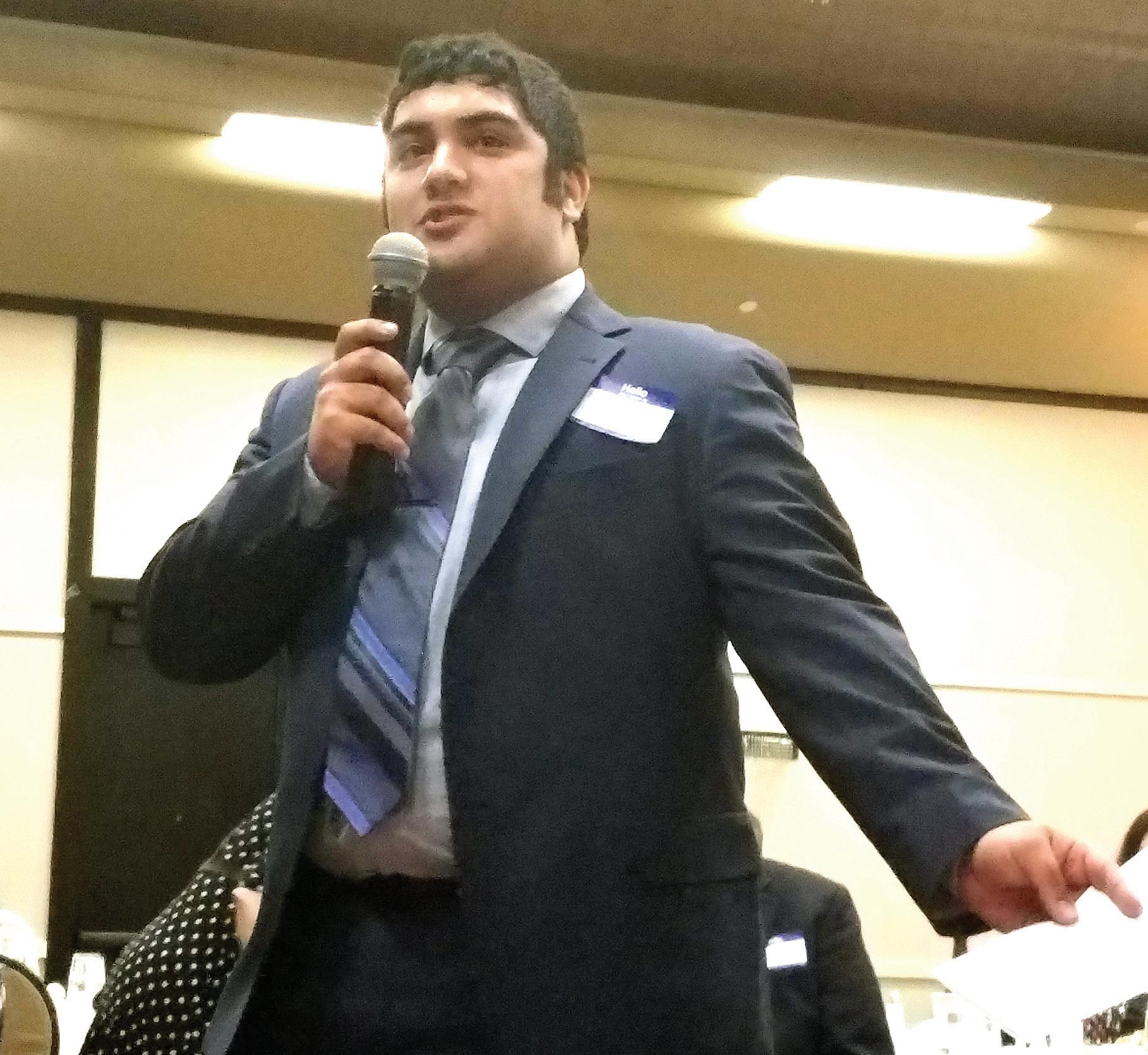
Current editor-in-chief, Ben Padanilam, gives a speech recognizing The Observer’s founder, Robert Sam Anson. Anson started The Observer with fellow student Stephen Feldhaus in 1966.
Policies The observer is the independent, daily newspaper published in print and online by the students of the University of notre dame du Lac and s aint mary’s c ollege. e ditorial content, including advertisements, is not governed by policies of the administration of either institution. The observer reserves the right to refuse advertisements based on content.
The news is reported as accurately and objectively as possible. Unsigned editorials represent the
Colleen Gudeman junior Pasquerilla east hall “Ping pong.” If
Dan Lindstrom junior Keenan hall “bobsledding.”
Grace McKenney sophomore Pasquerilla east hall “bobsledding.”
The nex T Five days:
Monday
2017 BFA/MFA Candidates Thesis Exhibition Snite Museum of Art all day
Open to the public.
Workshop: “Theater and Politics in the Early Modern Age” Hesburgh Library 10:30 a.m. - 6 p.m. RSVP is requested.
Tuesday
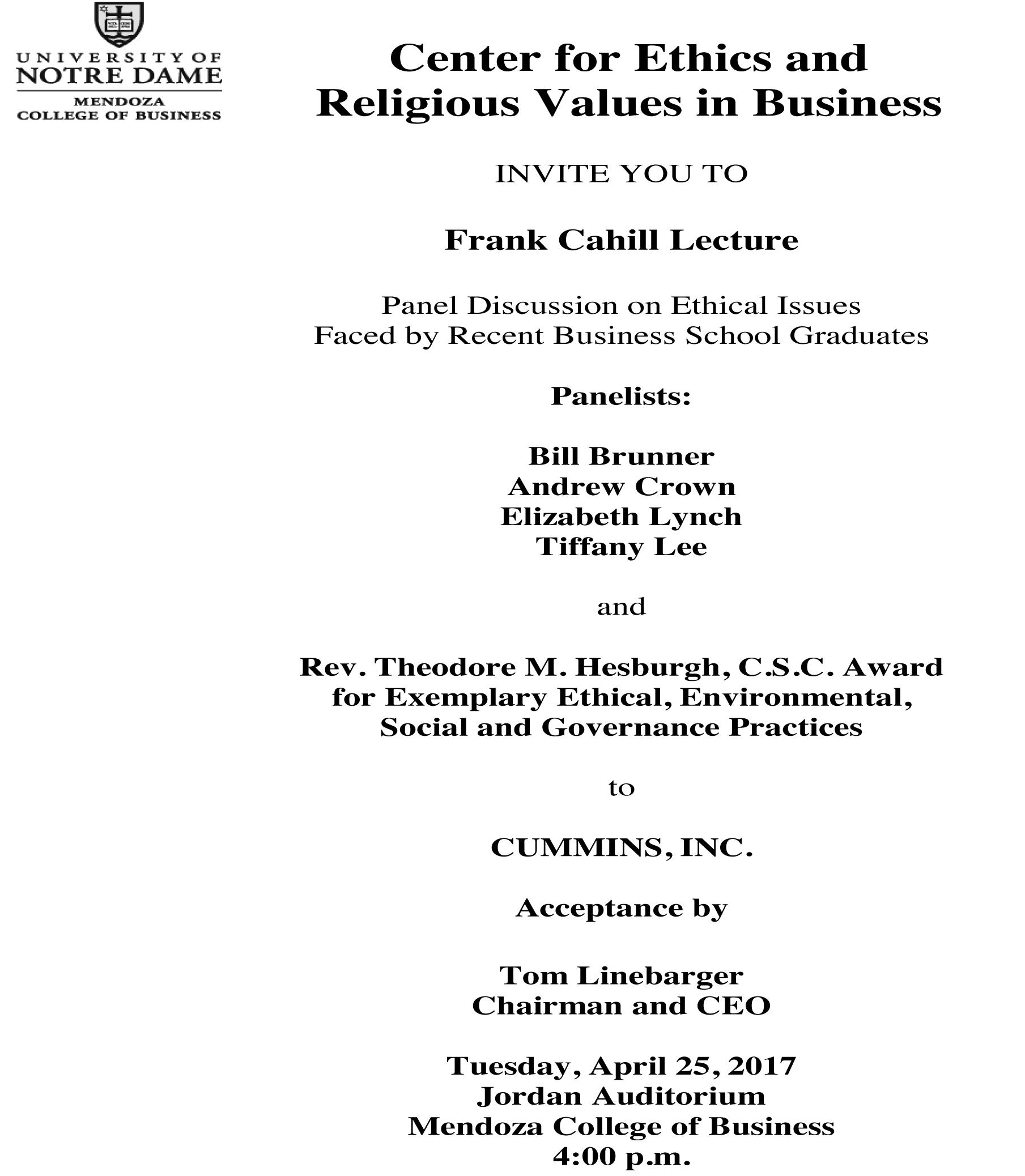
Frank Cahill Lecture Mendoza College of Business
4 p.m. - 5:30 p.m. Panel discussion on business ethics.
Seminar Session O’Shaughnessy Hall
4:30 p.m. - 6:30 p.m.
Wendy Pearlman will discuss Triadic Coercion.
Today’s Staff
Have
Kim Kosman junior Pasquerilla east hall “ski jump — the highest one possible.”
Sarah Drumm junior Walsh hall “speed walking.”
Wilson Barrett junior Keenan hall “Luge.”
Want your event included here? Email news@ndsmcobserver.com
Wednesday
Shred Your Home Files at Work Shred-It Truck in Lot C1 11:30 a.m. - 1:30 p.m. Free and secure document destruction.
Paws to Relax: De-Stress Fair North Quad noon - 2 p.m. Take a break from studying to pet dogs.
Thursday
“The Souls of China: The Return of Religion After Mao” Hesburgh Center 4 p.m. - 5:30 p.m. Talk on faith in China.
Art Exhibit and Reception: “Indivisible: Liberty and Justice for All”
Snite Museum of Art
5 p.m. - 7 p.m.
Friday
High School Art Day Snite Museum of Art all day Area high schoolers take art classes from graduate students.
Higgins Annual May Day Movie Browning Cinema 6 p.m. - 8:30 p.m. Screening of “Paterson” (2016).
Students march for environment
By GINA TWARDOSZ Associate s aint mary’s e ditor
several saint mary’s students marched from howard Park to Jon r hunt memorial Plaza in south bend’s version of the march on science, a celebration of science and a call for science to be involved in governmental policy, on saturday.
sophomore Teresa brickey said in an email the march for science calls for more funding for scientific research and progress.
“The march for science was a celebration of science in general and a call to uphold the dignity of such studies,” she said. “For me, it was about showing our current administration there is no such thing as alternative facts — just facts. And these facts need to be protected and held in a high regard. We must aim for a society that funds research and progress, not walls or for-profit deportation centers.”
brickey said she attended the south bend march for science with several other saint mary’s students and she marched because as a catholic and aspiring lawyer, she wants to help others cement science’s place in society.
“Personally, I have been attending as many protests and demonstrations that align with my faith and personal morals,” she said. “science and faith do go hand in hand. As a devout catholic, global citizen and breathing human being, it is my responsibility to do as much as I can to protect truths and to protect the common dignity that we all share. science is real and should be left out of absurd political party agendas, hence why the march was bipartisan.”
Freshman olivia Garza said in an email she marched because she and her mother strongly believe in water conservation and the importance of raising awareness for global warming.
“my mom is a hippie and strongly believes in conservation of water and reducing our carbon footprint,” Garza said. “Also, the Trump administration is cutting the [environmental Protection Agency] by 31 percent, which is very alarming. I also marched for global warming.”
brickey said the march for science was necessary because America’s current administration wants to cut funding to several environmental and educational factions of the government.
“our current administration is in the
process of creating their budget cuts,” she said. “They intend to decrease the allocation of funding to groups like the ePA, national Parks, the department of education, grants that protect our water quality and many other areas that simply are more important than offsetting the increase in defense funding.”
Garza said she believes the march for science is a march for future generations.
“students are the future,” she said. “We are the future teachers, lawyers, doctors, parents of America, and I want this plant to continue to be beautiful for the future. If we disregard climate change and global warming, we are doing disservice to ourselves and to future generations.”
Garza said students have the opportunity to raise awareness for science, education and conservation.
“I encourage students to recycle, to shop at thrift stores online or in person, use reusable water bottles or brita filters and reusable bags,” she said. “march for science, keep updated on the ePA and other political issues that concern climate. We can plant trees within our own communities.”
Contact Gina Twardosz at gtwardosz@saintmarys.edu
Watkins said, one of the biggest concerns that has been expressed about potential changes in Title i X policy under the new administration is the evidence standard with which Title i X cases will be judged.
“The main thing that we’re really concerned about is whether the preponderance of evidence standard will shift up to clear and convincing,” she said. “ s o right now, it sits that you need to have 50 percent, plus one or above, certainty that an act of gender-based violence occurred in order for the party to be found responsible. c lear and convincing moves it up to 75. … We need to value survivors’ ability to access education over having a higher standard.”
The transgender community is also expected to face greater resistance than it did under the o bama administration, fifth-year student b ryan r icketts said.
“The o bama administration put forth guidance on Title i X saying that its protections under gender discrimination and sex discrimination apply to transgender students,” he said. “ i f they are denied appropriate housing, or bathroom access or things like that, that is discrimination on the basis of their sex that falls under Title i X. This is not something that is expected to stay intact under the Trump administration.”
a ccording to r icketts, Title i X policy does not discriminate on the basis of whether or not an assault occurred between two members of the same sex, but there are additional challenges for LG b T survivors of sexual assault.
“Underreporting is more prominent [in the LG b T community], but sexual violence happens,” he said. “ … n ot only do you have to be reporting an incident of sexual
violence, but [you’re] also outing yourself as LG b T — maybe to friends maybe to family, maybe to administrators. Whatever that looks like, you have to go through the coming out process.”
s enior Gabriela m alespin spoke about the additional obstacles immigrants are facing in reporting instances of sexual assault, domestic abuse or other gender-based violence due to the increased authority of the U. s i mmigration and c ustoms e nforcement ( ice ).
“The Trump administration has eliminated a lot of existing barriers for ice officials,” she said. “This poses a challenge for a lot of undocumented survivors who might have to face a choice between reporting their abuse and facing the risk of deportation.”
i n addition to sources such as Know Your i X — an organization intended to inform students about their Title i X rights, Watkins cited several initiatives being introduced to n otre d ame as ways for students to become more aware of Title i X policy and issues on campus. Freshman i sabel r ooper, the student government director of gender relations, said student government is working to implement programs such as c allisto, a survivor-friendly reporting system, to improve the University’s response to sexual assault.
“ i t’s hard to know what the problems are with our school’s Title i X compliance if people don’t talk about it and if we don’t hear about it,” she said. “ … We have some recommendations in terms of releasing aggregate data, and the c allisto reporting system has been passed on to [vice president of student affairs] e rin h offman h arding. s o that’s in her hands now. We’re really hoping that both of those get kind of accepted, and we’d love to get c allisto implemented by fall of 2017.”
Contact Courtney Becker at cbecker3@nd.edu
Paid a dverT isemen T
Paid a dverT isemen T
reunion
there was kind of a movement of the alumni to also have a reunion.”
mike connolly and his wife, noreen gillespie connolly, who served as editor-in-chief and assistant managing editor respectively from 2000-2002, helped organize the 35th and 40th reunions for The observer.
connolly said he and gillespie collaborated with current staff members to organize this year’s 50th reunion.
connolly said this reunion was the easiest reunion he has organized because social media enabled him to recruit attendees.
“i would tag people on facebook,” he said. “i would find an old photo, and i would tag people in facebook posts and say ‘You had so much fun. You’ve got to come.’”
Looking through old editions of The observer causes fond memories to surface, connolly said.
“i was digging through the old archives and pulling up old stories and tagging the people that wrote them, tagging the photographers,” he said. “a nd everybody remembered ‘That was my crew. That was my crazy student government story, and that was my crazy cop story and that was my crazy football game.’”
suzanne Lacroix, class of 1985, said she cherished her time laying out the newspaper.
“You’d show up at 8 o’clock [at night], and then things really didn’t get rolling until about 1 [a.m.],” Lacroix said. “a nd then if you got done early, that was always the best. if you just blew through it and it was like 2:30, then you went to denny’s, if you had somebody with a car.”
heather macKenzie, who served as assistant managing
editor from 1998-1999, said she remembered reporting on gay male students who found notes on their beds containing death threats. she said her time on The observer taught her she could use her writing to advocate for others.
“What this place taught me was i can stand up for people like that,” macKenzie said. “it made me so angry to hear those stories. Throughout the rest of my life, i have been angry about stuff like that, and i have spoken up about it ... we had the voice and the opportunity to do that at The observer as an independent student institution.”
a lison hamilton, editor-inchief from 1990-1991, said the skills she learned while working for The observer have helped her in many areas of her life.
“The ability to tell a story, to frame a narrative or frame an issue is a skill that you can use in many many lines of work,” she said. “i’ve certainly used it as a social worker. i’ve used it advocating for my daughter with autism.”
at the gala, robert sam a nson — who co-founded The observer with fellow student stephen feldhaus in 1966 — was given an award recognizing his contributions to the paper.
When asked what legacy he hoped to leave, a nson said he hopes students enjoy their time as journalists and don’t let the administration intimidate them.
“[i hope] everyone has a great time, doesn’t get pushed around by the administration, resists authority — including that of the president of the united states — and just feels so lucky they are working as journalists,” he said.
“i just think, it was a million to one shot that The observer would work, and it did work.”
Contact Natalie Weber at nweber@nd.edu
“it’s crisp, it’s clean, it’s notre dame, the navy, and it captures all aspects of the start of a football game: the players walking out, the fans getting the chills when the song comes on, the cheerleaders running out of the tunnel,” mccurdy said. “it just incorporates that beginning that we all know to the notre dame football games.”
Kristin a ndrejko, vice president of The shirt committee, said the notre dame football experience is a unique one, and this year’s shirt seeks to replicate that.
“i think it’s special because i’ve never seen a shirt that captures a moment in the stadium, and i think this shirt really does just that,” a ndrejko said. “it’s the players walking out at the beginning of the game, holding hands, a sign of unity … and it’s the chills you get when you hear ‘There’s a magic in the sound of their name.’”
To create excitement about The shirt unveiling, the committee hosted several events last
tweeted were birds,” he said. “... reporters wrote stories on paper and were edited with crayons or pencils, something red.”
Krupa said she first experienced the massive changes of the digital era while working for The Times-Picayune in new orleans.
“When i was at the Picayune, i was faced with my first sea change in the industry, which was that the newhouse company … they decided that in the digital age, presumably because stories can be online 24 hours a day, they would reduce the staff by more than half and start printing the paper three days a week instead of seven,” she said.
Krupa said these changes pushed her to embark on a new career path, so she headed to cnn, whose digital platform provides expansive opportunities.
“We have a different kind of parameters but a different kind of freedom … there’s this new freedom in digital where we can hit publish at any time of the day,” she said. “We’re on sort of self imposed deadline. We want to be first. We want to be the ones with the most interesting and correct information.”
Jackman said he witnessed dramatic challenges at The Washington Post, such as amazon.com founder Jeff bezos purchasing the newspaper.
short form and goes back to long form,” she said. “don’t get too settled on a particular path because you’re going to have opportunities that you would have never expected,” she said.
buckley said one of the biggest changes she noticed concerned the social media aspect of reporting.
“When i graduated in 2011, newspapers were fully immersed in the digital world, but it was only until my last year at The observer that the website was becoming less of an afterthought,” she said. “so the things i’ve had to do in my reporting since graduating really [have] changed and surprised me. Just yesterday, trying to tie things up for the weekend, i wrote sample facebook prompts for a story that’s running sunday. i wrote news alerts for a story that’s running sunday. i worked on video with a photographer.” despite these wholesale
changes, and the seemingly dire straights of print journalism, gillespie connolly said good journalism is crucial in informing the a merican people.
“i think that we’re sitting right now in a political time where you’ve got a President of the united states challenging the credibility of journalists every single day, and i think what is going on and the reporting that is stemming from the political narrative is getting more readers, more interest in what we do,” she said. “Yes, there are allegations of fake news. ... There is more going on in journalism right now and more smart, good news reporting that it makes it more necessary than it’s ever been.”
When asked whether students ought to pursue journalism, Jackman said “Yes. hell yes.”
Contact Lucas Masin-Moyer at lmasinmo@nd.edu
week, allowing students to design a shirt on a cookie in the dining halls and to participate in an a mazing race scavenger hunt, which had a prize of two on-field tickets for the notre dame-miami (ohio) game next year.
“The a mazing race, all headed by a lex richard, was over in 11 minutes,” mccurdy said. “People were running into the final location sweating, out of breath. it was great.”
a ndrejko, who will serve as the president of The shirt committee next year, said the group looks forward to doing the event again.
The unveiling ceremony itself featured free food from barnaby’s Pizza, Let’s spoon and nd catering as well as performances by musical groups on campus and an appearance by scully.
The proceeds from The shirt will be split between the student union and student enrichment endowment, which seeks to allow all students to enjoy the notre dame experience regardless of their financial situation.
Contact Alexandra Muck at amuck@nd.edu
“The Post’s mission for many years was covering Washington,” he said. “ … so Jeff bezos said we need need to be bigger than that and go to the world and build that brand. People had heard of that brand. There was this thing in the seventies with a hotel and a break in and all that stuff.”
The change to digital forced Jackman to slightly alter his role, he said.
“i’ve had to make the change to digital … and also learn how to file all the time, and that was new, and a lot of the people at The Washington Post have been dragged kicking and screaming into the digital age because we liked one deadline,” he said.
gillespie connolly said the changing nature of journalism has forced her to be more flexible.
“in my 15 years with the aP, i’ve been a reporter, i’ve covered government, and i’ve been a manager,” she said. “Three years ago, after a decade in news, i switched to sports.”
adaptability, gillespie connolly added, is a necessary trait in aspiring journalists.
“i would say that the biggest thing [is] as industry has changed, as text has become video, as print has become broadcast, long form becomes
Paid a dverT isemen T
Paid a dverT isemen T
inside ColuMn
Where do senior friendships go?
Gabrielle Jansen news Writer
h ey seniors, I know you are wigging out about the future, but here’s some advice: go easy on your friends. Yes, your friends. They’re just as stressed as you too. I know it is scary not having solid plans, and it seems like they have their futures figured out, but they honestly don’t. We’re all in the same boat, stop imagining that you’re the only one in a boat full of holes out at sea (or the Fisher r egatta, if that seems more personal). s top holding things against them that are out of both of your control.
o n that note, we need to stop dumping our problems to our friends without thinking about them. As much as I wish I am Wonder Woman, I can only bear so much. I can only love so much before the weight of the world starts to crack my shoulders. Friends are great, we’re there for each other, but when it becomes one sided complaining and angst, it gets unhealthy for both. Those that are always venting to the one friend needs to realize that, while they have good reasons for their feelings, should know they’re friend is one person who can’t change anything and is probably tired of the ranting. For the friend on the receiving end, if they’re the cheerleader of the relationship, it gets disheartening and another stresser when finishing the year. b ut you can’t say no to that person because you want to be supportive. When the world is turning on all of us as seniors, it’s hard to support others when you can’t find any support for yourself.
As often discussed around the tri-campuses, we all like to brag about how busy we are, and seem to almost put down those who are on top of their schedule. Well, no one is on top of it as seniors, we’re all trying to get through this struggle of graduation and plans afterwards. s top pitying yourself by comparing yourself to others. Again with the boat analogy, we might be on the same sinking ship, but everyone’s destination is different. s top holding these standards that your friends and acquaintances should be doing what you’re doing.
It’s hard seeing our friends change in the last few months. s ome have immediate plans for jobs or graduate school. s ome have done the ring by spring. And others just haven’t. Instead of being mad at seeing how your friends have changed, realize how much you have changed. e njoy it before you both go off and not see each other for a while. Just be patient.
I know I’m scared of the future. I have yet to hear back from places I’ve applied to, while some of friends already know when they start at their jobs. We’re all stressed, it’s normal, just remember that you love these people and that they’re only human too.
Contact Gabrielle Jansen at gjanse01@saintmarys.edu
The views expressed in the Inside Column are those of the author and not necessarily those of The Observer.
leTTers To THe ediTor
If you like coffee with your oxygen...
n ow don’t get me wrong — I know that coffee is life-giving. It has the incredible ability to pick you up from your crumpled, sleep-deprived state and transform you into an alert, ambitious pupil. It allows you to adopt godlike powers at 4am as you study straight through the night and ace that exam. With your coffee in hand, you’re a sophisticated scholar, an eloquent speaker, a sharp mathematician. You recognize patterns, make connections, all the while not snapping at the person who just ran into you. It allows you to be the best and brightest among your groggy classmates who weren’t smart enough to down a cup before your 8am — or so you may think.
s o if I were to suggest you give up coffee — just for a few weeks — to mitigate your addiction, you’d probably scoff at me, right? I don’t blame you. That’s what I used to do too. c offee makes you a better person, so why not drink it?
b ut how do you know when you’ve gone too far? Is it when withdrawal headaches render you incapable of completing basic tasks? o r is it when your bank account cries for relief?
For me, it took a bunch of people at 11 p.m. on Fat Tuesday laughing about how I could never give up coffee for Lent. b eing the competitive person I am, paired with my love of proving people wrong (who doesn’t?), I decided to quit cold turkey. I was going to immediately transition from my average three to four cups a day to zero.
I’m not going to lie — the first week was ridiculously hard. d ay one, I slept through my 8:20, fell asleep amidst an intense basketball game, and had somehow adopted some type of caffeine-deprived, I’m-not-taking-your-nonsense alter ego. I remember walking past s tarbucks with tears in my eyes knowing that I couldn’t go ask for that incredible cold brewed coffee with an extra shot of espresso in it. m y migraines rivaled those from when I had a concussion, and there was nothing I desired more than to feel that coffee coursing through my veins. I missed the smell, the taste, the comfort.
These ridiculously over-dramatic side effects I was facing forced me to reflect upon what type of
life I had truly been leading before. What I had previously believed was a typical respect for the power of coffee had developed into an unhealthy, codependent relationship. When I looked back upon those particularly hectic weeks — those where I was a complete slave to my Keurig — I realized how truly lifeless I was. I was a robot —one that only functioned when powered with caffeine.
The truth of the matter is, coffee is a drug. A morning cup of joe is a perfectly healthy drink to have in your daily routine, as long as you’re not consistently consuming three or four times that amount. e ven though experts have touted its health benefits, that’s when it’s used in moderation. And unfortunately on college campuses, little is done in moderation.
Yet I have little room to lecture on this topic: I still put off more work than I should, and I still stay up way too late. And yes, it’s a rarity when I get those elusive eight hours of sleep. Yet I’m miles closer than I used to be.
s o what have I learned during my forty-day journey sans coffee? To start, I enjoy actually waking up when my eyes open in the morning, as opposed to after some caffeine is in my system. I enjoy (mostly) being able to resist the magnetic pull s tarbucks used to have over me. h eck, I even enjoy not having to worry about coffee breath.
m ost of all, I like being able to hold a coffee in my hands without it having a hold on me.
n ow that Lent is over, I’ve started incorporating some coffee back into my routine. The occasional cup in the morning when I’m especially dragging, or if I’m in a crunch and need to stay up late, I know I’ll reach for some. b ut as for me, it can’t be a crutch anymore. Life is too beautiful without it.
s o next time you reach for that triple-shot drink at midnight, think about what you’re doing to your body. You need sleep. You deserve sleep. You can function without coffee.
Katie
freshman Apr. 23
Tolerance and intolerance
In my political philosophy class last week, our discussion about the meaning of the word “intolerance” in John r awls’s “A Theory of” provoked a strong and healthy debate about same-sex marriage. o ne of my classmates was discussing how people holding intolerant views in modern-day society ought to be treated by supposedly “tolerant” individuals. h e argued that people who oppose government recognition of same-sex marriage are inherently intolerant because this recently-legalized institution is a “human right.” Thus, while a society should allow people to hold such views, those views are naturally wrong.
I wholeheartedly disagree. A practice like samesex marriage is not a “human right” just because one happens to agree with it. Furthermore, the millions of Americans who oppose same-sex marriage aren’t fundamentally intolerant of LG b T people; they just disagree with the idea that the government should be recognizing same-sex marriages.
m y argument in class, however, was more precise. I argued that the nationwide legalization of same-sex marriage was, practically speaking, nothing more than a requirement that the government hand out entitlements in the form of marriage licenses. This was very similar to what
Justice c larence Thomas said in his o bergefell v. h odges dissent: “Liberty has long been understood as individual freedom from governmental action, not as a right to a particular governmental entitlement.” Is a government entitlement the same thing as a “human right?” c ertainly not.
m oreover, I pointed out that the government does not exist to make individuals feel loved; rather it exists simply to create and enforce the law. As Justice Thomas said, “The government cannot bestow dignity, and it cannot take it away.” o nly individuals, not the government, have the ability to love and be loved by others.
It is not “intolerant” to believe that government entitlements are not human rights (they aren’t). It is also not “intolerant” to believe that the government is not responsible for giving people dignity (it can’t). I’m sure there are many people who would label me a homophobe for holding these views (I’m not). h owever, I welcomed this debate because civil disagreement is something that our society desperately needs.
McGuire
Brennan Buhr freshman
Cole Feldman
The Absurder
Friendship and society
Thoreau had three chairs in his cabin by Walden Pond: “o ne for solitude, two for friendship, three for society.”
I wonder if there are diminishing returns after two? If six or seven might be too many cooks in the kitchen. e specially when you’re trying to have a conversation. b ut then again, this would be far too few for a party big enough that any one is not too shy to dance.
And the modern economy is the biggest party of them all. e ver since specialization, there are enough machines to require many men for the benefits of scale. e ven in primal tribes, strength in numbers afforded protection to each individual.
Also the orchestra benefits from a diversity of instrument, and the scientific community from a diversity of opinion — instances, it seems, where the best way to serve the individual is to serve the society, to become a part of something greater.
Why then, of the third chair, does Thoreau say: “When visitors came in larger and unexpected
numbers there was but the third chair for them all, but they generally economized the room by standing up.”
n ot random, I think, that Thoreau uses the word “economized.” d iminishing, he might agree, are his returns from visitors beyond three. s o sudden is the diminishing, he thought it not worth the space to have a fourth chair.
b ecause friendship is one thing, and production — scientific, musical, economic or otherwise — is another. For the latter, we discovered we were better together. We invented trade, specialized and the togetherness became irreversible. We say, “The more the merrier.”
b ut for the friendly former, might we prefer less, even so few as two? m ore might be merrier for power and production but for trust and loyalty it seems there are diminishing returns after so many.
In conversation, for example. With two, always a listener and a speaker. The listener empathic and the speaker expressive. e ach speaking in the other’s language. With three, two listeners and a speaker. The speaker averaging his language for the listening two. And the averaging increases
Trains,
This year started on a disturbing note. As I was on a m onday morning walk near our house in d allas, I answered a call from on my mobile phone. I normally don’t carry my phone when I walk, since I consider it a time to get away from distractions, but my mom had gone into the hospital with respiratory issues the week before, and we were planning to return to s an Antonio in a few days to be with her.
“ m r. r amirez? It’s b .J. at the Toyota dealership,” the voice on the phone announced. o ur s U v had been in the shop for a while, and we had a loaner car. Just so you know, I do not consider having a car in for repair to be part of the disturbing aspect of that morning’s walk, but things were about to change.
“We need to get some parts in from c alifornia…”
A flurry of activity entered my peripheral vision, then moved off behind me to the right. I felt a punch at the back of my left ankle, and a sharp pain. I looked down and to my left, and saw a large pitbull-ish dog clamped on me just above my n ike. I tried not to move, and looked up to my right to see people running towards me, apparently having come from the house where the dog resided.
“ h ey, b .J.,” I said, in a calm, firm voice. “We’re keeping the loaner car for now, you guys are paying for it as long as we need it, but I have a dog biting me, so I’ll call you later.”
The dog’s owners pulled him (I later found his name was d ax) off my leg, got the dog secured on a leash, and we all started checking out the wounds. d ax had managed to wrap his maw around my
with number of listeners.
In lecture, the professor averages for a hundred students. The style of teaching increasingly mismatched with any one student’s individual style of learning. o ne student’s question is simultaneously wasting the time of the other ninety-nine, or at least of those who already know the answer. s o we don’t ask questions.
m ight we learn better from conversations? From back-and-forth dialogue rather than one direction slide-reading. b ut professors are too expensive. s o we economized education.
s o too with empathy, how to look out to the mass and discern an emotion other than what has been democratically agreed upon? versus to see the dilation in one pair of eyes. To hear the tone of one voice rather than a mass-formed unison that blends all diversity into one pitch.
Keep two chairs, three at most, lest your home become a factory.
Deep hows and outer spades, art and idiosingsongs; email colejfeldman@gmail.com, nonsense only, please.
The views expressed in this column are those of the author and not necessarily those of The Observer.
tracks and scars
leg and left a set of wounds like crimson parentheses arcing a third of the way around my lower calf. I had the wounds wrapped while I stood in the street, completed my walk and drove myself to a strip-center emergency care facility. d octors cleaned and covered the wounds (no stitches — apparently standard protocol for a dog bite), and three days later our family drove to s an Antonio.
We visited with my mom on the Thursday we arrived, saw her again of Friday, and were awakened s aturday morning with the news that she had passed away in her sleep. m y mom was 94, and she died surrounded by her family, so her death was not a surprise or tragic. s till, it hurt, and the funeral a week later was a time to hold our whole family close and remind each other that we need to take care of each other while we can and treasure our time together.
m y wife, who is a nurse, got to change my wound dressing twice a day, giving it better care than I received at the doctor’s office. With her help the dog bite went from being painful and raw, to sore and tender, now healed and scarring over. With respect to my mom’s death, my wife also provided the quiet comfort that only a caring friend and partner can offer: sometimes asking how I was doing, perhaps offering some advice from her own experience, but mostly just helping to fill in the quiet time by being near me or simply holding my hand.
We returned to s an Antonio for the first time since my mom’s funeral for our annual e aster reunion at my brother’s place in c astroville, about 20 miles west of s an Antonio. The gathering was a little subdued, but my dad, now 96, was on hand to encourage everyone to eat their fill of barbecue and get the kickball game underway. In the festivity was a sense of loss, but a certainty that life and
more celebrations would go on.
The house we stayed at was near a train line still in active use. I was standing on the porch of the house when the crossing guard bells rang out, and a s outhern Pacific engine moaned its low warning to clear the tracks. The train rumbled past, hauling freight cars, containers, tankers, large coils of the very stuff of industry, and rolled on into the distance. I was raised near the tracks of trains that hauled endless chains of cattle cars to meat packing plants, and the smell from those operations would make you nauseous when the wind blew the wrong way on a hot summer day.
m aybe that was the reason I saw train tracks as scars that cut across cities, and it was those tracks — those scars — that remained when the trains moved on. The sound of the train on our e aster visit made me nostalgic for the little house crammed with seven children and our parents, with a nearby train rumbling and sounding its horn.
Like many of us, I carry some scars. I’ve made my peace with d ax, who still roams the neighborhood, albeit with a muzzle, and I will always miss my mom, while treasuring any and all of the time we had together. If the wounds were deep and the scars take longer to heal, then so be it. b esides, on the West s ide of s an Antonio, where I was born and raised, a big dog bite scar is more than a scar — it’s street cred.
Ray Ramirez is an attorney practicing, yet never perfecting, law in Texas while waiting patiently for a MacArthur Genius Grant. You may contact him at patrayram@sbcglobal.net
The views expressed in this column are those of the author and not necessarily those of The Observer.
Ray Ramirez
The c rooked Path
Alonso shows Indy
500’s legitimacy
n ext month, hundreds of thousands will flock to the Indianapolis m otor s peedway as usual for one of America’s great traditions: the Indianapolis 500.
Yet one thing will be very, very different: Fernando Alonso’s presence.
Alonso is, by most metrics, one of the best drivers on the face of the planet. h is 32 Formula o ne race wins place him sixth on the all time list, and among active drivers, his two drivers’ championships are only surpassed by Lewis h amilton and s ebastian vettel. h e’s making $40 million this year to drive for m cLaren, most in the series. While he’s not going to fight for the title once more this year — his weak h onda engine will again keep him out of serious contention — but when you listen to the commentators on an F1 race, or ask any fan of the series, you’ll hear them gush about how well he starts, how much he gets out of his underperforming car and how Alonso still has “it,” 11 years after he won his last title.
In some sense, Alonso’s entry will be a throwback to the 1960s, when F1’s best — Jack b rabham, Jim c lark and, of course, Graham h ill — crossed the Atlantic to run, and in c lark and h ill’s cases win, the 500, bringing with them the rear-engine revolution that changed the sport. In another, it’ll be a throwback to the 1970s, when his m cLaren team won twice with Johnny r utherford.
Perhaps more importantly though, where the status of the 500 is concerned, Alonso will forgo an opportunity to win at m onaco to run Indianapolis.
Thirty years ago, if you’d asked any racing fan what the world’s biggest race was, the odds would have been good the Indianapolis 500 was the answer — even n A sc A r or F1 fans would be likely to admit it. b ut, thanks in part to an ever-damaging American open-wheel split that separated the largest race from the best drivers in the mid-’90s, the 500 wouldn’t be the universal, or even most popular, answer to the question today.
A n A sc A r fan will rave about the d aytona 500; an F1 fan would discuss m onaco.
Yet, on its biggest weekend, Alonso is ditching F1 for the Indianapolis 500.
Yes, the troubled car m cLaren- h onda has given Alonso this year probably factors into this decision — Alonso has little chance to finish on any F1 podium this year, so an opportunity to go somewhere he may be able to run near the front has to be attractive.
b ut at the same point in time, if Alonso was going to find the F1 podium this year, it was almost certainly going to be at m onaco. The famous street circuit often produces wonky results and, last year, it was Alonso’s joint-highest finish, fifth. A good result at m onaco could have been a highlight of Alonso’s season in Formula o ne — instead, he’s choosing Indy c ar and the 500 for a chance at the highlight of his season.
n ationwide and worldwide attention has, in recent years, pivoted away from the Indianapolis 500, that’s true. Yet Alonso’s decision to race the 500 gives it something it hasn’t had in a while: a must-watch attraction.
Yes, it is true that Alonso isn’t likely to move the needle inside the United s tates — Kurt b usch’s run in 2014 will have done more than the s paniard heading to Indianapolis this year.
b ut the real opportunity comes from the legitimacy Alonso will bring to the field.
Largely, race fans perceive the world’s best drivers to be outside of Indy c ar — whether that’s fair or not.
h amilton, Alonso and vettel are all better than Indy c ar’s s cott d ixon or Will Power; n A sc A r ’s Jimmie Johnson would be higher-regarded by most Americans than r yan h unter- r eay. n ow, Indy c ar’s best drivers will, at least, have a chance to run against one of those guys on their turf — and who knows, perhaps Alonso’s decision will turn into increased one-off appearances by other series’ top drivers.
And, perhaps, more than anything, it’s that Alonso brings legitimacy to the race; he’s running the 500 as part of his goal to be the “best driver in the world.”
If Alonso’s participation proves one thing, it’s the the Indianapolis 500 is, well, still the Indianapolis 500. o r, as we often like to refer to it back home, the “greatest spectacle in racing.”
Contact Alex Carson at acarson1@nd.edu
The views expressed in this Sports Authority are those of the author and not necessarily those of The Observer.
cavaliers sweep Irish in Acc matchup at home
Observer Sports Staff
o ver the weekend, n otre d ame was swept by Accfoe v irginia in a threegame series at m elissa c ook s tadium.
After the series, the Irish (27-18, 11-10 A cc ) sit in fifth place in the Acc , just a game above .500 in the conference.
The weekend action started s aturday with a doubleheader at m elissa c ook s tadium. The Irish got off to early leads in both games, but were unable to hold on as the c avaliers surged back both times s aturday afternoon to take two wins.
In the first game of the set, the Wester sisters, senior center fielder Karley and sophomore left fielder Ali, found their way on base in the bottom of the first inning, with Ali Wester driving in her sister for a 1-0 lead after a v irginia error. s ophomore infielder c aitlyn b rooks knocked in Ali Wester later in the inning to give n otre d ame a 2-0 lead.
v irginia answered in a big way, however, in the top of the second. s ophomore right fielder Lacy s mith hit a three-run blast to take the lead, and then a single and an error gave the c avaliers two more runs to make it a 5-2 game.
b rooks entered the game in relief for the third and fourth innings and did not yield a run, despite v irginia loading the bases in the third and stranding two runners in the fourth.
s ophomore third baseman m elissa r ochford homered in the sixth, but her solo shot wasn’t enough as the Irish fell 6-3.
In the second game of the series, the Irish led 4-1 after the first inning as junior shortstop m organ r eed and senior right fielder Kimmy s ullivan each hit two-run homers.
b ut the Irish defense couldn’t contain the c avaliers’ offense and v irginia scored three runs in the top of the second and then seven more in the top of the fourth to put the game out of reach at 11-5, and the final score came to 11-6.
In s unday’s game, junior
Katie b eriont struggled early on the mound, as the first two batters she faced picked up singles. A sacrifice bunt advanced the runners to second and third and a sacrifice fly by senior designated player m cKall m iller plated a run. Then, sophomore right fielder Lacy s mith singled to right field to put the c avaliers up 2-0 in the first inning.
In the bottom of the first, Karley Wester single and stole second, and Ali Wester advanced Karley to third on a fielder’s choice. Another fielder’s choice brought Wester home to make it 2-1 v irginia.
In the top of the second frame, v irginia added to the lead with an rb I double by senior shortstop m adison Labshere. s ophomore b rooks entered the game on the mound in place of b eriont. b rooks struck out one batter with runners on first and second. s enior third baseman Kaitlin Fitzgerald launched a single to right field, which scored a run. b ut on the same play, the Irish threw out Fitzgerald trying to reach second, as well as a c avalier runner trying to score all the way from first base to end the inning. The c avaliers led 4-1 after two frames.
The Irish again found a way back into the game as junior first baseman s ara White singled to score Kimmy s ullivan to make it
4-2.
Then, with the bases loaded the Irish had an opportunity to get back into the game with Karley Wester at bat. Wester grounded to the shortstop, but Labshere’s throw went wide of first base and all three Irish base runners came home to score as the ball skirted up into right field.
With their first lead of the game at 5-4, b rooks looked to maintain the Irish lead. The b urbank, c alifornia, native, pitched a scoreless third inning, but allowed an rb I single in the fourth to tie the game.
In the bottom of the fourth, the Irish loaded the bases, but came up empty. The fifth and sixth innings also remained scoreless for both teams and the game entered the seventh inning. v irginia took a 6-5 lead in the game’s final inning as m cKall m iller launched a solo home run just over the fence in left-center field. Later in the inning, Labshere doubled to left center to bring home two runners and giving the c avaliers an 8-5 lead. v irginia added two more runs to end their scoring at 10-5.
The Irish scored just one run in the bottom of the seventh to make the final score 10-6.
n ext up for n otre d ame is a game on the road at n orthwestern on Tuesday. First pitch is slated for 5 p.m.
Alex Carson s enior sports Writer
MICHAEL YU | The Observer
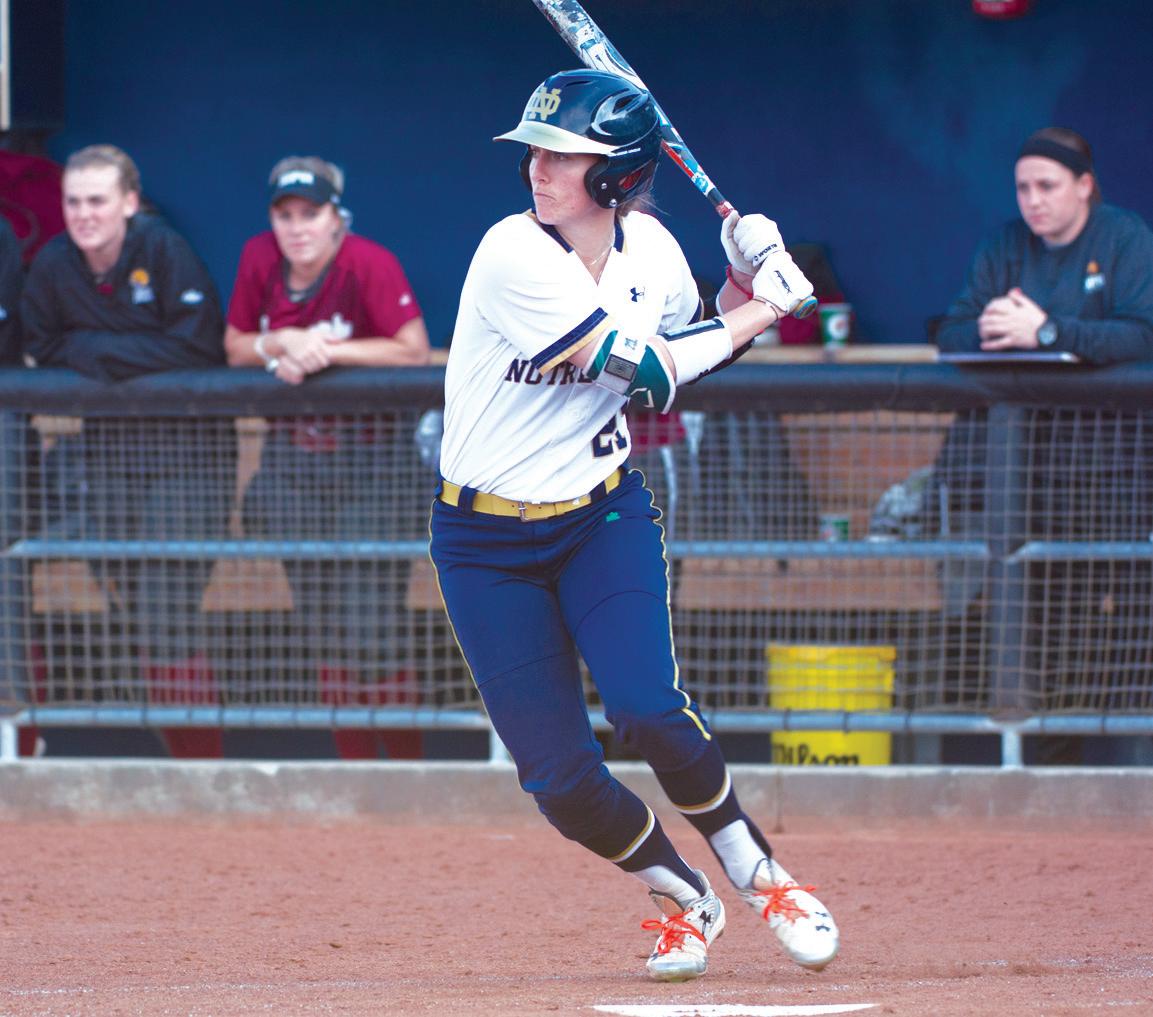
Irish senior center fielder Karley Wester waits for a pitch during Notre Dame’s 13-4 win over IUPUI on April 12.
their own from junior attack mikey Wynne.
a few minutes later, the irish put together a pair of unassisted goals from graduate student bobby gray and freshman bryan costabile to go up 3-1 early in the game. after carolina added another goal, a pin-point pass from Perkovic found Wynne to give Wynne his second goal of the game to close out the first period with a score of 4-2 in favor of the irish.
The Tar heels came out strong in the first five minutes of the second period, quickly tying up the game at four with goals from graduate student michael Tagliaferri and sophomore attack andy matthews.
but notre dame was unfazed, bouncing right back with a trio of goals from Perkovic, sophomore brendan gleason and the third goal on the day for Wynne to put the irish up 7-4. north carolina was able to break through with just three seconds left in the half, putting the halftime score at 7-5 in favor of the irish.
The second half opened with an impressive behind the back trick shot from Tar heel junior attack chris cloutier to bring the Tar heels within one. Keeping consistent with the first half, the irish bounced right back, behind a goal from gleason, his second on the day.
The Tar heels did not back down, and kept the pressure on the irish backfield. This worked to the team’s advantage, as north carolina was able to tie up the
Wl ax
con T inued from Page 12
“We weren’t able to win enough draws to compete with bc in the second half,” halfpenny said. “We actually were able to get the ball where we wanted to, we were winning it to our side of the field, but bc was doing a much better job of getting that quick first step to it and corralling it in traffic, so they were able to get into a make-it-take-it game in the second half, which really unfortunately kept us from scoring in that drought. We just didn’t have the ball.”
a lthough a goal from s avannah buchanan ended the run, the e agles struck back less than 30 seconds later and held on to win 16-10.
Pearsall led the i rish with three goals, as well as one assist, two ground balls and five draw controls. s ophomore goalkeeper s amantha giacolone recorded 15 saves, to bring her total to 159 for the season, the most since e rin g oodman in 2009 and the most in a regular season since c arol d ixon’s 164 in 2006. halfpenny
game at eight with two goals within 40 seconds of each other.
The scored remained unchanged for just over four minutes until the irish broke through, with Wynne adding to his hat trick for his fourth goal of the game and putting the irish up by one. Wynne was not done there, and following a scuffle and ground ball pickup by Perkovic, a quick pair of passes led the ball to Wynne in front of goal, who found the back of net for the fifth time on the day.
The Tar heels did not go away as cloutier tallied another goal to close the period, putting the scoring at 10-9 in favor of the irish going into the final period.
but notre dame’s lead immediately disappeared as north carolina tied the game up at 10 in under a minute and then took control with another goal a minute later, going up 11-10.
The Tar heels followed up that goal with another, making it a 4-0 scoring run.
The irish finally broke through 19 seconds later with a goal up a man to bring the game within one with just over ten minutes left. Then, an aggressive move by sophomore attack ryder garnsey led to another unc penalty, opening the door for the game-tying goal by Perkovic.
“i think we just fought consistently throughout the entrie game,” Perkovic said. “There were a lot of ups and downs, and at the end of the game we went down two goals. for the first time all year we just didn’t care that we were down, we just kept making plays to win and we did that and it was awesome to see.”
The senior captain came right
said giacolone’s performances were consistently highlights of the season.
“she’s continuing to have outstanding performances,” halfpenny said. “i n a day where we didn’t get the amount of possession we needed to not only to neutralize bc but also to compete for a win, s am did a great job to keep us in the game.”
The i rish as a team recorded only six caused turnovers, despite averaging 11.38 going into the game. The team lost 20 draw controls in total during the game, the most since a 17-11 defeat to northwestern last season when the i rish also gave up 20 draw controls.
The defeat means that the i rish fall to the fourth seed for the acc Tournament. With victory for the e agles securing them the fifth seed, the two teams are set to meet for the second time in six days in the conference tournament. The rematch will begin at 2 p.m. on Thursday at sports backers stadium in r ichmond, v irginia.
Contact Daniel O’Boyle at doboyle1@nd.edu
back to give the irish the lead 1312, putting the irish on a 3-0 run in just three minutes. unc tied the game right back up at 13 however, giving the irish no room to slip up. and although it was senior day for the irish, it was a freshman who delivered the win, as Perkovic found costabile to put the irish up 14-13 with just over two minutes remaining in the game. an irish shot clock violation led to a wild finish, and the ball was on the ground with both teams jostling for possession.
in the end, time ran out with the irish in possession, earning their fourth single-goal victory of the year in their sixth single-goal game of the year.
Wynne, who finished the game
with five goals, was the benefactor of strong team offense on the day.
“We know that we have really good players that draw sides,” Wynne said. “my job was just find space off ball and credit to our offense, they did a great job of finding me. i just had the easy job of catching it putting it in the back of the net.”
despite the victory, the irish ended the game with 19 turnovers and only converted on 16 of 23 clear attempts. irish head coach Kevin corrigan said that he was displeased with this aspect, but was proud that his team showed heart.
“We made an awful lot of good plays, but we also made a lot of bad plays,” corrigan said. “it’s was
frustrating game, because we have never turned it over that many times in the clearing game that i can remember. it was largely just mental breakdowns. however, the biggest positive was just the will to win. our guys refused to lose and they did not get their head down when we went down two. You love to see that. We have won a lot of games with great execution, and today was a game we won more with our hearts than our heads.”
The irish open the postseason with the acc tournament semifinals in durham against duke on friday at 8:30 p.m. at Koskinen stadium.
Contact R.J. Stempak at rstempak@nd.edu
Paid a dverT isemen T
KATHLEEN DONAHUE | The Observer
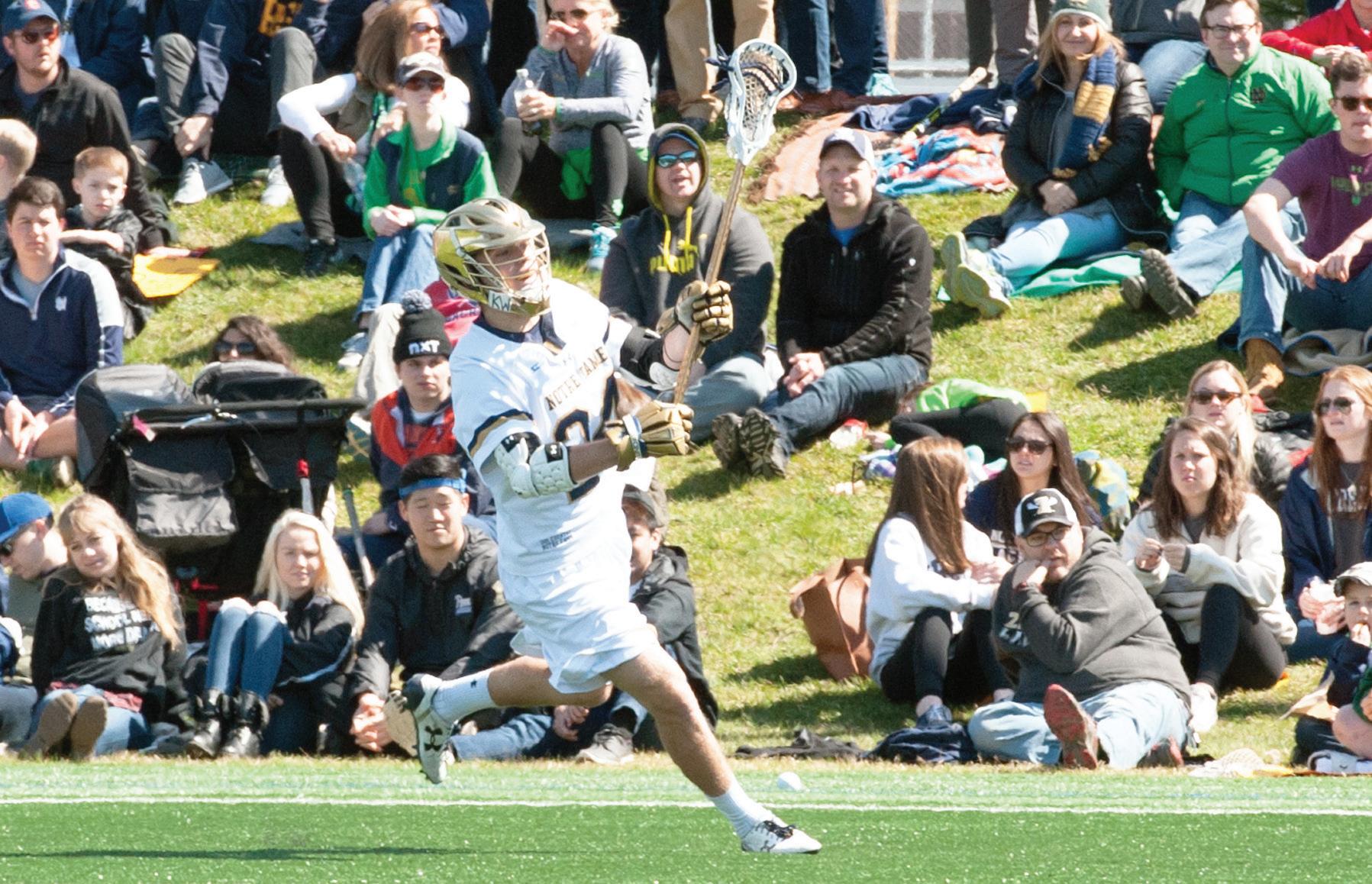
Irish junior attack Mikey Wynne runs with the ball during Notre Dame’s 11-10 loss to Syracuse on April 1 at Arlotta Stadium. Wynne scored five goals during Notre Dame’s victory over North Carolina on Saturday.
Greason
con T inued from Page 12
rebound from last season’s offensive woes. The backups who combined to score 27 points.
Junior receiver c.J. sanders had 58 receiving yards, sophomore receiver Kevin stepherson centered around one of the game’s most exciting plays: a 58-yard reception to the 2-yard line and junior running back dexter Williams rushed for nearly 100 yards. granted, these are names we heard making plays last season as well, as the irish were forced to look further into the depth chart
as the season wore on. but that extra year, or even extra couple of games, gives notre dame an advantage. having a second-string offense with significant experience is not an opportunity that comes along frequently. a nd then there’s ian book. The six-foot, 205-pound quarterback surprised many fans with his performance, passing for 277 yards and completing 17 of his 22 attempts, but irish head coach brian Kelly said book performed exactly as he has throughout spring practice. according to Kelly, there is no question that Wimbush would be leading the offense come september, and in my mind at
least, there is no doubt that that should be the case. but Kelly also noted that, in recent history, notre dame’s second-string quarterback has been forced into the spotlight unexpectedly. so, the ability to compete that book showed off saturday is a definite positive going forward. it’s these guys that lead me to believe notre dame will be successful this season. The defense had its ups and downs, leaving something to be desired in terms of tackling, but the offense remained successful throughout the game. a nd while the firststring offense stalled early, scoring on its first possession and then not again until the fourth
quarter, the second stringers remained potent throughout, putting up 27 points. sure, they were playing against the secondstring defense. but they showed poise and talent. add the experience that most of the offensive players possess into the equation, and you could have a recipe for success.
The irish have lacked depth in the past. injuries or slumps have proven problematic. but the depth this program proved it has offensively in the blue-gold game demonstrated that this may not be the case next season.
The next man up on the offensive side of the ball will always be a good option.
Wimbush
The biggest talking point of the day was seeing brandon Wimbush take the field as notre dame’s starter for the first time. Leading up to the game, Kelly, offensive coordinator chip Long and quarterbacks coach Tom rees had talked up Wimbush’s talent and willingness to learn, but also highlighted his need for consistency. for the junior quarterback’s first start, he fit right into that description.
Wimbush finished the game with 22-for-32 passing and two interceptions in what was not the greatest statistical performance, but one that still had bright spots. coming up against defensive coordinator mike elko’s new scheme, and limited to one-hand touch wearing the red jersey, the junior wasn’t able to use his legs as much as he could, which kept him mostly one-dimensional. he also forced some throws, highlighted by a redzone interception in the second quarter on third down, but overall he showed his potential.
his arm strength and ability to extend plays was on display in several situations, and as the game went on, Wimbush seemed to get more comfortable, culminating in a one-yard quarterback keeper on his 10th and final drive. Perhaps the best throw of the bunch was a third down roll-out in the fourth, in which he used his legs to create space and time before firing through tight coverage for 16 yards to sophomore receiver chase claypool, who also had a strong day.
Kelly thought the stats did not tell the whole picture on Wimbush’s day.
“he’s learning our offense. he’s learning the reads. he’s, again, a freshman quarterback,” Kelly said.
“i think every snap that he takes, gets him closer to prepared for where we want him. i don’t think we rate him as struggling versus playing superior football, as much as this is just the learning process for him; that he continues to learn every single day.
“ … so i loved everything that happened to him today. it’s how you take it, right. he’s just wideeyed, listening, paying attention and just totally committed to the process of getting better. and that’s really what i think about more so than trying to label whether they played really well or they didn’t play really well.”
i have faith that Wimbush will live up to the hype and that the boykin, st. brown and company will continue to play well. but the idea that Williams, stepherson and sanders are clearly fully prepared to take the field as well gives notre dame a cushion, should it need one. They prove the irish offense have completed the turnaround from last season and will be ready to play in september.
Contact Elizabeth Greason at egreason@nd.edu
The views expressed in this column are those of the author and not necessarily those of The Observer.
on the flip side, the gold team’s starting quarterback, sophomore ian book solidified his case as notre dame’s backup with a convincing 17-for-22 for 277 yards and a 37-yard touchdown pass to junior wide receiver c.J. sanders. The california native made sound decisions with the ball, albeit against the second-string defense. Kelly was pleased with what he saw from the sophomore.
“[it is] what we’ve seen all spring: consistency, throws strikes, rarely misses an open receiver, can see the field very well, runs the offense very well,” Kelly said on books’s performance. “ … i think you could point to his performance today and say it was a surprise; it wasn’t a surprise to me. he’s shown that. i thought he would go out and play really well. i’m glad he did.”
Looking ahead, with the spring season wrapped up for the irish, Kelly still stressed the importance of building good habits and preparing for the season in the newly renovated stadium, not just for his quarterbacks, but the whole team as well.
“We’re not there yet,” he said. “i mean, i think we have some guys that are further along than others, but this is collectively as a group something that we have to work on every single day. it will be something that’s talked about from today through the summer, all season, and it won’t go away. it’s not really a destination as much as it’s a journey every single day.
“ … There has to be a great sense of pride when you walk into that stadium and that pride has to carry over in your preparation and being focused and locked in every time we come into the stadium. it’s a stadium that is rich in tradition and our guys need to know that they play football at the university of notre dame and it’s just a great, great thing that they have and appreciate it.
“ … We want to play a certain style, and we don’t ever want to give football games away. We feel that, you know, our process and preparation should put us in a position where we don’t give games away.”
it’s still over four months until the irish open against Temple on sept. 2, but the first taste of the team came on saturday, and for all the ups and downs, the irish under Kelly look dialed in.
Contact Tobias Hoonhout at thoonhou@nd.edu
Paid a dverT isemen T
EDDIE GRIESEDIECK | The Observer
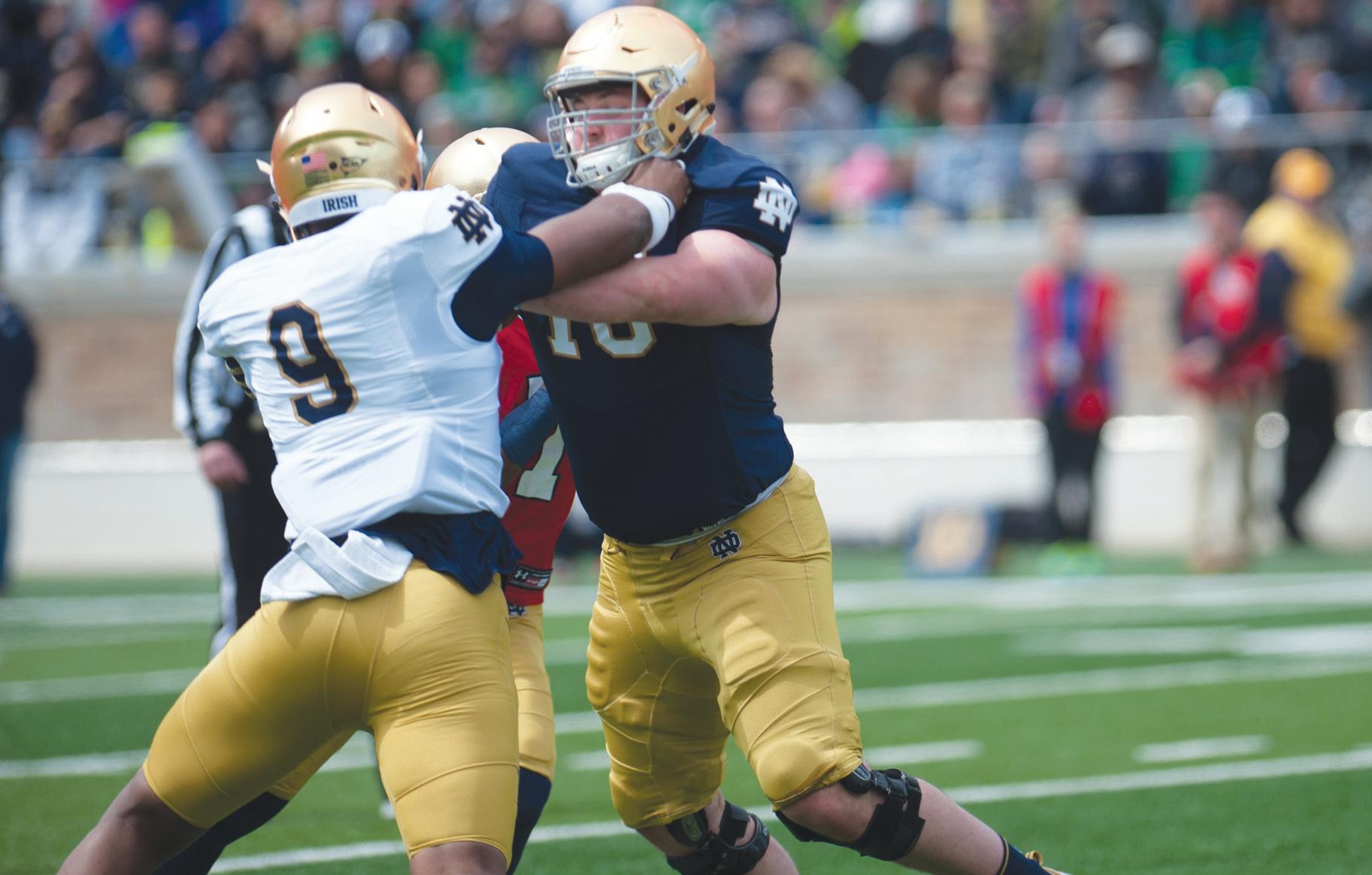
Irish sophomore defensive lineman Daelin Hayes, left, rushes the passer during the Blue-Gold Game at Notre Dame Stadium on Saturday. Hayes had seven tackles and three sacks in the game.