
n o T re d ame and s ain T m ary’s
Students place second in Disney competition
Team creates ‘The Spirit of the Isle’ concept for Disney Imagineering Design Competition
By MEGAN VALLEY
news e ditor
ssociate
a
l ast semester, seniors m ark d avidson, Jessica k louda and e rin r ice and graduate student m adeline Zupan registered for design professor s cott s him’s interdisciplinary c ollaborative p roduct d evelopment course, where they were randomly assigned as a group for the semester’s project. The four students were runners up in the w alt d isney i magineering i maginations d esign c ompetition on Jan. 27. Editor’s Note: Erin Rice is a former Graphics Editor for The Observer “ we were thrilled that the results of months and months of work and collaboration resulted in such a fantastic outcome,” Zupan said. “Truly, just making it as far as we did — in terms of becoming finalists — was absolutely an honor in and of itself.
“This competition brings in some of the most highly respected talent from designers and engineers across the country and so to even be included in this cohort was remarkable.”
The competition charged teams with the task of designing a space in respect to their college or university. The n otre d ame team’s project, “The s pirit of the i sle,” was conceived as a shamrock-shaped island in one of the lakes on campus.
“ u ltimately, based on the prompt, we decided to look into the magic of n otre d ame, and we looked into designing our space around the lakes, so that’s why we chose an outdoor space,” r ice said. “ w hen we were determining that ‘favorite spot’ on campus, we did a lot of this through generative
see disney PAGE 4
Journalist reflects on nationalism
By TOM NAATZ news writer
a rgentinian journalist
s ergio k iernan explored the similarities and differences in the colonial experience and subsequent national identity of each of the three countries in his “ p ostcolonial i dentity and the i dea of n ationhood: a rgentina, Brazil and i reland” lecture Friday.
k iernan, a writer for the a rgentinian magazine “ p agina 12,” contrasted his experience at the celebration of the last year’s centennial celebrations of the e aster r ising in i reland — his ancestral home — with expressions of patriotism in his native w estern h emisphere.
“The spotlight was on the volunteers that fought and sacrificed for the nation,”

k iernan said. “The i rish idea of nation is popular: a small, simple, easygoing nation. This is odd, because e uropean patriotism slides into nationalism quickly.”
k iernan said there are various examples of e uropean patriotism including palaces, symbols and military displays, and the nations of the a mericas then inherited this kind of patriotism.
“ w ashington is always shown crushing an enemy, and the u s . is represented as an eagle,” he said. “ i n a rgentina, it is the same thing with g eneral Jose de s an m artin, the great liberator of a rgentina, c hile and p eru.”
k iernan said s an m artin is an example of how myths are formulated.
see argenTina PAGE 3


Alumni receive awards
Observer Staff Report
d uring the winter meeting of the a lumni a ssociation’s Board of d irectors, two musicians and the founder of an after-school program for children in k ansas c ity’s urban core were honored with n otre d ame a lumni a ssociation awards, according to a press release.
c huck p errin, class of 1969, was awarded with the 2016 r ev. a nthony J. l auck, c s c ., award. The award recognizes alumni achievements in fine arts and visual arts.
o n campus, p errin performed and acted as well as operated a performance space that became an off-campus arts hub for
interaction between teachers and students. h e started a similar space in his hometown of s an d iego called d izzy’s Jazz. d izzy’s Jazz, an all-ages performance collective, has become an acclaimed s an d iego institution known among jazz fans internationally.
see awards PAGE 4
Student awarded Gates
Cambridge Scholarship
Observer Staff Report
s enior John h uber, applied and computational mathematics and statistics major, received a g ates c ambridge s cholarship to pursue a master’s degree at the u niversity of c ambridge, according to a press release.

h uber’s research has focused on constructing mathematical models for the transmission of mosquito-borne pathogens, including malaria and dengue. h uber will pursue a master’s degree in veterinary science in the d epartment of veterinary m edicine.

a native of g ainesville, Florida, h uber has researched infectious disease, which he considers the intersection of his interests in global health, mathematics and social justice.
“a t a time when drug
see camBridge PAGE 4

LAUREN HEBIG | The Observer
(574) 631-7471 Fax: (574) 631-6927
Advertising (574) 631-6900 ads@ndsmcobserver.com
Editor-in-Chief (574) 631-4542 mhynds@nd.edu
Managing Editor (574) 631-4542 kmullen2@nd.edu
Assistant Managing Editors (574) 631-4541 acarson1@nd.edu, zklonsin@nd.edu, ckossler@nd.edu
Business Office (574) 631-5313
News Desk (574) 631-5323 news@ndsmcobserver.com
Viewpoint Desk (574) 631-5303 viewpoint@ndsmcobserver.com
Sports Desk (574) 631-4543 sports@ndsmcobserver.com
Scene Desk (574) 631-4540 scene@ndsmcobserver.com
Saint Mary’s Desk ncaratas01@saintmarys.edu
Photo Desk (574) 631-8767 photo@ndsmcobserver.com
Systems & Web Administrators (574) 631-8839
Policies The
Today’s Staff
Question of the Day:


Justine Wang sophomore off campus “e lizabeth Warren.”
Anthony Luc sophomore dillon hall “beyonce.”
Greg Perenich junior dillon hall “ryan Gosling.”


Shaq Johnson senior Keenan hall “Alessia cara.”
Lei Yang junior off campus “myself.”
Monika Fanous freshman Farley hall “J. cole.”
Corrections In the Feb. 10 issue of The observer, the campus group “We stand For” was misidentified as “stand With Us.” The observer regrets this error.
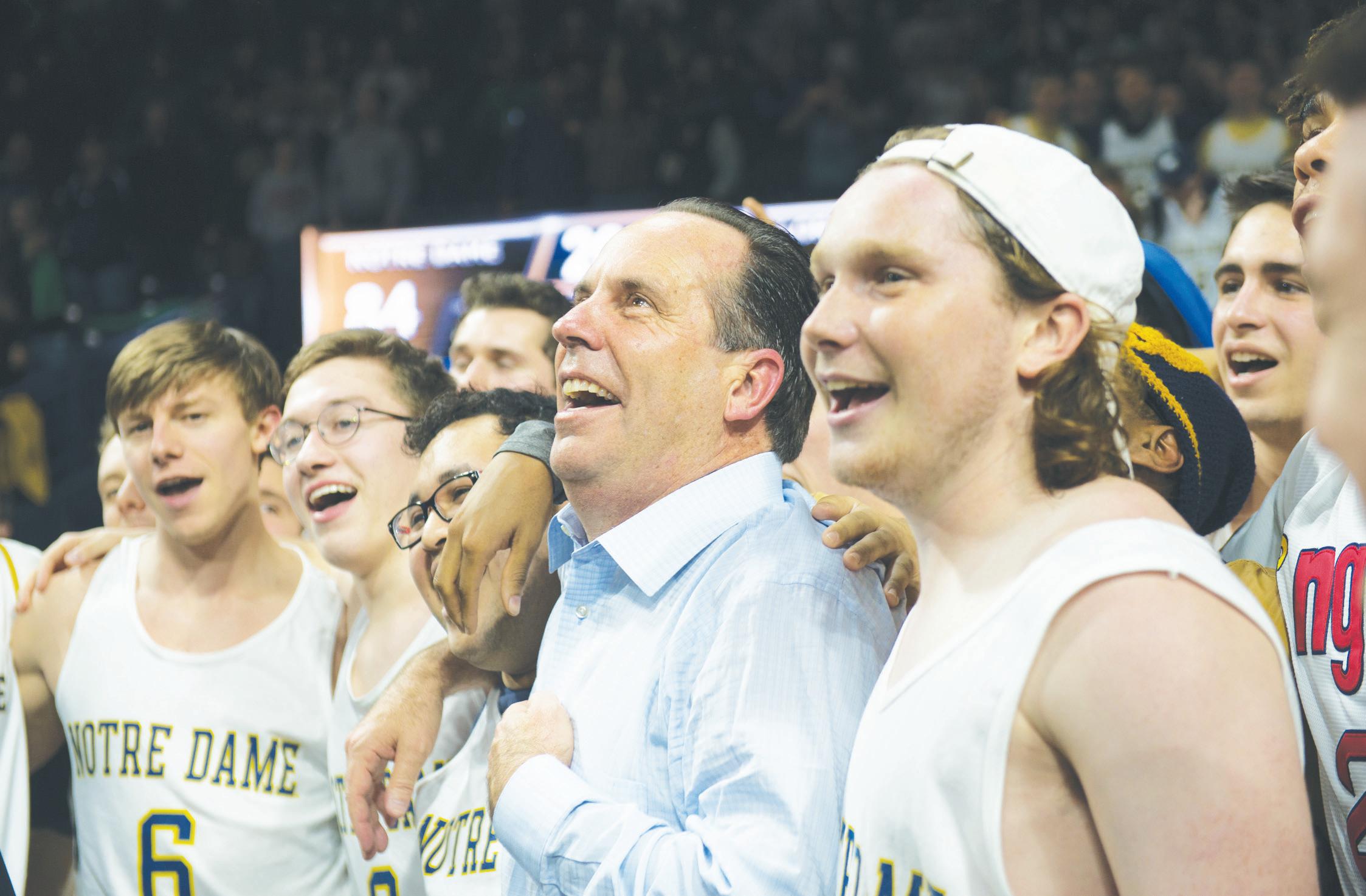
Irish head coach Mike Brey celebrates with sudents after the men’s basketball team defeated Florida State on Saturday night, 84-72. Junior forward Bonzie Colson scored 33 points, reaching the 1,000-point plateau for his career on a second-half tip-in. Have a question you want answered?
|
Monday
Lecture: “Strategic litigation on behalf of trafficking victims: the new reality”
1130 Eck Hall of Law
12:30 p.m. - 1:30 p.m.
Presentation by James Gingerich, M.D.
Geddes Hall, Andrews
Auditorium
5 p.m. - 6 p.m.
Tuesday
“Fake News and ‘PostTruth’: Challenges to Global Journalism”
Hesburgh Center for International Studies
4 p.m. - 5:30 p.m.
Bengal Bouts
Preliminaries
Jordan Auditorium
6 p.m.
Tickets available online or in person.
Wednesday
Sports and Activism: Fame, Controversy, and Impact
Montgomery
Auditorium
7 p.m. - 8 p.m.
Luis Bravo, Javier Etchevarren and Virginia Lucas
Hammes Campus
Bookstore
7 p.m. - 8:30 p.m.
Thursday
Workshop: “Introduction to Text Mining”
Hesburgh Library, CDS
Classroom 129
12:30 p.m. - 1 p.m.
Asylum in the U.S.Law and the Lives it
Touches
1140 Eck Hall of Law
12:30 p.m. - 1:30 p.m.
Lunch provided.
Friday
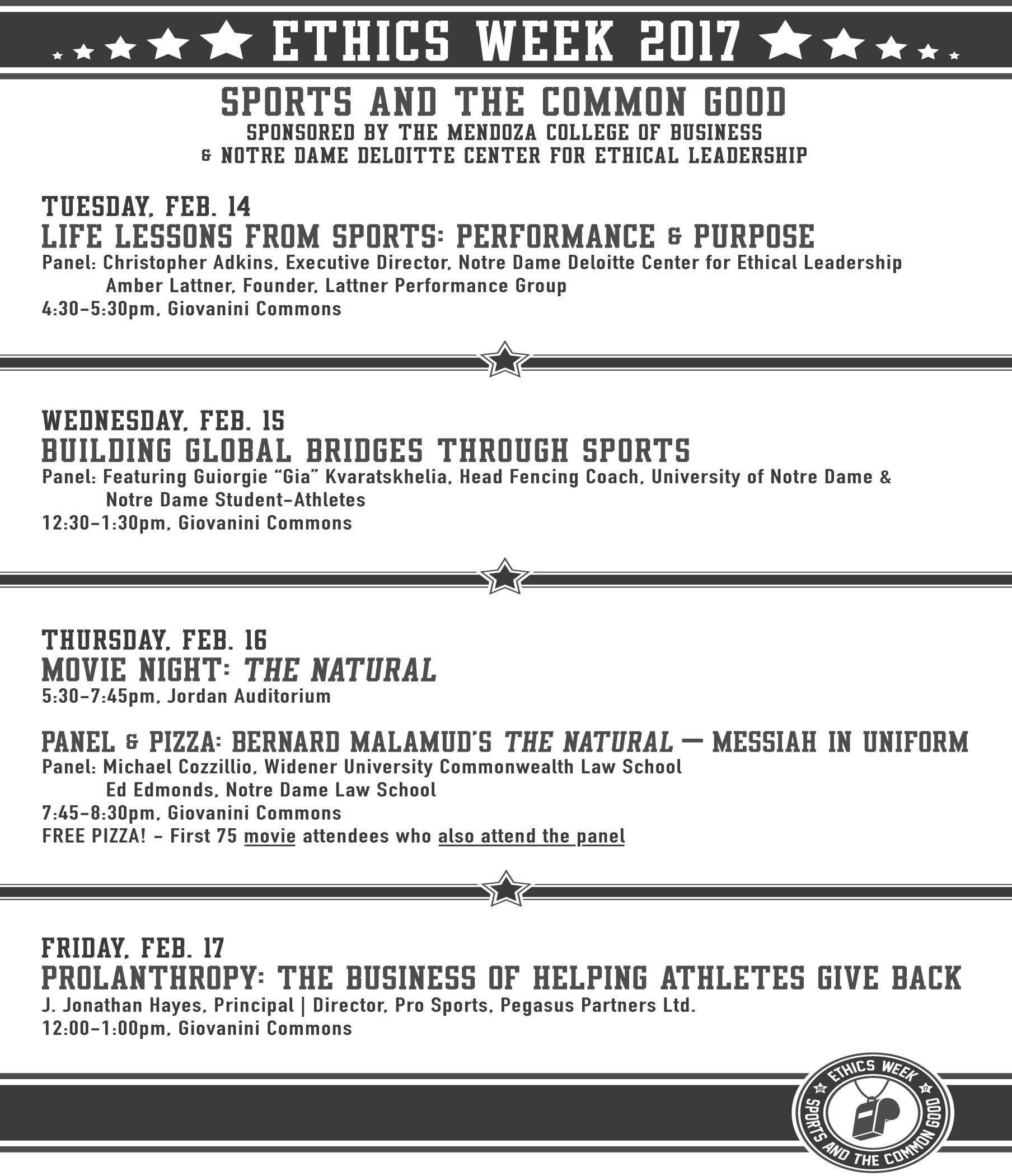
Prolanthrophy: The Business of Helping Athletes Give Back Mendoza College of Business noon - 1 p.m.
Hockey vs.
KATHLEEN DONAHUE
The Observer
Professor connects oil, religion, politics in US
By COURTNEY BECKER news Writer
d arren d ochuk, associate professor of history, addressed the relationship between oil, religion and politics in the United s tates as part of the h iggins Lunchtime Labor r esearch, a dvocacy and Policy ( ra P) series Friday.
d ochuk said oil has a long and rich history as an important resource in the United s tates.
“o il achieved unprecedented status in the mid-20th century — the 1930s to the 1950s — as leverage for a merica’s authority in the hydrocarbon age,” he said. “ b ut it first captured a merica’s heart at the dawn of the 20th century as the fuel and lubricant that would light its cities and grease its modern machinery and economic ascent.”
d ochuk said oil’s connection to religion began primarily with h enry Luce, a co-founder of Time
a rgentina
“The a rgentine government asked a French painter for several portraits of s an m artin,” he said. “The painter always showed him
m agazine.
“ it directly influenced God-fearing individuals with clout, who translated crude and c hristianity’s vision of the future into real institutional structures, policies and outcomes of significance,” he said. “ … For Luce, petroleum was a limitless power that held the capacity to transform the world into something godlier and good.”
Luce’s involvement with the oil industry prompted an entirely new movement based on the combination of oil and religion, d ochuk said.
“Luce’s aspirations mirrored those of a cadre of corporate, church and state visionaries who believed that petroleum-fueled c hristian democracy … integrated and partnered with the state could guarantee this nation’s post-war influence,” d ochuck said. “This cadre of corporate church and state visionaries accelerated intensified outreach on behalf of what i call the ‘civil
riding a white horse, so now everyone thinks that he rode a white horse.”
a ccording to Kiernan, national myths in a rgentina were magnified in the late 19th century by a huge influx of immigrants to the country.
religion of crude.’ a nd this civil religion of crude at midcentury was designed to steer the United s tates’ oil sector and society out of several unfolding crises that emerged at that moment.”
d ochuk said these crises, such as fear of depleting the nation’s oil supply, drove big businesses to drill for oil abroad.
“ d riven by fear and optimism, large corporations started chasing wider prospects,” he said. “ … With something momentous in reach, c hevron started sending workers to s audi a rabia’s outback to consult with [tribes] and to drill. b y 1940, assurances of shared destiny predominated as local and U. s . operatives together hunted bigger pools.”
o ne person who distinguished himself in the oil business particularly well, d ochuk said, was John d r ockefeller.
“John d. r ockefeller embodied the civil religion by
“ b y the 1910 census, half of the population was foreign born,” he said. “The government was worried that if it didn’t do something, then the nation would be an archipelago of foreign communities.”
Kiernan said b razil
placing the profits of his family’s standard oil empire in the service of its broad initiatives,” he said. “Frustrated with outmoded strategies of corporate and church outreach, he built a philanthropy that stressed scientifically informed global development.”
r ockefeller’s success in the oil trade, however, left him and his family with plenty of enemies, d ochuk said.
“Those who inhabited oil patches were also filled with the spirit of rebellion, which was present from the beginning due to their marginalization by the r ockefellers,” he said. “ … The revolt intensified in the 1930s and ’40s in response to U. s . oil’s shift to foreign fields.”
i n the midst of dissent against the r ockefeller monopoly of the oil market, d ochuk said, s unoco emerged as a worthy competitor.
“ s unoco’s executives were the antithesis to Washington politicos and standard
demonstrates the potentially racial elements of nationalism. a ccording to Kiernan, a painting depicting the Grito de i piranga — the moment when b razil declared independence from Portugal — is idealized, with only white bystanders despite the fact that the b razilian population during that time was 85 percent black.
The government found its solution in an increased emphasis on nationalism in schools, he said. a ccording to Kiernan, the a rgentinian school year runs from m arch to d ecember, a period that conveniently contains many anniversaries of the r evolution.
Kiernan said the government celebrates these anniversaries during the school year, choosing students to carry the national flag into
ceo s,” he said. “They focused on the interests of local people and their economic health, took care of the little man and royalty owners — with whom they collaborated — and stayed true to the politics of the small producer.” d ochuk said s unoco joined forces with other smaller oil moguls to challenge the r ockefellers and begin to turn the oil industry into what it is today.
“o n a purely political level, the clash of the two gospels of crude animated some of the most crucial pivots in 1940s federal governance,” he said. “The struggle certainly played out as a clash of competing economic interests, but it was also a matter of colliding world views. n urtured in different workscapes of oil, it was a culture war that folded matters of faith, labor and corporate politics into two competing sides.”
Contact Courtney Becker at cbecker3@nd.edu
the school while their companions stood at attention. a ccording to Kiernan, depictions of the 1916 e aster Uprising in i reland emphasized the volunteers who took to the streets and rarely showed leaders of the rebellion — and, if they did appear, they were never in uniform or on horseback. h e said this emphasis may derive from the recent nature of the rebellion, given that it was only 100 years ago.
“The i rish rebellion is unique because it was the reawakening of a people,” he said. “The i rish as a people almost died out because of b ritish colonization and emigration, and many patriots felt they were creating a new i reland.”
Contact Tom Naatz at tnaatz@nd.edu
Paid a dverT isemen T

By BRIAN BOYLEN scene Writer
There are few names in hollywood as polarizing as m night shyamalan.
Although he is responsible for certified classics such as “The sixth sense” and “signs,” his reputation has been marred by recent blunders such as the atrocious “The Last Airbender” adaptation. shyamalan’s inconsistency makes it clear that he is no hitchcock or Kubrick — but that doesn’t mean he can’t make a fun, enjoyable film. shyamalan has done just that in “split,” approaching the thriller genre with a healthy dose of campy b-movie charm.
The movie opens with the abduction of three teenage girls, casey (Anya Taylor-Joy), claire (haley Lu r ichardson) and marcia (Jessica sula), by an enigmatic and soft-spoken man named dennis (James mcAvoy). The girls (now trapped in foreboding underground bunker) realize that something is off about their captor, and discover that he has a mind-bogglingly severe case of dissociative identity disorder — resulting in 23 distinct personalities sharing his body. The details of the condition are fleshed out in scenes with Kevin’s (the original personality) psychiatrist dr. Fletcher (betty buckley), who acts as a familiar “concerned doctor” character. The primary conflict of the film arises from Kevin’s own internal struggle, as some of his personalities have revolted in anticipation of the arrival of “The beast,” a mythological persona they believe is destined to come. I confess that I was not looking forward to this movie
when the trailer first came out. The premise was ridiculous, and I couldn’t envision becoming immersed in a thriller that has a 37-year-old man acting as a 9-year-old boy. I now realize I was looking at the movie with the wrong mindset. “split” is not a serious and perpetually tense thriller — a la “Green room” — but is rather a pulpy, campy movie that intersperses many moments of levity throughout the otherwise grim plot. so yes, hedwig (the 9-year-old personality) talking about how much he loves dancing in his room to Kanye West albums is silly, but it fits the tone shyamalan is trying to establish.
straddling this line between silly and serious is no easy task, and its success in “split” is due largely to mcAvoy’s performance. mcAvoy transitions from persona to persona with a deft hand: It isn’t typically hard to see which personality is currently in control, but mcAvoy’s acting is nuanced and restrained enough that the different identities do feel like real characters, not just outlandish caricatures. The whole multi-personality facet of the character is used cleverly throughout the movie and never feels like a stupid gimmick. In particular, the fact that the personalities are all aware of each other introduces an intriguing depth to the movie. The conflicting personas are not all in agreement with each other: They try to sabotage and even impersonate others to fulfill their own goals.
“split” impresses on the technical level as well. shyamalan works well with cinematographer mike Gioulakis, best known for the lauded horror flick “It Follows,” to create a visually thrilling ride. The movie uses interesting camera techniques, with many
point-of-view shots and some clever uses of mirrors. The overall subjective, confusing visual feel of the movie is an effective reflection of the subject matter. shyamalan clearly enjoys playing with the perceptions of the audience and stylishly cultivates an unpredictable and thrilling atmosphere.
regarding plot, “split” is one of shyamalan’s more straightforward films — there is no shocking twist at the end that fundamentally changes how the rest of the movie should be viewed. (There is a reveal at the end, but it serves as more of a meta easter egg than as a crucial component of the movie.)
I imagine that “split” will end up one of shyamalan’s more positively perceived films. It lacks the scope and perfection to go down as a classic like “The sixth sense,” but its playful, almost interactive nature provides for an undeniably fun experience. now the only question is whether this marks the beginning of shyamalan’s critical resurgence, or if this success was merely a stroke of luck.
Contact Brian Boylen at bboylen@nd.edu
“Split”
Director: M. Night Shyamalan
Studio: Universal

By MATTHEW MACKE scene Writer
“The Young Pope” is like a swiss Army knife. It does everything.
most of the time it’s a political thriller, but it isn’t afraid to become a work-place comedy or emotional drama when it feels the need. The hbo miniseries can even whip out striking surrealism in the form of apparitions or a kangaroo running loose in the papal gardens, to accentuate the mood that it is currently trying to perpetuate. Whatever you want in a T v show, chances are you can find it, in some form or another, in “The Young Pope.”
Like the swiss Army knife my parents gave me that one year I was a boy scout though, I don’t really know what to do with “the Young Pope.” It is considered a masterpiece by some reviewers and a disappointment by others. The humor is occasionally so subtle that it can be hard to discern whether it was intentional or just a slightly misshapen chunk of dialogue. essentially, the show exists so perpetually in a nebulous region of non-genre that it demands the audience expect anything while simultaneously leaving them unprepared for moments of outright seriousness or humor, as when the college of cardinals files into the sistine chapel while L mFAo’s “sexy and I Know It” pulses in the background.
The premise of the show is oddly perfect for this
ambiguity. “The Young Pope” follows the newly appointed Pope Pius XIII, the first American pope, as he sets the tone for his papacy. The young man, known prior to his pontification as Lenny belardo, reveals himself to be somewhat of an uber-conservative. The juxtaposition of his physical youth and elderly ideology is made apparent in the first episode, when a dream sequence initially shows the titular young pope announcing a series of progressive policies (less sexual taboos, female priests, that sort of thing) only to have him remark later that this was a strange dream. Instead, Pius wants to make the church sexy again by making it as inaccessible as possible. he even keeps his face hidden during his first appearance before the crowd at st. Peter’s so that he can maintain an air of mystery like daft Punk or banksy (his comparisons, not mine).
This ironic twist of perspective means that even the main character in this religious dramedy lacks apparent moral superiority. he campaigns to drive homosexuals out of the clergy but is portrayed as one of the few men in the vatican who doesn’t succumb to sexual temptation. It is unclear whether or not this young pope is someone the audience should be rooting for or against. Part of the reason for this lack of clarity has to do with how the issues that face the church, and the clergy especially, are unique. The scandals of the catholic church are relatively tame compared to those of most shows focusing on political machinations. A priest’s alcoholism is deemed a severe transgression,
while a senator’s alcoholism is more of an inconvenience. In spite of the fact that the issues are much smaller, the stakes are much higher. People look to the pope for spiritual and moral guidance, even miracles. This creates a fascinating dynamic — one ideal for straddling the line between comedy and drama (and just about everything else).
Jude Law, who plays the freshly minted pope, is brilliant in the lead role. h is Pius marches the camel through the eye of the needle by somehow managing to leave the audience guessing as to whether he is a vatican political prodigy or a young man hoping to fake it until he makes it. There is a sense of danger in that things might fall apart at any moment, but also one of security that Lenny actually has a plan and isn’t just spewing hot air. normally this sort of translucency would get old quickly, but the hbo feature’s versatility keeps you engrossed. You’ll keep watching to find out where the show’s going — more in regard to tone than plot. All in all, it’s hard to criticize a show that does everything. sure, the plot is meandering and there are maybe two engaging characters, but I still want to know what “The Young Pope” has in store.
Like I said, the show’s a swiss Army knife. It might do so many different things that I end up never using it for anything, but you better believe I still want to take it to camp with me.
Contact Matthew Macke at mmacke@nd.edu
|
make America healthy again

I’m writing this column today to address one of the biggest — yet understated — problems facing this country today. no, it’s not Kanye West. everyone knows he’s a problem. It’s not that people don’t appreciate episodes I-III of star Wars. Although those are really good and I don’t care if you disagree.
The legitimate and serious problem I want to talk about is the lack of doctors in America.
having doctors is important for a country because, you know, being able to keep people healthy is good. And obviously, people are not dying by the dozens because the United states doesn’t have doctors. People also don’t tend to think about this issue because the U.s. has possibly the most advanced medical technology in the world.
but I’m not saying America lacks the effort in inventing new medical techniques. I’m saying America needs more doctors and physicians to treat everyday illnesses.
If we look at the statistics, the U.s. has only 2.5 doctors per 1,000 people. That’s less than virtually every country in Western europe, Uzbekistan, Ukraine, Lebanon and mongolia.
In April of last year, the Association of American medical colleges published a report which highlighted the fact that the shortage of physicians will grow even more serious as the baby boomers age.
beyond the stats, this shortage is evident. emergency room physicians can work 10-hour shifts, sometimes going a day or two without sleep. If, God forbid I or a loved had to be rushed to the emergency room, I know I’d want a doctor who had a good night of sleep on hand.
so we have a problem, now how to solve it?
one thing that could add more doctors is to ease up on the prerequisites.
medical school is hard. Like, really, really, really hard. so hard in fact, that only 81 percent of medical students graduated in four years. And that number is down from a 90 percent mark in the 1970s.
now I fully understand the need to make sure our doctors are fully trained and ready for every eventuality. but I feel there is a way to do that without forcing nearly 20 percent of students accepted into medical school to discontinue their studies.
since I am know nothing about the specifics of medical school, I don’t know how exactly to make this process easier, but if you’re telling me the a full 20 percent of students accepted into medical school are unqualified, I would beg to differ. To be even accepted into medical school, you need an incredible portfolio, a strong GPA and great letters of recommendation. Lowering standards is rarely a good idea, but in this case, the standards are too high and they are diminishing the amount of doctors in this country.
In addition to making sure more students graduate from medical school, more can be done to increase the number of accepted students. here again, we run into a problem without a lot of coverage.
If you look at medical school acceptance rates for top universities across the country, they’re pretty good. most schools are in the 80-90 percent range. but that’s the percentage of students accepted and those numbers don’t tell the whole story.
many schools, notre dame being one of them, are highly selective of who they allow to apply. For instance, if a school is on the fence about a student’s chances of getting in to medical school, they will discourage that student to not apply to preserver their pristine acceptance numbers.
If schools let more students apply, and medical schools were willing to accept more students, the shortage could be solved relatively easily. We just need to make America healthy again.
Contact Marek Mazurek at mmazurek@nd.edu
The views expressed in the Inside Column are those of the author and not necessarily those of The Observer.
Safe, rare and legal?
In m r. John Gadient’s letter to the editor published Feb. 11, he expressed the opinion that “a woman has a right to make decisions about her own body. … At the same time, I believe that as a society, we should strive to reduce the number of abortions.” This is a familiar formulation: both Presidents c linton and o bama claimed that abortion should be “safe, legal and rare.” however, this is a paradox. If abortion is a human right there is no reason that it ought to be rare; if abortion is not a human right, it ought not be legal.
c onsider a scenario where abortion is both safe and legal. That is, the procedure produces no harmful physical or mental side effects to the mother and is universally regarded as a constitutional right. Why, then, should abortion be rare? If abortion is as safe as any other medical procedure then there is no medical reason to reduce the number of abortions: n o one is calling for there to be less hip replacements. nor can it be any legal issue with abortion: c alls to reduce constitutional rights on purely legal grounds are self-defeating. n o, if abortion is to be a constitutional right — or a human right as called for in the 2016 d emocratic Presidential Platform — then there is no reason for it to be rare. r ather, it ought to be celebrated just as much as freedom of religion.
c alls to make abortion rare can be justified only on moral grounds. To claim that abortion should be rare one must necessarily levy a negative normative judgment independent of its medical or legal status, and to admit that we ought to “strive to reduce the number of abortions” as m r. Gadient does is to acknowledge a certain moral queasiness about abortion. This moral queasiness cannot coexist with
the assertion that abortion is a human right. I cannot speak for m r. Gadient’s views on the issue, but the moral objection to abortion generally arises from the belief — though perhaps fear is a better word — that a fetus is a person and so abortion is tantamount to murder. To call for abortions to be rare is to acknowledge the moral imperative ‘thou shalt not kill.’ however, this imperative cannot coexist with the idea that abortion is a human right. If one is concerned enough by the moral objections to abortion to the extent that one believes the number of abortions should be suppressed, one ought not assert that “a woman has a right to make decisions about her own body.” If one thinks that the fetus might be a human and that abortion might therefore be morally objectionable, one should not support abortion at all except perhaps in extenuating circumstances such as danger to the mother. more broadly, we can state that if abortion is a human right then there can be no moral objections to it. After all, what sort of moral objections can one mount against a human right? however, to call for abortion to be rare is to levy a charge against it which must be primarily moral in nature. Then abortion cannot be a right and the moral case against it is serious enough to warrant banning it in typical cases. Thus, the formulation of “safe, rare and legal” is incoherent. If abortion ought to be legal, then there is no reason for it to be rare. If abortion ought to be rare, then the moral case against it is strong enough that it ought not be legal.
A Siegfried thank you
d ear communities of notre d ame and s aint m ary’s, o n behalf of s iegfried h all and the s outh b end c enter for the h omeless, thank you for your amazing support for this year’s d ay of m an. As of the writing of this article, contributions for the c enter have exceeded $15,500 from cash and online donations this year.
While we plan and organize d ay of m an, the success we have experienced over the past 11 years would not be possible without your immense generosity. e very year this event brings out the best of the notre d ame community in a way that truly embodies the mission of o ur Lady’s University.
o ur online donation site will remain open for several weeks if you would still like to donate. You can also send cash or check donations directly to the c enter.
We look forward to many more successful d ay of m an’s in the future with your help. Thank you and God b less,
Michael Hernick junior Isaac Althoff
junior Patrick Davis sophomore Feb. 9
Patrick LeBlanc junior Feb. 12
Marek Mazurek sports e ditor
democrats applaud judicial overreach, again
The ninth c ircuit, the appeals court for the western United states, refused to lift the temporary restraining order placed on the executive branch earlier this month, effectively preventing the government from implementing President Trump’s recent immigration order.
The decision came down late Thursday from the ninth c ircuit’s three-judge panel, generally recognized as the most liberal of all 13 federal appellate courts. It signifies what is perhaps the first political victory for democrats since november, despite the limited scope and temporary nature of the ruling.
s enate m inority Leader c huck s chumer was quick to respond, demanding President Trump abandon the order entirely and “come up with a real, bipartisan plan to keep us safe.” The m inority Leader is likely to capitalize on this small victory, having tried unsuccessfully to obstruct Trump’s cabinet appointees for the last several weeks.
s en. s chumer, and others, have been very vocal in their opposition to the executive order, which suspended immigration from seven countries closely linked to Islamic terrorism for a period of 90 days. According to the Trump administration, the measure was put in place so that the relevant federal departments could implement revised immigration criteria consistent with existing screening standards.
As a first-generation immigrant, my family and I were also required to conform to those same standards before being admitted into the U. s. — as is every foreign national who wishes to visit, work or live in this country. The process includes interviewing the v isa applicant, assessing his or her credibility and working with foreign governments to determine whether or not the applicant represents a threat to the national security of the American public. e ach
year, over 1 million people successfully complete this process and legally relocate to the U. s., making it the world’s most popular destination for immigrants.
Unlike the vast majority of nations, including most of those with predominantly muslim populations, the seven nations affected by the President’s executive order lack the infrastructure and regional stability necessary to accurately screen immigrant applicants. Without background checks, government records or substantive intelligence, it is difficult — though not entirely impossible — to discern between lawful immigrants and malicious terrorists. because of the lack of reliable data, these applicants require further intensive scrutiny before they can be admitted into the U. s., what President Trump refers to as “extreme vetting.”
The obama administration was the first to recognize this in 2013, when it identified these seven countries — Iraq, Iran, sudan, syria, Libya, s omalia and Yemen — as nations of concern: Those most susceptible to terrorist infiltrations of immigrant applicant pools. In fact, President Trump’s executive order only refers directly to syria — the other six nations are listed under the ‘ v isa Waiver Program Improvement and Terrorist Travel Prevention Act’ of 2015. similarly, F bI d irector James c omey — appointed by former President obama — testified before c ongress that the Agency could not ensure IsIs agents had not infiltrated syrian refugee camps. democrats are either fundamentally unwilling to accept this reality or, more likely, they still believe that the humanitarian cause itself is more important than the national security implications. After all, what difference does a few bad apples make if the U. s. can come to the aid of thousands of innocent refugees?
Well, if the terror attacks of 9/11, s an bernardino, o rlando, boston, brussels, Paris, nice and so many others have shown us anything, it is that we should never underestimate the unimaginable devastation
that can result from a small number of people driven by hatred. o f course, the U. s. must continue to provide relief to all those suffering from oppression and persecution, if it is to remain the greatest beacon of hope and freedom on e arth. however, without an appropriate means of protection from those who would seek to destroy it, America cannot survive as the ‘shining city upon a hill.’
national security and public safety are not just factors to be considered in the administration of some larger policy agenda: They are the preeminent functions of government. The safety and security of the American people — including native and naturalized citizens, visa holders and permanent residents — should be the driving force behind all foreign policy objectives and decisions.
If we set aside the cloud of hysteria and misinformation that surrounds the President’s agenda for a moment, perhaps s en. s chumer and the American left can begin to accept the merits of his proposal and understand how he won the election in the first place.
most Americans understand the need for border security and a reasonable system of immigration that can distinguish between aspiring Americans and would-be terrorists. These are not, as c huck s chumer and the liberal media would have you believe, radical-right wing ideas. If d emocrats continue to marginalize the mainstream, they will be hardpressed to escape the minority in the future.
Liam Stewart is a Sophomore in the College of Arts and Letters, majoring in political science. Liam was born and raised in the beautiful Irish city of Dublin, although he has been proud to call Seattle home for the past six years. He enjoys country music, hardback books and binge-watching TV shows. He can be reached at lstewar4@nd.edu
The views expressed in this column are those of the author and not necessarily those of The Observer.
The careful balancing act of allyship
For any of you readers who have seen the ‘daily show’ segment ‘helper Whitey,’ you understand the reference. If you’re not as familiar with the term, let me satisfy your burning curiosity. Throughout the two-part skit, African-American correspondent Jessica Williams is repeatedly ignored and pushed around by the relatively oblivious white individuals she encounters. Fortunately, a benevolent white friend accompanies her and intervenes on her behalf each time, in the nick of time, when, for example, a random woman decides to pet her hair, or a police officer aggressively overreacts when she drops her ice cream cone. The segment concludes with an overly enthusiastic, rather sardonic Jessica exclaiming, “Thanks, helper Whitey!”
You may be wondering at this point, what on earth am I talking about? hang in there.
While the ‘daily show’ skit focuses on Jessica and how she is consistently misread and subsequently mistreated based on her race, I want to focus on her accompaniment, the aptly named “helper Whitey.” Who are these ever-so-mysterious, ever-so-helpful … whiteys? They are allies: People who tactfully read potentially explosive situations and uses his or her position of privilege to advocate on behalf of someone who lacks that same privilege.
As a white, middle-class notre dame student, I will never experience systematic racism. As a caring friend to many students of color, a loving partner to a Latino and a living, breathing human being with a heart, I realize that I cannot choose to ignore, or conveniently “not see,” racism on this campus and
beyond. I, myself, am responsible for becoming the best ally I can be for all the people of color both in and not in my life, but I’ll be honest, it can be a tricky job. I’ve spent a lot of time pondering how to best go about allyship, so here’s me, passing on what I’ve learned to you.
my first pro tip is that, in order to be a great ally (or even just a half-way decent ally), you must be present. To be present is to, well, show up. show up to that lecture about race and gender. sign up for that book club about intersectionality and poverty. Go to “show s ome skin.” stand in solidarity at that social justice event. Just go. b e present.
now, just because you’ve shown up to a conversation on race, intersectionality, gender and the like does not mean that you’re off the hook and oK to check out mentally. The second super important pro tip is to really, seriously listen. e specially if you do not identify as a person of color, or someone affected by racism, sexism, poverty or whatever kind of marginalization it is that’s being discussed, this is your time to sit back and absorb what is being said, to really do your best to hear and understand experiences that are not your own, and to hone in on why these kinds of painful experiences happen in the first place. That’s the second tip: listen, absorb and reflect.
my third and final tip is probably the most difficult of all the ally skills. It is striking the ever-elusive balance between speaking up and stepping down. What I mean by this is that, as allies, our task is to rise to the occasion and to call out when we see acts of racism, sexism, classism, homophobia, transphobia, etc. This is your time to shine with all that newfound knowledge you’ve just gained through tips one and two. r aise a discussion about how race operates in
that text you just read for your University seminar. have a heart-to-heart with your friends about that not-so-cool joke they just told about “being ghetto.” report instances of discrimination to the school administration. Write to The observer.
At the same time as you speak up, the key is knowing when it’s time to step down. As allies, we are constantly shifting roles according to context, between sitting back to listen to our peers and standing up when they need our support. As allies, we are constantly looking to learn and grow from people whose experiences may be vastly different from our own, so that we may be all the more effective when it is time to speak up.
I challenge you, aspiring allies of nd. #ItsTime to step it up by being present, truly listening and speaking out when duty calls.
Aniela Tyksinski is one of the organizers of We Stand For, a recently formed student activist group that mobilizes to promote the human dignity of those marginalized by our current political, cultural and social institutions. When she’s not instigating political conversations, Aniela enjoys hanging out with her beloved hermit crab, Lin-Manuel Miranda, and playing the ukulele (badly).
The Diversity Council of Notre Dame advocates for awareness, understanding and acceptance on issues of race, gender, sexual orientation, socioeconomic status and other intersectional identities in the Notre Dame community. The viewpoints expressed in this article do not necessarily reflect the opinion of the Diversity Council, but are the individual opinions of the author. You can contact Diversity Council at diversnd@nd.edu The views expressed in this column are those of the author and not necessarily those of The Observer.
Liam Stewart conservative conscience
Aniela Tysinski diversity council

Happy Birthday: make deliberate alterations to your life. Aim to improve your situation, not change it just to spite what someone else does. stubbornness and holding a grudge will not bring you the results you are hoping for. Weed out the people and things that no longer work for you and focus on what you can accomplish. success is the sweetest revenge. your numbers are 2, 10, 18, 21, 33, 35, 46.
ARIES (March 21-April 19): rethink your current position and consider the pros and cons of either staying put or looking for something new that excites you. An open discussion with someone you trust will help you make an important decision.
TAURUS (April 20-May 20): An emotional plea will help you get your way. do something with children or sign up for a retreat that will improve your life without infringing on your bank account. don’t take on responsibilities that don’t belong to you.
GEMINI (May 21-June 20): Attend a reunion or reconnect with old friends via the internet. The memories you share will help you make an important decision about your future and what you have to do in order to get to where you want to go.
CANCER (June 21-July 22): use your creative imagination to impress someone you want to enter into a partnership with. don’t be afraid to be different. It’s your uniqueness that will capture attention and draw people to your side. Attend a retreat.
LEO (July 23-Aug. 22): don’t be fooled by what others do or say. Put the past behind you so that you have the freedom to move forward. learn from experience and you will improve your standard of living. love and romance should be a priority.
VIRGO (Aug. 23-Sept. 22): keep your thoughts and feelings out in the open. deception and disillusionment will surface if you aren’t straight about what you want. be willing to do the legwork to prove that your plans can work with a little help.
LIBRA (Sept. 23-Oct. 22): refrain from sharing personal information that could be used against you. bring about personal changes that will make you feel good about who you are, how you look and what you do. formulate your strategy and execute your plan.
SCORPIO (Oct. 23-Nov. 21): dreams can come true if you are determined and use your ingenuity to make it happen. your intuition will not let you down when dealing with domestic situations. do whatever it takes to maintain a healthy lifestyle.
SAGITTARIUS (Nov. 22-Dec. 21): don’t be confused by what others are doing. stick close to home and enjoy the comforts you have worked so hard to acquire. host an event and you will form alliances with people who can help you get ahead.
CAPRICORN (Dec. 22-Jan. 19): you’ll find yourself in a unique position regarding a settlement, investment or legal matter you are dealing with. rely on what’s happened in the past and you will know what to do. money or gifts will come from an unusual source.
AQUARIUS (Jan. 20-Feb. 18): An unexpected surprise is apparent. Personal and financial gains are within reach. collect on old debts and make new investments. Positive actions will bring rewards as well as personal satisfaction.
PISCES (Feb. 19-March 20): emotions will rise to the surface causing some questions regarding important relationships. don’t waste time on assumptions. gather information and get to the root of things to find out exactly where you stand.
Birthday Baby: you are pioneering, entertaining and a self-starter. you are curious and progressive.

Jumble | dAvId hoyT
knurek
Irish produce strong showing at Clemson
By JOE EVERETT sports Writer
notre dame’s men’s and women’s teams found success around the country over the weekend, as the irish split to participate in three different competitions over the course of friday and saturday.
The majority of the team traveled to clemson, south carolina, to compete in the two-day Tiger paw invitational alongside plenty of acc and sec schools. senior pole vaulter nate r ichartz put forth the best performance of the weekend for the irish during friday’s competition, breaking his own school record with a 5.50-meter mark — a feat he barely missed at the meyo invitational the previous
weekend. r ichartz’s personal record ties him for the seventhbest height in the country and is good for third-best in the acc this season.
staying in the field, sophomore high jumper matthew birzer finished second in the high jump with a 2.15-meter mark while junior hunter holten came in seventh at 2.05 meters. on the women’s side, senior indi Jackson recorded a fourth-place finish in the shot put with a throw of 15.52 meters.
on clemson’s banked track, sophomore a nna rohrer won the 5,000-meter run with a time of 16:15.93, despite being well over her personal record of 15:32.03. in the sprints, junior payton miller finished 15th in the 400-meter dash with a time
capping the win and weekend sweep for the i rish.
Two maine penalties at 8:25 of the second period gave the i rish a 5-on-3 power play, and notre dame quickly capitalized as junior defenseman Jordan gross smashed home a shot from the top of the circles for his eighth goal of the season. The i rish power-play unit struck again late in the second period, as sophomore forward d ylan malmquist slotted a one-timer into the net for his eighth goal of the season to tie the game at two apiece.
“i think our power-play [execution] was really important,” Jackson said. “it’s been a little inconsistent over the last month … but we took advantage of the opportunities that were given to us.”
malmquist wasn’t done, however, as he scored on a breakaway just 2:46 into the third period to give the i rish the lead, 3-2. That score remained until o glevie added an insurance goal at 16:21 of the third for his 18th of the season,
“We had to play with discipline because on the road it’s especially crucial,” Jackson said. “it’s something that we’ve really stressed, and i think we’ve done a pretty good job of keeping our penalty minutes down this year.”
notre dame junior goalkeeper c al peterson, who totaled 46 saves over the weekend, also made his 80th consecutive start in the notre dame net, which is tied for the fifth-longest streak in ncaa d ivision i history. s aturday’s start also marked his 100th career appearance in net for the i rish.
The sweep bumped the i rish into a tie for third in hockey e ast with four conference games remaining. The top four teams earn a first-round bye in the hockey e ast playoffs.
notre dame looks to keep rolling this weekend when its hosts p rovidence at c ompton family ice a rena.
Contact Joe Everett at jeveret4@nd.edu

of 55.89, with junior Jordan shead close behind at 56.20 — good for 18th place. irish associate head coach matt sparks commented on rohrer’s performance, saying the mishawaka native used the Tiger paw invitational primarily as a preparatory event.
“for a nna, this meet wasn’t really on the radar at the beginning of the year, since she usually doesn’t have to travel this early in the year when she competes,” sparks said. “however, she wanted to gain experience going on the road and competing before nationals, and she did a decent job of it. The time’s not indicative of her performance, so i think overall it was a good workout in preparation for the postseason.”
The irish also sent two runners to a llendale, michigan, and the grand valley state big meet, as sophomore a nthony Williams and junior brent Kennedy both competed in the 5,000. Williams was 11th overall with a time of 14:35.22, and Kennedy finished right behind him in 12th at 14:35.59, improving his time by more than 10 seconds from the meyo invitational.
The third destination for notre dame track athletes this weekend was new York and the millrose games, as graduate student molly seidel aimed to compete in the 3,000-meter run and record a top-16 time in the country to put her in position to compete at the ncaa championship. however, seidel slipped on the ice saturday and hurt her
ankle and was not able to compete. sparks said the team did not want to risk seidel’s health and that the graduate student will wait for another opportunity to compete in the event.
“With molly, we decided to err on the side of caution and not run her,” sparks said. “hopefully [her injury] will only last a couple days, so that she can get ready for the postseason in a couple of weeks.”
The irish return to action this weekend when they host the a lex Wilson invitational at Loftus sports center on saturday. notre dame will also host the acc indoor championships from feb. 23-25 at Loftus sports center.
Contact Joe Everett at jeveret4@nd.edu
W Lax
con T inued from page 12
trying to get into a rhythm and i feel like we were just a little impatient in allowing for the plays to develop at times,” halfpenny said. “ … once we kind of settled in and allowed ourselves to be a little more patient and to work our offense, i thought we found great success, so i was really proud of our team.”
Lynch was once again instrumental for the notre dame offense, scoring two of her six goals in the first half to keep the irish in it as the half closed 8-7 in favor of notre dame. The irish came out and settled into a 7-0 run to take control in the second half though, thanks in large part to fortunato. The senior finished the contest with six goals and four assists for a career-high 10 points.
“The reality is she’ll do whatever it takes to win, and this year you’re seeing [fortunato] step into an even more comfortable role of leading the offensive
unit,” halfpenny said. “There’s a lot of different faces out there over the course of the game, so as we constantly rotate our midfielders, that unit is a little bit different every time down, so cortney has done a really good job of adding communication to the offensive end, taking a balanced amount of risks, looking for her opportunities but also creating opportunities for everyone else, and it’s nice to see how she balances that.”
The irish also tied the school record in draw controls with 22. freshman savannah buchanan, who had a big game against northwestern, carried the load, tying the individual irish record co-held by senior casey pearsall with nine draw wins. she had six in the second half as notre dame won 14-of18 of the draws to set up the offensive explosion, and the irish closed on a 6-0 run to stretch the lead at the end.
“savannah is just an invaluable asset to our team,” halfpenny said. “she’s obviously been valuable in gaining
possession right off the draw control, doing that work around the circle. … she knows how to work within space really well but she also has outstanding vision, she has a great and high level of athletic and lacrosse iQ, and it’s been great to see her be dominate even just a rookie. … she’s done everything and more that we’ve asked of her, and i think that she’s making our team better overall.”
The irish next look to a Tuesday night matchup with marquette, who suffered a home-opening loss to no. 18 Louisville despite jumping out to an early three-goal lead.
“[marquette] goes hard, and they’ve gotten better every single year under their head coach,” halfpenny said. “ … offensively the work as a team, they’re definitely not one dimensional. They’re dynamic in their attack, they’re good finishers, and they’re ready to make a name for themselves.”
Contact Tobias Hoonhout at thoonhou@nd.edu
KELLY VAUGHAN | The Observer
Irish junior goaltender Cal Petersen smothers a rebound during Notre Dame’s 4-1 win over Vermont on Feb. 4 at Compton Family Ice Arena.
EDDIE
GRIESEDIECK | The Observer
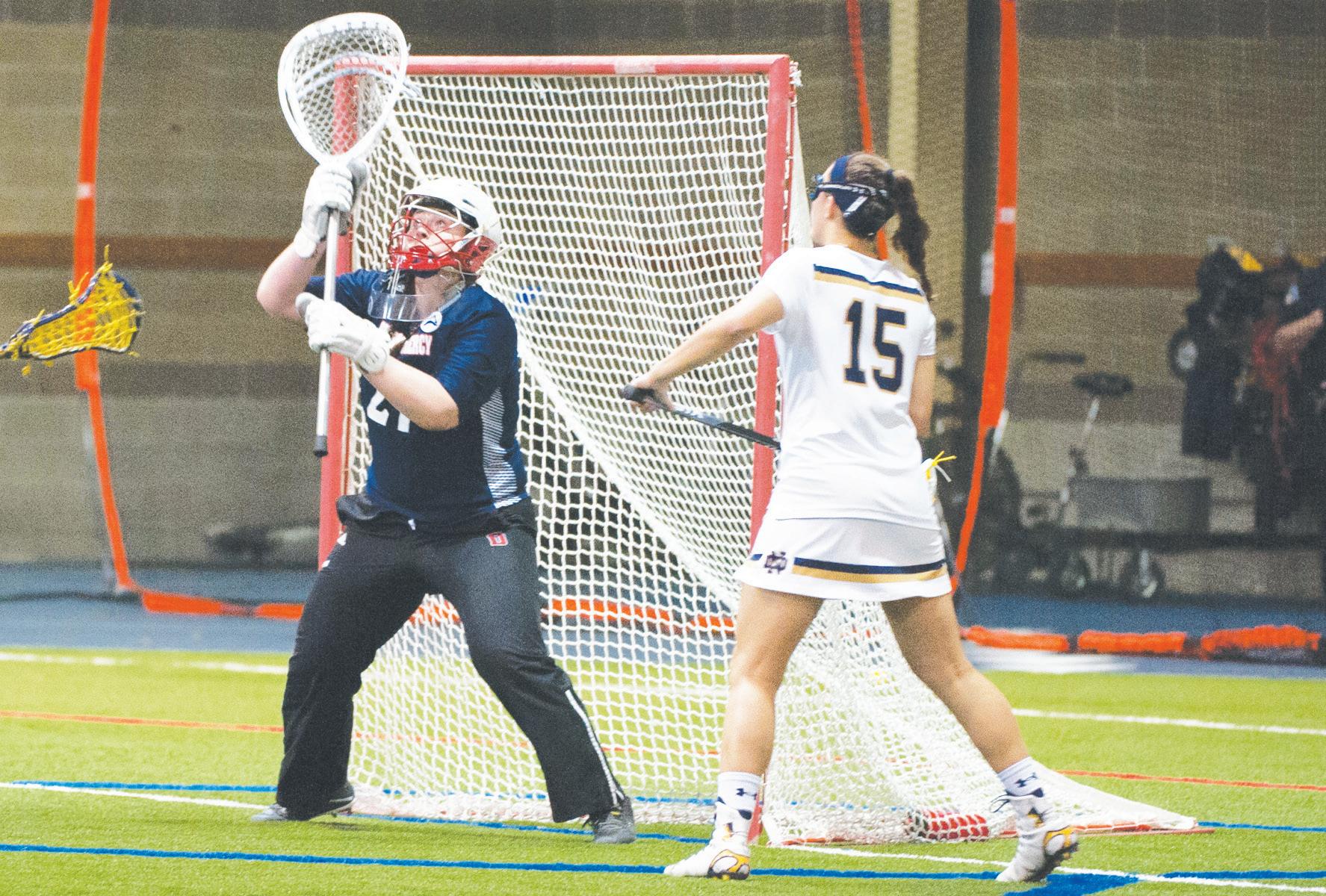
Irish senior Cortney Fortunato pressures the goalkeeper during Notre Dame’s 24-9 victory over Detroit Mercy on Saturday at Loftus Sports Complex. Fortunato set a career high with 10 points in the game.
men’s basketball | nd 84, FLorida sTaTe 72
Colson scores 33 as Irish top Florida State
By MAREK MAZUREK sports editor
Junior forward bonzie colson holds a special place in the hearts of irish fans for playing the role of an undersized big man. in his 2 1/2 years at notre dame, colson has managed to produce doubledoubles and give the irish solid minutes in big games.
but even the most optimistic notre dame (19-7, 8-5 acc) fan might not have suspected colson was capable of the kind of game he had saturday.
colson’s previous career high was 31 points against duke in a 95-91 win last season. but colson did not even start in that game, and it was not quite the same level of dominance he displayed in saturday night’s 84-72 victory over no. 14 Florida state (21-5, 9-4).
“That was one of the great performances in our program’s history,” irish head coach mike brey said.
“Just the adjustments we’ve made playing small and having
Hockey | nd 3, maine 2; nd 4, maine 2
icers sweep key road series
By JOE EVERETT sports Writer
no. 16 notre d ame kept the good times rolling this weekend, sweeping its road series with m aine and continuing to climb the hockey e ast standings down the stretch run of the regular season.
The i rish (17-9-4, 10-5-3 hockey e ast) were tied with U m ass-Lowell for fourth in the hockey e ast standings entering their two-game series against the b lack b ears (10-17-3, 4-13-1).
With serious conference implications at stake, the i rish came out strong Friday night at c ross i nsurance a rena in Portland, m aine. Just 65 seconds into the opening period, sophomore forward Jack Jenkins staked the i rish to a 1-0 lead with his fourth goal of the season. Then, at the 6:22 mark of the first period, junior forward a nders b jork sped through the m aine defense and fired top-shelf for his 17th goal of the season to put the i rish up 2-0.
a ndrew o glevie also scored his 17th goal of the season, as the sophomore forward made it 3-0 notre d ame just 1:37 into the second period by putting a shot on goal past the m aine goalkeeper and Jenkins, who was screening in front of the net.
From there, m aine would eventually get on the board with a goal halfway through the third period, and then, with four seconds left, added a goal on a power play with an extra attacker on the ice to bring the final score to 3-2. however, on s aturday night in a lfond a rena in o rono, m aine, it was the i rish who had to play catch-up. m aine jumped out to a 1-0 lead just 26 seconds into the opening period as the b lack b ears converted on a rebound opportunity in front of the net. m aine extended the lead to 2-0 at the 3:03 mark of the second period off an oddman rush chance to send its home crowd into a frenzy.
nd Women’s l acrosse | nd 18, LiberTY 2; nd 24, deTroiT 9
nd rebounds with pair of wins
By TOBIAS HOONHOUT sports Writer
after suffering a tough loss to no. 9 northwestern in its season opener, no. 8 notre dame bounced back with a pair of big wins this weekend, defeating Liberty, 18-2, on Friday night, and then pulling away from detroit mercy, 24-9, less than 24 hours later.
“it was really great to see us come out this weekend with a challenging schedule with less than a 24-hour turnaround and put two performances together,” irish head coach christine halfpenny said. “so i’m really happy with the focus that we had following the northwestern game earlier in the week. … it was nice to see us really showcase improvement on both Friday and saturday.”
notre dame (2-1) controlled the game against Liberty (0-1) from start to finish, as the irish opened the scoring — courtesy of senior attack Grace muller — and did not look back. Liberty quickly equalized, but the high-powered notre dame offense went on a
15-0 run to put the game out of reach. senior and preseason a llamerican cortney Fortunato led the way with seven goals, one short of her career-high, and sophomore attack nikki ortega pulled the strings for the offense with five assists. sophomore midfielder samantha Lynch also had breakout game with four goals, including a smooth behind-theback finish.
The Flames didn’t see much of the ball on the other end, and the irish defense held them off the board for most of the way, only letting in a second goal at 8:20 in the second half.
in a quick turnaround, the irish then played detroit mercy (0-1) on saturday afternoon. The irish came out a little sluggish, and struggled to dominate like they had against Liberty. The Titans actually scored first, and the game went back and forth for much of the first half.
“You could tell that we had just wrapped up a game about 18 hours prior in that first 30 minutes, and we were also just
Notre Dame starts slow, then cruises at home
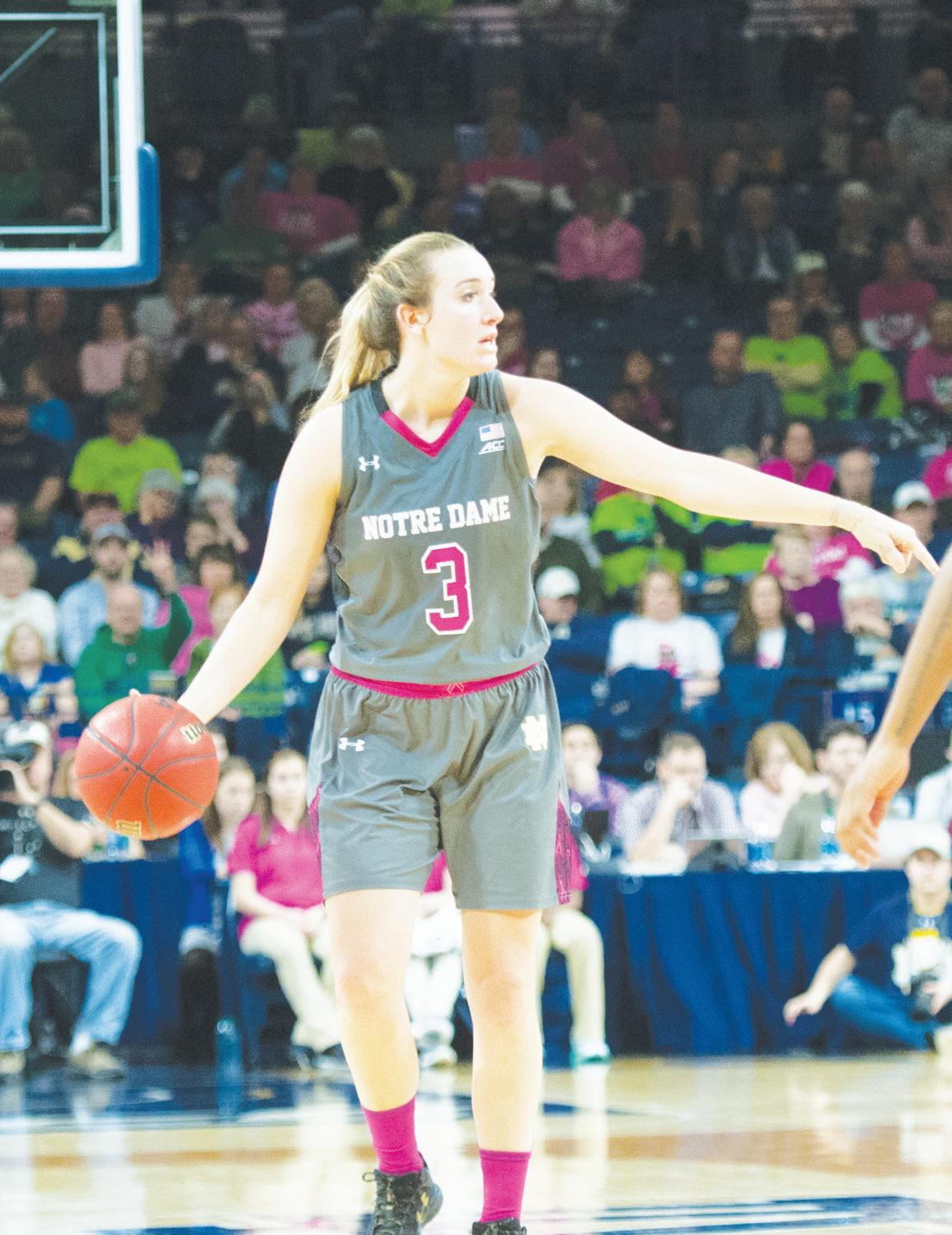
By DANIEL O’BOYLE s ports Writer
it’s not unusual to see no. 7 notre d ame start a game slowly before pulling away for a comfortable win. Trailing before the game even tips off is a little less common.
Yet neither a pre-game technical or a slow first quarter did much to stop the i rish (233, 11-1 acc ) running out as easy victors over Georgia Tech by a final margin of 90-69 on sunday at Purcell Pavilion. i n recent weeks, discussions about the i rish starting lineup have centered around whether junior forward Kathryn Westbeld — recovering from an ankle injury — was healthy enough to start. This time there was some extra drama, however, after junior forward and Wooden award top-20 candidate brianna Turner was accidentally not listed among the i rish starters. c orrecting the error cost notre d ame a see W bbaLL PaGe
EDDIE GRIESEDIECK | The Observer
Irish sophomore guard Marina Mabrey scans the floor during Notre Dame’s 90-69 win over Georgia Tech on Sunday.
KATHLEEN DONAHUE | The Observer
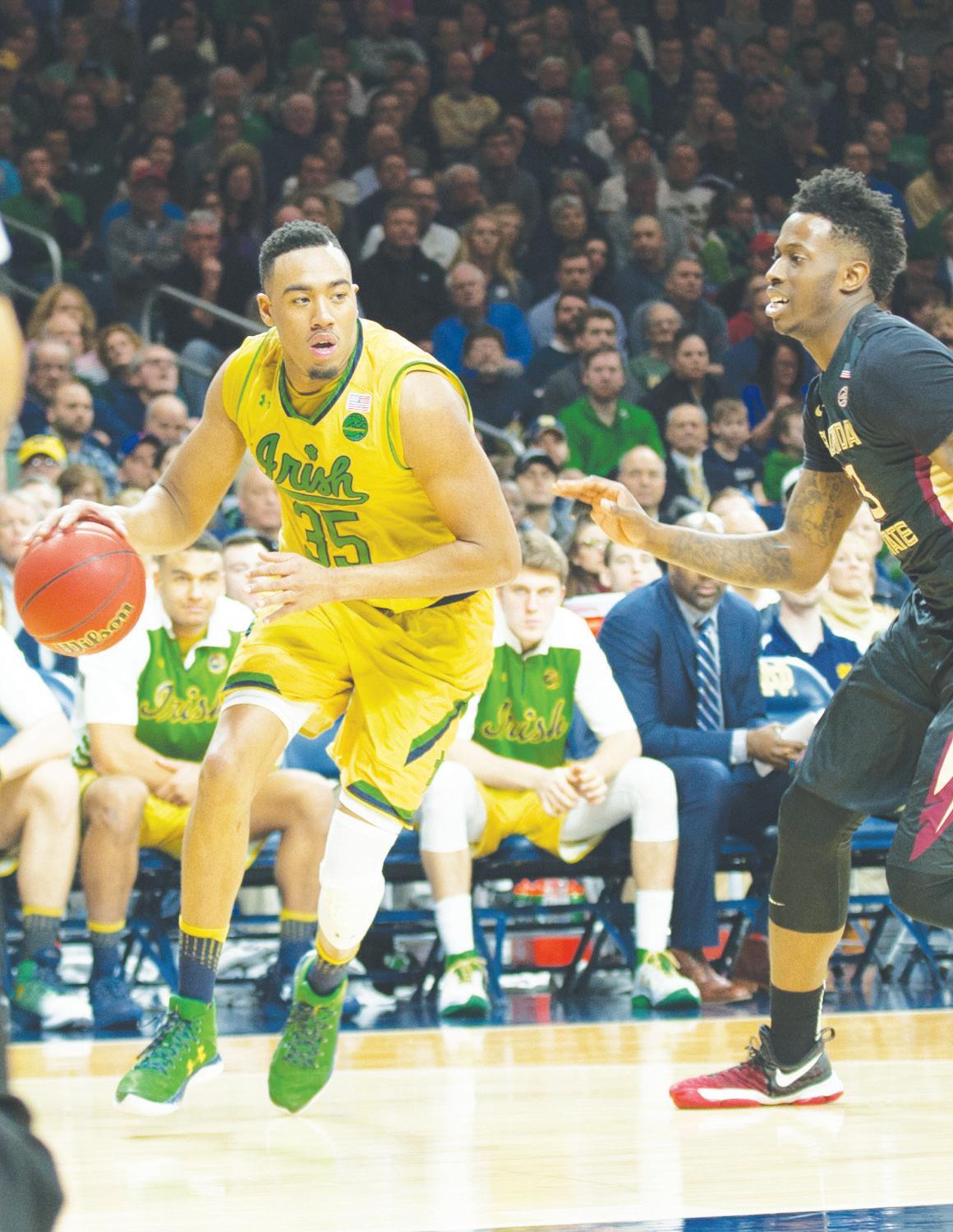
Irish junior forward Bonzie Colson drives baseline during an 84-72 victory over Florida State on Saturday at Purcell Pavilion.
see m bbaLL PaGe 11
see W LaX PaGe 10