Have a question you want answered? Email photo@ndsmcobserver.com
Ethan Holland senior sorin college
“The Question of the day.”
Luigi Grazioso junior off campus
“Talking to girls.”
Lucas Estrela freshman morrissey manor “room picks.”
Today’s Staff
Corrections
The observer regards itself as a professional publication and strives for the highest standards of journalism at all times. We do, however, recognize that we will make mistakes. If we have made a mistake, please contact us at (574) 631-4541 so we can correct our error.
Monday
“Brunelleschi’s Dome”
106 Bond Hall
5 p.m. - 6:30 p.m.
Author to speak about bestselling novel.
Marguerite Barankitse Lecture
102 DeBartolo Hall
7 p.m. - 9 p.m.
On leadership and love for social change.
Tuesday
“Voices of Change in Cuba” Hesburgh Center
12:30 p.m. - 2 p.m. Carmelo Mesa-Lago will present.
Christ’s Passion: Medieval Mystery Plays DeBartolo Performing Arts Center
7:30 p.m. - 9:30 p.m.
Want your event included here?
Email news@ndsmcobserver.com
Wednesday
Dirty Book Sale
Hesburgh Library
9 a.m. - 3:30 p.m.
Cheap, used books for sale. Sponsored by Notre Dame press.
Dogs and Donuts
4 p.m. - 6 p.m. North Quad
Take a study break to pet dogs and eat donuts.
Thursday
“Visualizing Fascism” Hesburgh Library
5 p.m. - 6:30 p.m.
Analysis of other ways to understand fascism.
Adoration of the Blessed Sacrament Basilica of the Sacred Heart
6:30 p.m. - 11 p.m. Held in Lady Chapel.
Friday
Easter Break campus-wide all day
Classes will resume for all students Tuesday, April 18th.
Stations of the Cross Basilica of the Sacred Heart
7:15 p.m.
See Campus Ministry website for events.
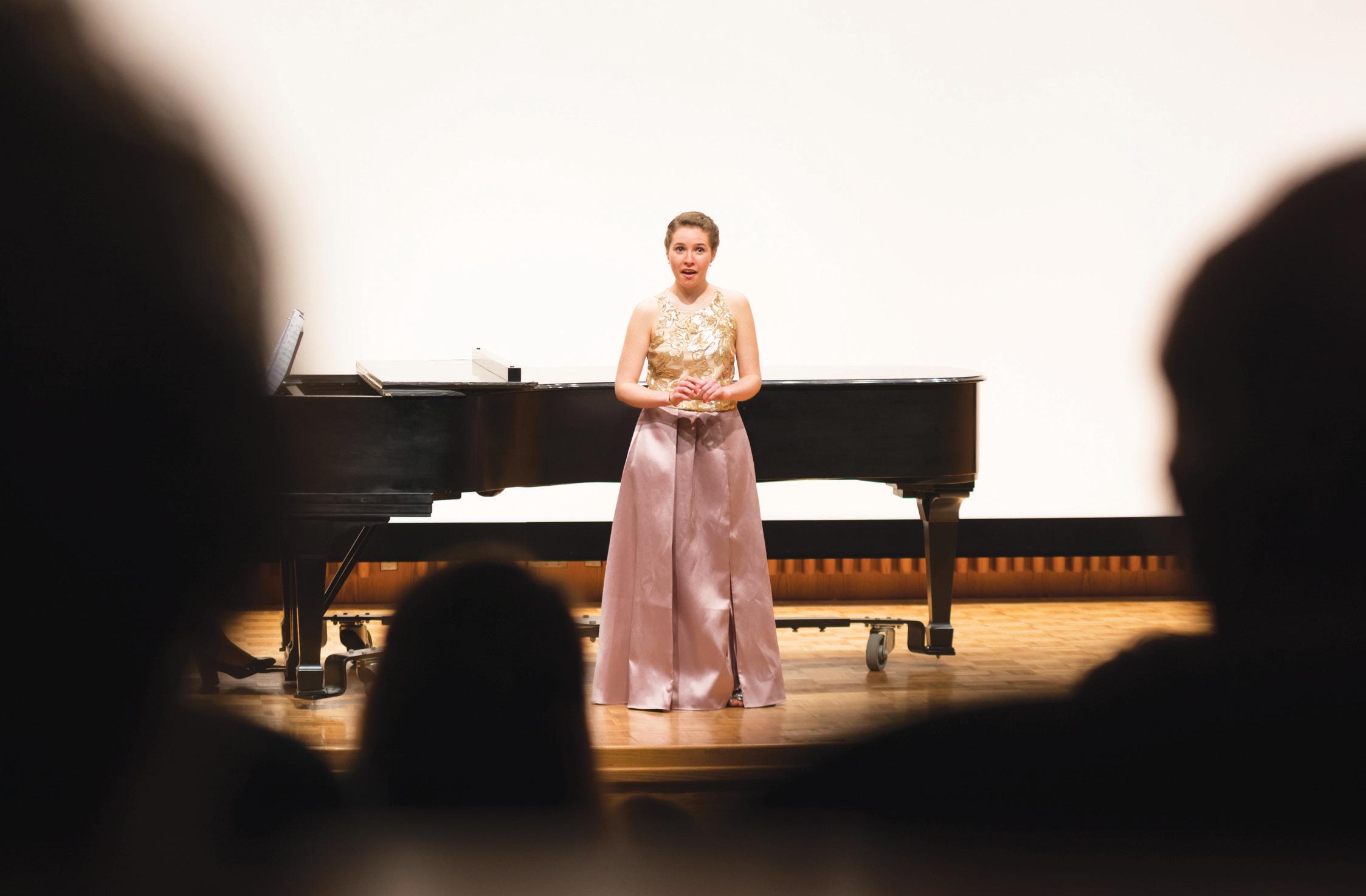
MICHAEL YU | The Observer
Senior Annette Sayre performs her senior recital at Annenberg Auditorium in the Snite Museum of Art. Sayre performed voice pieces by Hugo Wolf, Claude Debussy, Joseph Haydn, Johann Sebastian Bach, Enrique Granados and Dominick Argento.
Higgins Labor Cafe examines ND licensees
By ANDREW CAMERON news Writer
i n Friday’s installment of the h iggins Labor Program’s ( h LP) Labor c afe discussions, members of the n otre d ame community gathered in the Geddes h all c offee h ouse to discuss the supply chains of n otre d ame licensees s tudents from the c enter for s ocial c oncerns Fall 2016 human Trafficking s eminar delivered a presentation on the the topic titled “ e xploring the r isk of Forced Labor Within the s upply c hains of n otre d ame Licensees.”
d an Graff, director of the h LP, said Labor c afe events
enable attendees to foster dialogue about pertinent social issues.
“The Labor c afe is an ongoing vehicle for discussion on contemporary labor questions,” Graff said. “ it’s most of the time just a discussionbased convening, where we decide ahead of time that someone’s interested in talking about a particular issue, and they facilitate the discussion.”
s eniors John n olan and m ichelle Kim and sophomores m aggie Feighery, Joseph Laski and Zoe Walker shared research they conducted about n otre d ame’s supply chains last semester
as their final project for the c enter for s ocial c oncerns Fall 2016 human Trafficking s eminar.
Feighery said the University policies in place lessen the risk of unethical labor practices in the supply chains of n otre d ame licensees.
“We do have a code of conduct for our licensees that we expect them to adhere to,” Feighery said. “We also have a freedom of association policy. We don’t allow our licensees to make products in countries that don’t allow workers to unionize. There are nine countries on that list — among them is c hina. We’re a member of the Fair Labor
Observer recognized at ICPA awards ceremony
Observer Staff Report
The o bserver won 21 awards at the 2017 i ndiana c ollegiate Press a ssociation ( ic Pa ) awards s aturday in i ndianapolis, including third place in the d ivision i newspaper of the Year category and first place in the b est o verall Website category.
The news department won second and third places for b est non-d eadline news story for m anaging e ditor Katie Galioto’s coverage of the death of notre d ame student Theresa s agartz and news e ditor c ourtney b ecker’s story about increased competition for internships in the mendoza c ollege of b usiness, respectively.
Galioto also won second place for b est Feature story for her feature remembering s outh d ining h all monitor John r itschard, and the department additionally won third place for its coverage of the 2016 Laetare medal decision in the b est c ontinuous c overage of a s ingle story category.
The s ports department won three awards, including first place in b est breaking news
r eporting for its coverage of the arrests of six notre d ame football players in two separate incidents on one night.
e ditor-in- c hief b en
Padanilam won first place in the b est s ports c olumn category for his column arguing that head football coach brian Kelly should be fired after poor leadership last season and sports writer r enee
Griffin won second place in b est s ports Feature s tory for her piece “meet notre d ame’s emerging star receiver” about sophomore wide receiver e quanimeous st. brown.
The s cene department won four awards, including first place for former s cene e ditor e rin mc a uliffe’s piece
“Frankie c osmos moves on to ‘next Thing’” in b est r eview, and second place in the same category for former o nline e ditor Jimmy Kemper’s review of Usher’s “h ard ii Love” album.
mc a uliffe and Kemper also won third place for b est Podcast along with former a ssociate s cene e ditor Kelly mcGarry and s cene Writer a dam r amos for their “n irvanacast.” s cene Writer m atthew m acke won third
Paid a dverT isemen T
a ssociation [FL a ] , and our licensees are also members of the Fair Labor a ssociation.” d espite these policies, as well as regulations mandating supply chain transparency, determining whether or not a product was partially made with unethical or forced labor can be an arduous task, Feighery said.
“ s upply chains are incredibly difficult to trace these days,” Feighery said. “a lot of that has to do with the rapid expansion of globalization. e ven though information is spreading more easily, it’s not keeping up with how large the supply chain is getting and the different aspects
of it. it can have as many as eleven parts, from where the cotton is sourced to where it ends in your hand. There’s been an increase in forced labor, which we’re seeing a lot globally.”
Laski said several companies — such as Patagonia and a pple — have taken proactive measures to combat forced labor in the manufacturing of their products.
“The main thing we learned from this is even the best companies have trouble getting deep into their supply chains,” Laski said.
Contact Andrew Cameron at acamero2@nd.edu
place for his piece “b ottled nostalgia and the cultural feedback loop” in the b est e ntertainment c olumn category.
The Photo department won first place for both b est s ports Photo and b est Feature Photo for Photo e ditor e mmet Farnan’s photos of sophomore wide receiver c .J. s anders and the men’s basketball team celebrating, respectively.
The Graphics department teamed up with the Photo department to take home third place for b est s pecial s ection c over for former Graphic e ditor s usan Zhu and former Photo e ditor c aitlyn Jordan’s “breakout” i rish i nsider cover.
The v iewpoint section won first place for b est o pinion c olumn for Jordan r yan’s piece “o ut of many, one.”
The 2016-2017 e ditorial b oard won second place for b est staff e ditorial for its piece on sexual assault alerts, “it was timely.”
The o bserver also took home third place for b est Themed i ssue for the 2016 Freshman o rientation e dition, second place for b est o verall Web d esign and third place for b est Use of Twitter.
Panel connects gender, politics in a ndean town
By TOM NAATZ news Writer
s ubject of the documentaries “ s oy a ndina” and “ s oy a ndina ii : The r eturn,” nelida s ilva spoke alongside associate producer of both films, d oris Loayza, and associate political science professor Guillermo Trejo in a panel discussion that examined local politics and gender in rural Peru.
s ilva said she was born and raised in the rural a ndean town of Llamellin, Peru but moved to new York when she was young and lived there for 20 years.
i n new York, s ilva said she worked as an accountant before eventually returning to her hometown.
“i decided to back to my village to teach women, so they could earn some money,” she said.
s ilva said she was proposed as a candidate for mayor of Llamellin, though she initially struggled to decide whether or not to run for office.
“i wasn’t sure,” she said. “c andidates are seen as corrupt people.”
The documentary “ s oy a ndina ii : The r eturn” details s ilva’s campaign to be mayor. s ilva said she ran on a platform of economic development and ultimately lost the election.
Traditional gender roles often deter women from becoming involved in politics, but her candidacy demonstrates women’s capabilities, s ilva said.
“d espite the macho system, which is dominated by males, there is more space for women,” she said. “ however,
there were more receptive young people — some men, too, but not those who had a [stake] in politics.”
Loayza said producing a movie featuring s ilva’s political campaign was an arduous task that presented constant challenges, especially in terms of objectivity. “ m y role was not easy,” Loayza said. “We had to be objective.”
Loayza said making two films about the same place brought about some challenges, especially concerning the locals’ perceptions of the documentaries.
“The townspeople were developing the idea that the footage from the town was going to be big and disseminated internationally, which made it hard,” she said.
Trejo said the film almost never discusses the country of Peru at large because Peruvian politics has a “more local dimension.”
“There’s this idea that you leave but you never leave,” he said, “We are living in a reality with the question of universal citizenship. We are not trees. You don’t belong to one place.”
a ccording to Trejo, s ilva’s gender played an integral role in the success of her campaign.
“[ s ilva] was facing two enemies: political machines and the question of gender,” Trejo said. “ it was interesting and infuriating. it is hard for a woman to be heard — not to speak up, because she was, but the audience wasn’t listening. it doesn’t matter if you have the [microphone].”
Contact Tom Naatz at tnaatz@nd.edu
By OWEN LANE s cene Writer
Fredrick Tipton, aka Freddie Gibbs, a gangster-rapper from Gary, Indiana is the closest thing s outh bend has to a local rap star. Gibbs slowly rose to prominence through his prolific mixtape releases in the late 2000s and cemented his status as a top-tier rapper after his collaboration with madlib on the excellent 2014 album “Piñata.” h is raps frequently document the dangerous, gritty life of a black man in a decaying rust belt town. h is diverse, adroit flow and low, gravelly voice provide his verses with their distinctive hard-hitting flavor. Gibbs’ latest effort, “You only Live 2wice” finds the rapper at the most compelling crossroads of his career, following a 2016 rape allegation.
“You only Live 2wice” is Freddie Gibbs in prime form. h is recent issues have certainly not stifled his rapping abilities; if anything, they’ve only stoked Gibbs’ fire. opening track “20 Karat Jesus” is a two part track that is classic, A-1 Freddie Gibbs. The second half of “20 Karat Jesus” and the Kaytranada and bA dbA dnoTG ood-produced “Alexys” are examples of the album’s extremely impressive production. Throughout the record, Gibbs switches up his immaculate flow and drops his gritty message over the sweet, haunting beats. The 30-minute-long album is only half as long as his two previous LPs. In the “more Life” playlist era of today, a short and cohesive LP is refreshing. The album’s biggest drawback is how familiar and consistent it feels for Gibbs.
even if Gibbs is being unadventurous in his style, his lyrical content is certainly captivating due to his overseas legal trouble in 2016. In early June 2016, Freddie Gibbs was arrested in France on an Austrian warrant,
after a woman alleged that Gibbs raped her in Austria in 2015. Gibbs was extradited and finally charged with sexually abusing two women on August 16, 2016. A month and a half later, Gibbs was acquitted of all charges and returned to his fiance and toddler daughter in the United states.
Listening to “You only Live 2wice,” it becomes clear that the months Gibbs spent in foreign jails were painful and contemplative ones. Gibbs does not shy away from addressing the affairs of 2016. he is most explicit about the allegations on the album’s only single, “c rushed Glass,” openly denying any wrongdoing. he raps, “I just beat a rape case, groupie b–––– I never f––––– … ” Gibbs also released a video for the single in which he wanders through a desert in his dreams, only to awaken in his jail cell.
As the album’s title suggests, Gibbs has returned to rap music with a positive outlook and focuses on the themes of redemption and reform on “2wice.” on “20 Karat Jesus” Freddie pounds out bars glorifying his “resurrection,” as the album’s provocative cover suggests. Gibbs both thanks God for giving him a second chance and reflects on his biological father, telling him to forget about friends because he will “ ... be solo in that coffin.” Gibbs may be relieved, overjoyed and grateful, but his dark, nihilistic past obviously haunts him still. on the closing track “homesick,” Gibbs relates how he has to abandon some of his friends in order to prioritize his family. he both thanks his fiance for standing by him through his troubles and earnestly longs to be a new man for her and his daughter.
In today’s world, it is easy for avid hip-hop fans to shrug off or even completely disregard the mildly misogynistic aspects of hip-hop. however, this album should make listeners contemplate an ugly dimension
of hip-hop which is too frequently overlooked. For instance, the song “Andrea” completely changes within the context of Freddie’s trial. Freddie raps about a woman he had sex with in the past and compares the relationship with her to Wi-Fi. In other circumstances, the lyric would be perceived as a clever, yet slightly problematic brag about his sexual prowess. however, after his ordeal last summer, the lyrics strike as a testimony to the harmful, misogynistic attitude prevalent in rap music.
Listening to this album, I find myself wondering if Freddie learned anything from his ordeals last year. I certainly hope he did – and some of his lyrics suggest my hopes are not unfounded. I hope that the allegations about Gibbs were not even remotely true. I cannot reconcile one of my favorite artists committing a crime as horrible as sexual assault. regardless of what occurred, the media attention around Freddie Gibbs’ allegations of last year provide an important launching pad for discussion about sexual assault in the hip-hop community. Perhaps Gibbs may have learned something himself.
Contact Owen Lane at olane@nd.edu
“You Only Live 2wice”
Freddie Gibbs
Label: Empire
If you like: OutKast, 2Pac, WuTang
Tracks: “20 Karat Jesus,” “Homesick,” “Alexys”
image with a small, four-word instruction in capital letters: “Listen at maximum volume.”
here’s a record to judge by its cover: “World eater,” the latest record by blanck mass (benjamin John Power). The album art, which features a dog’s muzzle baring its teeth, is reminiscent of no wave band swans’ brutal 1983 debut “Filth,” which features a pair of dentures on its cover. Perhaps the likeness is fortuitous, but other similarities are not so superficial. Though their approaches differ widely, both records are debilitating in their obscene and vicious energy, and overwhelming in their darkness. most notably, the two records tackle related themes. In the “World eater” liner notes, Power elaborates on the artistic vision that guided the record’s production, which was largely a response to current events: “As humans, we are aware of our inner beast and should therefore be able to control it,” he writes. he goes on to argue that, in spite of our unique ability to reason, humans remain incapable of placating these selfish drives. “recent global events have proven this. The human race is consuming itself.”
Though I trust Power’s earnestness, the same philosophy would be fitting in relation to virtually any blanck mass production. After all, narcissism, aggression and the desires of the flesh — well, these are Power’s thematic bread and butter. Just take a look at his 2015 record, “dumb Flesh,” or his collaborative project with Andrew hung, the noise-techno duet F--- buttons. For that matter, take a look at the back cover of the “World eater” booklet, a thunderous fractal-like
At maximum volume, the gripping evolution of the record’s disturbing introduction, “John doe’s carnival of error,” is outright paralyzing. An uncanny music-box melody transports the listener to a haunted circus, the cyclical notes spinning slowly and lingering. The song swallows the listener in its abrasive techno, evocative of ecstatic, cocainefueled clowns.
In the track’s rave-powered, overdriven climax, Power does not merely channel daniel Lopatin’s recent output as oneohtrix Point never, but far exceeds the corny anti-ravemusic-but-still-rave-music sensibilities of Lopatin’s 2015 record “Garden of delete.”
In the next track, the amusement park ride jolts in the opposite direction and brings us to “rhesus negative,” the album’s brightest highlight. The track blends together everything effective about Power’s style: loud and looming drones in the background, dystopian synths and vocal samples in the foreground and the swelling synergy of classical instrumentation and layers of harsh noise to balance it all. For better or worse, the blanck mass project has never quite matched Power’s own work as F--- buttons with collaborator Andrew hung, but “rhesus negative” is about as close as he’s ever gotten.
overall, however, it’s true that “World eater” is primarily for fans of music along the electronic-to-industrial continuum, or others curious to explore beyond the Power and hung duo’s three brilliant records. After all, tracks like
“Please” and “hive mind” are well-executed but not particularly memorable, probably because the attempted sentimentalism is unfamiliar territory for Power. And while “The rat” is excellent and “silent Treatment” begins with the most exhilarating operatic flourishes you’ll ever hear, even these tracks are not particularly ambitious and linger over safe territory after the first few minutes.
Indeed, his difficulty with developing musical concepts over extended lengths is perhaps Power’s major weakness, especially given that most blanck mass tracks are at least seven minutes long. Fortunately, this seems to be hung’s contribution to F--- buttons — at least in part. This is also why, though “World eater” is an enjoyable record, listening to the duo’s output ultimately proves more rewarding instead.
Contact Adrian at lore.1@nd.edu
“World Eater”
Blanck Mass
Label: Sacred Bones Records
If you like: Ben Frost, Prurient, Oneohtrix Point Never
Tracks: “Rhesus Negative,” “Silent Treatment”
By ADRIAN MARK LORE
inside ColuMn
A north dining hall review
o ne thing people love about n otre d ame is the tradition. When prospective students come to campus for tours, they are often told that there is a campus-wide debate between the two dining hall options on campus: n orth and s outh. In this never ending debate, I would always choose n orth. b oth because it is obviously the superior dining hall and because I am stubborn. h owever, my staunch support of n orth was before the dining halls renovation. b efore the renovation, I loved n orth d ining h all: I could walk in every Tuesday and Thursday morning and stay there until my 11 a.m. class doing homework or answering emails. I could meet my friends there every s aturday for brunch and laugh and have a good time. m ore recently, I have been limiting my time spent in n orth d ining h all and that is because it is so alien to me, and because the chairs are very uncomfortable.
The old n orth d ining h all had a warm and nice atmosphere and it was always so bright and inviting. It was reminiscent of a pleasant retirement home, whereas the bright and harsh lights of the new dining hall remind me more of a hospital. o ne of my friends said that she sat on a panel with the designers of the new dining hall and their main concern was to make the dining hall as modern and contemporary as possible. e veryone was so excited about how different this new dining hall was going to be from what we already have on campus, and the designers talked about how they looked to other schools for inspiration.
m y only question is why the designers did not look more to the students and to campus for inspiration. I love n otre d ame for being n otre d ame and that is why I chose to go here rather than another school. Walking into n orth the day the new half opened, I was surprised and saddened to see how much character it had lost. It truly feels out of place when you compare it to all of the other buildings on campus. This may be the direction designers want to move in, in the future, but I think that what is special about n otre d ame is that it is different from other places and I loved n orth d ining h all the way it was.
m aybe my aversion to the dining hall is unfair and I need to give it more of a chance. Undoubtedly, I know that I will get used to it and come to enjoy it as much as I enjoyed the old n orth d ining h all. h owever, there are three things that I know for sure: the gray chairs have butt indents that are really uncomfortable, the chairs that have armrests don’t slide across the floor so it is really hard to push them in and the food lines have no set direction to move in, so it is really a free for all in there. In short, the new n orth dining hall is modern and aesthetic but it doesn’t feel like home.
It is still better than s outh though.
Contact Dominique DeMoe at ddemoe@nd.edu
The views expressed in the Inside Column are those of the author and not necessarily those of The Observer.
For the love of God, no war with Syria
I recently saw a headline that said President d onald Trump was considering military intervention in s yria in light of recent events. m arco r ubio is currently going viral making an impassioned appeal to American values and the need to oust s yrian president b ashar al-Assad. n ikki h aley is condemning the r ussian Ambassador in the U. n over his country’s continued support for the regime. All of this is pushing us closer to a war in s yria, a war that would serve no purpose and end in absolute disaster for the United s tates.
Let’s first be clear about what is going on s yria: a brutal dictator, Assad, is being bankrolled by r ussia and Iran, with military assistance from h ezbollah, in a civil war against Al- n usra, I s and other Jihadist groups. The civil war has caused unbelievable amounts of pain for the s yrian people, and thus the argument in support of this war is primarily humanitarian: Assad is a brutal, evil, dictator, and America must remove him, because, it is moral and the right thing to do. This is not just a bad idea; this is a horrendously idiotic idea that will result in the loss of thousands of American lives, achieve absolutely nothing, and has the potential to drag us into a war with r ussia.
Look at the situation at play: You have terrorist groups at war with a rogue dictator who is supported by a different terrorist group and bankrolled by two large regional powers. It’s a quagmire. Adding the American military to that situation will in no way alleviate the suffering of the s yrian people. It will merely add yet another front in a brutal war, along which more civilians will be caught in the crossfire.
Presuming that the United s tates does oust Assad, and presuming that for some reason r ussia and Iran don’t go to war with us to stop that, and presuming that we decide we’re o K with basically fighting on the same side as I s and Al- n usra, there’s the issue of what comes next. s etting up parliamentary democracies has led to anarchy in Libya and Iraq, and in e gypt led to the rise of r adical Islamic Fundamentalists, the m uslim b rotherhood. Another option is to replace Assad with a different brutal dictator who will rule over that territory with an iron fist and stop the anarchy. Though, if that’s the solution, then why remove Assad in the first place? We could also partition s yria, in some sort of 21st century s ykes-Picot, because we all know how well westerners drawing borders in the m iddle e ast has gone thus far. n ation building has been a colossal failure wherever the United s tates has tried it, and will only lead to the U. s . militarily occupying yet another country and overextending
itself further.
n ot only is the idea suggested by the humanitarian argument a bad one, but it is based on flawed logic. It is based on the notion that the United s tates should be pursuing some notion of “good” and should use its resources to advance this “good” in the world. This is false. The United s tates should pursue its own interests, and should only behave in a way that advances those interests. In no way, shape, or form, are the interests of the United s tates, or even the well being of her citizens, advanced from interfering in this civil war. s o what should the United s tates do? I would argue nothing. We do not need to interfere in every civil war going on around the planet, we do not have the resources and we do not have a dog in the fight. Let our geopolitical foes in r ussia and Iran bankrupt themselves to wipe out I s . Let our adversaries spend military, political and diplomatic capital to eradicate our enemies. As a nation, we will be better for it.
n ow many will call this argument immoral, that we should intervene because people are suffering and that I must be some sort of monster for not advocating for this. These people are conveniently silent on s audi Arabia’s atrocities in Yemen — should we intervene there? What about the ethnic cleansing taking place in the c entral African r epublic? People are suffering there, should we send in the m arines? What about in n igeria where b oko h aram is carving out a terrorist state for themselves, should we send troops there too? What about in venezuela where there are civilians starving from lack of food? Those who say that I am immoral for not wanting to intervene need to explain why we are not obligated to intervene in all of these places, because their humanitarian logic dictates that we should.
Finally, how is it moral, or the right thing to do to send Americans to die needlessly? h ow is it moral to make a mother bury her son because of the crocodile tears of a politician? h ow is it moral to make a war widow because a senator was worried r ussia might be gaining more influence than he considers ideal? h ow is it moral to make an American child grow up without his father because he was sent to die in a needless war thousands of miles away? We have fought too many wars, spent too many resources, lost too many men and achieved nothing. e nough is enough. n o war with s yria.
Dylan Stevenson senior Apr. 6
Dominique DeMoe Graphic designer
Cole Feldman The Absurder
Present and future
I want to use an investing paradigm to think about how we spend our time and see if we can build a strategy to maximize utility by investing in the right pursuits, allocating optimally between two securities: present and future.
Let’s assume two modes, two options for how to spend our time: one is “present focus” and the other is “future planning.”
Worn out adages seem to err toward present focus: enjoy the moment, focus on now, seize the day. m editation, anti-anxiety techniques and spiritual self-help often prescribe some form of hyperfocus on the present as a well-being cure-all. c lassic thinkers seem to err present as well. “c arpe diem” — aka, “seize the day” — actually comes from the longer, “c arpe diem quam minimum credula postero,” which appears in b ook 1 of h orace’s o des and more literally translates to: “Pluck the day, trusting as little as possible in the next one.”
s ophocles says, “Tomorrow is tomorrow. Future cares have future cures, and we must mind today.”
And to a great degree this seems right. o ther than memories and dreams, our ideas and sensations are about what we experience presently. It makes sense to match our focus to our experience. b ut I wonder if some future cares might have present cures, if some of tomorrow is in today. For example, it’s hard to “carpe diem,” if you haven’t studied for your exam tomorrow.
c ertainly, as I’m coming to learn is true of most things in life, there is a balance. A balance between present and future, between enjoying what you have and striving for more, between smelling the roses and tunnel vision.
m y decision framework looks something like this:
If (future utility from planning for future * probability of survival to experience that future) > (utility from present focus), then spend more time planning for future.
e lse if (future utility from planning for future * probability of survival to experience that future) < (utility from present focus), then spend more time focusing on the present.
This assumes we are indifferent between experiencing utility now versus later (which, I actually think is a bad assumption, considering we get old and slow, so there might be a time value of life, but discounting the utility is too complicated).
The most variability comes from your estimate for “probability of survival,” where a high probability will tilt the decision toward future planning and vice-versa.
And this is where adages like “you only live once” and “no such thing as tomorrow” have relevance because life is short and probability of survival might not actually be that high, in which case I think it makes utility-maximizing sense to err toward investing more time in present focus. b ut then again, there are heights to be achieved that require a commitment to the future, a bet on the probability of survival, which then subjects the decision framework to risk-preference.
Go with the flow
officer, who forced me to lesson plan, instead of annoyed at the delay.
Where I think the true synergy of the balance exists is in habits and activities that simultaneously allow for both present focus and future planning, present enjoyment and future benefit: reading, doing work you’re passionate about, exercising in a form you love, eating food that both tastes good and is healthy.
b ut then again, there are great present moments that are not so great for your future. For example, having one or two too many drinks at a party — great for the present night, not so great for the future morning.
It’s not as easy as the math makes it seem. b ecause when you’re chopping at the roots, it’s hard to see above the treetops. When you’re having fun, it’s hard to think about the future. When you’re working hard, it slips your mind to stop and smell the roses.
At least now, when your friend asks, “What would you do if you only had (insert small amount of time) to live?”
Instead of giving your usual answer: “I don’t know, tell my family I love them, go paragliding, then jump off the e mpire s tate b uilding.”
You can say: “I’d make a present-future utility maximizing decision.” And if they don’t flee the conversation immediately after that, you can show them your utility calculations.
Pluck the day, my friends.
Deep hows and outer spades, art and idiosingsongs; email colejfeldman@gmail.com, nonsense only, please.
The views expressed in this column are those of the author and not necessarily those of The Observer.
If you refuse to go with the flow, prepare yourself for a life full of annoying inconveniences instead of unexpected opportunities. I was reminded of this last s unday, when I had just boarded a plane at o’ h are and was promptly informed that the first officer was sick and thus the entire plane had to deplane, wait two hours for another officer to be available, and reboard. This news was not well received by the majority of the plane. m y neighbor cursed under his breath and shoved his tray table back to its full and upright position. s upermom let out a sigh as she bounced a baby on her hip and resignedly unfolded a stroller. messy b un demanded the Wi-Fi password, was refused it, and huffed off to s tarbucks.
This news did not please me at first, either. I was going home for a two-day interview trip and was disappointed that I would have even less time with my family than already anticipated. b ut I pictured my dad simultaneously tying his shoes and driving with his knees, telling me that life is better when you go with the flow. s o I found a decently cozy seat, commandeered nearby outlets, and prepped for a lesson I was to teach the next day. As I spread out my laptop, note-taking binder and textbook, I realized it was easier for me to prep in the gate than on the plane. If I had gone straight home, I would have had a late dinner with my family. Travel exhaustion paired with a food coma would probably not lead to the best lesson planning. Thus I found myself thankful for the sick first
I spotted another human in the gate thoroughly enjoying her extended time in the airport. s he was a toddler. s he roamed around the pillars between gates and pushed on the trashcan to see if she could move it. s he touched the nearby column and the trashcan at once. Which one was harder to push? Why was the trashcan colder to the touch? I, aspirational s T em teacher, fancied that she asked herself these questions as she explored her environment, a tactile learning master.
In reality, she was probably not asking herself explicit questions about mechanics and heat transfer. however, she was curiously exploring and possibly making observations about her environment. In this way, this toddler was entertaining herself during the delay through the practice of science. s he was able to appreciate the gate because she wasn’t obsessed with making it on the plane.
The adults around her were not engaging in such exploration. They were scrolling through newsfeeds too fast to read anything and chowing down on airport Paninis. e ven when they had time to do nothing at the airport, and thus notice what was around them, they filled their time with consumption — so much consumption that they weren’t able to appreciate what they were consuming. They did not pay attention to the Paninis because they were scrolling through information. They were not able to appreciate this information because they kept trying to get to the next information. They were caught in the cycle of always wanting to be somewhere else, doing something else. If they remain this way, they will never be content.
It’s oK to have an agenda. Google c alendar helps remind me of day-to-day commitments. At the same time, it is important to be open to a calendar change as a positive rather than a negative, a scenic route rather than a detour. It is important to be able to be in the present and go with the flow. e lse you’ll die without having ever fully lived in the present. Going with the flow is not only important in airports, but also in larger-impact situations. I had been planning on completing notre d ame’s Ace program since last April when I accepted my early admission offer. however, recent family developments made me realize I had to go home instead. After a talk with understanding Ace directors, I began planning for a new post-grad life at home. Instead of spring being a carefree glide to graduation, it was soon filled with rushed trips home, a flurry of cover letters and days of missed class for interviews. Yet in the chaos and work was the discovery of amazing independent schools in the b oston area. I went from no options to a choice between too many amazing schools. I went with the flow of the unexpected and challenging situation and found blessings among the hardships. s o when life doesn’t accord with your daily, monthly, or lifelong Google c alendar, go with the flow. It will save you a lot of upstream swimming and will allow you to enjoy the ride.
Ms. Thomassen is a senior studying mechanical engineering. She lives at the Chateau off campus, with four friends and more crepes. She can be reached at ethomass@nd.edu
The views expressed in this column are those of the author and not necessarily those of The Observer.
Erin Thomassen
The e xamined Life
Happy Birthday: Take better care of your health and well-being. search for guidance from those you find inspirational. change can be good if executed properly and within reason. consider ideas carefully before you put them into play. own what you do instead of just following others. your time is precious, so make sure to stick to positive rather than negative influences. your numbers are 4, 13, 22, 27, 32, 36, 41.
ARIES (March 21-April 19): don’t give in to pressure when you should be resourceful and find ways to ensure that the choices you make are based on truth, facts and what is in your best interest. Walk away from troubling situations or peer pressure.
TAURUS (April 20-May 20): Assess your emotional state and check into alternative options that will encourage you to take better care of your finances and medical issues. don’t be overwhelmed by the pressure being put on you by your peers, family or your lover.
GEMINI (May 21-June 20): don’t give in to manipulative individuals. explore new territory, meet new people and form alliances with those willing to give as much as you. equality should be your goal in all your relationships. set high standards and stick to them.
CANCER (June 21-July 22): keep your plans simple and within your budget. It’s fun to treat others to a good time, but not if it leaves you stressed out about money. offering your attention and affection will be more effective in the end. you can’t buy love.
LEO (July 23-Aug. 22): Put a little love in your life. socialize or make romantic plans. A day trip or attending an event that sparks your creative interest will encourage you to live life to the fullest instead of just going through the motions.
VIRGO (Aug. 23-Sept. 22): love conquers all. don’t hold back -- share your feelings and find out where you stand. It’s time to make changes that will improve your emotional well-being and stabilize your relationships with those you love.
LIBRA (Sept. 23-Oct. 22): emotions will surface, causing a reaction that is best contained. don’t let temptation or assumptions lead to regret. Plant your feet firmly on the ground and bring about necessary alterations that will promote a sense of calm and balance.
SCORPIO (Oct. 23-Nov. 21): don’t try to fix what isn’t broken. steady progress will be what leads to self-satisfaction and promising new developments. Perfectionism is fine, but knowing when to let go, move on and accept things as they are will be the key to success.
SAGITTARIUS (Nov. 22-Dec. 21): The world is a stage and you are one of the players. observation, strategy and common sense will be necessary if you want to avoid being taken advantage of by someone using emotional manipulation to get his or her way.
CAPRICORN (Dec. 22-Jan. 19): emotional negotiations can be formulated if you discuss your needs, what you are willing to offer and what you expect in return. Alterations to the way you live will bring greater stability and financial security.
AQUARIUS (Jan. 20-Feb. 18): An emotional imposition should be questioned before you agree to get involved. don’t feel guilty for not taking on too much. offer alternatives that will lessen the burden for everyone involved, and you will make progress.
PISCES (Feb. 19-March 20): find out what matters to someone you love. knowing how to make improvements for those who depend on you will make your life easier. A romantic plan will improve your relationship with someone special. Birthday Baby: you are energetic, hardworking and loving. you are impulsive and assertive.
Work Are A
Jumble | dAvId hoyT And Jeff knurek
sudoku | The mePhAm grouP
JusT add waTer | erIc cArlson & John roddy
wingin’ iT | bAIlee egAn & olIvIA WAng
Reevaluating the bullpen
Alex Carson s enior sports Writer
Just over five months ago, the c leveland Indians came to bat in the bottom of the ninth with a chance to win the World s eries.
In most years, this might be all you needed to know — a really good team went really far and nearly won it all. h appens to a bunch of teams. but most ball clubs don’t do that with their no. 2 and no. 3 starters unavailable — sorry, I’m not counting d anny s alazar’s three World s eries innings with the Tribe trailing as him being “available” — let alone with their once-no. 5, suddenly no. 3 starter leaving a postseason game in the first inning after he cut his finger on a drone.
Yet, with the guidance of manager Terry Francona and the left arm of reliever Andrew m iller, the Indians nearly won it all.
m iller made 10 postseason appearances, all of which except one (World s eries Game 7) ended with an Indians win. And every time he took the field, it felt like the situation was a little different. In the opening game of the postseason, and again in Game 3 of the World s eries, m iller entered in the fifth inning and picked up the win. o n the flip, Francona waited until there were two outs in the eighth to use m iller in Game 3 of the AL cs , keeping him in to record four outs and close out the game.
c ontrary to a reliever’s typical usage, m iller pitched more than an inning in each of his 10 outings last o ctober (and november), with outings stretching from 1 1/3 to 2 2/3 innings in length. he only once threw fewer than 20 pitches, and had three outings where his pitch count stretched past 40.
The discussion about how the Indians were overcoming injury quickly turned to a discussion about m iller — and, in part, concerning whether or not we’d see top relievers routinely recording six outs per game in the future. That conversation, though, misses the actual teachable point to be taken from Francona’s management last o ctober.
m iller’s long-duration outings were made possible by the nature of the postseason; teams never play on more than three consecutive days, and when teams take care of business early in their series, they get long spells of rest. Thus, long-term fatigue was never a true concern for
Francona with m iller, like it would be during the regular season, when teams often go weeks at a time with a lone off day.
The actual lesson, though, comes in understanding the idea of “leverage,” a term that seeks to measure the level of pressure at any point during the game. For an example, suppose it’s a one-run game in the bottom of the ninth, and the bases are loaded — this is, effectively, the most stressful moment in baseball, and thus, the highest-leverage play.
While Francona didn’t necessarily follow the actual Leverage Index statistic to dictate his use of m iller, he at least did so in theory — if m iller could come in and get key outs in the seventh inning, it made closer c ody Allen’s job a lot easier in the ninth.
Take Game 1 of the AL cs , when the Indians held a 2-0 lead in the seventh inning. With one out, Francona pulled c orey Kluber to go to m iller, who got two easy outs to set himself up to face the heart of the blue Jays’ order in the eighth. With Josh d onaldson, e dwin e ncarnacion and Jose b autista due up, this — not the ninth — was probably the key moment of the game. And the Indians had their best reliever in for it. m iller took care of business, letting Allen record a relatively low-pressure save.
now, let’s set up a scenario: Your team holds a one-run lead with one out in the seventh, but your opponent has the bases loaded and its cleanup hitter at the plate. Who do you want on the mound to secure this crucial out? Your best relief pitcher, or a bridge reliever to get from your starter to your setup man and closer?
I want my best option here, and I’ll worry about who gets the save when my team’s actually in the position to get it. We’re on the cusp of the next stats revolution in baseball, as we’ll start looking past the save as the key stat for relievers. Teams’ closers will enter more often in the seventh or eighth — because after all, what good is a closer if you never have the lead to use him? ( hello, buck showalter.) And that revolution will have started with Francona and m iller, who, despite not even being a closer, is the best reliever in baseball.
Contact Alex Carson at acarson1@nd.edu
The views expressed in this Sports Authority are those of the author and not necessarily those of The Observer.
Personal records abound at Sun Angel Classic
Observer Sports Staff
notre dame found success out west this past weekend, as the Irish set numerous personal records throughout the two-day sun Angel classic at Arizona state’s sun Angel Track.
The competition started Friday, where the Irish fielded athletes in only three events, but still made their presence known. Freshmen Logan Kusky and shae Watkins competed in the open hammer throw and both set personal records, as Kusky improved his mark from 54.68 to 57.29 meters, while Watkins improved his record from 45.92 to 50.91 metes. In other action, senior Anthony shivers recorded a 63.57 meter toss in the premiere hammer throw to earn fourth place, while on the women’s side, freshman Kassadee Ifft took fifth place in the pole vault with a height of 3.75 meters.
most of the Irish athletes
Baseball
con TI nued F rom PAGe 12
compete and put you in a position to win,” Fiala said. “he did that again [saturday]; he always does it. It’s huge.”
The Irish were able to secure themselves the series sweep sunday afternoon, defeating Georgia Tech 9-6. After falling behind 4-0 early on in the ballgame, notre dame was able to string together an enormous inning in the bottom of the third, scoring six runs off their 11 plate appearances in the inning. over the course of the next few frames, junior starter brad bass was able to settle in, keeping the Yellow Jackets from tacking on any more runs during his six-inning performance. After letting the game get close in the seventh inning when Georgia Tech put on a couple more runs to cut the Irish lead to 8-6, notre dame got one back itself in the bottom of the seventh to make it 9-6, a lead it maintained the rest of the way.
Aoki said he was happy with his team’s performance over the weekend in picking up its first Acc sweep of the season.
“I was really pleased with the way we handled a little bit of the adversity that we at times created for ourselves,” said Aoki. “The way in which we bounced back, I think earlier in the year that
competed on saturday, and continued to set personal records in all spheres of the event. Alexa coubal highlighted the field events saturday as she set a collegiate personal record in the discus, as her throw of 44.71 meters earned the Irish sophomore a sixth place finish. senior Indi Jackson also joined in on notre dame’s success in the field events by throwing a season-best 15.96 meters in the women’s shot put premiere, finishing in fifth place overall.
The Irish shone on the track as well. on the women’s side, freshman summer Thorpe placed fifth overall in the 100-meter hurdles with a time of 13.86 seconds, while freshman madysen hunter recorded a collegiate personal record with a time of 14.81 seconds. In the 200-meter dash, junior Payton m iller led the Irish by running a 24.79, earning herself a personal record and a fourth-place finish. r ight
behind her, hunter (25.26) and freshman m ichaela butler (25.40) finished sixth and tied for eighth, respectively. m iller also competed in the 400-meter and finished sixth, recording a time of 54.98 seconds. Junior Jordan shead led the Irish in the 400-meter hurdles by placing fourth — crossing the finish line at 59.14 seconds. on the men’s side, senior Jacob d umford finished the 800-meter race just .03 seconds shy of matching his personal record, placing seventh with a time of 1:51.82. Junior Kevin Pulliam recorded a personal record in the 1,500-meter race, recording a fourth-place finish with a time of 3:56.14. Fellow junior brent Kennedy also set a personal record in the 1,500m, running a time of 4:01.89. next up for notre dame is the Acc/big 10 c hallenge. The Irish will begin competition at noon on April 15 at cardinal Park in Louisville, Kentucky.
was something that may have spun out of control on us a little bit. I think some of the resilience that we’ve been able to build up from having made some mistakes in that department earlier in the year was really big.” moving forward, the Irish will have yet another busy week, starting Tuesday with hosting michigan state at 6:05 p.m., followed by Toledo on Wednesday before heading to Winstonsalem, north carolina, for a weekend series against Wake Forest. Aoki believes his team
can be successful as long as it approaches the upcoming stretch with the right mindset.
“We just have to keep grinding away. We have to worry about the next pitch and playing that as well as we can,” Aoki said. “We’ve got a busy week ahead of us with five games … we just have to keep trying to get better and just keep worrying about the pitch we’re about to play.”
Conact Alex Carson at acarson1@nd.edu and Alex Bender at abender@nd.edu
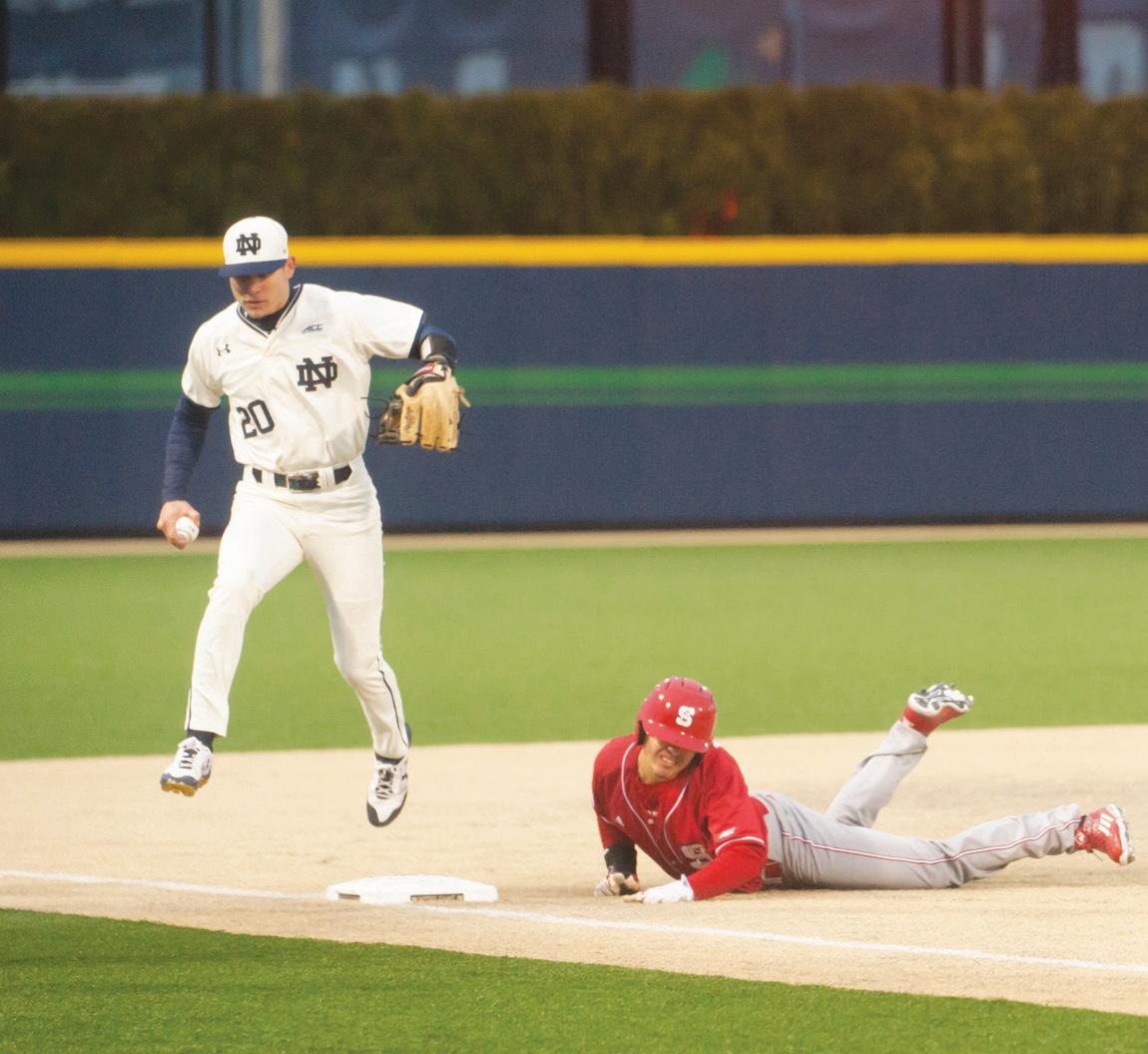
MICHAEL YU | The Observer
Irish senior third baseman Kyle Fiala tries to beat a runner to the base during Notre Dame’s 4-1 win over N.C. State on March 31.
the class of 2014 and a former captain and All-American forward under mcGraw, said mcGraw sets an example in her preparation that she both demands from her players and that her players strive to follow.
“she’s always had that never-quit competitive attitude that she instills in her players and that she demands from her players,” Achonwa said. “That’s always pushed me and always been in the back of my mind.”
her sentiments were echoed by those of ruth riley, the former First Team All-American center who clinched the national title for the Irish in 2001 and currently manages the WnbA’s san Antonio stars.
“I think her greatest strength is her intelligence and her competitive spirit,” riley said. “her ability to come up with a game plan and strategy and the process to achieve that throughout practice, even from the beginning of the season to reach your potential at the end of the season, just her basketball IQ is incredible. but, there’s also this motor that drives her every day that she steps on the court and the competition and desire for all of us to compete to our ability.”
mcGraw’s squads take “color tests” to examine the balance of personalities on the team, and according to Achonwa, mcGraw is a gold: detail-oriented, efficient and decisive, a realist, firm and a planner. mcGraw’s preparation for games, both on and off the court, is notoriously meticulous.
mcGraw’s work ethic is something that stays with her players, even after graduation. Former Irish guard, two-time captain and 2016 graduate michaela mabrey says that that work ethic is the most important lesson she learned from her former coach.
“[she taught me that] nothing is ever given,” mabrey said. “You know, obviously our program is something that, we’ve been to the Final Four [seven] times and we’ve made it far, but she said that this isn’t given. You can’t just walk into a gym and just because you have ‘notre dame’ on your chest you win the game. You’ve got to work, you have to continue to work hard all the time and I think that really hit me, and our team.”
“She never gave up on me.”
For many players, even the very best, the transition from high school to college hoops is difficult. every collegiate career has its ups and downs, and for many, those low points wear down self-esteem and confidence.
Unless you have muffet mcGraw in your corner.
This was especially true for Kayla mcbride, a 2014 graduate and former All-American guard who helped mcGraw lead the team to four consecutive Final Four appearances and three national title games.
“We used to have these meetings once a week, usually,” mcbride explained. “she just wanted us to pop in, check in, things like that. And at the end of every meeting, she’d just always tell me that I was the best player in the country. especially
during my senior year, she was always continuing to instill this confidence in me. I could have the worst day of my career and I could have the best game of my career, and she always had this undeniable confidence in me and I just remember the way that she looked at me, with those piercing eyes, and that honesty. I still carry that with me today.
“I can remember her getting on me in practices from the time I was a freshman. even more so when I was a senior because she always expected so much out of me. but, it was in those meetings that I gained that confidence in her, and so when we got to those big moments, those big games, when we got on the court, it was easy for us to be connected and easy for me to have confidence because I wanted to be so great for her, because I knew she believed in me.”
struggling with self-confidence is a common theme among the players whose phenomenal careers were accompanied by some dark points. but another common theme is mcGraw’s guidance pulling players from frustration to greatness.
“After my freshman year when I didn’t play a lot, I was down on myself and I think she never stopped believing in me, and that’s what I love about her,” mabrey said. “she never gave up on me.”
“We need you to be a beast.”
mcGraw is famous for expecting the very most out of her players, manifested in the success of her teams. but her players say that along with those high expectations, her ability to motivate and a mutual respect she shares with her players that gives them the desire to never let her down.
“It’s like an intimidation factor with that, because, as a player, especially as a player who wants to be great, you always want honesty,” mcbride said. “And she’s always going to give you the answer brutally honest, and that was something that I always admired about her.”
In fact, “honest” was the word both mcbride and Achonwa used to encapsulate mcGraw. she is brutally honest, a quality that adds to the immense respect her players, the notre dame community and the general public have for her.
Achonwa recalled this straightup approach particularly resonating with her in one moment leading up to the 2014 ncAA tournament.
“I’m remembering this one time, we were watching film, and I remember — and it’s something that plays back in my mind once in a while and it has continued throughout my career — but we were watching film and she stopped the film and she, I’m paraphrasing what she said a little bit, but, long story short, she said ‘Ace, you’re an All-American. We need you to be a beast. We need you to be a beast on the block,’” Achonwa said. “And I had been shying away a little bit on the offensive end and she said — this is right before the tournament my senior year, before I injured my knee — and she said ‘You just need to be a beast. We know you can do it. We believe in you and we really just need you to be a beast,’ so, it was kind of more than a challenge than anything. And that’s how I took it. I
took it as a challenge.
“And when we chatted about it a little bit more, later on, it was really just her challenging me, and so now if I’m ever doubting, I just think, ‘be a beast, be a beast.’ And I went on before I got hurt in the tournament, I was averaging 20 [points] and 10 [rebounds], I think, something like that. so, it was a little bit of a kick in the butt, but it’s something that really pushed me. And she always did that throughout my four years and continues to do that. she really challenges players. she’s not going to coddle you, she’s not going to baby you. If you want that, you’ve got to go somewhere else. she’s going to push you to be the best you because she believes in you and she knows you can do it.”
“She truly, genuinely cared about me as a person.”
What players say truly makes mcGraw special, however, is not wins or stats or film; rather, it’s the love and respect she fosters in the locker room.
“I think that was one of the things that drew me to her, is her honesty and how much she cared,” mcbride said. “she truly, genuinely cared about me as a person — and that meant more to me than anything she could ever do for me on the basketball court.”
Achonwa said players’ love for mcGraw all goes back to her honesty.
“It’s one thing to know to do the right thing, it’s another thing to have the guts to say and do the right thing, and I think that is her in a whole, that honesty right there,” Achonwa said. “sometimes you don’t want to hear it, but she’s going
to tell you.”
As a result of the connections mcGraw has been able to make with 30 years worth of notre dame teams, her former players look back on the time spent with her with fondness and look at her as a person to emulate on the court and in life.
“she expects a lot out of you as a person, as a player and then as woman,” mcbride said. “she expects a lot out of you, more than a lot of coaches probably do. but, it’s backed up with this loving, caring, motherly nature. she has us over to her house and into her family and things like that, so it’s backed by this genuine love for her players and wanting to see us be successful, no matter what we do. I think that, accompanied with that fact that she’s so tough and she’s so competitive, it allows her players to grow.”
For riley, mcGraw’s character, and the fact that she knew mcGraw would both develop her basketball skills and her as a person, was a main selling point as she made her decision as to where to attend school.
“[she is a] legend because of the impact that she’s made, not only at notre dame but for the game of women’s basketball and the sports world in general. And also, I think for women and girls’ empowerments, as well,” riley said. “ … clearly, she was very instrumental in the decision I made to come to the University of notre dame and I think it was a few things. The program that she had built up until that point, following their success and wanting to be a part of that, I really just felt like her personality and what the culture she created within the program, you know, I knew she
PAI d AdverTIsemen T
cared about us as young women, as student athletes. but there was also going to be an incredible opportunity for me to reach my potential and be a part of something great and she’s a leader.”
“i still hear her in the back of my mind.”
For many college athletes, the relationship built with a coach is a four-year commitment. For mcGraw’s players, this relationship is a lifelong one. As her players have gone their separate ways, she has stayed fully involved in their lives. This was especially the case for mcbride, a current guard for the san Antonio stars. mcbride tore her AcL halfway through the 2016 WnbA season, at which point she was the stars’ leading scorer and in the middle of a career-best season.
“As soon as I got injured, coach mcGraw was probably one of the first people to text me about the injury,” mcbride said. “she knows me, so she knows how competitive I am and how much I hate not playing, so she was one of the first people to tell me that it was going to be okay and that I’m going to be back better than ever and things like that.”
however, it was not just in that time of need that mcGraw was there for mcbride. mcbride attributes much of her professional success to her time playing under mcGraw at notre dame. she still lives and plays by the mantra “don’t settle for anything less,” something mcGraw preached.
“because I think there was a point in my career, maybe my sophomore year, I think she kind of could tell that I was settling into a role that wasn’t for me and she always was