Print Edition of The Observer for Wednesday, February 22, 2017
Project highlights sexual assault stories
Senior design major features quotes from ND, SMC student accounts in final project
By SELENA PONIO
a ssociate news e ditor
s enior design major m ary
Kate h ealey said she tries to think of her major as problem-solving.
i n the spring of their junior year, design majors propose an idea for their big final project. h ealey said when coming up with an idea she mulled through the things she was really passionate about and eventually decided she wanted to do something raising awareness for sexual assault, specifically at n otre d ame and s aint m ary’s.
“ we always hear about statistics, we get crime emails,” h ealey said. “There’s a lot of impersonal information passed around. i t’s very statistics driven and there’s also the kind of hidden shame and embarrassment that comes
with it.
“ i wanted to collect these very intimate stories and display them in a very public, unapologetic way while still maintaining the story of the storyteller.”
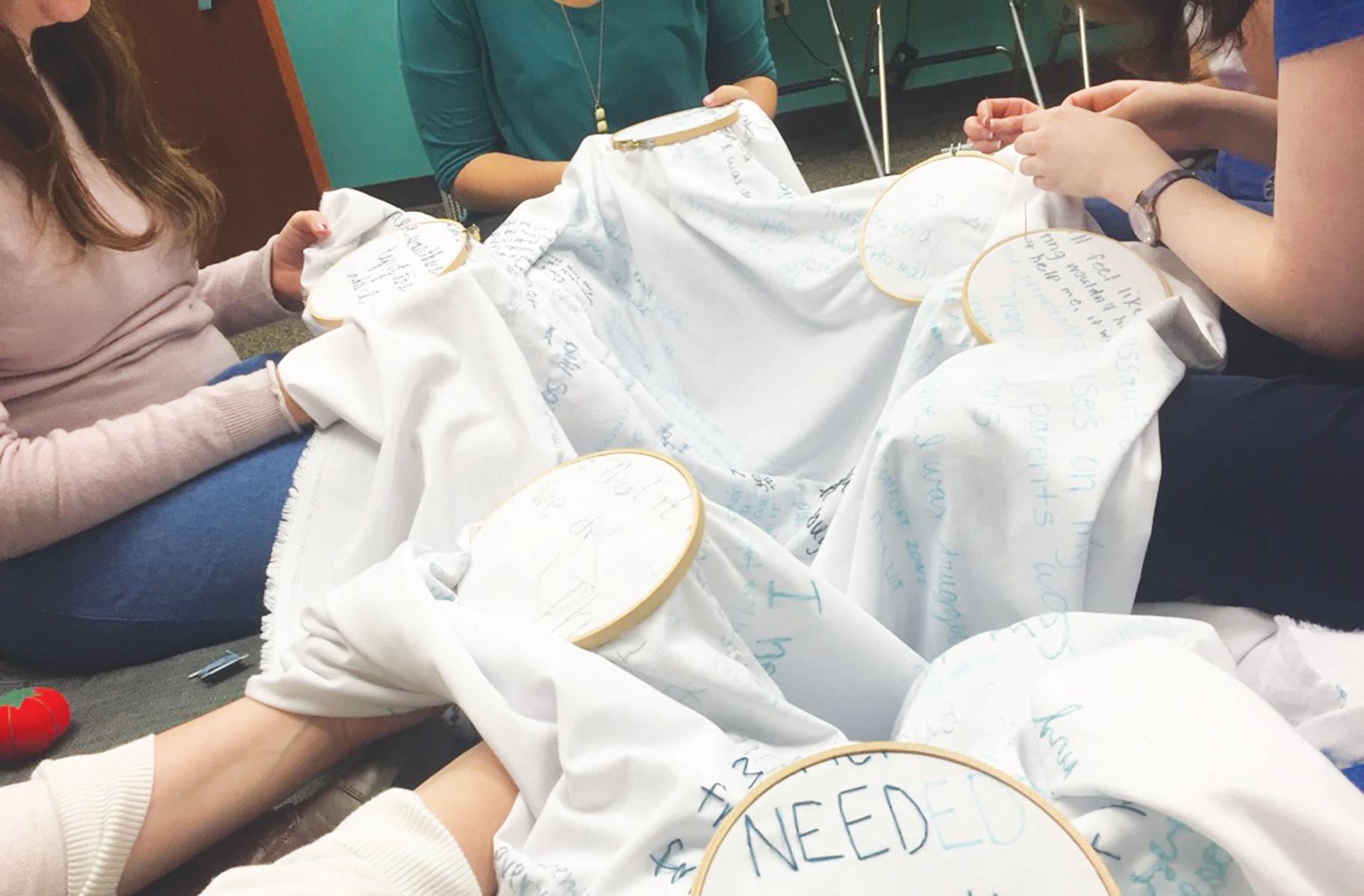
h ealey’s project is a 9-foot wide and 4-foot tall white sheet with quotes from sexual assault stories from students at n otre d ame and s aint m ary’s. The quotes were first written out on the sheet and then h ealey went back and stitched them on afterwards.
“The reason i ’m doing the stitching is because there’s a lot of art history between women and the domestic craft,” she said. “ women have always been making art, but because they didn’t necessarily have the resources,
proJecT PaGe 5
Saint Mary’s grad helps refugees Jenkins shows support for DACA students
By MARTHA REILLY
a
ssociate
saint mary’s e ditor
w hen h azim a l- a dilee arrived in the u s . in 2014, his wife e ntidhar a bbood was nearly 7,000 miles away in Jordan, having been denied relocation privileges. n ow, more than two years later, a bbood’s application to enter the u s . has still not been approved, as a l- a dilee discussed at a lecture about migration on Tuesday at s aint m ary’s.
a l- a dilee said his family established a happy life in i raq, where he and his wife both worked as teachers, but was forced to move to Jordan after the rise of insurgents in his homeland.
“They kill anybody in i raq, especially if they know he is a teacher, a doctor,” a la dilee said. “ we don’t know what happened. we are now refugees.”
a l- a dilee said p resident d onald Trump’s desire to
stop the entry of nationals from i raq, i ran, l ibya, s omalia, s udan, s yria and yemen into the u s . may prevent him from seeing his wife ever again. The situation is further complicated because a bbood suffers from diabetes and heart disease, according to a l- a dilee.
“ i have a green card now, but i cannot go back to help her,” he said. “ i f i go out of the u s ., i cannot enter again. That is a problem for me.”
a lumna l aurie p inter, class of ’84, who helps settle refugees in s outh b end, said she aims to connect refugees with resources in the community that can fulfill their legal and medical needs. s he said she works with a task force that arranges household items, enrolls children in school and conducts a cultural orientation for the refugees to make their transition easier.
Observer Staff Report
university p resident Fr. John Jenkins released a statement Tuesday in support of deferred action c hildhood a rrivals ( daca) students at notre dame.
“i was encouraged to learn today that homeland s ecurity s ecretary John Kelly will continue to respect obama-era protections for undocumented immigrants who came to the u s. as children,” he
said in the statement. “They include daca students who have been admitted to notre dame, thrived here and whom the university fully supports.”
Jenkins also expressed concern that undocumented community members who are not protected by daca will not be afforded the same respect.
“ we welcome this development, yet remain concerned that other undocumented members of our communities are treated fairly and compassionately,” he said. “ we call on our leaders to recognize that, throughout our nation’s history, immigrants have immeasurably enriched us culturally and have been the lifeblood of our economic vitality.”
Jenkins’s statement comes two weeks after he announced in a letter to faculty senate that he will not designate notre dame a sanctuary campus.
p rofessor dies at 54
Observer Staff Report
Timothy s. Fuerst, w illiam and dorothy o’neill p rofessor of e conomics at notre dame, died Tuesday morning at the age of 54 after battling stomach cancer for the past 10 months, the university said in a statement.
Fuerst’s research largely
centered on monetary policy. he also served as senior economic adviser at the Federal reserve bank of c leveland and taught for 19 years at bowling green state university, according to the press release.
“Tim was one of the cornerstones of a revived and extraordinarily successful economics program at notre
dame. … we will miss him terribly, but we can be grateful for knowing him as we did and for his inspiring service to the university,” John mc greevy, the dean of the c ollege of a rts and l etters, said in the statement. according to the university, arrangements for the funeral are pending.
Photo courtesy of Mary Kate Healey
Students participate in a sewing circle, an event senior Mary Kate Healey said was intended to foster an atmosphere of dialogue. The sheet features quotes from sexual assault survivors. see
Nathan Gundlach freshman sorin college “my reputation.”
Emily Koykka sophomore Lewis hall
“A pillow I’ve had since I was two.”
Matt Bulgarelli sophomore Keenan hall
“nature valley Granola bars, oats and honey.”
Students
Today’s Staff
Corrections
The
Wednesday
Michael Collins
Reading Hammes Bookstore
7 p.m. - 8:30 p.m.
Author of “The Keepers of Truth.”
“The Star Spangled Girl” Senior Theatre Show
O’Laughlin Auditorium
7:30 p.m.
Tickets are free.
Thursday
“Under Caesar’s Sword” Documentary
Washington Hall
Mainstage Auditorium
6 p.m. - 7 p.m.
Short Q & A to follow.
Women’s Basketball vs. Boston College Purcell Pavilion
7 p.m.
The Irish take on the Eagles.
Friday
“ND’s Labor Licensing Code: Moving Forward” Geddes Hall Coffee House
5 p.m. - 6 p.m.
Silent Retreat Moreau Seminary 5:30 p.m. Weekend silent retreat open to all students, faculty and staff.
Saturday
Pilates
Rolfs Sports Recreation Center
11 a.m. - noon Free , but space is limited. Arrive early.
Women’s Tennis vs. Bowling Green Eck Tennis Pavilion
3 p.m.
The Irish take on the Falcons.
Sunday
Women’s Basketball vs. Florida State Purcell Pavilion 1 p.m.
The Irish take on the Seminoles.
Men’s
Institute hosts chili cook-off for cancer research
By NATALIE WEBER news Writer
h arper c ancer r esearch Institute will be sponsoring its annual chili cook-off to benefit undergraduate cancer research in h arper h all’s multipurpose room Wednesday from 4-6 p.m.
“It’s $10 that will get you unlimited tastes, and as I [have] said, when you leave you are not hungry,” Angela c avalieri, who is heading the cook-off, said.
The cook-off has boasted a number of diverse chilis in the past, from dessert chilis to cheesy chilis, according to Jenna m rozinske, another one of the cook-off’s organizers.
“ o ne year, we had a faculty go to Wendy’s and get a huge tub of chili, and that was his entry,” m rozinske said. “We were all like, ‘Wow this is so good,’ and I’m like, ‘I’ve tasted this before,’ and then he revealed ‘ o h, I just went to Wendy’s.’”
c avalieri, who said she grew up in the m idwest with “one type of chili,” also said
she remembers unusual chilis from past cook-offs.
“We’ve had an Argentine chili — which if you know anything about Argentina, they’re famous for their beef,” she said. “That particular chili looked like a giant ball of shredded beef.
“We had a chili with ghost peppers submitted by someone from m exico c ity. h e
“People have used coffee, they’ve used chocolate, things you don’t normally think.”
Angela Cavalieri Harper Cancer Research Center
was kind of benevolent and let people know there were ghost peppers in that chili.”
Last year, s moke Free s t. Joe, a local organization working to help smokers quit smoking, brought a particularly unusual chili to the cook-off, according to c avalieri.
“They brought a regular chili and what they called
a ‘smoker’s chili’,” she said. “ s o one was a white chili and one was [representative] of somebody who smoked. I don’t know what they put in it. It was smoky.”
s ometimes the cooks will bring special “secret” ingredients, and attendees will try to guess what they used.
“We’ve had some secret ingredient chilis,” c avalieri said. “Those are fun. Those are the ones where you taste it and you think, ‘That is delicious. What is that?’ and they disclose the secret ingredient.
“People have used coffee, they’ve used chocolate — things you don’t normally think.”
The event draws participants from both the s outh b end and n otre d ame communities, from undergraduate students to children of faculty at the research institute.
“We consistently have entries by the n otre d ame fire department,” c avalieri said. “There’s just something about the fire department and chili makers that just go
together. Firemen are known for making excellent chili, and we generally have a couple entries from them.”
Though she said organizing the cook-off has not been too difficult, m rozinske said
“There’s just something about the fire department and chili makers that just go together. Firemen are known for making excellent chili.”
Angela Cavalieri Harper Cancer Research Center
finding the right type of sample cup for the event has been a challenge.
“Trying to find the right cup to serve chili has been the most challenging thing,” m rozinske said. “You wouldn’t think it, but … you don’t want it too big because then people pour too much of a sample, and then they run out quick … but then you
have to keep the cup from melting. They melted one year because the chili was so hot.”
c avalieri said the organizers would like to attract more students to the cook-off.
“The only logistical challenge, I would say, is that some people think that h arper h all is next to Florida because we’re down here on the south side of [ e ast] Angela [ b oulevard],” c avalieri said. “We’re over by e ddy s treet, so some people think it’s so far to walk. That’s the only thing. We would like to see more students come down for it.”
According to m rozinske, the event not only helps raise money for researchers, but also allows the community to reflect on those who have been affected by cancer.
“ ... [It’s] kind of a way to get the n otre d ame community together to reflect on those who’ve been impacted by cancer and spread awareness,” she said.
Contact Natalie Weber at nweber@nd.edu
Professors, students explore need for protests
By LUCAS MASIN-MOYER news Writer
The last ten years have seen a surge of protest both on the left of the political spectrum, mostly in reaction to President d onald Trump’s policies, and on the right, with the Tea Party m ovement. This spirit of protest has bled over into n otre d ame’s campus with student groups engaging in demonstrations this semester on campus and in Washington, d c Tuesday evening in the Geddes h all c offee h ouse, associate professors of sociology Kraig b eyerlein and Ann m ische and two student activists, s arah d rumm, the secretary of the r ight to Life club, and Jessica Pedroza from We s tand For, discussed the power of demonstration as a part of nd votes’ Pizza, Pop and Politics s eries.
b eyerlein argued that protest is central to all democracies.
“Protest and democracy go together like America and
apple pie,” he said. “Protest flourished in American democracy — the women’s suffrage movement, textile workers protest … the civil rights movement of the 1960s.”
b eyerlin also commented upon the recent surge in protests in the United s tates.
“This recent wave of protests has the largest number of participants that at least we have records of, in American history,” he said.
“The idea is that protest size signals to elected officials
that a majority of citizens are behind a protest and the cause of the protest.”
m ische added that this wave of protests was also a global phenomenon.
“In the years since [the global financial crisis]
protests have erupted across the world, austerity protests in Greece, protest relates to Israel’s occupation [of Palestine],” she said.
According to m ische, protest is not just necessary to creating democracies, as seen with the b oston Tea Party and the s torming of the b astille in r evolutionary France, but is also crucial in solidifying these democracies.
“The expansion of democracy has depended on protests of various sorts — they contribute to democratic accountability,” she said.
“ o nce you have a democracy it’s not set, regimes can become more or less democratic over time.”
After the professors spoke, the student activists detailed their movements and reasons for protesting.
d rumm began by discussing the ideals that drive r ight to Life.
“We exist as a club because we believe all life has innate worth. h owever society has the tendency to label
some lives as not worth living — we see it as our duty to change this mindset,” she said. “As a club we stand for the most vulnerable in society. This includes refugees, the young mother, the unborn child, the mentally dis -
abled, the elderly and those who, in many circumstances, might not be able to demonstrate for themselves.”
d rumm stressed the importance of the m arch for Life, which the club participates in every year in Washington, d c ., in getting the club’s message across.
“It has been one of the most effective ways for us to get our message across,” she said. “This year alone we were interviewed for four newspapers, one of them being the n ew York
Times, and ever since coming back to campus there’s been a viewpoint in The o bserver talking about our club or if you’re pro-life and pro-choice.”
Pedroza then discussed the structure of We s tand For.
“We s tand For is a coalition of a large group of people who have many different ideas and stand for social justice,” she said.
This coalition, which was founded after President Trump’s election, gave students a way to speak out against what they saw as unjust.
“ o ne of the reasons why I demonstrated … it was a way to place my anger and frustration in a constructive way,” Pedroza said. “I think demonstrating gives people a chance to come together. As people who care about issues we can communicate with each other and organize.”
Contact Lucas Masin-Moyer at lmasinmo@nd.edu
Kraig Beyerlein associate professor of sociology
Ann Mische associate professor of sociology
“We are supposed to have refugees settled and independent in 90 days,” Pinter said.
“ i n anticipation of h azim’s wife coming, we are trying to prepare what cardiologists we are going to have working with her.”
Pinter said she strives to make refugees feel welcome in the U. s . by surrounding them with members of the local community.
“a s a resettlement agency, you’re trying to find a sponsor group, which often is a church, because as case managers … you are so busy,” Pinter said. “You don’t have the time to sit and socialize.”
“Stay informed. Be aware. Use your voice to speak up. You have to hear what the other side is saying.”
Laurie Pinter class of 1984
people are shocked how busy we are as a mericans. h aving that church group that can help them acclimate and learn things about our culture is really important.”
Pinter said the sheer number of steps involved in
a ccording to Pinter, many refugees are surprised that a mericans spend so little quality time with their loved ones. “ it’s really important to connect families with a group that can spend that time being social,” she said. “What i ’ve learned doing this work is that we really are not a very social culture because
applying to enter the U. s can be daunting, which likely discourages people with harmful motives from relocating to the country.
“ i just don’t think this is a way any possible terrorist is going to choose to come to the United s tates because it’s tough to get through this process,” Pinter said.
a ccording to Pinter, students should aim to dispel misconceptions about refugees while fostering dialogue with people who hold opposing viewpoints.
“ s tay informed,” she said.
“ b e aware. Use your voice to speak up. You have to hear what the other side is saying. o nce in a while, listen in on people who are antirefugee or anti-immigrant to know what the other side is saying and to have those conversations.”
Contact Martha Reilly at mreilly01@saintmarys.edu
Project
Page 1
doing domestic crafts like creating clothing, embroidery, cross-stitch, quilting … those were never considered art because those women weren’t considered artists.”
h ealey said stitching and embroidery has been used a lot among feminist artists such as suffragettes and most recently on signs at the Women’s m arch on Washington.
“ i wanted to tap into that history,” h ealey said.
h ealey said use of a sheet as her canvas was purposeful; the fabric itself holds a double meaning since a bed should be considered a safe place for rest, but that for many people “it often becomes a crime scene.”
h ealey went through the i nstitutional r eview b oard since her project technically
counted as human research and had to be declared ethical before she could proceed. a fter it was approved by the board, she went on with a survey that she circulated and received 64 responses from. o n a pril 7, her project will be put on display at the s nite m useum of a rt. h ealey said the act of sewing itself was so laborious and that it took her several hours to sew even a sentence, however, that was not the most difficult aspect of the project.
“The hardest part of it has been the emotional toll of it,” she said. “a lot of these people revealed very upsetting stories and i don’t know if i anticipated going into it how difficult it would be.”
o ne story that stood out, h ealey said, was a submission that was in the form of a poem. s he said what was striking was that each line of the poem started of with “he was a friend of mine.” h ealey said the way the poem ended powerfully when the student wrote, “ i wish trying to erase my pain hadn’t caused me more pain.”
b ecause she wanted the project to be collaborative, h ealey started a sewing circle to create dialogue in a very straightforward way. The group has met five times so far and she said everyone is welcome to join, and most of those who have joined did not have prior sewing experience.
h ealey said she received some negative responses from her survey from people who had misconceptions about rape on campus and thought that it was not as prevalent a problem as she was making it out to be. s he said her hope is that her project expels these “rape myths” and raises awareness.
“ i think people also just don’t understand that it could happen to anyone,” she said. “ i t happens to tons of people, so i think that just the way people interact with each other, the way people look out for each other, the way people speak with each other … i just want people to be more conscious of that and to have the courage to engage in these conversations.”
Contact Selena Ponio at sponio@nd.edu
Paid a dverT isemen T
Keep exploring
“We choose to go to the moon. We choose to go to the moon in this decade and do the other things, not because they are easy, but because they are hard.”
These are the words that President John F. Kennedy pronounced to the American people while speaking at r ice University on sept. 12, 1962. To state at a time when there had not even been a single space docking or space walk that men would travel 240,000 miles and walk on the moon in seven years was bold. Thankfully, Kennedy had the American people behind him.
In order to carry out Kennedy’s vision, a launch site need be built to handle the saturn v, the most powerful rocket to ever be successfully flown. That is where the dream of what is now the Kennedy space center Launch complex 39 is derived from. This launch complex — or more specifically launch pad 39A — now stands with perhaps the most impressive pedigree of launches in the entire world. With 12 saturn v launches and 80 space shuttle launches, it has even joined the national register of historic places.
After seven years of intense work and sheer bravery, michael collins, buzz Aldrin and neil Armstrong departed from 39A on July 16, 1969, rewriting history as they literally stepped humans into a new era in which man was to set foot on another celestial body. on sunday, a new chapter in the historic legacy of 39A occurred. spaceX launched the first private rocket to orbit from this launch pad. The launch — the first since the end of the space shuttle program — was a resounding success with an additional success of autonomously returning the first stage of the rocket in typical spaceX fashion. While the mission of resupplying the International space station is not extremely unique in and of itself, the ramifications of this launch are far-reaching. now, more than ever before, it is clear that continued advancement in space will come from a combination of government and commercial entities.
There have been many questions concerning the future of this country. one thing is clear: The future of our space program looks hopeful so long as the American people believe in supporting such scientific advancement. We have to keep looking onwards and upwards, allowing humanity to do things, as Kennedy said, “not because they are easy, but because they are hard.”
Contact Emmet Farnan at efarnan@nd.edu
The views expressed in this Inside Column are those of the author and not necessarily those of The Observer.
To THe edITor
Stand against persecution and exclusion
by now, a wide array of critics of President donald Trump’s recent executive order on refugees — including a passel of United states catholic bishops — have explained with force and perspicacity how the action amounts to a failure of charity, hospitality and justice. Among the many baneful dimensions of the order is President Trump’s rhetorical insistence that christians are to be favored and muslims disfavored for entry into the U.s
In fairness, the order itself does not privilege christians or bar muslims per se, and, in fact, makes religious persecution a factor that enhances a refugee’s case for entry — arguably a positive development that has historical precedent in the refugee policy of the United states. even this gain, though, is offset by an indefinite bar of all refugees — whatever their religion — from syria, one of the worst sites of religious persecution in the globe.
more troubling still, though, are Trump’s many statements that have advocated banning muslims from immigration to the U.s., spoke of muslims in derogatory terms and called for privileging the protection of christians. These statements, undoubtedly designed to please the president’s most ardent supporters, are unjust and unwise. making this case and denouncing the order are numerous leaders of catholic, mainline Protestant and evangelical churches and of christian organizations dedicated to relief, development and the alleviation of persecution.
I applaud the protest of these leaders as co-director of a project, “Under caesar’s sword,” whose purpose is to promote solidarity with the world’s persecuted christians. based jointly at notre dame’s center for ethics and culture and the religious Freedom Institute in Washington, d c., and funded by a grant of $1.1 million from the Templeton religion Trust, “Under caesar’s sword” is the world’s first systematic global investigation of christian responses to persecution.
The project is timely and urgent. nearly 3/4 of the world’s population lives in a country where religious freedom is strongly curtailed, and christians suffer persecution and discrimination more than people of any other faith. The advocacy group open doors reports that persecution only increased in 2016, when some 90,000 christians were killed for their faith and some 215 million christians faced persecution. Among the worst violators are the governments of north Korea, Iran, saudi Arabia, china, eritrea and India, as well as the Islamic state.
“Under caesar’s sword” reports the reality of this persecution but more centrally conveys the range of christian responses to it, many of these hopeful and courageous. A better understanding of these responses can help the rest of the world, not least a catholic university, stand in solidarity with persecuted christians. on Thursday, bishop Kevin c r hoades will be celebrating a mass for persecuted christians at 5:15 p.m. in the basilica of the sacred heart, followed by the screening of a short documentary film on the subject in Washington hall at 6 p.m. solidarity with persecuted christians, though, in no way justifies the exclusion of vulnerable muslims from sanctuary in the U.s. or indifference to any human right of muslims. religious persecution of any kind and against anyone is a violation of the human right to religious freedom, which several major human rights conventions
articulate. The catholic church committed itself to this human right definitively in its landmark declaration of 1965, “dignitatis humanae,” rooting religious freedom in the dignity of the human person and his or her search for religious truth.
muslims themselves suffer the violation of religious freedom in great numbers. In some countries, muslim minorities like shias, Ahmadis and sufis are persecuted at the hands of sunni muslim governments. elsewhere, muslims face repression at the hands of governments dominated by other religions, like hindu India and buddhist burma, or secular governments, as is the case in china, syria, egypt, Turkey and several central Asian republics. muslims have faced harsh discrimination in the West, too. even in the United states, which is relatively tolerant and open to muslim assimilation, muslims have been denied the right to build mosques and attacked by other citizens, as they were in a wave of incidents following President Trump’s election.
This is not to deny the frequency of violence committed by Islamist militants in the U.s. and around the world. President Trump’s policy, though, will do little to reduce this violence. The vetting of refugees is already remarkably stringent. The U.s. has accepted some 750,000 refugees since sept. 11, 2001, not a single one of whom has committed a terrorist attack.
Worse, the policy is likely to set back, not privilege, the cause of persecuted christians. First, it undermines the credibility of these christians’ appeals to universal human rights, makes their protests look like special pleading and hinders their already difficult task of gaining sympathy from human rights groups, the mainstream media, Western governments and international organizations. second, the policy bequeaths recruiters of terrorists a perfect argument, confirming their contention that the United states wishes to fight a clash of civilizations between the West and Islam.
Finally, the policy suffocates a narrative that deserves far more attention: that of solidarity between christians and muslims in common cause against violence and persecution. one of the major findings of “Under caesar’s sword” is that christians often respond to persecution by forming bonds with people of other faiths as a bulwark against extremists. “Under caesar’s sword” scholars document such cooperation with muslims in nigeria, Kenya, syria, Iraq, India and Indonesia.
After Islamist attacks on coptic churches on new Year’s day in 2011 in Alexandria, egypt, muslims joined hands in a human shield around coptic churches during their worship services, and christians likewise surrounded mosques. In the U.s., when Florida pastor Terry Jones burned the Quran on the ninth anniversary of the sep. 11, 2001 attacks, christian, Jewish and muslim leaders joined to demonstrate against Jones’ deeds.
We best promote religious freedom for one faith by doing the same for all faiths, and when we promote the religious freedom of one faith to the exclusion of others, we undermine our efforts even for that one faith.
Feb. 20
Daniel Philpott professor of political science
Emmet Farnan Photo e ditor
Jack Rooney Irish eyes
Articulating the faith
I’ve never been particularly good at articulating my faith, which is strange given that it’s always been such a core part of who I am.
I went to c atholic school almost my entire life, I’ve led retreats, gone on service trips, I never miss m ass on s undays and now my first full-time job out of college is working as a campus minister for notre d ame’s d ublin program. more than that superficial laundry list of credentials, though, my faith is the foundation of who I am and how I both see and interact with the world.
c ombine all of that with my love of writing, and you’d think me well equipped to discuss my faith clearly. b ut whenever I try to explain what I believe and why I believe it, the words never seem to come. s ometimes I imagine this made-for-the-movies moment when someone challenges my faith and I dramatically recite the n icene c reed, professing to the hypothetical dissenter my belief in one God, the Father almighty all the way through to one holy, catholic and apostolic c hurch. b ut I doubt that is ever going to happen, though the c reed is probably a good starting point for expressing my faith.
o ther times, I envision a fellow c atholic chastising me for not being faithful enough, to which I like to imagine I would powerfully retort that after the soul-crushingly tragic past two years my family has endured, I would not have been able to
keep going but for the grace of God and my firm foundation in the c hurch. And while this scenario is also unlikely, I think my discomfort with talking about my faith is rooted in a sense that this hypothetical situation is more likely than the first one I described.
m y years of c atholic education left me with a decent enough knowledge of the c hurch and a good sense of what I believe, but I can never help but feel I don’t know enough. The result is that I hesitate to speak about my faith for fear of being called out as some sort of impostor, not worthy of calling myself a c atholic. I know this fear is unfounded, but sometimes the c hurch and the people who work for it still make me feel this way, though I also know they don’t mean to.
I served as a sacristan for three years in Alumni h all, and this year I’ve been in charge of planning m asses for the d ublin program, but I’ve never felt fully confident in either role. I like helping out at m ass because it makes me feel more active in my faith, but doing so also has a certain way of making me feel less secure in my faith.
I don’t know the difference between the m ass of r edemption and the m ass for o ur Lady, or even why there is a difference. I don’t know what a divine mercy chaplet is or really how to pray one, and the last time I tried to pray the rosary with a group, I fumbled my way through most of it. I haven’t gone to confession in three years because I’m embarrassed to tell the priest it’s been that long, and I can never remember the Act of c ontrition. I feel bad about all of this, but what makes it
worse is that I feel as if fellow c atholics will judge me for these things. m y gaps in knowledge about the c atholic faith make me feel like I’m not part of the club, and while I openly admit that there’s plenty I don’t know about the c hurch, I do know that it shouldn’t make me feel like that.
And I really do know, or at least truly hope, that no one in the c hurch actually judges me for these things. I know several priests whom I consider good friends and mentors, and I have never felt as if they have judged me on the veracity of my faith. I’ve almost always been part of warm, welcoming faith communities, too. There’s still this feeling, though, that there are groups within the c hurch who are somehow more serious about or better in their faith, and they judge me for my relatively lesser faith.
All I really know, though, is what I believe: The c atholic c hurch is a universal church with room for everyone, even those of us who sometimes struggle to articulate the faith. hopefully, though, the more I think about it, reflect on it and talk about it, the better I’ll become at living, speaking and spreading the faith clearly and joyfully.
Jack Rooney is a 2016 Notre Dame graduate and The Observer’s former managing editor. He is currently spending a year living and working for the University in Ireland, and writes these columns to keep him busy and satisfy his need for journalism. Follow Jack on Twitter @RooneyReports and/or email him at jrooney1@nd.edu
The views expressed in this column are those of the author and not necessarily those of The Observer.
Join brazil c lub in celebrating ‘carnaval’
The brazil c lub would like to extend our warmest invitation to our brazilian “carnaval” events happening on campus in the next couple of weeks. This Thursday at 6 p.m., Professor marcio bahia will be hosting a lecture discussing “h idden celebrations: carnaval and other festivities in northern brazil” in room c103 of the hesburgh center. In addition, next Tuesday, Feb. 28, there will be a carnaval celebration for “Terça-Feira Gorda” (Fat Tuesday) at Legends of notre dame from 7 p.m. to 9 p.m., with live music from Planeta Azul, samba dancers and traditional brazilian food. These events are free and open to the public, so please come join us as we celebrate brazilian culture with discussion, music, dancing, food and fun!
Though the brazilian carnaval is widely regarded as the largest party in the world, its origins and cultural significance are rooted in rich, diverse traditions dating back to the period of Portuguese colonialism in brazil. The Portuguese population first introduced brazilians to the “e ntrudo,” a festival in which people filled the streets, throwing water and flowers at one another. Years later, the “e ntrudo” was prohibited in brazil, causing brazilians to create new ways to celebrate their culture. Throughout many years, the legacy of the “e ntrudo” slowly fused with African traditions of rhythm and dance and eventually evolved into the brazilian carnaval as we know it today. carnaval in brazil is a wondrous manifestation of
both fantasy and illusion commemorated with almost an entire week of decadence and celebration leading up to the start of Lent on Ash Wednesday. during carnaval, revelers all throughout the country unite with opulent costumes, street performances, dancing, samba music, parades and parties through the day and night. carnaval is not only an incredible expression of joy and unification, but it is also at the very core of brazilian culture in general.
This year, the brazilian carnaval will be celebrated officially Feb. 24 through 28. Although the celebration in r io de Janeiro is perhaps the most famous brazilian carnaval event, many different regions in brazil host their own unique celebrations. For example, in salvador, many bands parade through the streets on large trucks called “Trios e létricos,” with dancers following behind them. In recife, revelers join together in the “desfile do Galo da madrugada” (Parade of the rooster of the early hour) to dance the “frevo,” a very high energy rhythm typical of brazil. In both são Paulo and r io de Janeiro, the main celebration occurs in a “sambódromo,” a large outdoor venue made specifically for the carnaval. In the “sambódromo,” many samba schools compete in a huge parade while presenting various themes exposed through their costumes, dance, music and “carros alegóricos,” huge vehicles decorated according to the theme. These samba schools are a very important and prestigious part of brazilian culture, and they prepare all year
for their performance in the carnaval. In são Paulo and r io de Janeiro there are also many “blocos,” or parades, held throughout the streets. These are just a few of the multitude of diverse carnaval celebrations throughout brazil. In general, the brazilian carnaval is an unbelievable show of costumes, dancing and music that unites the brazilian people and provides an escape into a world of fantasy.
brazil’s carnaval is an international celebration that truly represents the very core of the brazilian culture. The carnaval events on campus are a great opportunity for individuals to experience a new, perhaps unfamiliar culture and to promote cultural diversity in general. We are incredibly fortunate to have these opportunities to join together as a campus and enrich our cultural knowledge in a fun, interesting way. so again, on behalf of the brazil c lub, I extend my warmest invitation to these events to anyone who is interested in learning about brazilian culture and the carnaval. We would also like to thank our generous sponsor, The helen Kellogg Institute for International studies, and our supporters from the student Activities office and the romance languages and literatures department. We hope to see everyone on Feb. 23 and 28!
Kristen Kennelly senior Feb. 20
LeTTer TO THe edITOr
By CHARLIE KENNEY scene Writer
e d s heeran’s albums are predictable. All of them bulge at the seams with love songs, all of them are dotted with his sad attempts at rap and all of them have contained one or two tunes of childhood nostalgia.
h is highly anticipated album “ d ivide” is appearing to be just as predictable. 3 singles have already been released, and each of them satisfies one of the criteria necessary for one of s heeran’s classic math symbol albums. The void left by “Thinking o ut Loud” on “X,” which left s heeran’s fan base begging for another love song, has already been filled by “ h ow Would You Feel.” the pathetic attempt at rap “You n eed m e, I d on’t n eed You” on “+” has already been replaced by s heeran’s most successful attempt at hip-hop yet - “ s hape of You.” s heeran’s memory-recalling tracks, like “Grade 8” on “+” and “ e ven m y d ad d oes s ometimes” on “X,” have been replaced by a new tale told through the encapsulating, sentimental tune “ c astle on the h ill.”
The singles, however, do more than just fill the vacuums left by their predecessors. All three singles are refined versions of s heeran’s past work. While the songs from “+” and “X” were lacking, the three released singles from “ d ivide” are anything but.
“ h ow Would You Feel” is an elevated and more mature version of the love song s heeran wrote
and rewrote on his previous albums. The track finds him straying away from the anthems centered around age, alcohol, and college that have dominated his earlier records through songs like “Thinking o ut Loud”, “U. n .I” and “Give m e Love.” h e instead focuses on love in its purest form. It’s an undertaking he hasn’t really tackled before. The song isn’t about the break-ups, the unrequited love, or the drunken love he typically writes about, but rather about a successful relationship and how two people deal with the difficulty of love. The subtitle “(Paean) even furthers the meaning of the song. A paean is “a song of praise or triumph,” and that’s exactly what “ h ow Would You Feel” offers on the topic of love.
“ c astle on the h ill,” on the other hand, is culmination of s heeran’s work as a storyteller. Prior songs about the red-haired singer’s past have focused on singular events or people; past subjects include his father, one year from his primary school days, or a miscarriage his friend experienced. Yet in “ d ivide” he tells a more protracted and complicated story. “ c astle on the h ill” goes through s heeran’s entire childhood in s uffolk, chronicling events ranging from a broken leg at age six to his his first kiss at age fifteen. The track ultimately turns its eyes to s heeran’s present, where he watches his friends slowly part ways. In an almost s pringsteen-esque way he paints a picture of life that is unseen by the media or his fans. In such a way “ c astle on the h ill” brings together singular events that could have formed the subject
material for an entire album.
As much of improvements as the two prior singles were, “ s hape of You” is the most dramatic refinement of s heeran’s past work. The single elevates s heeran’s hip-hop songs from ones that will kill the party to ones that will start the party. h is rapping is slowed down, his attempts at beatboxing are replaced by a multi-layered marimba rhythm that consumes the background, and his awkward hip-hop rhythm that was notoriously difficult to dance to is now irresistibly groovy. h e identified what was wrong with the songs that so often dragged down his albums and eliminated all of their deficiencies. As a result his singles are now being played incessantly at clubs and parties, not just in the bedrooms of people who also have lifesize posters of him on the wall.
If these three released singles are any indication of what the soon to be released album will be, then s heeran will only be raising the standard that he set with his two debut albums. The singles are more finely tuned, more mature and more thorough than much of his previous work.
b ut the trajectory of an artist’s music isn’t always predictable. s heeran could completely ruin his musical reputation with the remainder of the album for all we know. We’ll have to wait for the release date m arch 3rd to see what happens, but with these three singles, such a collapse is definitely not predicted.
Contact Charlie Kenney at ckenney4@nd.edu
By MATTHEW LANUS scene Writer
Imagine if Pharrell Williams gave you the highest praise he could put into words before you even released your major label release. It would be pretty hard to surpass that feeling; it would be even harder to create an album under the pressure of that praise.
That is the problem m aggie r ogers faced upon releasing her new e P, “ n ow That the Light is Fading.” The record comes in the wake of Pharrell hyping m aggie as a “singularity” and even comparing her to Wu Tang c lan. Thankfully, “ n ow That The Light Is Fading” proves m aggie r ogers worthy of the phrase. As Pitchfork so aptly put it, “In 2017 ‘[ n ow That the Light is Fading]’ fits right in: a gently lilting beat that vaguely evokes tropicalia along with a falsetto pre-chorus that vaguely evokes r & b .”
“ n ow That Light is Fading” is not itself a “singularity,” but it does combine interesting folk and synth elements into something unique. The e P’s fantastic opener, “ c olor s ong,” evokes a hike in the forest taken as the sun just starts to set. It sparks to life like a campfire framed by the stars and a childhood folk song. It is the most folk-oriented track with zero instruments — the track consists of vocals and crickets chirping in the background. Although the track is minimalistic, the production is top notch. r ogers’s vocals are layered elegantly upon each other; sonic gaps hiss between them like a mystic wind.
The second track on the album, “Alaska,” has already seen popular success as a single, racking
up over 27 million plays on s potify. Although Pharrell may have exaggerated its distinctiveness, he was right about its merits. While the album’s underlying focus is hiking and nature, it is also about self-discovery as a young adult. “Alaska” has r ogers crooning “I’m inhaling / You and I, there’s air in between / Leave me be,” trying to get over a past love. “Alaska” has the e P’s most infectious chorus. Just try to listen without getting it stuck in your head.
“ o n + o ff,” my personal favorite off the e P, has r ogers singing about love once again. This time, she dissects an “on again, off again” relationship. o ne of the most interesting parts of the song is subtle but genius: The piano plays a single note repeatedly, yet the tone never hits both ears at the same time - instead it creates a hidden rhythm as it pans constantly around the listener.
Upon release of “Alaska,” listeners began clamoring for more music from r ogers. s everal months later r ogers released her second single and the third track off the e P, “ d og Years.” “ d og Years” is my least favorite song on the e P, but I cannot quite place my finger on why. It is neither as toetapping as “Alaska” nor as minimalist as “ c olor s ong.” That is not to say the production isn’t interesting: r ogers hides samples of birds, snakes, and trees to elevate the song from falling completely flat.
The album closes with “ b etter.” The lyrics hear r ogers claim, “They could be better,” but the “they” is ambiguous and never directly referenced. c ould she be referring to the old days and how they could have been sweeter? From the lyrics, it sounds like r ogers gets sick of the silence
between her and her significant other and drives off to somewhere new. Intentionally or not, the closer leaves the listener wondering if m aggie r ogers’s next musical step be ‘better’” too. r ogers, only 22 years old, has so much potential for her future. s he has garnered a massive following, but will she be able to keep it? With this e P, r ogers has taken a step in the direction of synth music and pop music, but her roots lie in folkshe grew up learning to play the banjo. Thus, the questions that must be asked is, “What is next for r ogers?”
Will her next material be more geared towards the synth side or the folk side? Will she be able to surpass her current acclaim? d oes she continue to work with Pharrell? o ne thing is for sure: m aggie r ogers will be an interesting artist to look out for in the coming years. h opefully she keeps her nature-based production; if anything, that is what keeps her from being lost among the stars.
Happy Birthday: look for the good in everything that unfolds this year. use charm and thoughtfulness to raise awareness about the matters that concern you the most. Participate in events that will give you a platform to express your views and offer suggestions. use persuasive tactics to get others to pitch in and help. strive for perfection. your numbers are 10, 13, 22, 27, 32, 36, 47.
ARIES (March 21-April 19): keep your emotions level regardless of what is inferred or who steps in your way. own what you do and use your knowledge and experience to overrule anyone who challenges you. don’t argue, state facts.
TAURUS (April 20-May 20): check out destinations that interest you or make plans to get together with someone you don’t get to see very often. Travel will lead to knowledge and information that will inspire you to take on something new and exciting.
GEMINI (May 21-June 20): Trust in yourself before you take someone else’s word as truth. hype up what you want others to know and you will find out who is eligible to contribute something worthwhile to your pursuits. gains are apparent.
CANCER (June 21-July 22): learn as you go. your astute way of observing what’s going on around you will help you make a personal decision that can improve your most valued relationships. choose to walk away from those who have taken advantage of you.
LEO (July 23-Aug. 22): map out a plan and work toward making it happen. stay focused on the way you envision your future. Personal improvements can be met if you are disciplined and willing to do things differently. Adapt and excel.
VIRGO (Aug. 23-Sept. 22): Joint ventures will not be in your best interest. gather all the information you can, but look for alternative ways to move forward on your own. It’s ok to discuss your plans as long as you don’t get involved in financial partnerships.
LIBRA (Sept. 23-Oct. 22): domestic situations will be difficult to deal with. emotions will be due to unwanted meddling or impulsive actions. remain calm and do your best to talk your way through any discord that you face. love will conquer hate.
SCORPIO (Oct. 23-Nov. 21): spend more time at home sorting out what you want to do personally and how you can initiate reaching your goals. determination and responding to what others suggest will help you make up your mind. do what works best for you.
SAGITTARIUS (Nov. 22-Dec. 21): Problems while traveling or dealing with official matters will arise if you aren’t fully prepared and don’t have your course of action or direction mapped out well. don’t leave anything to chance. make love, not war.
CAPRICORN (Dec. 22-Jan. 19): don’t let anyone persuade you to head in a direction that doesn’t feel right to you. emotions will be difficult to control if you are drawn into a situation that makes you feel nervous or uncertain. Trust in your abilities.
AQUARIUS (Jan. 20-Feb. 18): your intelligence and willpower will help you bring about the changes you need to make in order to find your way to financial freedom. contracts, negotiations and unexpected gains look promising. Physical improvements are featured.
PISCES (Feb. 19-March 20): An adamant mindset will help you reach your goal. use your experience and call on people who have proven to be an asset in the past. offer incentives and you will form a coalition that is bound to get results.
Birthday Baby: you are gentle, caring and perceptive. you are soulful and accommodating.
Jumble | dAvId hoyT
Jeff knurek
Playoff format needs alterations
Alex Carson Assistant managing e ditor
In 2002, then-new York Jets head coach herm edwards uttered one of the most recognizable press conference quotes of all time, reminding the world that, yes, “You play to win the game.”
At least in theory.
on Friday night in columbus, ohio, two of the nhL’s four best teams met in a game that lived up to what you’d expect: brandon dubinsky scored off a great individual effort to lead the host blue Jackets past the Pittsburgh Penguins in overtime, 2-1. You’d be right to call it a potential preview of a great playoff series — these are two of the best teams in the league, and of the three contests this year between the teams, two have gone to overtime.
There’s only one problem with this being a potential playoff preview: It could be a preview of a first-round matchup.
Thanks to the quirks of the nhL’s playoff system — and the quirks of the metropolitan division being far superior to any other — if the stanley cup playoffs started today, the Penguins and blue Jackets, the league’s third- and fourth-best teams, respectively, would meet in the first round.
Three teams are guaranteed to make the playoffs from each of the nhL’s four divisions, with two wild card teams per conference completing the field; the no. 2 and 3 finishers from each division play each other, while each division champion is matched up with a wild card team. In the east this year, that’s created a scenario where the Penguins, blue Jackets and new York rangers are embroiled in a race to, well, fourth place?
right now, the 82-point Penguins and 79-point blue Jackets would be matched up in each other in the first round, playing for the right to, more than likely, get the nhL-leading Washington capitals in the second round. For the blue Jackets, that would mean having to win four games against sidney crosby, hockey’s best player, then following it up with four games against Alexander ovechkin, the sport’s best scorer. To survive the two series would be one hell of an accomplishment.
Yet, by virtue of sitting in a
wild card spot — a less advantageous position, in theory — the 78-point new York rangers would get a much easier path to the conference finals, playing the inferior 72-point montreal canadiens in the first round, before either seeing the 70-point ottawa senators or 67-point Toronto maple Leafs in the second round.
You can flip the teams around, but at the end of the day, the story stays the same: Whoever finishes fourth in the metropolitan will have the easiest path in the playoffs, having the chance to slide through the Atlantic’s offerings while the top three teams in the metropolitan battle it out for a spot in the conference finals.
That the same thing happened last year, too, is further proof that the nhL’s system is flawed. The new York Islanders finished last season winning just eight of their last 17 games, entering the playoffs on a bit of a slide. but in doing so, they fell behind the rangers, who finished no. 3 in the metropolitan, and into a wild card spot.
The rangers were “rewarded” with a first-round match up against the eventual stanley cup winner Penguins. The Islanders got the overachieving Atlantic winner Florida Panthers, who they beat 4-2.
I could buy the division-based playoff system a little better if the nhL heavily weighted in-division games in its scheduling formula. but it doesn’t, with only 30 of a team’s 82 games played within the division.
If the nhL wanted to reserve a top-two seed for its division winners, that’d be fine. but at the end of the year, the two best teams in each conference might come from the same division, meaning we’d see what should be the conference finals a series early at the semifinal stage.
With next year’s introduction of the vegas Golden Knights as the league’s 31st team, it’ll create a natural opportunity for the nhL to re-evaluate its playoff seeding procedures. And when the team executives get together to discuss rule changes, they should eliminate the race down the standings.
Contact Alex Carson at acarson1@nd.edu
The views expressed in this Sports Authority are those of the author and not necessarily those of The Observer.
men’s tennis
Irish to face off against ranked northwestern
By MICHAEL IVEY s ports Writer
notre dame is set to host no. 7 northwestern in a nonconference match Friday night at eck Tennis Pavilion.
Irish head coach ryan sachire said his team will use this week’s practice time to work on improving both team play and individual adjustments before notre dame’s (7-3, 1-0 Acc) match against the Wildcats (10-3).
“We try to be specific in our practices and efficient with our time and try to isolate individual areas of each guy’s game where they can work on or improve and hopefully we’ll be a little better on Friday than we were on sunday,” sachire said. “That’s our goal.”
notre dame has won six of its last seven matches and are coming off of a 7-0 victory over Indiana on sunday.
The Irish were powered by singles wins from sophomore Grayson broadus, freshman Guillermo cabrera, freshman matt Gamble, sophomore Alex Lebedev and
con TI nued F rom PAGe 16
hunter landed multiple right crosses to end the round, but camara was named the winner by unanimous decision.
riley “King in the” north def. troy “i hope i” nguyen
In a fight characterized by aggressive offense, north, a morrissey freshman, overpowered nguyen, an off-campus senior. both boxers relied on jabs to the head, handing several hits to each other’s faces early on. They traded punches, with neither fighter focusing on defense. both fighters were strong offensively and allowed themselves to be hit instead of keeping their hands up in defense. In the second round, nguyen gained the upper hand by landing hits to north’s body. however, north came alive at the end of the round, finding openings in nguyen’s defense. he ducked a punch and connected on a combination to nguyen’s body. both boxers tired in the final round, and north was declared the winner by unanimous decision.
Chris dethlefs def. a rthur “fuego” ortiz both dethlefs, a sorin junior,
freshman Jonathan small, who all won their matches in straight sets. At no. 1 singles, senior Josh hagar won his first set 6-4 before dropping the second set 6-1. hagar emerged victorious in the third and decisive set, 7-5.
The Irish doubles squads also found success against the hoosiers. The no. 1 doubles team of seniors eddy covalschi and hagar won their match 6-4, while the no. 3 team of junior brendon Kempin and broadus emerged victorious in their match 6-1.
sachire said nonconference matches against strong opponents help his team improve its quality of play.
“We try to play the best teams we can out of conference,” sachire said. “obviously we’re very fortunate that there are some really strong teams that are within driving distance from campus so it makes it pretty logical to play them out of conference.”
before notre dame’s shutout victory against Indiana, the also shut out detroit 7-0 on Feb. 12.
The Irish have currently won six of their last seven contests
and ortiz, a freshman residing in Keough, started the first round in a fiery manner, exchanging blows equally until the end of round. Late in the first round, ortiz managed to get the crowd excited when he landed a jab to dethlefs’ head that completely knocked off his headgear. The second round ended similarly to the first round with neither competitor gaining an advantage over the other to set up a seemingly winner-take-all final round. dethlefs took a slight advantage when he threw a hook that sent ortiz to the ground. After a strong third round, dethlefs won by unanimous decision.
146 pounds
dominic “a ngel” a ngelotti def. ian “aaron” salzman
Angelotti, a junior from carroll, connected first, but salzman, a freshman from stanford, used a series of combinations to do damage to Angelotti’s head. salzman used his height advantage to back Angelotti against the side of the ring, but he quickly escaped and rebounded with a fast and powerful combination, causing the referee to stop the fight momentarily as salzman received medical attention. Angelotti found his stride after this break
— five of those six wins have been 7-0 affairs.
sachire also said the out of conference schedule helps his team prepare for their tough Acc schedule. For now though, his team is ready to face a nationally-ranked northwestern team.
“Good tennis is good tennis,” sachire said. “There’s not like a particular style that Acc schools play verses the way big Ten schools play. It’s just good, solid tennis and obviously that helps us prepare for our conference schedule. The Acc is the best tennis conference in the country and we know that every contest in the league is going to be very competitive and we need to be good to succeed. We see these non-conference matches as ways for our guys to see some quality competition and become better because of it.”
notre dame and northwestern are set to square off at 6 p.m. Friday at eck Tennis Pavilion.
Contact Michael Ivey at mivey@hcc-nd.edu
and used his quick footwork to dodge many of salzman’s upper cuts in the second round. salzman landed a few jabs in the final round when Angelotti began to back off, but Angelotti pinned salzman to close the fight with several strong blows to the body. Angelotti was declared the winner by split decision.
matthew “raindrop” yoder def. nick “the Governator” westhoven Yoder, a junior from o’neill, came out strong against Westhoven, an o’neill sophomore, who was thrown to the side of the ring with several strong blows to the head. The referee stopped the contest due to a shoulder injury in the first round, and Yoder was declared the winner.
Conor “babyface” ward def. Justin Jones conor “babyface” Ward, a junior from Knott, started the match on the offensive, dominating Jones, a Keenan senior. Ward finished the first round by trapping Jones into a corner and stringing together a series of blows that nearly knocked off Jones’ headgear. Ward continued his dominance in the second round with hard body
see bouTs paGe 12
blows that Jones could not manage to answer with hits of his own. Late in the third round, Ward struck Jones in the face with a right hook that sent Jones to one knee. Immediately after the referee resumed the bout, Ward threw another jab that sent Jones into the ropes. Ward was declared the winner after the referee stopped the fight.
a lex “el Cadejo” a lcantara def. Henry “dancing Queen” davis
From the opening bell, Alcantara, an off-campus senior, unloaded on davis, a sophomore from duncan. Thirty seconds into the match, the referee had to stop the fighting to check on davis. Alcantara continued his dominance into the second round, and the match was stopped twice more within a 10-second span. The referee called the bout with a minute remaining in the second round. Alcantara was declared the winner by referee-stopped contest.
154 pounds
Tim Mikulski def. Jared “ welcome to the neighborhood” rodgers
The fight began slowly, with both fighters trying to feel out the other. mikulski, a freshman resident of duncan, began to connect on a series of right-hand punches, pushing rodgers, a Keough senior, into a corner. The fight continued to appear even for another round, with rodgers battling back against mikulski, who took an offensive approach. In the third and final round, mikulski appeared to have the upper hand, landing a solid series of impactful combinations. mikulski was declared the winner by unanimous decision.
Chip blood def Parker
“Zika” revers
chip blood, an off-campus senior, started the match aggressively as he landed multiple jabs on revers, a freshman from Fisher. Late in the second round, blood lured revers into the corner and unloaded a series of jabs that caught revers in the face, forcing the referee to temporarily stop the contest. blood finished the second round with a right hook to the face that drew blood. revers could not seem to find any momentum throughout the match, and after a blow to the head that sent him into the ropes, blood won by referee stoppage.
a lex “The roth of God” roth def. Michael “The K.O.” feijoo
both fighters opened the bout with jabs, but roth, a graduate student residing in Zahm, threw a slew of combinations and Feijoo, a morrissey sophomore, covered himself and responded with a couple of hooks to roth’s face. In the second round, both fighters took an aggressive approach.
The two moved around the ring and threw a significant number of punches. The referee paused the match after Feijoo was began to bleed from his face, but he came out of the break swinging hard. The third round opened with roth depending on his right cross and Feijoo responding with his left cross. The two appeared tired, but continued to throw punches, with roth’s jabs making direct contact. roth defeated Feijoo by split decision.
“sloppy” Joe Guilfoile def. Tim Leisenring
Leisenring, a freshman representing morrissey, took an aggressive start, leading with several jabs. Guilfoile, an offcampus senior, responded with a flurry of hits to the face of his oopponent. Guilfoile landed a pair of strong hooks, causing the referee to pause the action. Guilfoile came out swinging in the second round, landing several crosses on his opponent. Leisenring quickly found himself on the defensive, despite his advantage in reach. As Guilfoile tired, Leisenring attempted to return blows, but he was unsuccessful in making solid contact. Guilfoile continued to land solid strikes to the head of Leisenring, and the referee once again interrupted the fight. Leisenring remained on the defensive throughout the third round while Guilfoile continued to land powerful hits. Guilfoile took home the victory by unanimous decision.
159 pounds
Garrett “fede x” schmelling def. Matthew “50 shades of” Green
Green, a dillon sophomore, with a distinct height advantage over his opponent, attempted to land several quick jabs early on. schmelling, a Fisher senior, quickly responded by landing a series of uppercuts and tough hooks. despite his disadvantage in height, schmelling was able to extend and land hits to the upper torso of Green. Green went on the offensive to start the second round, landing a series of light jabs on schmelling. schmelling quickly had Green pinned up against the ropes and took control with a series of body shots to his opponent. Green searched for any window to strike back. he took the first strike to start the third round, but schmelling evaded his punches and responded with a mix of crosses and jabs. Green appeared exhausted and was sent to the ground with a series of blows. schmelling was named victorious by unanimous decision.
Joey “Mrong” Quinones def. Phil stenger Quinones, a junior from Keough, started the match aggressively and forced stenger, a senior from siegfried, to retreat into a defensive stance. The referee called a stoppage after a Quinones jab that landed in stenger face and drew blood. As soon as the referee resumed the
contest, Quinones continued on the offensive and drew more blood that got on both fighters. midway through the second round, the referee ordered a temporary stoppage because stenger was bleeding profusely again. After failure to stop stenger’s bleeding, the referee called the match at the end of the second round, naming Quinones the winner.
Gio Lincon def. a lex “The a ztec” Cervantez
cervantez, a st. edward’s junior, threw the first strike, but Lincon, a senior resident of Knott, blocked several jabs before responding with a cross. Lincon landed a tough hook to the head of cervantez, but cervantez did not retreat. Instead, he launched a combination of his own. cervantez quickly went on the offensive in the second round, which left him vulnerable to several strikes to the head. The matchup remained scrappy throughout the round. The fighters continued to trade blows, occasionally landing a solid hit. exhaustion appeared to set in as fighters began to miss their targets. Lincon landed the final blows with a combination of a cross and jab to conclude the match. Lincon was named victorious by unanimous decision.
dan “no Chill” Childers def. Charlie Puntillo
Junior childers of Keough backed Puntillo, an o’neill sophomore, against the ropes with a multitude of combinations to start the bout. both fighters showed patience, but childers appeared to have the
edge at the end of the first round. childers landed a right cross and Puntillo threw a variety of left jabs and hooks. childers threw continuous combinations of jabs and crosses to finish the second round. both fighters took more aggressive approaches to kick off the third round. The two quickly tired, however, whiffing on most of their attempts. childers landed a few jabs and a right cross and Puntillo finished off the bout with a combination of jabs and crosses. childers defeated Puntillo by unanimous decision.
166 pounds
Tim “squad socks” Mcdermott def. Jake “I’m watching you” Makowski off-campus senior makowski came out swinging from the opening bell, sending a combination of hooks at his opponent. mcdermott, an o’neill sophomore, evaded the majority of the blows and proceeded to land a strong uppercut to makowski’s chin. mcdermott displayed his agility throughout the initial round, dodging several strikes from his opponent. makowski went back on the offensive, but his shots were uncoordinated and left him vulnerable to retaliation. mcdermott continued to display his body control by evading strikes and responding with a series of jabs to the face of his opponent. mcdermott took control of the third round, sending makowski to the ground with a strong combination. As makowski tired, mcdermott continued to land blows. makowski began scrambling to land any type of hit, but mcdermott never
relinquished control. mcdermott was named victorious by unanimous decision.
sean “The Crouton” flynn def. seamus “Kinda” Long Long, a Knott sophomore, made the first strike, but Flynn, a law student, responded with a hook to Long’s ribs. both fighters traded methodical, yet impactful, blows. Flynn began the second round with an burst of speed in an attempt to catch his opponent off guard. Long displayed strong footwork technique to get off of his heels and resume the fight. both fighters appeared tired and were hesitant to throw the next punch. Flynn landed another combination, causing the official to pause the fight. After a brief pause in the action, Flynn came out with another quick series of hits. As Long retreated, Flynn landed a hook to the back of his head. After the scrappy fight, Flynn was named the victor by unanimous decision.
174 pounds
Jack “not the Guy from Lost” shepard def. Henry “Hank the Tank” Perillo shepard, a graduate student, came out on the offensive, landing a series of jabs and crosses, while Perillo, a sophomore residing in Keough, displayed his evasiveness in the ring. henry showed strong footwork, avoiding several blows before landing a jab of his own. Perillo swung a towering right hook to begin the second round, but he whiffed and left himself open to attack. shepard took advantage of the opportunity by landing
KATELYN VALLEY | The Observer
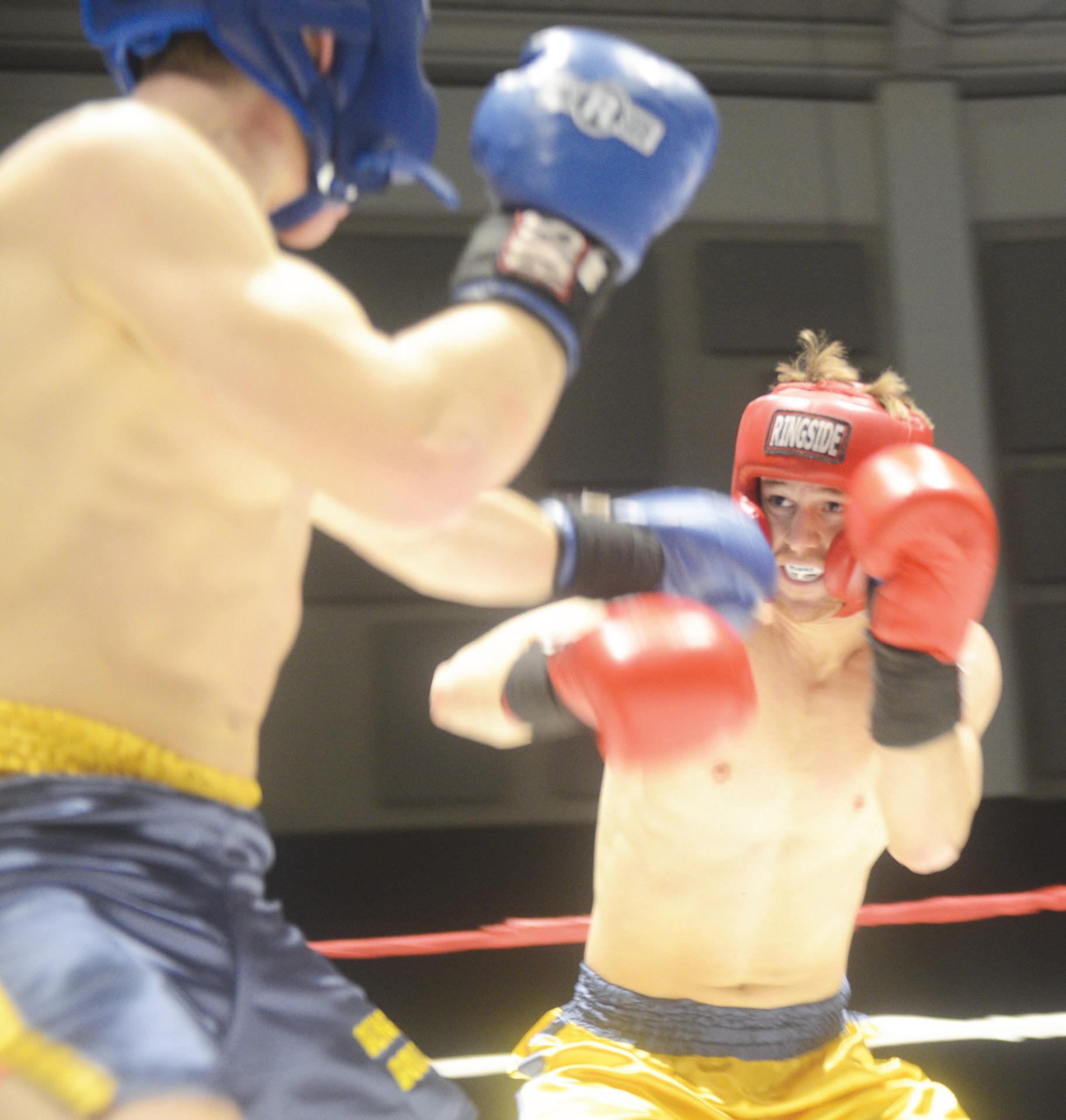
Senior Chip Blood, right, eyes his quarterfinal opponent and fends off a jab Tuesday night at the Joyce Center Fieldhouse. Blood defeated freshman Parker Revers in a referee-stopped contest.
a successful series of jabs and crosses. Perillo showed signs of exhaustion to start the final round and the official stepped in to call the match after only a few punches were thrown and shepard was declared victorious.
Mike “The Count of Monte fisto” Krecek def. Colin “red, the south bend bandito” O’neill
carroll senior o’neill was immediately backed into the corner of the ring to begin the fight against Krecek, a sophomore from morrissey. o’neill fought
his way out, but was dominated from then on by Krecek’s quick footwork and tight defense. in the second round, Krecek connected on a few hooks to o’neill’s head, a favorite target. o’neill struggled to keep his hands up in defense, allowing Krecek to find openings. both boxers slowed down towards the end of the second round, dancing around the ring. The fight closed with Krecek dodging o’neill’s jabs and finding o’neill’s head several times more. Krecek was declared the winner by unanimous decision.
Chris “dada” Harrington def. John Toomey
harrington, a graduate student from dillon hall, came out hard as the first bell sounded, pounding Toomey, a freshman hailing from siegfried, with a flurry of punches. harrington was able to control the center of the ring from the start and became increasingly dominant as Toomey showed signs of fatigue after the first few exchanges. he subsequently lost his balance after a particularly hard jab to the head form harrington, forcing the referee to stop the
contest and award the win to harrington just over one minute of fighting.
Jack “Hammer” Corrigan def. Ishaan Goel both fighters approached one another slowly as the fight began, cautiously exchanging hits. however, corrigan, an off-campus senior, began to gain momentum, administering hard punches to the face of Goel, a freshman in dunne, that resulted in the referee pulling the two apart to administer a countdown to Goel. The second round saw Goel come out swinging, battering corrigan with jabs and crosses, but the senior soon regained his composure and was able to control the fighting for the rest of the bout. at the close of the third round, corrigan was awarded the win by unanimous decision.
185 pounds
dan “Thunder road” a ndree def. eric requet a ndree, an off-campus senior, came out prepared to battle with a slew of powerful combinations. he landed a variety of uppercuts and left hooks, but requet persevered and landed a few punches to finish the first round. The second round began with high intensity, with a ndree throwing both left and right hooks. requet was on the defensive throughout the round, with a ndree having a clear leg up. requet did not give up and landed a strong right hook and a few right crosses in the final round. he trapped a ndree in a corner, but a ndree closed the round with multiple left crosses. a ndree was named the winner by unanimous decision.
Isaac “ your dad” a lthoff def. evan “big red” slattery in one of the closest, most energetic bouts of the evening, neither fighter wasted any time, each throwing strong punches
right as the fighting began. a lmost no jabs were thrown, with both fighters preferring to throw massive crosses and uppercuts instead. a lthoff, a siegfried junior, began to gain the upper hand over slattery, a freshman resident of morrissey, in the later rounds, and was ultimately able to work slattery into a corner and land a series of punches. a fter a final round, in which both slattery and a lthoff got more than their share of shots in, the judges declared a lthoff the winner by unanimous decision.
Jack “shadow recruit” ryan def. Jeremy “appendi” szitas Feeling each other out early, neither landed a ton of large punches in the first round as they each took a cautious approach. The fight’s intensity continued to increase as it went on, with ryan, a Knott senior, bouncing around the ring, and landing the majority of the punches early. szitas, an off-campus graduate student, was able to rally back, landing punches in the second round that drew the fight close to even. The bout went back-andforth throughout, but ultimately resulted in a split decision in favor of ryan.
Cam “Crash Cadillac” nolan def. dash “duck, dip, dive and dodge” Holland nolan, a sophomore representing duncan, entered the fight swinging, knocking holland, a senior in siegfried, to the ground with a jab early in the first round, which set the tone for the rest of the fight. nolan began the second round by hurling a series of combinations at the body of holland, causing the senior to nearly lose his balance. both fighters began to show signs of fatigue, but nolan was able to send holland to the ground a second time to close out the round. c learly fatigued, holland spent the third round attempting to wrap nolan up to contain his punches, but nolan ended the round with a hard combination of punches that sent holland to the ground for a third time. The judges awarded the win to nolan by unanimous decision.
199 pounds
Jack Considine def. Jackson “sly” fox both fighters approached the fight with self-control, as the pace of the fight began slow. both boxers displayed patience and experience. considine, a senior in dillon, maintained control throughout, picking his spots carefully to unleash heavy combos on Fox, an offcampus senior. i n the third round, considine was able to seal his fate by landing combinations that impressed the crowd. considine was declared victorious by unanimous decision.
Paid a dverT isemen T
EMMET FARNAN | The Observer
Senior Jack Corrigan throws a left cross at his opponent, freshman Ishaan Goel, on Tuesday night at the Joyce Center Fieldhouse. Corrigan went on to defeat Goel by unanimous decision.
aaron bode “ wan Kenobi” def. Mark “Loves His Momma” shealy each fighter prioritized aggression over defense, which quickly got the crowd involved in the bout. one memorable point in fight occurred when bode and shealy, both Keough seniors, got caught up on the ropes, with each fighter trading wild strikes. bode landed quality punches throughout the fight, but he sealed his fate by using the final moments of the third round to corner shealy and land some final key punches, leading to bode’s win by split decision.
Chris Vazquez def. Zach Pedersen in a fight that pitted vazquez, a law student, against Pedersen, a graduate student, the two fighters started aggressively, with both throwing hard punches. vazquez began to gain the upper hand, landing a cross to the head of Pedersen that resulted in a referee-administered countdown for the graduate student. however, Pedersen was able to flip vazquez to the ground to end the first round, throwing the match wide open again. Pederson failed to capitalize on this opportunity in the second round and began to drop his head as he tired. vazquez responded by throwing a hard series of jabs to his opponent’s head, although he also appeared to be fatigued as the second round drew to a close. The third round appeared to be a fairly even exchange, as both fighters began to lose steam, each throwing hard, but infrequent, punches at one another. vazquez’s efforts in the second round earned him the win by unanimous decision.
Giordano, a sophomore hailing from a lumni, dominated from the first bell, throwing a flurry of combos at dale that the off-campus senior found hard to defend in the first round. however, dale was able to better answer his opponent’s hits in the second round, chasing Giordano around the ring with a hard-hitting series of jabs. The sophomore responded with a hard-hitting series of his own and regained his composure, controlling the middle of the ring once again. The third round saw the two slowing considerably from fatigue as they exchanged weak punches, but Giordano still managed to earn the win by unanimous decision.
Heavyweight
erich “daddy” Jegier def. a lec Cramer
The first round began with the two off-campus seniors exchanging punches fairly evenly. however, as the round ended, Jegier almost knocked cramer over with a hit, before losing his own balance and stumbling to
the floor. The second round saw Jegier starting to pick up momentum and going on the offensive, pummeling cramer with a series of hard jabs. cramer began to shell up in an attempt to defend himself from the torrent of hits and was knocked to the ground by a particularly aggressive combination. The third round featured an attempt by cramer to turn the tide of the fight by charging Jegier into the ropes; however, Jegier was able to escape and land a series of vigorous combos on cramer, solidifying the win by unanimous decision.
Pat “The Quiet Man” Gordon def. Christian dennis in the first round, dennis, a dillon freshman, came out swinging early with a few swift jabs followed by a powerful cross, all of which were dodged by Gordon, a Keough junior. Gordon bounced back without hesitation, but dennis dodged his two jabs. after several more attempts
by each fighter, the round ended with little notable action. both fighters came out with more energy in round two, as Gordon landed a strong cross on dennis’ head almost immediately, and the referee stepped in to evaluate dennis. after the brief pause, Gordon continued to dodge the efforts of dennis, and the round concluded with Gordon landing a strong cross on dennis’ upper body. Gordon continued to dominate, as he landed several jabcross combinations before the referee stopped the fight again. Gordon ended the round with a powerful upper cut, and was soon declared the winner by unanimous decision.
Jackson “The flash” wrede def. nikolas brooks round one was evenly matched for the most part, as sorin junior brooks’ initial punches were swiftly evaded by Wrede, a Knott junior. brooks and Wrede continued to dodge each other, until Wrede landed a few strong jabs on
brooks, pushing him to the corner of the ring before the round concluded. brooks came out swinging early in the second round, but Wrede warded him off with several strong jabs. as Wrede gained momentum, he went on to land a powerful uppercut on brooks before the referee separated the fighters for evaluation. after the pause, Wrede landed two more crosses before the round finished. in the final round, Wrede continued to control the bout, as he swiftly backed brooks into corner of the ring, landing several impactful blows, which prompted the official to end the fight, giving Wrede the victory.
ryan “eat at yaz’s” richelsen def. a ndrew “big Cat” rosenberg
The first round started with richelsen, a sophomore in morrissey, throwing some solid punches in quick succession, but rosenberg, a law student, was able to keep him from getting into too much of a rhythm. The
effects of their big swings were visible after just one round, when they headed to the corner. in the second round, both fighters seemed to keep up the energy as each landed some strong blows to start. as the round went on, richelsen continued on his offensive approach against rosenberg, who began to appear fatigued. in the final round, richelsen was again the one delivering most of the punches, as he would eventually knock rosenberg to the ground. in the end, richelsen won by unanimous decision.
Contact Kayla Mullen kmullen2@nd.edu, Darcy Dehais at ddehais@nd.edu, Mia Berry at mberry1@nd.edu, Brenna Moxley at bmoxley@nd.edu, Alex Bender at abender@nd.edu, Ryan Kolakowski at rkolakow@nd.edu, Jack Concannon at jconcan2@nd.edu and Connor Mulvena at cmulvena@nd.edu
Paid a dverT isemen T
and scrimmage quite a lot, and those things would have reared themselves if that was part of the dn A of our team. d id we walk some guys? o f course we did. d id we commit a few errors? o f course we did. b ut it didn’t show up in the bunches that it did this weekend.”
Aoki isn’t concerned about his starting pitchers — junior b randon b ielak, who’s throwing Friday, junior Peter s olomon, who’ll pitch s aturday, and either graduate student southpaw m ichael hearne or senior r yan s moyer, one of whom will start s unday — since their struggles in the opening weekend do not reflect their career successes.
“For whatever the reason was, we played a little out of character, and we played a little bit out of what we’ve seen out of our pitching staff and our team for the last month in the scrimmages that we’ve played,” Aoki said. “h istorically, if you look at the body of work for each one
Track
con TI n U ed F rom PAGe 16
on the women’s side,” Turner said. “The men will probably be the middle of the road, they don’t have enough bodies at that level, and last year and this year has been a sort of rebuilding process. The men will be somewhere in the middle, probably around seventh or eighth. For the girls, I tell my athletes, go out there and you compete in your events. And again it is just a sum of individual events and efforts, and don’t let the team not being able to run for the team hinder anything that you have to do in your race.” e ntering the Acc meet, the Acc boasts one ranked squad on the women’s side
of those guys, it’s really out of character for each of those guys.”
While the level of play was not what he or the team wanted, Aoki said he was pleased with his team’s response to the opening-weekend disappointment.
“I felt like overall, we did a pretty decent job of staying positive through an otherwise-not-our-best performance out on the field,”
Aoki said. “I thought our kids did a pretty good job of continuing to stay positive, to stay together, to not fall into blaming or complaining, going negative on things, so I thought that was pretty encouraging.”
notre d ame will open the
Tony Gwynn c lassic with one of the co-hosts, s an d iego, on Friday, and will either face o regon or Uc -Irvine on s aturday depending on opening-round results. A matchup with one of s an d iego s tate, s eton h all or Tennessee could await the Irish on s unday.
Aoki said the field in s an d iego is strong, and he hopes the Irish can return to their usual selves for the second
— n o. 15 m iami — and three ranked mens teams in n o. 15 v irginia, n o. 21 v irginia Tech and n o. 25 s yracuse.
Last season, n otre d ame placed third in the women’s competition behind m iami and c lemson. The men last year finished in seventh, a finish which exceeded expectations according to Turner.
This year, despite the several injuries and team’s lack of progress this season, Turner hopes the weekend will result in some n otre d ame Acc champions that will qualify for national competitions.
The championships get underway Thursday and run until s aturday at Loftus s ports c omplex.
Contact Meagan Bens at mbens@nd.edu
weekend of the year.
“hopefully this weekend, we settle back into who we are,” Aoki said. “We’ve got pretty good tests in terms of our opponent on Friday for sure, and then any opponents we might face subsequently. We have some good teams, so hopefully we can get ourselves squared away.”
Aoki stressed that the Irish Alamo c lassic was just one weekend out of the whole season, and that there is a long season ahead of the team.
“o utside of the fact that, yes, it stinks to lose three games, it’s still one weekend of 14,” Aoki said. “And if 13 of these weekends go really well and 10 of our midweek games go pretty well, and we play to who I think we are, this weekend will just be a forgotten thing. And I really think that’s what it is.”
The Irish will look to get their 2017 season back on track Friday, when they take on co-host s an d iego (1-2) at 9 p.m. in the Tony Gwynn c lassic.
Contact Alex Carson at acarson1@nd.edu
softball
loss against Illinois s tate, their first loss since their season opener against n o. 13 James m adison. d ue to cancelled games on s aturday and s unday, m issouri will have plenty of rest before it takes on the Irish. Tigers redshirt junior outfielder Anna r eed has gotten on base safely in each of her last seven games, making her a threat on offense for m issouri.
o ver the course of the m ary n utter c lassic, n otre d ame will also play n o. 21
Arizona s tate and n o. 11 Georgia, two ranked opponents that threaten to hand the Irish more losses.
Arizona s tate (9-1) is coming off its first loss of the season at the hands of b oston c ollege, a game that showcased the strengths of the s un d evils’ pitchers, as Arizona s tate gave up only three runs. Junior s un d evils pitcher b reanna m acha delivered five scoreless innings for the s un d evils but b oston c ollege was able to get on the board in the sixth inning, and win the game 3-2. Although Georgia has had a strong start to the season, the b ulldogs (12-0) have yet to face a ranked opponent. Wins against d ayton and s yracuse, among others, make up their 12-0 start. The b ulldogs will play their first ranked opponents in this weekend’s c lassic.
n otre d ame will close the m ary n utter c ollegiate c lassic against n o. 4 o klahoma in what is sure to be a tough game for the Irish. The s ooners (6-2) posted a 4-0 record in last weekend’s h ouston c lassic, beating Incarnate Word, o le m iss and h ouston twice. The defending national champions, the s ooners were ranked n o. 1 by several preseason polls and are looking to repeat the success of last year’s season. notre d ame continues its season Thursday against Texas at 6:30 p.m. and m issouri at 9 p.m. They then face Arizona s tate at 3:30 p.m. and Georgia at 6 p.m. on Friday before closing the m ary nutter c ollegiate c lassic against o klahoma at 1 p.m. on s aturday.
CHRIS COLLINS | The Observer Irish senior catcher Ryan Lidge swings at the ball during Notre Dame’s 4-1 win over Boston College on April 15 at Frank Eck Stadium.
EMMET FARNAN | The Observer
Irish sophomore Anna Rohrer, left, and graduate student Molly Seidel compete at the Meyo Invitational on Feb. 4.
ALLISON CULVER | The Observer
Irish junior infielder Morgan Reed slides home during Notre Dame’s exhibition against Illinois State on Oct. 9 at Melissa Cook Stadium. Reed is hitting .520 so far this season and has started every game.
Irish look to rebound from early-season struggles
By ALEX CARSON Assistant manging e ditor
After a disappointing start to its season last weekend at the Alamo Irish classic, notre dame heads westward this weekend, traveling to san diego for the Tony Gwynn classic.
In many ways, notre dame (13) was its own worst enemy last weekend in san Antonio — over the course of the four games, a win over Incarnate Word and losses to Lafayette and saint Louis (twice), Irish pitchers issued 29 walks and fielders committed eight errors. Irish head coach mik Aoki said these problems surprised him, as the team hadn’t shown any indication of them in preseason practice.
“When you look at the number of walks that our pitching staff gave up and the number of errors we committed as a team, we didn’t see any of that in the preseason,” Aoki said. “We had an opportunity to be outside
win over UIC on March 22 at Frank Eck
Quarterfinal bouts take place
By KAYLA
MULLEN, DARCY DEHAIS, MIA BERRY, BRENNA MOXLEY, ALEX BENDER, RYAN KOLAKOWSKI, JACK CONCANNON and CONNOR MULVENA
142 pounds
Michael “Munchkin” kappaz def. Patrick “lightweight” donovan Kappaz, a senior living off campus, came out strong, backing his opponent into a corner right from the start of the fight. donovan, a freshman from dunne, fought his way out only to lose his footing in the ring and fall to the ground. When the fight resumed, Kappaz’s agility showed, as he chased donovan around the ring. donovan bent over in defense, keeping his head down instead of looking up for openings. In the second round, donovan threw the first punches but was quickly overcome as Kappaz landed hooks to his opponent’s body. Kappaz connected less often in the second round but managed several devastating blows. donovan was backed against the side of the
ring and the referee stopped the fight before it could reach the final round. Kappaz was declared the winner by referee-stopped contest.
Joaquin “Masagana” camara def. John “Goose” Hunter
The fight opened with high intensity and both fighters displaying their speed. camara, a Keenan junior, landed combinations of jabs and crosses, while hunter, a junior resident of Fisher, tried to create space with jabs and hooks. At the end of the first round, camara trapped hunter in a corner and ended the round with a powerful right hook. The second round began with camara throwing strong jabs and right hooks. hunter was on the defensive, but was able to get in a jab or two. camara landed a jab to hunter’s face to finish off the round.
hunter came out ready to fight in the third round, but camara continued to throw back-to-back combinations. Intensity fell in the third round, but both fighters threw some powerful punches.
see boUTs PaGe 11
By MEAGAN BENS sports Writer
For the first time in the program’s history, the Irish will host all fifteen teams in the Atlantic c oast c onference for the Acc indoor track and field championships at Loftus sports c enter from Thursday to s aturday.
c onsidering the team’s progress this season, Irish head coach Turner said individual athletes will place, but the team will most likely not win a title.
“I am confident that my top athletes are going to perform, my only issues is that I don’t have enough of those type of athletes where we can achieve those results as a team this week at the Acc indoor championship,” Turner said.
Although Turner is relying on individual athletes to compete, he said a couple of his top runners will be out due to injuries — including three-time nc AA champion and graduate
student molly s eidel and junior sprinter Parker e nglish.
“molly s eidel, right where her tibia meets her ankle, has a stress fracture,” Turner said. “s o we are going to hold her out because if she runs and makes it a worse injury, then she is out for the entire season. s o unfortunately she is going to miss the Acc indoor championships. Parker e nglish, one of my top sprinters, she hurt her hamstring at c lemson’s Tiger Paw Invitational. That’s a big blow cause she was expecting to score some points in the 400- and the 200-meters. s o we are not meant to be at full strength. The others are going to have to pick up the slack.”
For both the men’s and women’s team, the strong competition at the Acc indoor championship will result in a constant uphill battle.
“It’s going to be tough to the finish in the top four or five
Notre Dame hopes to rally against ranked teams nd heads to Acc championships
Observer Sports Staff
c oming off a 1-3 showing at the Acc / b ig Ten c hallenge, n otre d ame looks to improve its game as the team travels to c athedral c ity, c alifornia, to compete in the m ary n utter c ollegiate c lassic.
The Irish (4-5) dropped out of the nc AA rankings following the weekend losses and will aim to regain their spot among the top 25 this weekend.
The Irish will first take on Texas (7-3), which is coming off wins against Indiana and Louisiana Tech to end the Texas Invitational on s aturday. o ver the course of the five games the Longhorns played in the Texas Invitational, they batted .318 as a team, drew 32 walks and scored 34 runs. Longhorn senior left fielder s tephanie Wong provided a boost for Texas on offense, providing hits throughout the series. n ext n otre d ame will face n o. 20 m issouri (5-2). The Tigers are coming off of a 7-3
see soFTbALL PaGe 15
ALLISON CULVER | The Observer
Irish senior center fielder Karley Wester prepares to step up to the plate during Notre Dame’s fall game against Illinois State on Oct. 9.
benGal bouts nd sotfball
MICHAEL YU | The Observer
Irish graduate student Michael Hearne tosses a pitch during Notre Dame’s 9-5