Students say atmosphere at Heinz Field lacks energy compared to Notre Dame Stadium
By ADAM LLORENS News Writer
Notre Dame students who made the trip to Pittsburgh this weekend said they were excited about the Irish win, but unimpressed with the atmosphere of Heinz Field.
Sophomore Kurt Beatty, a Pittsburgh native, said he was surprised by how quiet the stadium was.
“The stadium was quiet, [which] was certainly not something I was used to,” he said. “I do not think Heinz Field, which was built for professional football, is conducive to loud environments like most college stadiums are.”
Senior Kelly Jones agreed and said the Irish fans were the loudest.
“The game was a lot of fun, but extremely unenthusiastic,” she said. “Notre Dame fans supplied all of the energy inside the stadium, which was strange.”
Sophomore Quinn White, who experienced his first away football game this weekend, sat in the Pittsburgh student section with a friend from high school.
Students describe away weekend
By MEL FLANAGAN News Writer
Despite students’ efforts, junior Calie Mohamed said the atmosphere at Notre Dame on away football weekends is incredibly different from the atmosphere on home football weekends.
“I don’t think people get as excited about the game,” she said. “I mean everyone still watches it, but they’re not as into it as [they are on] home game days.” Mohamed stayed in South Bend this weekend while the Notre Dame football team traveled to Pittsburgh, but said she still felt at times like she was in the student section of Notre Dame Stadium.
“The Pitt student section is nothing like the one found at Notre Dame Stadium,” he said.
to be detrimental to the atmosphere.”
“Being in an NFL stadium and having students that did not cheer the entire game proved
Students raise money for suicide prevention
By MARISA IATI News Writer
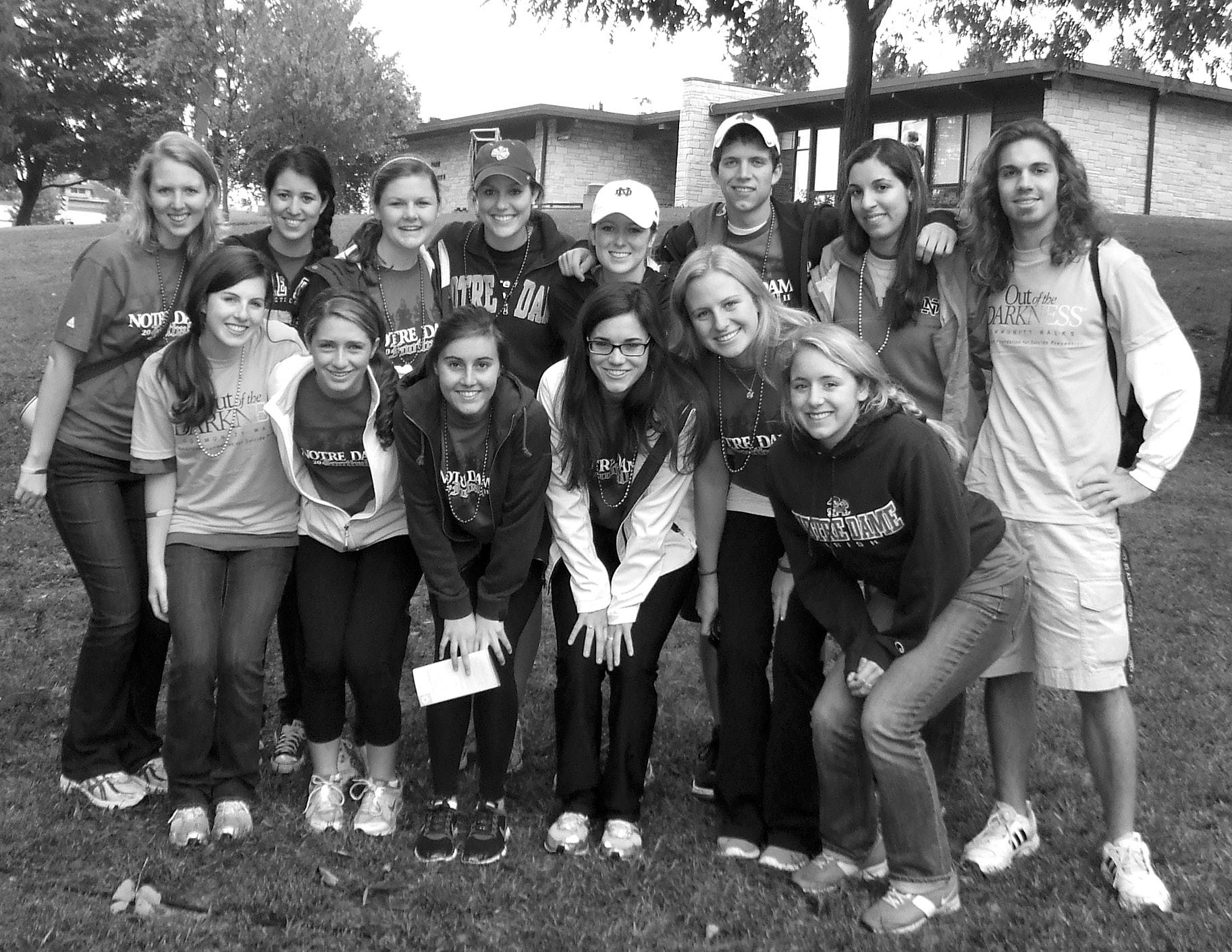
Notre Dame students raised more than $3,000 for the American Foundation for Suicide Prevention (AFSP) Saturday by participating in South Bend’s first “Out of the Darkness” community walk, a representative from Notre Dame’s chapter of the National Alliance on Mental Illness (NAMI-ND) said.
The “Out of the Darkness” walk, which is held each year across the country, helps to fund AFSP’s efforts with research, education, advocacy and prevention initiatives to reduce suicides.
NAMI-ND organized a team of 22 students to participate in the three-mile walk, which took place in South Bend’s Howard Park Saturday morning.
NAMI-ND vice president Clare Burke, a sophomore, said the walk was an emotional, inspiring experience.
“I think that the walk was significant because it’s sort of
representative of being part of something greater than yourself,” she said. “It’s cliché to say you can make a difference, but it really is being part of something bigger than yourself when you see everybody walking for the same cause.”
Several Saint Mary’s students walked as part of “Team Lizzy,” in honor of former classmate Lizzy Seeberg, Burke said.
Saint Mary’s first year Lizzy Seeberg committed suicide last September after alleging a Notre Dame football player sexually attacked her. Seeberg reported the alleged attack to Notre Dame Security Police about 10 days before her death. Following an NDSP investigation, the St. Joseph Prosecutor’s Office declined to press charges.
The 200 people that participated in South Bend’s walk raised more than $15,000, sophomore Alex Janiw, secretary of NA-
White said the Pittsburgh students weren’t as energetic as the Irish fans.
“The students go to the games because they feel obligated to,” White said. “They sat
“We still did pushups when we scored and we sang the Alma Mater at the end,” she said.
TOM YOUNG/The Observer
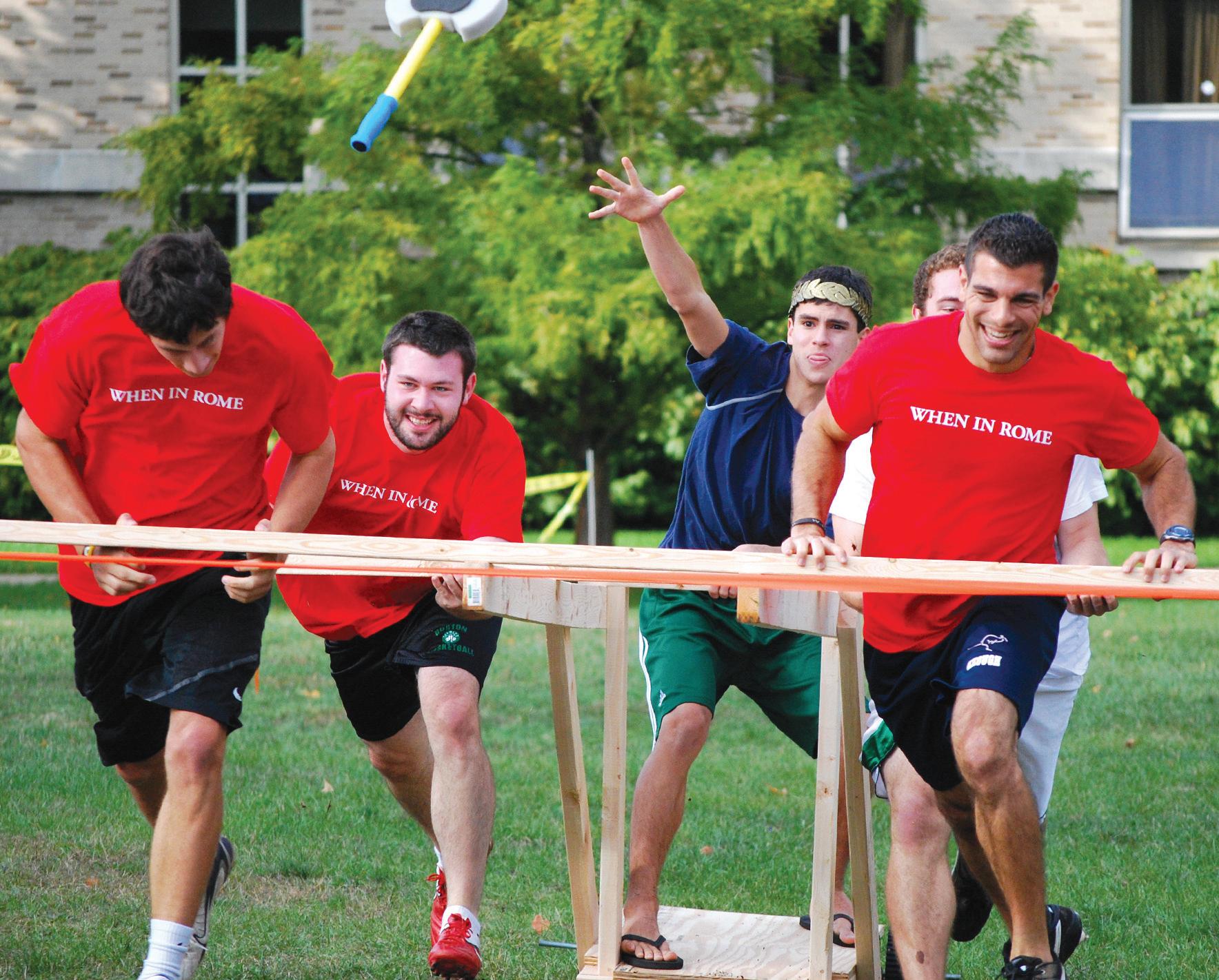
Sophomore Andrew Wilson, center, throws a foam axe as Keough Section 2A competes in
annual Keough Hall Chariot Race on Saturday afternoon.
SUZANNA PRATT/The Observer
Notre Dame fans cheer on the Fighting Irish in the Notre Dame fan section of Heinz Field during the away game Saturday afternoon.
Race to VictoRy
www.ndsmcobserver.com
P.O. Box 779, Notre Dame, IN 46556
024 South Dining Hall, Notre Dame, IN 46556
Editor-in-Chief
Douglas Farmer
Managing Editor
Sarah Mervosh Business Manager Jeff Liptak
a sst.
Managing Editor: Adriana Pratt
a sst.
Managing Editor: Chris Masoud
News Editor: Megan Doyle
Viewpoint Editor: Meghan Thomassen
Sports Editor: Allan Joseph
Scene Editor: Maija Gustin
Saint Mary’s Editor: Caitlin E. Housley
Photo Editor: Pat Coveney
Graphics Editor: Brandon Keelean
a dvertising Manager: Katherine Lukas
a d Design Manager: Amanda Jonovski
Controller: Jason Taulman
Systems a dministrator: William Heineman
Office Manager & General Info (574) 631-7471 Fax (574) 631-6927
Photo Desk (574) 631-8767 obsphoto@gmail.com Systems & Web Administrators (574) 631-8839
Policies
The Observer is the independent, daily newspaper published in print and online by the students of the University of Notre Dame du Lac and Saint Mary’s College. Editorial content, including advertisements, is not governed by policies of the administration of either institution. The Observer reserves the right to refuse advertisements based on content. The news is reported as accurately and objectively as possible. Unsigned editorials represent the opinion of the majority of the Editor-in-Chief, Managing Editor, Assistant Managing Editors and department editors. Commentaries, letters and columns present the views of the authors and not necessarily those of The Observer.
Viewpoint space is available to all readers. The free expression of all opinions through letters is encouraged. Letters to the Editor must be signed and must include contact information.
Question regarding Observer policies should be directed to Editor-in-Chief Douglas Farmer.
Eric Diep junior Keenan
“Pikachu, because I am a good friend.”
Hali Nguyen sophomore Lewis
“Squirtle, because I like to have a Blast-oise.”
Hoang Ho-Pham sophomore Pasquerilla East
“Snorlax, because no one can ever wake me up from my slumber.”
Jolynn Hoang sophomore Ryan
“Jigglypuff, because I like to sing.”
Paolo Garcia senior off campus
“Onix, because I go hard.”
to rainy weather.
Criminals can choose jail or church in small town
BAY MINETTE, Ala. —
Authorities say non-violent offenders in southern Alabama will have a new choice: Go to jail, or go to church every Sunday for a year.
WKRG-TV reports that Operation Restore Our Community begins next week.
The city judge in Bay Minette will let misdemeanor offenders choose to work off their sentences in jail and pay a fine; or go to church every Sunday for a year.
News
If offenders select church, they’ll be allowed to pick the place of worship but must check in weekly with the pastor and police.
If the one-year church attendance program is com-
pleted, the offender’s case will be dismissed.
Bay Minette Police Chief Mike Rowland says the program could change the lives of people heading down the wrong path. So far, 56 churches are participating.
Boy escapes mountain lion with only minor scratches
BOISE, Idaho — A 10-yearold Idaho boy who came face-to-face with a mountain lion in rural Boise County escaped with minor scratches — and concerns that his friends at school wouldn’t believe his story, according to state wildlife managers.
The Idaho Department of Fish and Game said Friday the mountain lion was tracked down and killed after the encounter late Thurs-
day. The boy, whose family asked not to be identified, received first aid at home for minor scratches and was expected to get a tetanus shot Friday.
The boy was not traumatized from his encounter, state wildlife officials said.
“His biggest concern was that his schoolmates wouldn’t believe him, which is kind of funny,” Senior Conservation Officer Matt O’Connell said.
The boy came across the mountain lion while searching for a missing hunting dog with his father near their home in a rural subdivision about 15 to 20 miles northeast of Boise.
Information compiled from the Associated Press.
Theresa Lai junior Howard “Psyduck, because I am always confused and crazy.”
in bRief
The Center for Social Concerns is sponsoring the lecture “Where has the Spirit Gone and Where is it Going?” in Geddes Hall from 11:30 a.m. to 12:30 p.m. today
The Julian Samora Library, located in Room 204 McKenna Hall, will hold an open house from 4:30 to 6:30 p.m. tonight. The open house is free and open to the public
In Room 140 of DeBartolo Hall the Department of American Studies will host the lecture “Seeing and Believing: On Photography and the War on Terror” from 5 to 6 p.m. tonight.
The Hesburgh Library will host a banned books read-out at 6 p.m. tonight It will feature student volunteer readers and librarians and staff reading passages from their favorite banned or challenged books.
Former Florida governor Jeb Bush will give the Notre Dame Forum interactive address “The Architect: Radical Education Reform for the 21st Century” from 7 to 8:30 p.m. tonight in the Leighton Concert Hall of the DeBartolo Performing Arts Center. Tickets to the event are sold-out.
The International Summer Service Learning Program (ISSLP) 2012 information session will be held in the McNeill Library in Geddes Hall from 7 to 8 p.m. tonight.
To submit information to be included in this section of The Observer, email detailed information about an event to obsnews.nd@gmail.com
SUZANNA PRATT/The Observer
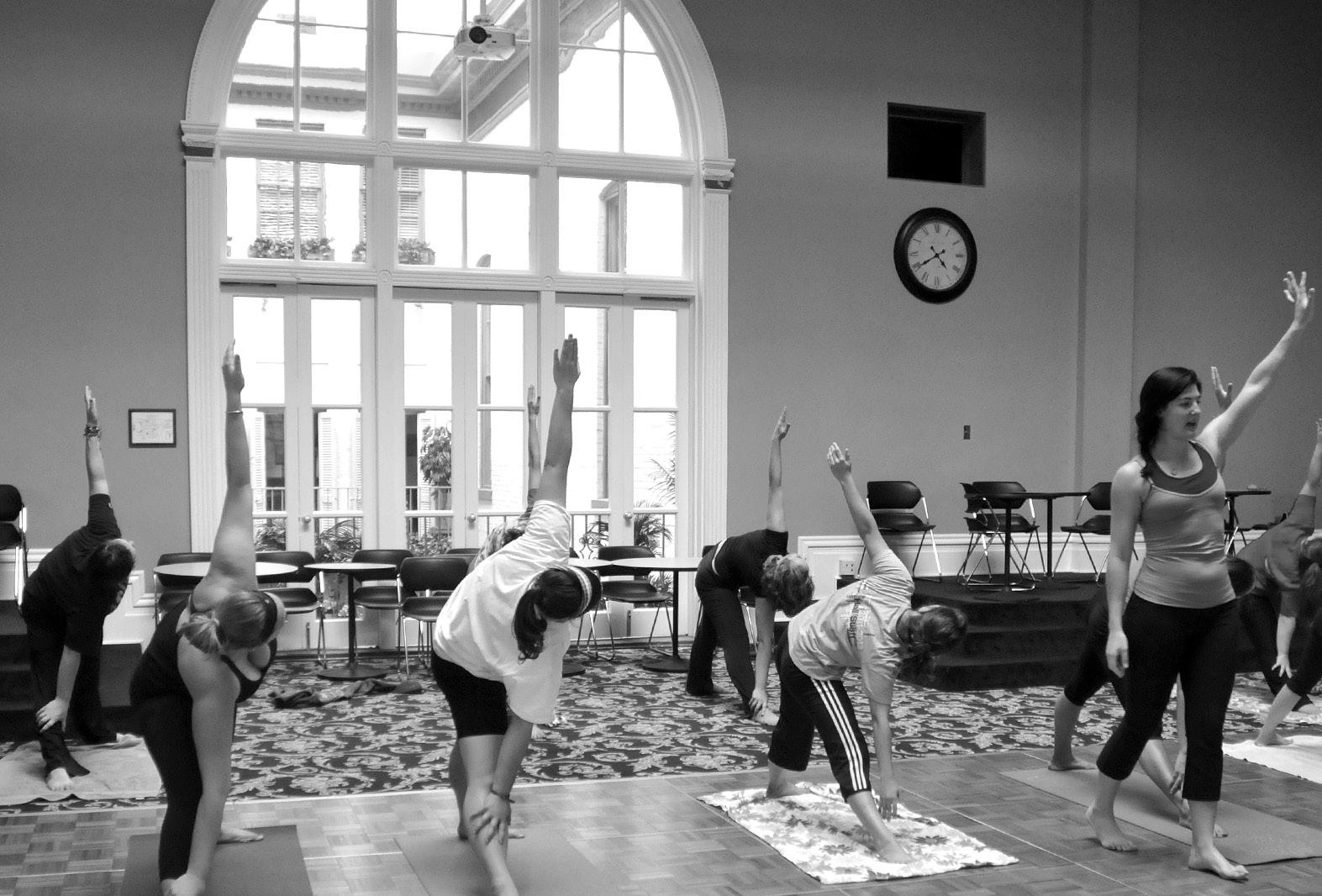
Students perform a basic yoga pose, known as Warrior Three, during Yoga on the Quad Sunday afternoon. The event was relocated to the LaFortune Student Center Ballroom due
Students train for Chicago Marathon
By EMMA RUSS News Writer
Senior Hayley Coffing, who ran both cross country and track in high school, said completing a marathon has always been one of her goals.
Along with a handful of other Notre Dame students, Coffing will participate in this year’s Chicago Marathon, which will take place Oct. 9. She said she has been training since the beginning of summer and is ready for the race.
times a week during the summer,” Sushinsky said.
“Now that school has started my training has gone a little downhill, but I still try to get in at least three decent runs per week.”
“You think the crowd will thin out eventually, but it doesn’t ... It’s nice in a way because you are exhausted and feel like dying and look around and see about 10 other people that feel the same way too.”
Marissa Gaskill junior
“Running has been a part of my life for a long time,” she said. “I’m really excited to experience what it’s like to run 26.2 miles with my family, friends and 45,000 other runners.”
Senior Matthew Sushinsky said most marathon training programs involve four or five shorter runs — between four and seven miles each — during the week. On weekends, Sushinsky runs between 15 and 18 miles.
For the average Notre Dame student’s busy schedule, this can be a tough regimen to follow.
“I started training at the beginning of the summer and was doing pretty well. I usually ran about four
Coffing agreed that school has become an obstacle, but said she has managed to stick to her schedule.
“It’s definitely hard to balance it all, especially being a senior,” she said.
“It’s tempting to skip running and go out with friends, but school, running and staying healthy are my priorities at the moment.”
Junior Marissa Gaskill, who ran the marathon last fall, said the number of competitors was overwhelming.
“The
“There are massive hordes of people,” she said. “You think the crowd will thin out eventually, but it doesn’t … It’s nice in a way because you are exhausted and feel like dying and look around and see about 10 other people that feel the same way too.”
Coffing also said there is a sense of community among runners. She is excited to be a part of the marathon this year instead of watching from the sidelines.
“The level of camaraderie among the runners and spectators is like nothing I’ve ever seen before,” Coffing said. “Chicago is a really special marathon and I’ve been going for years just to watch friends and family. My motivation for running the marathon has been building for years.”
Senior Laura Philipp ran the Indianapolis Marathon last fall but is even more excited for her Oct. 9 race.
“Chicago is a bigger race,” she said. “It’s a fun city and there’s just more overall hype about it.”
Philipp will run as part of the St. Jude’s Children’s Hospital fundraising team.
She said being a part of this team has been a major source of motivation throughout her training.
level of camaraderie among runners and spectators is like nothing I’ve ever seen before.”
Hayley Coffing senior
“It was great to get so much support from my friends and family in my effort to raise money,” she said. “I know that while I’m running, I’ll definitely be thinking about all of them and about the cause that I’ve been working for.”
Contact Emma Russ at eruss@nd.edu
The Shirt Committee to select new president
By ANNA BOARINI News Writer
Each year, a dedicated group of Notre Dame students works to provide a unique and colorful design for the following football season’s much-anticipated The Shirt.
The Shirt committee chooses the color of The Shirt, designs the logo, selects the quote and unveils the finished product the night before the annual BlueGold game.
This year’s The Shirt committee will select a president after candidates interview Oct. 6 and 7.
Last year’s president, senior Lauren Marzouca, said leading The Shirt committee was the most influential opportunity she has had while at Notre Dame.
“While [it] was stressful occasionally, I had such a great committee to help me that I would do it again in a heartbeat,” she said. “Before becoming president, I did not appreciate and value cooperative teamwork as I should have.”
Marzouca said the time commitment to The Shirt varies depending on the position a student is selected for.
“President is a big time commitment in October because you don’t have a committee to help, and you need to get a lot of the logistics settled for the process of selecting a shirt supplier,” she said.
She said a typical week for the president, after the committee is chosen, consists of checking The Shirt email account, leading weekly meetings, meeting with the project advisor and sometimes the Hammes Notre Dame Bookstore manager.
While the president has numerous weekly tasks, Marzouca said committee members’ jobs and time commitments range.
“Most committee members’ positions are like this: there are periods of activity interspersed with times when your only job is to show up for one weekly meeting to talk about The Shirt design,” she said.
While working on The Shirt
can be stressful at times, Marzouca said there are definite perks. Committee members get free shirts, and sometimes, the committee gets to tour the factory where The Shirt is made, Marzouca said.
The biggest perk for Marzouca came when she and the other members of The Shirt committee got to present a preview of The Shirt to head football coach Brian Kelly.
“Brian Kelly has always been really supportive of our project, and meeting him was definitely one of the highlights of my ND experience,” she said.
Over the years, The Shirt design process has evolved — Marzouca said last year was no different.
“Last year we took a new approach and designed The Shirt 2011 in one meeting,” she said. “We sat down and hashed out the details while our wonderful graphic designer worked her magic on Photoshop.”
Marzouca said color is always picked first, followed by the rest of the design.
“Last year our [committee] slogan was ‘new Shirt, same tradition,’” she said. “We used this because The Shirt was a slightly different color [than before}, but we felt that the design and quote made it feel very traditional.”
Marzouca said students interested in becoming president must send in their application by midnight on Oct. 3 to The Shirt website, theshirt.nd.edu
Students who receive an interview for the position of president will be notified Oct. 4, and interviews will take place on Oct. 6 and 7.
Marzouca said after a president is selected, committee applications will be posted to The Shirt website, and then applications will be reviewed and interviews conducted.
“Usually there are five to 10 committee members, and anywhere from 20 to 50 people applying depending on the year,” she said.
Contact a nna Boarini at aboarini@nd.edu
SUZANNA PRATT/The Observer
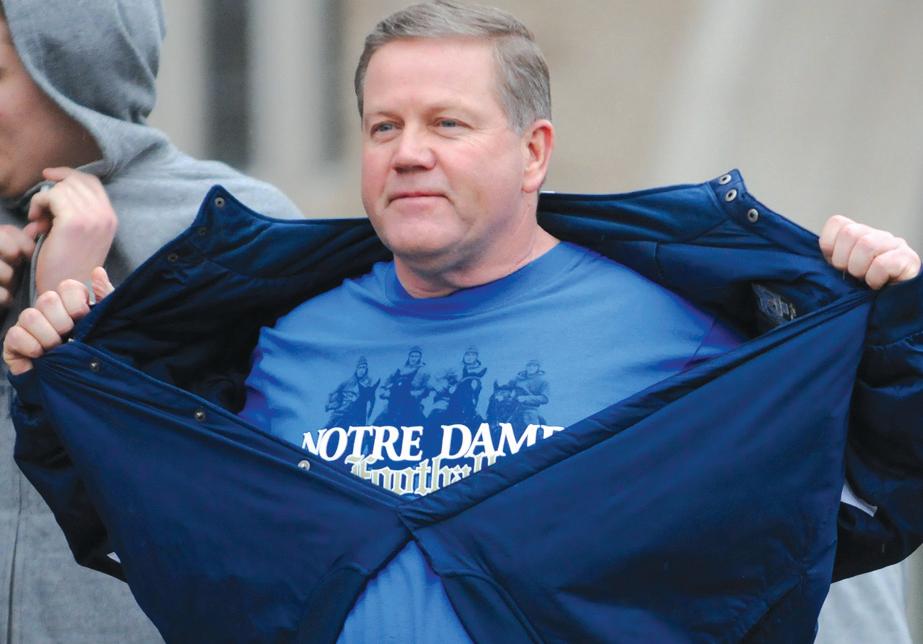
Irish coach Brian Kelly reveals The Shirt for 2011 at The Shirt Unveiling on April 15 last semester.
Exhibition features Catholic nuns in American history
By SUSAN HEAD News Writer
South Bend’s Center for History is hosting the national traveling exhibition “Women & Spirit: Catholic Sisters in America,” an interactive tour through American history that chronicles the sisters’ 300-year history in the country.
Marilyn Thompson, the Center’s director of marketing and community relations, said the attraction of the exhibit lies in the depth of information it provides.
“This exhibition is so signifi-
The exhibition details the stories of the nuns who pioneered the nation’s religious, education, health care and social work systems. The South Bend Center for History, the University of Notre Dame and Saint Mary’s College brought the exhibit to South Bend.
cant because it not only looks at the history of Catholic sisters, but at how their story mirrors the history of America,” she said. “It’s moments like these which help us to know how much prevalence these women have had in so many people’s lives.”
Thompson said the exhibit also strives to evoke an “awe” factor.
“The exhibit aims to show a secret world which so many have been able to experience because of attending Catholic schools or being helped by Catholic health care,” she said.
nois and Michigan regions have made the trip to learn the stories of their predecessors.
The exhibit emphasizes how much dress and lifestyle has progressed in the Catholic sister community. Today, many nuns choose not to dress in the traditional habit, and others are involved in controversial movements like the gay rights movement, according to the exhibit.
“The exhibit aims to show a secret world which so many have been able to experience because of attending Catholic schools or being helped by Catholic health care.”
Marilyn Thompson director South Bend Center for History
The Catholic sisters first arrived in America in 1727. Only 500 nuns lived in America in 1830, but by 1900, there were 50,000 American Catholic sisters in the country, according to the exhibit.
Catholic sisters were among the first women to assist as nurses during both the Civil War and the influenza pandemic of 1918, according to the exhibit. They also founded the nation’s largest private school system.
Visitors have come primarily from Indiana, Illinois and Michigan to see the “Women & Spirit” exhibit, Thompson said. Catholic sisters from the Illi-
But Sr. Jimene Alviani of the Franciscan Order said the underlying message of the Catholic sisters hasn’t changed.
“The basic message is the same for us, even if our habits have changed,” Alviani said.
The exhibit runs from Sept. 2 to Dec. 31. Admission is free for all Notre Dame, Saint Mary’s, and Holy Cross faculty, staff and students. A series of movies and lectures will be scheduled in conjunction with the exhibit.
“Women & Spirit” has previously been on display at Ellis Island and the Smithsonian, in addition to several other institutions across the country.
Contact Susan Head at shead02@saintmarys.com
SUZANNA PRATT/The Observer
Leprechaun Mike George keeps the energy up at Heinz Field in Pittsburgh. The Notre Dame fan section brought Irish spirit to the away game.
Game
continued from page 1
down during television timeouts, did not cheer the entire game and most left before the conclusion of the game.”
He said the influx of Notre Dame fans created a pro-Irish atmosphere near the end of the game.
“After Eifert scored the last Notre Dame touchdown, a chant of ‘Let’s Go Irish’ broke out from the upper deck and echoed around the stadium,” White said.
Jones said she was surprised to hear the Pittsburgh Marching Band play Lady Gaga’s “Edge of Glory” for their halftime show, a song Notre Dame students have already heard both from the Band of the Fighting Irish and Michigan State University’s marching band.
“The Band of the Fighting Irish definitely performed it the best,” Jones said.
Jones said that besides seeing the Notre Dame game, it was fun to explore a new city.
“My friends and I took the incline up Mount Washington to get a view of all of Pittsburgh,”
she said. “We also met up with a lot of Notre Dame students at a traditional German restaurant called the Hofbräuhaus, which was a lot of fun.”
Beatty said he enjoyed the opportunity not only to see his school play on the road, but also to visit friends and family.
“This trip was special for me because I got to go home,” Beatty said. “Sleeping in my own bed and being able to see a lot of old friends made the weekend memorable.”
Contact a dam Llorens at allorens@nd.edu
Away
continued from page 1
Mohamed watched the Pittsburgh game at a friend’s apartment, and said the excitement on campus did increase slightly when Notre Dame regained the lead in the fourth quarter.
For senior Kelly Miller, the away game weekend provided a chance to relax.
For students who don’t have a place to watch the game, dormitories frequently hold game watches on away game weekends.
Junior Patrizia Martellaro, the Cavanaugh Hall president, said Cavanaugh and Zahm Halls hosted a joint game watch in the Zahm basement for the Michigan game.
“People are still pretty into the game, but there’s a lot more socializing during it too.”
“[My roommates and I] made breakfast and had a few people over and watched the game,” Miller said. “It was way more laid back than home weekends are.”
Patrizia Martellaro junior
Miller said the greatest perk of an away weekend is having more time to yourself.
“Almost every home game, I know people that are coming in, so you have to plan out your whole day,” she said. “I mean it’s always great to see people, but you have to plan everything out to hang out with them.”
Mohamed agreed that away game weekends give students more downtime.
“Personally, I’m a lot more productive,” she said. “This past Friday I did some work and I never do that on game day weekends.”
“We figured it was the first weekend, so not a lot of freshmen have places to go or people to hang out with yet,” she said.
Although Cavanaugh did not organize a game watch for the Pittsburgh game, Martellaro said the dorm plans to hold them for the more important away games left this season.
She said Cavanaugh usually holds game watches in the basement, and the dorm orders pizza for students who attend.
Away game watches offer students a chance to interact with each other during the game more than they do in the student section, Martellaro said.
“People are still pretty into the game, but there’s a lot more socializing during it too,” she said. “People can just watch, talk a little and hang out.”
Contact Mel Flanagain at mflanag3@nd.edu
Walk
continued from page 1
MI-ND, said.
“We had a table with honor beads and each bead represented a different reason for being there, and you start to realize that everybody is somehow connected to the cause,” Janiw said. “When everyone threw the carnation in the water was a really reflective time. It really hit home how important it was to be reflective of who’s been lost to suicide and how you can help in the future.”
Burke said participants walked along the St. Joseph River.
“We had a station that was on the water, a little dock where you can throw a carnation into the water to signify someone that you lost or just a memory or anything that’s special to you,” she said.
She said in order to register for a team, participants had to sign up online.
“You can raise money and the money goes towards research for suicide prevention,” she said. “The things [AFSP tries] to do are raise money for research, but also educate the public about how many people are suffering, what are the signs, how do you care for someone that’s
lost someone.”
Burke said mental illness is often overlooked.
“People tend to look at it as not a real illness,” she said. “There are people suffering every day from depression and people need to start being aware of that.”
The main goal of NAMI-ND is to create an environment where talking about mental illness is accepted, Burke said.
“Nobody wants to bring it up, and I think after Sean Valero’s death and after Lizzy [Seeberg]’s death it sort of forced people to talk about it and it became obvious how uncomfortable everybody was,” she said.
Valero, then a sophomore, was found dead on March 31, 2010.
Laura Kaiser, a junior and the NAMI-ND treasurer, said the club hopes to bring Frank Warren, creator of PostSecret.com, to campus in March.
PostSecret.com is a website where individuals anonymously share secrets, many of which are related to suicide and mental illness.
Burke said NAMI-ND also aims to implement support groups at Notre Dame so students can talk about issues they’re struggling with.
Contact Marisa Iati at miati@nd.edu
Saudi women gain right to vote in 2015
Associated Press
RIYADH, Saudi Arabia — Saudi Arabia’s King Abdullah, considered a reformer by the standards of his own ultraconservative kingdom, decreed on Sunday that women will for the first time have the right to vote and run in local elections due in 2015.
It is a “Saudi Spring” of sorts.
For the nation’s women, it is a giant leap forward, though they remain unable to serve as Cabinet ministers, drive or travel abroad without permission from a male guardian.
Saudi women bear the brunt of their nation’s deeply conservative values, often finding themselves the target of the unwanted attention of the kingdom’s intrusive religious police, who enforce a rigid interpretation of Islamic Shariah law on the streets and public places like shopping malls and university campuses.
In itself, Sunday’s decision to give the women the right to vote and run in municipal elections may not be enough to satisfy the growing ambition of the kingdom’s women who, after years of lavish state spending on education and vocational training, significantly improved their standing but could not secure the same place in society as that of their male compatriots.
That women must wait four more years to exercise their newly acquired right to vote adds insult to injury since Sunday’s announcement was already a long time coming — and the next local elections are in fact scheduled for this Thursday.
“Why not tomorrow?” asked prominent Saudi feminist Wajeha al-Hawaidar. “I think the king doesn’t want to shake the country, but we look around us
and we think it is a shame ... when we are still pondering how to meet simple women’s rights.”
The announcement by King Abdullah came in an annual speech before his advisory assembly, or Shura Council. It was made after he consulted with the nation’s top religious clerics, whose advice carries great weight in the kingdom.
It is an attempt at “Saudi style” reform, moves that avoid antagonizing the powerful clergy and a conservative segment of the population. Additionally, it seems to be part of the king’s drive to insulate his vast, oilrich country from the upheavals sweeping other Arab nations, with popular uprisings toppling regimes that once looked as secure as his own.
Fearing unrest at home, the king in March announced a staggering $93 billion package of incentives, jobs and services to ease the hardships experienced by some Saudis. In the meantime, he sent troops to neighbor and close ally Bahrain to help the tiny nation’s Sunni ruling family crush an uprising by majority Shiites pressing for equal rights and far-reaching reforms.
In contrast, King Abdullah in August withdrew the Saudi ambassador from Syria to protest President Bashar Assad’s brutal crackdown on a seven-month uprising that calls for his ouster and the establishment of a democratic government.
“We didn’t ask for politics, we asked for our basic rights. We demanded that we be treated as equal citizens and lift the male guardianship over us,” said Saudi activist Maha al-Qahtani, an Education Ministry employee who defied the ban on women driving earlier this year. “We have many problems that need to be addressed immediately.”
saudi aRabia
Photo courtesy of Clare Burke
Notre Dame’s chapter of the National Alliance on Mental Illness said students raised more than $3,000 during South Bend’s first “Out of the Darkness” walk Saturday.
Hikers held in Iran return to America
NEW YORK — Declaring that they were detained because of their nationality, not their actions, two American hikers held for more than two years in an Iranian prison came home Sunday, ending a diplomatic and personal ordeal with a sharp rebuke of the country that accused them of crossing the border from Iraq.
Joshua Fattal and Shane Bauer, both 29, were freed last week under a $1 million bail deal and arrived Wednesday in Oman, greeted by relatives and fellow hiker Sarah Shourd, who was released last year. Their saga began in July 2009 with what they called a wrong turn into the wrong country. The three say they were hiking together in Iraq’s relatively peaceful Kurdish region along the Iran-Iraq border when Iranian guards detained them. They always maintained their innocence, saying they might have accidentally wandered into Iran.
The two men were convicted of spying last month. Shourd, to whom Bauer proposed marriage while they were imprisoned, was charged but freed before any trial.
The men took turns reading statements at a news conference Sunday in New York, surrounded by relatives and with Shourd at their side. They didn’t take questions from reporters.
Fattal said he wanted to make clear that while he and Bauer “applaud Iranian authorities for finally making the right decision, they “do not deserve undue credit for ending what they had no right and no justification to start in the first place.”
“From the very start, the only reason we have been held hostage is because we are American,” he said, adding that “Iran has always tied our case to its political disputes with the U.S.”
The two countries severed diplomatic ties three decades ago during the hostage crisis. Since then, both have tried to limit the other’s influence in the Middle East, and the United States and other Western nations see Iran as the greatest nuclear threat in the region.
The hikers’ detention, Bauer said, was “never about crossing the unmarked border between Iran and Iraq. We were held because of our national -
ity.”
He said they don’t know whether they had crossed the border. “We will probably never know.”
The irony of it all, he said, “is that Sarah, Josh and I oppose U.S. policies towards Iran which perpetuate this hostility.”
The two also told of difficult prison conditions, where they were held in near isolation.
“Many times, too many times, we heard the screams of other prisoners being beaten and there was nothing we could do to help them,” said Fattal.
Added Bauer: “How can we forgive the Iranian government when it continues to imprison so many other innocent people and prisoners of conscience?”
They said their phone calls with family members amounted to a total of 15 minutes in two years, and they had to go on repeated hunger strikes to receive letters. Eventually, they were told — falsely — that their families had stopped writing them letters.
“We lived in a world of lies and false hope,” Fattal said. Fattal called their release a total surprise.
Associated Press
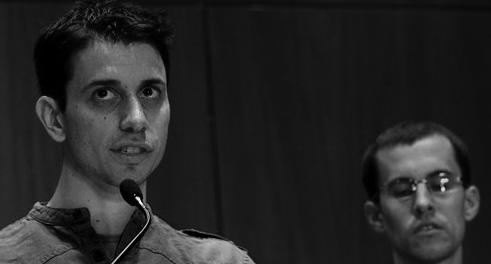
Josh Fattal speaks to reporters as Shane Bauer listens Sunday in New York. Fattal and Bauer were freed last week under a $1 million bail deal and arrived Wednesday in Oman.
Where to study ... or procrastinate
I’m a procrastinator — and a night owl. So naturally, I’m awake at 4:30 a.m. the night before most tests, smashing books against my head, hoping for some sort of informational osmosis to occur.
The problem isn’t just that I can’t draw a demand curve four hours before an economics exam. I also have been ousted from one study space or another every few hours, leaving me wandering campus like an over-caffeinated transient.
I just don’t get why the library isn’t open 24/7, or at least later than 2 a.m. Sure, I could study in my dorm. But the section lounge is almost never empty before 3 a.m., the study lounges have been converted into doubles, the basement is creepy and cold and my quad is a disaster most days.
I’m a big fan of the library — freshman and sophomore year (not quite as much these days), you could find me on any given weeknight on the second floor of Club Hes, wolfing down a giant iced coffee and looking irritable.
My only complaint — outside of the yellowy light and absence of a remotely reasonable number of outlets — is that at 1:45 a.m. each night, that weird noise comes on and someone announces “May I have your attention please ... The library will be closing in 15 minutes,” which translates loosely to “We know you still have four hours of studying to do, but you can’t do it here.”
It’s clear that the Library operators understand the need for late night study space, because the building stays open 24/7 during finals. That’s always great, but for many students, finals week is not their busiest or most difficult. Midterms are usually just as bad, and tests have a way of coincidentally piling up before breaks.
Of course there are practical considerations to take into account. The library does have a staff who would need to be paid for the extra hours and probably isn’t keen on the idea of working later, and the later the doors stay open the more likely students will attempt a late-night Hesburgh Challenge run. But as it is, the staff is greatly trimmed down after midnight anyway.
I would think the building could operate with a pretty minimal staff during the later shift. When I’m stressed and cramming at dawn I don’t need a librarian or help desk, I really just need silence, lights and a desk.
I’m kind of being a whiner. I know that. CoMo is open until 4 a.m. (except on Sundays, which makes zero sense also, as that is probably when people study most), the basement of LaFortune is open 24/7 and most dorms have some designated study area.
But still, since students in this decade probably only go to the library for books once in a long while, the building’s main purpose is a study space, so it should be open when students — even the procrastinating ones — are studying.
Tradition
It’s my senior year as a Domer and I’ve been extremely fortunate to submerge myself in as many Notre Dame things as I can. And from my experiences, I can certainly tell you that I’ve learned a lot.
However, fear no more. I want to help sustain the University with traditions as best as I can, and I’ve conducted some extensive research into the matter and discovered the magic formula.
twist, may become a tradition we hold 40 years down the road — Notre Dame planking.
Marc Anthony Rosa Bro Meets World
When someone asks me why Notre Dame is, in fact, Notre Dame, one of the first things that comes to mind is how seriously we take things — academics, football, the Viewpoint commentaries about football, Touchdown Jesus, UGG boots, same-side dining-hall dates and Franzia dorm parties. The fact is, all of us at Notre Dame take traditions like these extremely seriously, and that’s one of the greatest things about the University. And, while we rationalize why one of the most coveted of Notre Dame traditions, the football team, lost its AP Preseason Poll ranking, we love our football team because traditions like this are so engrained in all of us.
Despite our love for traditions, however, we’ll never be able to create new ones. We love them so much that they’ve become more cemented year after year. The minute we try something foreign to our closely-held set of traditions, we immediately dispel it because it’s not part of the set we’ve come to love.
Does anyone remember “Crank me up?” Tradition stared it in the face and subtly whispered “no,” simply because we’ve never seen it before. Thus, the vicious cycle continues, and we’re stuck recycling the comfortable and disregarding the fresh.
Creating a Notre Dame tradition goes something like this. (1) Identify a unique action, preferably repeatable, preferably inappropriate for a 1940’s standard. (2) Drink a lot of alcohol (obviously under 14 percent ... that would be against DuLac). (3) If it’s a phrase or chant, gather in LaFortune on a Friday night and chant it; if it’s an action, peer pressure your freshmen to do it with the allure of making a booze run for them. (4) Here’s the tricky part: repeat this process over and over again, until (5) Notre Dame issues a letter about it, creates a Freshman Orientation meeting about it, prints a Notre Dame Bookstore-official t-shirt about it or someone makes a Facebook fan page about it.
Kind of rings true, right? Think Hesburgh Challenge, the Stonehenge Run after a huge victory, climbing Stepan Center, discovering Notre Dame’s underground tunnels — the list goes on. They all follow this formula one way or another.
Keep in mind that I’ve just cracked the code on how to do this. Only time will tell if it yields success or not. It’s your job to use this formula, memorize it, refine it and blindly accept it until we reap the fruits of our labors. Propel any questionable action or phrase into the future, where it will be questionable not to embrace it.
In the meantime, I want to introduce to you a tradition that may seem ridiculous now, but, with a Notre Dame
I don’t know if you’ve ever heard of planking, but it’s a fad that’s spread like wildfire. According to trustworthy sources, “planking is an activity consisting of lying face down in an unusual or incongruous location. The hands must touch the sides of the body, and having a photograph of the participant taken and posted on the internet is an integral part of the game.” Google-search “planking” and you’ll see what I mean.
It’s a fad, and I hope it never disappears.
But we Notre Dame students can do so much better than this, using our mascot and Irish roots. (1) Dress up as a leprechaun. (2) Buy a pot of gold. (3) Place the pot of gold on the ground, tilting the pot of gold 90 degrees until it’s about to tip over. (4) Lay straight on the ground like you normally would do while planking, but let your face fall flat into the pot of gold.
There you have it! I’m counting on you to follow through.
And, for anyone who Notre Dame planks, take a picture of it and send it to me. I will write a full-column interview on you and how you’re creating a tradition.
Of course, this all may seem just a little strange to you. But that’s okay. It’s just not tradition yet.
Marc Anthony Rosa is a senior management entrepreneurship major. He can be reached at mrosa@nd.edu
The views expressed in this column are those of the author and not necessarily those of The Observer.
editoRial caRtoon
John Cameron News Writer
Racism: what can we do about it?
I’m going to call myself a racist, in a loose sense. I’m confessing that I think, say and act upon my ethnic prejudices, which directly hurts myself and others, and indirectly reinforces the continuation of such unjust, social inequalities.
Asiatic Gaze
I’m going to call you a racist by the same definition, regardless of your ethnic background, while asking for the maturity to be conscious of such prejudices. We are all bound by our preconceived opinions or feelings about others, sometimes formed regardless of our will.
On Sept. 21, Troy Davis, convicted of murdering a policeman, was executed in Georgia, possibly due to such prejudices. Our racism is different from a racism that influences such a life-and-death matter, but, to some degree, shares the same roots and thus hurts the Notre Dame community.
I am going to share my story, and I want readers to think about what kind of prejudices influence our behaviors and what we can do about it. When I first came to Notre Dame, I was intimidated by the white people, the ethnicity that seemed to account for the majority
uWiRe
of the student body. Being from South Korea, I never had a white friend before. I heard stories when I was young. The “white people” enslaved the Africans. They colonized Asia, Latin America and Africa. All the white people that had some direct effect on my life were those who seemed to be better than me to some respect: the American missionaries founded my secondary school and taught us about the religion of God, the textbook images of white American soldiers helped the country during the Korean War and the English teachers taught at my language institute. I saw friends and celebrities getting treatments and plastic surgeries to whiten their skin, widen their eyes and “lift up” their nose.
Then, unconsciously, I put myself in an inferior position when I interacted with “white people.” You might call it a selfdegrading racism. Then I learned, ate, laughed, cried and grew up with them and I touched the blond hair and pale, white faces for the first time. They were different from me, but also very different from how I had imagined them. I could see them as individuals with their own defects and goodness.
Then I noticed my prejudices against
other ethnicities as well. I felt uneasy when I met my first Latin American and African American friends. I knew I was supposed to treat everyone equally, but just like how I subtly put myself in an inferior position to white people, I found myself doing the opposite. I had to consciously “normalize” them in my mind to treat those individuals beyond the context of their ethnic background.
Fortunately, I ended up developing some of the most endearing friendships with those who tolerated my deficiency. Now, my ethnic prejudices obscure much less of my personal interactions with individuals from different ethnicities. That was my story, and if you think an American would be better at dealing with racism, please explain to me what I have witnessed at Notre Dame.
A friend of mine was ridiculed by a drunk for being “a black person,” even though he isn’t African. Someone came up to me and my friend and asked, “Why do Asians always hang out with each other?” Some of my American friends say that they are never attracted to Asian or black men unless they have “white features.” Some of my Asian and Latino friends get intimidated in front of a white person — just another example
of self-degrading racism. One American friend of mine never had a black friend until her junior year at Notre Dame. Compared to the blind, active and even intentional kinds of racism, our loose racism is less harmful. Also, many of you are very conscious of such prejudices because you grew up in a diverse community.
However, as I described above, our kind of racism does affect our community. If you saw me, a small Asian girl, today, what would you think about me? How much would I differ from your prejudices? How many times have you interacted with someone like me based upon your ethnic prejudices?
Let’s try to stop our prejudices and see individuals beyond their ethnicity. Let’s prevent the more vicious kinds of racism from harming the innocent. We are the children of the ugly past, but that should not be a continuing agent of racism. What can we do?
Jee Seun Choi can be reached at asiaticgaze@gmail.com or jchoi2@nd.edu
The views expressed in this column are those of the author and not necessarily those of The Observer.
Technology kills relationships Davis execution raises question of U.S. morals
It has long been said that chivalry is dead. Well, if chivalry is dead, then technology killed it.
With our tech devices permanently on hand — and I’m just as guilty as the next person — we have pummeled chivalry to the point of extinction. Why call when we can text? Why send a letter, or even an e-mail for that matter, when we can simply write a couple sentences on someone’s wall?
Convenience will always trump courtesy, and relationships now end via text, though they could have just as easily begun the same way.
Romantic traditions like throwing rocks at a girl’s window have been replaced by slightly less extravagant gestures like the Facebook poke.
If I can’t muster up the courage to go talk to a girl, all I need to do is find out her name. With that, I can retreat to Facebook and leaf through her pictures to make sure she truly looks the way I first saw her. I can read through her interests and eye a few of her statuses, just to make sure she doesn’t have an unhealthy obsession with cats.
As opposed to getting to know someone the old fashioned way, we have a convenient page that gives us a constantly updated cheat sheet. It sounds creepy now that you think about it, doesn’t it?
Even something far more casual, the booty call for instance, has been for-
ever changed by technology.
Picture this. A guy strikes out at a bar, but yearns for a woman to numb the pain of rejection. What does he do? It’s simple, really. To err on the side of caution, he texts every girl on his contact list. I know what you’re thinking — that doesn’t sound like booty calling; it sounds like a fishing trip. But you have to ask yourself: What’s stopping him?
You can’t blame him for utilizing the tools at his disposal.
Sure, it can be argued that chivalry is overrated. Maybe it’s an outdated and overblown ideal, but I’d like to think differently. And all courtesy aside, I think we should all seriously consider putting the phone down and choosing another route.
Let’s say I wanted to ask a girl out, so I text her. She receives the text, reads it over and now she has time to think about it. She has time to consult friends and get distracted by anything around her. But if I ask her in person, she would be forced to go with her gut reaction. There would be no “phone a friend” option. It would just be her and me, and that’s the way it should be.
All I know is, when I tell my children someday about how their mother and I met, I don’t want it to involve the words “friend request” or “PIN number.”
This article originally ran in the Sept. 22 version of The GW Hatchet, serving George Washington University.
The views expressed in this column are those of the author and not necessarily those of The Observer.
Banners pleading for justice to prevail in the case of Troy Davis waved vehemently outside the death-row prison in Jackson, Ga. One hundred and forty character-long tweets, with hashtags #TooMuchDoubt and #IAmTroyDavis, carried the voices of protestors whose potent message unequivocally decried the gross injustice and cruelty plaguing our nation’s judicial system.
Over 20 years of struggle for vindication has ended tragically with the execution of Troy Davis — described as a “legalized lynching” by his attorney Thomas Ruffin. Today I mourn both for the life of an innocent man and for the remnants of humanity that once existed within the U.S.
Since Davis’ conviction for killing off-duty police officer Mark MacPhail in Savannah, Ga., 22 years ago, seven of the nine witnesses have recanted their testimony, having alleged “police coercion” in securing a testimony that would pin Davis as a murderer. Despite no physical evidence associating Davis with MacPhail’s death, the state of Georgia administered a lethal dose of pentobarbital into Davis’ veins, taking his life in a mere 15 minutes.
Despite masses of people calling for a strike, begging for the state of Georgia and the Supreme Court Justices to reprieve an innocent man of the greatest crime against humanity, capital punishment has prevailed over the pillars of humankind that our government has failed to uphold. Despite Pope Benedict XVI, former President Jimmy Carter, former FBI director William Sessions and Archbishop Desmond Tutu all speaking out against an act so unfathomably inhumane, their voices were dismissed.
In a country that condemns the human rights violations of China, Iran, Libya, Pakistan, Bahrain and others, that is the first to wave the flag of
ethics, we have now become inaudible and illegitimate, negating our position in global leadership. While two-thirds of the world have abolished the death penalty, the U.S. is among several nations — China, Iran, Pakistan and Saudi Arabia included — that finds a gross sense of rightness in executing. The United States and Japan are the only fully developed countries that still engage in this practice of torture.
The death certificate of Troy Davis will read homicide at the hands of a corrupt judicial system. Crime rates will not decrease. Homicide rates will not be abated. We have made a travesty in the name of justice and it will be not served. The United States, as Benjamin Jealous, president and CEO of The National Association for the Advancement of Colored People, mournfully stated, has become “a dim light in the world.”
The Georgia State Board of Pardons and Paroles has neglected its decision not to permit an execution unless there is affirmatively “no doubt” about guilt. Until human rights activists triumph over the perils of malevolence and achieve justice for all of the lives unfairly taken, our judicial system will be regarded as a beacon of barbarism. As the eyes of the international community will be upon us — shocked, disgusted, mournful — I ask my country what kind of world it wants to be a part of.
Where have our values gone? What are we teaching? Who will hear our beckoned call if and when another American citizen is detained overseas? Rather than validating the U.S. as a bastion of humanity, our nation has legitimized itself as an emblem of hypocrisy.
This article originally ran in the Sept. 23 version of the Washington Square News, serving New York University.
The views expressed in this column are those of the author and not necessarily those of The Observer.
Jee Seun Choi
Harrison Levitan
Maria Michalos
Laura Marling brings new life to indie folk genre with new album, tour
By MAIJA GUSTIN Scene Editor
Laura Marling, recent winner of the Best Female Solo Artist award at the 2011 Brit Awards, is one of the most successful and well-regarded musical acts in the UK. Unfortunately, her star hasn’t risen to that level on this side of the Atlantic yet. Hopefully, though, that will change with the release of her third full studio album,
“A Creature I Don’t Know.”
Marling is a member of Britain’s “nufolk” scene. She dabbles primarily in the indie folk genre and has worked closely with bands like Mumford & Sons and Noah and the Whale. Her low, light voice and subtle guitar-driven melodies are reminiscent of some of Britain and America’s finest folk artists of the past. She is a true musical genius for those who enjoy the guitar-driven, lyrical, singer-songwriter folk genre.
“Creature” is full of her beautiful songwriting and distinctive vocals, but has a different tone than her previous albums. The scope of it is bigger — the songs feature the backing band more prominently and she seems to have reached a new level of musical maturity. Marling is only 21-years-old and is already on her third studio album. She has always seemed unnervingly mature, but now that maturity suits her age and the confidence brought by that beams through the music.
“Creature” ventures from the realms of bluegrass in “Sophia” to the sinister undertones of “The Beast” and hits everything in-between. The breadth of musical styles on “Creature” is what really illustrates Marling’s maturity. She has never been pigeonholed as an artist, but “Creature” represents a venture into new musical territories and finds the balance between the old and new in her writing.
and her band, all as talented as Marling herself, brought vibrancy to her songs and made them both completely familiar and utterly distinct at the same time.
Marling opened with “Rambling Man,” one of her most popular songs. Her spectacular husky vocals and the beautiful balance of the band instantly enraptured the crowd. “Rambling Man” isn’t exactly a toe-tapper — it opens with a soft guitar riff and some stunning musings by Marling. A few minutes in, though, the band joined Marling for a little upbeat flavor. Live, the song went from a beautiful solo to a euphoric jam when backing guitars, bass, drums and cello were added to mix. With this perfect opener, the crowd knew exactly what a ride they were in for.
Marling hit her stride from the first string plucked and the first chord sung, but her fourth song “Ghosts” was jubilant as she quipped to the audience singing along, “You’re really good.”
Concerts are, theoretically, meant to be perfect. They are rehearsed endlessly until perfected to the point of muscle memory. When this happens, though, it often feels like the concert loses some of its charm — any singular set is really just one more stop on a tour of the same show and it suddenly doesn’t feel special anymore. It turns into something robotic.
Mistakes and blunders should be a problem — but with Laura Marling, they were not. She laughed along with the crowd, at one point saying, “As you can probably tell, stage banter isn’t really my forte.” A brief reprieve between songs that featured an incredible moment of bandaudience connection got her laughing uncontrollably. When she went to play “Sophia,” she laughed through the first stanzas before stopping to let it all out, then picked up where she left off.
Marling visited Chicago last Thursday on her tour to promote “Creature.” She packed Lincoln Hall with an enthusiastic crowd that happily sang along to popular songs such as “Rambling Man” and “Ghosts.”
You know you are listening to a real musician when her live set sounds like a vast improvement on her already phenomenal recorded material. Marling is one of those real artists. She
Mistakes and admittances to imperfection might not sound like something good in a concert. On the contrary, they were reminders that Marling and her band were humans, susceptible to mistakes and just as liable to get caught laughing as we are. It was in those moments that it felt most like you were experiencing something alive and unique, not another cookie-cutter performance. Marling was real and she was really there and she was performing for you. Something about it was just simply amazing.
In the middle of the set, the backing band left the stage as Marling played several solo songs, including one of her most beautiful numbers, “Goodbye England (Covered in Snow),” a brand new untitled song, a new song from “Creature” and an excellent cover of Neil Young’s “Dance
The band came back to finish the concert off right with their new song “Sophia,” old favorite “I Speak Because I Can” and exciting new tune “All My Rage.” The crowd was begging for an encore, but unfortunately, Marling and co. have a noencore policy. Before the final two songs, Marling stated how they get around this — if the audience is hoping for an encore, think of the penultimate song as the final one and then the final one as an encore. If not, then two more songs to the set and that’s it. Comical as this may have been, there was a distinct air of disappointment in the audience when the band really didn’t come back out for an additional performance.
The disappointment was short-lived, though. Encore or no encore, Marling played an incredible concert that all in the audience felt lucky to experience. Her talent, audible in her songs but even more obvious in person, is astounding and a wonder to see in person. She may not make it to America often enough, but the next time she does, don’t make the mistake of letting her pass you by. “A Creature I Don’t Know” is available on iTunes now for a mere $7.99.
Contact Maija Gustin at mgustin@nd.edu
Laura Marling
“A Creature I Don’t Know”
Label: Ribbon Media Release Date: Sept. 13, 2011
Best Tracks: “Salinas,” “The Beast,” “My Friends,” “Sophia,” “All My Rage”
Dance Dance.”
STEPHANiE wALZ/Observer Photos
cultural heritage DPAC explores with film series
By COURTNEY COX Associate Scene Editor
The DeBartolo Performing Arts Center in conjunction with the Nanovic Institute provided a complete night of indie-foreign film gold Friday.
Producer and citizen of the world Leslee Udwin presented two films she produced, “East is East” and “West is West.”
Ayub Khan-Din wrote “East is East, which follows his childhood very closely.
Khan-Din was the son of a Pakistani immigrant who left behind his wife and two daughters to earn more money and send it home. In the meantime, however, he fell in love with an English woman.
They married and had 10 children together in the UK. Ayub Khan-Din was the youngest of these 10 children.
story lines or melodramatic acting. It tackles cultural identity with a distinct sense of humor, making it feel so much more real. It’s something any audience member can relate to, even if they know nothing about being a Pakistani living in the UK. By not venturing into the realm of serious drama, “East is East” captures the hearts of viewers and provokes a greater understanding of just how complicated cultural identity can be.
The best part of the film, however, is that it speaks to a very deep subject matter without getting bogged down by unrealistic story lines or melodramatic acting. It tackles cultural identity with a distinct sense of humor, making it feel so much more real.
The father in the film, George Khan, was a strict disciplinarian who insisted on instilling Pakistani values in his children.
The film opens on the oldest son’s wedding day. It is a marriage the father arranged to another Pakistani woman. When the bride and groom are seated at the wedding ceremony, the groom suddenly splits and runs away from both the ceremony and any possible relationship with his family.
The seven children in the film all showed varying levels of compliance with George’s near tyrannical attitude about their upbringing.
The film won the Alexander Korda Award for Best British Film at the 2000 BAFTA’s and was named Best Comedy Film at the British Comedy Awards.
The great reception the film received opened doors for filmmakers to make other movies about the Asian experience in the UK.
Udwin said it “paved the way for films like ‘Bend it like Beckham’ and ‘Monsoon Wedding’ to be made.”
The sequel “West is West” was made in 2010 and centers around the youngest son of George Khan, Sajid Khan.
Sajid was a prominent character in “East is East” and often provided many of the most humorous moments in the first film.
The double feature was a fantastic way to experience both films and learn about Pakistani culture in an entertaining form.
They eat pork when he’s away from the house, they participate in Catholic festivals and they go out to discos and drink into the early hours of the morning — all activities that go against the Islamic religion.
George Khan, in an attempt to force his cultural beliefs on two more of his sons, arranges a marriage for each of them to rather unsightly Pakistani girls. When the sons find out, they are furious and rebel against their father.
The best part of the film, however, is that it speaks to a very deep subject matter without getting bogged down by unrealistic
In “West is West,” George takes Sajid back to Pakistan to experience the culture firsthand. It is his attempt to force his son to identify with Pakistan in a way that only one of his other sons did.
At first Sajid is resistant. He wears his suit everywhere instead of conforming by wearing traditional Pakistani clothing.
He befriends a boy his age in the town and begins to open up to the experience.
“West is West” is the more serious of the pair, but it does not lose any of the heart that made the first film so incredible. It is a very real exploration of the struggle many go through to find their identity.
The double feature was a fantastic way to experience both films and learn about Pakistani culture in an entertaining form.
Contact Courtney Cox at ccox3@nd.edu.
spoRts authoRity
Baseball playoffs have inherent, large flaws
Lindell kicks Bills past Patriots
Associated Press
ORCHARD PARK, N.Y. — Time to Bill-ieve?
Allan Joseph Sports Editor
I love the Major League Baseball playoffs. I do. Pressure-packed games in front of packed stadiums with the game’s ultimate prize on the line? That’s great drama, and it’s absolutely fun to watch. There’s only one problem.
The playoffs don’t make any sense at all.
Why is that? Well, let’s start with the most obvious difference: the weather. Baseball is a summer sport. The vast majority of games are played in sun-splashed settings across the country or on warm summer nights. From spring training in Arizona or Florida throughout the vast majority of the regular season, baseball players train and play in warm weather. They don’t have to worry about the cold’s effect on how they hold the bat or throw the ball.
League teams such as the Yankees and Tigers get very strong offensive production from the designated hitter. To strip them of that position for three or four games when the most is on the line is unfair.
At the same time, National League play rewards pitchers who can swing the Louisville Slugger well. The rules of the World Series take away any advantage a team might have developed over the course of the season. It’s absurd that the rules aren’t standardized. Whether the National League adopts the designated hitter, the American League gets rid of the position or the leagues agree on a better, consistent World Series problem, something must happen. The status quo is simply illogical.
Five- and seven-game series make it too easy for a team to ride a lucky break and a hot pitcher to victory. Better baseball teams routinely lose playoff series because of chance.
Then the playoffs come around — and so does early winter in the Northeast. The World Series occasionally gets delayed by snow. Players are bundled in turtlenecks and winter gear. It affects the quality of the baseball, and it means the playoffs really don’t help decide the best team — unless the best team is the one that gets the luckiest in terms of weather.
But the NFL playoffs happen this way too. Why aren’t they so flawed?
Well, for one, the NFL plays all of its playoff games under the same rules. Baseball doesn’t. The designatedhitter rule is in effect solely based on which team is the home team — which is based on the results of a midseason exhibition game over which neither team had any true control!
This isn’t a trivial difference, either. American
What might be most troubling about the playoffs, however, is a fact fans do not like to admit: the playoffs really aren’t necessary. After 162 games of baseball, it’s pretty clear who the best teams in baseball are. The sample size is just too big for teams to get hot or get lucky. The truth about a team comes out over the course of the season. We’ve seen it this year with both the Indians and Pirates, who started the season hot before fading quickly.
Five- and seven-game series make it too easy for a team to ride a lucky break and a hot pitcher to victory. Better baseball teams routinely lose playoff series because of chance. Yes, there’s something to be said about the underdog winning. But when baseball already knows who the best teams are, why doesn’t it ensure its playoffs also identify those teams?
After all, if you’re going to crown the champions of the world, you should do it right. And Major League Baseball doesn’t.
Contact Allan at ajoseph2@nd.edu
The views expressed in this column are those of the author and not necessarily those of the Observer.
Ryan Fitzpatrick and the new-look, resilient, win-inthe-clutch Buffalo Bills are showing they’re for real after producing their second consecutive stunning comeback victory — this time against their AFC East nemesis, the New England Patriots.
Rian Lindell hit a 28-yard field goal as time expired to cap a 34-31 win over the Patriots in which the Bills overcame a 21-0 second-quarter deficit and snapped a 15-game losing streak against New England.
It was a win for the new generation of Bills, who don’t know any better. And the victory was particularly cherished by senior members such as linebacker Chris Kelsay, one of four Buffalo players still on hand since the team’s last victory over New England, in the 2003 season opener.
“It’s the biggest win of my career. I can’t think of any bigger,” Kelsay said. “To beat these guys at home, in front of our fans, with the way they’re behind us despite being down early, it’s huge. I’ll never forget it.”
Former Bills lineman Ruben Brown hugged Buffalo players as they ran up the tunnel. Running back Fred Jackson ran around the field carrying a Bills flag. And stadium workers took no chances, first guarding the goal posts before lowering them on their own before fans got any ideas.
It was that kind of euphoric win for a team attempting to turn around a dreadful past in which it has gone 11 seasons without making the playoffs. And it’s a victory that suddenly has the Bills (3-0) alone in first place atop the division after the New York Jets (2-1) lost at Oakland.
The Bills won courtesy of yet another Fitzpatrick-led rally. It was reminiscent of what they did in a 38-35 win over Oakland a week earlier, when Buffalo scored touchdowns on their final five possession to overcome a 21-3 deficit.
Fitzpatrick went 27 of 40 for 369 yards and two touchdowns. Jackson once again provided a spark with 72 yards rushing and a touchdown, and 87 yards receiving, including a 38-yard catch that set up Lindell’s decisive kick.
The Patriots (2-1) had a 10game regular-season winning streak snapped and suddenly find themselves looking up in the standings at Buffalo. Aside from their 15-game win streak,
third longest in NFL history for one franchise against another, the Pats had won 20 of the past 21 over the Bills.
“Obviously, it was a disappointing loss for us today,” Patriots coach Bill Belichick said. “We’ve just got to do a better job.”
Wes Welker had 16 catches for a franchise record 217 yards and two scores, and Rob Gronkowski also scored twice. Tom Brady went 30 of 45 for 386 yards and four scores for New England, but uncharacteristically unraveled.
Despite setting a league record for most yards passing over a three-game stretch, Brady matched a career worst with four interceptions. That included Drayton Florence’s 27-yard interception return for a touchdown with 10:22 left that came 14 seconds after Jackson tied the game at 24 with a 1-yard plunge.
“We played a good football team and made too many mistakes,” said Brady, whose four interceptions against Buffalo matched the number he had all of last season. “It’s never easy. ... We had too many turnovers, too many penalties that allowed them to get some easy plays. ... I just wish we would have made a few less mistakes.”
Dating to 1950, the Bills became the only team to overcome deficits of at least 18 points to win in consecutive weeks, according to STATS LLC. In fact,
only five teams had previously won twice in one season when trailing by 18 or more points. The last team to do so: the Patriots in 1996.
The game wasn’t decided until the final four minutes, and after Brady led the Patriots back to tie the score at 31 on a 6-yard touchdown pass to Welker — on fourth-and-goal, no less.
Back marched the Bills, who got the ball back with 3:25 left. Fitzpatrick needed only three plays to get the Bills into scoring position.
Facing first-and-10 at the Patriots 39, Fitzpatrick hit Jackson on a short crossing pattern over the middle. Jackson broke loose and was attempting to dive into the end zone before being tackled from behind by Devin McCourty.
Officials initially ruled Jackson had scored before having it overturned on video review.
That wound up an advantage to the Bills, who ran down the clock by kneeling. The Patriots ran out of timeouts — and composure as an unsportmanlike conduct penalty against Vince Wilfork gave Buffalo another set of downs at the 1.
All it took was Lindell to line up and hit a chip shot with the crowd cheering and standing on its feet.
“That’s the loudest I’ve ever heard it in here,” Lindell said. “Certainly they’ve been the team to beat. It’s definitely a step in the right direction.”
UNPLANNED PREGNANCY?
Don’t go it alone. Notre Dame has many resources in place to assist you. if you or someone you love needs confidential support or assistance, please call Sr. Sue Dunn at 1-7819 or Ann Firth at 1-2685. For more information, visit ND’s website at: http:// pregnancysupport@nd.edu
“The Silent Pond” An old silent pond... A frog jumps into the pond, splash! Silence again. by Basho (1644-1694) “Storm” Over the wintry forest, winds howl in rage with no leaves to blow. by Soseki (1275-1351)
“Pressing Sushi” Pressing Sushi; After a while, A lonely feeling by Yosa Buson
“Moonlight Flautist” Night, and the moon!
My neighbor, playing on his fluteout of tune!
by Kojo
“Through the window” A lovely thing to see: through the paper window’s hole, the Galaxy.
by Kobayashi i ssa
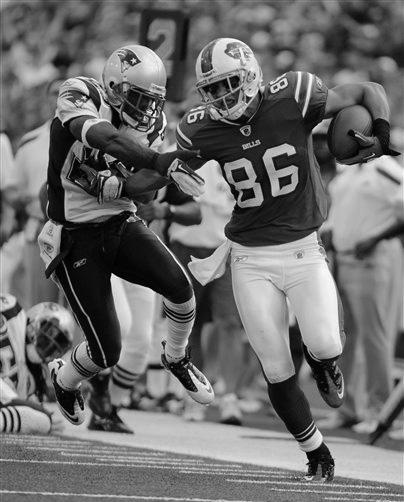
The Buffalo Bills’ David Nelson, right, runs by Patriots defender Leigh Bodden in the first half Sunday.
Dolphins fall to Cleveland, remain winless on year
Associated Press
CLEVELAND — The Miami Dolphins are winless. Soon, coach Tony Sparano could be jobless.
The NFL is a cruel, bottomline business.
Miami dropped its third straight game to start the season Sunday with a 17-16 loss to Cleveland, whose offense sputtered all day before quarterback Colt McCoy drove the Browns 80 yards in the final minutes, throwing a 14-yard touchdown to wide receiver Mo Massaquoi with 43 seconds left.
The Dolphins (0-3) needed a win to take some heat off Sparano. Instead, the pressure intensified.
“I do believe the group in that room believes we are going to win.” Sparano said. “I think we are going to win. Now, all that being said, we are 0-3 and that is what we have to show for it.”
Even before the latest loss, Sparano’s future was uncertain. Disgruntled Miami fans are demanding more, and after consecutive 7-9 seasons under Sparano, the Dolphins don’t seem to be making any significant progress. With upcoming road games at San Diego and the New York Jets surrounding the bye week, there’s a chance the Dolphins’ front office could make changes.
Miami won the statistical battle, posting better numbers
than the Browns (2-1) across the board.
However, the Dolphins didn’t do enough to have the figures on the scoreboard in their favor.
“Statistics don’t matter,” Sparano said. “The end result matters, winning the game. At the end of the game, they made more plays than we did.”
Before his game-winning TD toss, McCoy did little against Miami’s defense. But when it mattered most, Cleveland’s second-year quarterback completed nine of 13 passes for all 80 yards to six different receivers on the Browns’ winning drive, making up for a clunky performance.
“We played like garbage for the most part of the day,” McCoy said. “As ugly as it was, it was a huge win for us.”
Getting the ball back with 3:23 left, McCoy worked the ball down to Miami’s 14, picking up a key fourth-and-4 conversion and helped along by an offsides penalty on Dolphins end Jason Taylor. On first down at the 14, McCoy made the defining play of his still budding NFL career.
Dropping back, he pump faked before lofting a perfect pass to the right corner over rookie cornerback Jimmy Wilson and to a leaping Massaquoi.
“My best throw of the day,” McCoy said.
It fooled Wilson, who accepted blame for letting Massaquoi
get behind him.
“That’s what they have me out there for, to make plays in situations like that,” said Wilson, who intercepted a pass by McCoy in the first quarter. “I could have given up anything underneath, but I didn’t get back there deep enough. I mistimed my jump. If I would have been back one more step, we wouldn’t be talking about how we lost the game.”
There were other Miami miscues: a missed field goal, blown coverages and poor tackling.
“The last drive, we did a couple dumb things,” Sparano said. “We had a couple penalties that gave them opportunities to extend drives. In the fourth quarter, we had four penalties and that is not good in crunch time.”
Even after taking the lead with precious seconds left, the Browns had to withstand a late comeback by the Dolphins. Cleveland’s win wasn’t sealed until safety Mike Adams intercepted Chad Henne with 13 seconds left.
Dan Carpenter’s third field goal, a 38-yarder, put the Dolphins up 16-10, giving McCoy the ball back with enough time to rescue the Browns. On the final drive, McCoy, who was just 10 of 26 for 130 yards at the time, took what the Dolphins defense allowed, throwing mostly short passes — three to rookie wide receiver Greg Little.
AP
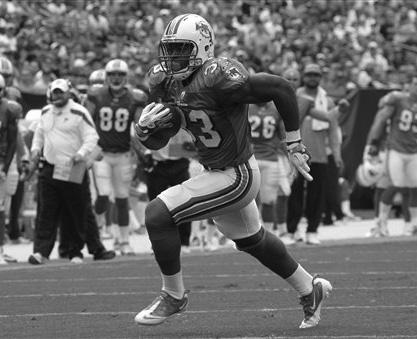
Dolphins running back Daniel Thomas runs for a touchdown during Miami’s 17-16 loss to Cleveland on Sunday.
Freeman, Buccaneers defeat Ryan, Falcons
Associated Press
TAMPA, Fla. — Josh Freeman pushed his way into the end zone, scrambled to his feet and flapped his arms in celebration of the first rushing touchdown of his career.
The little bird dance seemed uncharacteristic for Tampa Bay’s usually unflappable 23-year-old quarterback. It also spoke to how much beating the Atlanta Falcons means to a young Buccaneers team that ended three years of frustration against their NFC South rivals with a 16-13 victory on Sunday.
Tampa Bay’s defense forced three turnovers and sacked Matt Ryan four times in its best performance of the season. Freeman’s 1-yard sneak snapped a 3-3 tie in the second quarter and Connor Barth kicked three field goals as the Bucs (2-1) stopped a five-game losing streak in the series. Four of those losses were by six or fewer points.
“It’s huge, and it’s about time one went our way. They’ve been really close games since I’ve been here,” the third-year pro said. “They’re a great divisional opponent. I’ve got a lot of respect for those guys, offense and defense. They’re a good team. We’ll get to see them again. I’m looking forward to that, but today was our day. We got it done.”
As good as it felt, though, don’t try to tell the NFL’s youngest team that it has arrived.
“I just told the team we didn’t come into the season to beat the Atlanta Falcons. We came into this season to win the division. They just happen to be a team that’s in our division,” Bucs coach Raheem Morris said. “We’ve got to beat those guys just like we’ve got to beat everybody else in our division and try to win this thing so we can go to
the playoffs, and then compete for a championship.”
Tampa Bay won 10 games a year ago, but lost twice to the Falcons with both games being decided in the closing minutes. When his players convened for training camp, Morris delivered a simple message: The goal this year is to win the NFC South, regardless of how many wins it takes. That will ensure a postseason berth.
The Bucs forced two first-half fumbles with sacks. Ronde Barber intercepted a pass to stop an Atlanta threat just before halftime, and the Falcons (1-2) were stopped on downs inside the Bucs 10 early in the fourth quarter. Still, Ryan nearly pulled off a fourth-quarter comeback from a double-digit deficit for the second straight week.
The Falcons drew within 1613 on the 91st TD reception of Tony Gonzalez’s career with just under 10 minutes to go. They drove to the Tampa Bay 5 before Matt Bryant’s 33-yard field goal made it a three-point game with 4:06 left. Ryan and his supporting cast of playmakers never got the ball back.
With Freeman and LeGarrette Blount, who rushed for 81 yards on 24 carries, leading the way, the Bucs burned the rest of the clock. Any hope the Falcons had evaporated as Tampa Bay converted a final first down when Atlanta’s Corey Peters jumped offside on fourth-and-inches when the Bucs did not plan to snap the ball.
“It was a freeze play. They were going to use a hard count,” Atlanta coach Mike Smith said. “We talked about it on the sideline. We didn’t execute as an entire defense. Not one person (should be singled out). That one play didn’t determine the game. There were lots of plays. We just didn’t get it done.”
AP
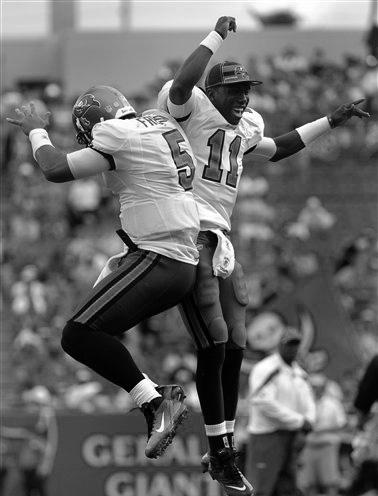
Buccaneers quarterback Josh Freeman, left, celebrates with teammate John Johnson during Tampa Bay’s 16-13 win Sunday.
Saint Mary’s sweeps pair of weekend opponents
By KATIE HEIT
Sports Writer
The Belles hit hard and came out on top with a weekend sweep against Adrian and Manchester.
“I thought we played really well as a team, especially our conference match versus Adrian,” Belles coach Toni Kuschel said. “They’re a tough team defensively and I thought we played excellent.”
Saint Mary’s (5-7, 3-4 MIAA) started out strong with a quick lead on conference opponent Adrian (11-7, 8-2). The Bulldogs came back quickly, however, and the two teams battled for
smc socceR
every point. Tied at both 22-22 and 23-23, the Belles finally clinched the game when junior outside hitter Stephanie Bodien hit back-to-back kills to bring her team to a 25-23 win. In the second set against Adrian, the Belles built a 19-14 lead before Adrian overcame the five-point barrier and brought the score to 20-20. The teams were in another tough spot, playing past
“I thought we played really well as a team, especially our conference match versus Adrian.”
the 25-25 point tie, when freshman outside hitter Kati Schneider mirrored Bodien’s winning shots the game before with back-to-back kills, bringing the final score to 29-27.
Toni Kuschel Belles coach
Saint Mary’s dominated the entire third set against the Bulldogs, winning 25-17.
Bodien led with 15 kills and a pair of service aces. Other top performers included Schneider, who had 13 kills, and sophomore middle
hitter Christi Wyble, who had the match-high six blocks.
In their game against nonconference opponent Manchester (10-6), the Belles had 17 kills and only four errors in the first set against the Spartans.
Saint Mary’s took control early and won the set 25-21. The second set was more difficult for the Belles. The lead changed eight times and Manchester was ahead 24-22 when the Belles took control of the game and scored the final four points, winning 26-24.
The third set was no easier. The score was tied 14 times and the lead changed six times. Saint Mary’s ended up with the
27-25 win.
Schneider had the match-high 15 kills. Junior setter Danie Brink had 36 assists, which brings her to over 2,000 career assists.
“We still need to work on some consistency,” Kuschel said. “We fall into slumps and allow teams to get runs of three and four on us. If we want to take control of the match, that’s something we need to get better at.”
The Belles will wrap up the first round of conference play Wednesday against Albion at 7 p.m. on their home court.
Contact Katie Heit at kheit@nd.edu
Belles earn comeback victory over conference foe Albion
Observer Staff Report
Saint Mary’s stormed back Saturday with two second half goals to earn a come-frombehind 2-1 victory against Albion College.
While the Belles (6-2, 2-2 MIAA) dominated the match against the Britons (0-8, 0-4) statistically, they trailed 1-0 at the half before junior midfielder Ashley Morfin scored
two goals to win the match.
Despite outshooting the Britons 7-1 in the first half and holding a 5-0 edge in corner kicks, the Belles found themselves in a 1-0 halftime deficit.
In the 35th minute, Albion sophomore midfielder Lindsey Lubanski drilled a goal into the back of the net unassisted to put the Britons in position to win their first game of the season. Lubanski’s shot proved
to be the only shot on goal for the Britons in the entire game as freshman Belles goalkeeper Natalie Warner did not record a save in the contest. Meanwhile, junior Britons goalie Sam Bowditch had a busy afternoon and managed to record five saves in the first half to keep the Belles off the scoreboard.
However, in the second half, the law of averages quickly
swung in favor of the Belles’ aggressive offense. Just over three minutes into the half, Morfin netted her first goal of the afternoon and was assisted by sophomore midfielder Mollie Valencia.
In the game’s 71st minute, senior defender Keely Noonan found Morfin for her second goal of the afternoon, marking the first time Morfin has scored multiple goals in a game.
From that point, the Belles’ defense easily dispelled any threats to the one-goal lead. Albion was only able to record one shot after the Belles took the lead and did not put any shots on goal.
The Belles continue their slate of games in the MIAA when they head to Grand Rapids, Mich., to face Calvin College on Wednesday at 4 p.m.
continued from page 24
The doubles duos Bandy and Moros, Barnard and Fredericka and McCoy and Moore were victorious.
The Irish continued their strong singles play Saturday, earning victories in 12 of 16 matches. Bandy, Fredericka, McCoy, Moore and Talmadge each picked up two victories.
Irish associate head coach Ryan Sachire was very impressed with the team’s effort and encouraged by the play of some of the team’s younger players.
“Things looked very positive for us all weekend,” Sachire said. “It was really good to see some of the younger guys really step up and take advantage of the opportunity to play against some strong competition. It was very encouraging to see.”
Sachire noted that he was particularly impressed with the play of three individuals.
“Ryan Bandy, Wyatt McCoy and Michael Moore really stood out to me,” Sachire said. “It’s really good to see [McCoy] playing well, as it is always nice when a freshman can contribute. [Bandy and Moore] are younger guys who have not really had many opportunities to be in the lineup for us, but they definitely shined and took care of business for us.”
Sophomore Greg Andrews accompanied seniors Niall Fitzgerald, Sam Keeton and Casey Watt to the Land Rover Napa Valley Tennis Classic, where they faced very stiff com-
petition from the USTA junior players.
In the event, the 32-player field was divided into eight groups, with each group consisting of three college players and one USTA junior player. After the three singles matches, each group winner faced off in a single elimination tournament to determine the champion.
Keeton had a very successful weekend and won his group before falling to USTA junior Nikko Madregallejo in the first round of the single elimination tournament.
Andrews scored an impressive victory Saturday when he knocked off Japie De Klerk of Tulsa, who is ranked No. 29 na-
tionally.
Sachire believes the team can make progress between now and when they next return to the court.
“We are playing at a high level right now and we have a chance to be a very strong team,” Sachire said. “We need to work on protecting our leads and finishing matches. If we can do that, I think we will definitely be on the right track.
The Irish return to action in the Midwest Singles/Doubles championship in Columbus, Ohio held from Oct. 13 to Oct. 17.
Contact walker Carey at wcarey@nd.edu
Saint Mary’s finishes 7th at MIAA Jamboree
By WALKER CAREY Sports Writer
Saint Mary’s finished in seventh place at the MIAA Jamboree on Saturday. The event, held at the Zollner Golf Course on the campus of Trine University, is important as it makes up one-third of the team scores that will decide the conference champion for the season.
The Belles finished with a team score of 160 on the day, which was a mere three points behind sixth place Kalamazoo.
“[Saturday] was a tough, but good day for us,” Belles coach Jackie Bauters said. “The competition in the MIAA is what I believe to be the best it’s ever been since I started coaching [at Saint Mary’s] seven years ago.”
Senior Joanne Almond led all Belles runners as she finished 20th overall (24:43).
Junior Julia Kenney was not too far behind her, finishing 32nd overall (25:10) and junior Emma Baker placed 50th overall (26:14) Bauters was very impressed with the performance of freshman Samee Chittenden, who finished 68th overall (27:07).
“It was great to see [Chittenden] step up and score for the team,” Bauters said. “We
need everyone stepping up and contributing to have good team performances.”
While Bauters was not pleased with where the team finished, she is happy with the improvement that continues to take place.
“Our team finish was not where we would have liked to have been,” Bauters said. “However, right now as a team our focus is to continue to improve – individually and as a pack.”
While the Belles’ team successes may not be visible at this point, Bauters believes her squad is making visible progress.
“I think our team is working very hard and are committed to having a great season,” Bauters said. “The successes we achieve may not be as visible through our team’s overall placing in the conference at this point — but that doesn’t mean it isn’t going to be a great season.”
The Belles will return to competition Saturday when they will participate in the Sean Earl Lakefront Invitational hosted by Loyola University in Chicago.
Contact walker Carey at wcarey@nd.edu
GRANT TOB N/The Observer
Irish junior Blas Moros prepares to return a shot during the Fallon Invitational on Sept. 23 at the Eck Tennis Center.
nd Women’s tennis
By KATIE HEIT Sports Writer
The Irish are in high spirits after a strong showing at the Indiana Invitational, reeling in 15 total wins over the course of three days.
Indiana’s Sophie Garre on Friday. White was the only Notre Dame player to win her first round of singles.
teams from Indiana, Kansas State and Georgia.
“I was really happy with our doubles play,” McGaffigan said.
Saint Mary’s places 6th at tournament Irish total 15 wins at Indiana Invitational
By JOSEPH MONARDO Sports Writer
The Belles had to compete with not only the field of teams at this weekend’s DePauw Small College Invitational, but also with the elements.
“The conditions were pretty rough,” Belles coach Mark Hamilton said. “The golf course was in not-great condition because of the hard summer that Indianapolis had, and then a lot of rain, so it was wet and bare. It was the same for everybody, but it was tough conditions.”
After finishing the first round in sixth place out of eight teams with a score of 350, No. 5 Saint Mary’s maintained its position throughout the second day with a score of 170 on the event’s second day, which was shortened to only nine holes due to inclement weather.
“Today ... it started to rain and they knew some lightning and bad rain was coming and we weren’t going to be able to get in 18,” Hamilton said. “So they just called it at nine instead of playing 14 or 15 holes and then having to call it.”
No. 8 Centre College took the tournament title with a score of 482 over 27 holes, only four strokes ahead of second place No. 2 DePauw. With their score of 520, the Belles finished well back of the pack’s leaders, but only seven strokes back of conference rival No. 13 Olivet, the tournament’s fourth place finisher.
Although they were not able to move up any positions on the scoreboard, the Belles’ second round performance was one of the day’s best. In the second round, Saint Mary’s gained 14 strokes on Olivet and 11 strokes on fifth place Illinois Wesleyan.
“I was pretty pleased today. We played pretty well under tough conditions,” Hamilton said. “We had one of the lowest scores for nine holes today.”
In the first round, seniors Natalie Matuszak and Christine Brown led the Belles with matching rounds of 84, tying them for 19th place in the field. After registering 92 on the tournament’s opening 18 holes, junior Cara Kielty came back to lead the Belles in the second round with her round of 40.
Even after his team’s impressive performance Sunday, Hamilton has already targeted areas the Belles need to work on to turn in lower team scores.
“We’re still in the low end of the field in pars made,” he said. “I know we are pretty good ball strikers, so that means that we are hitting the golf ball close to the green and just not converting. We’ve still got to continue to work harder at it in practice this week.”
Saint Mary’s will return to action Thursday when the team travels to Albion for the third MIAA tournament of the year.
Contact Joseph Monardo at jmonardo@nd.edu
This weekend was the first time the Irish have been on the court in a competitive setting since April. The team started off slow, dropping five of the first six singles matches it played Friday. From there, the Irish had nowhere to go but up.
“As each match went on, each one of us played better and better,” junior Chrissie McGaffigan said. “I could see my teammates playing better and better until the end of the weekend [when] we were playing our best.”
Freshman Katherine White started the weekend off well with her 7-5, 6-4 victory over
In doubles play Friday, Notre Dame was able to hold on to its leads. Sophomore Britney Sanders and White won their first match as partners against Kansas State. Sophomore Jennifer Kellner and McGaffigan were also victorious in their first round of competition.
The Irish hit their stride Saturday, as Kellner grabbed a 6-2, 6-2 victory over Kansas State’s Ana Gomez. Following her example, Sanders defeated Kansas State’s Marketa Trousilova 6-1, 6-2.
Wrapping up the leaderboard, McGaffigan defeated Georgia’s Alina Jerjomina 6-1,6-2.
In doubles action Saturday, the Irish snatched all but one of the matchups and defeated
“All three teams played really well together and I know our coaches were really pleased with our doubles play.”
The Irish reached their peak Sunday, going 4-0. Kellner finished with a 2-1 record for the weekend after knocking down Abilene Christian’s Julia Mongin 6-2, 6-1. McGaffigan and Sanders also finished with a 2-1 singles mark, both winning their final day’s matches.
Sophomore Julie Sabacinski snatched her first win of the weekend against Garre, 6-4, 7-5.
The tournament marked the first competition that new assistant coach Kelcy Tefft was on the sidelines for the Irish.
“Her having been on the team before in the past helps a lot
with experience,” Kellner said. “She was really helpful both on and off the court.”
Missing from play this weekend were senior captains Kristy Frilling and Shannon Mathews. In their absence, Kellner said the upperclassmen — McGaffigan in particular — really took control of the team.
McGaffigan said she was proud of the way her team performed.
“I think we all had to step up this weekend because it was the first tournament,” McGaffigan said. “Each and every one of us had to step up and just go out there and play our hardest.”
The Irish will send Frilling and Mathews to Pacific Palisades, Calif., for the ITA/Riviera All-American Championships on Oct. 1.
Contact Katie Heit at kheit@nd.edu
Marquette
continued from page 24
today.”
On the other side of the ball, Waldrum made a couple of key changes before the game, including moving senior defender Jess Schuveiller to midfield. It paid off as Schuveiller netted a goal off a pass from fellow senior defender Ellen Bartindale in the 72nd minute to send the game into overtime.
Notre Dame’s other goal came from senior forward Melissa Henderson, who evened the count at 1-1 with her league-leading 11th goal of the season.
Yet for all their efforts, the Irish failed to close out the game once again. And once again, Waldrum cited small mistakes and mental lapses that cost them in the end. This time, the mistakes began early, forcing the Irish to play from behind for the remainder of the contest.
“It was the same thing today,” Waldrum said. “Right from the opening kickoff we make a mistake, get beat down the flank, we don’t get the ball cleared properly and we’re down 1-0, 30 sec-
onds into the game. So now we’re fighting back again.”
Though the Irish fought back from behind with goals from two of their three captains, and strong play by the defense forced the extra session, another mental lapse at the opening whistle of overtime allowed Marquette (102-0, 3-1-0) to get the best of them.
“We told them at the break right before overtime began: when we kick the ball off — because we had the kickoff — play it long and deep into their end of the field and let’s let Henderson try to run onto it,” Waldrum said. “And it was wet and it was rainy and I thought that if we dump it into their end of the field, then maybe we can at least have that psychological edge that we were on top of them, instead of going backwards and giving them the edge.
“So we had that all planned and we came out right from the kickoff, and instead of playing it long like I told them, they played it short and we lost the ball. We lost it right there at midfield and as we started to put people forward. They counter-attack us with us not being in a good defensive posture and they score a goal 18 seconds into the overtime
and we lose.”
Though Waldrum said he continues to have faith in his team, he also recognizes that time is running out.
“I still think this team is going to be good at the end,” he said. “We just need to still believe that even though we’re off to a bad start by our standards, we still have time to salvage this and make it a really good year for us
and still make a run deep into the NCAA tournament. But we’re running out of weekends to do that, so we can’t keep saying that every week and not getting the result. We have to somewhere get the break to go our way.”
Waldrum maintains that despite the numbers, his team still has the potential to come back.
“I do think we showed some signs today of actually fighting
for each other,” he said. “We don’t look anything like a team that has given up by any means. So I still believe that; I still think we’ll be there at the end.”
The Irish will return home Friday to try to make the turnaround against Big East opponent Connecticut.
Contact Kelsey Manning at kmannin3@nd.edu
continued from page 24
“I always tell my girls when I’m coaching that the only obstacle you have is the net, so it is more efficient for a serve to go long than it is for it to not even go over the net,” Hoffman said. “I know Villanova tried to serve aggressively — which they did. Most of their balls were long, whereas Notre Dame came in and tried to serve aggressively, but most of their balls were in the net.”
Brown said the Wildcats performed at a high level during the match and took the Irish out of their game.
“I give Villanova a lot of credit,” Brown said. “We knew coming in they are a very aggressive serving team and they’re going to miss a fair amount of serves, but they’re going to serve really tough and try to get us out of system. They were able to do that. I give a lot of credit to them for a good game plan and executing well.”
Brown also said the Irish failed to capitalize on some of Villanova’s flaws.
“We didn’t respond to [the aggressive serving] really well,” she said. “We weren’t able to get kills and we weren’t able to take advantage of the big weaknesses we thought they had in blocking because our ball control wasn’t there — our first contact wasn’t good.”
Without good ball control, the Irish could not do much damage to the stingy Wildcat defense. A matchup of Big East schools often showcases the defense, Hoffman said.
“The Big East isn’t a conference like the Pac-12 or the Big10, where they have those juggernauts that come in and just bang the balls,” Hoffman said. “The Big East is a conference that really has to rely on their defense. I know Louisville is big on their blocking and so is Notre Dame. They just didn’t do it as consistently well throughout the match.”
The Irish continue Big East play Saturday when they host Cincinnati at 2 p.m. in the Purcell Pavilion.
Contact Cory Bernard at cbernard@nd.edu
GRANT TOBiN/The Observer
Irish senior defender Jessica Schuveiller, right, pressures the ball during Notre Dame’s 7-1 victory over Tulsa on Sept. 2 at Alumni Stadium. Notre Dame dropped to 4-5-2 with a loss to Marquette on Sunday.
continued from page 24
good finish there.”
Senior Max Scodro led the way for Notre Dame at Olympia, finishing 12th in the individual competition at +6. The Chicago native finished the final round one-under par, highlighted by five birdies on the back nine.
The senior’s leadership has been a bright spot for the Irish all year, according to Kubinski.
“Max gives us those good scores consistently and he has played the most,” Kubinski said. “He brings the tangible with his scores on paper, but he also brings the intangibles in his leadership.”
The Fighting Irish Golf Classic features 12 teams from around the nation including Georgetown, Houston, Villanova and San Francisco. Although the tournament doesn’t feature any squads in the national rankings — unlike Olympia’s 10 ranked teams — Kubinski said the Irish still need to compete at their highest level.
“[The Fighting Irish Golf Classic] is the typical college tournament, where all wins and losses count,” he said. “We just have to be ready to put on a good performance.”
Iowa finished atop the leaderboard at last year’s Fighting Irish Golf Classic, but Notre Dame comes in as the top returning team, finishing six strokes behind the Hawkeyes in second place. Senior Tom Usher led the Irish at last year’s tournament and tied for seventh, after shooting a 69 in the second round.
The top individual finishers from last year’s tournament also return: San Francisco senior Ji Hwan Park and junior Taylor Travis. The San Francisco duo tied for first after each shot a 208 to lead the way for the third-place Dons.
“[Park and Travis] finished two-under and really hit their stride last year,” Kubinski said. “They brought a good performance last week as well, but I think it’ll be a little more difficult here with the rain and the weather projected for the tournament.”
With the tournament, Notre Dame also plans to raise awareness of colon cancer. The Irish will wear blue to promote cancer screening and honor those who lost their lives to colon cancer, including Kubinski’s father.
“[Colon cancer] was really preventable for my dad and for everyone else if it is detected early,” Kubinski said. “We just want to get some awareness out there for early screening and get some people to try to prevent this deadly disease.”
The Irish host the first two rounds of the Fighting Irish Golf Classic on Monday at Warren Golf Course in South Bend.
Contact a ndrew Gastelum at agastel1@nd.edu
Louisville
continued from page 24
ally outshooting the Irish 16-2 in the second half for a 20-9 final margin.
Despite their aggressiveness, Louisville only had a 7-6 edge in shots on goal and most of their shots were unthreatening, which pleased Irish coach Bobby Clark.
“[I give] full marks to Louisville,” Clark said. “They’re a hard-pressing team and they did that well. They put us under a little bit of pressure [in the second half], although I didn’t really feel they opened us up. Most of their shots were from distance. I never felt they got behind us and I have to give our defense full marks for that.”
Louisville’s two best chances to tie the game arguably came late in the contest, when Irish senior goalkeeper Will Walsh made two of his seven saves.
In the 85th minute, Louisville senior and first team all-Big East midfielder Nick DeLeon ripped a shot from just outside the penalty box
forcing Walsh to make an acrobatic save to tip it over the crossbar. With under a minute left, Walsh again denied a great Louisville opportunity. Freshman forward Will Vitalis received a through ball in the penalty box but Walsh stonewalled him.
Experience helped Walsh come through in crunch time.
“It’s part of being a goalie,” Walsh said. “You have to anticipate shots. I knew they were going to come and you always have to be ready for it.”
Despite the amount of tension involved in a game between two conference rivals and top-15 clubs, there was a lighthearted moment in the second half, when a rabbit ran onto the field in the 54th minute, briefly interrupting play.
“When we played on the other field, we actually found rabbits after [a] game — all these baby rabbits with a little burrow,” Clark said. “So it must be something about soccer fields at Notre Dame with rabbits in them.”
After play resumed, Louisville continued its barrage on the Irish net but ultimately could not cash in, resulting in
a huge victory for Notre Dame.
“Every time we play Louisville it’s a huge game for us,” Walsh said. “Last year, they beat us twice [including] in the Big East semifinals. It was nice to get a revenge win on them.”
The Irish return to action Saturday when they travel to Queens, N.Y. to take on St. John’s at 7:30 p.m.
Contact Sam Gans at sgans@nd.edu
TOM LA/The Observer
Irish junior forward Danny O’Leary dribbles the ball during Notre Dame’s 1-0 win over Louisville on Saturday at Alumni Stadium.
Published Monday through Friday, The Observer is a vital source of information on people and events in the Notre Dame and Saint Mary’s Community.
Join the more than 13,000 readers who have found The Observer an indispensible link to the two campuses. Please complete the accompanying form and mail it today to receive The Observer in your home.
(Answers tomorrow) BRAND ALIAS WARMLYFERRET Saturday’s Jumbles: Answer: The poker player’s wager would soon cause him to do this — BIDFAREWELL Now arrange the circled letters to form the surprise answer, as suggested by the above cartoon.
Enclosed is $130 for one academic year Enclosed is $75 for one semester
the london expRess
JOE MILLER and KELLy LyNCH the clammy handshake
ALEX GRISWOLD and LEE HAGGENJOS
WORD
David L. Hoyt and Jeff Knurek
men’s socceR
nd Women’s socceR
Irish top Cardinals ND drops game in OT
By SAM GANS Sports Writer
Neither attacking Cardinals nor a disrupting rabbit could stop the Irish on Saturday evening as No. 14 Notre Dame defeated No. 3 Louisville 1-0 in its Big East opener, earning a bit of revenge in the process.
The Irish (5-2-1, 1-0-0 Big East) got on the board early when junior forward Danny O’Leary scored his second goal of the season in the fourth minute. O’Leary received a cross from senior midfielder Adam Mena and directed a shot toward the goal, which was initially saved by Louisville senior goalkeeper Andre Boudreaux. But the ball popped into the air and O’Leary beat
men’s Golf
Irish ready to host 6th Classic
By ANDREW GASTELUM Sports Writer
Notre Dame will host the sixth annual Fighting Irish Golf Classic at Warren Golf Course Monday following successive trips to Minnesota and Chicago.
The Irish are coming off an eighth-place finish at the Olympia Fields Invitational in Chicago, where they defeated No. 8 Duke, No. 20 Ohio State and No. 22 Augusta State — three teams that made it to last season’s NCAA Final Four.
“We had a couple of guys play really good [at Olympia],” Irish coach Jim Kubinski said. “That was, by far, the strongest field in college golf with 12 teams that will probably finish in the top-30. It was nice to steal a
see CLASSIC/page 22
Boudreaux to the ball and tapped it into the net.
“It hit off the goalie’s hands, he fumbled it and I saw it go up in the air,” O’Leary said. “So I just followed through with it and we both went for it and I ended up getting it with my foot.”
The Irish controlled most of the first half, as they went into the halftime break in front 7-4 in shots and 5-1 in shots on goal.
But the second half was a different story.
Louisville (6-2-0, 0-1-0) came out firing early in the latter 45 minutes and continued the pressure until the end of the match, with the Cardinals eventu-
see LOUISVILLE/page 22
By KELSEY MANNING Sports Writer
Until 18 seconds into overtime against No. 14/15 Marquette on Sunday, no member of the 2011 Irish squad had experienced a collegiate season with more than four losses. But with a quick Irish turnover and a Marquette goal seconds later that secured a 3-2 win for the Golden Eagles, Notre Dame (4-5-2, 1-2-1 Big East) faced defeat.
Irish coach Randy Waldrum expressed his disappointment with yet another close loss this season.
“We played too well to lose and I feel so bad for the kids because they really had a lot of fight in them,” Waldrum said. “We played so much better than [we did]
against South Florida the other night. And it’s a shame that we can’t seem to get that part right. We deserved a lot better today.” Waldrum was particularly pleased with the play of junior goalkeeper Maddie Fox who posted a career-high six saves, and freshman defender Sammy Scofield, who played big minutes in the back for the Irish.
“The positive for me coming out of it is that Sammy Scofield actually got a lot of minutes for us and played really well,” he said. “She’s a freshman for us and she looked like a player that was recruited. You want your freshmen to start to step up now and she did a really good job for us, so I thought that was a real positive
see MARQUETTE/page 21
Squad splits pair of matches
By CORY BERNARD Sports Writer
The Irish returned to the friendly confines of Purcell Pavilion over the weekend, opening Big East play with mixed results. Notre Dame swept Georgetown for an easy win Saturday, but lost to Villanova 3-1 Sunday.
The Irish (8-4, 1-1 Big East) played one of their best matches against the Hoyas, hitting .290 on the day and acing Georgetown (8-7, 0-2) 10 times. Junior middle blocker Hilary Eppink led the Irish with 10 kills on 18 error-free swings.
Sunday’s contest against the Wildcats (10-5, 2-0), however, was a different story.
The Irish hit at a .094 clip and committed 11 service errors in front of over 1,300 fans, who were on hand to watch the nationally televised match.
Irish coach Debbie Brown said her team will continue practicing serves to eliminate the momentum-killing ser-
KEViN SONG/The Observer
Freshman Toni Alugbue, left, and senior Kristen Dealy defend a shot during Notre Dame’s 3-0 win over Valparaiso on Sept. 11.
vice errors.
“We have still been trying to work on [serving],” Brown said. “I feel like that happened several times where we would get on a mini-run and then we would end it with a missed serve. That’s hard, because I think if you can keep the pressure on [the opponent] when they’re in a
tough spot, then those miniruns are really what wins the games.”
ESPNU color commentator and former Louisville AllAmerican Jennifer Hoffman said that when coaching, she told her team to serve long rather than short.
By WALKER CAREY Sports Writer
Four members of the Irish squad competed in the Land Rover Napa Valley Tennis Classic in St. Helena, Calif., this weekend, while the rest of the squad stayed home to compete in the Tom Fallon Invitational.
The Irish dominated in the first day of the Tom Fallon Invitational, winning eight of nine singles matches and three of four doubles contests.
In singles play, sophomore Ryan Bandy and freshmen Douglas Barnard, Wyatt McCoy and Michael Fredericka secured Irish victories. Juniors Michael Moore, Blas Moros and Spencer Talmadge also won their matches.
see BROWN/page 21 see FALLON/page 19
TOM LA/The Observer
Irish senior goalkeeper Will Walsh takes a goal kick during Notre Dame’s 1-0 win over Louisville on Saturday at Alumni Stadium.
GRANT TOBiN/The Observer
Irish junior defender Jazmin Hall prepares to kick the ball during Notre Dame’s 7-1 win over Tulsa on Sept. 2. Notre Dame lost to Marquette on Sunday.