A chance to make a Senior Day count
When these seniors signed their letters of intent to play for Notre Dame in February 2007, the Irish were coming off backto-back BCS bowl appearances and had gone 19-6 over the past two seasons.
Four seasons later, it seems that nothing has gone according to plan.
years haven’t been what any of us — players, students and fans included — had hoped for, there’s still the possibility to end it on the highest note possible. It would be poetic, almost, if these seniors earned their first win over a ranked team on Senior Day, a day that has recently become an embodiment of Notre Dame’s struggles.
FOOTBALL RECRUITING
Decommitments open up slots
By DOUGLAS FARMER Sports Editor
After two losses on the field, Irish coach Brian Kelly and his staff suffered three more losses in their first attempt at a full recruiting class while at Notre Dame.
Three four-star recruits, offensive tackle Jordan Prestwood, linebacker Clay Burton and defensive end Aaron Lynch, opted out of their verbal commitments to the Irish in the past two weeks.
said. “They just aren’t looking at the big picture and seeing why Notre Dame is losing.”
The decommitments from the three heralded recruits, all given a four-star ranking by ESPN’s recruiting analysts, likely eliminates any chance of them coming to Notre Dame, Frank said.
“Once these guys decide to take visits, almost always the original school is out,” he said. “All three of them have confirmed to us that Notre Dame is out of the running.”
injury to Irish junior quarterback Dayne Crist, Golson could take advantage of an uncertain Notre Dame quarterback situation, Frank said.
“With the situation with Dayne being out, and they aren’t exactly sure if he’ll be back or not for the spring, this is an ideal situation for a quarterback,” Frank said. “And [Golson] wants to enroll early, so he would be here for spring football.
Sam Werner Sports Writer
Despite their struggles on the field, 15 of those 18 seniors that signed on 3 ½ years ago are still on the Irish roster today. Going through the worst season in Notre Dame history and a tumultuous coaching change would have made it easy for players to transfer elsewhere. Frankly, who could have blamed them?
Transfers are usually a staple of coaching changes and, especially given the poor performance on the field it would have been easy for players to look at other schools. Two players transferred when Brian Kelly took over for Charlie Weis as Irish coach — one for reasons unrelated to football. While Kelly himself probably played some role in that high retention rate, this senior class banded together through the adversity. That attitude permeated throughout the rest of the team and, hopefully, laid the foundation for stability and success down the road.
No, I don’t think it’s likely that the Irish will beat Utah on Saturday, but both teams will still have to take the field for 60 minutes, and — if we have learned anything over the past four years — anything can happen. If the Irish do manage to pull off the upset Saturday, it would become a vindication for everything this class has worked for over the past four years and lay the groundwork for future victories, a common theme in recent interviews with both coaches and seniors alike.
After everything this class has been through, though, a win over a ranked team is something to celebrate, regardless of the logo on its helmet.
This senior class proves the axiom on which Notre Dame most prides itself — that it’s different from all other football programs. When things aren’t going well on the field, there’s somewhere else to turn here. If football were all that mattered, most of these players would have hit the road years ago. More importantly, they wouldn’t reflect glowingly when asked about their experience at Notre Dame. Talking to players over the past week, the most common theme is how they’re going to miss this place when they leave.
“[What made Notre Dame special] was just the things [it] offered to better myself as a human being, better myself as a student, to challenge myself,” senior running back Robert Hughes said.
Even though these past four
As important as the future is, though, it’s even more essential that these seniors take ownership of their Senior Day Saturday. The most disappointing part of previous Senior Days wasn’t even the losses to mediocre Big East teams, but the lackluster demeanor on the Irish sidelines on what is supposed to be the most emotional game on the schedule. Maybe it will help that Notre Dame will be playing a top-25 team, but these seniors, and the team as a whole, need to play like Senior Day means something to them. If they can harness that emotion, maybe, just maybe, this class will finally experience an elusive “Notre Dame moment.”
No, a win over Utah wouldn’t be the same as beating a topranked USC team, but you can only play the games in front of you. After everything this class has been through, though, a win over a ranked team is something to celebrate, regardless of the logo on its helmet.
The Class of 2011 won’t win a national championship at Notre Dame. The seniors won’t even graduate with anything close to a winning record, but that doesn’t mean they can’t go out with a bang.
It’s hard to say they don’t deserve it.
The views expressed in this column are those of the author and not necessarily those of The Observer.
Contact Sam Werner at swerner@nd.edu
“I think there are a lot of things players are looking for when they make that commitment,” said Mike Frank, an Irish recruiting analyst who runs the ESPN-affiliated site irishsportsdaily.com. “One is a good education, and another is they want to play for a big-time football program that gives you a chance to play for a national championship. And obviously, third, like any college student you want to have fun. I think for Notre Dame to get to that point, they are going to have to start winning some games.”
While Frank said the string of bad luck Kelly and the Irish have undergone is unlike any he has ever seen — from injuries to fake field goals to more injuries — he thinks recruits are failing to see the effects of that ill fortune.
“Kids are looking at it and saying that ‘I want to go to a program that can win a national championship,’” he
The decommitments also opened up three more slots for other recruits. Fittingly, three recruits, two of which are four-star recruits as well, will visit campus this weekend and take in the Utah game from the sidelines.
Defensive end Brennan Scarlett, an Oregon native, could fill the spot left by Lynch. Scarlett, heavily recruited by most of the schools in the Pac 10, has long shown an interest in Notre Dame, Frank said.
“He’s a big-time player,” Frank said. “He’s been interested in Notre Dame for quite some time, and I think Notre Dame has a real good shot at him too. It’s his first time out here, and we’ll have to see what he thinks, but he is the kind of kid who I think will fit in well with the type of personalities already on the team.”
Four-star quarterback, and North Carolina committee, Everett Golson will also be in town over the weekend. With the recent season-ending
“The thing that Golson brings that a Tommy Rees doesn’t, is that Golson is a tremendous athlete. He can run, and that has been one of the biggest problems of Notre Dame’s offense this year — you have to have a quarterback that can run.”
Also visiting campus this weekend are three-star recruit, and offensive lineman, Jay Whitmire and fourstar recruit, and Irish committee, offensive lineman Matt Hegarty.
“[Hegarty] is obviously huge to this class. His talent is immense,” Frank said. “He is a perfect left tackle with a nasty disposition … I personally think he is one of the top two or three players in this class.”
For more on Notre Dame recruiting, check out Mike Frank’s irishsportsdaily.com. E-mail Mike at mikefrank18@sbcglobal.net and tell him The Observer sent you.
Contact Douglas Farmer at dfarmer1@nd.edu

Williams leads D-line until suffering MCL sprain
By SAM WERNER Sports Writer
Editor’s note: This article first appeared in the Sept. 24 edition of The Observer.
Ask any football coach what the most important position is in a 3-4 defense is, and the response is almost unanimous.
No matter how talented the other players are, a defense will likely struggle without an effective nose guard to clog the middle of the line.
For the Irish, that responsibility falls on senior Ian Williams.
“We’ve given him an opportunity to play something that he’s good at,” defensive line coach Mike Elston said. “He’s on the center, whipping him. He’s using really good technique. He’s clued into indicators. He’s just doing a really nice job, and it’s important to him.”
New system, new position
Williams entered Notre Dame out of Altamonte Springs, Fla., in 2007 as one of ESPN’s top 150 high school players. Recruited to play nose tackle in then-defensive coordinator
Corwin Brown’s 3-4 system, Williams played in all 12 games his freshman year, starting two. He totaled 45 tackles on the year and was named a Freshman All-American.
Since that first year, though, the Irish defense has switched defensive coordinators twice, and moved to defensive coordinator Jon Tenuta’s 4-3 scheme in 2009. The switch meant that Williams had to move to defensive tackle, and away from his natural position.
When new Irish coach Brian Kelly hired defensive coordinator Bob Diaco this off-season, it meant that Notre Dame was switching back to the 3-4, and Williams was moving back to the middle.
While much has been made about the schematic changes, Williams said he was more excited about the new attitude the coaching staff brought.
“I knew a little bit about them, just watching Cincinnati and some of their games last year. I kind of read up on Coach Kelly, Coach Diaco, Coach Elston when they got hired,” Williams said. “I was really excited for the opportunity to have a new coaching staff and just try something new, start fresh.”
Williams said the technical changes on the Notre Dame defense weren’t as big a deal to him.
“It doesn’t make that much of a difference to me,” he said.
“I’ll play what I need to play. Defense is defense. I know I’ve said that plenty of times, but I’m just trying to go out there and have fun on every play.”
In addition to Diaco, Kelly also hired strength and conditioning coach Paul Longo, who Williams said has been invaluable to his development.
Heggie, who lives about a halfhour away in Florida, over to his house to show Heggie some workouts.
“I had him come down where I lived and just worked on some things this summer,” Williams said. “He just came down, I showed him some things to work on, and he just really worked on them by himself.”
Williams added that he modeled his leadership after the advice he got from seniors during his freshman year.
“I mean when I was a freshman, I had Trevor Laws, Justin Brown and [Pat] Kuntz who were the older guys,” he said.
“I’m the old guy in the group now. So I just feel like I have to be a role model for the younger guys.”
“It’s all paying off,” Williams said before Notre Dame met Stanford on Sept. 25. “I mean, we’re 1-2 right now, but I think it’s paying off and we’re getting better.”
Old man on the line
In addition to Williams’ responsibilities on the field, he’s also the senior man on the Irish defensive line this season.
“I’m the old guy in the group now,” Williams said. “So I just feel like I have to be a role model for the younger guys.”
Elston said that Williams has been taking charge by his attitude in practice, as well.
“He’s been a leader, he’s been working hard,” Elston said.
“Not a day goes by that I think he’s wasting his time, wasting our time. He’s been doing a nice job. He’s locked in and having fun too.”
Williams said that over the off-season, he had freshman defensive lineman Bruce
“They showed me how to play.”
The newfound leadership role became official against Michigan State on Sept. 18, when Williams was named a game-day captain, along with junior tight end Kyle Rudolph. Williams said he was caught a bit off guard when Kelly called his name out at the Friday team meeting, but knew that someone back home would be very happy.
“I was very surprised and I was very thankful,” he said. “My mom’s been asking for four years, ‘Ian when are you going to be a captain?’ ‘Ian when are you going to be a captain?’ So I talked to her on Saturday and said, ‘Mom, I’m a captain,’ so she was really proud of me.”
‘Clog the middle’
Against the Spartans, Kelly singled out Williams for his outstanding play.
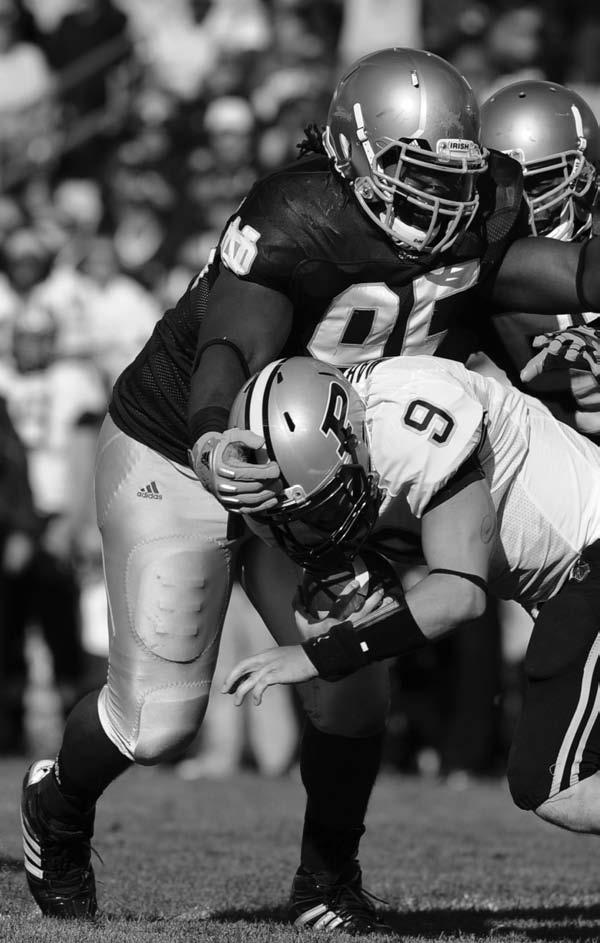
“Yeah, he’s a man,” Kelly said. “I mean, he was dominant for us. He controlled the line of scrimmage from his position. Now, he’s got to have help at certain areas, but he was clearly a dominating player for us on the defensive side of the ball.”
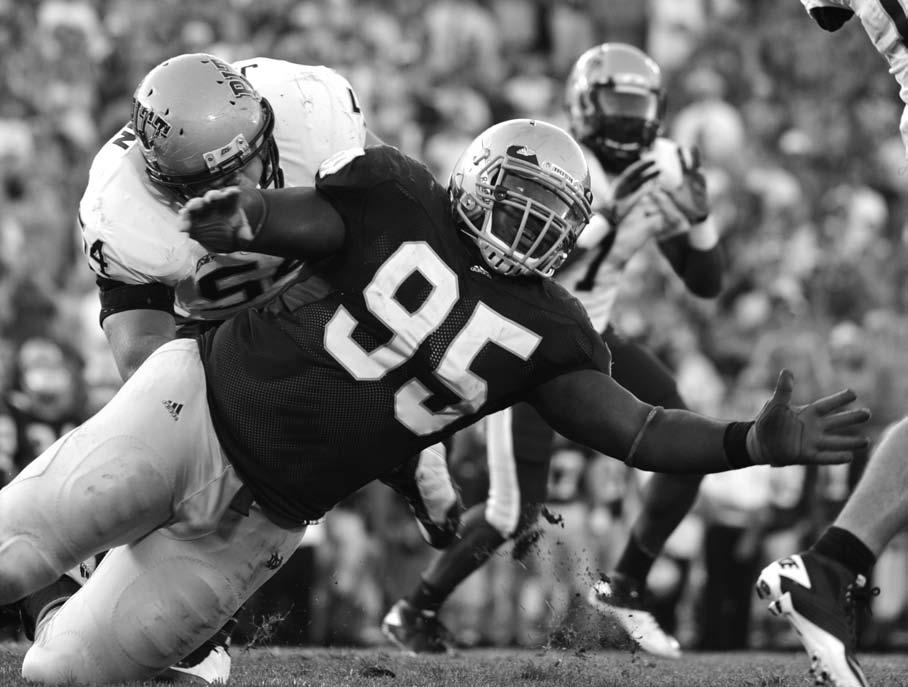
While Kelly may have been pleased, Williams said he still has plenty to improve.
“I personally think I didn’t play that good, so I’ve still got a lot of work to do,” Williams said. “I really appreciate him calling me out and giving me a little pub, but I just feel personally that I still have a lot of things to work on.”
While the generic job description of a nose guard in a 3-4 defense is to “clog the middle,” Williams said it was more specific than that.
“[My job is to] make sure the ball bounces outside,” he said. “Make sure the ball doesn’t come in any of my gaps.”
Once it gets out there, Williams relies on junior defensive ends Kapron Lewis-Moore and Ethan Johnson to make plays. He called Lewis-Moore and Johnson “two of [his] best friends.”
“It helps with chemistry, talking on the field,” Williams said. “We can joke around about little things, keep everything level on the field.”
Despite Williams’ difficult job description, he didn’t miss a game for more than three seasons, until suffering a seasonending MCL sprain against Navy on Oct. 23.
Due to that injury, only linebacker Kerry Neal played in every game of the last four years.
“Me and Kerry, we’ve worked hard since we got here as freshmen,” Williams said. “We made a pact before we got here that we would just try and make plays in every game that we play in.”
One aspect of the game that is not part of Williams’ job
description is pass defense, but in two of Notre Dame’s last five wins — this year against Purdue and last year against Washington State — Williams has recorded interceptions.
“It’s crazy because D-linemen never get interceptions so it’s exciting I got two,” he said.
Against Purdue, Williams caught the ball after senior cornerback Gary Gray tipped it to him.
Williams said he owes Gray a night out to dinner for helping him get the pick.
Williams is currently tied for the team lead with one interception, and has his sights set on more.
“I’m trying to go for more,” Williams said jokingly. “I’m trying to lead the team.”
Notre Dame’s defense currently ranks 79th in the country in run defense, but throughout the season Kelly said he’s seen improvement in the defense.
“Being a defensive player, you don’t want the opposing offense to get any points, gain any yards or anything like that,” Williams said. “So, I mean, that’s a negative right there. But I can see a difference in us from last year.”
Elston said that while Williams’ strong play didn’t surprise him, he foresaw even more improvement during his senior year.
“I expected him to play the way he is playing right now, so it is not really a shock,” Elston said before the Stanford game. “He is not yet, but he can be a dominant, dominant nose guard.”
Contact Sam Werner at swerner@nd.edu
DAN JACOBS/The Observer
Senior defensive tackle Ian Williams brings down Purdue’s Robert Marve during Notre Dame’s season-opening win.
Ian Williams senior defensive tackle
TOM LA/The Observer
Williams played in every game during his first three seasons with the Irish before injuring his MCL during Notre Dame’s 35-17 loss to Navy on Oct. 23.
Gallup relishes both returning a kick and playing the piano
By LAURA MYERS Sports Writer
A concert pianist sits alone on stage, showcasing his skills for an attentive audience.
Fifth-year Barry Gallup, Jr. played piano from kindergarten to high school. At Notre Dame, he turned to a different medium: returning kicks.
“All eyes are on you in the Stadium. You’re pretty much alone back there when they kick the ball to you,” Gallup said. “It’s something I felt real comfortable doing.”
After missing the last four games of his junior season with an ankle injury, Gallup returned to the field in 2009 against Michigan. He returned two kicks for 77 yards, including a thirdquarter return for 52 yards.
“It was the culmination of all my hard work getting back and all the people that supported me, and my family and all my friends staying positive,” he said. “I didn’t know if I was ever going to play again, because I had a pretty bad ankle injury.
“That was a job I didn’t want to give up.”
In nine returns in 2009, Gallup totaled 163 yards. He competed for the job again this season, but fell on the depth chart.
“All the guys give me a hard time, they say the fifth-years are old, so maybe I’m a step slow from what I used to be,” he said.
However, he has still played a significant role on special teams this year, and has made three tackles on the season, including one for loss.
“A lot of people said I proba-
BOBBY BURGER
bly hadn’t made a tackle since high school, but I don’t think I even made too many tackles in high school,” said Gallup, who is listed at 5-foot-11 and 190 pounds.
After the 2009 season, Gallup did not know whether he would come back for a fifth year. When the coaches offered, Gallup answered quickly.
“It wasn’t really a decision for me. It wasn’t a predicament,” he said. “The opportunity to play at Notre Dame one more time, I didn’t have any indecision on my part. Just to be around the guys and to have the opportunity to run out of the tunnel, and to play another season was something I was looking for.”
Because he didn’t know his situation, last season’s Senior Day loss to Connecticut could have been Gallup’s last game. However, he said the seniors are determined to make this year different.
“I think the main difference this year is we want to finish with a win,” he said. “It’s not the same feeling when you lose and your family’s on the field after the game and you give them a fake smile. It’s just not the same.”
The fifth year gave Gallup a chance to explore his interests outside of football, as well. He graduated with a degree in finance after just three years, and has spent the last two years taking graduate-level classes in other subjects that interest him — including piano.
“I don’t think many of my teammates know that about me,” he said. “You don’t see a lot of football players and pianists walking around. … I
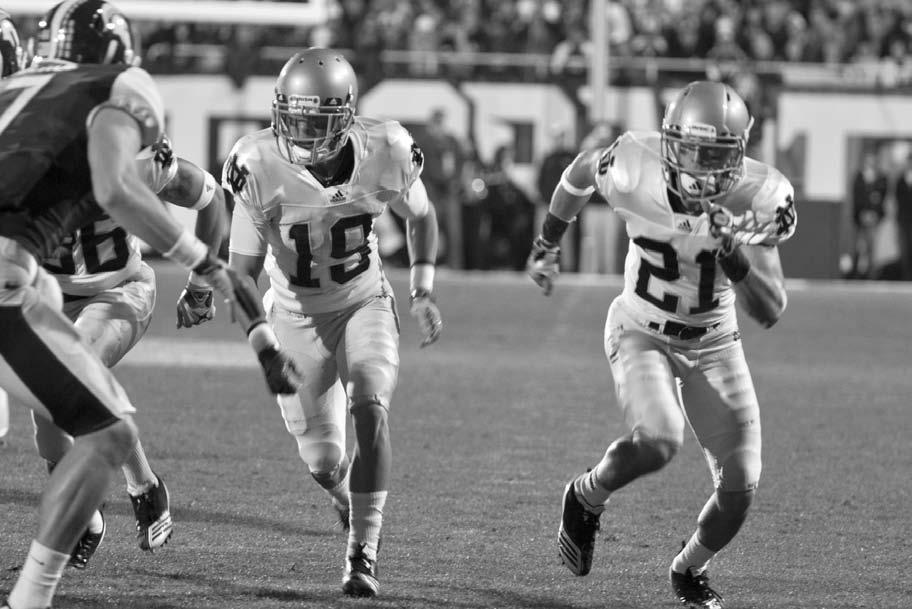
kind of got away from it with football and my finance classes, but I’ve been able to get back into it.” However, he might not have time much longer. Gallup accepted a job with CitiGroup, an investment banking firm in New York City, in October. The job came after many applications and interviews, Gallup said. His academic record probably helped him out, too; he was recently named to ESPN’s academic all-district thanks to his studies in graduate classes.
“That’s something my mom was proud of,” he said. “She was happy to hear that. I’ve got to keep my mom happy. She’s the best.”
In fact, part of the deal for Gallup to attend Notre Dame, which is far from his home in Wellesley, Mass., was that his mom would attend every one of his games.
“I’m really close with my family. My mom, my dad, my sister. They’re all my best friends,” Gallup said. “My mom’s actually never missed one of my games, all five years. She comes to
every game. … I’m forever grateful to her for everything she’s done for me. And my dad, he’s my biggest supporter. And my sister, she’s my best friend.”
After five tumultuous years at Notre Dame, Gallup said he is ready to face the real world.
“It’s been crazy all the stuff that’s happened,” he said. “I think my experiences here have prepared me for life after football and everything I’ll have to go through.”
Contact Laura Myers at lmyers2@nd.edu
Burger leaves starting spot at Dayton for ND
By CHRIS MASOUD
Sports Writer
Dayton scout team defensive player of the year as a redshirt freshman in 2006, a team-high eight sacks the following year, and a Division I FCS Mid Major National Football Championship in 2007 — that would be at the top of senior Bobby Burger’s college football resume.
So why drop a starting spot at a respected collegiate program and transfer to Notre Dame?
“It’s been a lifelong dream ever since I was a little kid,” Burger said. “When I was at Dayton, I gave everything I had to the Dayton Flyers. But my grades were finally good enough, and academically I transferred and was accepted. It’s been a dream come true.”
Burger’s dream developed at a young age, when he came to South Bend to watch football games with his father Bob Burger, an offensive guard for the Irish from 1977-80. While his father played on the national championship team of 1977, Burger has never been pressured to follow in his footsteps.
“He really doesn’t say anything,” Burger said. “He’s been so supportive of me throughout the whole entire walk-on process, earning a scholarship, playing — he’s just been very supportive.”
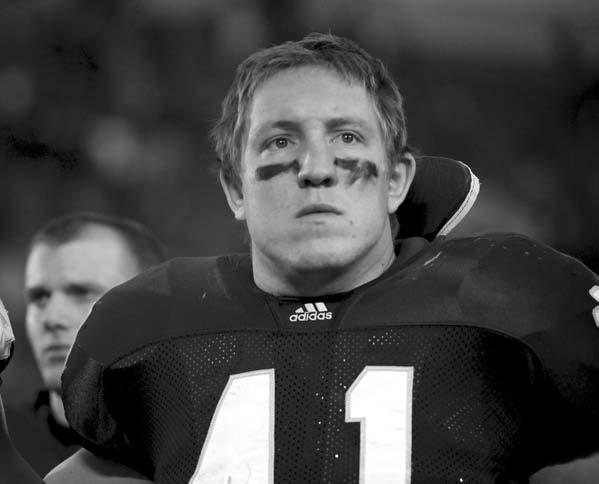
Burger’s transfer from Dayton stemmed from putting in the work in the classroom. But once accepted at Notre Dame, Burger knew he could earn a spot on the team as a walk-on. After a demanding workout process, Burger and his fellow walk-ons forged a relationship known as the WOPU — the Walk-On Players Union.
“We joined the team, and we had three days a week, while we’re having practice, of 5:30
a.m.
workouts. Just a half-anhour, nonstop, no-water, throw up a couple times, that’s okay workouts. At practice, instead of practicing, we did conditioning drills because we ‘weren’t ready to play yet.’”
After emerging as a member of the team, Burger focused his attentions on showcasing his skills that brought a national title to Dayton — on the other side of the ball. The coaching staff converted Burger from a defensive
end into a fullback and a tight end. Burger excelled in his new position on the scout team, earning a scholarship before the start of the regular season.
“I’m proud of that fact, the whole year — earning your respect as a football player, and I think I did that through scout team. I won scout team player of the week several times, and it was just a matter of getting my respect that first year.”
While Burger’s role changed from starter to scout team player, the senior has embraced his role as working to improve the starters on the defense while ensuring that the practice offense mimics the style of each week’s opposition.
“To see the [opposing] offense run the same plays you ran during the week and seeing the defense stop them — that’s definitely satisfying knowing that you helped the defense by doing your part,” he said.
In addition to his scout team role, Burger made 183 appearances on special teams for the Irish in 2009, including his first play in Notre Dame Stadium. Burger started on kickoff return for the first game of the 2009 season against Nevada.
“I’m thinking to myself, ‘Okay, this is the first time I ever ran out of the tunnel, first time I ever put pads on, game jersey on. Just let this one be kickoff so I can kind of
get the flow of the game down.’”
But after winning the toss, Nevada deferred the return.
“I get down in my stance, and it’s kickoff return,” Burger said.
“All of a sudden, I’ll never forget, I started smiling and I told myself, ‘Let’s just do this. This is awesome. This is cool. This is what you worked so hard for.’” Burger’s biggest play for the Irish came later in the season in a 24-21 victory against Purdue on Sept. 26. Burger caught a pass and broke a tackle for a nineyard gain, good enough for an Irish first down on a critical third-and-long situation in the third quarter.
While the senior has relished his moments as a member of the football program, he said he has been especially grateful for his experiences with professors and friends off the field. For Burger, just attending Notre Dame is a dream fulfilled.
“While Dayton was just a wonderful experience, there’s only one Notre Dame,” Burger said. “When you’re young, running around South Quad throwing a football, looking up at the Stadium and seeing all those guys run out there. Sometimes if you put your mind to a goal, even your wildest dreams can come true if you really work hard at it.”
Contact Chris Masoud at cmasoud@nd.edu
GRACE KENESEY/The Observer
Senior receiver Barry Gallup, Jr., has always enjoyed the spotlight, whenever it may find him. After playing the piano through high school, he has gotten his adrenaline-high from returning kickoffs.
SARAH O’CONNOR/The Observer
Senior tight end Bobby Burger began his career at Dayton before transferring to Notre Dame once his grades were high enough.
Moments of glory break through years of strife
By SAM WERNER
Sports Writer ROBERT HUGHES
Before Notre Dame Stadium public address announcer Mike Collins even announces the play, everyone in the building knows who just got the carry. No, the student section isn’t booing. They’re screaming “Huuuuuuughes!”
Senior running back Robert Hughes has become familiar with that sound from the northwest corner of the Stadium.
“[The cheer] means a lot,” Hughes said. “When I hear it, it just kind of gives me that extra motivation to say, ‘Hey, the fans are loving this, so keep doing it and keep going.’ So when I hear it, it just makes me want to run harder and give that much more.”
Perhaps the one play that exemplifies Hughes’ extra effort came last season against Washington.
and pushed the pile and we were just fighting our way for that goal.”
Coming to Notre Dame out of Chicago’s Hubbard High School in the fall of 2007, Hughes made an immediate push for playing time. He made special teams appearances in the first three games of his Irish career, and received his first carries in the fourth. Against Michigan State, he ran the ball six times, mostly in short-yardage situations, for 33 yards and scored his first touchdown.
Just over a month later, though, tragedy struck. On Oct. 30, 2007, Hughes’ brother was shot and killed in Chicago.
“The whole Notre Dame community was excellent in a hard time — my teammates especially. ... A lot of things were going on, but my teammates were there to pick me up and give me a little bit of encouragement and peace of mind.”
Robert Hughes senior running back
With 1:20 left on the clock, the Irish scored a touchdown to go ahead 28-27. Hughes plowed up the middle on the two-point conversion attempt and was stuffed at the line of scrimmage. But then, the pile just started moving slowly towards the goal line. The mass of players creeped in the direction of the goal line until the ball crossed the plane to give Notre Dame a key 30-27 lead.
“I wanted to make sure that my brothers had a good time partying in the end zone, so once I got stopped initially I was just like, ‘Don’t give in. You’re a fighter, so fight,’” Hughes said. “Guys jumped on the pile, jumped on the pile. A couple of my guys came up
Despite the tremendous emotional turmoil, Hughes said the tight connections he forged at Notre Dame were invaluable throughout the grieving process.
“The whole Notre Dame community was excellent in a hard time — my teammates especially,” he said.
“When hard times come, you know, a lot of things go through people’s heads, especially after the tragic loss of my brother. A lot of things were going on, but my teammates were there to pick me up and give me a little bit of encouragement and peace of mind.”
In that weekend’s game against Navy, the Irish drove the ball down to the Midshipmen’s 3-yard line on their opening drive. Hughes came in and powered the ball into the end zone to put the Irish on the board. After the game, then-Irish coach Charlie Weis said Hughes was “going to get [the ball] every play
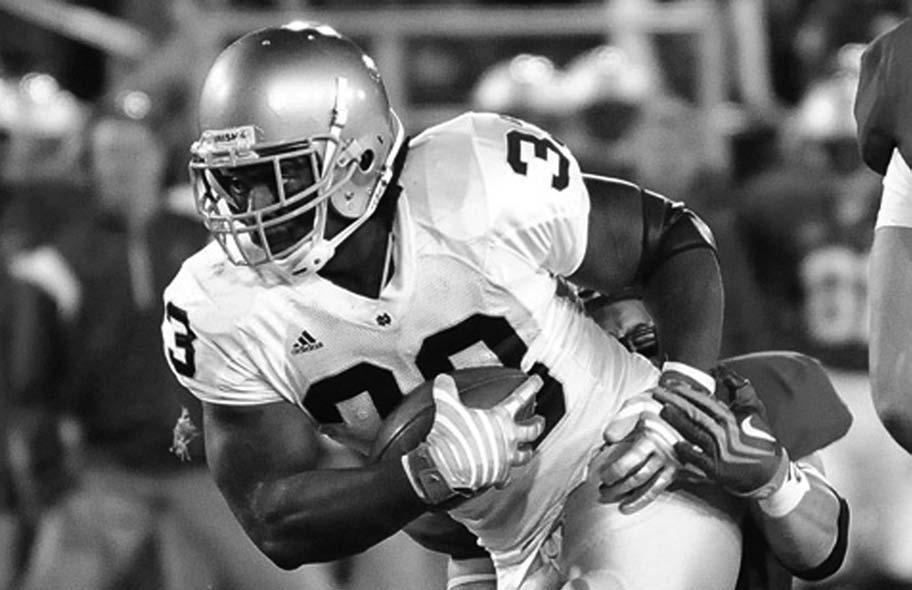
until he got it in the end zone.”
“He gave me the opportunity, and like any other chance, I wanted to score touchdowns and help the team win. I got the ball and was able to get in there,” Hughes said. “I didn’t play the rest of the game because I was a little too emotional on the sideline, but it definitely felt great. That definitely would tie as one of my greatest moments [at Notre Dame].”
Later in the season, Hughes would see the field even more, and make some history in the process. In the final two games of the 2007 campaign against Duke and Stanford, he carried the ball 35 times for 246 yards and two touchdowns, becoming the first Irish freshman to rush for 100 yards in back-to-back games since Allen Pinkett in 1982.
In his sophomore season, Hughes more than doubled his rushing attempts from his freshman campaign. He was most in his element in Notre
Dame’s rain-soaked win over Michigan in the second game of the season, with his punishing downhill style translating into 19 carries, 79 yards and two touchdowns. Hughes, though, hesitates to pinpoint one moment or game as his favorite of the past four years.
“It’s just been a great four years,” he said. “In the course of one year, so many things happen — so many great things happen. To sit here and say there’s one special great moment would just not really shed light on all the time that I had here.”
A year later, Hughes saw his role on the team change slightly. When then-senior James Aldridge went down with an injury, Hughes was forced into duty at the fullback position.
“It just adds versatility to your résumé,” he said of the position switch. “It’s just like any other profession, going and getting experience in different things. Whatever I can do to help the team win, I’ll definitely try my hardest at it and do it because I love the guys on this team.”
When he did get the ball during the junior season, though, Hughes made the most of it. Even though his total carries decreased from 112 to 88, his rushing yards rose from 382 to 416 to go along with five touchdowns. In his first start of the season against Washington State, the junior had a career-high 24 carries for 131 yards and a score.
So far this season, Hughes has been used primarily as a blocking back in Irish coach Brian Kelly’s spread offense, but showed his effectiveness three weeks ago against Western Michigan, when he rushed the ball eight times for 63 yards. Hughes said he has also assumed a lead-by-example role in the Irish backfield this season.
“The leadership role that I play isn’t really using words or being a rah-rah guy,” he said. “It’s really just continuing to fight. I think knowing what I’ve been through and having other guys look at me and see I’m still fighting, still standing strong, hopefully that inspires a lot of guys to keep doing this.”
Hughes said the most memorable part of his Notre Dame experience has been the strong bonds formed in the Irish locker room, through both wins and losses.
“It’s much different than just having regular friends because you’re going through the same things, you’re going through the same struggles,” he said. “It’s good to look over at the guy next to you and know that he’s bearing the same problem’s you’re bearing. You’re patting him on the back and he’ll pat you on the back.”
He did note, however, that the reasons he came to Notre Dame in the first place encompassed more than the football program. Though he considered numerous Big Ten schools during the recruiting process, he said the decision was “hands-down” Notre Dame.
“I could’ve gone to any other school and got though just fine, but I wanted to come here and challenge myself academically,” he said. “I knew it was going to be difficult so I pretty much took a leap of faith, and I knew at the end of the day I’d be better for it.”
Has that challenge paid off?
“I’m much wiser, much smarter than when I came in here,” Hughes said with a smile.
As for this week’s game against Utah, Hughes said the enormity of Senior Day hadn’t even hit him yet.
“It’s amazing how it came up so fast,” he said. “It sort of crept up on me. Feels like yesterday I was running out of the tunnel for the first time.”
Whether or not he realizes it, Hughes’ senior year is winding down, but at the end of the long practices and after disappointing losses, though, there’s always one thing Hughes said he could count on when he goes home — his 1 ½-year-old Dogo Argentino, Raycu, will be there to greet him.
“He doesn’t care whether the day’s bad or good,” Hughes said. “He’s happy to see me and I come home happy to see him.”
Observer File Photo
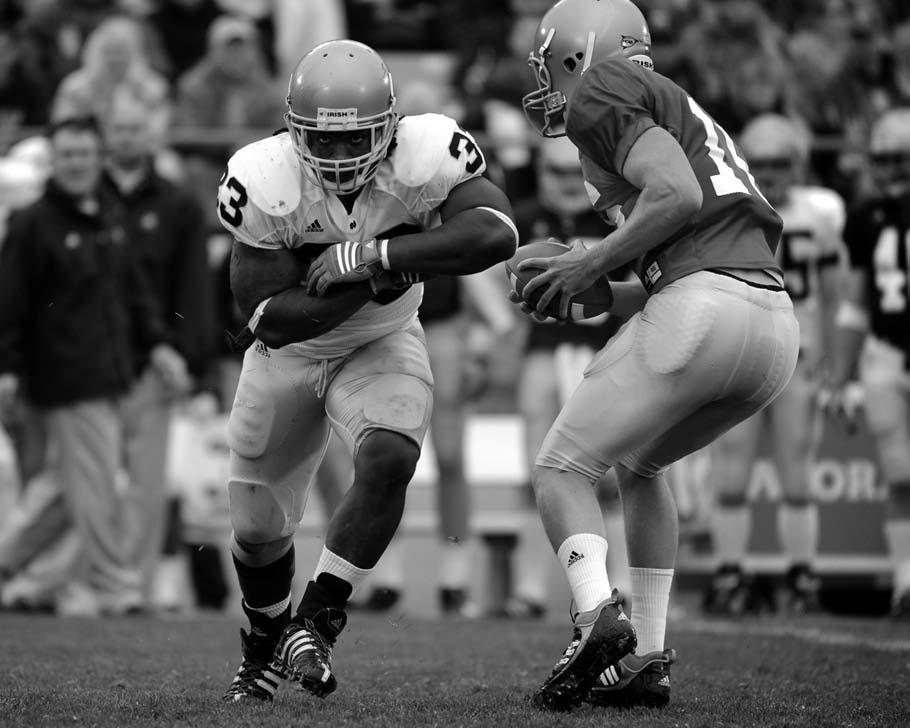
Senior running back Robert Hughes became a fan favorite during his four years at Notre Dame, largely due to his ability to break tackles on play after play.
PAT COVENEY/The Observer Hughes, pictured running a play fake in April’s Blue-Gold Game, has accounted for 13 touchdowns and more than 1,100 rushing yards in his career.
Contact Sam Werner at swerner@nd.edu
One of Walker’s first kicks counts as his favorite
By MICHAEL TODISCO Sports Writer
Many athletes chose Notre Dame at the end of their recruiting process because of the University’s unique blend of athletic tradition and academic excellence. For senior kicker Brandon Walker, it was fate.
While kicking for his Midget football team in fifth grade, Walker’s talents were identified by his hometown Findlay, Ohio, high school football coach. The coach called Walker over and told him that if he kept kicking, one day he could end up playing for Notre Dame.
The young Walker shrugged off the coach’s prediction as a long shot. During his senior season at Findlay High School, it seemed that Walker’s skepticism was well founded. He had committed to play for Louisville under coach Bobby Petrino.
When Petrino fled Louisville for a job in the NFL, Walker’s decision-making process was reopened. Notre Dame was the first school to call. Thinking back to the words of his high school football coach, Walker knew that it was meant to be.
“When Notre Dame made me an offer, I took it as a sign that I needed to come here,” Walker said. “When I took my visit, the school was everything that I thought it would be and more. It just worked out perfectly.”
Walker’s time at Notre Dame was immediately met with immense pressure and mammoth expectations. As one of the nation’s top kicking prospects, Walker was part of the illustrious recruiting class that included quarterback Jimmy Clausen and receiver Golden Tate. The group
DERRY HERLIHY
of talented freshmen was expected to lead Notre Dame back to national prominence.
Walker earned the starting kicker role his freshman year, a season in which the Irish went 39. Walker said that his tumultuous freshman season was a difficult adjustment from high school.
“It was tough to be thrown in there as a freshman and start losing because all of us who had been recruited came from winning programs,” he said.
Although the season was a disappointing one for the Irish, Walker’s favorite memory from his time as a Notre Dame player came during that 2007 season.
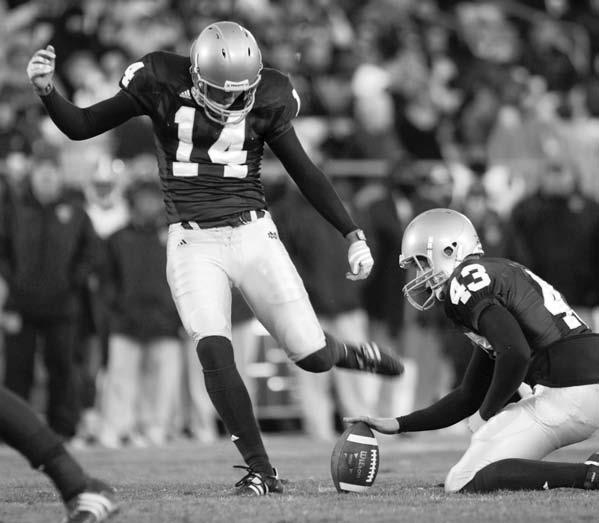
In the game at UCLA, Walker kicked a crucial 48-yard field goal in the third quarter to lead the Irish to victory. Walker said he would always remember his big game at the Rose Bowl.
“The game at UCLA was definitely my defining moment on the field,” Walker said.
Walker said he remembers his strong performance that day with a special souvenir he acquired on the trip to Los Angeles.
“Coach Weis gave me the game ball that day, and it says ‘Rose Bowl’ right on it,” Walker said with a blend of reminiscence and pride. “I gave that to my parents as a Christmas gift to thank them for everything that they’ve done for me.”
Despite a slow start to his sophomore campaign, Walker finished the season strong, connecting on 13 of his last 17 attempts, including six field goals from beyond 40 yards. He even led the team in scoring despite missing the Boston College game.
Walker’s bright career took a back seat to his health in his junior year, when he suffered a seri-
ous back injury. The injury was a particularly difficult time for Walker, as he could not kick at all for the entire year. While Walker contemplated ending his football career, the unity from his teammates drove him to return to the squad.
“There was a time when I thought I would have to hang it up for good because of the injury,” Walker said. “It just wasn’t allowing me to do what I do best or perform at the level that I needed to, but no matter what the guys and coaches were always there for me. My desire to just be part of the team again is what motivated me to get back in shape.”
Walker’s greatest challenge at Notre Dame came not from his opponents, but rather from some of the fervent Irish fans. As a highly touted recruit, Walker certainly had high expectations from the Irish faithful. After struggles in his freshman and sophomore year and his injury junior year, some of the criticism from the fans became hard for Walker to handle.
“I know that the fans are really passionate, but it was really hard to hear some of their criticism,” Walker said. “We have really great fans, but at the same time I have heard plenty of really tough comments.”
After returning from injury, Walker faced stiff competition to regain his job. Nate Tausch and David Ruffer had two of the most successful seasons for kickers in Notre Dame history. After it became evident that he would not win the starting job for his junior or senior season, Walker began mentoring and teaching the young kickers.
“Many times they would come to me and ask for advice or ask-
ing me to watch their form if something wasn’t feeling right,” Walker said. “Definitely being here to help them was important not only for the football aspect but also with life. With Tausch coming in as a freshman, he had a few issues where he wanted to talk with me and I would always be available for him.”
Looking to the future, Walker predicted success for his own career and the Notre Dame football program.
“I was happy when Mendoza became the No. 1 business school just in time for me to graduate with my finance degree,” Walker said. “I am looking into the whole job process and I have a really good lead out in California.”
As for the Irish, Walker believes that coach Brian Kelly is
the man for the job.
“Coach Kelly and his staff are perfect for this institution. What you guys see on the field may not be exactly what you want to see at the moment but everyone here is behind him and the changes are for the best.”
In a final assessment of his time at Notre Dame, one filled with highs and lows, praise and criticism, Walker said that he had not a single regret.
“Even though my career didn’t work out how I imagined, it is absolutely fate that I should be here all the way from Midget football, and I would not change a thing or one moment of my career.”
Michael Todisco at mtodisco@nd.edu
Former rugby player grasps chance as a walk-on
By SAM WERNER Sports Writer
New jersey number, new skill set, new persona — just another week for senior Derry Herlihy.
As a member of Notre Dame’s scout team, it’s Herlihy’s job to mimic opposing players that the first team defense needs to prepare for.
“They’ll give us a jersey number of someone on the other team, and we’re that person for a week,” he said. “I’ve played H-back, running back, wide receiver. But it’s a lot of fun because you’re doing something a little different every week.”
That ability to play multiple positions gives Herlihy a unique role.
“I’m kind of a hybrid, like an X-factor,” he joked.
Herlihy made his first attempt at walking on to the team his freshman year, but didn’t survive the final cut. Instead of giving up, the Houston native returned a year later to fulfill his goal.
During the interim, Herlihy took his talents to the rugby pitch, joining Notre Dame’s club rugby team in its first season returning to Division I.
“Rugby is a man’s game,” Herlihy said. “You have to be a
[grown] man to play rugby.
“It definitely toughened me up a little bit. Hitting someone with pads on is a piece of cake after you do it without any pads.”
Herlihy returned to football full-time in 2009, and said that the main feeling when he made the team was “relief.” After two rounds of tryouts, the 10 or so remaining walk-ons had to survive five weeks of 5:30 a.m.
“workouts from hell,” according to Herlihy.
“I was really excited when I made the first cut in tryouts,” he said. “Then after that it was a constant worry of how did I do today? Who was watching me? Am I going to get cut? It was relief [when I made the team], because by that time all my friends thought I was on the team, so I didn’t want to have to tell everybody, ‘Oh, I got cut.’”
It’s those friends, though, that helped define Herlihy’s four years at Notre Dame. He said the connections he made during his first year in St. Edward’s Hall have held strong up to this day.
“Most of my friends are guys that I lived with freshman year, guys that I lived down the hall from freshman year,” Herlihy said. “You always feel like you’re a part of something greater than yourself.”
Another Notre Dame subculture of which Herlihy is a proud member is the Walk-On Players Union, more commonly known as WOPU Nation. An unofficial club formed by the walk-on members of the team, Herlihy called WOPU “one of the coolest things [he’s] been a part of at Notre Dame.” He said the walk-ons hang out together outside of practice and keep in touch through a “pretty hilarious” e-mail thread.
While WOPU was created in good fun, Herlihy said that it has forged an important bond between the non-scholarship players.
“When [a member of WOPU Nation gets] on the field, every single guy rallies around those guys because they’re representing us,” Herlihy said. “They represent all the hard work we do; we go through everything together. When those guys get on the field and get a chance to make an impact for Notre Dame football, it means something to every single guy in WOPU.”
Herlihy has only seen action in the Blue-Gold Game, but that alone, he said, was a once-in-alifetime experience.
“I think I got three carries for about one yard in the spring game,” he said. “But … just lining up on the field wearing the Notre Dame uniform playing in
Notre Dame Stadium is a special thing — something that I’ll carry with me for the rest of my life.”
Upon graduation in May, Herlihy — an economics and political science double major — said he will begin working in sales and trading for Deutsche Bank in New York. For now, though, he said he’s just trying to enjoy his time as a Notre
Dame football player.
“There’s a million people that would give a ton to be in our place, putting on the gold helmet and representing Notre Dame,” Herlihy said. “So if you have the chance to do that, you’ve got to take advantage of it.”
Contact Sam Werner at swerner@nd.edu
DAN JACOBS/The Observer
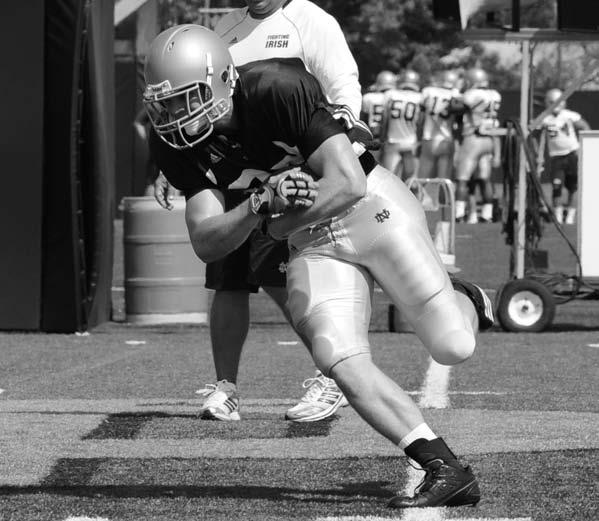
Senior Derry Herlihy has played many roles for Notre Dame as a versatile scout team player.
Contact
Observer File Photo
Senior kicker Brandon Walker converted 20 field goals during his two years as Notre Dame’s starting placekicker.
DAVID RUFFER
Walk-on, now a starter, shatters Irish records
By DOUGLAS FARMER Sports Editor
Editor’s note: This article first appeared in the Oct. 15 edition of The Observer.
When David Ruffer walked off the practice fields Tuesday afternoon, two loyal autograph seekers quickly approached him and asked for his signature. Unsurprisingly, the senior walk-on kicker signed away — something he never thought he would be in a position to do.
“It’s cool I guess,” Ruffer said a few seconds after putting the cap back on the provided Sharpie. “I never really thought of myself as somebody one day who would be signing autographs, but I’ll take what I can get. It’s neat to be in that position.”
Then again, Ruffer never really thought of himself as somebody who would be Notre Dame’s starting place kicker, having never missed a competitive field goal, even splitting the uprights from 50 yards away. In fact, the only aspect of Ruffer’s current life he could have anticipated is the one aspect that initially had been denied him — being a student at Notre Dame.
Denial serves its purpose
Ruffer’s father and grandfather graduated from Notre Dame, as did a few of his uncles and his older sister, but when Ruffer received a response to his application, it was not the response anybody in the family had hoped for.
“I grew up loving Notre Dame. I just wanted to be a student first of all,” Ruffer said. “I didn’t get in as a freshman, and that was probably the best thing that ever happened to me. It made me realize you have to work really hard for the things you want.”
Ruffer then turned his eyes to William & Mary for a year, where, after four years of playing varsity golf in high school, he took up kicking field goals.
After a tryout, Ruffer walkedon to the Tribe football team.
“I walked on there kicking,” he said. “and it’s worked out ever since.”
A field goal and a tryout
Once he transferred to Notre Dame, Ruffer joined the Siegfried interhall football team, and after two games, in which he kicked one field goal and a couple of extra points, attempted to walk on with the Irish.
“It was more of when I would go out and practice [that I impressed people],” Ruffer said.
The tryout process was threefold — one night with only tees and the then-special teams coach Brian Polian, one night with a snapper and holder and Polian, and a final night in front of then-Irish coach Charlie Weis.
“I was really nervous. These guys were going to see me for about 15 or 20 minutes, and if I don’t do really well, they will probably not want to see me again,” he said. “I just hoped I would perform to the best of my ability. I would have obviously been upset with myself if I came out here and didn’t do the best that I know I could have.”
Impress them he surely did, as Ruffer does not remember missing a single kick in the three tryout sessions.
The rest is history
Ruffer only took one kick in a game in 2008, a point-after attempt that clanked off the upright. In 2009, Ruffer took over place kicking duties after incumbent Nick Tausch injured his foot, and Ruffer connected on nine of his 10 point-after attempts, and all five field goal attempts.
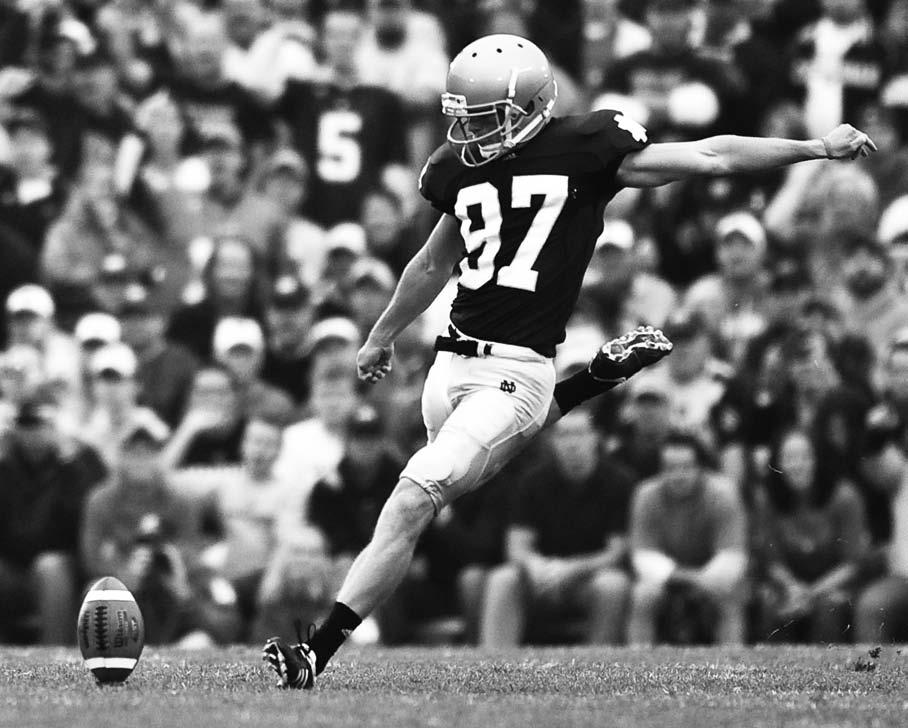
After nine games this season, he has made all 13 of his field goal attempts, bringing his Notre Dame career total to 19of-19. Including his one field goal as a Rambler, Ruffer has never missed a field goal attempt in competition.
By making kick after kick, Ruffer has raised the Notre Dame standard for place kickers. His 18 consecutive made field goals bested Tausch’s school record of 14, as well as the previous record for most consecutive made field goals to open a career, which was previously 13.
“I try not to think about [the streak],” he said. “Right now I’m zero-for-zero with Western Michigan coming up, and that is how I approach every game.”
Ruffer’s 50-yard kick against Pittsburgh tied the sixthlongest field goal in Notre Dame history. The longest in school history was kicked in 1976 by Dave Reeve, a 53yarder. Reeve should not count his record safe as long as Ruffer is kicking, according to special teams coach Mike Elston.
“I see the kid kick 52 or 53 yarders every day,” Elston said. “We were well in front of his threshold [on the 50-yard field goal] which is really about the 35-yard line.”
‘Kickers are head-cases’
After the Pittsburgh game, in which Ruffer also connected on 32- and 31-yard field goals, he attributed much of his success to junior holder Ryan Kavanagh, also a walk-on.
“Ryan Kavanagh is one of my best friends and he will say something to keep me calm,” Ruffer said. “But then from when the ball is snapped to when I kick it I don’t know what happens.”
Tuesday Kavanagh said he knows he needs to keep a close eye on Ruffer, if for no other reason than the position he plays.
“Kickers are head-cases,” Kavanagh said. “You have to make sure they’re honed in on the ball.
“I just give him a couple reminders, take it easy, make sure he takes a deep breath ... I just make sure he’s just focused on the kick.”
Elston said he has seen the
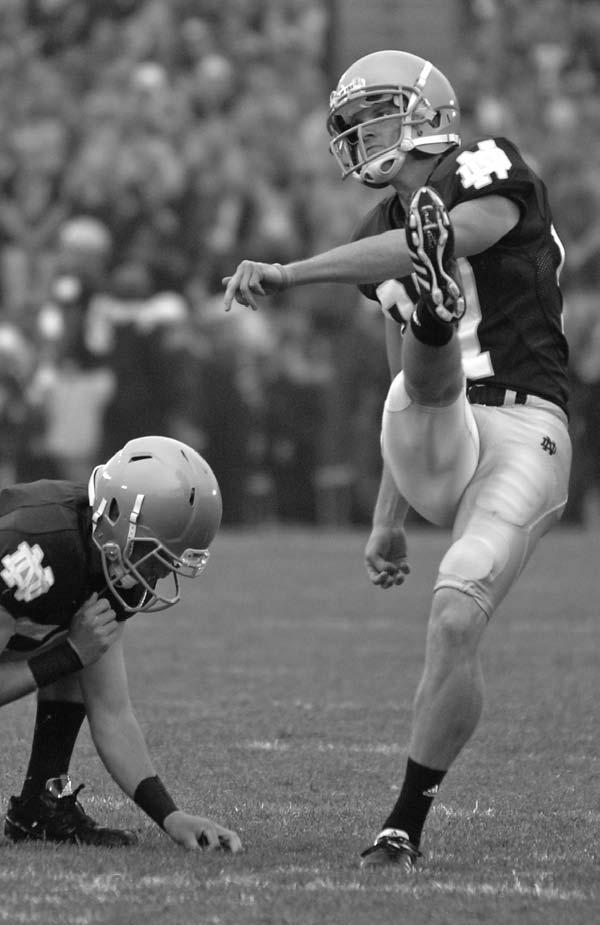
“head-case” in kickers that Kavanagh refers to, but in Ruffer it is more of an even demeanor that Elston sees.
“The kickers that I’ve been around that are good athletes, that have a good demeanor, that aren’t just specialists as kickers and have done other things in their athletic career, they typically tend to be more competitive and more evenkeeled when they take the field in pressure situations,” Elston said. “Because they are used to being in it.”
Whatever reasoning Kavanagh and Elston have for his success this season, Ruffer thinks he has found a groove simply because he has relaxed, in all areas of his life.
“I still work really hard [in school], but before I was really a perfectionist. Now I have grown up to a point where I realize things won’t always go your way,” Ruffer said. “That little bit of a laid-back attitude has helped my focus a little bit.”
At some point, things on the football field won’t necessarily go Ruffer’s way. He may miss a field goal — believe it or not, he does miss them in practice. When the Saturday afternoon comes that one goes awry, Ruffer said he is ready to deal with that setback.
“You can only learn from mistakes,” he said. “You can’t make every single one, so it will happen eventually. The trick will be how I bounce back from that. It will happen, but I feel like I have a pretty strong head, so I’ll be okay.”
‘Not For Long’
If Ruffer keeps making each and every one of his field goals, questions concerning the NFL are bound to come his way.
Ruffer qickly dismisses those thoughts.
“I don’t plan on playing football forever,” he said. “It’s probably going to end after this season and I’ll need to get started on the next chapter of my life.
“NFL stands for Not For Long, right? I would give it a shot, but if there is something else that gives me more of a sense of fulfillment, I’ll do that instead.”
Amid all of his success on the field, the primary reason Ruffer is at Notre Dame hasn’t changed — the same reason he wanted to come to the University in the first place.
“It’s been difficult, but I still think of myself as a student first,” he said. “That’s why I’m going through the interview process right now, and just trying to get that Notre Dame degree.”
Ruffer, an Economics major, interned in the accounting department of Gurley Leep over the summer, and has not decided what he will do after graduation, nor has he ruled much out.
“I could go and be a house husband,” he said. “If my wife is the bread winner, maybe I’ll just take care of the kids.”
He may not know what the future holds, but Ruffer did not expect any of what the present holds either, as he continues to move past his wildest dreams, field goal after field goal.
“I never thought this was going to happen. Obviously I thought it’d be something cool, but never to this magnitude. I can’t say it’s a dream come true, because I never really dreamed of this much.”
Contact Douglas Farmer at dfarmer1@nd.edu
GRACE KENESEY/The Observer Senior kicker David Ruffer has never missed a field goal for Notre Dame, standing at 18-for-18 over the past two seasons.
YUE WU/The Observer
Ruffer began his college career as a walk-on at William & Mary before transferring to Notre Dame. After one season playing interhall football for Siegfried, he joined the Irish.
Two-sport star leaves track behind to walk on
By ANDREW OWENS Sports Writer
For many high school students, picking a college is a simple decision — just choose the one that has the best balance of academic and athletic prestige. For senior cornerback Ryan Sheehan, the decision was a little more complicated.
An eight-time varsity-letter winner at Loudon Valley High School in Purcellville, Va., Sheehan starred in both track and football. In track, he won conference and state titles while setting school records. In football, his list of accomplishments was no less stellar, earning all-district honors and ranking at the top of his team in both rushing yards and tackles. His senior year, Sheehan was named Loudon Valley’s Most Outstanding Male Athlete.
Sheehan faced the decision of fulfilling his dream of becoming a college football player at a small school, or coming to Notre Dame under scholarship as a track athlete. Unlike his four brothers who made the decision to play college football, Sheehan decided to go in a different direction and accept Notre Dame’s scholarship offer.
But during his freshman year, Sheehan partially tore his Achilles tendon, ending his season and leaving him out of action for eight months. The lengthy healing process gave Sheehan a chance to evaluate his priorities, during which he made the decision to drop track and follow his true passion — football.
“When I made that decision, I was unsure of how my family would react to me quitting track,” Sheehan said. “It turned out that I had my family’s full support.”
As Sheehan learned, it would be no small task to switch sports. During his sophomore year, tryouts were held at 4:30 a.m. for the entire semester. During such a difficult time, Sheehan reflected that it would have been easy to simply give up, but that he always had the support of his family.
“I was the first from my family to come here, and I rave about this place all the time when I go home. I have no doubt that I am a better person now than when I first started here.”
Ryan Sheehan senior cornerback
“My parents and my brothers helped me get through it,” Sheehan said. “They come to the games even though I have not gotten much playing time. They make the drive from Virginia every weekend to see me on the sidelines.”
Despite making the squad, the nature of being a studentathlete prevented life from getting any easier. He now
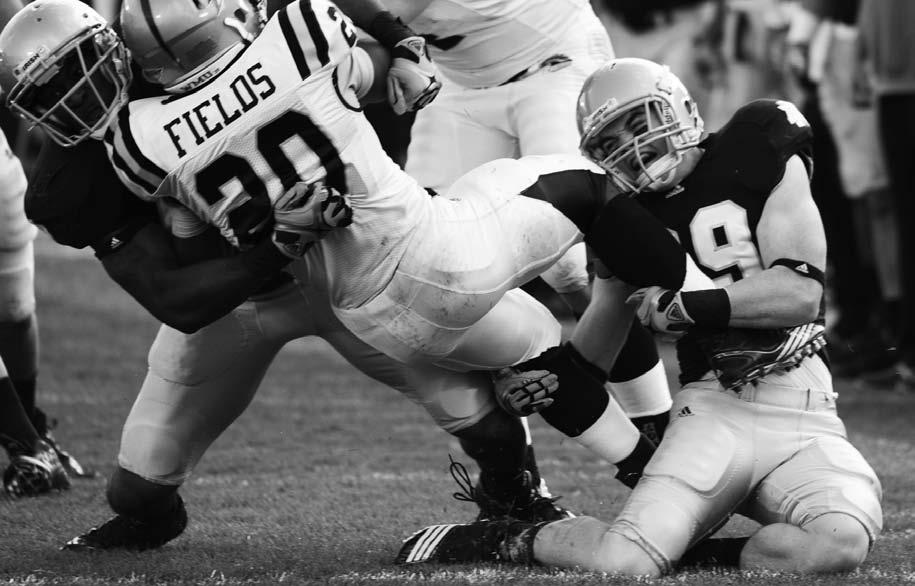
had to juggle the life of a varsity athlete with the academic workload of a Notre Dame student — without a full scholarship this time. Nevertheless, Sheehan believes that having such a busy schedule ending up helping, not hindering, his academic life.
“I’ve actually gotten better grades since joining the football team even though I have had more difficult classes as I have gotten older,” Sheehan said. “I had to put in the time to make sure I did well. I had no choice but to work hard or fail.”
Sheehan added that a typical day in his life includes classes, practice, and then heading straight to the library to do homework.
All of the experiences Sheehan has encountered during his time at Notre Dame have prepared him to excel once he graduates in the spring. As an accounting major, he plans on pursuing a master’s degree, but is still unsure of where that will be. This summer, he will be working in the field of public accounting in Washington, D.C.
Despite the struggles, set-
backs and hardships he has faced, Sheehan looks back on his time at Notre Dame with a positive attitude.
“I’m very happy with my experience,” he said. “Coming here and meeting all the people, especially the other walkons, has exposed me to something unique. I was the first from my family to come here, and I rave about this place all the time when I go home. I have no doubt that I am a better person now than when I first started here.”
Contact Andrew Owens at aowens2@nd.edu
JAMES REDSHAW
4.0 GPA not all that defines cornerback’s Notre Dame career
By ANDREW GASTELUM Sports Writer
The priorities of the student come before the priorities of the athlete, and according to senior cornerback James “J.T.” Redshaw, that’s the way it should be.
Redshaw graduated as his high school’s valedictorian
while captaining the football and baseball teams at Norwin High School in Pittsburgh, Pa.
“Academics and sports have always been a big part of my life, since I was little,” Redshaw said. “My parents always taught me that grades come first, but I never really got good grades for anybody else but myself, because that was what I wanted to do.”
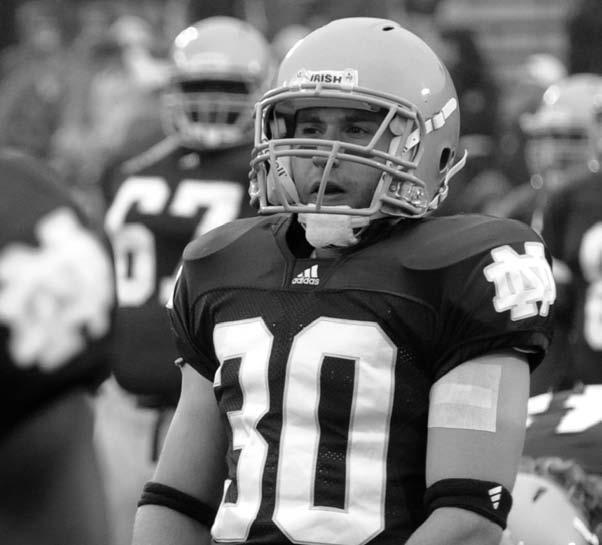
Even with a schedule filled with medical school interviews, keeping up with friends, and football practice in the afternoon, Redshaw’s pre-med major still makes academics his No. 1 priority. The senior has maintained a 4.0 GPA while transferring his drive and dedication to the football field.
“Coming out [to practice] against this caliber of athletes always keeps you driven and motivated to do whatever you can to help the team for the upcoming Saturday,” Redshaw said. “I love waking up every day and coming here to be a part of this team, knowing that I contribute to something great.”
undersized makes you realize how important the intangibles are in football because you can’t teach that,” Redshaw said. “It serves as inspiration that shows you how important every rep is in practice and where it can get you.”
While Redshaw draws inspiration in those around him on the football field, he finds motivation in his family, trying to return their sacrifices with his success.
“You wouldn’t want to tell anybody about the tryouts because at any moment you could get cut.”
“I see all of my family’s hard work to get me to a place like ND, so it’s the least I can do to just give my best effort when I am given this wonderful opportunity,” Redshaw said.
James Redshaw senior cornerback
Without his football pads, the 5-foot-9 cornerback is hardly recognized on campus, often having to prove his position on the roster.
But Redshaw finds inspiration in former walk-on, and 2009 graduate, Mike Anello, who became a special teams expert and fan-favorite despite his small stature.
“Seeing everything that [Anello] went through being
Football and family seem to mesh well in the Redshaw family, especially living in a football town in western Pennsylvania.
“Growing up in Pittsburgh, football is a way of life,” the senior said. “My dad was one of those dads that make sure they show up for every practice and game, and for him to see me play for Notre Dame is something special.”
When breaking the news that
he made the team to his family during spring of his freshman year, Redshaw waited until Easter break, a week before the annual Blue-Gold exhibition game.
“My dad practically fell out of the booth while my mom just started crying,” Redshaw said. “It just shows how much that meant to them, knowing how important football is to me. They really had no idea that I was trying out for the team.”
In fact, the only person close to Redshaw who knew that he was trying out for the team was his roommate, and that was simply a result of Redshaw waking up at 4:30 a.m. to work out with the squad.
“You wouldn’t want to tell anybody about the tryouts because at any moment you could get cut,” Redshaw said. “I didn’t want to get anyone’s hopes up, and especially not mine.”
Despite the early practices and the grueling process, Redshaw quickly adds that he would do it all over again in a heartbeat.
“Putting on the gold helmet is truly special and I will cherish it forever,” Redshaw said. “It is something that has epitomized my time here and my whole college experience.”
COLEMAN COLLINS/The Observer
Senior cornerback Ryan Sheehan, on right, originally came to Notre Dame planning to focus on his track career, but in due time, he placed his walk-on status with the football team above all else.
Courtesy of Lighthouse Imaging
Senior offensive guard Chris Stewart found playing under the Dome a different atmosphere than the one he came from.
DARRIN
Calvin Johnson, BCS berth highlight Walls’ career
By ANDREW OWENS Sports Writer
Many times life does not go as planned, even for a highly recruited football player. Irish senior Darrin Walls has constantly faced adversity over the past several years, but he has overcome it and contributed with four years of playing time, three as a starter.
In fact, Walls’ football career nearly came to an abrupt end before he even had visions of running out of the tunnel at Notre Dame Stadium.
“My sophomore year in high school I had shoulder surgery and I thought my career was done,” he said.
Walls fought through the pain and rehabilitation to return to the team his junior year. While things were starting to return to normal on the football field, he experienced tragedy in his personal life. Two of his cousins, ages seven and 30, died within a year of each other. Once again Walls experienced hardship and needed support and mental toughness to fight through it.
as a freshman, he did so as one of the top 30 players in the nation from the previous recruiting class, according to most websites. The expectations were high, and Walls was pressed into action from the get-go. He earned playing time during his freshman season in the secondary for the Irish, who entered the 2006 season ranked No. 2 in the country.
In his collegiate debut, Walls had the difficult task of covering All-American wide receiver Calvin Johnson of Georgia Tech. The Irish freshman held the future second overall pick in the NFL Draft to two catches and 16 yards in the second half. The shutdown of Johnson was crucial in helping Notre Dame earn a hard-fought 14-10 victory in Atlanta.
Walls immediately had to perform at a high level not only on the field, but also in the classroom.
“I’d say the support and the caring of everyone including the students at Notre Dame has been great.”
Darrin Walls senior cornerback
His senior year, as a fivestar cornerback and prized recruit, he needed shoulder surgery again. Despite the setback, he received offers from Florida, Michigan and in-state schools Pittsburgh and Penn State, before eventually deciding that Notre Dame was the institution best suited for him.
When he stepped on campus
As a double major in psychology and sociology, he quickly learned how to balance academics and athletics.
“I mean it’s been tough, especially my first couple years, because it was an adjustment to academics and having to juggle football at the same time,” Walls said. “It was difficult coming out of high school. Here you have so many things that demand time, but it’s been good. Notre Dame has so many academic services for student-athletes to help with the transition.”
One of Walls’ most memorable moments occurred in his fourth game at Notre Dame. The Irish, fresh off a
47-21 loss at home to Michigan, were in East Lansing and trailing Michigan State 37-21 in the fourth quarter under extreme weather conditions. Walls and the Irish pulled off a dramatic comeback to win the game, 40-37, and save the season. Had Notre Dame lost that game, they would have fallen to 2-2 on the season and would have had to win their final eight games to earn a BCS berth.
While Notre Dame finished the regular season 10-2 and reached the Sugar Bowl, the fortunes of the Irish would soon change. The team endured a nightmarish 3-9 season in 2007 after the graduation of several stars, including quarterback Brady Quinn and wide receiver Jeff Samardzija.
Despite the team’s struggles in the 2007 campaign, Walls’ top memory from his time at Notre Dame occurred in the second week of the season. As the starting cornerback in a difficult environment at Penn State, he recorded his first interception on a pass from Anthony Morelli and returned it for a touchdown, the only time the Irish would reach the end zone that evening.
“It was a special moment for me,” Walls said. “I was able to record my first interception and touchdown in my home state. My entire family was at the game and was able to see it.”
When the Irish players returned to campus in the fall of 2008, their starting cornerback from the previous season remained home. Walls remained in Pittsburgh for the entire semester and sat out the football season due to personal reasons.
“I was at home for a semester,” he said. “Basically I took some time off and tried to bounce back. I learned a lot
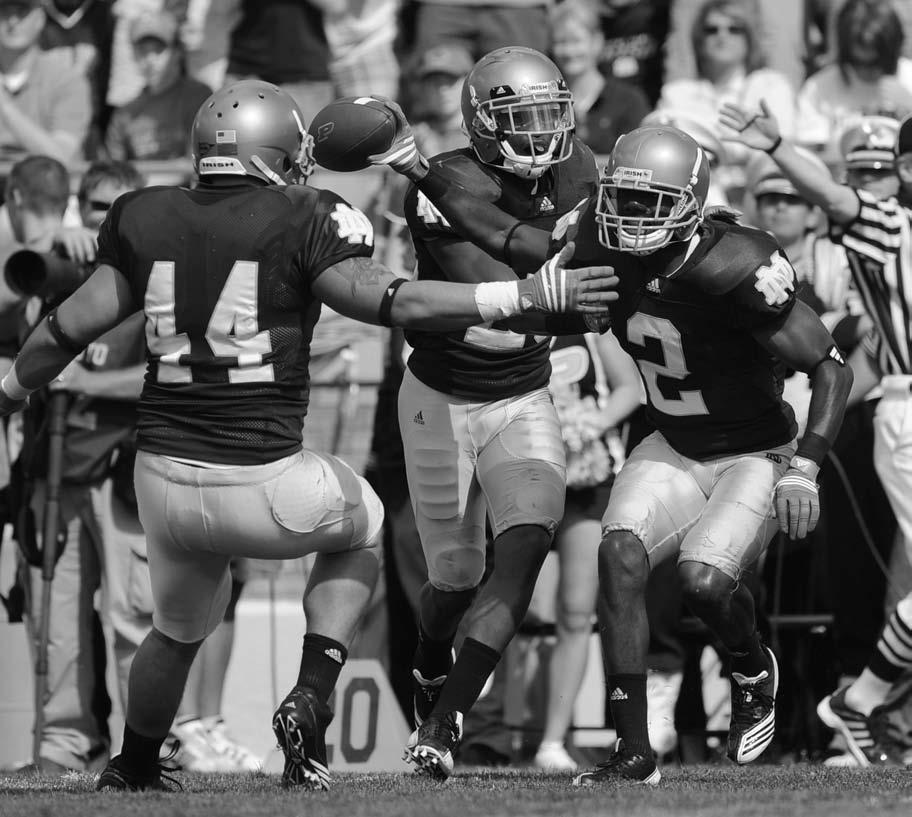
from that experience. I learned to avoid taking anything for granted. It’s important to appreciate what you have in life and I learned that Notre Dame is a special place and that I’m fortunate to be here.”
But adversity was nothing new for Walls. He had been through it before and, once again, overcame it.
He returned to campus for the spring semester and regained control of the starting cornerback position. With much of the squad returning and what many considered to be a favorable schedule, the Irish headed into the 2009 season with high expectations, despite the many questions surrounding the program following a 7-6 season.
Walls started eight games and played in all 12 as an important member of the defense. Once again, hope turned into despair once the Irish finished the season 6-6 and fired coach Charlie Weis. It was another turning point for both the program and Walls.
Shortly after terminating Weis’ contract, Notre Dame hired Brian Kelly to take over the football program. The change at the top also meant a completely new defensive staff, meaning Walls would play under his second head coach and fourth different defensive coordinator in his four seasons. Rather than use the experience as an excuse, he turned it into motivation for his final season with the Irish.
“I feel like sometimes it’s good to have a new start and new beginnings,” Walls said. “Every coach I’ve had has been a great coach and I’ve learned a lot. Good things are going to happen with this program.”
He entered the season as the most experienced member
of the secondary, having started 21 of 32 games for the Irish. His 16 pass breakups ranked ninth in Notre Dame history at the start of the 2010 campaign.
Once the final snap takes place Saturday evening and the seniors sing the Alma Mater for the final time as players in Notre Dame Stadium, reality will sink in and they will realize that their collegiate careers will quickly come to a close. Walls, however, is intent on making the most out of the lessons he has learned and making a bright future for himself.
“I’m not really sure where the future will take me,” he said. “We’ll see what happens after the season and how everything turns out. I’d like to try to go to the NFL. If my football career is over I’d like to work with kids somehow and coach football at the high school level.”
During the difficulties he has faced over the past several years, Walls has received the full support of others to help him overcome the setbacks.
“I’d say the support and the caring of everyone including the students and professors at Notre Dame has been great,” he said. “Everyone cares about each other and it is a loving place. They tell you that when they’re recruiting you, but it’s true.”
Not only has the Notre Dame community enabled Walls to fight through difficult times, but so has his family.
“I’d say my brother and sister don’t know this, but they are my greatest inspiration for playing well and playing hard,” he said. “They don’t know, but I play for them and I just want to be a good role model for my family.”
Contact Andrew Owens at aowens2@nd.edu
SARAH O’CONNOR/The Observer
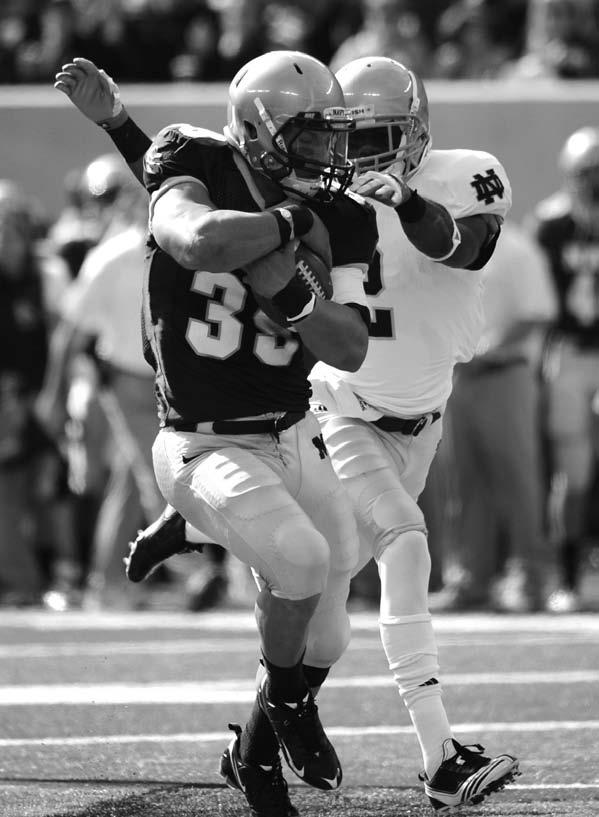
Senior cornerback Darrin Walls tackles a Navy ballcarrier from behind during Notre Dame’s 35-17 loss on Oct. 23.
DAN JACOBS/The Observer
Walls has four interceptions in his career with the Irish, including this one against Purdue during Notre Dame’s season-opening victory over the Boilermakers.
BRIAN CASTELLO
Calling in plays earns back-up quarterback airtime
By LAURA MYERS Sports Writer
Notre Dame’s backup quarterbacks signal plays with dynamic and often humorous gestures. But Bryan Castello’s favorite sign is more subdued.
“The victory kneel,” the senior walk-on said. He demonstrated the sign by raising his right hand with his middle and ring fingers in the air, thumb and index finger together and pinkie folded.
“It’s the signal of the Red Army, which is what we call the quarterbacks. And we won, so we get to do the victory kneel.”
Castello nearly always stands to the direct left of Irish coach Brian Kelly when Notre Dame is on offense, and is caught on TV often when the cameras look to the sidelines for Kelly.
“We move it around, but more often than not I am next to Coach,” Castello said.
“Gives me a lot of TV time. … I’ll take whatever publicity I can get.”
Castello tried out to be a walk-on in the spring of his freshman year with friend Chris Bathon, who graduated in 2010. Both made the team — Bathon as a defensive back and Castello as a quarterback.
“The worst thing that happens is you don’t make it,” Castello said. “But I worked hard enough, and I got on the team and have been for three years.”
In those three years, the Pittsburgh native has practiced with many other quarterbacks, including several
PAT COUGHLIN
from California.
“Our quarterback room is very California versus Midwest, with Dayne [Crist], Nate [Montana] and [Matt] Mulvey being from California and then myself, [Andrew] Hendrix, Luke [Massa] and Tommy [Rees] being from the Midwest,” he said. “We send some jokes their way, they send some jokes our way. It’s all in good fun though.”
Castello has also gotten close with the rest of the walk-on players, in what they have termed the Walk-On Players Union.
“Everyone knows the trials
and tribulations of walk-ons, and that brings us all together,” he said. “We all have a common characteristic: a lot of walk-ons are really good guys and that’s who you want to surround yourselves with. So yeah, WOPU Nation.”
The walk-ons have a formal every spring and make plenty of T-shirts. Castello said the saying on this year’s shirt is especially meaningful.
“This year’s is ‘Going pro in something other than sports,’” he said. “Because it’s true for almost everyone.”
“Going pro” means law school for Castello, an aero-
space engineering major. He is in the process of applying, and listed Georgetown, Duke and Michigan as his top three choices.
“I know that’s not your conventional path,” he said. “Coming out of high school I knew engineering was the right choice for me. I don’t know how I decided but I decided on aerospace. In the last year and a half or so, I started seriously considering law school to the point where now I’m 100 percent committed to law school.”
“It’s a lot like the ‘Social Network’ movie, like copyrights and trademarks and licensing,” he said. “That’s what I see myself doing.
“I’d be the one getting the people that deserve the money the money.”
Castello’s father, a Notre Dame alumnus, is also a lawyer. Castello said he talked to his dad, director of athletics Jack Swarbrick and several other attorneys in choosing to pursue law.
Castello acknowledged the help of Notre Dame’s alumni network as he “moves closer to the real world,” but his time at school is not over just yet, and he said the time spent with friends makes up his favorite memories.
“Different events you have with your friends, whether it be a certain social event you go to, or event you put together with your friends and teammates,” he said. “I think those define your college career.”
And if the seniors from WOPU Nation form a Bookstore Basketball team this spring, Castello will be on it.
“Basketball was really my first love from a sports standpoint,” he said. “But you know what, football’s really a great time. Especially at Notre Dame, you experience the tradition of Notre Dame football and it’s something truly special.”
While his technical expertise would help in practicing patent law, Castello said he would like to branch out and work in intellectual property law.
Contact Laura Myers at lmyers2@nd.edu
‘Turtle’ emerges as special teams contributor
By MATT GAMBER Sports Writer
Patrick Coughlin’s 11 carries for 80 yards in last year’s Blue-Gold Game didn’t catapult him into competition for time in a crowded Irish backfield. But the walk-on’s surprising performance in his first live reps at running back since eighth grade helped lay the foundation for meaningful time on kickoff and kick return as a senior.
“Playing in that game was the beginning of me thinking that I can really play with these guys and contribute to this team. It was definitely the first time I thought that,” said Coughlin, who played receiver under the previous coaching staff. “The transition to running back through the whole spring — being in the trenches, carrying the ball, getting more involved in everything — all helped make me a lot more confident.”
Fast forward to fall camp when, as a member of the scout kickoff team, Coughlin proved too much for the first Irish return unit to handle in practice. During those valuable reps, Coughlin was consistently winning the race down the field, going unblocked and making the tackle — the three keys to successful kick coverage.
“Finally, one day, we’re watching film of the prior day’s kick
return practice, and [Irish special teams coach Mike] Elston was just like, ‘Who’s that kid running down on scout team? You need to be running with the two-deeps,’” said Coughlin, who saw an opportunity that might someday lead to playing time. “That five-minute period of kickoff, I had a game-day Saturday mentality running down every play. Eventually, the coaches noticed that and got me in.”
Coughlin, whose friends call him “Turtle,” made his Irish debut when, during the opener against Purdue, an injury to a starter on kickoff gave him an opportunity to run with the first team. The move seemed temporary, however, as Coughlin remained in a backup role until the following Thursday morning leading up to the Michigan game.
“I got a text from [fellow walkon Nick] Lezynski that said, ‘the new depth charts are up, and you’re starting on kickoff,’”
Coughlin said. “I couldn’t really believe it, so I got in my car 15 minutes earlier than I normally do and went to the locker room myself before class to check it out.
Once I saw I was up there, the next 48 hours were just a blur — calling people, watching a lot of film and just making sure I was 100 percent prepared to succeed and not let it just be a one-time thing.”
Coughlin was credited with two
tackles in Notre Dame’s loss to the Wolverines, and he also made open-field solo tackles against Western Michigan and Navy. But that game against Michigan still stands out, Coughlin said.
“That was the most exciting game for me on the field because we started down early in the first half, came back with two touchdowns, and I got to run down the field while the place was just erupting,” he said. “That was the coolest feeling of my football career.”
A career that nearly ended after a shoulder injury cut short his senior season at Chicago’s Brother Rice High School. Hoping to play a college sport, Coughlin dedicated himself to track, winning the Catholic League’s high hurdles title and qualifying for the state meet. After Coughlin decided to attend Notre Dame, his high school coach convinced him to join the Irish track team. Injuries hindered his freshman track season at Notre Dame, and once sophomore year rolled around, it had become clear to Coughlin that he missed his athletic passion: football.
The turning point came at the 2008 Hawaii Bowl, where Coughlin traveled to watch his older brother Brian, then a walkon who graduated last May.
“Walking on had always been in the back of my mind, but it wasn’t
until that trip that I really realized how much I missed playing football,” said Coughlin, an accounting major who hopes to follow in his brother’s footsteps once again and achieve a Master of Accountancy from Notre Dame next season. “I saw the camaraderie of those guys, and especially of the WOPU [Walk-On Players Union] Nation, and that convinced me to give it a shot.
“I owe a lot to Brian. He was always there, as a guy who had been there before, telling me throughout that I could compete with anyone. I was just like yeah, whatever, but he kept it in the back of my mind that I could really play and not just be a scout team guy. And now I’m playing.”
Contact Matt Gamber at mgamber@nd.edu
COURTNEY ECKERLE/The Observer
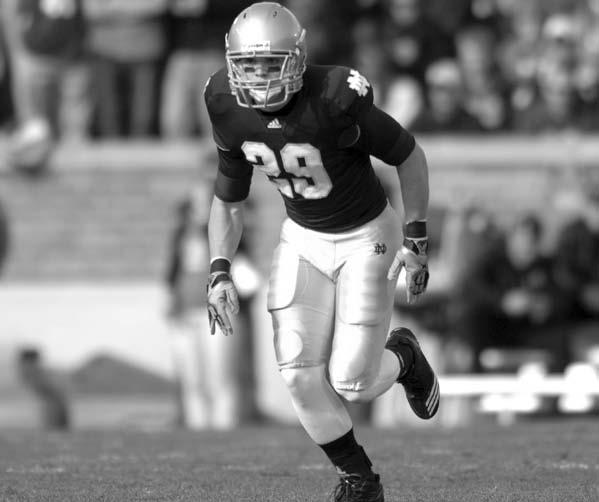
Senior walk-on running back Pat Coughlin’s practice mentality earned him a spot on the kick return two-deep depth chart.
TOM LA/The Observer
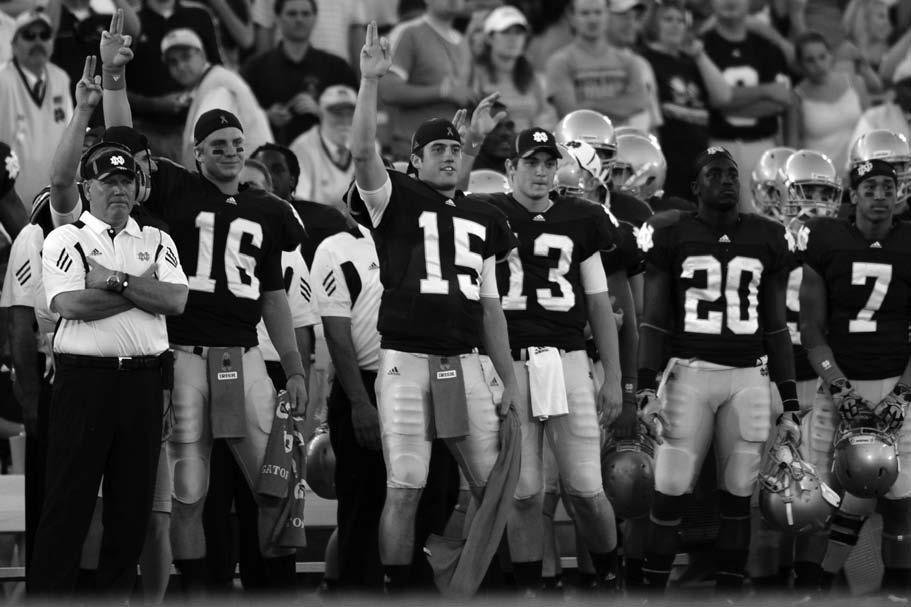
Senior walk-on quarterback Brian Castello, 15, signals in “the victory kneel” in the closing moments of Notre Dame’s 23-17 victory over Pittsburgh on Oct. 9.
Amid years of change, safety adapts in form
By BLAIR CHEMIDLIN
Sports Writer
When asked how he feels about this weekend’s game against Utah being his last football game in Notre Dame Stadium, senior safety Harrison Smith replied quickly, “That question doesn’t apply to me.”
According to Smith and defensive backs coach Chuck Martin, Smith, who red-shirted his freshman year, will most likely be coming back for the 2011 season.
The 6-foot-2-inch, 214pound Knoxville, Tenn., native has played both safety and linebacker during his college career. It wasn’t until this season that Smith found stability on the field, when Irish coach Brian Kelly declared early on Smith would have only one position on the gridiron.
“He never would be an outside linebacker in our system,” Kelly said during spring practices. “He’s always been a safety. If he can’t play safety, he can’t play. It was pretty easy for that one.”
Just as Smith’s position on the football field has flipflopped back and forth between safety and linebacker, and finally settled this season, his hairstyle has changed dramatically over the years as well. After keeping his hair short and tidy in high school, Smith decided to grow it out in college.
By fall of his sophomore year, his eyes were hardly visible beneath his bangs. The following year, this problem was remedied when his hair was long enough to part down the middle, no longer impairing his vision. His long hair became a favorite subject among friends and media alike, until Smith decided to cut it during the winter of his junior year.
These days, Smith sports a buzz cut.
“I just got sick of it,” Smith said. “It was too long, took too long to dry.”
Perhaps, however, he just became tired of everyone
bringing it up to him as a topic of conversation. Smith specifically cited his “mom and grandmom” as giving him a hard time about his long hair more than anyone else.
Although Smith admitted some disappointing games and seasons during his time at Notre Dame, he hopes to use his last year to turn things around.
“Since I’ve been here, we haven’t really had a strong team. That is something I really want to have. When people see us on their schedule, I want them to say ‘Oh, no, this week is Notre Dame,’” Smith said. “That is something I want to bring Notre Dame back to — that when people think about us, they think about us as being a tough team — guys who aren’t going to stop, guys who are disciplined, and just guys you really don’t want to go up against for four quarters.”
Smith said he feels bittersweet about coming back next year. He is certainly excited, and has high hopes for the fall season, but many of his fellow teammates from the class of 2011 will not be returning.
He reflected on how he has become close with all of his teammates by spending so much time together on and off the field over the years.
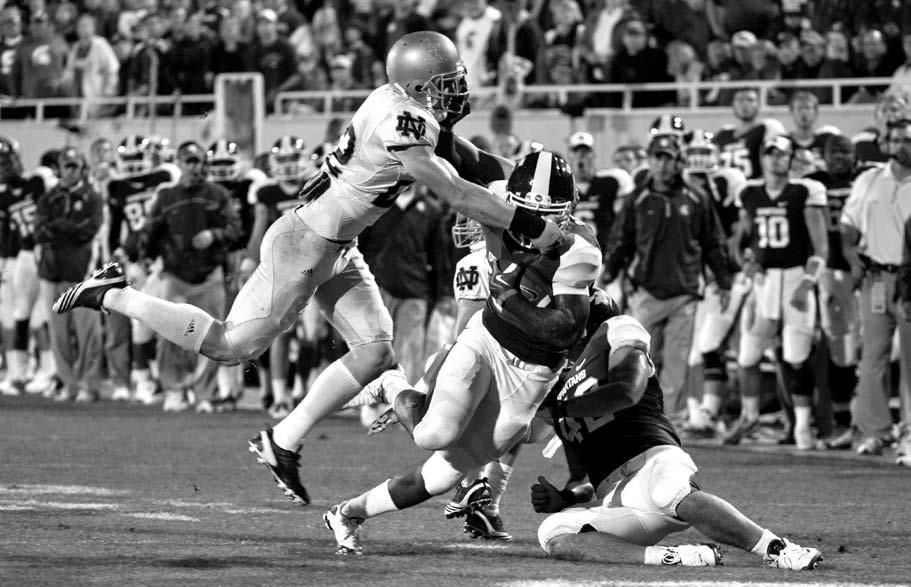
Hendersonville, in their shared home state.
“[Harrison Smith has] always been a safety. If he can’t play safety, he can’t play. It was pretty easy for that one.”
Smith particularly said he cherishes memories from the two times he brought back teammates with him to his home in Tennessee during breaks.
In addition to trips home with the boys, Smith recalled memories from summers spent at Notre Dame. To escape the heat and summer school, Smith and teammates often enjoyed trips to nearby lakes.
Brian Kelly Irish coach
Smith had the opportunity to introduce his classmates, including then-quarterback Jimmy Clausen, running back Armando Allen, linebacker Brian Smith and receiver Duval Kamara, to his home as well as friends of his at the University of Tennessee. He has also spent time with Golden Tate, of

“One summer a bunch of us went to Six Flags in Chicago,” he said. “It was me, Barry [Gallup], Sergio [Brown], Raeshon [McNeil] and Darrin Walls.”
Many of the Notre Dame players consider Smith among their closest friends, even outside of football.
“He’s my best friend,” senior tight end Mike Ragone said of his defensive counterpart. “He loves me.”
Ragone and Smith both look back fondly on memories of Halloween during their sophomore year at Notre Dame in which they dressed up in costumes together — Smith as “Shaggy,” complete with the appropriate hair-do, and Ragone as “Scooby-Doo.”
Close friend and roommate Barry Gallup, a fifth-year senior wide receiver, has much to say about Smith.
“He is the classic story of a kid who’s transformed from a
timid freshman to the leader of our defense and a guy who everyone respects and wants to be around,” Gallup said.
“For a guy who is so violent on the field, he is the opposite off the field. He likes golf, cars, playing Madden with friends, investing and anything Tennessee-related.
“He’s my best friend so I know a lot about him, and he’s definitely the most loyal and trustworthy person I know.”
Beyond football, Smith looks toward other future opportunities he would like to pursue.
A management entrepreneurship major in the Mendoza School of Business, he hopes to someday own his own business.
“I’ve always wanted to own a bar and grill with my brother, Garrett,” he said.
Smith recognized the outstanding academic opportunities Notre Dame offers as one of the many factors that contributed to his decision to leave Tennessee for Indiana.
The University of Tennessee, along with other SEC schools competed for Harrison’s enrollment in their football program when he was in high school.
But then he visited Notre Dame.
“I just felt at home. Everything about the school, the way the team acted together, how close they all were with one another; all of this helped me decide,” he said.
Has it lived up to his expectations? Yes — except in one area.
“Obviously we haven’t won as many games as we thought we would,” he said. “But at least for me, there’s always next year.”
Smith’s football career began 13 years ago when he was in third grade. He went on a hiatus the following year in order to play competitive soccer instead. It was during this time that Smith’s passion for football became apparent.
“My mom loves to tell the story,” he says. “During that football season I would wear my helmet and all my pads, even though I wasn’t playing. I used to dress up in all the gear because I missed it. I’d go out in the yard and pretend I was playing in a game, playing against the trees. I would hit the trees and run around them as if they were players. When the next season came around, I had to play.”
He’s played ever since, and plans to continue, in a fifth season at Notre Dame next fall.
These past four years Smith has experienced a variety of changes — changes in field position, hairstyles and coaching staff.
Next year, Smith hopes to witness even more changes, as he is determined to play a strong role in raising the Notre Dame football team to a more formidable status in the 2011 season.
Contact Blair Chemidlin at bchemidl@nd.edu
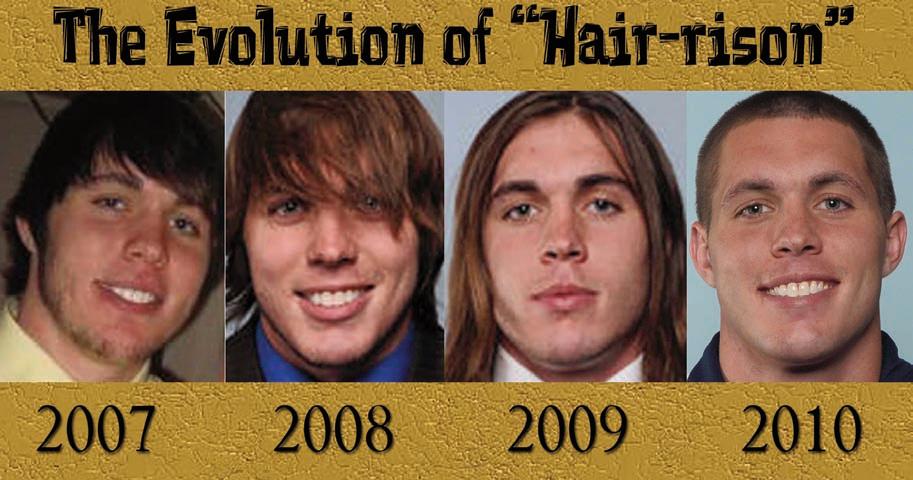
GRACE KENESEY/The Observer
Senior safety Harrison Smith makes one of his 10 tackles against Michigan State on Sept. 18. Smith, a three-year starter, has one more year of eligibility remaining.
Law school simply another challenge for Stewart
By LAURA MYERS Sports Writer
Article 2.6.4 of the Notre Dame Law School’s academic code strongly discourages first-year students from any employment, due to the “academic rigor of the required curriculum,” but it doesn’t say anything about firstyear students starting for a Division I football program.
Offensive lineman
Chris Stewart could be setting a new precedent.
in the fall prior to his sophomore year.
He played in just six games before cementing himself as a starter. He has started 31 of his 37 career games, including every game he has played in the last three seasons, and has started more games than any other offensive player.
“I’m definitely invested. I’m not giving up on my football career. Law school is second to football in my mind, because I’ve been at this longer and it’s the more imminent thing.”
Stewart, a fifth-year player who graduated from Notre Dame in three and a half years, is the first Irish player and the Football Bowl Series’ only active player enrolled in law school.
But school has far from distracted him from his final year at Notre Dame.
“I’m definitely invested. I’m not giving up on my football career,” he said. “Law school is second to football in my mind, because I’ve been at this longer and it’s the more imminent thing.
“It’s easy to stay focused because this is my last time around.”
Stewart, by far the biggest member of the team at sixfoot-five and 351 pounds, came to Notre Dame as a defensive tackle but did not play as a freshman. He switched to the offensive line
Being the most experienced member of the offense is not without its duties, Stewart said.
“It brings a lot more responsibility, culpability, everything like that,” he said.
“Whether it’s spoken or not, people look up to you, guys look up to you, coaches expect you to be there for guys after hours or on the field, all kinds of stuff. You really have to focus. And with so much going on in your own life, be able to focus on people too, because at the end of the day that’s what it’s about.”
Of course, Stewart does have a good amount to focus on.
He is enrolled in 12 credit hours, which he said is the equivalent to 18 or 21 undergraduate hours.
He wakes up at 7 a.m. most mornings for homework or a workout. From there, he’s in class until one. Preparation for football practice starts at two, and players are usually done between 6 and 7 p.m.
After three or four hours of studying, Stewart heads to
bed, where he aims for seven hours of sleep a night.
“Then I get up and do it all over again,” he said.
Neither his football friends nor his law school buddies can grasp his lifestyle, he said.
“Everybody thinks I’m crazy,” Stewart said. “I’ve definitely gotten that. It’s cool, though. It’ll pay off in the long run.”
In fact, it already has. Stewart graduated in 2009 with an honors degree in history, with a self-designed concentration in Caribbean Studies. He was an ESPN First-Team Academic AllDistrict honoree in 2009, and is an academic all-district selection again this year. Additionally, the National Football Foundation chose him as a National ScholarAthlete — a designation that comes with an $18,000 scholarship and puts him in the running for the William V. Campbell Trophy, which honors the best scholar-athlete in the country.
Fifth-year senior Barry Gallup, Jr., also an academic all-district selection, said the two joke about one day starting a business together.
“We’re supposed to keep it a secret but he and I are talking about going into business sometime,” Gallup said. “I’ll run the business side and he’ll handle the legal part. He’s obviously an unbelievable kid, and a kid that everyone should look up to.”
The name of the business would reference their size difference — Gallup is listed at 5-foot-11 and 190 pounds — but the two have yet to discuss what it would do.
“Make money somehow,” Gallup said.
But aside from jokes,
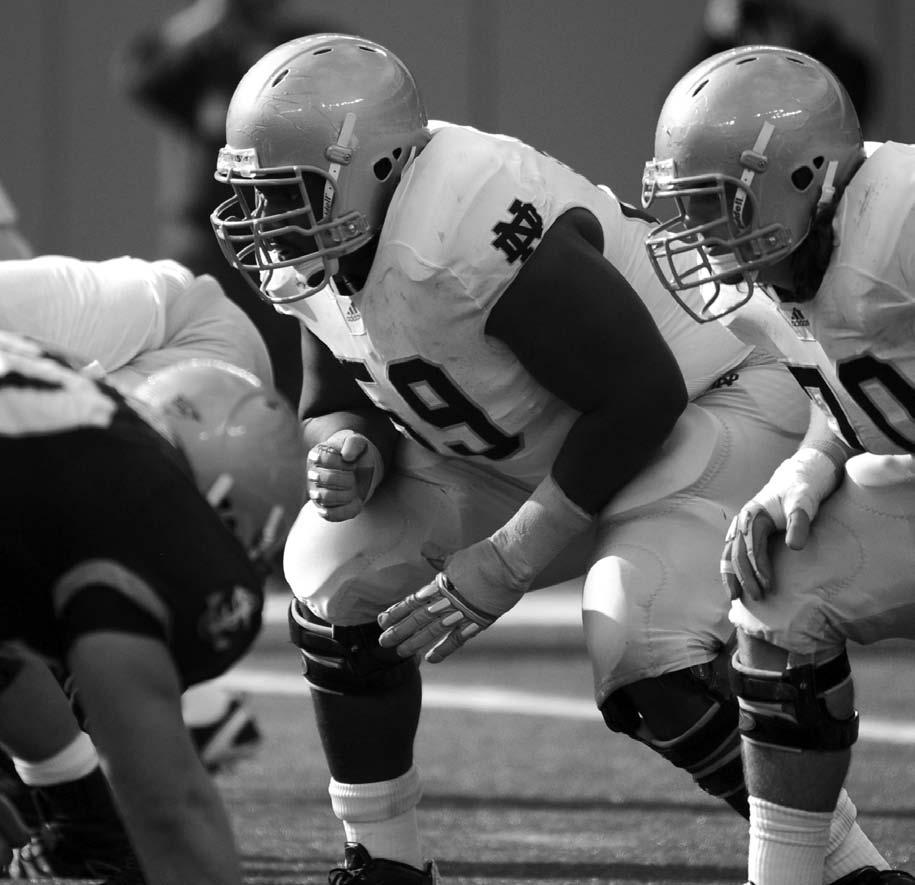
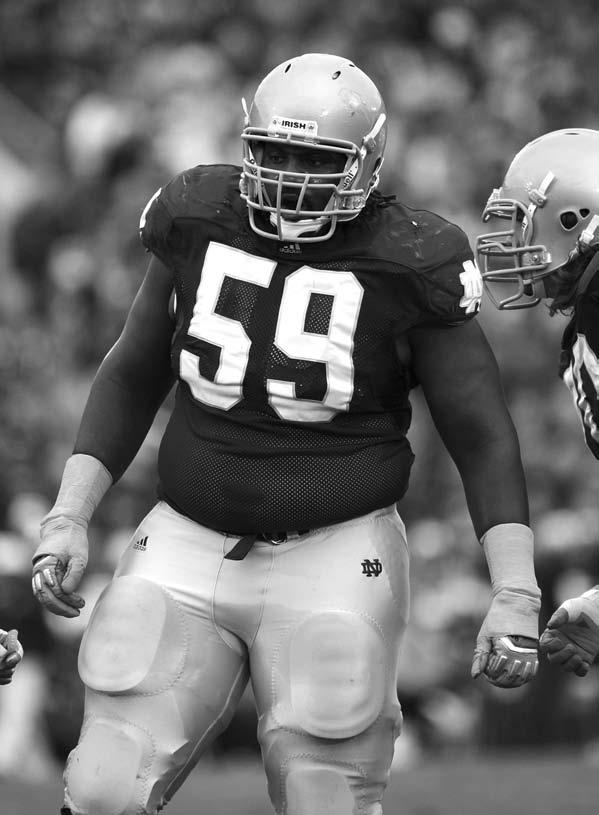
Stewart tries to keep his football and law school lives separate as much as possible.
“I’ve evolved this rule that I don’t study Friday or Saturday,” he said. “That’s time strictly devoted for football, for final preparations for the game. So I take a hiatus from that Friday after I leave the law school to that Sunday. It’s better to have 100 percent focus on football for 48 hours.”
and one other special studies law course, he took the LSAT.
“Anyone who’s in law school would tell you, unless they’re a genius, that that test [is terrible],” he said. “It’s one of the toughest tests I’ve ever taken.”
“Law school is a great career, you can always come back to it. The pro aspect, you really can’t come back to it.”
During the admissions process, he was asked about his next step, and he answered honestly: Football would come before law school.
That much of a break could leave him at a disadvantage, so he has to work even harder after each game weekend.
“Sunday and Monday, the days when we don’t have as much going on here, I really have to buckle down and study and catch up,” he said.
“So I’m kind of playing catch up the whole time, but that works way better than bringing it on the road, trying to figure out complex ideas on a bus or on a plane. That’s not smart.”
And while Stewart carried a 3.536 grade point average as an undergrad, including a 3.834 in his final semester, he won’t have any idea about his law school grades until the end of the semester.
“[There are] no midterms. We have take-home practice exams, and the whole grade is based on a test at the end of the semester,” he said.
“One four-hour test basically determines your whole grade.”
After graduation, Stewart took a year of graduate classes, including a few law classes, before deciding to apply to law school. In spring 2009, while enrolled in a torts class
“Law school is a great career, you can always come back to it,” he said. “The pro aspect, you really can’t come back to it.”
With nearly one year of law school done, Stewart will focus on his goal of getting to the NFL — after this season is over.
“Right now I’m going to focus on ending the season in a good way,” he said. “… I want to be here as long as possible as a Notre Dame football player.”
However, he made sure his intention of leaving school to go to the pros would not hurt his law school application.
“I made it very obvious that it’s my goal to come back here and finish,” he said. “Law school is only three years and I kind of have a year under my belt anyway. So it’s not that big of a deal to come back and spend two more years to get a degree. That’s not bad at all. I’ve been in school for like 10 years straight, even summers, so a break will be needed.
“And I’ll have a chance to focus on football.”
Contact Laura Myers at lmyers2@nd.edu
SARAH O’CONNNOR/The Observer
Fifth-year offensive guard Chris Stewart has served as an elderstatesman among the offensive linemen this year.
SARAH O’CONNO/The Observer Stewart, the only FBS player to be enrolled in law school, has started every game but four in the past three seasons for the Irish.
Chris Stewart senior offensive tackle
Chris Stewart senior offensive tackle
Two snaps last season highlight engineer’s career
By JACK HEFFERON Sports Writer
On a campus filled with individuals chasing career goals while performing community service and living active social lives, there may be no person on campus more well-rounded than senior receiver Chris Gurries.
Gurries’ journey as a college football player began four years ago, when he turned down offers from several Division III and FCS schools, including Harvard and Wesleyan, to accept a partial academic scholarship to Notre Dame.
“My family was extremely supportive. They were actually the ones who really prodded me to walk on,” Gurries said. “My dad put some of my film together, and we sent it in the summer before I got here. They set up a tryout for me, and I was able to make the team.”
While Gurries has seen limited game action in his four years, he has had some memorable moments.
“Last year, I played two snaps in the home opener against Nevada, with my family and about half of my hometown looking on,” said Gurries, who attended Bishop Manogue High School in Reno, Nev.
Memories of playing in Notre Dame Stadium may be lasting, but more important to Gurries are the strong relationships and lifelong friendships that he has
developed along the way.
“The best part of being on the team is just being around the guys,” Gurries said. “There’s a real sense of family.”
In particular, Gurries believes that he and his fellow walk-ons share a unique bond.
“The life of a walk-on is a unique experience. It’s good to have other people in the same boat as you,” he said. “We call ourselves the Walk-on Players Union, the WOPU Nation. We keep each other motivated, keep each other’s spirits high, and we’re really tight on and off the field.”
Another special part of that relationship, according to Gurries, is the older walk-ons helping out the younger players who may have the same issues.
One player who really influenced him was fellow walk-on and fan favorite Mike Anello, a 2009 graduate.
“I really looked up to Anello when he was here,” Gurries said. “We were both in Keough Hall, and he would give me advice all the time.”
Off the field, Gurries is just as dynamic as he is on it, due to graduate in May with a degree in chemical engineering.
“Chemical engineering probably wasn’t the easiest route to go, especially with the time commitment football requires and the workload of chemical engineering,” he said. “As you could imagine, football and studies led to a lot of late nights. The key was to stay on top of
my work and not procrastinate too much.”
With that degree Gurries plans to start dental school in July, and aspires to be an oral surgeon.
“Hopefully I’ll be going to the University of the Pacific. They can’t tell me officially yet, but I’ve been told that I’m pretty much in,” he said. “I want to become a dentist because I
enjoy working with people and helping people, and it allows me to provide for a family.”
Gurries looks forward to that family most of all, and his upcoming marriage to fiancée Sarah in July will be the first part of it.
“I love her to death and I think she is the most beautiful girl. We met in high school, and we just had our five-year
anniversary on Nov. 5. She is in nursing school in Salt Lake City and we plan to get married shortly after she graduates in June in Carmel, Calif., at the Carmel Mission,” he said. “We both cannot wait for the fouryear long-distance relationship to finally run its course.”
Contact Jack Hefferon at wheffero@nd.edu
Football experience complemented by time in ROTC
By KELSEY MANNING Sports Writer
As a business marketing major, a Naval officer in training and a safety on the Irish defense, the life of senior Tommy Smith is a balancing act. Smith does not view his busy schedule as a burden, however, but rather as the fulfillment of several lifetime
goals.
A Connecticut native and a third generation Domer, Smith dreamed about going to Notre Dame since his youth. And with a mom that swam at Notre Dame and a grandfather who walked onto the football team, Irish athletics are in his blood. Smith’s first love is hockey, and several Division III schools in the New England area recruited him for both sports. But
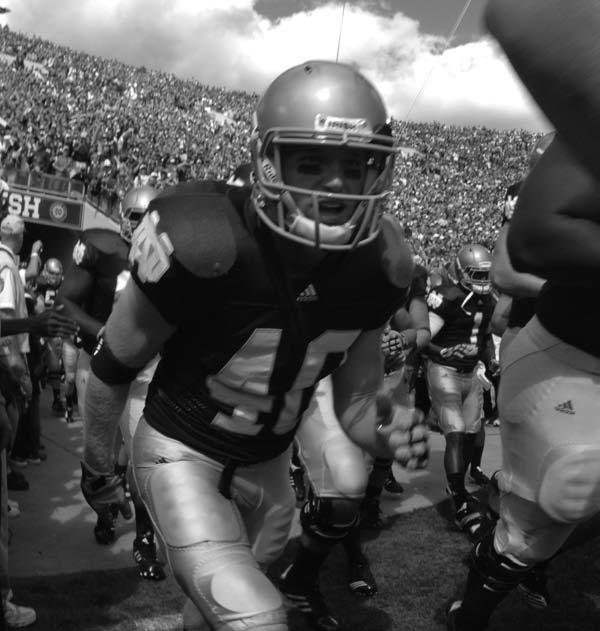
once he got into Notre Dame, there was no looking back.
“The first time I was ever at the Stadium I was four years old. … There is a picture of me and my sister in the old stadium before they redid it,” Smith said. “I remember my first game here when I was in fifth grade we beat Arizona State, and even since before then I’ve always wanted to come here. And I always knew if I got in and came here I would want to try to play football, and just check my goals off one by one if I could.”
That he did. As a freshman Smith started out on the Stanford interhall football, which went undefeated and won the championship game in the Stadium. From there he walked onto the Notre Dame football team the spring of his sophomore year, fulfilling a lifelong dream of being a part of the Irish.
“Football has been great,” Smith said. “Ever since I thought about the idea to walk on, I thought about how much of an honor it would be to be part of the tradition, to line up against these guys in practice every day, see how hard they work and see if I could pick up on their work ethic. It’s really helped me, not only in terms of work ethic, but I’ve gotten in much better shape physically, and it has made me a mentally stronger person.”
Along with the tremendous commitment Smith has made to football, Navy ROTC takes up a great deal of his time. Smith
started seriously considering the Navy during his junior year of high school.
“I looked at Annapolis and I really liked it, but I ultimately decided Notre Dame was where I wanted to be,” Smith said. “I figured I could get the best of both worlds being able to go to Notre Dame and be a part of the Navy, so I was able to get what I wanted in both areas.”
Football and ROTC have all but dominated Smith’s time at Notre Dame, yet he has managed to strike a comfortable balance between the two.
he is entering the Navy after graduation. Smith was recently selected to one of the Navy’s more elite programs, Explosive Ordinance Disposal (EOD), and will be training for that.
“Ever since I thought about the idea to walk on, I thought about how much of an honor it would be to be part of the tradition, to line up against these guys in practice every day.”
Tommy Smith senior safety
“It’s definitely not easy to balance the two, but I really appreciate everything that Navy ROTC has done for me to play football and vice versa,” Smith said. “I have to do a lot of the legwork but together we get things done. I have to miss a lot of things for ROTC and I really appreciate them letting me do that, especially since they’re paying for my scholarship. … I wouldn’t be where I am right now without either one of them.”
Smith said he has no regrets about taking on so much during his time here, especially since
“As long as I can continue along this training pipeline, and successfully make it through the next two years of training and school, then I would like to stay in the Navy for longer than the initial four-year commitment, possibly 10 to 15 years,” Smith said. Even if Smith does successfully complete EOD training, studying business law at Notre Dame has also made him consider the possibility of attending law school after his time in the Navy. Another option is a post-military career in the United States Secret Service. Whatever Smith decides, he is grateful for his entire Notre Dame experience.
“Everything has been worth it,” he said. “I don’t get a lot of sleep some nights but I’m ready to go the next morning. I have no regrets at all because both [ROTC and football] have been great for me.”
Contact Kelsey Manning at kmannin3@nd.edu
TOMMY SMITH
DAN JACOBS/The Observer
Senior receiver Chris Gurries, 38, turned down offers from Division III schools to take a shot at joining the Irish through the walk-on process.
DAN JACOBS/The Observer
Senior safety Tommy Smith not only walked onto the football team, but also has been involved with Navy ROTC for four years.
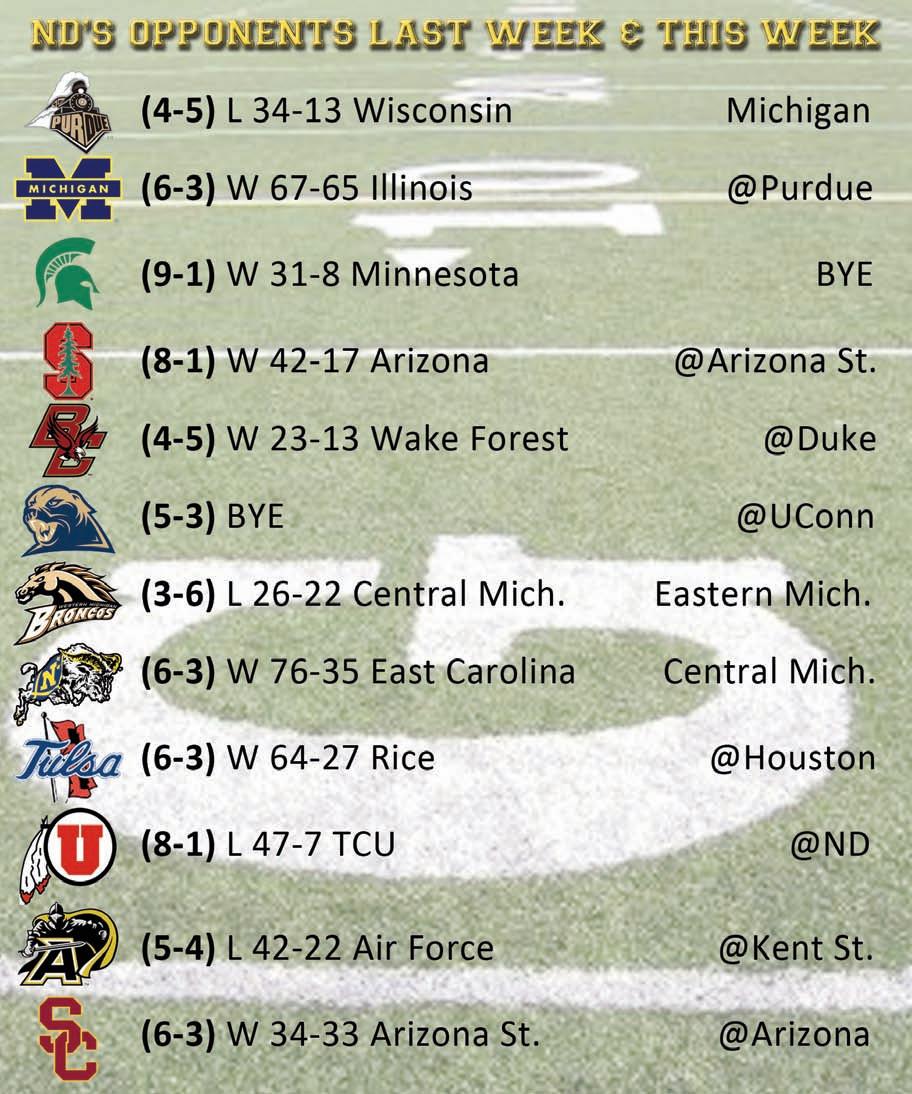

Utes, coming off ugly loss, pose tough test for ND
By DOUGLAS FARMER Sports Editor
Two weeks ago Notre Dame may have been upset 28-27 by Tulsa, but the argument could be made that No. 14 Utah’s loss last week was even more devastating for the Utes.
Utah (8-1), then ranked No. 5, hosted No. 3 TCU for a Mountain West Conference showdown, only to be blown out by the Horned Frogs 47-7. Whether the Utes are reeling from that result or not, Irish coach Brian Kelly said he expects to see the same high-powered Utah team fans are accustomed to.
to move forward and not let a hangover affect us,” Whittingham said. “That would be the most disappointing thing, if this affects two games.”
Even after suffering the 40point loss, Utah enters Notre Dame Stadium as the favorites — a role Kelly does not seem to mind the Utes having.
“What a great opportunity for seniors and everybody in our program to get back to the winning ways by beating a great football team.”
Brian Kelly Irish coach
“Generally my experience has been a team that has a lot of confidence coming in, is not all of the sudden going to lose all of their confidence,” Kelly said during a press conference Tuesday. “They are going to chalk it up to, hey, we had a bad day, let’s put that behind us, maybe we don’t even look at the film. Let’s get going on Notre Dame.”
According to what Utes coach Kyle Whittingham said in a press conference two days after the defeat, Utah planned to do just as Kelly expected.
“By this afternoon we will have the film [of the TCU game] watched, and it’s time
“What a great opportunity for seniors and everybody in our program to get back on the winning ways by beating a great football team,” he said. “I really haven’t been big on trying to draw those David versus Goliath kind of matchups, and I certainly don’t see that in this game. I see a very good football team in Utah, and one that needs to play up to those standards.”
Utah’s standards include a 31-4 record over the last three seasons, including an undefeated slate and Sugar Bowl victory in 2008. This season Utah topped Pittsburgh 27-24 in an overtime battle to open the season, and hardly looked back before facing TCU. In the seven games between Pittsburgh and TCU, the Utes scored 56 or more points four times, only scoring less than 30 points once.
“It’s a confident group, certainly. You look at some of the
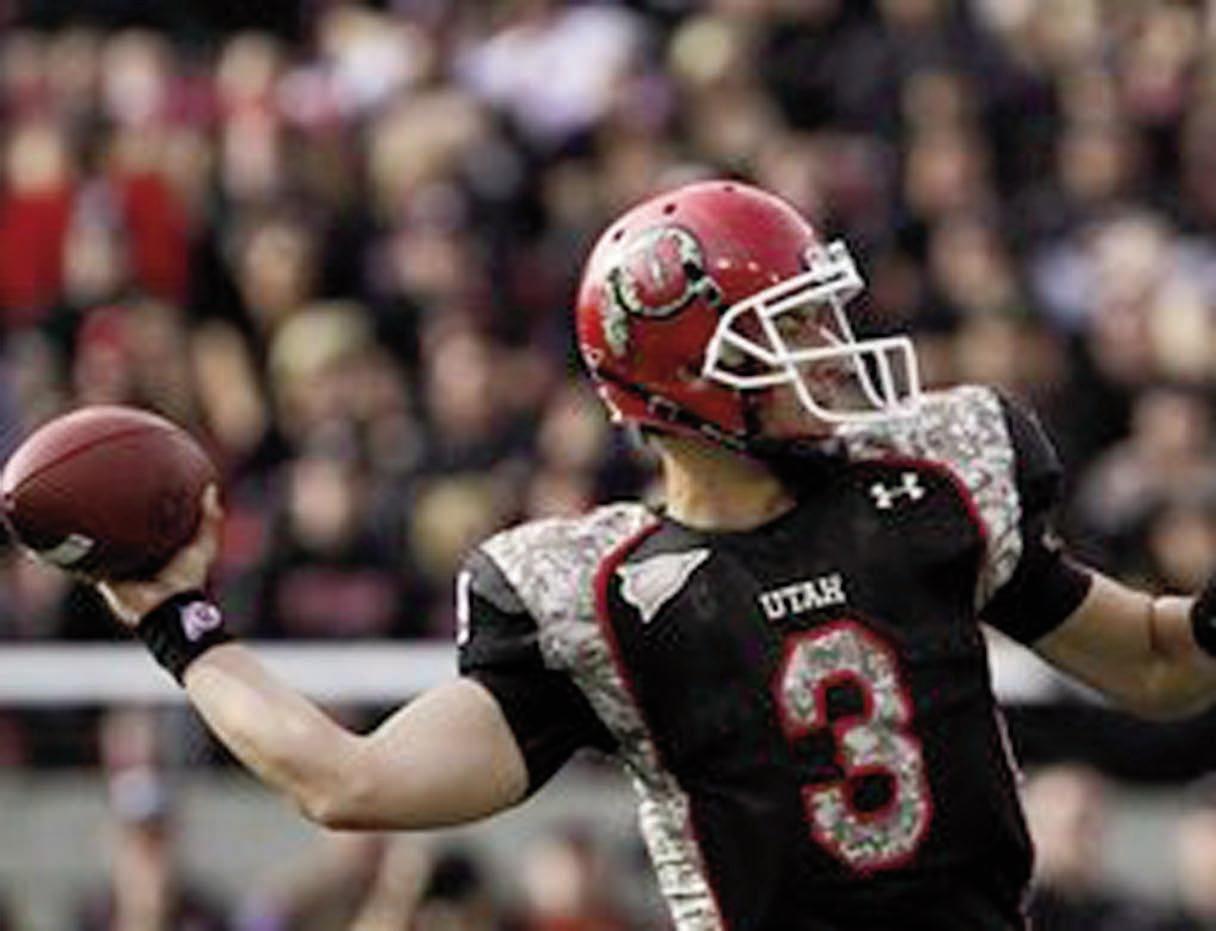
scores that they have had,” Kelly said. “They really believe in what they do offensively. It’s a physical presence.
“So I think what I take away from Utah is a personality. They clearly have a personality on the football field. Very confident about what they can do, and they have exhibited that on a very consistent basis.”
Yet that personality is not
overlooking Notre Dame.
Whittingham cited both Notre Dame’s present team and individuals and its tradition and history as formidable opponents this weekend.
“They have a tremendous receiver in [junior] Michael Floyd. … They have good size up front and good size on defense,” Whittingham said.
“[Sophomore linebacker] Manti Te’o is a big, physical presence in the middle. It’s
just what you expect out of Notre Dame.
“When you think of Notre Dame, you think of the Four Horsemen, Knute Rockne, ‘Rudy’ the movie. … The tradition, the guys they had there — Joe Montana, Joe Theismann. That’s everything that embodies what Notre Dame is.”
Contact Douglas Farmer at dfarmer1@nd.edu
AP
Utah quarterback Jordan Wynn unloads a pass during No. 3 TCU’s 47-7 victory over the then-No. 5 Utes Saturday. The sophomore has accounted for 14 touchdowns through the air this season.
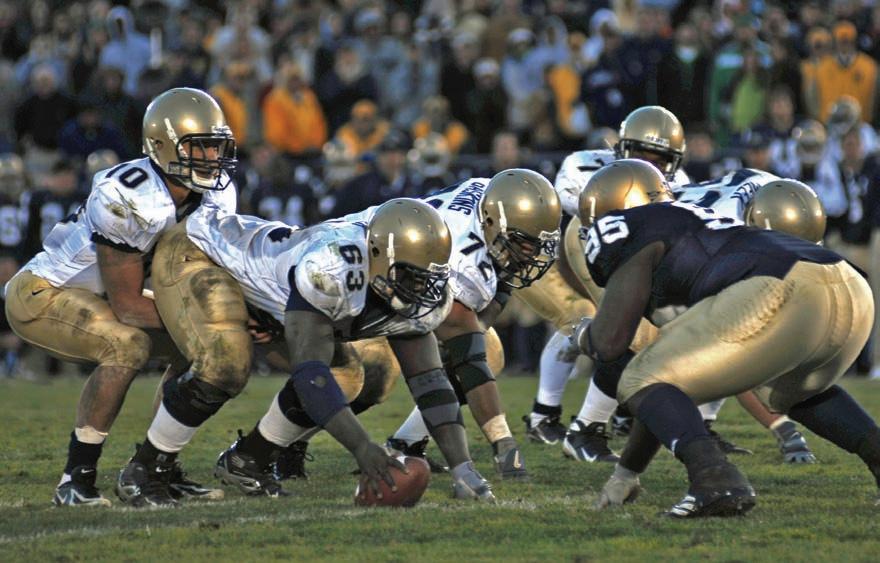
Helmets held high
The senior class of 2011 has experienced a trying four years of football at Notre Dame. A 3-9 freshman year, losing three out of four games against Navy and numerous last-second, heartbreaking losses are just the tip of the iceberg when describing the gridiron hardships that this senior class has gone through.
Despite the losses and a coaching change before their final year at Notre Dame, the members of the original class have held strong and seem intent on finishing their career on a positive note. No matter the result against Utah, the seniors will stand tall with the rest of their graduating class and proclaim words that have kept them going strong through it all:
“And our hearts forever, praise thee Notre Dame. And our hearts forever, love thee Notre Dame.”
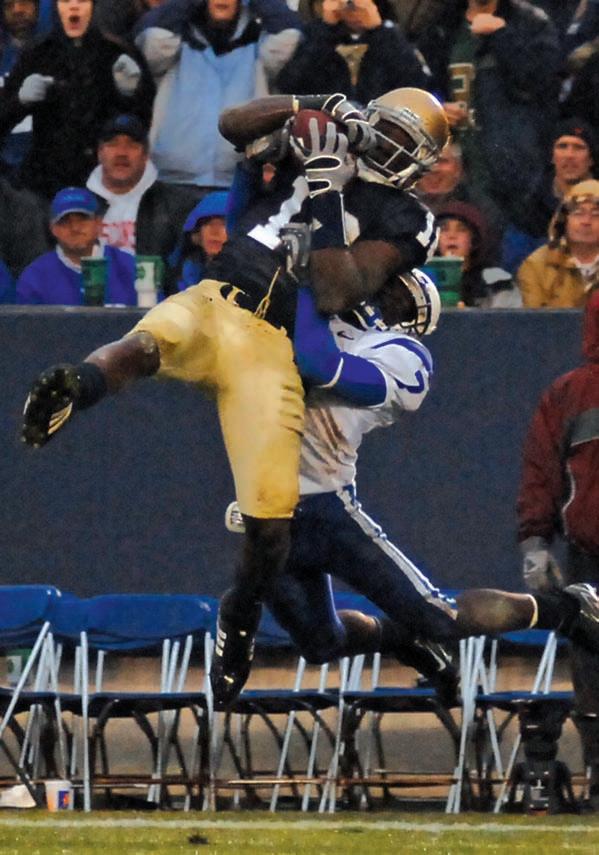
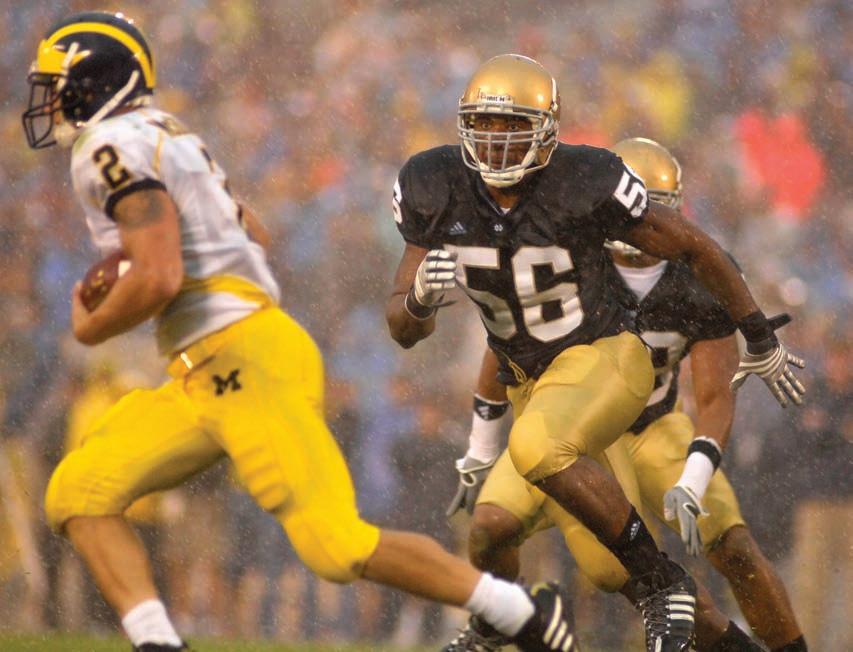
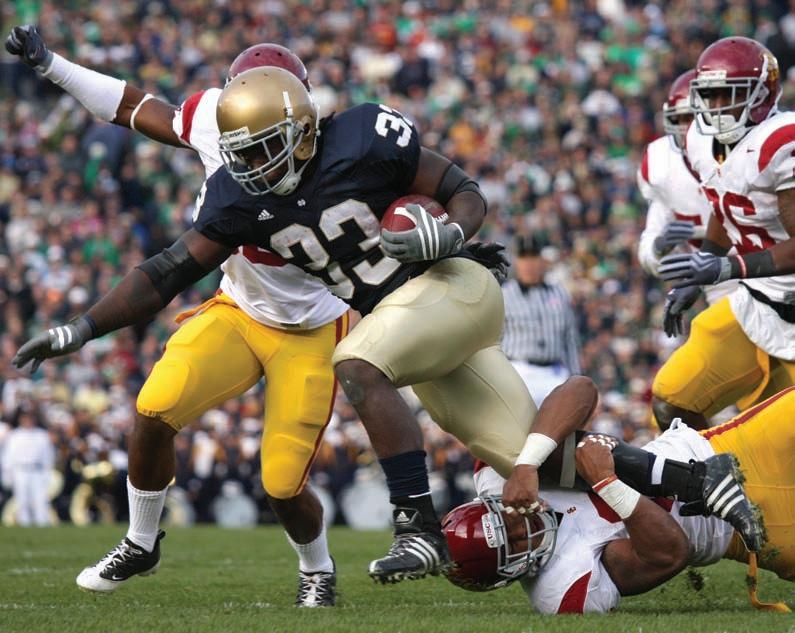
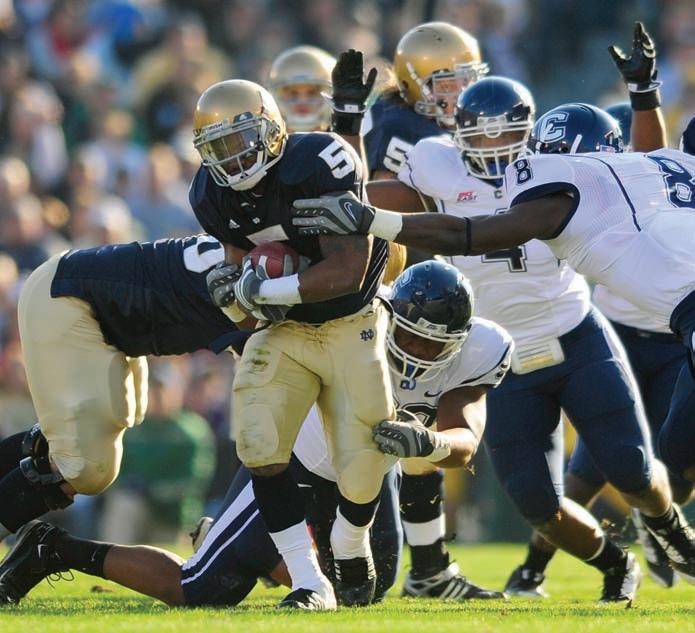
Clockwise from top: Senior nose tackle Ian Williams lines up against a Navy team which defeated the Irish for the first time since 1963 on Nov. 3, 2007; Senior wide receiver Duval Kamara catches his fourth touchdown pass of the season against Duke on Nov. 17, 2007; Senior linebacker Kerry Neal looks for a tackle in Notre Dame’s Sept. 13, 2008, victory over the Wolverines; Senior running back Armando Allen looks for daylight in a Nov. 21, 2009, loss to UConn; Senior running back Robert Hughes tackled in Notre Dame’s Oct. 17, 2009, loss to USC.
File Photo
TOM LA/The Observer
Notre Dame Fighting Irish
Record: 4-5
AP: NR Coaches: NR

Brian Kelly head coach
Bob Diaco Def. Coordinator
First season at Notre Dame career record: 175-62-2 record at ND: 4-5 against Utah: 0-0
Charley Molnar
2010 Schedule
Sept. 4
Sept.
Oct. 9
Oct. 16
Oct. 23
Oct. 30
Nov. 13
Nov. 20
Nov.
Head-to-Head
UTAH DEFENSE
ND
Scoring: 26.0 ppg (72nd)
Total: 402.0 ypg (49th)
Rushing: 113.44 ypg (100th)
Passing: 288.56 ypg (17th)
Turnovers against: 19 (92nd)
Fumbles lost: 7 (50th)
Interceptions: 12 (101st)
Sacks Allowed: 17 (58th)
T.O.P. for: 26:49 (117th)
Scoring: 17.78 ppg (14th)
Total: 300.0 ypg (13th)
Rushing: 111.0 ypg (17th)
Passing: 189.0 ypg (25th)
Turnovers for: 14 (74th)
Fumbles rec.: 7 (48th)
Interceptions: 7 (75th)
Sacks: 23 (24th)
T.O.P. against: 30:45 (80th)
Statistical Leaders
Irish Offense vs. Utes Defense
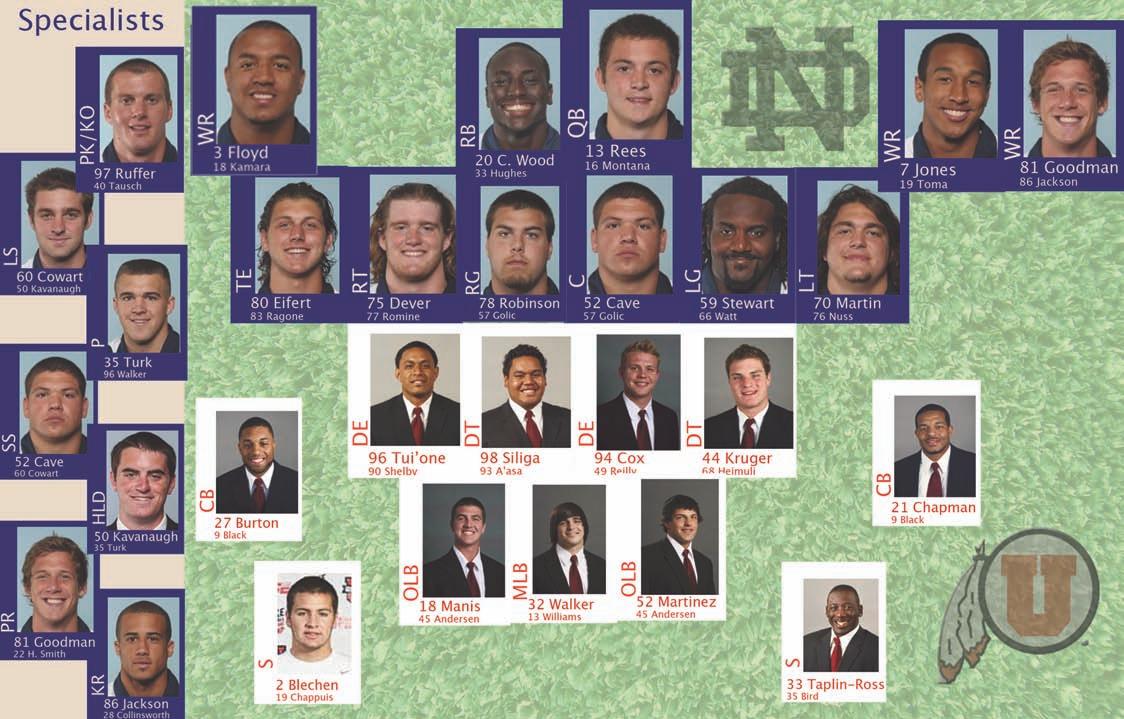
This year’s Irish offense can only be described as injuryplagued. Junior quarterback Dayne Crist tore his patella tendon in Notre Dame’s loss to Tulsa, so freshman Tommy Rees will take over under center for Notre Dame, making the first start of his career.
Junior receiver Michael Floyd
With senior Armando Allen out for the season with a hip injury, the Irish running game, which has already struggled so far this season, could be in even more trouble. Notre Dame averages only 3.8 yards per carry, and if Allen’s contributions are removed, they average only 3.1.
The Irish will turn to freshman
Senior David Ruffer continues to be perfect for his career and for the season on field goal attempts. He has made all 13 tries this year, and continues to be the bright spot on the Irish special teams.
At this point, Notre Dame’s back is very much against the wall. At 4-5, the Irish need, absolutely need, two wins to qualify for a bowl game. Unfortunately, one of those wins will not come this week. There is simply no conceivable way a freshman quarterback throwing to a cast of replacements can lead a stumbling Notre Dame team past the high-powered Utes. Sure, Utah is coming off an ugly loss. Sure, Notre Dame is at home. So the Irish have some things going for them, but those things don’t usually add up to a saving value. That takes time, which against the wall, the Irish don’t have.
FINAL SCORE: Utah 35, Notre Dame 14
has been banged up most of the year, but will play against Utah, while sophomore receiver Theo Riddick and junior tight end Kyle Rudolph will once again be inactive against the Utes. Notre Dame will turn to junior receiver John Goodman to fill the hole in their receiving corps.
The Utah defense ranks 25th in the NCAA against the pass, giving up only
Cierre Wood and senior Robert Hughes for contributions on the ground. Wood has gained 4.6 yards per carry on 59 carries, and despite a heavy workload, Hughes is picking up 5.3 yards per rush. Wood and Hughes have the potential to be a speed and power combination rush attack if the line gives them space to run
The Utes are tough against the run
Utah ranks 18th in the nation in kick return defense, an area in which the Irish have struggled. Field position will be important against the Utes, so Notre Dame will need to improve in that area.
EDGE: NOTRE DAME
189 yards per game. They have also recorded seven interceptions and 23 sacks, so the Irish offensive linemen will have its work cut out for them giving Rees enough time to find open receivers and avoid making mistakes. Otherwise, it could be a long day for Rees and the Irish passng game.
EDGE: UTAH
as well. Ranking 16th in the NCAA against the run, Utah is led by junior linebacker Chaz Walker, who is top on the team with 79 total tackles. A steady ground game could significantly help Rees, but it may be hard to come by against the staunch Utah defense.
EDGE: UTAH
Brian Kelly’s offense was not performing up to standards with Dayne Crist under center, and having Tommy Rees as the starter will certainly not expand the playbook. The injuries to the offense, combined with some questionable play-calling against Tulsa inspire little confidence. That being said, Kelly is well respected as an offensive mind, so it would be unwise to count his offense out, no matter the opponent.
How can you predict a 4-5 Notre Dame team to beat a Utah squad that was an outside contender to play for the national title less than a week ago? How can you think the Irish, led by a freshman quarterback making his first start, can overcome the absence of three of their most explosive offensive threats? How can you rationalize that a Notre Dame team that just lost to Navy and Tulsa can win its first Senior Day game since 2007?
I don’t have an answer to those questions, but I have to believe that for one day, the Irish at least have a chance to put it together and send their seniors out with a win. Just once. Just maybe.
FINAL SCORE: Notre Dame 23, Utah 17
EDGE: UTAH
Once again, on paper this game seems quite cut and dry. Utah is the superior team in almost every facet of the game, and that advantage is exponentially increased by the amount of injuries suffered by Notre Dame starters. With Crist, Allen, Riddick, Rudolph, Williams and Calabrese out, Notre Dame should have trouble moving and stopping the ball.
But this Irish senior class has been through a lot. I think the losingest class in Notre Dame history has one game left in them. Why shouldn’t it come on their Senior Day?
FINAL SCORE: Notre Dame 24, Utah 23
Off. Coordinator
Douglas Farmer
Sports Editor
Matt Gamber
Sports Writer
Eric Prister
Associate Sports Editor
TO HEAD
Utes Offense vs. Irish Defense
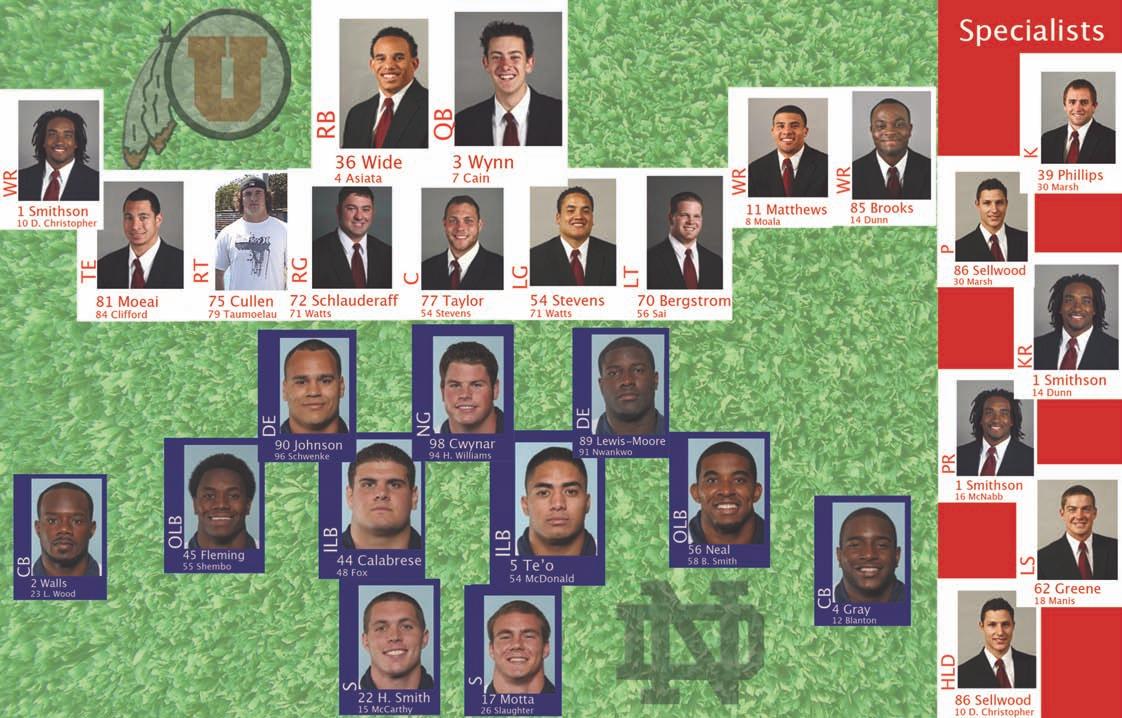
While only averaging 225 passing yards per game, sophomore quarterback Jordan Wynn has been effective for the Utes. He has thrown 14 touchdown passes so far this year, including three-touchdown performances against Pittsburgh and Colorado State.
Senior receiver Jereme Brooks and sophomore receiver DeVonte
Senior running back Eddie Wide leads the Utes’ rushing attack. Averaging 4.9 yards per carry, Wide has scored nine touchdowns and has crossed the goal line in six out of Utah’s nine games.
Senior Matt Asiata adds a second demension to Utah’s rushing game, averaging 4.7 yards per carry and scoring six times throughout the sea-
Kicker Joe Phillips has made nine out of 10 of his field goal attempts, including a long of 48 yards, and 48 of 49 extra point tries.
Christopher have combined for over 1000 yards receiving and nine touchdowns, and will likely give the Irish secondary trouble.
Notre Dame’s pass defense ranks 80th in the nation, and has had trouble stopping prolific passing attacks.
Senior cornerbacks Gary Gray and Darrin Walls will have their work cut out for them against Utah’s offense.
son. As a team, the Utes gain 5.2 yards per rush, which could be difficult to stop for an on-again, off-again Irish rush defense.
Notre Dame has held two opponents — Boston College and Western Michigan — to under 50 yards rushing, but has also given up over 200 yards on the ground four times, including to a Navy team which ran
Punter Sean Sellwood is averaging 43 yards per punt, including a long of 67 yards and has kicked nine punts inside the 20-yard line. Combined with Notre Dame’s struggles returning punts this season, Utah should have control over the field position battle.
EDGE: UTAH
Utah may have been exposed as a topfive team against TCU last week, but the Utes are still a legitimate top-25 squad. Even worse for the Irish, they're a talented team with a chip on its shoulder after getting embarrassed a week ago. Given Notre Dame's injury woes and the fact that freshman quarterback Tommy Rees will be making his first career start it would be easy to see the Irish fold early. Call it a gut feeling, but I can't shake the notion that this class will draw more from the emotions of Senior Day than previous classes. It may be wishful thinking, but Rees did look impressive in his first start. The Irish might not win this one, but they'll be in it until the end.
FINAL SCORE: Utah 34, Notre Dame 27.
The Utah offensive line has also given up only four sacks all season, placing them fourth in the nation. If Notre Dame is unable to put pressure on Wynn, the secondary will have a difficult time hanging with the Utah passing attack.
EDGE: UTAH
for 367 yards while averaging over six yards per carry. The Irish front seven will need to play their best game in order to stop Utah’s solid rushing attack, which could be difficult with nose tackle Ian Williams and linebacker Carlo Calabrese on the sideline.
EDGE: UTAH
The co-offensive coordinators for Utah, Aaron Roderick and Dave Schramm, are also the coaches of the wide receivers and tight ends, respectively. This gives a good indication of the focus of the Utah offense.
Many different Utah receivers have thrived in their spread offense system, and this group is no different. Utah will mix things up, but Roderick and Schramm will fall back to the pass in key situations.
EDGE: UTAH
After a painful, painful loss to No. 5 TCU last weekend, Utah will come in to Notre Dame Stadium with something to prove. Not only will the Utes win over this desperately depleted Irish squad, they will run up the score just to show they can.
I hope I’m wrong, and the senior class plays with the emotion of a team that has been battered for way too long.
But really, the only difference between this game and the past two senior days is that we're expecting it this time.
FINAL SCORE: Utah 44, Notre Dame 27


Oct. 9
Oct. 16
Oct. 23
Oct. 30
Nov. 6
Nov. 13

Aaron Roderick
Kalani Sitake
Sam Werner
Sports Writer
Laura Myers
Sports Writer
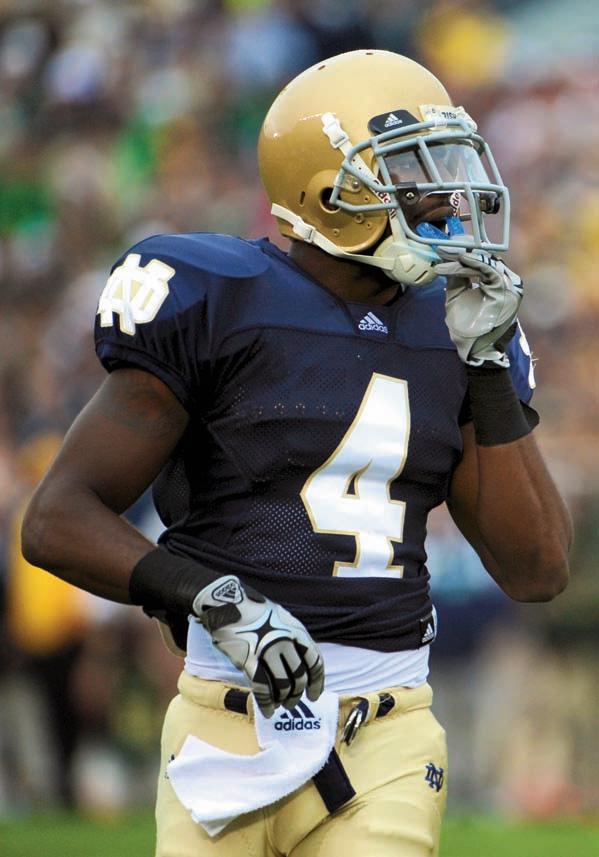
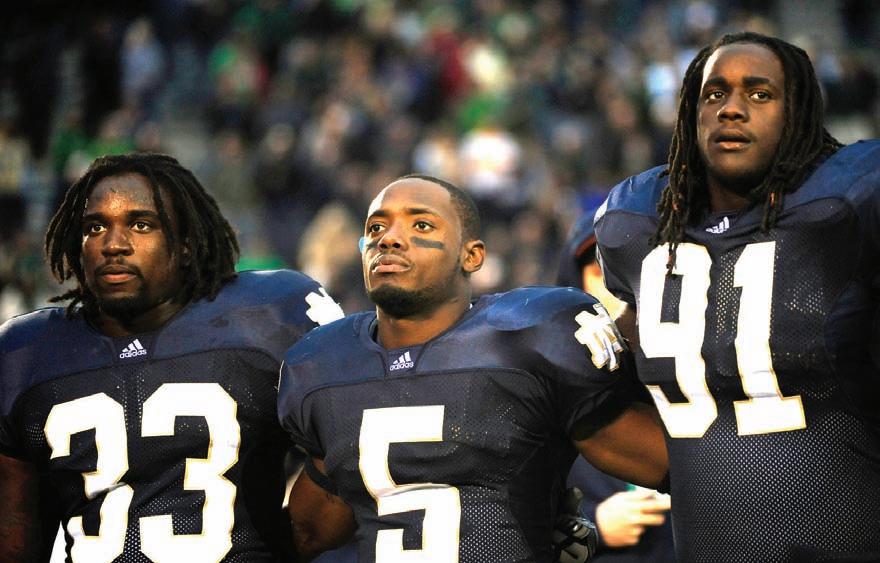
A season of streaks
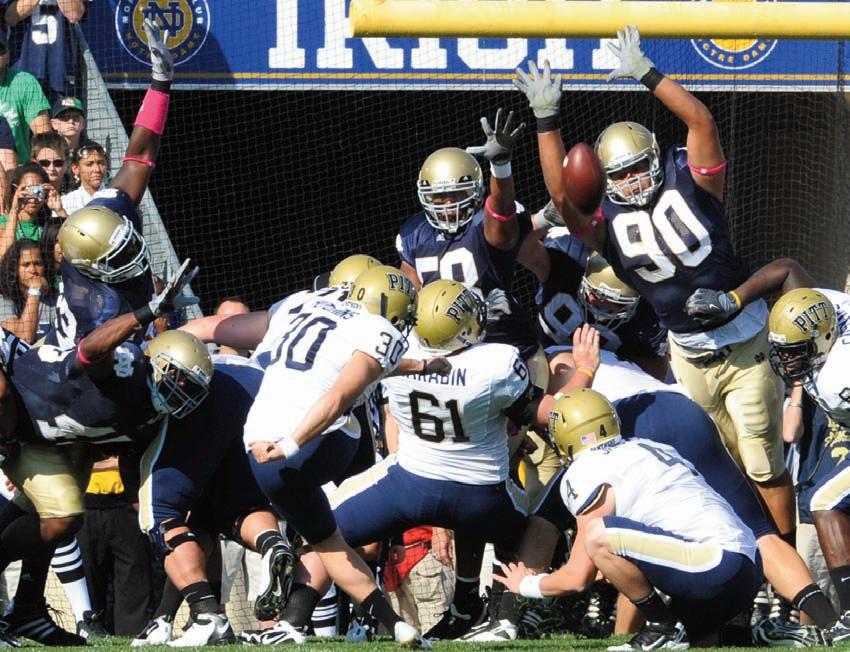
The Irish Class of 2011 opened its final season with a convincing 23-12 victory over Purdue before spiralling into a three-game losing streak which included last-minute losses to both Michigan and Michigan State.
With a 1-3 record, the Irish faced the prospect of a loss season before a three-game winning streak raised their record to 4-3. The winning streak included a 44-20 rout of Western Michigan on Oct. 16.
Notre Dame barely had time to enjoy that rout before facing Navy at the New Meadowlands Stadium in East Rutherford, N.J. Navy took control of the game early, and for the third time in four years beat Notre Dame. The following week, the Irish fell to Tulsa at home.
With possibly only three games left in their careers at Notre Dame, the seniors will need two wins to reach a bowl game.
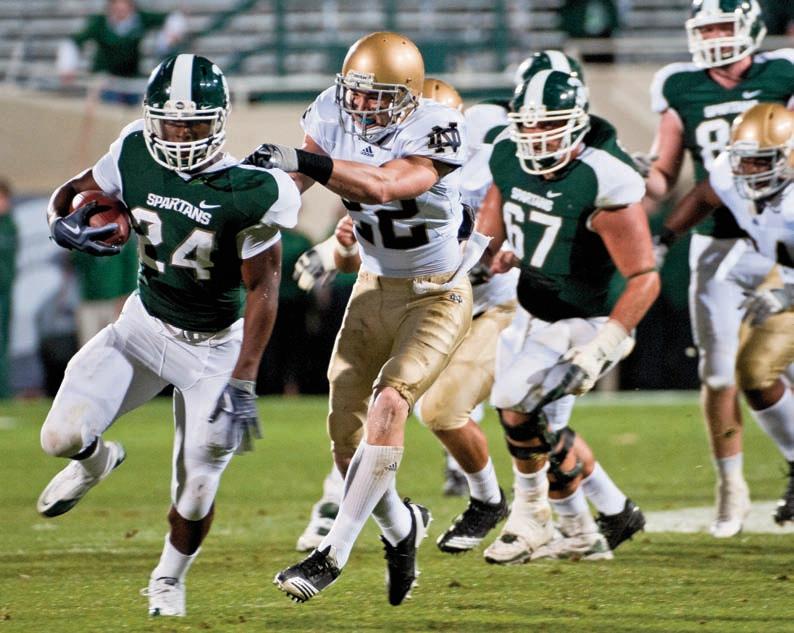
Counter-clockwise from top: Seniors Robert Hughes, Armando Allen and Emeka Nwankwo, from left, sing the Alma Mater; senior cornerback Gary Gray prepares for a play during Notre Dame’s 37-14 loss to Stanford on Sept. 25; seniors Ethan Johnson and Brian Smith, from right, leap in an attempt to block a Pittsburgh field goal; senior running back Robert Hughes gains an extra yard during Notre Dame’s 44-20 victory over Western Michigan on Oct. 16; senior safety Harrison Smith attempts a tackle against Michigan State.
SARAH O’CONNOR/The Observer
SARAH O’CONNOR/The Observer
GRACE KENESEY/The Observer MAGGIE O’BRIEN/The Observer
TOM LA/The Observer
Running back helps Irish in every possible way
By LAURA MYERS Sports Writer
Editor’s note: This article first appeared in the Sept. 17 edition of The Observer.
“You got my hat!” Armando Allen exclaimed as he entered the Loftus Center for a photo shoot with The Observer Tuesday. The senior running back grabbed the small green hat and placed it, at a slight angle, on his head, ready for his close-up.
Allen donned the leprechaun hat in celebration after Notre Dame’s win in the Hawaii Bowl on Dec. 26, 2008, and turned it into a post-game ritual in 2009.
“We all laughed, since he’s about 5’5” on a good day,” said sophomore wide receiver Theo Riddick, a former part of the running back corps with Allen, who is actually listed at 5-foot-10. “He’d get us all laughing and cracking up. It was a good joke.”
fracture in his hand.
But Irish head coach Brian Kelly admitted before Notre Dame played Michigan that he wasn’t sold on Allen coming into the season.
“The way college football is set up we can’t have contact with him all summer long, so you have a two-month period where you don’t even talk to him much,” running backs
coach Tim Hinton said. “It takes a little bit to bring out the real personalities when you just don’t know each other very well.”
Especially with sophomore Cierre Wood coming up quickly behind him, Allen had to prove himself all over again.
“I know that I owe Notre Dame so much, for allowing me to come here and take part in something special, so I really want to go out on a good note.”
Armando Allen senior running back
But two games into his senior year, Allen isn’t kidding around anymore.
“Some people joke about me being short, the size of a leprechaun,” he said. “But I do it in respect to Notre Dame. That’s my way to say I respect Notre Dame. I tip my hat to it.”
Going to work
That is not to say that Allen hasn’t been taking his role at Notre Dame seriously up to now. He was the leading rusher for Notre Dame in 2008 and 2009, with 585 and 697 yards, respectively. His mark of 697 last season came in just eight games, as he missed two games with a sprained ankle and another two with a
“It was just practicing hard every day,” Allen said. “That was one of the concerns we had, and I just took it under my initiative to go out there and work hard and give it all I had every day in practice.”
The competition only helped both of them, Allen said.
“That’s always positive,” Allen said. “When you look at our group, from me to Cierre to Robert Hughes to Jonas Gray, we all know that we have a great amount of talent and we all push each other. We use it as motivation. We all know we’ve got great backs here.”
But through his work ethic, the coaches got to know Allen and made the decision to keep him in the starting spot.
“He really does a good job of understanding and learning, taking notes in the meeting room, and understanding the game plan when he gets on the field,” Hinton said. “And he’s practiced hard. The young guy has practiced tremendously hard.
“He really has played the
game with a passion and physicality and he’s done a nice job in practice of doing the same thing,” Hinton said. “He’s a very consistent performer. He brings his lunch pail with him every day and goes to work.”
Racking up yardage
Through the season’s first two games, Allen had a heavy workload. He ran the ball 33 times for 182 yards and a touchdown, caught two passes for nine yards and returned two punts for 47 yards.
Allen has shown the same versatility throughout his career. His 119 career receptions eclipsed Darius Walker’s record of 107 career receptions by a running back.
“I think it’s really just being in the right place at the right time,” Allen said. “Gaining that trust from the coaches.”
Hinton said there’s only one way for Notre Dame to take advantage of Allen’s many abilities.
“Keep giving him the ball,” Hinton said. “That would be the best thing we can do is keep giving him the ball, get him in space as much as we can. He’s been an elusive guy. He’s been making guys miss. We’re certainly going to work very, very hard to get as many touches as he can have. And his job is to hang onto the ball and perform every time he gets that opportunity.
“I think he will.”
Allen would like to get another opportunity like the one he had in Notre Dame’s 2009 win over Michigan State, when he took the snap in the wildcat formation and connected with former Irish receiver Robby Parris for a five-yard touchdown pass.
“I wouldn’t mind,” he said. “That’s definitely something that’s always been in the back of my head. I’d like to get a chance to do it.”
In fact, Allen has just one feat left to accomplish: a long, breakaway run. Though he runs for a dependable aver-
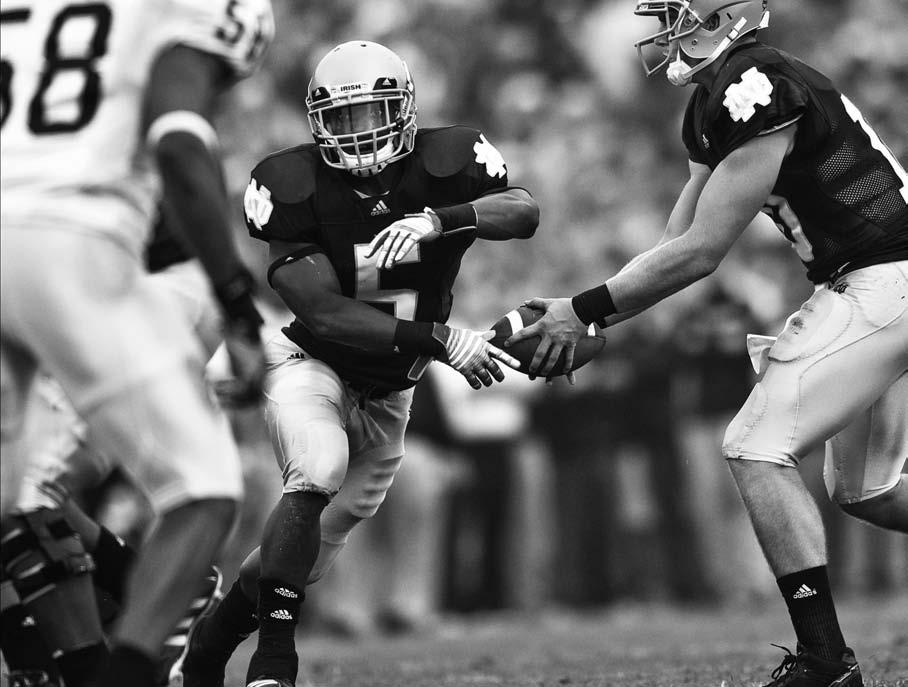
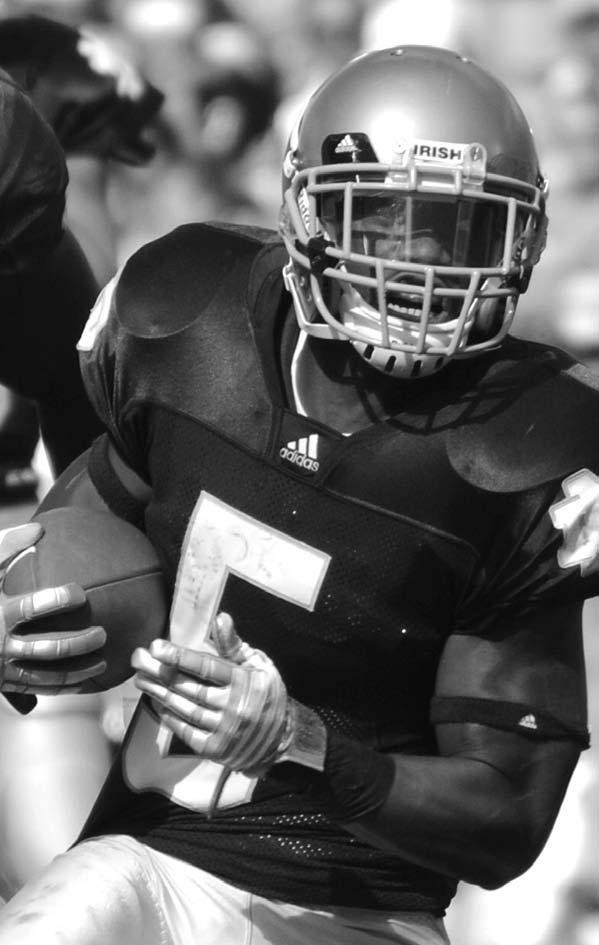
age of 4.6 yards per carry, his career long is 30 yards, a mark he set on Oct. 2 against Boston College.
“It’s always good to have a great breakaway run,” he said. “I think growing up, being a senior, you take everything for what it’s worth, but it always felt good.”
That 2010 is his last time through adds a sense of urgency to his season.
“I do feel like I’m running out of time,” Allen said. “I know that I owe Notre Dame so much, for allowing me to come here and take part in something special, so I really want to go out on a good note.”
Leading by example
Allen’s seniority has its upside, though, in an increased leadership role on the team. The coaches selected him to be a captain for Saturday’s game against Michigan.
“It was a great honor to go out there and be a captain and lead this team against Michigan,” Allen said. “It says a lot about what I’ve been doing here and to me it was a great honor to go out there and show that I can do this and I can be in the right place for my teammates.”
Despite his penchant for wearing leprechaun hats, Allen is usually not showy, Hinton said.
“He’s a quiet, unassuming personality,” Hinton said. “Some guys are real flashy, with flamboyant personalities. Armando really doesn’t come across that way. He’s quiet with leadership behind the scenes.”
His early struggles to prove himself made the role even more special, Allen said.
“I’m a more lead by example type guy,” he said. “I started off shaky coming in with the new coaches but right now I understand that I’m here to do whatever I can and just lead by example.”
Hinton assessed Allen’s leadership in the same way.
“Leadership comes in many styles,” Hinton said. “His work ethic and his on-thefield toughness have been the things he’s really displayed.”
Being a leader is even more vital this week, Allen said, as the team tries to shake off a heartbreaking loss and move on to its first road game.
“I think it’s very, very important,” Allen said. “The biggest thing is just to go out there and make sure that everybody has forgotten about last week and is moving on to this week, that we’ve got a new challenge in front of us.”
At this point, Allen is serious about continuing in the same way he has started the season, being an example for his teammates with hard work in practice and performance when it counts.
“We’ve been very pleased with what he’s doing,” Hinton said. “Obviously his challenge right now is to do it consistently for the next ten weeks. That right now is the biggest challenge that Armando has ahead of him. He can’t be self-satisfied. He’s got to be hungry to be better tomorrow, the next day and the next day until the season ends.”
Contact Laura Myers at lmyers2@nd.edu
JULIE HERDER/The Observer Senior running back Armando Allen has rushed for more than 2,000 yards in his Notre Dame career.
WU YUE/The Observer
Allen started 26 games over the last four seasons before suffering a season-ending injury against Western Michigan on Oct. 16.
Emotions, two TDs define linebacker’s four years
By ERIC PRISTER Associate Sports Editor
In his player bio on UND.com, the first word used to describe senior linebacker Brian Smith is emotional, and it is that emotion that has enabled Smith to become the active leader in games played for Notre Dame.
“When I’m out on the field, I embrace the emotion, the energy from the crowd,” Smith said. “I’m very passionate about what I do, and so to be described as emotional lets people know, ‘Yeah, that’s real me on the field.’ You just have to have the emotional advantage, that even if you aren’t, that you play like you are the baddest on the field and nobody can stop you. Having the kind of attitude makes you a better player and so that gives you that edge against the person you’re going against.”
Smith has played in all but three games throughout his Irish career, and has not missed a game since his sophomore season. He leads all active players in tackles with 180 and has added two touchdowns to his résumé throughout his career.
Michigan and Boston College, doing anything I can to help my team win. It’s just a special feeling.”
That first score came in Smith’s freshman year against Boston College. He intercepted Boston College quarterback Matt Ryan — now with the Atlanta Falcons — and returned it 25 yards for the score.
“One thing I’ll always remember is seeing [former Irish coach Charlie Weis] put his arm around me, because me and coach Weis, we had conversations, but you never really saw real emotion from him,” Smith said. “But when I scored that first touchdown, you saw that real emotion from him on the sidelines, and that’s the one thing that stuck out to me.”
The beginning of Smith’s career at Notre Dame was a tenuous one, as he had already committed to Iowa when he was offered a scholarship from the Irish, just two weeks before signing day. For Smith, that was when the real decision process began.
“The best advice I got was ‘What can Notre Dame do for you? That was a dream school which can do something for you which Iowa can’t.’ Hearing that from my father, I had to make the choice to come here.”
Brian Smith senior linebacker
“I can’t even explain [the feeling of scoring a defensive touchdown],” Smith said. “My first touchdown, I didn’t know what was happening. I told everyone that I felt like I was in someone else’s body watching it through their eyes, because it was such an adrenaline high, being out there. It was just crazy, being able to get into the endzone and get points for the team, especially against teams like
“The decision process was kind of a rocky one because I was committed to go to Iowa for about eight months during my senior year of high school, and then all of a sudden, two weeks before signing day, Notre Dame offers me,” he said. “It kind of put me at a crossroads because it was like, ‘If Notre Dame didn’t want me then, why do they want me now?’ And I kind of had a mind block about it. But then the best advice I got was, ‘What can Notre Dame do for you? That was a dream school which can do something for you which Iowa can’t.’ Hearing that from my father, I had to make the
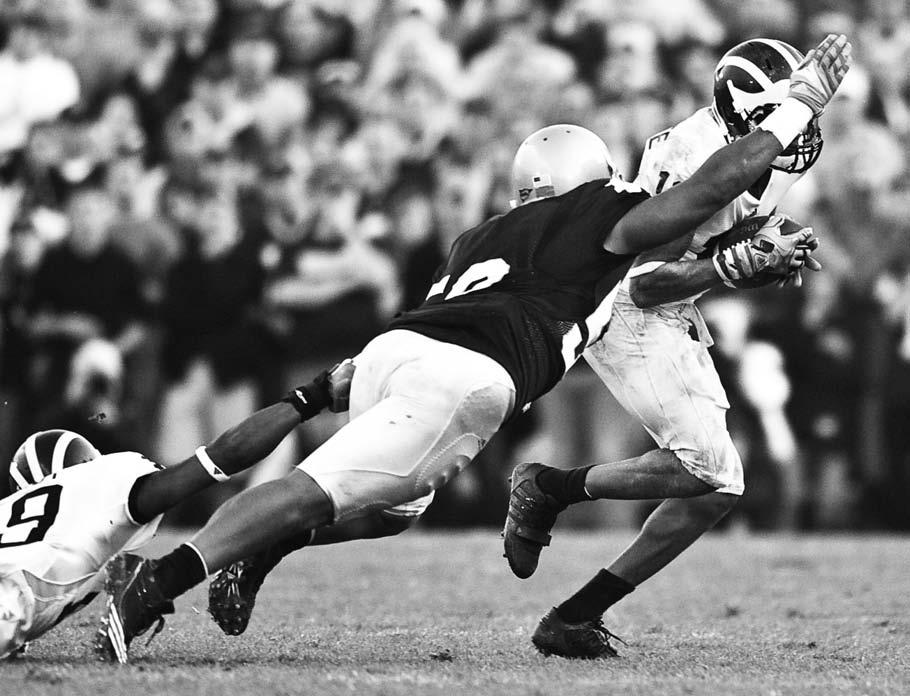
choice to come here.”
Smith’s career did not get any easier when he arrived on campus. The Irish went 3-9 during his freshman season, and have not recorded a winning season in his four years as a member of the football program, but Smith said he has not been disheartened by the ups and downs that Notre Dame has endured.
“Coming to Notre Dame is expecting to be a part of excellence,” he said. “Even though our football seasons haven’t been what everyone has wanted them to be, I still feel like I’ve been a part of excellence, being around these guys and these coaches. Living a first-class championship lifestyle will bring championship results. In years to come, everyone in the world will be able to see that.”
Keeping that championship
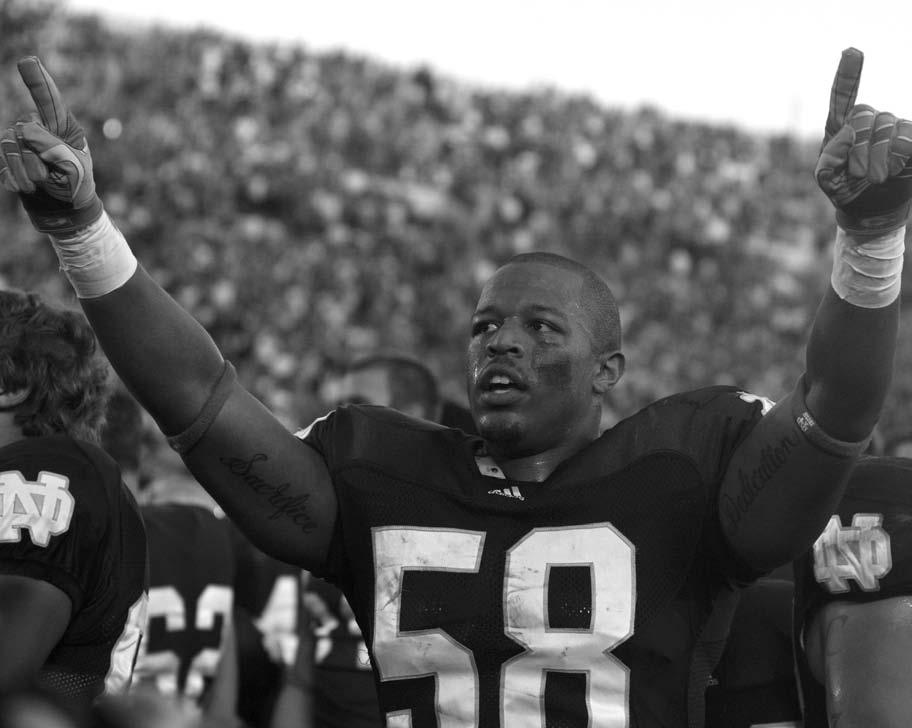
attitude was not easy for Smith. He was moved from outside linebacker in a 3-4 defense to inside linebacker in a 4-3 defense during his sophomore and junior years. Smith said that changing positions was difficult, but in the end gave him a greater understanding of the game.
“The process changing from outside to inside was very hard, because as a middle linebacker, you have to know what everyone is doing on the field,” he said. “I give a lot of credit to [former Irish defensive coordinator John Tenuta], because he taught me a lot about football and that, with my coaches now, [defensive coordinator Bob] Diaco and [Irish coach Brian] Kelly, I feel like there’s nothing on the football field that I don’t know. So now, transitioning, I feel like I can play anywhere on the field now that I’ve played middle linebacker, because that’s the captain of the defense, making calls, adjustments and checks. So I feel like I can play anywhere. Wherever they stick me, I feel like I’m going to do a very good job at it.”
changed — one day your position in the office is going to change, and you have to make adjustments. It keeps you on your toes and keeps your edge razor-sharp, because you have to always keep a razor-sharp edge to be competitive, not only on the football field, but in life.”
Smith said many people have made an impact on his life since being at Notre Dame, but coaches and former players in particular have taught him the lessons he needs both on the field and off.
“Because we’re Notre Dame, even though we haven’t done as well, we’re still in the national spotlight.”
Brian
Smith senior linebacker
Position on the field is not the only change Smith has experienced during his time at Notre Dame. He has played under two head coaches and three defensive coordinators, which can make finding a comfort zone difficult. Smith said he has used the coaching changes as a learning experience, as well.
“It makes you not only a better player but also a better man, because in the real world you’re going to face changes, day in and day out,” he said. “Having a new staff was different, but you have to adjust. When I’m in the working world, my boss is going to change and I have to adjust to what he’s going to do. My position
“There have just been a lot of guys who have played the game here and are still around,” he said. “Guys like [former Irish players] Reggie Brooks and Chris Zorich, coach Tenuta and [former defensive coordinator] Corwin Brown, that have played the system and have taught me since I was a young pup in the system — those are guys who I always look to and try to keep in touch with because they are the roots of the man I want to become in the real world.” Despite a career full of changes, successes and failures on the field, Smith said he still believes that he made the right choice in coming to Notre Dame.
“[Our class] has seen it all,” he said. “Living a first-class, championship lifestyle is always number one for me, and I feel like, even through all these wins and losses, the loss column especially, that I’ve still been a part of excellence. Because we’re Notre Dame, even though we haven’t done as well, we’re still in the national spotlight. Because we are Notre Dame, we are known for our excellence, and so I feel like being a part of this establishment has been the biggest blessing for me.”
YUE WU/The Observer
Senior linebacker Brian Smith attempts a diving tackle of Michigan quarterback Denard Robinson during Notre Dame’s 28-24 loss on Sept. 11.
TOM LA/The Observer
Smith has played in 43 games in the Notre Dame uniform, and in those 43 games has managed to score two defensive touchdowns.
Notre Dame fulfills two dreams for lineman
By ANDREW OWENS Sports Writer
When many scholarship football players step on campus for the first time as a freshman, they have dreams of someday playing on Sundays. Irish senior Matt Romine has realized since the start that there is life after football.
Despite being one of the most highly recruited prospects in the nation coming out of Union High School in Tulsa, Okla., the 6-foot-5, 292-pound offensive lineman said he is always focused on academics. He chose Notre Dame to give himself the best chance to fulfill his two dreams.
marketing department if the NFL doesn’t work out.”
While Romine has excelled in marketing while at Notre Dame, the football end of things has not always been so easy. In his freshman year, he played in each of the first two games before getting injured during the third. He missed the rest of his first season on the team.
“I finally got the chance to get on the field and run out of the tunnel as a starter. It was great to help lead the team to a win because Pittsburgh is one of our biggest wins this season.”
Matt Romine senior offensive tackle
“The main reason I came here was to be a business major and I picked marketing because I really like the shoe industry,” Romine said. “I’d like to work for Nike someday and either market their shoes or work in the Nike football department. It’s always been my dream to work in the Nike
That injury, however, has opened the door for Romine to play another season if he so chooses.
“I medically redshirted after getting injured after the third game of my freshman season, so I have the opportunity for a fifth year,” he said. “The decision of whether I return or not will be made after the season is over.”
If Romine chooses to return, he would be one of several returning linemen on a very experienced unit, which could be the key to an improvement in wins and losses.
Injuries are not the only roadblock that Romine has faced during his time at Notre Dame. This year, he has played
under the third different offensive line coach the Irish have employed in four seasons.
John Latina led the unit in 2007 and 2008, Frank Verducci in 2009 and Mike Elston is currently coaching the linemen.
Romine has not used the experience as an excuse, but rather as a challenge to get better and as a valuable lesson for his future.
“It’s taught me to adapt to anything,” Romine said. “I’ve had three offensive line coaches in four years and they’ve all had a different style and system and want something different. Going through all that has taught me to adapt and be ready to change for any situations that arise.”
Through it all, he has always been able to depend on the support of his family.
“My parents have been so influential in my life,” Romine said. “I’ve been injured a lot during my four years here so relying on the support of my parents has been huge for me. They come to a lot of home games and are here for me a lot.”
After battling through injuries and coaching changes for three years, Romine earned his first career start earlier this season against Pittsburgh. He considers it his most memorable moment at Notre Dame.
“I finally got the chance to
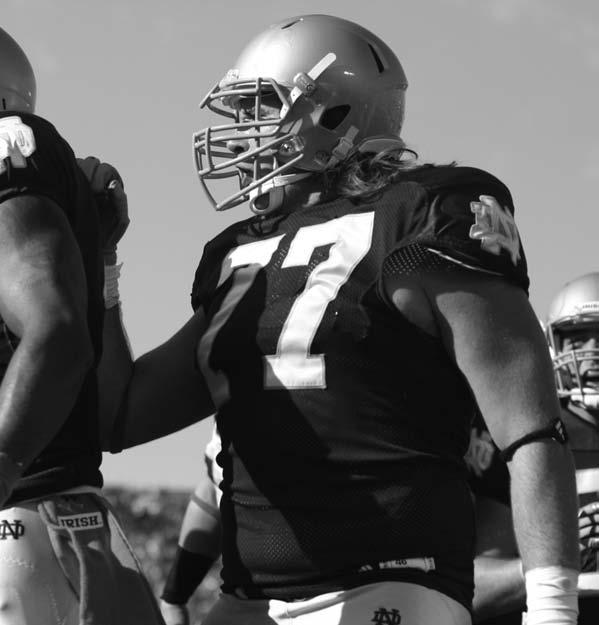
get on the field and run out of the tunnel as a starter. It was great to help lead the team to a win because Pittsburgh is one of our biggest wins this season.”
Even if Romine opts to depart from Notre Dame following his graduation this
spring, he will leave with a very favorable outlook of his time here.
“I didn’t realize coming in how tightly knit the Notre Dame family is,” he said.
Contact Andrew Owens at aowens2@nd.edu
TOM LA/The Observer
Senior offensive tackle Matt Romine has used his time at Notre Dame to prepare for life after football.
Waiting only yields benefits for Florida native
By JACK HEFFERON Sports Writer
“Good things come to those who wait” may be an overused cliché, but overused clichés are often overused for a reason: they are true.
Senior defensive end Emeka Nwankwo can certainly argue for the validity of that phrase, after waiting in the wings several times in his career before stepping into the spotlight, with success.
Nwankwo was a four-star recruit out of Miami Beach, Fla., who was named all-state twice at offensive line at ChaminadeMadonna Prep. But when it came time to commit to a college, he faced a difficult decision.
“At the end of the whole process, it was either going to be Notre Dame or Florida,” Nwankwo said. “I felt that I needed to get out of Florida, so I thought Notre Dame was my best option.”
Once he arrived on campus, Nwankwo had to accept several important changes in his life.
While he transitioned from life at home to more independence on campus, he also had to transition from offensive line to defensive tackle on the football field.
“Going away from home for the first time and being on your own was different, almost surreal. It was a lot of fun though, too,” Nwankwo said. “As far as football goes, the transition to defense wasn’t too difficult. I played defen-
KERRY NEAL
sive line in high school, so I was able to step right in day one.”
He was also helped in this transition by some older players with whom he developed a close relationship early in his Notre Dame career.
“Older guys like [defensive lineman] Trevor Laws, [linebacker] Maurice Crum, and [tight end] John Carlson really showed me the way things were done, and how to go about your business,” Nwankwo said.
After mostly working with the scout team and slowly climbing the depth chart in his freshman year, Nwankwo was able to bust into the gameday rotation his sophomore year.
“It was nice to start to get noticed, and the coaches start to get at you a bit more,” he said.
That year was Nwankwo’s breakout year of sorts, as he played in seven games, and had two tackles. More promising, though was that he saw action in five of the final six games, and his stock seemed to be rising. But during his junior season last year, Nwankwo seemed to get lost in the depth chart, and did not play a snap during the season. Once again, Nwankwo was forced to lie in wait, and the experience was frustrating.
“That was by far my worst year here,” Nwankwo said.
Nwankwo persevered, though, and now is playing the biggest role of his career in what has become a redemptive season for him.
“This year has been my best year here. I’ve really enjoyed it,” said Nwankwo, who has played in five games and has three tackles on the season.
Part of the reason that this year has been so enjoyable for him is all of the fun he has off the field, especially with his friends on the team, Nwankwo said.
“A lot of the guys on the team are really close … [Senior running back] Armando Allen, he’s my little brother,” Nwankwo said. “And [junior nose tackle] Brandon Newman, he’s the clown of the whole team. No doubt I’ll be friends with those guys for life.”
Nwankwo and his teammates are always up for some friendly competition, as well.
“I’m the current Notre Dame Madden king, I’m pretty much unstoppable,” he said. “I’ve got the best car on campus, too.”
Now that his senior year is coming to a close, Nwankwo has begun to look back and reflect on his time here.
“I’ll take a lot from these four years: family, brotherhood, and some good memories. Now that I think about it, I’m really going to miss this place.”
But while it may seem to be the end of Nwankwo’s Notre Dame career, he has not yet ruled out returning for a fifth season of eligibility.
“I might come back next season, but there’s a whole lot of other options,” he said. “It’s really up in the air right now.”
Regardless of his plans for next
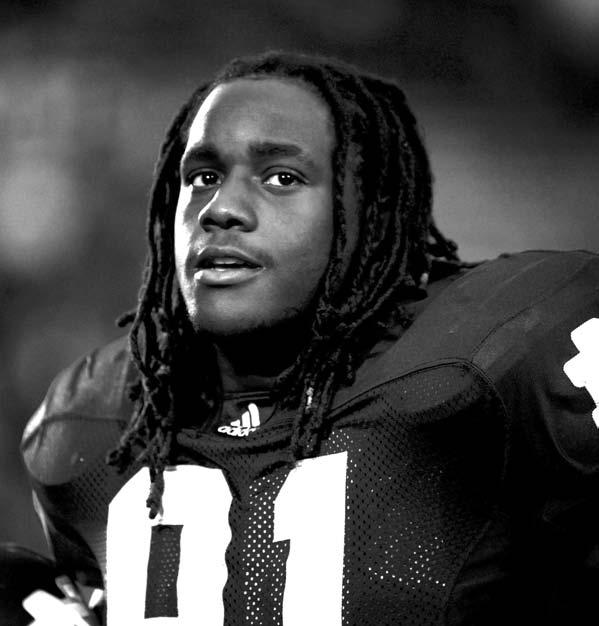
year, Nwankwo will graduate this spring with a degree in Psychology, although he has plans in a different field.
“My family has been really supportive, but football doesn’t mean that much to my parents, since they grew up in Nigeria. To them, the most important thing is getting that degree, and I got it,” he
said. “I really want to go back for grad school, though, and get my MBA. Eventually, I plan to be in the business world.”
Like so many other things for Nwankwo, future success is just a matter of time.
Contact Jack Hefferon at wheffero@nd.edu
Linebacker credits family for helping him succeed
By ANDREW GASTELUM Sports Writer
He began the journey as a boy, and the road turned him into a man.
Senior linebacker Kerry Neal vowed that Notre Dame has changed him into the person he is today, admitting that he came here as a boy out of high school — albeit a 6-foot2, 220-pound boy.
“This fouryear run has been great,” Neal said. “I have really grown as a man with everything that I have accomplished and Notre Dame has really opened my eyes up to a lot of things.”
doing everything to help give them a better life,” Neal said.
“I feel like I owe my life to them.”
“This four-year run has been great. I have really grown as a man with everything that I have accomplished and Notre Dame has really opened my eyes up to a lot of things.”
Kerry
Neal senior linebacker
The linebacker came to campus as a highly-touted recruit from Bunn, N.C., a small, rural city from which Neal finds inspiration.
“I play for my hometown and for all the people there that are able to see me do something I love,” he said.
Of those people, Neal finds a special place in his heart for his mother, who worked two jobs to support the family, and his grandmother, who cared for Neal when he was younger.
“They mean everything in the world to me and I am
In his first three years at Notre Dame, Neal totaled 70 tackles and five and a half sacks, with most of them coming as a defensive end during his sophomore and junior years. But this year, under the new 3-4 defensive scheme, Neal made the transition to outside linebacker almost seamlessly. He has since recorded a career-high 32 tackles through nine games this season, eight more than his previous personal record of 24 tackles in his sophomore year.
“At first, I was really nervous at making the switch, but I worked out in the summer and improved my agility,” Neal said. “Now I am much more comfortable being able to run in open space and use my athleticism to the team’s advantage.”
The move to linebacker made Neal realize the importance of offseason work and taking advantage of every opportunity to get better.
“There are no days off in the offseason,” Neal said. “You have to come with [the effort] every day and work harder than the other man.”
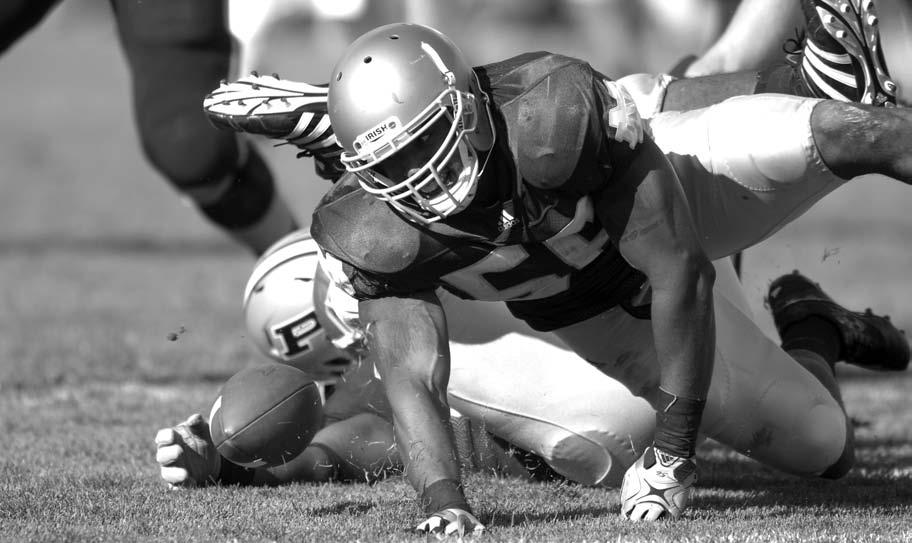
But football isn’t the only matter that Neal has striven to improve in. Off the field, the linebacker takes great pride in his studies and asserts that the quality education was a major factor in coming to Notre Dame.
“At Notre Dame, you can get the best of both words,” said Neal, who committed to Notre Dame before taking an official visit. “In order to play football, you have to have good grades and it’ll all pay off once you get that degree from one of the best schools in the country.”
Neal plans on graduating
with a degree in sociology, from which he hopes to give back to the community if he doesn’t play in the NFL.
“I’m never going to put a stop to my dreams [of playing in the NFL], but if that doesn’t work out I’ll have a degree,” he said. “I love working with kids and would love to give back to the youth, knowing how much I have been through in my life.”
In addition to leaving with a degree, Neal could graduate being the only senior in the class of 2011 to play in every game of his Notre Dame career. But when asked what
he will remember most about his college experience Neal didn’t mention his performance on the field or putting on a gold helmet. Rather, he spoke of the friends he made while playing football.
“I wouldn’t be the same without the bonds that I have made with all of my friends and my roommate [senior running back Robert Hughes],” the senior said. “We are all brothers and it’s like being in a giant family with moments that I will never forget.”
Contact Andrew Gastelum at agastel1@nd.edu
PAT COVENEY/The Observer
Senior linebacker Kerry Neal chases after a fumble during the season opener against Purdue on Sept. 4. He did not recover the fumble, but did record one tackle for loss in the Irish victory.
SARAH O’CONNOR/The Observer
After not getting playing time his junior year, senior defensive end Emeka Nwankwo has appreciated every moment of it this year.
MICHAEL GARCIA
Waiting game may be safety’s primary specialty
By MEGAN GOLDEN Sports Writer
If at first you don’t succeed, become friends with senior safety Michael Garcia, and try, try again.
Garcia’s journey toward success began during his senior year of high school, when he received an envelope in the mail from the Notre Dame Admissions Office.
“I was one of those waitlist guys,” Garcia said. “When you’re on the waitlist it’s almost like you have to want it more because you didn’t get in to begin with. That was probably the most stressful thing.”
Garcia proved, however, that he wanted it more than anyone.
“I did everything I could. I became good friends with [Director of Admissions] Bob Mundy, and I put on the full court press on the admissions office,” Garcia said. “Then I got a call May 14, 2007, and that’s when I got into Notre Dame.”
Coming from a family of Notre Dame graduates, Garcia always dreamed of being accepted into his father’s alma mater and walking on to the basketball team.
“My two brothers were already at Notre Dame, and my dad went here. They never played any Division I sports, but that’s what I always wanted to do,” Garcia said. “I love football, and I love basketball. As a kid, I always had a goal of walking on the basketball team, [but] I remember my freshman year they didn’t have basketball tryouts.”
STEVE BOTSFORD
Once again, Garcia was not going to stop there.
“I said, ‘Hey, I might as well try football.’ I was pretty good at football in high school, so I walked on,” Garcia said. “[I] didn’t think in a million years that I would make it and got called back.”
The early mornings and strenuous workload ultimately brought all of the walk-ons together.
“The process was excruciating getting up around 4:15 for 4:30 workouts in the freezing cold of January and really not talking to anybody at the time because the other walk-ons are your competition,” Garcia said. “You had to really want it, and I think that’s how we came really close. We were all competitors at the beginning, especially the walk-ons. We were all competing for the same spots, and then that grew into friendship because we were in this together once we all made it.”
Since those strenuous early workouts, the walk-ons have banded together and formed WOPU Nation, the Walk-On Players Union.
“WOPU Nation is Walk-On Players Union, an elite group of people,” Garcia said. “It’s awesome, it’s a brotherhood. We have each other’s back. That’s part of the WOPU Nation, and we take pride in that.”
Garcia has been ready to enter a game since day one. Two weeks ago against Tulsa, however, he went the extra step to make sure he would be ready if his number
After initial
By JOSEPH MONARDO Sports Writer
As a lifelong Notre Dame fan from Chicago, senior linebacker Steve Botsford considers himself lucky to have played for the Irish.
Botsford always dreamed of
was called.
“You share a number with another walk-on, and it’s hilarious. I share a number with [senior tailback] Pat Coughlin,” Garcia said. “They pulled a switcheroo on me last game because Coughlin was on kickoff, and I was going to be on kickoff. I was on the two-deep, so I was like, ‘Okay, there’s a slight chance that I might get into the game.’ I actually showed up to the game, and my number was 29. I knew I couldn’t be number 29, so I asked for a new number. So I came back, and I wore number 34.”
Garcia swapped jerseys and texted his mom about the number change just in time for her to see his debut on national television.
“It was my first time getting in and playing for ND. It was awesome,” Garcia said. “As a walkon, that’s what you work for, to consistently help the team out, and that’s how everyone thinks, and everyone wants their shot to compete for ND, compete for Our Lady. I feel like I was finally ready.
“It was awesome getting in, running down the field in the house that Rock built. I had chills coming down my back, it’s something that I’ll remember forever.”
Playing football for Notre Dame taught Garcia life lessons.
“I learned a lot about people, I learned a lot about leadership, I learned a lot about courage. You learn so much. With whatever circumstances you’re given, you just have to take it and roll, and you have to do the best that you
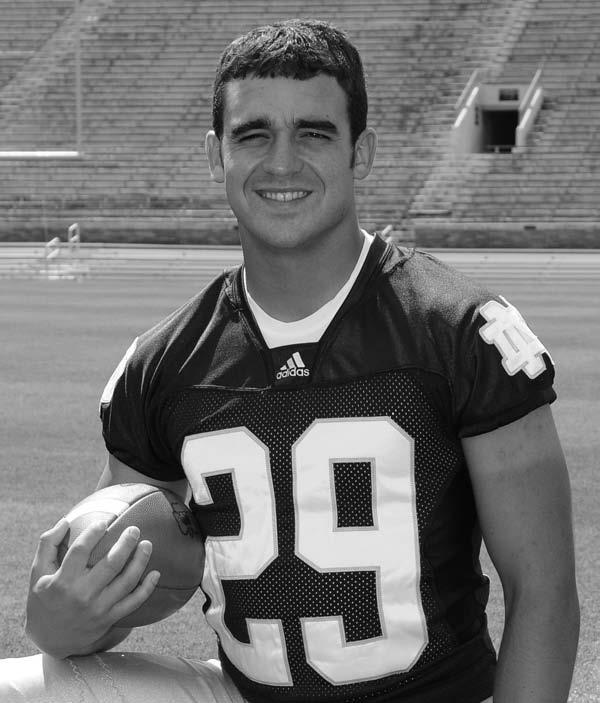
can,” he said. “Being a walk-on, we’re prepared for any situation.”
Garcia is grateful for all of his supporters who helped him get the opportunity to play at Notre Dame.
“I have to thank my parents, my family, my two brothers, my
friends and all who’ve supported me. I have to thank the coaches for giving me the opportunity,” he said. “It’s just been an amazing journey, an amazing experience.”
Contact Megan Golden at mgolde01@saintmarys.edu
denial, walk-on chases, and fulfills, dreams
playing football for the Irish, but he had to wait. He was not recruited by Notre Dame, so he enrolled at the University of Indiana before transferring to Notre Dame after his freshman year.
“When I got rejected from Notre Dame after high school, I knew I wanted to try to transfer,” Botsford said. “And then once I got in, I knew I was going to take the next step and see what I could do to with this football thing.”
As a sophomore, Botsford became a resident of Fisher Hall and began his Notre Dame football career immediately as a member of his interhall team. In the spring, Botsford decided to take the next step and pursue his goal of joining the varsity squad.
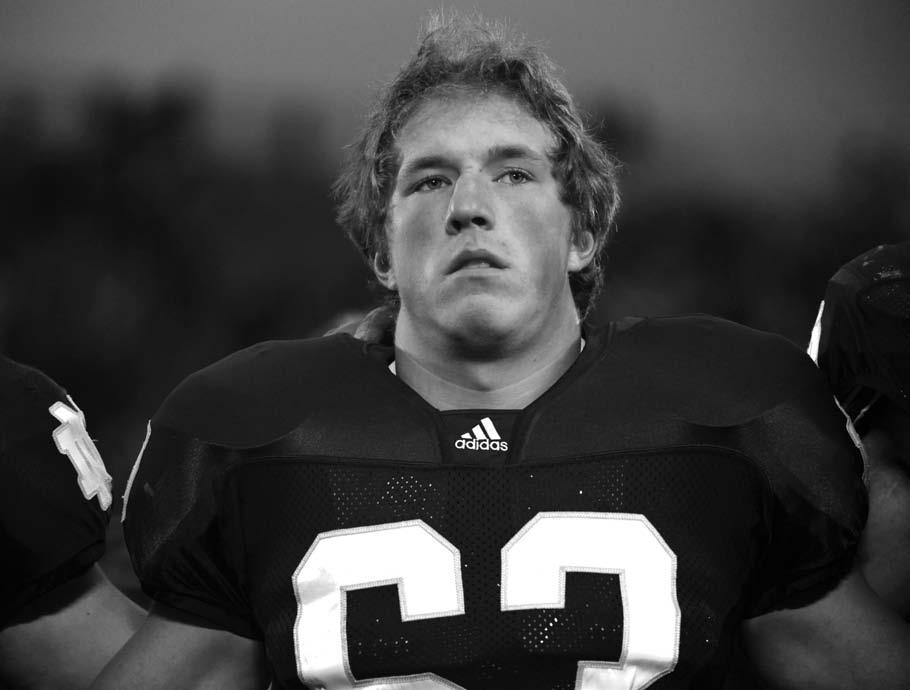
“[Tryouts were] rough,” Botsford said. “We started out three days a week, and then we went to five days a week at, like, 5:30 in the morning. It’s funny looking back on it now, but during it was horrible.”
Most people would not be able to recount 5:30 a.m. practices with a hearty laugh, but he managed to do just that managed to do just that.
Botsford, who describes himself as “fun-loving” and “goofy,” makes sure that everyone knows how happy he is to be part of the Notre Dame football team.
“I’ve always got a smile on my face, I’m always goofing around,” Botsford said.
While Botsford said he cherishes the fact that he has a role on the team, he harbors other passions as well. Although the economics major already has one job offer, he hopes to work on Wall Street in the future.
“I like economics a lot,” Botsford said. “It’s tough, but it’s fun, and it’s helping me get a job. It’s something that’s really easy to talk about when you get in an interview.”
Botsford said his biggest surprise at Notre Dame has been managing both football and academics. Although those two areas require a huge time commitment, he still finds time to relax.
“If I’m not studying or playing football, I’m probably either watching movies or playing the NCAA [football] video game,” Botsford said. The movies Botsford may be watching, however, might surprise the average Notre Dame student. While the movie buff likes movies like “The Matrix,” “Remember the Titans” and “Rudy,” his favorite is the 1942 classic “Casablanca.”
“It throws people off because it’s old, but I love it,” Botsford said.
As he prepares for his final home game, Botsford said he has come to appreciate his time at Notre Dame.
“The team has been great and everything I hoped it would be,” Botsford said. “Growing up a Notre Dame fan, obviously you want to be on the team, but you hope it’s a whole bunch of good guys out there who really work hard. And you get here, and everyone does. Everyone works hard, and everyone is really nice and open.”
Botsford said he has learned a lot during his time at Notre Dame.
“It’s taught me a lot about time management, and just working for a team,” Botsford said. “In high school, you get a little more credit, and as a walk on, you don’t really get that. But you still work hard and you get success from seeing the team succeed.”
Contact Joseph Monardo at jmonardo@nd.edu
Courtesy of Lighthouse Imaging
Senior safety Michael Garcia was initially wait-listed by Notre Dame, but through perseverance earned his way into the school.
SARAH O’CONNOR/The Observer
After he was not admitted into Notre Dame, senior walk-on linebacker Steve Botsford enrolled at Indiana University for a year. Soon thereafter, the Chicago native enrolled at Notre Dame and joined interhall football.
After setting freshman records, Kamara settles in
By MEAGHAN VESELIK Sports Writer
Growing up in Jersey City, N.J., Duval Kamara was never interested in playing football at Notre Dame, but once he arrived on campus, he knew he’d found everything.
“It [Notre Dame] actually wasn’t my first choice. I was actually interested in University of Miami but that didn’t go too well with the parents,” Kamara said. “They weren’t too sure about Miami, a big party school and all that. They thought I needed to be focused.
“Then I actually came here for a visit out here, and I liked it. The guys were cool, the coaches were great, I thought it was a perfect fit.”
with his teammates began that freshman season, when his older teammates aided him in taking his game to the next level as he prepared to wear his No. 18 Irish jersey.
“Coming in as a freshman, I thought it was a pretty smooth transition. You know you have older guys like [graduated players] David Grimes, D.J. Hord, they helped us out, the young guys, myself and Golden [Tate], the freshmen coming in,” he said. “They helped us and prepared us for the offense and basically college ball.”
“Just knowing I’m doing it for someone, and another thing is the program. Just doing it for years to come, and eventually a National Championship, and I can say I was part of building that.”
Duval Kamara senior receiver
Finding that perfect fit enabled Kamara to set freshman records for receptions and receiving yards, allowed a smooth transition to college life and find a family he wouldn’t have found anywhere else.
“I think that’s one of the things about Notre Dame’s football team — the guys in the locker room,” he said. “These are the guys that you’ll talk to for the rest of your life, your brothers, your family. That’s just another reason I came to Notre Dame, just the guys around me. I’m going to keep in touch with these guys for years and years to come. It’s a pretty special thing.”
Kamara’s close relationship
The leadership that Grimes and Hord showed became instilled in Kamara, who tries to emulate his former teammates around his new, younger teammates and set an example that they too can follow. He feels that a large part of this comes with being a senior on the team.
“It feels good to actually be a senior, you know, to be at the top of the locker room. The guys look up to you, and you have to play that role,”
Kamara said. “I think that comes with the territory of being a senior. And just ways that you can lead the team, ways that you probably don’t think about it but you are leading the team just because you are a senior.”
Kamara leads with his approach to practice every day and an attitude that he knows will lead to better results.
“Just going out there and working every day, and show-
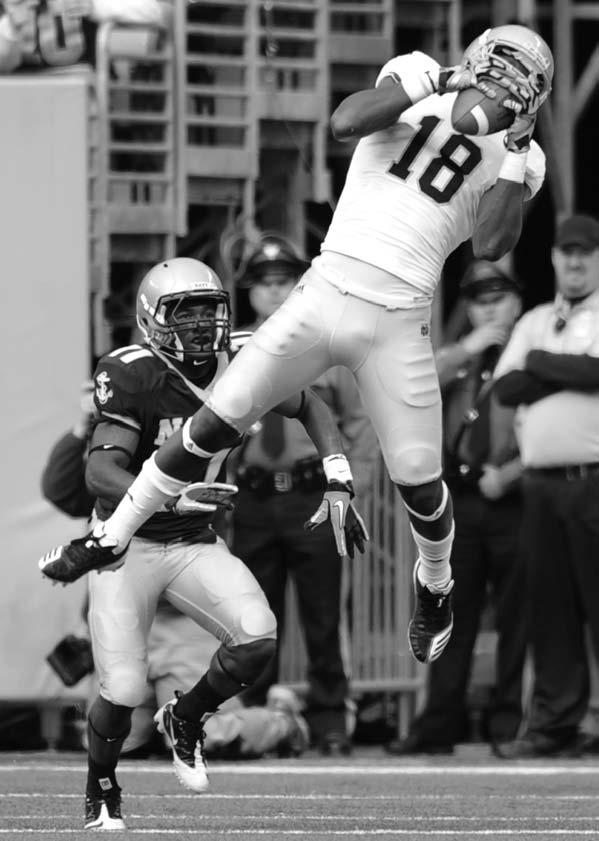
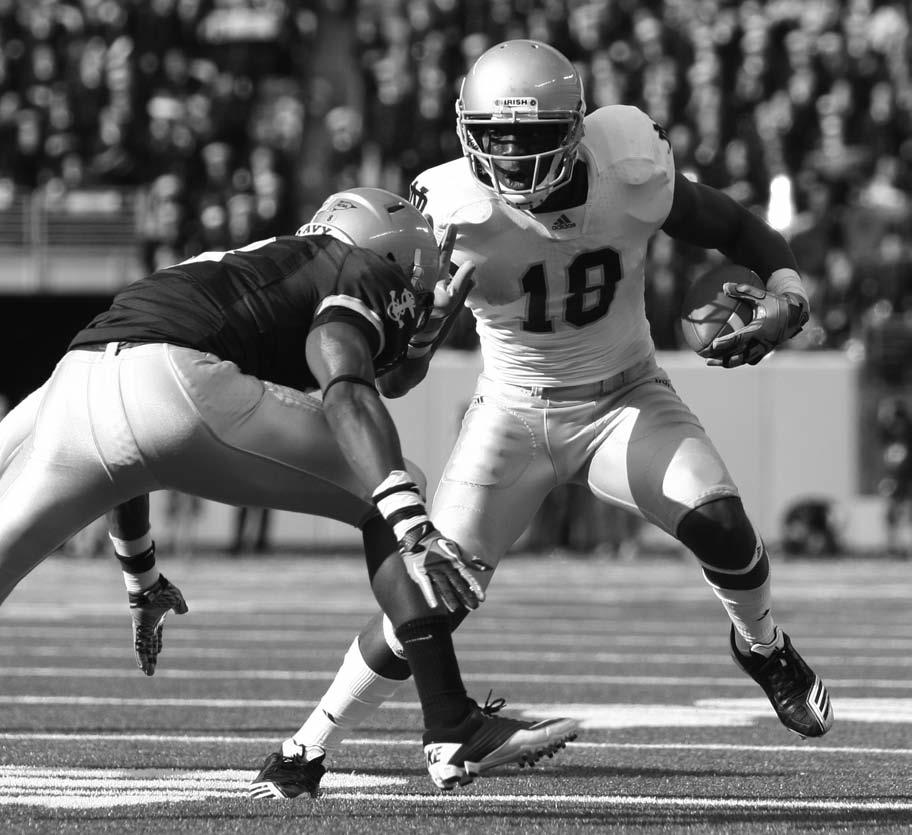
ing the guys that you have to work every day, every day that you’re supposed to and if you do little things, it’ll all work out,” Kamara said.
Another important lesson that Kamara works to instill in his underclassmen teammates is that the team surrounding them is everything, and that’s what makes Notre Dame more special than any other university.
“I think the guys in that locker room know it’s all about the players around you,” he said. “Those are the guys that you see every day, those are the guys who, when you’re going through your worst times, those are the guys that are going to be around you. I mean it’s four years and four years is a long time.”
Kamara also said he believes the team’s family atmosphere makes the players more willing to help each other improve.
“You don’t really get sick of them,” he said. “These are guys who are going to tell you that if you’re doing something wrong, they’re going to tell you it’s wrong. Those are the type of guys you need around you. You don’t need someone who’s just going to kiss up to you. That’s just what you need, a brother, a family member, who’s going to tell you what you’re doing right and what you’re doing wrong.”
Kamara said his classmates have made his college experience what it is.
“I think we’re a close group of guys, I think we’ve been close since we came in freshman year, and that’s what makes it special,” he said pointing to the group of seniors around him. “It’s like everyone’s from all over the globe and we just have one thing, football, to bring us
together. I mean it’s special. We all know what we want in life, we all want to achieve the highest level of this sport, and we just knew that coming in, and that’s one of the things that brought us together.”
For Kamara, the past four years seem to have flown by, and he tries not to focus on that as he approaches senior day and his final game in Notre Dame Stadium.
“It’s reality but I try not to think about it, so it’s unreal. It seems like yesterday we just came in as freshmen,” he said. “It all went by so fast. But I really don’t think about it, it’s just another chapter of life. It’s in the past right now, that’s how I think about it. I try to stay level headed.”
Although he tries to stay level headed, Kamara said he can’t help but recall the feeling of stepping into Notre Dame Stadium and wearing his No. 18 jersey for his first game with the Irish, a feeling he knows he won’t be able to find anywhere else.
“My freshman year, I can remember it like it was yesterday,” Kamara said, “I mean I was just struck, shocked about how many people were out there [in the Stadium]. That’s just part of going to Notre Dame, it’s something special, it’s a special place.”
He’s able to laugh and smile about it now, but Kamara said he wasn’t so relaxed when he first was called in to play.
“My first game — oh man, I was nervous. My first play of freshman year, I went out there and my legs are shaking, my arms are shaking, and I’m like, ‘Oh man, I don’t want to mess up, I don’t want to mess up.’ And I actually caught my first pass on my first play,” he recalled.
That first play led to a standout freshman season in
2007 in which Kamara surpassed legendary Irish receiver Tim Brown’s rookie record for catches with 32, including four touchdown catches, and he recorded 357 receiving yards in 11 games.
Kamara continued to be a contributor for Notre Dame in his sophomore and junior seasons, playing in a combined 25 games with 14 starts. So far this season, he has played in six games, notching 68 receiving yards.
“It’s something special,” Kamara said.
“It’s kind of like you’re going to war with your guys. You walk down the hall, tap the walls, tap the ‘Play Like A Champion Today’ sign. It’s something special, you can’t explain it unless you’re part of it. It’s something hard to understand, but it’s something special. Walking out and just looking around at 80,000 people.”
Although he’s no longer a freshman, Kamara said he still feels the same nervous excitement that he felt as a first year player whenever he emerges from the tunnel with his Irish teammates.
“I always have butterflies, that’s just who I am. But as a senior, you go out there with the confidence, a different swagger about yourself, you just want to perfect everything you do,” Kamara said.
Driving that swagger and desire for perfection for Kamara are both his family and teammates.
“Just knowing I’m doing it for someone, and another thing is the program. Just doing it for years to come, and eventually a National Championship, and I can say I was part of building that.”
TOM LA/The Observer
Senior receiver Duval Kamara looks for a few extra yards during Notre Dame’s 35-17 loss to Navy on Oct. 23. Kamara ended the game with six catches for 56 yards.
TOM LA/The Observer Kamara broke mutiple Notre Dame receiving records for a freshman in his first year in 2007.
GARY GRAY
Outgoing safety gives Irish a shot of athleticism
By LAURA MYERS Sports Writer
In Gary Gray’s first game in an Irish uniform, he returned an interception for 41 yards.
A little more than a year later, in the senior cornerback’s first start, he led the team with six tackles and returned a 30-yard interception.
Now, he is a steady presence in Notre Dame’s backfield.
In Notre Dame’s first game of 2010, a 23-12 win over Purdue on Sept. 4, Gray led the team with eight solo tackles, and tallied nine in total.
He followed that with five tackles against Michigan and Pittsburgh, eight against Western Michigan and nine against Tulsa.
“I think I’ve developed as a player, having more urgency,” Gray said.
Richland Northeast High School in Columbia, S.C., Gray chose Notre Dame over offers from Florida, Florida State and Michigan, among others.
After finishing his high school career with a trip to the U.S. Army All-American Bowl, he enrolled in January 2007 to be available for spring practice with the Irish.
But injuries kept Gray out of much of the spring and all of the 2007 season. He had surgery on his shoulder prior to the start of that season.
“I mean, going into the season we didn’t think we’d be 4-5 right now, but we’ve been close in all our games except two. It’s tough, but there’s still season left.”
Gary Gray senior cornerback
“Watching film more, learning your opponent. In high school, you didn’t watch film, but here you have to, to be ready.”
Gray said he became more of a leader as a senior, and his performance in games defined his leadership style.
“I’m not much of a talker, but I talk about plays on the field, and what I do,” he said.
“Guys see that, and they want to make plays too.”
At every new step Gray has had a fast start — but it took a while for him to get there.
A four-star recruit out of
“It was tough, not being able to play,” he said. “I hurt my arm in spring practice, then my recurring shoulder injury was bad [in the fall]. But it gave me a chance to adjust to college.” He played his first game in Notre Dame’s 35-17 win over Michigan on Sept. 13, 2008. In the fourth quarter, he grabbed the interception off a pass from Wolverine quarterback Nick Sheridan. He ran the ball from Notre Dame’s 42 yard line to Michigan’s 17 before being tackled.
“That was great. I read the coverage right, picked it and ran as far as I could,” he said.
Gray’s mother was in the stands to see him make the interception, which made it even better, he said. But he noted a playful grudge against defensive tackle Ian Williams, one of his best friends on the team.
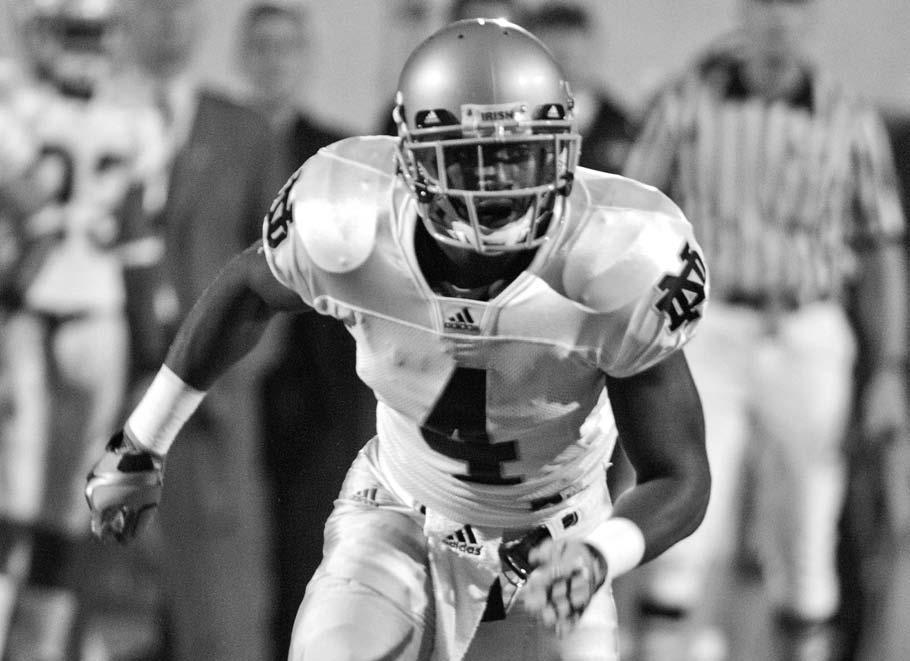
“I could have scored, but Ian didn’t block for me,” he said. “... He didn’t block, that’s why I got tackled.”
Gray played in nine games as a sophomore, but then took a leave from the team for personal reasons. He returned as a junior for the 2009 football season and soon became a fixture in the defense. He played in 11 games and started the last seven.
In his first career start, against Southern California on Oct. 17, 2009, he recorded six tackles and intercepted a pass from Matt Barkley. He ran the pass to the USC 13 yard-line, setting the Irish up
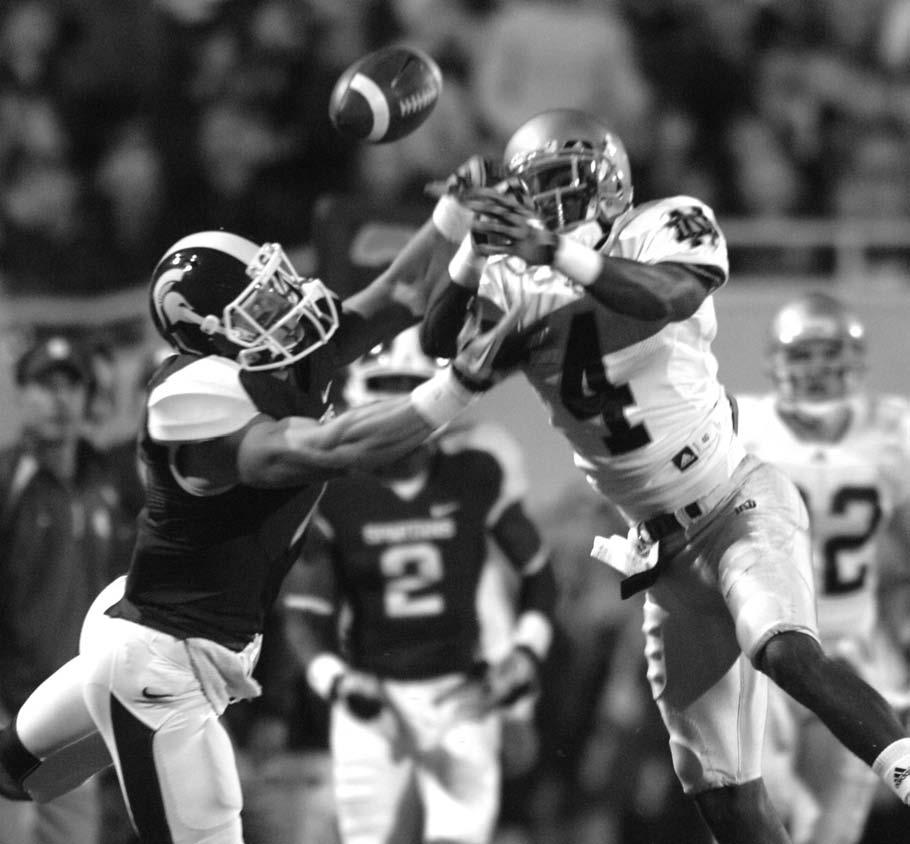
for a touchdown three plays later.
In his career Gray has intercepted four passes and helped to break up many more. His position in pass coverage led him to get a tattoo on his back, of a hawk carrying a football. The tattoo reads “Ball Hawk.”
“It just means I’m always around the ball when it’s in the air,” Gray said. “When it’s in my vicinity, I’m going to be around it.”
Gray had the tattoo done as a junior.
“My godfather always talked about getting to the ball,” he said. “We always joked about me getting a tattoo, like squeezing the air out of a ball, but I already got it. It has meaning behind it.”
Outside of practice, Gray is just like any other student — he listens to music, does homework and plays video games with friends. He has grown close with most of the football team’s seniors, he said, and spends most of his time with them.
Defensive end Emeka Nwankwo is the one to beat when playing Madden NFL, Gray said, but he is “great at FIFA,” a soccer video game.
His favorite place on campus is related to football as well: the Guglielmino Complex, where players lift weights, study, have meetings and eat dinner.
“We spend half our time here,” he said.
Gray will graduate in May with a degree in sociology and a minor in computer applications. He said he could continue with the computer applications major if he comes back to the team for a fifth year — something he would like to do.
“Hopefully I can do that,” he said. “We’ll see how things work out this year.”
Through three years of action, Gray’s time at Notre Dame has included plenty of upheaval, as the defense changed schemes in each year he played.
“It hasn’t affected me that
much. I think I’m a quick learner,” he said. “I think I adjusted okay.”
He said the coaching change worked out well.
“It’s been tough with the coaching changes,” he said. “But the transition was good. [Irish coach Charlie Weis] is doing great with the Chiefs, and I really like what [Irish coach Brian Kelly] brings to the table, and I like our defensive staff.”
Gray said the problems the team has faced since his freshman year have given the Irish a fighting character.
“Through the turmoil, us losing, us being 3-9 that year and having mediocre years the next two years after that has been tough, but you just have to keep fighting,” he said. “That’s what we always do.”
That character has been evident in this season as well, he said.
“I mean, going into the season we didn’t think we’d be 45 right now, but we’ve been close in all our games except for two,” he said. “It’s tough, but there’s still season left.”
But there is still a lot to accomplish in 2010. Gray said talk among the seniors is focused on avoiding a senior day loss.
“Just get the win for the seniors,” he said. “They don’t want to leave their last game in Notre Dame Stadium with a loss. It was tough last year, seeing my friends leave with a loss in the Stadium. We don’t want that to happen again.”
With coming back for a fifth year as a possibility, Gray’s view of that senior game may be a little different than that of most; but his reflection on his four years at Notre Dame summed up the experience of this year’s senior class.
“It didn’t start well with the records,” he said. “But we’ve always fought in every game this year. We had our ups and downs, but we keep fighting. We’re the Fighting Irish.”
GRACE KENESEY/The Observer
Senior cornerback Gary Gray has formed a cornerback-tandem with classmate Darrin Walls throughout the 2010 season.
TOM LA/The Observer Gray has recorded four interceptions and eight pass break-ups during his Notre Dame career. Five of those pass break-ups came this season, including two against Michigan State.
Time at ND teaches Quintana the ‘right manner’
By ANDREW GASTELUM Sports Writer
This Saturday, senior outside linebacker Martin Quintana will take his last steps onto the field he has worked so hard to find. Then he will trade in his helmet for a briefcase and swap his jersey for a suit, venturing into corporate America in December.
But heading into his last game, the fifth-year senior said he plans nothing different to highlight the significance of his situation.
“As always, I am just going to soak it all in, but this time it’ll be for the last time,” he said. “I always had a dream to play college football and it is definitely something that has defined my time here.”
The walk-on senior graduated last year with a degree in finance, but came back for one more year to earn a degree in Spanish, and, of course, to play football.
“It was very important to me and my heritage to receive this degree,” Quintana said. “I also had one more year of eligibility and I was lucky enough for [Irish coach Brian] Kelly to let me return and be a part of his team.”
Concerning the first-year coach, Quintana had nothing but good things to say, expressing praise and even foresight into where he sees the team
DAN WENGER
going in the future.
“I have no doubt that [Kelly] is going to do big things here with the program,” Quintana said. “I am just glad to say that I am a part of the start of something special.”
But returning to a team with a new coach meant changing positions from defensive end to outside linebacker, something that could have been very intimidating for a walk-on who has not received much playing time.
“My job is to make sure I make the guys out there better and prepare them for Saturday,” Quintana said. “I may not play too much in the game on Saturday, but my games are Monday through Thursday out on the practice field. If you can’t get pumped about that, then you must not love football.”
The fifth-year senior said that the field is where he belongs, especially because of the brotherhood he has formed with the other walk-ons.
“Later on down the road, I am going to remember the relationships that I have formed with all of these guys out here,” he said.
“All of us walk-ons love the challenges we face and it’s almost like it is a competition between us during practice.”
Reinforcing one of Kelly’s favorite mottos, Quintana also insists that he owes Notre Dame for what he has accomplished, not the other way around.
“I have grown so much since
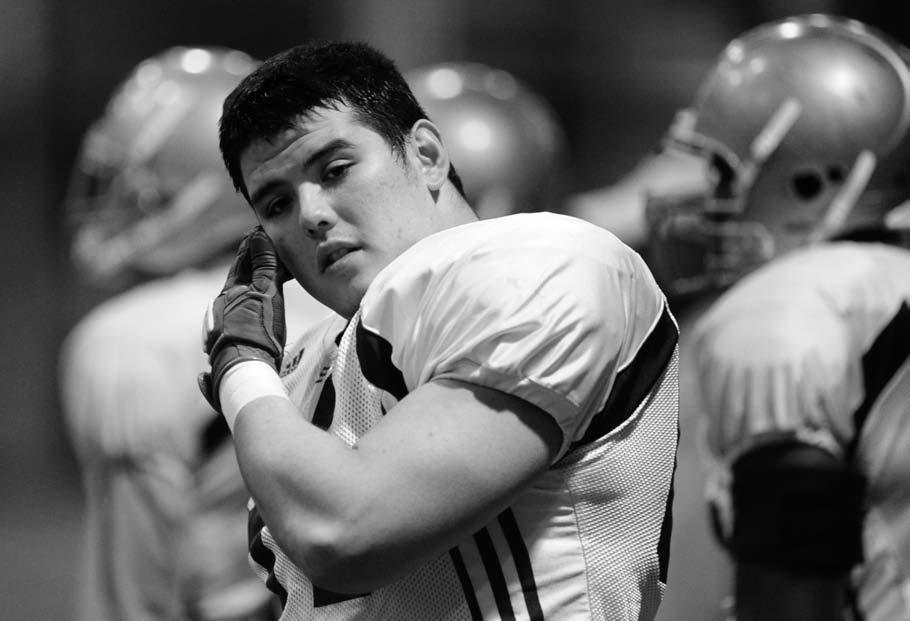
coming here,” he said. “Playing here is about doing things the right way and conducting yourself in the right manner, all for Notre Dame, our mother.”
Quintana said he would graduate with values that will help him in the future.
” Because of everything that I have been through, there is
nothing that someone can put me through that I haven’t experienced before,” Quintana said.
“The values that I developed here are what I will carry with me for the rest of my life.”
With his bright future coming fast, Quintana had only one thing to say.
“I love this university, but it’s
time for me to move on to other things,” he said.
Those other things will result in a gold-plated name on his desk, four years after first seeing his name scribbled onto tape stuck to a gold helmet.
Contact Andrew Gastelum at agastel1@nd.edu
With another year possible, Wenger not done yet
By ERIC PRISTER Associate Sports Editor
Fifth-year offensive lineman Dan Wenger has dealt with position changes, coaching changes and battled injuries throughout his time at Notre Dame. Through it all, Wenger said he felt that he had something to prove, and is confident that he was able to accomplish that goal.
“It’s just one of those things where you’re looking for the real end goal — to be successful every year and to keep getting better and hopefully play at the next level,” Wenger said. “In life, in football, in school or really in any aspect there’s always going to be something that comes up and brings you down to your knees, and then the question is are you going to get up or are you going to sit there and lay down and not do anything about it?
the teaching he received in his first few years on the team.
“It’s just one of those things where you’re looking for the real end goal — to be successful every year and to keep getting better and hopefully play at the next level.”
Dan Wenger senior center
“I would just say that my first offensive line coach, John Latina, recruited me from the start and was really always in my corner for everything,” he said. “He molded me and shaped me and taught me football like I never knew it was supposed to be played. He showed me what the game’s really about and transitioned me from a good high school player to a real college player who really understood the game and gave me a grasp on what we’re trying to do. Not only coach Latina, but also [former Irish center] John Sullivan reached out to me a lot, and luckily I had two years with John. Those two definitely helped me and worked with me and made me football smart.”
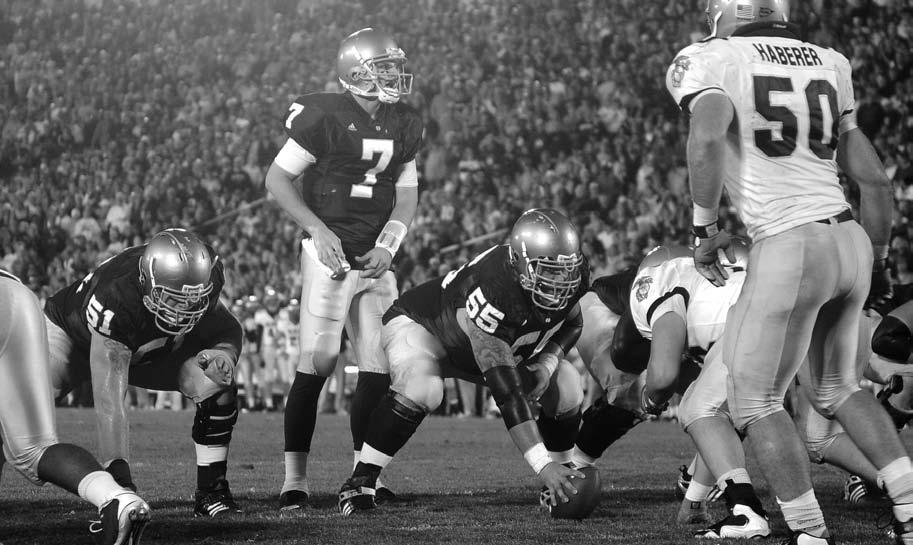
“And I just kept fighting and getting up and was stronger for it and bounced back and proved myself as one of the toughest and smartest and most reliable players that have come through this program.”
Wenger’s 19 starts places him third among active offensive players in that category. He attributes part of his success to
Wenger’s most successful season was his junior year. He started every game for the Irish at center in 2008, a team that finished 7-6 after their Hawaii Bowl victory.
“[Being a starter is] obviously one of the greatest feelings in the world,” he said. “I started at center, and all the calls were on me. I had control of the line, and that’s what I really live and die for in playing this game, because I have control, I’m the anchor of the line. That was the
greatest feeling of it all, just knowing that the other four guys could trust me and knew that I was going to get my job done and had faith and confidence in me. That’s the best feeling, being able to give your all on every snap of every play of every game, and being that reliable to a team. It’s something special that you don’t find very often with many players.”
Wenger played center in high school, but has been moved back and forth between center and guard, a process that he said he believes has taught him to adapt.
“It gave me the ability to just
be able to adapt in pretty much a split second, because with my position changes and coaching changes, there was a lot of back-and-forth,” he said. “So it’s just a matter of being able to be coached in certain situations at certain positions and roll with the punches. You’ve got a situation that’s out of your hand, out of your control, and you have to make the best of it.”
Despite the many setbacks, Wenger said he would not change a thing about his time at Notre Dame, which, he hinted, might not be quite done.
“It’s been great,” he said. “I
couldn’t change one thing about it. I met great guys, great people, great coaches. I got a great education, and this place is something special. Whoever gets the opportunity to come through here, not only going to school but if you’re given the blessing of playing here, you really have to treasure it. It took me a while to really understand that and really realize where I was. You can’t take it for granted at all. But don’t rule me out. I might be back next year.”
Contact Eric Prister at eprister@nd.edu
COLEMAN COLLINS/The Observer
Senior center Dan Wenger, pictured at guard, 51, has switched positions along the offensive line throughout his career at Notre Dame, filling in wherever was needed to help the Irish.
Observer File Photo
Senior Martin Quintana switched from defensive end to outside linebacker in his fifth year with Notre Dame, as new Irish coach Brian Kelly installed a 3-4 defensive scheme.
WOPU Nation president relishes chances to lead
By MATTHEW DeFRANKS
Sports Writer
For some kids, it’s a dream to one day play football for Notre Dame. For senior walk-on cornerback Nick Lezynski, it was much more than that.
“I would come home in first grade with a 100 on my spelling test and I would ask my mom ‘Is this good enough to get into Notre Dame? Will I be able to play football there?’” Lezynski said.
The Newton, Pa., native hails from a family draped in Notre Dame tradition. Lezynski’s parents, sister and uncles all attended Notre Dame. He even attended Notre Dame High School in his hometown.
An Irish fan growing up, Lezynski walked on during the spring of his freshman year and now is part of the very select WOPU Nation — the Walk-On Players Union, described as a brotherhood between the walk-ons.
“We have parties. We have formals. We have e-mail chains. We have video skits,” Lezynski said. “Basically, we rip on each other the whole time.”
Members of the WOPU Nation don’t take themselves too serious, either.
“I’m the president and they’re thinking about impeachment,” Lezynski said. “It’s not going to happen. It’s turned into a bit of a dictatorship.”
CHRIS SKUBIS
The leader of the WOPU Nation off the field, Lezynski got onto the field this season for a play in the fourth quarter of Notre Dame’s 23-16 win over Pittsburgh.
“The guy in front of me gets hurt and I find myself running onto the field in a six-point game, in the fourth quarter, playing kickoff return, which is easily the hardest thing to do in a game. It’s like running into a train wreck,” Lezynski said.
“It was refreshing to have some of the walk-ons get some playing time this year. I was fortunate enough to have played in a legitimately tight game.”
The converted quarterback — who, at 5-foot-9, calls himself a shade under six feet tall — also made the travel roster and has traveled to each game this year.
“I went from being the little puny quarterback to senior year, going on kickoff return and traveling with the team,” Lezynski said. “That whole route, I’ve had people supporting me and I appreciate the work ethic my parents instilled in me.”
Lezynski mentioned fellow senior walk-ons Michael Garcia, Dan Franco, Martin Quintana and Chris Gurries as among those who have supported him throughout this process.
“The bottom line is that we want Notre Dame football to
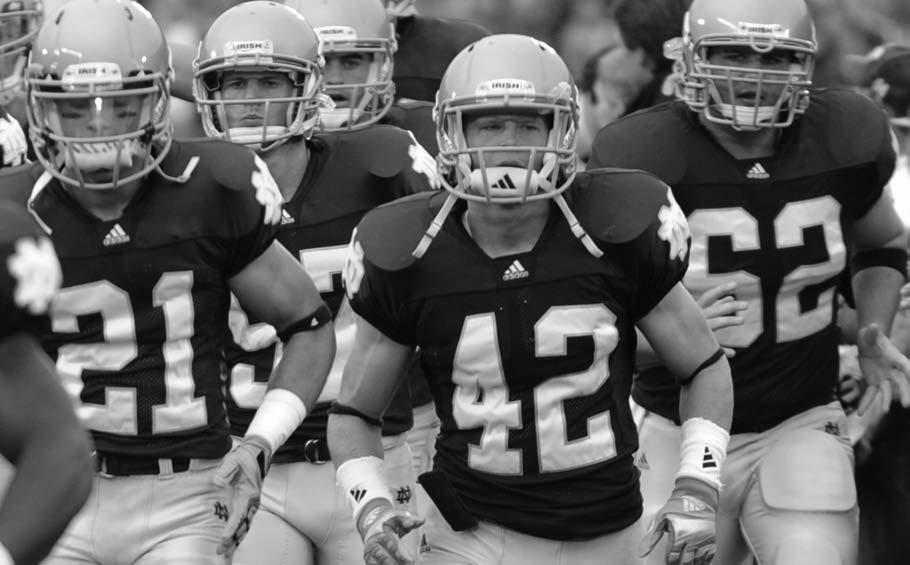
win,” Lezynski said. “These past few years have been tough knowing that, being a player, I can influence the outcome. It’s been frustrating. I owe a lot to the previous coaching staff and this coaching staff for giving me a shot.”
Lezynski, a marketing major, envisions the WOPU Nation bonds to continue for the rest of his life, including in a possible business venture.
“Maybe a couple of the
WOPU Nation guys and I will go into an entrepreneurship,” Lezynski said. “Maybe start a business, make some money and start a scholarship fund for the future WOPU Nation guys.”
While the business world is an option, Lezynski does not rule out a coaching career. Even without a coaching career, he believes football has prepared him for whatever challenge awaits him.
“There’s so many skills, not
just physically, but mentally also,” Lezynski said. “Now that I’ve accomplished this goal, I feel like anything in the future, I’ll be able to tackle.
“Even though we have these down seasons and personally, I’m not a star, I wouldn’t trade this for anything. There’s nothing like being a Notre Dame football player.”
Contact Matthew DeFranks at mdefrank@nd.edu
Lineman spends time with linemates on, off field
By SAM GANS Sports Writer
Rarely is a man who is sixfoot-two and weighs in at 232 pounds considered small.
One of the few exceptions is when he is a defensive end for
Notre Dame.
While the thought of facing men nearly 100 pounds bigger might intimidate some people, Christopher Skubis relishes the opportunity of going up against Notre Dame’s offensive line every day in practice.
“It was a tough adjustment at
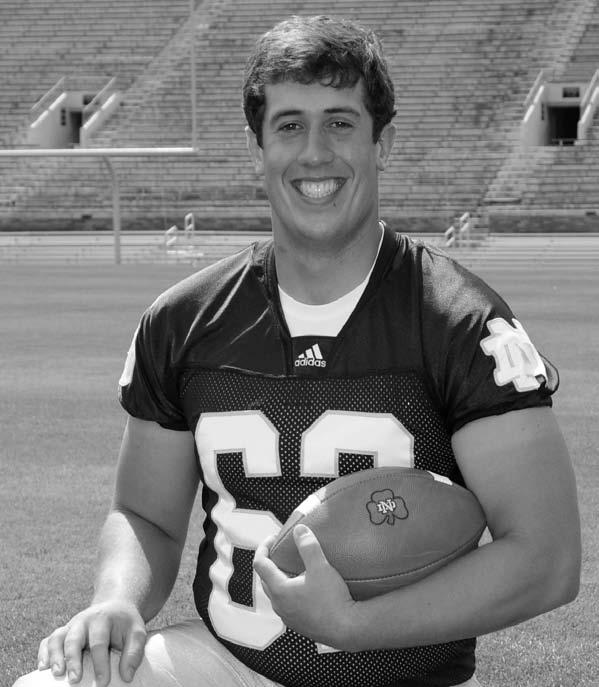
first going against offensive tackles who are 310 [pounds] or 320,” Skubis said. “It was a challenge every day to come out here, but I’ve been getting better and I’ve had a blast doing it. It’s nice to get in there and try to throw my weight around a little bit.”
Skubis, a walk-on, came to Notre Dame as a typical student. He did not play for the team as a freshman, and didn’t try out until his sophomore year, after a season of interhall football, when he felt the urge to attempt something bigger and better.
“My freshman year, I played interhall, but something was missing,” he said. “It wasn’t as competitive as I had hoped. I loved interhall, but I thought I could do something more.”
really beat the crap out of us, and they had us in here five days a week at five in the morning. They worked us to the bone.”
Skubis stuck it out, though, and became one of about 10 players out of the 50 from his class who tried out to make the squad. Though he was a walkon, the scholarship players instantly embraced him as a member of the team.
“All those guys took me under their wing,” he said. “They showed me what was expected and taught me the plays.”
Not only were the other defensive linemen helpful to him on the field, but he became friends with them off the field, as well.
“My freshman year, I played interhall, but something was missing. It wasn’t as competitive as I had hoped. I loved interhall, but I thought I could do something more.”
While he has to fight on the field now to make up for his size disadvantage, he had to battle even harder just to make the team. Tryouts took place in the spring and were an agonizing process, filled with many demanding workouts.
Chris Skubis senior defensive end
“It was a brutal process back under [former Irish] coach [Charlie] Weis,” he said. “They
“I never thought I’d be running around with [senior nose guard] Ian Williams and [junior defensive ends] Ethan [Johnson] and Kapron [LewisMoore], and we’ve actually become really great friends,” he said. “Last spring break, I was down in Florida with those guys. It’s just opened a lot of doors for me, and I’ve met a lot of great people that I probably wouldn’t have had a chance to.”
Though Skubis has not made
a huge impact for the Irish on the field, he and the rest of the senior walk-ons have helped to make their own large contribution to the program, through the Walk-On Players Union (WOPU), a group that unites all the walkons and brings them closer.
“WOPU has grown in strength,” he said. “Back in the day, no one really heard of it and part of our senior class goal was to get the word out there and make it one of those powerful groups on campus. It’s on the rise. We already got a hold of those new guys, teaching them our ways, showing them what’s expected, and they’re going to keep the tradition going.”
A double major in accounting and economics, Skubis plans to head south to Atlanta after graduation to work in auditing — and to escape the cold.
“I’m from Buffalo, and then coming to South Bend, I’ve gotten my fair share of snow,” he said. “So I figure I’ll go down there with nice, warm weather and enjoy the heat for a while down in SEC country and represent Notre Dame.”
But before he does that, there is still some more football to be played and memories to reflect on.
“I’ve gotten to experience so much by running out of that tunnel and being out there on the field for warm-ups,” he said. “It’s just incredible, and I wouldn’t trade it for anything.”
Contact Sam Gans at sgans@nd.edu
MACKENZIE SAIN/The Observer
Senior walk-on cornerback Nick Lezynski, 42, has led Notre Dame’s coalition of walk-on players, Walk-On Player Union, as its president over the past year.
Courtesy of Lighthouse Imaging
Senior walk-on defensive end Chris Skubis began his Notre Dame career playing interhall football.
Wyoming walk-on excels most with track team
By MATTHEW DeFRANKS Sports Writer
What do you get when you combine a one pound burger, some jalepeño sauce and a Notre Dame lineman? That would be the Man Challenge, presented by senior walk-on long snapper and defensive lineman John Belcher.
“It’s pretty fun but one of my roommates, he’s a little guy at about 160 pounds, he can eat,” Belcher said. “But we keep it a tight race.”
The 5-11, 235 pound native of Cheyenne, Wyo., makes more than just monstrous burgers in his spare time.
“I’m a huge fan of grilling stuff. I love making chicken, steak, pork, fish,” Belcher said. “I love to eat. So anything that sounds good, I’ll try to make it sometime.”
A new addition to the team this year, Belcher’s talents have been simmering on the track and field team, where he competes in both the shot put and hammer throw. The Irish men’s track team has won four of the past six Big East titles in both indoor and outdoor track.
“For track, [my goal is] to win two more Big East championships,” Belcher said. “I know our throwing squad is a good one. This year should be fun. I’m excited.”
Belcher, an All-Big East selection as a thrower, has the
ANDREW NUSS
unique situation of balancing track and football.
“Whenever football ends, I’ll be able to go back to track. Right now, my commitment is to football and when it’s over, I’ll be back to track.”
In May’s Big East championships, Belcher placed third and fourthin the shot put and hammer throw events, respectively. Belcher wants the rust to come off easily after not throwing for a while.
“Hopefully, I’ll be able to get back in the groove pretty quickly,” he said.
As a rare varsity athlete to walk onto the football team, Belcher had always wanted to play for the Irish.
“This was a great opportunity. I’m happy I did it, I’m happy I made it on the team,” Belcher said. “In my senior year of high school, I thought my football career was over. It’s nice to be able to play again.”
Belcher’s highlight of the year came in the Irish’s first game when he got to run out of the tunnel at Notre Dame Stadium.
“Running out of the tunnel is a really cool experience,” Belcher said. “It’s the first time I’ve run out to see 80,000 people from the field.”
Notre Dame’s great academics, athletics and overall atmosphere drew Belcher to Notre Dame out of high school, as did its with its proximity — or lack thereof — to his home
in Wyoming. But those factors did not have the greatest influence on him during his threeplus years.
“I could name off coaches. I could name off friends. I could name off teachers. But it’s really been the Notre Dame community that has had a huge impact on me,” Belcher said.
As a pre-med student who has opted to not attend medical school, Belcher would like to work in medical device sales for a company like Stryker or Johnson & Johnson. An ideal situation would be in the operating room with surgeons instructing them on how to use the instruments, he said.
“I was very fortunate to have this opportunity and lucky to be on this team,” Belcher said. “I can’t believe I’m already senior. I’ve just really enjoyed my time here.”
Contact Matthew DeFranks at mdefrank@nd.edu
Nuss switches sides of ball early in ND career
By CHRIS ALLEN Sports Writer
When offensive lineman Andrew Nuss first stepped onto the field of Notre Dame Stadium during his freshman year, he envisioned some of his greatest moments in an Irish uniform happening when he chased after opposing quarterbacks.
Little did he know then that his career would center around protecting quarterbacks on the other side of the ball. Before the change could be made, the sixfoot-five senior from Virginia had to experience a moment of self-realization.
wanted to give every school a fair chance,” Nuss said. “When I was offered by Notre Dame, I was like, well, this is what every kid grows up wanting. When I visited in the summer, it was basically, ‘I’m done, I’ve found everything I wanted.’”
When Nuss arrived on campus, the coaching staff, led by former Irish coach Charlie Weis and offensive line coach John Latina, convinced Nuss to switch to the offensive line to help him best realize his potential.
“My freshman summer, when I got here in training camp I was on the defensive side of the ball. It was a lot of fun, but I realized I’m not really athletic. I realized I should try offense instead.”
“My freshman summer, when I got here in training camp I was on the defensive side of the ball,” Nuss said. “It was a lot of fun, but I realized I’m not really athletic. I realized I should try offense instead.”
Andrew Nuss senior guard
Long before he considered his prospects on the offensive line, Nuss was a four-star recruit who started his college search looking for a school that could provide him with the perfect mix of academics and athletic accommodations. Though a dozen schools offered him spots, when Notre Dame came calling, he couldn’t resist.
“I visited every school because I
“Coach Weis asked me what I wanted to be. I told him I wanted to be a playmaker. Turned out to be the opposite,” Nuss said. “I made the switch after the Michigan game my freshman year. [Latina] who was the offensive line coach back then basically told me that my future here at Notre Dame was on the offensive line. When I made the switch, a bunch of guys helped me out along the way, namely [former center] Eric Olsen and [offensive lineman] Dan Wenger. I loved it.” Eventually, Nuss worked his way into the rotation along the line, making his way into two games during the 2008 season and impacting special teams.
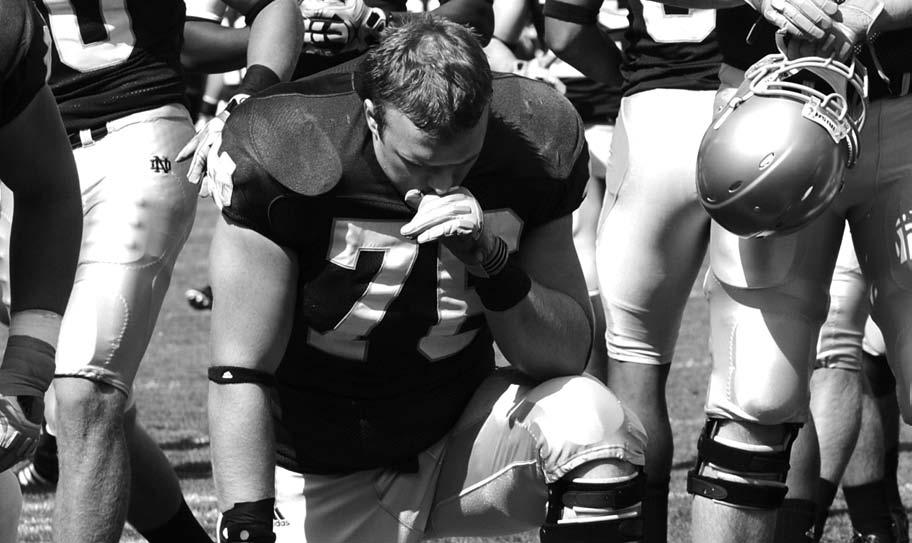
chasing quarterbacks,
“Sophomore year was great,” he said. “I got to play a little bit, got to play in the Navy game, and then obviously the Hawaii Bowl was a great trip.”
With another year of practice under his belt, Nuss found himself playing a big role in the 2009 opener against Nevada, where he had one of his favorite moments of his career.
“There was a screen, and I was just running downfield as fast as I could. I thought I was running really fast, but I wasn’t,” Nuss said. “All of a sudden out of nowhere I saw a corner coming at me and I just cut him really bad and sprung Michael Floyd on a 40-yard play. After that I was so pumped, but I was extremely tired at the end of it.”
Nuss played in 13 games in
2009, ranking sixth on the team in special teams appearances, seeing significant time as an offensive guard and flourishing under the coaching of new offensive line coach Frank Verducci. After the coaching change in the off-season, Nuss has maintained his role as a strong special-teams contributor while seeing duty along the offensive line.
As he approaches the end of his senior season, he said he believes attending Notre Dame was the right decision.
“It’s definitely a lot harder than I thought it was going to be,” Nuss said. “But overall, I think I would do it again if I could.”
Once the football schedule comes to a close, Nuss plans to pursue a job in the financial industry, a path that began with a position change in the business school similar to the one he made on the field.
“All of my friends were doing marketing,” he said. “I said, ‘Oh, I don’t want to do marketing, I want to be different.’ I chose finance, and sometimes I regret being a finance major because it’s so hard. I really do enjoy stocks and mutual bonds and all that stuff, though. I find it very interesting.”
Contact Chris Allen at callen10@nd.edu
JULIE HERDER/The Observer
Senior guard Andrew Nuss originally came to Notre Dame planning on
but after switching sides of the ball, he spent his Irish career protecting them instead.
PAT COVENEY/The Observer
Senior walk-on long snapper John Belcher has taken his role with the Irish seriously, while enjoying hyjinx off the field, including an eating contest he called “the Man Challenge.”
Long snapper exceeds even his own expectations
By MEAGHAN VESELIK
Sports Writer
A well-rounded Notre Dame experience is all Bill Flavin wanted when he stepped on campus four years ago as a student, but as he moved his belongings into the fourth floor of Keough Hall, Flavin never expected he’d one day be the starting long snapper for the Irish.
It’s a story that began his freshman year in the same dorm hallway where he still lives today, and one that ended two weeks ago when his ankle broke in the first quarter. Although it ended prematurely, Flavin said he’ll never forget experiencing a walk-on’s dream.
“I walked on in the spring of my freshman year,” he said. “It’s been a dream to come to Notre Dame since I was a little kid. My dad came here and I’ve been coming to football games my whole life. I didn’t really think about [walking on] coming out of high school, I just thought I’d be done.
“But then [graduated Irish player] Mike Anello, he was a walk-on and was a junior when I was a freshman, and he was in Keough and lived in my section, and he said, ‘Did you ever think about walking on?’ And I said, ‘Well, kind of, I mean I can long snap alright, so might as well try.’”
Another hallmate and friend,
MIKE RAGONE
Dan Brennan, also pushed Flavin to try out and seconded Anello’s encouragement.
“I was on the fence but [Brennan] was like, ‘just do it, you got nothing to lose. Even if you don’t make it, you’ll just be back here, where you are now,’” Flavin said. “So I took his advice to heart, and I gave it a shot and here I am now.”
Some things Flavin didn’t think about when he took that advice: early morning practices walking through snow, tough workouts that are expected to fit in around hours working in the summer, astrict weight training regimen, and the hours necessary to put in outside of class and a social life. But standing on the field and playing in front of thousands of cheering fans makes it all worth it for Flavin. Especially since he was not a recruit but rather a respected member of the WOPU Nation.
“The WOPU Nation is the Walk-On Players Union,” he said. “It’s just the group of walk-on players — like we have each other’s backs all the time and we all went through the same things to make it. We’re all dedicated people off the field and on the field. It’s a really cool group of people to be a part of and they’ve been my best friends for three years.”
Being part of the WOPU Nation and growing to have a leadership position on the team in his senior season has added to Flavin’s experience. Working
up to the top is nothing new for him, however, as he has held leadership positions before. This time, he said the drive to lead came from his desire of once more achieving his own goals and to help Notre Dame do well.
“I’ve been a Notre Dame fan my entire life, and obviously, no one enjoys seeing Notre Dame lose or not play a complete game to teams that [it] should beat, so the overall desire is to help the team win and to get the team back to where it should be” he said. “I think the difference between a leadership role on the football team at Notre Dame to a role in student government or whatever else I’ve been involved in, is that with this, the group of people you’re with, it’s an incredibly motivated group. It doesn’t take much to catalyze that effort. It’s kind of leadership by example; working hard and doing things right every day, everybody gets caught along for the ride.”
Flavin leads by example in the campus science labs as well, where he has been studying biochemistry in hopes of attending a MD/PhD program next fall to pursue a career that combines a love for research with patient care. Where he will end up is yet to be determined, but Flavin has submitted applications to schools such as Northwestern and Stanford. How Flavin handles it all is something that would have been a mystery to even himself
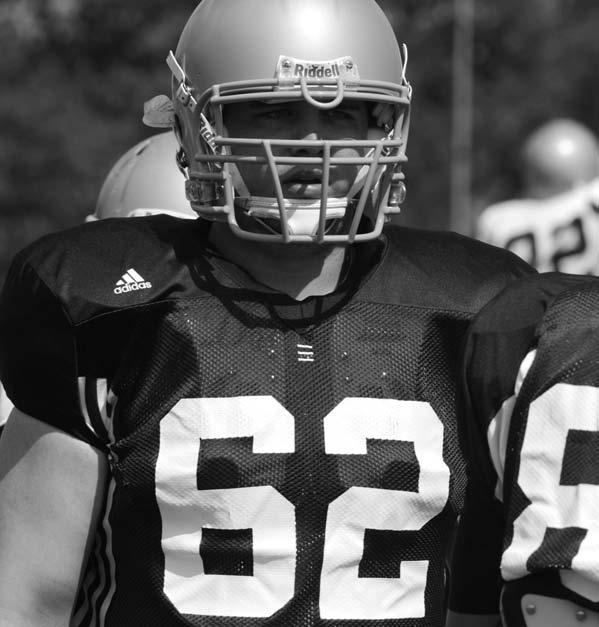
when he stepped onto campus, but now, he wouldn’t have preferred it any other way.
“Whenever I’m busier, I’m able to accomplish more. If you would have told me I’d be doing all the things I’ve been doing, I would have told you, when I first started, I would have said that’s nuts, I wouldn’t have been able to do it,” he said.
“But I think I’m able to do more when I’m involved with more. It’s cool to be able to go from a football practice at the Gug to a lab in Jordan or things like that. I think I’ve seen a broad piece of Notre Dame over the last four years and it’s been great.”
Contact Meaghan Veselik at mvesel01@saintmarys.edu
Torn ACL helps tight end realize priorities in life
By MEGAN GOLDEN Sports Writer
A torn ACL, a taste of Notre Dame academics and a coaching change were not going to stop senior tight end Mike Ragone from becoming the athlete, student and, most importantly, friend that he is today.
Ragone saw action in 11 games as a freshman, and he quickly learned the difference between his high school’s game day atmosphere and the
crowd of 80,000 in Notre Dame Stadium.
“My freshmen year against Georgia Tech [was] the greatest game in the world,” he said. “I come from a school with like 800 people, and the stands hold 1,000 to 2,000. It was mind blowing, crazy. I was nervous like a little girl.”
During training camp of his sophomore year, Ragone tore his ACL and underwent season-ending surgery.
“Sophomore year I was ready to play, and I tore my ACL. I had to play through it in
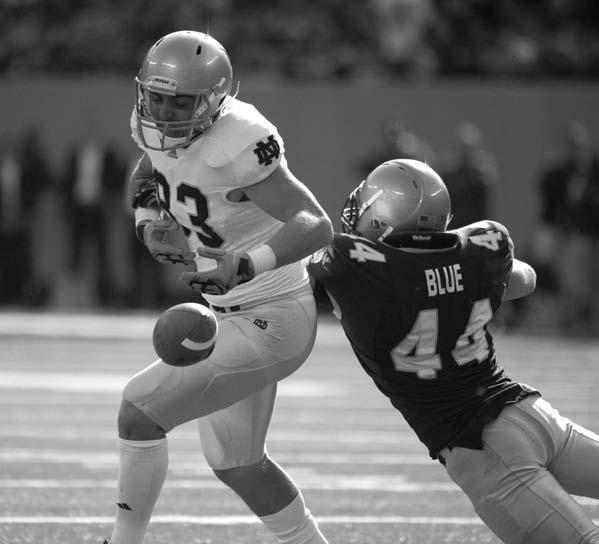
training camp, and my knee couldn’t take it anymore, so I had surgery and couldn’t play that year,” he said. “Just overall, it definitely sets you back. At the same time, it also developed me into the person I am today because I’ve worked so hard to just come back and come back.”
With the injury, Ragone learned that there is more to life than football.
“You also have the school here, and it’s not an easy school. So I had to work harder and harder, which really matured me in a lot of ways,” he said. “Before, I would just be messing around and not taking anything seriously. I was just worried about football, and football’s only a game. When I hurt my knee, I realized that there’s a life out there. Just enjoy everything.”
end because when [I] have a Notre Dame degree, I will be happy that I went through it. Having a degree at the end, plus football, I mean there’s nothing really better than that.”
The highlight of Ragone’s athletic career came early in the Washington State game during his junior season. The Cougars blocked an Irish extra point and attempted to return the ball, until Ragone sprinted 95 yards and came out of nowhere to make the tackle.
“Before, I would just be messing around and not taking anything seriously. I was just worried about football, and football’s only a game. When I hurt my knee, I realized that there’s a life out there. Just enjoy everything.”
Mike Ragone senior tight end
That means Ragone enjoys the academics, for what they are worth.
“It’s so tough, but it’s awesome. My advisors and mentors have really helped me, just standing over [me],” he said. “It really pays off in the
“Washington State, I caught a guy from behind. It was a 95-yard run down the field,” he said. “It was named the play of the game.”
Prior to Ragone’s senior year, one of the biggest reasons he had chosen Notre Dame — Irish coach Charlie Weis — was fired, and Notre Dame announced Brian Kelly’s hiring as head coach.
“Weis was always there for me, and he recruited me. He’s like a friend, someone who’s always there, who’s going to be at your wedding. It was tough. We all had the same goal, we all wanted to win.
And that’s what it came down to. He’s a great coach, competitor, and he’s there to help you,” he said. “At first I didn’t know what to think. I wasn’t mad or anything. Coach Kelly’s won everywhere he’s been.”
Although his athletic career might have been rocky with the injury and coaching change, Ragone has made friendships and memories that he will cherish forever.
“So many friendships, like in high school, there are so many guys from my state who have come here. [Receiver] Duval Kamara, one of my best friends, [safety] Harrison Smith, [linebacker] Steve Paskorz,” he said. “We’ve just bonded since day one. Hopefully it’ll stay that way the rest of my life.”
One particular memory stands out from his sophomore year.
“On Halloween Harrison and I went out after the game, and I dressed up as Scooby-Doo, and he was Shaggy. That was when he had the long hair,” Ragone said. “No one thought that we’d pull it off, and they were the best costumes ever.”
Ragone said he would never forget about his teammates, even after his career at Notre Dame.
“I want my teammates to know that I’ll always have their back. No matter what, I’m going to keep riding with them ‘til the day we die.”
Contact Megan Golden at mgolde01@saintmarys.edu
DAN JACOBS/The Observer
Senior walk-on short snapper Bill Flavin was part of an all-walk-on field goal unit before breaking his ankle against Tulsa.
SARAH O’CONNOR/The Observer
When senior tight end Mike Ragone tore his ACL his sophomore year, he was forced to notice the other chances Notre Dame offers.
Notre Dame obvious choice for South Bend WR
By MIKE GOTIMER Sports Writer
When senior wide receiver Dan Franco was looking at colleges, he knew he wanted to play football at the Division I level. But for the Granger, Ind., native, playing at Notre Dame was always the ultimate goal.
“I was looking at a lot of different kinds of schools,” Franco said. “I had a lot of offers from smaller schools, Division III schools, but I also had it in my head that I wanted to go to a Division I school because I want to see what I’m capable of and how I can compare against the best. And even if I’m not the best, I want to know if I could compete with the best.”
In his first season with the Irish, Franco turned in a fine play in practice that proved he could compete with some of the nation’s elite talent when he beat former Irish defensive back Raeshon McNeil for a touchdown in one-on-one drills at practice.
“Raeshon McNeil was our top cover corner at the time, and he came up expecting David Grimes and instead I show up,” Franco said. “I look over and I’m like ‘I’m ready to go coach, what do you want?’ and he looks at him, looks at me and says ‘[expletive] him, go run a go route.’ So I get to the line, [Irish quarterback] Dayne [Crist] throws the ball, throws it deep, 40-yard touchdown pass. I caught it right at the end. The entire offense swarmed me.”
A graduate of South Bend’s Clay High School, Franco and his friends dreamed of one day suiting up for the Irish at Notre Dame Stadium while growing up in Michiana. He also has family ties to the school, as his mother graduated from the University with an engineering degree and his father is a psychologist on staff.
“I’ve been raised on Notre Dame ever since I was young,” Franco said. “Me and all my friends had dreamt about putting on a gold helmet and the opportunity was
there. I’ve really been working my entire life for this opportunity, and I’ve been fortunate enough to be a part of it.”
Franco walked on for the Irish in the winter of 2008 after transferring from Indiana University South Bend, and he hasn’t looked back since making the cut under former Irish coach Charlie Weis.
“I never doubted my decision,” Franco said. “I knew from when I was younger if I could get myself an opportunity to go to Notre Dame and actually walk on the team that I was [going to] do everything I could.”
Since arriving on campus, Franco has become close with his fellow walk-ons, and he says that he’ll miss spending time with his fellow WOPU Nation colleagues once their playing days are over.
“We have a thing called WOPU Nation, which is what the walk-ons call ourselves —
the Walk-On Players Union,” Franco said. “These are the guys who when we first walked on, we’re waking up at like 4:15 in the morning, going through this process five days a week. It was hell, and it was painful, and it was only for guys that really, really wanted it.”
Franco, a psychology major, plans to graduate after this semester and will look to continue his studies in graduate school and work for a Ph.D. in psychology. He’s mainly focused on social psychology and ultimately hopes to get into sports psychology.
“It’s really something I’ve been interested in since I was like 10 years old, and I’m planning on going to grad school,” Franco said. “I’m hoping to get into a Ph.D. program after the semester. It’s always been a passion of mine.”
Contact Mike Gotimer at mgotimer@nd.edu
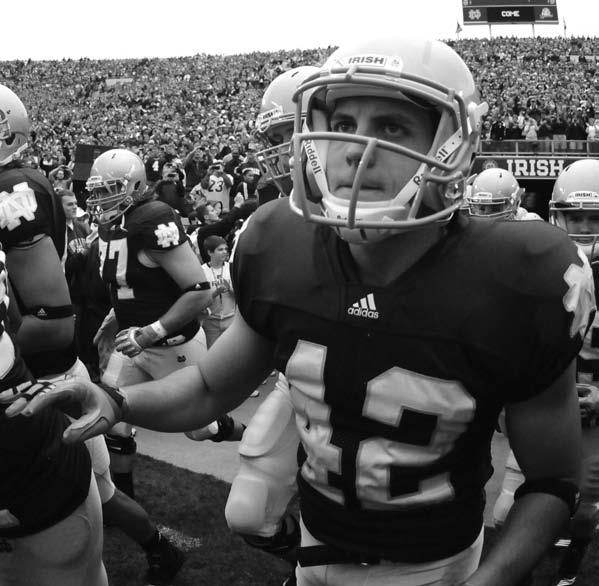

SUZANNA PRATT/The Observer
South Bend native and wide receiver Dan Franco never wavered in his decision to go to Notre Dame.
Competition brings three-year back-up to starter
By SAM GANS Sports Writer
There is an old saying that competition brings out the best in people.
Senior offensive tackle Taylor Dever might be the embodiment of that claim.
After backing up former Irish right tackle Sam Young for three years, Dever began spring practice in a competition for 2010 graduate Young’s vacated spot. Following a tough battle with fellow senior tackle Andrew Nuss, Dever emerged from fall camp as the starter.
The competition not only was a challenge that made the 6-foot-5-inch, 297-pound Dever better, but was an enjoyable experience for him, as well.
“The competition was good,” Dever said. “I was at right tackle with Andrew. He’s a great football player. Competition is what football is. It’s so much fun. It makes playing the game worth it. It makes coming to work every day worth it.”
Since that time, Dever has cemented his position as the starter when healthy, playing an important role in all of the Irish’s contests in which he’s been available. One game in particular that he noticed his play really come together was Sept. 18 in East Lansing.
“One of my best games was
STEVE PASKORZ
probably at Michigan State,” Dever said. “When we played up there, I just had a good game, as far as assignments and execution goes.”
On the field is just one area in which Dever has enjoyed Notre Dame. Off the field life has also contributed to his love for the University.
“There’s definitely a drive and a focus everywhere you go in the classrooms and in the dorms,” Dever said. “There are good people here. They like to have fun and they also like to work hard. That’s something I told myself that I was looking for in college when I was trying to figure out where to go. Away from football here, it’s been a lot of fun.”
Dever has thought about his future, but has not made any definitive plans at this point. As he did not play in his freshman year, Dever has a fifth year of eligibility remaining, and is likely to use it. He plans to graduate with a degree in marketing, but is unsure of exactly what type of career he’d like to pursue after his playing days and education at Notre Dame are over. Of course, there’s one that is a possibility: the NFL.
“If that opportunity presents itself and it works out, I’ll go into it with the mindset that I’m going to do the best I can and make everything work to the best of my ability,” Dever said. “There are some things
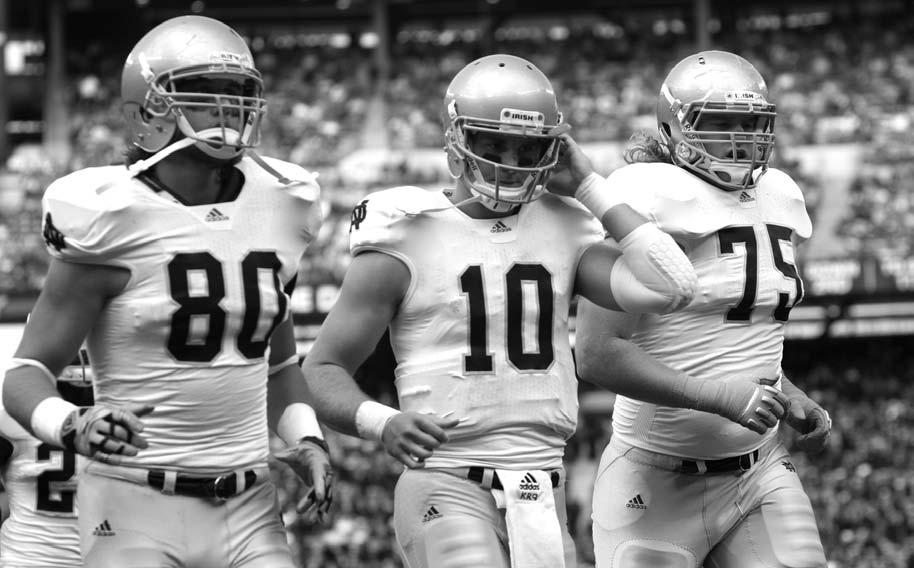
that are out of your control, but I do feel that’s an opportunity I have and I’ll take it head on.”
But to his fans, Dever’s football experience, social life, education and future career fall well short in importance when matched up with this question: What’s up with the long, luscious locks of hair?
“I am from California and people often give me grief because of that and I just
decided to start growing it out,” he said. “It’s been two years. In 2008, right before the Hawaii Bowl at the end of the season, was when I decided (to grow it out) and just kind of stuck with it since.”
While Dever’s hair length may be all in fun, results on the football field aren’t as much of a laughing matter.
“Obviously playing football at Notre Dame, there’s always going to be the eyes (watch-
ing), the pressures and expectations,” he said. “This is my senior year and I’ve been here for four years now and I’ve been through a lot of ups and downs. I’ve had experiences that are good and bad. But we’ve always continued to fight, which I think is something you’ve got to do in football and in life.”
Contact Sam Gans at sgans@nd.edu
Torn ACL leaves Paskorz on sideline for senior year
By MICHAEL TODISCO Sports Writer
Notre Dame football is defined by tradition — the gleaming golden helmets of the Fighting Irish carry with them decades of pride and success. For senior linebacker Steve Paskorz, this is what lured him to the University.
“The name and tradition that comes along with playing for
Notre Dame is outstanding,”
Paskorz said.
Paskorz entered Notre Dame as a highly touted prospect, in a group with the likes of Jimmy Clausen and Golden Tate, and he said he looks back fondly on the relationships formed with his fellow recruits.
“Not only were those guys leaders on the field but they were great people off the field, and I was real good friends with
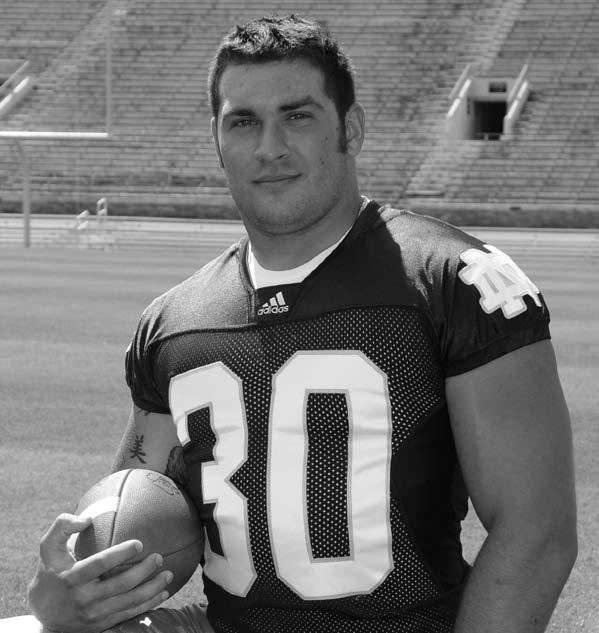
both of them,” he said. “I enjoyed talking to them when they came through here [during their bye week] for games this year and catching up and having fun with them.”
A highlight of Paskorz’s career came during his sophomore year, in which he established himself as a strong special teams player.
“I would say the defining moment was the Hawaii Bowl,” he said. “We really had fun, plus it was a unique experience to get out there and see Hawaii.”
Paskorz continued playing special teams during his junior season, and seemed prime to take on a bigger role as a senior under the new coaching regime. However, after tearing his ACL, Paskorz has spent his senior season on the sideline, which was aggravating for the Allison Park, Pa. native.
wouldn’t have an impact on the field for this season, Paskorz said he decided to try to make a positive impact on the team in other ways. Paskorz has tried to take the underclassmen under his wing and share his experiences with them.
“I stay around and talk to the younger guys and try to help them out, and mentor them, with what I know and what I’ve been through,” Paskorz said. “I do what I can off the field to help the guys on the field.”
“It’s been really frustrating only being able to watch my senior season. Possibly the last time I have the chance to go out on the field might slip away.”
Steve Paskorz senior linebacker
“It’s been really frustrating only being able to watch my senior season,” he said. “Possibly the last time I have the chance to go out on the field might slip away without even having a chance to play; it’s kind of depressing.”
Once he realized that he
Paskorz said he has met influential people at Notre Dame who helped shape his football career. While he stressed that he enjoyed learning from the coaching staff, especially strength coach Paul Luongo, Paskorz’s time at Notre Dame afforded him the opportunity to work with a legend: Former Notre Dame standout and a member of the Super Bowl I champion Green Bay Packers team Red Mack has taken an interest in Paskorz.
“Red Mack actually graduated from my high school, and when he comes to a game or attends practices he always gives me advice,” Paskorz said. “He lets me know what I’m doing wrong,
but he also just talks to me and tells me his story which is really interesting.”
Paskorz has embraced the coaching change from Charlie Weis to Brian Kelly. He laments his injury that precluded him from fully competing under and learning from the new coach.
“When I was still good I had the opportunity to play but it was just a shame that I got hurt,” Paskorz said. “I really enjoy his coaching style and the type of coach that he is.”
But Paskorz hopes that he may have one more year left under Coach Kelly. Since he did not play in his freshman season and was injured for his senior year, Paskorz still has NCAA eligibility. If things don’t work out playing football though, Paskorz said he may take some time to enjoy his other passion.
“Hopefully I can come back and play for a fifth year,” he said. “If I don’t get a fifth year then take some time off. I’m a big outdoorsman, and I’d love to travel and go hunting and fishing, just relax a bit.”
Whatever the future holds for Paskorz, he will always remember the unique experience of being a Notre Dame football player.
“When people come up and talk to you and ask, ‘You look like you play football player, where do you play?’ Being able to say that I play at the University of Notre Dame is truly special.”
Contact Michael Todisco at mtodisco@nd.edu
TOM LA/The Observer
In his first season as a starter, offensive tackle Taylor Dever, 75, protected Irish quarterbacks Dayne Crist, pictured, 10, Tommy Rees and Nate Montana.
Courtesy of Lighthouse Imaging Senior linebacker Steve Paskorz may come back for one more season with the Irish after tearing his ACL this season.