13 College students cooperate to stop drug counterfeiting
By CAITLIN HOUSLEY
Saint Mary’s Editor
In the lab students call “the dungeon” of Saint Mary’s Science Hall, 13 women are working to help those living in third-world countries, one Paper Analytical Device (PAD) at a time.
Liz Bajema, professional specialist on the PADs project and a Saint Mary’s alumna, said the group aims to help detect the sale of counterfeit drugs including Panadol (Acetaminophen), anti-malarial drugs and antibiotics in third world countries.
“The whole project kind of started with this problem of counterfeit drugs,” she said. “People are counterfeiting drugs in developing countries
see PADS/page 4
University evaluates reliability of Paper Analytical Device
By CAROLYN HUTYRA News Writer
The hunt for counterfeit drugs in third world countries has found an ally in Notre Dame junior Kellie Raddell. Raddell is currently hard at work with the Paper Analytical Device (PAD) program to help put a stop to counterfeit drug trafficking.
Raddell is working with a research team of students headed by Notre Dame professor Marya Lieberman and Saint Mary’s professor Toni Barstis. Raddell said counterfeit drugs are a serious problem in thirdworld countries.
“Companies make lots of money selling these counterfeit drugs in third world countries,” she said. “By the time we
see RESEARCH/page 5
Financial expert to speak on investing strategy
By SAM STRYKER News Editor
For students looking to make serious dough through investments, one financial expert will give his advice today: in the Internet era, you need to go against the grain.
Steve Cortes, a frequent onair contributor for CNBC’s “Fast Money,” is speaking today in the Mendoza Jordan Auditorium at 6 p.m. He will discuss his new book, “Against The Herd — Six Contrarian Investment Strategies You Should Follow.”
“I think in this digital age, the dangers of group-think are more prevalent than ever, particularly in financial markets,” Cortes said.
“I think social media in particular has fostered a greater susceptibility to false notions quickly becoming accepted as conventional wisdom.”
Cortes said the guiding principle behind his book is to not hold steadfast to commonly accepted financial wisdom.
“The book is a tutorial in contrarian thinking in markets,” he said. “By contrarian, I mean being willing to buck conventional wisdom as espoused by Wall Street and the financial media.”
Cortes also recommended against investing in China, despite the popular notion that the country will become a world superpower.
“My most provocative theme, what I lead with in the book,
Valentine’s Day celebrated with sonnets
By SARA FELSENSTEIN Associate News Editor
The Great Hall of O’Shaughnessy was full of love Tuesday — love, and lovers of Shakespeare.
In a celebration of Valentine’s Day, nearly 100 members of the Notre Dame community read aloud each of Shakespeare’s 154 sonnets in succession from 11 a.m. to 3 p.m.
Scott Jackson, executive director of Shakespeare at Notre Dame, said the annual Sonnet Fest is meant to reach students across disciplines, helping them
find modern-day relevance in Shakespeare’s words.
“The sonnets were meant to be written down, obviously, but still the ideas that are contained in there can be hard to decipher if you just read them off the page and don’t hear a voice bring them to life,” he said.
Jackson said by having all of Shakespeare’s sonnets recited in one place, at one time, his words become easier to understand.
“There’s something about hearing another person speak those words and impart their own emotions to it that … makes it a lot more accessible to some-
one,” Jackson said. “In a way [during the] Sonnet Fest you all of a sudden are aware that the things Shakespeare is writing about are completely relevant to society today.”
Sonnets were read Tuesday in eight different languages: Spanish, Italian, French, Latin, Morse code, Russian and Parseltongue — the “language of snakes” from the “Harry Potter” series.
Sophomore Mary Prokop, an English and Italian major, read two sonnets in Italian.
“I thought I might as well
see SONNET/page 5
is I believe China, which most of the world thinks is the next great emerging power and will soon eclipse the United States in many ways, is a false notion,” he said. “I believe if anything China is a very dangerous place to invest, it is a very unstable country, and I am very bearish from an investing standpoint.”
For young investors, Cortes said steering away from these seemingly promising markets is an advisable move.
“I think that academia, like Wall Street, is incredibly assured that emerging markets
… in the world are going to be growth stories in coming years and coming decades,” he said. “It is almost this accepted truth.”
Additionally, Cortes said young investors are often exposed to the misconception that heavily investing in stocks is a sure-fire method for financial success.
“From an investing standpoint, I believe Wall Street has also [emphasized] too high a percentage in stocks. It is too
see
MAGGIE O’BRIEN/The Observer
Graduate student Ben Wilson reads one of Shakespeare’s sonnets to celebrate Valentine’s Day. All 154 sonnets were read Tuesday.
CORTES/page 5
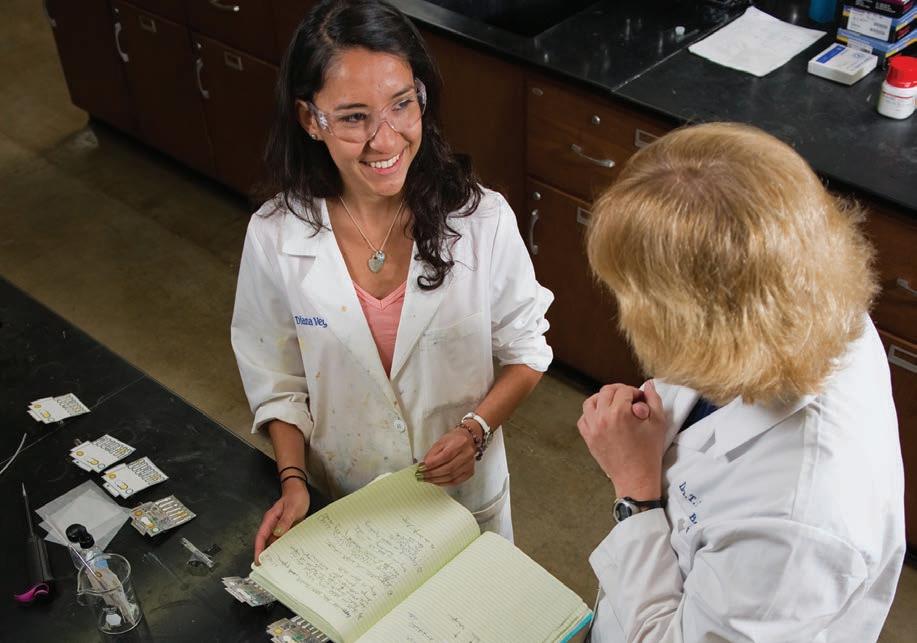
Photo courtesey of Toni Barstis
Dr. Toni Barstis, right, and SMC junior Diana Vega Pantoja work on creating the Paper Analytical Device (PAD) that helps detect counterfit Panadol, anti-malarial drugs and antibiotics.
Steve Cortes
www.ndsmcobserver.com
P.O. Box 779, Notre Dame, IN 46556
024 South Dining Hall, Notre Dame, IN 46556
Editor-in-Chief Douglas Farmer
Managing Editor Sarah Mervosh Business Manager Jeff Liptak
a sst. Managing Editor: Ad riana Pratt
a sst. Managing Editor: Ch ris Masoud
New s Editor: Sam Stryker
Viewpoint Editor: Me ghan Thomassen
Sports Editor: Al lan Joseph
Scene Editor: Ma ija Gustin
Sa int Mary’s Editor: Ca itlin E. Housley
Photo Editor: Pat Coveney
Gr aphics Editor: Br andon Keelean
a dvertising Manager: Katherine Lukas
a d De sign Manager: Am anda Jonovski Controller: Jason Taulman
Sy stems a dm inistrator: Wi lliam Heineman
Office Manager & General Info (574) 631-7471 Fax (574) 631-6927
Scene Desk (574) 631-4540 mgustin@nd.edu Saint Mary’s Desk chousl01@saintmarys.edu
Photo Desk (574) 631-8767 obsphoto@gmail.com Systems & Web Administrators (574) 631-8839
Policies
The Observer is the independent, daily newspaper published in print and online by the students of the University of Notre Dame du Lac and Saint Mary’s College. Editorial content, including advertisements, is not governed by policies of the administration of either institution. The Observer reserves the right to refuse advertisements based on content. The news is reported as accurately and objectively as possible. Unsigned editorials represent the opinion of the majority of the Editor-in-Chief, Managing Editor, Assistant Managing Editors and department editors. Commentaries, letters and columns present the views of the authors and not necessarily those of The Observer.
Viewpoint space is available to all readers. The free expression of all opinions through letters is encouraged. Letters to the Editor must be signed and must include contact information.
Questions regarding Observer policies should be directed to Editor-in-Chief Douglas Farmer.
Question of the Day: What ’s your favorite place to be on campus?
Angela Lake sophomore Breen-Phillips “Starbucks”
Elizabeth Murphy freshman McCandless “Band building”
Kathryn Murphy junior McGlinn “BK Lounge”
Leon Zhou senior Stanford “My bed”
Matt Kowalski freshman St. Edward’s “The library”
Nick Taylor sophomore St. Edward’s “The Grotto”
toDay’s
News
Sam Stryker
staff
Anna Boarini
Ann Marie Jakubowski Graphics
Lisa Hoeynck
Photo
Thomas La Sports
Matthew DeFranks
Joe Wirth
Brian Hartnett Scene
Mary Claire O’Donnell Viewpoint
Meghan Thomassen
CorreCtions
The Observer regards itself as a professional publication and strives for the highest standards of journalism at all times. We do, however, recognize that we will make mistakes. If we have made a mistake, please contact us at (574) 631-4541 so we can correct our error.
Fugitive runs out of gas, calls sheriff for assistance
EVANSTON, Wyo. — A 59-year-old fugitive is back behind bars after he ran out of gas in Wyoming and called the local sheriff’s office for roadside assistance.
The Wyoming Highway Patrol said Tuesday that Richard Vincent of Prineville, Ore., was wanted in Georgia for violating parole on a murder and escape conviction.
Vincent called the Uinta (YOO’-ihn-tah) County Sheriff’s Office sent state troopers to help him out. When they learned that Vincent had an outstanding felony warrant from Atlanta, he was taken into custody.
Vincent is now being held
for Georgia authorities pending extradition.
Car theft suspect held after LA roof standoff
LOS ANGELES, Calif. — A suspect in an auto theft was arrested Thursday after a bizarre five-hour standoff on the rooftops of a Westwood neighborhood.
Police SWAT members finally climbed the roof of a home and peppered the man with bean-bag ammunition.
That persuaded him to scramble over to a truck mounted ramp, and he was lowered to the ground and handcuffed, Officer Karen Rayner said. The suspect’s name was not immediately released.
No one was seriously injured during the confrontation, which began around 8 a.m. when police began following a reportedly stolen Toyota Camry.
After a short chase, the driver stopped, ran and climbed onto a roof east of the University of California, Los Angeles, police said.
The standoff was broadcast live throughout the morning from a KTTV-TV news helicopter that showed the man hopping from rooftop to rooftop of several homes as police flooded the neighborhood No homes were evacuated.
Information compiled from the Associated Press.
in Brief
A graduate student workshop titled “For the Busy Graduate Student: Company, Industry, and Market Data” will be held in the lower level of the Mendoza College of Business from noon to 1:30 p.m. today.
A lecture, “Ethics in the Financial Marketplace” will be held in the Giovanini Commons of the Mendoza College of Business from 12:30 to 1:30 p.m. today.
A colloquium titled “Order, Fluctuations, and New Frontiers in Quantum Materials” will be given by Dr. James Analytis in 118 Nieuwland from 4 to 5 p.m.
The Notre Dame men’s basketball team takes on Rutgers in the Purcell Pavilion at the Joyce Center tonight at 7 p.m.
The film ‘ The Interrupters’ will be shown tonight at 7 p.m. in the DeBartolo Performing Arts Center Tickets cost $3-6.
A conversation about “Wealth Inequality in the US: Lessons from Latin America” will be held tonight at 7 p.m. in the Geddes Hall Library Coffee and cookies will be provided.
National Book Award winner Jaimy Gordon will deliver a reading tonight at 7:30 p.m. as part of the Notre Dame Literary Festival.
To submit information to be included in this section of The Observer, e-mail detailed information about an event to obsnews.nd@gmail.com
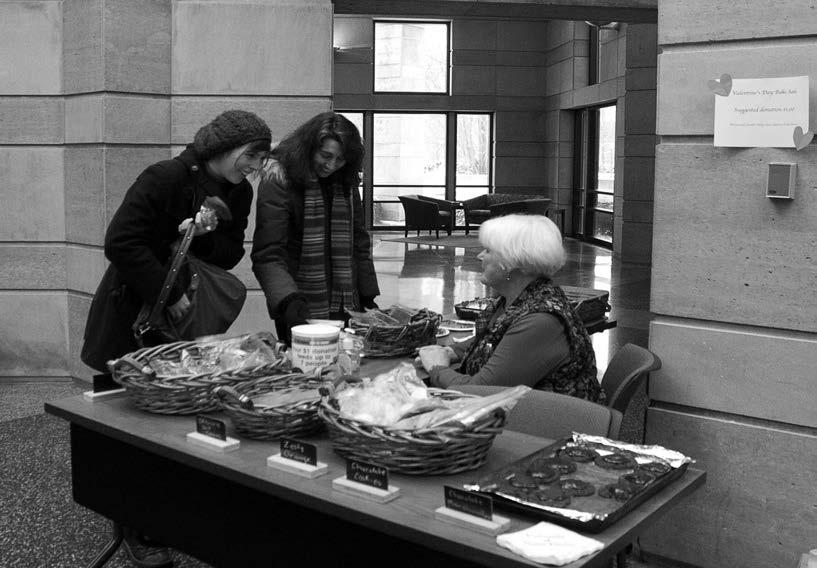
MAGGIE O’BRIEN/The Observer
Peggy Hartman, building coordinator at the Kellogg Institute for International Studies, helps out at a Valentine’s Day bake sale for the Institute, which was well attended by students and faculty Tuesday.
TonighT
Notre Dame bicycle shop remains closed
By NICOLE TOCZAUER News Writer
Campus bike enthusiasts will have to pedal on without the Notre Dame Bike Shop, which closed last semester for the foreseeable future. However, student bike technicians said they are working hard to reopen in a new location.
Phillip Johnson, director of Notre Dame Security Police (NDSP), said the shop’s garage in the Old Security Building was reallocated in December to support a growing need for academic space on campus. NDSP cannot run the program without the garage, he said.
Johnson said the bike shop’s services started small and expanded gradually.
“A number of years ago, NDSP was involved in making minor repairs to abandoned bikes that were auctioned at the beginning of the school year,” he said. “Over time, students came to ask for minor repairs.”
Sophomore Chris Glueck, a student employee, said the shop provided free bicycle repair services for students, faculty and staff. The shop supplied labor and used parts from abandoned bikes, which are now recycled rather than auctioned.
“It’s repairs that would cost people a hundred dollars that we do for free. We also [gave] advice on bikes to buy and register them,” he said. “We [had] a high success rate.”
Glueck said student bike technicians have worked with the Office of Sustainability to promote the use of bikes for commuting and the reopening of a
bike repair garage on campus.
Rachel Novick, education and outreach program manager with the Office of Sustainability, said the University supports biking for its carbon-free mode of transportation and reduction of local air pollution. She said the Bike Shop provided an important service to the campus community.
“Every biker needs an occasional tune-up for both performance and safety, and the bike shop has enabled countless students, faculty and staff members to keep their bikes in top form,” she said. “We hope that a new home can be found for it in the near future.”
Johnson said he is not certain the Bike Shop will reopen as it is not part of NDSP’s core campus safety services, but he said he realizes how important it is to the Notre Dame campus.
“This will depend on what space is available and who might be in the best position to operate the shop,” Johnson said. “We see the value in biking … It’s healthy and supports sustainability.”
Glueck said ideally the shop would reopen in a new garage or move into an existing unused space on campus. He said he hopes the shop will open in the near future to further provide services for students and their bikes.
“All we want is a place to put our tools and somewhere to check into. We’re looking for a new home and we do good work,” Glueck said.
Contact Nicole toczauer at ntoczaue@nd.edu
Dining halls add Korean food
By LISA SLOMKA News Writer
Notre Dame students looking to expand their culinary horizons can now try a taste of Korean cuisine in the dining hall.
Following the successful introduction of specialty days like Mediterranean night and the Pho soup bar, Notre Dame Food Services (NDFS) launched a new line of specialty foods that features authentic Korean dishes. North Dining Hall kicked off the new concept in January and South Dining Hall followed suit last week. The dishes are served on a 12day rotating schedule in both dining halls.
Marc Poklinkowski, general manager of South Dining Hall, said the concept for the new line came from positive student reception to other specialty meals.
“The basis of this came from students originally suggesting that we have things like Indian day and Mediterranean day,” he said.
NDFS considers input from two yearly surveys in launching new food lines, Poklinkowski said.
“They’re usually right after each of the breaks,” he said. “When we looked back at what students had suggested we saw a lot of students asking why we didn’t have more ethnic foods, which is what led to the Mediterranean and Indian cuisine days.”
Poklinkowski said rather than schedule these
specialty meals more often, NDFS decided to explore options for a new type of cuisine to serve to students.
“With both of those days being such big hits, we realized that we didn’t want to repeat them, otherwise they’d get boring,” he said. “We decided to try and do something else.”
Poklinkowski said the idea for Korean cuisine came from NDFS executive chef Don Miller.
“After I asked him for ideas, he asked if I’d ever thought about Korean food,” he said. “He said it’s really picking up and getting popular.”
Poklinkowski said Miller met with various Korean students on campus to discuss what dishes should be offered and how to authentically prepare them. Miller then prepared a presentation of traditional cuisine.
“He put together a show for us [with] about eight different recipes. He had the kimchi there, these two cold salads that we now use, and he also did the crepes for us,” Poklinkowski said. “From there we got a kind of good idea of how we could adapt it to our dining halls.”
Tina Aalfs Baker, operations manager of North Din -
ing Hall, said the new offerings may not appeal to all palates.
“It’s a matter of personal taste and preference. For some guests, it may not be their cup of tea,” she said. “For others, it is a change of scenery, something new to try.”
Poklinkowski said the new dishes have been received well at South Dining Hall.
“The first day went really well,” he said. “We did I believe close to 500 crepes at lunch and over 1,200 crepes at dinner. We’re always glad whenever something’s that popular when we start off.”
Poklinkowski said the introduction of Korean day is not the only change coming to the dining halls. During Lent, South Dining Hall is will prepare new menu items including a new Seafood Newburg dish and a make-your-own baked potato bar in the Pan-American section, he said.
“We never want to see students making rounds around the food options a few times without finding anything to eat,” he said. “We’re looking to give them more options.”
Contact Lisa Slomka at lslomka@nd.edu
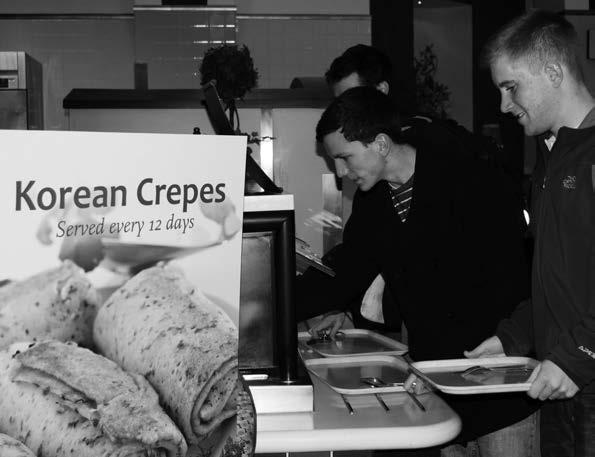
KIRBY MCKENNA/The Observer
Juniors Jed Chapin, left, and Robert Blume try the new Korean options offered every 12 days in South Dining Hall.
College to perform ‘Puss in Boots’ opera
By BRIDGET FEENEY News Writer
Dancing animals and a love story will be on stage this weekend at Saint Mary’s College as students and the music department put on a production of Xavier Montsalvage’s “El Gato con Botas.”
Sophomore Jessica Biek, performer and member of the backstage crew, said the opera, known in English as “Puss in Boots,” is sure to please audiences.
“[Puss in Boots] is a short opera with a never dull moment,” she said. “It is very funny and endearing.”
Laurel Thomas, chair of the Saint Mary’s music department and director of the production, said the opera should appeal to a wide range of ages.
bers were challenged with learning their lines and choreography in a short period of time, especially since some took on new roles after the audition process.
“We only began rehearsing for the opera at the beginning of this semester, a very tight rehearsal process to mount an opera, even a one-act like ‘Puss in Boots,’ she said. “The time crunch has been most difficult for us, as well as the fact that this is an incredibly busy semester in the scene shop.”
“Puss and Boots is a short opera with a never dull moment. It is very funny and endearing”
Despite the challenges of casting, backstage work and time limitations, Thomas said the student performers have stepped up to the challenge.
Laurel Thomas music department chair
“The performance will be entertaining for adults as well as young children,” she said.
Thomas said the performance is filled with twists and turns that will keep the audience captivated. She said the opera has a colorful cast of characters.
“In ‘Puss in Boots,’ the third son of a poor miller inherits nothing but a cat when his father dies,” she said. “The story involves rabbits, beautiful dancing by a lion, parrots and a mouse, a glamorous ogre and true love.”
Biek said while the performance may take its form in an adult medium, the content is jovial enough to amuse young audiences.
“This is sung elegantly like an opera, but there’s childlike play in it that adds humor,” she said.
Thomas said the opera is distinctive in several aspects.
“The opera is completely sung, and the inclusion of a lot of dance makes this opera unique,” Thomas said. “Also unique [is that the production features] two music majors who are also serious about dance studies and capable of doing the dancing in the show.”
Biek said she initially signed on to assist with backstage work but soon found out she had an additional role to master.
“I was originally told I would just do backstage crew,” she said. “I did not have to audition. But I ended up being [cast as] an extra in the queen’s court so I got a costume and everything.”
Thomas said balancing onstage and backstage duties presents a unique challenge for performers.
“The cast has had to take on backstage responsibilities when they aren’t performing, and it is difficult as a performer to have your focus split in this way,” she said.
Thomas said cast mem -
PADs
continued from page 1
like crazy.”
Toni Barstis, a chemistry and physics professor, said she considered the detrimental affects of counterfeiting when she developed the idea for the PADs project with Notre Dame faculty.
The project began with what Barstis called “a little bit of serendipity and a lot of student interest.” She said this past summer was crucial in the development of PADs.
“The summer of 2011 was really productive because we put together a provisional patent application for these PADs and now we’re working toward patenting it,” she said. “Actually, we’ve been looking at how we can distribute it.”
Bajema said experts estimate 10 to 50 percent of all drugs in developing nations are counterfeit.
“I think my favorite aspect of this project is seeing such young students rise to the challenge of performing an opera for the first time, and seeing that they recognize their abilities,” she said.
“Puss in Boots” will be performed in the Little Theater of the Moreau Center for the Arts on Thursday and Friday at 7:30 p.m. and again on Saturday at 2:30 p.m. Tickets are free for students.
Contact Bridget Feeney at bfeene01@saintmarys.edu
“Even 10 percent is a concern, because that means one out of every 10 pills is no good, but when you talk about 50 percent, that’s a huge deal,” she said.
The issue of counterfeiting has serious health implications, senior project member Teresa Cristarella said.
“In the most serious cases, [counterfeiters] can take dry wall and grind it up into a pill form,” she said. “Not only do victims encounter the problem of not getting the medicine they need in a dire situation … but they could be ingesting wall board, and poisoning themselves without even knowing.”
Junior project member
Diana Vega Pantoja said part of the counterfeiting issue is perpetrators are hard to track.
“This is basically the perfect crime, [victims] are drinking the evidence, and you cannot analyze something that is already gone,” she said.
Despite current efforts by the World Health Organization to stop counterfeiting, Vega Pantoja said the group has trouble tracking the people behind the pills.
“The counterfeit industry is very developed, and just by looking at packaging, that’s not enough,” she said. “We’ve found pictures online on how you can have two very different medicines in the same packaging, with the same labeling and the same holograms, but the contents of the medicine are so different.”
Bajema said PADs are a more effective system of identifying counterfeit medicine than the method of tracking labels.
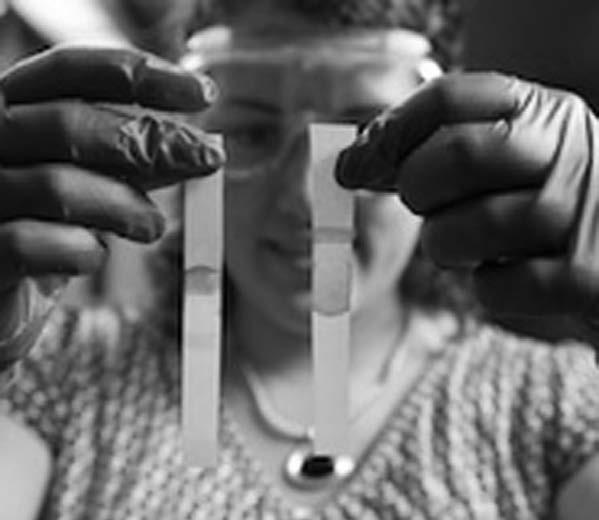
“The idea is, you take a pill and you swipe it on a line on the PAD, and you dip the PAD in water up to an indicated line,” Bajema said. “Then, water soaks up into the various lanes of the PAD, and the lanes turn different colors depending on what chemicals or constituents are in the pill.”
The PADs are equipped with reagents useful in detecting vitamin C, starch, chalk, and other ingredients commonly used in counterfeit drugs. Cristarella said the inclusion of these ingredients is dangerous in two ways.
“You’re not getting the medicine you need to get better, but you think you are, because you start feeling better with a boost of Vitamin C,” she said. “You start feeling better, but it never tackles the underlying problem.”
This misleading feeling of
wellness can become a matter of life and death in certain cases, Bajema said.
“It becomes a more lifethreatening problem when we’re talking about something like anti-malarial drugs or antibiotics,” she said.
Vega Pantoja said the PADs team has enlisted the help of computer scientists in solving the issue of reading the colors on the device.
“What looks green to you could look blue to me, and color plays a huge role in the test when determining whether a drug is real or fake,” she said. “What we found was that the color perception of those not familiar with the PADs was way off.”
Vega Pantoja said this problem has been solved with a program that reads each channel and compares the results to a database of previously established colors.
Bajema said the team now is looking to enlist the help of students, who can conduct the 30-second tests regardless of whether they have any scientific background. Notre Dame’s Breen-Phillips Hall will host the next test this Sunday.
“Now we want to bring it out to the rest of the people on campus,” she said. “We’re hoping to get 500 participants from both campuses throughout the month of February to run field tests of the PADs project.”
Barstis said these tests come when the project is at a critical point of progress.
“This will be really crucial in terms of us knowing if this is a realistic thing for us to send out to third world countries,” Barstis said. “We need as many people as we can get.”
Contact Caitlin Housley at chousl01@saintmarys.edu
Cortes
continued from page 1
volatile for most people. It’s particularly sold to young people,” he said. “Wall Street has oversold to the investing public, especially young investors. The grave exposure to equity stock should be relatively small.”
For undergraduates looking to enter the business world, Cortes said the ability to learn is more important than field of study.
“I think the most important thing is it’s not what you are learning as an undergrad, whether it’s art history or you’re a business major,” he said. “It’s far more about learning how to learn.”
Additionally, Cortes said entering into a business-related career is challenging due to the government’s increased regulation of Wall Street.
“I wouldn’t dissuade anyone
Sonnet
continued from page 1
bring the Notre Dame community Shakespeare in Italian,” she said.
Prokop said she enjoyed stopping by the Sonnet Fest and listening to fellow students’ interpretations of the sonnets.
“I’m loving the atmosphere,” Prokop said. “It’s great to see other Notre Dame students appreciating the greatness of Shakespeare’s words, and I think it’s a very fitting celebration of Valentine’s Day.”
Senior Kevin Barsaloux, a Film, Television and Theatre major, read two sonnets Monday afternoon. He said the Sonnet Fest was a great opportunity to share his appreciation for
who has a passion, because you are going to do it anyways,” he said. “If you are interested in Wall Street for what it was, it is going to be a very different and a much tougher place going forward.”
A self-proclaimed “subway alum” with many family members who have attended the University, Cortes he nearly attended Notre Dame, but chose Georgetown University.
“I would have gone to Notre Dame if I had been better at football,” he said. “It broke my mother’s heart that I didn’t go there.”
After attending a Jesuit-affiliated university, Cortes said Catholic business principles are important to him. While his book is not written from a moral or political perspective, he said applying these principles to investing strategies is one of the ways he recognizes investing in China as an area of risk.
“I do believe one of the reasons China is a dangerous
the Bard.
“Well I love Shakespeare for one, and I’m actually in a class where we’re studying Shakespeare’s text and techniques,” Barsaloux said. “It’s a lot of fun, I love this stuff.”
The first Sonnet Fest took place in 2010, and has now become a Valentine’s Day tradition, Jackson said.
“I never try to do anything the same way twice,” Jackson said. “So there’s been different focuses on each of the last events … I think that each year we’ve had a few more participants.”
He said the Great Hall was an appropriate space to hold the festival because so many students walk through it during the day, and might stop to grab a cookie and enjoy a sonnet or two.
place economically in terms of markets is because of the incredibly unethical way the government treats the people,” he said. “It has not has become a force of innovation and invention. I think one of the reasons, to tie it all in a grand way to Catholic principles, is because the government is so limiting on thought and expression.”
A Chicago native, Cortes said through interacting with Notre Dame alumni, he recognizes Notre Dame produces graduates unlike any other school.
“Notre Dame takes [its Catholic identity seriously] other great institutions don’t have the faith aspect and they don’t have the sports aspect,” he said. “I think because they don’t have those, they don’t have the kind of life-long identity and spirit and cohesiveness that is certainly evident among Notre Dame grads.”
Contact Sam Stryker at sstryke1@nd.edu
“There’s a certain theatricality [of the Great Hall] to begin with, and secondly, it’s the center of the College,” Jackson said. “There’s such a flow of students in and out of that space over the course of this event.”
Jackson said over the course of the day, students from the local Montessori school, Notre Dame freshmen through seniors, graduate students, faculty and staff recited sonnets.
“Students who might not otherwise engage [with Shakespeare] suddenly find themselves having a good time,” Jackson said. “That’s really the point of the whole event, to have students engage with Shakespeare across disciplines.”
Contact Sara Felsenstein at sfelsens@nd.edu
Research
continued from page 1
test if the drugs are real, the dealers have already changed the names and packaging.”
The PADs program works efficiently to detect certain ingredients in counterfeit drugs rather than identifying by labels, Raddell said.
“You put [a salt pad] in water, and in three to five minutes you know what’s in the drug and if it’s effective,” she said. “We’re testing to see if there are specific chemicals in the drugs.”
Raddell said this new method of detecting counterfeit drugs is the most cost-effective developed to date.
“PADs allows for quick diagnoses,” she said. “Chemicals move up with the water, and the paper will turn blue at the top if the chemicals wanted are present.”
Raddell, who has been working on the project since last summer, said her experience with PADs has been invaluable to her career aspirations.
said. “This factory makes salt supplemented with iodine and diethylcarbamazine citrate, and they don’t have access to the tools and instruments that we would normally use to carry out chemical analysis.” Lieberman said she expects the program to move even further forward once the PADs are tested for reliability and repeatability. She said after field tests at Notre Dame, the group plans to expand its work into the African continent.
“We will be working with three pharmacists with the AMPATH (Academic Model for the Prevention and Treatment of HIV) program at Moi University Teaching and Research Hospital to implement field tests in Kenya in summer 2012 and 2013,” she said. “We will be testing three types of antibiotics, two artemisinin combination therapy drugs and an analgesic.”
Raddell said a large group of students and faculty has been hard at work to ensure the success of the program.
“This research is a great way to take the skills I learn in the classroom and go out and apply them to a real world setting.”
“This research is a great way to take the skills I learn in the classroom and go out and apply them to a real world setting,” she said.
Kellie Raddell junior
The PADs program has crossed borders to the island nation of Haiti, Lieberman said. She said the PADs project got involved in Haiti at the behest of biology professor Fr. Tom Streit.
“Fr. Streit came by to talk to me about some quality control problems that the Bon Sel factory in Haiti was having,” she
“Currently, there are about twenty to thirty people working on this project. Research is done in the Stepan Hall of Science and in St. Mary’s science building,” she said. “We also have one large group meeting once a week.”
Even with a large number of students working on the project, Raddell said the project is far from over.
“We need to run five hundred of each test by the end of February … We need to know if it’s effective before sending it out into the field.”
Contact Carolyn Hutyra at chutyra@nd.edu
Photo courtesey of Kellie Raddell
Junior Kellie Raddell compares two Paper Analytical Devices, the most cost-effective way to detect counterfeit drugs.
Truck Day
If there’s anything good about late winter, it’s the streak of minor holidays that fall from February to mid-March. We get weather prognostication from a groundhog, heartshaped candy, an opportunity to blow off steam before Lent starts and an excuse to blow off Lent when St. Patrick’s Day rolls around just three weeks later.
What’s the point of miracles?
Fr. Lou DelFra Faithpoint
Vicky Jacobsen Sports Writer
But last Saturday we passed another day even less important and even more contrived, which automatically makes it the best minor holiday of the season by far. That’s right — I’m talking about Truck Day.
For those of you who aren’t baseball fans or follow a team whose fan base is infinitely saner than Red Sox Nation, Truck Day is the glorious morning when the Red Sox equipment crew fills a moving van with the stuff that’s been laying around the ballpark all winter and sends it off to the spring training complex in Florida.
While every major league team has to send its equipment to Florida or Arizona before Spring Training starts, my own perfunctory Google search indicated Boston is the only city where fans show up to watch a scene nearly indistinguishable from a typical Tuesday at the loading docks of a Sports Authority.
Maybe there are people who are excited to see Tupperware containers of uniforms loaded onto a truck, but I doubt anyone is really all that interested in the cargo. The truth is for anyone who spends six months of the year enthralled by baseball and the next six enclosed in a near-permanent freeze (and I’m including myself in that group along with the populace of Boston), the first reminder that spring actually does exist is pretty darn welcome by this point in February. I know that the prospect of a new baseball season shouldn’t make me quite as happy as it does. Last year’s team was already giving me heartburn after three games (starting the season 0-6 can have that effect on fans.)
As for the September collapse for the ages, let me just say I am truly thankful to my Yankee-supporting friends who were so concerned for my mental wellbeing they didn’t mention it in too much. (To those who did rub it in: your team didn’t win the World Series, either, so I don’t want to hear it.) Basically, this team has put me in more bad moods over the past few years than anything else, including finals week and malfunctioning dorm printers.
But because of Truck Day, all of that is officially in the past. Everybody starts over at 0-0, and we’re free to pretend that any past losing or finger-pointing didn’t really happen, or, at the very least, that it has no effect the current state of affairs. Unfortunately. the same rules do not apply in real life, and so my brother continues to complain about every wrong I’ve ever inflicted upon him, starting with the time I kicked him on the playground when has was two. But since we can’t erase the mistakes we’ve made and live in that world with the blissful, mistakeand-blame-free ambience of spring training, we can at least look forward to spring training weather, which I expect to arrive here in South Bend by May 15. Until then, happy belated Truck Day.
Contact Vicky Jacobsen at vjacobse@nd.edu
The views expressed in the Inside Column are those of the author and not necessarily those of The Observer.
In these first weeks of Ordinary Time, we have been reading from the early chapters of Mark’s Gospel. These chapters are often predominated by the early miracles of Jesus — the exorcism of the man with an unclean spirit, the healing of a leper, the raising of the centurion’s daughter. They are, by definition, astounding miracles — but just barely, at least as Mark recounts them. That is to say, Mark unfurls the miracles (“Demon, come out of that man,” “Go, show yourself to the priest and be clean,” “Get the girl something to eat”) but in each case concludes with a most unexpected and severely underwhelming line, “Go home, and tell no one about this.”
Indeed, immediately after the exorcism of the possessed man, Mark’s focus shifts abruptly away from the miracle to the subject of Jesus’ teaching authority. The healed man virtually vanishes into thin air, as the crowd asks, “What is this? A new teaching with authority.” The miracle is awe-inspiring, Mark suggests, but is really at the service of an even more important revelation (though the exorcised man may wish to argue this point).
The “Messianic secret” — Jesus’ recurring command “Don’t tell anyone” — is an important theme throughout Mark’s Gospel, as Jesus’ first miracles excite the towns of Galilee to near fever pitch and draw larger and larger crowds to gather. With every miracle Jesus performs, he asks, pleads and demands that the person healed, and the witnesses to the miracle, to not tell anyone about it.
letter to the edItor
Clearly, Jesus is reluctant to be overidentified with his miracles, or to be reduced to a mere “wonder-worker.” In fact, this seems to be one of Mark’s larger themes in the early chapters of his Gospel; the miracles of Jesus are but a revelation of something even more important. And we, the reader of these miracles, are left to wrestle with the question posed by the crowd after Jesus’ first miracle: “What is this?” That is, “What is the revelation that’s even greater than the miracle?” (Later, at Caesarea Philippi, Jesus will bring this question to a head, as he asks his disciples, “Who do people say that I am? And you, who do you say that I am?”) Perhaps it is the raising of this question, less than the miracles themselves, that is the point of Jesus’ early wonders. As we know, there will be moments in our life of intense goodness, liberation, healing and “miracles.” We experience a much-wanted success in a class or in a relationship. An interview or job a senior wants comes through; someone sick in our families is healed; we feel joy or intimacy with God in our spiritual life. Yet, Mark warns us we can’t condition our discipleship to Christ based on such moments alone. Why not?
Because what happens when we don’t get the grade we wanted or the relationship doesn’t work out? What happens when we, or one of our friends, do not get the job? When the family member does not recover physically? When we don’t feel God’s presence powerfully in our spiritual life? If success and “miracles” are our signs that God is present, do these experiences of apparent failure signify the absence of God? If you are Mark writing chapter one of a story you know will lead eventually to
Calvary and the apparent “failure” of the Cross, the “success” of Jesus’ early miracles must be handled with this reality in mind. And, likewise, Christ is present in our own lives. Do we follow him just so he might perform miracles, remove all obstacles, stress and suffering from our lives?
On the one hand, our faith tells us God is present at every moment of our lives. On the other hand, the dynamics of conditional love tell us that “God” is only present when we have “done well” or when good things happen. The Gospel of Mark decisively challenges this spiritual attitude. Mark is clear through his incessant inclusion of Jesus’ command to “not tell anyone” of the miracle that the main point of the miracle is not the confirmation that God is with us. For Jesus came to reveal this is always true — m iracle or not, “the Kingdom of God is in our midst.” Whether Jesus is experiencing the “success” of healing a leper, or the “failure” of hanging from the Cross, God is with him. And the same is true for us.
So, perhaps the main point of the little miracles in our lives — the moments of triumph, healing, success — is the raising in our hearts of the question: “What is this?” “Who has done this?” “Am I willing to come to know the author of this grace even more deeply … and to risk following him, come what may?”
This week’s column is written by Fr. Lou DelFra, director of Pastoral Life for ACE and member of Campus Ministry. He can be reached at delfra.2@nd.edu
The views expressed in this column are those of the author and not necessarily those of The Observer.
Both genders can support Center
Every year for the past three years, Siegfried Hall’s “Day of Man” has really frustrated me. Certainly, the all-male dorm’s signature charitable event is generous and directs important attention and funds to the South Bend Center for the Homeless.
Raising awareness about the realities faced by those without reliable access to shelter, and supporting an organization which assists them, is admirable.
What I don’t support, however, is the association of this action with the vague ideal of “manliness.” The slogan “be a man for the homeless” implies that the male person, specifically, the man who is too tough to feel or express discomfort, is uniquely suited to, and best capable of, supporting the patrons of the Center for the Homeless.
Obviously, both men and women of the ND community can support the Center by donating to today’s Siegfried Hall collection; of course, the men of Siegfried wearing shorts and tees in winter are highlighting the realities of our neighbors whom they are helping us to support.
But let’s not exalt restrictive, gender essentialist ideas in the process. There are two potential rationales behind this act of dressing down, because it’s the truth of what many homeless men and women experience. This solidarity in itself is not uniquely manly.
To identify and commemorate Siegfried’s collective action as an entire “Day of Man” is to “genderize” the act, thus introducing the second possible rationale: that a “real” man can handle, even thrive in, potentially unhealthy and (frankly) painful conditions.
If the “manliness” of wearing shorts in the cold is based on the notion that “real” men don’t experience (or at least show) pain or weakness, this is further evidence of the need for dialogue on gender in the Notre Dame community. And if the “manliness” of this act is that it highlights the needs of an often-overlooked population and brings people together to help others, then the slogan is misleading and unnecessary.
This sort of help and solidarity comes from a place beyond gender: it comes from the universal human capacity for compassion, which I hope to see acted upon generously today.
Quote of the day
“I can think of nothing less pleasurable than a life devoted to pleasure.”
John D. Rockefeller
U.S. industrialist, philanthropist
Weekly Poll
How are you?
“I’m Sexy and I Know It”
“I’m Rollin’ Like a Big Shot” “Baby I’m a Firework” “I Found Love in a Hopeless Place”
Vote by 5 p.m. on Thursday at ndscmobserver.com
Monica VanBladel senior Farley Hall Feb. 14
‘Everything is true, nothing is permitted’
Editor’s note: The following is a transcript of an interview by columnist Joe Wegener with Blake Butler, one of the authors visiting campus for the Notre Dame Literary Festival.
Joe Wegener: So, first off, what are you going to be reading at the Literary Festival? “Nothing, There Is No Year”?
Joe Wegener Guest Columnist
Blake Butler: No idea. I tend to wait to the last minute to figure out what feels right. Probably the fiction, as reading nonfiction feels weird in the mouth.
JW: I can dig it. Let’s keep talking fiction vs. nonfiction. “Nothing: A portrait of Insomnia” was published this past year by Harper Perennial, your first work of non-fiction. What was the research process like? How did it affect the movement and pacing of your writing? I read somewhere you wrote the first draft of “There Is No Year” in about 10 days. This must have been a little different.
BB : I thought I was going to hate researching because I more like to write out of mood and frenzy of sorts, and I thought that would maybe slow me down. Though I found the process of reading intensively about what I was writing about while I was writing about it to be actually very motivating, it provided constant stimulation and spring boarding for the forward progress of the work rather than a thing I had to attend to first.
With something like sleep as a subject, the research can be found almost anywhere; you find references to it in most anything you read, and that made a nice kind of web around the center of the idea.
letter to the edItor
I kind of began with what I already knew about insomnia from my own experience and then moved outward from there in whatever direction seemed to intuitively make sense, with some places along the way I knew I wanted to touch.
I still wrote the book rather quickly, as I still approached it with that same force I apply to fiction, though in both cases producing an early draft and then sculpting it intensely over time thereafter makes a nice mix of results somewhere between mystery and logic.
JW: Very cool. I love that you “like to write out of mood and frenzy of sorts.”
In another interview, when asked about the spatial format of “There is No Year,” you talked about the “spatial constraints” as sort of shaping the story’s logic and narrative flow. It’s interesting that [in “Nothing”] you moved outward from your own experiences “in whatever direction seemed to intuitively make sense.” In this way, did you feel like you actually had more creative freedom or space with this project?
BB : I definitely felt having the facts and experiences and emotions and ideas of sleep and consciousness surrounding my progress rather than just walking blindly into whatever sentences I was writing gave me a closer knit but also bigger kind of room to play around in.
Constraints can be really freeing in this way, in that you don’t have to construct everything from the ground up, as you often do in fiction. I can quote Andy Warhol or mention him and then the book gathers the idea of him there, not to mention whatever comes around him.
The nonfictional body gathers and consumes a lot in the process as you are go-
uWIre
Church over society
Recently, an article titled ‘’The Responsible use of Contraception’’ (Feb. 13) was posted in the Viewpoint claiming the Church’s teaching on contraception should be “reassessed” to fit better with the modern view of contraception. The author of this article states “members of the Notre Dame community can do both the Church and the country a service by engaging in humble and honest self-examination.”
In an act of extreme hubris, this author, a faculty member, had the audacity to claim to have knowledge that supersedes 2,000 years of church teaching and to suggest the Church should rethink its teaching based on the whims of a generation. This is precisely the reason why the Church should stick to its guns.
The Church has been around for over 2,000 years and is one of the oldest organizations in the world. Throughout that time, the Church has never been known to waver on its teaching, which is the exact reason it has survived this long. Jesus commissioned the Church to be a lasting beacon, a pillar of truth for the world and you can’t be that by bending to the will of society. The Church is not a part of society, it’s above it; from the moment Jesus gave the keys of the Church to Peter, he gave the Church the authority to make decisions that have moral implications.
Jesus himself went against many societal values in his day, therefore to think that his Church should be limited by any constraints of a government or a group of people is simply ridiculous. The Church, in the Catechism, states: “(2370) Periodic continence, that is, the methods of birth regulation based on self-observation and the use of infertile periods, is in conformity with the objective criteria of morality” (158). These methods respect the bodies of the spouses, encourage tenderness between them, and favor the education of an authentic freedom. In contrast, “every action which, whether in anticipation of the conjugal act, or in its accomplishment, or in the development of its natural consequences, proposes, whether as an end or as a means, to render procreation impossible is intrinsically evil (159),” and I support it fully.
Furthermore, I am proud to be a part of a Church that doesn’t bend in response to unfounded criticism but remains the beacon that lights the way to heaven, just as Jesus left it.
ing, I guess I mean, if you approach it the right way, which is certainly encouraging toward making even bigger spaces. JW: Big spaces. The “schizo” literature magazine blog of the future, as I like to call it. It’s contributor-driven, wide-ranging and totally awesome. What is your role as editor like? Do you try to orient the site (its field of discussion, thought) in certain ways?
BB : I am glad you see it as “schizo,” that is exactly what I hope for from it, and what feels true. Early on I was active in the site mainly by getting people whose voices I thought would lend themselves well to such a state, mainly writers whose personal blogs I already read which could then feed that energy into the field. I still direct the overall feel that way and duck my head in frequently enough to turn things ways I might like, though as a classical “editor” my policy for content is an inversion of an old line: Everything is true, nothing is permitted. Basically I like for contributors to have total open access and to say things without the lens of having to pitch or explain themselves to an editor, or to have that editor wield their ideas on them. It gathers a messy mass in that way, often self contradictory, sometimes loud. There are plenty of other places who do the opposite, so I’m glad to be in the midst of such.
JW: The “messy mass” — self-contradictory, loud and almost always entertaining. It’s an awesome site. Talk to me about the trajectory of online literature. Do you see more self-made, blog-popular types like Lin jumping into the mainstream?
BB : Things are happening, sure. I wouldn’t call it jumping to the main-
stream, but more an expansion of the field. It seems obvious the Internet is reshaping the way information is delivered, and therefore how a thing like a book might work and certainly there will be some crossover.
I don’t know it will change anyone’s tastes, but it will give at least some of them a chance to get confronted with a different way, which is good for people even if they don’t take to it. It seems like this will continue, as will the reverse of the previously large scale author retreating to the small press world. It’s tough to predict what will happen to books five years from now, much less than twenty, but as far as I’m concerned things feel to be shifting, spreading.
JW: It’ll be interesting to see what kind of literature comes out of that “shifting, spreading,” as you put it. So one last question:
It’s 11 p.m. on Friday night. You get a text message from your main man James Franco. He’s hanging out at a Motel 6 with Leonard Cohen. What happens?
BB : We watch “Leave It To Beaver” reruns in easy silence.
Blake Butler is the author of the novel “There is No Year,” the non-fiction memoir “Nothing,” the novella “Ever” and the novel-in-stores “Scorch Atlas.” He edits HTMLGiant, a literature magazine blog, as well as two journals of innovative text, “Lamination Colony” and “No Colony.” He lives in Atlanta.
Joe Wegener is a senior. He can be reached at jwegener@nd.edu
The views expressed in this column are those of the author and not necessarily those of The Observer.
Tenure breeds lazy lectures, stagnancy
With the Nevada State budget in a perpetual downward spiral, education has been under attack.
Nevada’s talking heads have proposed everything from eliminating extracurriculars (such as sports and music), to redirecting all operational costs (which normally pays for building maintenance and electricity bills).
The Nevada Sagebrush
Student-teacher ratios have reached unrealistic proportions, and schools can no longer accommodate the masses they try to seat.
As a future teacher, I strongly support providing quality public education, one that delivers more than just the bare minimum.
But there is one major change, brought to attention by the budget, of which I have become a supporter — eliminating tenure.
Perhaps I’ll regret saying this four years down the line when I’m living out of my car after losing my meager teaching salary to budget cuts, but hear me out. While I believe fairness and job security is important (especially my own), I think the education system (both general and university) need to reevaluate keeping teachers staffed based primarily on their seniority.
In most education systems, tenure is defined as padded job security, which ensures that a teacher cannot be fired unfairly. While this is great in theory, “unfairly” seems to have lost it’s true value.
At U. Nevada, Reno, for example, it takes a tenured professor two years of consecutive unsatisfactory remarks to even be considered for dismissal. In other words, even if a teacher is abysmal, it will take 730 days (in other words, approximately 12 college classes) before that teacher can be removed and replaced with someone more adequate.
That means that, for two years, students will be receiving instruction that is considered less than satisfactory. And in the grand scope of the budget, that is two years of wasted salary pay.
In an ideal world, teachers would get better as they spent more time in the classroom. The real world, however, couldn’t be any further from the truth. Nevada is full of teachers who have become ingrained in their old ways, refusing to adapt to the changing personalities and learning styles of students.
Teachers become comfortable in tenured positions and lose their desire to contribute and put their best effort into the classroom.
At the university level, we continue to employ professors based on their research, despite poor ratings from students and only satisfactory teaching skills. In any other profession, the idea of tenure is ludicrous. Jobs in marketing, journalism and even engineering can be lost in an instant based on one poor judgment call.
Only teachers are given a two-year window for messing up. And it’s an important place to clean up the flack.
For every day a poor teacher is in the classroom, there is a student who is likely not understanding the material. Don’t get me wrong. I support education to the fullest — but not the type that focuses on keeping its employees more than educating students.
And while I agree that every employee deserves job security, it should not impede our ability to keep the most able and flexible teachers in the classroom.
This column first ran in the Feb. 14 edition of The Nevada Sagebrush, serving the University of Nevada.
The views expressed in this column are those of the author and not necessarily those of The Observer.
Josh Schultz freshman St. Edwards Hall
Tara Verderosa
By BRIGID MANGANO Scene Writer
Most people living in the United States take for granted the ability to read and write. In many parts of the world, however, illiteracy is a persistent problem. This presents great challenges to government agencies when they need to communicate important messages to citizens.
In the past, a common solution has been to hire graphic artists to convey the information using a visual language that is easily understood. The Snite Museum of Art offers an excellent example of such didactic art with its exhibition “Art at the Service of the People: Posters and Books from Puerto Rico’s Division of Community Education (DIVEDCO).”
The exhibit was organized by Marisel Moreno-Anderson and Thomas Anderson, professors in the Department of Romance Languages and Literatures, the exhibition is comprised of 28 posters and 10 book covers from their private collection.
These artworks were created in conjunction with a sweeping public education campaign launched in 1949 by Puerto Rico’s newly-elected governor at the time, Luis Muñoz Marín. Over the next 40 years, DIVEDCO commissioned local artists to help teach the largely illiterate, rural populations about public health issues, community-building, agrarian subsistence and their unique cultural heritage.
A recurring theme is the importance of continuing to cultivate the land, rather than moving to urban centers in search of jobs. Thanks to an American initiative known as Operation Bootstrap, which aimed to modernize and industrialize Puerto Rico, the island witnessed a massive relocation of its populations to San Juan and other cities. This crisis takes center stage in a poster advertisement for the 1953 film “Pedacito de Tierra” (“A Small Plot of Land”), in which a farmer pushes a wooden plow in the foreground. The image strongly recalls Jean-François Millet’s “The Sower,” a famous nineteenth-century painting of a monumental figure scattering seed in his fields. Both pictures depict agriculture as a heroic, worthwhile enterprise.
Several of the posters and books strive to spread awareness about easy preventive measures that can be help eradicate disease. In the dramatically titled “Sucedió en Piedras Blancas” (“It Happened among White Stones”), three young boys gather around a man who is testing the water in their habitual swimming area. Meanwhile, a large freshwater snail hangs ominously over the stream. This
mollusk is the key to unlocking the image, because snails were frequent carriers of a parasitic disease called bilharzia. Children who swam in contaminated waters were the most frequent victims.
The front cover of the booklet “Bilharzia” features an even more urgent health message. A cracked skull that occupies almost half of the picture stares menacingly out at the viewer. This image of death suggests the fatal nature of the disease, even though its mortality rate was quite low relative to other diseases. At the bottom of the page, the capitalized title appears in a font reminiscent of the warning labels on medicine bottles.
Other artworks draw attention to Puerto Rico’s disappearing cultural traditions. In “El Santero” (“The Carver of Wooden Saints”), an elderly artisan hand-paints a wooden religious icon. The poster is an advertisement for a 1956 film about a craftsman whose business is threatened by the increasing availability of mass-produced plaster saints. The man’s bare feet, small stature, immaculate clothing and head bent in concentration all suggest a person of humble character. In the background, a shrine-like arrangement of figurines tower over their maker.
“Art at the Service of the People” will remain on view through March 11. Students and faculty should take advantage of this unique opportunity to find out more about the social uses of art in mid20th century Puerto Rico.
Contact Brigid Mangano at bmangano@nd.edu
On campus
What: “Art at the Service of the People: Posters and Books from Puerto Rico’s Division of Community Education (DIVEDCO)”
Where: Snite Museum of Art
When: Now - March 11
How Much: Free Learn More: sniteartmuseum.nd.edu
February 15, 2012
By BRENNA WILLIAMS Scene Writer
Summer, prime marshmallow toasting season, may be far away, but with this simple recipe you can impress your friends and hearken back to a time when your legs saw sunlight on a regular basis. This recipe, adapted from the Betty Crocker website, makes 16 pre-measured servings that you — and anyone you choose to share them with — will love. That is, if you choose to share them at all!
Below is the recipe, as well as suggestions for substitutions and tips to make it easier.
Ingredients:
- 1 box brownie mix and the water, vegetable oil, and egg called for on brownie mix box.
Tip: If you like fudgy brownies, use one less egg. Additionally, egg whites can be used instead of regular eggs.
- 2 cups miniature marshmallows
- 4 graham crackers, broken into small pieces
Tip: If you’re a chocolate lover, you can use chocolate graham crackers instead.
- 2 chocolate candy bars, broken into 1-inch squares
Directions:
1. Heat oven to 350°F.
2. Make brownie mix as instructed. Instead of putting the mix into a baking pan, use a muffin tin. Divide the mix equally among the cups — you can make one batch of superbrownie cups or make a full pan plus four in a second batch for the suggested serving size.
Tip: Using the muffin tin will eliminate the need to cut the brownies, which would get messy considering this recipe uses marshmal lows. Plus the cups are adorable. There is no need to grease the tins because of the oil in the mix.
3. Bake for about 12 minutes. The cups are done when you insert a toothpick in the center and it comes out clean.
Tip: KNOW YOUR OVEN! Baking times vary depending on how hot your oven gets. It’s always better to check the brown ies too early than to have them burnt.
4. After removing pan from oven, set oven to broil. 5. Immediately sprinkle marshmallows (8-10 on each cup) and graham crackers over warm brownies. Broil about 4 to 5 inches from heat for 30 to 60 seconds or until marshmallows are golden brown.
Tip: Keep an eye on them. As we all discovered as kids, marshmallows are prone to catching fire. 6. Remove from oven and sprinkle each cup with chocolate candy. 7. Cool for at least 30 minutes if you want to serve them warm.
Tip: I suggest using a large plastic spoon to lift the cups out of the tin.
Enjoy! Your inner child will thank you when you bite into one of these on a cold winter’s night.
Contact Brenna Williams at bwillia9@nd.edu
BRENNA WILLIAMS/The Observer
LISA HOEYNCK
Parity allows all MLB teams shot at success
Lin sinks Knicks’ game-winner
Associated Press
TORONTO — Linsane!
Andrew Owens Associate Sports Editor
Ah, the sweet sounds and smells of spring are approaching. Such thoughts conjure different feelings for different people, but for me, it mostly means baseball is around the corner. If you look outside it would be difficult to imagine that another baseball regular season is a little over seven weeks away.
There is simply something special about spring training that none of the other sports can match. When each team shows up to spring training each February, they believe they have a shot at winning their respective division and, unless you’re from the AL East, it is a realistic opportunity. After all, 15 of the 30 clubs have clinched a World Series berth since 2000, and 25 of the 30 teams have appeared in the postseason since 2001 (22 of 30 since 2006).
Baseball’s exclusive Futility Club consists of the Blue Jays (but they’re from Canada, so no one notices), the Royals, Pirates, Orioles and Expos/Nationals (rough to be baseball diehard from the Beltway, huh?). The Pirates, baseball’s poster child of irrelevance, have heightened hope to end a playoff drought that has lingered since 1992. Basically, the Pirates have not made the postseason since a guy named Fielder led the Tigers in RBIs. What are the chances that ever happens again?
What’s that? You say you have 214 reasons why that could happen again?
Anyway, back to the topic at hand.
Baseball has achieved a level of parity unmatched by other sports. Even with no salary cap and a luxury tax that only sometimes deters baseball’s Goliaths from letting their money rain (see the Yankees and Red Sox this offseason), baseball still achieves competitive balance at a higher level than the other major sports.
Last season, baseball’s version of the Final Four did not feature a club in the top
ClassIfIeds
nine of the sport’s payroll pecking order.
Three teams came from the Midwest and one from the Southwest, a stark contrast to football’s East Coast Super Bowl.
In the NFL, there has not been an AFC champion not named the Patriots, Colts or Steelers since 2002. If you don’t have an elite quarterback, forget about winning the Super Bowl. That sad reality eliminates 15-18 teams before the first whistle of the season is even blown.
The NBA has the least amount of parity, and it grows worse each year. Rarely does a team make it to the NBA Finals, or even the conference finals, if they were not one of the preseason favorites. When is the last time an underdog won their conference like the Cardinals, Rays, Tigers and Rockies won their leagues in recent years?
Much of baseball’s parity is due to the irregularities that are unique to that sport. Justin Verlander could very well win 20 games again this season, but it in no way guarantees the Tigers a division title, let alone an elusive World Series championship. If the bullpen implodes and the seemingly vaunted Detroit lineup fails to live up to the hype, the door will open widely for an up-and-comer like the Royals or Indians.
That’s what makes the sport so great. While many people scoff at the prospects of the Mets somehow becoming competent or a Pirates NL Central title, the fact remains that all 30 clubs, including the typical cellar dwellers, have reason for optimism heading into 2012.
After all, if a team that lost its ace in spring training, was 10.5 games out of the playoff hunt in late August and was down to its final strike twice in the World Series still managed to muster enough magic to win a championship, who says your favorite team can’t?
Contact Andrew Owens at aowens2@nd.edu
T he views expressed in this Sports Authority column are those of the author and not necessarily those of The Observer.
Jeremy Lin made a tiebreaking 3-pointer with less than a second to play to cap his finishing flurry of six straight points, and the New York Knicks rallied to beat the Toronto Raptors 90-87 Tuesday night, extending their winning streak to six games.
The NBA’s first American-Taiwanese player, Lin had 27 points and a careerhigh 11 assists in his first game since being named Eastern Conference player of the week.
The season-high crowd of 20,092 roared as Lin drained a pull-up jumper from the top with half a second to play, giving the Knicks their first lead since the opening quarter.
Toronto’s Rasual Butler airballed his attempt at the buzzer as the Knicks swarmed their newest hero at center court.
Amare Stoudemire returned from a four-game absence with 21 points and Tyson Chandler had 13 for New York.
Jose Calderon scored 25 points, Linas Kleiza had 15 points and 11 rebounds, and DeMar DeRozan scored 14 for the Raptors.
Up 75-66 to start the fourth, Toronto widened its lead with a three-point play by Barbosa before the Knicks stormed back with a 10-0 run, cutting it to 78-76 and forcing the Raptors to call timeout with 6:22 remaining.
cisive shot, touching off the latest instance of Linsanity.
“Are we in the playoffs now?”
Mike D’Antoni Knicks coach
Kleiza stopped the run with a driving layup, Amir Johnson added a hook shot and, after Lin made one of two from the line, Barbosa’s layup made it 84-77 with 4:49 to go.
Toronto led 87-82 with less than two minutes to go when Iman Shumpert stole the ball from Calderon and drove in for an uncontested dunk. After a missed shot, Lin completed a three-point play, tying it at 87 with 1:05 left.
Barbosa missed a 3 for Toronto and, at the other end, Shumpert missed a jumper but Chandler grabbed the rebound. Lin took the ball near midcourt and let the clock run down to 5 seconds before driving and pulling up against Calderon to launch the de -
The Raptors had a photo of Lin on their team website in the hours before the game, and his visit generated major interest among Toronto’s Asian community, estimated at over 280,000 people, or more than 11 percent of the local population. The Chinese Canadian Youth Athletics Association and the Taiwanese Canadian Association of Toronto both sent groups of almost 300 fans as Toronto sold out for the second time in 13 home games. One group of fans in the upper deck wore white Tshirts spelling out his name.
Not all the fans were so positive: Lin was booed several times throughout the game.
Local media also took note; some 75 reporters and 16 cameras packed a Tuesday morning press conference to hear Lin speak, with dozens more turned away to prevent overcrowding. More than 25 Chinese Canadian journalists were due to cover the game, including one who presented Lin with a book of
“Year of the Dragon” stamps from Canada Post and asked him to record a message in Mandarin, which he did. Even Knicks coach Mike D’Antoni was shocked by the size of the throng upon walking in for his turn at the microphone.
“Are we in the playoffs now?” D’Antoni joked as he made his way to the front of the room.
It was Calderon, coming off a career-high 30 points in Sunday’s loss to the Lakers, who was hot early, scoring 12 points in the first as the Raptors led 28-21 after one. Lin missed his first shot and didn’t score until a driving layup with 3:46 left in the first. He had four points and four assists in the opening quarter.
Lin turned the ball over on three straight possessions early in the second and Toronto took advantage with a 6-0 run, widening its lead to 13 points. He also missed a running bank shot as the half ended as the Raptors took a 47-36 lead into the break.
Stoudemire scored seven points and Lin had six points and four assists as the Knicks scored 30 points in the third, but still trailed 75-66 heading into the fourth.
cable, wireless internet, ADT
$3,600/month. Please contact Rob or Bob at 574271-4060 or email robpryor@ cressyandeverett.com orbobdunbar@cressyandeverett. com WALK TO CAMPUS Great Specials! Studio, 1, 2, 3 Bedroom; Townhomes available. (574) 272-8124. www.clovervillageapartments.com
UNPLANNED PREGNANCY? Don’t go it alone. Notre Dame has many resources in place to assist you. If you or someone you love needs confidential support or assistance, please call Sr. Sue Dunn at 1-7819 or Ann Firth at 1-2685. For more information, visit ND’s website at: http://pregnancysupport@nd.edu
Born on this day:
1820- Susan B. Anthony- Women’s Suffragist
1874- Ernest Shackleton- Antarctic Explorer
1892- James Forrestal- First United States Secretary of Defense
1935- Roger Chaffee- American Astronaut
1951-Jane Seymour- Actress
1954- Matt Groening- Creator of “The Simpsons”
1964- Chris Farley- Actor and Comedian
1972- Jaromir Jagr- Hockey Player
1981- Olivia- American Singer
1983- Russell Martin- Baseball Player
New York Knicks guard Jeremy Lin celebrates after draining the game-winning 3-pointer Tuesday night against the Raptors.
Associated Press
Colts, Manning expected to meet West Virginia ready to leave Big East, join Big 12
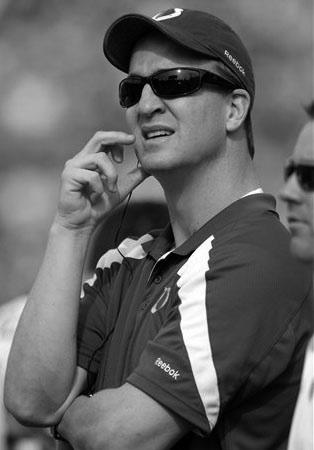
INDIANAPOLIS — According to Colts owner Jim Irsay, Peyton Manning will decide whether he plays another game for Indianapolis.
Irsay expects to meet with Manning in the next seven days, and the owner told The Indianapolis Star on Tuesday the return of the four-time MVP depends on his willingness to restructure his contract.
Manning has spent the past five months recovering from his third neck surgery in less than two years, and there have been conflicting reports about how much progress he has made.
The Colts owe Manning a $28 million roster bonus by March 8. They want to use the No. 1 pick in this year’s draft on Manning’s successor, and the future of their star QB will affect how much room they’ll have under the salary cap.
Manning turns 36 in March.
“We can make it work if he wants to be here,” Irsay told the newspaper. “We’d be excited to have him back and finish his career with us.
“I want him to be able to make the choice. We would love to have him back here if he can get healthy and we can look at doing a contract that reflects the uncertainty of the ... healing process with the regeneration of the nerve.”
The Colts went 2-14 last season without Manning, who started every game in his first 13 seasons in the NFL. He threw for 33 touchdowns and a career-high 4,700 yards in 2010, when Indianapolis went
10-6 and won the AFC South. Manning guided the Colts to a win in the Super Bowl after the 2006 season. Also Tuesday, the Colts completed their coaching staff by hiring eight assistants and
making Clyde Christensen quarterbacks coach.
First-year head coach Chuck Pagano already hired Bruce Arians as offensive coordinator and Greg Manusky as defensive coordinator.
Associated Press
MORGANTOWN, W.Va. — West Virginia University announced Tuesday it has settled a lawsuit with the Big East for an unspecified amount, clearing the way for the conference power Mountaineers to join the Big 12 in July in time for the fall football season.
Athletic Director Oliver Luck said the terms of the deal were confidential and WVU wouldn’t release details. But Luck said no state, taxpayer, tuition or other academic dollars will be used in the settlement.
A person familiar with the agreement said the settlement totaled $20 million but did not know how much money would come from the university and how much the Big 12 may contribute. The person spoke on condition of anonymity because financial terms were not being made in the announcement of the agreement.
Luck said the funding will come only from private sources and money that athletics raised independently.
WVU has already paid half of the required $5 million exit fee to the Big East.
Luck planned a news conference to discuss the deal later Tuesday morning.
A spokesman for the Big 12 didn’t immediately comment on the deal, but the conference released its football schedule about an hour after the announcement. West Virginia will make its Big 12 debut on Sept. 29 at home against Baylor.
The Mountaineers and their explosive offense went 10-3 last season and finished ranked
in the Top 25. West Virginia capped off the season with a record-setting 70-33 victory over Clemson in the Orange Bowl.
WVU sued the Big East in Monongalia County Circuit Court in Morgantown in November, challenging its bylaws in a bid to join the Big 12 in time for the 2012 season.
The Big East countersued in Rhode Island four days later, arguing that WVU had breached its contract with the conference and should remain in the Big East for another two years as required in the bylaws. In late December, the judge there denied WVU’s motion to dismiss.
Luck said the Big 12 gives WVU “significant advantages” over the Big East.
“The Big 12 is a strong and vibrant conference academically and athletically,” he said in a statement. “We look forward to the potential academic and athletic partnerships and financial opportunities that membership in the Big 12 offers.”
WVU President James Clements called the partnership with the Big 12 “an investment in WVU’s future.”
Big East Commissioner John Marinatto had repeatedly said West Virginia would not be allowed to leave until the 2014 football season.
But in a statement Tuesday, Marinatto said the board of directors voted to terminate WVU’s membership in the conference as of June 30. Marinatto said the board agreed to the deal because WVU was willing to drop its lawsuit and pay an exit fee “well in excess of that required by the bylaws.”
IndyCar changes rules to reduce safety concerns
Associated Press
INDIANAPOLIS — With IndyCar still recovering from Dan Wheldon’s death, series officials said Tuesday that double-file restarts will be scrapped at Indianapolis, Texas and Fontana and more changes to improve safety could be announced before next month’s season-opener at St. Petersburg.
“Oh yeah, there will be lots more to come,” IndyCar CEO Randy Bernard said after the two-day state of the series summit wrapped up in Indianapolis.
Bernard didn’t provide hints about what other announcements are pending.
It’s all part of a plan to make courses safer and revamp IndyCar’s image after Wheldon, a two-time Indy 500 winner, was killed in an accident at last year’s season-finale in Las Vegas. The wreck pushed safety issues to the forefront of racing and gave the drivers who risk their lives more latitude in framing complaints.
Plenty of changes have already been made.
The series is introducing its first redesigned car in nine
years, a model that is being deemed IndyCar’s safest yet. Driver seats will be surrounded by three inches of foam in the cockpit, an inch of foam underneath the seat and a panel on the right side of the cockpit to help reduce the force when hitting outside walls. Wheldon, who did most of the early testing, spoke glowingly about the new safety features.
Series officials are hoping the addition of rear-wheel pods will eliminate the wheel-to-wheel contact that can send cars airborne, too.
The 16-race schedule includes only five oval races, down from eight of 17 last year, a move many racers have embraced since Wheldon’s crash, though Bernard said that decision was more about marketability than safety with the obvious exception of Las Vegas.
New race director Beaux Barfield, who replaces Brian Barnhart in race control, made his decision on the restarts after talking directly with the drivers.
“I could look into their eyes and see very legitimate concerns,” he said.
AP
Colts quarterback Peyton Manning watches on the sideline during Indianapolis’ 19-13 loss to Jacksonville on Jan. 1.
Young, Smith propel Clemson past Virginia
Associated Press
CLEMSON, S.C.
— Andre Young and Tanner Smith scored 13 points each and Clemson held No. 22 Virginia to its lowest point total this season in a 60-48 victory on Tuesday night.
The Tigers (13-12, 5-6 Atlantic Coast Conference) took control with an 18-9 run over the final eight minutes to give the Cavaliers (19-6, 6-5) their second straight loss. Virginia looked out of synch with outside threat Joe Harris playing in a cast after breaking his left hand in a loss to North Carolina last Saturday.
Harris came in averaging 12 points a game, but was limited to two points on 1-of-5 shooting.
Jontel Evans led the Cavaliers with 17 points and star Mike Scott finished with 13, four below his team-leading average.
Devin Booker added 10 points for the Tigers.
Booker was a big reason for Clemson’s second-half dominance. He was 0-for-1 with no rebounds in the opening period, scoring all 10 of his points and four rebounds after the break. He also added two blocks and two steals.
The Cavaliers looked poised for a second-half charge after Evans had a three-point play and inside bucket to cut the lead to 44-41 with 7:56 remaining. That’s when Clemson got going on its charge.
Smith hit a basket to start the run, while Booker had two baskets sandwiched between a shot by freshman Rod Hall. When Smith made two foul shots with 1:55 left, the Tigers were ahead 54-43 and celebrating.
Virginia came in missing a big part of its attack when sophomore Harris just couldn’t get comfortable playing with his injury and did not start. When Harris did come off the bench, it was clear he was favoring the wrapped-up hand. He missed his only shot and committed two turnovers in 11 minutes of first-half action. Harris came in averaging 12.5 points and was crucial in the Cavaliers’ 6561 win over Clemson back on Jan. 31 with 19 points off five 3-pointers.
Having Harris at half speed seemed to affect his teammates, too.
Clemson forced 10 turnovers in the first 20 minutes, nearly what Virginia gives up in a game with its 11.5 average. The Cavaliers finished with 18 turnovers, while Clemson picked up 14 steals.
Harris’ replacement in the starting lineup, Malcolm Brogdon, picked up some of Virginia’s missing touch from the outside with seven points on 3-of-4 shooting.
Heat win fourth straight game
Associated Press
INDIANAPOLIS — LeBron James scored 23 points and nearly produced his first triple double in 11 months and Dwyane Wade had 16 points Tuesday night, leading the Miami Heat to a 105-90 rout of the Indiana Pacers to become the first team in 33 years to win three straight on the road in three days.
thing resembling a rope from the team trainer and acted like he was going to rope a steer. It was just that easy.
Playing their fourth road game in five nights, some thought the Heat might show sign of fatigue.
No way.
Young kept the Tigers in it throughout the period. He scored the first five points and added a second 3-pointer that put Clemson out front, 14-13.
The Tigers eventually led 2117 before Scott’s smooth jumper and Brogdon’s 3-pointer gave Virginia the lead.
Miami is also the first club in 42 years to win each of the three by double digits. Phoenix was the last to win three in a row on the road in consecutive days, from Dec. 21-23, 1979. Milwaukee was the last team to win all three by at least 10 from Nov. 20-22, 1970.
Plus, at 23-7, Miami has now tied the franchise’s best start.
Things went so well Tuesday, that at halftime, James turned to the crowd and acted like he was reeling in a fish and during a third-quarter timeout. Mike Miller grabbed some-
Instead, the Heat looked crisp, relaxed and ready to send a message to the rest of the league — that they can dominate every possible way.
Rookie Norris Cole matched his season-high with 20 points and James had nine points and six assists in the first 14 minutes. Wade made his first five shots and needed a little more than eight minutes to reach 10. Defensively, Miami was just as tough limiting Indiana to just 6 of 23 from the field in the first quarter and not much better until the closing minutes.
While Miami made it look easy, the Pacers played ugly.
David West led the Pac-
ers with 14 points and Paul George had 12, not nearly enough to avoid a fourth consecutive loss. Even worse, the Pacers (17-11) lost leading scorer Danny Granger with a sprained left ankle late in the first quarter and he did not return. Granger finished with three points.
Pacers fans were hoping Indiana had something to prove Tuesday after finally getting a two-day break. But James, Wade and their teammates never gave them a chance to amend for the 35-point loss at Miami last month.
Miami used an early 10-0 run to take a 23-9 lead less than eight minutes into the game and led 33-16 after the first quarter. The Heat extended the lead to 51-24 midway through the second quarter and led 68-39 at the half and the Pacers never got closer than 20 until less the final two minutes of the game.
AP
Virginia guard Malcolm Brogdon attempts a layup in the Cavaliers’ 60-48 loss to Clemson on Tuesday.
Belles welcome road test at Calvin
By PETER STEINER Sports Writer
While Saint Mary’s clinched the fourth spot in the MIAA tournament with a win over Adrian last week, the Belles still have at least one goal left to accomplish in the regular season — to defeat No. 5 Calvin.
The Belles (12-11, 8-6 MIAA) will travel Grand Rapids, Mich. tonight to play first place Calvin (22-1, 14-1) in their secondto-last regular season game. ‘Belles coach Jenn Henley said the team is looking forward to the opportunity to beat the best team in the conference.
“It’s a big game,” Henley said. “They are the No. 1 team in the conference so anytime you play the top team in the conference, you are gunning for them. I think they are beatable.”
The Belles lost to Calvin 80-54 earlier this season and have not beat the Knights since 2009. Much of Calvin’s firepower comes from junior forward Carissa Verkaik, who leads the MIAA in both scoring and blocked shots. To beat the Knights this time around, the Belles will have to limit the impact Verkaik has on the game, Henley said.
“As she goes, their team goes. She is very good and does a good job for them defensively with her ability to block shots and alter shots and keep people out of the paint. That’s going to be our number one focus,” Henley said. “It’s going to be a total team effort in terms of shutting her down.”
To combat Verkaik and the Knights, the Belles will rely on their four starting seniors, who all average over 10 points per game. In addition, Saint Mary’s will need to continue to get to the free throw line and play well as a team, Henley said.
“I think we are doing a good job of getting to the foul line,” Henley said. “That’s kind of been a thing for us all year. Trying to put some points on the board with the clock stopped. Our team is playing really well right now. They’ve got some good chemistry going.”
With Calvin sitting atop the conference, they are currently slated to play Saint Mary’s in the first round of the MIAA postseason tournament next week. While Henley said the Belles’ strategy will not change because of likelihood they will play the Knights again in the playoffs, she is not sure how Calvin will handle the game.
“I don’t think we will [go about the game any differently],” Henley said. “Wednesday is Calvin’s last regular season game and there is a great chance for their first game in the tournament to be us again. They may be preparing a little differently knowing we are going to play each other two times in a row. I think it makes for an interesting tournament because we will be really familiar with them.”
The Belles will travel to Grand Rapids, Mich. to play the Knights tonight at 7:30 p.m.
Contact pe ter s t einer at psteiner@nd.edu
Friars
continued from page 16 offense never appeared in sync, which prevented them from pulling away until late. But by the 7:59 point of the second half, Notre Dame had opened up a 16-point advantage.
“I thought we played a lot better defensively in the second half,” McGraw said. “A couple of times we let them loose for threes. [Peters] did a great job on the boards.”
Peters recorded her eighth double-double of the season by grabbing 11 rebounds to continue her rebounding tear. She struggled with the aggres -
siveness of West Virginia’s post players Sunday but enforced her will down low Tuesday, going seven for 10 from the field.
“I just want to go in there and rebound,” Peters said. “That first day where I had the 16 boards [Jan. 23], it clicked like, ‘I could be doing this every night.’”
Whenever the Irish offense seemed to stall in the half-court, Diggins got things going. She also pushed the ball in transition off turnovers and missed shots.
“She’s on a roll,” McGraw said. “She’s so hard to guard when the other team wants to come up and try to slow us down. She can just dribble right through. When you’re rebounding like [Peters] is doing and getting the ball in quickly and throwing it ahead to her, good things are going to happen.”
Diggins added she looks
Kubinski
continued from page 16
it on down the stretch en route to a 4-2 victory over the Bears. Both Usher and Walker rallied from three strokes down with nine holes to play.
“I thought this morning didn’t look great to be honest,” Kubinski said. “[Central] Arkansas was playing some great golf, and we weren’t, but to see the guys do that was great. It was a game where everything was going against, and I was almost a little to the fact that we were going to lose, but after we won I had no doubt we were going to win in the afternoon with the way we were playing.”
Kubinski’s prediction came true in the final as the Irish made much quicker work of the Spartans, though the 4-2 score remained the same. Usher, Walker, senior Max Scodro and sophomore Niall Platt claimed wins in the victory.
Kubinski said the team’s consistency was the highlight of the event.
“It was great to see consistent play across five or
for Peters to finish the fast break.
“As [Peters] raised her level of play, getting a rebound, I’m going to be right there, following her, trying to start the break, and she’s going to run,” Diggins said. “Our team is going to run.”
Sophomore Kayla McBride added nine points and five rebounds for the Irish. The win keeps the Irish unbeaten in the alltime series against Providence in 20 meetings.
Providence redshirt senior Teya Wright, Providence’s leading scorer and rebounder, went down early with an injury. She returned with 13:37 to play in the first half and scored just five points in the game.
The Irish continue their Big East schedule Feb. 20 at Louisville.
Contact Matthew r o bison at mrobison@nd.edu
six golfers,” Kubinski said. “Often in the fall it was Max [Scodro] carrying the load for us, but he didn’t have to today, and this was something that I told the guys. It was an area that we struggled with in the fall, but I think the break served us well in that regard.”
The Irish now wait a month before hitting the links competitively again at the Schenkel Invitational in Statesboro, Ga.
“The Schenkel [Invitational] is always huge for us because so many top teams are there,” Kubinski said. “With the way we played the past two days and some time to prepare, we’re feeling good about it.”
In the meantime, the Irish will travel to Hilton Head Island, S.C. next weekend for the Alumni Match Weekend, where the current Notre Dame squad will be paired with Irish golf alumni in an a tuneup contest.
“The Alumni weekend is great,” Kubinski said. “It gets us another weekend of warm weather golfing and is always lots of fun for everyone.”
Contact Conor Kelly at ckelly17@nd.edu
SARAH O’CONNOR/The Observer
Senior guard Natalie Novosel battles to shoot the ball during Notre Dame’s 66-47 win over Providence on Tuesday. Novosel finished with seven points and two assists in the victory.
continued from page 16
being hunted.”
The Irish swimmers will look to build on the strong performance by the Irish diving team over the weekend. The Irish divers picked up 71 points in competition, which lifted the Irish into second place, one spot below Louisville, in the Big East women’s team standings.
To make their push at the championships, the Irish will look to several of their accomplished and experienced upperclassmen. The team features two individual champions from last year’s Big East championships in Holden and sophomore Kelly Ryan.
Holden, who is a seventime Big East champion, took titles in the 100and 200-yard backstroke events last year, while Ryan, who holds the fastest time on the team in four different events this season, won the 100- and 200-yard freestyle championships last season.
Notre Dame will also rely on senior Amy Prestinario and junior Lauren Scott, who contributed to last year’s championship-winning 400-yard relay team.
Notre Dame will also look for strong performances from the team’s talented group of freshmen, who have been vital to the team’s success all season. Freshmen Emma Reaney, who has been named Big East Women’s Swimmer and Diver of the Week three times, Bridget Casey, who has won four titles in the 200-yard fly this season and Suzanne Bessette, who has the team’s quickest time in the 200-yard freestyle, have led this year’s group of freshmen.
Holden saidshe has confidence in the freshmen and thinks they will continue to contribute to the team, even during a highstakes meet like the Big East championships.
“I think the freshmen have set themselves really well to contribute a huge amount to this year’s championship meet,” Holden said. “I don’t even think of them as freshmen because they have been really impressive and stepped up as leaders. I’m not worried about them at all.”
Although a Big East championship serves as a major goal for the team, Holden said the team’s focus is ultimately on the small picture, the individual races that could make or break a championship bid.
“Winning the Big East would be amazing and it is definitely on our minds, but it’s not our number one priority right now,” Holden said. “Our priority is to focus on one swim at a time and to put up some fast times that will surprise a lot of people.”
The Big East championships will begin Wednesday at Pittsburgh’s Trees Pool and conclude Saturday.
Contact Brian Hartnett at bhartnet@nd.edu
Ranked
continued from page 16
tournament berth, the No. 23/25 Irish will host Rutgers (12-13, 4-8 Big East) tonight as a different squad than the last time the teams faced.
“I do [feel like we’re a different team],” Irish coach Mike Brey said. “I think we’ve come a long way. I was disappointed in how young we played there, hung our heads. It’s amazing how far we’ve come just watching the film this morning.”
The Irish entered the national rankings for the first time this season Monday, appearing at No. 23 in the AP poll and at No. 25 in the USA Today poll. Notre Dame (17-8, 9-3) currently sits in third place in the Big East standings.
“Our team is still improving but we can still
Events
continued from page 16
award twice in the course of the season. He stands second in the 50-yard freestyle with a time of 20.19 seconds, only one second behind No. 1 Brendon Andrews from Louisville. Dyer also holds top time in the 200-yard freestyle, the second best in the 500-yard freestyle, and the third best in the 100-yard freestyle.
Freshman James McEldrew holds the third spot in both the 1,000-yard freestyle at 9:21.53 and the 1,650-yard freestyle at 15:44.39. Joining him are freshman Patrick Olson, with the second best time in the 400-yard individual medley with a time of 3:56.30, and Johnson, who holds the third best time in the 100-yard breaststroke, clocking in at 55.23.
On the relay front, the Irish team of Dyer, junior
get better because there’s still young guys here figuring it out,” Brey said. “That’s one of the things you don’t want to lose track of in the midst of bracketology and rankings and all of that stuff.”
Junior forward and Big East player of the week Jack Cooley has been at his most effective in the last two games, scoring 43 points and grabbing 26 rebounds combined in the last two contests. He accumulated four double-doubles in the last six games.
the three-point line. Cooley was held to just nine points.
“They’re a tough matchup for us,” Brey said. “One of the reasons they beat us [was] their speed and their quickness gave us problems. We’ve got to do a better job defensively than we did there. We couldn’t guard them.”
“Our team is still improving but we can still get better because there’s still young guys here figuring it out.”
Mike Brey Irish coach
To counter the Scarlet Knights’ speed and quickness, Brey said Notre Dame might play some zone defense.
In the loss to Rutgers on Jan. 16, the Irish converted on just five of 13 free throw attempts and allowed the Scarlet Knights to shoot 47 percent from
Kevin Overholt, junior John McGinley and freshman Zach Stephens head in with the best time in the 400-yard freestyle, a spot they hope to preserve at the end of the week.
“The most important thing is to swim fast,” Johnson said. “If everyone can go out and drop time, that’s great. If we can do that, the rest falls into place. Coming home with a title would be great.”
This weekend’s events aside, the Irish already have four provision qualifiers for the NCAA championships — Dyer, Johnson, Overholt and McGinley.
“This is what we’ve been training all year for and we’re ready,” Johnson said. “Here we come.”
The championships kick off tonight with relays beginning at 6 p.m. Tomorrow the Irish will compete in the preliminary races starting at 10 a.m. with the 500-yard freestyle.
Contact Megan fi nneran at mfinnera@nd.edu
“We’ll mix it,” Brey said. “[If] we go to zone and it’s working, we’ll ride it for a long time. I think for us, changing defenses is a key.”
Changing defenses may also help the Irish force Rutgers to turn the ball
over. The Scarlet Knights rank last in the Big East in turnovers, coughing the ball up nearly 15 times per game. The Irish, meanwhile, average less than 11 turnovers a game, tops in the conference.
In Saturday’s victory over DePaul, the Irish scored 84 points — a season high during Big East play. It was the first time since December Notre Dame topped the 80-point plateau.
“I think we’ve shown here we’re comfortable in the second half putting up 40, 50 [points], we’ve done it a couple times now,” Brey said. “I think offensively, we’re improving.”
Notre Dame looks to extend their six-game winning streak tonight when they face Rutgers. Tip-off is set for 7 p.m. in Purcell Pavilion.
Contact Matt d e fr anks at mdefrank@nd.edu
ALEX PARTAK/The Observer Freshman Patrick Olson swims in the Shamrock Invitational on Jan. 28. The Big East championships began Tuesday.
Published Monday through Friday, The Observer is a vital source of information on people and events in the Notre Dame and Saint Mary’s Community.
Join the more than 13,000 readers who have found The Observer an indispensable link to the two campuses. Please complete the accompanying form and mail it today to receive The Observer in your home. Make
Enclosed is $130 for one academic year Enclosed is $75 for one semester
HeNry ArNOlD
Mike ArgiriON
JumBle
Alex griSWOlD and lee HAggeNjOS
london exPress
jOe Miller and kelly lyNcH
the Clammy handshake
February 15, 2011
nd Women’s BasketBall
Friared up
By MATTHEW ROBISON
Sports Writer
Coming off a home loss to West Virginia that snapped a 21-game Irish winning streak, both graduate student forward Devereaux Peters and junior guard Skylar Diggins answered with 19 points apiece in No. 4 Notre Dame’s 66-47 victory over Providence on Tuesday in the Purcell Pavilion.
Notre Dame (25-2, 12-1 Big East) did not get off to the start it had hoped and trailed 18-17 in the early going. Providence (13-13, 5-8) broke Notre Dame’s press early and often, breaking out in transi -
nd Women’s sWImmIng
tion to get easy layups and jump shots.
“They handled our press really well, a lot better than we wanted them to,” Irish coach Muffet McGraw said. “We had a little bit of a slower start than I expected. I really thought we’d have a great bounceback game.”
Diggins pushed the Notre Dame lead to 33-20 when she snagged a steal and took it the length of the court for a layup. In a half in which both teams turned the ball over 10 times, the Irish claimed a 37-27 advantage going into the locker room.
“We had some turnovers, just got a little sloppy,”
ND looks to start new championship streak
By BRIAN HARTNETT Sports Writer
After playing the role of favorite for the last 15 years, Notre Dame will look to use its newfound role of underdog to surprise some teams at this year’s Big East championships in Pittsburgh.
Louisville snapped Notre Dame’s unprecedented streak of 14 consecutive conference championships last year.
.With the Cardinals seen as favorites for this year’s championship meet, the
Irish (6-6) will aim to come from behind and potentially start a new run of championships.
“Our team was talking about how this year is the first time we will be able to be on the offense instead of on the defense, since we were previously always looking to defend the title,”
junior Kim Holden said.
“We’re looking forward to just focusing on putting up some impressive times, but we like knowing that we’ll be on the hunt instead of
see HOLDEN/page 14
men’s sWImmIng
Divers deliver gold, swimmers to compete
By MEGAN FINNERAN Sports Writer
The Irish brought home the gold in both diving events this weekend when freshman Nick Nemetz swept the competition. Now, the swimmers look to follow in Nemetz’s footsteps.
The Big East championships continue this afternoon, transitioning from diving events to swimming. The Irish (6-4) come off a rest period of more than two weeks, during which they tapered practice in preparation for this competition. With the normal season over, the Irish will attempt to add to Nemetz’s trophy haul at
men’s golf
McGraw said. “We were quicker to be frustrated. I think the little mistakes kind of got magnified in that stretch.”
Although Diggins led the team in scoring in the first half, she recognized there were points when she could have controlled the game more.
“Pushing the pace is fine, but I’ve got to notice times when we need to slow it down,” She said. “Sometimes I get anxious.”
The Friars hung around for most of the second half, keeping within striking distance of the Irish. Notre Dame’s half-court
see FRIARS/page 13
men’s BasketBall
Trees Pool in Pittsburgh as they face defending champion Louisville and the rest of the Big East.
“We got to Pitt a few days early to settle in and swim a few times in their pool to get a feel for it,” junior Chris Johnson said. “We’re gearing up for an intense week and we’re ready for that.”
Going into the championships, four members of the Irish hold top-three times in various events.
Sophomore Frank Dyer leads the Irish in many events and has proven himself as a top competitor, winning the Big East Men’s Athlete of the Week
Usher leads Irish to win in first spring tournament
By CONOR KELLY Sports Writer
Despite strong finishes in a number of events, the Irish were never able to secure a tournament victory in the fall season, much to the consternation of Irish coach James Kubinski. It took them exactly one tournament to do so in the spring season, taking The Match Play title with wins against Central Arkansas and USC Upstate at the Reunion Resort Watson Course in Orlando, Fla.
“To get on a winning track like this is huge for us,” Kubinski said. “It was something that frustrated us all fall, but I like what I’m seeing early on in the spring.”
The semifinal match with Central Arkansas saw the Irish fall behind early, trailing in four of six matches heading into the back nine. Spurred by impressive efforts from seniors Tom Usher and Chris Walker, the Irish turned
Squad seeks revenge over Rutgers
By MATTHEW DeFRANKS Sports Writer
Nineteen games into the season, then-unranked Notre Dame was struggling at 11-8, including 3-3 in the Big East. Connecticut had just snapped the long Joyce Center winning streak, and a loss at Rutgers extended the skid.
But on Jan. 21, Notre Dame (17-8, 9-3 Big East) upset then-No. 1 Syracuse 67-58, kicking off a sixgame winning streak that includes three victories over ranked opponents.
Now, nationally ranked and closing in on an NCAA
JULIE HERDER/The Observer
Irish senior forward Scott Martin drives to the basket during Notre Dame’s 84-76 win over DePaul on Feb. 11., the team’s sixth straight victory.
SARAH O’CONNOR/The Observer
Junior guard Skylar Diggins takes a shot during Notre Dame’s 66-47 victory over Providence on Tuesday. Diggins registered 19 points and seven assists in 33 minutes of playing time.