PDF Edition of The Observer of Notre Dame and Saint Mary's for Thursday, November 10, 2011
ND researchers pioneer ER technology
By AMANDA GRAY News Writer
University research is giving trauma victims a greater chance of survival, according to Dr. Francis Castellino, director of Notre Dame’s W.M. Keck Center for Transgene Research.
Researchers at the Keck Center, in collaboration with trauma physicians from South Bend’s Memorial Hospital, are looking at blood coagulation, or clotting, using a thromboelastogram, a machine that breaks down how a patient’s blood coagulates, Castellino said. By using this machine in a new way, the researchers are finding out what specific blood product, such as platelets, plasma or red
and white blood cells, a patient might need.
“We save lives by doing state-ofthe-art early trauma care,” Castellino said. “We’re looking at blood clotting in real time at the point of care, whether that be at the bedside of the far-forward battlefield, like the front lines.”
This real time analysis leads to quicker treatment as well as specified treatment, called “goaldirected point of care therapy,” Castellino said.
Besides saving lives of trauma victims, who need treatment as fast as possible, these new groundbreaking developments in the field of coagulation research are also saving precious blood products.
“Treatments now are shooting
blood into patients [instead of finding out what blood product they need],” Castellino said. “This research is taking it a step forward.”
Dr. Mark Walsh, a trauma physician at Memorial Hospital, said the goal-directed therapy is helpful in the emergency room.
“We can save blood products — we don’t want to waste them,” he said. “We can give this goal — directed blood component therapy instead of fixed ratios. We can adjust our ratios based on what the patient needs.”
The research out of Castellino’s lab is like nothing else in the nation, Walsh said. Only three to four other labs are doing any research
see ER/page 5
Architecture professor leads Taj Mahal preservation
By MEL FLANAGAN News Writer
Imagine if we could have known the Seven Wonders of the Ancient World — what they looked like, how they were built. Assistant professor of architecture Krupali Krusche laments not having the opportunity to study these architectural phenomenons, which is why she has undertaken the task of digitally documenting World Heritage Sites such as the Taj Mahal. Krusche founded the Digital Historical Architectural Re-
search and Material Analysis (DHARMA) team in 2007.
The team, comprised of Krusche, assistant professor of architecture Selena Anders and graduate and undergraduate architecture students, studies and documents historical sites in order to create highly detailed, 3-D images that can later be used for the preservation of the sites.
“These historical sites have just never been documented very well before,” DHARMA team member Jack Bangs said.
“As they age slowly, in order to repair them we need to know
what they looked like otherwise we might repair them wrong.”
DHARMA’s initial project of documenting four tombs in Agra, India, including the Taj Mahal, began in 2008 and is ongoing.
Krusche said the process consists of multiple methods of measurement and documentation that are fused together to form a complete digital image of the site.
“Our biggest investment has been in the 3-D scanning technology,” she said. “It is a 3-D laser scanner that allows you to
create and capture the 3-D coordinates of every surface you want to document.”
Anders, who co-founded DHARMA as a graduate student, helped the University acquire the scanner, a high-end device that not many schools have access to.
The DHARMA team works with the Center for Research Computing (CRC) to access the technology needed to create 3-D views of the site.
“If anything happens to the site in the near future, there are exact data coordinates available
about the site that allow you to reconstruct it without any information being missed,” she said.
The DHARMA team is also working with the Office of Information and Technology (OIT) to employ GigaPan technology.
“This is when you take a multitude of photos, say 500, and you put them together to create an image that is in gigapixels,” Krusche said. “It is very heavy, but very detailed.”
Krusche said this technology has the ability to zoom in ex-
see RESEARCH/page 5
Students discover ‘footprint’ Workshop addresses race relations in dorms
By NICOLE MICHELS News Writer
It takes a lot to outfit a Notre Dame student — clothes, electronics and other various school supplies. Ever wonder who made all of those things?
On Wednesday, ND8 hosted an event in the Dooley Room of LaFortune where students could look up their “slavery footprint,” an estimation of the number of modern-day slaves involved with the production of the items they use. This event was the second in a month-long series focusing on the problems of human trafficking and modern day slavery.
Sophomore John Gibbons, co-president of ND8, said the goal is to take a holistic look at the issues so the various aspects of these global problems are brought to the attention of a larger audience.
“A fair amount of the population knows so little about these problems,” Gibbons said. “Our main goal is to raise awareness about them so that it inspires people to think about it more and what they can do to help.”
All of the groups involved were motivated by a desire to increase awareness of these issues, inspiring students to help those affected and giving those students ways to
respond.
Rosie McDowell, director of International Community Based Learning and Outreach at the CSC, said the Center’s focus in the series was to help student groups to collaborate in order to better address social issues through the lens of Catholic Social Teaching.
“One of the things we try
see CSC/page 5
By BROOKE KOVANDA News Writer
Wednesday night was a night of awareness, understanding and acceptance of multiculturalism on Notre Dame’s campus.
Movimiento Estudiantil Chicano de Aztlán (MEChA), a Latino student activist group promoting social reform, student government and the Diversity Council presented a workshop on race relations in residence halls in Geddes Hall.
Senior Maya Younes, the diversity representative for MEChA, organized the workshop, centered around discussing challenges in promoting multiculturalism in dorm life and eliminating instances of discrimination through racial awareness.
“Conversations on discrimina-
tion in dorms have been occurring on a small scale across campus and I realized that in order to make long-lasting improvements to the experience of multicultural students in dorms, we needed to open that conversation to administrators who directly oversee housing,” Younes said.
“Part of the movement to creating a better community is sharing your experience with others.”
The event began with a story regarding racial conflict in one of the residence halls, and followed with small groups of students and peer mediators discussing their reactions, findings and personal experiences with race relations in residence life.
Two central topics of workshop were the “Spirit of Inclusion” and “Awareness.”
see RACE/page 5
PAT COVENEY / The Observer
A South Bend ambulance responds to an emergency on Notre Dame’s campus Tuesday.
Brandon Keelean/The Observer
www.ndsmcobserver.com
P.O. Box 779, Notre Dame, IN 46556
024 South Dining Hall, Notre Dame, IN 46556
Editor-in-Chief
Douglas Farmer
Managing Editor
Sarah Mervosh Business Manager Jeff Liptak
A sst.
Managing Editor: A driana Pratt
A sst.
Managing Editor: C hris Masoud
Ne ws Editor: Me gan Doyle
V iewpoint Editor: Meghan Thomassen
Sports Editor: A llan Joseph
Scene Editor: M aija Gustin
S aint Mary’s Editor: C aitlin E. Housley
Photo Editor: Pat Coveney
G raphics Editor: Brandon Keelean
A dvertising Manager: K atherine Lukas
A d Design Manager: A manda Jonovski
C ontroller: Jason Taulman
Systems Administrator: W illiam Heineman
Office Manager & General Info (574) 631-7471 Fax (574) 631-6927
Photo Desk (574) 631-8767 obsphoto@gmail.com Systems & Web Administrators (574) 631-8839
Policies
The Observer is the independent, daily newspaper published in print and online by the students of the University of Notre Dame du Lac and Saint Mary’s College. Editorial content, including advertisements, is not governed by policies of the administration of either institution. The Observer reserves the right to refuse advertisements based on content. T he news is reported as accurately and objectively as possible. Unsigned editorials represent the opinion of the majority of the Editor-in-Chief, Managing Editor, Assistant Managing Editors and department editors. Commentaries, letters and columns present the views of the authors and not necessarily those of The Observer.
V iewpoint space is available to all readers. The free expression of all opinions through letters is encouraged. Letters to the Editor must be signed and must include contact information.
Question regarding Observer policies should be directed to Editor-in-Chief Douglas Farmer.
Post Office
Lisa Carlson sophomore Pasquerilla West
“Statistically, probably nothing.”
Karina Lizzi senior Pangborn
“KNL Week and being Karina from the block.”
Sarah Guiterrez senior Pasquerilla East
“Getting a fracture in lab.”
Shane Kelly sophomore Keenan
“The ‘incident’ in O’Neill.”
Heather Chiarello junior Pasquerilla West
“My aggressively friendly hugs!”
weeklong
the Holocaust.
Emily
Anna
Nicole
Elisa
Amber Galik
Nose biting earns poll worker jail time
CLEVELAND -- A poll worker suspected of trying to bite off the nose of a voter during an Election Day argument surrendered to sheriff’s deputies on Wednesday.
James N. Williams turned himself in at the Justice Center, which houses police headquarters and the courts, and was jailed to await possible charges, police spokesman Sgt. Sammy Morris said. The case was investigated as a suspected felonious assault.
Williams, 53, is accused of trying to bite off the nose of a voter who helped
a campaign volunteer in an argument over signs posted near a Cleveland polling place on Tuesday.
The head-butting and nose-biting landed voter Greg Flanagan, 49, in a hospital for treatment, authorities said, and he was still feeling dizzy hours after his release.
“I’m glad that he turned himself in because that’s the first right decision he’s made in the last 24 hours,” Flanagan said after hearing of Williams’ surrender.
Maui bull freed after giant tire stuck on head KULA, Hawaii -- A rodeo bull in Hawaii has
been freed from a giant tire that was stuck on his head for about 20 hours.
The bull, named Skywalker, couldn’t eat or drink after he got his head lodged in the truck tire dumped at the Triple L Ranch in Maui. The tire weighs more than 50 pounds.
When the bull became exhausted enough to be approached, a ranch worker pried the tire off with a piece of wood.
Ranch owner Paige De Ponte says Skywalker seems fine now that he’s free from the rubber ring.
Information compiled from the Associated Press.
Thomas Bender sophomore Keenan
“My intensity. We don’t lose!”
In BrIef:
The Notre Dame International Security Program and the Nanovic Institute for European Studies will host Dr. Josef Joffe, publisher-editor of the German weekly “Die Zeit” and Visiting Professor of Political Science at Stanford University. He will give a lecture titled, “ Barack Obama, Follower of the Free World.” Jofee will speak at 4 p.m in 119 O’Shaughnessy Hall. A discussion will follow the lecture, which is free and open to the public.
Now in the final two months before it disbands, the Merce Cunningham Dance Company will perform at the Debartolo Performing Arts Center at 7 p.m. Tickets are $15-$40. The program is comprised of three of Cunningham’s seminal works, and will feature Suite for Five, first performed at Notre Dame in 1956.
Taste of ND will take place in the Lafortune Ballroom from 7 - 9 p.m . Participating dorm food sales are St. Edward’s, Welsh Family, Morrissey, Siegfried, McGlinn, Keough, Keenan, Dillon and Knott. The price is $2 for an all you can eat admission to the event.
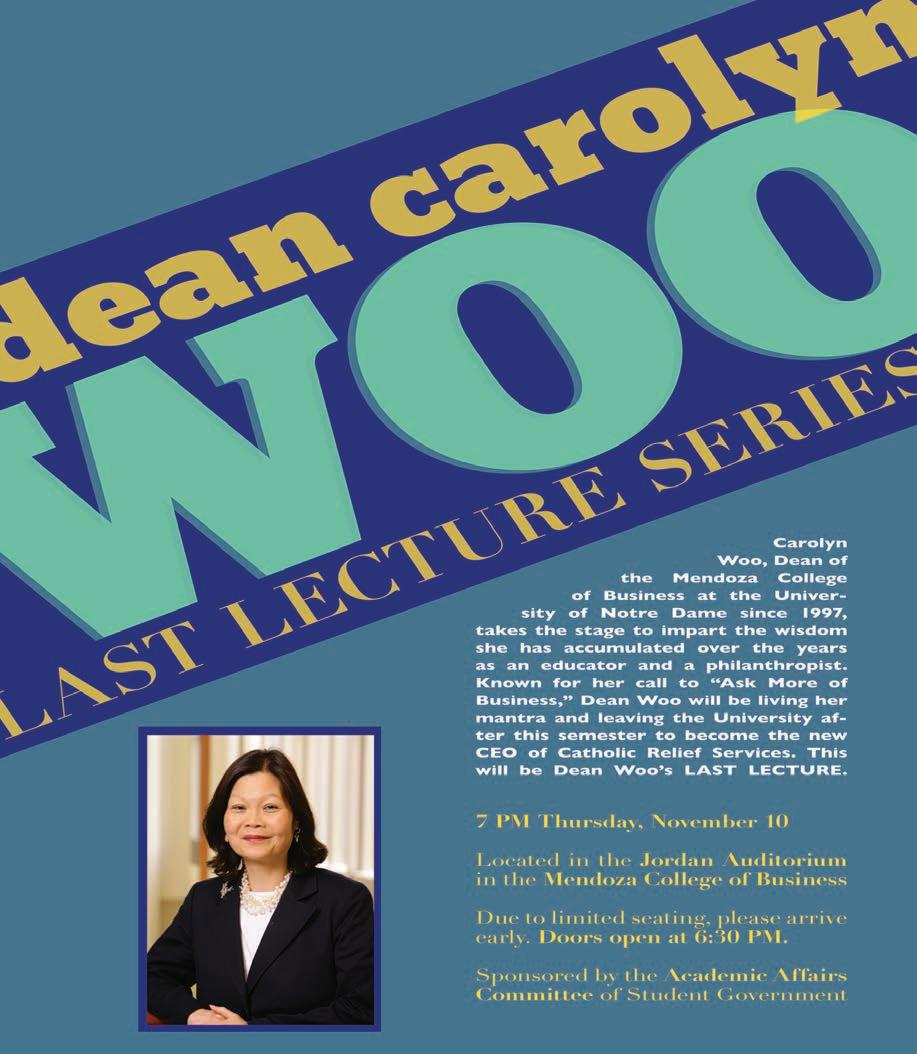
Carolyn Woo, Dean of the Mendoza College of Business since 1997, will speak in Menoza’s Jordan Auditorium as a part of The Last Lecture Series. Doors open at 6:30. This event is free and open to the public.
To submit information to be included in this section of The Observer, email detailed information about an event to obsnews.nd@gmail.com
COURTNEY ECKERLE/ The Observer
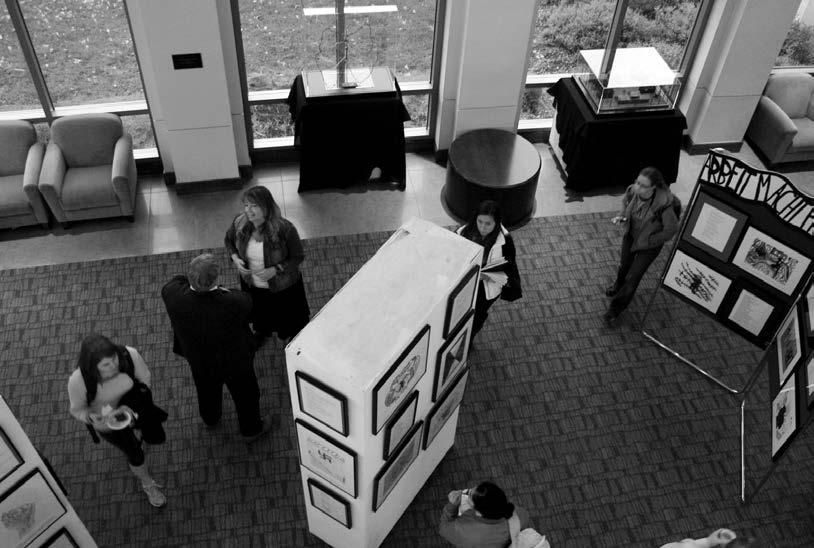
The “Children of the Holocaust” exhibit opened Wednesday in Spes Unica Hall at St. Mary’s. The exhibit is a part of a
series to reflect on Kristallnacht and
College displays Holocaust art
By JILLIAN BARWICK News Writer
After more than 65 years since the end of World War II, students at Saint Mary’s are still learning about the lasting effects the Holocaust had on its victims and its survivors.
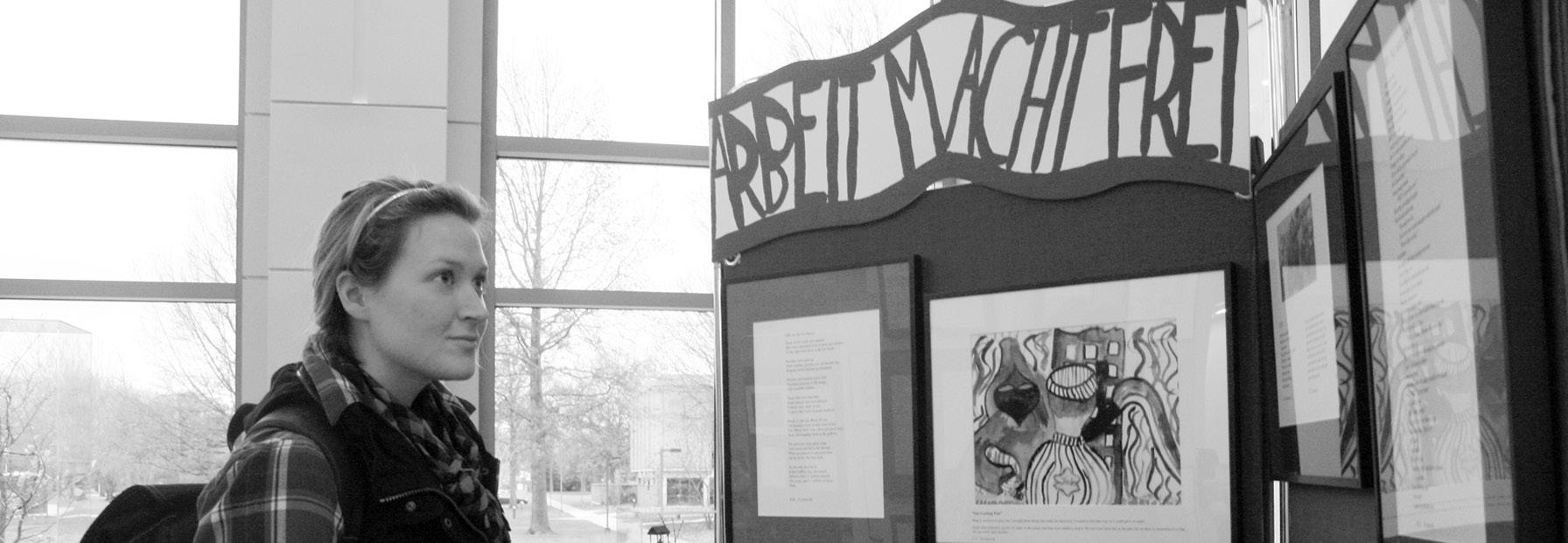
Misti Garner, a teacher with the School City of Mishawaka, introduces the “Children of the Holocaust” art exhibit in Spes Unica Hall, which features 50 pieces of art and poetry, as well as two sculptures, Wednesday. Garner worked with local students, ages 9 to 17, to read, discuss, interpret and express their feelings about the Holocaust through art and poetry.
“These kids are streetwise,” Garner said. “They know about the prejudices between blacks and whites, but that is the only prejudice
they knew about.”
Garner and her students studied the Holocaust for an entire year and during part of the summer as well. While learning the vivid details about death camps and how Nazi soldiers treated their prisoners, the students were sad and shocked, Garner said.
“The students did not realize that this type of suffering could exist because of faith,” Garner said. “They did not know what being Jewish was.”
At the end of the display, the pieces of artwork told some of the students’ own stories of suffering through poetry and paintings.
“My students told me, ‘If those people can survive the Holocaust, then I can survive what I’ve been through,’ which really resonated in me,” Garner said.
Garner said her students
learned that they were not alone in their suffering through their study of the Holocaust.
“The theme throughout the exhibit is the degree of suffering people in the Holocaust endured,” Garner said. “The students felt that they were the only people suffering in society, but now, after learning about the Holocaust, they see there are more people they did not know about who suffer also.”
The art exhibit at Saint Mary’s is a part of a week of events commemorating Kristallnacht, the official beginning of the violence against Jews in Nazi Germany on Nov. 9, 1938, which led to the Holocaust.
Contact Jillian Barwick at jbarwi01@saintmarys.edu
Senate passes resolution to amend constitution
By MEL FLANAGAN News Writer
Student Senate unanimously approved a resolution to amend the Student Union constitution by adding instructions to fill vacant student government positions Wednesday.
Oversight committee chair
Ben Noe said the subcommittee for constitutional reforms recommended several changes that he and his committee wrote into a resolution.
The first addition inserted a clause detailing the procedures to remove a committee chair. Previously, the constitution did not contain a way to remove a chair if necessary.
“This is kind of a problem because if committee chairs are slacking and not doing their jobs right, they may need to be removed,” Noe said.
The resolution also modified the instructions for the selection of the Student Union treasure.
“In the constitution the way the Student Union treasurer is replaced is that they appoint one of the assistant Student Union treasurers,” Noe said. “What if neither of the assistants are available to take the role of the Student Union treasurer?”
Following the amendment, if this scenario were to occur, the Student Union treasurer would have two options.
If he or she was available to serve another term, the treasurer could reappoint himself or herself. Otherwise, the treasurer can open the position up to applications from the student body.
“We thought this increased the transparency and openness of student government so we can get some people who have not been involved in student government for years at a time into the top positions,” he said.
Similarly, another clause opened up the positions of judicial council vice presidents to the entire student body.
While the judicial council president has the final say over who is selected as vice presidents, Noe said this step encourages students who have not previously been involved with the council to apply.
“Once again, this is with the intent of increasing the openness of student government,” he said. “We’re trying to make positions of some authority open to everyone.”
The last modification to the constitution eased the process of replacing officer positions.
“These changes are being made to make student government more open to the student body as a whole, and also to just make some technical changes that needed to be made,” Noe said.
Contact Mel Flanagan at mflanag3@nd.edu
Saint Mary’s sponsors Holy Cross Harvest
By MADELINE MILES News Writer
Saint Mary’s College kicked off the second annual Holy Cross Harvest, a large-scale donation drive to benefit the Northern Indiana Food Bank, on Monday.
Carrie Call, director of the Office for Civic and Social Engagement (OCSE), said she would like to see a majority of the Saint Mary’s community participate in the event.
“The Harvest shows us how a small amount of money can make a big difference,” Call said. “Plus it is important to remember that hunger is very real in our area and many families are struggling. It is our responsibility to act.”
The Holy Cross Harvest started last year in response to the declining economy, as many families struggled to put food on the tables, Call said.
Saint Mary’s has also joined with Notre Dame and Holy Cross College to combat hunger in the
community.
“The three schools can work together to make an impact in the community,” Call said.
Call said she is asking for students to donate $1, which can help provide up to eight meals.
Last year, the Harvest brought in more than $800. Call said she hopes to surpass that amount this year.
“If every person on this campus gave just $1, we could provide hundreds of meals to families in need,” Call said. “I’d like to beat that this year by at least $100.”
Junior Kelly Roepke, student director of OCSE, acknowledged the importance of the Holy Cross Harvest.
“Students don’t realize how much a dollar can do,” Roepke said. “It really does make a significant difference.”
The Harvest will run through Nov. 17.
Contact Madeline Miles mmiles01@saintmarys.edu
COURTNEY ECKERLE/The Observer
Senior Sarah McCroy visits the “Children of the Holocaust” art exhibit in Spes Unica on Wednesday. The exhibit featured art created by Mishawaka school children.
Lecture promotes fair trade outlet in South Bend
By CAITLIN HOUSLEY
Saint Mary’s Editor
The daughter of a firefighter and parks board member, Becky Reimbold learned at an early age the importance of giving back to the community.
Reimbold, proprietor of the Just Goods fair trade store in South Bend, said she didn’t intend on giving back to the community by becoming a retailer, but realized her store can help make a change in the world.
“If we feel glad about what we’re doing, and it meets a need, then we’ve found our calling,” she said.
Reimbold, a graduate of Kenyon College in Ohio, spent part of her college career researching international studies in Ecuador. While there, she experienced something that changed her life forever.
She spent a day working with children in a carrot field, where children would pack heavy
loads of carrots down field rows.
“Here I was in the prime of my life … and I could barely make it down to the end of that row, and here were these little children and that’s what they did with their days,” she said. “We can learn about things, hear about them, read about them, but when we feel them physically and make human connections, we’re changed.”
And she was.
“I came back knowing that I couldn’t just live life normally,” she said.
Instead, she continued to research international affairs, and took a second trip to Ecuador with her children 10 to 12 years after her first stay in Quito, Ecuador.
While there, she visited the Cloud Forest where she met a women’s co-operative, Mujeres Medio Ambiente. The group of 35 single women who use locally harvested and hand-
processed fiber to make their goods asked if Reimbold knew of a place in the United States where they could sell their products.
Reimbold said she took on the experience of selling the products in the United States herself.
“I think [my decision] was a combination of being kind of stircrazy — I was at home with the kids and lots of diapers — and maybe a bit of a calling,” she said. “[I thought], maybe this is something I should do.’”
“If we feel glad about what we’re doing and it meets a need, then we’ve found our calling.”
said. “I didn’t want to shop in a way that supported sweat shops and child labor, and there just weren’t a lot of consumer choices in our area at that time. Low and behold, four months later I was having my first trunk show in my home.”
Becky Reimbold proprietor Just Goods
When she realized there were very few fair trade outlets in South Bend, she decided to start one.
“I was trying to live a life that was in line with my values,” she
Later, Reimbold opened her fair trade store “Just Goods” in South Bend, and has paired with international organizations including Mujeres Medio Ambiente, Fui Reciclado and Global Mamas.
These partnerships provide an underlying thread that keeps Reimbold’s goal of making a difference alive, she said.
“[Fair Trade] is not a trading partnership where one can say, ‘Ok it probably cost you this
much to make this … so give me 10 of them, and I’ll pay you a fair price,’” she said.
“It’s more about, ‘Well tell me about your work. What do you need? What is it like in your community? What do you need in order to put food on the table? There’s a lot more to [the partnership]. It’s long-term and ongoing.”
These kinds of questions uphold the key principles of fair trade — to support safe and empowering working conditions, ensure the rights of children, cultivate environmental stewardships and respect cultural identity, she said.
Reimbold said if consumers want to buy fair trade, they simply have to look for certified fair trade labels such as the Fair Trade Federation logo or the World Fair Trade Organization.
Contact Caitlin Housley at chousl01@saintmarys.edu
Dr. Murray discusses trial, Jackson’s final day
LOS ANGELES — The doctor convicted of killing Michael Jackson never testified at his trial, but he is now defending himself in multiple NBC interviews taped just days before a jury returned his guilty verdict.
NBC’s “Today” show planned to broadcast interviews with Dr. Conrad Murray in which he defends his use of the surgical anesthetic propofol to put Jackson to sleep. Although multiple experts testified at his trial that propofol should not have been administered in Jackson’s home, the doctor disagreed.
“I think propofol is not recommended to be given in the home setting,” Murray said, “but it is not contraindicated.”
He also said Jackson had been using the substance long before the pop star met Murray.
The interview with the Houston cardiologist, who was found guilty of involuntary manslaughter Monday, is set to air Thursday and Friday. NBC released excerpts of the interview Wednesday.
Under questioning by the “Today” show’s Savannah Guthrie, Murray said it was not necessary for him to monitor Jackson because he had given him only a small dose of propofol, and he said that was the reason he didn’t mention it to paramedics when they arrived at Jackson’s mansion.
“That’s a very sad reason,” he said, “because it was inconsequential — 25 milligrams and the effect’s gone. Means nothing.”
Guthrie asked, “Well, you told them about the other drugs, but you didn’t tell them about propofol?”
“Because it had no effect,” Murray said. “It was not an issue.” The coroner would subsequently find that Jackson, 50, died of “acute propofol intoxication” after a huge dose of the drug complicated by other sedatives.
Murray’s defense tried to show that Jackson gave himself an extra dose of propofol while Murray was out of the room, but prosecution experts said there was no evidence of that and it was a crazy theory.
Asked by Guthrie if he became
distracted by phone calls, emailing and text messages, Murray said, “No I was not.”
“When I looked at a man who was all night deprived of sleep, who was desperate for sleep and finally is getting some sleep, am I gonna sit over him, sit around him, tug on his feet, do anything unusual to wake him up? No,”
Murray said.
“You walked out of the room to talk on the phone?” Guthrie asked.
“Absolutely, I wanted him to rest.”
He insisted Jackson was not on an infusion that would stop his breathing and, “I was not supposed to be monitoring him at that time because there was no need for monitoring.”
Other doctors testified at Murray’s trial that leaving a patient alone after giving him an anesthetic was an egregious deviation from the standard of care expected of a physician.
In one exchange, Murray suggested that had he known that
Jackson had a problem with addiction to medications he might have acted differently. Experts testified that he should have researched Jackson’s medical history before he undertook his treatment for insomnia.
On the day Jackson died, June 25, 2009, Murray said he believed he had weaned the singer off of propofol, the drug Jackson called his “milk.”
But when Jackson could not sleep, Murray told “Today,” he gave the entertainer a very small dose of propofol.
In retrospect, he said he probably should have walked away when Jackson asked for propofol. But he said he would have been abandoning a friend.
Meanwhile, the disclosure that MSNBC will air a documentary about Murray brought outrage Wednesday from the executors of Jackson’s estate, who said Murray is getting a prime-time platform to smear Jackson’s reputation without fear of crossexamination.
Associated Press
AP
Dr. Conrad Murray reacts after the jury announces a guilty verdict during his involuntary manslaughter trial Monday.
CSC
continued from page 1
to do at the Center is to encourage collaboration among student groups, and to give them support and resources to move forward with educational events about social issues for the campus and in the community,” McDowell said.
The series kicked off on Nov. 3 with a showing of the Invisible Children documentary “Tony,” which documented the struggle to end the use of child soldiers by the Lord’s Resistance Army in Uganda.
The St. Mary’s Invisible Children club and the Notre Dame club Inspire were heavily involved in bringing the film screening to campus.
Olevia Boykin, president of Inspire, said Invisible Children contacted her over the summer about doing a screening of “Tony” on Notre Dame’s campus.
“We paired up with the
CSC to bring this event to Notre Dame, and Rosie McDowell thought that the Invisible Children event could be a part of a larger conversation on human trafficking and modern day slavery,” Boykin said.
Senior Sarah Commiskey, president of the Invisible Children club at Saint Mary’s, also focused her efforts at showing this documentary on campus.
“I wanted to spread the word, just really to advocate for Invisible Children, and in the best case scenario, turn apathy into action,” Commiskey said. “I want to really get people so fired up that they do something about it.”
Sophomore Erin Hattler, co-president of ND8, said students can get involved in the cause by donating to organizations Catholic Relief Services and by pressuring lawmakers to enact legislation protecting victims and to not cut the budget allotted for international aid.
“The bill [the Trafficking Victims Protection Reauthorization Act of 2011], originally passed in 2000,
is currently making its way through the House and the Senate because it is due to expire at the end of this year,” she said. “We want to mobilize students to contact their representatives to encourage them to pass this bill.”
Hattler said the bill provides crucial funding for programs aiding the victims of sexual trafficking, and is crucial in its ability to set the standard internationally for nations attempting to combat the problem.
The goal of the groups involved with this series is not only to raise awareness, Gibbons said, but also to provide tangible ways for students to act.
“While we want to bring these harsh realities to life, at the same time we want to show that there are ways to work toward changing them,” he said. “We want to show people that there is hope and that there are ways to address these daunting problems.”
Contact Nicole Michels at nmichels@nd.edu
Research
continued from page 1
tremely close on pictures that were taken from very far away.
“We use this technology to document the site in such a way that when you come back you have all possible information about it, including what you would possibly not see when you are there,” she said. “You can look at cracks on the surface, other sorts of damages or even make offsite discoveries about the site itself.”
After these two steps, Krusche said the teams from CRC and OIT merge the data from the 3-D scans with the GigaPan images to create 3-D views that are photo real.
The third form of documentation is hand measuring, which the DHARMA students complete while on site.
For the project in India, Krusche said the majority of the sites have been hand measured, and the team will be traveling there for 10 days in January to 3-D scan the tombs of Akbar and Itmad-ud-Dauluh.
ER
continued from page 1
like this in the nation.
“We would have nothing of scientific value without Castellino,” he said. “We continue to refine our parameters of treatment based in his research.”
Besides trauma benefits, the research out of this collaboration has also helped identify gene mutations in genetic coagulation disorders, according to Dr. Victoria Ploplis, the associate director for the Keck Center.
“No one has ever identified what is going on with the platelets,” she said.
The Keck Center, which has spent the last 40 years researching genetic disorders, is the lab for expertise in blood coagulation, according to Castellino. This collaborative research has identified platelet receptor mutations for several coagulation diseases, including two separate mutations with Bernard-Soulier syndrome, a defect where the platelets don’t connect to the walls of blood vessels.
Race
continued from page 1
When discussing the “Spirit of Inclusion,” many students identified the size of their dorm as a crucial factor in cohesion among residents, as well as the level of comfort felt in interactions with rectors and resident assistants.
Senior Amanda Meza said it is important for students to feel that they are respected within their residence halls.
“You have one space on the entire campus that you can call yours, and you have to share it your freshman year, so it’s really sacred to feel at home,” she said. “We have to live with one another and deal with one another, and a huge thing about the ‘Spirit of Inclusion’ is respect. I’d like to see more action and communication.”
Students at the workshop also considered the impact cultural events had on creating consciousness about other ethnicities.
Sophomore Omar Garcia explained his approach to promot-
“Our hope is that this is an ongoing process in helping the local authorities there to get trained in such technology and at the same time to be able to digitally document as many sites as possible so there is information about them for their prosperity,” she said.
The DHARMA team is also working on another project, the documentation of the Roman Forum Krusche said the team has already taken 3-D scans of the Forum, and they are currently creating vellum drawings and watercolor palates of it.
Anders, who has been involved with both the India and Rome projects, said people are often surprised at how little is known about such familiar buildings as the Forum and the Taj Mahal.
“By documenting these things from the large scale to the minute, we have these examples for the rest of history,” she said. “I think we take for granted these wonderful things that we’re familiar with visually, but surprisingly are not as well documented as they could be.”
Contact Mel Flanagan at mflanag3@nd.edu
The group has published two papers on this coagulation research since the beginning of the collaboration a year-and-a-half ago, and has several more waiting for publication, he said.
“These are pioneering papers,” Castellino said. “We have had major collaboration with schools like the University of Colorado Medical School.”
Also in progress is an application for a Department of Defense grant, according to Ploplis.
“We have a good chance of getting the grant because we have people at both ends of the research,” she said. “We have the scientists, and we have the physicians implementing the research into their treatments. It’s translational.”
Castellino said he hopes to see this research implemented on the battlefield.
“I can see it implemented in the military,” he said. “These machines are small, and you can have one in the field to diagnose what a victim needs.”
Contact Amanda Gray at agray3@nd.edu
ing cultural awareness among his friends.
“It was more like trying to have everybody else understand where you’re coming from,” he said. “So I know last year, one of the things I did [to have my roommates understand where I was coming from], was I would try to invite them to dinners I made or events so they could kind of understand me culturally to eliminate the issue of ignorance and promote sensitivity to certain things.”
The workshop concluded with students filling out evaluations and surveys that would provide invaluable information needed to create changes in dorm life.
Younes said this was the first of many workshops and discussions to come.
“We are all part of the same community and must live in solidarity with each other to create a welcoming environment for all, regardless of race, ethnicity or belief,” she said. “This conversation fulfills the mission of Notre Dame by promoting a community where everyone has a voice.”
Contact Brooke Kovanda at bkovanda@nd.edu
InsIde Column
NBA nostalgia
I miss the NBA. There, I said it. After spending the last several weeks completely unnerved over the failure of the players and owners to reach a new collective bargaining agreement in time for the beginning of the season, I believe I have reached a point where I am no longer angry; instead I’m just sad.
Stay alert: for the Kingdom of God is at hand
papers or getting the next day’s lessons prepared. I was always too busy for him. Or, more accurately, I made sure I was too busy for him!
Walker Carey Sports Writer
I miss my hometown Chicago Bulls. I miss watching my favorite player, reigning NBA MVP Derrick Rose, annihilate the competition. I miss the enthusiasm and tenacity that Joakim Noah brings to the court each night. I miss watching Luol Deng use his length to stifle opposing scorers. Most of all, I miss watching the games and seeing the United Center filled to capacity willing my beloved team to victory.
Last spring, when I was supposed to be studying for finals, I devoted most of my attention to the Western Conference semi-finals. In that round, I watched Phil Jackson’s final stand as his Los Angeles Lakers squad was thoroughly dismantled by the Dallas Mavericks in four games. In the other semi-final, I watched the high-scoring and up-tempo war between the Oklahoma City Thunder and the Memphis Grizzlies. I watched my second favorite player, Thunder forward Kevin Durant, score points by the truckload. I watched Thunder point guard Russell Westbrook struggle with whether he wanted to be a great player or a good scorer. I watched guys like Tony Allen, Zach Randolph and OJ Mayo shake off their ugly “me-first” reputations and became solid team players for the Grizzlies. Even with four finals hanging over my head, I loved that week.
One round later, I watched in horror as the villainous “Big Three” of the Miami Heat topped my Bulls. I watched the Mavericks topple the Thunder, with veterans like Dirk Nowitzki, Jason Kidd, Shawn Marion, Tyson Chandler and Jason Terry. I suffered through the talk of how LeBron James, Dwyane Wade, Chris Bosh and the Heat were too dominant to allow the Mavericks a shot at winning. I was amused as I watched veterans Mike Bibby and Juwan Howard play in the NBA Finals. I cheered when Nowitzki brought the Mavericks back from 15 down to take Game Two. I was elated when I saw the underdog Mavericks clinch the NBA crown on the home court of the “Big Three.” After the final buzzer, I was moved when I watched Nowitzki, overcome by his emotions, run straight into the locker room to celebrate privately after so many years of trying.
I love the NBA and I loved the joy of last spring’s playoffs. I understand that the NBA is a business, but I do not think that should deprive so many fans of the ability to watch one of the best games in the world played by some of the best athletes in the world. I realize the league will undoubtedly lose some fans whenever this is resolved, but I vow I will not be among them. If you are a fan, I implore you to take the high road and do the same.
Contact Walker Carey at wcarey@nd.edu
As the Liturgical year comes to a close, the Gospels are becoming increasingly apocalyptic in tone: questions to Jesus about the end of the world; parables from Jesus about the last days. One of the first came this past Sunday: the Parable of the Ten Virgins — five of whom are prepared with lamps full of oil to greet the Bridegroom, and five of whom are not. While the five unprepared virgins are away buying oil, the bridegroom arrives, enters the wedding feast with the five prepared virgins, and the door is locked. “So stay awake,” concludes Jesus, “for you know neither the day nor the hour.” End of parable. The door is locked. The end of the world. It is not in our hands, so be prepared. Yet, as important as such a reading is, it seems to me that it is only part of the meaning of the parable. What else is the parable about?
Perhaps, in response, I could tell a simple personal story. It would be one any of us could tell, because something similar has happened to each of us in our own way. I was in my first year of teaching middle school religion. Like all teachers, I had one of those trouble students — the one who just drove me nuts on a daily basis. Oddly enough, the most troublesome students would often be the ones most likely to stop by my classroom at the end of the day — mostly, just to bother me some more!
So this student would often hang around in my classroom at the end of the day when I would be grading
Then one day in the spring semester, after almost a year of his antics, the weather had turned nice again so I asked him if he wanted to go outside and have a baseball catch. We grabbed some gloves and a baseball, walked outside and began to throw. And, as happens during baseball catches, we started to talk. We talked about his other classes, his friends at school and then I asked him about his family. As we tossed the ball back and forth, I noticed that he had begun to cry. So we stopped throwing and started walking. And I heard the story of how this student’s parents had been going through a painful separation throughout that whole year, and had now decided to divorce.
For the next three years, I accompanied this student as he adjusted, sometimes painfully, to this new life. I think I served as an instrument of grace for him, providing some stability and care. And he served as an instrument of grace for me, calling me, at the very beginning of my teaching career, to slow down and come to a deeper understanding of what was happening in my students’ lives.
But it took me eight months of his persistent antics to finally catch on, and if he wasn’t so persistent, I would have missed it entirely. Or, in the imagery of the parable of the Ten Virgins, the door on that opportunity for grace would have closed and locked.
We could each tell many such stories of missed opportunities due to busyness
or distraction — all kinds of legitimate and not-so-legitimate reasons. We have all missed movements of God’s Spirit, right in front of us, in a person or an event or a quiet moment of prayer. So here is a second reading of Jesus’ Parable of the Ten Virgins, and many of the apocalyptic readings we will hear in these last weeks of the year. Be alert, not just because the Kingdom of God will come in all its fullness at the end of time. Be alert because “the Kingdom of God is in your midst. The Kingdom of God is at hand.” Can we see it? Are we ready? Or are we too busy and distracted?
As I reflect on the Gospels and think about this encounter with my student I almost missed, I am struck by how often Jesus encounters a person who could easily be seen as inconvenient — a leper, a blind person, a deaf person, a Pharisee or his own disciples fighting. He never sees such people as an obstacle that he must get around so that he can continue his work of building up the Kingdom. Instead, he sees the Kingdom trying to break forth, right there, in that person who is right before him.
Jesus’ life is one of utter conviction that “the Kingdom of God is in our midst. The Kingdom of God is at hand.” He calls us, his disciples, to the same conviction.
Fr. Lou DelFra, CSC, is the Director of Pastoral Life for ACE and a member of Campus Ministry. He can be reached at delfra.2@nd.edu
The views expressed in this column are those of the author and not necessarily that of The Observer.
Fr. Lou DelFra Faithpoint
edItorIal Cartoon
Thursday, November 10, 2011
Floodwaters occupy Thailand. Beyond the evident and tragic cost of human life, the effects of the flooding are far-reaching for tech companies.
In its wake, the flood has left ruined homes and inundated factories.
Blake J. Graham Erudite Techno-Lust
More than 1,000 production buildings that formerly made equipment and components for the automotive and technology industries sit silently while CEOs and managers scramble to figure out how to pick up the slack. Most devastating is the effect on the companies who manufacture hard disk drives (HDDs).
The hard drive is the storage complex of technology. Any information contained within a closed system is placed onto the HDD (or equivalent such as an SSD) where it can be retrieved by any program that needs it.
Thailand’s government predicts the rise of the water until the end of the year, but even when the water recedes, there’s no knowing how long it will take to resume factory operation. The effects have yet to take a major hold on the market as drives have been produced to meet demand through December. Come quarter one of 2012, hard drives will be out of supply. Apple CEO Tim Cook is on record predicting “an
Letters to the editor
HDDeficit
overall industry shortage.”
Production will decrease by approximately 30 percent, or 50 million units. Factories in China, Malaysia and the Philippines owned by Western Digital, Seagate and Asus are already at 90-98 percent capacity — they cannot make up the substantial difference.
With the production of HDDs not resuming until February at the earliest, the manufacturers are already experiencing price increases in distribution channels. In some cases, distributors are stockpiling to wait out the period. PC manufacturers, looking to keep the cost of their machines down, are searching the grey market for cheaper devices. The result would put volatile drives in consumer devices.
PCs are not the only technologies operating on hard drive storage platforms. Companies like Amazon, Microsoft, Google, Apple and Facebook all purchase massive amounts of enterprise grade storage to hold the data constantly served on the Internet. The amount of information users dump into these cloud-based services accumulates on a super-massive scale. You can’t expand the Internet without expanding storage drives. When we reach the point when Google and Facebook cannot access or procure the drives they need, the Internet, as a whole, is in trouble.
Occupy Rainbow Road
Dear Notre Dame campus,
Our obsession with Mario Kart needs to end. The game has been a legitimate phenomenon for years, despite the serious design flaws and faux pas that plague each iteration.
Problem #1: While Mario Kart is lauded as “a fun party game” where “anyone can win,” it remains openly hostile to guests and new players. Dangerous levels lend themselves to memorization, and advanced strategies guarded by the besteducated players render blue collar racers helpless. Some identify the “catch up” power-up handouts as a solution to this issue, but these are band-aid solutions that do not address the crux of the problem.
Problem #2: Mario Kart pits its players against its courses, not each other. It is very easy to forget about your company mid-race due to the punishing, in-yourface antics of the course itself. It becomes a struggle against the system, alienating players from the human element and each other.
Problem #3: There is a poor correlation between expected modes of effort and reward. Game Design 101: if rewards do not meet player expectations, frustration will be quick to set in. And yet, Mario Kart awards the eggheads who practice power slides and inventory management over those who can actually aim a green shell. The dominance of these white-collar skill sets feels unintuitive, artificial and dissonant in the context of something that presents itself as a simple contest of effort.
Problem #4: Players who lag behind will encounter more banana obstacles on each lap than players up front. Excuse the pun, but the bottom rungs of the ladder become quite slippery.
Mario Kart does have two saving graces, though: It starts all players on the same footing and it teaches those of us in the mediocre ranks to accept our place there. Why does the racer in 12th always pummel the one in 11th? He gains more by listening to what the game is trying to teach him: We all drive the same three laps in life, regardless of our station. But once you have had this epiphany, there is simply no reason to play Mario Kart.
Chris Mathew senior Stanford Hall Nov. 9
The problem lies in the fact that the Internet was built on the assumption that storage is negligibly inexpensive. Trends for years indicate the ever-reducing cost per byte of data. The cost of production hasn’t changed but availability has. Because there was never concern about data supply, companies indulged in all-you-can-eat data models.
Nobody ever thinks about how the storage on their Gmail account perpetually grows. Nobody worries about how many photos they can upload to Facebook — click upload and go. Not just one copy of each photo exists on Facebook’s server, approximately seven do, each optimized for a different purpose. Services like Spotify offset the cost of maintaining 16 million instantly streamable songs with lucrative licensing deals. We live in a world where over 50 hours of video are uploaded to YouTube every minute — and then YouTube will store up to five different versions of each video on their servers. Without need to be efficient with data, the system has become exceptionally bloated and heavy-footed.
In the coming months, the giant Internet companies will be forced to create teams of programmers with the goal of optimizing their systems. It’s a seemingly insurmountable challenge. How does one reconcile doubling data
usage with static quantities of storage? It’s a problem with an answer long overdue. Analysts deem it unfortunate that these teams will be taken away from product and service development, but the total effect of an efficient web is monumental.
HDDs remain the slowest component within computers today. There is a growing trend towards Solid-State Drives (SSDs) that step away from the slow magnetic disks used in HDDs and replace them with solid-state memory. SSDs are stable, smaller, significantly faster and very expensive. SSD production has been left unscathed by the flooding.
As the HDD deficit grows, the cost per gigabyte is likely to double. When comparing old technology with new technology at an equal price-point, the decision is much easier to make. Perhaps it’s time to replace the 50-year old HDD industry itself. Crushing constraints and limited resources are known to produce states of rapid invention. There is promise for a better web amidst the murky water.
Blake J. Graham is a freshman. He can be reached on Twitter @BlakeGraham or at bgraham2@nd.edu
The views expressed in this column are those of the author and not necessarily that of The Observer.
A grip that was never tight
I feel, as a woman on campus, that the “Bro Code” does in fact linger through the musky halls of our brother dorms. While the boy you “talk” to may have a girlfriend, it is the responsibility of his “bros” to not say a word. And while most girls see this as a problem, I honestly don’t see it as anything serious ... any more.
Don’t get me wrong, there are a number of young men at this University who strongly stick to the “Bro Code.” However, at the University of Notre Dame, we are seen as a step higher than your normal state school student. While we have our “Bro Codes,” we also have moral codes which prevent boys from allowing bad things happen to innocent and sometimes sloppily drunk girls. There is no way you can convince me that there is not one brave soul who doesn’t mind saying, “bro, chill.” And it is these young men who the women and educators on this campus need to recognize and discuss, not the ones who put bros before hoes or the ones who will sit in silence and watch their friend take advantage of a young woman and think nothing of it.
While people argue about how the “Bro Code” should be interpreted, they need to realize — on this campus at least — the “Bro Code” is not always widely practiced. Instead there is a different code, one that allows the young men of our University to share a bond like no other, but be morally responsible when the time comes. And it is that code that has a tighter grip on this campus that any “Bro Code” ever will.
As for the “Bro Code” — guys, just give it a rest. You can still be a good friend and do the right thing. People remember the men that stand up for what’s right. Nobody remembers the bystander.
Fanny packs
Dear Notre Dame Style Spotter, What in the world are you thinking? Mr. James Denue should be given a scolding for wearing a fanny pack in public, not a public acceptance letter of approval. The only thing that neon-green fanny pack is good for is illuminating his way through the dark nights in South Bend. Are you trying to get Notre Dame ranked as the least stylish college campus?
Take a big picture approach to this: think about the male psyche. Men are notorious for wearing whatever they see first in their closet (that’s probably why James wore that fanny pack, it’s neon-green! How can you not see it?). However, men have learned through the years that chest-high khakis, short-shorts, and knee-high socks are no longer acceptable attire. I fear this picture proclaiming the comeback of the fanny pack will lead to an epidemic of fanny packs on campus. Then where do we draw the line? Will we let socks with sandals come back? I certainly hope not.
But, let’s end on a positive note. At least he was wearing it at Stepan, where no one was within five miles of seeing it.
Sean Fitzgerald sophomore
Dillon
Zuri Eshun sophomore Pasquerilla East Nov. 9
By LAUREN CHIVAL Scene Writer
“I’ll think about it.”
That was always a yes in my mother’s book. So there we were, sitting on the floor against bookshelves, waiting in line for midnight to come. Barnes and Noble was packed. I had taken a copy of the fourth book from a display somewhere and was rereading it as we waited, and finally that all-consuming excitement started to take over me again.
We eventually got it, and I read it as we walked out of the store. I read it in the car on the way home. I got into my mom’s big bed with her and continued reading even though it was late and we had a flight to catch in the morning. She didn’t even bother trying to tell me not to. I read for as long as I could, until my eyes glazed over and couldn’t take in any more words. But my mind woke me up only a few hours later at five, and I sat on the floor leaning against the bed as my mom slept until I finished. Well, until I almost finished. Something stopped me on page 806.
“There’s nothing you can do, Harry … nothing … he’s gone.”
Just like that, Sirius was gone. My world outside of Harry Potter was falling away around me, and in an instant, my escape betrayed me and took something else from me, too.
The characters from Rowling’s world had been with me since I was seven years old. Sirius had not joined them until the third book, but maybe because he had become such a life raft in Harry’s loneliness, he was the character I grew most attached to. I cried like I hadn’t yet cried for the friends I was leaving and the painful change that I knew was ahead. Those friends had been mine for just a year. But to lose Sirius — just as isolation was about to engulf me again — was too much for me
By COURTNEY COX Assistant Scene Editor
Fr. Robert Barron, respected theologian, speaker and creator of Word on Fire, is visiting Notre Dame today to screen selected scenes from his 10-part documentary “The Catholicism Project.”
He is the Francis Cardinal George Professor of Faith and Culture at Mundelein Seminary outside of Chicago. His nonprofit organization Word on Fire uses various forms of media to spread the Catholic faith.
His YouTube channel is a widely viewed source for Catholic interpretations of popculture including films like “No Country for Old Men,” “The Ides of March” and “The Departed.”
His new documentary series takes audiences through Catholicism across the globe in a vivid and eye-catching fashion. Fr. Barron and his crew visited various holy spaces for Catholics from Philadelphia to India and were able to tell the story of Catholicism in an engaging and beautiful way.
The screening for the film is being hosted by the College of Engineering and the College of Science, said Professor Peter Kilpatrick, the McCloskey Dean of Engineering.
“I was familiar with the Catholicism Project, as I had seen the trailer videos,” he said. “I believed that Fr. Barron had done something singular here in terms of presenting the beauty, unity and logic for the Catholic faith.”
The trailer Kilpatrick speaks of is indeed a sweeping advertisement encapsulating some of the Church’s most beautiful spaces and speaking to the unique history of Catholicism.
In it Fr. Barron said, “The Catholic story is being told but being told by the wrong people in the wrong way.”
His documentary series is a response to this.
“We need to tell our own story, we need to get the message out, so as to draw people in,” Fr. Barron said in the trailer.
Kilpatrick also explained why this
event is a good fit for the Engineering College.
“I think it relates to Engineering because he has taken a very ratio-like approach to explicating the Faith,” he says, “something that we are called to by St Peter who said, ‘Always be ready to give a reason for the faith that is within you.’ Engineering is very much based on reason.
“I also have a strong personal interest in the role of beauty in discovery in science. So I thought this was a good project and a good speaker to expose the Colleges of Science and Engineering to.”
The project is meant to highlight the Catholic heritage and draw new believers into the faith.
“I hope that the students will get a strong sense of the compelling rationale for both the priority of Christ and of Catholicism,” Kilpatrick said. “I hope they will be captivated by the beauty of the faith and so much of what surrounds it.”
Throughout the screening Fr. Barron will be present to speak to students about the role of evangelization in the Catholic faith as well as introducing the series.
Contact Courtney Cox at ccox3@nd.edu
On Campus
What: “The Catholicism Project” Screening Where: 105 Jordan When: Thursday, Nov. 10 at 3:30 p.m. More
to bear.
My mother woke to my bawling, completely alarmed and unprepared for the fact that her act of selflessly waiting with me in a crowded bookstore into the wee hours of the morning had backfired. I could see the wheels turning in her head — she had been hoping to deter tears, not cause more of them.
“Lauren, honey, it’s … just a book … it’s not real.”
All I could do was cry harder. She didn’t understand, and at the time, I didn’t either. I knew her words to be true, but I also knew my little 12-year-old heart felt broken.
Sirius Black was not real. He was a figment of Rowling’s imagination that then became a figment of mine. But my childhood had become fragmented, devoid of lasting relationships. Those figments had become people to me — real influential forces that held truths and comfort when I needed them. Harry grappled with what he would do without Sirius, and so did I.
In the end, the greatest trick Rowling pulled out of her hat was not creating characters so meaningful their fictional deaths sent readers into mourning. It was what came after that. She taught Harry — and through Harry, us — how to deal with such grief. In the face of loss and change, Harry and I were fearful and angry. We lashed out. She forced us to move on. What choice did we have? Life moves on no matter what we do.
But Harry could not just move forward. He had to move forward with strength and maturity. And perhaps the only thing that could have helped me through another move more than Sirius’ presence was Sirius’ death.
To read the first part of this story, go to ndsmcobserver.com.
Contact Lauren Chival at lchival@nd.edu
3:30 p.m.
Free
The Colleges of Engineering and Science present this unique 10-episode-long documentary about the Catholic faith, following Fr. Barron, as he travels around the world exploring the Catholic heritage as well as what Catholics today believe and why.
Leighton Concert Hall
8 p.m.
$3 for students
After traveling to Rome last May to sing for the Pope and the Cardinals, they are back to present their Fall concert. Their repertoire is vast, featuring music from the Renaissance to now, highlighting classic choral music. The performance is one hour with no intermission.
Waiting for Godot Washington Hall Lab Theater
4:30 p.m. $3 for students
This weekend, Student Players presents Samuel Beckett’s classic absurdist play about endless waiting. You may have read it in school, but head to Washington Hall’s Lab Theater this weekend to see it live. “Waiting for Godot” will also be presented Thursday and Friday at 7:30 p.m.
2 p.m. Free
Associate professor of music Karen Buranskas presents cello suites by Max Eger, Ernest Bloch and Benjamin Britten. She will play works by each of these 20thcentury composers that draw on the work of Johann Sebastian Bach.
By ROSS FINNEY Scene Writer
Steve Shiffman and the Land of No have a gimmick.
Rock ‘n’ roll gimmicks are usually a mixed bag, superficially interesting but often unrewarding. Most of the time they’re a pretty good indicator that a group has spent more time thinking about how to sell its songs than they have on the songs themselves.
But sometimes behind the gimmick, behind the pretense, lies some kind of talent. After all, the Beach Boys only sang surf songs at first, David Bowie dressed up as an alien, and Radiohead let people pick how much to pay for music.
All gimmicks. They just had the tunes to back it up.
So learning that Shiffman and company were releasing a new three-song EP every three months for a year concluding with a full-length album, there was some reason to be skeptical. The idea is to write the album as you go, sell the album as you go and then resell it all together, kind of like a serially-published novel.
Somebody should have told them no -
body buys albums, let alone EPs anymore but luckily Shiffman and the Land of No have the tunes to make it worth the attempt.
The New York based group released the second EP in the series, “Nemegt Uul,” named for a mountain range in Mongolia with little context as to the reason. Name issues aside, the EP packs a punch. It follows the first EP release “Death & Love,” a solid effort that’s worth checking out. That record earned the group some buzz outside of Brooklyn, and this latest release continues the band’s earnest and endearing vein of rock.
The press kit states the band sounds somewhat in the vein of Big Star or the Velvet Underground. They do have a familiar and grounded style of music but the more obvious influence however is Pavement.
Rooted in a kind of classic indie rock songwriting — the kind often thought of as too conventional by many of today’s indie groups — Shiffman and company deliver riffs, hooks and a sound that is both modern in its lyrical sensibilities and straight out of 1995 in its lo-fi guitar driven vibe.
Critics will call them derivative, but really they’re making a certain sound
new again. And the indie genre could use a new Pavement.
The opener on “Nemegt Uul,” “All Part of His Plan” is a bizarre sort of love song. While the singer warns a girl about a manipulative suitor, the lyrics betray a concern that just barely breaches affection. Lyrical ambiguity notwithstanding, the chorus’ guitar riff will stay in your head for days. And the guitar solo rocks pretty hard.
“Never Know What to Say” is a classic three-chord piece of rock and roll. Once you grant Shiffman the conceit he’ll sing an entire three-minute song about not knowing what to say, the track is pop perfection, with driving verses and a catchy sing-along chorus that all us who’ve been at a loss for words can get behind.
Closing out the EP is “It’s OK,” perhaps the strongest song here. The go-withthe-flow lyrics are the perfect accompaniment to Land of No’s classic rock riffing.
It opens like some sort of Strokes BSide and is sung like a Grandaddy track, highlighting the interaction of the group with their classic indie influences, and that it turns out so well is testament to the group’s musical chops and Shiff-
man’s on the mark writing. With just three songs, the EP runs on the short side but none of the tracks is wasted and it definitely leaves you wanting more.
So in a way the gimmick works. “Nemegt Uul” plays surprisingly well and is testament to why it’s a good idea to give some gimmicks a chance.
Contact Ross Finney at trfinney@nd.edu
Steve Shiffman and the Land of No “Nemegt Uul”
Recommended Tracks: “All Part of His Plan,” “Never Know What to Say,” “It’s OK” If You Like: The Strokes, Pavement
‘The Catholicism Project’ Room 105, Jordan Hall of Science
Chorale Concert
Karen Buranskas’ Cello Recital Walter R. Beardsley 20th and 21st Century Gallery
It’s Harbaugh time Haynesworth lands in Tampa Bay
Cue the lights and the dramatic Monday Night Football music. Cue the football at Candlestick Park in January. Cue the red and gold in the playoffs.
Playoffs?
Yep, I want to talk about playoffs, and it’s been almost a decade since the San Francisco 49ers reached them. The franchise’s last postseason victory ranks as one of the greatest playoff comebacks of all time, a 24-point come-from-behind win over the New York Giants in the 2002 NFC Wildcard game.
Chris Masoud Assistant Managing Editor
Since then, the once-great franchise has fallen into mediocrity and disappointment. Joe Montana and Steve Young were succeeded by Tim Rattay and Ken Dorsey. Management drafted Alex Smith as the No. 1 overall pick instead of Aaron Rodgers in 2005, a move fans have yet to come to terms with.
The irreplaceable Bill Walsh, the innovator of the West Coast offense, and Steve Mariucci were followed by Dennis Erickson and Mike Nolan. The GOAT, Jerry Rice, will also never be replaced, but no one has even come close to filling the gap at wide receiver since Terrell Owens left for Philadelphia.
But at 7-1, the 49ers own the second-best record in the league behind only undefeated Green Bay and compete in possibly the worst division the league has ever seen. A 25-19 win over the Detroit Lions on Oct. 16 was our coming-out party. While completely blown out of proportion, the subsequent media-labeled “handshake-gate” (do we have to add “-gate” to anything remotely controversial to catch someone’s attention?”) gave the team the national spotlight it has been missing since it captured its fifth Super Bowl title in 1994.
locker room, and it all starts with the head coach, Jim Harbaugh.
Yes, he’s arrogant, loud and probably still wishes he could suit up and take the field. But he also likes to run up the score against USC, has an NFL pedigree and sure knows how to coach, taking Andrew Luck and a Stanford program mired in mediocrity to the top of the Pac-12 and near the top of NCAA football.
While less physically gifted than Luck, Smith has gone through six different offensive coordinators in as many years. A former quarterback himself, Harbaugh finally resembles the mental stability Smith needs to be successful — that, and a healthy Frank Gore, Vernon Davis, Michael Crabtree and Braylon Edwards.
Four-time Pro Bowl middle linebacker Patrick Willis anchors a stifling defense that is tops in the NFC. David Akers has found new life by the Bay, and Ted Ginn, Jr. is always a threat to run back a punt (he’s already done it twice in one game).
One of my favorite scenes in “Gladiator” is of Proximo talking in private with Maximus in his chambers after the General dismantles a set of provincial gladiators prior to their departure for Rome.
Proximo: “After five years of scratching around in fleainfested villages, we’re finally going back to where we belong — the Coliseum.”
The NFC West is very much a fleainfested village, and it’s been almost 10 years since the 49ers played in front of a playoff crowd at Candlestick — but it’s where we belong.
The NFC West is very much a flea-infested village, and it’s been almost 10 years since the 49ers played in front of a playoff crowd at Candlestick — but it’s where we belong.
So I’m drinking the Harbaugh Kool-Aid, as I will be while fighting the tryptophan when the 49ers take on the Ravens in the Harbaugh Bowl on Thanksgiving. While our following in northern Indiana is small, look for the 49er faithful in our puffy red and gold this winter.
“Who’s got it better than us? — Nobody.”
Contact Chris Masoud at cmasoud@nd.edu
Associated Press
TAMPA, Fla. — Albert Haynesworth didn’t stay unemployed long.
The Tampa Bay Buccaneers claimed the 350-pound defensive lineman off waivers Wednesday, one day after the two-time Pro Bowl selection was released by the New England Patriots.
General manager Mark Dominik made the announcement, saying the Bucs more than likely would not have been interested in giving Haynesworth an opportunity to revive his career if Tampa Bay (4-4) had not lost secondyear pro Gerald McCoy for the season this week because of a torn right biceps.
“I would say candidly that if Gerald wasn’t hurt right now, I probably wouldn’t do this move. But because of the situation we’re in, I felt Albert Haynesworth has the best ability of any defensive tackle out there. For us and for me, it made sense as an organization to bring him on board,” Dominik said.
Haynesworth, who has 30½ career sacks, emerged as one of the top tackles in the NFL during seven seasons with the Tennessee Titans. But he’s been a huge disappointment since signing a sevenyear, $100 million free-agent contract with Washington in 2009, clashing repeatedly with coach Mike Shanahan during two rocky seasons with the Redskins and continuing to struggle after joining New England in a trade.
In six games with the Patriots, he had three tackles and no sacks. His last play was early in the third quarter of Sunday’s 2420 loss to the Giants when Brandon Jacobs scored on a 10-yard run.
Dominik’s interest in Haynesworth is not new.
ington and New England.
“I think the thing I’m going to bank on a little bit here is our defense and what we ask (his position) to do,” Dominik said. “Over the last couple of seasons, he’s been in more of a 3-4 defense and two-gapping.
I think he’s always felt like he’s a one-gap penetrator. The timing was what it was, and it made sense to us to put the claim in.”
“I would say candidly that if Gerald wasn’t hurt right now, I probably wouldn’t do this move.”
More importantly, it revealed an unmistakable culture shift that has gripped hold of the
ClassIfIeds
The views expressed in the Sports Authority column are those of the author and not necessarily those of The Observer.
UNPLANNED PREg N ANCY? Don’t go it alone. Notre Dame has many resources in place to assist you. If you or someone you love needs confidential support or assistance, please call Sr. Sue Dunn at 1-7819 or Ann Firth at 1-2685. For more information, visit ND’s website at: http://pregnancysupport@nd.edu
The Bucs also were in discussions with him the night Haynesworth signed his big deal with the Redskins. Despite the tackle’s struggles since then, the GM thinks the 10th-year pro can be an effective player again because Tampa Bay runs a 4-3 defense instead of the 3-4 alignments Haynesworth was asked to play in Wash-
Mark Dominik Buccaneers general manager
McCoy, the third overall pick in the 2010 draft, was injured during last Sunday’s loss to New Orleans. He was placed on injured reserve Monday, and the player the Bucs initially signed to replace him — John McCargo — was released Wednesday to free up a roster spot for Haynesworth.
Pressed about his expectations for Haynesworth, Dominik conceded that the tackle would be evaluated “week to week” and could find himself without a team again if he does not perform.
“I have had a chance to talk
to him already,” the general manager said. “As you would hope, he’s excited and fired up. He asked, how soon can we get him a flight? He said he wants to get in tonight, so he can go to practice tomorrow. Those were his words. That’s very encouraging.”
Dominik said he did not speak with anyone from the Patriots before putting in a claim for Haynesworth. However, the GM did watch film of the 134 snaps the tackle has played this season.
Although Haynesworth left New England with unimpressive numbers, Dominik said he found more production than showed up on the stat sheet.
By the GM’s count, Haynesworth had seven quarterback pressures, was disruptive on about 15 plays and was involved in eight tackles.
“I watched every game twice. I watched how he played, his effort, his motor, what they asked him to do, what he actually did do,” Dominik said, adding that what he saw on tape was a player that can be “strong, powerful, dominating, disruptive and can overpower an opponent.”
“When I see him hit a gap or shoot a gap, he still can play football,” Dominik said. “He’s not one of these older players that really can’t play anymore. I just want him to play our way.”
The Observer accepts classifieds every business day from 8 a.m. to 3 p.m. at the Notre Dame office, 024 South Dining Hall. Deadline for next-day classifieds is 3 p.m. All classifieds must be prepaid. The charge is 5 cents per character per day, including all spaces. The Observer reserves the right to edit all classifieds for content without issuing refunds.
Today, I asked my iPod if I was going to prom with someone. It’s answer? “Ridin’ Solo” by Jason Derulo. MLiA
Today, i ac cidently recorded myself for 6 hours. At one point I was licking myself subconciously, while I was asleep. MLIA
Today I decided to teach my dog some tricks. He now acts like a
dinosaur when I say “Rawr,” and plays dead when I say “Avada Kedavra.’ Time well spent. MLIA
Today I was outside a local smoothie store, and I saw a garbage truck with a giant poster on it saying “yo ho, yo ho, a recycler’s life for me!” with pirates and fish on it. I respect these workers a whole lot more now. MLiA
Today, my art teacher threatened to eat the next student who talked in his class. MLiA
Today in math my friend suddenly turned to me and asked quite seriously, ‘Whats the fancy name for plussing?’. She meant addition. HerLiA
Today I realized that I always speak loudly to myself whenever I’m alone at home. I then told myself to be quiet. MLiA
Today got a fortune that said, “Even the greatest of whales is helpless in the middle of the desert.”
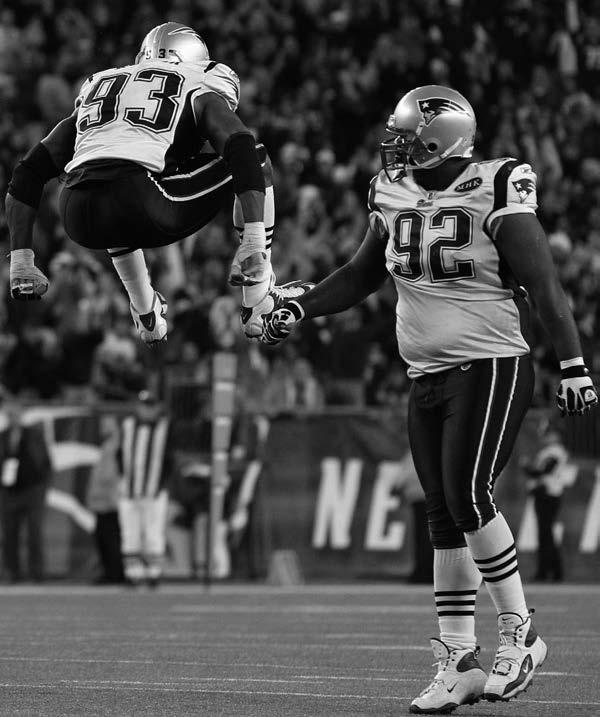
Former Patriots defensive tackle Albert Haynesworth watches defensive end Andre Carter celebrate a sack against the Cowboys on Oct. 16.
Penn State trustees fire Paterno, university president
Associated Press
STATE COLLEGE, Pa. — Penn State President Graham Spanier, a family sociologist and therapist who led the mammoth university system for 16 years, saw his tenure as one of the nation’s longestserving college presidents end Wednesday because of a campus child sex abuse scandal.
Spanier, among the highestpaid college presidents in the country, had come under fire over the past several days for his handling of allegations that a Penn State assistant football coach, Jerry Sandusky, had sexually abused at least eight boys over more than a decade. He was fired Wednesday night for failing to tell authorities about an allegation of child molestation in a campus locker room shower.
The sex abuse scandal also claimed long-serving head coach Joe Paterno, who had announced Wednesday that this would be his last season in Happy Valley but wasn’t given the chance to continue coaching, and two other top administrators, who stepped down earlier this week after being charged with perjury in the case.
The ousters of Spanier and Paterno were announced Wednesday night by university trustees.
“It is in the best interests of the university that a change in leadership (must be made) to deal with the difficult issues that we are facing,” John P. Surma, vice chairman of the university’s board
of trustees, said at a press conference.
The trustees said school Provost and Executive Vice President Rodney Erickson will be the interim president while the football team’s defensive coordinator, Tom Bradley, will serve as interim coach.
Sandusky, considered Paterno’s likely successor before he retired in 1999, was charged last week with molesting eight boys over a 15year period. He has denied the charges.
A grand jury report said at least two of the assaults were witnessed on campus — and one of those was reported to Spanier. But the university president did not tell authorities about the reported attack on a young boy, which a football team graduate assistant claimed to have seen in 2002. The graduate student’s accusation was passed up the chain of command to Spanier, but he said the seriousness of the encounter was not conveyed to him.
The grand jury report said Spanier described the episode as “Jerry Sandusky in the football building locker area in the shower ... with a younger child and they were horsing around in the shower.”
Spanier said in a statement Wednesday night that he was “stunned and outraged to learn that any predatory act might have occurred in a university facility” and would have reported a crime if he’d suspected one had been committed.
“I am heartbroken to think
that any child may have been hurt and have deep convictions about the need to protect children and youth,” he said. “My heartfelt sympathies go out to all those who may have been victimized.”
The investigation is con -
tinuing. State Attorney General Linda Kelly said Monday that Paterno is not a target of the inquiry into how the school handled the matter, but she refused to say the same for Spanier.
State police Commissioner Frank Noonan earlier this week criticized school officials’ handling of the allegations, saying “a football coach or a university president or the guy sweeping the building” had a moral responsibility to call police if they suspected a child was being sexually abused. He also said Penn State had “a culture that did nothing to stop it or prevent it from happening to others.”
Calls for Spanier’s ouster by newspapers, online groups and petitions mushroomed in recent days, many supported by upset and disillusioned alumni.
The 63-year-old Spanier had led Penn State since 1995, and his contract was to run through 2015. The university system, headquartered in State College, includes 96,000 students on 24 campuses and has an annual budget of about $4.3 billion.
Spanier earned more than $800,500 in annual base pay, deferred compensation and retirement contributions, according to The Chronicle of Higher Education. He told The Associated Press earlier this year that he considered his salary, which was set by trustees, to be “very generous” and that it “feels peculiar for someone who grew up in a poor family.”
Spanier has donated more than $1 million to the university. He also has overseen $3 billion in philanthropic contributions to Penn State during his tenure, according to his biography.
Spanier is well known in academics and athletics, both inside and outside
Pennsylvania. He heads the Bowl Championship Series presidential oversight committee, hosts a sports talk show on the Big Ten’s television network and previously led the Association of Public and Land-grant Universities.
Penn State is a state-related institution that receives some public funding but is not under direct state control.
Spanier is trained as a family sociologist, demographer and marriage and family therapist. He first served in Happy Valley from 1973 to 1982 as a member of the faculty and in three administrative positions in the College of Health and Human Development.
He later went on to serve as chancellor of the University of Nebraska-Lincoln, provost and vice president for academic affairs at Oregon State University and vice provost for undergraduate studies at the State University of New York at Stony Brook.
He received bachelor’s and master’s degrees from Iowa State University, followed by a doctorate in sociology from Northwestern University.
He said Wednesday it had been his “great privilege and honor” to serve Penn State for more than 25 years, including the past 16 as president.
“I will continue to serve the university in every way possible and celebrate the greatness of Penn State,” he said.
Spanier and his wife, an English professor at the university, have two children, both Penn State graduates.
Penn State student body President T.J. Bard, who said he has worked closely with Spanier over the past two years, called the president “a phenomenal leader for this university.”
“That’s not something that should be overlooked very quickly,” he said.
Penn State students gather outside the Old Main building to protest the university’s handling of the child abuse scandal surrounding former Nittany Lions coach Jerry Sandusky.
Alomar interviews for Red Sox manager job
Talks continue as deadline passes
Associated Press
NEW YORK — As Commissioner David Stern’s deadline passed, the NBA and its players continued negotiating Wednesday in an attempt to end the lockout.
The two sides met for more than seven hours to try to hash out a deal to save the season.
Stern had issued an ultimatum to players: Accept the league’s latest proposal by 5 p.m. ET Wednesday or it will be replaced with a much harsher one that would drive the sides even farther apart.
Players said Tuesday they wouldn’t accept the current one as configured and suggested another negotiation session.
The current offer calls for players to receive between 49 percent and 51 percent of basketball-related income, though union officials said it would be impossible to get above 50.2 percent. Players were guaranteed 57 percent of BRI under the previous collective bargaining agreement.
Failure to make a deal likely would increase the calls for the union to decertify so the players can file a lawsuit against the league in court, a risky and lengthy tactic that likely would doom the 2011-12 season. Union officials have downplayed the idea, but players might have no other leverage once the more severe proposal is put into play.
ington Post that owners are treating players like “plantation workers” during the ongoing lockout. He said he planned to call Stern and apologize.
BOSTON — Ben Cherington was in his first year in a major league front office — as an advance scout for the Cleveland Indians — when he came across Sandy Alomar Jr.
“He didn’t know who I was, in ‘98 with Cleveland,” said Cherington, who is now the Red Sox general manager and leading the search for a new manager in Boston. “But I saw him in the clubhouse — I was in the clubhouse all the time — and I saw the leader he was back then, the respect he had in that clubhouse. I’ve been sort of following him since then.”
It was that respect that led Cherington to add Alomar to the short list of candidates interviewing to replace Terry Francona as the Red Sox manager. Brewers hitting coach Dale Sveum and Phillies bench coach Pete Mackanin have already been in to discuss the job; former Pirates and White Sox manager Gene Lamont and Blue Jays first base coach Torey Lovullo are scheduled to come in later this week.
Cherington said he hasn’t ruled out the possibility of additional candidates.
Alomar, who spent parts of 20 seasons catching in the majors — most notably as the 1990 AL Rookie of the Year and a six-time All-Star for the Indians — has been the first base coach in Cleveland for the past two seasons. He is the only candidate the Red Sox have acknowledged who has no managerial experience. “His name kept coming up as a guy with a ton of respect in baseball,” Cherington said. “We felt that, in spite of the lack of managerial expe -
rience, it was worth getting to know him better. ... He’s going to be a major league manager. Whether that’s in 2012 or sometime after that, I’m very confident to say that he’ll be a big league manager sometime.”
The Red Sox parted ways with Francona this fall after the team’s unprecedented September collapse, the result of a 7-20 record down the stretch that left them one game behind the Tampa Bay Rays in the AL wildcard race. After allegations of players fattening up on fried chicken and beer during games, each managerial candidate has been grilled by reporters on his approach to clubhouse discipline.
“The goal for a manager is to let your players manage themselves. In order to do that, you have to let the guys play,” he said. “I am a guy that lets the players play the game. You have some rules, but you respect the players (and) they respect you back.”
The 45-year-old Alomar also played for the Padres, White Sox, Rockies, Rangers, Dodgers and Mets. He had a lifetime average of .273 with 112 homers and 588 RBIs.
He said he has played for nine managers, all of whom reached the postseason in their careers; six of them reached the World Series, and two of them won it. His father, Sandy Alomar Sr., spent 15 seasons in the majors as a second baseman, and his brother, Roberto, is in the Hall of Fame.
So it’s no surprise that when asked to describe his managerial style, he said, “I like the family atmosphere.”
“We are a family. We bonded — coaches, players,” he said. “That’s the way I would handle it.”
The next proposal would call for a 53-47 revenue split in the owners’ favor, essentially a hard salary cap and salary rollbacks, which the league originally sought but had taken off the table. Both proposals were sent to union executive director Billy Hunter on Sunday.
The meeting featuring small groups from both sides was arranged Wednesday morning.
Stern and Deputy Commissioner Adam Silver were joined Wednesday by Spurs owner Peter Holt, the chairman of the labor relations committee, and lawyers Rick Buchanan and Dan Rube. Besides Hunter and president Derek Fisher, vice presidents Roger Mason Jr. and Maurice Evans, economist Kevin Murphy and attorney Jeffrey Kessler represented the union.
Kessler took part just hours after saying he regretted telling the Wash -
Besides the revenue split, the sides still are divided on elements of the salary cap system, mostly relating to the spending rules for teams that are over the luxury tax level. Players want those teams to remain options for free agents, whereas the league thinks talent would be more evenly distributed throughout the league if payrolls were more balanced.
Players indicated after their meeting Tuesday that they would be open to reducing their BRI take if owners made some changes on the system issues. Players offered to go to about 51 percent Saturday, with 1 percent going into a fund for retired player benefits.
NBA Commissioner David Stern speaks to reporters after leaving talks with the NBA players union in New York City on Oct. 10.
Associated Press
AP
Sandy Alomar, Jr., speaks to the media Wednesday. Alomar interviewed for the vacant Red Sox manager position earlier in the day.
continued from page 16
many novices holding their own in their first trip to the ring.
In the ring, experience level did not always trump pure skill level and energy, as several less-experienced fighters knocked off older fighters. Junior Kaitlyn Cole earned perhaps the most improbable victory, beating three-time veteran and senior captain Kat Rodriguez in a split decision.
Monday night, however, was not just marked by success in the boxing ring; it succeeded in drawing many students and generating substantial fundraising for the Holy Cross Missions in Uganda, who receive all profits from the bouts.
“We made a lot in ticket and merchandise sales,” Byrne said. “We had a pretty good turnout, and there was always plenty of activity for the fans to watch, since we had two rings this year.”
With the first round complete, the victorious fighters move on to face an even greater challenge. A daunting opponent awaits them, but the boxers also have to fight the enemy of fatigue, as they box for the second time in four nights.
“I think that some of the challenges for the fighters will be figuring out how to change their training schedules to get ready for another fight and how to push themselves to their utter limits twice in one week,” senior Women’s Boxing Club copresident Jen Coe said. “I think they’ll probably leave the week really tired, but they are really capable and they train so hard that they are
definitely in shape to fight multiple times in a week.”
The 19 bouts taking place Thursday night will serve as the conclusion to the Baraka Bouts tournament, but don’t serve the purpose of ultimately conferring a championship to an overall winner.
This year the tournament was organized into 20 pods of four fighters, with the two winners in each pod moving on to fight each other. These pods serve an organizational function by working to group fighters by skill level, rather than grouping them by weight class as Bengal Bouts does.
With the tournament organized in that manner, it is no surprise to see Coe mention she expects to see more competitive, high-intensity fights in the finals.
“I expect to see a lot more close calls and split decisions
Thursday night,” Coe said. “I think that there will be tons of overall intensity, energy and excitement in the ring.”
Byrne echoed similar sentiments, emphasizing the experience of a first fight earlier in the week would ratchet up the skill level of many of the boxers.
“I think that the skill level will be a lot better because all the nerves from getting in the ring were left out on Monday, so now girls can be a little bit more focused and more technical,” Byrne said. “It should be an exciting round, since there will be several captain showdowns as well as many novices and veterans participating in the round.”
The final round of Baraka Bouts starts at 6 p.m. Thursday at the JACC.
Contact Brian Hartnett at bhartnet@nd.edu
Irish to race against tough Big Ten crews
By VICKY JACOBSEN Sports Writer
The Irish will challenge three daunting Big Ten crews Saturday when they race Ohio State, Michigan State and Indiana in the Scioto Scrimmage in Columbus, Ohio.
“I would expect very competitive [races],” Irish coach Martin Stone said. “Ohio State and Michigan State were both at the NCAAs last year, and Indiana had a good crew last year, and I think they’re stronger, so I think it’ll be very competitive.”
Notre Dame has not raced since Oct. 23 when the Irish four boat took fifth place in the Head of the Charles Regatta, the second best finish among collegiate crews.
The team was supposed to travel to Indianapolis for a scrimmage against Indiana on Sunday, but conditions on the water forced the schools to cancel the meet.
“The weather was too bad and the water was too rough to race in,” Stone said.
Although the quality of competition is formidable, the regatta is technically a scrimmage, which allows the coaching staff to give its athletes more instruction.
“It’s a controlled scrimmage, so we’ll go and talk to our athletes between races and go over stuff between pieces,” Stone said, “so it should be a great learning experi-
ence for us.”
Although the crews for each boat have not yet been named, Notre Dame will take five eight boats, meaning many members of the large rowing roster will get a taste of competition.
Stone said he would like to see how his crews respond when they are racing opponents other than their teammates.
“We haven’t raced very much,” Stone said. “We’ve had two races and we strive to get better all the time, so that’s what we’d like, particularly in race situations.”
None of the four teams have participated in many events this fall.
The Hoosiers kicked off their fall training season at the Head of the Ohio on Oct. 8 and last competed Oct. 30, when their varsity eight crew claimed eighth place at the Princeton Chase, finishing ahead of reigning champion Brown.
The Buckeyes’ only other scheduled event of the fall was an Oct. 8 exhibition against Michigan in Ann Arbor, Mich., while the Scioto Scrimmage will be the Spartans’ first competition of the fall.
The Irish will hit the water at the Scioto Scrimmage in Columbus, Ohio, this Saturday.
Contact Vicky Jacobsen at vjacobse@nd.edu
PAT COVENEY/The Observer
Senior Natty Baldasare, left, throws a punch at junior Grace Spaulding on Monday during their Baraka Bouts matchup.
TOM YOUNg / The Observer
Notre Dame’s varsity eight boat races to victory during a regatta against Tulsa on the St. Joseph’s River on Oct. 30, 2010.
Welsh
continued from page 16
with the top teams in the country, teams in the top 25, so this is a very important test for us,” Welsh said. “The Iowa Invitational will be our final exam. It’s where we’ll really see where we are as a team.”
After the meet with the Cardinals, the Irish will not compete again until early December. Welsh said that he’d like to see everyone on the team get a chance to see the pool Saturday, as developing experience on a young team is key for the Irish moving forward.
“As much as we talk about our opponents, it’s really just about us and our team,” Welsh said. “We’re in the middle of things, not the end of things, and that doesn’t depend at all on what Louisville does.”
The Irish will need a number of strong individual performances in order to compete at Louisville and will look to stalwarts like sophomore Frank Dyer to continue their
Natorium
continued from page 16
burgh in a dual meet after arriving on a 6-hour bus ride the day of the meet, Louisville will pose a greater challenge.
Senior Fanny Lilliestrom is one of the Cardinals top swimmers, earning a victory along with an NCAA B-cut time in the 200-yard breaststroke in the Cardinals’ loss to Tennessee.
In addition, Cardinals’ junior diver Hannah Gadd will present a challenge. She earned a victory in the SMU Classic in the 1-meter diving event against top national competition, including No. 6 Texas and No. 7 Florida.
However, Notre Dame’s diving team has proven strong in dual meets this season. The duo of
strong strokes. Dyer has won a race at every meet this year, and his times in the 200-freestyle have been among the top finishes in the country.
Freshman diver Michael Kreft has also placed at numerous events among strong fields.
The College Swimming Coaches Association of America released the first rankings of the year Wednesday, and though the Irish received votes, they did not crack the top 25. Two past Irish opponents, Purdue and Michigan, appeared in the poll at the No. 17 and No. 1 positions, respectively.
“As we mature, I think that we’ll deserve a ranking,” Welsh said.
“But right now, we’re not ready.”
Welsh has made it clear that managing the season will be a process for the Irish, and a large step in that process will play out when the Irish jump into competition Saturday in Louisville, Ky., at 11 a.m.
Contact Conor Kelly at ckelly17@nd.edu
freshman Allison Casareto and junior Jenny Chiang have placed first and second in all of the 1-meter and 3-meter diving events in Irish meets so far this season.
Both squads have a common win at Pittsburgh, as the Cardinals won by a score of 193-102 last Friday against the Panthers. However, Louisville dropped a meet to Tennessee and placed fourth out of eight squads in the difficult SMU Classic, which included three of the top 10 ranked swimming squads in the country.
The Irish hit the pool against the Cardinals on Saturday at 1 p.m. Following the meet, Notre Dame will not swim in competition again until Dec. 2 when it competes in the three-day Ohio State Invitational in Columbus.
Contact Matt Unger at munger3@nd.edu
Digger
continued from page 16
and obviously we have west coast cities.
“But, I just don’t see how we will ever have the opportunity to compete for a BCS national championship without being in a conference. What’s the best conference for us? If I’m looking out right now, I’ve got to say the ACC right now for football and basketball.”
Phelps said the ACC could create a north division and a south division and rotate the basketball conference tournaments between Greensboro, N.C. and Madison Square Garden in New York. He added that key rivalries in football could be maintained, as well as the television contract in place since 1991.
“I would still say we should keep our NBC home contract,” he said. “We can negotiate that. Then play nine games [in the ACC] in football. I’d give them
Gaul
continued from page 16
the lineup again, playing in just two games.
“Sophomore year I got a chance, we just kind of had a tough season overall, and I didn’t think I played as well as I could have,” Gaul said. “I wasn’t pleased with how I played sophomore year. Junior year we had a lot of good, talented, hardworking freshmen, so I spent my year preparing to get into the lineup, and I didn’t really get a chance, but just kind of kept working on it, and tried to keep a good attitude about the whole thing. And this year I’ve been given a chance and an opportunity, and I’m just trying to take advantage of it.”
Gaul has indeed been making good on his second chance so far. After registering just three points in his first three Irish seasons, Gaul has four points already this season. He’s played in every game so far, and has been featured on both the power play and shorthanded units.
According to Gaul though, his biggest contributions to the team don’t often show up in the box score.
“I’d say my ability to read plays and anticipate certain things is my biggest strength,” he said. “Some guys hate blocking shots, some guys hate penalty killing. It’s my favorite part of the game. Just from the coaches I’ve had in the past and my parents, not quitting is kind of my thing. I’m not the fastest guy and I’m not the biggest guy, but I’m not going to give up on a play.”
That resilience allowed Gaul to make one of the biggest contributions of his career Oct. 29 at Bowling Green. Tied up 2-2 in the third period, the Irish were looking for a spark to close out the weekend. On a play where he was knocked down twice before
gaining the offensive zone, Gaul’s refusal to give up on a puck secured Notre Dame’s first series sweep of the year.
“By the time I got into the zone, [freshman winger Peter] Schneider had already attacked the net, came back around and hit me with a pass, and I just caught it, shot it and it went in,” Gaul said.
“I was just happy, because there’s a lot of times where it might not show up on the scoresheet, so it was nice to have something like, ‘Hey, Gaul got the game-winner.’
It was a good feeling.”
And while Gaul had never given up on his goal of getting back in the regular lineup, the start to the season has exceeded even his expectations.
“Keeping a good attitude and staying positive, I think, is what put me in a position to do well this year,” Gaul said. “I can’t really say that this is how I expected my senior year to go. I was just hoping to get a chance to play, and given that chance try to take advantage of it. I’m happy
that I’m making progress and doing things to help us win, but I still want to get better and keep improving.”
Gaul’s career path has certainly been windier than most of those on Notre Dame’s roster, but there is still a lot of road left to travel. The next stop on that road will be against Alaska at the Compton Family Ice Arena this weekend, but the senior hopes the ride doesn’t end anytime soon.
“I’m excited to get out there against Alaska this weekend. They’re generally a hardworking, defensive team. It’s fun to play those teams that are known to be gritty,” Gaul said. “I just want to keep helping our team have success, and come home with some championships, be it CCHA or national. It’s my last year here, and I want to win as much as I can before I have to go.”
Contact Jack Hefferon at wheffero@nd.edu
nine. Still play Navy because of tradition, Southern Cal, and rotate with Michigan and Michigan State every other year.
In order to compete nationally in recruiting, Phelps said the basketball program needs a new practice facility. He said he was a proponent of building a combined basketball and hockey arena where the Joyce Center parking lot is, tearing down the Joyce Center and building a practice facility there.
“You’d have what Kentucky has, and what a lot of these schools have now,” he said. “It’s all part of the package for men’s and women’s basketball. Kentucky’s [practice facility] cost I think $30 million, one side is men’s and the other side is women’s, but they got it done. It’s used against us in recruiting obviously.”
Phelps will travel to Bristol, Conn., on Monday to begin ESPN’s coverage of college basketball.
Contact Andrew o wens at aowens2@nd.edu
ASHLEY DACY/The Observer
Graduate student forward Tim Abromaitis drives past a Stonehill defender during Notre Dame’s 92-70 victory Nov. 7.
SUZANNA PRATT/The Observer
Senior center Patrick Gaul skates after the puck during Notre Dame’s 5-2 victory over RPI on Oct. 21.
Published Monday through Friday, The Observer is a vital source of information on people and events in the Notre Dame and Saint Mary’s Community.
Join the more than 13,000 readers who have found The Observer an indispensable link to the two campuses. Please complete the accompanying form and mail it today to receive The Observer in your home.
HENRy ARNOLD MIKE ARGIRION
ALEx GRISWOLD and LEE HAGGENJOS
london express
JON REPINE expnd
Thursday, November 10, 2011
Digger Phelps comments on season, conference
By ANDREW OWENS Associate Sports Editor
Former Irish coach Digger Phelps discussed the state of the program, Notre Dame’s place in the Big East this season and where the Irish fit in among the ever-changing landscape of college athletics Tuesday in an exclusive interview with The Observer.
Phelps shares the record for wins over No. 1-ranked teams with seven during his 20-year tenure at Notre Dame, a career
that included the school’s only Final Four appearance.
See Also
Full transcript of the Observer’s sitdown with Digger Phelps ndsmcobserver.com
With only two starters returning in 2011-12, Notre Dame will need to rely on senior forward Tim Abromaitis this season, Phelps said.
“It’s going to be an interesting
year because, as I said to Abromaitis the other day — I saw him at the end of practice and said, ‘Well, I think I’m going to go on the air and say that what Jimmer Fredette did last year for BYU, I can see Tim Abromaitis doing that for Notre Dame, getting 35, 40 [points] in big games, like when Pitt comes in here Dec. 27,’” said Phelps, who now works as an analyst on ESPN.
Phelps said much of Notre Dame’s success will depend on how well the frontcourt can make
up for the loss of Carleton Scott, who declared for the NBA Draft with a year of eligibility remaining. Scott went undrafted, was recently released by a team in Spain and might play in Iceland.
“To me the mystery is why Carleton Scott left,” Phelps said. “If Carleton Scott came back, he could have averaged 20 [points] and 10 [rebounds] and been a late first-round draft pick or early second-round next year, but he made that choice to leave. We will miss him, because he would have been
that presence that we needed. So we lost three quality players and it is going to be interesting to see in time how these guys mature.” Phelps also said it is time for Notre Dame to drop its independence in football and join the ACC. “I’d love to see us join the ACC,” he said. “We are east of the Mississippi when it comes to fundraising, alumni clubs, etc., and I include Chicago when I say that. And that’s not going to go away,
Better late than never
Center Gaul sees more playing time during final season
By JACK HEFFERON Sports Writer
In several senses, senior center Patrick Gaul can be an easy guy to lose track of. He stands just 5’8” when he’s on the ice, but over the last three years he has struggled just to get the chance to be on it.
“You kind of lose track of it if you’re not on the team, because mostly you only see the games on the weekend, but there’s three forwards and two defenseman every weekend that don’t play,” Gaul said. “But they do everything, except play the two games. They’re still practicing just as much as the other guys.”
After paying his dues and beginning to adjust to the college game as a freshman, Gaul was able to crack the lineup and see serious time on the ice in his second year. He admittedly didn’t take full advantage of that chance though, and when Notre Dame’s recordbreaking freshman class came in last year Gaul was squeezed out of
hoCkey see GAUL/page 14
Senior center Patrick Gaul controls the puck during Notre Dame’s 5-2 victory over RPI on Oct. 21. After fighting for playing time over his first three seasons, Gaul has become a regular contributor.
Irish look to rebound on the road
By MATT UNGER Sports Writer
Following a tough dual meet loss to Purdue last Friday, the Irish will look to bounce back in a road meet at Louisville on Saturday at the Ralph Wright Natorium.
The meet marks Notre Dame’s third road meet in a row and the final one of the fall season before the Ohio State Invitational in December. If the Irish can salvage a win, they would finish 2-1 on the road.
One factor working against the Irish will be a 5-hour bus ride to Louisville on Saturday morning. While the Irish dominated Pittssee NATORIUM/page 14
By BRIAN HARTNETT Sports Writer
After emerging victorious from an intense round of fights Monday, 38 boxers will return to the ring Thursday night to compete in the final round of Baraka Bouts.
The 19 bouts will serve as the first ever finals for Baraka Bouts, which traditionally had been a one-night event. The new tournament format for the bouts debuted Monday night and the first round — 40 fights spread over two rings in the Joyce Center —
By CONOR KELLY Sports Writer
Coming off a convincing victory against Valparaiso, the Irish will travel to Kentucky on Saturday for a meet against No. 16 Louisville, the defending Big East champion. Over the past three years, the Cardinals (2-1) and the Irish (4-2) have exchanged places atop the Big East tournament podium, with the Irish last taking the title in 2009.
This competition creates a natural, intense rivalry between the two teams, Irish coach Tim Welsh said.
“Whenever we race each other, we have either the past or future championships on our minds,” Welsh said. “They’re a very fast team coming off of a great season last year. It’s a pretty natural rivalry for that reason.”
Welsh compared his team’s matchup with Louisville to a midterm exam.
“We like to compare ourselves
see WELSH/page 14
was a great success, according to Women’s Boxing Club co-president senior Erin Byrne.
“Even with the switch to tournament style, we had a lot of close, definitive bouts that were pretty high-skill level on Monday,” Byrne said.
Among the boxing highlights of the night, Byrne said she noticed the promising trend of many second-year fighters rising up to the level battle-tested captains and veteran fighters, as well as
ASHLEY DACY/The Observer
Freshman Emma Reaney swims the breaststroke during Notre Dame’s first-place finish at the Dennis Stark Relays on Oct. 14.