Print Edition of The Observer for Wednesday, March 8, 2017
‘Grandfather of n FL analytics’
ND Sports Analytics Club hosts data analyst to discuss innovation in field
By AIDEN LEWIS news writer
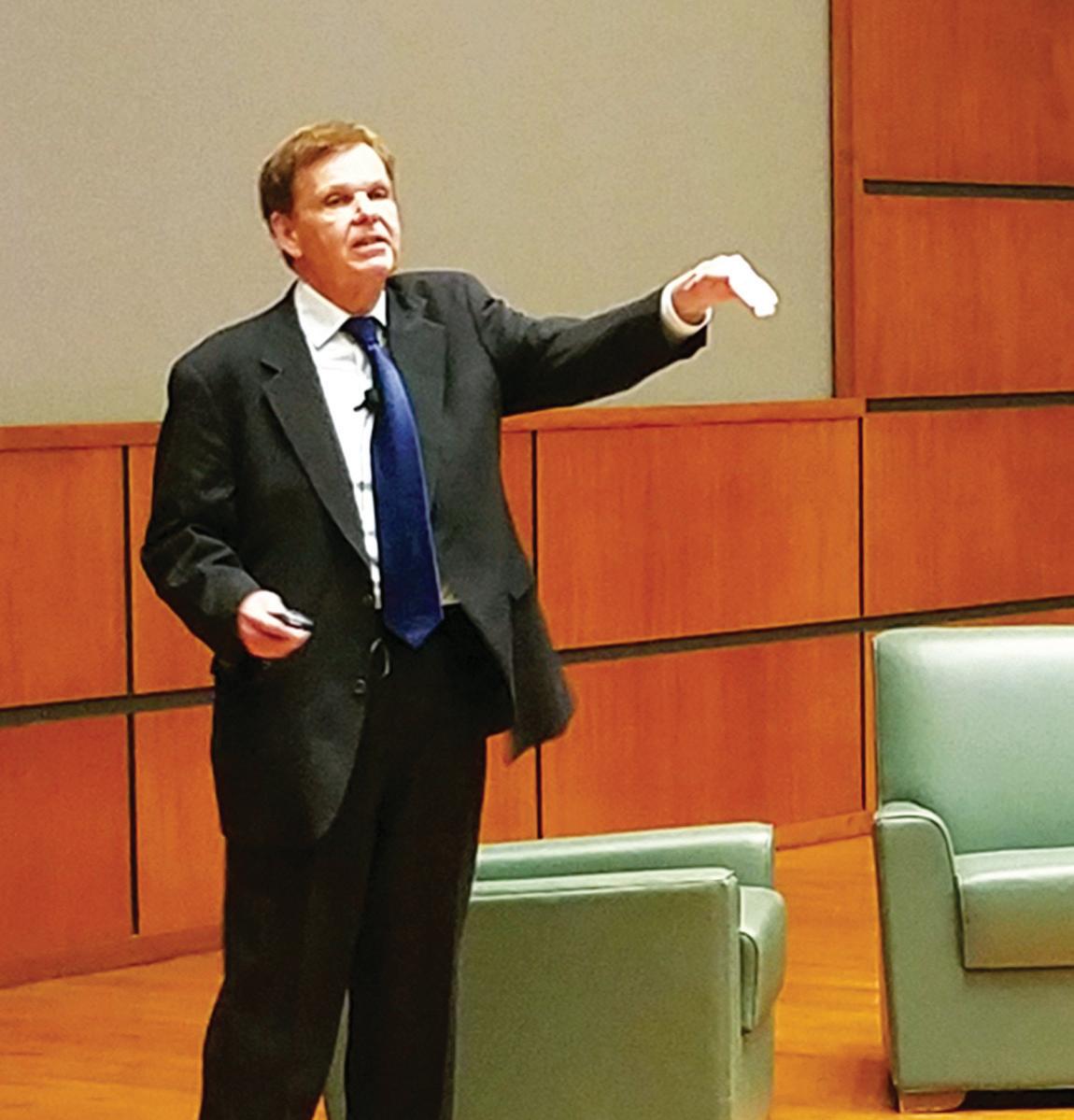
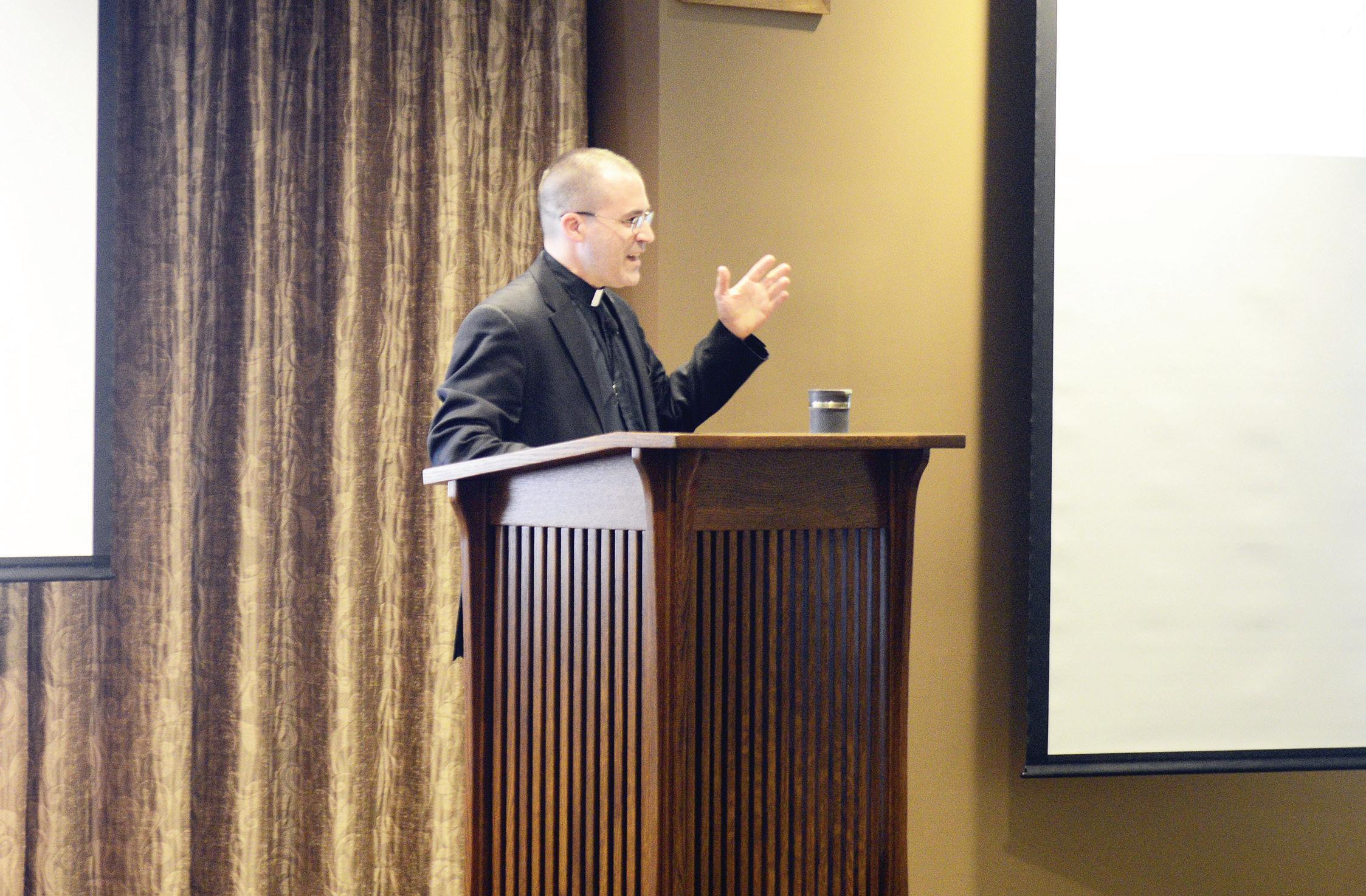
m ike e ayrs, a data analyst for several college and nfl football teams, spoke about the innovative practices that led to him being termed the “grandfather of nfl analytics” at mendoza c ollege of b usiness on Tuesday night. e ayrs started out as an assistant coach in the ncaa c ollege d ivision, where he said he and the other coaches were constantly arguing over new ways to gain a competitive advantage.
“i was trying to think, ‘ w hat’s the lowest common denominator we have in our staff room?’” e ayrs said. “The answer was everybody wants to win.”
i n response, e ayrs said he started to study game statistics and how they were
connected to the team’s wins and losses. i n this study, he said that turnovers were the factor that had the strongest impact on the outcome of a game.
“for the first time since i’d been hired, we actually agreed on something,” e ayrs said. “e verybody agreed that if we could lower turnovers on offense and raise them with our defense and coverage teams, we would have a much better football team.”
a s a result, e ayrs said he began catering drills in practice towards ball security, so that players could become better at handling the football and would be less likely to turn the ball over with fumbles.
“The more you repeat something successfully, the better the neuroconnections become,
Activist recounts civil rights era
By SELENA PONIO
a ssociate news e ditor
a merican civil rights activist d iane nash — who led the first successful campaign to desegregate lunch counters, was a part of the s elma voting rights movement and co-founded the student nonviolent c oordinating c ommittee — shared her personal experiences with racism and her integral efforts in the civil rights movement Tuesday.
nash was first exposed to the full extent of overt, statesponsored racial segregation as a college student at f isk university in nashville, Tennessee, she said. d uring the fall of 1959, nash said she was shocked into the reality of Jim c row laws in the south. o riginally from the south side of c hicago, she said she was always aware segregation existed but did not know its severity until she moved to the south.
“ w hen i obeyed segregation rules, it felt like i was agreeing that i was too inferior to go through front doors or [to] restaurants, swimming pools and other public accommodations,” nash said.
i n downtown nashville, a frican a mericans could only purchase food in restaurants on a take-out basis, she said. w hen she walked down the streets during lunchtime, a frican a mericans lined the curbs and alleys, eating the lunches they brought from home or bought as take-out, she added.
nash said she was dissatisfied with the word “nonviolence” as it pertains to the civil rights movements of the 1960s.
“nonviolence means absence of violence,” she said.
“[ i ] wanted a term that encompassed more than the
see acTivisT PAGE 4
Sexual assault MOU signed
university p resident fr.
John Jenkins, s aint mary’s p resident Jan c ervelli and holy c ross p resident br. John p aige signed a memorandum of understanding ( mou ) Tuesday declaring their commitment to a “collaborative approach in [their] attempt to eliminate sexual assault, dating violence, domestic violence, stalking and any other form of sexual harassment” from the community, according to a
SMC professor confronts immigration myths
By MARTHA REILLY a ssociate saint mary’s e ditor
a s part of s aint mary’s annual d iverse student l eadership c onference, which aims to establish an awareness and appreciation of diversity, assistant professor
of philosophy and director of the Justice e ducation program a ndrew p ierce dispelled misconceptions about immigration Tuesday.
according to p ierce, today’s political climate consists of contrasting viewpoints regarding p resident d onald
Trump’s immigration proposals, from his support of a wall separating the u s. from mexico to his executive order banning the entry of nationals from i raq, i ran, syria, sudan, s omalia, yemen and
v isiting professor connects l enten habits, ‘l audato si’’
By NATALIE WEBER news writer
c lemens s edmak, visiting professor of c atholic s ocial Tradition and community engagement at the c enter for s ocial c oncerns, discussed “l audato si’” — p ope f rancis’ encyclical on environmental issues and consumerism — and how to integrate
its teachings into l enten practices.
s edmak said a monk told him l ent was meant to be a time to form habits which will last throughout the year.
“i once met a b enedictine abbot, as one does, and he told me that l ent is something like intensive exercise time for the monks, and it means you try to take something
very seriously which will help you throughout the rest of the year,” s edmak said. “s o the idea is that your l enten exercises and sacrifices will sustain you through the rest of the year, trying to establish habits that you hopefully will bring into your life after e aster.”
EMMET FARNAN | The Observer
Mike Eayrs educates students on how he achieved success in modernizing analytics practices in professional football.
Fr. Terrence Ehrman speaks at the second lecture of the “Integral Ecology” series at Geddes Hall on Tuesday night. The lecture, titled “Biodiversity and Invasive Species,” discussed the danger facing the Great Lakes due to the introduction of non-native species. Have a question you want answered? Email photo@ndsmcobserver.com
Wednesday
Higgins Labor RAPS: “Racial Justice as a Business Issue”
Geddes Hall
5:30 p.m. - 6:30 p.m.
Lunch provided.
“Sin, Mercy and the Vision of God in the Book of Exodus”
Eck Visitors Center
7 p.m. - 8 p.m.
Open to the public.
Thursday
“The Durability of Revolutionary Regimes”
Hesburgh Center for International Studies
4 p.m. - 5:30 p.m.
Symposium Honoring
Historian McKenna Hall
4 p.m. - 7 p.m.
Marking the retirement of Thomas Kselman.
Friday
Digital Scholarship Workshop
Hesburgh Library
3 p.m. - 4 p.m.
Discussing Geographic Information Systems.
Hockey East Playoff vs. Providence Compton Family Ice
Arena
7:35 p.m.
ND meets the Friars.
Saturday
Mid-term Break Begins Campus-wide
All academic classes will resume Monday, March 20.
Film: “20th Century Women” Browning Cinema, DeBartolo Performing Arts Center
7 p.m.
Sunday
Hockey East Playoff vs. Providence Compton Family Ice Arena
7:05 p.m. Game 3 (if necessary).
Vespers Basilica of the
SARAH OLSON
The Observer
absence of violence.”
nash’s dissatisfaction led her to coin the phrase “agapic energy,” meaning energy produced by a love for humankind. inspired by mohandas gandhi’s way of observing love energy, as well as the greek word “agape” — which means brotherly love or a love of humankind — nash said agapic energy was an improvement on the term nonviolence.
“agapic energy is not passive — it’s active,” she said. “users are not pacifists — we are activists.” nash said she discovered the basic principles of agapic energy in the 1960s and has used them over her lifetime. a n important principle of agapic energy is to
realize people are not your enemies, she added.
“unjust political systems, unjust economic systems, attitudes, racism, sexism, ignorance … are enemies,” nash said. “if you recognize that people are not the enemies, you can love and respect the person [and] at the same time, attack the attitudes of that person.”
nash said she slowly helped desegregate the restaurants in nashville by targeting six establishments at a time. eventually, nashville became one of the first southern cities to desegregate lunch counters.
“we changed ourselves into people who could not be segregated,” nash said. “That presented a new set of options to southern white racists. They could either shoot us or desegregate because
and that’s true,” he said. “it’s also true that the nation has been forged in the flames of race and racism.”
libya into the u s. for 90 days.
“defenders of the current administration would argue that the measures put in place are necessary to keep americans safe,” pierce said. “opponents of those measures not only deny those claims — that these policies will effectively promote national security or economic security — but they also often claim that those policies are driven by an underlying racism.”
pierce said some white americans may feel as though they are losing ground as the nation diversifies.
“These concerns, these issues [and] these anxieties are not new,” he said. “They haven’t sprung up overnight, and in fact, they represent the continuation of a history that’s as old as the united states itself.”
according to pierce, issues of racial tension are so deeply rooted in society because they have persisted for centuries.
“we often hear that the united states is a nation of immigrants,
To address modern-day racism, pierce said people must understand the complexities of american history and the ways in which white individuals attempted to justify the mistreatment of minority groups.
“Throughout our history, ideas about race have shaped our immigration policies, and vice versa,” pierce said. “nowhere is this more apparent today than in the panicked reporting of the ‘fact’ that whites are slated to become a minority.”
pierce said several logical fallacies surround the common prediction that whites will be considered a minority group by the year 2050. “what they’re interpreting as being a minority is non-hispanic whites dropping below 50 percent of the population,” he said. “They’re measuring minority as falling under 50 percent. That only makes sense if you think of whites as being one group, and you lump all non-whites together.”
according to pierce, most people who immigrated to the u s
they could no longer segregate.
“very often, we give away our power. if you understand that concept, you are going to save yourself a lot of time and effort trying to change other people.”
nash said there are six phases in an agapic energy campaign: investigation, education, negotiation, demonstration, resistance and insurance that the problem does not reoccur.
“The purpose of the demonstration phase is to focus the attention on the community,” she said. “resistance is when the oppressed withdraw their participation from the oppressive system. w hatever the issue that you’re working on, you would have the oppressed withdraw their participation. during the sixth phase, you might institutionalize an education in
until 1965 originated from europe or canada, but in 1965, immigration to the u s. from mexico, central america, the caribbean, south america and asia increased significantly. This demographic shift continues to persist, which adds some credibility to the proposal that whites will become a minority in the u s
“There is something statistically accurate about this claim — that because of the shifting pattern of migration, that whites will become a minority if these patterns continue,” he said. “The assumption behind these predictions about whites becoming a minority is that people from europe are white, and people from central america and asia and other places in the world are not. it’s not that simple.”
The prediction loses validity because people cannot necessarily be neatly sorted into racial groups since race is a social construction, pierce said.
“[race] is an idea that society has invented in order to categorize and, ultimately, control people,” he said. “it doesn’t have a biological basis.”
Contact Martha Reilly at mreilly01@saintmarys.edu
your community or establish a museum.”
nash said the movement of the ’60s provides a legacy that people can use in 2017. she said people today have an opportunity to move a step higher into their evolvement as an improved species, and demonstrations today and the people who participate in them must know the rest of the strategy.
“we must understand that elected officials have not and will not do what’s necessary to protect the interest of this country and of a merican citizens,” she said. “The only way this country will make it through this frightening period and survive with citizens having a reasonable measure of rights is that we citizens must take the future of this country in our own hands.”
nash said if they had waited for officials to desegregate lunch counters and give a frican a mericans the right to vote, “we probably would still be waiting.” nash was arrested for her protesting efforts in the 1960s. w hen she and others marched, they very often knew they faced the risk of being killed or injured, she said. she said their fears were understandable, but their actions were necessary.
“i’d like for you to know that although we had not yet known you, we loved you, and we were trying to bring about the best society for you to be born into and for you to come of age in,” nash said. “future generations will look to you to do the same.”
Contact Selena Ponio at sponio@nd.edu
university press release.
The mou — which took effect Tuesday and will be renewed at the start of every academic year — is made up of eight provisions that “[seek] to foster communication and the sharing of information across our campus communities regarding awareness and prevention education, resources, reporting options and procedures,” according to the release.
These provisions include additional resources for students looking to file a complaint, further options for complainants regarding releasing information about complaints to the institutions they attend and an increased commitment from each institution to sexual assault awareness and prevention events.
The mou also calls for improved communication between the institutions, the press release said, and
outlines commitments to “[the] sharing of updates” and “[an] annual exchange of information among the institutions’ Title ix coordinators” about sexual assault initiatives, policies and resources. additionally, the release said the mou ensures members of all three campus communities will be informed when one institution “issues a timely warning” to students regarding reports of sexual assaults.
“any time one institution issues a timely warning for any reason, it will share it with designated officials at the other institutions,” the release said.
This step is the result of significant collaboration between the three presidents, Jenkins said in the release, as well as a testament to the bond between these campuses.
“working together, our three campuses have made significant progress in our collective efforts to eliminate sexual assault, developing what we believe are best practices,” he said in the release. “i am grateful for the collaborative spirit
which has animated these efforts and honored to join with my colleagues in codifying our shared commitment to providing all of our students with an educational environment that is safe and honors the dignity of each person.”
This collaboration is “essential to making substantive progress,” cervelli said in a college press release.
“This mou increases responsiveness when crimes do occur, protects and empowers students and creates a system of accountability across our campuses,” cervelli said. “The goal that our three institutions share is to have a tri-campus community free from the devastating effects of sexual assault and other forms of harassment. ... This agreement formalizes a working relationship rooted in a mutual commitment to addressing those issues and maintaining a social and academic environment that respects human dignity in keeping with our holy cross tradition.”
according to sedmak, pope francis focuses on habits in “laudato si’” as a means of obtaining a more sustainable world.
“pope francis encourages us in ‘laudato si’’ to establish new habits,” sedmak said. “i think the most sustainable way of changing an institution or any person is habits.
“so you change your everyday life. you change what you take for granted, what is familiar, what is regular. you change the space, you change the things you repeat over time and you change your actions.”
last november, sedmak and 18 of his students experimented with various aspects of their lives in light of “laudato si’” and tried to live more sustainable lives. sedmak said this process helped his students to reflect on their habits and question the practices they took for granted.
“if you try, as one colleague did, to live without buying plastic for a month, you don’t buy plastic for a month, you will refine certain categories and you will rethink what you took for granted,” he said. “and certain categories all of the sudden become problematic.”
sedmak said lent offers a time to undergo this process in light of “laudato si’” and free one’s self from excesses.
“i see ‘laudato si’’ and lent coming nicely together in the concern of try[ing] to renew yourself so that you’re open for what’s really important in life,” sedmak said. “and i think most of us have made the experience, and can make the experience that if we forego certain things. we gain a freedom that makes
us much more open to the things that really matter in life.” adapting the mindset of “less is more” helps to be successful with lenten goals, sedmak said.
“in the spiritual life you have to have some sense of moderation,” sedmak said. “ … [ignatius of loyola] had to deal with over-ambitious, young Jesuits in portugal. They were overdoing it and fasting too much and sleeping not enough. so they took lent over seriously.”
according to sedmak, ignatius of loyola responded to these Jesuits with a letter, telling them not to exhaust themselves with excessive fasting.
“he sent a letter in two parts,” sedmak said. “The first part basically said ‘yes, god expects very impressive fruits from us, and yes, should be perfect as your father in heaven is perfect. however, don’t overdo it because if you overdo it, you will break down, ruin your health and not be able to serve the kingdom in the long run.’”
according to sedmak, lent — viewed in light of “laudato si’” — challenges christians to take the suffering caused by environmental degradation and make it their own.
“To turn what’s happening in the world into our own personal suffering; that’s how i see, in a nutshell, the lenten challenge because if you are honest, this is a challenge,” sedmak said. “ … it takes an effort for me to turn what’s happening in the world into my own personal suffering.
“That’s why we need lent. To make this bridge happen, because here on campus we may not see much of the climate change or the ecological threats that the pope talks about.”
Contact Natalie Weber at nweber@nd.edu
InsIdE cOLUmn
ryan is more than a dorm, it’s family
Tuesday nights are practically sacred in r yan h all because at 11 p.m., f J’s commences.
The tradition is simple — every Tuesday, girls in r yan bake a plethora of treats in f r. Joe c arey’s second-floor residence, and at 11 p.m., the rest of the world gets to enjoy them. i t’s community building and dorm bonding at its finest, and there’s the added bonus of an imminent stomachache from eating way too many cookies.
b ecause of my preference of studying in the library or my work schedule, i rarely get to enjoy f Js right at 11 p.m. i nstead, i usually grab the leftover cookies outside of his door when i do make my way back to my room, but i always feel a bit guilty given that i contributed nothing to the process. h aving said that, i realized earlier this Tuesday night that it’s in those little tiny moments that the r yan h all community really demonstrates unconditional love. i did absolutely nothing to deserve freshly baked cookies at 2 a.m., but like clockwork, every Tuesday i can count on them being there.
i t’s this kind of attitude that makes r yan what it is for me. The group of women i live with here are collectively nothing short of incredible, and you can always count on them to be there as a support system, day in and day out.
i ’ve already written about what a truly wonderful roommate i have, but that’s only the tip of the iceberg of the rest of the community here. i could not have asked for better neighbors — on both sides, and in both of my years here. They’re the girls that, after a long day, i can consistently count on to let me rant to them about whatever is on my mind. They’re the ones that blast music down the hallway on game days — sometimes way too early in the morning — and get us out of bed. They’re the ones that will defend you to the death and have late night conversations about important issues while sharing their food with you.
m ore importantly, however, these are the people i have had the pleasure of watching grow into truly lovely individuals over the past two years, and each day i am constantly impressed by them and all that they do. They are all cooler people than i will ever be.
i ’m way too proud of my dorm, and anyone who knows me knows i live in r yan h all — in fact, it’s a recurring joke amongst many of my friends. b ut that pride comes from a place of genuine love and appreciation for the beyond fantastic group of women here.
i know everyone thinks this of their dorm, but r yan h all is more than a dorm. we’re a family, we’re a team, and we’re a community unlike any other.
Contact Rachel O’Grady at rogrady@nd.edu
The views expressed in the Inside Column are those of the author and not necessarily those of The Observer.
What the Keystone XL pipeline says about us
The Keystone xl pipeline has been in the news for a long time. i ts initial proposal in 2008 sparked immediate controversy as proponents hyped over less foreign oil and opponents worried about the environmental costs. f or six years, environmental committees evaluated, c ongress deliberated and in 2015, o bama vetoed the project. l ast January, p resident Trump signed an executive order to give the project a green light.
To be clear — the Keystone pipeline already exists. i t transports crude oil from a lberta, c anada, to h ouston through three different “phases” of pipes and delivers about 1.3 million barrels of oil per day to a merican refineries. The problem is this oil highway doesn’t run in a straight line: p hase i travels east through c anada and turns south at the d akotas, taking an l -shaped path instead of a direct route. The proposed p hase iv pipeline — otherwise known as Keystone xl — would solve this problem, creating an expressway that cuts a straight diagonal line from h ardisty, c anada, to s teele c ity, n ebraska. Keystone xl is not meant to replace any existing pipelines but rather to supplement them.
i f you want your oil and you want it now, Keystone xl makes sense. i t takes a more direct route, has larger diameter pipes and runs through b aker, m ontana, where it can pick up some homegrown light-crude oil to supplement that of our c anadian friends. o nce completed, it would deliver an additional 830,000 barrels of oil to refinery each day — that’s 35 million gallons of gasoline for our planes, trains and automobiles. p roponents argue that this will lower the price of gas, reduce our dependence on foreign oil and create construction jobs.
n ote: u nder this logic, c anadian oil does not count as foreign. w hether the pipeline would increase or decrease gas prices is hotly debated and comes down to whether the pipeline will transport oil that is sold oversees or used at home — a question no one can answer. a s to how many jobs will be created, estimates range from 28,000 ( p resident Trump) to 138,000 (Trans c anada, the company who owns the pipeline). The s tate d epartment honed in at 42,000, stressing that these jobs would end when construction ends. f or comparison, our economy generated two million new jobs over the course of 2016.
m ost of the controversy over Keystone xl is the environmental risks its construction could pose. e nvironmentalists looking to meet divestment goals don’t like the sound of 830,000 barrels of oil hurtling through the g reat p lains. They also fear the threat oil spills could pose to already-fragile ecosystems — spills that are an eventuality more
than a possibility, as even Trans c anada allowed that there would be at least eleven spills over the project’s fifty year lifespan (although some experts put that number as high as ninety one). i n response to these fears, Trans c anada has rerouted the planned pipeline away from endangered wetlands and freshwater aquifers and also agreed to bury the pipeline deeper underground.
These measures were taken to limit the effects of a spill on the surrounding environment, but some critics believe the problem begins before the oil is even in the pipe. The oil transported by Keystone xl will be mined from c anadian tar sands. Tar sand oil is considered to be especially “dirty,” as it requires a lot of energy to extract. The oil also has to be superheated to be transportable, requiring more fossil fuels. f rom ground to gas pump, the use of tar oil releases 17 percent more greenhouse gasses than traditional oil.
Tar oil is already being mined, but vocal opposition to the environmental costs has made it something of a last resort. h owever, as projects like Keystone xl get approved, more and more tar sand oil will be extracted, refined and used. i t is the opposite direction that a climate-conscious society should be moving in.
s ome people believe the hype over the Keystone xl is overblown. They claim that this project will not eliminate u s . dependence on s audi a rabian oil any more than it will spell the end of our polar ice caps. They point out that this oil will get to market it eventually anyway, so there is not much point in trying to stop it now.
These people are wrong.
There will never be a silver bullet with which to fight climate change. w hat there will be is constant opportunities, at every level, to take steps either towards a cleaner future or backwards to a dirty one. There will be opportunities and there will be turning points, and there will be times to make decisions about what we want to be. The Keystone xl p ipeline is one of these.
a nd the fight is not over. p resident Trump has made his position clear, but Trans c anada still has to get permission from n ebraska to begin construction. n ebraska’s politicians have been staunchly opposed to the p ipeline in the past. n ow is the time to give them our support. n ow is the time to decide what we want our policies to say about us.
Sarah Cate Baker is in her third year at ND, double majoring in biology and English. When she’s not in the lab pouring over viruses under a microscope, you can usually find her shooting caffeine in the Hesburgh basement, while she desperately tries to write papers and make deadlines. If you would like to question her sanity or her science, feel free to email her at sbaker6@nd.edu
The views expressed in the column are those of the author and not necessarily those of The Observer.
Sarah Cate Baker s cience is g olden
Rachel O’Grady news e ditor
Jack Rooney i rish eyes
my name is John c larke rooney.
What’s your name, man?
That’s just about the simplest, most important thing i can say about myself.
i was named after my dad, John f lynn rooney. f lynn was his mother’s maiden name. c larke is my mom’s maiden name. To avoid confusion in the house, i became Jack. still, i like to say that i’m a pseudo-junior.
i take great pride in my name, in large part because i’m proud of my family and our heritage. i’m proud that i get to live in i reland, where i can blend my family’s history with my own present. a nd the weekend before last, i reland reminded me just how important names can be.
i was helping lead the notre dame d ublin program’s weekend trip to northern i reland, a place that always provides plenty to think and write about (for instance, my column on empathy and understanding born out of last semester’s trip). d eep-seated religious and sectarian conflict still simmer just beneath the delicate surface of peace, evidenced by last week’s northern i reland a ssembly elections and the uncertainty that has followed.
i n this environment, i embarked on my third trip to northern i reland, each of which has given me new perspectives and plenty of intellectual, spiritual and emotional fodder. This time, the trip provided an example of how our names can tell so much about who we are.
i n northern i reland — especially b elfast, where
polar p rotestant and c atholic communities live literally a stone’s throw from each other (though separated by a rather oxymoronically named peace wall) — names give important cues about how you can speak and act around other people. o ur tour guide for the c atholic side of b elfast, peter, is fairly easily identified as a c atholic. you probably wouldn’t find many northern i rish p rotestants sharing a name with the first pope. similarly, our tour guide for the p rotestant side of the wall, noel, is not hard to peg as a p rotestant.
a nd when each of the guides first stepped on our coach bus, they were quick to ask the name of the bus driver, because they might be more or less guarded depending on the bus driver’s background (his name was mark, which didn’t really give too much insight into his religious or political background).
i n my two previous trips to b elfast, i hadn’t noticed this largely unspoken emphasis on names, but it makes sense, and it’s further proof for me that our names can shape who we are. i’ve long believed that names matter a great deal — i wrote one of my notre dame admissions essays about my name and what it reveals about me (and i tried to dig up that essay to include in this column, but tragically couldn’t find it).
The older i’ve gotten, though, the more i feel i’ve grown into my name. my dad, before he died last June, was a hard working, honest, faithful and deeply loving man, and i’m honored to share my name with him. s ometimes, i catch myself in a “dad moment” — using a phrase he would have used, reacting to a situation the same way he would have. a few years
ago, that would have annoyed me, but as i’ve grown into my name, i’ve also come to appreciate that if i live the way my dad lived, i will have a good life. at the same time, i like that i go by Jack. To this day, if someone tries to get my attention by calling me John, i probably won’t realize they’re talking to me. i’ve never really been a John. b eing Jack allows me to chart my own course and put my own mark on the family name.
a s the middle child, i also love that my full name encompasses both sides of my family: rooney for my dad’s side and c larke for my mom’s. i’ve been told time and again that i look like a c larke and act like a rooney, which seems only natural.
s o, my name tells a lot about me. it contains much more information and detail than 16 letters normally would. according to some research, it could even help predict how i would perform in school or my career opportunities. i n some contexts, it could reveal something about my religious or political beliefs, which could dictate how people treat me. i n the end, though, it’s my most important possession, my biggest source of pride and one of my favorite parts about myself. a nd regardless of whatever else changes in my life, it will always be my name.
Jack Rooney is a 2016 Notre Dame graduate and The Observer’s former managing editor. He is currently spending a year living and working for the University in Ireland and writes these columns to keep him busy and satisfy his need for journalism. Follow Jack on Twitter @RooneyReports and/or email him at jrooney1@nd.edu
The views expressed in the column are those of the author and not necessarily those of The Observer.
for the sake of ‘pro-life’
i’m writing this letter to the notre dame community to express my complete disillusionment with what i thought was my beloved alma mater. w hen i was at notre dame (under the leadership of fr. Theodore hesburgh), we stood for the rights of all people — especially the downtrodden, the oppressed and the poor. o ur community was one that i was very proud of. now, i’m reading in my local paper that notre dame has asked m ike pence, and was considering d onald Trump, for c ommencement speaker. how can the great notre dame community endorse these people who have consistently lied and exhibited varying degrees of disregard for the inclusiveness and love that was preached by Jesus and has been preached by our current beloved pope?
The c atholic endorsement of the anti-lgbT rhetoric is undermining the message of love and inclusiveness that should be sent around the world. The c atholic endorsement of the policies of p resident Trump and his administration is terrifying to me. has the c atholic position of anti-abortion allowed everyone to ignore all of the other positions of this
new administration and blinded everyone to its evils? how can an educated population such as the notre dame community not see the deception and greed in this current administration? They have no qualms about lying and then saying that it’s someone else’s fault when the lies are exposed. s ome of the most “trusted” advisors in the w hite house are part of the “alt-right” movement that has been spreading messages of hatred, misogyny, discrimination and racism throughout the country.
w here are the peace-loving activists of the ’60s and ’70s? a re they being replaced by greedy nationalists and white supremacists? w hy aren’t more people — especially c atholics — standing up for all of our less fortunate members of the human race, such as immigrants, blacks and h ispanics? since when did it become the “right” of an a merican to keep and build as much wealth as possible, especially to the detriment of those who are less fortunate than them? we don’t have a right to this land or this land’s wealth — we took it from the native a mericans. we built wealth using the a frican a merican slaves and we “gave” it to the white soldiers returning
from war (read about the housing policies of our administration in the ’50s).
The Trump administration stands for greed and wealth. how many millionaires are included in this current administration? w ho is looking out for the less fortunate?
a nd i haven’t even mentioned the stewardship of our earth — who is protecting our world for our children? The current administration is stripping away all of the policies that have been put in place to try to stop the polluting of our air and water — all in the name of economic development (aka corporate greed). d o we want to destroy our earth, and our children’s future, for the sake of more money?
The religious right in this country are giving away the heart and soul of our country in return for what? no anti-abortion policy is worth all that we are losing. i s this what the c atholics of this country want to be remembered for?
march 6
Barbara Sennett Franko class of 1978
LETTEr TO ThE EdITOr
Happy Birthday: l ive life your own way. make your home comfy and welcoming. share what you have with those you love. make an effort to enhance your mind, body and soul. c heck into lifestyles that will help you present your skills to the best of your ability. rely on what you have to get ahead. use your intuition to achieve excellence. your numbers are 7, 13, 22, 24, 32, 37, 41.
ARIES (March 21-April 19): Take the time to hear someone out. you may not agree, but there will be value in knowing what you are up against. Take action if you want to make changes, but do so thoughtfully so that no one gets hurt.
TAURUS (April 20-May 20): l et your imagination run wild and you will come up with some interesting ideas. focus on your dreams and the things you enjoy the most. a ny help you offer others will be appreciated and repaid. share your feelings.
GEMINI (May 21-June 20): you’ll be torn between what you want and what you have. d on’t rely on anyone to help you make a personal decision. figure out what’s best for you and follow that path. avoid overreacting or letting temptation lead you astray.
CANCER (June 21-July 22): d o whatever it takes to use your skills. refuse to let anyone or anything slow you down. o verreacting, indulgence and excess will stand between you and your desires. use your intelligence and strive for perfection.
LEO (July 23-Aug. 22): c heck over your personal papers or get your taxes up to date. Taking care of business will be stabilizing and bring you greater freedom to explore something new. romance and personal growth are on the rise.
VIRGO (Aug. 23-Sept. 22): discuss your thoughts with people heading in the same direction as you, and you will find solutions. collaborating and joining forces to form a strong coalition will help you bring about change. honor your beliefs and fight for your rights.
LIBRA (Sept. 23-Oct. 22): d on’t overreact if someone puts pressure on you to do more. Take a moment to rethink the best way to handle anyone who gets in your way or who tries to take advantage of you. stabilize important relationships.
SCORPIO (Oct. 23-Nov. 21): personal changes can be made. sign up for a retreat or plan to make a change to where or how you live. new beginnings will sprout through social networking. expand your mind, your outlook and your future. follow your instincts.
SAGITTARIUS (Nov. 22-Dec. 21): you’ll face difficulties if you fight the establishment. Keep diplomacy in mind when dealing with anyone who can influence your position or your future. stick close to home and take care of your responsibilities. focus on self-improvements, not trying to change others.
CAPRICORN (Dec. 22-Jan. 19): you’ll have to counter someone’s poor habits or influences. d on’t be tempted to get involved in risky schemes or joint ventures. g o it alone and control how much time, money and effort you are willing to sacrifice.
AQUARIUS (Jan. 20-Feb. 18): reacquaint yourself with familiar faces, places and pastimes. your enthusiasm will be infectious and lead to new beginnings. personal improvements will result if you show discipline and implement a healthy diet and physical fitness routine.
PISCES (Feb. 19-March 20): l isten to your inner voice and take action. follow your emotional awareness and make adjustments to the way you live. d on’t miss an opportunity to achieve what you want to pursue because someone is being demanding.
Birthday Baby: you are brave, honorable and astute. you are progressive and innovative.
JUmbLE | david hoyT and Jeff KnureK
m Golf
con T inued from page 12
of play in the hopes of bouncing back from a 1oth-place finish in its last showing.
“ we’ve had only two opportunities so far this spring, a win at the match play and the 10th in Tucson, which sees us at nine-and-nine to start out,” Kubinski said. “ we need to keep growing each week, moving toward an ncaa berth. Tucson saw us three holes away from finishing maybe
10-and-five, only to lose a few shots coming in. we need to finish out 54 holes. That’s something young teams learn how to do and i’m confident this group will do so.”
The i rish will have the chance to work on their endurance when the g eorgia s outhern s chenkel i nvitational gets underway on m arch 17. The i nvitational will take place over the course of three days.
Contact Brennan Lee at blee18@nd.edu
with eight strikeouts. i rish junior right-hander p eter s olomon had a solid outing, striking out eight himself. he was hurt, however, by an early two-run home run by um ass l owell first baseman s teve p assatempo. The r iver h awks (4-6) took control of the game from there.
The notre d ame bats came alive s aturday night, however, as the i rish snapped their sixgame losing streak by defeating r hode i sland, 8-4. m att v ierling sparked the i rish, as the sophomore outfielder singled and scored in both the second and fourth innings to give the i rish a 2-0 lead. he then broke the game open in the bottom of the fifth by hitting a grand slam over the left-center field wall to make it 6-0. a lthough the r ams (56) threatened to steal another win from the i rish with a fourrun sixth inning, i rish junior southpaw s ean g uenther steered the i rish away from trouble with 3 1/3 innings in relief, and v ierling, also a right-handed pitcher, moved to the mound to get the final out and earn the save. notre d ame closed out the usa b aseball-i rish c lassic
on s unday when it took on monmouth. The i rish got key contributions from junior right-handed pitcher b rad b ass and freshman first baseman d aniel Jung to take down the h awks (1-8), 4-0. b ass struck out nine over seven shutout innings, while Jung drilled a pair of solo home runs to provide all the offense the i rish needed. v ierling also drove in two runs in the victory.
w ith consecutive wins under its belt, notre d ame now prepares for acc play. The i rish will travel to c lemson this weekend for a threegame series, to d avidson for one game next Tuesday and then will wrap up their road trip with a three-game series at p ittsburgh. a oki said he believes his team is improving and will continue to do so.
“ we certainly have a lot of things to improve on, but i certainly believe we’re capable of competing at a high level [on this road trip],” a oki said. “ we’re trending in the right direction.”
The i rish will take on the Tigers in c lemson, s outh c arolina, starting on f riday, with the series’ first pitch scheduled for 6:30 p.m.
Contact Joe Everett at jeveret4@nd.edu
w Lax
con T inued from page 12
scored soon after after draw controls from freshman midfielder e rin m c b ride.
The scoring glut continued as the b uckeyes got in on the act too, and just over six minutes after the opener the score was 6-3 in n otre d ame’s favor. The i rish added two more in four minutes before the scoring slowed down again, and by halftime n otre d ame led 11-5. i rish head coach c hristine h alfpenny said her entire team deserved credit for the first-half offensive performance.
“ i just feel like the team was just moving the ball really well,” h alfpenny said. “a gain our defense really fueled some great offensive fast break opportunities and we didn’t really allow o hio s tate’s defense to settle us. we just kept pushing it and kept moving the ball through a lot of people’s hands and were able to find the ball really nicely. i t’s probably some of our best movement and ball movement in that half, we were really happy with that. i t looked great.
“ we talked about contesting every ground ball, and the team did such a great job of that that even the ones
that didn’t fall, we got that second chance opportunity battling for the ground ball and created a scoring play out of it.”
i n the second half, the b uckeyes slowly worked their way back into the game as n otre d ame struggled to get much going offensively. o hio s tate scored the opening three goals of the second half and five of the first six goals in the period as they closed the gap to just two goals at 12-10 with 18:54 remaining.
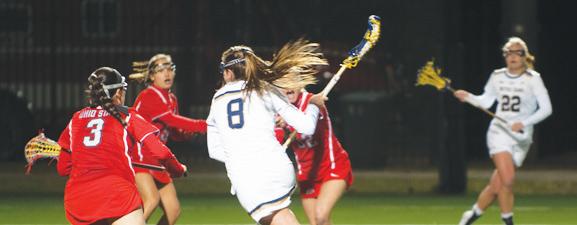
a fter 10 scoreless minutes, the i rish restored their lead back to four goals as p earsall and sophomore defender h annah p roctor each scored, but b uckeyes freshman midfielders s age d arling and l iza h ernandez quickly canceled out the i rish pair. The i rish, however, scored two more inside the final five minutes and although the b uckeyes grabbed one back, the i rish win was secured with a 1613 final score when p earsall grabbed the ensuing draw.
“ we did enough,” h alfpenny said. “ we made stops; we made some critical stops in that under-seven minute period. we got two critical stops in about three minutes and those two stops fueled an 8-meter goal by h annah p roctor and
another goal by [junior midfielder] m olly c obb. s o that was really big, to not allow them to get within one and get momentum. That was huge for us.”
n otre d ame’s eight game winning streak is tied for the third-longest in program history. The i rish are currently just two wins away from the program record of 10, achieved twice, in 2004 and 2013 to open the season. o rtega and freshman s avannah b uchanan each scored three for the i rish, while b uchanan also added four draw controls. p earsall ended the game with two goals, two assists and four draw controls.
s pring break sees n otre d ame begin a stretch against a variety of topranked teams. The i rish will play at n o. 10 p rinceton and n o. 20 Towson before a game at v irginia to finish the week. The i rish also hope to carry their momentum into the following weeks, as they will take on n o. 4 s yracuse and return home to face n o. 2 n orth c arolina.
The i rish and the Tigers (4-0, 1-0 i vy l eague) will meet at a lumni s tadium, in p rinceton, n ew Jersey, on m arch 8 at 1 p.m.
Contact Daniel O’Boyle at doboyle1@nd.edu
CHRIS COLLINS | The Observer
Irish sophomore outfielder Matt Vierling makes contact during Notre Dame’s 4-1 win over Boston College on April 15 at Frank Eck Stadium.
KATHLEEN DONAHUE | The Observer
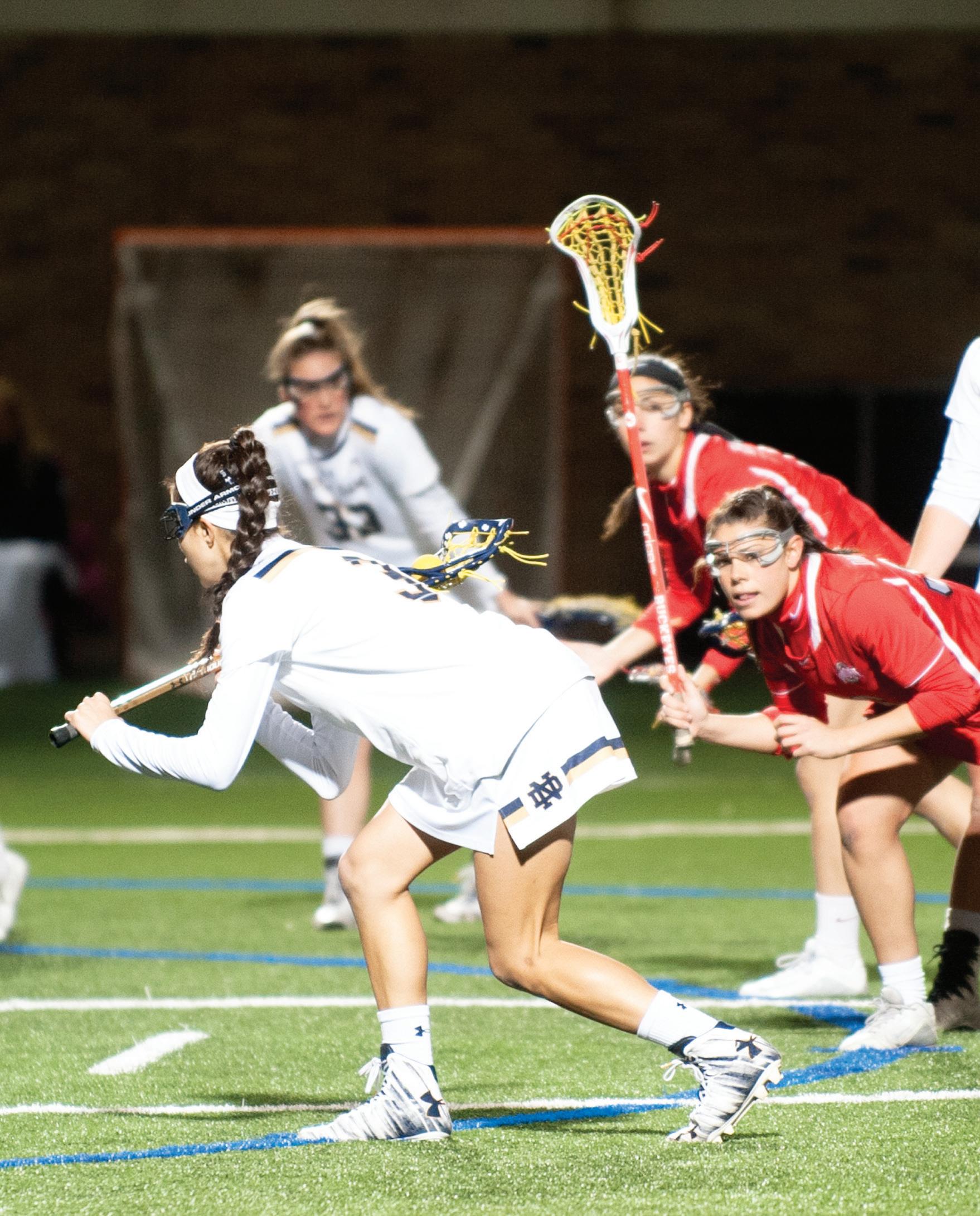
Irish sophomore attack Nikki Ortega takes a free-position chance during Notre Dame’s 16-13 win over Ohio State on Tuesday. Ortega finished with a hat trick and has 15 goals and to 16 assists on the season.
nd wOmEn’s GOLF
Clover Cup up next for ND
By ELIZABETH GREASON and COURTNEY BECKER sports writers
The coming off a ninthplace finish at the university of wisconsin westbrook spring invitational at westbrook village golf club in peoria, arizona, the irish will host the clover cup in mesa, arizona, over spring break.
notre dame is hosting the clover cup at longbow golf club for the sixth consecutive year. irish junior alison snakard is looking forward to hosting the event because it adds an element of control that other tournaments do not provide.
“it’s nice to be able to have something that is your own event and that you can invite teams to,” snakard said. “That’s how golf works. you’ll be invited to one thing, so it’s nice to be able to invite people back and also represent your school at something that’s your own tournament.”
irish sophomore isabella dilisio is excited for the tournament because she feels it will give her team a chance to prove itself, especially as it attempts to earn a place in the ncaa tournament in may.
“personally, i’m excited for all the opportunities we have to beat some really good teams,” dilisio said. “right now, we’re trying to get into regionals and we’re kind of on the border-line, and at this point, we probably wouldn’t make it if they were deciding tomorrow. so, we have a lot of really solid opportunities. florida state is coming and they’re ranked third. so, there are a lot of solid teams, that, if we can get a couple wins, it should help our ranking and hopefully we can put together a good season.” despite the team’s struggles in its last event, dilisio was able to pull together a personal best
two-round total of 138 at the westbrook spring invitational, finishing with a 54-hole total of 211. she is looking forward to carrying that momentum into the clover cup.
“it was a good confidence booster in the last tournament,” dilisio said. “That’s always helpful going into the next tournament knowing the last one you played in, you came in third, shot under par. so, that will definitely help for the upcoming tournament.”
snakard, on the other hand, is looking forward to showing off the skills she has been focusing on improving over the course of the season in the clover cup.
“it’s been really great to have a lot of experience this year,” snakard said. “i hope that finally putts can start dropping and the improvements start showing, so i can actually help the team in a positive way.”
snakard noted that the season as a whole to this point has been an important learning experience for the team, as it has shown flashes of strong play over the course of events. she discussed the fact that the team knows it has improvements to make coming into the clover cup.
“we’ve learned that there’s a lot of talent out there and there are a lot of really good teams and having the cold weather is not an excuse,” snakard said. “we need to keep working so that we can have some good wins.”
The irish will look to find the consistency they desire when they take the course on march 17 in mesa, arizona, for the clover cup. The tournament is a three-day event, ending march 19.
Contact Elizabeth Greason at egreason@nd.edu and Courtney Becker at cbecker3@nd.edu
Irish head to Tennessee
Observer Sports Staff
The irish will head to Tennessee to commence their spring season at the sixth annual oak r idge cardinal invitational, which will take place saturday and sunday. notre dame had a strong showing in its most recent event, the head of the charles regatta, which took place oct. 22 and oct. 23. The club four team, made up of sophomore gen Johanni, junior lauren matchett, junior meredith swartz and junior christine schindele-murayama, finished third in its time trial after starting 52nd. The
Football
con T inued from page 12
“ f irst of all is skill development; [we’re] making sure that there’s a portion that we’re working on their skill,” Kelly said. “ p utting them in competitive situations, putting fatigue, putting stress on them during competitive situations. To see those guys fight through those kinds of situations and handle themselves with great focus, with great attention to detail. g rit, grit. g rit is sustained effort over a long period of time. a nd having some adversity. s o creating those situations in practice with an eye towards building those traits is what our practices will look like.”
a nother departure from last season is the leadership structure Kelly has put in place. Traditionally, four captains are chosen a few weeks before the season commences. This time around, however, Kelly named captains for the upcoming season at the team’s end-of-the-year banquet in early d ecember.
h owever, Kelly said the leadership isn’t limited just to captains, and he has put a system in place with more players serving in leadership roles.
“ we’ve included our leadership group to not just be about our captains, but to be about a number of players,” Kelly said. “ f rom our quarterbacks to players that we’ve identified this year and moving forward who will be future leaders in our program that have responsibilities, whether it’s in
the locker room, our players’ lounge, whether they are swag team captains. we have eight teams that are responsible for a group of players, accountability teams. They’re out front, and they have to be in leadership positions, holding players accountable on a day-to-day basis. s o that’s been going on for the last eight weeks.”
o ne future leader of the team is junior quarterback b randon w imbush. Kelly said he isn’t requiring w imbush to take on too many responsibilities and hopes the Teaneck, n ew Jersey, native will grow into the mantle of leadership in time.
“ w hat i ’m asking him to do [is] probably more focused on him just taking care of himself,” Kelly said.
“a nd we’ve got a lot of good leaders. i ’m giving him some leadership opportunities, and i think he’s doing quite well. b ut we’re not asking him to come in here and lead the entire building. we’ve got seven — six captains right now. we’re going to probably have as many as seven, so he’s well supported in that role.
“ h e has to have a presence about him. b ody language. h e’s got to have confidence in himself. s o those are the areas that i ’m spending more time on than him having to take control of the entire football program.”
Injuries
a lso helping the i rish ease into spring practice is a lack of injuries. Kelly said junior cornerback s haun c rawford, who tore his a chilles against n evada in s eptember, will
be moving around quite a bit, but no contact drills are expected.
“ i ’m very optimistic that when we look at two of our big guys in terms of the injuries, s haun c rawford being one with the a chilles — you know, he’s jumping, his change of direction, i think you’re going to see him extremely active in the spring,” Kelly said. “ i don’t see him in a contact position at this time, but he won’t be cheated this spring. h e’s really going to use spring as an opportunity for him to continue to grow as a football player.”
Offense
a nother change Kelly said he has in mind for the offense is to let newly hired offensive coordinator c hip l ong have full control. l ong was the offensive coordinator at m emphis before being named to the same position at n otre d ame. Kelly said his goal is to have l ong run an up-tempo offensive unit.
“c hip will be allowed to put all of his time and effort in running the offense and playing fast,” Kelly said. “ i ’m going to give him that autonomy to do that. i think that over the last few years, it’s been a committee running the offense. There is no committee now. it’s one guy that can kind of turn it loose and run it.
“ w hen i was at c incinnati, i was the guy. i was running it by myself. s o i think going back to what i believe is the most efficient way to do it and get out of the way and let c hip run it.”
Contact Marek Mazurek at mmazurek@nd.edu
irish also snagged 19th in the championship eight and 10th in the championship four. last year, the oak ridge invitational proved to be a fierce competition, with some of the nation’s top-ranked programs in attendance. The irish found success, garnering four first place and 10 runner-up finishes.
The oak r idge invitational will take place at melton lake in oak r idge, Tennessee. The rowing venue has hosted notre dame’s first spring competition every year since 2008.
The regatta will occur march 11-12, with races beginning at 8 a.m. both days.
KATHRYNE ROBINSON | The Observer
Irish junior quarterback Brandon Wimbush scores a touchdown during Notre Dame’s 62-27 victory over UMass on Sep. 26, 2015, at Notre Dame Stadium. Wimbush redshirted his sophomore year.