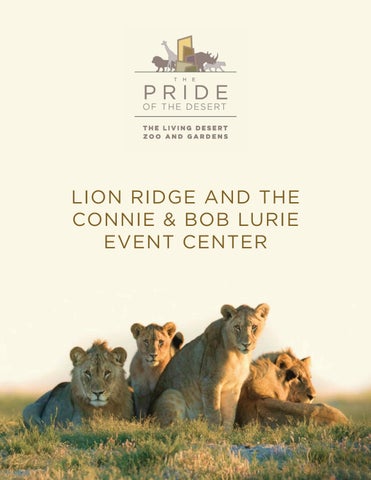
LION RIDGE AND THE CONNIE & BOB LURIE EVENT CENTER
PRIDE OF THE DESERT PIONEERS Phase 3 Only as of July 1, 2025
$5 MILLION AND ABOVE Connie L. and Robert A. Lurie $3 MILLION AND ABOVE Eldorado Country Club Members The A.C. and Shaughne S. Warnack Foundation $1 MILLION AND ABOVE Lance Eldred and Rita Stec Wayne L. Prim Foundation $500,000 AND ABOVE Bill and Suzan Appel Mike and Tracy Clark / Clark Foundation / Candace and Jon Holzgrafe Patricia Ann and Terry E. Simmons $250,000 AND ABOVE William Fries II Foundation The Grousemont Foundation / Carol Wright Raymond and Mildred Hegwer Foundation / Ellen and Thomas Gibson Sandy and George Kachlein III Pat and David Lamb Sharon and Craig McCollam Sandy Myerson Trudy and Henry Ritz Leslie Halverson and Rick Waddell $100,000 AND ABOVE Cathy and Bill Dickson Mary Lou Graziadio Susan and Jim Gould Susan and George LeBlanc Marcia and Max Messmer Sandi and Ralph Miller
Sandy Petersen Linda and John Seiter Kit and Roger Snoble The George and Stephanie Suddock Foundation Marcy Tonkin
Thank you for being the pioneers for our capital campaign!
CROSSROADS OF CONSERVATION
FROM VISION TO LEADERSHIP
T
he Living Desert Zoo and Gardens was founded in 1970 with a bold and visionary mission: to preserve, conserve, and interpret the desert’s unique flora and fauna through education, environmental awareness, and impactful conservation programs. Nestled in the heart of the Coachella Valley in Palm Desert the institution was established on land originally owned by the Coachella Valley Water District, with the goal of protecting the fragile desert ecosystem and inspiring public stewardship of arid lands. In its early years, The Living Desert focused primarily on native desert plants and animals, creating a unique blend of a botanical garden and a wildlife preserve. Over the decades, The Living Desert evolved into one of the nation’s premier desert-focused zoological institutions. It became a full member of the Association of Zoos and Aquariums (AZA) in 1983, a prestigious accreditation that recognizes excellence in animal care, conservation, education, and scientific advancement. AZA accreditation is held by fewer than 10% of licensed animal exhibitors in the U.S. and is a gold standard for zoos and aquariums worldwide. The Living Desert’s continued re-accreditation every five years underscores its commitment to the highest standards of animal welfare and conservation leadership. Under the current leadership of President and CEO Allen Monroe, who joined The Living Desert in 2014, the institution has undergone transformative growth. With a background in wildlife conservation and zoological operations, Monroe has been instrumental in shaping the zoo’s strategic direction. His leadership emphasizes expanding conservation impact, modernizing guest experiences, and deepening the zoo’s role in global desert species preservation. One of Monroe’s most significant contributions has been the development and execution of the Crossroads of Conservation Master Plan. This multi-phase capital improvement initiative introduced innovative habitats like the Rhino Savanna and upgraded infrastructure to better serve both animals and visitors.
THE LIVING DESERT ZOO AND GARDENS
A HISTORY OF CONSERVATION
T
he Living Desert Zoo and Gardens is more than a zoo—it is a dynamic conservation organization committed to protecting desert ecosystems and the species that inhabit them, both locally and globally. Since its founding in 1970, The Living Desert has prioritized conservation through research, habitat protection, species recovery, and education, positioning itself as a leader in desert wildlife preservation. Central to The Living Desert’s mission is its work with endangered and vulnerable species. The Zoo plays a key role in the recovery of the desert bighorn sheep, the Mohave desert tortoise, and the Arabian oryx, among others. Through breeding programs, head-starting initiatives, and habitat restoration, the Zoo helps ensure that these species have a chance to thrive. Its desert tortoise head-starting program, for example, rears young tortoises in safe, controlled environments before releasing them into the wild, improving their survival rates in the face of predation and environmental threats. Internationally, The Living Desert supports field conservation projects in over a dozen countries. These efforts include safeguarding the critically endangered black rhino in Namibia, funding anti-poaching patrols like the Black Mambas in South Africa, and aiding the rescue and rehabilitation of cheetahs threatened by illegal wildlife trafficking in Somaliland. The Zoo is also a partner in protecting the Ikh Nart Nature Reserve in Mongolia, a vital sanctuary for Argali sheep, cinereous vultures, and other species unique to Central Asian deserts. Through public education, on-site interpretation, and immersive experiences, The Living Desert fosters a deep connection between people and nature. By translating complex conservation issues into engaging guest interactions and supporting real-world fieldwork, The Living Desert exemplifies how modern zoos can serve as both educators and active participants in global wildlife conservation.
ACCOMPLISHMENTS AND ACCOLADES
THE LIVING DESERT ZOO AND GARDENS
IMPACT AND LEARNING
E
ducation is at the heart of The Living Desert Zoo and Gardens’ mission to inspire people to care for and protect desert species and ecosystems. Since its founding in 1970, The Living Desert has served as a living classroom, where science comes to life through hands-on experiences, immersive exhibits, and dynamic programming for learners of all ages.
Each year, tens of thousands of students, teachers, and families participate in the Zoo’s wide-ranging education initiatives. These include standards-based field trips, interactive tours, summer and holiday camps, and classroom outreach programs that align with state science curricula. These programs give young learners direct access to wildlife and conservation science, sparking curiosity and fostering the next generation of environmental stewards. Special emphasis is placed on serving Title I schools, ensuring that cost and access are not barriers to learning. Our annual attendance has surpassed 500,000, with over 32,000 students participating in school field trips. Our membership program has soared to include 13,500 households and we have 480 volunteers who dedicate over 50,000 hours to the Zoo. Beyond youth programs, The Living Desert offers lectures, workshops, and citizen science projects that engage adult audiences and lifelong learners. From guided hikes and behind-the-scenes animal encounters to wildlife conservation presentations by global experts, the Zoo makes science and sustainability engaging and accessible. The Living Desert participates in Museums for All and SNAP/EBT programs to increase access for underserved individuals and families in our community. Over 22,000 people with SNAP/EBT benefits attended The Living Desert for $3 per person in the 2024-2025 fiscal year. Through its educational efforts, The Living Desert empowers guests with knowledge and encourages them to take meaningful conservation actions. By connecting people with desert animals and plants in a personal and memorable way, The Living Desert not only teaches facts—it cultivates empathy, understanding, and a sense of responsibility for the natural world. In doing so, it plays a vital role in shaping a more informed and conservation-minded society.
THE LIVING DESERT ZOO AND GARDENS
FINANCIALS
T
he Living Desert Zoo and Gardens is a non-profit organization that operates from a position of fiscal strength, positive cash flow, and without debt. Unlike the majority of AZA-accredited zoos, The Living Desert receives no on-going government funding toward its operating budget. The Zoo operates self-sufficiently through its earned and raised revenues. Our fiscal year 2025-2026 operating budget is $30 million. Below is a breakdown of operating expenses by percentage spent in each of the Zoo’s major departments for fiscal year end June 30, 2025.
Marketing & Public Relations 7%
Fundraising 8%
Management & General Support 4% Animal Care 28%
Membership & Park Services 32%
The Living Desert Zoo and Gardens Expenses for 2024-2025 Fiscal Year
T
he Coachella Valley is experiencing significant development and growth, with the City of Palm Desert population growing 5.6% in a decade and the building of an Amazon facility, Acrisure Arena, Cotino, Indian Canyon, DSRT Surf Club, and many others. In response to this growth, The Living Desert has been working to develop a forward-thinking master plan that will become the “Zoo of the Future” while continuing the legacy that has been built by previous generations.
Gardens 5%
Learning & Impact 7% Conservation 9%
CROSSROADS OF CONSERVATION
PHASE ONE & TWO
S
ince launching the Crossroads of Conservation initiative in 2016, The Living Desert Zoo and Gardens has undertaken bold and transformative capital projects driven by its Pride of the Desert campaign. This multi-phase, $80 million effort has shaped the zoo into a leading hub for conservation, education, and immersive guest experiences.
PHASE ONE GRUNDHOFER ADMISSIONS PLAZA
$10,000,000
The Patti and Jack Grundhofer Welcome Plaza was introduced in November 2018. It has welcomed 3.5 million guests since its opening. This new entrance transformed the arrival experience with features such as shaded garden areas, electronic and expedited ticketing kiosks, enhanced guest services, and engaging animal ambassador encounters.
SUZAN AND BILL APPEL GIFT SHOP The Suzan and Bill Appel Gift Shop is located in the new entry plaza. It offers a spacious, bright space where guests can enjoy a wide variety of unique items like succulents, jewelry, animal plushies, toys, and so much more.
CROSSROADS OF CONSERVATION
PHASE ONE & TWO: PHASE TWO RHINO SAVANNA
$21,000,000
Rhino Savanna, which opened November 2021 and is The Living Desert’s new four-acre habitat, houses twelve species including black rhinos Jaali and Nia. Designed with immersive elements, hidden feeding systems, subterranean tunnels showcasing naked mole-rats, lush savanna segments, and viewing terraces, Rhino Savanna bridges storytelling and design. Integrated guest amenities—such as a pavilion, restrooms, and concession stand—further enhance comfort and engagement.
SAUSMAN OFFICE COMPLEX
$10,000,000
Beyond its habitat expansions, the zoo also upgraded infrastructure vital to its mission. In August 2023, it unveiled a 10,000 square-foot Sausman Office Complex named in honor of Karen Sausman, The Living Desert’s former CEO of 40 years. This office building houses the Animal and Gardens Teams, Conservation, and Operations, giving them a modern and efficient office space to get their work accomplished. It includes a state-of-the-art breakroom/kitchen, a full functioning locker room, and office space for each staff member. This reflects organizational growth and logistical investment.
CROSSROADS OF CONSERVATION
BIGHORN CAFE
$15,000,000
The Bighorn Cafe, opened in April 2025 next to the Bighorn Sheep Habitat, offers guests a welcoming space to relax and dine. With seating for up to 150 guests indoors and two spacious patios, the cafe provides ample room for visitors to enjoy a meal. The back patio overlooks the stunning Bighorn Mountain, offering the unique experience of dining with a view of the majestic bighorn sheep in their natural habitat.
BILL GROSS AND PAX STENGAARD GROSS OASIS SPLASH PAD
$5,000,000
The Oasis Splash Pad is a vibrant, desert-themed water play area designed to delight visitors of all ages. Featuring interactive elements inspired by the desert landscape, the splash pad not only offers refreshing fun but also serves as an educational experience. The facility operates using a recirculated, treated water system that uses less water annually than a typical single-family home—underscoring The Living Desert’s commitment to sustainability. While children revel in the playful environment, parents and caregivers can appreciate the powerful message about protecting our planet’s most precious resource.
CROSSROADS OF CONSERVATION
PHASE THREE: WHY LIONS? WHY AN EVENT CENTER?
L
ions have long stood as a symbol of strength and majesty – “the King of the Jungle”. Yet today, these iconic animals face an uncertain future. Over the last century, Africa’s lion population has plummeted from over 200,000 to fewer than 20,000—a staggering 90% decline. This steep drop is due to habitat loss, prey depletion, human-wildlife conflict, and illegal trafficking.
The Living Desert Zoo and Gardens is proud to announce Lion Ridge. This groundbreaking new habitat redefines how lions are housed in human care, while furthering the mission of The Living Desert Zoo and Gardens to protect vulnerable species and inspire conservation. Lions are one of the most recognized and beloved species in zoos around the world. Of the 139 zoos that are members of the Association of Zoos and Aquariums, 90 house lions. Yet housing these animals presents significant challenges, particularly around the species’ complex social structure. In the wild, male lions are typically solitary, while only one dominant male presides over a pride. By age three, male lions leave their birth pride in search of their own territory. This natural behavior leads to difficult management decisions in zoos. Traditionally, zoos house one breeding male and several females, while older or surplus males are often kept behind the scenes, limiting their visibility, welfare, and opportunities for natural social behavior. Lion Ridge will revolutionize how lions are cared for and understood. This innovative, flexible habitat will accommodate lions of varying ages and social dynamics, enhancing both animal welfare and guest engagement. The final phase of our Crossroads of Conservation Capital Campaign includes the construction of the Connie and Bob Lurie Event Center—an extraordinary, state-of-the-art venue designed to support The Living Desert’s long-term sustainability. This premier 500-seat, climate-controlled ballroom will be the first of its kind anywhere in the world, offering panoramic floor-to-ceiling windows into the Lion Ridge habitat, a one-of-a-kind experience for event guests, and a unique point of distinction for The Living Desert.
CROSSROADS OF CONSERVATION
PHASE THREE
T
his ambitious phase is more than an expansion—it is a transformative step in our mission to save desert species, inspire environmental stewardship, and provide a world-class guest experience. At its heart is Lion Ridge, an immersive, multi-acre habitat that will serve as home to a pride of African lions—an iconic and vulnerable species whose populations in the wild have declined by over 40% in the past 25 years. Their survival depends on awareness and support for global conservation efforts. Alongside this striking habitat will rise the Connie and Bob Lurie Event Center—a 500-seat, multi-use facility with a dramatic 180-degree glass wall offering panoramic views directly into the lion habitat. This dynamic venue will be a game-changer for The Living Desert and the entire Coachella Valley. It will host conservation lectures, educational programs, private celebrations, cultural events, and community gatherings year-round.
LION RIDGE
$30,000,000
Lion Ridge will revolutionize how lions are cared for and understood. This innovative, flexible habitat will accommodate lions of varying ages and social dynamics, enhancing both animal welfare and guest engagement. The habitat will feature three interconnected spaces, each designed to reflect the species’ natural behaviors and needs: ▪ ▪ ▪
A fully open habitat for a coalition of young males, allowing them to coexist and roam freely. A dedicated space for female lions and breeding pairs, ensuring a safe and controlled environment. A protected refuge for older males, providing them with a comfortable space free from competition from younger lions.
Linked by elevated “catwalks” that allow lions to traverse and access different habitats safely, Lion Ridge will offer unmatched adaptability. This dynamic system will set a new standard in animal care, while captivating guests with meaningful, close-up encounters that deepen their connection to lions and their conservation.
CONNIE AND BOB LURIE EVENT CENTER
$42,000,000
This premier 500-seat, climate-controlled ballroom will be the first of its kind anywhere in the world, offering panoramic floor-to-ceiling windows into the Lion Ridge habitat, a one-of-a-kind experience for event guests, and a unique point of distinction for The Living Desert. With indoor-outdoor flexibility, state-of-the-art technology, and unparalleled scenery, the Event Center will not only generate vital revenue to support our mission, but also create a new space for dialogue, learning, and connection. These events will deepen community engagement, diversify income, and reinforce the Zoo’s financial sustainability.
CROSSROADS OF CONSERVATION
INVESTING IN THE COACHELLA VALLEY
T
he Living Desert Zoo and Gardens is a cornerstone of the Coachella Valley’s economic vitality, generating significant value for the region while operating as a sustainable nonprofit institution. According to a 2023 study by Tourism Economics, the Zoo delivered over $148 million in annual economic impact during the 2022–2023 fiscal year alone—totaling more than $530 million since 2018. That includes support for approximately 1,484 full-time and part-time jobs and nearly $18 million in state and local tax revenue per year. This visionary capital campaign represents far more than an investment in facilities—it is a commitment to conservation, community, and future generations. A leadership gift would have a transformational impact, secure the success of Lion Ridge and the Connie and Bob Lurie Event Center, and ensure that The Living Desert continues to lead globally in animal welfare, conservation, and immersive education. In the past year, The Living Desert hosted 29 private events, generating $740,000 in revenue despite constraints on venue size and seasonal availability. With the Lurie Event Center, our event capacity and revenue potential will grow dramatically: Year One Projection: $1 million Year Two Projection: $2 million Year Three Projection: $3 million — $5 million This new stream of revenue will be reinvested directly into our operations, supporting animal care, staff wages, conservation initiatives, future growth, and economic impact on the entire Coachella Valley. In total, the combined impact of Lion Ridge and the Connie and Bob Lurie Event Center is projected to bring $62.8 million in economic output, including the creation of 509 jobs, $3 million in state and local tax revenue, and $40.9 million in direct spending. More than an exhibit expansion, this development reaffirms The Living Desert’s role as an economic engine, educational leader, and conservation catalyst—while contributing to the Coachella Valley’s resilience and prosperity for decades to come. We invite you to join us in bringing this extraordinary vision to life. Together, we can protect one of the world’s most iconic species—and inspire millions to care, act, and make a difference.
CROSSROADS OF CONSERVATION
CAPITAL CAMPAIGN GIFT PYRAMID GIFT AMOUNT
GOAL
SECURED
NEED
$10,000,000
1
0
$5,000,000
3
$3,000,000
TOTAL
TOTAL
1
$10,000,000
$10,000,000
1
2
$15,000,000
$25,000,000
4
2
2
$6,000,000
$31,000,000
$2,500,000
2
0
2
$5,000,000
$36,000,000
$1,500,000
3
0
3
$4,500,000
$40,500,000
$1,000,000
5
3
2
$5,000,000
$45,500,000
$750,000
6
0
6
$4,500,000
$50,000,000
$500,000
8
4
4
$4,000,000
$54,000,000
$250,000
10
11
0
$2,500,000
$56,000,000
$100,000
15
19
0
$1,500,000
$58,000,000
$50,000
20
21
0
$1,000,000
$59,000,000
$25,000
25
23
2
$625,000
$59,625,000
$10,000
50
52
0
$500,000
$60,125,000
$5,000,000
$65,125,000
Grants
$10,000,000 $5,000,000 $3,000,000 $2,500,000 $1,500,000 $1,000,000 $750,000 $500,000 $250,000 $100,000 $50,000 $25,000 $10,000
PHASE THREE MAP RENDERING
LION RIDGE AND CONNIE & BOB LURIE EVENT CENTER
CROSSROADS OF CONSERVATION
MEET THE TEAM DEVELOPMENT TEAM
Jeff Petrovic Chief Development Officer
Cortney Weir Senior Manager of Development
Donna Raider Major Gift Officer
Karyn Cooks Major Gift Officer
Kat Sacher Grants and Government Programs Officer
Kaitlyn Laverty Major Gift Officer
Kimberly Geck Capital Campaign Assistant
BOARD OF DIRECTORS AND TRUSTEES Bill Appel, Chairman of the Board*
Deborah Chapman*
Jneil Nelson
Craig McCollam, Treasurer*
Susan Cooper
Peter Scheer
Sandra Woodson, Secretary*
Jeff Elder
Sally Simmonds
Allen Monroe, CEO & President*
Marylynn Gladstein
Bill Simpkins
Phil Hasbrouck
Phil Smith*
Candace Holzgrafe*
Mary Lou Solomon
Suz Hunt*
Larry Spicer
Michael Kiner
Sam Spinello
Justin McNulty
Nancy L. Stegehuis*
Jaishri Mehta * Board of Directors
47900 Portola Avenue Palm Desert, CA 92260 (760) 346-9584 Development@LivingDesert.org LivingDesert.org