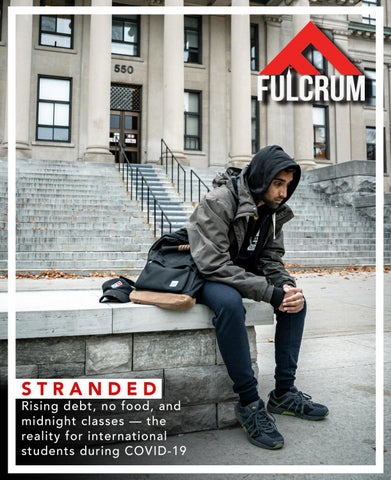
In this month’s issue... THE CUP WIRE CUP - The Varsity - Statistics Canada projects financial losses for Canadian universities, decrease in international enrolment “In light of the COVID-19 pandemic, Statistics Canada has updated its data about revenues and expenditures of Canadian universities to include projections based on revenue streams from past years, including a breakdown of funding sources and a projection of how universities might be impacted by the pandemic. Due to COVID-19 restrictions, Statistics Canada has created five different scenarios to project revenue losses, which range from $377 million to $3.4 billion.”
CUP - The Ubyssey - Hundreds petition Vancouver School of Economics to stop using Proctorio “Over 800 students have signed a petition asking the Vancouver School of Economics (VSE) to stop using the Proctorio remote exam invigilation service.
U of O president breaks silence on ‘N-word’ incident involving faculty of arts professor P. 4 Professors also pen letter, UOSU makes comment. New digital Arts Bistro P. 8 R.I.P to Cafe Alt Debt, no food and midnight classes: International students and COVID-19 P. 9 Read this issue’s cover story
The petition notes that Proctorio has extensive access to student data while active, including a student’s location, browser and physical surroundings. The petition also raises concerns over the Proctorio CEO’s publication of private student chat logs and the company’s lawsuit against a UBC staff member, ultimately accusing Proctorio of being invasive and unsafe for student use.”
Ottawa Public Health looks at U of O and CHEO wastewater research P.12 Trio testing local sewage levels
CUP - The Gateway - U of A researcher second Canadian to win Nobel Prize for work on Hepatitis C
League updates and COVID-19 positive players P.13 Everything you need to know in the world of University sports
“With the first win dating back to 1923, a University of Alberta researcher is the second Canadian to receive a Nobel Prize in Physiology or Medicine. Michael Houghton, U of A Canada Excellence research chair laureate in virology and Li Ka Shing and department of medical microbiology and immunology professor, was awarded the 2020 Nobel Prize in Physiology and Medicine for discovering the Hepatitis C (HCV) virus and subsequently working on a vaccine.”
Opinion: RCMP failures in Nova Scotia P.14 “What are we even funding them for?” Editorial: Varsity athletes shouldn’t be training P. 18 Our take on the exception at U of O
NEWS
NEWS EDITOR
Karli Zschogner news@thefulcrum.ca Insta: @karli.zschogner Twitter: @KarliZschogner
The PSUO-SSUO strike mandate explained
What is at stake for students and why have negotiations come to a halt? Charley Dutil Editor-In-Chief
The union representing support and administrative staff at the University of Ottawa (PSUO-SSUO) has announced its intention to proceed with a strike on Monday at 12:01 a.m. if it cannot reach a tentative settlement on a collective agreement with the University. The announcement follows the breakdown of a non-binding privately meditated session between both parties that took place on Oct.15. “The bargaining committees for the University and the union have met with the assistance of a mediator chosen by both parties,” wrote Patrick Charette, the director of institutional communications at the U of O in an email to the Fulcrum. “Despite reaching consensus on many issues, a small number remain outstanding.” According to the PSUO-SSUO’s press release, talks came to a halt after the union refused the U of O’s latest offer citing it as being “not significantly different to their last offer” from the summer. In June, the University had imposed a ‘final offer’ vote upon PSUO-SSUO members which was voted down by 80 per cent of the 1,037 members who cast a ballot. The union at the time qualified the final offer vote as “an unnecessary vote put to the membership by our employer, the University of Ottawa.” Marcelle Desmornes, the president of the District 35 OSSTF/FEESO PSUO-SSUO Bargaining Unit, provided a bleak outlook on the negotiations and the chances of reaching an agreement before the strike comes into effect on Monday morning. “The members of PSUO-SSUO have stood strong against the employer’s effort to strip health benefits and other provisions, with 80 per cent of the membership rejecting a final offer vote forced by the university in June,” he said. “The bargaining team has no intention of bringing a tentative agreement to the membership that does not respect the contribution they make to this institution.”
The University is hopeful that a strike may be averted. Image: Dasser Kamran/Fulcrum.
What’s at stake for students? The PSUO-SSUO represents over 1,300 U of O employees that are vital to the operations of the University. Members include lab coordinators, mental health counsellors and specialists, academic counsellors and assistants, financial officers and library technicians “The big areas where students will feel the pinch (include) finance officers at financial aid and awards who deal with OSAP requests, academic assistants and operations in faculties/ departments who handle exam (and) timetable changes, professional certification (law/medicine/accounting), career and CO-OP specialists for placements (plus) library technicians who handle reserves, loans and research databases,” wrote Jonathan Degan, the PSUO-SSUO vice president in an email to the Fulcrum. “The University of Ottawa Students’ Union (UOSU) stands in solidarity with their union partners at the PSUO-SSUO, and we encourage both sides to come to a speedy resolution,” said Tim Gulliver, the UOSU’s advocacy commissioner to the Fulcrum. “One of the groups impacted the most will
be undergraduate students. We’re concerned about the impact this will have on students needing services at the Student Academic Success Service (SASS), the library and other academic supports.” “The PSUO-SSUO represents a hugely important part of our university community and we understand they have not taken this decision lightly.” Some classes and labs could be cancelled since lab coordinators and other essential workers will be on strike. This will make an already uniquely challenging semester for students even more difficult. There is no official statement from the union on if disruptions would impact SASS or mental health services on campus; these services could be deemed essential. The strike will also affect the University of Ottawa’s administration functionality as a number of employees from secretaries to managers are members of the PSUO-SSUO and will be on strike if no tentative agreement is reached before the union’s deadline.
Why have negotiations come to a halt?
The new collective agreement negotiations between the two parties have focused on multiple elements since they started over 19 months ago. According to the PSUO-SSUO, the U of O is attempting to ‘strip’ its members of their health benefits, reduce parental leave top-ups, lower retirement allowance, reduce the reimbursement for members medication from 100 to 80 per cent and willingly leave 80 support positions vacant. “The Union has been trying to get the University to address critical employee issues that directly impact the student learning experience such as unfilled vacancies, the hiring of more academic advisors and mental health counsellors, but all have been ignored,” explained Degan. According to Degan, the University has had three consecutive years of surpluses totalling over $200 million. He highlights that the U of O has an advantage in negotiations due to the Ford government’s Bill 124 that already imposes salary restraints. He insists that the University is trying to make more savings on the backs of workers who are most vulnerable, all the while in a pandemic. Harvey Bischof, provincial president of the Ontario Secondary School Teachers’ Federation, of which the PSUO-SSUO is a part of, explained the same views in a press release following the breakdown in negotiations on Oct.15. “In the midst of a pandemic, and in an environment of artificial wage constraint caused by the Ford government’s Bill 124, it’s extremely disappointing that this employer would seek to further erode the conditions under which these valuable workers are employed,” said Bischof. According to Charette, the U of O has “worked hard with this union for [the] last 19 months to try and achieve a negotiated collective agreement that reflects the important role that our support staff play at the University and in the lives of our students, staff and faculty.” “The University is hopeful that a strike may be averted.”
Café Alt to stay closed for the rest of the year Paige Holland staff writer
After the dissolution of the Student Federation of the University of Ottawa (SFUO) in March of 2019, many student-union run businesses on campus shut their doors. Now add in a global pandemic and some won’t be reopening for the foreseeable future. One of the affected spaces at the University of Ottawa is Café Alternatif (otherwise known as Café Alt), which served as a popular study space and coffee shop for students on campus. The business was located in the basement of Simard Hall at 60 University Private.
According to a recent statement from Babacar Faye, the current president of the UOSU, the student union has now decided that “Café Alt will not be opening this year.” When the UOSU took over for the SFUO after the student union referendum, the new student union was handed the responsibility of operating all student-union run businesses including PIVIK and Pub 1848 alongside Café Alt. However, UOSU struggled to reopen the business after the initial transfer of power and instead prioritized getting student services up to speed again. The reopening of the cafes, bars, and stores on campus was initially planned for January 2020 but eventually pushed to September.
In addition to the changing of the guard, the COVID-19 pandemic had a strong impact on businesses on campus resulting in student services continuing to be more of a priority for UOSU. In a previous interview with the Fulcrum, Faye “referenced a lack of manpower and operational capacity which resulted in an incremental process of rebuilding and the UOSU prioritizing reopening services that were more important to the needs of students.” Still, many students hoped Café Alt would be open sometime during the 2020-21 academic year, crossing their fingers it would only be closed temporarily until the UOSU figured out how to manage the space amidst all the drastic changes.
Finances aside, the space was a beloved space for all U of O students on campus to go to, whether an arts major or not. It was known to fluctuate in terms of revenue sometimes “rolling in the dough” like in 2012 but also could experience “weak numbers” as they did a few years later, at one point even losing $44,501. Regarding the remaining student-union businesses, the UOSU has plans to open PIVIK in January 2021. Faye did not specify if there are any plans to reopen Café Alt in the 2021-22 academic year.
This article has been condensed for print, see the full version online at www.thefulcrum.ca.
3 | NEWS
THEFULCRUM.CA
U of O president breaks silence on ‘N-word’ incident involving faculty of arts professor
Professor to keep teaching at U of O with full academic freedom Charley dUTIL & eMILY wiLSON eDITOR-iN-cHIEF & mANAGING eDITOR
University of Ottawa president and vice-chancellor Jacques Frémont broke his silence to address the “recent incident at the faculty of arts wherein a part-time professor used the ‘N-word’ during a class.” In a message sent to the U of O community early Monday morning, Frémont announced that the professor who used the ‘N-word’ in an online lecture had returned to work on Friday. “Throughout these recent days the professor in question has remained an employee of uOttawa,” wrote Frémont. “During the several days during which she did not teach the university organized a coordinated return for her class with her cooperation. She is free to continue her teaching (which she returned to last Friday) while enjoying her full academic freedom.” On Oct. 2, the Fulcrum broke the story that professor Verushka Lieutenant-Duval was facing backlash from students and under investigation by the faculty of arts after an email was leaked of her apologizing to a student for uttering the ‘N-word’ in a previous lecture. According to La Presse, she had not taught since the beginning of October. “The leadership of the faculty of arts proactively met with students and established a new section of the course in question to serve students who did not wish to continue their classes with their original professor,” explained Frémont. “This was
a necessary step to accommodate and respect the rights of all.” On Oct.16, a group of 34 current and retired U of O professors expressing their disagreement with the University’s treatment of professor Verushka LieutenantDuval published a letter in multiple Frenchlanguage newspapers. “This collective letter was produced in response to an article published in the national newspaper, La Presse, which raised the issue of academic freedom,” said Jonathan Paquette, a professor of public administration who signed the letter. “A number of professors felt it was necessary to do so in order to obtain important clarifications because it raised implications that were far broader than those highlighted in the case.” Translated from French by the Fulcrum’s editor-in-chief, the professors argued within the letter that “classrooms (may they be physical or virtual) cannot become an area freed from the weight of history, of ideas and their representations. It is inevitable that certain lectures, certain concepts, certain words will hurt some susceptibilities. University is precisely the place to reflect on this reality, to historicize it, and to scientifically break free from tyranny, both from majorities and from presentism.” The U of O’s president addressed their academic freedom concerns in his message stating “Freedom of expression and academic freedom are essential to the functioning of any university. We must fight to ensure that these freedoms remain
ubiquitous in our daily lives.” “Personally, I can assure you that I regularly fight to protect the freedom of expression of my colleagues in response to the steady stream of people writing to my office concerning things that have been written or said and demanding that their author be sanctioned.” “Every day difficult conversations are held on our campus and in our classes, on all sort of issues. Critical thinking depends on academic freedom.” The professors also argued within the letter that “two elements seem to be confounded in this unfortunate affair.” “First, that racism on campus, microaggressions, and the sometimes unconscious, but nonetheless real discrimination to which minorities are victims, must be denounced.” Secondly, is that “the role of university education, professors and classrooms, which is to nurture reflection, develop critical thinking, allow everyone, (regardless of their position) to have the right to speak.” Frémont stated in his message that “contrary to so much of what has been written in recent days, the right to freedom of expression and the right to dignity are not contradictory principles, but complementary. They must co-exist with one another.” “This is the task we have been given.” Since its publication, the group of professors letter has circulated throughout social media, gaining attention within Ottawa and throughout Ontario and Quebec
as well as on campus. The University of Ottawa Students’ Union (UOSU) released a statement late Sunday night addressing the “several instances of racism happening within [our] classrooms this semester,” including the incident regarding professor LieutenantDuval and the recently-circulated letter. In the statement, the Union explained they are “deeply disturbed by the ignorant, invalidating and reprehensible comments made in support of [Lieutenant-Duval] in La Presse by columnist Isabelle Hachey.” “We are also deeply disturbed by the open letter defending the use of racial slurs in classrooms co-signed by a group of 30 professors at the University of Ottawa. Though these individuals and groups often sit silent when asked to vocalize support for their BIPOC students, they’ve found their voice in defending the use of a racial slur while discounting the vast majority of uOttawa’s Black community’s disagreement. This is appalling.” The UOSU emphasized their solidarity with Black-led student groups on campus “in condemning all forms of racism and discrimination to the strongest degree.” The statement was supported and endorsed by 20 other recognized U of O student governments, all of which collectively asked the University to take action against those who signed the letter. “In light of this responsibility, and as a bare minimum, we call on the University of Ottawa and President Jacques Frémont to denounce these professors, not just
U of O President, Jacques Frémont. Image: Jaclyn McRae-Sadik/Fulcrum
through words, but through actions.” “Although these may be the actions of individuals, the University of Ottawa has a responsibility to ensure that racialized students are able to feel safe, included and able to succeed to their full potential in our classrooms, virtually and in-person. “We often say that racism has no place on our campus, yet it seems to have been enrolled into our classrooms. Incidents like these make racialized students feel unwelcome and question their belonging to the uOttawa community.” “We are, like many other universities, taking stock of the systemic dimensions of racism and we have committed to making meaningful changes to address these issues,” wrote Frémont in response to UOSU’s concerns in his message. Due to the early morning nature of the message from the U of O president, both the professors and UOSU have not publicly commented on Jacques Frémont’s message. - with files from Paige Holland
CIHR awards grant funding to six U of O COVID-19 mental health projects Researchers received a combined total of over $1 million karli zschogner news editor
Six University of Ottawa affiliated COVID-19 mental health projects have been selected to receive a combined total of over $1 million in funding grants from the Canadian Institutes of Health Research (CIHR). The funding is part of the Government of Canada’s Knowledge Synthesis Grant: COVID-19 Rapid Research Funding Opportunity in Mental Health and Substance Use. In total, the federal government has invested $10.2 million into 55 different projects across the country. The chosen projects focus on Mental Health and Substance Use (MHSU) in the workforce, stress of front-line hospital cleaners, delivering mental health support for front line workers serving homeless communities, using COVID-19 tests to detect and provide early mental health treatment, the mental health of Canadian medical residents during the pandemic and improving their physical health and wellness. “As Canadians continue to adapt to changing times and the ‘new normal,’ mental health and substance use needs will not diminish,” said Dr. Samuel Weiss, the scientific director for the CIHR Institute of Neurosciences, Mental Health and Addiction in a news release. “This research will provide urgent evi-
dence to service providers and policy makers in a time when many Canadians are experiencing increased stress and anxiety.” “These projects will also address the impact of the pandemic on ongoing and increasing substance-related harms — including an opioid crisis that is already one of the most significant public health crises in recent Canadian history,” explained Weiss. Recipient Ivy Lynn Bourgeault is implementing a one-year study assessing the capacity of the MHSU workforce across Canada by outlining a real-time picture of the ongoing pandemic needs and how to best respond to the anticipated longerterm service delivery. “This is a project very dear to our heart and it [has] taken us a few kicks of the can to get it,” said Bourgeault, a U of O professor and holder of the University’s research chair in gender, diversity and the professions. “We don’t know much about our mental health workforce in this country. The more this crisis goes on, the more these issues will be compounded,” said Bourgeault. “Mental health issues are being exasperated by the pandemic, over and above what was already there.” Mary Bartram, a Carleton University professor and former director of mental health and substance use at the Mental Health Commission of Canada, is Bourgeault’s project partner.
“The health workforce often gets short [changed] from governments and researchers, mental health and substance use more so because it’s less about doctors and nurses and more about psychologists and social workers,” said Bartram. “That lack of attention ignores that if you want to increase access to services, you have to look at who’s providing them.” For recipient Wendy Gifford, an associate professor at the U of O in the faculty of health sciences, the focus on the experiences of frontline workers dealing with homeless populations is something that needs more attention. Gifford and her team’s research is taking a mental, physical, emotional, and spiritual approach to health and wellness directly delivering mental health support to frontline workers serving homeless and streetinvolved communities during the pandemic and beyond. “I’m humbled and thrilled,” said Gifford’s project partner Danielle Rolfe, a U of O graduate, health researcher, and filmmaker. “For many [front-line workers] they have similar lived experiences as the homeless and are only paid minimum wage, and [have] a background where they don’t have a lot of money,” she said. “They are dealing with chronic underfunding and staff [were] already burning out at extreme levels prior to the pandemic,” said Rolfe.
Rolfe adds that with the $197,000 they received in funding they will be able to continue supporting Ottawa Inner City Health and provide mental health retreats and the help of 20 new volunteers including Indigenous healers and a massage therapist. “Front-line workers working to support on the street, often get forgotten about because they don’t work in hospital-based settings,” she said, wanting to better validate their transformative work. “They’re truly saving people’s lives.” A third project examining the impact of COVID-19 on the mental health of Canadian medical residents was awarded $101,540. This project is led by Dr. Jennifer L. Phillips, an assistant professor at the U of O in the department of psychiatry within the faculty of medicine. “I feel very proud and thankful,” wrote Phillips in an email to the Fuclrum. “I am hopeful that through this work we can learn how to mitigate the effects of the pandemic on medical residents and influence change to lessen the impact of disruptions to medical training. The project is the result of a partnership with Dr. Katerina Nikolitch of the Royal Ottawa Mental Health Centre. The project is co-developed by medical residents and educators, scientists, physicians, and physician health experts as well as advocates from the U of O faculties of medicine and health sciences. The U of O’s affiliated Roy-
4 | NEWS
al’s Institute of Mental Health Research and the Canadian Medical Association are also playing big roles in the project. “Under normal circumstances, medical residents experience burnout, depression, and suicidal ideation at higher rates than practicing physicians,” explained Phillips. “The COVID-19 pandemic is compounding these problems.” “The mental health needs of medical trainees are largely underserved due to barriers in seeking care related to confidentiality, professional consequences and stigma.” Another project to receive funding, is a project focusing on measuring the stress of front-line workers in Canadian hospitals. This project is a collaboration between Dr. Marie-Hélène Chomienne and Montfort Hospital. Professor, vice-chair of research in the department of psychiatry and head of Ottawa’s Hatching Ideas Hub Dr. Simon Hatcher has been awarded funding for a study using COVID-19 tests to detect and provide early mental health treatment. The final CIHR-funded project is datadriven research towards improving the physical health and wellness of health workers and studying the impact COVID-19 has had on their health. This project is led by Dr. Peter Tanuseputro, an assistant professor at the U of O in the department of family medicine.
THEFULCRUM.CA
Increase in youth volunteers combating homelessness in Ottawa
Ottawa's Shepherds of Good Hope Shelter relying heavily on student volunteers karli zschogner news editor
The COVID-19 pandemic has brought a surprising and unexpected surge of volunteers at Ottawa’s Shepherds of Good Hope homeless shelter and kitchen. Caroline Cox of the Shepherds of Good Hope knew in March when the pandemic hit, they would be in trouble, not just for the number of already-vulnerable persons they helped but in losing their dedicated senior volunteers leaving for their health and safety. However, their downtown Ottawa location has had an unexpected uptick in the number of student volunteers. Cox, who is the senior manager of communications, community and volunteer services has seen the largest surge of volunteers since the organization’s founding in 1983 from the student and young adult demographic. “We needed a positive story and it has come to us,” she said. “The younger generation has stepped up and kept us going in this pandemic.” “Homelessness can happen to any of us,” she stated. “I’ve seen people with PhDs to successful contractors come through our doors. There is also a lot of trauma.”
Benefits of rising numbers According to the Shepherds’ most recent annual report there were 257 new volunteers in 2019 and 2450 shelter clients. Since the start of the pandemic in March, the number of volunteers under the age of 29 has risen from 20 to 42 per cent of the shelter’s volunteer base. These newcomers have taken over the core of the weekday shifts which were often the older adults volunteer shifts. Pre-pandemic, Cox said they would normally have around 20 volunteers prepping and cooking meals and then serving
them. She said at the beginning of the pandemic they had to scale down the meals to allow for physical distancing. They also transitioned to cooking and serving outside under a tent. “Shepherds rely heavily on food donations,” she said. For COVID-19 precautions they have only been accepting commercial kitchen food. They were grateful for the restaurants who closed due to the pandemic and donated their remaining food, receiving tens of thousands of dollars worth of food. “It’s really inspiring,” she said. “Even amongst their own stressors, [they] thought about other people in our community.” Cox said the general narratives of the new volunteers include, ‘I realize I have some more privilege and I want to help who need it the most’ or that volunteering is helpful for them, often separated from family and friends, they’ve found it feels meaningful. She said while they in one way, have lost the consistency of scheduled days prior to the pandemic, she sees it as a good challenge to accommodate and be more flexible for the younger volunteers’ schedules. The young volunteers have also started a wave in the community stepping up in fundraising and awareness-raising initiatives “It’s translated into real meaningful action, and [that’s] been helpful for them,” she said. “It’s really cool to see.”
Students on the frontlines Suzanne Schildroth is one of the organization’s newer volunteers, she’s a fourthyear student at the U of O in social work and gender studies. She first came to the Shepherds last winter semester from her feminism class
where the option was to either write a final paper or 30 hours of volunteer work. Having completed 30 hours for the class at Shepherds, she moved back to her home in London, Ont., when the COVID-19 pandemic began. Eventually, when she moved back to Ottawa in June, she said she was drawn back to helping out at the Shepherds. “I just love the people and the environment,” she said. “The people are so caring and genuine, and I feel that translates to our serving experience with clients.” She said she feels the value of giving back to the community. “When we treat them with respect, they’ll treat us with respect.” A few weeks ago when serving food, she was informed by her supervisor that she had won their “There in a Pinch” volunteer award for consistently taking up multiple spare shifts on top of her regular shifts. She said the experience has allowed her to put her education from class into practice. “Society tends to view people who have become homeless as ‘their fault’ and if they would work harder or enter programs they can get themselves back on track. But I have found and learned that once you become homeless, it becomes very hard to get out of because it’s cyclical.” “You get minimum support checks, you buy the basics like foods and then back to square one. You can’t get a checking account without a home address.” “I’ve found people don’t understand that and tend to blame them. Step into their shoes and see what their life is like compared to yours.” She explained with the pandemic creating an unprecedented societal environment, there are added concerns for those who are homeless. “One thing I’ve learned that while peo-
Photo: Bridget Coady/Fulcrum
ple are concerned about COVID-19, [those homeless] are terrified. They have no security and safety. They are stuck outside and have nowhere to go. They don’t feel safe.” She said that she sees how vulnerable the homeless feel and with the winter coming, it is very concerning for the clients and those supporting them.
Winter is coming On Oct. 1, the organization had to reorganize their food preparation and move to serving in the basement for the cold months. Cox and the Shepherds’ team are very concerned about the approaching winter months coupled with the pandemic for their clients. Last year, the shelter was overcrowded and blankets had to be laid out in the hallways. Going into the winter months, Cox said they are looking for donations in winter clothing and bedding. The Shepherds’ housing advocate Katie Burkholder Harris said that a key concern is also connected to accessing affordable housing. “The risk of eviction is a risk to everyone’s health,” she said. “We cannot sustain phase two of COVID-19 if so many are in
shelters because they have no safe place to stay. We just can’t.” Burkholder Harris, who is also the executive director of the Alliance to End Homelessness Ottawa, worked with Shepherds of Good Hope and other shelters to get the city of Ottawa to recognize a housing and homeless emergency in the city back in January. The Alliance’s partnership with the City of Ottawa in the Ottawa Housing Blitz initiative helps fill room vacancies. “Housing is a human right and you can’t leave human rights to the [business] private sector,” she said. “We do need to do something strategic about regulation and the inclusion of more affordable units within this market model.” She said since the start of the Housing Blitz, she’s been surprised by how many individuals have called her due to landlords calling for a ‘renoviction’ and that they cannot find any similar affordable housing. “People cannot continue to be left to go into shelters or maintain homelessness as a way that we continue to structure our system,” she said. “We have to focus on getting people safely and affordably housed or we will not have recovery.”
UOSU releases FGA agenda, includes multiple student motions
Items include referendum on UOSU’s mandatory undergraduate anti-racism course, a smoke-free campus and more charley dutil editor-in-chief
The University of Ottawa Students’ Union (UOSU) Board of Directors (BOD) unanimously passed a motion on Oct.18 approving the agenda for its upcoming online Fall General Assembly (FGA). The agenda contains a number of motions from students that will need to be voted on by undergraduate students. In total, there are seven student-proposed motions that will be voted on.
The motions The first student motion calls on UOSU to hold a referendum on its mandatory anti-racism course stance. On Aug. 27, UOSU and nine recognized student governments formally offered their support to Carleton student Khadija El-Hilali in demanding an anti-racism course to be a mandatory requirement for all undergraduate students.
“The opinions of UOSU and its Board of Directors do not necessarily represent the opinion of the majority of students; now, Therefore: be it resolved that the General Assembly strongly recommend that the UOSU Elections Committee administers a referendum,” reads the motion. The motion suggests that UOSU asks students in its referendum the following two questions: “Do you support a mandatory 4-month anti-racism course for all undergraduate students?” “Would you support a mandatory antiracism course of a different form (i.e. class presentations, seminars, or 101-week events)?” The next student-proposed motion demands that UOSU call on the University to absolve students without in-person courses from the $119.40 ancillary fee for Sports Services. It also asks UOSU to demand the reimbursement of all Sports Services fees that were paid for the fall 2020 semester. It also calls for UOSU to demand that
the U of O automatically opt-out students that have no in-person courses from the U-Pass. “Many students are facing economic hardship due to the COVID-19 pandemic and are unable to access some Universityrun services in-person,” reads the motion. The third item calls on UOSU to lobby the U of O administration to lower tuition fees during the COVID-19 pandemic. “The quality of education in the Fall 2020 semester has declined significantly due to the transition to online learning,” reads the motion. “Students do not have access to the same physical spaces, including study spaces, that they would access prior to the COVID-19 pandemic.” Taking a stance to call on the U of O for a smoke-free campus comes next on the agenda. “Students are less likely to smoke if they attend a school that prohibits smoking as part of a comprehensive smoke-free policy, and if they perceive smoking policies to
be well enforced.” Then the following motion calls for “the creation of a permanent indigenous lead group of full-time indigenous students, recognized by the UOSU, represented and led by Indigenous full-time law students.” The group would be named the Indigenous Law Student Government (ILSG) and would be “recognized by the UOSU, represented and led by Indigenous full-time law students according to the current self-identification definition developed by the University of Ottawa, including students in the Faculty of Law.” If passed it is suggested that “the UOSU Executive and the founders of the ILSG come to an agreement on a mutually agreed framework for the funding of the ILSG.” The next item calls for the UOSU to stand in solidarity with Muslim Uighurs living in China and suffering at the hands of the Chinese government. If passed, the motion would push “the
THEFULCRUM.CA
General Assembly [to] strongly encourage the Board of Directors to adopt a General Policy providing for the boycott of any and all products made with the forced labour of Uyghur Muslims in its businesses or daily operations.” The final motion is a statement presented by Telfer School of Management BOD member, Tian Kun Chen, on the relationship between the SFUO and the UOSU. “I propose writing a formal declaration that would put an end to any ambiguous relationship between the SFUO and UOSU,” wrote Kun Chan. “We must focus our energy first and foremost on building and improving our new student union. The sooner we put an end to this ambiguous state, the better it will be for our unity among students. We must leave all burdens of the past in the past and walk proudly towards a better future.” The UOSU’s FGA will take place online on Nov.12 at 7 p.m.
NEWS | 5
arts
& culture
A&C EDITOR Aly Murphy arts@thefulcrum.ca
Insta: @aly_murph Twitter:@aly_murph_
Fulc music: The Lathums, Metz, Mise en Scene, and Black Puma The Fulcrum evaluates interesting music releases from the past week Charley dutil Editor-In-Chief
This record is well made: Eric Ratz and Dave Genn produced it, and deserve a lot of credit as the album sounds clean and well recorded. They were able to effectively mix Stef Johnson’s vocals with different guitar tones and pedals as well as Jodi Dunlop drumming, to create a real banger of a record.
Single of the week: “I See Ghosts” by The Lathums 4.,8/5 This fast-paced bass driven tune may be about being haunted by your ex, but it 100 per cent puts a smile on your face. Vocalist Alex Moore’s delivery is very unique: he plays with the vocal timing of the song, oftentimes singing the end of the verses extremely fast in a ska fashion. Moore’s vocals are beautifully complemented by guitarist Scott Concepcion’s funky and reggaeinspired playing. It’s clear, though, that the bass is the driving force behind this tune. Bassist Johnny Cunliffe’s new-wave style mixes really well with Conception’s guitar playing and Moore’s vocals, creating an original sound singular to the Lathums — a sound that, if properly developed and marketed, could bring the Wigan, U.K. lads to the forefront of mainstream rock music.
Highlighted Albums Metz: Atlas Vending 3.7/5 Ottawa band Metz is back in force with a heavy punk album. The record opens on a strong note with “Pulse” and its fuzzed-up guitars, as well as “Blind Youth Industrial Park,” which has a nice mix of riffs accompanied by a Foo Fighters-esque chorus.
Discovery of the Week: Black Puma
The highlights of the record, however, are “No Ceiling” and “Hali Taxi.” The instrumental work on “No Ceiling” is great and very melodic: it blends well with frontman’s Alex Edkins delivery. “Hali Taxi,” the other standout on this record is catchy, with Edkins repeating over and over: “I’ll send a messenger/ I’ll send a messenger for you,” which I guarantee will give you an earworm – something rare for a punk song. There are a couple of tracks on the record that do drag on for a little too long, though. “The Mirror” and “A Boat to Drown On” (an instrumental) come to mind, as they don’t bring much to the album but collectively take up more than a quarter of the 40-minute run time.
Image: Dasser Kamran/Fulcrum
Mise en Scene: Winnipeg, California 4.1/5 This Manitoban duo’s latest effort is diverse and scattered in sound, as none of the tracks sound the same. The opening track “About Love” is filled with angst and flutes, and sounds like a Weezer outtake from the Pinkerton sessions. The song “High School Feeling,” a ballad where the narrator reminisces about high school, has a guitar sound that is very similar to U2’s “One.” This is a good thing, as it helps the album flow. However, for some tracks it does fall flat, like in “Angel,” which has a Sheryl Crow vibe but just doesn’t cut it.
Black Puma are formed by vocalist/songwriter Eric Burton and guitarist/producer Adrian Quesada. The Austin, Texas based duo’s music can be described as funky folk groove music that evokes 60’s nostalgia. The group’s second single “Colors,” is meant for those evening strolls in Sandy Hill enjoying the contrasts created by the fall colours and old brick houses. It helps ease the soul and creates a sense of escapism as the world seemingly burns around us. This brings me to “Fire,” another soulful and groovy jam which features a jazzy trumpet, piano, and clean electric guitar. “Black Moon Rising” is the kind of 60s-inspired tune that can only be fully enjoyed on an old record player as you dance in your room listening to the needle hit all the grooves on the vinyl. Personally, I came across this group while looking for cool Beatles covers and found Pumas’ unique version of the McCartney classic “Eleanor Rigby”: I wasn’t disappointed!
U of O’s Office of the Vice President, Research holds greeting card contest Artwork featured on annual holiday greeting card
Ciara Wallace contributor What does innovation look like to you? If it looks like something that can go on the front of a holiday card, then you might win $2,000. While spending more time indoors due to COVID-19, many students have dusted off old paint pallets and drawing pencils to revisit and immerse themselves in old hobbies. Whether you are a seasoned painter or a beginner doodler, this greeting card contest put on by the University of Ottawa’s Office of the Vice President, Research (OVPR) could be a chance to unleash your inner artist and maybe even grow your bank account. First founded by Dr. Mona Nemer in 2007 (who is now the Chief Science Advisor of Canada), the contest has been designed as an initiative to bring the arts and sciences together, and for the past fourteen years, has produced winners from all different faculties. The 2019 winner was Kira. F Robinson from the Telfer School of Management. The contest allows students of any faculty to submit up to three creative drawings, paintings, sculptures, etc. of what innovation means to them. Applicants must also include a short paragraph to accompany their artwork describing how it ties to-
gether with the theme of innovation. The winning artwork will be purchased for $2,000 and placed on the front of all holiday greeting cards sent by the OVPR. The Fulcrum spoke with Monique Roy-Sole, director of communications and marketing, research at the U of O, to get insider knowledge and tips for making a great submission. When asked to offer advice and tips for students looking to submit to the contest, Roy-Sole wanted to encourage students to send in well thought-out submissions. “Put thought into your written paragraph, let your imagination go, and remember the end product goes on a holiday card, so keep that in mind,” she said. You may be wondering: do you need to be a modern-day Picasso to enter? And the answer is no. Of course, though, it helps to tap into your creative side and think outside the box. The winners will be selected by a U of O professor from the visual arts department and a curator from the Ottawa Art Gallery, said Roy-Sole. Both art critics sifted through over 100 submissions last year, which was their biggest year yet; however they are always welcoming more.
ARTS & CULTURE | 6
Last year’s winning greeting card design. Image: Kira F. Robinson/Office of the Vice President, Research.
Roy-Sole recognizes the broadness of the term “innovation” and encourages students from all disciplines to take advantage of the opportunity; whether you are a student in engineering or English, there is an opportunity to win and showcase your interpretation of what innovation means to you. “Everyone and anyone can join!”
If you want to enter the contest here’s everything you need to know: - The contest is available to all current full-time and part-time students. - You can submit up to three art pieces to innovation@uottawa.ca - You must include a short paragraph explaining how your work illustrates innovation. - The deadline to submit is Nov. 2, 2020.
THEFULCRUM.CA
The unexpected role an Ottawa call centre played in the 2016 U.S. election
My first university job taught me about media transparency and the intricacies of political polling aly murphy
arts & culture editor There are two things you need to know before reading this story. First: I’m American. I came to Canada in September of 2016 to study at the University of Ottawa for reasons completely unrelated to the 2016 presidential election. Second: call centre jobs are famously awful. I began my first year of university with approximately $1,200 in my savings account. I was proud of that number: I’d saved my tips from my waitressing job back home in Baltimore. Naively, I thought that would be enough spending money to last a full academic year. I was broke by October. I needed a job, and as an international student, I needed a job that would be flexible enough to accommodate the work restrictions on my visa. The fateful posting appeared in one of the U of O Facebook groups for first-years: “Now hiring interviewers for a local research firm. Must speak English fluently and have excellent reading skills. Pay starts at minimum wage, and goes up to $12 per hour after a probationary period.” Hell yeah. I spoke English, and I was a theatre student who could read a script with no problem. I didn’t really understand what the job was for, per se, but I had the necessary qualifications (which I later learned were little more than having a pulse). After a breezy application and interview process, I got the job. Better yet, the office was within walking distance of my U of O dorm room. In fact, I could see the drab brown tower from my bed. Orientation made things a little clearer. Our small-but-mighty group of new hires would be conducting surveys over the phone. We were promised over and over that we wouldn’t be selling anything (in retrospect, this was a serious bonus, as we were screamed at enough over the phones as it was). There were a few key things we learned in orientation, including how to turn down the volume on our headsets if (when) a respondent yelled at us. Importantly, we didn’t learn what exactly these surveys were about right away. I suspected something political, as we were warned that some questions might be a bit “touchy,” but I figured they would be about Canadian issues – which, to a homesick American convinced she would be moving back home within the year, didn’t carry much emotional weight yet. They gave us employee numbers and a lengthy employee agreement to sign (including a gag order and a non-compete clause that expired after one year – I left in early 2017). Apparently, we’d get our scripts during our first shift on the call centre floor. Imagine my surprise when I logged into my computer for the first time and read that we were calling on behalf of an enormous American news network. This was the network known to have given preferential treatment to a certain blonde candidate with a killer pant suit collection, and was a contentious key player in the looming November polls. We were administering those polls from Canada. To this day, I don’t know why. The computer randomly generated Ameri-
THEFULCRUM.CA
I spent a lot of Fall 2016 getting yelled at. Image: Aly Murphy/Fulcrum.
can phone numbers that we then had to dial on a separate phone, which was connected to a (germ-laden) headset. I recognized some of the area codes: there were a few from my safely-democratic Maryland, but most of them were in key battleground states. These surveys were serious business. These surveys, as we all found out after Trump’s victory, were also terribly, terribly inaccurate. Half the battle of this job was getting a real person to answer the phone: that alone was a success in itself. Then, even harder, getting that real person to listen to your spiel: “Hi, my name’s Aly, and I’m calling on behalf of (Network). Are you in a location where you can speak freely and without distractions?” That was the real opening line. The only clue to what the call was actually for was in the name drop of (Network), but even that was subject to tampering, as some versions of the survey omitted (Network)’s name and instead referenced the organization that was subcontracted to write and implement the polls. Most Amerians (including myself) hadn’t heard of (Network)’s little pollster sibling, and most others had serious reservations about (Network) administering these polls at all. Here’s the problem: say you got a real person to answer. They listened to your speech and said that, yes, they were somewhere they could talk and they had a few minutes to do so. Cool. You, entry-level Aly, were great at your job and were going to make so much money doing it. Maybe. Because, entry-level Aly, you had to deal with the fact that most Trump supporters didn’t want to talk to (Network) at all. They didn’t trust (Network) to record their answers accurately, and they thought these polls were fake news. Sometimes they took it out on you personally, which hurt. The kicker: they’d tell you they were voting for Trump, but then immediately hang up because they hated (Network) so much. Your polling software wouldn’t let you register that as a response, because the respondent didn’t phrase it using the right language. You couldn’t say that the person associated with that phone number was voting for Trump, so instead, you had to log them as a “general callback” (which meant some other poor soul at the call centre was going
to have to try them again later, and likely get screamed at for it). Sometimes, though, you got someone patient on the phone, someone who either didn’t care about (Network)’s reputation, or even kind of liked it. They were voting blue and they were happy to tell you about it. They answered your questions the way you needed them to be answered, and even stayed on the phone long enough to answer the statistical questions about their demographics at the end of the call. Those rare wins were logged as “complete” (meaning no one would bother that respondent again), and you, entry-level Aly, were flagged as “productive” at your new job. Those surveys were intrinsically flawed, and the United States of America paid a steep price for (Network)’s eventual miscalculations; overconfidence in Hillary Clinton was one of many factors that led to low Democrat turnout. That, coupled with under-reporting and misrepresentation of Trump support, meant the 2016 polls really were fake news: the screamers on the other end of the phone had been right. I dreaded my shifts as Election Day got closer. I told my friends back home what I was experiencing, and shared my real fears that Trump was going to win.
My then-boyfriend, still in Baltimore, said I was overreacting. I wasn’t. I worked on the evening of Nov.8, 2016, and left mid-shift to watch the news (my supervisors at that point knew I was American and didn’t really care if I skipped a few hours of work). I signed out shakily, ran down Laurier back to the 90 University residence, and watched Trump win state after state in abject horror. The commentators spoke gravely about miscalculated polls. For better or worse, I’d helped to facilitate those polls. The questions themselves hadn’t been the problem, but someone far, far above me in the (Network) food chain had misjudged just how hated (Network) was across the country. I felt guilty – as if I’d been somehow complicit. I stayed at that job until April of 2017. The surveys got much more boring after the election; the call centre reset to what I was told was “normal”, and we started interviewing respondents almost exclusively about consumer electronics (to this day, I harbour a secret resentment for single-cup coffee makers because their surveys were so wordy and repetitive). For the last few months I was there, there were no more polls on post-Trump politics. This story has haunted me for four years. I don’t know where we go from here. I don’t know how we improve mental health in some of Ottawa’s busiest (and saddest) working environments. I don’t know how we reform election polling to accurately reflect the voice of the people, rather than the voice of the network (which is an issue not limited solely to (Network)). I don’t know how to make people care about the students, low-income workers, and recent migrants facilitating the call centre industry. I’ve not yet been called by (network) for a phone survey leading up to the Nov. 3 election this year. If I am, I don’t know if I’ll have the words to express my sympathy to the person on the other end of the phone – maybe a fellow American U of O student, carrying out the polling work of my home country just a few blocks down the street in Ottawa.
Image: Dasser Kamran /Fulcrum.
ARTS & CULTURE | 7
Say hello to the faculty of arts’ new digital hangout spot, the Arts Bistro R.I.P. Café Alt ALY MURPHY
ARTS & culture EDITOR Professor Jenepher Lennox Terrion is no newcomer to the University of Ottawa. A longtime member of the department of communications, she stepped on as the vice dean of student affairs for the faculty of arts in July of 2020. One of Lennox Terrion’s first initiatives since her appointment as vice dean is already taking off: the new digital Arts Bistro. The Arts Bistro is something of a digital replacement for in-person hangouts like Café Alt (which will not reopen for the rest of the academic year) and Café Nostalgica. It’s meant to be an online spot for networking, relaxing, studying, and meeting new people from the faculty. The Bistro even has a team of “baristas” who can help connect students with counseling services, academic support services, and members of the faculty of arts administration. “There’s a nice touch of humanity,” said Lennox Terrion. (Shhhh, don’t tell anyone, but Lennox Terrion and the “barista” share an email account, so student concerns and questions can be addressed directly by the administration.) Over the summer, she organized a team of four students enrolled in the University’s work-study program to help field requests
Image: Dasser Kamran/Fulcrum
at the Arts Bistro help desk. “They’re trained in helping with relationships, and they can help get you the support you need quickly. Instead of sending you off on your own to another building on campus, it’s like they’re walking with you to the right desk. They can connect you with mental health services, academic support, and things like time management skills, too,” she said. The Arts Bistro plans to feature live digital performances in the coming months, as well (performances, meaning not just music but readings, theatre, comedy – whatever people are willing to share). The idea for the space was first proposed
as a measure to improve mental health on campus. “That’s our priority. There’s an overwhelming sense of loneliness and sadness that’s been heightened by the pandemic, and we want the Bistro to be a place where people can connect and find important information,” said Lennox Terrion. The Bistro is easy to find, too, and that’s by design: “it’s the first thing that comes up when you type ‘arts bistro’ into Google. We worked hard with our consultant, Stephane Souparayapoule, to make sure it was easily accessible.” So far, the Bistro has been a success, and over 100 students have used the help
desk. The faculty is working hard to spread awareness about the Bistro amongst all of the U of O student body. “That’s the important thing. It’s not just for arts students. We want it to be a place where any student at the University can connect with other students,” she said. This project is an important display of transparency for the faculty of arts, who have previously been criticized for not being adequately responsive to students’ needs. “The help desk and the ‘barista’ email can help address students’ problems with the faculty before they grow into fullblown ‘complaints’,” said Lennox Terrion. This is a promising sign of real change coming to the administrative structure at the University. There is also an initiative to showcase student entrepreneurs’ products at the Arts Bistro, one predicated on the idea that the University will buy students’ products to use as contest prizes and to display on social media. This will hopefully drive traffic to both the students’ products and the Arts Bistro itself. “We want this to be a place where we can show student work and let students mingle with each other. We’re filling the gap left by Café Alt and making it even better.”
Top ten spooky movies to get you through October From Disney to horror, here are our spooky picks for your movie marathon Ciara Wallace
#9 Hocus Pocus: Directed by Kenny Ortega (of High School Musical fame), 1993 Hocus Pocus features elite stars such as Sara Jessica Parker, Kathy Najimy, and Bette Midler, who give a hilarious and compelling performance as tricky and mischievous witches who come back to their hometown Salem, and, well…I figure you can put together the rest.
contributor
Image: Dasser Kamran/Fulcrum.
Whether you’ve made it to the pumpkin patch, stocked up on gourds at the grocery store, or taken some time to explore the beautiful changing leaves, fall is upon us! So what better way is there to start off the spooky season than by indulging in the best season-sparking flicks? Grab your pumpkin spice latte and settle in for the top ten spooky movies to get you in the fall spirit. #10 Halloweentown: Directed by Duwayne Dunham, 1998 Halloweentown is a Disney Channel classic that tells the tale of young witches who discover and travel through an entirely new world. As they leave the mortal realm behind, they venture into Halloweentown, where every day is packed with beautiful fall leaves, pumpkin carving décor and every monster you can think of.
ARTS & CULTRE | 8
#8 Sleepy Hollow: Directed by Tim Burton,1999 Sleepy Hollow stars Johnny Depp and tells the tale of the headless horsemen (originally by Washington Irving). This film is every gothic enthusiast’s dream with its monotone colour palette, whimsical dark forests, and perfect pathetic fallacy. #7 The Nightmare Before Christmas: Directed by Henry Selick, 1993 If you’re someone who’s itching for the holiday season, The Nightmare Before Christmas is a spectacular mix of Halloween fun with a hint of Christmas joy. For an animated musical, this movie stays timeless as you can watch it once per holiday (but watching in October is my personal favourite!). #6 Coraline: Directed by Henry Selick, 2009 Coraline is based on the children’s book of the same title by Neil Gaiman. It’s a story full of many twists and turns, just on the other side
of a secret door in Coraline’s house. It was one of the first animated movies to be shot and released in 3D back in 2009, and has haunted the minds of children and adults ever since. #5 Nightmare on Elm Street: Directed by Wes Craven, 1984 Nightmare on Elm Street is an October essential if you’re into 80s horror flicks. There’s something about the 80s graphics and special effects that may not maintain their fear factor (compared to our CGI monsters of the 21st century) but the suspense and scare tactics never fail. #4 Halloween: Directed by John Carpenter, 1978 To add to our cheesy horror favourites, Halloween is a perfect horror movie to watch with the volume up and the lights off. This film has a particularly outstanding score that is simple yet effective. With the repetitive notes and crescendos, you’re left on the edge of the couch clutching your popcorn. #3 The Shining: Directed by Stanley Kubrick, 1980 One of the most famous movies in the genre to emerge from the 80s is The Shining, and if you’re more into psychological thrillers then this movie is the perfect match for you. As a family takes residence in an old isolated hotel during the winter months, they find themselves bound by the walls of their getaway home as strange
and sinister things begin to happen. #2 Insidious: Directed by James Wan, 2011 Insidious is true horror and contains many of the same tactics as the classics including musical manipulation, jump scares and monsters, yet takes them to a whole new level. This horror flick stays close to home as it tells a tale of a boy who falls into a coma, and explores the lengths his parents will go in order to save him. #1 Hereditary: Directed by Ari Aster, 2018 Lastly, we have our newest horror movie that encapsulates many aspects of the horror genre. This movie is not for the faint of heart, and comes with mind-numbing moments that instill true fear. As a family mourns the death of a relative, they must face tragic and haunting realities. There you have it: a complete list of spooky movies that will get you prepped and ready to take on the Halloween season! Whether you’re into the fall aesthetic and fun costumes, or looking for the thrill and rush of being so scared you spill your snacks all over your couch, this list will have you covered. Stay safe and stay spooky!
This article has been condensed for print, see the full version online at www.thefulcrum.ca.
THEFULCRUM.CA
FEATURES
FEATURES EDITOR Amira Benjamin features@thefulcrum.ca
Insta: @amira.img Twitter: N/A
Rising debt, no food, and midnight classes: The reality for international students during COVID-19
International students are caught between a rock and a hard place
rendered more difficult by the University. Dam is a student mentor in Telfer International, a club to welcome and support international and exchange students. The club could not identify a set list of registered international students, making it extremely difficult for them to reach out to those in need of their services. She shared that with the International Office on campus already overrun by emails of students needing assistance, clubs like Telfer International should be uplifted by the school, not have their benevolent intentions made more laborious.
Mayson Maharaj contributor
“It was literally do or die for me to pay that months’ rent, or how I would get my next meal,” said Ashwath Param, a University of Ottawa international student discussing the months following the outbreak of COVID-19. Param, who is a third-year international development and globalization student, received an emotional call in mid-March from his parents in Dubai, asking him to come home. They had just lost their jobs and could no longer support him with his $40,000 annual tuition and costly rent. With the future bearing substantial uncertainties for so many, the ripple effects of the COVID-19 pandemic remain difficult to comprehend, let alone observe on a global scale. Needless to say, students are living through it and in turn, have generated a resilience that extends beyond what many thought was possible, particularly international students. As immigrants to the United Arab Emirates (U.A.E.) from Mumbai, Param’s parents saved throughout his life to afford to send him to school abroad. But losing their jobs meant that all funds needed to be re-allocated to maintain the bare minimum cost of living in Dubai. Before Param could react, the United Arab Emirates closed its borders, leaving him stranded in Canada having to independently support himself. Not wanting to worry his parents, Param went on a desperate job hunt in Ottawa; it wasn’t easy given the struggling job market, and without any prior work experience. He was given a chance by a hiring manager at his local Domino’s pizza but the six hours or so a week at minimum wage was barely enough to cover rent. For two months straight in the summer, the only meals Param could afford were instant ramen noodles, which he allowed himself to eat once every other day. “It’s really hard when you are so hungry, but you realize you have already eaten your soup for the day, but even tomorrow it is just the same soup you had today,” he said. Param also racked up a sizable credit card debt to be able to keep up with his other bills, and no reassurance as to when he would be able to pay it off. With the fall semester approaching and the decision of whether or not to renew his lease looming, Param and his parents decided it would be best if he stayed in Ottawa. They relied on the belief that the winter semester would be held in person and therefore justifying his rental expenses. Finding out that it would be online was a
THEFULCRUM.CA
Silver Linings
For two months straight in the summer, the only meals Ashwath Param could afford were instant ramen noodles. Photo:Dasser Kamran/Fulcrum
hard blow to his family. “Everything my mom and dad planned and saved for is being sold off just because I am here.”
Double edged sword While there are benefits to staying in Ottawa and Eastern Standard Time during what students are calling “Zoom university,” it can be hard to be away from the comfort of home. On the other hand, being away from the place where many international students have grown into young adults, and to be back in their parents’ homes far away from their university friends can be equally as isolating. Param noted that if he were to return to the U.A.E., his parents are now living in different cities to both search for employment and all their family friends have returned to India. To make things harder, Whatsapp, Facetime and Skype are all banned in the U.A.E. This means keeping up with any friends, near or far, would be difficult while alone at home. There is part of him that struggles not to feel selfish that he hesitates to go back to this lonely reality that would bring on its respective mental health challenges. A similar dilemma is presented with the pros and cons of asynchronous versus synchronous courses. Asynchronous can mean the comfort of maintaining healthy working hours depending on your time zone, but dealing with the reality that for many professors, this results in a heavier workload and what can feel like a selftaught course. Fourth-year Telfer School of Management student, Audrey Dam, now home in Hanoi, Vietnam, talked about the struggles of online learning. “Honestly, for the past five weeks, I don’t
think I have learned anything, I’m just pushing through… it’s been hard… I just do what I gotta do,” she said. Alternatively, for synchronous classes Dam has no option but to be present between 12 a.m. to 3 a.m., as her fourth-year seminars are participation-based. This can be taxing on mental health and well-being when arranging a day and sleep schedule around when classes are, let alone being alert and engaged at those hours if one does manage to attend. Darina Stoytcheva, a fourth-year Bulgarian international student in international studies and modern languages, spent September at home in Sofia while dealing with the realities of distance learning with a seven hour time difference. She decided to come back to Ottawa after the summer to better focus on her courses and continue to practice her French. Stoytcheva, like many other international students in Ottawa, was attracted to the school for the benefit of not having to pay international fees if you study in French. As the vice-president of finance of the International Students’ Student Association, she shared that many students are feeling the financial burden of the pandemic. International students already struggle feeling like “cash cows” for the University, and would have benefitted from a specific bursary or grant for them, maybe even tuition payment plans. They do not receive federal support such as the Canada Emergency Response Benefit or the Canada Emergency Student Benefit, but rather receive countless emails from the University reiterating the school’s support, which does not amount to meaningful action. Student-led efforts to mediate the challenges of being an international student are being
Dam has made the hard decision to stay in Vietnam for the duration of the year, leaving behind the life she built for herself in Ottawa; the rent is simply not worth it. She, like Param, is taking six courses this semester. For many students, overloading one’s course load is a way of saving money later on. However, the turmoil of the pandemic has inspired her to want to pursue a career in organizational psychology, promoting healthy work environments and destigmatizing access to mental health in East Asia. For Param, staying in Ottawa allowed his home to serve as an impromptu storage place for many of their friends that had to flee the University residences with little notice back in March. In turn, he has felt the breadth of support he has among his diverse community of friends here. Param’s sudden weight loss this spring was noticed by a friend. When inquiring about it, Param confided in his friend, who then secretly sent hundreds of dollars of groceries to his house the next day. Upon sharing this story on social media, many others reached out to Param with community resources which bring meals to students each week. He did not have to pay for groceries for the rest of the summer. In the 2019-20 school year, the University of Ottawa was home to nearly 8,000 international students, all of whom were forced to make some difficult decisions mid-March 2020, whether they wanted to or not. Stoytcheva, Dam and Param have all loved their time studying at the U of O and recommend it as a school to study at. Biking and being active outside has been a coping mechanism for many. But as the winter looms, things might get bleaker for international students still in Canada’s capital. Though, on a more lighthearted note, Param says — in reference to his own humid country — “No one every said there was anything beautiful about a sandstorm, but a snowstrom ... that is magical.”
FEATURES | 9
Sandy Hill blues: How local businesses are navigating COVID-19
How ‘Stage 2’ closures are affecting local establishments amira benjamin Features Editor
It’s no surprise that local businesses have been one of the most impacted victims of the COVID-19 pandemic. With millions of dollars lost in revenue and tens of thousands unemployed, both the local and national economies have taken a turn for the worse. With the sudden 28-day closure of specific operations by the provincial government, local businesses have found themselves at a standstill once again. Supplies have been delivered and new staff has been hired, and although the federal government recently announced rent relief for these smaller businesses, they are still struggling. The Ottawa Coalition of Business Improvement Areas (OCBIA) believes that the 28-day closure could threaten dozens of businesses, expecting loss in revenues of 20 to 30 per cent for some businesses. As the semester progresses, the oncampus student presence has dwindled significantly, leaving many on and offcampus residences empty. With the low student traffic and the shift to remote work, how are businesses in the previously student-populated downtown core progressing?
Decreased student presence means decreased profit Prior to the start of the fall semester, the University of Ottawa announced that all of its courses would be held online, with few in-person exceptions. Several residences were closed, the ones that are open house only a limited capacity of students. With the University projecting for an estimated loss of approximately $65.5 million at the beginning of the summer, administrators have prepared for the worst. Local businesses, however, have not. “I lost maybe 85 per cent of sales, so you have to live with 15 per cent,” said Magdi Bazara, the owner of ‘3cents2’, a coffee and pan-bread shop. They had recently opened a secondary location on Templeton Street, but had to close it a couple of months later as a result of the COVID-19 pandemic. With government aid and his landlord forgiving part of his rent, Bazara is still struggling to work with only 16 to 20 per cent of customers that he previously had. He was forced to lay off all of his staff to make ends meet Previously in May, the Canadian Imperial Bank of Commerce (CIBC) released a poll that said 81 per cent of small businesses believe that COVID negatively affected their operations, with 32 per cent worrying about the survival of their business over the next year. CampusTec, a technology repair service located inside the University Centre, has been making the necessary adjustments to continue business operations safely, despite challenges from the University, in-
Apple to remove the phone in next year’s iPhone
You’ll never believe the cost! Dasser Kamran VISUALS Editor
Image: Bridget Cody/Fulcrum
cluding an initial refusal to decrease rent. “Because we’re located at the University Centre, this is prime real estate and they bill fairly high for monthly lease,” said Michael Xiang, the manager and technician of Campus Tec. “They’ve eventually changed their stance to apply for a rent subsidy. But despite that, they still want to bill us down the line for any business revenues on their side.”
Back to the drawing board Despite the significant decrease in student presence, many restaurants and businesses both on campus and in Sandy Hill have continued to safely operate by finding various ways to adapt. With the Ford government’s recent prohibition of all indoor food and drink service, smaller establishments find themselves stuck in the same position they were at the beginning of the pandemic. The recent announcement from the U of O regarding plans of holding the winter semester online provides additional pressure. Xiang said that because his business couldn’t sustainably support itself on campus, they have shifted to an appointment-based approach which will possibly continue through the winter, as well as potential online sales. “The return of students is up a little bit, but definitely way less than expected. We’re only getting about 15 per cent of our annual expected revenue for September. We’re projecting the same thing for the rest of the year.” Bazara, on the other hand, claims that little revenue has been generated with the minuscule student presence. “When I reopened back in June and July and half of August, the sales were close to zero, almost nothing. [Since] mid-August [up] until now, these sales [have] helped me reach [my] minimum rent payments.” With the additional financial pressure, work has bled into personal time as well. Many business owners spend long days and nights, preparing their supplies and calculating budgets. Rigo, the co-owner of the restaurant Ahora, located in the Byward Market, explains how COVID-19 has affected him
morally and emotionally. With little staff, he is forced to juggle more responsibilities. “At this point, I have to work more because I have to be in-person. I have to be at the restaurant to take care of everything, like orders online and [delivery] companies like Skip the Dishes.”
Looking forward Unfortunately, the future isn’t very clear, especially in these circumstances. By the time the extended 28-day lockdown is lifted, it will be early November and edging towards another Canadian winter; final exams and projects will also be creeping up on students, possibly hindering any students’ plans to go out. “We’re gonna start online orders, and work in conjunction with companies who provide delivery services,” said Rigo. Although these delivery couriers take a large portion of his profits, he believes that business is worse without them and he wants to keep his customers in mind. Bazara hopes that as long as his landlords and the federal government support him, he won’t have to consider the idea of closing. But other Sandy Hill businesses cannot say the same. “Nobody knows if owners [within] Sandy Hill will be able to continue business or not. Many of them said they will not be able to do anything,” he said. In addition to the OCBIA’s predictions, a collective of approximately 6,200 Ottawa businesses have also written an open letter to the provincial government, demanding data that justifies these closures. However, optimism, drive and appreciation for work are what keeps these businesses looking forward. Bazara prides himself on the atmosphere 3cents2 has cultivated, describing the experience as very cozy and multicultural and a sensible alternative to more expensive restaurants and hangouts. Rigo is also very grateful for the support his restaurant has received, despite the difficult circumstances and financial tensions. “I have to thank every single customer for their loyalty and generosity. As a small, independent business we only survive with the support of our community.”
FEATURES | 10
After being brave enough to remove the charger and earphones from the package the iPhone 12 comes in for environmental reasons, Apple has decided to take it a step further, announcing that the next iPhone, named the iPhone Air’s, will come without the phone. We sat down for an interview with Apple’s CEO Tim Chef who explained to us what he’s been cooking at Apple. Hint: it’s not apple sauce! Chef explained to us that since most iPhone users already have a phone, Apple didn’t need to put in a phone anymore. Anyone who needs one can just use one of their old phones lying somewhere in their home. “It’s not like anything was gonna change,” he said. This will allow Apple to significantly reduce e-waste and will further help Apple in its goals to be a carbon-neutral company. Some people were furious to hear this, while others praised Apple for its consideration of the environment. Chef insisted that it was always in Apple’s pipeline to eventually do this and was not due to them running out of ideas or wanting to increase profit margins. “We started small by removing any innovation, and then slowly moved our way to the headphone jack, charger and earphones. Initially, we wanted to remove just the charging port, but we asked ourselves why stop there? We wanted to give our customers the best experience. Something truly revolutionary and never done before!” He went on to explain some of the benefits of removing the phone from the iPhone, like how the device could be 100 per cent thinner, 100 per cent lighter and be completely shatter-resistant. “By removing all distractions, we can finally achieve our minimalistic vision for the iPhone. This decision also allows us to achieve an all-day battery life and by removing the phone, customers can finally focus on the “i” which is you.” Finally, we asked him the big question; how much would the new iPhone cost? Chef stated that despite all the improvements, they were still keeping the cost under $1,000 dollars at only $999.99. It takes “courage” to charge so little for so much, said Chef. Chef also promised us that the new iPhone will still come with the iconic Apple stickers, which he suggested putting on your forehead to be easily recognized as part of the Apple cult… I mean gang.
THEFULCRUM.CA
S&T EDITOR Ryan Matte Science@thefulcrum.ca
SCIENCE & TECH
Insta: @ryanmatte55 Twitter: @rmatte1999
Students with poor Internet left behind in online learning atmosphere Those living in rual or remote areas have added difficulties working home RYAN MATTE SCIENCE AND TECH EDITOR In the age of online learning, an area of concern facing students living in rural areas and remote communities is the lack of high speed internet to attend lectures and conduct any form of evaluations. This presents a systemic issue, as students who work and live in rural communities are faced with poor internet connections, as well as lack of infrastructure. According to a survey from speedtest. net Canadian average internet speed registers at 62 megabits per second (mbps) but the readings can vary widely from urban to rural regions. In Nunavut, for example, the fastest internet service that can be accessed offers a speed of only 15 mbps. This is lackluster for browsing, let alone studying, and many students are feeling the effects. Liam Wilford, a fourth-year computer science student from Yellowknife, felt staying at home wouldn’t work sufficiently for his upcoming semester. “I felt the need to go to Ottawa during the school year, because I did not want to rely on the internet provided in Yellowknife.” “Some professors do not provide recordings of the lectures, and others are not very tech savvy.” Valentina Canales Burke, a third-year international development and globalization student has had multiple issues with her internet connection resulting in struggles when it comes to attending a live lecture. “Living in a rural area means that I often have to deal with my connection cutting out, or being out for hours at a
time,” she said. “This has been an issue during synchronous courses, in particular, especially if the professor doesn’t record the lectures or if in-class participation is a course component.” Grace Salomonie, a second-year Inuit biochemistry student, felt the same way for the summer term. “I would have loved the opportunity to do a summer semester, but the internet in Iqaluit is so terrible I would not be able to attend any classes.” But while the University learning-landscape might look different for students in the age of COVID-19, lack of internet access isn’t a new problem and many programs are hoping to change the dynamic. Some of these include Connected North and the Indigenous Kids Network of Canada. Connected North was founded by Cisco and was later taken over by TakingITGlobal (TIG), a non-profit organization founded by Michael Furdyk. The company’s goal is “to use education and technology to really help young people understand and act on challenges and really become actively engaged citizens,” according to Furdyk. Connect North utilizes low bandwidth televideo services of 1.5 mbps, that allow for students in remote communities to not only have access to high speed internet and computers, but education and resources they may have not had access to before. “On a daily basis, we’re delivering video based virtual learning to try to help bridge that digital divide, you know, really trying to bring learning experiences to students,” said Furdyk to the Fulcrum. However, Furdyk notes that when it
comes to supplying internet access as well as computers, there is a troubling cost associated with supplying high speed internet to remote communities. “I think we need to make sure that we as citizens and our government are doing as much as possible to make sure that internet access is almost like a human right.” When it comes to online learning, Furdyk explained that what might be accessible for some students can be barriers for others. “When we come up with rules, like you have to be on camera, that can create a lot of barriers, not just for someone in a low bandwidth situation, maybe someone who’s a single parent or someone who asked to, you know, work multiple jobs to pay their tuition,” said Furdyk. “I would really encourage, working with students from diverse contexts to really understand how they can redesign learning in a way that’s relevant for them.” “We need to keep hiring professionals or professors that are on the cutting edge. So we’re trying to [find] those skills [in] people who are out in industry and community.” The Indigenous Kids Network of Canada founded by Emily Fudge in 2019 is another program working to make internet access more accessible across Canada, starting with young students. It is a non-profit organization aimed at making sure members of Indigenous communities across Canada are connected to Jordan’s Principle, a federal government initiative to ensure that all Indigenous children in Canada have access to services and resources. “I was inspired because I worked on a reserve for about two and a half years, I
Image: Dasser Karman/Fulcrum
just saw all the injustices that were going on there,” said Fudge. “I wanted to help people connect to other services, because there’s a lot of people that want help, and they’re not able to get help in their communities.” With the onset of the COVID-19 pandemic, Indigenous communities who are already struggling to keep up with the education systems in place throughout the country are set back even further due to the lack of infrastructure. Fudge explains that students in remote, Indigenous communities were already experiencing a grade gap when compared to students in less remote areas due to the unconventional nature of their education. Additionally, remote communities usually only have access to one or two general stores where workbooks for school are not available, and office supplies like pencils and glue can cost up to four times more than they would in more populated areas. Tutors and specialized education
programs are also limited. Students who wish to pursue higher education face a multitude of problems. This may include leaving their communities for the first time, which can be a huge change, limited support systems and in some cases, racism. To specifically combat the limitations that have come with the pandemic, the Indigenous Kids Network of Canada has launched a COVID-19 project using a grant the organization received from the federal government through the Red Cross. However, for most students living in rural or remote areas, it remains that the lack of high speed internet makes it less than optimal for them to study from home despite the University’s assurances and these programs. “Despite the school’s assurances of support,” said Wilford “I would not feel comfortable trying to attend school in my hometown of Yellowknife.”
A look at the research happening at the biophysics labs in the STEM complex ABBeY KERKMAnn FREELANCER
The STEM complex. Image: University of Ottawa/Provided
With a multitude of different research labs located across campus, the University of Ottawa ranks amongst the top research universities in Canada. Biophysics, a field that bridges the gap between biology and physics, is a field where numerous advancements are being achieved in U of O labs. However, if students wish to take a virtual tour of the biophysics lab facilities, they are brought to a highly outdated website where the virtual
tour is disabled due to Adobe Flash no longer being supported. The website also lists MacDonald Hall as the location for the labs, which no longer exists. Today, the biophysics laboratories are located within the STEM complex located where MacDonald Hall used to stand. There are four different labs each with a different processor specializing in different research topics in the field. Professor Vincent Tabard-Cossa’s lab, located within the department of physics, focuses on single-molecule biophysics. His most recent discovery, highlighted back in January, is a tool that makes nanopores more accessible. Typically a long, slow process that requires lots of specialized training, the creation of nanopore membranes has been streamlined into a simple automated procedure, significantly reducing production time and allowing for increased throughput. You can learn more about
SCIENCE & TECH | 11
his research on his website. Professor Godin, another researcher using the labs, specializes in small scale fluidics in biomedical application areas. According to his website, Godin’s lab is involved with multiple projects including microfluidic encapsulation of cells, cell-biomaterial interactions, disease diagnostics with nanopores, and more. In May and July of this year, Godin and his associates published three scientific journal articles with the latest detailing his discoveries while studying the impact of different factors on the regenerative potential of transplanted heart cells. The STEM building is also home to professor Andrew Pelling’s lab, which specializes in augmented biology. He has delivered over one hundred keynote speeches around the world and according to his website, the Pelling lab has been featured on numerous news outlets for its work. They have a podcast, Quarantimes, that features
each of the lab members and how they are continuing their research during the pandemic. Finally, there is professor James Harden who focuses on a few major fields including biological physics, biomaterials, and soft condensed matter. His biological physics research includes applications of polymer physics as well as soft nanostructured materials. All physics research labs are restricted to students and staff who are working directly with the involved professors. The majority of students are in their postgrad, however, it is possible for undergraduate students to obtain lab research opportunities through co-op, work-study, and other available research programs. While there is currently no virtual tour available on the website, the U of O’s administration is creating a new virtual campus tour, that includes tours of the labs.
THEFULCRUM.CA
Ottawa Public Health looking at CHEO and U of O wastewater research
Research projects will look at COVID-19 readings in local sewage siena Domaradzki-Kim
Associate features editor
Way back in the spring, when COVID-19 was just in its first wave, University of Ottawa researchers began to look into ways that they could detect and quantify the virus. Eventually, they found the solution, and it went quite literally down the drain from there. Researchers at the U of O partnered with Children’s Hospital of Eastern Ontario (CHEO) and the city to begin work on a wastewater research project that would allow them to detect and amplify the RNA of the virus and use it to find COVID-19 hotspots around Ottawa. The project is not new globally, Australia and the Netherlands have been working on similar projects, with the Dutch ramping up the research project to national levels back in March and April. When researchers at the University heard about it, they began work to see if it could be used here, however, the labs on campus were closed. So, they reached out to other labs to see if any could work and CHEO opened their labs to them. Tyson Graber, an associate researcher with CHEO, was one of the first researchers in Ottawa to begin implementing the testing locally, noting that the project is a scientist’s
dream. “There is no formal agreement right now, it’s very much a research collaboration. As scientists, this is great right now,” said Graber. “This is about as pure science as you can get, there aren’t many roadblocks in the way. And it’s really great to be in this atmosphere where everyone is very collegial and sharing data.” The process is very labouring, a 12 hour day for the current group of U of O graduate students working with researchers on the project. “In cooperation with the city and their wastewater people, they go down there every morning and collect a single sample, bring it back to the lab, and start the process,” Graber said. They then can begin looking into ways to amplify the RNA to make the COVID virus detectable through a process called polymerase chain reaction testing, or PCR. “It can be somewhat tricky, because wastewater, as you can imagine, has a lot of fecal content and whatever else you put down the drain,” he said. “And it can wreak havoc with the PCR method. So we need ways to try to get that needle out of the haystack.” According to an email interview with Ottawa Public Health (OPH), they are taking into account any information gathered from the research project into their daily COVID decisions.
Image: Adobe Stock
“The data source has been added to the COVID-19 statistics section on our website, and we are considering this data as part of many other factors in our daily decision-making,” wrote a spokesperson for OPH. This goes along with a recent statement from medical officer of health Dr. Vera Etches, where she stated that Ottawa has the highest rate of infection in all of Ontario. “Ottawa, we have been through so much together these last seven months. But I am hopeful that the recent spike in cases is something we can change.” “This is very exciting! Our overall
goal was to develop an epidemiological tool to identify the prevalence of the virus and identify significant increases of the virus in communities ahead of an outbreak,” wrote Robert Delatolla, associate professor in the faculty of engineering and study colead in a U of O press release. Graber says that they’ve seen a lot of success in detecting the virus, with testing now occurring daily. Etches echoed this in her statement. “Just recently, the wastewater data is suggesting that the virus is spreading in our community faster than it is being picked up by people going for testing,” she wrote.
The next step is drilling into neighbourhoods to pinpoint even more exact data. “The more metrics or measurements you have done different ways, if they all point in the same way you can be more and more confident that this is what happens, this is the ground truth,” Graber said. “We can also use this as an unbiased survey of the population. Our wastewater plant collects about 90 per cent of the population here in Ottawa, so at the end of the day people are contributing to this survey, and we can see whether you’re presymptomatic, asymptomatic, or you have COVID-19,” he said. In Etches’ statement, she continues to urge people to follow COVID-19 health warnings and protocols to stay safe, especially as the numbers rise once again in Ottawa. “Both our testing and wastewater data are telling us the same thing: we need to bring the level of COVID-19 in the community down to avoid an increase in people testing positive in long-term care homes, keep hospitalizations down and to keep our schools open,” she wrote. Graber agrees with this. “Heed the public health unit warnings, and the data coming out of this project re-iterates how important it is to, you know, wear your mask, wash your hands, physically distance, etc.”
No more breaking the bank: How the ‘right to repair movement’ can support students Not always having to buy a new device could help tight budgets ryan matte science & tech editor Most students attending a Canadian university have grown accustomed to using a very expensive laptop and cell phone while attending class. Typically, students will use either a Windows laptop or a MacBook, with a small group using Chromebooks and Androids. When it comes to cell phones most students either own an iPhone or an Android device. However, with more expensive devices comes a lack of repairability. On Oct. 8, 2018, CBC’s The National took a look at Apple’s genius bar and the amounts they charge to repair devices and some of their more devious business practices. The “right to repair movement” is a movement that focuses on allowing consumers to have access to the equipment, manuals and replacement parts that are necessary to repair their own devices. This would be similar to how the automotive sector allows customers to service their own cars, or go to a third party mechanic if they wish. When it comes to many Windows devices and Apple computers, schematics and replacement parts are not always readily available, but can come from third parties or taken from donor boards.
Michael Xiang, the lead technician of CampusTec, a computer repair center located on the U of O campus, explained the problems service centres can encounter with Apple products as the apple certified repair program makes repairing products more difficult. Xiang was trained by Louis Rossman, an Apple repair technician, activist and business owner, with a YouTube following of over 1 million subscribers. “Apple has very stringent guidelines in terms of the facilities,” said Xiang. “For example, they require everything to be basically white, they require a reception area, and any of the technical activities that go on to be in the backroom.” Board level repair is a specialty of Xiang’s store, as many devices require components on the motherboard to be replaced. “Apple doesn’t really deal with board level repairs, they just replace it.” Many of these components on a motherboard cannot be sold to third parties and have to either be pulled off of a doner device, or the part needs to be replaced entirely. As well, the schematics required to trace issues on a motherboard are only available from third parties and are not made available by Apple. The only way to get access to the parts necessary to repair these devices is to go through Apple’s Independent Repair Provider program but this can bring added
problems for independent repair companies. Xiang notes, “if you want everything with genuine official Apple parts, you’re essentially looking at a monopoly.” “For us as a service center, if we do go through the latest program with Apple you have to order parts one by one and service time is extremely long.” With all of these issues, repairs have become more expensive and many consumers are stuck with replacement parts from third parties that are not genuine parts to fit their devices. A screen repair from Apple that is out of warranty can cost as high as $429 for the iPhone 11 Pro Max. For many students, these prices are extremely high, and the premium price for a genuine part from Apple may not be within reach. According to Statistics Canada, 73 per cent of students working a part time job reported doing so to afford their education. External expenses such as textbooks, electronics, food and rent can make these added costs for a phone repair unreasonable. Plus, there is always a chance of a loss of data that can occur. There is also a risk involved in the repair of devices in general. Xiang, however, assures “the chance of damage occurring is extremely, extremely low.” “It’s the same for any other industry. For example, you might have one symptom,
SCIENCE & TECH | 12
Image: Dasser Kamran/Fulcrum
and then when we do examine that system we notice that a bunch of others appear, similar to repairing a car.” With new devices having their components soldered to the motherboard, and the new MacBook keyboard design being riveted to it’s chassis, (whilst frequently breaking,) repairs to these devices have become quite difficult. “Users should be given the opportunity to have a crack at repairing their own stuff and after all, these are not cheap devices, they’re very, very expensive,” said Xiang. “Before choosing to invest in a new device, things should be repaired as people are buying and throwing away these devices, and it’s not very good for the environment,” “Nobody wants to pay thousands [of]
dollars every few years for something that could last longer. Back in the day, everything could be repaired. Now, technology’s obviously gotten more complex. So it’s definitely a lot harder.” With Ontario’s Bill 72 (Consumer Protection Amendment Act [Right to Repair Electronic Products]) and it’s goal to provide consumers with the right to repair being voted down, many activists such as iFixit or Rossmann, have been pushing for this legislation to pass, and providing insight on some of the troubles involved in repairing modern devices. “We do have the tools, and there are many shops around, not only locally, that doe, so there’s definitely more competition. And as you have more competition, you lower the price,” said Xiang.
THEFULCRUM. CA
SPORTS
SPORTS EDITOR Jasmine McKnight opinions@thefulcrum.ca
Insta: @j.mcknight08 Twitter: @Jazzle59
U Sports, OUA, RSEQ Five football players test announce winter updates positive for COVID-19 Jasmine McKnight Sports Editor
Together on Oct. 15, the governing bodies of university-level sport across Canada all announced updates regarding the possibility of returning to play for the winter semester. The national governing body, U Sports, officially announced that the 2021 winter national championship events will not be held due to the ongoing COVID-19 pandemic. The decision was supported unanimously by all four university sports conferences in the country, and the U Sports Board of Directors. The affected sports include basketball, hockey, swimming, track and field, volleyball and wrestling. Curling Canada previously announced the cancellation of the 2021 university championships as well. “As the number of cases rise during the second wave of COVID-19, and without an available vaccine, on-going sports restrictions are required to ensure student-athlete health and safety,” said Dr. Taryn Taylor, U Sports chief medical officer in the U Sports release. In addition, the Ontario University Athletics (OUA) announced the cancellation of all sanctioned sport programming and championships until March 31, 2021.
“While we would love nothing more than to see our student-athletes back on the field of play and participating in OUA-sanctions competition during the second term, we are yet at a place where that can occur safely,” said president Gord Grace in the OUA press release. The University of Ottawa said the decision affects the following Gee-Gees teams: “men’s basketball, women’s basketball, men’s hockey, men’s and women’s track and field, badminton, men’s and women’s fencing, men’s and women’s nordic skiing, and men’s water polo.” The Gee-Gees athletes competing in the Réseau du Sport Étudiant du Québec (RSEQ) are also affected as the league has suspended all university sport programming until further notice. However, an official cancelation has not been made. “The suspension of all activities of RSEQ university sport programming takes effect immediately and is maintained at least until January 15, 2021,” read the press release. U of O teams affected include: women’s hockey, women’s volleyball, men’s and women’s swimming, and alpine skiing. RSEQ maintains they will meet regularly with the public health of Quebec, Ministry of Education and the Ministry of Higher Education.
University working with Ottawa Public Health
Emily wilson managing editor
Five University of Ottawa football players have tested positive for COVID-19 as first reported by CTV Ottawa. All Gee-Gees varsity football training has been suspended until further notice. In a statement on Thursday night, the University said they “received reports that some players were not following self-isolation rules,” and the players in question had “therefore put the health and safety of their teammates, the University community and the public at risk.” According to a player on the team, who requested to remain anonymous, the “team was first told of the cases earlier in September after the first person tested positive.” “We had been shut down including workouts, practice, and meetings until further notice from Ottawa Public Health,” The player said that last week, just one week after returning to practice, four players on the team tested positive for COVID-19. “It’s quite disappointing as it is very inconsistent with our training,” said the player. “We get into a rhythm with our schedule then we get shut down.” The news comes the same day as Ontario University Athletics (OUA) cancelled all sanctioned sports programming until March 31, 2021.
Photo: Marta Kierkus/Fulcrum
Despite no competitive matches, Gee-Gees varsity teams are still allowed to continue training. “The University of Ottawa has implemented extensive protocols for varsity sports team training that respect public health guidelines.” “The health and safety protocols enable varsity teams to train, even though the Ontario University Athletics’ (OUA) competitive season has been cancelled due to the pandemic,” added the statement. The University confirmed they will be working closely with Ottawa Public Health regarding the
Women’s soccer highlighted in new ‘OUA Classics’ series 2014 OUA gold medal match scheduled to re-air EMILY WILSON MANAGING EDITOR
With the COVID-19 pandemic halting sports across the world, many leagues have found new and innovative ways to entertain fans. On Oct. 8, Ontario University Athletics (OUA) announced a new way to enjoy classic games by reliving them through ‘OUA Classics.’ The University of Ottawa will feature twice in the first batch of releases, both times in women’s soccer. David Frizzell, the league’s director of marketing, confirmed to the Fulcrum in an email that the series will be an ongoing program with more games released every week in November. The Gee-Gees appearance is a replay of the 2014 gold medal match against the Western Mustangs. The game will air on Oct. 22. According to the press release, the league is “set to turn back the clock” every Thursday and release “some of the best games and exciting finishes from over the years.” The 2014 OUA champion women’s soccer team. Photo: Jen Elliott/Courtesy
“The OUA has cancelled all sanctioned games and championships until December 31, 2020 and while we await a decision on university sport for January and beyond, we have combed through our storage to look for old games and championships that we would like to share with you,” added the release. The schedule for October includes football, women’s rugby as well as men’s and women’s soccer with games dating as far back as 2005. In addition to the 2014 gold medal match, the original press release from the OUA listed a second U of O women’s soccer match to be aired: the 2019 semi-final match against the York University Lions. However, the league informed the Fulcrum that this second broadcast will no longer take place as scheduled due to an unknown issue. The league is looking into airing the game at a later date once the issue is resolved. For now, fans can find the full schedule at OUA. TV and “relive some great moments in OUA history.” Keep an eye out for more Gee-Gees appearances to come in the future.
THEFULCRUM.CA
SPORTS | 13
OPINIONS
OPINIONS EDITOR Jasmine McKnight
opinions@thefulcrum.ca Insta: @j.mcknight08 Twitter: @Jazzle59
Opinion: Professors are not making online learning any easier for students
There is much criticism with how some professors transitioned to online learning jasmine mcknight opinions editor
Online classes have been hard for students and staff alike, but the lack of effort from some professors makes remote learning incredibly difficult for students. COVID-19 forced us into a new, far from ideal, environment. The transition to online learning was fast with only a few months to prepare for the fall semester. But regardless of time constraints, there is no excuse for the obvious lack of effort shown by a number of professors. It’s true that some professors may have struggled with new technology, but so do students when there are various programs to download or WiFi constraints. Yes, it may not be easy to take a course intended to be taught in person and smoothly transition it to an online friendly format, but it’s not easy for students to follow when there’s an overwhelming amount of content to consume. Sure, it’s hard to judge the vibe of a class when cameras are off and there’s little activity in the chat, but it’s equally as hard for students to stay engaged when they’re being taught by someone who seems uninterested in what they’re teaching. That said, some professors have transitioned their courses online wonderfully. One of mine has created easy to follow videos where she talks us through the slides – just as she might in person. She’s given us fairly sized assignments and quizzes to gauge our understanding each week, and has offered live tutorials
Image: Dasser Kamran/Fulcrum
and discussions with herself or teaching assistants by appointment. The difference between her class and others is that you can tell she has thought about how to present the course. Unfortunately, that’s just one professor among many. Students are overwhelmed because lazy professors have put them in difficult positions, making school harder than it’s ever been. Some professors seem to have the mindset that because classes are online, it must be easier for students and choose to pile on outrageous amounts of readings and tasks. I’ve never heard of classes having as many assignments as they do now. This sort of thinking is backwards, and does nothing but
overwhelm students. Yes, just like professors, students are at home more often than they used to be, but this doesn’t mean we all of the sudden have more hours to put towards readings or watching videos. If professors expect us to have unlimited hours to consume course content, why are there still professors taking five business days to respond to a simple email? Not to mention the professors who don’t even attend their own office hours and ignore appointment requests. It doesn’t end there. Some professors have taken the complete opposite approach to the piles of assignments and instead are doing the absolute bare minimum to grade the class. In one of my classes, this
means a 40 per cent midterm, and 60 per cent final with absolutely no room for failure. I am studying yes, but hard to follow lectures are often made harder by unrelated personal stories or interruptions from pets in the background. I couldn’t even tell you what sort of questions I think will be in the midterm for that class, so please wish me luck. Then there’s the professors who are literally doing nothing. Absolutely nothing. Five weeks into the semester, there are classes who have yet to do a lecture either live or asynchronous. It’s great to have lecture slides posted, but without the actual lecture or recordings, it’s nearly impossible to comprehend or learn anything. Technical issues can only be an excuse for so long and this deep into the semester, it’s unacceptable. I really don’t understand what professors are expecting of students right now. Clearly, there’s a lack of understanding of what students can do before they start being overwhelmed and stress leads to bad habits or unhealthy methods of study. Rather let’s start making an effort towards understanding student needs, making a fair grading structure, and finding a way to make online learning engaging. I am begging professors to try a little harder. There are masses of students who are struggling due to the overwhelming amount of deadlines or the heavily weighted tests. The way school wears down on students regularly is hard enough, but this is another level. Professors need to support students, not make their university experience harder.
Opinion: The RCMP’s failure to stop hate crimes in fishery dispute is another strike against them raina young contributor
This past week, Mi’kmaq fishermen in Nova Scotia were trapped inside buildings by angry mobs, had their vehicles torched, and saw a portion of their harvest destroyed, all while Royal Canadian Mounted Police (RCMP) officers stood by and did little to nothing to stop the violence. On Oct. 13, reports detailed that RCMP officers stood by as a group of around 200 people prevented Mi’kmaq employees from leaving a lobster storage facility in Pubnico, N.S. Earlier the same day, a similar-size mob blocked Mi’kmaq workers from exiting a facility in New Edinburgh, N.S. The mob reportedly threatened to burn down the building with the workers inside, while livestreams showed the group throwing rocks at the building and smashing windows. The RCMP were present at the scenes of the events, yet somehow the harassment and property damage continued. Last week, a Mi’kmaq fisherman’s boat was torched. This week, a portion of the Mi’kmaq live lobster harvest was destroyed, two fishermen were trapped inside a building by an angry mob, and a van torched. Mi’kmaq fishermen say they are fearful for their physical safety.
The harassment has been ongoing since the Sipekne’katik First Nation launched their fishery on Sept. 17. Commercial fishermen have claimed the fishery is illegal and endangers conservation. However, the right of the Mi’kmaq to operate a “moderate livelihood fishery” is firmly backed by treaty rights and legal precedent. R. v. Marshall, a Supreme Court of Canada decision from 1999, dealt with this very issue, and reaffirmed the Mi’kmaq right to earn a livelihood from fishing. Even if this were not the case, nothing excuses the violent and racist behaviour from the commercial fishermen. There are legitimate channels for expressing grievances in this country; when people express their grievances through vigilantism and violence, we expect the law to step in. The RCMP say they are investigating the incidents, but no arrests have been made. To me, it fails to add up that RCMP officers could look on as an angry mob destroyed property and issued death threats, without making any arrests. A statement from the Nova Scotia RCMP said that officers tried to de-escalate the situations, but that “unfortunately events escalated with further damages incurred.” In the situation in New Edinburgh, officers “attempted to mediate” the situation and extinguished a vehicle fire. One would think that vandalism and death
threats merit arrests, not failed attempts at mediation. The violence has escalated to the point that members of the First Nation fear for their lives. At a press conference held Wednesday morning, chief Mike Sack of the Sipekne’katik First Nation told reporters, “last night I was afraid somebody would die.” On Wednesday, Assembly of First Nations National Chief Perry Bellegarde called for the RCMP and federal government to intervene “before someone gets badly injured or possibly killed.” Indigenous Services Minister Marc Miller on Thursday described the events as an “assault” on the Mi’kmaq people. Both Miller and Prime Minister Justin Trudeau have appealed to the RCMP to keep the peace. This dispute is one that should be settled respectfully around negotiation tables or in the courts, with Mi’kmaq treaty rights at the centre of the conversation. The violence and harassment against Mi’kmaq fishers is despicable, racist behaviour. Even more concerning is the failure of the police to stop it, revealing deeper systemic racism. Imagine if it were the other way around, and Mi’kmaq fishermen were harassing white people. Such behaviour would never be tolerated. The RCMP would arrest them without
OPINION | 14
hesitation. The hypocrisy and double standards show a clear racist bias. The failure of the RCMP to act recalls my own memories of the tragedy that occured this April, 10 minutes down the road from my home in Bass River, N.S. My middle school teacher, Lisa McCully, was killed in the largest mass shooting in Canadian history, over which the RCMP have been extensively criticized for not reacting as they should have. RCMP Constable Heidi Stevenson, who lost her life in the efforts to end the shooting, will always be remembered as a hero in my eyes, and I am acutely aware of the trauma experienced by officers who responded to the scene. However, my community on the Colchester shore of the Bay of Fundy is traumatized by the fact that the shooter promenaded in a mock RCMP vehicle for 12 hours, while no emergency alert was sent out to inform residents in the area of the danger. My family, 10 minutes down the road from Portapique, N.S., did not even know what was going on until it ended. We fund the RCMP so that they can protect us, but recently, I have not felt protected. The Mi’kmaq in south-western Nova Scotia do not feel protected. The Black communities in this province do not feel protected. If this is the case, what are we even funding them for?
THEFULCRUM.CA
Opinion: Masks have become a fashion statement and everyone wants in on the action
I have spent outrageous amounts of money on masks mask. I’ve also found that my coljasmine mcknight I took to the internet and lection of masks slowly depletes opinions editor searched up masks. Unsurprisand I struggle to track down a When COVID-19 restrictions first started to take form and it was suggested that people wear masks, the classic blue and white disposable masks were the norm. Soon enough, masks became required, and stores were wiped clean of disposable masks. Since then, people have moved away from the original mask to more creative options. All of the sudden, masks have become a fashion statement. For some, they’re a way to express themselves, for brands they are a way to put their logo out into the world. Others just want to look put together by wearing a nice mask. Personally, I felt pressured to move on from disposable masks. Seeing everyone with their nicely coloured cloth masks definitely made me feel like I looked cheap, or like I didn’t care enough to purchase a reusable
ingly, there were many options. From a $30 variety pack containing ten coloured and patterned masks from Old Navy, to a single $35 Under Armour mask. There was no lack of variety in style and price. I even walked through the Byward Market and walked past a few stores selling handmade cloth masks, proving that everyone wants in on the mask selling action. Even cooler than those masks you can buy, one of my friends gave me a mask she sewed herself, using fabric that doesn’t make my nose itchy and actually fits my face very well. At this point, I’ve spent an outrageous amount of money on masks. Considering you can’t just try them on, it’s a gamble on the fit and feeling of the material. I’ve bought a couple masks that are too big or just uncomfortable and end up becoming useless to me.
mask before leaving my house. To be fair, it’s my fault for constantly losing track of them. I’m sure I’ll find some in the laundry, in the bottom of my backpack or purse, maybe in a jacket pocket, or elsewhere. Either way, I end up with no choice but to go buy another pack of masks to make sure I can walk around without people looking at me funny, or you know, getting fined. That said, it almost seems silly that masks have become the rage. I understand that they’re required, but it is strange to think about how much a mask that is required for safety purposes has become a fashion statement. Now, brands are all trying to produce masks that people will find aesthetically pleasing enough, or comfortable enough, to wear on their face everyday.
Opinion: Does the NFL really care about player safety? jasmine mcknight opinions editor The return of sports during COVID-19 has been difficult for sports leagues of all levels. While the ‘bubble system’ worked successfully for the National Hockey League (NHL) and National Basketball Association (NBA) playoffs, the National Football League (NFL) has chosen to return to action and play their entire regular season differently than other professional leagues. Unfortunately, they have done so in a way that, as a fan, completely stresses me out. Of course, the NFL did put together what seems to be a wellthought out and detailed return to play protocol to keep players, team staff, and families safe. There are daily COVID-19 tests for players and personnel who may be in close proximity to each other. As reported by Sporting News, anyone who tests positive is required to isolate and are no longer allowed to access team facilities or be in contact with other players or personnel. Additionally, players are subject to fines if they are found to have engaged in ‘reckless’ behaviour away from the team
facility. These high-risk activities include attending an indoor bar with more than 10 people without wearing a mask and attending any gathering or event that violates local and state restrictions. Masks are required to be worn by all staff members on the sidelines during games – as they should be. On-field officials must wear masks and gloves during games. As for players, they are recommended but not required to have masks on during games. All of these rules make sense and are reasonable. In their protocol, the NFL claimed that they would be strictly enforcing compliance of these rules. But, it seems the NFL is more interested in money than player safety. The lack of effort in regards to health and safety is clear to see when tuning into games and seeing coaches with their masks pulled down, or trying to set up your fantasy lineup and seeing that a player isn’t playing because they literally tested positive for COVID-19 – I’m talking about you, Cam Newton. There have already been plenty of positive tests throughout the league amongst staff and players. But this isn’t surprising because we are literally in a pan-
demic, and there are thousands of personnel involved between the 32 teams that make up the league. A handful of games have already been rescheduled because of players testing positive for COVID-19, notably the Tennessee Titans who also had an outbreak within the team. Though, asymptomatic players are allowed to hit the field only “ten days after the initial positive,” or if “five days have passed since the initial positive and the player receives two consecutive negative PCR virus tests at least 24 hours apart within that five-day period.” That doesn’t seem like long enough considering people are expected to self-isolate for 14 days if they feel COVID-19 symptoms. It really makes me wonder whether or not the NFL genuinely cares about health and safety within their league, or if they really only think of this as business. There seems to be numerous problems in the way the NFL is handling COVID-19 within the league, and it makes me question whether or not having a season like this is worth it at all.
Letter to the Editor: Why the intersections of blackness, queerness, and activism still matter The intersections at which Black queer folks exist forces them to confront (at minimum) two forms of violence
ShadE eDWARDS contributor Dear Editor The Intersections of Blackness, Queerness and Activism: A Conversation with Desmond Cole and Reakash Walters was a virtual teach-in held on Sep.17, 2020, that addressed anti-Blackness, anti-Queerness and the intersections at which these two forms of violence meet. The event also explored abolition, activism, community responses to harm and violence, and the ways in which the lives of 2SLGBTQ+ identified persons are affected by and intersect with, the law.
Re-centering the work done by those who are marginalized From the Stonewall Riots to the Black Lives Matter Movement and beyond, it is evident that Black Queer Folks are vitally situated within global liberation movements. The victors who are simultaneously the victims, the liberators who oftentimes remain shackled, the forerunners whose leadership is routinely subject to erasure; in truth & by all accounts, it is an experience that is oxymoronic. As acknowledged at the event, Black, Queer, Trans, gender non-conforming, and feminist politic has unfailingly guided us. These folks have grieved, cried, laughed, loved, taught, cared for, celebrated, and held space for each of us, even when we have been incapable of holding space for ourselves. This event was created to confront erasures that tell us otherwise. In the same breath, we must remember Martin
THEFULCRUM.CA
Luther King Jr. and Bayard Rustin… Harvey Milk and Marsha P. Johnson! Ultimately, each of us are strong in our fight against injustice today because these folks were first.
Living at the intersections of multiple marginalized identities The intersections at which Black Queer Folks exist forces them to confront (at minimum) two forms of violence, and they do not have the privilege to resist passively. Operating within the confines of both anti-Blackness and anti-Queerness, Black Queer persons are oftentimes entangled in the middle of movements that either deny their race or their sexuality. It is imperative that our activism, in this moment of radical resistance and transformative change, recognizes this uncomfortable truth so that we can begin to wholeheartedly embrace an intersectional approach to resistance.
Challenging systems of oppression It is our duty to dismantle heteronormativity, transphobia, anti-queerness, xenophobia, islamophobia, white supremacist delusions, patriarchy, sexism and racism. Wherever we are situated on the spectrum of learning—for we are all in a constant flux of emitting, receiving and processing information—we must acknowledge this responsibility. We have an inescapable obligation to protect one another, and this protection must be intersectional. Your pro-Blackness cannot be anti-Queer, and your Pro-Queerness cannot be anti-Black: a simultaneous acceptance of these opposing
dichotomies only serves to reify the very systems of violence that we are seeking to undo.
Building safer communities and interrogating our activism I would like to echo the same sentiments expressed by both Desmond Cole and Reakash Walters, being that we as a community—as a collective of interlocked beings—must embrace a radical turn towards community-centered solutions to harm and violence. This also includes the University of Ottawa community. What have you done since your Black colleagues have told you that they do not feel safe on our campus? How are you protecting me—how are you protecting us? I implore all of you to interrogate your activism: who have you been leaving behind? Who have you failed to hold space for? In your silence and complacency, whose lives have you decided no longer matter?
Photo: Shadé Edwards/Provided
ShadéEdwardsisasecond-year lawstudent at theUniversityof Ottawainthecommonlawsection. Shecompletedher BAincriminologyandCanadian studies, withaminor insociologyat theUniversity of Toronto. Sheispassionateabout thestrugglefor social justiceanditsinterplaywiththelegal sector.
OPINIONS | 15
ARCHIVES
EDITOR-IN-CHIEF CHARLEY DUTIL
editor@thefulcrum.ca Insta: @cduts98 Twitter: @CDuts98
Federation on’ rocks’; Fulcrum out editors need help to carry on Leads to question – is Fulcrum worth while?
Fun facts about this article
Douglas roche former contributor
-Douglas Roche was born in 1929, he is still alive today and has had an illustrious career. He was a Conservative member of parliament for two different Edmonton electoral districts from 1972 to 1984, he was the Canadian Ambassador for Disarmament at the United Nations from 1984 to 1989 and served as the Chairman of the United Nations Disarmament Committee in 1988. Following his role on the Disarmament Committee, he served in a number of roles at the U.N until he was appointed to the Senate of Canada where he served as a Senator from 1998 to 2004. He is an Officer of the Order of Canada.
Originally published on Friday, Jan.26, 1951 The Fulcrum is bankrupt, unable to continue operations because its parent body, the Students’ Federation itself is on the “financial rocks”. The resultant maze of confusion in trying to figure out where The Fulcrum stands in this deplorable hodge-podge, is tinged by the realization that this story, written just before press-time, may be the Fulcrum’s own obituary.
Not appreciated That the Fulcrum editorial staff is actually prevented from further publishing, there is no doubt. For some time the Students’ Federation has controlled the Fulcrum’s finances, appropriating to the Fulcrum a certain amount of the $4,000 the Federation collects from the students. The Fulcrum was to make up the rest of the expenditures for printing from advertising revenue. As far as it went the system was satisfactory, but it didn’t go far enough, because now that the Federation has used up this year’s funds on appropriations to all the campus activities, The Fulcrum’s financial support has been cut off.
Image: Christine Wang/Fulcrum
More advertising In order for the Fulcrum to keep publishing at its present standard, the space devoted to advertising would have to be increased two and a half times. Said Editor Dubreuil: “The paper couldn’t stand that much advertising … We’ve already had too many complaints from readers on the amount of advertising we’ve been carrying to the exclusion of student news”. All the presupposes that the additional advertising could be obtained in the first place, which the Fulcrum advertising staff flatly denies in view of this season of the year.
Veteran Fulcrum observers, on being informed of the “folding” of the Fulcrum, said that hard times have been experienced before, and that the paper had always weathered them. This time? The answer is said to lie with the initiative of the Federation in seeking out some form of subsidy. The Fulcrum editors cannot be expected to fight their way out of the financial doldrums unassisted. “No matter where the fault lies,” said Mr.Dubreuil, “the fact still remains that the Fulcrum cannot stand unassisted. If no help is forthcoming, this looks like the end for this year.”
-Robert Dubreuil was the Fuclrum’s Editor-inChief in 1950-51. -According to the Fulcrum’s Wikipedia “In 1951, the SFUO (suffering from serious financial problems) proposed that The Fulcrum and La Rotonde be combined into one publication and renamed The Ottawa. The proposal was rejected, but operations at the two papers were condensed into one workspace in the house the SFUO occupied at the time.” -The Fulcrum became financially independent from the SFUO on June.1, 2005, thanks to the efforts of 2004-05 editor-in-chief Mary Cummins and managing editor Marcus McCann.
Medical Building Opens Lawrence O’Grady former editor-in-chief Originally published on Sept.29,1954 After a very sound and rapid growth, the Faculty of Medicine of the University of Ottawa is now established in its new Indiana whitestone building. The modern five-story structure, with many of the latest facilities for medical students, precipitates concretely the eighty-year old dream of the Oblate Fathers and the citizens of Ottawa. Formal opening ceremonies at the new Medical School Building will begin on Thursday, September 30. at 3:00 P.M. Among prominent dignitaries present will be the Most Reverend Marie-Joseph Lemieux, Archbishop of Ottawa, and the Chancellor of the University, the Prime Minister of Ontario, the Honourable Leslie Frost, the various deans of the medical schools of Ontario, Doctor Maxwell M. MacOdrum, President of Carleton College and Monsignor Oliver Moreau, P.S.S, Rector of the University of Montreal. A cortege of members of the Senate and of these distinguished personages, along with the professorial doctors of the Medical Faculty and members of the medical student body, will proceed with from the main University building on Laurier at Cumberland, to the premises on Sommerset and Nicholas.
Open House For the benefits of the guests and the public, an open house of the new building will be held from 5:00 to 7:00 in the afternoon, following the ceremo-
nies. Among the numerous new features to be seen at the new building are the modern laboratories and lecture rooms on each floor. The prominent cube on the west side of the building is an auditorium with a sitting capacity of almost 500 persons. Historical Background As far back as 1866, word was spread expressing the desire to set a Medical School for the University of Ottawa. Expenditures were approved for purchasing of land for the University of Ottawa. However, nothing definite was done in furthering the project. In 1870, attempts were made to have the Faculties of Law and Medicine of the University of Montreal affiliated with the University of Ottawa. But the establishment of such an agreement at the time was strongly opposed, the reason being conservative caution. The question of the medical school was mentioned again frequently from 1877 to 1885, but nothing materialized. Then, in 1930, studies for the establishment and operation of a medical school were made by Reverend Joseph Gravel, O.M.I., while visiting several leading universities and medical centres in Canada and United States. His results were reported to the Council of Administration, and at that time it was agreed that the financial burden of conducting a first-class school was too great. Towards the close of World War II, the opportunity to begin the Medical School presented itself. In 1945, Reverend A.Lorenzo Danis, O.M.I., was commissioned by the Rector of the University. The Very Reverend Philippe Cornellier, O.M.I., began the basic steps for the founding of a new Medical School. It was Father
Danis’ conscientious efforts that laid, the groundwork for the enormous project. Coordinating the cooperation of the medical profession with the sponsorship of the University, Father Danis delved further in this unique undertaking. Numerous conferences and investigations followed. Problems succeded obstacles. But bold decisions proved fruitful. On October 30, 1945, in the University Academic Hall, the formal opening of the Faculty of Medicine took place. In support of the Medical School, the Government of Ontario gave the Faculty an initial grant of $250,000, very shortly after the opening. The temporary buildings at the University Oval formally occupied by the Canadian Army, were renovated to house fully equipped laboratories of the various departments of the new Faculty. From Europe, many distinguished professors joined ranks with other doctors to establish courses in the nature of those which now enjoy the present grade A standing. For the past nine years, the Oval was the cradle of the Medical Faculty. This year, the entire course of studies of medicine proceeds from the beautiful white building. On Friday morning at nine, at Sacred Heart Church, the mass of the Holy Ghost will be celebrated for the entire Faculty of Medicine. That afternoon, at 3:00 P.M., Doctor Richard, Dean of the Faculty of Medicine, and Father Maurice Beauchamp, O.M.I., Regent of the Medical School, will address the students in the medical auditorium.
Ottawa benefits Located in a strategic spot of the City of Ottawa, the Medical Building is an imposing structure. It
ARCHIVES | 16
fits in with the plans of Ottawa’s expansion and the Capital Planning Board. That this new building also represents more than a mere structure, than part of a school, is evidenced by the illustrious dignitaries attending the opening ceremony. The Faculty of Medicine of the University of Ottawa, during the short span of its existence, has carved a permanent place for itself in the ranks of the best in North America.
Fun facts about this article: –Lawrence O’Grady (1953-54,1954-55) is one of only three Fulcrum editors-in-chief to serve two full terms the others are Thomas Van Dusen (1943-1944,1944-45) and Chris Bodnar (1998-1999, 1999-2000). -The Medical School Building was renamed Vanier Hall and now houses the School of Psychology, the Faculty’s computing group, and computing laboratories as well as Teaching and Learning Support Services. -If you notice anything strange about this article in terms of the Fulcrum’s tone and general writing it is because the Fulcrum was editorially controlled at the time by the Student Federation of the University of Ottawa and could not ask certain questions such as the price tag of the building. -Leslie Frost was the 16th Premier of Ontario, he was the head of the Progressive-Conservative Party and was Premier from 1949-1961. -Mgr. Marie-Joseph Lemieux was chancellor of the University of Ottawa from 1949 to 1965 at which point the University was reorganized and became a non-religious institution.
THEFULCRUM.CA
DISTRACTIONS
FEATURES EDITOR Amira Benjamin
features@thefulcrum.ca Insta: @amira.ing Twitter: N/A
DEAR DI: CAR SEX ETIQUITTE Dear Di,
Because of roommates and family, my partner and I have been looking to take our bedroom activities to the car. I have never had sex outside of the bedroom before, so I have no clue what the do’s and dont’s of car sex are. Can you share some tips on proper car sex etiquette? - Night Rider
Dear Night Rider, The first rule of car sex is that although they may be roomie, minivans are a sure way to ruin the mood. Nobody wants to have sex in your mom’s Chevy Lumina APV. Trucks are the best because you can simply put a mattress in the bed and enjoy the stars. Car sex is a great opportunity for you and your partner to get out of the house and try something different. Here are some things to keep in mind before you unbuckle your seatbelts and get busy in the back seat. Park your car in a good, remote, location away from wandering eyes. While part of car sex can be the thrill that it’s in public, you don’t want authorities knocking on your windows asking why you’re parked outside the Toys ‘R’Us hours after closing. Think about where you are parking the car so you don’t get interrupted. Bring towels or blankets. The worst thing about car sex is your bodily fluids seeping into the seats – if you are really worried put a plastic cover on your seats. Not only is this gross, but the smell of sex will linger in the car for a long time. Having those little air freshener trees is never a bad idea either. Do yourself – and future passengers – a favour and bring towels or some old blankets to make the clean up quick and efficient. Then as far as music goes, it’s up to you! But we recommend keeping the volume low so you can hear what’s going on outside. As for the air conditioning, turn on the air conditioning and fog up the windows for extra privacy.
Finally, make sure to put the car in park, there’s nothing worse than crashing in a fence while having sex because the car was on neutral.
- Love, Di and Ty Daniels
THEFULCRUM.CA
DEAR DI | 17
Volume 81, Issue 3, Oct. 19, 2020 The University of Ottawa’s independent student news outlet since 1942. Instagram: @instafulcrum | Facebook: The Fulcrum | Twitter: @The_Fulcrum
EDITORIAL Varsity athletes shouldn’t be given a hall pass to continue training during COVID-19
Closing facilities and restricting play for the student body means it should be applied to all students
Charley “neck gator” Dutil Editor-in-Chief editor@thefulcrum.ca Emily “sick of this” Wilson Managing Editor content@thefulcrum.ca Karli “trying self care” Zschogner News Editor news@thefulcrum.ca Aly “Zoom fatigue” Murphy Arts and Culture Editor arts@thefulcrum.ca Amira “post-anime depression” Benjamin
Features Editor features@thefulcrum.ca
Siena “anyway chile“ Domaradzki-Kim Associate Features Editor associate.features@thefulcrum.ca Jasmine “what day is it” McKnight Sports & Opinions Editor sports@thefulcrum.ca Ryan”sus” Matte Science & Tech Editor Science@thefulcrum.ca Dasser “going to class in bed” Kamran Visual Director visual@thefulcrum.ca Leyla “stay away” Abdolell Online Editor Online@thefulcrum.ca Jelena “tik tok addict” Maric Staff Writer staff.editor@thefulcrum.ca Paige “Carole Baskin did it” Holland Staff Writer staff.writer@thefulcrum.ca Bridget “doom-scrolling” Coady Staff Photographer photographer@thefulcrum.ca Sam “tropical mask” Coulavin videographer videographer@thefulcrum.ca Rame “speaking moistly” Abdulkader General Manager manager@thefulcrum.ca
Contributors
The Fulcrum would like to thank: Abbey “cat lady” Kerkmann Raina “PPE“ Young Shade “red zone“ Edwards Mason “conspiracy“ Maharaj Ciara “stage two“ Wallace
for their contributions to this issue.
Board of Directors
Justin “COVID-IOT“ Turcotte Kalki “unprecedented times“ Nagaratnam Kate “pandemic“ Murray David “social distance“ Campion-Smith Benjamin “plank the curve“ King Ryan “hero pay“ Pepper Julia “Tiger King“ D’Silva
Cover: Dasser Kamran.
Unknown Gee-Gees athletes. Image: Bridget Coady/Fulcrum.
The Fulcrum
editorial STAFF On Oct. 15, CTV News reported that five GeeGees football players had tested positive for COVID-19. The Fulcrum interviewed a player on the team who revealed that the Gees had previously shut down group training and practices due to players testing positive for the virus and had just gotten back on the field a week prior to CTV’s report breaking. Earlier that day, the governing body of all university-level sports across Canada, U Sports, announced the cancellation of all 2021 winter national championship events due to the ongoing COVID-19 pandemic. Ontario University Athletics (OUA) also announced the cancellation of all sanctioned sport programming and championships until March 31, 2021. Finally, the Réseau du Sport Étudiant du Québec (RSEQ) suspended all university sport programming until further notice. These announcements were the result of a spike in cases associated with the dreaded ‘secondwave’ of the COVID-19 pandemic which has been felt not only locally but nationally. Ironically, the same day as the Gee-Gees news, Canada beat its previous record for daily new cases with 4042 according to the World Health Organisation (WHO). Ottawa has also been struggling mightily with containing the spread of the virus, topping the 100 new case per day mark multiple times in the last two weeks and the 500 new cases per week mark in the last three weeks. This has forced Ottawa Public Health (OPH) to classify Ottawa as a ‘red zone’ in relation to the spread of COVID-19 in the general population. As such, the Ford government decided to close all dine-in areas in restaurants, gyms, movie theatres, and performing arts venues for the next
EDITORIAL | 18
four weeks in hopes of decreasing the spread of the virus. All of these factors resulted in the University closing all gyms, the pool and cancelling all recreational sports on campus. The kicker? This applies to everyone except for varsity training. Despite Ottawa moving back into ‘Stage 2’ and clamping down on health restrictions, varsity athletes have been given a hall pass to keep using U of O facilities in groups and playing their respective sports. Again, more irony, the athletes were the ones to have a five-person breakout. So this begs the question. Should U of O varsity athletes be allowed to continue to hold practices and have workouts? If the increase in cases wasn’t enough, the cancellations from U Sports, OUA and temporary cancelation of RSEQ sports means no Gee-Gee will step on the field, court or ice for most of the 202021 season. So why are they allowed to train? Why are they the exception? The U of O’s varsity athletics department has been clear with athletes that the only way they can stay on the field is if they obey all the rules set out in Varsity Athletics Behavioural Guidelines. These are a set of strict guidelines that studentathletes are asked to follow both on and off the field. “What will allow us to continue training on campus with our teams is how student-athletes behave and/or the choices they make outside of campus in their social settings,” wrote Sue Hylland, the director of varsity athletics in an email sent to Gee-Gees coaches this week. “All athletes have signed off on [the] Varsity Athletics Behavioural Guidelines and it is important they understand that sanctions for anyone not adhering to some of the simple things we are asking, will be applied.” It is unclear if the football players broke the Varsity Athletics Behavioural Guidelines, but even if
they didn’t, the news that five players tested positive is concerning. Though, the University did admit they “received reports that some players were not following self-isolation rules,” and “therefore put the health and safety of their teammates, the University community and the public at risk.” There is a line in Hylland’s email that is very telling of varsity athletics worries with the nonrespect of the guidelines. “They must understand that being healthy, fit young people they may not even be aware of the fact they are carrying the virus (are asymptomatic). So it requires further increased attention and respect for the rules in social settings.” But clearly, something has already gone wrong in the world of athletics with the news of the football team. So why keep that social setting available? If the University is denying sport and recreation for the student body, why aren’t they doing so for the varsity athletes? Closing facilities and restricting play for the student body means it should be applied to all students. Plus, regular students who may be roommates with athletes or interact with them in their workplace didn’t sign a waiver or the Varsity Athletics Behavioural Guidelines. If a regular student gets sick and the transmission is traced back to varsity athletics, it could result in an outbreak on campus and probably a real legal clusterfuck. We understand the purpose of athletes training in groups is so they don’t lose chemistry with their teammates and so they are ready for the games, but there won’t be any games. As our editor-in-chief’s old baseball coach once said, it’s time to ‘shut-her-down.’ Editorials are written by the Fulcrum’s fourteen-person editorial board and express the shared opinion of Fulcrum’s editorial staff. To share your own views, email editor@thefulcrum.ca
THEFULCRUM.CA