Cascade is funded with UFV student funds, is a forum for UFV students to have their journalism published in an entirely student-run setting and is overseen by The Cascade Journalism Society Board, a body run by a student majority.The Cascade is published every other Wednesday with a print circulation of 800 and
Editorial //
Pussy is god
This International Women’s Day, I want to strongly encourage women all around the world to lay down, get comfortable, and get your pussy ate. I want to put extra emphasis on this if you are a heterosexual woman in a relationship with a hetero man. Yes, there are very real issues going on in the world that impact women in a very real way, and misogyny is sometimes so rampant and common — especially in my life — it feels absolutely suffocating. Some of the issues affecting women feel overwhelming, I don’t know how to address them in real life. But, I have an idea. What if women took back what has so often been used to silence, objectify, and control them? What if we took back our sexuality? For any woman who dates a man, honey, you’re doing him a favour, eating pussy is just a small way he can give back and help ease the burden of womanhood.
Some context: the orgasm gap is very real, and science can back this up. According to a 2018 study, an average of 62.9 per cent of women reported having an orgasm during their last sexual encounter compared to 89.9 per cent of men. GROSS. There is no reason that women should be orgasming less during sex. This study also found that women who received oral sex were most likely to orgasm. All the more reason, my friends.
As someone who sexually interacts most often with cis/ hetero men, I get it when the girlies complain about their man slacking off in bed. I want to encourage the women reading this to speak out against the lazy, half-hearted lovemaking men in their lives! Stop saying that it’s okay, that you enjoy it regardless, or that it’s not that important to you! It is! And it is to other women he’ll interact with in the future! Don’t minimize your needs! In order to come you need to empower yourself and demand that the world give you the pleasure that’s owed to you. So let’s take back the means of orgasms and reclaim them for ourselves!
To help you vagina-owning folk with this, I’ve made a response guide for the poor shmucks like me who still sleep with hetero men that try to shirk their pussy-eating responsibilities. Here are some all-too-common excuses from dudes and some ideas on how to respond:
Excuse one: You’re too hairy.
Response: Oh, I didn’t realize having sex with a cleanshaven, pre-pubescent girl was your thing. You want to go to Epstein Island, bro?
Excuse two: You’re on your period.
Response: Okay, you told me you were iron deficient.
Excuse three: My jaw hurts.
Response: Take an Advil.
Excuse four: That’s just not my thing. Response: You’re not my thing.
Cascade reserves the right to edit submissions for clarity and length and will not print any articles or be a platform for any contributor or contractor who has shared racist, sexist, homophobic, or libellous content online in any form. Letters to the editor, while held to the same standard, are unedited, and should be under 200 words. Opinions expressed do not necessarily reflect that of UFV, The Cascade’s staff and collective, or associated members.
The Cascade is published on the traditional, unceded territory of the Stó:lō peoples. We are grateful
If you’re a hetero man or otherwise a non-vagina-owning person in a relationship (committed or casual) with a woman or vagina-owning person, you need to spend some time with some pussy not just for Women’s Day, but everyday.
NEWS BRIEFS
Trump rejected by Republicans on tariffs
On Feb. 11, the U.S. Supreme Court rejected President Donald Trump’s efforts to apply tariffs on Canadian goods by a vote of 6-3. The ruling found that Trump doesn’t legally have the power to impose tariffs, Congress does. An article from Chris Brennan at USA Today argued that the taxes are considered illogical for U.S. consumers to pay. Trump fears for the future of Republican control in the House, as Democratic control may affect the president’s ability to maintain power over his government, and lead to impeachment.
In reaction to the rejection, Trump posted an enraged response on Truth Social the same day the voting took place, threatening Republicans with consequences for their decision, but did not disclose specifics. There’s also speculation that it was directed toward two U.S. Reps, Jeff Hurd of Colorado and Brian Fitzpatrick of Pennsylvania. As of Feb. 21, Trump no longer endorses Hurd, however, any retaliation against Fitzpatrick is still unknown.
Trump declared he would find new ways to impose tariffs on countries, and the day after the vote, he declared that we would raise the global tariff rate from 10 per cent to 15 per cent, despite being the ruling from the Supreme Court. Accordingly, there is a possibility that the U.S. will have to refund countries affected by the tariffs, equalling at least 134 billion dollars.
Marie Philip-Poulin breaks an Olympic record
Marie-Philip Poulin made history on Feb. 16, during Canada’s semi-final game against Switzerland as she scored two goals. This allowed Poulin to break a previously-held record at the Olympics, which helped Canada advance to the gold medal game against the United States, where Canada won silver.
During the 2026 Olympic Winter Games, Poulin made it to the top of the goal scorers’ list for women’s hockey.
Poulin, 34, has played in the Olympics five times, first in Vancouver 2010. She has been a part of subsequent Winter Olympics, and has earned a medal each time. As a part of the Canadian team, Poulin has won three gold medals and two silver medals.
Prior to Poulin, Hayley Wickenheiser, a former Canadian women’s hockey player, was at the top of the Olympics’ goal-scorers list, with 18 goals in total.
Poulin tied Wickenheiser’s record on Feb. 14, during Canada’s quarter-final game against Germany.
During the semi-final, Poulin surpassed the 18-goal record by scoring her 19th goal. In the same game, Poulin continued to make history by beating her own record when she scored her 20th goal.
International // Guadalajara at the centre of violent cartel reaction
The catastrophic events following cartel leader’s death
On Sunday, Feb. 22, Mexican cartel leader Nemesio Rubén Oseguera Cervantes, who was known as “El Mencho,” died due to gunshot wounds while being flown to a hospital via helicopter. He was en route to Mexico City following a Mexican military capture operation carried out in Tapalpa, Jalisco when he was shot.
The Cartel Jalisco Nueva Generación (CJNG), was founded and led by Oseguera Cervantes, and is currently one of the country’s most powerful and dangerous cartels. They reacted violently in the wake of their leader’s death, setting hijacked civilian vehicles on fire to block roads and highways, lighting convenience stores and different businesses ablaze, and initiating shootouts throughout Guadalajara and its surrounding cities.
This prompted Jalisco’s government to issue a state-wide “code red,” advising schools, businesses, and public transport to temporarily shut down and urging people to not go outside unless absolutely necessary.
state’s “code red” status and called for the reactivation of the economy, while assuring 24 hour patrolling would be in effect with public security in mind. WestJet and Flair Airlines implemented recovery flights from Puerto Vallarta to Vancouver to assist Canadians stranded by the events that unfolded over Sunday and Monday.
Guadalajara will be one of the host cities of the FIFA 2026 World Cup, and public concern has emerged due to violent cartel activity, questioning if the city is safe enough to host the event. SafeAbroad’s risk assessment mentions that visitors are unlikely to be targeted by cartel violence, but their presence still remains a concern not just for tourists, but for residents as well.
Cartels have a long history in Mexico, and dismantling one of these criminal groups is a complex undertaking — one that Eduardo Guerrero Gutiérrez from Lantia Intelligence assures cannot be accomplished by merely taking out a kingpin, such as Oseguera Cervantes.
Over 100 First Nations reject changes to B.C. DRIPA
In a joint statement released Feb. 9, directed at B.C. Premier David Eby, over 100 First Nations opposed the proposed changes made to the Declaration on the Rights of Indigenous Peoples Act (DRIPA). DRIPA was passed back in 2019 by the B.C. government to incorporate the United Nations Declaration on the Rights of Indigenous Peoples (UNDRIP) into provincial law.
In reaction to a court ruling on Dec. 5, which found that the Mineral Tenure Act, that allows individuals and corporations to register claims on mineral rights within crown land, did not align with DRIPA. Eby has since stated that DRIPA will be reviewed and possibly changed so that it can better align with the original reasons for adopting the act, and ensure that future rulings are left to elected officials, and not the hands of the court. The B.C. Conservatives expressed their opposition to DRIPA as a whole, once again calling for its full repeal.
In response to growing misinformation regarding DRIPA and its importance, the First Nations Leadership Council created a new page detailing DRIPA, its functions, and how it has been successful in promoting reconciliation.
Lapu-Lapu Festival: almost a year later
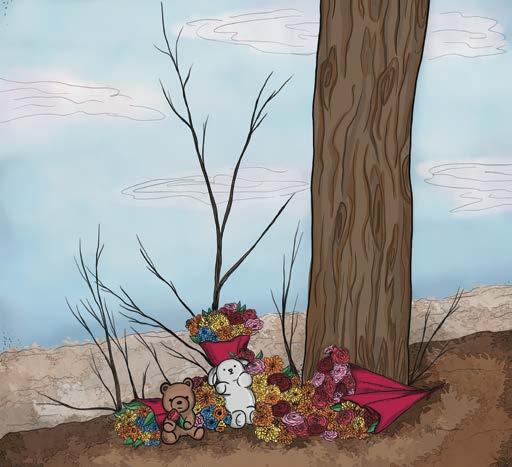
Nearly a year has passed since 2025’s tragic Lapu-Lapu Festival on Apr. 26, where a vehicle intentionally crashed into several people on the busy Vancouver street hosting the festival, injuring almost 30 people and killing 11. Subsequent support was given to the affected Filipino community through United Way British Columbia’s Kawpa Strong Fund, which helped raise over 2 million Canadian dollars. 36 different groups received grant money stemming from around 75 per cent of the funds raised within the Kawpa Strong Fund.
The non-profit organization Filipino BC announced on Jan. 7, that the Lapu-Lapu Day Festival 2026 is expected to take place on Apr. 17-19. They recognize that the grief is still affecting the community and emphasized that the intent of the festival is not only about celebrating Filipino culture, but also about honouring the lives lost and their families.
Alejandro Samper, who lost his parents and sister during the Festival’s tragedy, spoke with Global News about this year’s plans. He pleaded for the Festival organizers to consider suspending the Festival because the organizers never consulted the families of the people who lost loved ones in the attack.
“Give us time to heal, rather than going back at it.”
Guadalajara was the epicentre of the cartel’s violent response. Fear broke out early on Sunday with videos of panicked people running away from apparent danger at the airport, and footage of vehicles being set on fire all over the state. Jalisco’s governor Pablo Lemus Navarro confirmed 266 vehicles had been charred across the state, within the city and in different points of the connecting highways.
Flights were canceled and diverted from Guadalajara’s International Airport leaving passengers stranded on the terminal, and due to the city-wide cancellation of public transport over 1,000 visitors of the Guadalajara’s Zoo were left with no alternative than to stay the night.
Another city that was affected by the cartel’s violence was Puerto Vallarta, a beloved vacation destination of Mexicans and Canadians alike. According to Global Affairs Canada, more than 4,000 Canadians were in Jalisco at the time of the cartel’s violent activity on Sunday, with some Canadian airlines such as WestJet cancelling 37 flights heading and originating from Puerto Vallarta International Airport after it temporarily shut down, affecting Canadian travellers. On Tuesday, Feb. 24, Lemus removed the
U.S. President Donald Trump has pressured Mexico into taking action to get rid of the cartels, even placing a 15 million U.S. dollar bounty on Oseguera Cervantes’ head, despite the U.S. remaining one of CJNG’s largest drug buyers. Mexico’s President Claudia Sheinbaum shared that Oseguera Cervantes’ capture operation was planned and executed by Mexico’s armed forces, but that the U.S. had provided critical intel central to the operation’s planning.
While the death of CJNG’s leader is a major blow for the cartel, it is yet to be seen what the long term effects of this operation will have on the criminal organization, Jalisco, and Mexico as a whole.
Guadalajara, Jalisco, Mexico (Another Believer, CC BY-SA 4.0, via Wikimedia Commons)
NATALIA TOSCANO MURUA
NATALIA TOSCANO MURUA
UFV // Professor Profile: English professor teaches rhetoric at UFV
Understanding the deeper meaning of literature in this modern age
RACHEL TAIT
Dr. Alex Wetmore is an associate professor in the English Department at UFV.
Dr. Wetmore has been working at UFV since 2016, he specializes in 18th century literature and rhetoric. Wetmore spoke with The Cascade about the courses he teaches and why rhetoric is so important.
What inspired you to become a professor?
“About three-quarters of my way through [my degree], I had a professor who was really interesting, and her class was on detective fiction. I worked really hard on an essay, and she mentioned [that I] can actually keep going.
“I hadn’t really thought about it, but I realized, as I was getting towards the end, that I really loved studying, and I didn’t feel like I was done. I decided that I would go to grad school, and I would just keep studying literature.”
What do you like most about literature?
“I think what I like about literature is that you get a chance to raise and explore really big [and] exciting questions about meaning, language, [and] the power of storytelling … I just feel literature is a powerful medium for expressing meaning and for having cultural significance, and there’s no real way to exhaust your curiosity in studying it.”
What courses do you teach?
“Recently, I had a chance to teach three courses that I really enjoy. One is ENGL 319, which is The 18th Century Novel, and we get a chance to explore the origins and history of the novel as a genre … We get to read some early experiments in this genre where the authors don’t really know what they’re doing or what the rules are gonna be, and students find that really interesting.
“I really enjoy teaching ENGL 366, which is Literary Theory, and that’s a course where we get to ask the biggest possible questions that literature can raise around the nature of meaning, the power of language to mediate and shape our experiences of the world. We get to read not just literary works, but also what thinkers, theorists, and literary critics had to say about literature and how it works.
“The third course … which I’m teaching right now, is [ENGL 271C] Rhetoric and Contemporary Humour … In this class, we get to take humour seriously, and students learn a lot of rhetorical terms and concepts that will be valuable to their writing, and whatever kind of communication, writing, and reading, that they do, we do it through the lens of studying humour and comedy, with a particular focus on stand-up comedy.”
Why is it important to understand rhetoric?
“I think rhetoric is really important. [It’s] one of the oldest fields of study, it’s been around before Western philosophy established itself. It has its roots in giving powerful speeches, in persuasive
communication, but it’s also the study of what makes language and any form of symbolic communication effective, meaningful, powerful, [and] beautiful … understanding how that works affects our daily lives, it can be useful wherever your education takes you after UFV.”
What current projects are you working on?
“On the research side, I was fortunate to get an Insight Development Grant through SSHRC, which is the Social Sciences and Humanities Research Council of Canada, to start to develop a new project, which I think is exciting. This project is in a newer area of literary studies that goes under the umbrella term ‘the digital humanities.’
“With this new project, [entitled] ‘Tears for Gears,’ I’m looking at the relationship
February 2026 Senate recap
Senate serves as UFV’s academic governing body, making decisions that shape the daily experience of students and faculty. It advises the Board of Governors — responsible for the university’s business affairs — on matters of shared interest. Monthly public meetings are open to all members of the UFV community. This article will recap key agenda items of the hybrid Senate meeting held on Friday, Feb. 13, 2026.
Dr. Gerry Palmer, associate professor of UFV’s School of Business, motioned to make revisions to administrative elements of final grade appeal procedures and revise policy procedures.
“Since the development of the Students Rights and Responsibilities Office, the Office of the Registrar has handed some responsibilities from their work over to this newer office. This includes the administrative elements related to Final Grade Appeals.”
The motion was voted on and approved.
Dr. Tracy Ryder Glass, provost and vice president academic, motioned for the program discontinuations of the Applied Ethics and Political Philosophy minor and the Graduate Certificate in MindfulnessBased Teaching and Learning.
A common factor to cancel all these programs was due to low interest among students. Additionally, there was also no instructor available to continue running the MBTL program. However, since 2023
between technology and emotion as it shows up in 18th century writing … It was really trendy [then] to be emotionally sensitive [and] to be easily overcome by your feelings … It influenced literature, philosophy, medical science, all kinds of things … people often compared their feelings to machines [and] technological artifacts. They would describe the inner workings of their emotions as clockwork, or a watch.
“For this project, I’m going to use new text analysis tools that you can [use to] study patterns within a whole bunch of works in a digitized archive to try and figure out how references to emotions and technology intersected in this period.”
What do you want to do with this research?
“The project plan is for the research to culminate in a few outputs: a digital humanities online resource where we will share our research findings for other academics and relevant communities, an article to be submitted to a peer-reviewed scholarly journal on our work, a more public-facing essay [that is] ideally co-authored with my research assistants at UFV, and multiple presentations at academic conferences. My longer-term hope is that it may become part of a larger book-length project down the road, and also benefit my research and teaching at UFV in other ways.”
Q&A has been edited for length and clarity.
the program has been in suspension and should not affect any current students. The motion was voted on and carried.
David Johnston, registrar and associate vice-president, motioned to make changes to the entrance requirements, program requirements, and credential classification for the English Language Studies (ELS) program. The primary changes concern the name and classification going from ELS certificates to ELS
CONTINUED ON PAGE 05
JASLEEN SANDHU
CONTINUED FROM PAGE 04
associate certificates. The motion was voted on and approved.
Johnston also motioned to approve changes to the Library and Information Technology diploma. Students will be able to declare multiple “streams” — previously known as “concentrations.”
However, this will not affect the number of credits students have, Johnston clarified.
“They’re just restructuring, allowing students the ability to do multiple … concentrations.”
Another motion by Johnston was made to approve changes to the Psychology Honours program as outlined by department head Dr. Andrea Hughes’ memo. Changes include: PSYC 301’s (Intermediate Quantitative Methods and Statistical Inference) upper-level prerequisite credits have gone up from nine to 12 to help students do well in the program. The motion was voted on and approved. These program changes will come into effect in September 2026.
Johnston also presented possible options for sessional dates for the 2026-27
academic year. While tentative schedules for the next five years are available to view, Senate, in discussion with student representatives, worked to create an optimal schedule for both faculty and students for the upcoming year.
The Senate board and students discussed the number of days in the fall
reading break and the exam dates. The initial schedule proposed the final day for Fall 2026 exams to be Dec. 23, 2026. This late end to the semester prompted conversation to revise this schedule. Johnston remarked on the reasoning behind this decision.
“Labour Day comes late, which it does this year, it just pushes things down the line, so both options that I presented to you have the last day of exams on the 23rd. There’s some people who may want to discuss that. Alternatives. So perhaps any general questions, and then we can open the floor to concerns with the schedule.”
Bilal Faisal Faheem, president of UFV’s Student Union Society (SUS), suggested starting the Fall 2026 semester the week before Labour Day.
“If we are able to start the classes a week before, which is Sept. 2, [but this] is usually not the trend that we follow.”
The reasoning behind the suggested model to begin classes before Labour Day, was to provide enough instructional days within the semester, as well as a full reading week break in the fall. This suggestion prompted members of Senate to discuss other options.
SUS // SUS 2026 Candidates Debate
Candidates pitch their vision for SUS 2026
PRATI KAPOOR
Every year, UFV’s Student Union Society (SUS) hosts the annual elections that give students the opportunity to run for various positions on the SUS Board of Directors and executive members. This year’s election period runs from Jan. 8 to Mar. 6, and the candidate debate took place on Feb. 10 from 10-12 p.m. in Evered Hall.
There are five positions open for election: President, Vice President Internal, Vice President External, Vice President Students, and Student Representatives At-Large.
This year, around 20 candidates out of the total 24 who were running expressed their interest to participate in the debate. Hosted by the SUS Electoral Officer Patti Neufeld, the debate followed a structured format with timed responses and moderated questions.
Neufeld began by going over the agenda and laying down the ground rules. This was followed by the debate among the Vice-President Internal candidates, which included Prabujot Bagri, Trimaan Singh Bhatti, and Toshit Dawar. Candidate Prasoon Tyagi, was not present.
Bagri described the role as an opportunity to give back to the UFV community. He believes that his experience as the vice-president of the Political Science Students Association (PSSA), and his involvement in campus events and public
board meetings has made him wellequipped to run for the behind-the-scenes leadership that the role requires.
T. Bhatti emphasized that his background in accounting and finance and his past work experience has given him an “attention to detail” skillset needed to succeed in the role.
Dawar reflected on his experience with student startups and non-governmental organizations, explaining that these roles have taught him consistency, persistence, and how to turn challenges into opportunities.
Next were the vice-president students candidates: Jahan Arora, Soum Majumdar, and Saif Qazilbash.
Majumdar said that, if elected, he would focus on improving the backend process for clubs and associations including streamlining event approvals and clearer feedback systems for club executives.
Qazilbash stressed the importance of relationship building within the executive team and the extended student community. He proposed allocating a specific budget toward the Chilliwack campus and distributing funding across multiple events rather than concentrating resources on one large annual event.
Arora expressed interest in launching pop-up booths and surveys to gather student feedback. He also intends on fostering effective communication with
students and helping create an even more inclusive campus for students from diverse backgrounds.
The vice president external candidates included Arveen Bhatti, Zack Castiglia, and Manmeet Chhabra.
A. Bhatti described the role as being transparent, honest, and fearlessly advocating for students. She added that she aims to succeed in the role with clarity, integrity and transparency. If elected, she intends to bridge the gap between domestic and international students, ensuring equal representation for both. A. Bhatti also wants to bring down the cost of the Route 66: Fraser Valley Express bus, as it costs five dollars each way.
Chhabra expressed her strong interest toward student representation on campus. She aims to ensure student voices are not just heard but represented clearly and acted upon externally. She also spoke about building strong relationships with external stakeholders and representing student’s concerns and voices.
Castiglia believes in the importance of strong advocacy for students on a local, provincial, and national level. He got his inspiration from his peers who previously held similar positions at SUS and he hopes to continue their work by dedicating his last year as a student to the role wholeheartedly. Castiglia is also confident that his degree focusing on intergovernmental
Palmer introduced an alternative to the Fall 2026 schedule in order to find a compromise between the Senate board and students.
“Let me just do the simple motion … the reading week would be as proposed, and the last day of classes would be on the Wednesday, not the Friday, and exam period would end on the 2nd, not the 23rd.”
This motion was voted on and carried.
Dr. James Mandigo, UFV president and vice chancellor, was not present, but his report included updates to Senate such as the renewal of the Integrated Strategic Plan and Fiscal Sustainability. Mandigo also added that an update was provided at the second budget town hall meeting on Jan. 23, 2026, and discussion around the skilled trades programs is ongoing.
“Members of the Skilled Trades Training Council met with Minister [Jessie] Sunner and the CEO of Skilled Trades BC to receive an update, during which it was reinforced that the initial tranche of funding will help reduce waitlists for apprenticeship seats and support progression to Red Seal certification.”
relations, advocacy, and public policy has helped prepare him for this position.
Following were the presidential candidates Tanvir Hundal and Gurpreet Singh. Singh, who is currently serving as the SUS vice president external, believes his experience in this position has prepared him for the presidency. He proposed introducing pilot-based student involvement opportunities and emphasized his understanding of how the society operates.
Current Vice President Internal, Hundal, wants to use her background in advocacy and student involvement to build a SUS that students can rely on. Hundal also wants to focus on successfully advocating for what she can realistically do for students, recognizing that there are limitations to her role.
The debate concluded with nine candidates running for student representatives at large reps: Chloe Boughen, Amtoj Brar, Gurarmaan Dhillon, Balkarn Singh Gill, Prabcharn Singh Mahal, Josh Parson, Pranya Rana, Rudhar Sachdeva, and Abhayjeet Singh.
Each candidate expressed their interest in stepping up as student leaders and dedicating their time toward the student body at UFV. With voting open until Mar. 5, students are encouraged to cast their vote in the voting ballot sent to their UFV email to decide who will represent them in the upcoming term starting May 1.
Illustration by Eseniia Bondar
Provincial // Tumbler Ridge shooting in B.C. recap
Online speculation floods social media after B.C. school shooting claims eight lives
ABBY HANSEN
Dr. Irwin Cohen is a professor in the department of Criminology & Criminal Justice at the University of the Fraser Valley.
The small town of Tumbler Ridge in Northeastern British Columbia faced an unprecedented tragedy on Feb. 10, when a mass shooting at Tumbler Ridge Senior Secondary claimed the lives of eight people and injured 27. The deceased shooter was identified as 18-year-old Jesse Van Rootselaar, but her motive is currently still unknown. Reportedly, Van Rootselaar was visited by police for mental health reasons multiple times and had guns seized from her home that were later returned. Dr. Cohen shared his insight with The Cascade in the aftermath of the shooting.
“Not only is it [an] incredibly rare occurrence, but it also happens at a time in which we’ve seen pretty significant
reductions in violent crime … it’s an anomaly in a lot of ways for Canada.”
The victims killed in the school shooting were Abel Mwansa (12 years old), Ezekiel Schofield (13 years old), Kylie Smith (12 years old), Ticaria Lampert (12 years old), Zoey Benoit (12 years old), and Shannda Aviugana-Durand (39 years old). Van Rootselaar also shot and killed her mother, Jennifer Jacobs (39 years old), and half-brother, Emmett Jacobs (11 years old). Their bodies were found in their family home on Fellers Avenue.
19-year-old Paige Hoekstra was also shot and injured but is expected to make a full recovery. However, the condition of 12-year-old Maya Gebala remains uncertain, but according to CTV News, she is “showing remarkable progress.”
This shooting marks the deadliest attack in B.C. since the Lapu-Lapu Day festival attack in April 2025, which resulted in 11 deaths. The Tumbler Ridge shooting was also the second
deadliest in Canadian history since the 2020 Portapique, Nova Scotia massacre.
Dr. Cohen commented on how this tragedy has made an impact, especially in online spaces. Online speculation has pointed out that the shooter’s gender identity as a transgender woman is a potential explanation for the violent act. This stems from a recent internet trend of online agitators and politicians claiming that transgender individuals are more likely to commit crimes than others. However, Cohen said this explanation is inconsistent with reality.
“If you look at shootings, overwhelmingly the profile is young, white, male.”
In a study conducted by Hamline University’s non-profit research centre, the Violence Prevention Project (VPP), data shows that 98 per cent of mass shooters are male, and transgender individuals account for less than one per cent.
A 2021 study from the American Journal of Public Health also shows that
transgender individuals are over four times more likely than cisgender people to be the victims of violence rather than the perpetrators.
Dr. Cohen warned that although it is natural to want to identify the cause of the tragic event, it is of utmost importance to first gather all the information possible before making an assessment, and to avoid drawing conclusions when there is not sufficient information available.
“We’ve got to be really careful about that. Because without information out, we can speculate all day long as to what was the root cause, what drove it, what was the intended purpose of it.”
Dr. Cohen cautioned people against speculating on social media and blaming undeserving individuals or demographics.
“Speculating on social media, disparaging people, blaming specific things, is quite dangerous and can cause a lot of problems and challenges that we’re going to then have to unwrap and unravel down the road when more information comes out.”
When looking at potential causes that have influenced mass shootings in the past, the VPP explained that in a lot of cases, there are recurring themes of familial violence and problems handling strong emotions like anger and male entitlement.
Dr. Cohen highlighted that in criminology, there are three categories of youth offenders. There are children who rarely, if ever, get into trouble. Then, there are the adolescence-limited offenders, which Dr. Cohen said include around 80 per cent of children. Finally, there are lifecourse-persistent offenders, who amount to roughly 20 per cent of youth who get involved in crime at a later point in life.
“Kids whose delinquency, deviance, antisocial behaviour begins much earlier and persists through to adulthood.”
Dr. Cohen also stated that there are numerous root causes, but that most offenders do not suddenly decide to commit a crime on a whim.
“There are all kinds of things that happen at different developmental stages of peoples’ lives. But usually, the kinds of people who end up with long-term problems or really explosive, expressive forms of violence, it’s not ‘wake up one day and do it.’ It’s a long pathway or trajectory towards this.”
When asked where Canadians can go from here, Dr. Cohen emphasized the importance of staying calm in times of uncertainty instead of identifying the problem.
“We blame people, we blame things, and try to address those instead of the root causes of things.”
Illustration by Natasha Zilcosky / The Cascade
SNAPSHOT
A medium popcorn, regular ginger ale, and large community please
by Iryna Presley
I am by no means a “film person,” but through my library and politics studies I have found a particular love for community spaces and community forming around art. Thus, the movie theatre has become one of my favourite places.
After one of my solo viewings of The Hunger Games: The Ballad of Songbirds & Snakes (2023) an older man walking past my seat paused, said “Well that was something wasn’t it?” and we nodded, knowing we had the movie in common if nothing else.
I contemplated We Live in Time (2024) with the group of girls that my friend and I cried with during the credits, and the indie film Plainclothes (2025) connected me to the woman that matched my stunned expression after the ending.
From collective laughter across the room during Little Women (2019) when Amy got her foot stuck in cement, the sniffles across the theatre during Avengers: Endgame (2019), to the compliments on all pink outfits exchanged in line for Barbie (2023) — I shared all these movies with a community that the theatre created.
I don’t love every movie that I see in the theatre, but I love every time I get to go there.
BY KARA DUNBAR
UFV // UFV’s Communist Club expresses concerns following club probation
Events leading up to the initial suspension and subsequent probation
As previously reported on by The Cascade, UFV’s Revolutionary Communist Student Club (RCSC) was initially suspended on Jan. 14 by the Student Union Society (SUS) for breaching their Clubs and Associations Guidelines. However, they were later placed on probation on Jan. 23, after their appeal was submitted to and reviewed by SUS. During an interview with The Cascade, RCSC’s founder and President, Jordan Holmes, expanded on the events leading to the disciplinary action taken on the club.
“At the end of the day, we were just appealing to the SUS. We were trying to go about this democratically.”
The original suspension happened following the UFV Campus Engagement Expo held on Jan. 14 when the Communist Club distributed pamphlets petitioning to organize a student strike following in the steps of Canadian Federation of Students Nova Scotia’s (CFS-NS) strike planned for March. The student strike coordinated by CFS-NS, called for a reduction in tuition and other university related issues.
“We’re fighting for lower tuition. We’re fighting for affordable housing. We’re fighting for divestment from war industries, from mining industries, from a lot of these awful, harmful industries.”
Holmes distributed the pamphlets and gathered signatures from sympathising students to later present to SUS, however, the pamphlet contained wording that SUS President Bilal Faisal Faheem pointed out potentially conveyed the idea that SUS was already on-board with the movement, when this was not the case. Holmes said that he and Faheem had a brief chat where Faheem requested the wording on the pamphlet be corrected before further distribution, which Holmes confirmed was done immediately after the request.
SUS later contacted Holmes through email to notify of the guideline infringements committed by RCSC, which included Misrepresentation of Authority, Failure to comply with SUS Governance and Politics, Improper use of Communications and Platforms, and
Abuse of Club Politics. RCSC was also given the opportunity to appeal before any further disciplinary action was taken in accordance to section 16.3 of the guidelines, which reads:
“All Clubs & Associations reserve the right to plead their case prior to any disciplinary action.”
The distinctive use of wording for the appealing process, one instance being before any further disciplinary action, and for the other instance being prior to any disciplinary action, created a point of contention for both parties. RCSC received a two day deadline to submit their appeal to SUS, which the club abided by.
In their appeal, Holmes requested that the club’s privileges be reinstated given their right to appeal was denied prior to the suspension. SUS carefully considered RCSC’s request and responded by informing them their club could continue, although on a probation status, and clarified that SUS has the right to respond prior to escalated or final disciplinary outcomes in accordance to section 16.2, reading:
“16.2: Disciplinary action varies based on the severity of the act, but some penalties could include:
16.2.1: Immediate cancellation of a Club & Association Event.”
SUS also mentioned in an email sent to RCSC that while they considered the club’s appeal, the suspension was an interim measure and not a final sanction, which ultimately resulted in the suspension being dropped and probation being employed instead.
“This decision was reached after careful consideration. The actions taken allows your Club to express your interest in advocacy and student engagement, while upholding SUS’ obligation to administer our Club & Association guidelines and policies in a consistent and equitable manner.”
During the interview, Holmes expressed his concern with the manner in which his club’s situation was handled, stating that to him it feels like political repression. He acknowledged that calling
for a student strike during the Campus Engagement Expo was very political in nature, but to have the club initially shut down because of the wording on a pamphlet seemed like a drastic response — recalling that they immediately crossed out the sentence on the pamphlet upon Faheem’s request.
Holmes reported feeling as though agitating the student body when campaigning for better conditions for students on campus was frowned upon and potentially placed them in a tenuous relationship with UFV.
“I feel like they shut us down as a result of us agitating for the student body [when] trying to actually secure better conditions for the students on campus. This throws us into a [possibly] tenuous relationship with UFV as a whole.”
Holmes is worried that what happened to his club could potentially be repeated with other clubs supervised by SUS, because of the power they demonstrated to enforce the guidelines where deemed applicable, reserving the right to provide a clear explanation before responding with potentially severe disciplinary action.
As of writing this article, the RCSC remains on probation and has a limited ability to table at UFV, capped at six days total throughout the remainder of the semester, along with other restrictions that significantly impact their ability to engage as a club.
Holmes mentioned that the RCSC is happy to cooperate with SUS, as they did when Faheem approached them during the expo to have the pamphlet changed, and that they always operated within the guidelines provided by SUS.
“I can understand where SUS is coming from [and that they] don’t like the wording on the pamphlet. [When Faheem] came down and explained to us, ‘Hey, this isn’t okay. Can you change it?’ We changed it. We’re happy to work with them.”
The Cascade made several attempts to reach out to the Student Union Society for comment and has not heard back at the time of writing.
NATALIA TOSCANO MURUA
Illustration
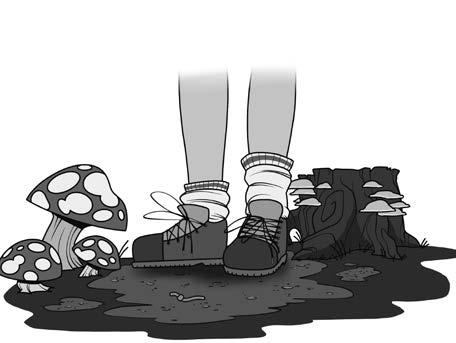
THE ENVIRONMENTALIST: the world beneath your feet
A
climate solution — the soil under your soles
Welcome to The Environmentalist, your column for understanding the natural world. Today, we’re exploring what’s beneath our feet.
Soil is one of the most underestimated ecosystems on Earth. We walk on it, build on it, dig through it, but rarely think about it. Mind you, a quarter teaspoon of healthy topsoil can contain billions of microorganisms: bacteria, fungi, protozoa, nematodes, arthropods, and microscopic algae. Not millions. Billions. Suddenly, the ground doesn’t feel so empty.
A common misconception is that soil is just ground-up rock. But it is a living system. It forms slowly — sometimes over thousands of years — through the breakdown of minerals, the decay of organic matter, and the constant work of organisms recycling nutrients. Additionally, we have to consider the freezing and thawing that happens in northern regions, just like in British Columbia. What looks like brown dust is actually a biological metropolis with immense biodiversity.
Bacteria decompose organic matter, releasing nitrogen and other nutrients plants need to grow. Fungi form symbiotic relationships with roots, extending their reach through microscopic filaments. Earthworms aerate and mix the soil, improving water infiltration and soil structure. Even teeny-tiny nematodes regulate microbial populations and influence nutrient cycling. Together, these organisms create what scientists call the soil food web: a complex network of energy transfer and nutrient exchange. Plants feed the system through root exudates, which are chemicals they release into the soil that end up nourishing microbes. And they,
in turn, make nutrients available to plants. It is less a hierarchy and more of a circulation of resources.
Soil does more than grow food and plants. Globally, soils store more carbon than the atmosphere and all vegetation combined. That makes them one of the planet’s largest carbon reservoirs. When soils are healthy and undisturbed, they can act as carbon sinks, locking organic matter underground.
Yet, soil is threatened by erosion, urban expansion, over-tillage, and intensive agriculture, leading to that stored carbon being released back into the atmosphere, and they are degrading land faster than it can regenerate. The United Nations has warned that 33 per cent of the world’s soils are moderately to highly degraded. And unlike forests, soil doesn’t grow back in a decade. It rebuilds slowly — about one centimetre of topsoil every thousand years.
There is something quietly profound about the role soil has in our lives. Beneath every forest, every lawn, every farm field, and every step you take there is a living community performing essential work without recognition. No blossoms or feathers, nor dramatic migrations. Just organisms cycling nutrients, storing carbon, filtering water, and holding the planet together — literally.
The real virus of our world
The next time you step outside, consider this: you are not standing on dirt. You are standing on a highly fragile and rapidly degrading ecosystem that is the base of all life on earth. As the Lorax once said, “Unless someone like you cares a whole awful lot, nothing is going to get better.” So, let’s care about our soils.
There are too many damn ads in the world. Everytime I enter a website, there’s a bundle of distracting, random ads that have nothing to do with what I’m reading. If I want to watch a quick clip on YouTube, I have to watch three ads first. On TV, and especially during award season, I must endure 10 commercials before I can watch three minutes of my program. They’re so repetitive, too! The same annoying songs play like a broken record in hopes of attracting audiences, but all it does is slowly drive me mental.
Granted, I understand that’s how business works. You want people to invest in your product? You have to promote it. But the least they can do is switch it up from time to time or allow us more skip buttons. Now, I can’t knock YouTube because they have given viewers the luxury of the skip button, but it’s not consistent. I suppose there’s no point in complaining because the internet will always plague the world. The upside to ads? It might deter us from staring at our phones more often. For that, my sanity thanks them.
BY VERONICA POWELL
Illustration by Hannah Bricknell / The Cascade
Illustration by Iryna Presley
FABIOLA CRUZ ALDERETE
SNAPSHOT
No one is safe from my barista mind
I enjoy making all manner of delicious lattes and drinks, and the more I grow my barista skills, the more ideas pop into mind. So here’s this idea: I’m crafting a drink for each of The Cascade’s sections!
News would be an iced shaken espresso with cold foam. A dynamic range of textures, strong yet smooth, I think it encapsulates the vibe of the section well.
I’d give Opinion a white chocolate peppermint mocha — smooth, refreshing, and balanced — a perfect fit!
For Feature, I would craft a yuzu espresso tonic. The strength, statement, and intricate balance of a feature is on par with this drink.
I feel Culture would vibe so hard with a London fog. Both the section and the drink make me feel at home, and both reflect so much passion and craft.
The Sports section gets a cold brew — simple but efficient, energetic, and ready for action.
Last but not least, I’d give Arts an iced vanilla matcha latte. An explosion of flavour perfectly balanced to be fresh and exotic!
Bonus: I’d give the production team an espresso affogato. Just as ice cream and espresso go well together, so does design and writing.
BY NATALIA TOSCANO MURUA
Lifestyle //
A deconstructed recipe for unfinished tasks
The potential reasons behind an unchecked to-do list
processes mean different ways of resolving challenges.
As a student, I always aim to be responsible, get things done, and deliver good results. I like to think that students in general aim for that, but sometimes despite one’s best efforts, life brews the perfect concoction for chaos: a generous scoop of challenging undertakings, two cups of perfectionism, and a pinch of decision fatigue are merely a handful of the ingredients this hampering recipe may contain. When wanting to check items off the to-do list, I find that it is hard to even find a place to start, and in the past, this made me feel that I was to blame for not being able to make any significant progress. Little did I know, this disastrous recipe had less to do with the “ingredients” that I was using, and more to do with the amount and the process.
The feeling of being overwhelmed and frozen in inaction when faced with certain challenges is called task paralysis. What distinguishes it from procrastination is that task paralysis happens despite the effort and intent to get to tasks, whereas procrastination stems from a choice factor. There are several potential causes for task paralysis, which may include the desire to achieve excellence or being a perfectionist, being afraid to fail, or becoming overwhelmed. This leads to becoming avoidant and feeling unmotivated from decision fatigue due to having too many choices to make without a clear path ahead. It is worth noting that people with ADHD may have a rougher time with task paralysis, as different thought
Identifying the underlying causes behind why you may be unable to get started with what you have to do is key to understanding how to move forward. In my case, I grappled with perfectionism, fear of failure, being unmotivated, and becoming overwhelmed. Understanding how all these factors contributed to how I was feeling helped me shift from blaming myself and turned it into a reasonable explanation that helped me discover what I could adjust for better results. This issue had haunted most of my student life — to me it felt like being unable to start a task was heavily frowned upon, and that it was synonymous with being lazy. Now I know that is not the case, so if you relate and want to know how to break free from task paralysis, here are my tried and true tips, backed by science:
To tackle perfectionism, recognize that progress is equally as valuable as results. Rewarding yourself for making progress instead of only wanting a perfect outcome should help you feel that your work is meaningful. This is important, because it shifts weight away from the goal, and makes starting the journey not feel pointless.
If you are afraid to fail, remember that everyone makes mistakes, and you are allowed to make them too. Mistakes are an excellent way to learn and become better at something, just as a toddler learns how to walk upright by trying and falling until they get it right. And even so, I still trip and fall at the ripe old age of 24,
so metaphorically speaking tripping over the same rock twice happens, it’s okay. Failure is a normal part of life.
When overwhelmed, categorize tasks by ranks — optional, important, necessary, and urgent. Go for what is urgent first, those are the things that must happen then and there. Then you can do things that are necessary, followed by those that are important, and last but not least, optional. Prioritizing tasks can help pave the way forward.
If you feel like you can’t make another big decision or you’re going to explode, try dumbing them down as much as possible. Simplifying and limiting your options from a hundred to just a couple can make a massive difference. I personally challenge myself to give myself “only two soups” as the Spanish saying goes. Hay de dos sopas, either I go to the market today, or I go tomorrow. Simple.
Last but not least, if you are feeling unmotivated, remember to not force yourself but also go through the motions of giving it a try. Giving the two minute method a try may surprise you, since that method consists of getting at a task uninterrupted for merely two minutes, with the freedom of stopping after if you don’t feel like it. It is possible that once you get past that initial barrier of actually starting, you’ll find it easier to continue. If you truly aren’t feeling it, then you can try again at another time.
Now, with a cup of analysis, a spoon of compassion, and a teaspoon of cunning, you’ve got a potential recipe for success.
NATALIA TOSCANO MURUA
Illustration by Iryna Presley
OPINION
Feminism // “Boys will be boys”
Why women’s representation in sports matters
CASSIE
WILLIAMS
We’ve all heard it. In gym class, around the workplace, in media, and in social gatherings.
“Boys will be boys.”
This antiquated message has been long-standing in all sorts of settings.
But are boys just being themselves when harassing girls? When ridiculing them for doing the same things they do? How about when sexually assaulting women? Is it excusable then?
Following the United States men’s hockey team’s gold medal win at the Milano Cortina 2026 Olympic Games on Feb. 22, U.S. President Donald Trump had a phone call with the team. What he had to say was as disappointing as it was unsurprising.
“We’re gonna have to bring the women’s team,” Trump said apologetically during the call. Gonna have to. After they achieved the same thing? Not to mention that they’ve been winning gold for years while this is the first time for the men’s team to place first at the Olympics in 46 years.
This isn’t just distasteful. That phone call opens the window into the deepseated ridicule that women’s sports have faced for… ever.
The chauvinistic behaviour demonstrated by Trump isn’t at all surprising, but the blatancy of it was wild. To make a comment like that and not even call to congratulate the women’s team — for winning the same medal — is unreal.
As a woman who comes from a very athletic background and who has taught martial arts for years, I’ve encountered my fair share of misogyny — most of it in work settings and not on the mats if I’m being honest — but still. It’s there, it exists. And I fear it hasn’t gone away like some people like to believe. Just because
“You don’t have to be the one mocking to be complicit in demeaning women.”
it’s the 21st century doesn’t mean deeply entrenched sexism just, poof, disappears.
Going back to the Olympics, these revered games didn’t permit women to compete until the year 1900, when a mere 22 out of 997 athletes were women.
Women’s achievements in sports have long gone under-reported and were barely even accepted in the past. Women were deemed unfit for athletics when their participation in sports first bloomed largely because it was disgusting how violent and sweaty they got from competing. To avoid this, it was proposed by powerful men that women should only be allowed to compete in graceful sports like figure skating or swimming. Listen, as someone who competed in sparring divisions for years, I can tell you that sweat is damn earned and nothing beats the rush of a match — which still requires plenty of grace.
Now I’m all for celebrating a big win, and if their president was less of an asshole, maybe I’d feel a little differently toward the men’s U.S. hockey team. But when you huddle around a phone and celebrate sexism with laughs and cheers, that’s when I lose respect.
You don’t have to be the one mocking to be complicit in demeaning women.
This could have been a purely celebratory and historic moment for American sports. However, the focus shifted due to this ignorance.
“I think this is a really good learning point to focus on how we talk about
women, not only in sport but in industry,” said Hilary Knight, captain of the U.S. women’s hockey team in response to Trump’s comment. “Women aren’t less than.”
It’s unfortunate this controversy has largely overshadowed the accomplishments of both these teams, but I believe it has led to a greater conversation, one that has been ongoing for generations.
Stand up for women. Not in big Superman-esque ways, but by standing up to misogynistic men and fighting against everyday comments like “it was a joke” and “boys will be boys.” It’s understood that it was meant as a joke. Doesn’t mean it’s funny. It’s not that the teams don’t get along either. The men’s team may have supported the women’s by going to their games and celebrating together after their dual wins, like some members have said — but that really goes out the window when you choose to join in on a “joke” at the expense of those you claim to respect. You can’t claim to be so courageous and then drop the ball when it comes to standing up to one of your own in defence of women.
It’s time to stop laughing at jokes that aren’t funny and stop normalizing casual misogyny.
“You can’t claim to be so courageous and then drop the ball when it comes to standing up to one of your own in defence of women.
”
SNAPSHOT
Love letter to my best friend’s
dog
I love my godson. He’s small, sweet, the perfect companion. And he’s soft. No, he’s not a baby, rather a dog. Specifically, my best friend’s dog. I met Milo the first day she brought him home and, since then, he’s been the greatest gift. When I think of him, I marvel at how such a small, simple creature can bring such insurmountable joy.
While the winter blues are slowly thawing as the March sun begins to bless us, they’re still here. In dark times, sometimes all you want is a little buddy who has no idea what the hell is going on. A completely unaware being, innocent to the world’s struggles. He just exists. And we love him for it. Having a little comfort is more important than ever when balancing so many stressors and existing in such a chaotic world. So, kidnap your friend’s dog! Catsit for a neighbour! Buy that fish? Whatever it is, I promise you’ll find a source of comfort in a non-human companion. So thank you, Mr. Milo, for bringing so much joy in a world that sometimes has so little, even if you don’t know it.
BY CASSIE WILLIAMS
Editor — Caitlyn Carr
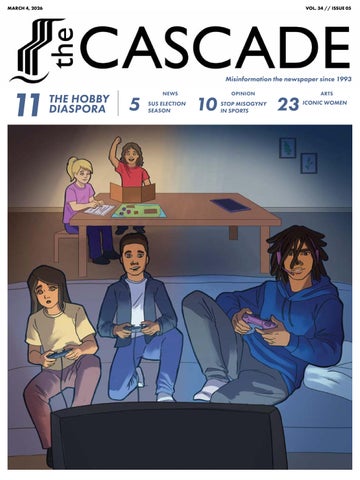
THE HOBBY DIASPORA
Community culture changes in gaming
ZACKERY FITZPATRICK
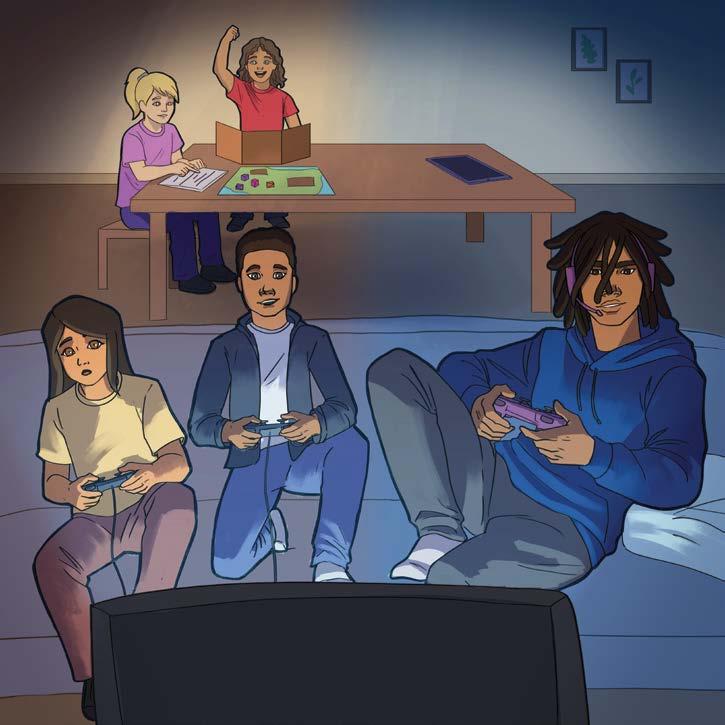
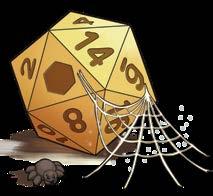
I grew up around competitive games. This was long nights around the TV with friends, religiously following tournament brackets, and eventually dipping our toes into local events when we could. Then, tabletop games became a fixation. This was late-night Yu-Gi-Oh! matches, Dungeons & Dragons (D&D) campaigns around kitchen tables, and, eventually, running games myself as a Dungeon Master.
See, there was a time when these hobbies were a place. You went somewhere to do it. You had to. A friend’s basement or a local game store with folding tables and mismatched chairs. Hobbies — especially games — were dependent on proximity, and whoever happened to show up that day. For many people, that physical presence was inseparable from the game itself.
But now, online gaming, voice calls, forums, and other tools to help with all sorts of hobbies or games have existed for decades, facilitating and generating community. But something feels different lately. With it getting harder and harder to trust what you read or watch online, suddenly the online spaces where folk would congregate or seek out information have become riddled with landmines, be they AI-generated content, bad-faith actors, or political polarization.
Over the last decade there’s been an evident shift in many communities — something accelerated dramatically by the COVID-19 pandemic. As competitive and social pastimes that once relied on in-person gatherings now thrive in these online spaces, a dependency on physical attendance has been traded for Discord servers and browser tabs.
This migration of a community from its original homeland (in this case, from physical to digital) is nothing new, and has been building gradually for years. However, I believe the ever-evolving technology of today warrants a closer look into this diaspora. What are the ramifications of this shift? The lingering effects and takeaways? Since it would be impossible to cover every hobby under the sun, I took a look at some major gaming spaces to reflect on how they have, and continue, to change.
“Perhaps that journey can begin with a login, but end with a handshake.”
THE LOST NEED FOR PHYSICAL PRESENCE
Exemplary of this shift, competitive Super Smash Bros. Melee (2001) (Melee, or, Smash) once lived and breathed through local tournaments, before online matchmaking became an option. You had to show up if you wanted to play seriously.
The Cascade had the pleasure of sitting down with Dazrin Tioseco, a longtime figure in B.C.’s fighting game community to talk about his experience witnessing this transition.
Dazrin spoke with nostalgia for the grassroots culture that defined earlier Smash scenes and with a pragmatic understanding of how online play has reshaped community dynamics.
“Back then it was definitely like, if you wanted to play Smash, you had to go to the local scene, you had to attend an event.”
With over a decade of experience as both a competitor and tournament organizer, Dazrin first got involved during the height of Project M (2011). This mod for Super Smash Bros. Brawl (2008) made it play more like Melee, helping unify the once-at-odds communities of the two games through events that bridged skill levels and regions. In the years since, he has worked in esports production — formerly serving as head of production for TGS Esports — and now helps organize local events using his skills and experience.
The physical presence requirement of these events wasn’t just about logistics and competition, it built relationships, etiquette, and a shared sense of community. Tournament organizers lugged old CRT TVs up staircases while players travelled across borders for tournaments. Casual competitors and top players were mingling in the same spaces for the love of the game.
But in 2020, a fan project called Slippi introduced rollback netplay to Melee — a type of code for network connection that makes gameplay much more seamless. With high-quality online competition possible, they then added a ranked mode in 2022, sparking a massive change, which Dazrin explained had a significant impact.
“The biggest con is that there’s not much incentive to go to in-person locals as much as before, because you don’t need to go to an event if you don’t want to. You can stay at home and do whatever you want and play in your pajamas.”
The shift was palpable as practice, competition, and community were now accessible from the comfort of your own home (PJs and all) despite having once been entirely inseparable from physical events.
“All of my Melee experience from that point forward was only netplay. And when I came back, it was very different. The scene was completely new — new people,
new faces. Some familiar faces here and there, but for the most part … that transition from the previous era … was quite different because there was almost no real reason to go to a local anymore. Like the scene could and did exist completely online.”
REDISCOVERING COMMUNITY
Certain hobbies are just more predisposed to this migration, adapting and reshaping themselves in the digital age. For example, the COVID-19 pandemic disrupted most tabletop games, forcing groups to evolve and learn new ways to play.
Lucy Reimer, president and co-founder of UFV’s Tabletop Games Club, described the club as one such community that was born in a digital space before it went about reclaiming physical ones. Discord allowed members to coordinate sessions, socialize, and run games when physical meetings were impossible.
“The whole club was founded online,” Reimer said. “It was so natural that it grew into in-person. We just couldn’t contain everything online.”
Under her leadership, the club has rebuilt and expanded from an online Discord-based community into a slew of in-person events designed to foster a third-space for students. But, as Reimer explained, the transition to in-person gatherings presented challenges.
“I found that moving people to in-person [meetings] was a little bit harder, but it was accepted. A lot of people want to do this because of the situation at UFV in general … which is such a commuter school.”
Illustrations by Rebeca Marquez Lopez / The Cascade
Board game nights, chess meetups, and social deduction games drew students seeking connection alongside their gameplay, something Reimer believes online meetings struggle to replicate fully.
“People wanna have social things, and part of our Thursday [game] nights is [that] it’s spontaneous. People just bring whatever game they want to and people play it.”
However, one of the advantages of keeping things online is convenience. Players no longer need to coordinate schedules, travel long distances, or rely on limited setups. As Dazrin explained, they can log in at any time and find camaraderie anywhere across the world.
“Instead of needing to organize going to someone’s house to play and practice for a few hours, you could just stay at home and play for 12 hours a day if you really wanted to.”
That accessibility has accelerated skill development dramatically in Melee. With training tools, replayable match footage, and instant matchmaking, the competitive meta of Smash and many other games have advanced at unprecedented speeds. What once took years of experimentation now evolves in months.
Still, Dazrin noted that a consequence of playing online is that doing so can often more easily satisfy players’ competitive urges, thus robbing them of incentive to challenge themselves.
“The pro is the convenience, the level of play always advancing and just being motivated to continue to improve. The people who ‘get it’ — the people who know exactly what it takes to play at that level — they have a deep respect for those who also put in the same amount of time and energy to be able to play and practice and improve as much as everyone else.”
Dazrin then reflected on past events, and the shift in culture.
“Before it was just a regular thing, where if you hosted a really big tournament ... everyone came out. Everyone who was anyone in the scene came to the tournament. To be able to play and shoot their shot, and make a mark on the scene. Whereas now it’s ‘if my friend is going, maybe I’ll show up if I have time.’”
ETIQUETTE AND ACCESSIBILITY
As a self-proclaimed hobbyist, I’ve experienced the energy of bustling in-person events and the intimacy of voice calls with players scattered across time zones. With one foot in physical communities, the other in digital ones, I’ve noticed that the two experiences are different in more complex ways than appear obvious on the surface. People behave differently when they’re face-to-face compared to over a text chat or voice call, where players’ emotions can get the better of them without fear of repercussions or embarrassment from peers.
Anonymity and distance embolden negative behaviour, sometimes becoming full blown, overt toxicity, as Dazrin has observed over the years.
“People, because they’re hiding behind a screen, feel more comfortable being toxic.”
The physical presence of an opponent is humanizing, and it reinforces mutual respect. While negative behaviour can occur offline, Dazrin explained that the social consequences are more immediate and tangible.
“When you’re in person … you have to treat that person as a real human being because they’re right there. And because they are.”
Seeing someone’s reactions, sharing physical space, and participating in the collective ritual of it all, contributes to a sense of accountability that digital environments struggle to replicate.
“When you’re in person … you have to treat that person as a real human being because they’re right there. And because they are.”
Yet for newcomers, this shift can actually be empowering. Dazrin believes that online spaces lower the barrier to entry, offering a place to observe, learn, and connect before stepping into a physical venue.
“Maybe a person who is just dipping their toes in, joins a server just ‘cause they’re mildly interested, and they end up going to an in-person tournament and having a lot of fun there … It can make it a lot less daunting to go to something when you make a lot of friends online.”
Rather than replacing in-person culture entirely, online spaces often act as gateways. Dazrin shared that they provide continuity between events, extend conversations beyond tournament brackets, and allow friendships to persist across distances.
“It’s deeply integral to the community that we have these online spaces to be able to play [with] each other and talk and hang out and be in voice call. It’s different, but it’s good too.”
Online spaces expand access for players facing challenges, including various disabilities, social anxiety, financial limitations, or scheduling trouble. Reimer acknowledged this, discussing how there are opportunities made accessible online that often physical spaces or communities can’t facilitate.
“Accessibility is a huge one, at least for me. I’m a huge advocate for accessibility. Hobbies like this should be available to every single person who wants to enjoy them [and] online you can tailor your experience however you want.”
That flexibility can allow people to participate on their own terms and to experiment with hobbies with less fear of judgment. Reimer shared that online communities can therefore become safe spaces where identity and expression can be explored.
“You can turn your camera off. You can mute yourself. You can adjust the game to how you wanna play it.”
THE COMMODIFICATION OF PLAY
At the same time, this also introduces a new dynamic to people’s engagement. Without physical presence, participation can drift toward passive consumption rather than active engagement. Reimer shared her experience with online gaming, emphasizing how common multitasking and fragmented conversations can become.
“I started playing D&D online … but it was so easy to zone out … I could turn my camera off. I could mute myself. They could think I’m still there and I’m not. I could not be paying attention … One of my D&D campaigns [actually] fizzled out because nobody paid attention to what was happening.”
This shift reflects a broader trend: the attention economy. Digital platforms compete for user focus, which tends to encourage faster paced gaming sessions, impatience, constant novelty, and rapid transitions between activities. Reimer articulated that in that environment, hobbies risk becoming background noise rather than intentional experiences.
“Online things don’t feel like a hobby anymore… [now] it’s about the commodity, it’s about having access.” Physical gatherings, by contrast, demand intention. Attending a club meeting or tournament requires time, travel, and commitment. That investment often fosters stronger social bonds, and a sense of occasion. Using crochet and chess as examples, Reimer elaborated on the role of intention in hobbies.
“I love crochet. It’s so fun. I can do it by myself. I can do it at my own time, at my own pace. I’m very impatient with it because I really wanna get stuff done, but I take my time. [Whereas] playing board games is a hobby because I set time apart to do that intentionally, versus ‘I’m gonna pull up my phone and play chess absent-mindedly’ … It’s about the intention.”
“SO… GET OFF THE SCREENS?”
Well. Not quite. This isn’t me pulling a “kids and their damn phones these days” or “the internet is rotting your brain” (even if I think it definitely is). The hobby diaspora itself is not a story of loss. If you ask me, online and in-person spaces can and do function as complementary ecosystems rather than competing ones, with players practicing online and competing offline, or clubs organizing digitally but meeting physically. Dazrin put it best, insisting on the importance of these spaces, and urging people to take interest.
“I deeply encourage and implore anyone to just give it a try. If you’re even mildly interested, join a server, see what happens, and play some games — meet some people.”
The challenge moving forward is maintaining balance and ensuring that digital expansion enhances, rather than replaces, the community culture that helps to give hobbies meaning. Behind every tournament bracket, board game table, or voice call lies a simple truth: it’s all about people. The migration online has opened doors for countless participants, accelerating growth and broadening inclusion, but it has also prompted reflection on what makes hobbies fulfilling — the joy of something shared, and, as Reimer put it:
“There’s beauty in how mundane everything is in person.”
The hobby diaspora is ongoing, and while its trajectory remains uncertain, the passion that drives these communities endures gathered ‘round CRTs, kitchen tables, and Discord servers alike. People continue to seek a place to belong, a game to play, and others to share it with.
Perhaps that journey can begin with a login, but end with a handshake.
Illustrations by Rebeca Marquez Lopez / The Cascade
SLAPSHOTS
Maybe hockey fights come from more than anger Nostalgia overload
Everytime I watch a hockey game (which is not very often), there’s some fight breaking out. I can’t understand why it’s a natural reaction from players, even to the mildest of threats on the ice. Then I heard about Canadian NHL draft pick Gavin McKenna being charged with felony aggravated assault (which was later dropped) while at a bar. My question: is it that competitive athletes are conditioned to be aggressive, or is it to feel empowered and dominant?
Although the situation with McKenna was reportedly a matter of defense after there was an exchange of words about his mom, I would consider his behaviour being influenced by a competitive nature and asserted himself only because it was out of protection. Perhaps that’s what dominance on the ice is about — not to win or have the upper hand, but to protect oneself or one’s teammates out of brotherhood. Off the ice, aggression can be a response stemming from a desire to defend those we love. In that regard, I view sportsmanship differently and I understand those who choose to fight.
BY VERONICA POWELL
The Winter Olympics are one of my favourite events to watch on television. High flying action and intense thrills are the perfect recipe to bring strangers together and cheer on athletes from across the globe. And nothing has shown that more to me than the Vancouver 2010 Olympics. Before the games even got started, I got to see one of my late family members run the Olympic torch relay in early February of 2010. It is core memories like seeing them run down the street with a massive smile on their face while holding the Olympic torch that makes me thankful to have witnessed a special event in my lifetime.
From the adorable mascots (Quatchi is my GOAT), the patriotic atmosphere of downtown Vancouver, and Sidney Crosby’s golden goal, Vancouver 2010 had everything you would want in an Olympic Games and will always hold a special place in my heart. And now, 16 years later, we have the 2026 FIFA World Cup playing matches in Vancouver this coming summer. I cannot wait to witness the city come alive again with the passionate spirit of competition that we last saw in the 2010 Winter Olympics, once again ready to show the world that Vancouver is a sports town.
BY ETHAN PAULSON
Basketball // Unable to upset: UFV falls to top ranked Huskies in playoffs
Women’s basketball season ends at the hands of defending champs
ETHAN PAULSON
This season was always going to be special. Cascades WBB head coach Al Tuchscherer has been at the helm of the program for 24 seasons and has seen hundreds of athletes play for UFV, but this was going to be the final year that he would coach one of his own kids.
Julia Tuchscherer was a force in her final season as a Cascade. After the squad lost star players Nikki Cabuco, Maddy Gobeil, Google Sidhu, and Julia’s sister Deanna Tuchscherer to graduation after the 2024-25 campaign, it opened the runway for Julia to flourish. Now with more time and space on the court, the fifth year forward was able to take off in 202526, posting career highs in total points (340), minutes played (657), rebounds (172), and blocks (49). J. Tuchscherer’s dominance on the court this year showed up not only on the Cascades’ stat sheet, but put the rest of Canada West (CW) on notice as she led the conference in points per game (17.0), was second in blocks (49), and fifth in rebounds per game (8.6), all on route to a second straight Canada West First Team All-Star selection.
Despite J. Tuchscherer having her best season as a Cascade, the team struggled to find their footing as they finished the regular season at 9-11 and had to settle for the seventh seed in the CW playoffs. The Cascades jetted over to Saskatoon for the first two rounds, with the winner of the play-in round between UFV and the Mount Royal University Cougars going on to play the weekend host in the University of Saskatchewan.
And while Mount Royal had the better record at 10-10 in the regular season, the veteran experience of J. Tuchscherer and fifth year forward Esther Allison was too much for the Cougars to handle, as the Cascades took the lead in the first quarter and never looked back. Allison led the
Cascades with 18 points on the night and shooting 8-11 from the field and picked up seven rebounds, while J. Tuchscherer put home 13 points, and led the team with seven assists and four blocks as the Cascades cruised to a 78-60 victory.
Even with momentum going for the Cascades after their play-in round victory, it did not carry through into second round as they fell the next day by a score of 95-58 to the number one nationally ranked and undefeated Saskatchewan Huskies. J. Tuchscherer led the team with 17 points, six rebounds, and two blocks in the match, but her efforts were not enough to get past a juggernaut in Saskatchewan.
And while a second-round exit may be disappointing for a Cascades squad coming off back-to-back seasons where the team played for the CW bronze medal, winning in 2024, a loss to one of the best teams in the country is nothing to take lightly. And when taking on a team led by reigning U SPORTS Female Athlete of the Year, Gage Grassick, it was never going to be an easy fight as the battletested Huskies proved to be too much for the Cascades to handle. The Huskies had not lost a game in exhibition, regular season, and post-season play since Nov. 2, 2024 before suffering a shocking loss in the CW semi-finals to the Calgary Dinos, just one weekend after sending the Cascades packing.
And so, another Cascades season and a storied UFV career for J. Tuchscherer has come to a close. From a trip to the 2023-24 U SPORTS Final 8 to three separate Canada West All-Team selections, Julia made a significant impact on the Cascades program and her departure will leave big shoes that need to be filled. But with the Tuchscherer name still attached to the program, there is no doubt that this team will continue to compete for years to come.
Illustration by Iryna Presley
Illustration by Iryna Presley
SPORTS
Volleyball //
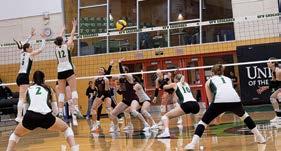
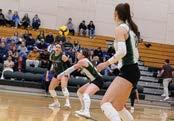
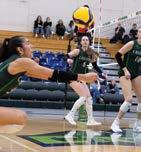
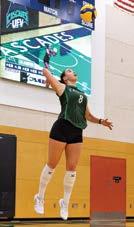
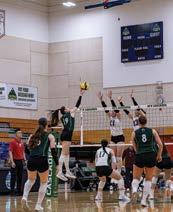
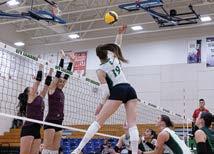
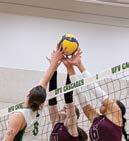
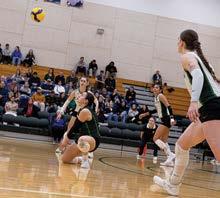
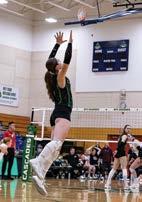
Set Scores: MacEwan vs UFV
MacEwan (1) vs UFV (3)
Set 1 19 - 25
Set 2 16 - 25
Set 3 25 - 21
Set 4 19 - 25
Photos by Anjali Randhawa / The Cascade
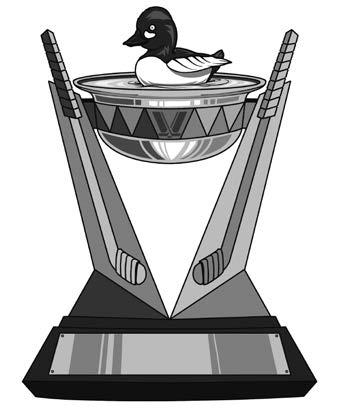
Hockey // Vancouver’s vying for the Walter Cup
Discussing the Goldeneyes’ hopes for the rest of the season with Captain Ashton Bell
JASLEEN SANDHU
On Apr. 23, 2025 the Professional Women’s Hockey League (PWHL) announced Vancouver as the destination for the first expansion team in league history.
The Vancouver Goldeneyes have learned hard lessons in their inaugural season’s first half, but determination ultimately persists in hopes of winning the ultimate prize — The Walter Cup — to wrap up the year. The Cascade got the chance to speak with Goldeneyes’ Captain Ashton Bell about the team’s growth, what playing in Vancouver means, and what she expects from the group in the second half of the season.
Vancouver is new to the league, but the hockey fervour only continues to grow in the city with the entrance of a professional women’s team. Captain Bell had no doubts that Vancouver would be a great place to play.
“Incredible, [it] has exceeded all of my expectations. I knew bringing hockey out West would be a success. But here in Vancouver, it’s something special, and something that I could have never imagined. Just the immediate support from the fans and the energy at the Pacific Coliseum for all our home games has been incredible, and it’s so fun to be a part of it and to get to play in front of them.”
Along with developing culture for a brand new team, Bell has had her own personal journey being named the first captain in franchise history. The Cascade asked her how she has been adjusting to the role.
“That was a huge honour, to be named the captain, here among so many incredible leaders in this league and among our team as well. I think after the first half, it took a bit to kind of settle with this being an expansion team and being a new group.”
Illustration by Hannah Bricknell / The Cascade
The Olympic break has allowed a necessary reset for the team which will allow them to re-focus for the second half of the season. When asked about the benefits of the break, Bell commented on the importance of rest, as well as the benefits of practice and community engagement.
“I think a break is always tough, but there’s definitely lots of positives to take from it. We were on the road a lot in that
first half, so I think this break kind of came at a good time.
“We’re [going to] take advantage of these couple weeks. We still have a decent crew and we’re able to kind of have full team practices still and focus a little more on positional skill work and with that also, just getting to spend some time in the community, getting out, doing some outreaches and having some work
bonding activities, which we didn’t have a lot of time to do in that first half.”
After the Olympic break, the league will resume its season. Bell, who gained playoff experience with the Ottawa Charge last year, is pushing for a playoff spot. She highlighted how every game after the break matters.
“We want to get points where we can kind of solidify our spot in the playoffs. So we know what we have to do, and we know that [we have to make] the most of these two weeks and [be] ready once the full group is back, [so] on March 1st we’re prepared and we’re ready. We want to hit the ground running then and make something with the standings.”
The first season hasn’t been the easiest for the Goldeneyes, but Bell commended her group’s collective effort.
“A lot was thrown at us in the beginning, and we kind of went through some ups and downs, but I think we stuck together. We held each other tighter through that adversity. And I think we were patient and trusted the process and knew that eventually, it would pay out.
“We have good core values and identity on who we want to be now heading into this last half.”
Despite an arduous season with shuffles in standings, player injuries, and trying to shape the identity of a franchise, Bell and the Goldeneyes are hopeful. The Captain believes in her group and is hopeful about playoff chances.
“The goal is to make the playoffs and we’re hoping to do that, and know that by being here in Vancouver, we can definitely make a push for it. We have a lot of experienced players in this locker room. We know that it comes down to that last game and it comes down to one or two points. So every game matters from here on out.”
Event Coverage //
“Many Voices, One City”
Archway celebrates Black History Month
of Canada and encompasses all stories of community building and support.
On Feb. 12, Archway Community Services’ Diversity Education program hosted “Many Voices, One City,” to celebrate Black History Month. The event featured dance performances, music, poetry, and also showcased local businesses, such as Africarib, an African and Caribbean import store in downtown Abbotsford.
Five panellists presented during the event, sharing lived experiences, their resilience in coming together and building community in Abbotsford, and their strategies for greater community engagement and connection.
Mirela Gigovic, who works with Archway in the Department of Multiculturalism opened the event with a land acknowledgement and recognized that the same systems which create barriers for Black people, has its roots in the colonial institutions that oppress Indigenous peoples.
“When we talk about Black history without also understanding Indigenous history, we risk starting the story part way through. And this land acknowledgement is meant as a reminder that the past is not abstract. It’s embedded in our land, in our policies, and in our systems that many of us still move through every day.”
Yvan Morando, who works in Archway’s Diversity and Education department and hosts multiple workshops designed for building resilience and empowerment, introduced the theme of the event, which celebrates the contributions that Black folks have made in all
Event Coverage //
“Tonight, we celebrate the history of the villages that Black people have made in this country. Tonight’s theme is titled ‘Many Voices, One City: Stories of Contribution, and Belonging.’ The theme represents the richness of our city, and the many voices that amplify and lift us all. Contribution is shown in how we support one another and grow to succeed.”
And Muhi Bakini, supervisor of Archway’s Diversity Education Team, moderated the panel and was full of humour and smiles as he opened the floor to the five panellists and presented them with questions around sustainable community building.
Irene Nviiri, a food scientist and entrepreneur, spoke on her incredible journey from Uganda to Abbotsford, about the importance of finding people who may come from a similar place as yours.
“I met some people from Uganda, I tried to build a relationship because I realized we’re in the same boat. When you can identify what is in you and what is in the other person, that is where it starts.”
Kanta Naik, a retired teacher who has spent 17 years helping newcomer families and their children integrate into the Abbotsford community, brought up the need for solidarity in the long term, and the need for consistent support to communities in need.
“Sometimes solidarity is joining a protest about something you believe in or signing a petition or sending a donation. It can be a one time event. But I’m here [in] solidarity for the long term, sustainability and solidarity, and I think it’s quite difficult to see something through long term because lots of changes from other issues pop up for us.”
Melissa Ly has worked with Immigrant Youth Services, Diversity Education, and Language Instruction for Newcomers to Canada and continues to be an incredible force in her community. At the event she advocated for those who are treated as ‘others’ by their community, and explained that we need to change and recognize that harmful narrative and adopt a new one of solidarity.
“Solidarity for me is what it is when it’s not there. Have you ever sat in a
When is the next Snippets?
Snippets brings together the local community to celebrate music, art, and expression
On the evening of Feb. 21, the local community in Abbotsford gathered for a night of entertainment as Shep Dandelion hosted the recently launched talent show Snippets. Held at the Trinity Western Church, the event showcased performances from Alison May, Franklyn Woods, Shiv, Dandelion, Pigeon, Luke Taylor, Keller James, Tayos, and Morse Code Literature.
Opening the night with her soul-stirring vocals was May, a local pianist and songwriter. As May played her piano, it didn’t feel like watching her performance,
but like being part of her story. My absolute favourite song of her set was “A Story (Save Her Soul)” which made me want to grip my chair tight as it quietly echoed the heartbreak I also went through.
For May, music has always given her comfort, inspiring her to perform for over 20 years. She wishes to channel that comfort outwards and remind everyone that they aren’t alone in their journey. Performing at shows like Snippets gives her the pathway to leave a piece of her story with her audience.
“These events help me reintegrate back into social settings. I get to meet new like-minded individuals and express
myself artistically, which is difficult to do when you’re living in survival mode,” May shared. “It’s amazing to see so many artists do their thing as well. It’s inspiring and helps me dream of bigger and better things.”
Following her was local tattoo artist and musician Franklyn Woods — an artist in every sense of the word. Woods doesn’t just create art with ink but he also with his voice. Woods brought music, rawness, and a magnetic presence. His performance was a subtle reminder that art, no matter what form, has the same goal: to make others feel seen.
wheelchair and had people point at you?
Have you ever been pushed against the lockers, told that your English sucks, and that you should go back to your country?
When we can recognize that narrative inside us, the narrative that all humans matter, no matter their background, then that’s where the actions come from the practice of solidarity.”
Ryan Leonard, the new executive director of Downtown Abbotsford Business Association shared his perspectives on community building and solidarity, urging that we need to build toward something better piece by piece, and relationship by relationship.
Each panellist underscored the importance of community building and relationships, and in the end, the audience came together, clapping and singing along with the following soulful music and uplifting dances. The event truly showcased the power of community when it comes together, and the incredible diversity that Abbotsford has. It was a fantastic way to celebrate Black History Month, and I encourage everyone to visit Africarib and support your local businesses, as well as educate yourself on the history of the Black experience in Abbotsford and the lower mainland.
“As we reflect on Black history today, I hope we can hold that bigger picture in mind, not to feel overwhelmed or guilty, but to better understand. Because understanding where things begin [helps] us have more honest conversations about where we are now and where we might go next.”
Next up was Indian comedian from Surrey, Sheevum Dooggall, better known by his stage name Shiv. Ironically late to the show, he kicked off by reminding everyone that being late is such an Indian thing. (As an Indian, I agree!) His skit was a blend of jokes, puns, playful cursing of Surrey roads, and desperately finding a couple in the crowd.
Adding more comedy to the night was Keller James. For him, performing stand-up helps him stay true to himself. More than anything, James hopes for his audience to laugh and let loose.
Archway
LIAM PYPER
PRATI KAPOOR
CONTINUED FROM PAGE 16
“Things suck in a pretty general and global sense so I hope while at my shows they can get a laugh or at the very least a smile, some kind of distraction.”
Adding spice to the show was drag king Pigeon. Known offstage as Will Jarratt, they stepped into the spotlight like they owned it. (I am a fangirl already!) Their performance was intense, magnetic, and the way they carried themselves didn’t just deliver a performance, they served one. Jarratt said that they confide in Pigeon to express themselves fully and honestly.
“I use my drag to express parts of my inner self that don’t often see the light of day. I am a daycare teacher, so I spend 40 hours a week infused with childlike whimsy, and Pigeon is my opportunity to explore the more sinister and sexy part of my identity.”
Jarratt hopes the audience leaves feeling inspired to embrace their true self and remember that life is too short to filter who they really are. They shared a quote from Austin Butler which echoes a similar sentiment.
“Embarrassment is an underexplored emotion, go out there and make a fool of
Campus Fashion: top footwear for 2026
Fun fresh styles for spring
This is Campus Fashion, your source of inspiration for seasonal trends, cool finds, and wardrobe basics to keep you looking stylish throughout the year. With spring just around the corner, it’s time for a change up in what you wear on your feet. Swap out your heavy, clunky winter boots for sleeker, more sophisticated footwear that is sure to turn heads and get you to your classes in style. The Cascade compiled a list of the top five shoe trends to get excited about for spring.
Slim sneakers
Sleek and slim fitting running shoes are all the rage, bringing both comfort and sophistication to an ensemble. Try wearing a pair of skinny black sneakers with jeans, a black turtleneck and a long oatmeal cardigan for a fun, casual look. To elevate the look, swap out the turtleneck and cardigan with a white button-down shirt, and a blazer.
Feminine pumps
Pumps are a staple wardrobe piece, and for a more feminine look, add a pair with bows to your collection. Wearing a cream and pink floral dress, a trench coat, and baby pink pumps with matching bows is a nice outfit to go on a lunch
CULTURE
yourself. Just go for it. Feel the cringe, feel the fear … because everything you want is on the other side of that.”
Next was Tayos, a local band who have been playing since 2019. The band includes Connor James (vocals and rhythm guitar), Bryce Richardson (lead guitar), Raphael Medina (bass) and Mykal Storey (manager and drummer). Their performances showcased seven years of shared experiences and friendship.
James hopes their audience will enjoy it as much as they enjoy playing music.
“We like to have fun and playing music is fun. Being able to listen to music with other people when we’re playing live is an experience like nothing else. [We] hope that they like our songs and take our name away as well … we hope to get them sweating from dancing.”
Looking ahead, Dandelion hopes that Snippets will become a recurring event and never stops moving forward.
“I just want to make something that gains momentum. And I want people when they leave to be excited and be asking me and everyone that performed ‘hey, when’s the next Snippets?’”
date with friends. For an evening look, pair a bold red bow pump with a tailored black jumpsuit and a black motto leather jacket.
Backless loafers
A revamp of the classic loafers, this style goes great with any outfit. Wear an indigo wash denim shirt dress with a pair of dark brown backless loafers and a white lightweight wool coat. On date night, try pairing black backless loafers with a leopard print maxi dress and a black denim jacket.
Glove flats
Created to be form fitting, these flats more resemble socks than shoes. Dress up a pair of black dress pants and a pink button-down shirt with black glove flats for a put together
look. During the evening, opt for a satin pair to go with a little black dress and a hooded dark grey wool coat with faux fur cuff sleeves.
Boots
While the weather will get warmer, it is still going to have rainy days from time to time. Having a nice pair of boots is not only practical, but stylish. Wear a pair of dark green hunter boots with black jeans, a black crewneck sweater and a cream soft shell raincoat when it rains. For a more sophisticated look, a pair of tall black leather boots go well with a cream sheath sweater dress and a long indigo denim coat. There you have it, a list of some fun shoes to wear as the weather warms up. Try some new styles to add a spring to your step this season!
“ballet flats” by Amy Ross, CC BY-ND 2.0
“Snippets” Promotional Poster
RACHEL TAIT
Crossword // STUDY BREAK
Horoscopes //
By: The Bitch Witches
Aries - Mar. 21 to Apr. 19
Frustrated? Join the club. You know what you want, now it’s time to make it happen. Maybe it’s time to cut out the narcissist in your life. I know it helped me.
Taurus - Apr. 20 to May 20
Anxiety is just anxiety. Say it again. Don’t let those big scary feelings take over. Time to snap the fuck out of it.
Gemini - May 21 to Jun. 21
Mercury’s gone retrograde friend. Whatever TF that means I think you should probably slow down and chill TF out.
Cancer - Jun. 22 to Jul. 22
All right, sensitive queen. You’re back in your cycle of focusing all on other people again while your own needs go unaccounted for. Be a little more of a selfish bitch or you’ll be ruled by more than just the moon soon.
Leo - Jul. 23 to Aug. 22
Are you overwhelmed? Do you focus too much on what’s going wrong and forget what’s going right? Maybe it’s time to try some fucking positivity. Recommended by four out of five astrologists.
Virgo - Aug. 23 to Sept. 22
Overall vibe… 7/10. Too emotional, looks in the wrong places for solutions, ignores feedback from the right people. Wouldn’t come back again.
Libra - Sept. 23 to Oct. 23
You’re a slave to the machine and news flash, the machine hates you. Is starting a 401K really that important? Student loans will always be there to haunt you, you don’t have to pay them off just yet. You’ve made it, sure… but at what cost?
Scorpio - Oct. 24 to Nov. 21
Way to abandon your friends and move halfway across the country for some guy. Thanks a lot. (If this doesn’t apply to you it’s because it’s a fucking metaphor. Use your noggin, Jesus fucking Christ.)
Sagittarius - Nov. 22 to Dec. 21
Ah, the brooding. It can be so fun, amiright? But your destiny doesn’t have to be darkness, you can (and really should) ask for help. Cuz girl, lord knows you need it.
Capricorn - Dec. 22 to Jan. 19
Knock knock! Who’s there? It’s the grown-up police! They’re here to revoke your grown-up status, you’re abusing it and making the rest of the grown-ups feel bad. Get your crayons out, it’s time to colour! Plus I heard Bluey (2018-) is a pretty cool TV show, maybe you should watch it.
Aquarius - Jan. 20 to Feb. 18
Remember when Buffy the Vampire Slayer (1997-2003) stabbed her vampire boyfriend (who had just gotten his soul back) and pushed him into a vortex that took him to another dimension because if she didn’t the world would get sucked into a black hole? That’s kind of like how you are right now.
Pisces - Feb. 19 to Mar. 20
Masturbate more.
Theatre //
A behind-the-scenes look at how Secret in the Wings is prepping for the stage
Cast talks workouts, connection-building, and having a good cry
Are you drawn to fairy tales? Dreams? Non-linear stories? If so (and even if you’re not), watching UFV Theatre’s upcoming production Secret in the Wings sounds like the ideal activity for you. Currently in its final weeks of production, the theatre program has been hard at work preparing for opening night on Mar. 19. The Cascade was fortunate to speak with the play’s Director, Anna Griffith, and actors Kira Taves and Lake Butterworth about what that looks like, including details about the play itself and their individual experiences.
According to Griffith, the play’s story contains themes of trauma, but Taves and Butterworth said that alongside that darker theme the play also explores imagination, humor, and transformation. The project doesn’t follow a realistic storyline, it’s surreal, presenting seven dark fairy tales sewn together into one play.
“It’s best to think about it as a dream, or the way that memory works. We have these bits of memory that our brain is putting together.”
Griffith, Taves, and Butterworth proved that the preparations for putting together a theatre production is much more than vocal exercises, costume fittings, and reciting lines over again –– it’s physical strengthening too that conditions the body, not just the mind.
“The first five weeks of work [were] the most intense acting work I’ve ever
Artists //
done,” Butterworth said. “We would usually start class with an hour to an hour and a half [of] long physical warm up that involved cardio and dancing because there’s multiple lifts and physical work in this show.”
Now being past that point, Griffith mentioned that it’s about refining the production’s structure and focusing on details of their performances. Although, with building the confidence to perform also comes an inevitable panic as opening day creeps closer.
The Secret in the Wings Promotional Poster
“Now it’s the part where we start to put it together and it feels like the wheels are coming off the bus. This is a moment where it starts to feel like we’re running out of time, but everyone has done such a good job … we’re actually at an excellent stage.”
The production doesn’t work unless the team works well together, and in the midst of the prep work, they believe building connections and sharing thoughts and ideas with each other is important for their success.
“There’s a lot of intimate moments throughout [production], and we’ve done a really great job of asking, you know, ‘how do you feel?’” said Taves. “That’s been so helpful, because everybody’s level of comfortability is different and it’s been really nice to have such a good group of people come together.”
During production, Griffith lets the cast take the lead. It’s a team effort, and she believes extending autonomy to interpret the story is important to the script and also her growth as a director.
“It’s not about the director coming in and having all these ideas and saying ‘do it like this,’[it’s] that ensemble spirit where everybody’s contributing their ideas, thoughts, and impulses … [we have] a space where people can experiment and everybody can work together to have a voice and to solve problems.”
Griffith, Taves, and Butterworth had their own feelings about what they’ve loved the most about the process so far.
“The first time we saw all of the individual stories that we’d worked on –– because [we’d] worked on them out of order –– come together, [it was] something totally new that emerged. That was awesome [and] unexpected. Yeah, it was really magical,” said Griffith.
“The most memorable part of the show for me was the first week of rehearsals,” said Butterworth. “So many times I’d go home and cry, and it wasn’t that I was having a rough day. It was so much to deal with, to think about, to bring home with me. It was difficult, but as everything started making more sense for me, it was liberating.
“Going into the space and running through the scenes and doing movements and being able to really be present and allowing impulses,” said Taves.
The production’s hard work will leave a powerful, inspiring message to audiences.
“The conclusions of all these stories never really end on a bleak, sad, depressing note, even if they aren’t a happy ending. There’s a message of continuing to move forward and not dwelling on the past … it never stops moving and I think that’s another important message that goes with the transformation –– to just keep trudging along despite life challenges and difficulties, and even if you don’t get a happily ever after, you keep moving until you do.”
“The artistic process is a mysterious and convoluted conversation”
UFV alumni Jesse Klassen on religion and respect in art
In a world with so many different religions and belief systems, Abbotsford painter and sculptor Jesse Klassen aims to open conversation with his art. The Cascade sat down with the artist to discuss not only his art, but the upbringing that led to finding his artistic niche and voice, and how his experience as a UFV student influenced his creative practices.
Klassen discovered his interest in researching different religions while
growing up in a Christian belief system that he didn’t agree with at first. In doing so, he questioned the dynamic of understanding religion as a whole.
“Historically speaking, cultures have always been axiomatic. Countries have always been axiomatic … they’re quite pluralistic. They don’t necessarily have that one core … and so I look at the world [and] our society here and I wonder: how does a person in any kind of identity –– whether they’re 60 years old and just looking for their idea of truth, or a
teenager growing up in our society — navigate our culture and come to some understanding of what their belief is with any kind of grace?”
He was fascinated by the number of religions the world offered, but he learned that the act of identifying with one was a challenge for him and others, so his art became an outlet to do that.
“It’s a proverbial minefield of potential, conflict, beauty, and wonder … to give people this idea [to] go and discover what you believe — [it’s] such a beautiful
thing. It’s also this incredibly hard thing that we put people into, and so my work is really about exploring those kinds of questions, that context.”
Where Do I Know You From? is his series being showcased in Open Space Downtown Abbotsford, which is a collection that formed accidentally.
“This series of work I call my sketchbook series, because it all started off as just sketches in my sketchbook. I’d work
CONTINUED ON PAGE 20
VERONICA POWELL
VERONICA POWELL
CULTURE
CONTINUED FROM PAGE 19
on a project in my studio, and I’d be painting something or sculpting something, and then I would sit back and just sketch for a little bit … or I would take all the leftover paint and just play with it and it eventually became a consistent body of work.”
Klassen also commented on the purpose behind his work, saying it “isn’t to tell you something … [it] is to open the door to dialogue, to create potential learning.”
His process of creating art isn’t super structured –– in fact, it usually starts with a small, tangible object or thought.
“I start with a somewhat abstract goal, like a point of inspiration, a material that I really like, or colour that I really like.
Just something really basic that grounds the work … I would say my process is a mixture of intentional and intuitive.”
Klassen’s experience as a UFV student has influenced his artistic development and perspective, especially something a professor told him that has always stuck with him.
“He said … university is a place for learning. It’s a place for challenging things [and] asking questions. It’s not a place where we should be trying to be comfortable. So when you’re learning about something, you should be willing to challenge your assumptions. If you want to walk into a classroom and display a perspective that’s completely ignorant and arguably just fundamentally wrong,
you’re more than welcome to but you have to be open to the potential of somebody counteracting them.”
He explained that he operated in this space with respect, understanding that society has natural tension and opposition when it comes to religious views. Klassen’s goals in his practice will always be to create art humbly and continue to grow in skill and knowledge.
“I think as soon as an artist becomes complacent with what they’re making, that’s when their work becomes bad … the concept of learning, in my case about religion and spirituality, is something that I hope will continue for the rest of my career [and the] rest of my life.”
Cascade Rewind: Snakkin’ on a local legend
West Coast dirtbag, East Van hooligan
DARIEN JOHNSEN
There wasn’t a lot that I could flex about when I was in high school. I was a homeless youth, something of a burnout, and hopelessly lost. But there was one sliver of solace in the chaos of my life: the Maple Ridge-born rapper Snak the Ripper. Snak was a founding member of the hip-hop group, the Stompdown Killaz, a group that was born largely out of the suburbs of Langley City — my hometown — and we all loved him. You would be hard pressed to walk around our city without seeing his tag splayed on the sides of trains and buildings.
Then, I grew up. I graduated, and largely forgot about Snak the Ripper until a few days ago when I was scrolling through Instagram and saw a video of some guy in a black beanie pasting a concert poster onto the side of a building. The artist name, tagged at the top of the poster, was instantly recognizable: it was “Snak.” Being in a Mood I suddenly became nostalgic for the raspy, biting, nasally voice of this now throwback-worthy artist. I decided to dig through his discography to find the 17 year-old album my peers and I listened to on repeat during our high school days: Sex Machine (2009). The track “Live Fast Die Young” is so familiar to me it could be part of my personhood. The backing track is dreamy, compared to the aggressive vocals and pessimistic lyrics, it dances on the edge of being at both the end and the beginning of life. “Live Fast Die Young” isn’t an original saying (one could say it’s even a bit cringe), but Snak embraces this concept in a unique way that’s emotional and desperate. For him, it’s personal — an entry point into a life that feels unworthy, and therefore free from societal pressures, nothing to strive toward, and no one to impress. It’s there, at the edge of imposed expectations, that there is absolute personal freedom.
When you’re a teenager — especially one who’s been pushed to the margins of society — things feel more alive to you, more personal, and more meaningful. Listening through this album, I’m reminded how music can work like magic within us, awakening parts that we thought were no longer there. I’m sure there is some science to explain this, but I don’t
care. I just know that it’s a part of life that I value so deeply.
As we get older, we find ways to manage the pain and intense feelings that drove us in adolescence. Snak is an embodiment of this. He used music as a healthier outlet and as a way out of the homeless, drug-filled life he was living into commercial success. But those experiences never truly leave us, and I think it’s still important to (sometimes) feel that rage and passion.
“With this pen I gain grip / gangrene finger tip, cigarette stained, chest pain, dope sick / I’m confused, self abused, no rules or amused on, how the world turns, money burns.”
“Dead and Gone” still hits just as hard . They comforted me at a time when I needed it most, channelled my inner emotions, and were a way for me to feel less alone in my own pain.
One of the album’s catchiest tracks, “The Rap Biz,” paints a picture of someone oscillating between multiple states of life — poverty, music, drugs, and a shitty nine-to-five. Snak recognizes his limitations and human-ness; when you’re going through tough shit, sometimes you live and act like a dirtbag. “Lazy” embraces that messiness, and I love this track
so much because despite the quick lines Snak spits throughout the track, the beat remains mellow. Plus, it contains some of teenage Darien’s favourite lyrics. This song is great simply because it’s funny, clever, and honest as hell.
I’ll end this on my favourite track — and the most suitable for coverage of the Langley City native. “Locally Famous” sits at the top in my books for its sharp shooting lyricism, funky track, and pugnacious tone. It’s a humorous and honest embrace of the rapper himself, featuring lyrics like “I’m white, weird and lonely, ain’t genuine / But if you don’t like my rhymes bitch, you could ride my pony.”
And as an honourable mention, I have to include the not-so-pc line “Don’t take cops much to shoot, scabby faced prostitutes / In the same neighbourhood as rich people in suits” because if anything, I will give props to my high school self for still listening to class-conscious music. I like to think that, maybe, Snak played a role in activating my sociological brain and propelling me to explore these socio-economic disparities further in university.
So thanks, Snak, for carrying me through onto greater things.
Cover
photo
Sex Machine (2009)
Snak
The Ripper
Photo submitted by Jesse Klassen
Television //
She killed for love — His & Hers on Netflix
PRATI KAPOOR
His & Hers (2026) is more than a show you casually watch — it’s an American thriller series inspired by Alice Feeney’s bestselling novel, and it leans into you until you devour it. The story, the cast, the pacing, and especially the narration complements each other like a chef’s kiss. Unless you experience it first-hand, words cannot do justice to how mind-boggling it is. Yes, I am exaggerating, but I am a certified fangirl, so I stand by it. What sets this apart from other thriller stories is how it emphasizes that truth isn’t simply black or white; it can be a messy, ugly grey shaped by biased perspectives.
The series stars Tessa Thompson as Anna Andrews and Jon Bernthal as Detective Jack Harper, and honestly, they ate with their supercalifragilisticexpialidocious acting skills (no regular adjective could make the cut). Bernthal, known for
his emotionally charged performances in The Wolf of Wall Street (2013) and Fury (2014) brings his rich emotional palette to the role. Thompson — whose recent work includes Marvel Zombies (2025) and Hedda (2025) — brings an award-worthy performance of her own. Together, they command the screen, pulling the audience in as they navigate their relationship through the loss of their daughter.
The series also features Anna’s highschool friend circle — Rachel Jones (Jamie Tisdale), Zoe Harper (Marin Ireland), Helen Wang (Poppy Liu), and Catherine Kelly (Rebecca Rittenhouse). Their grown up lives add emotional depth to the narrative, revealing how shared histories can carry trauma that still lingers in adulthood.
The series follows the investigation into Rachel’s murder, gradually widening to include Anna’s other friends, with the truth unfolding through alternating
Tier Lists //
A psychological thriller that explores grief, perspective, and the terrifying lengths a mother can go to protect her child From
perspectives in Dahlonega, Georgia. Instead of having extensive twists, the story gives the audience subtle hints and physical tells. Every unspoken thought, every expression intensifies the scene, making it impossible to look away. The show gives you just enough to stay hooked, but never enough to unlock the mystery. The second you think you’ve pieced it out, the narrative swivels and humbles you. It’s a show that refuses easy answers, and that refusal makes its world feel startlingly real.
This authenticity is one of the show’s greatest strengths — how deeply relatable these characters feel. They aren’t celebrities but real people who make mistakes, lie, grieve, and feel intense emotions. Take Anna, who moved away after losing her daughter and ghosted her family for over a year. Not out of indifference, but because everyone has their own way of dealing with grief. The series beautifully reminds us that motherhood isn’t just about having or raising a baby — it’s a full journey of letting yourself embrace a new chapter in your life, mourning the version of yourself you leave behind and reshaping your identity in the process.
Supporting characters like Zoe add exceptional depth to the show. She isn’t framed as a perfect mother — she’s a single parent trying to raise a child while battling alcoholism and the suffocating guilt of feeling like she’s failing at life. It’s painfully, extraordinarily real because she carries her own red flags, yet she’s still trying to be better. That effort leaves
Ranking my favourite horror franchise
1. Scream (1996)
Billy Loomis (Skeet Ulrich) said it best: we all go a little mad sometimes –– and I’m proud to say I am mad over the Scream franchise. I’m no killer, of course, but I am dying to see the insides of the newest film, Scream 7, releasing on Feb. 27. Adding to the excitement –– and in impeccable timing –– 2026 also marks the 30th anniversary of the original Scream (1996). Anyone who knows me knows that I will never pass up the opportunity to talk about these movies, so grab some popcorn and dial in as I rate them from best to worst.
I hate to be predictable, but the original is iconic for a reason. To clarify, I’m not ranking it highest for nostalgia or for its good old-fashioned jump scares and striking visuals. The dialogue and delivery is gold, outshining every other film in the franchise. Lines from Stu Macher (Matthew Lillard), Tatum Riley (Rose McGowan), and Randy Meeks (Jamie Kennedy) feel less generic and more personality-driven, laced with mild but clever humour and backstory that slips clues into the dialogue. The characterization is strong and the tension never dips because the film’s level of predictability
remains low –– even while openly acknowledging classic slasher tropes like “sex equals death” and never saying “I’ll be right back.”
2. Scream 2 (1997)
I struggled to place this one because it’s just as good as the first, but there’s one singular thing about this film that lost its chance for first place: the death of a seemingly legacy character. RIP legend. Although, frustrating as it is, I can’t deny the scene’s tauntful setup that escalates beautifully from banter to brutal. Plenty of other elements keep this film high on my list, like the reveal of Mrs. Loomis (Laurie
her in that uncomfortable middle space — where most of us live in.
Other characters, like Jack’s detective partner Priya (Sunita Mani), bring an innocent, brave, and quietly fierce energy to the show. Her presence compliments the storyline well with her calm, attentive, and sharp mind. She represents exceptional emotional clarity (something I’d love to have more of).
As the investigation unfolds, your suspicion of the killer keeps flickering, and your focus diverts from solving the mystery to understanding why it happened — and how easily the truth can be warped by bias.
As you finish the series, you won’t walk away with neat justifications for those murders — but you’ll understand the truth behind them, and how the truth gets blurred at the edge of morality.
In the end, you realize the extent of someone’s love can become both protection and destruction at the same time. One of my friends always says, “If you truly love someone, you should be able to kill for them and die for them,” and I feel the show truly echoes that. It’s frightening to think how “love” could make you justify every “I would never” action. His & Hers forces you to confront the thin line between devotion and possession, which is perhaps the biggest strength and scariest truth about loving someone
Metcalf) and Mickey Altieri (Timothy Olyphant), which genuinely surprised me — at least on my first watch. The plot development is excellent, especially in the way Sidney Prescott (Neve Campbell) tries to start fresh in college while still navigating her complicated relationships with Gale Weathers (Courteney Cox) and Cotton Weary (Liev Schreiber). There is also a heightened tension because there is a higher kill count than the original, and it felt like Ghostface would actually win.
VERONICA POWELL
ARTS
CONTINUED FROM PAGE 21
3. Scream 4 (2011)
Despite its mixed reviews, the fourth one remains firmly in my top three. This one is vicious, more graphic, the acting is gold, and there were some really badass scenes. They certainly weren’t shy about what they showed in the aftermath of each murder, and it establishes a tone for the killer that feels unforgiving, relentless and –– most importantly –– passionate. That’s the kind of adrenaline rush that makes me love the horror genre. Jill Roberts (Emma Roberts) and Charlie Walker’s (Rory Culkin) acting even before things turn dark were some of the best individual performances in the franchise.
Tier Lists //
4. Scream 3 (2000)
The plot is a beast on this one. We’re reconnected with Weathers and Dewey Riley (David Arquette) after years apart from Prescott, and we actually see her career blossom into fame and not because of her past. That’s before she returns to Woodsboro, of course, and the plot heats up real fast from there. I love being brought back to the original Prescott household but as a movie set in the film. It’s a top-tier strategy in trilogy elevation, but despite the dead ends and escapes Prescott makes, the scare factor isn’t as strong. The character movements are far less clever and the witty flare in the dialogue is weaker.
5. Scream VI (2023)
It may have a higher number, but it doesn’t deserve a high rating. It’s annoying to watch because of how unrealistic it is. The way the course of events unravels makes the characters and the writer look stupid because everything is so obvious from a viewer’s perspective. Murders go unnoticed even with the looming threat of Ghostface and Woodsboro’s history. Granted, that might just be a genre habit, but here there’s less adrenaline, less tension, and it feels pointless to watch. The scare factor feels included for the sake of the genre rather than enhancing watchability. A positive? The kill count is the highest in the franchise and the gore is still very realistic.
6. Scream 5 (2022)
Although I did enjoy being taken out of Woodsboro and into New York City, at this point the film becomes too modernized with different visual quality, plot, and graphics that take away the appeal that made me love these films so much. I’m not a fan of the new characters and their behavior, and the dialogue felt cliché, contributing to inauthentic dry humor and drama. It’s just silly, and the killer-reveal conversation is basically a rerun of the fourth film.
No matter the placements of this iconic film franchise, I’ll always get the itch for a good scream.
A mother’s guide to surviving through fiction
The fictional women who helped my mom unlearn the limits the world placed on her
SKY S. TERRONES
At The Cascade, we’re celebrating International Women’s Day not just with a kickass media care package, but with a top-tier heroine list crafted by my very own top-tier heroine: my mom. Indeed, yours truly spent an entire afternoon talking with their mother to gather the legendary women who have inspired her movie-and-show-loving heart to keep going in a world that still makes her fight harder than she should.
Sarah Connor — The Terminator (1984)
In my mother’s words, Sarah Connor is the one who hurts to watch. She was one of her idols growing up, and the only reason she isn’t higher on this list is her strained relationship with her son, John. In trying to make him strong, she pushes him away, sacrificing tenderness for survival. My mother recognizes that instinct: the pressure to hold everything together, the struggle to show affection, the belief that pain is something you carry alone. Sarah is strong, but the price is steep. Still, her resilience remains unmatched — and my mom honours that.
“No fate but what we make.”
Sidney Prescott — Scream (1996) Sidney is the fierce yet empathetic horror heroine. She’s traumatized, distrustful, scared — and still lets people in. My mother connects with her because she never pretends bravery is easy. She survives without losing her humanity. The ultimate final girl, still carrying this stellar franchise 30 years later.
“You want me motherfucker? Come and get me.”
Adora/She-Ra — She-Ra and the Princesses of Power (2018-2020)
Adora never asked for the weight of the world, yet carries it all the same. She gives up her own desires for the greater good, until she finally begins to question the destiny forced onto her — pushing back against it, and learning to let go of it. She has a habit of taking everything on herself, but slowly unlearns that instinct by leaning into the connections she’s built and cherishes most. My mother is drawn to the friendships, the loyalty, the chosen-family devotion Adora protects so fiercely, a reminder that power and expectation were never the point — love is.
“Let’s do this. Together.”
Imperator Furiosa — Mad Max: Fury Road (2015)
Furiosa is liberation in motion. She protects the vulnerable, carves open a future for them, and refuses to let suffering make her cruel. My mother sees in her that warrior’s instinct to fight for other women, to guarantee them the freedom they were denied. In her, mom recognizes the echo of women’s past struggles, the weight of our present ones, and the warning flare of a future threatened by rising conservatism — yet also the enduring hope that from oppression a heroine will rise.
“You wanna get through this? Do as I say.”
Buffy Summers — Buffy the Vampire Slayer (1997-2003)
Buffy is the teenager who gives up her youth for a world that rarely acknowledges the cost. She trains, she fights, she protects, and she keeps going even when the weight of it all threatens to pull her under. My mother holds her close because she deserves joy — and still chooses duty.
Buffy proves that being young and being heroic are not mutually exclusive. She’s imperfect, like all of us, but she doesn’t stop trying and never will.
“If the apocalypse comes in, beep me!”
Alice — Resident Evil (2002)
Alice is the woman who tries to isolate herself and fails beautifully. My mother loves her realism (despite being in a zombie apocalypse) — the exhaustion, the grit, the instinct to protect others even when she’s certain she shouldn’t. She’s a survivor who still believes in community, who knows she could make it alone but chooses to meet people where they are and lift them up. No one gets left behind.
“I’m not on the menu.”
Ellen Ripley — Alien (1979)
There is no one like Ripley in my mom’s eyes. She’s the blueprint of her heroines — smart, furious, utterly badass. Ripley doesn’t wait for rescue — she is the rescue. She can be terrified of what’s ahead (who wouldn’t be?), but never in a
way that keeps her from risking everything for the people she loves — not that we doubt her endless ability to outsmart an entire species of nightmare biology. If strength had a face, for my mother, it would be Ripley’s.
“Get away from her, you bitch!” My mom grew up believing that strength wasn’t an innate “feminine” trait — a cliché shaped by stories of princesses waiting to be rescued, a narrative that has harmed us for generations.
These heroines validated her hope in everything she could become on her own. They were proof that women can be complex, powerful, sensitive, and self-sufficient. You don’t have to lose your fragility or sensitivity to be a hero, nor conform to a construct. Sometimes, the refusal to obey, perform, give up — is an act of empowerment in itself.
Illustration by Natasha Zilcosky / The Cascade
ARTS
Media Care Package // Women worth learning about
Recognizing International Women’s Day with these resources
KARA DUNBAR
International Women’s Day marks an opportunity to learn about and reflect on women’s achievements, history, and current challenges. It is a reminder that our freedoms and privileges were hard fought for, and that continues in different ways worldwide and at home. I believe that education is a foundation for freedom, and these are just a few resources to learn more about the women who built the world we stand on, so we can carry their work forward.
Status Quo? The Unfinished Business of Feminism in Canada (2012) is a documentary available for free on the National Film Board. While this is older, it acts as a good historical resource. The documentary covers the 1967 Royal Commission on the Status of Women, issues of domestic abuse, the abortion movement in Canada from pre-Morgentaler case and up to 2012, the development of childcare systems in Canada, and the Live-In Caregiver Program. For anyone interested in Canadian women’s issues, this is an excellent starting point.
What’shername? is a podcast dedicated to telling stories of women that history has overlooked. Created by academics Dr. Katie Nelson and Olivia Meikle, each episode blends in-depth research with expert interviews, making it both academic and engaging. They also published a book of the same name What’s Her Name: A History of the World in 80 Lost Women (2024) –– a collection of some of the stories featured on the podcast. In a recent episode, they spoke about Jarena Lee, an African American Methodist preacher in the early 19th century –– someone whom, as the podcast title suggests, I’d never heard of, but whose story was well worth hearing.
If you are looking for something short and sweet then Womanica creates on the same premise, telling stories of women you may not have heard of. This podcast does that for just five minutes a day, giving a short overview of a specific woman’s place in history. They tell the stories of women of myth like Medusa to authors like Toni Morrison, and everyone in between.
The Power of Days (2023) recounts the story of Days for Girls International as told by its founder, Celeste Mergens. Days for Girls is a charitable organization
that works to address period poverty and remove the stigma associated with menstruation. They provide reusable menstruation products and health education, help local leaders establish businesses to make their own menstruation products, and do advocacy work to advance menstrual equity worldwide. The Power of Days chronicles the beginnings of the organization with the discovery of what happens when people don’t have access to period care, and how their DfG Pad, health education program, and independent branches were formed. The book tells both the successes and failures, and acts as a memoir of Mergens’ personal and professional struggles throughout the organization’s development.
Wicked Little Letters (2023) is the fun pick for this article. Based on a true story, this comedy follows polar-opposite neighbours in the 1920s: rowdy Irish immigrant Rose Gooding (Jessie Buckley) and devoutly religious Edith Swan (Olivia Colman). When Edith and the other residents of their small English town start receiving anonymous, scandalous letters full of profanities and insults, the first suspect is the rebellious Rose. The uproar grows into a national spectacle and a trial –– but as the investigation unfolds, the women of the town start to wonder if Rose might actually be innocent. This movie about an absolutely unapologetic woman is hilarious and heartfelt, and the historical story I didn’t know I needed to watch.
These are just a few resources from a much larger library of women’s stories that deserve to be heard. Mar. 8 is a great day to sit with them –– and to remember that women’s right to work, to learn, to vote, and to have a voice are hard-won gifts from women who believed in a future they barely got to witness. It’s a day for celebration, reflection, and recommitting to keep fighting for the future you want to pass on.
CHARTS SHUFFLE
I’m Cam The Man — volunteer, show host, and producer of Tuesday-morning program The Cam the Man Show, which I’ve been hosting since May 2, 2023! In 2024, I won the Volunteer of the Year Award presented by the National Campus and Community Radio Association, and I’m also a 2025 BCLC Community Hero. Today, I’m highlighting four female independent artists who’ve all cracked the CIVL Top 30 chart list:
Annika Catharina - “Dishonest”
Two times Fraser Valley Music Award Country winner, twice in a row, “Dishonest” is my favourite, because it has a meaningful message. She made it as high as number three on The Top 30 chart list, Aug. 12, 2025, and number two on CIVL’s folk/roots/blues list on Dec. 16, 2025. She currently sits at number nine!
Savannah Jade“He’s The One”
A rising country artist from Montreal, she’s been bringing some truly great music to the table. I first discovered her on a social media story with “More Like It,” but this is my favourite, from her 2025 debut self-titled EP, because it’s one of those songs about avoiding heartbreak. Savannah’s currently sits at number four.
Raquel Cole“Let Alone my Heart”
Another B.C. country artist on the rise, who I found on social media with “Slow Motion.” My favourite song of hers is this one, from her EP Fire Child (2025), because it’s about protecting your heart when it comes to love. Raquel charted number one for eight straight weeks, now at number three!
Seyblu - ”Day Dream”
A Toronto R&B artist that I first discovered through social media with her debut album. Its title track, “Day Dream,” is an amazing song with a 90’s/2000’s vibe. She’s charted as high as number two at points, and was sitting at number six on the CIVL Top 30 chart as of Feb. 17, 2026.
01. ALEX LITTLE
Spider in the Sink
02. THE SYLVIA PLATTERS Will Tomorrow Be Enough [Ep]
03. RAQUEL COLE Fire Child
04. SAVANNAH JADE
Savannah Jade 05. WILLIAM PRINCE Further From The Country 06. SEYBLU Day Dream
Summer
COLTAN FULLER
Long Distance Blues EP
LIL CJ Friday Night Alone (Single)
AUSTRA Chin Up Buttercup
HÉLÈNE BARBIER Panorama
KATIE TUPPER Greyhound
Where your music taste matters by CIVL’s Music Director, Stephen Munga.
MARCH • TEMT’ELÉMTSES EVENTS CALENDAR
TEMT’ELÉMTSES
This month’s Halq’eméylem name is temt’elémtses or “time things stick to the hand [with cold].” temt’elémtses is from Feb 18 — Mar 18.
11:30AM - 01:30PM Film - Renewal: Stories from America’s Religious-Environmental Movement — UFV
@UFV Abbotsford campus, B101
04:30PM - 08:30PM International Women’s Day 2026 — Abbotsford Chamber of Commerce
@UFV Abbotsford campus, B101
ALL DAY Campus Recreation & Active Living: Drop-In Sports — UFV
@UFV Abbotsford campus, Building E
11:00PM - 03:00PM Her Preloved Market
@Open Space, 110 – 33765 Essendene Avenue
12:00PM - 12:50PM Halq’eméylem Language Learning and Sharing (Part 1) — UFV
@Abbotsford campus, G113
03:00PM - 05:00PM Beyond Blankets — UFV
@UFV Abbotsford campus, B140
03:00PM - 04:30PM Richard Kemick’s Final Presentation — UFV English @Abbotsford campus, A225
04:00PM - 06:00PM Simple Meals and Shared Connections: A Community Cooking Class — UFV
@UFV Abbotsford campus, Building J
11:30PM - 12:30PM Sadiqa de Meijer Reading — UFV
@UFV Abbotsford Library
03:00PM - 05:00PM Creative Writing Workshop with Richard Kelly Kemick — UFV Literature club
@UFV Abbotsford campus, Room S2102b
05:00PM - 08:00PM Sustainability Open Mic Night & Queeraoke — UFV
@UFV Abbotsford campus
Abbotsford Film Festival
@The Reach Gallery Museum, 32388 Veterans Way
Some of the e vents require tickets, and most are online. If something catches your eye, take to the Internet for more details, including those about any safety measures for in-person events.