Is the American dream out of reach?
72 percent of renters say they’ll never be able to afford a home. Are they right?
Franklin Schneider WEALTH OF GEEKS
Finding an affordable home in 2023 is like finding a needle in a haystack made of other needles. At least, that’s the sentiment expressed by most U.S. renters. A new study found that 72 percent of renters are convinced they’ll never be able to afford a home. The findings come from Home Bay, a real estate education platform, which polled 1,000 renters about their feelings toward homeownership, the housing market, and the American Dream.
The answers reveal a fundamental pessimism about the trajectory of the real estate market. Two in three renters, 66 percent, said current home prices make them feel hopeless, and just over a quarter, 28 percent, said homeownership used to be, but is no longer, part of the American Dream.
The new generational gap
Renters’ view of the housing market is stark, especially since they’ve spent the last few years watching house-rich homeowners benefit from price appreciation, fueling the perception of haves and have-nots.
Quite often, the line between the two is generational. About 61 percent of renters believe millennials and Gen Z will “never reach the same homeownership rates as baby boomers.”
At the moment, their pessimism seems justified. Millennials currently trail baby boomers by a whopping 30 percentage points in the metric, according to U.S. Census data.
There might be some hope for them, though. Gary Painter, a professor at the Sol Price School of Public Policy at the University of Southern California, believes
Average long-term mortgage rate rises to 6.57 percent this week, highest level since mid-March
ASSOCIATED PRESS
LOS ANGELES — The average long-term U.S. mortgage rate rose this week to its highest level since mid March, driving up borrowing costs for prospective homebuyers facing a housing market that’s constrained by a dearth of homes for sale.
Mortgage buyer Freddie Mac said Thursday that the average rate on the benchmark 30-year home loan rose to 6.57 percent from 6.39 percent last week. The average rate a year ago was 5.10 percent.
High rates can add hundreds of dollars a month in costs for homebuyers, limiting how much buyers can afford in a market that remains unaffordable to many Americans after years of soaring home prices and limited housing inventory.
The median monthly payment listed on applications for home purchase loans in April rose to $2,112, up nearly 12 percent from a year ago and a 0.9 percent increase from March, the Mortgage Bankers Association said Thursday.
The average rate on a 30-year home loan has risen two weeks in a row, echoing moves in the 10year Treasury yield, which lenders use as a guide to pricing loans.
The 10-year Treasury yield has been mostly rising of late, climbing to 3.79 percent in afternoon trading Thursday. Two weeks ago, it was at 3.39 percent.
the younger generations will make up ground eventually.
“A portion of millennials and zoomers may have homeowning grandparents,” Painter said. “At some point, these (generations) may be able to buy due to inheritances, but will likely become homeowners after their parents did.”
Renters know they’re behind, and the overwhelming majority blame high home prices. Nearly three-quarters of respondents, 72 percent, thought they’d be homeowners by now, and 86 percent say home prices are too expensive nationwide.
Although many blame inflation, home price increases have far exceeded inflation in most parts of the country.
As renters blame sky-high prices for their inability to buy a house, Painter and other experts say soaring prices are just a symptom of the real problem - low housing supply.
Since 2016, inventory has dropped by 60 percent, while prices have risen by 50 percent. That mismatch between supply and demand is one of the biggest culprits behind the country’s affordable housing crisis.
Mounting debts and stagnant wages
Forget buying a housemost renters are prioritizing simply getting out of debt.
Student debt has been an undeniable drag on young Americans’ finances, Business Insider reporting that student debt is actively preventing 36 percent of millennials from buying a house.
The Home Bay survey found that 71 percent of renters consider being debt free a very important milestone.

Significantly fewer renters, 51 percent, consider owning a home to be very important to them, behind having a comfortable retirement, 66 percent, and owning a car, 59 percent.
The findings underscore how priorities have shifted among younger generations, at least in part due to financial necessity. After paying their bills, most renters don’t have much income left to save for a down payment. In fact, 73 percent of renters said they can’t afford to put any money towards a down payment.
Considering that the average sale price for a home in late 2022 was $535,000, according to Federal Reserve data, many Americans have nowhere near enough income to purchase a home on their own.
Even with a 20 percent down payment, experts say affording the mortgage on a home that price would likely
require an annual income of about $138,000. The median worker makes less than half of that$54,000 per year, according to the U.S. Bureau of Labor Statistics.
A light at the end of the tunnel?
America’s housing problems didn’t pop up overnight, they’re the result of years of home prices outpacing wages. Consequently, housing can’t be solved overnight, and Painter said it begins with more emphasis on construction.
Additionally, Painter noted that wealthy countries with better housing situations typically have policies to support low-income households. For example, he suggested providing tax credits to households paying more than 50 percent of their income in rent.
However, solving this crisis won’t be easy and resistance could come from unexpected quarters.
“Current homeowners have a selfish incentive to support policies that restrict the building of housing,” Painter said, “because it increases their home equity.”
It’s a reminder that there are two sides to every story and that one buyer’s affordability crisis is another homeowner’s good fortune. •••
This article was produced by Home Bay and syndicated by Wealth of Geeks.
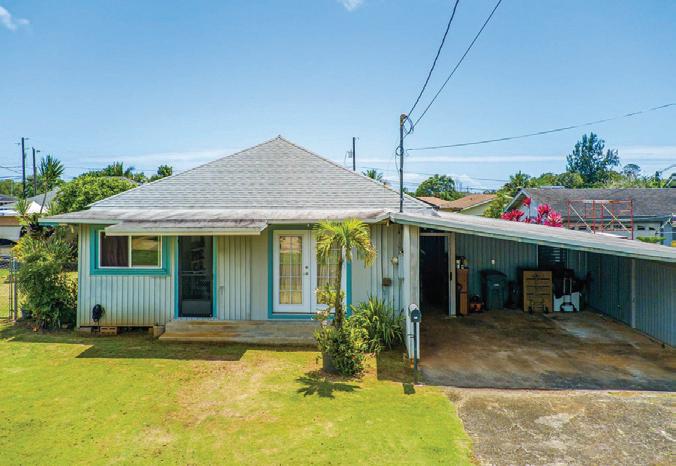
It’s all about location. Here is a






















































































































home within the heart of Old Lihue. Spacious dwelling also comes with a toolshed and possibly a workshop. Lots of potential for an ARU.