

MICRO-APARTMENTS ARE BACK
Hallie Golden and Claire Rush ASSOCIATED PRESS
SEATTLE — Every part of Barbara Peraza-Garcia and her family’s single-room apartment in Seattle has a double or even triple purpose.
The 180-square-foot (17-square-meter) room is filled with an air mattress where she, her partner and their children, ages 2 and 4, sleep. It’s also where they play or watch TV. At mealtimes, it becomes their dining room.
It’s a tight squeeze for the family of asylum seekers from Venezuela. But at $900 a month —more than $550 less than the average studio in Seattle — the micro-apartment with a barebones bathroom and shared kitchen was just within their budget and gave them a quick exit from their previous arrangement sleeping on the floor of a church.
“It’s warm. We can cook ourselves. We have a private bathroom. It’s quiet,” said Peraza-Garcia, whose family came to the U.S. to escape crime in Venezuela and so she could access vital medication to combat cysts on her kidney. “We can be here as a family now.”
Boarding houses that rented single rooms to low-income, blue-collar or temporary workers were prevalent across the U.S. in
the early 1900s. Known as single room occupancy units, or SROs, they started to disappear in the postwar years amid urban renewal efforts and a focus on suburban single-family housing. Now the concept is reappearing — with the trendy name of “micro-apartment” and aimed at a much broader array of residents — as cities buffeted by surging homelessness struggle to make housing more affordable. “If you’re a single person and you want a low-cost place to live, that’s as cheap as you’re going to get without trying to find a subsidized apartment,” said Dan Bertolet, senior director of
housing and urbanism for the non-profit research center Sightline Institute.
The Pacific Northwest is a leader in the resurgence of this form of affordable housing. Oregon last year passed a bill opening the door for micro-apartments and Washington state lawmakers this year did the same, starting to clear red tape that for years has limited construction of the tiny units, which are about a third the size of an average studio apartment.
The Washington bill, which was signed this week by Democratic Gov. Jay Inslee after receiving nearly unanimous support in the Legislature, would require most cities to allow mi-


Borrowing costs on 15-year fixed-rate mortgages, popular with homeowners refinancing their home loans, also rose this week, pushing the average rate to 6.21 percent from 6.16 percent last week. A year ago it averaged 5.68 percent, Freddie Mac said.
When mortgage rates rise, they can add hundreds of dollars a month in costs for borrowers, limiting how much they can afford in a market already out of reach for many Americans.
Investors’ expectations for future inflation, global demand for U.S. Treasurys and what the Federal Reserve does with its shortterm interest rate can influence rates on home loans.
After climbing to a 23-year high of 7.79 percent in October, the average rate on a 30-year mortgage has remained below 7 percent since early December. Rates eased amid expectations that inflation was cooling enough for the Fed to begin lowering its short-term interest rate by this spring. But a spate of stronger-than-expected reports on inflation, the job market and the economy in recent weeks dimmed that outlook, sending mortgage rates higher through most of February.
Many economists expect that mortgage rates will ultimately ease moderately this year, but that’s not likely to happen before the Federal Reserve begins cutting its benchmark interest rate. On Wednesday, the central bank kept its rate unchanged and signaled again that it expects to make three rate cuts this year.
Returning after nearly a century, as need for affordable housing soars
one-quarter — of renters nationwide, the report said.
Rep. Mia Gregerson, who sponsored Washington’s bill, said she predicts the measure will lead to thousands of units being built in her state, providing unsubsidized affordable housing to everyone from young people getting their first apartment and elderly people downsizing to those coming out of physical or mental health treatment.
“Government can’t close that gap all by itself, it has to have for-profit, market-rate housing built all at the same time,” said Gregerson, a Democrat.
cro-apartments in residential buildings with at least six units, according to the Department of Commerce. It takes effect in late 2025. The legislation is an effort to counteract skyrocketing housing prices and, in the Seattle area, one of the nation’s highest rates of homelessness, as well as a critical housing shortage. Extremely low-income renters — those below federal poverty guidelines or earning 30 percent of the area median income — face a shortage of 7.3 million affordable rental homes, according to a National Low Income Housing Coalition report published last week. Such households account for 11 million — or nearly
The U.S. lost hundreds of thousands of SROs in the last half of the 20th century as associations with poverty and substandard accommodation sparked restrictive zoning laws. Some cities outlawed their construction altogether — a loss some housing experts say helped contribute to the homelessness crisis.
Facing that crisis and a critical housing shortage, cities and states across the nation are now shifting their stance.
In December, as her state grappled with a massive influx of migrants, New York Gov. Kathy Hochul announced a $50 million program aimed at repairing and renovating 500 SROs across the state. New York City lost at least 70,000 such units between the early 20th century and
2014, according to a report from New York University’s Furman Center.
But there is concern that this type of affordable housing is not an ideal fit for an especially vulnerable group — families.
There are more than 3,800 unhoused families with children in the Seattle area, among the highest in the nation, according to the U.S. Department of Housing and Urban Development 2023 one-night count.
The bill passed by Oregon lawmakers last year requires local governments to allow single room occupancy units in areas zoned for residential use. The provision took effect Jan. 1.
Central City Concern, a Portland-based homeless services nonprofit, leases more than 1,000 SRO units — both subsidized and not — to people who are considered extremely low income. It helps people struggling to access housing due to things like eviction histories and poor credit scores.
The units have a median rent of $550 a month, making them a “vital option” for people exiting homelessness or living on fixed incomes, such as those with disabilities, said Sarah Holland, senior director of supportive housing and employment. Over 80 percent of tenants were formerly homeless, she said, and some have been living in their units for 30 years.















For graduating high school students, returning college or graduate students! 35th Annual Kaua‘i FCU Scholarship With two $5,000 Awards Available Pick up and drop off applications at any of our branches at: Lihue Branch 2976 Ewalu Street Lihue, Hawaii, 96766 Kalukalu At 1624 1624 Kuhio Highway Kapaa, Hawaii, 96746 Kilauea Branch 2555 Ala Namahana Pkwy Kilauea, Hawaii, 96754 Applicants must be a Kaua‘i FCU member. Awards available to high school, college, Kaua‘i Community College, graduate, PHD and/or any students continuing education. Applications must be turned in or sent to a branch by April 8, 2024. You can request an application by emailing scholarship@kauaicreditunion.org thegardenisland.com THE GARDEN ISLAND Friday, March 22, 2024 • B3 Long-term mortgage rate climbs back up to 6.87 percent ASSOCIATED PRESS LOS ANGELES — The average long-term U.S. mortgage rate climbed back to nearly 7 percent this week, pushing up borrowing costs for home shoppers with the spring homebuying season underway. The average rate on a 30-year mortgage rose to 6.87 percent from 6.74 percent last week, mortgage buyer Freddie Mac said Thursday. A year ago, the rate averaged 6.42 percent. The average rate is now just below where it was two weeks ago.
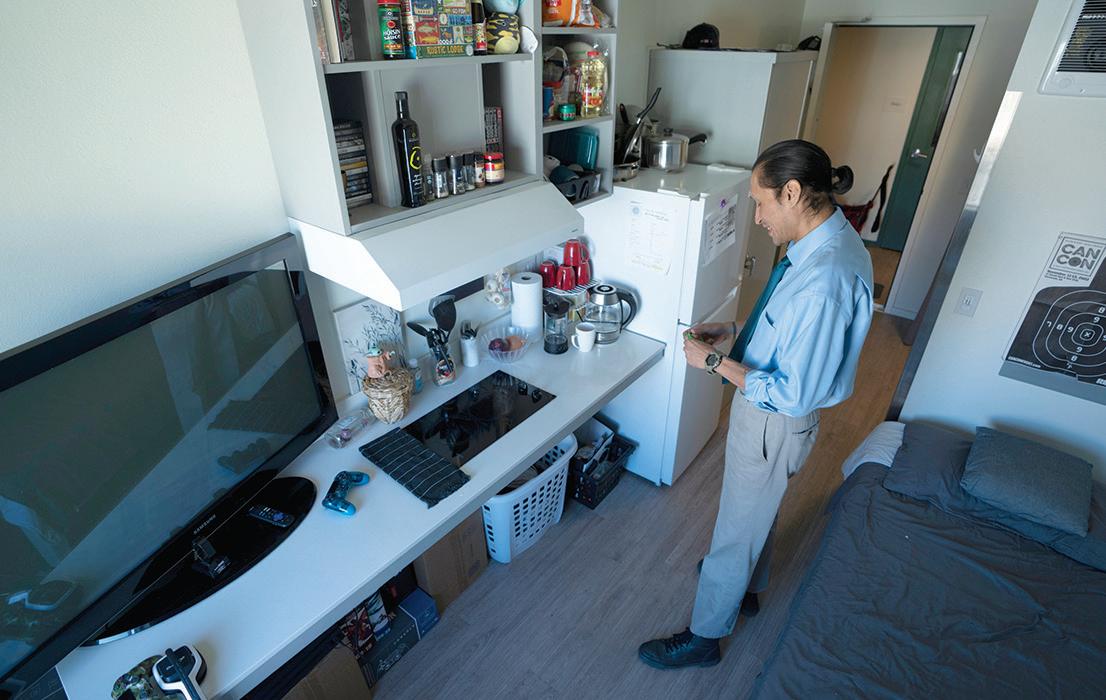
JENNY KANE / ASSOCIATED PRESS
Cheyenne Welbourne stands in his micro-apartment at The Starlight affordable housing building in Portland, Ore., on Friday, March 15, 2024.

































































































Notices to Creditors Notices to Creditors Lihue Completion of Contract General Pets MERCHAN DISE Appliances Kalaheo Kekaha Lihue Redmond Tree Service is seeking ground laborers and/or climbers. Starting pay $25 per hour. Apply by email to redmondtrees@gmail.com Please include: 1. Your resume or detailed work experience. 2. Any experience in tree work or the landscaping profession. 3. Contact information. AKC Labrador Retriever Pups $1500 808-335-2808 or Kauai8888@gmail.com Beautiful Goldendoodle puppies available 3/7 vet checked 3 sets of shots serious inq only $1800. 808-346-2526 Mini Labradoodle Choc, or red, M/F ready 4/6, 1st vax, chipped, vet checked, $3500 808-937-2516 Recycled Appliances Washers,Dryers, Stoves & Refrigerators 6mos. warranty Tashi 808-652-0551 IN ESCROW $573,000 Lot size: 0.51 acres Mark Tanaka-RB 808-639-8213 Ashley Carvalho-RS 808-482-4077 MLS 705122 KEKAHA $399,999 10,584 sqft Kevin Horita -RB 808-639-8213 Jesse Fukushima -RS 808-482-4077 MLS 703768 SOLD $630 ,000 2 Bed/ 2 Ba Interior Area: 840 sqft Clifton Kukino 808-639-1490 Jordan Kukino 808-634-5032 Kaylin Kukino 808-635-2822 MLS 706241 OWNER’S NOTICE OF COMPLETION OF CONTRACT NOTICEISHEREBY GIVENthatpursuantto theProvisionsofSection 507-43,oftheHawaii RevisedStatutes,the constructionbyJohn Murrayofthatcertain 2storysinglefamily residencesituatedat 2636HalaluSt.Koloa, Hawaii,TMK:(4)-2-831-178-2,hasbeen completed. John Murray Owner(s) (TGI1449315 3/22, 3/29/24) AMENDED FIFTH CIRCUIT COURT NOTICE AND NOTICE TO CREDITORS 5CLP-24-0000014 ESTATE OF TIMOTHY JOHN CASEY, Deceased FILED,PetitionforAdjudicationofIntestacyand AppointmentofPersonalRepresentative,alleging intestacyofsaiddecedent,andaskingthatKELEIGH CASEY,whoseaddressis2945MokoiStreet,Lihue, Hawaii96766,beappointedPersonalRepresentative of said estate. Tuesday,April2,2024,at1:30p.m.beforethe presidingJudgeinProbateat3970KaanaStreet, Lihue,Kauai,Hawaii96766istheappointeddate, timeandplaceforhearingsaidpetitionandall interested persons. Allcreditorsoftheabove-namedestatearehereby notifiedtopresenttheirclaimswithpropervouchersor dulyauthenticatedcopiesthereof,eveniftheclaimis securedbyamortgageuponrealestate,tosaid nomineeattheaddressshownabovewithinfour(4) monthsfromthedateofthefirstpublicationofthis notice or they will be forever barred. DATED: Lihue, Kauai, Hawaii, February 20, 2024. /s/ C. Martinez Clerk of the Above-Entitled Court Attorney for Petitioner: JONATHAN J. CHUN (2928-0) 3135 Akahi Street, Suite A Lihue Kauai Hawaii 96766 Telephone: (808) 245-4705 (TGI1447321 3/8, 3/15, 3/22/24) Deadlines: Regular, single-column classifieds in The Garden Island can be placed until 4:45pm on Monday, Tuesday, Wednesday, and Thursday for the following day, noon on Friday for Sunday and Monday. Please call your sales executive or 246-0325 for deadlines for larger, multi-column ads. Cancellation/Correction Deadlines: To cancel or change an ad in the Garden Island, call us by 4:45pm on Monday, Tuesday, Wednesday, and Thursday for the following day, noon on Friday for Sunday and Monday. (We are closed Saturdays and Sundays). The Garden Island Real Estate Deadlines: To place, correct or cancel a Friday real estate/rental single-column ad, please call by noon on Thursday. Check your ad for errors the first day it runs in the paper. We are unable to issue credit for errors reported after the first day of publication. While we try to accommodate our advertisers, The Garden Island does reserve the right to edit, refuse, reject, or cancel any ad at any time. All ads are subject to approval prior to publication. We are not liable for losses or expenses resulting from publication errors or omission of an ad at any time. All ads are subject to approval prior to publication. We are not liable for losses or expenses resulting from publication errors or omissions of an ad. Advertising rate cards are available from any sales executive. Ads are subject to the rate card in effect at the time they are placed. ANNOUNCE MENTS MERCHAN DISE THE INDEX WE GLADLY ACCEPT: Business Hours Call Center Monday–Friday; 7:30 a.m.–5:30 p.m. SELL YOUR STUFF FOR AS LITTLE AS $9.99 A WEEK ON ALL MERCHANDISE ADS * Restrictions may apply. Call for details. real estate directory PLACE YOUR AD t ODAY 246-0325 th E g ARDE nis LA n D CO m/ CLA ssifi ED s KAUAI’S 808-246-0325 Subscribe today 245-0433 thegardenisland.com Legals / Public Notices KAUAI’S thegardenisland.com Subscribe today 245-0433 Stay Informed thegardenisland.com FRIDAY TGIFR!DAY REAL ESTATE-----Season’sGreetings- SEEDS OF CHANGE DowDuPont to expand research increase staffing;Hartung Brothers become production scale of products for commercial statewide thegardenisland.com Subscribe today 245-0433 Stay Informed thegardenisland.com FRIDAY December 15, 2017 INSIDE TGIFR!DAY REAL ESTATE KIF SOCCER • B1 RED RAIDERS SHUT OUT VOYAGERS---consumeraccess.org/), Featured HomesWaysrentersarebecominghomeowners Poipu VISIT SHOWROOMTODAY! Lihue Flooring Homes product selection installation, 2pm Annual Holiday ‘THE GREATEST TIME OF THE YEAR’ 4-1525 Kuhio Hwy. Kapa Islandwide Deliveries M–F OPEN SATURDAYS 7:30-11AM Season’s Greetings from your friends at year by the merger of the Dow Chemical Co. and E.I. DuPont de Nemours and Co., is in the process dividing its corporate operations companies, one of strains.Meanwhile, Hartung Brothers Inc., a leading seed developer that produces GMO, organic and conventional seeds for farmers, said it changing the nature of its will become a Kauai operations of Syngenta A.G., a Swiss conglomerate closely identified with GMO agriculture and widely criticized over pesticide use. It will continue its GMO and other research activities on Kauai as it diversifies into production farming. announcement Kauai’s Westside seed companies — starting with reduction in the total number of firms from four to three. Rumors of an impending shake-up at DowDuPont had been rife for weeks. In 2016, Beck’s Hybrids acquired the Kauai operations of BASF Corp., an international chemical and techSEEDS OF CHANGE Allan Parachini SPECIAL TO THE GARDEN ISLAND DowDuPont to expand research activities,increase staffing;Hartung Brothers Inc.to become a production scale grower of food products for commercial markets statewide A8 Subscribe today 245-0433 thegardenisland.com thegardenisland.com Subscribe today 245-0433 Stay Informed LIHUE $950,000 2Bed/2Ba Shelly Kaui Carvalho 808-652-3886 MLS 705526 IN ESCROW AROL C. CUMMINGS RB-14915 (RB) CRB, CRS, GRI, SFR 808-651-4766 kauairealty@gmail.com www.carolcummingskauai.com LAWAII JUST LISTED! Land Area: 15,751 sf Living Area: 640 sf Carport: 269 sf Laundry/Shower: 105 sf Bed/Bath: 2/1.5 Price: $995,000 MLS# 708541 JUST LISTED! LAWAI SHELLY KAUI-CARVALHO RS-64829 (RS) ABR, CRS, SFR, SRS 808-652-3886 Shelly@kauairealty.net Land Area: 26,746 sf House: 3bd/2ba Cottage: 1bd/1ba Price: $1,300,000 MLS# 706818 CAROL C CUMMINGS RB-14915 (RB) CRB, CRS, GRI, SFR 808-651-4766 kauairealty@gmail.com (808)246-8828 Across From Kauai Community College 4490 Puhi Road, Lihue * Custom Color Matching * Armstrong-Clark Stains * * Purdy Brushes * Graco Sprayers * Home Owner * * Maintenance * Commercial * Industrial * Carpentry Carpenter looking for maintenance jobs. Free estimates. 3D Construction Call Albert 652-8861. alapaki82@outlook.com FOR MORE INFORMATION, CALL DIANE 245-0456 BUSINESS service guide 245-0456 THE GARDENISLAND.COM/CLASSIFIEDS Subscribe today 245-0433 thegardenisland.com Page 4 Friday, March 22, 2024 THE GARDEN ISLAND www.thegardenisland.com