Rieter placed
8/31/26
3:07 PM
Page 1
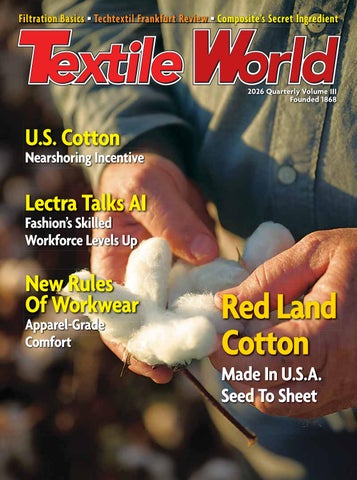
Filtration Basics Techtextil Frankfurt Review Composite’s Secret Ingredient
2026 Quarterly Volume III Founded 1868
U.S. Cotton
Nearshoring Incentive
Lectra Talks AI Fashion’s Skilled Workforce Levels Up
New Rules Of Workwear Apparel-Grade Comfort
Red Land Cotton Made In U.S.A. Seed To Sheet
TIMG Promotion5
8/31/26
3:11 AM
Page 1
COVERING THE TEXTILE INDUSTRY SINCE 1868
TRUSTED Textile Industry News & Technology
INSIGHT For Manufacturers, Brands & Innovators
English-language fiber-to-fabric coverage of the U.S. and the broader Americas. Read by senior executives, engineers and plant-level decision-makers.
Spanish-language coverage for Mexico, Central and South America, and the Caribbean. Read by Latin American manufacturers and buyers in their own language.
English-language window on Asia’s textile hubs. Read by manufacturers, brands and textile executives across the region’s production centers.
I S YO U R C O M PA N Y PA RT O F T H E C O N V E R S AT I O N ? READ
SUBSCRIBE
REACH
Digital Magazines Available
Stay Current with Today’s Industry News
Marketing & Press Opportunities
TA RG E T E D M A R K E T I N G S O L U T I O N S F O R T H E G LO B A L T E X T I L E I N D U ST RY textilewor ld.com | textilespanamer icanos.com | textilewor ldasia.com adver tising@textilewor ld.com
TOC3.qxd
8/31/26
3:10 PM
Page 4
2026 Quarterly Volume III TextileWorld.com Founded 1868
A
Publication
Features 7
ITMA ASIA + CITME 2026 Shanghai show expands machinery and technology coverage.
8
Techtextil And Texprocess 2026 Bring Innovation To Frankfurt Frankfurt events turn ambitious ideas into real-world solutions.
10
U.S. Cotton, Nearshoring And The Resilient Supply Chain As sourcing volatility reshapes brand decision making, U.S. cotton is being evaluated on more than raw material cost
12
The New Rules Of Workwear How apparel-grade comfort and fit are becoming workwear essentials — supporting safety, productivity and inclusivity on the job.
14
Textiles: Composite’s Secret Ingredient Textile reinforcements give composite materials their manufacturing versatility.
18
Red Land Cotton: From Seed To Sheet One family’s cotton crop now powers a Made in U.S.A. bedding brand from farm-to-home.
23
High Performance Rotor Spinning at Nazar Tekstil Rieter’s R 70 fully automatic rotor spinning machine combines quality, productivity and energy efficiency.
ON THE COVER: Cotton farmer Mark Yeager and his daughter, Anna Yeager Brakefield, turn Alabama cotton into Red Land Cotton, a fully American-made, farmto-home bedding brand, one heirloom sheet at a time. (Photo courtesy of Red Land Cotton)
Nonwovens/Technical Textiles READ Digital Magazine Available
24 News 25 Filtration Basics: Quiet Giant For U.S. manufacturers, technical demands are creating new opportunities.
Fiber World 28 News 29 From Textile Waste To Spinnable Fiber: Why Classification Comes First
Departments 4
From The Editor
6
News
37
People
39
Calendar
38
Quality Fabric: Nuyarn™ Technologies
Textile waste origin influences fiber quality in mechanical recycling.
Knitting/Apparel
Dyeing,Printing & Finishing
36 News 36 News 32 AI Can Strengthen Fashion’s Skilled Workforce AI can preserve expertise and empower the next-generation workforce.
34 VDMA’s Threads of the Future: Textile Production Toward 2035 How textile processing, cut-and-sew and finishing will evolve through 2035. VOL. 176, No. 3 / TEXTILE WORLD (ISSN 0040-5213) is published quarterly by Textile Industries Media Group, LLC, PO Box 683155, Marietta, GA 30068, and incorporates Modern Textiles, Textile Industries, Fiber World and Knitting/Apparel magazines, which remain the property of Textile Industries Media Group, LLC. Copyright 2026, Textile Industries Media Group, LLC Title registered with the U.S. Patent Office. All rights, including translation into other languages, reserved. Subscription rates for one year are: $65 (US); $85 (Canada and Mexico); $130 (Other International). Single copy rates are: $15 per copy. All prices are in U.S. dollars and all orders must be prepaid. Questions may be submitted to jdavis@textileworld.com. POSTMASTER send address changes to: Textile Industries Media Group, LLC, PO Box 683155, Marietta, GA 30068. Send Canadian address changes to: Textile World, c/o The Mail Group, P.O. Box 25542, London, ON N6C 6B2, Canada. Customer #7007632 Publications Agreement #40612608.
EditNote2.qxd
8/28/26
3:12 AM
Page 6
From The
U.S. Textiles:
Editor
Staying The Course
R
ough water challenges even the best run ships and crews. High winds, cross currents and unseen obstacles can suddenly test even the strongest vessel. This year’s textile events have felt a lot like that — U.S. mills and brands navigating their own rough seas. From the macro shocks of war, high energy prices and the lingering effects of COVID 19, textile manufacturers are universally challenged. Undercurrents of nearshoring decisions, trade policy shifts and global price pressures are testing even well-managed companies, while leaps in technology and regulatory changes unexpectedly hit their path forward. All in all, this isn’t really new water for U.S. textiles. There is a deep history of offshoring, plant closures and strong companies facing unexpected shocks or final blows. But the industry also has a history of resilience and a remarkable instinct for finding a new path forward. Both Techtextil Frankfurt and Techtextil North America echoed these challenges — and opportunities — this year. As reported in this issue’s coverage of the Frankfurt show, “The overall situation reflects the current global uncertainty. Companies are cautious with investments and eager to cut costs,”said Matthias Schemken, managing director of Trützschler Nonwovens. “This is exactly where practical, efficient solutions become important.” Beyond that practicality was a desire to look past the headwinds for a path forward; both shows shared the same tone — acknowledging the current situation while trying to see past it to the opportunities ahead. Whether it was NASA’s discussion of a need for textiles in the Artemis program, or hemp fiber making new strides, there was — and still is — positive change to be embraced.
The Red Land Cotton cover story is a great example of looking at one’s strengths and fearlessly pushing forward for the company’s gain — and, in Red Land’s case, for the security of family and farm. The nay-sayers can’t be discounted — and there are plenty of them. But navigating through rough waters has never been for the faint of heart. An interesting detail of the Red Land Cotton story is easy to overlook. Red Land Cotton built a U.S.-based textile supply chain to take their Alabama cotton all the way through domestic manufacturing, to deliver heirloom sheets to consumers: “We all got in the same room at Techtextil in Atlanta, in 2016, and by October of that year we had our first product to sell,”recalled Brakefield. “Parkdale was there. Jim Hopkins [Hamrick Mills] was there. Brewster Yates was there.You know, so all of a sudden, they’re in this big room full of textile people and realize, hey, here’s our supply chain right here,”said Miller. Anna Yeager Brakefield is a founder of Red Land Cotton and Jack Miller is the textile veteran instrumental in Red Land’s ability to navigate the U.S. textile industry. But it goes to show that “being there” matters. Showing up, looking for opportunity, solving problems — U.S. textiles has weathered many a storm, and rough water or not, will continue to stay the course.
James M. Borneman jborneman@TextileWorld.com
Masthead2.qxd
8/30/26
11:52 PM
Page 5
A
Publication
PO Box 683155, Marietta, Georgia 30068, USA Telephone +678-483-6102 TextileWorld .com www.T
ADVERTISING REPRESENTATIVES EDITOR IN CHIEF TECHNICAL EDITORS
James M. Borneman
UNITED STATES/CANADA
Dr. Lisa Parillo Chapman
+864-594-0921 • sturner@textileworld.com
Dr. Peter J. Hauser Dr. Trevor J. Little Dr. William Oxenham Dr. Behnam Pourdeyhimi
Turner Marketing & Media, LLC
MEXICO, CENTRAL & SOUTH AMERICA Virgilio L. González + 58-412-622-2648 • vlgonzalezp@gmail.com EUROPE (except ITALY)
Sabine Dussey
+49-171-5473990 • sabine.dussey@dussey.de
Dr. Abdel-Fattah Seyam Dr. Andre West
ITALY Ferruccio & Filippo Silvera +39-022-846716 • info@silvera.it
CONTRIBUTING EDITORS
Jim Kaufmann
CIRCULATION MANAGER
Julie K. Brown-Davis
ASIA James M. Borneman
ADVERTISING BUSINESS MANAGER
Denise Buchalter
+678-483-6102 • jborneman@textileworld.com
ART & PRODUCTION MANAGER
Julie K. Brown-Davis
INTERNET & CLASSIFIEDS OPPORTUNITIES Julie Davis
OWNER/PUBLISHER
James M. Borneman
+678-522-0404 • jdavis@textileworld.com
Celebrate 30 years of textile innovation at TITAS 2026, Oct 6-8, at Taipei Nangang Exhibition Center, Hall 1. As Taiwan’s premier hub for sustainability and intelligent manufacturing, TITAS connects the entire supply chain to offer a one-stop sourcing experience. Join us to shape the future of textiles!
News3.qxd
8/30/26
11:57 PM
Page 6
News Burlington Celebrates Commissioning Of State-Of-The-Art Dyehouse Charlotte, N.C.-based Burlington Industries, a U.S. manufacturer of advanced textile solutions, celebrated the commissioning of a modernized dyehouse at its Raeford, N.C. operation. The investment supports domestic textile production and the company’s militaryuniform supply programs. The Raeford facility produces specialized fabrics for military dress uniforms and is the only U.S. manufacturer producing those fabrics domestically. It supplies dress-uniform programs for the Air Force, Army, Coast
Guard, Marine Corps, Navy and Space Force. “Our dyehouse investment demonstrates our confidence in the Raeford operation, our employees and the critical role this facility plays in supporting those who protect our freedoms,”said Jeffrey P. Pritchett, CEO of Elevate Textiles, Burlington’s parent company. Burlington President Guy Lucas said the modernized dyehouse equips employees with technology to sustain the site’s more than 70-year legacy. “This new state-of-the-art dyehouse is an investment in our future, but it is also an investment in our people,”Lucas said.
(left to right) The commissioning ceremony: N.C. Rep. Garland Pierce, County Commissioners Chairman James Leach, County Commissioner Mary Blue McCollum, Raeford Mayor John McNeill, Elevate CEO Jeffrey P Pritchett, U.S. Rep. Richard Hudson, Burlington President Guy Lucas and Raeford Plant Manager Keith Mims.
Supreme Nonwoven Inc. Invests $25.8 Million In North Carolina Facility Raleigh, N.C.-based Supreme Nonwoven Inc., a manufacturer of advanced nonwoven materials and products, will invest $25.8 million to establish its first U.S. manufacturing facility in Lexington, North Carolina. The more than 200,000-square-foot facility will support technical collaboration and customized material development for North American customers in apparel, automotive, filtration and industrial markets. “Our decision to establish this facility in North Carolina reflects a long-term commitment to serving the U.S. market with locally manufactured nonwoven materials,” said Amit Kavrie, managing director of Supreme Group, Supreme Nonwoven’s India-based parent company. Average annual wages for the new positions will be $55,800, above Davidson County’s average of $54,395.The jobs could generate an annual regional payroll impact of $2.79 million.
Thomas Jefferson University Announces The New College Of Fashion And Textiles Philadelphia-based Thomas Jefferson University established the College of Fashion and Textiles this summer as part of a restructuring of its Kanbar College of Design, Engineering and Commerce. The new college will offer undergraduate and graduate programs in fashion design, fashion merchandising and management, textile design and textile technology, as well as a doctoral program in textile engineering and sciences. Students
will remain in their current programs without changes to curriculum, faculty or advising. “Rooted in our legacy as the nation’s first textile school and strengthened by our internationally recognized fashion programs, the College creates a dynamic, collaborative environment where creativity, innovation and purpose converge,”said Marcia Weiss, dean of the College of Fashion and Textiles. Thomas Jefferson University also will create the College of Business and the College of Architecture, Design and Engineering.
NC State To Spearhead 10-Year, $480 Million Effort To Bolster Defense Textile Manufacturing Raleigh, N.C.-based NC State University will lead FutureTEX, a 10-year Department of War initiative to modernize U.S. textile manufacturing for defense and domestic applications. The award includes $36 million in its first year and has a $480 million ceiling over a decade.
6
2026 QUARTERLY ISSUE III
FutureTEX will unite industry, government, university and nonprofit partners to advance textile manufacturing technology, workforce development, and facility and equipment modernization. Core partners include Drexel University, Gaston College, Georgia Tech, ISAIC and UMass Lowell.
TextileWorld.com
“FutureTEX is focused on creating a cutting-edge national ecosystem for defense textiles that simply doesn’t exist today,” said David Hinks, FutureTEX chief strategic partnerships officer and dean of NC State’s Wilson College of Textiles. NC State and Gaston College will establish a nonprofit to oversee the initiative,
headquartered at Gaston College’s Kimbrell Campus in Belmont, North Carolina. “North Carolina and Gaston County have deep roots in the textile industry,” said Gaston College President John Hauser.“We are uniquely positioned to propel this manufacturing innovation institute forward.” TW
ITMAAsiaCITMA2.qxd
8/31/26
3:19 PM
ITMA ASIA + CITME 2026 PREVIEW
Page 2
Weaving Knitting & Hosiery Spinning & Man-made Fiber Production Winding, Texturing & Twisting Testing Nonwovens Dyeing & Finishing Garment & Textile Processing Embroidery, Braiding Narrow Fabrics Weaving Machines Colorants & Chemicals Printing & Inks Research & Innovation
ITMA ASIA + CITME 2026 Shanghai show expands machinery and technology coverage. Textile World Special Report
I
TMA ASIA + CITME 2026 will be held Nov. 20-24 at the National Exhibition and Convention Centre in Shanghai. The combined exhibition will occupy seven halls and approximately 180,000 square meters of gross exhibition area, a 10% increase from the last edition. More than 1,800 exhibiting companies have applied to participate, with nearly 90% from China. Exhibits will be organized by production process and span the textile and garment manufacturing value chain, from spinning and man-made fibers through weaving, knitting, printing, dyeing and finishing, nonwovens, garment making, recycling, testing and packaging. New sectors will include equipment for textile-reinforced composites, textile recycling technologies, digital platforms and automation solutions for production processes. A dedicated Research and Innovation sector will bring together Chinese universities to present research developments and industry-academiaresearch collaboration, including embodied robots for textile applica-
tions, intelligent inspection technologies and artificial intelligence development platforms. Among companies that have confirmed participation are Atexco, B.T.D., Barmag, Beijing Chonglee, BEST, CHTC, Cixing, Dornier, Epson, Fong’s, Hicorp, Hongyuan, Itema, Karl Mayer, Konica Minolta, LMW, Murata, Picanol, Rieter, Rifa, Santoni, Saurer, Shima Seiki, Staubli, Taitan, Texpro, TMT, Truetzschler, Vandewiele, Yingyang and Yoantion. Exhibitors will present developments in digitalization, intelligent manufacturing and automation intended to support sustainability, energy and resource efficiency, and smarter production. The 2024 edition attracted more than 90,000 visitors from 111 countries and regions, nearly 90% of them from China. Organizers also reported growing visitor numbers from Algeria, Japan, Italy, Sri Lanka, Türkiye and the United Kingdom that year. International trade visitors may preregister through itmaasia.com and citme.com.cn through Nov. 19. Trade visitors can receive a 40%
early-bird discount on admission tickets. Domestic and international trade associations, industry organizations and corporate visitor groups of six or more participants may apply for preferential group admission packages. From April through July, organizers conducted outreach in key textile markets as part of efforts to broaden international visitor participation. Further activities are planned in Bangladesh, Brazil, Egypt, Pakistan, South Africa and other markets. More than 100 overseas trade associations, industry organizations and key enterprises have received invitations for group participation. Within China, promotional activity is focused on Jiangsu, Zhejiang, Fujian, Shandong and Guangdong, as well as industrial clusters in Xinjiang, Hubei and Henan. TW
November 20-24, 2026 National Exhibition & Convention Centre Shanghai, China
Tickets & Questions: itmaasia.com | citme.com.cn
Textile World 2026 QUARTERLY ISSUE III
7
TTReview3.qxd
9/2/26
3:30 PM
Page 8
TECHTEXTIL FRANKFURT
The Techtextil Forum featured “High-Performance Textiles for Space,” presented by Jane Gensler of NASA Headquarters and Wendy Gao of NASA’s Johnson Space Center. Photos courtesy of Messe Frankfurt/Pietro Sutera
A Pavilion At Home
Techtextil And Texprocess 2026 Bring Innovation To Frankfurt
Despite a challenging market, co-located Frankfurt events delivered the expertise to turn ambitious ideas into real-world solutions. Textile World Special Report
F
or those who have attended Techtextil and Texprocess in the past, the shows hold the promise of connecting with like-minded textile individuals who are driven by innovation, collaboration and the goal to take textiles to a new realm of form and function. In May, event organizer Messe Frankfurt Exhibition GmbH welcomed more than 36,000 visitors to Techtextil and Texprocess 2026 at the Messe Frankfurt fairgrounds, featuring 1,700 exhibitors. The organizer characterized the event, saying: “In a challenging market, Techtextil and Texprocess provided the global industry with a stable meeting place.” With participants from 112 countries represented at the exhibition grounds, the organizer reported that the top 10 visitor countries were Germany, Italy, France, Türkiye, the Netherlands, Spain, Belgium, the United Kingdom, Poland and Switzerland. The organizer reported growth in international attendance, underscoring the global reach of the Frankfurt shows. Techtextil featured 1,500 exhibitors from 52 countries.
Innovation In A Challenging Market Energy costs, geopolitical conflict and trade uncertainty were undercurrents of the May event.
8
2026 QUARTERLY ISSUE III
TextileWorld.com
Messe Frankfurt Executive Board Member Detlef Braun commented: “Volatile market developments are driving lasting changes in business models. Connectivity, flexibility and speed are key success factors in this environment. At Techtextil and Texprocess, relevant partners come together to rapidly translate ideas into applications.” Global challenges leading up to the May 2026 event may have dampened turnout but were often overcome on the show floor — new ideas, innovations and cutting-edge companies were not in short supply.
On The Show Floor Trützschler Nonwovens GmbH, Dülmen, Germany, acknowledged the lower turnout but was not surprised based on pre-show discussions with its clients. “The overall situation reflects the current global uncertainty. Companies are cautious with investments and eager to cut costs,” said Matthias Schemken, managing director of Trützschler Nonwovens. “This is exactly where practical, efficient solutions become important.” “We are seeing a clear trend toward refurbishments and retrofits,” explained Robert Koert, director of service at Trützschler Nonwovens. “Customers want to restore and exceed original performance levels.”
VDMA Textile Machinery had a strong presence with more than 50 exhibiting companies and seven companies at the VDMA group stand. “The fact that Techtextil is held in Frankfurt, where our headquarters are based, has a very practical advantage for us: we can meet with our member companies face to face, practically on our doorstep. This saves both us and the companies a great deal of time,” VDMA said in a statement.” The association also celebrated the 60th anniversary of the Walter Reiners Foundation, highlighting six decades of commitment to young engineers. VDMA representatives noted: “The event reflected on past award winners and their careers before introducing the 2026 recipients. Five graduates received awards for their bachelor’s and master’s theses, presented by Foundation chairman Peter D. Dornier.”
Innovation Awards The presentation of the Techtextil and Texprocess Innovation Awards 2026 was a great source for discovering trends and standout members of the industry. The organizers reported that “across 10 categories, 17 international winners were being recognized for pioneering research, innovative products and materials, as well as new processes and technologies. These innovations provide solutions far beyond the textile industry — including sectors such as automotive, aerospace, medical, architecture, construction and robotics.”
Show Floor Forums The show floor forums were a highlight of the event, featuring what seemed like an endless progression of interesting presentations.
TTReview3.qxd
8/27/26
12:56 AM
Page 9
Sabine Scharrer, director of brand management technical textiles and textile processing at Messe Frankfurt and show director of Techtextil and Texprocess, commented: “The NASA presentation was undoubtedly one of the highlights of the trade fairs and attracted a diverse audience, ranging from textile engineers and material scientists to manufacturers, researchers, students and technology providers. “We were particularly pleased to welcome Jane Gensler, Crew Health and Performance Domain Lead at NASA Headquarters, and Wendy Gao, Textile Material Lead at NASA’s Johnson Space Center. “Their presentation demonstrated how critical advanced textiles are — from fire protection and thermal management to abrasion resistance, wearable technologies, and future habitat concepts. The clear message: many of the challenges of future Moon and Mars missions are, in fact, material and textile challenges. “This resonated strongly with our audience because it highlighted the
Techtextil and Texprocess 2026 welcomed to Frankfurt Germany more than 36,000 visitors and featured 1,700 exhibitors.
growing importance of technical textiles in highly demanding applications. The level of engagement was remarkable,” said Scharrer. “The forum was packed, and many attendees stayed afterwards to continue discussions, meet the speakers in person, and take photos. At the same time, NASA made it clear that solving these challenges will require close collaboration between industry, research institutions, and technology providers.” This post-presentation interaction
was commonplace at both the Techtextil and Texprocess forums. The forums were a strong draw but also represented the real spirit behind Techtextil. “The [NASA] session illustrated how material innovation developed for extreme environments can create opportunities beyond space exploration,” Scharrer added. “This reflects exactly what Techtextil and Texprocess stand for: bringing together the expertise needed to turn ambitious ideas into real-world solutions.” TW
INDUSTRIAL LABORATORY EQUIPMENT CO., INC. 3210 Piper Lane – Charlo e, NC 28208 / PO Box 220245 – Charlo e, NC 28222 – U.S.A. Phone: 704-357-3930 – Email: ile@ile-tex les.com
Catalog: www.ile-tex les.com
DIGITAL SHRINKAGE TESTER For determining the shrinkage of yarns, twines, narrow fabrics, and re cords. Temperature range is adjustable from room temperature to 245 degrees cen grade / 473 degrees Fahrenheit. Digital readout of temperature and shrinkage in imperial or metric systems. Temperature controlled. Conforms to A.S.T.M. D4974 110-120 VAC.
Yarn Reels
Color Card Winders
Sliver Reels
Twist Testers
Textile World 2026 QUARTERLY ISSUE III
9
Cotton3.qxd
8/31/26
3:53 AM
Page 10
COTTON SPOTLIGHT
U.S. Cotton Trust Protocol provides audited field-to-mill data and verified regenerative practices, validated on the ground and via satellite imagery, from a U.S. cotton industry built on about 14,000 farms and supporting more than 200,000 jobs.
U.S. Cotton, Nearshoring And The Resilient Supply Chain As sourcing volatility reshapes brand decision making, U.S. cotton is being evaluated on more than raw material cost, including quality, traceability, compliance and nearshore supply chain performance. By Liz Hershfield
T
he sourcing environment right now is unlike anything most of us have navigated in our careers. The trade landscape has shifted considerably, reshaping sourcing economics across multiple regions. Supply chains that looked efficient in one set of conditions have adapted quickly. And brands that optimized purely for cost are now reckoning with what it really means: margin exposure, lead time and the ability to respond when conditions change. Fiber choice sits right in the middle of that reckoning. Where your fiber comes from, what you can verify about it and how it moves through the supply chain all have real consequences for cost, compliance and competitiveness. The brands thinking seriously about this are the ones building supply chains that can withstand a dynamic and volatile environment. After 30 years in sourcing and supply chain, mostly on the brand side, I have learned that price is always a key consideration with U.S. cotton. But the question isn’t just raw material cost. It’s what the alternative actually costs you, in yields,
10
2026 QUARTERLY ISSUE III
TextileWorld.com
compliance exposure, verifiable sustainability data and supply chain resilience. That’s where the real math lives and that’s the conversation worth having right now.
Quality That Delivers: From Field To Finished Garment U.S. cotton’s fiber characteristics — length, uniformity and strength — consistently rank among the highest in the world. That matters at every stage of processing. Better fiber uniformity means fewer breaks in spinning, higher yields and more consistency in the dyeing and finishing stages. When you run the full cost-in-use analysis rather than stopping at price-per-pound, the gap with perceived lower-cost alternatives often becomes cost neutrality, if not cost savings. This isn’t a claim I make lightly. Comparative fiber testing data backs it up and mills that have switched to U.S. cotton or increased their share of it report real, measurable improvements in processing efficiency. The technical work to prove this, done side-by-side with suppliers, is where
COTTON USA’s team has been focused. We’re now extending that directly to brand partners — through the U.S. Cotton Trust Protocol — who want to deploy this service in their supply chains to take full advantage of all that U.S. cotton has to offer.
A Sustainability Story Backed By Data Most U.S. cotton comes from multi-generational family farms. Many of these growers have been practicing soil health-focused, reduced-input farming for years, well before “regenerative agriculture” became an industry buzzword. What has changed is the ability to verify and communicate that. The U.S. Cotton Trust Protocol, now in its sixth year, gives brands field-to-mill audited aggregated data on water use, greenhouse gas emissions, soil health and energy efficiency. For the 2025 crop year, the U.S. Cotton Trust Protocol launched a dedicated Field Partner Program pilot for regenerative practices, testing a dual framework that combines verified practice adoption with quantifiable, data-driven outcomes, validated through field visits and satellite imagery analysis. Broader implementation is planned for 2026. This is serious, rigorous work: audited proof of practice at field level, not a marketing exercise. Scrutiny on sustainability claims is intensifying. The EU Green Claims Directive is one example and U.S. regulatory attention is growing. Verified, supply chain-specific data has become a basic expectation, not a selling point. U.S. cotton also comes without the forced labor or deforestation risks that demand constant due diligence elsewhere. In the current environment, that clarity has real value.
Cotton3.qxd
8/27/26
12:36 AM
Page 11
The Latin America Connection: Nearshoring + U.S. Cotton One of the biggest sourcing shifts I’ve watched over the past two years isn’t about fiber. It’s about geography. Latin America has gone from a supplemental sourcing option to a genuine strategic priority for many brands with U.S. distribution and the current trade environment has accelerated that considerably. The reasons aren’t hard to see. Shipping times from Latin America to the U.S. run three to twelve days, making weekly replenishment cycles possible. That has direct consequences for inventory management: fewer markdowns, faster response to demand signals. Trade agreements are also a meaningful part of the picture. Mexico and the U.S. have had a mutually beneficial trade relationship for more than 30 years. Today, USMCA offers duty- and tariff-free access for qualifying goods, helping to make Mexico one of the largest importers of U.S. cotton in Latin America. CAFTA-DR provides duty- and tariff-free entry for qualifying yarn-forward goods from Central America and the Dominican Republic and brands with strong rules of origin compliance are well-positioned to take advantage of that. CAFTA-DR’s FTA utilization rate reached 75.7% in 2025, up from 73% in 2024, reflecting growing investment in supply chains built to meet those requirements. Across the region, the manufacturing offer has developed into a sophisticated operation: premium denim in Mexico and Guatemala; performance and activewear in Central America; and high-quality knitwear in Guatemala and Peru (which consistently ranks among the top three countries in the world by average apparel export price). Additionally, there is the benefit — through the U.S. Cotton Trust Protocol — of being able to trace a finished garment back to U.S.-grown fiber, through spinning, knitting, sewing and finishing, all within a compliant and audited nearshore supply chain:
More brands are asking harder questions about fiber origin, inputs and proof, and turning to the U.S. Cotton Trust Protocol to trace garments back to U.S.-grown cotton through spinning, knitting, sewing and finishing in an audited, compliant nearshore supply chain — a story they can substantiate and build on.
that’s a story more brands are starting to build and it’s one that resonates.
The Opportunity Ahead The U.S. cotton industry continues to evolve by investing in technology, sustainability and technical support. For example, the U.S. Cotton Trust Protocol recently announced its partnership with Oritain implementing a forensic testing strategy to provide physical assurance along with the best-in-class digital traceability offering. Now, it’s time for brands to come to the table prepared to evaluate the full value case, not just compare price per pound. The brands I keep an eye on are the ones asking hard questions about what goes into their products, where the fiber comes from and what they can actually prove. Some are smaller companies building natural-fiber commitments from scratch. Some are larger brands who are evolving their sourcing approach to include nominating fiber origin so they can benefit
from a compliant supply chain and higher quality. Connecting U.S. cotton to Latin American manufacturing, through strong trade partnerships, increased traceability and trusted supplier relationships, is a supply chain model with real integrity. It performs under pressure, it can be audited and it tells a coherent story from field to finished garment. Behind that story is a U.S. cotton industry that supports communities in rural America, providing more than 200,000 jobs across roughly 14,000 farms. These aren’t passive operations waiting to be sourced from. They’re investing in their practices, their data and their connections to the brands and mills downstream. When you go and actually look at what’s been built, the case makes itself. TW Editor’s Note: Liz Hershfield is Executive Director of COTTON USA™ and Director of the U.S. Cotton Trust Protocol.
Textile World 2026 QUARTERLY ISSUE III
11
LYCRA6.qxd
9/3/26
11:57 PM
Page 12
FIBER SPOTLIGHT
Inclusive workwear is a growing market as more and more women enter the skilled trades.
How apparel-grade comfort and fit are becoming workwear essentials — supporting safety, productivity and inclusivity on the job. Textile World Special Special Report Report
The New Rules Of Workwear
T
oday's workers have lived their lives in performance fabrics for years — their activewear stretches and supports their bodies, their outerwear provides justright thermal comfort and their everyday gear fits comfortably and holds its shape. They expect the same on the job. Workwear, though, has long been treated as the exception:
just a nice-to-have. And the right fiber ingredients can make the difference.
The Comfort-Safety Connection When workwear doesn't feel comfortable for the wearer, there can be real safety consequences. Picture a worker whose heavy, rigid high-vis jacket doesn't breathe and causes overheating. They're bound
When workwear doesn’t deliver what the body needs, workers are less likely to wear it properly — or wear it at all — which can mean more sick days, injuries, or worse. a category where protection came first, of course, while comfort was an afterthought, at times even in conflict with safety. Now, workers no longer have to compromise. With labor markets tighter, standards shifting and expectations around well-being at work on the rise, no longer is simply meeting a standard enough. Delivering better is a market opportunity, not
12
2026 QUARTERLY ISSUE III
to unzip it, remove it, or avoid wearing it altogether, just to cool down. This is true across industries and work sites. A 2025 study1 published by Frontiers in Public Health found a roughly 50% PPE compliance rate across sectors, with workers citing discomfort — including overheating, poor fit, lack of breathability and the weight of a garment — as a key reason for not wear-
TextileWorld.com
ing it. Data cited in that report found that workers who did not wear PPE were at nearly three times the risk of suffering a workplace injury compared to those who wear it. Put simply, when workwear doesn't deliver what the body needs, workers are less likely to wear it properly — or wear it at all — which can mean more sick days, injuries, or worse. With textile fibers and fabrics that support well-being, workers can feel better in their gear and are more likely to keep it on — opening the door to increased safety-gear compliance, better morale, higher productivity and satisfaction from the business that the job is getting done right. The LYCRA Company, known for its expertise in high-quality apparel fibers, is primed to deliver. Across its portfolio of heritage brands, including LYCRA®, COOLMAX® and THERMOLITE® brands, the company offers fibers that enhance the comfort and performance of workwear while helping
fabrics meet international safety standards. LYCRA® ANTISTATIC fiber is a recent offering from the iconic stretch brand. It's a special spandex fiber that delivers all-day comfort while effectively dissipating static charge, replacing the rigid carbon and silver fibers typically found in antistatic workwear. It supports fabrics to meet EN 1149, IEC 613404-9, ANSI/ESD S20.20 and other global antistatic standards. For workers in industrial environments and clean rooms, they get the benefit of stretch comfort without the fear of dangerous sparking. COOLMAX® Hi-Vis fiber is another unique offering with a range of benefits. Delivering the signature cool-and-dry comfort of COOLMAX® fiber, this highly durable product also qualifies for the ISO 20471 and ANSI 107 norms, retaining its high-vis properties through harsh industrial laundering and demanding drying processes. That means safety gear can perform its critical role and remain bright while wicking moisture away from the body and allowing wearers to feel cool and dry throughout their shifts. For outdoor laborers, COOLMAX® ALL SEASON fiber stands out. As seasons blend and regional weather patterns become increasingly unpredictable, multipurpose products are essential. With COOLMAX® ALL SEASON fiber, a durable, industrially
LYCRA6.qxd
8/31/26
5:09 AM
Page 13
When workwear is well-designed and made with performancedriven fibers, comfort and safety go hand in hand.
launderable product, wearers get year-round comfort, staying cool when it's hot and warm when temperatures drop — without the need for multiple uniforms. This keeps wearers comfortable as they work, more likely to remain in their gear and more focused on getting the job done.
Designing For Inclusivity The benefits of apparelgrade fiber technology go beyond comfort, particularly for women laborers. Women make up a growing share of the skilled trades — in the US, women’s participation in the trades reached an all-time high in 2021, according to the Department of Labor2, as reported by Forbes in March 2024 — and the number is likely to keep climbing as trade wages rise and white-collar job opportunities tighten. The workwear segment must keep up. Women in the trades are typically given smaller versions of men's workwear, rather than garments fitted and sized for their bodies and proportions. That can mean too-long sleeves, wrong-sized pants and jackets, and garments that cause friction and overheating. This has consequences: Research cited by the British Standards Institution3 in a 2025 report on inclusive PPE found that over 80% of women experience problems with their PPE, with 57%
reporting that their PPE “sometimes or significantly hampered their work.” Using patterns designed for women’s bodies can go a long way, and choosing the right textile fibers can turn a well-cut garment into one that performs on the job. The LYCRA® brand has defined stretch comfort for more than 65 years and today the company offers several innovative solutions for workwear. For workwear brands crafting size-inclusive garments, such as in-flight uniforms and medical scrubs, LYCRA® ADAPTIV fiber offers unique benefits. An easy-stretch fiber, this product allows a single garment size to fit a wider range of bodies, so sizing systems can be streamlined and workers can enjoy real comfort as their bodies move and change throughout the day. For moisture management and stretch comfort in a single, durable product, LYCRA® T400® fiber stands out. This fiber provides permanent
stretch and recovery plus moisture-wicking benefits and can withstand the rigors of industrial laundering for long-lasting, high-quality wear. In garments designed to fit a broader range of bodies, this fiber checks the boxes: resilient stretch plus thermal comfort for the ups and downs of a busy workday.
The New Baseline It's clear that comfortdriven design isn't just a trend — it's the new baseline expectation, and it presents an opportunity for workwear makers to meet a critical need. When workers are comfortable — in well-fitting garments that meet their needs — they're more likely to keep those garments on, staying safer and more focused on the task at hand. Brands that recognize this shift stand to gain workers' and companies’ trust, loyalty and long-term use of the safety gear they're counting on. The LYCRA Company works alongside workwear
manufacturers to help meet this moment, applying decades of fiber innovation to build garments that perform as hard as the people wearing them. The company’s fiber experts work closely with brands and mills, ensuring safety requirements are met and comfort expectations are exceeded. The line between fashion and workwear is only going to keep blurring. The brands that treat comfort, fit and inclusivity as core performance features — not afterthoughts — will be the ones defining what workwear looks like next. TW References: 1 https://pmc.ncbi.nlm.nih.gov/ articles/PMC12715716/ 2 https://www.forbes.com/sites/jackkelly/2024/03/07/why-more-womenshould-consider-a-job-in-the-skilledtrades/ 3 https://www.bsigroup.com/en-GB/ insights-and-media/insights/white papers/enabling-the-provision-ofinclusive-ppe/
For more information on workwear solutions, visit LYCRA.com/workwear. Sponsored content provided by The LYCRA Company.
Textile World 2026 QUARTERLY ISSUE III
13
Composites2.qxd
8/31/26
12:50 AM
Page 14
COMPOSITES
Bcomp’s flax composite material for BMW dash components demonstrates new natural fiber composite applications.
Textiles: Composite’s
Secret Ingredient Textile reinforcements give composite materials their strength, form and manufacturing versatility across markets ranging from tires to aerospace, creating opportunities for textile professionals. Textile World Special Report
T
o many people, the word “composites” brings to mind NASA rockets, aerospace applications and Formula One cars. But composites are also close at hand. The tires on a car depend on reinforcing cords and fabrics; a fishing rod may rely on carbon fiber; and boats, bicycles and building products also make use of composite materials. In many cases, the textile component is largely out of sight. Yet it often helps determine how a product carries load, holds its shape, resists damage or can be manufactured efficiently. That is where the textile industry enters the composite story. From woven glass fabrics and nonwoven mats to braided carbon preforms and 3D-woven structures,
14
2026 QUARTERLY ISSUE III
TextileWorld.com
textile technologies give composite materials much of their practical utility. The same basic relationship between reinforcement and matrix appears in products ranging from tires and sporting goods to industrial equipment, infrastructure and aerospace structures.
The Textile Contribution The role of textiles in composites becomes clearer when the materials are considered as a system. Fibers, arranged as yarns, fabrics, mats, braids or other preforms, provide reinforcement. Resin holds the structure together and helps transfer loads among the fibers. A textile preform is more than fabric awaiting impregnation or
coating. Its architecture is part of the engineering design. Yarn count, fiber type, weave construction, crimp, areal weight, porosity, thickness and fiber orientation influence stiffness, strength, impact behavior, permeability, surface quality and manufacturability. In manufacturing, permeability is particularly important. It refers to how readily resin can flow through a dry textile preform during processes such as resin transfer molding or vacuum infusion. A construction that is difficult to wet out consistently can slow production or contribute to dry areas and voids in the finished part. The best textile choice is not always the reinforcement with the highest fiber properties; it is the construction that performs reliably in the intended process and end use. A 2023 review published in Oxford Open Materials Science grouped textile preforms into four principal categories: woven, knitted, braided and nonwoven. Woven structures interlace warp and filling yarns; knitted structures use interlocking loops; braids intertwine yarns into flat, tubular or shaped forms; and nonwovens are fiber webs bonded mechanically, thermally or chemically. Each architecture creates different technical and commercial possibilities: • Woven fabrics offer repeatable construction, dimensional stability and the ability to place yarns in defined directions. • Knitted structures can provide extensibility and conformability for complex shapes. • Braids can form tubular, tapered and other near-net-shape preforms, reducing the need to cut and assemble flat plies. • Nonwovens can support efficient coverage, isotropic or nearisotropic reinforcement and costeffective molding systems.
Composites2.qxd
8/27/26
2:04 AM
Page 15
• Multiaxial noncrimp fabrics position fiber layers at selected angles and are used when designers seek directional reinforcement with limited yarn crimp. • Three-dimensional woven structures add through-thickness yarns, creating an integrated architecture rather than a stack of separate two-dimensional plies. For textile manufacturers, the management implication is clear: a reinforcement supplier increasingly is expected to contribute to process capability as well as material supply. Textile construction affects lay-up time, scrap, resin use, cycle time, part quality and the degree of automation a fabricator can achieve.
Top Textiles Used In Composites Composite reinforcements are identified by fiber chemistry but supplied in many textile forms. Glass fiber remains the dominant volume reinforcement because it balances cost, tensile performance and processing versatility. It is used in rovings, chopped strands, woven fabrics, mats and multiaxial constructions. Mordor Intelligence estimated that glass fiber represented 61.22% of the global fiber-reinforced composites market by revenue in 2025. Carbon fiber provides high specific stiffness and strength relative to weight for aerospace, automotive, energy, sporting goods, industrial and defense applications. Its cost and processing requirements make material efficiency important.
CAMX 2026: A Textile-Composites Connection CAMX — the Composites and Advanced Materials Expo — offers textile-industry professionals a concentrated view of the downstream markets for fiber reinforcements and engineered preforms. The event brings together material suppliers, equipment producers, fabricators, researchers and end users, working across the composites value chain. For textile companies, the practical value is seeing how woven, multiaxial, braided, nonwoven and other reinforcement forms are specified, handled and incorporated into finished parts. Produced by the American Composites Manufacturers Association, headquartered in Arlington, Va., and the Society for the Advancement of Material and Process Engineering, headquartered in Diamond Bar, Calif., CAMX 2026 will take place at
Aramid offers toughness and impact resistance, while basalt, natural, ceramic and quartz fibers serve specialized needs. Natural fibers, including flax, hemp and other cellulosic fibers, are considered where renewable content, appearance, weight or particular sustainability objectives are relevant. Ceramic and quartz fibers serve high-temperature environments. Ultimately, manufacturers select among unidirectional materials, woven or knitted fabrics, braids, mats, multiaxial constructions and shaped preforms based on the appli-
Atlanta’s Georgia World Congress Center. The conference runs Sept. 21-24; the exhibition is scheduled for Sept. 22-24. The program includes technical presentations, education and hands-on tutorials, providing a useful venue for companies evaluating new applications, manufacturing methods and customer requirements.
September 21-24, 2026 Georgia World Congress Center Bldg C, 285 Andrew Young International Blvd NW
Atlanta, GA 30313
Tickets & Questions: thecamx.org/why-attend/
cation, resin system, part geometry and manufacturing process.
From Soft Goods To Structural Parts Textile-based composites range from flexible coated fabrics to highly engineered aircraft structures. Flexible composites, such as coated fabrics, membranes, conveyor belts and protective materials, retain flexibility while textiles provide tear resistance, strength and dimensional stability. Rigid structural composites use cured resin to form load-bearing parts reinforced with woven glass,
Bally Ribbon Mill’s patented 3-Dimensional Multifunctional Ablative Thermal Protection system (3-D MAT) involves 3-D weaving quartz yarns and infusing them with a cyanate ester resin for a 900% increase in tensile strength.
Textile World 2026 QUARTERLY ISSUE III
15
Composites2.qxd
8/27/26
2:04 AM
Page 16
behavior. An infrastructure customer may prioritize durability, ease of installation and resistance to environmental degradation.
Modern High-Tech Applications
Kevlar EXO’s HA E230S, in a ceramic tile support application, is designed to enhance performance of rifle plate systems when compared to carbon fiber, fiber glass or aramid systems.
carbon or aramid fabrics, nonwovens or chopped fibers. Sandwich composites combine lightweight cores with reinforced skins for bending stiffness at low weight. Other categories include textile-reinforced concrete and 3D textile composites. Three-dimensional textile composites extend reinforcement architecture beyond layers stacked in a laminate. In 3D weaving, yarns are introduced through the thickness, or Z direction, rather than only in the length and width directions. This can improve resistance to delamination — separation between layers under load — and create complex, singlepiece preforms. T e x t i l e W o r l d has reported that 3D weaving can reduce crack risk and production time in appropriate applications. This range means that composites are not a single market for the textile sector. A supplier of high-volume glass mat faces a different competitive environment, capital requirement and quality framework from a company developing 3D carbon preforms for aerospace or defense structures.
Scale, End Uses And Value Chain There is no single public measure that isolates the dollar value or tonnage of all textiles used in composites. Reinforcements can be sold as yarn, fabric, mat, prepreg, chopped fiber or a fabricated preform, and market reports do not always use identical definitions. However, published composites data demonstrates the scale of downstream markets served by textile
16
2026 QUARTERLY ISSUE III
TextileWorld.com
reinforcements. The American Composites Manufacturers Association, headquartered in Arlington, Va., reported that more than 1.9 billion pounds of glass-reinforced polyester/ vinyl ester thermoset composites were sold in the U.S. and Canada during the first half of 2025. ACMA identified construction as 34% of sales, infrastructure as 26% and transportation as 21%. The figure covers composite materials rather than textiles alone, but it provides a useful indicator of the markets supported by glass-fiber reinforcements. At a global level, Mordor Intelligence estimated the textile composites market at $34.94 billion in 2026 and projected it would reach $49.70 billion by 2031. The figures should be treated as directional estimates rather than as an industry census because market definitions, forecasts and methodologies vary. Common end uses include corrosion-resistant pipes, tanks, ducts and process equipment, marine hulls and structures, wind-energy components, automotive parts, rail and truck components, sporting goods, building panels, infrastructure products, aircraft components, protective equipment and consumer goods. The property sought varies by application. A marine customer may value corrosion resistance and maintenance performance. A transportation manufacturer may focus on weight reduction, production volume and cost. An aerospace customer may place greater emphasis on repeatability, traceability, certification and long-term structural
Some advanced textile-composite applications use fiber architecture to address structural or manufacturing problems that conventional flat laminates cannot easily solve. Braided preforms can follow tubular, tapered and other complex shapes. They may reduce cutting, scrap and assembly compared with a process that begins with multiple flat plies. Multiaxial fabrics can position fibers at selected angles with limited yarn crimp. Threedimensional weaving can integrate through-thickness reinforcement and support shaped, single-piece preforms. The Institute for Advanced Composites Manufacturing Innovation — IACMI, The Composites Institute® — headquartered in Knoxville, Tenn., documented a project involving textile-grade polyacrylonitrile precursor, commonly called PAN, to produce lower-cost carbon fiber for a full-size injection-molded automotive component. IACMI reported an estimated 40% to 50% cost reduction compared with a commercial carbonfiber benchmark used in the project. The broader implication is not that all carbon-fiber applications will move rapidly into high-volume markets. Rather, lower-cost fiber pathways, more efficient preforming and faster molding processes can expand the range of applications where advanced reinforcements are commercially feasible. The U.S. Department of Energy describes IACMI’s work as focused on lower-cost, higher-speed and more efficient manufacturing and recycling processes for advanced composites.
Demand For Textile Professionals Composite manufacturing needs personnel who understand both textile formation and downstream part
Composites2.qxd
8/27/26
2:04 AM
Page 17
production. That demand extends beyond laminate technicians. It includes textile engineers, fiber and polymer scientists, weavers, braiders, process engineers, tooling specialists, quality professionals, automation engineers and technicians trained in cutting, kitting, lay-up, infusion, molding and inspection. The need is especially clear when a preform is engineered rather than purchased as a commodity fabric. Teams must understand yarn handling, tension control, fiber placement, fabric drape, permeability, nesting of plies and defects such as wrinkles, gaps and misalignment. They also must connect textile variability with resin flow, void content, cure behavior and finished-part consistency. For textile manufacturers, this creates an opportunity as well as a challenge. Traditional textile competencies — fiber handling, fabric construction, tension management and process control — are directly relevant to composites. However, companies seeking to participate in advanced-composite supply chains also need expertise in resin systems, fabrication processes, testing requirements, digital-manufacturing tools and customer qualification procedures. ACMA has identified workforce training and outreach as industry priorities. The association provides educational resources for the fiber-reinforced polymer composites sector, including information relevant to material specification and construction applications. IACMI includes workforce development as part of its mission. The institute connects industry, government and academia to advance the development and adoption of advanced-composites manufacturing technologies. The Society for the Advancement of Material and Process Engineering, or SAMPE, headquartered in Diamond Bar, Calif., provides a complementary resource. Founded in 1944, SAMPE brings together professionals working in advanced materials and manufacturing processes through conferences, technical sessions and professional networking. Its relevance to textile-composite suppliers lies in the cross-disciplinary nature of product development: fiber and textile engineering must work alongside resin chemistry, tooling, automation, fabrication and end-use design. For textile companies entering or expanding in composites, these organizations offer more than event calendars. They provide access to technical education, industry contacts and a clearer view of evolving customer requirements. The opportunity for textile professionals lies in connecting their expertise in fibers, yarns, fabrics and preforms to the performance of the finished composite part. From reinforcing the tires on a car to enabling advanced aerospace structures, textiles give composites much of their strength, form and manufacturing versatility. Companies that understand both textile formation and downstream composite processing will be best positioned to turn that capability into new products, partnerships and markets. TW
NONWOVENS COMPETENCE OUTSTANDING FUNCTIONALITY A role with infinite possibilities. No matter of the end use – diaper, wipe, filter, surgical gowns or geotextile – CHT finishes and DURON spin finishes offer a tailor-made solution for every nonwovens application. Our modern processing auxiliaries provide process safety and a large range of functionalities. Soft and strong, hydrophilic or hydrophobic, antistatic – unwind our nonwovens expertise by yourself. Our application team for fiber auxiliaries is happy to help if you have further questions. Please contact directly fibreauxiliaries@cht.com
Together for a sustainable www.cht.com Textilefuture World 2026 QUARTERLY ISSUE III 17
Redland6.qxd
8/31/26
5:00 AM
Page 18
MADE IN U.S.A.
For Anna Yeager Brakefield, every thread still traces back to the soil that started it all.
that bring home that feeling of something more — maybe reminiscent of a stay at a grandparents’ house or a country bed-and-breakfast. It sounds like a flowery marketing story, but if you can deliver on that promise and tell the authentic story of quality bedding made in the United States that starts with cotton seed planted in farmland in Alabama, you may just make it work. That story starts not with marketing but with a farmer. Mark Yeager didn’t set out to tell a story. He took over the family farm in 1983. Always looking to improve his business and the well-being of his family, in 1994 he took the next step and built his own cotton gin. Just as farming cotton takes specialized skill and knowledge, ginning has its own complexities. It takes a crop from the field, cleans it, grades it and creates bales ready for market. In the process, Yeager gained more control over his crop and his seed, extending his business and the security of his family.
Red Land Cotton:
From Seed To Sheet One family’s cotton crop now powers a Made in U.S.A. bedding brand from farm-to-home. By James M. Borneman, Editor In Chief
T
extiles are a mystery. Most people never consider how the basic products lining our closets, filling every room of our house, and touching our lives daily actually get made. The process of transforming fiber into yarn, yarn into fabric — bleaching, dyeing, possibly printing — then cutting and sewing into finished goods is invisible, overlooked and never part of the conversation.
18
2026 QUARTERLY ISSUE III
TextileWorld.com
Ideas and concepts for new products, when they originate outside the circle of textile insiders, rarely break through that unseen curtain. Red Land Cotton’s story is about how that barrier was broken by nothing more than the sheer force of will of a cotton farmer from Alabama and his daughter, who had a talent of her own. There are consumers today searching for the comfort and quality of years gone by. Imagine bed linens
Inspiration An idea struck in 2015 when Mark’s sister commented on one of his Instagram posts. She reacted to Mark’s photo of his cotton, saying she was proud of him but “… would love some sheets made out of [his] good North Alabama cotton.” Mark, always looking to improve the security of his family and 3,000acre cotton farm, thought it was a great idea: “Sheets use a lot of cotton.” But not just sheets — heirloom sheets. Yeager brought his idea to his church group and asked for help finding an example of the bed linens his grandparents would have used. And from a friend, the sample was in hand. In 2016, Mark Yeager and his daughter, Anna Yeager Brakefield, founded Red Land Cotton, focusing on creating premium cotton heirloom bedsheets.
Redland6.qxd
8/31/26
5:00 AM
Page 19
More Than A Daughter From the outside, you may see a TV commercial for Red Land Cotton and wonder: How can the story be true? Is this some slick marketing company conjuring up an image just to sell me something? Did an Alabama cotton farmer really do this on his own? The quick answer: You’d have to actually meet the Yeagers to understand. Mark has his own talents — an entrepreneurial spirit second to none, fiercely focused on America’s ability to make quality products starting in American soil, direct to consumer. But Anna Yeager Brakefield, Mark’s daughter, has a story all her own. After graduating from Auburn University with a degree in graphic design, she moved to New York to work in marketing, then continued her career in Nashville. There she married Nick Brakefield, whom she’d met at Auburn while he studied pharmacy.
Getting Started Yeager and Brakefield had done their homework. They had an early conversation with friends at Cotton Incorporated and showed them the sample of heirloom sheeting. Cary, N.C.-based Cotton Incorporated is a nonprofit research and marketing company established in 1970. It functions as the primary engine behind U.S. cotton, funded by growers and importers to strengthen every link of the supply chain, from the field to the retail shelf. “And after we got the green light on if we could make this, then it became, ‘How could we make it?’” said Brakefield. From the very start, one thing was essential. “It was very important that it be made in the United States,” said Brakefield. “And over the course of doing this for 10 years, it has become even more evident that it is so important that the success of the American farmer is so directly related to the success of the textile industry in the United States — it goes hand in hand.
Mark Yeager built a farm, a gin and a brand, but out here, waist-deep in cotton, nothing has changed. It still starts and ends with his own two hands.
“So that’s why we wanted to build a supply chain out here — and connected with Jack Miller.”
Pulling Back The Curtain Jack Miller has spent a lifetime in textiles. Growing up in South Carolina, he was at home with summer jobs at Alice Manufacturing Co. After graduating from Clemson University with a degree in administrative management in 1982, Spartanburg, S.C.based Milliken & Company was a natural fit. Miller later returned to Alice Manufacturing, where he moved through a progression of responsibilities and eventually oversaw the day to day operations of four greige textile plants, along with other duties as time went on. Miller lived his career in the wake of major changes in the industry — plant closings, consolidations — and watched links in the textile supply chain slowly being disassembled.
In 2009, Miller went out on his own, spending time in knitting, then forming SustainTex LLC, headquartered in Greenville, South Carolina. “Organics — organic cotton — was getting bigger and bigger by the day,” said Miller. “I was obsessed with sustainability — recycled polyester had just come out. “So our objective [at SustainTex] was to use that same domestic supply chain I knew and develop those fabrics here in the States. “Pricing was always an issue — it’s a very small market for people who really care about that ‘Made in U.S.A.’ and that transparent supply chain. “I was converting on my own — the classic 50-year-old textile guy with some relationships — converting cottons and things for guys that I worked with before … and it got me through.”
Yeager Gin Co. stands between field and fabric, where Mark’s cotton crop becomes Red Land Cotton.
Textile World 2026 QUARTERLY ISSUE III
19
Redland6.qxd
8/31/26
5:00 AM
Page 20
Vickie Armstrong spreads fabric that will soon become Red Land Cotton sheets.
Connecting With Red Land “When Red Land came in,” said Miller, “Alice was still open. And Mark called Apryll Smith at Alice and said something along the lines of, ‘We want to start making sheets. Can y’all help us?’ And Apryll said, ‘Call Jack Miller. He knows everything about sheets’ — and then Mark called me, and I still owe Apryll several beers!” This is when Yeager and Brakefield’s authenticity and drive became the tipping point. Miller had received calls like this many times and had always taken them seriously — but he has also seen reality play out when a new idea doesn’t cross the finish line. Regarding their initial contact, Miller remarked, “You could tell that this was not going to be a hobby. “You’ve got a cotton farmer. You’ve got a brilliant marketing person — both got guts. They’ve got money. They needed some clown to help them pull that together.” Having seen projects driven by interests outside the textile industry before, Miller knew what to look for, and he saw it in Yeager and Brakefield. Red Land Cotton had the passion for the project — without a doubt — and that passion was coupled with the financial resources essential to get the project off the ground. “It was perfect. Perfect timing for me, wherein I could help them build
20
2026 QUARTERLY ISSUE III
TextileWorld.com
the supply chain that I’d already done — I’d already worked on twice before. “I’d seen the supply chains built before, and I knew all the players. So it was a really good fit for me personally. I was extremely fortunate to get to help.” Things progressed quickly for Red Land, with Yeager and Brakefield intent on making the plan come together. “They just got in the car — they drove up here [Greenville, S.C.] and we hit the tour,” said Miller. “Because remember — the thing is — from Greenville you can hit a weaver, spinning and finishing, in a day or two.” The tour was an eye opener for Red Land. “We got hooked up with Jack, and at that point, it started the winding road of the players,” said Brakefield. The tour included spinning at Parkdale Mills and weaving at Hamrick Mills.
Assembling The Chain “We met with Parkdale, and we went and visited that plant and talked to them about doing our spinning,” said Brakefield. More than just a spinner, Gastonia, N.C.-based Parkdale Mills is known as the world’s largest independent yarn spinner, consuming roughly 60% of all cotton used domestically each year. Founded in 1916 and, under the leadership of
Chairman and CEO Anderson Warlick, Parkdale remains privately held, supplying yarn to major home furnishings and apparel brands. Miller later added, “Parkdale has been a phenomenal partner — phenomenally cooperative and helpful with Red Land.” Yeager and Brakefield also visited weaving at Hamrick Mills. Gaffney, S.C.-based Hamrick Mills was founded in 1900 and produces high-quality greige woven fabrics in 100% cotton and poly/cotton blends. Cameron Hamrick serves as president of the family-owned company started by his great-great grandfather. Under his direction, Hamrick Mills focuses on supplying domestically made woven fabrics for customers in the home furnishings, apparel and industrial markets. For finishing, Miller suggested Yates Bleachery. Though the plant has now closed, Miller commented, “I’ve worked with Brewster Yates my whole life, so I consider Yates a friend.” Yates Bleachery was founded in 1920 by Arthur Edward Yates near the base of Lookout Mountain in Flintstone, Ga., and remained under family ownership for more than 100 years, most recently led by third-generation owner Brewster L. Yates Sr. “He’s a good man and that plant is closed now, but all those folks became good relationships. “Mark, Anna and Brewster Yates still have a great relationship.” In building the relationships, both Brakefield and Miller spoke of attending the 2016 Techtextil North America show in Atlanta. Techtextil North America 2016, held May 3-5 at the Georgia World Congress Center in Atlanta, Ga., brought together just under 10,000 visitors and hundreds of exhibitors across technical textiles, nonwovens, sewn products and equipment. Colocated with Texprocess Americas, the show floor and symposium sessions highlighted new materials, advanced manufacturing technologies and reshoring-focused supply chain discussions — the backdrop against
Redland6.qxd
8/31/26
5:01 AM
Page 21
which Red Land Cotton and Jack Miller met Parkdale Mills, Hamrick Mills and Yates Bleachery, beginning to stitch together their domestic supply chain. “Parkdale was there. Jim Hopkins [Hamrick Mills] was there. Brewster Yates was there. You know, so all of a sudden, they’re in this big room full of textile people and realize, hey, here’s our supply chain right here,” said Miller. “We all got in the same room at Techtextil in Atlanta, in 2016, and by October of that year we had our first product to sell,” recalled Brakefield.
Scaling Up Miller also commented that part of the challenges were the run sizes and fragility of the supply chain. He knew that mills like Parkdale, Hamrick and Yates Bleachery are built for large commercial orders, so a new, unproven brand asking for a one-off first run is inherently a hard sell. Hamrick’s Jim Hopkins, director of sales and marketing at Hamrick Mills, recalls, “I said, you know, I feel confident that this is going to work and it’s going to be a nice fabric and you’re going to like it. “I said, but we can't just do a little bit. And she [Anna Brakefield] said, ‘You know, I feel really good about this. I don't think we have a problem giving you a good-sized order to get this off the ground and get it started.’ And so that’s when the order came through May 6 for 20,000 yards. “I was amazed,” said Hopkins. “Yeah, but we had to get the yarn made. So we needed this fabric to weigh right at a pound of yarn a yard. “We needed 20,000 pounds of yarn to get it started. And Parkdale — they got the Yeagers’ cotton in; they spun the yarn, put the warp packages together and the filling packages. They sent it to us and we were weaving by August.” Timing matters here because Yeager and Brakefield had a plan. And that plan meant Red Land Cotton heirloom sheets would be ready to ship to meet the Christmas rush.
(Above) In Moulton, Audrey Zirbel guides a seam into place, turning woven cloth into sheets. (Right) At the Red Land Cotton warehouse, Melinda Mason’s careful fold is the last touch before those heirloom pieces leave home.
From Sheeting To Sheets With sheeting fabric on the way, Red Land needed to move fast. The heirloom sample was from the 1920s and needed to be sewn and ready for Christmas. Red Land Cotton’s first vendor fell through and the company needed to act quickly. “Goodness, so our first cut and sew, we sourced out of New Jersey. We were set to use another vendor, but I cannot remember exactly what happened and why we were unable to use him, so we had to find somebody who could do the designs I had chosen — that I was pre-selling, mind you — I already sold,” said Brakefield. “I was selling this design with this stitching on it. And I needed to find somebody who could do that stitch. “I found a lady who had sewn for some reputable home brands, but, I mean, literally, it was in her garage,” said Brakefield. “Essentially, it was her and three other ladies in North Bergen, New Jersey, but it wasn’t sustainable — it was too small.
“It just so happened that in our hometown, there was a group of ladies who had a cut and sew, and they were doing apparel — and there was an article in our local paper, talking about what we were doing, and they reached out to us about making shirts out of our fabric or something like that,” said Brakefield. “We told them, we didn’t need shirts but we needed sheets — could they make sheets? “And they started making our sheets. And every week we would go and get our inventory from the cut and sew in our hometown, drive five minutes back to my dad’s gin office, where I was doing the pick, pack and ship — and fulfilling orders on a weekly basis like that.”
Growing Quickly And Keeping Up “We were able to grow with them for quite some time, and we hit a real growth spurt in 2019 and 2020. We realized we had to get more cut
Textile World 2026 QUARTERLY ISSUE III
21
Redland6.qxd
8/31/26
5:01 AM
Page 22
Earhardt also received a tour of Hamrick’s weaving operation with Cameron Hamrick explaining the basic steps of the process — even letting Earhardt start a weaving machine, saying, “I don’t know what customer will be fortunate enough to have Ainsley Earhardt make their fabric, but here she is making it!” It was noteworthy TV to see Hamrick’s clean, modern weaving operation on display for the public to see — great for Red Land and great for U.S. textiles. Elizabeth, Katharine, George, Nick and Anna Brakefield; Mark and Cassandra; Joe and Caitlyn; and Mark, Samantha, Henry and Avery Yeager are three generations rooted in this field, working together to turn what they grow into Red Land Cotton and long-term value close to home.
and sew production going, so we decided to start our own cut and sew plant in Tylertown, Mississippi,” said Brakefield. “And you would probably ask yourself, ‘Why Tylertown, Mississippi?’ “Well, my dad did a lot of Googling — a lot of research — and that area has a ton of textile history. “And there was a cut and sew manufacturing building that was up for rent. I mean, literally, the place had the cutting tables there, had machines there — just sitting. We worked with the town, we sourced a manager and got our cut and sew up and running in October, roughly, of 2020.” Miller corroborated, saying, “Mark and I were on the phone one day and he says, ‘We’re going to Tylertown, Mississippi. They got a plant down there. We may open up a cut and sew.’ I’m like, ‘Wow, I’ll meet you down there.’ You know, again — it’s just, if they want to do something, they do it. They don’t overthink it. They just do it. It’s been very successful for them.”
The Finish Line For Red Land Cotton, there never seems to be a finish line. The company seemingly did the impossible, from concept to Christmas, in a very short time. “There was growth every year, but the real takeoff was in 2019, 2020.
22
2026 QUARTERLY ISSUE III
TextileWorld.com
The bar graph is pretty steep,” said Brakefield. “We had to grow to meet the requirements to be desirable as manufacturing partners — so that they would even pay attention to us or so that we could get product when we needed it. We had to have higher orders. So that was a real motivating factor …” Brakefield still wonders about Red Land’s trajectory. “I mean, how we did it was kind of — placed the purchase order and said we’re going to figure it out.”
Ten Years Later In July 2026, the TV lit up with a segment on Fox Broadcasting’s “Fox & Friends” morning show. Host Ainsley Earhardt was on location on the plant floor of Hamrick Mills in Gaffney, S.C. With her, Mark Yeager and Anna Yeager Brakefield were giving an inside look at Red Land Cotton sheets being made. The segment captured what Red Land had said all along. Brakefield’s words were clear: “The beautiful thing about making a product in America is the way everybody came together to make this happen.” When asked what was the best part, Brakefield answered, “When we ask our customers why they are purchasing from Red Land Cotton, it’s because it’s made in America.”
Relying On What You Know Mark Yeager, a family-focused farmer and entrepreneur always trying to increase the value of what he grows, is straightforward in his value to Red Land Cotton. But how did Anna Brakefield add value? “There is no telling the amount of benefit all the experience I collected over the first five years of my time outside of college that really benefited what Red Land Cotton is today,” said Brakefield. “Just getting to work for really big brands and seeing how they handled their marketing. You know, I was able to do work for American Express, for BMW — I worked on the launch of Jay Z’s cologne — it’s just, there’s nothing that could replace that type of experience,” said Brakefield. “For our senior thesis [at Auburn] we had to come up with a company. We had to write a business plan and then do all the branding, all the marketing, all the materials for it,” said Brakefield. “And when I sat down to do Red Land Cotton, I pulled out that template and redid the whole thing — my whole senior thesis — but just for Red Land Cotton. You know, that’s a real testament to my education. I love Auburn. The fact that I can pull out my senior project and apply it to my business, I think, is really cool.” Jack Miller summed it up nicely when asked how Red Land Cotton happened: “Everybody believed in them.” TW
Rieter5.qxd
8/28/26
2:46 AM
Page 2
SPINNING
Nazlı Ceylan Balcı Kurtul, vice chairwoman of the board at Nazar Tekstil, is satisfied with the performance of the R 70.
V I D E O TECHNOLOGY IN ACTION
High Performance
Rotor Spinning at Nazar Tekstil R Rieter’s R 70 fully automatic rotor spinning machine combines quality, productivity and energy efficiency.
Textile World Special Report
otor spinning is a key technology for efficient yarn production with consistent quality and high output. With the fully automatic rotor spinning machine R 70, Rieter offers an advanced solution that combines excellent yarn quality, high productivity and energy efficiency. Successfully implemented at Nazar Tekstil in Türkiye, the machine demonstrates its capabilities in daily production. Nazar Tekstil, a family-owned spinning mill in Türkiye, focuses on producing high-quality compact and rotor yarns with a daily capacity of up to 100 tons. By investing in the Rieter R 70, the company has further strengthened its production performance and quality consistency. Nazlı Ceylan Balcı Kurtul, vice chairwoman of the board at Nazar Textile, confirms the results: “We are extremely satisfied with the performance of the R 70.”
Outstanding Yarn Quality And Tenacity With the R 70, Nazar achieves very stable yarn-quality values. “This predictability is critical for meeting the expectations of our customers in the weaving and knitting sector,”
emphasizes Nazlı Ceylan Balcı Kurtul. The mill produces yarn with a tenacity that is consistently 0.5 to 1 Rkm higher than the market average.
High Productivity At Maximum Rotor Speeds The R 70 enables Nazar to operate at rotor speeds of up to 150,000 rpm in the production of Ne 30 cotton weaving yarn. These performance levels are made possible by high yarn quality and consistent package winding. Fibers from pre-processing stages can be used without compromising performance, which supports Nazar’s zero-waste principle.
Efficient And Reliable Operation Designed for fully automatic operation, the R 70 ensures high efficiency with minimal manual intervention. Rotor cleaning takes place without interrupting production, as automatic compressed-air cleaning occurs during each piecing. The R 70 is also characterized by low energy consumption thanks to modern rotor drives and optimized vacuum systems. This helps Nazar Textile to optimize operating costs and improve sustainability. TW
Textile World 2026 QUARTERLY ISSUE III
23
NWTTNews2.qxd
8/31/26
12:49 AM
Page 24
Nonwovens/Technical Textiles DiloGroup Receives Order For Complete U.S. Nonwoven Line Eberbach, Germany-based DiloGroup has received an order for a complete needling line for production of hygiene materials in the United States. The line will cover all process stages, beginning with fiber opening. It includes a TEMAFA fiber-opening and filtration system designed to support stable operation, fiber preparation and dust and particle management. The installation also features Dilo Spinnbau card feeding and carding equipment, as well as DiloMachines crosslapping and high-performance needlelooms supported by the CV1 system. The configuration is intended to provide controlled fiber processing, stable web formation and high throughput. DiloGroup said the equipment is suited for hygiene-material applications requiring process stability, uniform web quality and consistent production parameters. The order strengthens DiloGroup’s position in the U.S. hygiene sector and reflects continued demand for complete, highperformance nonwoven production systems.
Orbital Composites Wins U.S. Space Force Contract Campbell, Calif.-based Orbital Composites Inc. has received a $1.9 million Tactical Funding Increase contract from SpaceWERX, the U.S. Space Force’s innovation arm, to continue development of its robotic additive manufacturing platform for extreme-environment materials. The platform is designed to manufacture components for conditions exceeding 3,000-degrees Celsius, high-velocity combustion gases and repeated thermal-shock
cycles. “This work addresses a critical barrier to the rapid scaling of manufacturing for high-temperature rocket nozzles to serve the U.S. warfighter,” said Amolak Badesha, CEO of Orbital Composites. “Our initial goal is to eliminate the supply constraints on solid rocket motors that have long limited what the warfighter can field.” Orbital combines robotics, advanced materials and physical AI to streamline manufacture of extreme-environment materials.
Freudenberg Performance Materials Acquires Foshan United Medical Weinheim, Germany-based Freudenberg Performance Materials has acquired Foshan United Medical Ltd., a China-based supplier of advanced wound-care products. Foshan United Medical, headquartered in Foshan, China, employs about 200 people. The purchase price was not disclosed. The sellers were UMT founder and CEO Dr. Xiaodong Wang and a private Chinese founding partner. “Freudenberg Performance Materials and Foshan United Medical are a perfect strategic match,” said Dr. Andreas Raps, CEO of Freudenberg Performance Materials. “Going forward, the merger will enable us to offer a unique portfolio of technologies and products as an innovative full-service supplier in the market for advanced wound care.” UMT’s capabilities span fiber manufacturing and functionalization, nonwoven production, final packaging, sterilization and marketing authorization. Its portfolio includes polyurethane foam dressings, silicone-coated dressings, antimicrobial dressings containing silver, alginate-based absorbent fibers, and chitosan- and CMC-based wound dressings. “The innovative strength and high level of customer-orientation characteristics in both our companies make for an ideal fit,” Wang said.
24
2026 QUARTERLY ISSUE III
TextileWorld.com
KARL MAYER Supplies Technology Behind The AI Boom Obertshausen, Germanybased KARL MAYER reports growing demand for its warp-preparation technology as artificial intelligence infrastructure drives production of copper-clad laminates, the glass-fabric reinforced base material used in printed circuit boards. “Currently, around four billion meters of glass fabric are produced worldwide each year,” said Enzo Paoli, president of KARL MAYER’s Warp Preparation Business Unit. “By 2028, another two billion meters will be added — a massive market in which we lead with a major market share.” KARL MAYER’s FILSIZE-G sizing machine and AM-G assembling machine are designed to provide process reliability, efficiency and consistent warp quality for glassfabric production. The company said it has supplied leading glassfabric manufacturers for nearly 20 years, reaching a milestone of 100 electronic-glass machines sold in China in 2020. AI data centers require increasingly complex printed circuit boards, with copper-clad laminate exceeding 24 layers, compared with six layers for standard electronics. KARL MAYER said precise yarn-tension control during warp preparation helps prevent fabricdensity variation that can affect high-frequency signal transmission.
Fitration4.qxd
8/31/26
1:03 AM
Page 25
NONWOVENS/ TECHNICAL TEXTILES
VORTEX baghouse dust collector, from Torch-Air.com.
For U.S. manufacturers, technical demands and the strategic importance of filtration products are creating new opportunities. Textile World Special Report
Filtration Basics:
Quiet Giant
L
ike many technical textile applications, filtration technologies are often undervalued and overlooked by everyday consumers and professionals alike. Wherever air has to be cleaned, water clarified, or process streams kept on spec, there is almost always a textile hidden in the system. As manufacturers, utilities and regulators have asked more of filtration — collecting finer particles, hotter gases, harsher chemistries — U.S. textile producers have shifted from basic textiles to engineered nonwovens and laminates designed around specific performance targets. Filtration has emerged as a significant technical outlet for U.S. textiles at a time when much commodity production has come under pressure. Industry analyses place the global nonwoven filter media market in the multibillion-dollar range, with one recent estimate valuing it at $6.55 billion in 2022 and projecting it to reach nearly $10 billion by 2030. INDA, Association of the Nonwoven Fabrics Industry, also identifies filtration as one of the key North American nonwovens end-use segments in its outlook work.
Meeting Basic Needs In the early days of industrial filtration, textiles were used largely because they were available, not because they were engineered for the task. Woven cotton and wool fabrics — some felted — were pressed into service wherever a porous barrier was needed to keep solids out of water, air, or product. Municipal water plants relied on sand beds and simple filter cloths to hold back grit, while factories used cloth bags and basic screens to catch dust and fibers before they fouled machinery or finished goods. As industrial processes intensified, those materials reached their limits. Higher throughputs and more aggressive chemistries exposed the weaknesses of traditional fibers, prompting broader adoption of synthetics such as polyester, polypropylene and nylon. Nonwoven technologies, meanwhile, made it possible to create thick, threedimensional felts capable of trapping particles throughout the structure rather than only on the surface. In many operations, what had been a simple fabric became an engineered component.
Environmental regulation accelerated that evolution. As air-quality standards tightened, fabric-filter baghouses became established in cement, metals, power generation and wasteto-energy operations. Those systems depend on textile filter bags that can withstand hot, dust-laden and chemically aggressive gas streams while maintaining acceptable pressure drop and service life. Producers responded with structures based on aramids, PTFE and glass, along with finishes tailored to specific dust loads and cleaning methods.
In-Plant Filtration Filtration also became more important inside manufacturing plants. Dust, lint and airborne fibers were increasingly treated not just as housekeeping concerns but as occupational and product-quality issues. Textile operations installed dedicated air- and lint-filtration systems around weaving, knitting and finishing, while improved liquid filtration for process water, dyes, coatings and auxiliary chemicals helped reduce downtime and improve consistency. Nonwoven technologies added another layer of capability. Spunbond and melt-blown processes gave producers new ways to tune fiber diameter, web structure and basis weight for particular air- and liquid-filtration duties. Multilayer constructions — for example, a spunbond backing carrying a fine melt-blown layer — delivered higher efficiency without sacrificing strength or processability. Melt-blown media in particular became important where very fine fibers and high surface area were needed, including high-efficiency air filtration and some liquid applications. As commodity textiles came under pressure from offshore production, many U.S. plants leaned more heavily into technical products, including filtration. Industry observers have pointed to filtration textiles, along with other performance fabrics and
Textile World 2026 QUARTERLY ISSUE III
25
Fitration4.qxd
8/27/26
2:54 AM
Page 26
A variety of N95 respirator masks (Image courtesy of CDC/Pexels)
nonwovens, as one route away from price-driven competition and toward application-specific business with higher value added.
A Variety Of Constructions From a manufacturing standpoint, filtration textile development starts with a basic question: What does the application require? The answer usually determines fiber selection and whether a producer relies on woven, knitted, or nonwoven constructions, or combines several in a composite. Polyester and polypropylene continue to account for a large share of air and liquid filtration where temperatures are moderate and a balance of cost and performance is acceptable. Where processes involve hotter gases or more aggressive chemistries, producers report greater use of aramids, PTFE and glass to prevent softening, shrinkage, or chemical attack. In that sense, fiber choice sets the operating window for a medium before fabric construction is even considered. Engineered wovens remain important where dimensional stability and mechanical strength are central. By adjusting yarn size, monofilament or multifilament construction and weave design, manufacturers can target specific pore geometries and flow characteristics. Those fabrics are widely used in press cloths and belt filters in mining and chemical processing, where media must tolerate abrasion, pressure and mechanical cleaning. Knitted structures play a narrower but still significant role. Warp-knit spacer fabrics and other knits serve as support or flow-management layers in spiral-wound membrane modules and some multilayer laminates.
26
2026 QUARTERLY ISSUE III
TextileWorld.com
In those applications, the textile is there primarily to maintain channel spacing and support more fragile layers rather than deliver the main filtration performance. Nonwovens have become central in many air- and a growing number of liquid-filtration applications. Needlepunched constructions are standard in dust-collection bags and industrial air filters, valued for their depth-filtration behavior and manageable pressure drop. Spunbond and melt-blown nonwovens, often used together, dominate many high-efficiency HVAC and cleanroom filters and are common in industrial cartridges. The ability to tune fiber diameter, porosity and thickness allows producers to balance efficiency, dirt-holding capacity and energy consumption in ways that differ from traditional wovens.
Air, Liquid And Process In practice, textile-based filtration tends to appear in three broad categories: air, liquid and process. One INDA-based market analysis described the North American filtration market as about $21 billion in end-user sales in 2019 and projected it to approach $27 billion by 2024, illustrating the scale of the opportunity for media suppliers and converters. T e x t i l e World’s reporting on the North American nonwovens filter market, drawing on INDA data, described filtration as the most diversified of the nonwoven end-use categories, spanning more than 30 major market segments. On the air side, nonwoven and composite constructions are common in industrial dust collectors and HVAC systems. Needle-punched fabrics provide depth filtration that cap-
tures dust through the thickness of the media, while surface treatments encourage the dust cake to release during cleaning rather than blind the pores. Higher-efficiency applications often rely on melt-blown layers and finer fibers to raise capture performance without pushing pressure drop beyond acceptable limits. The broader North American air filter market is also growing, with one forecast estimating an increase from $5.29 billion in 2025 to $7.21 billion by 2030.
The Largest Segment In liquids, textiles are used wherever solids need to be separated from water, oils, or more complex fluids. Woven and nonwoven media appear in belt presses, filter presses, cartridge and bag filters. Mining and chemical plants rely on robust woven filter cloths to handle abrasion and pressure in dewatering duties, while food and beverage operations use nonwovens and engineered fabrics to keep products clear and consistent. Liquid filtration is also the largest segment of the broader industrial filtration market, accounting for 57.6 percent of global revenue in one 2024 market summary. Process filtration cuts across both air and liquid. In power generation, cement and metals, high-temperature filter bags made from aramid, PTFE and glass-based felts are used to control particulate emissions. In transportation and industrial equipment, cartridge filters built with nonwoven media protect engines, hydraulic circuits and lubricating systems from wear-causing particles. Across these examples, the task is similar: matching fiber, structure and finishing to the demands of the stream.
Innovation In Fiber And Finish Although the main constructions are well established, much of the recent innovation has occurred at the fiber and finish level. Finer fibers and bicomponent designs provide more surface area and more tightly controlled pore structures, which can be used to increase efficiency or reduce
Fitration5.qxd
8/31/26
1:10 AM
Page 27
energy use. Multilayer structures let producers combine a robust backing with a delicate, high-performance surface layer tuned for a specific particle size or droplet behavior. Finishing chemistry is another area of activity. Hydrophobic and oleophobic treatments are used to help shed water or oil in coalescing and separation applications. Antimicrobial treatments are being applied to nonwoven and technical textile media to inhibit microbial growth on filter surfaces, particularly in HVAC, appliance and some water applications. In industrial dust collection, specialized surface treatments can reduce blinding, improve cake release and extend the service life of filter bags between changeouts. Energy consumption is also a growing focus. Every inch of pressure drop across a filter translates into fan or pump power. Media designed for lower resistance at a given efficiency, or that can be cleaned more effectively to maintain performance over time, contributes directly to plantwide energy and emissions targets.
N95 — A Lifesaver The COVID-19 pandemic underscored the need for reliable domestic filtration capacity as demand for respirators surged and supply chains came under strain (see “A Necessary Filter,” Textile World). In 2020, during the early months of the COVID-19 pandemic, Behnam Pourdeyhimi, then executive director of The Nonwovens Institute and associate dean for industry research and extension at NC State’s Wilson College of Textiles, explained that N95 respirators are generally built as a sandwich of spunbond nonwoven layers that give the mask shape and protect an inner melt-blown filtration layer that captures microscopic particles such as viruses and bacteria. One key differentiation is that polypropylene can be made into fine fibers through meltblown processes and electrostatically charged, and that charge can be made stable and durable by using a variety of additives. Other materials
FiltXPO™ Minneapolis FiltXPO™ 2026, organized by Cary, N.C.-based INDA, Association of the Nonwoven Fabrics Industry, will take place Oct. 28-29, 2026, at the Minneapolis Convention Center in Minneapolis, Minn. Held every 18 months, the event brings together more than 1,200 filtration professionals and features more than 120 exhibitors showcasing technologies, equipment and solutions for air, liquid and industrial filtration applications. Co-organized with the American Filtration and Separations Society, based in North Olmsted, Ohio, the Advances in Filtration Conference will highlight emerging technologies, including artificial intelligence, sustainability initiatives, PFAS mitigation and applications in e-mobility and data centers. The program will include technical presentations, panel discussions and research posters from industry experts, academics and students. A Filter Media Training Course is scheduled for Oct. 26-27.
such as polyesters and nylons are not capable of producing fine fibers in the same way and their charge durability and charge density are limited. Therefore, traditional textiles cannot offer the enhanced filtration made possible by electrostatic charge. The pandemic highlighted how important it is for the United States to maintain this manufacturing capability.
Room To Grow The demands placed on filtration textiles are unlikely to ease. Tighter air and water standards, greater attention to indoor air quality and continuing pressure to reduce energy and waste all point toward higher performance expectations for filters. Market researchers tracking nonwoven filter media place global revenues in the high single-digit billions of dollars today, forecasting continued growth through the next decade. The broader industrial filtration market is also expanding, with one recent forecast projecting growth from $37.1 bil-
“FiltXPO is where technologies, industry leaders and business opportunities converge,” said Tony Fragnito, president and CEO, INDA. “This is the leading filtration event for companies looking to grow their business and engage with decision-makers who are shaping the future of filtration.” The event also will feature the FiltXPO Innovation Awards, recognizing advances in air filtration, liquid filtration and equipment. Winners will be announced live during the exhibition.
October 28-29, 2026 @Minneapolis Convention Center Ticket prices increase September 28 Special rate rooms by October 5
Tickets & Questions: filtxpo.com
lion in 2024 to $47.1 billion by 2029. INDA’s North American outlook work likewise points to continued importance for filtration within the nonwovens industry as producers adapt to changes in trade, sourcing and downstream demand. At the same time, recent supplychain disruptions have drawn more attention to the value of domestic capacity for critical technical materials. For U.S. manufacturers, that combination of technical challenge and strategic importance suggests continued opportunity. Plants that can combine expertise in fibers, constructions and finishing with specific application knowledge — and that are willing to work closely with equipment makers and end users — appear well positioned to compete. The same demand-driven evolution that carried filtration textiles from utility cloth to engineered media is still underway, as customers ask more of the systems that keep air clean, water clear and processes running. TW
Textile World 2026 QUARTERLY ISSUE III
27
FWNews.qxd
8/31/26
1:13 AM
Page 28
Fiber World
Cotton Incorporated Advances “Plant Not Plastic” Message Cary, N.C.-based Cotton Incorporated expanded its education efforts, helping the textile industry and consumers understand the benefits of natural fibers and cotton’s role in discussions about microplastics, sustainability, circularity and textile waste. Cotton Incorporated reported that 41% of U.S. consumers are aware of microplastics pollution, compared with 17% in 2017. In addition, 59% said they are likely to seek
clothing made with microplastic-free fibers. A recent industry survey found that 67% of textile professionals said their companies are taking, or plan to take, action to reduce microplastics pollution. “Our research shows that consumers are paying closer attention to what products are made from and how those materials align with their values,”said Bev Sylvester, chief marketing officer at Cotton Incorporated. “Cotton comes from a plant, not plastic.” Programming included educational videos,
CovationBio Introduces Sorona Elasterell-p Fiber Newark, Del.-based Covation Biomaterials LLC, doing business as CovationBio, has introduced Sorona elasterell-p fiber, its first branded fiber and first U.S.-produced bicomponent stretch fiber. Made with partially plant-based Sorona polymer, the fiber provides durable stretch and shape retention without elastane. It is designed for apparel applications requiring stretch and recovery, including activewear, athleisure, workwear and uniforms. “Sorona elasterell-p fiber is our first branded fiber,” said Steven Ackerman, CovationBio CEO. “With the introduction of Sorona elasterell-p fiber, we’re pairing our reputation for trusted performance and sustainability benefits with a new stretch solution built for what brands need next.” The fiber is commercially available in the United States and Latin America through regional distribution partner Mercados Internacionales, which will provide local inventory and customer service. Sorona polymer is used in apparel, home goods and carpeting to add softness, stretch, durability and warm breathability.
CottonWorks resources, webinars, digital communications, tradeshow activations and consumer education initiatives.
Rieter: Barmag Integration On Track Winterthur, Switzerland-based Rieter reported that integration of Barmag, its Man-Made Fiber Division, is on track following their completion of the
Reju Opens First U.S. Research And Development Center Paris-based Reju, a textile-to-textile materials regeneration company, has opened a research and development center in Conshohocken, Pennsylvania, its first dedicated North American research facility. Located within Technip Energies’ Advanced Materials and Catalysts Research Center, the facility will support development and validation of recycling technologies for Reju’s future Regeneration Hubs. Its work will span polyester recycling, mixed-fabric solutions and new circular chemistry pathways, from early-stage feasibility through kilo-scale production. The center also marks the relocation of Reju’s core research team from IBM’s Almaden Research Center in San Jose, California, where its VolCat depolymerization technology was developed.VolCat is a catalytic chemical recycling process that breaks polyester into reusable raw materials. “I am excited to be joining such an innovative company and to be part of the team moving the technology toward industrialization,” said Gregory Breyta, Reju’s director of research and development. Reju’s global infrastructure includes Regeneration Hub Zero in Frankfurt, Germany, and planned hubs in Sittard, Netherlands; Lacq, France; and Rochester, New York.
28
2026 QUARTERLY ISSUE III
TextileWorld.com
company’s largest acquisition. The expanded group is now positioned as a system supplier for processing natural and man-made fibers and expects at least CHF 20 million in synergies by the end of 2028. Rieter also entered a strategic partnership with Recycling Powerhouse to industrialize, standardize and scale textile recycling. Rieter will contribute expertise in tearing textile waste and spinning short fibers to support development of scalable circular solutions. First-half order intake increased 56% year over year to CHF 554.1 million, including CHF 261.3 million from Barmag. Sales rose 72% to CHF 576.7 million, and the June 30 order backlog totaled approximately CHF 760 million. Rieter confirmed its 2026 outlook for sales of CHF 1.3 billion to CHF 1.5 billion and an operating EBIT margin of 0% to 3%. TW
YarnRecycling3.qxd
8/31/26
1:36 AM
Page 29
RECYCLING UPDATE
Adapted Defibering Technology For Post-Consumer Textiles Output RecoMover
Input RecoMover
Figure 1: Tearing process for postconsumer textiles: input material, cleaning and opening stage, and the resulting fiber material after the tearing line. The figure illustrates that contaminant removal and fiber preservation already determine later process stability before carding even begins.
RecoMover
Output RecoLine RecoLine
Trash RecoMover
Source: Presentation “From Torn Fiber to Yarn” / Recycling Atelier Augsburg
From Textile Waste To Spinnable Fiber:
Why Classification Comes First
R
esearchers at Institut fuer Textiltechnik Augsburg gGmbH, in collaboration with Technische Hochschule Augsburg and Trützschler Group SE, recently reported on the role of material classification in mechanical textile recycling. Their work shows that textile waste origin can have a major impact on fiber quality, spinning preparation and final yarn performance, even when fiber composition remains the same. The report that follows highlights those findings and underscores why classification comes first in building an effective recycling route.
Introduction Mechanical textile recycling is increasingly important in the transition toward a circular textile industry. A central question is under which conditions textiles and textile waste can be reprocessed into spinnable raw material and ultimately into high-quality yarn. Systematic material classification is essential for this purpose. It enables reliable assessment of heterogeneous waste streams, selection of appropriate recycling routes and adjustment of machine settings in spinning preparation.
Controlled trials show that textile waste origin — not just fiber composition — can strongly influence fiber quality, carding performance and yarn outcomes in mechanical recycling. Textile World Special Report In the approach presented here, textile recycling is treated as a continuous, interconnected system. Material classification, tearing, fiber assessment, carding, fiber preparation and yarn production are considered linked stages within a closed value chain rather than isolated steps. The objective is not only to recover fibers from waste, but to return them to new textile products at the highest possible quality. This framework allows material streams of different origins to be analyzed systematically and translated into reproducible process windows.
Why Different Textile Waste Streams Require Different Recycling Routes Secondary raw materials differ not only in fiber composition but also in
history, contamination, construction and mechanical condition. Distinguishing between waste types is therefore essential in mechanical recycling. A practical classification differentiates post-industrial, pre-consumer and post-consumer material streams, capturing fundamental differences without excessive complexity. Post-industrial textiles, such as cutting waste or production residues, are generally well controlled. They originate from known processes, have defined fiber compositions and contain minimal foreign matter. Pre-consumer materials, such as unsold goods, also have known compositions but may include seams, coatings, labels or other additional components. Post-consumer textiles are the most challenging. Having been used, they may be soiled and contain both textile and non-textile components such as zippers, buttons, reinforcements or linings. In this study, three material categories were examined under controlled conditions: worn workwear (65% cotton, 35% polyester) as postconsumer material; identical unused garments as pre-consumer material; and the same fabric supplied as yard
Textile World 2026 QUARTERLY ISSUE III
29
YarnRecycling3.qxd
8/31/26
1:36 AM
Page 30
urations could not be applied; further trials are planned. These results demonstrate that material classification must extend beyond fiber composition. Textile construction, garment features, pre-treatments, finishes and tearing parameters must also be systematically documented for reliable process control.
Pareto Analysis Of Influencing Factors In Spinning Preparation Pareto Chart Of Standardized Effects
Pareto Chart Of Standardized Effects
(Response Variable is L(n); α = 0,05)
Term
(Response Variable is SFC(n); α = 0,05)
Term
2,262
2,262
A D B BC BD AC AB CD AD C
A D B BC AC BD CD AB AD C
0
1
2
3
4
5
6
Spinning Preparation As A Quality-Defining Step 0
1
2
3
Standardized Effect
Pareto Chart Of Standardized Effects
5
6
7
8
Pareto Chart Of Standardized Effects
(Response Variable is TotNepCnt; α = 0,05)
Term
4
Standardized Effect
(Response Variable is CVm; α = 0,05)
Term
2,262
2,26
B D BC C A AB BD AC CD AD
D A AB AC BC B CD C AD BD
0
1
2
3
4
5
0
2
4
6
8
10
12
Standardized Effect
Standardized Effect
Figure 2: Material type emerges as the dominant factor for carding behaviour and is therefore a central variable in process optimisation. A = Material; B = Number of Twintops; C = Distance of Twintops; D = Cylinder Speed Source: presentation “From Torn Fiber to Yarn” / Recycling Atelier Augsburg.
goods as post-industrial material. This ensured identical fiber composition and textile construction across all categories. A two-stage tearing system was employed in collaboration with Ommi S.r.l. (Prato, Italy). The RecoMover, equipped with coarser clothing, performs automated contaminant removal and initial opening. The downstream RecoLine, with progressively finer clothing and six workers, ensures gentle opening to the individual fiber level. Post-consumer and pre-consumer materials pass through two RecoMover drum units and four RecoLine drum units, whereas postindustrial materials are processed solely through six RecoLine drum units.
Fiber Quality: Visible And Hidden Differences The quality of torn fiber material is critical for producing spinnable raw material. It is evaluated using fiber length distribution, mean fiber length
30
2026 QUARTERLY ISSUE III
TextileWorld.com
L(n), short fiber content SFC(n), degree of opening, waste content, dust and nep levels. These parameters directly affect yarn strength, evenness and process stability. Fiber length was measured using an AFIS Pro 2, while degree of opening and usable fiber proportion were assessed with a Shirley Trash Analyzer. Despite identical initial compositions (65% cotton, 35% polyester), notable differences were observed. Post-industrial fibers exhibited the lowest quality, with L(n) of 10.4 mm and SFC(n) of 67.5%. Pre-consumer material achieved L(n) of 14.2 mm and SFC(n) of 45.3%, while postconsumer material reached L(n) of 12.4 mm and SFC(n) of 55.0%. NIR analysis confirmed no chemical differences apart from color and washing had no significant effect on fiber quality. The shorter fiber length in the post-industrial stream is therefore attributed to differences in the tearing process. Due to limited machine availability, identical config-
After fiber opening, spinning preparation determines whether heterogeneous recycled fibers can form stable card slivers and yarn. The card plays a central role by opening, cleaning, individualizing and aligning fibers, thereby influencing sliver evenness, nep formation and short fiber content. Experiments were conducted using a TC 11 card (Trützschler Group SE) at the ITA Augsburg Recycling Atelier to examine the effects of material type and process parameters on sliver and yarn quality. The study addressed three questions: the influence of material type on carding behavior, the effect of carding on process and yarn stability and the relationship between fiber and yarn quality. A mixed-level full-factorial design was applied. The material blend consisted of 70% virgin cotton and 30% recycled material, producing an Nm 34 ring-spun yarn. Variables included material-related factors and machine settings in pre-carding and main carding zones, such as the number and spacing of carding elements and cylinder speed. This design allowed clear distinction between material effects, process effects and their interactions. Such differentiation is critical for industrial practice, as settings that perform well for one material stream may result in increased neps, poor evenness or instability in another.
Material Effects Dominate Carding Behavior Statistical analysis showed that material type is the dominant factor
YarnRecycling3.qxd
8/31/26
1:36 AM
Page 31
affecting spinning preparation. Pareto analysis identified it as a significant influence on carding behavior, particularly for fiber-related parameters. Highly significant effects were observed for L(n) and SFC(n), with additional significant impacts on total nep count and yarn neps. Relevant interactions between material and process parameters were also identified. Recycled materials respond differently to identical machine settings; parameters such as carding element configuration and cylinder speed have material-dependent effects. Consequently, a universal card setting is inadequate for recycled fibers. Material classification must precede process optimization. Only after characterizing a material in terms of origin, composition, fiber quality and processing behavior can suitable parameters be defined. While process adjustments can partially compensate for material differences, they remain dependent on the material itself. In practice, this requires adaptive parameter windows tailored to each material class.
Yarn Quality: Compensation In Spinning Despite clear differences in fiber and sliver quality, yarn parameters did not always reflect these differences to the same extent. Variations in yarn evenness (CVm) were less pronounced, indicating that spinning processes can compensate for certain inconsistencies through blending, fiber guidance and twist. However, this does not diminish the importance of fiber and sliver quality. Critical differences must be detected early, before they manifest as instability, increased waste, restricted process windows or yarn defects. Yarn quality parameters alone may not reveal underlying risks. Based on eight key parameters — including L(n), SFC(n), total nep count, card sliver CVm, yarn CVm, thin and thick places, and yarn neps — a ranking of material performance
What This Means For Spinners For spinners committed to a more circular textile industry, this report makes one point clear: recycled fiber performance starts with understanding the material origin. Post-industrial, pre-consumer and post-consumer inputs may share the same nominal fiber blend, but they can behave very differently in processing. For spinning operations, that means recycled inputs cannot be handled with a single standard setting. Material origin, construction and condition all affect fiber quality, carding performance and yarn results. Spinners most likely to succeed with higher recycled content will be those that classify incoming material carefully, track key fiber characteristics and match each stream to the right process route and machine settings. — Textile World Editors
was established. Pre-consumer materials performed best, followed by post-industrial and post-consumer materials. These results confirm that material homogeneity and low contamination improve processing conditions, while more challenging streams can be partly compensated through appropriate process control.
From Classification To Predictive Process Control Material classification is not merely a sorting step but a process-defining factor. It determines the appropriate tearing route, cleaning stages and carding parameters. In mechanical fiber-to-fiber recycling, it is the foundation for reproducible quality. Industrial implementation requires three key measures. First, material streams must be described in detail, including origin, construction, color, finishing, garment features, contamination and expected mechanical behavior. Second, material characterization must directly inform process control, influencing tearing, cleaning and carding decisions. Third, systematic data documentation is required to establish reliable process windows and predictive models. With highly variable input materials, conventional machine optimization is insufficient. Applying uniform parameter sets inevitably leads to quality fluctuations. Predictive process control must therefore start with the material, integrating classification, characterization and process routing into a unified system.
Conclusion The study demonstrates that the origin and classification of textile secondary raw materials strongly influence mechanical recycling, fiber quality and carding behavior. Material type and history affect fiber length, short fiber content, degree of opening and contamination, which in turn determine spinning preparation performance and required machine settings. While process adjustments can partially compensate for material variability, effective control depends on systematic material characterization. Material classification must therefore be integrated into process development as the basis for adaptive carding strategies, stable processing windows and high-quality recycling. High-quality mechanical recycling does not begin at the machine but with understanding the material. Only when both visible and hidden material properties are identified and translated into process control can recycled fibers become a reliable raw material for new yarns. TW Editor’s Note: Acknowledgements This report was submitted by Dr. Lukas Lechthaler, Expert R&D Technology, Trützschler Spinning, and authored by Bettina Cherdron, Amon Krichel and Mesut Cetin of Institut fuer Textiltechnik Augsburg gGmbH and Technische Hochschule Augsburg; Prof. Stefan Schlichter of Technische Hochschule Augsburg; and Lukas Lechthaler and Luisa Verbocket of Trützschler Group SE.
Textile World 2026 QUARTERLY ISSUE III
31
Lectra2.qxd
8/28/26
2:58 AM
Page 32
KNITTING/APPAREL
Fashion’s skilled workforce and emerging technologies can work together to preserve expertise and prepare the next generation of talent.
AI Can Strengthen Fashion’s Skilled Workforce AI can preserve fashion expertise while empowering the industry’s next-generation workforce. By John Brearley
F
or decades, the fashion industry has relied on skilled craftspeople, designers, product specialists, and developers whose work is informed by knowledge accumulated over years. This collective knowledge forms the backbone of fashion development, enabling brands to consistently translate creative vision into high-quality products. Today, that system is under strain. As younger professionals continue to enter the fashion workforce, the traditional pathways for learning need to evolve. Emerging talent is expected to work faster and apply existing knowledge without adequate training. This creates a disconnect where shared understanding is rooted in assumptions rather than formal training. Most brands aren’t struggling because they lack tools or creativity — they struggle because the pace and complexity of modern fashion operations have outgrown traditional ways
32
2026 QUARTERLY ISSUE III
TextileWorld.com
of working. New hires are often expected to navigate fragmented systems, shifting consumer demand, supply-chain volatility, and datadriven decision-making from day one. As timelines tighten and speed to market becomes a defining competitive advantage, the brands that will thrive are the ones using technology to better connect people, ideas, data and operations, while continuing to invest in human expertise and the next generation of talent.
The Growing Skills Shortage Within Design And Development Teams Fashion development remains deeply dependent on specialized human experience. Patternmaking, fit, material usage and costing accuracy are skills refined through years of hands-on experience and contextual learning. These capabilities are highly nuanced and difficult to document, scale or replace.
As experienced professionals retire or move on, brands face a serious risk of knowledge loss. Critical decisions become inconsistent, execution varies across teams and younger employees are left without clear guidance on best practices. In many organizations, this results in an over-reliance on a few key individuals rather than resilient systems that support knowledge continuity. At the same time, younger generations entering the fashion workforce have different expectations. They look for transparent career pathways, intuitive tools and environments where learning is embedded into daily work. Unfortunately, outdated workflows, fragmented systems and undocumented processes often fail to meet these expectations. When the tools feel disconnected from reality, adoption stalls and frustration grows. Resistance to change is rarely about technology itself. More often, it stems from underestimated change management, unclear role evolution and insufficient training. Without a clear connection between new systems and real-world workflows, teams are left unsure of how technology supports their expertise rather than complicates it.
Bridging Talent Gaps With Technology Technology alone will not solve the talent gap, but when applied intentionally, it can significantly amplify scarce expertise. The challenge is not whether to adopt technology, but how. Fashion companies must integrate digital tools in ways that are accessible to new employees while respecting the experience of existing teams. When systems reflect real workflows and decision logic, they act as a bridge between generations rather than a source of disruption. Structured, intuitive platforms allow junior and senior team mem-
Lectra3.qxd
8/31/26
2:17 AM
Page 33
Lectra describes a connected fashion ecosystem that brings together the three core domains of create, manufacture and market with collaboration and traceability, linking workflows and data across the value chain.
As fashion brands navigate increasing operational complexity, AI is emerging as a powerful catalyst for transforming human roles. This requires viewing AI not as a replacement for creative or technical expertise, but as an amplifier that enhances how that experience is applied. AI-driven solutions can capture institutional knowledge, standardize best practices and provide real-time insights that support better decisions. By embedding intelligence into design, development and production workflows, brands can reduce dependency on individual memory while creating more consistent outcomes. For example, AI can analyze historical data to guide material selection,
GERBER PARAGON GERBER ATRIA
s
MANUFACTURE
Cus tom er
Su cc es
GERBER XLS
VALIA FASHION
ta Da
AI As An Amplifier Of Human Expertise In Fashion Manufacturing
VIRGA FASHION
ion sh Fa
bers to collaborate more effectively, embedding best practices directly into the process instead of relying on an informal knowledge transfer. This is evident in intelligent manufacturing, automation and robotics, which can reduce production time and improve consistency without eliminating the need for skilled professionals. Technology handles repetitive or data-heavy tasks, allowing human talent to focus on creativity, judgment and problem-solving. The urgency of this balance is underscored by broader workforce trends. Research from McKinsey & Company and The Business of Fashion Insights, published in The State of Fashion 2026, indicates that by 2030, up to 40% of workers in developed economies may need to reskill or transition to new roles as technology advances. Fashion is no exception: roles are evolving, and the ability to support continuous learning is becoming a competitive differentiator.
VECTOR FASHION
COLLABORATION KUBIX LINK
CREATE
MARKET
MODARIS GERBER ACCUMARK
LAUNCHMETRICS
MODARIS PGS
NETEVEN
GERBER YUNIQUE
RETVIEWS
QUICK OFFER BY LECTRA KALEDO
T R AC E A B I L I T Y
In d u
AI/GenAI
stry 4 . 0 Pr o c es s e
IoT
optimize fit adjustments, or flag production risks earlier in the process. This allows teams, especially less experienced ones, to operate with greater confidence while learning from established practices. Senior professionals, in turn, are freed from repetitive tasks and can focus on innovation, mentorship and strategic direction. AI also plays a role in modernizing training. Digitized workflows, guided processes and intelligent recommendations help transform learning from an informal afterthought into a continuous, embedded experience. These benefits are further reinforced by using AI in predictive maintenance and manufacturing optimization, enabling manufacturers to reduce downtime, improve operational efficiency and support performance commitments such as 98% equipment availability. In doing so, AI supports one of fashion’s most pressing needs: preserving knowledge while making it accessible to the next generation.
Cloud
s
BigData
Long-Term Outlook: Investing In Skills To Secure the Future The talent gap in fashion development is not a future concern; it is already here. Brands that ignore skill shortages risk becoming slower, less consistent, and more vulnerable in an increasingly competitive market. Those that succeed will be the ones willing to invest in their people as much as their technology. This means supporting continuous learning, digitizing training and automating administrative tasks while using technology as an enabler of human expertise. To survive in today’s fashion landscape, companies must commit to preserving, scaling and amplifying skills. In doing so, they ensure that craftsmanship, creativity and innovation continue to define fashion, even in the most technologically advanced era. TW Editor’s Note: John Brearley is president, Americas, at Lectra.
Textile World 2026 QUARTERLY ISSUE III
33
VDMAGherzi2.qxd
8/31/26
2:20 AM
Page 34
KNITTING/APPAREL
VDMA’s Threads of the Future:
Textile Production Toward 2035
T A new Gherzi Germany study prepared for VDMA examines how textile processing, cut-and-sew and finishing are expected to evolve through 2035. Textile World Special Report
he textile industry is entering a new phase of transformation. A new Gherzi Germany study prepared for VDMA argues that future competitiveness in textile processing, cut-and-sew, and finishing will depend less on individual machines and more on integrated, digitally networked production systems. Building on that thesis, “Threads of the Future,” prepared by Gherzi Germany for VDMA Textile Care, Fabric and Leather Technologies, explores how textile processing, cutand-sew, and finishing will evolve through 2035. Its central message is clear: competitiveness is no longer defined by individual process steps, but by how well entire production systems perform as a whole.
From Processes To Integrated Systems For decades, textile production has been organized as a sequence of largely separate steps — cutting,
34
2026 QUARTERLY ISSUE III
TextileWorld.com
sewing, finishing — each optimized individually. That logic is now breaking down. Digital connectivity, data integration and automation are linking processes that once operated in isolation into increasingly coordinated production environments. In this new reality, value is shifting away from process-level optimization toward system-level performance. Cutting systems feed directly into sewing operations, quality inspection loops back into process control, and finishing is no longer the final step but part of a continuous, data-driven workflow. The key question is no longer how efficient a single process is, but how efficiently the entire production chain operates. Several forces are driving this transformation simultaneously. Traditional growth models built on scale are reaching their limits as overcapacity and pricing pressure reduce the benefits of volume alone. Productivity, flexibility and consistency are becoming the decisive factors.
VDMAGherzi2.qxd
8/31/26
2:21 AM
Page 35
At the same time, production environments are becoming more integrated, with automated cutting, modular sewing solutions and AIsupported inspection increasingly forming connected systems rather than stand-alone applications. This shift is reinforced by changes in demand. Growth is moving toward technically demanding applications — from automotive and filtration to medical and advanced materials — where precision, traceability and reliability are essential. These segments require tightly integrated processing capabilities and reward solutions that work seamlessly across multiple steps. Sustainability is adding another layer of complexity. What was once primarily a reporting topic is rapidly moving onto the shop floor. Energy consumption, water usage and material efficiency are becoming measurable and controllable production variables, directly influencing how processes are designed and operated. At the same time, circularity is gaining momentum. Recycling and material recovery are moving beyond niche applications toward industrialscale relevance, placing new demands on processing — from sorting and separation, to reintegration into production flows.
Automation, Global Shifts And The Road To 2035 Automation plays a central role in all of this, but with clear limits. In areas such as cutting, inspection and parts of finishing, automation is already well established. Digital workflows, CNC systems and realtime quality monitoring are standard in many operations. However, one challenge remains unresolved: the handling of flexible materials. Sewing and joining processes are still difficult to automate fully, as textiles are inherently variable and hard to control. While robotics and AI are advancing, full automation remains limited to highly standardized applications. In practice, the most effective production
models are likely to remain hybrid, combining machine efficiency with human expertise. These technological shifts are mirrored by changes in global production structures. Rather than a broad reshoring of manufacturing to highcost regions, the industry is reorganizing into more differentiated, regionally distributed networks. Established hubs continue to handle large-scale volumes, increasingly supported by automation, while nearshore regions gain importance for flexibility and responsiveness. At the same time, high-value processing and innovation activities are strengthening closer to end markets.
with digital capabilities is emerging as a critical differentiator. Looking ahead to 2035, textile processing is set to become more flexible, more connected and more intelligent. Modular automation will allow greater adaptability, while AIsupported quality control will increasingly move from defect detection to prediction. Integrated data systems will link design, production and logistics, and sustainability will become an operational discipline — managed continuously rather than reported retrospectively. What emerges is not a gradual evolution, but a structural shift. Textile processing is moving from frag-
Quick Take For textile producers, garment makers and technology suppliers, this study makes one point clear: future competitiveness will depend less on individual machines and more on how well entire production systems work together. Cutting, sewing, inspection and finishing are becoming part of integrated, digitally networked environments, so equipment and technology decisions must consider connectivity, traceability and system fit, not just stand-alone performance. — Textile World Editors
For providers of textile processing technologies, this changing landscape brings significant implications. Customers are no longer looking for standalone solutions; they expect integrated systems that connect processes, generate data, and deliver measurable performance across the entire production chain. Digital integration, real-time monitoring, predictive maintenance and built-in traceability are becoming baseline expectations. At the same time, business models are evolving. Alongside physical equipment, software, data-driven services and performance-oriented offerings are gaining importance. The ability to combine process expertise
mented processes toward integrated systems, from labor-intensive production toward hybrid automation, and from linear value chains toward more circular models. In this environment, success will depend less on optimizing individual steps and more on connecting them. Those who can design and operate intelligent, integrated production systems will not only adapt to the transformation — they will shape it. TW Editor’s Note: This report was submitted by VDMA Textile Care, Fabric and Leather Technologies and Gherzi Germany. Textile World edited the text for length, clarity and house style.
Textile World 2026 QUARTERLY ISSUE III
35
DPFnewsKAnews2.qxd
8/28/26
3:10 AM
Page 36
Dyeing,Printing & Finishing Novonesis Launches DeniBrite Denim Bleaching Platform Copenhagen-based Novonesis has launched DeniBrite, an enzymatic biobleaching platform for denim formulators and laundries seeking bright, contemporary and vintage finishes while reducing reliance on conventional bleaching chemistries. The platform combines DeniBrite Cold T for low-temperature bleaching and DeniBrite Vintage for aged finishes and gray-cast effects. Products are bluepass certified and available in ZDHC Level 3-compliant formulations. “For decades, denim bleaching was about achieving the right look. Today, it is also about proving how that look was made,”said Hans Ole
Klingenberg, vice president of Planetary Health Biosolutions at Novonesis. A screening-level life cycle assessment found DeniBrite Cold T had approximately 40% lower global warming potential and used 28% less water than conventional sodium hypochlorite bleaching under modeled conditions.
EFI Reggiani And Danitech Announce Agreement For Mezzera Textile Finishing Machinery Bergamo, Italy-based EFI Reggiani and Danitech Group have entered a multiyear licensing and manufacturing agreement covering Mezzera and Jaeggli textile finishing machinery. Danitech gains global rights to manufacture, market, sell, install and
service Mezzera machinery, including washing and bleaching lines, singeing machines, jiggers and Jaeggli yarn mercerizing lines. New equipment will be marketed as “Mezzera by Danitech.”EFI Reggiani will continue service and spare-parts support for the existing installed base, while Danitech will manage lifecycle support for new machines. “Our selection of Danitech as global manufacturing partner for the Mezzera range reflects our commitment to safeguarding the brand’s longstanding reputation for quality and performance,”said Vincenzo Marino, vice president and general manager of textile at EFI Reggiani. Danitech will use Italian and Chinese manufacturing capabilities and Greater China sales rights to expand its market reach, particularly in Asia. TW
Knitting/Apparel Nester Hosiery Awarded U.S. Military Sock Contracts Mount Airy, N.C.-based Nester Hosiery has been awarded three-year contracts for the U.S. Army Cold Weather Sock Program and U.S. Marine Corps Intense Cold Weather Sock Program, following novation from Fox River. Nester will serve as provider of record for the Army program and supply the Marine Corps program. The company manufactures highperformance Merino wool socks designed, engineered and produced in the United States. The awards reinforce Nester’s position as a provider of Berry Amendment- compliant coldweather and performance sock systems for the U.S. military.
36
2026 QUARTERLY ISSUE III
TextileWorld.com
“These two major awards reflect the trust placed in our team, our domestic manufacturing capabilities, and our long-standing commitment to delivering premium performance products to the warfighter,”said Kelly Nester, CEO. The company’s military programs are supported by North Carolina manufacturing, advanced knitting technology and technical productdevelopment expertise.
Morito Scovill Americas Acquires Edward Segal Inc. Clarkesville, Ga.-based Morito Scovill Americas has acquired Edward Segal Inc., a U.S. manufacturer of eyelet, grommet, rivet and snap-fastener attaching machines, as well as custom automated assembly systems.
Edward Segal will join Morito Scovill Americas while retaining its existing team and customer relationships. The acquisition expands Morito Scovill Americas’manufacturing, sourcing and operational capabilities for apparel and specialty-market customers. “This acquisition represents an important strategic step for Morito Scovill Americas,”said Shane McEntyre, chief sales officer. “Together, we will be even better positioned to serve our customers.” Edward Segal President David Segal said: “Morito Scovill Americas’ investment in growth will allow us to stay true to the values that have defined Edward Segal Inc. for generations.” Edward Segal is based in Thomaston, Conn. TW
People3.qxd
8/31/26
2:25 AM
Page 37
People
Meridian Specialty Yarn Group Names Keith Horn Vice President Of Manufacturing Valdese, N.C.-based Meridian Specialty Yarn Group Inc. has named Keith Horn vice president of manufacturing for its Ranlo Plant. Horn brings more than 30 years of worsted-wool spinning experience and will lead manufacturing operations, with emphasis on operational performance and consistent product quality.
Mario Jorge Machado Re-Elected EURATEX President
Horn
RefrigiWear Names Jim Dugan CEO Dahlonega, Ga.-based RefrigiWear has appointed Jim Dugan CEO. Dugan brings more than 25 years of leadership experience, recently serving as chief revenue officer at Galls. He will lead RefrigiWear and its European brands: FlexiTog®, Fortdress®, Dugan Cold Tex®, Tessuto® and Goldfreeze®. Former CEO Ryan Silberman remains on RefrigiWear’s board.
Marcia Weiss Appointed Dean At Thomas Jefferson University Philadelphia-based Thomas Jefferson University has appointed Marcia Weiss, MFA, dean of its newly-formed College of Fashion and Textiles. Weiss previously served as interim dean and brings 19 years Weiss experience from Burlington Industries, as vice president of design for the House Fabrics Division.
Schotex Global Names Jennifer Ryan Head Of Sales, North America
Ryan
Hong Kong-based Schotex Global Co. Ltd. has appointed Jennifer Ryan head of sales for North America. Ryan brings 35 years textile-market experience, including more than 20 with Schoeller Textil AG. She will lead North American sales, activelifestyle and fashion-apparel markets.
Champion Thread Appoints John Giordano Senior Sales Director Gastonia, N.C.-based Champion Thread Co. has appointed John Giordano senior sales director, a newly created role. Giordano brings more than 50 years of industrial sewing-thread sales and marketing experi- Giordano ence, and will lead the company’s nationalaccount and wholesale-distribution initiatives to expand market reach and strengthen customer partnerships.
Brussels-based EURATEX has re-elected Mario Jorge Machado as president. Machado, who holds a degree in production polymer engineering from the University Machado of Minho, will focus on improving textileindustry competitiveness, establishing a level playing field for products sold in Europe, and supporting companies through green and digital transitions.“Europe must decarbonize its industry, not deindustrialize it,”Machado said.
bluesign Appoints Hanane Taidi CEO Baar, Switzerland-based bluesign has appointed Hanane Taidi CEO. Taidi brings more than 20 years of global leadership in sustainability, public affairs and Taidi strategic communications and most recently served as director general of TIC Council. She will focus on expanding access to verified data, strengthening System Partner collaboration and translating evolving regulatory requirements into practical solutions for brands and manufacturers.
National Safety Apparel Appoints Michael Enright CEO Cleveland-based National Safety Apparel has appointed Michael Enright CEO, succeeding Chuck Grossman Jr., who will become vice chairman after nearly Enright 30 years leading the company. Enright brings more than 30 years of protectiveclothing market experience and has served as NSA president for five years. Grossman will remain involved in mergers and acquisitions and strategic-growth initiatives.
Lenzing Appoints Georg Kasperkovitz CEO Lenzing, Austria-based Lenzing AG has appointed Georg Kasperkovitz CEO, effective June 1. Kasperkovitz will retain Kasperkovitz his role as chief operations officer and lead the company’s fiber production, sales, supply chain and human resources functions. A board member since June 2025, he succeeds to a three-year CEO mandate running through May 31, 2029. TW
Textile World 2026 QUARTERLY ISSUE III
37
QF2.qxd
8/31/26
2:32 AM
Page 38
Quality
Fabric
Nuyarn Powers Ultra-light
Trail Running
Textile World Special Report
CONTACTS:
For more information, visit nuyarn.com
Go online to TextileWorld.com for archived Quality Fabric articles.
Unknown Runner’s debut Courser Collection is designed to breathe well, dry quickly and support nextto-skin comfort. Photos courtesy of Unknown Runner
38
2026 QUARTERLY ISSUE III
Unknown Runner hits the trail with Nuyarn™ Technologies’ patented spinning process.
N
uyarn® Technologies recently announced a partnership with Unknown Runner, a developer of purpose-built merino performance apparel for trail runners. Flagstaff, Ariz.-based Unknown Runner was founded by trail-running partners Katie and Alex Mette, and is a performance apparel brand focused on merino garments for long-distance trail use. The company’s approach centers on applying wool’s natural comfort and odor-management properties to technical running products while addressing the lightweight, breathability and durability requirements of high-output activity. Unknown Runner’s debut Courser Collection features an ultralight performance-merino system designed for hot, variable conditions and powered by Nuyarn technology, according to the company. Built for high-output runs and everyday adventure, the 115-gsm merino-blend fabric combines an open-knit structure with 63% merino wool, 29% polyester and 8% nylon. According to Unknown Runner, the fabric is designed to provide natural temperature regulation, moisture management, odor resistance and next-to-skin comfort. Nuyarn’s proprietary drafting technology wraps merino around a nylon filament to create a wool yarn that, according to the company, is lighter in weight, manages moisture more effectively and offers greater long-term durability. Combined with the fabric’s open-knit construction and polyester content, the resulting ultralight fabric is designed to breathe well, dry quickly
TextileWorld.com
and maintain performance through repeated use in demanding conditions. Developed by New Zealand-based TMC Ltd., Nuyarn® differs from conventional ring-spun and core-spun yarn systems by eliminating the twist typically used to bind staple fibers. Instead, the company says its patented process drafts merino fibers along a high-performance filament, creating two-ply yarns with greater loft and aeration. Nuyarn reports that retaining more of wool’s natural crimp and volume supports lightweight fabric constructions while maintaining warmth, stretch and resilience. The company says the construction positions merino at the yarn surface to support next-to-skin comfort and natural odor management, while the filament contributes strength and recovery. The technology has found use in technical outdoor, activewear and base-layer applications, where reduced fabric weight, fast dry times and repeat-wear durability are important performance considerations. “We are excited to see Unknown Runner utilize Nuyarn to push the boundaries of performance apparel in the trail running space,” said Monica Ebert, vice president of sales for Nuyarn. “Our technology is designed to unlock the natural potential of wool and in a high-intensity sport like trail running, the benefits of five-times faster dry times and eight-times more durability are game-changers for the athlete.” “We’re always searching for the highestperforming merino fabrics and Nuyarn’s ability to innovate around performance made them the ideal partner for Unknown Runner,” said Alex Mette, founder of Unknown Runner. TW
Calendar.qxd
8/31/26
2:34 AM
Page 39
Calendar SEPTEMBER 10-12: Expo Producción, organized by Exposition Development Co. with FESPA; Centro Banamex, Mexico City.Visit expoproduccionmexico.com. 10-12: FESPA Mexico, organized by FESPA; Centro Banamex. Visit mexico.fespa.com. 16-18: Dornbirn Global Fiber Congress, organized by the Austrian Fibers Institute; the Kulturhaus, Dornbirn, Austria. Visit dornbirn-grc.com. 15-16: 66th FILO Yarn Fair, Fiera Milano, Rho, Italy.Visit filo.it. 15-17: SEAMS Annual Conference, organized by SEAMS – The Association and Voice of the U.S. Sewn Products Industry; Crowne Plaza, New Orleans. Visit seams.org. 21-24: CAMX 2026, the Composites and Advanced Materials Expo, organized by
American Composites Manufacturers Association (ACMA) and Society for the Advancement of Material and Process Engineering (SAMPE); Georgia World Congress Center, Atlanta, Ga.Visit thecamx.org.
(ITMF); Fortaleza, Brazil. Visit itmf.org.
Centro de Exposiciones Jockey, Lima.Visit expotextilperu.com.
22-24: ITF Intertex Tunisia, organized by BGroup US; Foire Internationale de Sousse. Visit intertextunisia.com.
16-18: ITF Intertex Spain, organized by BGroup US, Madrid, Spain.Visit intertexspain.com.
22-24: EDANA’s OUTLOOK 2026, organized by EDANA; Hotel Miragem, Portugal. Visit edana.org.
28-29: FiltXPO™ 2026, organized by INDA; Minneapolis Convention Center.Visit filtxpo.com.
OCTOBER
28-30: 2026 SPESA Executive Conference, organized by SPESA – Sewn Products Equipment & Suppliers of the Americas; Hotel Valencia, San Antonio,TX.Visit spesa.org/ upcoming-spesa-events.
4-6: AATCC International Summit, organized by American Association of Textile Chemists and Colorists (AATCC); Hotel Ballast Wilmington, N.C. Visit aatcc.org.
NOVEMBER 6-8:TITAS — Taipei Innovative Textile Application Show, organized by Taiwan Textile Federation;Taipei Nangang Exhibition Center,Taiwan.Visit titas.tw 14-15: ITMF Annual Conference, organized by International Textile Manufacturers Federation
3-5: Advanced Textiles Expo 2026, organized by Advanced Textiles Association (ATA), Orange County Convention Center, Orlando, Fla.Visit advancedtextilesexpo.com. 5-8: Expotextil Peru, organized by Plastic Concept;
16-19: Hygienix™ 2026, organized by INDA; Hyatt Regency Houston,Texas. Visit hygienix.org. 20-24: ITMA Asia + CITME 2026, by ITMA Services Pvt. Ltd.; National Exhibition and Convention Center, Shanghai. Visit itmaasia.com/shanghai2026.
MARCH 2027 23-25: IDEA®27, organized by INDA – Association of the Nonwoven Fabrics Industry; Kansas City Convention Center, Kansas, MO.Visit ideashow.org
SEPTEMBER 2027 16-22: ITMA 2027, organized by CEMATEX; Hannover Exhibition Center, Hanover, Germany. Visit itma.com. TW
CLASSIFIEDS Place Your Classified Ad Today! Call Julie Davis at (678) 522-0404 or e-mail jdavis@textileworld.com
— Advertiser Index —
Tire Cord USA
CHT..........................................................17
FIBERS & TEXTILES
Industrial Laboratory
WAREHOUSING BEAMING RECYCLING
Equipment Co .............................9 The LYCRA Company..............12-13 Rieter ......................................................C4 TITAS 2026..............................................5
‘Since 1989’
www.tcunc.com Textile World 2026 QUARTERLY ISSUE III
39
Rieter placed
8/27/26
4:23 AM
Page 1