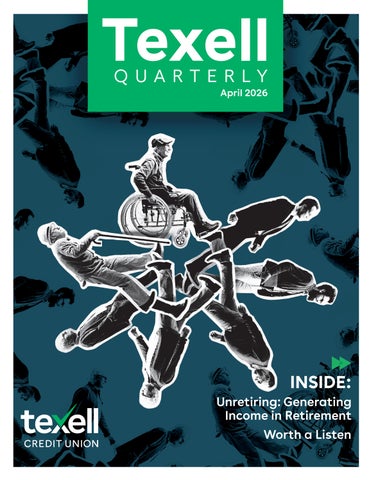
Texell Quarterly | April 2026

Page 1


Welcome to the spring 2026 issue of Texell Quarterly, where we dive into financial topics across all stages of life. As graduates prepare to cross the stage and begin their careers, we share a few tips for their first steps toward financial independence. The financial journey, however, often starts before the first job. Since April 23rd is National Teach Children to Save Day, we examine ways to get started even at a young age. Finally, our feature article explores the later years with a look at the trend of “unretiring,” or generating income in retirement.

Whether you’re looking for part-time jobs after retirement or starting your career search, scammers target jobseekers using several tactics. The article on employer impersonation scams warns of this recent trend and offers tips to avoid becoming a victim. We share exciting news about the launch of the Worth a Listen podcast and discuss how Galen Burke started in Retail and worked his way up to Vice President of Commercial Service in the Meet the Team section.

We hope you find the tips useful at every stage of your financial journey, and we thank you for your membership.

Join us at these upcoming Texell events.

April 11 @ 9:00 a.m. – 12:00 p.m. | Shred Day: Hewitt Branch

April 23 @ 5:30 – 7:00 p.m

Be Aware: Financial Scams Seminar

Learn how to protect your accounts from fraud at this seminar held in the 1948 Room at Texell’s Headquarters, 7083 Members Parkway in Temple.

May 16 @ 9:00 a.m. – 12:00 p.m. | Shred Day: Cedar Park Branch

May 30 @ 9:00 a.m. – 12:00 p.m. | Shred Day: Killeen Branch

Teaching Kids to Save

It’s never too early to teach children about saving. Learning financial skills early builds a solid foundation that carries into adulthood. April is Financial Literacy Month, and Teach Children to Save Day is on April 27, making spring the perfect time to plant the seed of money management. Start by explaining how someone can earn money, then introduce a simple budget, dividing money into items you need and want. For older kids and teens, break down the family’s income and spending using a budget worksheet. Discuss how to check your budget often to ensure you’re spending less than you’re making.

Answer questions after you cover the basics, then use these hands-on activities to make learning about money management fun.

1

Divide money into three jars to show how to split it for Spending, Saving, and Giving goals. Set aside money for immediate needs, such as food or clothes. For things you want or bigger purchases, such as a new video game, use the Savings jar. To demonstrate how interest works for savings, add $1 each week that money remains in the Savings jar. As a family, discuss how much to allocate for spending and saving, and aim to add 5-10% to the

2

3

Giving jar. When your school or favorite charity holds a fundraiser, you’ll have funds in the Giving jar to contribute.

Set up a store: Gather toys, clothes, and other items from around the house, make price tags, and use real money to practice shopping trips. Talk about how to decide which items to buy when you don’t have enough money for everything you want.

Savings Bingo or other board games: Create a bingo card with savings goals of dollar increments or actions, like “bake cookies at home” or “earn money with chores.” Play board games that use play money, like Monopoly or The Game of Life, to practice making financial decisions.

Take the next step and teach kids to save with Texell’s Dollar Squad Savings Account, designed for children 12 and under. Each dollar deposited earns interest and a Squad Dollar, which kids use to redeem fun prizes. After moving money from the Savings jar to the account, visit the Dollar Squad online store and exchange Squad Dollars for rewards—a fun way to reinforce saving! For teens ages 13-17, Texell’s thr!ve accounts continue their financial journey with a debit card and access to Digital Banking. Learn more at Texell.org/thrive

Still Growing:

The First 3 Steps to Financial Independence

Accomplishing financial independence varies depending on your stage of life and immediate goals. For recent graduates, it means breaking free from relying on parents and family members to pay rent and living expenses. For those recovering from a major life event, like a divorce or a family member’s death, it means reestablishing financial habits and decisions that you’ve never met before. However, whatever stage of life you’re facing, financial independence is about taking control of your money so that it’s working for you—not the other way around.

Step 1

The first step to taking control of finances is spending less than you make and investing what you can of the rest. Creating a budget provides a plan for how you spend and save your money. Follow the 50/30/20 rule: spend 50% on needs, 30% on wants, and 20% on savings. To start building a budget, track expenses for a month on necessities, like rent, bills, groceries, and gas. If your spending on these needs exceeds 50% of your income, you’ll cut spending on things you want, like shopping, fast food, or other entertainment. Once you’ve set your budget, track expenses daily by logging into your digital banking app.

Step 2 Step 3

Create a budget. Build emergency savings.

An emergency savings account provides a lifeline for unexpected events. Build your savings fund early by setting aside 20% of your income and only withdrawing funds in case of an actual emergency, such as car repairs or a new appliance. Start by saving $1,000 for emergencies and keep adding until you’ve reached at least six months of living expenses. Simplify building your savings account by setting up automatic transfers from your paycheck after direct deposit.

Once you’ve set up a strong emergency fund, list other savings goals for big purchases like a car or vacation. However, keep those funds in a separate savings account from your emergency fund. Start saving for retirement as early as possible with an Individual Retirement Arrangement (IRA) account. These accounts offer tax benefits for long-term investments. Take advantage of any employer-sponsored retirement savings plans, such as a 401(k), especially if they offer a matching contribution.

Know your credit score.

Your credit score reflects your creditworthiness based on your credit report, which includes your payment history, types of credit accounts, and other factors. A strong score makes it easier to rent an apartment or get approved for a mortgage and other loans. However, you don’t have to open credit cards to build your credit score. Other options include becoming an authorized user on a credit account owned by a trusted family member, or opening a secured loan, also known as a credit-building loan. If you’re renting, pay rent and bills on time, since payment history accounts for more than a third of your score. The amount of credit available also affects your score. If you decide to open a credit card, pay the entire balance each month to improve your score and avoid interest charges.

After taking the first steps toward financial independence, it’s tempting to relax your attention and splurge a little. Celebrate your achievements responsibly and avoid these common traps and setbacks on your financial journey.

Avoid these 6 financial traps!

01 02 03 04 05 06

High-interest debt

Avoid credit cards, payday loans, and adjustable-rate mortgages with high interest rates. Aim to save for big purchases instead of charging them to a credit card or getting a loan.

Lifestyle creep

Review your budget regularly and adjust for inflation. As your salary increases, avoid the temptation to spend more. Instead, invest more in your retirement account.

Missing or overdue payments

Late payments of more than 30 days stay on your credit history for up to seven years, impacting your credit score and your ability to qualify for lower interest on future loans.

Fraud attempts

Scammers often impersonate financial institutions in fraud attempts. Texell will never reach out to ask for account or personal information. Be hesitant about any texts, emails, or other messages claiming to be from your bank or another business that ask you to verify information.

Not using digital tools

Digital banking apps offer much more than your current balance and recent transactions. Texell members can access their credit score and report, set financial goals, set card and account balance alerts, and more.

Forgetting about insurance

Set up life insurance and review the policy annually to update beneficiaries. Take advantage of any other policies your employer offers at little or no cost, like accidental death and disability.

Managing your money becomes less stressful with thoughtful planning, avoiding impulsive spending, and not splurging with credit cards. By following these first steps and avoiding the traps, you’re paving the way to financial independence.

Worth a Listen Podcast

On March 6, 2026, Texell launched the Worth a Listen podcast, a financial podcast for your everyday life. While the podcast focuses on broad financial topics, each episode delves deeper into questions.

The first episode features guest Amber Speer on Demystifying Home Buying. She talks with podcast host Chris Hanyie about the process of shopping for a home, navigating preapprovals and mortgage applications, and other expenses that come with becoming a homeowner.

Understanding Health Benefits launched on March 20 with guest Kimberly O’Toole. As an expert on employee benefits, she explains why employers offer different types of health plans, including their coverage and costs. Kimberly

also provides valuable tips on how employees can save money and get the most out of their health care benefits.

On April 3, 2026, the third episode, Investing 101, airs with guest Barrett Evan. Chris and Barret discuss investment plans that companies offer their employees and dive deeper into alternative investment options, such as bitcoin. The fourth episode airs on April 17, featuring guest Don Owens on career development and job-finding advice after college.

Listen and watch episodes at Texell.org/wortha-listen. Make sure you don’t miss an upcoming episode by subscribing to Texell’s YouTube channel at Youtube.com/@TexellCU.

Worth a Listen, Worth a View

Many who have reached retirement age are joining the trend of “unretiring,” or finding ways to generate income in retirement. Carol Williams retired in 2006 after teaching for 25 years in elementary schools. She enjoyed a few years at

Unretire

Generating Income into Retirement

home until an offer for part-time work in schools piqued her interest. From 2009 to 2011, she worked for Scholastic’s reading program, Project READ, as a part-time reading consultant assisting teachers with strategies for struggling readers.

“It was so rewarding being in the classroom again and watching the kids learn to read and be successful,” said Carol. “I didn’t really do it for the money, although they flew me to St. Louis, Chicago, and Atlanta for training, which was a fun perk.” Like many in retirement, Carol enjoyed using her skills and knowledge from decades in the classroom to support and collaborate with other teachers.

leaving your home, including data entry, graphic design, digital marketing, and web and software development.

Part-time Employment

A study by NMG Consulting on behalf of T. Rowe Price found that 57% of retirees want to continue working in some capacity after retirement. ¹ Half of retirees felt they needed to work for financial reasons, but 45% chose to work for social and emotional benefits. Even if you’ve built a comfortable retirement fund, making extra money in retirement helps you plan for trips or other big purchases while socializing and staying active. For retirees looking to offset unexpected expenses or otherwise build savings, consider the following options to generate income in retirement

Working part-time as a receptionist, administrative assistant, retail clerk, or greeter fulfills the need for social interaction. If you have a youthful spirit and enjoy sharing your knowledge with younger generations, tutoring and substitute teaching offer flexible scheduling, and online tutoring lets you work from the comfort of home. For work that benefits older adults, part-time caregiving, driving, or providing delivery services offers valuable help. Part-time options that vary based on your location include becoming a tour guide at a museum or other tourist attractions.

Freelance Work

Like Carol, retired professionals offer skills and knowledge from decades of work for consulting or coaching. Before retiring, ask your current employer if they have contractor opportunities to provide mentoring or coaching sessions. With accounting experience, you can search for part-time bookkeeping or tax preparation roles. If you have strong writing skills, share your knowledge as a subject-matter expert and search for copywriting, editing, or ghostwriting opportunities. Many freelancing websites provide ways to earn income without

¹ “Unretiring”: Why

Turning Hobbies into a Business

Now that you have the time, develop your favorite hobby into a side gig. Take your passion for cooking and display your skills as a personal chef or meal-planning expert. If you’re skilled at home maintenance, help others by setting up a repair service, fixing appliances, and doing other odd jobs. Use your decades of yoga, weight training, or whatever fitness training you love and lead your own classes. Whether your passion is crocheting, gardening, or making goodies from your sourdough starter, sell any of these handmade items at local farmer’s markets or share your passion by teaching classes at libraries or community centers.

“It was so rewarding being in the classroom again and watching the kids learn to read and be successful.

“Gig Work

Becoming a driver for a rideshare company like Uber or Lyft or for a delivery service like DoorDash or Grubhub allows you to set your own schedule. If you like shopping, work as a personal shopper for companies like Shipt or Instacart. If you’d prefer to drive alone and avoid social interaction, delivering packages for Amazon Flex also lets you choose your hours.

Babysitting and pet-sitting gigs provide a great way to fight loneliness in retirement. If you’re not excited about watching children or animals, earn extra money with

less stress by house sitting. Add housekeeping if you’d like to increase the value of your house-sitting fees. To protect your safety while searching for these jobs, use reputable websites like Care.com or TrustedHousesitters.com

After decades of full-time work, “unretiring” can enhance your retirement years and provide fulfillment. Whether you’re concerned about financial surprises or you simply want to earn extra “fun” money, search for opportunities that allow you to generate income without adding worry or stress.

Dream Job... or Nightmare?

Employer Impersonation Scams

According to the Identity Theft Resource Center’s 2025 Trends in Identity Report¹, impersonation and job scams ranked among the top scams reported last year. Impersonation scams increased 148% yearover-year, with criminals impersonating businesses (51%) and financial institutions (21%) the most often. For those searching for employment in the financial industry, avoiding the snares of impersonation scammers adds an extra hurdle to the job search.

The Set Up

It’s easy to spot scams that use unsolicited text and email messages offering jobs with pay rates that sound too good to be true. But what if you’re applying for a job that’s posted on legitimate employment websites like Indeed.com, ZipRecruiter, or LinkedIn? In a recent trend, scammers create fake job postings on employment websites using vague language with broad requirements to draw more applicants. The applicant then receives follow-up messages through the site or in texting apps like WhatsApp or Telegram. Using AI tools, the message conveys false enthusiasm for the applicant’s capabilities, relying on vague phrases rather than listing specific skills or talents.

¹ Identity Theft Resource Center 2025 Trends in Identity Report: Impersonation Scams Rise 148 Percent & Become Top Reported Scam from idtheftcenter.org

Generic information about the company, position, and key contact details presents a red flag, such as using common names like “John Smith” or titles like “Sourcer” or “Recruiter.” The contact email domain contains slightly altered, misspelled, or generic domains, such as “@txell.com” instead of “@texell.org.”

The Catch

To lure their victims, scammers recreate a website page identical to the company’s career page, making it appear more believable. They’ll make job offers before asking for an application or interview, claiming they found the person’s resume online and that they’re a perfect fit. The criminals then collect personal identifiable information from the hopeful job applicant, and some scammers take it a step further by requesting money or financial account information to “start the process.”

Both employers and potential employees lose out on opportunities to build a stronger workforce and further career growth. To avoid these scams, don’t click on links or respond to unsolicited messages right away. Take time to research the actual website of the business and compare their job postings to the message you received.

The Recover

If you’re suspicious about a job posting or offer, stop communicating with the scammer and report the scam to the platform that is being misused, whether it’s a job listing website or social media. Alert the business that’s being impersonated by using contact

information from the company’s website. If you followed through with instructions from the scammer and suspect that you’ve been a victim, report it to the Federal Trade Commission at IdentityTheft.gov. Change usernames and passwords of any accounts used while communicating with the scammer. Alert your financial institution if you’ve shared account information and place a fraud alert on your credit report.

Businesses that receive reports of impersonation should report them to the platform used in the fraud attempt and post warnings on their careers website. For instance, the examples in this article came from messages scammers sent through Indeed.com to would-be applicants at Texell. For current openings at Texell, visit Texell.org/ Careers. For questions about the application process, call or text 254.774.5120.

Meet Galen Burke

Vice President of Commercial Services

Learn what it’s like to work at Texell in our Meet the Team series. For this issue, we sat down with Vice President of Commercial Services, Galen Burke, who started at Texell in 2012.

Galen started working in financial institutions as a teller while living in Colorado. He moved back to Texas with his wife to be near his family while starting his own and applied at Texell for a Financial Service Specialist position at the Belton branch. He was then promoted to Assistant Branch Manager and later to Branch Manager, and he managed Texell’s busiest branch at 31st Street for a few years.

“Texell’s been great to me with opportunities,” Galen said. “It’s great watching people grow here, and we’re constantly celebrating the achievements, whether it’s getting their degree, a promotion, or changing and improving what we do.”

After working as a Branch Manager, he moved on to become an Area Director of Retail. He shared his interest in commercial services with his manager. When the credit union decided to offer commercial loans and other products, Galen was selected to help launch the Commercial Department in 2021.

“It was a great milestone to officially launch the department,” Galen said. “Now we’re fine-tuning what really works and finding our niche of what we offer.”

Galen is also a board member of the Texell Serves Foundation, the credit union’s philanthropic efforts, where employees volunteer for worthy causes. A few of his favorite, more recent activities involved building beds for children at Sleep in Heavenly Peace in Robinson. Employees also volunteered at the Ronald McDonald House for the first time last year by preparing meals for families staying there.

“It’s great getting to volunteer alongside people you don’t normally work with at the credit union, but it’s also great working together and helping our community in new ways,” Galen said. He discussed how he enjoyed learning about treating wood with vinegar and steel wool as a bug deterrent while making beds.

Take the next step in your career at Texell!

Interested in joining a great place to work? Check out our current openings at: Texell.org/careers.

Outside of work, Galen finds creative relaxation through music and creating art with paint, charcoal, and other media. He also started Monday morning meetings at Summer Moon for anyone who wants to share what’s on their mind and heart to help center themselves for the week. He enjoys helping people develop, and it’s a great opportunity to encourage others and support their growth.

Turn static files into dynamic content formats.

Create a flipbook