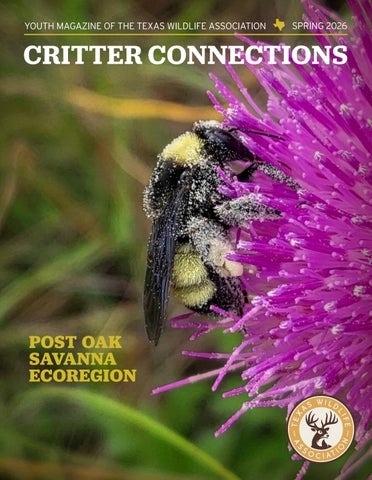
CRITTER CONNECTIONS
ANTELOPE HORN MILKWEED

Antelope Horn milkweed, scientific name Asclepias asperula, is a native Texas plant found across the state, including the Post Oak Savanna ecoregion. Antelope Horn milkweed gets its name from its seed pods, which resemble the shape of antelope horns. This native milkweed can grow up to two feet tall. Its large clusters of light greenish-yellow flowers are about the size of a softball. Like other milkweeds, this plant has a white, toxic sap that is poisonous to animals. The sap’s bitter taste warns animals that it is bad for them and protects the plant from being eaten.
Antelope Horn milkweed is a host plant for pollinators. The monarch butterfly, for example, relies on milkweed species as its only host plant. A host plant is a plant that provides
BEE HUMMER
For this craft, you will need an index card, two cap erasers, a popsicle stick, stapler, wide rubber band, string, and colors or markers.
Fold your index card horizontally across the card and place a popsicle stick along the crease. Staple the index card to the popsicle stick.
Put an eraser on each end of the popsicle stick. Tie a string around one end of the popsicle stick, between the index card and eraser.
Stretch a wide rubber band over each end of the erasers. Make sure the string isn’t touching the rubber bands. Draw a native Texas bee on the index card.
Find an open area where you can safely swing your bee hummer around. Listen to the sounds of a bee buzzing!

basic needs like food, shelter, and nesting sites for another organism. Milkweeds are the only plant that monarch butterflies can lay their eggs on, and where their caterpillars can feed. Despite the milkweeds toxic sap, monarch butterfly caterpillars can safely eat this plant by storing the toxins to use as a defense mechanism, making them taste bad to predators. Adult monarchs and other pollinators like bees feed on the nectar. By providing food, shelter from weather and predators, and nesting sites, the Antelope Horn milkweed is vital to the ecosystems in which it is found. How neat!

Learn more about bees and other native Texas wildlife in the feature article.
Cover photo courtesy of Nicole
Activity Source: University of Michigan Museum of Natural History
Katy Hoskins Vince Hale
Antelope Horn Milkweed Flowers
Antelope Horn Milkweed Seed Pods
DID YOU KNOW...
… that Texas has 10 different ecoregions?
… that Antelope Horn milkweed is a pollinator host plant?
… that the Post Oak Savanna ecoregion makes up about eight percent of Texas?
… that the Virginia opossum is an omnivore?
… that Loggerhead Shrikes are also called butcher birds?
… that the Texas horned lizard is the official state reptile?
… that the Houston toad is endangered?
… that there are nine native species of bumble bees found in Texas?
… that American bumble bees live in grasslands?
… that the Post Oak Savanna ecoregion is a transition zone?

TEXAS HORNED LIZARD COLOR ME


Houston Toad
Scott Wahlberg
(Phrynosoma cornutum)
Texas Horned Lizard
highsinger

POST OAK SAVANNA ECOREGION
By Amber Brown

Texas is home to 10 different Gould’s ecoregions as seen on the map above. Ecoregions are areas of land that share similar climate, topography, and soils. In this series, we will dive into each of Texas’ 10 ecoregions one Critter Connections issue at a time. Next up – the Post Oak Savanna!
The Post Oak Savanna ecoregion, found in east central Texas, makes up about eight percent of the state. This ecoregion begins at the Texas-Oklahoma line and runs south between the Piney Woods and Blackland Prairie ecoregions. Cities found in the Post Oak Savanna ecoregion include Bastrop, College Station, Giddings, Gonzales, Palestine, and Tyler. Historically, this area consisted of open grasslands with scattered oak tree motts. Frequent fires and grazing bison helped maintain these plant communities, creating a diverse ecosystem.
The Post Oak Savanna ecoregion is a transition zone, or an area where two different habitat types meet and blend. This ecoregion is located where the forests of the east give way to the open grasslands of the west. As such, many of the plants and wildlife found here occupy other parts of the state as well. Still, that makes this area no less important. Unique features such as the Lost Pines, a relic population of loblolly pines in Bastrop County, can be found in this region. Let’s learn more about this ecoregion and the critters that call it home!
One native Texas mammal that can be found throughout most of the state, including the Post Oak Savanna ecoregion, is the Virginia opossum. This small, gray critter has a white face, pink snout, and scaley tail. In the wild, Virginia

opossums can grow to be 10 pounds and live up to three years. Opossums are nocturnal, meaning active at night, and are adapted to their environment. Large ears, long snouts, and whiskers help them find food despite their poor eyesight. The opossum’s unique hallux and prehensile tail helps it keep balance as it climbs trees. When threatened, they will play dead, known as tonic immobility, to scare off predators. Opossums are omnivores, meaning they eat both plant and animal materials. Their diet is made up of fruits and vegetables, grains, eggs, frogs, insects, reptiles, worms, carrion, and even garbage! These unique critters have the most teeth of any land mammal on this continent and are the only marsupial native to North America. At birth, a young opossum is about the size of a bumble bee and will immediately make its way to its mother’s pouch. After about eight weeks, it will leave the pouch and begin to ride on its mother’s back until it becomes fully independent at 12 weeks old. How neat!
One native Texas bird you can find in the Post Oak Savanna is the Loggerhead Shrike. This small gray and white songbird can be identified by a black mask near the eyes, large head, and hooked beak. Loggerhead Shrikes are carnivores, meaning they eat other animals. Their diet consists of small mammals, reptiles, amphibians, other birds, and insects. These predatory birds get the nickname “butcher bird” from their unique feeding behavior – they will impale their prey on thorns or barbed wire fences. This allows them to store their food and mark their territories. Loggerhead Shrikes are an indicator species of grassland habitats. By monitoring Loggerhead Shrike populations, conservationists can gain a better understanding of the local ecosystem’s health. Like other grassland birds, Loggerhead Shrike populations have seen a significant decrease, reflecting a larger decline in the health of our nation’s grasslands.

One native reptile that could once be found across much of Texas, and within the Post Oak Savanna ecoregion, is the
William L. Farr
Kathy McAleese
Loggerhead Shrike
Nathan Vaughn
Virginia Opossum

Texas horned lizard. This critter, named the official state reptile in 1993, is a small, flat-bodied lizard with two large spines on its head and smaller spines on its body. It can be identified by its light brown color with dark spots, white line on its back, and dark brown stripes near its eyes. These critters are diurnal, meaning active during the day. They need bright sunlight to produce vitamin D and are often found sunning in open areas. Lying out in the open is risky for such a small critter, so Texas horned lizards rely on their camouflage to hide from predators. If that does not work, they will deter predators by filling their lungs with air and inflating themselves to form a spiney ball. They can even squirt blood from glands near the corners of their eyes by raising the blood pressure in their heads! Texas horned lizards are insectivores and will use their sticky tongues to catch insects like grasshoppers, spiders, beetles, and their main food source, harvester ants. The decline of harvester ants, in addition to habitat loss, has contributed to this native reptile’s decline across the state. Because of this population decline, the Texas horned lizard is listed as threatened in Texas.
The Houston toad, an amphibian endemic to Texas, can be found in the Post Oak Savanna ecoregion. This small critter has a pale underside and a speckled back that can vary in color from light brown to green or gray. They can grow to be two to three and a half inches long and can be identified by their calls, described as a high trill. Houston toads are a habitat specialist, meaning they need a very specific habitat type to meet their basic needs. These critters need sandy soil so they can bury deep to protect themselves from extreme heat and drought during aestivation, and for hibernation. Their habitat must also include shallow ponds or other temporary water sources for breeding, laying eggs, and tadpole development. Shade provided by trees helps slow pond evaporation, and an open understory of grass allows the toad to move around freely. Such specific habitat requirements make a species more vulnerable to changes
Topography - an area’s physical shape; for example rivers, hills, and valleys
Hallux - a clawless, opposable first toe that helps the opossum grasp, much like a human thumb
Prehensile tail - a tail capable of grasping
Carrion - dead and decaying flesh of an animal
Marsupial - mammals that carry their young in a pouch on the mother’s stomach
Endemic - found in a specific place and native to the area it is found in
Aestivation - a deep and extended sleep during hot and dry periods
Hibernation - a deep and extended sleep during winter
in their environment. The Houston toad is no different. This critter was one of the first amphibians listed as federally endangered in 1970. Today, they are listed as both a federal and state endangered species due to factors like habitat loss, invasive species like feral hogs and fire ants, drought, fire suppression, and human disturbance.


The American bumble bee is one of nine native species of bumble bees found in Texas. These critters are easily recognized by their fuzzy yellow and black bodies. Like honeybees, American bumble bees produce honey as a food reserve for their colonies to use when nectar is not available or when weather prevents worker bees from foraging. Their honey reserves are much smaller than those of other bees, so they must continuously search for nectar and pollen. In recent years there have been declines in native bumble bee populations. One factor is the loss of grasslands. Grasslands, like those in the Post Oak Savanna ecoregion, provide the diverse flowers and nest sites that native bumble bees need for survival. Bees are especially important to our natural ecosystems. They pollinate plants, benefiting the animals that depend on them and helping to reduce soil erosion by promoting plant growth. They also provide an estimated $3 billion annually to agriculture by pollinating crops. These insects play an important role in creating diverse, healthy, and balanced ecosystems that benefit us all.
This ecoregion, like other parts of the state, faces challenges like habitat loss caused by growing urban areas and agriculture, invasive species like feral hogs and fire ants, and fire suppression. Conservationists, private landowners, and citizens are working together to conserve this area through research, partnerships, private land management, citizen science, and education. With these continued efforts, the Post Oak Savanna ecoregion can thrive for years to come.
www.texas-wildlife.org/critter-connections-library Visit the Critter Connections library for enrichment activities and resources to take your learning to the next level.
Article Source: The Natural History of Texas by Brian R. Chapman and Eric G. Bolen
Texas Horned Lizard
Nancy McIntyre
Houston Toad
John Williams
Rich Sommer
American Bumble Bee
Find these words:
Bumble bee
Ecoregion
Houston toad
Marsupial
Milkweed
Opossum
Post Oak Savanna
Topography
Visit the Critter Connections library at www.texas-wildlife.org/critter-connections-library to view the answer key.
NANCY’S CORNER
One thing we can do to help wildlife across our state is create a pollinator garden. Pollinator gardens are areas planted with flowers that native pollinators need for food and shelter. Pollinator gardens come in many different shapes and sizes. You can create a pollinator garden in flower beds or old plant pots and by scattering seeds.
The fun doesn’t stop there! You can create more pollinator habitat by planting native grass in your yard, using native landscaping plants, providing water in a shallow dish, and leaving dead plants and fallen leaves on the ground during winter.
When planning a pollinator garden, it’s important to use native plants that bloom at different times. Visit www.pollinator.org/guides to learn more about plants native to your area. Share photos of your pollinator garden and other pollinator friendly actions at texas-wildlife.org/critter-connections-magazine for a chance to be featured on our social media!


Youth Education
Texas Ecology | Natural Resources | Conservation | Stewardship
C lassroom & outdoor experiences for educators & students (at no cost)
Discovery Trunks
Hands-on materials and lessons shipped statewide to schools and sites
Wildlife by Design Classroom Presentations
Classroom & outdoor TWA Educator-led interactive in-person presentations
Land, Water & Wildlife Expeditions
Middle & High School program series culminating with a day of outdoor studies focused on land, water, and wildlife
Distance Learning
Interactive youth video lessons
Online Lessons
Online compilation of lessons emphasizing the action component of conservation and stewardship
Critter Connections
Quarterly kids magazine focused on native plants and wildlife

Professional Development
Trainings which increase participant conservation and stewardship knowledge and provide information about classroom resources

Youth Education
Adult Education

Texas Youth Hunting Program
Adult Learn to Hunt Program

Professional Development TWA is the leading voice for wildlife conservation policy in Texas.
Texas Big Game Awards


Please consider making a tax-deductible investment to TWAF, and help us as we continue to change minds and lives, through natural resource education. Together, we can make sure that Texans understand the importance of wild things, wild places, and the stewards who care for them.