SEPTEMBER 2026
What You Read is What You Get.
Ready for Better Rehearsals? When students can quickly connect theory to the music in front of them, everything changes. Breezin’ Thru Theory builds rapid response, stronger sight reading, and deeper understanding. It’s fun and supports teachers in two powerful ways: • In-the-moment: with NEW Theory On The Go and Breezin’ Thru Fingerings, you can address concepts quickly during rehearsals. • Beyond rehearsal: with 24 chapters of scaffolded content, it builds skills methodically thru the year, ensuring no learning gaps, and saving you class and marking time. The result? Less time struggling, more time making music, and rehearsals that really sing.
Subscribe Now! 1-855-265-3805 BreezinThruTheory.com
CONTENTS VOLUME 95 • ISSUE 1 • SEPTEMBER 2026
Features Sound Ideas 10
Band . . . . . . . . . . . by.jesse.d ..espinosa
26
Orchestra. . . . . . by.jennifer.gingell.and.bethany.hagin
40
Vocal. . . . . . . . . . . by.gyasi.j ..blanton
48
Elementary. . . . by.gabriela.montoya-stier
56
College. . . . . . . . . by.alec.d ..scherer
21
Culture Is the Pathway to Possibility by.kathy.appleton.and.joshua.shaw
A positive classroom culture doesn’t happen by accident. Learn how music educators can intentionally create a supportive structure that empowers students to embrace challenge and achieve musical growth.
34
by.gary.seighman
The best music educators don’t draw inspiration from music alone. Discover how embracing a generalist mindset—through art, science, history, psychology, and other disciplines—can enrich teaching, conducting, creativity, and student learning.
46
53
The Power of Connection
Creating Magic in Early Elementary Music Lessons by.angel.walter.mcginn
Turn kindergarten chaos into musical magic. Explore practical classroom management strategies, engaging routines, interactive games, and creative centers that help early elementary music students feel safe, focused, and excited to learn.
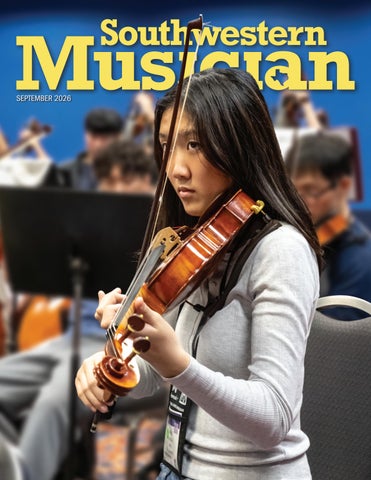
ON THE COVER: Julia Choi, now a junior at Ray HS (Corpus Christi ISD), rehearses with the 2026 All-State Symphony Orchestra. Photo by Karen Cross.
COLUMNS 2
From the Editor
28
Orchestra
4
TMEA News
42
Vocal
6
President
50
Elementary
12
Band
58
College
UPDATES 3
2027 Clinic/Convention: Hotel Reservations
17
Honor Bands and Finalists
18
Advocacy in Action
18
TMEA Scholarship Opportunities
32
Honor Orchestras and Finalists
53
Elementary Grants & Scholarships
SOUTHWESTERN MUSICIAN | SEpTEMbER 2026
1
From the Editor Before the first concert, the first contest, and the first measure of success, music educators spend the opening weeks of the school year creating something much more significant. We create the culture of our classrooms and rehearsal halls. The foundation we build during these first weeks supports our students as they face the challenges and opportunities that lie ahead. As we begin Volume 95 of Southwestern Musician, this issue explores how music educators intentionally shape the culture of their classrooms and rehearsal halls. Throughout these pages, contributors examine practical ways to foster belonging, establish purposeful routines, and spark creativity. You’ll find techniques for building classrooms where students feel valued, systems that support both excellence and well-being, and ideas that encourage fresh approaches to teaching and musicianship. Together, these articles remind us that students are most willing to take risks and discover their potential when they know they belong, understand what’s expected, and are engaged in meaningful learning. The Sound Ideas authors present a variety of division-specific perspectives that reinforce these themes. You’ll learn about building welcoming elementary classrooms, creating systems that maximize instructional time, empowering students through collaborative learning, and developing musicianship through jazz. These articles provide practical strategies that can be implemented immediately while supporting growth for both students and teachers. Our Vice-Presidents share important updates in their columns, including exciting offerings for elementary educators, recognition of honor and invited ensembles, featured convention clinicians, and upcoming division events and deadlines. As music educators, we rarely have the opportunity to see the full impact of our work in real time. Yet those daily moments— welcoming students, planning rehearsals, encouraging those who struggle, and celebrating small successes—add up to something much larger than a performance. We help young people develop confidence, curiosity, discipline, creativity, and a feeling of belonging. Thank you for the work you do every day on behalf of Texas students. On behalf of the TMEA staff and leadership, welcome to a new school year and to a new volume of Southwestern Musician. I hope the ideas and content shared throughout these pages encourage and support you as you continue creating meaningful musical experiences for every student you serve. I wish you a meaningful and successful year ahead.
Joe Muñoz Executive Director jmunoz@tmea.org
2
SOUTHWESTERN MUSICIAN | SEpTEMbER 2026
OFFICIAL PUBLICATION OF TEXAS MUSIC EDUCATORS ASSOCIATION
Editor-in-Chief: Joe Muñoz Managing Editor: Karen Cross Advertising Manager: Zachary Gersch
TMEA Executive Board President: Jennifer Martin, Midway ISD president@tmea.org / 254-761-5610 x1155
President-Elect: Joshua McGuire, Birdville ISD presidentelect@tmea.org / 817-547-5500 x22455
Immediate Past-President: Shane Goforth, Galena Park ISD pastpresident@tmea.org / 713-516-7158
Band Vice-President: Kim Shuttlesworth, Coppell HS bandvp@tmea.org / 512-897-8697
Orchestra Vice-President: Sabrina Behrens, Travis HS orchestravp@tmea.org / 281-633-6300
Vocal Vice-President: Jennifer Gallagher, Shadow Creek HS vocalvp@tmea.org / 281-245-3865
Elementary Vice-President: Lauren Summa, Passmore ES elementaryvp@tmea.org / 281-585-6696 x3126
College Vice-President: Crystal Gerrard-Ramirez, University of North Texas collegevp@tmea.org / 682-587-9937
TMEA Staff Executive Director: Joe Muñoz, jmunoz@tmea.org Deputy Director: Mike Howard, mhoward@tmea.org Administrative Director: Colleen Whatley, cwhatley@tmea.org Advertising/Exhibits Manager: Zachary Gersch, zgersch@tmea.org Membership Manager: Daniela Ornelas, dornelas@tmea.org Communications Manager: Karen Cross, kcross@tmea.org Digital Communications Specialist: Amanda Pierce, apierce@tmea.org Financial Manager: Cristin Gaffney, cgaffney@tmea.org Information Technologist: Andrew Denman-Tidline, adenman@tmea.org Software Developer: Daniel Reinhuber, dreinhuber@tmea.org Administrative Assistant: Melissa Escobar, mescobar@tmea.org
TMEA Office 7900 Centre Park Drive, Austin, TX, 78754 P.O. Box 140465, Austin, TX, 78714-0465 www.tmea.org / 512-452-0710 Southwestern Musician (ISSN 0162-380X) (USPS 508-340) is published eight times annually (September–May, excluding March) by Texas Music Educators Association, 7900 Centre Park Drive, Austin, TX 78754. Subscription rates: One Year – $30; Single copies – $5.00. Periodical postage paid at Austin, TX, and additional mailing offices. © Texas Music Educators Association.
2027 TMEA Clinic/Convention FEBRUARY 10–13 • SAN ANTONIO 300 CLINICS • 100 PERFORMANCES • 600 EXHIBITORS
Member Hotel Reservations Open September 29, 6 a.m. CT Hotel rates, housing tips, and FAQs:
www.tmea.org/housing
WWW.TMEA.ORG/CONVENTION SOUTHWESTERN MUSICIAN | SEpTEMbER 2026
3
TMEA News By Joe Muñoz
W
elcome to the new school year! As classrooms and rehearsal halls across Texas come alive with the energy of students and educators, we remember the extraordinary impact music education has on young lives. Whether you are welcoming elementary students or guiding advanced performers, your commitment helps all students develop skills that go well beyond the music classroom. As we begin another year of learning, growth, and performance, TMEA remains dedicated to supporting your work through advocacy, professional development, and resources that strengthen music education across our state. We wish you a successful and rewarding year ahead. IT STARTS WITH MUSIC—AND YOU As election season approaches, now is a great time to build relationships with local candidates and help raise awareness of the importance of fine arts education. Consider inviting candidates to performances, concerts, parent meetings, or other school events, and take opportunities to attend community forums or town halls to discuss the role of fine arts in student success. After meeting candidates, follow up with a note of thanks and continue the conversation about supporting access to high-quality fine arts education for all students. Remember, educators play an important role in informing their communities and encouraging civic engagement. After the election, build relationships with newly elected officials by inviting them to future events and sharing the impact that fine arts programs have on students, schools, and communities. Make sure you register your support with the Texas Arts Education Campaign at www.txartsed.org to remain updated and assist with actions during the 90th Texas Legislative Session, which begins in January 2027. TMEA is stressing the importance of music education through our It Starts With Music advocacy campaign. Be sure you are following our social media channels. When you see the advocacy posts, please like and share the content to extend the reach of our efforts. Learn more about this amplified advocacy on page 18. Your participation in the election cycle activities and fine arts advocacy will help build support for fine arts education during the 90th Texas Legislative Session. FREE ALL-STATE PREPARATION RESOURCES The TMEA Executive Board approved the continued partnership with Ensemble Block to offer TMEA All-State audition preparation resources at no cost. High school students who are preparing to audition can access reference recordings and lesson videos. Featured practice tools include synchronized notation, section looping, and slow‑down playback of the videos. In addition to band, jazz, orchestra, and mariachi resources, this year there are video resources to support vocal sightreading preparation as well 4
SOUTHWESTERN MUSICIAN | September 2026
as tutorials for one of the 1A–4A audition pieces. Regardless of where students live or their socioeconomic status, all students have access to this valuable resource at no cost. For more information about how students enroll, visit the divisional All-State audition material pages on the TMEA website. TMEA CLINIC/CONVENTION HOUSING The convention housing reservation system for TMEA members will open on Tuesday, September 29, at 6 a.m. CT (with no virtual waiting room before that time). Watch your email inbox, as TMEA will send all members the URL to access the system the week prior. When the reservation system opens, if you’re unable to access the reservation page immediately, you will see your place in line with an estimated wait time (which is often shorter than initially indicated). This feature helps manage system load and reduce the chances of rooms appearing available only to be unavailable as you navigate the reservation pages. TMEA STAFF UPDATE Over the summer, we welcomed three new members to our team: Colleen Whatley, Administrative Director, was an orchestra director for 17 years, working with students in all grade levels. She served as a TMEA Region Chair and President of the Texas Orchestra Directors Association. Outside the office, she continues to serve as a conductor for the Austin Youth Orchestra. Daniela Ornelas, Membership Manager, worked in membership, marketing, and event management for the Texas Realtors Association and Texas Counseling Association after earning a bachelor’s in business administration in marketing from the University of Texas Rio Grande Valley. Melissa Escobar, Administrative Assistant, served in patron services for the Houston Symphony and has a diverse background in nonprofit arts support. She was an All-State violist and earned a bachelor’s degree from the University of Houston and a master’s degree in music from the University of Denver. The TMEA staff are always here to help. Please don’t hesitate to reach out for assistance. LIABILITY INSURANCE RENEWAL TMEA offers members low-cost access to purchase liability insurance coverage each year. If you purchased it last year, it has expired, so take time to renew it now. We encourage all teachers to maintain this important coverage. While some school districts pay for TMEA membership, they do not pay for this additional coverage. Learn more at www.tmea.org/liability. 0
INTRODUCING OUR NEW FACULTY GIYONG AHN
JIHYUN KIM
ASSISTANT PROFESSOR OF PRACTICE IN COLLABORATIVE PIANO
ASSISTANT PROFESSOR OF MUSIC COMPOSITION
TIMOTHY MACDUFF
JOHN MARSHALL
ASSISTANT PROFESSOR OF VIOLA
MARY MARTIN
VISITING PROFESSOR OF CELLO
MATT MCGRORY
ASSISTANT PROFESSOR OF OPERA AND VOICE
VISITING ASSISTANT PROFESSOR OF MUSIC EDUCATION
ZACHARY NENABER
ASSISTANT PROFESSOR OF MUSIC EDUCATION
JUSTIN WADKINS
VISITING ASSISTANT PROFESSOR OF PRACTICE IN MUSIC THEATRE AND COMMERCIAL VOICE
ttu.edu/music | schoolofmusic@ttu.edu | 806.742.2274
TMEA PRESIDENT JENNIFER MARTIN
Sustainable teaching requires intentional rest built into our days, weeks, and seasons—not just summer recovery.
The Power of Rest
W
hether this is year 1 or year 41, the start of a new school year brings fresh opportunity to begin anew. I love the cyclical nature of education. The annual rhythm provides some sense of certainty to the often unpredictable and sometimes chaotic nature of the job. The start of the year brings a wide range of emotions for educators, from excitement and joy to anxiety and fear and every combination in between. In this first month, keep in mind your students also experience the same range of emotions. Whether they are starting kindergarten or their senior year, students want to feel accepted and safe in their classes and by their teachers and peers. You have the power to create a positive and supportive climate and culture in your programs that allow students to experience all that music has to offer! It takes stamina and it takes rest to make this happen over the course of a school year. In May, I wrote about seven types of rest and how we might incorporate them over the summer. Each type is important and restorative in a different way. Summer break provided a golden opportunity for these types of rest and recovery from the intense, on-the-go schedule of the school year. As we settle into the new year, we need to understand that sustainable teaching requires us to build intentional 6
SOUTHWESTERN MUSICIAN | SEpTEMbER 2026
MARK YOUR CALENDAR check www.tmea .org for updates
September—Renew membership, purchase liability insurance, register for the convention. September 29, 6 a.m. CT—TMEA convention housing reservation system opens online. October 30, 4:30 p.m. CT—TMEA scholarship online application deadline. October 30, 4:30 p.m. CT—Elementary Music Materials grant online application deadline. January 21—TMEA convention early registration deadline. February 10–13—TMEA Clinic/Convention.
rest into our days, weeks, and seasons— not just reserve it for summer recovery. In addition to research on the seven types of rest previously mentioned,1 this month, I’m sharing guidance from cognitive neuroscientist Dr. Sahar Yousef. I have found her 3M framework for preventing burnout especially helpful. As the following terms in this framework convey, the idea is that there are varied durations of breaks, each with its role. Micro breaks are brief pauses throughout the day. Meso breaks are longer recovery periods (1–2 hours) taken during the week. Macro breaks are when we take extended recovery periods, such as a halfor full-day break during the month, like taking a hike or visiting family.2 Admittedly, I don’t do well at intentionally scheduling these breaks. Instead, I often succumb to the notion of squeezing every bit of productivity out of each minute and “earning rest” only after my to-do list is complete. I sometimes think of this as my power-through mode. To be fair, there are times when this mode helps us meet an important deadline or get multiple things done in a crunch. But it’s not a sustainable default mode of operation.
When we push ourselves to the limit of our mental and physical capacity for an extended period, focus wanes, brain fog increases, we make more mistakes, and it takes longer to accomplish everything. When I’m in this cycle, I get frustrated by my mistakes and slower speed. Another reason powering through isn’t sustainable is because our to-do list is rarely, if ever, done. There is always one more thing that will need to be taken care of. The idea that you can “earn” a break when everything is done is a recipe for guilt, frustration, and burnout. Being more intentional with micro and meso breaks can make a big difference. As I’ve learned more about rest, I realized I gravitated toward macro breaks, while dismissing micro breaks as ineffective. I thought such a short time couldn’t possibly do any good. What I’ve learned since then is that the activity during micro breaks is the key. Previously, I scrolled social media or news sites, checked texts, and watched reels with no real purpose. I did stop working for a few minutes, but it wasn’t restful; I just changed activities. The break didn’t bring me any meaningful sense of rest, recharge, or improvement in productivity. Recently, I have started incorporating higher quality micro breaks into my day. I leave my phone behind and walk for about two minutes. I get to greet colleagues or simply give my brain a break from all the stimuli. I have always found it challenging to “turn off” my brain from work tasks, but
I’ve gotten better with practice. I find that leaving my phone behind is what helps me be present in the moment. When I get back to work, I’m more centered, focused, and productive. After teaching several classes, you may benefit from a quick refresh time before switching gears and jumping into administrative tasks. I wasn’t familiar with the term meso breaks until recently. My biggest challenges with incorporating them are being intentional to block time for it, and then learning to let myself truly enjoy the rest or recreation. For me, it comes back to fighting against the push-through mentality. Establishing some familiar routines to shut down work for the evening can be helpful. One thing that helps switch gears is to put tomorrow’s most important tasks at the top of my to-do list. Having a plan for the next day can help slow down the racing thoughts and stress of getting it done. During busy audition and performance seasons, make meso breaks a frequent and scheduled part of your week. Trying to power through at those times is a recipe for exhaustion, frustration, irritability, and burnout. Protect time for yourself, friends, and family throughout the week. If your calendar is so stacked you can’t seem to find time, look for something you can streamline, eliminate, or delegate. The key takeaway is that sustainable teaching requires intentional rest built into our days, weeks, and seasons—not just summer recovery.
1849 University Ave. Berkeley, Ca 94703 800-322-6263 510-845-7178 www.forrestsmusic.com
Your one stop shop for all things double reed since 1944
Instruments Accessories Rental Repair KEYSTOIMAGINATION.com 8
SOUTHWESTERN MUSICIAN | September 2026
JUNE EXECUTIVE BOARD MEETING The Executive Board met June 19–21 in Austin. This summer meeting always covers a lot of ground, and this was no exception. As part of our continued policy review that began at our March meeting, we approved updates to TMEA’s copyright policy and to our Code of Ethics & Standard Practices (to align with TEA). You can find each of these important policies at www.tmea.org/about/policies. Convention planning is always a significant portion of the June meeting, as each Vice-President shares details about their programs. Read your divisional column in this issue as some have updates that came from this meeting that may apply to you. The Board approved significant opportunities for our elementary music teacher members. The Elementary Music Materials Grant and a new continuing education scholarship are now available to current TMEA members who are teaching elementary music. With a planned total distribution of approximately $1 million, the grant provides eligible members the opportunity to apply for up to $1,000 to purchase instructional materials. Through a new scholarship type, elementary educator members can apply for up to $2,000 to support their continued education in programs that lead to additional elementary music certifications. The Board is pleased to offer each toward the goal of supporting our amazing elementary music educators in the critical work they do for every student on their campus. Learn more about each and apply by October 30 at www.tmea.org/ elementary. The Board and staff are also in the process of developing a TMEA Strategic Plan and have been gathering a variety of input from TMEA stakeholders.
Band, Jazz, Orchestra, and Mariachi, this year we added support videos for All-State Choir students. Videos are available to support sightreading preparation as well as tutorials for one 1A–4A Mixed Choir selection. You and your students can sign up at www.ensembleblock.com/tmea to access these resources.
of $30. Keep in mind that all policies purchased through TMEA last year expired August 20, so don’t wait to check this off your to-do list! Whether you take advantage of this access through your TMEA membership or go elsewhere, know that it’s important protection to maintain. Learn more at www.tmea.org/liability.
In this second year of the pilot, the Executive Board will be closely evaluating the effectiveness and long-term feasibility of this resource. We will review usage data, member feedback, cost, alternative funding sources, and more to envision the future of this resource. Thank you in advance for your feedback as this audition season progresses.
VOLUNTEER TMEA members are the lifeblood of our association! I hope you will consider answering the call to serve in your Region and at the annual convention. There are roles of all kinds, large and small. Those in leadership appreciate it more than you know, and ultimately the students are the ones who benefit most! Sign up at www.tmea.org/volunteer. 0
RENEW MEMBERSHIP & PURCHASE LIABILITY INSURANCE If you haven’t yet, please take a moment to renew your TMEA membership and encourage new music teachers to join. Multiple member benefits and programs require your membership to be current, so be sure to renew now. Renew online or download the form at www.tmea.org/ renew. TMEA offers members access to a one-year liability insurance policy for the low cost
Jennifer Martin is the Director of Fine Arts for Midway ISD. president@tmea.org REFERENCES 1. Dalton-Smith, Saundra. Sacred Rest. (New York: FaithWords, 2017). 2. Burnout & Energy Management, accessed July 31, 2026, www.saharyousef.com/burnout
Create a Texas Future Music Educators Chapter Provide high school students who are interested in a music education career a network of support and information to help them be better prepared to pursue their passion. TFME Members: • prepare for entry into college music programs • provide service to their school music programs • preview the benefits of association membership
Grants available for chapter events and TMEA convention travel!
Our next meeting is in mid-September, so given our publication deadlines, I’ll report on that meeting in my November column.
At the Convention: Members attend a TFME keynote, clinics, performances, and the exhibit hall at no cost, plus connect with music programs during College Night.
ENSEMBLE BLOCK PILOT PARTNERSHIP UPDATE TMEA is in its second year of a pilot partnership with Ensemble Block to support high school students who are preparing for TMEA All-State auditions. While continuing to offer video resources for TMEA
LEARN MORE & START A CHAPTER: WWW.TMEA.ORG/TFME SOUTHWESTERN MUSICIAN | SEpTEMbER 2026
9
SOUND IDEAS BAND: JAZZ BAND AS A CATALYST FOR MUSICAL GROWTH
By Jesse D. Espinosa
J
azz has always had a special place in my heart as a band director because of the positive experiences I had in high school. Since then, I have seen this true American art form bring excitement to students, attract new members to our band program, and improve students’ musicianship. GETTING STARTED There are some essential things needed to start a jazz band, such as a drum set, bass guitar or double bass, piano, and guitar with the appropriate amplifiers. Depending on how you would like to begin, you will need either music that fits a big band like the Count Basie Orchestra or lead sheets, which would be great for starting a small jazz combo. Once you have these basics, invite students from your saxophone, trumpet, and trombone sections. Don’t hesitate when students from other sections want to join. I have even had tuba, horn, and baritone players ask to be part of the jazz band. Once you get past the initial setup, a jazz program can become a great catalyst for musicianship and retention.
TEACHING MUSICIANSHIP THROUGH JAZZ Over the last 15 years, I have had the opportunity to work with many directors as they learned to start a jazz band. There is often reluctance, especially from directors who never played a jazz instrument or participated in a jazz band. I’m often told, “I don’t do the jazz thing.” My response is always: “Do you do music? What’s the difference between playing a concert F in a concert setting versus a jazz setting?” Jazz requires the same skills—and often more—to perform well. Good tone quality, proper intonation, balance, blend, articulation, style, phrasing, and dynamics are all essential. There are nuances unique to jazz, just as there are in great symphonic works. Getting past the idea of “the jazz thing” can unlock another level of musicianship and appreciation that could be game-changing for your program and your students. One of the greatest skills students develop through jazz is listening. Intentional listening helps improve intonation, balance, blend, articulation, and phrasing. While listening is essential for all musicians, in a small ensemble like jazz band, listening becomes even more paramount. Listening to the great jazz performers who came before us helps students develop their own sound and learn the art of improvisation. Simple call-and-response exercises can provide an approachable way to introduce beginning improvisation. I use simple songs 10 SOUTHWESTERN MUSICIAN | SEpTEMbER 2026
or nursery rhymes as a start to this process. As students’ ears develop, they become more comfortable learning musical lines from recordings and eventually creating their own ideas. CONTINUE LEARNING If you’re new to jazz, don’t feel like you must immediately learn everything. As you begin, I highly recommend reading the text, Teaching Music through Performance in Jazz. Published by GIA, there are three volumes that offer great information about the intricacies of teaching the jazz idiom. The United States Army Field Band and Jazz Ambassadors offer some great educational resources to help you get started. Go to www.armyfieldband.com/perspectives to find royalty-free charts, downloadable recordings, promotional posters, pro-tip videos, and more. Jazz at Lincoln Center Orchestra has a great YouTube channel with many videos of their performances, educational resources, and lessons. Go to www.youtube.com/jazzatlincolncenter. JAZZ STRENGTHENS THE ENTIRE PROGRAM In terms of recruitment and retention, jazz band is one of the most popular groups in our program and community. And logistically, it’s an easy group to take on the road. Without transporting the full instrumentation of a marching or concert band, our jazz band has been an awesome promoter of our music program. This group still highlights the different areas we want students to see and hear. Our holiday tours at elementary schools are always a big hit because of our jazz band. Jazz festivals also provide memorable experiences for students. Our students enjoy performing, but they also appreciate listening to other school jazz bands. Whether they’re hearing an outstanding solo or an exciting shout section, students develop a genuine respect for one another as musicians. Opportunities like these also help promote a lifelong appreciation for live music. Jazz is meant to be a shared experience, and there is a welcoming community ready to help you and your students succeed. 0 Jesse D. Espinosa is Director of Bands at Klein Forest HS (Klein ISD).
Open for bands in classes 1A-4A Awards for Class Placement and following: Drum Major Color Guard Outstanding Soloist
Saturday, Sept. 26, 2026 1600 E. Tom Green St. Brenham, Texas 77833
ENTRY DEADLINE: Monday, August 24, 2026 • First 20 entries accepted • Entry fee includes adjudication and a video of your performance
Scan the QR code for entry form
For information, contact: Jill Stewart, Instrumental Music Coordinator jstewart@blinn.edu
BAND DIVISION
KIM SHUTTLESWORTH, STATE VICE-PRESIDENT
In Memoriam Gerald Fagan 1942–2026
The focus of our culture and the processes that support it should always be the students.
Setting the Year Up for Success
A
ugust and September are key months for setting up systems and processes that support a successful school year. As we return from a much-needed break, we are fast-tracked through professional development, welcome-back camps, meetings, registrations, and more. August seems to fly by as we take in all the “new” information intended to get us on track for the educational year. With so many priorities competing for our attention, it’s easy to overlook how important these opening weeks are in shaping the culture of our programs. CREATE A WELCOMING CULTURE When students walk into your classroom, what is the first thing you want them to think? To see? To feel? Are you there welcoming them? A favorite moment in my day is when I see a student walk through the door and start grinning, as this is where they want to be. It’s where they belong. I’ve had the privilege of observing many styles of welcome to the band hall. I love walking into rehearsal halls where the walls are covered by posters created by each section as well as a variety of quotes that encourage students to be the best version of themselves. As you enter, great music is playing and it sets the mood for the day. These little acts create a lasting impression.
12 SOUTHWESTERN MUSICIAN | SEpTEMbER 2026
MARK YOUR CALENDAR check www.tmea .org for updates
September—Renew membership, purchase liability insurance, register for the convention. September 1—All-State etude errata submission deadline. September 29, 6 a.m. CT—TMEA convention housing reservation system opens online. October 30, 4:30 p.m. CT—TMEA scholarship online application deadline. January 9—Area Band auditions. January 21—TMEA convention early registration deadline. February 10–13—TMEA Clinic/Convention.
A New Voice for Classical Saxophonists The New Rousseau 3.0 Classic RC Series
A new mouthpiece that feels unmistakably Rousseau yet expands the tonal palette available to classical players.
All 2025–2026 TMEA Memberships Expired June 30. Renew today to ensure your continued access to programs and benefits.
www.tmea.org/renew
CREATE ADAPTABLE PROCESSES FOR LEARNING One of the phrases I often repeat in my band hall is “How we do anything is how we do everything.” That goes from how we enter the room to how we behave during rehearsal to how we leave the band hall after a performance. It’s important to understand that every year, I adjust these processes to adapt to the students in front of me and other factors. Students’ needs change, the environment can change, school policies change, and more. We must be adaptable within the process, but we can still maintain a baseline of expectations that does not shift. In our everchanging world, what worked five years ago may need to be tweaked to the needs of today’s programs. Being open to new ways to enhance our process is key to moving the program forward. STAY STUDENT CENTERED The focus of our culture and the processes that support it should always be the students. When I taught middle school, I felt tremendous pressure to set up every student for success because I was their “beginning of always.” We need to meet each student where they are to help them grow. On that topic, I must insert a quick kudos to all middle school directors—you are superheroes, helping your students develop a strong foundation and a love for learning a musical instrument! When developing lesson plans, leave room for the individual assessments and moments of growth that may be needed. Try to avoid just pushing through the lesson plan because you think you must finish. You will often find that circling back to make sure everyone is feeling successful, regardless of the result, advances the group
The TMEA Band Division includes over 8,000 members! Thank you for your dedication to your students and to highquality music education for all!
TMEA.ORG/BAND 14 SOUTHWESTERN MUSICIAN | September 2026
EXPLORE MUSIC & FIND YOUR FUTURE
at music major days.
Music Major Day at SEMO is your chance to step into the spotlight. You will have the opportunity to tour River Campus, connect with faculty, and learn about ensembles and scholarships. Whether you plan to join us for your audition or just to see what the department is like, it is a first step toward turning your talent into a future!
UPCOMING DATES * Auditions required for select ensembles and scholarship consideration.
Music Major Day: Audition Only Day: November 9, 2026 February 15, 2027
February 27, 2027
Department of Music / (573) 651-2544 / nkenney@semo.edu Follow us @semomusic__
REGISTER! Find out more about our Music Auditions here:
much faster than if you just continued on to reach the planned end of the lesson. One great aspect of our work is that we constantly have instant assessment as we go through our lessons. We can immediately hear what is working and what needs to be adjusted. And we can tell when we are going too fast. Let’s use that to our advantage! Every day we are met with new challenges and potential obstacles, but when we choose to focus on the culture we wish to create, the process we believe in, and the individuals we are fortunate enough to teach, those things that pop up become
less troublesome. From the beginning band sounds to the Friday night lights, let’s make great musical experiences! As you are going through the start of the year, I want to wish you all the best of luck! Know that the work you do each day matters to those around you. For a deeper dive into the importance of program culture, be sure to read the fantastic feature article by Kathy Appleton and Joshua Shaw on page 21. HONOR BAND, INVITED ENSEMBLES, AND PROGRAM SPOTLIGHTS Congratulations to all who applied for
TMEA Clinic/Convention BAND DIVISION 60+ Band Division Clinics & Concerts
February 10–13 • San Antonio Convention Center
Mallory Thompson Northwestern University Featured Clinician
With amazing professional development, performances, and exhibit hall deals, be sure to attend the 2027 convention!
Convention Hotel Reservations Open September 29, 6 a.m. CT Learn more at tmea.org/clinicians
The week of September 21, TMEA will email members the reservation URL to use on September 29. For a preview of rates, go to www.tmea.org/hotelrates.
WWW.TMEA.ORG/CONVENTION 16 SOUTHWESTERN MUSICIAN | September 2026
their programs to be featured at the 2027 Clinic/Convention. Your dedication to creating musical excellence in your programs will have a lasting impact on the students you serve. I would also like to recognize the music educators who served as audition chairs, adjudicators, playback operators, and selection committee members throughout these processes. Their expertise and willingness to serve is what makes this organization great. On the adjacent page is the list of our Honor Bands and Finalists. Congratulations go to these directors, their students, and community members. In future issues of the magazine, you’ll learn more about our Honor Bands, Invited Ensembles, and Invited Program Spotlight Ensembles. ENTERING STUDENTS TO AN AUDITION? To enter students for participation in a TMEA audition, your membership must be current. Don’t wait until the entry deadline week to renew your membership, especially if your school completes this for you, given the inherent delays in that process. Renew today and advise any new teachers to do the same, including the important step of purchasing liability insurance, which TMEA offers access to for only $30. Go to www.tmea.org/renew. ENSEMBLE BLOCK PARTNERSHIP TMEA is continuing its pilot partnership with Ensemble Block to provide online instructional video resources for students preparing for TMEA All-State auditions (including TMEA Band and Jazz). Access to the TMEA portal on the Ensemble Block website is free to high school auditioning students and their teachers. Students can access instructional videos, with adaptive tempo play-along experiences, and indepth practice techniques for the etudes. You and your students can sign up at www. ensembleblock.com/tmea. CONVENTION UPDATES I am delighted to announce that Dr. Mallory Thompson will serve as the 2027 Band Division Featured Clinician. Dr. Thompson has meticulously planned clinics that will provide you with opportunities to learn, be inspired, and leave motivated to conclude your academic year successfully. She has consistently delivered exceptional All-State experiences for our students in previous years,
and now attendees will have the privilege of benefiting from her pedagogical expertise. Learn more about Dr. Thompson and other Featured Clinicians online at www.tmea.org/featured-clinicians. I am thrilled to announce that the Saitama Sakae HS Wind Orchestra from Japan will perform and present at the convention. Considered one of the most prestigious
wind ensembles in Japan, the group made their first TMEA convention appearance in 2019. When you renew your membership or after that, I hope you also register to attend the convention. Don’t miss the opportunity to experience amazing performances and pedagogical opportunities at next year’s convention. Visit www.tmea.org/register
to register online or to download the registration form to submit to your school district. 0 Kim Shuttlesworth is the Director of Bands and Fine Arts Department Chair at Coppell HS in Coppell ISD. bandvp@tmea.org
Congratulations, Honor Bands and Finalists Join TMEA in congratulating the directors and students of the following outstanding programs!
Class 6A
Class 4A
Rank School/ISD...................................................... Director
Rank School/ISD...................................................... Director
1
Vista Ridge HS/Leander ISD........................ Robert Herrings
1 Davenport HS/Comal ISD...........................Michael Lehmann
2
Flower Mound HS/Lewisville ISD..................... Brent Biskup
2 Richland HS/Prosper ISD..............Dimitrios Icossipentarhos
3
Vandegrift HS/Leander ISD.............................Jarrett Lipman
3 Alvarado HS/Alvarado ISD..................................Patrick Dietz
4
Marcus HS/Lewisville ISD.............................. Jeffrey D. Jones
4 Celina HS/Celina ISD...............................................Jon Weddle
5
Dickinson HS/Dickinson ISD......................Trevor Braselton
5 Panther Creek HS/Frisco ISD............................Kenton Wallis
6
South Grand Prairie HS/Grand Prairie ISD.......Michelle Ross
6 China Spring HS/China Spring ISD...........Adam Mothersole
7
Haltom HS/Birdville ISD......................................Donnie Hull
7 Long Creek HS/New Braunfels ISD........................... Kyle Day
8
Westwood HS/Round Rock ISD....................... Brittany Dacy
8 Kerr HS/Alief ISD.........................................Nikola Nikolovski
9
College Park HS/Conroe ISD.......................... Jeffrey Gorring
9 Spring Hill HS/Spring Hill ISD...................... Michael Moody
10 Wylie East HS/Wylie ISD (Wylie).......................Holly Taylor
10 North Lamar HS/North Lamar ISD................... Austin Snow
Class 1A/2A
Class 2C
Rank School/ISD..................................................... Director
Rank School/ISD...................................................... Director
1
Rivercrest HS/Rivercrest ISD..................................Elliott Ayo
1 Wiley MS/Leander ISD...............................Taylor Williamson
2
Dodd City SCH/Dodd City ISD..........................Juliana Wild
2 Kranz JH/Dickinson ISD.........................................Kelby Koch
3
Beckville HS/Beckville ISD.......................................Josh King
3 Grisham MS/Round Rock ISD........................ Mason England
4
Santo HS/Santo ISD.............................................Mark Belding
4 Moises V. Vela MS/Harlingen CISD..................... Erika Uribe
5
Garrison HS/Garrison ISD................................... Oscar Denis
5 Colleyville MS/Grapevine-Colleyville ISD......... Lauren Jones
6
Shelbyville HS/Shelbyville ISD.......................... John Kennon
6 Griffin MS/Frisco ISD.....................................Carolyn Cansler
7
Overton HS/Overton ISD.................................Preston Parker
7 Shadow Ridge MS/Lewisville ISD.................... Ross Patterson
8
Bosqueville HS/Bosqueville ISD.......................James Beeson
8 McAnally MS/Aledo ISD.........................................Joey Qualls 9 Filemon B. Vela MS/Brownsville ISD..........Mario Sarmiento 10 Hill Country MS/Eanes ISD..............................Kristin Hames SOUTHWESTERN MUSICIAN | September 2026 17
ADVOCACY ACTION
T
MEA launched It Starts With Music, a dedicated Facebook page focused exclusively on music education advocacy. Unlike TMEA’s primary Facebook page, which shares news and information about the association and its programs, this new page is designed to reach parents, families, administrators, community leaders, policymakers, and other education supporters. On this social media channel, we will publish authentic stories, videos, student outcomes, simple facts, resources, and timely advocacy messages.
ACT NOW We invite you to follow It Starts With Music on Facebook and actively share the posts with your school community, families, colleagues, and friends. Every share helps amplify the message and strengthens our collective voice in ensuring every Texas student has access to a high-quality music education. Follow today and be part of advocacy in action! WWW.FACEBOOK.COM/ITSTARTSWITHMUSIC
To extend that reach even further, TMEA will promote selected posts through paid social media campaigns, helping place music education advocacy in front of those who may not already follow TMEA or regularly engage with music education. This effort will help introduce new audiences to the positive impact of music education and build broader public support for school music programs.
TMEA Scholarship Opportunities Graduating High School Seniors
• Bill Cormack Scholarship: $3,000/year, up to five years. • Past-Presidents Memorial Scholarship: $2,500/year, up to five years. • Past-Presidents Scholarship: $2,500/year, up to five years. • Executive Board Scholarship: $2,500/year, up to five years. • One-year scholarships: $2,500, one year only (multiple awarded).
Undergraduate Music Education Students
Robert Floyd Scholarship for Music Education: $4,000/year, up to four years. One-Year Scholarships: $2,500, one year only (multiple awarded). One-Semester Student Teaching Scholarships: $2,500 for students scheduled to student-teach during spring or fall semesters (multiple awarded).
Graduate Music Students
Graduate Study Scholarships: $1,250–$2,500 for studies during summer or fall 2027 semesters (multiple awarded).
Elementary Educators
Continuing Education Scholarships: Up to $2,000 to support participation in professional development courses that lead to certification in an elementary music education methodology.
18 SOUTHWESTERN MUSICIAN | SEpTEMbER 2026
tmea.org/scholarships Review eligibility and application requirements online and apply by 4:30 p.m. CT on October 30.
Donate to the Scholarship Fund! Help TMEA continue to offer over $200,000 in scholarships annually. Add a donation when you renew or donate any time at www.tmea.org/donate. Share this with your community to encourage their contributions. TMEA thanks our members and music industry partners for their generous contributions!
Unmatched Quality Unrivalled Performance +44 (0) 20 7935 2407 howarthlondon.com howarthoboes@howarthlondon.com
The HL Oboe A semi-professional model from Howarth of London
PO Box 12693 Durham, NC 27709 Ph: 800 869 8822 Fax: 919 289 5352 www.tubaexchange.com
STP Carpathians 202N BBb Tuba Model: STPͲ202 Size: 4/4 Valves: 4 Rotary Bore: 0.830” Bell: 17.75” Finish: Nickel (N) or Lacquer (LD) Material: Yellow or Gold Brass
The STP Carpathians (St. Petersburg) 202 is the instrument of choice for any school looking for a 4/4, four rotary valve, BBb tuba with the best combination of great tone, great response, great intonation, and all of this at a great price! While its compact size is smaller than other full size tubas on the market, this affords a very comfortable fit for any size player. Its large 0.830" bore provides for a free blowing horn that produces a huge sound. All of this together delivers excellent playability throughout the entire range of the horn. Available in nickel plate or lacquer finish, yellow or gold brass.
Other Models/Keys:
203 BBb
209 CC
210 CC
207 F
206 EEb
Note: The St Petersburg Musical Instrument factory made a name change to STP Carpathians, which pays homage to the mountain range that is a dominant geographical feature of the region where the factories are located. Nothing has changed other than the name(s) stamped on the bell.
Culture Is the Pathway to Possibility BY KATHY APPLETON & JOSHUA SHAW
I
n every music classroom, there are tools we rely on daily. We use scores, instruments, tuners, metronomes, method books, technology, risers, chairs, music stands, rehearsal plans, and calendars. These tools matter. They support instruction, clarify expectations, and move students toward musical growth. But tools alone never create learning. The teacher is the one who gives every tool its purpose. The teacher is the driving factor in establishing the culture that determines whether students merely attend class or truly belong to it. The teacher sets the emotional temperature. The teacher shapes the habits of the room. The teacher decides whether mistakes are treated as evidence of failure or evidence of learning. The teacher determines whether challenge feels like a threat or an invitation. WHY CULTURE MATTERS Our students do not rise to rigorous instruction simply because we tell them the work is important. They rise when they are part of a culture that makes the work feel meaningful, safe, structured, and shared. Culture is not separate from instruction. Culture is the pathway through which instruction becomes possible.
THE TEACHER SETS THE CONDITIONS FOR BELONGING The sense of belonging is not created simply by being friendly. It is created when students consistently receive the feedback that conveys their importance in the program: You are seen here. You are needed here. You have a role here. Your growth matters here. In a music classroom, belonging is deeply connected to contribution. Students need to know that their part matters, even if they are not the strongest player or singer in the room. The second clarinet part matters. The back-row alto matters. The freshman percussionist learning to count rests matters. The student who is still developing confidence matters. When teachers intentionally communicate the value of every student’s contribution, the ensemble becomes more than a class; it becomes a community. This does not happen by accident. Teachers create belonging through countless daily interactions—how they greet students, respond to mistakes, create opportunities to contribute, and recognize effort that might otherwise go unseen. Students are always reading the room, asking themselves, “Do I matter here? Is this the place for me?” Our answer cannot be assumed. It must be taught through repeated action.
A STUDENT WHO DOES NOT FEEL SAFE WILL OFTEN CHOOSE SELF-PROTECTION OVER GROWTH. For music educators, this idea is especially powerful. We ask students to do vulnerable things every day. We ask them to make sound in front of others, to expose their current level of skill, to receive feedback publicly, to repeat difficult passages, to perform under pressure, and to contribute to something larger than themselves. A student who does not feel safe will often choose self-protection over growth. A student who does not feel connected will often choose compliance over commitment. A student who does not understand the purpose will often choose minimum effort over meaningful investment. If we want all students to engage with grade-level challenge, we must first build the culture that allows them to believe that they can do hard things and that the hard things are worth doing. That work begins with the teacher.
A culture of belonging does not lower standards. In fact, it allows us to raise them. When students feel disconnected, challenge can feel personal and threatening. But when students feel that they belong, challenge becomes part of the shared identity of the group. They begin to understand that high expectations are not proof that the teacher is dissatisfied with them; they are evidence that the teacher believes in them. PSYCHOLOGICAL SAFETY MAKES CHALLENGE POSSIBLE Psychological safety is sometimes misunderstood as comfort, but it is not about making the room easy. It is about making the room safe enough for difficult learning to happen. Music classrooms are full of moments that require courage: playing alone, singing a difficult interval, trying a new technique, asking a question, admitting confusion, or performing a passage that is not SOUTHWESTERN MUSICIAN | SEpTEMbER 2026 21
STRUCTURE IS NOT THE ENEMY OF CREATIVITY. IN MUSIC, STRUCTURE IS WHAT ALLOWS CREATIVITY TO FLOURISH. yet secure. These moments can either build students up or shut them down, depending on the culture the teacher has established. A psychologically safe classroom is not one where errors are ignored. It is one where errors become opportunities to learn. Students learn that mistakes are information, feedback is not an attack, and correction is part of the process, not a sign that they do not belong. The teacher’s response to mistakes becomes one of the most important cultural signals in the room. A sarcastic comment, a frustrated sigh, or a dismissive tone can teach students to hide. A calm correction, a clear next step, and a belief-filled response can teach students to try again. One year, a freshman asked to join the band program. Never having played an instrument before, he approached us defensively, saying he would try to play if we did not laugh at him. We agreed not to laugh at him but explained he would absolutely make mistakes and that we’d get through them together, and if we ever laughed it would be because we were laughing with him. By his junior year, he was the leader of our front ensemble. When he was behind everyone else in learning, he needed to feel valued and know it was safe to fail and try again. This does not mean teachers must be endlessly soft or avoid honest feedback. Students need clarity. They need accuracy. They need to know when something is not good enough yet. But the word yet is essential. The best teachers communicate both truth and possibility. They are honest about the current level of performance while also making the next step feel reachable. This balance is powerful. “This is not where we need to be, but I believe we can get there, and I know how to help us move forward.” STRUCTURE CREATES FREEDOM Students cannot buy into a culture they cannot understand. Structure gives students the clarity they need to participate fully.
22 SOUTHWESTERN MUSICIAN | September 2026
In strong classrooms, routines are not just about management; they are about access. Clear procedures help students know how to enter the room, how to begin rehearsal, how to respond to instruction, how to ask questions, how to transition, how to practice, how to reset, and how to improve. When students know what to do, they can spend less energy guessing and more energy learning. For our marching rehearsals, students are assigned roles to set up the speakers, ladders, and water stations. Everyone knows what to do and where to be. Structure and routine provide a sense of safety and readiness to participate. This is especially important when we are asking students to engage with grade-level content. If the environment is chaotic, the challenge becomes heavier than it needs to be. Students may struggle not because the musical task is impossible but because the room lacks the structure that supports focus, repetition, and progress. Structure is not the enemy of creativity. In music, structure is what allows creativity to flourish. A steady pulse gives freedom to phrase. A key center gives freedom to explore harmony. A clear rehearsal process gives freedom to pursue artistry. Students are more willing to take musical risks when the environment around them is predictable and purposeful. The teacher creates that structure. The teacher decides what is repeated, what is reinforced, what is tolerated, and what is celebrated. Every routine teaches students what the group values. If we want students to value preparation, we must build routines around preparation. If we want to value listening, we must embed opportunities for listening within all aspects of the classroom, including opportunities for peers to provide feedback to one another. If we want students to value excellence, we must define what excellence looks like in daily behaviors, not just final performances. Culture lives in the details.
A PERSONAL CALL TO THE WORK Most of us entered music education because someone created a place where we felt changed. Maybe it was a director who saw potential in us before we saw it in ourselves. Maybe it was an ensemble that gave us belonging during a difficult season. Perhaps it was the discipline of music or the sound of a group becoming better together that convinced us this work mattered. Now, we have the opportunity to create that place for our students. Our classrooms can be places where students are known by name and challenged with purpose. They can become places where mistakes are part of mastery, structure supports creativity, and belonging supports courage—all while high expectations are paired with deep care. In building this culture, the teacher gives every tool its greatest potential to support students’ growth. A challenging piece of music in a poor culture may become a source of stress that students begin to avoid. But in the hands of a teacher who has built trust, clarity, purpose, and process, that challenge becomes an avenue for transformation. Students deserve access to meaningful, grade-level challenge. They also deserve a culture that helps them believe they can meet it. Those two commitments belong together. As music educators, we are teaching students how to listen deeply, work consistently, contribute responsibly, and pursue excellence together. That kind of learning does not happen by accident; it happens when teachers intentionally build cultures where students belong, feel safe enough to grow, understand the purpose, and trust the process. The work is demanding, but it is worth it. 0 Kathy Appleton teaches English, AP Capstone, and Color Guard at Coronado HS, and trains teachers for The College Board. Joshua Shaw is Director of Bands/Fine Arts Chair at Coronado HS (Lubbock ISD).
MOORES SCHOOL OF MUSIC
Your Music. Your Passion. Your Future. Apply now and shape what’s next.
WHERE PASSION MEETS PURPOSE
www.uh.edu/kgmca
At the University of Houston Moores School of Music, artistry becomes impact—where world-class faculty, interdisciplinary collaboration, and a commitment to excellence prepare the next generation of leaders in music and music education. Recognized as one of the nation’s most innovative music schools, Moores offers students exceptional opportunities to perform, discover, and thrive within a Tier One research university and Houston’s vibrant arts community. With more than 400 performances each year, a legacy of outstanding career outcomes, and a community dedicated to inspire, educate, and transform through music, Moores is where your passion meets purpose.
Questions? Email musicadmissions@uh.edu
Learn more & view samples
The Leader in Texas Fine Arts Assessment for the Teacher Incentive Allotment
Keith Dye, Ed.D.
TEKS-Based, Customized Assessments to be Authentic to YOUR District’s Curriculum and Instructional Priorities • Now Working with over 200 Districts • • Knowledge Assessments • Performance Assessments • Sight Reading Assessments • Portfolios
“This data-driven approach not only supports instructional improvement but also plays a vital role in our district’s efforts to meet the requirements of TIA.” Dana Grubb, Director of Curriculum & Professional Learning, La Vernia ISD
“MusicFirst has provided all fine arts areas with access to the TIA Incentive process through easy, effective, and approved pre- and post-test assessments tailored to our curriculum and specific needs. Our teachers are experiencing great success with this tool!” Eric Eakes, Director of Fine Arts, College Station ISD
“We are so fortunate to have MusicFirst as a partner in our TIA process! I can’t imagine having to do everything that MusicFirst does for us on our own.” Mark Rohwer, Director of Fine Arts, Carrollton-Farmers Branch ISD
Former Associate Academic Dean, Texas Tech University College of Visual Arts & Performing Arts and Past-TMEA President, personally works with every partner to develop, customize, and refine all aspects of your Fine Arts TIA journey.
“I highly recommend MusicFirst. It makes the Teacher Incentive Allotment testing procedures smooth and stress free.” Oscar Gonzales, Supervisor of Bands, Rio Grande City CISD
“MusicFirst provides a student growth measure for Fine Arts when there are few options for TIA purposes. The data gives teachers feedback, which is something they have had little access to prior to TIA participation.” Linda Borchardt TIA Lead, Burkburnett ISD
“The work they do allows easy integration in every classroom and they take care of the details, allowing us to focus on our programs and our students.” Jacob Justice, Director of Fine Arts, Bryan ISD
musicfirst.com
SOUND IDEAS ORCHESTRA: BUILD THE SYSTEM, TEACH THE MUSIC
By Jennifer Gingell and Bethany Hagin
E
ffective preparation and organization are critical to creating a safe, positive music experience for students. By implementing simple yet strategic systems for your physical space, your planning, and your class procedures, you can free your mind to focus on teaching and music-making.
and rehearsal of concert material. We divide each piece into four sections and rehearse a different section daily, Monday through Thursday. On Friday we record a full run-through, and the notes we take from that recording inform the details of next week’s plan, benefiting directors and students alike.
ORGANIZING THE PHYSICAL SPACE A smart physical space promotes student independence and a smooth start to class. Label everything that can be labeled. Schoolowned instruments often have long ID numbers that are difficult for students to remember, so we relabel them with simple identifiers that are easy to record, recall, and locate. We also label the right- and left-hand sides of each stand with its number, using a distinct color for each row. As we greet students at the door, we tell them their color and number, and they quickly find their seats. This system also serves as a rehearsal strategy, allowing us to call on different color and number combinations, and we are able to hear a variety of students toward the front of the ensemble.
Another area for process improvement is email communication. Whether the content is about an event (a seasonal concert) or a process (handling instrument repairs or missing assignments), these messages often recur annually. Once created, these emails can be saved in a folder to be edited and reused rather than rewritten.
The tuning process can quickly become chaotic without a clear and practiced routine. To reduce that chaos, we attach two tuners and clips to each stand using adhesive hook-and-loop fastener. Once students are ready, we teach them how to use the tuners, and after monitoring that process, they follow through with the routine independently. Until first-year players can produce a good tone, however, this task is best done by the teacher. PLANNING AHEAD There are many ways we can organize our work to support our personal and program success. Instead of reinventing the wheel for every task, start a to-do list with all the tasks you complete each month and will repeat the following year. With a busy schedule and little time to collaborate, our shared to-do list has become a vital form of communication, allowing us to complete the tasks that support program continuity. Our April to-do list includes ordering next year’s supplies—binders, dividers, pencils, and pencil pouches. Following the final concert, students help us assemble and organize the supplies. Another way to get ahead is by tuning and adding markings to new beginner instruments over the summer. High school students are looking for volunteer hours, even before the year starts, and can help by adding finger tapes, stickers, and any labels you use to the incoming students’ instruments. Streamlined planning also frees time to think creatively about rehearsals. The system that works best for our two-person team is a shared document that houses the daily plan for each class. Our typical agenda includes announcements, warmups, technique, 26 SOUTHWESTERN MUSICIAN | SEpTEMbER 2026
ESTABLISHING CLASS PROCEDURES Tuning beginner instruments can be a lengthy and tedious chore, but this time can also be used to assign independent work. Have students use note-naming flashcards, copy lesson-relevant vocabulary, complete note-naming worksheets, or attend to other music theory work. While you tune, you are also able to check students’ work to ensure their understanding is accurate. Following the routine of getting seated and tuning, we train students to take out their music binders and begin to shadow practice. Applying rosin can become a delay tactic during rehearsal, so we also train students that the beginning of class is the only time for this task. With this routine established, students can participate fully without disruption. Many young people suffer anxiety surrounding their grades, so a clear system for how and when they are graded can give some peace of mind. We share a rubric that breaks down the grading categories and the points associated with each. We provide it in paper form for in-person tests and upload it as part of our online video assessments. Even when tests are completed in person, we have found it beneficial to allow students to retest online. This allows students to continue improving not only their grade but also their musical performance. As we all know in the world of music-making—better never stops. Investing a few minutes to devise your systems will lead to saved hours in the future, allowing you to teach bell to bell, handle unexpected problems with ease, and find the best strategies to reach every student. These concrete systems give students the structure and security to grow and give you the opportunity to be at your best. 0 Jennifer Gingell is the orchestra director at Freeman HS and Bethany Hagin is the orchestra director at Nelson JH (Katy ISD).
THE DIVISION OF MUSIC AT TEXAS WOMAN'S UNIVERSITY PRESENTS TWO UPCOMING OPPORTUNITIES FOR INSTRUMENTAL STUDENTS:
ALL-STATE BAND & ORCHESTRA WORKSHOPS including masterclasses with TWU faculty
Saturday, Sept. 19, 2026 Free of Charge | Registration Required
8TH ANNUAL PIONEER HONOR BAND FESTIVAL featuring our 2026 Honor Band Composer & Clinician
FRANK TICHELI Friday and Saturday, Nov. 20-21, 2026 All-State Masterclasses (TMEA & ATSSB) Honor Band Rehearsals Festival Concert
Scan the QR code or visit twu.edu/music/camps-and-workshops
TWUDivisionofMusic
TWUMusic
TWUDivisionofMusic
twu.edu/music 940-898-2500
ORCHESTRA DIVISION SABRINA BEHRENS, STATE VICE-PRESIDENT
Think about the goals for your program and play the game focused on improvement, not winning.
Rules for Orchestra Life, Part 1
I
recently read Jordan B. Peterson’s 12 Rules for Life: An Antidote to Chaos, hoping to find a magical cure to calm the chaos in my world. Realizing that’s an unrealistic dream, I did come away with rules that directly apply to the orchestra classroom. I encourage you to add this book to your queue for reading or listening. Here’s how I’ve begun thinking about each rule through the lens of orchestra teaching. I’ve found this to be especially helpful in these early weeks of this school year, and I hope they might help you as well: Fix your posture. No need to paraphrase this rule. Fix your posture on the podium. Stand up straight. Be proud of what you are doing. And fix your students’ posture. Better posture always equals better tone!
MARK YOUR CALENDAR check www.tmea .org for updates
September—Renew membership, purchase liability insurance, register for the convention. September 1—All-State etude errata submission deadline. September 15—Honor Orchestra Part A online entry deadline for HS String. September 29, 6 a.m. CT—TMEA convention housing reservation system opens online. October 25—HS String Honor Orchestra Parts B & C and recordings deadline. October 30, 4:30 p.m. CT—TMEA scholarship online application deadline.
Care for yourself the way you care for others. This is a big one for me and many educators. As teachers, we are so used to pouring into our students and making them a priority, we must remember that we matter too. No one can pour from an empty cup. (I encourage you to read Jennifer Martin’s column on page 6 as she describes an important aspect of this rule.)
November 7–8—HS String Honor Orchestra adjudication.
Stick with people who want the best for you. For our students, this is a big rule. We want our classrooms to be a place where students
February 10–13—TMEA Clinic/Convention.
28 SOUTHWESTERN MUSICIAN | SEpTEMbER 2026
January 21—TMEA convention early registration deadline.
Where Artistry Meets Opportunity. Your passion deserves more than just a stage—it requires a launchpad. At The University of Texas at Arlington, we bridge the gap between creative excellence and career success. Whether your goal is to command the concert hall, engineer the next definitive album, educate the next generation of musicians, or lead a global music brand, our comprehensive programs provide the elite training, hands-on faculty mentorship, and industry connections you need to thrive.
Don’t just study music. Shape its future. Areas of Study Composition Conducting Jazz Studies Keyboard
Music Education Music Industry Studies Musicology & Music History Music Theory Strings
Voice Woodwinds Brass Percussion
THE UNIVERSITY OF TEXAS AT ARLINGTON | DEPARTMENT OF MUSIC
Audition for the Fall 2027 semester. Scholarships and graduate teaching assistantships are available. Learn more and schedule your audition at uta.edu/music
feel safe and supported in ways that give them the freedom to create and express themselves. Creating a positive classroom culture helps students make choices that are best for them.
responsibility, and dedication, all of which are taught in our classrooms through our ensembles. Never underestimate our immense duty to continue teaching the next generation these rules.
Improve your game instead of playing others’. This can be challenging to navigate in the educational music space as we are constantly entering contests and being evaluated. Think about the goals for your program and play the game focused on improvement, not winning.
Get your classroom in order before constructively criticizing others. There are many different lenses through which we can view this rule. It’s so easy to see what other people aren’t doing well before we recognize our need to improve, so I choose to view this rule as a guide for continual self and program growth.
Teach your students to abide by society’s rules. This rule sums up my personal educational philosophy—to create good humans in society through the vehicle of music education. So many of society’s rules emphasize collaboration, hard work,
While my search continues for an antidote to the daily chaos (in and out of the classroom), I do take solace in how these rules can help me manage the day-to-day of orchestra teaching. Next month, I’ll share how I’ve been applying the remaining six
TMEA Clinic/Convention ORCHESTRA DIVISION 40+ Orchestra Division Clinics & Concerts
February 10–13 • San Antonio Convention Center
Michael Hopkins University of Michigan Featured Clinician
Learn more at tmea.org/clinicians
With amazing professional development, performances, and exhibit hall deals, be sure to attend the 2027 convention!
Convention Hotel Reservations Open September 29, 6 a.m. CT The week of September 21, TMEA will email members the reservation URL to use on September 29. For a preview of rates, go to www.tmea.org/hotelrates.
WWW.TMEA.ORG/CONVENTION 30 SOUTHWESTERN MUSICIAN | September 2026
rules. I hope you find these ideas helpful as you settle into this new school year. ORCHESTRA DIVISION UPDATES This was an exciting summer in the TMEA Orchestra Division! In our annual Honor Orchestra competition, we received so many great entries this year, and in June, all but one of the 2027 Honor Orchestras were named. A huge thanks goes to the site host, Josue Martinez at Westlake HS, as well as all the amazing volunteers, judges, and playback operators needed to make this competition run so smoothly. See page 32 for all state finalists and Honor Orchestras. The High School String Honor Orchestra competition will be in November, and I will share those results here in the January issue. Also, this summer, Orchestra Division committee members reviewed Invited Ensemble and Program Spotlight applications. There were many wonderful and highly qualified applicants. Our gratitude goes to all who applied and those who served on the committees. You can find the list of all Invited Ensembles at www.tmea.org/ conventionconcerts. Program Spotlights are listed at www.tmea.org/convention/ clinics. I look forward to sharing more information about each performing and presenting ensemble in future issues of the magazine! TMEA ALL-STATE MARIACHI ENSEMBLE I am thrilled to announce that at its June meeting, the Executive Board approved TMEA All-State Mariachi Orgullo de Tejas as the name of this All-State ensemble, starting with the 2027 convention. Special thanks go to the All-State Mariachi naming committee who considered feedback from our membership and collaboratively recommended this name. I know this ensemble will be the pride of Texas!
Online Learning for Music Educators In these 30-minute courses, you’ll gain practical strategies from fellow educators. Each course offers CPE credit.
tmea.org/online-learning
Renew Your TMEA Membership All 2025–2026 memberships expired on June 30. Liability policies purchased last year expired August 20.
Renew Now
Add Liability Coverage As a member benefit, TMEA offers you this essential coverage at a low cost. You can purchase this one-year policy for $30 when you renew.
Go to tmea.org/renew and log in to renew your membership. Ask your district if they will pay for this professional membership!
Register for the Convention
Update Your Record When you renew (or before), update your TMEA record with your current school and contact information. Go to tmea.org/ memberinfo and log in.
While you’re online, also register to attend the 2027 Clinic/Convention. We look forward to seeing you in San Antonio February 10–13!
Please don’t create multiple records in your name. If you can’t log in or have other difficulties accessing your record, contact us!
Need Help? Email Membership Manager Daniela Ornelas at dornelas@tmea.org or call 888-318-8632. Office hours are M–F, 8:30 a.m.–4:30 p.m.
Texas Association for Symphony Orchestras Presents
30th Annual-Juanita Miller Concerto Competition Saturday, January 09, 2027 Southern Methodist University Piano
Kathryn Brown
Strings
Cleveland Institute of Music
Renee Jolles
Eastman School of Music
Winds-Brass
Deborah Confredo
Temple University Boyer College of Music
Prizes per division: First Place $750 - Second Place $400 - Third Place $200
Entry Deadline: October 31, 2026 Information: www.tasovolunteers.com Entries are accepted online only.
SOUTHWESTERN MUSICIAN | SEpTEMbER 2026 31
ENSEMBLE BLOCK PARTNERSHIP TMEA is continuing its pilot partnership with Ensemble Block to provide online video resources for students preparing for TMEA All-State auditions (including orchestra and mariachi). Students can access instructional videos with adaptive tempo play-along experiences and indepth practice techniques for the etudes. You and your students can sign up for free access at www.ensembleblock.com/tmea. CLINIC/CONVENTION UPDATES I am pleased to announce that Dr. Michael
Hopkins from the University of Michigan will be our division featured clinician. With a wealth of pedagogical knowledge and composition experience, he will offer clinics on practice motivation, shifting and vibrato, bow arm fundamentals, and developing intonation skills for your students. You can learn more about Dr. Hopkins at www.tmea.org/featured-clinicians. With so much to look forward to during our 2027 Clinic/Convention, be sure you mark your calendar (February 10–13) and start making plans to attend! Member
housing will open on September 29, so be sure to prepare for that and watch for emails from membership@tmea.org with important notices. You can register to attend when you renew your membership or following that at www.tmea.org/register. 0 Sabrina Behrens is the Director of Orchestras at Travis HS in Fort Bend ISD. orchestravp@tmea.org
Congratulations, Honor Orchestras and Finalists Join TMEA in congratulating the directors and students of the following outstanding programs! High School String Honor Orchestra finalists and winners will be included in the January issue.
High School Full Rank
School/ISD.... .. .. .. .. .. .. .. .. .. .. .. .. .. .. .. .. .. .. .. .. .. .. .. .. .. .. .. .. .. .. .. .. .. .. .. .. .. .. .. .. .. .. .. .. .. .. .. .. .. .. .. .. .. .. .. .. .. .. .. .. .. .. .. .. .. .. .. .. .. .. .. .. .. .. .. .. .. .. .. Directors
1
Plano West Sr HS/Plano ISD............................................................................................................................ Ryan Ross, Jackie Digby
2
Jordan HS/Katy ISD............................................................................................................ Kyle Davis, Daniel Galloway, Sunny Yam
3
Klein Cain HS/Klein ISD..................................................................................Sundas Mohi-Truong, Chris Rapacki, Hanson Yong
4
Allen HS/Allen ISD........................................................................................................................................ David DeVoto, Matt Cross
5
McKinney HS/McKinney ISD..........................................................................Jeff Harvick, Jacob Cortez, Alexandria Underbrink
6
Westlake HS/Eanes ISD...................................................................................................................... Josue Martinez, Thomas Turpin
Middle School/Junior High Full Rank
School/ISD.... .. .. .. .. .. .. .. .. .. .. .. .. .. .. .. .. .. .. .. .. .. .. .. .. .. .. .. .. .. .. .. .. .. .. .. .. .. .. .. .. .. .. .. .. .. .. .. .. .. .. .. .. .. .. .. .. .. .. .. .. .. .. .. .. .. .. .. .. .. .. .. .. .. .. .. .. .. .. .. Directors
1
Dulles MS/Fort Bend ISD.........................................................................Marisol Luna, Edward Odeh, Adam Blakey, Phillip Kim
2
Ereckson MS/Allen ISD................................................................................................. Joanna DeVoto, Matt McGann, Chris Garza
3
Krimmel IS/Klein ISD................................................................................ Tiffany Webb, Stephen Cook, Kris McKee, Lilly Arnold
4
Curtis MS/Allen ISD.................................................................................................................................... Amanda Su, Clint Schaefer
5
Faubion MS/McKinney ISD........................ Kari Zamora, Ryan Gaughan, Emilia Arciniega, Josh Stephenson, Taylor Alsaffar
6
Seven Lakes JH/Katy ISD......................................................................................................................Klayton Hoefler, Adam Seltzer
Middle School/Junior High String Rank
School/ISD.... .. .. .. .. .. .. .. .. .. .. .. .. .. .. .. .. .. .. .. .. .. .. .. .. .. .. .. .. .. .. .. .. .. .. .. .. .. .. .. .. .. .. .. .. .. .. .. .. .. .. .. .. .. .. .. .. .. .. .. .. .. .. .. .. .. .. .. .. .. .. .. .. .. .. .. .. .. .. .. Directors
1
Seven Lakes JH/Katy ISD........................................................................Klayton Hoefler, Madison Welch, Samantha VanVoorhis
2
Ereckson MS/Allen ISD............................................................................................... Joanna DeVoto, Rachel Boone, Annabel Choi
3
Canyon Vista MS/Round Rock ISD................................................................................................ Ragan Whatley, Emily Hornbake
4
Adams JH/Katy ISD ������������������������������������������������������������������������������������������������������������������������ Nikki McNeal, Christopher Koter
5
Sprague MS/Cypress-Fairbanks ISD.........................................................................................Danielle Darrigo, Christina LeBlanc
6
Fowler MS/Frisco ISD...........................................................................................................................................................Victoria Lien
32 SOUTHWESTERN MUSICIAN | September 2026
Too Many Students Quit Because of Performance Anxiety The standard advice for anxiety and nerves: “Just perform more, you’ll get used to it.” “It’s ok to be nervous; it just means you care.” “You can push through – anxiety and excitement are basically the same thing.”
ILA NOW AVA
BLE
Brand New Masterclass 4 simple parts | 30-45 min. Live or Recorded
The standard advice... is not wrong but is also not adequate. unintentionally trains students to suppress emotions and dismiss themselves. often increases internal pressure. conflicts with efforts to “feel the music.” creates adults who have difficulty connecting. Better tools and simple skills are available. It doesn’t take much to make a big difference.
Visit: PerformanceAnxietyNinja.com | Mimi Porter MCC
The Power of Connection how broad experiences influence artistry and instruction
by gary seighman
W
e live in an age that professes to admire broad, interdisciplinary thinking, yet so often elevates specialization. Stories like that of Andre Agassi, who famously had a tennis ball hung over his crib before he was even a year old, show how early and narrowly focused training is often glamorized. A similar anecdote exists in gymnastics with Simone Biles. At just six years old, she visited a gym with her daycare group, impressed coaches by imitating older girls with remarkable precision, and was immediately encouraged to begin formal lessons. However, these types of success stories are outliers and don’t reflect a path that supports meaningful success in our creative profession. In his book Range: Why Generalists Triumph in a Specialized World, David Epstein shares how generalists, with their wideranging interests and abilities, are often the ones who flourish. For music educators, this raises an important question: how might embracing a broader mindset deepen both our teaching and our musicianship?
Generalists can draw insights from a wide range of disciplines to fuel innovation and creativity. THE IMPORTANCE OF BEING A GENERALIST Generalists are often more creative and adaptable, and they can make connections that specialists might miss. For example, scientists who are more widely recognized in their field for their research track record are statistically more likely than their peers 34 SOUTHWESTERN MUSICIAN | SEpTEMbER 2026
to also pursue music, sculpture, painting, woodworking, tinkering with electronics, or writing.1 And as Epstein points out, Nobel Prize–winning scientists are more than 22 times as likely as their non–Nobel colleagues to spend time as amateur performers, whether in acting, dance, magic, or other artistic pursuits. Generalists can draw insights from a wide range of disciplines to fuel innovation and creativity. Steve Jobs credited a college calligraphy class with shaping his understanding of typography, which in turn influenced his design of the first Macintosh computers. Claude Shannon, who revolutionized computing by applying binary code to circuits, got the idea from a University of Michigan philosophy class. There, he was exposed to 19th-century English logician George Boole, who assigned values of zeros and ones to solve logic problems. PRACTICAL BENEFITS FOR MUSIC EDUCATORS Being a generalist isn’t about diluting focus. It’s about becoming a more insightful, adaptable, and effective leader. Ultimately, these broader experiences enhance our ability to lead by helping us connect with others on a deeper level. Even for conductors who stand daily in front of an ensemble full of music majors, drawing on broader experiences helps them relate as whole people rather than simply function as cogs in a musical machine. These broader experiences also influence artistic and instructional decisions we make every day. Insights from other disciplines, such as psychology, literature, or science, can directly shape our work in rehearsal and lead to new insights. For example, an interest in poetry could inspire a more thoughtful interpretation of a piece’s text. Eric Whitacre’s first choral piece, Go, Lovely Rose, is based structurally on the Fibonacci series found in math and nature. It provides clues on the musical climax of the piece and gestural
WE WELCOME DR. LÍVIA DE MORAES THIS FALL AS ASSISTANT PROFESSOR OF MUSIC EDUCATION!
MUSIC SCHOLARSHIPS TO NON-MUSIC MAJORS! FEBRUARY 19, 2027 DEADLINE BM
MUSIC EDUCATION PERFORMANCE COMPOSITION
• FACULTY WHO FOCUS ON UNDERGRADUATES • FREQUENT NATIONAL AND INTERNATIONAL ENSEMBLE TOURING
BA
• 100% JOB PLACEMENT FOR MUSIC ED. MAJORS
MUSIC MINOR
• 16 ENSEMBLES, PRIVATE LESSONS, AND CHAMBER MUSIC AVAILABLE TO ALL STUDENTS
MUSIC
MAT
MASTER OF ARTS IN TEACHING 5TH YEAR PROGRAM
• 11 FULL-TIME MUSIC FACULTY + 22 APPLIED TEACHERS • STUDY IN CULTURALLY VIBRANT SAN ANTONIO AT ONE OF THE NATION’S TOP LIBERAL ARTS SCHOOLS
www.trinity.edu/music
pacing for the conductor while also creating opportunities to teach students how composers draw inspiration from literature, mathematics, and the natural world. Exploring world history can have dramatic effects on how we present music to our students. For example, an understanding of Soviet history helps explain the renewed embrace of folk music by many nations once they achieved independence. The choral work Northern Lights by Latvian composer Ēric Ešenvalds (Latvia being part of the former Soviet Union), draws inspiration from both traditional folk stories and factual accounts by 19th century Arctic explorers. Before rehearsing the work, students might examine a timeline of Latvia’s history and discuss why preserving folk traditions became an important expression of national identity.
that are too large, for example, raise the visual baseline of motion too much for the musicians to perceive the necessary directional contrasts that allow for musical subtleties. Liken it to a flood that covers over the small contours of a landscape as opposed to a small stream that still shows the unique structures and terrain. By contrast, a more economical approach ensures that intentional physical shifts are clearly perceived. Musicians can more readily pick up on these movements and, through emotional contagion, a clinically observed phenomenon in which people mirror the emotions of others, respond more intuitively to both the conductor and each other within the ensemble. Teaching students to be sensitive to these observable forces can promote both better ensemble technique and empathy.
As music educators, diverse interests can unlock new pathways of creativity. Consider how you could collaborate with a science class or produce an interesting concert theme which better engages performers and audience members. By integrating knowledge from seemingly unrelated areas, we can approach the musical art with a fresh perspective. Generalist thinking can also inform our conducting technique. Understanding the intersection of body mechanics, visual cognition, and psychology can help conductors shape gestures that are both efficient and expressive. Conducting patterns
Chamber musicians exemplify the act of collaborative music making, balancing musical independence with ensemble sensitivity. Even large ensembles can achieve chamber-style playing or singing. By implementing the right rehearsal strate-
Are You in the Directory? Help TMEA members connect with you by including the information of your choice in the online directory and checking your member record each year to ensure it’s accurate. The online directory requires a TMEA member login to access—it is not publicly available. Log in and go to Security & Privacy settings to update your preferences:
my.tmea.org/update 36 SOUTHWESTERN MUSICIAN | September 2026
gies and allowing the brain to function as it was designed, conductors can step out of the way. While the following examples are from my work with choirs, the ideas could be adapted to work with instrumental ensembles. One effective exercise is to have the ensemble “Pod Up” by dividing them into small, inward-facing circles scattered around the room. Because half the students can no longer see the conductor, they must rely on the facial and physical cues of their peers who can see the conductor to establish an internal pulse. Another is a “Passing the Phrase” exercise. Singers split into two facing halves to seamlessly trade a musical line back and forth. By unexpectedly switching mid-phrase or even mid-word, singers are forced to lock eyes, breathe in tempo together, and collectively transfer the momentum of the musical arch across the room. The most liberating strategy, however, is for the conductor to stop conducting altogether when an ensemble struggles with rhythmic cohesion. Without a designated leader to watch, singers must rely on shared aural sensitivity and peripheral movement to coalesce into a unified tempo, functioning as a true chamber ensemble. As generalists, we have the capacity to strengthen our rehearsal feedback by incorporating meaningful movementbased metaphors (e.g., sports or other group movement activities), encouraging greater situational awareness during performance. Ensemble performers who maintain active visual contact and move together create a physiological alignment that allows closer synchronization. Interestingly, musicians’ heart rate variability and many other biological markers have been shown to synchronize in group music-making.2 THE INTERDISCIPLINARY MIND In Leonardo’s Brain, author Leonard Shlain argues that da Vinci’s genius stemmed from his interdisciplinary approach, blending art, science, and engineering in ways that transcended traditional boundaries.3 For da Vinci, art and science were not separate domains; any rigid distinction between those disciplines would have seemed absurd to him. In this way, his methods predict modern educational theories on how learning through multiple sensory inputs enhances understanding.
Looking even further back, ancient Greek philosophers, who came up with the very origins of what we call the liberal arts, were active in many disciplines. In Ancient Greece, the gymnasium served as a training facility for physical competition and a forum for intellectual discussions. While we don’t all need to be triathletes, research in modern neuroscience shows that working out, stretching sessions, and long walks during lunch engage the brain in ways that fuel creativity. The brain’s Default Mode Network (DMN) engages when the mind drifts, helping connect memory, emotion, and higher-order thinking in ways that support creativity. Daydreaming allows different areas of the brain to meet, often in combinations that wouldn’t normally occur. In those moments, we connect seemingly unrelated ideas, and this is essential for abstract thinking, imagining possibilities, and generating new insights. This is why our best ideas often appear in the shower, while taking out the trash, or on a long drive.
Encouraging students to deliberately rest between focused practice sessions is way of helping them experience the benefits of engaging the DMN. In those restful moments, scattered thoughts settle and consolidate. In other words, giving ourselves mental space isn’t wasted time, it’s essential for creativity. Alex Soojung-Kim Pang’s book Rest explores the scientific research behind the benefits of alternating intense work with periods of stepping away and becoming distracted. Pang offers many real-life examples, and I find his thinking to be especially applicable for the high-intensity work of musicians and music educators.⁴
grow as educators and bring renewed creativity to our students. 0 Dr. Gary Seighman is a Professor, Director of Choral Activities, and Chair of the Music Department at Trinity University. His book The Choir Playbook: Tools for the Imaginative Conductor was published by Meredith Music and GIA. REFERENCES 1. David Epstein, Range: Why Generalists Triumph in a Specialized World (New York: Riverhead Books, 2019), 33. 2. Björn Vickhoff et al., “Music Structure Determines Heart Rate Variability of Singers,” Frontiers in Psychology 4, no. 334 (2013).
The lesson is clear: embracing interests beyond music, allowing your mind to wander, and engaging both body and brain are not distractions but essential tools for music educators. For those who constantly balance multiple roles, both inside and outside the classroom, there is real value in giving ourselves the freedom to explore, make connections, and let curiosity lead the way. In doing so, we
3. Leonard Shlain, Leonardo’s Brain: Understanding Da Vinci’s Creative Genius. Guilford (CT: Lyons Press, 2015). 4. Alex Soojung-Kim Pang, Rest: Why You Get More Done When You Work Less. (New York: Basic Books, 2016).
Discover your
SOUND.
AUDITION FOR FALL 2027
Personalized instruction. Professional performance experiences. 100% Music Education Graduate Job Placement.
Where talent becomes opportunity. Audition Dates INSTRUMENTAL February 18 February 27 March 19 April 3
VOCAL
PIANO~STRINGS~GUITAR
February 5 February 19 March 19
February 5 February 19 March 19
SCHEDULE YOUR AUDITION uttyler.edu/ performing-arts-auditions
SOUTHWESTERN MUSICIAN | SEpTEMbER 2026 37
UNIVERSITY OF NORTH TEXAS
COLLEGE OF MUSIC
Y T L U C A F W E N S E WELCOM
AKELYAN ARAM ARPR OFESSOR
INE REED& KATHARWI ND STUDIES
KEN EBO USURMCER(RET.)
JJ HUDSUROERN
R JEFF BAOFKESESO R
R OLIVERIO JENNIFE OR LECTURER
ASSISTANT PIANO OF COLLABORATIVE
SENIOR LECT ECTION OF OPERA STAGE DIR
LECTURER OF IC BANDS DIRECTOR OF ATHLET
ASSISTANT PR OF TUBA
GUNNERY SGT.
SENIOR LECT OF JAZZ STUDIES
SENI OF TRUMPET
ÁR ÉVA POLG OFESSOR
ASSISTANT PR OF PIANO
IAN CICCESO SOR
ERIC HITT ER
SENIOR LECTUR OF JAZZ BASS
ASSISTANT PROF N OF MUSIC EDUCATIO
S T N E M T IN O P P A S E T A R B E CEL
RACHSEL ANDREWECT TOR OF DIR WIND STUDIES
NORTH
BETTER LOOK
Y AMY WOOFOESD SOR
ASSISTANT PR OF WIND STUDIES
LEARN MORE MUSIC.UNT.EDU
SOUND IDEAS VOCAL: AUTHENTIC PRACTICES FOR PROGRAMMING SPIRITUALS By Gyasi J. Blanton
T
ranscending generations, spirituals have become foundational in the choral repertoire and are regularly programmed by choirs across the country. Born from resilience, faith, sorrow, and hope, spirituals provide a multifaceted picture of the experiences of enslaved people. When we share the meaning of the text and themes of spirituals with our students, we are teaching music with historical and cultural relevance. While I encourage you to dig deeper into this topic, this is a brief overview of the genre along with practical considerations for incorporating spirituals into your instruction.
ORIGINS OF THE NEGRO SPIRITUAL The Africans forcibly brought to the English colony of Virginia beginning in 1619 came from West Central Africa and spoke the languages of their homelands.1 While music was an integral and rich part of their society, historical accounts describe captors forcing the enslaved people to sing and dance aboard some slave ships and later while laboring. These experiences, combined with African musical traditions and Christian influences, ultimately gave rise to the Negro Spiritual—one of America’s greatest art forms. Often referred to as slave songs, spirituals were sung in the fields, on plantations, and during worship. They became a lifeline for enslaved people, offering comfort, strength, and a means of preserving cultural identity. While many spirituals draw on biblical themes, they are distinct from Gospel music, which emerged in the early 20th century. Passed down through oral tradition for generations, many were later arranged as concert spirituals for ensemble performance. HONORING THE TRADITION For many Black composers, every phrase carries generations of cultural memory, reflected in traditions of communal singing, improvisation, rhythmic vitality, and expressive freedom. There are also arrangements by composers outside the Black diaspora that honor the historical, musical, and cultural integrity of the spiritual tradition. It is also important to recognize that no printed score can fully capture the complexity of a tradition shaped by oral transmission and lived experience. As musicologist Lucy McKim Garrison observed, “It is difficult to express the entire character of these Negro ballads by mere musical notes and signs.” With that in mind, directors might still worry they don’t know how to create the authentic sound of spirituals like they’ve heard sung by outstanding HBCU choirs. Instead of trying to replicate a particular performance, focus on presenting the concert arrangement with musical integrity and an understanding of its historical and cultural context.
40 SOUTHWESTERN MUSICIAN | SEpTEMbER 2026
CONCERT SPIRITUAL PERFORMANCE PRACTICES When programming this wonderfully diverse music, let your basic musicianship guide your interpretation because these arrangements were created by musicians trained in Western art music. For example, teaching dialect doesn’t vary that much from your work on diction in any choral piece. It’s also important to understand that transcribers of spirituals had to approximate some pitches because their notation systems couldn’t illustrate the fluid pitch often heard in the oral tradition. Directors should seek well-crafted arrangements that not only fit the singers’ technical and musical strengths but also stretch them toward new levels of artistry. A quality arrangement should challenge students with meaningful musical concepts without sacrificing healthy vocal production or confidence. William Dawson created settings that remain a cornerstone of the American choral repertoire by balancing historical awareness with exceptional craftsmanship. Before rehearsing, invite discussion with questions such as: What circumstances led the enslaved to create this music? How might singing together have provided hope, strength, or resistance? What emotions do you hear in the text and melody? For example, when rehearsing Moses Hogan’s arrangement of Elijah Rock, you can discuss how Hogan transforms what was originally learned by ear into a sophisticated choral work. ACCESSIBILITY When spirituals become a regular part of our concert repertoire, students begin to understand their place within the broader study of American music. There are wonderful spiritual arrangements that are accessible for the youngest singer in an elementary choir to the most experienced community choir member. As you navigate programming for your next concert and the rest of this year, consider programming a spiritual arrangement by a Black composer. The future of choral music depends on preserving traditions while amplifying the voices who shaped them. This is not an act of diversity or inclusion; it’s one of historical accuracy, artistic excellence, and educational responsibility. For more resources on this topic go to www.tmea.org/blanton2026. 0 Gyasi J. Blanton is assistant director of choirs at Stratford HS (Spring Branch ISD).
REFERENCE 1. Library of Congress “African | Beginnings,” Immigration and Relocation in U.S. History Classroom Materials, accessed July 31, 2026, https://www.loc.gov/classroom-materials/ immigration/african/beginnings.
DEAL YOURSELF
AADVANTAGE ROYAL
OWN THE SPOTLIGHT
GET FREE TS SIZING SE
BOOK A
CUSTOM DESIGN
APPOINTMENT
RECEIVE UP TO CONFIDENCE
M E E T S
STYLE RULE THE STAGE FROM IDEA TO
FIELD-READY
DESIGNS
1-800-HTS-1958 hamiltonstheatrical.com
$495 OFF
CUSTOM DESIGN Ordering Made Easy!
DON’T WAIT FOR
BUDGETS
VOCAL DIVISION
JENNIFER GALLAGHER, STATE VICE-PRESIDENT
In Memoriam Donald L. Bailey 1943–2026 Gary Packwood 1967–2026
By always choosing your pace, your path, and your way, you can make it to the top.
Laura J. Rexroat-Sink 1970–2026
Own Your Journey
I
n this welcome-back issue of our magazine, I’m holding onto the notion that these two things can be true: we can be excited for a new school year and wish there was another month of summer vacation! It’s especially the case for me now as I reflect on the amazing trip to Hawaii that we took with our students in June. We spent one of our days hiking to the top of the Diamond Head volcanic crater in Oahu. While it’s a short 0.8 miles, the challenge is in the 560-foot elevation gain. And even though my dormant competitive side started to resurface, I became winded before even arriving at the first long set of stairs! I had to remind myself to calm down. This isn’t a race. So, I popped in my headphones, listened to Brené Brown’s latest book Strong Ground, and took my time. I let people pass by on my slow ascent. I held onto the rail when I needed support. I stopped, rested, and hydrated. Ultimately, I took an easier path to the top (a longer hike that avoided the grueling stairs). As we start another year of school, I believe there are lessons I learned on this hike that apply well in our profession and that can help us support our students on their journeys.
42 SOUTHWESTERN MUSICIAN | SEpTEMbER 2026
MARK YOUR CALENDAR check www.tmea .org for updates
September—Renew membership, purchase liability insurance, register for the convention. September 1—All-State audition material errata submission deadline. September 29, 6 a.m. CT—TMEA convention housing reservation system opens online. October 30, 4:30 p.m. CT—TMEA scholarship online application deadline. January 9—Area Vocal auditions. January 21—TMEA convention early registration deadline. February 10–13—TMEA Clinic/Convention.
TEXAS LUTHERAN UNIVERSITY SCHOOL OF MUSIC
S C H O L A RS H I P A U D I T I O N S TLU SCHOOL OF MUSIC
Scholarships are available for both music and non-music majors. These awards are intended to provide recognition for scholarship and talent in the study of music.
SCHOLARSHIP AUDITION DATES: Saturday, November 14, 2026 • 1 – 3 p.m. Saturday, November 21, 2026 • 1 – 3 p.m. Monday, February 15, 2027 • 1 – 3 p.m. Saturday, April 3, 2027 • 1 – 3 p.m. Saturday, April 17, 2027 • 1 – 3 p.m. Individual audition dates may be requested if necessary.
For specific qualifications for each award, visit
www.tlu.edu/music-scholarships. TEXAS LUTHERAN UNIVERSITY
SCHOOL OF MUSIC
BACHELOR OF MUSIC IN ALL-LEVEL MUSIC EDUCATION BACHELOR OF MUSIC IN PERFORMANCE BACHELOR OF ARTS IN MUSIC
DEPARTMENT HEADS Douglas R. Boyer Director, School of Music Director of Choral Activities dboyer@tlu.edu 830-372-6869 or 800-771-8521 Heather Couture Musicology Studies hcouture@tlu.edu Eliza Jeffords Director of Strings ejeffords@tlu.edu Melissa Lubecke Sarabia Director of Vocal Studies mlubecke@tlu.edu SungEun Park Director of Piano Studies supark@tlu.edu Brett A. Richardson Director of Bands brichardson@tlu.edu Ross M. Cawthon Visiting Interim Director of Choral Activities FACULTY Erik Anderson Instructor, Trombone & Euphonium Carol Brittin Chambers Composer in Residence & Composition Jimmy Cheung Asst. Professor, Piano & Collaborative Pianist Tyler J. Guzmán Asst. Professor, Clarinet Sean Holmes Asst. Professor, Horn & General Music
Stephanie Hulsey Instructor, Flute Michael Keplinger Instructor, Guitar Elizabeth Lee Asst. Professor, Cello Katherine Martz Instructor, Bassoon Carla McElhaney Asst. Professor, General Music David Milburn Instructor, Double Bass Daniel Orban Instructor, Trumpet Keith Robinson Instructor, Tuba & Music Education Jill Rodriguez Instructor, General Music Roland Sandoval Instructor, Saxophone, Jazz Band & Music Education Eric Siu Asst. Professor, Violin Yu-Hsin Teng Asst. Professor, Collaborative Pianist Bryce Turner Instructor, Percussion Mika Allison Valenzuela Instructor, Oboe Yvonne Vasquez Instructor, Mariachi Amber Wang Asst. Professor, Piano & Music Theory
www.tlu.edu/music
Let others pass by. It’s sometimes difficult to watch others in our profession doing the things we wish we were doing—performing at our convention, making sweepstakes, presenting staff development, conducting Region choirs, and more! I am
certain that regardless of your program’s ratings or its number of All-Staters, you are your students’ favorite choir director and likely their favorite teacher overall! Do your best not to compare yourself to others. Each person must choose what is right for them at that moment.
TMEA Clinic/Convention VOCAL DIVISION
40+ Vocal Division Clinics & Concerts
February 10–13 • San Antonio Convention Center
Dr. Brandon Williams Featured Clinician
Learn from experienced educators, make connections, enjoy performances, and get great deals in the exhibit hall!
Get the restoration you need. Each of us must set boundaries so we can be the best version of ourselves each day. Whether it’s exercise, sleep, a healthy diet, therapy, non-music hobbies, or anything else that restores you, I hope you care for yourself in this way. You are more than just your job. Stop and notice. When I paused my hike to sit down, catch my breath, and hydrate, I took in the view. In every direction, there were things to observe and such beauty to appreciate. The path of every school year is undoubtedly filled with challenges, so we must intentionally stop to give ourselves time to notice what we should be celebrating. My students cheered as I summited the dormant volcano—the last in our group to finish. I stopped and surveyed the spectacular scene. In that moment, I considered my hope for my own children and all who I teach: May the outside voices be softer than your inner voice. I wish each of you a beautiful school year. Cheers to the memories, music-making, and fully owning your journey! By always choosing your pace, your path, and your way, you can make it to the top.
Learn more at tmea.org/clinicians
WWW.TMEA.ORG/CONVENTION
29
Hold onto the support rail. Regardless of where you are in your teaching career, reach out and take the support others want to offer. During my career, so many colleagues have been happy to let me bounce ideas off them or vent or cry whenever I needed it. None of us is meant to do this work alone. So, reach out and create a support system. It doesn’t have to be a music educator; find a seasoned veteran on your campus who teaches history or math. If you feel relatively stable in your career, I hope you will reach out and be a new teacher’s support rail.
TMEA Convention Hotel Reservations Open September 29, 6 a.m. CT The week of September 22, TMEA will email members the reservation URL to use on September 29. For a preview of rates, go to www.tmea.org/hotelrates.
44 SOUTHWESTERN MUSICIAN | September 2026
2027 CONVENTION UPDATES I’m so pleased to welcome Dr. Brandon Williams as our 2027 Vocal Division Featured Clinician. He will present four sessions covering specific topics centered around conducting, teaching philosophies, student engagement, and a reading session with a specific focus on literature for non-varsity ensembles. Additionally, I’m excited to share that Hila Plitmann, a two-time Grammy Award–winning soprano, songwriter, and actress will offer an address during our Vocal Division Business meeting.
With these and so many other amazing presenters and performers slated for our convention, be sure to mark your calendar for February 10–13 and attend. When you renew your membership, add convention registration.
and tutorials for Kyrie by Mozart, a 1A–4A Mixed Choir audition piece. 0
to support high school students who are preparing for TMEA All-State auditions. You and your students can sign up for free access at www.ensembleblock.com/tmea. This year’s video resources include support for choral sightreading preparation
Jennifer Gallagher is the Choir Director at Shadow Creek HS in Alvin ISD. vocalvp@tmea.org
On September 29, convention housing will open for members. TMEA will email members about accessing it the week before, from membership@tmea.org, so be sure to watch your email for those updates. ALL-STATE MIXED CHOIR NAMES During its June meeting, the Executive Board approved the renaming of the two All-State Mixed Choirs based on the recommendation of the 2026 Small School Choir Ad Hoc Committee. The following are the updated official names: • All-State 1A–4A Mixed Choir • All-State 5A–6A Mixed Choir ALL-STATE AUDITION PREPARATION RESOURCES TMEA is in its second year of a pilot partnership with Ensemble Block, an educational media and technology company,
YOUR STUDENTS. OUR STAGE. CHICAGO. • Music Education • Classical Voice & Musical Theatre • Jazz & Contemporary Music Studies • Brass, Classical Guitar, Percussion, Piano, Strings, Woodwinds • Arts, Entertainment & Media Business • Interdisciplinary Music Industry • Music & Liberal Arts Double Majors • Performing Arts Administration
APPLY TODAY: roosevelt.edu/tmea
new music for young voices
free for title 1 schools learn more
from the Fort Worth Chorale
SOUTHWESTERN MUSICIAN | SEpTEMbER 2026 45
Creating Magic in Early Elementary Music Lessons
By Angel Walter McGinn
T
he unexpected unfolds as you stand at the door, ready to welcome your kindergarten class. Children rush in, some instantly pounding xylophones, others racing around the music carpet. Amid the frenzy, a timid student hides in the hallway while another climbs onto the risers, ignoring your warnings. Two children begin crying, and one urgently announces the need for the restroom. As you attempt to restore order, you remember the fearful student in the hallway. You race out of the room only to catch a glimpse of the student’s head disappearing around the corner. With a sigh of defeat, you call for backup, hoping to bring an end to the kindergarten chaos. This might sound unreal to some, but to early elementary music educators, this is likely unsurprising. In this article are practical strategies that have helped calm the chaos and captivate the young musicians in my classroom while bringing a little magic to our early elementary music lessons. CREATING A WELCOMING ENVIRONMENT Building positive relationships with students is the foundation of a welcoming music classroom. When students feel seen, valued, and respected, they are more willing to participate, take risks, and learn. Here are a few simple ways to build those connections: Greet each student at the door and invite them to choose how they would like to say hello—a high five, wave, smile, fist bump, secret handshake, or even a Texas yeehaw! If a student isn’t ready to engage, simply acknowledge them with a smile or nod and allow the relationship to grow over time. Invite students to share their good news. Listen intentionally and ask one open-ended follow-up question to show genuine interest. Reading a picture book that connects to the week’s musical theme is another wonderful way to build community and a love of learn46 SOUTHWESTERN MUSICIAN | SEpTEMbER 2026
ing. Some classroom favorites are All Are Welcome, Barn Dance, Ten Red Apples, In the Trees, Honey Bees, Brown Bear, Brown Bear, What Do You See?, One Love, and What a Wonderful World. End each class with a quiet song. If you play an instrument, accompany a simple lullaby or folk song, and consider including music from different cultures and languages, such as Duérmete Niño, Shady Grove, All Through the Night, Ho Ho Watanay, Señora Santana, and Alouette. Ending class this way helps students leave feeling calm, connected, and successful. BUILDING PREDICTABLE ROUTINES Establishing well-planned routines helps provide the structure young elementary students need and helps keep them engaged throughout the lesson. Meet each class in the hallway and establish expectations before entering the music room. I wear a conductor’s hat, blow a train whistle, and lead students into class as we chant “Engine, Engine.” We make our engine slow, fast, high, low, loud, and soft before students “park” on their assigned spots. Before transitioning from a game or activity, offering a heads-up helps students prepare for changes smoothly. Encourage a positive attitude toward sharing and taking turns with “That’s okay, I’ll get a turn another day.” This fosters a cooperative and supportive atmosphere. CLASSROOM MANAGEMENT Establishing a well-managed classroom and maintaining a calm demeanor are vital for a thriving learning environment. Providing positive reinforcement, playing self-control games, offering choices, and setting up spaces like a “Calm Corner” or “Rest Retreat” are practical ways to promote a well-organized and harmonious classroom setting. The following are a few classroom
management tips based on what I have found most successful: • Allow students to choose from various classroom instruments you have available so they can practice playing the steady beat or explore playing along with a song. • Play a “Self-Control” game with instruments. Once students have chosen their instruments, they place them in front of them. We then play a game of following the leader, where everyone is involved. I demonstrate by slowly moving my hands toward my instrument and then pulling them back, adding sound effects for extra fun. We repeat this several times before actually playing the instruments. This game is super simple, and the kids love participating. • Provide students options. This empowers them to personalize their experience in the music classroom. They can choose the color of their dance scarf, select the hue of their egg shakers, pick the instruments they want to play, decide on the initial center to explore, select a puppet for songs, and opt to join a game or play instruments during musical activities. Offering these choices fosters a sense of ownership and belonging, enhancing their engagement in music class.
From traditional favorites to creative variations, games offer a dynamic approach to keep students engaged and motivated. CENTERS THAT INSPIRE LEARNING Centers (or stations) build on that sense of ownership by giving students opportunities to explore through hands-on experiences. I have found that utilizing centers creates an engaging and interactive learning environment. Depending on class size, organize five or six centers, ensuring groups remain together throughout the rotation. Each center offers compelling and educational activities, with students spending five to seven minutes at each before smoothly transitioning to the next. Additionally, I prioritize empowering even the youngest learners to use technology effectively. For instance, I teach PreK students how to scan a QR code, equipping them with valuable independence skills for the future. For details on 10 center ideas, go to www.tmea.org/mcginn2026. MAKE LEARNING FEEL LIKE PLAY You can make learning a fun and compelling experience by incorporating games into the classroom. From traditional favorites to creative variations, games offer a dynamic approach to keep students engaged and motivated. Allocating time for play centers and using a variety of manipulatives like scarves, ribbon wands, egg shakers, parachutes, and small animal puppets further enriches the learning experience and promotes interactive learning.
eagerly invite students to join in with a spirited “Yes, ma’am” as I pose various questions, sparking their curiosity and enthusiasm: • Can you sing? • Do you like chocolate ice cream? • Do you like recess time? • Do you like playing games? • Do you like Brussels sprouts? (Usually, a few children will sing “Nooo, ma’am,” and I’ll react, and we all laugh before starting the song.) The following week, I teach the game to the students. They line up on one side of the classroom while I put on my Farmer Brown hat and hold the rabbit puppet. I set the scene, explaining the classroom represents my garden and the colored seat spots are vegetables. A mischievous rabbit is causing chaos by hopping on my lettuce, munching on peas, and trampling green beans. With dramatic flair, I transform the students into rabbits. Then, each time they sing “Yes, ma’am” in the call and response, they take one hop through the garden. As the song concludes, they rush back to the opposite side, aiming to avoid being caught by Farmer Brown. To prevent students from taking excessive hops and reaching the other side prematurely, I position myself a foot away and clarify that jumping past Farmer Brown results in being eliminated. Young students thoroughly enjoy this game and eagerly request to play it. In the following week, we revisit the game and students take turns singing the solo, assuming the role of Farmer Brown. Another engaging activity with young learners is the enchanting “Disappearing Snail” activity on the interactive panel. This game incorporates technology and a formal assessment. Before the session, I prepare a slide that displays four snails, each symbolizing a beat in the initial phrase of the song “Snail, Snail.” Using a magical music wand, I pass on the enchantment to one student at a time, adding an element of drama and whimsy that the children thoroughly enjoy. With the magic wand in hand, the student taps each snail to practice the steady beat while I remotely advance the slide, causing the snails to vanish before their eyes. This captivates the students and is an engaging method to assess their ability to maintain a steady beat. Whether through games, centers, or daily routines, you can transform chaotic moments into magical learning opportunities. You can nurture a safe and structured environment where students feel valued and engaged, inspiring a love for music and learning that lasts a lifetime and that shapes their future. 0 Angel Walter McGinn is in her 19th year of teaching and is the Performing Arts teacher at Deer Creek Elementary School (Leander ISD).
One of our most exciting kindergarten games is based on the song “John the Rabbit.” I transform into Farmer Brown, complete with a cowboy hat on my head and a rabbit puppet on my hand. As an introduction, I sing the song, bringing the story to life. Then, I
SOUTHWESTERN MUSICIAN | SEpTEMbER 2026 47
SOUND IDEAS ELEMENTARY: EXPLORING DÍA DE LOS MUERTOS By Gabriela Montoya-Stier
M
y first memories of Día de los Muertos are with Mamá Bertha, my abuelita (grandmother), as we prepared an ofrenda (home offering) for Papá Quico, my abuelito (grandfather). She taught me to make papel picado, explained the meaning of each item we placed on the ofrenda, and shared the traditions that continue to shape this celebration. BUILDING CULTURAL CONNECTIONS Celebrated throughout Mexico and the Southwest, Día de los Muertos is a fusion of Indigenous traditions and Catholic beliefs. During the 16th century, Spanish influence aligned the celebrations honoring loved ones with All Saints’ Day (November 1) and All Souls’ Day (November 2), helping shape the holiday as it is observed today. At my dual language campus, we begin preparing to celebrate Día de los Muertos in early October. Families contribute photos to our schoolwide ofrenda, our librarian shares literature lessons and leads papel picado activities, and I implement several musical activities that help students explore this meaningful tradition. As this holiday approaches, I hope the following ideas might help you share it with your students. The musical examples I mention here are available for download in the online resource. Not only are these engaging learning activities, they also fulfill the Music TEKS, such as the Grade 4 TEKS 5(A): “Historical and cultural relevance. The student examines music in relation to history and cultures. The student is expected to: (A) perform a varied repertoire of songs, movement, and musical games representative of diverse cultures such as historical folk songs of Texas and Hispanic and American Indian cultures in Texas.” BRINGING TRADITIONS TO LIFE THROUGH MUSIC For this holiday, skeletons are portrayed as performing everyday activities like playing the guitar or riding a bike. The following two activities feature skeletons, a representation of La Muerte (Death). For students in first and second grade, the ronda “A Madrú Señores” is a wonderful circle chase game where the student chosen to be it, or the muertito, chases the children playing the game. Once the muertito tags a student, the others begin singing “Ya Murió la Cucaracha” and return to the circle formation with the new muertito lying down in the center. The rhythm in the A section of this chase game is simple and repetitive enough to become a simple reading exercise. In addition to TEKS 5(A), this also fulfills TEKS 2(A): “The student is expected to read, write, and perform various rhythmic patterns, specifically utilizing quarter notes, paired eighth notes, and quarter rests.”
48 SOUTHWESTERN MUSICIAN | SEpTEMbER 2026
Go to www.tmea.org/montoya-stier2026 or scan this code to download music notation and other helpful resources as you include these activities. Appropriate for students in third and fourth grades, “El Reloj de la Calavera” is a chant that describes skeletons in a specific action as the clock strikes the next hour. It has a recurring refrain that can be played on nonpitched percussion instruments like tubanos. It includes eighth–sixteenth-note patterns, which fulfill the rhythmic standards in the Music, Grades 3 and 4 TEKS 2(A). Karen Howard’s World Music Initiative includes a beautifully illustrated adaptation of this chant. In some Mexican folk traditions, the tecolote (owl) is associated with the spirit world. In Mesoamerica, it is considered a guardian of the night and spiritual messenger. The lyrics in “El Tecolote” ask the owl to lend them its wings so they can go see their loved ones who have passed away. When I introduced “El Tecolote” to my dual language students, I collaborated with mariachi director Eric Jorge Garcia. His high school students created a mariachi arrangement, which my students performed for their parents. This collaboration culminated with a Zoom meeting in which the two groups exchanged performances and my elementary students learned about various mariachi instruments. I also recommend Nancy Luenn’s book A Gift for Abuelita: A Day of Remembrance, which introduces Día de los Muertos from a child’s perspective. It describes how Rosita and her family are preparing to remember family members who passed away, especially their beloved abuelita. As we approach this holiday, I invite you to try one of these activities and have meaningful conversations about Día de los Muertos with your students. 0 Gabriela Montoya-Stier is an elementary music specialist at Los Reyes and Kuentz Elementary Schools (Northside ISD).
Make the Most of Your TMEA Elementary Music Materials Grant
t n ie ip c e r r e p 0 0 0 , 1 $ Up to Applications are open Sept 1 – Oct 30 Start your quote early to beat the deadline
Maximize Your $1,000 Grant Our Educational Consultants are ready to assist you in selecting the best resources for your classroom and preparing an itemized quote for the TMEA Elementary Music Materials Grant. Special discounts and free shipping available for grant applicants.
T STARR YOU E QUOT
West Music TMEA Grant Hotline: 877-393-6854 Email: texasteachers@westmusic.com westmusic.com/tmea-grant
ELEMENTARY DIVISION LAUREN SUMMA, STATE VICE-PRESIDENT
The best relationships endure because they add genuine light, comfort, and value to our lives.
Better Together
D
uring my first year of teaching, I got left behind at my school’s open house.
Students and their families had been dropping by all evening. Because my classroom was tucked away in a corner of the building, I was often their final stop. After a while, I found myself sitting alone in my soundproof room, patiently waiting to greet more families. Thirty minutes later, I finally poked my head out and looked around. The hallways were deserted. As I walked to my car, I reflected on how silly it was that I hadn’t bothered to learn when the event would end. While I’d like to say that I’ve improved after 27 years in the classroom, the truth is that I still often show up for open house unaware of the end time. Thank goodness for patient colleagues who help me get home on time!
MARK YOUR CALENDAR check www.tmea .org for updates
September—Renew membership, purchase liability insurance, register for the convention. September 29, 6 a.m. CT—TMEA convention housing reservation system opens online. October 30, 4:30 p.m. CT—TMEA scholarship online application deadline.
I share my story simply to remind us how important building strong collegial relationships is to our school year. We all have our strengths and weaknesses but identifying them can be a challenge. Things get easier when you have a cheerful support system of colleagues.
October 30, 4:30 p.m. CT—Elementary Music Materials grant online application deadline.
IT TAKES A VILLAGE I work closely with the seven other elementary music teachers in
February 10–13—TMEA Clinic/Convention.
50 SOUTHWESTERN MUSICIAN | SEpTEMbER 2026
January 21—TMEA convention early registration deadline.
EXCLUSIVE DIRECT DISTRIBUTORS OF:
Orff Instruments
800.443.3592 www.PERIPOLE.com HALO ® RECORDERS
Best Overall Value! •Highest Quality Products •Educator and School Discounts •Triple Guaranteed
PERCUSSION
my vertical feeder pattern. We’ve gotten to know each other’s quirks and strengths. Madi somehow creates the perfect song for every occasion. Taylor keeps us organized, Ben is our encyclopedia of musical knowledge, Jessica is our choir expert, Natalie has an incredible eye for quality, Yesenia is our visionary, and Colleen somehow solves every logistical problem. Ours is a busy and helpful group chat!
Relationships with colleagues don’t happen accidentally. They are built through trust and acceptance. How can you build a team that supports each other throughout the school year? • Work Together. It’s hard to find time in the school year to collaborate with music teachers from other campuses, but it is absolutely worth the effort!
TMEA Clinic/Convention ELEMENTARY DIVISION February 10–13 • San Antonio 60+ Elementary Division Clinics & Concerts Elementary Featured Clinicians
• See the Individual. Make an effort to see your colleagues as individuals. Their unique points of view can help you grow. • Give and Take. You don’t have to be the smartest person in the room. Give advice when it’s solicited and be sure to take advice as well. The best relationships endure because they add genuine light, comfort, and value to our lives. WHAT GENERATION GAP? Hosting student teachers has kept me from getting stuck in my Gen X comfort zone. My hard-earned ’90s cynicism has been softened and reshaped by the energy and optimism of the student interns I work with. Once student teaching wraps up, our relationship shifts. We’re no longer mentor and mentee, but peers on the same journey. If you allow yourself to drop the hierarchy, mentorship can easily turn into lasting friendship. Bonding over shared nostalgia is an easy icebreaker with people your age. But reaching out to someone from a different generation can stretch your perspective. Plus, everyone needs a trusted peer to explain the latest slang terms!
Larena Code Boyle Sofía López-Ibor Learn more about the Elementary Division Featured Clinicians at tmea.org/clinicians
Melissa Fuller Flores Featured Event Clinician
Teaching Methods • Technology Use Instrument Methods • Repertoire Curriculum Planning • Classroom Management • And Much More
WWW.TMEA.ORG/CONVENTION
29
TMEA Convention Hotel Reservations Open September 29, 6 a.m. CT The week of September 21, TMEA will email members the reservation URL to use on September 29. For a preview of rates, go to www.tmea.org/hotelrates.
52 SOUTHWESTERN MUSICIAN | SEpTEMbER 2026
DREAM TEAMS Teaching is better together. We need the organizers, the visionaries, the songwriters, and the generational translators to help us through the school year. As you build your network, cherish the tried-andtrue relationships, but welcome in the new voices as well. Your dream team won’t just make you a better teacher. They’ll also make sure you know when open house ends. I’ve already mentioned my teammate Madi Fore’s prowess at composing just the right songs for the moment. I’m so pleased she gave me permission to share her song “Thank You” so you can teach it to your students. It’s singable, easy to learn, and perfect when you want to thank someone in your school! To download the PDF, go to www.tmea.org/thankyousong. NEW OPPORTUNITIES FOR ELEMENTARY MUSIC TEACHERS I’m so excited about two amazing opportunities that the TMEA Executive Board
TMEA Is Investing in
ELEMENTARY MUSIC EDUCATION TMEA is proud to offer two new opportunities to strengthen elementary music programs and to support the amazing music educators who help every child discover the joy of music and build the skills that support their musical growth.
Elementary Music Materials Grants
Continuing Education Scholarships
APPLY FOR UP TO $1,000
APPLY FOR UP TO $2,000
Funds to purchase campus materials for PreK–5 music instruction. Grant funds may be used for music, equipment, instruments, instructional software, and other educational materials.
To support registration and travel expenses for professional development courses leading to certification in an elementary music education methodology, such as Kodály, Orff Schulwerk, Dalcroze, or a related area.
Eligibility: Active TMEA membership that is current for 2026–2027. Currently teaching elementary music in Texas. Deadline: October 30, 4:30 p.m. CT Status Notification: in December Funds Distribution: January
Funds will be distributed to the eligible school or district purchasing entity identified in the application.
Eligibility: Active TMEA membership that is current for 2026–2027. Texas teaching certificate. Currently teaching elementary music in Texas. Deadline: October 30, 4:30 p.m. CT Status Notification: in January Funds Distribution: with Registration
Funds will be distributed to the applicant upon proof of course registration.
Apply by October 30, 4:30 p.m. CT Learn more at www.tmea.org/elementary SOUTHWESTERN MUSICIAN | SEpTEMbER 2026 53
approved at its June meeting to support Texas elementary music education. Current TMEA members who teach elementary music across Texas are eligible to apply by October 30. If you don’t usually renew this early, be sure to take care of that now so that you can participate in these programs. You can renew online or download the membership form to provide your school for their processing at www.tmea.org/renew. ELEMENTARY MUSIC MATERIALS GRANT From September 1 to October 30, eligible members can apply for a grant of up to $1,000 to support the purchase of music, music equipment, instruments, instructional software, and other educational materials for use in PreK–5 music classrooms. TMEA encourages applicants to obtain quotes from TMEA Sustaining Members, as most are exhibitors and actively support TMEA’s mission. TMEA will distribute awarded grant funds to the school’s purchasing entity on the application in January.
Go to www.tmea.org/elementary/grant to learn about the grant requirements, access the Sustaining Member directory, and apply. ELEMENTARY CONTINUING EDUCATION SCHOLARSHIPS Eligible members can apply for this new scholarship online (the scholarship portal closes October 30, 4:30 p.m. CT). These scholarships will be awarded to individuals for up to $2,000 to support registration and travel expenses for professional development courses that lead to certification in an elementary music education methodology, such as Kodály, Orff Schulwerk, Dalcroze, or similar training. Applicants will receive email notification of award status by the end of January. Go to www.tmea.org/scholarship and to the Elementary Educators tab to learn about the application requirements.
Ask for support! Even if your district hasn’t financially supported your attendance before, keep asking. Inform them about the high-quality professional development delivered in the 60+ sessions targeted for elementary music educators. I hope you’ve had a great start to the year and that we get to enjoy some time together next February in San Antonio! 0 Lauren Summa is an Elementary Music Teacher at Melba Passmore Elementary in Alvin ISD. elementaryvp@tmea.org
2027 CONVENTION UPDATE The TMEA convention will be held in San Antonio February 10–13, 2027. Registration is open now! The convention will include exciting pedagogy and per-
Received a TMEA Elementary Grant?
Give a life-long gift... LOVE of Classical Music
Over 1600 schools use Mighty Music materials to teach the UIL Music Memory Program each year.
formance by teachers and students from around the state and nation. I’m already looking forward to the incredible sessions that our Featured Clinicians and Special Event Clinician will offer our division. Learn more about them at www.tmea.org/ featured-clinicians.
2026-2027
www.musicmemory.com
Flash Drives and Downloads Available
Stretch your grant funding further with a curriculum designed by music educators, for music educators. Our easy-to-implement lessons, teaching resources, and student-centered activities help create meaningful musical experiences from day one.
SOUTHWESTERN MUSICIAN | September 2026 55
SOUND IDEAS COLLEGE: GOING TOGETHER THROUGH DEMOCRATIC PRACTICES
By Alec D. Scherer
Y
ou are probably familiar with the aphorism, “If you want to go fast, go alone. If you want to go far, go together.” As music educators, we often choose to go fast by taking responsibility for every decision in our classrooms. We know instructional time is precious, so we plan carefully to maximize efficiency. However, even the most organized and prepared educator cannot account for every contingency because a classroom consists of people—and people are messy. Nevertheless, many of us spend countless hours planning every minute of our classroom procedures and instructional time. We search for every strategy to get the best result as quickly as possible. Our dedication knows few limits because we are committed to creating meaningful musical experiences for our students.
musically and why? Be open to non-performance-based outcomes (e.g., analyze what makes a catchy earworm or leitmotif). Selecting Repertoire: Engage students in discussing the hows and whys of repertoire selection. An approachable starting point might be to give 2–3 options that you have already considered. Together, listen to and analyze the repertoire. Avoid surface-level discussion centered on liking. Instead, consider how individuals, sections, and the ensemble might be challenged or highlighted and whether the music aligns with the learning objectives. For more advanced classrooms, give students a genre or style of piece to choose (e.g., fanfare) but no specific titles. Then select 2–3 finalists and engage in the same collaborative discussion.
It is tempting to be the expert who, through preparation, knowledge, and determination, single-handedly leads the way. But going fast can also be exhausting and lead to burnout. Why aren’t our students and administrators as committed as we are? Didn’t we already cover this? Are we destined to teach the same concepts with every new piece of repertoire?
Analysis and Preparation: After the initial analysis discussion, dive deeper. What specific techniques might individuals, sections, or the ensemble need to learn? Are there rhythmic, scalar, or harmonic patterns that are transferable from previous learning? Listen to multiple recordings and discuss the musical decisions made to develop a shared interpretation. Have students set specific practice deadlines and discuss strategies to learn the music.
GOING TOGETHER Although there are times when going fast is necessary, perhaps a more sustainable long-term approach is going together. One approach to going together is the use of democratic educational practices. A thorough discussion of democratic education requires more space than allotted here. In practice, democratic education and instructional practices support a collaborative approach to teaching and learning. Students and teachers work together to make decisions about classroom outcomes and the process through which those outcomes are achieved.
Feedback and Rehearsing: Regularly engage students in the process of listening, analyzing, and providing instructional strategies and feedback. Adjust the complexity by varying who receives feedback (self, peer, section, ensemble), the focus of the feedback (fundamentals or expression), and the feedback timeline. For example, you could have students write an exit slip at the end of class discussing one strength and growth opportunity for themselves, their section, and the ensemble. Have them suggest a practice strategy and use the analysis and strategy to begin discussion on what to address and how during the next rehearsal.
In a democratic classroom, the teacher-as-expert is still essential; however, instead of serving as the sole arbiter of knowledge, the teacher adopts the role of facilitator, guide, or coach to create space for and highlight students’ goals, perspectives, and knowledge. The result is an active learning community where many minds are involved with the process and product. As with most instructional strategies, the degree to which you apply democratic educational practices is informed by the readiness of your students. DEMOCRATIC INSTRUCTIONAL PRACTICES Setting Goals: As a class, develop a set of procedures and expectations. Be clear about non-negotiable items but engage in good-faith discussion about why and how we should treat each other, our equipment, and our classroom. Take it a step further by discussing and setting learning objectives. What do students want to achieve
56 SOUTHWESTERN MUSICIAN | SEpTEMbER 2026
GOING FORWARD Collaboratively setting goals and engaging in the process of learning music can lead to moments where everyone is moving together with the same intention. Adopting a going together approach using principles from democratic education can increase the frequency and length of those magical moments of alignment. While not always the fastest path, using democratic practices increases student engagement and agency and may lead to deeper learning, stronger musicianship, and a more sustainable teaching practice. 0 Dr. Alec D. Scherer is Associate Professor of Music Education at Texas State University, where he teaches undergraduate and graduate music education courses.
Music Scholarships available up to
FULL TUITION
Music Education Church Music Music Performance Music Business Worship Technology
Music at
Programs at umhb
2027 Saturday, January 30 AUDITIONS Monday, February 15 Saturday, March 6 Saturday, April 10
Learn more
music@umhb.edu
COLLEGE DIVISION
CRYSTAL GERRARD-RAMIREZ, STATE VICE-PRESIDENT
If we focus solely on what’s observable at the surface, we may miss opportunities to connect with students and support their growth.
Challenging Deficit Views in Teaching
T
he beginning of the school year is a great time to reflect on teaching practices and the goals we’d like to set. One of the practices I aim to center is an asset-based approach to teaching that recognizes and builds on the strengths students bring to the classroom. To do so, it is important to first recognize deficit perspectives so they can be challenged.
Deficit-based perspectives are pervasive, and the world around us can strongly influence them. It’s common to adopt a deficit lens in our daily lives. For example, we may notice that our bank accounts aren’t where we’d like them to be, or that we’re not living in the type of residence we’d prefer or driving the car of our dreams. We may compare ourselves to others in deficit ways across professional accolades, life milestones, and health, among other areas. In our teaching, we are trained to detect errors in student performance and identify academic deficiencies to improve overall performance. While diagnosis is an important skill and all students have areas for improvement, focusing solely on deficits can harm our views of and connections with students, especially when we see differences (e.g., musical and teaching experiences, cultural backgrounds, ability, linguistic diversity, and more) as obstacles. Instead, we can reframe our thinking and practices to better support students on their trajectories. 58 SOUTHWESTERN MUSICIAN | SEpTEMbER 2026
MARK YOUR CALENDAR check www.tmea .org for updates
September—Renew membership, purchase liability insurance, register for the convention. September 29, 6 a.m. CT—TMEA convention housing reservation system opens online. October 1—TMEA College research proposal grant application deadline. October 9—TMEA College Fall Conference. October 15—Research poster session proposal submission deadline. October 30, 4:30 p.m. CT—TMEA scholarship online application deadline. November 1—Collegiate Music Educator Award nomination deadline. December 15—College Student Essay submission deadline. January 21—TMEA convention early registration deadline. February 10–13—TMEA Clinic/Convention.
An asset-based approach to teaching requires us to consider and center the experiences, knowledge, and strengths students bring to the classroom. Here are a few key points to consider with this approach to teaching: Disrupt and challenge deficit thoughts: One of the greatest opportunities for change is the individual work of challenging deficit thoughts and labels we may associate with students. For example, if a student seems unmotivated in class, there may be circumstances we don’t yet know about (e.g., the student is working long hours to pay for school and living expenses, taking care of family) or we may not yet have presented content that resonates with the student. Reframe perspectives: Building on the previous example, proceed with curiosity. Consider meeting with the student oneon-one to learn more about them rather than assuming a lack of motivation. Center students’ strengths: After learning more about students’ backgrounds and experiences, find ways to incorporate them into the course. For example, if students have experiences with music outside the Western European tradition or the predominant school ensembles, those experiences could be integrated into the curriculum. Engage in reflection: No matter how wellintentioned our efforts are, missteps are bound to occur. Therefore, it is important to continue engaging in self-reflection to determine which teaching practices are effective and which have not yet resonated with students. If we focus solely on what’s observable at the surface, we may miss opportunities to connect with students and support their growth. By viewing students through asset-based lenses rather than deficitbased ones, we can build more meaningful learning communities where students feel seen and valued. 2026 COLLEGE DIVISION FALL CONFERENCE College Division faculty are encouraged to attend the College Division Fall Conference on Friday, October 9, at the TMEA office in Austin. The Fall Conference offers updates and a forum to discuss issues affecting our division. Your perspectives are valuable. Aside from the College Division Business
Meeting at the TMEA Clinic/Convention, this is the only other full-division meeting we host. College Division members will receive a full schedule and an RSVP request via email. Lunch will be provided for in-person attendees. Please share this information with colleagues, especially those new to your institution. I look forward to meeting with you in October! SCHOLARSHIP APPLICATIONS Now is a great time to encourage undergraduate and graduate students to apply for a TMEA scholarship. TMEA awards multiple graduate study scholarships ($1,250 and $2,500) and undergraduate scholarships ($2,500 to $16,000). The OneSemester Student Teaching Scholarships are $2,500 and open to students who will complete their student teaching in spring or fall 2027. The application deadline is October 30, at 4:30 p.m. CT. Applicants should submit their materials early to
allow time for references. Students must have a current TMEA membership to apply. For additional information on eligibility and application requirements, go to www.tmea.org/scholarships. CLINIC/CONVENTION UPDATE I’m delighted to announce our College Division Featured Clinicians, Dr. Julia Shaw (Indiana University) and Dr. Brian Silvey (University of Missouri), who will join us at our convention in San Antonio in February 2027. Each featured clinician will offer four clinics tailored to their expertise, complementing the overall slate of clinics. Registration information for the convention is available at www.tmea.org/register. We look forward to seeing you there! CALL FOR RESEARCH PROPOSALS The call for proposals for presentations at the TMEA Clinic/Convention Research Poster Session is open from September 1
TMEA Clinic/Convention COLLEGE DIVISION 60+ Clinics, Research Poster Session & College Exhibits Learn about the latest research and much more, including: Teacher preparation • Advocacy Inclusion • Teaching methods Certification & Career • Wellness
2027 Featured Clinicians
Dr. Julia Shaw Indiana University
February 10–13 • San Antonio
Dr. Brian A. Silvey University of Missouri
Learn more about our Featured Clinicians at www.tmea.org/clinicians
WWW.TMEA.ORG/CONVENTION SOUTHWESTERN MUSICIAN | September 2026 59
COLLEGE DIVISION FALL CONFERENCE October 9 • Austin • TMEA Headquarters Make plans to attend the TMEA College Division Fall Conference held in Austin.
RSVP by October 5 collegevp@tmea.org
October 9, 9 a.m.–3 p.m. Lunch provided. College faculty from across the state are invited to come together to discuss issues relevant to educator preparation in music, teacher certification, and research in the field. Help shape the future of the College Division and receive important updates from policy makers and TMEA staff.
to October 15. The Research Committee invites submissions from members across all TMEA divisions, including college students. The College Division Research Poster Session offers a valuable opportunity to highlight current research and discuss its applications to music teaching. For additional information and to submit your materials, visit www.tmea.org/papers. I’m pleased to share that at its June meeting, the TMEA Executive Board approved a $2,000 research poster award. The criteria for the award will be determined by the College Division Research Committee. STUDENT ESSAY CONTEST A great way to support student writing is to encourage participation in the Student Essay Contest. The College Division will select one undergraduate and one graduate student to receive the Student Essay Award, which includes recognition and a monetary prize ($1,000 for undergraduate and $2,000 for graduate). For more information, visit www.tmea.org/essaycontest. 0
WWW.TMEA.ORG/FALL-CONFERENCE
Crystal Gerrard-Ramirez is Assistant Professor of Music Education at the University of North Texas. collegevp@tmea.org
ADVERTISER INDEX Blinn College . . . . . . . . . . . . . . . . . . . . . . . . . . . . . . . . . . . . . . . . 11
Roosevelt Univ . . . . . . . . . . . . . . . . . . . . . . . . . . . . . . . . . . . . . 45
Breezin’ Thru Inc. . . . . . . . . . . . . . . . . . . . .Inside Front Cover
Southeast Missouri State Univ . . . . . . . . . . . . . . . . . . . . . . 15
Dallas Baptist Univ . . . . . . . . . . . . . . . . . . . . . . . . . . . . . . . . . . 7
Texas Association for Symphony Orchestras . . . . . . . . . 31
Forrests Music, Inc. . . . . . . . . . . . . . . . . . . . . . . . . . . . . . . . . . . 8
Texas Lutheran Univ . . . . . . . . . . . . . . . . . . . . . . . . . . . . . . . . 43
Fort Worth Chorale . . . . . . . . . . . . . . . . . . . . . . . . . . . . . . . . . 45
Texas Tech Univ . . . . . . . . . . . . . . . . . . . . . . . . . . . . . . . . . . . . . 5
Hamilton’s Theatrical Supply . . . . . . . . . . . . . . . . . . . . . . . . .41
Texas Woman’s Univ . . . . . . . . . . . . . . . . . . . . . . . . . . . . . . . . 27
Howarth of London . . . . . . . . . . . . . . . . . . . . . . . . . . . . . . . . . 19
Trinity Univ . . . . . . . . . . . . . . . . . . . . . . . . . . . . . . . . . . . . . . . . . 35
Ithaca College . . . . . . . . . . . . . . . . . . . . . . . . . . . . . . . . . . . . . . 14
The Tuba Exchange. . . . . . . . . . . . . . . . . . . . . . . . . . . . . . . . . 20
JodyJazz/Chedeville/Rousseau . . . . . . . . . . . . . . . . . . . . . . 13
Univ of Houston . . . . . . . . . . . . . . . . . . . . . . . . . . . . . . . . . . . . 23
Keys to Imagination LLC . . . . . . . . . . . . . . . . . . . . . . . . . . . . . 8
Univ of Mary Hardin-Baylor . . . . . . . . . . . . . . . . . . . . . . . . . 57
Marco Group, Inc. . . . . . . . . . . . . . . . . . . . . . . . . . Back Cover
Univ of North Texas. . . . . . . . . . . . . . . . . . . . . . . . . . . . . 38–39
Mighty Music Publishing . . . . . . . . . . . . . . . . . . . . . . . . . . . . 55
UT/Arlington . . . . . . . . . . . . . . . . . . . . . . . . . . . . . . . . . . . . . . . 29
MusicFirst . . . . . . . . . . . . . . . . . . . . . . . . . . . . . . . . . . . . . .24–25
UT/El Paso . . . . . . . . . . . . . . . . . . . . . . . . . . . . . . . . . . . . . . . . . 54
Performance Anxiety Ninja . . . . . . . . . . . . . . . . . . . . . . . . . . 33
UT/Tyler . . . . . . . . . . . . . . . . . . . . . . . . . . . . . . . . . . . . . . . . . . . 37
Peripole Music . . . . . . . . . . . . . . . . . . . . . . . . . . . . . . . . . . . . . 51
West Music Co. . . . . . . . . . . . . . . . . . . . . . . . . . . . . . . . . . . . . 49
60 SOUTHWESTERN MUSICIAN | SEpTEMbER 2026
Music Makes You Unstoppable La Música Te Hace Imparable Download, display, and present compelling advocacy materials that are targeted for elementary and middle school students and their families. All resources are available in English and Spanish. • POSTERS • FLYERS • PRESENTATION FILES • IMAGES
Music education helps students realize their potential and become unstoppable in their academic and personal lives.
WWW.TMEA.ORG/UNSTOPPABLE