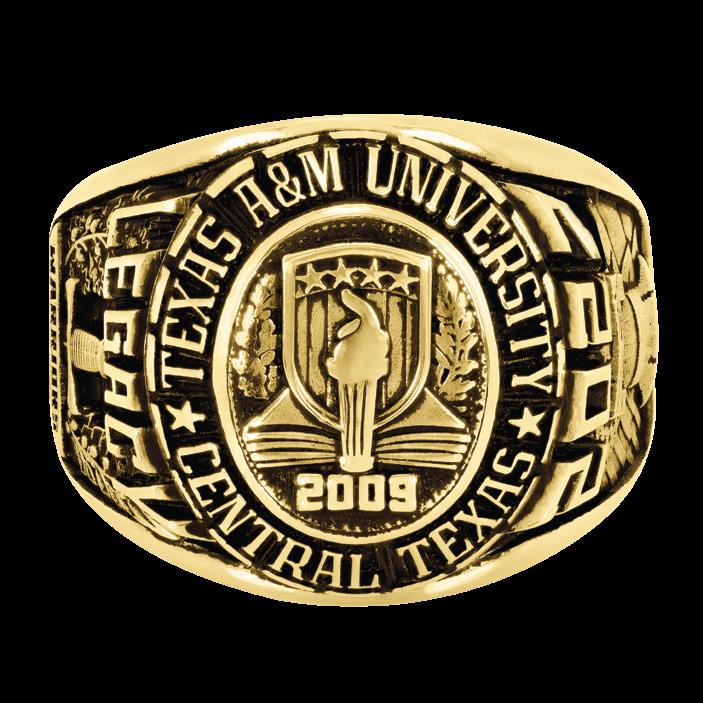
12,000+ Degrees Generate $468M in Added Income to Texas Economy
Finding Solutions: A Peek Inside Real World Research at UCARE
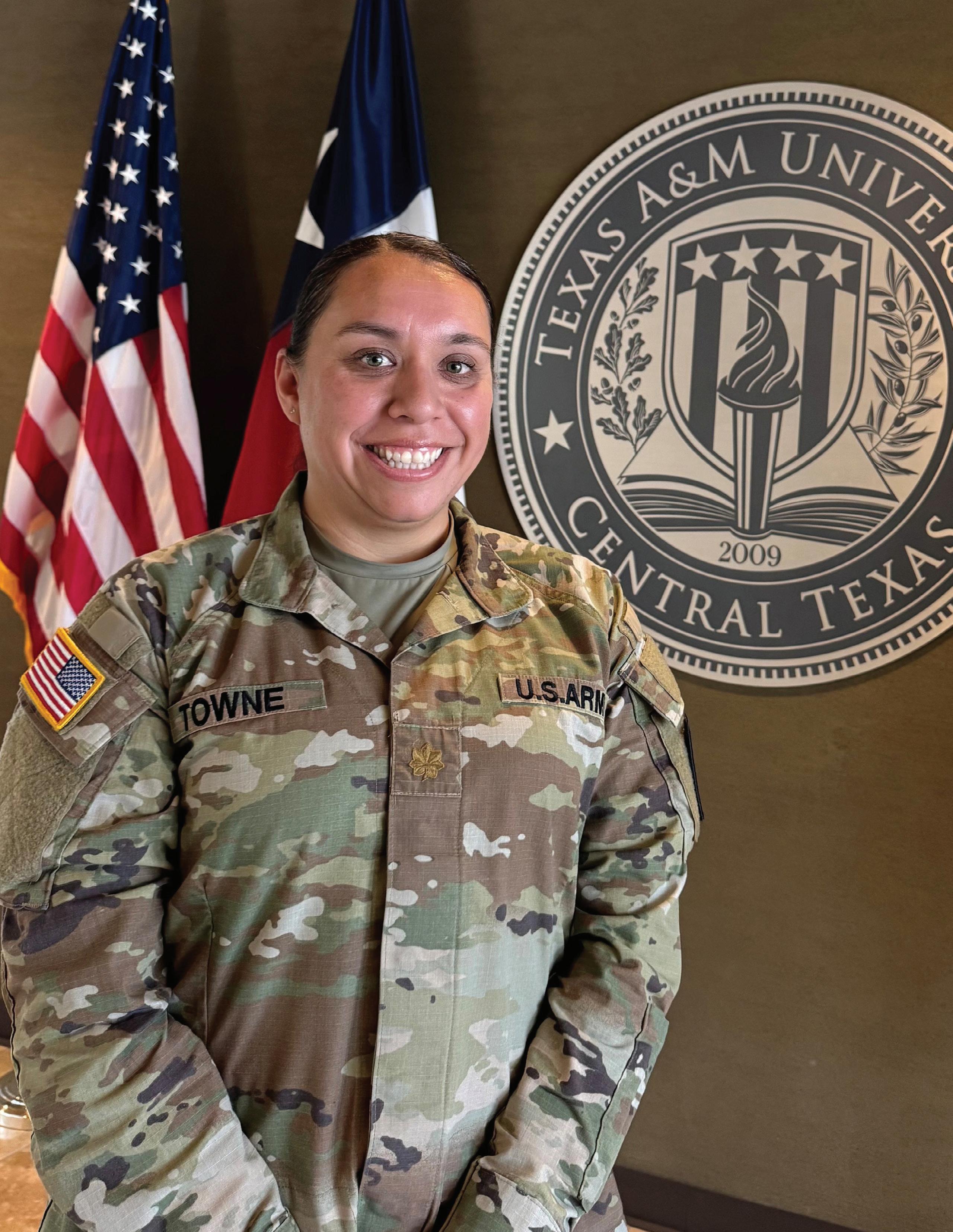
Welcome Major Towne, First Female Leader of A&M-Central Texas U.S. Army ROTC Program INAUGURAL ISSUE | FALL 2025
IN THIS ISSUE
UP FRONT
The adventures and accomplishments of our people, students, alumni, and faculty.
PARTNER PAGE
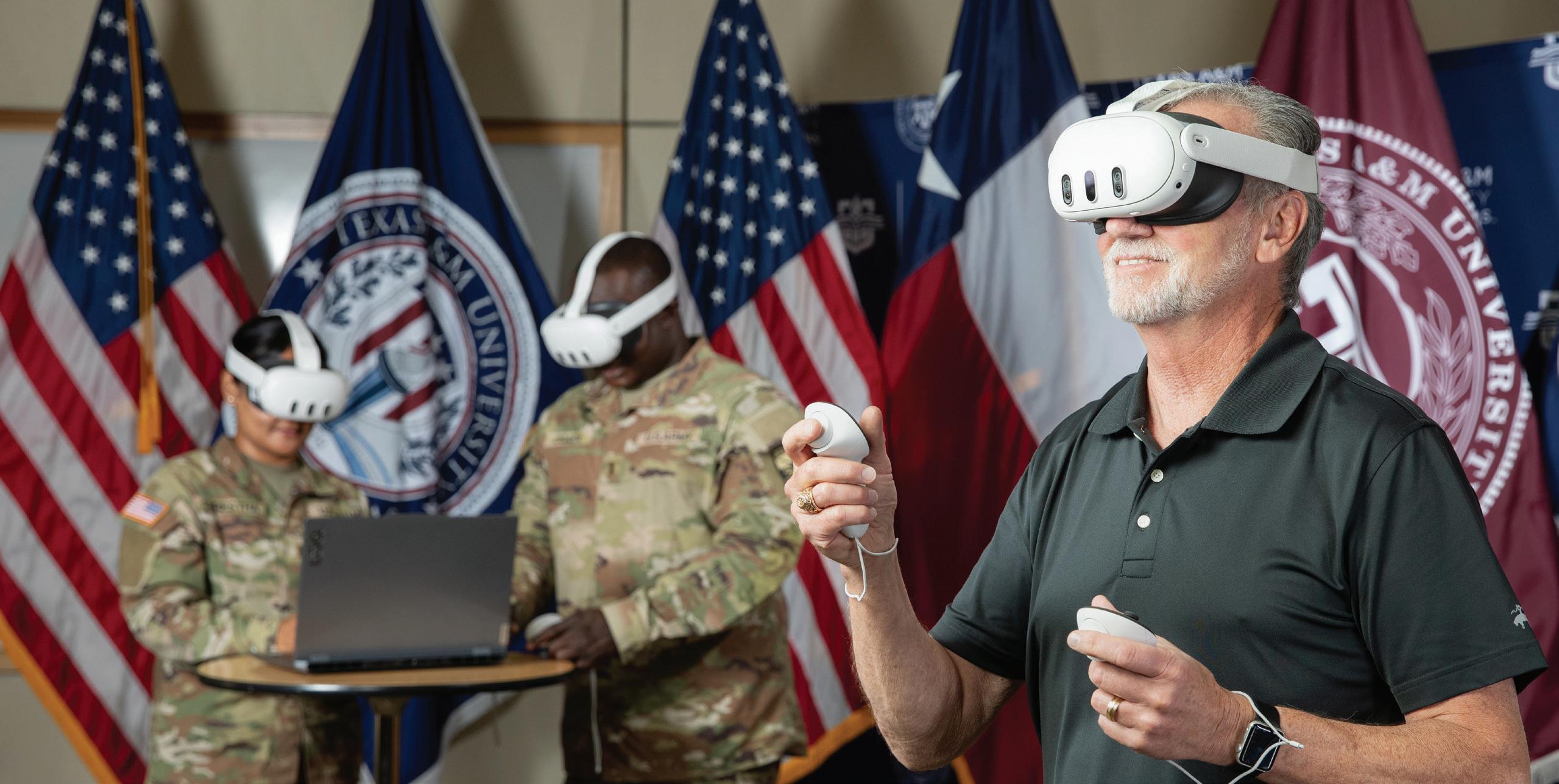
It is in the University Archives. In the practical projects underway at UCARE, and in a quiet virtual technology lab exploring and producing virtual training for our military. 06 16 18 34 36
Temple College is brimming with new buildings, new programs, and we are a part of it.
HIGHER EDUCATION HAS HIGH ECONOMIC IMPACT
When does 12,000+ A&M-Central Texas degrees awarded equal $468M for the State of Texas and almost $77M for the Central Texas region? Let Hanover Research’s Economic Impact Analysis April 2025 study show you the money.
PEOPLE WITH MOMENTUM
They are all unique and different, but they are also the same in one very important way: they are people with momentum.
THAT’S RESEARCH
A&M-Central Texas thanks our colleagues and friends at the Texas A&M University System Office of Marketing and Communications who we have seen here on campus a few times over the summer.
One of them, Mark Guerrero, Texas A&M University Class of ’12, and TAMUS video producer, came back to campus when we hollered for help providing story video featuring our very own alumna and facilities team member Jessica Caldwell to CBS Morning News segment with David Begnaud in “Beg Knows America.”
Rumor has it that the folks at CBS Morning News were extremely impressed with the video, and we couldn’t be happier to hear that, and thank the whole TAMUS team and Mark who went above and beyond to make it happen.
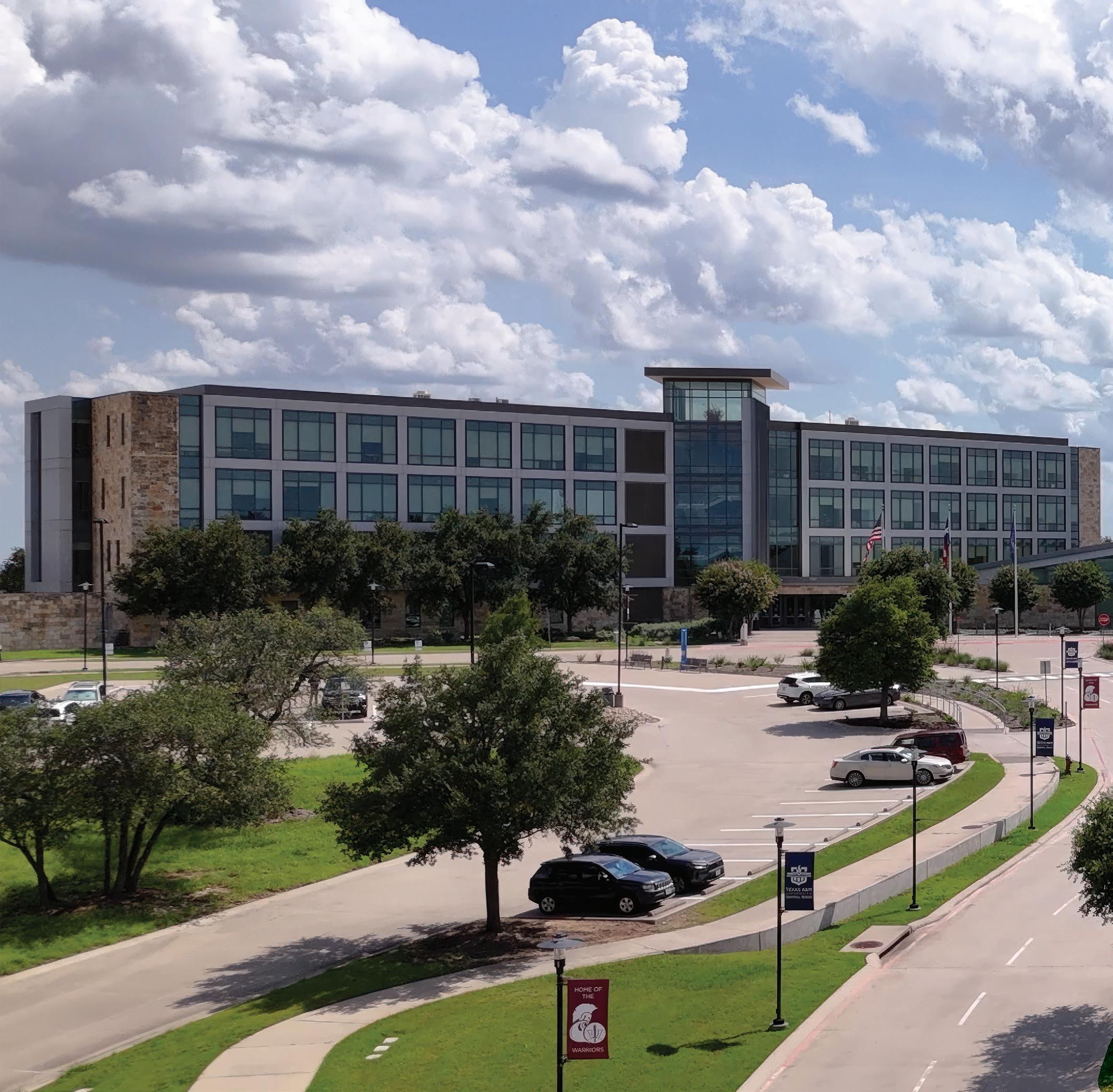
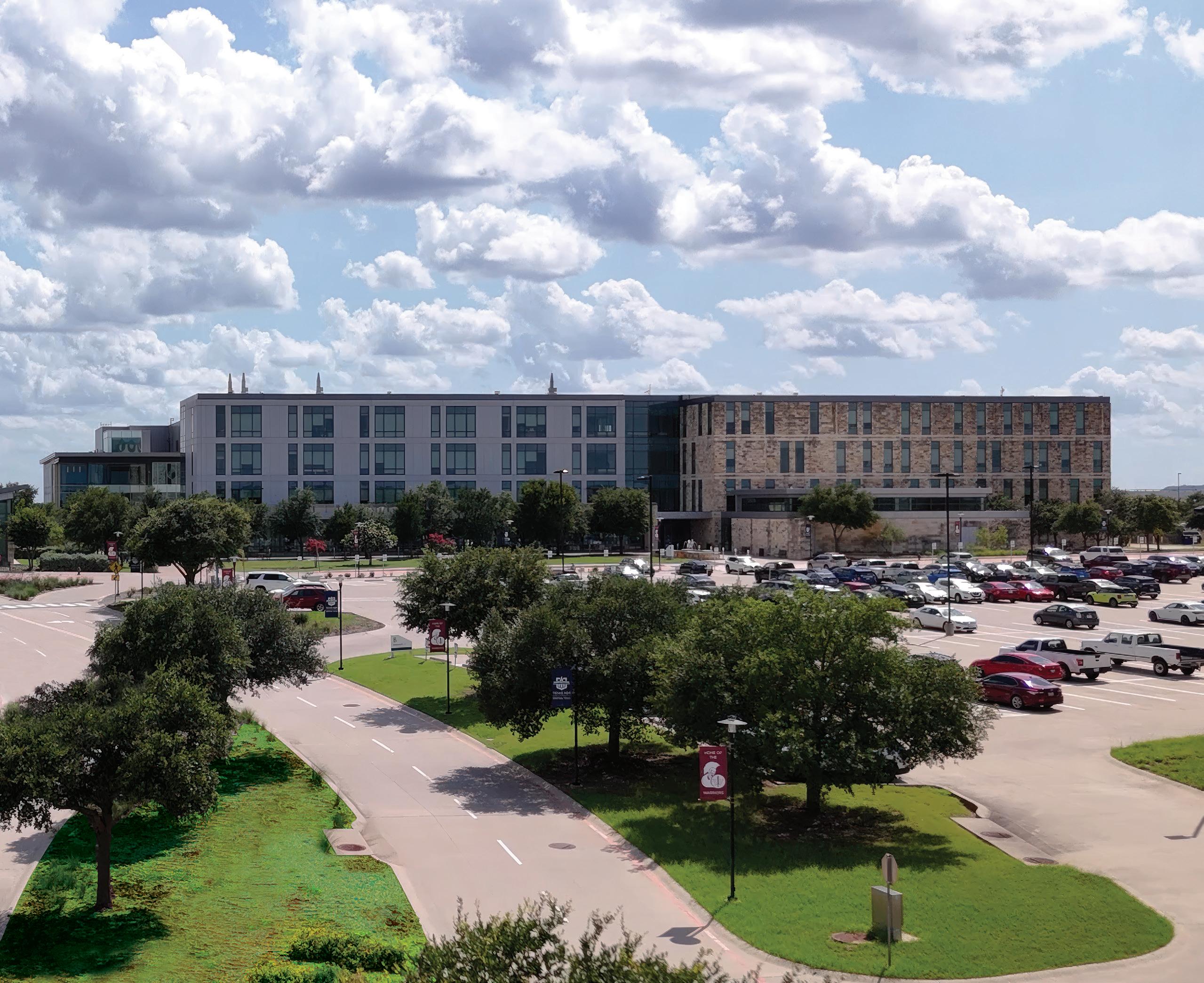
One of the happy outcomes of having such gorgeous video is the ability to ‘freeze’ a frame and make a photograph; so, if you are admiring the photo above, you have Mark Guerrero to thank. We love it because it shows off our Texas Hill Country context, all three of our beautiful buildings, and just how pretty our campus is.
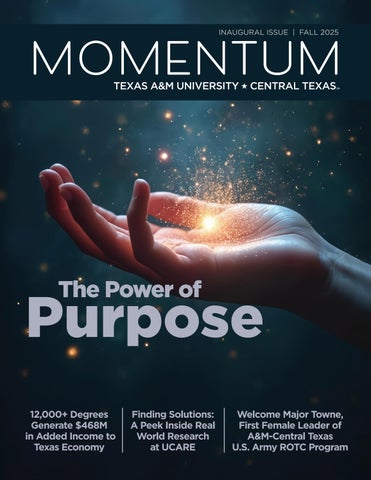
EDITOR’S NOTE The Power of Purpose
Dear Momentum Readers,
An annual publication of the A&M-Central Texas Communications and Media Relations Office
Content and Editorial Leadership
Karén L. Clos
Artistic Concept and Design
Bonnie Johnson, Perry Facility & Supply
Project Coordination
Lisa Padleski
Contributing Writers & Creative Talent:
Michael Boyd, That’s For the Birds, Drone Service Provider
Flash Photography
Mark Guerrero, TAMUS Video Producer
Steve Hanik, Ph.D., COBA adjunct faculty
LTC Joel M. Rainey, PMS, Tarleton TAMUS Marketing and Communications Office
Temple College Marketing Office
State University U. S. Army ROTC
Texas Battalion
Brent Schultz, EMC Multimedia Production Specialist
A&M-Central Texas is the 11th regional university of The Texas A&M-University System
Do you have a story idea or just want to chat about Momentum?
We’d love to hear from you: (254) 519-5744 communicationsandmedia@tamuct.edu
Copyright 2025. This publication may not be reproduced in whole or in part without expressed written permission from Texas A&M University-Central Texas.
When the A&M-Central Texas President, Dr. Richard M. Rhodes, gave us the greenlight to create a university magazine, we had a few questions to answer. The first was obvious: What do we call it? The second question came instinctively: What should our inaugural issue be about?
Thankfully, the answers came so quickly they felt like revelation. And if you’re reading this, you’ve already seen the cover—which means you’ve already seen both our name, Momentum, and the theme of this very first issue: The Power of Purpose.
We are looking at purpose in action. Not the kind you write on a sticky note and slap on your bathroom mirror. Not a tagline. We’re talking about the kind that works a night shift, raises a family, studies for finals, and still shows up early. The kind that builds something real. Grit under the nails, bags under the eyes, fire in the belly—that kind of purpose.
You’ll see it in Jessica Caldwell—a former custodian by night and a fulltime student by day, and mom 24/7—who decided she wasn’t waiting around for her dream to come true. She chased it down in work boots and latex gloves. You’ll see it in David Allen, an employee and combat veteran whose service dog is much more than a companion. And a new university ROTC associate professor, Major Azucena Towne. She’s a former ROTC cadet herself, and the first in her family to earn a university degree, and she is paying it forward right here in Central Texas.
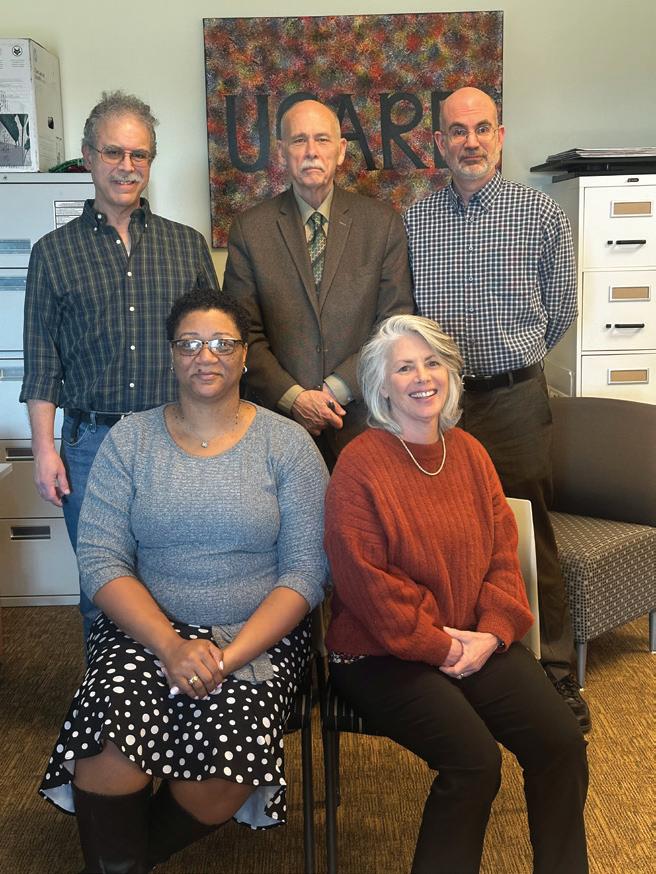
Oh, and research? That has our kind of purpose, too. Just ask UCARE. They focus on research that identifies real-world problems, works with folks to explore options, and makes solutions available. All to better the lives of everyday Central Texans. We call it “research with its sleeves rolled up.”
Just as compelling as the people featured here are, we also have the Texas-sized results of a recent economic impact study that found that our alumni working in the State of Texas generate $468M – that’s nearly half a billion dollars in added income to the state economy every year. That’s billion with a big, bold “B.” For our regional economy, the university generates $76.9 million. That’s the university showing up in paychecks, in classrooms, in grocery carts. Purpose that hires people, builds businesses, feeds families.
So, as you’re browsing through this issue, we hope you find inspiration here. Because that’s what MOMENTUM is about. Read it. Feel it. Then go do something with it. Like the people whose stories we tell, we know purpose is palpable. It builds momentum. And momentum builds everything else. Just like it built this inaugural issue — inspired by you and made for you. Enjoy. And when you are ready, ask yourself: Where will purpose take me today?
Karén L. Clos, Ed.D. Editor-in-Chief, MOMENTUM
Coming In Spring 2026
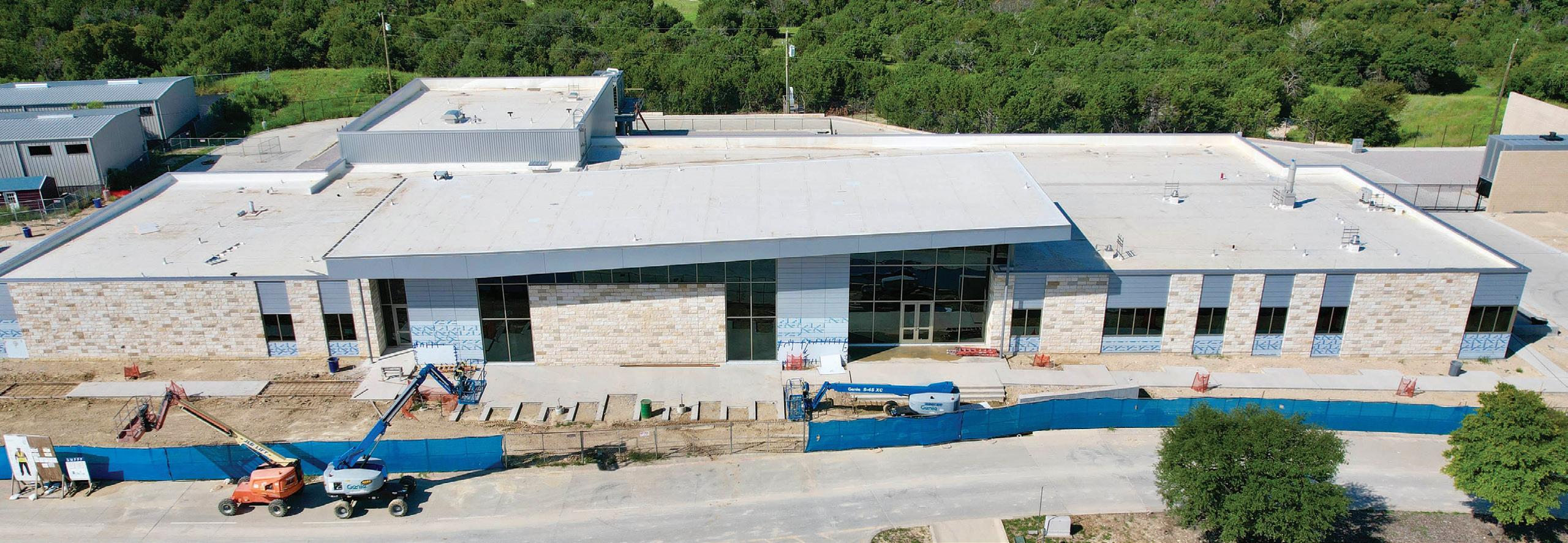
The Centralized Operational Reliability and Efficiency Building establishes an essential backbone for campus utilities and a hub for current facilities like the University Police Department and an Emergency Operations Center.
Scheduled to open in early Spring 2026, the building will support up to 1M square feet of building space, tripling the potential support now supporting more than 300,000 square feet.
Funded by the State Legislature and SB 52 in 2021, and designed to substantially improve long-term utility infrastructure and support the addition of new buildings on campus, the CORE Building will enhance energy efficiency which has been previously managed by each individual building which made the additional buildings to the campus more expensive, explained Shawn Kelley, the University’s director of facilities who praised the new addition as a “game changer,” and a practical solution to improve infrastructure support and grow the existing campus via a coordinated utility hub.
University President Richard M. Rhodes, Ph.D. thanked Representative Brad Buckley and then Senator Dawn Buckingham for their continuous support for the original legislation and the growth of our region’s university.
For more information on the CORE Building, visit: tamuct.edu/about/core-building.html
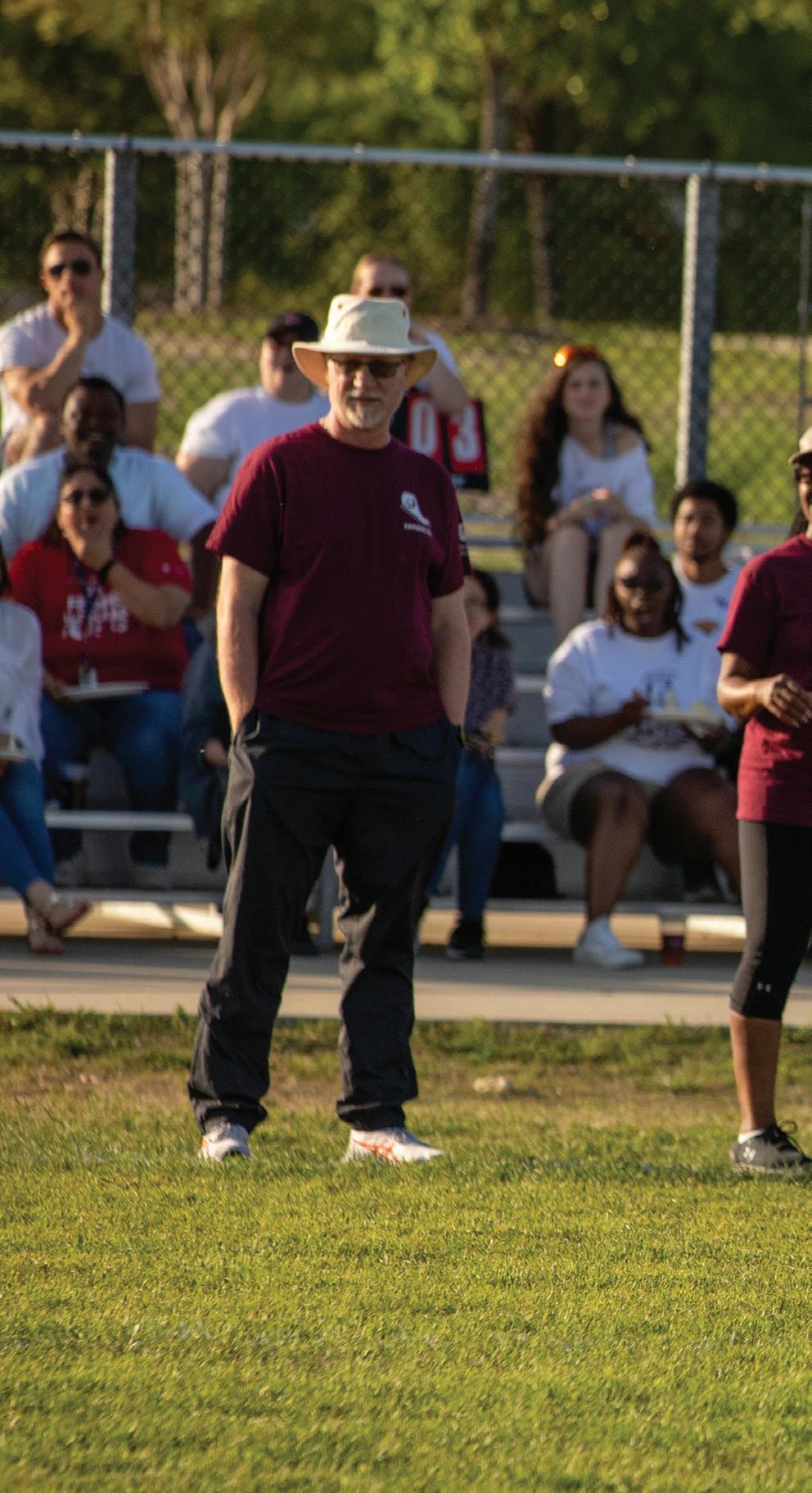
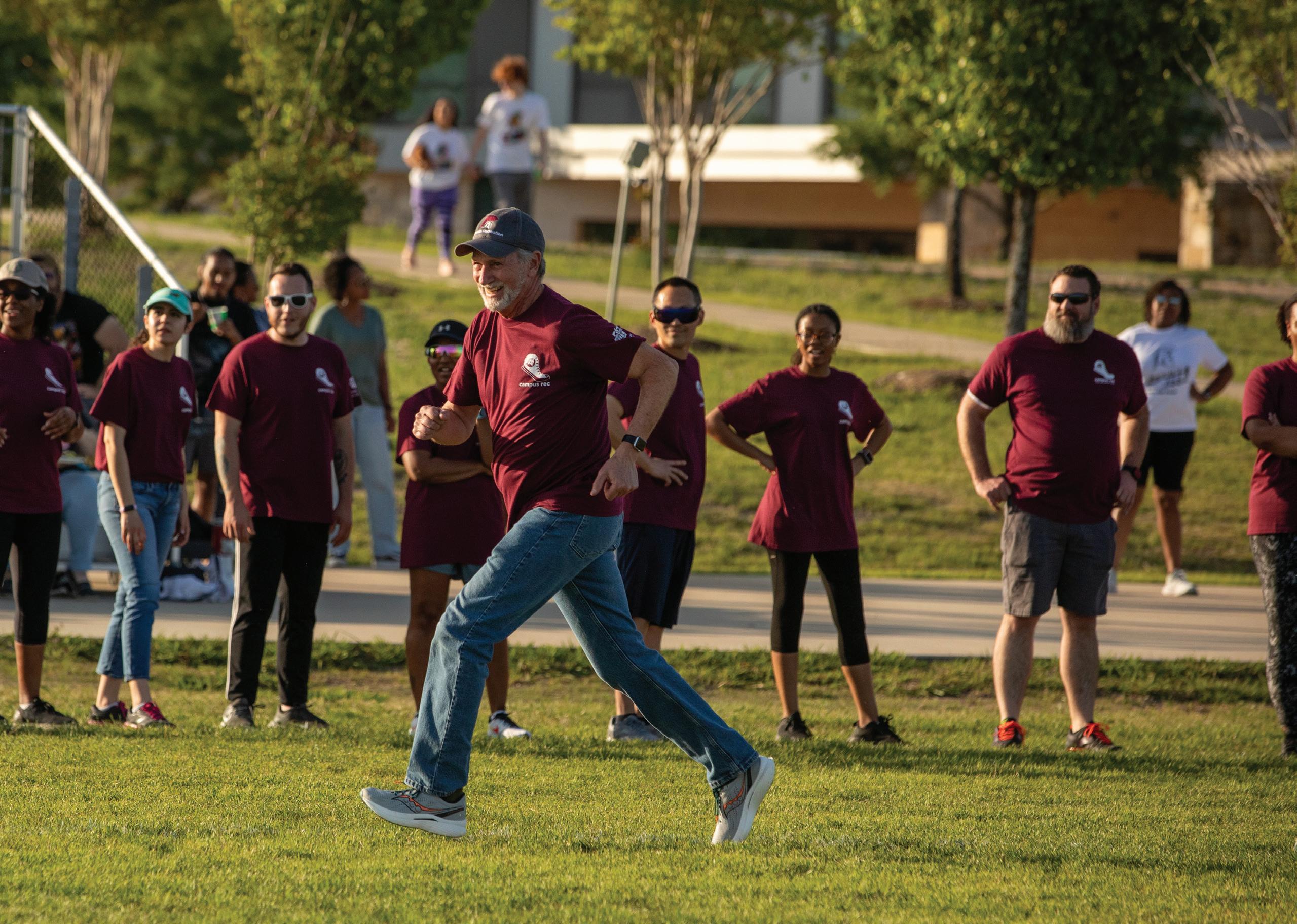
A&M-Central Texas President, Dr. Richard M. Rhodes, was literally air-bound during the Spring 2025 Warrior Picnic where the festivities included a semi-friendly game of kickball between the faculty/ staff and students. It was close, but the students snatched up a victory.
Twelve A&M-Central Texas Staff
Honored at Spring
Convocation 2025
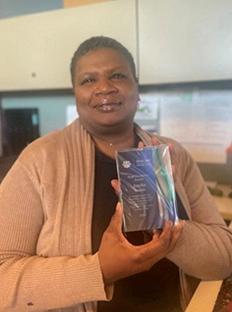
A&M-Central Texas staff members were awarded with Staff Excellence or Distringuished Supervisor, netting both audience appreciation with applause, a cash award, and a personalized plaque. The recipients for each category are:
Staff Excellence:
Amanda Chewning – Senior Coordinator, Career and Professional Development
Amelia Smith – Registrar Services Specialist – Graduation Coordinator
Cheryl Scott – Associate Director, Student Success and Academic Support Services
Christina Acevedo – Recruiter/Enrollment Specialist
Dawndrea Casey – Library Specialist III
Hannah McDonald – University Registrar/Executive Director for Records and Admissions
Keisha Holman – Director, Career and Professional Development
Amelia Smith
A&M-Central Texas Psi Chi Named 2024-25 National Model Chapter
The A&M–Central Texas chapter of Psi Chi, the International Honor Society in Psychology, has earned national recognition as a 2024-25 Model Chapter — one of just 40 chapters selected from more than 1,150 worldwide.
The distinction affirms the chapter’s commitment to academic excellence, leadership, and community engagement which was demonstrated most vividly by their donation drive and delivery of essential supplies to Hurricane Helene survivors in North Carolina.
The group collaborated with a local military unit and collected clothing, toiletries, pet food, and other necessities from the campus community. Club members personally delivered the donations to the affected areas, demonstrating Psi Chi’s core value of service.
TAMUS Board of Regents Approves University Proposal to Offer Doctorate
in Business Administration in 2027
University President Richard M. Rhodes, Ph.D. applauded the Texas A&M University System Regents and new Chancellor Glenn Hegar for their support for the University’s goals to add a Doctor of Business Administration (DBA) to the University’s offerings within the next few years.
And while it is a good beginning, University officials say that there are a number of formal approvals following this one, including the Texas Higher Education Coordinating Board (THECB) and the Southern Association of Colleges and Schools and Commission on Colleges (SACSCOC).
Nevertheless, Rhodes is optimistic that while it may take time for the necessary review and approval processes to be completed, he has no doubt whatsoever that this proposal – the second proposed doctorate to be offered at the University in the relatively near future – will be “energetically pursued” in the upcoming years until it is a reality.
New MSN Degree on the Horizon for College
of Arts
and Sciences
After more than two years in the planning and approval stages, University officials expect one new graduate program to begin in the Fall of 2026: Master of Science in Nursing (MSN), designed for those with an interest in health care administration and leadership.
Amy Mersiovsky, DNP, and Director of Nursing Programs and Associate Professor, says that the process of recommending and receiving official approvals for new graduate degree programs require approval from the Texas A&M University System Regents, the Texas Higher Education Coordinating Board (THECB), the Southern Association of Colleges and Schools and Commission on Colleges (SACSCOC).
While there is still more to do to move forward, approvals from each of the entities named above have been received and potential candidates for admission may reach out to the A&M-Central Texas Graduate School for more information.
Doctoral Degree in Education Under Consideration
While there may be no way to predict when the official results of the University’s application for approval to offer a doctoral degree might be received from the Texas Higher Education Coordinating Board (THECB), the lengthy process which includes a notification of planning, proposal submission, review and approval is underway. Provost Clifton T. Jones, Ph.D., confirmed that if all goes well, A&M-Central Texas hopes to welcome the first cohort for the new Ed.D. program in Fall 2027.
Texas A&M–Victoria Officially Joins The Texas A&M University System
It’s official: The University of HoustonVictoria soon will become Texas A&M University–Victoria, the 12th university in The Texas A&M University System.
Following the end of the governor’s signing period, the A&M System announced the historic transition on June 25th — a move years in the making and backed by overwhelming legislative support.
As part of this milestone, then Texas A&M University System Chancellor John Sharp also announced that Texas A&M UniversityVictoria received $25 million in the new state budget for the effort, and commended the work of Victoria-area State Senator Lois W. Kolkhorst in the Senate Finance Committee for securing the funds needed to grow the university and its services to the region.
“This is a transformational moment for Victoria and for South Texas,” said Chancellor Sharp. “The people of this region deserve a world-class regional university, and that’s exactly what we’re going to help build. Thanks to the leadership of Governor Abbott, Senator Kolkhorst, and Representative Louderback — and with this new $25 million investment — Texas A&M–Victoria is ready for takeoff. I am especially happy about this milestone, since I grew up in Victoria County.”
The transfer was made possible through Senate Bill 2361, authored by Senator Lois Kolkhorst and sponsored in the House by Representative A.J. Louderback, and signed into law by Governor Greg Abbott. The legislation transfers all governance, assets, and oversight of the Victoria campus from the University of Houston System to the A&M System. While the change takes effect Sept. 1, today’s announcement follows the customary waiting period for gubernatorial review.
“This move opens new doors for students, faculty, and the entire region,” said Board of
Regents Chairman Robert L. Albritton. “The A&M System is committed to investing in academic programs that directly support the workforce and economic development of this vital part of Texas.”
The university officially becomes part of the Texas A&M System on Sept. 1. As part of the A&M System, Texas A&M–Victoria is expected to expand degree offerings — including new programs in engineering and agribusiness — that align with the region’s petrochemical, manufacturing, and agricultural industries.
Founded in 1973 and previously part of the University of Houston System, the university has long served as a critical hub of higher education in South Texas. Local officials, employers, and residents have strongly supported the transition, which reflects renewed confidence in the A&M System’s ability to grow regional campuses.
“To partner with the prestige of the Texas A&M System is a momentous opportunity,” said Senator Kolkhorst. “We are grateful for the leadership of Chancellor Sharp and Chairman Albritton and their work with the Legislature to bring this vision into reality and set the course to build a globally recognized university in the coastal plains of Texas.”
A national search for the first president of Texas A&M–Victoria is now underway.
Incoming Chancellor Glenn Hegar, who, like Sharp, represented Victoria in the Texas Senate, also expressed enthusiasm about the addition to the System. He said: “I know the Victoria area well, and I am confident that the Texas A&M System can provide the resources to take the university to the next level. I am excited about the opportunities this will bring to the region.”
A&M-Central Texas Students Meet Ken Cooke, One of Britain’s Last Surviving WWII Heroes During Summer Study Abroad
For A&M University–Central Texas College of Arts and Sciences Dean, Allen Redmon, Ph.D., and English and linguistics Associate Professor Amber Dunai, Ph.D., the majority of their time is spent in classrooms, conference rooms, and office spaces on the second floor of the Beck Family Heritage Hall.
Not for a moment has their place bound physical location constrained their respective imaginations; in fact, anything but. They are proud to be scholars and prouder still to build on and leverage the real-life experiences and imaginations of their students. That, they both agree, is where the magic happens.
“We started talking about a study abroad trip about two years ago,” Dunai said. “We wanted our students to explore the connection between public memory and public space firsthand through England’s architecture and art.”
And so it was, they said, that they and 10 A&M-Central Texas students found themselves in London, York, and Canterbury with actual homework to do.
“Study abroad means just that,” Redmon said. “We focused the trip, the related readings, discussions, and assignments around the places we were visiting and the things we were seeing.”
Dunai, a scholar of medieval literature and language, explained the kind of learning she was hoping her students might have, adding that she and Redmon had created their itinerary around significant historical places like Canterbury Cathedral.
“There is more than 1000 years of history reflected in the cathedral,” she began, referencing Thomas Becket, Edward and King Henry II. “What we are hoping is that our visits to sites like Canterbury Cathedral will show just how interconnected public space, image, and memory are.”
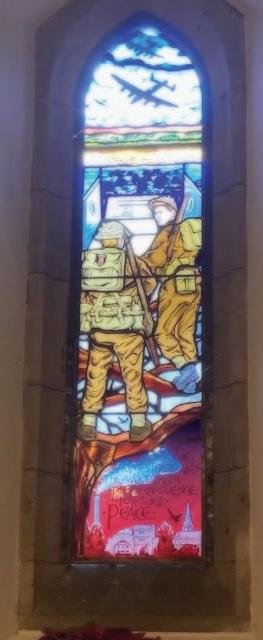
A stained-glass window the St. Lawrence Parish Church commissioned to be hung on the 80th anniversary of the D-Day invasion, June 6, 2024.
About that. The intersection of public space, image, and memory. Dunai now happily reports that all of their students fulfill their assignments and with an unexpected but delightful meeting while on a planned trip to York.
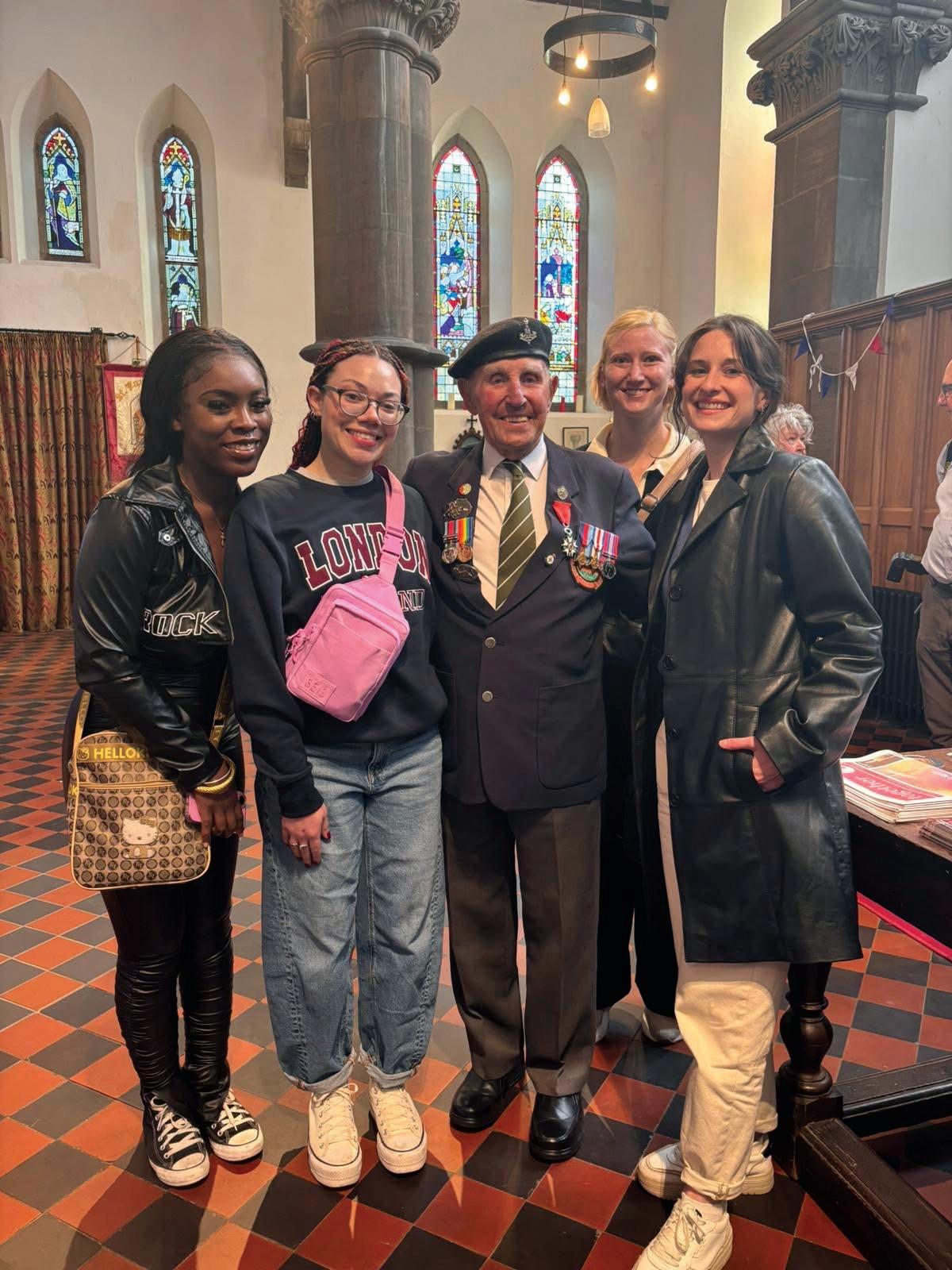
There, she said, on a tour of St. Lawrence Church, the A&M-Central Texas delegation met one of the last surviving WWII D-Day veterans, Ken Cooke, 99, who had once landed as a part of the first wave at Gold Beach as a conscript and a private, a member of the 7th Battalion Yorkshire Regiment at only 18 years old.
And, quite perfectly, Cooke was there to commemorate the installation of a stained-glass tribute to WWII veterans and generously shared a few impromptu moments of conversation with the appreciative students, providing the very kind of learning that Dunai and Redmon had hoped for..
“It meant a great deal to us and to our students to see their whole perspective of history and memory and art just blossomed with every stop along the way,” Dunai said.
“And to make the trip all the way from Killeen, a place so full of military veterans and heroes, and see the commonalities of other D-Day heroes being celebrated was an unforgettable moment from all of us.”
A&M-Central Texas students (L to R), Kyra Bailey, KyLeah Falkenstein, Jenna Orsak, and Kaylee Dusang were honored to meet Ken Cooke (center), who turned 100 years old this August. During an informal exchange with our students, Cooke recounted what it was like to be an 18-year old conscript among the first wave on the beach during the D-Day invasion.
Welcome, Charley Ayres
University Names
New Director of University Relations
Texas A&M University–Central Texas has named Charley Ayres as its new Director of University Relations, effective April 14.
Ayres, who served as the director of Workforce Solutions of Central Texas since 2018, brings a wealth of experience in government, business, and corporate relations, as well as grant writing and team leadership.
His connections in Central Texas will be a valuable asset as A&M–Central Texas continues to expand its footprint in the region. The university’s new strategic plan also focuses on building awareness and connections and Ayres will be key in making those connections.
Associate Vice President for Enrollment Management and University Relations Clifton W. Jones said selecting Ayres for the position was an easy decision.
“As the Director of University Relations, Mr. Ayres will play a pivotal role in advancing our strategic goals outlined in the ‘A Bold New Vision’ strategic plan, particularly in the areas of community collaboration and awareness,” Jones said.
“Mr. Ayres’ leadership in community engagement will be instrumental in building and maintaining partnerships with community organizations, businesses, and government entities.”
Ayres will also work to develop new, and strengthen existing, relationships with key stakeholders including alumni, donors, and community leaders. He will lead annual giving campaigns and work closely with the A&M–Central Texas Foundation to cultivate major gifts.
Ayres said the opportunities to work with these groups and to promote the university is what attracted him to the position.
“The university is growing,” Ayres said. “It has an energy to it. It is the only public university in our region, and I’m excited about being part of a team that is having such an impact on the region and the workforce in Central Texas.”
Coming from Workforce Solutions, Ayres understands the needs of the region and said A&M–Central Texas is in a unique position to make a huge difference.
“Specifically in Central Texas, when you look at the labor market data and projections over the next 10 years, the highest demand and fastest growing occupations across the board are requiring more education and training than just a high school diploma,” he said.
“IT, healthcare, and education. All of those have a talent pool that requires a bachelor’s degree or above. This university is going to play a significant role going forward.”
Prior to working with Workforce Solutions, Ayres served as the Vice President for the Temple Economic Development Corporation and held multiple positions with the Round Rock Chamber of Commerce.
He holds a variety of professional certifications from University of California, University of Texas, University of Georgia, University of Southern Mississippi, and Tulane. He has served on the Board of Directors for the Development District of Central Texas, the Board of Directors for the Texas Economic Development Council, the District Education Improvement Council at Belton ISD, and the Industry Advisory Councils for several Central Texas School Districts.
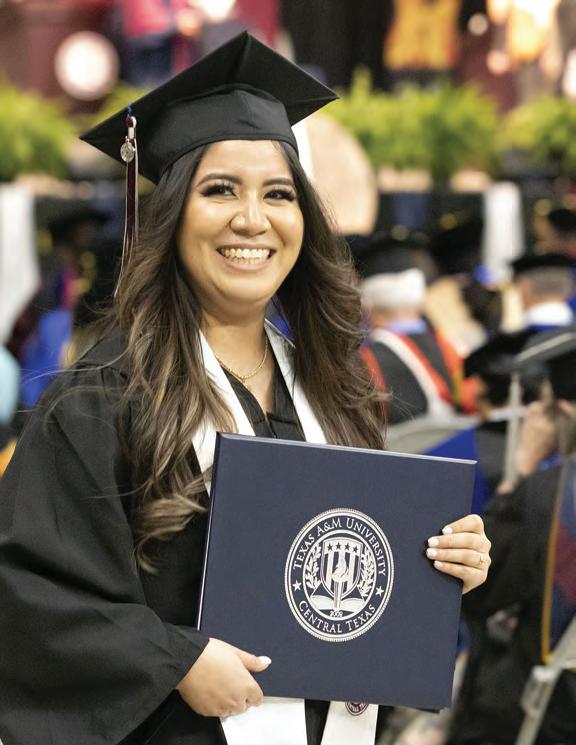
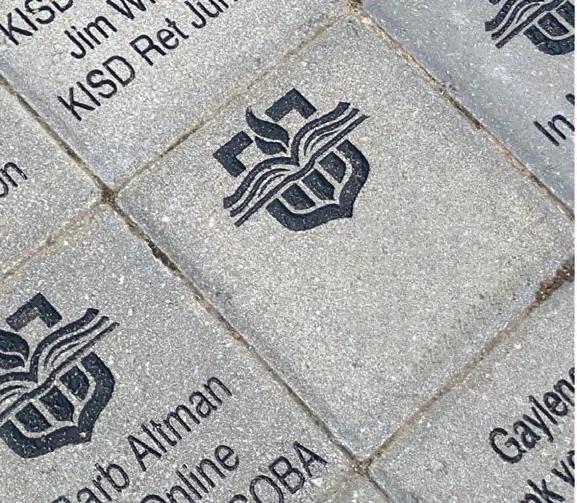
Graduation day is a momentous occasion—filled with pride for your accomplishments and excitement for the future. Commemorate this milestone and leave a lasting legacy at Texas A&M University–Central Texas with a personalized paver. To place your order, simply scan the QR code.
Changes in Student Affairs Leaders: Former AVP and Dean Brandon Griggs Accepts Assistant
Commissioner Role with THECB
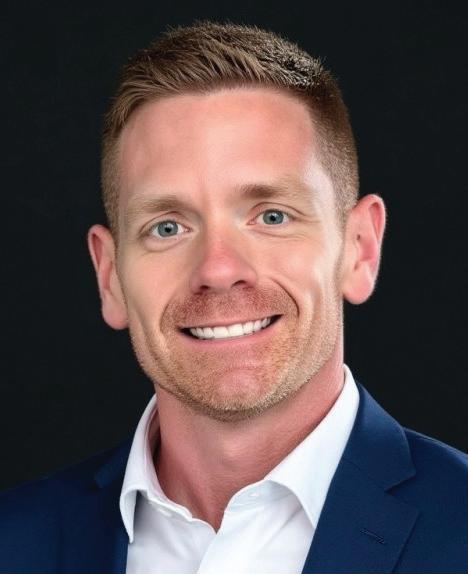
Long-time A&M-Central Texas student affairs leader, Assistant Vice President and Dean of Student Affairs, Brandon Griggs, Ph.D., announced his appointment to the Texas Higher Education Coordinating Board (THECB) effective in May.
In a LinkedIn post following his appointment, Griggs described his 17-year tenure at the University as ‘a phenomenal experience with the finest people he has ever met and filled with a passion for student success.’
Former A&M-Central Texas Assistant Dean
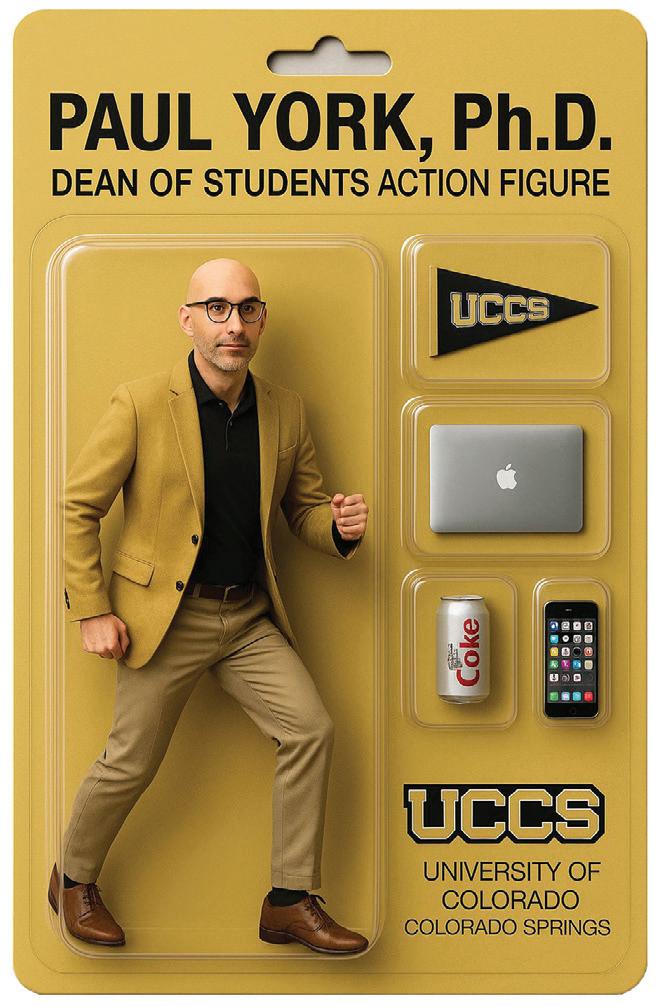
Paul York Becomes Student Affairs Dean at University of Colorado-Colorado Springs
Paul York, Ph.D., the University Associate Dean of Student Affairs and Deputy Title IX Coordinator, announced his appointment to the University of Colorado-Colorado Springs as Dean of Students in May, describing his decade plus experiences at A&M-Central Texas and his pride in the work that was accomplished – especially, he noted, the initiatives grounded in advocacy and belonging.
York had been at the University in a variety of student affairs roles since Spring 2013, including associate director of student
conduct, associate dean of student affairs and deputy IX Coordinator, had also recently begun teaching in the higher education graduate programs, and plans to remain in the latter.
During his time at the University, York was actively involved in non-partisan voter registration and awareness drives which won A&M-Central Texas multiple awards and recognitions by the ALL IN DEMOCRACY CHALLENGE in 2016, 2020, and 2022.
College of Education and Human
Development Dean
Named Fellow by Deans for Impact
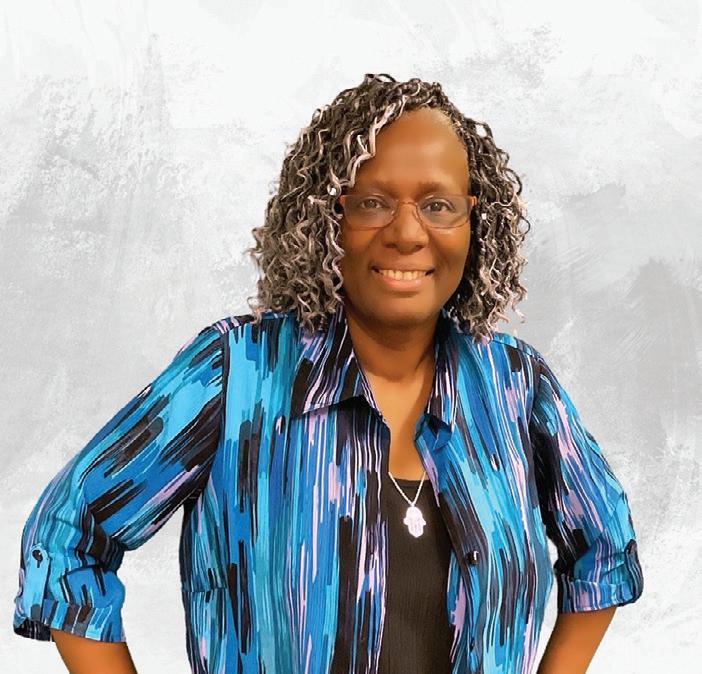
Lorrie Webb, Ph.D., Dean of the A&MCentral Texas College of Education and Human Development has been named an Impact Academy fellow by the national non-profit organization Deans for Impact (DFI).
Webb joins a cohort of leaders chosen for their commitment to educator preparation by building on the existing strengths of current degree programs at their respective colleges and universities. She is one of 18 leaders announced as part of the fellowship’s 10th cohort.
DFI Fellows lead programs that serve 11 states, both public and private universities, community colleges, residencies, and teaching fellowships – all of which are unified around strengthening existing programs and producing exceptional teachers who are ready to thrive in their careers.
Participants also benefit from monthly learning sessions and one-on-one coaching from seasoned leaders. Activities are designed to encourage strategies and best practices that
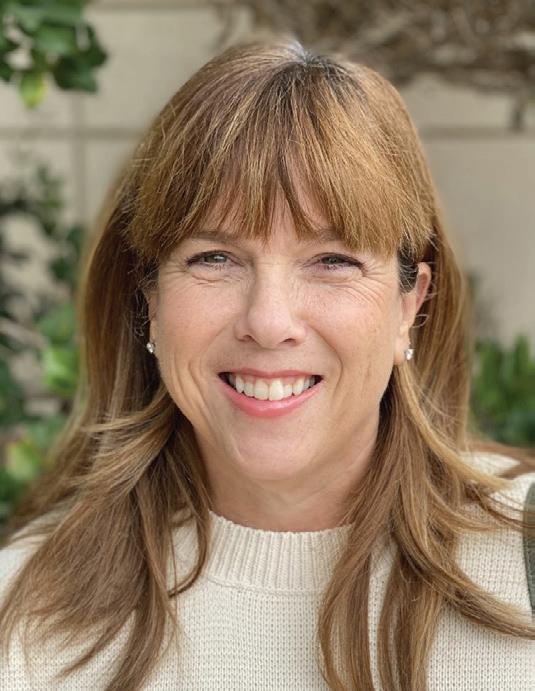
Former Student Success Associate Dean Stephanie Legree-Roberts Selected to Lead Student Success as New AVP
Following the departures of AVP and Dean Brandon Griggs and Assistant Dean Paul York, the University’s academic leadership moved quickly to keep years’ worth of momentum in student affairs and student success in motion.
In mid-May, Provost and VP for Academic and Student Affairs, Clifton T. Jones, Ph.D., announced three organizational changes that would become effective immediately.
“Effective today, Mr. Clifton W. Jones, Associate Vice President for Enrollment Management and University Relations, will assume the responsibility for Student Affairs that was previously held by Dr. Griggs,” he wrote, adding that Mr. Jones’ title will change to Associate Vice President for Enrollment Management and Student Affairs.
“Ms. Legree-Roberts will continue to provide outstanding leadership for the array of programs that support the success of our students, including the Warrior Center for Student Success and the new Success360 initiative for our many online students,” he concluded.
“In this role, Mr. Jones will continue to serve on the President’s Executive Cabinet, and he will continue to report directly to me. University Relations will now report directly to me.”
The Provost also announced that Ms. Stephanie LegreeRoberts, Associate Dean and Executive Director for the Warrior Center for Student Success, would be assigned additional responsibilities for student success programs and assume the title of Assistant Vice President for Student Success effective immediately.
thoroughly prepare new teachers as they transition from degree program completion to fieldwork to careers in the classroom.
“Educator-preparation leaders play a critical role in shaping how new teachers are set up for long-term success,” said Valerie Sakimura, Executive Director of DFI.
“From prioritizing instructional improvement in their programs, to supporting their teams to meet the evolving needs of schools and
Legree-Roberts began her tenure with the University in September 2022 – first as executive director of the Warrior Center for Student Success later promoted to Associate Dean and Executive Director two years later.
She expressed her pride and her deep commitment to A&M-Central Texas students and the on-going work of the student success areas which have been designed to increase student engagement and strengthen academic achievement.
“As a first-generation college graduate, I’ve experienced firsthand how education opens doors and transforms lives, and this promotion is both a reflection of that journey and an opportunity to help others create their own,” she said.
“I’m passionate about outreach and student support, and I’m honored to help lead the student success effort at A&M–Central Texas.”
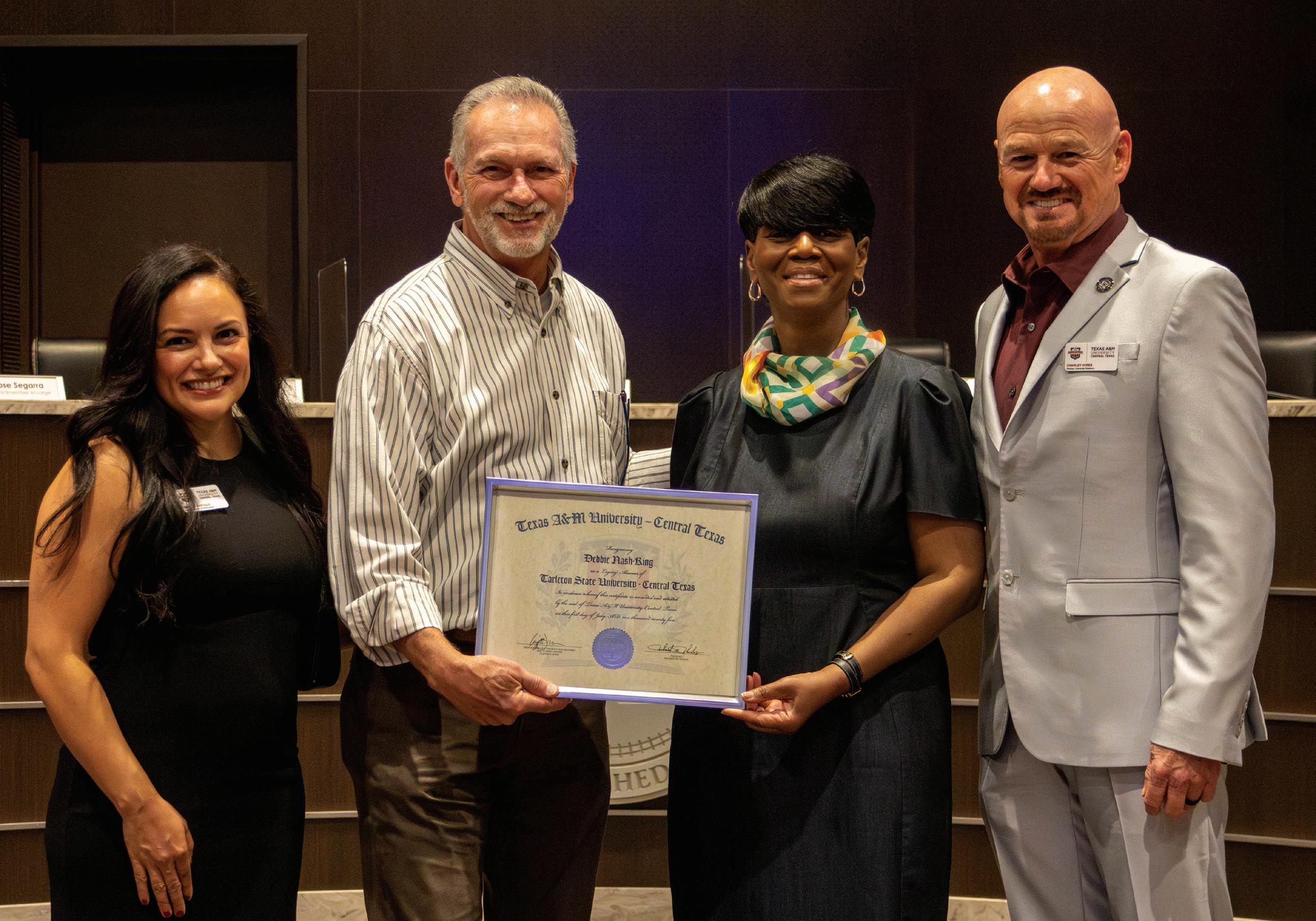
Legree-Roberts is a proud Tarleton State University alumni.
communities, to advocating for innovative and sustainable practices, they carry an immense responsibility in shaping the future of teaching and learning.
In the last three years, 155 students have earned their teacher certification through the A&M-Central Texas educator preparation program, and 127 (82%) of these graduates are actively employed as teachers – comparable to the national average. In addition, 100% of
educator preparation program pass their pedagogy and professional responsibilities exam.
The Texas A&M University System has prepared highly qualified teachers for Texas schools and beyond for more than 100 years, and the 12 universities of the A&M System prepare more highly qualified educators than any system in the State.
Higher Education Has High Economic Impact
In the heart of Central Texas, where rolling hills meet bustling communities, what began as a bold vision of undergraduate and graduate degree attainment that was public, purposefully affordable, and exceptional quality is revealing not just its significant educational impact, but an even bolder economic impact on the region and the state.
A recent comprehensive economic analysis shows that A&M-Central Texas generates nearly $77 million in annual economic activity throughout the state with 440 jobs that both individually and collectively function as a substantial economic engine. Moreover, their data demonstrate that, in addition to the economic impact of money spent by university employees, there is also an additional economic benefit with every dollar spent by the university and its students creating $1.01 in economic activity across Texas. This remarkable 2.01 multiplier effect amplifies the institution’s investment in the community.
The mechanics of this economic impact reveal a sophisticated web of interconnected benefits. Direct spending from university operations, capital investments, and student expenditures totaling $38.4 million serves as the foundation for broader economic activity. This initial investment triggers an additional $11.6
million in business-to-business spending and $26.9 million in household spending, creating a cascading effect that strengthens the entire regional economy.
The employment impact is equally impressive, with the university’s activities supporting nearly 442 jobs throughout the state. These positions span the economic spectrum, from the 251 direct jobs created by university operations to the 52 indirect positions supported by business partnerships and the 139 induced jobs generated by household spending. This employment network represents families supported, communities strengthened, and a regional workforce that continues to grow and diversify.
Obviously, there are significant economic advantages for the educational institutions in Central Texas – from local ISDs to universities. But there is also an equally important truth – one that the university’s founders knew: degree attainment results in economic impact to be sure. And it is a worthy investment that is a testament to economic and social mobility and the power of strategic investment in higher education. And the results are more than encouraging; they are exceptional.
The total number of students enrolled, referred to as headcount, is also growing substantially when comparing Spring 2024 and Spring 2025, which now totals 2,417 – an 8.2% increase year over year.
12,000+ A&M-Central Texas Degrees
Generate $468M in Statewide Income and $77M in Regional Growth
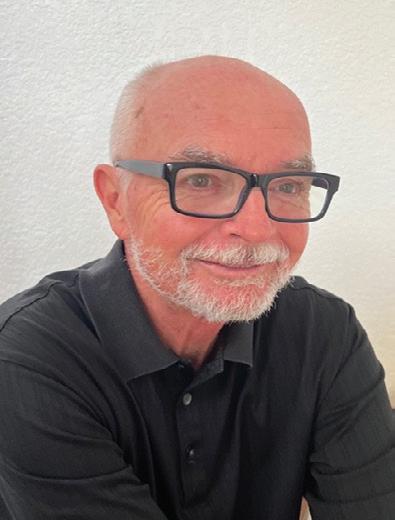
Steve Hanik, Ph.D.
Equally important is the total number of credit hours being taken which is also on a significant growth trajectory. The total number of courses taken in Spring 2025 is the highest it has ever been at 23,427 semester credit hours – breaking the previous record set in Spring 2017 which is crucial because university funding is generated by credit hours.
Enrollment is crucial, of course. But so is the result of that enrollment. Since 2009, more than 12,000 degrees have been earned and awarded, and the economic impact of that degree attainment is an estimated $468 million in additional annual income for graduates working within the state.
Specifically, A&M-Central Texas alumni earn an average of $63,759 per year ten years after graduation, exceeding the average salaries of graduates from peer institutions by at least $1,000. As expected, 79% of alumni earn more than the average high school graduate, demonstrating the transformative power of a college education in enhancing lifetime earning potential.
The university’s strategic alignment with regional workforce needs amplifies its economic impact. Academic programs align with eight of the Top 10 occupations facing predicted worker shortages in Texas, particularly in essential areas such as computer science, nursing, and business. This alignment ensures that graduates are not just educated but also employable in highdemand fields that drive economic growth and competitiveness.
Graduate-level programs address critical shortages in specialized fields, with particular strength in addressing predicted gaps in substance abuse and mental health counseling, education administration, and other essential services. This strategic focus on workforce development demonstrates how A&MCentral Texas serves as an educational institution and a regional economic and community development partner.
Finally, beyond other economic measures, there is still the additional economic benefit of increased local tax revenues, enhanced local spending power, and the creation of a skilled workforce that attracts additional business investment to the region. The presence of well-educated professionals in communities throughout Texas creates a virtual cycle of economic development that continues to generate returns long after graduates have completed their studies.
Today, A&M-Central Texas is a catalyst for regional transformation, an engine of economic development, and a beacon of both opportunity and prosperity, creating a legacy of growth that will continue to benefit Texas and communities for generations to come.
Meet Azucena Towne: First Female Leader of A&M-Central Texas U.S. Army ROTC Program
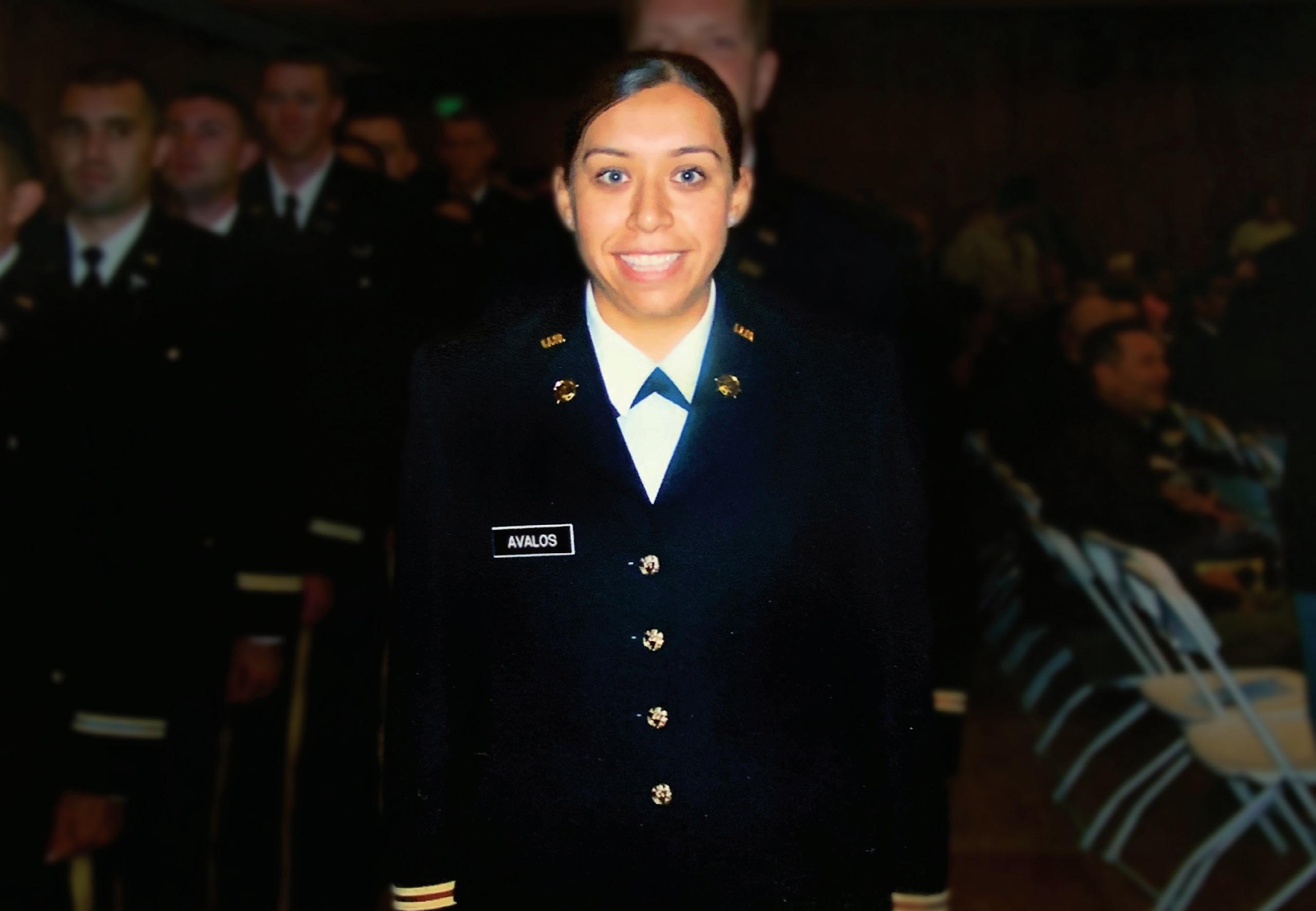
Long before she was a major in the U.S. Army, well before she could conceive the direction her life would take her, Azucena Avalos Towne, 36, was proving her mettle without even knowing it.
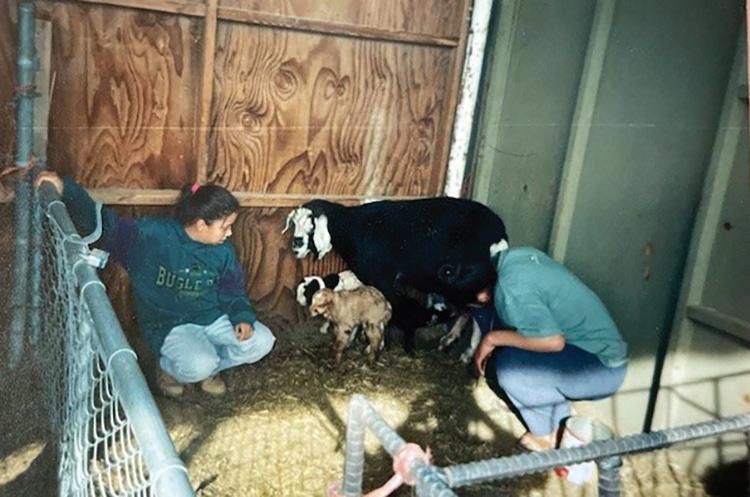
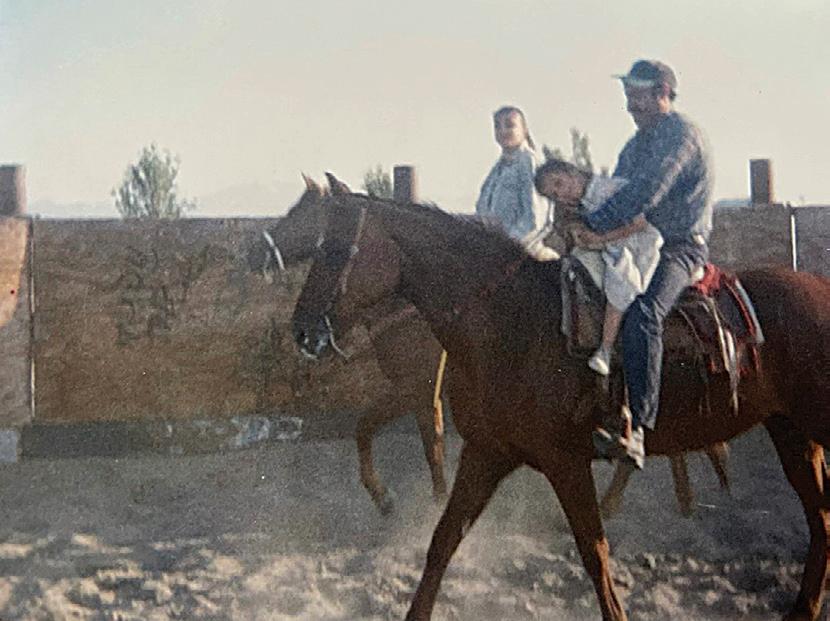
The youngest of five children, she grew up in San Bernardino County, California, on a farm south of State Route 18 and northeast of State Route 138. Situated anonymously in a windswept, tiny, unincorporated town nestled just north of the Mojave Desert and west of the San Gabriel Mountains, her parents, Ruben and Maria Dolores Avalos, coaxed a home, a farm, and a family out of the loamy soil where nothing else would ever grow. All five children were taught to prioritize family, hard work, and education.
Towne shrugs a little bit when she repeats her given name for the record, tilting her head while simultaneously spelling and saying it aloud – graciously and patiently, even though it might be the zillionth time she has had to account for being named something not familiar to mainstream ears.
Still, she smiles, her name is a gift inspired by the two people who shaped her entire life, and their abiding love for each other and where they came from.
“My parents grew up in different towns, and my father walked long distances to see her,” she began. “During those walks, he saw Easter lilies growing wild alongside the road, and he would pick them for my mother when they were courting. In their language, the flower is named ‘azucena.’ So it will always be special. Both to them and to me.”
For 17 years, she blossomed from her parents’ acts of love and sacrifice, although whether or not she recognized them as such at the time, she isn’t entirely sure. Her father’s ingenious ‘make it work’ talents arose from what he had learned from his own parents ensured that his family had shelter and food first.
“My dad’s grader was an old cow guard he probably found in a junkyard or alongside a road somewhere,” she said, laughing. “He attached it to the back of his 20-yearold Nissan Datsun truck, just as proud of it as if it were brand new.”
Her enduring love and respect for her parents never waned over the years. The grit her parents had to have in order to hustle a farm out of actual nothingness, she thinks, is their legacy. Although calling it a farm, she concedes, might be overly generous.
There was land, but no crops. Its relatively small size limited its economic relevance. But, she adds, it provided bare bones economic stability for a family of seven where there was always food and shelter, and no small amount of work to do. Even for the children.
While she was very young, their house was simple. Oil lamps for light in the evening and constant laundry washed by hand outside in repurposed concrete washboard sinks. A single propane tank powered a stove, a water heater, and a refrigerator. No running water until later.
There, in the high desert, where the days are long and hot and the nights are cool and clear, the night sky above the farm was illuminated with a kaleidoscope of stars unobscured by the glare of city lights.
“I spent a lot of nights sleeping outside under those stars,” Towne said. “All of us kids did. We’d drag our camitas outside where it was cooler and fall asleep to the sight of them. For us, it was like paradise.”
In this paradise, however, work was still work. Laundered clothes hung on a line outside. Cows and goats were milked, and her mother made homemade queso fresco relying on an abbreviated assembly line of her children’s little hands.
Using fresh milk from cows and goats, toallas as thin as onion skin, and an empty menudo can sliced horizontally and repurposed to make enough circular molds to pour and form their own cheese, their labor was purposeful. And yummy.
Towne’s sense of duty began at a young age. In elementary school, before she even went to school, she had chores. Feeding the animals, washing up, and grabbing a taquito, and a two-mile walk to the bus stop. Then the whole thing in reverse at the end of the day.
Even still, she worked hard in school. In elementary school, she did her homework before going home because classroom fluorescent light instead of the oil lamps at home was not a thing to be taken for granted.
The work ethic she developed – along with the discipline, faith, and an appreciation for the small things – are still with her, as much a part of her DNA as her Mediterranean Sea green eyes or the thick wafts of spiral curls that frame her face and fall over her shoulders and down her back whenever she is out of uniform.
But how she came to wear that uniform is a separate journey. Before she graduated from high school, she decided to follow in her sister, Catalina’s, footsteps and join the Army – against the strong objection of her mother.
When she informed her mother of her plan, the result, she added, may or may not have involved a swift and silent response involving corporal maternal discipline – right there in between the aisles of their local grocery store.
And so, she began at Cal State-San Bernardino. But, by the time she had completed her freshman year, she struggled to stay motivated about a degree. Especially since it excluded the potential of military service.
For reasons not entirely known, except to God and fate, she was
sent a sign. Literally. A. Sign: a banner promoting the university’s ROTC program. Right then and there, she says, she signed up with the full intention of making her commitment to the Army official in her junior year.
Fine, she remembered with a nostalgic smile. Fine until her formerly relaxed morning schedule shifted to accommodate the required physical training that occurred at what military folks refer to as “zero-dark-thirty.
Running the gamut between one parent’s partial approval and the other parent’s strong disapproval for her first year in college was one thing. But there was hardship and tragedy ahead that would again test her mettle.
Her beloved father died suddenly, and out of grief and loss, she simply did not have the strength to focus on goals or the work required to fulfill them. Perhaps for the first time in her 21years of life. She failed. And this failure could have cost her the career she wanted in the Army.
“Intellectually, I knew I had to do it, and I wanted to do it.,” she said. “But there’s the kind of commitment that get the laces tied up and ready, and there’s the kind that dissolves when your heart is already heavy and the scale and the two-mile run try to tell you that it can’t be done.”
Not always, but sometimes, people show up for each other. Not because they are told, but because they know: We are what we do together, Towne said while retelling what unfolded next. When a person is a part of a unit, she said, that unit is only as fast as its slowest member.
During practice runs, she said, they put her out front of the rest of the company. Not to humiliate her, but so that she knew that they had her back. And also at the gym, in the weight room, on the treadmill. And not out of suspicion, but out of support.
“Their faith in me reminded me of my father,” she said. “He never faltered in that. He always told me that committing to something meant we give it our all.”
Towne is not the kind of leader who is comfortable crediting herself. What she has accomplished, she knows, is a reflection of many – not the least of which is her mother, Maria Dolores, who once adamantly refused her daughter’s request to join the Army with a resounding and irrevocable no.
Still, when her daughter received her commission the following year, it was she who stood before her daughter and affixed the second lieutenant rank
to her daughter’s dress blues with a proud smile and a whispered bendicion.
To this day, Towne says, her mother has been there for her daughter and her daughter’s family through multiple deployments and relocations. She would prefer all of her daughters were nearer to her, and still, she sacrifices without complaint.
Which happens a lot, Towne says, because she and her husband, Major Jonathan J. Towne, 38, both actively serve. A dual career military family.
They arrived at Fort Hood in the summer of 2022 with their two children. She as the 48th Chemical Brigade logistics officer and later, as support operations officer for the Army Field Support Battalion. He as a 35A or military intelligence officer.
Earlier this year, Azucena Towne was notified that she would become assistant professor of military science, making her the first woman leader of the U.S. Army ROTC program at A&M-Central Texas, arriving on campus right before the beginning of the Fall 2026 Semester.
And the girl who’s work ethic literally grew out of the loamy soil where nothing else could have taken root looks back in gratitude for all of it. And literally can not wait to do for today’s cadets what was done for her.
“My younger self would have never imagined making it this far in my career – much less that I would be chosen to lead an ROTC program,” she admitted without guile.
“I could not have imagined how much ROTC would do for me over the years: a career, a degree, a chance to serve as an active-duty officer. Now, everything I have learned, and everything I was given in my own training, becomes all that much more valuable when its given back to the cadets I’ll serve.”
Overnight Custodian Daytime Scholar
Killeen resident, Jessica Caldwell, 37, knows a thing or two about working literally around the clock. She knows about overnight shifts, 40-plus hour work weeks where the start of her day is at 8 p.m., lunch is at midnight, and her drive home at 6 a.m. is on the other side of the highway from people beginning their workday.
On any given day, sometimes seven days a week, she wrestles the hours of her day into submission simultaneously prioritizing, doing, and completing one goal after another. Sometimes, it’s work. Sometimes it’s family. Sometimes, it is studying for the alternative certification exam. Sometimes, she says, it is the unexpected. Sometimes, it’s everything all the time every day.
But it is worth it, she says. It is more than worth it. And that nocturnal work schedule from 8 p.m. to 6 a.m. has only been the half of it. During that same time, the long nights and longer days, Caldwell decided to also become a college student with one goal: She wants to be a teacher.
Just as her kids were pulling a pillow over their heads for the second time, finally putting both feet to the floor and shuffling into a shower, and her friends and neighbors were sipping a second cup of coffee, Caldwell, one of the A&M-Central Texas custodians had already tackled the 31 restrooms, 40+ classrooms, a dozen labs, and each and every one of the 349 offices and workspaces in all three of the A&M-Central Texas buildings.
By the time her kids were off to school, when she might have been getting some much-needed sleep, she was in school, too – wide awake in the classrooms at Central Texas College, hammering away at the coursework necessary to transfer to A&M-Central Texas for her teaching degree.
From 2013 to 2018 – without pause or fail – she worked the overnight shift at the university and, in the daylight hours, she attended mostly full-time, tackling an aggressive slate of courses including biology, speech, English Composition I and II, macroeconomics, college algebra, world geography, history and government I and II and a plethora of electives until her efforts tallied
an impressive 90-hour credit total and a hard-earned B- grade point average – or, put another way, more than enough to have earned one and a half associates degrees.
The fact that she was a daytime scholar and overnight custodian never gave her a moment’s doubt as to her own potential. She has done this, she says, because she wanted to be an example to her four children so that they understood the value of higher education.
It is called walking the way you talk, Caldwell muses. And she would know. In the ten+ years as a custodian at A&M-Central Texas, she has put in steps roughly totaling 26,000 miles – 1,000 more miles than the circumference of the globe – all in the wee hours of the night – pushing and sometimes pulling her heavily laden four wheeled custodial cart filled from top to bottom with all manner of compartmentalized cleaning tools of the trade.
Her weapons of choice include a generous supply of paper towels, trash bags, and toilet paper. A cordless Dyson vacuum cleaner, large yellow bucket with attached wringer, ruddy gray solid plastic 55-gallon trash can, half dozen wet floor warning signs, carpet shampoos, dust pans, mops, brooms, spray bottles, red rags, and blue latex elbow length gloves, and a complete cornucopia of specialized utensils – the mop head of one resembling a larger-than-life fluffy yellow dandelion.
But, she says, that one is not for wishing unless the wish being made is for safety regulation clean air ventilation. Turns out, she confirmed knowledgeably, that cleaning is, most definitely not, just cleaning. The university, she said, complies with the Association of Physical Plant Operators Level 2 cleaning standards. And that is a high standard indeed.
Every. Day. Top to bottom and left to right floor to ceiling clean. All for $8.25 an hour.
Still, she pursued her degree with vigor, undistracted by the fact that she was going to work when most people were going home and taking not one but four or more classes instead of sleeping – squeezing in just enough
rest to wake up by 5 p.m. and start the whole cycle all over again. Because, she repeated, this dream of becoming a teacher wasn’t just going to make itself happen.
By 2019, Caldwell had officially transferred to A&M-Central Texas declaring a teaching major, and her advisor, Yvonne Imergoot, made use of every single one of all the credit hours she had earned at Central Texas College.
About a year into her studies, Caldwell faced a potentially career-stopping obstacle: If she stayed on the traditional teacher preparation and certification track, she would have no other choice than to quit her job in order to take and complete the required student internship courses. These, by necessity, were offered only during traditional daylight hours because that is when the schools are open.
Anyone else might have sat down and cried. Not her. When that door of opportunity closed to her, she found another way. A way that was longer, and maybe even less certain, but a way that meant she wouldn’t have to choose between the job she was in and the career she craved: the Master of Arts degree in teaching. It was specifically designed to prepare teacher candidates with an undergraduate degree outside of education to become teachers via the alternative certification option.
“I knew when I started that I would never give up on becoming a teacher,” she said. “I wanted my children to see me really work for it, so they know they, too, can overcome anything.”
Had it only been a year earlier, she mused, it wouldn’t have been an issue, she said. But her work schedule unexpectedly changed from the overnight shift to the daytime shift which conflicted with the student teaching rotation she needed. She requested a shift change from new management and was told no. Her work was contracted with an outside vendor, she said. And there she was. Stalled after so much effort. Quitting her job was not an option, she said. She is a mom. And every mom knows that their kids like to eat.
From where the grit comes in a situation like this is different for everyone. But for a person determined enough even an alternate route that results in a sure destination is certainly worth it. She reminded herself that she hadn’t worked this hard for this long to just give up on the very reason she had started in the first place.
Working with her advisor, she changed her undergraduate degree major to liberal studies, graduating in 2020 – the first in her family – and immediately enrolled in the alternative certification program. By August 2024, she graduated with an A- grade point average and a well-worn certification test preparation manual.
One of the things Caldwell believes in is that an obstacle only has the power a person is willing to surrender to it. And, she laughed, she doesn’t have one iota of surrender to her.
“I knew when I started that I would never give up on becoming a teacher,” she said. “I wanted my children
CELEBRATE YOUR SUCCESS
to see me really work for it, so they know they, too, can overcome anything.
But her journey hasn’t been just about the grit. She is buoyed by the human, the humorous, and sometimes ironic moments that have happened along the way. Like the fact that her big dream was made possible by a humble minimum wage job while her gloved hands were polishing mirrors, scrubbing toilets, and vacuuming miles of carpet.
“It isn’t like everyone at the university even knew that I was a custodian and a college student and then a university student and then a graduate student,” she mused. “It wasn’t something I wanted to appear to brag about. I just wanted to put my mind to it without any special attention.”
While she may have assumed her goals were invisible to most people, Caldwell got from A&M-Central Texas faculty and staff the same generous heaping of encouragement and assistance that every other student gets – without the faintest idea from anyone that she was the same person who kept their toilets clean.
For example, she said, it was Morgan Lewing, Ph.D., an associate professor and chair in the College of Education and Human Development, who originally guided her toward the M.Ed and alternative certification.
“We were both there in his office, and he was so great to me, explaining the process,” she began, trying to suppress a laugh. “And as we sat there talking, I thought of all the times I had been working on his floor, cleaning the restrooms on that floor when he tried to use them, and I would have to say, ‘No. You can’t come in here.’ I kept waiting for him to
recognize me as that person who had shooed him away.
He did not, she added. Or if he did, she thinks, he never let her know he had recognized her as the building’s custodian. Maybe, she thinks, it is because he cared more about her dream of becoming a teacher than he did he did about the number of times she directed him away from a temporarily closed restroom.
Today, Caldwell studies for the alternative certification examination that will allow her to finally and forever call herself a teacher. Last year, she was hired as an administrative assistant in the university’s facilities services office and is still a part-time custodian -- sometimes during the week and even on Sundays.
Turns out, once an around-the-clock workaholic, always an around-the-clock workaholic. And, sometimes, that effort returns with rewards when most unexpected.
In 2025, Central Texas College retroactively awarded her not one but two associate’s degrees after Caroline Williams, assistant registrar, noticed that the courses she had taken there more than fulfilled their degree reqiuirements.
Today, Caldwell is deploying the focus she once had on degree completion to knock down one last challenge: a passing score on the teacher certification exam.
“I am taking the certification coursework through Iteach,” she said, adding that she works on it a little every day.
Good Boy? WHO’S A
Service Dog is Every Warrior’s Favorite Buddy
While they are on campus, they are hard at work. Identifiable by their service dog vest and happy and healthy humans, they have a serious job to do. But that has not stopped A&M-Central Texas staff and students from becoming their biggest fans whenever they encounter them.
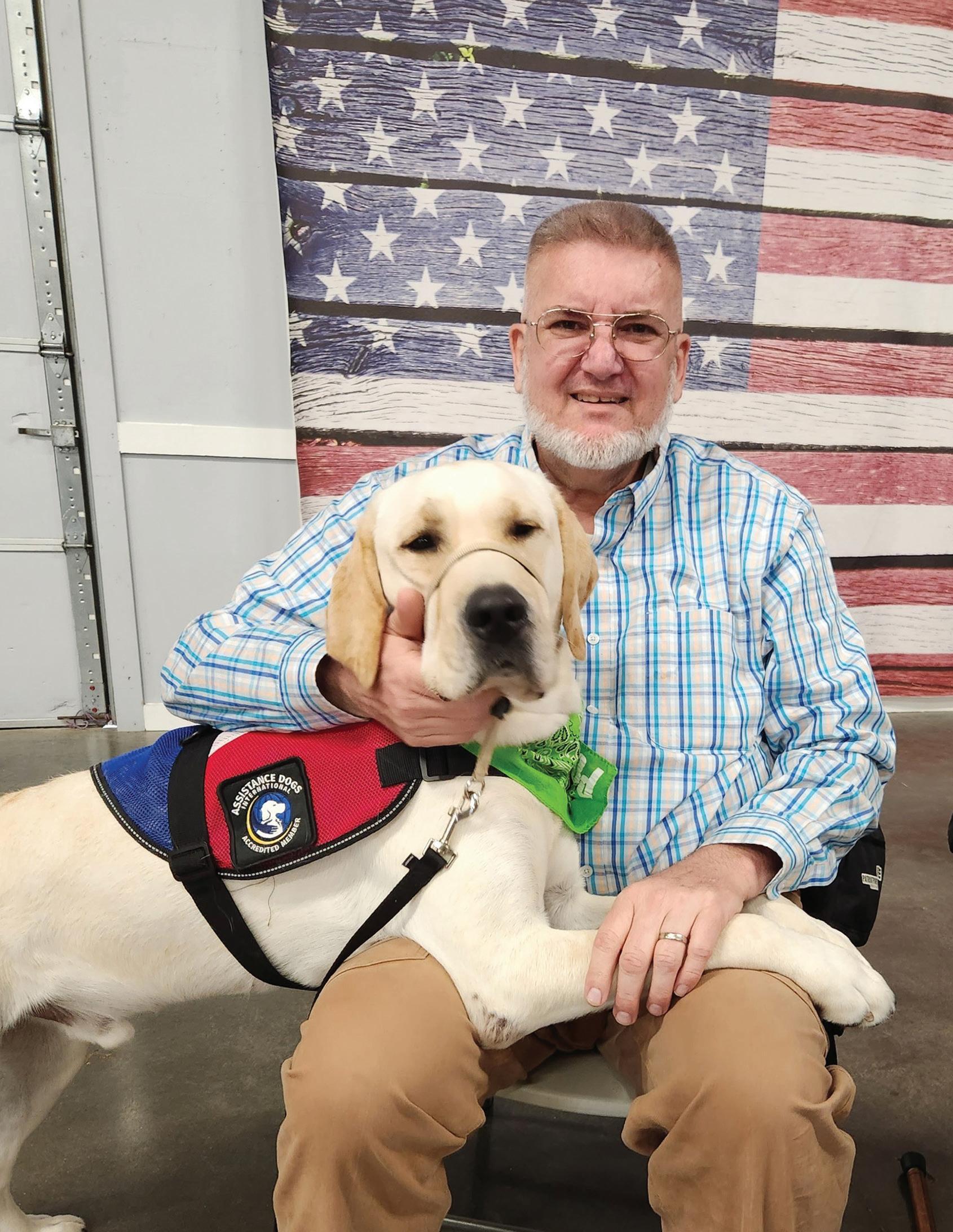
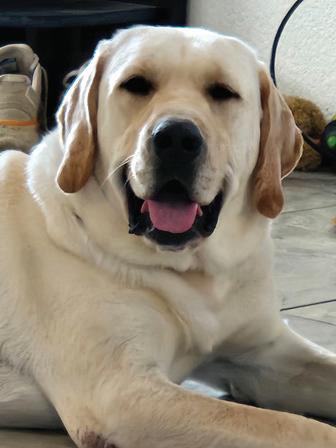
David Allen, contracts and grants coordinator in the finance and administration office, brings his three-year-old, 107-pound, pure breed, yellow lab, Porkchop, to work with him.
“Porkchop has been accepted across the campus to the point that many of the people in the different offices have commented that he might be my service dog, but he is their support animal and morale officer. And we are both pretty content with that.”
Allen doesn’t mind sharing, he says. In fact, just the opposite is true. But there is a best way, he says, to get to know an ‘on duty’ service dog.
“Most of the time, here on campus, the staff knows how to ask first before they pet him,” he explained. “And in public, most folks see him but understand that he is working, so they do not ask.”
But while working time is working time, Allen also loves to share Porkchop with others. Especially the children they encounter.
PEOPLE WITH MOMENTUM
staff members cannot help but break into 150-watt smiles when they see him coming or going.
“It has been such a joyful thing to see how loved he is, and it is kinda funny too,” Allen added.
“They can be busy at work, preoccupied, or just quietly going on with their day, and when they see us, they can’t not smile and reach out to him,” he said.
“Some people even put on their best ‘doggo voice’ and ask him ‘Who’s a good boy?’ while they rub his belly or lean in for a face lick.”
“I tend to migrate towards folks with kiddos,” he said. “I will have him (Porkchop) sit, and then have the kiddos come love on him.”
“Any time he gets lovin’ he enjoys it, and it always amazes me how genuine dogs are about their emotions. He just loves getting lovin’,” he added.
“He loves his ears being rubbed. Often he will lay down and roll over for a big belly rub or just start with the non-stop 90 mph tail wagging.”
There is, he explains, a reason motivating his desire to allow interaction between Porkchop and local little ones. And it is as pure and simple as the love between any pet parent and their beloved pooch.
“When he and I interact with the kids in public, one of my goals is to help with kids that might be afraid of large dogs get to know him and show them he is a lovable critter.”
Lovable doesn’t seem adequate to describe it. Not by a long ways. On random walks in between buildings, running on campus errands, or just arriving or leaving for the workday,
Allen is grateful for Porkchop, and no doubt, the feeling is quite mutual. They are buddies, he says, in the best way possible. Lucky buddies both of them. All because of a group called Patriot Paws, a nonprofit organization in Rockwall, Texas – just north of Dallas.
“The day I received Porkchop there were four other vets that were receiving their dogs,” he said, adding the appreciation he has for the organization and the lifechanging impact of the nonprofit’s work.
“They had already named him Porkchop because he was the largest of a litter that included a set of triplets,” he said.
“Just look at the size of his head,” he laughed, flashing a picture of his six-day buddy before he became his.
Allen said that ‘when the service dog vest is on, Porkchop is all business,’ but when he is relaxed after the vest comes off, he is just like any other three-year old puppy: all smiles.
“He loves walking around the house with his favorite stuffy toy, Lambchop, in his mouth, Allen says. And there isn’t a mud puddle that he hasn’t found and rolled around in.
Shortly after the adoption, Allen says, his wife of 44 years, Gwen, appreciates Porkchop, too – and the work of Patriot Paws.
“Within 10 days, she told me, ‘I really enjoy the fact that I’m no longer the retriever wife.’”
Allen, who is anticipating retirement in the future, says he hopes to be able to share Porkchop with the Central Texas community.
Maybe, he says, Porkchop can become certified to visit children in local hospitals. But not to worry, Allen says. They will always come back to Porkchop’s second home: A&M-Central Texas.
Family Ties, Tassels, & Triumphs
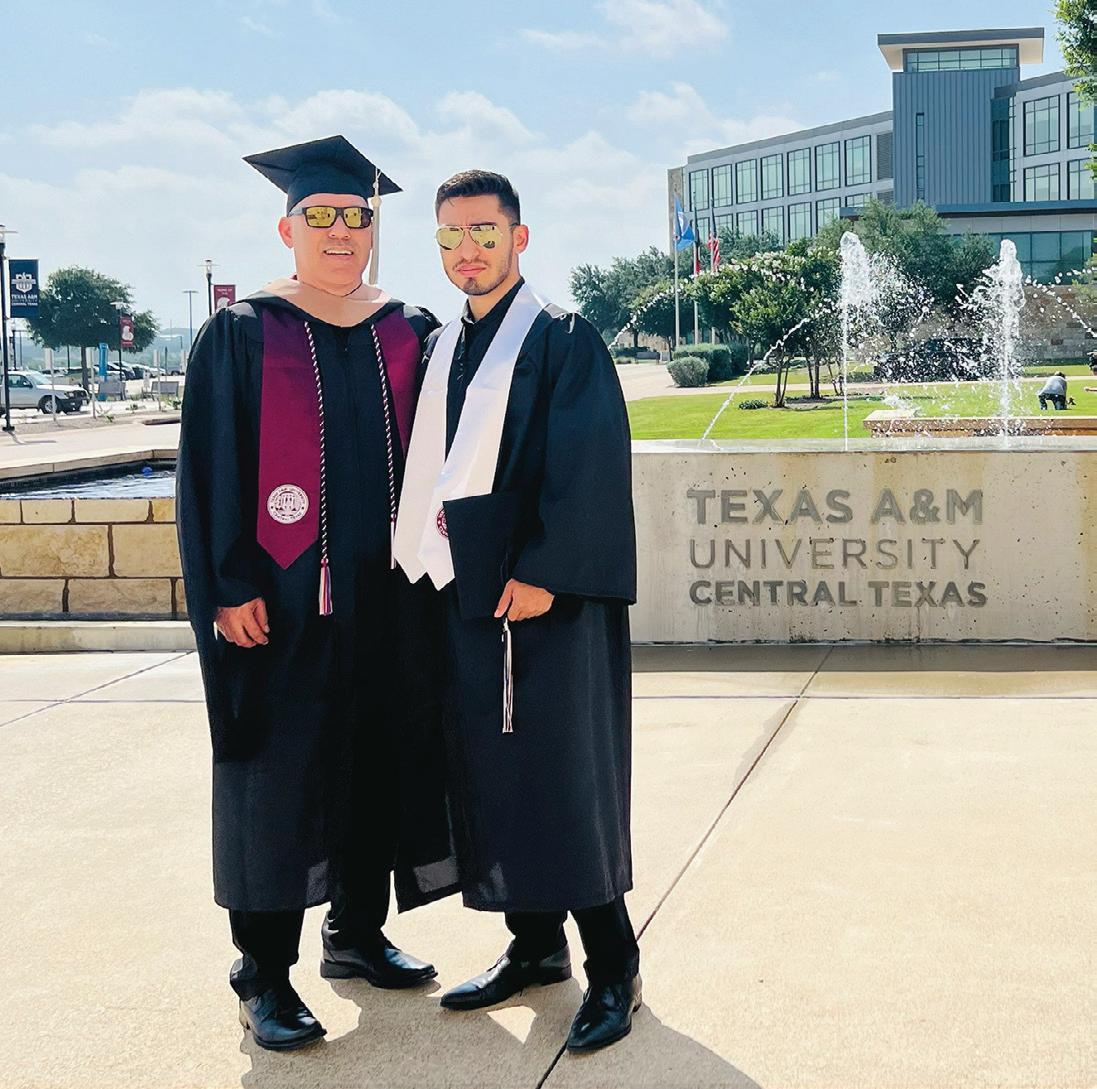
Three Sets of Family Members Earn Their A&M-Central Texas Degrees Together
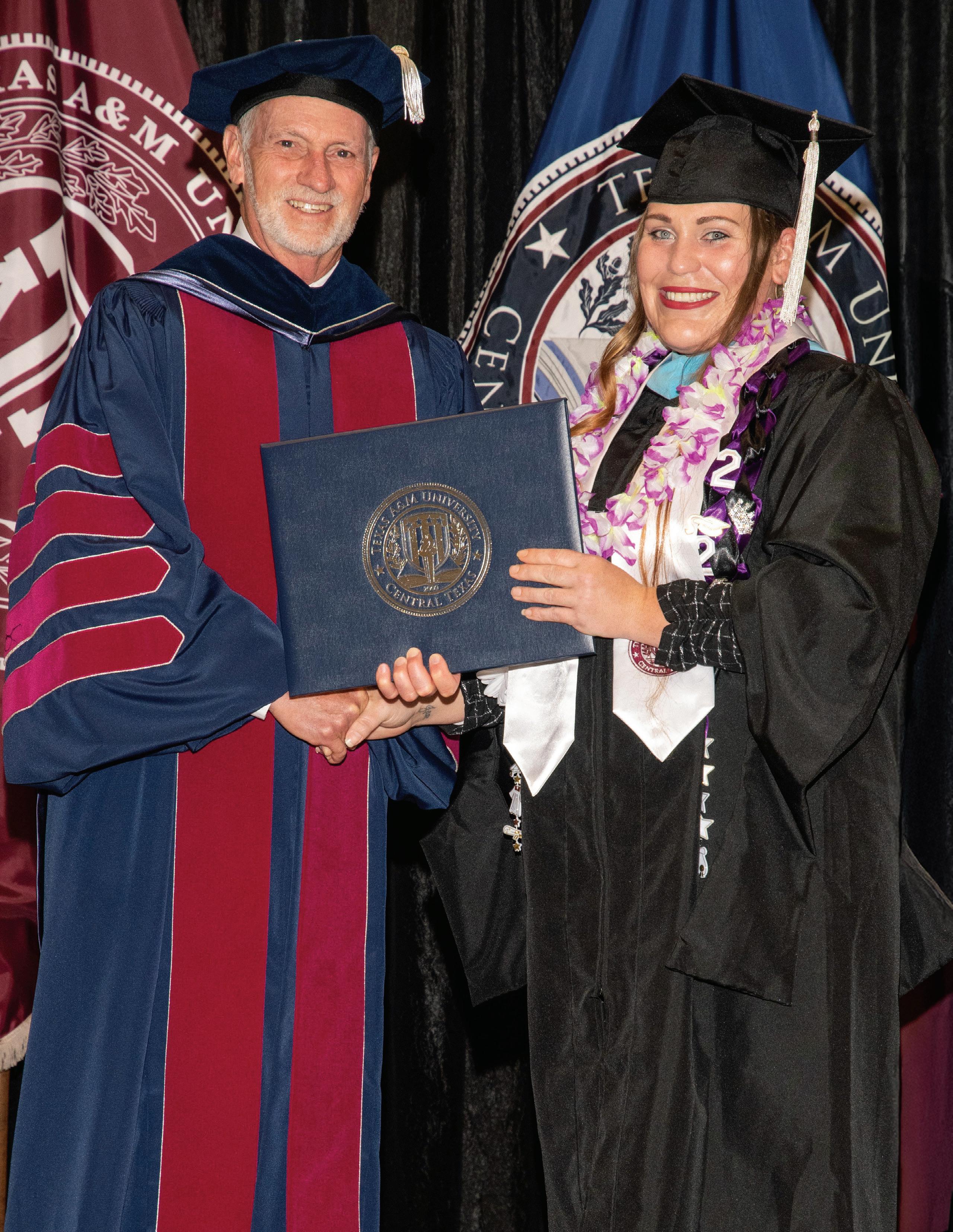
On Saturday, May 17, at 3 p.m., A&M–Central Texas celebrated 375 undergraduate and graduate degree candidates at the Cadence Bank Center in Belton. And a first of its kind occurrence that, so far, university officials say, hasn’t happened at any other university they’ve been able to find.
According to an exhaustive Google search, no college or university has ever reported three completely separate families each having closely related family members graduating at one time. Until now, that is.
Among the degree candidates, there is one father and one son, a husband and wife, and a brother and sister – who decided to earn their university degrees in sync with each other. And they are finishing the way they started: together.
“When we first realized it was happening, we all looked at each other like, ‘Can this be real?’” said A&M-Central Texas President Richard M. Rhodes, Ph.D. “And then we thought, ‘Well, we have always known our students to be extraordinary
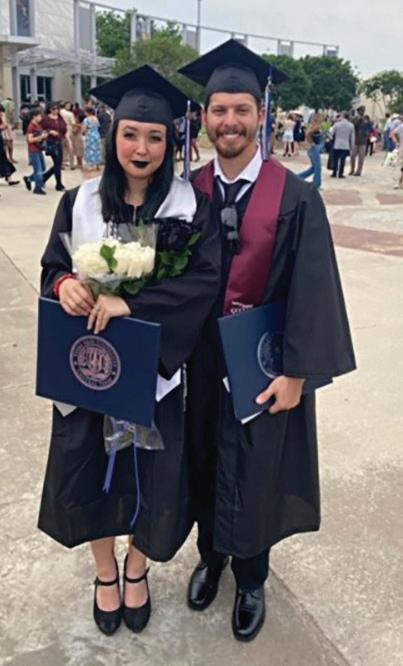
Nicholas & Cynthya Husband & Wife
when it comes to potential and persistence, and this is an extraordinary example of that.”
Graduation Coordinator, Amelia Smith, noticed the relationships between graduation applicants, anticipating the university’s communications director would want to know. And she was right.
“We love celebrating these family members because it is a reflection of the kind of university we are,” she said. “The fact that family members are choosing to get their degrees together is very special to us.”
And choose, they most certainly did. Of the three pairs of family-related graduates, some decided based on the opportunity to support and challenge each other. For others, it was the affordability of the university’s tuition that made it financially practical. EdSmart editors, echoes Dr. Rhodes, identified A&M-Central Texas tuition as the most affordable in the U.S.
Husband, Nicholas Karcher, 33, and wife, Cynthya Dennison, 30, of Copperas Cove, had already undertaken other things together – like a decade of prior military service and the birth of their now 10-year-old son.
Both had also earned college and university credits here and there, but it wasn’t until they moved back to Texas that they set their minds on completing their undergraduate degrees – and doing it together.
And not just together, but at mach speed –together. Both first enrolled at Central Texas College, wrapping up their core courses, taking five or six classes each, completing the core courses needed to transfer – and raising
a then four-year old son before transferring those credits to their individual degree plans at A&M-Central Texas.
After graduation, Dennison plans to return to the university for a master’s degree in applied psychology on her way to a doctorate. Karcher will earn an undergraduate degree in criminal justice and continue a career as a police officer in Copperas Cove.
Editor’s Note: Cynthya Dennison began classes Fall 2025 as a graduate student in the university’s Applied Psychology program. Congrats!
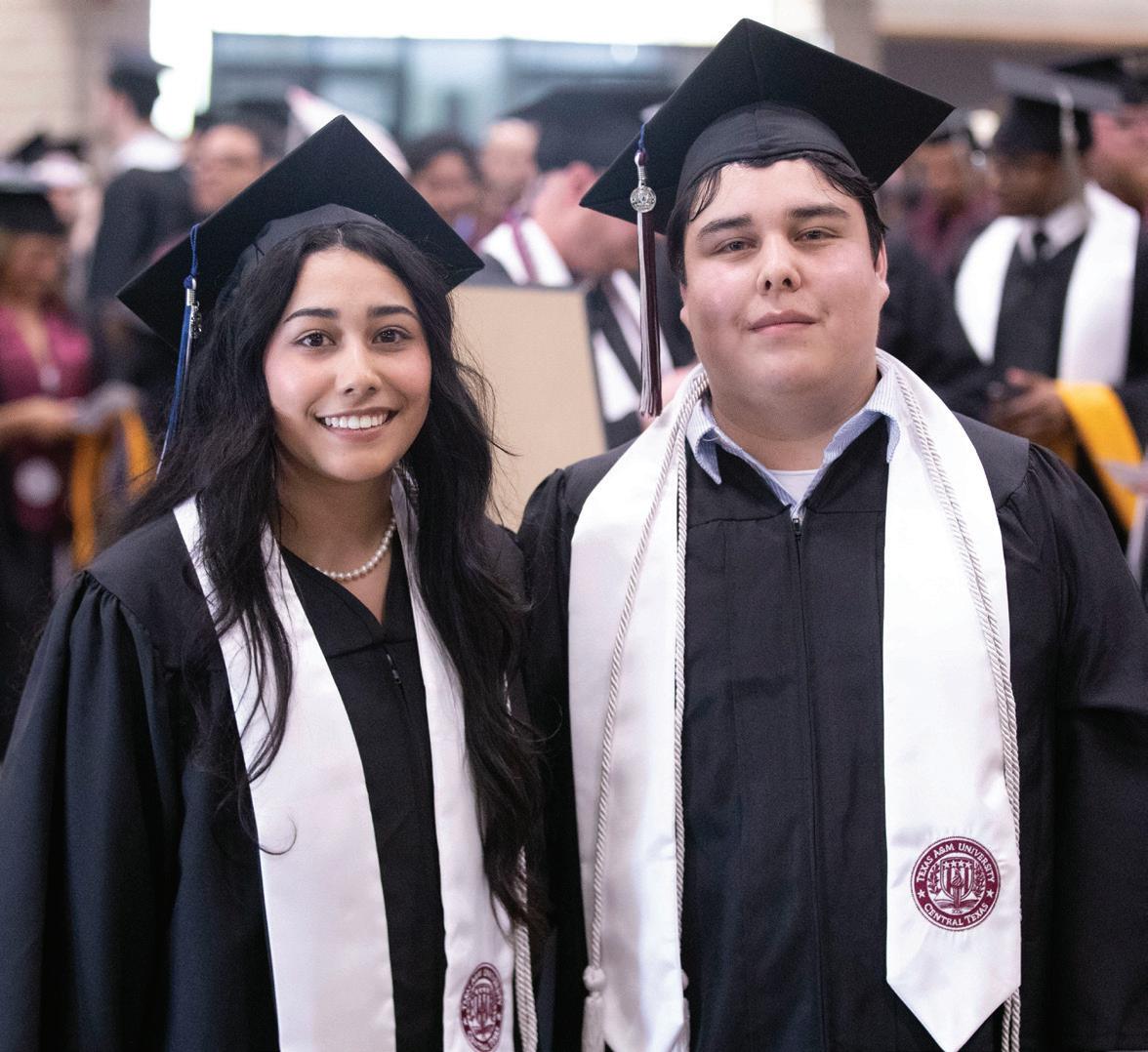
Deric & Abigayle Jorge & Jonathan
Brother & Sister Father & Son
Brother, Deric Rocha, 24, and sister, Abigayle, 20, both from Copperas Cove, are self-admitted competitors. But more importantly, it is a friendly kind of competition where each holds the other accountable with the common goal of degree completion in sight.
“She has always been the annoying little sister,” her brother laughed, explaining how he enrolled at A&M-Central Texas first only to be joined by his sister who transferred after completing one semester at a different university.
Both had taken college-level courses in high school and their prior credits transferred straight into their degree programs where both have maintained an impressive 3.9 and 4.0 GPA, respectively.
It was Abigayle who noticed a Spring 2025 graduation date when she was checking her degree plans on the university’s portal during a family dinner and Deric immediately checked his degree plan, too, finding that he, too, would be a Spring 2025 graduate.
They generously credit each other for keeping close tabs on the other, offering constant encouragement not just at this stage but for the future when Abigayle applied for the university’s graduate program leading to licensure in specialist school psychology.
Editor’s Note: Both Abigayle and Deric Rocha begin Fall 2025 as A&M-Central Texas graduate students. She is in the School Psychology Specialist certificate program, and Deric is pursuing an MBA and concentration in Strategic Human Resource Management.
Father, Jorge Casillas, 49, and son, Jonathan, 24, have both always had a love for learning. And even better, Jonathan says, his father, a former U.S. Army medic, is not one to back away from a challenge, preferring to embrace it.
“Watching him get his MBA is going to be a very proud moment for our whole family,” Jonathan said.
“And being side by side in different programs, but at the same time has made us even closer than we were. There’s a real appreciation for the determination and sacrifice that’s necessary, and we don’t regret doing it together for one moment.”
The feeling is mutual, says Jorge, describing how his son never flinched at the prospect of his undergraduate degree in computer information systems, working and taking classes full-time and on his way to becoming a naval aviator immediately following graduation.
“There’s no doubt in our minds that the goals we had for ourselves and for each other were do-able,” he said. “And something about being in it together kept us in that mindset. We lifted each other up all the time and that experience is almost as valuable as the degree.”
Editor’s Note: Jonathan Casillas reports that if all goes well, he will be in the U.S. Marines Officer Candidate’s Class 250 this September. With all due respect to our friends and loved ones in the U.S. Army, we offer Officer Cadet Casillas a hearty ‘Oorah!”
Taking Life By the Horns
A&M-Central Texas ROTC Cadet and Competitive Bull Rider
Pursues Career as U.S. Army Commissioned Officer
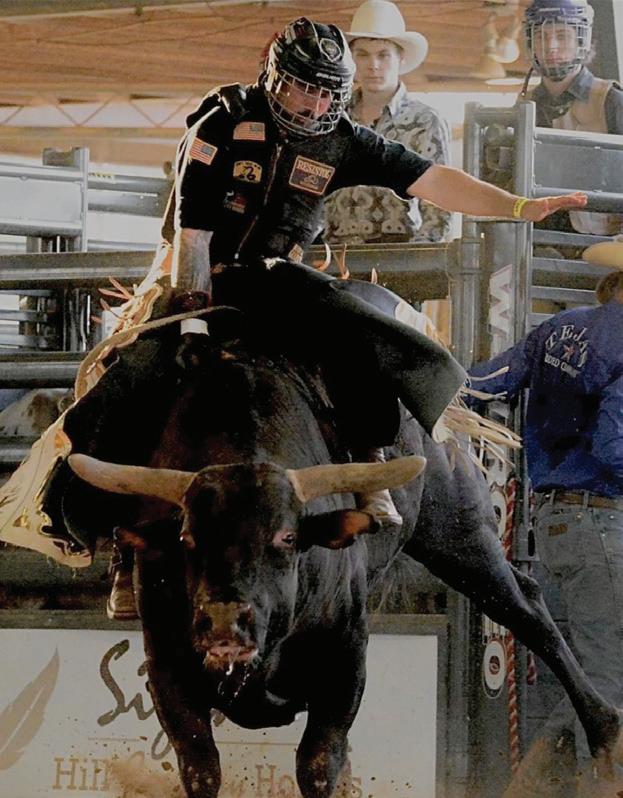
Chris Landry, 28, the middle son of Dale and Tina Landry, has been giving his mother grey hair for the last two and a half decades. He started young. Very young. In fact, he can remember his exact age when he recognized – and embraced – a daredevil spirit that is with him to this day.
By all accounts, he was blissfully unbothered about putting himself in jeopardy, or, for that matter, worrying his patient mom who witnessed his antics as he continually tested his limits.
At a mere four years of age, he remembers, he climbed to the very top of a 70-foot pecan tree in the family’s backyard where his mother caught him dangling riotously in between the branches, shouting at him to get down. That, he laughed, was the first time he startled her. But most certainly not the last.
Not even a year later, he says, she caught him on the roof of the family’s two-story guesthouse when – after they had locked eyes – he took a defiant running start, jumping off, and sliding down a trampoline leaning against an exterior wall.
Shortly thereafter, his preoccupation with high places literally accelerated to include the need for speed. By 11, he took to riding the family four-wheeler. Faster, he thought. I need to make it go faster.
Pedal to the proverbial metal, he did, in fact, make it go faster, he said. Speed, he learned, requires foresight. And sometimes swerving before racing headlong into a fence. He walked away without a scratch, he remembered. No spankings even from the ever-patient mom. No broken bones, either, he says. Those came later.
To meet Landry when he is content to sit still and momentarily tethered to a chair reveals the young man steadily in control of the breakneck pace of his life. Dressed in casual cowboy garb, he tips the brim of his black felt cattleman’s style cowboy hat before removing it politely.
He looks up from a strong chiseled chin, slightly lowered and his raised eyes seem curiously alert, and his manners seem borrowed from another time, replete with a slow, soft drawl, a dab of shyness, and a slight sense of hesitation for conversation that is punctuated with more “ma’ams” than an entire Larry McMurtry novel.
At 5’6, he is somewhat on the slightly built side but make no doubt about it. He is muscular, as if years of physical discipline have molded him into a multidimensional man: part speed demon and part adrenaline junky, all born from the heart of a soldier and risk-taker – he has spent the better part of his youth defying gravity, most of the laws of physics, and –well – boundaries in general.
But, those qualities aside, he is who he is, and he does what he does for a reason more significant than the rush that comes from all of it.
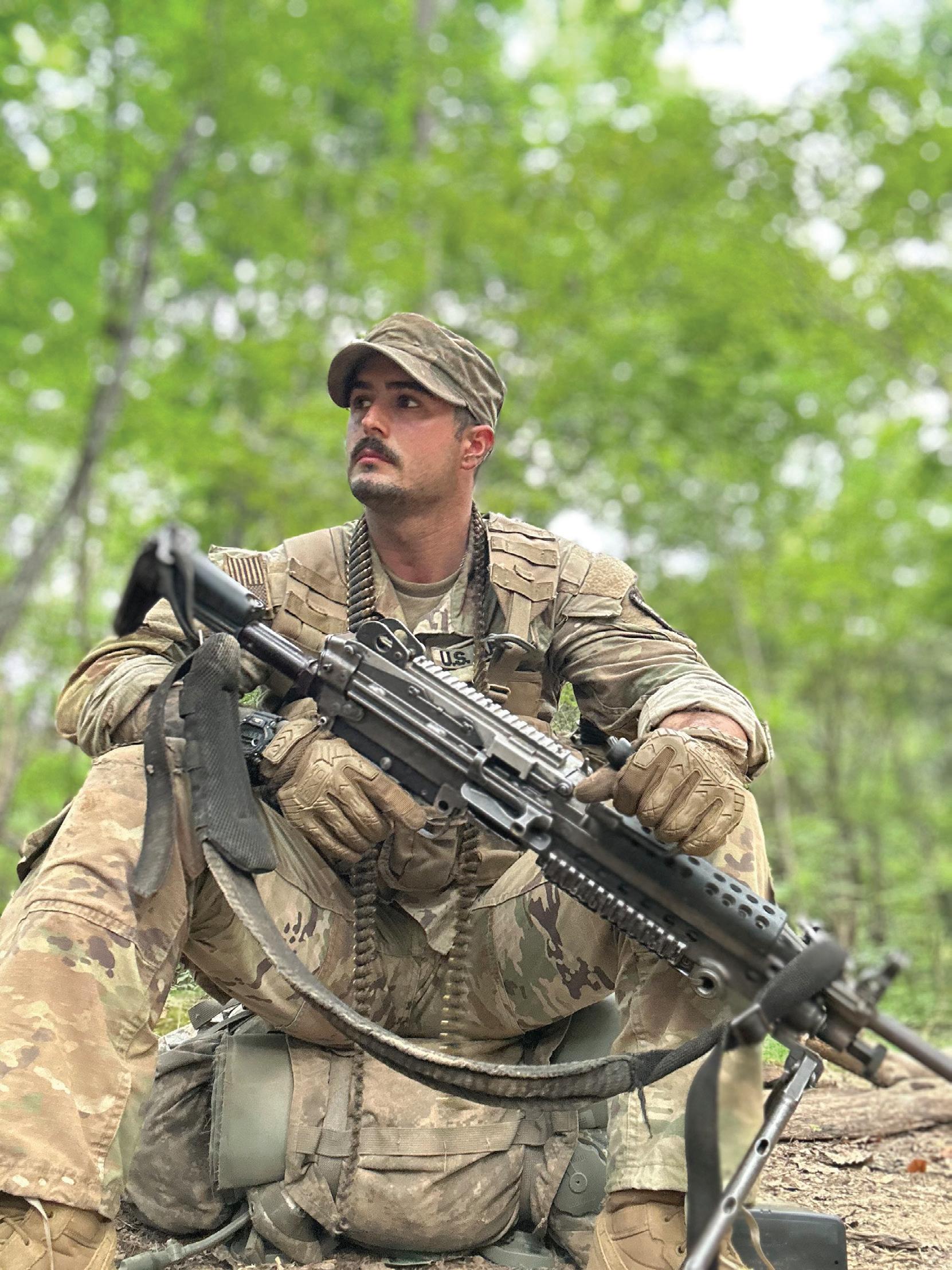
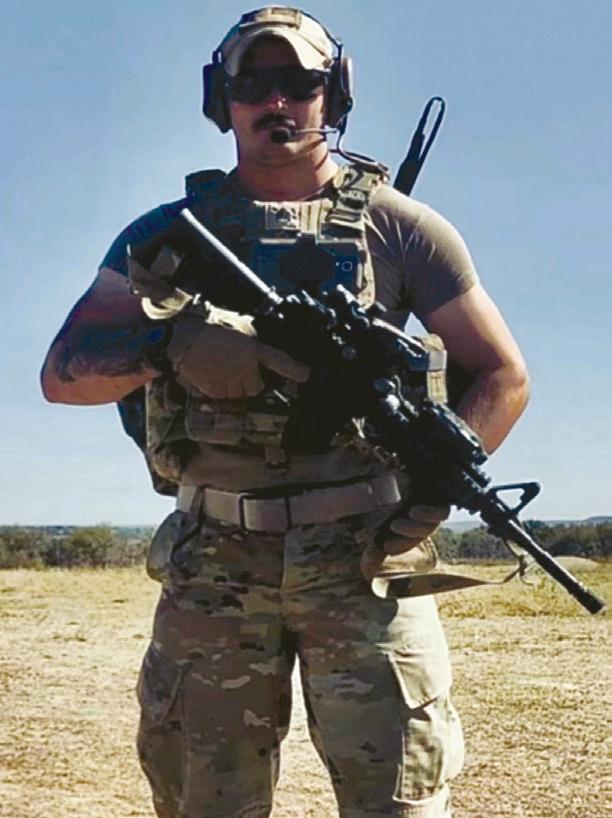
Those who know Landry know something else about him: when not in head-to-toe cowboy gear, he wears a completely different kind of uniform as a cadet in the A&M-Central Texas ROTC program. A desire to serve. A student and scholar and, if all goes well, an officer in the making. And in between all of those obligations, there is yet another side: an experienced competitive bull rider.
Even at his relatively young age, Landry has a decade of increasingly impressive military service under his belt. After graduating high school in 2015, he entered the Army as a 68Whiskey: in layman’s terms, a combat medic. It suited him, he said, naturally combining his desire to help those in the most need with his appetite for adrenaline.
He excelled over the first years, moving quickly through the ranks from E-2 to E-3 – the only one to do so in a platoon of 60 other soldiers. He made E-5 while at Brooke Army Medical Center in San Antonio, then Fort Carson and Evans Army Community Hospital, and eventually, an E-6 while serving as a medical advisor at the Security Forces Assistance Brigade and deployed to the United Arab Emirates and Jordan.
Not very much stops Landry. Neither hair raising high places or shot-from-a-cannon speed. It is not impulsive, he explains. It is just who he is. No more no less. And it isn’t like he hasn’t known obstacles because he has.
As he moved from one duty assignment to another, he had decided to pursue his degree, enrolling in Purdue Global where he held down a perfect 4.0 grade point average and earned an associate’s degree in health sciences.
That’s right. This young man – straight as an arrow moving at mach speed – got slowed down after first starting his coursework by a significant life event. But his reason for stopping wasn’t the balancing of military duties and academic work.
The pause he took from college was made necessary by something much more personal than work: the birth of his daughter, he said, quickly adding that she was both the reason he paused and the reason he went back and completed the degree without further interruption.
Reassigned to Fort Hood, he had already been promoted to E-6 before he even got there. Which is where he heard about the Army’s Green to Gold program. And the odds he would have to overcome to win his spot.
It wasn’t the competition that bothered him, His brand of competitiveness is on the stealthy side of quiet. It is as much a part of him as his other traits, each
brought up to a high gloss of his own expectations. He had, however, learned about competition the hard way. Literally. The hard way. Competitive bull riding.
Yes. The same young man who rose from combat medic to health services advisor would also rise from an E6 to an A&MCentral Texas Army ROTC cadet. And he is the same man who climbs voluntarily into a chute, his lower body both spread eagle across the back of an angry 2,000-pound bull, arms and sometimes legs mostly akimbo – all while holding on for dear life to the count of eight.
He had just been promoted to E-7, he says, when he learned that he had been selected to join the A&M-Central Texas ROTC program. He took the news quietly and without bravado, determined to make those who endorsed him glad that they did.
“Almost 3,000 applicants were in the same pool I was in,” Landry said, again demonstrating command of his cool, absent any whiff of nonchalance. “There’s competition in anything that is worthwhile, of course. But this,” he paused, “this was next level for sure.”
Now, both an ROTC cadet and an undergraduate student in business administration with a minor in military science, Landry is proud to say that he is one of only two cadets in the program to hold a perfect 4.0 grade point average.
As important as that is, it is not all about the classroom. Physical training before sunrise on most days and then timed routines through the obstacle course on campus or off and running on a multi-mile run somewhere through the university’s 672-acre campus.
Former Assistant Professor of Military Science, Captain Abraham Orozco, says that the training cadets are required to master is rigorous – for a reason.
“These cadets are going to be a leader of enlisted men and women who deserve the very best we can train,” he said. “And there is also an element of legacy to what they are doing.
“Our program has commissioned 261 second lieutenants in the 15 years, and in all of those years, our cadets have ranked in the top 10% of national competitions for physical and intellectual and leadership abilities.”
But even Captain Orozco has to admit that he holds his breath a little bit when Landry tells him about the next competition he’s training for – or, for that matter, the number of bones he has broken by putting himself between God and the business end of a bull: Two broken arms, a broken foot, and three ribs.
For himself, Landry begrudges none of it. In the last three years, he says, he has won second place at a veteran’s bull riding event in Decatur and fourth place at the jackpot in Marion in 2022. And belt buckles the size of license plates. Sterling silver with engravings and gold etchings.
It doesn’t sound like a very fair trade for broken bones, but Landry is as proud of the breaks as he is the buckles. Nothing of any real value ever comes without some kind of competition, he muses. Some kind of competition. That and a whole lot of discipline.
He can’t say if any of his forefathers and mothers ever scaled ridiculously high places or lusted after eye watering mach speed. Probably not.
But what he does know is that his sister has traced their family’s roots, discovering great-great-grandfathers who fought in the Revolutionary War. And their offspring in forthcoming generations, moving from Canada to Maine. Maine to the Southeastern Coast. And from there to Louisiana.
Landry is moving through similar stages of life, he muses. Perhaps fulfilling, before he even knew about them, a lineage inspired by previous generations of daredevils and officers.
In December of 2025, he hopes, he will be matching with a duty assignment, accepting second lieutenant’s rank, completing his undergraduate degree, and stepping into the rest of his life. And, for the record, he has no intention of foregoing the bull riding anytime soon.
Hands-On High Tech
Temple College and A&M-Central Texas
Bring Roots Education Semiconductor and Advanced Manufacturing Training System to Texas
Courses in the New Program Begin September 2025
In a significant move to bolster workforce development in the semiconductor industry, Temple College and A&M-Central Texas announced the introduction of the first Roots Education Semiconductor & Advanced Manufacturing Training System in Texas.
This innovative program and cutting-edge technology will be housed in Temple College’s new Visual Arts and Workforce Building which opened in August 2025. The Temple College Board of Trustees approved an initial $2.6 million investment.
“The program equips students and professionals with the essential skills needed to thrive in one of the fastest-growing sectors in the nation,” said DeDe Griffith, Temple College’s Vice President for Workforce Development.
“The complete training system and the new degree pathways will be available at Temple College’s main campus and at the campus in Taylor, Texas, just a few miles from Samsung and begin in August 2025.”
The semiconductor industry is at the forefront of technological advancement, powering everything from smartphones to electric vehicles. As demand for skilled workers continues to rise, Temple College and A&MCentral Texas aim to bridge the skills gap by providing a comprehensive pathway.
“The new Temple College Semiconductor and Advanced Manufacturing Center will provide the instructional environment that is the first of its kind in Texas,” Griffith added.
“The new pathway will include industry-recognized credentials, short-term workforce training, a military transition training program, stackable credentials, an
associate degree, a bachelor’s degree and beyond. The Center will also serve as a testbed for research.”
The Roots Education specialized training system, secured through Advanced Technology Consultants, includes two major components: the Semiconductor Wafer Processing System housed in a mock clean room and the Medallion Line, a manufacturing line that incorporates integrated robotics, robotics maintenance, metallic 3D printing, CNC production, programmable logic-controlled systems, packaging and logistics.
This initiative is projected to create high-quality job opportunities for Central Texans and provide a major boost to the semiconductor and advanced manufacturing talent pipeline in Central Texas, Griffith said.
“I am thrilled to witness the bold initiatives being taken by the leadership at Temple College and A&M-Central Texas. Their forwardthinking approach directly addresses the growing demand for skilled
professionals in semiconductor and advanced automation fields,” said Jeff Kondel, President of Roots Education.
“We at Roots Education are proud to support these efforts with our cutting-edge training technologies. Through our patented Semiconductor Processing System and Medallion Line, we are equipping students and professionals with hands-on, realworld experience needed to thrive in this critical sector. We’re excited to see the lasting impact this will have on both Texas’ workforce and economy.”
“Temple College is excited to partner with Texas A&M UniversityCentral Texas to bring this essential training program to our region,” said Dr. Christy Ponce, President of Temple College.
“By investing in education and workforce development, we are not only preparing our students for successful careers but also supporting the economic growth of Central Texas.”
University President Dr. Richard M. Rhodes said, “The semiconductor
industry is crucial for our nation’s technological future. By implementing the Roots Education Semiconductor Training System, we are fostering a new generation of skilled workers who will drive innovation and economic growth in Texas and beyond.”
“This partnership marks a pivotal step in addressing the growing demand for semiconductor professionals and reinforcing Texas’s position as a leader in technology and education,” Griffith said.
Holding History
Library Archives Support Research & Scholarship
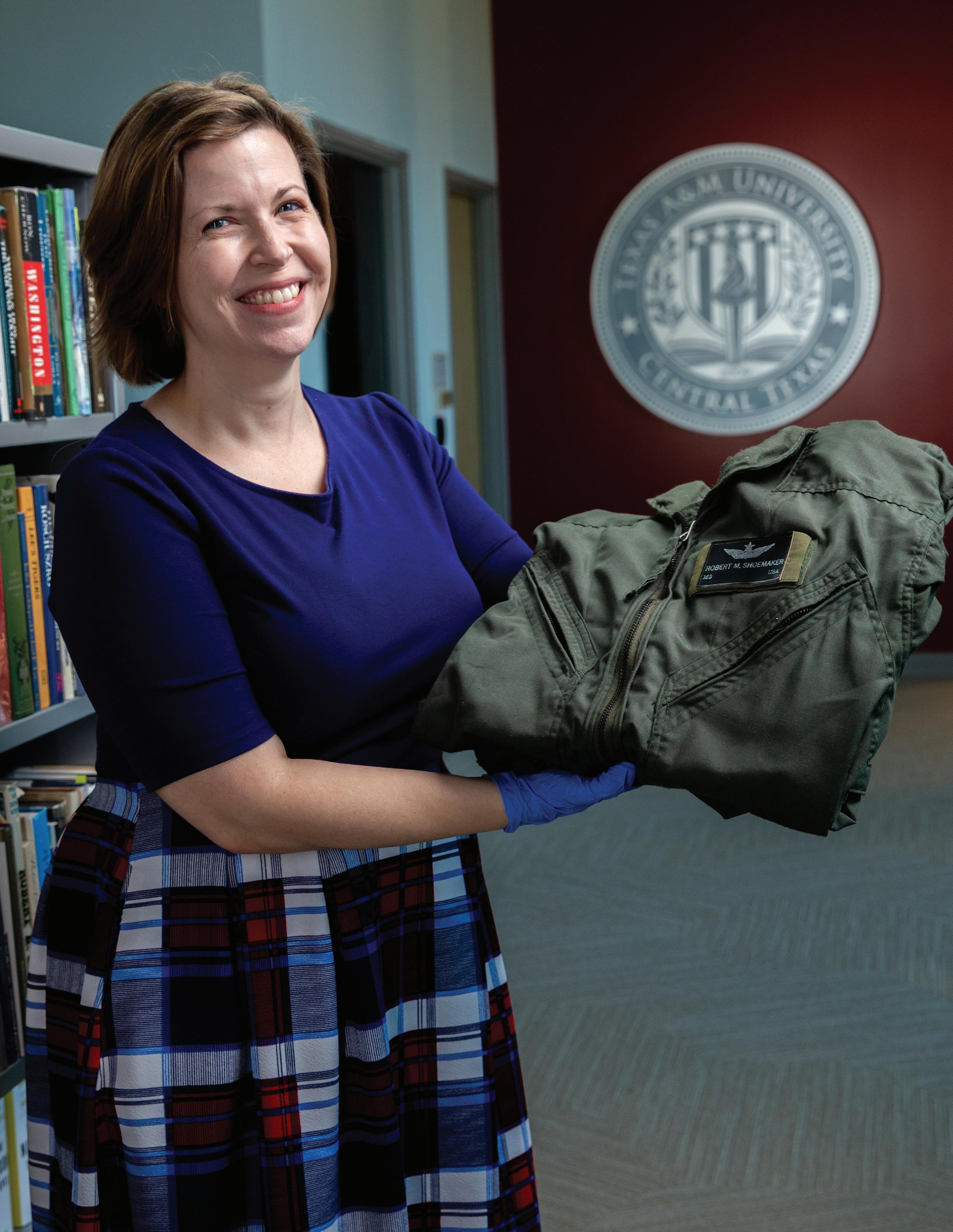
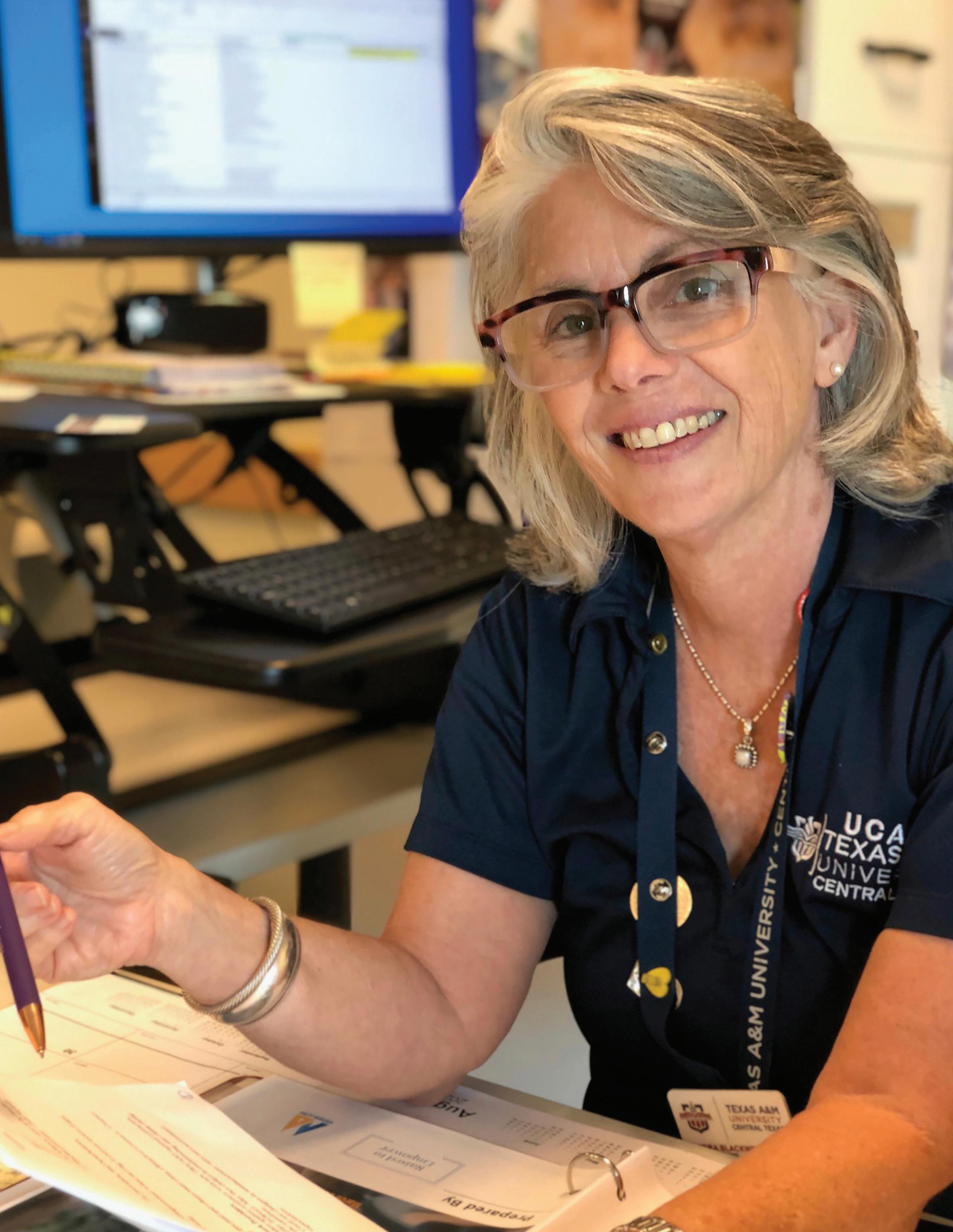
University Archivist Victoria Eastes has been fascinated with museums and libraries since she was too young to fully anticipate just how significantly her interest would shape her later career.
As A&M-Central Texas’ first archivist, she recently celebrated her ninth anniversary with the university and lacks no passion when it comes to preserving the history of the institution and its surrounding communities.
To her, an archivist is one part historian, one part record keeper whose job it is to preserve materials and artifacts that support the of history – be it of an institution, a community, an individual, or even of certain events.
Collections such as the General Robert and Tuke Shoemaker Papers, the Eula “Sis” Beck Collection, and the General Pete Taylor Collection document the history of A&M-Central Texas itself and the community leaders responsible for its establishment and inclusion into the Texas A&M University System.
“These collections, individually and altogether, represent the progression of our university from a private institution to
a public one,” she explained. “The role of the archives is to protect that legacy and that of those community members, faculty, staff, and students responsible for making it possible.”
When asked what applicability archives have in “the real world,” or relevancy the preservation of history has to the average person, Eastes shares that archives can mean more to the everyday life than most realize.
For example, the Killeen Public Library Historical Collection, a significant collection on the history of Killeen donated to the university by the Killeen Public Library System, is often accessed by city planners, local officials, business owners, and journalists for a wide variety of reasons.
City maps from the 1950s and 1960s can inform whether land has been zoned for commercial or residential use; the correspondence of city leaders can justify proposed building dedications and honorariums; and photographs of early downtown Killeen help new business owners complete building and renovations projects.
For the scholarly researcher, the archives represent an opportunity to answer significant research questions and offer historical evidence to support theoretical ideas or arguments.
One example, she says, is the collection of the late Texas State Senator William T. Moore. Known as “the Bull of the Brazos,” Moore was one of the longest-serving state senators in Texas history and a forceful proponent of the admission of women into Texas A&M University in College Station.
“When the collection came to us, we knew right away that it was a significant addition to the archives because of Senator Moore’s long career in the Texas Senate,” she said.
“I drove to Bryan in a borrowed pickup truck to meet with the late senator’s granddaughter at the family’s home where we loaded dozens of cardboard boxes from their garage, including some very confused silverfish living for generations among the papers. I began the long process of sorting, documenting, and rehousing thousands of papers, photographs, and memorabilia of a 32-year career.”
“Work like this – the work of an archivist, can be very labor intensive,” she explained, “No two collections are exactly the same and processing a backlog of collections takes many staff hours and resources.” Her favorite part, she says, is being able to hold these items in her own hands and just take them in, like the many candid and professional photographs she sorted through in the Moore Collection.
“Those photos are more than a snapshot in the literal sense,” she said, “They are a glimpse of life on the Texas Senate floor – from black and white images of legislators smoking cigars
on the floor reminiscent of ‘Mad Men’ to sepia toned shots of members in the middle of heated debates wearing bell-bottoms and polyester suits – that I find fascinating for the story they tell.”
The goal of an archives is to make collections open and accessible to researchers and the public. The role of the archivist is to evaluate these collections, make decisions on which items are historically relevant, and organize them in such a way that documents their significance.
From photos to day planners, personal letters to unidentified documents, each must be evaluated – what might look like a piece of scratch paper, or an old office memo notepad worthy of disposal might possibly be an important part of the larger historical context for a scholar’s research.
Some items are disposable, either removed or given away through a process called de-accessioning, and that is also the role of the archivist to document these decisions for the record.
Though it is a matter of debate within the archival profession, for her the archivist is best as a neutral arbitrator committed to preserving history – including all records, straightforward or controversial, and as impartial to all sides of an issue as possible.
When asked what drew her to the archives profession in the first place, she jokingly replies, “The same thing that draws in most – we all want to handle the old books!”
“The first time I held a ‘real’ artifact, was as a freshman in college. Somehow my small, only 600 plus students college in Kansas had a 1522 edition of Erasmus’ New Testament in Greek and Latin. It’s a rare volume, and I got to hold it carefully with white cotton gloves.”
Are there any other items, she was asked, any close seconds? Of course, she said, with a laugh. It may or may not have been a piece of the Berlin Wall that one of her old history professors happened to pick up on their trip to Berlin in the 1990s.
Although officially, she cannot confirm or deny that this event took place as tourists are not supposed to take home those kinds of souvenirs.
Joking aside, it is clear that for her, history is much more than boxes of papers and remnants from another time.
History is a living and ever-changing thing, and archivists are its keepers, protectors, and admirers, charged with its preservation for current scholars and the generations to come.
Former U.S. Marine and U.S. Army Soldier Now a Part of Research Team Innovating How Soldiers are Trained Enhancing Military Training With Immersive Virtual Reality
When Research Associate, Frantzy Mesadieu, approaches a research project that has the potential to make training more realistic – and therefore, more effective – for the U.S. Army’s Office of Test Command and Army Test and Evaluation Command, he doesn’t just use complex computer coding and a variety of technical applications to create something that has never existed before. He uses his own 16 and a half years as an enlisted man in both the U.S. Marines and the U.S. Army. He uses field experience from six deployments in places in the Middle East that were so hot he still remembers the smell of his own arm hair turning to ash and surrendering right there beneath the fabric of his digital camo gray Army Combat Uniform.
Mesadieu has been in theater, he admits, but it was the experience of leading his men that is just as important to him as technology in the doing of his job as a research associate.
The one that has him simultaneously captivated and in a constant state of technical motion is designed to enhance training for soldiers using a combination of virtual reality headsets, a disc-like swiveling platform with a three-foot circumference and a sturdy mounted support system that stabilizes the individual in training.
Wait. He says with a satisfied smile. That is not all. This is not, he emphasizes, a pre-programmed game of one dimensional virtual pickleball. It is much, much more than that. Those who know such things call it full body simulation. And gratefully, Mesadieu is one of those people and he is gracious and ready to explain what that is.
“No one – and I mean no one – is more devoted to training than the United States Armed Forces,” he says. He knows, because he has been there, of the crucial nature of keeping service men and women as prepared and as safe as humanly, and in this case, technologically, possible.
Training is constantly evolving, he says, either to meet the next challenge or to take advantage of new technologies. It is at the intersection of those two things where Mesadieu’s work begins.
And, while he cannot divulge the specific nature – or even the technical applications – of his work for security reasons, he is allowed to describe in broad strokes the current projects that are underway.
Because the research is looking at both the addition of immersive VR training as well as evidence of stress levels during the training, the standard handheld VR controllers are supplemented with a technical pack and physical sensors to record and report results, and two handheld VR controllers.
The purpose of this project is to more closely replicate the 3D reality that soldiers will most certainly encounter and adapt to.
He has been in those environments, he says. In desert wilderness. On foreign soil in mountainous regions where uncertain terrain and adverse heat and furnace like winds are the least of a soldier’s problems.
And it is exactly those kinds of things that he is trying to take into account as he creates the research-based immersive environment. And what’s more, he is not in theater. He is in a somewhat orderly office on the fourth floor of Gen. (Ret.) Robert M. Shoemaker Founders Hall, still in ramrod traditional U.S. Marine pose – even when he’s programming in an effort to make these technological tools work together.
The university environment is not at all unfamiliar, he smiles. This is where he earned both his undergraduate and graduate degrees in cybersecurity. And, just as the former soldier deploys his military experience in the administration of the project, Mesadieu has another asset: the world-class cybersecurity education that he earned not that long ago, and the wisdom of the department’s faculty and mentors who so generously poured their passion for research into him as a part of his learning.
Getting down to it, he says, their goal is to create an immersive virtual reality to allow realistic training that comes as close as possible to the “real thing.”
For the purpose of illustration, he says, pretend the “real thing” is an M1 Abrams or an M2 Bradley. There is a crew and anywhere from 3-6 other soldiers in tight quarters in that tank.
For some, it is an invitation to claustrophobia. For still others, the noises of the environment, both inside and outside the tank, makes it almost impossible to hear and communicate in an already stressful context.
“All of these situations are common, real-life maneuvers that must be taught and trained for,” Mesadieu says. “But there’s no way a one-dimensional computer screen can replicate as well as an immersive experience can.”
Neither will one dimensional training pick up on stress levels, movement sickness, or temporary lapses of concentration. That is for him and fellow researchers to do.
“The hope is that when a soldier trains, that they will
from an immersive 3D environment that is as realistic as we can possibly make it,” he says.
“Traditional simulation only accomplishes so much,” he knows. He has seen it, he adds. Well-trained soldiers literally stopping in their tracks in a forward area temporarily overwhelmed with the reality of where they are and what they are doing.
“They are extremely well-trained soldiers,” he said. “And we can replicate situations in real time and make sure they are ready to use that training, but it benefits everyone if we know more about their ability to effectively deal with the stresses related to a hostile environment or a rigorous or a challenging or unexpected context or both. The more realistic the training, the more likely that soldier will be successful when it matters.”
That, he says stoically, is research. Research that literally has the impact to preserve life and prevent death.
And, like most things that have never been done before, there is trial and error. And many, many hours deploying high-level and complex programs to make technologies sync reliably, create the simulated environments, and report and aggregate the stressors of the training which he says is the whole point. And the part of research that is the most meaningful to him.
That, and the thought of those whose experience training as a soldier and subsequent performance will be more insightful, safer, and worthy of the high standards of the U.S. Army.
benefit
How UCARE Turns Data Into Solutions for Real People in Central Texas Research That Rolls Up Its Sleeves
Sandra Blackwell doesn’t believe in ivory towers.
Petite in stature but unmistakably formidable, she moves across campus with quiet focus, a couple of lanyards around her neck, salt-and-pepper hair pulled back from a face shaped by thought, determination, and a certain relentless empathy. She looks like someone who asks a lot of questions — and stays until the answers lead somewhere useful.
As director of the University Center for Applied Research and Engagement — UCARE, for short — Blackwell leads a team of student researchers with one mission: solve real problems for real people. “If research isn’t helping someone,” she says, “then what are we doing?”
Her own journey began as a student herself, earning her psychology degree at A&M–Central Texas in 2015, followed by a graduate degree in experimental psychology. From the start, she wanted more than theory.
“I wasn’t interested in research for research’s sake,” she says. “I wanted to take what we learned and do something with it.”
That’s what UCARE was built for.
signs, no sidewalks.”
Blackwell’s team — all student researchers — went out into the field across six counties, visiting shelters, food banks, and senior centers. They surveyed residents, mapped transportation gaps, and created a data-backed set of route improvements to help local leaders serve people more safely and effectively.
“She wasn’t complaining,” Blackwell says of the Nolanville resident. “She was just explaining what it took to get home.”
UCARE partners with cities, school districts, housing authorities, and nonprofits across Central Texas to conduct research that helps solve practical problems — often in places where resources are limited and impact matters most. One such project began with a bus stop.
“I was talking with an elderly woman in Nolanville,” Blackwell recalls. “She used a walker. She had no car. And every time she took public transit, she had to wait at unsheltered stops, then get dropped blocks from home. She had to cross a highway, then navigate roads with no
That kind of community-grounded, results-oriented research is what defines UCARE.
Blackwell is thoughtful about who she brings into that mission. UCARE’s research team is made up entirely of A&M–Central Texas students from disciplines across the university — business, psychology, education, IT, history — selected not just for what they know, but for how they think.
“I look for balance,” she says. “They need academic training, sure. But they also need practicality. Curiosity. The ability to ask, ‘What can we fix? What options can we offer?’ That’s what this work is about.”
And that work has grown. UCARE teams have conducted studies on bullying prevention in schools, analyzed HUD and fair housing data, produced salary equity reports for local school districts, and helped evaluate digital learning strategies. Every project is a collaboration — between students, faculty, and the community.
“She’s created a model of engagement that’s not just effective — it’s inspiring,” says Dr. Walter Murphy, Assistant Vice President in the Division of Research and Innovation. “It’s exactly what research at a regional
Back Row: Dr. Walter Murphy, Dr. Jeffrey Kirk, Dr. Christoper Quick. Front Row: La Treice Frederick and Sandra Blackwell.
public university should be: smart, collaborative, and deeply responsive to community needs.”
Dr. Jeff Kirk, Associate Provost, Associate Vice President for Research and Innovation, and Chief Research Officer, agrees. “Sandra brings empathy, intellect, and drive to everything she does,” he says. “She’s building bridges between the university and the people we serve.”
That’s intentional. UCARE offers agencies research insight and evaluation expertise they might otherwise have to pay outside consultants for — often at far greater cost. “We’re part of the community,” Blackwell says. “It makes sense that we help solve its problems.”
And while knowledge is at the heart of what she does, Blackwell values something more: objectivity, and a real desire to make things better.
“It’s not about being the smartest person in the room,” she says. “It’s about being useful.”
That philosophy extends to her students. They don’t just gather data — they present findings, make recommendations, and learn how to work with partners who depend on real outcomes.
“It’s empowering for them to see that their work matters,” she says. “It prepares them to lead not just in school, but out in the world.”
Looking ahead, Blackwell hopes to expand UCARE’s work — not just in scale, but in visibility.
“We can do so much good,” she says. “We just need more people to know we’re ready.”
President Richard M. Rhodes presents a Legacy Alumni Certificate to Killeen Mayor Debra Nash-King, an alumna of Tarleton State University-Central Texas, with Kristle Castillo and Charlie Ayers from the University Relations Office. Legacy Alumni Certificates recognize graduates from our ‘founding’ universities American Technological University, University of Central Texas, and Tarleton State UniversityCentral Texas.
If you or someone you know would like to receive one, contact University Relations at (254) 519-5785