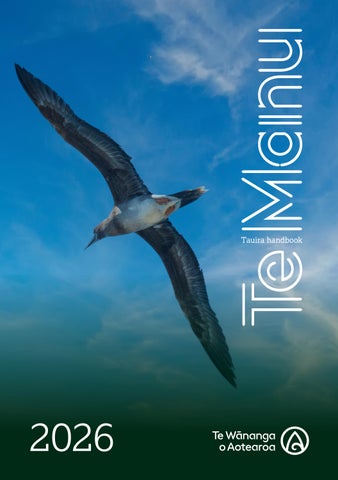
Te Manu 2026

Page 1


He kupu whakataki

Te Kura Toroa

Welcome from Chief Executive Officer

Tēnei te tangi tonu nei ki ngā mate tara ā-whare, ki ngā mate tārūrū o tēnā whaitua, o tēnā whaitua, puta noa i ō tātou whare maha o te motu. Tē taea te kupu kotahi o roto mai i te huhua te tiki noa ake e mauru ai te auē e rongo rā te ao i te kāhakitanga mai o tētahi e aroha nuitia ana. Engari kia titiro whakawaho atu au, kātahi ka kitea atu te paringa o te tai, te timunga o te tai, ka moku tā te ngākau i taku kite atu, kei tua o te pae, ko te rangi mātāhauariki. He wā ka taka e whitikina anō ai tātou e te rā. Tīhei mauri ora ki te whai ao, ki te ao mārama!

Tēnā koutou, e ngā whānau, e ngā iwi, otirā, ngāi tauira, kua kake mai ki runga i te waka o Te Wānanga o Aotearoa. Nō tātou katoa te hiahia kia tere tō tātou waka i ngā wai o Manako Nui, e ū tika atu ai tātou ki te wāhi e tūmanakohia ana.

Mā Te Manu nei koe hei āwhina, e mōhio ai koe ki ngā āhuatanga katoa e tautoko ana i tōu haerenga i te waka o Te Wānanga o Aotearoa, pēnei me ngā ratonga, ngā motika, ngā haepapa, me ētahi atu kaupapa whai tikanga. Ka noho mai tēnei hei āwhina, i tua atu i ngā āwhina a tō kaiako, a tō kaitiaki, a Te Puna Manaaki anō hoki (ratonga tauira) – katoa, katoa e tautoko nei i a koe, e tino eke panuku ai koe i roto i āu mahi katoa.

Ko koe tēnā e kaha nei ki te whakatutuki i ō whāinga. Heoi anō tā mātou, he tautoko i a koe e taea ai e koe ēnā ki tētahi taumata atu anō –ā kāti, ko koe ki tāu hoe, ko mātou ki ā mātou hoe. Hūkere, hūkere!

Nau mai, haere mai ki Te Wānanga o Aotearoa. By choosing to study with us, you join a place that commits to your growth, success, and the aspirations you carry for yourself and your whānau. Our vision: He takapau mātauranga, he whānau huarewa, and our mission: Kia angitu te tauira, place you at the centre of everything we do.

Our vision and mission place you, our tauira, at the heart of everything we do. These are the guiding lights that steer our course:

While you study with us, you gain more than the knowledge of your chosen programme. You strengthen your sense of identity, build meaningful connections, and develop the skills to create positive change for your whānau, hapū, iwi, and communities. Your kaiako, kaitiaki, and our tauira support teams walk alongside you, challenge you to aim high, and equip you to achieve your goals.

Te Manu guides you on this journey. Inside, you’ll find the information, advice, and services that help you navigate study life, from understanding your rights and responsibilities to accessing resources to support your success. Refer to it whenever you have a question, need guidance, or want to plan your next step.

Our Vision:

He takapau mātauranga, he whānau huarewa

Whānau transformation through education.

Our Mission:

Kia angitu te tauira Tauira success.

Here you begin a journey that leads to He Puāwaitanga and beyond. Use what you gain to open doors, create opportunities, and shape a future you and your whānau can take pride in.

Whakataukī

Proverb

Ko te manu e kai ana i te miro, nōna te ngahere.

Ko te manu e kai ana i te mātauranga, nōnā te ao.

The bird who feasts on the miro berry, theirs is the forest. The bird who feasts on knowledge, theirs is the world.

What is Te Manu?

Te Manu is your tauira (student) handbook, here to help you navigate your journey with us. It covers the 7 steps of our tauira footprint: first connection, pre-enrolment, enrolment, induction, learning experience, course completion, and staying connected.

Why is it called Te Manu?

Te Manu comes from the whakataukī (proverb) above. Think of yourself as the manu (bird) and us, the kaimahi (staff) at Te Wānanga o Aotearoa (TWoA), as the miro berry. We’re here to provide manaakitanga (support) and nourishment throughout your journey. It’s our privilege to help you grow and succeed, benefiting not just you, but your whānau, hapū, iwi, and the world.

Mahere-ā-tau 2026

First connection

Our mission, vision, values

Ko te Whakakitenga

Our Vision

He takapau mātauranga, he whānau huarewa Whānau transformation through education

Ko te Uaratanga

Our Mission

Kia angitu te tauira Tauira success

Ko Ngā Uara

Our Values

Te Aroha

Having regard for one another and those for whom we are responsible and to whom we are accountable.

Te Whakapono

The basis of our beliefs and the confidence that what we are doing is right.

Ngā Ture

The knowledge that our actions are morally and ethically right and that we are acting in an honourable way.

Kotahitanga

Unity amongst iwi and other ethnicities; standing as one.

Kaupapa Wānanga

How we approach situations

Kaupapa wānanga is our unique way of being and doing, born from our mission and philosophy. It’s how we handle situations and bring our values to life. Think of it as putting on our kaupapa wānanga glasses to make sure everything we do is good and right.

Ngā takepū (applied principles) guide us in our wānanga spaces and help us work together as a team. Here’s a closer look at how we see kaupapa wānanga in action:

Kaitiakitanga - This means always recognising that we’re part of relationships with others, our environments, and our kaupapa. It’s about being mindful of these connections and taking care of them.

Āhurutanga - This is about creating and maintaining safe, quality spaces where we can do things ethically and meaningfully. It’s like making sure the environment is just right for everyone to thrive.

Koha - This principle is all about giving and receiving contributions responsibly. It’s about valuing what everyone brings to the table and making sure it’s done with respect.

Mauri ora - At the heart of everything we do is the pursuit of wellbeing. This principle reminds us that our goal is to foster wellbeing in all our activities.

Kaupapa wānanga encourages us to strive for balance (mauri ora) in our lives and work relationships. It also pushes us to contribute to mauri ora through our efforts across the institution and in our relationships with external stakeholders. At Te Wānanga o Aotearoa, we see kaitiakitanga, āhurutanga, and koha as key elements that help us succeed in these endeavours.

By embracing these principles, we aim to create a supportive and nurturing environment where everyone can grow and succeed. It’s about working together, respecting each other, and making sure we’re all moving towards a common goal of wellbeing and success.

Kaitia kitanga
Kaupapa

Ako Wānanga

Ko te kounga o te ako te take. For quality living, learning and teaching

Ako Wānanga is our unique framework at Te Wānanga o Aotearoa, inspired by the tongi of Kingi Tawhiao. It uses the metaphor of a wharenui to house the key factors for the success of our tauira. It’s our commitment to creating transformative education and awesome ako (learning) experiences.

Ako Wānanga has 4 primary huanga (attributes):

› Ako – living, learning, teaching

› Aro – reflective practice

› Te Hiringa – passion, motivation and spirit

› Whanaungatanga – respectful relationships and connections.

These elements are the heart of Ako Wānanga. When we look at them holistically, they shape our philosophy and educational practices at Te Wānanga o Aotearoa.

Ako Wānanga reminds us of our obligations, who we serve, and what we stand for. It guides our behaviour, ensuring our practice is principle-based, reflective, and always striving for excellence. No matter our role, we all contribute to ako at Te Wānanga o Aotearoa.

Ako Wānanga positions mātauranga Māori (Māori knowledge) as the foundation for quality teaching and learning experiences that are empowering, redemptive, and transformative.

Ko te Whakakitenga Vision

Ko te Uaratanga Mission

Ko te Kaupapa Philosophy

Ko Ngā Uara Values

Ko te Kaupapa Wānanga

Ngā Takepū - Principles

Ko te Ako Wānanga

Ngā Huanga - Attributes

Future direction

What we will undertake to support

Our fundamental nature

How we’ll conduct ourselves to achieve successful outcomes

How we’ll approach situations to strive for constant acknowledgement

How we’ll apply practice of excellence to foster continuous improvement for quality reflection, teaching & learning.

Pre-Enrolment

Entry criteria and eligibility

Some programmes have specific entry criteria. You may be required to attend a pre-enrolment interview and/or complete a pre-entry assessment. There could also be an info session, a drug test, and, Police vetting or a safety check for certain programmes.

We can then determine if you’re eligible or suitable for the programme. Entry requirements often relate to the professional standards of fields like teaching or social work. If you have any questions, just ask your kaiako (tutor) or kaitiaki (support person for home-based learners) for details of the programme (e.g. structure, delivery method and duration) or refer to our website.

Programme Delivery Methods

During your programme, you’ll need to attend scheduled classes with your kaiako. Keep in mind that online and home-based learning programmes may have different arrangements. These sessions are called ‘kaiako directed learning’ activities.

Examples include:

› noho / noho marae

› wānanga

› kura whakaako

› classes

› tutorials

Throughout your programme, you’ll also have to complete learning activities outside of class, known as ‘activity directed learning.’

Activity Directed Learning (ADL)

ADL is all about the learning activities you’ll do between classes. These are planned out for you and can include things like:

› Workbook activities

› Pre-recorded resources (like DVDs, YouTube videos, CDs)

› Homework and home play activities

› Study tasks from your kaiako

› Online activities in our digital classrooms, Akorau and iAkoranga

Online classrooms

Akorau - Learn anytime, anywhere, and build on what you’ve learned in class. Akorau supports our Te Ara Reo Māori programmes (levels 1 – 4) and Papa Reo (online and home-based learning). Here’s what you can do with Akorau:

› Complete fun, interactive activities related to your classwork

› Chat with your kaiako and other tauira (learners) in online forums and discussions, or keep a learning journal to reflect on your progress

› Access resources like new words (kupu hōu), readings, and audio/video materials

› Download activities to do offline when you don’t have internet access

iAkoranga - Think of this as your digital classroom where you can practise what you’ve learned in your own time. iAkoranga supports all of our other programmes at Te Wānanga o Aotearoa. With iAkoranga, you’ll:

› Access resources like readings and workbooks

› Upload your assessments (aromatawai)

› Join online forums

Keep an eye on your tauira email for messages from iAkoranga. Once you’re in, there are self-help videos on your dashboard to help you get familiar with the platform.

You’ll find both iAkoranga and Akorau in Te Matakā, your tauira portal.

Enrolment

Terms and Conditions of Enrolment

All tauira must receive and agree to the following Terms and Conditions of Enrolment

Proof of Identity

To qualify as a domestic student and to be entitled to the government tuition subsidy, you must be a New Zealand citizen (this includes students from the Cook Islands, Tokelau, or Niue), or you must prove that you’re a permanent resident of New Zealand, or a citizen or permanent resident of Australia residing in New Zealand for the required period.

To enrol as a domestic student, you must provide one of these documents as evidence of citizenship or permanent residency:

› Birth Certificate with place of birth in New Zealand, Cook Islands, Tokelau or Niue

› New Zealand or Australian passport

› An active and verified NSI (National Student Index) Number

› Statement of Whakapapa including date of birth signed by a Kaumatua if you’re over 60 years old

› Certificate of Citizenship

› Overseas passport with a resident visa

› MOE Exemption for Under 16 years

If you’ve supplied an active and verified NSI number, you’re considered the legitimate owner of the claimed identity.

Your name, date of birth and residency as written on the enrolment form will be included in the National Student Index and used in an authorised information matching programme with the NZ Birth Register. For further information visit www.nsi.govt.nz

Certified Copies of Documents

You can bring your original ID documents to one of our sites to be verified by an authorised kaimahi (staff member). Or, if it’s easier, you can send us certified copies of your ID documents with your completed enrolment form. We accept certified copies of ID documents if you’re enrolling online too.

To get a certified copy, photocopy your original document, then take your original document and the photocopy and have it signed as a true and accurate copy by a Justice of the Peace, a solicitor, or a court registrar.

Under 18 Years of Age

If you’re under 18 and want to enrol in one of our fee-paying programmes, you’ll need to get a parental or legal guardian consent form signed. This form is available from Student Registry. If you want your parent or guardian to be able to ask us for info about you, make sure you state this in the form. By filling it out, you’re giving us permission to contact them if we can’t reach you directly.

Disability Services

If you choose to share any medical condition, disability, impairment, or temporary injury - our Tauira Services team may get in touch to discuss your needs and the support we can offer. If you prefer, you can also reach out to your local Student Advisor before you start your studies to set up a meeting. Our Advisors can connect you to our range of Tauira Services and help work out if you might be eligible for any specific disability assistance.

Services offered:

› advice and assistance

› reader/writers

› support workers

› NZ Sign Language (NZSL) interpreters

› help for tauira who are blind or have low vision

› and referrals to other service providers.

Check out our disability services for more info.

Student Loans and Allowances

Te Wānanga o Aotearoa isn’t responsible for your entitlements with StudyLink. It’s up to you to check if you’re eligible for loans & allowances through StudyLink before you enrol.

For more details, visit www.studylink.govt.nz

Fees

If course fees apply, you can find them on www.twoa.ac.nz or ask Student Registry. By completing and signing this enrolment form, you agree to pay all fees within the required time frames in accordance with our fee policy. If you don’t pay as required, you’ll be responsible for any charges associated with debt recovery. You can view our policies on fees, withdrawals and refunds online or contact Student Registry for more info.

Te Wānanga o Aotearoa reserves the right to withhold acceptance of your enrolment for failure to pay fees. We can enforce our policy of paying fees and withhold refunds for withdrawals at our discretion.

You should arrange to pay your student fees (if any) within 30 days of the start date of your programme. When you’ve made these arrangements, get in touch with our student finance team to update your student account. You can email them at studentfinance@twoa.ac.nz or give our contact centre a call on 0800 355 553.

› Fees that are unpaid after 31 - 90 days from the start of your programme will be deemed overdue fees.

› Fees that are unpaid after 91 days, can result in the student account being referred to a debt collection agency.

Non-payment of your student fees may result in your academic records, certificates and your eligibility to graduate being withheld.

Government Fees Free Eligibility

It’s your responsibility to determine whether you’re eligible for the government’s Fees Free initiative.

To find out if you’re eligible for Fees Free study, go to www.feesfree.govt.nz

Academic Records

Academic records and certificates will be issued to you once all fees have been paid in full and any outstanding books or materials have been returned. Te Wānanga o Aotearoa reserves the right to access and verify your academic records.

Credit Recognition

Credit Recognition is a process where your prior learning (formal or informal) can be considered for recognition to gain entry into a programme and/or have credit granted towards kōnae ako or units. This can be done in 3 ways:

Cross credit if you’ve successfully completed an identical NZQA unit standard with Te Wānanga o Aotearoa or elsewhere. Cross credits will be automatically credited by Student Registry and don’t need to be applied for. You’ll need to submit your Record of Learning during enrolment so that cross credits can be processed.

Credit transfer if you’ve successfully completed an identical Te Wānanga o Aotearoa kōnae ako or a sufficiently comparable kōnae ako/unit standard.

Recognition of prior learning if you have relevant and current knowledge and skills gained through prior learning that meets the learning outcomes for particular kōnae ako/unit standard(s) of a programme.

To apply for credit transfers and recognition of prior learning, you’ll need to fill out an application form with supporting evidence. Talk to your kaiako or tauira support advisor for more info and to get the form.

Refunds

To be eligible for a refund you’ll need to withdraw before the cut-off date for early withdrawal. You can then receive a refund but won’t have academic results entered.

Important: The person who paid your programme fee will receive the refund. If your fee was paid by a student loan, the money will go back to StudyLink.

If you withdraw after the cut-off date you won’t receive a refund and will be liable for outstanding fees. For more information view our refund policies online.

Withdrawals

If you withdraw from a programme after the cut-off date you won’t receive a refund and are liable for any outstanding fees. Your results will be entered on your academic record and NZQA units recorded. The cut-off dates for early withdrawals are:

Number

14 weeks 7 working days after the start date

18 (except noho) weeks

18

20 (except noho) weeks

based) weeks 15 working days after the start date

36 (Home Based Learning programmes) weeks 18 working days after the start date

36 (not HBL programmes) weeks 20 working days after the start date

38 weeks 20 working days after the start date

40 weeks 20 working days after the start date

42 weeks 20 working days after the start date

For more info on withdrawing from a programme, refer to our Educational Regulations Tikanga Ako Policy.

Change of Enrolment

After you’ve enrolled in a programme, you might realise it’s not the right fit and there’s another programme you’d prefer to be in. If you want to change your programme, here’s what you’ll need to consider:

› Do you meet the entry requirements for the new programme?

› Is there still time for you to enrol in the new programme?

› (You need to be within the 10% cut-off date –see below)

› Will changing programmes affect any loans or allowances you’re getting from StudyLink?

If you need a Change of Enrolment form, just ask your kaiako for one. Fill it out and give it back to them. If you’re in a home-based learning programme and want to change, have a chat with your kaitiaki about this.

Late Enrolment

You can enrol late up until the 10% cut-off date, which is 10% of the total length of your programme. e.g. for a 36-week programme, the cut-off date is 3.5 weeks after the programme start date. If a programme has been running for longer than 10% of its total duration, you won’t be able to enrol into it. We can help you find an alternative programme if there’s one available.

Regulations

Once you’re accepted into a programme at Te Wānanga o Aotearoa, you’ll be subject to any applicable tauira policies and procedures. You can find these online on our regulations page or by asking us. By submitting your enrolment form, you agree to make yourself familiar with and abide by the tauira policies and procedures. You also agree to comply with our expectations of behaviour set out in the Educational Regulations Tikanga Ako Policy as well as our Ngā Uara (values). If your behaviour is inconsistent with our policies and procedures, we may refuse entry, suspend, or cancel your enrolment.

Digital Systems

By enrolling with us, you agree to:

› Use our Learning Management Systems as intended

› Follow the terms of use on those platforms

› Respect our Digital Tikanga

› Follow kaiako instructions to keep our online space safe

You agree to respect the privacy of other tauira in class and on digital learning platforms. You agree to follow any instructions specific to that programme and the delivery of the programme.

If you borrow any equipment from us, you agree to complete all relevant forms, follow the terms and conditions of the loan, and understand that the equipment is still owned by Te Wānanga o Aotearoa. For more details, view our policies online.

Privacy Information

By completing and submitting the enrolment form, you accept the terms and conditions of how Te Wānanga o Aotearoa uses, stores and shares your personal information according to our privacy policy.

You can ask about any information held about you and request corrections of any errors by contacting us at privacy@twoa.ac.nz

Tauira Support Services

By completing and submitting the enrolment form, you agree to how Te Wānanga o Aotearoa uses your information to provide a targeted learning experience that suits your needs. This includes creating a personalised support plan and offering other tauira support services tailored to you.

If you don’t provide the personal information we ask for, Te Wānanga o Aotearoa may be unable to enrol you or provide certain services to you.

Electronic Messages

By completing and submitting the enrolment form, you agree to receive electronic messages from Te Wānanga o Aotearoa including surveys, marketing materials and info about third-party goods and services.

Induction

Ngā Uara (values), Behaviour inconsistent with Ngā Uara

Ngā Uara (values)

Te Aroha, Te Whakapono, Ngā Ture, and Kotahitanga inform our expectations of the behaviour of our kaimahi and tauira. When these values guide our behaviour, we act with integrity and respect for all people.

Behaviour inconsistent with Ngā Uara

Examples of inconsistent behaviour include:

› Insulting, threatening or bullying any person

› Sexual harassment

› Wilfully disobeying reasonable directions or instructions given by a Te Wānanga o Aotearoa kaimahi

Te Whakapono

The basis of our beliefs and the confidence that what we are doing is right

Ngā Ture

The knowledge that our actions are morally and ethically right and that we are acting in an honourable way

Te Aroha

Having regard for one another and those for whom we are responsible and to whom we are accountable

Kotahitanga

Unity amongst iwi and other ethnicities; standing as one.

› Being under the influence of substances (drugs and alcohol) in any situation where the tauira is attending or representing Te Wānanga o Aotearoa

› Being in possession of illegal drugs or alcohol

› Being in possession of a weapon

› Bribing or attempting to bribe by offering gifts or services in return for personal favour

› Misuse of internet

› Wilfully or recklessly damaging, defacing, removing or selling property of Te Wānanga o Aotearoa

› Behaving in any way without reasonable course, which brings harm to oneself or others or is likely to bring Te Wānanga o Aotearoa into disrepute.

Expectations of Behaviour Procedure

If there’s an allegation your behaviour has been inconsistent with Ngā Uara there will be an enquiry. If the enquiry finds your behaviour was inconsistent with Ngā Uara there can be a range of outcomes, depending on the seriousness of the behaviour.

Outcomes can range from requiring you to apologise to those affected by your actions, temporarily suspending you from class, or withdrawing you from Te Wānanga o Aotearoa.

Copyright FAQs for Tauira

1. Why do I need to learn about copyright?

Copyright is important because it protects the content you use and create while you’re studying. Think about your course materials like textbooks, reading lists, images, lectures, and exam questions — they’re all covered. Plus, anything you write or create, like assignments, is protected too. Imagine if someone copied your project and shared it without asking. Not cool, right? Same goes for your kaiako and other creators — they wouldn’t be happy if you copied their work without permission.

2. Do I have copyright?

Absolutely! Unless otherwise agreed, you own the copyright in anything original that you create — whether it’s writing, drawing, videos, or music. Your copyright happens automatically, so you don’t need to register your work or use the © copyright symbol. If someone wants to use your work, they need to ask for your permission first before they copy, perform, or exhibit it. For example, if they want to put your essay in a newsletter, post it on a website, or play your music, they need your okay.

3. What if Te Wānanga o Aotearoa or a kaimahi helped with my work?

If Te Wānanga o Aotearoa or a kaimahi made significant contributions to your work, or if your work includes our existing IP, then we’ll share ownership rights with you. We’ll work out a fair agreement with you, so everyone’s protected. For more details, you can check out the Intellectual Property Policy, section 3.13.

4. Can I use the © copyright symbol?

Yes, if you want to! It helps remind people that you own the copyright. Just make sure to acknowledge any material from others that you’ve used. Add the year you created the work next to your © symbol so others know what year your copyright began.

5. How can I protect my work?

The best way to protect your work is to keep evidence that you created it. Save dated notes, drafts, manuscripts, and recordings. And use the © symbol if you want to.

6. Can I copy course materials from Te Wānanga o Aotearoa?

Yes, you can download and print a copy for yourself. But you can’t make extra copies, share them with others, or post them on social media — even it’s for study purposes.

7. Can I copy material to include in my coursework, essays, and assignments?

Just because it’s legal to copy material for an assignment, doesn’t mean it’s always a good idea. But you can do it without breaking copyright rules as long as you:

› Don’t make it publicly available unless it’s part of your assessment and falls under an examination exception.

› Adhere to academic integrity principles and properly reference anything you use, following the APA 7th Edition Reference Guide.

8. Are there any exceptions to the rules around copying course materials?

There may be some instances where you can share course materials if they aren’t covered by copyright.

Academic Conduct

The copyright rules grant you use of materials for your study while you’re at Te Wānanga o Aotearoa. If you go beyond the limits of what’s allowed, you may jeopardize your personal integrity and that of Te Wānanga o Aotearoa. Such actions may result in Assessment Misconduct (Tikanga Ako Teaching and Learning, Section 9) or you may face legal action for copyright infringement.

Copyright doesn’t cover Mātauranga Māori (traditional rights), where the intellectual property is out of the copyright protection period (generally the life of the creator plus 50 years). In these situations, we follow the principle of kaitiakitanga (guardianship) and respect the rights of iwi and hapū over ngā taonga katoa (their treasured things), as provided for in Te Tiriti o Waitangi.

For more info, check out the Copyright Act 1994.

Using Our Computers and the Internet

Make sure you:

› Refer to local rules regarding food or drink in computer labs and keep computer labs tidy

› Respect all people and property in this learning environment

› Keep your passwords confidential

› Notify your kaiako about computer errors

› Use the computer labs, computers, the internet and email for study/assessment purposes only

› Avoid downloading or requesting large files such as software and media files

› Store downloaded information in a place approved by your kaiako

› Don’t use computers, the internet or email for illegal or objectionable purposes e.g. spamming, harassment, downloading or emailing objectionable material.

Any illegal downloading of material such as music, movies, TV shows etc. on Te Wānanga o Aotearoa networks is an extremely serious matter – see copyright information above. You and Te Wānanga o Aotearoa can be held legally liable if this happens.

Tauira use of ICT Resources

Tauira are accountable for the safe and appropriate use of Te Wānanga o Aotearoa ICT resources, including and not limited to, Wi-Fi, computers and printing. Tauira must use ICT resources in a responsible, ethical and legal manner, and exercise good judgement regarding what constitutes reasonable personal use for study purposes.

Safety and Wellness

How am I kept safe and well?

Āhurutanga is all about safe and healthy people and spaces. Te Wānanga o Aotearoa is committed to providing and maintaining a safe and healthy environment for all tauira and will ensure that its campuses, sites and workplaces meet health and safety requirements under the Health and Safety at Work act 2015. Our Te Marupainga (Health, Safety and Wellbeing) team are responsible for all policies and procedures which maintain a safe and healthy environment for tauira, kaimahi (employees – including contractors), tamariki (children) and manuhiri (visitors).

In class your kaiako is responsible for ensuring you know and understand the safety policy and procedures for your learning location. You’re responsible for your individual safety and the safety of those around you.

We’re all responsible for health and safety. We always encourage you to keep yourself, each other, and our environments safe. Always follow kaiako instructions, especially when it comes to safety requirements, procedures and guidelines. If you don’t feel safe in your learning environment on campus, tell your kaiako, another kaimahi (staff member) or Te Marupainga straight away. You can contact our Te Marupainga team via the Te Wānanga o Aotearoa contact centre 0800 355 553 or by email at temarupainga@twoa.ac.nz

Reporting – Accident, Incident and Security Events (AIS)

ALL incidents must be reported to your kaiako. Incidents include injuries, near misses, and notifiable events (serious accident or incident).

In the event of an incident or accident, complete a form via the online Te Marupainga platform. Prompt reporting of all incidents ensures that appropriate medical treatment is received without delay (where applicable) and helps to minimise the extent of any injury.

Where the incident is a significant event (or) needs internal escalation (or) external regulatory notification. It also allows for the scene to be isolated (if necessary).

We follow a 4-step process for managing incidents as follows:

01. Immediate action

› Dial 111

› Provide first aid

› Isolate scene

› Contain spill (if necessary).

03. Reporting

› Report to kaiako

› Complete online incident form

› via Te Marupainga platform

› Internal escalation Kaiako will alert Te Marupainga on 0800 355 553 or temarupainga@twoa.ac.nz

› External escalation- Te Marupainga will alert Worksafe NZ if the incident is a notifiable event.

02. Investigation (kaiako/manager)

› What happened?

› When did it happen?

› Where did it happen?

› Who/what was affected?

› What needs to be done to prevent it happening again? Worksafe NZ if the incident is a notifiable event.

04. Addressing findings

› Include corrective actions to prevent reoccurrence.

First Aid

Provision of first aiders and first aid facilities

› Each campus will identify and train sufficient numbers of kaimahi to be first aiders.

› Names, contact details, and the location of defibrillators are displayed on H&S Hotspots.

› For programmes that include off site activities, first aiders must be identified as part of the Offsite Activity Assessment process.

In the case of a serious accident, incident or security event ensure first aid is administered, emergency services are called (ambulance, fire, police), keep yourself and others well out of risk and preserve the site until the takiwā management (or) Te Marupainga are able to give the all clear.

Call 111 in ALL cases where emergency medical treatment is required.

Tamariki (Children) Onsite

Our health and safety arrangements and commitments to keep everyone safe at Te Wānanga o Aotearoa extend to that of manuhiri and tamariki who may visit our sites, including on-site and off-site noho.

For tamariki visiting onsite, attending classes, tutorials, offsite activities, 1-day wānanga and noho, please note the following:

› It’s not recommended that tamariki are routinely brought into the work or learning environment, except for very young immobile pēpi who are being breastfed. Parent/ caregivers must ensure that the work of other tauira and kaimahi are not adversely affected by the presence of their tamariki or that tamariki are disruptive at the site.

› Parent/caregiver must obtain prior approval from their kaiako who need approval from their Takiwā Ako Manager (TAM) for all instances of tamariki attending classes, tutorials, offsite activities, 1-day wānanga and noho inclusive of noho held on-site.

› Parent or caregiver of a tamaiti or tamariki must sign them in and out via the Manuhiri (visitor) sign in/out kiosk.

Tauira must acknowledge the tamariki statement on the Manuhiri (visitor) sign in/out kiosk, when signing in a tamaiti or tamariki.

› Don’t bring tamariki on-site or to off-site activities when they’re unwell.

› Tamariki must always be accompanied by their parent/caregiver; they MUST not be left unsupervised in any areas on-site or off-site.

Tamariki aren’t permitted to enter restricted sites or areas. These areas are as follows:

› workshop areas - e.g. Toi: raranga, rauangi, whakairo; forestry, carpentry

› waka ama,

› maintenance areas,

› computer suites,

› gymnasium,

› commercial kitchens

› any other area that contains significant hazards which have the potential to cause serious injury or illness.

For site protocol where tamariki aren’t permitted to stay overnight on a Te Wānanga o Aotearoa site or off-site, this must be adhered to.

Safety Procedures

Programmes with specific safety rules, machinery and equipment and hazardous substances.

Some of our programmes are classified as high (safety) risk due to exposure to the following:

› Body of water ie: waka ama programme

› Machinery and equipment ie: carpentry, whakairo & some toi programmes

› Hazardous substances ie: carpentry, whakairo & some toi programmes

Programme specific safety manual and guidelines

All participants for Waka Ama, Carpentry, and Forestry must read, understand, and follow the safety manuals. Safety instructions must be practiced throughout the entire duration of the programme. There are NO exceptions.

Machinery and equipment

For safety guidelines relating to machinery and equipment, see your kaiako.

Hazardous substances

For safety guidelines relating to hazardous substances, see your kaiako.

At all times tauira must follow specific safety rules and instruction delivered by the kaiako.

This may include but isn’t limited to:

› Safety manual

› Machinery and equipment guidelines

› Hazardous substances guidelines

› Protective clothing and equipment (e.g. steel cap boots, helmets, protective eyewear, gloves, earmuffs, lifejackets etc).

Training on how to use equipment will be provided by your kaiako. If you’re unsure about any safety procedures on site, speak to your kaiako.

Preparing for Emergencies

Being ready for emergencies is key to keeping things under control before they escalate. Having the right equipment, training, and test scenarios in place can make all the difference.

Here’s how we approach emergency situations:

Prevention

The best way to prepare for an emergency is to stop it from happening in the first place. For example, keeping flammable materials away from heat sources to prevent fires.

To do this, we:

› Identify potential risks

› Determine the controls to avoid these risks

› Make it happen (i.e. Implement and check these controls)

Containment

If an incident has happened, prompt action is the best way to contain a situation and prevent it from escalating to something far worse than it needed to be.

For example, if chemicals spill, using a spill kit can prevent them from entering drains.

Action

The faster people act in an emergency (like using a spill kit to stop a substance from spreading), the less severe the outcome will be.

Recovery

After an emergency, we might need to do some checks before anyone can return to the area or restart activities.

For instance, after flooding, an electrician may need to check that the electrical systems are safe.

Your kaiako will work with Te Marupainga to make sure you’re informed and prepared for emergencies through our Emergency Response Plans (ERP).

If you’re not sure whether a detailed emergency response plan is required for your situation, feel free to reach out to Te Marupainga at temarupainga@twoa.ac.nz.

Keeping Well

Your Hauora (health and wellbeing) is important to us. If you’re not feeling well, please stay home. and rest up. Take care of yourself, and we’ll see you when you’re better.

While you’re on campus, remember these simple steps to create a safe and healthy space for everyone:

› Wash your hands regularly and use hand sanitiser when needed.

› Cough or sneeze into your elbow to prevent the spread of germs.

› Stay hydrated and nourish your body with good food and rest.

If you test positive for COVID-19, Te Whatu Ora (Health New Zealand) recommends isolating for at least 5 days. Isolating for at least 5 days if you’re symptomatic. Please let your kaiako know, and they’ll support you in keeping up with your studies.

Remember, hauora isn’t just about physical health — it’s about mental, social, and spiritual wellbeing too. Take time to look after all aspects of your health and be kind to yourself as you rest and recharge.

Smoke-Free Environment

Te Wānanga o Aotearoa is committed to providing a safe and healthy work and learning environment and has a smoke-free policy in place. Smoking and vaping isn’t permitted on or in Te Wānanga o Aotearoa campuses, sites, learning spaces, buildings and vehicles.

Te Uru Taiao | Sustainable Environment

As part of our waste minimisation project, we have recycling units to help us minimise our negative waste footprint. The overall goal of our waste minimise project is to seek innovative ways to create a positive, regenerative footprint working towards zero waste, closed loop systems and regenerating Ranginui (sky father) and Papatūānuku (mother earth).

We encourage you to participate by reducing the amount of waste you bring onto our campus and recycling your waste correctly. For more information, contact our Te Marupainga team via the Te Wānanga o Aotearoa contact centre on 0800 355 553 or by email at temarupainga@ twoa.ac.nz

Sorting Our Rubbish

Let’s do our part to keep our space clean and green by using the coloured rubbish bins correctly:

Red Bins

For general waste that can’t be recycled, such as food wrappers and non-recyclable plastics.

Yellow Bins

For mixed recycling including cans and recyclable plastics. Please wash item before disposing.

Grey Bins:

For paper and cardboard recycling. Remove staples and flatten cardboard.

Blue Bin:

For glass bottles and jars. Please wash these items before disposing.

Security

Our campus security team ensure you’re safe and protected. They can assist you with personal security and our 24-hour on-call security communications centre can dispatch security patrols immediately. The Te Wānanga o Aotearoa security communications centre can be contacted directly on 0800 247 762 .

You should call the security communications centre to:

› report suspicious persons on site

› report an assault

› report willful damage

› advise of a potential risk.

If there’s a life-threatening emergency, dial 111 for Ambulance, Fire Service, Police

Remember these safety tips – especially at night:

› Lock your vehicle and park under good lighting

› Don’t leave valuables in vehicles – or at least hide them from view

› Alert whoever is waiting for you at home that you’re leaving the campus

› Don’t carry large amounts of money unless you need to

› Add our security communication centre number 0800 247 762 to the contacts in your mobile phone.

Harassment in any form isn’t tolerated at Te Wānanga o Aotearoa – so don’t suffer in silence. Talk to your Tauira Service Advisor, kaiako or security guard. We handle such matters with discretion and confidentiality.

Taupārongo | Technology

Our Taupārongo Technology Support team can help you with common technology issues while studying at Te Wānanga o Aotearoa.

We can help with:

Tauira login issues – access to campus PCs, Tauira Email, Microsoft 365, and online learning resources.

Printing support – Print Portal access, troubleshooting campus printers, and BYOD printing setup.

101 SISS (Student Information and Support System) – help accessing your enrolment details and student records.

Wi-Fi and connectivity – getting connected to campus Wi-Fi on your devices.

For technology assistance, contact our IT Service Desk team (Taupārongo) on 0800 808 789 or email tauparongo@twoa.ac.nz

Ngā Amo Tiatia | Tauira Services

Our Ngā Amo Tiatia - Tauira Services team are here to connect you with everything you need to support you on your learning journey with Te Wānanga o Aotearoa. They offer a variety of services:

Tauira Support Advisors

Te Pātaka

MāramatangaLibrary

Contact Centre)

Tatau Pounamu & Te Ata Hāpara (National

Tauira Services Offered by Tauira Support Advisors

Enrolment

Advisors can help you select a programme and guide you through the enrolment process.

Financial

Advisors can help you access financial support from:

› Work and Income

› StudyLink

› Budgeting services

› Scholarships.

Learning

Advisors can help you develop study skills including:

› Understanding the assignment process

› Essay writing

› Critical thinking

› Referencing

› Time management and goal setting.

Disability

If you have, or think you may have, a temporary or permanent disability, impairment or learning difficulty, contact the advisors about our disability support services. These include:

› Readers and writers

› Learning assessments, eye and hearing tests

› Special equipment and resources.

Health & wellbeing

Advisors can help connect you with:

› Counselling

› Drug and alcohol support

› Health services

Careers & Pathways

Advisors can help you reach your career goals through:

› Career planning

› Developing your CV and cover letters

› Work search skills and access to the student job search agency

For further information:

https://www.twoa.ac.nz/StudentSupport , contact your local Tauira Service Advisor or the National Tauira Services team in Hamilton via the Te Wānanga o Aotearoa contact centre, on 0800 355 553.

Te Kōpuretanga | Scholarships and Grants

Over the past fifteen years Te Wānanga o Aotearoa has distributed more than $850,000 to scholarship recipients throughout the country, supporting their academic journey and success. Our scholarship recipients come from all walks of life and many have gone on to achieve high levels of success in their chosen fields.

Our recipients demonstrate a commitment to educational success and a desire to give back to their communities and whānau. The kaupapa of giving back is strongly evident in the contributions made by courageous leaders whose names we honour with these scholarships. The tireless efforts of Dr Buck Nin, Rewi Panapa, Tāne Taylor, Dr Diggeress Te Kanawa, and Mike Watson continue to leave an inspiring example for tauira and whānau today.

Te Wānanga o Aotearoa looks forward to supporting more tauira on their road to success.

Prospective tauira (students):

You can search online for scholarships offered by government agencies, iwi, trusts, and community organisations.

Current tauira: You can use the Generosity NZ (GNZ) funding service to find scholarships and grants.

Step 1: Connect to the Wi-Fi at your local Te Wānanga o Aotearoa campus.

Step 2: Log in to Te Matakā.

Step 3: Search using key word ‘Generosity’.

Step 4: Explore scholarships and grants from iwi, trusts, and other organisations. Important: Free access to GNZ is only available through Te Matakā on campus.

Student ID

Te Wānanga o Aotearoa provide enrolled tauira with student ID. Your ID helps you access our library and other services and provides evidence of your enrolment. Your ID could also entitle you to a range of discounts (e.g. public transport, movies, retail shops etc.) - ask your Tauira Support Advisor for details.

Once your enrolment is finalised and your fees (if any) are paid, you’ll be eligible to get a student ID. Tauira will receive an email to apply, after their programme’s early withdrawal period has ended. Your student ID is valid for 2 years.

Te Wānanga o Aotearoa will supply one digital student ID, at no cost. Tauira may choose to purchase their own physical student ID card via the supplier’s website, at their own cost. Requests for change of name, change of photos or replacement student ID will incur additional cost to the tauira.

Tauira Voice

As tauira of Te Wānanga o Aotearoa your whakaaro and kōrero is valued. There are many opportunities to share tauira voice throughout your study journey. Some of these opportunities include:

› the Tauira Representative system

› the Formal Complaints process

› our tauira surveys

› end of kōnae (learning module) feedback

Tauira Representatives

We have tauira representatives at both local and national level. Each class needs to elect one of its members as a Tauira Representative. Within the first few weeks of your programme, a Tauira Support Advisor will call for nominations for the Tauira Represenative position for your class and oversee the voting process to ensure it’s done fairly.

What’s required for the role?

› There’s a training session each semester to tautoko you in the role of Tauira Representative.

› There’s ongoing support from your local Tauira Support Advisor, as well as from the national Tauira Voice Coordinator.

› Once a semester the class Tauira Representative will facilitate a hui with their class to collect feedback.

› Once a semester the Tauira Representative will attend a local campus hui with other Tauira Representatives and their Tauira Support Advisor/s.

You can share your ideas, feedback, and suggestions with the Tauira Representative. The Tauira Representative also attends local committee hui with other Tauira Representatives and reports information back to your class. This committee can also pass concerns and suggestions onto takiwā management for a response.

Tauira Representatives don’t resolve or become involved in personal grievances or complaints. Tauira with grievances or complaints should contact their local Tauira Support Advisor for advice and assistance. Alternatively, they can email nationaltauiraservicesteam@twoa.ac.nz for guidance.

For further information about Tauira Representatives contact your local Tauira Support Advisor. The Tauira Representative handbook is accessed via our tauira platform – Te Matakā.

Concerns and Complaints

If you have a concern or complaint about any aspect of your learning experience at Te Wānanga o Aotearoa, we encourage you to talk to the staff involved to try and resolve the problem. They may be genuinely unaware of the issue that’s led to your concern and will appreciate you bringing it to their attention. You can also talk to your local Tauira Support Advisor. Concerns may include any dissatisfaction with an aspect of Te Wānanga o Aotearoa services such as resources, kaimahi or tauira behaviour, facilities, curriculum etc. Please note: if your concern relates to educational regulations, these are considered through the education review process (see educational review and appeals in Te Manu on page 55).

If this informal approach doesn’t achieve the outcome you’re looking for - or you’d just prefer to go directly to a formal process - you can make a formal tauira complaint. You can do this by completing and submitting the official tauira complaints form. More information, including guidelines for making a complaint and the Formal Complaints form can be found via our tauira platform – Te Matakā.

When you submit your complaint form, you’ll receive a formal written acknowledgment that it’s been received and is being actioned. Te Wānanga o Aotearoa has 20 working days to resolve your complaint.

Your responsibilities when making a complaint are to:

› Make sure you raise the complaint as soon as possible – and report it honestly and fully.

› Be prepared to provide evidence to the staffmember investigating your complaint – it won’t

be possible to uphold your complaint if there’s no credible evidence to support it.

› Respect the confidentiality of the process and give us reasonable time to resolve it.

› Treat people involved with courtesy and respect.

› Be clear about the outcomes you’d like and try to suggest resolutions that are reasonable.

Our responsibilities when receiving your complaint are to ensure it will: › Be investigated thoroughly and fairly.

› Be dealt with in a timely and courteous manner.

› Be kept confidential.

› Result in no unpleasant action against you while it’s being investigated.

You may bring support (i.e. whānau etc.) with you to any hui (meeting) about the complaint, and you may appeal the outcome if you’re not satisfied. You have 20 working days to submit an appeal from the date you were notified of the outcome.

The tauira complaints form and information about our tauira complaints process can be accessed on the Te Wānanga o Aotearoa website:

https://akongatwoaac.sharepoint.com/sites/ temataka/SitePages/Complaints.aspx

For further information about the tauira complaints and appeal process please contact the National Tauira Services team by calling the Te Wānanga o Aotearoa contact centre 0800 355 553.

Education Code of Practice 2021

Education (Pastoral Care of Tertiary and International Learners) Code of Practice 2021

The Code supports the wellbeing of tertiary and international tauira while enrolled with New Zealand education providers. It states the expectations that education providers must meet for the wellbeing and safety of their tauira.

The Code of Practice is effective from 1 January 2022. It’s available as a download in both English and Māori.

What is the Code?

The Code sets out the roles and responsibilities of education providers in promoting and supporting tauira wellbeing, safety, and academic success.

Under the Code, your education provider should help you to:

› be safe, both physically and mentally

› feel respected and accepted for who you are

› feel supported in your learning and wellbeing

› stay connected to your social and cultural networks

› have your say in decisions about services.

› Code of Practice | English

› Code of Practice | Māori

Tauira can use the following links for more information about this Code:

› Know the Code | Videos

Te Matakā

Your

place, your space

He mea wehe anō te māra tapu, ko te matakā tērā

Te Matakā - a sacred plot set aside in a kumara field

Once your enrolment is complete and live in our systems, you’ll be able to access your tauira online portal for learning, information and communications. It’s called Te Matakā.

The whakataukī “He mea wehe anō te māra tapu, ko te matakā tērā” translates to “A sacred plot is set apart, that is the matakā”.

The matakā specifically refers to a sacred area set aside within a kumara field. This highlights the importance of respecting and acknowledging sacred spaces, even within a working environment like a garden.

This name choice emphasises the importance of sacredness and respect in learning and knowledge acquisition.

The portal is a space for tauira to access learning resources, information, and communication, and the name Te Matakā signifies that this is a dedicated and respected space for learning.

Te Matakā is your online portal that gives you access to everything you need to succeed while on your learning journey with Te Wānanga o Aotearoa.

Te Matakā provides you with access to tauira emails, Office 365, and other software and applications. You can also access Tauira Services assistance, connect with your Tauira Support Advisor, find out about library resources, hauora health and wellbeing information and support, policy and regulation documents plus much more. If you’re already studying with us, you can log in to Te Matakā or visit tauira.twoa.ac.nz.

It’s important that you get familiar with and engage with Te Matakā - there’s a lot there for you!

You can use your own device or log in to one of our drop-in tauira computers – please check with campus reception for help.

Your Tauira Login

To log into Te Matakā you’ll need your tauira login details:

› Your login is your tauira email address, for example 123456789@akonga.twoa.ac.nz

› Your password will be your date of birth in this format: ddMmmyyyy!! e.g. 01Jan1900!!

Troubleshooting tips:

› If you’re having trouble logging in, try using Incognito mode or a private browser.

› Try logging in without the exclamation marks: ddMmmyyyy e.g. 01Jan1900

› If you’re still unable to log in, please call our IT Service Desk 0800 808 789 or email tauparongo@twoa.ac.nz

Login to Te Matakā

Te Matakā also provides you with access to tauira emails, Office 365, Zoom and other software and applications. You can also connect with your Tauira Support Advisor, find out about library resources, hauora health and wellbeing information and support, policy and regulation documents plus much more.

It’s important that you get familiar with and engage with Te Matakā either from your own device or our campus computers.

iAkoranga - online online classrooms for all other programmes

Te Matakā connects tauira with everything they need to engage and succeed in their learning journey.

Tauira Support Services
Tatau Pounamu Contact Centre
Tauira ID and Transport Concessions
101 Student Information Service System
Akorau - online online classrooms for te reo Māori programmes

101 Student Information Service System

This data base allows you to:

› Update your personal details

› View your progress on your programme

You can access 101 from anywhere with internet access. It’s a great way to make sure we can always stay in touch with you.

Step 1: Register

› Go to https://101.twoa.ac.nz

› Select ‘Student’

› Log in with your TWoA email and password

› Click “Need a 101 account?”

› Enter your Student ID

› Enter your date of birth: DD/MM/YYYY

› Click “Next”

› You will be emailed a registration link

Step 2: Log in

› Go to https://101.twoa.ac.nz

› Select ‘Student’

› Enter your username (this is your STUDENT ID number)

› Enter your password (the one you chose for yourself)

› Click “Login”

You can now access your learning records and update your personal information. For help, try the “help” button at the top of the screen, email us at 101@twoa.ac.nz or call 0800 355 553.

Te Pātaka Māramatanga

Library

Our six networked libraries, located throughout Aotearoa, will help you find the information you need.

Our libraries provide access to a vast collection of information both in print and digitally (online or electronic). Our friendly and knowledgeable librarians are available to help you find the information you need and will assist you in developing your research skills.

You can access our online resources 24/7 via our Library page on Te Matakā, and we welcome you into any of our physical libraries during our open hours (addresses and open hours available from the library page on Te Matakā).

Some of the key services we provide are:

› Free courier delivery of physical items from us to you and back home to the library – see more about this below

› Assistance in using our online resources including our online catalogue KITEA, e-books, full-text journal articles, streaming videos, and more

› Instructional ‘how-to’ tutorials/workshops both online and in-class about using our services and resources

› Borrowing items we don’t have from other NZ libraries via the NZ inter-library loans scheme

› Assistance with finding the information you need via our Reference Service and, much more.

Our collections contain information that relate specifically to the programmes Te Wānanga o Aotearoa delivers. So, no matter what programme you’re enrolled in – we have information that will meet your needs.

All library services are FREE for tauira currently enrolled with Te Wānanga o Aotearoa.

Visit your Local Te Wānanga o Aotearoa Library

Our library spaces are designed specifically for you. You’ll be able to browse the physical collections, use devices (PCs & printers), and utilise areas to sit, read, study or just chill. The friendly and professional librarians look forward to welcoming you into YOUR library and helping you in any way we can.

You can visit our libraries at these campuses:

› Māngere Campus, Manukau

› Mangakōtukutuku Campus, Hamilton

› Tauranga Moana Campus, Tauranga

› Waiwhero Campus, Rotorua

› Papaiōea Campus, Palmerston North

› Porirua Campus, Porirua

To know more about Te Pātaka Māramatanga Library?

Scan the QR code to go to the library page on Te Matakā.

Tatau Pounamu & Te Ata Hāpara

National Contact Centre

Our integrated team of skilled kaimahi is here for you – our tauira. We want you to feel confident and supported throughout your learning journey. Whether it’s answering questions about your enrolment or proactively reaching out when we see you might need help, we’re here in ways that work best for you.

Our Tatau Pounamu team is your first point of contact for:

› connecting you with academic services and support

› help with Online Applications (OLA)

› understanding programme options and entry requirements

› assisting with changes to your study

› referrals to specialist teams when needed

Our Ngā Amo Tiatia team focuses on:

› providing support that makes a real difference

› making services easy to access and inclusive for everyone

› reaching tauira wherever they are in Aotearoa

› helping you stay on track and progress into higher-level study

› supporting all tauira, especially tauira Māori, to succeed and thrive

Your success is our priority. If we notice you might need a hand, you could receive an email from us or a friendly call from one of our Tauira Journey Representatives (TJR) to check in.

For more specialised help, we’ll connect you with your local Student Support Advisor (SSA) to ensure you get the right support at the right time. We work alongside other services to keep things simple and easy – so help is always within reach.

To learn more, visit Te Matakā, your tauira portal.

Change of Personal Details

The Ministry of Education requires us to hold your full enrolment details in our records and this information is used to create and update your accounts. You may need to change the personal details we’ve recorded on your file. This might be because you’ve moved house, your name has changed, or for some other reason. You can access your enrolment information and correct or update personal information we hold about you.

To update your personal details:

› Visit a Student Registry office to get a “change of personal details” form. Fill out the form, send it back to us, and we’ll update your details, or

› Ring our contact centre, on 0800 355 553 and provide us with the updated information, or

› Log-in to 101 Student Information Service System on the previous page.

Please note: You’ll need to provide documented evidence for a change of name; e.g. Your birth certificate or name change certificate.

Learning Experience

Kaiako and Kaitiaki (tutors and assessors)

Your kaiako or kaitiaki are there to support you on your learning journey and are your first point of call for most queries. They’ll tell you the best way to stay in contact with them and they keep you updated with information about your programme.

Attendance

It’s important you attend every class. However, we understand you may not be able to attend sometimes. Your programme may have certain attendance requirements. If you’re unable to come to class, please talk to your kaiako. If you’re going to be away for more than two noho or three classes, please provide your kaiako with evidence of the reason, such as a medical certificate.

Long absences may affect your ability to successfully complete your programme as well as affect your student allowances or loans – so please talk to your kaiako or a Tauira Support Advisor if you’re struggling to attend classes.

Please note – it’s the responsibility of the tauira to inform Studylink (or other relevant agencies) of any long-term absences from study.

Appointments with Home Based Learning (HBL) Kaitiaki

If you’re a tauira in a HBL programme you should always keep your appointments with your kaitiaki. These meetings are important to your learning progress and can help you gain a better understanding of your assessments.

We know circumstances can change and an appointment may need to be rescheduled. If you need to reschedule an appointment, please call/text your kaitiaki or call free 0800 355 553 and ask to be connected to your kaitiaki.

Aromatawai (Assessments)

At the beginning of a programme or kōnae ako (unit or module) your kaiako will tell you about:

› assessment methods

› assessment requirements specific to the programme (if any, details will be in your programme handbook)

› deadlines for submitting assignments

› criteria

› marking schedules.

Assessment Results – Non-degree Programmes

(and placement/ practicum for some degree programmes)

A – Achieved Tauira has successfully achieved the evidence requirements / performance criteria of the assessment.

YTA – Yet to achieve Tauira has yet to achieve the evidence requirements / performance criteria of the assessment.

CC – Cross Credit Tauira has completed an identical NZQA unit standard at Te Wānanga o Aotearoa or elsewhere.

CT – Credit Transfer Tauira has been granted credit for completing an identical Te Wānanga o Aotearoa kōnae ako or a sufficiently comparable kōnae ako/unit standard.

RPL – Recognition of Prior Learning

Tauira has been granted credit through prior learning that meets the learning outcomes for particular kōnae ako/unit standards.

Assessment Results: degree programmes (and some diploma programmes)

Grade

Achieved with excellence

Achieved with excellence

Tauira has met all performance criteria to grant the kōnae ako, with excellence.

Achieved with merit

with merit

Tauira has met all performance criteria to grant the kōnae ako with merit.

Achieved

Tauira has successfully achieved the performance criteria of the assessment.

YTA - Yet to achieve

Tauira has yet to achieve the performance criteria of this assessment.

‘Yet to achieve’ (YTA) Result

A core belief that drives our teaching and learning approach is that every tauira can achieve. We don’t believe in failure – and neither should you. If you receive a YTA result it means we expect you to achieve when you attempt the assessment again.

Storage of Assessment Materials

All institutes of technology and polytechnics, wānanga, government training establishments and industry training organisations are required to keep full copies of all assessment materials for at least 12 months from the date of completion.

A tauira may receive an assessment result for an item of work but the item itself may not be returned to them. Tauira may make a request to their kaiako for the return of the original item. In these cases, kaiako will make a photocopy of it for their records. When returning items that can’t be photocopied the kaiako will confirm the record- keeping process with the tauira.

Assessments and Tauira Responsibilities – You will:

› submit assessments and reassessments by the due date, as directed by your kaiako/kaitiaki.

› keep a copy of all of your assessments.

› properly reference any materials used in your assessments, including AI for programmes where AI is allowed to be used.

Tauira Assessment – We will:

› Give you the result of your assessment and feedback within a reasonable timeframe, as outlined in your programme documentation.

› Give you reasonable consideration for extensions.

› Provide you with opportunities for resubmission or reassessment as needed and as specified in your programme documentation.

› Participate in moderation, a process which ensures our assessment processes are fair, consistent, relevant, valid and reliable. Moderation is an assessment of our practices, not of your work. If we use samples of your work for moderation, all personal details are removed from it before we submit it.

Assessments in Te Reo Māori

We welcome and encourage you to complete assessments in te reo Māori if this is your preference. Tau kē! If you do wish to complete your assessments in te reo Māori, please advise your kaiako/kaitiaki at least 3 weeks before the assessment due date (or preferably at enrolment if you plan to complete all assessments in te reo Māori) so that assessors can be arranged if your kaiako/kaitiaki isn’t fluent in te reo Māori.

Extensions

When considering applying for an extension, we recommend you talk first with your kaiako and or Tauira Support Advisor. This allows you to make an informed decision and gives opportunity to discuss any potential penalties that may occur with an extension application.

Extensions before the due date

If you’re struggling to complete an assessment by the due date, you can apply for an extension from your kaiako. You must complete and submit an “Extension to Assessment” application form to your kaiako at least 1 week before the assessment due date.

Extensions after the due date

If you’re wanting to apply for an extension where the extension date falls after the programme completion date, you must submit an “Extension to Assessment” application form to your kaiako at least 2 weeks before the programme completion date. Extensions after the due date are submitted to the Takiwā Academic Committee to consider and approve.

An extension date that falls outside of 10% of the programme length after the programme

completion date won’t be considered and you’ll need to re-enrol to complete the programme. For approved extension applications that fall outside of the programme completion date, student allowances can’t be extended.

Programme Extensions for Home Based Learning tauira

If you’ve not completed all the assessments for your programme, you may be able to get an extension. Talk to your kaitiaki well before your programme end date about this option or call 0800 355 553 and ask for your HBL manager.

Resubmission and Reassessments

If you don’t successfully achieve an assessment, you may have an opportunity to resubmit the assessment or have it reassessed. Your kaiako will give you written feedback on the parts of the assessment requiring improvement. Each programme will specify the number of reassessments a tauira may undertake to demonstrate competency or achievement.

Educational Reviews and Appeals

Education reviews

If you’re unhappy with a decision made on an education matter relating to your studies, you may request a review of that decision by completing an application for an education review.

Education matters include:

› Credit Recognition and Recognition of prior learning.

› Compassionate Consideration.

› Assessment Misconduct.

› Assessment.

› Assessment in Te Reo.

› Results.

› Extension.

› Re-submission / Re-assessment.

› Awards and Graduation.

Complaints / disputes related to all other regulations under Tikanga Ako would otherwise be dealt with under the Tauira Complaints Process.

Education Review form:

You may appeal an education review decision by completing an application for an education appeal form: www.twoa.ac.nz/tauira-students/ te-punamanaaki-support/complaints-process

Education appeal deadline

An education appeal form must be received by Te Wānanga o Aotearoa within 20 working days of the date of notification of the education review decision.

Compassionate consideration

If you’ve been affected by a medical condition, bereavement or another exceptional circumstance beyond your control which has prevented you from preparing, completing or attending an assessment or alternative assessment you may apply for compassionate consideration.

To apply, you’ll need to complete a compassionate consideration application form. Your kaiako or tauira support advisor will be able to provide this.

You’ll also need to:

› Supply relevant evidence with the application e.g. medical certificates, funeral notice etc. and

› Have completed at least 30% of the total assessable course work at a level that shows proficiency of learning.

The application with relevant evidence must be submitted within 10 days either side of the assessment due date. If your application is successful, you’ll receive an ‘achieved result’.

Please note: Compassionate consideration is limited to a total of 3 assessments, and these can’t be from the same kōnae ako (unit or module). A full kōnae ako may not be awarded.

Course Completion

Completion letter

If you’ve met all the attendance and assessment criteria to complete your programme, you’ll get a formal confirmation letter from us. You can expect this letter about 6 to 8 weeks after your programme finishes. If you haven’t received it by then, give us a call at 0800 355 553.

Unpaid Fees and Returns

To get your tohu (certificate), either at graduation or by post, you must pay any outstanding fees and debts that you owe Te Wānanga o Aotearoa. Also, make sure you return any library books, equipment, or resources you’ve borrowed. If anything’s lost or damaged, you may be required to repay the costs.

He Puāwaitanga – Graduation

After you get your completion letter, you’ll receive an invite to He Puāwaitanga with all the details about your upcoming graduation ceremony. This is a great chance for you, your classmates, whānau, friends, and kaiako to come together and celebrate your achievements.

Graduation ceremonies are usually held a few months after you finish your programme. We host them across the motu, so there’ll be one at a campus or venue near you. You’ll be awarded your tohu at the ceremony.

Can’t make graduation?

If you can’t make it to graduation, kei te pai – no worries! You don’t have to attend a graduation ceremony to get your tohu. Certificates will be sent out by post after the ceremony. Just make sure to check your address in 101 and update it if it has changed to avoid any mix-ups.

Stay connected with Kāpuia!

As you look towards your next adventure, we’d love to stay connected. Kāpuia, our graduate community, keeps you connected to news, events, and opportunities for further study. For more details, check out Kāpuia on our website.

Turn static files into dynamic content formats.
Create a flipbook
Issuu converts static files into: digital portfolios, online yearbooks, online catalogs, digital photo albums and more. Sign up and create your flipbook.