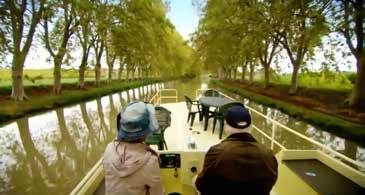
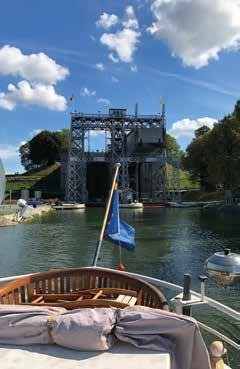
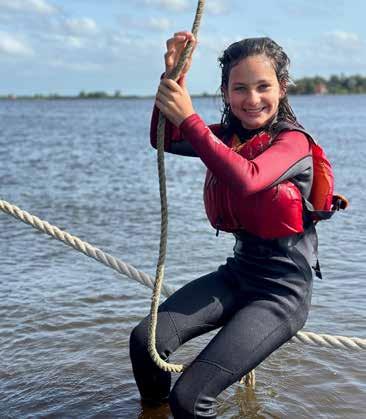
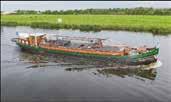
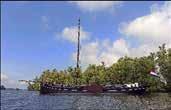
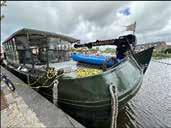
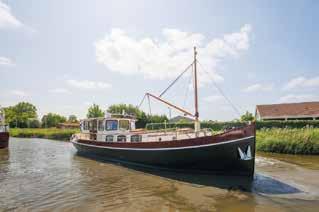
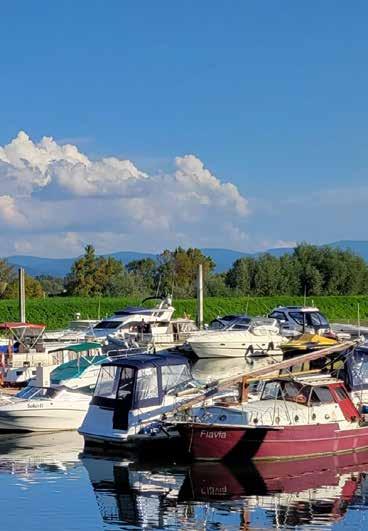
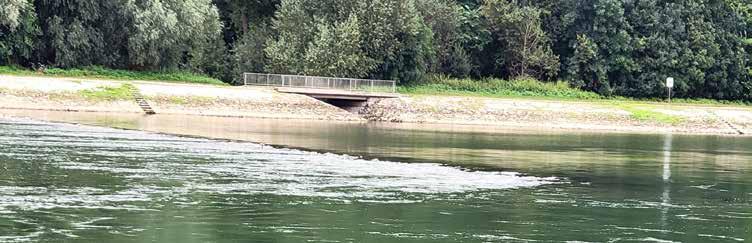
Re-join Lejla Cox and family as they cruise the Frisian Islands before returning to the UK aboard their sailing barge ‘Johanna’..
Page 8 - 12
Molly – Circumnavigation of the UK
Andy and Deborah Kerswill head for home on board ‘Molly’ on the final leg of their epic circumnavigation of the UK.
Page 14 - 19
DBA Mainland Europe Rally 2025
It’s on! Read all about it!
Contacts
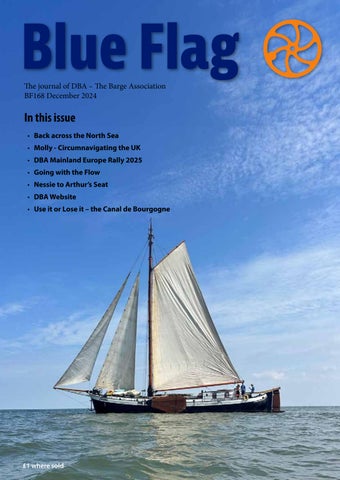
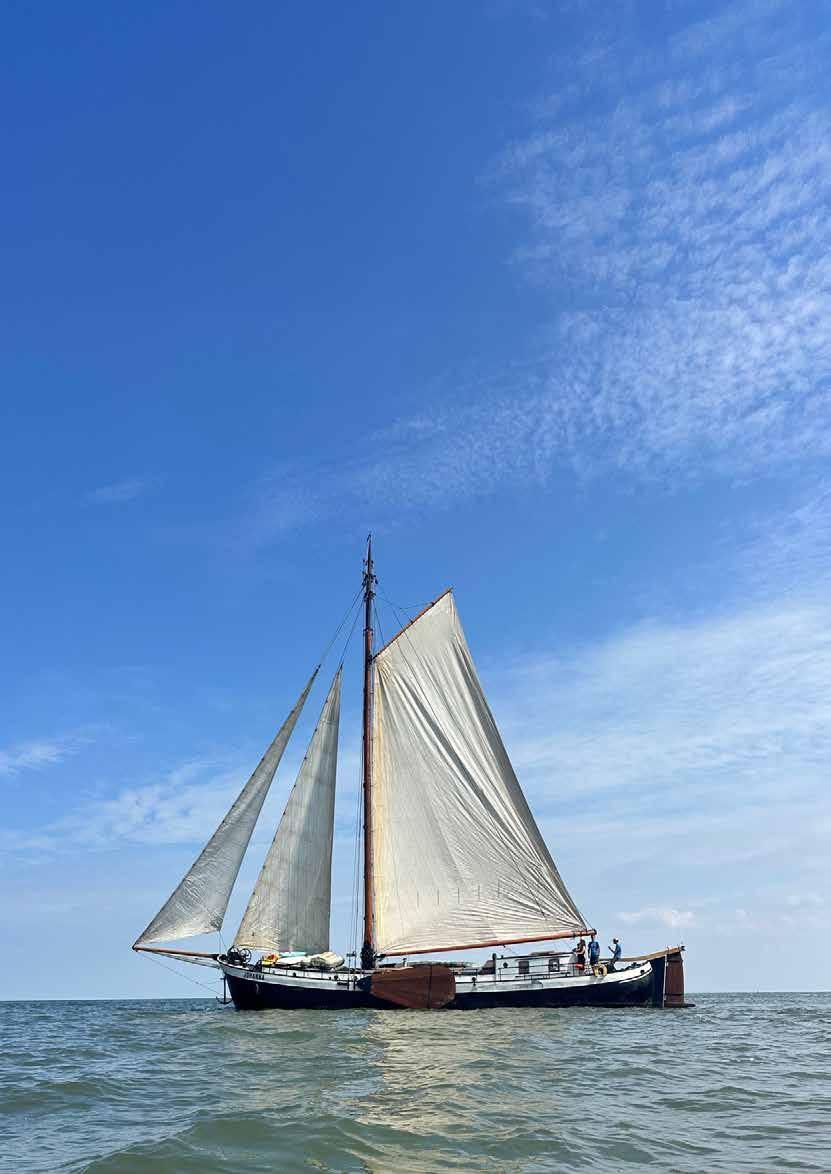
Cover
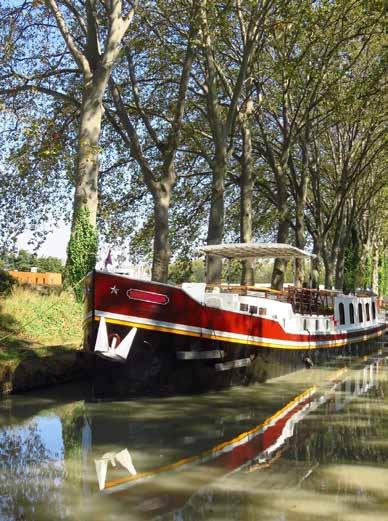
- barge Johanna - Cuillin
Contributions always wanted
Blue Flag is always in search of good informative articles. If you have something which you think fellow members would like to read about, please send your article, letter or news item (or perhaps just the outline of an idea which we can develop) to the editor at editor@barges.org - we look forward to hearing from you.
Latest date for copy and adverts for the February edition will be 15th January 2025.
Layout, artwork and print coordination - Chris Grant.
Opinions expressed in Blue Flag are not necessarily those of the editor or of the DBA Board and directors. The editor and the publishers accept no responsibility or liability for any errors, omissions or consequences ensuing from any information given or advertisements in this publication. The editor reserves the right to decline publication of any contribution or to edit and condense text. Authors who wish to see the final proof of their article before publication must say so when submitting the article but that publication in the next issue cannot then be guaranteed.
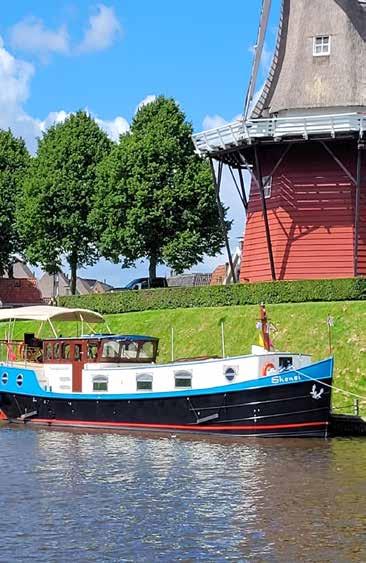
Join Andrew and Nicki Phillips on a speedy trip down the Rhine on board ‘Shensi’.
Page 22 - 27
Nessie to Arthur’s Seat
Christine Walliman and Peter cruise the Great Glen on the first part of their Scottish boating adventure.
Page 28 - 32
DBA Website
Pete Milne gives an update on the major work of upgrading DBA’s website.
Page 33
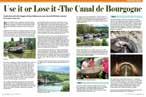
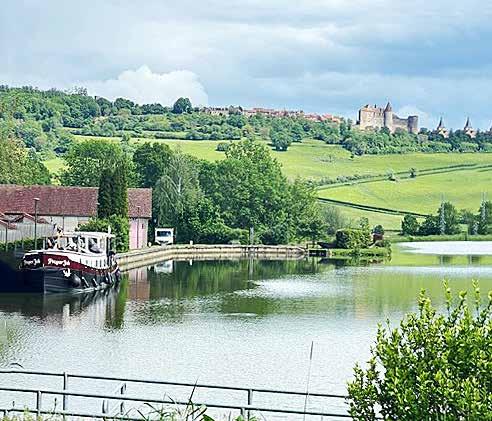
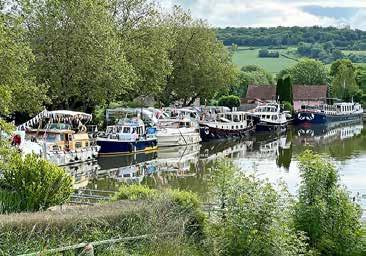
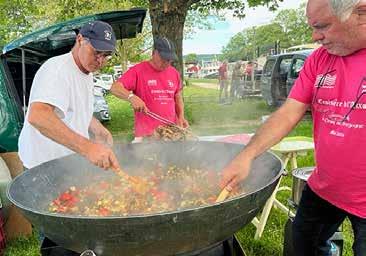
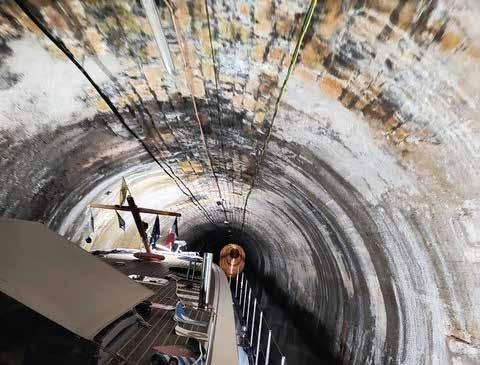
Use it or Lose it – the Canal de Bourgogne
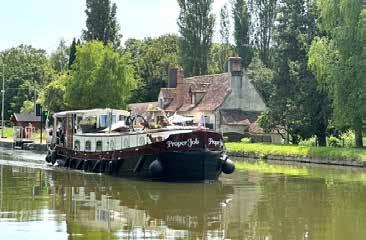
Charlie Bevis joins an early season ANPEI Rally, with wife Maggie and canine crew Muffin on board ‘Proper Job’.
Page 34 - 36
From the Chair Mike Gibbons
It’s December already and the year has flown by. Welcome to the final Blue Flag of 2024.
I need to start by making reference to the e-mail letter which you will have recently received concerning, principally, the rise in subscriptions from 1st January 2025. The detail in it was, I hope, clear and reflects the challenging conditions for all organisations. The DBA Board has not put up charges without a great deal of discussion and this rise provides a careful response to the problem by creating a solid financial base to pay our bills. It also goes a long way to addressing the major cost gap in providing printed copies of Blue Flag to all members who request it in that form, and that issue will be kept under review. The Board has taken this decision because it absolutely has to protect DBA for the future so I hope you understand and are able to continue to be members, able to help by paying the increase and possibly helping by, like me, receiving Blue Flag in future in its digital form to mitigate the rise in subs. DBA remains one of the cheapest organisation for your interests afloat particularly if you cruise in Mainland Europe, on UK wider canals & rivers, in larger boats, wanting moorings information and technical support. DBA remains your ‘one-stop shop’ and thank you for being a member. We are very grateful to those who in response to our letter suggested creating a donations option which we have done, and several members have already donated. Details are in Klipperings.
By the time our next edition drops onto your doormat or into your Inbox in February, the Association will be looking firmly towards our Annual General Meeting with all that brings. So today we need to cast our minds forward to 15th March 2025 when the Annual General Meeting of DBA – The Barge Association will take place on Zoom at 20.00 GMT. Full details will follow but do keep an eye on the various outlets such as the Forum, Facebook, Newsletter and Event Dates on www.barges.org for this and all other events including Member Zooms over-winter and Rallies during the summer (see more below and in this edition). The AGM is always a key moment in the DBA year and, with the gradual shift to online meetings, has become, in a very different way, a chance for members from all over the globe to meet up (virtually) and socialise as well as do all the business required. We’ve traded off the meeting in person which was much-enjoyed but restricted to those who were realistically within easy distance of London, in favour of a chance for everyone to take part. Time-zones make it less favourable for some corners of the world but for most it’s reasonably convenient, so do please put it in your personal diary. There’s another reason to stop and think about the AGM too because it is the chance for all members to consider whether they can put their hand up to become a member of the Board. You may say “Never!” or “Why would I even consider it?” but here’s why you should. The Board represents all of us members, the individuals concerned are boaters of all types and experience, they bring a wide range of skills to the table, they range from new boaters to experienced barge owners, some are new to any form of Board role, others are (in the nicest possible way) old hands. So you would fit in. You do not have to take on any responsibilities, you merely need to be an interested person who is prepared to join the meetings of the Board held six times a year by zoom for a couple of hours. You may then want to do more but there is no pressure. So do please think about it and especially this year, because this year which
will be one of change. It’s time for me to stand down as Chair and my predecessor, Andy Soper, who is currently and has been for many years Vice-Chair, Treasurer and in charge of Representation, is also passing on his roles. The Board rotates membership every three years so there will be at least three vacancies. I hope that an impartial observer would say that as a unit, the Board members do represent a wide slice of the membership and work hard to bring any disparate views to a consensus. Much of that work, of course, takes place between Board meetings and involves members and volunteers who bring their expertise to bear. If you are interested, then please e-mail one of the Board members – addresses are on the back page.
What else? Well there’s been considerable progress in the major project of this past year, namely the complete updating of our website at www.barges.org to make it future-proof. More details of the work are in this edition of Blue Flag and while there are some items just being completed, the majority of that work is done for which we should be very grateful to those who have worked so hard on our behalf.
And also in this edition, as well as seeing it online in the Forum, the Newsletter and Facebook, there’s details of next year’s Mainland Europe Rally; some of these details are still being worked out but it will be at Thieu, by the foot of the Canal du Centre Historique in Belgium. We expect the UK Rally to be on The Thames, details to follow.
And I must close by a short mention of the sad passing of Timothy West. He and wife Prunella Scales have done much to publicise inland waterways, in the footsteps of and matching others like David Suchet, Timothy Spall and nowadays Robbie Cumming (let alone a lot of ‘celebrity’ programmes). Timothy and Prunella were always charming, made lots of friends along the way in engaging series on the Midi and the Nivernais (and were fleeced by the same cheese stall as us in Chablis…….) Much missed and loved.
Thank you for reading Blue Flag and supporting DBA. I hope you have an excellent Christmas & New Year and see you on either a Member Zoom or at the AGM online in March.
Mike Gibbons, Chair
* The dialogue from Great Canal Journeys: Prunella: “It's really not like you to veer from shore to shore.” Timothy : “It becomes more and more like me as time goes on!”
Timothy & Prunella on the Midi, by kind permission of Minervois Cruisers *
News and letters
Email editor@barges.org with your news, feedback, events or comments for next time.
Hello from Melbourne
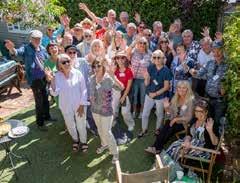
On Sunday 11th November a group of 33 people interested in cruising the canals and rivers of Europe met at Deb and Howard's place in Fitzroy North. They represented a range of boats from barges to smaller cruisers, as well as some who are now selling or thinking about buying a boat.
The weather was lovely, the chat about boats and cruising was interesting, and the shared food was delicious. A great way to expand our group of friends and contacts with similar interests, and a delightful way to spend a Sunday.
Our group meets usually twice a year, once in November after the cruising season and again in March before the cruising season. If you'd like to come along to a future lunch, please contact deb.keir@barges.org
VNF Seine Bassin Update
Sharon Hammond has posted on the Forum (Waterways Continental Europe) details of the October 18 2024 VNF Users Group meeting for the Seine Bassin, which also covered some aspects of the Picardie, Champagne & Ardennes Canals.
Salient points are:
• Required use of AIS for pleasure craft over 20 metres.
• Status of AIS to be kept up-to-date at all times.
• Pleasure craft traffic in 2024 down 36% (40% on the Marne, 35% on the Oise, 34% on the Seine); the main reasons were the weather - cool and rainy often - and the disruptions from the Olympic Games.
• Modernisation projects in the Seine Bassin are expected to cost about 12 million euros per year. The main focus is using teleconducting across the commercial ports to manage traffic and support 24 hour service.
• New centralised control centres for locks to be introduced over the next few years.
• Planned areas and timing for weed removal.
• Planned 2025 closures for maintenance.
VNF Nord Pas-de-Calais
Bob Marsland has posted on the Forum (Waterways Continental Europe) provisional details of the planned 2025 closures for the Nord Pas-de-Calais region.
VNF Users Group: Centre –Bourgogne
This region covers the following main waterways: Canal de Bourgogne, Canal de Briare, Canal de Roanne a Digion, Canal du Centre, Canal du Loing, Canal Lateral a la Loire, Canal du Nivernais, and the Rivers Yonne and Seille.
Richard Hyman and Bob Marsland have posted on the Forum the VNF’s endof-season report (in French and English) tabled at the Users Group meeting held on 17 October 2024.
This covers:
• Water reserve status for each waterway.
• Work undertaken and planned for weed infestation.
• Usage (substantially down, due partly to heavy rainfall, but also to restrictions imposed by the Olympics).
• Costs of works completed and planned.
• Provisional dates for closures / stoppages in 2025 and 2026. View the full power-point report, minutes and summary closure dates on the Forum under Waterways Continental Europe, ‘CLU Centre-Bourgogne 17 October’
Encouraging News for the Canal de Bourgogne
A substantial funding increase for the Canal de Bourgogne was signed off on 5 November 2024, committing the State, the Region and VNF to major renovation works on the Canal to ensure its continued navigability. The euros 98 million budget is for “better managing water resources to ensure that the canal does not dry up in summer, combating invasive plants, reviving river transport and developing tourist ports”. On y voit!
Thanks to Rob Davidson and Bob Marsland.
Grey Water Tanks in Paris
It seems as if regulations introduced in Paris for the Olympics, under which all pleasure boats had to prove that they had a grey as well as a black water tank, are still in force. The Arsenal has pump-out facilities, but if you don’t have a grey water tank, you are likely to be denied a berth.
Thanks to Tim Cahill-O’Brien.
Linssen goes Electric
Leading Dutch steel motor yacht builder Linssen (which numbers several DBA members amongst its owners) has developed an electric propulsion system which it will start to install on new build vessels once sufficient waterfront charging facilities are in place; it will however continue to offer models with diesel engines, plus the modular design of the e-drive system allows it to be installed on the same engine foundations as diesel models, making it relatively easy to convert from diesel to electric power.
A squadron of Linssens at rest
Postponement of Amsterdam Vignette
The City of Amsterdam has postponed the deadline for purchase of a passage vignette for nonelectric powered craft to use the inner canals from October 1, 2024 to April 1, 2025, owing to the large number (>1,000) of objections from boat users.
Thanks to Vaarwijzer.
DBA Continental Rally 2025 is on!
Location: Canal du Centre, Thieu, Belgium. Timing: Second half of June, 4 days (so 19-22 June or 26-29 June), to be confirmed shortly. See page 20 for more details.
Fund Britain’s Waterways
FBW (the Fund Britain’s Waterways organisation) has responded to an invitation to make a submission to the Government's 2024 Spending Review. Their request to Government is that:
• the importance of our inland waterways as a unique national asset and part of the national infrastructure is recognised.
• the deterioration in condition that is already happening is acknowledged.
• a comprehensive review of Government funding for all our inland waterways should be carried out as a matter of urgency, with the aim of defining a sustainable funding solution which will enable the current benefits of our canals and rivers to be maintained and enhanced for future generations.
Thanks to the Inland Waterways Association.
Environment Agency National Navigation Update
Andy Soper has extracted the following encouraging words from the EA’s October 2024 Navigation Update: ‘We know that the Navigation service is
not where it needs to be’
‘Assets that are struggling with age and use’
‘Our service is not meeting your expectations’
‘We are planning for a better service in 2025’
‘We have made a strong case for the benefits of Navigation to DEFRA which ‘received positive feedback on its quality.’
In Andy’s words - linked with the recent Thames successes in court and the joint operation with local Thames councils to move unauthorised moorers on, there appears to be a new determination to improve EA waterways for users. Doubtless the outcome of the Boat Registration consultation will result in us paying more (9%) but if the funds are used effectively, that will be for the good of all EA navigations.
Changing use of the Waterways
A recent article for the IWA highlighted that cruising on the UK waterways has been declining while residential use of boats has been increasing; new residents on boats are less keen on moving, and this is the main reason for declining boat movements.
These comments were backed-up by annual lockage data from the Canal & River Trust showing a clear decline from around 2016-17 in use of the 33 most heavily used locks. This chimes with data on decreased lock usage previously shared with the IWA’s Navigation Committee
Decreasing cruising is a cause for concern, because silting and vegetation growth is more likely, and ultimately because a little-used waterway is much easier to close.
The Navigation Committee discussed the situation in depth and concluded that there are other factors as well as residential boating behind the decline in cruising. The recent IWA Boaters’ Survey showed that some boaters are reconsidering or restricting their cruising areas or even considering giving up boating, because of the uncertainty and difficulty caused by unplanned stoppages and lack of maintenance. CRT’s Annual Boaters’ Survey showed that the proportion of boaters who are satisfied with their experience has fallen from a peak of 76% in 2017 to 46% in 2024. It is surely no coincidence that the decline in lock usage on CRT waterways has coincided with the decline in boater satisfaction. Of course there are many other possible factors too, such as the cost
of living crisis, the increasing age of the current cohort of boaters, poor weather and relatively cheap overseas holidays and cruises. And all this is – at least anecdotally – having a knock-on effect on waterway businesses like hire companies, marinas and pubs. But the bottom line for the Navigation Committee is the importance of ensuring that the waterways are in the best possible condition for all types of users.
Thanks to the IWA – see also Tim Haines report on the recent NINF meeting below.
National Inland Navigation Forum
Here is a synopsis by Tim Haines of the NINF meeting he attended on the 5th of October 2024.
Residential boats: there has been a large increase in people living on boats. This is particularly evident along the canals in London and other canals and rivers in major cities. A major concern is the number of people living on boats as a low cost residence. Due to the complexity of this, it was decided that a subcommittee be formed to discuss further.
AirBnB: this is also increasing in numbers but really needs to be regulated by the relevant navigation authority.
Canal and River Trust survey 2024: there wasn't a lot of discussion around the survey as the results haven't been published but there was general discussion around the general lack of maintenance. It was brought to the NINF's attention that both Canal and River Trust (CRT) and Environmental Agency (EA) staff are prohibited from making any negative comments.
European Boating Association Report
Andy Soper has posted on the Forum (Waterways Continental Europe) the October 2024 EBA Report, together with his summary of the main items likely to be of interest to DBA Members.
Border Checks within the Schengen Area
Judy Evans posted the following on the Forum, Waterways Continental Europe:
For those in Dutch, Belgium and German waters, news released today confirms that the Netherlands will be increasing border checks as of 9th December 2024 for 6 months. The Dutch cabinet yesterday decided and announced that increased border checks will be introduced at the borders with Belgium and Germany from 9 December onwards. Also increased border checks will take place on intra EU flights where there is an increased risk of illegal immigration. The purpose of these extra checks is to combat irregular migration streams. This has been notified to the EU Commission under the Schengen Border Code. According to press reports, no additional border staff will be made available and the intention is to cause as little disturbance as possible to normal border crossing traffic.
Whether this will impact on those crossing borders by boat or not is a moot point, but advice is to be aware of the possibility of spot-checks and ensure that your papers are all in order.
Donations
If you would like to offer support to the DBA beyond the normal membership fees, we would sincerely welcome your contribution and promise it would be used carefully to support the ongoing association costs and the technical improvements to the website.
A donation of any amount may be made using one of the avenues described on the website. If possible please put “Donation” in any refence box or notes. If you want to be sure we know how generous you are, drop an email to chair@barges.org so we know who you are.
Back across the
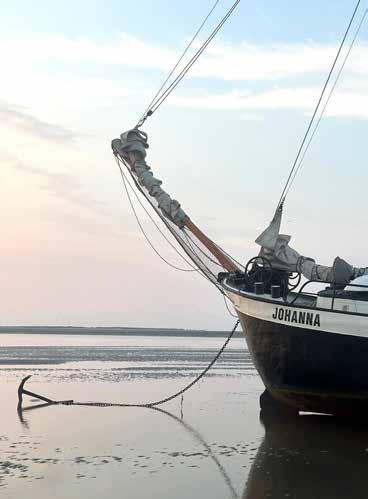
In the previous edition, we had left Lejla and her family in Harlingen on board their trusty barge Johanna. Now they’re off to the Frisian Islands – read on!
5th August
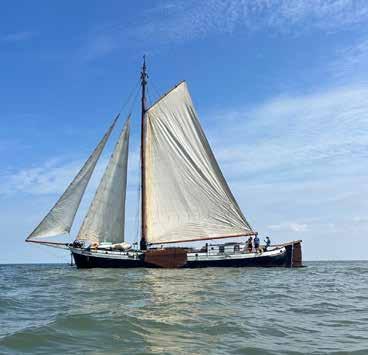
In the morning we set off for the island of Vlieland. On the way over we decided to raise the sails, first the mainsail then the jib. We were soon doing at least 7/8 knots past all the other enormous cargo ships and ferries. My brother decided to go out on his sea kayak to take a picture of us sailing - however it was short lived because soon a high-speed ferry came whizzing past and he had to make a swift exit to avoid being swamped by the wake.
Shortly later we dropped our anchor just off Vlieland, it was a beautiful spot just off a beach.
7th August
Early in the morning, we raised our anchor to go to Tershellinganother Dutch island in the chain. We pulled off one of our best moorings yet, doing a full 180 degree turn - and managing not to crash into any of the fleet of shining white plastic yachts coming towards us from the marina.
We stayed in Tershelling for several days, cycling around the island each day. As a treat, we also had our first ever lesson of kite surfing which involved first learning how to control a huge kite, then moving into the water and being pulled through the water like a torpedo. I thought it was really fun.
While we were in Tershelling, there was a significant storm which came from the South. This meant that the waves came over the sea wall and threw us around like a paper boat in a washing machine. My dad had to get up in the middle of the night to adjust the ropes but luckily it didn’t last too long.
11th August
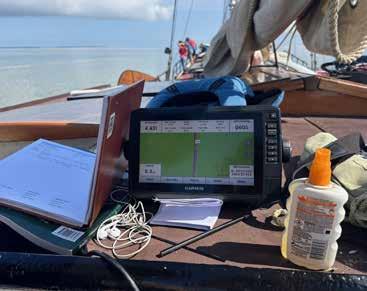
We set off from Tershelling on the passage to Ameland. Us kids played a few more games below deck until we were called up to swing the lead. Swinging the lead involves using a line with depth markers on and a piece of lead tied to the bottom. As you sail along, you swing it slightly forward and into the water and try to see the depth marker when it touches the bottom alongside you. My brother started by swinging the lead, and my job was to shout back to my dad on the helm how deep it was.
The route we had planned was incredibly shallow, with only just enough water at high tide for us to cross the sandbanks. It started off ok with depths between 1.2 and 4 metres but then things started to get a bit hairy. I shouted “one point two metres”, then “one point one”, then “one metre”, then with a gulp “below one”. Johanna draws 95cm so at this point we had less than 5 cms of water below our hull.
If we ran aground here we would be stuck until the next tideand possibly longer because the tides were getting smaller.
We slowed the engine in case we needed to reverse to get off the sand bank and everyone went quiet apart from me shouting the depths.
Heading to Vlieland – taken by my brother before the ferry came!
You can just see that we had 30cm under our stern, we are at the bow swinging the lead
the North Sea
After thirty minutes of swinging the lead and worrying about what would happen if we hit, the depth finally started to increase. Phew.
We found our way into a deeper channel and soon arrived in Ameland. The harbour at Ameland is tiny, with space for only a few barges. We approached slowly and headed for the nearest free mooring. The harbour master arrived just as we were pulling in, and asked us to turn around. Yikes! By some miracle we managed it.
13th August
From Ameland our plan was to head for the brilliantly named Schiermonnikoog, the most Easterly of the islands. The sandbanks were even worse here and we were now on neap tides making it almost impossible to cross, so we decided to go around the outside to avoid the shallows. This was a somewhat abnormal decision as far as the Dutch skippers were concerned. Their insurance doesn’t cover them outside the islands and they saw it as a rough and dangerous passage to attempt.
We decided that we’d do it anyway much to their shock. We left early in the morning on the ebb tide through Borndiep and the West Gat. The aim was to get out just as the tide turned so we would be pushed East by the rising flood. As we came out of the Gat we could see breaking waves which we feared might roll over us.
We considered turning back - the warnings of the Dutch skippers ringing in our ears - but we managed to find a route around the worst of the breakers and once we were through the shallows the sea calmed and we even got to watch a pod of porpoises playing alongside us.
There was a bit of a swell on the sea which made our friends feel a bit sick but it was generally plain sailing all the way to the next Gat. Once back inside the islands we headed for a sandback named Het Rif. I had to go back on lead swinging to guide us into the right channel and this time to run aground on purposeour plan was to dry out on the sandbank for the night.
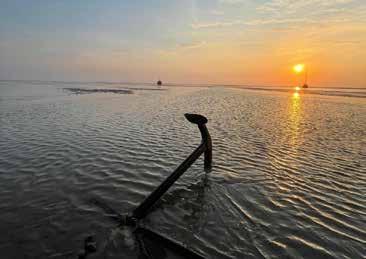
We slowly nudged our way into the shallows until it was time to drop our anchor. We dropped it but the water was so shallow we could still see its stock sticking out of the water.
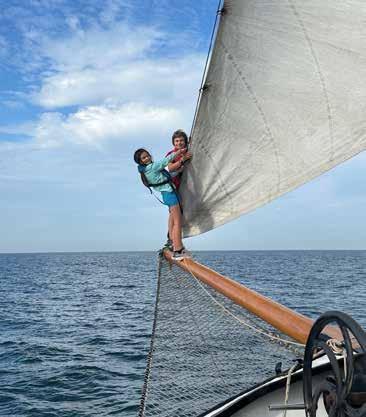
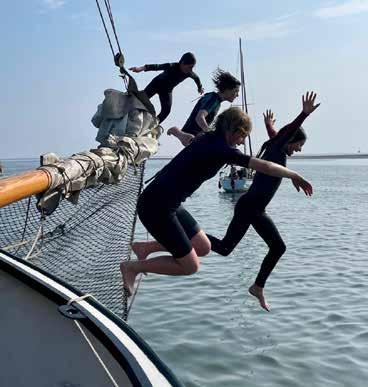
My brother and me on the bowsprit
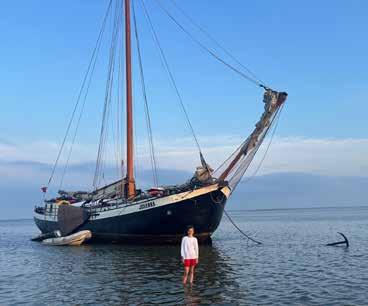
High and dry at Het Rif
With the anchor down, we all jumped in and swam/paddled in the shallow sea - and then discovered that under our feet were thousands of enormous cockles. We were soon diving under and collecting them by running our fingers through the sand. We filled a whole bucket.
14th August
We woke up in the morning to find ourselves high and dry on the sandbank. We built sand castles and tried to protect them from the incoming tide while the adults raised the sails - she looked a bit weird with her sails up while stuck in the mud! We got back on board and waited for the tide to float us off the sand.
We then raised our anchor and motored off to the Lauwersmeeran inland sheltered lake where we would be mooring for a while to hide from the tail end of hurricane Ernesto which had hit Puerto Rico earlier in August.
We had been worrying about this weather system for a while and the risk of getting stuck out East with big south westerly gales forecast. The great thing about Holland is you almost always have more than one option. In this case there was a deep canal with lifting bridges to take us back through the centre of the country and onto the Ijsselmeer to avoid the open sea.
To enter the Lauwersmeer - a beautiful and protected lake, we had to go through a lock and as we were by far the biggest boat there, we had to wait a while before we were allowed in. Our next challenge was to tie up to a mooring buoy. Given that our bow is
more than two metres high, it’s not easy. Luckily we have come up with a new technique which involves my brother getting into his kayak and the rest of us throwing him off the side into the water. It’s called a ‘seal launch’ and we are now pretty good at it. Once he is in the water, I pass him a rope and he loops it around the mooring buoy and passes it back up to me and I tie it on. Admittedly it doesn’t always work - the first time we tried it my dad managed to flip my brother so he landed upside down. At least no one drowned.
To celebrate the last night of our current crew and being out of the approaching wind - we had an enormous disco. At midnight we jumped into the lake with all of our clothes on dancing as we swam. Woohoo !
18th August
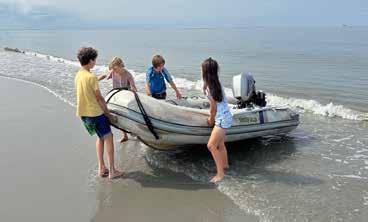
Checking the forecast, we realised that we had another couple of days before the wind hit, so we decided to go back to Het Rif because we had loved it so much. Our plan was to run aground again but not so much that we could only get off on a high tide. As we got closer we saw loads of enormous blue jellyfish! We dropped our anchor and climbed into our RIB and headed across to Schiermonnikoog - the last Dutch island in the chain which we had not visited yet.
We played football on the beach and walked to the lighthouse. On the way back the wind had strengthened and the tide had turned, and we had to cross two miles of short sharp waves. We got absolutely drenched. The waves had almost tripled in size from when we had gone across and they just kept coming over our bow again and again - soaking us to the skin. None of us had brought waterproofs, so we had no way of protecting ourselves, but it was warm enough that we actually found it funny. We sang songs as we got drenched. Once safely back to the boat we had steaming mugs of hot chocolate before bed.
20th August
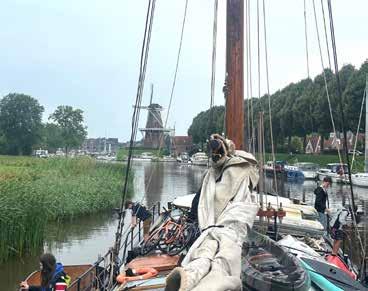
To avoid the incoming storm, our plan was to set off to Sneek, a waterside town famous for boating, passing through Dokkum and Leeuwarden. The only way to get there by boat was through the narrow, winding canals - which for a boat like us, no matter how skilled we were, would be a challenge. The bridges were tight and the way was packed with other boats less than half our size. For them it would be easy, but for us it was another story. We attracted a lot of attention from people onshore!
Waiting for water
Landing on Schiermonnikoog
After staying at Dokkum for the night, the next day was even tougher. The storm had arrived and as we set off down the canals again it was coming from the worst possible direction - directly behind us. That meant that even with the engine in tickover we were going too fast and steering was almost impossible. Today we faced fourteen bridges!
We cleared the first few with only minor fending required. The kids were in charge of the fending and we would rush to put the fenders over the side at the point of impact - ideally before we hit! The next few bridges were not good at all. It seemed that all of them had been positioned in the most difficult of places, for example on the tightest of corners. One of the bridges was a railway bridge which only opened occasionally so we had to try and moor on one of the piles before it. With a force eight behind us we missed completely. With the bridge still down we had to turn around to avoid being blown onto it; it wasn’t easy in such a tight canal but we managed it.
The bridges that followed were hardly any better. The next mishap came in the form of a large tree on the corner before a bridge. To make the corner we had to stay on the port side which
meant going through the branches. I would guess that half of its branches are still in our rigging.
After the last bridge we passed over a motorway - we climbed into the rigging to see the traffic below. It felt a bit weird to be going over a bridge for a change. We moored in a large windswept lake and it felt good to have no bridges in sight.
25th August
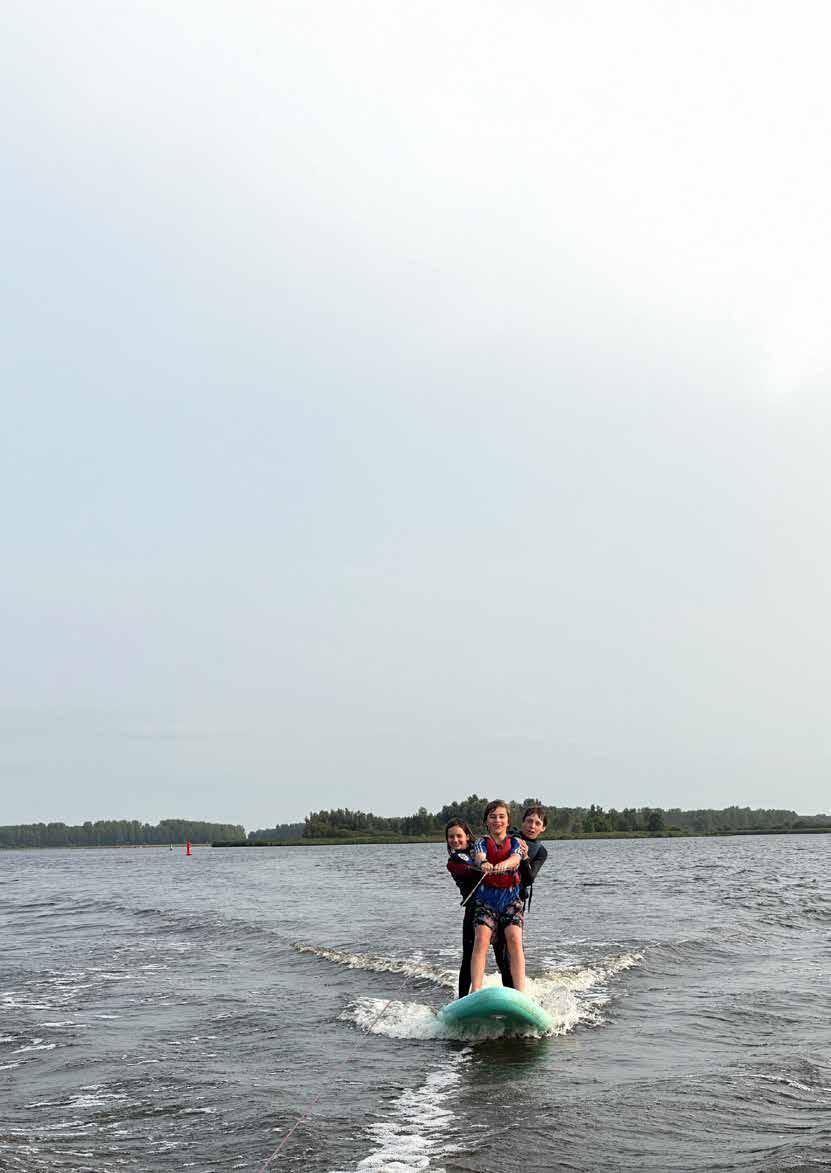
After a few days playing around on the lake and actually enjoying the wind for a change (we developed a new sport of paddleboard sailing) - we set off again.
We radioed the first bridge, but it was broken and not letting any boats through. We dropped anchor and watched Mutiny on the
Approaching Dokkum
Jumping from the Bowsprit
Wakeboarding on a paddleboard
Bounty while we waited for it to be fixed (and thought about ways to overthrow our dad!) By the time the film had finished, the bridge had opened and we set off towards the IJselmeer. The wind was now on our nose which made steering much easier.
As we approached the IJselmeer we came through a lock and a woman shouted from the bridge - it turned out that she was the old owner of Johanna! We had a lovely chat with her.
We had expected the IJselmeer to be rough and as we came out it was certainly a bit plashy at the bow - but nothing serious. We were followed by dozens of sea birds who accompanied us all the way across.
27th August
The weather had improved which meant we had a crossing window to get back to the UK. We left IJmuiden after lunch having cycled half-way across Amsterdam to Immigration and to buy some chocolate before we left. As we came out onto the sea the swell rolled us around a bit and one of our crew took medicine for seasickness. But we were used to it by now.
I was on night watch until 2am. Just after midnight I was steering when we saw an enormous mass of lights coming towards us from behind. We checked on AIS and it was a cruise ship. We made radio contact to make sure they had seen us. It was a bit scary.
In the morning we raised the sails for the last bit of the journey into Harwich, finally coming alongside just after 13.00. It felt very strange when the harbour master came up and started speaking
to us in English in an English accent. For the next week we kept saying thank you in Dutch by mistake.
29th August
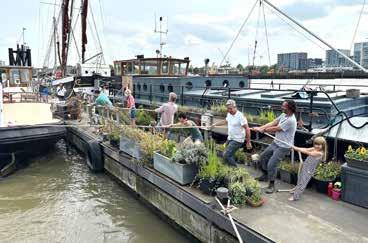
We finally got back to our mooring after six weeks at sea. We were helped back into our berth by our neighbours and spent a day derigging the boat, folding the sails and washing the decks.
I had learnt to trust Johanna and what she is capable of, I’d improved my navigation and had really explored the Netherlands. I’m now looking forward to more adventures with our trustworthy boat.
Thank you very much for reading my story.
Lejla Cox
As readers will recall, Lejla and Cuillin are the children of Brendan Cox and the late Jo Cox, MP.
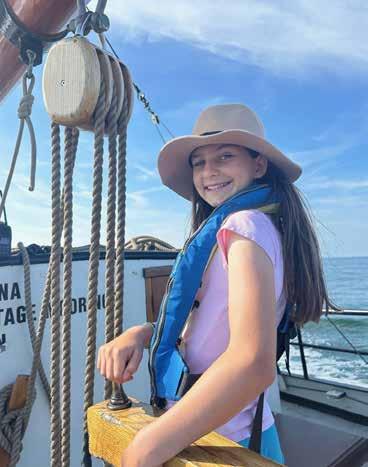
Lejla at the helm
Neighbours helping us home
Crystal Light - or how to build your own Barge!
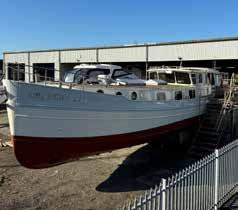
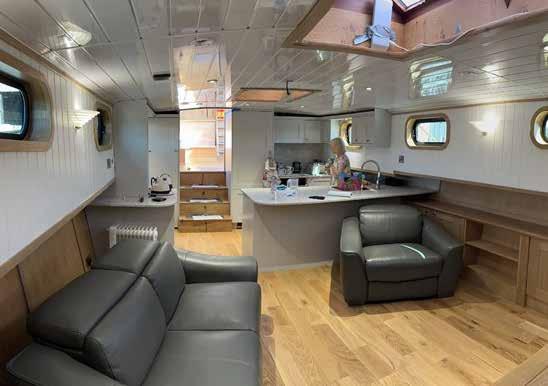
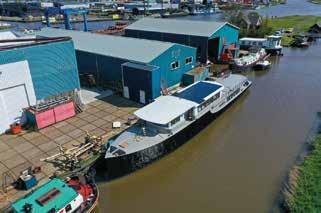
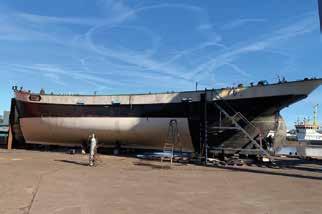
Readers will recall Mick Grain’s story (Blue Flag February 2023 – BF157) of how he decided to build his own 20 metre barge from scratch – we left him manoeuvring the finished hull out of his workshop. Here’s what’s happened since.
Just to give you an update on Crystal Light, I know it has been a long time coming. I am pleased to say that I am nearly there, and I will be launching around February / March next year, when the weather starts to get better. I could launch before Christmas, but I have a few bits to finish, especially in the aft cabin, so there is no point rushing now.
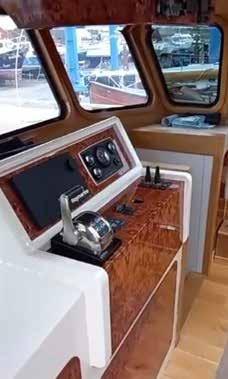
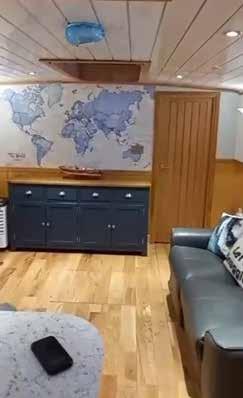
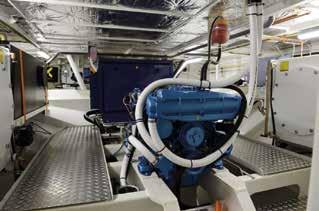
The boat has been sitting on a hard standing at Hull Marina for the past 18 months or so, where I have been fitting out the interior. It has taken time because I have only been working with my assistant Dean Hobson a couple of days a week, but at last we are nearly there, and she is looking good.
I am a complete novice, so I am booked on training courses in November with Mathews Marine, and I am looking forward to it.
The photos don’t really do justice to the interior, but it gives you an idea and it has moved on a lot since the pictures were taken. I will be updating the youtube video eventually.
https://youtu.be/HWmXpK0BWO0
In his previous article, Mick said that the biggest challenge had been the amount of wiring and electronics required - I asked him for an update now that he has nearly finished the fit-out. Here’s what he said: “I think the whole build is challenging for a person who has not built a boat before; as you will be aware fitting out a boat is not like a house, there are no square corners, so it means making a lot of templates.
Also, I guess a big challenge or maybe just an inconvenience is having the boat on a hard standing with access by a scaffoldingbuilt stairway, so any minor adjustment to a part is back out of the boat to do it, so I have been up and down those stairs 100s of times - I think I’ll need a new hip when it is complete! Also planning all the service routes - if I did it again, I have the
experience to know where exactly to put the ducting and cable tray etc, in advance.” If any readers have any queries or are thinking of building their own boat, please do get in touch with Mick mickgrain@hotmail.com
Mick Grain
Molly - Circumnavigation
Andy & Debbie Kerswill set out on the third and final leg of their epic voyage around the UK
Homeward bound – Scottish Western Isles and East coast.
Having cruised around the South Coast of the UK in the previous year, and now part way from Cardiff Bay to the Scottish Western Isles via Northern Ireland, we were really looking forward to a few days of gentle canal passage. So we set off from Cambeltown, via Ardrishaig and entered the Crinan Canal.
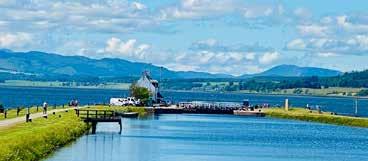
What a beautiful canal and with a gentle breeze, not a mosquito in sight. We packed in some lovely walks and cycle rides. Once through the Crinan, we sailed on to Oban and stayed on a swing mooring for a week in a very pretty sheltered bay off Kerrera Island.
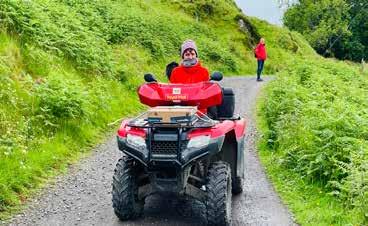
It was just beautiful, and being so far North now, we experienced long days of daylight – still light at 11pm and becoming light again at about 3am. While on Kerrera Island, their lovely postie Pat(ricia) with her black and white dog (yes really) tracked us down on her postie quad bike with a parcel for Andy that had been playing catch up with us since Ardrishaig. Very impressed with Royal Mail’s tenacity.
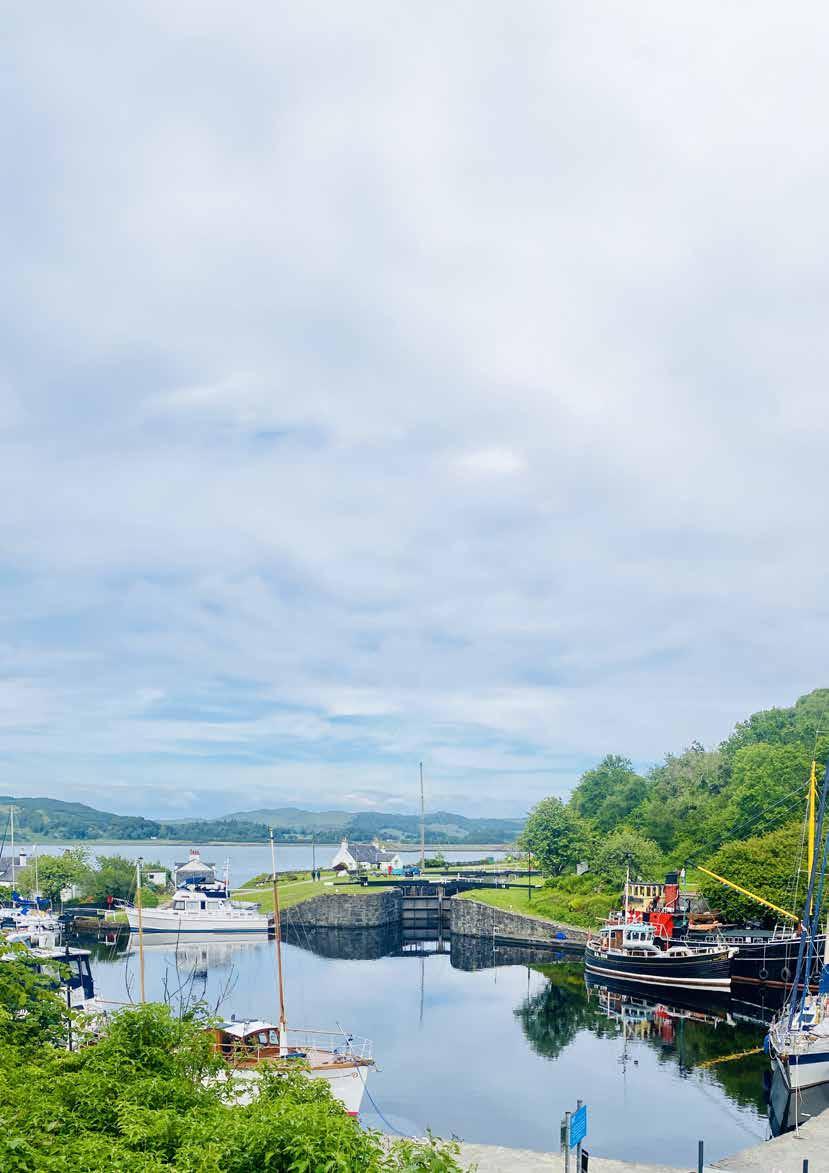
Crinan Canal Basin
The trip from Oban to Fort William and the start of our journey through the Caledonian Canal was beautiful.
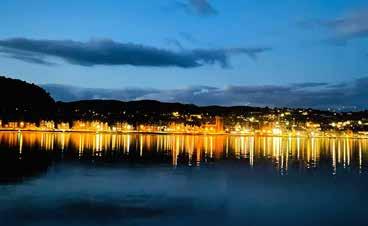
Oban at night from Molly’s swing mooring off Kerrara Island
Postie Pat
Circumnavigation of the UK
Scotland really does have the most stunning coastline. Just breathtaking. We had a leisurely trip through the Canal.
Stopping off at each Loch for a couple of days to explore. Is it just me or are all the Lochs prior to Loch Ness much more impressive? Loch Ness wasn’t my favourite - very long and comparatively narrow compared to the others.
However, once moored up in Inverness, we decided to get the bikes off and cycle back up the towpath of Loch Ness. On the way back, I noticed Andy exhibiting a very bizarre cycle motion - a one-legged pedal push! As I got closer, it became evident that his whole right pedal had come off, hence the fun spectacle for me following behind. For the whole cycle back, he was having to stop every few minutes to bash the pedal arm back on. Needless to say, I found this incredibly entertaining, until he pointed out to me that I was having my own bike issues.
For some bizarre reason, my saddle began to very slowly descend as I pedalled, until I found my knees slowly coming up to meet my chin! ‘Poetic justice’, I hear you shout, for me ridiculing Andy! So, there we both were, cycling along the towpath of Loch Ness –Andy with his one-legged gait stopping regularly to jam his pedal back on and now me having to stop every few minutes to haul my saddle up before I knocked myself out with my knees. We must have looked like Coco and Bobo but without the makeup and curly wigs. By the time we got back to MOLLY we were both in need of oxygen as we couldn’t stop laughing, but we only had wine – close enough!
Moral of the story – don’t waste your money on cheap folding bikes – and make sure you always have plenty of wine!
From Inverness we called into the fishing harbour of Buckie and then on to Peterhead.
At Peterhead we were too big for the marina but were directed by port control to go into the massive main fishing harbour, under the bridge, turn left and moor up behind the blue and white fishing boat. Fair enough. Very straightforward. No. I can only think this was their idea of a joke. We followed their instructions and once we had completed the left turn, we found ourselves in a basin of about 70 blue and white fishing boats! After trying without success to find ‘the one’ we gave up and pulled into the paint bay. Where they left us!
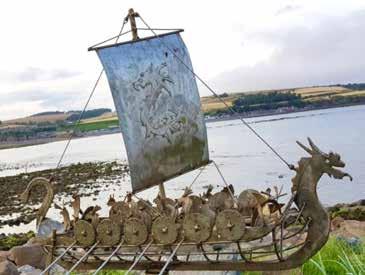
From Peterhead we carried on to Stonehaven and what a picturesque place this is. There is a beautiful crescent shaped beach with a boardwalk overlooking the bay along which there are several steel sculptures. Each sculpture has a marine theme. There are fishing trawlers crewed by fish and crustaceans, and even a Viking longboat crewed by Viking fish all wearing horned helmets! There’s even an amusing one where the fishing boat is crewed by a giant lobster and a crab, with cages in their claws containing human skeletons.
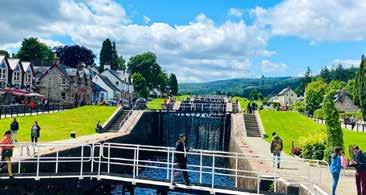
Neptune’s Staircase, near Fort William
West End Caledonian Canal
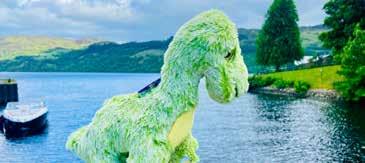
Proof that Nessie does exist
Viking ‘fish’ sculpture on Stonehaven Beach
After Stonehaven, we sailed for a few days stopover in Arbroath – home to the famous Smokies. The lovely harbour master described where to go for the very best of the best of smokies and to make sure we asked for them ‘hot off the barrel’. We hurried back to MOLLY with our catch tightly wrapped in wax paper and sat down to enjoy these beautiful fish with bread and butter. Just delicious.
Whilst in Arbroath, Andy saw the yacht we met at the Isle of Man, and went over for a chat. Apparently, they had completed a 36-hour non-stop navigation over the top of Scotland’s most northern point in horrendous weather and 8 metre waves. The husband, a very experienced sailor, said it was ‘amazing’ but unfortunately for him, his wife didn’t and now wanted him to sell the sailboat! A cautionary tale for any of you adventure junkies out there…!
Leaving Arbroath, our next stop was Edinburgh where we had booked MOLLY in for 2 weeks while we flew back to Windsor to meet up with friends and family – and to have a bit of a break from each other!
Sadly, we both caught Covid on the flight down and ended up locked in our apartment together for 10 days until we could catch a flight back to Edinburgh! We had both been to Edinburgh before, but it was lovely to revisit all the haunts we loved and to have the time to find some new ones.
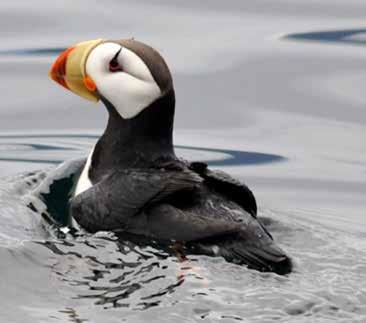
After Edinburgh, passing wee Puffins en route (I never realised they were so small, just gorgeous) we sailed to Berwick-uponTweed. Such a pretty stop with a lovely harbour master who told us all about the film crew having been there filming the last Raiders of the Lost Ark film. They were using Berwick Bridge in
the film and passing it off as London Bridge. You could see how that would totally work.
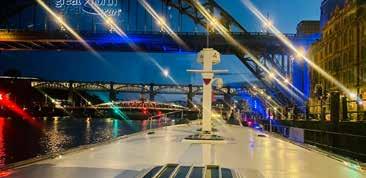
Next stop was Amble Harbour and then on to Newcastle. We absolutely loved our time in Newcastle. MOLLY was moored up quayside in the city centre under the Tyne Bridge and everyone was so friendly. It was just buzzing and now rates as one of our favourite UK cities.
MOLLY approaching Forth Bridge
MOLLY moored up quayside under the Tyne Bridge
Puffins en route
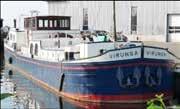
Luxe motor Oude Jan Spits Virunga
Klipper Energie V
Tjalk Freonskip
Luxe motor Mika
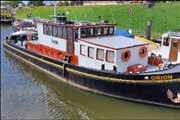
Sleepboot Orion
From Newcastle we made our way down to Hartlepool. Here we unfortunately fell foul of which VHF channel to use to gain access through the harbour entrance and into the marina. The sea conditions were quite rough, so we were moving about quite a bit but were clearly visible to the harbour office. A fishing boat came past us and so we decided to follow him in. The harbour master decided this was really bad form and started shouting at us out of his window. Andy was shouting back saying he had been trying to get them on the radio and that we were clearly visible to them.
Meanwhile MOLLY was bouncing around like crazy in the swell and eventually slammed into the side of the concrete. The fenders did their job, but under such pressure and the forward movement against the wall, one of our very large sausage fenders was wrenched off. It sounded awful – like we’d punctured a hole in her hull. Once through the harbour and into the calm of the basin, we couldn’t see our fender so decided to moor up and then go out in the rib to see if we could locate it (lost fenders as you know are not to be dismissed lightly – especially the large ones). We searched everywhere on the water and then Andy dropped me off on the quayside and I walked down past all the fishing boats. From one of the boats a fisherman asked me what I was doing and after I explained, he mentioned he’d seen a fishing boat pick up a fender at the fuel dock. He obviously had a beef with this particular fisherman because he took me to the boat, climbed on board and came back with our fender! Andy couldn’t see any of this as he’d gone off in the rib so when he came back to get me, there I was like Lancelot holding our fender up high above my head, like I’d just pulled it out of the water Excaliburesque Result!
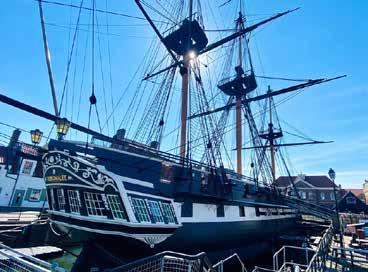
Whilst at Hartlepool, Andy walked to the historic navy tall ship that’s based there.
Beautifully frozen in time and visually takes you back to how things were on board back in the day. You can wander around everywhere on board. Nothing is roped off and the whole quayside has been recreated to show just how life would have been. Unbelievably they charged £4 and your ticket is valid for a year – well worth a trip if you’re in the area.
Our passage from Hartlepool to Scarborough was on a perfect blue sky, flat sea day and we were accompanied by 3 pairs of fighter jets which were practising low flying strafing manoeuvres. The noise was just incredible. They were so low to us that we felt
the vibration coming up through MOLLY’s deck and through our bodies, so we were literally bouncing. They stayed with us for several passes. Flying overhead, turning just ahead of us and then dropping really low to the water, screaming past us before doing very impressive vertical climbs. Very exhilarating.
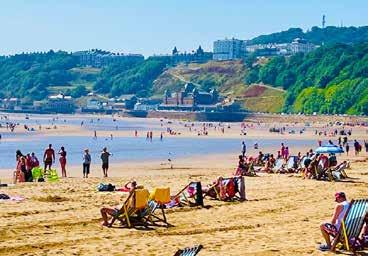
Next stop, Scarborough with its beautiful beach and imposing sea front hotel. Easy to imagine just how beautiful this whole area
would have been back in the Victorian era, and incredibly sad to see how it has steadily lapsed into decline.
Nearing the end of our second summer touring the UK coastline, we stopped off in Grimsby and then Wells Harbour – entrance to the mooring for the latter is along a very tricky sand estuary which runs incredibly close to the beach. You are sailing so close to the beach passing families splashing around in the water. Quite nerve wracking.
Our next stop was Felixstowe – the UK’s busiest container port handling 48% of all the UK’s containers. Getting into Shotley Marina lock from the estuary was incredibly challenging along a long narrow dredged channel with a strong crosswind. Never one to miss an opportunity to ridicule my husband, I feel I should occasionally give credit where it’s due. So, I’m sat on MOLLY’s bow, rope in hand for our arrival, and all I see is MOLLY rolling from side to side in the swell, crabbing heavily, heading straight for the concrete wall to the right of the lock entrance. To make matters worse, everyone had come out of the marina building to watch. I hold my nerve until contact looks inevitable and turn around to give Andy the ‘rabbit in headlights’ look – and just at that moment, Andy swings the wheel to port and MOLLY literally glides into the lock. So impressive – the sigh of disappointment from the onlookers was palpable!
We spent three days in Shotley and on one of them we caught the small ferry over to Harwich to have a wander around. The following day we took the estuary walk down to Shotley Winery. We arrived at about 10.30am on a beautiful warm and sunny day and sat outside and, as you do, ordered two glasses of their ‘champagne’, a glass of their Bacchus and a glass of red (it seemed rude to discriminate when we knew nothing about their wines), two coffees and cake. We later learnt from the owner who came over to chat that she had just that morning been awarded regional gold for their Bacchus. It was delicious.
HMS Trincomalee, built in 1817
Scarborough Beach
Anyway, about half an hour later, two couples arrived and sat at the table behind us. One of the husbands stood up and asked if everyone would like a glass of wine. To which one of the ladies declared ‘oh no, it’s far too early for wine’. Andy and I looked at each other and then down at our alcohol strewn table just as the husband caught our eye – how we laughed. I don’t think the rest
of his party approved, but he definitely looked like he wanted to pull up a chair at our table. When we left, we bought a case of their Bacchus and Shotley very kindly delivered it to us at the marina later that afternoon. Later, just before Christmas 2022, I rang Shotley to order some more Bacchus and was told they had now won the UK gold award. Well done Shotley!
Leaving Felixstowe, we retraced our steps back into Chatham and then into St. Kats and back up the Thames to our winter mooring on the quayside in Windsor.
We had had the most amazing adventures over 2 summers. Lots of laughs with friends who had come on parts of the journey with us. One or two high adrenaline moments which MOLLY handled better than us……and realised that there is something quite special in owning a boat and seeing the beauty of the UK coastline from the sea.
Thank you so much to Andrew Fells for asking us to share our journey and thank you for taking the time to read our MOLLY trilogy. We are now on our next adventure with Molly, very slowly down to the Greek Islands via central France, Italy, Adriatic, and the Peloponnese.
Happy and safe sailing to you all – mangez bien, riez souvent, aimez beaucoup… …. ….
Congratulations to Andy & Debbie and thank you for sharing your adventure with us – I for one am already looking forward to the next exciting instalment!
MOLLY on her winter mooring at Windsor
Shotley Winery
Membership matters
Dear All
We’re well under way to 2025 and DBA will do its utmost to make the year one to fondly remember. This includes the purchase of a weather machine which, due to technical reasons, is proving difficult but as you know: nothing is too much trouble to please our members!
The DBA Mainland Europe Rally 2025 is on! Please look into joining us at Thieu - Canal du Centre, Belgium either 19-22 June or 26-29 June. The exact weekend will be confirmed soon. More information below and on the event-page barges.org > events > 2025.
DBA is working towards a qualitative increase in membership
Welcome to new members
Australia
George & Libby Awburn
Andi Howess
France
Karen Duff
Germany
Rean van der Merwe
Israel
by promoting your association on social media with testimonials (look out for them and share please), and hope you will continue to talk to potential new members while you’re out and about. Please remember if you recruit a new member, they and you get a discount out of it. For more information, go to barges.org > members > menu page > members-get-members.
For any questions or remarks, please do not hesitate to contact membership@barges.org - suggestions and testimonials always welcome!
For Membership enquiries, call Liza on +32 475 261 559 or email membership@barges.org
DBA Mainland Europe Rally 2025
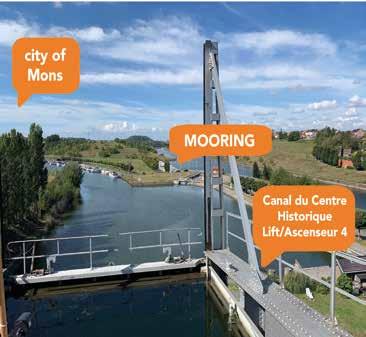
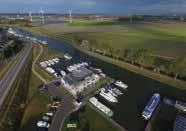
DBA will organise its 2025 Mainland Europe Rally in Thieu, Belgium on the Canal du Centre. The mooring site will be the public quay outside the YCDA marina, near the bottom of the Strepy-Thieu boat lift and the Canal du Centre Historique (Unesco World Heritage Site).
The dates will be either 19-22 June or 26-29 June, the exact weekend should be confirmed soon.
The rally will include a visit to the historic lifts and canal, a bus tour to the nearby and beautiful city of Mons, the much renowned Progressive Dinner, BYOF* lunches and much more.
Facilities: there is no electricity or water at the mooring so please arrive with full water tanks and your own power supply. Discharging of black water is prohibited; we will look at possibilities for pump out and possibly stocking up on fuel and water. Bins will be provided.
For those wishing to register right now, go to barges.org > events > 2025, where those participating without a boat can also find a list of nearby accommodation.
Jake Watson & Helen Myers
Paul Widdecombe
Jane Young
USA
Daniel Albert
Richard Heywood
Bill & Robyn Karau
Valerie Garrett
*BYOF = Bring Your Own Food (for the purposes of this rally, it's best to also live by BYOB, as in Bring Your Own Bicycle!)
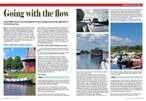
Going with the flow
Andrew Phillips shares the story of the exciting trip he and his wife, Nicki, made down the mighty Rhine on board their barge‘Shensi’
Shensi is a 19m Dutch style barge built by Bluewater Boats in 2017, and over the ensuing years Nicki and I have travelled extensively with her on the inland waterways of Europe. We had often spoken about cruising the Rhine, but until fairly recently this was not really an option for us as only boats <15m could make the trip without any special restrictions - over this length, special certification or the services of a Rhine qualified pilot were required. But then, in 2023, we heard that changes had been made to regulations such that sports boats up to 20m could now independently cruise the Rhine with no restrictions, so we began planning for a 2024 cruise.
Initially we couldn’t find many documents to assist in our research, certainly no maps or guides in any format that I was
used to, and there seemed to be a distinct lack of entries for the Rhine in the Waterways Guide (those that did exist generally favoured <15m boats – presumably as most marinas along the Rhine were established when the sports category was a maximum of 15m). That was until I came across the book, “Der Rhein” written by Manfred Fenzl, which really seemed to fit the bill (although with the drawback that it was all in German), and a separate useful source of information in the form of an article for BF139 written by Peter Cawson detailing much of the same journey that we were planning. It was full of useful advice, some of which I fully took on board, some of it I chose to ignore but subsequently regretted doing so!
Our Plan – fairly simple, with just two aims:
1. Delay our trip until the beginning of September and avoid high season, when hopefully water levels and flow rate would be lower.
2. Enjoy as much of the Rhine experience as possible, starting from Strasbourg and heading downstream to Duisburg.
Strasbourg - Arriving in Strasbourg at the end of August to await the arrival of our good friends and support crew, Janos and Rachel of Czavargo, Nicki and I moored up at ecluse 86, a great location with access to the old town and a large shopping centre nearby. Knowing there were no facilities at this ecluse and uncertain of water availability on the Rhine, we made sure to fill up with water prior to arriving here – as it turned out most marinas did have water ‘on tap’, although there were a few where the water still comes from wells and is rated as non-drinkable. On Monday 2nd September Janos and Rachel arrived, and we spent that evening discussing ‘the plan’, looking at maps and checking equipment available to us.
The Journey
Day 1
We were as prepared and ready as we felt we could be, and despite a restless night and significantly less sleep than we wanted, we set off to enter Ecluse Strasbourg North, where the mere 7cm change in water level took us out onto the Rhine.
The flow in this section is controlled by the locks above and below Strasbourg, so we weren’t launched into the main flow at breakneck speed, although it was definitely quicker than we were used to, and so the adventure began.
Now on the Rhine, we motored on to our first lock, Ecluse Gambsheim, with its drop of 10m. Entering behind a commercial
barge, for some reason both boats remained hanging around in the lock for around two hours!
We never did find out what the problem was but surmised there might have been an issue with the rear lock gates as they kept opening and closing. Eventually they stayed closed, the lock emptied and we were able to continue to our second lock of the day at Ecluse Iffezheim. This time we were left to hover outside for an hour or so, waiting around once again with no real understanding as to why - it didn’t help that all our calls over the radio were met with silence although we eventually realized that it was probably because we had been calling on the wrong channel! (The first of many ‘oops’ moments on our travels.) A possibility for this delay was that only one of the two locks here was operational and combined with significant upstream traffic, progress slowed down considerably. Eventually though, we locked in and negotiated the 20m drop, at which point we agreed to stop for the night at the next marina, CNAC Beinheim.
With the volume of oncoming traffic, as we exited the lock we had to drift a little further downstream than we would have liked, making an almost 180 degree turn upstream into the junction for the marina at just 1kph against the increased current. But with a little more power we moved into slack water at the marina entrance, spotting what we all dream of at the end of a tiring day – an empty 20+ metre guest pontoon – and glided into place, just nine hours after departure from Strasbourg.
Seconds later we were greeted by a club member inviting us for drinks - obviously it would have been rude to refuse, so the rest of that evening soon became a (happy) blur, although we did appear to meet a lot of friendly people and in the morning they were all there to wave us off!
Day 2
Leaving the marina we spotted a police boat hovering mid-stream so dutifully held our course to starboard, until they came on the radio and politely asked us to move to the port side, which was in fact shown as a deviation in the Der Rhine book, but as there was no other traffic at that time we felt comfortable taking the midline. Still, who am I to argue with the police? From here on in, the day became much more challenging as we meandered from side to side with the flow of the river, groynes of rocks stretching from the banks into the channel to slow the flow.
These groynes were all clearly identified by both markers along the way and in Der Rhein. We were careful to track every
kilometre marking along our route, and we were all kept busy constantly scanning the markers, the book and the navigation software, along with actively keeping a lookout for other traffic. This is when a good set of binoculars came into play, and Rachel was a star in keeping watch over the water.
Shensi uses PC Navigo for its navigation, which has always worked well for us especially when linked up to the AIS, and so for pretty much all the time it was zoomed in with GPS tracking enabled so that we could monitor where we were along our route (useful when channel markers were less obvious) and also monitor where other traffic was in relation to us – where upstream traffic went against the slower flow of the river a large percentage of the commercial traffic displayed Blue Boards and by keeping a close eye on the downstream traffic AIS signals, it was possible to spot as/when they changed course allowing us to anticipate their actions.
In addition to all the traffic, the current was significantly faster, and poor Shensi was at times travelling at about 18kph (as opposed to her more leisurely 8kph in normal conditions), and this meant that it became pretty tiring at the helm, so Janos and I agreed to take one hour shifts to ease the stress of the journey.
The target for this second day of travel was the town of Speyer as recommended by our friends of the night before, and some four and a half hours from our start we powered into the town’s marina, mooring up on a 150m visitor pontoon (with just one other boat already in place).
Check-in was a little more difficult, and not as sociable as day 1,
but after the previous night that was almost a relief. We managed a quieter evening at the Domhof restaurant close to the Dom cathedral, and felt that it would be good to spend two nights here so that we could spend the next day in the town and also take in a tour of the Domhof brewery, which from the haze of
the previous evening we recalled a strong recommendation to visit. However, as it turned out, we were distracted by the nearby “Technik Museum” and ended up spending a fascinating full-day wandering around planes, vintage cars, motor bikes, steam engines, boats, trains, submarines and a space shuttle. An absolutely fabulous experience that put paid to any brewery visit.
Day 4
Two nights into our trip saw us heading to Rüdesheim-am-Rhein on another very busy day of commercial traffic, with the scenery getting more industrial with every kilometre – definitely all eyes were on stalks today, and I was regretting not having a second set of binoculars for the eyes in the backs of our heads!
After about five hours though, we arrived at a pre-reserved two-
night mooring in the Rüdesheim yacht club. (On calling them earlier that day, they had seemed unsure as to whether they could accommodate us when we said we were 19m long, although they did agree to take us in. Perhaps they thought we had said 90m!)
As we turned into the marina, we were pointed in the direction of the club boat – a large converted ex-commercial bargewhich was easy to spot at the end of the waterway, and duly manoeuvered ourselves into position, ably assisted by several staff and other boaters (we counted twelve at one point).
Entrance to Speyer marina
The Groynes just below the surface that reach out towards the navigable channel
Busy day of commercial traffic
Once again we were met by a very friendly and welcoming group of people who we joined for food and drinks later that evening, and from whom we gained some useful information on activities in the area, namely a ‘round tour’ of the region via cable car to visit the Neiderwald monument with its stunning views over the Rhine, followed by a 3 km walk through a forest ending at a chairlift ride down to the nearby town of Assmanshausen. A short walk through the streets then took us back to the river and a return cruise to Rüdesheim.
Day 6
We took on the challenge of navigating a section of the Rhine known famously as the “Gorge” which, despite some intimidating descriptions from other boaters, was less of a worry than we had expected, despite the huge volume of traffic in full flow all round us - cruise ships, commercials, day trip boats and ferries, but surprisingly few sport boats. The Gorge is too narrow for two-way traffic and there are also
problems with GPS and AIS signal reception, so a system of traffic management is in place to enable right of way for downbound boats and to warn upstream traffic of what is ahead.
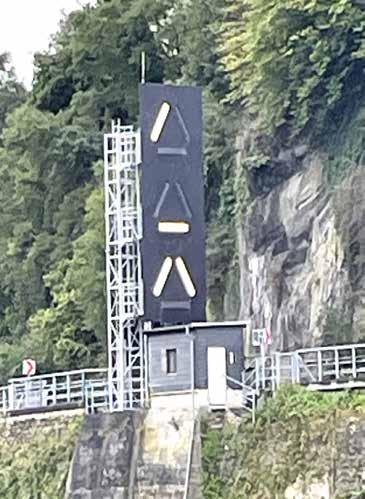
This took the form of a lighting system consisting of three distinctly arranged vertical triangles, with a light bar on each straight side.
Squeezed into Rüdesheim-am-Rhein yacht club
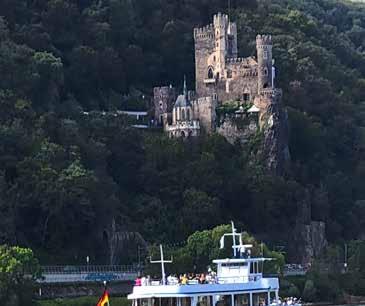
Rheinstein Castle at the start of the gorge
System of traffic management
Each triangle refers to one ‘reach’ (i.e. the upper, middle and lower sectors) of the ‘s’ curves of the river - an illuminated horizontal bar means there are no boats in the reach; left arm illumination means there is a down-bound boat; right arm illumination, an up-bound boat. All up-bound boats have to hold at the lower light until down-bound boats have cleared the entire stretch of river, and only then should they proceed. Sounds complicated, but it worked well and we were feeling almost ‘professional’ as we neared the end of the Gorge five hours later.
Our aim as we set off that morning was to stay in Koblenz for the night, but on phoning through we were informed that there was no space for us. A slight hiccup, so we just had to continue on until we found the smallish marina of the Motor Yacht Club, Neuwied, with an empty guest stage available. A nearby bar and restaurant was tempting, but it seemed that the long, tiring cruising days were beginning to take their toll and we all settled down for a quiet night to recharge our batteries.
Day 7
On to Cologne with a mixed bag of weather, still with lots of commercial traffic although this did ease towards the final stages of today’s six hour journey. We had a bit of a dogleg to enter the marina, only remembering just in time that there was a height restriction under the entrance bridge to the harbour and that our bimini was still in place on the stern. We rapidly dismantled it and left it lightly secured on the stern but as so often happens, a few seconds later a heavy rain squall with very high gusts of wind threatened to completely rip off the bimini, and I had to quickly bring the cover under control getting absolutely drenched in the process! All of this just moments from our mooring spot, but we made it and breathed a sigh of relief as ropes were tied up.
On the plus side, we had successfully completed yet another day on the Rhine, and we celebrated this in a restaurant only a short walk from the mooring (conveniently close to the Lindt museum where Rachel stocked up on much needed bags of Lindt chocolates).
Day 8
It was the last day for Janos and Rachel, who had worked so diligently with us over the past few days, and so the four of us made a foray into the centre to do ‘touristy things’ and have a bite to eat before their departure that afternoon. And here, we offer huge thanks to them both for everything they contributed to our Rhine adventure, they made it all so much easier for us, especially as Nicki was more or less out of action with broken ribs.
For Nicki and I, the following day was a period of reorganisation before our son, Alec, arrived around 2am because of flight delays, but despite the middle of the night bedtime, just a few hours later we were setting off towards Dusseldorf.
The Gorge
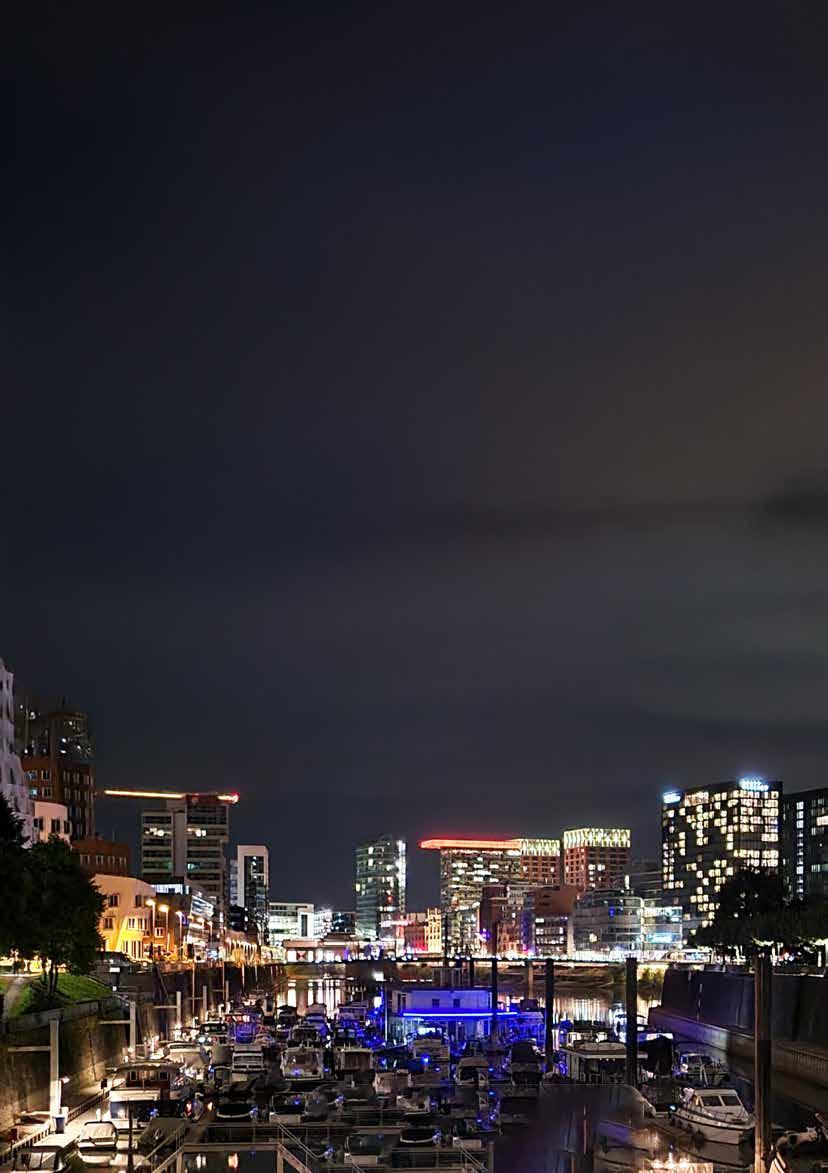
km 743 Dusseldorf
Day 10
To date, every day of our journey along the Rhine seemed very different and this was no exception. The river was again incredibly busy (does it never stop?) and at one point it seemed as if we were facing an upstream invasion fleet with constant Blue Boarding. The time seemed to evaporate as we constantly scanned the horizon and tracked the AIS images, until four plus hours later we arrived at Dusseldorf marina. We had already phoned and arranged a mooring here, and as we got closer, rang up for instructions as to where we should rope up, and with the help of a very friendly English-speaking harbour master, we slid into place. Despite only being there for the night we explored a few of the local sights, including an old telecoms tower looming over the marina (now largely devoted to restaurants) which boasts a light display down its full length apparently to denote the time from what appeared to be a random set of flashing lights.
Day 11
As the day dawned, we took our final cruise down the Rhine, setting off towards Duisburg on a much sunnier day, still with plenty of Blue Boarding commercial traffic despite all the twists and turns of the river. Eventually though we bade farewell to this mighty river and headed off along the Rhein-Herne and Dortmund-Ems canals on our way back to the Netherlands.
In summary, the major takeaways from the trip for me were:
1. Extra binoculars – a definite advantage.
2. AIS is essential, together with either a chart plotter or navigation software of choice. (Ours was PC-Navigo and it excelled, greatly assisted by its links to our AIS.)
3. A decent chart or guide.
4. Extra crew if possible.
5. There are many marinas along the route and most of them seemed happy to try and accommodate larger vessels, so always worth making contact in advance. (Indeed, our Rhine book identified plenty of potential marinas with contact details, and as we passed by we could see that many would have been OK for us.)
6. Deep bodies of water in the river generated a significant swell.
7. Good knowledge of Blue Boarding.
8. Two radios or a dual watch radio would be extremely useful.
And finally, what can I say about this adventure? Well, what a rush, an amazing experience and something that we are so pleased to have undertaken and achieved successfully. Definitely a journey to remember.
Dusseldorf at night
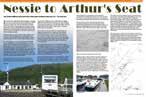
Nessie to Arthur's
Join Christine Walliman and partner Peter as they explore Scotland's waterways. Part 1 - The Great Glen.
In my research for appropriate poems and songs to accompany my story, I came across the line “My heart belongs to Scotland” I have lots of Scottish blood flowing through my veins but for reasons of history, love, and wars, I have never lived there; to be so near to places of my heritage it was tempting to wander off track. but we were travelling with friends and I decided that looking for my roots could wait for another visit. However, I did discover that most of my family since the 1800s were associated with the distilling of whisky!
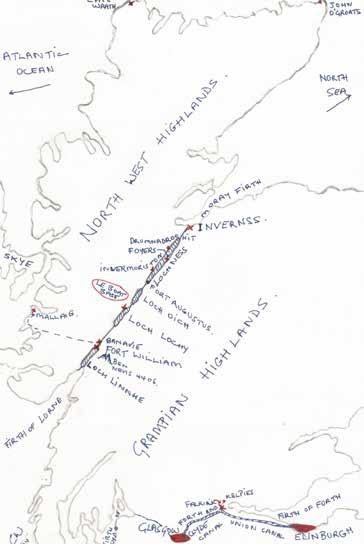
With our friends Steve and Angie, Peter and myself were at last to fulfil two years of planning a dream holiday taking in the Caledonian canal, the Falkirk Wheel and the Kelpies at Falkirk and for good measure, the Forth and Clyde and Union canals.
On 18th September, we drove from Gloucestershire to Moffat for our overnight stop. It is a charming old place, once a spa town known for its sulphurous waters and conveniently close to the M6. We ate at The Black Bull Inn established in 1568, it is the oldest inn in the area and steeped in history. We set off the following morning after a hearty breakfast, full of high spirits and ready for our adventure. The magnificent mountains with their rich autumn colours came into view, which really set us off in a good merry mood, singing “I'll take the high road”...at the top of our voices. We were on our way to take up our hire cruiser with Le Boat for a week on the Caledonian Canal.
We had reached the top of Glencoe when a red light on the dashboard came on. Not wanting to push our luck, we drove extra slow, past numerous road works. We turned off the main
road out of Fort William, crossed a bridge and took a bumpy single track several feet above the canal et voilà, in the middle of nowhere was the Le Boat base. “Thro pathways rough and muddy, a certain sign that makin roads, is no this people's study” from “On Rough Roads” by Robert Burns. Today, I guess he would have written a poem about potholes!
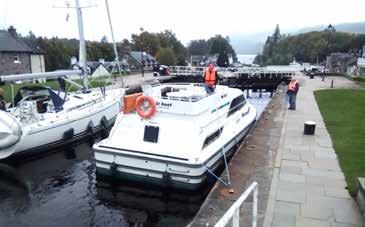
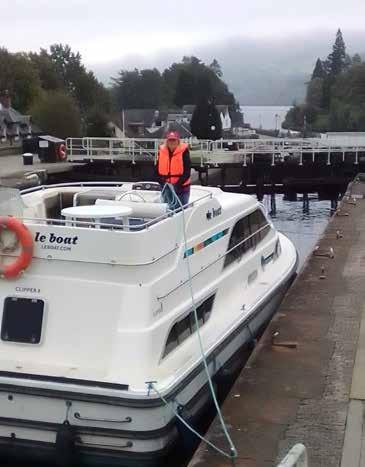
We arrived late at the Le Boat hire base at Spean Bridge near Laggan. Having checked in, we lugged our week’s shopping (including several boxes of wine we had brought over from France) and travel bags to our boat, a cruiser style Clipper 8, 11m x 3.90m. Two double cabins en-suite, one in the bow and the other in the stern suited us fine. The centre housed the galley, dining and seating area. The boat, I would say, was a little tired and of a certain age confirmed by the sign on the dashboard “Crown Blue Line”!
On closer inspection we noticed a lack of attention to detail... and equipped with barely the basics, no soap, one cleaning cloth, one bin bag, one pillow each, those little things that make all the difference to one’s easy living boat wise. A week before arrival, there are safety videos and reading matter that is compulsory reading including “wearing life jackets is obligatory at locks and anytime you're engaging with land” so we were surprised to find only 2 adult and 2 children's life jackets on board!
Once all was sorted and I have to say, the staff were very pleasant and eager to rectify the problems, we visited The Eagle Barge, bar and restaurant moored just below the lock. Full of character, built in 1926 (one year older than Amity!), it has quite a history,
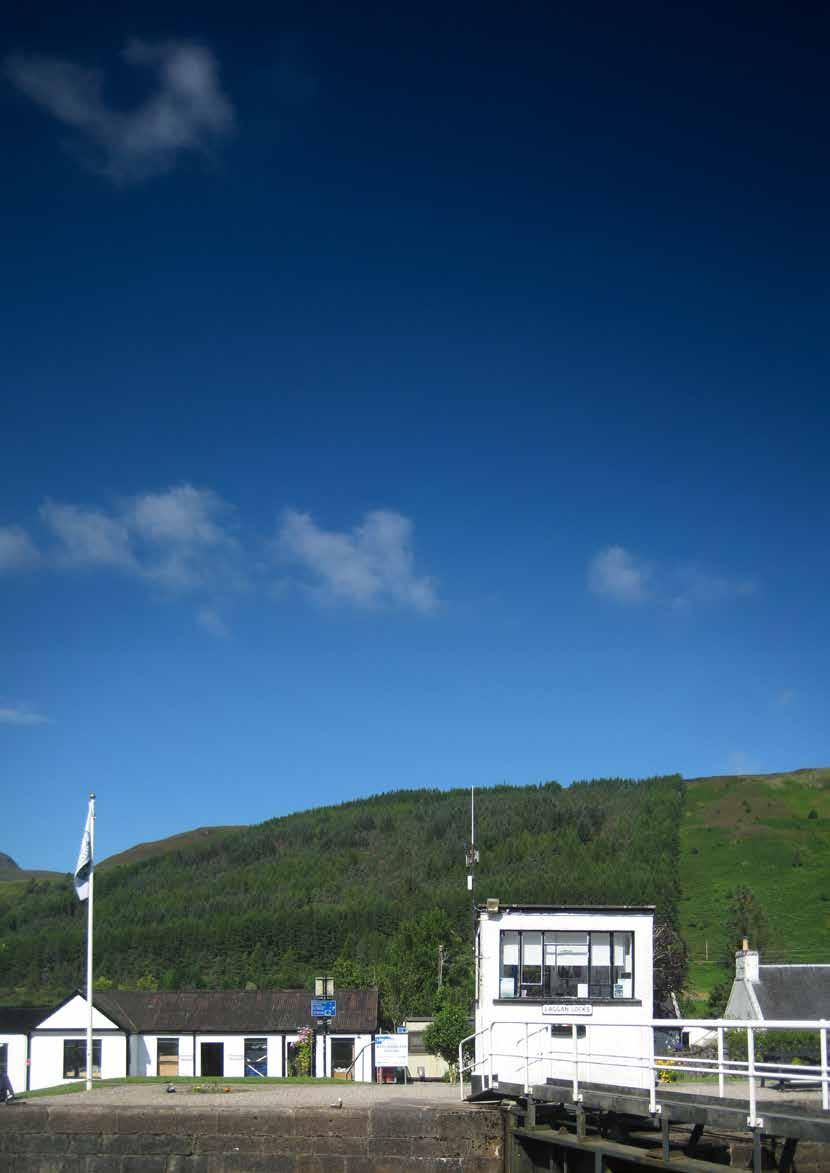
Laggan Locks
Arthur's Seat
built in Holland for transporting beet and during WW2, commissioned for transporting German troops. But how about this - it has crossed the Atlantic several times. A flat-bottomed vessel taking on the might of those waters and lives to tell the tale!
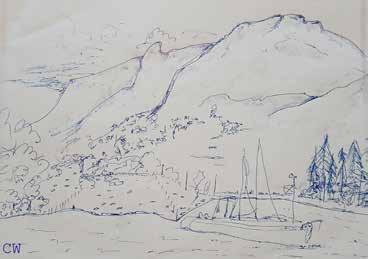
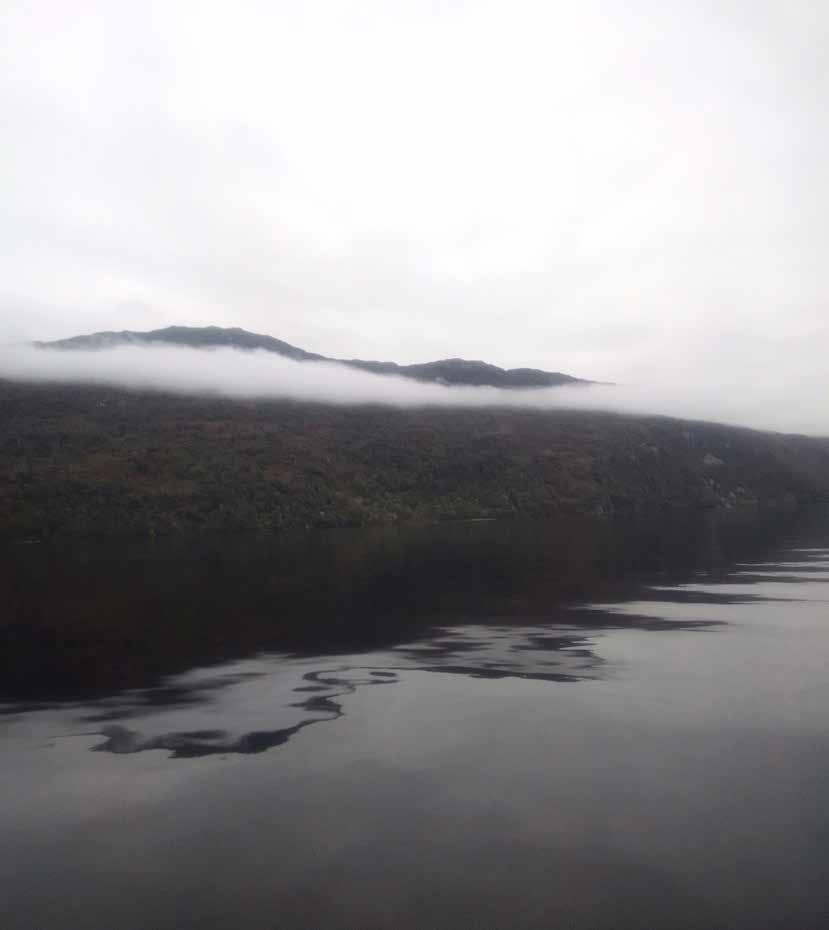
The morning mist and the clouds gradually lifted up the mountains revealing green and rust coloured trees. Sheep grazed in the pastures and here we were, miles from home in the gorgeous Scottish Highlands (see my pen sketch of our view). We study our maps. We are advised not to get too close to the banks of the canals or lochs as they are very rocky.
Leaving our base on the tiny Ceann Loch, which is approx. 1/3 of the way along the Caledonian Canal, direction Loch Ness. We pass through a series of channels and the smaller Loch Oich to Fort Augustus. En route we try to spot Ben Nevis, which was hopeless as every mountain that came into view was taller than the last! There has been a frenzy of logging on the hillsides, a bit of a blot on the landscape. The lock keepers are a helpful lot, bright and cheery as the mountain dew and full of stories as we tie up and make our passage through the locks. We decide to moor for the night above the 5 locks at Fort Augustus. A sensible decision as we can see “white horses” on Loch Ness in the distance.
We wander around Fort Augustus, cheek by jowl with tourists from all parts of the globe. By the swing bridge we came across The Clansman Centre. Walking past rows of tartanware, shortbread and fudge we find a “hidden” room dedicated to the history of the 200 hundred year old canal. The very northern part of Scotland appears to be sliced in two and indeed it is. The Great Glen fault, in geological terms, is a strike-slip fissure when millions of years ago the earth was a melting pot and undergoing massive movements, the fault line appeared, in fact it stretches all the way to Canada. Melting ice from the ice age caused displacement of earth and rocks deepening the fault into which water flowed.
The normal sea route across the top of Scotland was hazardous, with unpredictable weather, seas and pirates and a safer waterway avoiding the Pentland Firth and around Cape Wrath was planned. The 1800s was the century of the industrial revolution, fresh ideas and some brilliant engineers, and, not least, a ready supply of local labour. The first survey was undertaken by James Watt in 1773.
Fort Augustus Locks
Thomas Telford was commissioned to construct a series of canals and locks, linking the lochs from the sea at Loch Linnhe, the staircase of 8 locks at Banavie and Fort William in the South to Inverness in the North via 4 locks taking you onto the Moray Firth and the sea. It took 12 years to build at a cost of £910,000 and was completed in 1822. The statistics are a credit to all involved - 29 locks and 22 miles of man-made canals linking 38 miles of natural lochs. Unfortunately it was not without its problems and major reconstruction work was carried out between 1843-49. The locks and bridges were mechanised in the 1960's.
In 1873, Queen Victoria took a trip on a steamship along the canal. As we know, she loved all things Scottish and as a talented water colour artist probably memorised the same scenes as we are now.
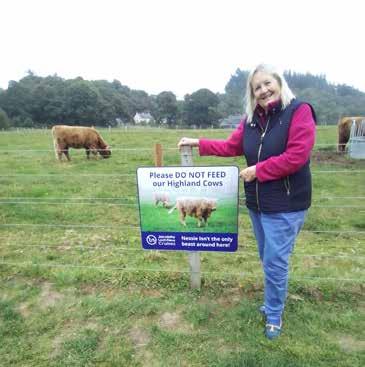
With our heads full of facts and figures, we pass 2 large leisure boats optimistically named “The Loch Ness Research Project” and “Nessie Hunter”. Judging by the vast selection of stuffed Nessies of all sizes in the gift shops, from now on, it was all about the so-called sea monster!
By now we are making our way along Loch Ness, there isn't a speed limit on the lochs (though 5 knots is max on the canals), we gather speed, past Invermoriston and Foyers. At 23 miles long, 1.7miles wide and at its deepest point, 230 metres deep, there is more water in Loch Ness than all the lakes in England and
Wales. We sat all day just gazing out of the windows, taking it all in. There is a sense of isolation with so few boats about, and joy being amongst stunningly beautiful wild scenery.
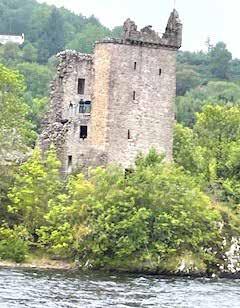
The Falls of Foyers are spectacular I believe. There is something rather magical watching and listening to the rush of water from a great height, 140ft in this case. But mooring on the privately owned quay is not allowed by Le Boat, all to do with safety when the wind blows from the North. Some of the inlets have moorings and by lunchtime we had pulled into Drumnadrochit, all boats moored stern on. On a spur, overlooking the bay and across Loch Ness, is the majestically positioned Urquhart Castle, now a ruin.
And as folklore determines, an excellent spot for capturing the monster on camera!
The mist still hovered over the tops of the mountains, the small harbour had a swell, rocking us about. Luckily none of us suffers from seasickness! We were tempted to take the bus into town and take a look at the Loch Ness Centre and Exhibition and/or make the long walk to the castle, instead we “upped anchor” and continued on towards Inverness before clouds descended onto the lock making visibility practically impossible.
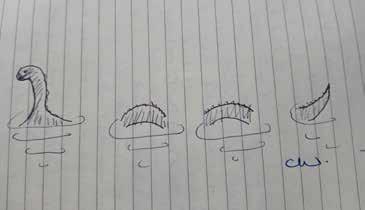
It's strange on this vast area of deep peaty water how affected we are by stories of underground caverns, big enough to provide a route out to sea for a very large fish type of thing.....what are we looking out for across the water?......ripples, undulating snake like curves gliding along, a beaver shaped head popping up above the water’s edge, piercing us with its beady sharp eyes. The mind boggles and then, with no other boat in sight, nor wind, that could create any kind of disturbance, I kid you not, our boat
Urquhart Castle
is tossed, enough for us all to take notice, by a long deep wash, huge ripples making us bounce about. We are still talking about the incident weeks later.....who knows what caused it? We try to laugh it off...but I know what we're thinking, are you?
It takes us five and a half hours to reach the end of Loch Ness at Lochend. We enter the long and narrow Loch Dochfour which leads to Inverness and the sea port at Clachnaharry. We asked the lock keeper for advice bearing in mind we wished to explore the centre of the city and replenish our food store. She advised us to moor above the two bridges rather than further down at Caley Cruisers “it's only a short walk”
It was a very long walk. And to be honest, I was disappointed. Inverness has been a Royal Burgh since 1153. The most prominent building is the castle which, judging by the scaffolding, is undergoing renovations. We climb a mountain of steps leading to the castle grounds, only to find the gates were locked. We didn't even get a peek of the panoramic views of Loch Ness, the Caledonian Canal, the Moray Firth and Chanonry Point. There were lots of people milling about and endless rows of shops selling, surprise.....kilts, tartan, you name it, it was there, for sale, as well as restaurants, tea and coffee shops.
One day I will return. I need a joining together of centuries of history and my roots. To discover more about the perilous
journey my mother’s ancestors made from Brora their homeland near Inverness to Australia in the mid 1800s. It is a hauntingly beautiful area and I have the sort of feeling of coming home.
I was intrigued as to why there are at least three Fort towns. It goes back to the time of frequent rebellions. Strategicallly situated bastions were essential to keep the “enemy” out, linked by roads and bridges, Forts Augustus, William and, nearby to Inverness, Fort George.
Our return was uneventful and by the time we took the concealed entrance into Fort Augustus, we could see the tops of the surrounding mountains.
Boats are hauled manually up the flight of locks, three on this occasion. Tourists lined every inch of the lock area, sometimes leaning dangerously over the lock’s edge with cameras on sticks, peering into our boat, ever eager for a better shot. I'm surprised the lock keeper allowed this behaviour as it's not easy juggling with ropes, bollards, steps and onlookers.
“You're lucky with the weather” said our jolly lock keeper “this is the best week since May” as I admired the pretty whitewashed lock side cottages. In the days before Scottish Waterways took control, British Waterways became cash strapped and decided to
sell off many of the keepers’ homes, (including our lock keeper’s grandfather’s) often at a knockdown prices. After the takeover there was a move to buy back the cottages, short lived as by then
of course the cottages were more expensive to purchase. We hope to make it to where we started at Loch Creann, then continue to the other end of the Caledonian canal at Banavie, achieving our aim of completing the whole canal. The weather
changes drastically, it is chucking it down with rain as we motor though the narrow Loch Oich and Loch Lochy (the 3rd deepest loch in Scotland) with excellent fishing, wild brown trout, rainbow trout and pike (Steve brought his fishing gear!) But, we came across very little wild life, a cormorant or two, the brilliant flash of a kingfisher, until we heard a deafening ear splitting sound from high up in the sky. Forming a V we saw hundreds of geese joining up to head South. Over the course of our holiday, we were to see huge numbers of migrating birds, either in the air or in fields, presumably taking a rest.
We pay attention to the signs “very shallow, keep out”, all well marked with red and green buoys. There are no places to moor, so we plough on. We reach Gairlochy top lock. As we enter the lock, I notice a couple of paddle boarders making for the shore. Their luggage is stuffed into waterproof bags resting beside their feet. That's brave, given the choppy water. Over the week we come across the hardy few - canoes, some strapped together, some with tiny sails, all loaded with their camping gear.
From late afternoon we put on the heating which works very well, huge blowers by your feet, so I guess that anyone out there at night must have a good supply of thermals. There are plenty of activities at Fort William. One can visit the Clan Cameron Museum, a former training centre for Commandos during WW2, you can take a gondola up Aonach Mor and experience breathtaking panoramic views of the Highlands and Ben Nevis. Mountain biking and paragliding is on offer too. But we carried on to Banavie, we wanted to say “we've done the lot!”
We are in for a surprise the following morning, our boat was covered in ice. I bought a local newspaper with a photo of Loch Lochy shrouded in mist and the headline “MINUS 3, has winter come early? Wake up to sub-zero autumn”. Adding, “the frosty conditions are a stark contrast to last week, when some areas enjoyed sizzling temperatures of nearly 26C”. Yes, we know! We moor above Neptune's Staircase, the famous Telford flight of 8 locks; it takes 90 mins. to negotiate the 65 ft. We are not encouraged by Le Boat to take the staircase and anyway, we were running out of time. We turned around and headed back to base.
My advice to anyone taking a hire boat on the Caledonian is to ask for an inventory before leaving the base. Apart from a couple of towns and remote villages, there is little chance to go shopping so stock up with food and drink beforehand. Frankly, it's not a cheap holiday so be prepared for the extras e.g. fuel/damage waiver/Scottish canal licence/breakages deposit. As lovely as the canal is, you may want to explore further afield so think of hiring a bike too.
Our car problems were always lurking in the background and had to be solved before we set off for our next boating destination starting in two days time. Would we be “roamin in the gloamin”..............or?
Look out for the next stage of Christine and Peter’s maritime tour of Scotland in a future edition of Blue Flag.
Fort Augustus Locks
DBA Website
IT Director Pete Milne provides the following update on the major and necessary changes to DBA’s website.
Over twelve years ago, Chris Grant converted the DBA website from a basic DIY site to a well-established package (Joomla) with 'plug-in' features like the Forum software we use. Most of the site remained hand-coded and supported by Chris, notably Membership management, the Waterways Guide and the Barge Register. I took on the Website Manager's role about that time to work with Chris - me looking after most of front end and Chris the technical stuff behind the scenes.
In recent years, updates to the Joomla package have required a significant amount of re-programming by Chris, taking much of his time to locate and correct problems arising from the upgrade. The updates were necessary to maintain support for the package and for some of the other 'plug-in' packages we already use (e.g. for Forum & Suppliers).
Last year Chris retired. In the absence of a volunteer with the right skills, in 2022 he & I selected a UK software company to take over his technical work. They reported that the cost of
supporting an existing system that was (in computer terms) so old, made it far more economic in the long term to replace it with a cheap, easily supported plug-in package.
The cost of implementing these changes has been substantial, but unavoidable now that we have to pay commercial rates for programming rather than relying on a volunteer. It is a major piece of work to rebuild parts of a complex website, and to futureproof it for years to come. The bulk of the replacement costs have already been incurred and funded from DBA’s reserves. Ongoing charges for maintenance of the website are already part of the DBA annual budget.
The work is nearing completion and will come into effect in the coming weeks, needing the site to be offline for a day or two. Changes that DBA Members will see will generally be cosmetic, as most are 'behind the scenes’.
Pete Milne, Director IT & Website.
Nieuwpoort
Use it or Lose it -The
Charlie Bevis with wife Maggie and dog Muffin join an early-season ANPEI Rally, on board their barge ‘Proper Job’.
Back in February 2024, we first heard of a plan by ANPEI to run a rally on the Bourgogne Canal to promote boating interest and traffic. It is a route we had considered in the past but were dissuaded by lurid stories of water shortages and weed.
I applied and was accepted as a ANPEI non-member. We left our base in Briare in mid-April and in dreadful weather headed south on the Canal Lateral a la Loire and the Canal du Centre to Chalon sur Saone. From there it was a short run up the river to the port at St Jean de Losne, the southern end of the Canal de Bourgogne.
The canal is a masterpiece of engineering built between 1795 and 1834 to connect the Northern waterways of the Seine and the River Yonne with the South via the Saone and the Rhone. In its day the canal served an embryonic iron industry and evidence of this exists at various locations along the route. The canal extends over 242 km and climbs via 76 locks from the south to the summit at Escommes where there is a 3.4km tunnel under the town of Pouilly en Auxois, before descending through 113 locks to Migennes and the River Yonne. The canal presently has a minimum depth of about 1.2 – 1.4 m and the maximum air draft is 3.1 m. Our boat ‘Proper Job’ is a Piper 57 and we have a draft of 0.9m, an air-draft of 2.95m and a ‘keel’ cooler; so we had no problems with draft, bridges or cooling issues.
The canal has an unenviable reputation for weed, but an early season passage in a year with plentiful rain gave us grounds for optimism that a transit was both possible and practical. Vessels with raw water cooling should pay close attention to their cooling filters as several biefs (pounds) are afflicted with substantial marine growth.
After refuelling at SJdL we commenced our transit on 15 May 2024. Thirteen locks in the first 20 km where we met up at Petit Ouges with friends on another Piper who we hadn’t seen for 3 years. At Dijon there were services available but the bourne near us was unserviceable and all other points were taken by long term residents or earlier arrivals. The biefs between the last two or three locks were heavily fouled with weed but although this slowed our progress there were no real issues. Sadly we saw little of the town itself as it was raining heavily during our stay.
Hotel boats were evident in the port and operate between Dijon and the summit at Escommes. North of Dijon the waterway wends its way north and then eastward, following the contours of the hills through some absolutely delightful countryside. With locks every kilometre or so, progress was slow and steady with opportunity for one of us to walk our dog between the locks. We passed another hotel barge at a stop I had previously earmarked as an overnight stop and continued so as to be well clear of him before he got underway the following day.
After cruising all day in clear water we then encountered heavy weed in the approach to Pont d’Ouche - whereafter it magically cleared. Pont d’Ouche is a pretty little port with services and a restaurant adjacent to the berths. One’s sense of direction is surely tested in this area as, in following the contours around the hills in the latter stages of this leg, at times we were actually heading due South!
Vandenesse-en Auxois was the location for the commencement of the ANPEI rally on a date that coincided with a fête run by local interests.
‘Proper Job’
Canal de Bourgogne
We arrived early and were joined prior to commencement by five ANPEI boats lead by their president (Anne Ackerman) ably assisted by Jean Marie Blather. In the evening the group was complete following the arrival of a 30m barge ‘Christina’ with her South African crew.
Unlike a DBA rally, this was a rolling event with a new venue each day. The sailing order was organised before departure with six boats sailing in three pairs followed by Christina. Apéro were organised each evening throughout the rally with meals cooked in an enormous pan by Jean Marie.
Day 3
The fleet moved up to Escommes (2.5km and the last 8 locks before the summit). Christina’s wheelhouse had to be partially dismantled to pass some bridges and fully dismantled to transit the Pouilly tunnel on day 4. With many hands to help, dismantling was achieved in fine style.
Day 4
The transit through the tunnel was a long drawn-out affair as only one boat is permitted to transit at a time; the following boat must wait at Escommes until the preceding boat arrives in the port of Pouilly at the northern end. Traffic is controlled by lights and barriers at each end. Each skipper is interviewed by VNF and inspected before departure; a certificate is completed and a portable VHF radio is handed to each boat and the wearing of lifejackets is compulsory.
The smaller boats completed their transit in 30 – 40 minutes. Christina, the fifth to transit, was in the dark for over 90 minutes, and it was 50 minutes before we re-emerged into the light when our turn came! Our dog Muffin was not impressed as the engine and bowthruster noise were amplified by the acoustics of the tunnel! However, the tunnel is in excellent condition and is intermittently lit and ventilated throughout its length.
Excursions were arranged from Pouilly, and a group meal on the quayside that evening closed off an eventful day.
The Barnstaple, water-colour on card, Allan Smith, 1912 (37.5cm x 28cm), author’s possession
The Rally assembles at Vandenesse-en-Auxois
One of many quayside meals ably prepared by Jean Marie
Pouilly Tunnel
Day 5
We commence the descent from Pouilly to Eguilly where the boats moored on pins at the canal side. An excursion to Chateau Soussey-sous-Brionne was arranged followed once again by aperos and food.
Day 6
Underway again for a 12.4 km passage but with only 2 locks to Pont Royal. Here in a very attractive setting the boats berthed with services. An organised coach trip and guided tour of Semur en Auxois was organised during the afternoon followed by a group evening meal at a quayside restaurant. Only the inclement weather spoiled what had otherwise been an excellent day.
The following day we were underway again with an 11.5 km passage to Marigny le Cahouet with 13 locks. Here we enjoyed a walk to view a local chateau followed by apéros and an excellent group meal prepared by Jean Marie with entertainment. Friday 31st May found the boats underway again bound for Pouillenay, 6.7 kms and 19 locks. An excursion and guided tour of Flavigny was run during the day followed by the inevitable apéros and a barbeque meal managed once again by the esteemed Jean Marie.
Day 9
A 6 km passage to Granges-sous-Grignon with 12 locks.
A guided tour of the grounds of Chateau d’Orain followed by apéros and a group barbeque. The ever adaptable Jean- Marie changed into his wet suit and cleared one propeller and inspected the six other boats. We waved goodbye to our new-found friends after day 10 at Granges-sous-Grignon. The rally had taken us through some beautiful scenery north of Pouilly as we descended through a total of 57 locks. We had to stay behind because of a hospital appointment in Paris meaning a two day stay at Tonnerre.
The rally was excellently organised and researched by Anne and the local ANPEI representatives including Roger Collins. The organised excursions provided experiences that would otherwise have been omitted. Below Tonnerre the frequency of locks reduced significantly as the waterway traversed the plains running down to the final port of Migennes. Refuelling was possible by visiting nearby supermarket fuel stations at Pouilly and Migennes.
As to the canal itself, it would be a tragedy if it or sections of it are closed to navigation. Hotel traffic on the southern end should ensure the survival of this part of the canal and, to be fair, this is the more picturesque section. Hire and hotel boats operate in the northern section at Venarey-les Laumes and Ancy-le Franc, but at present there is little through traffic. There are isolated sections affected by weed but we found this issue quite manageable. The propeller was cleared by occasionally reversing and we had no cooling problems. The depth of the canal was quite adequate thoughout. Lock chambers and gates are in generally good condition and the VNF staff were excellent being attentive, cooperative and considerate.
Closure of part of the Bourgogne route would quickly lead to uncontrolled growth of weed which would compromise navigation of the remaining sections, spoil the fishing and the tourist/cycling experience. Of course, the number of locks make this a slow passage but this is more than compensated for by the magnificent scenery, particularly south of Escommes. In our experience, weed was not an issue to preclude navigation - at present a commercial barge pulling a crane mounted drag helps to keep the waterway navigable. We have no hesitation in recommending this route.
Use it or lose it!
Charles will be gratified to see that there has already been a positive response to his concerns (see Klipperings)!
Aperos aboard ‘Christina’ courtesy of Murray & Olivia
bridge at Granges sous Grigon
Farewell apéros before the Rally dispersed
Barge life
Bio-Fenders
Winner of the 2024 James Dyson Design Award was industrial design postgraduate student Rehan Petit, for his development of a boat fender that cleans waterways by using embedded bioremediation agents in coconut coir to absorb and break down oil spills into harmless substances, enhancing water quality.
The Bio-Fender is a dual-purpose device designed to protect boats and clean waterways by breaking down oil pollution in water using natural processes. The Bio-Fender features a durable, water-resistant outer shell typical of boat fenders, but with a crucial innovation inside. It contains coconut coir, a natural fibre known for its high absorbency of oils and fats from water. Within this layer of coconut coir, there is a specialised pod that slowly releases bio-remediation agents—harmless micro-organisms that consume oil. When the fender comes into contact with oil from spills, the coconut coir captures it. The pod then gradually drips bio-remediation agents into the coconut coir, where they actively break down the absorbed oil into water and carbon dioxide, which are safe and non-polluting. This continuous cleansing process occurs automatically as the boat moves, requiring no manual intervention and effectively reducing water pollution while protecting the boat.
Thanks to DBA member Duncan Hart for alerting us to this interesting development.
Cost of ES-TRIN
There’s an interesting comparison of the costs of ES-TRIN renewals in various EU countries in the DBA Forum, under Waterways Continental Europe.
Is there a correct name for this?
“Back ebb”, “back flush”, “back eddy”, “translation wave”follow the erudite discussion on the Forum (Barge Life) as to the correct name for a shock wave phenomenom which can cause a boat to surge, lift and/or lose steerage.
Solar Panel Upgrade
Colin Stone installs new flexible solar panels on his barge ‘Kei’. In 2008 I bought 6 Unisolar PVL 68Wp, total 408Wp, thin solar panels and imported them from USA as UK supplies were intermittently available. I also got a simple Morningstar PWM controller with temperature compensation. The panels back then were pretty pricey at around $350 each, but helpfully the exchange rate was about $2:£1. I did manage to get it all VAT zero rated. These panels were amorphous silicon and not as efficient as monocrystalline cells, so a little larger. They are however quite good in cloudy and shady conditions. Dutch research indicated that their overall output over a year was in line with an 80Wp monocrystalline panel. They were wired 2 in series and 3 parallel, reflecting the input voltage requirement of the controller.
The panels were self-adhesive and easy to stick down after a little paint sanding and degreasing. I installed them on the wheelhouse roof where their thinness and light weight made them pretty unobtrusive. The output was sufficient to charge and cover our daily consumption May to September as long as high power electrical use was for short periods; I reckon that daily summer production is about 4 times the installed capacity. In winter they kept the domestic and engine batteries topped up. Consequently, our generator was only used for about 12 hours a summer – often on a Sunday morning to do a little charging, heat the 2 calorifiers by a 3kw immersion and engine coolant and most importantly heat the breakfast rolls. Solar power is ideal for the boost/absorption stages of battery charging after the bulk charging has been done by either engine alternators whilst underway or generator.
In 2017 I upgraded the PWM controller to an MPPT Epever Tracer 4215BN with both temperature and a remote panel. The panel connection changed to 3 in series and 2 parallel. The remote panel provides far more control of the charging regime. For example, in winter when KEI is unattended, I lower the absorption/boost/equalisation voltages to reduce water loss from the domestic flooded tubular cells. The controller also does a monthly equalisation charge on the 28th – so even February doesn’t miss out!
These panels have served us well since but a little more capacity would be really useful. The limitation was the area of wheelhouse roof available for more panels and I didn’t want to put panels on the coachroofs. However, newer panels were gradually getting more efficient and the size was reducing.
So this summer, somewhat in fear and trepidation, I took the plunge and bought 6 100w ETFE flexible panels from Aliexpress in France. Prices have dropped enormously- the panels were around €60 each. They arrived pretty promptly from WH DE Online Seller, Germany! The panels are 970 x 530 mm, very thin, lightweight and almost looked printed - ideal for the space left on the wheelhouse roof. I checked one on receipt and was relieved to see a healthy open circuit voltage over 21 volts.
I installed them connected 3 series 2 parallel to a second Epever Tracer 4215BN controller which would have accepted all 6 in series but recommended for best performance 3 in series on a 24v system. The controller again has a remote panel and battery temperature sensor, all from Bimble Solar. I used 6mm2 cabling for the panels to the controller and 35mm2 and 70mm2 for the controller to domestic battery connections. The sealed engine starter battery is connected to the domestic by a Smartbank and relay, so the connection/disconnection voltages can be adjusted for their slightly different charging regime. Amazon France provided 6mm solar panel cable and a connector/crimper kit. The connection plugs and sockets have changed out of all recognition since 2008 and now the locking is completely magpie and child proof to disconnect without a gadget.
The panels are simply secured onto the roof with a blob of CT1 adhesive/sealant on the backs and through the 6 eyelet holes. The new panels are 45% the area of current panels with 47% more output. If I ripped out the Unisolar panels, there would be space for 24 panels, which would be a respectable 2.4kwp but a little more than the capacity of the 2 controllers. After monitoring them all, the old Unisolar panels, amorphous silicon, are better in low grazing angle sun and cloud/shade but the ETFE monocrystalline silicon panels are streets ahead in full on sunshine. So a fair balance I think and now a total of 1008Wp. Overall, I am so far well impressed with them. I did also find 415Wp panels in a Brico for €99, but too large for the available space and would have added too much height and weight. 4 of the 100w ETFE panels are pretty much the same area.
After a year and a half of being Editor, I thought it was about time that I did some research into the start of Blue Flag, something I probably should have done earlier – in fact about a year and a half earlier. However, better late than never.
The first issue was in May 1992, and consisted of twelve pages. Even after all these years, it is still a good read, featuring articles on the Hollandse Ijssel and an in-depth (sorry) study of marine toilets. The first editor was Balliol Fowden, who is of course still an active member of DBA; three other members of the original Steering Committee (John Griffin, Carl Kirby-Turner and Paul Holland) are also still honorary members of DBA.
Balliol explained the nomenclature of the magazine in the following classic terms: “The adoption of this name for our journal could be taken to imply political motives, or just laziness, taking the easiest course through the current. In truth, having hastily converted a piece of blue rag into a flag for ‘Actief’ in 1984, “Blue Flag” seemed like a good name for this rag as well.”
DBA 2025 Calendar
Ian McCauley announces next year's calendar. It’s a testament to the diversity of our membership - with photos of:
• renovated old boats and new recreational vessels;
• barges and cruisers;
• boats cruising, moored wild and at town moorings;
• located in Belgium, Britain, France, Germany and the Netherlands;
• and owned by Americans, Australians, British, Dutch, Germans and Turks.
January
DBA Board Meeting
Monday 6th January at 19.00 hrs GMT; please email chair@barges.org to be included on the zoom link.
Zoom call for Members
Monday 13th January at 19.00 hrs GMT – check the Forum the week before for log-in details.
Dusseldorf Boat Show
The world’s largest yacht and motorsports show. Saturday 18th – Saturday 25th January.
All previous editions of the magazine can be found on the DBA website, in the Library section. Spend some time over the winter reading some of the tales of derring-do of our members over the past 30 + years. Talking of derring-do, this edition features some great journeys - Andy & Deborah on the last leg of their epic circumnavigation of the UK, Andrew & Nicki taking on the Rhine, and Lejla and family cruising the Frisian Islands before returning across the North Sea, plus Christine and Peter braving the mysterious depths of Loch Ness.
We’ve covered a wide geographic range in recent issues, but I wonder how many of our intrepid members have in recent years followed in the footsteps of Laurel and Bill Cooper in taking on the mighty Danube (you’ve seen some extracts in previous editions of Blue Flag from their book ‘Back Door to Byzantium’). I’d love to hear from anyone who has done so.
In the meantime, a very happy Christmas and New Year to all.
Andrew editor@barges.org
What a varied lot we are!
The cover is a photo from Judy Evans taken, of course, at Auxerre - across from an ex-member's barge. My thanks to Judy and to all those who made contributions - the calendar will certainly grace our wheelhouse next season and record, each day, where we are moored.
You can download a moderate-sized version suitable for personal printing on the DBA website under the Library menu item, where you will also find instructions for printing at home and using a professional print service.
February
Zoom call for Members
Monday 10th February at 19.00 hrs GMT – check the Forum the week before for log-in details.
March
DBA Annual General Meeting
Saturday 15th March at 20:00 hrs GMT - check the Forum the week before for log-in details. See www.barges.org/events for the latest info.
ABOUT DBA - THE BARGE ASSOCIATION
Aims and Benefits
Editor
Andrew Fells +44 (0)7766 113 013 editor@barges.org
DBA - The Barge Association, 'Cormorant', Spade Oak Reach, Cookham, Maidenhead, SL6 9RQ, United Kingdom
The Board
Mike Gibbons
Chair Editorial
Public Relations and Strategy Events
mike.gibbons@barges.org
+44 (0)7885 239 643
Tim Haines
tim.haines@barges.org +44 (0)7726 115 980
Sharon Hammond
Representation
Waterways Guide sharon.hammond@barges.org
Deborah Keir
Marketing & Membership deb.keir@barges.org
The aims of DBA are to promote interest in barging; be the representative body for noncommercial barging; be the premier source of barging information; establish contact with and influence other relevant clubs, societies, navigation authorities and trade associations; keep members informed on all barge related topics; facilitate communication between members to provide the opportunity for discussion of all aspects of barging.
Membership of DBA is open to anyone from anywhere in the world who is a barge owner, a barge dreamer or just interested in barges. Our club is around 1700 strong with members from all over the world cruising and living on their barges in the UK and in mainland Europe, sharing knowledge and information. Tap into a huge amount of accumulated knowledge and wisdom about barges and barging; become part of an international barging community; fast forward to find your barge and all the practical information you will need to fulfil your dream; know that your club is looking after your barging interests whether you just want to live quietly onboard up a backwater or plan to cruise the length and breadth of Europe; gain access to a database where cruising members share detailed information about good moorings both long and short-term.
DBA - The Barge Association is a not-for-profit organisation formed in 1992. The association relies entirely on the voluntary contributions of its management team and members. Volunteers represent the membership at both government and non-government levels within Europe.
DBA - The Barge Association
Our public Facebook page for finding out more about the Association. www.facebook.com/DBA.The.Barge.Association
DBA - The Barge Association Facebook Members’ Group
A closed group for subscribing members of DBA - The Barge Association. www.facebook.com/groups/abd.chat
Ian McCauley eNewsletter
Boat Register Booklist
ian.mccauley@barges.org +61 4 0302 4579
Pete Milne
IT, Website and Forum Waterways Guide Facebook Social Group pete.milne@barges.org
Scott Pereira
Heritage UK and EU
Port of London Authority (PLA) UK scott.pereira@barges.org +44 (0)7798 914 734
Jan Pieterse jan.pieterse@barges.org
Andy Soper Vice-Chair Treasurer Representation Lead Brexit Commercial
Non Tidal Thames Barge Buyers Handbook E-mail and telephone queries andy.soper@barges.org +44 (0)7940 598 364 treasurer@barges.org