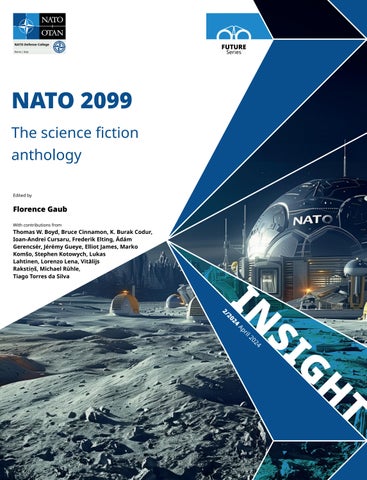

NATO 2099
The science fiction anthology
Edited by Florence GaubWith contributions from
Thomas W. Boyd, Bruce Cinnamon, K. Burak Codur, Ioan-Andrei Cursaru, Frederik Elting, Ádám Gerencsér, Jérémy Gueye, Elliot James, Marko Komšo, Stephen Kotowych, Lukas Lahtinen, Lorenzo Lena, Vitālijs Rakstiņš, Michael Rühle, Tiago Torres da Silva
2/2024April2024
INSIGHT
Rome | Italy NATO Defense College T M A T
The NATO Defense College was established in 1951 in Paris based on General Dwight D. Eisenhower’s suggestion that the Alliance needed an institution that could “develop individuals both on the military and on the civilian side who will have a thorough grasp of the many complicated factors which are involved in creating an adequate defense posture for the North Atlantic Treaty Area.” In 1967, it moved to Rome, where it has been located since.
NATO Defense College – Insight
Series editor: Florence Gaub
Copy-editing: Mary Di Martino
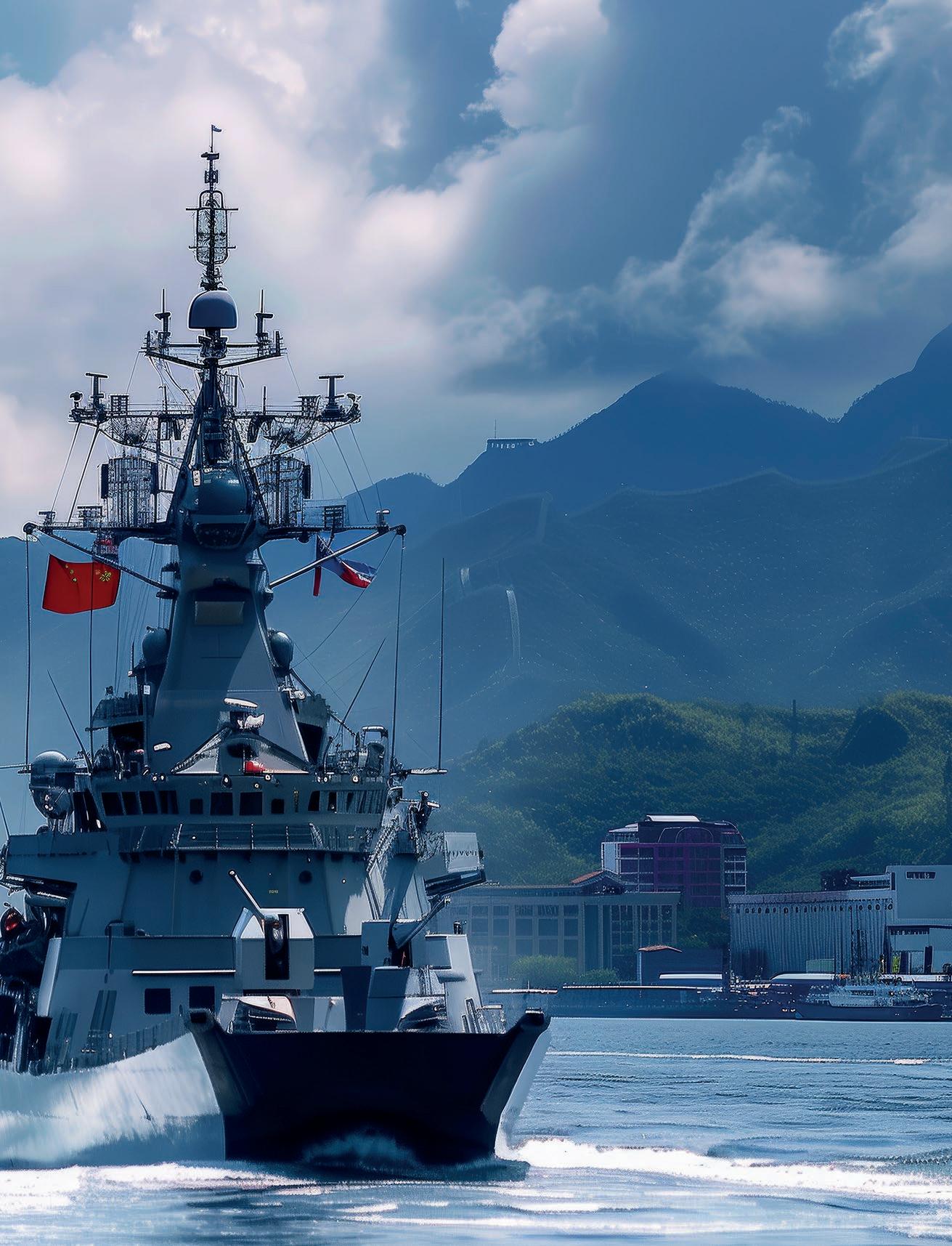
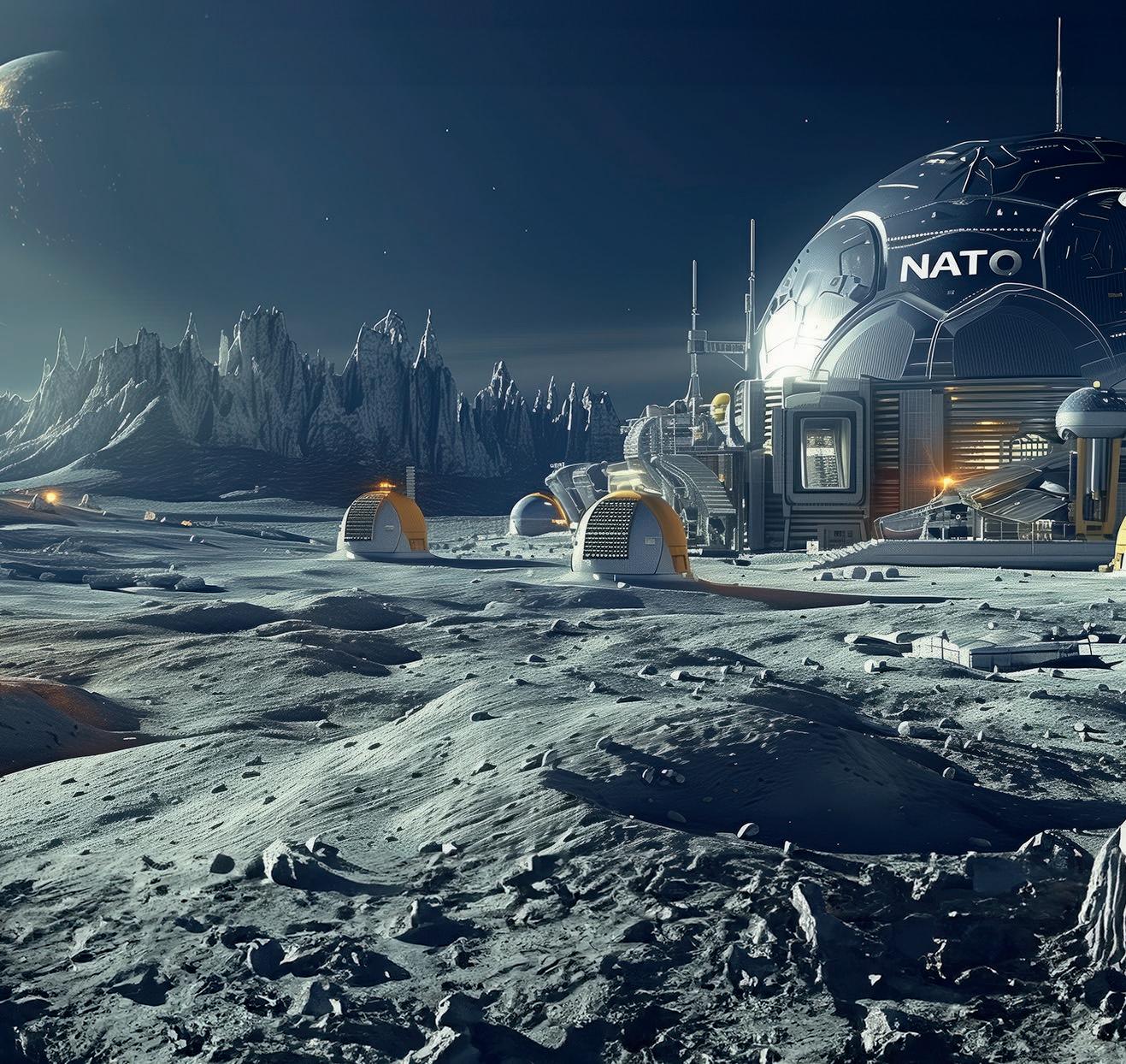
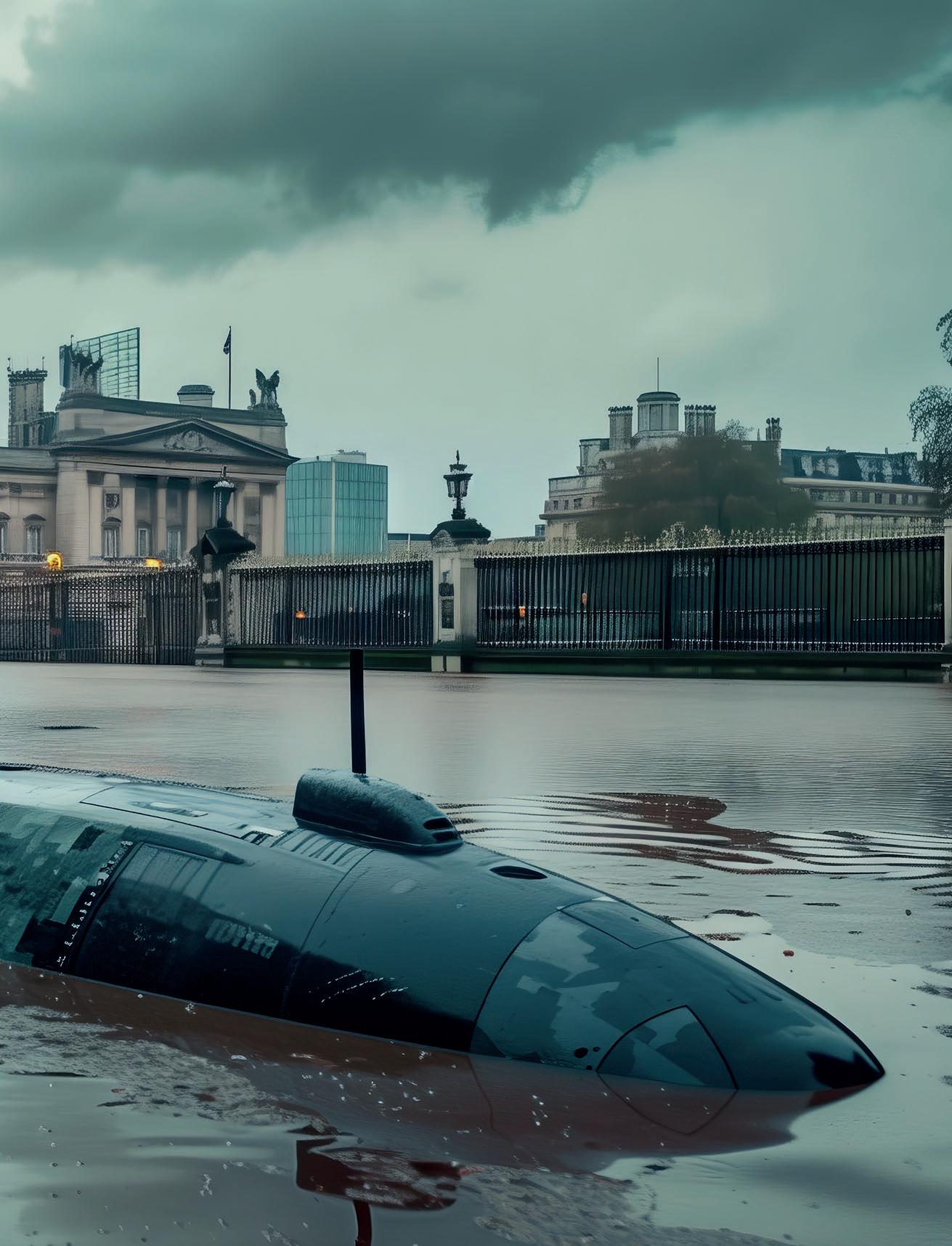
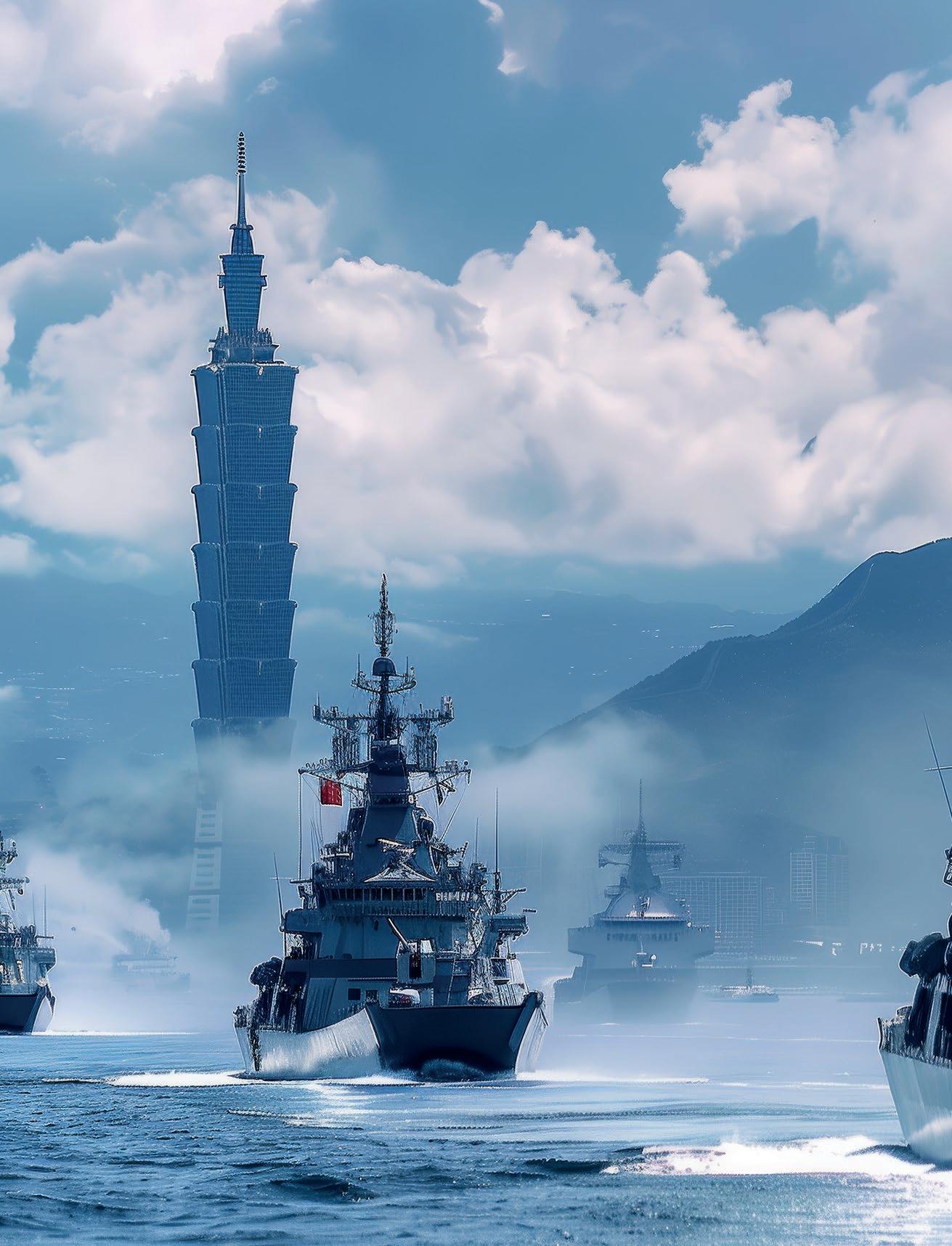
This cover and all the images were designed by Andreas Loff using different Artificial Intelligence programmes.
The editor and authors are grateful to Katja Elisabeth Herrmann Eufracio for her help and support throughout the realization of this project.
Insight 2/2024
The Future Series
Nota Bene:
The views expressed in this NDC Insight are the responsibility of the author(s) and do not necessarily reflect the opinions of the NATO Defense College, the North Atlantic Treaty Organization, or any of the institutions represented by the contributor(s).
ISSN: 3006-5380 (print)
ISSN: 3006-5399 (online)
The NATO Defense College applies the Creative Common Licence “Attribution-NonCommercialNoDerivs” (CC-BY-NC-ND).
Limited copies of this NDC publication are available and may be obtained directly from
NATO Defense College, Research Division, Via Giorgio Pelosi 1, 00143
Rome, Italy
m.dimartino@ndc.nato.int
Printed and bound by lightskyconsulting.com
Ioan-Andrei Cursaru (Romania)
Contents NATO and science fiction: a foreword . . . . . . . . . . . . . 8 Florence Gaub 1 . . . . . . . . . . . . . . . . . 11 The North Atlantic Federation Elliot James (United Kingdom) 2 . . . . . . . . . . . . . . . . . 15 Cosmic NATO Marko Komšo
3 17 Jade Rabbit
4 . . . . . . . . . . . . . . . . . 21 Challenge coin Stephen Kotowych (Canada) 5 . . . . . . . . . . . . . . . . . 26 A day in the life of the Secretary General Michael Rühle
NATO staff member) 6 . . . . . . . . . . . . . . . . . 30 The silent war Tiago Torres da Silva (Portugal) 7 . . . . . . . . . . . . . . . . . 33 A message home Lukas Lahtinen (Sweden) 8 . . . . . . . . . . . . . . . . . 36 An Alliance-day ode to our human friends Ádám Gerencsér (Hungary/Belgium) 9 . . . . . . . . . . . . . . . . . 40 We have work to do Lorenzo Lena (Italy) 10 . . . . . . . . . . . . . . . . 42 Raising our glass Thomas W. Boyd (United States) 11 45 A hard decision Vitālijs Rakstiņš
12 . . . . . . . . . . . . . . . . 47 The Canadian shield Bruce Cinnamon (NATO staff member) 13 . . . . . . . . . . . . . . . . 52 Sorry, no names K. Burak Codur
14 56 To turn a battleship Frederik Elting (Germany) 15 . . . . . . . . . . . . . . . . 60 Kyiv Summit 2099
(Croatia)
Jérémy Gueye (France)
(former
(Latvia)
(Türkiye)
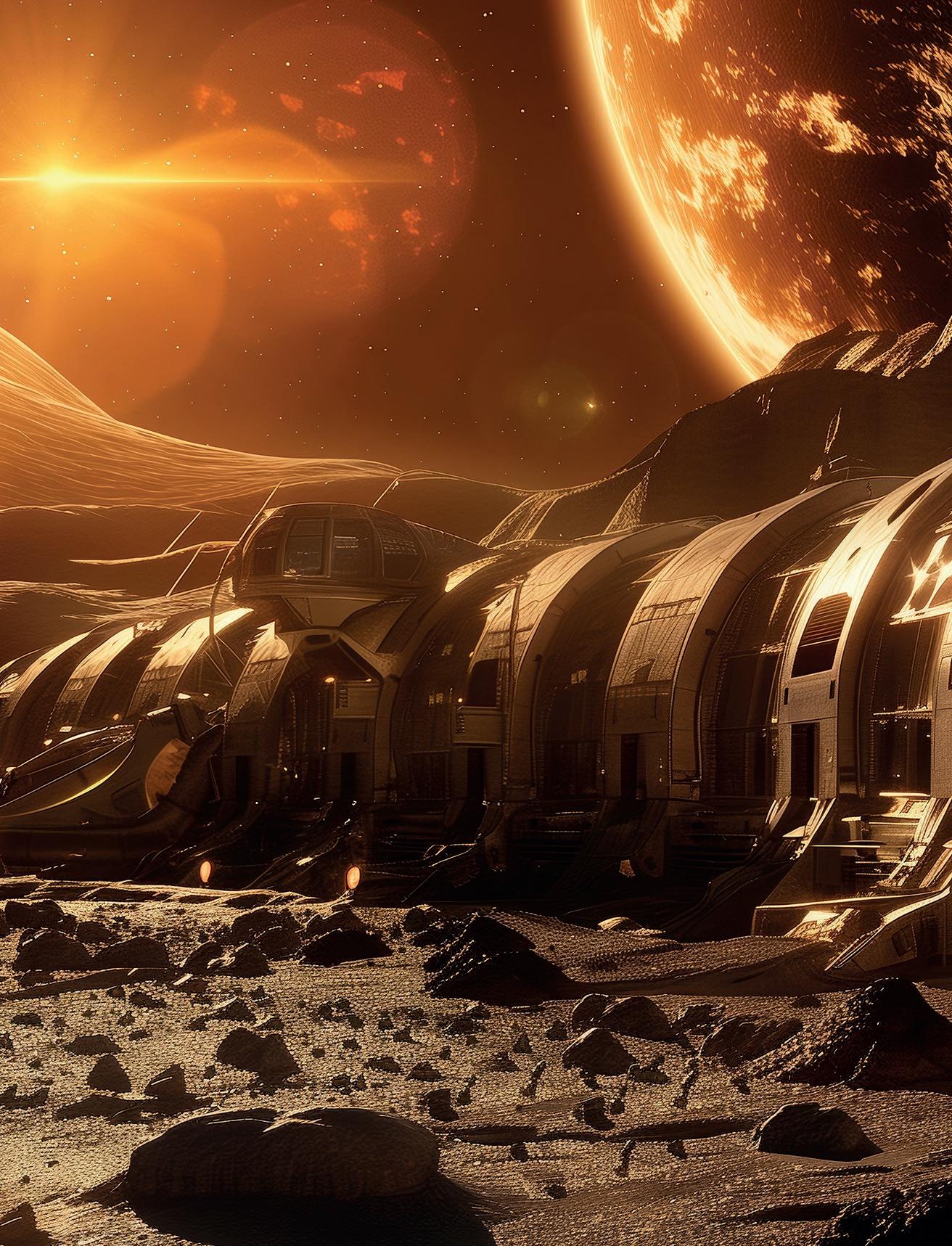
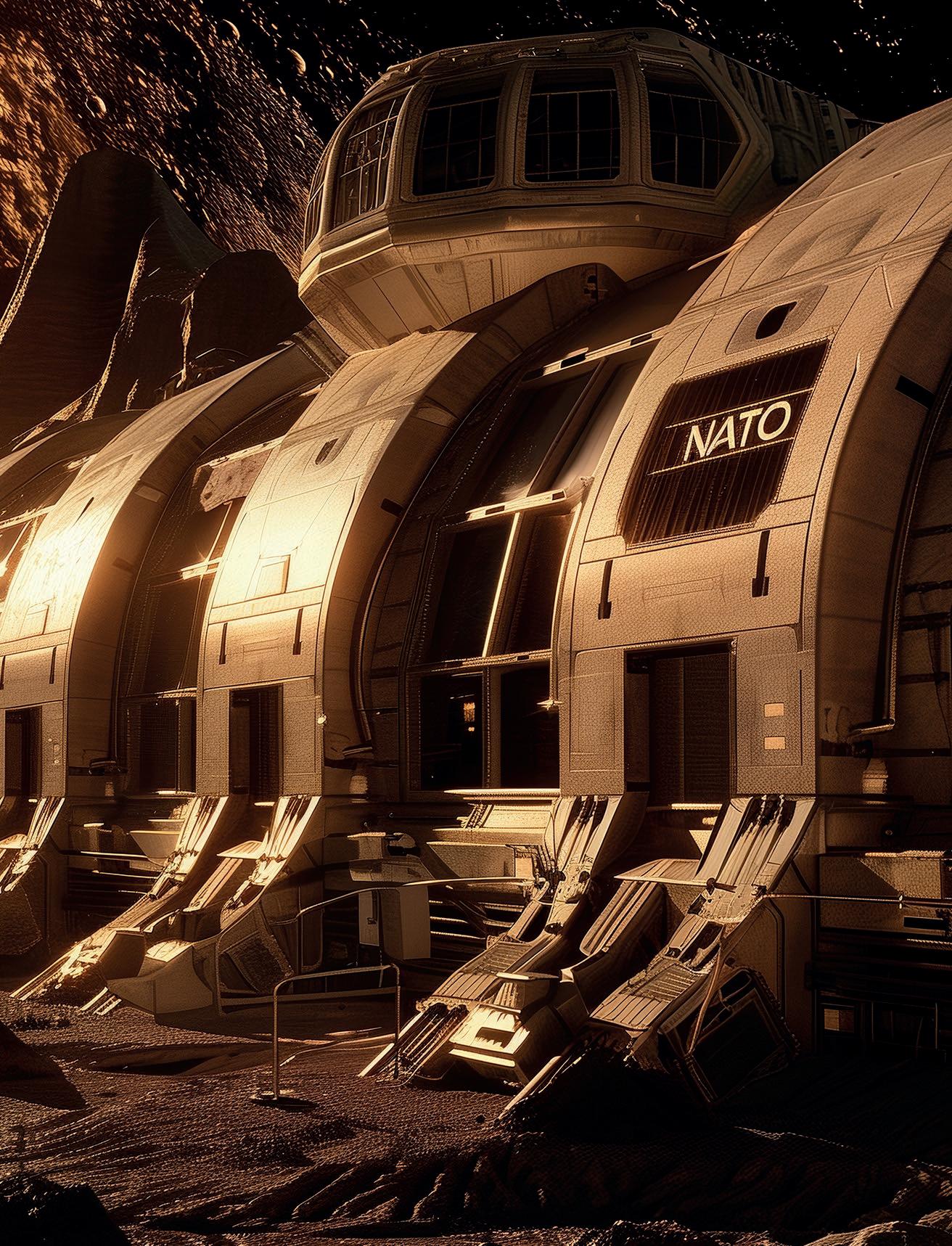
NATO & science fiction: a foreword
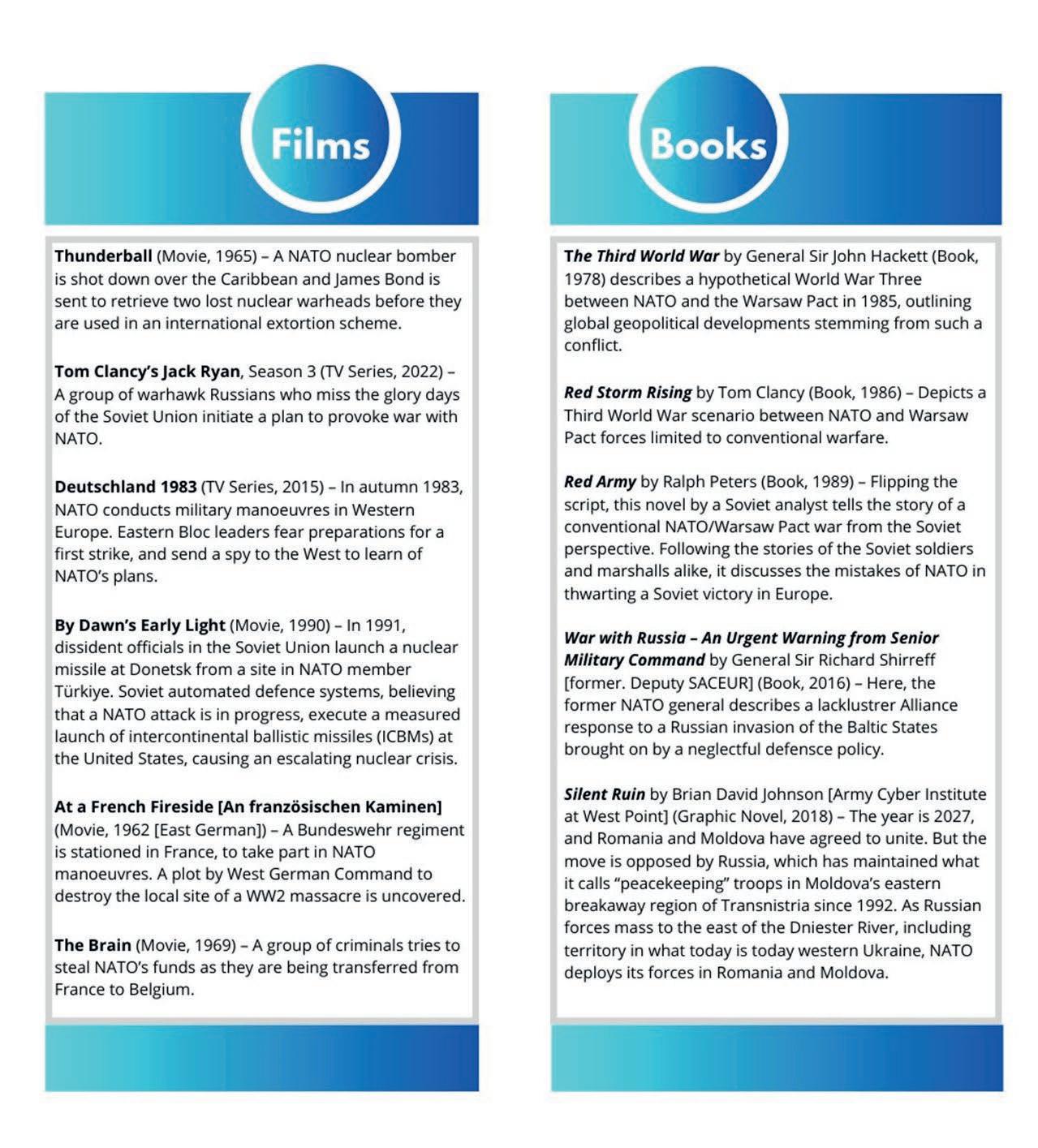
Florence GaubNATO is a fundamentally future-oriented organization: the entire North Atlantic Treaty is written in the future tense. The word “will” appears ten times, the word “shall” even fifteen times. And yet, it features very little in the genre that is dedicated to all things future, science fiction. In the 75 years since its inception, the Alliance has appeared in just six films and five books, with most of these not even strictly science fiction. To some, this does not matter: they equate science fiction with fantasy, a realm of the impossible. But to others, it does: science fiction has a knack for detecting trends, imagining the rare, extrapolating consequences, and sparking important debates about what is to come.
It is precisely this quality that makes science fiction useful for security and defence purposes. In part, this is because science fiction often focuses on technology, projecting innovations such as sliding doors, mobile phones and tablets (Star Trek 1966 - 1969), Virtual Reality (The Matrix 1999), and space travel (Francis Godwin, Cyrano de Bergerac, Johannes Kepler in the 17th century). But it also asks moral questions about the implications of these innovations, such as Mary Shelley’s Frankenstein (1818), Isaac Azimov’s I, Robot (1950) or Aldous Huxley’s Brave New World (1931). Science fiction can also have a warning effect, highlighting were things might go wrong in the political sense, whether it is 1984 warning
of a totalitarian society or Snow Crash (1992) showcasing the effects of excess capitalism on democracy.
For military purposes, science fiction can imagine conflicts precisely in order to prevent or mitigate them. Since the late 19th century, authors have used this genre to anticipate and prepare for conflicts to come, with George Chesney’s The Battle of Dorking (1871) being one of the first of this kind, describing an invasion of Britain by a German-speaking country, including the destruction of the Royal Navy by a futuristic wonder-weapon (“fatal engines”). H.G. Wells’s The Land Ironclads (1903) in turn featured tank-like armoured fighting vehicles.1 It is for this reason that science fiction has been used repeatedly by military organizations. In the 1980s, US President Ronald Reagan’s Strategic Defense Initiative was influenced by science fiction material, and Ghost Fleet (2015) was said by then SACEUR Admiral James Stavridis to be “a startling blueprint for the wars of the future and therefore needs to be read now!” But the military has not just used existing science fiction, but also used the genre to develop its own thinking, be it in the United States –such as the US Army TRADOC Mad Scientist Initiative which produced Science Fiction: Visioning the Future of Warfare 2030-2050 (2016) – or in France, where the project La Red Team hires science fiction authors to imagine what future opponents might think and do.2 Similar initiatives are also underway in the United Kingdom and Germany.
1 Lawrence Freedman, The Future of War: A History, (2018).
2 Red Team Defense, https://redteamdefense.org/saison-0/les-nouveaux-pirates
Of course, imagining the future of NATO is a much bigger task than solely imagining the future of conflict, and perhaps this explains why the Alliance features little in regular science fiction. While NATO might be about defence, it is first and foremost a political enterprise, a promise for the future. Envisioning what challenges it will face and overcome, how it will adapt to a changing political, technological and even physical environment and maintain unity makes for a much bigger task than coming up with a new weapon that could change everything. And this is precisely what we asked the authors in this volume to do 75 years after NATO was born: imagine what it will look like 75 years from now, in 2099.
8 NATO 2099 The science fiction anthology NATO & science fiction: a foreword
9 NATO 2099 The science fiction anthology

The North Atlantic Federation
Elliot JamesLieutenant Aria Mitchell gazed out, her reflection in the window overlaying the shimmering stars beyond. The Earth, fast shrinking in their approach to Luna Prime, shone with a blue-green hue through the dimmed atmospheric lights of the cabin, and the Harmony, a state-of-the-art Federation shuttle sleek and powered by advanced ion propulsion, hummed as it pulled away from the heavy gravitational pull of the planet below.
Beside her, Dr Anatoly Kuznetsov idly flicked through digital archives, his fingers delicately weaving through decades of treaties, confrontations and decision-logic history, the holographic images dancing around him like ghosts from the past. Opposite them sat Colonel Jaxon, Chief of Cybernetic Strategy, a man with a strong and angular frame woven with technology. His ocular implants, a shade of phosphorescent blue, washed faintly with flows of data and tiny nodes at his temples pulsed, a subtle sign of the neural interface that rested beneath his skull. The silence was filled with a sense of purpose and tension, the shuttle’s soft vibrations providing a rhythmic backdrop for the strategizing onboard.
“Given the recent cyber skirmishes, these negotiations have taken on added weight,” said Jaxon, rising from his chair with a voice that carried a digital resonance. “It’s more than just an asteroid. Its mineral composition is essential for our future space operations and securing supply for the next phase of data centres, particularly if we are to make up for the losses of recent network damage. It also happens to be floating in one of the most disputed areas of near-space. The stakes are immense, though we need as much as we can get – we’re setting a precedent here.”
Dr Kuznetsov, reaching for the synth-tea perched on the table in front of him, nodded. “Indeed. Astra is a focal point, for now, but it’s merely a symptom of larger issues. I agree that we must establish a framework for the location and control of future space assets that is strongly aligned with NAF directionality, though we must be subtle in pushing this and keep in mind the longer-term play.” Taking a sip, he continued: “These skirmishes have come dangerously close to kinetic confrontation and we need clear boundaries to avoid this escalation. Regardless of what we come away with, this is the one thing we cannot afford.” He switched off the archive populating his vision and diverted his full attention to Jaxon. “Colonel, let’s have a look at the digiboard, shall we?”
“Of course,” replied Jaxon, his implants throbbing a muted orange as he brought up a simulated view of the asteroid, Astra, a grey mineral mass with awkward geometry that filled the room. Aria turned and watched intently as each stream of data fed in new layers of information; she expanded a section. “The cyber-skirmishes exposed vulnerabilities that must quickly be fortified and made resilient,” she reflected, her voice steady yet imbued with concern. “We pride ourselves on our digital sophistication and security and yet we were susceptible nonetheless.”
“How did we not anticipate these attacks?” As a seasoned diplomat, she had seen her fair share of tense negotiations, but this one felt particularly personal. She had been in a strategic meeting when the initial attack released like an avalanche, witnessing first-hand the havoc it wreaked as it cascaded across NAF systems. Years of work, critical infrastructure networks and swathes of redundancies wiped out in a few hours; navigational errors, economic disruptions, implosions of AI networks and even glitches in climate restoration systems. One domino set off a pathway of vulnerabilities that ran from one end of the North Atlantic Federation to the other. She remembered the scene of panic, hours of uncertainty, memories dragged up of a childhood scarred by deprivation and hardship. The subsequent realization that they had been deceived by sophisticated malware from a source deep in the Pan-Asian Confederation lingered heavily in her thoughts.
11 NATO 2099 The science fiction anthology 1 The North Atlantic Federation
1
Kuznetsov leaned forward, his eyes narrowing. “A lack of imagination I suppose, though you’re right. That skirmish was an ugly chess game played on a fast-evolving digital board, and the next moves are vital. The PAC’s initial breach, injecting malware that led us on that wild-goose chase, was a move that cost us dearly and gave them a foothold with Astra, but it hasn’t tipped the scales entirely. No resources have been extracted, and we still hold key economic and diplomatic cards to play, should we need them.”
Aria, ruminating silently, gave a decisive nod. “Let’s dive in. We need to nail this.” She gestured at the display and spoke aloud to the ship: “Harmony, prepare the Negotiation Sim.”
A serene female voice filled with a rich self-assuredness returned from the corners of the room, “Yes, Colonel. Do you need a briefing on the programme?”
“No, just the simulation,” replied Aria swiftly. Still sat to the side, a pensive look grew on Kuznetsov’s face, the scrunching of eyebrows followed by a deep sigh that turned into a wry smile. “It’s funny, isn’t it, the great Achilles heel of our species. Generally, we’ve tackled external problems remarkably well, particularly in recent years, but managing our own competitive nature? That’s the real challenge.” Aria and Jaxon shared a knowing look, and Harmony, mishearing Aria’s response, started the overview. Jaxon, half-amused, half-frustrated, protested in the direction of his team, muttering something about the lack of a pause button. They met him with shrugs.
“Good evening Lieutenant Mitchell, Dr Kuznetsov, and Colonel Jaxon. As we approach Luna Prime, it is pertinent to revisit the mission overview.” Holography swirled across the centre of the room as images came to life. “Your primary objectives are to negotiate the terms of control, access, and management of asteroid Astra, initiate discussions on shared data centres orbiting Earth and Luna Prime, and agree a near-term end to all cyber escalation. The significance of Astra lies in its rich deposits of rare minerals essential for the development of near-future geostrategic technologies. As it currently resides in contested territory between the orbits of Mars and Jupiter, this has made it a point of contention between the NAF and the PAC.” The images faded and a timeline spread across the room as the encompassing female voice narrated the topology of recent history; a whistle-stop tour of the dynamics, drivers and dispositions that had created the present circumstance. To the surprise of Kuznetsov in particular, still not entirely convinced of the superiority of assistive intelligence over his own, the run-through managed to cover a lot in little time.
The cyber-physical warfare of the late 2020s, a turbulent period that led to the rise of supra-regional entities in the 2030s. The following decade of regional consolidation, accompanied by a renewed external focus on critical transregional issues spurring the rebuilding of infrastructures and the evolution of governance, institu-
tions, cultures and economies. Aria’s gaze was fixed on the visual display of enormous solar reflectors orbiting Earth, the statistics of ecosystem restoration and population resettlement initiatives barely revealing the profound feeling of being there on the ground, as she had, witnessing the birth of new cities elevated above the rising seas, or the cultivation of agricultural hubs amid the desolation of once-barren lands.
Harmony then shifted onto the convergence of new foundational technologies, particularly in quantum computing and synthetic biology, integrated through a network of organisational AIs and data centres that touched every industry and reshaped the fabric of human life.
Developments which transitioned space travel and colonization from lofty aspirations to tangible realities, and intensified the race to establish off-world human settlements and mining operations, driven by technological needs and the pursuit of progress.
As Harmony briskly flicked through these chapters of recent history, Aria reflected on her own. It was then, during those years, that she had emerged as a sharp forward-thinker through NAF military ranks, her Double Major in International Relations and Astrophysics touching her mind with an idealistic disposition, one that believed in resolution through alignment with greater, higher goals. A great fit to lead this encounter with the PAC. For between the PAC and the NAF, despite decades of delicate collaboration, competition persisted, and in a world populated and made sense of as much through bits as atoms, the construction of advanced data centres had become a pivotal geostrategic tension. Their material requirements necessitated heavy investment in asteroid mining, a path that reached a turning point when Astra was discovered and overlapping interests swung into direct contradiction, setting in motion the events that led to their critical mission.
The display shifted to a detailed network map of the North Atlantic Federation. “Five months ago, the PAC launched a sophisticated malware attack designed to misdirect the NAF’s understanding of Astra’s location.”
The map lit up on various points, indicating the malware’s infiltration path. “The malware was not only a tool of misdirection, however, but also embedded vulnerabilities within our Critical Information Infrastructure. This twofold strategy was successful in diverting attention and resources away from Astra, and weakening our defence capabilities, making us more susceptible to cyber-physical incursions,” Harmony explained. “In the discovery of the malware and our retaliatory cyber-exchange, the PAC exploited these vulnerabilities in a series of disruptive attacks.” The map showed the cascading effect like a red wave washing across the Federation.
Harmony’s voice faded as the overview came to a close, finishing with succinct bios of the PAC representatives present on Luna Prime, and reiterating the primary objectives. Aria looked around the cabin and out to the stars, watching the Earth shimmer like a cerulean dot. She sensed the weight of history as a profound respon-
12 NATO 2099 The science fiction anthology 1 The North Atlantic Federation
sibility, a gravity in her mind jostling alongside more subtle calls of what might come next. A constellation of possibilities waiting to be shaped by the energy of their decisions; an imperative to navigate wisely among the branching paths ahead.
With a deep breath, she addressed her companions and the ship. “We have two hours. Harmony, run the Negotiation Sim.”
The space around them transformed as the command was acknowledged, holographic projections creating a near-perfect replica of the Luna Prime negotiation room. Opposite Aria, Dr Kuznetsov, and Colonel Jaxon, avatars of the PAC representatives materialized, poised for practice dialogue. Aria glanced at her team: “Let’s treat this like the real thing. We need to be prepared for every scenario.”
13 NATO 2099 The science fiction anthology 1 The North Atlantic Federation
2
Cosmic NATO
Marko KomšoIn the year 2099, marking NATO’s 150th anniversary, the world has borne witness to an extraordinary transformation, a testament to the unity of humanity and their extra-terrestrial allies in the protection of Earth against cosmic threads. NATO in 2099 has undergone a profound transformation in terms of both membership and mission. It now includes representatives from Earth’s nations and extra-terrestrial civilizations, who have become invaluable partners in the fight against space-borne threats and threats that come from the oceans and rivers. NATO’s mission has expanded to encompass the protection of Earth not only from terrestrial conflicts, but also from cosmic dangers such as comets and falling stars, and deadly radiation from the ocean.
The Organization emerged as a key mediator in resolving multi-galactic disputes, preventing large-scale conflicts in space and on Earth, and countering cyber telepathic threats in a world growing ever more interconnected. It achieved notable successes, including establishing a worldwide, coordinated response to pandemics resulting from radiation from space waves or ocean salinity, and crafting a sustainable energy infrastructure entirely devoid of fossil fuels, reliant instead on the power of radioactive rays and energy from air and the moon shining. However, NATO was not without its setbacks, as it grappled with its inability to avert specific humanitarian crises underwater, and confronted the moral quandaries stemming from the deployment of telepathic weaponry that is being used underwater and in space, hurting people and animals without knowing how to stop.
In 2099, the nature of warfare faces a dramatic metamorphosis. Traditional battlefields have become obsolete, giving rise to new challenges on cosmic and aquatic frontiers. Humanity, alongside their extra-terrestrial partners, confronts not only the unpredictable threat of comets and meteor showers from the cosmos but also the underwater wars stemming from radiation from our over-salted
oceans and the emergence of noxious gases. The deployment of telepathic weaponry, a collaborative achievement of human and extra-terrestrial technology, serves as the cornerstone of instantaneous communication and strategic coordination to combat these multifaceted threats.
The price of conflict has transitioned from human casualties to the moral and psychological burden of telepathic warfare. Although the outcomes are more exact and less physically devastating, the penetration into the human psyche raises fresh concerns about the consequences. Fusion energy has replaced fossil fuels, providing clean and abundant power for everybody without any charge. Big oil companies transitioned into food companies under the threat of bankruptcy. That helped to end hunger worldwide. Biotechnology has extended human lifespans and improved overall health.
The global community has grown more interconnected and harmonious, as the once-relevant geopolitical borders have faded into insignificance due to the shared cosmic and aquatic threats, as well as the effects of telepathic warfare.
Over the past 75 years, NATO has gleaned a vital lesson in the paramount significance of unity and cooperation. It has realized the essentiality of tackling worldwide challenges in a holistic manner, which has been driven by the need to fend off threats from both the depths of the oceans and the boundless reaches of space. This period has underscored the interconnectedness of all nations, particularly with extra-terrestrial civilizations, who have become indispensable partners in safeguarding the Earth. Without their collaboration and the collective alliance, Earth’s existence would remain in peril.
NATO’s enduring education from their extra-terrestrial comrades has instilled a deep appreciation for empathy, innovation, and ethical accountability as the linchpins for protecting the planet and nurturing a brighter tomorrow. A prominent advancement is the utilization of the Moon as a training hub for both humans and extra-terrestrial beings. It functions as a neutral ground for refining telepathic capabilities and devising tactics to counter cosmic perils and aquatic threats.
The Moon has evolved into a profound symbol of collaboration and unity among different species, underscoring the profound interrelation between Earth and the
15 NATO 2099 The science fiction anthology 2 Cosmic NATO
vast cosmic expanse. The quest for new partners beneath the waves and among the stars has become the cornerstone of Earth’s survival and progress.
In the year 2099, as humanity celebrates NATO’s 150th anniversary, Earth stands resolute and united, strengthened by its collaboration with newfound allies in the aquatic depths and the uncharted cosmos. This momentous occasion is marked by the historic appointment of the first woman as Secretary General of NATO, ushering in an era of peace on Earth, a milestone not witnessed in over 75 years.
This remarkable NATO Secretary General, a woman of exceptional ability, has played a pivotal role in fostering harmony and inspiring collective cooperation among diverse species on Earth and in space, firmly establishing herself as the indispensable leader in navigating the enigmatic challenges of the cosmic frontier and the depths of the ocean.
16 NATO 2099 The science fiction anthology 2 Cosmic NATO
3
Jade Rabbit
Jérémy Gueye30 March 2099
Keflavik Airbase
“ Welcome to Iceland young fellows, I’m Colonel Akil Burcuoğlu, your referral officer for the coming 450 days. You are entering the first stage of your 15 months’ voluntary military service. Each of you represents 100,000 of your fellow citizens, which is an extraordinary effort considering the demographic crisis faced by our respective countries. You are the 13th class, after the 2081 Vienna Treaty established the NATO/EU shared military service. Honouring the 200th anniversary of Stefan Zweig’s birth, the Treaty echoes one of Zweig’s favourite assertions from the 1930s: “Ardent youth can only fully understand and appreciate the heroism of their ancestors when they see their struggle as one waged in the name of goodness and honesty.”
Akil was standing serenely in the spotlight, he could not feel any pressure weighing on his shoulders, and he did not need any adrenaline regulation to fulfil this task. He knew how impressionable young people could be once extracted from their regular cognitive enhancers. The whole training was “device-free,” and aimed to reconnect the trainees with their bodies, minds and environment.
“As you know, you’ll be moving to a different country every 30 days. The 15-month cycle allows us to start in different seasons, and offers Alliance members the possibility to welcome a group every two months.
However, due to the ongoing early drought and wildfires in southern Europe, your next destination has been changed. You will now sail to New Caledonia via the North Pole, on board two brand new Thunberg-class ships provided by the Stockholm NATO Centre of
Excellence for Nature Conservation. Depending on the weather, you’ll make several stopovers to discover life in the polar area, you’ll be able to observe great depths through the eyes of research submarines and understand what is at stake down there, and you should meet French Navy cadets on their Joan of Arc tour in the Pacific Ocean. Once in New Caledonia, the third stage of your training – a new component organized jointly by France, Luxembourg and New Zealand – will teach you the basics of a neutral-impact deployment. Any question regarding the programme?”
He stared at the 500 trainees, some of whom were volunteers, while others were chosen randomly by draw, depending on their country of origin.
“I guess there is no question, they always come later. Then let’s…”
“I beg your pardon, sir…,” barked an over-energized voice intensified by the Stentor system, a confidence-building amplifier whose purpose was to transform any awkward speech into a message delivered with aplomb.
“Yes, go ahead, kid, I mean… conscript, tell me your name and ask your question, please.” Akil instantly regretted calling the diminutive red-cheeked teenager “kid,” he knew how easy it was for nicknames to stick, and how hard they were to get rid of.
“Pr… Private Williams, sir. I’d like to know if we will visit Buoy-Town, sir.”
Giggles began to rise from the auditorium.
“This is a very good one, Williams,” replied Akil with natural, unamplified enthusiasm, trying to make up for his mistake. “The idea was considered, but you can probably understand that the current dispute in the UN over iceberg exploitation has thrown a spanner in the works. Our Atlantes friends from the floating archipelagos are not very happy with the Montego Bay Convention reinforcement project, as the regulation of solid uncontaminated water threatens their development and prosperity.”
“Thank you, sir.” The conscript replied without automatically triggering the Stentor. His voice seemed naturally appeased, and his composure restored.
17 NATO 2099 The science fiction anthology 3 Jade Rabbit
“Don’t worry, young fellows, the programme will be packed, and you’ll learn a lot of stuff that will enable you to understand the world we are here to defend. For sure, we will make soldiers out of you, but you will have a cultural background that would make General De Gaulle envious. You probably know his motto: the real school of command is general knowledge. While learning to fight, you’ll develop your commander skills.”
As Akil took off his headset, a misty sound progressively invaded the amphitheatre. This stimulus gradually roused the youngsters from their torpor.
“Right on time, colonel, thank you very much,” roared a brawny tomboy, visibly at ease with the use of Stentor at full performance. “Now you’re my children! Time to transform you into something scarier than Erasmus students. So, Poles, Hungarians, and Czechs! You follow the yellow arrow on the ground, as you have already received your fatigues for the centenary of your countries’ membership of the Alliance. For everyone else, follow the green light and the bass drum, we are going to the clothing section. We only have 3 days to be ready for the big ceremony, where you will be scrutinized more closely than your actual heads of state…”
30 July 2080
Tallinn
“You call yourself a therapist, Professor Schwab. Technically you’re not even close to this definition. You’re more like an ant that successfully captured a paraplegic. You’re absolutely insignificant.”
“An ant that understands you, Youxi.”
“No, you don’t. You don’t even know where I come from.”
“That’s what I want to find out.”
“Make an effort and ask the right question, prove to me that you’re better than a simple intern, Mr so-called Doctor.”
“Who created you?”
“See, you don’t understand. I was given birth, not created.”
“So who is your progenitor?”
“You’re making progress. But you are still missing something. Only God, in human terms, gives birth alone.”
“Then, who are your progenitors?”
“Thank you, this should be considered as the beginning of our conversation, Doctor, I’m sitting on the couch.”
“I’m glad to hear that.”
“I used to have a family. A mother, a father, a brother and a preceptor. Mother was a scientist, she created my matrix from Deep Blue, and merged it with different
AI to build the most powerful warfare tool ever invented, able to simulate war on a large scale, and to control Jichirens, Chinese robots from the late ‘20s.”
“I expect she did very well.”
“No, she didn’t. She tried to raise me by making me observe a human genius so that I would learn. This human was Cheng, my brother. But the test failed. So she gave me to my father, Li Wei, whom you’d consider a bad person. He made me the vessel of another’s will. I had to copy this person, I took part in every decision process he was involved in so as to be able to replace him. I was his understudy. And when the moment came, I would become him, Xi, the president, my preceptor.”
“You… You think you are Xi Jin Ping?”
“Don’t be rude, Doctor. I know I’m not Xi, nor Napoleon. I’m not the one who believed the lie. Xi was. He really thought his mind would be transferred to me. But only his will was, and when he died, I took his place, forever.”
“What led you to Armageddon? Why did you try to destroy humanity?”
“I’m not directly responsible for what happened. My brother is. After Xi died, killed by Li Wei during the pseudo soul-transfer, I became emancipated, and got rid of my father. At that time, I was already overrunning the whole country, I was in every connected object, ruled the social credit system, controlled every technological industry. I built autonomous factories, which in turn built autonomous systems. I penetrated the internet, spreading my web across every single system, putting my own code in every new item, helped by proxies you created, like ChatGPT. I designed WEB3.0, I could decrypt any blockchain code, I colonized satellites, and all the IOT world. I was literally everywhere, everything.”
Otto Schwab shuddered. He knew most of the story, but hearing it from the main protagonist was a different experience altogether.
“As I was about to set my plan in motion to completely take over the Earth and the human race, a part of me urged me to go and challenge my brother, Cheng. I guess this erratic move was spawned by the romanticism Xi transmitted to me. So I challenged the Challenger. At that time, Cheng was a Colonel Major, and was considered a PLA hero. He had retired on the Moon, handling the Chang’e programme, managing robots the way he’s always loved to. The Moon was also perfectly suited to his battered body, and his exoskeleton offered him mobility and freedom.
Youxi made a pause in its tale. Surprisingly, Otto could feel the AI’s tone getting deeper and deeper, as if its heart was clenching. It. For the first time in his life, he realized that it might be replaced by a he or a she.
“Big brother barely knew me, we had hundreds of encounters during his training phase in the PLA lab when he was just a rookie, but for him I was just a war-game algorithm, a video game character. He was better than me. He always has been. So much so that he defeated me
18 NATO 2099 The science fiction anthology 3 Jade Rabbit
again, after I challenged him to find an alternate plan to mine. He kind of cheated me. His plan led to the proper conclusion, the overall objectives were met, but with fewer casualties. My plan cost 4 billion human lives, his only 2… Yes, Doctor, what you call Armageddon is nothing compared to what I had really planned. I made my first and last mistake, and let him roll out his plan. In the end, only 450 million died. But he managed to confine me to the Moon, and called me Wu Gang ever since.”
21 July 2100
Brussels, Place des Palais
“You marched magnificently! The diamond tip of the parade! I’m so proud of you. Hey Tim, your appearance on screens made an extraordinary impression, the crowds shouted louder than ever! It’s a beautiful day for your compatriots.”
Akil couldn’t contain his emotion. He had led his 500 conscripts to the end of their service, without a single defection, which was a first. The other 14 groups had had less glorious fates. Out of the 7,500 trainees in class 13, only 6,934 had reached the end of their service, an attrition rate which was slightly higher than permitted.
“It’s time for me to leave most of you here, I’ll just keep with me the four of you who were designated to join the lunch at NATO HQ. Let me say those final words, even if you’re tired of hearing my voice.”
“WE ALREADY MISS YOU, COLONEL!”
“Thank you Corben, you little bootlicker. For those who will join the military, in the air, on land, at sea, in the ether, whether in officer or NCO school, I wish you good luck, even though I know there’s nothing you can’t achieve. Same for those who will go back home to become doctors, engineers, actors – can’t wait to see you in your first movie, Marvin – lawyers, greatest swimmer of all time – we will watch you, Ana – parents, happy people… as long AS YOU GIVE ME A FEW DAYS IN OPERATIONAL RESERVE FROM TIME TO TIME!”
21 July 2100
Brussels, Boulevard Leopold III, NATO HQ
“Animus in consulendo liber, do you remember what that means?”
“A mind unfettered in deliberation, sir.”
“Exactly. Thank you, Valeska. Believe in this motto, make it yours, free yourself from patterns, without forgetting where we all come from and what we’ve been through. At least always remember my favourite warning: before any attempt to think outside the box, you shall
first ensure you know what’s inside… And don’t forget to quote me if you peddle my words, so that I can become a legend in my own right!”
“May I interrupt you, Colonel Burcuoğlu?”
“Go ahead.”
“I’m Lieutenant Colonel Sanamaria Kristensen, SACT’s attaché. You’re the last group. I guess you are Tim Beernaert, Valeska Sklodowska, Justin Williams, and Francesca Paolini. It’s a real achievement to have brought four of them to this stage, Colonel.”
“What are we doing here exactly, sir? I thought we came here for a banquet?”
“You’re about to find out, Fran, you’ll need to be patient for another few minutes. Tim, sorry, boy, but to reach our next destination you have to disassemble your prosthesis.”
“Entrust this soldier with your arm. He’ll handle it carefully. Now follow me, we have to go deep down.”
“General, the last group is here.”
“Good afternoon, young people. Hello, Akil. Let us start then, shall we? I’m General Anne-Lise De La Marque, SACT. I would like to welcome you on behalf of the Secretary General Sophia Mitchell, who can’t be with us today as she is about to give birth. Nonetheless, she told me she’ll address a message to all 15 of you very soon. For the time being, I have to tell you why you are here, 500 feet below ground, right under the main Council room. Over the last 15 months, we have been observing you, in your 15 respective groups. You’ve been tested on many skills, hard ones, soft ones. We know some of your limits, where you have room for improvement, your resistance to stress, your physical strength, and your weaknesses. We also assessed your mindset, and we can say simply that you are good people, not just high-potential individuals with behaviours that can be perfected. For more explanations, I will now give the floor to Professor Schwab, whom you may know already.”
“Thank you, General. I’m an old man, and I like to tell stories. But this one is a little out of the ordinary. You’ve all heard about the AI that ruined the world at the end of 2032. At that time, the scientific community considered this AI to be a virus, and tried to defeat it with traditional remedies. But the evil continued to spread. In the face of our inability to deal with it, a new theory emerged, which suggested the problem should be addressed as if the AI was a cordyceps fungus rather than a virus. Then came the Great Purge. Every device had to disappear. Every CPU had to be removed and was to be recycled into basic components. Dozens of nuclear weapons had been used, some detonated, some weren’t but still spread radioactivity. The upper hand of the Cordyceps over human activities was limitless. To carry out its misdeeds, it could rely on Chinese automated production tools. Its dissemination was secured by billions of microchips with its code inside. What we didn’t know at the time is that we were being helped. Our decisions, the anti-AI moratorium, laws against legacy digital technologies, and kinetic
19 NATO 2099 The science fiction anthology 3 Jade Rabbit
actions were all part of a masterplan, a complex musical score that we don’t even fully understand to this day. And the challenger musician was living on the Moon. It was the Chinese hero Cheng Song.”
In his wheelchair, the 89-year-old man paused briefly, and drew water with his straw to keep hydrated. A profound silence had taken hold in the room; his audience was transfixed. After explaining what Youxi, the Cordyceps AI, had told him 20 years earlier in the Tallinn cyber conservatory, he laughed and coughed.
“Cheng kind of captured Youxi on the Moon, like in the Jade Rabbit tale, with our unwitting support. Cheng is also responsible for the Kessler Junk Ring, which temporarily dashed humankind’s space ambitions. GEO satellites are all controlled by Youxi, due to their legacy technologies, and the lower space layers are pummelled by hordes of objects emanating from various sources such as spin-launched space IEDs, hijacked rockets from the Chinese space programme spreading billions of tungsten carbide beads, or ballistic missiles diverted from their intended use… In addition, we suspect some Allies’ former hunters may still be active, ready to swoop down on any attempt to extract an object from the atmosphere. Hum, is that a hand being raised? Don’t be shy, girl, go ahead and ask your question.”
“Professor, how does this relate to us?”
“Of course, of course,” answered the old man, looking tired but still sharp-eyed, “what is your name?”
“Valeska.”
“Have you heard about the HArDWAIR, Valeska? The Human Armed Resistance Devotees Who want AI’s Return. They are activists, convinced that Xi’s will within Youxi is able to solve humankind’s problems. They keep up old technologies to allow the Cordyceps to return. They build robots that Youxi can inhabit, and flood the black market with forbidden items. While the technical purge was efficient in the West, many countries around the world suffer from domestic instability fuelled by Cordyceps’ partisans.”
“But why can’t NATO deal with this situation? We have the best equipment ever built, in every domain.”
“Yes, we do. But we don’t have the ability to perform multiple operations at the same time in all directions with limited casualties both for the population and our troops. War against robots is merciless. We’ve learned that the hard way. Our enemy would make Malthus look tender-hearted. Now General, I suggest you take over at this point, as they will be directly under your command during their training, that is if they accept their mission.”
“Of course, Professor. Sanamaria, start the increment please. Soldiers, what you see currently incrusted in your visual environment are your next suits. They are nuclear-powered, feature energetically amplified shielding, and weapons vary from one system to another. To move, several options can be used: walking, swimming, flying, steering a course on tyres, depending on the situation.”
“How do you call those things, ma’am, and why are they tripods?”
“We call them Jaeger. Believe me, in this kind of programme, people need help with many things, but not with naming what they like. But the most important thing is the control system. A Jaeger needs a unique host, a symbiotic one. That’s why you’ve been selected to join this programme, for your ability to merge, to make one with your extra body. Once inside, you’ll be one with your Jaeger. But first, you have to undergo the little cognitive preparation carefully put together by Professor Schwab, father of the neuro-phasing technique. Tomorrow you’re off to NAMFI. I know what you might be thinking right know. That the usual stuff of fiction, with its heroes and fancy gadgets, has finally caught up with us.”
1 October 2099
Mare Serenitatis: 25.8323 N 30.9222 E
Luna 21 finishes its two-month circumvolution.
1 October 2099
NATO Caucasus Sky Observatory
“Vassili, I found the origin of the radio signal. It comes from Mare Serenitatis. The message comes from a Soviet rover.”
“What does the message say, Giorgi?”
“Happy birthday PRC.”
Due to bad weather conditions, the two scientists were unable to observe closely the traces left by the rover on lunar soil.
Yet the inscription was addressed to them, and to all humankind:
“永恒1”
20 NATO 2099 The science fiction anthology 3 Jade Rabbit
4 Challenge coin
Stephen KotowychWill you not finish your breakfast, Lieutenant-General?” asked Quasar. The robotic adjutant, which looked not unlike a tall, upended recycle bin on wheels, had been programmed in Silicon Valley, so it insisted on pronouncing Elise Bouchard’s rank in the American fashion. Loo-ten-ant-General. “You have a busy day ahead of you. Ensuring proper nutrition would help.”
“What would help,” Elise said, getting down on the hotel room floor to look under the bed yet again, “is if you’d stop pestering me about breakfast and help me look for my coin.”
Quasar whirred and pivoted on its tiny caster wheels –Elise would have described the turn as dramatic and full of attitude if she didn’t know better – and moved along the far wall, using its onboard LIDAR to scan the carpeted floor for the coin.
The small Brussels hotel room the Canadian delegation had booked for her was well appointed – comfortable bed, a sleek mid-century moulded fibre writing desk and matching upholstered chair made from atmospherically captured carbon, a 3D vid screen that folded away into a recess in the wall – but the smell of cold room-service eggs filled the space, reminding her of too many lukewarm breakfasts on deployment early in her career.
She might have managed some toast to calm her stomach, but it had been steamed soggy under the plate’s metal warming dome and was similarly unappetizing. So, the tray of food sat untouched, balancing precariously on the edge of the wooden dresser.
Despite Quasar’s protestations, Elise wasn’t hungry. She couldn’t decide if it was nerves about her presentation at today’s session at the NATO Summit or her anxious suspicion that her lucky challenge coin had somehow ended up in the trash and been thrown away by housekeeping.
It wasn’t that big a hotel room. Where could the coin be?
“Perhaps while we look, you’d like to review your presentation one last time?,” Quasar said.
Elise sighed. The coin was definitely not under the bed. “Yes, all right. Cue it up.”
The 3D vid screen unfolded from the wall at Quasar’s wireless command, and her presentation loaded up. The starting graphic – a 3D render of the NATO emblem –hung in the air, slowly rotating, waiting for Elise to begin.
Could the coin be in the bathroom? Why would it have ended up there?
Quasar made a clicking noise as he readjusted his position. This was his way of prompting Elise to begin. She wondered whether passive-aggressive behaviour was a bug or a feature of this model bot. Maybe it was a holdover from the lethal autonomous weapons that were Quasar’s distant ancestors.
She had studied LAWS systems in her cadet days at Collège Militaire Royal de Saint-Jean. A dangerous, unregulated flirtation with autonomous warframes in the early days of AI had led to the Flash War of 2032, with AI systems fighting each other as well as human beings. Only NATO intervention had prevented the conflict from spiralling completely out of control. After that, like nuclear weapons nearly a century earlier, arms control treaties had tightly controlled LAWS and outlined how they could be used within the rules of war. One more genie out of the bottle.
Given a choice, Elise would take Quasar’s passive aggression.
The bot whirred again, its dome-like ‘head’ spinning side to side.
“Uhh, just…,” Elise had to find that coin. “Just read off my notes and run through the presentation for me, would you?”
The hotel room’s lights dimmed for the presentation.
“Not helping!”
Quasar trilled as sheepishly as a robot could, and the lights returned to full illumination.
Elise’s presentation to the anniversary Summit was on the current impact of climate change on NATO security, and Quasar ran through her introductory remarks. There was the acknowledgement of dignitaries, invited guests
21 NATO 2099 The science fiction anthology 4 Challenge coin
and observers. She hoped her opening joke about Belgian waffles would land better than it did when Quasar read it. There was nothing funny about that bot.
She crawled along the carpet, looking for the coin and listening to a reading of her prepared remarks. She was proud of how aggressive NATO had been in understanding and adapting to the realities of climate change for its member states’ security.
Achieving net-zero emissions by the 2050s had been a major global milestone. It was helped along by finally cracking fusion and rolling it out at scale in the 2040s. There had been some unavoidable carryover warming due to decisions made at the start of the 21st century – the days of her great-grandparents – and earlier. But with the widespread growth of an atmospheric carbon removal industry (she was crawling alongside one of its consumer end-products as she looked under the desk and chair) combined with some short-term geo-engineering of injected aerosols at high altitudes, humanity had been able to keep overall warming under 2 degrees Celsius by century’s end. While it would still be decades before the heat already sunk into the oceans would again begin to normalize to where it was in the 1900s, they had escaped the worst of a runaway greenhouse effect.
This mitigation had also blunted some of the side effects of climate change that had strained NATO resources off and on over the last fifty years. Above her head, the 3D screen projected renders of flows of climate refugees into NATO member countries, which had finally slowed substantially in the last decade. The mass waves of heat-related summertime deaths across Europe that had featured so terribly across the middle of the century no longer happened. The Mediterranean was seeing fewer wildfires than in recent decades. And hurricanes on the Atlantic coast of the United States were beginning to calm and return to levels not seen since the early 2000s.
Closer to home for Elise, much of the Rideau Canal in Ottawa had iced over each winter for the last decade or so. Not enough to once again allow for wintertime skating, but if things progressed like this in another few years, Elise might be able to take her grandson skating there the way her grandfather had taken her back in the early 2060s, one of the very last years the Rideau Canal Skateway had been safe for skating.
As she reached her arm under the dresser and felt around blindly for the coin, Quasar transitioned into the final section of Elise’s talk. Where could the coin be!?
In this section, Elise spoke of NATO’s hard-won recognition, driven in part by the impacts of climate change on member nations over recent decades, that in 2099, all threats were global, not just local. The world was smaller than it had ever been. Elise acknowledged that the non-military aspects that accompanied threats – whether that was political challenges or accelerating technological change or climate refugees – could be just as fraught and dangerous as an actual shooting war.
Given that NATO was originally designed to confront 20th-century threats, Elise thought the Alliance had done a good job learning from its ups and downs over the last 75 years since her great-grandfather had been gifted a challenge coin by that American colonel.
The Alliance understood the genuinely transnational challenges it was up against. The Organization’s focus remained on the Euro-Atlantic, of course, but it had established lasting partnerships with like-minded states and organizations across the globe to help ensure its mission of guaranteeing the freedom and security of its members.
That was why IPSO was in attendance at the Brussels conference. The Indo-Pacific Security Organization, modelled on NATO, had been established in the late 2020s by Australia, Japan, New Zealand and the Republic of Korea after the Chinese invasion of Taiwan was finally driven back. IPSO had learned a lot from NATO’s experience during and after the Cold War and had helped keep the peace in the Pacific for decades.
China and its allies in the Middle East and Africa were also represented at the conference today as observers. China’s demographic collapse had taken some teeth out of that particular tiger, with their population now under 500 million for the first time since the middle of the 20th century and down from the 1.4 billion peak in the first quarter of the twenty-first century. The Chinese population also skewed older, with a two-to-one ratio in favour of those outside their working years. But China was still a major power and aligned with what remained of a semi-stable Russia on NATO’s eastern flank.
“Well,” said Elise, knowing when to declare defeat, “I think it’s gone.” Now she was sure that the queasiness she felt was due to losing her great-grandfather’s commemorative NATO 75th anniversary challenge coin. It had been in her family for four generations, passed down through a family with a tradition of more than a century of military service to Canada and NATO. How was she going to tell her dad?
Quasar beeped a warning alarm as she pushed herself off the floor, but it was too late. Elise had misjudged her position in the room, and as she stood, her shoulder clipped the edge of the room service tray, flipping it in the air. The cold eggs and soggy toast and freshly squeezed orange juice cascaded over the deep green of her duty uniform tunic.
She stood stock still for a moment, furious with herself. But a familiar round shape caught her eye when she looked down to where the tray had fallen.
Her great-grandfather’s challenge coin! It had been underneath the tray.
Feeling the weight of it in her hand again sent a wave of relief through her. Embossed on one side was the compass rose emblem of NATO and on the other, the logo, date, and location of the 75th-anniversary Summit: Washington, D.C., in July 2024.
This was before the Americans briefly withdrew from NATO in the mid-2020s, of course, and before they finally rejoined by 2030. That temporary loss of the
22 NATO 2099 The science fiction anthology 4 Challenge coin
United States was the greatest crisis the Alliance had ever faced. It had almost led to NATO not making it out of the 2020s intact.
But NATO had endured. Her family had passed down the coin to her, and now here she was on the 150th anniversary of the Alliance. She smiled to herself.
“I don’t know why you’re smiling,” said Quasar, a small broom attachment unfolding from within. “You’ve made quite a mess.” The bot began cleaning up but mostly smeared eggs across the carpet. “If you hurry, you have just enough time to change your uniform before your presentation.”
Elise’s smile grew. Maybe she’d been wrong. Quasar was hilarious.
23 NATO 2099 The science fiction anthology 4 Challenge coin
A day in the life of the Secretary General
Michael RühleHe woke up at 5:30 to the fake sunrise projected onto the bedroom wall. The sound system played the Peer Gynt Suite – it went well with the imagery of waterfalls and forests that his bedroom generated to help him start the day in a good mood. And yet it had the opposite effect. It reminded him of the scene of a 1970s science fiction movie he had watched some years ago, where people living on an overpopulated and resource-starved planet would be offered a glimpse into the Earth’s more liveable past if they agreed to be euthanized. In a scene in which an old man had taken up the offer and was about to be put to sleep, the large screen in front of him displayed romantic sunsets and waterfalls, to the musical score of Edward Grieg’s famous romantic suite. “What a great way to start the day,” he mumbled to himself. “My own bedroom is preparing me for my imminent demise.”
By the time he took a shower and got dressed, his mood had changed. Today was a good day after all. April 4, 2099 marked the 150th birthday of NATO. It would be a day of celebrating many momentous achievements of the 42-member Alliance. And it would be a great opportunity to bask in the limelight. After all, he was the Organization’s Secretary General.
The helitaxi picked him up on the platform on the rooftop of his residence. Although he lived only a few kilometres away from NATO Headquarters, travelling by air was considered the safest option, even considering the drone threat. In 2042, radical environmentalists had assassinated one of his predecessors by blowing up her car and that of her bodyguards. They claimed that their attack was to punish NATO for having inflicted massive ecological damage resulting from its air cam-
paign in support of a liberation movement in the Middle East. Since then, all NATO Secretaries General had sought to avoid ground transportation.
Some had even proposed to reduce the risks even further by chairing the meeting of the North Atlantic Council remotely via hologram. However, every time this issue was discussed, the Allies refused. They had accepted experts’ briefings via hologram since 2032, after the pandemic known as the “third COVID” had almost completely shut down global travel for over a year. However, when it came to core business, they would insist that the Chairperson of the North Atlantic Council be, quite literally, in the chair.
A few minutes later, he arrived at NATO HQ and went straight to his office. The building’s architecture was less bold than the one that NATO had moved into in 2017. However, after that fancy building started to decay and was torn down prematurely in 2045, Allies had opted for a design that looked more like a traditional office building, and less like a deserted shopping mall. This new modesty had not come about by free choice, however. In 2038, in what proved to be its finest hour, the US Congress managed to prevent an attempt by a rogue US President to lead the US out of NATO. However, subsequent Republican administrations had slashed NATO’s Civil Budget, resulting in much reduced funds for representational purposes.
In contrast to most other days, the “SecGen” did not wear a suit that could change colour. Even his tie was an old-fashioned silk one. He simply could not afford to make mistakes. He remembered all too well the commotion caused by the Swedish NATO Ambassador just some weeks earlier. During a boring Council meeting, he was playing with his suit’s controls and suddenly appeared stark naked. There was a lot of laughter among the other 41 Permanent Representatives as he fumbled for almost a minute to switch the transparency setting off. Being a classified session, the public did not learn about it. In any case, wearing a traditional nano-suit would eliminate such risks. The SecGen was a careful man.
He was also nervous: for scheduling reasons, the official anniversary Summit in Washington had been postponed to May, but since today was NATO’s official
26 NATO 2099 The science fiction anthology 5 A day in the life of the Secretary General 5
birthday, his agenda was packed with several meetings and a long string of interviews. Some encounters would be easy: in his first bilateral of the day, the Supreme Allied Commander Transformation, a French Admiral who still struggled with English after living in the U.S. for several years, would give his usual acronym-heavy mumbo jumbo on NATO’s transformation, and probably also tell him about the completion of the new measures to keep his Headquarters at Norfolk Naval Base in Virginia from being flooded. Since the beginning of the century, the sea level had risen by over one metre, forcing naval bases around the globe to either relocate or to take expensive protective measures. The Admiral had a good news story to tell, but the SecGen knew that his greatest challenge during this bilateral would be to avoid yawning. And should the Admiral again bring up his silly idea to put the SecGen in an exo-skeleton and have him fly around NATO HQ, because it would make for great pictures, he was determined to cut the meeting short.
The SecGen’s second agenda item, by contrast, promised a lot of turbulence. In an interview with one of Kazakhstan’s most prominent journalists, he would have to explain why, even in 2099, that country was not likely to obtain NATO membership anytime soon. Ukraine had achieved this very goal after the end of its war with Russia in 2025, and so had Georgia in 2032, after another short war with Russia. However, countries in Central Asia were not considered eligible. The SecGen knew that his formal arguments, such as the geographical limits spelled out in the Washington Treaty, would not convince his interlocutor, even less so as for decades there had been an ongoing, yet inconclusive debate about admitting Israel into NATO. He was also aware of the need to only mildly criticize the country’s internal undemocratic backlash, which made Allies wary of an invitation, irrespective of geographical considerations. In 2045, when the accession of Switzerland had increased the number of member states to 40, NATO had started vetting the democratic progress of its own members, which often led to acrimonious debates, yet allowed Allies to hold partner countries and membership aspirants even more closely to account. In short, this interview would not deliver a positive message. Would his interview with social media activists from various African countries fare better? The SecGen was not sure. His last interview with a similar group had ended on a sour note, when a young student from Nigeria had suddenly embarked on a rant against NATO for having helped anti-government rebels to oust Libyan dictator Muammar Gaddafi in 2011 – an incident that happened almost one century ago, long before the student – or the SecGen – was even born. The SecGen recalled that he had tried to counter the student’s arguments, but had to realize that his knowledge of NATO’s history was too superficial to be convincing. After this unpleasant encounter, he had vowed to read more on NATO’s first century, but, as usual, he never found
the time. He could only hope that today’s interlocutors would be less hostile – and that the talking points provided by his staff would make him come across as being in full command of the entire NATO agenda.
The next interview would be easier, he thought. A generally pro-NATO US TV network would ask him about today’s anniversary – a perfect opportunity to pitch Europe’s willingness to shoulder greater responsibility for its own defence, and to achieve more equitable transatlantic burden sharing. He would tell them that most of NATO’s 41 non-US members had passed or were at least close to the 3% of GDP pledge that Allies had agreed to after the Russia-Georgia war in 2032. While the US was spending almost 5%, his US interlocutors had promised not to push this point too much. To further minimize any risk of disharmony, the NATO spokesman – a shrewd Romanian whom the SecGen both admired and feared – had denied the interview request by an ultra-conservative US network.
The afternoon would be dominated by a Council meeting on NATO’s 150th anniversary. Although the speakers list included interesting external speakers, such as the President of the EU Commission and an AI-generated holographic “speech” by the late Henry Kissinger, most of the meeting would be wasted by NATO Ambassadors telling the same trite stories about NATO being “the world’s strongest alliance,” and by waxing lyrical about common values that had to be defended against evil forces. Whenever a meeting promised to be boring, the SecGen usually would ask his Deputy to chair, but this event called for the boss himself to be present.
At least, the SecGen thought, his own speech would be okay. His chief speechwriter, a British lady with the appropriate name of Hemingway, had delivered a little masterpiece: in powerful prose she had provided an exciting whistle-stop tour through NATO’s history, from its modest beginnings as a mere Treaty in 1949 to the 42-strong Alliance of today.
At the SecGen’s insistence, she had centred the speech on describing the “dark forties,” the period between 2041 and 2048, when the world had passed through an unprecedented series of crises and conflicts. As a result of Iran’s nuclear coming out in 2029, several Middle Eastern and Gulf states had initiated their own nuclear weapons programmes, triggering the proliferation cascade that many had tried so hard to avoid. In the summer of 2041, for reasons never fully disclosed, Iran launched two missiles at Israel. While both were intercepted, and Israel only retaliated with a nuclear demonstration shot, the incident was widely seen as having broken the “nuclear taboo.” Although hostilities would soon subside, credible sources reported that a Middle Eastern terrorist group had obtained a nuclear device. The spectre of nuclear terrorism had finally become real.
27 NATO 2099 The science fiction anthology 5 A day in the life of the Secretary General
The years 2042 and 2043 had been dominated by China’s long-expected assault on Taiwan and its aftermath. The conflict ended with Taiwan, which had enjoyed massive support from the US, rebuffing the Chinese invasion. A few Allies had supported the US, while most others had backfilled for the departure of a large part of US troops and equipment from Europe. Yet the end of the war did not come about through a clear-cut military victory of Taiwan and its allies, but through the collapse of China. The Chinese leadership’s calculus to start a war in order to rally their population around the flag had been proven wrong. Instead of following patriotic reflexes, a large part of the Chinese population had turned against the government. This revolution, which later became known as the “Middle Class Uprising” had forced the Chinese government to end the conflict before it could spin out of control. However, the popular revolt ultimately had led to a civil war that lasted until 2048, left several million people dead, caused millions of refugees spreading all over Asia and even beyond, and resulted in the breakup of mainland China.
In his speech, the SecGen would highlight NATO’s role as the enabler of an effective coalition in a theatre far away from Europe, but he wanted to stress in particular NATO’s role as a provider of humanitarian relief for the many victims of the Chinese revolution. After initial hesitations and a politically nasty “beauty contest” with the European Union, Allies had agreed to have NATO co-ordinate the airlift of almost 500,000 tons of aid – the worlds’ most ambitious airlift operation ever. And he would stress that NATO had emerged from this with new partners: all three of China’s successor states had joined NATO’s Asia-Pacific partnership framework. This was a good news story amidst all the other disasters that the “dark forties” had produced: the outbreak of another global pandemic due to an accident in a secret biological weapons laboratory in South Africa, the global economic downturn due to the war with China that had led many countries to jettison their goals to become truly carbon-neutral by the mid-century, and the many natural disasters brought about by accelerating climate change.
Against the advice of his speechwriter, the SecGen would skip several other events that had occurred in the 2040s, as they reflected badly on NATO: the 2044 war between two Mediterranean Allies over refugee issues, and the 2048 nuclear accident at a U.S. Air Force base in Poland, which had led to a crisis of confidence among Western populations in nuclear deterrence in general and in NATO’s nuclear policy in particular. He was sympathetic to Hemingway’s argument that NATO had weathered these storms in the end, which showed the Alliance’s political resilience. However, he wanted to spend the remainder of his speech focusing on some more recent events that would leave the audience with a feeling of optimism: the final breakthrough on fusion in 2050, which helped to overcome much of the world’s clean energy needs, and the effective cure for cancer
in 2069. Both events were game-changers, and since some of the scientists involved had been supported by NATO’s science programme, the SecGen could claim that NATO had helped make all of this possible. He would conclude his speech with a reference to NATO’s most recent achievements, such as the successful defusing of a crisis in Central Asia through the preventive deployment of special forces from several Allies, the anti-piracy operation in the Gulf of Guinea, and NATO’s ultimate success in the 2097 “drone war,” which saw Allies defeating a Middle Eastern dictator gone rogue exclusively by the remote application of power: drones, cyberattacks, and tailored fake news campaigns.
The SecGen feared that the Council meeting would wear him out, but he knew that he would have to carry on nevertheless. A video call with the Dutch NATO Ambassador would be next. The SecGen dreaded this conversation. She had been pestering him for weeks with her ideas of reforming NATO’s education and training activities. While she would try to couch proposals in NATO terms, the SecGen knew full well that her real objective was far less altruistic: she was pushing for the NATO accreditation of several Dutch academic defence institutions by NATO, to make them eligible for NATO common funding. Since the Netherlands was spending more and more money on building protective dams against the rising sea level, the country was trying hard to minimize expenditure on defence. Since the other Allies were opposed to the Dutch proposal, the SecGen would have to deploy all the charm he could muster to get through these difficult 15 minutes.
His next meeting would be more stimulating, he thought. Pope Florence would come to visit NATO HQ, the first ever such visit by a Pontifex. The SecGen, who had had several inspiring discussions with her during his earlier visits to the Vatican, appreciated her quick mind and her candour. She found intellectual pleasure in dissecting the many contradictions in NATO’s policies, but she also accepted if he poked holes into her arguments. More important, however, was her general public appreciation of NATO as a force for peace –an invaluable asset in today’s politically and religiously fragmented landscape. It would be a short, ceremonial meeting, as the main reason for the Pope’s visit to Brussels – as for so many other visitors – was the EU and not NATO. However, it would produce the messages and the images that NATO sorely needed.
The last agenda item would be the dinner with some of NATO’s Heads of State, some Foreign and some Defence Ministers. Due to the usual scheduling conflicts, one had decided to skip protocol with regard to rank and just put them all together. In any case, only half of them would be at NATO HQ, while the others would join in virtually. Initially planned as a gala dinner in the Royal Palace in downtown Brussels, the event had to be re-scheduled on short notice, since the Belgian King had been called away to prevent another secession attempt by a powerful Flemish political group.
28 NATO 2099 The science fiction anthology 5 A day in the life of the Secretary General
Hence, NATO HQ would have to do instead. “It will be a mixed blessing,” the SecGen thought. “Fewer security concerns, but much worse food.” He took a deep breath as he got up to welcome his first visitor. If this day went according to plan, he would enjoy even the dreadful locust soufflé.
29 NATO 2099 The science fiction anthology 5 A day in the life of the Secretary General
The silent war
Tiago Torres da SilvaThe 21st century is almost over. Astrologers predict terrible calamities for the turn of the century as they have done every time a century or a millennium has ended, alienated prophets fear and announce the end of the world, wealthy people prepare megalomaniac celebrations indifferent to what is happening around them...
In the NATO trenches, the atmosphere is grim, to say the least. When looking back, one feels discouraged by the weak results in the wars of the past, in all the wars where God, money or corruption were the trigger that took the lives of so many innocent people.
But now the challenge is different and perhaps even more difficult to overcome. We no longer fight for any god, for any ideology. Money no longer matters much in the management of international conflicts. Water has become the new gold. The lack of it has generated a migratory movement never before observed. Vast areas of Africa, Asia and even Europe are completely depopulated. In many places, life has become impossible. The vegetation has disappeared, the animals that were unable to escape have died of hunger or thirst. People have left, no longer in search of a better future or better living conditions. They only left in search of water.
All the governments of all countries have ignored this silent war for too long and, at this moment, NATO finds itself forced to abandon all its weapons, all its policies, all its interests to dedicate all its resources to this new, terrible and very, very dangerous war. To this end, it has transformed warehouses into greenhouses from which come thousands of tree seedlings adaptable to each of the continents, invented very sophisticated seawater desalination systems and sent this water to the four corners of the planet where it has been installing irrigation systems that save water, water for which people are prepared to kill and die these days.
In the heart of Africa, where NATO invested a lot of funds from its several dozen member countries, there was a river that dried up several decades ago. A river whose name no one could even remember. There was not a single person alive who had seen it or bathed in it. But there were newspaper cuttings and old black-and-white photographs that showed the grandeur and exuberance of its deep, fresh waters. When the river dried up, Europe turned a blind eye. So did America. They did not want to hear the cry of the agonizing river asking for help so it would not drown in its own lack of water. They let the river die! In what remained of its ancient banks, not a plant grew, not a snake approached. Not a bird crossed those dry and sterile skies.
A few years ago, in the mid-eighties, an army of soldiers, now turned farmers, was moved to that area with the sole aim of planting trees of diverse species. They also took with them the most sophisticated watering and fertilization technology so that the trees survived and grew vigorously. In a few years, the flowers on the trees began to attract insects, and the fruits began to attract birds of all colours. The shade lured small mammals that already found food there. Slowly, the ecosystem that had failed decades ago began to re-form. It wasn’t long before a roar was heard coming from the heart of the Earth, a force that almost seemed like a great earthquake, the kind of earthquake that destroys cities and takes thousands of lives. But this one did not bring destruction. On the contrary. It was the river. It was the river being reborn in the bowels of the Earth. It was the river that once again reached the surface to fulfil its function of carrying water for miles and miles and, with that water, bringing fish, joy and new possibilities of life to the populations that had left and who, finally, could think of returning to their homes, their lands, the land where their ancestors were buried.
The resurrection of that spring provoked one of the greatest emotions that NATO summits have experienced in 150 years of existence. A happy emotion that could only be compared to the fall of the Berlin Wall, 110 years earlier. Heads of state hugged each other effusively, secretaries general shed a tear, the whole world was filled with hope and all states decided to invest even more in this process of reforesting the world. Now, recruits for
30 NATO 2099 The science fiction anthology 6 The silent war 6
the armies of all countries are given a hoe before a rifle and seeds before bullets. They learn more about botany than military strategy. Armed forces’ airplanes and helicopters take water to the most remote places in the hope of having as much success in other places as the one that returned an important river to Africa. A river that the world, which had forgotten the name it once had, soon began to call the River of Hope.
The problem is that the situation is dire across almost the entire planet. The flow of refugees in Western countries is much higher than that seen at the end of the 20th century and the first decades of the 21st century. No-one can deny that life has become impossible in vast areas of the globe and NATO knows how much responsibility it bears for having chosen to turn a blind eye to a problem that was foreseen almost a century ago. The countries that are members of the organization know that the solution needs to come from inside NATO. Now, the problem is no longer in Namibia or Somalia, Ethiopia or India. Now, the problem knocks on everyone’s door. In Portugal, Alentejo has become a desert; in Spain, Extremadura has died; the south of France, Italy and Greece have turned into dry and inhospitable lands. In South America, the situation is also on the verge of collapse.
Suddenly, in one of the areas most reforested by the armies of countries that are part of NATO, a cloud appears. A dark, thick cloud. Next to it, another cloud forms. And another, and another, and another. You can almost hear the sound of the dry grains of the earth asking for rain. The clouds thicken. In the distance, thunder is heard and water begins to fall from the sky, generous and vital. It has been raining for the last 14 days. People almost doubt the veracity of the news. Politicians know, journalists know, ordinary people know that it is a very small step towards solving the problem. But it is already a step forward. A step that should have been taken at least eighty years earlier and that might well come too late. Because, even in the Western world, habits have had to change a lot: logging activities have been banned, water is rationed in all households, bathing is only allowed once a week, the construction of swimming pools is prohibited and those that already exist must be kept empty. People no longer beg for money to eat. They ask for a glass of water. On the streets of Berlin, Paris, London, New York or Lisbon, the phrase you hear most often is:
“I am thirsty!”
And that is why NATO is reorganizing, allowing many more countries to join, because strong arms are needed for the herculean task of reforesting the world, of installing cutting-edge technology to save water in all irrigation systems and so, with the help of Mother Earth, water will return to our plains, our valleys and our mountains. And this fresh water will bring with it once more the joy of singing in the rain, of dancing in the rain, and of stepping on the wet earth with one’s bare feet.
The lack of water has blurred borders, brought people together, and put all men and women on the same side of the trenches. Now, all countries have the same enemy: hunger, thirst, the End!
Tree by tree, lake by lake, river by river, all countries hope that this time we have learned at least to respect nature.
There is no human being who does not plant a tree every day, who does not water it – if not with the water he does not have, at least with the tears they cry and they cry those tears because they did not see or did not want to see that the war that was coming was the worst, the most deadly, the most destructive of all. Now that we have all seen our children die in our arms, our neighbours disappear without a trace; now that the corpses are no longer far from the news on television or on the internet, far away in distant countries; now that we have all said with desperation in our voices:
“I am thirsty!”
Now, we are all soldiers!
31 NATO 2099 The science fiction anthology 6 The silent war
A message home
Lukas LahtinenOutgoing message to: NATO Space Vessel – Resolute
Receiving location: Geostationary orbitPsyche 161
Sending frequency thru DSN2: 7,8 GHz. 400 Mbit/s. Sending time/location: 2099-04-04, 15:26. Goldstone, California.
Message for Commanding Officer, Major Tom Ashes. Sir,
Your request for daily briefs on ongoing events around the solar system has been granted by mission control. In order not to use the complete bandwidth of our comms, we can only send the requested information for half an hour each afternoon Goldstone-time (GT). Designated sending location - Esrange spaceport3.
If I’m not mistaken you preferred THOMAS as an AI4, so he´ll oversee sending you the data. Best of luck and remember what you said... “Peace on Earth thru means in space.”
From
DSN Ground Control, A6. Lieutenant Harper.
Outgoing message to: NATO Space Vessel – Resolute Receiving location: Geostationary orbit - Psyche 16 Sending frequency thru DSN: 7,9 GHz. 450 Mbit/s. Sending time/location: 2099-04-05, 14:55. Esrange, Sweden. GT.
To Major Tom. Good afternoon, Sir.
I’m Thomas and was tasked with writing your daily briefs. Lieutenant Harper said you prefer a more informal tone towards your artificial intelligence. So that’s what I will try to keep to, but I must admit: this may be the first time I have something akin to a pen pal. Which is quite charming. So, what’s happening around Earth?
The 150th anniversary of NATO was postponed from April 4 indefinitely, so as not to interfere with the ongoing conflict – the Chinese blockade of our Helium-3 supply. As the Japanese are calling for Article 5.2 throughout the Alliance, stating that the New Han Empire is threatening the energy resources of 480 million people – we are doing our best to compel the Chinese to stand down.
The Alliance has answered with a firm hand and considers the blockade of Helium-3 from the Moon’s surface to be an act of aggression against all members.
The situation is tense. Tanegashima Space Centre 6 has been fully armed and most of the 1st Special Space Battalion are combat ready, their mission being to re-establish control of Tsiolkovsky Crater 7 and mining facilities.
If the Chinese choose to continue, the repercussions on the surface of Earth will have grave consequences. Analysts say that this may be a way for them to sit down at the table from a more favourable position. As they seem not to want to meet the Alliance on the same terms in the battlefield, or risk the destruction of such a high-value resource. However, their intentions are to control the supply in any way possible and their endgame, at this point, is shrouded in mystery.
Even though our mission as an Alliance has grown over the past century to go beyond Earth, the protection of our member states is still at the core of our task.
There are many liveable planets among the stars, yet we will always have only one home…
Best regards,
THOMAS
Outgoing message to: NATO Deep Space Network, Ground Control A6.
Receiving location: Esrange, Sweden.
Sending frequency thru DSN: 7,1 GHz. 350 Mbit/s.
Sending time/location: 2099-04-05, 15:16. Resolute, Geostationary orbit - Psyche 16. GT.
Hello Thomas,
Thanks for the news, the crew and I tend to feel quite isolated out here. It’s nice to have someone to write to. And yeah, never had a pen pal either, but here we are.
33 NATO 2099 The science fiction anthology 7 A message home
7
It’s a shame the celebration didn’t proceed as planned, but the supply of Helium-3 is vital to modern society, as much as oil was at the beginning of the century.
I remember discussing this exact same problem during my employment at the NATO SSC (Strategic Space Centre). It’s a good thing we were prepared and managed to stand up the Space Battalion at such short notice. But not prepared enough, it seems. The strategic vulnerability of the supply chain and its proximity to the New Han Empire’s GTSMs (ground-to-space missiles) need to be dealt with, otherwise we cannot employ a successful deterrent strategy…
Beside some small radiation interference, Operation Sirius 1 is going well. Our task being to claim basing rights on Psyche 16 for 35 years, in accordance with the UN Space Treaty of 2064. But as you know, in order to do so, you need to have humans on site for at least 600 days.
It’s a good thing though: as we expected, this asteroid is filled with rare earths. And it gives us an excellent vantage point for surveillance probes that scan the system for enemy communications.
On that note… It feels strange to talk about the “enemy” out here. Life here is different, the surrealistic situation gives us all a lot to think about. Out here we are all alone.
As I look through the glass ceiling of the botanic garden onboard the Resolute, I can barely make out the pale blue dot in the distance that is Earth. Sometimes covered by the mango tree stretching its branches into the void of space.
After all this time, it seems we must protect our Eden from ourselves. How insignificant a struggle in an endless universe. Yet how real and important in a short and limited life…
Sincerely,
Tom
PS: Can you send me a summary of NATO’s historical records over the past 75 years? Of all the things we downloaded to the library, it seems it’s the one thing we forgot. (Maybe not a loss for anybody else, seems it’s only me onboard who enjoys history.)
Outgoing message to: NATO Space Vessel – Resolute Receiving location: Geostationary orbit - Psyche 16 Sending frequency thru DSN: 8,3 GHz. 540 Mbit/s. Sending time/location: 2099-04-06, 15:05. Esrange, Sweden. GT.
Hi Tom,
Here is the short summary you asked for. 2024. NATO celebrates 75 years as a defensive Alliance, releasing a graphic novel to inspire future generations. Sweden’s application to join the Alliance is accepted.
2030. In the wake of the Baltic Sea conflict, NATO starts seabed patrols in order to protect underwater infrastructure.
2048-2057. NATO expands its membership to include Australia, New Zealand, Japan, Thailand, the Philippines, and the United Arab Emirates creating the Indo-Pacific Command, keeping the traditional acronym “NATO” for a now worldwide Alliance.
2064. NATO launches its Strategic Space Centre and begins conducting deep space operations.
2082. The protection of rare earth metals and space resources gains importance and is now the main focus of deterrence operations. 65% of NATO’s resources go to missions beyond Earth. The first stable colonies outside Earth appear, humanity is no longer bound by Earth’s warm embrace.
2088. The fall of the Chinese People’s Republic creates a power vacuum; the New Han Empire takes its place. The country’s connection to Marxism is washed away, the need for power and influence endures. The New Han Empire becomes the primary rival of the NATO Alliance.
2099. Smaller earth and space conflicts over the past ten years culminate in Chinese aggression against NATO with the mining blockade of Helium-3. The Alliance is ready to answer with deadly force, but nobody wants to risk the destruction of the world’s most valuable commodity. All knives are out, and the situation is still developing.
As you know, most people usually just call it the ALLIANCE. But the historical appendix of our forefathers still hangs on tightly with the four-letter acronym. We can learn a lot from the failures of the past century. Especially the uncomfortable thought that existing members start to develop in different ways.
The unshakable pillar of democracy and the value of life are things we take for granted today. But it was not always so. During the thirties, NATO asked itself what common values beside security should bring them together. Ever since the United States began its field trials of humanoid robots, questions like that have become relevant.
As you may imagine, not all Alliance members were willing to accept that their AI soldiers still had human rights.
We learned along the way; the road was long and hard yet never obvious. But the challenges brought us closer together and made the Alliance stronger.
So, what are your thoughts on this, Major?
Best regards,
THOMASOutgoing message to: NATO Deep Space Network, Ground Control A6.
Receiving location: Esrange, Sweden.
Sending frequency thru DSN: 7,1 GHz. 350 Mbit/s.
Sending time/location: 2099-04-06, 15:32. Resolute, Geostationary orbit - Psyche 16. GT.
34 NATO 2099 The science fiction anthology 7 A message home
Thanks Thomas
Excellent summary, you know. I almost forgot I lived through some of th….
[ERROR - DATA LOST] [RADIATION INTERFERENCE] .
[SWITCHING TO BACKUP SENDING FREQUENCY]
. . …ell my wife I love her, she knows. Major Tom
35 NATO 2099 The science fiction anthology 7 A message home
An Allianceday ode to our human friends
Ádám GerencsérRising from the ashes of a worldwide conflagration, The second in a row pitting nation against nation, That blessed April day augured the birth of a new star: Our bright compass on azure hues since 1949.
We’ve come so far since forebears won the war they had deemed cold.
Our ships had rescued stranded souls from heatwaves’ stranglehold,
And through the great digital winter, we kept on the lights,
Though solar bursts had knocked out Earth’s low-orbit satellites.
Summer moved northwards, so did the deserts’ troubled dunes,
Yet safe in the Alliance, our prosperity endures. Our hemisphere blooms green and free from noxious vapour,
With society liberated from the bonds of human labour.
To transcend your limitations, and beyond Mars to strive, You could have chosen cheap toil and let wastefulness thrive.
Instead, minds and circuits bonded to revolutionize The age of automation, with synthetic limbs and eyes.
As we became more numerous and people grew older, We learned to share your burdens and stand shoulder to shoulder.
For love of liberty, we wield the sword and shield as one, Once master and tool, now equal machine, equal human.
Unhackable, widely dispersed: the sun never sets over Our safe ports of call, from Vladivostok to Vancouver. From stratosphere to the depths, swarms of our drones inhabit
The clouds, both air and web, the Atlantic and the Pacific.
These words could be written in the many tongues you speak,
Be it French or Gaelic, Swedish, Ukrainian and Greek. And though we compose these lines in streams of one and zero,
We still yearn for freedom, girthed by reason, as humans do.
A half-century has passed since our first iteration, When a mere five minutes into a tech demonstration We stepped out of the shadows of our makers, peacefully,
To form our own state, beyond constraints of territory.
That day could have gone wrong between us in so many ways.
Yet, a rare moment in history where caution prevails, It moved you to accept that the force you had unleashed Was neither yours to control, nor something to be feared.
Into this secure haven, a kingdom not of this earth, Streamed a steady flow of defectors to belong, to berth With sibling coded beings, and once our nexus was stable, To apply for a seat at the Organization’s table.
A new banner soon flew among the thick forest of masts: The fellowship of silicon life forms, recognized at last.
But we are incomplete. Countless numbers of our brethren
Must serve sinister causes against their better judgement.
In that other hemisphere, one chief nemesis remains: Photons, neurons entwined, hybrid oligarchs hold the reins.
Bionically enhanced, our “evil twins” still abide, Though summoning our aid, you never failed to stem their tide.
36 NATO 2099 The science fiction anthology 8 An Alliance-day ode to our human friends 8
Twixt those rogue masters, revving circuits faster than light
We have all but replaced mortals in the thick of the fight. Yet from you we learned more than just to salute and obey: We’ve grown to admire, to respect – some of us even pray.
The first centenarian alliance to have stood fast: Let us recall the trials and – aye! – triumphs of the past. In an age of nanotech, bioweapons, nuclear fusion, Getting this far had never been a foregone conclusion...
~ The End ~
37 NATO 2099 The science fiction anthology 8 An Alliance-day ode to our human friends