Stronger Together: Building a Culture of Learning Through Instructional Rounds
By Maggie Walton
At Acton Elementary, we believe powerful teaching begins with powerful learning, both for students and for educators. Our Instructional Rounds process was developed to take school improvement to the next level by fostering a shared understanding of effective instruction, building collective efficacy among staff, and ensuring all students have access to high-quality teaching every day.
Modeled after medical rounds in hospitals, Instructional Rounds provide educators with a structured process to observe, analyze, and reflect on teaching and learning practices across classrooms. Our model is sustained and led by our Instructional Leadership Team, a collaborative group that includes classroom teachers from each grade level, instructional coaches, and our campus administration team. Together, this team identifies a Problem of Practice (POP) based on schoolwide data and trends, conducts targeted class-
room observations, and uses the insights gained to drive con tinuous improvement across the campus.
The purpose of Instructional Rounds is multifaceted: to deepen our collective understanding of effective teaching and learning, reduce variability across classrooms, strengthen our shared commitments to best practice, and place educators firmly in charge of their own learning. The process also generates meaningful data that directly informs our professional development, allowing us to design learning experiences that are responsive to teacher and student needs. Ultimately, every aspect of the process is grounded in one goal, improving student achievement.
) page 4
Meet the Candidates Running for Office: Vote in TEPSA State Election by March 3
We have an impressive lineup of candidates vying for TEPSA State Office. Meet the candidates for Vice President and Member At-Large on pages 10 to 13, and be sure to cast your e-ballot by March 3 at 5pm (CST).
Ballots were emailed to voting members on February 17. Check your inbox and spam folder for the email
with voting credentials from vote@skypunch.tech. Add vote@skypunch.tech to your email contacts and safe senders list.
Contact your region leaders or email todd@tepsa.org or belinda@tepsa.org for information on how you can get more involved with TEPSA.
President's Column by Dana Harley Boyd................................3
Guiding Early Learning with Purpose and Heart by Martin Silverman........................................................................................6
Wrapping Up a Tough Year, In Search of Greener Pastures by Kevin Lungwitz.......................................................................8
Supporting Campuses, Leaders, and Families Through the End of the School Year and Summer Break by Lorena Zertuche, EdD......14
Leading Through the Chaos: How Principals Can Stay Connected and Find Joy at the End of the School Year by Todd Nesloney and Ross Braun................................................................................17
Anita Jiles Associate Executive Director for Marketing & Communications
Trae Kendrick Chief Operating Officer
Elizabeth Kernan Membership Services Coordinator
Heather Loomis Events Services Coordinator
Belinda Neal Associate Executive Director for Instruction
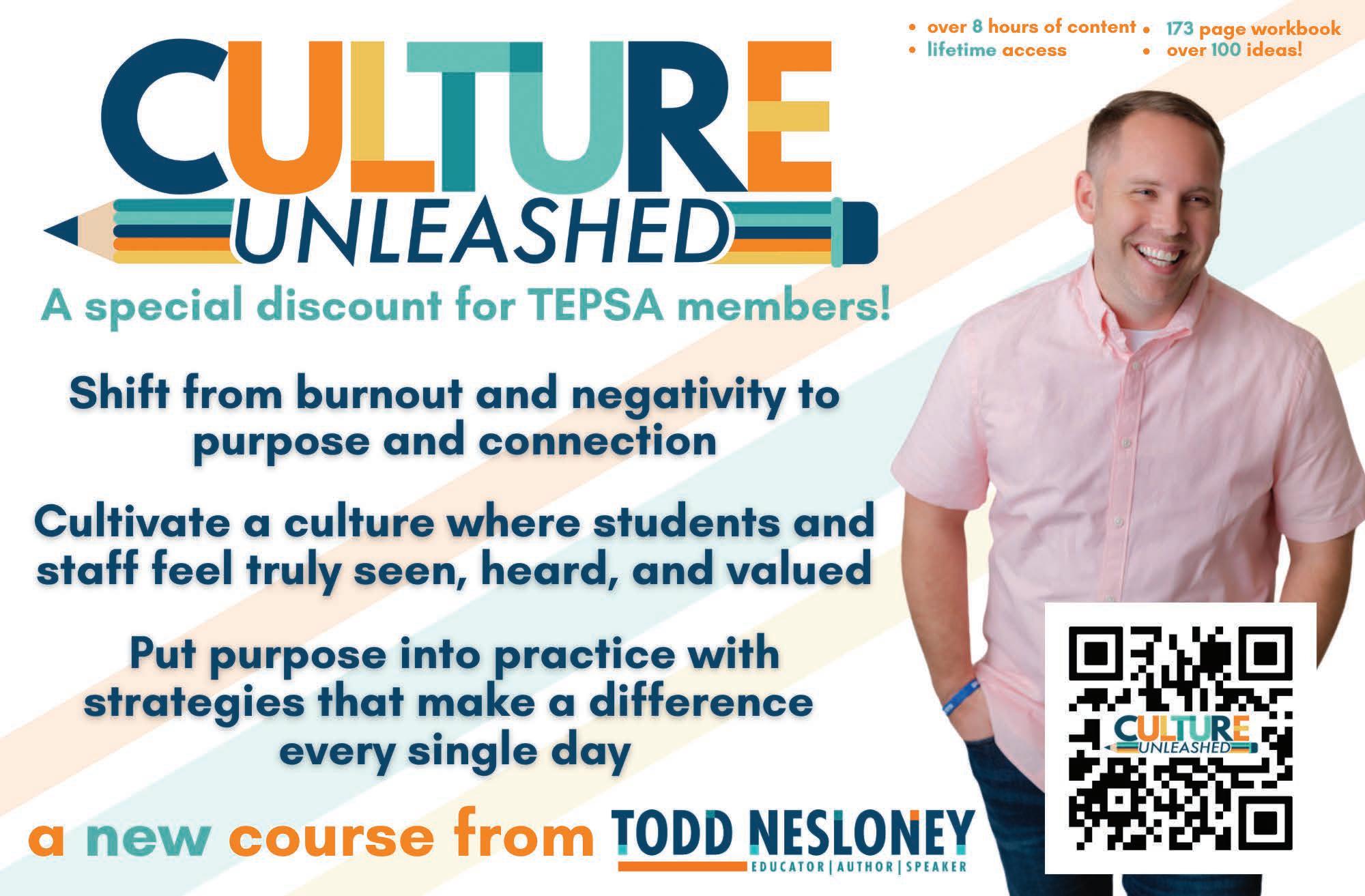
Todd Nesloney Director of Culture & Strategic Leadership
Louis Silvas Web Content Specialist
Mark Terry Deputy Executive Director
TEPSA News
Published six times a year by Texas Elementary Principals and Supervisors Association. Subscription is included in TEPSA membership dues. Postage paid at Austin, Texas.
Articles may be reproduced by TEPSA members without written request, provided that duplication is for an educational purpose at a nonprofit institution; copies are available without charge; and each copy includes full citation of the source.
TEPSA 501 East 10th Street Austin, TX 78701 512-478-5268 800-252-3621 Fax: 512-478-1502 www.tepsa.org
Follow on social media @TEPSAtalk
Hello TEPSANs,
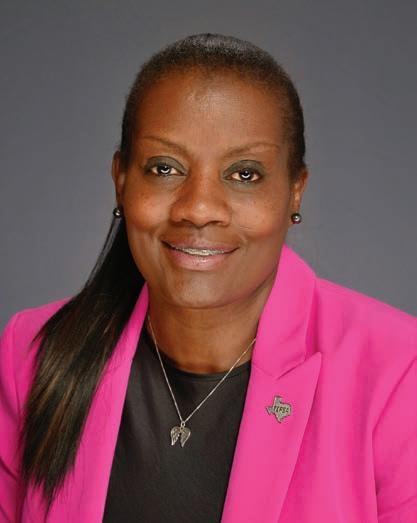
TEPSA President/Dana Harley Boyd
I hope you are enjoying the beautiful Texas spring weather. I want to invite you into something rare in our profession: a purposeful pause. This point in the school year carries weight. The pace has been relentless, the expectations constant, and the finish line is visible. Spring break is not just time away from work; it is an opportunity to tend intentionally to your well-being and to the well-being of those you lead.
Earlier this year, we set a collective goal: to lead in and Leave an Unforgettable Legacy. Not one defined by perfection or nonstop productivity, but by faithfulness, courage, and care. This season offers space to reflect. How are we doing with that goal, not just in outcomes, but in how people feel under our leadership?
Well-being is not separate from leadership; it is evidence of it. The way you model rest, boundaries, and grace sends a powerful message to staff and students. When leaders pause intentionally, they give others permission to breathe. When leaders choose restoration, they reinforce that people matter more than pace, pressure, or performance metrics.
Be deliberate. Rest your body. Quiet your mind. Reconnect with what grounds you. Just as important, reflect on how your leadership has supported the well-being of your campus or district community. Have you created space for encouragement? Have you recognized effort, not just results? Have you checked in with others, not to evaluate, but to care?
We are nearing the end of the school year, and legacy becomes clearer through reflection. When your school or district community looks back on this year, what Unforgettable Legacy memories do they hold about you? Will they remember your steadiness during uncertainty, your humanity in difficult conversations, and your courage to lead with strength and compassion?
The good news is this: there is still time. Time to adjust, to realign, and to lead with renewed intentionality. Small shifts matter. A handwritten note, a listening conversation, a public affirmation, or a moment of grace can leave lasting impressions long after the year ends.
As you step into spring, do so with purpose. Restore yourself. Recommit to the people you lead. Return ready to finish this school year in a way that honors your values, strengthens your community, and leaves a legacy worth remembering.
With appreciation and belief in your leadership,
Texas Elementary Principals & Supervisors Association
Building a Culture of Learning Through Instructional Rounds
Rather than evaluating individual teachers, the focus of Instructional Rounds is on studying our system of practice. This lens allows us to identify schoolwide patterns, celebrate strengths, and address opportunities for growth through shared ownership and collaboration.
Before each round, our team begins by identifying the Problem of Practice, a precise area of focus aligned to our campus goals. In recent years, our focus areas have included engaging all students, improving the quality of student participation, and most recently, enhancing guided discourse to strengthen academic conversations. Once the focus is established, the team develops clear “look-fors” and a rubric aligned to the corresponding T-TESS dimensions of focus, ensuring that observations and discussions are grounded in a shared understanding of effective instructional practice. The team then engages in instructional learning to calibrate what optimal teaching and learning look like before entering classrooms.
During the classroom observation phase, observers enter rooms as quiet learners, scripting only objective, descriptive evidence related to the Problem of Practice. Each visit lasts about 20 minutes and follows a consistent observation protocol, ensuring that data is focused, valid, and reliable.
Following the visits, the team gathers for a structured debrief using a “plus/delta” format, first highlighting
strengths and effective practices, then identifying questions or patterns that suggest areas for professional growth. This reflective conversation often leads to deep professional dialogue about teaching and learning, helping the team define the next level of work and determine how to refine instruction campuswide.
Guided by clear norms that promote a growth mindset, confidentiality, and a culture of risktaking, Instructional Rounds at Acton Elementary provide a safe and empowering space for teachers to learn and grow together. Sustained through the ongoing work of our Instructional Leadership Team, this process has become an integral part of our professional culture, one that empowers teachers as learners, builds shared language around effective practice, and aligns professional development to what matters most: improving outcomes for all students. At Acton Elementary, we know that when educators learn together, students thrive.
TEPSA member Maggie Walton is a principal in Granbury ISD. With over 15 years in education, she is passionate about cultivating culture, developing staff, and creating schools where students and teachers thrive.
Conference: Member $599/Nonmember $899
Conference + LeadWell: Member $848/ Nonmember $1198
JUNE 9-11, 2026 | ROUND ROCK KALAHARI
TEPSA Summer Conference is perfectly timed to boost your enthusiasm when you need it most! It’s all about sharing insights, asking questions, and walking away with renewed inspiration and knowledge.
Featuring keynotes by Ron Clark, Jessica Cabeen and Salome Thomas-EL.
Enhance your skills and impact with:
Expert-led sessions covering the latest trends in PK-8 education including AI, attendance, behavior, culture, data and accountability, instructional coaching, special education, and more!
Opportunities to cultivate meaningful connections to thrive in your role.
Vibrant exhibit hall showcasing the newest educational services to enhance student learning.
LeadWell
The Curated Leadership Experience June 9 | Optional Add-On | Limited seats
1 Session. 2 Speakers. 3 Hours.
LeadWell is designed to support you as a leader. It’s intentional. It’s reflective. And it’s focused on helping you lead with clarity, courage, and purpose.
Featuring:
Words on the Wall: Culturizing Your Campus for Observable Impact with Jimmy Casas
Leadership for Enduring Impact with Pete Hall
Guiding Early Learning with Purpose and Heart
How school leaders can build environments where curiosity and connection drive learning
Elementary leaders play a critical role in shaping what the earliest years of learning look and feel like on their campuses. Those years before and during kindergarten form the foundation for everything that follows—academically, socially, and emotionally. Yet the world of early childhood can sometimes feel separate from the rest of the school: different routines, different measures of progress, and a different pace.
As principals and assistant principals, we can close that gap by championing what we know works best for young learners—developmentally appropriate practice grounded in connection, curiosity, and joy.
Every Moment Matters
From birth through age five, children experience an extraordinary period of growth. They build language, confidence, and understanding through movement, exploration, and relationships. When schools protect these pathways rather than replace them with rigid expectations, we see children thrive—not just academically, but as whole learners.
For leaders, this means asking reflective questions:
• Do our early childhood classrooms reflect what we know about how children learn best?
• Are our expectations for four-, five-, and six-yearolds rooted in development rather than convenience?
• Are we creating schedules and structures that allow for discovery, talk, and play?
By safeguarding time for exploration—through learning centers, outdoor play, and authentic conversation—we communicate to teachers, children, and families that curiosity is not a distraction from learning; it is learning.
“Curiosity is not a distraction from learning; it is learning.”
The Leader’s Role
Leadership in early learning is less about adding new initiatives and more about reframing what already exists. Observing early childhood classrooms through the
lens of child development helps us recognize effective practice when we see it: teachers on the floor engaged with children, students talking through problems, and appropriate noise that signals active learning.
It’s important that we model understanding and advocacy. When we explain to families and staff why play matters, or why conversation supports literacy, we strengthen the culture of trust that early childhood instruction depends on.
Equally, supporting teachers in these grades requires attention to their professional and emotional wellbeing. Early childhood educators juggle high expectations, extensive family communication, and the daily intensity of caring for very young learners. Leaders who provide meaningful feedback, protect planning time, and celebrate small victories help sustain the joy that fuels great teaching.
Sustaining the Vision
When early learning is prioritized, everything downstream benefits. Students arrive in later grades ready
not just with skills, but with curiosity, empathy, and a sense of belonging. Teachers in upper grades inherit learners who can think, wonder, and persist. Families sense that their children are known and valued.
The kids in our early childhood classrooms may be small, but their impact is immeasurable. The choices we make as leaders—how we allocate time, space, and support—signal what our schools truly value.
When we guide early learning with purpose and heart, we do more than prepare children for school—we prepare them for life.
Martin Silverman is an educator, consultant, and author of "Little Learners, Big Potential: Guiding Early Learning with Purpose and Heart." A TEPSA member, he is a former principal and frequent presenter on early childhood leadership and culture building.
leadership series principal
moves that matter. The year isn’t over, and the next one is already taking shape.
As principals, this is the time of year when we’re starting to straddle two worlds: leading progress toward campus goals and planning for next year. The leadership moves we make matter more than ever.
What’s needed for a strong finish?
How can we lean in, listen, and learn from our teachers and students as we make decisions about next year?
Reach out to sophia@lead4ward.com to find out how to get started with campus support!
lead4ward.com/principal-leadership
Wrapping Up a Tough Year, In Search of Greener Pastures
Not everything goes according to plan. Even when it does, you might still feel like you’re being pushed out by the new administration or board. What are some key issues that arise when you are threatened with nonrenewal or termination and you want to negotiate a resignation agreement?
“Do
I Have Any Leverage?”
Yes. Every Chapter 21 contract has rights, and those rights are your leverage. Although the superintendent or HR may insinuate otherwise, a school district cannot fire you immediately. If the district wants to fire you in the middle of any Chapter 21 contract, you are entitled to due process which could take 60-90 days. Leverage rating: A. At the end of a term contract, you are entitled to a nonrenewal hearing before the board, a process that could take 30-60 days. Leverage rating: B. Even at the end of a probationary contract the board must formally notify you that you have been terminated. Leverage rating: D minus.
The school district’s implicit or actual threat to get rid of you, and your corresponding made-up leverage rating above, are the crucible in which adversarial resignation agreements are negotiated. Whether you use a lawyer (preferred) or not, here are some of the more common things to consider:
1. Never resign in a gotcha meeting. On your way out, your resignation is usually the only thing the district wants from you. It is your ace in the hole. Do not play it until you must. Once played, you cannot take it back. Once played, the district has no reason to negotiate with you. Only resign when you have gotten what is fair in exchange for it.
2. This is kind of crazy, but if the district is not in hot pursuit of your resignation, you may have no cards to play. Put another way, if you are a moderately valued employee who has run aground with one supervisor, or who is just burned out, but you have not been asked to resign, do not expect a resignation deal.1
3. If you want a good reference, you need to find a trusted person in the district to do this. This is a good reason not to burn bridges on your way out. Lawyer-negotiated references are worthless. Most resignation agreements will say the district will not thwart the employee’s quest for a private reference; but the official district reference will be “neutral.” A neutral reference is also worthless, but at least it may avoid overt negativity. If you trust no one in the district, you will have to look to a previous supervisor and hope for the best.
4. It is mostly a myth that your entire personnel file follows you to every job. But it is possible, though
not likely, that your evaluations may follow you. If you have a bad evaluation or other negative documents you would rather not be followed by, get the district to agree to keep them confidential from prospective employers. Caveat: State law ultimately controls what is confidential or not.
5. How many workdays are left on the contract? How many days of leave do you have? Do you have a legitimate need for paid medical leave? Will the district put you on some sort of paid administrative leave, whether voluntary or not? All of this is beans for the grinder in negotiating your final days of employment. Some people want out now to preserve what’s left of their nerves; others feel a duty to hang in there as long as possible.
6. Mend fences, if possible.
Every case is different. The pretend leverage ratings above can go up or down depending on the facts, personalities, politics and laws involved. There are numerous issues to consider beyond those listed above. If you are ever called into a meeting where it is suggested that
you resign or face dismissal proceeding, you should not resign on the spot. Instead, contact a lawyer to fully discuss your rights and options.
Endnote
Kevin Lungwitz practices law in Austin and is a former Chair of the School Law Section of the State Bar of Texas.
1If you are burned out and want to resign – even though you have not been asked to, consider the article, “Contract Abandonment: What is it and to whom does it apply?” in TEPSA News, May/June 2025, https://bit.ly/457cpJW.
Note: Information from Legal Ease is believed to be correct upon publication but is not warranted and should not be considered legal advice. Please contact TEPSA or your school district attorney before taking any legal action as specific facts or circumstances may cause a different legal outcome.
Election Information - TEPSA State Office
Votes must be cast electronically at www.tepsa.org
Stephanie Gomez Boerne ISD
Region 20 President Continued Term
Jaci Underwood
Lubbock ISD
Region 17
President-Elect
Continued Term
Each year TEPSA members elect two officers:
Christy Watley Midway ISD
Region 12
Member At-Large
Continued Term
Lorena Carrasco
Pasadena ISD
Region 4
NAESP Representative
Continued Term
• Member At-Large: A 2-year term that supports the work of the association.
Annette Sanchez Beeville ISD
Region 2
NAESP Zone 8 Director
NAESP Elected Position
• Vice President: A 3-year term that supports the work of the association and culminates in serving as the President.
Every three years, members elect the NAESP Representative.
Required Qualifications to Run for TEPSA State Office
• Served at least one full year as a Region President or Standing Committee
• TEPSA member in good standing for three consecutive years with no breaks in membership
• Support from the TEPSA Region Executive Committee and school district superintendent
• Must be a practicing administrator who deals directly with early childhood through grade eight instructional programs
• Professional demeanor and ability to communicate
Vice President – Contested
Lori Gallegos
Assistant Superintendent for Elementary Instruction, Northside ISD
Region 20, Grades PK-12
Education
Trinity University, M.Ed. in Education Administration: 2000
University of Texas, M.A. in Education Specialization in Curriculum and Instruction: 1995
• Texas Lutheran University, B.A. in Multidisciplinary Studies: Specialization in Reading Education; Early Childhood Endorsement: 1992
• University of Southern Queensland, Toowoomba, Australia, International Student Exchange Program: Spring, 1991
Educational Leadership
• Mentored 6 NISD Principals
• Presentations:
–Enhancing a Principal Pipeline Through Effective Coaching; Leadership in Action: Creating a Sustainable Principal Pipeline, TASA
–Journey to Dual Language: Deciding Which Road to TravelNABE, TABE, & La Cosecha Dual Language Conference
–Developing Instructional Leadership through Principal Networks, HSTW/MMGW State Conference
–Judgment and Problem Analysis: Decision Making and Problem Solving, Region 20 Cohort of Leadership Associates (Principal Alternative Certification)
–Keynote: UTSA Student Teacher Induction Ceremony
TEPSA Leadership/Involvement/Awards
• National Distinguished Principal Texas State Finalist, 2017
• TEPSA Member 2000-present School Honors/Accomplishments
• Kuentz Elementary named a Franklin Covey “Leader in Me” campus ultimately receiving Lighthouse School designation in 2019
• Kuentz Elementary named the PepsiCo Recycle Rally National Champions in 2011 and in the Top 10 in the nation for 10 years, resulting in over $100,000 cash awards for the campus
• Kuentz Elementary Student Council named a TEPSA Honor Council for 5 consecutive years
• Kuentz Elementary Earned TEA Distinction Designation: Top 25 Percent: Comparative Closing the Gaps, 2019
• Kuentz Elementary won over 10 awards from the city of Helotes for Best in Show (Parade Float and Walking Group) and First Place in non-profit category (Parade Float and Walking Group) at the Cornyval Parade and the Helotes Christmas Lights Parade between 2009-2019
Community Involvement
• Northside ISD Council of PTA’s Principal of the Year Award 2011
• School Community Relationships with organizations including the Helotes Police & Fire Departments, Helotes Cornyval Association, Helotes Community Band, South Texas Blood Bank
• Campus Host: Daily COVID Food Distribution Site 2020-2021
• Recycling Team Volunteer at the San Antonio Fiesta Battle of Flowers Parade 2011-2019
• Volunteer Northside ISD/San Antonio Food Bank Distribution
• Zion Lutheran Church: Call Committee for the Associate Pastor for Youth & Family Faith Formation; Faith Formation Teacher; Zion Theater Group
Other Professional Networks
• NAESP
• Member of the TEPSA Advocacy Committee visiting legislators at the state capitol, 2023 and 2025
• Texas Association of School Administrators (TASA)
• Association for Supervision and Curriculum Development (ASCD)
• N2 Learning Texas Principals Institute - Cohort 7
• N2 Learning Executive Leaders Institute - Cohort 4
• National School Leaders Network Group Facilitator 2009-2011
• Book Study Co-Facilitator, Trinity University, 2011-2019
• TEA Teacher Preparation Program Advisory Committee with the University of Texas at San Antonio, 2012-2013
Platform Statement
For 25 years, TEPSA has helped me become a leader who is deeply committed to the success of our public schools. It has provided me with professional learning, networking, lifelong friends, and most importantly, advocacy for our leaders. Serving on the Executive Committee the past 2 years showed me the power of our combined voices. Now more than ever, we must unite to champion the value of public education and address the challenges posed by legislative actions. Each day, our principals are at the frontline navigating issues at a time when funding and policy often overlook campus realities. As Vice President, I will work with the Board to ensure our leaders understand the real issues facing our schools: safety, mental health, excessive mandates, lack of funding, and teacher shortages. My central office experience helps me understand how district leadership can amplify our unified message. I want to strengthen TEPSA’s network by empowering admin at all levels to become effective advocates by sharing their stories of perseverance and highlighting the daily challenges they face. Through advocacy, I will show how our TX Principals are true superheroes. Despite challenges, they lead with grit and grace, but they need help. I am dedicated to ensuring every TEPSA member feels equipped to act, protecting the promise of Texas public education for all students. It would be an honor to serve our leaders as Vice President, to be part of the change, and to celebrate our successes together!
Kevin Hunter continued
• Selected for Charles Butt Foundation Harvard Leadership Academy
• Participated in education classes at Harvard University – Joined a network of other school leaders
• Served on the Burkburnett ISD Community Based Accountability Team as a part of TPAC
Community Involvement
• Burkburnett Senior Center Meals on Wheels - Meal Delivery
• Wichita Falls Faith Mission/Refuge - Preparing and Serving Meals
• Vernon Holiday Meal - Preparing the Thanksgiving meal that is served to the citizens of Vernon, TX
Other Professional Networks
• Texas High School Coaches Association
Platform Statement
Being part of TEPSA has strengthened me as a leader by providing meaningful collaboration and networking opportunities that directly benefit my staff and students. Texas is a big state, yet TEPSA makes it possible for leaders from every corner to connect, learn from one another, and grow together.
Campus administration can often feel isolating, and now more than ever, we need each other. My heart for service continually draws me to opportunities like this, and I feel a strong calling to support both teachers and administrators across our state.
I want to be an advocate for all educators — from leaders in districts with over 100,000 students to the small, rural campuses in Region 9 serving fewer than 200. As a leader, my mission is to support, advocate for, and celebrate the incredible work happening throughout Texas public education.
ote by 5pm Central March 3
Ballots were emailed to voting members on February 17. Check your inbox and spam folder for an email with voting credentials from vote@ skypunch.tech. Add vote@skypunch.tech to your email contacts and safe senders list.
Member At-Large – Contested
Vanikin Leggett
Principal, Brule Elementary, Navasota ISD
Region 6, PK-5
Education
Region 6 Superintendent Preparation and Certification Program - 2024
Lamar University - Master’s Educational Leadership - 2014
Texas A & M University- Bachelor of Science, Interdisciplinary Studies - 2011
• Presenter at TEPSA Summer Conference, 2022, 2024, 2025
School Honors/Accomplishments
• Increased campus student achievement and growth to move the campus from a D to a C rating in the 24-25 school year; on our way to an A by May!
• Worked with key stakeholders to establish our S.O.A.R. core values of Self Discipline, Optimism, Altruism and Respect as the basis for our House System.
• Established partnership with Campos Foundation and SmartLab to bring cutting edge STEM lab to Hirsch Elementary valued at $160,000
• Established partnership with Brighter Bites to bring fresh produce to families in our community.
• Established partnership with The Children’s Museum of Houston to bring literacy and STEM programming to Hirsch Elementary.
• Established partnership with Alpha Kappa Alpha Sorority Inc. to bring voter registration to the school community.
• Established partnership with Home Depot to bring school supplies to students at Hirsch Elementary.
• Attended TEPSA Advocacy Day in Austin, TX, 2023.
• Attended Spring ISD Advocacy Day at the Texas Capitol, 2025.
Vanikin Leggett continued
Other Professional Networks
• NAESP Member 2023 - Present
• ATPE 2011- Present
Platform Statement
My desire to lead has always been rooted in service to students and the belief that every child deserves to see themselves in those who lead them. I became an educator to give back to the same community that raised me and shaped my values. As a campus administrator since 2015, I have worked intentionally to ensure students, families, and educators feel seen, supported, and empowered to succeed.
Leadership for me is deeply personal. My mother served as a paraprofessional for over 40 years, and through her example, I learned that true leadership is grounded in humility, consistency, and service. Watching her dedicate her life to supporting students taught me that leadership is not about position, but about impact. That lesson guides every decision I make as a leader.
I believe principals have a responsibility to advocate for students, elevate educators, and strengthen connections between schools and their communities. I am passionate about developing future leaders, mentoring educators, and ensuring equity and opportunity for all students. I will continue serving educators and students across Texas by amplifying voices, strengthening leadership capacity, and keeping students at the center of our work while honoring the communities we serve.
ote by 5pm Central March 3
LaToya Patterson continued
Other Professional Networks
• Texas Elementary Principals and Supervisors Association (TEPSA), 2015-present
• National Association of Elementary School Principals (NAESP), 2022-present
• Texas Association for the Gifted and Talented, 2013-present
• Kappa Delta Pi International Honor Society in Education, 2016-present
• Alpha Kappa Alpha Sorority, Inc., 1998-present
Platform Statement
I am running for TEPSA Member At-Large because I believe strong school leadership transforms lives, strengthens communities, and ensures every child has access to an excellent elementary education. As Principal of Hirsch Elementary in Spring ISD, I have led with a focus on culture, collaboration, and continuous growth. Through intentional systems, datadriven practices, and a commitment to the whole child, our campus has accelerated achievement, strengthened relationships, and created a school where students and staff truly thrive.
My platform centers on three priorities:
1. Empowering Leaders: TEPSA should continue to provide relevant, high-quality professional learning that reflects the real challenges principals face. I will work to expand opportunities for collaboration and capacity building so leaders across Texas feel supported, connected, and equipped.
2. Supporting Instructional Excellence: I will advocate for tools, resources, and policies that help principals grow teachers, improve instruction, and support all learners.
3. Amplifying Principal Voice: Campus leaders deserve a strong voice in statewide conversations. I am committed to listening deeply, communicating clearly, and representing the diverse needs of elementary leaders across our state. TEPSA has shaped my leadership journey, and I am ready to serve, support, and advocate for the principals who make a difference every day. I would be honored to represent you.
Supporting Campuses, Leaders, and Families Through the End of the School Year and Summer Break
As the 2025-26 school year ends, educators are balancing academic responsibilities, celebrations, and transitions, while families prepare for the changes summer brings. From a central office supervisor perspective, this is a critical time to ensure our support extends beyond campus leaders to the families and communities they serve. When campuses, leaders, and families are aligned, students are more likely to experience a smooth and successful transition into summer and the 2026-2027 school year.
For campus leaders, it is essential they are clear and thoughtful in their communication. Central office supervisors can support campus principals by helping prioritize expectations and minimize competing demands. Streamlined timelines, simplified reporting requirements, and clear guidance on end-of-year processes allow campus leaders to focus on what matters most—students, staff, and families. From a central office perspective, this is a critical time for us to shift from compliance-focused oversight to intentional support. How we show up now can significantly impact campus morale, leader capacity, and readiness for the next school year. Reducing non-essential meetings and providing concise checklists demonstrates respect for campus leaders’ time during this
high-demand period on the academic calendar. They are navigating local and state assessments, summative evaluations, end-of-year celebrations, staffing considerations, and planning for the upcoming year which all converge at the same time.
Equally just as important is relational support. The end of the school year can be a whirlwind of emotions for principals and their teams as they support students through transitions and celebrate milestones. Intentional check-ins, campus visits, phone calls, or brief reflection meetings allow supervisors to listen, affirm accomplishments, and problem-solve collaboratively. Recognizing campus efforts publicly also boosts morale and reinforces a culture of appreciation. Sometimes the most valuable support we can offer is simply acknowledging the hard work being done and celebrating growth, even amid challenges. As campuses transition into summer, supervisors play a key role in helping leaders shift from survival mode and closure to strategic reflection and preparation. Encouraging principals to engage in structured reflection—What worked? What can we improve? What systems need strengthening? Analyzing data, identifying strengths, and planning targeted improvements sets the stage for more purposeful planning
when it comes time for writing the Campus Needs Assessment and creating the Campus Improvement Plan. Providing reflection tools, data summaries, or guiding questions can help leaders use summertime effectively without feeling overwhelmed.
This reflective process ultimately benefits families, as campuses become more responsive to student and community needs. Summer is also an opportunity to focus on campus leader development. Rather than filling the break with back-to-back professional development training, central office teams can design flexible, differentiated learning opportunities. Book studies, leadership cohorts, or optional workshops focused on instructional leadership, culture-building, or new administrators’ needs allow principals to grow at their own pace. Of course, all school leaders should plan to rejuvenate and fill their toolbox at the annual TEPSA Summer Conference—the best conference of the year! Pairing newer leaders with experienced mentors during the summer months can also be invaluable to building confidence and strengthening district leadership pipelines.
Supporting the families we serve during this transition is just as critical. Supervisors can help campuses communicate clearly and consistently with families about end-of-year events, summer programs and resources, registration for the next school year, and important dates. Providing campuses with readyto-use communication templates—translated as needed—ensures families receive accurate and accessible information. Simple messaging around summer learning opportunities, meal programs, and community resources helps families feel supported and connected beyond the school year.
Summertime presents an excellent opportunity to strengthen family engagement. Central office teams can collaborate with campuses to promote summer learning activities that families can support at home, such as reading challenges or math practice resources. Offering a summer bookmobile that goes into the community to get gently used books into the hands of children is a way to not only increase summer literacy and reduce the recurring “summer slide,” but it also builds credibility and relationships with families. Partnering with community organizations to share information about camps, enrichment programs, or social services ensures families have access to supports that promote student well-being.
Usually, additional late staffing changes and onboarding of new staff remain a priority during the summer months. Supervisors can support campuses by maintaining straightforward staffing timelines and ensuring new staff are prepared to serve students and families effectively when they return in August. Coordinated onboarding that emphasizes family engagement practices such as “Success Walks” to invite families to a Back-to-School or Meet the Teacher event helps teachers and administrators build strong relationships even before the start of the school year.
Finally, central office leaders must model balance and self-care for their well-being. Encouraging campus leaders to take time to get real rest and set healthy boundaries during the summer months—and leading by example—sends a powerful message. When supervisors respect boundaries, limit non-essential communication, respect time off, and normalize rest as a part of effective leadership, they create conditions that prevent burnout and promote effective leadership for long-term success.
Supporting campuses, leaders, and families at the end of the school year and throughout the summer requires empathy, intentional planning, and heaps of collaboration. When supervisors focus on reducing barriers, strengthening communication, and honoring relationships, we lead with empathy, clarity, and purpose. Let's create a strong foundation for a successful start to the next school year feeling energized, focused, and ready to serve.
TEPSA member Dr. Lorena Zertuche is a dedicated educator with 28 years of experience serving as a teacher in Spring Branch ISD, a campus administrator in Katy ISD, and a central office administrator in Spring ISD. She currently serves as the Community Engagement Coordinator in the Family and Community Engagement Department, where she focuses on building strong partnerships between schools, families, and the community. Dr. Zertuche, a past TEPSA State President, is currently serving as Nominating Committee Vice Chair.
Because “figure it out alone” was never the job description.
When your day looks like this…
Three discipline referrals before 10:00 a.m.
A parent waiting in the office
A teacher out sick
A “quick question” that takes 45 minutes
…you don’t stop leading. You just run out of time to stop and think. Introducin g th e Master Prin cipal GPT
Your calm, wise thinking par tner that:
Star ts with questions, not quick f ixes
Helps you process before you respond
Grounds your decisions in solid practice
Leading Through the Chaos: How Principals Can Stay Connected and Find
Joy at the End of the School Year
The end of the school year is not for the faint of heart.
Schedules are packed. Emotions are high. Deadlines are looming. Your staff members are tired. Students are counting down. And administrators/supervisors? You’re holding it all together while sprinting to the finish line.
It’s easy during this season to slip into survival mode focusing only on tasks, checklists, and getting across the finish line. But the final weeks of school also present one of the most powerful opportunities you have as a leader: the chance to connect deeply with your staff and reclaim joy in the middle of the chaos.
Here are a few practical, realistic ways to do just that (without adding more to your plate).
1. Be Present, Not Perfect
Right now, your staff doesn’t need perfection. They need presence
A quick check-in in the hallway.
A sincere “How are you really doing?”
A few minutes sitting in a classroom, not evaluating. Instead, just observing and appreciating.
Presence builds trust. It reminds staff they’re not invisible, even when everything feels rushed.
Try this: Schedule 10–15 minutes a day for intentional visibility. These minutes are spent not fixing problems, just connecting.
2. Name the Hard While Celebrating the Good
Joy doesn’t mean ignoring the exhaustion. In fact, joy grows when people feel seen.
Acknowledge how hard this season is:
• The long days
• The emotional load
• The nonstop pace
Then intentionally name the wins:
• Growth you’ve seen in students
• Effort teachers continue to give
• Moments that mattered this year
When leaders name both, they build credibility and hope.
Try this: Start meetings or emails with one honest acknowledgment and one genuine celebration.
3. Personalize Your Appreciation
Generic praise is fine. Personal appreciation is powerful.
A short-handwritten note.
A quick voice memo.
A one-sentence email highlighting something specific you noticed.
These moments don’t take long, but the impact lasts a long time.
Ask yourself: “Who hasn’t been recognized lately?” Then act on it.
) page 18
Lead from the Heart/Todd Nesloney and Ross Braun
Leading Through the Chaos continued from page 17
4. Protect Staff Energy Where You Can
You may not control everything, but you can control some things.
Cancel a nonessential meeting. Shorten an agenda. Protect planning time. Give permission to close doors and breathe.
Small decisions that honor energy send a big message: I value you.
5. Find Joy in the Moments You’ll Miss Joy doesn’t always come from big celebrations. It lives in small, fleeting moments:
• Laughter in the hallway
• A student breakthrough
• A shared joke in the staff room
• A quiet moment after dismissal
Slow down just enough to notice them.
One day soon, the building will be quiet, and these are the moments you’ll wish you could rewind.
6. Model What You Want Staff to Feel Your energy sets the tone.
When you show gratitude, staff feel valued. When you show calm, staff feel grounded. When you show joy, staff feel permission to experience it too.
Leadership at the end of the year isn’t about doing more, it’s about showing up differently.
Final
Thought:
Finish Strong by Leading from the Heart
The end of the school year will always be chaotic. That’s unavoidable.
But how you lead through it?
That’s everything.
Stay connected. Stay human.
Stay grounded in why you chose this work in the first place.
Your staff may forget some of the meetings. They may forget some of the emails.
But they will never forget how you made them feel in the moments that mattered most.
Finish strong! Not just with systems, but with heart.
Todd Nesloney is TEPSA’s Director of Culture and Strategic Leadership. He is an award-winning educator, author and international speaker.
Ross Braun is a former elementary principal who is passionate about supporting schools and leaders to ensure every child has a safe, loving and engaging learning environment. Ross is now the VP of Positive Education at Spring, Texas-based, School Life.
501 East 10th St
Austin, TX 78701
800-252-3621
www.tepsa.org
U.S. Postage PAID
Austin, TX
Permit No. 127
Vote in the TEPSA State Officer Election by March 3 at 5pm (CST). See pages 10-13.
TEPSA Highlights
Scan the QR code to learn more.
Calendar/Deadlines
Don't miss the standout event of the year for Texas PK-8 school leaders! Join us for three days of dynamic learning at the TEPSA Summer Conference, June 9-11 at the Round Rock Kalahari.
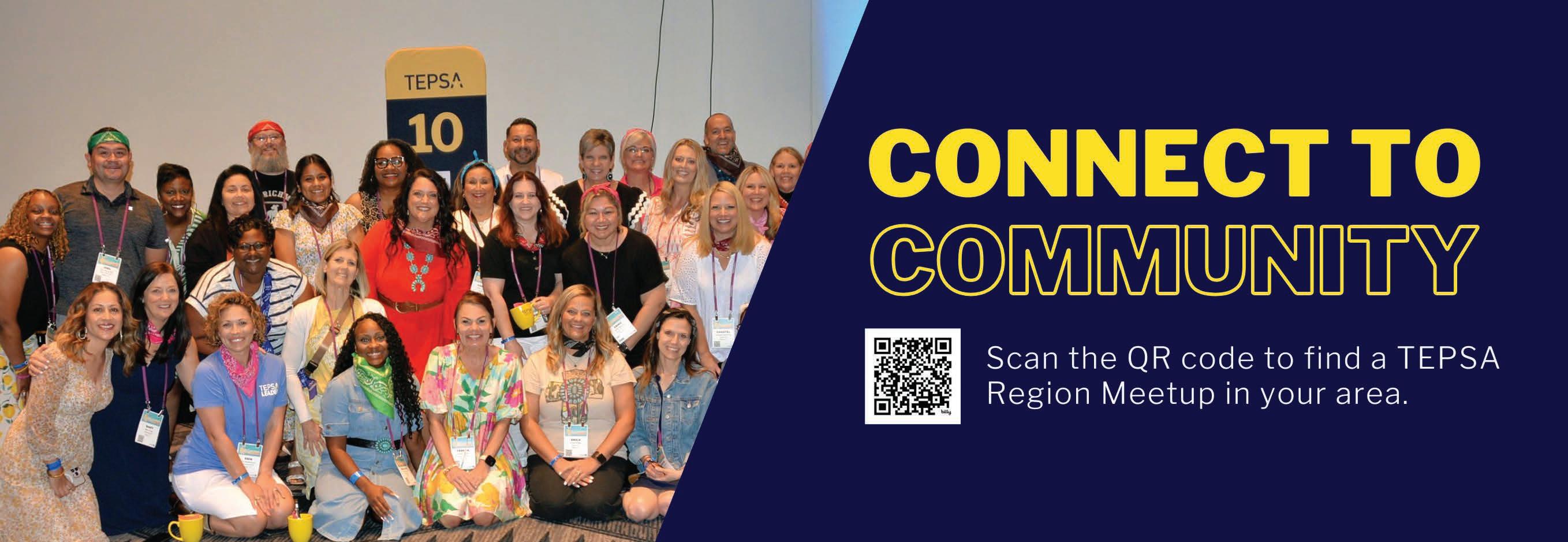
Build your network and stay inspired! Meet local leaders in your area at a spring TEPSA Region Meetup and at the TEPSA Summer Conference in June.
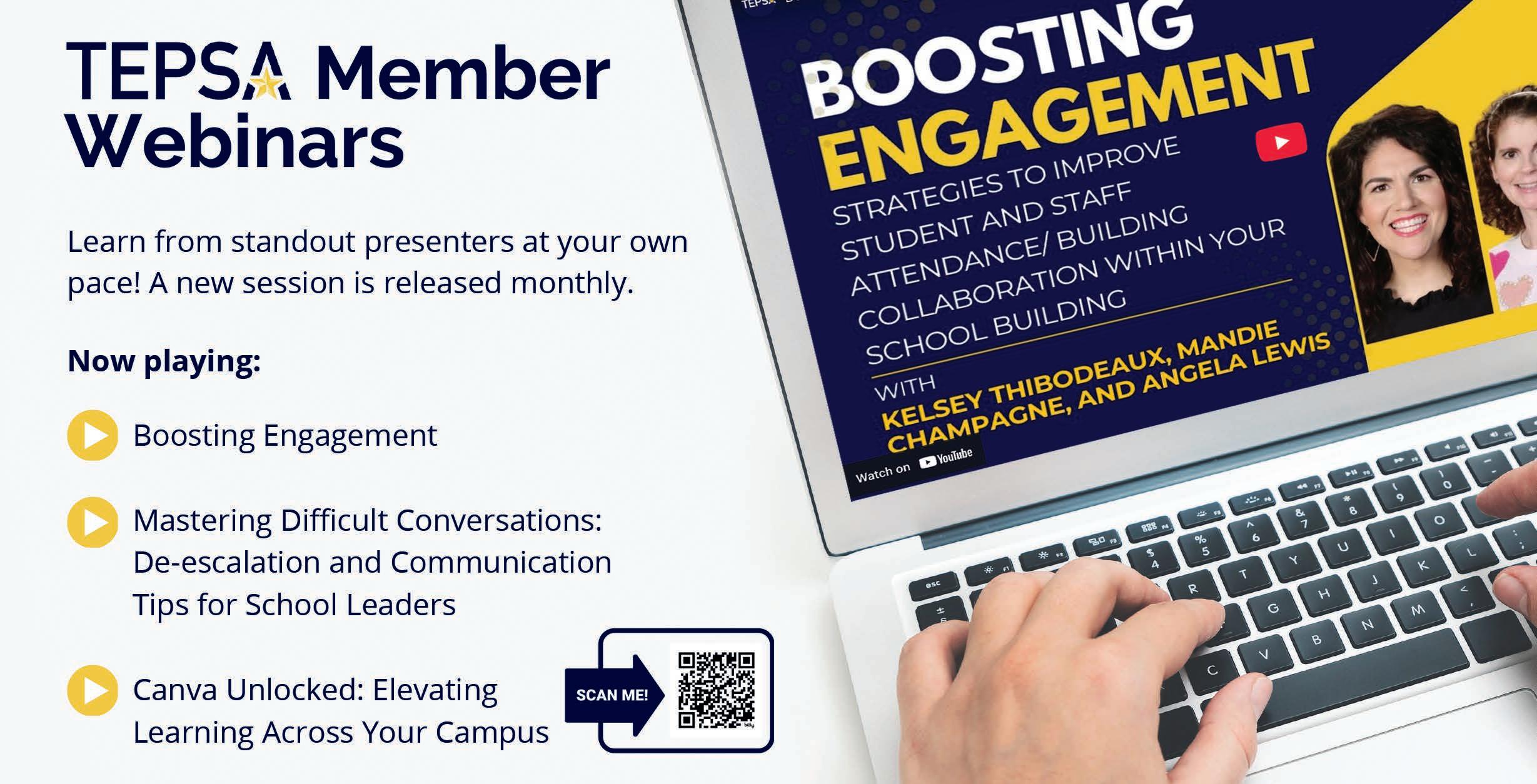
Learn on-demand at your convenience with our member-only webinars. Explore strategies for boosting attendance, navigating challenging conversations, and more!
Discover leadership tips and insights on the TEPSA Talk podcast available on Spotify, Apple and YouTube.
Hiring Strategies for the Win: Tips for Successful Interviews
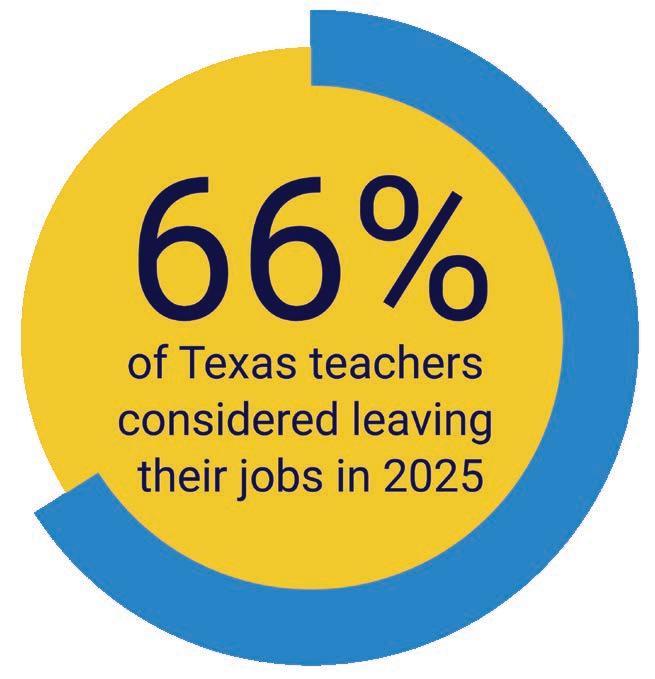
Job interviews can be stressful, making it challenging for candidates to showcase their true potential. For principal Tom Sauve, helping candidates prepare for their interviews and ensuring they feel at ease is an essential step in his school's hiring process. It also provides an important opportunity to highlight the school's culture. By being transparent about the school’s values and expectations, Sauve believes candidates are more likely to feel aligned with the school’s mission which is crucial for long-term success and teacher retention. To enhance your recruitment strategies and help candidates shine, Sauve recommends you:
�� Give candidates the first and last interview questions in advance so they have time to prepare
�� Let candidates know who will be interviewing them so they can research panel members
�� Share information about the school’s mission/goals
�� Be up front about salary, benefits and expectations
�� Provide step-by-step directions all the way to the front door of the school so candidates know where they are going for the interview
�� Make sure your interview questions get to the heart of who you want in that role
Tune in to the TEPSA Talk podcast "Building a Winning Team" to learn more from Tom Sauve at https://bit. ly/3MyAX4T.
Sources: Texas Elementary Principals & Supervisors Association. (2025, October 19). TEPSA Talk: Building a Winning Team with Tom Sauve. [YouTube]. https://www.youtube.com/watch?v=n7tlz97odb0 Caldera, B. (2025, September 26). "Texas teacher retention shows modest improvement, but 66% still consider leaving their jobs." Texas Public Radio. https://www.tpr.org/news/2025-09-26/texas-teacherretention-shows-modest-improvement-but-66-still-consider-leaving-their-jobs