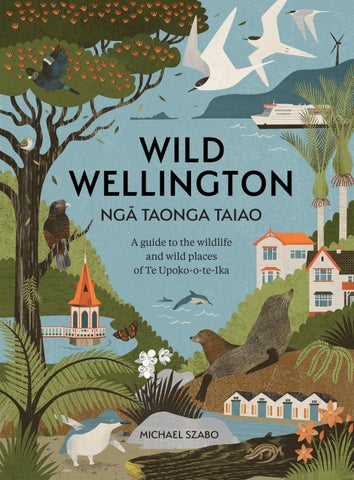
WILD WELLINGTON NGĀ TAONGA TAIAO A guide to the wildlife and wild places of Te Upoko-o-te-Ika
MICHAEL SZABO
KARAKIA Ka huri taku aro ki Turakirae. Ka mau te wehi, ā, ko ahau ko koe – ko koe ko ahau.
As I gaze upon Turakirae, I am filled with awe, for I am you – and you are me.
Ka piki ake rā ki Remutaka. Ka mau te wehi, ā, ko ahau ko koe – ko koe ko ahau.
As I climb the ranges to Remutaka, I am filled with awe, for I am you – and you are me.
Ka nuku, ka neke ki Pipinui. Ka mau te wehi, ā, ko ahau ko koe – ko koe ko ahau.
As I journey to Pipinui, I am filled with awe, for I am you – and you are me.
Ka tau, ka rarau ki Rimurapa. Ka mau te wehi, ā, ko ahau ko koe – ko koe ko ahau.
As I find solace in Rimurapa, I am filled with awe, for I am you – and you are me.
Tēnei ahau, tēnei ahau. Tēnei te amokura nā Tokomaru, he kāwai nō runga i te rangi.
I am a product of the places above, the spaces below, and everything in between. I am a descendant of the waka Tokomaru, a child of the heavens.
Neavin Broughton (Te Āti Awa, Taranaki Tūturu, Ngā Iwi o Taranaki ki te Tonga), 2024
TE ŌHĀKĪ A TE WHAREPŌURI I muri nei kia pai ki aku taonga Māori, taonga Pākehā, kia tae ake te haruru o te reo ki ahau i Te Rēinga. After I have gone be good to my Māori people and my European people, let the thunder of your voice reach me in the spirit land.
The only known portrait of Te Wharepōuri. One half of Plate I from Illustrations to ‘Adventure in New Zealand’ by Edward Jerningham Wakefield (London: Smith, Elder and Company, 1845). Lithograph by Day and Haghe. Alexander Turnbull Library, Ref: PUBL-0011-02-1
CONTENTS
Introduction
9
PŌNEKE WELLINGTON CITY He oranga wai, he oranga tangata: As waterways thrive, so too do people
21
1.
Zealandia Te Māra a Tāne
24
2.
Ōtari–Wilton’s Bush Reserve
34
3.
Wellington Botanic Garden Ki Paekākā
44
4.
Te Ahumairangi
52
5.
Mount Tarikākā and Khandallah Park loop track
58
6.
Pōneke Wellington waterfront
64
7.
Matairangi Mount Victoria
72
8.
Waimapihi Reserve
78
PŌNEKE KI TE TONGA THE SOUTH COAST Ngā tai karekare o te tonga: The turbulent seas of the southern coast
86
9.
90
Oruaiti Reserve and Breaker Bay
10. Rangitatau Palmer Head and Tarakena Bay
94
11.
Taputeranga Marine Reserve and coast
98
12. Te Kopahou Reserve including Spooky Gully
108
13.
116
Te Haape Stream valley
14. Pariwhero Red Rocks Scientific Reserve and 5 Te Rimurapa Sinclair Head
122
15.
128
Te Moana-o-Raukawa Cook Strait ferry
16. Nicholson Canyon and Cook Canyon pelagic seabirds
132
TE AWA KAIRANGI THE HUTT VALLEY Te mākurukuru o Te Awa Kairangi: The profuse abundance of the Hutt Valley
142
17. Korokoro Dam Loop Track, in Belmont Regional Park
146
18. Pito One Beach and Te Awa Kairangi Hutt River mouth
152
19. Matiu Somes Island scientific and historic reserve
158
20. East Harbour Regional Park northern forest including Ōtuamotoro, Muritai and Butterfly Creek
164
21. Parangarahu Lakes at Te Rae-akiaki
186
22. Puketahā forest in Wainuiomata Mainland Island
192
23. Percy Scenic Reserve and alpine plant collection
200
24. Kaitoke Regional Park swingbridge track circuit
206
MAI TE AWARUA-O-PORIRUA KI ŌTAIHANGA PORIRUA AND KAPITI COAST He whānau, he whenua: Connecting whānau with whenua
215
25. Pāuatahanui Wildlife Reserve
218
26. Plimmerton Beach and foreshore
224
27. Mana Island Scientific Reserve
230
28. Kapiti Island Nature Reserve
236
29. Kapiti Marine Reserve
242
30. Waikanae Estuary Scientific Reserve
246
More wild places
254
Glossary
256
Acknowledgements
258
About the author and photographer
260
Image credits
261
Index
262
INTRODUCTION
H
ave you ever seen a kekeno New Zealand fur seal basking on a rock, a flock of kākā flying overhead, or a kiwi walking through a tangle of ferns? You can find all of these and more in the ‘natural capital’ of Aotearoa New Zealand:
Wild Wellington. You can see kākā and tūī in city parks, kororā little blue penguins and whai keo eagle rays swimming in the harbour, and kiwi during night tours of the world’s first fully fenced urban ecosanctuary, Zealandia Te Māra a Tāne in Karori. But what about the kōkako, weka, hihi stitchbird, tītitipounamu rifleman and kārearea New Zealand falcon? Or giant wētā, rāpoka leopard seals, geckos or manaia seahorses? This guide will show you where, when and how to look for them – and, hopefully, improve your chances of seeing them. There are so many ways to appreciate nature here, from walking in wild places, bird and wildlife watching, botanising and photography, to swimming, snorkelling, scuba diving and kayaking. The amazing diversity that occurs here ranges from elegant pūrerehua butterflies to majestic toroa albatrosses, sleek aihe common dolphins to maki orca mega-dolphins, delicate native orchids to giant rimu, and tiny filmy ferns to towering tree ferns. Wild Wellington has many of the geographical features that typify Aotearoa. From the maunga at Puketahā in Wainuiomata, 767 metres above sea level, down to the depths of Cook Canyon at 600 metres below sea level, there are ngahere forests, repo wetlands, awa rivers, roto lakes, pūwaha estuaries, motu islands, sandy takutai beaches, and underwater toka rocky reefs. This guide covers the wider Te Upoko-o-te Ika metropolitan area, which comprises about 2250 square kilometres when Pōneke is combined with Porirua, the Hutt Valley, Wainuiomata and the Kapiti Coast, and includes hundreds of publicly owned parks, reserves and beaches, many with scenic landscapes and breathtaking views. The wild places included here are all connected by the birds that move between them and the complex food webs they help to sustain. Wild Wellington is also connected
9
PŌNEKE
WELLINGTON CITY
He oranga wai, he oranga tangata: As waterways thrive, so too do people
21
1. Zealandia Te Māra a Tāne
24
2. Ōtari–Wilton’s Bush Reserve
34
3. Wellington Botanic Garden Ki Paekākā
44
4. Te Ahumairangi
52
5. Mount Tarikākā and Khandallah Park loop track
58
6. Pōneke Wellington waterfront
64
7. Matairangi Mount Victoria
72
8. Waimapihi Reserve
78
PŌNEKE Young ruru morepork sunning itself.
Tuatara emerging from its burrow to bask in the morning sun.
30
Te Upoko-o-te-Ika. Since it is nocturnal,
The native ruru is the apex nocturnal
the best time to see it is during a guided
predator. This golden-eyed hawk-owl can
night tour.
sometimes be seen roosting by day near
Rōpū Tiaki, the guardianship and
the Beech Track or the Round the Lake
co-governance group of Taranaki
Track. At night it feeds on flying insects
Whānui ki Te Upoko o Te Ika and
such as moths, sometimes hovering to
Greater Wellington Regional Council for
catch them under artificial lights. Listen
the Parangarahu Lakes Area, has also
out for its ruru or more-pork calls at night.
contributed to protecting the mauri of
There are also several endemic
two aquatic species at Zealandia with
reptiles and frogs in the ecosanctuary.
its translocations of kākahi freshwater
The spiny-backed tuatara is the only living
mussels and toitoi common bully from
member of an ancient order of reptiles
Lake Kōhangapiripiri to Roto Māhanga in
which once had a global distribution.
2022 and 2023. Monitoring here for toitoi
While the rest became extinct around
in October 2023 discovered one guarding
65 million years ago, tuatara survived in
eggs as well as a huge banded kōkopu and
isolation in Aotearoa. After the arrival
kōura freshwater crayfish.
of introduced predators, they became
The endemic Cook Strait giant
restricted to offshore islands until a new
wētā is most likely to be seen during a
wild population was re-established on
guided night tour. It was extinct on the
the mainland at Zealandia in 2005. Adult
mainland for over a century until 100
tuatara are greenish-brown and grey,
were transferred here in 2007. You can see
and can grow up to 80 centimetres long
the smaller Wellington tree wētā inside
and weigh up to 1.3 kilograms. There is a
the wooden wētā ‘hotels’ by Lake Road
fenced research area next to Lake Road
and Tūī Terrace, and cave wētā are also
where tuatara and the smaller kōkōwai
sometimes seen on the guided night tours.
spotted skink and glossy brown skink bask
There are plenty of iconic native
near the fence on sunny days.
plants, too, including golden-flowering
Growing up to 5 centimetres long,
kōwhai along Lake Road and the Swamp
Te Hoiere pepeketua Maud Island frog is
Track, purple-white flowering mākaka
the largest of the country’s four primitive
native broom near the research area
endemic frog species. After it became
and Tūī Terrace, and whauwhaupaku
restricted to Te Hoiere in the Marlborough
five-finger by Lake Road, which flowers
Sounds, the first wild population was
pinkish-white in June–August and then
established on the mainland at Zealandia
produces bunches of small, fleshy, dark
in 2006. This is the only place to see it in
purple fruits in August–February.
31
WELLINGTON CITY
perched in the tall pines near Roto Kawau.
PŌNEKE KI TE TONGA
THE SOUTH COAST
Ngā tai karekare o te tonga: The turbulent seas of the southern coast
86
9. Oruaiti Reserve and Breaker Bay
90
10. Rangitatau Palmer Head and Tarakena Bay
94
11. Taputeranga Marine Reserve and coast
98
12. Te Kopahou Reserve including Spooky Gully
108
13. Te Haape Stream valley
116
14. Pariwhero Red Rocks Scientific Reserve and Te Rimurapa Sinclair Head
122
15. Te Moana-o-Raukawa Cook Strait ferry
128
16. Nicholson Canyon and Cook Canyon pelagic seabirds
132
PŌNEKE KI TE TONGA
Pāngurunguru northern giant petrel.
Toroa northern royal albatross.
Toroa southern royal albatross.
Toroa Salvin’s albatross.
Toroa pango light-mantled sooty albatross.
Toroa black-browed albatross.
130
During a lifetime a single toroa can fly over 8.5 million kilometres, equivalent to more than ten times the distance from Earth to the Moon and back. At over 3 metres, wandering and royal albatrosses have the largest wingspan of all seabirds and can weigh up to 10 kilograms, or about the same weight as a newborn dolphin. Between them,
THE SOUTH COAST
the different toroa species muster a wide range of bill colours, from pink or bluish-grey to yellow with an orange tip, or black with a blue stripe. They use the razor-sharp bill to slice up squid and fish – and to threaten other toroa when they squabble over food. The other seabirds to watch for are Karetai kauae mā white-chinned petrel.
pāngurunguru giant petrels, Westland and karetai kauae mā white-chinned tāiko petrels, pakahā fluttering and Hutton’s tītī shearwaters, karetai hurukoko Cape
then past Matiu Somes Island and across
petrels and tītī wainui fairy prions.
to the ferry terminal near the city. On a
Subantarctic-breeding species such as
clear day the views seem endless.
soft-plumaged petrels and white-headed petrels are sometimes seen in winter, and a very rare sighting was a south polar skua seen from a ferry crossing the strait on
GETTING THERE
19 January 2013. Tara white-fronted terns and tarāpunga red-billed gulls are also seen regularly, and a few tarapirohe blackfronted terns cross the strait in autumn and spring on their annual migrations. On the return journey be sure not to miss the views as the ferry passes Te Rae-akiaki Pencarrow Head into Te Whanganui-a-Tara Wellington Harbour,
131
Ferries depart from the Wellington ferry terminal to Waitohi Picton several times a day on their return trips. The number 83 bus route from the Wellington central bus station and from Hutt city centre passes close to the Cook Strait ferry terminals at Waterloo Quay. There is also parking nearby.
T E M Ā K U RU K U R U O T E AWA K A I R A N G I : T H E P R O F U S E A B U N D A N C E O F T H E H U T T VA L L E Y Liz Mellish MNZM, Amokura, Te Wharewaka o Pōneke
T
he beautiful valley of Te Awa Kairangi used to be a podocarp forest with many streams and rivers that traversed the valley floor, home to many species of birds, insects and freshwater fish. The valley was navigable up
to Kaitoke and the Waiwhetū Stream to present-day Silverstream. The valley teemed with mahinga kai food resources and rongoā medicinal plants, all the necessary requirements for life. The wonderful nīkau and kahikatea predominated and there are still remnants of the original forests to explore. The ngahere forest included rimu and tōtara, which were vital for building waka. Charles Heaphy wrote about
TE AWA KAIRANGI
the sight encountered by settlers on arrival into Te Whanganui-a-Tara of this forested valley, which was flat, but not cleared and ready to be farmed as they had been led to believe. Te Āti Awa allowed the settlers to use raupō to build houses as their first accommodation and supplied water and food under the direction of Hōniana Te Puni-kōkopu. Heaphy noted too that there were kererū in flocks numbering more than a thousand, easily shot and beautiful to eat. Food was plentiful – trees such as rimu have sweet berries, kareao supplejack has soft shoots which are also good to eat, and much more. It is interesting to see Māori chefs today around the country collecting and celebrating the fruits of the ngahere forest in their menus. Mana whenua were provided with tuna eels in large quantities and the inner harbour was populated by pelagic fish, from whitebait to mullet, kahawai, and tuna at the delta of Te Awa Kairangi and Waiwhetū and their tributaries. What we called the summer papakāinga ancestral settlement extended from Waiwhetū Pā to Turakirae and were used in tune with the seasons. This allowed 142
whānau access to their own fishing grounds, respecting the right of each other to harvest and provide manaakitanga for their manuhiri guests. Mana whenua could, and still can, collect shellfish at the appropriate times while attending to fishing regulations, which enables us to continue the practice of manaakitanga. Whānau were able to practise essential arts and crafts, such as homebuilding, weaving clothing and teaching the skills necessary to survive in Te Whanganui-a-Tara. Harakeke flax was harvested for trade centred at Kumutoto Pā in Wellington City. Much of the cultivated harvest was gathered for sale to the new settlers in both Wellington and the Hutt Valley as the nation was established. The international trade, especially to New South Wales in Australia and Europe, came through Te Whanganui-a-Tara. The journey through Te Awa Kairangi starts at Korokoro Dam Loop Track in Belmont Regional Park. The Korokoro Stream valley supports many plants used for rongoā. It was an easy place for whānau to gather what they needed to supply Pito One Pā and these days for Te Tatau o Te Pō marae on the old Hutt Road. Korokoro Stream has very pure water and is a good place to see native fish species, namely kōkopu of many varieties. It flows into the harbour at This neatly brings us to Pito One Petone Beach and its relationship with the mouth of Te Awa Kairangi, sometimes now known as the estuary. Pito One Beach begins at the southern entrance to the valley from Pōneke Wellington City, bounded by the Korokoro Stream. The following narrative by Matiu Jennings tells a story of this stream and its relationship to the harbour islands. ‘Whātatitai [the taniwha] was washed down Te Korokoro-o-te-Ika (the throat of the fish), causing it to cough, and Whātaitai and three morsels flew out. The morsels became islands in the harbour, Matiu, Mākaro and Mokopuna, but Whātaitai was stranded and grew weak and died.’ The Hutt River mouth is an interactive tidal area full of life. The two pā that originally sat on either side of the river mouth, Waiwhetū Pā to the east and Hīkoikoi Pā to the west, were dramatically affected by settlement and the river constantly flooded. As the Harbour Board and Petone Council tried to mitigate 143
THE HUTT VALLEY
Hōniana Te Puni Reserve on the waterfront at Pito One Petone.
TE AWA KAIRANGI Nīkau in fruit, the endemic palm tree of Aotearoa.
148
Male miromiro New Zealand tomtit.
Pīwakawaka New Zealand fantail, adult pied morph.
THE HUTT VALLEY
Pīwakawaka New Zealand fantail, adult dark morph.
149
Charitable Trust and the Kaitiaki Board
like the visitor centre building and nearby
with support from DOC, and birds are now
paths. Tuatara are thought to have lived
breeding successfully here. Since 2019,
in Aotearoa for 80 million years, and the
pairs of kuaka common diving petrels
endemic geckos and skinks probably
have also fledged six chicks here, one of
dispersed here over the past 50 million
which returned and paired up in 2023.
years.
These small black-and-white seabirds with blue feet, dubbed ‘flying penguins’, fly
and Wellington tree wētā have also been
on fast-whirring wings like a big bumble
successfully released on Matiu. The best
bee and can fly through high waves, going
place to look for giant wētā is at night in
in one side and out the other without
the grassy area around the visitor centre
hesitation!
building. Abundant flowering koromiko
Matiu Somes Island is an important
TE AWA KAIRANGI
Since 1996, Cook Strait giant wētā
hebe in summer means there is a good
breeding site for kawau tikitiki spotted
chance of seeing butterflies such as
shags and kororā. The kawau tikitiki
kahukōwhai yellow admiral, kahukura red
colonies here are the largest in the region.
admiral, and pepe para riki North Island
The birds nest along the steep western
coastal copper and Māui’s copper. Other
side of the island, and on Shag Rock and
interesting insect life to watch out for
adjacent Mokopuna Island. The kororā
here includes the New Zealand giant stick
population has grown to 400 pairs since
insect, kihikihi wawā clapping cicada and
170 artificial nest boxes were installed.
whē New Zealand mantis.
Watch around the wharf and nearby tracks late in the day where you might see one in the water or coming ashore. Since 1998, taonga reptile species such
GETTING THERE
as tuatara, moko pāpā Raukawa gecko,
Ferries to Matiu depart regularly from Queens Wharf and from Ōtuamotoro Days Bay Wharf. You can either return the same day, or overnight in a Forest & Bird house with three bedrooms that is bookable online for a fee. Private boats or kayaks are permitted to land only at the island’s main wharf or the beach next to it. The island is open to the public daily between 8.30am and 5pm.
ngahere gecko, moko kākāriki barking gecko, kōkōwai spotted skink and ornate skink have been successfully released on the island. The skinks like to bask in the sun along the edges of the tracks and the paths by the buildings. Since geckos and tuatara are nocturnal, the best strategy is to look for them at night using a torch with a red light. Tuatara are mostly seen along the main eastern track, while geckos
162
Female New Zealand whē mantis eating male whē.
THE HUTT VALLEY
The striking moko kākāriki barking gecko is named for its vocalisations.
163
TE AWA KAIRANGI
View of beech forest with northern rātā flowering, Ōtuamotoro Days Bay.
20
EAST HARBOUR REGIONAL PARK NORTHERN FOREST including Ōtuamotoro, Muritai and Butterfly Creek
East Harbour Regional Park is one of the most species-rich wild places in Te Upoko-o-te-Ika. The wetter valleys in the northern forest section have lush podocarp forest with areas of regenerating pukatea and mānuka. On higher terrain, there is tawhai beech forest with areas of northern rātā and kāmahi. Another sublime attraction is the treasure trove of native orchids. 164
T
he northern forest section of East
Caladenia orchids have a striking range
Harbour Regional Park (EHRP) has
of colours, from flamingo pinks and violet
one of the richest orchid floras in
mauves to hot pinks and vivid purples.
the harbour area, with a quarter of the
The bamboo orchids and sun orchids are
country’s 120 native orchid species. Their
the most fragrant, while the greenhood
flowering here is one of the botanical
orchids and Corybas spider orchids are the
glories of wild Wellington, and will leave
most diverse.
you enchanted by their delicate elegance
Greenhood orchids can grow up to
and beautiful fragrances.
50 centimetres tall and have a ‘snap
The two main ground orchid groups
dragon’ ability to trap insects in their
are the sun orchids and the onion orchids,
flowers, helping to boost pollination.
which grow up to 80 centimetres tall. Sun
Their convex hood-shaped flowers are
orchid flowers are up to 3 centimetres wide
green with opaque white stripes, and
and can form impressive sprays of up to 20 blooms on each plant that mesmerise as they sway around in a light breeze. Onion orchids are pale green with up to a hundred smaller, more densely packed flowers on each plant. Most of the other species are forest orchids grow a dark flowering spike up to a metre tall with up to 40 dark greenish-brown and cream-coloured
Winikā orchid flower.
lantern-shaped flowers. The creamy white flowering perching peka-a-waka bamboo orchids and delicate pink-and-
have a touch-sensitive ‘tongue’ that
white flowering winikā orchid can grow
forms a narrow platform at the centre of
quite large on tree trunks and branches,
the flower. When an insect touches the
spreading out for several metres. The
tongue, it snaps back and traps the insect
flowers of winikā grow up to 3 centimetres
inside the flower. The only way for the
wide and form extensive sprays on masses
insect to escape is to crawl through a small
of fine bamboo-like stems. Winikā was
tunnel past the pollen. The tongue then
formerly also known by the English name
resets itself in about 30 minutes. If you
Christmas orchid.
carefully insert a small twig and gently
The flowers of the sun orchids and
touch the tongue, you can see it snap back.
165
THE HUTT VALLEY
orchids. Among these, hūperei black
MAI TE AWARUA-OPORIRUA KI ŌTAIHANGA
PORIRUA AND KAPITI COAST
He whānau, he whenua: Connecting whānau and whenua
215
25. Pāuatahanui Wildlife Reserve
218
26. Plimmerton Beach and foreshore
224
27. Mana Island Scientific Reserve
230
28. Kapiti Island Nature Reserve
236
29. Kapiti Marine Reserve
242
30. Waikanae Estuary Scientific Reserve
246
Ngāti Toa, and the representative iwi authority, Te Rūnanga o Toa Rangatira, acknowledge and affirm our responsibility to uphold the mana prestige, rangatiratanga sovereignty and mauri life force of the whenua land, wai water, natural resources and people within the rohe district as consistent with the kawa protocols, tikanga customs and mātāpono principles of Ngāti Toa. During the Ngāti Toa heke migration of the early 1800s from Kāwhia, Kapiti Island was recognised as a key strategic asset due to its proximity to the mainland and the ability to defend it in times of conflict. Maintaining mana over the island was a key reason why Ngāti Toa was able to establish its presence in Te Upoko-o-Te-Ika southern North Island as well as in Te Tauihu-o-Te-Wakaa-Māui the top of the South Island, given the conflict that existed during the development of tribal alliances. In contemporary times, Kapiti Island has become a key conservation estate with many native species now able to thrive due to its pest-free status. Ngāti Toa continues to value its strategic and contemporary significance and maintains strong ties to the island through partnerships and relationships with the Department of Conservation and other key government organisations. The Ngāti Toa Rangatira Claims Settlement Act 2014 also provides a platform for meaningful and authentic connections to Kapiti and other sites in our rohe, some of which are included in the following pages. The Barrett whānau hold an ahikā cultural occupation role on Kapiti Island and they maintain a close and intimate connection to the island, just one example of how our people are reaffirming their kaitiakitanga. This is their story. Rawiri Faulkner, Pou Toa Matarau, Te Rūnanga o Toa Rangatira
The following story has been adapted from an article by Lee-Anne Duncan in the January/February 2019 issue of NZ Life & Leisure.
214
H E W H Ā N AU, H E W H E N UA : C O N N E C T I N G W H Ā N AU A N D W H E N UA
T
he vast majority of Kapiti Island is a nature reserve. But 20 hectares of the iconic island is privately owned by a whānau dedicated to preserving their whakapapa – including the land and everything upon it – and sharing
it with the world. The Barrett whānau are among the descendants who remain on the island as guardians of this bird-lover’s paradise and Kapiti Island Nature Tours lodge. The island, one of New Zealand’s most accessible nature reserves, is a vivid and vocal example of what investing in eradicating pests can achieve. The list of resident native birds is extensive, the dawn chorus is raucous and roly-poly kererū are confident enough to feed on the ground. John Barrett and his wife Sue and sister Amo Clark have built up Kapiti Island Nature Tours over the past two decades on land towards the north end of the island. ‘When we set up Kapiti Island Nature Tours, the whole kaupapa was to provide an opportunity for the whānau to do something positive and productive for ourselves,’ says John. ‘What’s happened over the past 20 years is that we’ve become stronger with our whakapapa, and stronger in providing a Māori/conservation/soft-adventure tourism product. We want to be developing something that’s great, not just good – something that people talk about and that enhances the mana of our whānau, hapū, iwi and district.’ Kapiti Island fair locals have never made the trip. But Ōtaki-born-and-bred Sue understands. ‘Kapiti Island is very spiritual for a lot of people in the area and some, I think, feel if they came it might spoil the feeling they have of it.’ Sue also has a whānau connection as her grandparents farmed at Rangatira, at the mid-point of the island, back before the government bought the island 215
PORIRUA AND KAPITI COAST
looms over the coast that shares its name. So perhaps it’s surprising how many
PORIRUA KI ŌTAIHANGA
Moko pāpā Raukawa gecko can live for as long as 20 years.
Rowi Ōkarito brown kiwi have a maximum lifespan of 34 to 48 years.
232
Omoeroa Range of Te Waipounamu. Rowi are now present all over the island – but since they are nocturnal, don’t expect to see them during a daytime visit. Pāteke brown teal, yellow-crowned kākāriki, toutouwai North Island robin, mātātā fernbird, pōpokotea whitehead and korimako bellbird have also been successfully translocated here since
Flax weevil.
1995. They are now dispersed around the whole island, with pāteke mostly seen in the Waikōkō wetland area. Mātātā are abundant in shrubland on the plateau,
the island supported six reptile species:
while the other species are in both the
moko pāpā Raukawa gecko, moko
regenerating forest and shrubland. A
mangaeka goldstripe gecko, mokomoko
few species have returned on their own
northern grass skink, glossy brown skink,
to breed here, including tūī, pūkeko
McGregor’s skink and copper skink. Five
and kāruhiruhi pied shag, while kererū
more have been translocated here since
New Zealand pigeons and kārearea
1998: moko kākāriki barking gecko, Tohu’s
New Zealand falcons are regular visitors,
gecko, ngahere gecko, kōkōwai northern
and ruru moreporks are sometimes
spotted skink and Newman’s speckled
present in low numbers.
skink. Of these, moko pāpā, mokomoko
Mana Island is also an important
and copper skink are now very abundant
breeding site for the feisty kororā little
and are the most likely to be seen by
blue penguin, whose natural wild
visitors to our most bedragoned isle. Their
population nests near the landing area
glistening scales can often be seen in the
and along the coast. There is also a
coastal zone near the landing area and by
natural breeding population of tītī sooty
grassy track edges on still, sunny days. Populations of Cook Strait giant
and tarāpunga red-billed gulls breed at
wētā and Wellington tree wētā have
the north end of the island, and a few
both survived on the island, while the
interesting seabirds are sometimes seen
large flightless flax weevil and Hutton’s
from the ferry including pakahā fluttering
speargrass weevil were translocated here
shearwaters and Arctic skuas, which often
between 2004 and 2007.
chase after terns and gulls at sea.
Since 1998, the Friends of Mana Island
Prior to becoming a scientific reserve,
(FOMI) volunteer group has taken the
233
PORIRUA AND KAPITI COAST
shearwaters. Tara white-fronted terns
GLOSSARY
Aotearoa The Māori language name
Kaitiaki Guardian.
for New Zealand.
Kaitiakitanga The exercise of
Awa A river, stream, gully or gorge.
guardianship by the tangata whenua
Cryptic Relating to colouration or
of an area in accordance with tikanga
markings that camouflage a bird or
Māori in relati on to natural and
plant in its natural habitat.
physical resources; includes the
Endemic Relating to a species found in
ethic of stewardship.
a single defined geographical location,
Koru A coil or spiral shape.
such as an island or a country, in this
Lineage A sequence of species each
case Aotearoa.
of which is considered to have evolved
Epiphyte A plant that derives its
from its predecessor.
moisture and nutrients from the air and
Mahi Work or effort.
rain, and usually grows perching on
Mana whenua Collective authority
another plant.
over and responsibility for the lands of
Forest & Bird Abbreviated name of the
a descent group; the people who hold
Royal Forest and Bird Protection Society
this responsibility in an area.
of New Zealand.
Maunga (mounga in Taranaki dialect)
Gondwana The large, ancient super
A mountain or peak.
continent in the southern hemisphere,
Mauri Life force, the essential quality
clustered near the Antarctic Circle,
and vitality of a being or entity. Also
which consisted of the modern-day
used for a physical object, individual,
continents of Antarctica, Zealandia,
ecosystem or social group in which this
India, Australia, South America and
essence is located.
Africa, before it began to break up about
Motu Island, or country.
200 million years ago.
Native species A plant or animal that
Iwi Tribe; a larger grouping of hapū
is indigenous to more than one country.
and whānau units.
Ngahere Forest.
256
Podocarp A tree or shrub with linear
which are correct, just, and appropriate;
or scale-like leaves, which usually
customs.
has the male and female reproductive
Translocation The managed
organs in separate individuals.
movement of live birds, reptiles, fish,
Podocarp forest A type of forest with
shellfish, insects or plants from one
a mixture of tall podocarps and smaller
location to another.
hardwood trees with an understorey
Tuna The Māori name for various
of shrubs, plants and ferns.
species of eel.
Raptor A bird of prey that feeds on
Vagrant A bird outside its usual
live captured prey or carrion.
breeding and wintering range.
Relict A population or species that
Vegetable sheep A member of
was once more widespread or diverse.
Raoulia, a genus of endemic cushion
Tamariki Children.
plants found only in Aotearoa. Due to
Tangata whenua Indigenous people;
their shape and form, they resemble
Māori.
sheep from afar, hence this name.
Taiao The natural environment.
Wattles Paired fleshy growths hanging
Taonga Treasured things, both
from the head or face of a bird.
physical and intangible.
Whānau Extended family.
Te reo Māori The language spoken
Zealandia A long, narrow continent
by the indigenous Māori people of
that is now mostly submerged in the
mainland Aotearoa.
South Pacific Ocean.
Tikanga Processes and behaviours
257
WILD WELLINGTON NGĀ TAONGA TAIAO RRP: $45 ISBN: 978-1-99-116557-2 PUBLISHED: November 2024 PAGE EXTENT: 272 pages FORMAT: Flexibind SIZE: 200 x 148mm FOR MORE INFORMATION OR TO ORDER https://www.tepapa.govt.nz/about/te-papa-press/contact-te-papa-press