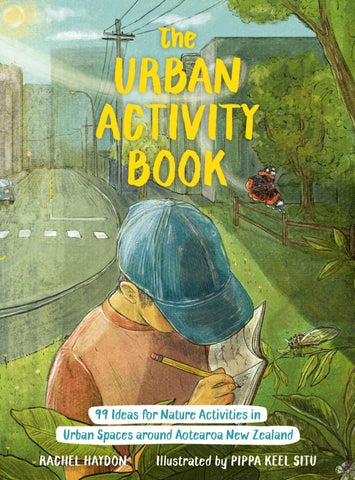
99 Ideas for Nature Activities in
Urban Spaces around Aotearoa New Zealand RACHEL HAYDON Illustrated by PIPPA KEEL SITU
THIS BOOK BELONGS TO HE PUKAPUKA TĒNEI NĀ Ingoa | Name: Tau | Age:
CONTENTS THE URBAN JUNGLE page 11
UNEXPECTED NATURE
PATHWAYS page 67
page 43
CREATE AND PLAY WITH NATURE
RE-WILDING page 119
page 93
Answers
page 147
Finding out more
page 151
Thank you
page 157
MATERIALS
As well as friends and whānau, you’ll need a few things from around the house for some of the activities in this book. Don’t worry if you don’t have everything – just find alternatives that work for you. You may also need an adult to help sometimes, so make sure to ask for help when you need it.
ART & CRAFT
• Label stickers
• Beeswax
• Fine-tip markers or pens
• Scissors
• Felt pens
• Permanent marker pens – coloured and black • Pencil
• Pencil sharpener • Eraser
• Coloured pencils • Crayons
• Hot glue gun (get an adult!) • Duct tape
• Masking tape
• Double-sided tape • Light cardboard
• Wooden popsicle sticks • Beads
• Acrylic paints
• Buttons
• Chalk – new and old stubs of chalk
• Clear contact paper (self-adhesive book covering – or use wide, clear tape)
• Paint brushes
• Thick paper (such as cardstock or watercolour paper)
FROM NATURE
• Fresh kawakawa leaves • Leaves
• Flowers
• Twigs, sticks, branches • Bark • Logs
• Seed pods
• Stones, pebbles, sand, gravel • Feathers • Soil 8
• String or twine
• Hole punch or safety pins
RECYCLED MATERIALS
• Plastic tray or big yoghurt container lid • Plastic bottle (330ml or 500ml) with screw-top lid • Small yoghurt pottle
• Small plastic containers or cans (no lids needed, but make sure the edges aren’t sharp) • Small bottles and jars with lids • Egg cartons • Foil
FROM THE KITCHEN
• Clean glass jars or tins with lids • Metal or glass bowls
• Medium-sized saucepan • Tea towel or oven mitts
• Wooden spoon or spatula • Sieve and muslin cloth • Funnel • Jug
• Muffin tin
• Sweet almond oil or olive oil
• Lavender essential oil, rose water (optional) • Seeds from fresh tomato or chilli (or buy them)
• Dried seeds, nuts
• Dried fruits (raisins, sultanas or currants) • Rolled oats
• White millet • Oranges
• Lard or vegetable shortening
BITS & BOBS
• Old pavers, bricks, corrugated sheet roofing • 8mm bolt and nut
• Thin wire (about 50cm total)
• Electric drill and small drill piece (and the help of an adult!) • Phillips screwdriver
• Small, flat piece of wood (about 30cm long and 5–10cm wide) • Camera or a mobile phone or tablet to take pictures • Binoculars
• Magnifying glass
• Snacks and a drink bottle of water!
FOR YOU, WHEN YOU’RE OUTSIDE
• Clothes you might camouflage yourself in! • Covered shoes or boots • Gumboots
• Insect repellent • Raincoat
• Sunscreen and hat • Warm clothing • Backpack
• Bike, skateboard or scooter, and a helmet 9
10
THE URBAN JUNGLE Becoming more aware of urban nature and engaging with it.
MAKE A MAURI JOURNAL
Find a spot to use for writing your mauri journal. It can be somewhere in nature or in an urban space. You might choose to do this once or repeat it a number of times.
Location
Date & time
What did I see, hear, smell, feel or taste?
List some things you noticed. Think about textures, sounds, movement or colours.
Sight
Sound Smell
Touch
Taste (if safe!)
What felt alive to me?
Write down a moment – such as a bird flying past, a plant reaching toward the sun, a bug crawling in the soil, or water flowing in a stream.
Now describe and then draw that moment as it made you feel.
How did that moment connect to mauri? Describe it, asking yourself these questions:
• Was there energy, movement or stillness? • Was there a sense of balance or care? • How did it make me feel inside?
Draw your mauri feeling. Use colours, shapes, squiggles, lines or whatever you think represents your feeling.
31
MINI ADVENTURES
Plan a mini adventure for you, your friends and family. You might even challenge people to do one each, so come up with a few different ideas that you can do. Think about:
• Where do you want to go?
• How will you get there? (Drive, walk, bike, scooter)
• What will you need? (Type of food, type of clothing, any money, etc.)
• Do you need anything special? (Binoculars, torch, hiking boots, snorkels) Think about the different types of adventures you might be able to have, who you’ll be with and what they might like. Your mini adventure might fit into one of these categories: • ‘Active’ adventure – based on an activity such as hiking or biking
• ‘Relaxing’ adventure – going somewhere relaxing, such as a beach or a hot pool • ‘History’ adventure – going somewhere a historic event took place
• ‘Movie’ adventure – going somewhere a movie or show was filmed Ideas for mini adventures:
78
DIVERSITY SEARCH
Decide on something you want to ‘follow’ to create a route. For example, following from tree to tree, or flower to flower, or something yellow to something yellow. Decide how long you plan to walk for (for example, fifteen minutes) and the distance you’re happy to walk (for example, a kilometre). Before you start your walk, guess how many of that thing you might see. During your walk, take note of how many different kinds of that thing you actually follow or pass. Was your guess bigger or smaller than what you ended up finding? Look at all the diversity around you – it’s more than you’d expect!
79
92
CREATE AND PLAY WITH NATURE
Arts, crafts and imaginative activities in urban nature.
LEAF ANIMALS
Collect different types of fallen leaves in various shapes, colours and sizes. Use them to create animal shapes or even invent new creatures. Leaves can be used to represent feathers or scales, so try making a leafy kiwi, a leafy fish or another type of creature. If you’re out and about, leave them for other people to find.
98
MASKING-TAPE JEWELLERY CROWNS OR BRACELETS
Wrap some masking tape, sticky side out, loosely around your wrist. Go on a walk and collect items that represent the nature you find around you to stick to your bracelet. Keep them small and simple – larger items won’t stick and will fall off easily. Feeling adventurous? Make masking-tape headbands or crowns (sticky side out, remember) and place them around your head and the head of a friend or family member – be careful not to get your hair stuck to them. Then add items to each other’s to make your creations. Love what you created? Stick your bracelet or headband in your book.
Stick here
99
DOUBLE OBSTACLE COURSE
Create a fun obstacle course to do alongside a friend or family member so that you can race side by side. You could use rocks for stepping stones, sticks or logs that you use to cross ‘lava’, low branches or bushes to crawl under or between, and pinecones to throw at a target before you can proceed! You don’t necessarily need to create obstacles – instead you could find existing ones together and then race. For example, walk along a low fence, jump the cracks in a pavement or over puddles, hop only on the grey tiles, or move only on grassy edges.
108
EGG CARTON COLLECTION
Take an egg carton. This can be for six or more eggs. Collect treasures in each dimple. The egg carton allows you to collect and keep objects safe, and makes a lovely treasure box. (Parents – it also helps to restrict the number and size if your house is overrun by collected treasures, as ours is sometimes!)
What made you select each treasure – what got your attention? Are your treasures connected in some way – for example, are they all smooth, are they all rocks, are they all from plants? 109
WHĀNAU TREE MOBILES
Create a beautiful mobile where each branch represents a family member, decorated with items from nature.
YOU WILL NEED:
• Twigs or small branches – one for each whānau member
• A strong branch or stick – for the base of the mobile • Nature finds – feathers, leaves, seed pods, shells, petals, bark curls, moss • Scissors
• String, yarn or twine • Glue
• Name tags and pens
• Extra decoration materials (optional) – beads, paint, cardboard tags, crayons
114
INSTRUCTIONS:
1. Head outside and collect twigs or thin branches – look for ones that are sturdy but light. Choose one branch to represent each whānau member you want to include in your mobile. Find one strong larger stick for your base.
2. Now collect your decorations. Gather different colours and textures: feathers, colourful leaves, seed pods, small stones or even urban moss. Sort them by colour, texture or even their ‘energy’ (for example, calm, bold, sparkly). 3. Design each whānau branch – decorate each branch with the nature finds that remind you of that person. Use string to tie on feathers and glue for petals, seed pods and other small items. Write each whānau member’s name on a tag and attach it to their branch. Think about why you chose those things – ‘I chose a yellow leaf for Nana because she’s warm and sunny.’ 4. Assemble your mobile by tying all the whānau branches to your larger stick base so they hang down from it. Or you might want to cluster them vertically like a tree. Make sure the mobile is balanced and secure.
5. Hang your mobile from a tree, hook or fence post. Reflect and celebrate together – you might want to share the stories behind each branch with your family members.
URBAN NATURE COLLAGE
Create a beautiful collage that shows the wonder of nature and what people have created side by side.
YOU WILL NEED:
INSTRUCTIONS:
• A sheet of sturdy paper or cardboard (you can use a piece of recycled paper or cut a sheet from a cardboard box)
1. Split your sheet in half and label one side ‘Nature’, the other ‘Human-made’.
• Natural items: leaves, twigs, feathers, stones, petals, bark, etc.
3. Sort your finds into groups. Which ones came from the natural world – from the ngahere (forest), the sky or the earth? Which ones were shaped or made by people or machines?
• Pen or pencil
• Human-made items: plastic bits, paper scraps, cardboard, foil, buttons, string, etc. • Glue or doublesided tape
2. Explore your surroundings, collecting small items from both groups. Try to collect fallen leaves, twigs, bark and flower petals rather than picking living ones. And be very careful if picking up litter you want to use – make sure it’s safe and not too mucky. You can use things you’ve collected at home too.
4. Now create your collage by placing each item on its side of the sheet and fixing it with glue or tape. Arrange by colour, shape or texture if you like. 5. Look at what you have created and consider: • Which side has more textures?
• Are there items that seem to belong on both sides?
• What might your collage say about where you live?
115
SET UP A SKINK SANCTUARY
New Zealand is home to at least 75 species of native skink. Skinks are small lizards that have smooth, shiny scales, short legs and a long body (they often appear to move a bit like snakes). They have no obvious ‘neck’ (their neck sort of blends right into their head and body) and many can drop their tails to escape danger (and grow them back later). You might be lucky to live near skinks. Check out some different kinds of skinks and where they live at the Department of Conservation website: doc.govt.nz/nature/ native-animals/reptiles-and-frogs/lizards/skinks/
Create a skink-friendly garden by:
• Adding logs, rock piles, old bricks or pavers and even small pieces of old corrugated sheet roofing. These help create cosy spots where skinks can stay warm or cool as needed (skinks are reptiles and are cold-blooded, so they need outside sources of heat to warm their bodies) and where they can rest and hide from predators. • Avoiding the use of chemicals and pesticides in your gardens at home – these can harm skinks’ natural food supply of insects.
• Growing plants in pots on your windowsill, on a balcony or in your garden that attract bugs or grow small fruits – both are food sources for skinks.
122
Plant
Benefit for skinks
• Coprosma species (e.g. Coprosma propinqua, Coprosma crassifolia)
• Berries for food, dense cover for hiding
• Muehlenbeckia species (e.g. Muehlenbeckia complexa, Muehlenbeckia astonii)
• Scrambling vines attract insects and offer shelter
• Māhoe porcupine shrub (Melicytus alpinus)
• Berries and great hiding spots
• Gaultheria species (e.g. Gaultheria antipoda, Gaultheria crassa)
• Small berries and insectattracting flowers
• Mānuka and kānuka (Leptospermum scoparium, Kunzea ericoides)
• Nectar attracts insects, dense leaves for cover
• Harakeke (Phormium tenax)
• Wī or haumata (tussocks, for example, Chionochloa rubra, Festuca novaezelandiae, Poa cita)
• Shelter, nesting material and insect habitat
123
The Urban Activity Book: 99 Ideas for Nature Activities in Urban Spaces around Aotearoa New Zealand RRP: $35 ISBN: 978-1-99-107210-8 PUBLISHED: October 2026 PAGE EXTENT: 160 pages FORMAT: Limpbound SIZE: 270 x 200 mm
FOR MORE INFORMATION OR TO ORDER https://www.tepapa.govt.nz/about/te-papa-press/the-urbanactivity-book-99-ideas-for-nature-activities-in-urban-spacesaround-aot