16mm
is packed with activities to encourage children to see, think and draw like artists. They can solve an art mystery, make a lei, design a treasure box, create a flying sculpture . . . it’s full of fun, creative challenges. FEATURING: • 50 artworks from Te Papa’s collection • 15 artworks gifted especially for this book by New Zealand artists: Darryn George | Sara Hughes | Kerry Ann Lee | Seung Yul Oh | Séraphine Pick | Martin Poppelwell | John Pule | Ian Scott | Tiffany Singh | Sopolemalama Filipe Tohi | Francis Upritchard | Lisa Walker | John Walsh | Rohan Wealleans | Wayne Youle • Guided explorations of colours, shapes and different art styles and techniques • More than 100 inspiring activities to suit all ages and abilities, from simple colouring-in to making a print and sewing a tīvaevae.
So switch off those screens and get out the paints! The New Zealand Art Activity Book will provide hours of fun with art and is guaranteed to get those creative ideas flowing.
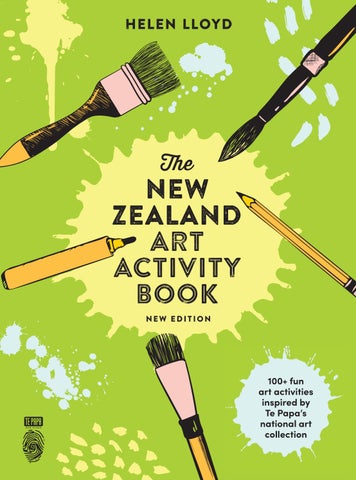
The NEW ZEALAND ART ACTIVITY BOOK
THE NEW ZEALAND ART ACTIVITY BOOK
NEW EDITION
ISBN 978-0-9941362-3-7
CMYK: 270mm x 200mm
HELEN LLOYD
The
NEW ZEALAND ART ACTIVITY BOOK N E W E D I TI O N
100+ fun art activities inspired by Te Papa’s national art collection
9 780994 136237 www.tepapapress.co.nz
ArtActivityBook_CVR_FULL.indd 1
12/07/17 1:57 PM
Hide and seek
Imposters
Lookout 1 by Tony de Lautour
Colour this New Zealand scene and add some creatures you would not expect to find there.
Tony was born in Melbourne and has lived in Christchurch most of his life. His art is quirky and full of dark humour.
Are your creatures friendly or scary?
This painting might look like a typical New Zealand landscape but there are exotic creatures running wild and hiding in the grass and trees that don’t belong there. Can you spot them? How many creatures can you count?
10
AAB_TXT_FINAL.indd 10-11
11
17/07/17 6:39 PM
Painted urn
Your own legend
Attic volute crater, 1779, depicting scenes from the odyssey of Captain Cook by Marian Maguire
Draw scenes from a story that you have read on this Grecian-style urn. Place different parts of the story on different levels.
Marian was born in Christchurch and studied printmaking in New Zealand and America. In this print of a Grecian-style urn, she has mixed drawings of Greek, Māori and Pākehā people and objects to tell a story involving the British explorer Captain James Cook and the Tahitian priest and navigator Tupaia.
Show your picture to a friend. Can they work out what is happening in the story?
Can you spot Captain Cook and Tupaia? Find these things:
□ harakeke | flax □ koruru | carved Māori head □ punga | anchor □ kurī | dog □ manaia | mythical Māori creature □ ponga | silver tree fern What else can you see?
□□ □□ □□ □□ □□
The style of this print is inspired by Grecian art. Ancient Greek artists decorated urns like this one to tell stories of their gods and heroes. They drew characters in profile (from one side) and as silhouettes (solid dark shapes).
12
AAB_TXT_FINAL.indd 12-13
13
17/07/17 6:39 PM
Layered Painting
Cliff face
Back bone by Shane Cotton
Look at the pattern and texture in this rocky surface. Use your imagination to see a picture in it.
Shane was born in Upper Hutt and belongs to the Ngāpuhi and Ngāti Hine iwi. Look closely at his painting. Can you see these layers:
□□smooth, blurred grey paint, which looks like sky □□rugged, textured black and white paint, which looks like rock □□finely-painted, floating red, black and white lines and shapes, which look
Draw onto the rock using layers of different materials. You could try chalk, crayon, pen, pencil or paint.
like symbols
□□red spray paint, which looks like graffiti.
Can you see a falling manu or bird? Why do you think Shane called this painting ‘Back bone’?
48
AAB_TXT_FINAL.indd 48-49
49
17/07/17 6:40 PM
60
AAB_TXT_FINAL.indd 60-61
61
17/07/17 6:40 PM
60
AAB_TXT_FINAL.indd 60-61
61
17/07/17 6:40 PM
Spiralling Shapes
Colour-by-numbers
Camowhaiwhai by Andrew McLeod
The shapes in this picture are different types of koru or spiral motifs, like those found in kōwhaiwhai patterns. In Māori art, koru can represent new life or growth.
Andrew is from Rotorua and now lives in Auckland. He made this painting in the style of a colour-by-numbers picture. He used four different colours. What do the colours remind you of?
Colour the numbered shapes using four colours. Colour the key below first to help you remember which colours to use for which number. 1.
2.
3.
4.
Add some more koru to this pattern. Label your koru with numbers one to four and colour them in following your key.
98
AAB_TXT_FINAL.indd 98-99
99
17/07/17 6:40 PM
My art collection #11 OMG, what are they saying? by John Walsh
110
AAB_TXT_FINAL.indd 110-111
111
17/07/17 6:40 PM
My art collection #11 OMG, what are they saying? by John Walsh
110
AAB_TXT_FINAL.indd 110-111
111
17/07/17 6:40 PM
A Comet Cloth
Rub, rub, rub
Ngatu (Tongan bark cloth) Ngatu is the word for bark cloth in Tonga. It is made from the bark of the paper mulberry tree. A ngatu is a valuable treasure that is used at special occasions, such as weddings and funerals, and handed down from generation to generation.
Patterns on a ngatu are made by rubbing over a pattern board. Use textured objects or your own pattern board to make a picture. You will also need crayons or pencils. You could try using coins, leaves, keys, wood grain and woven fabric, or you could make your own pattern board using matchsticks or toothpicks glued in a pattern onto cardboard.
This old and precious ngatu records an important historical event – the appearance of Halley’s Comet over Pacific skies in 1910. Can you spot these shapes?
Place your objects or pattern board under this page. Rub over the page with the side of a crayon or pencil to reveal the texture of the object beneath.
□ fetu‘u | star □ Halley’s Comet □ māhina | moon
To make ngatu, first the bark of the paper mulberry tree is soaked in water, then beaten to stretch and flatten it. Lots of beaten pieces are hung up to dry then joined together with tapioca or cassava glue. To decorate the cloth, kupesi pattern boards are placed underneath it and coloured dye is rubbed over it, leaving an impression of the pattern on the cloth. The patterns are outlined again to make sure the dye doesn’t fade.
134
AAB_TXT_FINAL.indd 134-135
135
17/07/17 6:41 PM
Mesmerising
Zigzag
Natural by Reuben Paterson
Complete this picture to make a dazzling pattern. Draw diagonal straight lines in different directions crossing over each other.
Reuben’s family are Ngāi Tūhoe, Ngāti Rangitihi and Scottish, and he lives in Auckland. Look at the large black whetū or star in the middle of this painting. Reuben made this picture using ngā porotaka or circles and lots of diagonal straight lines in different directions. It is hard to see here but he also used glitter and diamond dust to make the surface of the painting sparkle.
Use a ruler to keep your lines straight. Which two colours will you use? You could add a fine layer of glitter to your picture to make it sparkle!
Every alternate shape is painted pango or black and mā or white. The lines and colours make some parts of the drawing look as if they are poking in and other parts poking out. How do your eyes feel when you look at it?
The style of this painting is similar to op art. Op art includes optical illusions or tricks for your eyes. Op art patterns are often black and white and can make the page look as if it’s moving – either poking in or out, waving or flashing.
146
AAB_TXT_FINAL.indd 146-147
147
17/07/17 6:41 PM