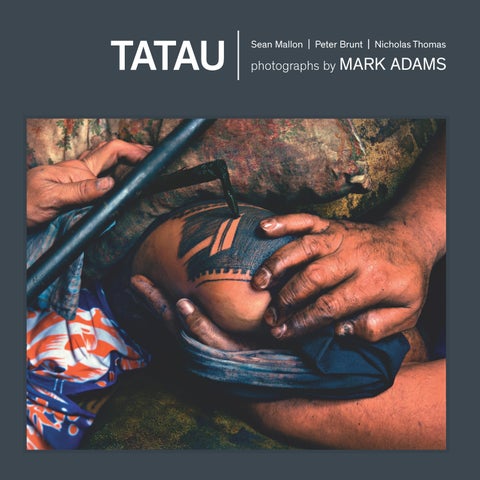
TATAU
TPP1204_Tatau_Mark_Adams_text_AW.indd 1
Samoan Tattoo New Zealand Art Global Culture
13/12/22 3:29 PM
SEAN MALLON
TPP1204_Tatau_Mark_Adams_text_AW.indd 2
PETER BRUNT
NICHOLAS THOMAS
13/12/22 3:29 PM
TATAU
TPP1204_Tatau_Mark_Adams_text_AW.indd 3
PHOTOGRAPHS BY MARK ADAMS
13/12/22 3:29 PM
TPP1204_Tatau_Mark_Adams_text_AW.indd 4
13/12/22 3:29 PM
Contents
Foreword to the Second Edition
7
Preface
11
Samoan Tattooing, Cosmopolitans, Global Culture
15
Sean Mallon The Portrait, the Pe‘a and the Room
41
Peter Brunt ‘A Living Art’
63
A conversation between Su‘a Sulu‘ape Paulo II and Sean Mallon ‘An Uncomfortable Edge’
75
A conversation between Mark Adams and Nicholas Thomas
TPP1204_Tatau_Mark_Adams_text_AW.indd 5
Plates
85
Epilogue to the Second Edition
291
Notes
297
Selected Bibliography
301
Acknowledgements
303
About the Authors
305
13/12/22 3:29 PM
TPP1204_Tatau_Mark_Adams_text_AW.indd 6
13/12/22 3:29 PM
Foreword to the Second Edition
Recognition of the importance of Samoan tatau as art, as heritage and as an innovative, bordercrossing expression of cultural identity has only grown since Tatau: Samoan Tattoo | New Zealand Art | Global Culture was first published in 2010. Mark Adams’s remarkable body of photographic art, dedicated to documenting the practice of tatau across decades and hemispheres, has equally been recognised as being well ahead of its time, in particular for its implicit critique of photography of the ethnographic ‘other’. This new edition makes a full representation and contextualisation of his tatau photography since 1978 accessible again. It adds a suite of images taken of John Dunn, a New Zealander of Cook Island descent, who received his pe‘a from tufuga Su‘a Sega‘ula Fuiavailili Lawrence Ah Ching in 2014, and it extends the seemingly endless story of tatau’s travels beyond Sāmoa. Mark Adams met Su‘a Sulu‘ape Paulo II in 1978 and began creating the body of work published here. In the late 1990s, aware that Paulo had begun attending and working at European tattoo conventions, Mark and I began to think about a project that might address tatau in the northern hemisphere context, adopting a similar approach to his Auckland photography. We found modest funding and were able to get started in November 2000 with a short trip to the Netherlands, where we visited and photographed one of Paulo’s closest European associates, Michel Thieme, and Henk Schiffmacher, who ran a well-known Amsterdam tattoo museum. Given the keen interest of our Aotearoa friends and colleagues, including curator and anthropologist Sean Mallon at the Museum of New Zealand Te Papa Tongarewa and art historian Peter Brunt at Victoria University of Wellington Te Herenga Waka, there seemed to be an opportunity to seek a larger-scale research grant that would enable us to undertake work on the history of tatau across the Pacific, and on contemporary tatau practice, among diasporas and across the international body-art scene, where Paulo, his relatives and other Pacific practitioners of tatau were becoming celebrities. We hoped to win funding that would enable an inclusive project, as well as further photographic work and a major exhibition that would represent Mark’s body of work much more fully than his participation in various thematic or survey shows had done to date.
7
TPP1204_Tatau_Mark_Adams_text_AW.indd 7
13/12/22 3:29 PM
TPP1204_Tatau_Mark_Adams_text_AW.indd 40
13/12/22 3:29 PM
The Portrait, the Pe‘a and the Room Peter Brunt
Two views, front and back. A man tattooed with a Samoan pe‘a stands alone in the centre of his living room in a low-cost house in suburban Auckland. The room is simply decorated with family photographs draped with shell and plastic necklaces on the walls, colourful bed sheets on the sofas and mats on the floor. The man wears a red-painted pandanus lei around his neck – an item of formal Samoan attire (which is to say he has ‘dressed up’ for the occasion) – and proudly shows off his pe‘a to those interchangeable entities: the photographer, camera and viewer. The title of the work gives the date and place the photograph was taken, the man’s name and the name of his tattooist: 30.6.1985. Chalfont Crescent, Māngere, south Auckland. Jim Taofinu‘u. Tufuga tātatau: Su‘a Sulu‘ape Paulo II (see plates 70 and 71). Such is the basic formula for Mark Adams’s remarkable portrait series within his larger photofile on Samoan tatau: a man with a pe‘a in a room confronting the photographer, camera and viewer. Sometimes the man portrayed is alone; sometimes he is with others: friends, spouse, family members, the tattooist and his helpers. The nature of the rooms varies, reflecting different individual social and cultural backgrounds, but usually they are domestic interiors (lounges, bedrooms, garages), or personally significant spaces (a dealer in his gallery, a tattooist in his tattoo parlour, a priest in his small country church). Otherwise, the basic scenario is constant. Beside the portraits, the other main subject in the series is the scene of tattooing itself – photograph after photograph of individuals undergoing the ordeal, primarily in domestic settings.1 They might be seen as contemporary ‘genre pictures’, a category of image from the history of Western painting depicting events in the lives of ordinary people and often set in homely interiors. There are exceptions to the trope of the intimate interior in Adams’s complete ‘Tatau’ series, including photographs of tattoo conventions, Samoan village ceremonies, hotel swimming pools and industrial factories. Nonetheless, the room is a predominant motif, on which I focus in this essay. What is it about this scene – tattooed man in a room – that is so compelling in Adams’s work? Is it just a voyeuristic fascination with bodies in private spaces, made alluringly real by the photographic medium’s power of illusion? Is it the striking design of the pe‘a, with its intricate lines and patterns that wrap intimate parts of the body? Or is it our instinctive interest in the
41
TPP1204_Tatau_Mark_Adams_text_AW.indd 41
13/12/22 3:29 PM
above: 1971. Portrait of Tony Fomison at Beveridge Street, Christchurch above right: 1972. Portrait of Tony Fomison at Tai Tapu, Banks Peninsula
TPP1204_Tatau_Mark_Adams_text_AW.indd 44
13/12/22 3:29 PM
above: 18.3.1978. The stairwell, Gunson Street, Freemans Bay, Auckland Courtesy of Auckland Art Gallery Toi o Tāmaki above right: 18.3.1978. The parlour, Gunson Street, Freemans Bay, Auckland right: 12.2.1990. The bedroom, Williamson Avenue, Grey Lynn, Auckland
TPP1204_Tatau_Mark_Adams_text_AW.indd 45
13/12/22 3:29 PM
TPP1204_Tatau_Mark_Adams_text_AW.indd 62
13/12/22 3:30 PM
‘A Living Art’ A conversation between Su‘a Sulu‘ape Paulo II and Sean Mallon March 1999
SM Can you tell us about where you were born and who your parents were? PS I was born in a little village, a very remote village in the district of Lefaga called Matafa‘a. My mother is Me‘eta‘a and my father is Sulu‘ape the first. SM What are your earliest memories of growing up? PS Well, I remember when I was really young, my parents were travelling to Palauli in Savai‘i to tattoo some people and we were there for maybe two, three or four months. These are just vague memories. Another village I remember was Satapuala, near the airport. My father would travel for any length of time to tattoo people around the islands and they would take me. Well, I was a baby and they would have to take me . . . so when they come back home we just carry on and live like a Samoan family. SM Did you go to school in your village or did you go to Apia? PS I started school in my village at Falease‘ela, which is part of where I was born, but is about 500 metres across the sea, across the bay. So we had to row a canoe across to go to school and come back. When you catch the bus to go to Apia you have to go the same way. After that I spent a year at intermediate school at Lefaga, and then I was fortunate to pass the entrance exam to Chanel College, which was a [Catholic] boarding school in town – behind Apia.
Su‘a Sulu‘ape Paulo I From a photographic print in the Sulu‘ape family collection
63
TPP1204_Tatau_Mark_Adams_text_AW.indd 63
13/12/22 3:30 PM
Plate 1 2.4.1978. Grey Lynn, Auckland Mr Salati Fiu Tufuga tātatau: Fa‘alavelave Petelo
TPP1204_Tatau_Mark_Adams_text_AW.indd 88
13/12/22 3:30 PM
TPP1204_Tatau_Mark_Adams_text_AW.indd 89
13/12/22 3:30 PM
Plate 2 5.8.1978. Chalfont Crescent, Māngere, south Auckland Epifania and Su‘a Sulu‘ape Paulo II and Paulo’s first child, Va‘a
TPP1204_Tatau_Mark_Adams_text_AW.indd 90
13/12/22 3:30 PM
TPP1204_Tatau_Mark_Adams_text_AW.indd 91
13/12/22 3:30 PM
Plate 3 30.3.1979. Chalfont Crescent, Māngere, south Auckland Painting of the crucifixion (unfinished) by Su‘a Sulu‘ape Paulo II
TPP1204_Tatau_Mark_Adams_text_AW.indd 92
13/12/22 3:30 PM
TPP1204_Tatau_Mark_Adams_text_AW.indd 93
13/12/22 3:30 PM
Plate 13 7.10.1978. Triangle Road, Massey, west Auckland Afa, a wrestler Tufuga tātatau: Su‘a Sulu‘ape Paulo II
TPP1204_Tatau_Mark_Adams_text_AW.indd 112
13/12/22 3:30 PM
TPP1204_Tatau_Mark_Adams_text_AW.indd 113
13/12/22 3:30 PM
Plate 14 7.10.1978. Triangle Road, Massey, west Auckland Tattooing Tom Ah Fook, Arona and Leo Maselino (solo) Tufuga tātatau: Su‘a Sulu‘ape Paulo II
TPP1204_Tatau_Mark_Adams_text_AW.indd 114
13/12/22 3:30 PM
TPP1204_Tatau_Mark_Adams_text_AW.indd 115
13/12/22 3:30 PM
-
PRESS TATAU: SAMOAN TATTOO, NEW ZEAL AND ART, GL OBAL CULTURE Sean Mallon, Nicholas Thomas and Peter Brunt RRP: $75 ISBN: 978-1-99-115098-1 PUBLISHED: May 2023 PAGE EXTENT: 308 pages FORMAT: Hardback SIZE: 290 x 290 mm